

India flag video
India flag picture

| Nickname | तिरंगा — Tiraṅgā, “the Tricolor” |
|---|---|
| Designers | Pingali Venkayya (Swaraj flag) Surayya Tyabji (1947 design) |
| Adopted | 22 July 1947 |
| Flag day | 22 July (anniversary of the 1947 adoption) |
| Proportion | 3 : 2 |
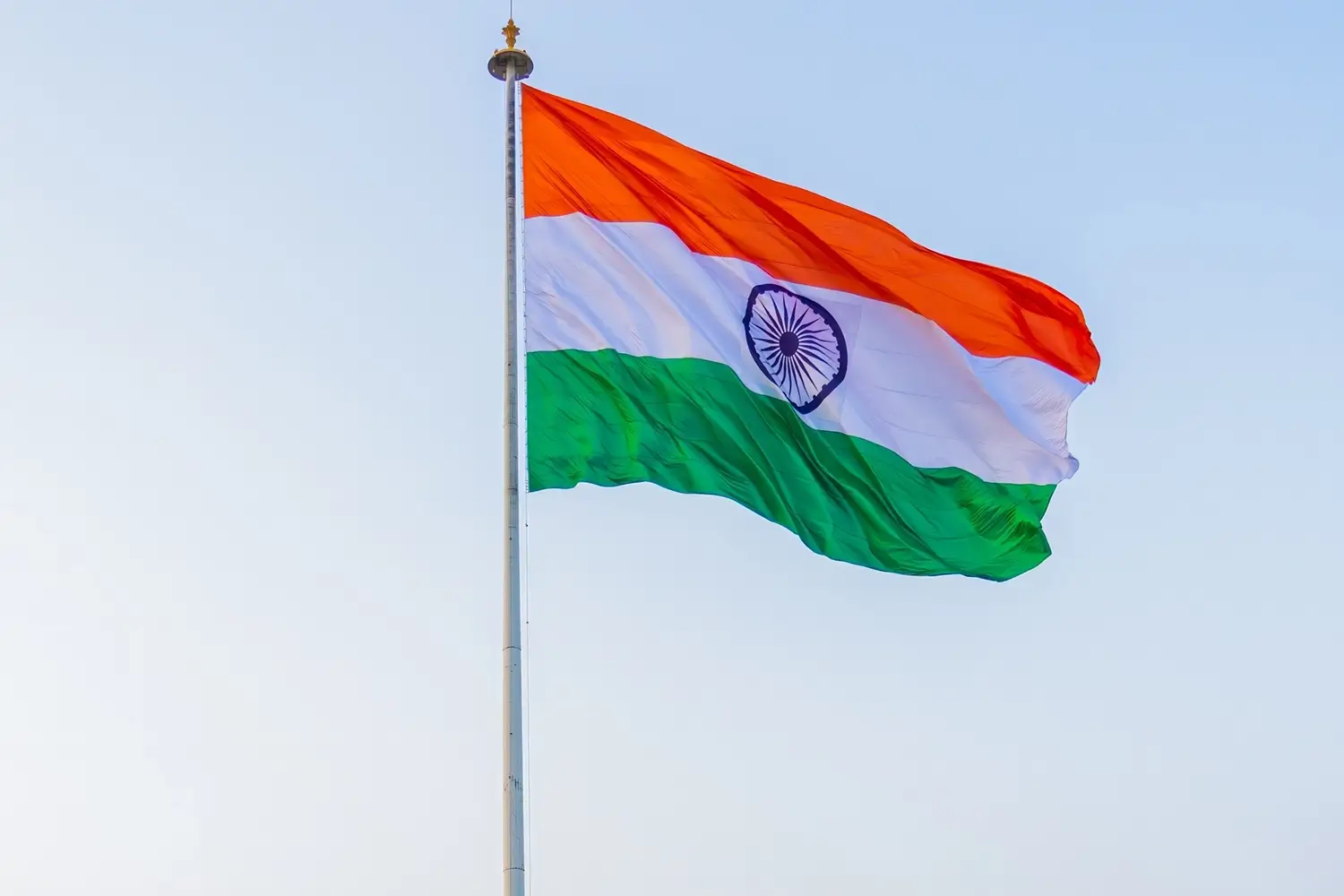
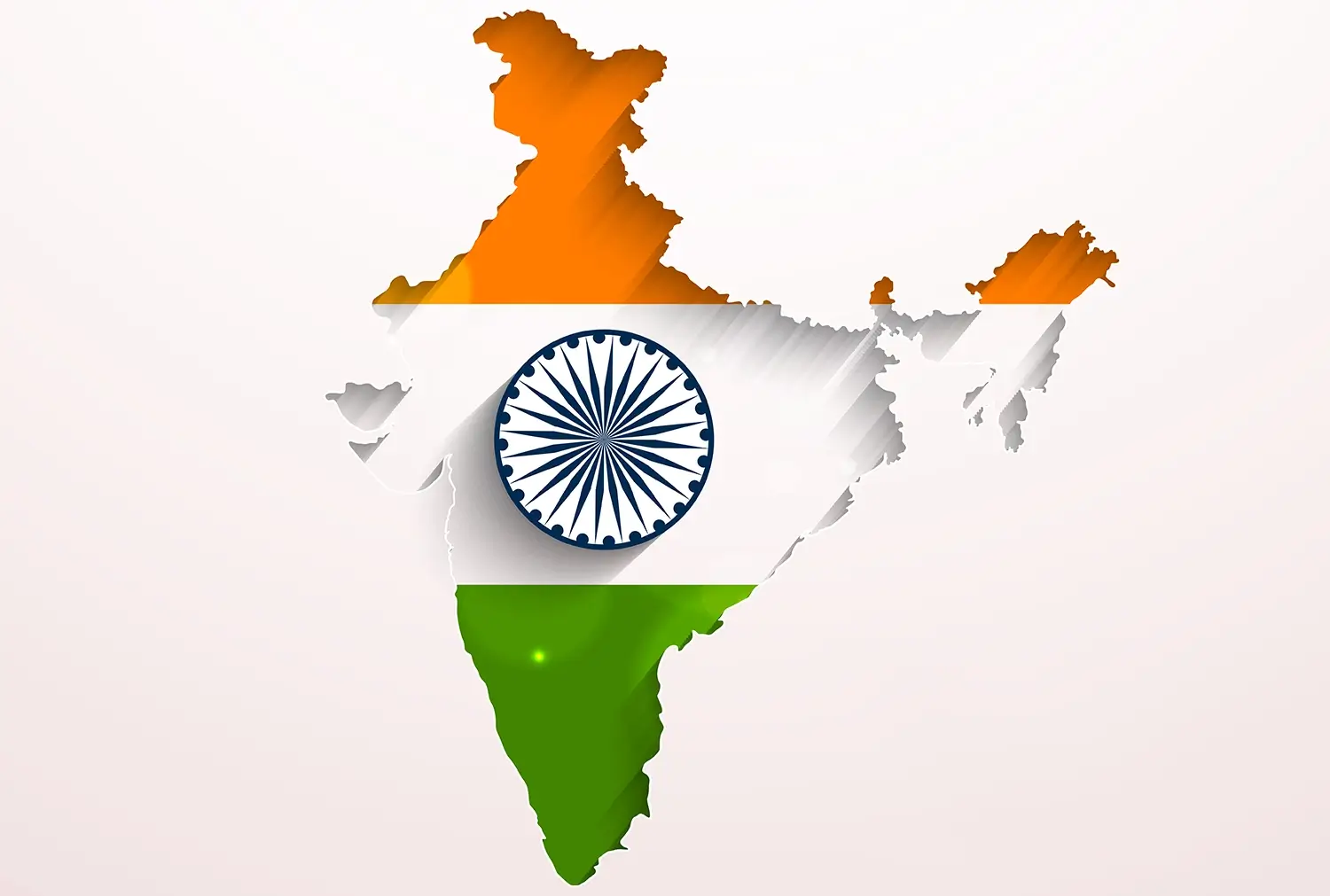
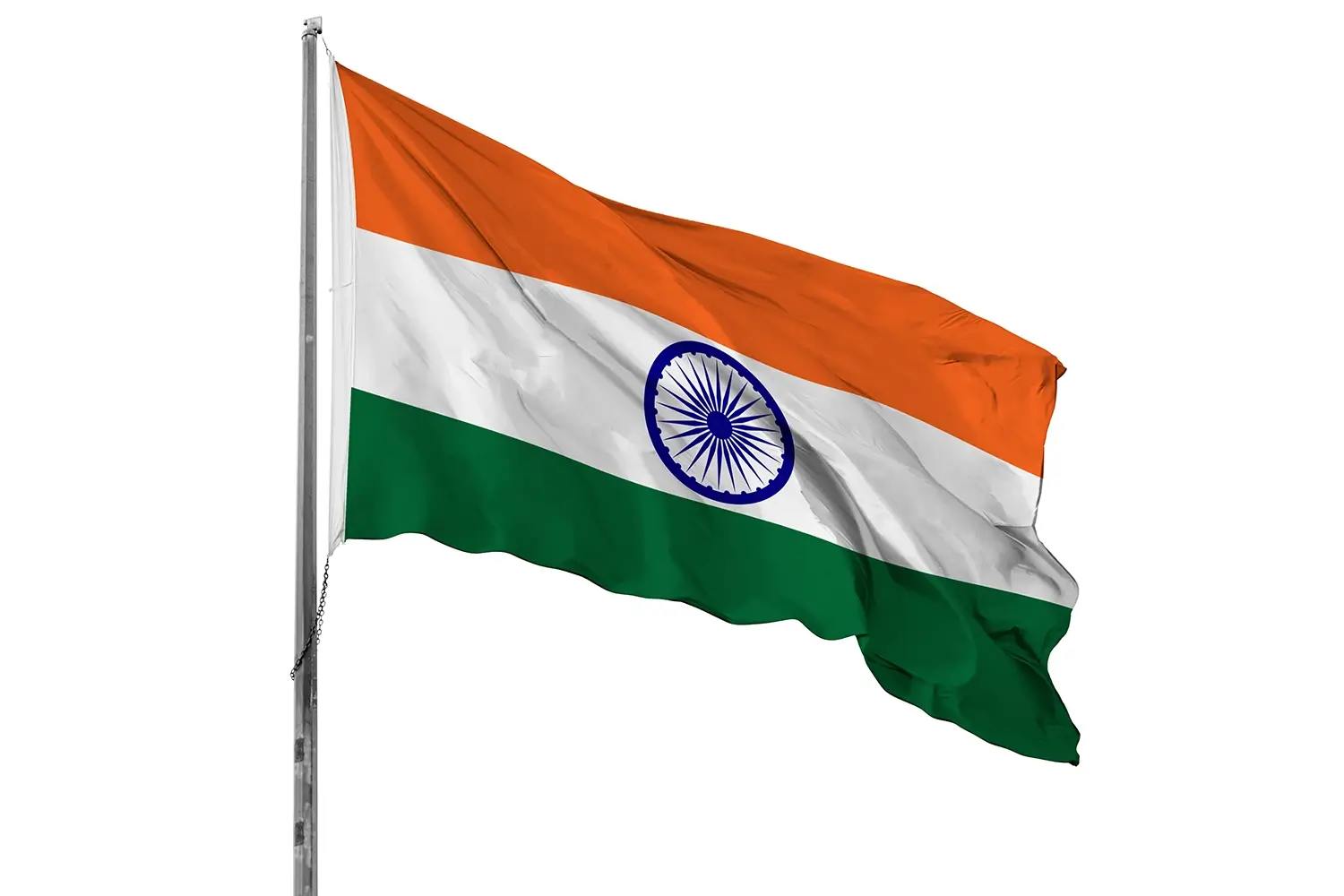
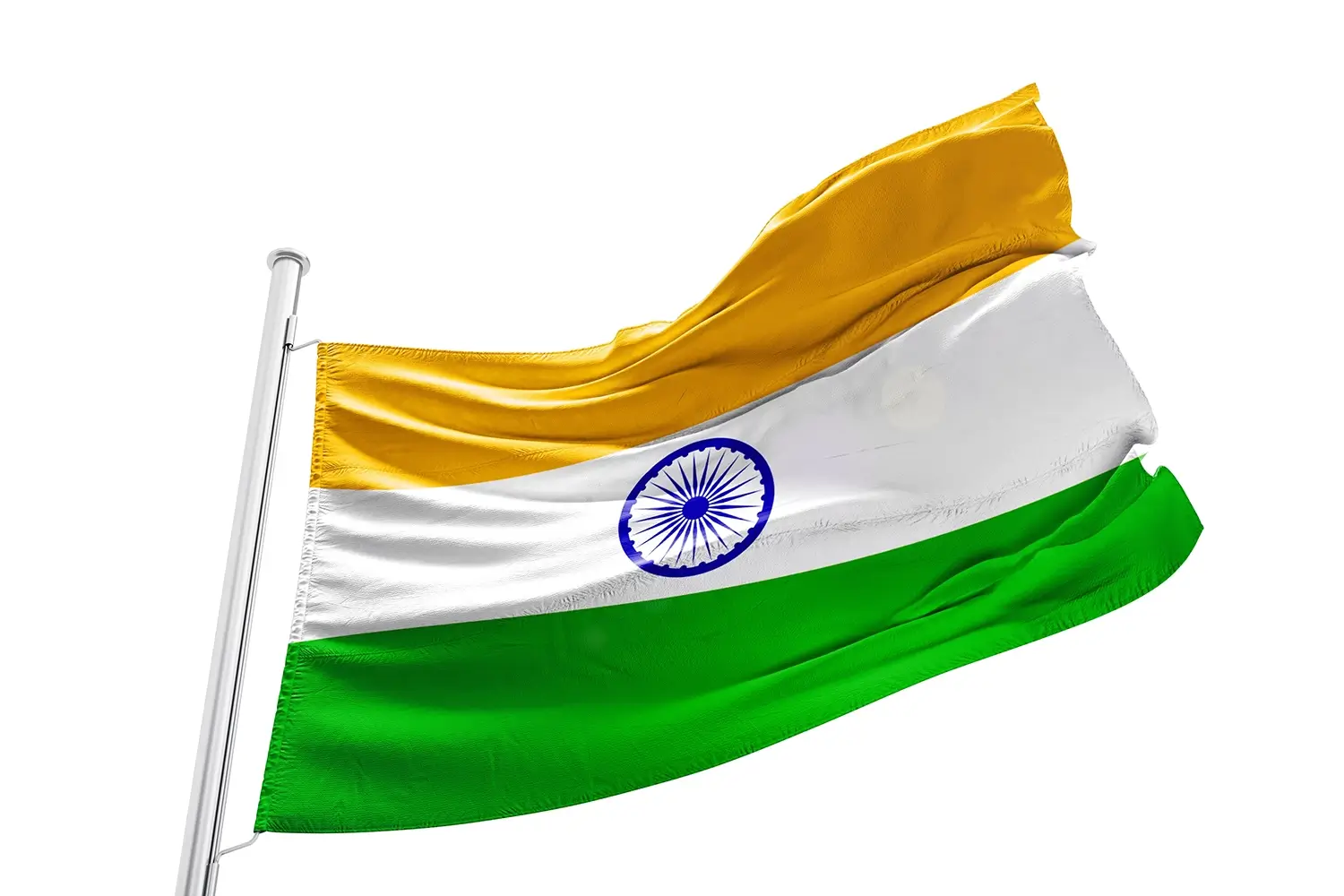
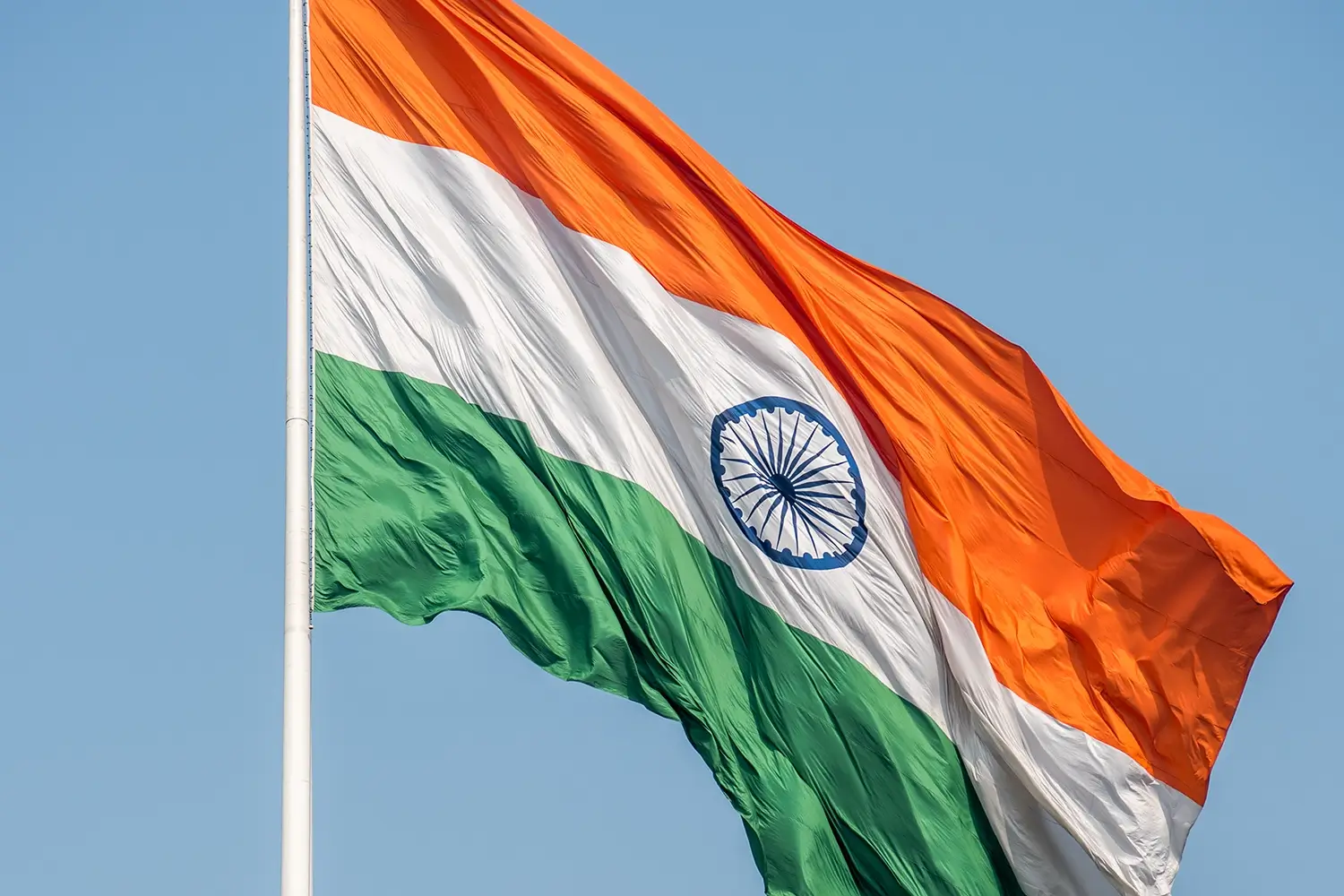
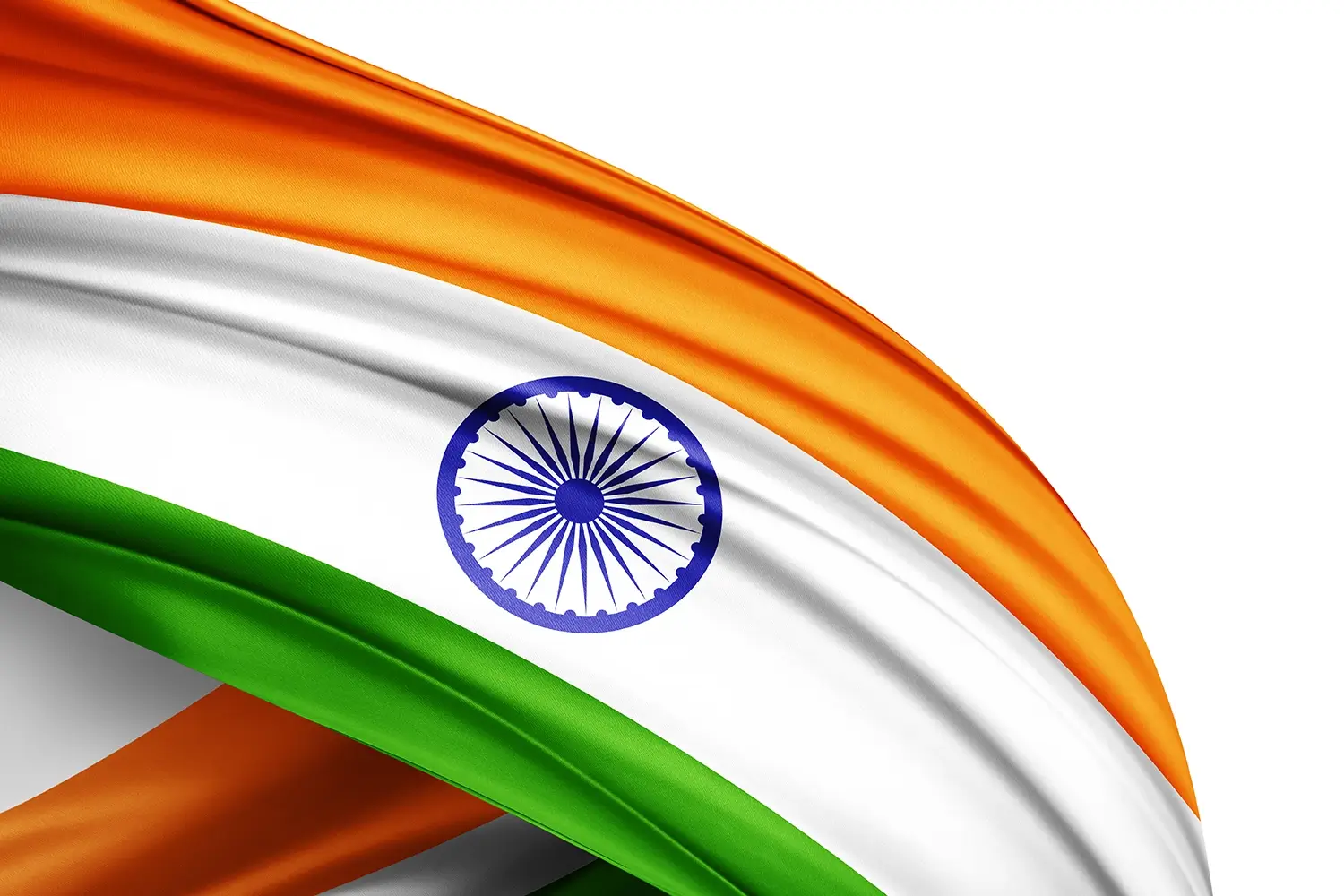
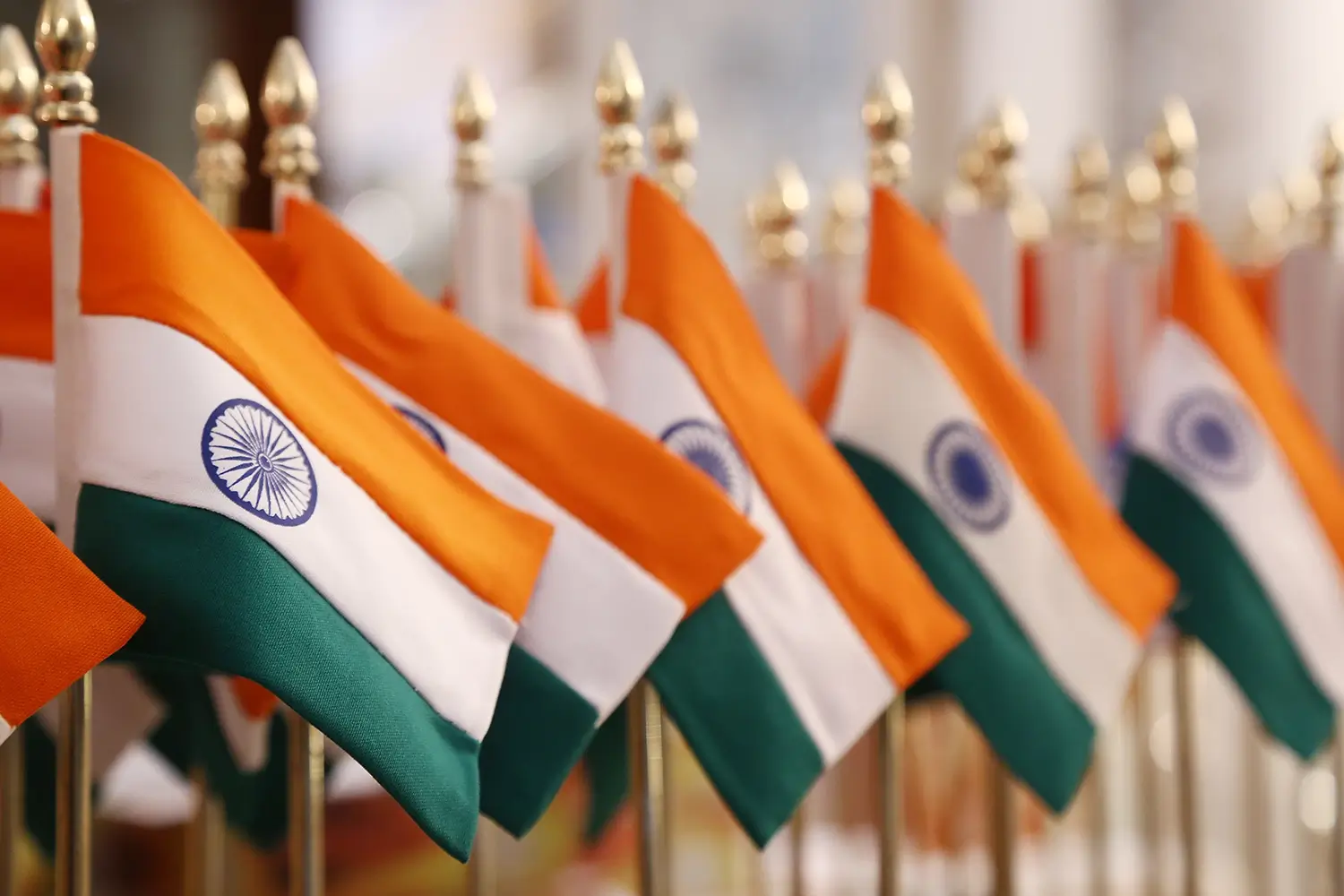
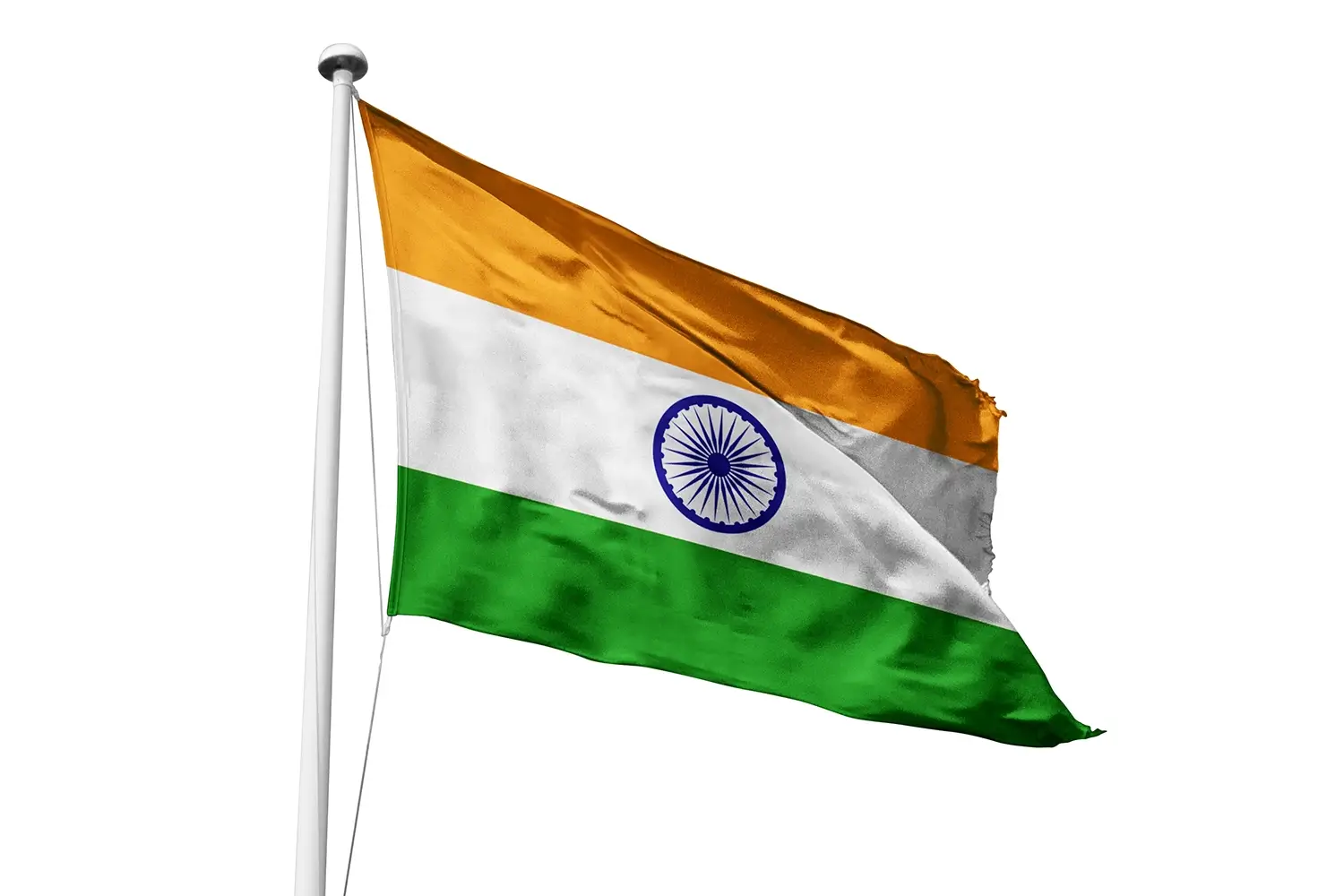
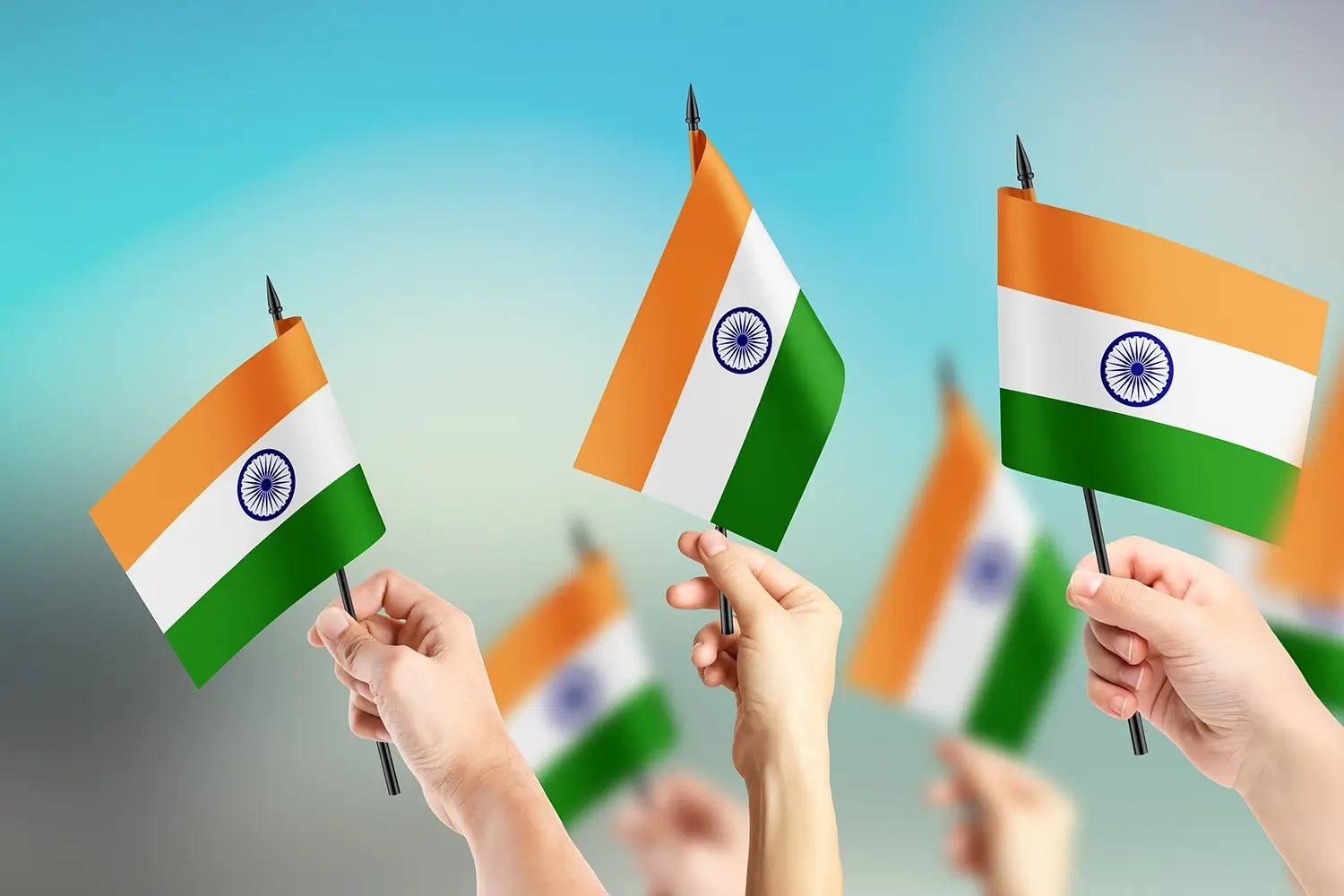
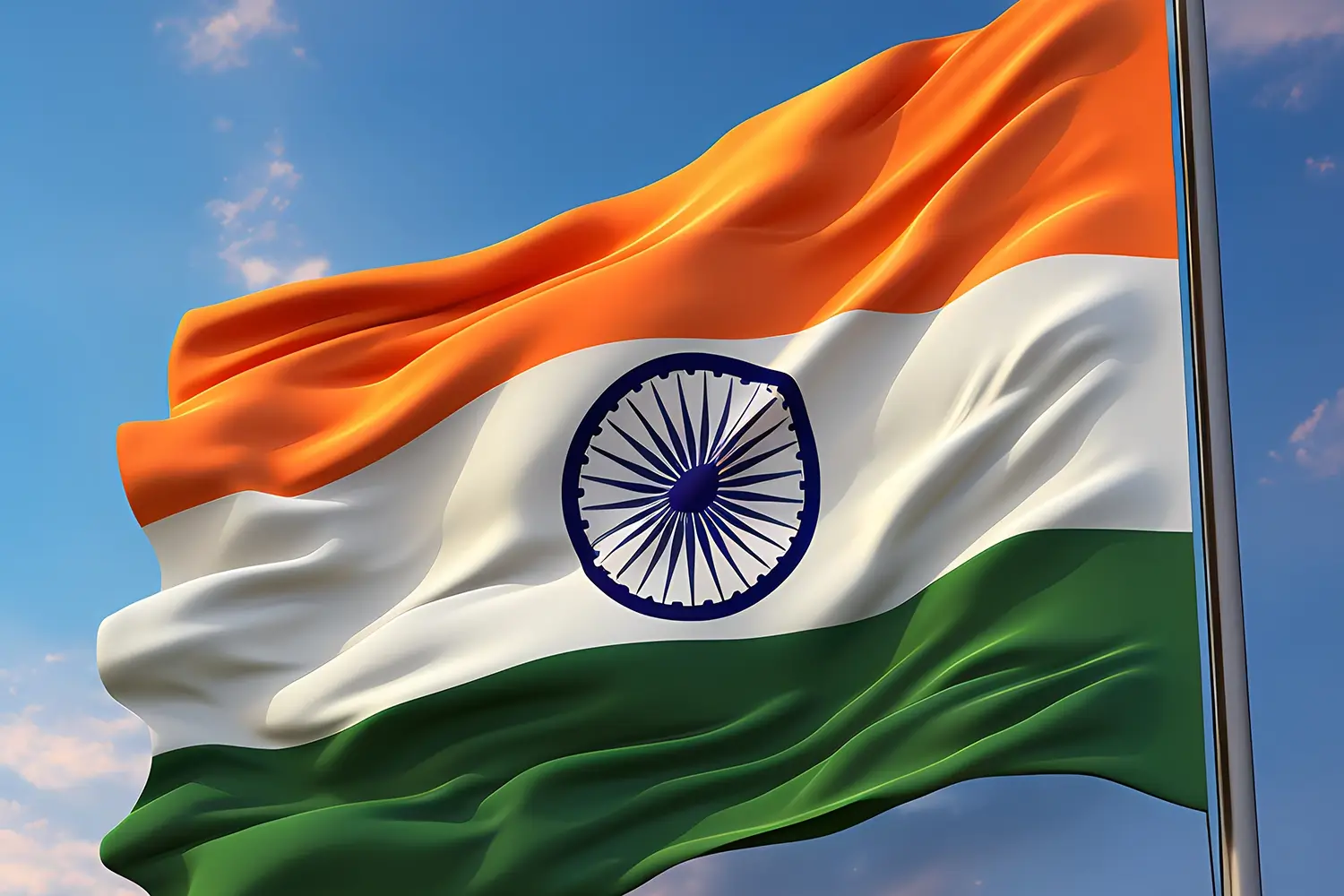
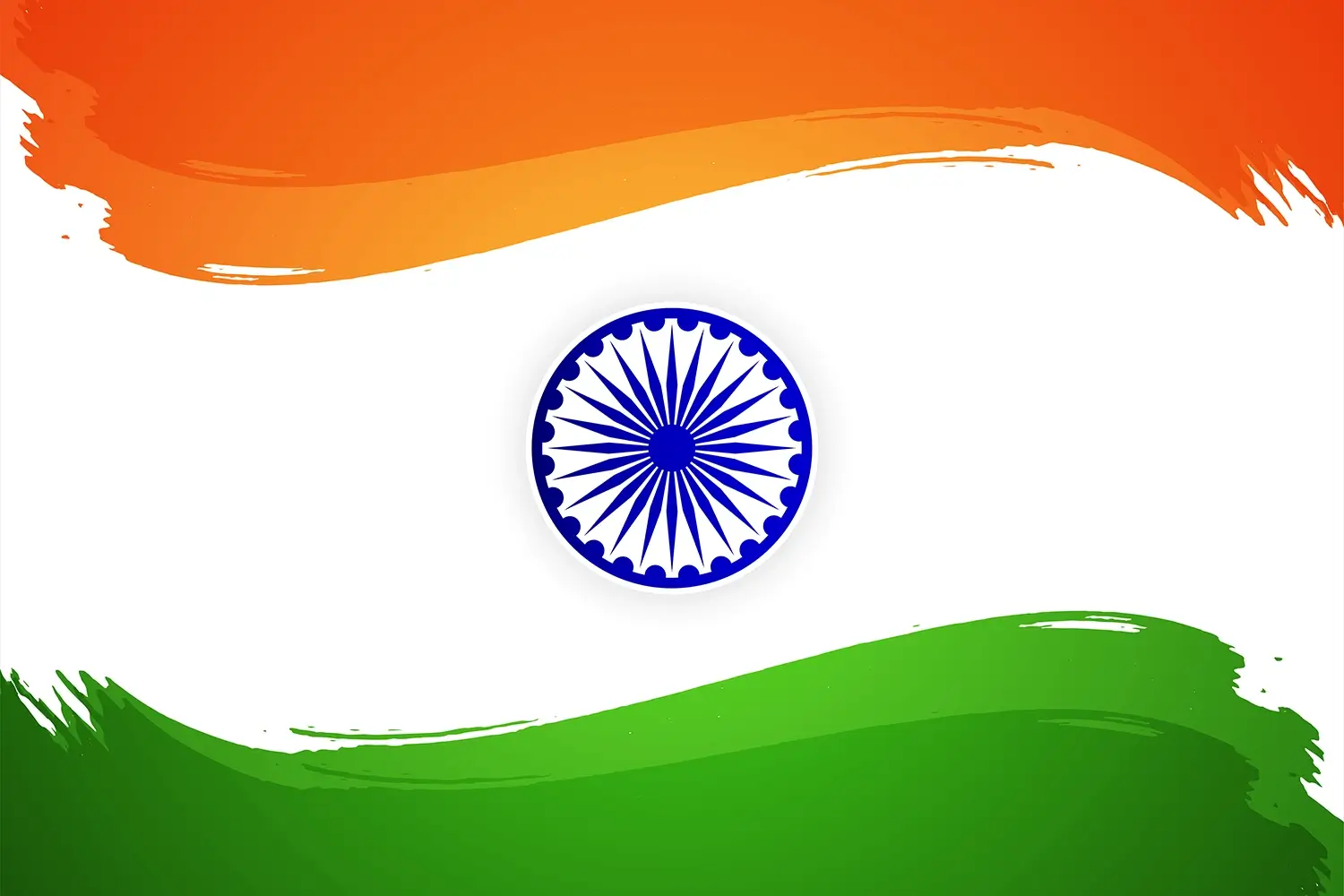
The national flag of India has three equal horizontal bands — India saffron on top, white in the middle, and India green at the bottom — with a navy blue, 24-spoke Ashoka Chakra centered in the white band.
An overview
Known across India simply as the Tiranga ("three colors"), the national flag of India was adopted by the Constituent Assembly on 22 July 1947. It became the flag of the newly independent Dominion of India on 15 August 1947 and was kept when the country became a republic on 26 January 1950.
The design is a modified version of the Swaraj flag of the Indian National Congress. Its three equal horizontal bands are saffron at the top, white in the middle, and green at the bottom. The one major change made in 1947 was at the center: the charkha, or spinning wheel, of the freedom-movement flag was replaced by the navy blue Ashoka Chakra, the ancient "wheel of the law."
The flag's use is governed by the Flag Code of India, 2002, and its manufacture by the Bureau of Indian Standards. For decades the official cloth flag has been hand-spun from khadi — the homespun fabric Mahatma Gandhi made a symbol of self-reliance.

The Ashoka Chakra
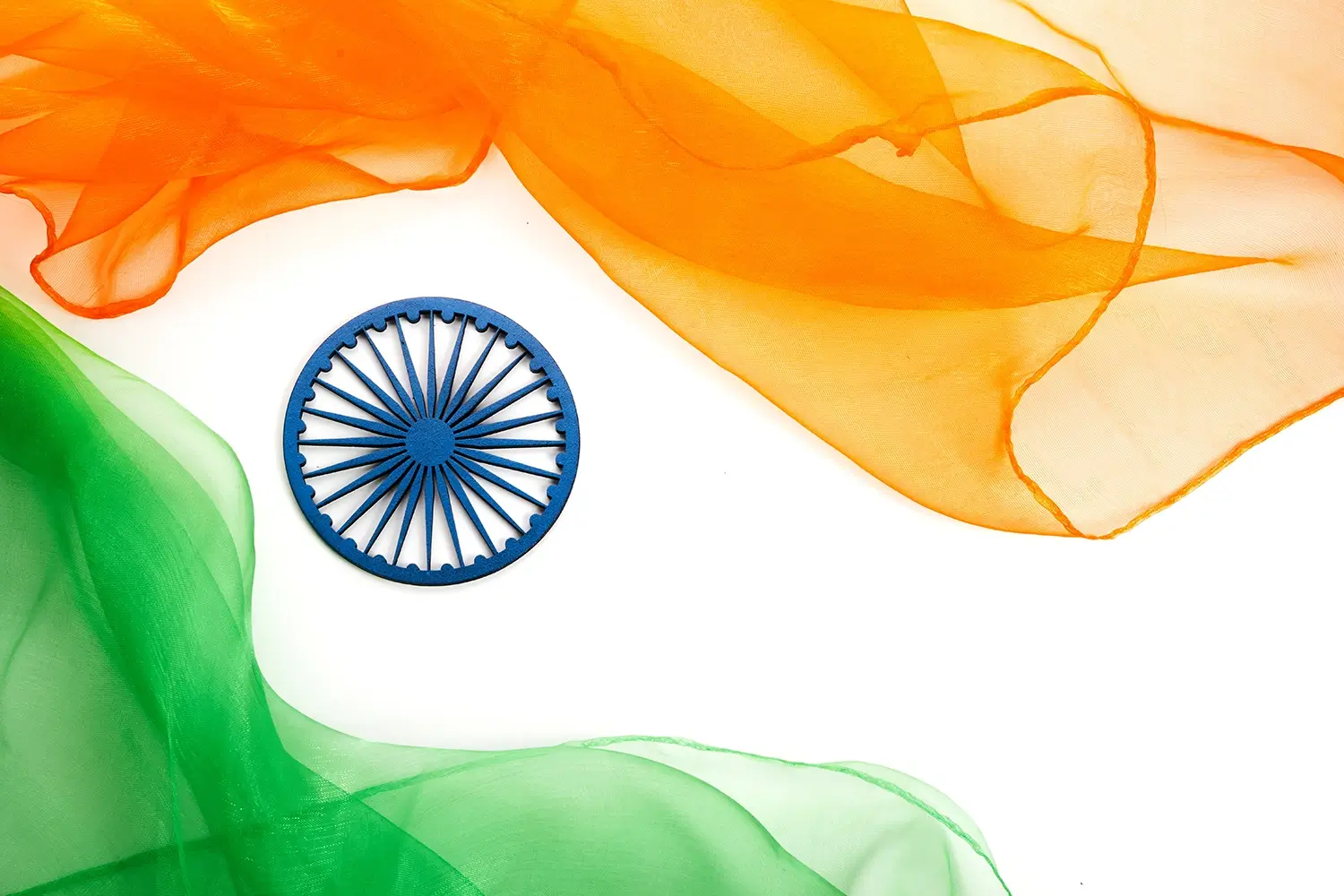
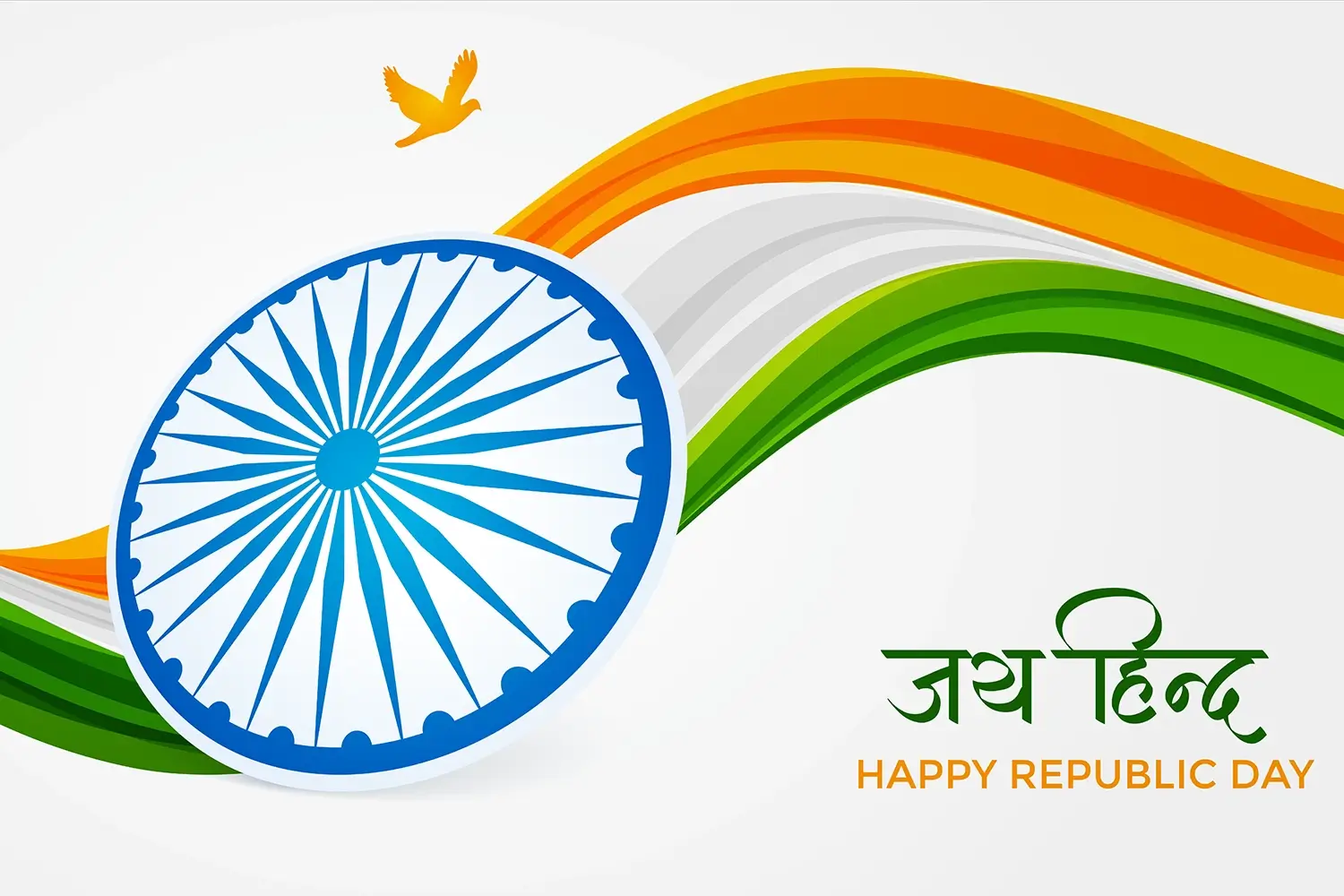
At the heart of the white band sits the Ashoka Chakra, a navy blue wheel with 24 evenly spaced spokes. It is a depiction of the Dharma Chakra, the "wheel of law," and is taken from the Lion Capital of Ashoka — a sculpture commissioned by the emperor Ashoka in the 3rd century BCE and set atop a pillar at Sarnath. That same Lion Capital is today India's State Emblem.
The wheel signifies motion and progress. As Radhakrishnan put it, it shows that "there is life in movement and death in stagnation." The number 24 is popularly tied to ideas such as the 24 hours of the day or a set of virtues, but no single meaning is fixed in law.
Official color specification
The colors are defined by Bureau of Indian Standards specification IS 1 using the 1931 CIE color space (under illuminant C); the navy blue is set by IS 1803. The closest standard values are below. Note that the official cloth shades are deeper than the familiar bright web colors (often quoted as #FF9933 saffron, #138808 green, and #000080 navy), which are screen approximations rather than the standard.
| Color | Hex | Pantone | RGB |
|---|---|---|---|
| India saffron | #FF671F | 165 C | 255, 103, 31 |
| White | #FFFFFF | 000 C | 255, 255, 255 |
| India green | #046A38 | 2258 C | 4, 106, 56 |
| Navy blue | #06038D | 2735 C | 6, 3, 141 |
Symbolism and meaning
The tricolor reads at two levels. In the familiar telling — the one taught across India — saffron stands for courage and sacrifice, white for peace and truth, and green for faith and the fertility of the land, with the navy blue Ashoka Chakra for the wheel of dharma. None of it is communal: the Constituent Assembly wanted a flag acceptable to every community, and the colors were deliberately given meanings free of religious association.
The fullest explanation came on the day of adoption itself. Presenting the flag to the Constituent Assembly on 22 July 1947, the philosopher Dr. Sarvepalli Radhakrishnan — later India’s first Vice President and second President — read the bands as a code of conduct: saffron for renunciation and disinterestedness, asking leaders to set aside material gain and dedicate themselves to their work; white for the light of truth that should guide the nation’s conduct; and green for India’s bond with the soil and the plant life on which all other life depends. The chakra, he said, is the wheel of the law of dharma — and a reminder that a nation stays alive by moving forward.
The courage–peace–faith readings are the ones commonly taught; the renunciation–truth–soil explanation is from Dr. S. Radhakrishnan’s address to the Constituent Assembly, 22 July 1947. The Flag Code and BIS standard prescribe the flag’s form and colors — the meanings live in convention and in that founding address.
Construction and the nine official sizes
The flag is rectangular with a length-to-height ratio of 3:2 — its width is one and a half times its height. The three bands are exactly equal, the chakra is centered in the white band, and its 24 spokes are evenly spaced. The Bureau of Indian Standards permits the flag in only nine specified sizes, each with a matching chakra diameter.
| Size | Flag width × height (mm) | Ashoka Chakra diameter (mm) |
|---|---|---|
| 1 | 6300 × 4200 | 1295 |
| 2 | 3600 × 2400 | 740 |
| 3 | 2700 × 1800 | 555 |
| 4 | 1800 × 1200 | 370 |
| 5 | 1350 × 900 | 280 |
| 6 | 900 × 600 | 185 |
| 7 | 450 × 300 | 90 |
| 8 | 225 × 150 | 40 |
| 9 | 150 × 100 | 25 |
How the flag evolved
The tricolor was not designed in a single stroke. It grew out of four decades of the freedom movement — a series of banners that each carried the idea a little further. The timeline below traces that evolution flag by flag, from the colonial Star of India to the tricolor flown today.
1880–1947
Star of India

Under the Raj, India’s official flag was a Blue Ensign bearing the Union Flag and the Star of India, whose motto was “Heaven’s Light Our Guide.”
1906
Calcutta flag

The “Vande Mataram” flag of the Swadeshi movement had three bands of green, yellow, and red bearing eight lotuses, a sun, and a crescent.
1907
Berlin Committee flag
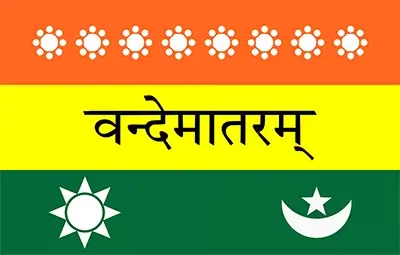
Madame Bhikaji Cama unfurled a related tricolor at Stuttgart, Germany — among the first Indian flags raised abroad.
1917
Home Rule flag

Tilak and Besant’s Home Rule flag had a Union Jack canton, five red and four green stripes, a crescent, and the seven stars of the Saptarishi.
1921
The first tricolor

In April 1921, writing in Young India, Gandhi proposed a flag bearing the charkha (suggested by Lala Hansraj) and commissioned Venkayya to set it on red and green for Hindus and Muslims; he soon added white for all other communities.
1931
Swaraj flag

The Indian National Congress formally adopted the saffron-white-green Swaraj flag with the charkha; its colors were now read as secular rather than communal.
1947
National flag
A committee under Rajendra Prasad replaced the charkha with the navy blue Ashoka Chakra; the Constituent Assembly adopted the flag on 22 July, and it flew at independence on 15 August.
Who designed the National Flag of India?
India honors Pingali Venkayya, who designed the Swaraj flag the national flag is based on, as the creator of the tricolor. The 1947 redesign that introduced the Ashoka Chakra is often credited to Surayya Tyabji, though the record is not fully settled. When Jawaharlal Nehru presented the flag to the Constituent Assembly, he offered two versions — one in khadi-silk, one in khadi-cotton — and the resolution passed unanimously.
How the flag is made
Until 2021, the law required the national flag to be made only of khadi — hand-spun, hand-woven cloth. The right to make the official khadi flag has long belonged to the Karnataka Khadi Gramodyoga Samyukta Sangha (KKGSS) at Bengeri, near Hubballi in Karnataka. Founded in 1957 and certified by the Bureau of Indian Standards in 2004, it is the sole maker of the khadi tricolor and supplies the flag that flies over the Red Fort. Around 1,200 workers, most of them women, spin, weave, and stitch the flag across its units, which produce only the nine approved sizes under regular BIS inspection.
To meet demand during the 2022 "Har Ghar Tiranga" campaign — part of the Azadi Ka Amrit Mahotsav marking 75 years of independence — the Flag Code was amended on 30 December 2021 to also permit machine-made flags of cotton, polyester, wool, or silk. A further amendment on 20 July 2022 allowed the flag to be flown day and night at homes, where earlier it could be hoisted only between sunrise and sunset.
The Flag Code and how to treat the flag
Display of the flag is governed by the Flag Code of India, 2002, together with the Emblems and Names (Prevention of Improper Use) Act, 1950, and the Prevention of Insults to National Honour Act, 1971. For years private citizens could fly the flag only on a few national days; after a Supreme Court case brought by Naveen Jindal, the 2002 code (in force from 26 January 2002) opened everyday display to the public.
Marks of respect
- Give the flag the position of honor, set apart from and higher than other flags.
- When flown horizontally, keep the saffron band at the top.
- Fly only a clean, undamaged flag; a torn or soiled flag is never displayed.
- Retire a worn flag privately and with dignity, in keeping with its honor.
Never do this
- Let the flag touch the ground, the floor, or water.
- Use it as drapery, clothing, or to cover a table, podium, or vehicle.
- Fly it upside down or in a damaged, faded condition.
- Draw or print on it, or use it to carry or hold objects.
Half-mast, state mourning, and the flag on coffins
Grief has its own protocol. Only the Government of India may order the flag to half-mast, and the Flag Code fixes exactly whose death lowers it, where, and for how long — along with whose coffins the flag may drape and how the ritual ends.
| On the death of | Flag half-masted at | Period |
|---|---|---|
| President · Vice-President · Prime Minister | Throughout India | Day of the death |
| Speaker of the Lok Sabha · Chief Justice of India | Delhi | Day of the death |
| Union Cabinet Minister | Delhi and state capitals | Day of the death |
| Minister of State or Deputy Minister of the Union | Delhi | Day of the death |
| Governor · Lieutenant Governor · Chief Minister of a state or union territory | Throughout the state or union territory concerned | Day of the death |
| Cabinet Minister of a state | Capital of the state concerned | Day of the death |
| Occasion | The flag’s part |
|---|---|
| State funerals | The flag drapes the bier or coffin, saffron band toward the head — accorded to national dignitaries, and to others when the government so directs. |
| Armed forces and central para-military forces | The coffin of fallen personnel is draped in the flag with the same honors. |
| After the last salute | The flag is lifted away with dignity before burial or cremation — it is never lowered into the grave and never burnt in the pyre. |
| Situation | Rule |
|---|---|
| Who orders half-masting | Only the Government of India, by official instruction; the flag is never half-masted for private grief. |
| The half-mast movement | The flag is first hoisted briskly to the peak, then lowered slowly to half-mast; before the day’s final lowering it is raised to the peak once more. |
| Death announced in the afternoon | The flag also flies at half-mast on the following day at the place of the funeral, provided the funeral has not taken place by sunrise that day. |
| Day of the funeral | At the place where the funeral of a scheduled dignitary is held, the flag flies at half-mast on that day. |
| Mourning on a national day | On Republic Day, Independence Day, Gandhi Jayanti, and other notified days, flags stay at full mast — except over the building where the body lies, and there only until the body is moved. |
| A foreign head of state or government dies | The Indian Mission accredited to that country flies its flag at half-mast. |





























Frequently asked questions
What is the difference between flag hoisting on Independence Day and flag unfurling on Republic Day?
On Independence Day the flag is hoisted — raised up the pole from below, recalling a nation rising to freedom in 1947; the Prime Minister performs it at the Red Fort. On Republic Day the flag is unfurled — already tied at the top of the mast, it is opened out, because the nation was free and in 1950 gave itself a Constitution; the President performs it at the parade.
When was the flag of India adopted?
The current design was adopted by the Constituent Assembly of India on 22 July 1947, a few weeks before independence. It became the official flag of the Dominion of India on 15 August 1947 and was retained when India became a republic on 26 January 1950.
What do the three colors of the Indian flag mean?
The saffron band stands for courage and sacrifice, the white for peace and truth, and the green for faith and the fertility of the land. The colors were deliberately given these secular meanings; officially they carry no communal or religious significance.
What is the wheel in the middle of the Indian flag?
It is the Ashoka Chakra, a navy blue wheel with 24 spokes. It represents the Dharma Chakra — the wheel of law (dharma) — and is taken from the Lion Capital of Ashoka, a 3rd-century-BCE sculpture at Sarnath that is also India's State Emblem. It replaced the spinning wheel of the earlier flag in 1947.
How many spokes does the Ashoka Chakra have?
The Ashoka Chakra has exactly 24 evenly spaced spokes. The number is popularly linked to ideas such as the 24 hours of the day or 24 virtues, but no single meaning is fixed by law; the wheel itself signifies dharma and the idea that there is life in movement and death in stagnation.
Who designed the flag of India?
The tricolor descends from the Swaraj flag designed by freedom fighter Pingali Venkayya, whom India honors as the flag's creator. The final 1947 design — which swapped the spinning wheel for the Ashoka Chakra — is often credited to Surayya Tyabji.
What are the official colors of the Indian flag?
The Bureau of Indian Standards (IS 1) defines them in the CIE 1931 color space. The closest standard values are India saffron (Pantone 165 C, about #FF671F), white, India green (Pantone 2258 C, about #046A38), and navy blue for the chakra (Pantone 2735 C, about #06038D). The brighter #FF9933 and #138808 often seen online are screen approximations, not the official cloth shades.
What is the ratio of the Indian flag?
The flag is rectangular with a length-to-height ratio of 3:2 — its width is one and a half times its height. The three horizontal bands are equal in size, and the Ashoka Chakra is centered in the white band.
What is the Indian flag made of, and can citizens fly it at home?
Traditionally the flag is made of khadi, the hand-spun cloth tied to the freedom movement. A 2021 amendment to the Flag Code also permits machine-made cotton, polyester, wool, and silk. Since the Flag Code of India, 2002 — and after a 2002 Supreme Court case brought by Naveen Jindal — private citizens may fly the flag; a 2022 amendment allows it to be flown day and night at homes.
What is the Flag Code of India, and what rules should citizens follow?
The Flag Code of India brings together all laws, conventions, practices, and instructions governing the display of the National Flag by private, public, and government institutions. For citizens the essentials are simple: fly it with saffron on top, keep it from touching the ground, put no lettering on it, do not use it as clothing below the waist or as decoration, and retire a damaged flag privately with dignity.
Can the Indian flag be flown at night or after sunset?
Yes, the flag can be flown day and night when displayed in the open or on the house of a member of the public, a private organization, or an educational institution.
Can I display the Indian flag on my car or motorcycle?
No. The Flag Code restricts vehicle display to a short list of high offices — the President and Vice-President, the Prime Minister, Governors and Lieutenant Governors, Chief Ministers and Union Ministers, the presiding officers of Parliament and the legislatures, and judges of the Supreme Court and High Courts. Everyone else may fly the flag at home or on their premises, but not on a car or motorcycle.
Can the Indian flag be worn as clothing or used as an accessory?
While it can be worn as part of a costume or uniform above the waistline, it is not permitted to be embroidered or printed on cushions, handkerchiefs, napkins, undergarments, or any dress material.
Is lettering or writing allowed on the national flag?
No lettering of any kind is permitted to be put upon the National Flag.
Can the Indian flag touch the ground or be used as decoration?
No. The flag must never touch the ground or trail in water, and it may not be used as festoons, rosettes, bunting, or general decoration. Art in the flag’s colors is free to play; the flag itself is not a decorative prop.
Can the national flag be used to wrap or cover objects?
The flag must not be used to wrap, receive, or deliver things, nor should it be used to cover a speaker’s desk or the sides, back, and top of any vehicle. When it drapes a bier or coffin at a funeral with state honors, the saffron band lies toward the head, and the flag is removed with dignity before burial or cremation — it is never lowered into the grave or burnt in the pyre.
How should a damaged or worn-out Indian flag be disposed of respectfully?
If a flag is damaged, it should not be discarded on the ground; it must be destroyed as a whole in private, preferably by burning or any other method that respects its dignity.
Are plastic national flags allowed?
The Ministry of Home Affairs advises avoiding plastic flags because they are not biodegradable, making appropriate and dignified disposal a practical problem.
What is the correct way to display the Indian flag vertically or on a wall?
Hung vertically, the flag is rotated so the saffron band is to the viewer’s left, with the Chakra centered as always. Displayed flat against a wall, saffron stays uppermost. In no arrangement is the flag ever shown inverted.
How should the Indian flag be displayed alongside other countries’ flags?
When displayed in a straight line with flags of other countries, the Indian National Flag must be on the extreme right, with the other flags following in alphabetical order based on their English names.
When can the Indian flag be flown at half-mast?
The flag shall not be flown at half-mast except on occasions officially instructed by the Government of India. When doing so, it must first be hoisted to the top of the staff and then lowered to the half-mast position.
Where was the first Indian tricolor hoisted before independence?
The first tricolor raised during the struggle for freedom was hoisted on August 7, 1906, in Calcutta (now Kolkata) at the Parsee Bagan Square (Green Park).
Explore all general-knowledge topics and the A-to-Z lists.

We Value Your Opinion Comments