

Montenegro flag picture
Explore the construction drawing, history, and complete picture gallery.
| Design | Red field with gold borderComplete state coat of arms at the center. |
|---|---|
| Proportions | 2:1 length:heightHorizontal flag; upright vertical model also official. |
| Present design | July 12, 2004Current flag predates the 2006 independence referendum. |
| Border / arms | a/20 · 2a/3Border width / arms height; a is the shorter side. |
| Key national days | May 21 · July 13Independence Day / Statehood Day respectively. |
The gold border is part of the flag. The official vertical model keeps the coat of arms upright.
What is the national flag of Montenegro?
Montenegro’s national flag is red with a gold border and the state coat of arms at its center. The crowned, double-headed golden eagle carries a scepter and orb, with a lion on its breast shield. The horizontal flag is twice as long as it is high.
The present design dates to 2004, before the independence referendum of 2006. Its official models include both horizontal and vertical flags. This guide explains the complete coat of arms, measured construction, specified print colors, historical changes, and current rules for respectful display.
What are the proportions of Montenegro’s flag?
Montenegro’s horizontal flag has a length-to-height ratio of 2:1, also written 1:2 when height comes first. The gold border is included in those outer dimensions. A 1200 × 600 drawing therefore represents the whole flag, not a red rectangle to which a separate border must later be added.

The law describes length and width; the construction manual labels the shorter side a and the longer side 2a. For an upright vertical flag, the same outer rectangle becomes a wide by 2a tall. The eagle remains upright in the separately supplied vertical model.
How are the border and coat of arms measured?
Let a represent the flag’s shorter side. The outer dimensions are 2a by a, the gold border is a/20 wide, and the coat of arms is 2a/3 high. The emblem’s center coincides with the intersection of the flag’s diagonals, placing it centrally within the full rectangle.
| Element | Official relationship | At 1200 × 600 units |
|---|---|---|
| Outer horizontal flag | 2a × a | 1200 × 600 |
| Border on each side | a/20 | 30 units |
| Coat of arms height | 2a/3 | 400 units |
| Flag and emblem center | Intersection of diagonals | x=600, y=300 |
| Clearance above/below emblem | a/6, measured from outer edge | 100 units |
The example measurements follow directly from the official proportions. The downloaded government artwork uses rounded PDF coordinates; its complete vector paths are preserved in the supplied images. The eagle’s width is determined by that official drawing, rather than by a newly invented width formula.
Is the gold border part of the flag or a fringe?
The gold border is an integral part of Montenegro’s flag and runs along all four edges. It is not optional decoration and cannot be replaced by a hanging fringe. The display regulations permit fringe on ceremonial and table flags, but that additional trimming does not remove the prescribed flat border.
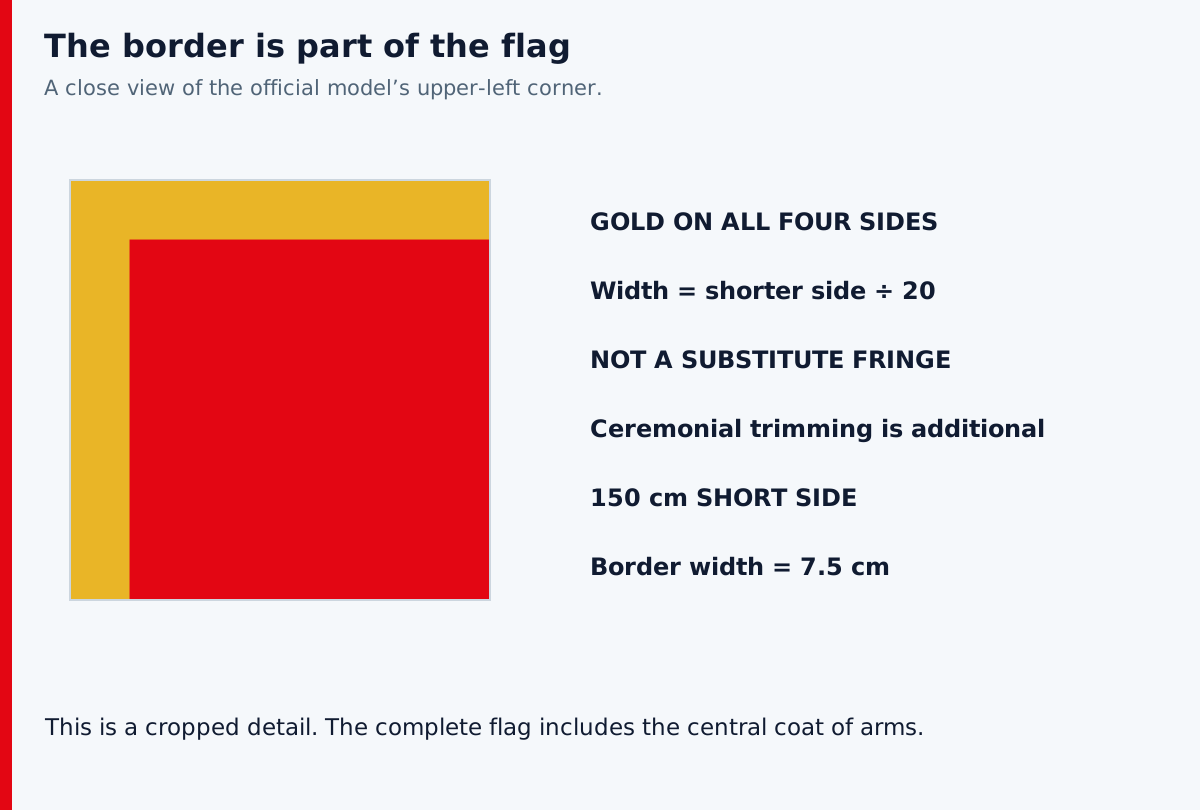
Article 4 of the flag-model decision expressly treats the gold border as part of the flag. Its width is one-twentieth of the shorter side. On a flag 150 centimeters high, that produces a 7.5-centimeter border; decorative tassels or attachment fittings do not change the measurement.
What appears in Montenegro’s coat of arms?
The coat of arms shows a crowned golden eagle with two heads and raised wings. It holds a gold scepter and a blue orb with gold bands and a cross. On its chest, a gold lion walks across a green base inside a blue shield. Crosses also top the crown and scepter.
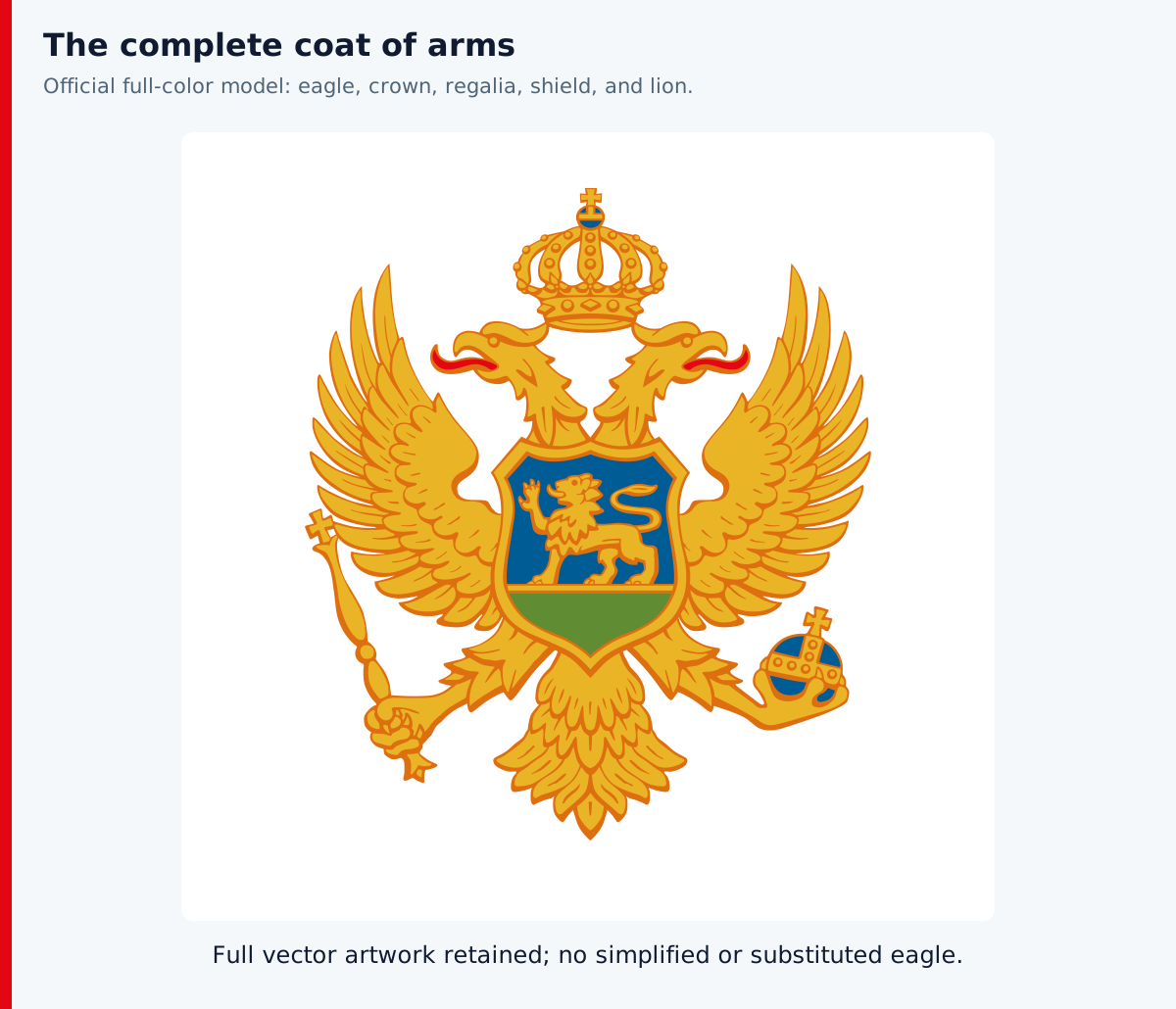
These are parts of one official composition. The detailed model includes the eagle’s feathers, red tongues, crown, feet, tail, shield, lion, and shaded gold lines. Replacing it with a generic two-headed bird loses features specified by the legal description and the government’s drawing.
Which side holds the scepter and which holds the orb?
The scepter appears on the viewer’s left and the orb on the viewer’s right when looking at the official front view. The law describes these as the eagle’s right and left claws respectively. Heraldic directions follow the figure’s own perspective, so they are opposite the viewer’s directions.

| Object | Heraldic position | Position for the viewer |
|---|---|---|
| Scepter | Eagle’s right claw | Left |
| Orb | Eagle’s left claw | Right |
Use the complete official artwork to retain this relationship. A casual mirror flip can reverse the regalia, while rotating a horizontal flag cannot produce the official upright vertical composition. The vertical model keeps the same frontal arrangement of scepter and orb.
What is the animal on the shield?
The animal on the eagle’s breast shield is a golden lion passant, meaning a lion shown walking with one forepaw raised. It stands on green beneath a blue background. The lion is a distinct heraldic figure within the coat of arms; it is not another eagle or a separate national flag.

The modern law identifies the lion and its colors without prescribing a separate moral meaning for every part of the animal. The official vector provides the reference for its tail, legs, facial details, and outline. Those details remain intact in the enlarged view.
What are the official colors of Montenegro’s flag?
The flag’s principal colors are red and light gold. The official model specifies red as CMYK 0/100/100/0 and light gold as 10/30/90/0. The coat of arms also uses dark gold, blue, and green. These are the published process-color values, not a set of official hexadecimal web codes.

| Color | Official CMYK: C / M / Y / K | Use |
|---|---|---|
| Red | 0 / 100 / 100 / 0 | Flag field and red heraldic details |
| Light gold | 10 / 30 / 90 / 0 | Border and main golden elements |
| Dark gold | 10 / 65 / 100 / 0 | Coat-of-arms shading and outlines |
| Blue | 100 / 60 / 20 / 0 | Shield background and orb |
| Green | 70 / 30 / 100 / 0 | Ground beneath the lion |
The flag-model decision supplies red and light gold; the coat-of-arms decision and official construction sheet supply the full five-color palette. A metallic thread or reflective finish is not encoded by a flat CMYK percentage.
What HEX and RGB colors do the downloadable images use?
The supplied web images use red #E30613, light gold #E9B527, dark gold #DE6F10, blue #005C95, and green #608D33. These values result from converting the official vector PDF artwork into SVG. They identify this package’s digital palette; the official production references remain the published models and CMYK specifications.
| Color | HEX in this package | RGB |
|---|---|---|
| Red | #E30613 | 227, 6, 19 |
| Light gold | #E9B527 | 233, 181, 39 |
| Dark gold | #DE6F10 | 222, 111, 16 |
| Blue | #005C95 | 0, 92, 149 |
| Green | #608D33 | 96, 141, 51 |
CMYK and screen RGB use different color systems. Conversion depends on color management and rendering, so an arithmetic CMYK-to-RGB shortcut should not be advertised as a legally prescribed HEX value. For fabric production, use the official models alongside the relevant material and colorfastness requirements.
What do Montenegro’s flag and its symbols mean?
The flag represents Montenegro and belonging to the state, as the symbols law expressly states. Its eagle, crown, scepter, orb, and lion connect the modern emblem with Montenegro’s earlier heraldic tradition. The legislation defines their forms and colors, but does not assign a separate official virtue to each color.
A careful account distinguishes legal description from interpretation. Red should not automatically be labeled “blood,” or gold “wealth,” without a specific supporting source. The documented historical connection is the use of the double-headed eagle in the Crnojević and Petrović Njegoš traditions, with earlier links to Byzantine heraldry.
Why does a republic have a crown on its flag?
Montenegro is a republic, but its state emblem retains a crown and other elements from historical heraldry. Their appearance preserves a connection with earlier state symbols; it does not make the current country a monarchy. The Constitution describes the republic and its crowned-eagle emblem within the same constitutional framework.
The crown, orb, and scepter are fixed parts of the official model. Removing the crown to make a supposedly “republican” version would change the national flag. Historical symbolism and the present form of government are different kinds of information.
When was Montenegro’s current flag adopted?
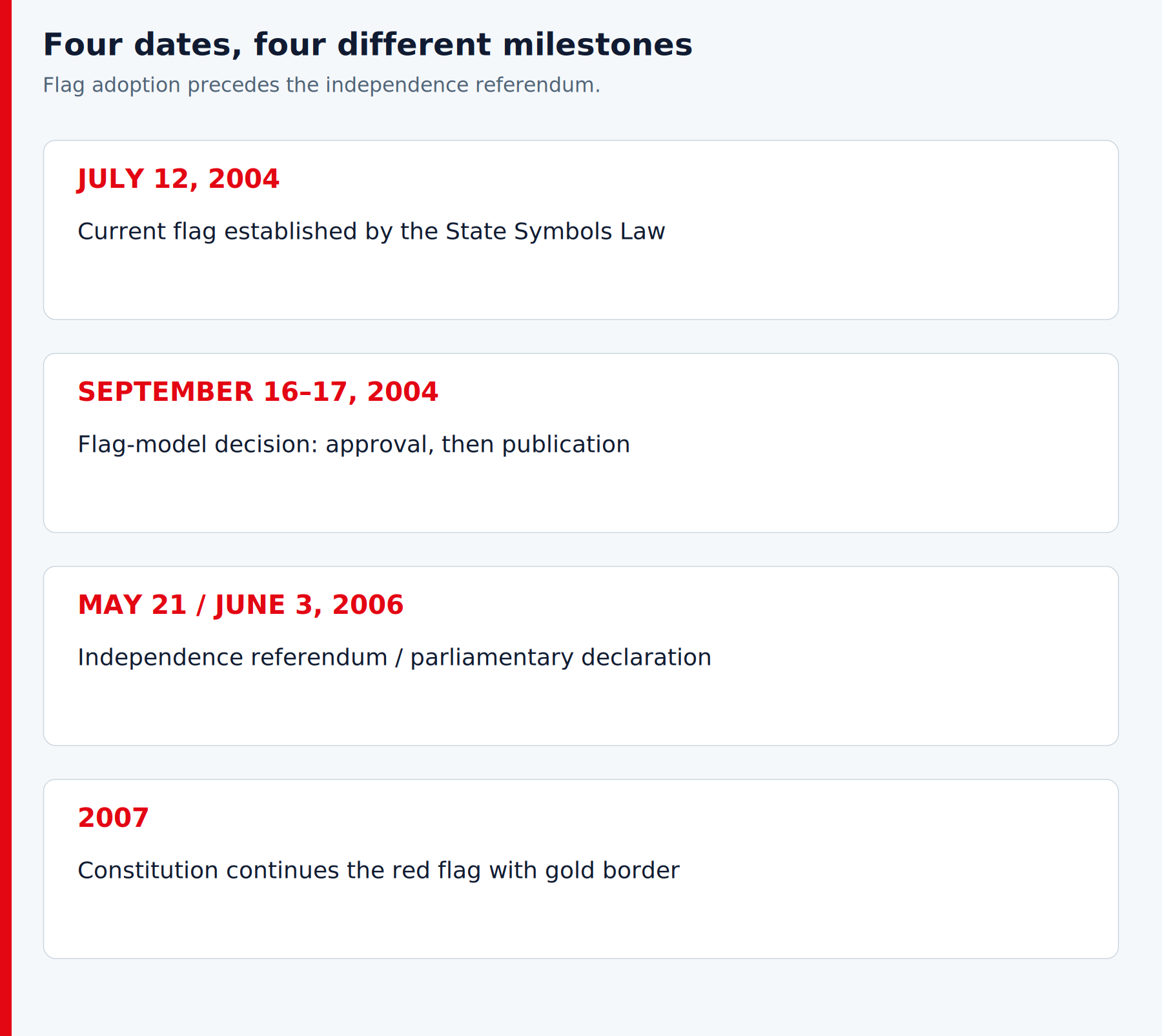
Montenegro’s present red-and-gold flag dates to July 12, 2004, under the Law on State Symbols and Statehood Day. The official register records publication on that date, and the law provides for commencement upon publication. July 13 is Statehood Day; the later 2006 independence referendum is another distinct event.

The primary legal record is important because summaries sometimes merge adoption, commencement, and the neighboring national holiday. Article 32 makes publication the commencement event. The separately approved graphic models followed in September 2004, and the 2007 Constitution continued the red flag with its central arms and gold border.
When were the official flag drawings standardized?
The government approved the flag-model decision on September 16, 2004, and it was published on September 17. It supplies horizontal and vertical models, construction instructions, and colors. This technical decision followed the July law; the later dates on government download pages are upload dates, not new flag adoptions.
The flag decision took effect on publication. The coat-of-arms model was also published in September 2004 and later amended in 2008 concerning reproduction techniques. Its consolidated text should not be confused with a new national flag. The official download includes vector PDFs for both flag orientations and the full-color arms.
How did Montenegro’s flags develop before 2004?
Montenegro’s flag history includes royal and military banners, tricolors, socialist-era flags, and the modern red flag with a gold border. The double-headed eagle has older heraldic roots, but those earlier flags were not identical to today’s design. The current legal composition and its technical models were established in 2004.

The 1905 Constitution listed red, blue, and white as national colors; that statement should not be expanded into a complete flag-construction specification. Socialist-era flags carried a star. The later tricolor prescribed under the 1993 law omitted that star before the 2004 change to the present design.
Surviving military objects form another strand of this history. Montenegro’s National Museum describes a Krstaš battle flag associated with Vučji Do in 1876, bearing a cross and Nikola I’s initials. Such an object is evidence of a particular historical banner, not a substitute drawing for today’s state flag.
What flag did the present design replace?
The preceding flag under the 1993 law was a long horizontal tricolor of red, light blue, and white, without an emblem. Its 3:1 proportions made it noticeably longer and narrower than the current 2:1 flag. The comparison here preserves each design’s different proportions instead of stretching them into identical shapes.

The historical image is labeled as a reference to the 1993-law tricolor, replaced in 2004. Its digital shades come from the credited historical SVG, not measurements of an original textile. Current law protects specified historical symbols, but protection does not make a former flag interchangeable with the present national flag.
Was the present flag introduced when Montenegro became independent in 2006?
No. The present flag was already established in 2004, while Montenegro was within the state union with Serbia. The independence referendum took place on May 21, 2006, followed by the parliamentary declaration on June 3. Independence changed the country’s status without introducing this flag for the first time.
May 21 is the statutory Independence Day. It should not be substituted for July 12, 2004 in an adoption table. The 2007 Constitution subsequently enshrined the red flag, central coat of arms, and gold border.
How should Montenegro’s flag be displayed vertically?
Use the official vertical model, which has a narrow upright rectangle and an upright coat of arms. The eagle is not turned sideways. Its height remains two-thirds of the flag’s shorter side, and it stays centered. The gold border remains one-twentieth of that shorter side on every edge.


For a vertical flag 150 centimeters wide and 300 centimeters tall, the arms are 100 centimeters high and the border is 7.5 centimeters wide. Turning a complete horizontal flag image through 90 degrees would rotate the eagle and give a different result.
Which laws govern Montenegro’s national flag?
The Constitution identifies the flag, while the Law on State Symbols and Statehood Day supplies its design and principal rules of use. Government decisions establish the official graphic models. The 2019 display and material regulations add practical requirements for positioning, illumination, sizes, fabric, and appropriate reproduction in different settings.
| Instrument | Role |
|---|---|
| Constitution, Article 4 | Constitutional identification of the flag and arms |
| State Symbols Law, Articles 4–5 | Heraldic description and measured flag design |
| 2004 flag-model decision | Official horizontal/vertical artwork, colors, construction |
| Arms-model decision, including 2008 amendment | Official arms and permitted reproduction methods |
| 2019 display and material regulations | Practical display, materials and sizes |
The consolidated symbols law consulted includes amendments through 2019. Historical-symbol protection appears in Article 28. A proposal to alter legal treatment of historical flags is not itself an enacted replacement of the current national design.
On which national holidays is the flag displayed?
The symbols law requires flag display on state-holiday occasions at buildings of state and local authorities. The current holiday law lists Independence Day, Statehood Day, Njegoš Day, and Ecological State Day as state holidays. The last is observed as a working day, so a state holiday does not always mean time off.

| Date | State holiday | Ordinary statutory observance |
|---|---|---|
| May 21 | Independence Day | May 21–22 |
| July 13 | Statehood Day | July 13–14 |
| September 20 | Ecological State Day | September 20; working day |
| November 13 | Njegoš Day, Montenegrin culture holiday | November 13–14 |
The current law also lists New Year and Labor Day as other holidays. Sunday substitution rules can affect nonworking dates; annual official notices determine the calendar application. The table gives nominal dates rather than an annual work schedule. The two-day Njegoš observance reflects the 2023 amendments, not the older one-day rule.
What is the difference between Statehood Day and Independence Day?
Statehood Day is July 13 and recalls international recognition in 1878 and the uprising of 1941. Independence Day is May 21 and marks the 2006 referendum. Both are national occasions associated with flag display, but neither should be mistaken for the July 12, 2004 adoption of the present flag.
The government’s historical account connects July 13 with the conclusion of the Berlin Congress in 1878 and the wartime uprising in 1941. The separate May observance belongs to the modern restoration of independence. A flag timeline should keep these commemorations separate from laws adopting designs.
Where must Montenegro’s flag be permanently displayed?
The symbols law specifies permanent display at the Parliament, designated central state institutions, the presidential residence, local-government premises, and public institutions founded by the state or local government. These statutory categories matter: the permanent-display rule is not simply a requirement imposed on every private home or every business building.
Article 15 includes the President, Government, Constitutional Court, Supreme Court, Supreme State Prosecutor, and Ombudsman among the specified institutions. The consolidated provision includes local authorities and relevant public institutions. Other articles address holiday display, polling places, diplomatic settings, vessels, and aircraft.
Can the flag remain flying at night?
Flags displayed permanently must be permanently illuminated under the 2019 regulations. That requirement permits an account of night display without inventing a universal sunrise-to-sunset schedule. The same regulations require ceremonial raising and lowering to be slow, so importing another country’s customary brisk raising instruction would be incorrect.

The lighting obligation appears in Article 6 of the regulations; the slow raising and lowering instruction is in Article 7. For an installation, illumination should keep the flag visible throughout its permanent display. The cited rules do not prescribe a nationwide daily ceremony time such as seven in the morning.
Where does Montenegro’s flag go beside a foreign flag?
When Montenegro’s flag is displayed beside a foreign flag, the symbols law gives it the position on the viewer’s left when seen from the front. Other arrangements have their own honor positions, including the center between other flags. Always specify the viewpoint, because heraldic right and a spectator’s left can be confused.

Article 18 governs flags: it also names the center of a circle, the apex of a semicircle, and the first position in specified rows or groups. Article 14 has a separate rule for coats of arms; transferring that rule to flags would reverse the two-flag arrangement.
How is the flag displayed during official mourning?
On days of mourning declared by the Government, Montenegro’s flag is displayed at half-mast. This is the rule stated in the symbols law. The illustration shows a lowered flag without inventing a precise measuring point, black ribbon requirement, or special sequence that the cited provision does not establish.

The trigger is a government declaration of mourning under Article 16. Its text does not define the exact staff measurement for the cloth’s center or upper edge. Particular arrangements should follow the applicable official instructions for that observance; the general statutory rule is half-mast.
What standard flag sizes do the regulations give?
The 2019 regulations list an outdoor horizontal flag of 300 × 150 centimeters, an outdoor vertical flag of 150 × 300, an indoor horizontal flag of 200 × 100, and a table flag of 26 × 13. Other sizes are permitted when suited to the space and the prescribed proportions.

These are listed formats, not the only lawful dimensions. Keep the border and coat of arms proportional when scaling. A small table flag retains the same complete national design even though its fabric construction, stand, and optional trimming differ from an outdoor installation.
What materials and finishing rules apply to different flags?
The regulations distinguish office, ceremonial, table, and outdoor flags. Office flags use crepe satin or silk at 140–180 grams per square meter, while outdoor flags use polyester mesh at 115–125. Ceremonial and table flags are double-sided and may have fringe. Outdoor fabric must also meet durability and colorfastness requirements.
| Type | Specified material or finish |
|---|---|
| Office | Crepe satin or silk, 140–180 g/m² |
| Ceremonial | Double-sided; fringe permitted |
| Table | Crepe satin, double-sided; fringe permitted |
| Outdoor | 100% polyester mesh, 115–125 g/m²; weather resistant |
The regulations cite the MEST EN ISO 105-B01, 105-B03, and 105-B10 colorfastness tests. They require the front and back to be of the same quality. Those requirements should not be replaced with an unsupported claim that every flag must have a mirrored single-layer reverse.
How should flagpoles and indoor flags be positioned?
The regulations link pole length to the flag’s shorter dimension and require flags to clear people, objects, and vegetation. Outdoor building displays use the highest point or front facade; a freestanding pole beside a building is at least six meters high. Indoor office placement gives the flag the occupant’s right-hand side.
The general pole-length minimum is three times the flag’s shorter side. An indoor flag’s lower edge must be at least one shorter-side length above the floor. For a viewer facing the office occupant, the occupant’s right is the viewer’s left. A facade pole is set at no more than 45 degrees relative to the facade.
The listed outdoor pole heights are six, eight, ten, and twelve meters. Mounting and clearance should be checked for the actual space; the dimensions of the cloth alone do not determine a suitable installation.
May people use the flag privately, in education, or on products?
The symbols law allows free artistic and educational use that respects public morals and Montenegro’s reputation and dignity. It also requires the prescribed form of the symbols. Use as a trademark, service mark, design, or goods-and-services identifier is subject to prior permission from the competent authority for culture.
The relevant provisions are Articles 7–10. Permission for educational illustration should not be confused with an unrestricted right to change the design or register it commercially. The official-model copyright basis and national-symbol use rules address different questions; reproducing an official graphic does not cancel the rules governing its use.
How should a damaged flag be treated?
A damaged or otherwise unfit national flag must be withdrawn from use. The symbols law also prohibits allowing the flag to touch the ground or using it as a carpet or curtain. These are concrete requirements; the cited legislation does not prescribe a special burning, folding, or burial ceremony for disposal.
Use the complete flag in good condition and replace worn examples as needed. Avoid adding slogans or other marks to the official design. Articles 9, 11, and 20 address alteration, unsuitable condition, and disrespectful placement; they provide a firmer basis than importing etiquette from a different country.
What is Montenegro’s flag emoji and country-code sequence?
Montenegro’s flag emoji is 🇲🇪. It uses the regional-indicator pair M and E, encoded as U+1F1F2 followed by U+1F1EA. The resulting appearance depends on the device or platform. For a stable, detailed rendering of the coat of arms, use the supplied flag image instead of relying on emoji artwork.
The sequence is ME, not the neighboring alphabetical entries for Monaco, Moldova, or Mongolia. Some systems show letters when a flag emoji is unsupported. Unicode identifies the sequence; individual vendors supply the displayed artwork.
What are the most common mistakes in reproducing Montenegro’s flag?
Common errors include omitting the gold border, substituting fringe for it, simplifying the eagle, reversing the scepter and orb, and rotating the horizontal artwork to create a vertical flag. Historical mistakes include calling the current design a 2006 introduction or presenting the former tricolor as the present national flag.

Keep the full official coat of arms, a centered placement, the 2:1 outer proportion for the horizontal flag, and a border one-twentieth of the shorter side. Distinguish the published CMYK specifications from converted web colors. The gallery provides separate horizontal, vertical, detail, construction, and historical-comparison images.
Explore more in World Flags: Iceland flag, Lithuania flag, Luxembourg flag, Madagascar flag, Malawi flag, Malaysia flag, Maldives flag, Mali flag, Malta flag, Mauritania flag, Mauritius flag, Mexico flag, Micronesia flag, Moldova flag, Monaco flag, Mongolia flag.
Download Montenegro flag pictures
Download the national flag as SVG or large PNG. The gallery includes 18 distinct subjects with captions and alternative text. Keep the full proportions when resizing. Image credits and reuse notes accompany the graphics.
World Flags/Montenegro
Montenegro flag pictures
Red field, integral gold border, and the complete state coat of arms. Converted from the government’s official vector model.
Government of Montenegro official artwork; SVG conversion and diagrams by GKBookDownload SVGDownload PNGThe shorter side is a, the longer side 2a, the border a/20, and the arms 2a/3 high. Dashed centerlines are explanatory overlays.
Government of Montenegro official artwork; SVG conversion and diagrams by GKBookDownload SVGDownload PNGA corner crop retains the actual official border geometry. Its width is one-twentieth of the shorter side, including on a vertical flag.
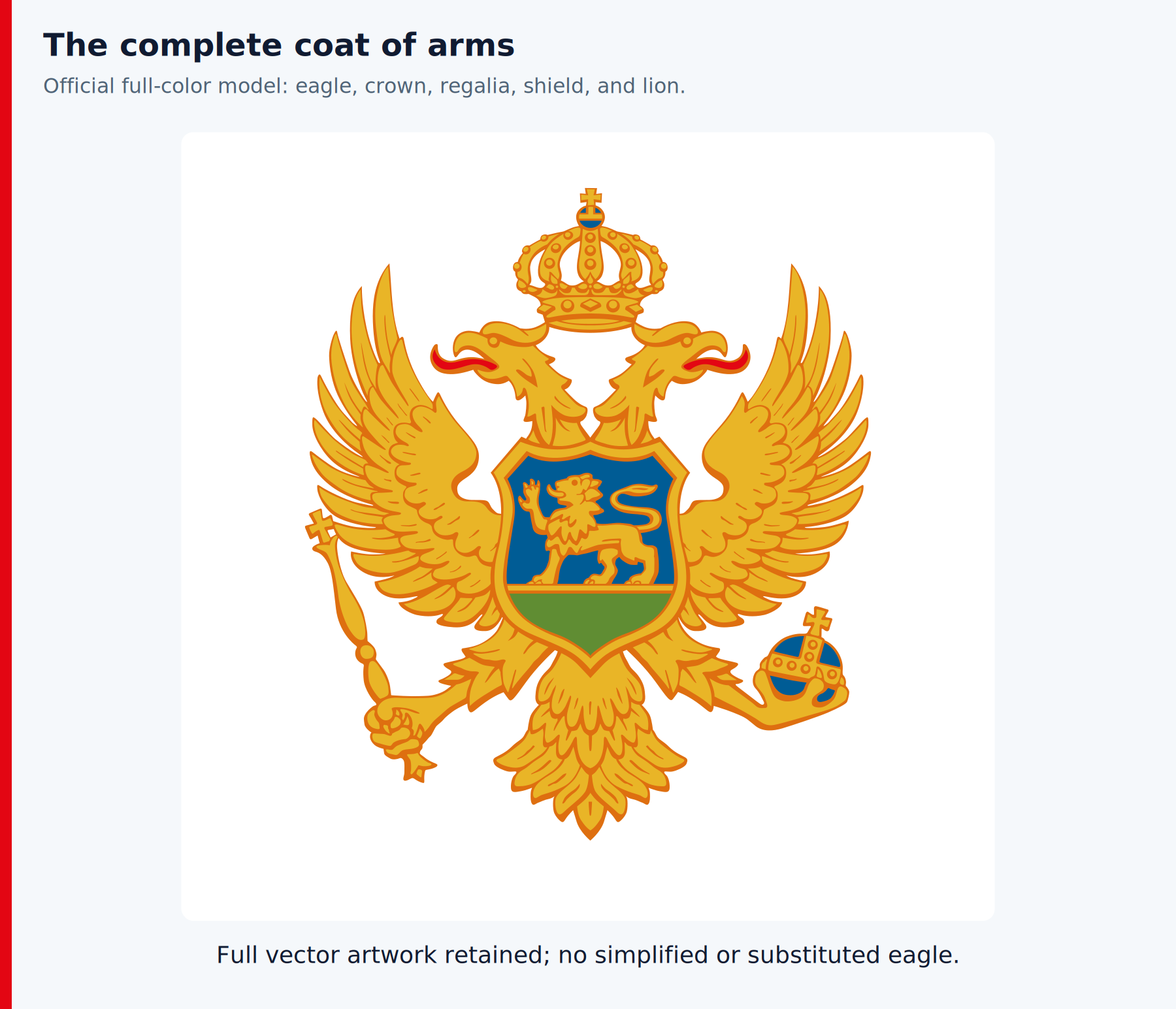
Government of Montenegro official artwork; SVG conversion and diagrams by GKBookDownload SVGDownload PNGThe full government vector preserves the crowned double-headed eagle, feathers, scepter, orb, breast shield, lion, and colored details.
Government of Montenegro official artwork; SVG conversion and diagrams by GKBookDownload SVGDownload PNGThe scepter is in the eagle’s right claw, shown on the viewer’s left. The orb occupies the opposite side.
Government of Montenegro official artwork; SVG conversion and diagrams by GKBookDownload SVGDownload PNGThe breast shield is enlarged from the government vector; the lion and its tail, legs, and outline are not redrawn.
Government of Montenegro official artwork; SVG conversion and diagrams by GKBookDownload SVGDownload PNGFive published CMYK colors are separated from the SVG conversion’s HEX/RGB values. The swatches show the digital conversion.
Government of Montenegro official artwork; SVG conversion and diagrams by GKBookDownload SVGDownload PNGThe government’s separate upright model keeps the eagle upright. Arms height is two-thirds of the shorter side, not two-thirds of the tall side.
Government of Montenegro official artwork; SVG conversion and diagrams by GKBookDownload SVGDownload PNGEach official vector is fitted to its own native orientation. The upright flag does not come from rotating the horizontal artwork.
Government of Montenegro official artwork; SVG conversion and diagrams by GKBookDownload SVGDownload PNGThe date sequence keeps the July 2004 law, September technical model, 2006 independence events, and 2007 Constitution distinct.
GKBookDownload SVGDownload PNGA historical overview separates heraldic roots, royal and military banners, socialist and later tricolors, and the present design.
GKBookDownload SVGDownload PNGThe historical 3:1 tricolor is shown beside the current 2:1 flag. Historical geometry and colors remain unchanged; source credits and license accompany the comparison.
Zirland and Commons contributors (historical tricolor); Government of Montenegro (current flag); comparison by GKBook; source: https://commons.wikimedia.org/wiki/File:Flag_of_Montenegro_(1993%E2%80%932004).svg; CC BY-SA 2.5. License: https://creativecommons.org/licenses/by-sa/2.5/Download SVGDownload PNGThe calendar reflects the holiday law through its 2023 amendments. September 20 is a working observance; Njegoš Day has the ordinary two-day observance.
GKBookDownload SVGDownload PNGAn explanatory night-display diagram accompanies the actual instructions for permanent illumination and slow raising and lowering.
Government of Montenegro official artwork; SVG conversion and diagrams by GKBookDownload SVGDownload PNGArticle 18 puts Montenegro’s flag on the left from the viewer’s front-facing perspective. The other panel is an explicitly labeled placeholder.
Government of Montenegro official artwork; SVG conversion and diagrams by GKBookDownload SVGDownload PNGThe diagram illustrates a lowered flag. It does not invent a measurement for the upper edge or center, or add a black ribbon requirement.
Government of Montenegro official artwork; SVG conversion and diagrams by GKBookDownload SVGDownload PNGThe regulations list these four sizes while permitting other sizes appropriate to the space, with proportions preserved.
GKBookDownload SVGDownload PNGFour checks cover the integral border, complete coat of arms, separate upright model, and accurate treatment of historical dates and color specifications.
Government of Montenegro official artwork; SVG conversion and diagrams by GKBookDownload SVGDownload PNGFrequently asked questions
What are the proportions of Montenegro’s flag?
Montenegro’s horizontal flag has a length-to-height ratio of 2:1, also written 1:2 when height comes first. The gold border is included in those outer dimensions. A 1200 × 600 drawing therefore represents the whole flag, not a red rectangle to which a separate border must later be added.
How are the border and coat of arms measured?
Let a represent the flag’s shorter side. The outer dimensions are 2a by a, the gold border is a/20 wide, and the coat of arms is 2a/3 high. The emblem’s center coincides with the intersection of the flag’s diagonals, placing it centrally within the full rectangle.
Is the gold border part of the flag or a fringe?
The gold border is an integral part of Montenegro’s flag and runs along all four edges. It is not optional decoration and cannot be replaced by a hanging fringe. The display regulations permit fringe on ceremonial and table flags, but that additional trimming does not remove the prescribed flat border.
What appears in Montenegro’s coat of arms?
The coat of arms shows a crowned golden eagle with two heads and raised wings. It holds a gold scepter and a blue orb with gold bands and a cross. On its chest, a gold lion walks across a green base inside a blue shield. Crosses also top the crown and scepter.
Which side holds the scepter and which holds the orb?
The scepter appears on the viewer’s left and the orb on the viewer’s right when looking at the official front view. The law describes these as the eagle’s right and left claws respectively. Heraldic directions follow the figure’s own perspective, so they are opposite the viewer’s directions.
What is the animal on the shield?
The animal on the eagle’s breast shield is a golden lion passant, meaning a lion shown walking with one forepaw raised. It stands on green beneath a blue background. The lion is a distinct heraldic figure within the coat of arms; it is not another eagle or a separate national flag.
What are the official colors of Montenegro’s flag?
The flag’s principal colors are red and light gold. The official model specifies red as CMYK 0/100/100/0 and light gold as 10/30/90/0. The coat of arms also uses dark gold, blue, and green. These are the published process-color values, not a set of official hexadecimal web codes.
What HEX and RGB colors do the downloadable images use?
The supplied web images use red #E30613, light gold #E9B527, dark gold #DE6F10, blue #005C95, and green #608D33. These values result from converting the official vector PDF artwork into SVG. They identify this package’s digital palette; the official production references remain the published models and CMYK specifications.
What do Montenegro’s flag and its symbols mean?
The flag represents Montenegro and belonging to the state, as the symbols law expressly states. Its eagle, crown, scepter, orb, and lion connect the modern emblem with Montenegro’s earlier heraldic tradition. The legislation defines their forms and colors, but does not assign a separate official virtue to each color.
Why does a republic have a crown on its flag?
Montenegro is a republic, but its state emblem retains a crown and other elements from historical heraldry. Their appearance preserves a connection with earlier state symbols; it does not make the current country a monarchy. The Constitution describes the republic and its crowned-eagle emblem within the same constitutional framework.
When was Montenegro’s current flag adopted?
Montenegro’s present red-and-gold flag dates to July 12, 2004, under the Law on State Symbols and Statehood Day. The official register records publication on that date, and the law provides for commencement upon publication. July 13 is Statehood Day; the later 2006 independence referendum is another distinct event.
When were the official flag drawings standardized?
The government approved the flag-model decision on September 16, 2004, and it was published on September 17. It supplies horizontal and vertical models, construction instructions, and colors. This technical decision followed the July law; the later dates on government download pages are upload dates, not new flag adoptions.
How did Montenegro’s flags develop before 2004?
Montenegro’s flag history includes royal and military banners, tricolors, socialist-era flags, and the modern red flag with a gold border. The double-headed eagle has older heraldic roots, but those earlier flags were not identical to today’s design. The current legal composition and its technical models were established in 2004.
What flag did the present design replace?
The preceding flag under the 1993 law was a long horizontal tricolor of red, light blue, and white, without an emblem. Its 3:1 proportions made it noticeably longer and narrower than the current 2:1 flag. The comparison here preserves each design’s different proportions instead of stretching them into identical shapes.
Was the present flag introduced when Montenegro became independent in 2006?
No. The present flag was already established in 2004, while Montenegro was within the state union with Serbia. The independence referendum took place on May 21, 2006, followed by the parliamentary declaration on June 3. Independence changed the country’s status without introducing this flag for the first time.
How should Montenegro’s flag be displayed vertically?
Use the official vertical model, which has a narrow upright rectangle and an upright coat of arms. The eagle is not turned sideways. Its height remains two-thirds of the flag’s shorter side, and it stays centered. The gold border remains one-twentieth of that shorter side on every edge.
Which laws govern Montenegro’s national flag?
The Constitution identifies the flag, while the Law on State Symbols and Statehood Day supplies its design and principal rules of use. Government decisions establish the official graphic models. The 2019 display and material regulations add practical requirements for positioning, illumination, sizes, fabric, and appropriate reproduction in different settings.
On which national holidays is the flag displayed?
The symbols law requires flag display on state-holiday occasions at buildings of state and local authorities. The current holiday law lists Independence Day, Statehood Day, Njegoš Day, and Ecological State Day as state holidays. The last is observed as a working day, so a state holiday does not always mean time off.
What is the difference between Statehood Day and Independence Day?
Statehood Day is July 13 and recalls international recognition in 1878 and the uprising of 1941. Independence Day is May 21 and marks the 2006 referendum. Both are national occasions associated with flag display, but neither should be mistaken for the July 12, 2004 adoption of the present flag.
Where must Montenegro’s flag be permanently displayed?
The symbols law specifies permanent display at the Parliament, designated central state institutions, the presidential residence, local-government premises, and public institutions founded by the state or local government. These statutory categories matter: the permanent-display rule is not simply a requirement imposed on every private home or every business building.
Can the flag remain flying at night?
Flags displayed permanently must be permanently illuminated under the 2019 regulations. That requirement permits an account of night display without inventing a universal sunrise-to-sunset schedule. The same regulations require ceremonial raising and lowering to be slow, so importing another country’s customary brisk raising instruction would be incorrect.
Where does Montenegro’s flag go beside a foreign flag?
When Montenegro’s flag is displayed beside a foreign flag, the symbols law gives it the position on the viewer’s left when seen from the front. Other arrangements have their own honor positions, including the center between other flags. Always specify the viewpoint, because heraldic right and a spectator’s left can be confused.
How is the flag displayed during official mourning?
On days of mourning declared by the Government, Montenegro’s flag is displayed at half-mast. This is the rule stated in the symbols law. The illustration shows a lowered flag without inventing a precise measuring point, black ribbon requirement, or special sequence that the cited provision does not establish.
What standard flag sizes do the regulations give?
The 2019 regulations list an outdoor horizontal flag of 300 × 150 centimeters, an outdoor vertical flag of 150 × 300, an indoor horizontal flag of 200 × 100, and a table flag of 26 × 13. Other sizes are permitted when suited to the space and the prescribed proportions.
What materials and finishing rules apply to different flags?
The regulations distinguish office, ceremonial, table, and outdoor flags. Office flags use crepe satin or silk at 140–180 grams per square meter, while outdoor flags use polyester mesh at 115–125. Ceremonial and table flags are double-sided and may have fringe. Outdoor fabric must also meet durability and colorfastness requirements.
How should flagpoles and indoor flags be positioned?
The regulations link pole length to the flag’s shorter dimension and require flags to clear people, objects, and vegetation. Outdoor building displays use the highest point or front facade; a freestanding pole beside a building is at least six meters high. Indoor office placement gives the flag the occupant’s right-hand side.
May people use the flag privately, in education, or on products?
The symbols law allows free artistic and educational use that respects public morals and Montenegro’s reputation and dignity. It also requires the prescribed form of the symbols. Use as a trademark, service mark, design, or goods-and-services identifier is subject to prior permission from the competent authority for culture.
How should a damaged flag be treated?
A damaged or otherwise unfit national flag must be withdrawn from use. The symbols law also prohibits allowing the flag to touch the ground or using it as a carpet or curtain. These are concrete requirements; the cited legislation does not prescribe a special burning, folding, or burial ceremony for disposal.
What is Montenegro’s flag emoji and country-code sequence?
Montenegro’s flag emoji is 🇲🇪. It uses the regional-indicator pair M and E, encoded as U+1F1F2 followed by U+1F1EA. The resulting appearance depends on the device or platform. For a stable, detailed rendering of the coat of arms, use the supplied flag image instead of relying on emoji artwork.
What are the most common mistakes in reproducing Montenegro’s flag?
Common errors include omitting the gold border, substituting fringe for it, simplifying the eagle, reversing the scepter and orb, and rotating the horizontal artwork to create a vertical flag. Historical mistakes include calling the current design a 2006 introduction or presenting the former tricolor as the present national flag.
Explore all general-knowledge topics and the A-to-Z lists.







We Value Your Opinion Comments