

Mauritania flag picture
Explore the construction drawing, history, and complete picture gallery.
| Design | Red · green · goldUpward-opening crescent; five-pointed star. |
|---|---|
| Proportions | 3:2 width:heightBands: 20% red, 60% green, 20% red. |
| Constitutional change | August 15, 2017Amendment adding the red bands. |
| Decree effective | November 28, 2017Article 11 specifies 10 a.m. |
| Independence Day | November 28Independence in 1960. |
The decree gives a 3:2 ratio and red bands each 20% of the full height. The constitutional change and the decree’s commencement have separate dates.
What is the national flag of Mauritania?
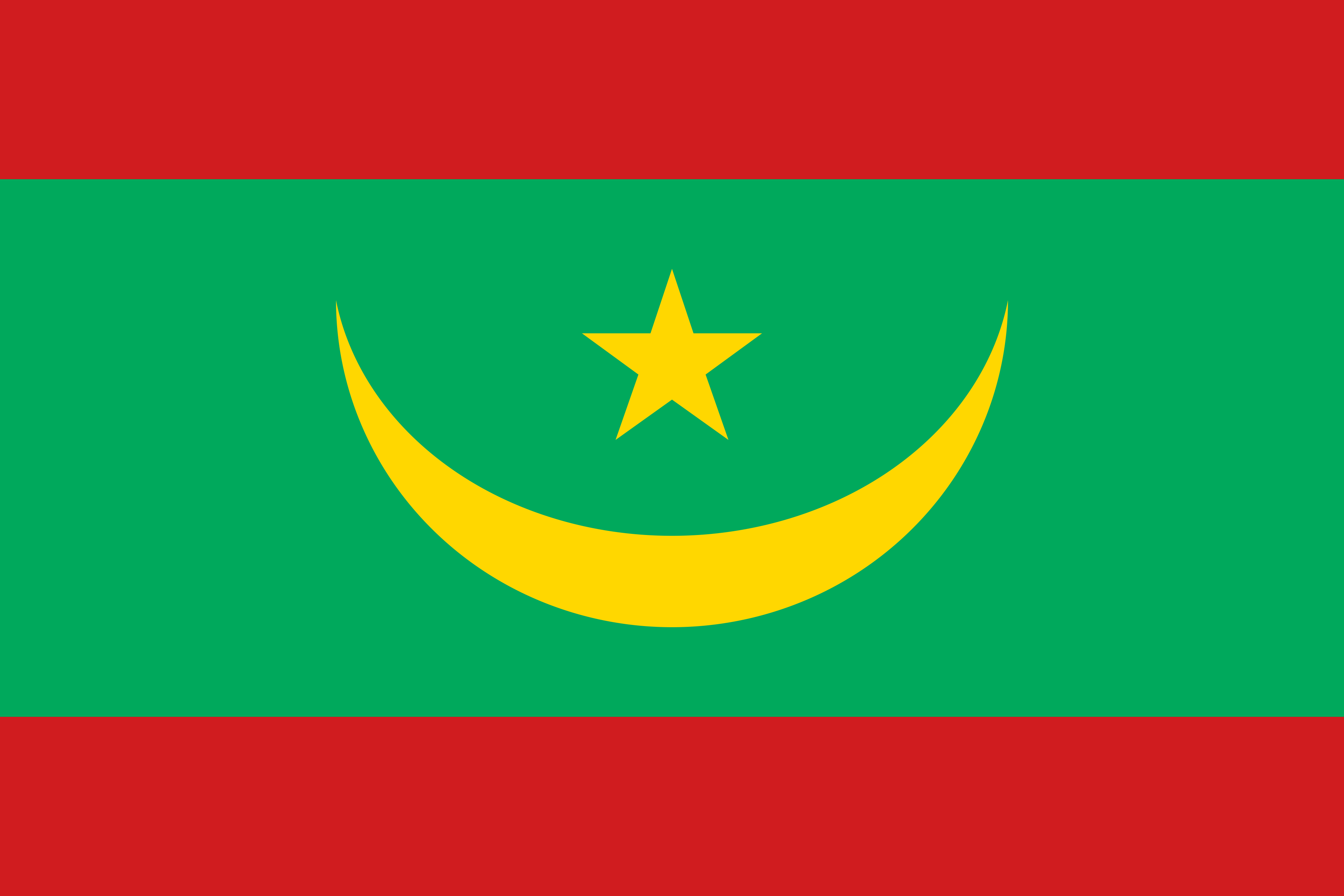
Mauritania’s national flag has a green field between red horizontal bands, with a gold crescent and five-pointed star in the center. The red bands were introduced through the constitutional changes of 2017. The standard rectangle is three units wide and two high, and each red band occupies one-fifth of its height.
The present flag retains the green-and-gold identity of the earlier national design while adding red to commemorate sacrifice for the country. Its history involves several different dates: the original 1959 flag, independence in 1960, constitutional and technical changes in 2017, and a government graphics guide published in 2020.
What does Mauritania’s flag look like?
Mauritania’s flag is a horizontal red, green, and red arrangement with a gold crescent and five-pointed star centered on the green area. The crescent opens upward and the star sits above its bowl. The green band is three times as tall as either red band; the bands are not equal thirds.

The top and bottom edges are red, but the left and right edges of the central area remain green. This is a useful distinction from a flag with a red border around all four sides. No lettering or national seal is part of the ordinary national flag.
What are the flag’s correct proportions?
The normal national flag has a width-to-height ratio of 3:2. The 2017 decree expresses this by making the smaller dimension two-thirds of the larger dimension. Thus 2:3 height-to-width describes the same shape. The decree separately permits square standards and pennants for the armed and security forces.
| Notation or example | Interpretation |
|---|---|
| 3:2 width:height | Three units wide and two high |
| 2:3 height:width | The same rectangle, expressed in reverse order |
| 150 × 100 cm | A calculated example at the correct ratio |
| Square military standard | Express exception; not the ordinary national rectangle |
A square thumbnail can contain the complete rectangular flag with empty space around it. It should not stretch the national design into a square. The square military exception belongs to specified official flag categories, not to arbitrary changes in website artwork.
How wide are the red and green bands?
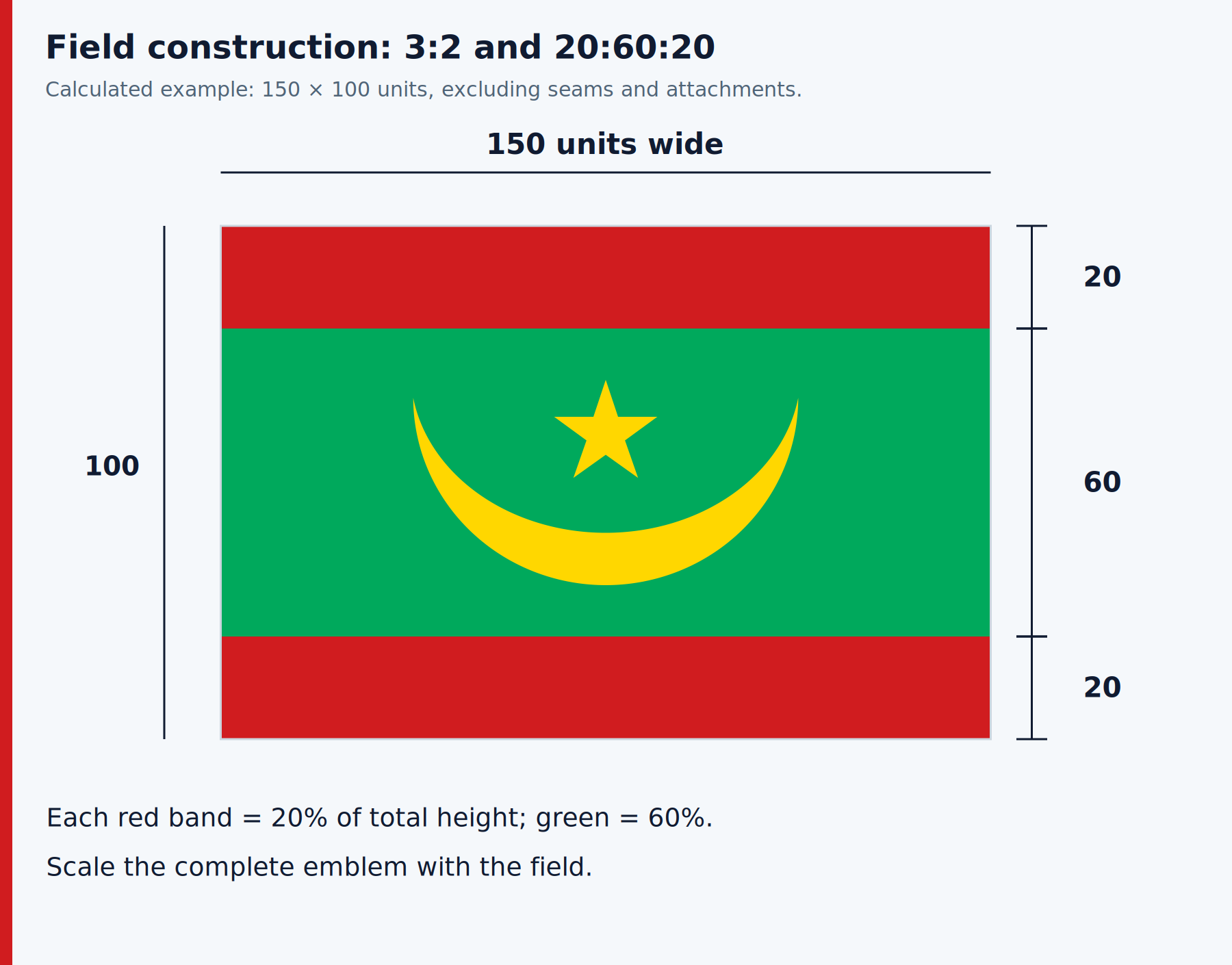
Each red band occupies twenty percent of the flag’s total height, while the central green band occupies sixty percent. The vertical division is therefore 1:3:1, or 20:60:20. Measure these percentages against the full height, including both red bands, rather than against the green area alone.

For a 150 by 100 centimeter flag, the upper red band is 20 centimeters high, the green area is 60 centimeters high, and the lower red band is 20 centimeters high. All three extend across the full width. These are calculated finished-design dimensions, excluding seams and attachments.
How should the flag be constructed?
Begin with the 3:2 rectangle and divide its height into red, green, and red bands in a 20:60:20 sequence. Place the gold star and upward-opening crescent together in the central field. Use the complete current reference artwork for their contours instead of replacing the crescent with an arbitrary moon icon.
The government guide provides a construction drawing and the official colors. The supplied vector follows the current reference’s full three-path drawing. It retains the flattened crescent and the five-pointed star; these are not reconstructed by adding red strips to an older flag image.
The diagram identifies the dependable field divisions. It does not turn every rounded measurement in a published drawing into a tolerance-free engineering specification. For official manufacture, use the responsible Mauritanian authority’s approved materials and procedures.
Which direction does the crescent face?
The gold crescent opens upward, with its rounded outer side facing downward. Its two tips rise on either side of the central star. It is not a sideways crescent like those on several other national flags, and it should not be flipped upside down in a standard front-view illustration.

The present reference has a broad, relatively flattened crescent. Older flag illustrations use a more circular form. Preserving the current contour matters: changing the outer field while retaining an older emblem can produce a hybrid rather than a faithful current illustration.
How many points does the star have?
The flag has one gold star with five points. One point faces upward, and the star is centered above the crescent’s bowl. The star and crescent share the same gold color. There is no second star, enclosing disk, inscription, or outlined badge around the pair in the national design.
At thumbnail size, the star can merge visually with the crescent or lose its sharp corners. Use the vector version for clear enlargement and retain the complete contour. A Unicode star character is not a substitute for the flag’s actual drawn emblem.
What are the official HEX, RGB, and CMYK colors?
The government’s Kennach color table specifies green #00A95C, gold #FFD700, and red #D01C1F. Their RGB values are 0,169,92; 255,215,0; and 208,28,31 respectively. The same official table supplies separate CMYK recipes. These are published digital and print specifications, rather than colors guessed from a photograph or sampled from an emoji.
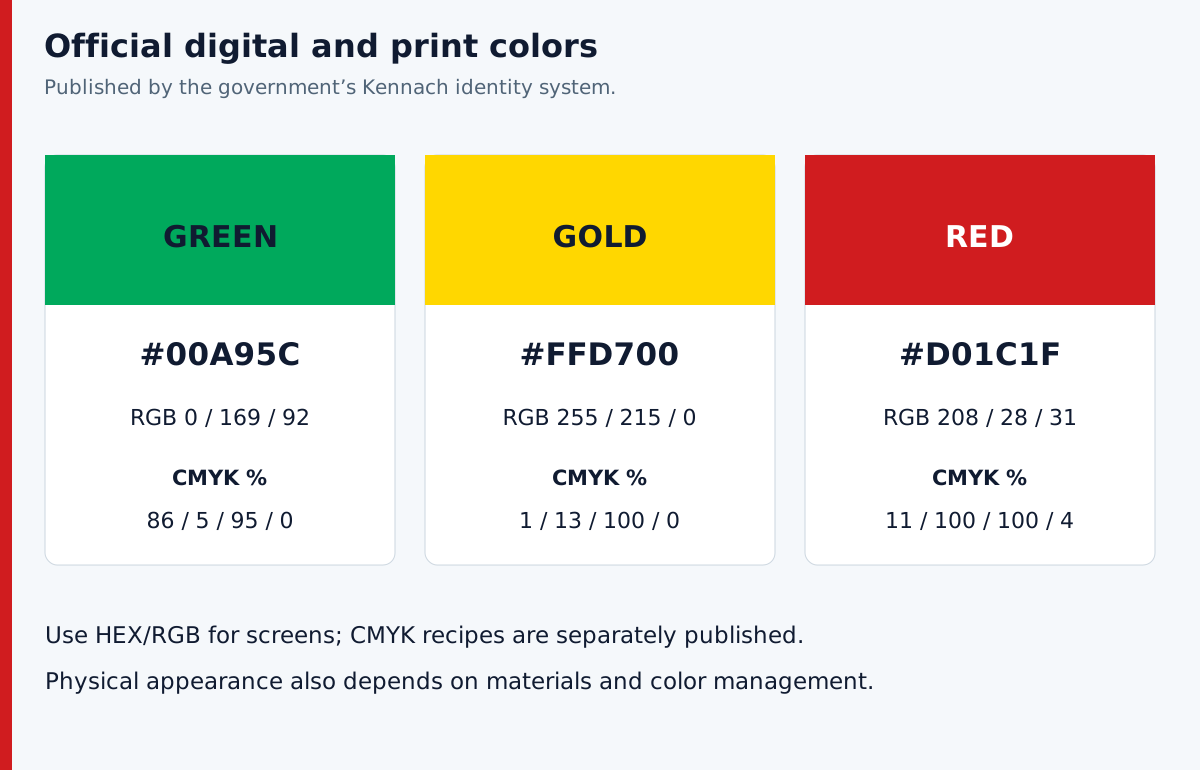
| Color | HEX / RGB | CMYK percentages |
|---|---|---|
| Green | #00A95C · 0, 169, 92 | 86, 5, 95, 0 |
| Gold | #FFD700 · 255, 215, 0 | 1, 13, 100, 0 |
| Red | #D01C1F · 208, 28, 31 | 11, 100, 100, 4 |
Use the RGB or HEX values for the supplied digital artwork. The listed CMYK recipes are those published by the government, not automatic conversions performed for this page. Paper, fabric, ink, coating, and color management still influence the appearance of a physical reproduction.
Why do some references show different colors?
Historical flags and earlier technical references do not always use the same shades as the current government graphics system. The old construction annex also lists Pantone references, while Kennach publishes explicit RGB, HEX, and CMYK values. Keep each specification attached to its source and date rather than treating every listed value as interchangeable.
The older annex lists PMS 802 for green, PMS 803 2X for gold, and PMS 1788 2X for red. This article uses Kennach’s current digital table for its present-day downloads. It does not claim a verified one-to-one conversion between those Pantone entries and the later screen colors.
The historical reference retains its original deeper green and gold. Its palette is evidence of that particular reconstruction, not proof of the exact pigments used on every pre-2017 textile.
Can the flag be reproduced in grayscale?
The government graphics guide allows grayscale reproduction when needed, specifying eighty-five percent black for the red bands, fifty percent for the green field, and ten percent for the star and crescent. This is a defined monochrome treatment. It should not be presented as an alternative national color scheme or used to redefine the flag.
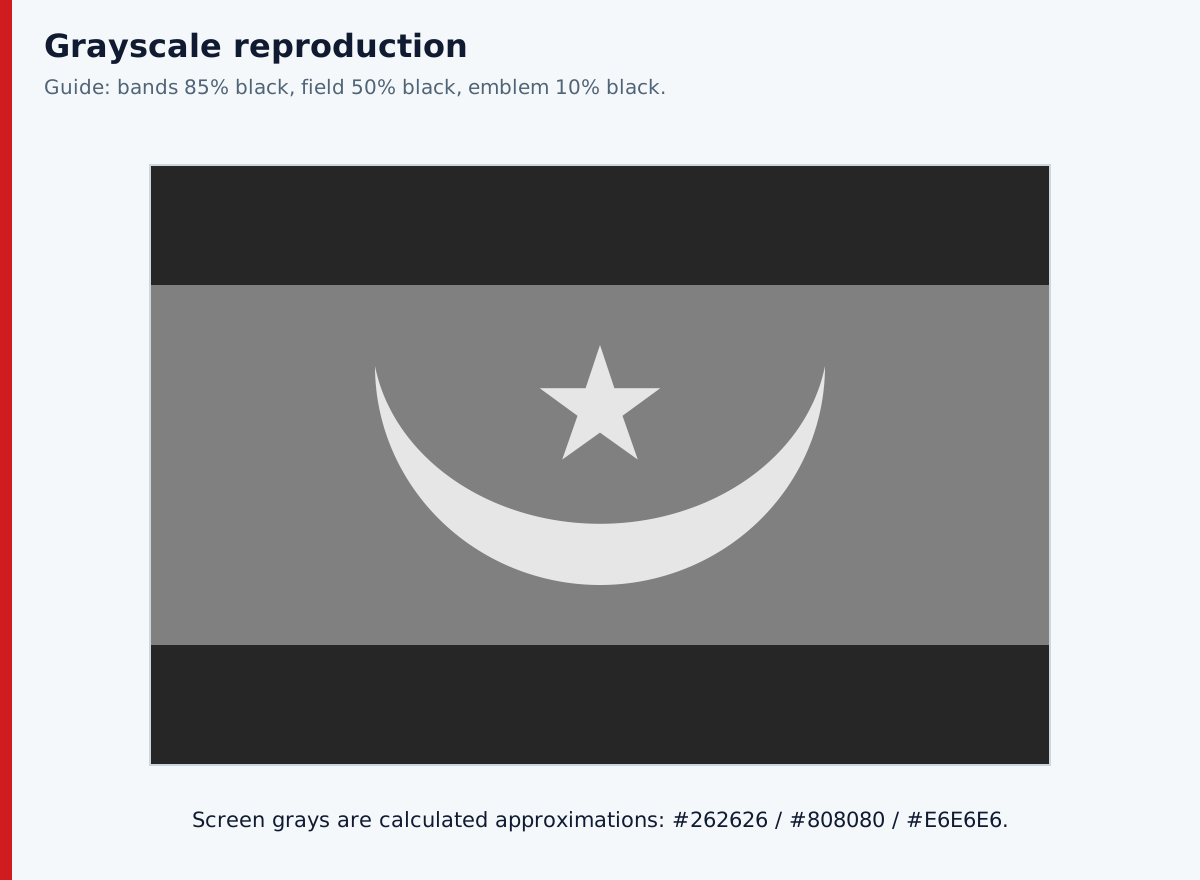
The example here maps those percentages to approximate screen grays: #262626, #808080, and #E6E6E6. Those HEX grays are calculated display values, not additional government color codes. The guide also describes an outline treatment for engraving; that is a production technique rather than a new flag.
What do the flag’s main symbols mean?
Green and the crescent-and-star motif are commonly associated with Islam, while gold is often linked with the Sahara and the country’s resources. Red commemorates sacrifice for the nation. The Constitution describes the design without assigning all these meanings; institutional explanations distinguish the legal description from customary interpretations.
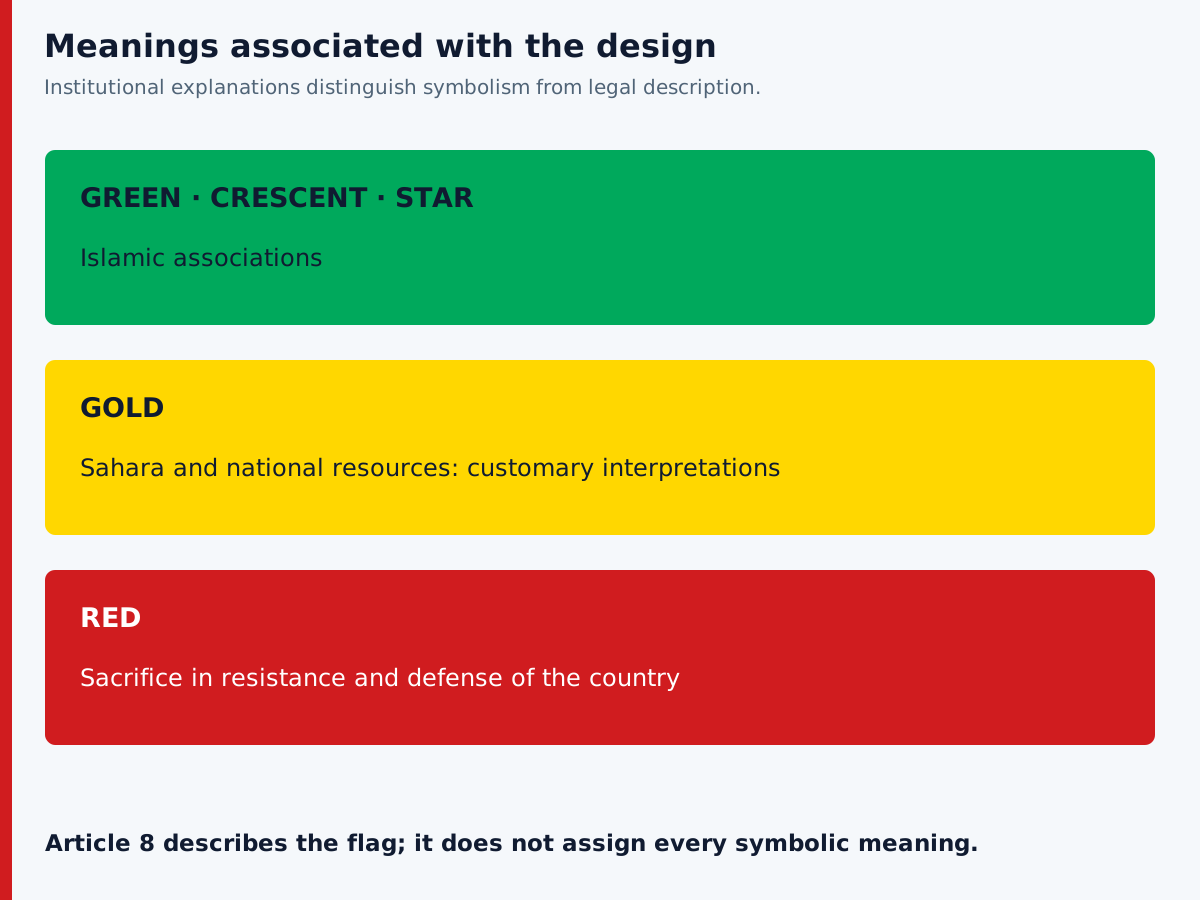
AMI’s discussion of national symbols explicitly treats several color associations as interpretations. That distinction matters when preparing a school answer: the Islamic association is well established, but a claim that every color meaning is written into Article 8 would be inaccurate.
Why were the red bands added in 2017?
The red bands were introduced to honor those who sacrificed their lives in resistance and defense of the country. The government’s explanation connected the change with remembrance and national identity. The existing green field and gold crescent and star were retained, so the revision added a commemorative element to an established design.
The official explanation refers both to resistance martyrs and to members of the armed forces who died defending the country. It is broader than a claim that the bands commemorate one named battle or one precisely defined date. The design itself does not list individual names or events.
What did the earlier Mauritanian flag look like?
The earlier national flag showed a gold crescent and star on a plain green field, without red bands. It was described in the 1959 Constitution and remained the national design through independence in 1960. A historical illustration should be labelled accordingly, since that plain-green version is not the present national flag.


The historical vector supplied here preserves its own emblem geometry and colors. It is a reconstruction for comparison, not a photograph of a surviving original. The present crescent’s different shape is why simply removing the red bands from a modern vector is an inadequate historical method.
Was the original flag adopted in March or April 1959?
The Constitution of March 22, 1959 already described the gold crescent and star on green. The later implementing decree was dated April 1, 1959, a date often given for the original flag’s adoption. These are separate legal steps. The 2017 decree expressly identifies and replaces that April decree.
| Date | Document or event |
|---|---|
| March 22, 1959 | Constitution, Article 5: gold crescent and star on green |
| April 1, 1959 | Decree 59-007 describing the earlier flag |
| November 28, 1960 | Independence; distinct from the flag’s original legal description |
The April date is corroborated by Article 10 of the 2017 decree, which also identifies supplementary rules from 2010. The constitutional description and implementing decree belong to the same early period of national identity, before independence in 1960.
When was the present flag adopted?
The red-band design was constitutionally adopted in 2017, with the amendment promulgated on August 15. A descriptive law followed on October 24 and a technical decree on October 25. That decree expressly took effect on November 28, 2017 at 10 a.m. These dates identify different stages rather than a single interchangeable anniversary.

August 15 marks the constitutional amendment, while November 28 marks the detailed decree’s commencement. October 25 is the date of the decree, not the date its own final article says it took effect.
What happened in the 2017 referendum and rollout?
The referendum took place on August 5, 2017. The constitutional amendment followed in August, and the National Assembly approved the flag-description bill on October 12. Official reporting then documented the new flag at the November 28 independence celebrations. The referendum, parliamentary approval, legal commencement, and public raising should be kept distinct.
The flag change formed part of a wider constitutional-reform process. The vote, parliamentary proceedings, and later implementing rules formed distinct stages in bringing the new design into use.
What changed with the 2020 graphics guide?
In May 2020, the government introduced a unified graphics charter for official documents and related media. It supplied a consistent visual reference for national symbols, including flag geometry and color values. This standardization belongs to the flag’s reproduction history; it does not mean the red bands were first adopted in 2020.
The May 28 Council of Ministers communiqué describes the goal of consistency across correspondence, publications, websites, and administrative material. The current downloadable reference is checked against that visual system, while the 2017 constitutional and decree dates remain separate.
Who designed Mauritania’s flag?
The primary documents consulted establish the flag through constitutional and governmental decisions, but they do not securely identify a single individual designer of the national design. A president who promoted a change, a designer of official typography, and an illustrator who draws a digital file perform different roles and should not be conflated.
For that reason, this page does not invent a designer credit. The image credits identify the people responsible for the reference files and GKBook’s explanatory graphics; they are not claims of authorship of the national flag itself.
How does the flag’s history relate to independence?
Mauritania became independent on November 28, 1960, after the earlier green-and-gold flag had already been described in 1959. The red bands arrived decades later, in 2017. Independence, the first national design, and the current design are therefore separate milestones, even though November 28 also became the new decree’s commencement date.

The Presidency’s historical overview also distinguishes the declaration of autonomy on November 28, 1958 from full independence two years later. Neither should be relabelled as the date on which the present red-band design first appeared.
When is the main national flag celebration?
November 28, Independence Day, is a major occasion for raising Mauritania’s flag. It commemorates independence in 1960 and was also the commencement date specified for the 2017 flag decree. Official reports document flag-raising ceremonies with the national anthem. Those facts do not establish a separately named annual holiday called Flag Day.
The November 28, 2025 presidential-palace ceremony is a dated example of the continuing practice. It is not a timetable for future celebrations. Local ceremony times and any special arrangements should come from the relevant announcement for that year.
Which way up should the flag be displayed?
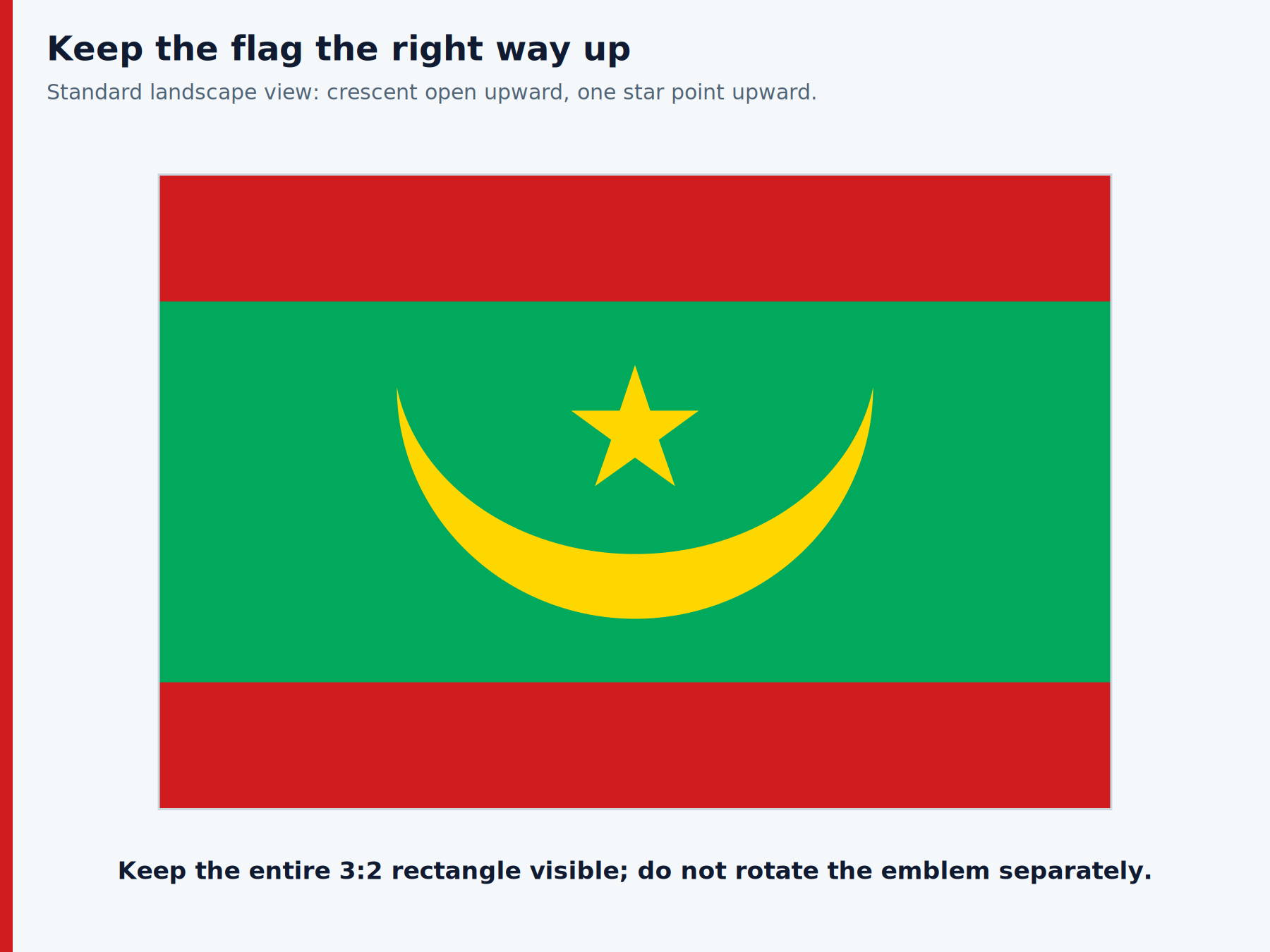
In the standard landscape view, the red bands run along the top and bottom, the crescent opens upward, and one star point faces upward. The emblem is centered horizontally. Keep the complete rectangle in view and preserve its ratio; an upside-down crescent is not corrected merely because the red bands remain symmetrical.
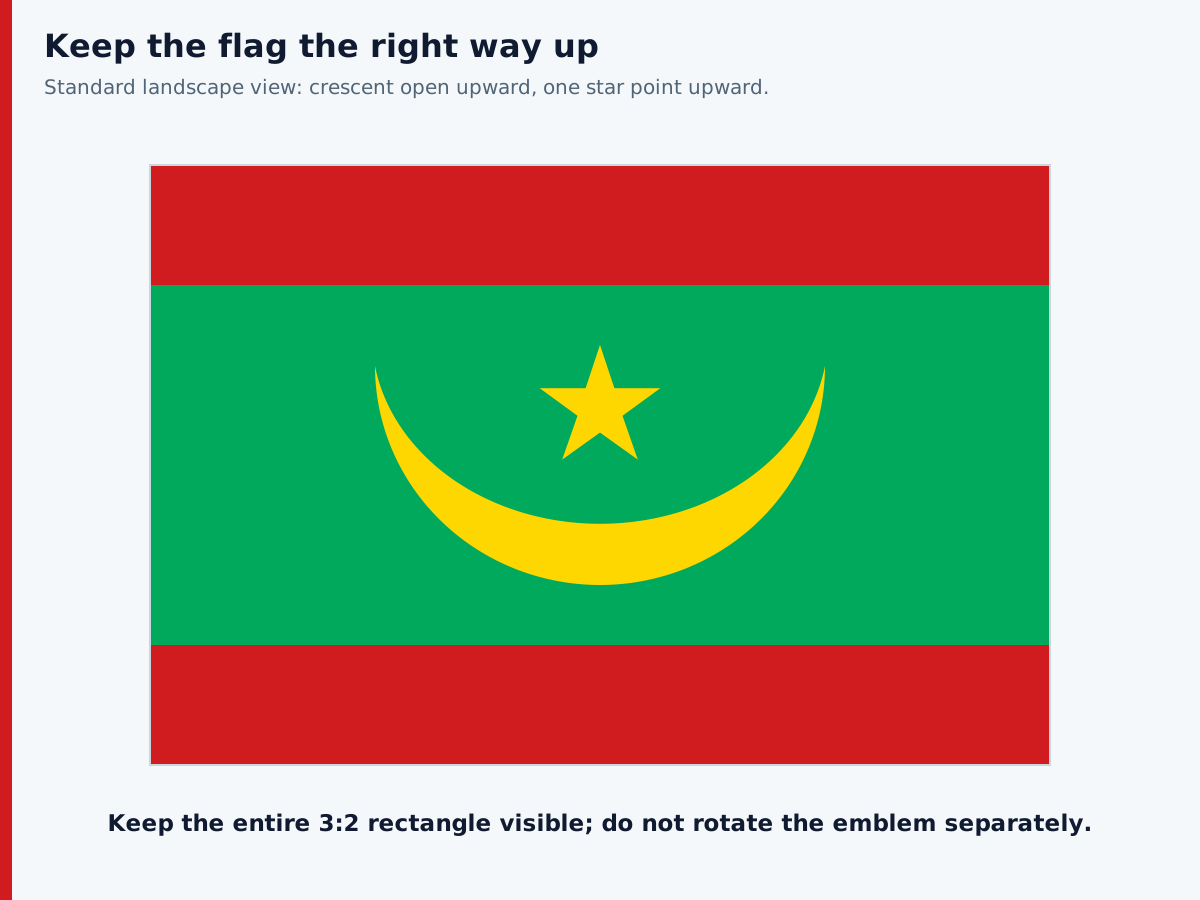
The hoist is the attachment edge and the fly is the free edge. The ordinary drawing is symmetric left to right, but not top to bottom. Its left-right symmetry does not authorize rotating the emblem independently when making a vertical banner.
What sizes keep the flag in proportion?
Any rectangle whose width is one and a half times its height preserves the normal 3:2 proportion. Examples include 90 by 60, 150 by 100, and 180 by 120 centimeters. The main PNG is 3600 by 2400 pixels. Each red band remains one-fifth of the height at every size.
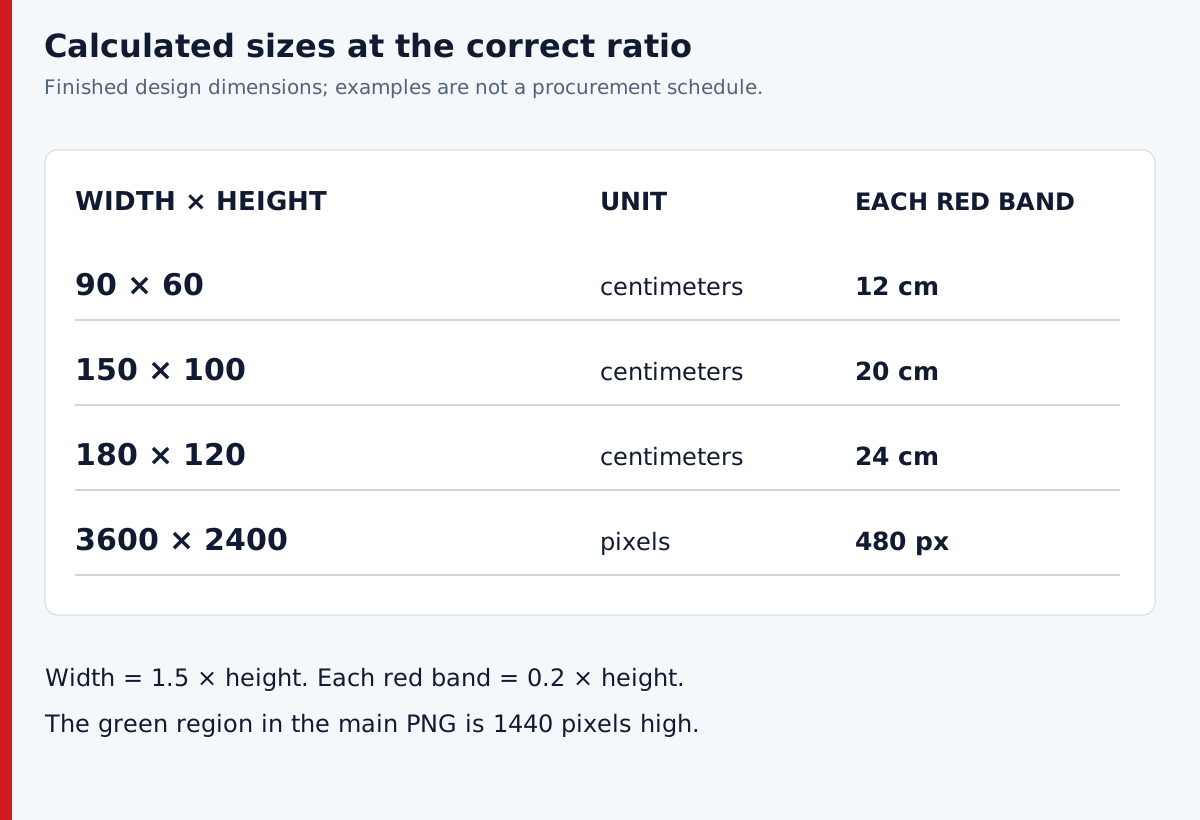
A 3600 by 2400 image has a 480-pixel top red band, a 1440-pixel green region, and a 480-pixel bottom red band. Scale the star and crescent with the field rather than keeping the emblem at a fixed pixel size. These calculated examples are not the decree’s complete procurement schedule.
What are the decree’s thirteen flag categories?
The decree divides flags into thirteen categories according to use, including the presidential palace, United Nations format, ministries, other institutions, interiors, street decoration, vehicles, tables, and military formations. These categories mainly distinguish settings and formats. They do not establish thirteen different national color schemes or authorize replacing the crescent and star.

| Category | Use named in the decree |
|---|---|
| 1 | November 28 flag at the presidential palace |
| 2 | United Nations format |
| 3 | Prime ministry, ministries and major parade grounds |
| 4 | Chancelleries, major institutions and large public places |
| 5 | Other public or private entities |
| 6 | Indoor flag |
| 7–9 | Avenues, building fronts and other decorated spaces |
| 10–11 | Vehicle flag; table flag |
| 12–13 | Military formation standard; military unit pennant |
The decree refers to an annex for exact sizes and particulars. A use category alone does not determine every finished dimension. The diagram helps identify the categories; official purchasing specifications must come from the applicable annex and responsible authority.
Are military flags allowed to be square?
Yes. Article 3 of the 2017 decree expressly makes an exception for the standards and pennants of the armed and security forces, specifying a square shape. This exception should be identified by use. The ordinary national flag remains a 3:2 rectangle, and the decree’s military exception does not change that general rule.
The square exception applies to specified military and security uses. It does not make a stretched square copy of the ordinary national drawing an approved service standard; specialized flags must follow the relevant official specifications.
What does the decree say about display and decoration?
The decree generally provides for one flag at a headquarters or location, with multiple flags permitted for festivities and ceremonies. It separately says decorative banners may use the national colors but must not represent the national flag. These provisions distinguish a complete national emblem from decorative strips or event banners.
Article 6 is a general rule with an express ceremonial exception. Article 5 addresses decorative banners, not the ordinary national flag’s design. A red-green-gold decorative treatment should not be described as another official flag variant simply because it uses the same colors.
When is Mauritania’s flag flown at half-staff?
Mauritania uses half-staff display during officially announced periods of mourning. For example, a government communiqué of October 17, 2023 directed flags to be lowered for three days. That is a dated instruction, not a permanent calendar rule. For a current ceremony, follow the applicable official announcement and its stated duration.

The illustration only shows a lowered flag. It does not impose a numerical halfway measurement or import another country’s raising and lowering sequence. This article makes no claim that an exceptional mourning order is in force today.
Are flag downloads the same as permission to manufacture official flags?
No. A downloadable illustration supplies artwork, while the 2017 decree assigns official flag production responsibilities to the Ministry of Defence and the National Army. It also gives the National Gendarmerie a role in enforcing the specified standards. Copyright status, visual accuracy, and authority to produce regulated physical flags are separate questions.
Articles 7 and 8 assign manufacture to defence institutions and describe supply, at cost, to public services, private entities, and individuals on request. These are provisions of the published decree, not a claim that this educational package grants governmental approval or supplies a current procurement service.
Is the national seal part of the flag?
No. Mauritania’s national seal is a separate circular emblem with additional elements, including a palm tree, millet, and the country’s name in Arabic and French. The flag uses only its colored field, crescent, and star. Placing the full seal on the rectangle would produce a different graphic from the ordinary national flag.
Both symbols appear in the government’s identity system, but they have different compositions and purposes. The visual charter treats them separately. The national flag is recognizable without a seal, wordmark, or additional badge.
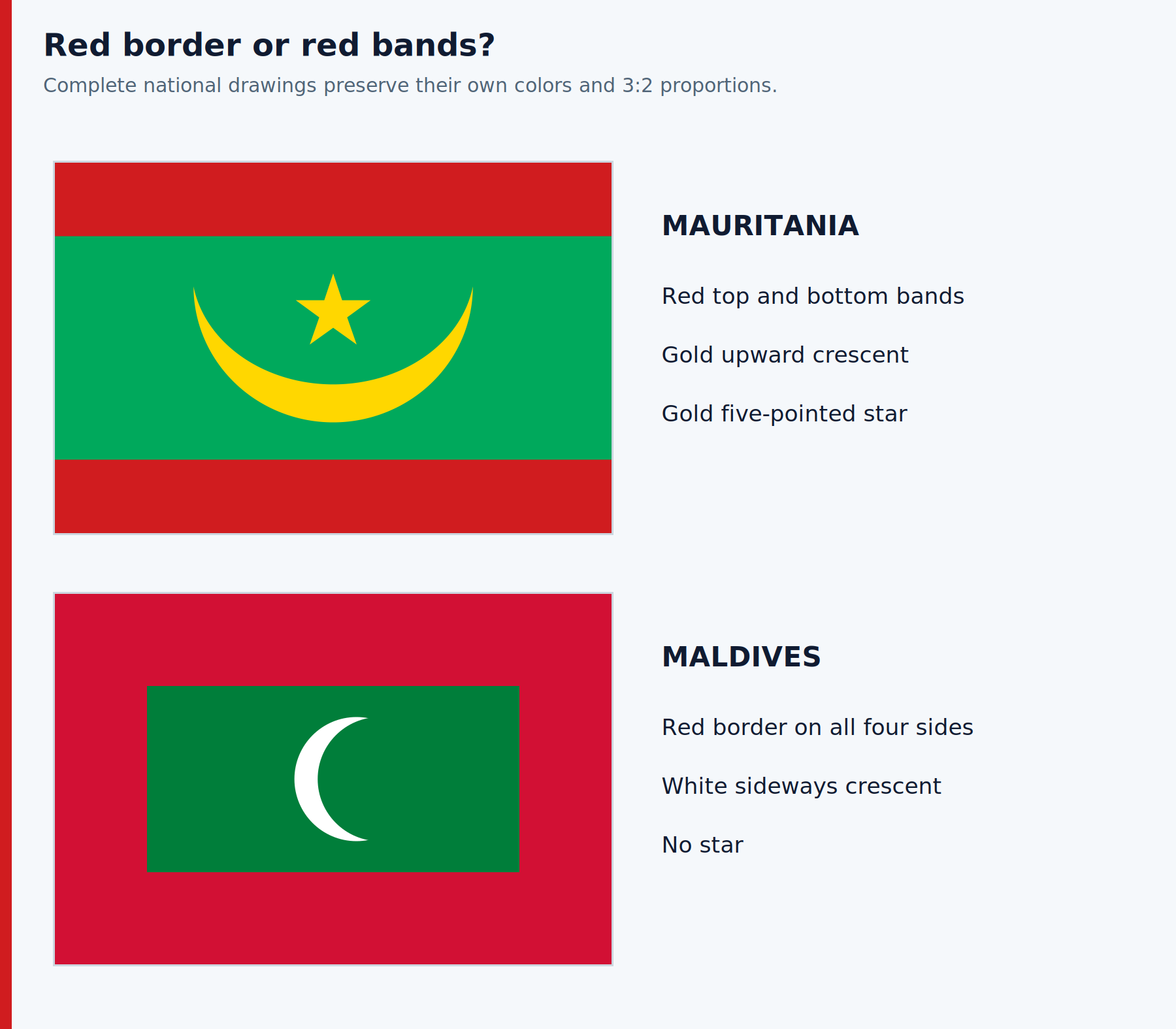
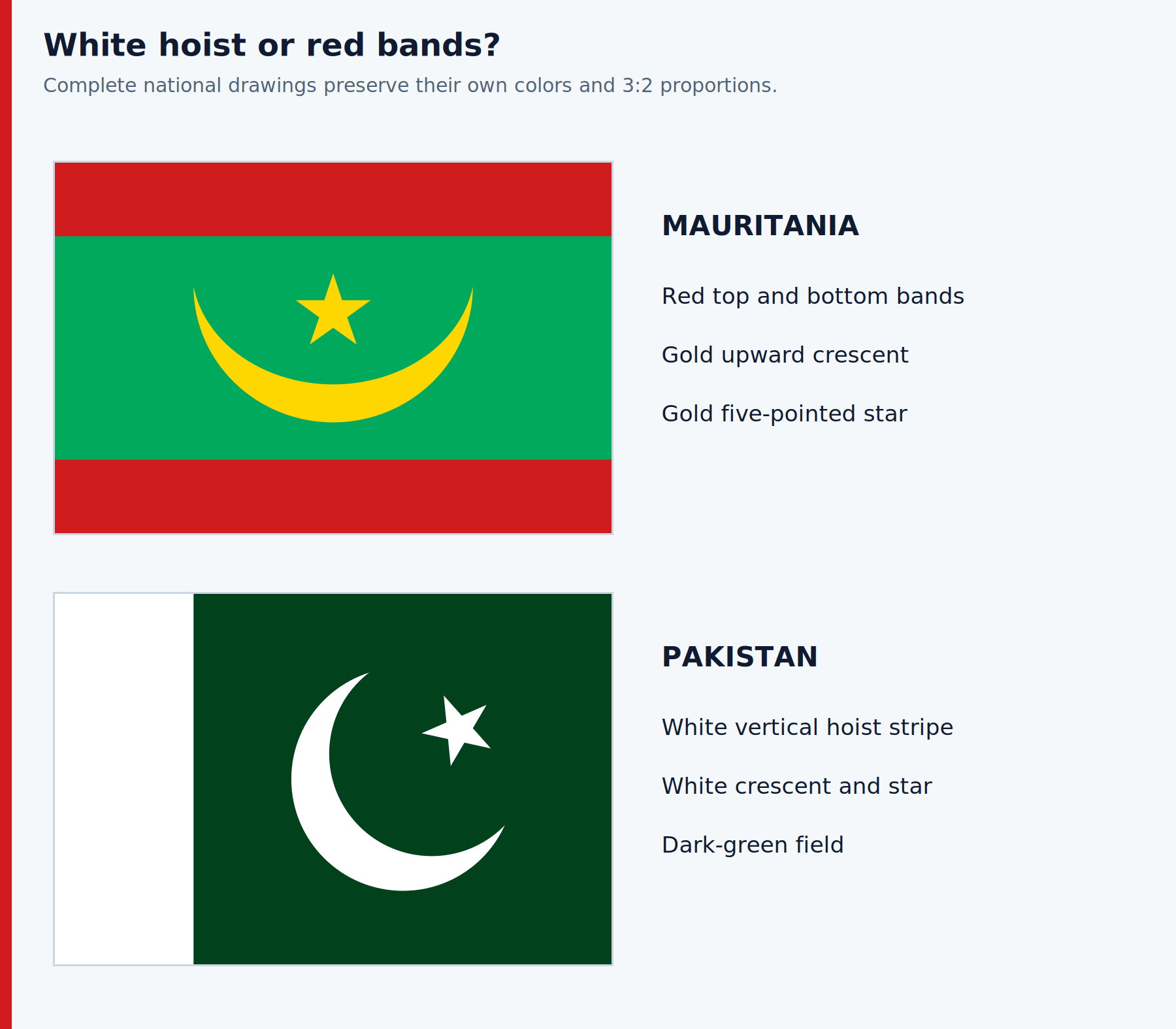
How does Mauritania’s flag differ from the Maldives and Pakistan?
Mauritania has red bands only at the top and bottom and a gold crescent and star. The Maldives has a red border on all four sides and a white crescent without a star. Pakistan has a white hoist stripe and a white crescent and star on a dark-green field.


| Flag | Border or stripe | Emblem |
|---|---|---|
| Mauritania | Red top and bottom bands | Gold upward-opening crescent and star |
| Maldives | Red border on all four sides | White sideways crescent; no star |
| Pakistan | White vertical stripe at the hoist | White crescent and star |
Each comparison uses the complete source drawing and its own palette. Green backgrounds and crescent motifs alone are insufficient for identification. The crescent’s direction, the presence of a star, and the placement of red or white areas are more reliable visual clues.
What is Mauritania’s flag emoji?
Mauritania’s flag emoji is 🇲🇷. It combines regional indicator M, U+1F1F2, and regional indicator R, U+1F1F7. Do not confuse it with Mauritius, whose regional indicators are M and U. Emoji appearance depends on the platform, so a small or outdated rendering should not be treated as an authoritative national design specification.
| Item | Value |
|---|---|
| Emoji | 🇲🇷 |
| Regional indicators | M + R |
| Unicode sequence | U+1F1F2 U+1F1F7 |
| Different country | Mauritius uses M + U: 🇲🇺 |
For print, teaching, and detailed comparison, use the SVG or large PNG. Give the image an accessible name identifying Mauritania, since the small star and crescent can be difficult to read at emoji size.
What mistakes should a Mauritania flag illustration avoid?
Common mistakes include omitting the red bands, dividing the field into equal thirds, adding red side borders, using a sideways crescent, or substituting an older emblem for the current reference. Another error is collapsing every 2017 event into one date. Check the drawing, colors, proportions, and historical label together.
- Keep the normal field at 3:2 and the bands at 20:60:20.
- Retain the current upward-opening gold crescent and five-pointed star.
- Use the official digital palette for current artwork.
- Label the plain-green reference as historical.
- Separate constitutional adoption, decree date, commencement, and later graphic standardization.
| Term | Meaning in this article |
|---|---|
| Hoist / fly | Attachment edge / free edge |
| Field | The flag’s background areas |
| Crescent | The upward-opening gold curved emblem |
| Standard / pennant | Specialized official flags, including the military exception |
| Width:height 3:2 | A rectangle one and a half times as wide as high |
| Half-staff / half-mast | Lowered position used for official mourning |
Explore more in World Flags: Iceland flag, Lithuania flag, Luxembourg flag, Madagascar flag, Malawi flag, Malaysia flag, Maldives flag, Mali flag, Malta flag.
Download Mauritania flag pictures
Download the national flag as SVG or large PNG. The gallery includes 17 distinct subjects with captions and alternative text. Keep the full proportions when resizing. Image credits and reuse notes accompany the graphics.
World Flags/Mauritania
Mauritania flag pictures
Red bands above and below a green field, with a gold upward-opening crescent and five-pointed star. Standard width:height 3:2.
GKBook; reference artwork: Commons contributors (current Mauritania reference based on Kennach)Download SVGDownload PNGThe central green field reaches both side edges. The crescent opens upward; the five-pointed star sits above its bowl.
GKBook; reference artwork: Commons contributors (current Mauritania reference based on Kennach)Download SVGDownload PNGThe decree specifies a 3:2 rectangle and red bands each one-fifth of the full height. The green region is therefore three-fifths.
GKBook; reference artwork: Commons contributors (current Mauritania reference based on Kennach)Download SVGDownload PNGEnlarged crop of the current reference keeps the original star and elliptical crescent contours.
GKBook; reference artwork: Commons contributors (current Mauritania reference based on Kennach)Download SVGDownload PNGGreen #00A95C, gold #FFD700 and red #D01C1F, with the government’s RGB and CMYK values.
GKBookDownload SVGDownload PNGGreen and the crescent/star have Islamic associations; gold is linked with Sahara and resources; red honors sacrifice. Not every interpretation is written into the Constitution.
GKBookDownload SVGDownload PNGThree calculated physical sizes and the 3600 × 2400-pixel national PNG preserve the 3:2 rectangle and 20:60:20 bands.
GKBookDownload SVGDownload PNGGold crescent and star on plain green, without red bands. Separate historical reference; its palette is not a verified textile-color specification.
GKBook; reference artwork: Commons contributors (historical Mauritania reference)Download SVGDownload PNGThe older flag is a separate reference drawing. Removing the red bands from the present vector would not recover its historical emblem geometry.
GKBook; reference artwork: Commons contributors (current Mauritania reference based on Kennach); Commons contributors (historical Mauritania reference)Download SVGDownload PNGThe original legal description preceded independence. Red bands date from 2017; the graphics charter followed in 2020.
GKBookDownload SVGDownload PNGThe constitutional amendment is dated August 15. The October 25 decree expressly commenced on November 28 at 10 a.m.; its journal issue is dated November 30.
GKBookDownload SVGDownload PNGThe guide’s percentage-black treatment preserves the complete flag geometry. The shown HEX grays are calculated display approximations, not extra government color codes.
GKBook; reference artwork: Commons contributors (current Mauritania reference based on Kennach)Download SVGDownload PNGThe red bands are symmetrical, but the emblem is not symmetrical top to bottom. Keep the crescent opening and the star’s top point upward.
GKBook; reference artwork: Commons contributors (current Mauritania reference based on Kennach)Download SVGDownload PNGCategory numbers are grouped for readability. The diagram does not invent an unavailable annex dimension schedule.
GKBookDownload SVGDownload PNGA dated government communiqué ordered three days of lowered flags in October 2023. The illustration specifies neither an exact pole position nor a current mourning order.
GKBook; reference artwork: Commons contributors (current Mauritania reference based on Kennach)Download SVGDownload PNGComplete reference flags show the different border or stripe arrangement, emblem color and crescent orientation.
GKBook; reference artwork: Commons contributors (current Mauritania reference based on Kennach); Commons contributors (Maldives reference)Download SVGDownload PNGComplete reference flags show the different border or stripe arrangement, emblem color and crescent orientation.
GKBook; reference artwork: Commons contributors (current Mauritania reference based on Kennach); Commons contributors (Pakistan reference)Download SVGDownload PNGFrequently asked questions
What does Mauritania’s flag look like?
Mauritania’s flag is a horizontal red, green, and red arrangement with a gold crescent and five-pointed star centered on the green area. The crescent opens upward and the star sits above its bowl. The green band is three times as tall as either red band; the bands are not equal thirds.
What are the flag’s correct proportions?
The normal national flag has a width-to-height ratio of 3:2. The 2017 decree expresses this by making the smaller dimension two-thirds of the larger dimension. Thus 2:3 height-to-width describes the same shape. The decree separately permits square standards and pennants for the armed and security forces.
How wide are the red and green bands?
Each red band occupies twenty percent of the flag’s total height, while the central green band occupies sixty percent. The vertical division is therefore 1:3:1, or 20:60:20. Measure these percentages against the full height, including both red bands, rather than against the green area alone.
How should the flag be constructed?
Begin with the 3:2 rectangle and divide its height into red, green, and red bands in a 20:60:20 sequence. Place the gold star and upward-opening crescent together in the central field. Use the complete current reference artwork for their contours instead of replacing the crescent with an arbitrary moon icon.
Which direction does the crescent face?
The gold crescent opens upward, with its rounded outer side facing downward. Its two tips rise on either side of the central star. It is not a sideways crescent like those on several other national flags, and it should not be flipped upside down in a standard front-view illustration.
How many points does the star have?
The flag has one gold star with five points. One point faces upward, and the star is centered above the crescent’s bowl. The star and crescent share the same gold color. There is no second star, enclosing disk, inscription, or outlined badge around the pair in the national design.
What are the official HEX, RGB, and CMYK colors?
The government’s Kennach color table specifies green #00A95C, gold #FFD700, and red #D01C1F. Their RGB values are 0,169,92; 255,215,0; and 208,28,31 respectively. The same official table supplies separate CMYK recipes. These are published digital and print specifications, rather than colors guessed from a photograph or sampled from an emoji.
Why do some references show different colors?
Historical flags and earlier technical references do not always use the same shades as the current government graphics system. The old construction annex also lists Pantone references, while Kennach publishes explicit RGB, HEX, and CMYK values. Keep each specification attached to its source and date rather than treating every listed value as interchangeable.
Can the flag be reproduced in grayscale?
The government graphics guide allows grayscale reproduction when needed, specifying eighty-five percent black for the red bands, fifty percent for the green field, and ten percent for the star and crescent. This is a defined monochrome treatment. It should not be presented as an alternative national color scheme or used to redefine the flag.
What do the flag’s main symbols mean?
Green and the crescent-and-star motif are commonly associated with Islam, while gold is often linked with the Sahara and the country’s resources. Red commemorates sacrifice for the nation. The Constitution describes the design without assigning all these meanings; institutional explanations distinguish the legal description from customary interpretations.
Why were the red bands added in 2017?
The red bands were introduced to honor those who sacrificed their lives in resistance and defense of the country. The government’s explanation connected the change with remembrance and national identity. The existing green field and gold crescent and star were retained, so the revision added a commemorative element to an established design.
What did the earlier Mauritanian flag look like?
The earlier national flag showed a gold crescent and star on a plain green field, without red bands. It was described in the 1959 Constitution and remained the national design through independence in 1960. A historical illustration should be labelled accordingly, since that plain-green version is not the present national flag.
Was the original flag adopted in March or April 1959?
The Constitution of March 22, 1959 already described the gold crescent and star on green. The later implementing decree was dated April 1, 1959, a date often given for the original flag’s adoption. These are separate legal steps. The 2017 decree expressly identifies and replaces that April decree.
When was the present flag adopted?
The red-band design was constitutionally adopted in 2017, with the amendment promulgated on August 15. A descriptive law followed on October 24 and a technical decree on October 25. That decree expressly took effect on November 28, 2017 at 10 a.m. These dates identify different stages rather than a single interchangeable anniversary.
What happened in the 2017 referendum and rollout?
The referendum took place on August 5, 2017. The constitutional amendment followed in August, and the National Assembly approved the flag-description bill on October 12. Official reporting then documented the new flag at the November 28 independence celebrations. The referendum, parliamentary approval, legal commencement, and public raising should be kept distinct.
What changed with the 2020 graphics guide?
In May 2020, the government introduced a unified graphics charter for official documents and related media. It supplied a consistent visual reference for national symbols, including flag geometry and color values. This standardization belongs to the flag’s reproduction history; it does not mean the red bands were first adopted in 2020.
Who designed Mauritania’s flag?
The primary documents consulted establish the flag through constitutional and governmental decisions, but they do not securely identify a single individual designer of the national design. A president who promoted a change, a designer of official typography, and an illustrator who draws a digital file perform different roles and should not be conflated.
How does the flag’s history relate to independence?
Mauritania became independent on November 28, 1960, after the earlier green-and-gold flag had already been described in 1959. The red bands arrived decades later, in 2017. Independence, the first national design, and the current design are therefore separate milestones, even though November 28 also became the new decree’s commencement date.
When is the main national flag celebration?
November 28, Independence Day, is a major occasion for raising Mauritania’s flag. It commemorates independence in 1960 and was also the commencement date specified for the 2017 flag decree. Official reports document flag-raising ceremonies with the national anthem. Those facts do not establish a separately named annual holiday called Flag Day.
Which way up should the flag be displayed?
In the standard landscape view, the red bands run along the top and bottom, the crescent opens upward, and one star point faces upward. The emblem is centered horizontally. Keep the complete rectangle in view and preserve its ratio; an upside-down crescent is not corrected merely because the red bands remain symmetrical.
What sizes keep the flag in proportion?
Any rectangle whose width is one and a half times its height preserves the normal 3:2 proportion. Examples include 90 by 60, 150 by 100, and 180 by 120 centimeters. The main PNG is 3600 by 2400 pixels. Each red band remains one-fifth of the height at every size.
What are the decree’s thirteen flag categories?
The decree divides flags into thirteen categories according to use, including the presidential palace, United Nations format, ministries, other institutions, interiors, street decoration, vehicles, tables, and military formations. These categories mainly distinguish settings and formats. They do not establish thirteen different national color schemes or authorize replacing the crescent and star.
Are military flags allowed to be square?
Yes. Article 3 of the 2017 decree expressly makes an exception for the standards and pennants of the armed and security forces, specifying a square shape. This exception should be identified by use. The ordinary national flag remains a 3:2 rectangle, and the decree’s military exception does not change that general rule.
What does the decree say about display and decoration?
The decree generally provides for one flag at a headquarters or location, with multiple flags permitted for festivities and ceremonies. It separately says decorative banners may use the national colors but must not represent the national flag. These provisions distinguish a complete national emblem from decorative strips or event banners.
When is Mauritania’s flag flown at half-staff?
Mauritania uses half-staff display during officially announced periods of mourning. For example, a government communiqué of October 17, 2023 directed flags to be lowered for three days. That is a dated instruction, not a permanent calendar rule. For a current ceremony, follow the applicable official announcement and its stated duration.
Are flag downloads the same as permission to manufacture official flags?
No. A downloadable illustration supplies artwork, while the 2017 decree assigns official flag production responsibilities to the Ministry of Defence and the National Army. It also gives the National Gendarmerie a role in enforcing the specified standards. Copyright status, visual accuracy, and authority to produce regulated physical flags are separate questions.
Is the national seal part of the flag?
No. Mauritania’s national seal is a separate circular emblem with additional elements, including a palm tree, millet, and the country’s name in Arabic and French. The flag uses only its colored field, crescent, and star. Placing the full seal on the rectangle would produce a different graphic from the ordinary national flag.
How does Mauritania’s flag differ from the Maldives and Pakistan?
Mauritania has red bands only at the top and bottom and a gold crescent and star. The Maldives has a red border on all four sides and a white crescent without a star. Pakistan has a white hoist stripe and a white crescent and star on a dark-green field.
What is Mauritania’s flag emoji?
Mauritania’s flag emoji is 🇲🇷. It combines regional indicator M, U+1F1F2, and regional indicator R, U+1F1F7. Do not confuse it with Mauritius, whose regional indicators are M and U. Emoji appearance depends on the platform, so a small or outdated rendering should not be treated as an authoritative national design specification.
What mistakes should a Mauritania flag illustration avoid?
Common mistakes include omitting the red bands, dividing the field into equal thirds, adding red side borders, using a sideways crescent, or substituting an older emblem for the current reference. Another error is collapsing every 2017 event into one date. Check the drawing, colors, proportions, and historical label together.
Explore all general-knowledge topics and the A-to-Z lists.






We Value Your Opinion Comments