
Luxembourg flag picture
Explore the construction drawing, history, and complete picture gallery.
| Design | Red, white, sky blueThree equal horizontal bands; no emblem. |
|---|---|
| Proportions | 5:3 or 2:1 width:heightBoth forms are permitted by the national-emblems law. |
| Legal definition | June 23, 1972Date of the law; the tricolor itself is older. |
| Colour references | Pantone 032C / 299CRed / blue; white has no Pantone code in the regulation. |
| National Day | June 23The sovereign’s official birthday celebration. |
The older tricolor was defined by the law of June 23, 1972. The 1993 colour regulation specifies Pantone references; the displayed screen shades are illustrative.
What is the national flag of Luxembourg?
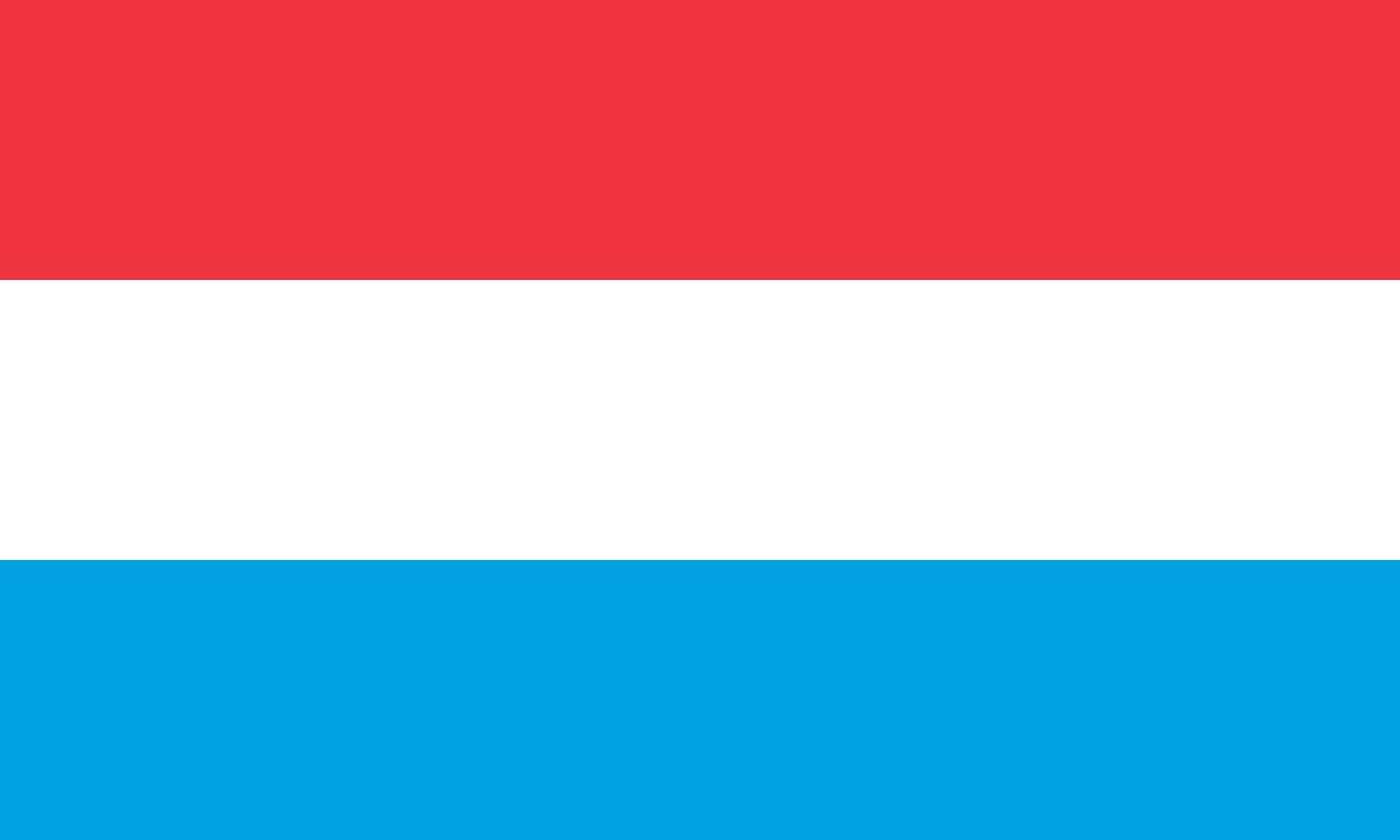
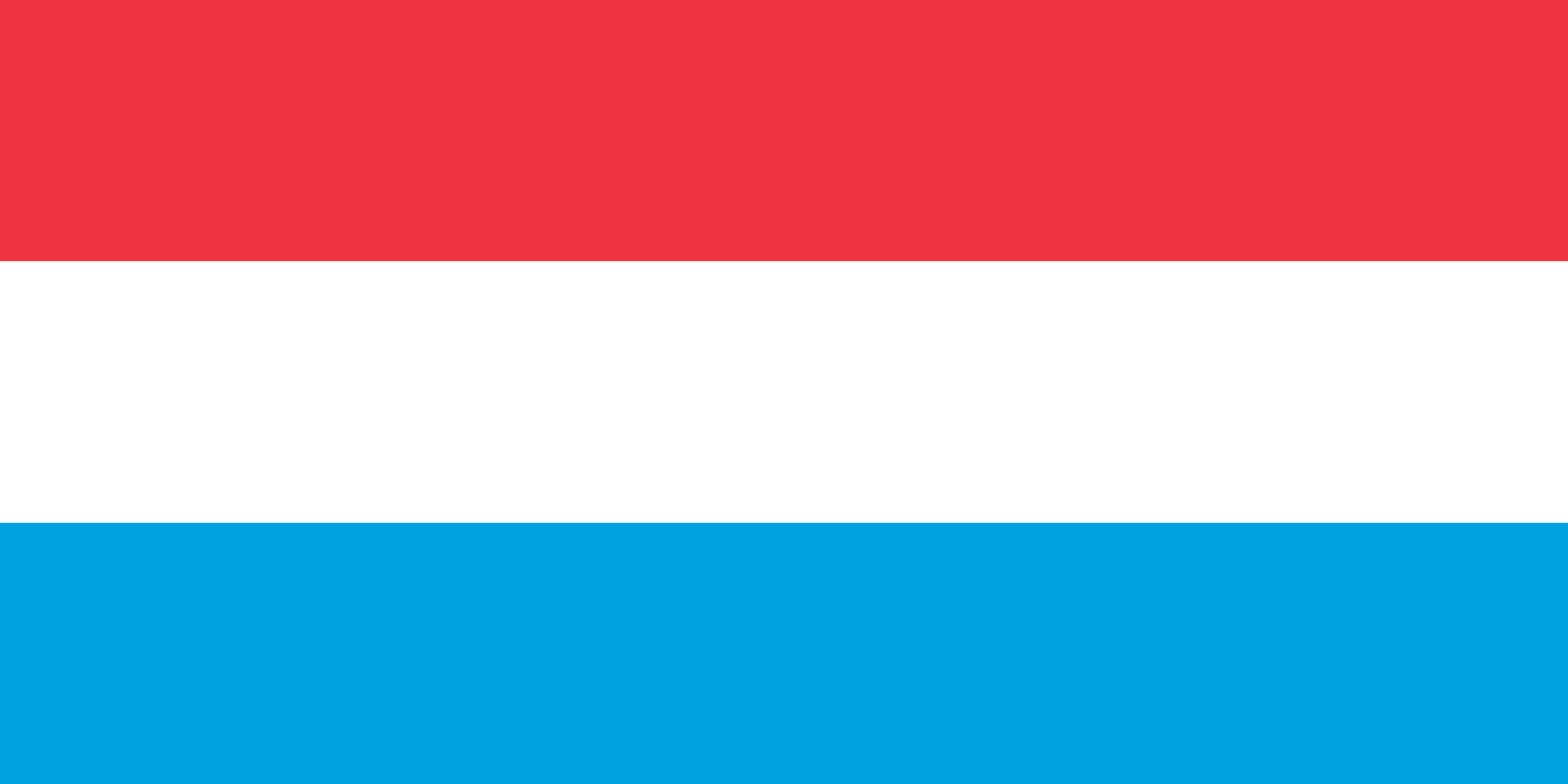
The national flag of Luxembourg has three equal horizontal bands: red at the top, white in the middle, and sky blue at the bottom. The law allows either 5:3 or 2:1 width:height proportions. The familiar red-lion flag is a separate heraldic design with its own official uses.
A small change in blue can separate two countries’ flags; a change from three bands to ten can identify an entirely different Luxembourg emblem. This guide explains the national tricolor, its medieval colour ancestry, its legal definition, and the Roude Léiw. Start with the design and proportion drawings, then follow the history, National Day traditions, comparison pictures, and downloadable artwork. The official colour references and the illustrative screen colours are identified separately throughout.
What does the Luxembourg flag look like?
Luxembourg’s national flag is a plain horizontal tricolor with equal red, white, and sky-blue bands. Red is uppermost and blue is lowest. It has no lion, crown, shield, lettering, or other central device. Both permitted rectangular proportions retain exactly this arrangement and the same equal band heights.
The white stripe belongs to the flag itself. On a white page it can appear to merge into the background, so a display frame may help identify the rectangle. That frame is a presentation aid: it does not add a fourth colour or a narrow border to the actual flag.
| Feature | National design |
|---|---|
| Band order | Red → white → sky blue, from top to bottom |
| Band heights | One-third of the complete height each |
| Field | Rectangular, with straight edges |
| Central emblem | None |
| Permitted width:height | 5:3 or 2:1 |
The two downloadable national flags preserve both legal shapes. Choose the proportion appropriate to the intended presentation, then resize the complete rectangle uniformly. Cutting a strip from either end or stretching only its width changes the drawing.
What are the correct proportions?
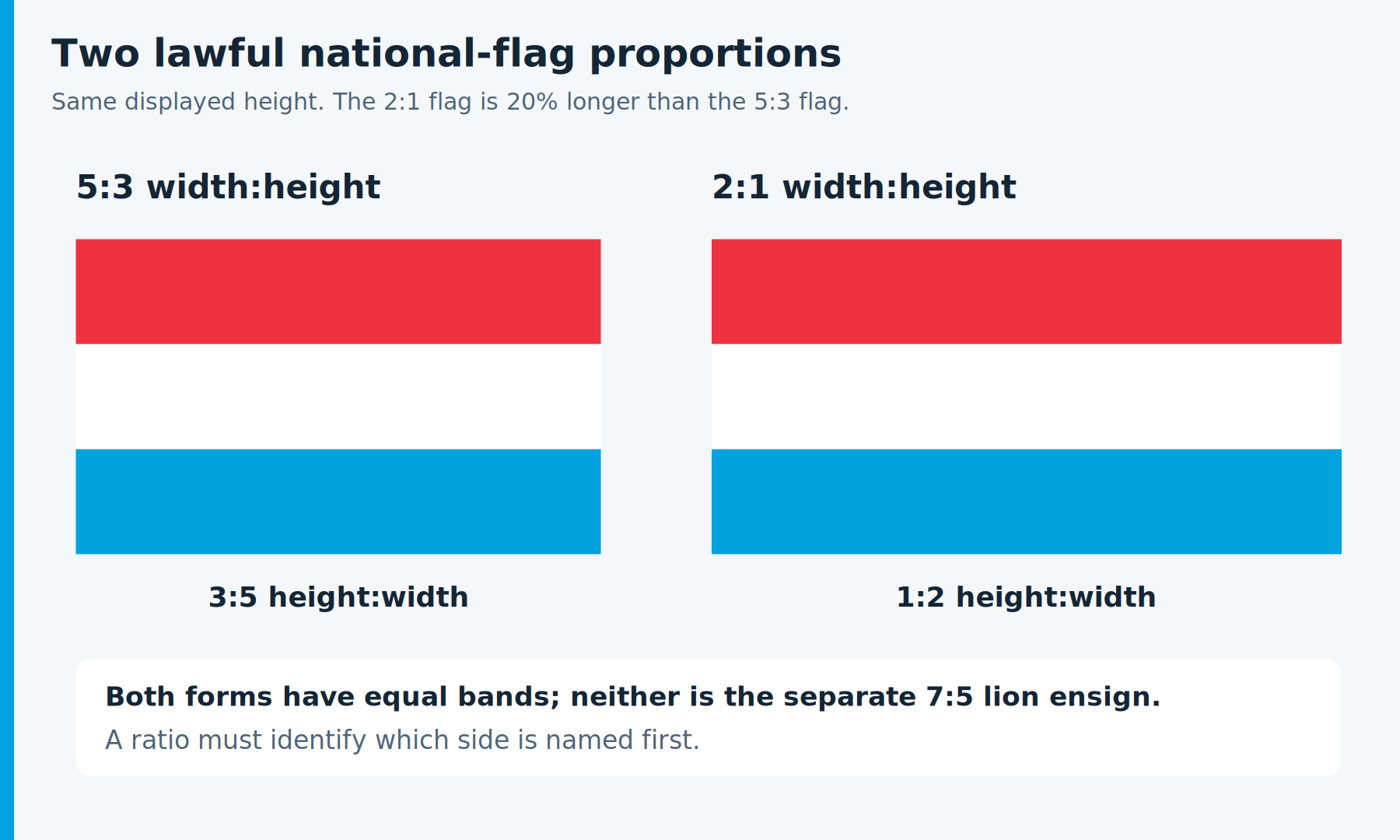
Luxembourg permits two national-flag proportions: 5:3 and 2:1 when the width is written first. In height:width notation these become 3:5 and 1:2. Both appear in the national-emblems law. The separate red-lion ensign uses 7:5 width:height, so its dimensions should not be transferred to the tricolor.

At a height of 90 centimetres, the 5:3 flag is 150 centimetres wide and the 2:1 flag is 180 centimetres wide. The longer form is therefore 20% wider at equal height. These are two lawful alternatives, not a comparison between an obsolete flag and its replacement.
A description that gives only “3:5” can be misunderstood when another source writes “5:3.” Always name the sides. This article normally puts width before height, while the size tables explicitly list height × width. Neither convention changes the underlying rectangle.

How do you draw the flag accurately?
Draw a rectangle in either permitted proportion and divide its height into three equal parts. Fill the upper band red, the middle band white, and the lower band sky blue. Leave no gaps or outlines between the bands. Measure the visible field separately from any sleeve, hem, or attachment material.
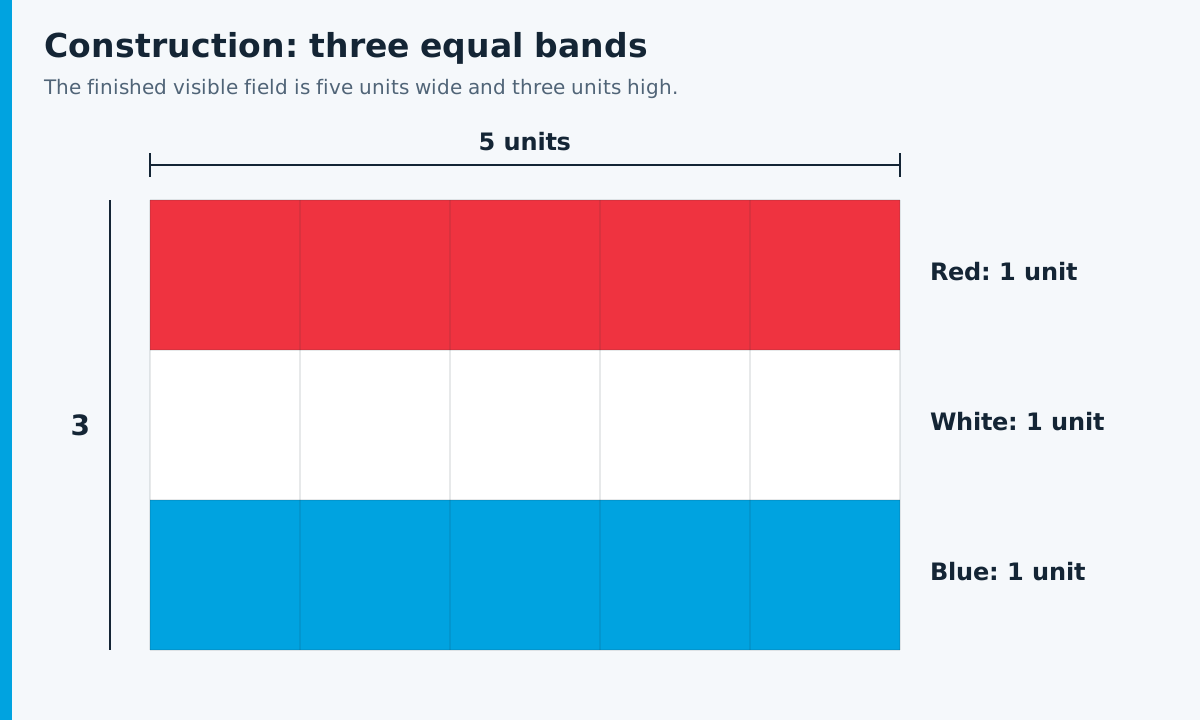
For a convenient 5:3 construction, choose a unit such as 10 centimetres. The rectangle becomes 50 centimetres wide and 30 centimetres high, with three bands each 10 centimetres high. For the longer form, keep that 30-centimetre height and make the width 60 centimetres. The band heights remain unchanged.
| Height × width | Proportion | Height of each band |
|---|---|---|
| 30 × 50 cm | 5:3 | 10 cm |
| 60 × 100 cm | 5:3 | 20 cm |
| 90 × 150 cm | 5:3 | 30 cm |
| 30 × 60 cm | 2:1 | 10 cm |
| 60 × 120 cm | 2:1 | 20 cm |
| 90 × 180 cm | 2:1 | 30 cm |
These calculated sizes are examples, not a compulsory purchase list. In a raster image, a height divisible by three gives an equal whole-pixel height to every band. The 3000 × 1800 national PNG has three 600-pixel bands; the 3000 × 1500 longer version has three 500-pixel bands.

What are the official flag colours?
The 1993 colour regulation specifies Pantone 032C for national-flag red and Pantone 299C for blue. The middle band is white. It does not supply official HEX, RGB, or CMYK values. The red-lion ensign uses the same red and blue references, with Pantone 116C for its gold-coloured details.

| Colour | Legal reference | Illustrative HEX in these downloads | Illustrative RGB |
|---|---|---|---|
| Red | Pantone 032C | #EF3340 | 239, 51, 64 |
| White | White; no Pantone code stated | #FFFFFF | 255, 255, 255 |
| Sky blue | Pantone 299C | #00A3E0 | 0, 163, 224 |
| Gold, ensign only | Pantone 116C | #FFCD00 | 255, 205, 0 |
The screen values label this package’s artwork. They are not presented as extra provisions of the regulation, nor as measured conversions from an original cloth sample. A colour on an uncalibrated monitor is affected by display settings, image processing, brightness, and surrounding colours.
For physical production, specify the legal references and agree an appropriate material sample and production process. A web hexadecimal value alone does not define how ink, woven fabric, or embroidered thread will look. In particular, a dark navy replacement for the lower band loses Luxembourg’s characteristic sky-blue appearance.
What do the flag’s colours mean?
The strongest documented explanation connects Luxembourg’s red, white, and blue with its historic arms: a red lion on a field of silver and blue bands. Silver is normally represented as white. The reviewed flag legislation prescribes the design and colours without assigning separate official meanings such as courage, peace, or loyalty.
The connection is heraldic rather than a requirement to show the lion on the tricolor. A coat of arms can supply a country’s colours while its national flag reduces them to a simpler arrangement. In Luxembourg, the lion emblem also survives as a recognizable symbol in its own right.
| Flag colour | Documented heraldic connection |
|---|---|
| Red | The red lion; heraldic term gules |
| White | The silver bands; heraldic term argent |
| Blue | The blue bands; heraldic term azure |
General colour associations may be used in poetry, school activities, or personal interpretation, but they should be identified as such. A neat three-word explanation is not automatically a historical account. The colour ancestry is better supported than assigning one abstract virtue to each band.
Nor should modern Pantone references be projected back onto medieval textiles. The continuity concerns heraldic colours and national identity, not proof that a thirteenth-century banner matched a twentieth-century colour standard.
Where did the Luxembourg flag come from?
The tricolor developed from a much older heraldic colour tradition. Luxembourg’s government associates the national arms with Count Henry V in 1235–1239, while its parliamentary record describes the later transformation of heraldic colours into a national flag. Medieval banners and the modern three-band rectangle belong to different stages of that history.
The government also describes a barred banner carried by Count William in 1123, with colours that were probably yellow and red. The qualification matters: this is neither a securely documented modern red-white-blue flag nor a basis for claiming that today’s tricolor was adopted in 1123.
In the government’s account of the nineteenth century, red, white, and blue emerged as a simplified expression of the country’s arms. Luxembourg’s political relationship with the Netherlands and the wider European use of tricolors form part of the setting, but a resemblance between flags is not enough to prove direct copying.
This history has no single reliably established artist who can be credited with inventing the current rectangle in one sitting. It is more accurately described as a developing national emblem that was later defined precisely by law.
When was the national flag legally defined?
The law dated June 23, 1972 formally defines Luxembourg’s national tricolor and its two permitted proportions. The design was already established before that law. Its original publication appeared on August 16, 1972. The 1993 amendment and colour regulation refine the legal framework; they do not mark the first appearance of the tricolor.
The original 1972 text already contains 5:3 or 2:1 for the national flag and 7:5 for the lion ensign. It is therefore incorrect to say that the 1993 changes abolished 1:2 and introduced 3:5 as the sole legal proportion. Both alternatives survive in the consolidated wording.
An adoption date, a signature date, a publication date, and a commencement date describe different events. This article identifies June 23 as the date of the 1972 law rather than casually treating it as the flag’s first historical use or its publication date.
Some summaries give a precise nineteenth-century adoption date without showing the underlying instrument. The reviewed primary legal record supports the 1972 legal definition clearly; the longer history should be explained as a process rather than compressed into an unsupported anniversary.
What changed in 1993?
In 1993, an amending law and a separate grand-ducal regulation addressed Luxembourg’s national symbols. The regulation dated July 27 specified the flag and ensign colour references. The law also addressed the anthem, protected uses, and the Heraldic Commission. The national flag’s existing two proportions and three equal bands were retained.
The two instruments share a date but do different jobs. The amending law supplies the legal framework; the colour regulation gives Pantone 032C and 299C for the national flag and adds 116C for the lion ensign. They were published in Mémorial A No. 73 on September 16, 1993.
Article 5 states that the text prevails over the annexed illustrations and that original plates and models are deposited at the National Archives. A scanned plate can be useful for understanding the design, but its colour appearance is not a substitute for the written specification.
This distinction is particularly useful when comparing a faded printed page, a compressed photograph, and a bright modern SVG. Their pixel colours may differ even though all depict the same national emblem.
What are the main historical milestones?
The flag’s history combines medieval heraldry, nineteenth-century national development, twentieth-century legislation, and a later debate about the red lion. The timeline separates those events. A proposal to replace the tricolor was introduced in 2006, but it did not become the new national design and was removed from the parliamentary agenda in 2014.
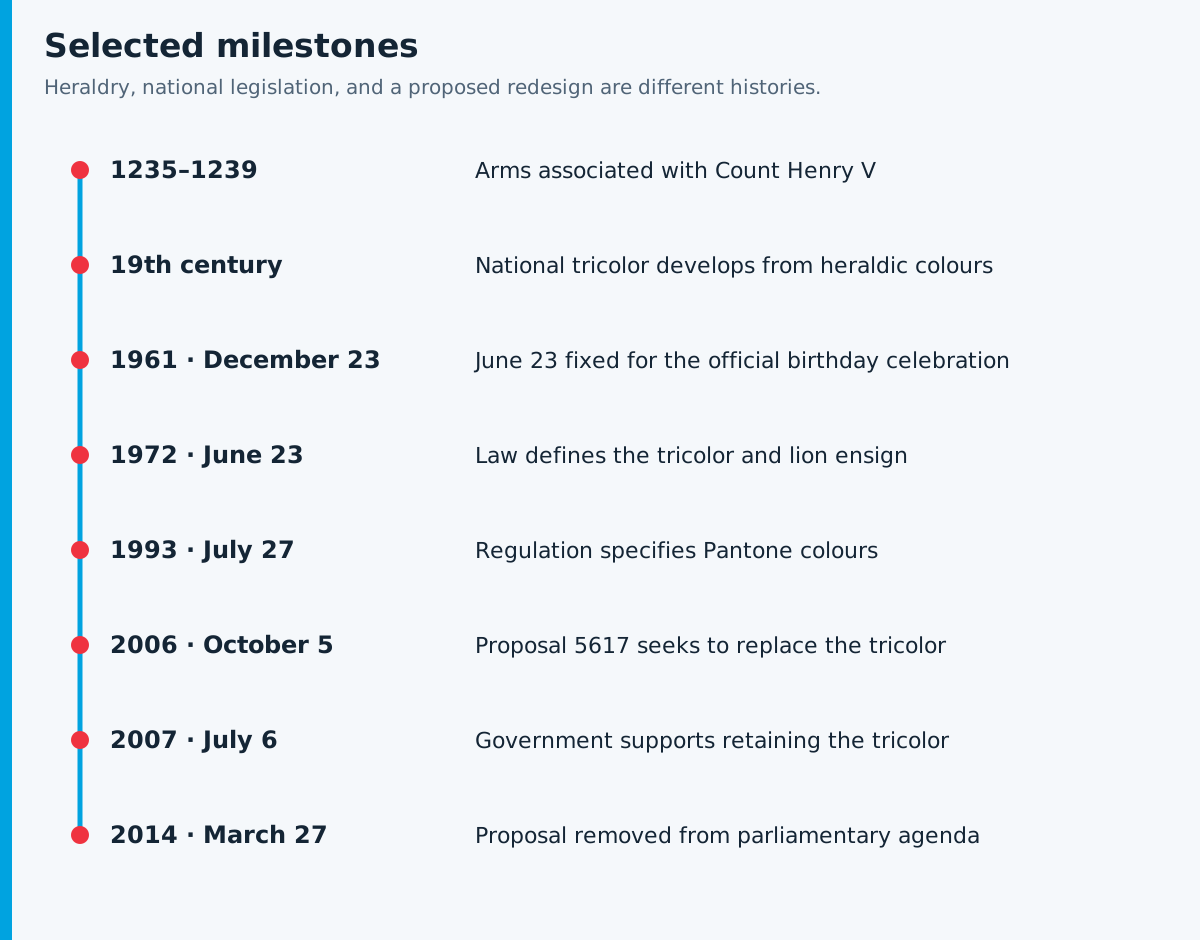
| Date or period | What the date identifies |
|---|---|
| 1235–1239 | Arms associated with Count Henry V |
| Nineteenth century | Development of the national tricolor from heraldic colours |
| December 23, 1961 | Decree fixing the official birthday celebration on June 23 |
| June 23, 1972 | Date of the national-emblems law |
| July 27, 1993 | Date of the amendment and colour regulation |
| October 5, 2006 | Introduction of proposal 5617 |
| July 6, 2007 | Government position in favour of retaining the tricolor |
| March 27, 2014 | Proposal 5617 removed from the parliamentary agenda |
The timeline includes National Day because it is a major setting for flag display. It does not suggest that the 1961 birthday decree changed the flag or that the 1972 law created National Day. Those developments happened through different instruments and for different purposes.
What is the Roude Léiw flag?
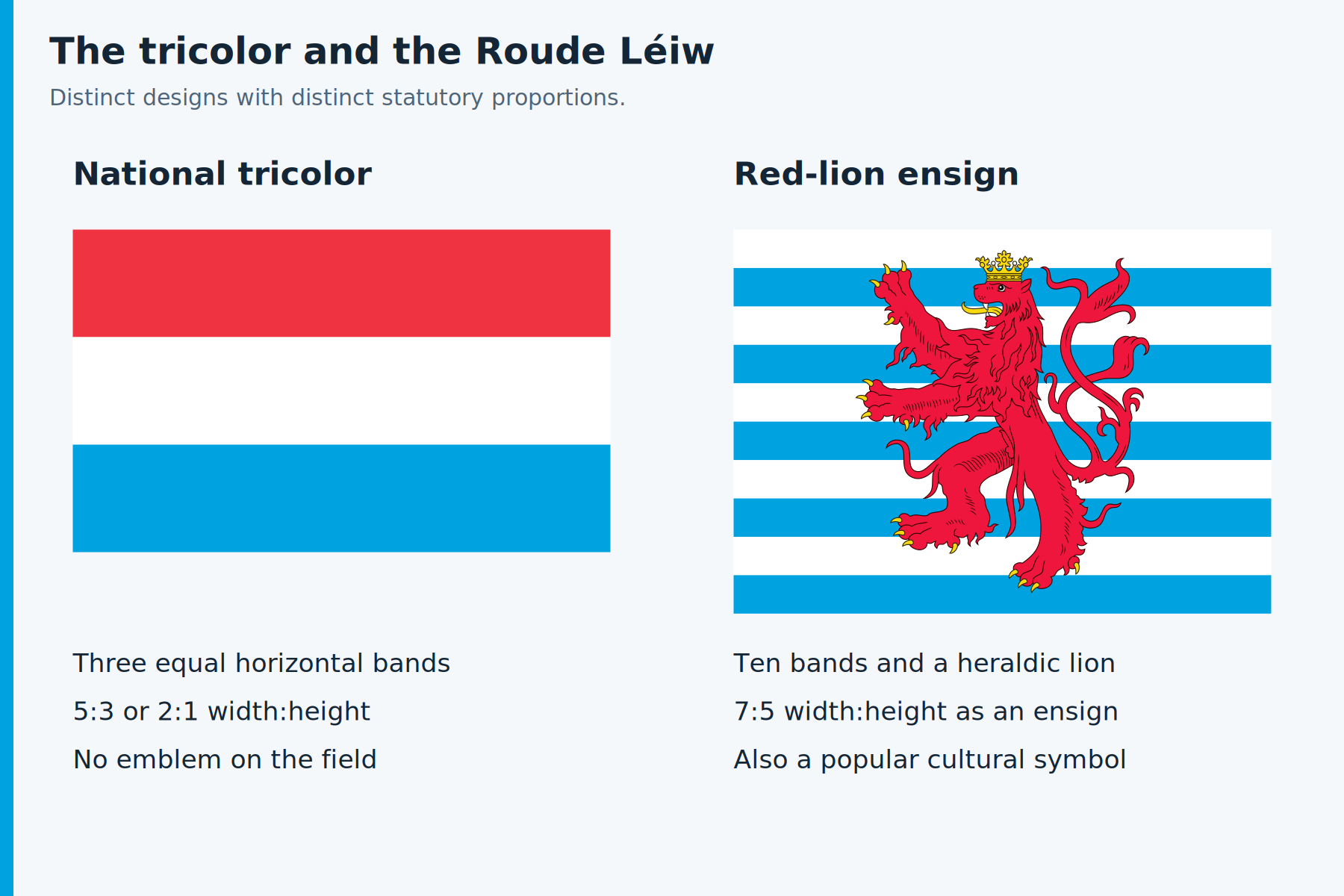
The Roude Léiw, or Red Lion, is Luxembourg’s familiar heraldic flag: a crowned red lion over ten alternating white and blue horizontal bands. The statutory ensign has 7:5 width:height proportions. It is distinct from the plain national tricolor and also has an established place in patriotic, sporting, and cultural display.

The national-emblems law calls it the pavillon de la batellerie et de l’aviation, an ensign associated with inland navigation and aviation. The word pavillon describes a flag used in a particular identifying role; it does not mean that Luxembourg has an ocean coastline.
The complete design matters. A red lion pasted onto an otherwise unchanged three-band tricolor is neither the plain national flag nor the statutory lion ensign. The lion belongs on the ten-band field, with the specified direction, tail, and gold details.

A longer lion flag seen at a match or festival should be described according to its actual form. Popular variants do not change the 7:5 specification for the ensign. This gallery supplies that statutory ensign proportion rather than silently stretching the emblem into a tricolor-sized rectangle.
How should the heraldic lion be drawn?
The ensign’s lion is red, rampant, and directed toward the hoist. Its crown, claws, and tongue are gold, and its tail is forked with the branches crossed. The background contains ten white and blue bands. These details identify the Luxembourg emblem more accurately than a generic crowned-lion silhouette.

“Rampant” describes the upright heraldic posture. “Armed” refers to the claws, while “langued” refers to the tongue. “Forked” describes the divided tail; “crossed in saltire” means that its branches cross diagonally. These words describe visible features, not an instruction to invent additional decoration.
With the hoist at the viewer’s left, the lion faces left. On the reverse, the same attachment edge appears at the viewer’s right, so the lion appears to face right. The law specifically relates the reverse description to the front.
The supplied reference preserves the full geometry of the credited source vector, including the complete tail and gold details. Its three principal colour fills have been adjusted to the explicitly labelled illustrative palette used across this article; it is not represented as an authenticated production master.
Why does landlocked Luxembourg have an ensign?
A maritime flag identifies a vessel’s national registration rather than proving that its country has a coastline. Luxembourg has maintained a public maritime register since 1990, supervised by its maritime authority. The country’s red-lion design also has the separate navigation and aviation role described in the national-emblems law.
Guichet.lu identifies the Commissariat aux affaires maritimes, usually abbreviated CAM, as the authority overseeing the Luxembourg maritime sector and relevant registration arrangements. A vessel’s flag-state connection is a legal and administrative relationship; it is not determined simply by the port at which a photograph was taken.
This explains why a Luxembourg emblem can appear far from Luxembourg. It does not mean that a privately owned vessel automatically qualifies to fly the ensign because its owner buys a flag. Registration, authorization, and the applicable vessel rules are separate from obtaining an image or a piece of cloth.
For identifying a picture, first distinguish the red-lion field from the plain tricolor. For operational vessel requirements, the relevant maritime authority’s current instructions are more useful than a general educational flag page.
Did Luxembourg replace its tricolor with the lion?
No. Luxembourg’s national flag remains the red-white-sky-blue tricolor. A 2006 parliamentary proposal sought to replace it with a red-lion design, but the government supported keeping the tricolor while recognizing the lion’s domestic use. The proposal was later removed from the parliamentary agenda in March 2014.
The 2007 government statement and the later legislative outcome must be read separately. Support for displaying the lion alongside the tricolor did not itself amend Article 3 into a different national design. The government’s current public explanation also recognizes use of the lion as a civil flag within Luxembourg.
A photograph of many lion flags at a celebration therefore does not demonstrate that the national tricolor has been abolished. It shows the strength of a second national symbol in public culture. The legal national flag, an official ensign, and a popular patriotic banner can coexist without being interchangeable.
In a caption or classroom answer, name the actual design: “Luxembourg national tricolor” for the three bands, or “Roude Léiw red-lion flag” for the heraldic design. That is more informative than calling every Luxembourg-coloured object simply “the flag.”
Is the flag the same as the coat of arms?
No. Luxembourg’s flag and coat of arms are related national symbols, but they are different designs. The national tricolor has no shield or lion. The arms have small, medium, and great versions, while the red-lion ensign places the heraldic motif on a rectangular striped field with its own legal proportions.
| Symbol | How to recognize it |
|---|---|
| National tricolor | Three equal red, white, and sky-blue bands; no emblem |
| Red-lion ensign | Ten bands with a crowned red lion facing the hoist |
| Small arms | A shield with the lion and striped field, surmounted by a crown |
| Medium arms | The small arms with two supporting lions |
| Great arms | The medium arms with additional order insignia and a mantle |
The full arms should not be confused with the lion alone. Their supporters, crown, mantle, and other elements belong to specific versions. Likewise, inserting the small arms into the centre of the tricolor produces an altered illustration, not the ordinary national flag.
The national emblem also should not be automatically identified as the municipal arms of Luxembourg City or the personal arms of a ruler. Shared heraldic features can indicate a relationship, while the exact arrangement and legal identity remain different.
How is Luxembourg’s flag different from the Dutch flag?
Both flags have equal red, white, and blue horizontal bands, but Luxembourg’s lower band is sky blue and the Dutch flag uses darker cobalt blue. Luxembourg permits 5:3 or 2:1 width:height proportions; the ordinary Dutch proportion is 3:2. Colour and shape together are more useful than either clue alone.

The Dutch Royal House describes its colours as bright vermilion, white, and cobalt blue. Luxembourg’s official material sometimes uses “ultramarine” when explaining the contrast, but the Dutch authority’s own term is cobalt blue. This article uses that national description in its comparison.
In the equal-height drawing, the 5:3 Luxembourg flag is slightly longer than the 3:2 Dutch flag. A photograph may hide that difference if the cloth is folded, seen obliquely, or cropped. Lighting and camera processing can also make a light blue look darker than expected.
For a reliable identification, combine the visible design with the setting and caption. The comparison is a teaching aid, not a claim that every object sold as a Dutch or Luxembourg flag has been manufactured to the correct specification.
When is Luxembourg’s main national flag celebration?
June 23, Luxembourg’s National Day, is a major occasion for national flags and public celebration. It marks the sovereign’s official birthday celebration rather than an independence anniversary or a separate flag-adoption holiday. The date was fixed by a decree of December 23, 1961, and festivities traditionally begin on June 22.
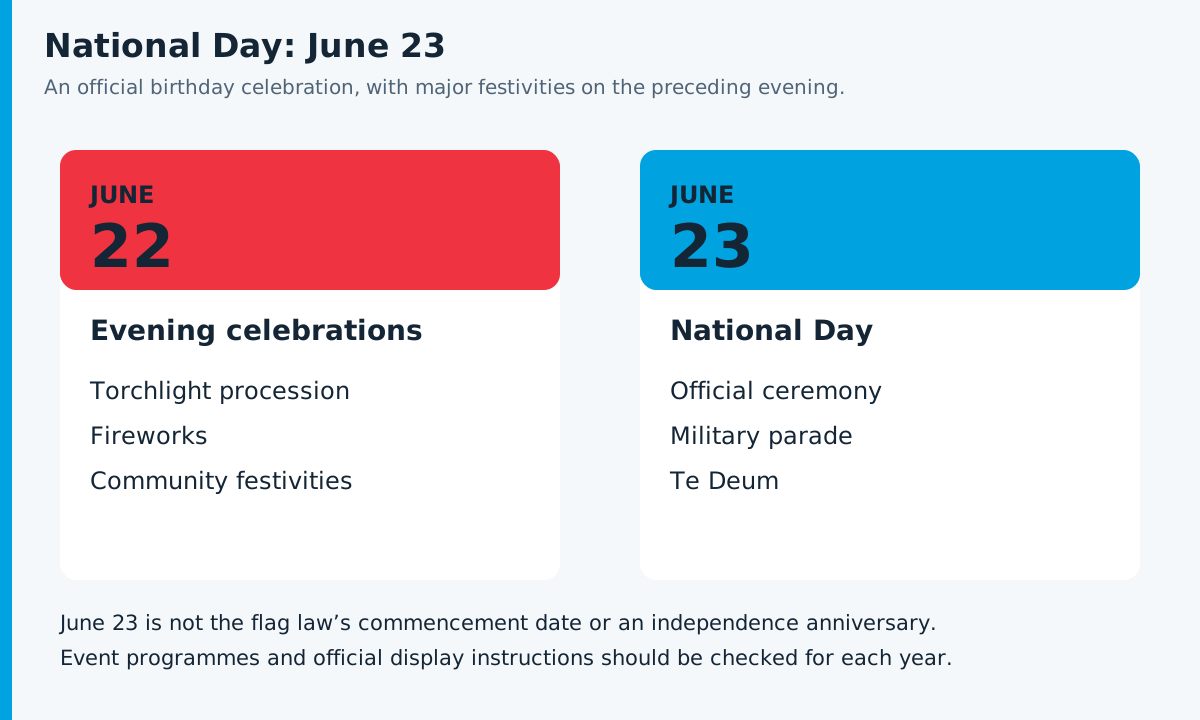
During Grand Duchess Charlotte’s reign, the birthday celebration fell on January 23. Moving the public celebration to June provided a more suitable season for festivities. The annual date does not require each reigning sovereign to have been born on June 23.
The court’s account describes a torchlight procession and fireworks on the eve, followed by official ceremonies, a military parade, and a Te Deum on National Day. Specific programmes can change from year to year. A description of customary celebrations is not an exhaustive schedule or a universal private-household duty.
The infobox’s National Day link therefore leads to this explanation. It does not invent a separate annual “Luxembourg Flag Day” or imply that the date of a national-emblems law and the purpose of the public holiday are the same.
What should guide official flag display?
For an official Luxembourg event, use the correct national design and follow the host institution’s current display instructions. Public authorities may issue directions for particular occasions. Those directions should be read for their stated dates and audience; they should not automatically become permanent rules for every private home or every future ceremony.
A useful example is the Interior Ministry’s September 30, 2025 circular concerning the change of reign. It asked municipal authorities to display the tricolor on communal buildings from October 2 through October 7, around the October 3 accession. This was a specific administrative request for a specific occasion.
The national-emblems law gives the design and proportions, but it is not a complete manual of pole precedence, vertical wall arrangements, daily hours, or the order of raising several flags. Do not fill those gaps by silently borrowing rules from Iceland, Lithuania, or the Netherlands.
For a school diagram or ordinary identification, use a level horizontal tricolor with the red band uppermost. For a formal line of flags, ask the responsible protocol office or organizer for the arrangement applicable to that event.
How is the flag used during national mourning?
Luxembourg can direct flags on public buildings and public places to fly at half-mast during declared national mourning. The government did so after Grand Duke Jean’s death in 2019. Such announcements define an occasion and duration; they should not be treated as a permanent instruction or as evidence of mourning today.
The April 23, 2019 announcement set mourning through May 4 at 18:00 and specifically addressed flags on public buildings and places. Its dates belong to that historical event. A current ceremony should follow the current announcement or the responsible institution’s directions.
The reviewed Luxembourg notice does not specify a numerical fraction of the pole or a universal black-ribbon length. Consequently, this article does not borrow another country’s one-third rule or draw an apparently official measured half-mast construction.
When describing a historical photograph, separate what is visible from why it happened. A lowered flag may be observable, but the caption or institutional record is needed to identify the particular commemoration or mourning period.
What changes when you see the reverse of the flag?
The national tricolor keeps red above white above blue when viewed from its reverse. Only the apparent location of the hoist changes. The lion ensign requires closer attention: its lion faces the attachment edge on both sides, so its apparent left-to-right direction reverses when the observer moves behind the flag.

A hoist is the side attached to the pole or halyard. A fly is the opposite, free edge. These are physical parts of the flag, not permanent names for the left and right sides of a photograph. Keeping that distinction clear prevents a correct reverse-side lion from being mislabelled as backwards.
The drawing shows front and reverse views of horizontal flags. It is not a rule for rotating a national flag into a vertical hanging. A vertical banner changes the relationship between the cloth, its attachment, and the viewer; official use should follow the organizer’s applicable instructions rather than an assumed universal rotation rule.
How should flag pictures and physical flags be handled?
For accurate reproduction, preserve the complete rectangle, equal band heights, and correct colour order. Keep a physical flag clean, dry, and suitable for display, following its material-care instructions. When reusing an illustration, distinguish the artwork’s copyright status from rules governing national symbols, official identification, or a particular commercial use.
For an SVG or PNG, avoid stretching one dimension, clipping the edges, adding a lion to the tricolor, or making the blue so dark that it resembles the Dutch flag. A decorative waving effect can obscure proportions; a flat reference image is better for learning the construction.
For cloth, inspect the attachments and allow wet material to dry before storage. These are practical care suggestions, not claimed Luxembourg statutory folding rules. No mandatory triangular fold, prescribed private disposal ceremony, or universal burning requirement is asserted here.
The gallery credits identify the lion vector and the original explanatory artwork. A freely reusable drawing does not by itself authorize every use of a protected state emblem. The national-symbols framework addresses unauthorized uses; commercial branding or implied official endorsement needs its own appropriate check. Historic fine amounts printed in old legislation are not reproduced as current advice.
What is the Luxembourg flag emoji?
The Luxembourg flag emoji is 🇱🇺. Its Unicode sequence combines the regional indicator letters L and U: U+1F1F1 followed by U+1F1FA. The displayed picture depends on the operating system or application. Some environments show letters instead of a coloured flag, and emoji artwork is not an official construction or colour standard.
| Item | Value |
|---|---|
| Emoji | 🇱🇺 |
| Regional indicators | L + U |
| Unicode sequence | U+1F1F1 U+1F1FA |
| CLDR name | flag: Luxembourg |
| Accessible description | Flag of Luxembourg: red, white, and sky-blue horizontal bands |
For meaningful identification, write the country name beside the emoji. This helps readers whose software does not render a flag glyph and avoids relying on a very small blue stripe to distinguish Luxembourg from the Netherlands.
Use the flat SVG or PNG for a worksheet, labelled comparison, or design demonstration. The emoji may have folds, rounded corners, a pole, or a platform-specific shade that makes precise measurement inappropriate.
Which common mistakes should you avoid?
The most common errors are using a dark Dutch-style blue, drawing unequal bands, treating only one national proportion as lawful, or calling the lion flag a replacement national flag. Also avoid inventing statutory colour meanings, official HEX values, a universal Flag Day, or display rules borrowed from another country.
| Mistake | Better explanation |
|---|---|
| Only 3:5 is legal | Both 3:5 and 1:2 height:width are permitted |
| The ratio changed from 1:2 to 3:5 in 1993 | Both alternatives already appear in the 1972 law |
| The national flag has a lion | The plain tricolor and red-lion ensign are distinct |
| All red-lion flags have the national ratio | The statutory ensign uses 7:5 width:height |
| The law supplies a HEX palette | The regulation specifies Pantone references |
| June 23 is Independence Day | It is the sovereign’s official birthday celebration |
| A 2007 decision replaced the tricolor | The government supported retaining it; proposal 5617 did not become a replacement law |
| A historical mourning notice applies today | Read each notice’s actual occasion, dates, and scope |
A quick identification method is to count the bands, look for an emblem, check the top-to-bottom order, and then examine the blue and the full rectangle. For historical or official-use questions, attach the relevant date and context rather than expecting one image to answer every question.
What do the key flag terms mean?
A tricolor has three colours; the hoist is the attachment edge and the fly is the free edge. An ensign identifies a vessel or another designated service. In Luxembourg heraldry, argent means silver or white, azure means blue, and gules means red. Roude Léiw means Red Lion.
| Term | Meaning in this article |
|---|---|
| Tricolor | The plain national red-white-sky-blue flag |
| Width:height | Horizontal extent followed by vertical extent |
| Hoist / fly | Attachment edge / free edge |
| Ensign | A flag used in a designated identifying role |
| Burelé / barruly | A field divided into a series of narrow horizontal bands |
| Argent / azure / gules | Silver or white / blue / red |
| Rampant | An upright heraldic lion posture |
| Armed / langued | Having specified claw / tongue colours |
| Forked and crossed tail | Two tail branches that cross diagonally |
| Roude Léiw | Luxembourgish name meaning Red Lion |
The same word can have a technical and an everyday use. “Flag” is broad enough to include both designs, but “national tricolor” and “red-lion ensign” make the distinction explicit. In a comparison table or picture caption, precise names prevent the two emblems from being treated as contradictory versions of one drawing.
Explore more in World Flags: Iceland flag, Liechtenstein flag, Lithuania flag.
Download Luxembourg flag pictures
Download the national flag as SVG or large PNG. The gallery includes 13 distinct subjects with captions and alternative text. Keep the full proportions when resizing. Image credits and reuse notes accompany the graphics.
World Flags/Luxembourg
Luxembourg flag pictures
Three equal horizontal bands: red, white, and sky blue. This 5:3 width:height form is one of two proportions allowed by law. Screen shades are illustrative.
GKBookDownload SVGDownload PNGThe longer 2:1 width:height form is also permitted. It has the same three equal bands and no emblem.
GKBookDownload SVGDownload PNGA 5 × 3 grid makes each band exactly one unit high. Grid lines are explanatory and are not part of the flag.
GKBookDownload SVGDownload PNGThe law permits 5:3 or 2:1 width:height. These are alternatives, not an old-to-new sequence.
GKBookDownload SVGDownload PNGNational red: Pantone 032C; blue: Pantone 299C. White has no Pantone code in the regulation. Ensign gold is Pantone 116C. HEX/RGB values label this artwork only.
GKBookDownload SVGDownload PNGThe Roude Léiw ensign uses ten alternating white and blue bands, a red lion facing the hoist, and gold details. The complete credited vector is retained with a disclosed illustrative palette.
Denelson83, Permjak, Sodacan, Sangjinhwa and Wikimedia Commons contributors; Public domain (PD-self); GKBook composition CC0. License: https://creativecommons.org/publicdomain/zero/1.0/Download SVGDownload PNGThe plain national tricolor and the red-lion ensign are separate symbols. Popular use of the lion does not turn it into a replacement national flag.
Denelson83, Permjak, Sodacan, Sangjinhwa and Wikimedia Commons contributors; Public domain (PD-self); GKBook composition CC0. License: https://creativecommons.org/publicdomain/zero/1.0/Download SVGDownload PNGThe full lion remains visible. The legal description specifies its posture, direction, gold details, and forked crossed tail.
Denelson83, Permjak, Sodacan, Sangjinhwa and Wikimedia Commons contributors; Public domain (PD-self); GKBook composition CC0. License: https://creativecommons.org/publicdomain/zero/1.0/Download SVGDownload PNGDates identify specific events. The 1972 law did not invent the older tricolor, and the 2006 proposal did not become a replacement flag law.
GKBookDownload SVGDownload PNGEqual-height comparison: Luxembourg’s 5:3 form and the Dutch 3:2 form. The blue is the clearest everyday distinction; screen hues are illustrative.
GKBookDownload SVGDownload PNGJune 23 is the official birthday celebration. June 22 hosts the traditional torchlight procession and fireworks. This is a selected cultural calendar, not a universal flag-duty schedule.
GKBookDownload SVGDownload PNGThe tricolor retains the same top-to-bottom order. In the lion ensign, hoistward orientation means the lion appears to face the opposite screen direction on the reverse. This is not a vertical-hanging rule.
Denelson83, Permjak, Sodacan, Sangjinhwa and Wikimedia Commons contributors; Public domain (PD-self); GKBook composition CC0. License: https://creativecommons.org/publicdomain/zero/1.0/Download SVGDownload PNGExamples preserve each permitted proportion. Seam, hem, sleeve, and attachment allowances must be added without changing the visible field.
GKBookDownload SVGDownload PNGFrequently asked questions
What does the Luxembourg flag look like?
Luxembourg’s national flag is a plain horizontal tricolor with equal red, white, and sky-blue bands. Red is uppermost and blue is lowest. It has no lion, crown, shield, lettering, or other central device. Both permitted rectangular proportions retain exactly this arrangement and the same equal band heights.
What are the correct proportions?
Luxembourg permits two national-flag proportions: 5:3 and 2:1 when the width is written first. In height:width notation these become 3:5 and 1:2. Both appear in the national-emblems law. The separate red-lion ensign uses 7:5 width:height, so its dimensions should not be transferred to the tricolor.
How do you draw the flag accurately?
Draw a rectangle in either permitted proportion and divide its height into three equal parts. Fill the upper band red, the middle band white, and the lower band sky blue. Leave no gaps or outlines between the bands. Measure the visible field separately from any sleeve, hem, or attachment material.
What are the official flag colours?
The 1993 colour regulation specifies Pantone 032C for national-flag red and Pantone 299C for blue. The middle band is white. It does not supply official HEX, RGB, or CMYK values. The red-lion ensign uses the same red and blue references, with Pantone 116C for its gold-coloured details.
What do the flag’s colours mean?
The strongest documented explanation connects Luxembourg’s red, white, and blue with its historic arms: a red lion on a field of silver and blue bands. Silver is normally represented as white. The reviewed flag legislation prescribes the design and colours without assigning separate official meanings such as courage, peace, or loyalty.
Where did the Luxembourg flag come from?
The tricolor developed from a much older heraldic colour tradition. Luxembourg’s government associates the national arms with Count Henry V in 1235–1239, while its parliamentary record describes the later transformation of heraldic colours into a national flag. Medieval banners and the modern three-band rectangle belong to different stages of that history.
When was the national flag legally defined?
The law dated June 23, 1972 formally defines Luxembourg’s national tricolor and its two permitted proportions. The design was already established before that law. Its original publication appeared on August 16, 1972. The 1993 amendment and colour regulation refine the legal framework; they do not mark the first appearance of the tricolor.
What changed in 1993?
In 1993, an amending law and a separate grand-ducal regulation addressed Luxembourg’s national symbols. The regulation dated July 27 specified the flag and ensign colour references. The law also addressed the anthem, protected uses, and the Heraldic Commission. The national flag’s existing two proportions and three equal bands were retained.
What is the Roude Léiw flag?
The Roude Léiw, or Red Lion, is Luxembourg’s familiar heraldic flag: a crowned red lion over ten alternating white and blue horizontal bands. The statutory ensign has 7:5 width:height proportions. It is distinct from the plain national tricolor and also has an established place in patriotic, sporting, and cultural display.
How should the heraldic lion be drawn?
The ensign’s lion is red, rampant, and directed toward the hoist. Its crown, claws, and tongue are gold, and its tail is forked with the branches crossed. The background contains ten white and blue bands. These details identify the Luxembourg emblem more accurately than a generic crowned-lion silhouette.
Why does landlocked Luxembourg have an ensign?
A maritime flag identifies a vessel’s national registration rather than proving that its country has a coastline. Luxembourg has maintained a public maritime register since 1990, supervised by its maritime authority. The country’s red-lion design also has the separate navigation and aviation role described in the national-emblems law.
Did Luxembourg replace its tricolor with the lion?
No. Luxembourg’s national flag remains the red-white-sky-blue tricolor. A 2006 parliamentary proposal sought to replace it with a red-lion design, but the government supported keeping the tricolor while recognizing the lion’s domestic use. The proposal was later removed from the parliamentary agenda in March 2014.
Is the flag the same as the coat of arms?
No. Luxembourg’s flag and coat of arms are related national symbols, but they are different designs. The national tricolor has no shield or lion. The arms have small, medium, and great versions, while the red-lion ensign places the heraldic motif on a rectangular striped field with its own legal proportions.
How is Luxembourg’s flag different from the Dutch flag?
Both flags have equal red, white, and blue horizontal bands, but Luxembourg’s lower band is sky blue and the Dutch flag uses darker cobalt blue. Luxembourg permits 5:3 or 2:1 width:height proportions; the ordinary Dutch proportion is 3:2. Colour and shape together are more useful than either clue alone.
When is Luxembourg’s main national flag celebration?
June 23, Luxembourg’s National Day, is a major occasion for national flags and public celebration. It marks the sovereign’s official birthday celebration rather than an independence anniversary or a separate flag-adoption holiday. The date was fixed by a decree of December 23, 1961, and festivities traditionally begin on June 22.
What should guide official flag display?
For an official Luxembourg event, use the correct national design and follow the host institution’s current display instructions. Public authorities may issue directions for particular occasions. Those directions should be read for their stated dates and audience; they should not automatically become permanent rules for every private home or every future ceremony.
How is the flag used during national mourning?
Luxembourg can direct flags on public buildings and public places to fly at half-mast during declared national mourning. The government did so after Grand Duke Jean’s death in 2019. Such announcements define an occasion and duration; they should not be treated as a permanent instruction or as evidence of mourning today.
What changes when you see the reverse of the flag?
The national tricolor keeps red above white above blue when viewed from its reverse. Only the apparent location of the hoist changes. The lion ensign requires closer attention: its lion faces the attachment edge on both sides, so its apparent left-to-right direction reverses when the observer moves behind the flag.
What is the Luxembourg flag emoji?
The Luxembourg flag emoji is 🇱🇺. Its Unicode sequence combines the regional indicator letters L and U: U+1F1F1 followed by U+1F1FA. The displayed picture depends on the operating system or application. Some environments show letters instead of a coloured flag, and emoji artwork is not an official construction or colour standard.
Which common mistakes should you avoid?
The most common errors are using a dark Dutch-style blue, drawing unequal bands, treating only one national proportion as lawful, or calling the lion flag a replacement national flag. Also avoid inventing statutory colour meanings, official HEX values, a universal Flag Day, or display rules borrowed from another country.
Explore all general-knowledge topics and the A-to-Z lists.







We Value Your Opinion Comments