
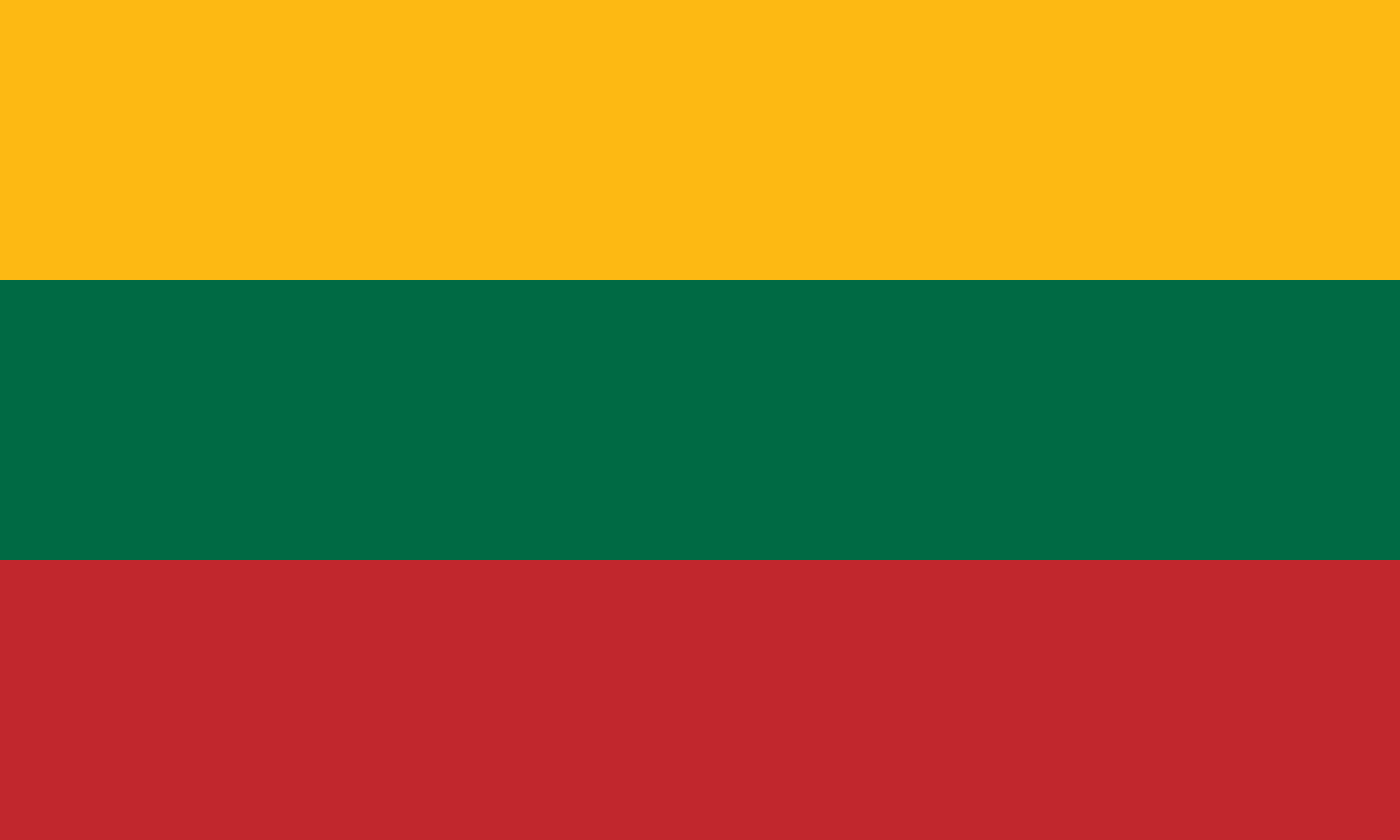
Lithuania flag picture
Explore the construction drawing, history, and complete picture gallery.
| Design | Yellow, green, and redThree equal horizontal bands; the ordinary flag has no emblem. |
|---|---|
| Proportion | 5:3 width:heightEquivalent to 3:5 height:length in official descriptions. |
| Adopted | April 25, 1918Council approval followed the commission’s April 19 decision. |
| Restored | November 18, 1988State-flag status returned before independence was restored in 1990. |
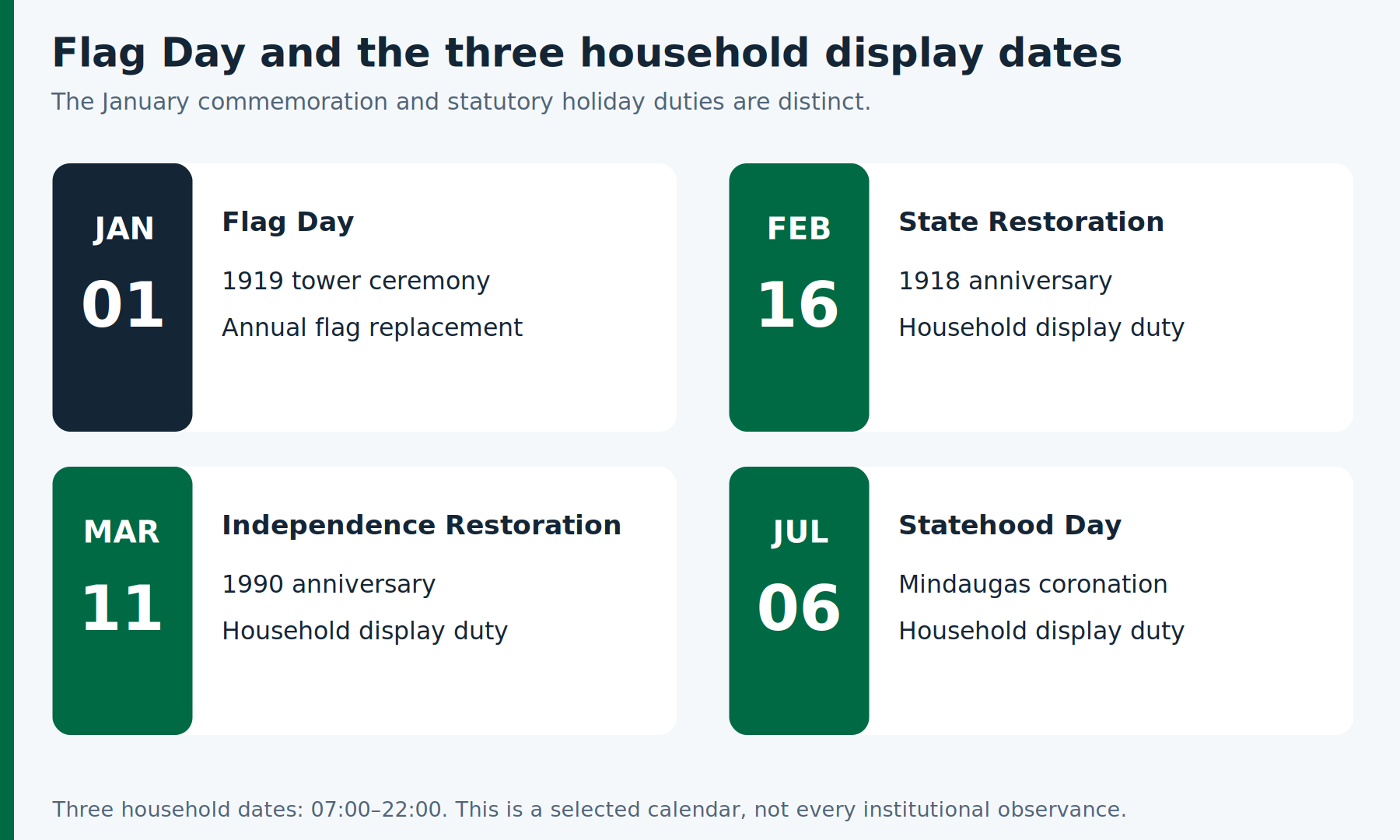
| Flag Day | January 1Commemorates the 1919 ceremony at Gediminas Tower. |
Design adopted in April 1918; state-flag status restored in November 1988. The current 3:5 height:length proportion took effect in September 2004.
What is the national flag of Lithuania?
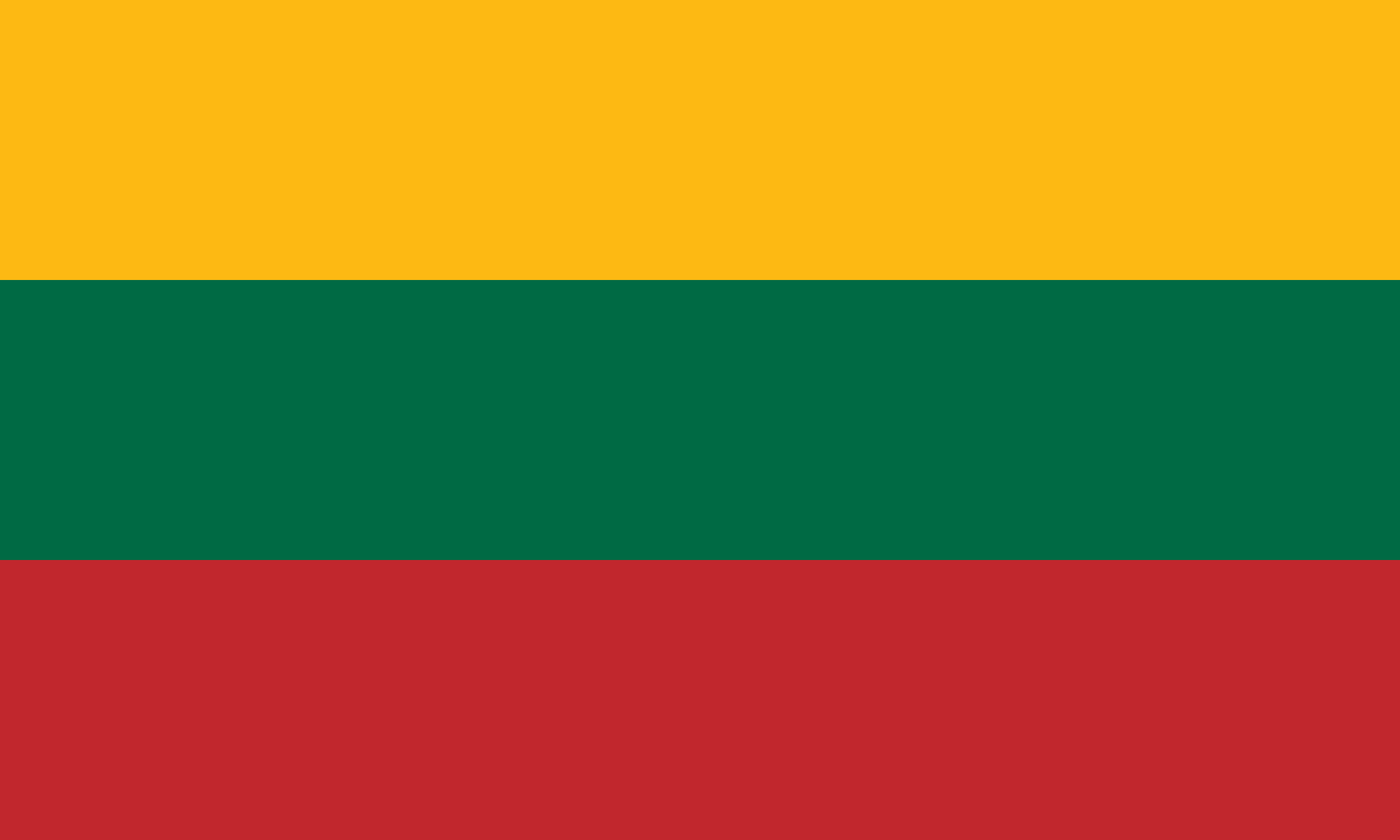
The flag of Lithuania is a horizontal tricolor of yellow, green, and red, arranged in three equal bands. Its present proportions are 3:5 height:length, or 5:3 width:height. The plain tricolor is the national flag; the red flag bearing the mounted knight Vytis is a separate historical state flag.
Known in Lithuanian as the Trispalvė, or tricolor, the flag connects the creation of the modern republic with the movement to restore independence. Its design was approved in 1918 and regained state status in 1988. Those events preceded the restoration of independence in 1990. Understanding the flag means keeping its colors, changing proportions, commemorative dates, and related state symbols distinct.
What does Lithuania’s flag look like?
Lithuania’s flag has three equal horizontal bands, with yellow at the top, green in the middle, and red at the bottom. The ordinary national flag contains no star, shield, lettering, or mounted knight. Its broad rectangular shape and the order of its bands are essential features of the design.
The three fields extend from the attachment edge, or hoist, to the free edge, or fly. Each occupies exactly one-third of the flag’s area. In a normal front view, the hoist is on the left. Looking through to the reverse does not change the top-to-bottom color order.
A photograph can show folds, shadows, a decorative fringe, or a pole sleeve. Those are features of a particular cloth or mounting. They do not add another stripe or an official emblem to the national design. A flat reference drawing is therefore useful when identifying a partially folded flag.
How do you draw the flag accurately?
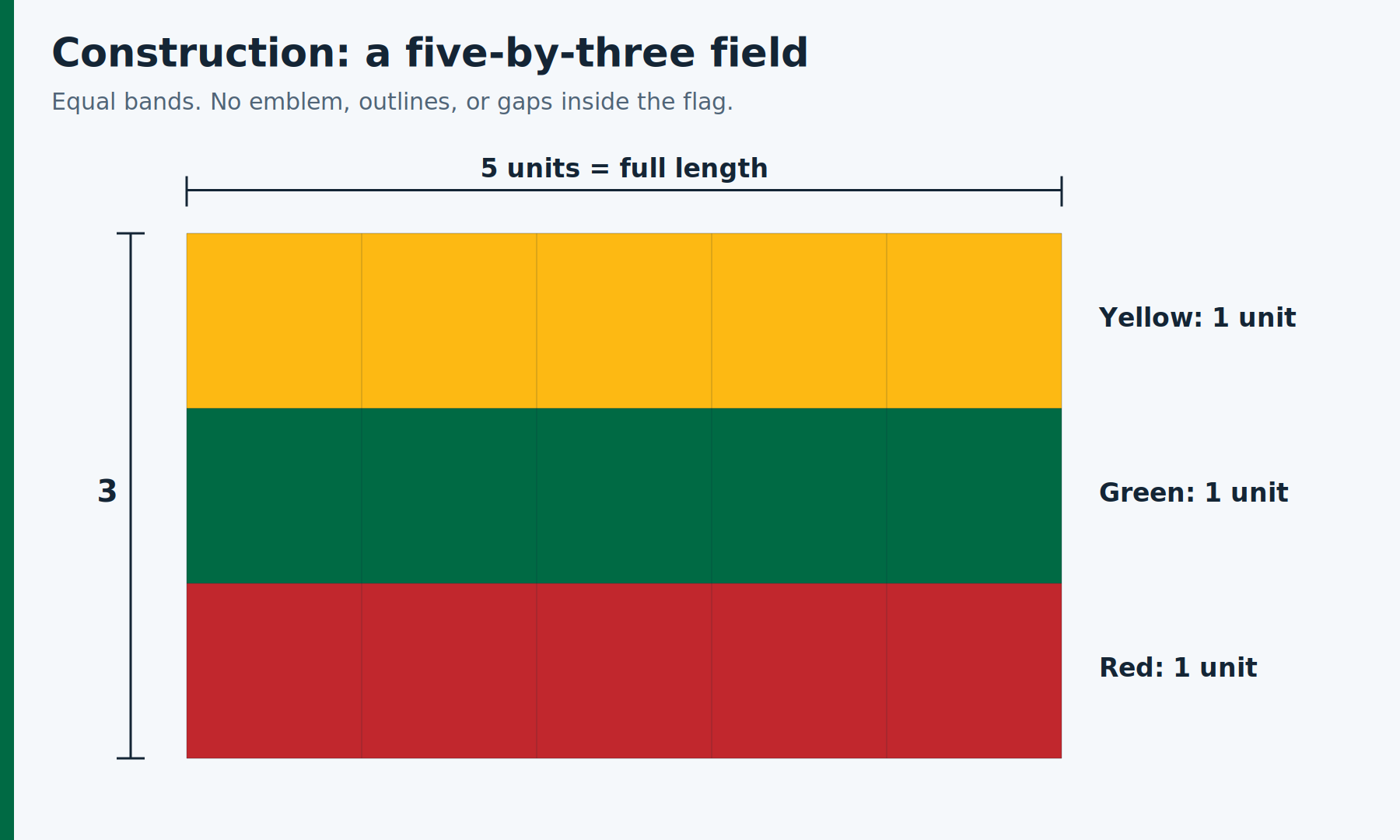
Draw a rectangle five units long and three units high, then divide its height into three equal parts. Fill the upper part yellow, the middle part green, and the lower part red. This construction produces the present flag without needing a special emblem template or any unequal stripe measurements.

| Element | Coordinate rule | Example on a 1,500 × 900 grid |
|---|---|---|
| Whole field | Length = 5u; height = 3u | x = 0–1500; y = 0–900 |
| Yellow band | First third of height | y = 0–300 |
| Green band | Middle third of height | y = 300–600 |
| Red band | Final third of height | y = 600–900 |
| Band boundaries | No white gaps or outlines | Edges meet at y = 300 and 600 |
These coordinates are a calculation from the official proportion and equal-band description. They describe the visible field; sewing allowances, hems, and attachment sleeves must be planned separately. A diagram’s dimension lines and labels belong outside the flag and are not features to reproduce on the finished cloth.
What size should a Lithuanian flag be?
A correctly proportioned Lithuanian flag is five-thirds as long as it is high. Multiply the intended height by 5/3 to calculate its length, or multiply the length by 3/5 to calculate its height. Many physical sizes are possible; the mathematical ratio does not prescribe one universal purchase size.

| Height | Length | Height of each band |
|---|---|---|
| 30 cm | 50 cm | 10 cm |
| 60 cm | 100 cm | 20 cm |
| 90 cm | 150 cm | 30 cm |
| 120 cm | 200 cm | 40 cm |
The values above are exact calculated examples. Lithuanian official guidance also gives commonly used nominal sizes, including 1 m by 1.7 m. That rounded example is not mathematically identical to 3:5. The downloadable reference artwork follows the explicit ratio rather than treating a rounded building-display example as a new geometric rule.
For a digital image, 1,500 × 900 pixels and 3,000 × 1,800 pixels both preserve the design and give each band a whole-number pixel height. Resizing to a height divisible by three helps avoid an antialiased boundary that makes one stripe appear a pixel deeper than the others.
What are the official color codes?
The Lithuanian Foreign Ministry gives yellow as #FDB913, green as #006A44, and red as #C1272D. Its reference also supplies RGB, CMYK, and Pantone values. These published values are used in the national-flag downloads, while the separate historical knight flag is documented with its own source and rendering palette.
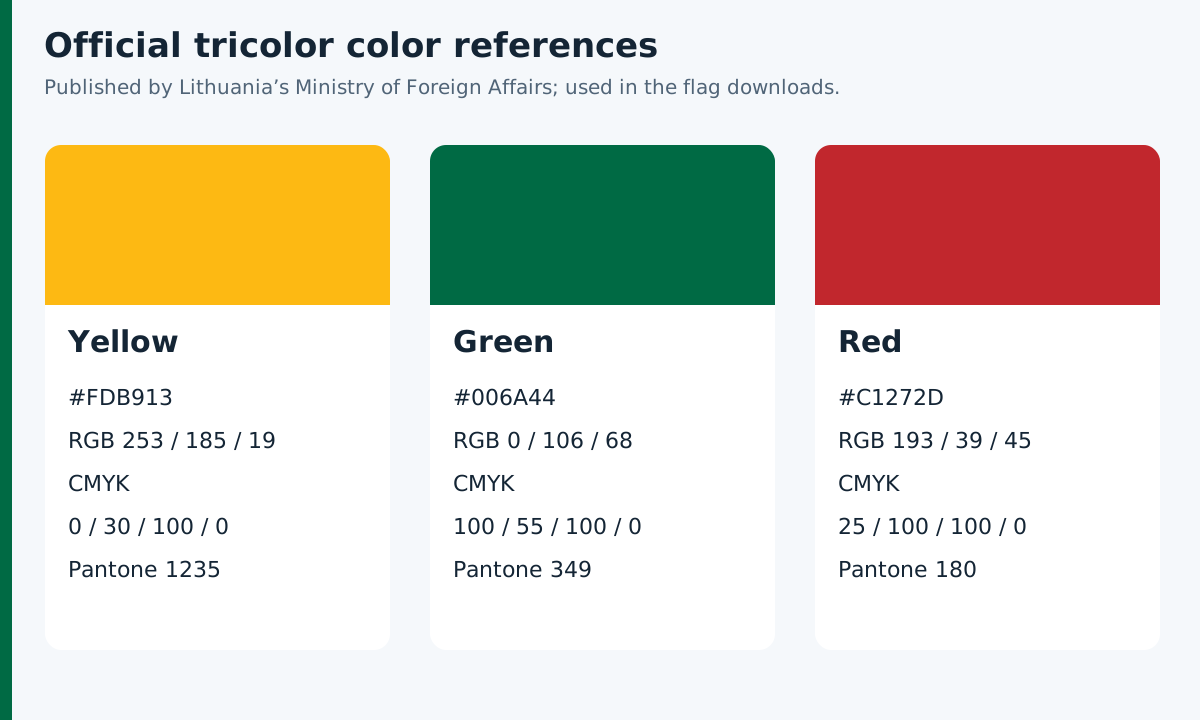
| Color | HEX | RGB | CMYK | Pantone |
|---|---|---|---|---|
| Yellow | #FDB913 | 253, 185, 19 | 0, 30, 100, 0 | 1235 |
| Green | #006A44 | 0, 106, 68 | 100, 55, 100, 0 | 349 |
| Red | #C1272D | 193, 39, 45 | 25, 100, 100, 0 | 180 |
The 2007 government-commissioned standards give the same table and identify coated/uncoated Pantone references with C/U notation. These are published reference values, not numbers calculated here by an automatic conversion between color systems. The coat-of-arms table elsewhere in that document uses different colors and must not be substituted for the tricolor’s table.
Screens, paper, ink, and textiles reproduce color differently. RGB describes emitted screen color; CMYK describes process-ink components; a spot-color reference identifies a production target. Use the relevant official sample for the intended material. A screenshot of a waving flag is a poor color master because lighting and shadows alter its appearance.
What do yellow, green, and red mean?
An official Seimas explanation associates yellow with sunshine, light, and prosperity; green with natural beauty, freedom, and hope; and red with the land, courage, and blood shed for the homeland. These are established symbolic interpretations. The constitutional provision names the colors without assigning each one a compulsory verbal meaning.
| Color | Meanings in the Seimas explanation | How to understand the association |
|---|---|---|
| Yellow | Sun, light, prosperity | A positive image of life and well-being. |
| Green | Nature, freedom, hope | Landscape and aspirations for national life. |
| Red | Land, courage, sacrifice | Remembrance of those who struggled for the homeland. |
Symbolism is easier to explain accurately when the source and period are identified. A historical discussion about selecting a brighter color is evidence about the design process; a later educational interpretation describes how people understand the finished flag. The two can complement each other without being identical.
The colors do not stand for three provinces or three constitutional branches of government. Nor does the ordinary flag contain the Vytis emblem. Readers should distinguish what they can see on the cloth from the ideas subsequently associated with it.
How did the modern flag originate?
The modern tricolor emerged from debates about a Lithuanian national flag during the movement to reestablish statehood. Discussions in 1917 considered colors familiar from Lithuanian folk dress. A green-and-red proposal was judged too dark, and yellow was introduced during the process that produced the three equal bands adopted in 1918.
The Seimas account describes an earlier 1905 proposal by Jonas Basanavičius to use the traditional red banner with a white knight. In 1917, Antanas Žmuidzinavičius prepared a green-and-red design for the Vilnius Conference. Tadas Daugirdas suggested adding yellow, initially as a narrow intermediate stripe associated with dawn. The final arrangement differed: yellow became the top band, and all three bands were equal.
This sequence explains why a proposal should not be reproduced as though it were the adopted national flag. A narrow yellow stripe between green and red belongs to discussion of an intermediate idea, not to the present construction drawing.
Who designed the Lithuanian tricolor?
The flag’s development is associated with a commission of Jonas Basanavičius, Antanas Žmuidzinavičius, and Tadas Daugirdas. Žmuidzinavičius prepared an influential green-and-red proposal, and Daugirdas advocated adding yellow. The final three-band design resulted from their collective work and approval by the Council of Lithuania, rather than a single isolated act of drawing.
| Person | Documented role |
|---|---|
| Jonas Basanavičius | National movement leader; commission member; advocate of the older knight-banner tradition. |
| Antanas Žmuidzinavičius | Painter; prepared the green-and-red proposal used at the 1917 conference. |
| Tadas Daugirdas | Archaeologist and heraldic specialist; proposed the addition of yellow. |
The commission approved a design on April 19, 1918. The Council’s later decision gave it political authority. These roles distinguish proposing colors, developing a composition, and adopting a national symbol; assigning every stage to one “designer” obscures that collaboration.
When was Lithuania’s flag adopted?
The flag commission approved the yellow-green-red design on April 19, 1918, and the Council of Lithuania approved it on April 25. The latter is the usual adoption date for the modern tricolor. Its 1988 restoration and the 2004 change in proportions are later events, not alternative dates for the original decision.
Lithuania’s February 16, 1918 declaration of independence belongs to the same state-building period, but it is not the flag’s April adoption decision. Likewise, January 1, 1919 commemorates a particular flag-raising ceremony at Gediminas Tower. A useful date label states the event, rather than presenting all three dates as interchangeable.
For an image caption, “Design adopted in 1918; present proportions restored in 2004” is more informative than an unexplained year. It allows the same basic colors to be traced through changes in the flag’s legal form.
Did the flag’s proportions change?
Yes. Lithuania used a longer 1:2 height:length tricolor during the late Soviet restoration period and the early years of restored independence. The original 1991 flag law specified that ratio. The 2004 replacement law restored the interwar 3:5 proportion, taking effect on September 1, while retaining yellow, green, and red.

The Seimas history dates approval of the restored flag’s 1:2 proportions to January 25, 1989. A flag from that period should therefore be described using its historical context. Drawing every version as 3:5 would erase an actual change; calling a correctly dated 1:2 photograph an error would also be misleading.
At equal height, the older 1:2 rectangle is 20 percent longer than the present 3:5 rectangle: 2 ÷ (5/3) = 1.2. The comparison artwork uses the current digital palette for both shapes to isolate this geometric difference. It does not claim to reproduce the exact dyes of surviving historical cloth.
What happened to the flag during Soviet rule?
Soviet rule displaced the Lithuanian tricolor from official use and made it a symbol of opposition and national continuity. Soviet-era flags used different designs, including a red-white-green arrangement introduced in 1953. People continued to preserve and display the yellow-green-red flag, sometimes secretly and at considerable personal risk under the regime.
The National Museum of Lithuania describes imprisonment, deportation, and other repression connected with displaying the tricolor. The severity and form of punishment changed over time; a single description cannot stand for every decade of Soviet rule. The flag’s reappearance in the late 1980s therefore carried significance beyond a change in government decoration.
Historical flags should be labeled by the authority and period they represented. The Soviet Lithuanian flag was not merely the present tricolor with slightly different shades. The color order and political symbols were different. The continued use of the national colors by opponents of Soviet rule is another strand of the history.
How did the tricolor return in 1988–1990?
The tricolor returned prominently during Lithuania’s national revival. It was raised at Gediminas Tower on October 7, 1988, and recovered state-flag status on November 18. Lithuania restored independence on March 11, 1990. The tower ceremony, legal recognition, and restoration of independence are separate milestones in the flag’s modern history.
The National Museum distinguishes the flag raised in 1988 from its replacement raised on October 7, 1989. The latter cloth became a museum exhibit. That distinction matters when a photograph or surviving object is described: the date of the symbolic event is not automatically the date of every later flag flown at the same site.
The Baltic Way on August 23, 1989 linked people across Lithuania, Latvia, and Estonia in a peaceful demonstration for freedom. UNESCO describes a human chain about 600 km (373 miles) long. It supplies regional context for the national revival, without making the three countries’ flags interchangeable or assigning the same legal adoption date to each.
Which dates belong on a flag-history timeline?
Lithuania’s flag timeline should distinguish a design proposal, political adoption, public ceremony, legal restoration, and change in proportions. The same yellow-green-red pattern appears across several of these events. Recording what happened at each date gives a more accurate account than selecting one year to represent the whole history.

| Date | Milestone |
|---|---|
| 1917 | Vilnius Conference debates and development of a national-color design. |
| April 19, 1918 | Commission approves the three equal bands. |
| April 25, 1918 | Council of Lithuania approves the design. |
| January 1, 1919 | Volunteer flag-raising ceremony commemorated by Flag Day. |
| October 7, 1988 | Tricolor raised again at Gediminas Tower. |
| November 18, 1988 | State-flag status restored. |
| January 25, 1989 | Color standard and 1:2 proportions approved. |
| March 11, 1990 | Lithuania restores independence. |
| June 26, 1991 | Flag law adopted with 1:2 proportions. |
| October 25, 1992 | Constitution adopted; Article 15 names the flag colors. |
| September 1, 2004 | Replacement law takes effect with 3:5 proportions. |
| June 17, 2010 | Seimas approves the historical flag’s design and standard. |
| March 1, 2024 | Expanded historical-flag display provisions take effect. |
The timeline combines parliamentary records, museum history, and later legal changes. “Restored” describes different things in 1988, 1990, and 2004: the flag’s status, independence, and the earlier flag proportions respectively.
What is the red flag with the white knight?
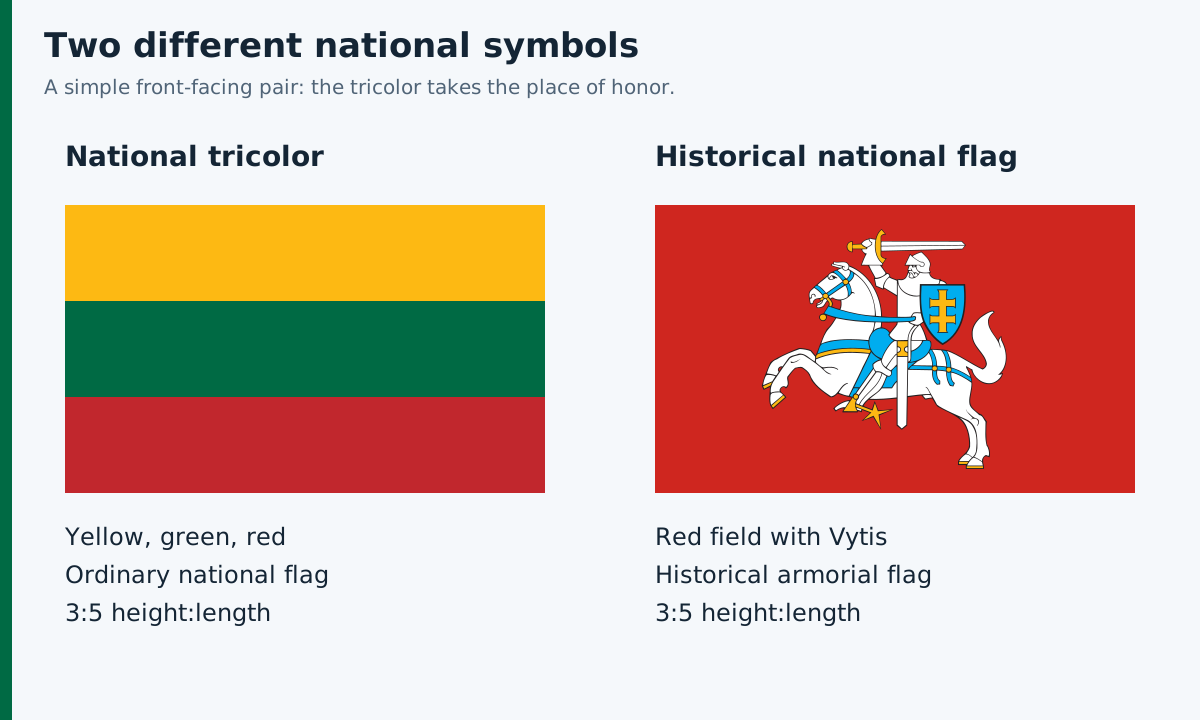
The red flag bearing an armored rider on a white horse is Lithuania’s historical national, or armorial, flag. The rider is Vytis, a longstanding Lithuanian state symbol. This flag has its own legal status and a 3:5 height:length ratio. It is distinct from the plain yellow-green-red national tricolor.

The knight raises a sword and carries a blue shield bearing a gold double cross. Blue and gold details also appear on the horse’s equipment. Its historical identity draws on the banner tradition of the Grand Duchy of Lithuania. The modern standardized graphic is not a photograph or an exact facsimile of one surviving medieval textile.
The historical flag was recognized in the 2004 flag legislation, and its design and standard received Seimas approval on June 17, 2010. The reference image here preserves a complete documented vector derived from the Presidency’s artwork. The contributor’s cleanup and color conversion are recorded with the image credits.
How are the tricolor and historical flag used together?
Lithuania recognizes both the national tricolor and a separate historical flag. The tricolor remains the ordinary national flag; the historical flag expresses the older armorial tradition and has its own display requirements. The 2024 changes expanded specified uses of the historical flag without replacing the tricolor or adding Vytis to it.
From March 1, 2024, the amended law extended continuous historical-flag display to specified border checkpoints. It also addressed July 6 display at state and municipal institutions and expressly allowed residents to raise the historical flag at their homes on their own initiative. These changes should not be reduced to the older three-site summary found in early English translations.
The Ministry’s paired-display diagrams give the tricolor the place of honor: in a simple front-facing pair, it is on the observer’s left. Both flags should be recognizable as complete flags. Placing a knight on the tricolor creates a different composition, rather than combining the two official designs correctly.
Is the presidential flag the same flag?
No. Lithuania’s President has a separate flag with a purple field and the national coat of arms supported by a griffin and a unicorn. The presidential law describes proportions of 1:1.2 height:length. That office flag is neither the plain tricolor nor the red historical flag showing Vytis without those supporters.
| Flag | Identifying features | Height:length |
|---|---|---|
| National flag | Equal yellow, green, and red horizontal bands | 3:5 |
| Historical national flag | Red field with the mounted knight Vytis | 3:5 |
| Presidential flag | Purple field; arms with griffin and unicorn supporters | 1:1.2, equivalent to 5:6 |
Article 7 of the presidential law connects this flag with the office of the head of state. Its display conditions include the presidential residence when the President is in Vilnius, as well as specified transport use when the President is present. The ordinary flag should not be labeled “presidential” merely because it appears beside a president.
Military units and other institutions may use additional standards. Their emblems and use must be identified individually. This article illustrates the two principal national flag forms and describes the presidential distinction without substituting a generic shield or an invented heraldic drawing.
When is Lithuania’s Flag Day?
Lithuania observes Flag Day on January 1. It commemorates the volunteer flag-raising ceremony at Gediminas Tower in Vilnius on January 1, 1919. A ceremonial replacement of the tower flag continues the tradition, and the outgoing flag is entrusted to a selected school associated with civic education and remembrance.
The museum account describes a group of ten volunteers arriving at the hill and three ascending the tower. The ceremony took place in the unsettled period after the restoration of Lithuanian statehood. The commemoration concerns that particular 1919 act; the Seimas history also documents an earlier, short-lived tower display in 1918.
The Defence Ministry’s 2026 notice marked the 107th anniversary and described the transfer of the previous year’s flag to a school. The school-custody initiative began in 2005. These details explain the living observance without confusing the date with February 16 or March 11.
On which holidays must households display the flag?
The three major dates requiring the national flag at residential buildings, as well as the institutions and organizations covered by the rule, are February 16, March 11, and July 6. Official guidance gives display hours of 7 a.m. to 10 p.m. These duties should be distinguished from other institutional commemorations.

| Date | Occasion | Distinction |
|---|---|---|
| January 1 | Flag Day | Commemorates the 1919 tower ceremony. |
| February 16 | Restoration of the State Day | 1918 statehood anniversary; one of the three household display dates. |
| March 11 | Restoration of Independence Day | 1990 independence-restoration anniversary; household display date. |
| July 6 | Statehood and National Anthem Day | Associated with King Mindaugas’s coronation; household display date. |
A February 2026 municipal reminder confirms the three dates and hours. State institutions, permanent flag sites, military establishments, and diplomatic premises can have additional duties. A selected holiday table is therefore not an exhaustive government calendar. Permanent display is a separate category from raising a household flag for a particular holiday.
When planning an official ceremony, identify the institution, type of flag, and applicable occasion before applying a calendar. The historical flag’s rules and a mourning instruction can create additional requirements that are not captured by the three household dates alone.
What are the main principles for displaying the flag?
Display the Lithuanian flag in its correct colors and proportions, in sound condition, and in the place of honor appropriate to the setting. The Foreign Ministry illustrates arrangements for buildings, rooms, vehicles, and groups of flags. A rule for one arrangement should not be transferred automatically to every other display.
For a simple indoor arrangement facing an audience, heraldic right corresponds to the audience’s left. A flag beside a speaker is placed to the speaker’s right. More complex rows, semicircles, and official visits have their own illustrated arrangements, so the viewpoint must be clear before positions are assigned.
The Ministry gives relationships between flag size and support: for a façade-mounted pole, the flag’s short dimension is between one-third and one-half of the pole length. For a freestanding mast, it is between one-sixth and one-quarter of mast height. These relationships address physical display, while the flag itself retains its 3:5 field.
Keep a stored flag dry and protected from dirt and damage. Such practical care advice supports a presentable display; it does not establish a special Lithuanian triangular fold or a universal private disposal ceremony.
How should the flag hang vertically?
When Lithuania’s flag is displayed vertically, yellow belongs on the observer’s left, green in the middle, and red on the right. Official wording describes yellow as being on the heraldic right. That term refers to the flag’s heraldic viewpoint, which is opposite to the viewpoint of someone facing it.
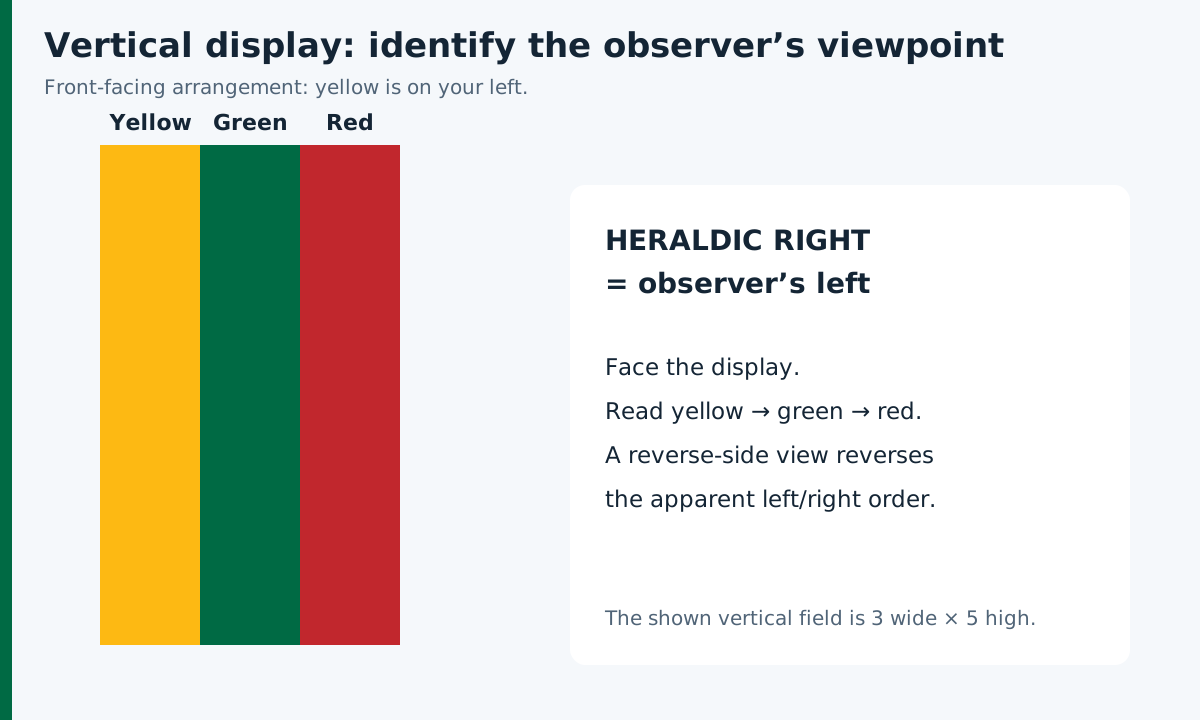
The front-facing vertical reference reads yellow–green–red from left to right. A clockwise rotation of an ordinary horizontal drawing would instead put red on the left, so blindly rotating an image is an unreliable instruction. Set the required visible arrangement first, then consider the mounting and which face will be seen.
A reverse-side view naturally reverses left and right. Captions should identify that viewpoint instead of calling every reversed photograph an incorrectly made flag. For the ordinary horizontal design, the upper yellow and lower red remain in place when the flag is viewed from behind.
How is the flag displayed during mourning?
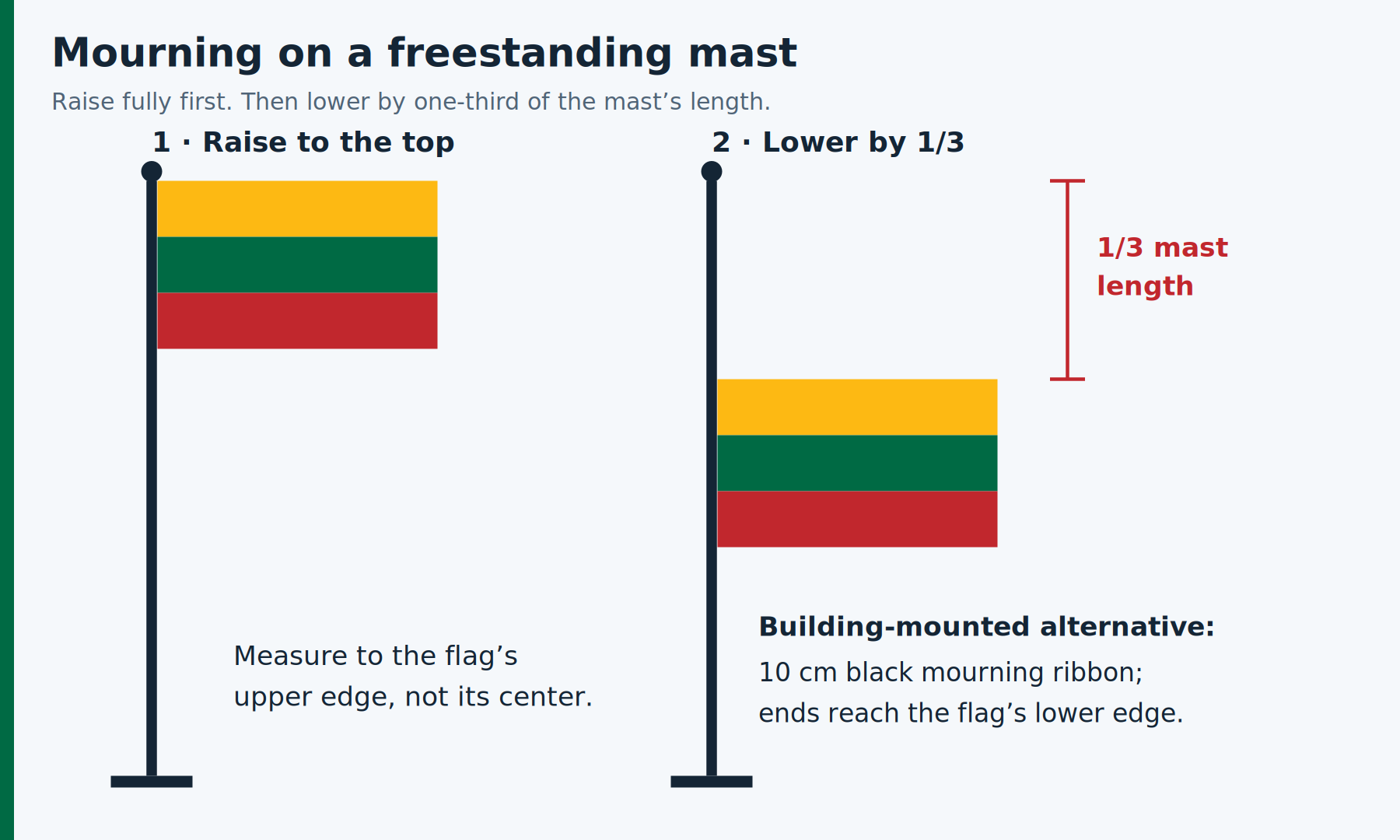
The Foreign Ministry’s mourning guidance says to raise a flag fully, then lower it by one-third of the mast’s length. For a flag attached to a building-mounted pole, it specifies a black mourning ribbon 10 centimeters wide, with ends reaching the flag’s lower edge. These are two different display methods.
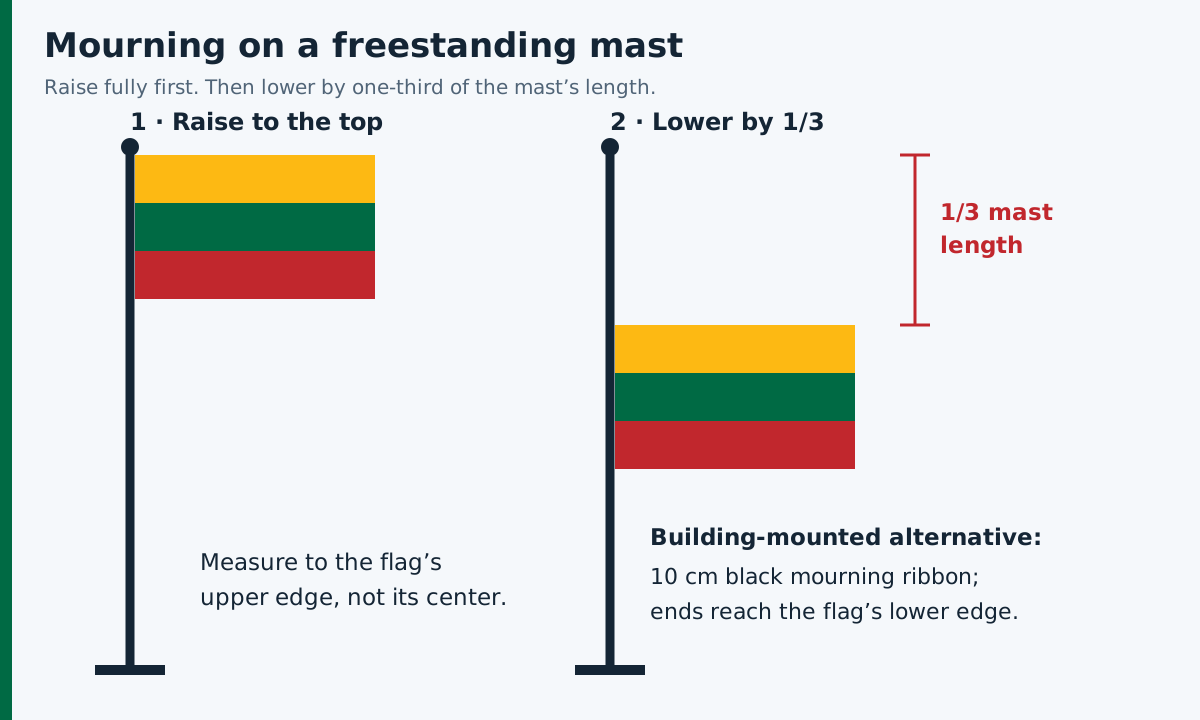
“Lower by one-third” measures the movement from the masthead, not a demand to place the cloth’s center halfway down the pole. The accompanying diagram shows the flag’s upper edge one-third of the mast length below the top. Its cloth size is schematic; the measured gap is the important relationship.
The same Ministry guidance recommends taking down other flags when the national flag is lowered on a mast. It states that this recommendation does not apply to the building-mounted ribbon arrangement. The guidance describes how to show mourning; an actual mourning observance or official instruction determines when that treatment is appropriate.
How does Lithuania’s flag differ from the other Baltic flags?
Lithuania, Latvia, and Estonia have distinct national flags. Lithuania uses equal yellow, green, and red bands. Latvia uses carmine, white, and carmine with a narrower middle band. Estonia uses equal blue, black, and white bands. Their official rectangular proportions also differ, so comparison pictures should preserve each country’s shape.
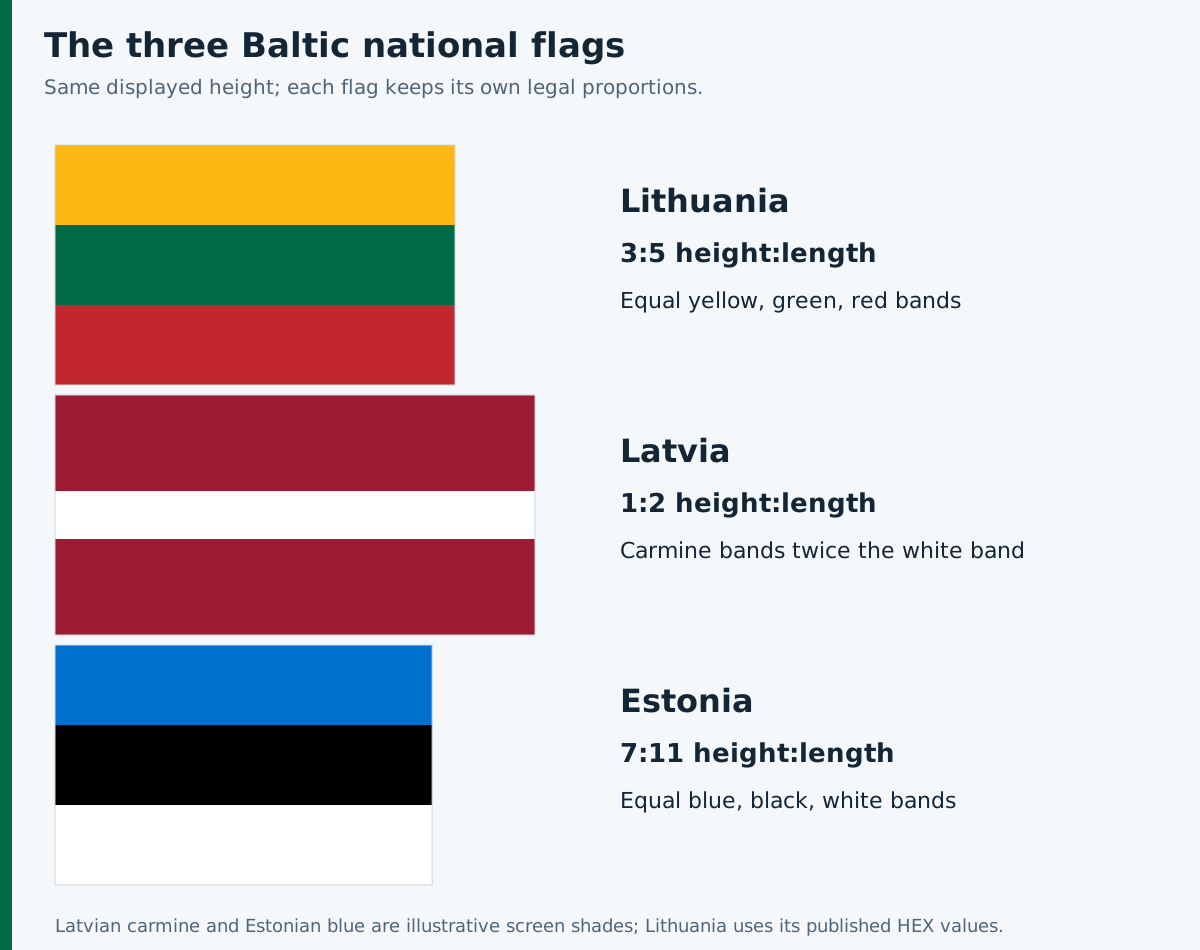
| Country | Top-to-bottom arrangement | Band depths | Height:length |
|---|---|---|---|
| Lithuania | Yellow / green / red | 1:1:1 | 3:5 |
| Latvia | Carmine / white / carmine | 2:1:2 | 1:2 |
| Estonia | Blue / black / white | 1:1:1 | 7:11 |
Latvia’s flag law and Estonia’s flag act define these geometric differences. In the comparison, each flag is drawn at the same height; Latvia consequently appears longer than either of the other two. The comparison’s Latvian carmine and Estonian blue are illustrative screen shades, not asserted Lithuanian government color specifications.
The shared Baltic history of the late twentieth century does not turn these three flags into variants of one design. Identifying the country by both color order and stripe proportions is more reliable than remembering only that it uses three horizontal fields.
What is the Lithuania flag emoji, and how should images be used?
Lithuania’s flag emoji is 🇱🇹, encoded by the regional-indicator sequence U+1F1F1 U+1F1F9, representing L and T. Its appearance depends on the platform and font. For an accurate diagram, print file, or accessible educational page, use a properly proportioned image with descriptive alternative text instead of relying on emoji artwork.
A useful image description is “Flag of Lithuania, three equal horizontal bands of yellow, green, and red.” If the purpose is to teach measurements, include the 3:5 height:length proportion in the surrounding text or the diagram’s description. Color names and labels make the information available beyond the image alone.
SVG is suitable for scaling a diagram without pixelation. PNG is convenient for presentations, documents, and software that does not accept SVG. Keep the whole image in proportion, avoid cropping off a band, and do not stretch it to fill a square placeholder.
The downloadable graphics include explicit creator and reuse notes. The knight-flag reference has a documented government-symbol public-domain record. An image’s copyright status and the rules governing respectful use of a national symbol address different questions; the presence of a download button is not a government certification of a proposed commercial use.
What mistakes are most common?
The most common errors are reversing the color order, giving the three bands unequal heights, using the old 1:2 proportions for an undated modern flag, and confusing the tricolor with the historical Vytis flag. Date errors also matter: adoption, restoration, Flag Day, and independence anniversaries describe different events.
| Mistake | Correction |
|---|---|
| Putting green or red at the top | Use yellow above green above red. |
| Making a narrow middle band | All three tricolor bands have equal depth. |
| Adding Vytis to the ordinary flag | Explain the separate historical red flag. |
| Labeling every flag 1:2 | The present height:length ratio is 3:5. |
| Rejecting a dated older 1:2 flag | Check the period before judging the proportions. |
| Calling January 1 the adoption date | It commemorates the 1919 tower ceremony. |
| Equating 1988 with restored independence | State-flag restoration preceded March 11, 1990. |
| Putting yellow on the viewer’s right vertically | For the front-facing display, yellow is on the viewer’s left. |
| Using the coat-of-arms palette for the tricolor | Follow the separate national-flag color table. |
| Treating a draft annex as an operative standard | Check whether the instrument is enacted and in force. |
A reliable caption identifies the object, date or period, and viewpoint. Those three pieces of information resolve many apparent contradictions without changing the flag drawing itself. The images in this article label historical comparisons and explanatory diagrams so they cannot easily be mistaken for current national-flag masters.
Glossary and related topics
Flag vocabulary helps distinguish a design from an individual cloth and a national symbol from a particular office flag. In Lithuania, the most useful distinctions are between the tricolor, the historical armorial flag, and the presidential flag. Measurements also become clearer when the two dimensions of a stated ratio are named.
| Term | Meaning |
|---|---|
| Tricolor / Trispalvė | A flag using three principal colors; Lithuania’s yellow, green, and red national flag. |
| Hoist | The edge attached to a staff, mast, rope, or other support. |
| Fly | The free edge opposite the hoist. |
| Height:length | The short vertical dimension followed by the horizontal length in a normal flat view. |
| Heraldic right / dexter | The bearer’s right; the observer’s left when facing the display. |
| Vytis | Lithuania’s mounted-knight state symbol. |
| Armorial flag | A flag based on heraldic arms or their principal figures. |
| Standard | A flag associated with an office, person, institution, or unit. |
| Consolidated law | A text incorporating amendments that apply during a specified period. |
| Restoration | Reinstatement; its meaning depends on whether the subject is statehood, a flag’s status, or its proportions. |
Related subjects include Lithuanian state symbols, the Council of Lithuania, the national revival, the Baltic Way, and the history of heraldic banners. The modern tricolor provides an entry point into those subjects while remaining a simple, precisely defined three-band design.
Explore more in World Flags: Iceland flag, Liberia flag, Libya flag, Liechtenstein flag.
Download Lithuania flag pictures
Download the national flag as SVG or large PNG. The gallery includes 12 distinct subjects with captions and alternative text. Keep the full proportions when resizing. Image credits and reuse notes accompany the graphics.
World Flags/Lithuania
Lithuania flag pictures
The present national tricolor: three equal bands and a 3:5 height:length ratio.
GKBookDownload SVGDownload PNGOriginal construction drawing from the official ratio and equal-band description; dimensions refer to the visible field.
GKBookDownload SVGDownload PNGThree calculated sizes show how equal bands and the 3:5 ratio scale together. Nominal building-display sizes may be rounded.
GKBookDownload SVGDownload PNGHEX/RGB/CMYK/Pantone values follow the Ministry table and the 2007 government standard. The historical flag uses a separate reference rendering.
GKBookDownload SVGDownload PNGThe 1:2 form approved in 1989 and specified in the 1991 law is compared with today’s 3:5 form. Both use modern colors for clarity.
GKBookDownload SVGDownload PNGA dated teaching timeline; the full article distinguishes commission approval, Council adoption, restoration, and law commencement.
GKBookDownload SVGDownload PNGA documented reference rendering of the separate historical flag. Complete source geometry and paints are retained; this is not a medieval textile facsimile.
Jefim Vytovtov, derived from Lithuanian Presidency artwork; Wikimedia Commons; Public domain (PD-LT-exempt). License: https://commons.wikimedia.org/wiki/Template:PD-LT-exemptDownload SVGDownload PNGThe tricolor and the Vytis flag are separate designs, shown as a simple front-facing pair. The historical vector is preserved and fully credited.
GKBook; historical vector: Jefim Vytovtov, derived from Lithuanian Presidency artwork; Wikimedia Commons; Public domain historical emblem; CC0 composition. License: https://creativecommons.org/publicdomain/zero/1.0/Download SVGDownload PNGJanuary 1 commemorates the tower ceremony. February 16, March 11, and July 6 are the three major household display dates; other institutional duties exist.
GKBookDownload SVGDownload PNGFor a front-facing vertical display, yellow is on the observer’s left. The diagram explains heraldic right without confusing it with the viewer’s right.
GKBookDownload SVGDownload PNGThe upper edge is lowered by one-third of mast length. Building-mounted display instead uses the Ministry’s specified mourning ribbon; pole and cloth sizes here are schematic.
GKBookDownload SVGDownload PNGEqual-height comparison preserves each flag’s legal geometry. Latvian and Estonian shades are illustrative; the Lithuanian palette follows its Ministry reference.
GKBookDownload SVGDownload PNGFrequently asked questions
What does Lithuania’s flag look like?
Lithuania’s flag has three equal horizontal bands, with yellow at the top, green in the middle, and red at the bottom. The ordinary national flag contains no star, shield, lettering, or mounted knight. Its broad rectangular shape and the order of its bands are essential features of the design.
What is the correct ratio of Lithuania’s flag?
A correctly proportioned Lithuanian flag is five-thirds as long as it is high. Multiply the intended height by 5/3 to calculate its length, or multiply the length by 3/5 to calculate its height. Many physical sizes are possible; the mathematical ratio does not prescribe one universal purchase size.
How do you draw the Lithuanian flag?
Draw a rectangle five units long and three units high, then divide its height into three equal parts. Fill the upper part yellow, the middle part green, and the lower part red. This construction produces the present flag without needing a special emblem template or any unequal stripe measurements.
What are Lithuania’s official flag color codes?
The Lithuanian Foreign Ministry gives yellow as #FDB913, green as #006A44, and red as #C1272D. Its reference also supplies RGB, CMYK, and Pantone values. These published values are used in the national-flag downloads, while the separate historical knight flag is documented with its own source and rendering palette.
What do the three colors mean?
An official Seimas explanation associates yellow with sunshine, light, and prosperity; green with natural beauty, freedom, and hope; and red with the land, courage, and blood shed for the homeland. These are established symbolic interpretations. The constitutional provision names the colors without assigning each one a compulsory verbal meaning.
Who designed the Lithuanian flag?
The flag’s development is associated with a commission of Jonas Basanavičius, Antanas Žmuidzinavičius, and Tadas Daugirdas. Žmuidzinavičius prepared an influential green-and-red proposal, and Daugirdas advocated adding yellow. The final three-band design resulted from their collective work and approval by the Council of Lithuania, rather than a single isolated act of drawing.
When was the modern tricolor adopted?
The flag commission approved the yellow-green-red design on April 19, 1918, and the Council of Lithuania approved it on April 25. The latter is the usual adoption date for the modern tricolor. Its 1988 restoration and the 2004 change in proportions are later events, not alternative dates for the original decision.
Why do some older Lithuanian flags look longer?
Yes. Lithuania used a longer 1:2 height:length tricolor during the late Soviet restoration period and the early years of restored independence. The original 1991 flag law specified that ratio. The 2004 replacement law restored the interwar 3:5 proportion, taking effect on September 1, while retaining yellow, green, and red.
When was the flag restored?
The tricolor returned prominently during Lithuania’s national revival. It was raised at Gediminas Tower on October 7, 1988, and recovered state-flag status on November 18. Lithuania restored independence on March 11, 1990. The tower ceremony, legal recognition, and restoration of independence are separate milestones in the flag’s modern history.
What is the red Lithuanian flag with a knight?
The red flag bearing an armored rider on a white horse is Lithuania’s historical national, or armorial, flag. The rider is Vytis, a longstanding Lithuanian state symbol. This flag has its own legal status and a 3:5 height:length ratio. It is distinct from the plain yellow-green-red national tricolor.
Did the historical flag replace the tricolor?
Lithuania recognizes both the national tricolor and a separate historical flag. The tricolor remains the ordinary national flag; the historical flag expresses the older armorial tradition and has its own display requirements. The 2024 changes expanded specified uses of the historical flag without replacing the tricolor or adding Vytis to it.
Is Lithuania’s presidential flag different?
No. Lithuania’s President has a separate flag with a purple field and the national coat of arms supported by a griffin and a unicorn. The presidential law describes proportions of 1:1.2 height:length. That office flag is neither the plain tricolor nor the red historical flag showing Vytis without those supporters.
When is Lithuanian Flag Day?
Lithuania observes Flag Day on January 1. It commemorates the volunteer flag-raising ceremony at Gediminas Tower in Vilnius on January 1, 1919. A ceremonial replacement of the tower flag continues the tradition, and the outgoing flag is entrusted to a selected school associated with civic education and remembrance.
When must homes display the Lithuanian flag?
The three major dates requiring the national flag at residential buildings, as well as the institutions and organizations covered by the rule, are February 16, March 11, and July 6. Official guidance gives display hours of 7 a.m. to 10 p.m. These duties should be distinguished from other institutional commemorations.
Which color goes on the left in a vertical display?
When Lithuania’s flag is displayed vertically, yellow belongs on the observer’s left, green in the middle, and red on the right. Official wording describes yellow as being on the heraldic right. That term refers to the flag’s heraldic viewpoint, which is opposite to the viewpoint of someone facing it.
How is the flag displayed for mourning?
The Foreign Ministry’s mourning guidance says to raise a flag fully, then lower it by one-third of the mast’s length. For a flag attached to a building-mounted pole, it specifies a black mourning ribbon 10 centimeters wide, with ends reaching the flag’s lower edge. These are two different display methods.
How do the three Baltic flags differ?
Lithuania, Latvia, and Estonia have distinct national flags. Lithuania uses equal yellow, green, and red bands. Latvia uses carmine, white, and carmine with a narrower middle band. Estonia uses equal blue, black, and white bands. Their official rectangular proportions also differ, so comparison pictures should preserve each country’s shape.
What is the Lithuania flag emoji?
Lithuania’s flag emoji is 🇱🇹, encoded by the regional-indicator sequence U+1F1F1 U+1F1F9, representing L and T. Its appearance depends on the platform and font. For an accurate diagram, print file, or accessible educational page, use a properly proportioned image with descriptive alternative text instead of relying on emoji artwork.
Explore all general-knowledge topics and the A-to-Z lists.





We Value Your Opinion Comments