
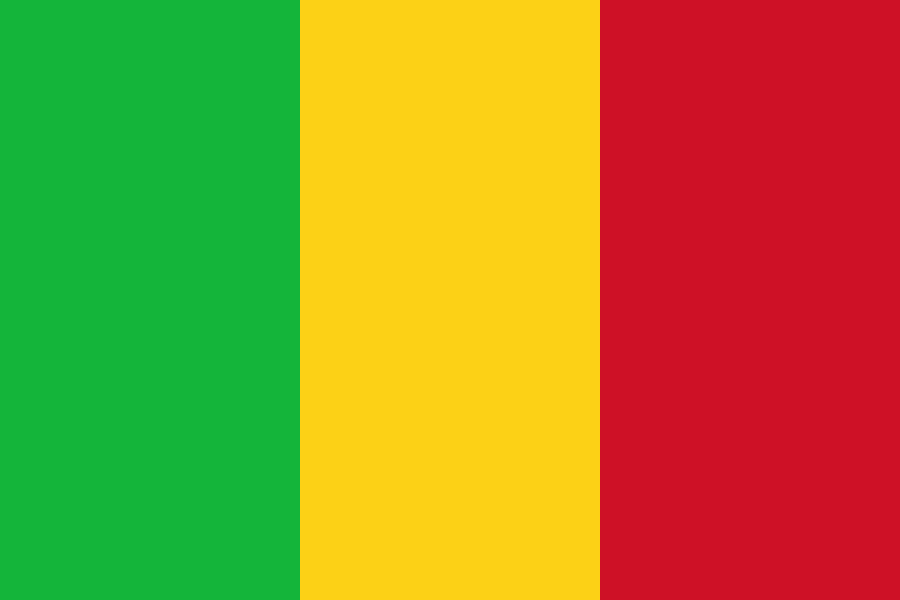
Mali flag picture
Explore the construction drawing, history, and complete picture gallery.
| Design | Green · gold · redEqual vertical bands; no emblem. |
|---|---|
| Proportions | 3:2 width:heightAlso written 2:3 height:width. |
| Legislative approval | January 20, 1961Law No. 61-26. |
| Official publication | March 1, 1961Commonly cited as the adoption date. |
| Independence Day | September 22Republic proclaimed in 1960. |
Article 30 defines the three equal bands. The 1961 record distinguishes approval on January 20, promulgation on February 18, and publication on March 1.
What is the national flag of Mali?
The national flag of Mali is a plain vertical tricolor of green, gold, and red, read from the hoist toward the fly. Its three bands are equal. The present design has no star, human figure, or coat of arms. It developed from the flag shared by the short-lived Mali Federation.
Mali is a West African republic whose flag combines a simple geometric design with the history of decolonization and African unity. The Constitution of July 22, 2023 defines the three equal vertical bands, while the Presidency gives the familiar 2:3 height-to-width proportion. The 1961 amendment removed the black central figure from the earlier design. Legislative approval, promulgation, publication, and independence are separate events, explained below.
What does the Mali flag look like?
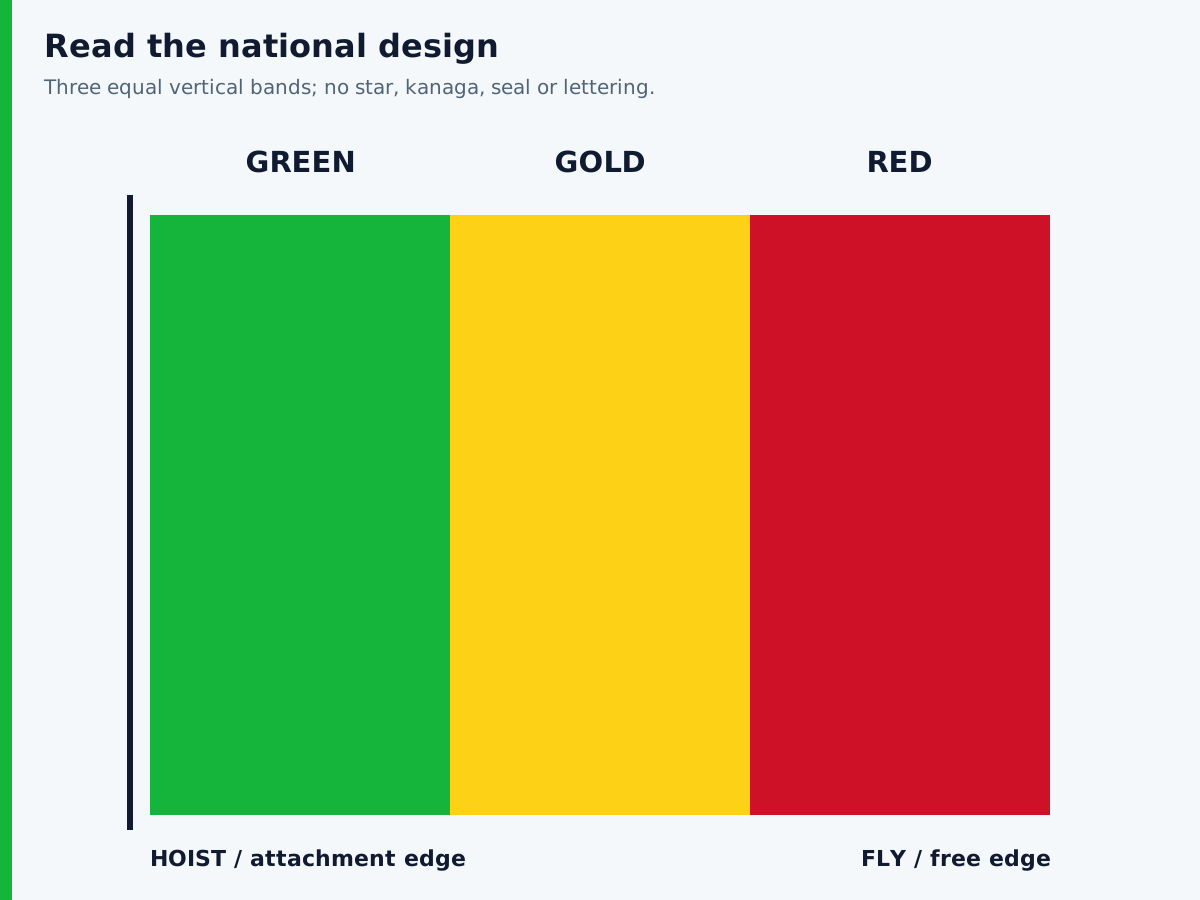
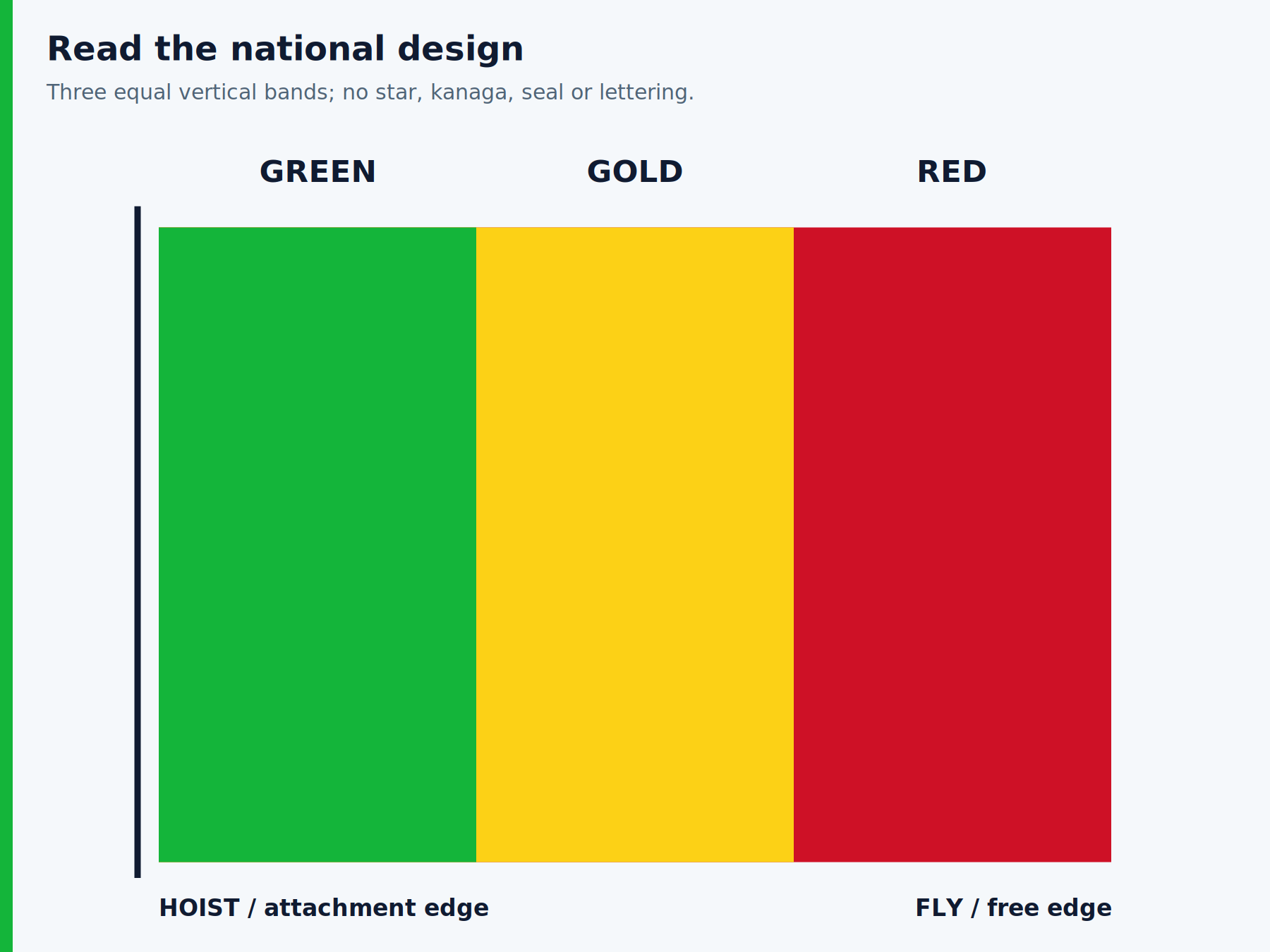
Mali’s flag has three equal vertical bands: green nearest the pole, gold in the middle, and red at the free edge. The current national design is uncharged, meaning that it carries no additional emblem. A star, a black humanlike figure, or a national seal would change this plain tricolor.
The pole-side edge is called the hoist; the opposite edge is the fly. Identify these edges before reading the colors, especially in photographs showing the back of a flag. The standard flat front-view illustration places the hoist at the viewer’s left.
What are the flag’s proportions?
The familiar Mali flag has a width-to-height ratio of 3:2, also written as 2:3 when height comes first. The Presidency states the latter convention. Article 30 of the 2023 Constitution specifies equal vertical bands but does not itself supply the overall ratio, numerical color values, or a detailed manufacturing drawing.
A flag 90 centimeters wide is therefore 60 centimeters high. Reversing the order of the numbers does not create a second national design when the dimension labels are also reversed. A square or an unusually long rectangle changes the reference proportions.
How can the flag be constructed accurately?
Draw a rectangle three units wide and two units high, then divide its width into three equal parts. Fill the first part green, the second gold, and the third red. Each band spans the full height and occupies one-third of the flag’s area; there are no gaps, outlines, borders, or central symbols.
| Element | On a 90 × 60 grid |
|---|---|
| Whole field | Width 90; height 60 |
| Green band | x = 0 to 30 |
| Gold band | x = 30 to 60 |
| Red band | x = 60 to 90 |
| Each band | Width 30; height 60; area one-third of field |
The supplied main PNG is 3600 × 2400 pixels, giving each band a width of 1200 pixels. These are finished visible-field measurements. Extra fabric for seams, a sleeve, or attachment is a separate production allowance and should not distort the displayed bands.

What colors and digital codes are used?
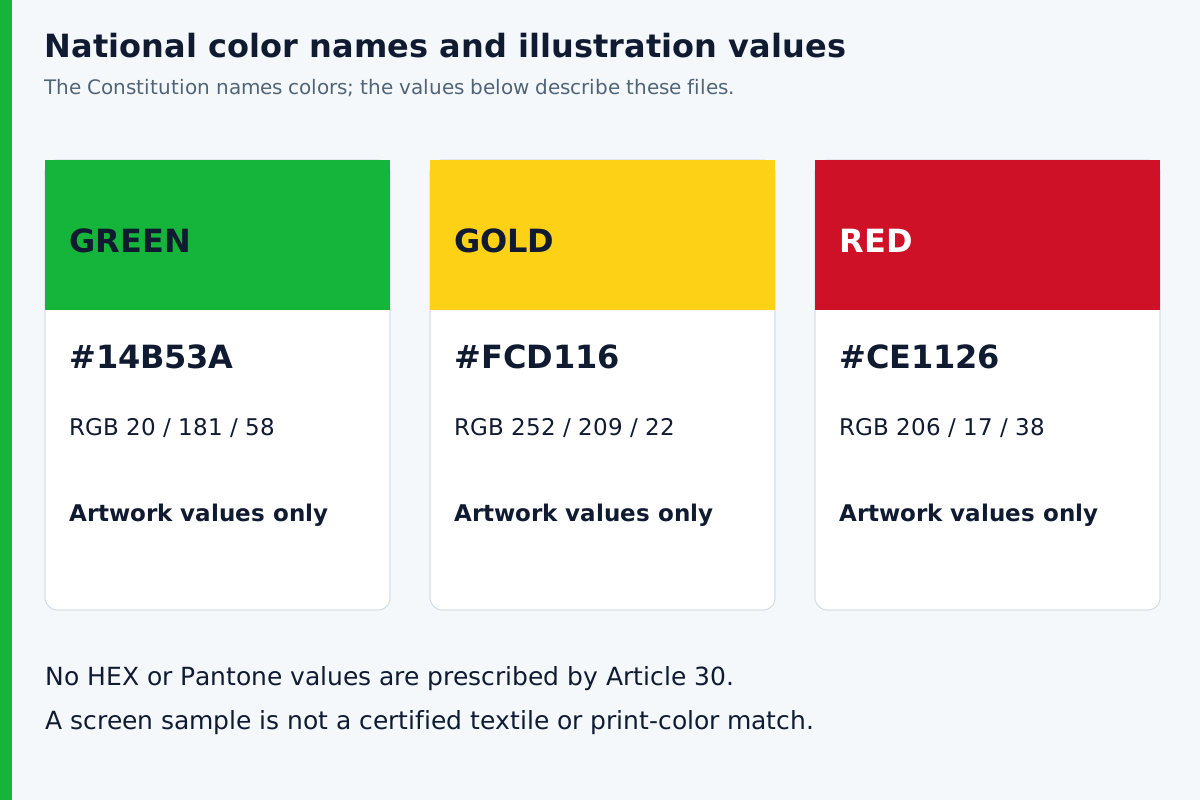
The constitutional color names are green, gold, and red. The downloadable illustrations use #14B53A, #FCD116, and #CE1126 respectively, following the actual national reference SVG. These are disclosed artwork values. The constitutional provision does not prescribe HEX, RGB, CMYK, or Pantone numbers, so digital approximations should not be labelled constitutional color standards.
| Color | Artwork HEX | Artwork RGB |
|---|---|---|
| Green | #14B53A | 20, 181, 58 |
| Gold | #FCD116 | 252, 209, 22 |
| Red | #CE1126 | 206, 17, 38 |
Specialist sources list different Pantone approximations, including sets used for particular international sporting events. Such event specifications do not automatically establish a universal Malian textile standard. The values above describe the delivered files; a printer or flag maker still needs an agreed physical proof for the intended material.
Why is the middle band called gold rather than yellow?
The Constitution names the middle color or, the French word for gold. Flat flag illustrations commonly render that color as a yellow tone, and the Presidency uses both descriptions in explaining the flag. The name does not mean that every printed image or cloth flag must use metallic ink, foil, or gold thread.
Use “gold” when reproducing the constitutional color sequence, and explain the yellow appearance when teaching color recognition. Adding shine, a gradient, or a metallic texture is an artistic treatment of an illustration, not part of the basic three-band construction.
What do the three colors symbolize?
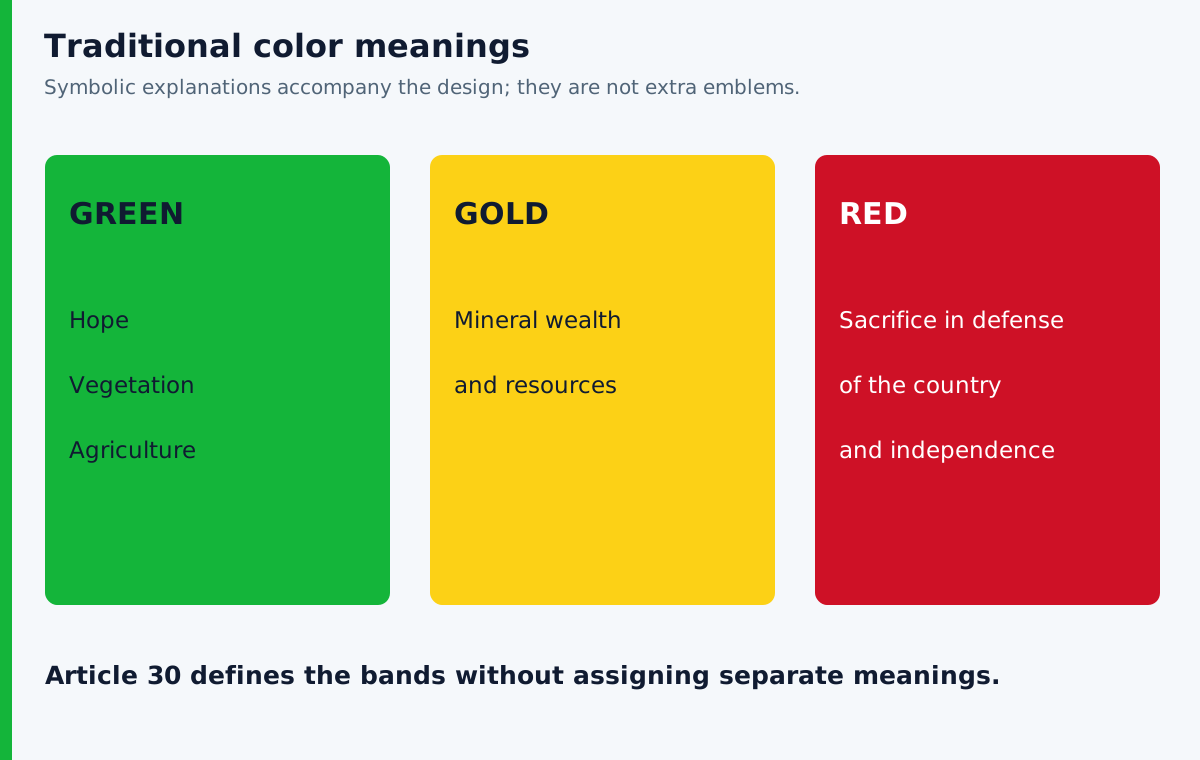
Green is associated with hope, vegetation, and agriculture; gold with mineral wealth; and red with sacrifice in defending the country and securing independence. These traditional explanations accompany the design. They should be distinguished from Article 30, which defines the bands and their colors without providing a separate symbolic interpretation for each one.
The reported embassy explanation emphasizes agriculture, gold, and the sacrifices of earlier generations. The longer historical account adds hope and the country’s productive land. Color symbolism is an interpretation of the national emblem, not a requirement to place pictures of crops, mines, or people on the cloth.
Why are these called Pan-African colors?
Green, gold, and red belong to a widely used Pan-African color tradition associated with African identity, solidarity, and independence. Mali’s combination emerged in that political setting. Sharing the colors does not make national flags interchangeable: their order, direction of stripes, emblems, and proportions distinguish individual countries and their particular histories.
The federal predecessor linked the colors to aspirations for African unity. Today, comparisons with Senegal, Guinea, and Cameroon show why identification requires the complete arrangement rather than a list of three color names. There is no single mandatory symbolic dictionary that gives every African flag the same meanings.
How did the Mali flag develop?
The modern flag grew from the green, gold, and red tricolor of the Mali Federation, which carried a black figure in the center. The Republic of Mali initially retained that device in 1960. A constitutional amendment adopted in 1961 removed the figure while keeping the three equal bands, creating the present plain design.
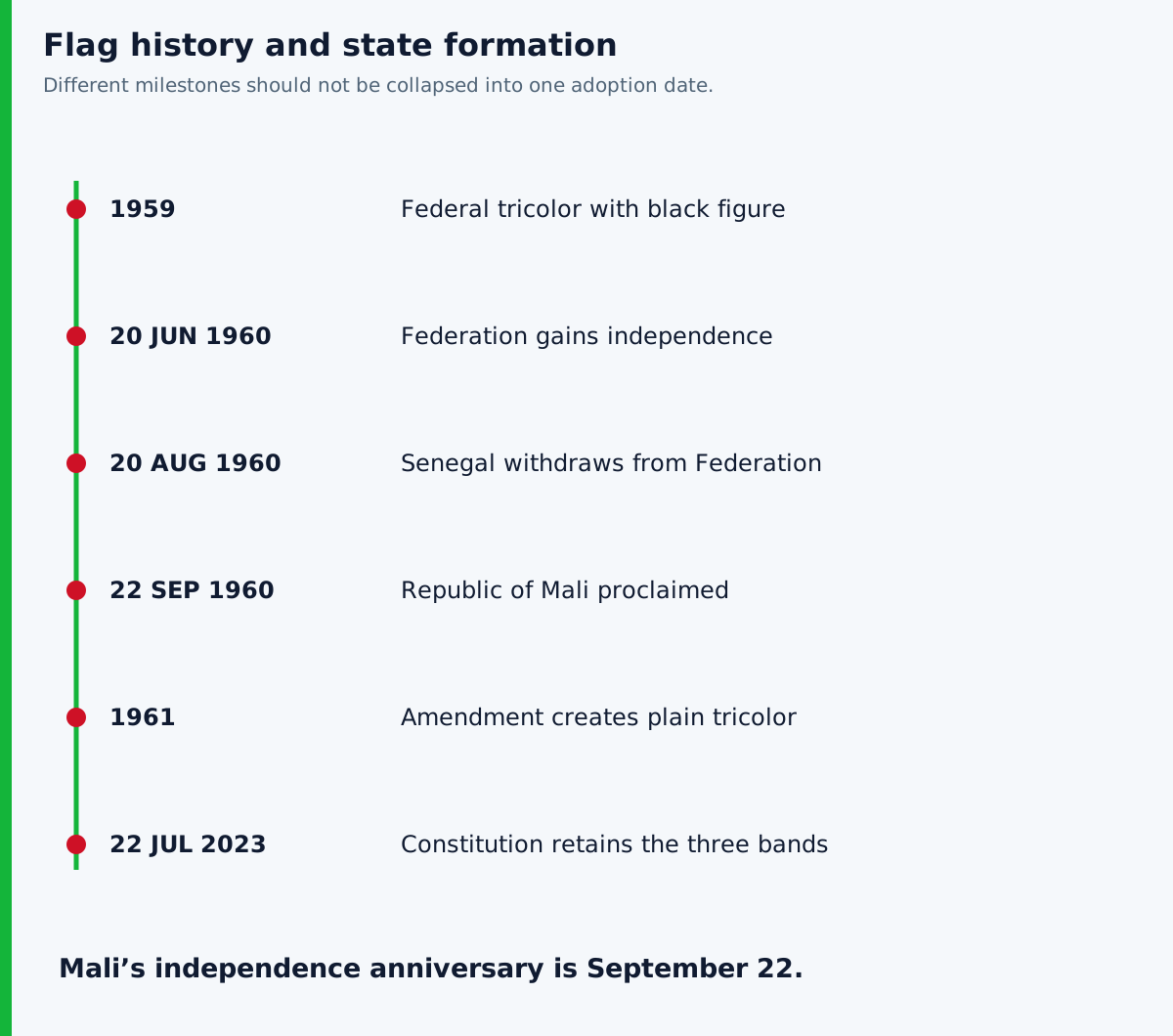
| Date or period | Flag-related significance |
|---|---|
| 1959 | Federal tricolor with black central figure |
| June 20, 1960 | Mali Federation becomes independent |
| August 20, 1960 | Senegal withdraws from the Federation |
| September 22, 1960 | Republic of Mali proclaimed; figure retained in constitutional description |
| January–March 1961 | Amendment approved, promulgated, and published |
| July 22, 2023 | New Constitution retains the plain tricolor |
The name French Sudan in this history refers to the former West African territory from which modern Mali developed. It should not be confused with the present Republic of the Sudan in northeastern Africa.
What was the Mali Federation flag?
The Mali Federation used a vertical green, gold, and red flag with a black central figure commonly called the kanaga. The Federation joined Senegal and the Sudanese Republic and became independent in June 1960. After its breakup, Mali initially retained the figure-bearing design, while Senegal adopted a related tricolor with a green star.
The historical illustration is a reconstruction of the familiar federal and early republican pattern. It preserves the source drawing’s complete figure and colors. It is not a photograph of surviving cloth or proof that every historical flag used precisely the same curves and shades.


What was the black kanaga figure?
The kanaga was the black device on the earlier flag’s gold band, described in the 1960 Constitution as a human figure with arms raised skyward. Its form is associated with Dogon masks. Museum and anthropological accounts show that the mask tradition has layered meanings, which should not be reduced to a single universal flag explanation.
Kanaga masks have a characteristic double-barred superstructure and are used in Dogon performance traditions, including funerary rites. The flag adapted a cultural form into a political emblem. A stylized flag drawing and a carved ceremonial mask are related objects, not identical artifacts with one fixed meaning in every context.
Why was the kanaga removed?
The 1961 amendment removed the sentence requiring a black figure from the constitutional flag description. Specialist histories connect the change with objections to human representation among some Muslim groups. The law itself does not state that motive. The documented legal alteration is therefore firmer evidence than a claim that the same religious view was held by everyone.
The statute preserves the three colors and equal vertical arrangement. Its text supports a precise account of what changed, while the proposed historical explanation should remain attributed to the specialist literature. It does not justify describing Dogon culture or Mali’s religious communities as uniform or unchanging.
When was the present flag adopted?
The present flag was approved by the National Assembly on January 20, 1961, through Law No. 61-26. Its promulgation decree is dated February 18, and publication followed on March 1. Flag references commonly list March 1 as the adoption date; the original gazette makes the three distinct legal stages visible.
| Stage | Date | Evidence |
|---|---|---|
| Legislative approval | January 20, 1961 | Law No. 61-26, signed after the Assembly sitting |
| Promulgation | February 18, 1961 | Decree No. 11 P.G.-R.M. |
| Official publication | March 1, 1961 | Journal officiel No. 79, page 203 |
The original printed page was checked directly. Some summaries give January 21, but the gazette identifies January 20 in both the decree’s title and the Assembly’s closing formula. March 1 is accurately described here as publication and the commonly cited flag-adoption date, without inventing an additional commencement clause.

How is flag adoption different from independence?
The Republic of Mali commemorates independence on September 22, recalling its proclamation in 1960. The preceding Mali Federation had become independent on June 20. The plain flag followed in 1961. These events belong to different stages of state formation, so the flag’s publication date should not replace Mali’s national independence anniversary.
The United States recognized the separate Republic of Mali and established diplomatic relations with it on September 24, 1960. That is a bilateral recognition date, not the national holiday or the date when the black figure was removed from the flag.
Who designed or made the flag?
The flag developed through federal symbolism and legislative decisions, and the sources do not establish one certain designer of every feature of the current tricolor. Research associates Léopold Sédar Senghor cautiously with the choice of the earlier kanaga. A historical account credits Mariam Traoré with sewing the first national flag, which is a different contribution.
Designing an emblem, proposing its use, approving a law, and sewing the first cloth are distinct roles. A responsible attribution preserves that distinction instead of assigning the whole modern design to a person solely because their name appears in one part of the flag’s history.
Are the national motto and seal part of the flag?
The motto and the seal are separate national attributes; they are not printed on Mali’s ordinary national flag. Article 30 identifies the flag, the motto, and the anthem, while leaving the seal and arms to legislation. The motto is commonly translated as “One People, One Goal, One Faith,” but the tricolor remains unlettered.
The French motto is Un Peuple – Un But – Une Foi, and the constitutional name of the anthem is Le Mali. A flag displayed beside a seal, an official podium, or a motto inscription does not acquire those surrounding elements as part of its national design.
How is Mali’s flag different from Senegal’s?
Mali and Senegal both use equal vertical green, gold, and red bands in the same order. Senegal adds a green five-pointed star in the middle of the gold band; Mali has no star. Their resemblance reflects a shared federal history, but each country now has its own distinct national flag.
The comparison keeps the separate source palettes instead of recoloring both flags to identical digital values. The presence of the star is the most reliable design distinction; small differences in photographed shades are much less dependable because lighting and fabric vary.

How is Mali’s flag different from Guinea’s?
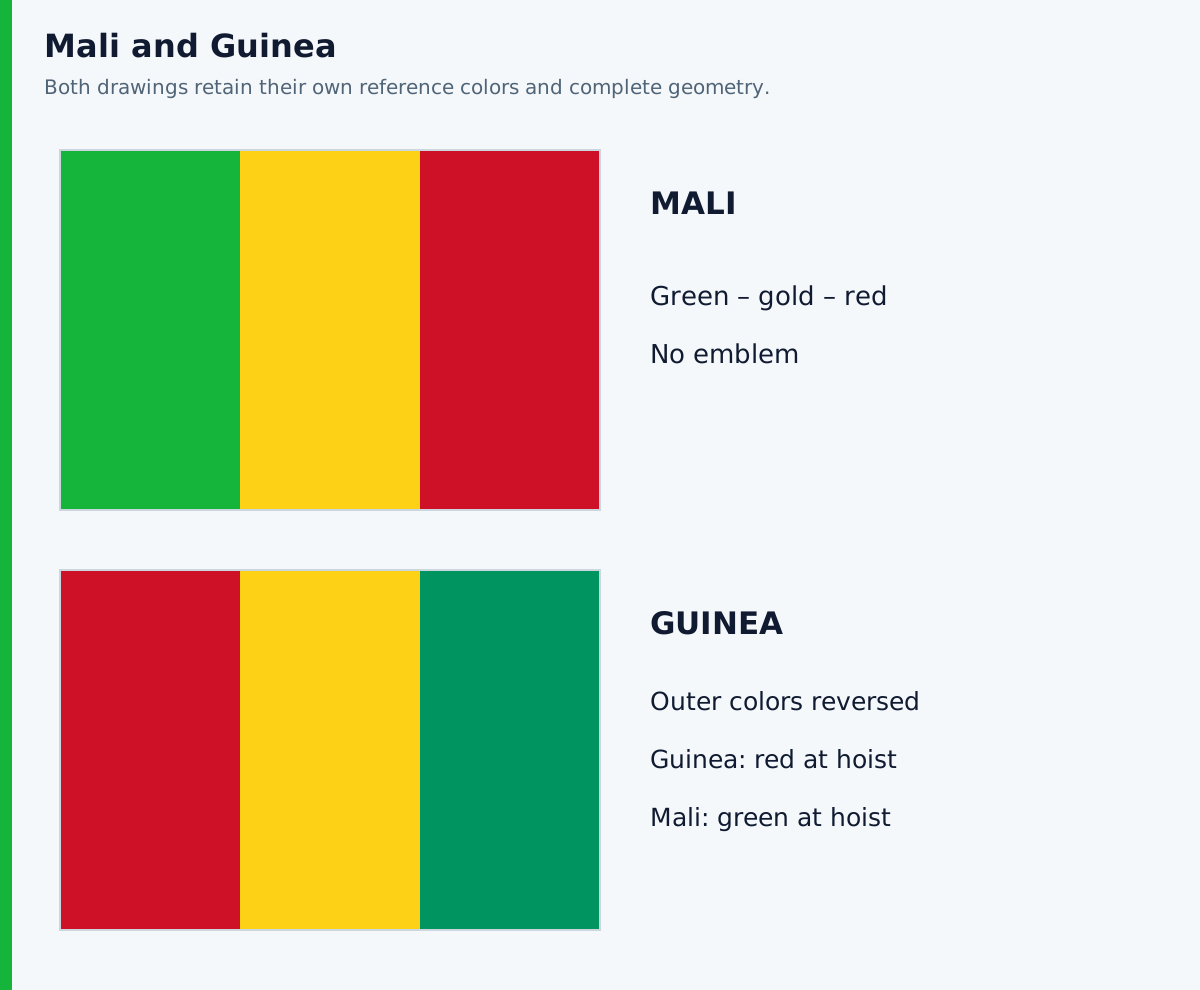
Mali and Guinea use plain vertical tricolors, but their outer colors are reversed. With the hoist at the left, Mali reads green, gold, red; Guinea reads red, gold, green. Check the attachment edge in a photograph, because the back of Mali’s flag can otherwise resemble a front view of Guinea’s.
The comparison uses each country’s separate reference drawing. The green values in these files differ, so a mirrored Mali image should not be presented as a sourced Guinea flag. Color order from the hoist is the principal identifying feature.
How is Mali’s flag different from Cameroon’s?
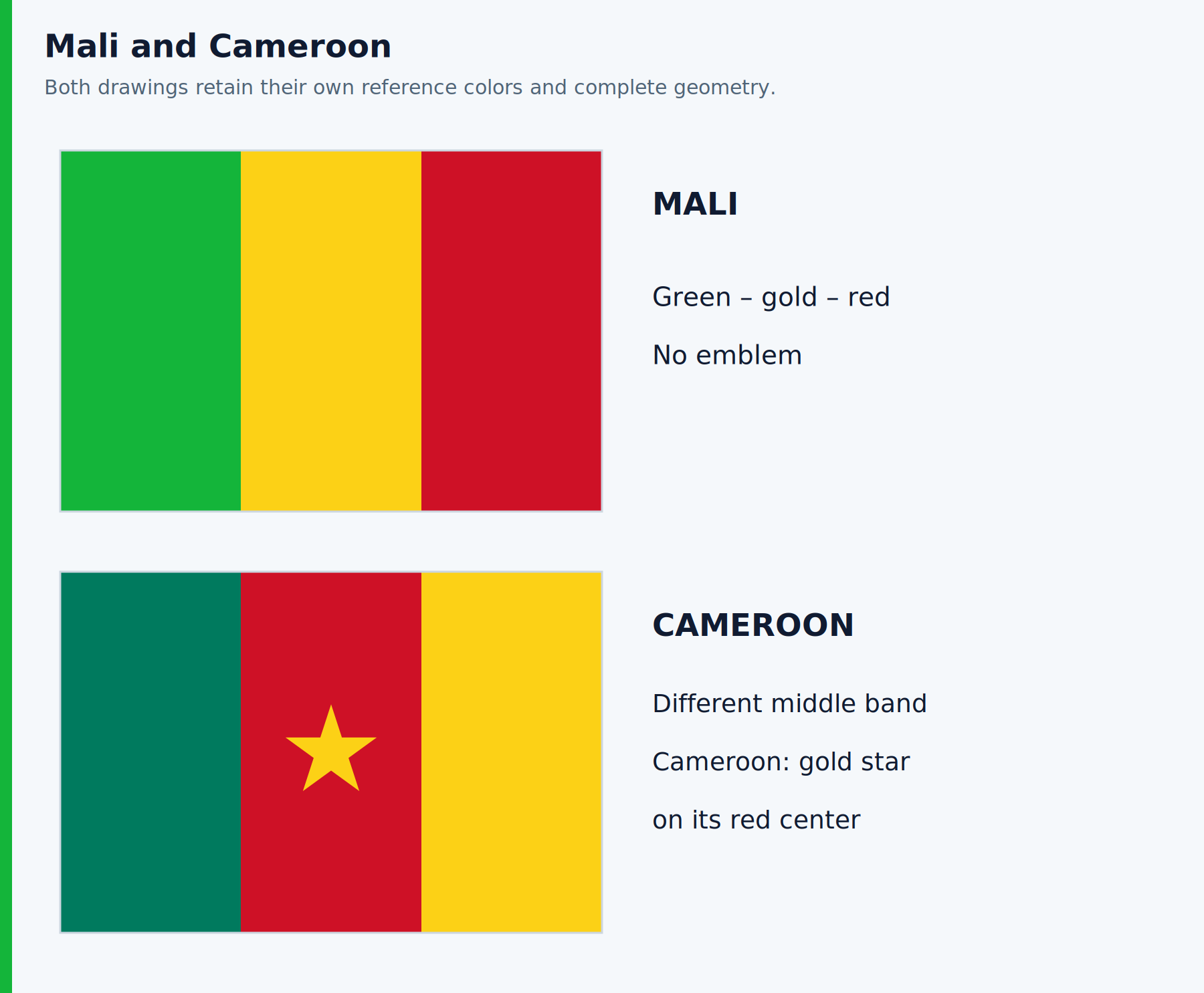
Mali places gold in the center and red at the fly, with no emblem. Cameroon places red in the center and yellow at the fly, with a gold five-pointed star on the red band. Both begin with green at the hoist, so the middle band and star provide the quickest distinction.
| Country | Bands from hoist | Central device |
|---|---|---|
| Mali | Green – gold – red | None |
| Senegal | Green – gold – red | Green five-pointed star |
| Guinea | Red – gold – green | None |
| Cameroon | Green – red – yellow | Gold five-pointed star |

How should the flag be oriented?
In a conventional front view, put the green band beside the pole at the viewer’s left and the red band at the right. From the reverse side, the apparent order is mirrored while green remains next to the actual hoist. Viewpoint changes should not be confused with reversing the national design.
For a vertically suspended ceremonial banner, follow the relevant Malian protocol instructions. A sporting event’s instruction to rotate a flag through ninety degrees is a rule for that event; it does not by itself prove a universal national requirement for buildings, stages, or schools.

Which national occasions feature the flag?
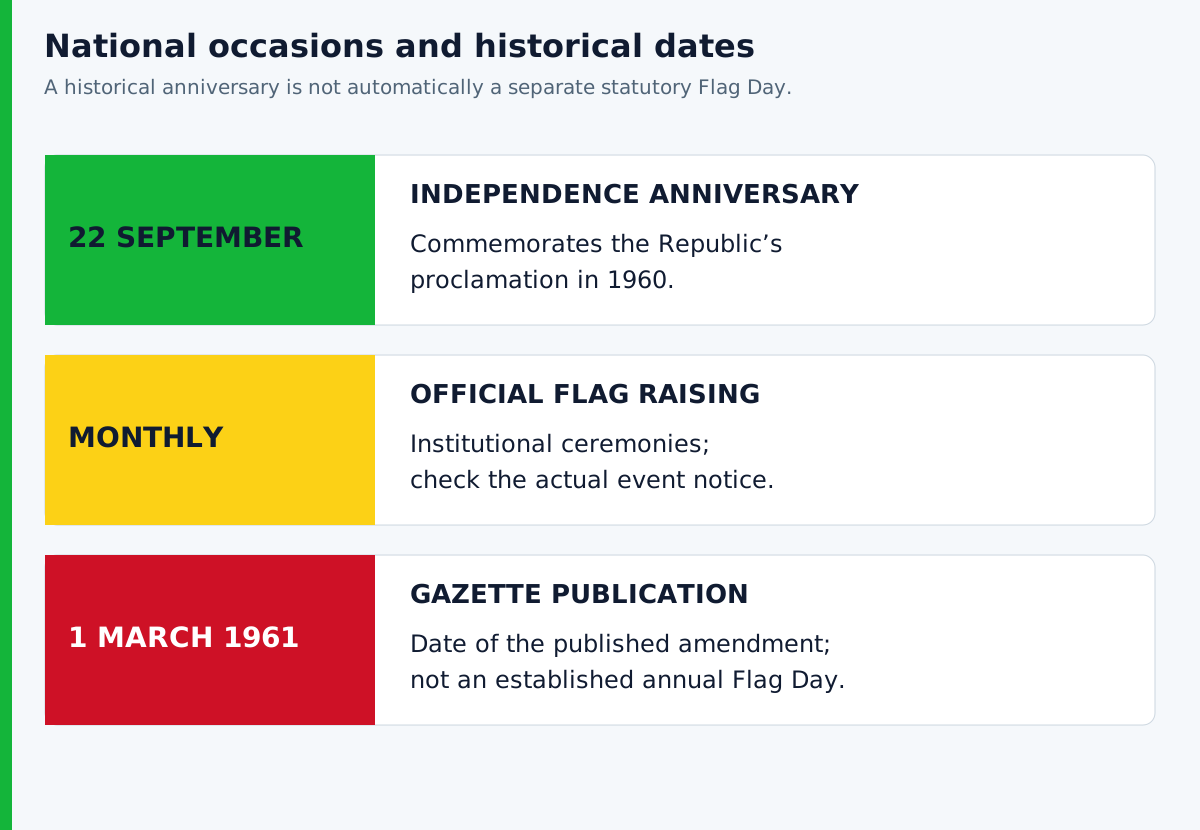
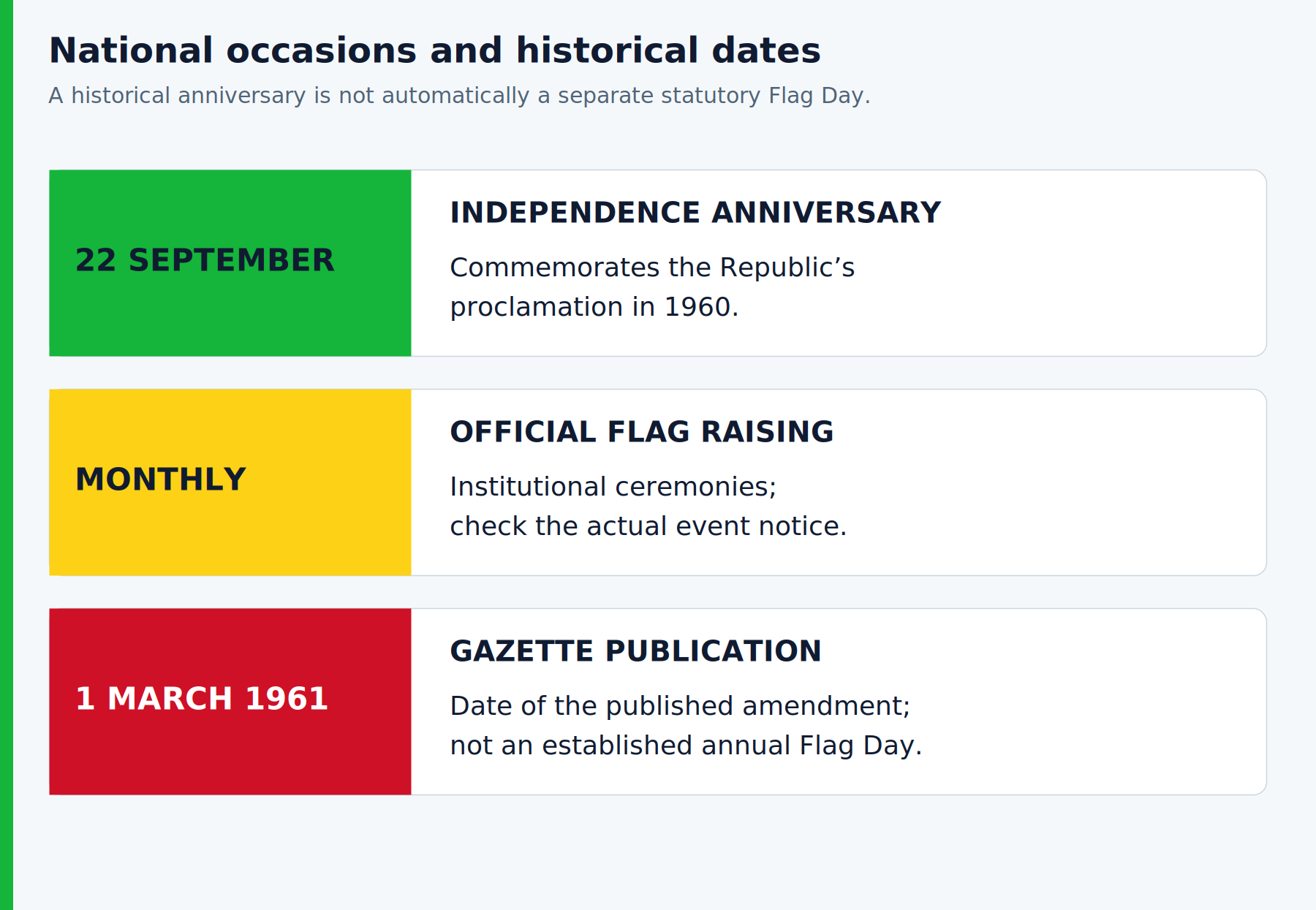
September 22 is Mali’s independence anniversary and a major occasion for national flag display. Official institutions also hold recurring flag-raising ceremonies and may display the flag for other state events. The March 1 publication anniversary is a historical date; the sources consulted do not establish it as a separate nationwide statutory Flag Day.
Avoid turning a date in a historical timeline into a mandatory annual observance without an official basis. Likewise, the date of a constitutional promulgation is not automatically a replacement for the independence anniversary.
What happens at official flag-raising ceremonies?
Official reports describe recurring ceremonies in which the flag is raised and saluted as a symbol of the state. A 2024 Presidency report calls the gathering a first-Monday monthly practice. A later report records a ceremony on October 12, 2026, so actual notices should guide attendance rather than an inflexible calendar assumption.
These reports document institutional practice; they do not establish identical raising and lowering hours for every school, household, and business. The monthly ceremony and the routine management of a particular building’s flag are related but separate matters.
When is the flag flown at half-mast?
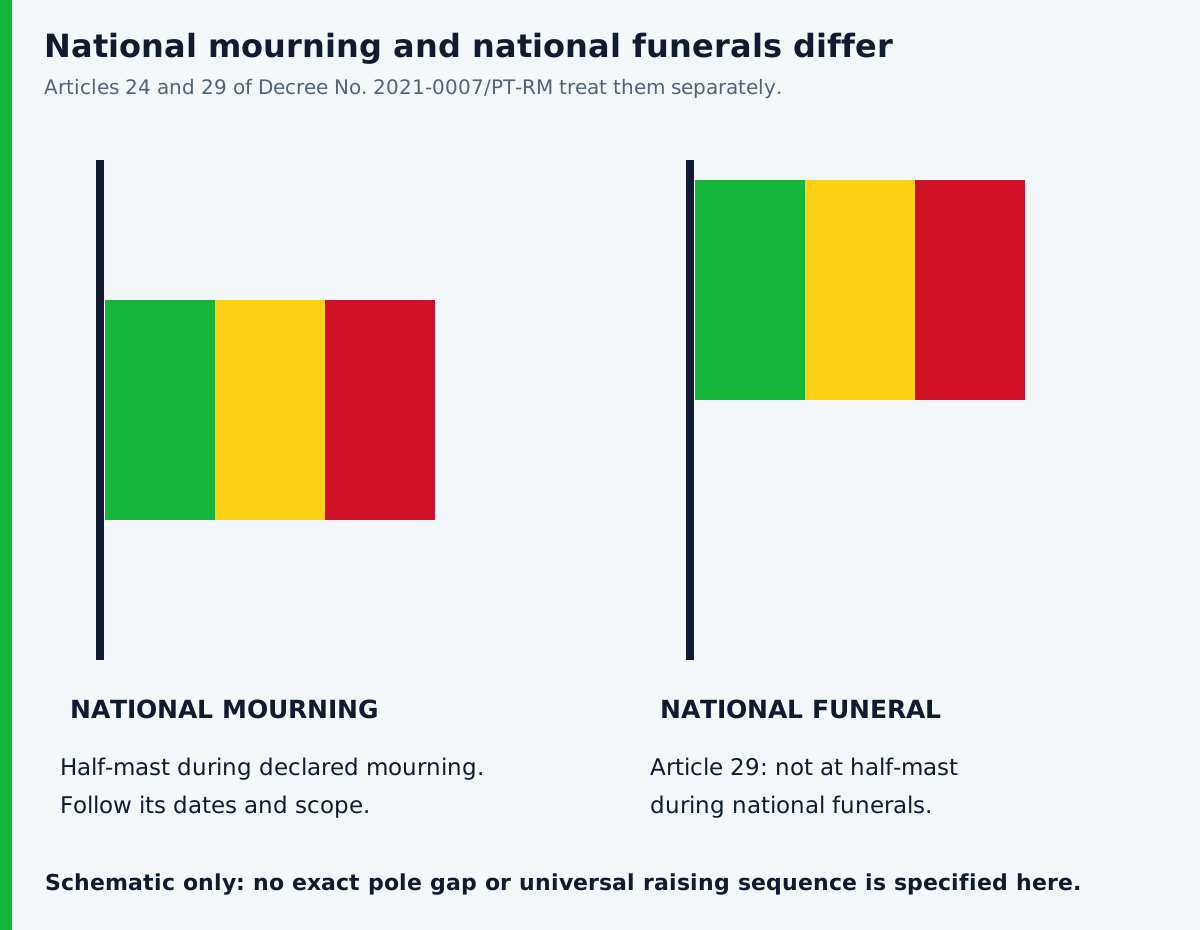
Mali’s 2021 ceremonial decree provides for the national flag to be lowered during officially declared national mourning. The declaration establishes the applicable period. For example, a 2026 decree ordered two days of mourning from April 27, with flags on public buildings at half-mast; that dated example is not a current instruction.
The April 26, 2026 decree honored Sadio Camara after his death on April 25. It specifies the covered public buildings and the mourning period. It does not give a universal measured gap below the top of a pole, so the accompanying drawing illustrates lowering without claiming such a dimension.
Does a national funeral automatically mean half-mast?
No. The 2021 decree distinguishes national mourning from national funerals. Article 24 provides for half-mast during national mourning, while Article 29 states that the flag is not lowered during national funerals. Organizers should therefore identify the declared observance and the applicable instructions instead of assuming that every official funeral follows the same flag treatment.
The distinction matters when mourning and funeral events take place on different dates. For a particular ceremony, use the specific declaration and the responsible protocol authority’s directions. A general illustration should not silently merge two legal categories that the source treats separately.
What official guidance governs display and reproduction?
Article 30 defines the national emblem, while specific rules and official instructions govern particular uses. The government launched a campaign to harmonize national symbols in 2024, and a 2025 Presidency report describes a reference handbook and recommendations. Those announcements do not supply a complete public construction, placement, or daily-hours manual by themselves.
The consulted materials do not justify inventing a universal sunrise rule, a fixed ceremonial pole spacing, or automatic permission for every commercial use. A faithful educational drawing and authorization for a regulated official or commercial use are separate questions.
Did the AES flag replace Mali’s national flag?
No. The flag of the Confederation of Sahel States, known by the French initials AES, is a separate regional emblem. The Presidency reported its inaugural raising at Koulouba on March 3, 2025, alongside Mali’s national flag. That ceremony demonstrates coexistence of the two flags, not replacement of the green, gold, and red tricolor.
The report dates adoption of the AES flag to February 22, 2025. A confederation’s emblem represents that grouping, whereas Mali’s constitutional national emblem identifies the republic. Captions should name the correct flag when both appear in the same photograph.
How should a flag be cared for and reproduced?
For a clear, respectful display, keep the cloth clean, intact, and correctly oriented, and preserve the full rectangular shape in images. These are practical care and reproduction principles, not a newly claimed Malian statute. Dry damp fabric before storage, follow its material-care instructions, and replace badly faded or damaged examples when appropriate.
- Keep the three visible bands equal after sewing or cropping.
- Choose fabric and attachments suitable for the expected wind and mounting.
- Store a clean, dry flag away from prolonged light and moisture.
- Avoid stretching, recoloring, or adding emblems to a national reference image.
- Use a physical proof when matching printed or textile colors.
The SVG is useful for scaling, while the PNG provides a ready-made raster image. Copyright credits accompany the files. Copyright status alone does not settle every rule concerning official insignia; the download is not represented as a government authorization for all uses.
What sizes preserve the correct proportions?
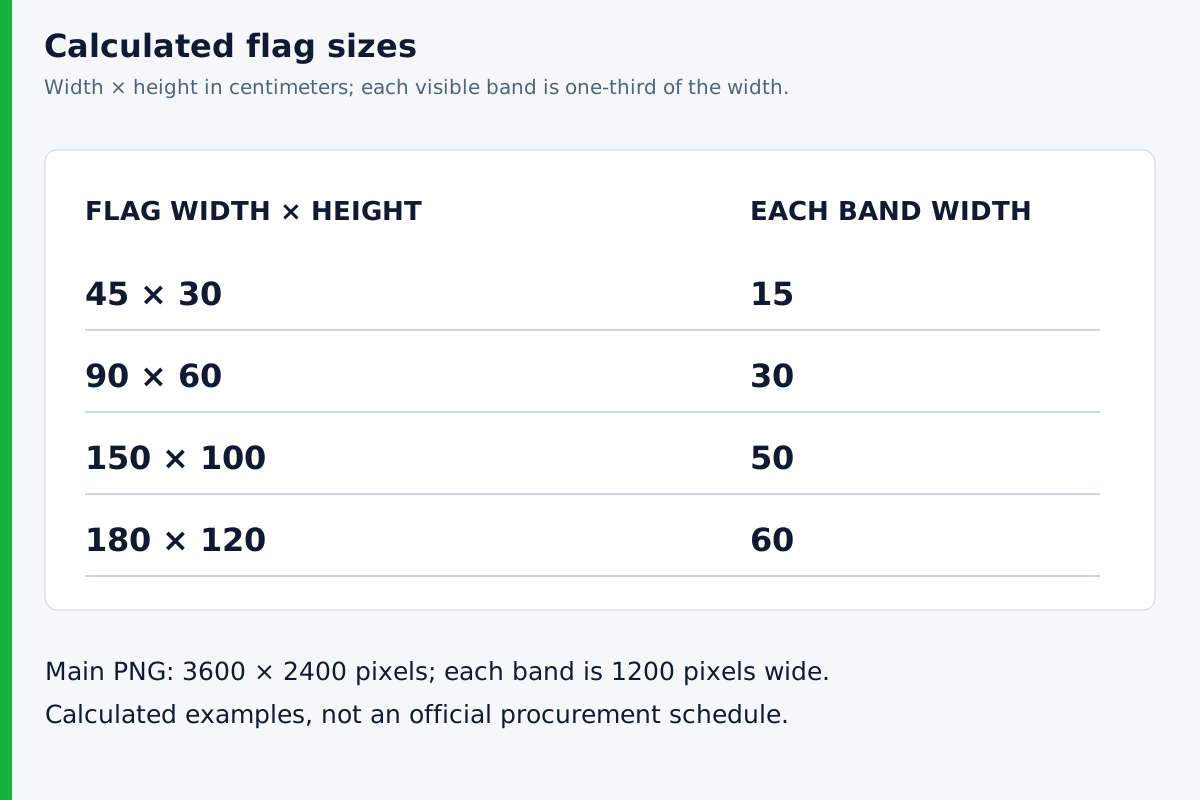
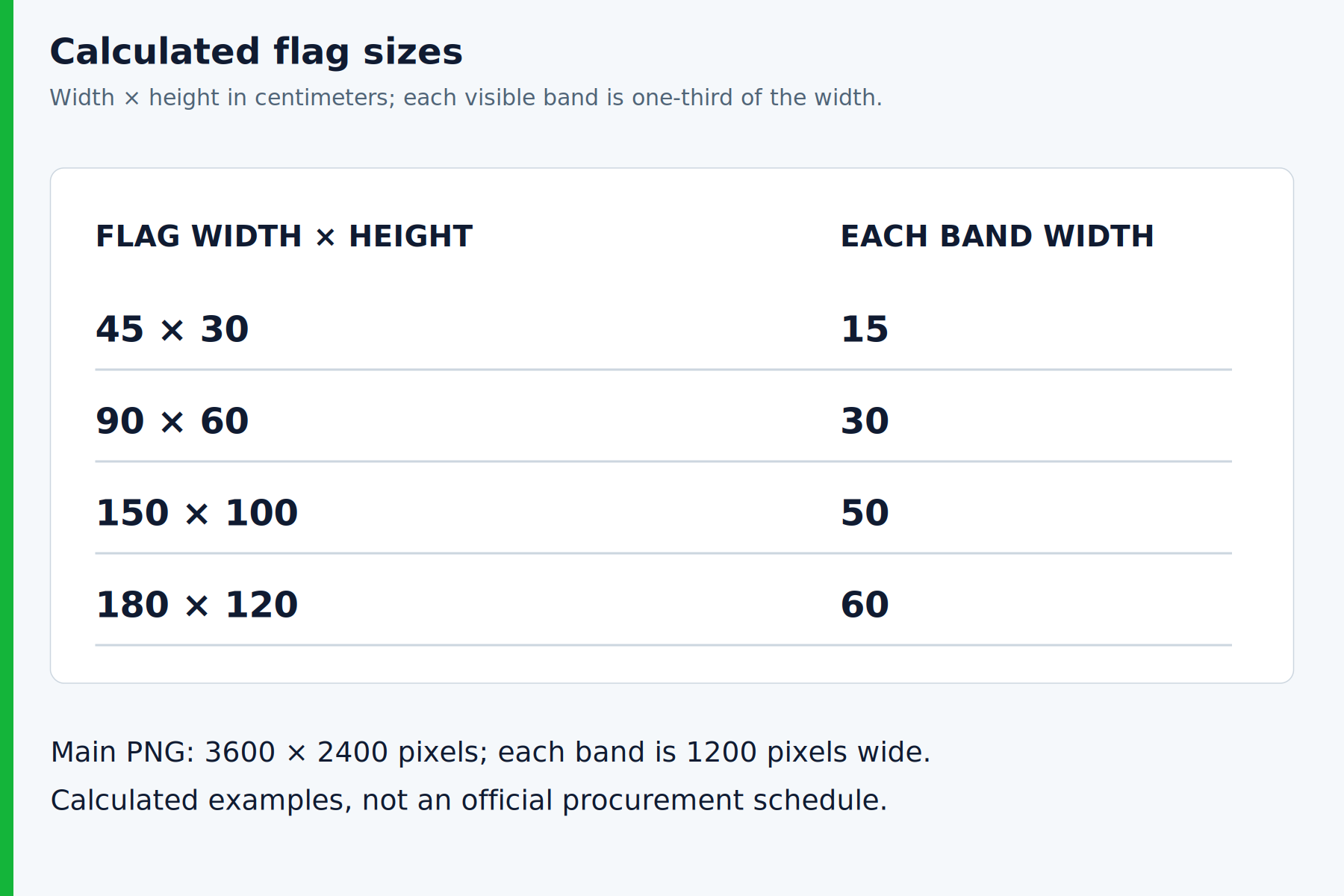
Any size that keeps width one-and-a-half times height and divides that width into equal thirds preserves the reference construction. A 90-by-60-centimeter flag has three bands thirty centimeters wide. The examples here are calculated teaching and production references, not an official mandatory purchase schedule or a certification of finished fabric.
| Width × height, cm | Width of each band, cm |
|---|---|
| 45 × 30 | 15 |
| 90 × 60 | 30 |
| 150 × 100 | 50 |
| 180 × 120 | 60 |
For a raster image, a width divisible by three gives clean whole-pixel bands. The 3600 × 2400 download has boundaries at x = 1200 and x = 2400. A surrounding web-page frame or shadow is outside the flag itself.
What is the Mali flag emoji?
The Mali flag emoji is 🇲🇱, encoded by the regional indicator letters M and L, corresponding to country code ML. Supported systems display the pair as a flag, while others may show letters. Its appearance depends on the platform and should not replace a measured drawing when exact band dimensions or colors matter.
| Item | Value |
|---|---|
| Emoji | 🇲🇱 |
| Country code | ML |
| First code point | U+1F1F2 — regional indicator M |
| Second code point | U+1F1F1 — regional indicator L |
The code identifies Mali; it does not prescribe every curve, shadow, or waving effect used by an operating system’s emoji artist. Use the flat SVG or PNG when teaching the national design.
What common mistakes should be avoided?
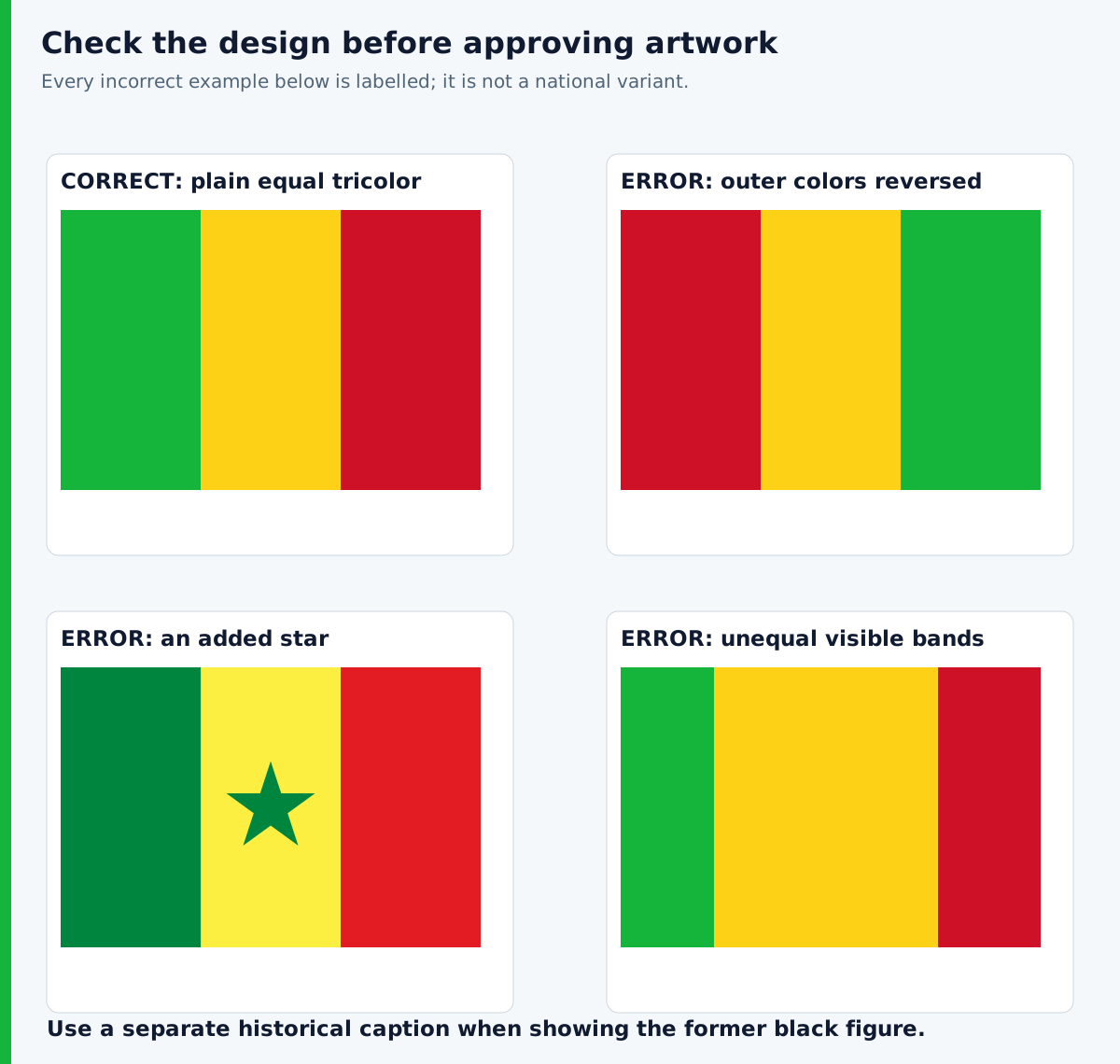
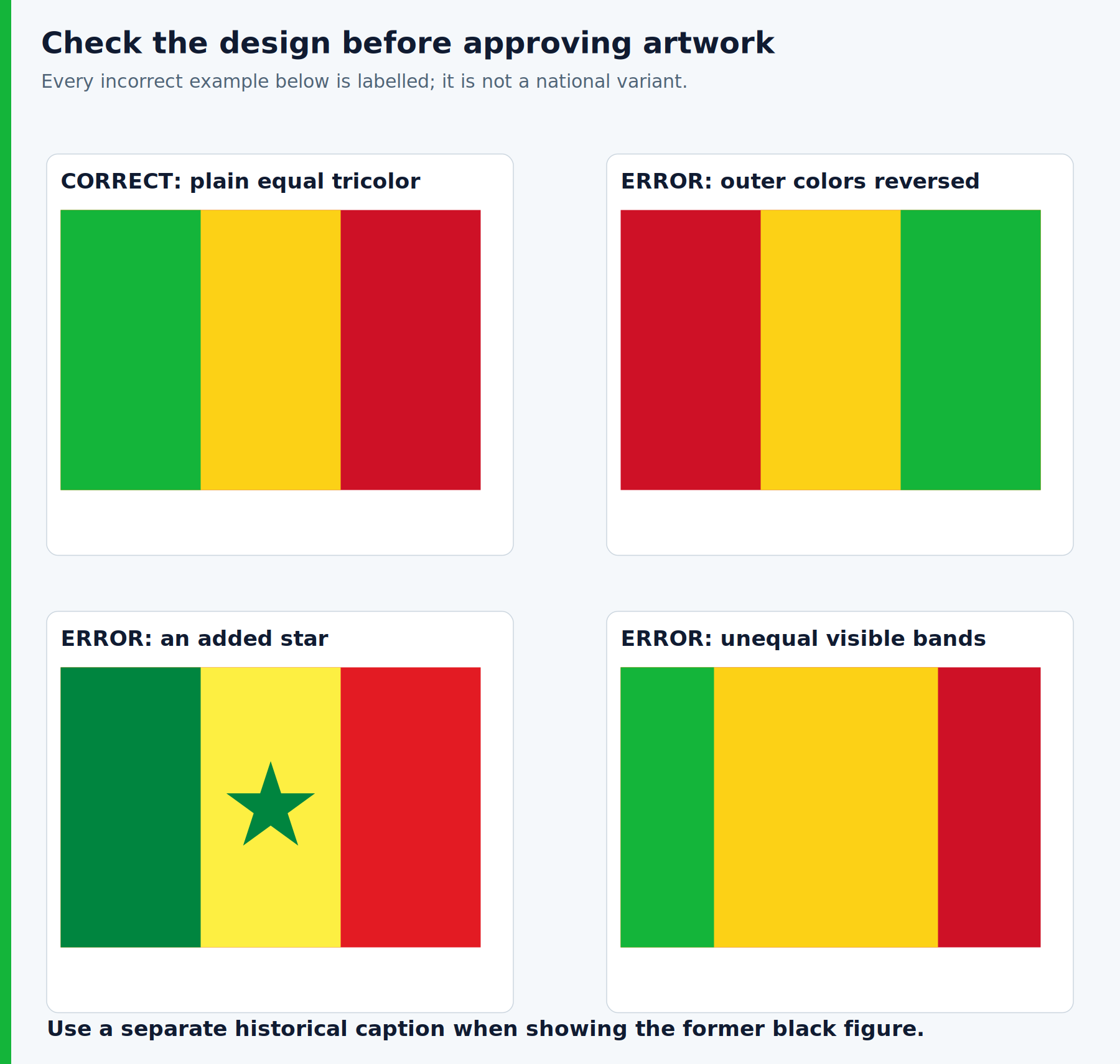
The main mistakes are reversing the outer bands, making the bands unequal, adding Senegal’s star, or presenting the historical black figure as part of the current flag. Confusing width:height with height:width also causes distortion. Check the hoist, the three equal divisions, and the absence of an emblem before approving an illustration.
- Green belongs at the hoist; red belongs at the fly.
- The current center is plain gold, without a star or kanaga.
- All three bands have equal width and the full height.
- Use 3:2 for width:height, or 2:3 for height:width.
- Keep historical flags and neighboring national designs clearly labelled.
- Identify digital color values as artwork specifications.
What do the main flag terms mean?
The hoist is the attachment edge, and the fly is the free edge opposite it. A tricolor uses three colors, while an uncharged field has no added emblem. The kanaga names the earlier central device in this context. Promulgation and publication describe different legal stages, which is important when explaining the 1961 change.
| Term | Meaning in this article |
|---|---|
| Hoist | Edge attached to a pole or halyard |
| Fly | Free edge opposite the hoist |
| Tricolor | Flag organized around three colors |
| Band | One full-height vertical division |
| Uncharged | Without an added emblem |
| Kanaga | Name associated with the historical black figure |
| Promulgation | Formal act declaring the adopted law |
| Publication | Appearance in the official gazette |
| Half-mast | Lowered display prescribed for a relevant observance |
Explore more in World Flags: Iceland flag, Lithuania flag, Luxembourg flag, Madagascar flag, Malawi flag, Malaysia flag.
Download Mali flag pictures
Download the national flag as SVG or large PNG. The gallery includes 17 distinct subjects with captions and alternative text. Keep the full proportions when resizing. Image credits and reuse notes accompany the graphics.
World Flags/Mali
Mali flag pictures
The current plain tricolor: three equal vertical bands of green, gold and red, from hoist to fly. Width:height 3:2.
GKBook; national reference by SKopp and Wikimedia Commons contributorsDownload SVGDownload PNGRead the colors from the attachment edge: green, gold, red. The current design carries no additional device.
GKBook; national reference by SKopp and Wikimedia Commons contributorsDownload SVGDownload PNGThe 90 × 60 unit grid divides into three 30 × 60 bands. Width:height is 3:2; height:width is 2:3.
GKBook; national reference by SKopp and Wikimedia Commons contributorsDownload SVGDownload PNGConstitutional colors: green, gold and red. Actual illustration HEX values: #14B53A, #FCD116 and #CE1126.
GKBook; national reference by SKopp and Wikimedia Commons contributorsDownload SVGDownload PNGGreen: hope and agriculture. Gold: mineral wealth. Red: sacrifice. These explanations are distinct from the constitutional design wording.
GKBook; national reference by SKopp and Wikimedia Commons contributorsDownload SVGDownload PNGFour calculated sizes preserve the 3:2 rectangle and equal bands. Main PNG: 3600 × 2400.
GKBook; national reference by SKopp and Wikimedia Commons contributorsDownload SVGDownload PNGHistorical green–gold–red flag with black kanaga figure, used by the Federation and initially retained by the Republic. Reconstruction, not a surviving textile.
SKopp, Dbenbenn, Tcfc2349, FDRMRZUSA and Wikimedia Commons contributors; explanatory additions by GKBookDownload SVGDownload PNGThe 1961 amendment removed the black-figure requirement. Both drawings retain their full source geometry.
SKopp, Dbenbenn, Tcfc2349, FDRMRZUSA and Wikimedia Commons contributors; explanatory additions by GKBookDownload SVGDownload PNGThe timeline separates Federation history, the Republic’s proclamation, the flag amendment and the 2023 Constitution.
GKBook; national reference by SKopp and Wikimedia Commons contributorsDownload SVGDownload PNGJanuary 20: Assembly approval. February 18: promulgation. March 1: official publication and commonly cited adoption date.
GKBook; national reference by SKopp and Wikimedia Commons contributorsDownload SVGDownload PNGThe pole identifies the attachment edge. A reverse view mirrors the visible order but leaves green beside the hoist.
GKBook; national reference by SKopp and Wikimedia Commons contributorsDownload SVGDownload PNGSenegal adds a green five-pointed star to the same green–gold–red band order.
GKBook; Mali by SKopp and contributors; Senegal by Nightstallion and Wikimedia Commons contributorsDownload SVGDownload PNGGuinea places red at the hoist and green at the fly. Both source palettes are preserved.
GKBook; Mali and Guinea by SKopp and Wikimedia Commons contributorsDownload SVGDownload PNGCameroon has a red middle band with a gold star and yellow at the fly. Complete reference shapes are preserved.
GKBook; Mali by SKopp and contributors; Cameroon by SKopp, -xfi-, FDRMRZUSA, MapGrid and Wikimedia Commons contributors; complete flag sources scaled and arranged with GKBook labels; CC BY-SA 4.0. License: https://creativecommons.org/licenses/by-sa/4.0/Download SVGDownload PNGSeptember 22 commemorates independence. Monthly raising ceremonies follow actual official notices. March 1, 1961 is the gazette date.
GKBook; national reference by SKopp and Wikimedia Commons contributorsDownload SVGDownload PNGNational mourning: half-mast under Article 24. National funerals: Article 29 says the flag is not lowered. Schematic, not a measured pole diagram.
GKBook; national reference by SKopp and Wikimedia Commons contributorsDownload SVGDownload PNGCorrect plain tricolor compared with reversed colors, an added star and unequal bands. Incorrect examples are explicitly labelled.
GKBook; Mali by SKopp and contributors; Senegal by Nightstallion and Wikimedia Commons contributorsDownload SVGDownload PNGFrequently asked questions
What does the Mali flag look like?
Mali’s flag has three equal vertical bands: green nearest the pole, gold in the middle, and red at the free edge. The current national design is uncharged, meaning that it carries no additional emblem. A star, a black humanlike figure, or a national seal would change this plain tricolor.
What are the flag’s proportions?
The familiar Mali flag has a width-to-height ratio of 3:2, also written as 2:3 when height comes first. The Presidency states the latter convention. Article 30 of the 2023 Constitution specifies equal vertical bands but does not itself supply the overall ratio, numerical color values, or a detailed manufacturing drawing.
How can the flag be constructed accurately?
Draw a rectangle three units wide and two units high, then divide its width into three equal parts. Fill the first part green, the second gold, and the third red. Each band spans the full height and occupies one-third of the flag’s area; there are no gaps, outlines, borders, or central symbols.
What colors and digital codes are used?
The constitutional color names are green, gold, and red. The downloadable illustrations use #14B53A, #FCD116, and #CE1126 respectively, following the actual national reference SVG. These are disclosed artwork values. The constitutional provision does not prescribe HEX, RGB, CMYK, or Pantone numbers, so digital approximations should not be labelled constitutional color standards.
Why is the middle band called gold rather than yellow?
The Constitution names the middle color or, the French word for gold. Flat flag illustrations commonly render that color as a yellow tone, and the Presidency uses both descriptions in explaining the flag. The name does not mean that every printed image or cloth flag must use metallic ink, foil, or gold thread.
What do the three colors symbolize?
Green is associated with hope, vegetation, and agriculture; gold with mineral wealth; and red with sacrifice in defending the country and securing independence. These traditional explanations accompany the design. They should be distinguished from Article 30, which defines the bands and their colors without providing a separate symbolic interpretation for each one.
Why are these called Pan-African colors?
Green, gold, and red belong to a widely used Pan-African color tradition associated with African identity, solidarity, and independence. Mali’s combination emerged in that political setting. Sharing the colors does not make national flags interchangeable: their order, direction of stripes, emblems, and proportions distinguish individual countries and their particular histories.
How did the Mali flag develop?
The modern flag grew from the green, gold, and red tricolor of the Mali Federation, which carried a black figure in the center. The Republic of Mali initially retained that device in 1960. A constitutional amendment adopted in 1961 removed the figure while keeping the three equal bands, creating the present plain design.
What was the Mali Federation flag?
The Mali Federation used a vertical green, gold, and red flag with a black central figure commonly called the kanaga. The Federation joined Senegal and the Sudanese Republic and became independent in June 1960. After its breakup, Mali initially retained the figure-bearing design, while Senegal adopted a related tricolor with a green star.
What was the black kanaga figure?
The kanaga was the black device on the earlier flag’s gold band, described in the 1960 Constitution as a human figure with arms raised skyward. Its form is associated with Dogon masks. Museum and anthropological accounts show that the mask tradition has layered meanings, which should not be reduced to a single universal flag explanation.
Why was the kanaga removed?
The 1961 amendment removed the sentence requiring a black figure from the constitutional flag description. Specialist histories connect the change with objections to human representation among some Muslim groups. The law itself does not state that motive. The documented legal alteration is therefore firmer evidence than a claim that the same religious view was held by everyone.
When was the present flag adopted?
The present flag was approved by the National Assembly on January 20, 1961, through Law No. 61-26. Its promulgation decree is dated February 18, and publication followed on March 1. Flag references commonly list March 1 as the adoption date; the original gazette makes the three distinct legal stages visible.
How is flag adoption different from independence?
The Republic of Mali commemorates independence on September 22, recalling its proclamation in 1960. The preceding Mali Federation had become independent on June 20. The plain flag followed in 1961. These events belong to different stages of state formation, so the flag’s publication date should not replace Mali’s national independence anniversary.
Who designed or made the flag?
The flag developed through federal symbolism and legislative decisions, and the sources do not establish one certain designer of every feature of the current tricolor. Research associates Léopold Sédar Senghor cautiously with the choice of the earlier kanaga. A historical account credits Mariam Traoré with sewing the first national flag, which is a different contribution.
Are the national motto and seal part of the flag?
The motto and the seal are separate national attributes; they are not printed on Mali’s ordinary national flag. Article 30 identifies the flag, the motto, and the anthem, while leaving the seal and arms to legislation. The motto is commonly translated as “One People, One Goal, One Faith,” but the tricolor remains unlettered.
How is Mali’s flag different from Senegal’s?
Mali and Senegal both use equal vertical green, gold, and red bands in the same order. Senegal adds a green five-pointed star in the middle of the gold band; Mali has no star. Their resemblance reflects a shared federal history, but each country now has its own distinct national flag.
How is Mali’s flag different from Guinea’s?
Mali and Guinea use plain vertical tricolors, but their outer colors are reversed. With the hoist at the left, Mali reads green, gold, red; Guinea reads red, gold, green. Check the attachment edge in a photograph, because the back of Mali’s flag can otherwise resemble a front view of Guinea’s.
How is Mali’s flag different from Cameroon’s?
Mali places gold in the center and red at the fly, with no emblem. Cameroon places red in the center and yellow at the fly, with a gold five-pointed star on the red band. Both begin with green at the hoist, so the middle band and star provide the quickest distinction.
How should the flag be oriented?
In a conventional front view, put the green band beside the pole at the viewer’s left and the red band at the right. From the reverse side, the apparent order is mirrored while green remains next to the actual hoist. Viewpoint changes should not be confused with reversing the national design.
Which national occasions feature the flag?
September 22 is Mali’s independence anniversary and a major occasion for national flag display. Official institutions also hold recurring flag-raising ceremonies and may display the flag for other state events. The March 1 publication anniversary is a historical date; the sources consulted do not establish it as a separate nationwide statutory Flag Day.
What happens at official flag-raising ceremonies?
Official reports describe recurring ceremonies in which the flag is raised and saluted as a symbol of the state. A 2024 Presidency report calls the gathering a first-Monday monthly practice. A later report records a ceremony on October 12, 2026, so actual notices should guide attendance rather than an inflexible calendar assumption.
When is the flag flown at half-mast?
Mali’s 2021 ceremonial decree provides for the national flag to be lowered during officially declared national mourning. The declaration establishes the applicable period. For example, a 2026 decree ordered two days of mourning from April 27, with flags on public buildings at half-mast; that dated example is not a current instruction.
Does a national funeral automatically mean half-mast?
No. The 2021 decree distinguishes national mourning from national funerals. Article 24 provides for half-mast during national mourning, while Article 29 states that the flag is not lowered during national funerals. Organizers should therefore identify the declared observance and the applicable instructions instead of assuming that every official funeral follows the same flag treatment.
What official guidance governs display and reproduction?
Article 30 defines the national emblem, while specific rules and official instructions govern particular uses. The government launched a campaign to harmonize national symbols in 2024, and a 2025 Presidency report describes a reference handbook and recommendations. Those announcements do not supply a complete public construction, placement, or daily-hours manual by themselves.
Did the AES flag replace Mali’s national flag?
No. The flag of the Confederation of Sahel States, known by the French initials AES, is a separate regional emblem. The Presidency reported its inaugural raising at Koulouba on March 3, 2025, alongside Mali’s national flag. That ceremony demonstrates coexistence of the two flags, not replacement of the green, gold, and red tricolor.
How should a flag be cared for and reproduced?
For a clear, respectful display, keep the cloth clean, intact, and correctly oriented, and preserve the full rectangular shape in images. These are practical care and reproduction principles, not a newly claimed Malian statute. Dry damp fabric before storage, follow its material-care instructions, and replace badly faded or damaged examples when appropriate.
What sizes preserve the correct proportions?
Any size that keeps width one-and-a-half times height and divides that width into equal thirds preserves the reference construction. A 90-by-60-centimeter flag has three bands thirty centimeters wide. The examples here are calculated teaching and production references, not an official mandatory purchase schedule or a certification of finished fabric.
What is the Mali flag emoji?
The Mali flag emoji is 🇲🇱, encoded by the regional indicator letters M and L, corresponding to country code ML. Supported systems display the pair as a flag, while others may show letters. Its appearance depends on the platform and should not replace a measured drawing when exact band dimensions or colors matter.
What common mistakes should be avoided?
The main mistakes are reversing the outer bands, making the bands unequal, adding Senegal’s star, or presenting the historical black figure as part of the current flag. Confusing width:height with height:width also causes distortion. Check the hoist, the three equal divisions, and the absence of an emblem before approving an illustration.
What do the main flag terms mean?
The hoist is the attachment edge, and the fly is the free edge opposite it. A tricolor uses three colors, while an uncharged field has no added emblem. The kanaga names the earlier central device in this context. Promulgation and publication describe different legal stages, which is important when explaining the 1961 change.
Explore all general-knowledge topics and the A-to-Z lists.







We Value Your Opinion Comments