
Malawi flag picture
Explore the construction drawing, history, and complete picture gallery.
| Design | Black · red · greenRed rising sun in the upper black band. |
|---|---|
| Proportions | 3:2 width:heightThree equal horizontal stripes. |
| First adoption | July 6, 1964Independence from Britain. |
| Restoration | 2012Parliament voted on May 28. |
| National Day | July 6National Independence Day. |
The national schedule describes the design and 3:2 ratio. Gallery artwork uses a disclosed screen palette; the statutory sun detail is reproduced separately.
What is the national flag of Malawi?
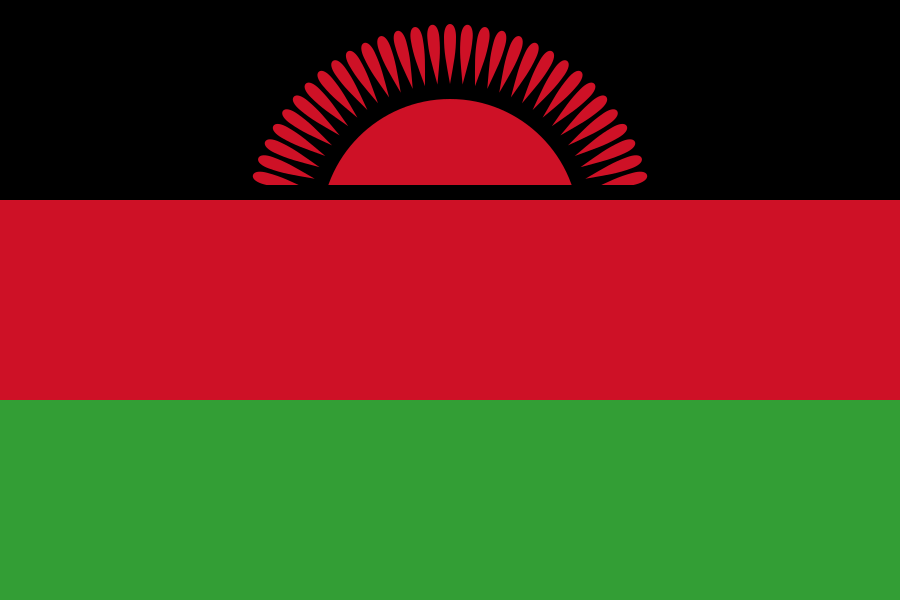
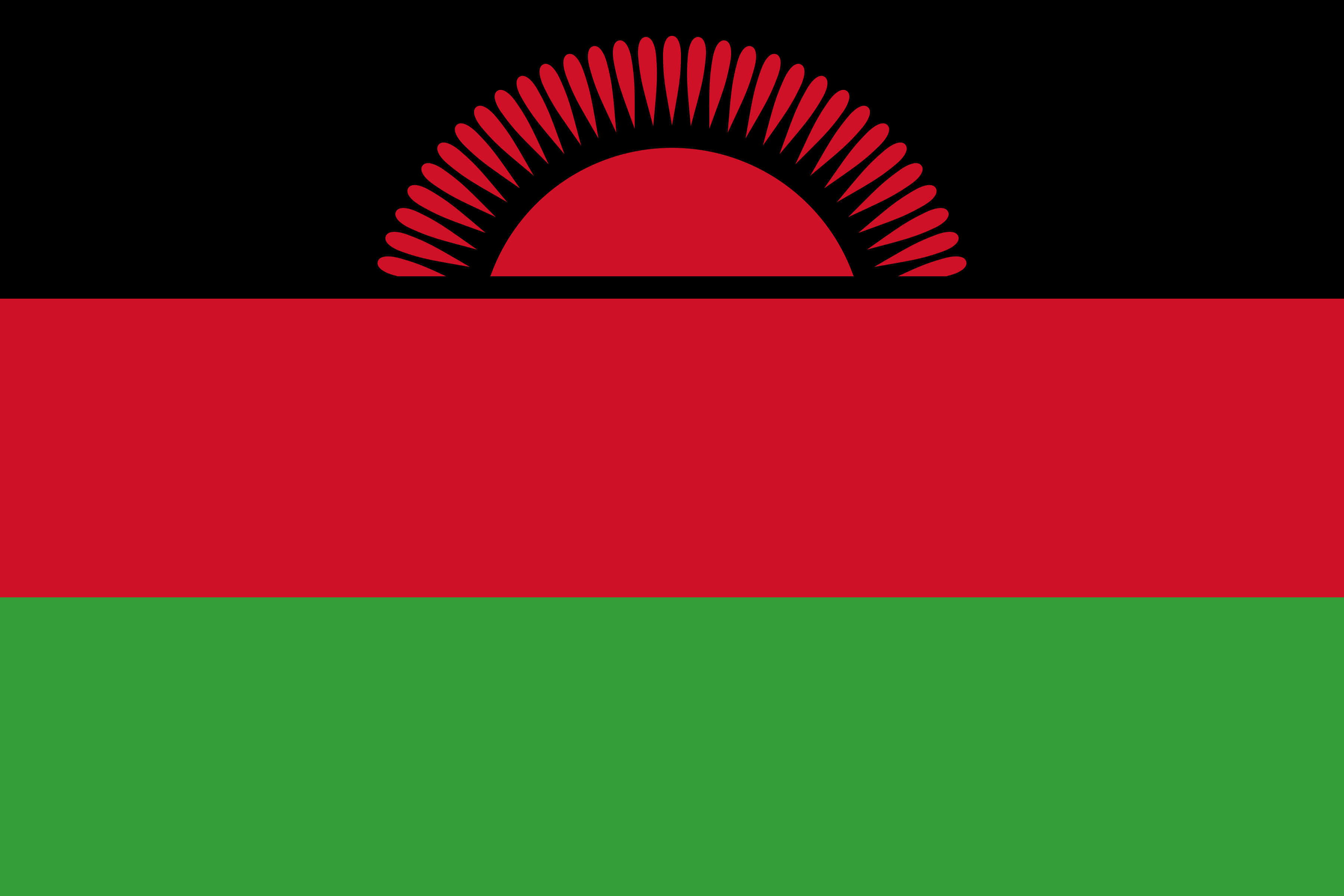
Malawi’s national flag has three equal horizontal stripes: black, red, and green from top to bottom. A red rising sun appears in the black stripe. The design dates to independence on July 6, 1964, was replaced in 2010, and returned in 2012. Its width is one and a half times its height.
The rising sun makes Malawi’s flag immediately recognizable. Its history also makes dates essential: an image with a full white sun belongs to the short-lived 2010–2012 design. This guide separates the current arrangement, its official meanings, the historical redesign, national celebrations, and practical reproduction. The gallery includes both flag designs, measured stripe diagrams, and a reproduced statutory construction detail. The screen illustrations are reference artwork, not certified manufacturing masters.
What does the Malawi flag look like?
Malawi’s flag is a horizontal tricolor with black at the top, red in the middle, and green at the bottom. The stripes have equal heights. A red rising sun, surrounded by separate rays, sits centrally within the black stripe. The flag has no lettering, white borders, or central shield.

The sun is part of the national design, not an optional decoration. It is horizontally centred on the flag but placed within the upper band, rather than at the centre of the entire rectangle. A narrow black interval separates the visible sun from the middle red stripe.
| Part | Position |
|---|---|
| Black | Upper third of the field |
| Red stripe | Middle third |
| Green | Lower third |
| Red rising sun | Centred horizontally in the black band |
The unlabelled download is suitable for a reference illustration. Teaching labels, measuring lines, and frames belong only to the explanatory gallery images. A border used to separate a thumbnail from a page background is not part of Malawi’s national flag.
What are the proportions of Malawi’s flag?
The flag’s length-to-height ratio is 3:2, meaning that a flag 90 centimetres wide is 60 centimetres high. The equivalent height-to-length notation is 2:3. Each horizontal stripe occupies one-third of the height, and each runs across the complete width. These proportions appear in the national flag schedule.
| Measurement | Relationship |
|---|---|
| Width W | 1.5 × height H |
| Height H | 2W ÷ 3 |
| Each stripe’s height | H ÷ 3 |
| Each stripe’s width | W |
A 3:2 label and a 2:3 label are consistent when they specify opposite measurement orders. Always state the order. Stretching the flag into a square or an extra-wide banner changes the field and the sun together, even if the colour order remains recognizable.
The SADC identity manual independently illustrates a 1,800 × 1,200 field. That agrees with the ratio in the national schedule; it does not establish a compulsory single size for every flag.
How is the Malawi flag constructed?
Begin with a rectangle 180 units wide and 120 units high, then divide its height into three equal bands of 40 units. Fill them black, red, and green from top to bottom. Add the red rising sun within the black band, centred horizontally, while preserving its separate rays and surrounding clearance.

For a 900 × 600-pixel field, the three bands occupy y = 0–200, 200–400, and 400–600. Each is 900 pixels wide. These are the underlying fields: the red sun overlays part of the black band. Consequently, equal stripe areas do not mean that the final image contains equal amounts of black, red, and green.

The statutory plate also marks a six-degree spacing for the rays. Common digital illustrations, including the source geometry used for this gallery, differ in that detail. The reproduced plate preserves the documentary evidence; the gallery’s clean flag is a conventional reference illustration and is not presented as an exact manufacturing transcription.
How many rays does the rising sun have?
The familiar digital version of Malawi’s flag shows 31 visible red rays around the rising sun. However, the published statutory construction plate includes a six-degree spacing instruction that differs from common digital artwork. Keep this distinction visible when precision matters, and do not treat an online icon as a certified construction master.

In the supplied reference artwork, a repeated ray shape uses five-degree steps; one additional instance is completely covered by the black masking region, leaving 31 visible rays. The legal plate’s six-degree instruction is therefore not a measurement of this SVG. Replacing the repeated shape with a generic spiky semicircle would conceal, rather than resolve, the difference.
The ray forms are elongated and rounded toward the outside, tapering inward. The sun body is a partial disc with a flat lower edge. For officially controlled production, obtain an approved master or clarification of the construction plate instead of inventing a resolution to its small-detail discrepancy.
Claims that the ray count encodes a specific number of independent African countries are not established by the official explanations consulted here. The documented meaning concerns hope and freedom for Africa.
What are Malawi’s flag colour codes?
The national schedule names black, red, and green and lists British Standard shade numbers 0-005 for red and 0-010 for green. It does not supply an RGB or HEX table. This package uses a disclosed screen palette, while the SADC manual’s separate print references are identified as regional production guidance.

| Colour | National schedule | SADC p.65 | This artwork only |
|---|---|---|---|
| Black | Black | Black | #000000 · RGB 0, 0, 0 |
| Red | British Standard 0-005 | 186C | #CE1126 · RGB 206, 17, 38 |
| Green | British Standard 0-010 | 355C | #339E35 · RGB 51, 158, 53 |
The HEX values identify the downloadable illustrations. They are not certified conversions of the British Standard or Pantone references. Screen brightness, printing process, ink, and cloth can change appearance, so an approved physical sample remains valuable for controlled production.
White belongs to the temporary 2010–2012 full-sun design. It is not an additional colour in the current national flag. Labels and pale backgrounds in teaching diagrams are explanatory additions.
What do the colours and rising sun mean?
Black represents the people of Africa; red recalls those who died for African freedom; and green represents Malawi’s evergreen nature. The rising sun expresses the beginning of hope and freedom across Africa. These meanings appear in the national flag schedule, making them more than an unattributed modern interpretation of the colours.
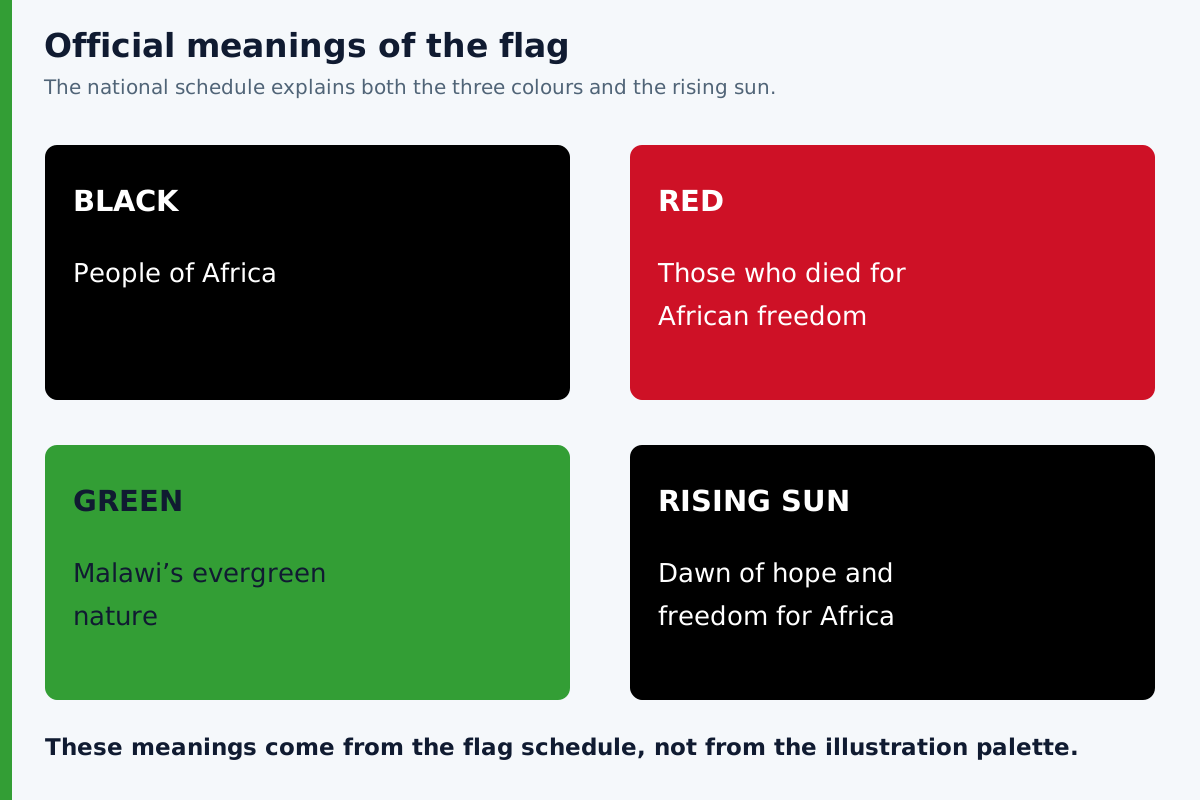
The official explanation reaches beyond Malawi’s borders. Both the black band and the rising sun refer to the African continent, while the green band specifically names Malawi. This combination connects national identity with a wider African struggle for freedom.
The Malawi embassy in Cairo gives a closely related explanation, associating red with the independence struggle and green with vegetation. The schedule’s wording is broader about African freedom. These emphases are compatible, but the article keeps their scopes distinct.
The sun should remain visibly rising in an illustration of the current flag. Changing it to a complete white disc changes both the design and the historical meaning being presented.
What is the history of Malawi’s flag?
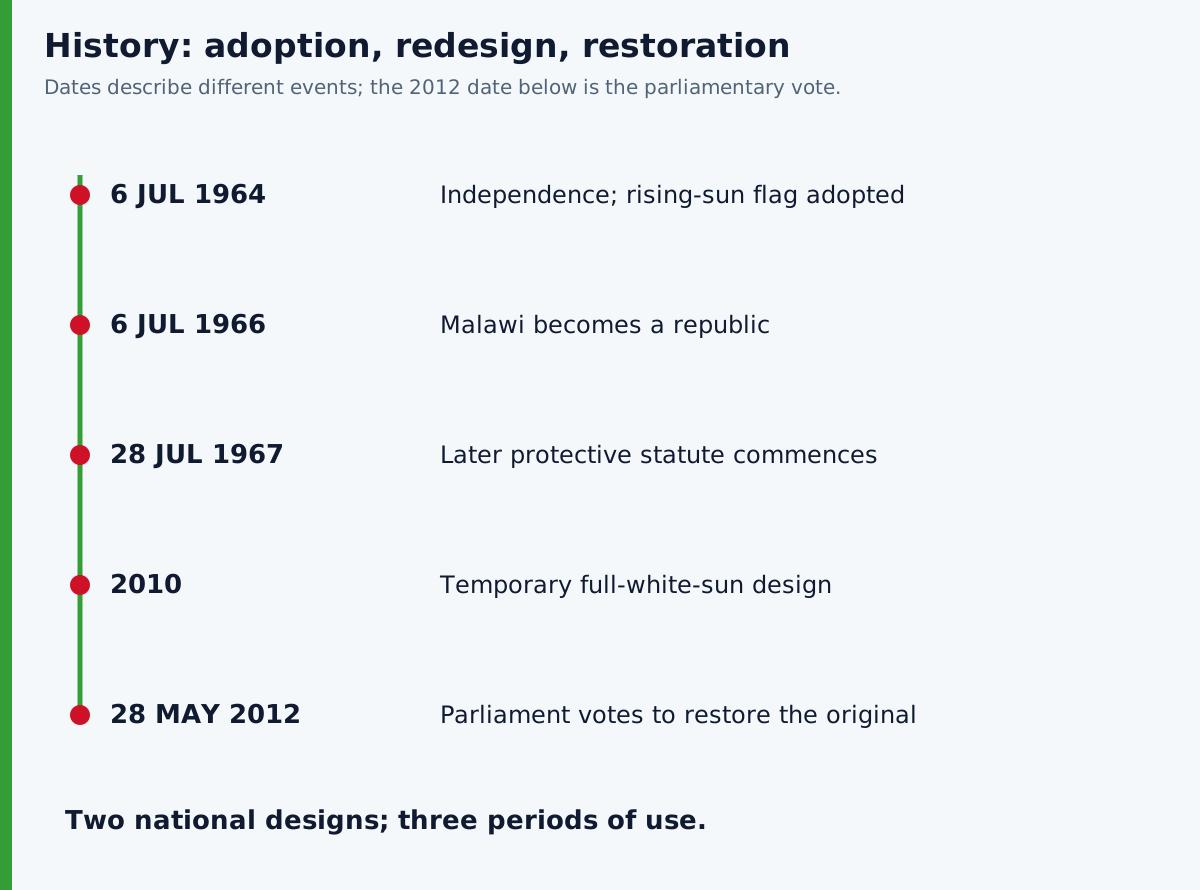
Malawi adopted its black, red, and green flag with a rising red sun at independence in 1964. A different design, using reordered stripes and a full white sun, replaced it in 2010. The independence design returned in 2012. These changes distinguish two national designs used across three periods of the country’s history.
| Period or date | Significance |
|---|---|
| July 6, 1964 | Independence and original national flag |
| July 6, 1966 | Malawi becomes a republic |
| July 28, 1967 | Commencement of the statute reproduced in the research record |
| 2010–2012 | Temporary flag with a full white sun |
| May 28, 2012 | Parliament votes to restore the independence design |
Independence, the republic, later legislation, and restoration are different events. The date on a consolidated law is not automatically the date when a flag first appeared. Likewise, a vote to restore a design should not be silently relabelled as the date of assent or Gazette publication.
When was Malawi’s flag first adopted?
The familiar rising-sun flag was adopted on July 6, 1964, when Malawi became independent. This original adoption date is distinct from the return to the design in 2012. It is also distinct from July 6, 1966, when Malawi became a republic, and from the commencement of later protective legislation.
For a short fact box, “adopted July 6, 1964; restored 2012” communicates both events clearly. Giving only 2012 can suggest that the design was first invented then; giving only 1964 hides the interruption between 2010 and 2012.
The reviewed official documents describe the national design and its significance without securely identifying an individual designer. This article does not convert the name of a president, political party, or modern SVG illustrator into an unsupported designer credit.
Why did Malawi change its flag in 2010?
The government of President Bingu wa Mutharika introduced a new flag in 2010 to symbolize development since independence. It replaced the rising red sun with a complete white sun and moved red above black. Contemporary reporting records criticism of both the consultation process and the government’s argument for changing a national symbol.

The specialist chronology records presidential assent on July 29, 2010. Contemporary AFP reporting describes the later public unveiling and quotes the government’s view that the country should no longer be represented as remaining at dawn. That was the administration’s symbolic rationale, not an independent assessment of economic performance.
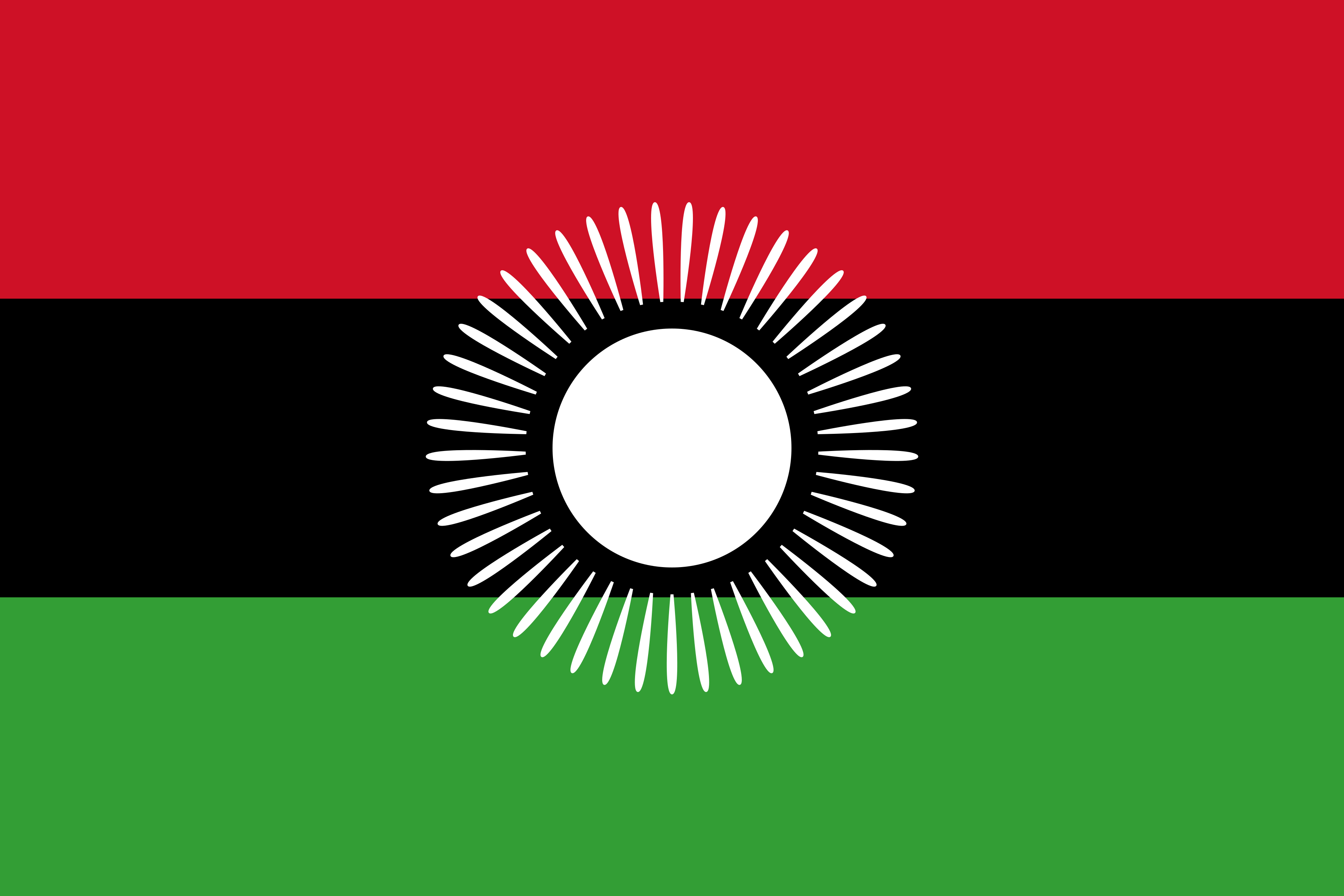
The historical flag retains a 3:2 field, with red above black above green. A white disc and 45 rays are centred on the whole flag. The gallery preserves the complete source illustration rather than replacing its sun with a generic icon.
Use this design for a correctly dated historical context. A white-sun image is not the current national flag.
Why was the independence flag restored in 2012?
Under President Joyce Banda, Malawi returned to the independence flag in 2012. Parliament approved the reversal on May 28 after the government argued that the earlier change lacked sufficient public consultation and a compelling justification. The restoration brought back black above red above green and the red rising sun in the upper stripe.
Contemporary reporting identifies Justice Minister Ralph Kasambara’s presentation of the amendment and the parliamentary vote. The date is used here for that documented parliamentary action; the original assent and commencement instruments were not independently authenticated for this package.
The restoration revived an existing national design. It did not introduce a third arrangement of colours or a new sun. That is why a useful timeline has three periods but only two national flag designs.
Historical photographs, old textbooks, and archived web pages may still show the white-sun flag. Date the image before treating the difference as an error. In a present-day country list, however, use the restored rising-sun design.
How do the current and 2010–2012 flags differ?
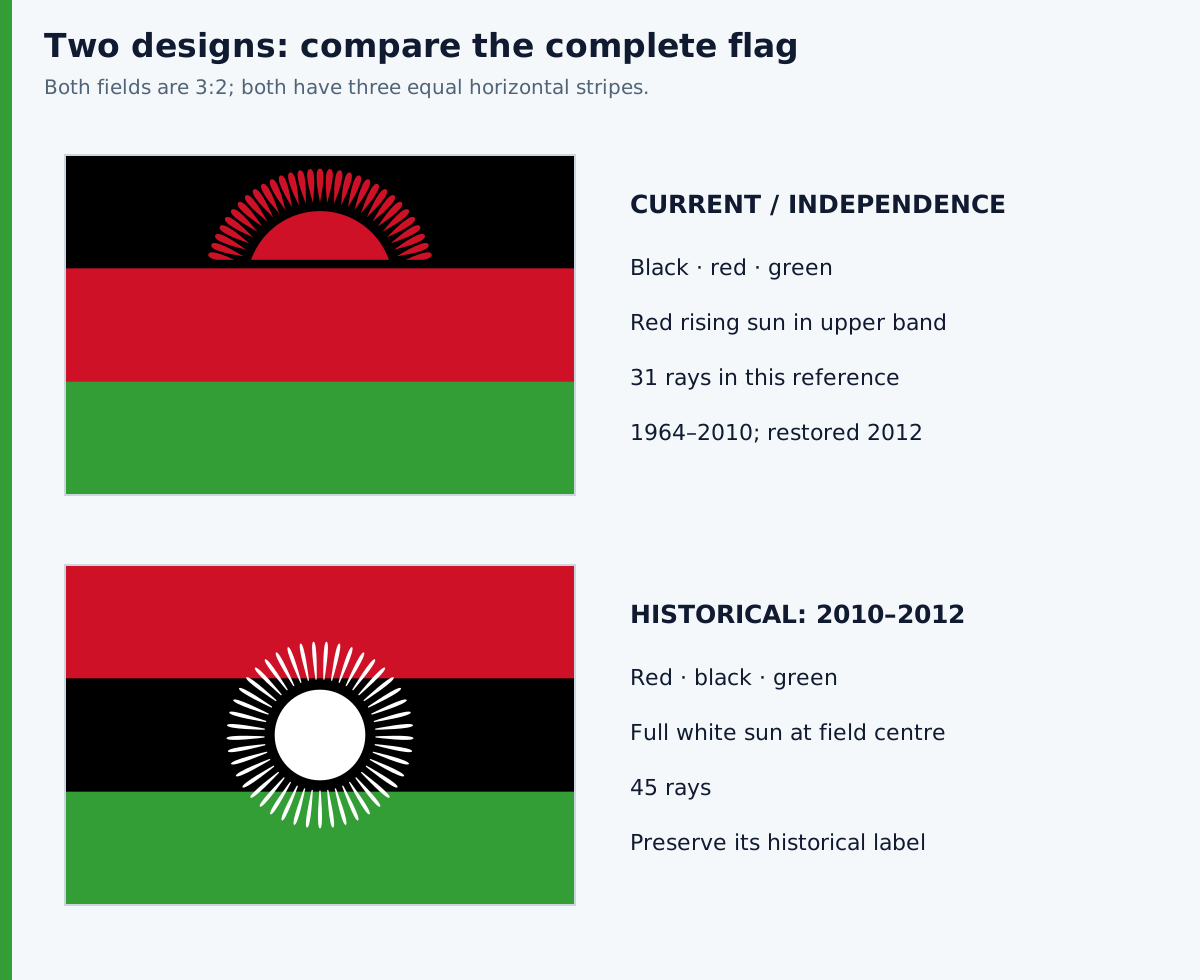
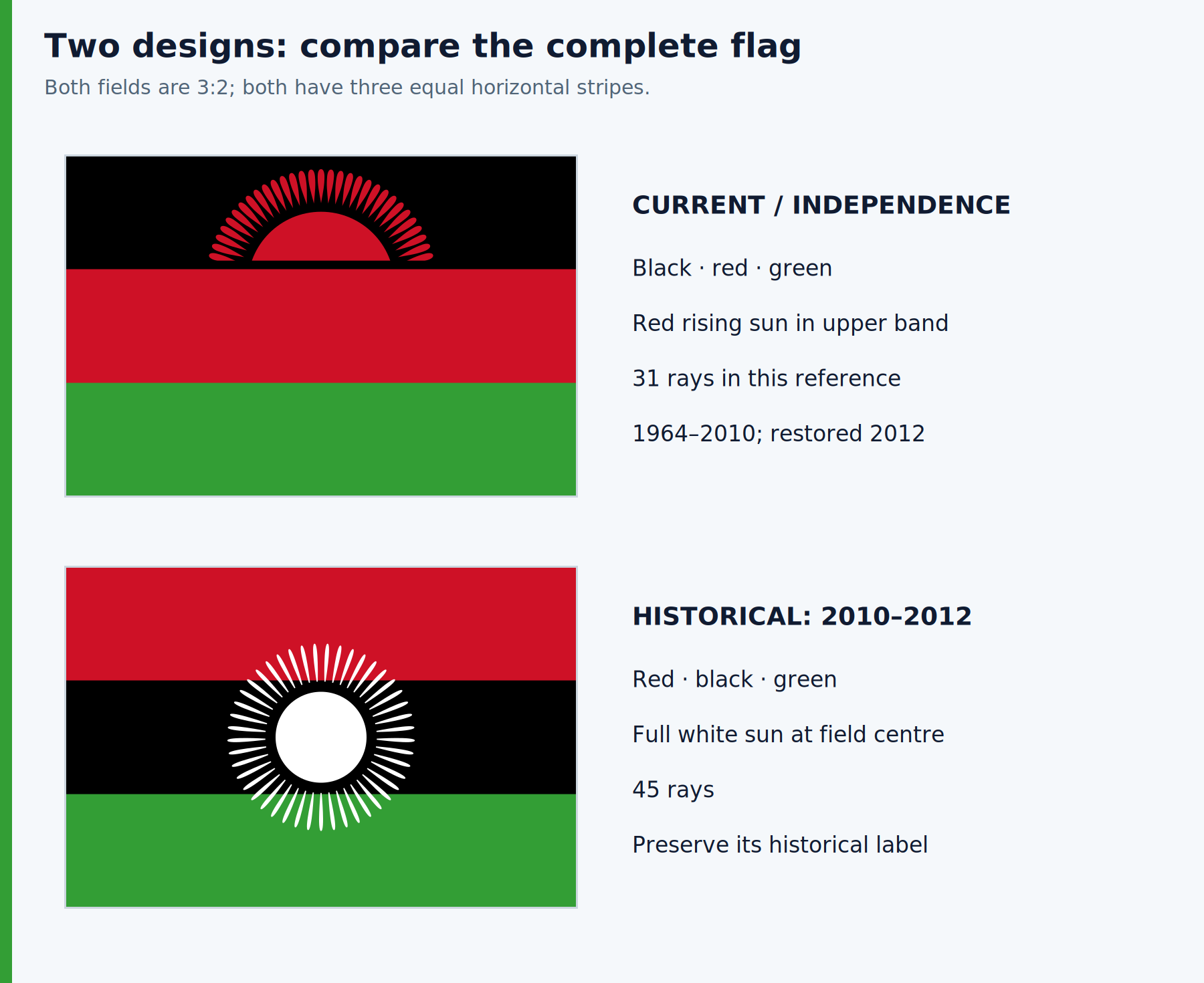
The current flag has black above red above green, with a rising red sun in the black stripe. The 2010–2012 flag has red above black above green, with a full white sun centred on the field. Both use equal horizontal stripes and a rectangle three units wide for every two units high.
| Feature | Current / independence design | 2010–2012 design |
|---|---|---|
| Stripe order | Black, red, green | Red, black, green |
| Sun colour | Red | White |
| Sun form | Rising partial disc | Full disc |
| Sun position | Upper black stripe | Centre of entire field |
| Reference ray count | 31 visible in common artwork | 45 |
| Field ratio | 3:2 width:height | 3:2 width:height |
Changing only the sun colour is insufficient to convert one version into the other: its form, position, and the top two bands also change. The comparison uses complete artwork for each version and keeps both at the same scale.
How are independence and the republic connected to the flag?
Malawi became independent on July 6, 1964, and became a republic on July 6, 1966. The national flag belongs to the independence milestone and continued through the later constitutional change. The shared month and day can cause confusion, so the year is essential when describing either event or preparing a historical caption.
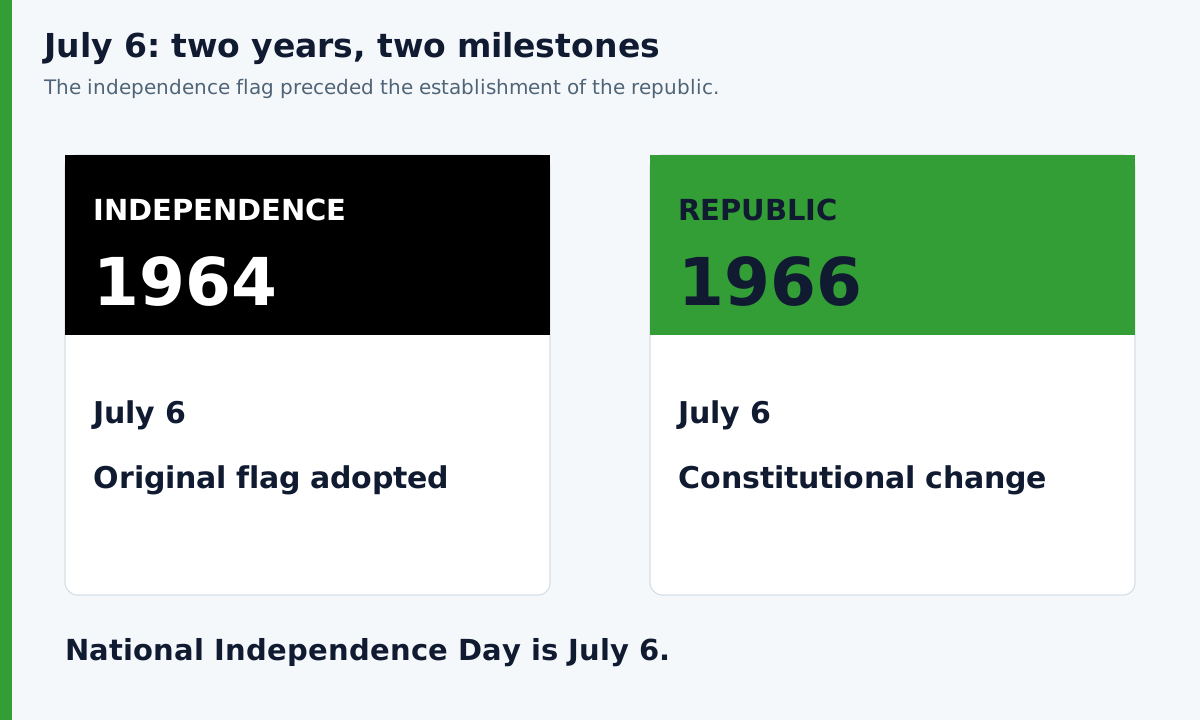
The official arts calendar identifies July 6 as National Independence Day and connects it with Nyasaland becoming Malawi in 1964. Parliamentary and government historical accounts distinguish the republican change two years later.
A caption such as “Malawi became independent and a republic in 1964” merges two events incorrectly. A more accurate compact caption is “Independence: 1964; republic: 1966; both commemorated on July 6.”
When is Malawi’s National Day or Flag Day?
Malawi’s National Independence Day is July 6, commemorating independence in 1964. The same calendar date also marks the republic established in 1966. The official material reviewed here identifies Independence Day; it does not establish a separate annual national Flag Day. Celebration programmes and venues should be checked for the particular year.
Flags are natural national symbols at independence commemorations, but an annual observance does not guarantee an identical programme every year. The arts calendar explicitly describes the location as rotational. A particular parade, service, or flag-raising ceremony should be described as that year’s event.
The adoption date, July 6, and the parliamentary restoration vote, May 28, have different roles. The latter should not be promoted as a statutory recurring Flag Day without supporting authority.
Which official documents describe Malawi’s flag?
Section 2 of Malawi’s Constitution establishes the country’s national symbols, including the flag. The detailed design appears in the First Schedule to the Protected Flag, Emblems and Names Act. Its published plate gives the stripe arrangement, ratio, meanings, and colour references. An older consolidated copy should not be mistaken for fully current legal guidance.
The researched consolidation states that its legislation is current to December 31, 2014. Later reporting records a 2023 amendment concerning the Act. Accordingly, this article uses the schedule as documentary evidence for the design and avoids presenting the consolidation’s old offences or penalties as current rules.
Copyright in an illustration and legal controls on a national symbol are separate questions. A downloadable or openly licensed image does not, by itself, grant permission for every commercial, trademark, or official-identification use. Check the applicable current requirements for the intended use.
Does the national flag include Malawi’s coat of arms?
No. The national flag carries the red rising sun but not the full coat of arms. Malawi’s arms are a separate national symbol, featuring a shield, a fish eagle, lion and leopard supporters, and the motto Unity and Freedom. Adding the full arms to the ordinary flag creates a different illustration.
The embassy explains that the fish eagle and wavy blue-and-white bands evoke Lake Malawi, while Mount Mulanje appears at the base. The heraldic description in the Act supplies the formal composition. These elements should not be reduced to a generic shield and described as the complete national arms.
The sun occurs in both symbols, but shared imagery does not make the symbols interchangeable. The ordinary flag’s simplicity is deliberate: three bands and a red rising sun.
Is the presidential flag the same as the national flag?
The presidential flag is a distinct official emblem, separate from the ordinary national flag. The reviewed statutory schedule describes a gold lion on a red field with a gold scroll bearing the word Malawi. That description should not be confused with the black, red, and green national flag or with the full coat of arms.
The relevant entry appears among protected emblems in the Second Schedule. It is a description in the researched consolidation, not evidence that every online presidential-standard drawing has the correct current detail. No speculative or incomplete reconstruction is supplied in this gallery.
For a school chart or country listing, use the ordinary national flag. For a historical or official presidential-standard illustration, identify the period and obtain a verified complete reference for that specific emblem.
How should Malawi’s flag be displayed?
Display the current design with black above red above green and the red sun upright in the upper band. Preserve the field’s proportions and keep the emblem unobstructed. For an official ceremony, follow the responsible authority’s current directions on placement, timing, and precedence instead of importing another country’s flag rules.
A clean, legible flag communicates the design more clearly than one with distorted proportions or an obscured sun. A printed teaching diagram should distinguish labels from the national design and identify historical variants prominently.
The materials reviewed for this guide do not establish a universal daily raising hour, a compulsory household schedule, or a detailed national precedence table. Specific institutional instructions should be checked where those details matter. This is practical display guidance rather than a newly invented protocol code.
When is Malawi’s flag flown at half-mast?
Malawi uses half-mast display during officially declared mourning. For example, the government declared 21 days of national mourning after Vice President Saulos Chilima’s death in June 2024, with flags flown at half-mast. That historical order does not establish a permanent schedule; follow the applicable announcement for its dates, scope, and instructions.
The Malawi News Agency reported the measure on June 15, 2024. It provides an official example of the practice, but it does not specify a universal measured distance between the flag and the masthead. No exact fraction is invented here.
A photograph of a lowered flag may belong to a particular period of mourning. Its meaning depends on context, and it should not be used to announce that a mourning order is currently in force.
Does the flag look different from the reverse?
The flag’s basic design is horizontally symmetrical, so black remains above red above green when it is viewed from the reverse. The centred rising sun also retains its recognizable appearance. The pole changes sides in the viewer’s perspective, but the stripe order and the flag’s own attachment edge do not change.

Horizontal reflection differs from turning the whole flag upside down. Reflection preserves the black upper band; upside-down display puts green at the top and inverts the sun. These are different geometric operations.
A ninety-degree rotation produces a vertical illustration, but a geometric rotation is not automatically an official vertical-hanging instruction. If a ceremony or installation requires vertical display, use the relevant organizer’s approved arrangement. The supplied unrotated national image is the standard front reference.
Which sizes preserve the flag’s proportions?
Any size preserves the field if its width is one and a half times its height and each stripe remains one-third of the height. Scale the sun together with the complete artwork. The examples here are calculated finished dimensions, excluding seams and sleeves, rather than a mandatory national list of manufactured sizes.

| Height × width | Each stripe: height × width |
|---|---|
| 20 × 30 cm | 6⅔ × 30 cm |
| 60 × 90 cm | 20 × 90 cm |
| 90 × 135 cm | 30 × 135 cm |
| 120 × 180 cm | 40 × 180 cm |
The main PNG is 3600 × 2400 pixels, while the SVG can scale without pixelation. Use proportional resizing. Increasing only the width flattens the sun and changes the flag even though the bands remain horizontal.
How can the downloadable flag pictures be reused?
Use the SVG for scalable illustration and the PNG where a raster image is required. Preserve the complete flag, check whether a picture is current or historical, and retain the supplied credits. The clean illustrations use a disclosed screen palette; they are not colour-certified cloth samples or approved manufacturing masters.
The historical white-sun artwork and its comparison image carry attribution and a Creative Commons Attribution-ShareAlike 3.0 notice. The reproduced statutory detail credits Laws.Africa and contributors under CC BY 4.0 for the article copy. The accompanying credits file identifies these differences.
For accessible use, describe the arrangement and sun rather than simply writing “flag.” For example: “Malawi flag with black, red, and green horizontal stripes and a red rising sun in the black band.” Keep explanations outside an unlabelled reference image.
For cloth, dry a wet flag before storage and avoid handling that damages its seams or emblem. These are general care recommendations, not a claimed Malawi-specific folding or disposal law.
What is the Malawi flag emoji?
The Malawi flag emoji is 🇲🇼. Its Unicode sequence combines the regional indicator for M, U+1F1F2, with the regional indicator for W, U+1F1FC. The pair represents the country code MW. Its visual rendering depends on the platform, so it should not replace a measured flag drawing or a colour specification.
| Element | Value |
|---|---|
| Country code | MW |
| First regional indicator | U+1F1F2 · M |
| Second regional indicator | U+1F1FC · W |
| Combined sequence | 🇲🇼 |
Some systems display the pair as a flag, while unsupported environments may expose letters or placeholder glyphs. In web content where accurate appearance matters, use the provided image with descriptive alternative text. Emoji artwork may simplify the small sun at typical text sizes.
What mistakes are common in Malawi flag images?
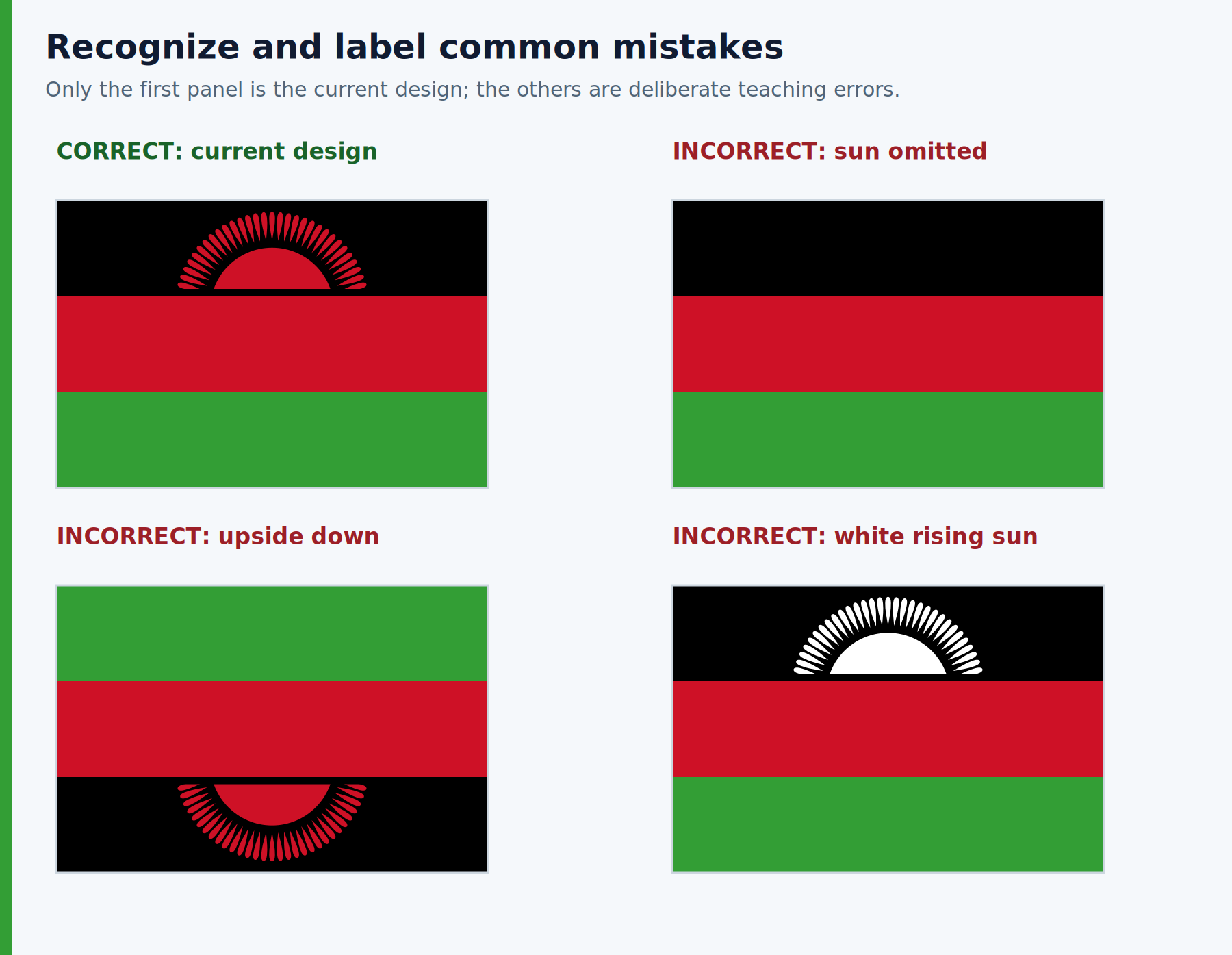
Common errors include swapping the black and red stripes, omitting the rising sun, placing it in the middle of the whole field, and presenting the historical white-sun flag as current. Distorted proportions and unsupported claims about exact colour conversions also cause confusion. Check the date, layout, sun, ratio, and artwork provenance together.

The mistakes diagram deliberately labels incorrect teaching examples. They are not alternate national flags. The separate historical image is correctly labelled as the design used from 2010 to 2012 and should not be called an error when it appears in a properly dated context.
Another mistake is treating every downloadable SVG as an exact legal master. Even a recognizable image can differ in ray geometry or colour implementation. This package preserves that distinction and includes the statutory detail for comparison.
Which flag terms are useful for understanding Malawi’s design?
The hoist is the attachment side of a flag, and the fly is its free end. The field is the main surface, while a charge is an added emblem such as Malawi’s rising sun. A horizontal tricolor has three coloured bands. These terms describe different features and help make construction instructions precise.
| Term | Meaning in this article |
|---|---|
| Hoist | Attachment side; normally left in the front reference |
| Fly | Free edge opposite the hoist |
| Field | The complete rectangular surface |
| Charge | The red rising-sun emblem |
| Tricolor | Three coloured bands |
| Aspect ratio | Width compared with height |
| Restoration | Return to an earlier national design |
When writing a caption, combine the terms with ordinary language: “A red rising sun is centred in the black upper band of a 3:2 horizontal tricolor.” That description identifies both the emblem and its location without confusing the field’s centre with the black band.
Explore more in World Flags: Iceland flag, Lithuania flag, Luxembourg flag, Madagascar flag.
Download Malawi flag pictures
Download the national flag as SVG or large PNG. The gallery includes 14 distinct subjects with captions and alternative text. Keep the full proportions when resizing. Image credits and reuse notes accompany the graphics.
World Flags/Malawi
Malawi flag pictures
Black above red above green, with a red rising sun. This conventional 31-ray reference preserves its source geometry; the legal plate’s finer construction differs. Screen shades are illustrative.
GKBook; national reference geometry from Achim1999 and Wikimedia Commons contributorsDownload SVGDownload PNGThree equal horizontal stripes; the red rising sun is centred horizontally in the top band. Pole and labels are explanatory.
GKBook; national reference geometry from Achim1999 and Wikimedia Commons contributorsDownload SVGDownload PNGThe 180 × 120 field gives a 3:2 ratio and three 40-unit bands. This diagram measures the field; it does not certify the reference SVG’s fine sun geometry.
GKBook; national reference geometry from Achim1999 and Wikimedia Commons contributorsDownload SVGDownload PNGThe original plate specifies 180 × 120 units, equal bands, British Standard shades and a six-degree ray callout. Reproduced scan; SVG is an image container.
Laws.Africa and contributors; statutory PDF excerpt reproduced and captioned by GKBook; CC BY 4.0. License: https://creativecommons.org/licenses/by/4.0/Download SVGDownload PNGAn enlarged view of the source-preserved rising sun. Its 31 visible rays should not be confused with the different six-degree callout in the statutory plate.
GKBook; national reference geometry from Achim1999 and Wikimedia Commons contributorsDownload SVGDownload PNGNational schedule: red 0-005, green 0-010. SADC p.65: 186C and 355C. The separate screen palette is #000000, #CE1126 and #339E35.
GKBook; national reference geometry from Achim1999 and Wikimedia Commons contributorsDownload SVGDownload PNGBlack: people of Africa. Red: sacrifice for African freedom. Green: Malawi’s evergreen nature. Rising sun: hope and freedom across Africa.
GKBook; national reference geometry from Achim1999 and Wikimedia Commons contributorsDownload SVGDownload PNGOriginal adoption in 1964, republic in 1966, later statute in 1967, redesign in 2010, and parliamentary restoration vote in 2012.
GKBook; national reference geometry from Achim1999 and Wikimedia Commons contributorsDownload SVGDownload PNGHistorical design: red above black above green, with a full white sun and 45 rays centred on the field. This is not the current flag.
Fornax, Zscout370, Phlegmatic and Wikimedia Commons contributors; adapted by GKBook; CC BY-SA 3.0. License: https://creativecommons.org/licenses/by-sa/3.0/Download SVGDownload PNGThe top two stripe colours, sun colour, sun form, and sun position change. Keep each design tied to its period.
Fornax, Zscout370, Phlegmatic and Wikimedia Commons contributors; adapted by GKBook; CC BY-SA 3.0. License: https://creativecommons.org/licenses/by-sa/3.0/Download SVGDownload PNGJuly 6, 1964: independence and original flag. July 6, 1966: republic. The official annual observance is National Independence Day.
GKBook; national reference geometry from Achim1999 and Wikimedia Commons contributorsDownload SVGDownload PNGThe pole changes sides in the viewer’s perspective. The stripe order and centred rising sun retain their appearance.
GKBook; national reference geometry from Achim1999 and Wikimedia Commons contributorsDownload SVGDownload PNGFour calculated finished-field sizes. Each band spans the full width and one-third of the height; scale the sun with the flag.
GKBook; national reference geometry from Achim1999 and Wikimedia Commons contributorsDownload SVGDownload PNGOnly the first panel is correct. The others omit the sun, invert the flag, or change the rising sun to white. Historical flags are separately labelled in the gallery.
GKBook; national reference geometry from Achim1999 and Wikimedia Commons contributorsDownload SVGDownload PNGFrequently asked questions
What does the Malawi flag look like?
Malawi’s flag is a horizontal tricolor with black at the top, red in the middle, and green at the bottom. The stripes have equal heights. A red rising sun, surrounded by separate rays, sits centrally within the black stripe. The flag has no lettering, white borders, or central shield.
What are the proportions of Malawi’s flag?
The flag’s length-to-height ratio is 3:2, meaning that a flag 90 centimetres wide is 60 centimetres high. The equivalent height-to-length notation is 2:3. Each horizontal stripe occupies one-third of the height, and each runs across the complete width. These proportions appear in the national flag schedule.
How is the Malawi flag constructed?
Begin with a rectangle 180 units wide and 120 units high, then divide its height into three equal bands of 40 units. Fill them black, red, and green from top to bottom. Add the red rising sun within the black band, centred horizontally, while preserving its separate rays and surrounding clearance.
How many rays does the rising sun have?
The familiar digital version of Malawi’s flag shows 31 visible red rays around the rising sun. However, the published statutory construction plate includes a six-degree spacing instruction that differs from common digital artwork. Keep this distinction visible when precision matters, and do not treat an online icon as a certified construction master.
What are Malawi’s flag colour codes?
The national schedule names black, red, and green and lists British Standard shade numbers 0-005 for red and 0-010 for green. It does not supply an RGB or HEX table. This package uses a disclosed screen palette, while the SADC manual’s separate print references are identified as regional production guidance.
What do the colours and rising sun mean?
Black represents the people of Africa; red recalls those who died for African freedom; and green represents Malawi’s evergreen nature. The rising sun expresses the beginning of hope and freedom across Africa. These meanings appear in the national flag schedule, making them more than an unattributed modern interpretation of the colours.
What is the history of Malawi’s flag?
Malawi adopted its black, red, and green flag with a rising red sun at independence in 1964. A different design, using reordered stripes and a full white sun, replaced it in 2010. The independence design returned in 2012. These changes distinguish two national designs used across three periods of the country’s history.
When was Malawi’s flag first adopted?
The familiar rising-sun flag was adopted on July 6, 1964, when Malawi became independent. This original adoption date is distinct from the return to the design in 2012. It is also distinct from July 6, 1966, when Malawi became a republic, and from the commencement of later protective legislation.
Why did Malawi change its flag in 2010?
The government of President Bingu wa Mutharika introduced a new flag in 2010 to symbolize development since independence. It replaced the rising red sun with a complete white sun and moved red above black. Contemporary reporting records criticism of both the consultation process and the government’s argument for changing a national symbol.
Why was the independence flag restored in 2012?
Under President Joyce Banda, Malawi returned to the independence flag in 2012. Parliament approved the reversal on May 28 after the government argued that the earlier change lacked sufficient public consultation and a compelling justification. The restoration brought back black above red above green and the red rising sun in the upper stripe.
How do the current and 2010–2012 flags differ?
The current flag has black above red above green, with a rising red sun in the black stripe. The 2010–2012 flag has red above black above green, with a full white sun centred on the field. Both use equal horizontal stripes and a rectangle three units wide for every two units high.
How are independence and the republic connected to the flag?
Malawi became independent on July 6, 1964, and became a republic on July 6, 1966. The national flag belongs to the independence milestone and continued through the later constitutional change. The shared month and day can cause confusion, so the year is essential when describing either event or preparing a historical caption.
When is Malawi’s National Day or Flag Day?
Malawi’s National Independence Day is July 6, commemorating independence in 1964. The same calendar date also marks the republic established in 1966. The official material reviewed here identifies Independence Day; it does not establish a separate annual national Flag Day. Celebration programmes and venues should be checked for the particular year.
Which official documents describe Malawi’s flag?
Section 2 of Malawi’s Constitution establishes the country’s national symbols, including the flag. The detailed design appears in the First Schedule to the Protected Flag, Emblems and Names Act. Its published plate gives the stripe arrangement, ratio, meanings, and colour references. An older consolidated copy should not be mistaken for fully current legal guidance.
Does the national flag include Malawi’s coat of arms?
No. The national flag carries the red rising sun but not the full coat of arms. Malawi’s arms are a separate national symbol, featuring a shield, a fish eagle, lion and leopard supporters, and the motto Unity and Freedom. Adding the full arms to the ordinary flag creates a different illustration.
Is the presidential flag the same as the national flag?
The presidential flag is a distinct official emblem, separate from the ordinary national flag. The reviewed statutory schedule describes a gold lion on a red field with a gold scroll bearing the word Malawi. That description should not be confused with the black, red, and green national flag or with the full coat of arms.
How should Malawi’s flag be displayed?
Display the current design with black above red above green and the red sun upright in the upper band. Preserve the field’s proportions and keep the emblem unobstructed. For an official ceremony, follow the responsible authority’s current directions on placement, timing, and precedence instead of importing another country’s flag rules.
When is Malawi’s flag flown at half-mast?
Malawi uses half-mast display during officially declared mourning. For example, the government declared 21 days of national mourning after Vice President Saulos Chilima’s death in June 2024, with flags flown at half-mast. That historical order does not establish a permanent schedule; follow the applicable announcement for its dates, scope, and instructions.
Does the flag look different from the reverse?
The flag’s basic design is horizontally symmetrical, so black remains above red above green when it is viewed from the reverse. The centred rising sun also retains its recognizable appearance. The pole changes sides in the viewer’s perspective, but the stripe order and the flag’s own attachment edge do not change.
Which sizes preserve the flag’s proportions?
Any size preserves the field if its width is one and a half times its height and each stripe remains one-third of the height. Scale the sun together with the complete artwork. The examples here are calculated finished dimensions, excluding seams and sleeves, rather than a mandatory national list of manufactured sizes.
How can the downloadable flag pictures be reused?
Use the SVG for scalable illustration and the PNG where a raster image is required. Preserve the complete flag, check whether a picture is current or historical, and retain the supplied credits. The clean illustrations use a disclosed screen palette; they are not colour-certified cloth samples or approved manufacturing masters.
What is the Malawi flag emoji?
The Malawi flag emoji is 🇲🇼. Its Unicode sequence combines the regional indicator for M, U+1F1F2, with the regional indicator for W, U+1F1FC. The pair represents the country code MW. Its visual rendering depends on the platform, so it should not replace a measured flag drawing or a colour specification.
What mistakes are common in Malawi flag images?
Common errors include swapping the black and red stripes, omitting the rising sun, placing it in the middle of the whole field, and presenting the historical white-sun flag as current. Distorted proportions and unsupported claims about exact colour conversions also cause confusion. Check the date, layout, sun, ratio, and artwork provenance together.
Which flag terms are useful for understanding Malawi’s design?
The hoist is the attachment side of a flag, and the fly is its free end. The field is the main surface, while a charge is an added emblem such as Malawi’s rising sun. A horizontal tricolor has three coloured bands. These terms describe different features and help make construction instructions precise.
Explore all general-knowledge topics and the A-to-Z lists.





We Value Your Opinion Comments