

Madagascar flag picture
Explore the construction drawing, history, and complete picture gallery.
| Design | White · red · greenWhite at the hoist; red above green on the fly. |
|---|---|
| Proportions | 3:2 width:heightEquivalent to 2:3 height:width. |
| Adoption | October 21, 1958Distinct from the proclamation of the republic on October 14. |
| Designer | Andrianome RanaivosoaCredited to an agent of the Malagasy geographical institute. |
| National Day | June 26Independence was proclaimed in 1960. |
Article 4 of the 2010 Constitution describes the layout. The SADC manual illustrates its 3:2 construction. Screen shades in these downloads are illustrative.
What is the national flag of Madagascar?
Madagascar’s national flag combines a vertical white band at the hoist with red above green on the remaining field. Its three coloured rectangles have equal areas. The standard rectangle is three units wide and two units high. Adopted in October 1958, the design predates independence on June 26, 1960.
The unusual arrangement makes this tricolor easy to recognize: white runs from top to bottom beside the pole, while red and green divide the free end. This guide explains its geometry, traditional meanings, designer, adoption chronology, national celebrations, and practical reproduction. The downloadable artwork includes an unlabelled flag, measured diagrams, comparisons, and orientation examples. Documentary colour references are distinguished from the illustrative screen palette.
What does the Madagascar flag look like?
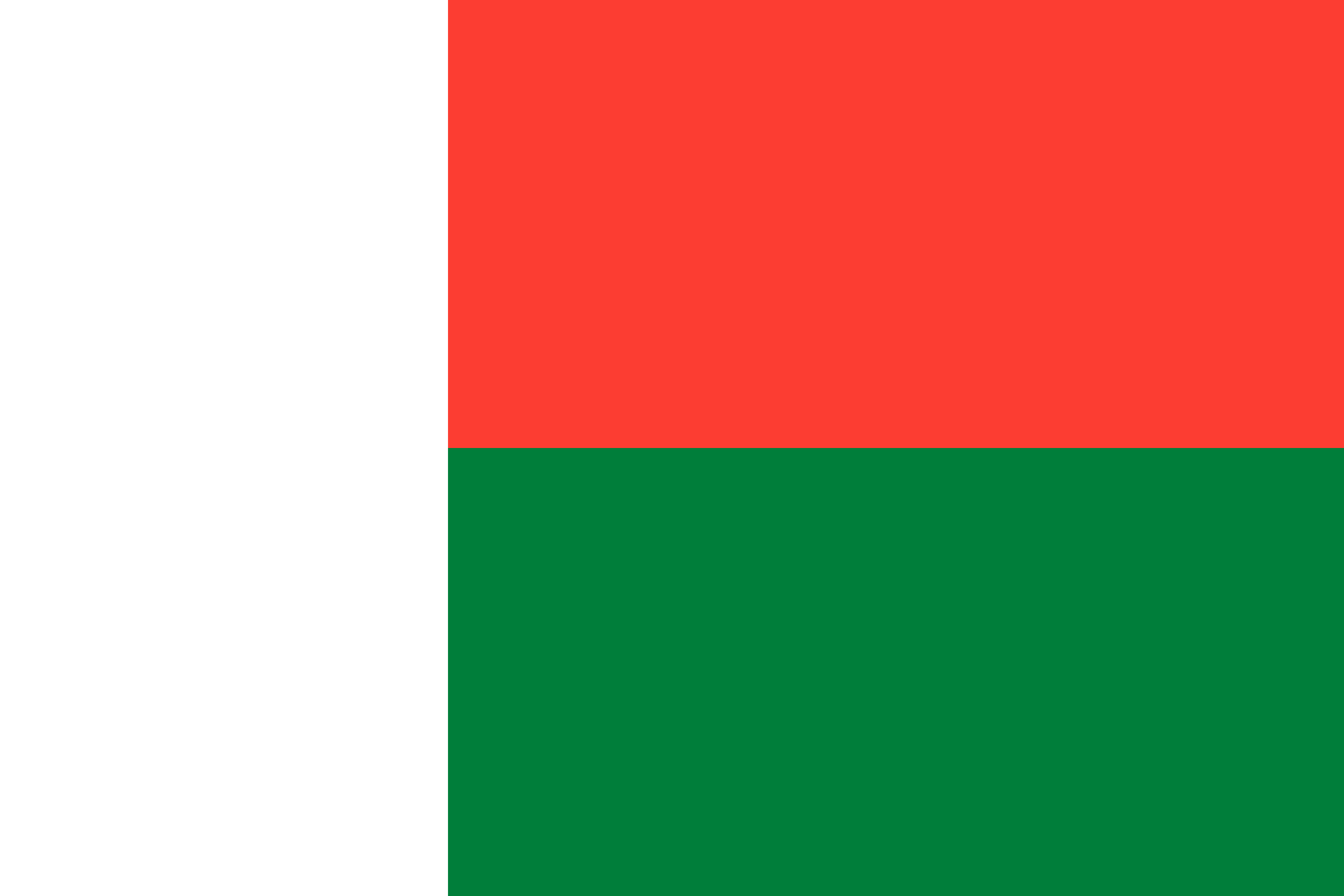
The Madagascar flag has a full-height white band beside the pole and two horizontal bands on the other side: red above green. It has no central emblem, lettering, star, crescent, or border. In the usual front-facing drawing, white is on the left and the coloured pair is on the right.
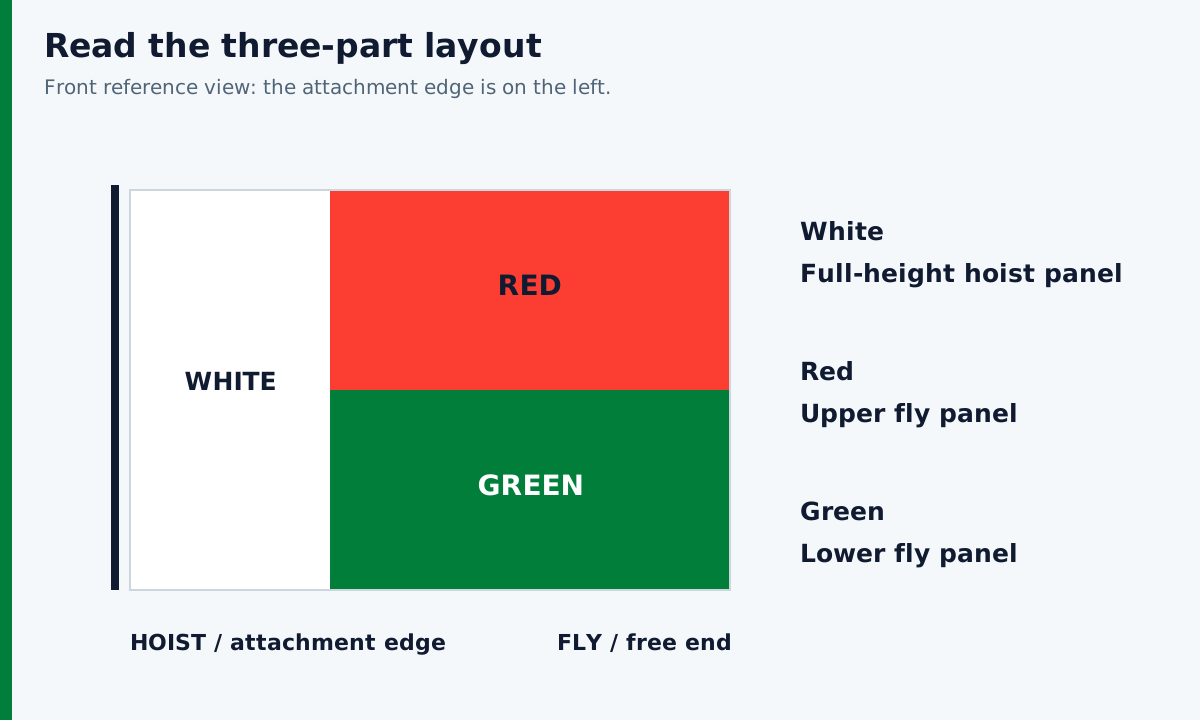
The vertical white panel is part of the flag. On a white background it can disappear visually, making the remaining red-and-green rectangle seem like the whole design. A thin frame around an illustration can clarify its edge, but that frame is not a fourth component of the national flag.
| Feature | Arrangement |
|---|---|
| At the hoist | White panel spanning the full height |
| Upper fly | Red rectangle |
| Lower fly | Green rectangle |
| Centre | No added device |
| Outer shape | A complete 3:2 rectangle |
The terms “Malagasy flag” and “flag of Madagascar” refer here to the same national design. The main download is a flat, unlabelled reference; labels and measuring lines appear only in the explanatory diagrams.
What are the correct flag proportions?
The standard Madagascar flag is 3:2 when width is written before height, or 2:3 when height comes first. The SADC construction drawing shows a field 1,800 millimetres long and 1,200 millimetres high. The white panel occupies one-third of the width, while red and green each occupy half the height.
These two ratio notations describe the same flag. A 90-centimetre-high flag is therefore 135 centimetres wide. A square version changes the proportions even if the three colours remain recognizable.
| Measurement | Formula |
|---|---|
| Full width W | 1.5 × height H |
| White-panel width | W ÷ 3 = H ÷ 2 |
| Red or green width | 2W ÷ 3 = H |
| Red or green height | H ÷ 2 |
Article 4 describes three rectangular bands of equal dimensions but does not print a numerical ratio. The numerical construction is corroborated by the SADC drawing; it should not be presented as a direct quotation of a ratio from the Constitution.
How do you draw Madagascar’s flag accurately?
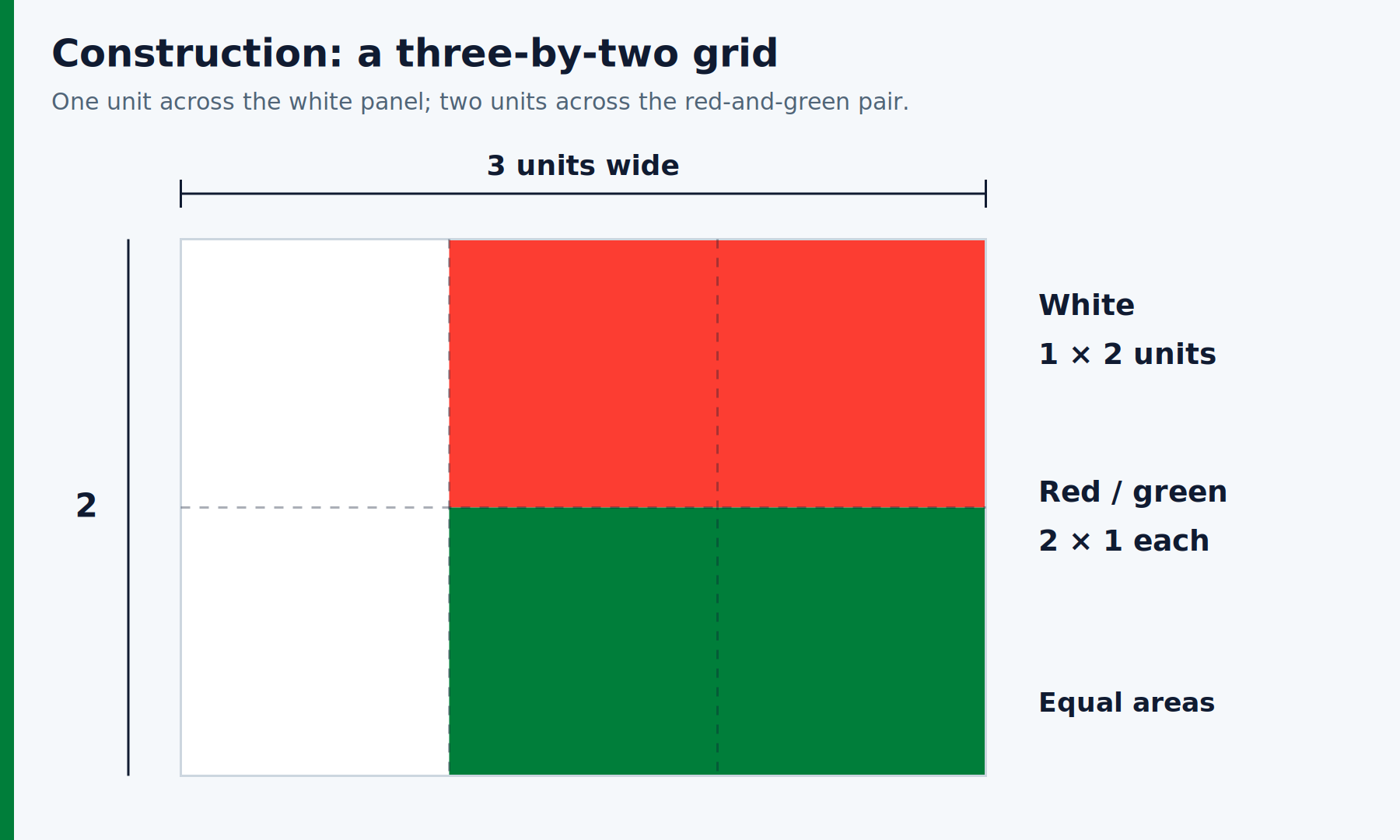
Start with a rectangle three units wide and two units high. Mark a vertical division one unit from the hoist. Leave that full-height panel white. Divide the remaining two-unit-wide area horizontally at its midpoint, filling the upper rectangle red and the lower rectangle green, without gaps or outlines between them.

For a 900 × 600-pixel drawing, the white panel is 300 × 600 pixels. The red panel starts at x = 300, y = 0 and measures 600 × 300 pixels; the green panel starts at x = 300, y = 300 and has the same dimensions. Coordinates are measured from the image’s upper-left corner.
| Panel | x | y | Width | Height |
|---|---|---|---|---|
| White | 0 | 0 | 300 | 600 |
| Red | 300 | 0 | 600 | 300 |
| Green | 300 | 300 | 600 | 300 |
Use adjoining solid fills. A white gap between red and green, an inset coloured panel, or rounded corners changes the national drawing. A cloth maker should add seams and sleeves outside the measured visible field. The construction grid is a measuring aid and must disappear from the finished flag.
Do the three colours occupy equal areas?
Yes. Each colour covers one-third of Madagascar’s flag. The white rectangle is one unit wide and two units high; each coloured rectangle is two units wide and one unit high. They are congruent rectangles turned through ninety degrees, so their equal areas follow directly from the three-by-two construction.

The whole flag contains six unit squares. White covers two squares, red covers two, and green covers two. The white panel may look larger because it reaches the full height, but its narrower width exactly balances that height. This is a useful example of equal area without equal orientation.
Do not confuse “equal dimensions” with three equal vertical stripes or three horizontal stripes. Here the long side of the white rectangle runs vertically, while the long sides of the other two run horizontally. The joined shapes, not merely the colour list, identify Madagascar.
Which flag sizes preserve the design?
Any finished size can preserve the design if its width is one and a half times its height and the panels retain their proper divisions. The examples below are calculated dimensions, not a mandatory national size list. Measurements refer to the visible flag field, excluding sleeves, hems, cords, and other fittings.
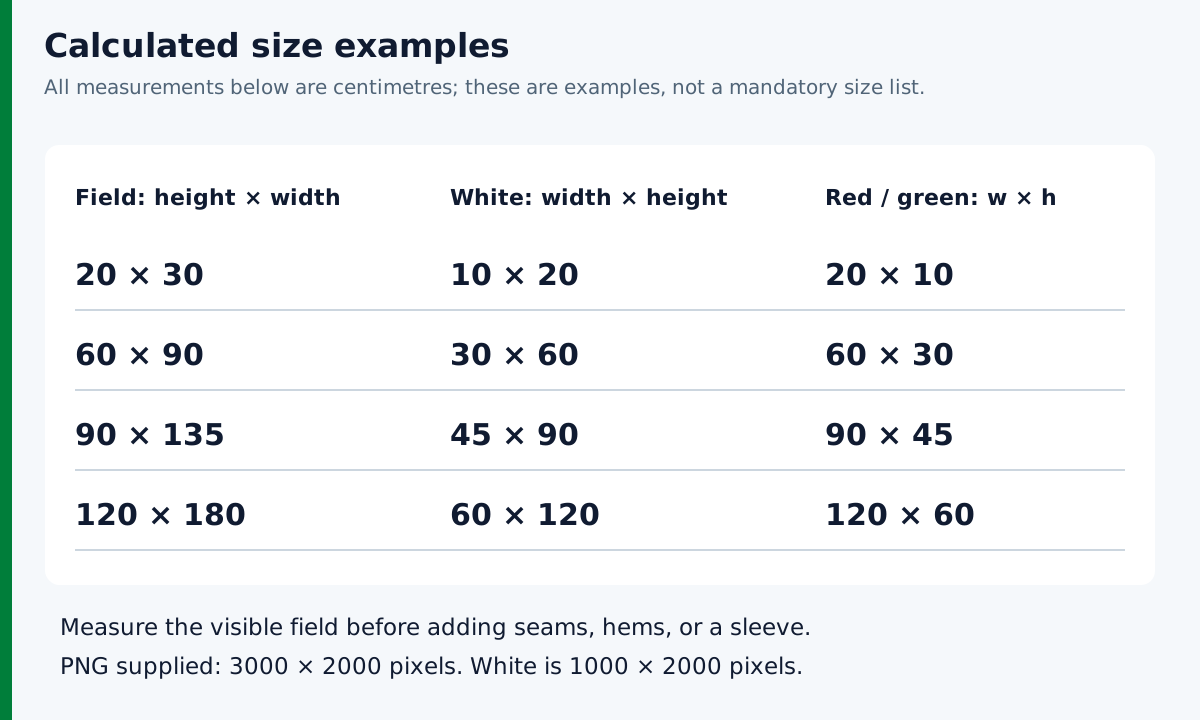
| Finished height × width | White width × height | Each red/green width × height |
|---|---|---|
| 20 × 30 cm | 10 × 20 cm | 20 × 10 cm |
| 60 × 90 cm | 30 × 60 cm | 60 × 30 cm |
| 90 × 135 cm | 45 × 90 cm | 90 × 45 cm |
| 120 × 180 cm | 60 × 120 cm | 120 × 60 cm |
For raster artwork, choose a width divisible by three and a height divisible by two. The supplied 3000 × 2000 PNG gives white a 1000 × 2000 panel and each coloured panel a 2000 × 1000 panel, with no fractional-pixel boundaries.
For a website thumbnail, 180 × 120 pixels works cleanly. For print, calculate the required pixel dimensions from the actual printed size and resolution. The SVG can be enlarged without pixelation, provided the application preserves the full viewBox and its aspect ratio.
What colour references should be used?
Article 4 names white, red, and green without numerical colour codes. The SADC identity manual labels its Madagascar illustration with Pantone 186C red and 348C green. Those are documented regional production references. The HEX and RGB values in this package identify its screen artwork and are not presented as binding Malagasy specifications.

| Colour | SADC manual reference | Illustrative HEX here | Illustrative RGB |
|---|---|---|---|
| White | White; no numbered swatch | #FFFFFF | 255, 255, 255 |
| Red | 186C | #FC3D32 | 252, 61, 50 |
| Green | 348C | #007E3A | 0, 126, 58 |
The screen values are an explicitly chosen illustration palette, not certified conversions of the SADC swatches. A bright display, a faded printed chart, and dyed cloth can show different appearances. Reproducing a hexadecimal value does not by itself demonstrate compliance with a physical colour standard.
For official manufacture, obtain the applicable Malagasy specification and an approved material sample from the commissioning authority. A 2020 report describes a local display of technical references, but it does not reproduce the numerical table. The sources reviewed here do not authenticate a current nationally authoritative HEX table. This is an evidence limit, not a claim that technical standards do not exist.
What do white, red, and green symbolize?
A traditional explanation associates white with purity, red with sovereignty, and green with hope. The SADC manual records these meanings. Historical discussion also connects the colours with older symbols and later interpretations. Symbolism should therefore be identified by its source and period, rather than treated as a single unchanging legal definition.

The constitutional design clause describes the arrangement of the colours; it does not assign those three abstract meanings. This distinction separates the measurable flag from the ideas people attach to it. A different poetic interpretation does not necessarily identify a different physical flag.
The museum historian interviewed in 2020 explained that interpretations developed after the selection of the design. Red and white also recalled the Merina monarchy, which contributed to early criticism. It is misleading to turn these historical associations into a fixed chart assigning each present-day colour to a particular ethnic population.
How did the modern flag develop?
The modern design emerged during Madagascar’s transition from French colonial rule to republican self-government in 1958. It was selected before full independence in 1960. Earlier royal and colonial flags belong to different political settings; their histories help explain the setting without making them interchangeable versions of today’s national emblem.

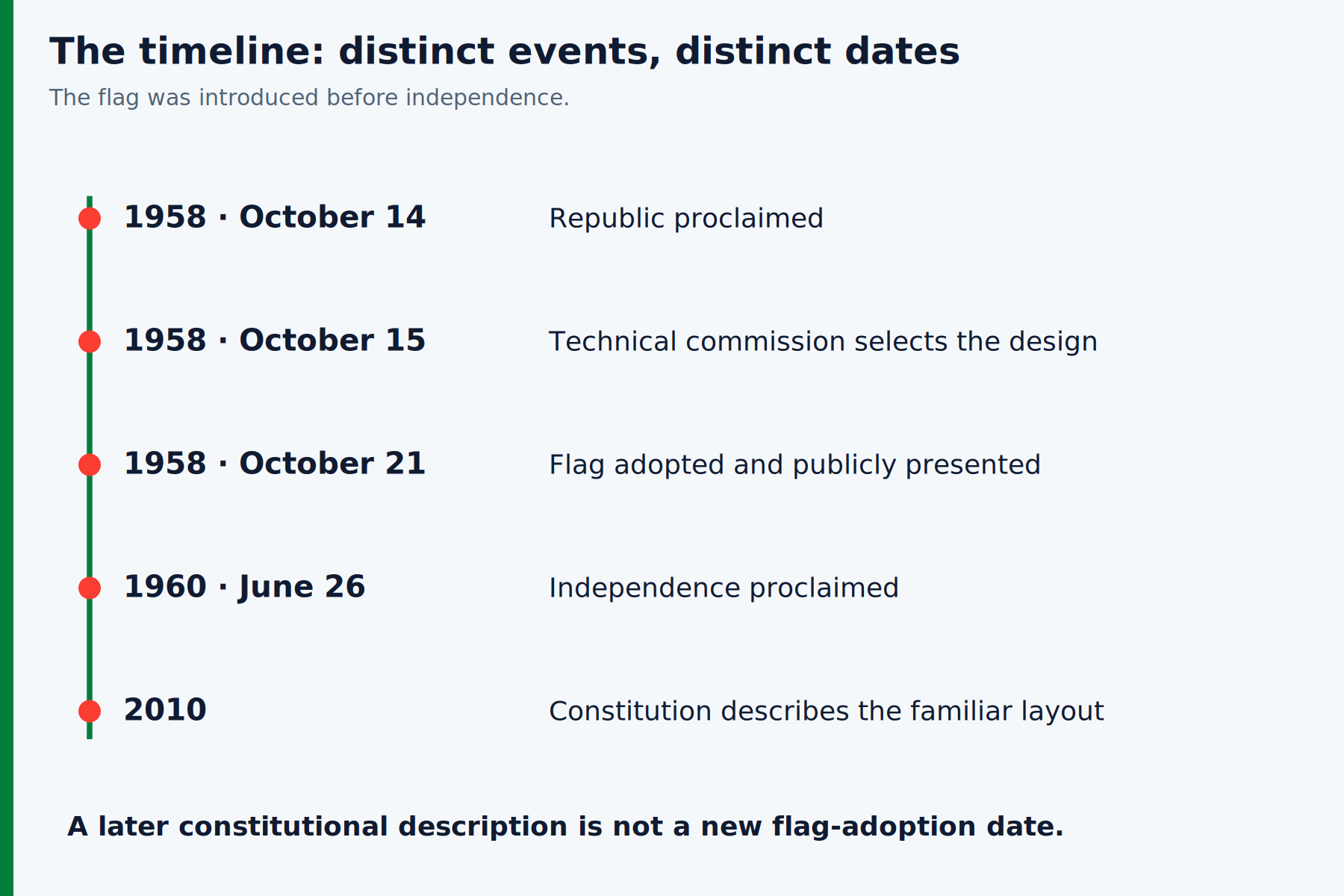
| Date | Distinct event |
|---|---|
| October 14, 1958 | Proclamation of the Malagasy Republic |
| October 15, 1958 | Technical commission selects the design |
| October 21, 1958 | Adoption and public presentation of the flag |
| June 26, 1960 | Independence proclaimed |
| 2010 | Article 4 of the Constitution describes the familiar arrangement |
A timeline must attach each date to its own event. A republic can exist within a wider political association before achieving independence. Similarly, a constitution can restate a flag already in use, so the date of that constitution is not automatically a new adoption date.
The gallery concentrates on the verified national design and its construction. A royal standard, colonial administrative flag, or presidential standard needs its own dated evidence and complete emblem artwork before it can be presented as an accurate historical reconstruction.
Who designed the Madagascar flag?
Andrianome Ranaivosoa is credited with designing the national flag. The museum historian’s account identifies him as an employee of the Malagasy geographical institute, and reporting on the 2025 independence celebrations repeats that attribution. His design was selected through a technical commission following a public appeal broadcast by Radio Tananarive.
At the opening of the 2025 celebrations, his descendants carried the national flag. That ceremony provides a recent, independently reported connection between the designer’s family and the national symbol. It does not make 2025 a design or adoption date.
Some retellings vary the spelling or order of the creator’s name and describe a different government service. This article follows the attribution in the museum interview and the later ceremony report. The distinction matters when crediting a named person rather than simply repeating an unsourced designer field.
Was the flag adopted on October 14 or October 21?
October 21, 1958 is the flag’s adoption and public-presentation date used here. October 14 marks the proclamation of the republic, while October 15 marks the selection commission’s meeting. Keeping those events separate resolves the common confusion between the birth of the republic and the introduction of its national flag.

The 2020 museum interview places the first public presentation on the Avenue de la Libération in Antananarivo. The contemporary report of a flag-reference exhibition also gives October 21. Summaries that attach October 14 to every national symbol compress several different events into one anniversary.
An educational caption should therefore say “adopted October 21, 1958,” while a caption about the republic’s proclamation should retain October 14. The timeline distinguishes the commission’s choice from the later public event; neither date should be silently changed to the independence date.
Why was the flag adopted before independence?
The Malagasy Republic was proclaimed in 1958, while independence was proclaimed on June 26, 1960. The flag belongs to the earlier stage of that transition. It therefore already existed when independence arrived. The two dates describe different political milestones and do not imply that the flag was first created in 1960.
A flag can express emerging national identity before the final transfer of sovereign powers. For Madagascar, the key educational sequence is republican institutions and flag selection in 1958, followed by independence in 1960. It is more precise than describing all three events simply as “independence.”
National Day on June 26 celebrates the independence milestone. An anniversary of flag adoption on October 21 has a different historical reference. Neither should be presented as proof of a separate nationwide statutory “Flag Day” without the instrument establishing such an observance.
Does the national flag include a coat of arms?
The national design described in Article 4 is the plain white, red, and green flag. It does not place a seal, map, zebu head, motto, or presidential initials on the field. State seals and other official insignia are distinct subjects, even when they appear beside the national flag on documents or buildings.
A seal printed on a government letterhead should not be transferred onto the downloadable national flag. The 2010 Constitution separately refers to state seals and republican arms, which reinforces the need to distinguish those symbols from the flag’s three plain rectangles.
Special or historical standards may bear additional devices, but a particular example needs a dated identification and reliable artwork. This package does not label a conjectural emblem-bearing drawing as a verified current presidential standard. For ordinary country identification, use the plain national design.
How is Madagascar’s flag different from Italy’s and Bulgaria’s?
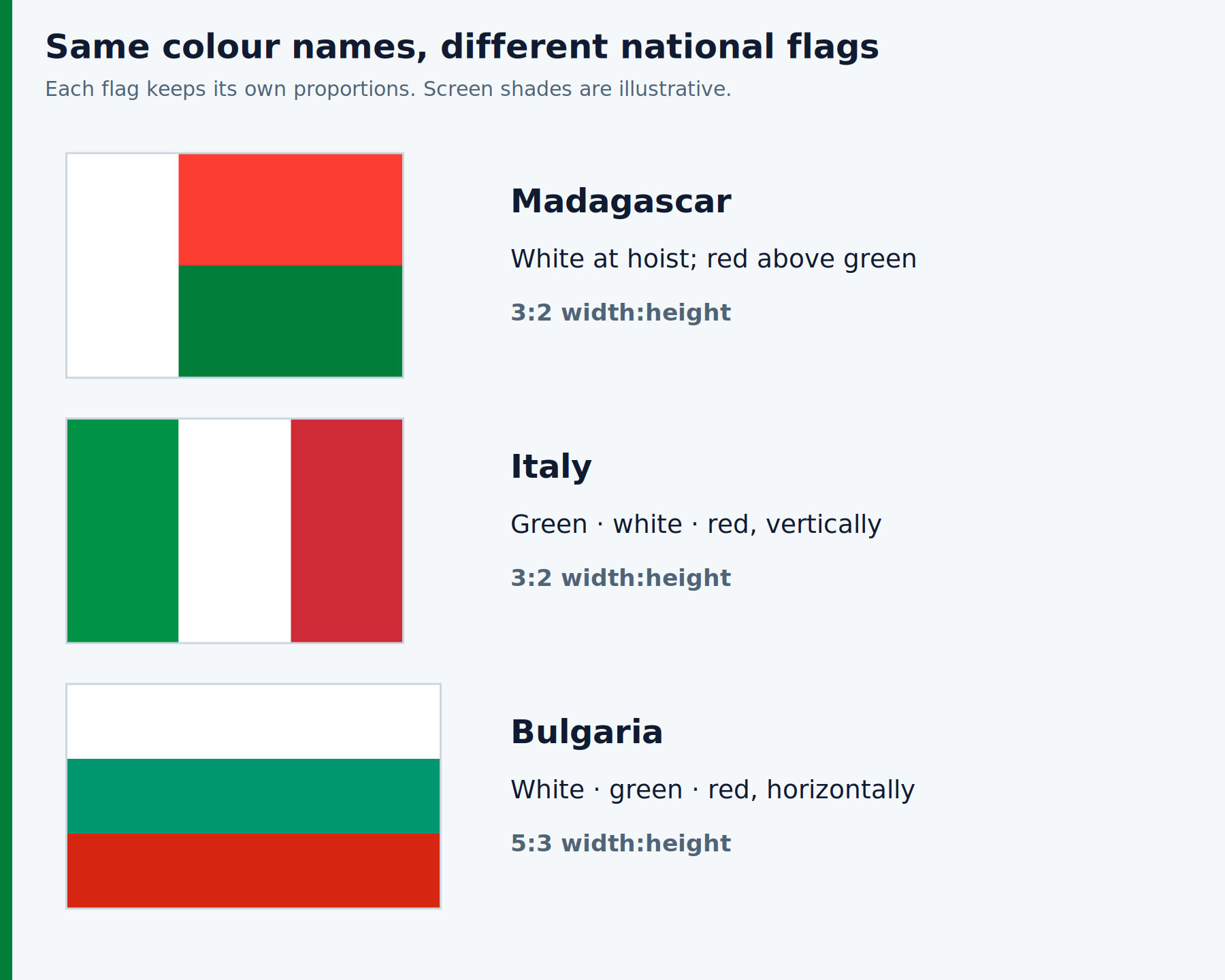
All three flags use white, red, and green, but arrange them differently. Madagascar combines a white hoist panel with red above green. Italy has three vertical bands, green first; Bulgaria has three horizontal bands, white above green above red. Colour order, orientation, and the shape of the whole rectangle identify the country.

| Country | Arrangement | Width:height shown |
|---|---|---|
| Madagascar | White hoist; red above green at the fly | 3:2 |
| Italy | Green, white, red from hoist to fly | 3:2 |
| Bulgaria | White, green, red from top to bottom | 5:3 |
The comparison preserves each country’s ordinary national proportions. Its screen palettes are illustrations, not a shared international colour specification. Turning the same three colours into equal stripes would lose Madagascar’s characteristic construction, even if the resulting image still looked like a familiar tricolor.
For quick recognition, locate the white area first. On Madagascar’s flag it reaches the full height beside the pole; on Italy’s flag it is the middle vertical stripe; on Bulgaria’s flag it is the top horizontal stripe. This positional test is more dependable than judging shades in a small photograph.
When is Madagascar’s National Day?
Madagascar celebrates National Day on June 26, marking independence in 1960. Flag displays and public ceremonies form part of the celebrations. October 21 instead recalls the flag’s 1958 adoption. This guide distinguishes the national holiday from that historical anniversary and does not describe them as the same occasion.
The 2025 celebrations began with an official flag-raising in Antananarivo and included a programme leading to the June 26 military parade. That is a dated example of how the flag participates in national celebration, rather than a promise that every year follows an identical timetable.
For an event poster, identify both the occasion and the year. For an educational display, the stable caption “June 26 — Independence Day” is clearer than copying an old programme’s venue or anniversary number. Local organisers’ current instructions govern the particular ceremony.
How is the flag used in public ceremonies?
The flag appears in government ceremonies, national celebrations, and school civic activities. Official reports document particular flag-raising events, while a constitutional-court decision discusses school anthem ceremonies. These sources establish specific contexts; they do not justify inventing one daily timetable, household duty, or universal set of display penalties for every situation.
The Foreign Ministry recorded a staff flag-raising ceremony on January 10, 2022. It is evidence of that event, not a nationwide rule requiring every household to raise a flag on the same date each year. Public display instructions should be read with their audience and occasion in mind.
In its August 2023 decision, the constitutional court distinguished singing the anthem during school flag-raising and civic education from compelling it in other circumstances. The court also rejected discriminatory expulsion in the case before it. A brief flag guide should not flatten that decision into an unlimited command applying to everyone.
As practical preparation, identify the attachment edge, check that the flag can move without snagging, and follow the event organiser’s order of display. These are general handling recommendations; any formal precedence or ceremonial instruction should come from the responsible authority.
When is the Madagascar flag flown at half-mast?
Half-mast display may be ordered for a declared period of national mourning. A documented example is January 28, 2015, when a presidential decree ordered the national flag lowered for victims of cyclone Chedza. That historical instruction applied to its specified day; it is not a permanent annual mourning calendar.
Article 2 of Decree 2015-033 states the mourning display for that day. It does not provide a measured fraction of mast height, a general black-ribbon substitute, or a recurring anniversary rule. Those details should not be invented from the expression en berne.
For a present ceremony, obtain the current instruction and check its start, end, territorial scope, and intended institutions. A dated news photograph or an old decree is useful historical evidence, but cannot establish that mourning remains in effect today.
What does the reverse side of the flag look like?
Viewed from the reverse, the white panel appears on the viewer’s right because the pole is now on that side. Red remains above green. The white panel is still at the flag’s own hoist. This change in apparent left and right is a normal consequence of looking through a two-sided flag.

“Hoist” identifies the attachment edge, not a permanently fixed side of a photograph. A person standing on the opposite side of a flying flag sees a mirror view. The diagram shows a pole in both views so that the relationship remains clear.
The front-facing reference used in charts puts the hoist on the left. A photograph with white on the right is not automatically an error: locate the pole before judging it. Red below green, however, is not produced by merely viewing the ordinary horizontal flag from the reverse.
How should a vertical display be interpreted?
A ninety-degree rotation changes the apparent positions of all three panels, so a vertical banner cannot be checked using screen-left alone. Preserve the complete rectangle and identify the original hoist. For formal vertical display, follow the responsible authority’s instructions; the rotation diagram here explains geometry and does not prescribe a Malagasy ceremonial rule.

Rotating the front-facing reference clockwise places its white hoist panel across the top, with green below on the viewer’s left and red below on the right. Rotating it anticlockwise produces a different arrangement. Neither operation should be confused with stretching a horizontal flag into a tall rectangle.
A photograph may also show the reverse of a rotated flag. This is why a reliable orientation explanation identifies the original hoist and the direction of rotation, rather than offering an unsupported statement that a particular colour must always be on one screen side.
How should the flag artwork be resized and cared for?
Resize the entire flag uniformly, keep all three panels visible, and preserve the white area as opaque white. Use SVG for scalable graphics and PNG when a raster image is required. For physical flags, follow the fabric maker’s cleaning and drying guidance; these practical recommendations are not presented as a statutory Malagasy care code.
Transparent white would let a coloured website background replace one-third of the flag. The supplied national SVG and PNG therefore retain an opaque white panel. Shadows, rounded cards, and decorative frames may belong around an illustration, but should not be saved into the plain reference flag itself.
A width-only resize must calculate the matching height. At 360 pixels wide, the flag should be 240 pixels high. If an image slot has a different shape, fit the whole flag within the slot and leave surrounding space rather than cropping or stretching it.
For accessible web use, a useful description is “Madagascar flag: white at the hoist, red above green at the fly.” If the same flag is immediately repeated for decoration, an empty alternative text can prevent redundant screen-reader announcements. File dimensions and the correct country name remain useful even when an emoji is available.
What is the Madagascar flag emoji?
The Madagascar flag emoji is 🇲🇬. Its Unicode sequence is U+1F1F2 followed by U+1F1EC, the regional indicators corresponding to M and G. Supporting devices combine them into a flag glyph. Other systems may show letters or a different rendering, so an emoji is not an exact technical drawing of the national flag.
| Item | Value |
|---|---|
| Country indicator | MG |
| First code point | U+1F1F2 — regional indicator M |
| Second code point | U+1F1EC — regional indicator G |
| Rendered sequence | 🇲🇬 |
A platform may draw a waving flag, add shading, or omit flag glyphs altogether. For a reference article, printed worksheet, or colour comparison, use a labelled image file with explicit dimensions. Do not rely on a platform’s tiny emoji to establish panel ratios or production colours.
What mistakes are common in drawings of the flag?
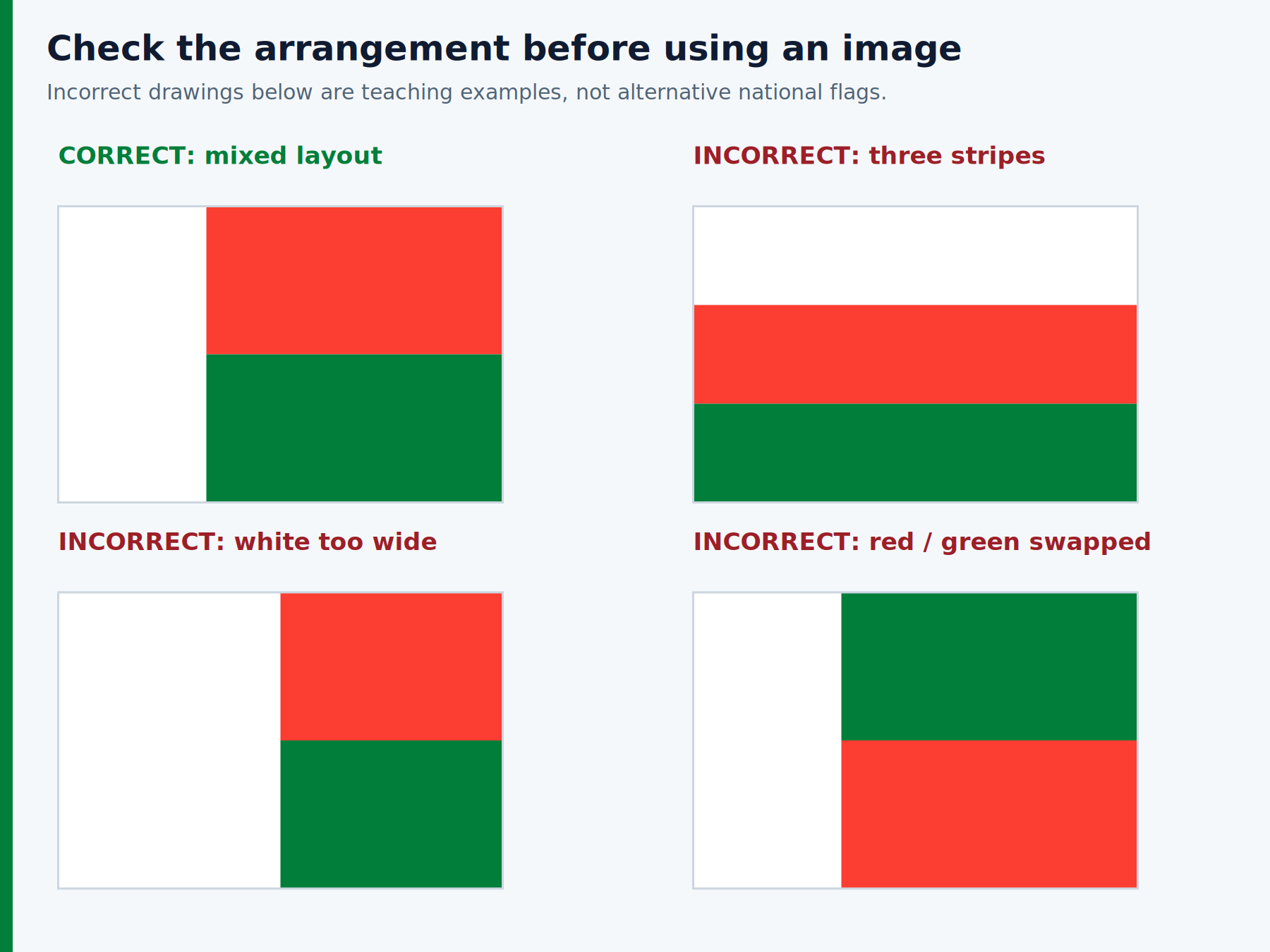
Common mistakes include replacing the mixed layout with three equal stripes, making the white panel half the width, reversing red and green, or adding a central emblem. Another error is stretching the flag into a square. Check the three-by-two outline, the one-third-width white panel, and the red-above-green arrangement together.

The error diagram is deliberately labelled. Its incorrect examples are teaching aids, not alternative national flags. For an actual download or classroom display, select the plain national reference and retain its complete rectangle.
- Check the outer shape before judging colours.
- Find the hoist and keep the white panel against it.
- Make white one-third of the width, not one-half.
- Keep red above green in the ordinary horizontal view.
- Keep all three colour areas equal.
- Use the plain national field without added seals or slogans.
Historical mistakes matter too: October 14, October 15, October 21, and June 26 identify different events. An accurate drawing can still carry an inaccurate caption, so the date and description deserve the same care as the geometry.
What do the main flag terms mean?
The hoist is the edge attached to the pole, while the fly is the free end extending away from it. The field is the flag’s visible surface, and a tricolor uses three colours. For Madagascar, these terms explain why white remains at the hoist even when a reverse view changes its apparent side.
| Term | Meaning in this guide |
|---|---|
| Hoist | The attachment edge; white runs along it |
| Fly | The free end; red and green meet it |
| Field | The complete visible flag surface |
| Obverse / front | The conventional reference view with hoist at left |
| Reverse | The view from the opposite side |
| Width:height | Horizontal length first, vertical height second |
| Congruent | Same shape and dimensions, allowing rotation |
| Tricolor | A design using three colours; not necessarily parallel stripes |
The term “band” does not require all three pieces to run in the same direction. Madagascar’s distinctive combination is a useful reminder that a flag’s construction depends on both colour and arrangement. The gallery provides the plain reference alongside the explanatory views.
Explore more in World Flags: Iceland flag, Lithuania flag, Luxembourg flag.
Download Madagascar flag pictures
Download the national flag as SVG or large PNG. The gallery includes 13 distinct subjects with captions and alternative text. Keep the full proportions when resizing. Image credits and reuse notes accompany the graphics.
World Flags/Madagascar
Madagascar flag pictures
The plain 3:2 national flag: white at the hoist, red above green at the fly. Each colour occupies one-third of the field. Screen shades are illustrative.
GKBookDownload SVGDownload PNGThe white rectangle touches the pole. Red and green divide the fly into two equal horizontal panels. Labels and frame are explanatory.
GKBookDownload SVGDownload PNGThe white rectangle measures 1 × 2 units and each coloured rectangle 2 × 1. Grid lines do not belong on the actual flag.
GKBookDownload SVGDownload PNGEach colour covers two of the six unit squares. The white panel is a rotated equivalent of either horizontal panel.
GKBookDownload SVGDownload PNGEach example preserves 3:2 width:height and equal colour areas. The red and green panels have identical dimensions.
GKBookDownload SVGDownload PNGSADC p.64 gives red 186C and green 348C. The separate HEX/RGB table labels this package’s illustrations only, without claiming certified conversion or national legal status.
GKBookDownload SVGDownload PNGThe SADC manual records purity for white, sovereignty for red, and hope for green. Historical interpretations are not a fixed statutory colour-meaning table.
GKBookDownload SVGDownload PNGThe timeline distinguishes the republic, selection, public adoption, independence, and later constitutional description.
GKBookDownload SVGDownload PNGUse October 21 for flag adoption; October 14 for the republic’s proclamation; October 15 for the commission’s selection.
GKBookDownload SVGDownload PNGMadagascar combines vertical and horizontal panels; Italy uses vertical stripes; Bulgaria uses horizontal stripes. Each national ratio is preserved.
GKBookDownload SVGDownload PNGApparent left and right change when the viewer changes sides. White remains at the hoist, and red remains above green. This is not a vertical-hanging rule.
GKBookDownload SVGDownload PNGA clockwise quarter-turn of the front reference places white across the top and green to the left of red below. This diagram is geometric explanation, not official Malagasy protocol.
GKBookDownload SVGDownload PNGOnly the upper-left example is the national design. The other panels deliberately demonstrate common layout errors.
GKBookDownload SVGDownload PNGFrequently asked questions
What does the Madagascar flag look like?
The Madagascar flag has a full-height white band beside the pole and two horizontal bands on the other side: red above green. It has no central emblem, lettering, star, crescent, or border. In the usual front-facing drawing, white is on the left and the coloured pair is on the right.
What are the correct flag proportions?
The standard Madagascar flag is 3:2 when width is written before height, or 2:3 when height comes first. The SADC construction drawing shows a field 1,800 millimetres long and 1,200 millimetres high. The white panel occupies one-third of the width, while red and green each occupy half the height.
How do you draw Madagascar’s flag accurately?
Start with a rectangle three units wide and two units high. Mark a vertical division one unit from the hoist. Leave that full-height panel white. Divide the remaining two-unit-wide area horizontally at its midpoint, filling the upper rectangle red and the lower rectangle green, without gaps or outlines between them.
Do the three colours occupy equal areas?
Yes. Each colour covers one-third of Madagascar’s flag. The white rectangle is one unit wide and two units high; each coloured rectangle is two units wide and one unit high. They are congruent rectangles turned through ninety degrees, so their equal areas follow directly from the three-by-two construction.
Which flag sizes preserve the design?
Any finished size can preserve the design if its width is one and a half times its height and the panels retain their proper divisions. The examples below are calculated dimensions, not a mandatory national size list. Measurements refer to the visible flag field, excluding sleeves, hems, cords, and other fittings.
What colour references should be used?
Article 4 names white, red, and green without numerical colour codes. The SADC identity manual labels its Madagascar illustration with Pantone 186C red and 348C green. Those are documented regional production references. The HEX and RGB values in this package identify its screen artwork and are not presented as binding Malagasy specifications.
What do white, red, and green symbolize?
A traditional explanation associates white with purity, red with sovereignty, and green with hope. The SADC manual records these meanings. Historical discussion also connects the colours with older symbols and later interpretations. Symbolism should therefore be identified by its source and period, rather than treated as a single unchanging legal definition.
How did the modern flag develop?
The modern design emerged during Madagascar’s transition from French colonial rule to republican self-government in 1958. It was selected before full independence in 1960. Earlier royal and colonial flags belong to different political settings; their histories help explain the setting without making them interchangeable versions of today’s national emblem.
Who designed the Madagascar flag?
Andrianome Ranaivosoa is credited with designing the national flag. The museum historian’s account identifies him as an employee of the Malagasy geographical institute, and reporting on the 2025 independence celebrations repeats that attribution. His design was selected through a technical commission following a public appeal broadcast by Radio Tananarive.
Was the flag adopted on October 14 or October 21?
October 21, 1958 is the flag’s adoption and public-presentation date used here. October 14 marks the proclamation of the republic, while October 15 marks the selection commission’s meeting. Keeping those events separate resolves the common confusion between the birth of the republic and the introduction of its national flag.
Why was the flag adopted before independence?
The Malagasy Republic was proclaimed in 1958, while independence was proclaimed on June 26, 1960. The flag belongs to the earlier stage of that transition. It therefore already existed when independence arrived. The two dates describe different political milestones and do not imply that the flag was first created in 1960.
Does the national flag include a coat of arms?
The national design described in Article 4 is the plain white, red, and green flag. It does not place a seal, map, zebu head, motto, or presidential initials on the field. State seals and other official insignia are distinct subjects, even when they appear beside the national flag on documents or buildings.
How is Madagascar’s flag different from Italy’s and Bulgaria’s?
All three flags use white, red, and green, but arrange them differently. Madagascar combines a white hoist panel with red above green. Italy has three vertical bands, green first; Bulgaria has three horizontal bands, white above green above red. Colour order, orientation, and the shape of the whole rectangle identify the country.
When is Madagascar’s National Day?
Madagascar celebrates National Day on June 26, marking independence in 1960. Flag displays and public ceremonies form part of the celebrations. October 21 instead recalls the flag’s 1958 adoption. This guide distinguishes the national holiday from that historical anniversary and does not describe them as the same occasion.
How is the flag used in public ceremonies?
The flag appears in government ceremonies, national celebrations, and school civic activities. Official reports document particular flag-raising events, while a constitutional-court decision discusses school anthem ceremonies. These sources establish specific contexts; they do not justify inventing one daily timetable, household duty, or universal set of display penalties for every situation.
When is the Madagascar flag flown at half-mast?
Half-mast display may be ordered for a declared period of national mourning. A documented example is January 28, 2015, when a presidential decree ordered the national flag lowered for victims of cyclone Chedza. That historical instruction applied to its specified day; it is not a permanent annual mourning calendar.
What does the reverse side of the flag look like?
Viewed from the reverse, the white panel appears on the viewer’s right because the pole is now on that side. Red remains above green. The white panel is still at the flag’s own hoist. This change in apparent left and right is a normal consequence of looking through a two-sided flag.
How should a vertical display be interpreted?
A ninety-degree rotation changes the apparent positions of all three panels, so a vertical banner cannot be checked using screen-left alone. Preserve the complete rectangle and identify the original hoist. For formal vertical display, follow the responsible authority’s instructions; the rotation diagram here explains geometry and does not prescribe a Malagasy ceremonial rule.
How should the flag artwork be resized and cared for?
Resize the entire flag uniformly, keep all three panels visible, and preserve the white area as opaque white. Use SVG for scalable graphics and PNG when a raster image is required. For physical flags, follow the fabric maker’s cleaning and drying guidance; these practical recommendations are not presented as a statutory Malagasy care code.
What is the Madagascar flag emoji?
The Madagascar flag emoji is 🇲🇬. Its Unicode sequence is U+1F1F2 followed by U+1F1EC, the regional indicators corresponding to M and G. Supporting devices combine them into a flag glyph. Other systems may show letters or a different rendering, so an emoji is not an exact technical drawing of the national flag.
What mistakes are common in drawings of the flag?
Common mistakes include replacing the mixed layout with three equal stripes, making the white panel half the width, reversing red and green, or adding a central emblem. Another error is stretching the flag into a square. Check the three-by-two outline, the one-third-width white panel, and the red-above-green arrangement together.
What do the main flag terms mean?
The hoist is the edge attached to the pole, while the fly is the free end extending away from it. The field is the flag’s visible surface, and a tricolor uses three colours. For Madagascar, these terms explain why white remains at the hoist even when a reverse view changes its apparent side.
Explore all general-knowledge topics and the A-to-Z lists.







We Value Your Opinion Comments