
Micronesia flag picture
Explore the construction drawing, history, and complete picture gallery.
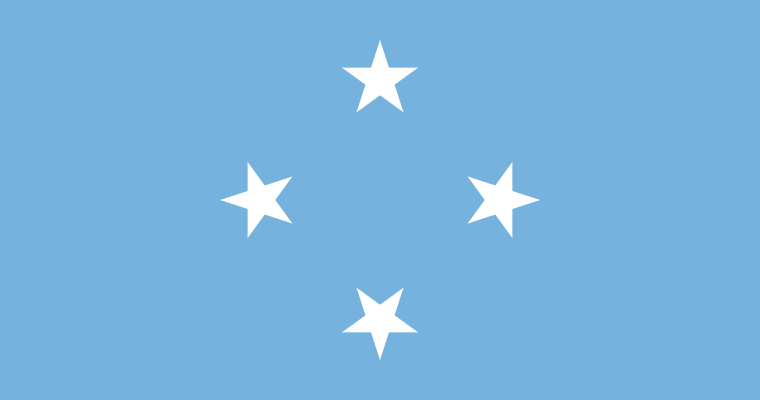
| Design | Four white stars on blueOne point of each star faces outward in the reference. |
|---|---|
| Proportions | 19:10 width:heightEquivalent to 10:19 height:length. |
| Adoption | November 30, 1978Four-star design adopted by the Interim Congress. |
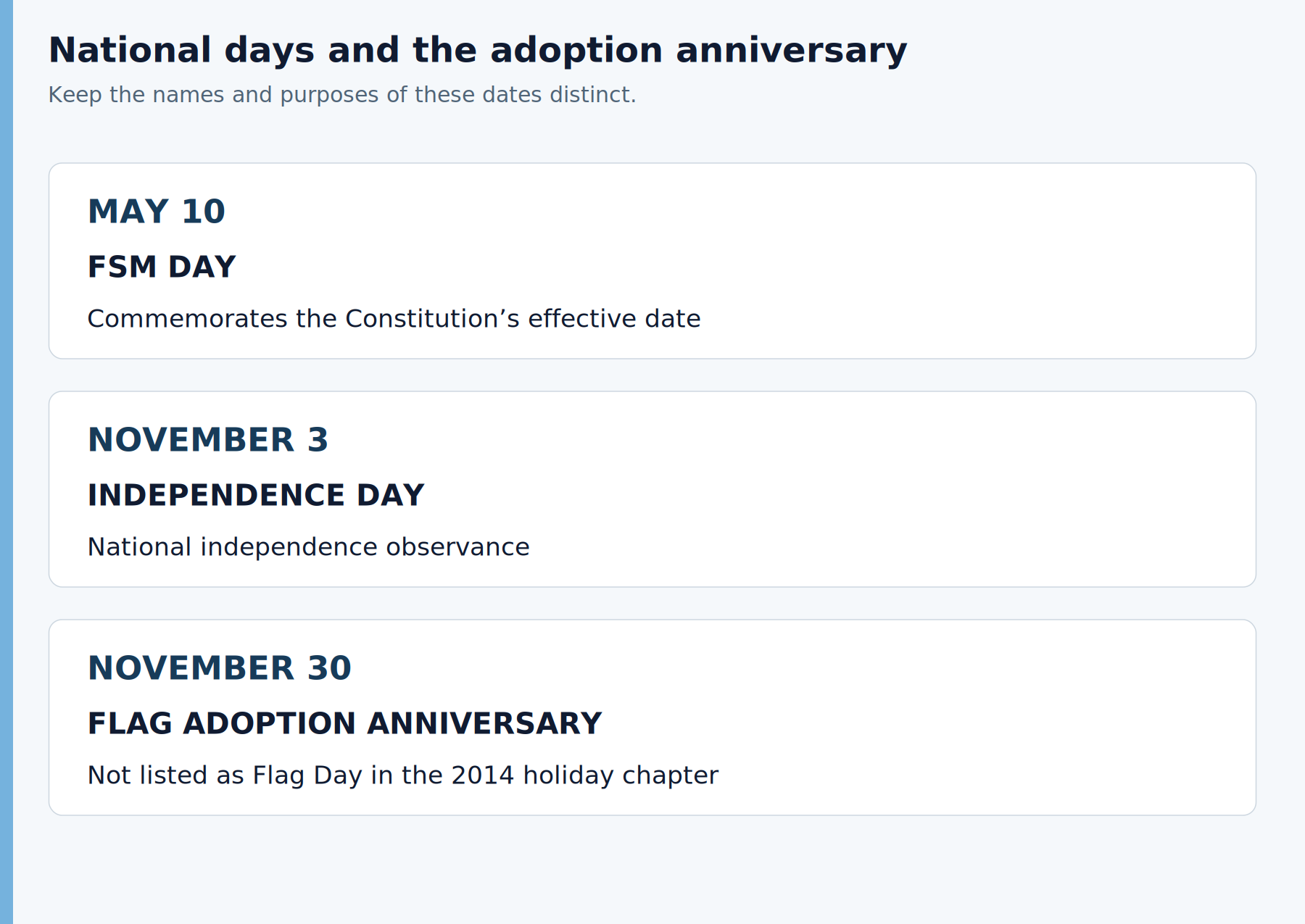
| National days | May 10 · November 3FSM Day and Independence Day respectively. |
| Legal source | Title 1, Chapter 52014 Code edition; design, display and protection. |
The four stars represent Chuuk, Kosrae, Pohnpei, and Yap. This is the flag of the FSM, not a flag for the entire Micronesia region.
What is the national flag of Micronesia?
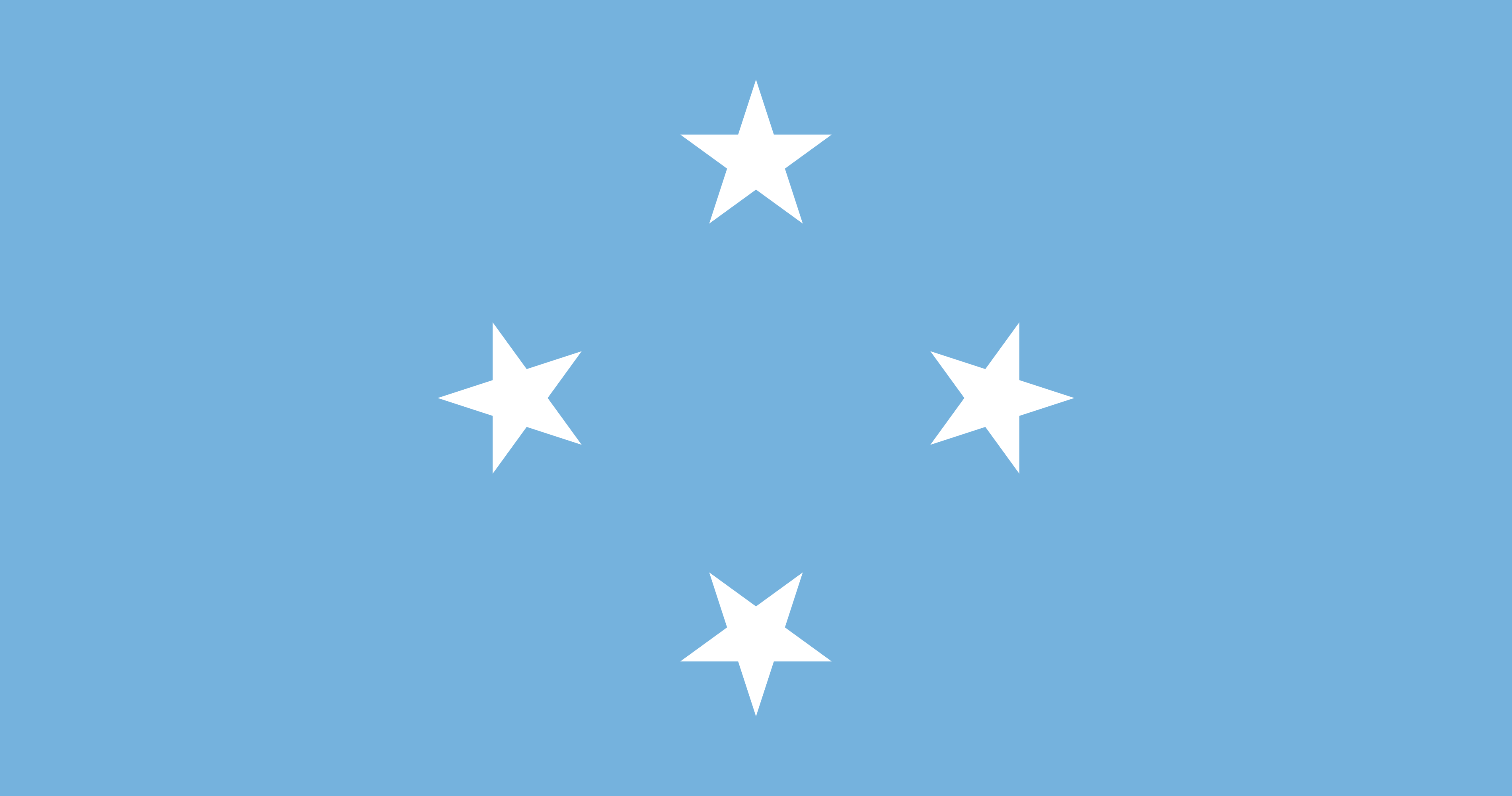
The flag of the Federated States of Micronesia has four white, five-pointed stars on a blue field. The stars represent Chuuk, Kosrae, Pohnpei, and Yap, while blue evokes the Pacific Ocean. Its official proportions are 19:10 from width to height, and the four-star design was adopted in 1978.
Here, Micronesia means the Federated States of Micronesia, usually abbreviated FSM. The national flag belongs to that sovereign country, rather than to the entire geographic region called Micronesia. Reading its four stars alongside its constitutional history helps explain both the unity of the federation and the distinct identities of its states.
What does the Micronesia flag look like?
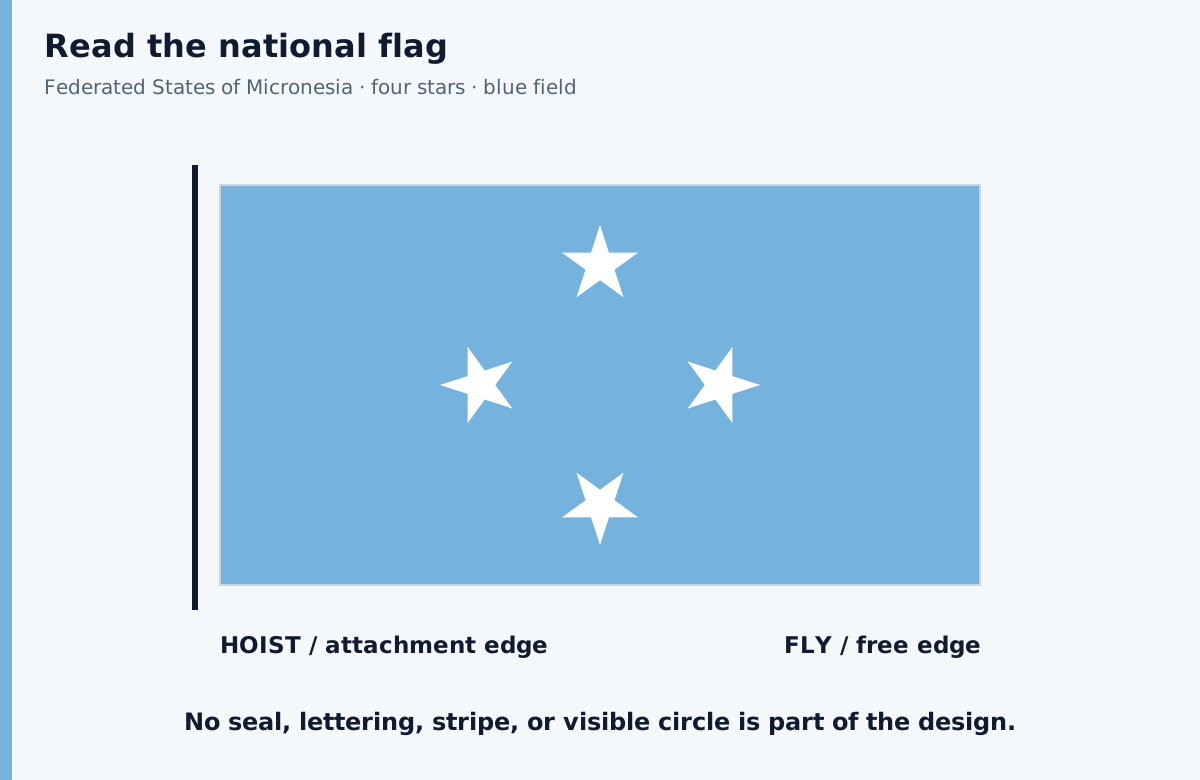
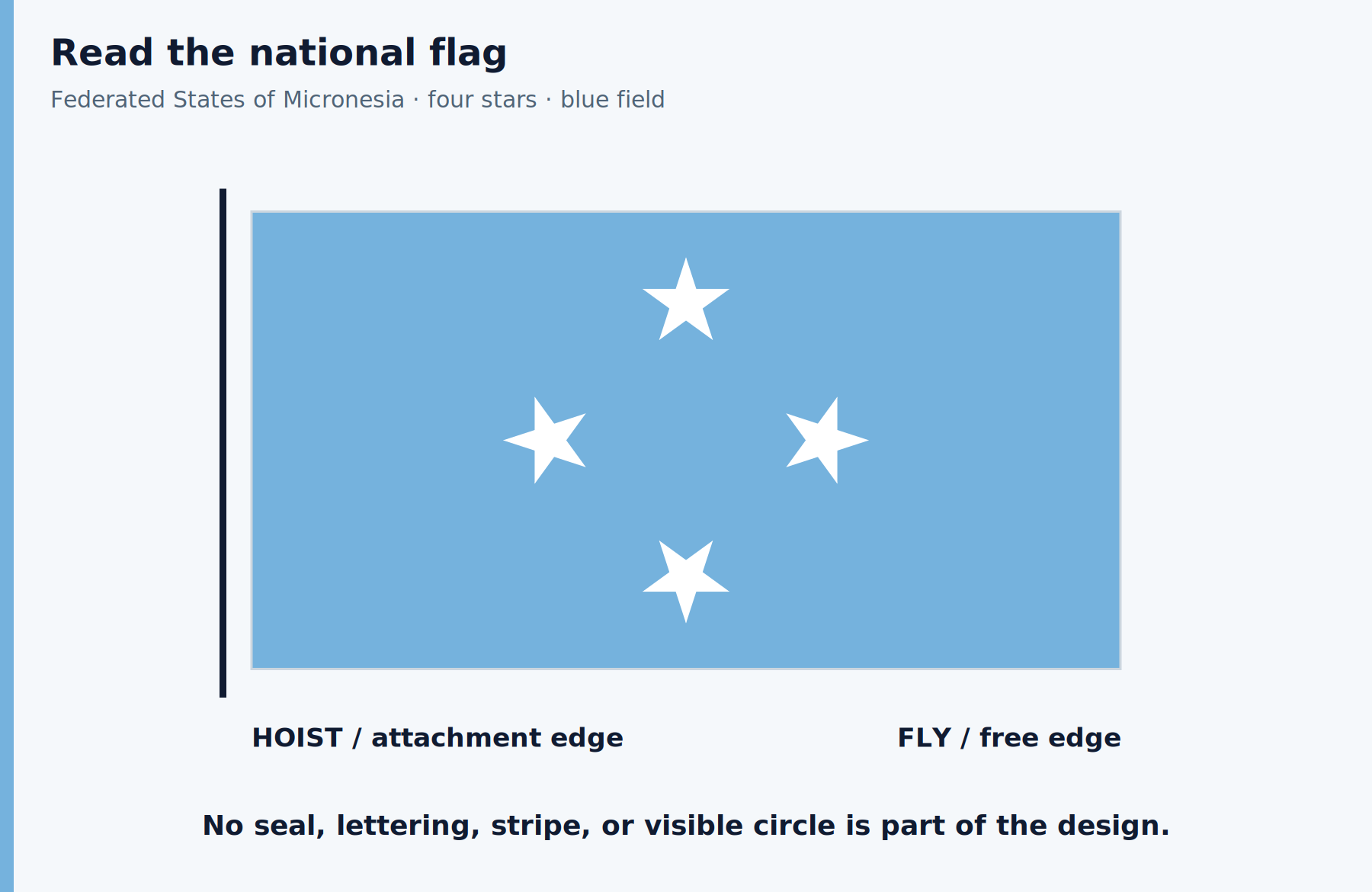
Micronesia’s national flag has a plain blue background and four white stars arranged around its center. Each star has five points, with one point directed outward from the group. The spaces between the stars remain blue; there is no central seal, coat of arms, lettering, stripe, or circular border.
The legal description calls the arrangement a circle of four stars. In the familiar drawing, their centers occupy the top, right, bottom, and left positions, so the group also reads visually as a diamond. These descriptions refer to the same arrangement.
Does this flag represent the whole Micronesia region?
This flag represents the Federated States of Micronesia, an independent country made up of four states. Micronesia is also the name of a wider Pacific region, so the short name can cause confusion. The FSM flag is not a collective national flag for every country and territory in that region.
Use “Federated States of Micronesia” on first mention when the context could be ambiguous. The Marshall Islands and Palau, for example, have their own national identities and flags; they are not additional states represented by the FSM’s four stars.
What is the ratio of Micronesia’s flag?
The official flag is 19 units wide for every 10 units high. Section 501 expresses this as a width-to-length ratio of 1:1.9, using width for the short dimension. In ordinary image dimensions, the same shape is 19:10 width:height, or 10:19 when height is written first.
| Convention | Ratio | Example |
|---|---|---|
| Image width:height | 19:10 | 190 × 100 cm |
| Hoist height:fly length | 10:19 | 100 cm high, 190 cm long |
| Law’s width:length | 1:1.9 | The short dimension precedes the long dimension |
A 3:2 crop or a square icon changes the official rectangle. The law allows different dimensions for unofficial reproductions, but the national download here retains the official overall ratio.
How is the reference flag drawing constructed?
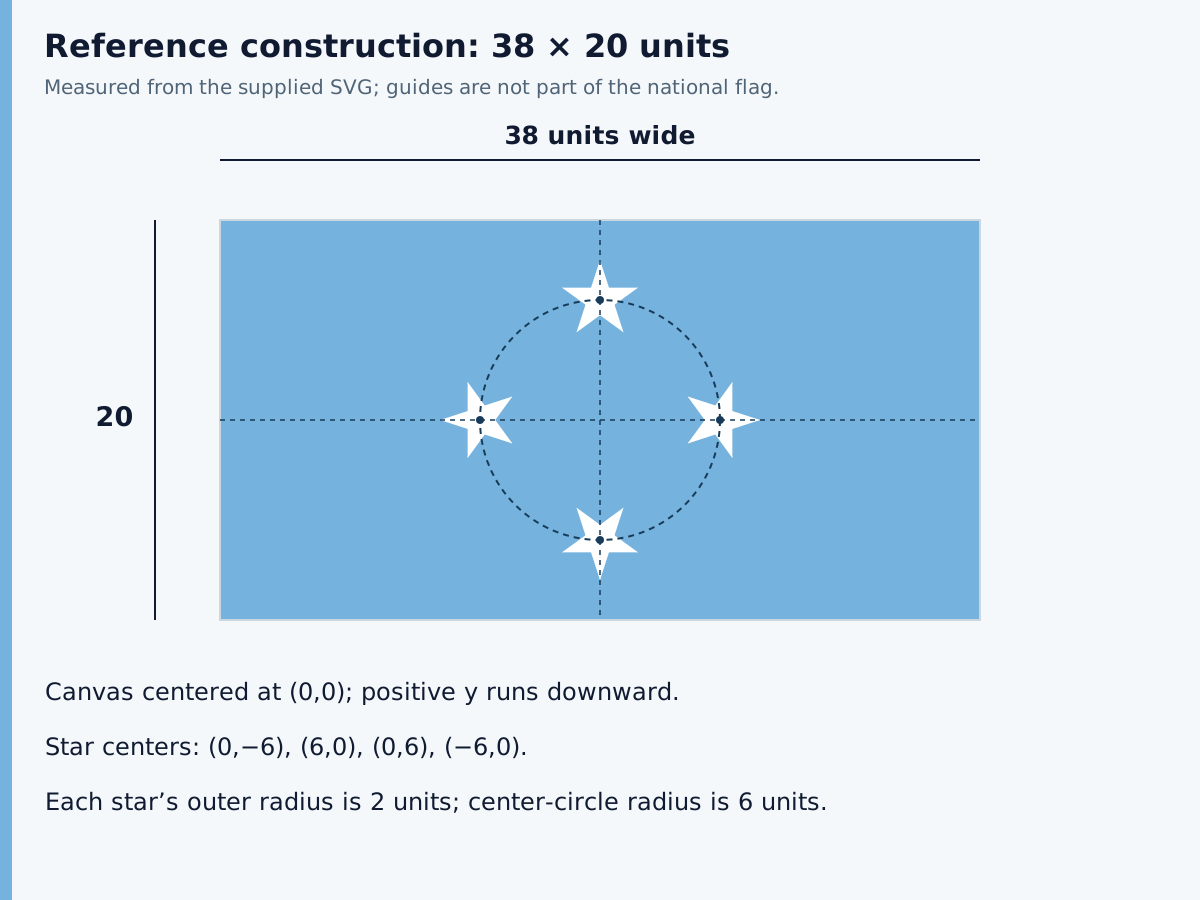
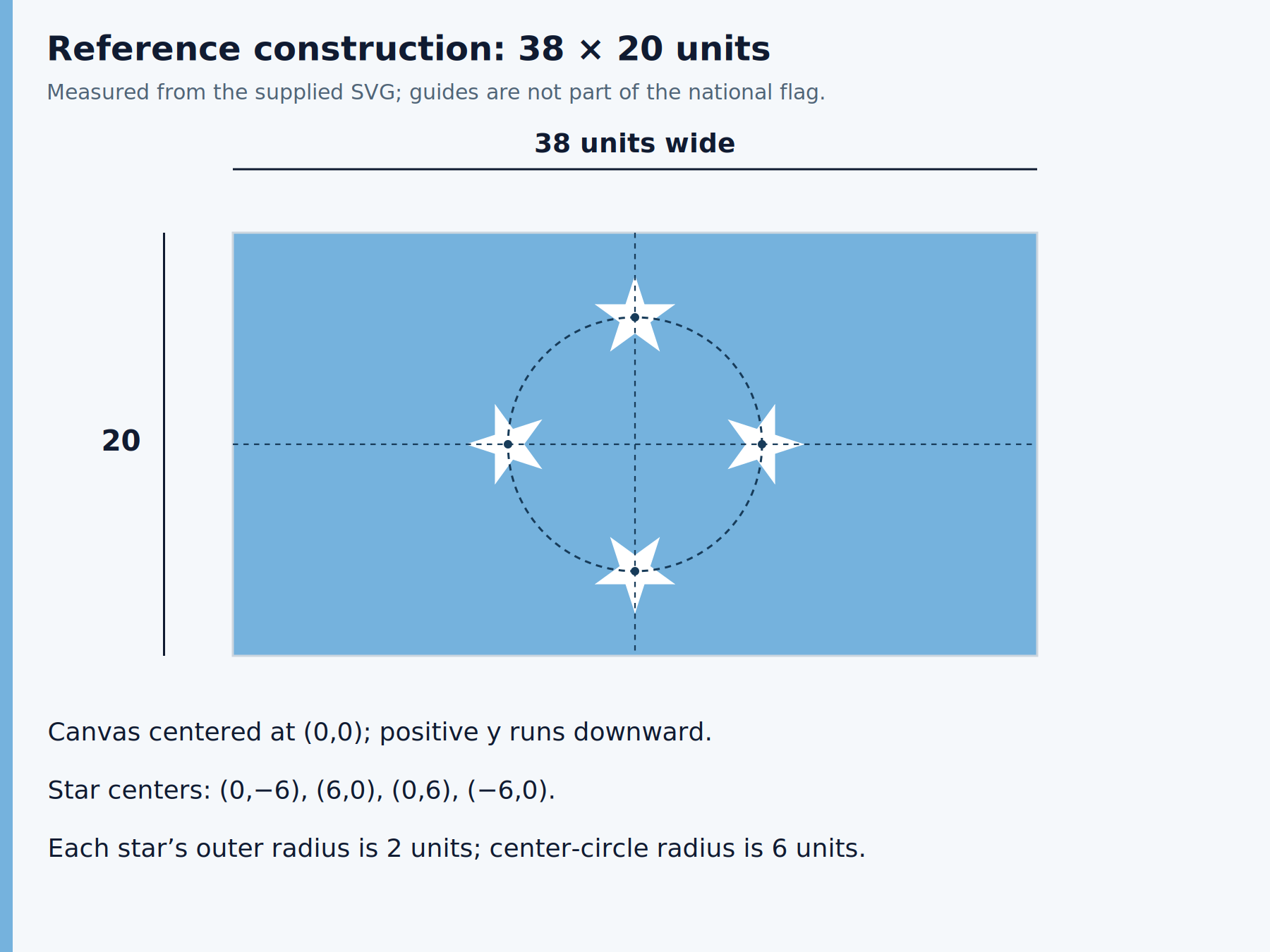
The reference SVG uses a rectangle 38 units wide and 20 units high, centered on the origin. Its four star centers are six units above, right, below, and left of the origin. Each star has an outer radius of two units. These measurements describe this reference vector, not a certified manufacturing standard.
| Reference feature | Coordinate or size |
|---|---|
| Canvas | x = −19 to 19; y = −10 to 10 |
| Star centers | (0,−6), (6,0), (0,6), (−6,0) |
| Outer radius of each star | 2 units |
| Circle through the star centers | 6-unit radius; the circle is a guide only |
In this coordinate system, positive y points downward. The guide lines in Figure 3 explain placement and are not part of the national flag. Preserve the source stars and rotate the complete shapes rather than drawing four unrelated icons.
How large are the four stars?
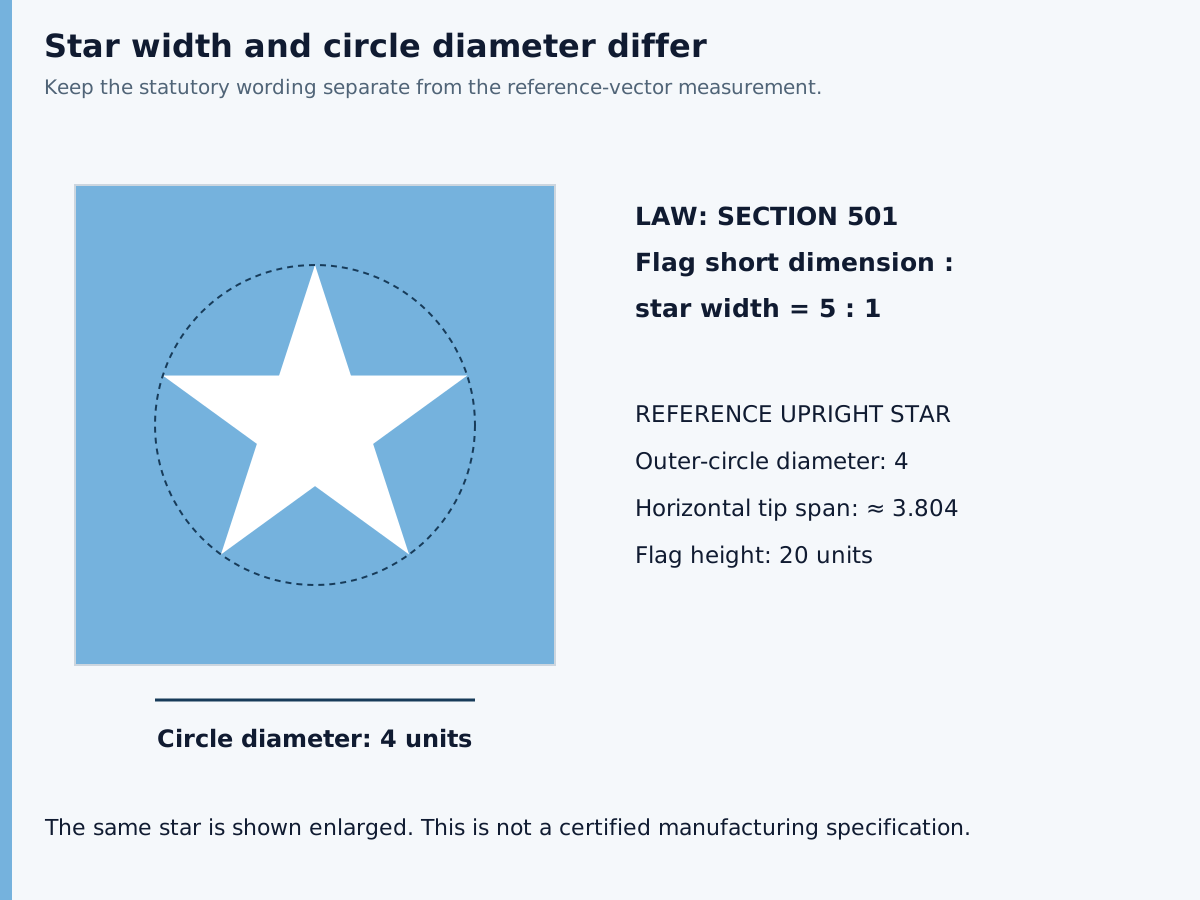
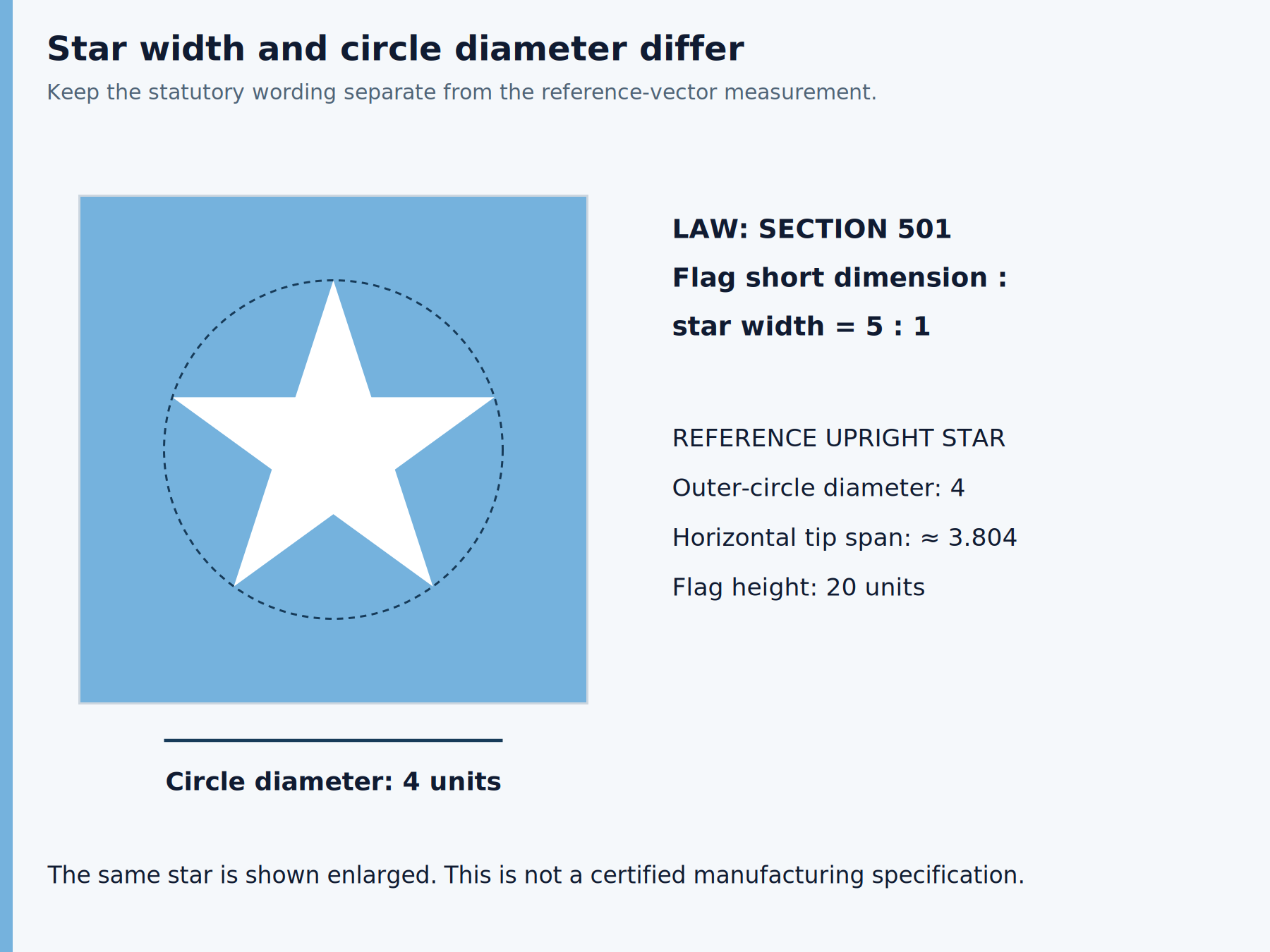
Section 501 gives a five-to-one relationship between the flag’s short dimension and the width of a star. The reference SVG uses a star’s surrounding-circle diameter equal to one-fifth of flag height. A circle diameter and a star’s actual bounding width are different measurements, so they should not be silently treated as identical.
For the upright star in the 38×20 reference, the surrounding circle has diameter 4, but the outer-tip horizontal span is about 3.804 units. The source remains intact in these files. The illustration identifies that distinction instead of modifying the artwork and claiming a legally authenticated construction.
Which way should the stars point?
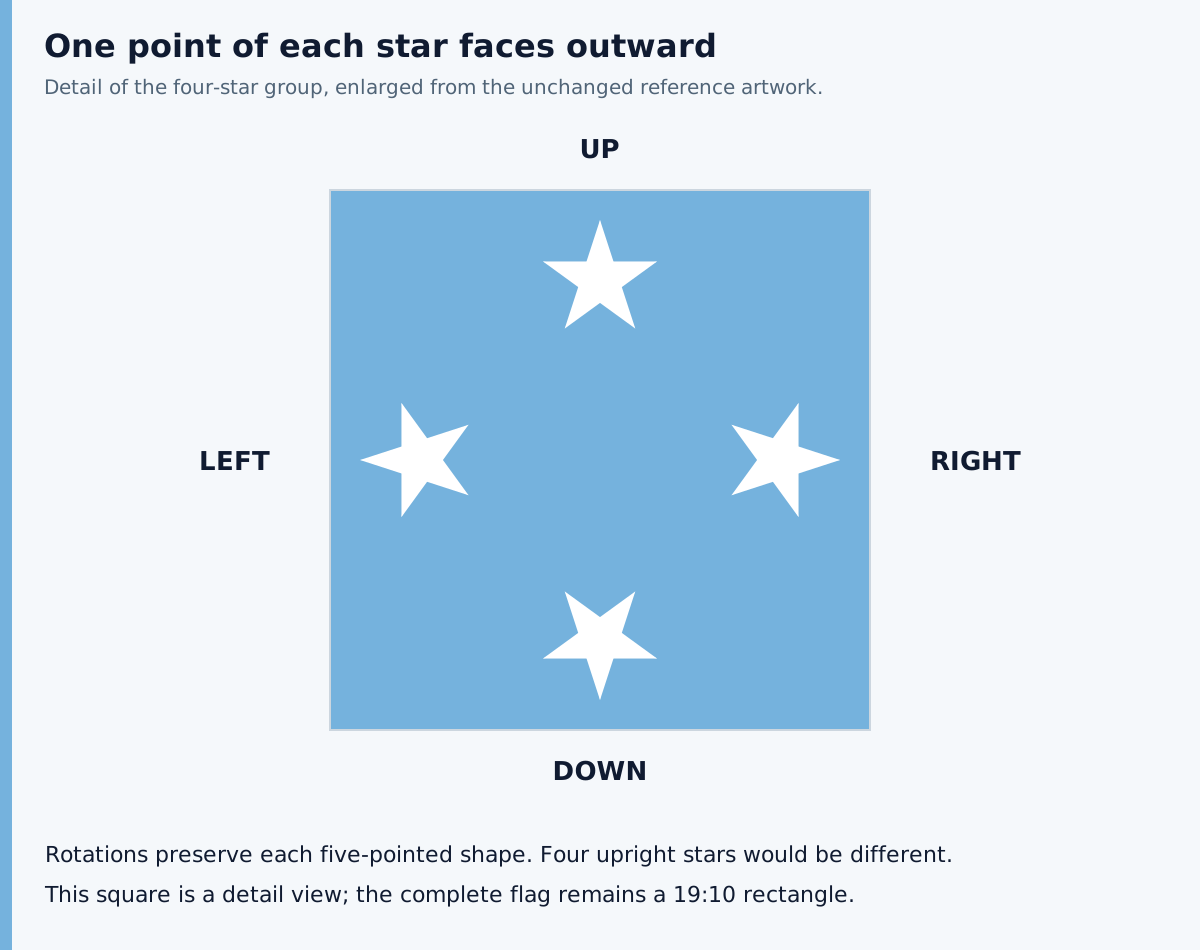
In the reference design, one point of each star faces away from the center of the four-star group. The upper star points up, the right star points right, the lower star points down, and the left star points left. Making all four stars upright changes this familiar arrangement.
Rotate each complete star around its own center while maintaining its position in the group. A five-pointed star does not have a point directly opposite every point, so inward-facing and outward-facing versions are visibly different. Figure 5 isolates the orientations without changing the source shapes.
Do the stars mark exact geographic positions?
The four stars identify the four federated states collectively; the design is not a geographic map of their locations. Its upper, right, lower, and left positions organize the symbol symmetrically. The legal description and reference drawing do not assign a named state to each specific position in the star group.
A classroom diagram can list the four state names next to the flag without labeling the top star as a particular state. Avoid turning the diamond into a compass map or implying that its spacing measures actual distances across the Pacific.
What are Micronesia’s flag color codes?
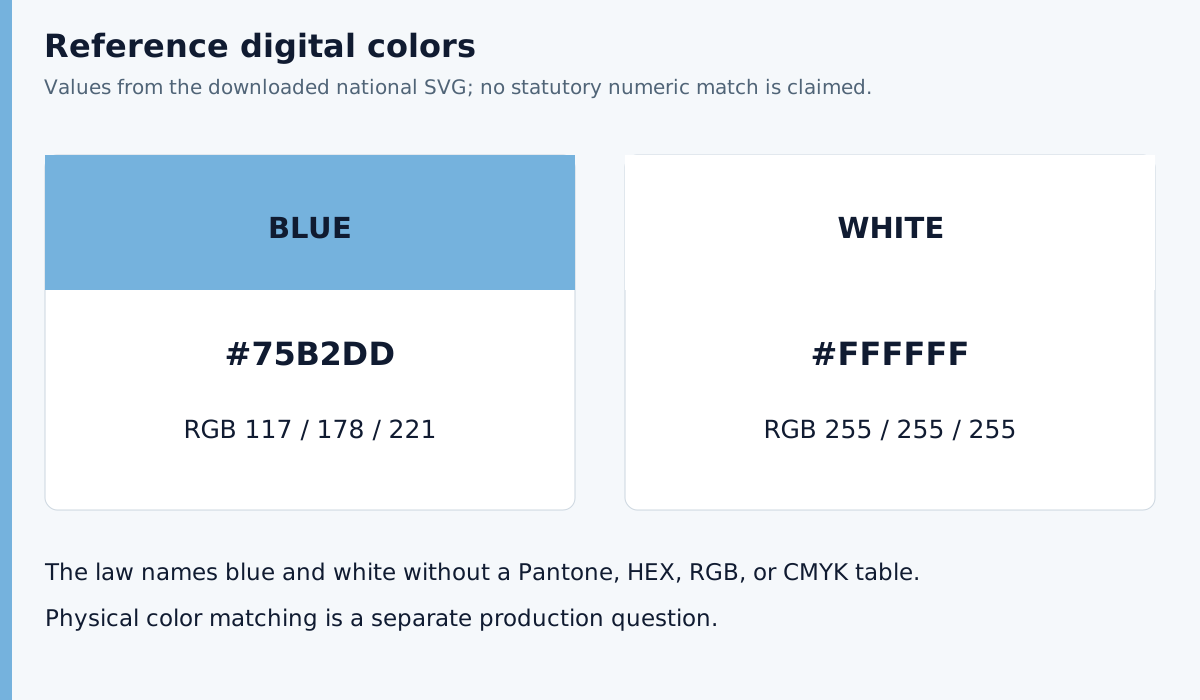
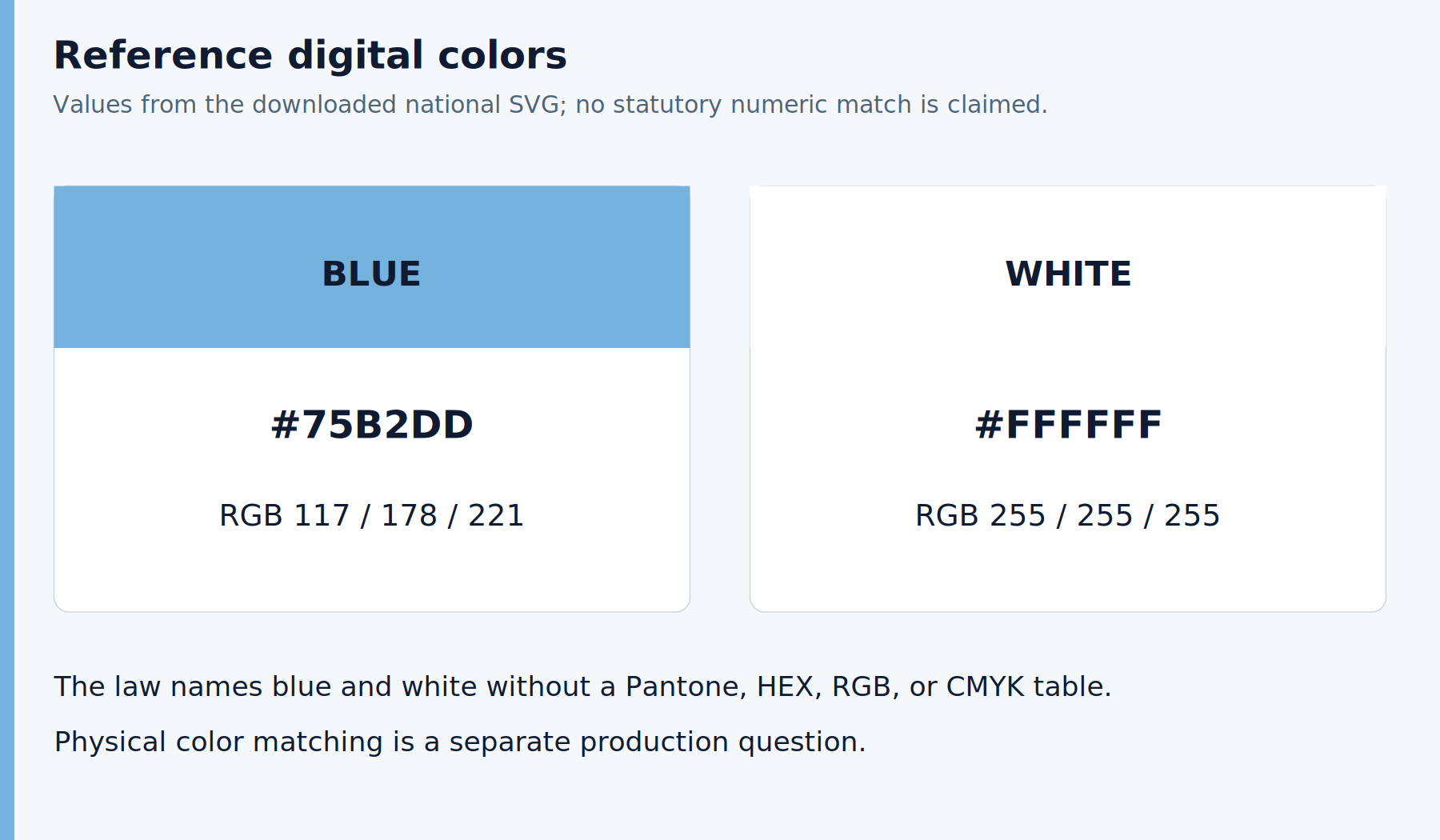
The national flag files supplied here use blue #75B2DD and white #FFFFFF. Their RGB values are 117, 178, 221 and 255, 255, 255 respectively. These numbers reproduce the credited SVG’s actual fills. They are reference digital colors, not HEX or RGB values specified in the flag law.
| Element | Reference HEX | RGB |
|---|---|---|
| Blue field | #75B2DD | 117, 178, 221 |
| White stars | #FFFFFF | 255, 255, 255 |
Antialiased edge pixels may contain blended shades when the vector is rendered to PNG. Those edge colors smooth the stars; they do not introduce additional heraldic elements or change the two principal colors.
Is an official Pantone or CMYK match specified?
The flag chapter consulted names blue and white but provides no numeric Pantone, CMYK, RGB, or HEX table. A web color chart therefore needs its own supporting authority before being called an official production standard. For this package, the blue is explicitly tied to the downloaded vector rather than an unverified color conversion.
Different online drawings and physical flags show different blues. This article does not claim that a particular Pantone number is mandatory or that a dated change of shade has been established by a verified legal instrument. Screens, inks, and fabrics also reproduce color differently.
What do the blue field and white stars mean?
Blue represents the Pacific Ocean, and the four white stars represent the federation’s four states. Together, the sea-colored field and repeated stars make the country’s island setting and federal structure easy to recognize. This established explanation should be distinguished from a claim that the flag law assigns a separate meaning to every visual detail.
The symbol connects a shared national identity with distinct constituent states. The number of stars refers to states, not a count of islands, languages, or individual communities. A surrounding blue field is the flag’s background, not a fifth component state.

Which four states do the stars represent?
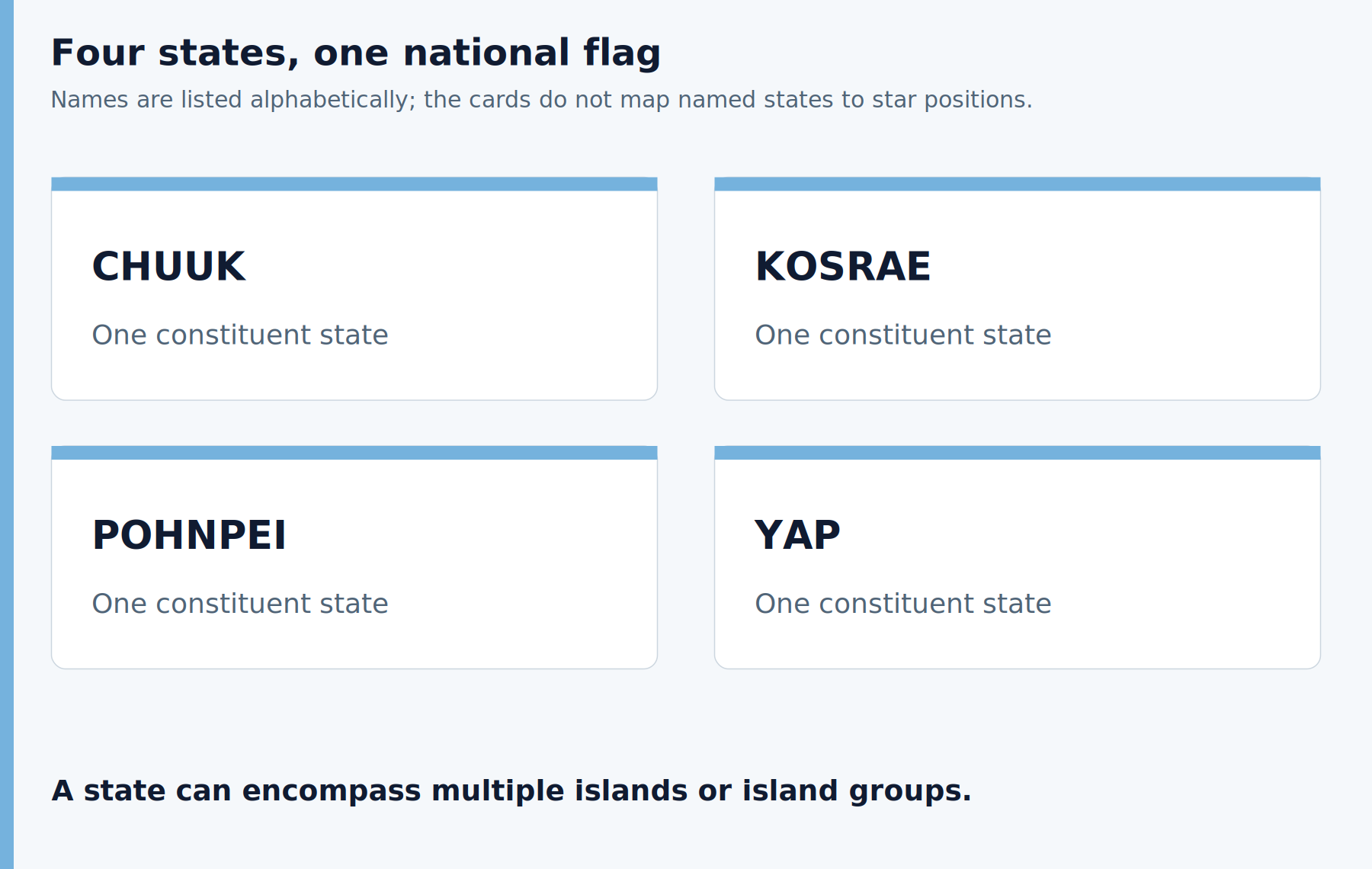
The four stars represent Chuuk, Kosrae, Pohnpei, and Yap. Each is a constituent state of the Federated States of Micronesia, and each receives one star in the national symbol. Listing them alphabetically is a convenient way to identify the membership without implying a ranking or a fixed position for each star.
| State | Representation in the national design |
|---|---|
| Chuuk | One of the four white stars |
| Kosrae | One of the four white stars |
| Pohnpei | One of the four white stars |
| Yap | One of the four white stars |

Why are there four stars if the country has many islands?
The stars count states, not individual islands. A state can include more than one island or island group, so a four-star national flag does not mean the country contains only four islands. The design summarizes political membership in a federation rather than attempting to draw every part of its territory.
The same distinction prevents misleading descriptions such as “one star for every island.” The four state names remain the useful key, regardless of the level of detail used in a map or an island inventory.
When was the four-star flag adopted?
The four-star flag is dated to November 30, 1978, when it was adopted by the Interim Congress of Micronesia. That milestone belongs to the formation of the federation. It should be kept separate from the constitution’s commencement in 1979 and the Compact of Free Association taking effect in 1986.
November 30 is therefore the design’s adoption anniversary. An adoption date does not by itself establish a national public holiday or an annual statutory Flag Day. Those are separate questions requiring their own legal or official evidence.
How did Micronesia’s flag develop?
The national flag grew out of the blue-and-white flag tradition of the Trust Territory of the Pacific Islands. The earlier flag carried six stars, while the FSM adopted a four-star design during its constitutional transition. This visual continuity links the modern symbol with a former administrative setting without making the two flags interchangeable.
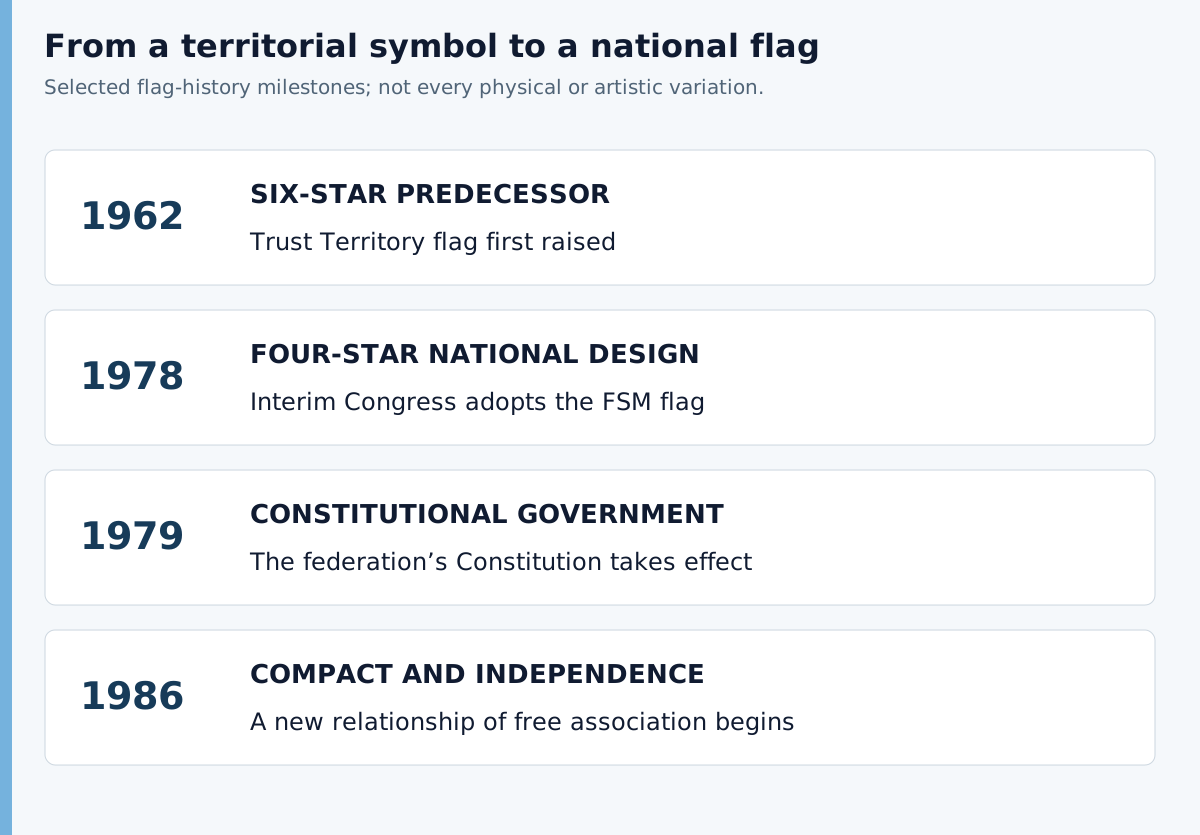
The timeline selects milestones rather than reconstructing every historical flag or manufacturing variation. The predecessor’s six-star arrangement and today’s four-star arrangement should be counted and labeled separately.
Why did the earlier flag have six stars?
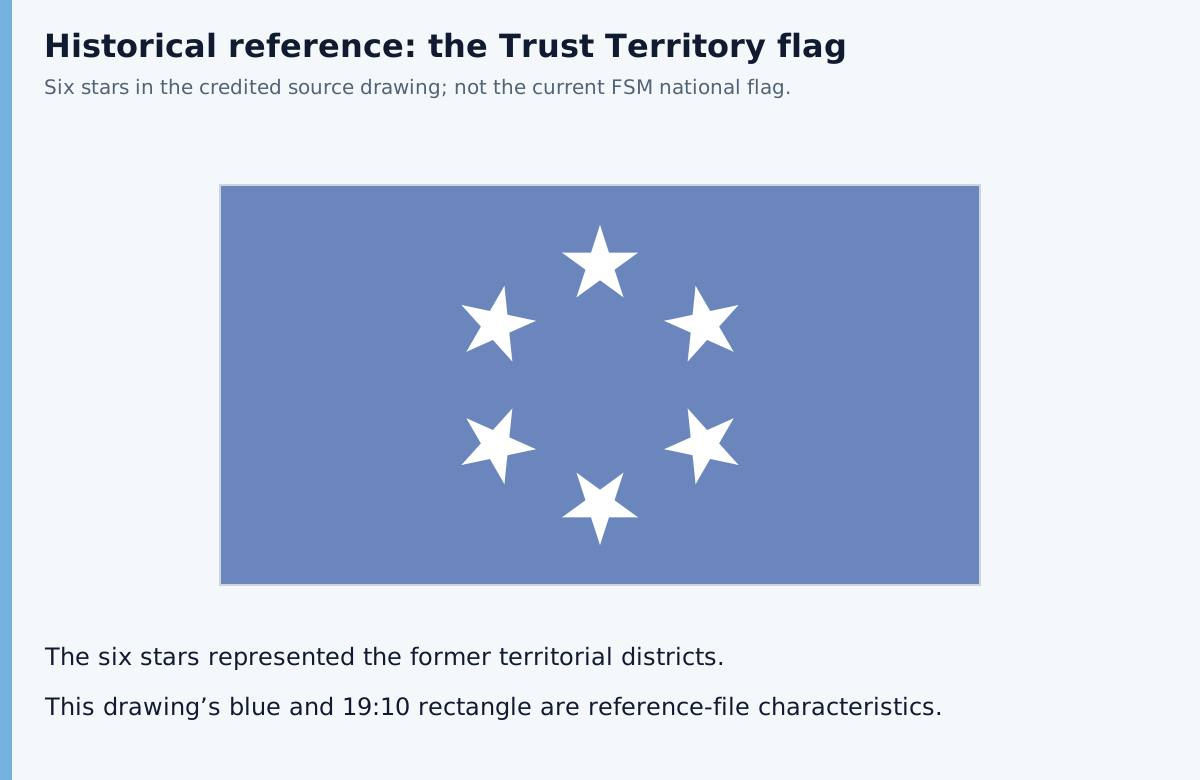
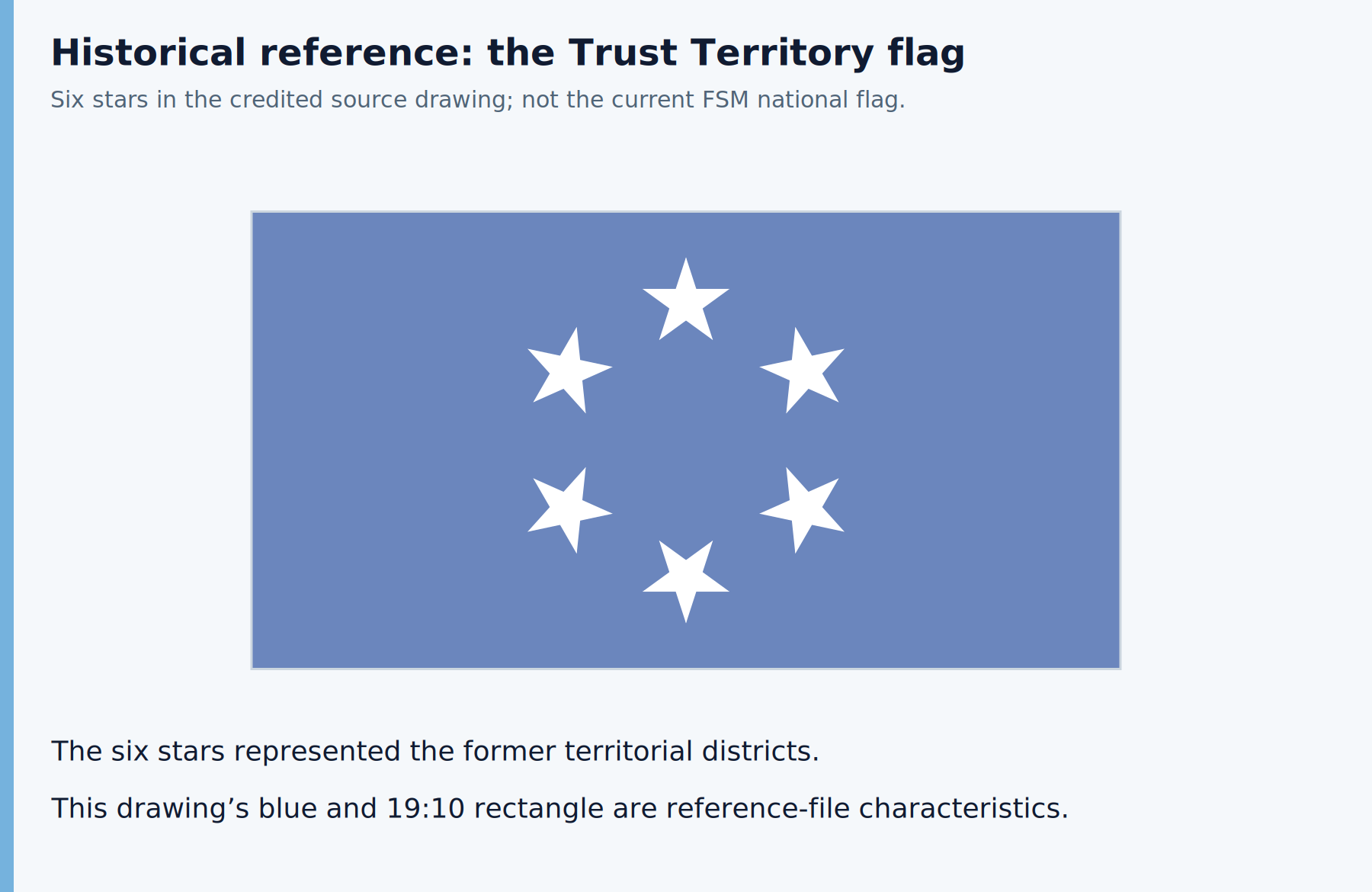
The Trust Territory flag represented six districts: the Marshall Islands, Northern Marianas, Palau, Ponape, Truk, and Yap. The modern FSM comprises four states, including Kosrae, which became separate from Ponape before the federation formed. The change from six stars to four was therefore more complex than simply removing two unchanged member states.
Ponape and Truk are historical names associated with present-day Pohnpei and Chuuk. Figure 10 reproduces a credited six-star historical reference, whose blue and proportions describe that particular drawing. Figure 11 compares the two membership lists without treating their stars as a geographic map.

Who designed Micronesia’s flag?
Gonzalo Santos is documented as the designer of the earlier Trust Territory flag selected through a 1962 competition. That attribution should not automatically be transferred to the later four-star FSM adaptation. The sources used here establish the predecessor’s designer and the adoption of the national design, without proving a separate individual author for the adaptation.
The artists who prepared a modern SVG are another distinct category. Their contribution is digital reference artwork. They are credited with that work in the image notes, rather than described as the creators of the national symbol.
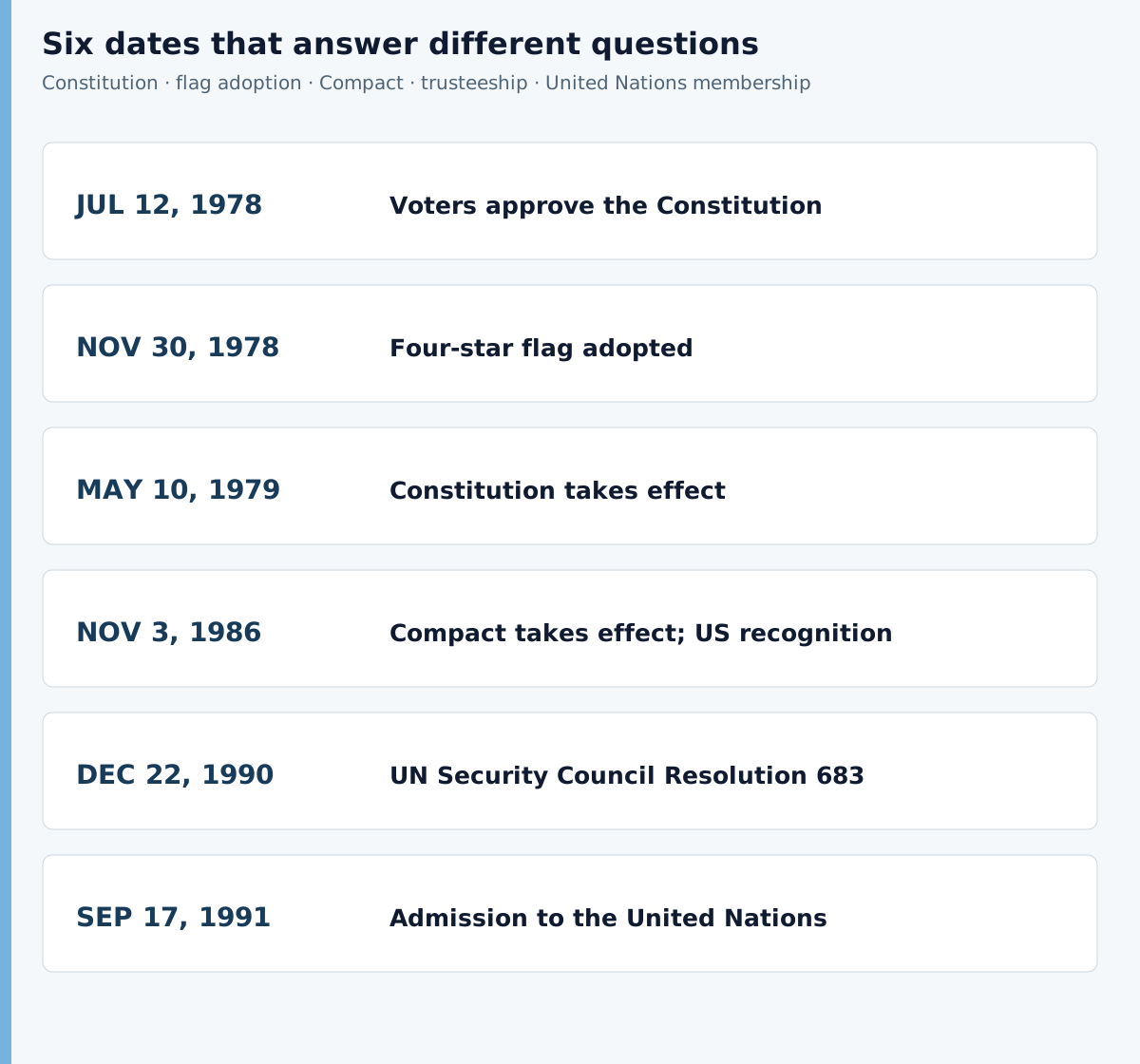
How do 1978, 1979, 1986, 1990, and 1991 differ?
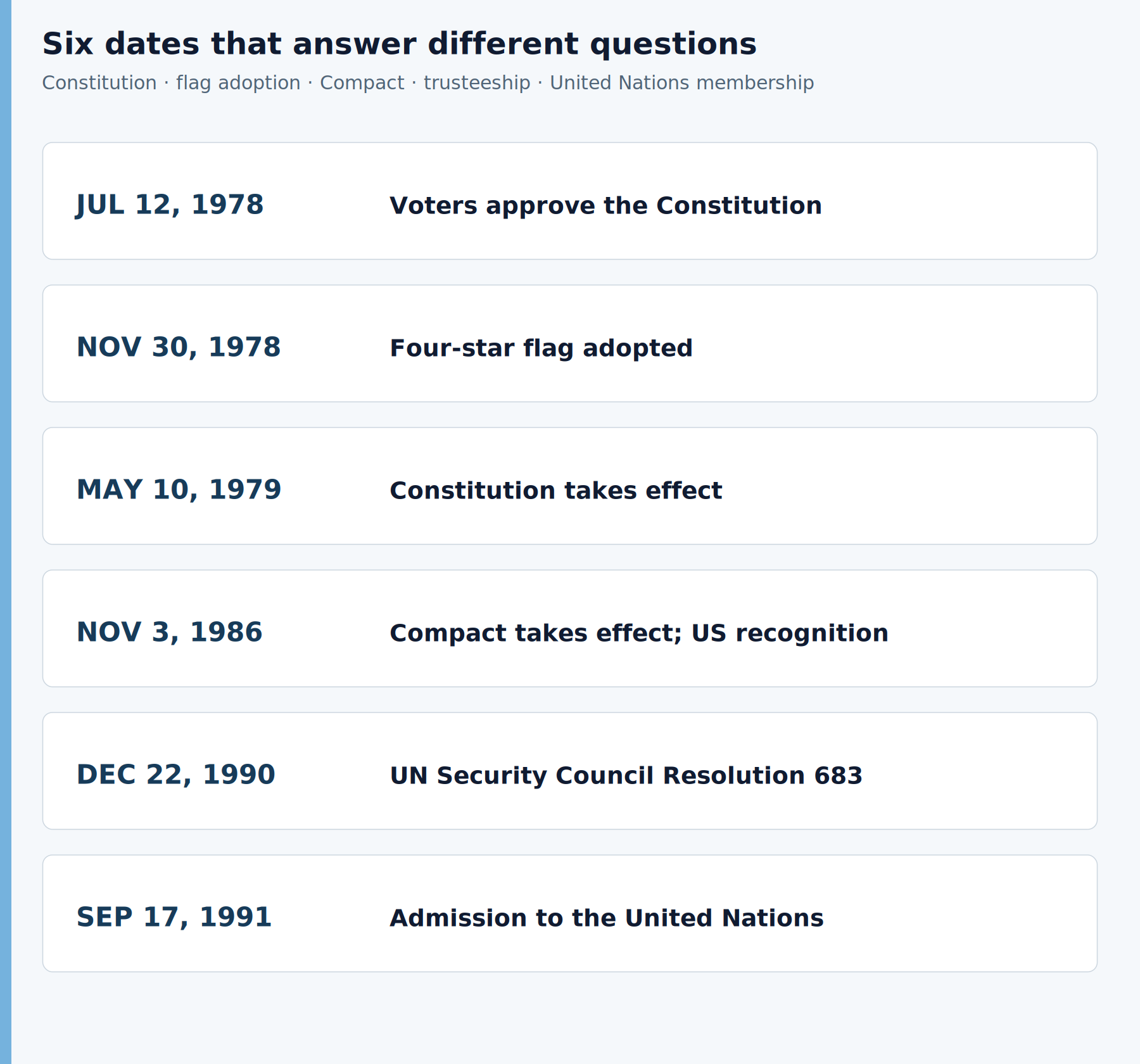
These dates identify different stages: constitutional approval and flag adoption in 1978, constitutional government in 1979, the Compact taking effect in 1986, the UN Security Council’s trusteeship decision in 1990, and UN admission in 1991. Keeping the milestones separate avoids assigning every event to a single supposed independence or flag-adoption date.
| Date | Milestone |
|---|---|
| July 12, 1978 | Voters approve the FSM Constitution |
| November 30, 1978 | Four-star flag adopted |
| May 10, 1979 | Constitution takes effect |
| November 3, 1986 | Compact takes effect; US recognition of independence |
| December 22, 1990 | UN Security Council Resolution 683 addresses termination of trusteeship applicability |
| September 17, 1991 | FSM admitted to the United Nations |
Is November 30 an official Micronesia Flag Day?
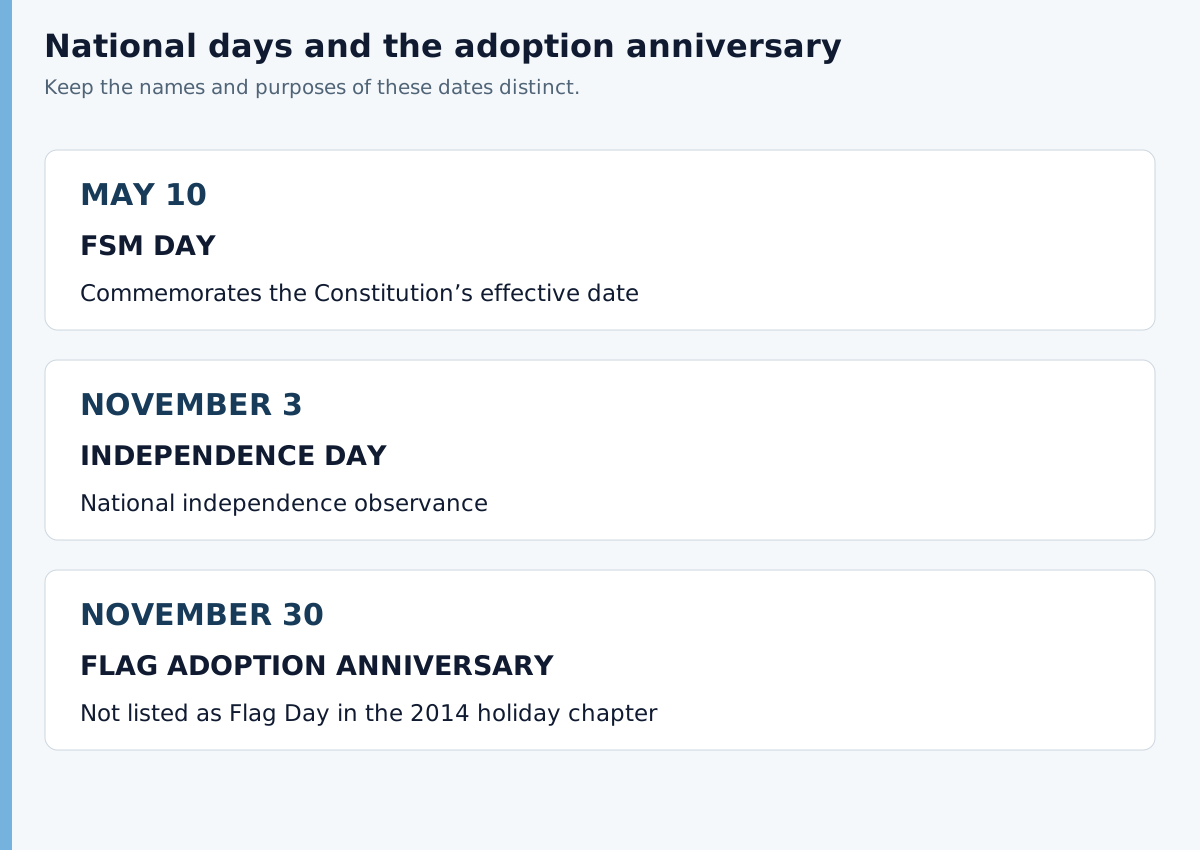
November 30 is the anniversary of the flag’s adoption, but the national holiday chapter consulted does not list it as a public holiday called Flag Day. May 10 is Federated States of Micronesia Day, and November 3 is Independence Day. These established observances should not be renamed or replaced by an unsupported flag holiday.
The holiday source is identified as the 2014 Code edition. This distinction concerns what that published chapter establishes; it is not a claim that no community can hold a separate flag celebration or that later special proclamations are impossible.
When does the flag appear in national celebrations?
The flag plays a visible role in national ceremonies, including Independence Day on November 3. An official account of the 2025 celebration records a flag raising by the National Police Honor Guard at the President’s Office in Palikir. It provides a documented example of ceremonial use, rather than a universal script for every celebration.
May 10 commemorates the constitution’s effective date. These occasions connect the flag with constitutional government and national self-government, while the November 30 adoption anniversary concerns the design itself. The dates have different meanings even when all involve national pride.
Which law defines the FSM national flag?
Title 1, Chapter 5 of the FSM Code sets out the flag’s design, display rules, and protection against desecration. Sections 501 through 503 cover those subjects respectively. The online text used here is the 2014 Code edition; its source notes trace the national provisions to earlier legislation, including Public Law IC-6.
The design is prescribed in ordinary legislation rather than by a separate numerical color table. The congressional record identifies Public Law 4-82 as a 1986 amendment to the display section, aligning it with the country’s political status. That is not evidence for a mandatory new blue shade.
When may the flag be displayed outdoors?
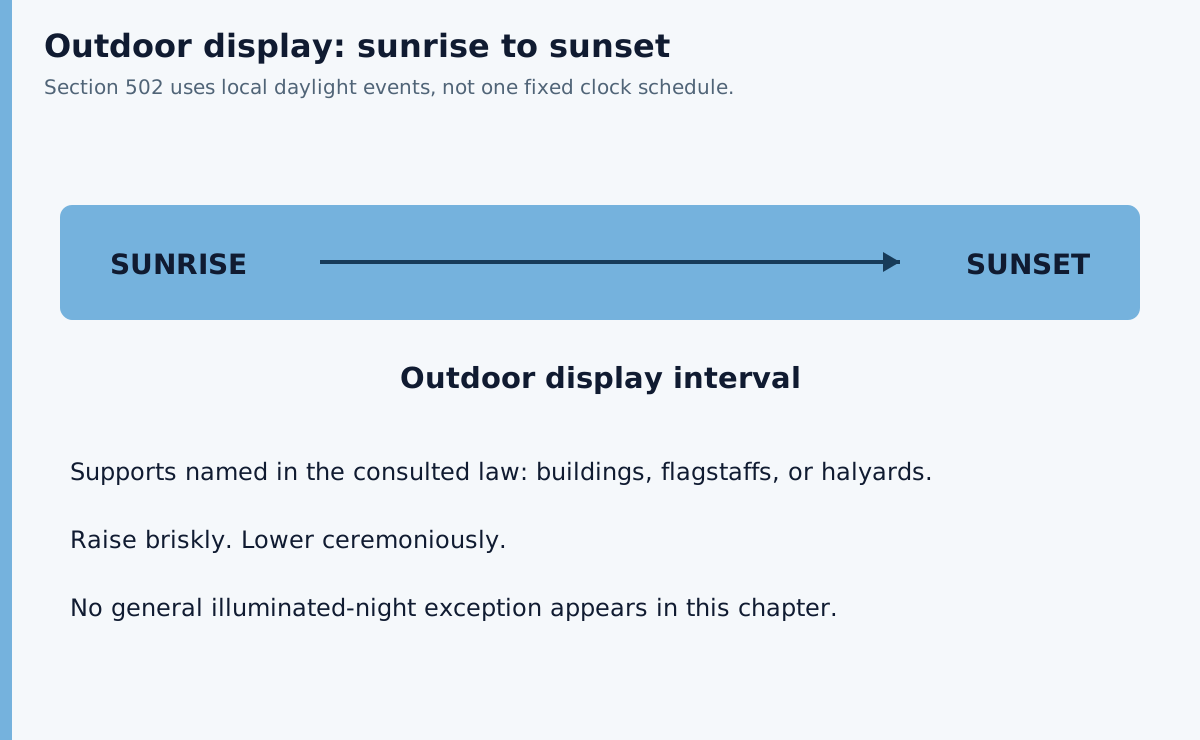
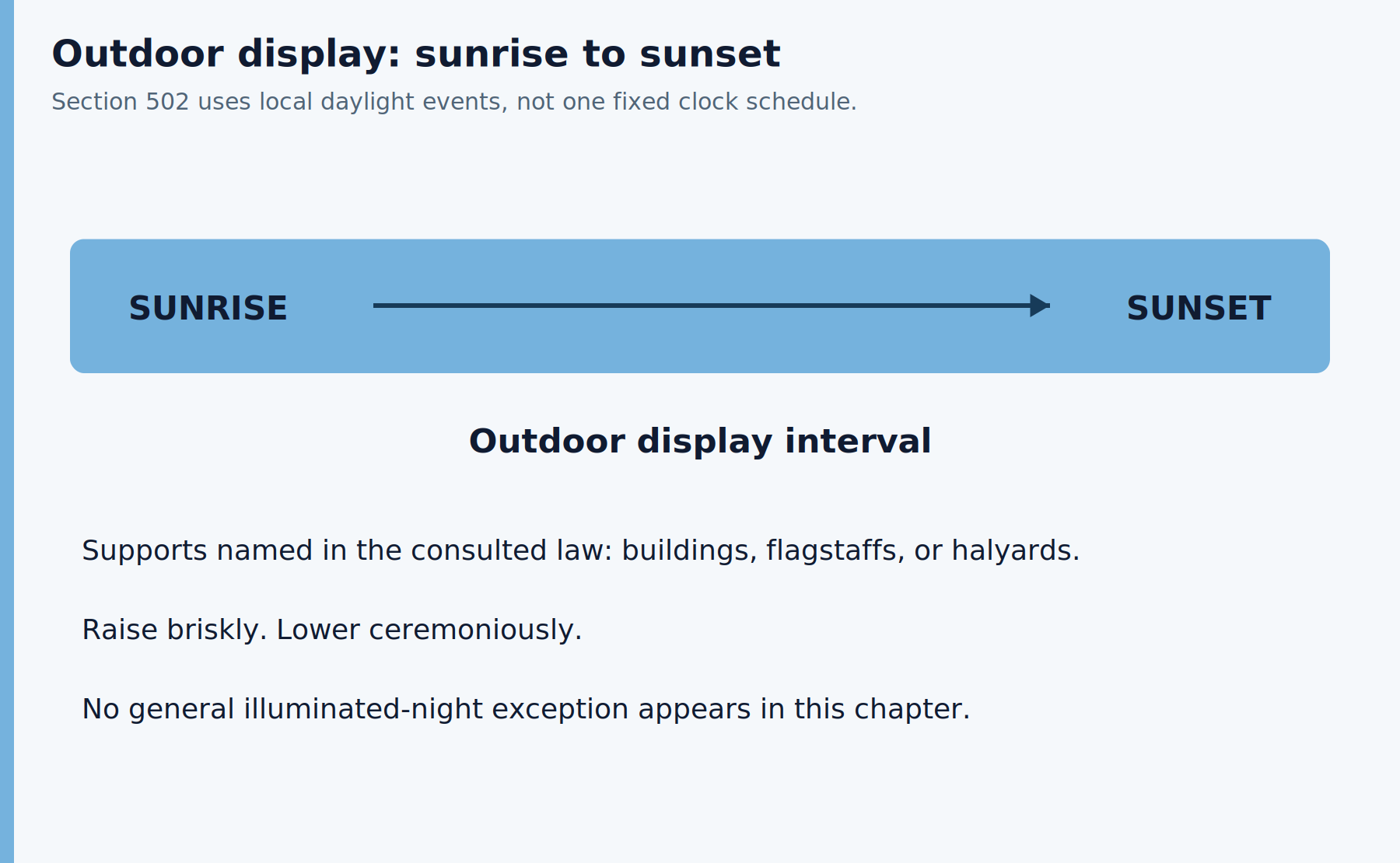
Section 502 limits display in the open to the period from sunrise until sunset and identifies buildings, flagstaffs, and halyards as the permitted supports during those hours. The consulted text contains no general exception for an illuminated flag at night. Outdoor display should therefore follow the FSM provision rather than importing another country’s practice.
Sunrise and sunset are local events, not fixed clock times that apply to every island throughout the year. Figure 14 explains the daily interval without inventing a universal morning or evening hour. The provision addresses open-air display; it should not be rewritten as a blanket rule about every indoor image.
How should the flag be raised and lowered?
The flag code says the national flag should be hoisted briskly and lowered ceremoniously. Those instructions concern the manner of handling the flag, while the sunrise-to-sunset provision governs outdoor display hours. A local ceremony can follow both requirements without adding an unsupported fixed number of seconds or a compulsory musical accompaniment.
A respectful explanation can describe the different pace and care of the two actions. The law excerpt does not supply a timed drill, a prescribed knot, or an exact number of participants; such details should come from the responsible institution’s actual ceremonial instructions.
How should the flag be displayed with other flags?
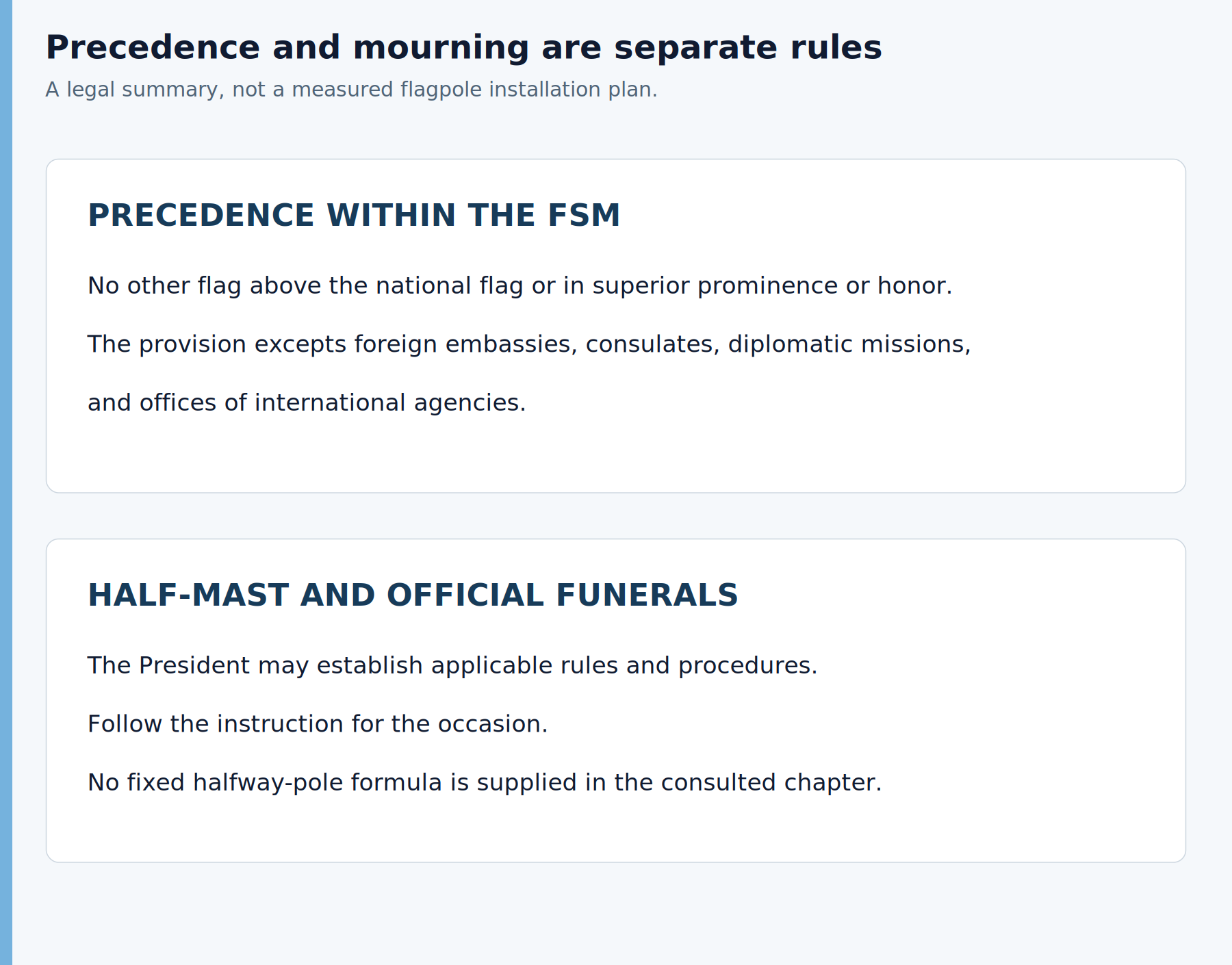
Within the FSM, section 502 prohibits placing another flag above the national flag or giving it superior prominence or honor. The provision expressly excepts foreign embassies, consulates, diplomatic missions, and offices of international agencies. Its territorial scope and stated exceptions matter when explaining precedence at a particular site or ceremony.
This rule does not supply an exact spacing between poles or a complete seating-style order for every multinational event. Figure 15 summarizes the legal principle and the separate authority for mourning arrangements; it is not an installation drawing.

When is the Micronesia flag flown at half-mast?
The President may establish rules for half-mast display and official funerals under section 502. A dated example is the March 20, 2026 announcement of three days of mourning for former Pohnpei Speaker Nelson Pelep. That announcement documents a particular period; it should not be treated as a permanent or currently active half-mast order.
Follow the applicable official instruction for the occasion. The consulted code does not fix the lowered position as exactly halfway down every pole, and this package does not invent a numerical mast-height formula or a recurring mourning calendar.
May the flag be reproduced for unofficial purposes?
Section 501 allows reproductions with different dimensions for unofficial purposes, while section 503 extends its desecration provision to reproductions as well as official flags. Permission to vary dimensions is therefore not a general exemption from the flag code. The downloadable national artwork preserves the standard rectangle to provide a consistent educational reference.
Section 503 concerns knowingly casting contempt on the flag through specified public acts. That wording should not be reduced to an assertion that every alteration, damaged flag, or act of disposal is automatically the same offense. Copyright status and national-symbol rules also answer different questions.
What sizes preserve the correct flag proportions?
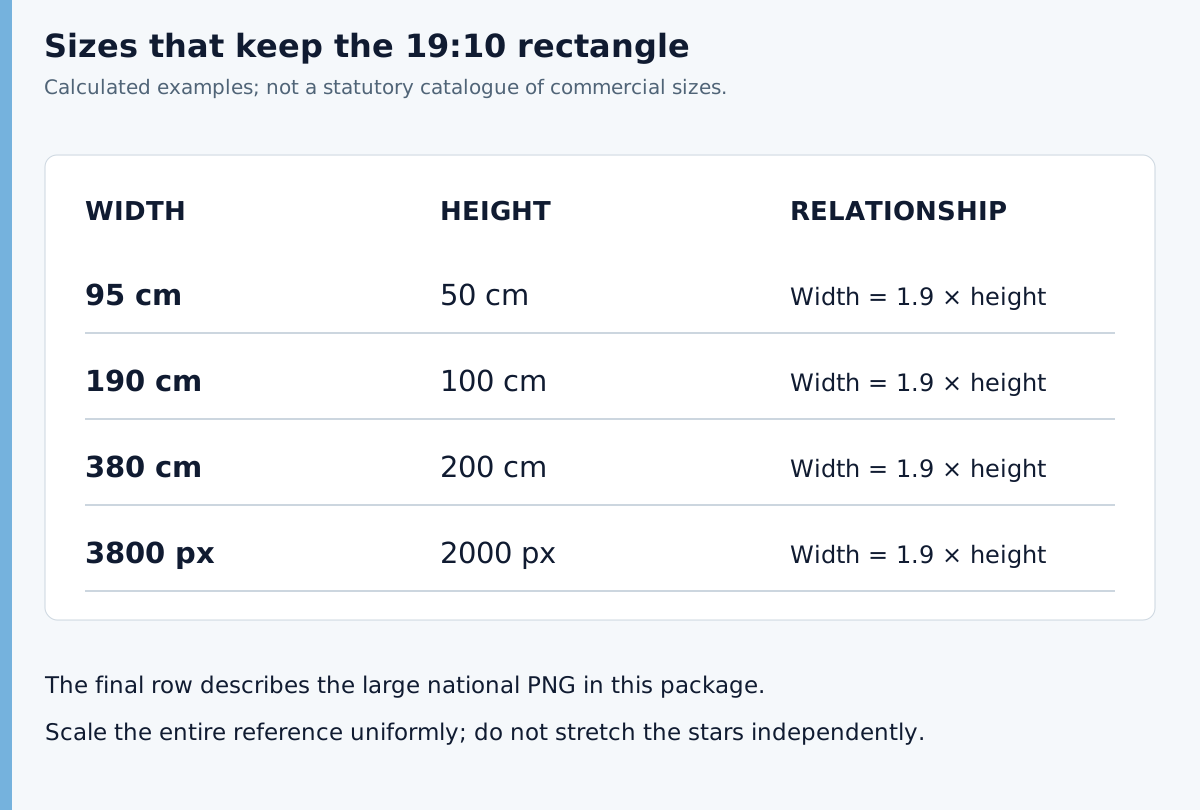
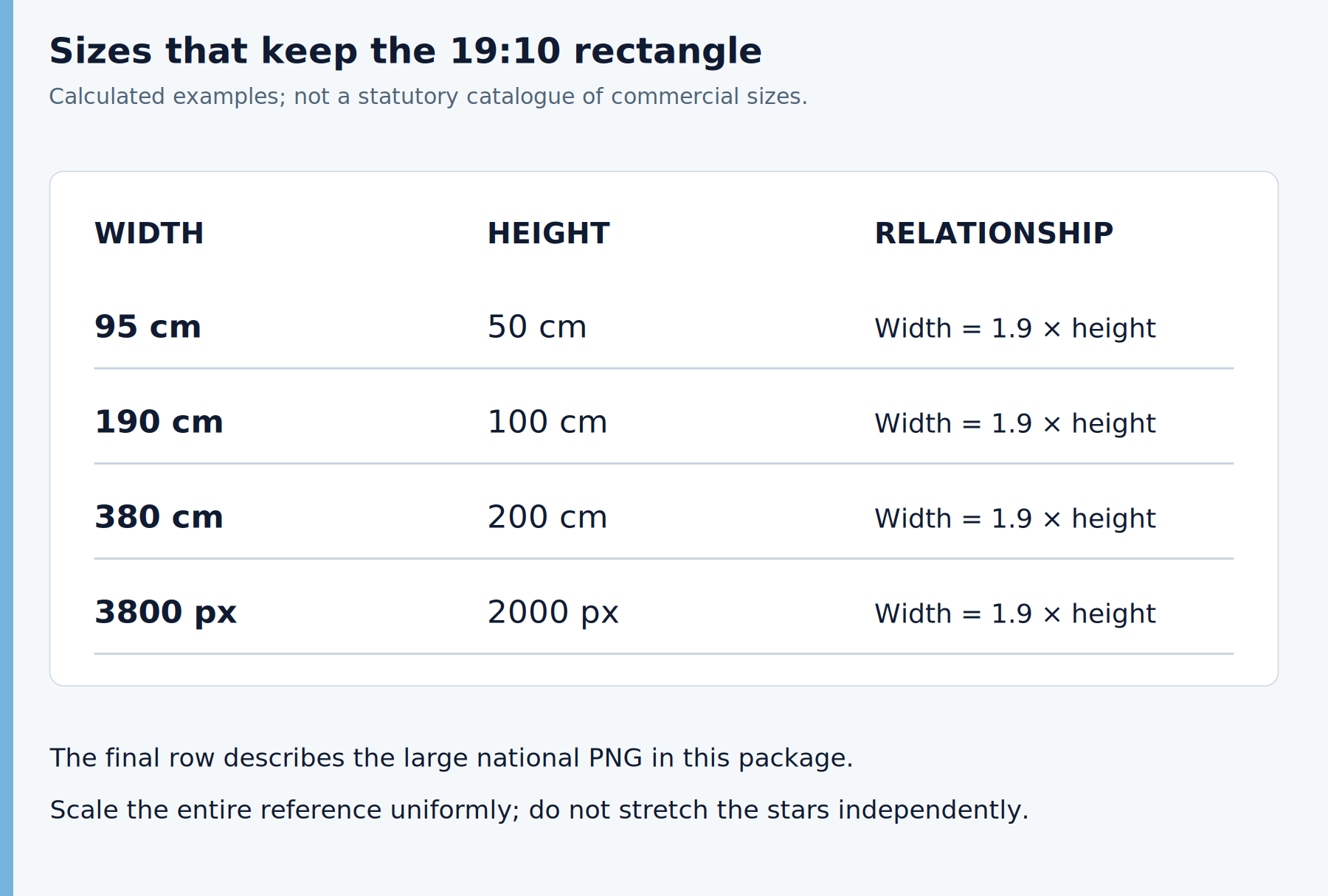
Any rectangle whose width is 1.9 times its height preserves the official overall shape. Examples include 95 by 50 centimeters, 190 by 100 centimeters, and 380 by 200 centimeters. The large PNG in this package is 3800 by 2000 pixels. Scale the complete design uniformly so the stars retain their reference geometry.
| Width × height | Use as a calculation example |
|---|---|
| 95 × 50 cm | Smaller physical reproduction |
| 190 × 100 cm | One-meter-high reproduction |
| 380 × 200 cm | Two-meter-high reproduction |
| 3800 × 2000 px | Supplied large national PNG |
These are proportional examples, not a statutory catalogue of commercial sizes. Physical specifications such as fabric, hems, attachment methods, and any authenticated star measurements require separate production decisions.
Does the flag look different from the reverse side?
The reference design is horizontally mirror-symmetric, so its blue field and four-star arrangement look the same from the opposite side of an ordinary flag. The attachment edge changes sides for the viewer. This visual symmetry does not mean that four upright stars or a stretched portrait rectangle reproduce the same design.
A photograph of cloth in motion can obscure the symmetry through folds and perspective. Compare a flat drawing with the complete reference rather than treating a wind-folded silhouette as a new flag variant. No special vertical or naval version is invented here.
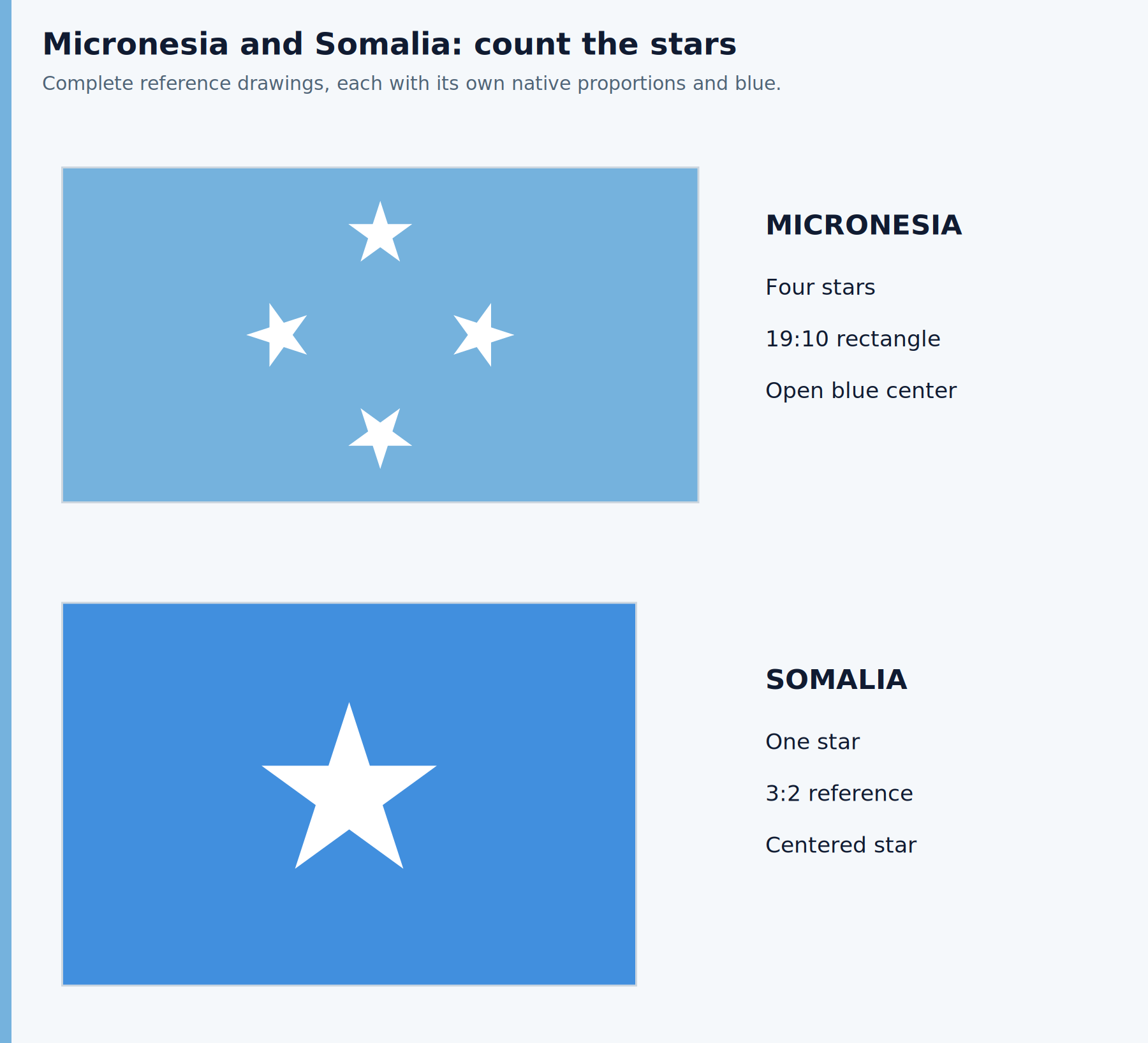
How is Micronesia’s flag different from Somalia’s?
Both flags use a blue field and white five-pointed stars, but Micronesia has four outward-facing stars around an empty center, while Somalia has one centered star. The reference drawings also have different rectangles: 19:10 for Micronesia and 3:2 for Somalia. Counting stars and checking the full layout makes the distinction clear.
The comparison preserves each downloaded drawing’s own proportions and colors. It does not force the blues to match or enlarge Somalia’s single star into a substitute for the FSM’s four-state group. The six-star Trust Territory reference is a separate historical comparison.

What is Micronesia’s flag emoji?
Micronesia’s flag emoji is 🇫🇲, formed from the regional indicator letters F and M. Its code points are U+1F1EB and U+1F1F2. Platforms may display a small flag image or separate indicators. The emoji identifies the country, but its simplified artwork is not a precise reference for star dimensions or color reproduction.
Use the SVG for scalable artwork and the supplied PNG for a fixed-size image. Keep accompanying text available where an emoji may not render, especially when a reader needs to distinguish the country from the wider region.
What mistakes should be avoided when drawing this flag?
Common errors include drawing six stars, making all four stars upright, using the wrong rectangle, adding a central seal, or assigning one star to every island. Another error is presenting a convenient digital blue or a reference construction measurement as a legally certified specification. Accurate explanations distinguish the law, the artwork, and historical interpretation.
- Use four stars for the FSM; the historical Trust Territory reference has six.
- Keep one point of each star directed outward in the reference arrangement.
- Preserve the 19:10 overall rectangle in a standard national drawing.
- Identify Chuuk, Kosrae, Pohnpei, and Yap as states rather than four individual islands.
- Keep adoption, constitutional commencement, independence, and UN milestones distinct.
- Treat the 2014 Code text, source-vector geometry, and original calculations as distinct kinds of evidence.
Explore more in World Flags: Iceland flag, Lithuania flag, Luxembourg flag, Madagascar flag, Malawi flag, Malaysia flag, Maldives flag, Mali flag, Malta flag, Mauritania flag, Mauritius flag, Mexico flag.
Download Micronesia flag pictures
Download the national flag as SVG or large PNG. The gallery includes 17 distinct subjects with captions and alternative text. Keep the full proportions when resizing. Image credits and reuse notes accompany the graphics.
World Flags/Micronesia
Micronesia flag pictures
Four white stars on blue, with a point of each star directed outward. Overall width:height 19:10.
GKBook; reference artwork: Phroziac, Zscout370 and Commons contributors (FSM vector)Download SVGDownload PNGThe reference rectangle is 19:10. The blue center between the four stars remains empty.
GKBook; reference artwork: Phroziac, Zscout370 and Commons contributors (FSM vector)Download SVGDownload PNGThe source uses a 38×20 grid. Star centers lie six units from the origin and each star has a two-unit outer radius. These are reference-vector measurements.
GKBook; reference artwork: Phroziac, Zscout370 and Commons contributors (FSM vector)Download SVGDownload PNGFor the upright reference star, a four-unit surrounding-circle diameter gives an outer-tip horizontal span of approximately 3.804 units. The law uses the term star width.
GKBook; reference artwork: Phroziac, Zscout370 and Commons contributors (FSM vector)Download SVGDownload PNGThe top, right, bottom and left stars have outward-facing points. The square image is a detail crop, not the whole national flag.
GKBook; reference artwork: Phroziac, Zscout370 and Commons contributors (FSM vector)Download SVGDownload PNGThe files use #75B2DD and #FFFFFF. These are source-vector screen values rather than a verified statutory textile or print standard.
GKBook; reference artwork: Phroziac, Zscout370 and Commons contributors (FSM vector)Download SVGDownload PNGBlue evokes the Pacific Ocean; four stars identify the four states. No separate geographic position is assigned to each state here.
GKBookDownload SVGDownload PNGChuuk, Kosrae, Pohnpei and Yap each correspond to one star in the national symbol; the cards imply no star-position assignment.
GKBookDownload SVGDownload PNGThe six-star Trust Territory tradition preceded the four-star FSM design. Flag adoption and constitutional and political milestones are separate events.
GKBookDownload SVGDownload PNGA historical six-star drawing from Open Clip Art and Commons, retained with its native color and proportions. It is not the current FSM flag or a claim of one universal historical manufacturing standard.
GKBook; reference artwork: Open Clip Art and Commons contributors (Trust Territory vector)Download SVGDownload PNGThe transition was not just a subtraction of two unchanged members: Kosrae became separate from Ponape, and other districts followed different political paths.
GKBookDownload SVGDownload PNGSix separate events from constitutional approval to UN membership. The 1990 UN decision should not be merged with the 1986 Compact date.
GKBookDownload SVGDownload PNGMay 10 is FSM Day and November 3 is Independence Day. November 30 marks flag adoption; the consulted holiday chapter does not designate it Flag Day.
GKBookDownload SVGDownload PNGThe law’s outdoor interval is sunrise until sunset. Local daylight varies; no universal clock times or lighting exception are invented.
GKBookDownload SVGDownload PNGSection 502 addresses precedence, with explicit exceptions, and gives the President authority over half-mast and official-funeral procedures.
GKBookDownload SVGDownload PNGEvery example preserves 19:10. The supplied national PNG is 3800×2000 pixels; the physical dimensions are arithmetic examples only.
GKBook; reference artwork: Phroziac, Zscout370 and Commons contributors (FSM vector)Download SVGDownload PNGThe FSM reference has four stars and a 19:10 rectangle; the Somali reference has one centered star and a 3:2 rectangle. Each source’s own paint values are retained.
GKBook; reference artwork: Phroziac, Zscout370 and Commons contributors (FSM vector); Commons contributors (Somalia vector)Download SVGDownload PNGFrequently asked questions
What does the Micronesia flag look like?
Micronesia’s national flag has a plain blue background and four white stars arranged around its center. Each star has five points, with one point directed outward from the group. The spaces between the stars remain blue; there is no central seal, coat of arms, lettering, stripe, or circular border.
Does this flag represent the whole Micronesia region?
This flag represents the Federated States of Micronesia, an independent country made up of four states. Micronesia is also the name of a wider Pacific region, so the short name can cause confusion. The FSM flag is not a collective national flag for every country and territory in that region.
What is the ratio of Micronesia’s flag?
The official flag is 19 units wide for every 10 units high. Section 501 expresses this as a width-to-length ratio of 1:1.9, using width for the short dimension. In ordinary image dimensions, the same shape is 19:10 width:height, or 10:19 when height is written first.
How is the reference flag drawing constructed?
The reference SVG uses a rectangle 38 units wide and 20 units high, centered on the origin. Its four star centers are six units above, right, below, and left of the origin. Each star has an outer radius of two units. These measurements describe this reference vector, not a certified manufacturing standard.
How large are the four stars?
Section 501 gives a five-to-one relationship between the flag’s short dimension and the width of a star. The reference SVG uses a star’s surrounding-circle diameter equal to one-fifth of flag height. A circle diameter and a star’s actual bounding width are different measurements, so they should not be silently treated as identical.
Which way should the stars point?
In the reference design, one point of each star faces away from the center of the four-star group. The upper star points up, the right star points right, the lower star points down, and the left star points left. Making all four stars upright changes this familiar arrangement.
Do the stars mark exact geographic positions?
The four stars identify the four federated states collectively; the design is not a geographic map of their locations. Its upper, right, lower, and left positions organize the symbol symmetrically. The legal description and reference drawing do not assign a named state to each specific position in the star group.
What are Micronesia’s flag color codes?
The national flag files supplied here use blue #75B2DD and white #FFFFFF. Their RGB values are 117, 178, 221 and 255, 255, 255 respectively. These numbers reproduce the credited SVG’s actual fills. They are reference digital colors, not HEX or RGB values specified in the flag law.
Is an official Pantone or CMYK match specified?
The flag chapter consulted names blue and white but provides no numeric Pantone, CMYK, RGB, or HEX table. A web color chart therefore needs its own supporting authority before being called an official production standard. For this package, the blue is explicitly tied to the downloaded vector rather than an unverified color conversion.
What do the blue field and white stars mean?
Blue represents the Pacific Ocean, and the four white stars represent the federation’s four states. Together, the sea-colored field and repeated stars make the country’s island setting and federal structure easy to recognize. This established explanation should be distinguished from a claim that the flag law assigns a separate meaning to every visual detail.
Which four states do the stars represent?
The four stars represent Chuuk, Kosrae, Pohnpei, and Yap. Each is a constituent state of the Federated States of Micronesia, and each receives one star in the national symbol. Listing them alphabetically is a convenient way to identify the membership without implying a ranking or a fixed position for each star.
Why are there four stars if the country has many islands?
The stars count states, not individual islands. A state can include more than one island or island group, so a four-star national flag does not mean the country contains only four islands. The design summarizes political membership in a federation rather than attempting to draw every part of its territory.
When was the four-star flag adopted?
The four-star flag is dated to November 30, 1978, when it was adopted by the Interim Congress of Micronesia. That milestone belongs to the formation of the federation. It should be kept separate from the constitution’s commencement in 1979 and the Compact of Free Association taking effect in 1986.
How did Micronesia’s flag develop?
The national flag grew out of the blue-and-white flag tradition of the Trust Territory of the Pacific Islands. The earlier flag carried six stars, while the FSM adopted a four-star design during its constitutional transition. This visual continuity links the modern symbol with a former administrative setting without making the two flags interchangeable.
Why did the earlier flag have six stars?
The Trust Territory flag represented six districts: the Marshall Islands, Northern Marianas, Palau, Ponape, Truk, and Yap. The modern FSM comprises four states, including Kosrae, which became separate from Ponape before the federation formed. The change from six stars to four was therefore more complex than simply removing two unchanged member states.
Who designed Micronesia’s flag?
Gonzalo Santos is documented as the designer of the earlier Trust Territory flag selected through a 1962 competition. That attribution should not automatically be transferred to the later four-star FSM adaptation. The sources used here establish the predecessor’s designer and the adoption of the national design, without proving a separate individual author for the adaptation.
How do 1978, 1979, 1986, 1990, and 1991 differ?
These dates identify different stages: constitutional approval and flag adoption in 1978, constitutional government in 1979, the Compact taking effect in 1986, the UN Security Council’s trusteeship decision in 1990, and UN admission in 1991. Keeping the milestones separate avoids assigning every event to a single supposed independence or flag-adoption date.
Is November 30 an official Micronesia Flag Day?
November 30 is the anniversary of the flag’s adoption, but the national holiday chapter consulted does not list it as a public holiday called Flag Day. May 10 is Federated States of Micronesia Day, and November 3 is Independence Day. These established observances should not be renamed or replaced by an unsupported flag holiday.
When does the flag appear in national celebrations?
The flag plays a visible role in national ceremonies, including Independence Day on November 3. An official account of the 2025 celebration records a flag raising by the National Police Honor Guard at the President’s Office in Palikir. It provides a documented example of ceremonial use, rather than a universal script for every celebration.
Which law defines the FSM national flag?
Title 1, Chapter 5 of the FSM Code sets out the flag’s design, display rules, and protection against desecration. Sections 501 through 503 cover those subjects respectively. The online text used here is the 2014 Code edition; its source notes trace the national provisions to earlier legislation, including Public Law IC-6.
When may the flag be displayed outdoors?
Section 502 limits display in the open to the period from sunrise until sunset and identifies buildings, flagstaffs, and halyards as the permitted supports during those hours. The consulted text contains no general exception for an illuminated flag at night. Outdoor display should therefore follow the FSM provision rather than importing another country’s practice.
How should the flag be raised and lowered?
The flag code says the national flag should be hoisted briskly and lowered ceremoniously. Those instructions concern the manner of handling the flag, while the sunrise-to-sunset provision governs outdoor display hours. A local ceremony can follow both requirements without adding an unsupported fixed number of seconds or a compulsory musical accompaniment.
How should the flag be displayed with other flags?
Within the FSM, section 502 prohibits placing another flag above the national flag or giving it superior prominence or honor. The provision expressly excepts foreign embassies, consulates, diplomatic missions, and offices of international agencies. Its territorial scope and stated exceptions matter when explaining precedence at a particular site or ceremony.
When is the Micronesia flag flown at half-mast?
The President may establish rules for half-mast display and official funerals under section 502. A dated example is the March 20, 2026 announcement of three days of mourning for former Pohnpei Speaker Nelson Pelep. That announcement documents a particular period; it should not be treated as a permanent or currently active half-mast order.
May the flag be reproduced for unofficial purposes?
Section 501 allows reproductions with different dimensions for unofficial purposes, while section 503 extends its desecration provision to reproductions as well as official flags. Permission to vary dimensions is therefore not a general exemption from the flag code. The downloadable national artwork preserves the standard rectangle to provide a consistent educational reference.
What sizes preserve the correct flag proportions?
Any rectangle whose width is 1.9 times its height preserves the official overall shape. Examples include 95 by 50 centimeters, 190 by 100 centimeters, and 380 by 200 centimeters. The large PNG in this package is 3800 by 2000 pixels. Scale the complete design uniformly so the stars retain their reference geometry.
Does the flag look different from the reverse side?
The reference design is horizontally mirror-symmetric, so its blue field and four-star arrangement look the same from the opposite side of an ordinary flag. The attachment edge changes sides for the viewer. This visual symmetry does not mean that four upright stars or a stretched portrait rectangle reproduce the same design.
How is Micronesia’s flag different from Somalia’s?
Both flags use a blue field and white five-pointed stars, but Micronesia has four outward-facing stars around an empty center, while Somalia has one centered star. The reference drawings also have different rectangles: 19:10 for Micronesia and 3:2 for Somalia. Counting stars and checking the full layout makes the distinction clear.
What is Micronesia’s flag emoji?
Micronesia’s flag emoji is 🇫🇲, formed from the regional indicator letters F and M. Its code points are U+1F1EB and U+1F1F2. Platforms may display a small flag image or separate indicators. The emoji identifies the country, but its simplified artwork is not a precise reference for star dimensions or color reproduction.
What mistakes should be avoided when drawing this flag?
Common errors include drawing six stars, making all four stars upright, using the wrong rectangle, adding a central seal, or assigning one star to every island. Another error is presenting a convenient digital blue or a reference construction measurement as a legally certified specification. Accurate explanations distinguish the law, the artwork, and historical interpretation.
Explore all general-knowledge topics and the A-to-Z lists.





We Value Your Opinion Comments