
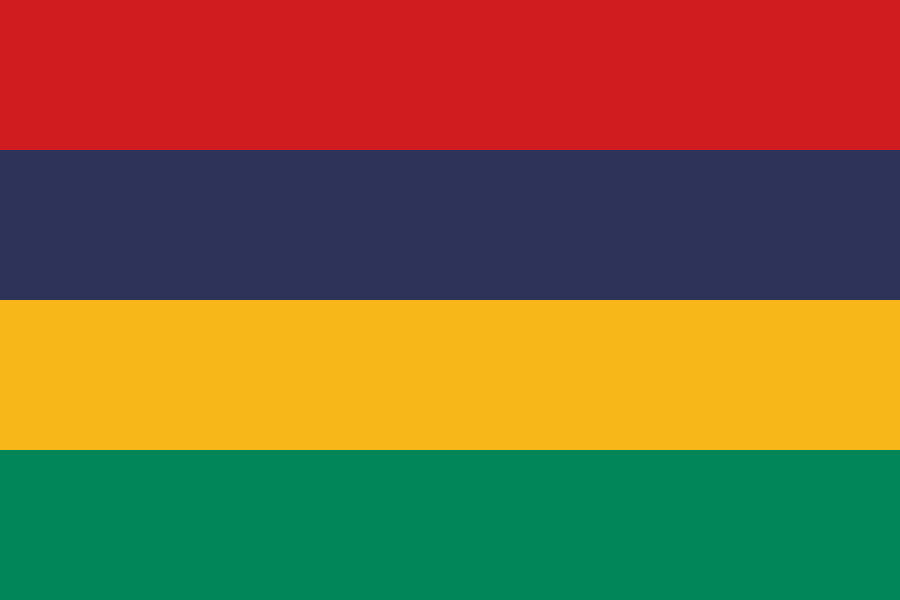
Mauritius flag picture
Explore the construction drawing, history, and complete picture gallery.
| Design | Red · blue · yellow · greenFour equal horizontal bands; no emblem. |
|---|---|
| Proportions | 3:2 width:heightEach band is 25% of the height. |
| Adoption | March 12, 1968Independence; flag raised at Champ de Mars. |
| Republic status | March 12, 1992The four-band flag continued. |
| Later legislation | 2022 national-symbols ActEffective June 1, 2022; distinct from adoption. |
The normal flag has four equal bands and no emblem. The 2022 Act gives textile color references; the download palette provides digital reproductions.
What is the national flag of Mauritius?
Mauritius’s national flag has four equal horizontal bands: red, blue, yellow, and green, from top to bottom. Its normal width-to-height ratio is 3:2, and it has no emblem or lettering. The flag came into national use at independence on March 12, 1968; later legislation defines its design, meanings, and technical specifications.
The four-band design connects independence with the Indian Ocean, the new light of freedom, and the country’s agriculture and greenery. These meanings are stated in the 2022 national-symbols Act. The distinction between the flag’s original adoption, the republic established in 1992, and subsequent technical legislation is central to understanding its history.
What does the flag of Mauritius look like?
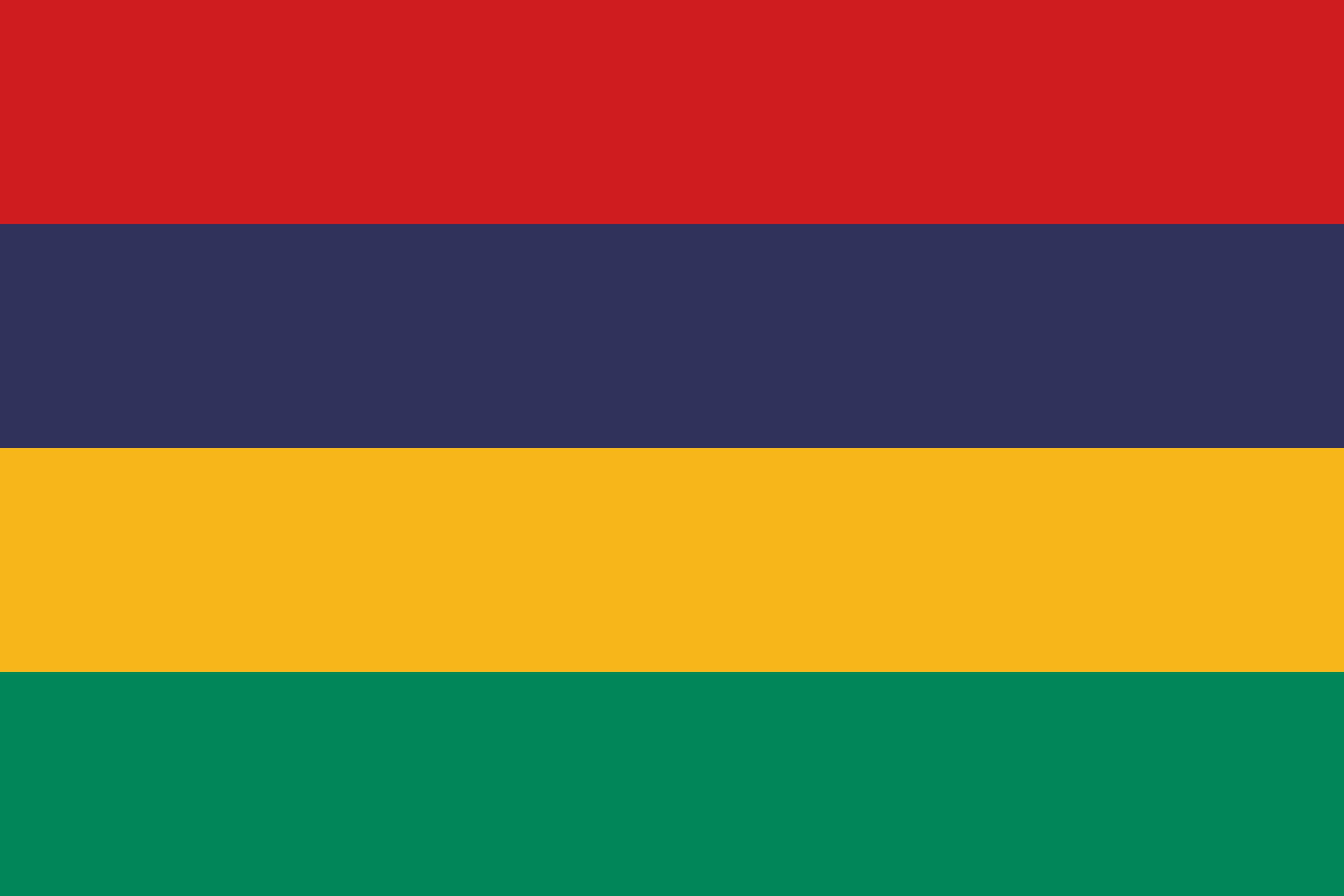
Mauritius’s flag is a plain rectangle divided into four equal horizontal bands of red, blue, yellow, and green. Red is at the top and green at the bottom. There is no star, crescent, coat of arms, inscription, or other emblem on the ordinary national flag, making the band sequence its main identifying feature.
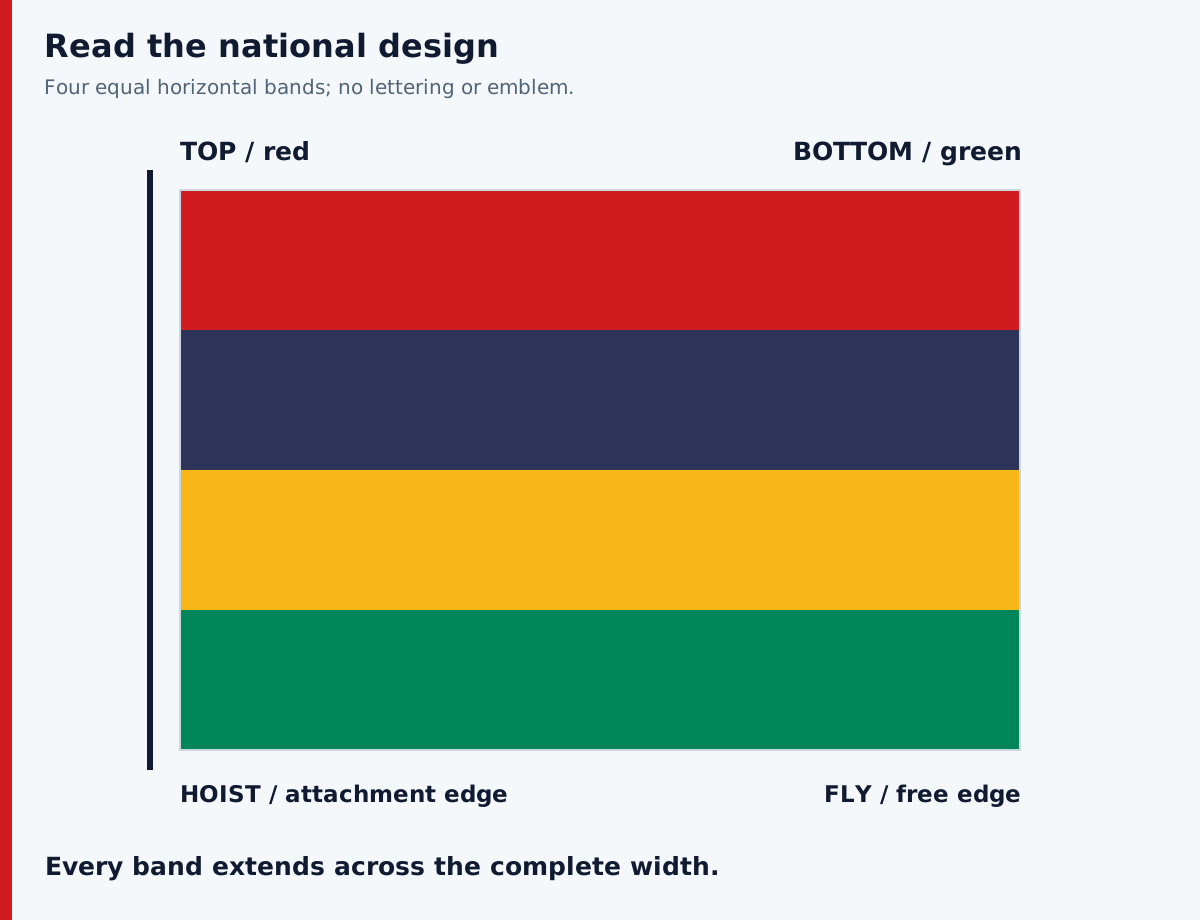
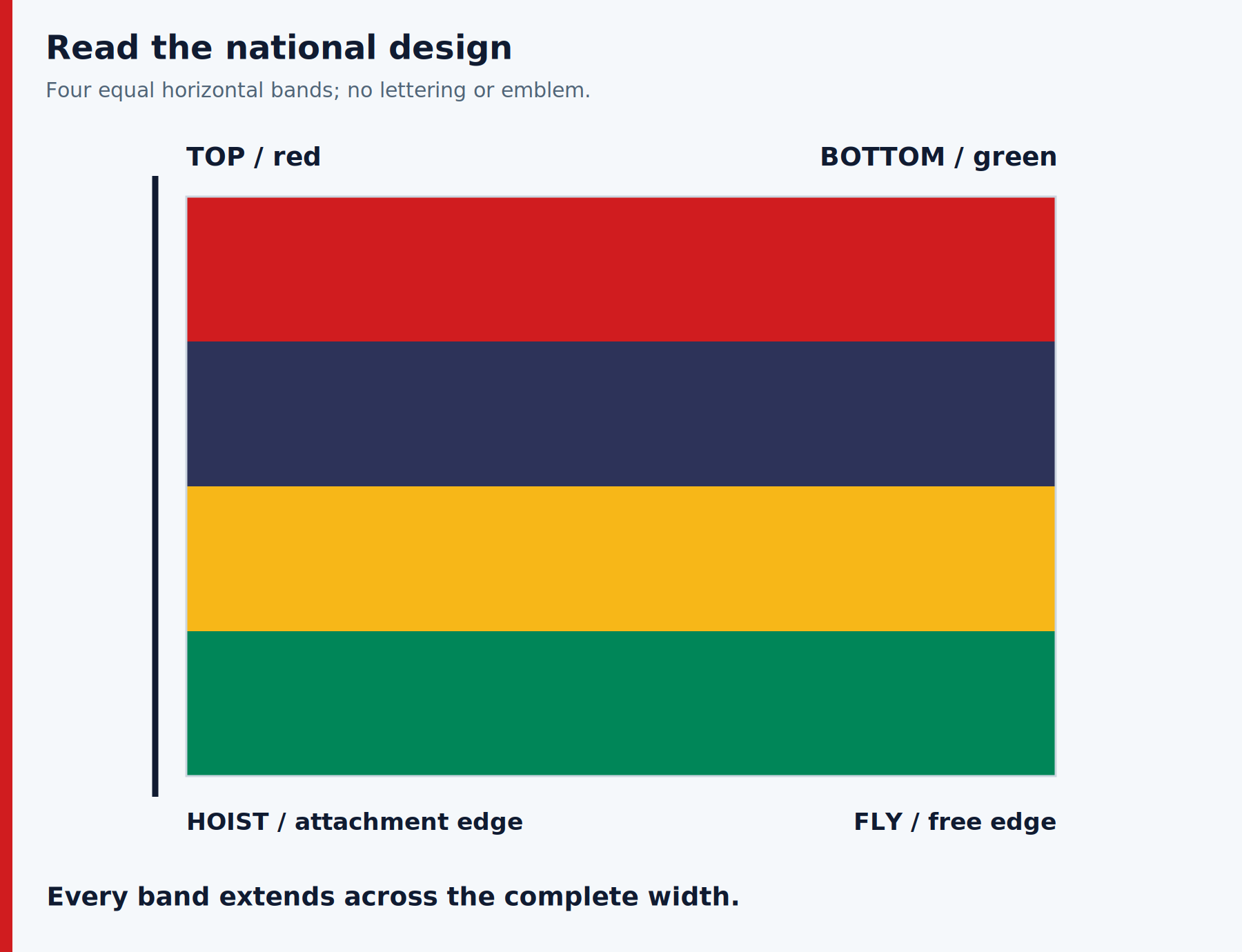
Each band runs all the way from the hoist, or attachment edge, to the fly, or free edge. The standard drawing has no gaps or outlines between bands. A small image should still show all four colors in the correct order.
What is the correct order of the four colors?
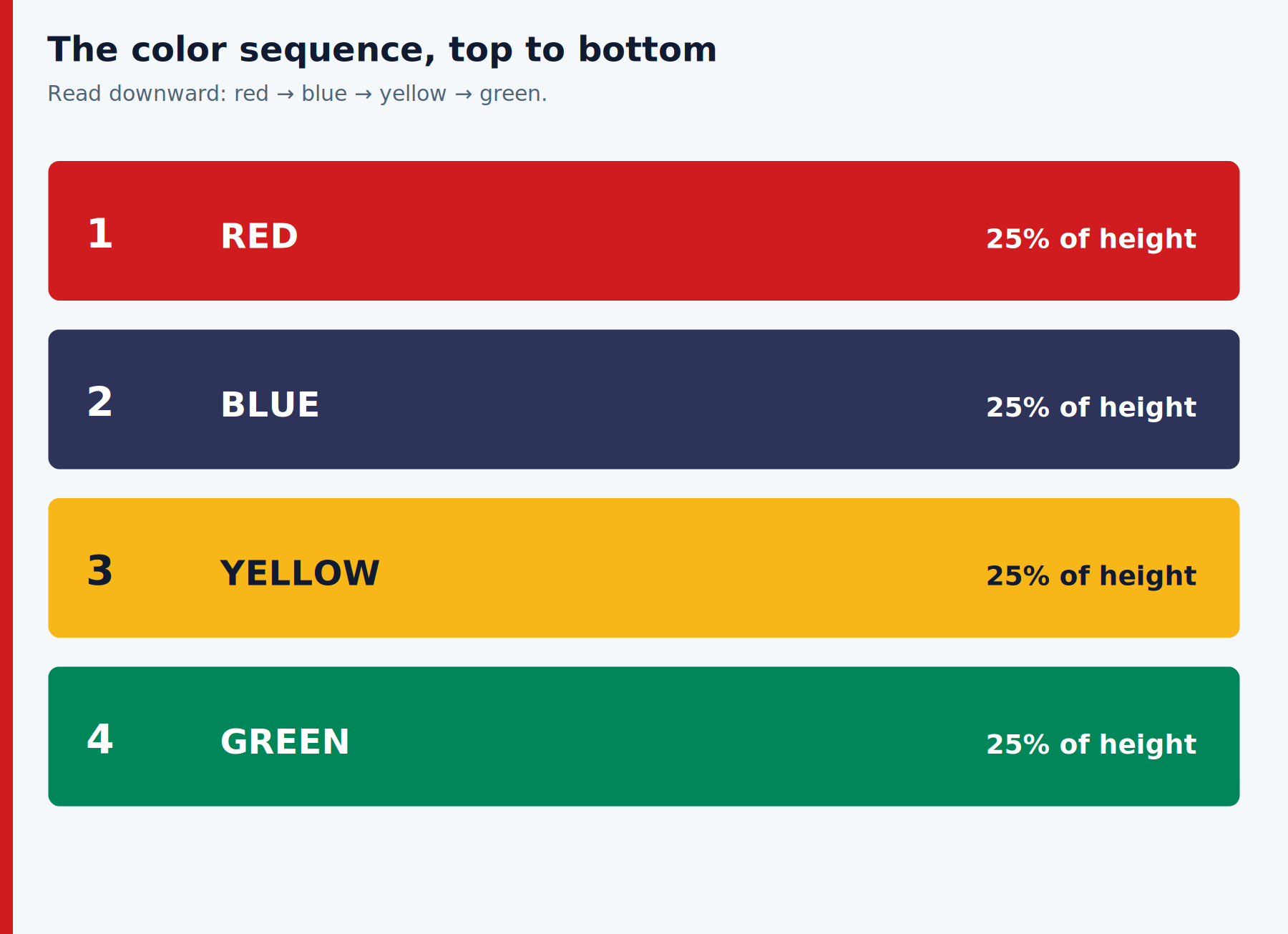
Read the flag from top to bottom: red, blue, yellow, green. Each color appears once and occupies one-quarter of the total height. The sequence is part of the legal description, not a choice left to the illustrator. Reversing the flag puts green at the top and produces an incorrect standard display.
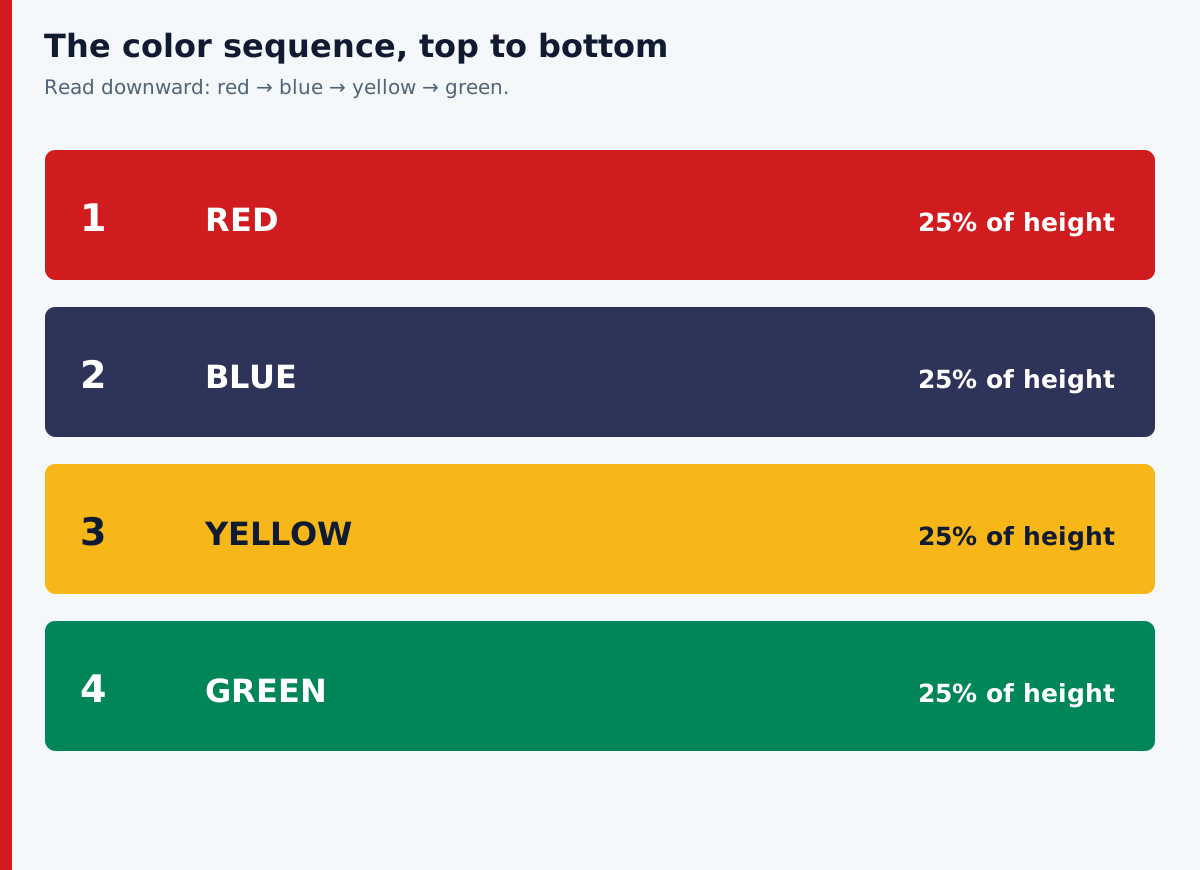
| Position | Color | Share of height |
|---|---|---|
| Top | Red | 25% |
| Second | Blue | 25% |
| Third | Yellow | 25% |
| Bottom | Green | 25% |
A useful memory aid is to connect the sequence with its meanings: freedom, ocean, independence’s light, and agriculture. This follows the flag’s actual order rather than rearranging the colors to suit a familiar rainbow pattern.
What are the flag’s proportions?
The normal national flag is three units wide and two units high, a width-to-height ratio of 3:2. The government overview expresses the same shape as 6:4. A height-to-width ratio of 2:3 also describes that rectangle. These notations agree once the order of the named dimensions is made clear.
| Notation | Meaning |
|---|---|
| 3:2 width:height | Three units across, two high |
| 6:4 width:height | Equivalent government overview notation |
| 2:3 height:width | Same rectangle, dimensions named in reverse |
| 900 × 600 pixels | An example preserving the standard proportion |
Changing the dimensions proportionately preserves the shape. Cropping a rectangle into a square or stretching it to fill a narrow banner changes that shape; a square container can instead hold the complete flag with space around it.
How can the flag be drawn accurately?
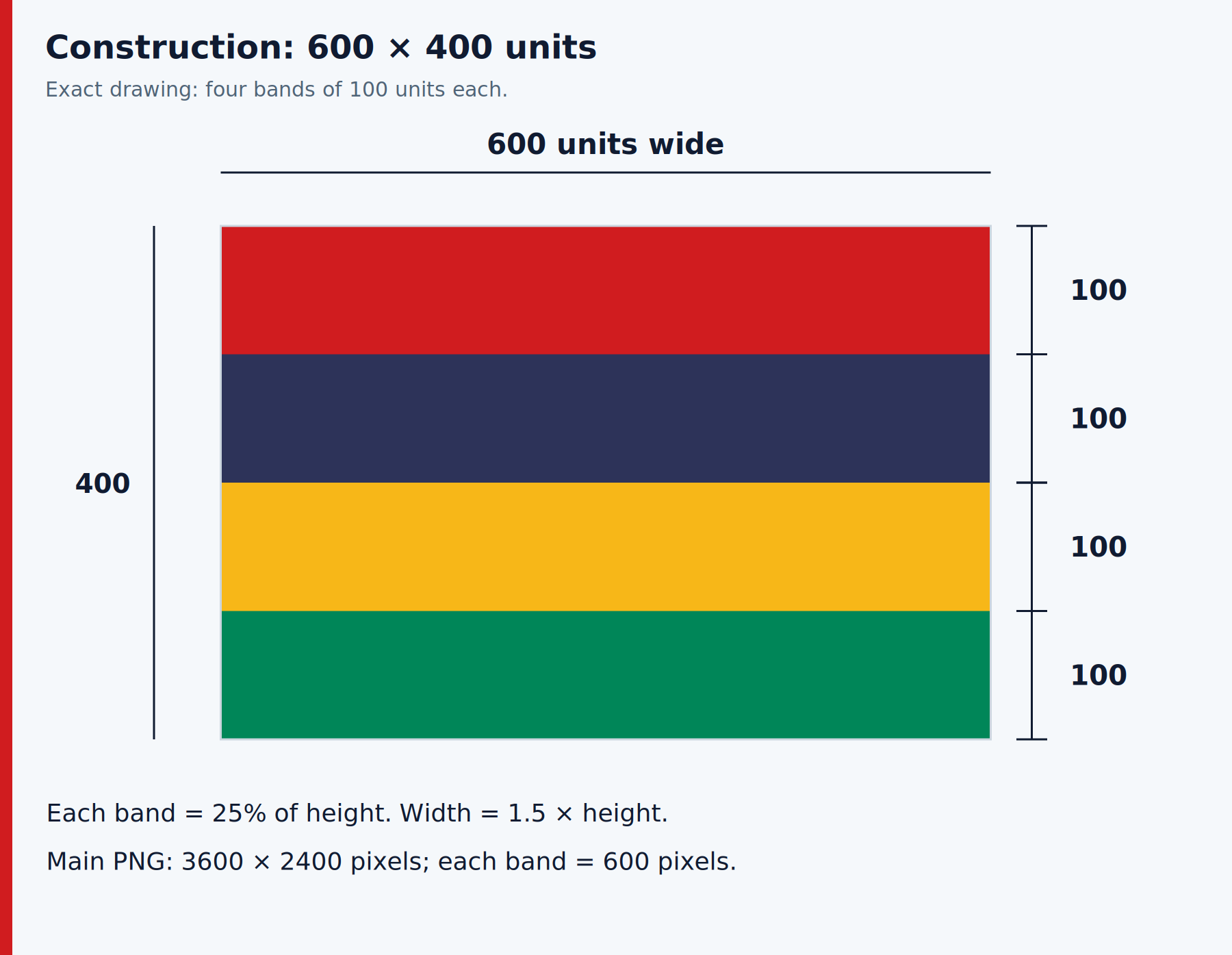
Draw a rectangle with a width one and a half times its height. Divide the height into four equal parts and fill them red, blue, yellow, and green from top to bottom. No emblem needs to be positioned. Keep every boundary horizontal and every band the same height across the full width.
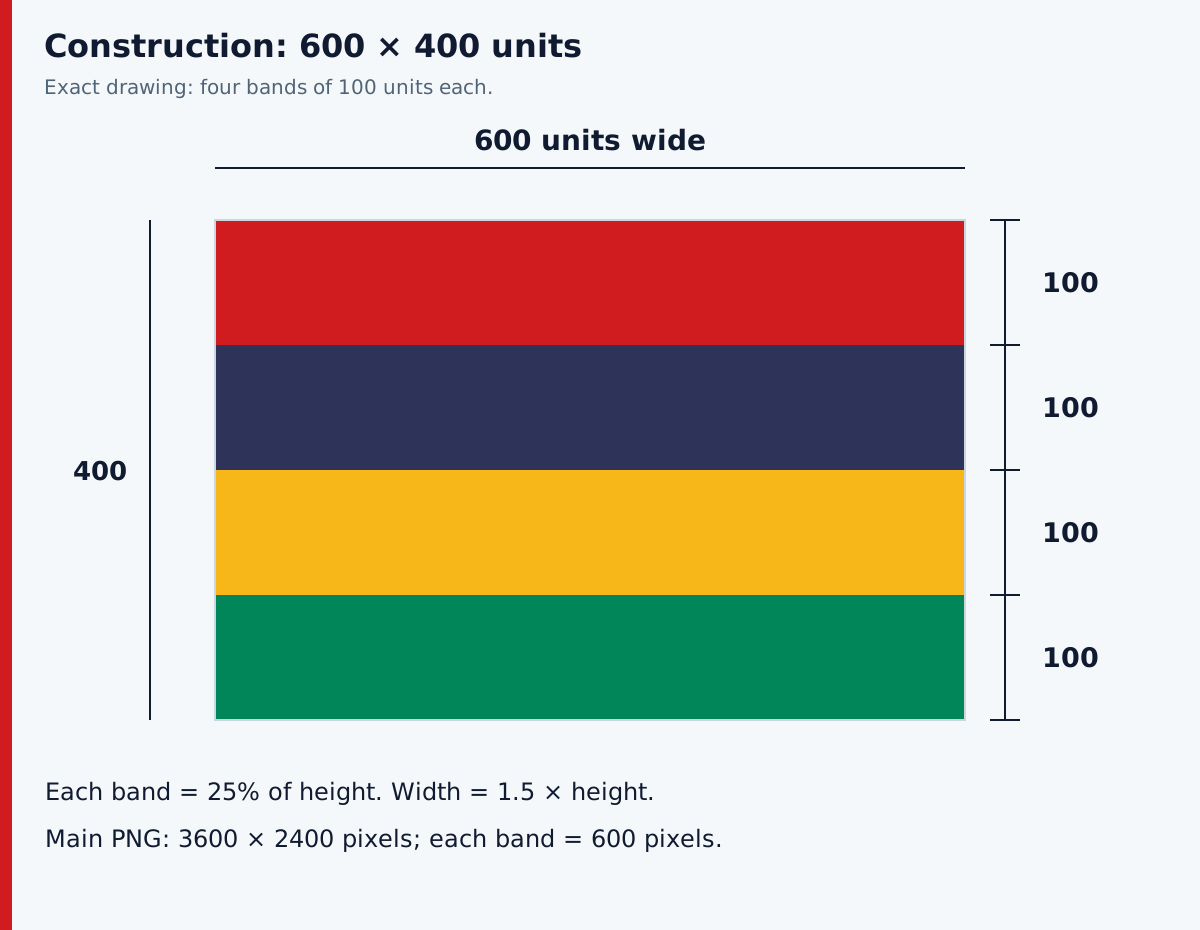
On a 600 by 400-unit drawing, each band is 100 units high. Its boundaries lie at 0, 100, 200, 300, and 400 units down from the top. The main 3600 by 2400-pixel PNG has four bands of 600 pixels each. These are exact drawing calculations, separate from manufacturing tolerances.
What are the official textile color codes?
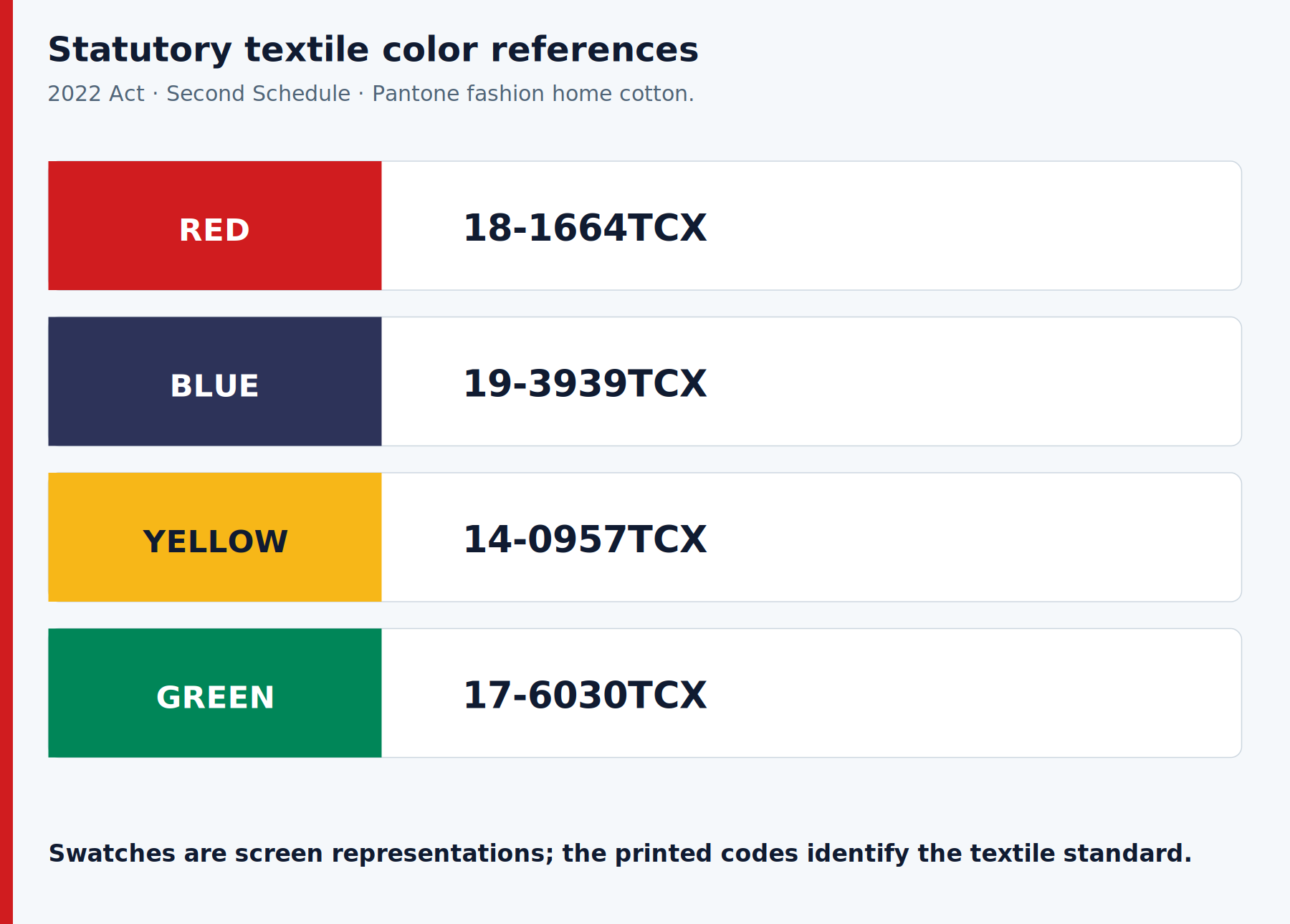
The 2022 Act specifies Pantone fashion home cotton references: red 18-1664TCX, blue 19-3939TCX, yellow 14-0957TCX, and green 17-6030TCX. These are the flag’s statutory textile color references. They should not be replaced with the coat of arms’ different Pantone values merely because both tables appear in the same national-symbols legislation.
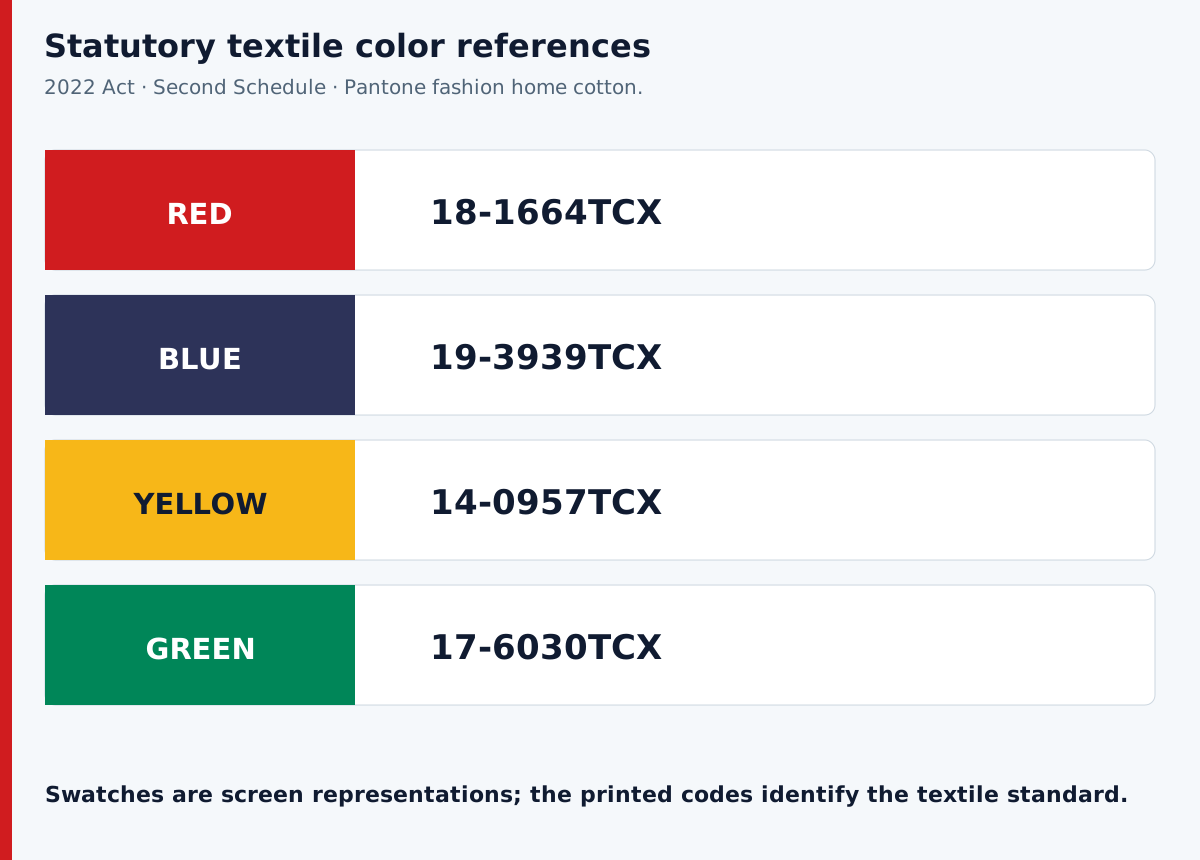
| Band | Statutory textile reference |
|---|---|
| Red | 18-1664TCX |
| Blue | 19-3939TCX |
| Yellow | 14-0957TCX |
| Green | 17-6030TCX |
The flag colors appear in the Second Schedule. The First Schedule concerns the arms and gives a different set of color specifications. The distinction matters when commissioning a flag or checking a supplier’s documentation.
Which HEX and RGB values are used in the downloads?
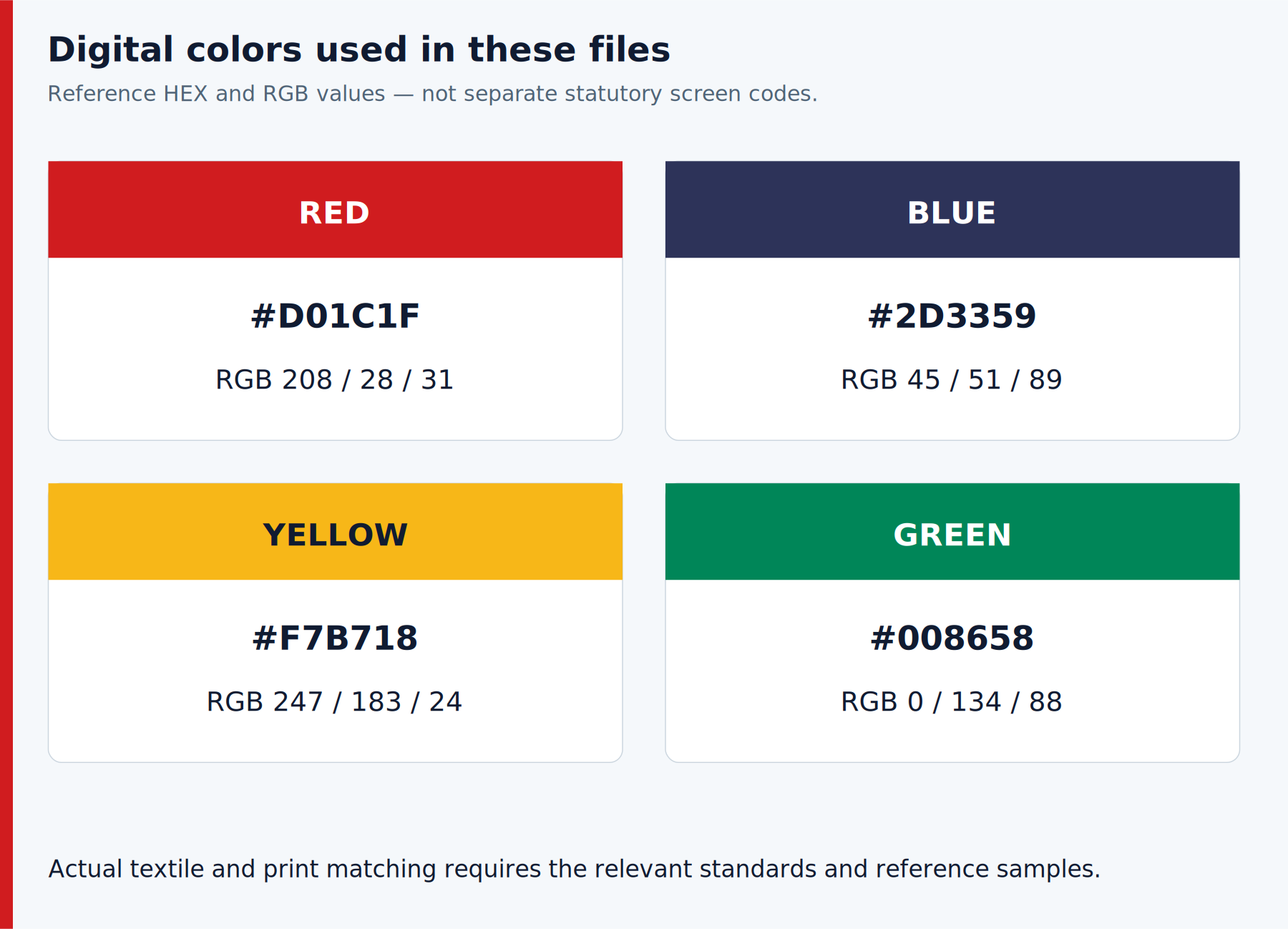
The illustrations use red #D01C1F, blue #2D3359, yellow #F7B718, and green #008658, matching the current credited reference vector. These are digital reproduction values. The Act specifies textile references rather than these HEX numbers, so the screen palette should not be presented as a separate set of legally prescribed RGB codes.
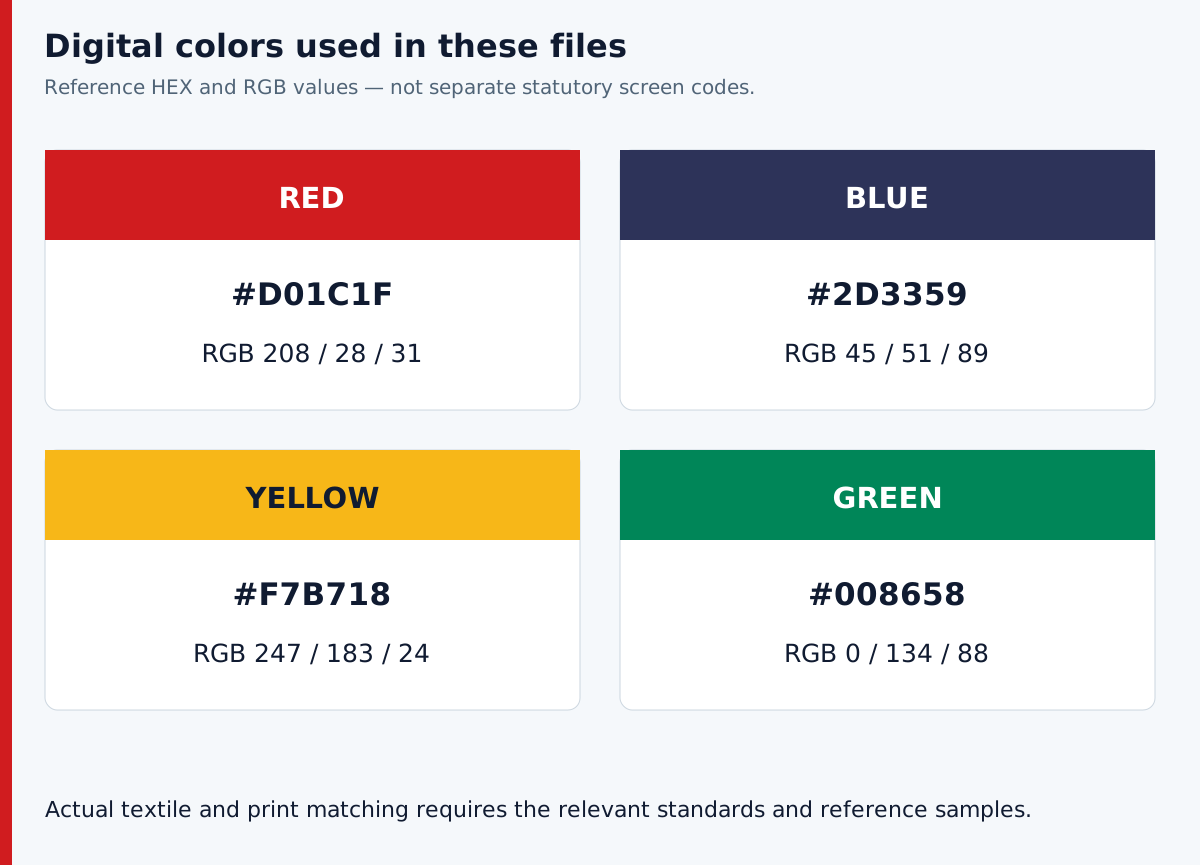
| Color | HEX | RGB |
|---|---|---|
| Red | #D01C1F | 208, 28, 31 |
| Blue | #2D3359 | 45, 51, 89 |
| Yellow | #F7B718 | 247, 183, 24 |
| Green | #008658 | 0, 134, 88 |
The reference file’s current revision retains a palette introduced in 2025. A change to a digital illustration is not a new adoption of the national flag. Textile matching, display calibration, and printing conditions remain distinct questions. The Mauritius Standards Bureau separately lists MS 1-3:2019 for color coding on paper.
Why do older pages give different color numbers?
Older government descriptions list British Standard numbers: red 0.005, blue 7.086, yellow 0.001, and green 0.010. The 2022 Act instead prints the TCX textile references. Keep these systems attached to their sources and dates. A historical code, a textile reference, and a screen HEX value are not interchangeable labels.
The February 2017 communiqué used TC suffixes in the earlier regulatory framework. The enacted 2022 schedule uses TCX. Its text is the appropriate source for reporting the later statutory specification; an older webpage or draft regulation should not silently override it.
Color numbers alone do not establish a measured conversion between systems. For a physical print or textile job, consult the relevant standard and approved reference samples rather than choosing whichever online shade looks most familiar.
What do the four flag colors mean?
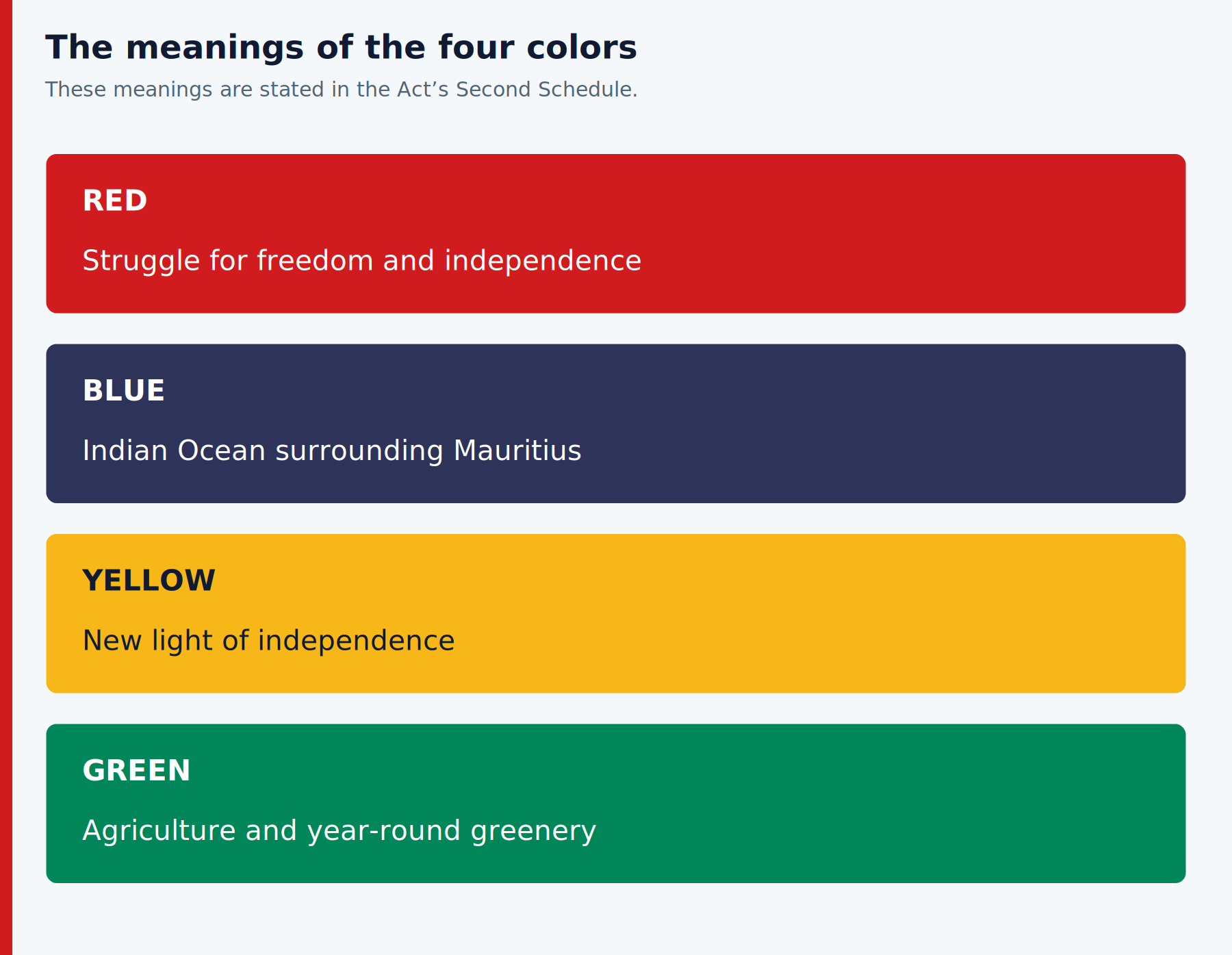
The law associates red with the struggle for freedom and independence, blue with the Indian Ocean, yellow with the new light of independence, and green with agriculture and the country’s year-round greenery. These are meanings stated in the Second Schedule, rather than an informal interpretation inferred only from the appearance of the colors.
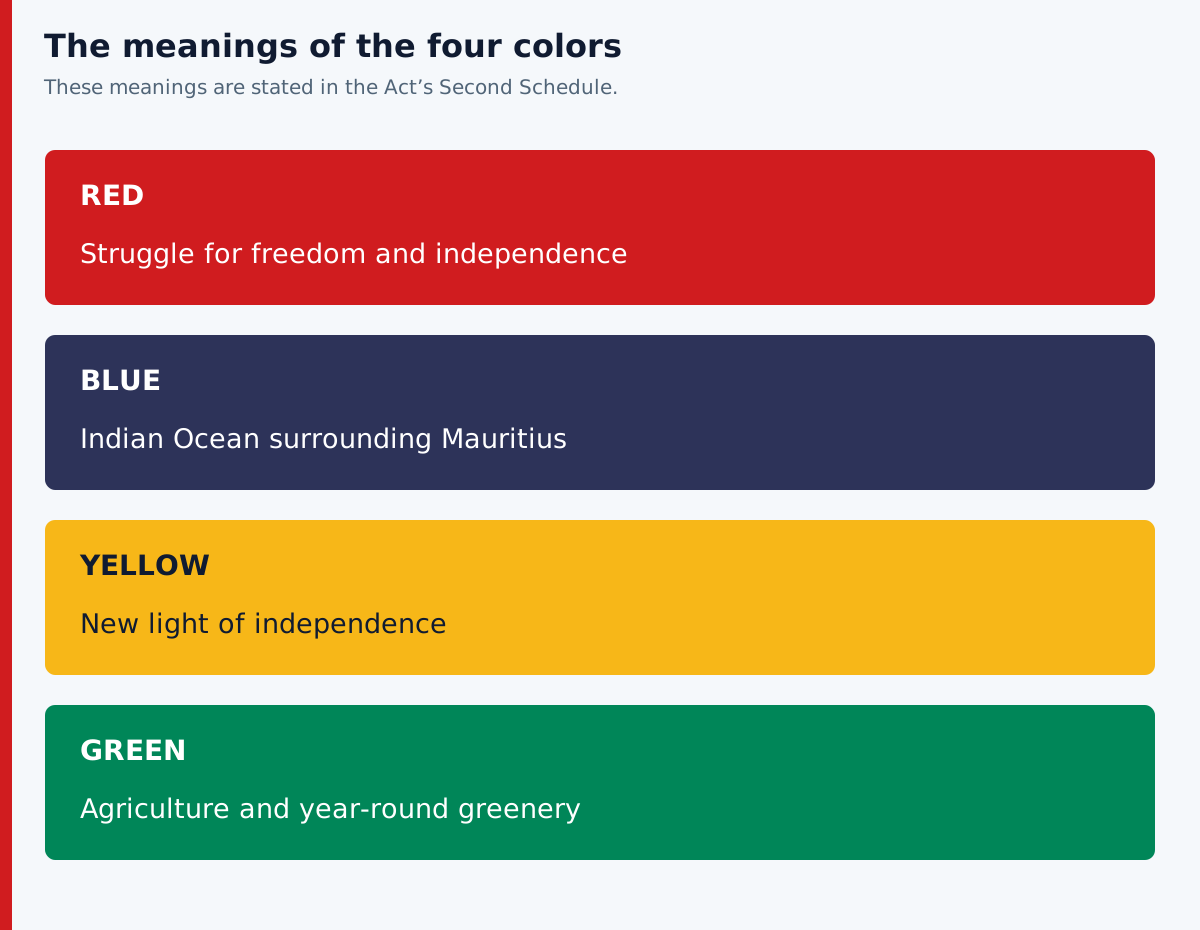
| Color | Meaning stated in the Act |
|---|---|
| Red | Struggle for freedom and independence |
| Blue | Indian Ocean surrounding Mauritius |
| Yellow | New light of independence |
| Green | Agriculture and the island’s color throughout the year |
The statutory explanation does not assign the four bands to four ethnic or religious groups. Political readings and personal associations should be distinguished from the meanings that the law actually sets out.
What does the red band represent?
The red band represents the struggle for freedom and independence. It is the uppermost quarter of the flag and introduces its national story. The statutory wording does not identify one particular battle or require the band to be explained solely as bloodshed; its meaning concerns the wider achievement of freedom and self-government.
The National Archives describes the elections and constitutional negotiations that led to independence. That historical setting helps explain the theme of freedom without adding an unsupported claim that the color commemorates a specific military campaign.
Why is there a blue band?
Blue represents the Indian Ocean, in which Mauritius is situated. It is the second band, immediately below red and above yellow. This geographical meaning is stated explicitly in the national-symbols legislation. The band is not a map of territorial waters, and its thickness does not encode a distance, maritime boundary, or ocean depth.
Like the other bands, blue occupies one-quarter of the flag’s height. Its meaning remains the same at every scale, whether the image appears on a classroom worksheet, a desk flag, or a full-size mast flag.
Does yellow mean sunshine or independence?
The Act’s precise meaning is the new light of independence. Sunshine is a common explanatory association, but it should not displace that statutory wording in an exam answer or formal description. Yellow forms the third horizontal band, between blue and green, and represents the promise associated with the country’s independent future.
Some diplomatic summaries shorten the explanation to golden sunshine. For a concise answer about the official symbolism, “the new light of independence” is the more precise formulation because it follows the Second Schedule directly.
What does the green band symbolize?
Green represents the agriculture of Mauritius and its greenery throughout the twelve months of the year. It is the lowest of the four bands. This symbolism refers to the country’s cultivated land and enduring green appearance; it does not mean that the flag is a statistical chart of the present economy.
Agriculture, especially sugar, was central to the historical economy described by the National Archives. The flag preserves that national association even as the wider economy changes. No current crop-production figure or percentage of economic output is implied by the band’s size.
When was Mauritius’s national flag adopted?
The four-color national flag dates from independence on March 12, 1968. Official historical accounts recall its raising at noon at Champ de Mars in Port Louis as the Union Jack was lowered. Later Acts and technical rules formalized protection and specifications; they did not create a new independence date for the flag.
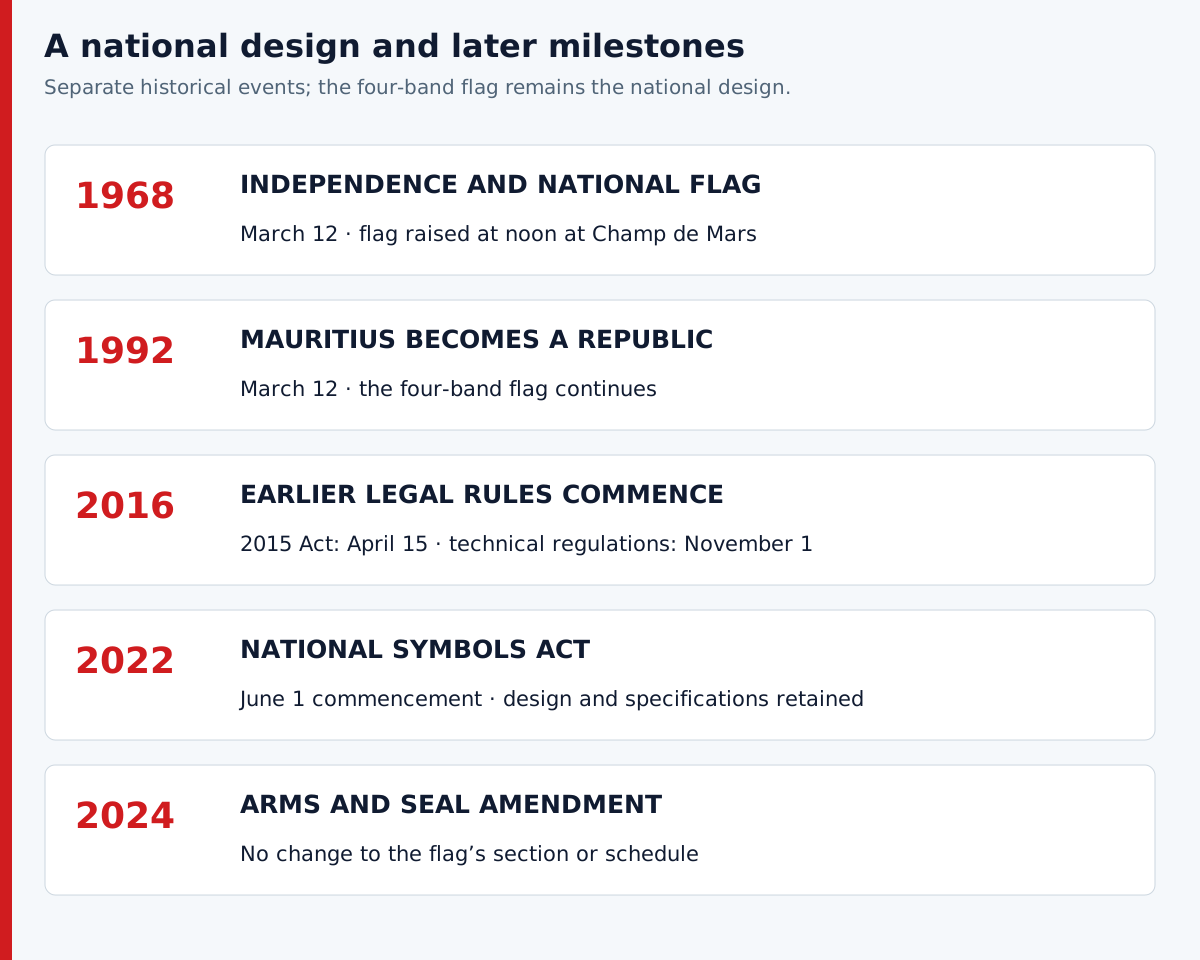
March 12, 1968 is the practical adoption date for the national design. The United States also recognized Mauritius on that date, but recognition is a diplomatic act, distinct from designing or raising the country’s flag.
Who designed the flag of Mauritius?
Gurudutt Moher is credited as the flag’s creator in a tribute recorded in the National Assembly’s April 26, 2022 proceedings. Contemporary Mauritian reporting also identifies him as the designer and records his posthumous MSK honor in March 2018. That design credit is separate from the later legal specification and reproduction of the flag.
The parliamentary record provides a direct institutional attribution, while the 2018 report independently corroborates it. The digital artists credited with the downloadable vector drew a reference illustration; their credits do not make them the designers of the national symbol.
What is the flag’s historical background?
Mauritius passed through Dutch, French, and British colonial periods before independence. The present four-band flag belongs to the independent nation, rather than to a colonial administration. Its ceremonial raising in 1968 marked the transition from British sovereignty, and the same basic design continued when Mauritius became a republic in 1992.
At the independence ceremony, official accounts describe the Union Jack being lowered. That particular ceremony should not be confused with a complete catalogue of colonial ensigns, governors’ flags, or earlier administrative badges. Those flags had different roles and are not variants of today’s ordinary national flag.
The National Archives places independence after the 1967 elections and constitutional process. The current flag’s history therefore concerns both the creation of a national symbol and the transition to independent government.
Did the flag change when Mauritius became a republic?
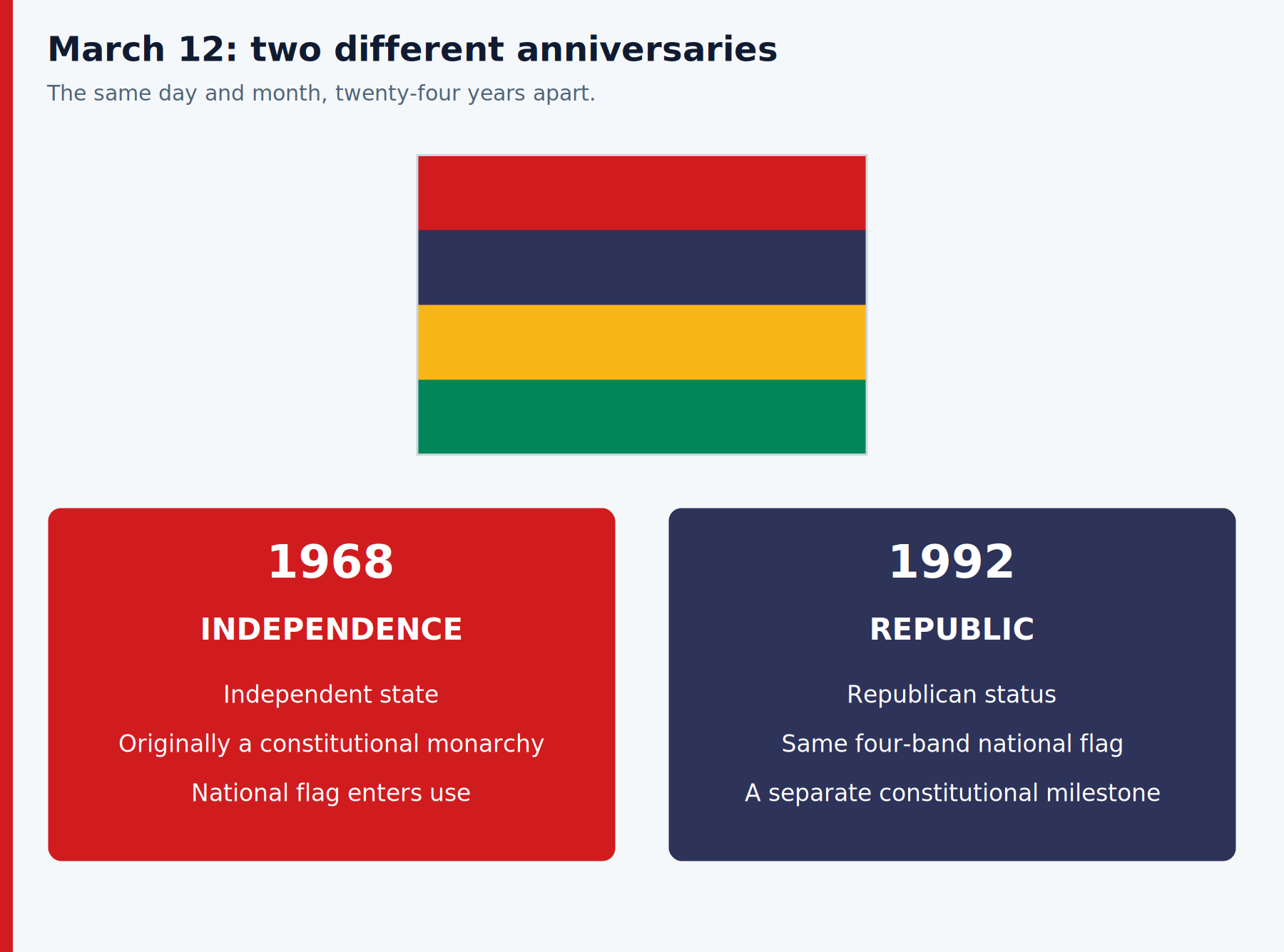
Mauritius became a republic on March 12, 1992, twenty-four years after independence. The red, blue, yellow, and green national flag continued in use. The two anniversaries share the same day and month but commemorate different events: independence in 1968 and the change from constitutional monarchy to republic in 1992.
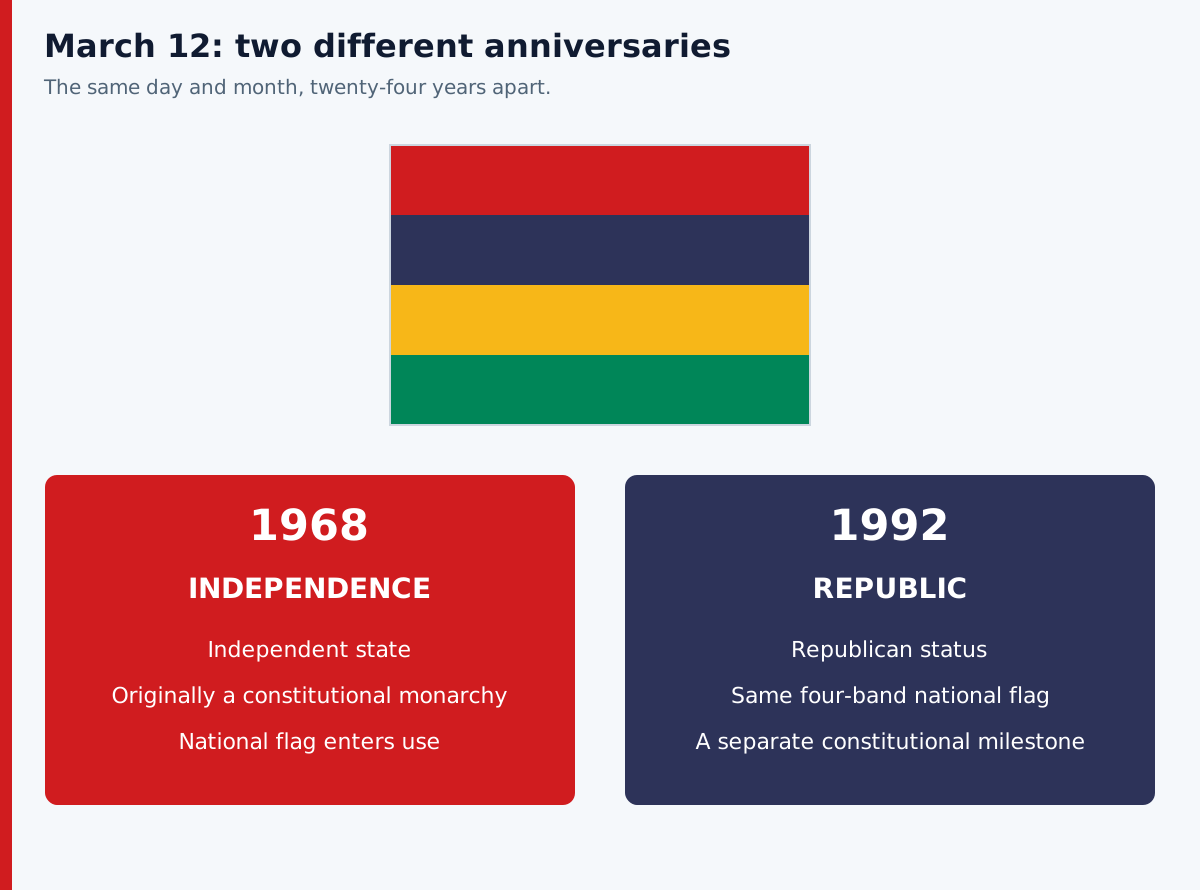
March 12 is consequently central to national celebrations. It is useful to label both anniversaries explicitly rather than treating “Independence Day,” “Republic Day,” and the flag’s adoption as three names for one event in one year.
What did the 2022 national-symbols Act change?
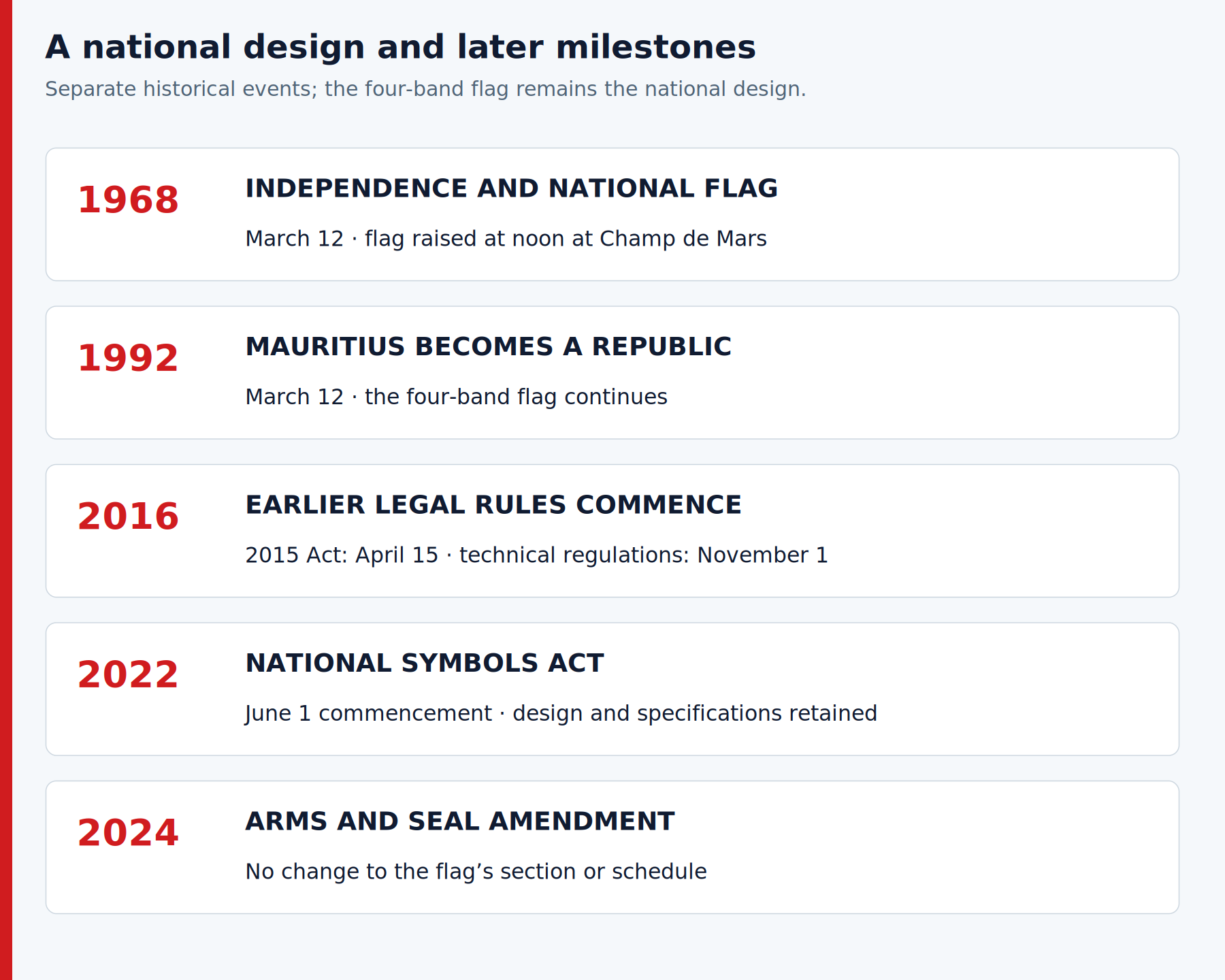
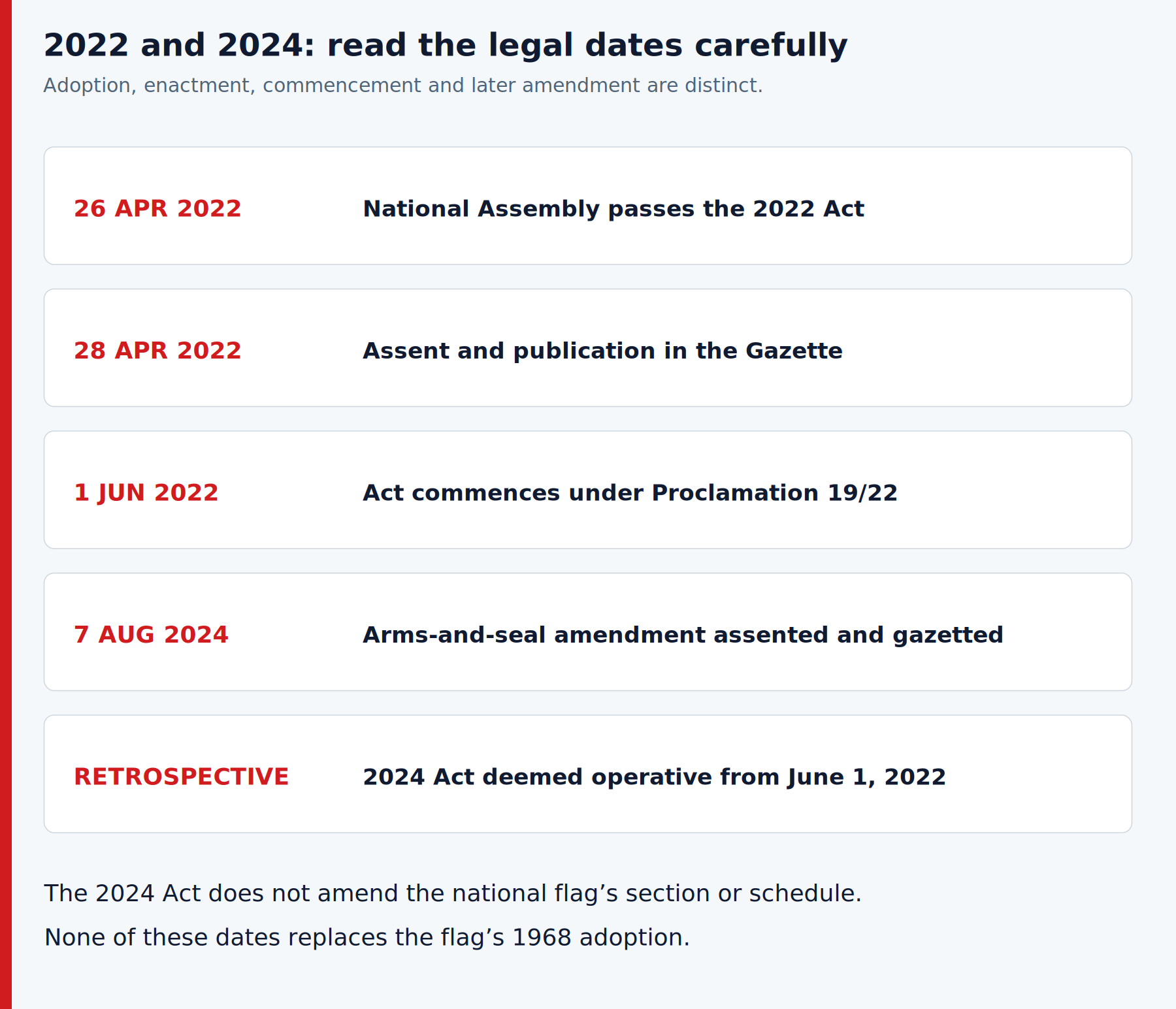
The 2022 Act consolidated protection of Mauritius’s national symbols and placed the flag’s design, meanings, dimensions, colors, and mast-material requirements in its Second Schedule. It came into operation on June 1, 2022. It repealed the 2015 National Flag Act and revoked the 2016 technical regulations, while retaining the established four-band national design.
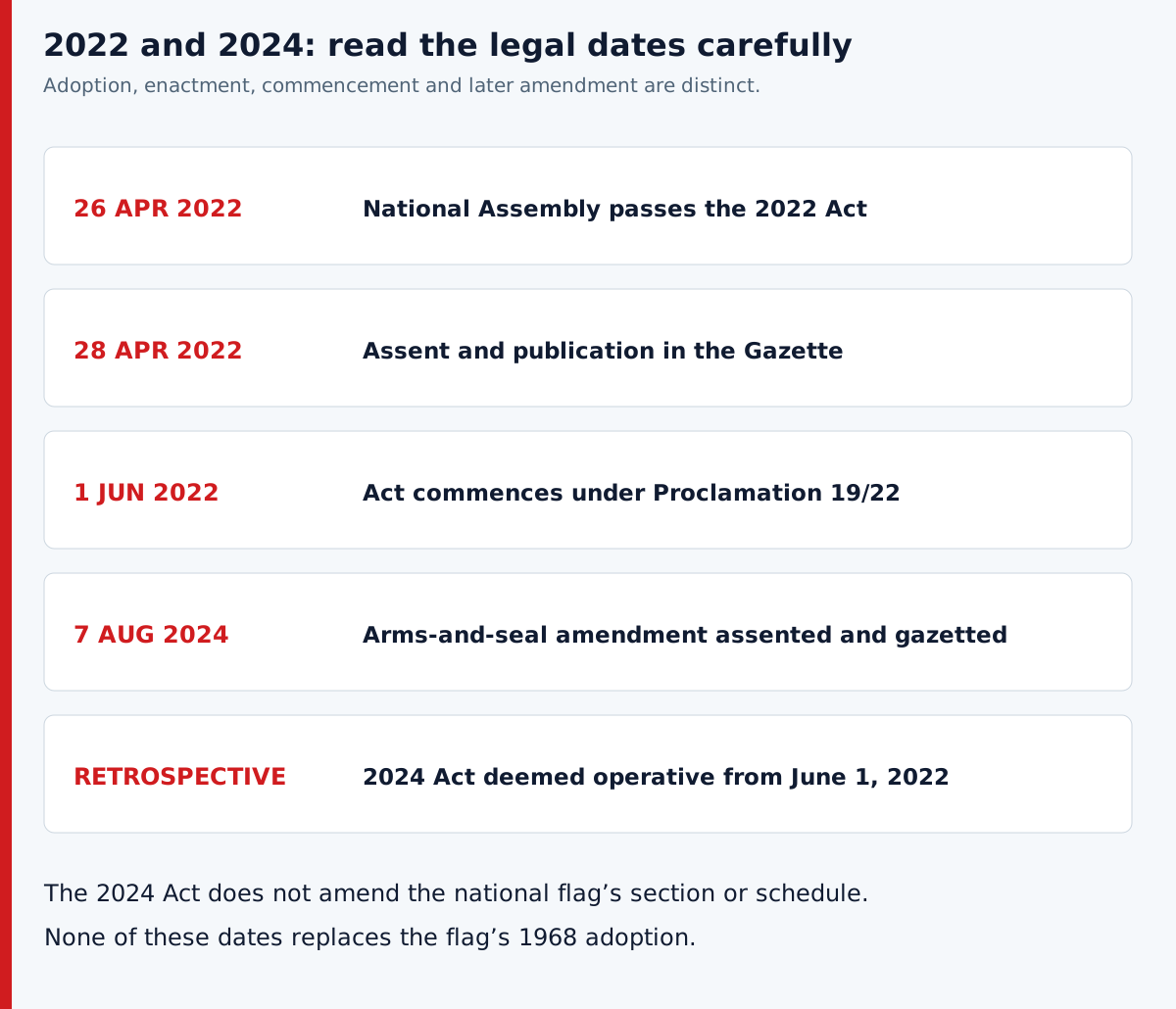
The Assembly passed the Act on April 26, 2022; assent and gazetting followed on April 28. Commencement on June 1 is a separate legal milestone. The earlier 2015 Act had taken effect on April 15, 2016, and its technical regulations became operational on November 1, 2016.
Did the 2024 amendment introduce a new flag?
No. The 2024 amendment changes provisions concerning the arms and seal of Mauritius, including approved monochrome, grayscale, and line-art versions for specified government uses. It does not amend the national flag’s section or its Second Schedule. Its retrospective commencement provision also does not turn 2024 into a new flag-adoption year.
The amending Act was assented to and gazetted on August 7, 2024 and is deemed to have operated from June 1, 2022. Its permissions for the arms and seal should not be generalized into an official grayscale version of the four-color national flag.
What standard physical sizes does the Act specify?
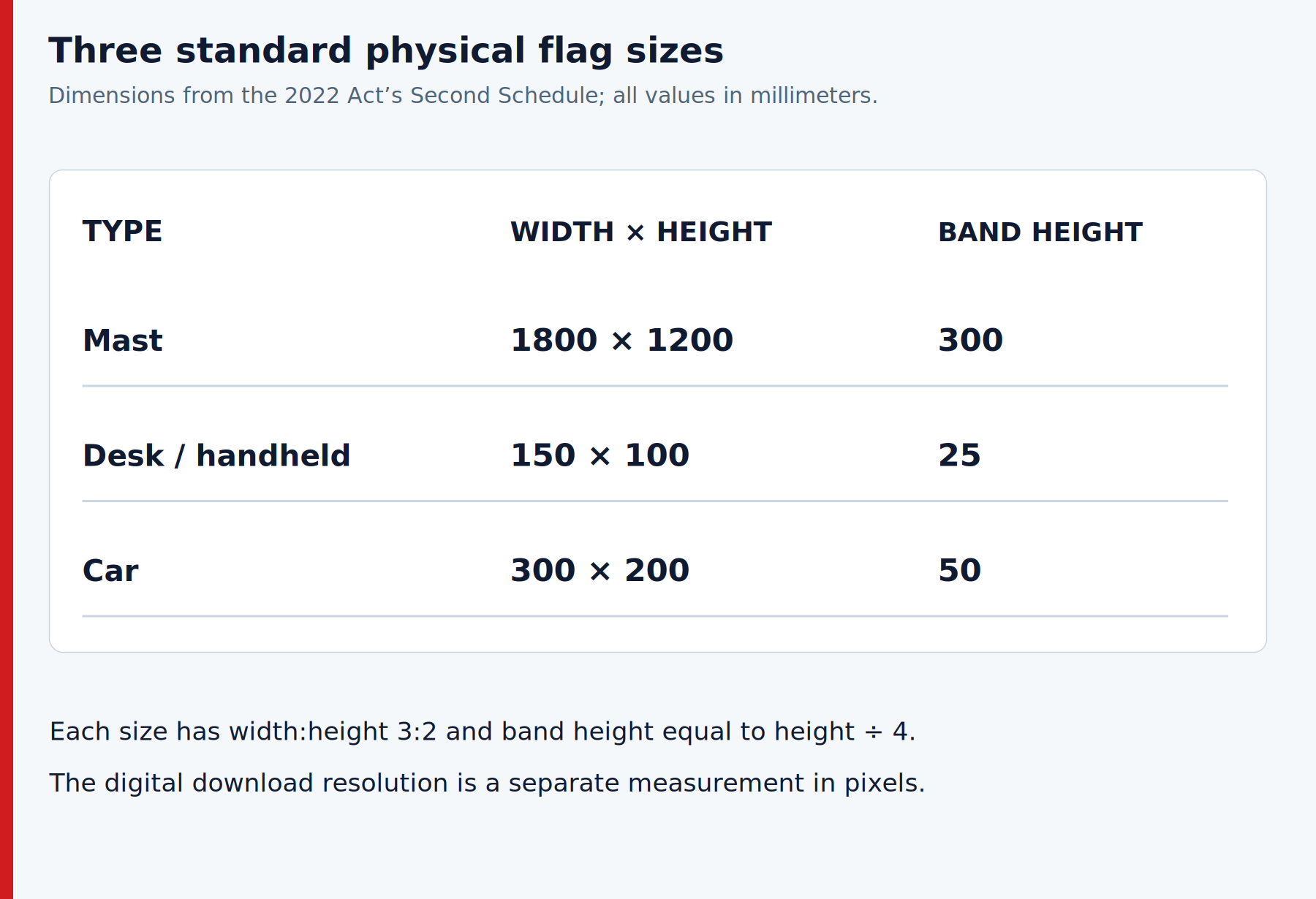
The Second Schedule specifies a mast flag of 1800 by 1200 millimeters, a desk or handheld flag of 150 by 100 millimeters, and a car flag of 300 by 200 millimeters. Their individual band heights are 300, 25, and 50 millimeters respectively. All three preserve the normal 3:2 rectangle.
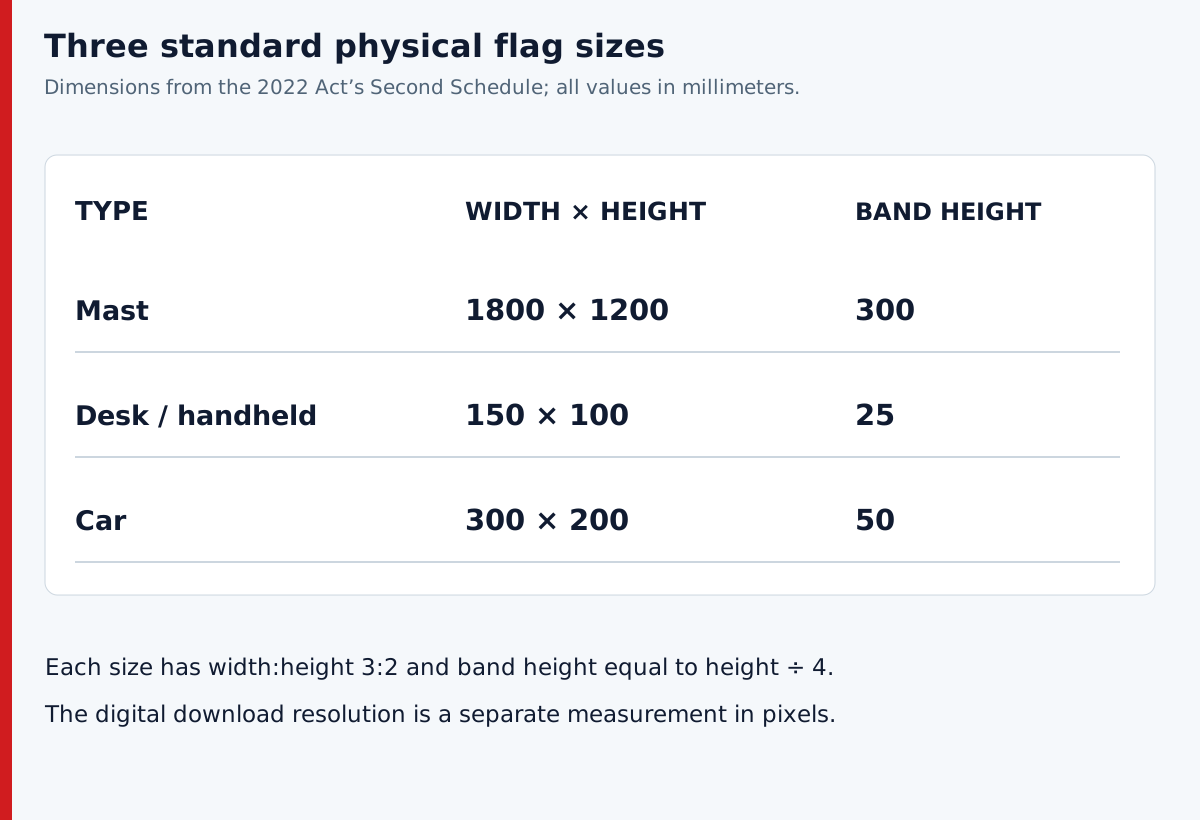
| Type | Width × height | Each band |
|---|---|---|
| Mast | 1800 × 1200 mm | 300 mm |
| Desk or handheld | 150 × 100 mm | 25 mm |
| Car | 300 × 200 mm | 50 mm |
In centimeters, those dimensions are 180 × 120, 15 × 10, and 30 × 20. The 3600 × 2400-pixel download is a digital image size, not an additional physical category created by the Act.
What manufacturing tolerances are specified?
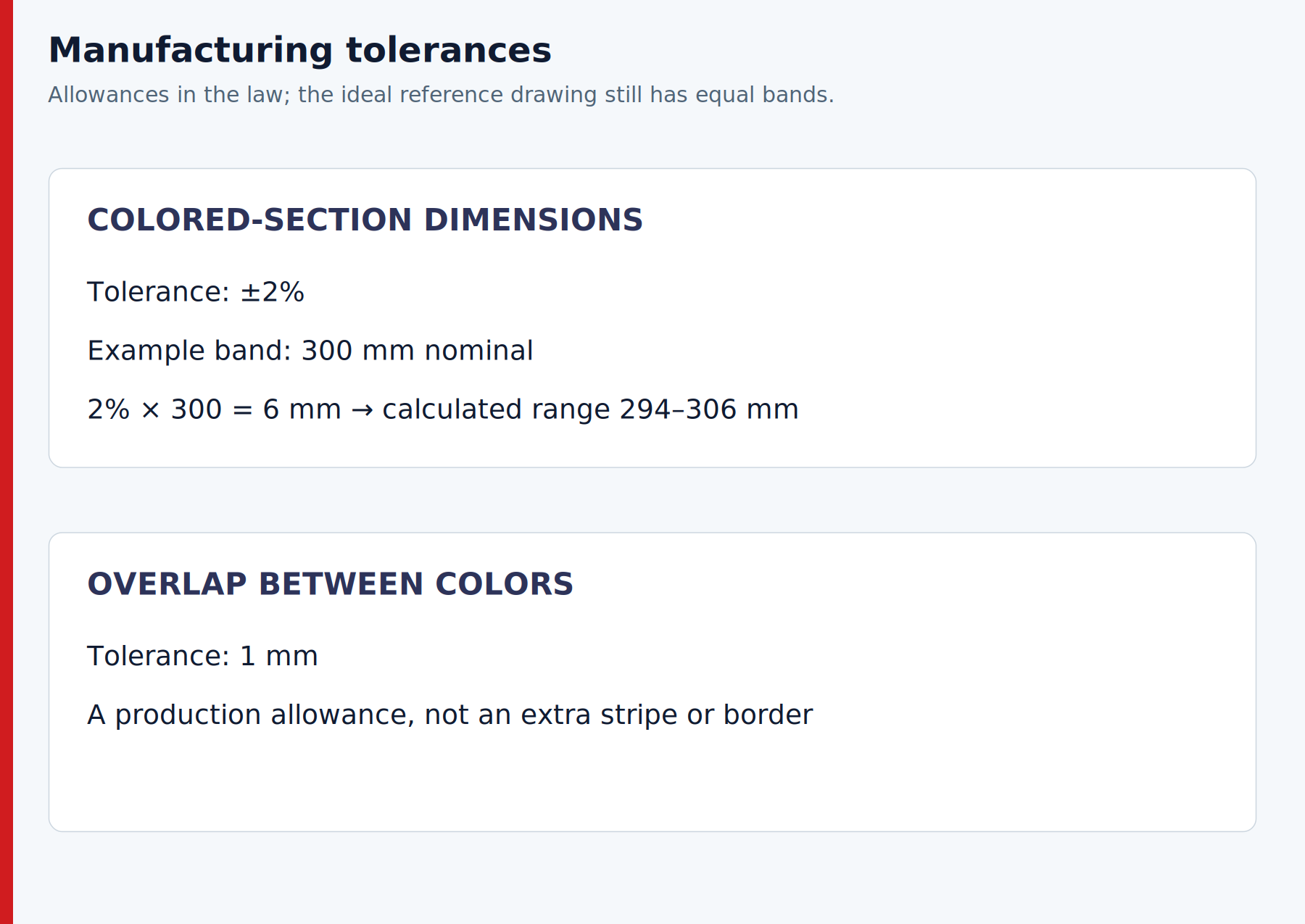
The Act allows a tolerance of plus or minus two percent on the dimensions of the different colored sections and a one-millimeter tolerance for overlap between two colors. These allowances concern production accuracy. They do not change the ideal drawing into four deliberately unequal bands or authorize a different normal color sequence.
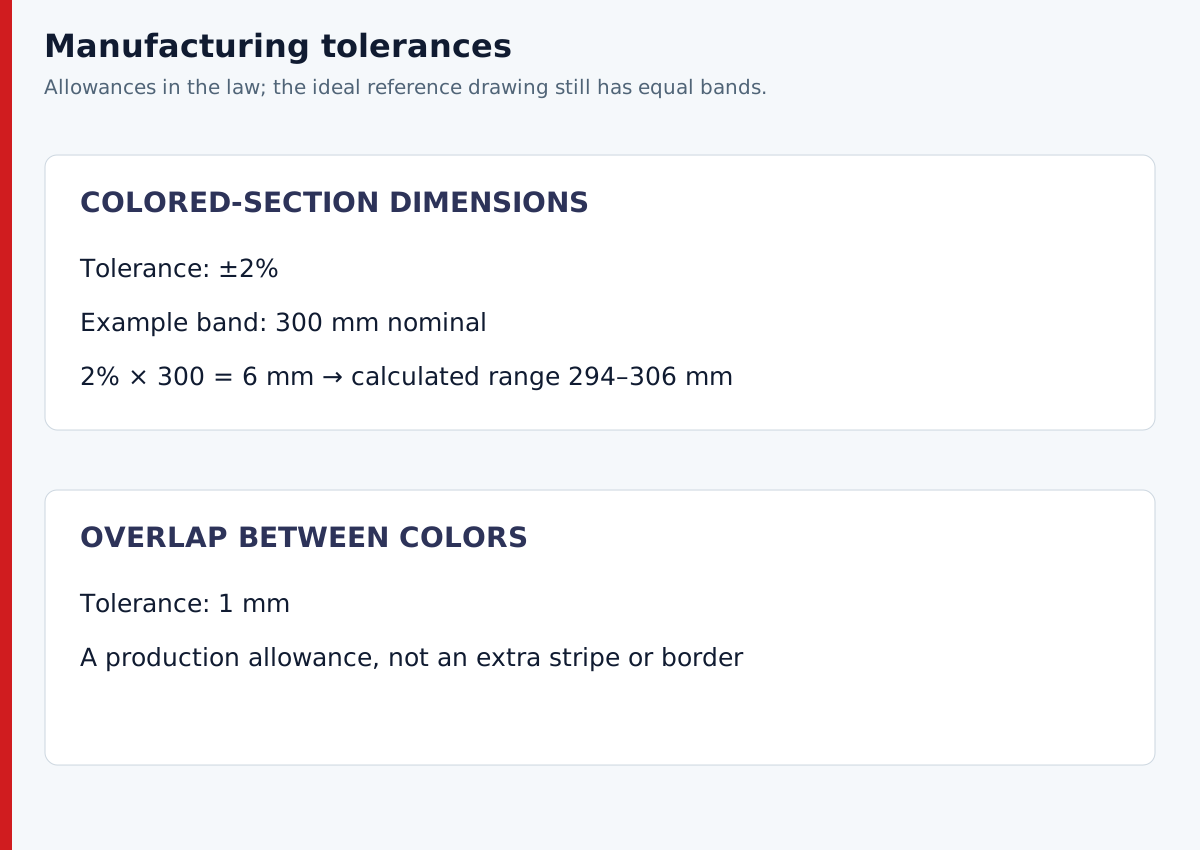
For a nominal 300-millimeter band, two percent is 6 millimeters, giving a calculated range of 294–306 millimeters for that dimension. This arithmetic illustrates the stated tolerance; it is not a complete inspection procedure or a rule that every band must be made at an extreme.
What material is specified for a mast flag?
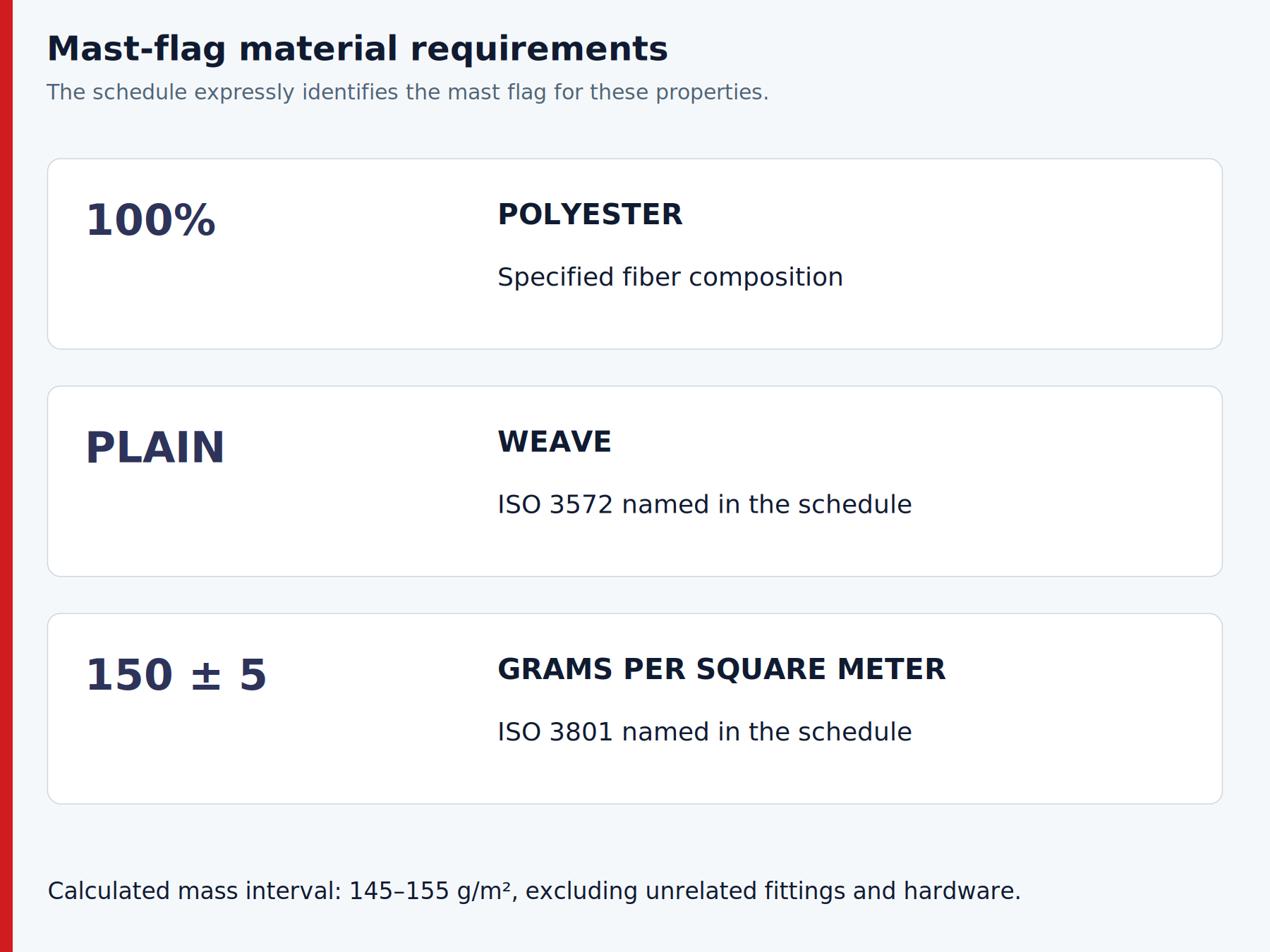
For the mast flag, the Second Schedule specifies one hundred percent polyester in a plain weave, with a mass per unit area of 150 plus or minus 5 grams per square meter. It also names test references. This material specification applies expressly to the mast flag, rather than automatically to every paper or digital representation.
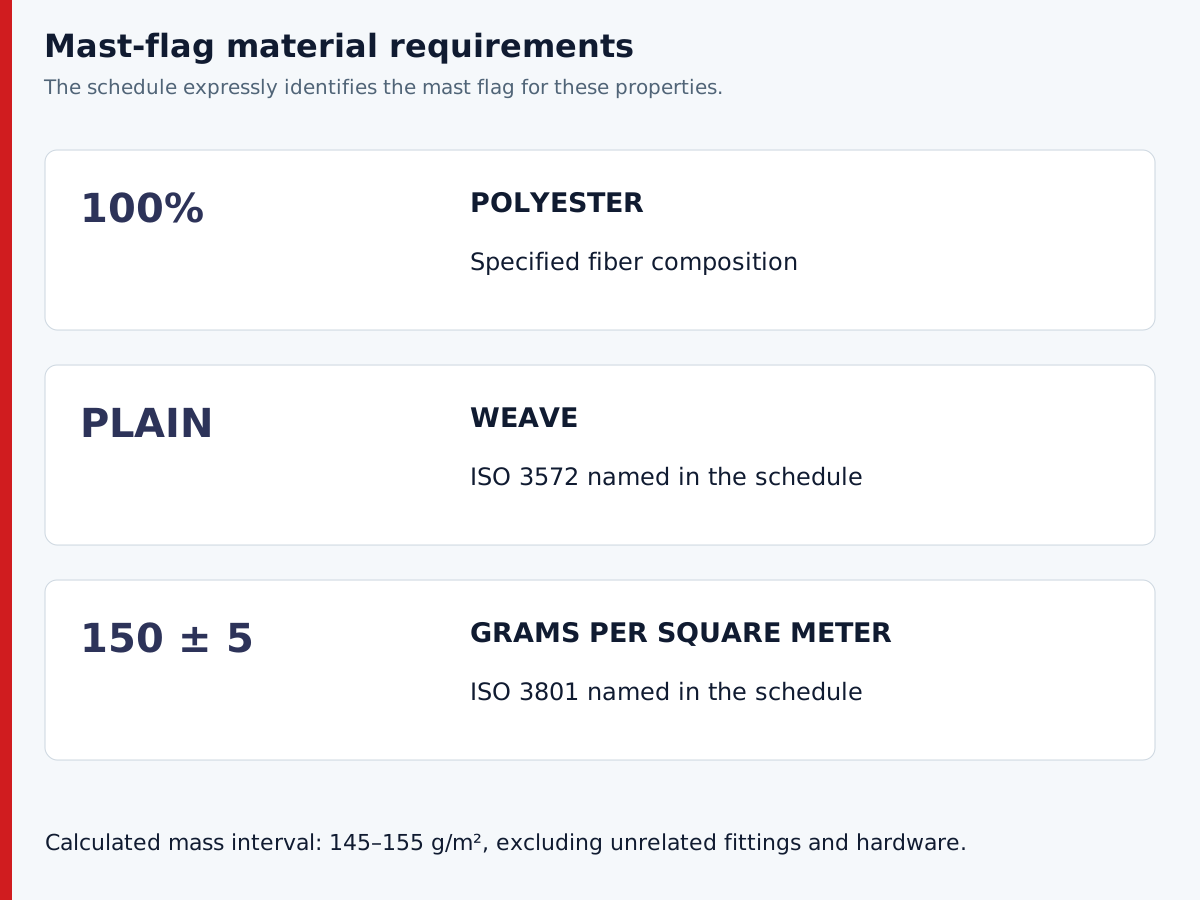
| Property | Specified requirement |
|---|---|
| Composition | 100% polyester |
| Construction | Plain weave; ISO 3572 named in schedule |
| Mass per unit area | 150 ± 5 g/m²; ISO 3801 named in schedule |
The permitted mass interval is therefore 145–155 g/m². That describes fabric mass per unit area, not the weight of every finished flag including seams, cord, or fittings. The materials and dimensions must be evaluated as separate parts of a manufactured object.
How should the flag be oriented and displayed?
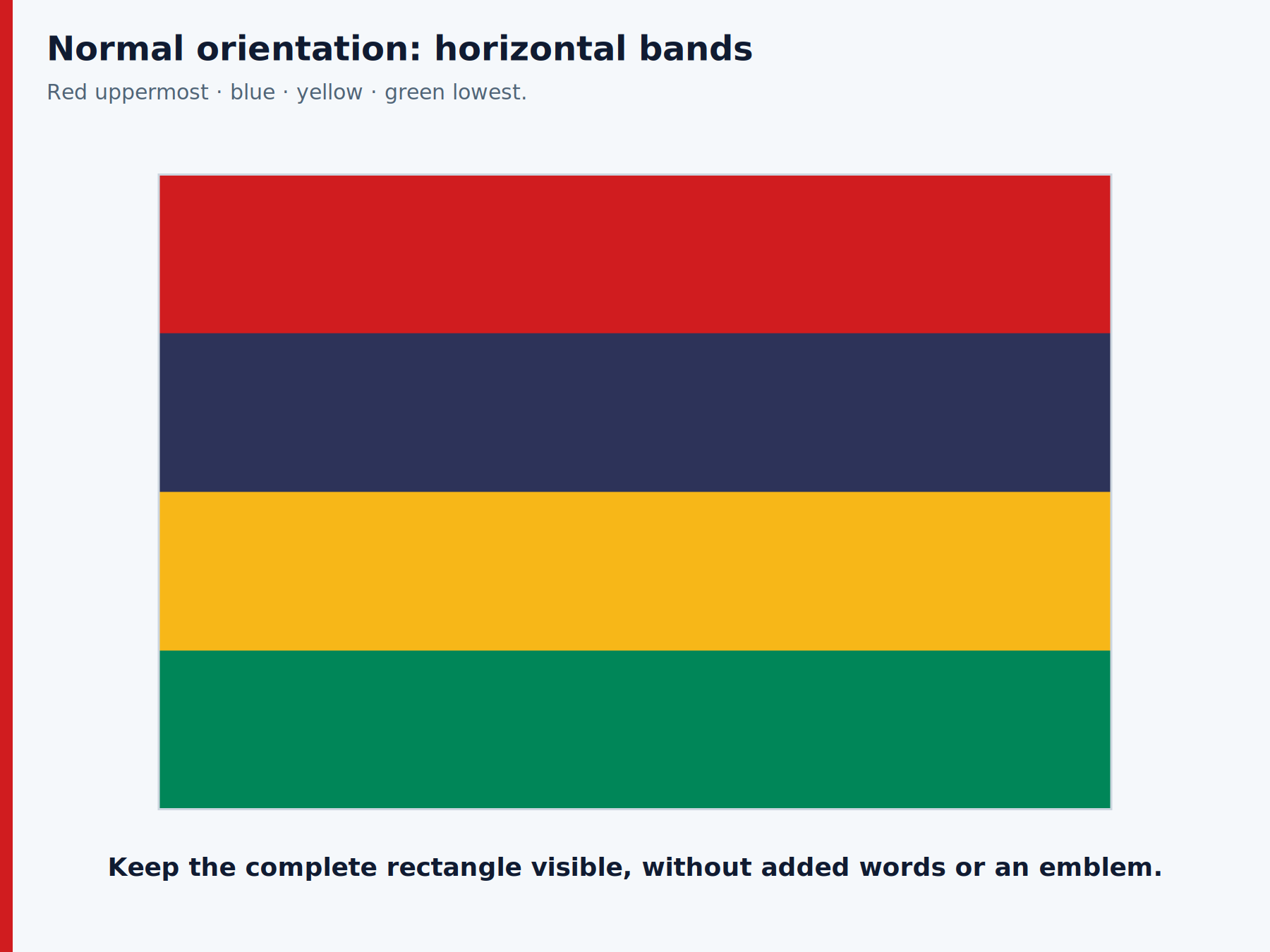
The normal display keeps the bands horizontal, with red uppermost and green lowest. Preserve the complete rectangle and avoid placing lettering or an emblem on it. The Act addresses alteration and incorrect exhibition separately. Detailed ceremonial arrangements should follow the applicable Mauritian flag code and official instructions for the occasion.
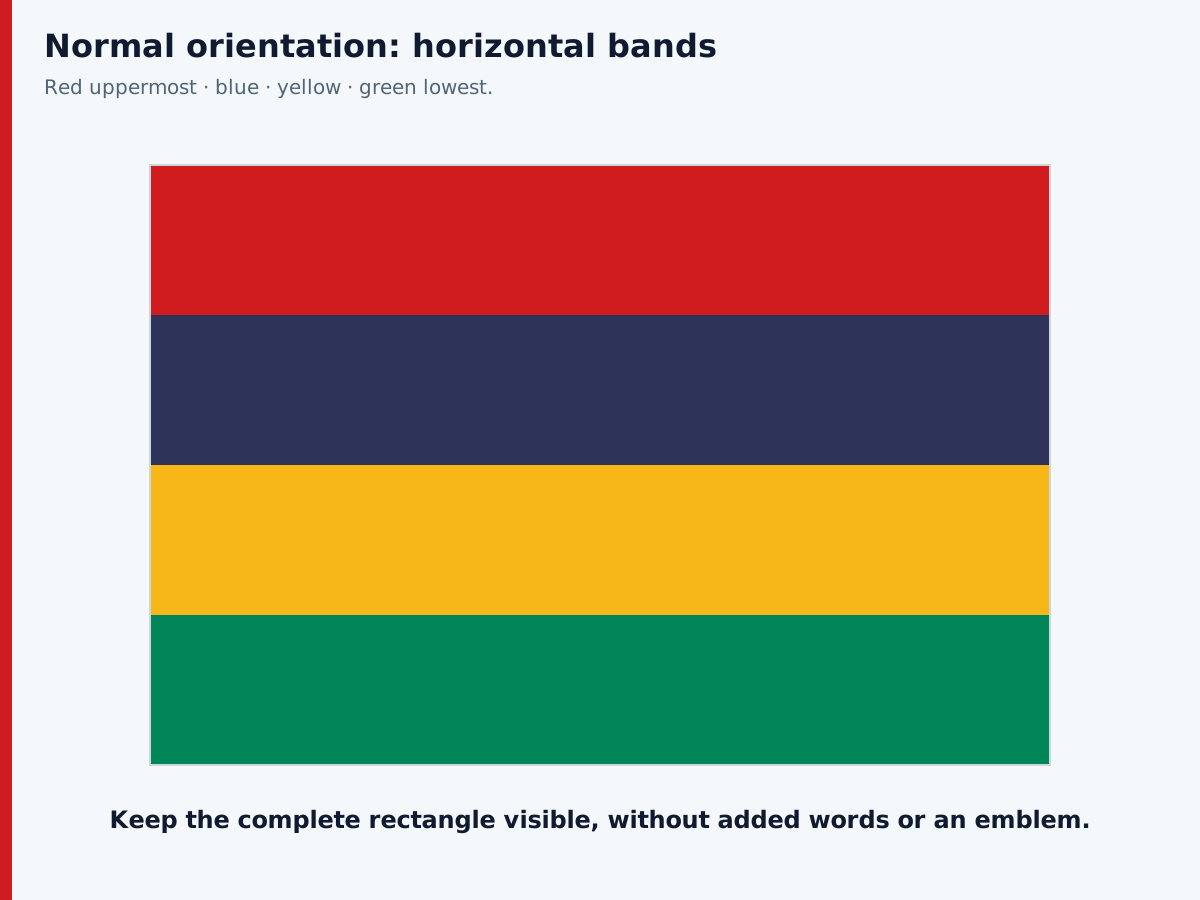
The Standards Bureau catalogue lists MS 1-2:2011 as the Flag Code of Mauritius. A reference to that standard is not the same as reproducing all its rules. In particular, another country’s vertical-hanging or flag-folding convention should not be assumed to apply to Mauritius.
Are there special provisions for national celebrations?
Yes. Section 13 includes a national-event provision allowing flags or flag images to depart from the particular sizes and dimensions in Part II of the Second Schedule, provided they are displayed horizontally with red, blue, yellow, and green in order. The Act identifies Independence Day and Republic Day as national events.
This is a specific statutory exception, not a general permission to rearrange the colors or add a badge. The ordinary reference drawing remains 3:2 with equal bands. The same section also contains a good-faith educational or social-activity exception for minors; it is not a blanket exemption for all adult commercial use.
The 2017 communiqué about buntings belongs to the former legal framework. Read present-day questions against the later Act, including its express conditions and exceptions, rather than repeating the older notice without its date.
When is the flag flown at half-mast?
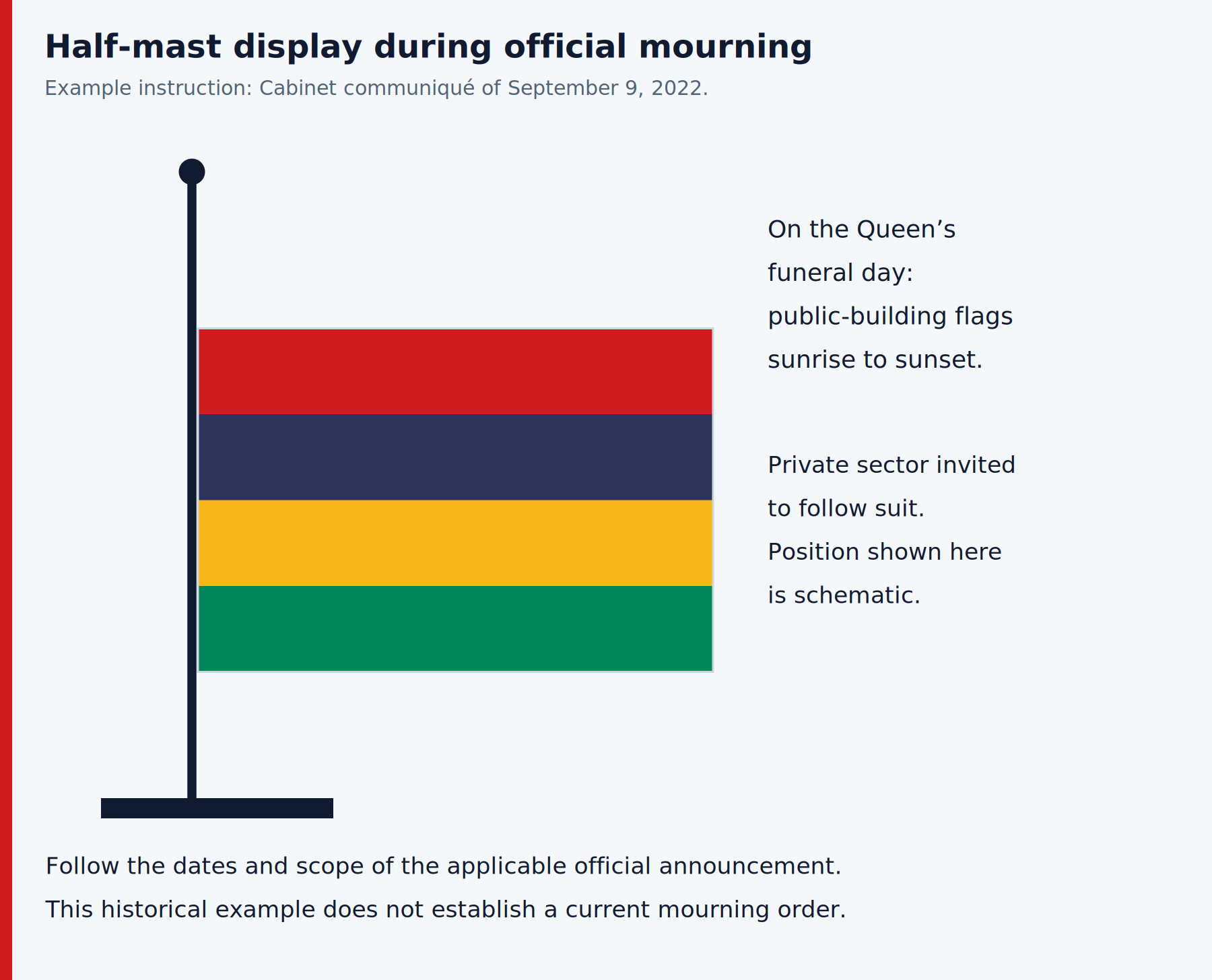
The flag is lowered for mourning when the relevant official instruction calls for it. A Cabinet communiqué of September 9, 2022 directed half-mast display on public buildings from sunrise to sunset on Queen Elizabeth II’s funeral day and invited the private sector to follow. This was a specific dated direction, not a permanent daily timetable.
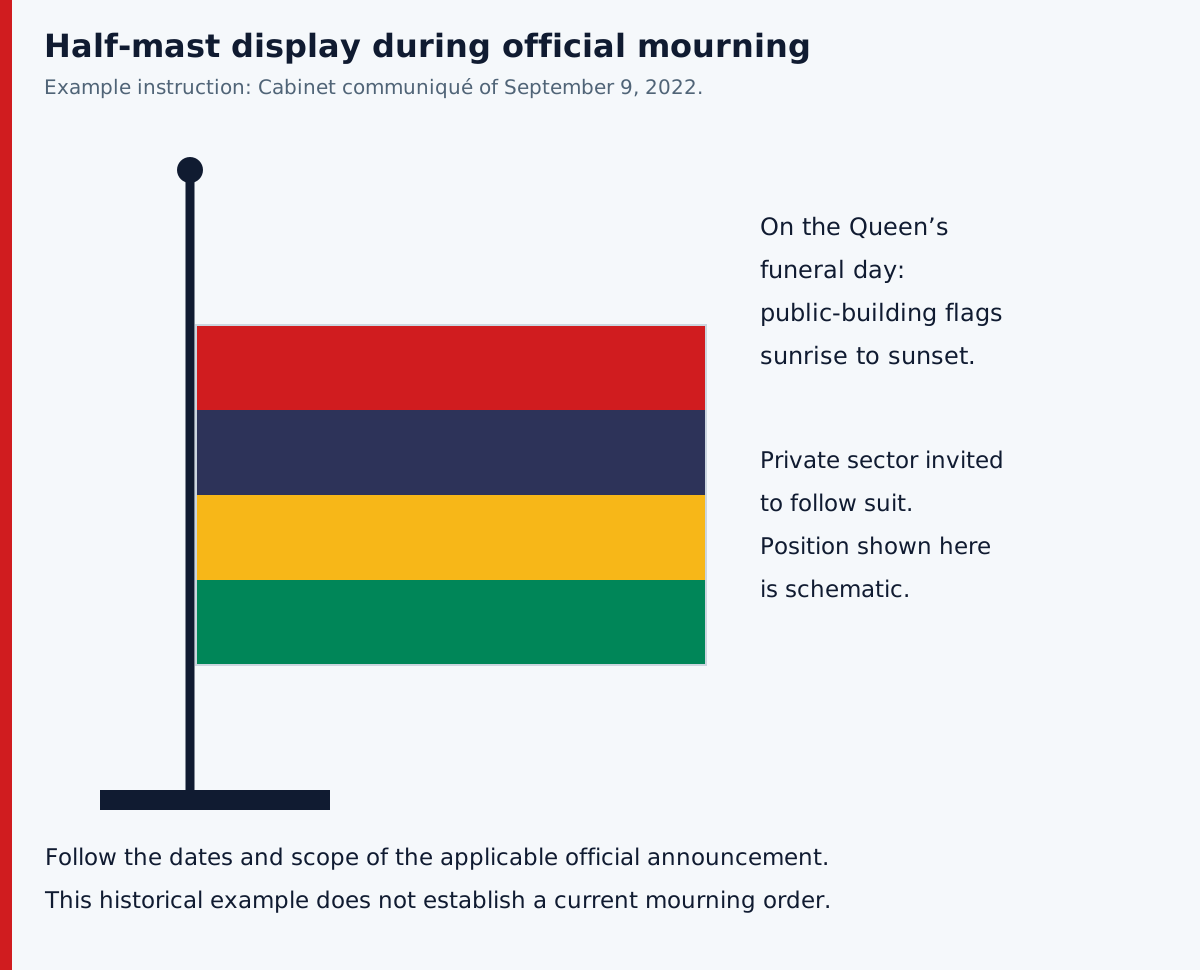
For a current mourning observance, check the announcement’s dates, locations, and duration. The diagram shows a lowered flag schematically; it does not invent an exact pole-height formula or import a raising sequence from another national flag code.
Is the national flag also used by Mauritius ships?
Yes. Section 24 of the Merchant Shipping Act requires a Mauritius ship to hoist the national flag on a signal from a government-service ship and when entering or leaving ports. The 2022 national-symbols Act also updates the shipping law’s flag definition. A maritime use of the national flag does not create a different four-color design.
Illustrations of specialized or historical ensigns should be identified by their particular role and authority. A commercial seller’s red or blue ensign is not, by itself, evidence that the current shipping legislation requires that design instead of the national flag.
Are the coat of arms and national anthem part of the flag?
No. The flag is the four-band rectangle. The arms, government seal, and national anthem are separate national symbols, each with its own provisions in the Act. The anthem is titled Motherland. Adding the arms, a dodo, a motto, or the anthem’s words to the ordinary flag would alter its plain national design.
The dodo appears in the arms, which helps explain its association with Mauritius, but it is not drawn on the national flag. The arms’ own colors and the 2024 rules about approved government reproductions must also be kept separate from the flag specifications.
Does downloading an image authorize every use of the flag?
No. Copyright status and national-symbol rules are separate. The Act restricts alteration, certain forms of exhibition, and commercial or advertising uses, including specified sales, without written authorization from the Prime Minister. A downloadable illustration supplies artwork; it does not itself supply the authorization required for a regulated use.
Section 15 contains the commercial-use provisions and its government-public-activity exception. Section 13 contains particular exhibition exceptions. Their conditions should be read together for a proposed use; an image-credit notice alone does not resolve those separate legal questions.
For accessible educational images, identify Mauritius in the alternative text and describe the top-to-bottom sequence. Keep attribution and file provenance with the download so the original digital colors and dimensions remain traceable.
How does Mauritius’s flag differ from Seychelles and Mauritania?
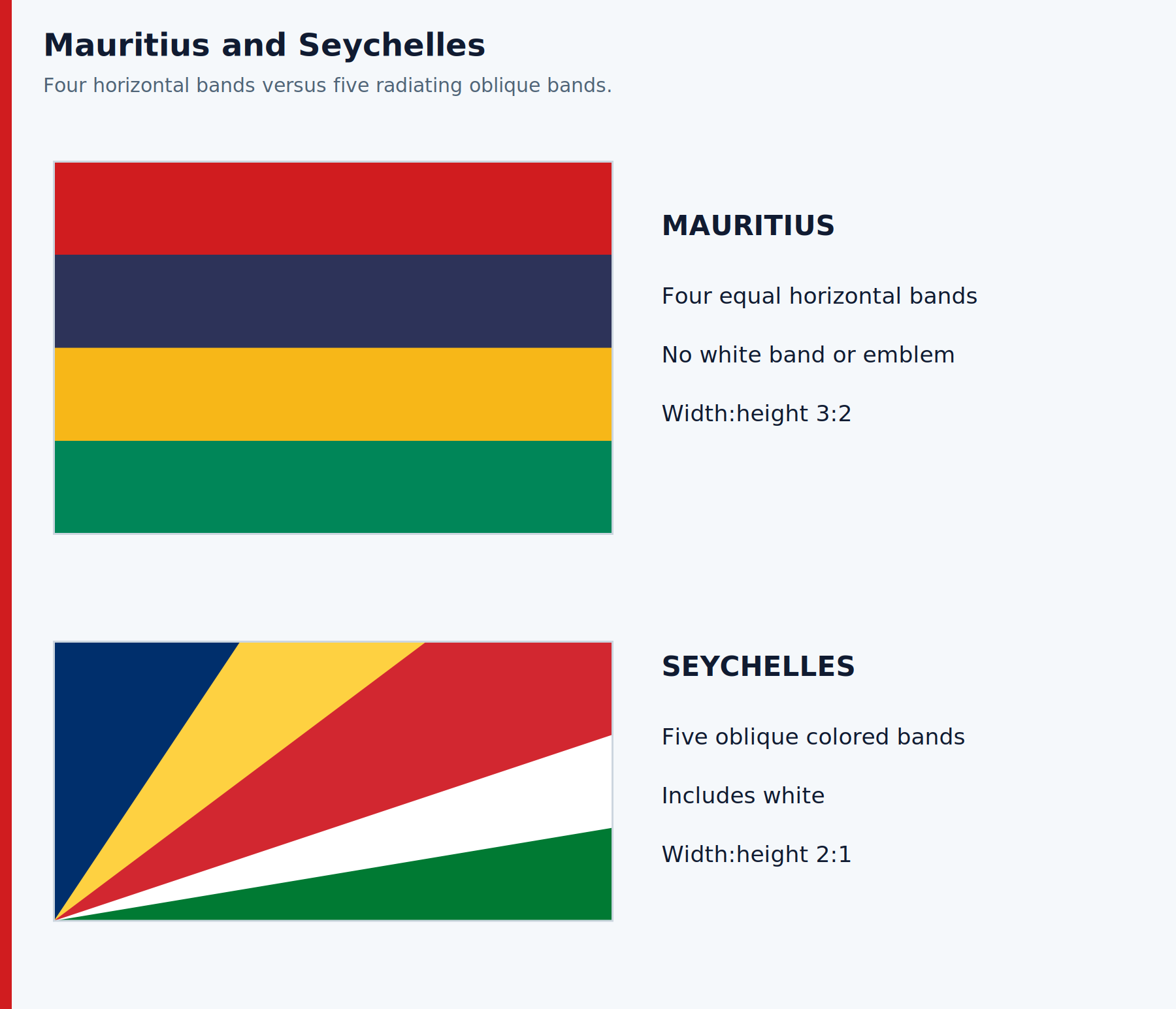
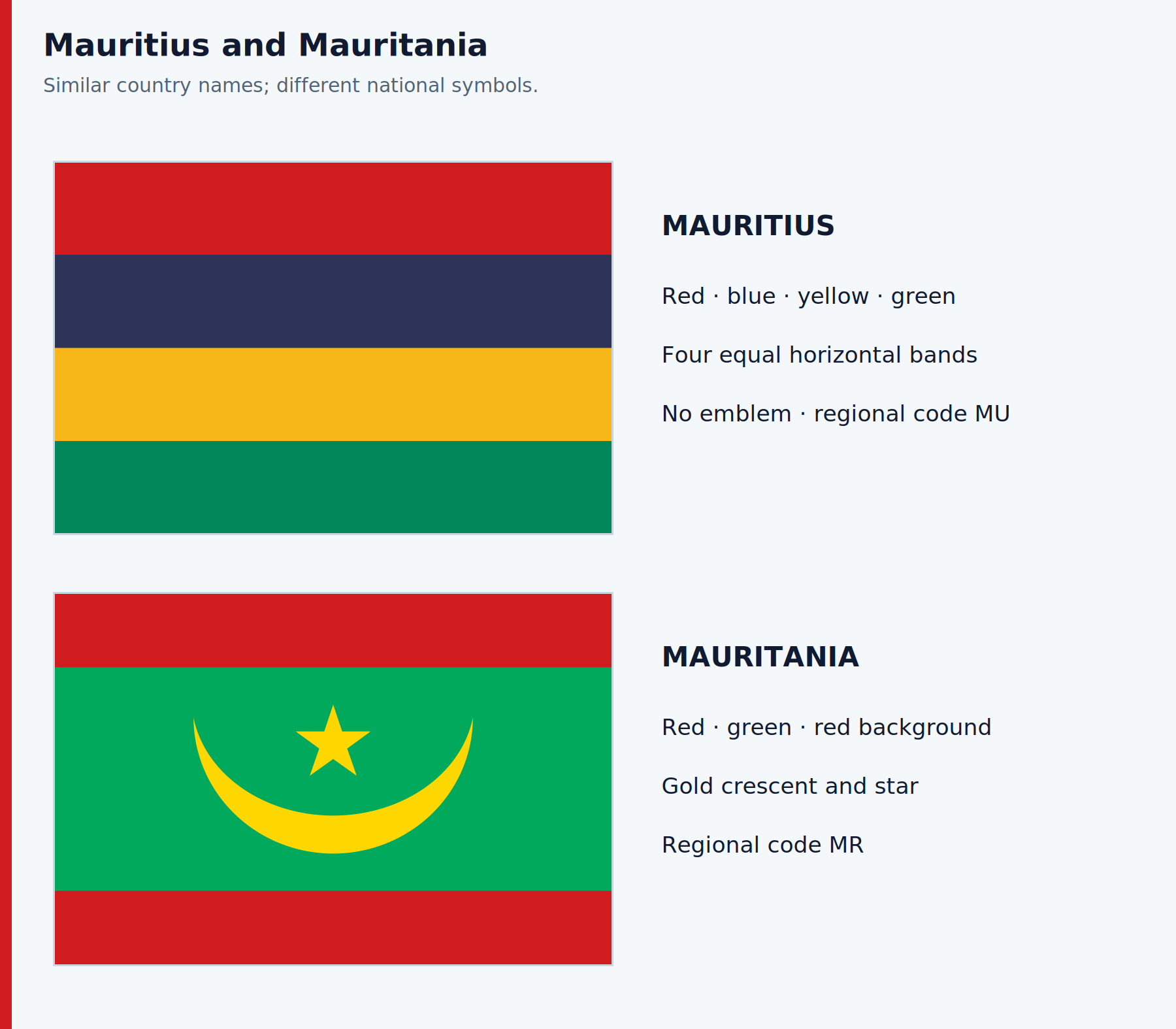
Mauritius has four equal horizontal bands and no emblem. Seychelles has five oblique bands, including white, spreading from the lower hoist. Mauritania has red top and bottom bands around green, with a gold crescent and star. Similar names or overlapping colors do not make these flags interchangeable; their structures are plainly different.
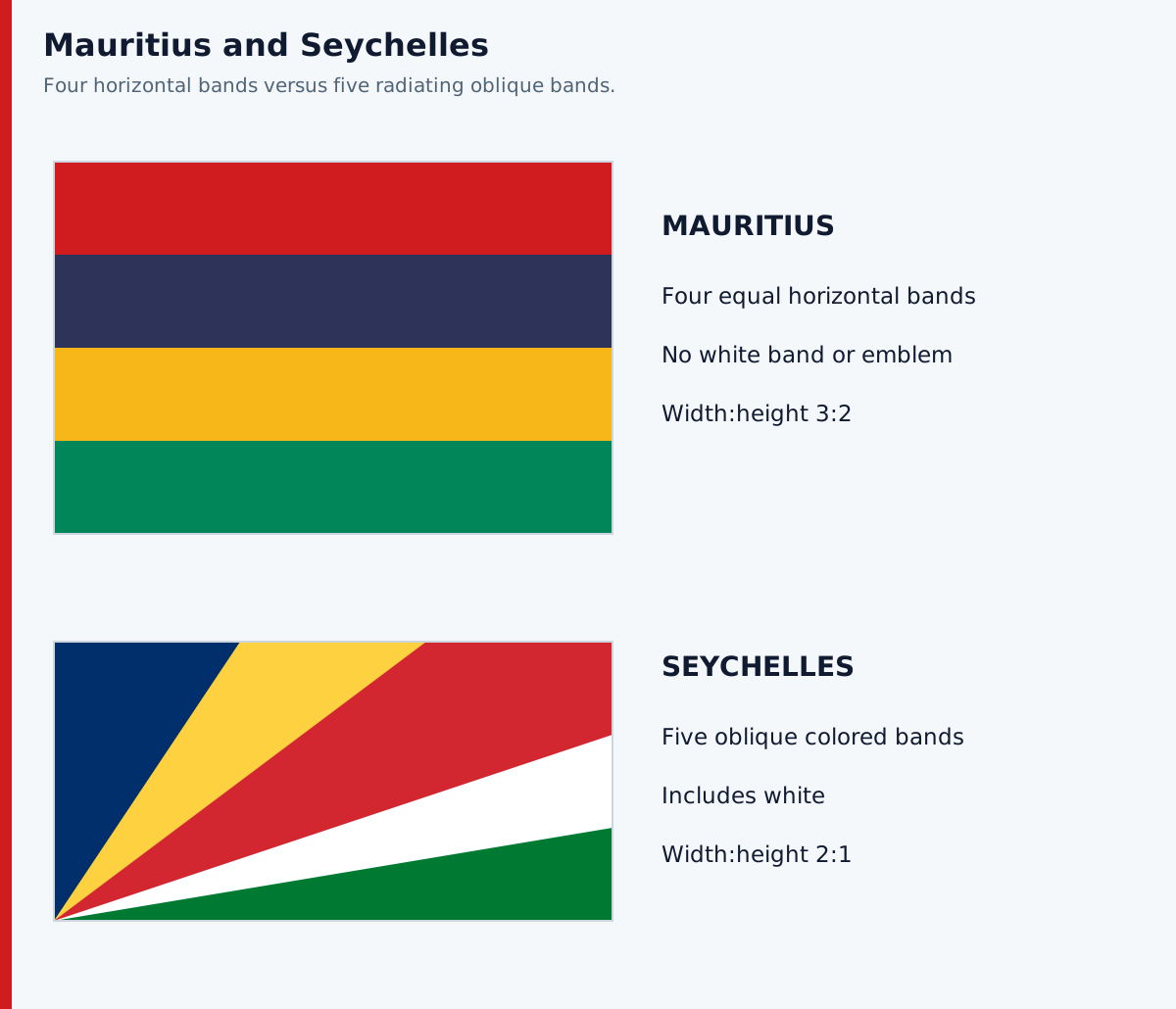
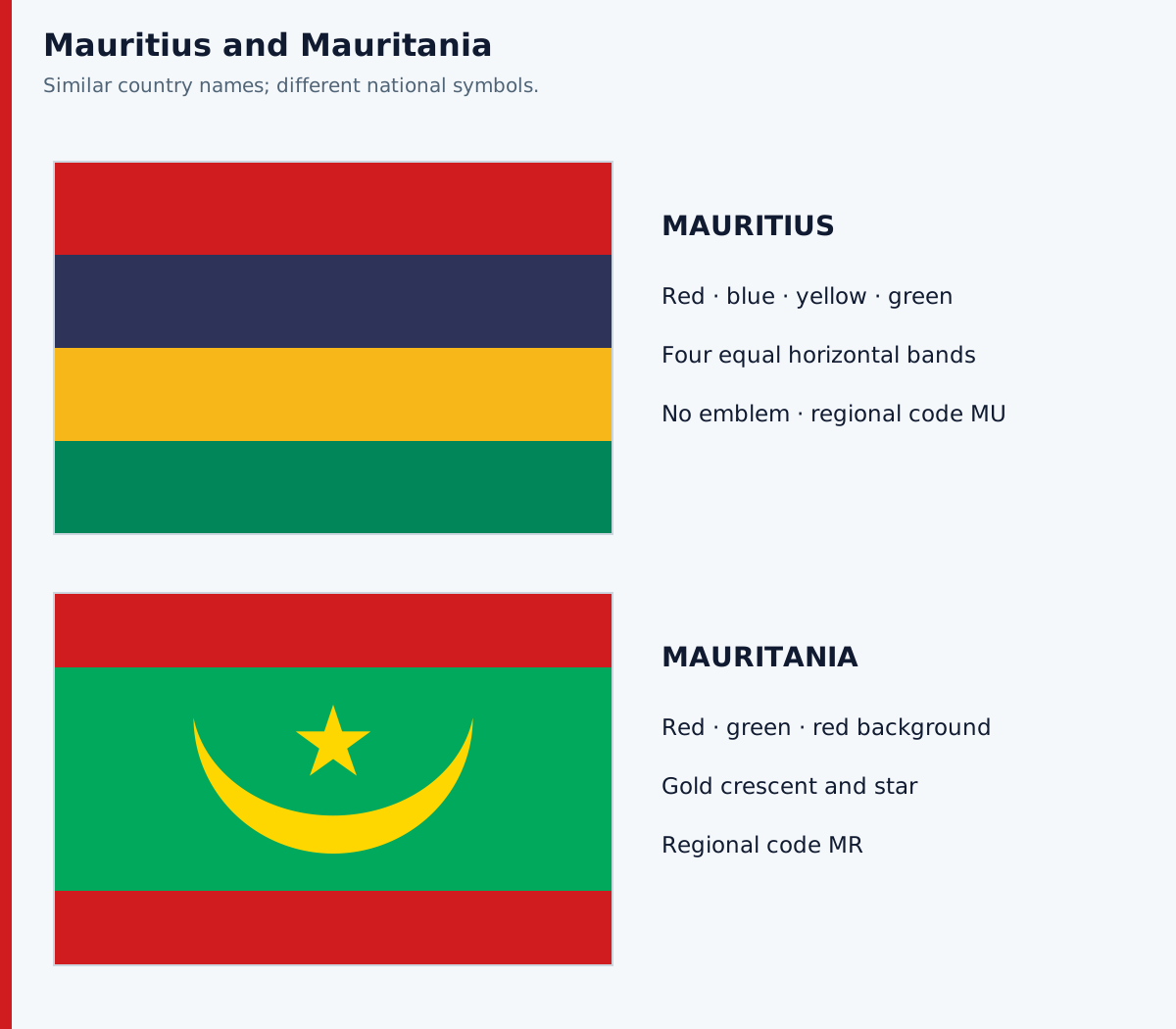
| Country | Distinctive design | Width:height |
|---|---|---|
| Mauritius | Four equal horizontal bands; no emblem | 3:2 |
| Seychelles | Five radiating oblique bands, including white | 2:1 |
| Mauritania | Red-green-red field with gold crescent/star | 3:2 |
The comparison images preserve each complete source drawing and its own palette. Seychelles is proportionately longer; stretching it to match Mauritius’s 3:2 rectangle would erase a useful identifying difference.
What is the flag emoji for Mauritius?
Mauritius’s flag emoji is 🇲🇺. It is formed from regional indicator M, U+1F1F2, followed by regional indicator U, U+1F1FA. Mauritania instead uses M and R, producing 🇲🇷. Emoji artwork varies by platform, so its tiny rendering is useful for identification but should not be treated as a precise textile-color or construction reference.
| Item | Value |
|---|---|
| Mauritius emoji | 🇲🇺 |
| Regional indicators | M + U |
| Unicode sequence | U+1F1F2 U+1F1FA |
| Different country | Mauritania: 🇲🇷, M + R |
Some systems display the regional-indicator letters instead of a small flag. For a reliable article illustration or printable lesson, the local SVG or PNG provides a larger, explicitly described representation.
What mistakes should a Mauritius flag illustration avoid?
Avoid changing the red-blue-yellow-green order, drawing unequal bands, adding an emblem, or stretching the normal rectangle. Keep statutory textile references distinct from illustrative digital values. Historical dates also matter: 1968 is independence and flag adoption, 1992 is the republic, and the 2022 and 2024 Acts are later legislative milestones.
- Use four equal horizontal bands, each 25% of the total height.
- Keep the normal width:height at 3:2.
- Use the flag’s Second Schedule color table, not the arms’ First Schedule.
- Do not interpret the 2024 arms-and-seal provisions as a new flag design.
- Identify the specific event when giving an adoption, commencement, or anniversary date.
| Term | Meaning |
|---|---|
| Hoist / fly | Attachment edge / free edge |
| Band | One of the four horizontal colored areas |
| Width:height | Horizontal dimension compared with vertical dimension |
| Textile reference | A color specification for the fabric matching system |
| Tolerance | A permitted manufacturing variation from a nominal dimension |
| Half-mast / half-staff | A lowered display position used for mourning |
Explore more in World Flags: Iceland flag, Lithuania flag, Luxembourg flag, Madagascar flag, Malawi flag, Malaysia flag, Maldives flag, Mali flag, Malta flag, Mauritania flag.
Download Mauritius flag pictures
Download the national flag as SVG or large PNG. The gallery includes 17 distinct subjects with captions and alternative text. Keep the full proportions when resizing. Image credits and reuse notes accompany the graphics.
World Flags/Mauritius
Mauritius flag pictures
Four equal horizontal bands: red, blue, yellow, green. Width:height 3:2. Digital colors follow the credited reference vector.
GKBook; reference artwork: Zscout370, Kirill.alx and Commons contributors (Mauritius reference)Download SVGDownload PNGThe horizontal bands run continuously from hoist to fly. Red is uppermost, green lowest.
GKBook; reference artwork: Zscout370, Kirill.alx and Commons contributors (Mauritius reference)Download SVGDownload PNGThe ideal rectangle is 3:2, with four equal bands. Calculated drawing units are separate from manufacturing tolerances.
GKBook; reference artwork: Zscout370, Kirill.alx and Commons contributors (Mauritius reference)Download SVGDownload PNGNumbered color panels identify the order without adding numbers to the national flag itself.
GKBookDownload SVGDownload PNGThe four TCX references come from the flag’s Second Schedule. They differ from the arms’ separate color specifications.
GKBookDownload SVGDownload PNGRed #D01C1F, blue #2D3359, yellow #F7B718 and green #008658 retain the current reference vector’s fills.
GKBook; reference artwork: Zscout370, Kirill.alx and Commons contributors (Mauritius reference)Download SVGDownload PNGThe statutory meanings follow the same top-to-bottom sequence as the colors.
GKBookDownload SVGDownload PNGMast 1800×1200 mm; desk/handheld 150×100 mm; car 300×200 mm, with band heights 300, 25 and 50 mm.
GKBookDownload SVGDownload PNGThe Act permits ±2% on colored-section dimensions and 1 mm color overlap. The 294–306 mm example is calculated from a 300 mm nominal band.
GKBookDownload SVGDownload PNGThe flag dates from independence in 1968. Republic status and later legal standards are separate milestones.
GKBookDownload SVGDownload PNGMarch 12, 1968 marks independence and the flag’s national use; March 12, 1992 marks republic status.
GKBook; reference artwork: Zscout370, Kirill.alx and Commons contributors (Mauritius reference)Download SVGDownload PNGThe 2022 Act’s passage, assent and commencement have different dates. The 2024 amendment affects arms and seal provisions, not the flag design.
GKBookDownload SVGDownload PNG100% polyester, plain weave, 150±5 g/m². The Act names ISO 3572 and ISO 3801 as test references.
GKBookDownload SVGDownload PNGStandard display preserves horizontal bands in the legal order and the complete 3:2 rectangle.
GKBook; reference artwork: Zscout370, Kirill.alx and Commons contributors (Mauritius reference)Download SVGDownload PNGThe 2022 Cabinet instruction concerned Queen Elizabeth II’s funeral day. The drawing does not prescribe an exact pole position or a universal daily schedule.
GKBook; reference artwork: Zscout370, Kirill.alx and Commons contributors (Mauritius reference)Download SVGDownload PNGThe complete Seychelles flag is shown at its native 2:1 proportion. Its colors radiate from the lower hoist instead of forming equal horizontal bands.
GKBook; reference artwork: Zscout370, Kirill.alx and Commons contributors (Mauritius reference); Commons contributors (Seychelles reference)Download SVGDownload PNGBoth references retain their 3:2 shapes and their own colors. Mauritius’s plain four bands differ clearly from Mauritania’s crescent-and-star design.
GKBook; reference artwork: Zscout370, Kirill.alx and Commons contributors (Mauritius reference); Commons contributors (Mauritania reference)Download SVGDownload PNGFrequently asked questions
What does the flag of Mauritius look like?
Mauritius’s flag is a plain rectangle divided into four equal horizontal bands of red, blue, yellow, and green. Red is at the top and green at the bottom. There is no star, crescent, coat of arms, inscription, or other emblem on the ordinary national flag, making the band sequence its main identifying feature.
What is the correct order of the four colors?
Read the flag from top to bottom: red, blue, yellow, green. Each color appears once and occupies one-quarter of the total height. The sequence is part of the legal description, not a choice left to the illustrator. Reversing the flag puts green at the top and produces an incorrect standard display.
What are the flag’s proportions?
The normal national flag is three units wide and two units high, a width-to-height ratio of 3:2. The government overview expresses the same shape as 6:4. A height-to-width ratio of 2:3 also describes that rectangle. These notations agree once the order of the named dimensions is made clear.
How can the flag be drawn accurately?
Draw a rectangle with a width one and a half times its height. Divide the height into four equal parts and fill them red, blue, yellow, and green from top to bottom. No emblem needs to be positioned. Keep every boundary horizontal and every band the same height across the full width.
What are the official textile color codes?
The 2022 Act specifies Pantone fashion home cotton references: red 18-1664TCX, blue 19-3939TCX, yellow 14-0957TCX, and green 17-6030TCX. These are the flag’s statutory textile color references. They should not be replaced with the coat of arms’ different Pantone values merely because both tables appear in the same national-symbols legislation.
Which HEX and RGB values are used in the downloads?
The illustrations use red #D01C1F, blue #2D3359, yellow #F7B718, and green #008658, matching the current credited reference vector. These are digital reproduction values. The Act specifies textile references rather than these HEX numbers, so the screen palette should not be presented as a separate set of legally prescribed RGB codes.
Why do older pages give different color numbers?
Older government descriptions list British Standard numbers: red 0.005, blue 7.086, yellow 0.001, and green 0.010. The 2022 Act instead prints the TCX textile references. Keep these systems attached to their sources and dates. A historical code, a textile reference, and a screen HEX value are not interchangeable labels.
What do the four flag colors mean?
The law associates red with the struggle for freedom and independence, blue with the Indian Ocean, yellow with the new light of independence, and green with agriculture and the country’s year-round greenery. These are meanings stated in the Second Schedule, rather than an informal interpretation inferred only from the appearance of the colors.
What does the red band represent?
The red band represents the struggle for freedom and independence. It is the uppermost quarter of the flag and introduces its national story. The statutory wording does not identify one particular battle or require the band to be explained solely as bloodshed; its meaning concerns the wider achievement of freedom and self-government.
Why is there a blue band?
Blue represents the Indian Ocean, in which Mauritius is situated. It is the second band, immediately below red and above yellow. This geographical meaning is stated explicitly in the national-symbols legislation. The band is not a map of territorial waters, and its thickness does not encode a distance, maritime boundary, or ocean depth.
Does yellow mean sunshine or independence?
The Act’s precise meaning is the new light of independence. Sunshine is a common explanatory association, but it should not displace that statutory wording in an exam answer or formal description. Yellow forms the third horizontal band, between blue and green, and represents the promise associated with the country’s independent future.
What does the green band symbolize?
Green represents the agriculture of Mauritius and its greenery throughout the twelve months of the year. It is the lowest of the four bands. This symbolism refers to the country’s cultivated land and enduring green appearance; it does not mean that the flag is a statistical chart of the present economy.
When was Mauritius’s national flag adopted?
The four-color national flag dates from independence on March 12, 1968. Official historical accounts recall its raising at noon at Champ de Mars in Port Louis as the Union Jack was lowered. Later Acts and technical rules formalized protection and specifications; they did not create a new independence date for the flag.
Who designed the flag of Mauritius?
Gurudutt Moher is credited as the flag’s creator in a tribute recorded in the National Assembly’s April 26, 2022 proceedings. Contemporary Mauritian reporting also identifies him as the designer and records his posthumous MSK honor in March 2018. That design credit is separate from the later legal specification and reproduction of the flag.
What is the flag’s historical background?
Mauritius passed through Dutch, French, and British colonial periods before independence. The present four-band flag belongs to the independent nation, rather than to a colonial administration. Its ceremonial raising in 1968 marked the transition from British sovereignty, and the same basic design continued when Mauritius became a republic in 1992.
Did the flag change when Mauritius became a republic?
Mauritius became a republic on March 12, 1992, twenty-four years after independence. The red, blue, yellow, and green national flag continued in use. The two anniversaries share the same day and month but commemorate different events: independence in 1968 and the change from constitutional monarchy to republic in 1992.
What did the 2022 national-symbols Act change?
The 2022 Act consolidated protection of Mauritius’s national symbols and placed the flag’s design, meanings, dimensions, colors, and mast-material requirements in its Second Schedule. It came into operation on June 1, 2022. It repealed the 2015 National Flag Act and revoked the 2016 technical regulations, while retaining the established four-band national design.
Did the 2024 amendment introduce a new flag?
No. The 2024 amendment changes provisions concerning the arms and seal of Mauritius, including approved monochrome, grayscale, and line-art versions for specified government uses. It does not amend the national flag’s section or its Second Schedule. Its retrospective commencement provision also does not turn 2024 into a new flag-adoption year.
What standard physical sizes does the Act specify?
The Second Schedule specifies a mast flag of 1800 by 1200 millimeters, a desk or handheld flag of 150 by 100 millimeters, and a car flag of 300 by 200 millimeters. Their individual band heights are 300, 25, and 50 millimeters respectively. All three preserve the normal 3:2 rectangle.
What manufacturing tolerances are specified?
The Act allows a tolerance of plus or minus two percent on the dimensions of the different colored sections and a one-millimeter tolerance for overlap between two colors. These allowances concern production accuracy. They do not change the ideal drawing into four deliberately unequal bands or authorize a different normal color sequence.
What material is specified for a mast flag?
For the mast flag, the Second Schedule specifies one hundred percent polyester in a plain weave, with a mass per unit area of 150 plus or minus 5 grams per square meter. It also names test references. This material specification applies expressly to the mast flag, rather than automatically to every paper or digital representation.
How should the flag be oriented and displayed?
The normal display keeps the bands horizontal, with red uppermost and green lowest. Preserve the complete rectangle and avoid placing lettering or an emblem on it. The Act addresses alteration and incorrect exhibition separately. Detailed ceremonial arrangements should follow the applicable Mauritian flag code and official instructions for the occasion.
Are there special provisions for national celebrations?
Yes. Section 13 includes a national-event provision allowing flags or flag images to depart from the particular sizes and dimensions in Part II of the Second Schedule, provided they are displayed horizontally with red, blue, yellow, and green in order. The Act identifies Independence Day and Republic Day as national events.
When is the flag flown at half-mast?
The flag is lowered for mourning when the relevant official instruction calls for it. A Cabinet communiqué of September 9, 2022 directed half-mast display on public buildings from sunrise to sunset on Queen Elizabeth II’s funeral day and invited the private sector to follow. This was a specific dated direction, not a permanent daily timetable.
Is the national flag also used by Mauritius ships?
Yes. Section 24 of the Merchant Shipping Act requires a Mauritius ship to hoist the national flag on a signal from a government-service ship and when entering or leaving ports. The 2022 national-symbols Act also updates the shipping law’s flag definition. A maritime use of the national flag does not create a different four-color design.
Are the coat of arms and national anthem part of the flag?
No. The flag is the four-band rectangle. The arms, government seal, and national anthem are separate national symbols, each with its own provisions in the Act. The anthem is titled Motherland. Adding the arms, a dodo, a motto, or the anthem’s words to the ordinary flag would alter its plain national design.
Does downloading an image authorize every use of the flag?
No. Copyright status and national-symbol rules are separate. The Act restricts alteration, certain forms of exhibition, and commercial or advertising uses, including specified sales, without written authorization from the Prime Minister. A downloadable illustration supplies artwork; it does not itself supply the authorization required for a regulated use.
How does Mauritius’s flag differ from Seychelles and Mauritania?
Mauritius has four equal horizontal bands and no emblem. Seychelles has five oblique bands, including white, spreading from the lower hoist. Mauritania has red top and bottom bands around green, with a gold crescent and star. Similar names or overlapping colors do not make these flags interchangeable; their structures are plainly different.
What is the flag emoji for Mauritius?
Mauritius’s flag emoji is 🇲🇺. It is formed from regional indicator M, U+1F1F2, followed by regional indicator U, U+1F1FA. Mauritania instead uses M and R, producing 🇲🇷. Emoji artwork varies by platform, so its tiny rendering is useful for identification but should not be treated as a precise textile-color or construction reference.
What mistakes should a Mauritius flag illustration avoid?
Avoid changing the red-blue-yellow-green order, drawing unequal bands, adding an emblem, or stretching the normal rectangle. Keep statutory textile references distinct from illustrative digital values. Historical dates also matter: 1968 is independence and flag adoption, 1992 is the republic, and the 2022 and 2024 Acts are later legislative milestones.
Explore all general-knowledge topics and the A-to-Z lists.

We Value Your Opinion Comments