
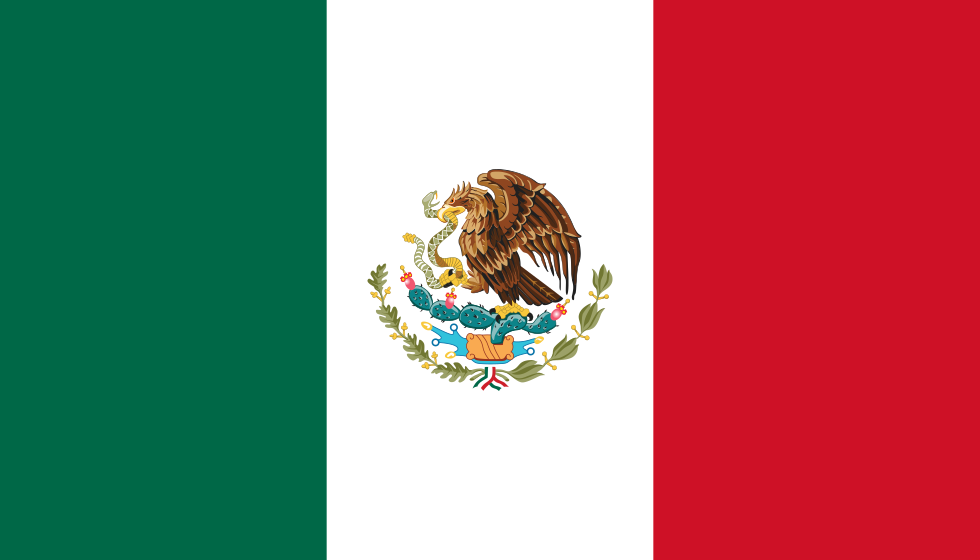
Mexico flag picture
Explore the construction drawing, history, and complete picture gallery.
| Design | Green · white · redThree equal vertical bands with the national arms. |
|---|---|
| Proportions | 7:4 width:heightThe law also expresses this as 4:7 height:length. |
| Current design | September 16, 1968Distinct from the tricolor’s nineteenth-century origins. |
| Flag Day | February 24National recognition in 1940; current law Article 10. |
| Current rules | 1984 law; 2025 updatesCalendar amendment and later regulation. |
The full national coat of arms belongs in the white band. Green, white and red are the background colors; the emblem contains additional colors.
What is the national flag of Mexico?
The flag of Mexico has three equal vertical bands of green, white, and red, with the national coat of arms centered in the white band. Its proportions are 7:4 from width to height. The eagle, serpent, and nopal connect the modern national symbol with the Mexica foundation tradition.
Mexico’s familiar tricolor combines nineteenth-century national colors with an emblem whose form developed over generations. The present design dates to 1968. The current national-symbols law took effect in 1984, while later amendments and the 2025 regulation govern particular uses and ceremonies. These are separate milestones in the flag’s history.
What does the Mexican flag look like?
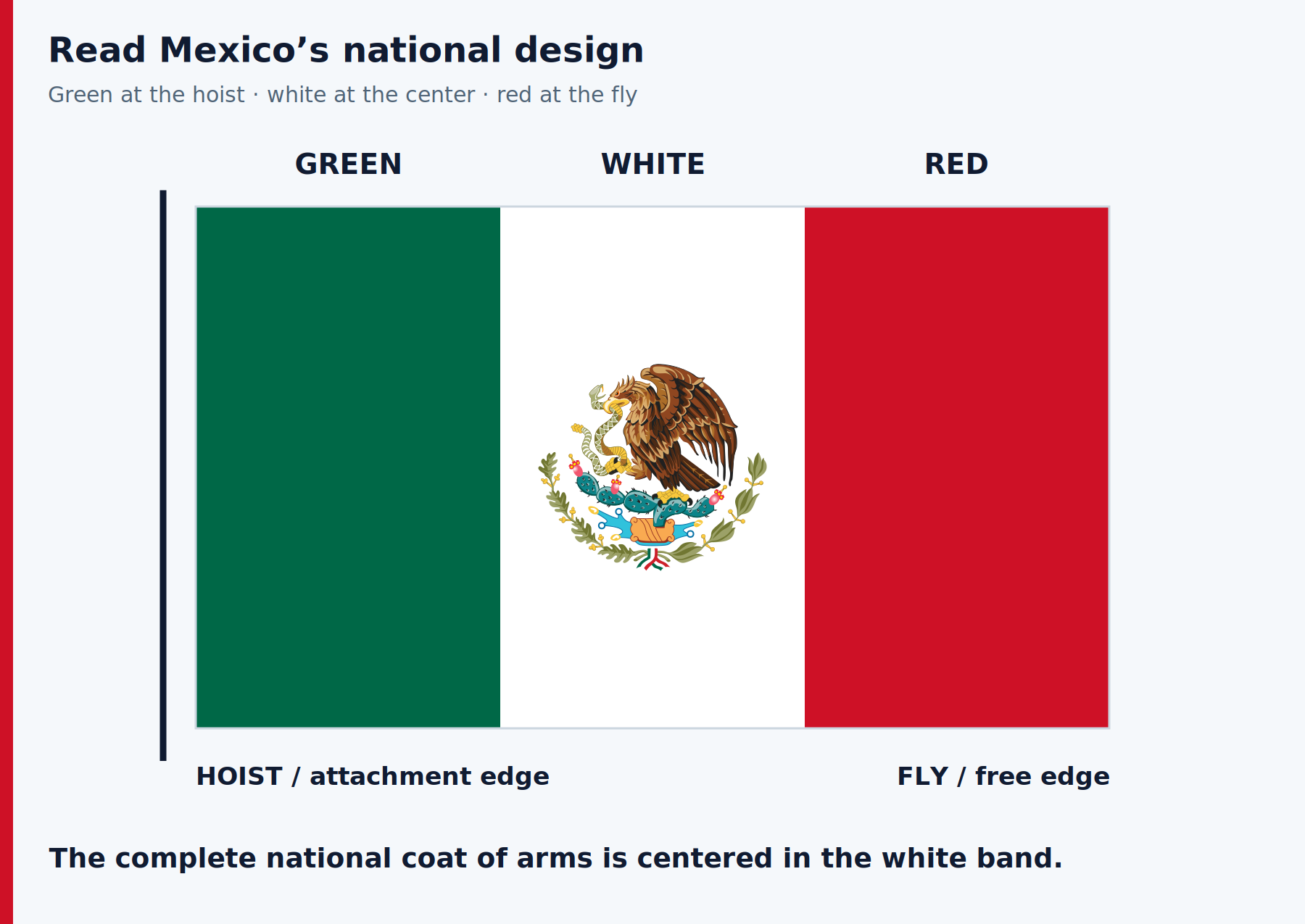
Mexico’s national flag is a vertical tricolor with green beside the hoist, white in the middle, and red at the fly. The three bands have identical dimensions. The national coat of arms occupies the center of the white band, giving Mexico’s flag its most distinctive identifying feature.
The eagle, serpent, cactus, rock, water, branches, and ribbon belong to one complete emblem. A plain green-white-red rectangle omits a required part of the national design. Describing the flag as a tricolor therefore identifies its background, not the whole composition.

What is the correct order of Mexico’s flag colors?
The colors run green, white, and red when read from the flagpole toward the free edge. In the usual front-view illustration, that means green on the left and red on the right. The hoist is the reference point, so the visible order changes when the cloth is viewed from behind.
| Position | Color | Relationship to the flag |
|---|---|---|
| Hoist third | Green | Nearest the pole or attachment edge |
| Middle third | White | Carries the centered national arms |
| Fly third | Red | Farthest from the pole |
The published reference shows the front, or obverse. A reverse-side view is explained separately; it does not establish a second national color sequence.
What are the proportions of Mexico’s flag?
Mexico’s flag has a width-to-height ratio of 7:4. The law expresses the same shape as four units of hoist height to seven units of length. For example, a flag 140 centimeters wide and 80 centimeters high preserves the prescribed rectangle without stretching the national coat of arms.
Here, “width” always means the long horizontal dimension of an ordinary displayed flag. This avoids confusing English screen dimensions with the law’s Spanish wording, which gives anchura:length as four to seven. Both descriptions identify the same rectangle.
| Measurement | Formula | Example |
|---|---|---|
| Width L | 7H ÷ 4 | 140 cm |
| Height H | 4L ÷ 7 | 80 cm |
| One band’s width | L ÷ 3 | 46⅔ cm |
How is the Mexican flag constructed?
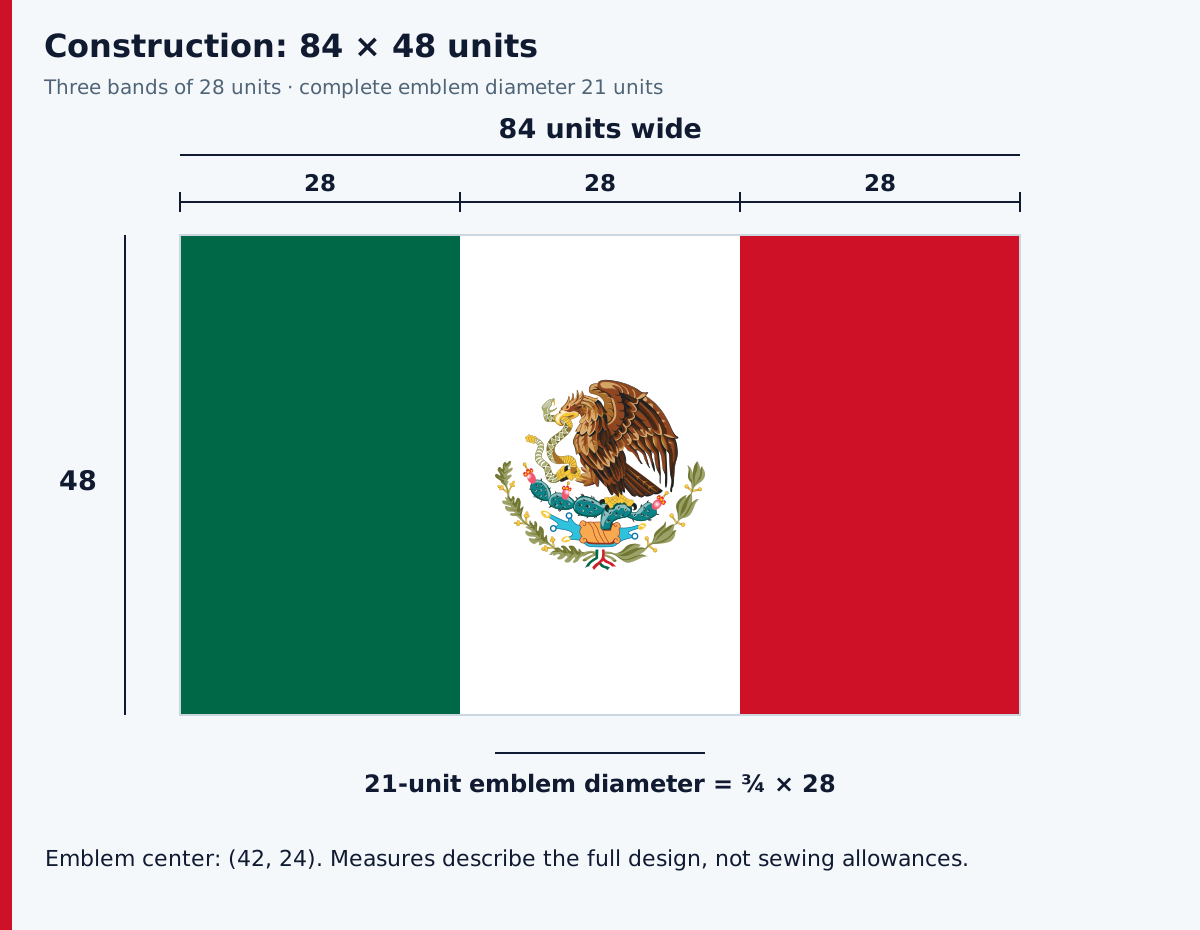
Divide a 7:4 rectangle into three equal vertical bands, then place the complete national coat of arms in the center of the white band. The law sets the emblem’s diameter at three-quarters of that band’s width. A convenient drawing grid is 84 units wide by 48 units high.
On that grid, each band is 28 units wide and the prescribed emblem diameter is 21 units. Its center lies at coordinate (42,24). The measurement describes the complete arms, not just the eagle’s body, and does not authorize drawing a circular border around them.
What are Mexico’s flag color codes?
The supplied reference images use green #006847, white #FFFFFF, and red #CE1126 for the three background bands. These are digital reproduction values, not HEX codes stated in the national-symbols law. The law names the colors and preserves an authenticated model; the detailed emblem also contains additional colors.
| Band | Reference HEX | RGB |
|---|---|---|
| Green | #006847 | 0, 104, 71 |
| White | #FFFFFF | 255, 255, 255 |
| Red | #CE1126 | 206, 17, 38 |
The national vector’s complete original palette is retained, including the brown eagle, green vegetation, and other details. Restricting every pixel to three colors would erase part of the legally described design.

Are Pantone and CMYK values legally fixed for Mexico’s flag?
The national-symbols law and the 2025 regulation consulted here do not prescribe a numeric Pantone, HEX, RGB, or CMYK table for the flag. Popular color charts should therefore be identified as reproduction references. For physical manufacture, matching the authenticated model is more defensible than treating an online conversion as statutory authority.
The Commons reference page lists Pantone 3425 C and 186 C alongside its digital values, but it does not supply an original government color standard establishing those numbers. They are not promoted here as legally certified specifications. The 2025 annex supplies model imagery, not a calibrated screen-to-textile conversion.
What do the colors of Mexico’s flag mean?
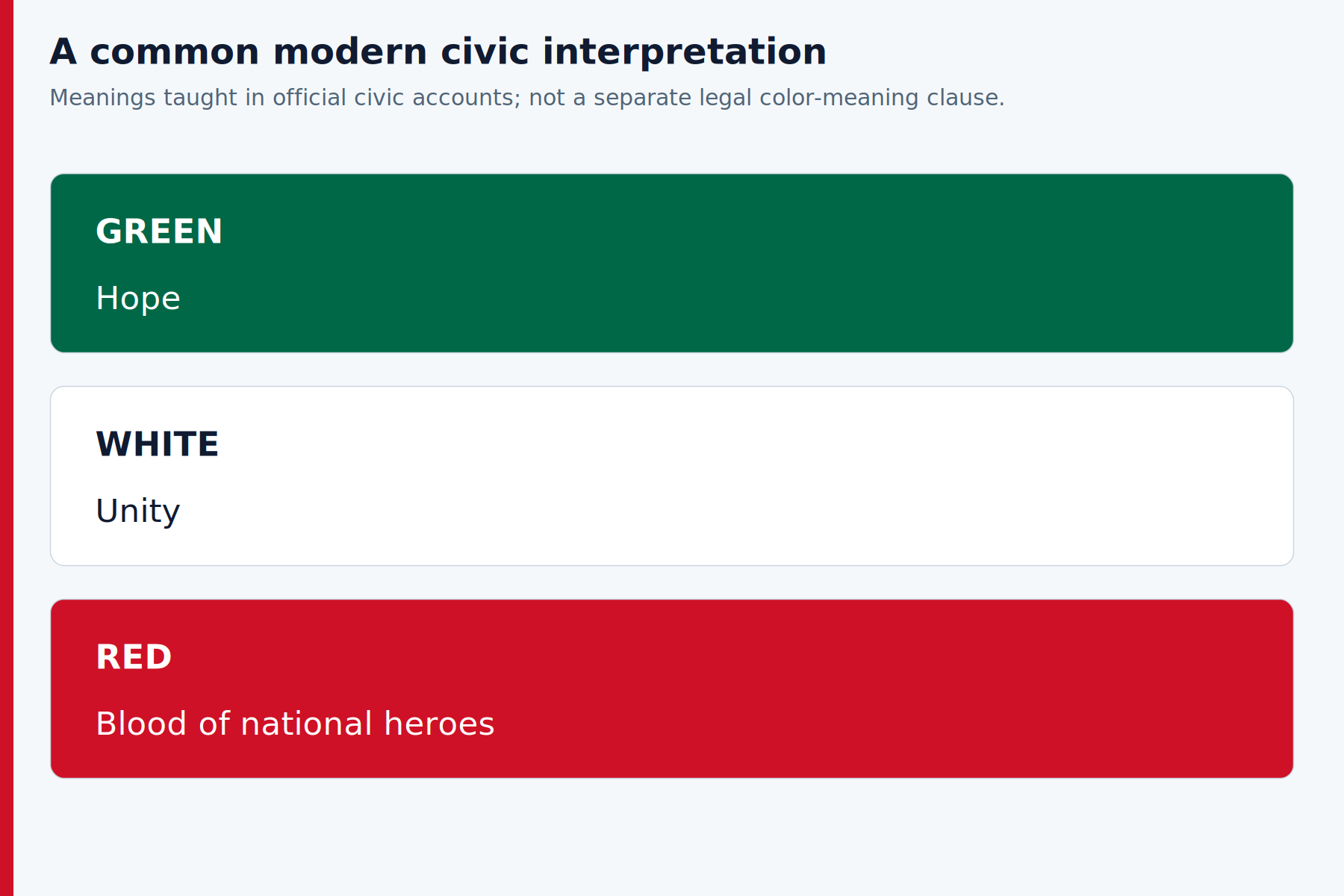
A widely taught modern interpretation associates green with hope, white with unity, and red with the blood of national heroes. These civic meanings differ from the Three Guarantees associated with the independence period. The current law defines the flag’s appearance but does not enact a separate symbolic meaning for each color.
Meaning and construction answer different questions. The legal description fixes what belongs on the flag, while historical and civic accounts explain how Mexicans have understood it. The modern three-part interpretation is presented as an established civic explanation, without inventing a clause of law that defines those meanings.

What did the three colors mean in 1821?
The independence-era Three Guarantees connected green with independence, white with the Catholic religion, and red with union. The Trigarante flag arranged its colors diagonally, so it should not be confused with today’s vertical tricolor. The later meanings of hope, unity, and national sacrifice belong to a different interpretive context.
These associations accompanied the Plan of Iguala and the coalition that brought independence in 1821. A historical color meaning is not a present-day religious requirement for citizenship or an official assignment of a separate stripe to each modern ethnic community.

What is shown in Mexico’s coat of arms?
The coat of arms shows a Mexican eagle on a flowering nopal cactus growing from a rock in a lake, holding a curved serpent in its beak and talon. Oak and laurel branches form a lower semicircle, joined by a ribbon in the national colors. These elements form one prescribed composition.
| Element | What to look for |
|---|---|
| Eagle | Left profile exposed on the standard front view |
| Serpent | Held by the beak and the eagle’s right talon |
| Nopal | Flowering cactus rooted on a rock emerging from water |
| Branches | Oak in front of the eagle; laurel opposite |
| Ribbon | National colors joining the lower branches |

How large should the coat of arms be?
The law gives the coat of arms a diameter equal to three-quarters of the white band’s width. Since that band is one-third of the flag’s total width, the prescribed diameter equals one-quarter of the total width. It is centered in the white band rather than aligned to a stripe boundary.
For an 84-by-48-unit drawing, the white band is 28 units wide and the diameter is 21 units. The outermost details of a vector may not form a perfect circle: the measurement guides placement and scale, while the authenticated model governs the emblem’s form.

Why does the emblem show an eagle and a serpent?
The emblem evokes the Mexica tradition of finding the place to establish Mexico-Tenochtitlan through the sign of an eagle on a nopal. The familiar eagle-and-serpent composition developed through historical retellings and images. It is a national origin narrative, not a claim that every surviving pre-Hispanic depiction contains the same scene.
INAH scholarship distinguishes the eagle-and-bird tradition in some historical accounts from the later eagle-and-serpent reading. A symbol can carry cultural continuity while its representation changes. The modern legal emblem is specific; the earlier traditions should not be flattened into an identical picture repeated unchanged for centuries.
Who designed the present Mexican flag emblem?
Francisco Eppens Helguera is credited by Mexican cultural and diplomatic sources with the modern national coat of arms adopted in 1968. The green-white-red flag tradition is much older, so his contribution should be described as the contemporary emblem design. He did not originate Mexico’s entire nineteenth-century tricolor tradition.
This distinction also separates national design authorship from digital illustration. The downloadable vector credits its own later contributors. Neither a modern SVG artist nor a present-day publisher should be described as the creator of the historic national flag.
When was Mexico’s current flag adopted?
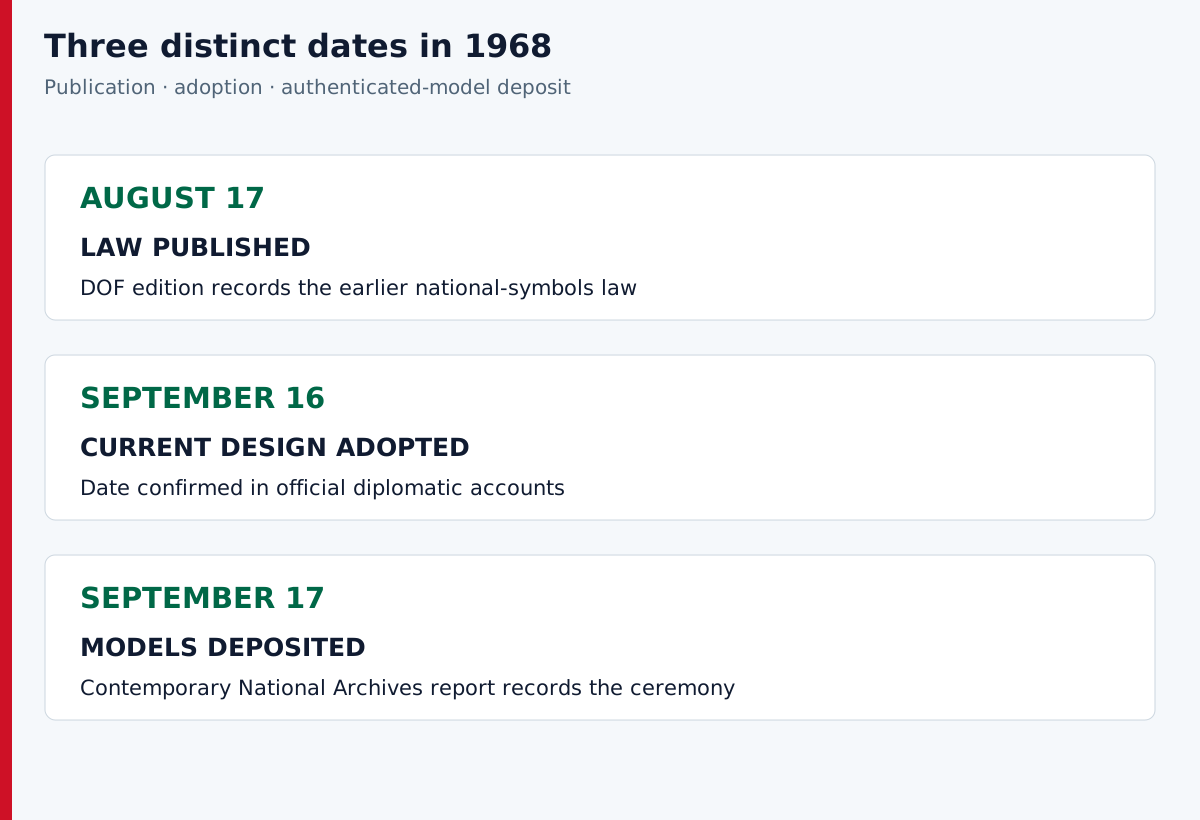
The current Mexican flag is conventionally dated to September 16, 1968, a date confirmed in official diplomatic accounts. The associated national-symbols law was published on August 17, 1968. These dates should be distinguished from the nineteenth-century origins of the tricolor and from the replacement law that took effect in 1984.
The National Archives’ contemporary report records the deposit of the authenticated flag and arms models on September 17, 1968. Publication, adoption, and deposit are distinct events. The present package does not describe an assumed single ceremony as the source of all three dates.
How has Mexico’s flag changed over time?
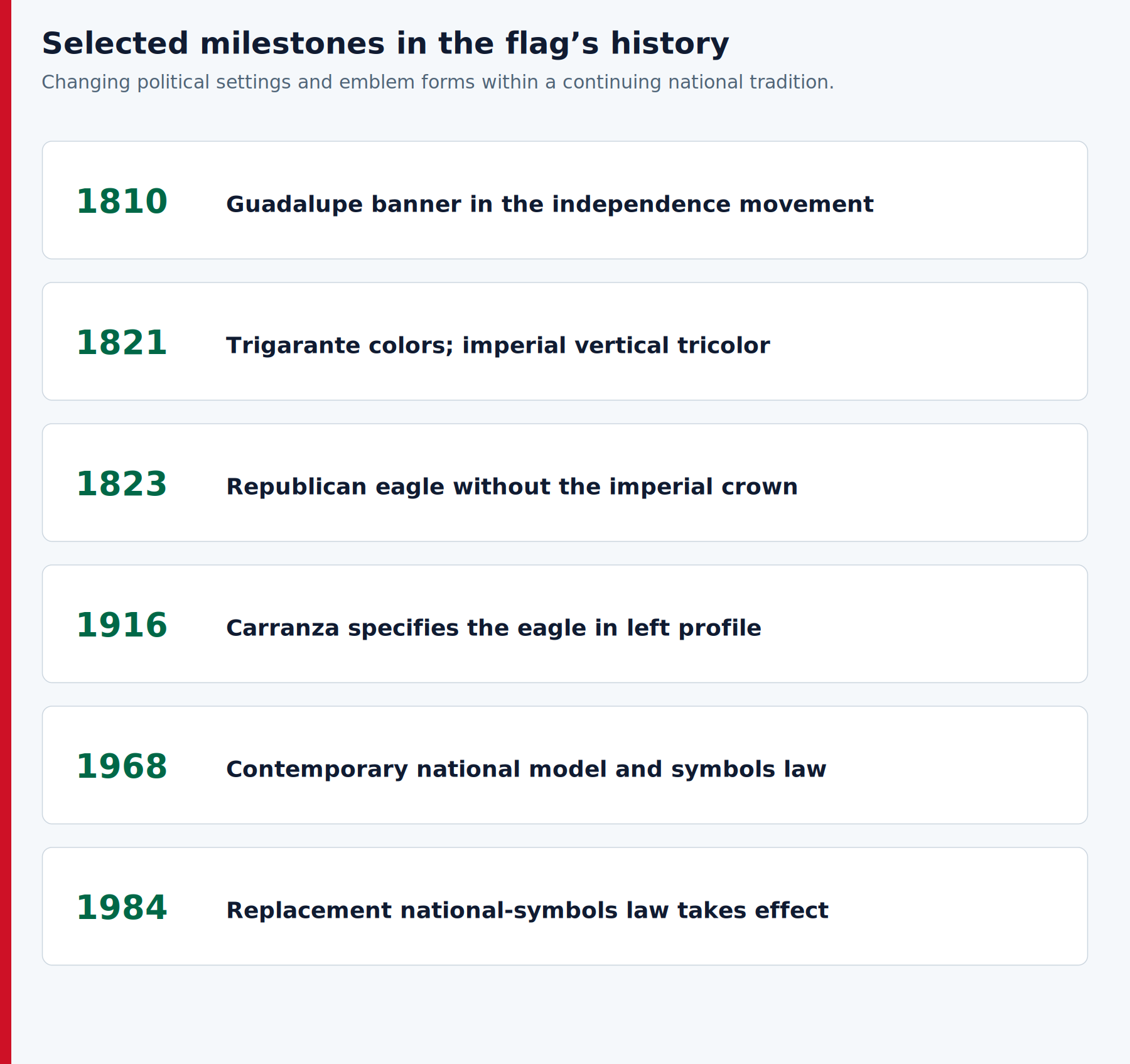
Mexico’s flag history includes the independence movement’s banners, the Trigarante colors, imperial and republican eagle designs, and later standardization. The vertical green-white-red arrangement has nineteenth-century roots. The eagle’s crown, position, and artistic treatment changed across regimes before the contemporary national model was established in 1968 and regulated by later legislation.
| Milestone | Significance |
|---|---|
| 1810 | Hidalgo’s Guadalupe banner belongs to the independence movement |
| 1821 | Three Guarantees; subsequent imperial vertical tricolor with crowned eagle |
| 1823 | Republican treatment removes the imperial crown and includes branches |
| 1916 | Carranza’s decree specifies the eagle in left profile |
| 1968 | Contemporary national model and first comprehensive symbols law |
| 1984 | Replacement national-symbols law takes effect |
Museum chronologies contain military standards as well as national designs. Counting every surviving regimental banner as a separate official national flag produces a misleading history. The timeline below selects major changes and does not present reconstructed historical artwork as an authenticated textile.

When is Mexico’s Flag Day?
Mexico celebrates Flag Day on February 24. Article 10 of the national-symbols law establishes the observance, and official historical accounts identify its national recognition under President Lázaro Cárdenas in 1940. The date recalls the independence-era flag tradition and is separate from Independence Day, which falls on September 16.
The Plan of Iguala was proclaimed on February 24, 1821. Flag Day offers a civic occasion to learn the symbol’s history and meaning; it does not mean the current emblem was designed on that day in 1821.

What law governs Mexico’s flag?
The Ley sobre el Escudo, la Bandera y el Himno Nacionales governs Mexico’s national symbols. It was published on February 8, 1984, and took effect on February 24 that year. The consolidated text consulted here includes the July 21, 2025 amendment, which revises the flag-raising calendar rather than redesigning the flag.
Articles 2 and 3 define the arms and flag. Other provisions address ceremonies, private display, reproduction, commercial use, the presidential sash, and enforcement. The law’s transitional provisions expressly replace the earlier measure published in August 1968. An older government explainer may therefore omit later amendments.
What did the 2025 flag regulation add?
The national-symbols regulation was published on September 9, 2025, and took effect the following day. It elaborates procedures for ceremonies, reproduction, authorizations, commercial accessories, and retirement of worn flags. Its annex supplies national-symbol models. It operates alongside the law and does not replace the flag’s green-white-red layout or 7:4 proportions.
The decree was signed on September 5; that is not its publication date. For flag readers, two particularly useful distinctions are the express requirements for reproductions on accessories and the separation between a complete flag and the national arms used independently.

When must the flag be flown at full staff?
The law gives specified public buildings and institutions a flag calendar that includes full-staff commemorations and mourning dates. Full-staff examples include February 24, September 15 and 16, and November 20. The July 2025 amendment added recognition of women in Mexican history, so older abbreviated calendars may be incomplete.
| Selected date | Full-staff commemoration |
|---|---|
| January 9 | Lady Six Monkey, Mixtec ruler |
| February 24 | Flag Day |
| March 8 | International Women’s Day |
| May 5 | Victory at Puebla in 1862 |
| September 15 | Grito de Independencia commemoration |
| September 16 | Beginning of the independence movement in 1810 |
| October 17 | Women’s federal voting and candidacy rights |
| November 20 | Beginning of the Mexican Revolution in 1910 |
This is a selected list, not the complete Article 18 calendar. Article 16 separately provides for year-round display at the places covered by Article 15, subject to force majeure or fortuitous circumstances. The commemorative schedule is not a claim that all other dates prohibit flying the flag.

When is Mexico’s flag flown at half-staff?
Half-staff display marks the mourning commemorations listed in Article 18 and additional occasions directed by the competent authorities. Examples include September 13 for the Niños Héroes, September 19 for the 1985 and 2017 earthquakes, and October 2 for those killed at Tlatelolco in 1968. These are annual commemorations, not current emergency notices.
| Selected date | Half-staff commemoration |
|---|---|
| February 28 | Death of Cuauhtémoc |
| April 10 | Death of Emiliano Zapata |
| July 18 | Death of Benito Juárez |
| September 13 | Sacrifice of the Niños Héroes |
| September 19 | Earthquakes of 1985 and 2017 |
| October 2 | Those killed at Tlatelolco in 1968 |
| November 25 | International Day for the Elimination of Violence against Women |
The president may direct raising on other occasions of exceptional national importance; governors have a corresponding power within their jurisdictions. A schematic picture cannot replace the applicable ceremonial instructions or establish a universal distance below the masthead.
How does the reverse of Mexico’s flag differ?
The reverse shows the same cloth from the opposite side, so a pole-at-right view displays red, white, and green from left to right. The law explicitly reverses the eagle’s talon arrangement: on the reverse it stands on its right talon and holds the serpent with its left talon and beak.
The supplied two-sided diagram mirrors the complete reference to explain this relationship. It preserves the entire emblem and identifies the hoist on each side. This is different from turning a front-view image upside down or independently reversing only the color bands.

What sizes can a Mexican flag be?
The law allows individuals to display flags of any dimension at home, work, or on vehicles while respecting the national symbol. For an accurately proportioned reproduction, preserve the 7:4 rectangle and scale the complete emblem together with it. The sizes shown here are calculated examples, not an official mandatory product list.
| Width × height | One band’s width | Prescribed emblem diameter |
|---|---|---|
| 84 × 48 cm | 28 cm | 21 cm |
| 140 × 80 cm | 46⅔ cm | 35 cm |
| 210 × 120 cm | 70 cm | 52.5 cm |
| 4200 × 2400 pixels | 1400 pixels | 1050 pixels |
The last row describes a digital canvas, not a textile measurement. Article 19 of the 2025 regulation separately sets a minimum mast-to-flag relationship. That requirement should be applied to the intended display or escort context, rather than replaced by a product photograph.

How is the Mexican flag saluted?
The civilian salute is made while standing at attention, with the right hand extended across the chest at heart level and the palm facing down. The law additionally requires men to uncover their heads. Ceremonial honors to the flag take precedence over honors to people, with specific rules governing when the flag itself inclines.
The 2025 regulation distinguishes saluting the flag during its movement from standing at attention during the national anthem. These are adjacent parts of a ceremony, but their instructions are not interchangeable. Military personnel follow the rules applicable to their role.

How is the flag used in Mexican schools?
Every public and private educational establishment must possess a national flag for civic acts. The law calls for flag honors on Mondays, at the start of schoolwork or another designated time that day, and at the beginning and end of the school year. Educational authorities also teach the symbols’ history and significance.
The regulation describes a six-person escort: a flag bearer, two forward guards, two rear guards, and a commander. Those ceremonial roles concern organized honors; they do not change the national flag’s image or authorize substituting a school logo for its coat of arms.
Can people display Mexico’s flag at home or on a vehicle?
Yes. Article 32 permits individuals to use the national flag on vehicles and display it at home or at work, provided they treat it respectfully. This permission concerns personal display. Separate provisions address the use of the flag to promote a person, institution, goods, or services, so display and advertising require different consideration.
Older government material allowed a black-and-white emblem in this context. That wording is absent from Article 32 after its 2018 amendment. The current package retains the complete colored national design instead of presenting the old exception as current blanket permission.
Can Mexico’s flag be used on products or advertisements?
Mexican law distinguishes selling a correctly made flag, reproducing its image on accessories, and using it to promote an image, goods, or services. The 2025 regulation sets conditions for commercial accessories and says those reproductions do not require prior authorization. That exception does not cancel the law’s separate restriction on promotional use.
Article 32 Bis restricts individuals and institutions from using the flag to promote their image, goods, or services. Article 33 requires flags sold commercially to follow the legal design. Regulation Article 20 requires faithful proportions, colors, order, and arms, appropriate inscriptions, and a national-identity purpose for accessories.
A downloadable image’s copyright status and a proposed use’s compliance with national-symbol rules are separate questions. These files provide educational references; they do not certify a specific advertising campaign or confer official authorization.
How should a worn Mexican flag be retired?
When a replica is too deteriorated or damaged for dignified display, Mexican rules provide for respectful, solemn incineration. Article 54 Bis establishes that method, and the 2025 regulation supplies ceremonial procedures. Retirement is treated as an organized civic act, with the relevant authorities available to provide guidance on the applicable arrangements.
The regulation distinguishes an escort flag from an outdoor flag in its retirement ceremony. A routine classroom explanation should not be turned into an improvised burning activity. The appropriate practical step is to arrange the ceremony through the responsible institution or seek SEGOB’s ceremonial guidance.
Is the presidential sash the same as the national flag?
The presidential sash is a legally defined presentation of the national flag and an emblem of the federal executive, reserved for the president. It uses three equal longitudinal bands, with green uppermost under current law, and a gold-embroidered national coat of arms. It is not the ordinary rectangular flag flown from a pole.
Article 34’s green-uppermost arrangement reflects the November 2018 amendment. Older official pages describing red at the top are outdated on this point. The flag’s full-color arms also differ in presentation from the models used on coins, medals, and official seals.
How is Mexico’s flag different from Italy’s?
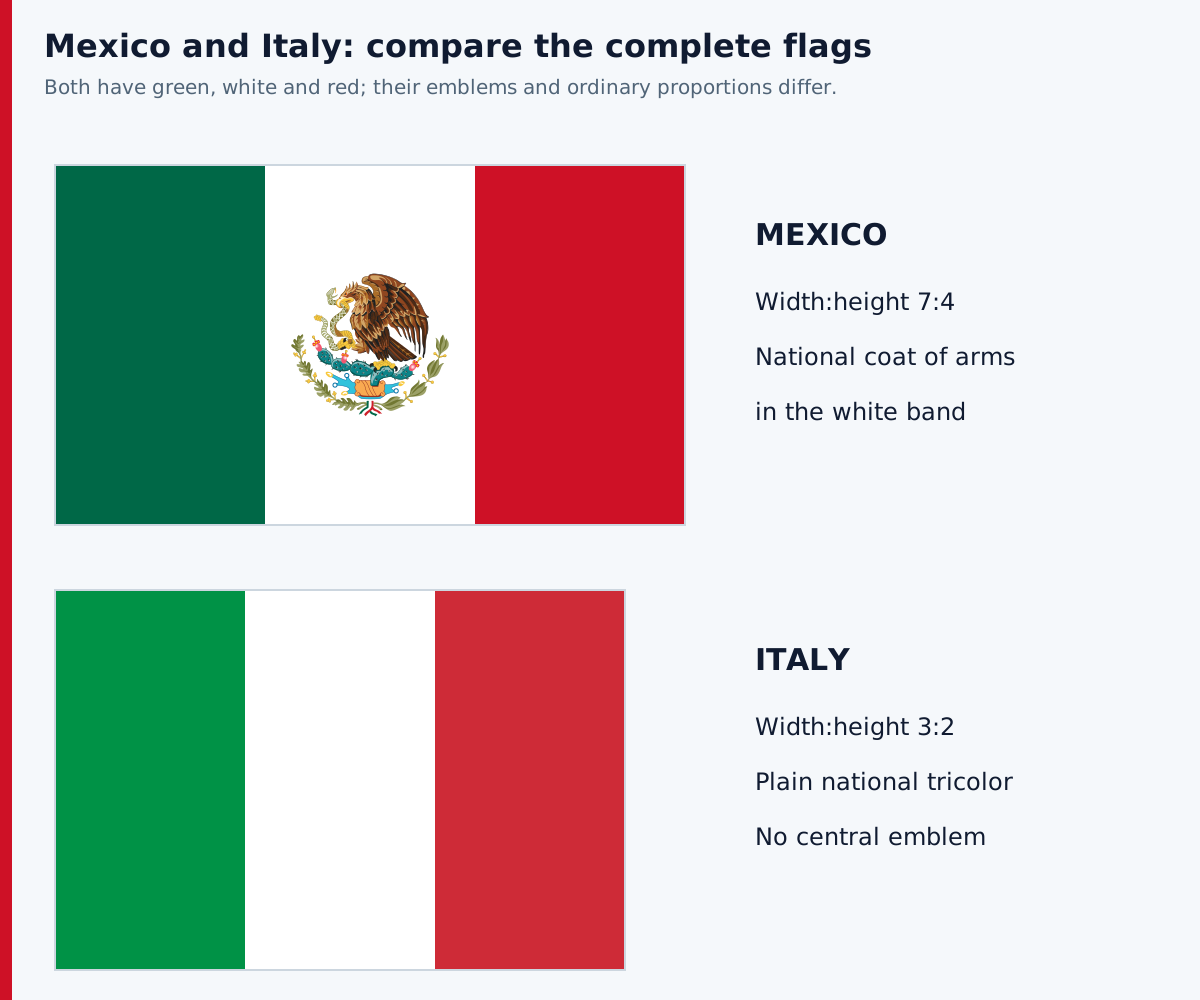
Mexico and Italy both use vertical green, white, and red bands, but Mexico’s flag includes a central national coat of arms and has a 7:4 rectangle. Italy’s ordinary national flag has no central emblem and is commonly shown at 3:2. Comparing full designs and proportions is more reliable than comparing color names alone.
The comparison preserves each source drawing’s own colors and proportions. Italy’s screen palette is not copied onto Mexico’s flag. Removing Mexico’s arms does not create a correctly proportioned Italian flag, because the ordinary reference rectangles differ as well.
What is Mexico’s flag emoji?
Mexico’s flag emoji is 🇲🇽. It consists of the regional indicator letters M and X, encoded as U+1F1F2 and U+1F1FD. Devices may combine these characters into a small flag picture or show separate indicators. The emoji identifies Mexico, but its tiny artwork is not a construction drawing for the national emblem.
Use the complete SVG or large PNG for diagrams, printed materials, and careful study of the coat of arms. Scaling up an emoji does not restore the detail that a platform omitted at small sizes.
What mistakes should be avoided when drawing Mexico’s flag?
Common errors include omitting the coat of arms, using a 3:2 rectangle, reversing the bands in a front view, replacing the eagle with a generic icon, or enlarging the emblem to fill the entire white stripe. Accurate reproduction preserves the complete design, the proper proportions, and the relationship between the front and reverse.
- Keep green at the hoist and red at the fly.
- Retain the complete eagle, serpent, nopal, rock, water, oak, laurel, and ribbon.
- Use the actual emblem artwork; do not substitute a coin or presidential-sash emblem.
- Identify digital color values as reference values, not unverified statutory codes.
- Distinguish February 24 Flag Day, September 16 Independence Day, and the 1968 and 1984 legal milestones.
- Consult the current calendar and regulation rather than copying superseded online guidance.
Explore more in World Flags: Iceland flag, Lithuania flag, Luxembourg flag, Madagascar flag, Malawi flag, Malaysia flag, Maldives flag, Mali flag, Malta flag, Mauritania flag, Mauritius flag.
Download Mexico flag pictures
Download the national flag as SVG or large PNG. The gallery includes 17 distinct subjects with captions and alternative text. Keep the full proportions when resizing. Image credits and reuse notes accompany the graphics.
World Flags/Mexico
Mexico flag pictures
Three equal vertical bands, green, white and red, with the complete national coat of arms. Width:height 7:4.
GKBook; reference artwork: Omar Alejandro Covarrubias Neri and Commons contributors (Mexico reference)Download SVGDownload PNGColor names and orientation labels sit outside the complete flag. Each band has identical width.
GKBook; reference artwork: Omar Alejandro Covarrubias Neri and Commons contributors (Mexico reference)Download SVGDownload PNGAn 84×48 grid gives three 28-unit bands. The statutory emblem diameter is 21 units, centered at (42,24).
GKBook; reference artwork: Omar Alejandro Covarrubias Neri and Commons contributors (Mexico reference)Download SVGDownload PNGGreen #006847, white #FFFFFF, red #CE1126. These reproduce the credited SVG’s band fills, not certified statutory screen or print codes.
GKBook; reference artwork: Omar Alejandro Covarrubias Neri and Commons contributors (Mexico reference)Download SVGDownload PNGThe full eagle, serpent, nopal, rock, water, branches and tricolor ribbon are retained in the enlargement.
GKBook; reference artwork: Omar Alejandro Covarrubias Neri and Commons contributors (Mexico reference)Download SVGDownload PNGThe law specifies a diameter of three-quarters of the white stripe’s width; the equivalent whole-flag relation is one-quarter of total width.
GKBook; reference artwork: Omar Alejandro Covarrubias Neri and Commons contributors (Mexico reference)Download SVGDownload PNGGreen is associated with hope, white with unity, and red with the blood of national heroes. These meanings are identified as civic interpretation.
GKBookDownload SVGDownload PNGThe Three Guarantees explain one historical setting for the colors. The graphic does not reconstruct an 1821 flag.
GKBookDownload SVGDownload PNGTimeline of major milestones. Military standards and every artistic variant are not counted as separate national flags.
GKBookDownload SVGDownload PNGThe 1968 milestones are kept separate; the later law commenced on February 24, 1984.
GKBookDownload SVGDownload PNGFlag Day is February 24. September 16 is the anniversary of the beginning of the independence movement.
GKBook; reference artwork: Omar Alejandro Covarrubias Neri and Commons contributors (Mexico reference)Download SVGDownload PNGThe examples reflect the current statutory calendar, including changes made in July 2025. No current emergency mourning notice is implied.
GKBookDownload SVGDownload PNGArticle 2 explicitly specifies the reverse talon arrangement. The reverse is an illustrative mirror of the complete reference, with the hoist at the right.
GKBook; reference artwork: Omar Alejandro Covarrubias Neri and Commons contributors (Mexico reference)Download SVGDownload PNGAll examples preserve 7:4. Emblem diameter is calculated as one-quarter of total width.
GKBookDownload SVGDownload PNGThe civilian salute and standing at attention during the anthem are described separately in the current ceremonial rules.
GKBookDownload SVGDownload PNGEach complete reference keeps its own proportions and colors. The Italian reference remains 3:2, while Mexico is 7:4.
GKBook; reference artwork: Omar Alejandro Covarrubias Neri and Commons contributors (Mexico reference); Commons contributors (Italy reference)Download SVGDownload PNGThe July 2025 amendment updates the calendar. The September 2025 regulation elaborates procedures and includes the model annex.
GKBookDownload SVGDownload PNGFrequently asked questions
What does the Mexican flag look like?
Mexico’s national flag is a vertical tricolor with green beside the hoist, white in the middle, and red at the fly. The three bands have identical dimensions. The national coat of arms occupies the center of the white band, giving Mexico’s flag its most distinctive identifying feature.
What is the correct order of Mexico’s flag colors?
The colors run green, white, and red when read from the flagpole toward the free edge. In the usual front-view illustration, that means green on the left and red on the right. The hoist is the reference point, so the visible order changes when the cloth is viewed from behind.
What are the proportions of Mexico’s flag?
Mexico’s flag has a width-to-height ratio of 7:4. The law expresses the same shape as four units of hoist height to seven units of length. For example, a flag 140 centimeters wide and 80 centimeters high preserves the prescribed rectangle without stretching the national coat of arms.
How is the Mexican flag constructed?
Divide a 7:4 rectangle into three equal vertical bands, then place the complete national coat of arms in the center of the white band. The law sets the emblem’s diameter at three-quarters of that band’s width. A convenient drawing grid is 84 units wide by 48 units high.
What are Mexico’s flag color codes?
The supplied reference images use green #006847, white #FFFFFF, and red #CE1126 for the three background bands. These are digital reproduction values, not HEX codes stated in the national-symbols law. The law names the colors and preserves an authenticated model; the detailed emblem also contains additional colors.
Are Pantone and CMYK values legally fixed for Mexico’s flag?
The national-symbols law and the 2025 regulation consulted here do not prescribe a numeric Pantone, HEX, RGB, or CMYK table for the flag. Popular color charts should therefore be identified as reproduction references. For physical manufacture, matching the authenticated model is more defensible than treating an online conversion as statutory authority.
What do the colors of Mexico’s flag mean?
A widely taught modern interpretation associates green with hope, white with unity, and red with the blood of national heroes. These civic meanings differ from the Three Guarantees associated with the independence period. The current law defines the flag’s appearance but does not enact a separate symbolic meaning for each color.
What did the three colors mean in 1821?
The independence-era Three Guarantees connected green with independence, white with the Catholic religion, and red with union. The Trigarante flag arranged its colors diagonally, so it should not be confused with today’s vertical tricolor. The later meanings of hope, unity, and national sacrifice belong to a different interpretive context.
What is shown in Mexico’s coat of arms?
The coat of arms shows a Mexican eagle on a flowering nopal cactus growing from a rock in a lake, holding a curved serpent in its beak and talon. Oak and laurel branches form a lower semicircle, joined by a ribbon in the national colors. These elements form one prescribed composition.
How large should the coat of arms be?
The law gives the coat of arms a diameter equal to three-quarters of the white band’s width. Since that band is one-third of the flag’s total width, the prescribed diameter equals one-quarter of the total width. It is centered in the white band rather than aligned to a stripe boundary.
Why does the emblem show an eagle and a serpent?
The emblem evokes the Mexica tradition of finding the place to establish Mexico-Tenochtitlan through the sign of an eagle on a nopal. The familiar eagle-and-serpent composition developed through historical retellings and images. It is a national origin narrative, not a claim that every surviving pre-Hispanic depiction contains the same scene.
Who designed the present Mexican flag emblem?
Francisco Eppens Helguera is credited by Mexican cultural and diplomatic sources with the modern national coat of arms adopted in 1968. The green-white-red flag tradition is much older, so his contribution should be described as the contemporary emblem design. He did not originate Mexico’s entire nineteenth-century tricolor tradition.
When was Mexico’s current flag adopted?
The current Mexican flag is conventionally dated to September 16, 1968, a date confirmed in official diplomatic accounts. The associated national-symbols law was published on August 17, 1968. These dates should be distinguished from the nineteenth-century origins of the tricolor and from the replacement law that took effect in 1984.
How has Mexico’s flag changed over time?
Mexico’s flag history includes the independence movement’s banners, the Trigarante colors, imperial and republican eagle designs, and later standardization. The vertical green-white-red arrangement has nineteenth-century roots. The eagle’s crown, position, and artistic treatment changed across regimes before the contemporary national model was established in 1968 and regulated by later legislation.
When is Mexico’s Flag Day?
Mexico celebrates Flag Day on February 24. Article 10 of the national-symbols law establishes the observance, and official historical accounts identify its national recognition under President Lázaro Cárdenas in 1940. The date recalls the independence-era flag tradition and is separate from Independence Day, which falls on September 16.
What law governs Mexico’s flag?
The Ley sobre el Escudo, la Bandera y el Himno Nacionales governs Mexico’s national symbols. It was published on February 8, 1984, and took effect on February 24 that year. The consolidated text consulted here includes the July 21, 2025 amendment, which revises the flag-raising calendar rather than redesigning the flag.
What did the 2025 flag regulation add?
The national-symbols regulation was published on September 9, 2025, and took effect the following day. It elaborates procedures for ceremonies, reproduction, authorizations, commercial accessories, and retirement of worn flags. Its annex supplies national-symbol models. It operates alongside the law and does not replace the flag’s green-white-red layout or 7:4 proportions.
When must the flag be flown at full staff?
The law gives specified public buildings and institutions a flag calendar that includes full-staff commemorations and mourning dates. Full-staff examples include February 24, September 15 and 16, and November 20. The July 2025 amendment added recognition of women in Mexican history, so older abbreviated calendars may be incomplete.
When is Mexico’s flag flown at half-staff?
Half-staff display marks the mourning commemorations listed in Article 18 and additional occasions directed by the competent authorities. Examples include September 13 for the Niños Héroes, September 19 for the 1985 and 2017 earthquakes, and October 2 for those killed at Tlatelolco in 1968. These are annual commemorations, not current emergency notices.
How does the reverse of Mexico’s flag differ?
The reverse shows the same cloth from the opposite side, so a pole-at-right view displays red, white, and green from left to right. The law explicitly reverses the eagle’s talon arrangement: on the reverse it stands on its right talon and holds the serpent with its left talon and beak.
What sizes can a Mexican flag be?
The law allows individuals to display flags of any dimension at home, work, or on vehicles while respecting the national symbol. For an accurately proportioned reproduction, preserve the 7:4 rectangle and scale the complete emblem together with it. The sizes shown here are calculated examples, not an official mandatory product list.
How is the Mexican flag saluted?
The civilian salute is made while standing at attention, with the right hand extended across the chest at heart level and the palm facing down. The law additionally requires men to uncover their heads. Ceremonial honors to the flag take precedence over honors to people, with specific rules governing when the flag itself inclines.
How is the flag used in Mexican schools?
Every public and private educational establishment must possess a national flag for civic acts. The law calls for flag honors on Mondays, at the start of schoolwork or another designated time that day, and at the beginning and end of the school year. Educational authorities also teach the symbols’ history and significance.
Can people display Mexico’s flag at home or on a vehicle?
Yes. Article 32 permits individuals to use the national flag on vehicles and display it at home or at work, provided they treat it respectfully. This permission concerns personal display. Separate provisions address the use of the flag to promote a person, institution, goods, or services, so display and advertising require different consideration.
Can Mexico’s flag be used on products or advertisements?
Mexican law distinguishes selling a correctly made flag, reproducing its image on accessories, and using it to promote an image, goods, or services. The 2025 regulation sets conditions for commercial accessories and says those reproductions do not require prior authorization. That exception does not cancel the law’s separate restriction on promotional use.
How should a worn Mexican flag be retired?
When a replica is too deteriorated or damaged for dignified display, Mexican rules provide for respectful, solemn incineration. Article 54 Bis establishes that method, and the 2025 regulation supplies ceremonial procedures. Retirement is treated as an organized civic act, with the relevant authorities available to provide guidance on the applicable arrangements.
Is the presidential sash the same as the national flag?
The presidential sash is a legally defined presentation of the national flag and an emblem of the federal executive, reserved for the president. It uses three equal longitudinal bands, with green uppermost under current law, and a gold-embroidered national coat of arms. It is not the ordinary rectangular flag flown from a pole.
How is Mexico’s flag different from Italy’s?
Mexico and Italy both use vertical green, white, and red bands, but Mexico’s flag includes a central national coat of arms and has a 7:4 rectangle. Italy’s ordinary national flag has no central emblem and is commonly shown at 3:2. Comparing full designs and proportions is more reliable than comparing color names alone.
What is Mexico’s flag emoji?
Mexico’s flag emoji is 🇲🇽. It consists of the regional indicator letters M and X, encoded as U+1F1F2 and U+1F1FD. Devices may combine these characters into a small flag picture or show separate indicators. The emoji identifies Mexico, but its tiny artwork is not a construction drawing for the national emblem.
What mistakes should be avoided when drawing Mexico’s flag?
Common errors include omitting the coat of arms, using a 3:2 rectangle, reversing the bands in a front view, replacing the eagle with a generic icon, or enlarging the emblem to fill the entire white stripe. Accurate reproduction preserves the complete design, the proper proportions, and the relationship between the front and reverse.
Explore all general-knowledge topics and the A-to-Z lists.







We Value Your Opinion Comments