
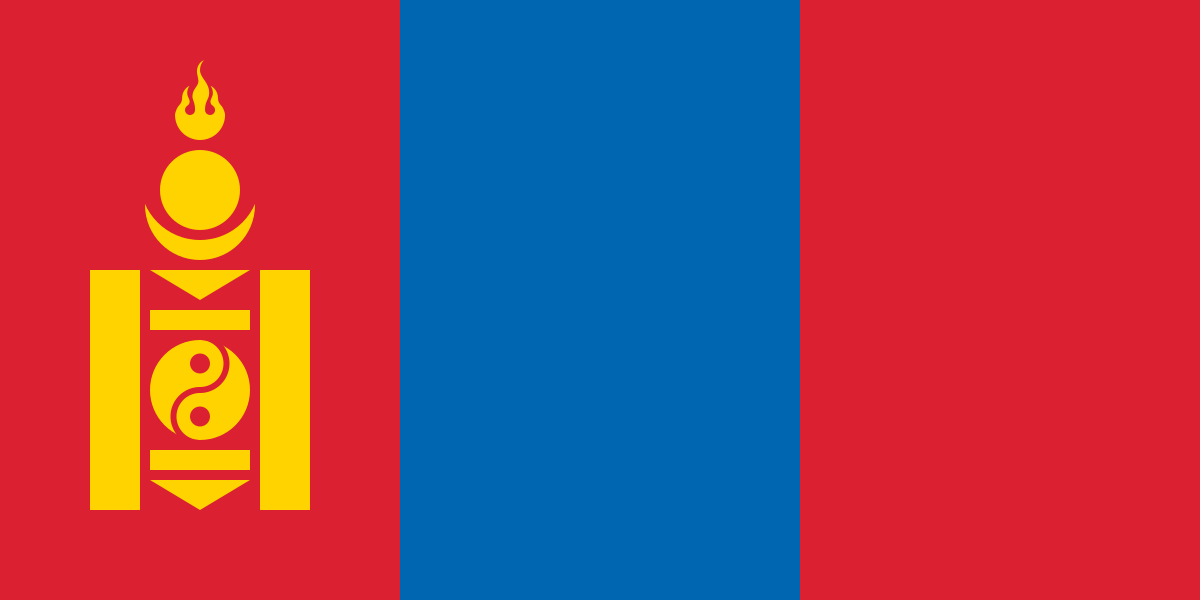
Mongolia flag picture
Explore the construction drawing, history, and complete picture gallery.
| Design | Red–blue–red with SoyomboThree equal vertical bands; golden emblem beside the hoist. |
|---|---|
| Proportions | 2:1 width:heightEquivalent to 1:2 height:length. |
| Present design | 1992 · no starConstitution approved January 13; effective February 12. |
| State Flag Day | July 10Observance established by the 2009 amendment. |
| Technical standard | MNS 6262:2011Effective in 2012; an amendment is recorded in 2018. |
Current design: 1992. State Flag Day: July 10. The Soyombo stands in the hoist-side red band.
What is the national flag of Mongolia?
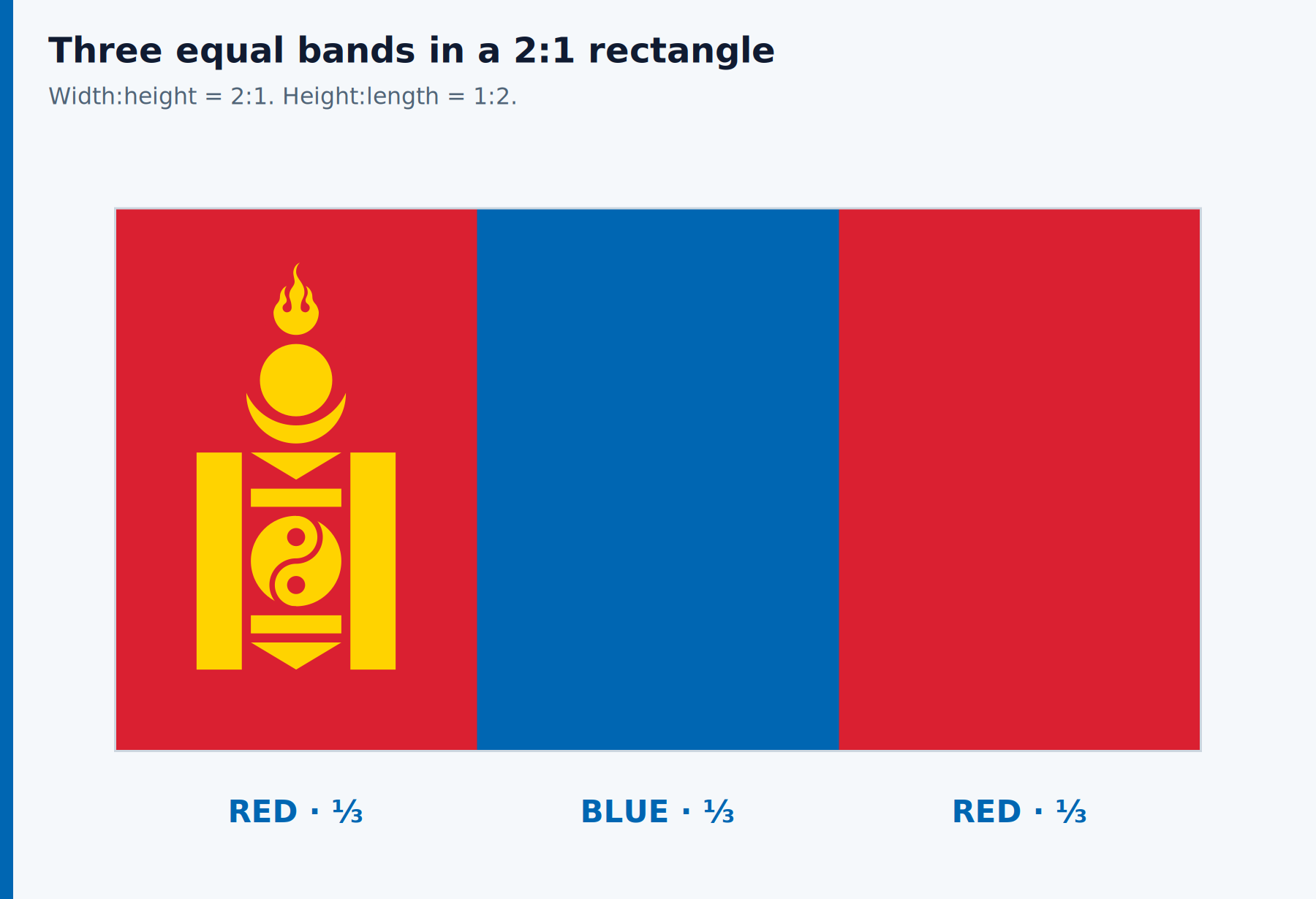
Mongolia’s national flag has three equal vertical bands of red, blue, and red, with a golden Soyombo in the band beside the hoist. Its width is twice its height. The present starless design belongs to the constitutional settlement of 1992 and preserves the older red-blue-red arrangement.
The flag combines a precisely described layout with an emblem that predates the modern state. This guide separates constitutional design, traditional interpretations, historical flags, manufacturing references, and rules for display. Its diagrams preserve the complete Soyombo, including the small cutouts and curved central motif.
What are the proportions and stripe widths of Mongolia’s flag?
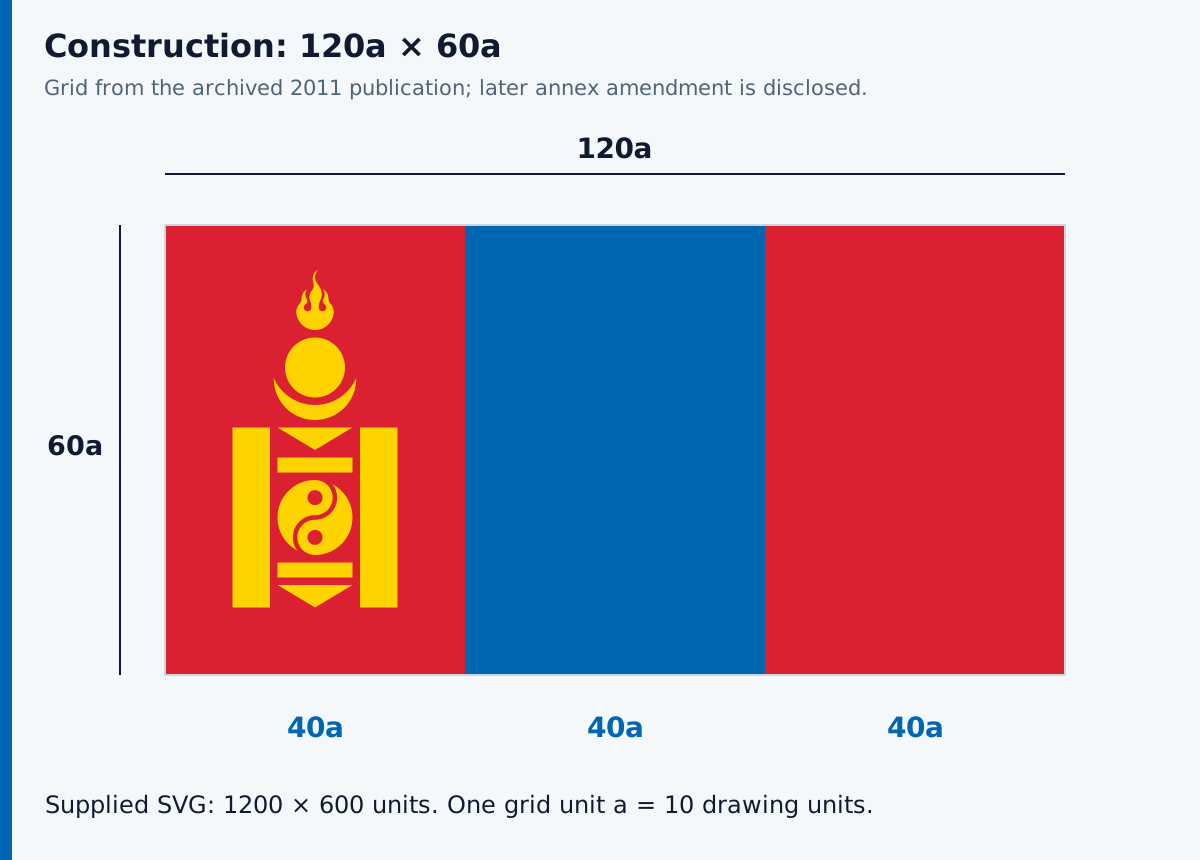
The flag is twice as wide as it is high: 2:1 width:height, or 1:2 height:length. Its three vertical bands have equal widths. On a 1200 × 600 drawing, each band is 400 units wide, with blue in the middle and red at both ends.

Article 12 of the Constitution fixes the overall proportion and gives the blue band one-third of the length. The State Symbols Law repeats the design. These measurements describe the flag field; an attachment sleeve or ties are not extra colored bands.
How is the flag constructed on a measured grid?
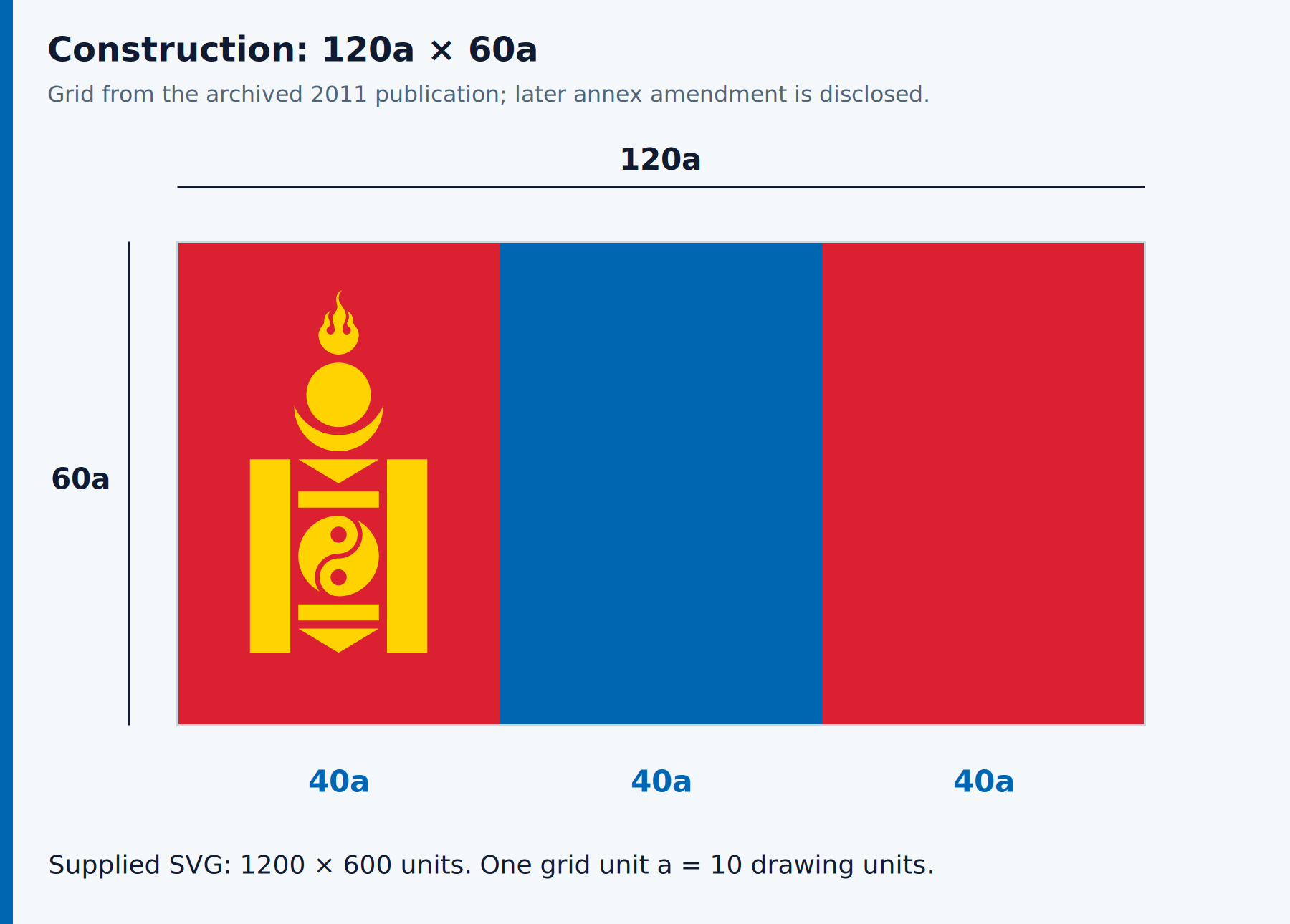
The archived 2011 construction drawing uses a 120-unit length and a 60-unit height, with each stripe 40 units wide. The supplied vector follows that arrangement at ten drawing units per grid unit. Its Soyombo keeps the source’s complete curves, circles, triangles, bars, and pillars rather than substituting an approximate icon.
| Grid item | Archived construction / supplied reference |
|---|---|
| Flag field | 120a × 60a; supplied SVG 1200 × 600 |
| Each stripe | 40a wide; supplied SVG 400 units |
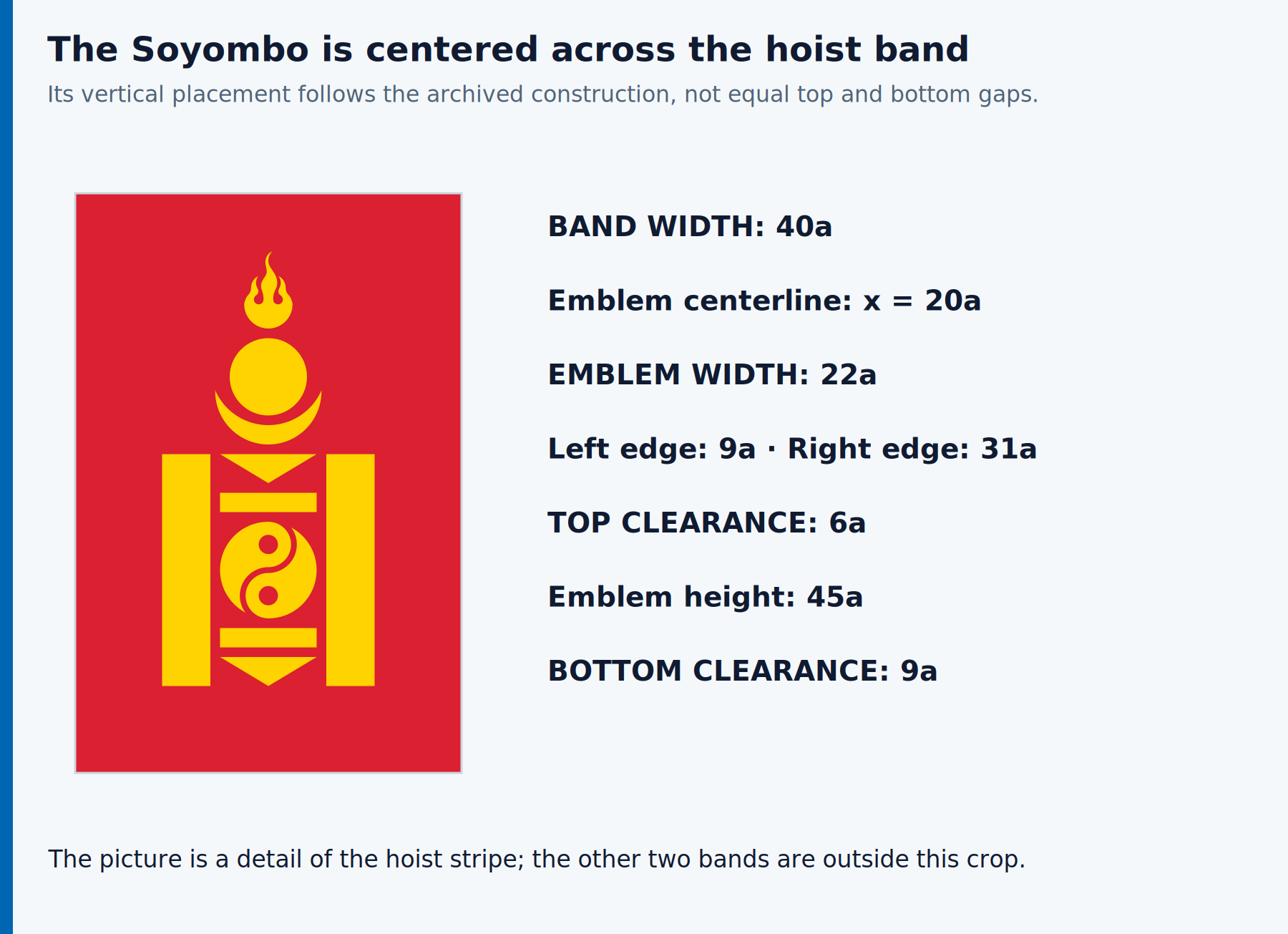
| Soyombo overall width | 22a; supplied reference 220 units |
| Soyombo top and bottom | 6a and 51a from the top; 45a overall height |
| Two side pillars | Each 5a wide and 24a high |
The measurements correspond to the archived presidential construction plate. They explain this reference image; they do not certify a manufactured flag against the amended annex registered in 2018.
Where should the Soyombo sit on the flag?
Place the golden Soyombo in the red band next to the hoist, centered across that band. In the archived construction, its upper clearance is six grid units and its lower clearance is nine. It therefore sits slightly above the flag’s vertical midpoint, rather than being centered in both directions.
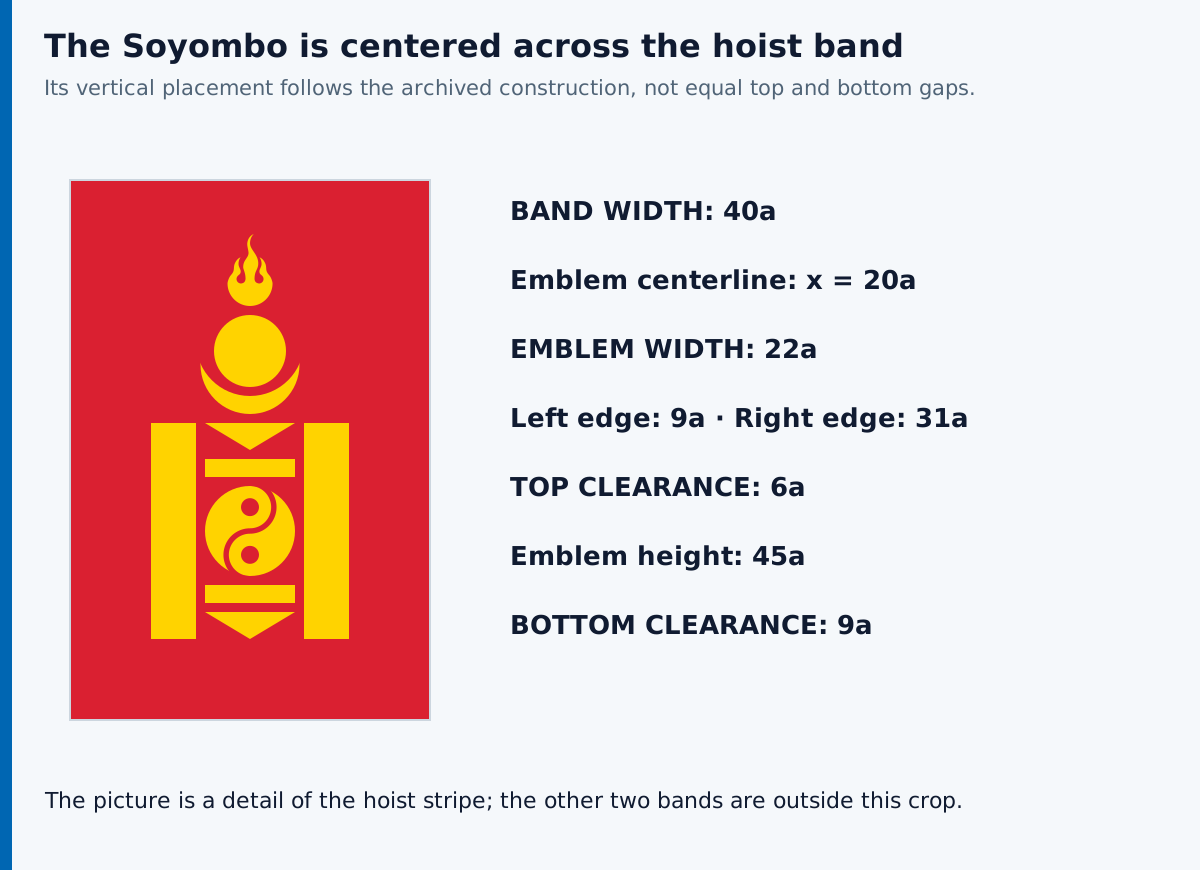
In the 1200 × 600 reference, the emblem extends from x=90 to x=310, with its centerline at x=200. It extends approximately from y=60 to y=510. Moving it to the central blue stripe, adding a star, or aligning it to the whole flag’s center changes the design.
What are Mongolia’s flag colors and digital color codes?
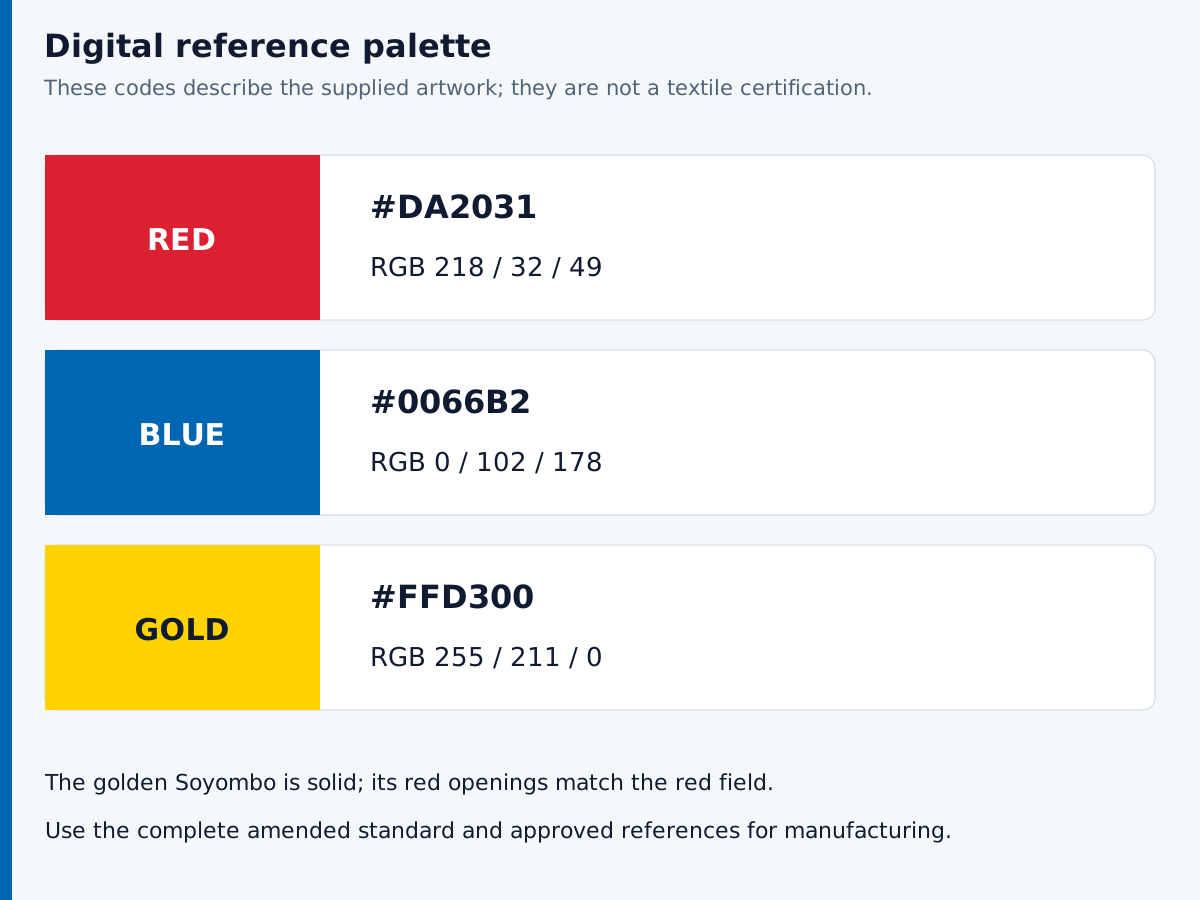
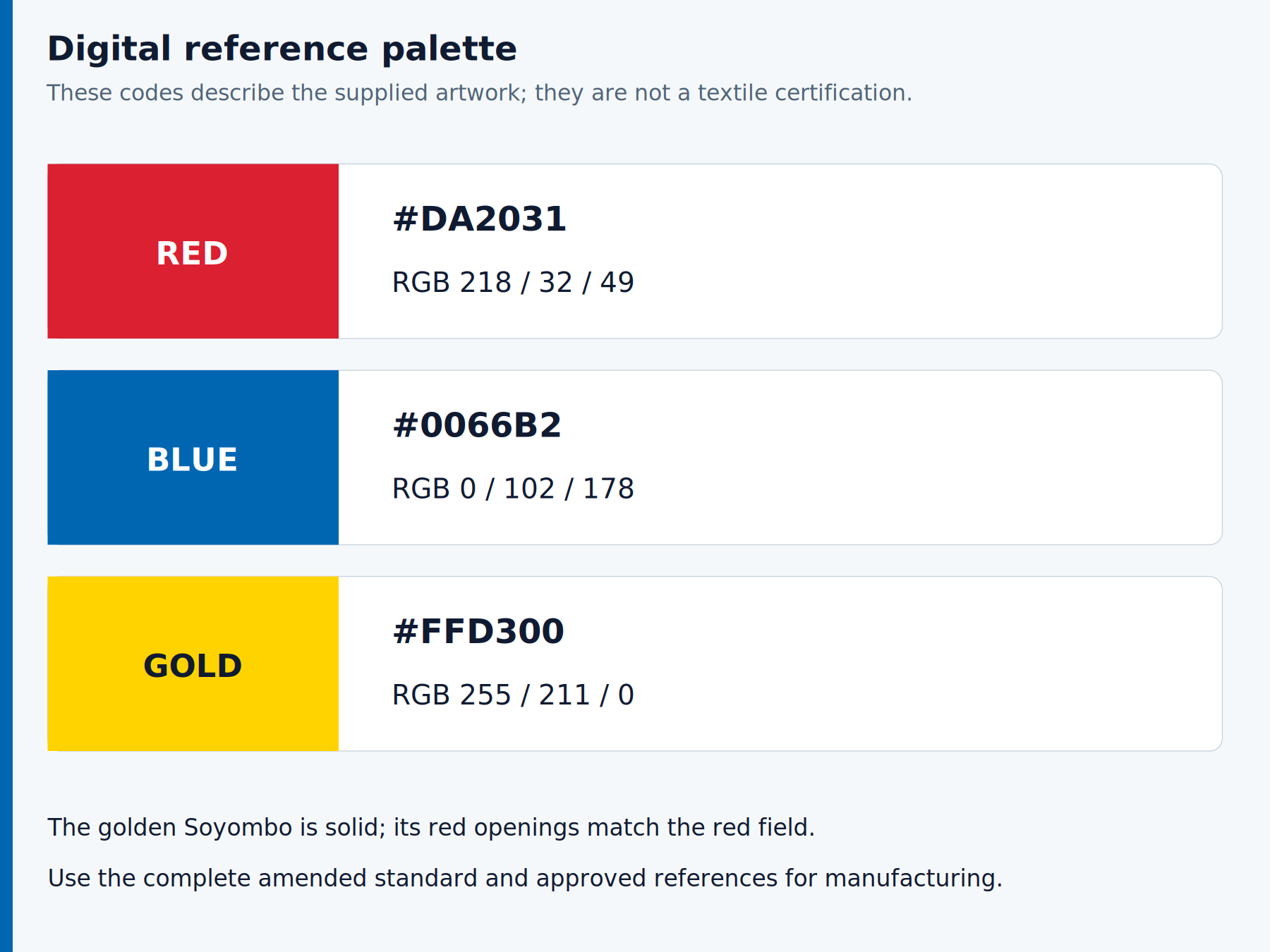
The Constitution names red, blue, and a golden Soyombo. The supplied digital reference uses red #DA2031, blue #0066B2, and golden yellow #FFD300. These values identify the colors in these downloadable files; they are not presented as independently verified legal HEX specifications or a complete specification for printing on fabric.
| Color | HEX in this package | RGB |
|---|---|---|
| Red | #DA2031 | 218, 32, 49 |
| Blue | #0066B2 | 0, 102, 178 |
| Golden yellow | #FFD300 | 255, 211, 0 |
The source SVG used a slightly different red inside the central motif. Those red cutouts have been matched to the surrounding red field. Every geometric element remains intact. The national PNG is opaque and measures 4800 × 2400 pixels.
Which flag standard applies, and what changed after 2011?
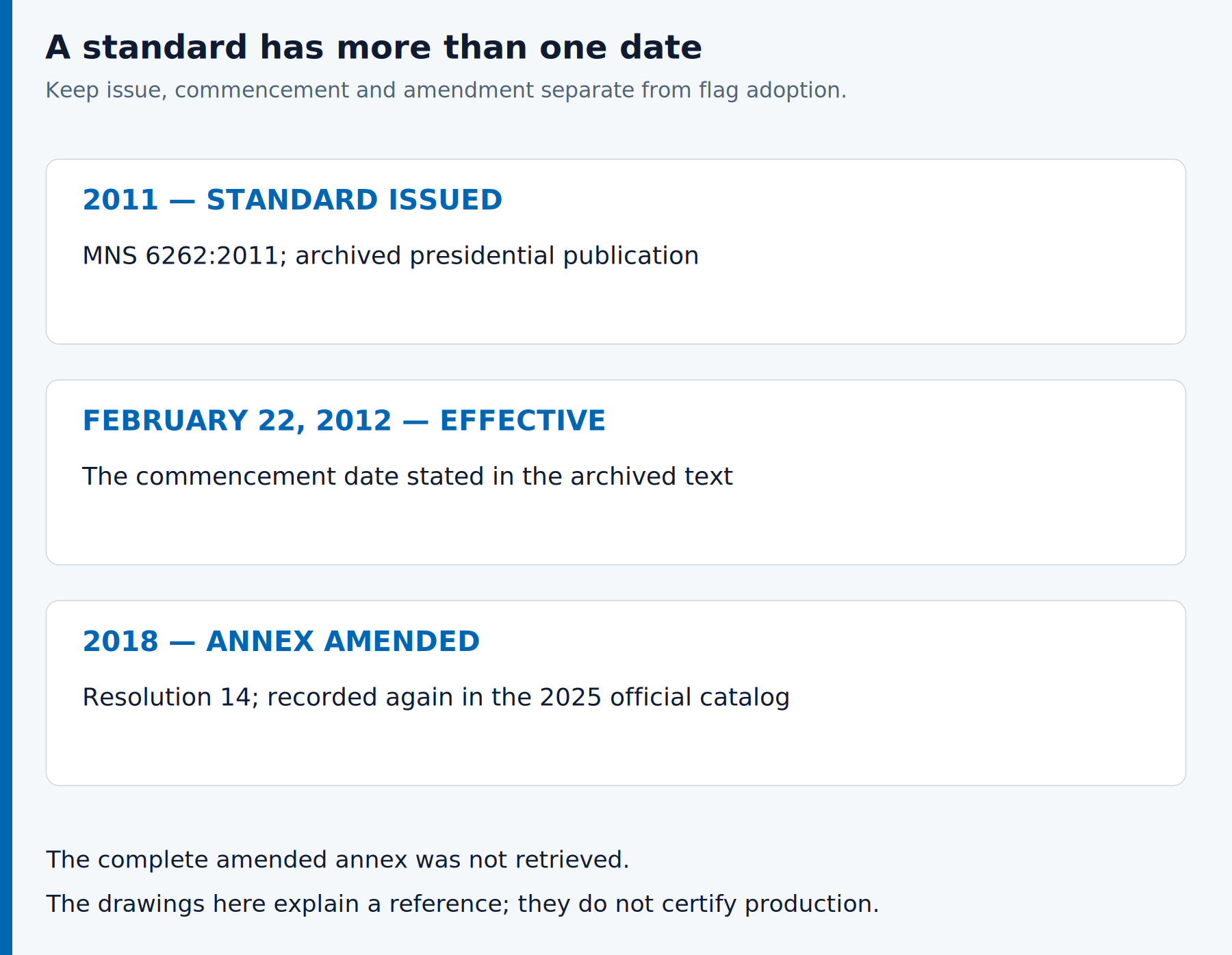
MNS 6262:2011 sets out general requirements for Mongolia’s state flag. The archived presidential publication gives February 22, 2012 as its effective date. An official standards catalog records a 2018 amendment. Those are different milestones, and the original publication should not be treated as proof that its entire annex remains unchanged.
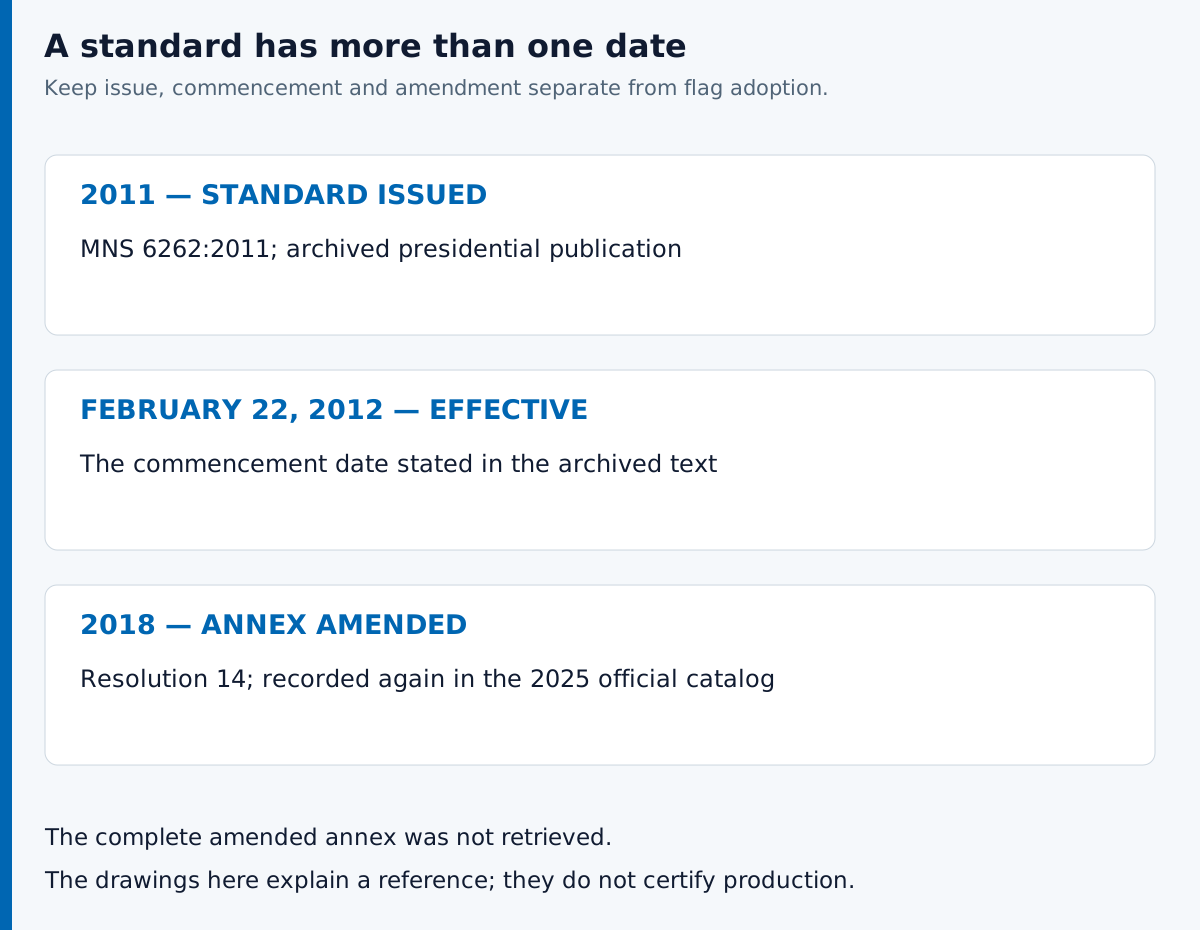
The 2025 official catalog still lists MNS 6262:2011 and notes amendment by Resolution 14 of 2018. The available amendment register identifies an annex change registered on June 20, 2018; the amended annex itself was not retrieved.
The archived text gives CMYK 100/60/0/0 for blue and 10/100/90/0 for red. A 2025 government document also references the blue formula. The archived yellow line contains an internally inconsistent value, so it is not reproduced here as a reliable production formula. For manufacturing, obtain the complete amended standard and an approved color reference.
What do the red and blue bands symbolize?
Mongolia’s Constitution explicitly connects blue with the eternal blue sky and red with progress and prosperity. The golden Soyombo is a symbol of independence. These meanings explain the national design without turning every familiar interpretation of the emblem’s individual shapes into an additional rule about how the flag must be manufactured.
The constitutional description is the strongest source for the band meanings. Traditional explanations of the Soyombo add cultural context, while the standard’s drawings answer different questions about shape and spacing.
What is the Soyombo symbol on Mongolia’s flag?
The Soyombo is the golden vertical emblem on the hoist-side red stripe. Its structure combines a flame, sun, crescent moon, two triangles, two horizontal rectangles, a curved central pair, and two upright pillars. These form one integrated emblem; the current flag does not place a five-pointed star above it.
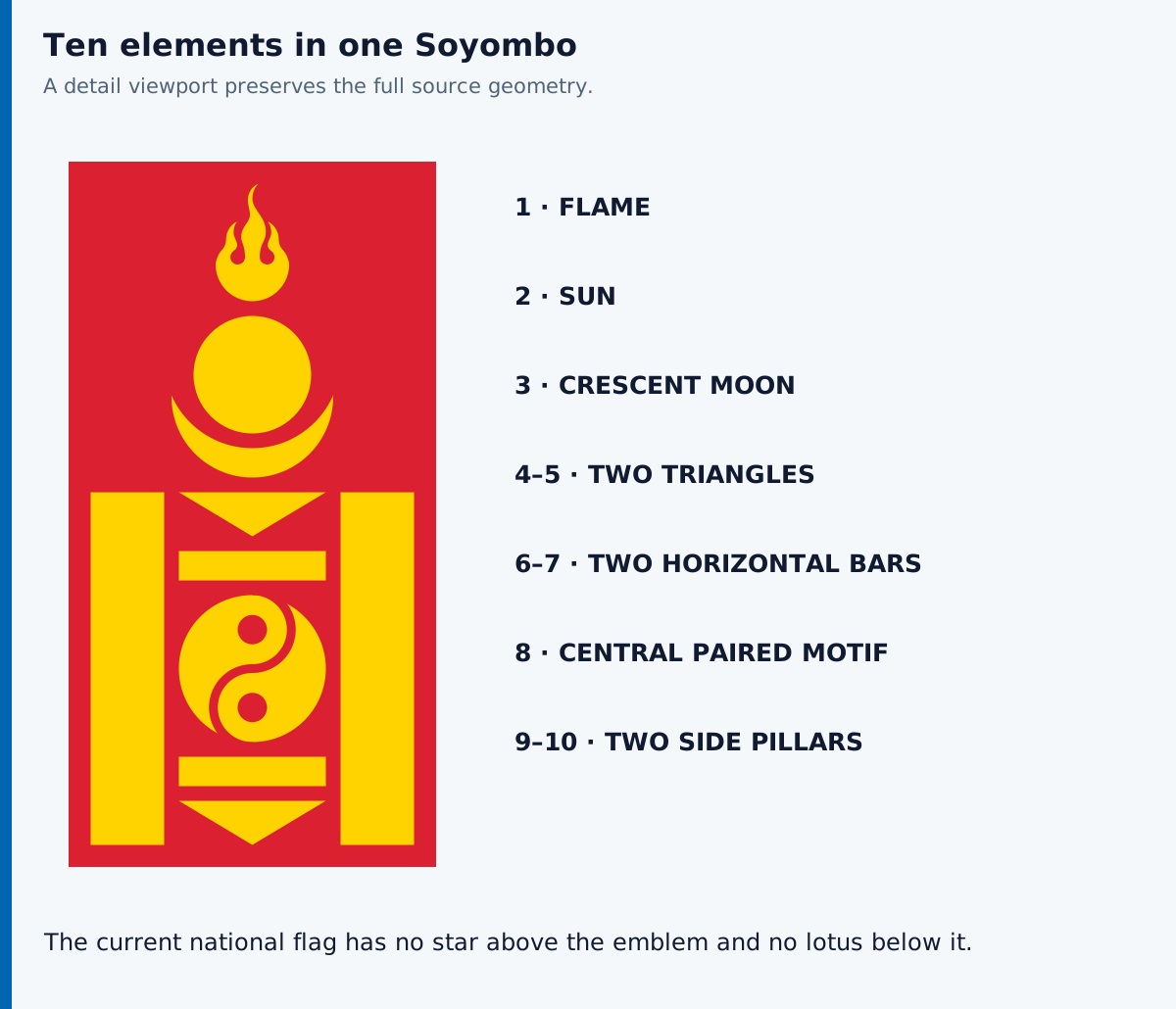
Counting the paired triangles, bars, and pillars separately gives ten elements. The central motif is one paired composition. This is a description of the emblem’s structure, not ten extra marks to draw outside it.
Who created the Soyombo, and how old is it?
Zanabazar created the Soyombo writing system in 1686, long before Mongolia adopted its present flag. The familiar national emblem comes from that script’s opening symbol. Distinguish the creation of the script from later uses of the symbol on state flags, and from the modern red-blue-red design introduced in the twentieth century.
Zanabazar is also known as Undur Gegeen. The name Soyombo is associated with “self-born.” The symbol’s long history explains why it can appear in different national objects without making every object a version of the current flag.
What do the flame, sun, and crescent moon mean?
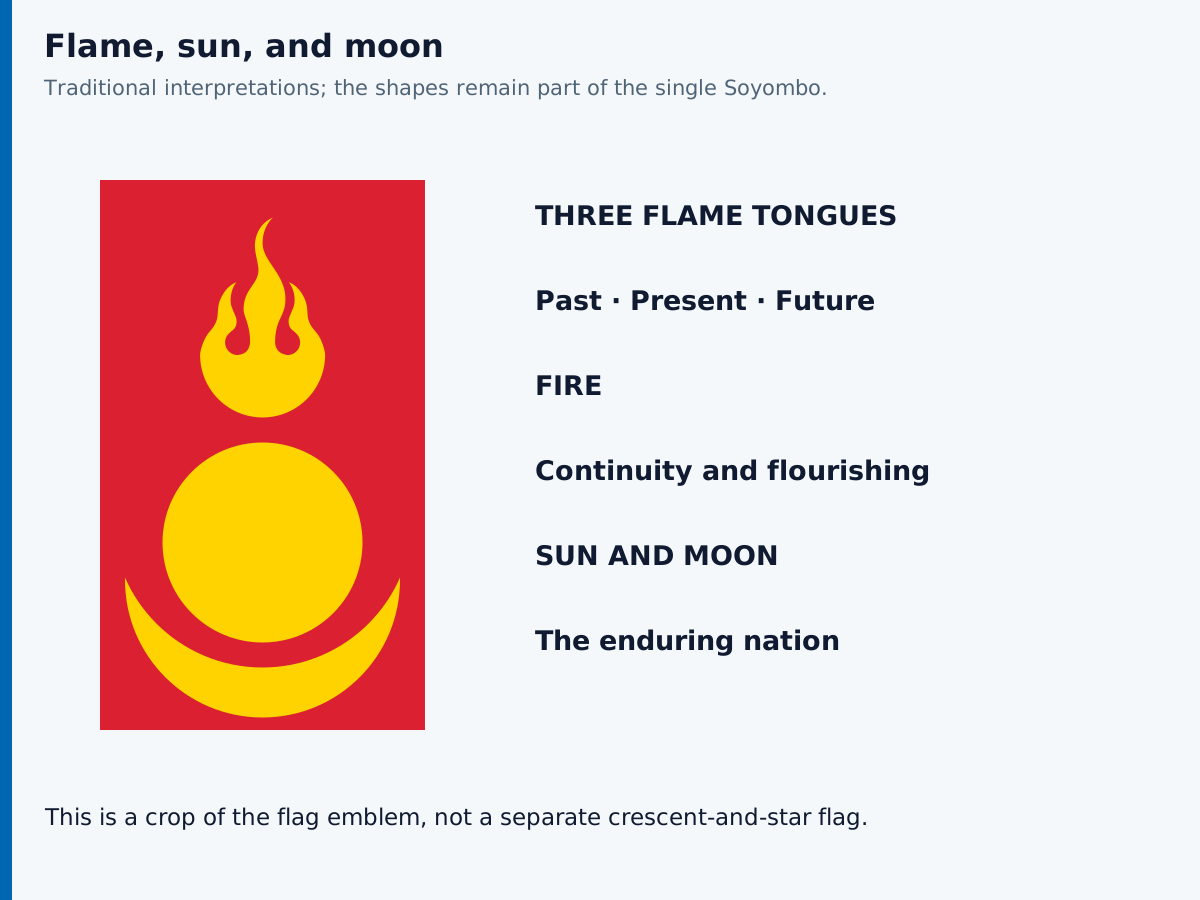
Traditional explanations connect the flame with continuity and flourishing, and its three tongues with past, present, and future. The sun and moon express the lasting existence of the nation. On the flag, these are golden parts of the Soyombo; they are not a separate religious crescent-and-star design or an added emblem.
What do the triangles, bars, and pillars represent?
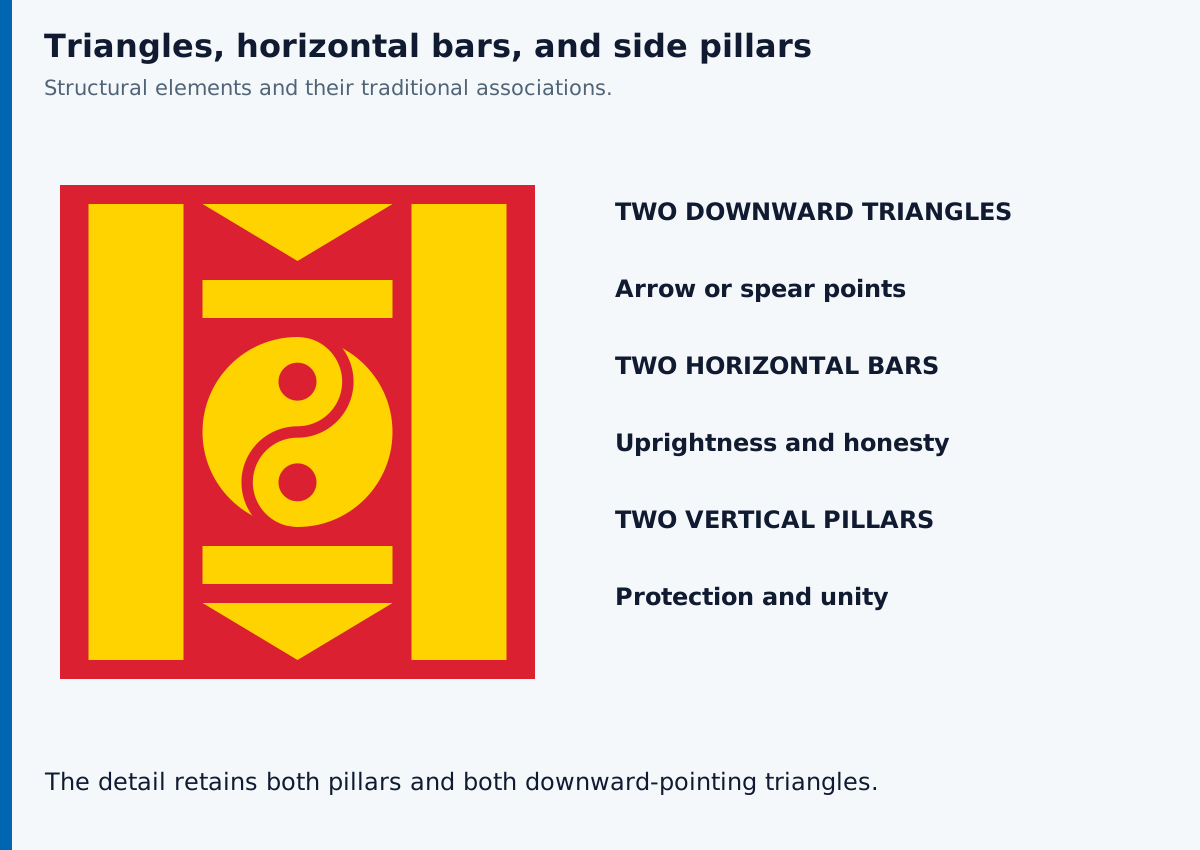
The downward triangles are traditionally explained as spear or arrow points overcoming adversaries. The horizontal bars express uprightness and honesty, while the vertical pillars suggest protective walls and unity. Their exact shapes also matter: the flag has two downward triangles, two horizontal bars, and two tall side pillars within the Soyombo.
Are the shapes in the middle fish or a yin-yang symbol?
The central paired forms are commonly interpreted through complementary forces and through two vigilant fish. Both readings belong to the Soyombo’s interpretive tradition. For reproduction, preserve the actual curved division and the two small circular cutouts; replacing them with a generic black-and-white yin-yang icon changes the flag’s golden and red artwork.
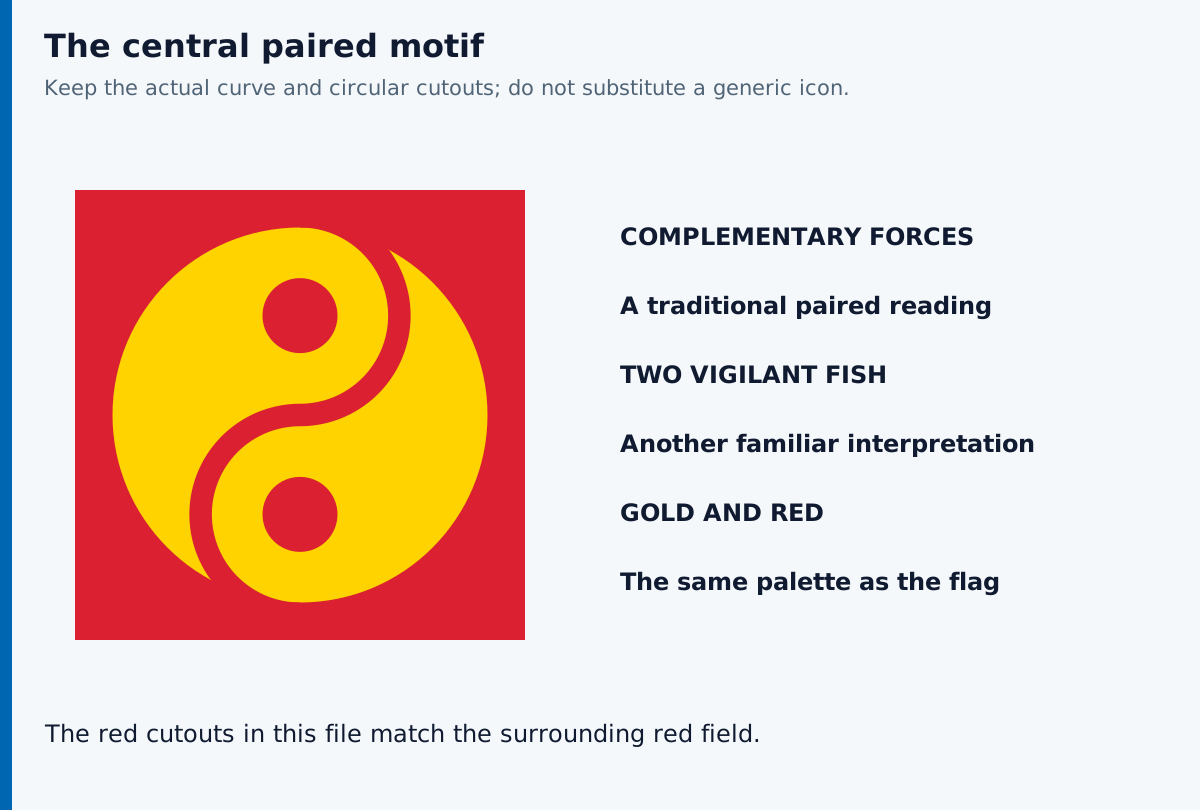
The archived detail drawing specifies the central construction rather than leaving it to a font or decorative symbol. The supplied vector retains that curved motif at its original scale within the complete emblem.
When was the current Mongolian flag adopted?
The current starless flag dates to 1992. The new Constitution was approved on January 13, 1992 and came into force on February 12, 1992; Article 12 describes the design. These legal milestones should be kept distinct from the older tricolor’s introduction and from the flag standard’s much later effective date.
The constitutional text establishes January 13 as the approval date and February 12 as commencement. It does not establish January 12 as the adoption date. This article therefore uses 1992 for the present design and states the two verified constitutional dates separately.
How did Mongolia’s flag develop before the present design?
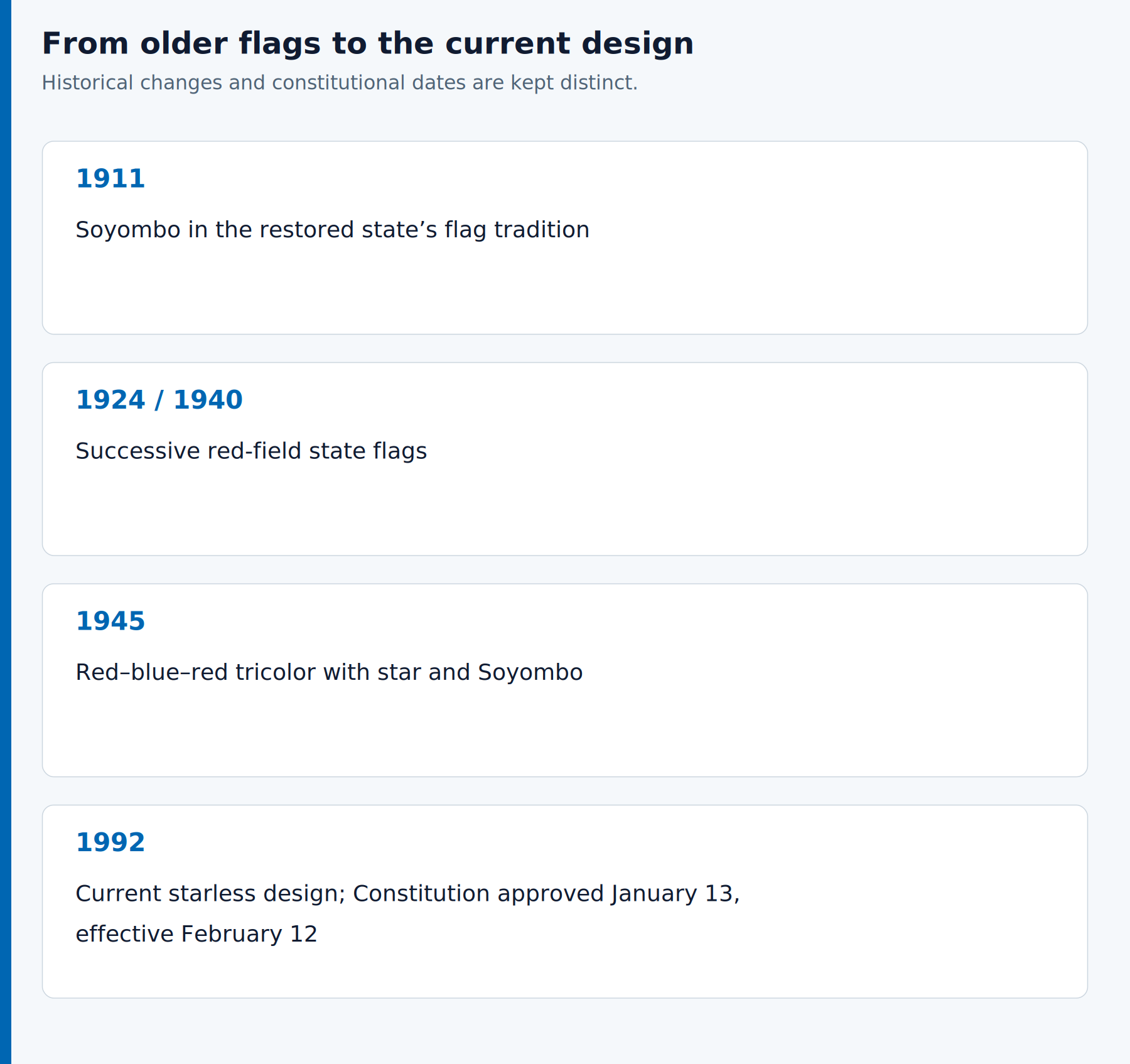
Mongolia used earlier state flags before the familiar tricolor appeared in 1945. The red-blue-red flag of the socialist period carried a star above the Soyombo. The present flag retained the three bands and the emblem while removing that star in 1992, linking the modern design with an older national symbol.

| Period or event | What changed |
|---|---|
| 1911 | The Soyombo appeared in the restored state’s flag tradition. |
| 1924 and 1940 | Successive constitutions described different red-field state flags. |
| 1945 | The red-blue-red arrangement appeared with a star above the Soyombo. |
| 1992 | The present constitutional design has the Soyombo without that star. |
| 2011 / 2012 / 2018 | Technical standard issued, effective, and later amended: separate from adoption. |
Earlier flags should be researched as their own designs. The historical illustration below is specifically a starred tricolor reference, not a generic image claimed to represent every Mongolian flag before 1992.
How does the socialist-period flag differ from today’s flag?
The most immediate difference is the golden five-pointed star above the Soyombo on the socialist-period tricolor. Today’s flag has no star. The historical reference supplied here also has different drawing details and reference shades, so the comparison retains each complete source instead of simply adding a star to the modern image.
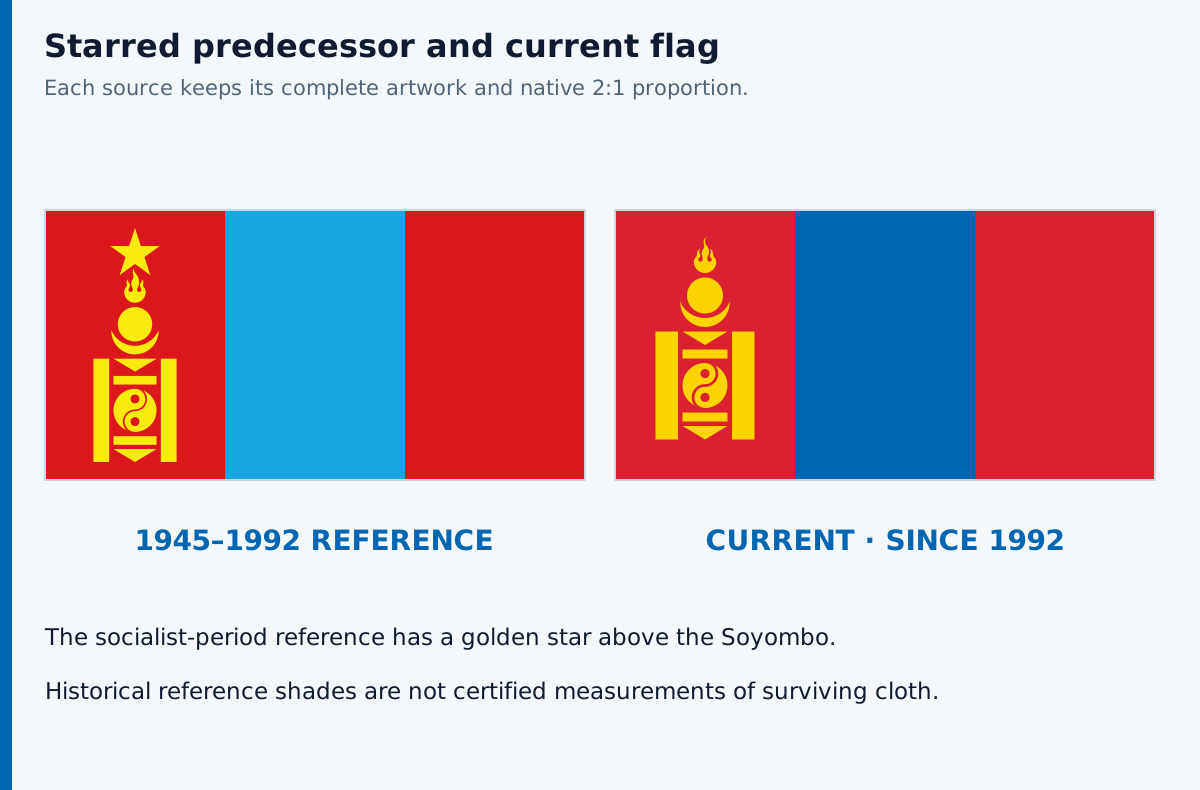
The historical source is labeled 1945–1992. Its colors are reference artwork, not measurements from an authenticated surviving cloth flag. The current image likewise remains a digital reference rather than a certification of textile dyes.
Who designed the red-blue-red flag?
Mongolian institutional accounts credit artist Dodiin Choidog with the 1945 flag design. That is a different contribution from Zanabazar’s creation of the Soyombo script in 1686. The modern flag combines that older emblem tradition with the tricolor arrangement, while the 1992 constitutional design omits the socialist-era star.
This distinction prevents two common attribution errors: assigning the seventeenth-century script to the twentieth-century artist, or describing the whole modern flag as a seventeenth-century design.
Which laws describe and regulate Mongolia’s flag?
Article 12 of the Constitution describes the flag and its main symbolism. The State Symbols Law, adopted on May 20, 1994 and effective from July 1, 1994, addresses design, use, display, and respect. The technical standard adds construction requirements; ceremonial arrangements may also depend on the applicable official protocol.
The State Symbols Law’s Articles 11–15 concern the flag’s design and principal display situations. Articles 23–26 address representations, ceremonies, respectful private use, and protection. Its consolidated text includes 2024 changes concerning additional permanent display locations and commemorative presentation of flags.
When is Mongolia’s State Flag Day?
Mongolia observes State Flag Day on July 10. The observance was added to the holidays and commemorative-days law by an amendment dated June 11, 2009. It celebrates the national flag and is associated with official ceremonies; it is not the date on which the present constitutional flag took effect in 1992.
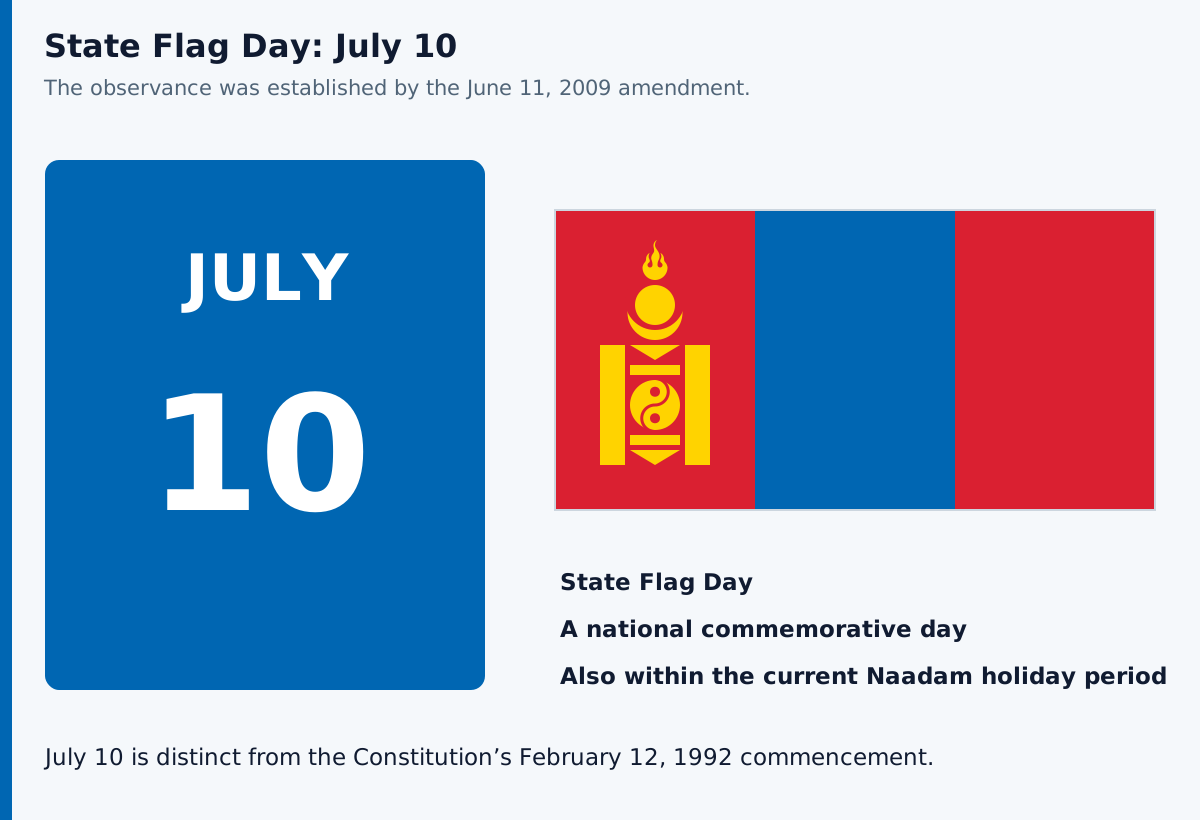
The law settles the observance’s establishment in 2009. July 10 also falls within the present statutory Naadam holiday period. A day can therefore have both a named commemorative purpose and a place in a longer public-holiday period.
Which other national dates are associated with flag display?
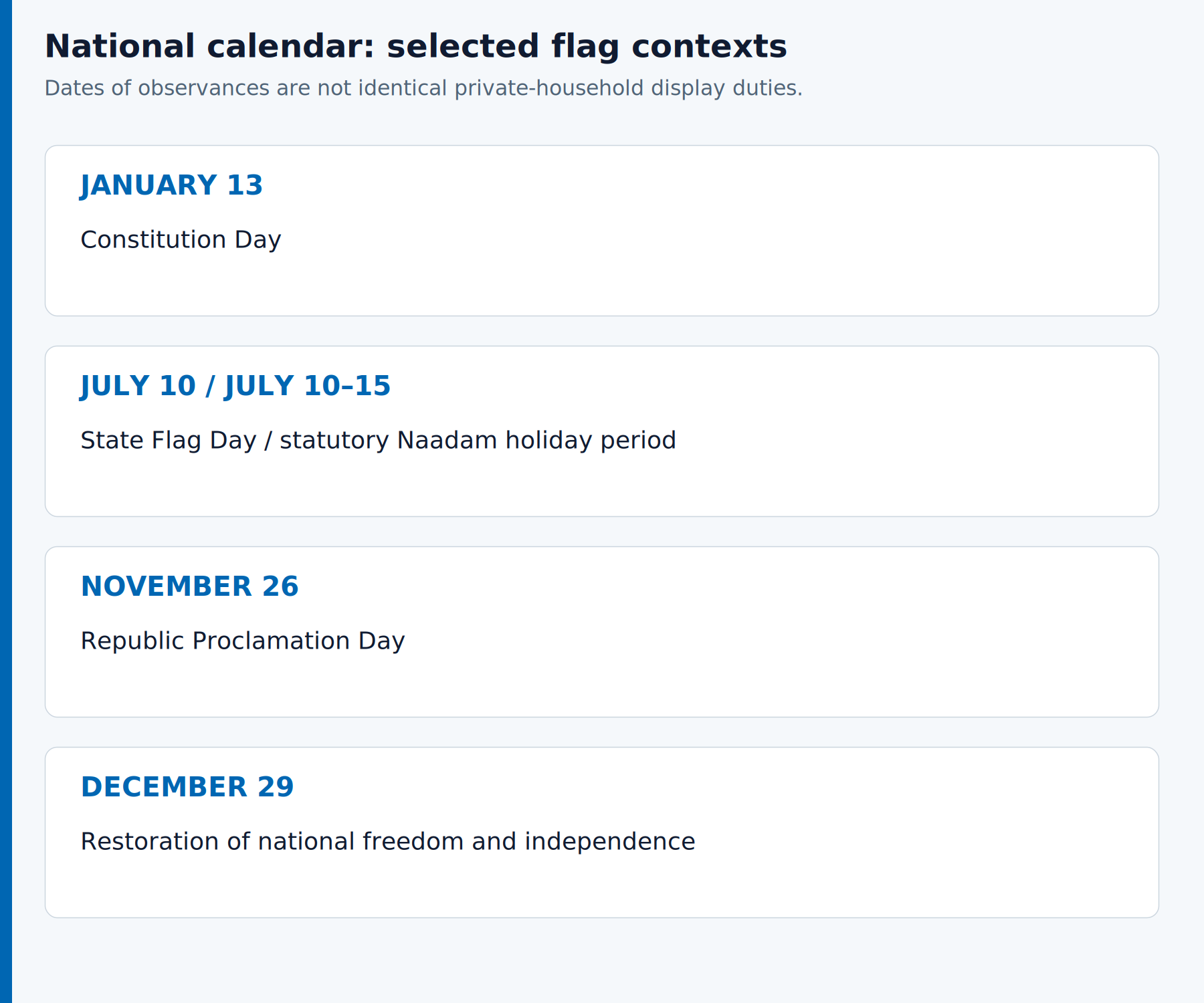
Constitution Day on January 13, the Naadam holiday period in July, Republic Proclamation Day on November 26, and the independence-restoration holiday on December 29 provide important national contexts for the flag. These observances have different meanings; their inclusion in the calendar does not impose an identical display duty on every private household.
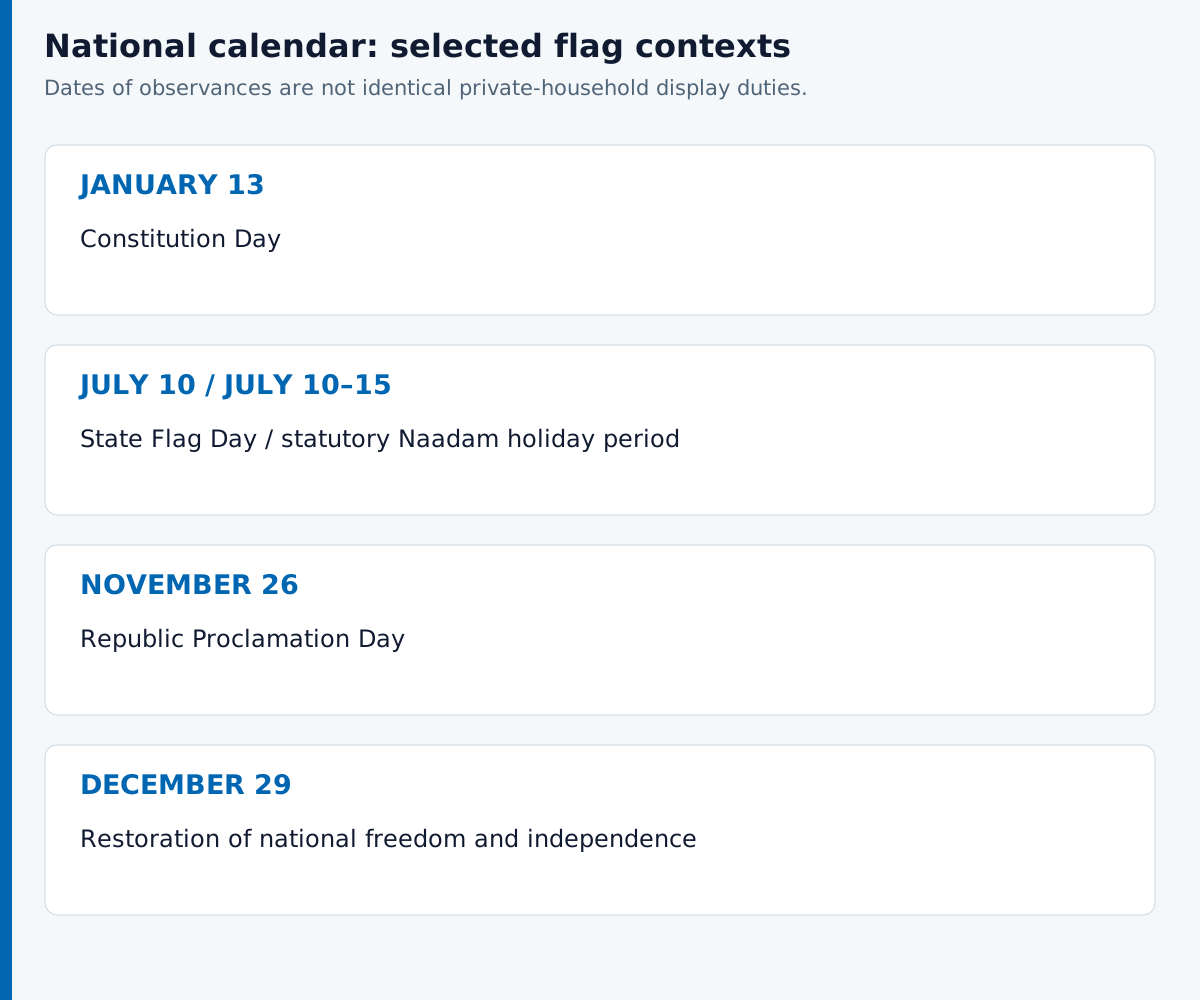
| Date | Occasion |
|---|---|
| January 13 | Constitution Day |
| July 10 | State Flag Day |
| July 10–15 | Statutory Naadam and revolution-anniversary holiday period, unless otherwise provided by law |
| November 26 | Republic Proclamation Day |
| December 29 | Restoration of national freedom and independence |
The consolidated holiday law includes July 10–15 after its 2022 amendment. The dates of particular competitions or a published annual ceremony program are separate questions. The State Symbols Law identifies the institutions and occasions for which specified flag display is required.
Where is the state flag displayed officially?
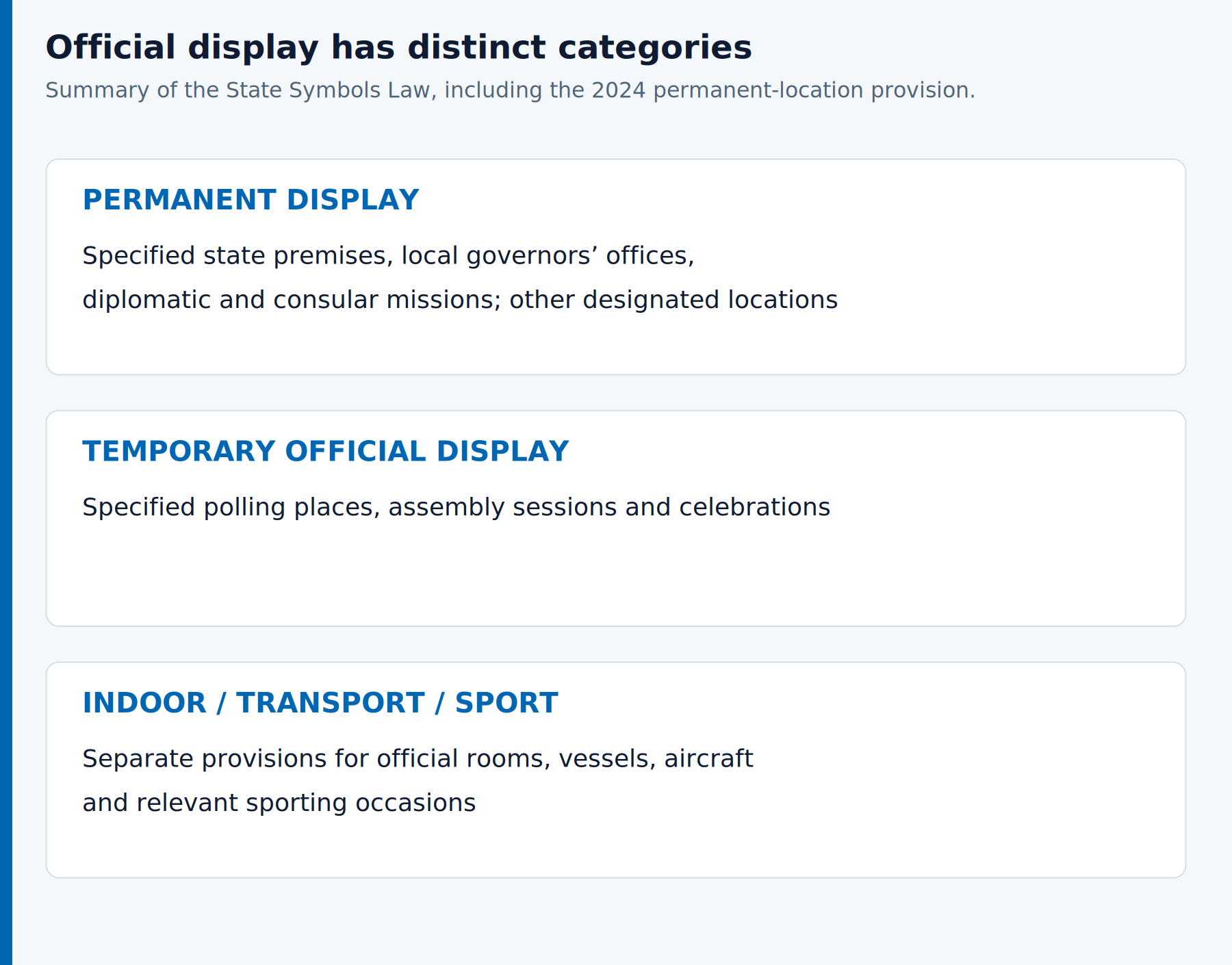
The State Symbols Law requires permanent flag display at specified state premises, including the Government Palace, the President’s residence, local governors’ offices, and diplomatic or consular missions. It also identifies temporary and indoor uses. A 2024 amendment allows the President to designate additional permanent locations, so the statutory list should be read with that provision.
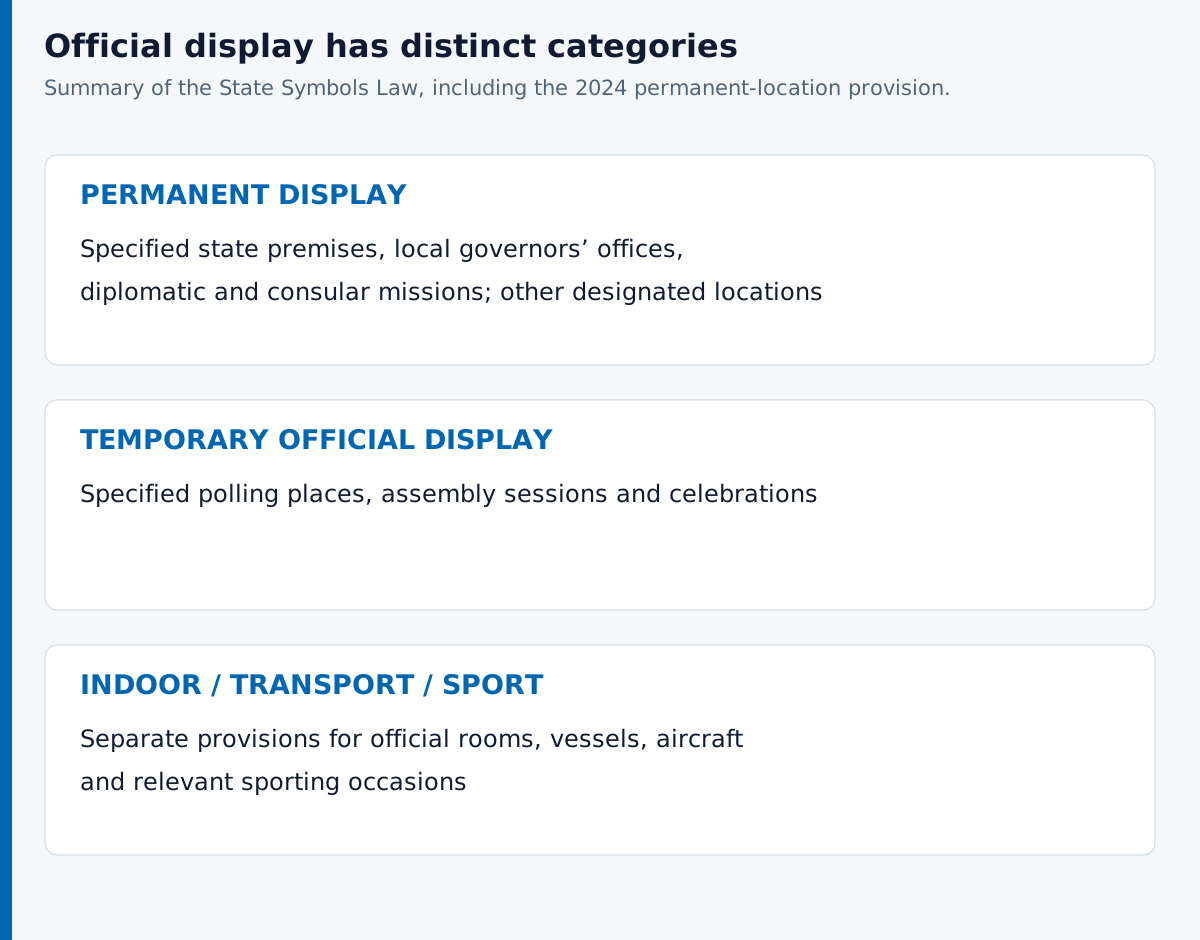
Temporary situations include specified election polling places, local assembly sessions, and named celebrations at public institutions. Separate provisions address courtrooms and official offices, vessels and aircraft under applicable international practice, and sports events. These are distinct categories, not a universal rule that every building must fly the flag every day.
May citizens and businesses display the Mongolian flag?
Yes. Article 25 of the State Symbols Law permits individuals, families, enterprises, and organizations to carry, display, and hoist the flag respectfully during celebrations, ceremonies, and other occasions. This permission should be read with the law’s protection of state symbols and with any specific rules governing the proposed setting or reproduction.
Article 23 separately provides for regulation of representations on items such as souvenirs, badges, posters, and labels. Permission to display the flag does not by itself answer every question about a particular product or advertisement. Nor does the law support a blanket statement that ordinary citizens may never use the flag.
Are there universal daily hours or special hanging rules?
The consulted State Symbols Law distinguishes permanent display, temporary official use, and respectful private display, but does not prescribe one universal daily raising-and-lowering schedule for every flag. Follow the instructions applicable to the particular institution or ceremony. A schedule for a named public event should not be generalized into a rule for all households.
The same caution applies to a vertical wall hanging, a group of foreign flags, or disposal of a worn flag: this article does not supply an unsupported national formula. The construction diagram describes the ordinary horizontal field. Keep the emblem and proportions intact, and use event-specific ceremonial guidance where required.
How is Mongolia’s flag displayed during national mourning?
Article 15 of the State Symbols Law provides two forms for national mourning: incline the flag at 45 degrees, or lower it to two-thirds of the staff. This is the law’s stated arrangement. Do not replace it with an assumed universal half-height measurement or add an unverified black-ribbon requirement.

The wording does not identify the cloth’s center as the measuring point. The diagram therefore illustrates the alternatives without pretending that it is a detailed halyard installation specification. Apply the official direction for the particular mourning occasion.
What does the reverse side of Mongolia’s flag look like?
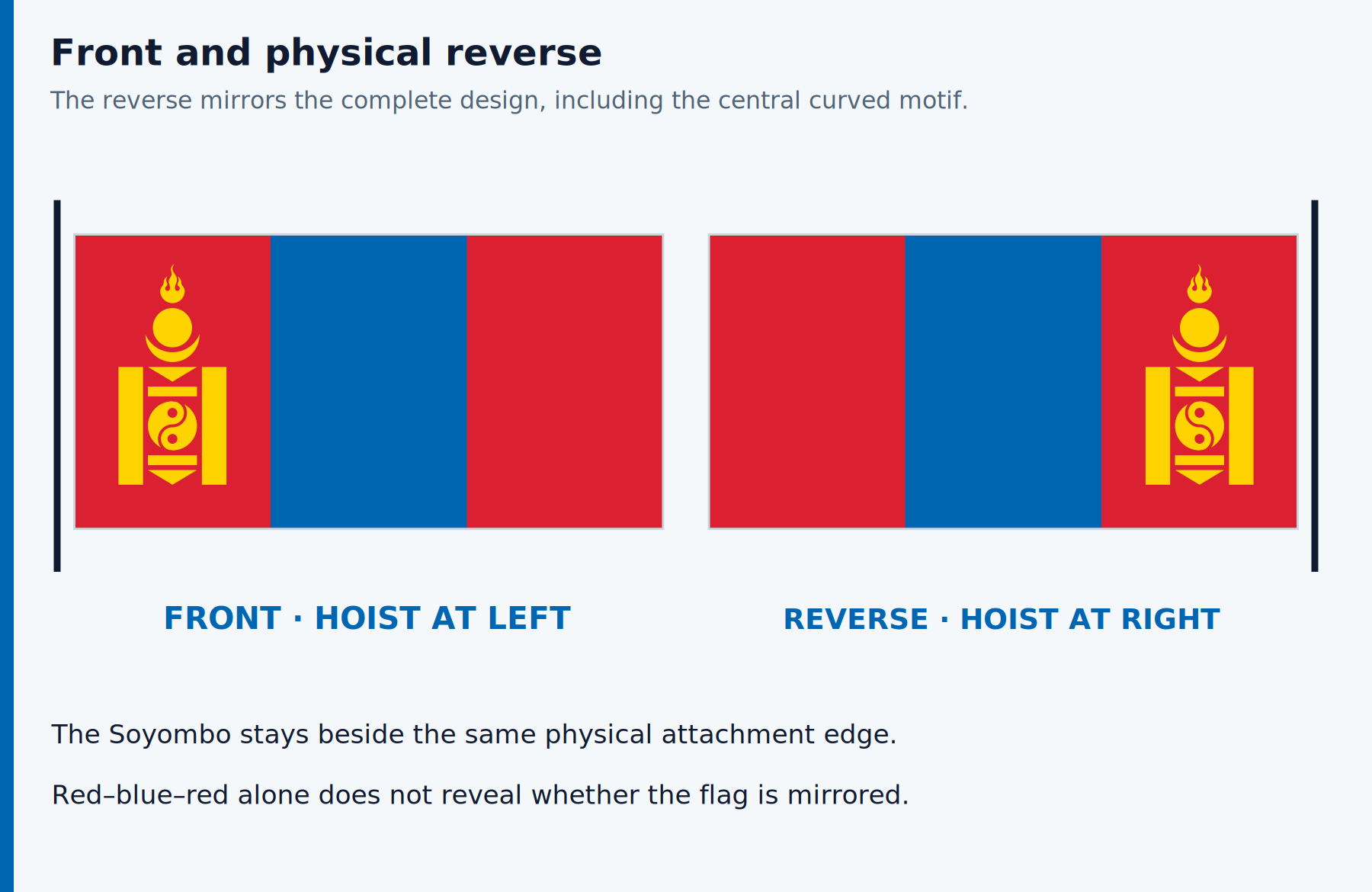
The ordinary reverse is a horizontal mirror of the front: the Soyombo remains beside the physical hoist, which appears on the viewer’s right when looking from the other side. Mirror the complete artwork, including the central curved motif. Moving an unchanged front-facing emblem to the right would not produce the same reverse image.
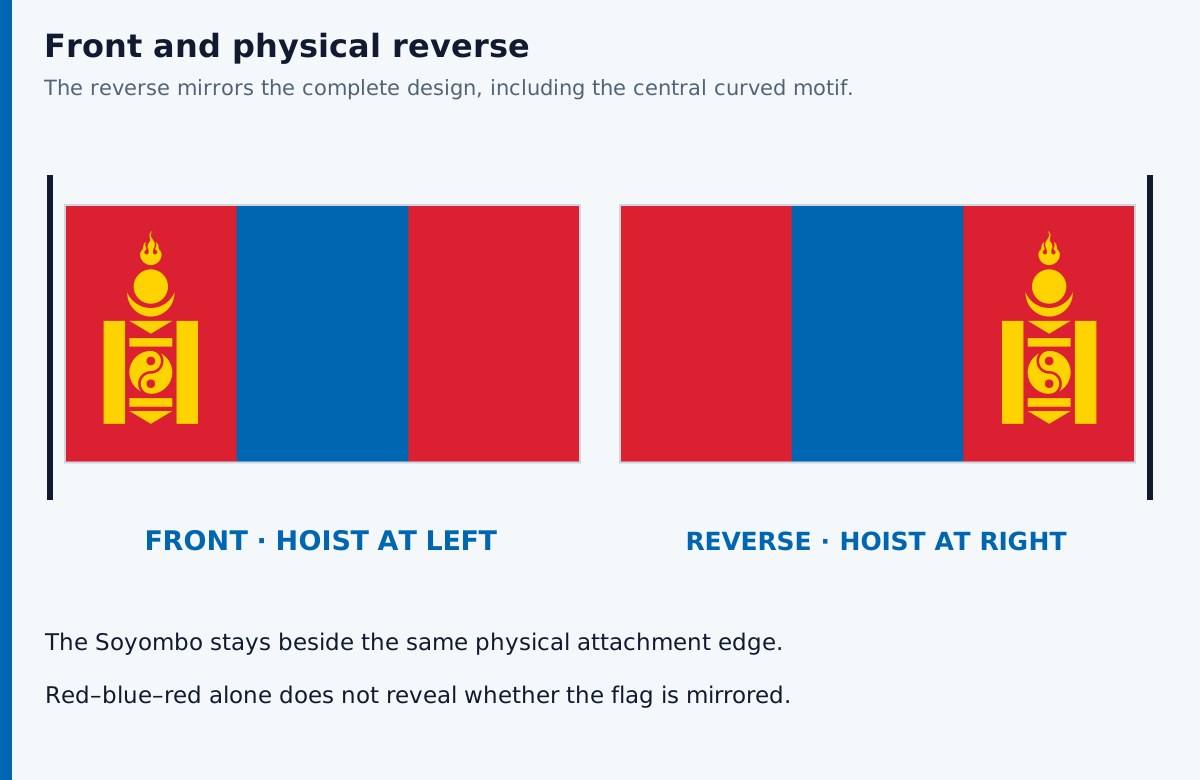
The front-view drawing used throughout the article has its hoist at the viewer’s left. The two red bands can conceal an orientation mistake, so locate the Soyombo and the physical attachment edge rather than relying only on the red-blue-red sequence.
What sizes preserve the correct flag proportions?
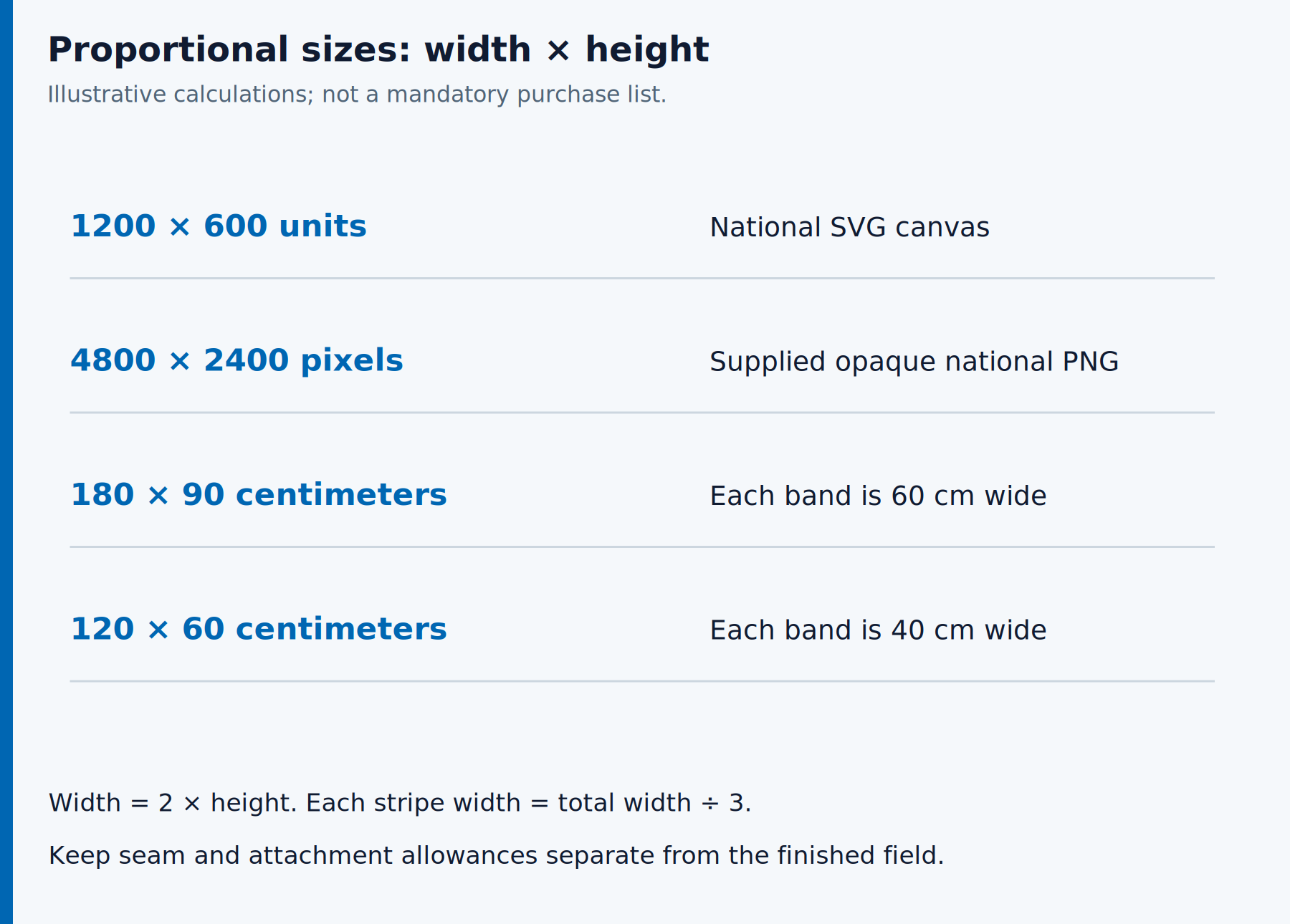
Any proportional size keeps the width twice the height and each band one-third of the width. The national SVG uses 1200 × 600 units, and the supplied PNG uses 4800 × 2400 pixels. A 180 × 90 centimeter flag would have three bands measuring 60 centimeters across.
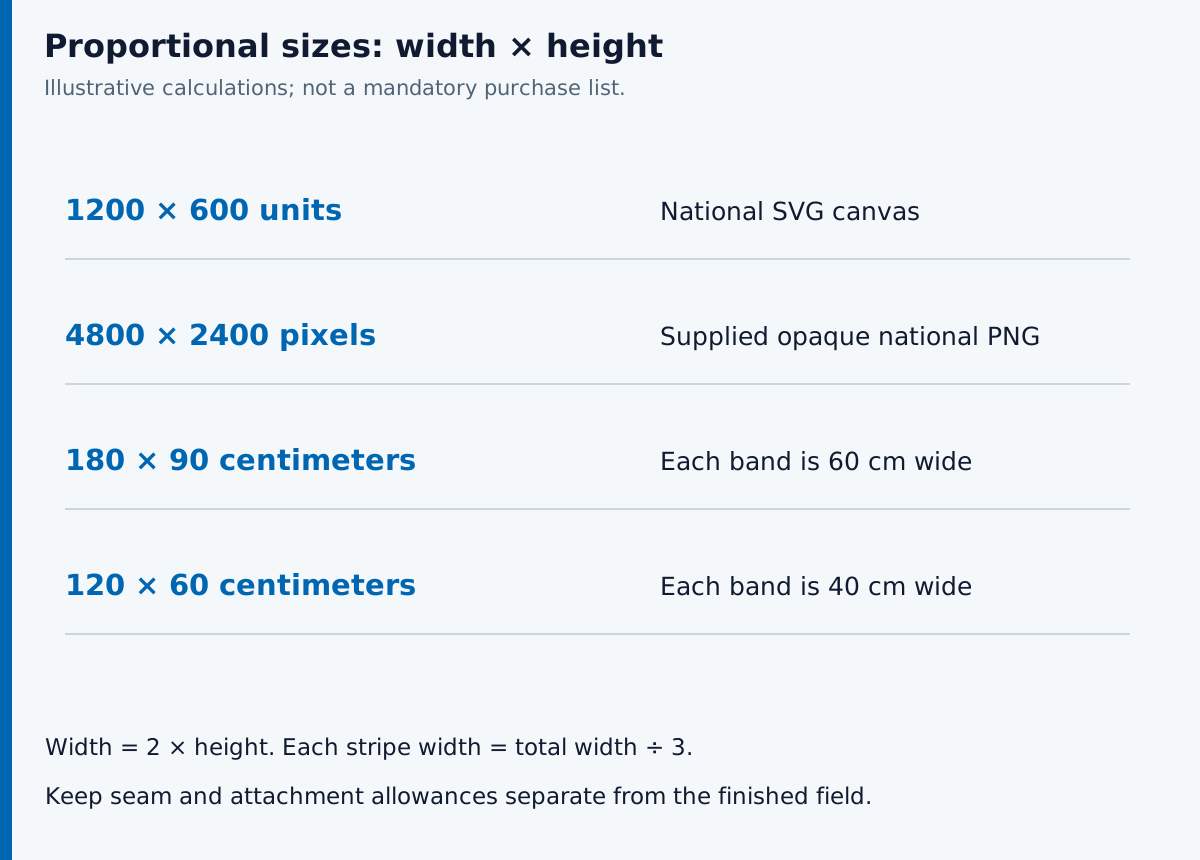
These examples are calculations, not a mandatory shopping list. When preparing a textile pattern, distinguish the finished visible field from seam or attachment allowances and use the complete amended standard for production requirements.
Is the national flag the same as the Great White Banner or state emblem?
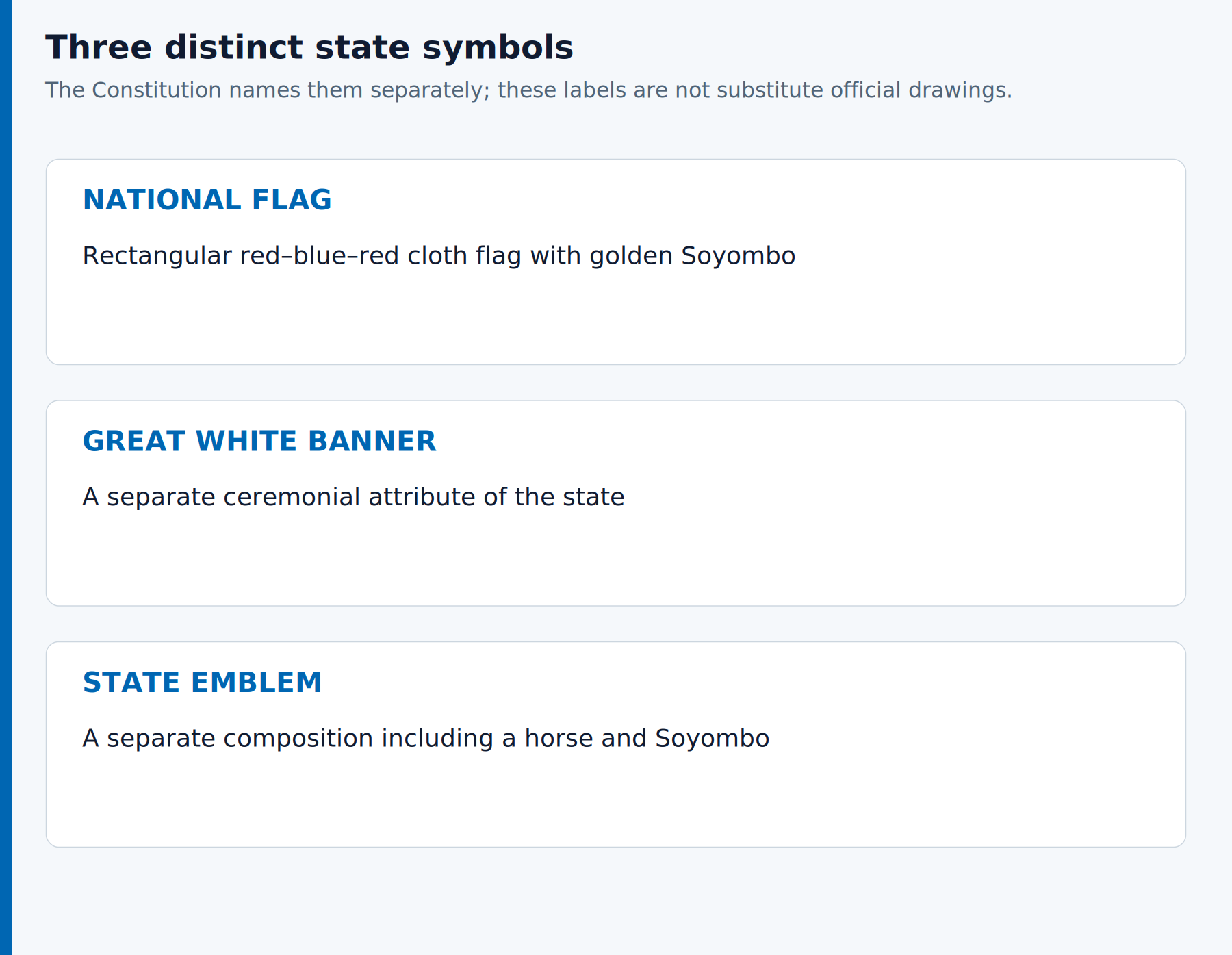
No. The Constitution distinguishes the cloth national flag, the Great White Banner used ceremonially, and the state emblem. The flag carries the golden Soyombo on red-blue-red bands. The state emblem has a different composition, including a horse and Soyombo, while the Great White Banner belongs to a separate ceremonial tradition.

The appearance of the Soyombo in more than one state symbol does not make the objects interchangeable. Do not place the full circular state emblem in the flag’s red stripe or label a ceremonial banner as the ordinary rectangular national flag.
What is Mongolia’s flag emoji and country sequence?
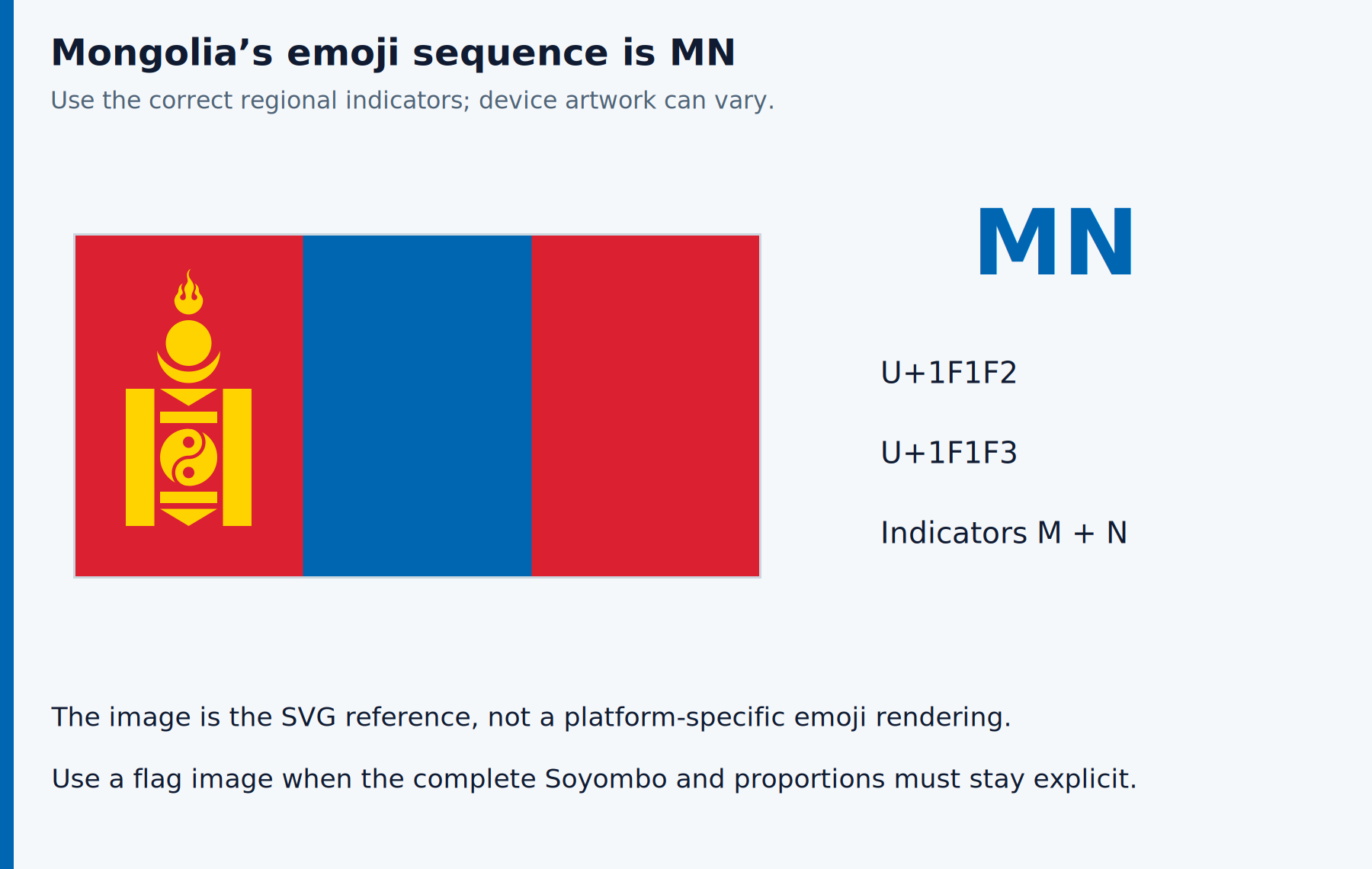
Mongolia’s flag emoji is 🇲🇳. Its Unicode sequence uses regional indicator M followed by regional indicator N: U+1F1F2 and U+1F1F3. The identifier is MN. Devices can render the artwork differently, so use the supplied SVG or PNG when the Soyombo’s geometry and the 2:1 proportions must remain explicit.

Which Mongolia flag image should I download?
Choose the national SVG for scalable artwork, or the opaque 4800 × 2400 PNG for software that needs a raster file. Keep the full 2:1 frame and use descriptive alternative text. The other gallery downloads are labeled historical references or educational diagrams; their captions and labels are not part of the national flag.
The adjacent image credits explain source artwork, the small red-fill correction, and the distinction between digital reference colors and a verified manufacturing specification. The historical flag retains its own source palette and geometry.
What mistakes should be avoided when reproducing Mongolia’s flag?
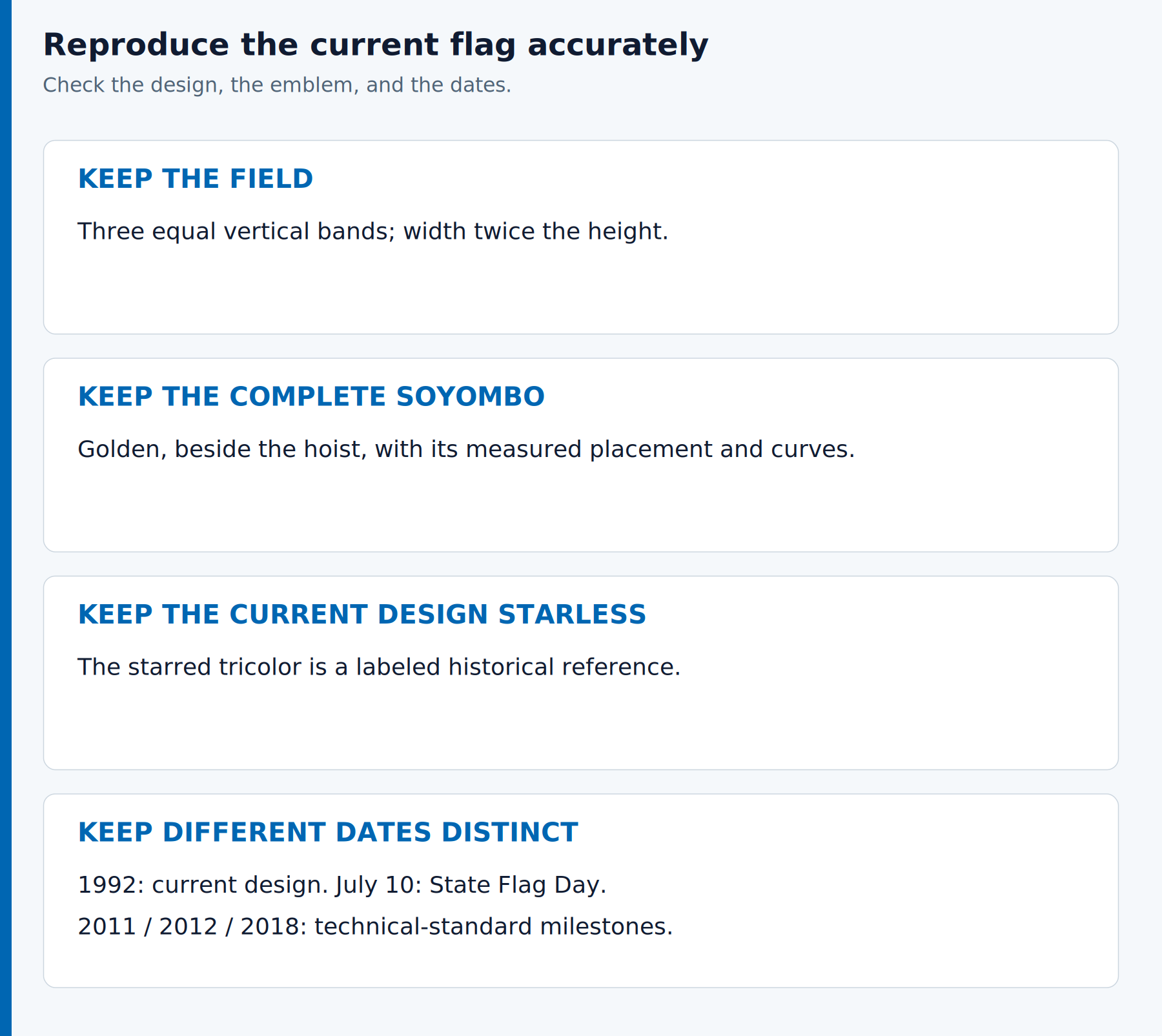
Keep three equal vertical bands, a 2:1 frame, and the complete golden Soyombo beside the hoist. Omit the socialist-era star from the current flag. Preserve the emblem’s placement and curved details, separate digital reference colors from manufacturing certification, and distinguish the 1992 constitutional dates from July 10 State Flag Day.
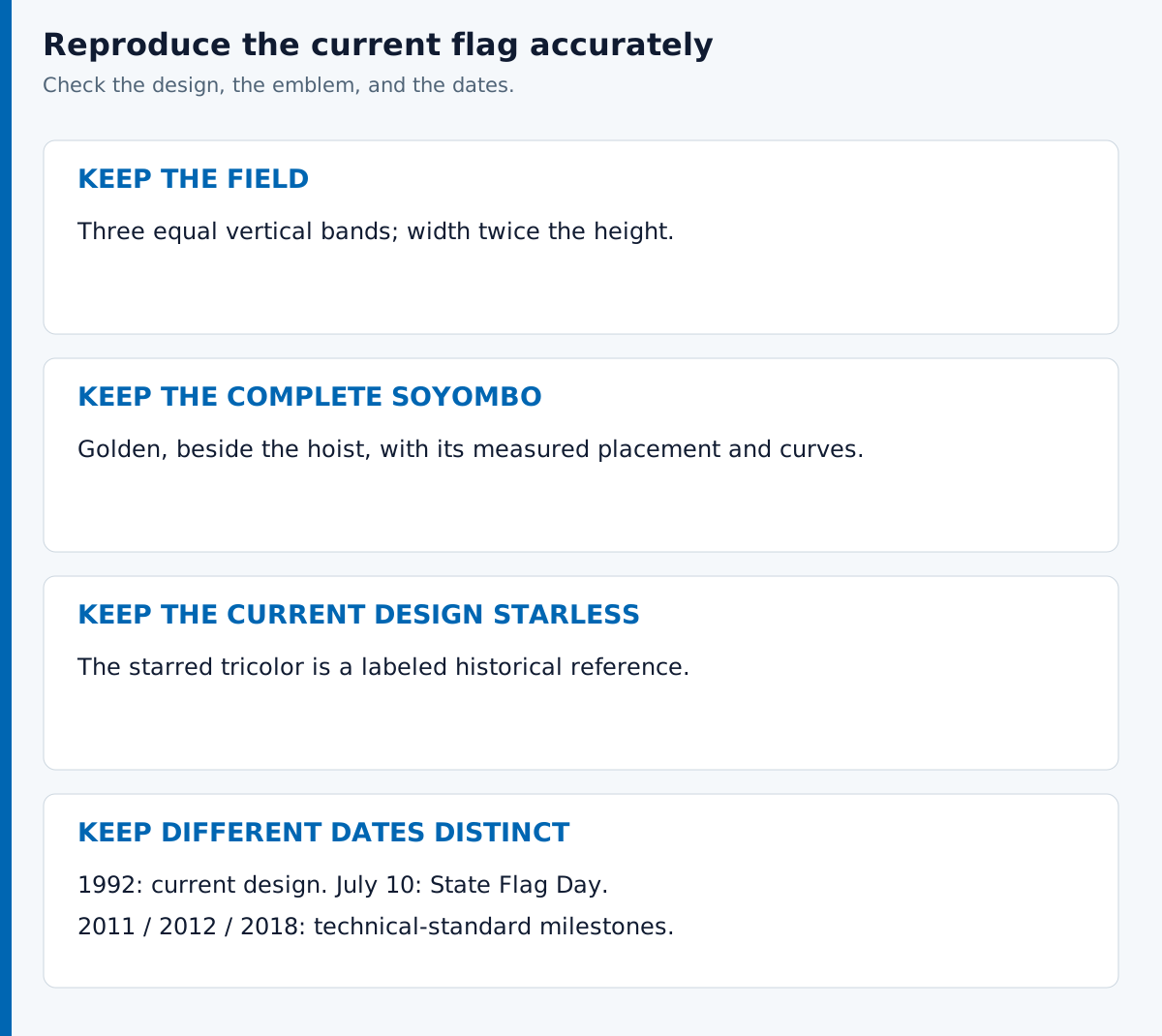
- Do not center the Soyombo in the blue band or add a lotus beneath it.
- Do not replace the central curved pair with a generic icon.
- Do not label the 2011 standard, its 2012 commencement, or its 2018 amendment as a new flag adoption.
- Do not apply a universal half-height mourning rule when the law specifies a different arrangement.
Explore more in World Flags: Iceland flag, Lithuania flag, Luxembourg flag, Madagascar flag, Malawi flag, Malaysia flag, Maldives flag, Mali flag, Malta flag, Mauritania flag, Mauritius flag, Mexico flag, Micronesia flag, Moldova flag, Monaco flag.
Download Mongolia flag pictures
Download the national flag as SVG or large PNG. The gallery includes 21 distinct subjects with captions and alternative text. Keep the full proportions when resizing. The national artwork is a digital reference; the article explains the later amendment to its technical standard. Image credits and reuse notes accompany the graphics.
World Flags/Mongolia
Mongolia flag pictures
Three equal red-blue-red bands and a golden Soyombo beside the hoist. The 2:1 digital reference preserves the complete emblem; the central red cutouts match the red field.
GKBook; reference artwork: Kxeon and Commons source contributors (current flag)Download SVGDownload PNGThe constitutional design has three equal vertical bands. The blue band occupies one-third of the total length.
GKBook; reference artwork: Kxeon and Commons source contributors (current flag)Download SVGDownload PNGThe reference scales the archived 120a×60a flag grid by ten. Each band is 40a wide; the current amended manufacturing annex was not retrieved.
GKBook; reference artwork: Kxeon and Commons source contributors (current flag)Download SVGDownload PNGThe archived drawing places the 22a-wide emblem in a 40a-wide stripe, with 6a above and 9a below. This is a labeled detail crop of the complete source.
GKBook; reference artwork: Kxeon and Commons source contributors (current flag)Download SVGDownload PNGThe files use #DA2031, #0066B2 and #FFD300. RGB equivalents are exact file values, not a claim that the Constitution prescribes HEX codes.
GKBook; reference artwork: Kxeon and Commons source contributors (current flag)Download SVGDownload PNGThe 2011 standard, its February 22, 2012 effective date, and the 2018 amendment are distinct milestones. The present flag dates to 1992.
GKBookDownload SVGDownload PNGThe enlarged emblem retains the flame, celestial shapes, triangles, bars, curved central motif and pillars. Paired structural elements are counted separately.
GKBook; reference artwork: Kxeon and Commons source contributors (current flag)Download SVGDownload PNGThe flame and the sun-and-moon group are shown as a detail of the complete source. The short labels summarize traditional interpretations.
GKBook; reference artwork: Kxeon and Commons source contributors (current flag)Download SVGDownload PNGA close view of the source’s curved pair and two circular openings. The red openings are normalized to the same red as the flag field.
GKBook; reference artwork: Kxeon and Commons source contributors (current flag)Download SVGDownload PNGThe lower emblem is enlarged without redrawing. The explanations are traditional symbolism, while the illustration retains the technical reference shapes.
GKBook; reference artwork: Kxeon and Commons source contributors (current flag)Download SVGDownload PNGThe sequence distinguishes earlier flags, the 1945 starred tricolor and the present design. It does not assign an unverified precise day to the 1945 introduction.
GKBookDownload SVGDownload PNGThe historical vector retains its original star, emblem geometry and palette. The current vector retains the starless Soyombo with its documented red-fill correction.
GKBook; reference artwork: Kxeon and Commons source contributors (current flag); latebird and Commons source contributors (historical flag)Download SVGDownload PNGA calendar panel marks July 10. The holiday-law amendment establishing the observance dates to June 11, 2009.
GKBook; reference artwork: Kxeon and Commons source contributors (current flag)Download SVGDownload PNGThe consolidated law includes July 10–15 for the Naadam holiday period, unless otherwise provided by law. Specific competitions and annual programs are separate.
GKBookDownload SVGDownload PNGThe law distinguishes permanent, temporary, indoor and other uses. These categories are not a universal daily flag requirement for every building.
GKBookDownload SVGDownload PNGThe law specifies a 45-degree inclination or lowering to two-thirds of the staff. The graphic avoids inventing a precise cloth-center measurement or a black-ribbon rule.
GKBookDownload SVGDownload PNGA horizontal mirror of the complete national source represents viewing an ordinary flag from behind. This is not a separate national variant or a vertical-hanging rule.
GKBook; reference artwork: Kxeon and Commons source contributors (current flag)Download SVGDownload PNGThe table gives calculated width-first examples. The complete amended standard remains the relevant manufacturing reference.
GKBookDownload SVGDownload PNGText panels distinguish the constitutional objects without inventing simplified official artwork for the banner or the state emblem.
GKBookDownload SVGDownload PNGRegional indicators M and N encode the Mongolia flag emoji. Emoji appearance depends on the platform.
GKBook; reference artwork: Kxeon and Commons source contributors (current flag)Download SVGDownload PNGFour checks cover the constitutional field, complete emblem, historical star distinction and separate adoption, observance and standard dates.
GKBook; reference artwork: Kxeon and Commons source contributors (current flag)Download SVGDownload PNGFrequently asked questions
What are the proportions and stripe widths of Mongolia’s flag?
The flag is twice as wide as it is high: 2:1 width:height, or 1:2 height:length. Its three vertical bands have equal widths. On a 1200 × 600 drawing, each band is 400 units wide, with blue in the middle and red at both ends.
How is the flag constructed on a measured grid?
The archived 2011 construction drawing uses a 120-unit length and a 60-unit height, with each stripe 40 units wide. The supplied vector follows that arrangement at ten drawing units per grid unit. Its Soyombo keeps the source’s complete curves, circles, triangles, bars, and pillars rather than substituting an approximate icon.
Where should the Soyombo sit on the flag?
Place the golden Soyombo in the red band next to the hoist, centered across that band. In the archived construction, its upper clearance is six grid units and its lower clearance is nine. It therefore sits slightly above the flag’s vertical midpoint, rather than being centered in both directions.
What are Mongolia’s flag colors and digital color codes?
The Constitution names red, blue, and a golden Soyombo. The supplied digital reference uses red #DA2031, blue #0066B2, and golden yellow #FFD300. These values identify the colors in these downloadable files; they are not presented as independently verified legal HEX specifications or a complete specification for printing on fabric.
Which flag standard applies, and what changed after 2011?
MNS 6262:2011 sets out general requirements for Mongolia’s state flag. The archived presidential publication gives February 22, 2012 as its effective date. An official standards catalog records a 2018 amendment. Those are different milestones, and the original publication should not be treated as proof that its entire annex remains unchanged.
What do the red and blue bands symbolize?
Mongolia’s Constitution explicitly connects blue with the eternal blue sky and red with progress and prosperity. The golden Soyombo is a symbol of independence. These meanings explain the national design without turning every familiar interpretation of the emblem’s individual shapes into an additional rule about how the flag must be manufactured.
What is the Soyombo symbol on Mongolia’s flag?
The Soyombo is the golden vertical emblem on the hoist-side red stripe. Its structure combines a flame, sun, crescent moon, two triangles, two horizontal rectangles, a curved central pair, and two upright pillars. These form one integrated emblem; the current flag does not place a five-pointed star above it.
Who created the Soyombo, and how old is it?
Zanabazar created the Soyombo writing system in 1686, long before Mongolia adopted its present flag. The familiar national emblem comes from that script’s opening symbol. Distinguish the creation of the script from later uses of the symbol on state flags, and from the modern red-blue-red design introduced in the twentieth century.
What do the flame, sun, and crescent moon mean?
Traditional explanations connect the flame with continuity and flourishing, and its three tongues with past, present, and future. The sun and moon express the lasting existence of the nation. On the flag, these are golden parts of the Soyombo; they are not a separate religious crescent-and-star design or an added emblem.
What do the triangles, bars, and pillars represent?
The downward triangles are traditionally explained as spear or arrow points overcoming adversaries. The horizontal bars express uprightness and honesty, while the vertical pillars suggest protective walls and unity. Their exact shapes also matter: the flag has two downward triangles, two horizontal bars, and two tall side pillars within the Soyombo.
Are the shapes in the middle fish or a yin-yang symbol?
The central paired forms are commonly interpreted through complementary forces and through two vigilant fish. Both readings belong to the Soyombo’s interpretive tradition. For reproduction, preserve the actual curved division and the two small circular cutouts; replacing them with a generic black-and-white yin-yang icon changes the flag’s golden and red artwork.
When was the current Mongolian flag adopted?
The current starless flag dates to 1992. The new Constitution was approved on January 13, 1992 and came into force on February 12, 1992; Article 12 describes the design. These legal milestones should be kept distinct from the older tricolor’s introduction and from the flag standard’s much later effective date.
How did Mongolia’s flag develop before the present design?
Mongolia used earlier state flags before the familiar tricolor appeared in 1945. The red-blue-red flag of the socialist period carried a star above the Soyombo. The present flag retained the three bands and the emblem while removing that star in 1992, linking the modern design with an older national symbol.
How does the socialist-period flag differ from today’s flag?
The most immediate difference is the golden five-pointed star above the Soyombo on the socialist-period tricolor. Today’s flag has no star. The historical reference supplied here also has different drawing details and reference shades, so the comparison retains each complete source instead of simply adding a star to the modern image.
Who designed the red-blue-red flag?
Mongolian institutional accounts credit artist Dodiin Choidog with the 1945 flag design. That is a different contribution from Zanabazar’s creation of the Soyombo script in 1686. The modern flag combines that older emblem tradition with the tricolor arrangement, while the 1992 constitutional design omits the socialist-era star.
Which laws describe and regulate Mongolia’s flag?
Article 12 of the Constitution describes the flag and its main symbolism. The State Symbols Law, adopted on May 20, 1994 and effective from July 1, 1994, addresses design, use, display, and respect. The technical standard adds construction requirements; ceremonial arrangements may also depend on the applicable official protocol.
When is Mongolia’s State Flag Day?
Mongolia observes State Flag Day on July 10. The observance was added to the holidays and commemorative-days law by an amendment dated June 11, 2009. It celebrates the national flag and is associated with official ceremonies; it is not the date on which the present constitutional flag took effect in 1992.
Which other national dates are associated with flag display?
Constitution Day on January 13, the Naadam holiday period in July, Republic Proclamation Day on November 26, and the independence-restoration holiday on December 29 provide important national contexts for the flag. These observances have different meanings; their inclusion in the calendar does not impose an identical display duty on every private household.
Where is the state flag displayed officially?
The State Symbols Law requires permanent flag display at specified state premises, including the Government Palace, the President’s residence, local governors’ offices, and diplomatic or consular missions. It also identifies temporary and indoor uses. A 2024 amendment allows the President to designate additional permanent locations, so the statutory list should be read with that provision.
May citizens and businesses display the Mongolian flag?
Yes. Article 25 of the State Symbols Law permits individuals, families, enterprises, and organizations to carry, display, and hoist the flag respectfully during celebrations, ceremonies, and other occasions. This permission should be read with the law’s protection of state symbols and with any specific rules governing the proposed setting or reproduction.
Are there universal daily hours or special hanging rules?
The consulted State Symbols Law distinguishes permanent display, temporary official use, and respectful private display, but does not prescribe one universal daily raising-and-lowering schedule for every flag. Follow the instructions applicable to the particular institution or ceremony. A schedule for a named public event should not be generalized into a rule for all households.
How is Mongolia’s flag displayed during national mourning?
Article 15 of the State Symbols Law provides two forms for national mourning: incline the flag at 45 degrees, or lower it to two-thirds of the staff. This is the law’s stated arrangement. Do not replace it with an assumed universal half-height measurement or add an unverified black-ribbon requirement.
What does the reverse side of Mongolia’s flag look like?
The ordinary reverse is a horizontal mirror of the front: the Soyombo remains beside the physical hoist, which appears on the viewer’s right when looking from the other side. Mirror the complete artwork, including the central curved motif. Moving an unchanged front-facing emblem to the right would not produce the same reverse image.
What sizes preserve the correct flag proportions?
Any proportional size keeps the width twice the height and each band one-third of the width. The national SVG uses 1200 × 600 units, and the supplied PNG uses 4800 × 2400 pixels. A 180 × 90 centimeter flag would have three bands measuring 60 centimeters across.
Is the national flag the same as the Great White Banner or state emblem?
No. The Constitution distinguishes the cloth national flag, the Great White Banner used ceremonially, and the state emblem. The flag carries the golden Soyombo on red-blue-red bands. The state emblem has a different composition, including a horse and Soyombo, while the Great White Banner belongs to a separate ceremonial tradition.
What is Mongolia’s flag emoji and country sequence?
Mongolia’s flag emoji is 🇲🇳. Its Unicode sequence uses regional indicator M followed by regional indicator N: U+1F1F2 and U+1F1F3. The identifier is MN. Devices can render the artwork differently, so use the supplied SVG or PNG when the Soyombo’s geometry and the 2:1 proportions must remain explicit.
Which Mongolia flag image should I download?
Choose the national SVG for scalable artwork, or the opaque 4800 × 2400 PNG for software that needs a raster file. Keep the full 2:1 frame and use descriptive alternative text. The other gallery downloads are labeled historical references or educational diagrams; their captions and labels are not part of the national flag.
What mistakes should be avoided when reproducing Mongolia’s flag?
Keep three equal vertical bands, a 2:1 frame, and the complete golden Soyombo beside the hoist. Omit the socialist-era star from the current flag. Preserve the emblem’s placement and curved details, separate digital reference colors from manufacturing certification, and distinguish the 1992 constitutional dates from July 10 State Flag Day.
Explore all general-knowledge topics and the A-to-Z lists.







We Value Your Opinion Comments