
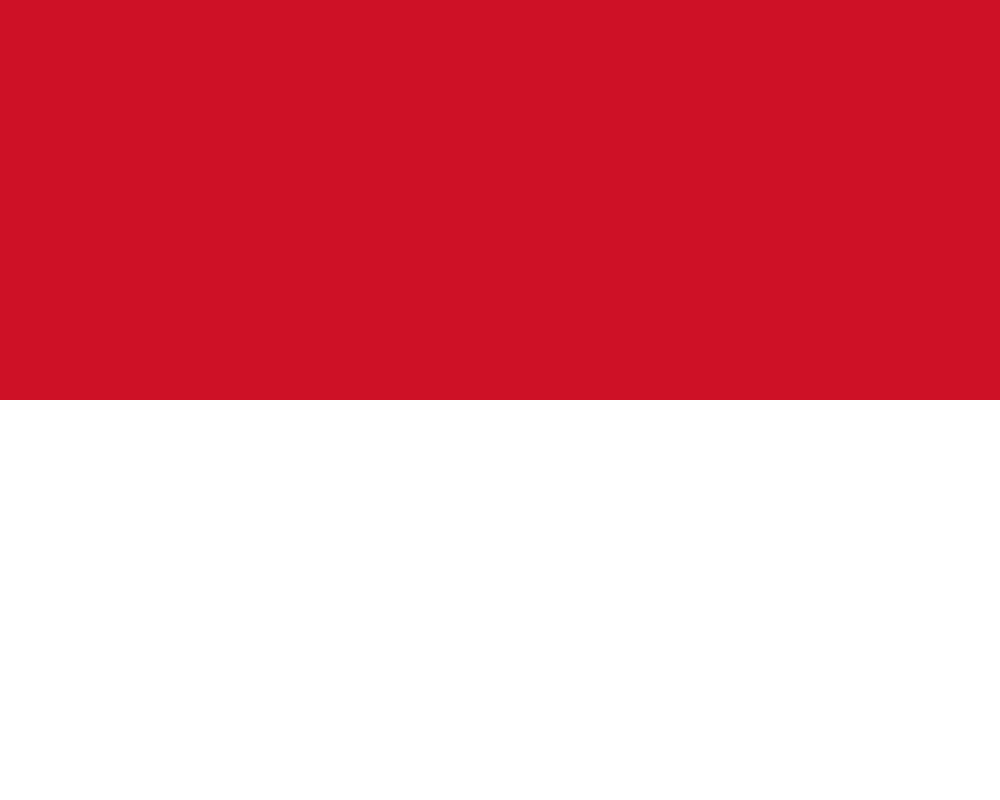
Monaco flag picture
Explore the construction drawing, history, and complete picture gallery.
| Design | Red over whiteTwo equal horizontal bands; no emblem. |
|---|---|
| Reference proportions | 5:4 width:heightEquivalent to 4:5 height:length; wider forms also occur. |
| Adoption | April 4, 1881Sovereign ordinance under Prince Charles III. |
| National Day | November 19Distinct from the April 4 flag anniversary. |
| Princely flag | Grimaldi arms on whiteA separate flag named in the Constitution. |
National flag: April 4, 1881. Main download: 5:4 reference. National Day: November 19.
What is the national flag of Monaco?
Monaco’s national flag has two equal horizontal bands, red above white. Prince Charles III established it on April 4, 1881. Its colors come from the Grimaldi heraldic tradition. The familiar 5:4 reference shape is distinct from the separate princely flag, which displays the Grimaldi arms on white.
This guide explains the national design, its historical origins, the princely flag, proportions, color references, observances and display rules. The main download uses a 5:4 width-to-height reference. Numerical ratios and digital color values are identified separately from the wording of Monaco’s Constitution and the accessible text of the 1881 ordinance.
What does the flag of Monaco look like?
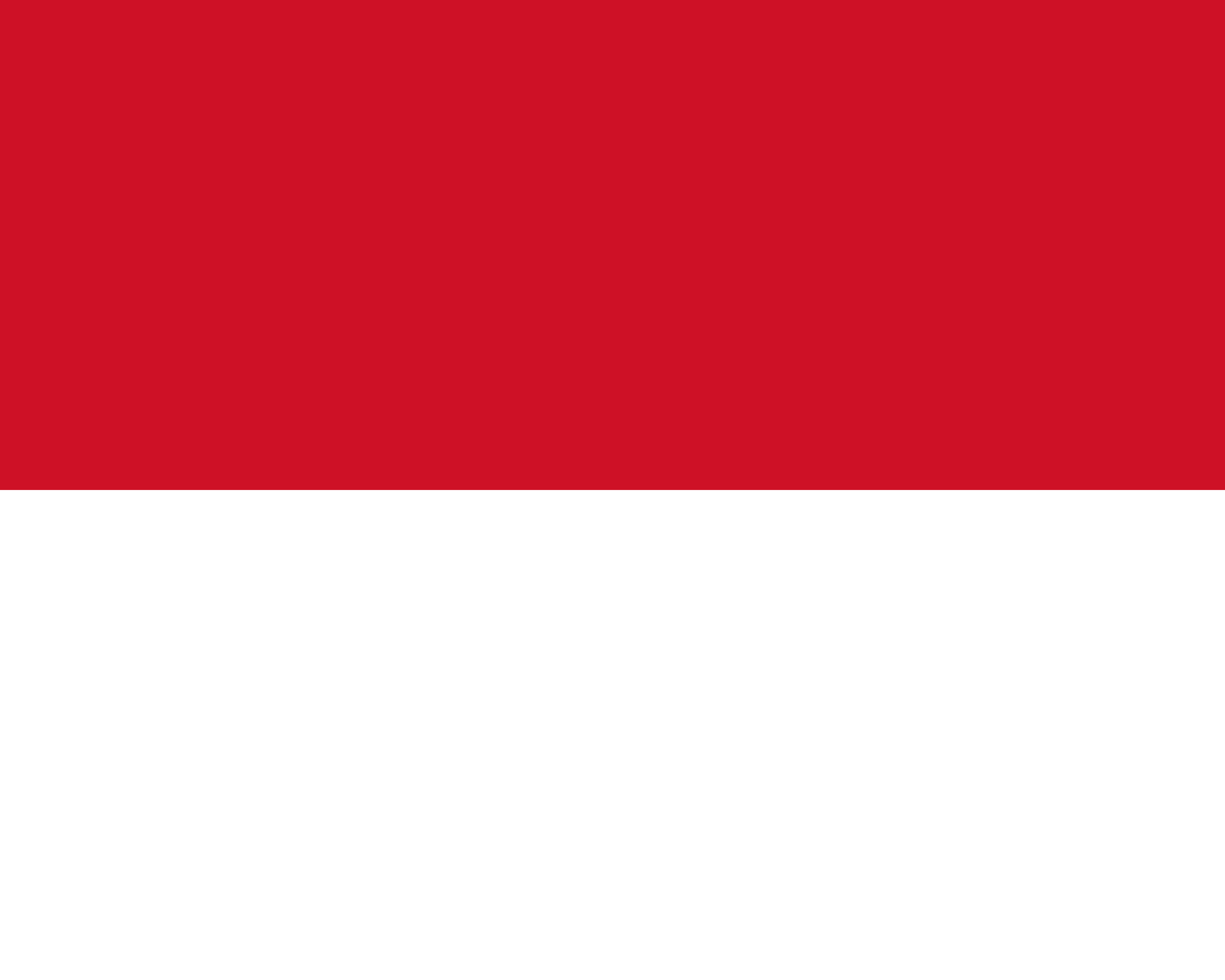
Monaco’s national flag is a plain horizontal bicolor with two equal bands: red above white. Both bands extend from the hoist to the fly. The national design has no crown, shield, lettering or border. A white flag bearing the Grimaldi arms is a different, princely flag.
The dividing line lies halfway down the rectangle. A thin outline around an image on a white webpage is a viewing aid, not part of the flag. The downloadable national artwork has no added outline.
What are Monaco’s flag proportions?
The familiar reference ratio is 5:4 width to height, also written 4:5 height to length. This package uses that shape. Vexillological literature also records 3:2 examples in practice. The Constitution and the accessible ordinance text do not themselves state a numeric ratio; the ordinance refers to illustrated models.

Flags of the World summarizes research by Whitney Smith and William Crampton connecting the 4:5 height-to-length form to the original model and documenting later 2:3 use. The accessible official PDF contains the ordinance’s six articles but no illustrated annex. This guide therefore distinguishes the conventional reference from a directly verified legal measurement.
| Notation | Width × height | Meaning |
|---|---|---|
| 5:4 width:height | 1000 × 800 | The supplied national reference. |
| 4:5 height:length | 800 high × 1000 long | The same shape, written in the opposite order. |
| 3:2 width:height | 900 × 600 | A wider form reported in practice; do not stretch the supplied image to make it. |
How do you draw Monaco’s national flag?
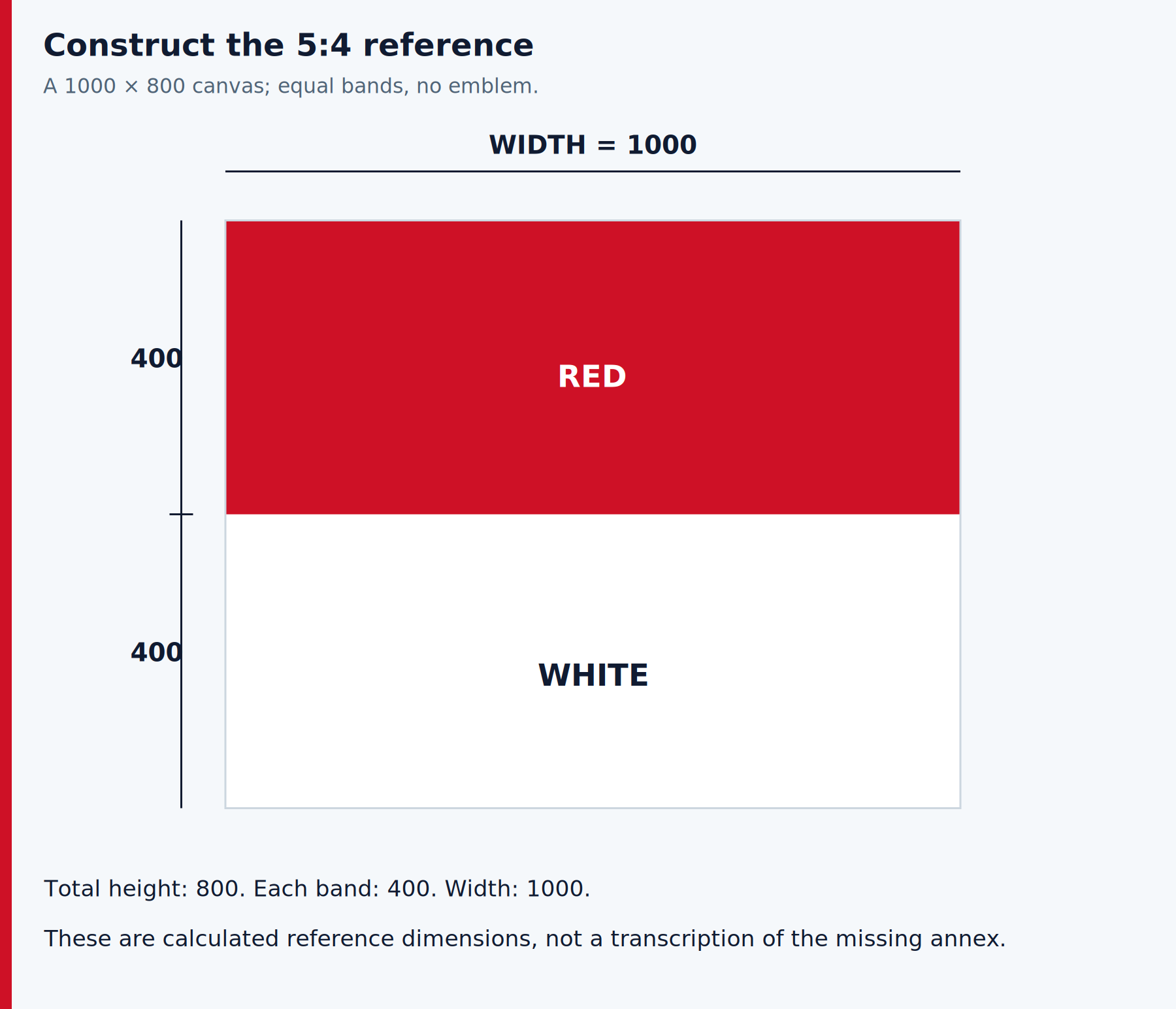
For the 5:4 reference, draw a rectangle five units wide and four units high. Divide it horizontally into two bands, each two units high. Fill the upper band red and the lower band white. Keep the edges straight and the bands equal; there is no central emblem to position.
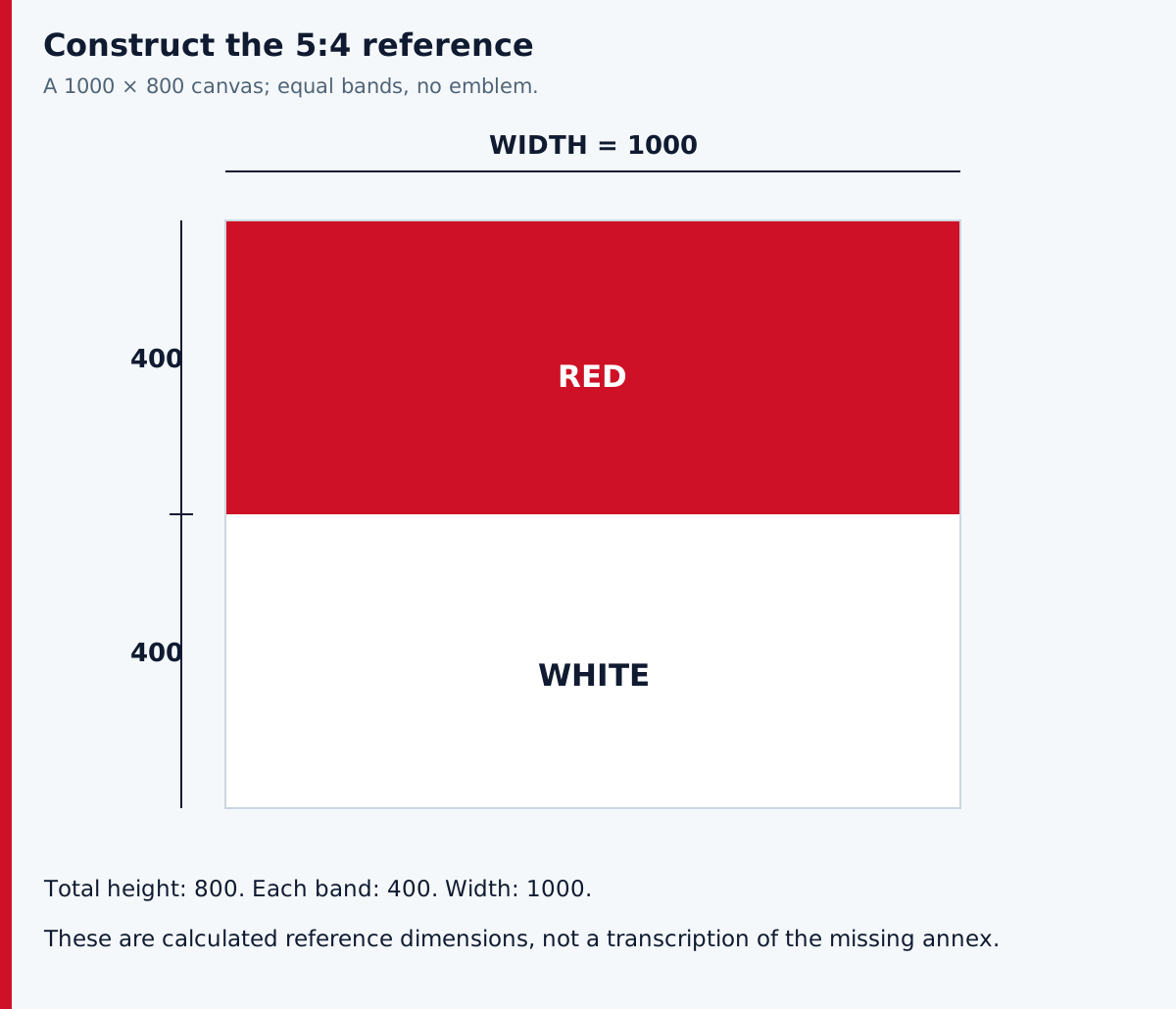
On a 1000 × 800 canvas, the division is at y = 400. Red occupies the upper 400 units and white the lower 400. These coordinates explain the supplied artwork; they are calculated construction instructions for this reference, not dimensions quoted from the missing 1881 illustration.
What are Monaco’s flag colors and HEX codes?
The legally described colors are red and white. The supplied digital reference uses red #CE1126, equivalent to RGB 206, 17, 38, and white #FFFFFF, equivalent to RGB 255, 255, 255. These values reproduce the credited reference file; the consulted constitutional and ordinance texts do not prescribe those HEX codes.

| Color | HEX in this reference | RGB in this reference |
|---|---|---|
| Red | #CE1126 | 206, 17, 38 |
| White | #FFFFFF | 255, 255, 255 |
Both bands are opaque in the national PNG. White remains an actual white band rather than a transparent opening through which a page background could show.
Is there a verified official Pantone or CMYK formula?
No Pantone, CMYK or RGB formula appears in the constitutional and ordinance texts consulted for this guide. Specialist references report different production specifications in different publications. Use the supplied HEX values to match these digital images, and obtain an approved physical sample or specification for a formal textile or print commission.
A screen value is not an automatic dye recipe. Fabric, paper, ink, lighting and color management affect the result. This package does not turn an approximate Pantone association or a software CMYK conversion into a statutory color requirement.
What do the red and white colors mean?
The strongest documented explanation is heraldic: red and white are the colors of the House of Grimaldi. Monaco’s National Council also connects them with Genoa, the dynasty’s ancestral city. Popular labels such as bravery for red and peace for white should not be presented as meanings established by Monaco’s flag law.
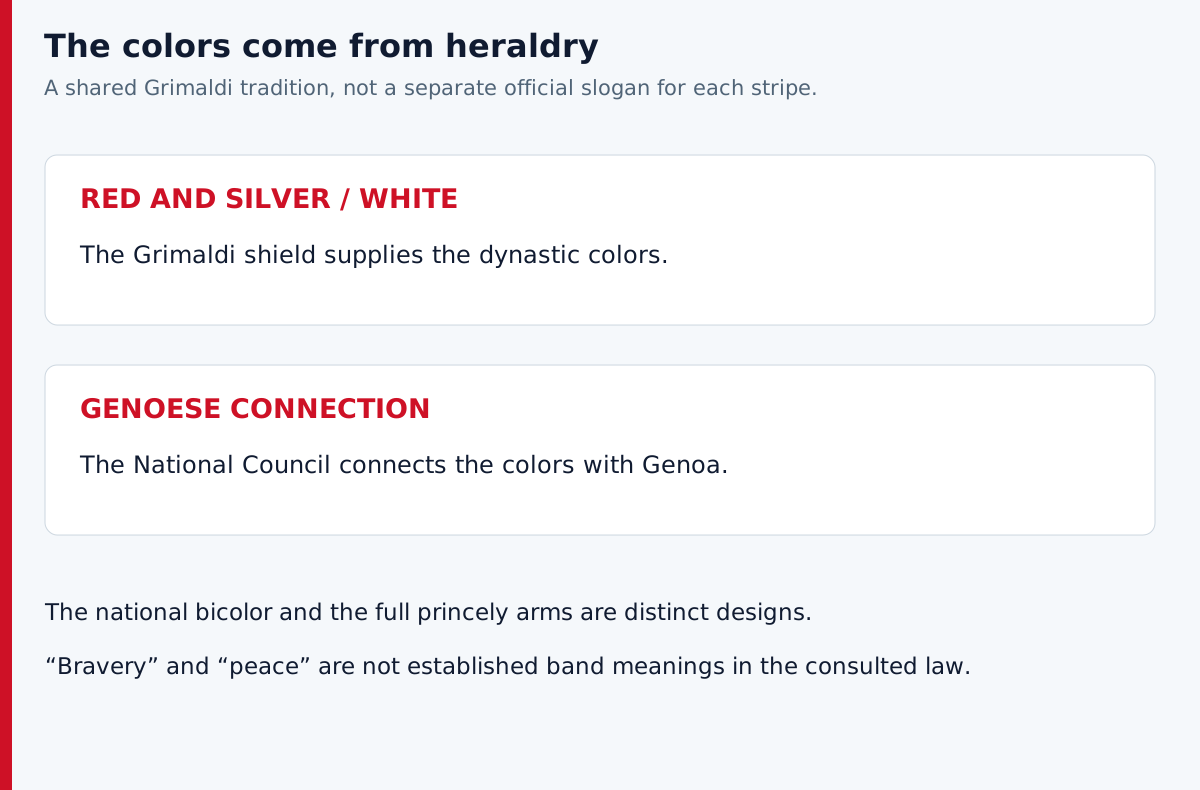
The National Council’s anniversary account also mentions a poetic association with Saint Devota. That is an interpretation, not the legal definition of either band. The plain bicolor and the elaborate princely arms share a heraldic tradition without being the same flag.
What appears in the Grimaldi coat of arms?
The Grimaldi arms have a shield patterned with silver and red elongated diamonds, surrounded by the collar of the Order of Saint Charles. A princely crown tops an ermine-lined red mantle. Two sword-bearing friars support the shield, and a ribbon carries the motto Deo Juvante, meaning “with God’s help.”

In heraldry, silver is called argent and red is called gules. Silver is commonly rendered white in flat artwork. The Palace describes the supporters as Friars Minor. Their figures, swords, collar, mantle and motto belong to the full arms, not to the ordinary red-and-white national flag.
How does the princely flag differ from the national flag?
The princely flag places the colored arms of the House of Grimaldi on a white field. The national flag instead has two plain horizontal bands. Article 7 of the Constitution recognizes both. The 1881 ordinance assigns the princely flag to princely residences, public buildings and state vessels.
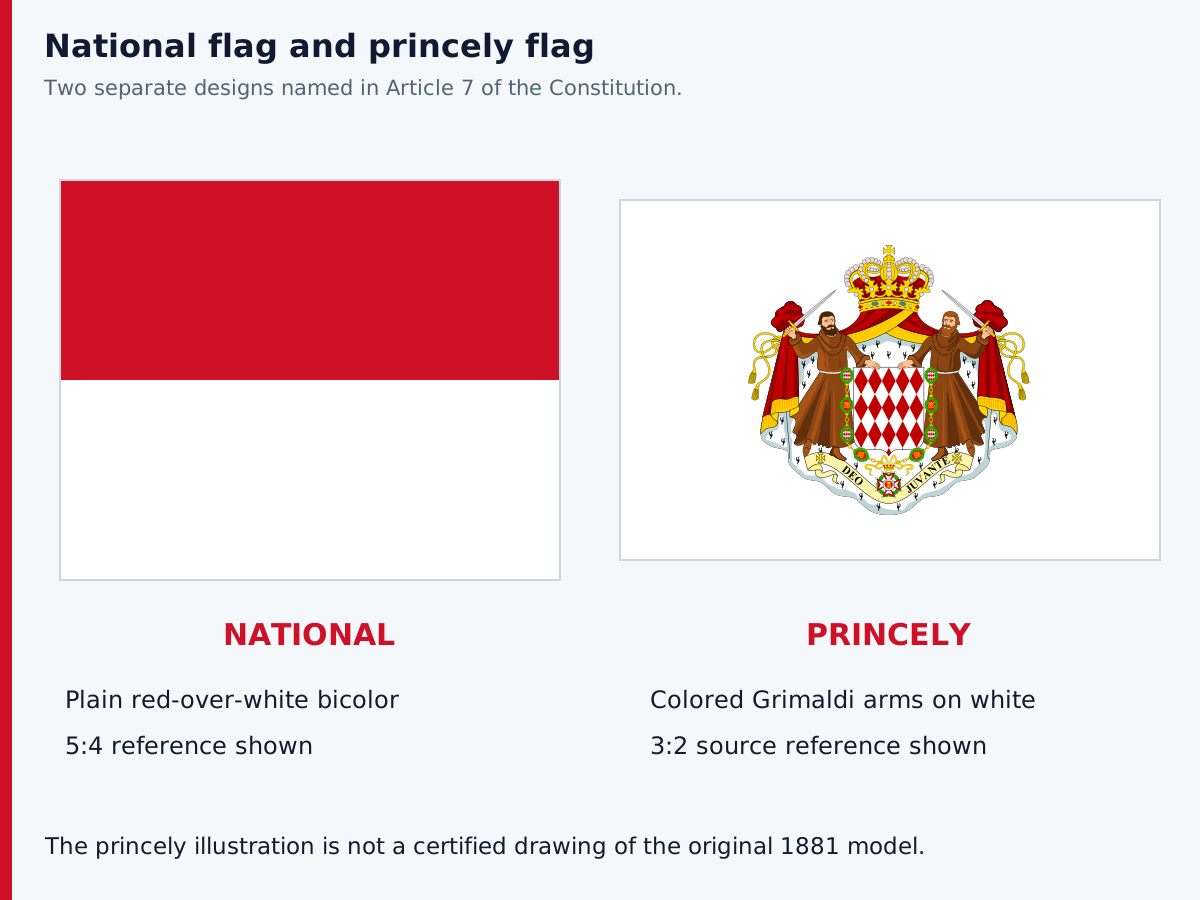
| Flag | Appearance | Source distinction |
|---|---|---|
| National flag | Red over white; no arms | The national bicolor. |
| Princely flag | Full Grimaldi arms on white | The pavillon princier named in the Constitution. |
The included princely illustration preserves a credited 900 × 600 reference in its native 3:2 shape. It is explanatory artwork, not a claim that the Constitution fixes this ratio or the precise size of the arms. The national bicolor should not be replaced with a fictional red-and-white flag carrying the arms.
When was Monaco’s national flag adopted?
Prince Charles III established the national red-and-white bicolor by the sovereign ordinance of April 4, 1881. Monaco’s National Council commemorates that date as the flag’s anniversary. Earlier use of Grimaldi colors does not mean the present statutory bicolor was adopted in the Middle Ages, and the 1962 Constitution is a later milestone.
The ordinance describes both the princely and national flags and allocates uses to them. A modern account should keep the date of that instrument separate from the much older family heraldry behind its colors.
What are the main milestones in Monaco’s flag history?
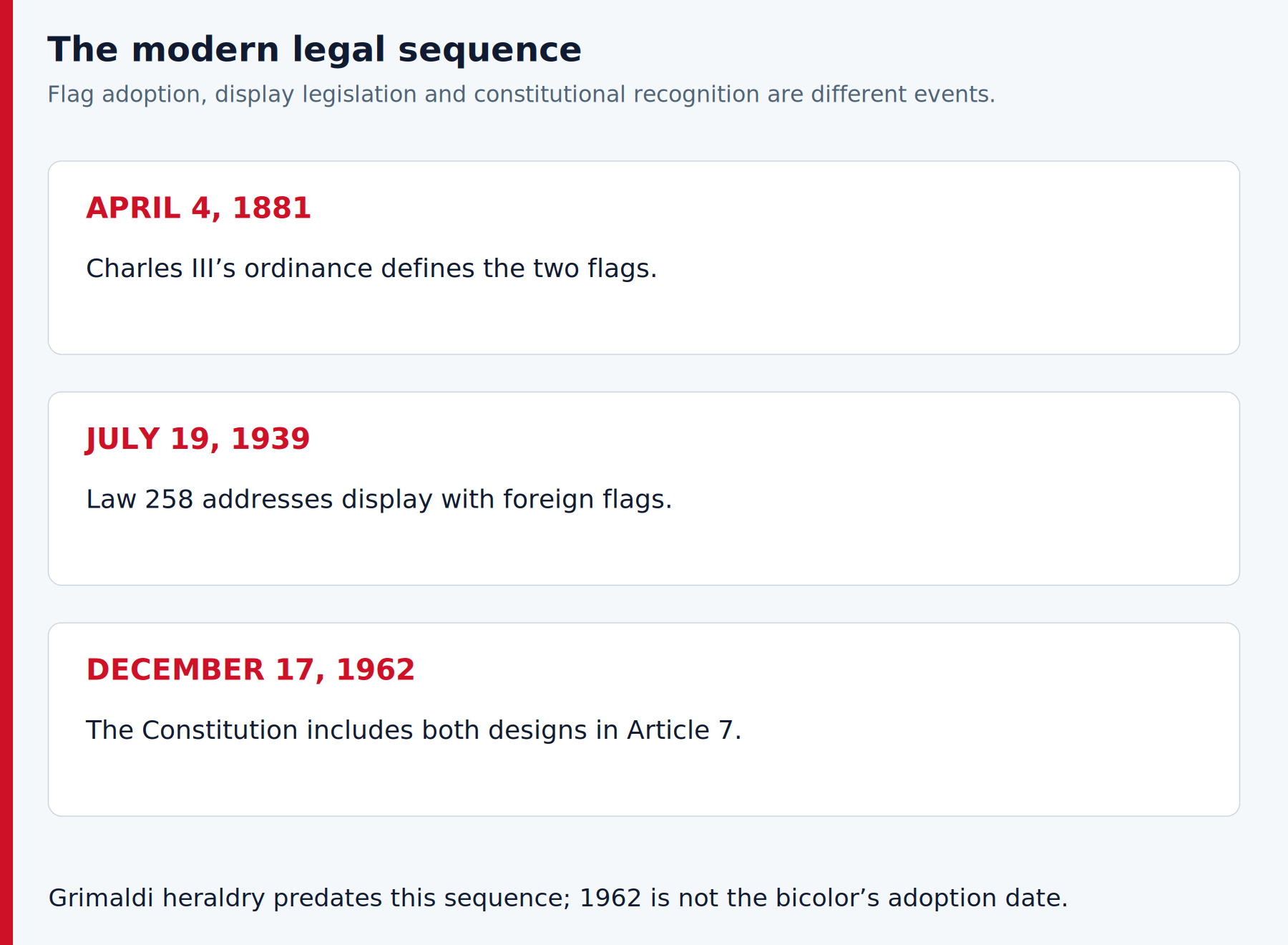
The essential sequence begins with the Grimaldi heraldic colors, followed by Charles III’s flag ordinance in 1881. A 1939 law addresses displays with foreign flags. The Constitution of December 17, 1962, later restates the two flag designs and retains the ordinance as the basis for their use.

| Date or period | Milestone |
|---|---|
| Grimaldi heraldic tradition | Red and silver provide the dynastic background to the national colors. |
| April 4, 1881 | The sovereign ordinance defines the national and princely flags. |
| July 19, 1939 | Law 258 regulates display with foreign flags. |
| December 17, 1962 | The Constitution includes both designs in Article 7. |
| April 2, 2002 | Law 1249 revises the Constitution; this is not a new national-flag adoption. |
A historical timeline is not a set of annual public holidays. Neither the constitutional date nor the foreign-flag law’s date should be substituted for April 4, 1881, in an adoption label.
Is April 4 Monaco’s National Day or Flag Day?
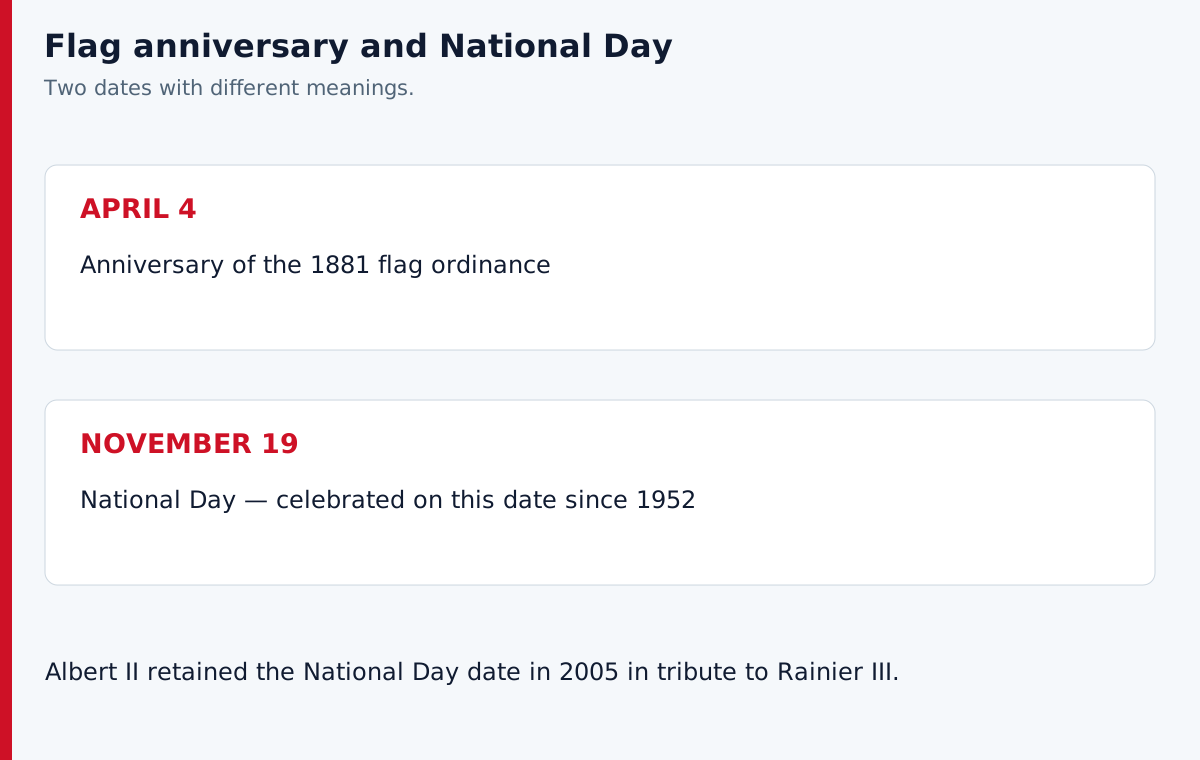
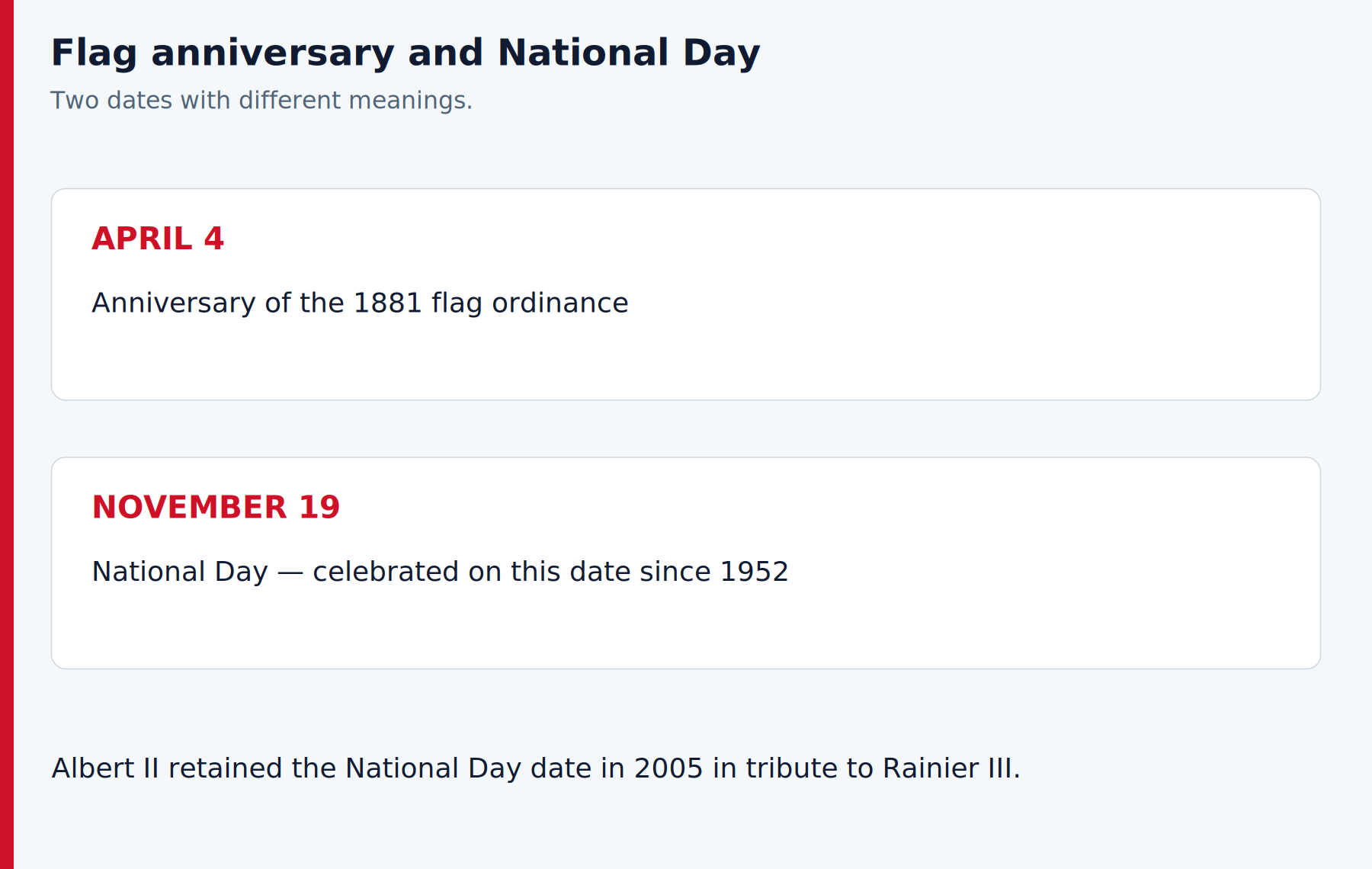
April 4 is the anniversary of the 1881 flag ordinance. The National Council explicitly commemorates it as the flag’s anniversary. The sources consulted do not establish it as a separate public holiday called Flag Day. Monaco’s National Day is November 19, a different observance with its own princely history.
Use “flag adoption anniversary” when describing April 4. That wording identifies the documented occasion without turning a commemorative post into evidence of a statutory holiday.
When is Monaco’s National Day and why November 19?
Monaco’s National Day is November 19. It has been celebrated on that date since 1952, linking the occasion to Rainier III’s enthronement and the observance of Blessed Rainier of Arezzo. Albert II retained November 19 in 2005 as a tribute to his father, rather than choosing a new date.
The Palace describes honors, a military review, religious services and community festivities as parts of the celebration. November 19 should be labeled National Day or Fête Nationale, not the flag’s adoption date or an invented independence anniversary. A particular year’s program requires its own current announcement.
Which official texts define Monaco’s flags?
Article 7 of the Constitution defines the national and princely flags and refers their use to the sovereign ordinance of April 4, 1881. That ordinance supplies the design and use provisions. Law 258 of July 19, 1939, separately addresses displaying foreign flags alongside a Monegasque flag in Monaco.
The legal texts establish the designs and specific display requirements. They should be kept distinct from later digital drawings, manufacturing conventions and international event manuals. This guide summarizes the provisions relevant to identification and display; it does not reproduce a complete protocol manual.
Which Monaco flag is used for merchant and fishing vessels?
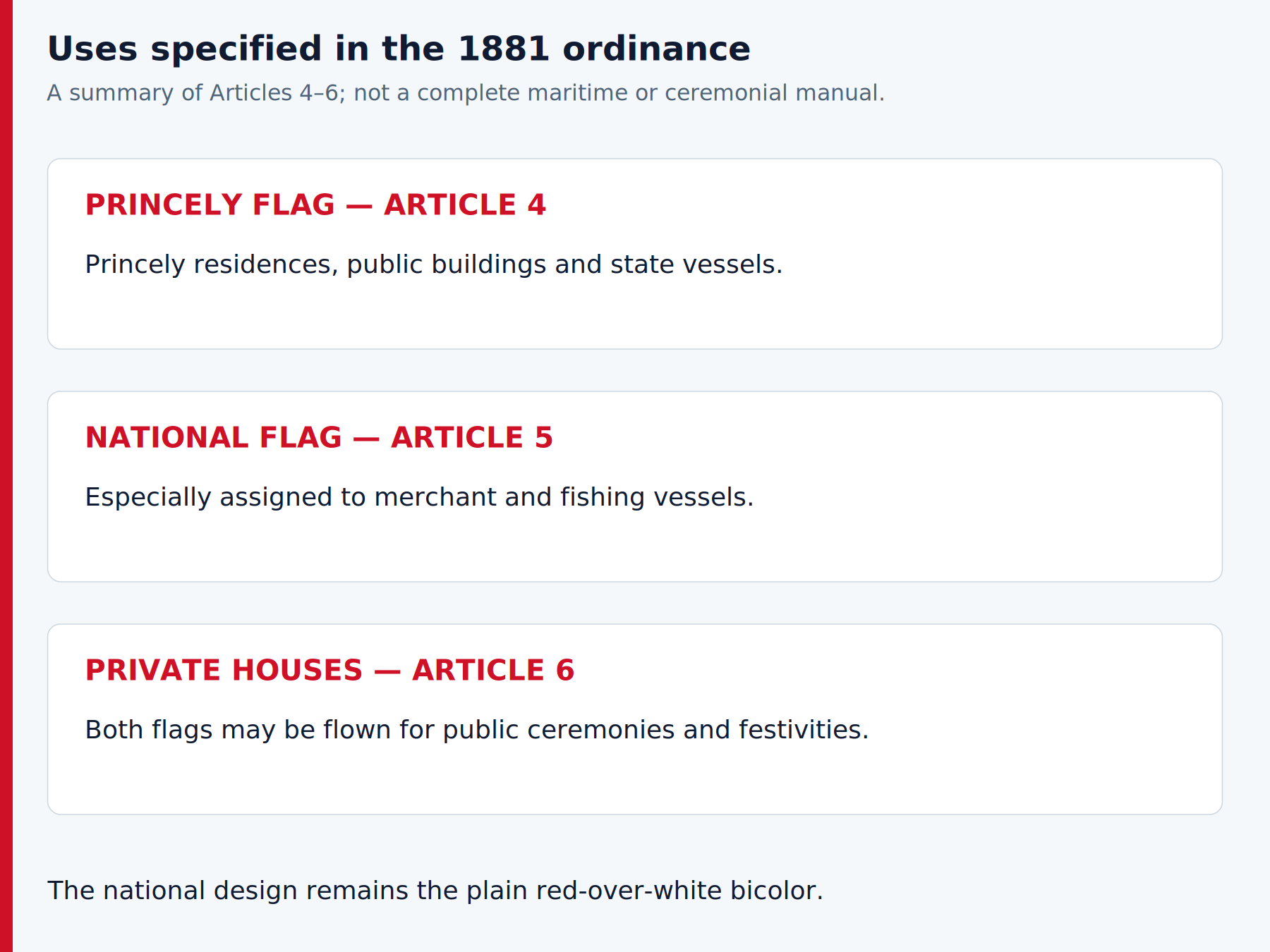
Article 5 of the 1881 ordinance specifically assigns the national red-and-white flag to merchant and fishing vessels. Article 4 assigns the princely flag to state vessels, as well as princely residences and public buildings. This distinction concerns the two named flags; it does not add an emblem to the national bicolor.

“Ensign” describes a flag’s maritime function. The legal national design remains the plain red-over-white rectangle. Actual vessel registration, required equipment and maritime operating procedures are separate questions from identifying the flag in an illustration.
May private houses display Monaco’s flags?
Article 6 of the 1881 ordinance permits both the princely flag and the national flag on private houses during public ceremonies and festivities. That express permission should be quoted in its stated context. It does not, by itself, establish every rule for permanent private displays, advertising uses or commercial branding.
For a festive national display, use the complete design and keep red above white. The provision’s wording does not justify claiming that only the bicolor is ever permitted on a private house, because it names both flags.
How must Monaco’s flag accompany foreign flags in Monaco?
Under the 1939 law, foreign flags displayed outside diplomatic or consular premises must be accompanied by a Monegasque flag. It must be at least as large as the largest foreign flag and occupy the place of honor. The law specifies the center when there are at least two foreign flags.
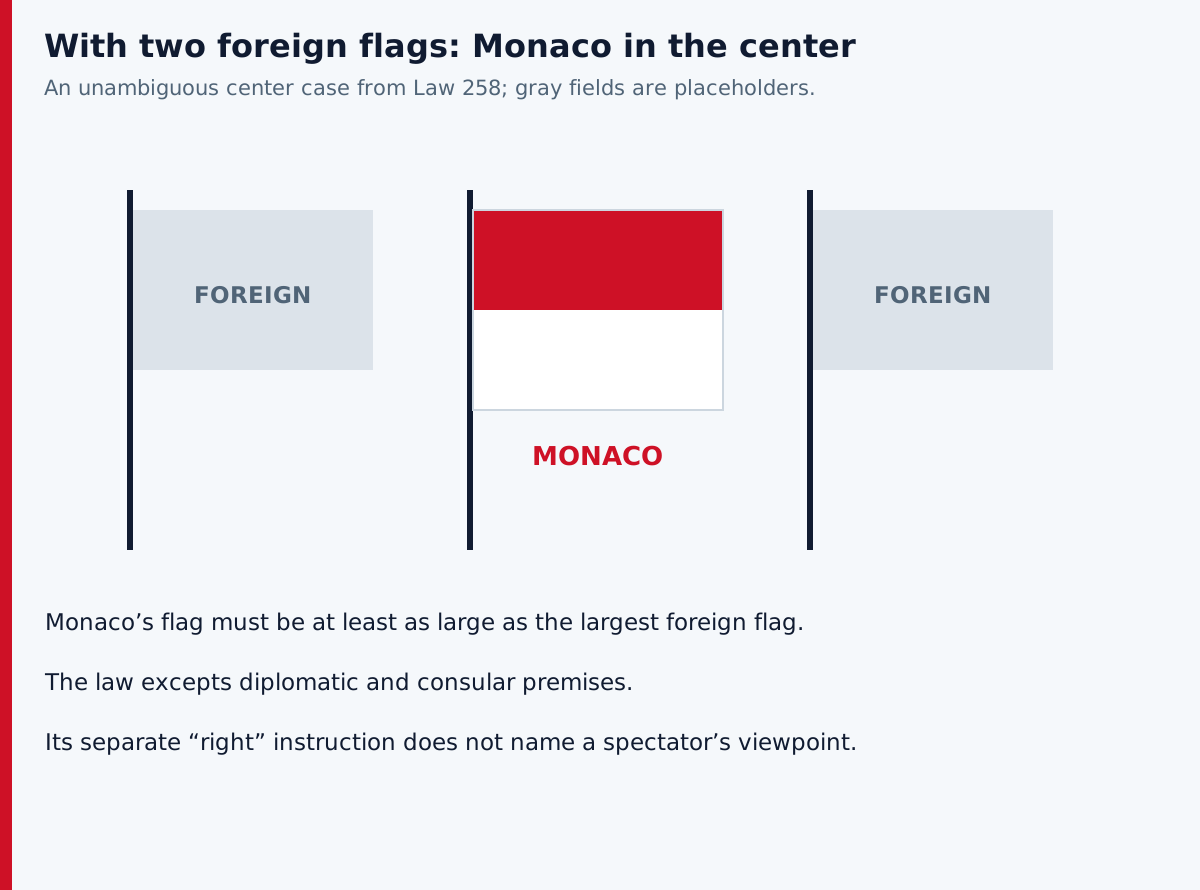
For the place of honor, Article 2 also uses the word “right.” The text does not explicitly identify a spectator’s viewpoint. The diagram therefore illustrates the unambiguous central arrangement with two foreign flags, rather than inventing a left-versus-right audience instruction. The diplomatic and consular exception must not be omitted.
These are provisions for the relevant displays in Monaco. They should not be presented as universal rules that automatically govern every overseas event or every country’s own protocol.
When is Monaco’s flag flown at half-mast?
Monaco uses half-mast flags during officially directed mourning. A documented example followed the death of Minister of State Didier Guillaume in January 2025: public-building flags were lowered from January 18, and January 23 was declared a national day of mourning. That historical example is not an instruction for a current display.
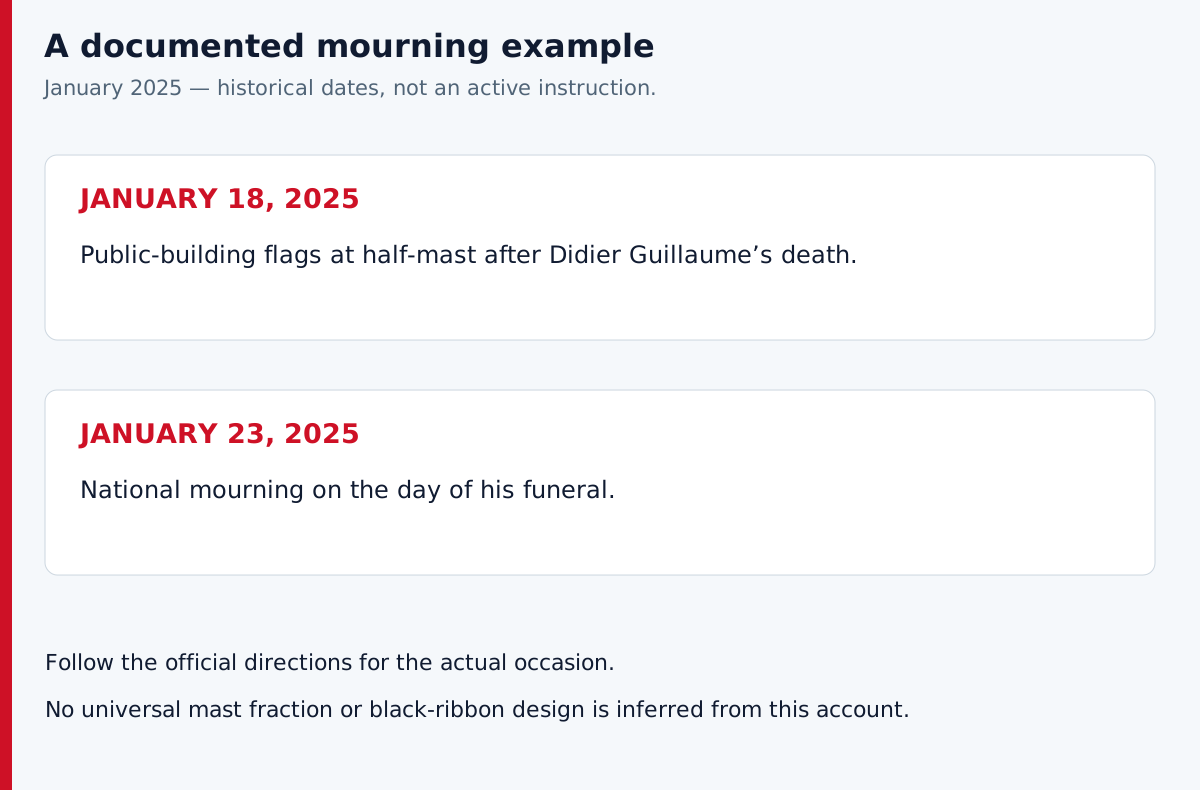
The official account establishes the occasion and dates. It does not provide a universal numerical mast position, a prescribed black-ribbon design, or daily raising and lowering hours. Follow the instructions issued for the actual occasion instead of importing a detailed rule from another country.
What is the correct orientation, and does the reverse differ?
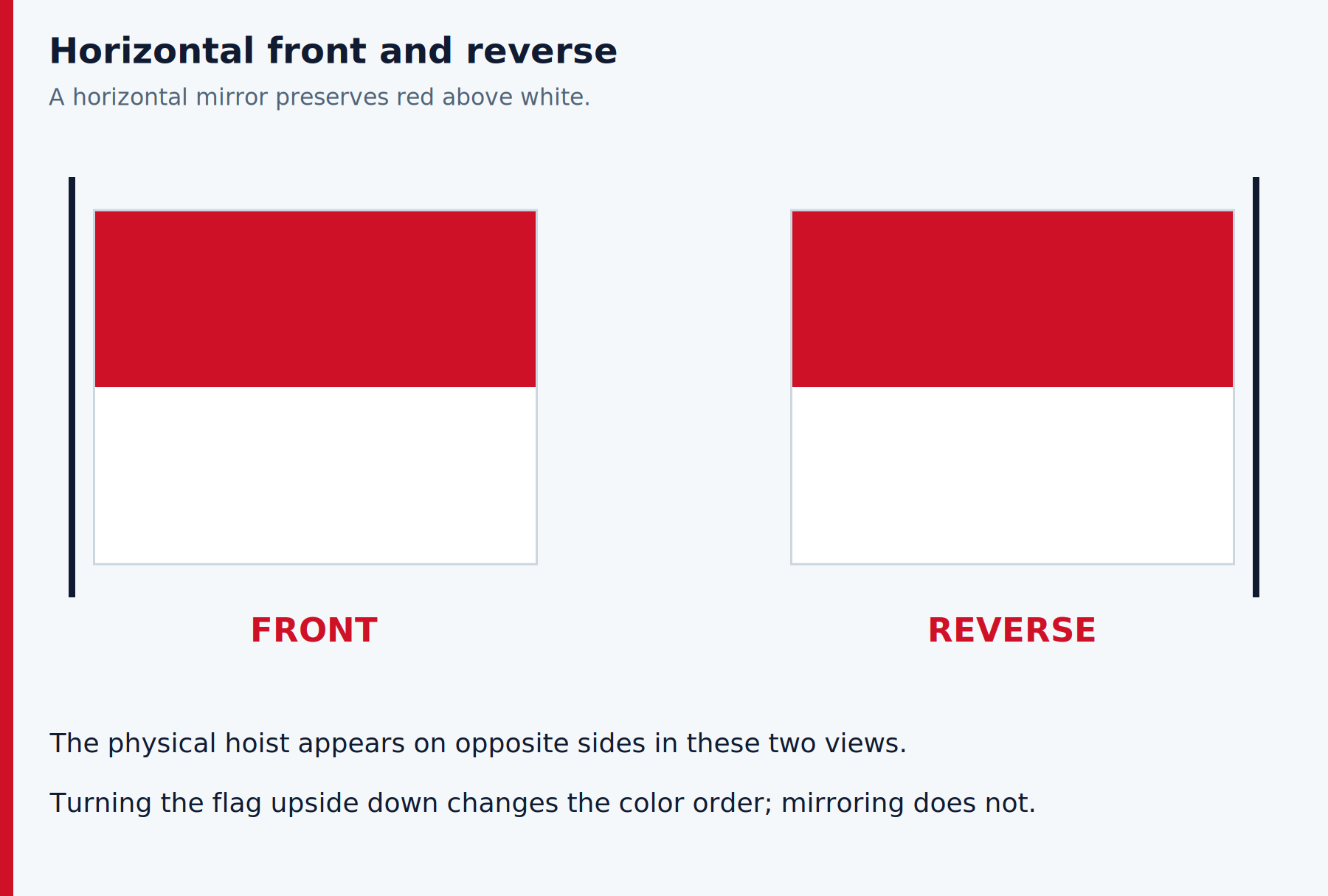
For an ordinary horizontal display, red belongs above white. Because the national flag has no emblem or lettering, viewing it from the back does not change that color order. Turning it upside down does. A vertical event installation should follow the organizer’s applicable protocol rather than an assumed universal rotation rule.
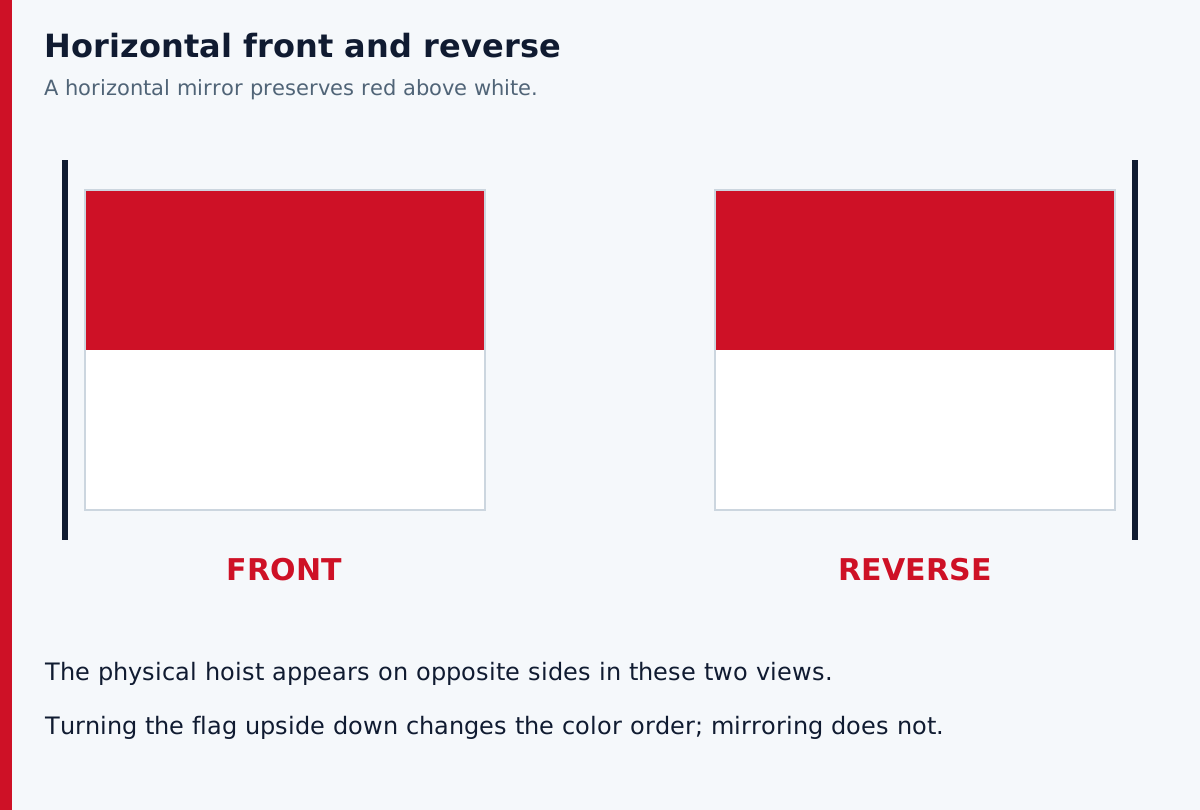
A left-to-right mirror of a horizontal bicolor looks the same. A half-turn puts white above red and changes the appearance. A simple silhouette or a low-resolution emoji cannot establish all the details of a physical installation.
What sizes keep the supplied flag in proportion?
Any width and height in the ratio 5:4 preserve the supplied national reference. Examples include 1000 × 800 pixels, 2000 × 1600 pixels and 4000 × 3200 pixels. For cloth, 125 × 100 centimeters has the same shape. These are calculated examples, not statutory sizes or required flagpole pairings.

All dimensions in the download tables are written width first. To calculate height, multiply width by four-fifths. To calculate the height of either band, divide the total height by two. Lock the image’s aspect ratio when resizing.
How is Monaco’s flag different from Indonesia’s flag?
Both national flags have equal red-over-white bands. The familiar Monaco reference is 5:4 width to height, while Indonesian law specifies 3:2. Their histories are independent. Because wider Monaco flags also occur in practice, shape alone cannot always identify a photograph; check the country label and context as well.
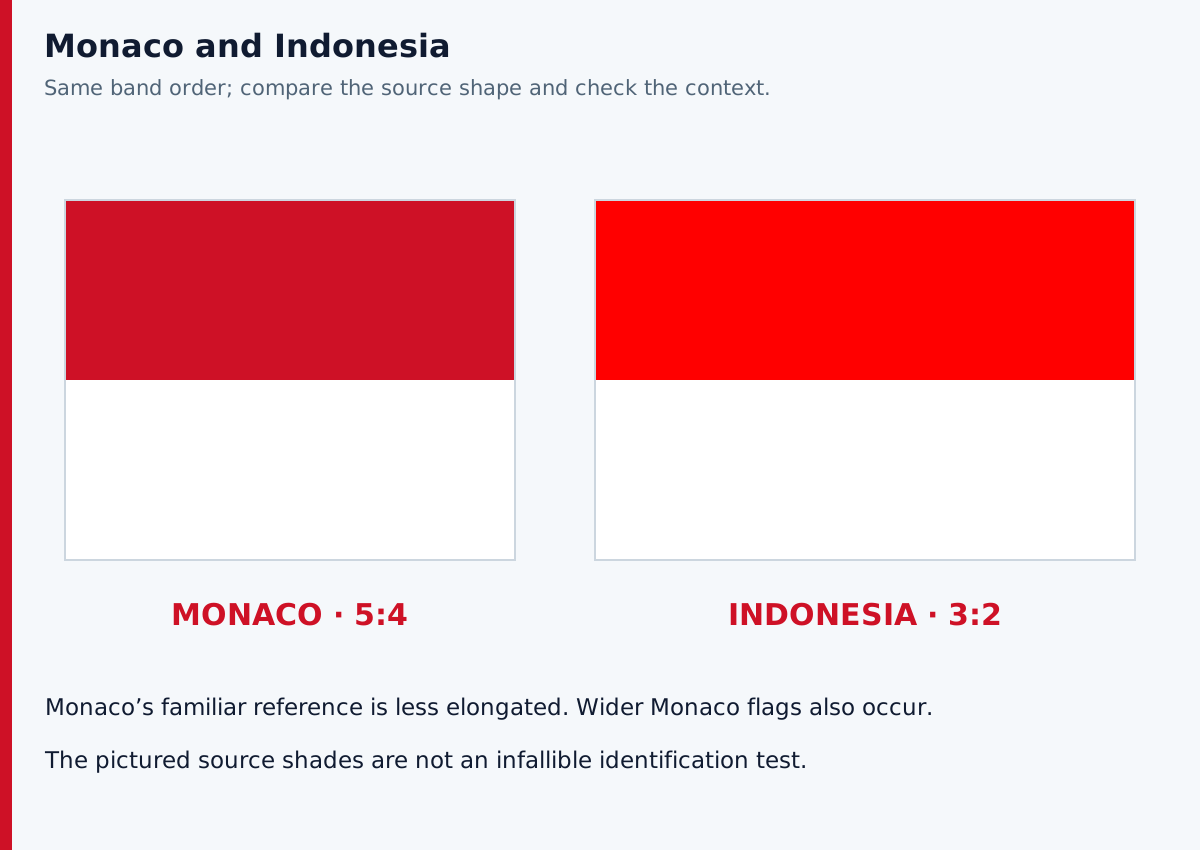
The comparison preserves each source’s native shape. Its Monaco red is #CE1126; the Indonesia reference uses #FF0000. Those digital choices are not proof that a particular red shade is an infallible national identifier. Lighting, fabric and reproduction can obscure such differences.
How is Monaco’s flag different from Poland’s flag?
Monaco places red above white; Poland places white above red. Poland’s ordinary national flag also has an 8:5 width-to-height ratio, compared with the 5:4 Monaco reference supplied here. The band order is the clearest visual distinction. Neither ordinary bicolor needs an emblem to be identified correctly in this comparison.

Do not identify a flag solely from the two colors it contains. Read them in order from the top and check the rectangle’s shape. The Poland drawing here represents the plain national flag, not its separate version bearing the state arms.
Is this also the flag used to represent Monte Carlo?
The red-and-white national flag represents the Principality of Monaco. Monte Carlo is a place within Monaco, not a separate sovereign country with a different national flag. Use “Monaco flag” for the country symbol, and avoid replacing it with a municipal, sporting or commercial logo merely because an event is held in Monte Carlo.
The constitutional name is the Principality of Monaco. “Monegasque” is the English adjective used for its people, institutions and national flag. A location name on an event poster does not change the national symbol’s identity.
What is Monaco’s flag emoji and country code?
Monaco’s flag emoji is 🇲🇨, formed from the regional indicator letters M and C. Its Unicode sequence is U+1F1F2 U+1F1E8. The corresponding flag identifier is MC. Indonesia’s ID sequence and Poland’s PL sequence are different, even when a device renders their flag pictures at similar sizes.

Emoji artwork varies by platform and is not a scale drawing. On systems without flag-emoji support, the sequence may appear as two regional indicator letters. Use the SVG or PNG when the intended proportions and color order must remain explicit.
Which image file should I use for a website or print layout?
Use the national SVG when you need a scalable reference that keeps its sharp edges at different sizes. Use the opaque 4000 × 3200 PNG when your software requires a raster image. Keep the 5:4 shape, preserve both bands, and use an accurate text label such as “Flag of Monaco.”
The princely flag and educational diagrams have their own SVG/PNG pairs. Their surrounding labels are explanatory material, not parts of the national flag. The princely artwork carries a separate attribution and share-alike license, recorded with the image and in the credits file.
What mistakes should be avoided when reproducing Monaco’s flag?
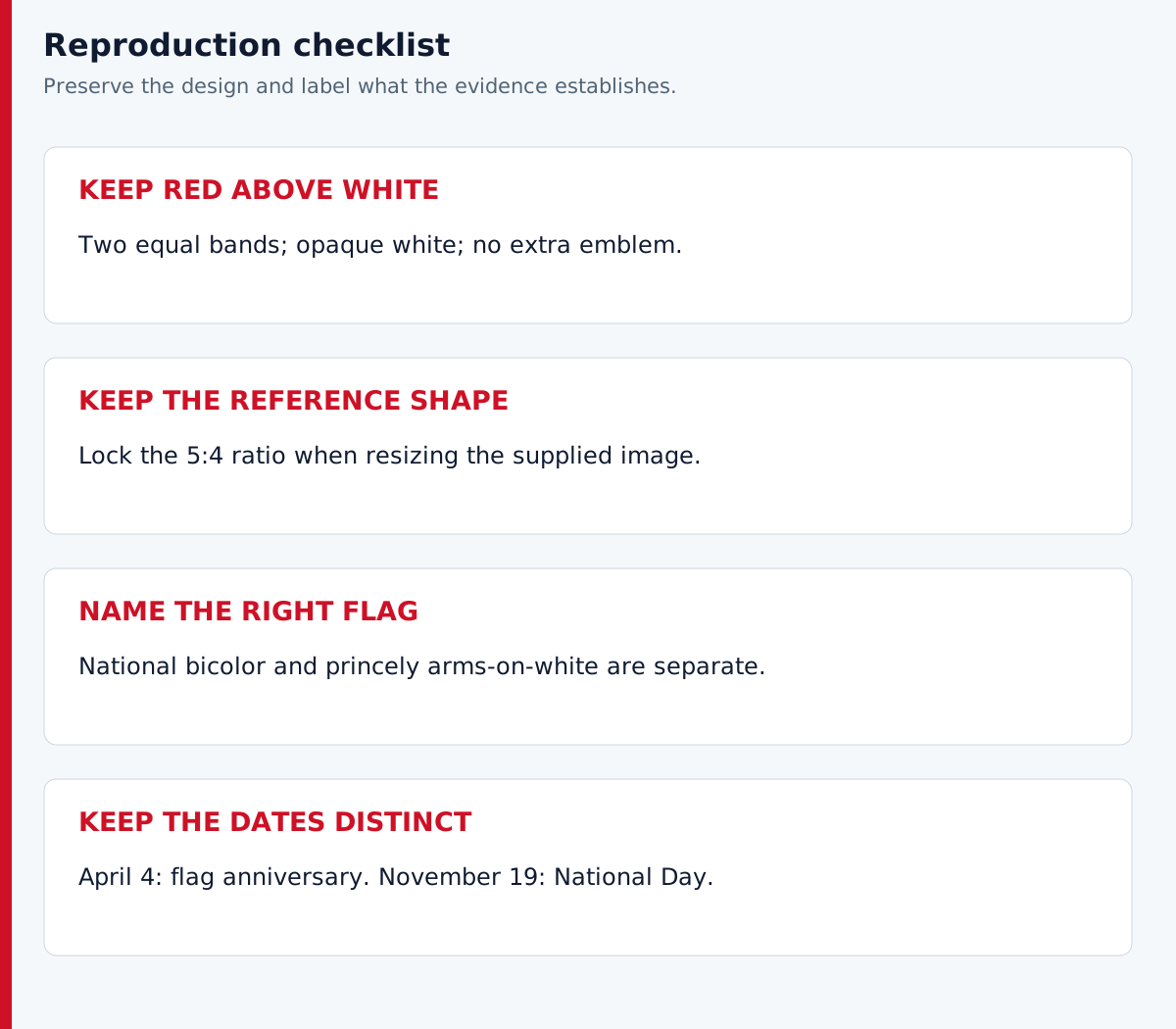
Keep red above white and make both bands equal. Do not add the Grimaldi arms to the bicolor, confuse it with Indonesia or Poland, or describe a reference HEX code as a verified legal formula. Keep the 1881 adoption anniversary separate from National Day, and identify the princely flag as its own design.
- Preserve the intended aspect ratio; do not distort the downloaded image.
- Keep white opaque and preserve the complete lower band.
- Use the MC emoji sequence rather than copying a visually similar country flag.
- For ceremonial display, apply the relevant local instruction and retain the exceptions stated in the legal text.
Explore more in World Flags: Iceland flag, Lithuania flag, Luxembourg flag, Madagascar flag, Malawi flag, Malaysia flag, Maldives flag, Mali flag, Malta flag, Mauritania flag, Mauritius flag, Mexico flag, Micronesia flag, Moldova flag.
Download Monaco flag pictures
Download the national flag as SVG or large PNG. The gallery includes 18 distinct subjects with captions and alternative text. Keep the source proportions when resizing. The main national image is a 5:4 reference; its digital colors are not asserted as a numeric legal standard. Image credits and reuse notes accompany the graphics.
World Flags/Monaco
Monaco flag pictures
Two equal horizontal bands, red above white. The conventional 5:4 reference uses #CE1126 red and opaque white; it is not presented as a verified numeric statutory specification.
GKBook; reference artwork: SKopp and Commons contributors (Monaco reference)Download SVGDownload PNGEqual-height rectangles compare the conventional 5:4 reference with a 3:2 construction illustrating reported practice. Neither is labeled as a numeric requirement in the consulted constitutional wording.
GKBook; reference artwork: SKopp and Commons contributors (Monaco reference)Download SVGDownload PNGThe 1000×800 reference divides at y=400. The guide gives calculated dimensions for the supplied artwork without claiming to reproduce the missing 1881 annex.
GKBook; reference artwork: SKopp and Commons contributors (Monaco reference)Download SVGDownload PNGReference red #CE1126 and white #FFFFFF, with their exact RGB equivalents. These are the source file’s digital values, not certified textile or statutory color formulas.
GKBook; reference artwork: SKopp and Commons contributors (Monaco reference)Download SVGDownload PNGThe documented link is to Grimaldi heraldry and Genoa. The diagram does not assign an invented legally fixed meaning to each band.
GKBookDownload SVGDownload PNGThe source’s crown, mantle, friars, swords, collar, shield and motto remain intact. The detail viewport excludes only surrounding white space; the source paths are unchanged.
GKBook; reference artwork: Denelson83 and Commons contributors (princely reference); CC BY-SA 3.0. License: https://creativecommons.org/licenses/by-sa/3.0/Download SVGDownload PNGThe national flag is uncharged. The separate princely flag displays the complete arms on white. Each drawing retains its source proportions; the 3:2 princely ratio is not asserted as a numeric constitutional rule.
GKBook; reference artwork: SKopp and Commons contributors (Monaco reference); Denelson83 and Commons contributors (princely reference); CC BY-SA 3.0. License: https://creativecommons.org/licenses/by-sa/3.0/Download SVGDownload PNGThe dates mark adoption of the flag ordinance, enactment of the foreign-flag display law, and the Constitution. The older dynastic colors are distinguished from the statutory bicolor.
GKBookDownload SVGDownload PNGApril 4 commemorates the flag ordinance. November 19 is National Day. The research does not establish April 4 as a separate statutory public holiday named Flag Day.
GKBookDownload SVGDownload PNGThree panels summarize the allocations to the princely flag, the national maritime flag and private houses during public celebrations. No universal advertising or permanent-display permission is inferred.
GKBookDownload SVGDownload PNGThe national reference is at least as large as either gray foreign-flag placeholder. The diagram shows only the center case explicitly stated by the law and preserves its diplomatic/consular exception in the caption.
GKBook; reference artwork: SKopp and Commons contributors (Monaco reference)Download SVGDownload PNGThe Journal de Monaco records the half-mast start and the national mourning date. This timeline does not invent a universal lowering measurement or imply that the mourning period is current.
GKBookDownload SVGDownload PNGThe front and mirrored back look the same because the design consists of full-width horizontal bands without lettering or an emblem. The physical hoist changes sides in the two views.
GKBook; reference artwork: SKopp and Commons contributors (Monaco reference)Download SVGDownload PNGThe table demonstrates equivalent 5:4 sizes, including the 4000×3200 national PNG. These are calculated scaling examples rather than mandated dimensions.
GKBook; reference artwork: SKopp and Commons contributors (Monaco reference)Download SVGDownload PNGThe comparison preserves native 1000×800 and 900×600 source canvases. Both have red above white; Indonesia’s law gives the 3:2 width-to-height proportion. Context matters when identifying wider Monaco flags.
GKBook; reference artwork: SKopp and Commons contributors (Monaco reference); Jayakatwang and Commons contributors (Indonesia reference)Download SVGDownload PNGThe ordinary Polish flag reverses the band order and has an 8:5 shape. Source colors are retained as reference colors, not claimed as a complete colorimetric specification.
GKBook; reference artwork: SKopp and Commons contributors (Monaco reference); Commons contributors (Poland reference)Download SVGDownload PNGThe Monaco sequence uses regional indicators M and C. The picture is a national SVG reference, not a claim that all emoji platforms use this exact shape or shade.
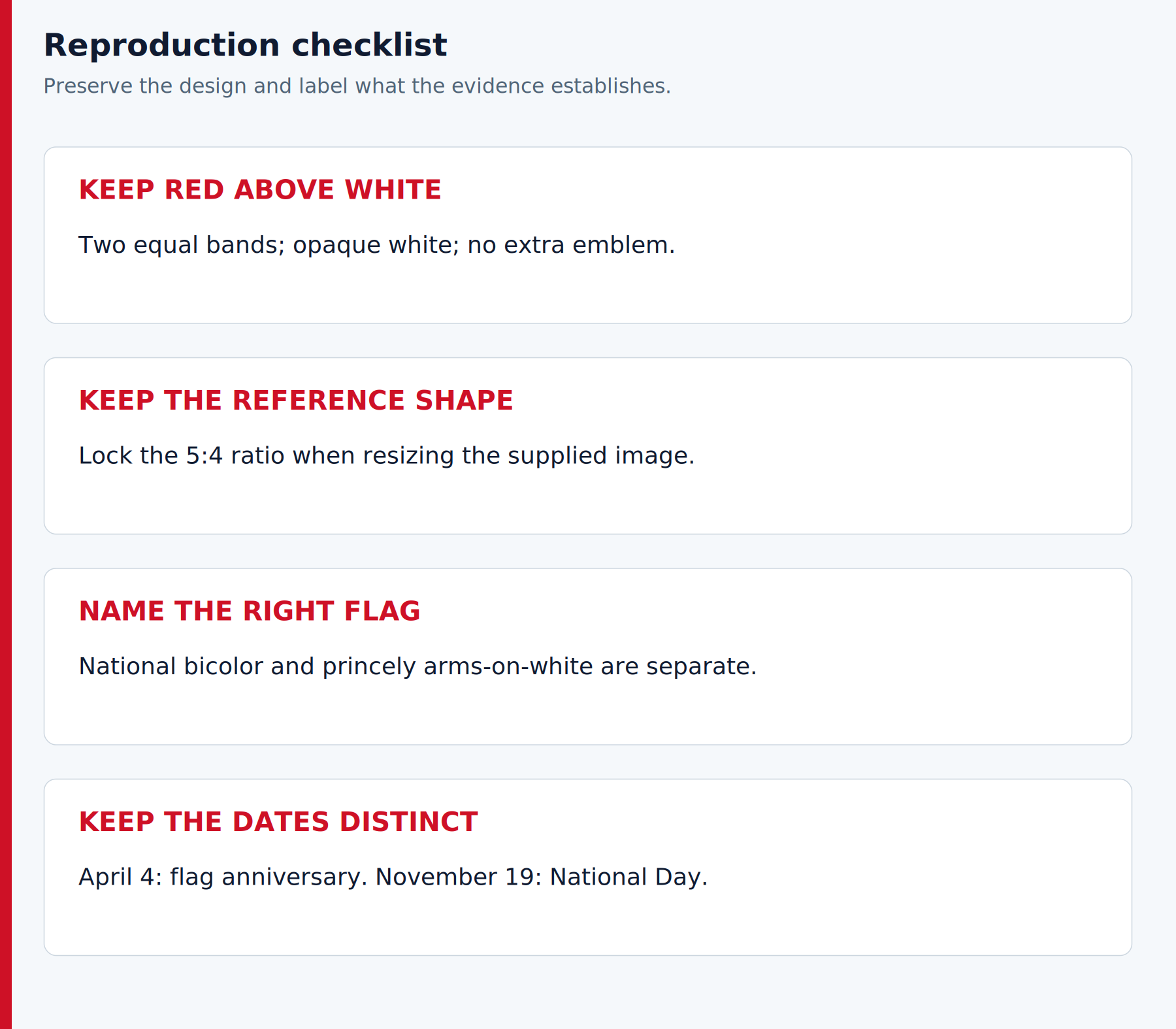
GKBook; reference artwork: SKopp and Commons contributors (Monaco reference)Download SVGDownload PNGFour checks cover band order, equal bands, aspect ratio, the national/princely distinction and the two different commemorative dates.
GKBook; reference artwork: SKopp and Commons contributors (Monaco reference)Download SVGDownload PNGFrequently asked questions
What does the flag of Monaco look like?
Monaco’s national flag is a plain horizontal bicolor with two equal bands: red above white. Both bands extend from the hoist to the fly. The national design has no crown, shield, lettering or border. A white flag bearing the Grimaldi arms is a different, princely flag.
What are Monaco’s flag proportions?
The familiar reference ratio is 5:4 width to height, also written 4:5 height to length. This package uses that shape. Vexillological literature also records 3:2 examples in practice. The Constitution and the accessible ordinance text do not themselves state a numeric ratio; the ordinance refers to illustrated models.
How do you draw Monaco’s national flag?
For the 5:4 reference, draw a rectangle five units wide and four units high. Divide it horizontally into two bands, each two units high. Fill the upper band red and the lower band white. Keep the edges straight and the bands equal; there is no central emblem to position.
What are Monaco’s flag colors and HEX codes?
The legally described colors are red and white. The supplied digital reference uses red #CE1126, equivalent to RGB 206, 17, 38, and white #FFFFFF, equivalent to RGB 255, 255, 255. These values reproduce the credited reference file; the consulted constitutional and ordinance texts do not prescribe those HEX codes.
Is there a verified official Pantone or CMYK formula?
No Pantone, CMYK or RGB formula appears in the constitutional and ordinance texts consulted for this guide. Specialist references report different production specifications in different publications. Use the supplied HEX values to match these digital images, and obtain an approved physical sample or specification for a formal textile or print commission.
What do the red and white colors mean?
The strongest documented explanation is heraldic: red and white are the colors of the House of Grimaldi. Monaco’s National Council also connects them with Genoa, the dynasty’s ancestral city. Popular labels such as bravery for red and peace for white should not be presented as meanings established by Monaco’s flag law.
What appears in the Grimaldi coat of arms?
The Grimaldi arms have a shield patterned with silver and red elongated diamonds, surrounded by the collar of the Order of Saint Charles. A princely crown tops an ermine-lined red mantle. Two sword-bearing friars support the shield, and a ribbon carries the motto Deo Juvante, meaning “with God’s help.”
How does the princely flag differ from the national flag?
The princely flag places the colored arms of the House of Grimaldi on a white field. The national flag instead has two plain horizontal bands. Article 7 of the Constitution recognizes both. The 1881 ordinance assigns the princely flag to princely residences, public buildings and state vessels.
When was Monaco’s national flag adopted?
Prince Charles III established the national red-and-white bicolor by the sovereign ordinance of April 4, 1881. Monaco’s National Council commemorates that date as the flag’s anniversary. Earlier use of Grimaldi colors does not mean the present statutory bicolor was adopted in the Middle Ages, and the 1962 Constitution is a later milestone.
What are the main milestones in Monaco’s flag history?
The essential sequence begins with the Grimaldi heraldic colors, followed by Charles III’s flag ordinance in 1881. A 1939 law addresses displays with foreign flags. The Constitution of December 17, 1962, later restates the two flag designs and retains the ordinance as the basis for their use.
Is April 4 Monaco’s National Day or Flag Day?
April 4 is the anniversary of the 1881 flag ordinance. The National Council explicitly commemorates it as the flag’s anniversary. The sources consulted do not establish it as a separate public holiday called Flag Day. Monaco’s National Day is November 19, a different observance with its own princely history.
When is Monaco’s National Day and why November 19?
Monaco’s National Day is November 19. It has been celebrated on that date since 1952, linking the occasion to Rainier III’s enthronement and the observance of Blessed Rainier of Arezzo. Albert II retained November 19 in 2005 as a tribute to his father, rather than choosing a new date.
Which official texts define Monaco’s flags?
Article 7 of the Constitution defines the national and princely flags and refers their use to the sovereign ordinance of April 4, 1881. That ordinance supplies the design and use provisions. Law 258 of July 19, 1939, separately addresses displaying foreign flags alongside a Monegasque flag in Monaco.
Which Monaco flag is used for merchant and fishing vessels?
Article 5 of the 1881 ordinance specifically assigns the national red-and-white flag to merchant and fishing vessels. Article 4 assigns the princely flag to state vessels, as well as princely residences and public buildings. This distinction concerns the two named flags; it does not add an emblem to the national bicolor.
May private houses display Monaco’s flags?
Article 6 of the 1881 ordinance permits both the princely flag and the national flag on private houses during public ceremonies and festivities. That express permission should be quoted in its stated context. It does not, by itself, establish every rule for permanent private displays, advertising uses or commercial branding.
How must Monaco’s flag accompany foreign flags in Monaco?
Under the 1939 law, foreign flags displayed outside diplomatic or consular premises must be accompanied by a Monegasque flag. It must be at least as large as the largest foreign flag and occupy the place of honor. The law specifies the center when there are at least two foreign flags.
When is Monaco’s flag flown at half-mast?
Monaco uses half-mast flags during officially directed mourning. A documented example followed the death of Minister of State Didier Guillaume in January 2025: public-building flags were lowered from January 18, and January 23 was declared a national day of mourning. That historical example is not an instruction for a current display.
What is the correct orientation, and does the reverse differ?
For an ordinary horizontal display, red belongs above white. Because the national flag has no emblem or lettering, viewing it from the back does not change that color order. Turning it upside down does. A vertical event installation should follow the organizer’s applicable protocol rather than an assumed universal rotation rule.
What sizes keep the supplied flag in proportion?
Any width and height in the ratio 5:4 preserve the supplied national reference. Examples include 1000 × 800 pixels, 2000 × 1600 pixels and 4000 × 3200 pixels. For cloth, 125 × 100 centimeters has the same shape. These are calculated examples, not statutory sizes or required flagpole pairings.
How is Monaco’s flag different from Indonesia’s flag?
Both national flags have equal red-over-white bands. The familiar Monaco reference is 5:4 width to height, while Indonesian law specifies 3:2. Their histories are independent. Because wider Monaco flags also occur in practice, shape alone cannot always identify a photograph; check the country label and context as well.
How is Monaco’s flag different from Poland’s flag?
Monaco places red above white; Poland places white above red. Poland’s ordinary national flag also has an 8:5 width-to-height ratio, compared with the 5:4 Monaco reference supplied here. The band order is the clearest visual distinction. Neither ordinary bicolor needs an emblem to be identified correctly in this comparison.
Is this also the flag used to represent Monte Carlo?
The red-and-white national flag represents the Principality of Monaco. Monte Carlo is a place within Monaco, not a separate sovereign country with a different national flag. Use “Monaco flag” for the country symbol, and avoid replacing it with a municipal, sporting or commercial logo merely because an event is held in Monte Carlo.
What is Monaco’s flag emoji and country code?
Monaco’s flag emoji is 🇲🇨, formed from the regional indicator letters M and C. Its Unicode sequence is U+1F1F2 U+1F1E8. The corresponding flag identifier is MC. Indonesia’s ID sequence and Poland’s PL sequence are different, even when a device renders their flag pictures at similar sizes.
Which image file should I use for a website or print layout?
Use the national SVG when you need a scalable reference that keeps its sharp edges at different sizes. Use the opaque 4000 × 3200 PNG when your software requires a raster image. Keep the 5:4 shape, preserve both bands, and use an accurate text label such as “Flag of Monaco.”
What mistakes should be avoided when reproducing Monaco’s flag?
Keep red above white and make both bands equal. Do not add the Grimaldi arms to the bicolor, confuse it with Indonesia or Poland, or describe a reference HEX code as a verified legal formula. Keep the 1881 adoption anniversary separate from National Day, and identify the princely flag as its own design.
Explore all general-knowledge topics and the A-to-Z lists.








We Value Your Opinion Comments