
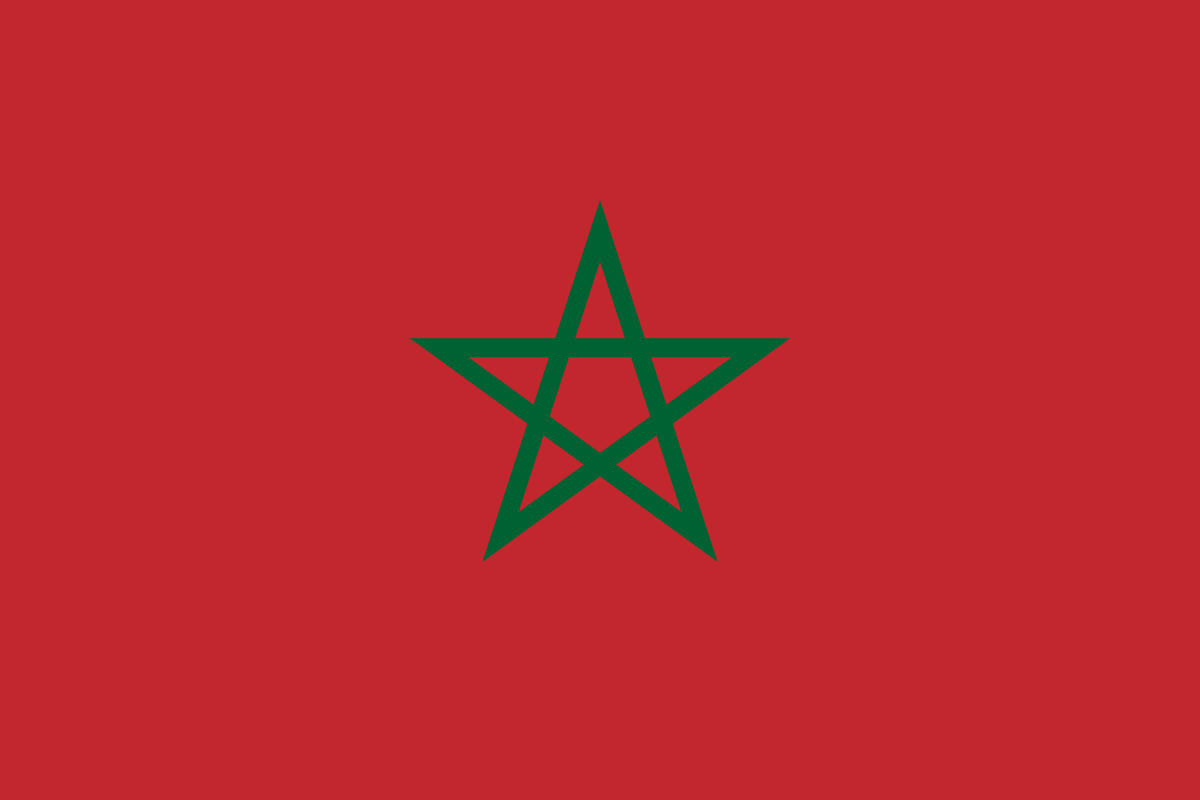
Morocco flag picture
Explore the construction drawing, history, and picture gallery.
| Design | Red field; green pentagramOne star point faces upward. |
|---|---|
| Proportions | 2:3 height:lengthEquivalent to 3:2 length:height. |
| Modern emblem | November 17, 1915Date of the decree adding the star. |
| Detailed decree | November 23, 2005Dahir no. 1-05-99. |
| Construction | Circle radius = length / 6The circle center is the flag center. |
| National holiday | Independence Day: November 18Separate from the flag-decree date. |
What does Morocco’s national flag look like?
Morocco’s national flag is a red rectangle with a centered green pentagram, an open five-pointed star with one tip pointing upward. Its height-to-length ratio is 2:3. The modern emblem was introduced by a decree dated November 17, 1915; a 2005 decree gives detailed specifications for the design and cloth.
The pictures below explain the design through original geometric diagrams. Legal specifications, historical evidence, and common symbolism are identified separately so that each answers the right question.
What are the official colors of Morocco’s flag?
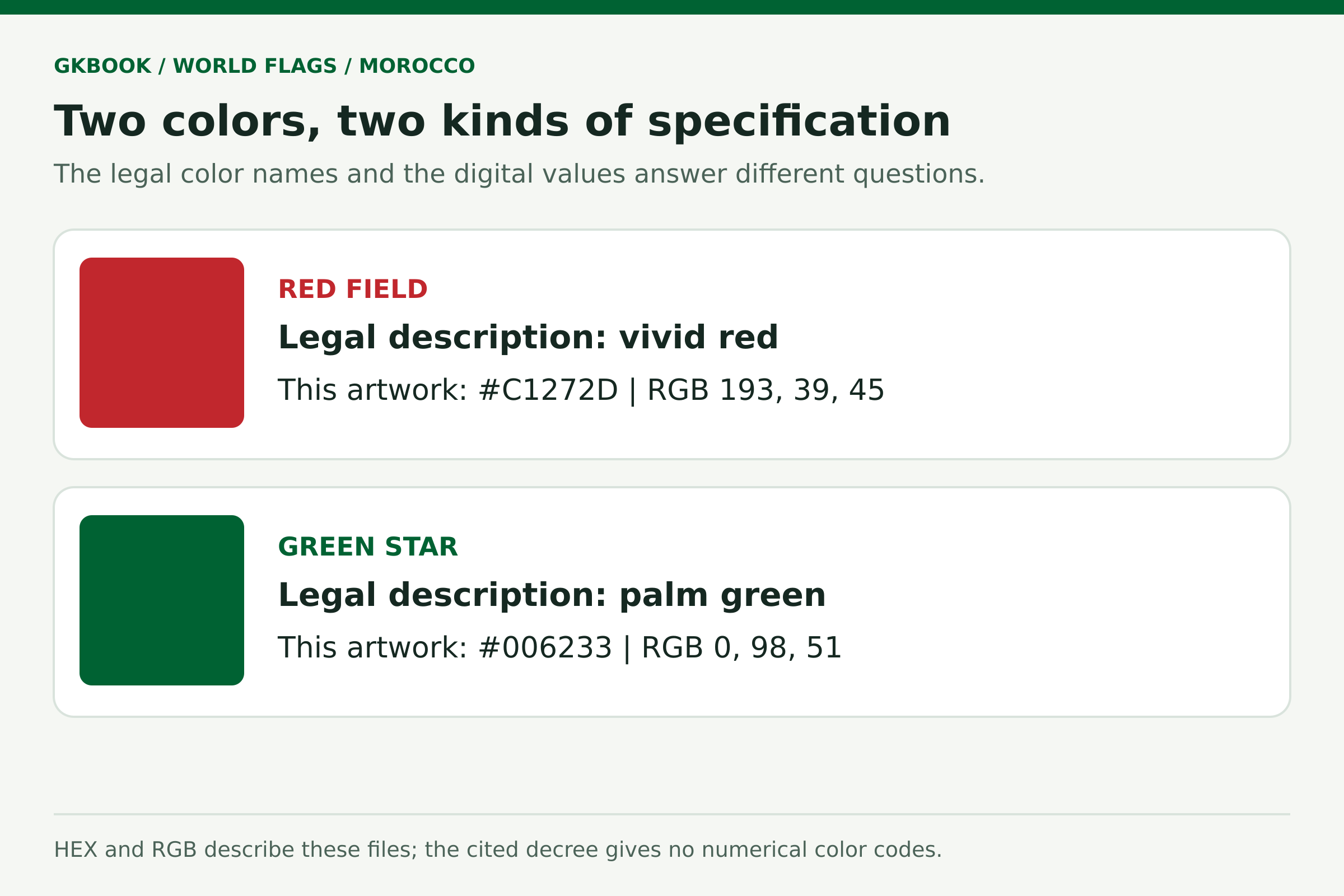
Morocco’s national flag has a vivid red field and a palm-green star. Those are the color descriptions in the 2005 royal decree. The law defines the appearance in words; the cited text does not provide numerical HEX, RGB, CMYK, or Pantone specifications for the two colors.

The distinction matters because a flag is a physical object as well as a digital image. Cloth, ink, and illuminated screens reproduce color differently. A web swatch can document the appearance of one illustration without becoming a legally prescribed dye formula.
For production intended for official use, compare an approved physical or graphic reference under appropriate viewing conditions. A generic name such as “red” cannot by itself control every printing, fabric, or lighting variation.
What HEX and RGB values do these Morocco flag images use?
The downloadable GKBook illustrations use red #C1272D, equivalent to RGB 193, 39, 45, and green #006233, equivalent to RGB 0, 98, 51. These are familiar digital reference values. They identify this package’s artwork and should not be presented as numerical color specifications enacted by Morocco’s flag decree.
Use the same two values consistently when resizing or placing the supplied flag. A shaded photograph, an emoji, and a flat vector can look different even when all are intended to represent Morocco.
The table gives exact values for these files. No Pantone or CMYK conversion is labeled official: an appropriate print conversion depends on the printer, substrate, and color profile.
| Element | Legal color description | This package’s HEX | This package’s RGB |
|---|---|---|---|
| Field | Vivid red | #C1272D | 193, 39, 45 |
| Pentagram | Palm green | #006233 | 0, 98, 51 |
Why is the background of Morocco’s flag red?
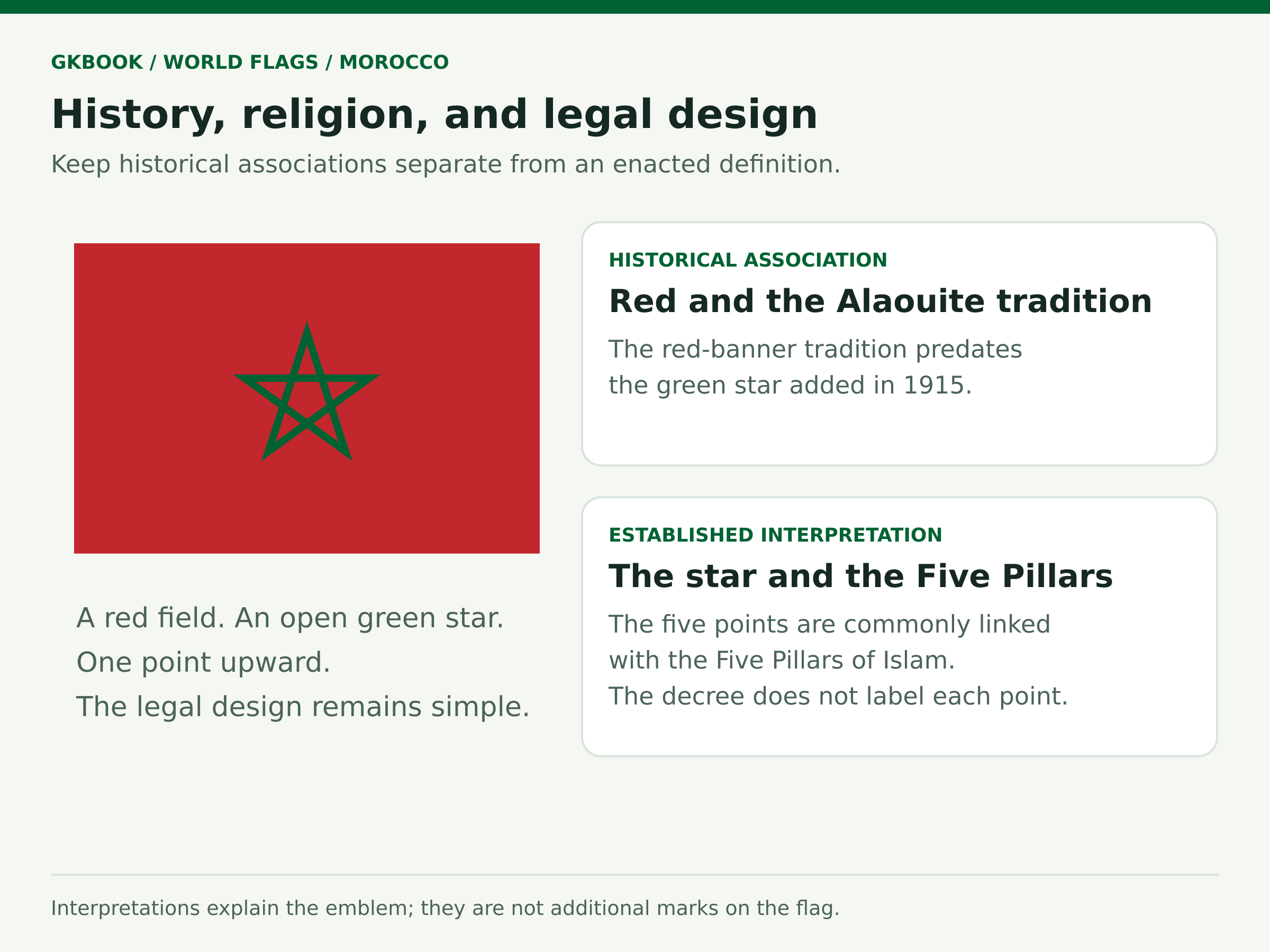
Red connects Morocco’s flag with the historical banner tradition of the Alaouite dynasty. An institutional account of research presented at Morocco’s Royal Institute for Research in Moroccan History identifies red with Alaouite political power. That historical association is better documented than assigning one compulsory modern meaning to every color.
The green star was added to an existing red-banner tradition. This continuity explains why the modern flag combines a relatively simple field with a distinctive central emblem.
Descriptions such as courage, sacrifice, or strength may appear in popular accounts. They should be identified as interpretations when used, rather than inserted into the legal design specification.
What does the green star on Morocco’s flag mean?
The green star is associated with Islam, and its five points are commonly interpreted as representing the Five Pillars of Islam. This is an established symbolic reading, found in government reference material and Moroccan commentary. The flag’s legal description specifies a green five-branched star without assigning a separate meaning to each point.

The Five Pillars are the profession of faith, prayer, obligatory giving, fasting during Ramadan, and pilgrimage for those able to undertake it. The interpretation concerns the five points collectively; the decree does not label individual tips.
The star also distinguishes the national flag from a plain red banner. Historical purpose, religious interpretation, and legal specification answer different questions about the same symbol.
Why is Morocco’s star called the Seal of Solomon?
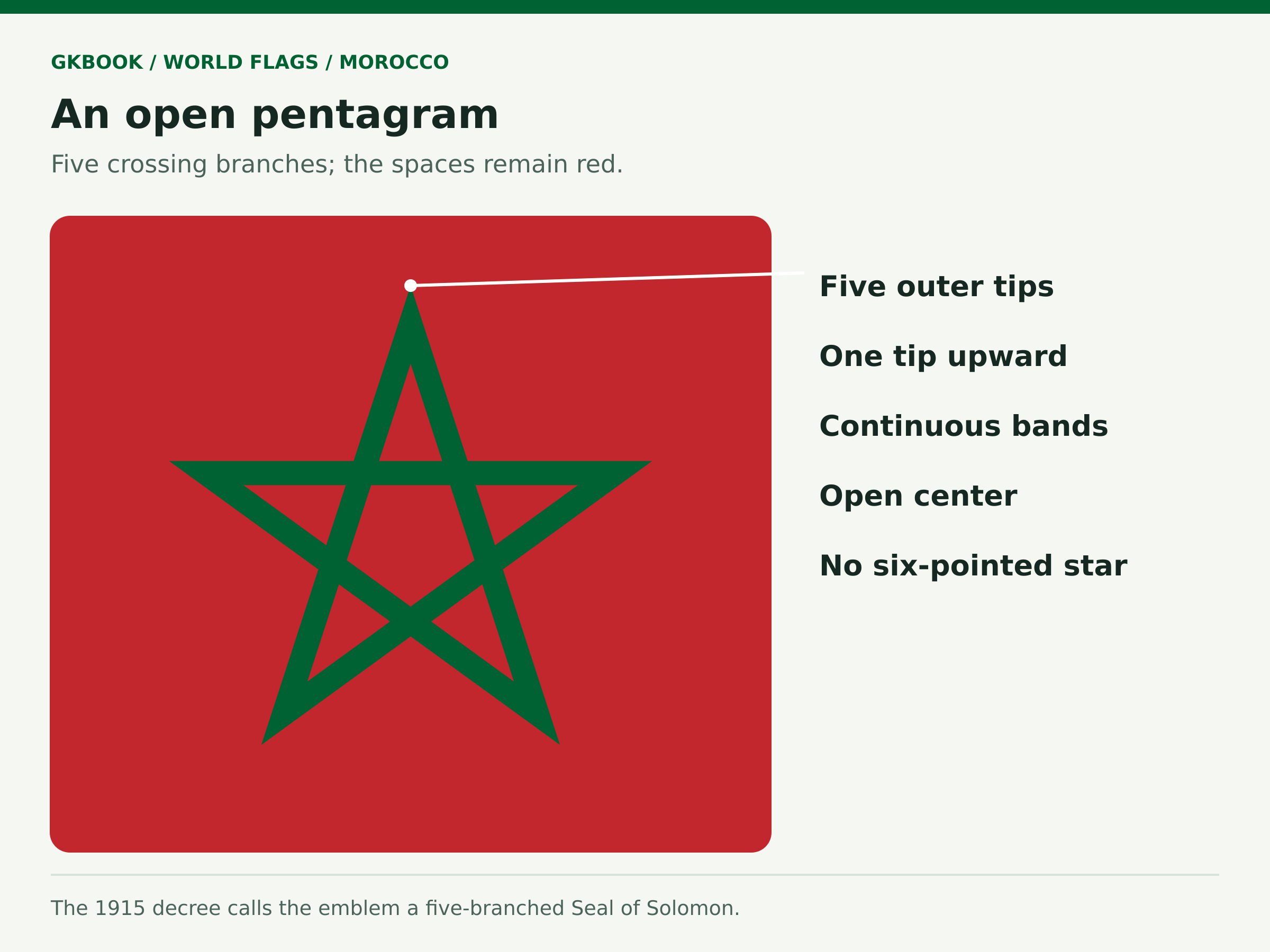
The 1915 decree calls the added emblem a five-branched Seal of Solomon. On Morocco’s flag, that means a green pentagram: a continuous, crossing five-pointed star with open red spaces inside it. The national emblem has five points, so a six-pointed star is not an interchangeable substitute.
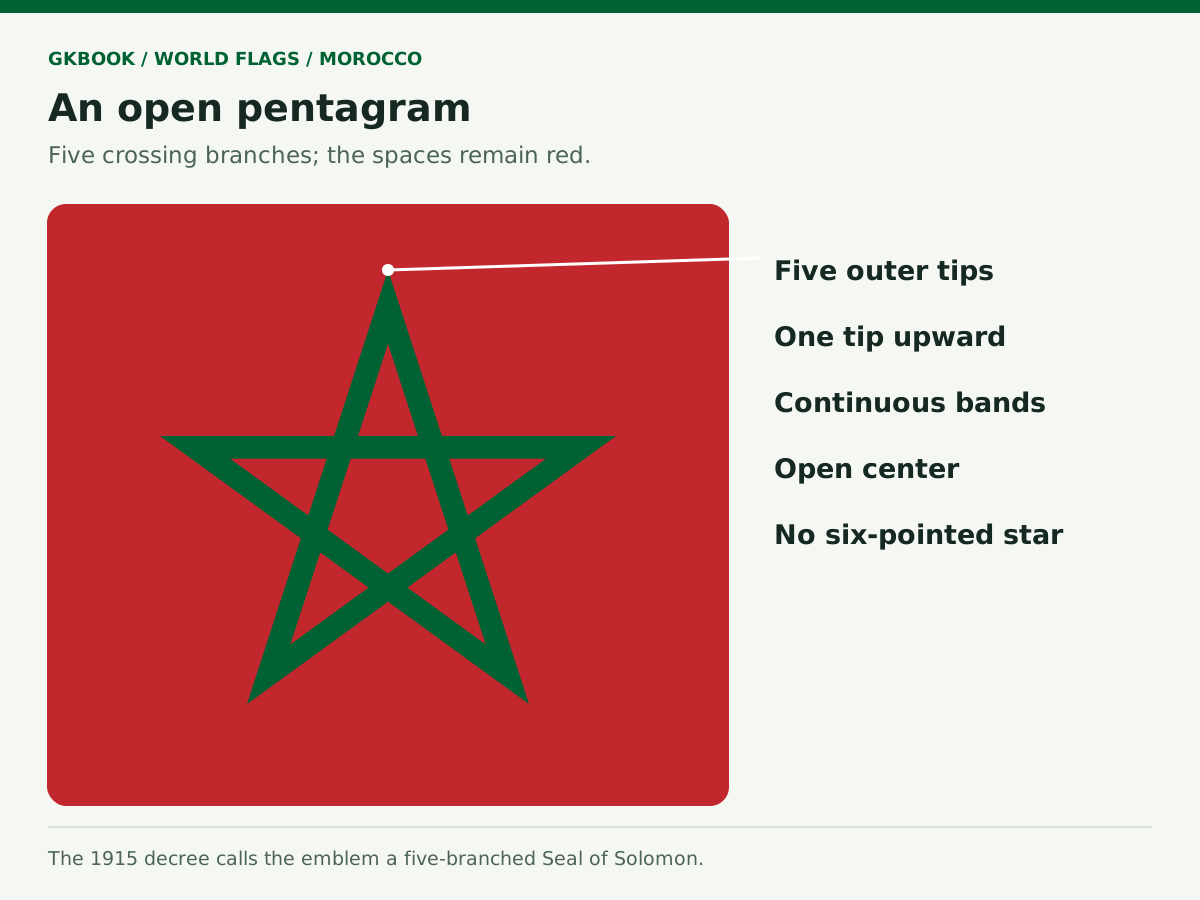
The name belongs to a wider historical family of symbols. Its meaning in this particular decree is settled by the explicit reference to five branches, not by every shape that has carried the same name elsewhere.
A filled five-pointed star is also a different drawing. Preserve the crossing bands, the open center, and the upward-pointing tip when identifying or reproducing Morocco’s national emblem.
Does Morocco’s national flag include a motto or coat of arms?
The standard national flag consists of the red field and green star; it does not include the national motto, a crown, or the full royal coat of arms. Article 4 of the Constitution states the flag’s design and the kingdom’s motto separately. Adding those other symbols changes the standard flag image.
The motto is commonly translated into English as “God, the Homeland, the King.” The constitutional description does not instruct that these words be written across the flag.
Morocco’s coat of arms is a separate heraldic composition, with a shield, crown, supporters, and other elements. The shared appearance of a green star does not make the coat of arms and the national flag the same design.
What are the proportions of Morocco’s flag?
Morocco’s national flag has a height-to-length ratio of 2:3. Expressed with the horizontal length first, the same proportion is 3:2. A flag 120 centimeters long is therefore 80 centimeters high. The whole rectangular field follows this ratio, including the area behind the central star.

The French legal terms distinguish guindant, the hoist dimension, from battant, the horizontal fly length. The decree makes the hoist two-thirds of the fly.
Keeping the order explicit prevents a common numerical mistake. A 1200 × 800 image follows the required proportion; a 1200 × 600 image is a different rectangle and must not be substituted merely because another country uses it.
How large is the star on Morocco’s flag?
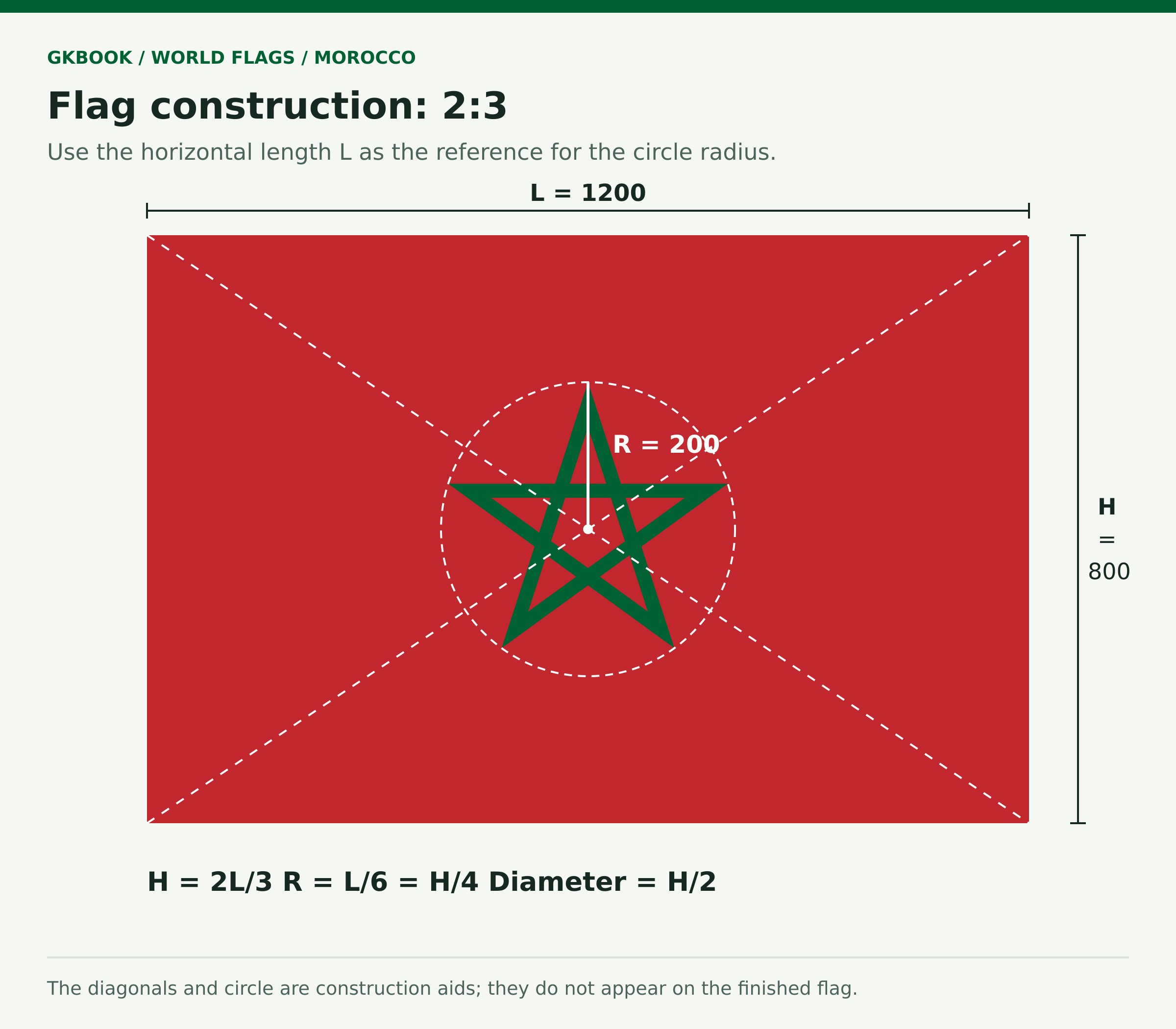
The 2005 decree places the star within an invisible circle whose radius equals one-sixth of the flag’s horizontal length. The circle is centered where the rectangle’s diagonals meet. Because the flag is 2:3, that radius also equals one-quarter of its height; the circle’s diameter equals half the height.
Let L be the horizontal length and H the height. Then H = 2L/3, R = L/6 = H/4, and D = 2R = L/3 = H/2. These equivalent expressions are calculated from the two legal ratios.
For a 1200 × 800 drawing, the circle has radius 200 and diameter 400. The circle is a construction aid: it is not a green ring that should appear on the finished flag. Its diameter is also not the star’s rectangular bounding-box height.
Some reference drawings use a smaller star. A specialist vexillological comparison records this difference, so a familiar image should not silently override the dimensions in the 2005 text. The downloadable reconstruction here follows the circle rule stated above.
How is the five-pointed star constructed?
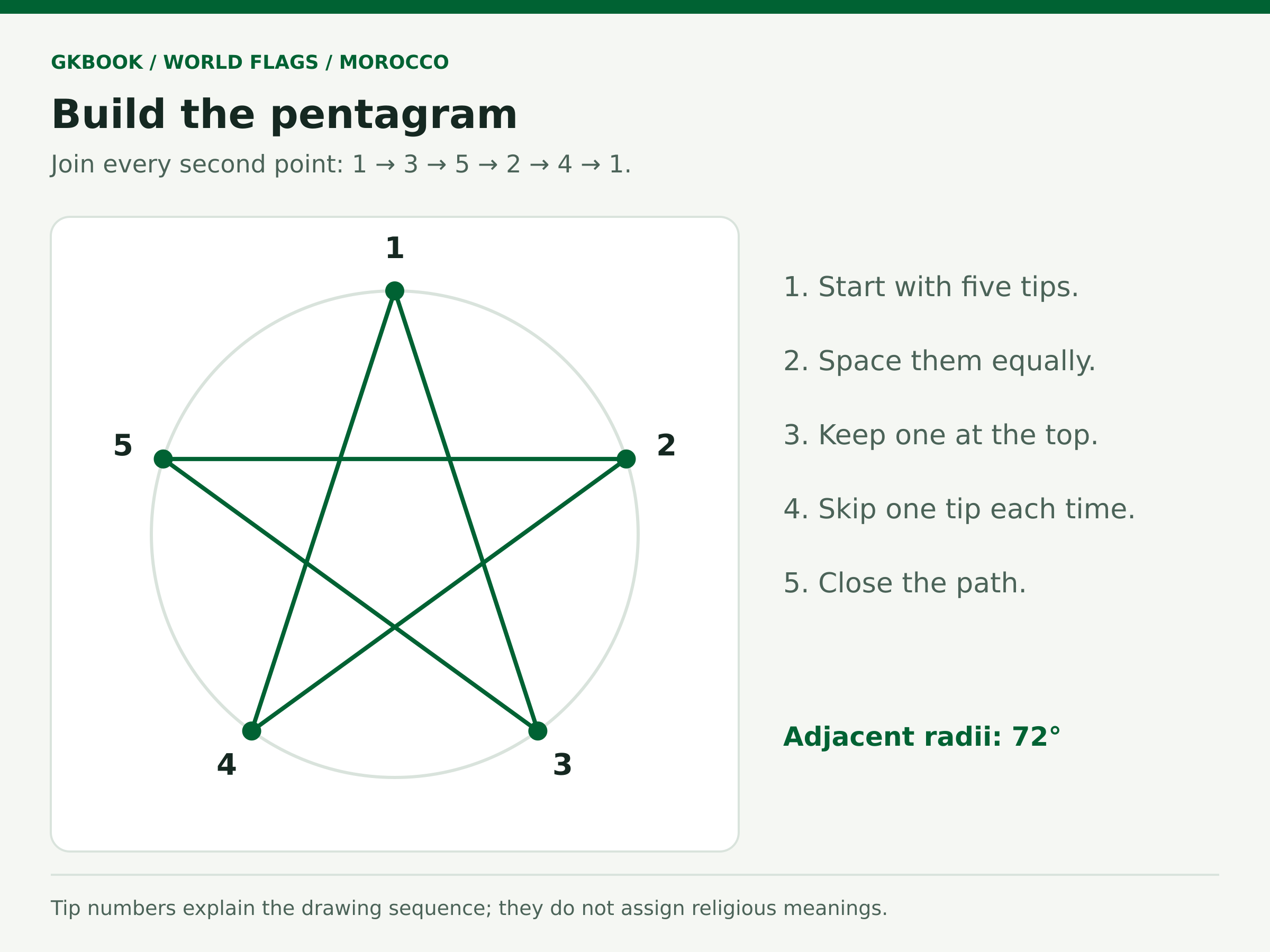
A regular pentagram can be constructed by placing five equally spaced points around a circle and joining every second point. Start with one point at the top. The resulting continuous path crosses itself and leaves an open central pentagon. For Morocco’s flag, the completed green bands must preserve those open spaces.
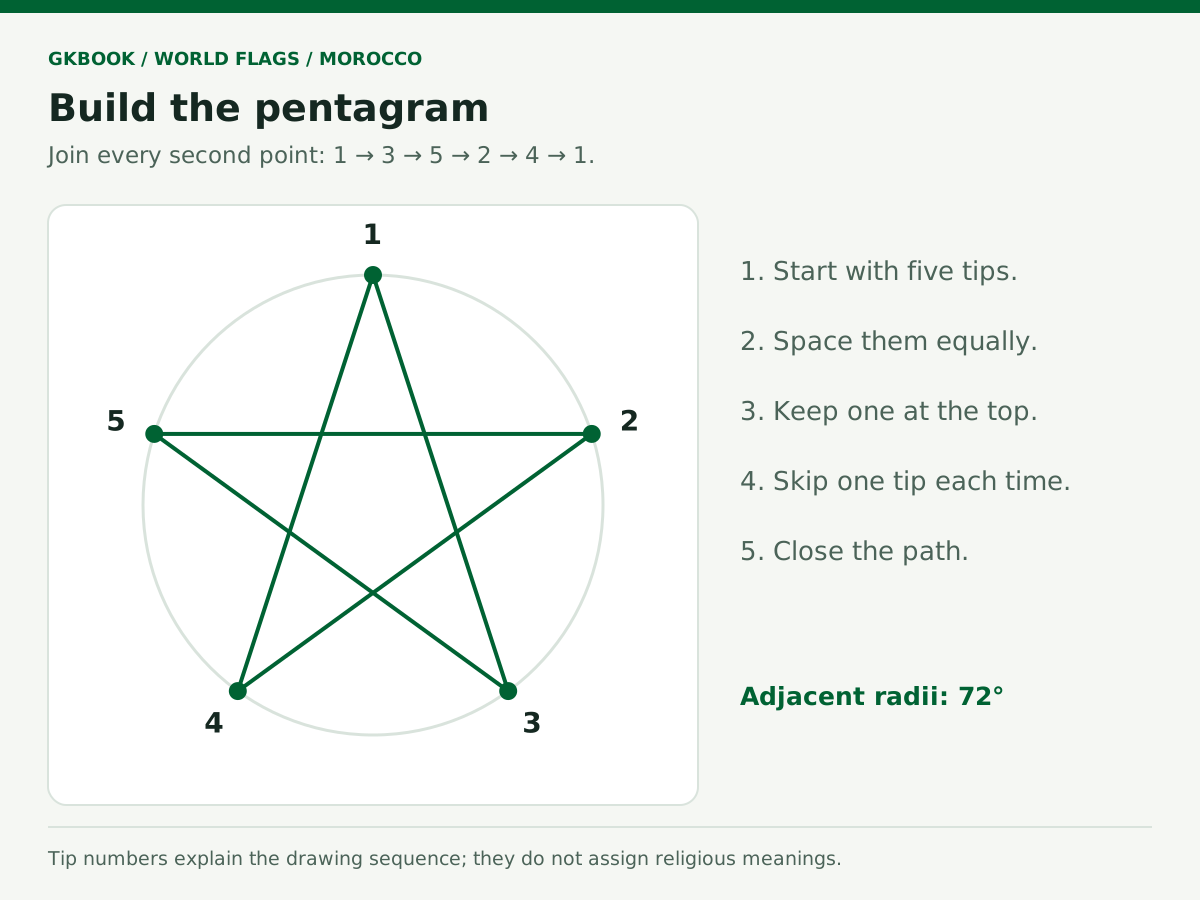
For the explanatory drawing, number the five outer tips clockwise from the top. Join 1 → 3 → 5 → 2 → 4 → 1. This is a geometric construction of a pentagram, not a list of religious meanings for numbered points.
Equal spacing gives 72° between adjacent radii. The connecting lines form the familiar five-pointed outline. These mathematical details explain the shape; the decree supplies the flag’s dimensions and its requirement for a continuous, open star.
How thick should the branches of the star be?
The 2005 decree states that each star branch has a width equal to one-twentieth of its length. This proportion concerns the branch, not the whole flag. In the GKBook reconstruction, a branch is measured between its two outer tips, and the green band’s thickness is measured perpendicular to that branch.

For this drawing convention, if R is the outer-tip radius, branch length B = 2R sin 72°, and band width t = B/20. At L = 1200, R = 200, so B is approximately 380.423 and t approximately 19.021 drawing units.
The SVG accounts for the sharp tips of the bands so that the visible tips stay on the construction circle. The geometric implementation is documented with the artwork. It is a reference reconstruction; official manufacturing work should use an authority-approved master.
How is the star centered correctly?
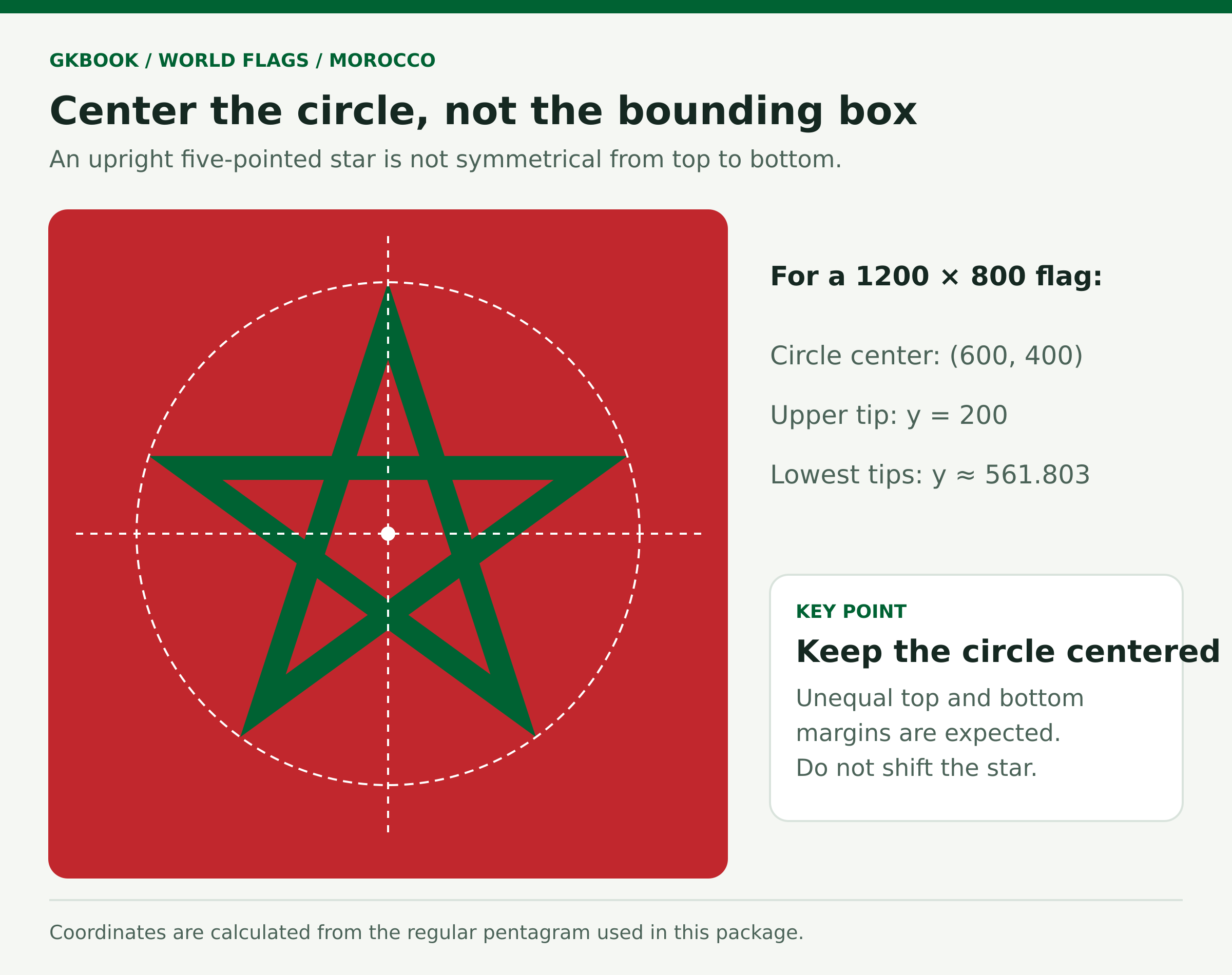
The flag’s center is the center of the star’s construction circle, located at the intersection of the rectangle’s diagonals. It is not the midpoint of the star’s highest and lowest painted points. An upright five-pointed star is not vertically symmetrical, so those two centering methods produce different results.

In the 1200 × 800 example, the circle center is (600, 400). The upper tip is at y = 200; the two lowest tips are near y = 561.803. Their unequal distances above and below y = 400 are a normal property of the shape.
Do not nudge the star downward to equalize its top and bottom margins. Center the construction circle instead. The illustration marks both the geometric center and the visible outline to make the distinction clear.
How can Morocco’s flag be scaled to different sizes?
Scale the entire design uniformly while retaining its 2:3 height-to-length ratio and the star’s relative measurements. For any chosen horizontal length L, use height 2L/3 and construction-circle radius L/6. These formulas generate consistent sizes without inventing a compulsory list of standard dimensions in centimeters or pixels.

The examples below are calculated options, not a government procurement schedule. Multiplying the length, height, star radius, and band thickness by the same factor preserves the drawing.
Use SVG when an illustration must scale sharply. Use the supplied PNG at a suitable resolution for documents or slides. Avoid stretching width and height independently, which changes both the flag and its star.
| Horizontal length | Height | Star-circle radius | Status |
|---|---|---|---|
| 90 cm | 60 cm | 15 cm | Calculated example |
| 150 cm | 100 cm | 25 cm | Calculated example |
| 240 cm | 160 cm | 40 cm | Calculated example |
| 1200 px | 800 px | 200 px | SVG drawing canvas |
When was Morocco’s current flag adopted?
The decree introducing the green five-pointed emblem is dated November 17, 1915, under Sultan Moulay Youssef. This is the documented decree date associated with the modern red-and-green design. It should be distinguished from later execution and publication steps, the 2005 technical specification, and Morocco’s recovery of independence in 1956.
The earlier red banner remained the basis of the flag. The 1915 change added the central emblem rather than replacing the field with a new arrangement of stripes.
A decree date establishes a legal decision. It does not, on its own, prove the date of the first cloth flag manufactured, the first public ceremony, or immediate uniform use in every location.
Why do different dates appear in accounts of the flag?
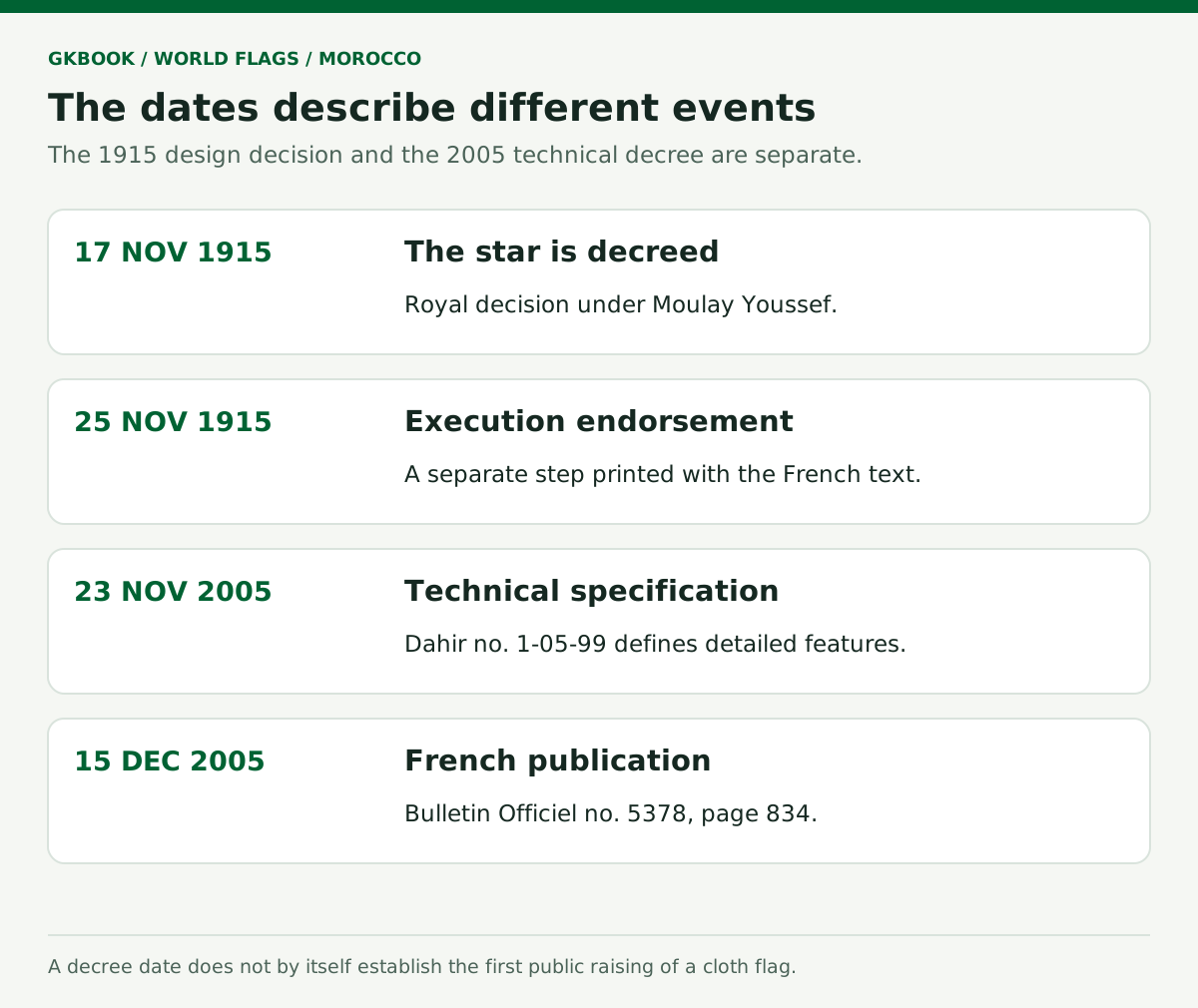
Several dates describe different events. November 17, 1915 is the date of the decree adding the star; its French text also carries a November 25 execution endorsement. November 23, 2005 is the later specification decree’s date, while December 15, 2005 is its publication date in the French Official Bulletin.
Keep the event beside the date when writing a caption or answering an examination question. “Adopted,” “published,” “standardized,” and “became independent” are not interchangeable labels.
The 2005 decree refers to Article 7 of the Constitution then in force. The present constitutional flag provision is Article 4 of the 2011 Constitution. That change in numbering is not evidence of a new flag design.
| Date | Document or event | What it establishes |
|---|---|---|
| November 17, 1915 | Royal decree | Addition of the five-branched green emblem |
| November 25, 1915 | Execution endorsement | Separate endorsement printed with the French text |
| November 23, 2005 | Dahir no. 1-05-99 | Detailed design and material specification |
| December 15, 2005 | French Bulletin Officiel no. 5378 | Publication of the later decree |
Why was the green star added in 1915?
The 1915 decree explains that Morocco needed an emblem distinguishable from other nations’ flags. It says the inherited flag could be confused with other flags, particularly maritime signals. The addition of a central green five-branched Seal of Solomon supplied a distinctive identifying feature while retaining the established red field.
This explanation comes from the decree itself. It is stronger evidence for the stated purpose than an unsupported account that names one particular foreign flag as the sole cause.
The distinction also helps explain the design’s economy: a single emblem could identify the country without introducing multiple bands, a long inscription, or a full coat of arms.
What flags did Morocco use before the modern design?
Morocco’s earlier flag history includes dynastic, military, religious, and local banners rather than one continuously standardized national design. The Alaouite red-banner tradition is the immediate background to the modern flag. A plain red field is therefore a useful historical comparison, provided it is identified as a schematic illustration rather than a surviving textile.

Research presented at the Royal Institute for Research in Moroccan History emphasizes that banners changed function over time, from organizing forces to representing sovereignty and later national identity.
The comparison below isolates the 1915 addition. Its earlier red rectangle does not claim that all historical banners had the modern 2:3 ratio, this exact digital red, or no other decoration. A reliable historical atlas would require object-specific evidence for each separate banner.
Who designed Morocco’s flag?
The securely documented attribution is to Sultan Moulay Youssef as the sovereign who issued the 1915 decree adding the green star. That does not establish who personally drew every line of the emblem. The cited primary record does not identify a separate graphic designer, so a sole artist’s name should not be asserted as fact.
Moulay Youssef’s name also appears in variant transliterations, including Moulay Yusuf and Mawlay Yusef. These spellings can refer to the same ruler.
Accounts assigning the artwork to an adviser or colonial official require evidence beyond the decree’s royal authorization. This article therefore distinguishes the documented issuing authority from an unresolved claim about individual artistic authorship.
Was Morocco’s flag introduced at independence in 1956?
No. The decree adding the green star dates from 1915, before Morocco recovered independence in 1956. The red-and-green emblem continued into the independent state. Its significance developed through national political life, but a new state of independence and the first legal introduction of a flag are different historical events.
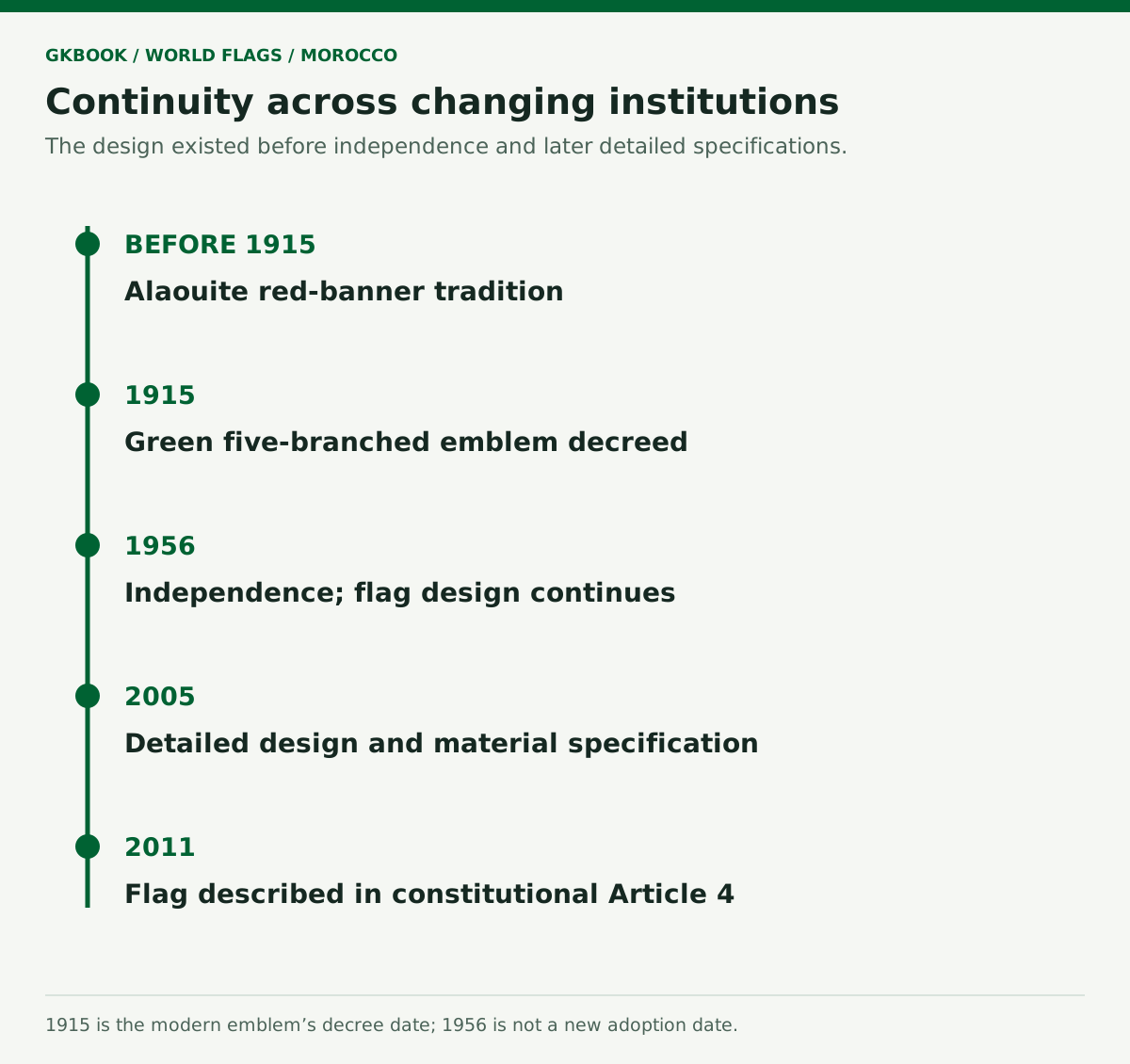
France recognized Moroccan independence in the declaration of March 2, 1956. Morocco’s United Nations admission followed on November 12, 1956. Neither event should replace the 1915 decree date in a flag fact box.
The timeline separates the existing red-banner tradition, the 1915 emblem, independence, the 2005 specification, and the 2011 constitutional provision. This keeps continuity visible without compressing several legal and political changes into one date.
Is the flag’s November anniversary Morocco’s Independence Day?
Morocco’s Independence Day is November 18, whereas the decree adding the star is dated November 17, 1915. The two dates should not be merged. The official national calendar also includes Throne Day on July 30 and the Revolution of the King and the People anniversary on August 20.

The November 18 commemoration is associated with Mohammed V’s historic 1955 speech after returning from exile. The official historical chronology separately records France’s recognition of independence on March 2, 1956.
The diagram shows selected national occasions, not the complete holiday calendar and not a legal instruction that every private building must display a flag on those dates. The sources consulted do not establish November 17 as a separate official national Flag Day.
Which documents define Morocco’s national flag?
Article 4 of the 2011 Constitution identifies Morocco’s emblem as a red flag with a central green five-branched star. The 1915 decree establishes the addition of that emblem, while Dahir no. 1-05-99 of November 23, 2005 supplies the detailed proportions, colors in words, and requirements for the cloth and star.
The Constitution gives the national definition. The later technical text explains how the physical flag is to be formed. Reading them together prevents the short constitutional sentence from being mistaken for a complete manufacturing specification.
The national-symbol provisions in the Penal Code address a different subject: protection and certain uses of the emblem. They should not be confused with the geometric construction rules.
What fabric and manufacturing requirements does the decree give?
The 2005 decree specifies opaque, rectangular, colorfast cloth in vivid red. It describes the palm-green star as continuous, open, woven into the material, and visible on both faces. Those are explicit physical requirements. The cited article does not set a universal fabric weight, a mandatory polyester grade, or a list of approved commercial suppliers.

The French expression grand teint concerns colorfastness. It should not be converted into an invented numerical testing threshold. Likewise, a recommendation for convenient classroom printing is different from conformity for an official textile.
The supplied graphics describe the design for education and digital reproduction. A manufacturer should work from the applicable official requirements and an approved sample, including finishing and procurement instructions for the particular use.
What appears on the reverse side of Morocco’s flag?
The decree requires the green star to be visible on both faces of the flag. Its upright regular pentagram is symmetrical from left to right, so a horizontal mirror image retains the same recognizable shape. The legal requirement for visibility on both sides does not by itself prescribe every possible sewing or printing process.
Front and back are especially easy to confuse when a flag has lettering, an asymmetric badge, or different designs on each face. The standard Moroccan national design has none of those complications.
For the supplied flat geometric illustration, a left-right reflection gives the same design. This mathematical observation does not authorize replacing the decree’s textile requirements with a claim that every one-sided printed banner is compliant.
How should the flag be displayed for educational or formal use?
For an educational display, use the complete red rectangle, the correct proportions, and the upright open star without added lettering or emblems. For a state ceremony, follow the responsible institution’s protocol. The design decree does not supply a complete rulebook for precedence, staff heights, parade order, or every arrangement with foreign flags.
A clear classroom or publication illustration shows the whole flag without cropping away edges or distorting the emblem. Keep labels outside the flag when explaining its parts.
A diplomatic display involves additional decisions, such as which flags appear, their order, and the viewpoint from which positions are described. Those decisions need the host’s instructions; a familiar rule from another country should not automatically be called Moroccan law.
Can Morocco’s flag simply be rotated for a vertical display?
Rotating the horizontal flag by a quarter turn makes the star point sideways. The 2005 text says that one point faces upward, but the sources consulted do not establish a separate official portrait-format construction. For a simple educational image, preserve the standard horizontal flag; formal vertical installations need an authoritative arrangement for that setting.
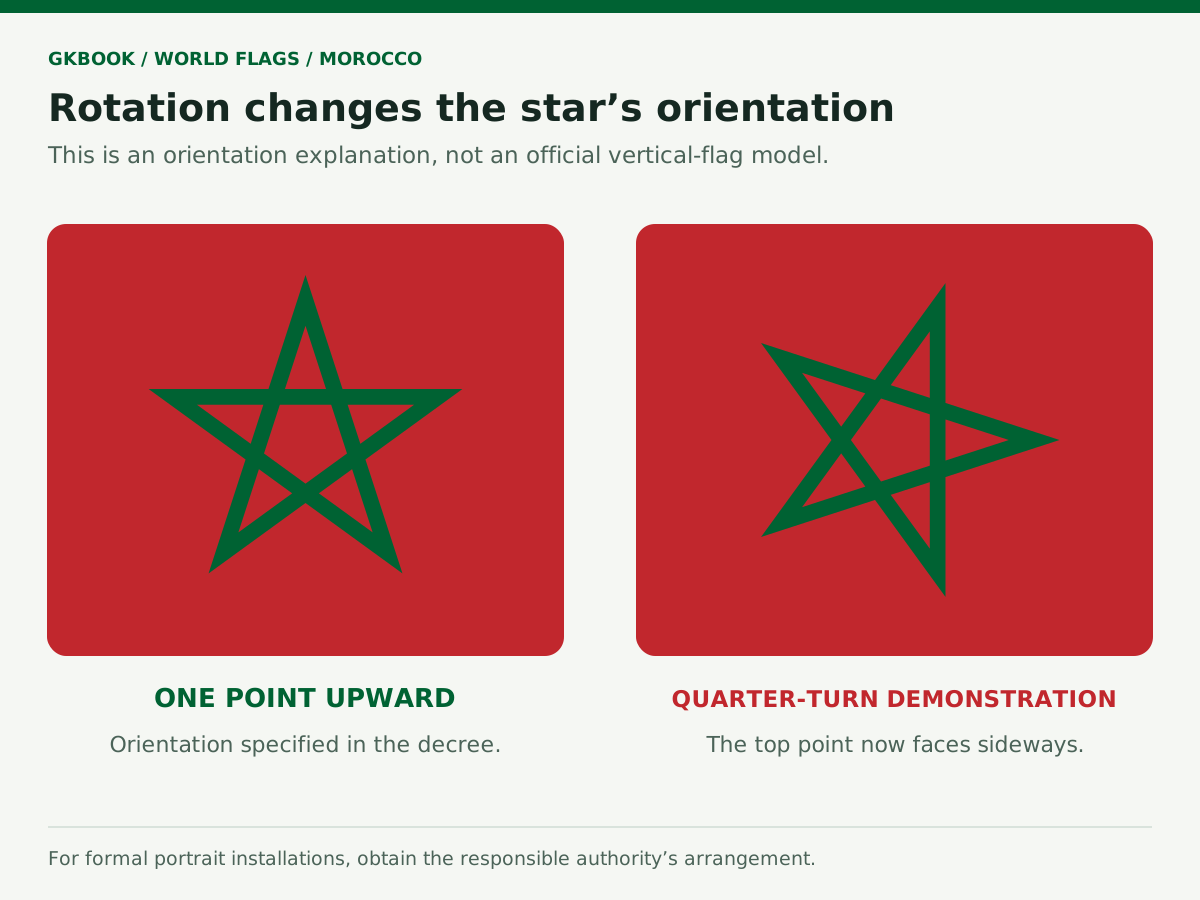
Turning an image, turning the cloth, and producing a specially arranged vertical banner are different operations. A photograph of one installation cannot establish a general construction rule for every use.
The orientation diagram illustrates the effect of rotation on the star only. It does not offer a newly invented vertical Moroccan flag as an official downloadable variant.
Must Morocco’s flag always be lowered at sunset?
The design provisions cited here do not establish a universal sunrise-and-sunset timetable or a nationwide lighting rule for every flag. An institution may have additional instructions for its own premises or ceremony. A general display custom should therefore not be presented as a specific Moroccan legal obligation without the relevant authority.
The distinction is between what a source actually regulates and what a reader might reasonably expect a wider protocol manual to cover. The 2005 article regulates the flag’s form and material.
For an actual installation, obtain instructions from the responsible institution, including safe attachment, maintenance, and any schedule that applies there. This article does not infer a fixed daily ceremony time from the design law.
When is Morocco’s flag flown at half-mast?
Flags may be lowered when an official mourning decision directs it. After the September 2023 earthquake, a royal decision established three days of national mourning with flags at half-mast on public buildings. That documented example shows the practice, but it does not establish one automatic mourning duration or exact staff measurement for every future event.
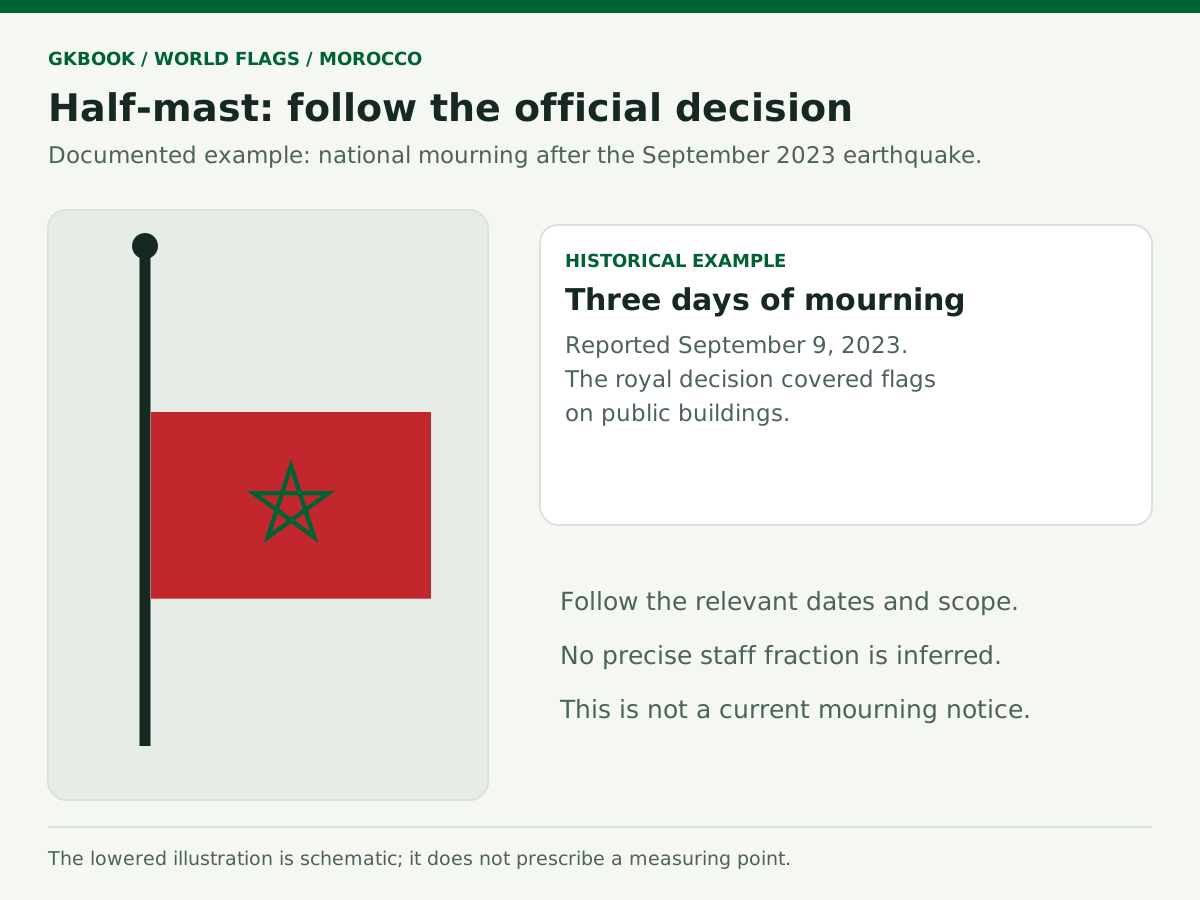
The decision followed the earthquake of September 8, 2023 and was reported on September 9. The illustration is a historical explanation of lowered display, not a notice that mourning is currently in force.
Follow the applicable announcement for the dates, locations, and institutions covered. The cited report does not define whether a particular edge or the cloth’s center must sit at a mathematically specified fraction of the pole.
How should the flag be treated, and can it be used as a logo?
Handle a flag carefully, replace badly damaged display copies, and keep its design recognizable. These are practical care recommendations. Commercial use raises a separate issue: Morocco’s national-symbol provisions address unauthorized use of the emblem as a trademark. Availability of a downloadable illustration does not itself grant permission for every branded product or commercial use.
The legal consolidation consulted also contains provisions protecting national symbols against insult. This article does not reproduce penalty figures or claim that an older consolidated text answers every current legal question.
For a commercial application, check the current rules and the responsible authority. For ordinary learning materials, distinguish an accurate illustration of the flag from a modified corporate logo. The sources reviewed do not prescribe a special national burning or folding ceremony for worn copies.
What is Morocco’s flag emoji?
Morocco’s flag emoji is 🇲🇦. Its sequence combines the regional indicator letters M and A, encoded as U+1F1F2 and U+1F1E6. A device may display the sequence as a flag or as letters, depending on support. The country sequence is standardized; the detailed artwork and shades are supplied by the platform.

Use the letters MA, not MC, ME, or MO, when identifying this sequence. Similar-looking country codes refer to different places.
An emoji is useful in a short message, but it is not a precision flag drawing. Use the SVG or PNG when proportions, the open star, and a consistent palette matter in a teaching resource or publication.
What are the most common mistakes in drawing Morocco’s flag?
Common errors include using a filled or six-pointed star, rotating the top point sideways, stretching the 2:3 rectangle, and making the construction radius one-sixth of the height instead of the length. Other mistakes are treating a web palette as statutory and replacing the 1915 decree date with the 1956 independence date.
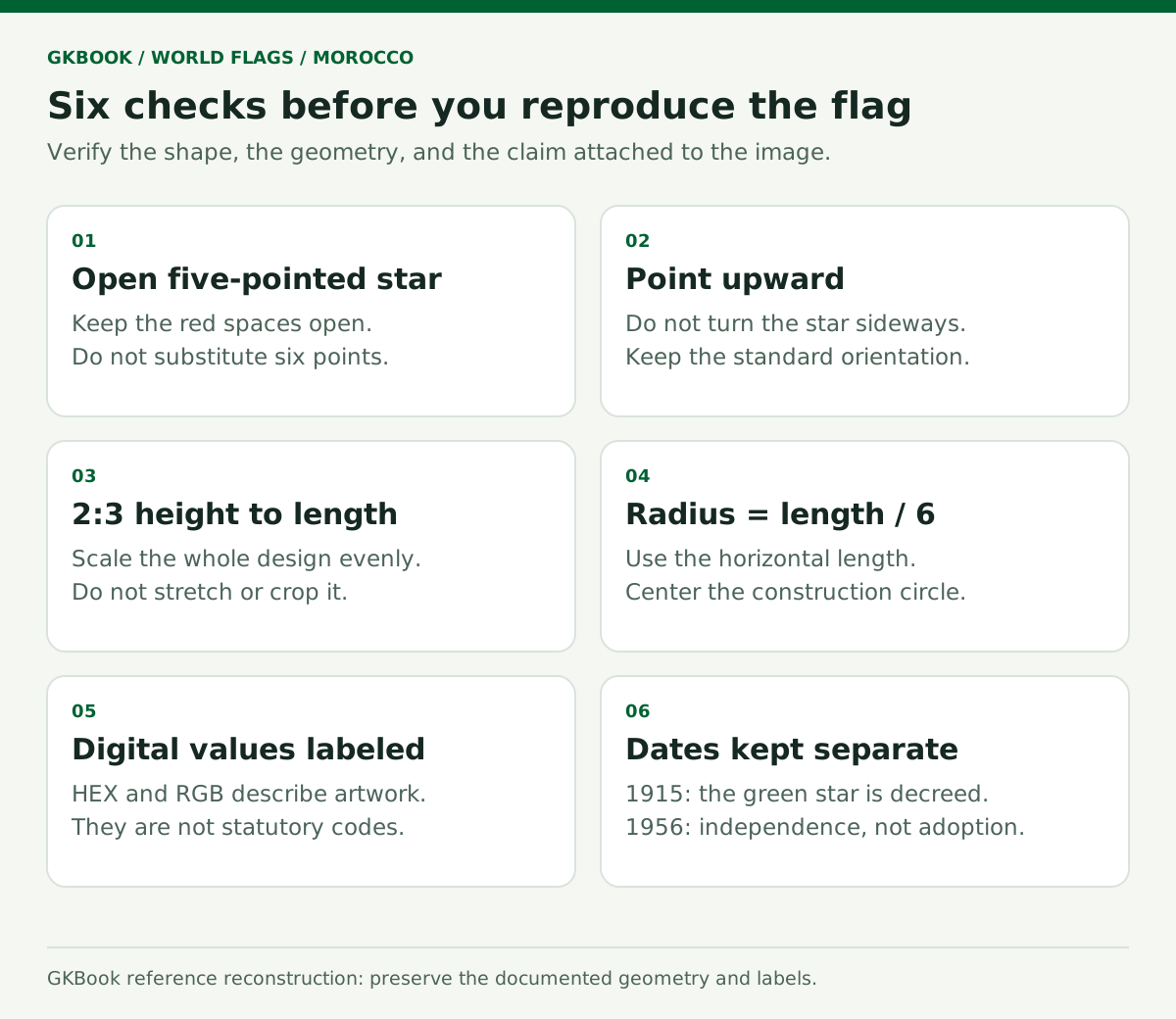
Check the silhouette and the open spaces before comparing small shade differences. Then confirm the ratio, the circle’s center, and the star’s size. Labels, a crown, or a coat of arms belong outside an explanation of the standard national flag.
The downloadable construction diagrams show the geometric checks. The flag files use one consistent reconstruction throughout the article and gallery, with its measurement convention recorded for editors.
Download Morocco flag pictures
Download the national flag as SVG or 4800 × 3200 PNG. The gallery contains 18 subjects, each with SVG and PNG versions. Use the full image and preserve its proportions. Image credits and reconstruction notes accompany the artwork.
Explore more in World Flags, including the Mauritania flag, Monaco flag, and Montenegro flag.
World Flags/Morocco
Morocco flag pictures
The red field and open green star follow the 2:3 design. This is a GKBook reconstruction using the 2005 ratios and a stated branch-measurement convention; the digital colors are reference values.
GKBook; original geometric reference illustrationDownload SVGDownload PNGVivid red and palm green are the legal descriptions. HEX and RGB values identify this package’s illustrations, not enacted color codes.
GKBook; original geometric reference illustrationDownload SVGDownload PNGRed connects with the Alaouite banner tradition; the Five Pillars reading is an established interpretation of the five points, not a per-point statutory legend.
GKBook; original geometric reference illustrationDownload SVGDownload PNGThe enlarged pentagram preserves the crossing green bands and the open red center. It has five outer points and one upward-facing tip.
GKBook; original geometric reference illustrationDownload SVGDownload PNGThe flag has height 2L/3, while the star’s invisible circle has radius L/6. The circle is centered at the intersection of the rectangle’s diagonals.
GKBook; original geometric reference illustrationDownload SVGDownload PNGFive equally spaced points are connected in the order 1–3–5–2–4–1. Numbers and the thin construction path explain the geometry only.
GKBook; original geometric reference illustrationDownload SVGDownload PNGThe decree sets width at one-twentieth of branch length. The drawing makes explicit its outer-tip-to-outer-tip interpretation and keeps the painted tips on the construction circle.
GKBook; original geometric reference illustrationDownload SVGDownload PNGThe circle’s center coincides with the flag’s center. The visible star’s upper and lower extremes have unequal distances from that point.
GKBook; original geometric reference illustrationDownload SVGDownload PNGFour calculated examples preserve 2:3 proportions and the radius L/6. These are educational examples rather than a government procurement schedule.
GKBook; original geometric reference illustrationDownload SVGDownload PNGNovember 17 and 25, 1915 identify different documentary steps; November 23 and December 15, 2005 identify signature and French publication of the detailed decree.
GKBook; original geometric reference illustrationDownload SVGDownload PNGA plain red schematic isolates the addition of the green star. The earlier panel does not assert the dimensions or exact color of every historical banner.
GKBook; original geometric reference illustrationDownload SVGDownload PNGThe timeline separates the red-banner background, the 1915 emblem, the 1956 independence period, the 2005 specification, and Article 4 of the 2011 Constitution.
GKBook; original geometric reference illustrationDownload SVGDownload PNGJuly 30, August 20, and November 18 are selected official calendar occasions. Independence Day must not be merged with the November 17 flag-decree anniversary.
GKBook; original geometric reference illustrationDownload SVGDownload PNGThe star must be open, integrated into the fabric, upright, and visible on both faces. The flat geometric design is symmetric left to right.
GKBook; original geometric reference illustrationDownload SVGDownload PNGA quarter turn moves the upward point sideways. The panels show star orientation only and do not claim an official portrait-format flag specification.
GKBook; original geometric reference illustrationDownload SVGDownload PNGFlags were ordered lowered on public buildings during three days of national mourning after the 2023 earthquake. The lowered position is schematic.
GKBook; original geometric reference illustrationDownload SVGDownload PNGMorocco uses regional indicators M and A: U+1F1F2 U+1F1E6. A platform determines how that sequence is displayed.
GKBook; original geometric reference illustrationDownload SVGDownload PNGSix checks cover the open five-pointed star, orientation, 2:3 ratio, length-based radius, color-code status, and distinct historical dates.
GKBook; original geometric reference illustrationDownload SVGDownload PNGFrequently asked questions
What does Morocco’s national flag look like?
Morocco’s national flag is a red rectangle with a centered green pentagram, an open five-pointed star with one tip pointing upward. Its height-to-length ratio is 2:3. The modern emblem was introduced by a decree dated November 17, 1915; a 2005 decree gives detailed specifications for the design and cloth.
What are the official colors of Morocco’s flag?
Morocco’s national flag has a vivid red field and a palm-green star. Those are the color descriptions in the 2005 royal decree. The law defines the appearance in words; the cited text does not provide numerical HEX, RGB, CMYK, or Pantone specifications for the two colors.
What HEX and RGB values do these Morocco flag images use?
The downloadable GKBook illustrations use red #C1272D, equivalent to RGB 193, 39, 45, and green #006233, equivalent to RGB 0, 98, 51. These are familiar digital reference values. They identify this package’s artwork and should not be presented as numerical color specifications enacted by Morocco’s flag decree.
Why is the background of Morocco’s flag red?
Red connects Morocco’s flag with the historical banner tradition of the Alaouite dynasty. An institutional account of research presented at Morocco’s Royal Institute for Research in Moroccan History identifies red with Alaouite political power. That historical association is better documented than assigning one compulsory modern meaning to every color.
What does the green star on Morocco’s flag mean?
The green star is associated with Islam, and its five points are commonly interpreted as representing the Five Pillars of Islam. This is an established symbolic reading, found in government reference material and Moroccan commentary. The flag’s legal description specifies a green five-branched star without assigning a separate meaning to each point.
Why is Morocco’s star called the Seal of Solomon?
The 1915 decree calls the added emblem a five-branched Seal of Solomon. On Morocco’s flag, that means a green pentagram: a continuous, crossing five-pointed star with open red spaces inside it. The national emblem has five points, so a six-pointed star is not an interchangeable substitute.
Does Morocco’s national flag include a motto or coat of arms?
The standard national flag consists of the red field and green star; it does not include the national motto, a crown, or the full royal coat of arms. Article 4 of the Constitution states the flag’s design and the kingdom’s motto separately. Adding those other symbols changes the standard flag image.
What are the proportions of Morocco’s flag?
Morocco’s national flag has a height-to-length ratio of 2:3. Expressed with the horizontal length first, the same proportion is 3:2. A flag 120 centimeters long is therefore 80 centimeters high. The whole rectangular field follows this ratio, including the area behind the central star.
How large is the star on Morocco’s flag?
The 2005 decree places the star within an invisible circle whose radius equals one-sixth of the flag’s horizontal length. The circle is centered where the rectangle’s diagonals meet. Because the flag is 2:3, that radius also equals one-quarter of its height; the circle’s diameter equals half the height.
How is the five-pointed star constructed?
A regular pentagram can be constructed by placing five equally spaced points around a circle and joining every second point. Start with one point at the top. The resulting continuous path crosses itself and leaves an open central pentagon. For Morocco’s flag, the completed green bands must preserve those open spaces.
How thick should the branches of the star be?
The 2005 decree states that each star branch has a width equal to one-twentieth of its length. This proportion concerns the branch, not the whole flag. In the GKBook reconstruction, a branch is measured between its two outer tips, and the green band’s thickness is measured perpendicular to that branch.
How is the star centered correctly?
The flag’s center is the center of the star’s construction circle, located at the intersection of the rectangle’s diagonals. It is not the midpoint of the star’s highest and lowest painted points. An upright five-pointed star is not vertically symmetrical, so those two centering methods produce different results.
How can Morocco’s flag be scaled to different sizes?
Scale the entire design uniformly while retaining its 2:3 height-to-length ratio and the star’s relative measurements. For any chosen horizontal length L, use height 2L/3 and construction-circle radius L/6. These formulas generate consistent sizes without inventing a compulsory list of standard dimensions in centimeters or pixels.
When was Morocco’s current flag adopted?
The decree introducing the green five-pointed emblem is dated November 17, 1915, under Sultan Moulay Youssef. This is the documented decree date associated with the modern red-and-green design. It should be distinguished from later execution and publication steps, the 2005 technical specification, and Morocco’s recovery of independence in 1956.
Why do different dates appear in accounts of the flag?
Several dates describe different events. November 17, 1915 is the date of the decree adding the star; its French text also carries a November 25 execution endorsement. November 23, 2005 is the later specification decree’s date, while December 15, 2005 is its publication date in the French Official Bulletin.
Why was the green star added in 1915?
The 1915 decree explains that Morocco needed an emblem distinguishable from other nations’ flags. It says the inherited flag could be confused with other flags, particularly maritime signals. The addition of a central green five-branched Seal of Solomon supplied a distinctive identifying feature while retaining the established red field.
What flags did Morocco use before the modern design?
Morocco’s earlier flag history includes dynastic, military, religious, and local banners rather than one continuously standardized national design. The Alaouite red-banner tradition is the immediate background to the modern flag. A plain red field is therefore a useful historical comparison, provided it is identified as a schematic illustration rather than a surviving textile.
Who designed Morocco’s flag?
The securely documented attribution is to Sultan Moulay Youssef as the sovereign who issued the 1915 decree adding the green star. That does not establish who personally drew every line of the emblem. The cited primary record does not identify a separate graphic designer, so a sole artist’s name should not be asserted as fact.
Was Morocco’s flag introduced at independence in 1956?
No. The decree adding the green star dates from 1915, before Morocco recovered independence in 1956. The red-and-green emblem continued into the independent state. Its significance developed through national political life, but a new state of independence and the first legal introduction of a flag are different historical events.
Is the flag’s November anniversary Morocco’s Independence Day?
Morocco’s Independence Day is November 18, whereas the decree adding the star is dated November 17, 1915. The two dates should not be merged. The official national calendar also includes Throne Day on July 30 and the Revolution of the King and the People anniversary on August 20.
Which documents define Morocco’s national flag?
Article 4 of the 2011 Constitution identifies Morocco’s emblem as a red flag with a central green five-branched star. The 1915 decree establishes the addition of that emblem, while Dahir no. 1-05-99 of November 23, 2005 supplies the detailed proportions, colors in words, and requirements for the cloth and star.
What fabric and manufacturing requirements does the decree give?
The 2005 decree specifies opaque, rectangular, colorfast cloth in vivid red. It describes the palm-green star as continuous, open, woven into the material, and visible on both faces. Those are explicit physical requirements. The cited article does not set a universal fabric weight, a mandatory polyester grade, or a list of approved commercial suppliers.
What appears on the reverse side of Morocco’s flag?
The decree requires the green star to be visible on both faces of the flag. Its upright regular pentagram is symmetrical from left to right, so a horizontal mirror image retains the same recognizable shape. The legal requirement for visibility on both sides does not by itself prescribe every possible sewing or printing process.
How should the flag be displayed for educational or formal use?
For an educational display, use the complete red rectangle, the correct proportions, and the upright open star without added lettering or emblems. For a state ceremony, follow the responsible institution’s protocol. The design decree does not supply a complete rulebook for precedence, staff heights, parade order, or every arrangement with foreign flags.
Can Morocco’s flag simply be rotated for a vertical display?
Rotating the horizontal flag by a quarter turn makes the star point sideways. The 2005 text says that one point faces upward, but the sources consulted do not establish a separate official portrait-format construction. For a simple educational image, preserve the standard horizontal flag; formal vertical installations need an authoritative arrangement for that setting.
Must Morocco’s flag always be lowered at sunset?
The design provisions cited here do not establish a universal sunrise-and-sunset timetable or a nationwide lighting rule for every flag. An institution may have additional instructions for its own premises or ceremony. A general display custom should therefore not be presented as a specific Moroccan legal obligation without the relevant authority.
When is Morocco’s flag flown at half-mast?
Flags may be lowered when an official mourning decision directs it. After the September 2023 earthquake, a royal decision established three days of national mourning with flags at half-mast on public buildings. That documented example shows the practice, but it does not establish one automatic mourning duration or exact staff measurement for every future event.
How should the flag be treated, and can it be used as a logo?
Handle a flag carefully, replace badly damaged display copies, and keep its design recognizable. These are practical care recommendations. Commercial use raises a separate issue: Morocco’s national-symbol provisions address unauthorized use of the emblem as a trademark. Availability of a downloadable illustration does not itself grant permission for every branded product or commercial use.
What is Morocco’s flag emoji?
Morocco’s flag emoji is 🇲🇦. Its sequence combines the regional indicator letters M and A, encoded as U+1F1F2 and U+1F1E6. A device may display the sequence as a flag or as letters, depending on support. The country sequence is standardized; the detailed artwork and shades are supplied by the platform.
What are the most common mistakes in drawing Morocco’s flag?
Common errors include using a filled or six-pointed star, rotating the top point sideways, stretching the 2:3 rectangle, and making the construction radius one-sixth of the height instead of the length. Other mistakes are treating a web palette as statutory and replacing the 1915 decree date with the 1956 independence date.
Explore all general-knowledge topics and the A-to-Z lists.





We Value Your Opinion Comments