

Qatar flag picture
Explore the proportions, history, and picture gallery.
| Design | Maroon and whiteNine white triangular points; no emblem or inscription. |
|---|---|
| Outdoor proportion | Height:length = 11:28Specified for outdoor use within Qatar. |
| Other contexts | 1:2 indoors within QatarAbroad: local specifications and annex construction figures. |
| Color reference | Pantone 1955 CMOFA digital drawing: maroon #8A1538 and white #FFFFFF. |
| Present design | 1960Independence followed in 1971; flag law issued in 2012. |
| Image basis | Foreign Ministry web illustrationSVG: 2,520 × 990; PNG: 5,040 × 1,980. |
What does the Qatar flag look like?
Qatar’s national flag combines a white hoist band with a maroon field. Nine white triangular points project into the maroon along their shared boundary. The familiar elongated version has height:length proportions of 11:28, specified for outdoor use within Qatar. Its ordinary national design contains no lettering, stars, or coat of arms.
This guide connects the flag’s appearance with its history and different display proportions. The gallery pairs a clean reference with labeled diagrams; the answers distinguish construction, attributed symbolism, and the dates of design, independence, and legislation.
What are the colors of the Qatar flag?
The Qatar flag is maroon and white. The Foreign Ministry identifies the maroon as Pantone 1955 C, while its embedded flag drawing uses #8A1538. That digital value corresponds to RGB 138, 21, 56. The supplied pictures use this maroon with #FFFFFF white, keeping screen values separate from physical production standards.

A color name, a spot-color reference, and an RGB triplet describe related things through different systems. Pantone provides a production reference; an RGB value tells a screen how to combine light. The government brand palette also lists #8A1538. Neither a screenshot nor an ordinary office print proves that a fabric sample meets a specification.
For a classroom slide or web illustration, use the supplied colors consistently and keep the white area opaque. Transparent white can disappear against a colored page and alter the apparent flag. When comparing photographs, allow for exposure, lighting, and camera processing before deciding that a differently photographed maroon represents a different historical design.
| Color | HEX | RGB | Reference |
|---|---|---|---|
| Maroon | #8A1538 | 138, 21, 56 | MOFA drawing; Pantone 1955 C named in text |
| White | #FFFFFF | 255, 255, 255 | MOFA drawing |
Why is the Qatar flag maroon?
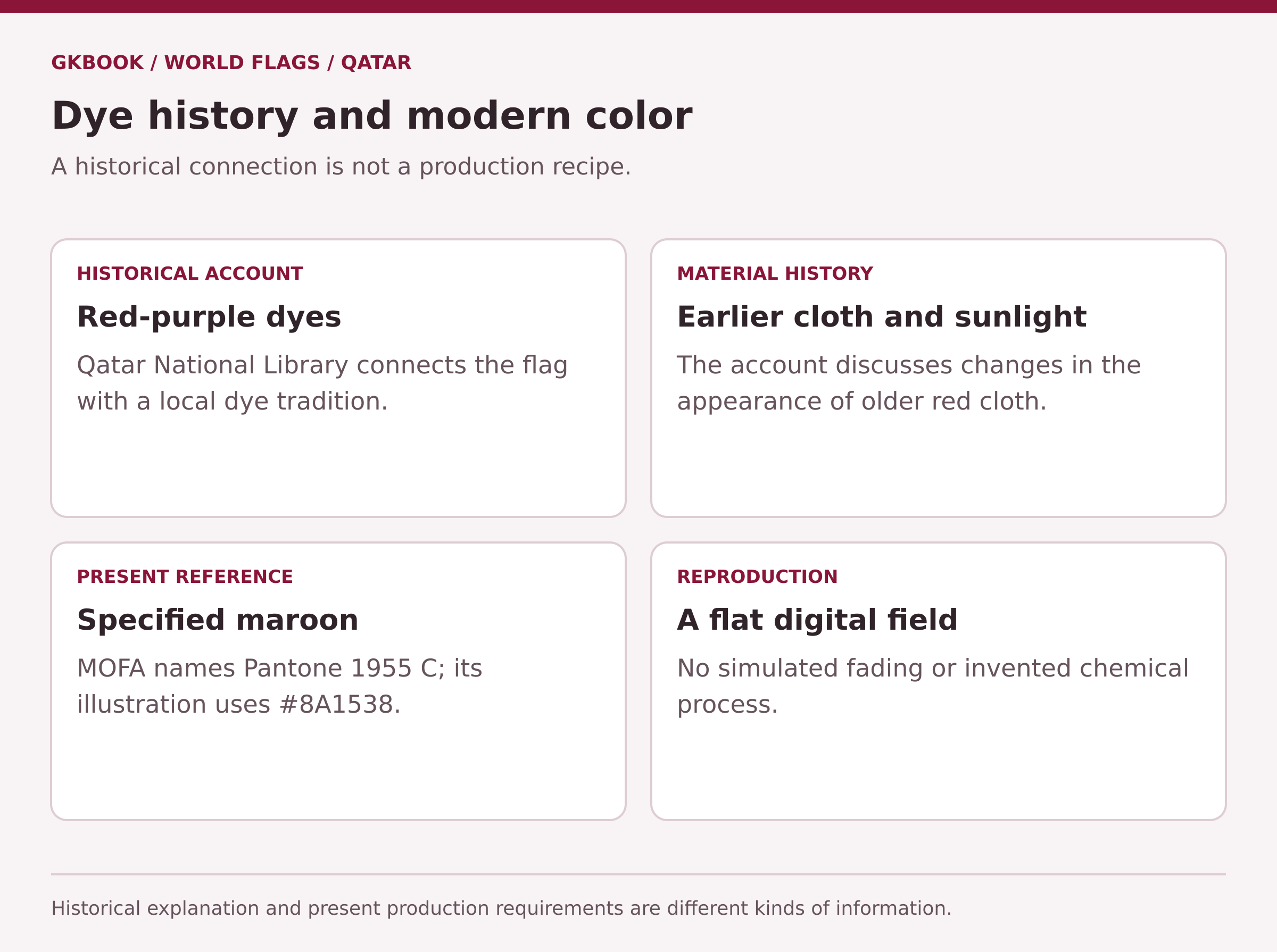
Maroon is a defining feature of Qatar’s flag and its national visual identity. Qatar National Library connects it with the country’s historical dye tradition and the darkening of earlier red cloth. The modern flag uses a specified maroon; its appearance should not be recreated by deliberately fading or weathering red material.

The distinction between a historical explanation and a present specification is essential. A story about old dyes can help explain the persistence of a color preference, but it is not a recipe for producing a contemporary flag. Today’s flat digital illustration begins with the published maroon value and retains that value throughout the field.
The gallery therefore shows a solid swatch beside the finished flag. It does not simulate stained cloth or give an arbitrary gradient the status of a national color. The history of materials belongs in the explanation beside the image; the clean reference picture provides a stable shape and palette for comparison.
What does the white on Qatar’s flag mean?
The Interior Ministry associates white with peace and maroon with blood shed in past wars. Qatar National Library explicitly disputes that familiar explanation and emphasizes the flag’s dye history. These institutional accounts differ, so the symbolism should be attributed to its source rather than presented as one uncontested explanation of the colors.

A useful caption can say that the Interior Ministry gives a peace interpretation, while a longer article explains the National Library’s different account. Combining the two into an invented official consensus would conceal the disagreement. The present design remains readily identifiable regardless of which historical or symbolic account a reader is discussing.
White also has a precise visual role: it occupies the hoist side and forms the nine points. That observable feature does not depend on an interpretation. In an explanatory diagram, place labels outside the colored rectangle so that an educational sentence about peace does not become an added inscription on the flag.
How many points are on the Qatar flag?
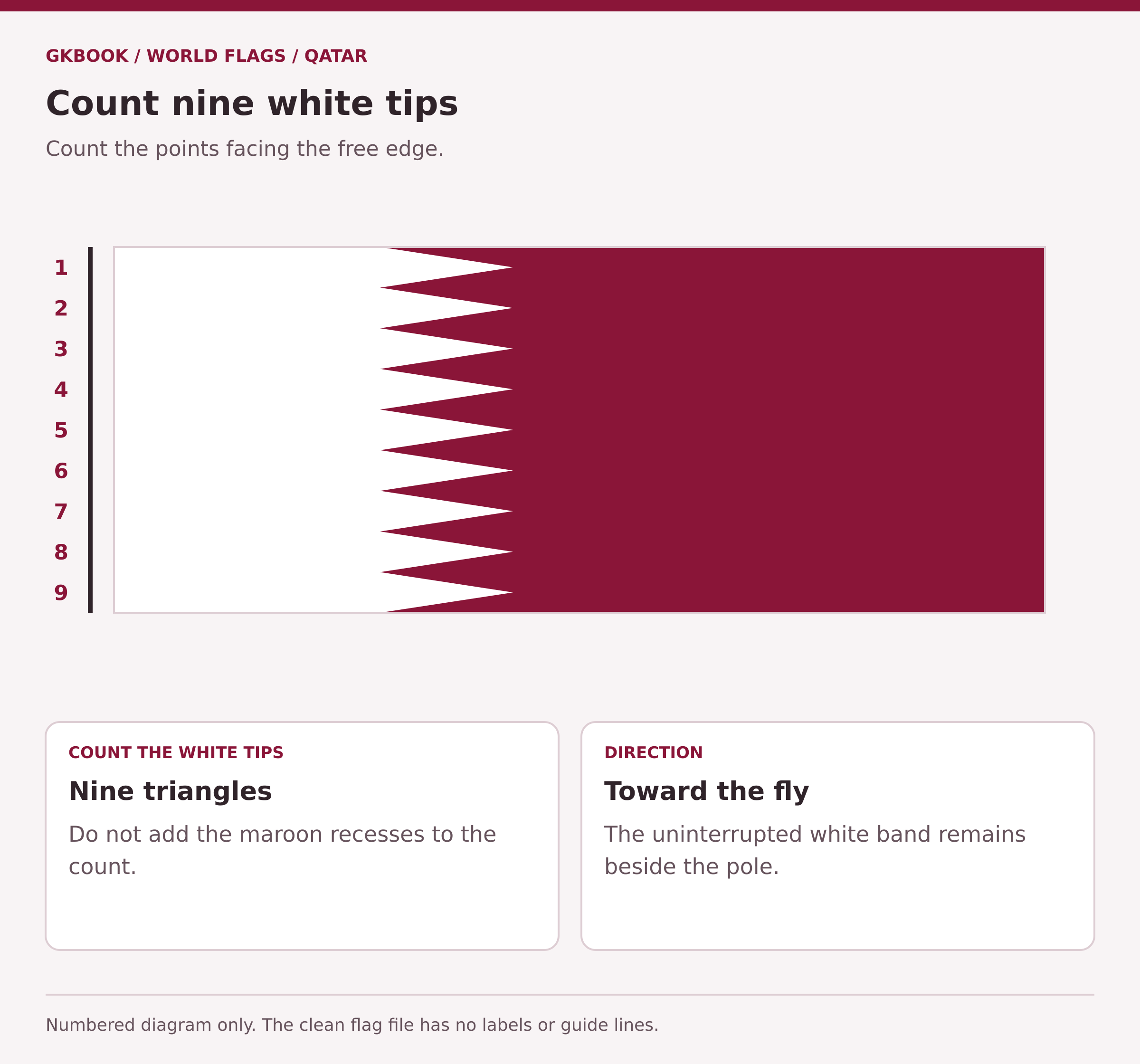
The Qatar flag has nine white triangular points extending into the maroon field. Count the tips pointing toward the free edge, from top to bottom. The maroon recesses between them are the complementary spaces along the same boundary; counting both colors’ corners together gives the wrong number for the flag’s defining feature.
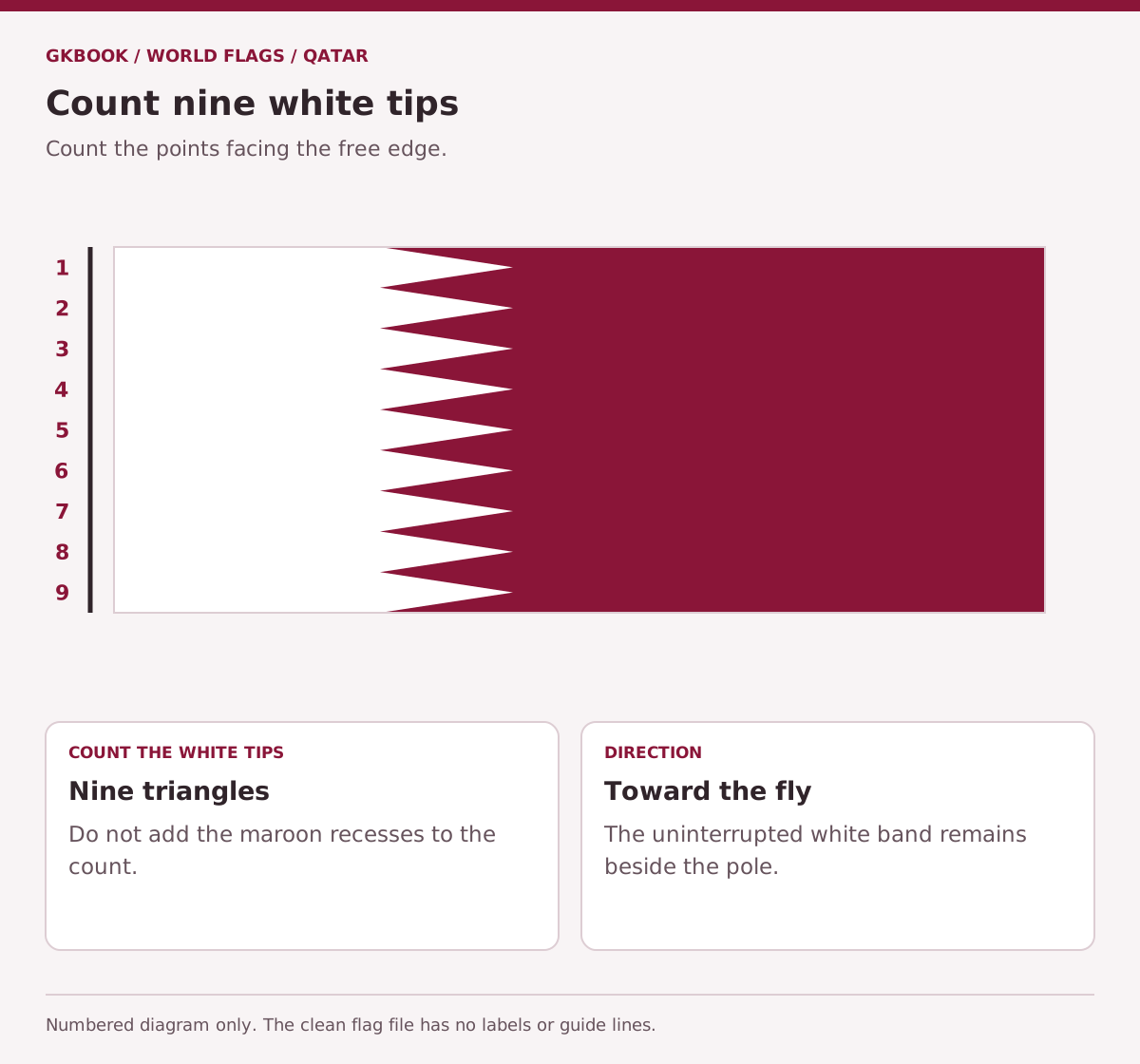
Each white point belongs to a triangle with a vertical base and two equal sloping sides. The first begins at the top edge and the ninth ends at the bottom edge. Numbering their centers from one to nine makes the pattern easier to inspect than counting every turn in the zigzag line.
At a very small display size, several points may blur together. Enlarge the SVG or use the larger PNG for a counting activity. The labeled picture uses a larger flag and keeps its numerals outside the fabric boundary. The clean download contains neither numbers nor extra guide lines, so it remains suitable as a reference image.
What do the nine points on Qatar’s flag represent?
Official Qatari explanations associate the nine points with Qatar’s place as the ninth member in a historical Gulf treaty grouping following its 1916 agreement with Britain. This is a historical interpretation of the serration. The points do not represent nine present-day Qatari districts, nine rulers, or membership in today’s United Arab Emirates.

The wording varies between institutional accounts, including references to reconciled emirates or the Trucial Coast. Those historical expressions need their period context. They should not be converted into a modern administrative map or a claim that Qatar is part of another contemporary country. A short caption can retain the treaty association without inventing a numbered list.
Separate the number from the detailed chronology of the drawing. Nine is directly specified in the current description, while historical accounts explain why that number was selected. The diagram pairs the visible count with the year 1916 as an interpretive reference; it does not label the modern artwork as a surviving flag made in that year.
What is the Qatar flag’s ratio?
The elongated Qatar flag has a height:length ratio of 11:28, making its length about 2.545 times its height. Annex 1 of the flag law specifies this format for outdoor use within Qatar. It should not be described as the only permitted proportion in every indoor, international, or ceremonial setting.
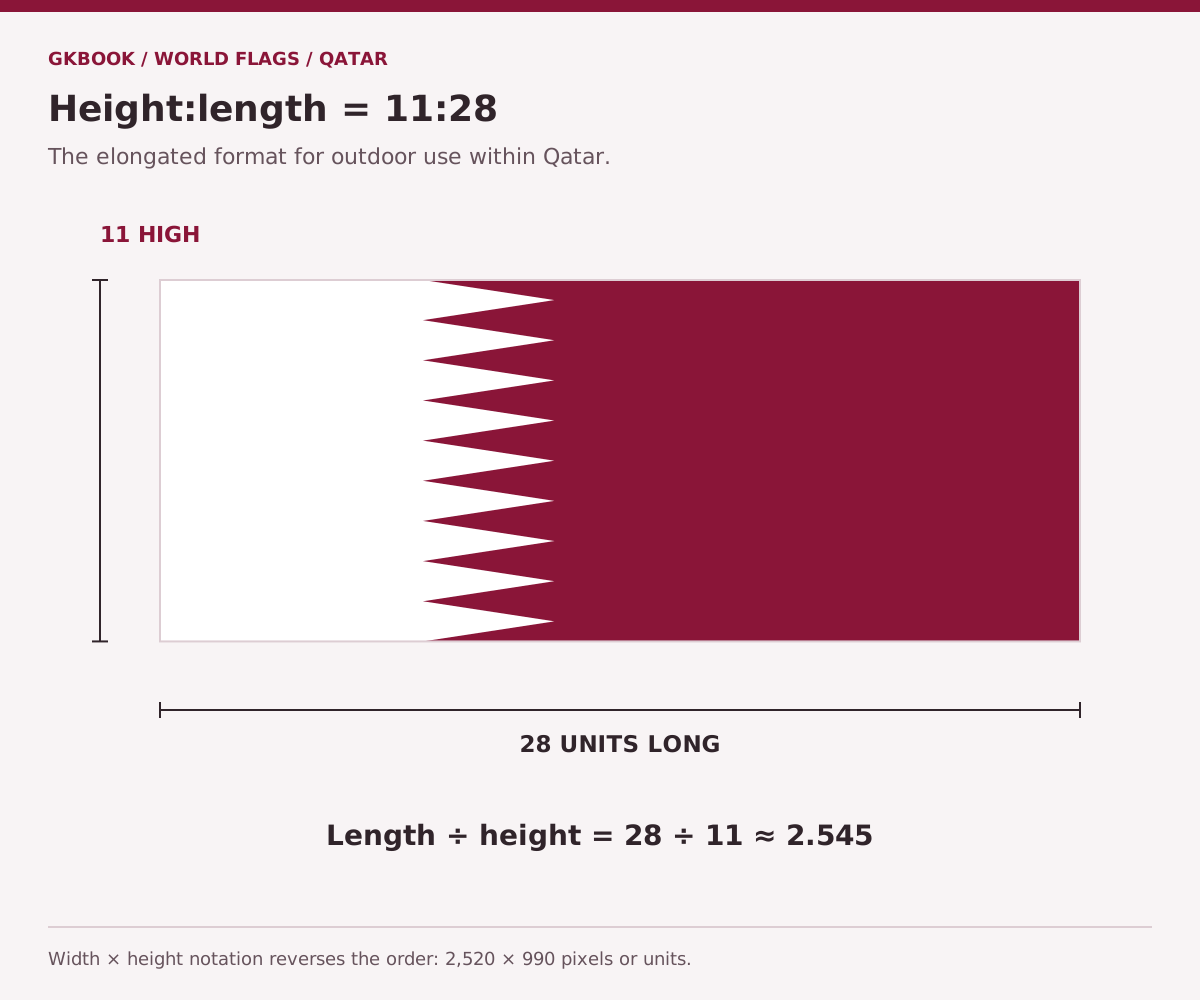
Write the order of the measurements beside the numbers. Height:length equals 11:28, while a digital file’s dimensions are usually written width × height. Thus a 2,520 × 990 image has the correct elongated shape even though its larger number appears first. The two notations describe the same rectangle from different starting conventions.
Measure only the flag itself. A surrounding white page, a caption strip, or the flagpole is not part of the ratio. The explanatory diagrams deliberately use taller canvases to leave room for labels. Their internal flags preserve the chosen ratio, while the separate social card follows the dimensions of a sharing image.
Are Qatar’s indoor and outdoor flags the same shape?
The law’s annex distinguishes contexts: within Qatar, the outdoor format is 11:28 and the indoor format is 1:2, both stated here as height:length. For use abroad, it refers to local specifications and its associated construction figures. The main download illustrates the elongated outdoor format, rather than claiming to cover every prescribed setting.
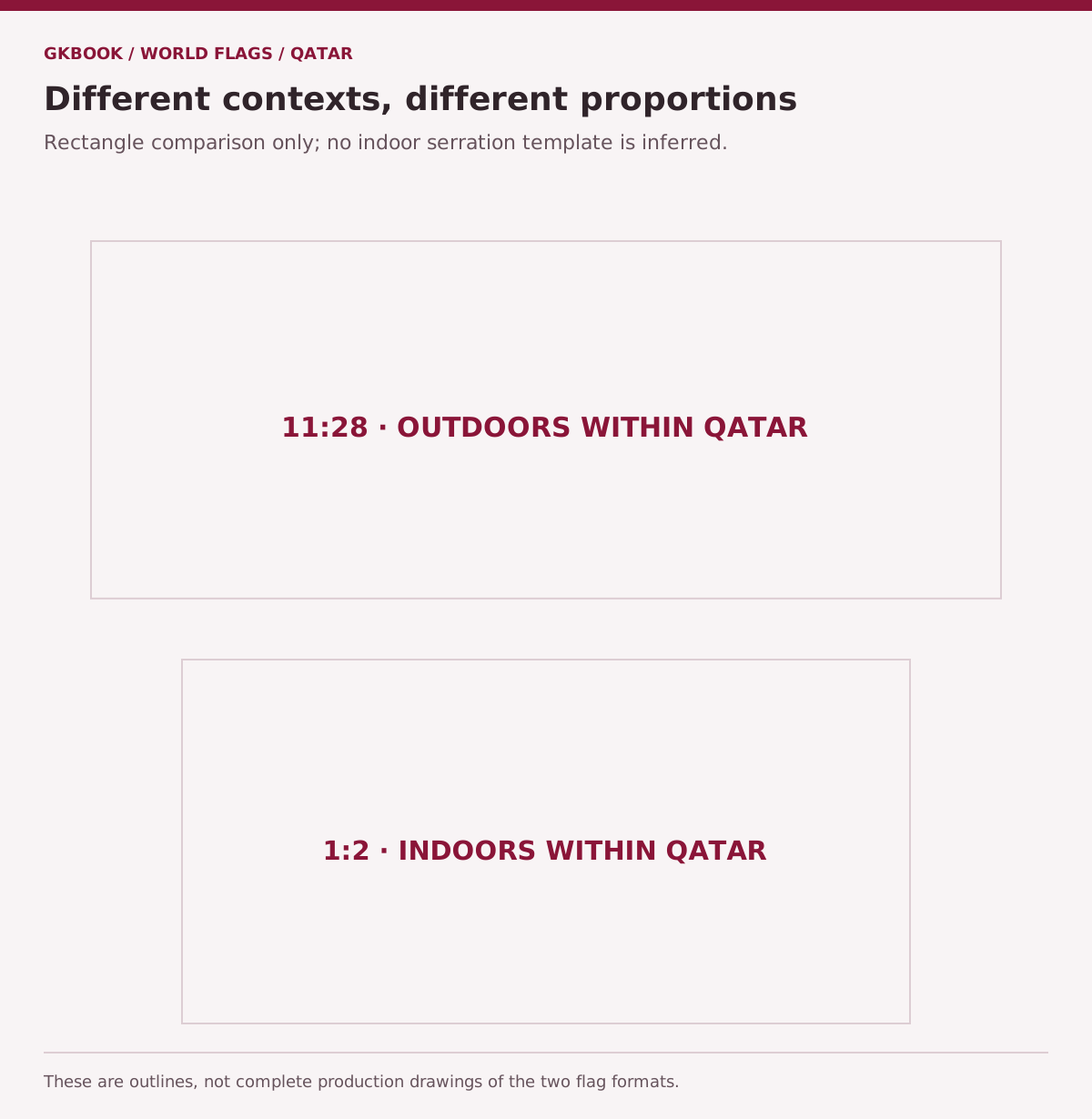
A shorter-looking Qatar flag in an official indoor photograph is therefore not automatically an error. Context matters before measuring it, and perspective can introduce additional distortion. The comparison diagram shows the two rectangle proportions only. It does not stretch the outdoor serration into an indoor manufacturing template whose detailed annex figure has not been inspected.
For international ceremonies, the host’s arrangements and the applicable official guidance belong together. A collection of equally sized flag illustrations may serve a page layout without documenting a protocol standard. Keep the country label and the context visible whenever a different proportion is discussed, so readers understand what the comparison establishes.
| Context | Height:length | What this package provides |
|---|---|---|
| Outdoors within Qatar | 11:28 | Main flag illustration |
| Indoors within Qatar | 1:2 | Rectangle comparison only |
| Outside Qatar | Local specifications; annex figures apply | No universal alternative asserted |
How wide is the white part of the Qatar flag?
This reproduction follows the Foreign Ministry’s online drawing: on its 1,400 × 550 canvas, white triangle bases lie at x = 400 and tips at x = 600. Those are measurements of that published illustration. They are not presented as independently verified dimensions from the law’s unavailable construction figures.
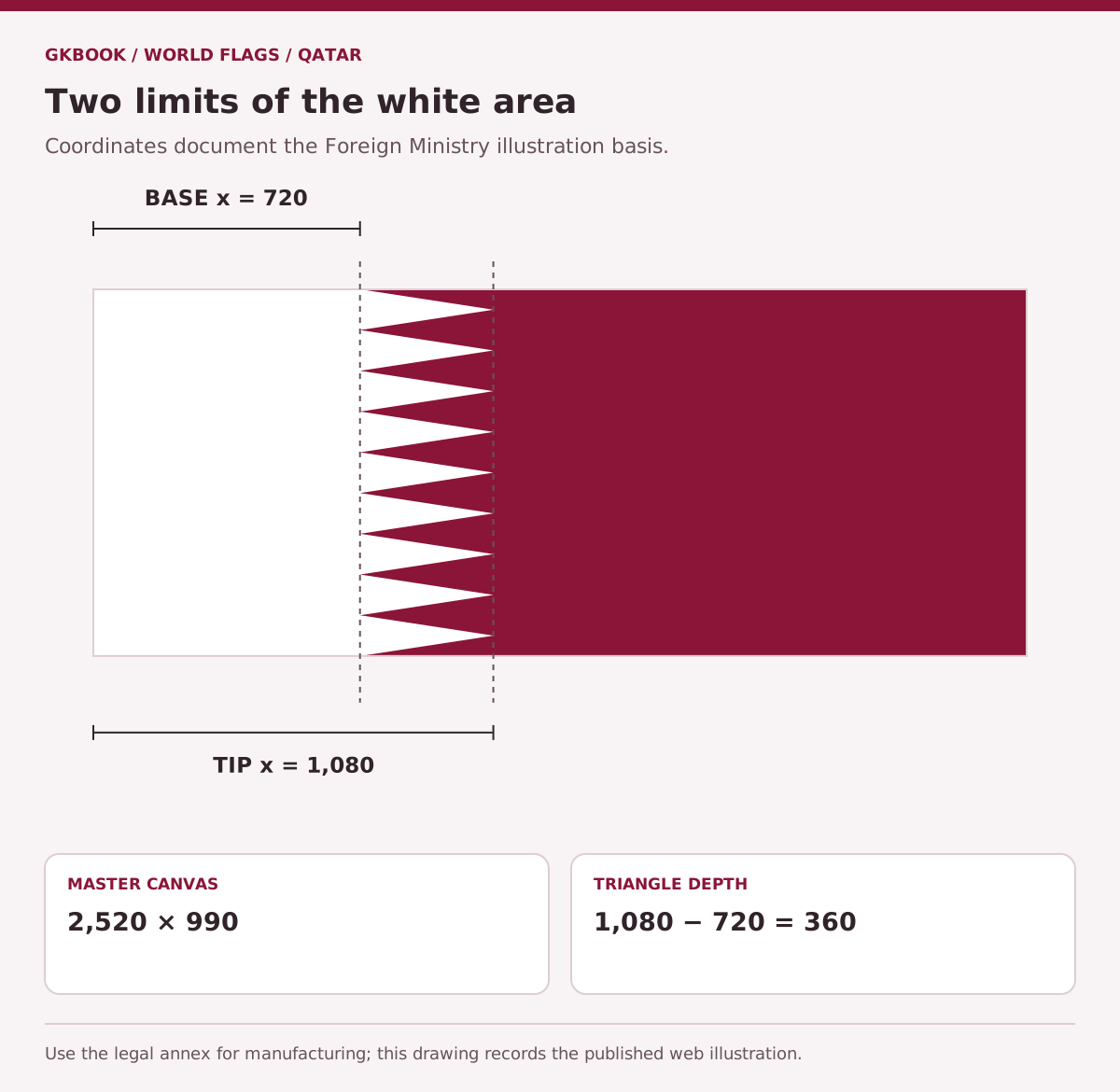
The white area has two useful horizontal measurements because its boundary zigzags. The distance to the bases describes the uninterrupted white band; the distance to the tips describes its greatest reach. A single phrase such as one-third white cannot identify both positions. The field diagram labels the two limits separately and keeps their reference clear.
Our master scales the ministry’s drawing uniformly to 2,520 × 990 units. The base line becomes x = 720 and the tip line x = 1,080. This makes each triangle’s vertical base exactly 110 units. These values document a reproducible digital illustration; they do not replace the annex’s separate manufacturing and material requirements.
Are the Qatar flag’s triangles equilateral?
The Foreign Ministry describes the nine triangles as isosceles, meaning that each has two equal sides. It does not call them equilateral. In this reproduction, each triangle has a vertical base of 110 units and a horizontal depth of 360 units, following the ministry’s illustration scaled to a 2,520 × 990 canvas.
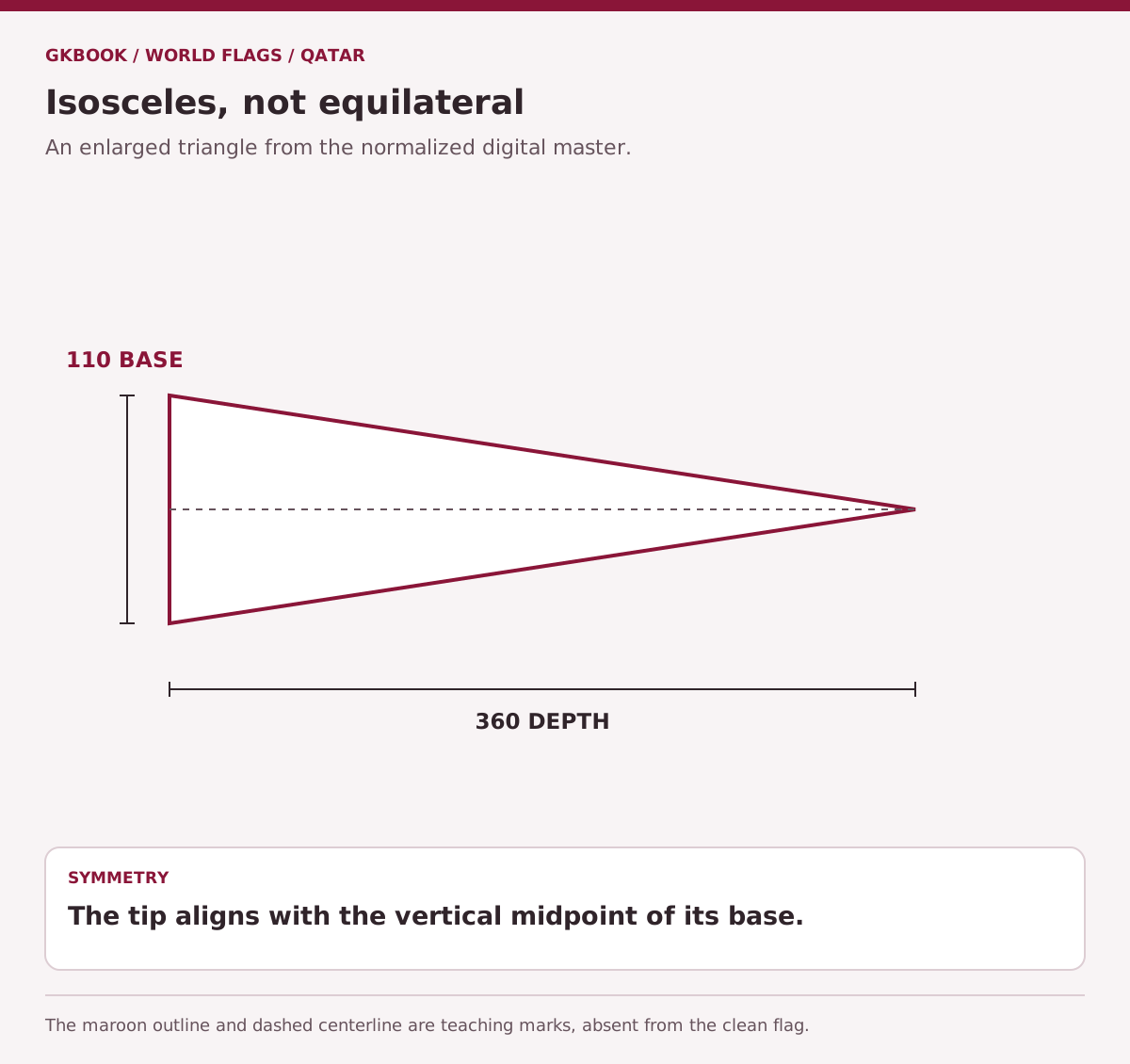
An equilateral triangle would have three equal sides and a very different depth for the same vertical base. Substituting that familiar geometric shape would visibly change the serration. The correct construction for this particular reference places each tip at the vertical midpoint of its two base endpoints, ensuring that the upper and lower slopes are equal in length.
The original webpage rounds each half-step to 30.5556 units. Repeating that rounded number produces a tiny cumulative discrepancy. Our drawing instead divides the complete height into eighteen exact half-steps, then scales to integer coordinates. The adjustment preserves equal spacing and closes the final triangle precisely at the bottom edge.
How can you draw the Qatar flag accurately?
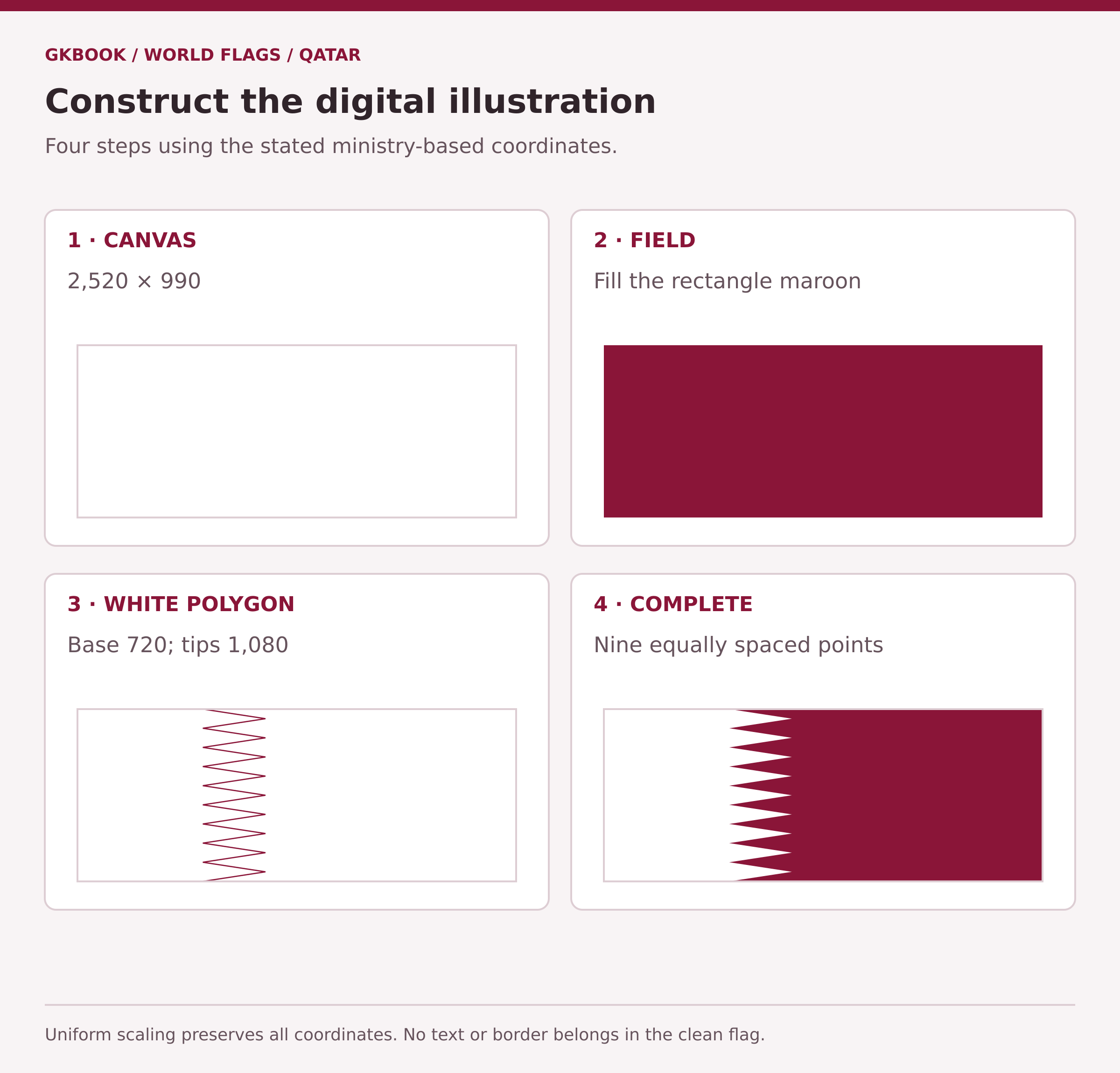
Start with an 11:28 rectangle for the outdoor illustration. Fill it maroon, then draw the white hoist area with nine evenly spaced points. For this ministry-based master, use width 2,520, height 990, a base line at x = 720, and a tip line at x = 1,080. Keep all explanatory labels outside.
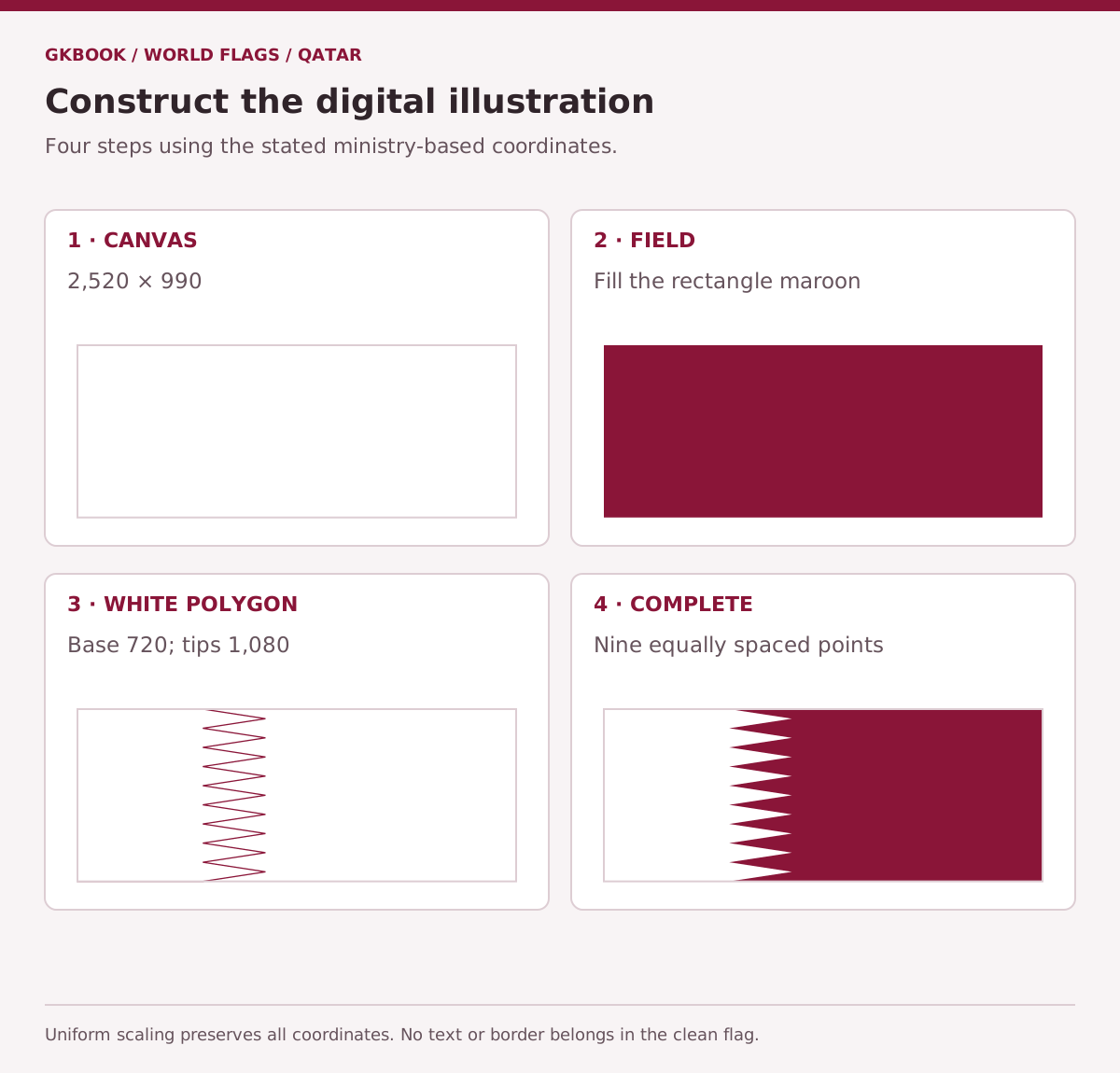
Mark eighteen equal vertical intervals of 55 units. Begin at the upper base position, move to the first tip one interval down, and return to the base line after the next interval. Repeat this alternating sequence nine times. Finish along the lower edge and return up the hoist to close the white polygon.
This coordinate method produces one continuous boundary with no gaps between adjacent triangles. The supplied construction stages are teaching diagrams, while the finished reference image contains only the two filled shapes. Uniform resizing preserves the complete construction.
How did Qatar’s flag develop?
Official accounts trace a maroon banner tradition to the nineteenth century, describe a nine-point design with additional decoration in 1932, and date the present simplified appearance to 1960. Independence followed in 1971. The 2012 flag law later specified the national symbol’s technical requirements and treatment, rather than creating its familiar appearance from nothing.

These milestones answer different questions: the earlier banner concerns historical identity, the 1932 account concerns a decorated design, and 1960 concerns the removal of lettering and diamonds. The political event of independence belongs in the timeline without being substituted for the date of every visual change. A legal standard can also arrive after a design is established.
The gallery uses labeled milestones rather than invented photographs of old cloth. No historical flag is reconstructed from a brief verbal description alone. This keeps a general chronology useful without suggesting that an illustration proves the exact fabric, dimensions, lettering style, or shade used at every stage of Qatar’s history.
When was the present Qatar flag adopted?
The Amiri Diwan and Qatar National Library date the present simplified flag design to 1960. Qatar became independent in 1971, and Law No. 14 was issued in 2012. A careful adoption caption distinguishes the established design from independence and later legal standardization instead of assigning all three events to one date.
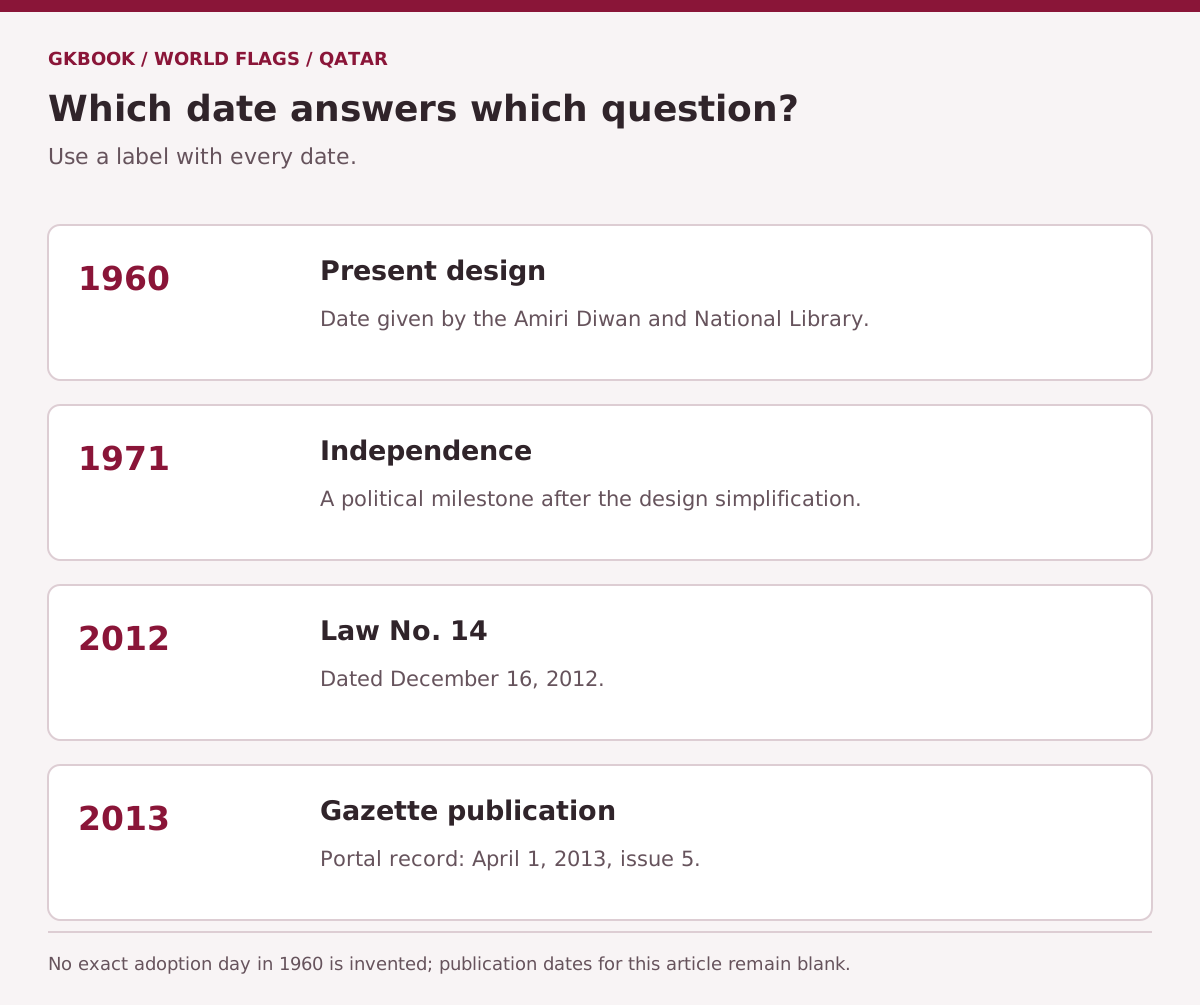
A reference entry that lists only 1971 may be describing the flag of the independent state. That does not erase the earlier design history given by Qatari institutions. For this article, the concise fact is present design: 1960. The surrounding explanation records independence separately and avoids inventing an exact day for the 1960 change.
The legal record introduces another distinction: the law is dated December 16, 2012, while the portal gives April 1, 2013 for its Gazette publication. Neither date is used as the article’s publication date. A documentary timeline should explain what each date measures before inviting readers to compare them.
What changed in the Qatar flag in 1932?
Institutional histories describe a 1932 design with nine points, maroon coloring, the name Qatar in white, and diamond decorations near the serrated boundary. These additional elements distinguish that historical stage from today’s plain national flag. The gallery explains the change in text rather than inventing an exact reconstruction of the decorated banner.

Qatar National Library’s account describes the lettering and ten diamonds as additions made shortly after the nine-point proposal. The National Day account summarizes them together. This difference in narrative detail is a reason to avoid claiming that one precisely dated drawing captures every stage of the 1932 development without examining the relevant archival sheet.
For identification, the practical distinction is straightforward: the ordinary present flag has neither the country name nor the diamonds. Adding them to a modern reference image would turn it into an unexplained historical hybrid. The timeline card names the earlier decorations, while the accompanying clean flag remains labeled as the modern design.
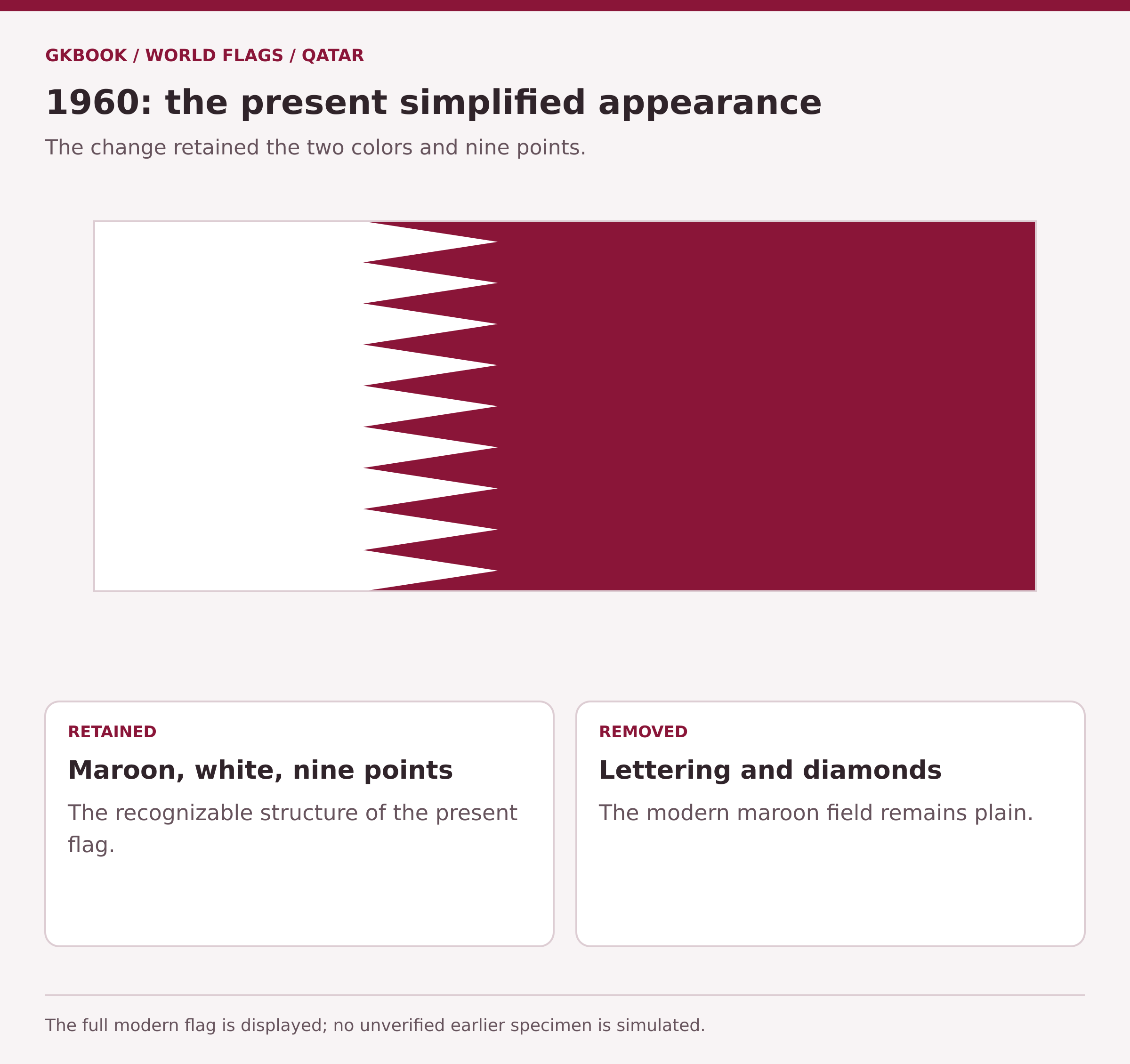
What changed on the Qatar flag in 1960?
In 1960, the country name and diamond decorations were removed, leaving the maroon and white fields with nine points. Official accounts associate this simplification with Sheikh Ali bin Abdullah Al Thani. This is the present design milestone used in the article, distinct from Qatar’s subsequent independence and its later flag legislation.

Simplification made the serrated division and the two colors the entire ordinary national design. It also means that an empty maroon field is intentional. A designer should not try to complete it with the state emblem, Arabic calligraphy, a star, or a commemorative slogan just because the large colored area appears available.
The change card contrasts retained features with removed decorations in words. It does not manufacture an earlier cloth specimen or assign exact old lettering coordinates. When studying an actual historical image, its date, archival description, and relationship to a particular version should remain attached to it rather than being replaced by a generic caption.
What happened to Qatar’s flag in 1971?
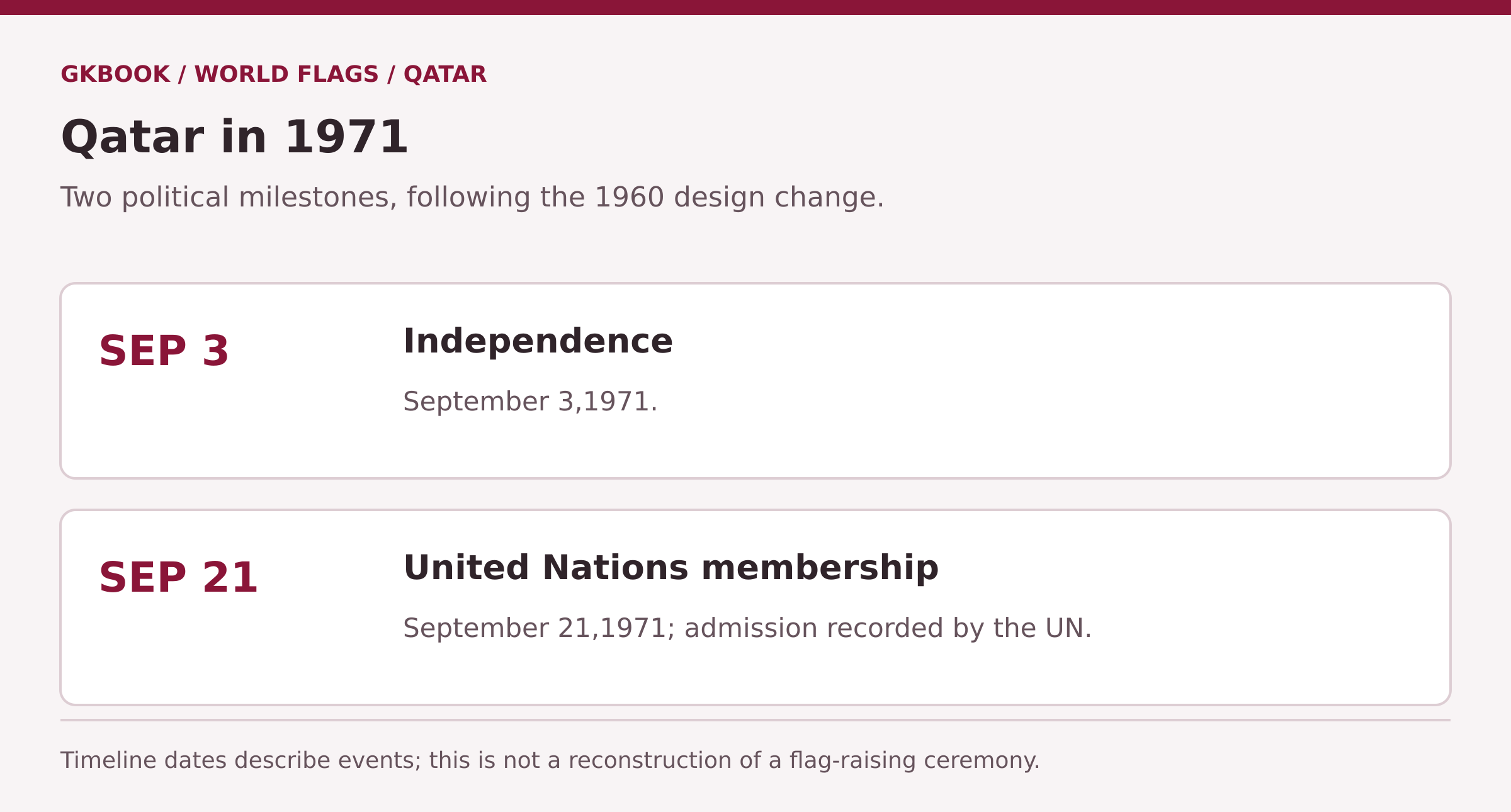
Qatar became independent on September 3, 1971 and joined the United Nations on September 21. The maroon-and-white flag represented the independent state internationally. These political milestones followed the 1960 simplification described by Qatari institutions, so 1971 should not automatically be treated as the year when every element of the present design first appeared.

The United Nations admission date is independently documented in its membership records. It identifies the state’s entry into the organization, not a technical revision to the serration. Keeping that distinction prevents an international photograph or membership caption from being mistaken for a new flag construction law.
The illustration presents independence and UN admission as separate dated entries. It does not show a ceremonial scene that was never photographed or claim to reproduce the first flag raised at a specific venue. A chronological chart can communicate the relationship between design history and international recognition without inventing visual evidence for either event.
What law governs Qatar’s national flag?
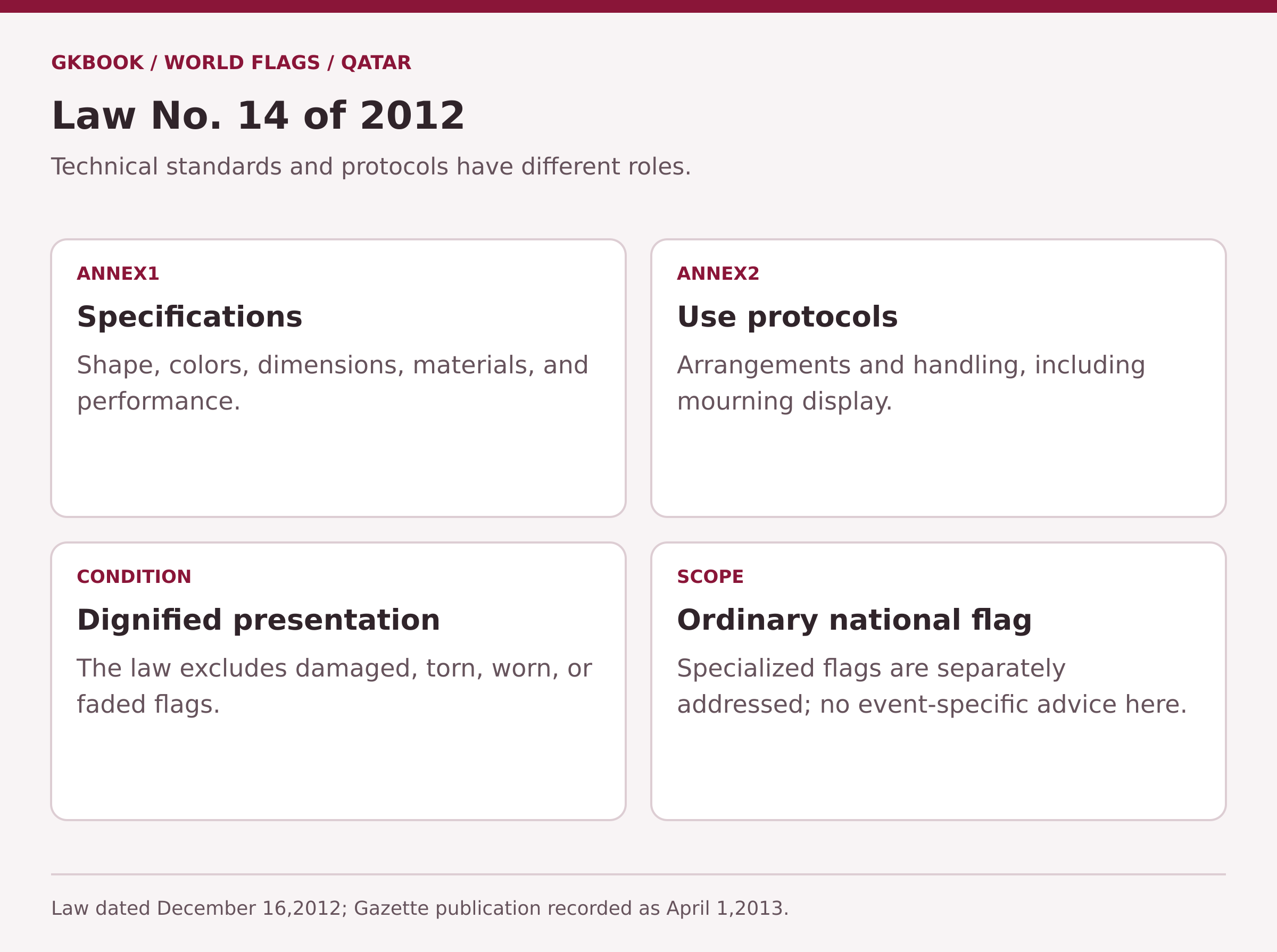
Law No. 14 of 2012 concerns the Qatari flag. It places technical specifications in Annex 1 and use protocols in Annex 2. The law addresses respect, condition, alterations, and other uses. Its record is dated December 16, 2012, with Gazette publication listed as April 1, 2013; these are distinct documentary dates.

The main law and its annexes perform different jobs. A general description of maroon, white, and nine points helps identify the design, while manufacturing requirements involve additional details about materials and performance. A digital teaching file does not demonstrate that a physical flag satisfies those requirements simply because its outline looks correct.
The law also distinguishes the national flag, the Emir’s flag, and armed-forces flags. This package illustrates the ordinary national design. It does not infer specialized patterns from the state emblem or offer event-specific instructions for a diplomatic ceremony. The article’s protocol summaries preserve that limited educational scope.
Why is Qatar’s flag called Al Adaam?
Al Adaam is a name associated with Qatar’s maroon flag and its distinctive color. English transliterations vary, including Al Adam and Al Adaam. The name expresses the flag’s established national identity; it is not a separate emblem or an instruction to print a word across the ordinary modern national flag.

Transliteration represents Arabic sounds through Latin letters, so modest spelling differences across English institutional pages do not necessarily indicate different flags. Use one form consistently within an article while recognizing the alternatives readers may encounter. Here, Al Adaam follows the National Library’s English usage, and maroon remains the straightforward color description.
The name card combines that English rendering with a clean flag and a short explanation. It avoids decorative pseudo-Arabic lettering or a newly designed logo. A national name can be discussed accurately in a caption without placing it on the cloth, where it would change the plain appearance established in 1960.
Is Qatar’s maroon flag connected with a dye tradition?
Qatar National Library connects the flag’s maroon with the historical production and use of red-purple dyes, including an account associated with Bin Ghannam. It also discusses earlier red cloth darkening in sunlight. This historical narrative should be distinguished from a modern recipe: today’s flag color is specified, not produced by uncontrolled fading.
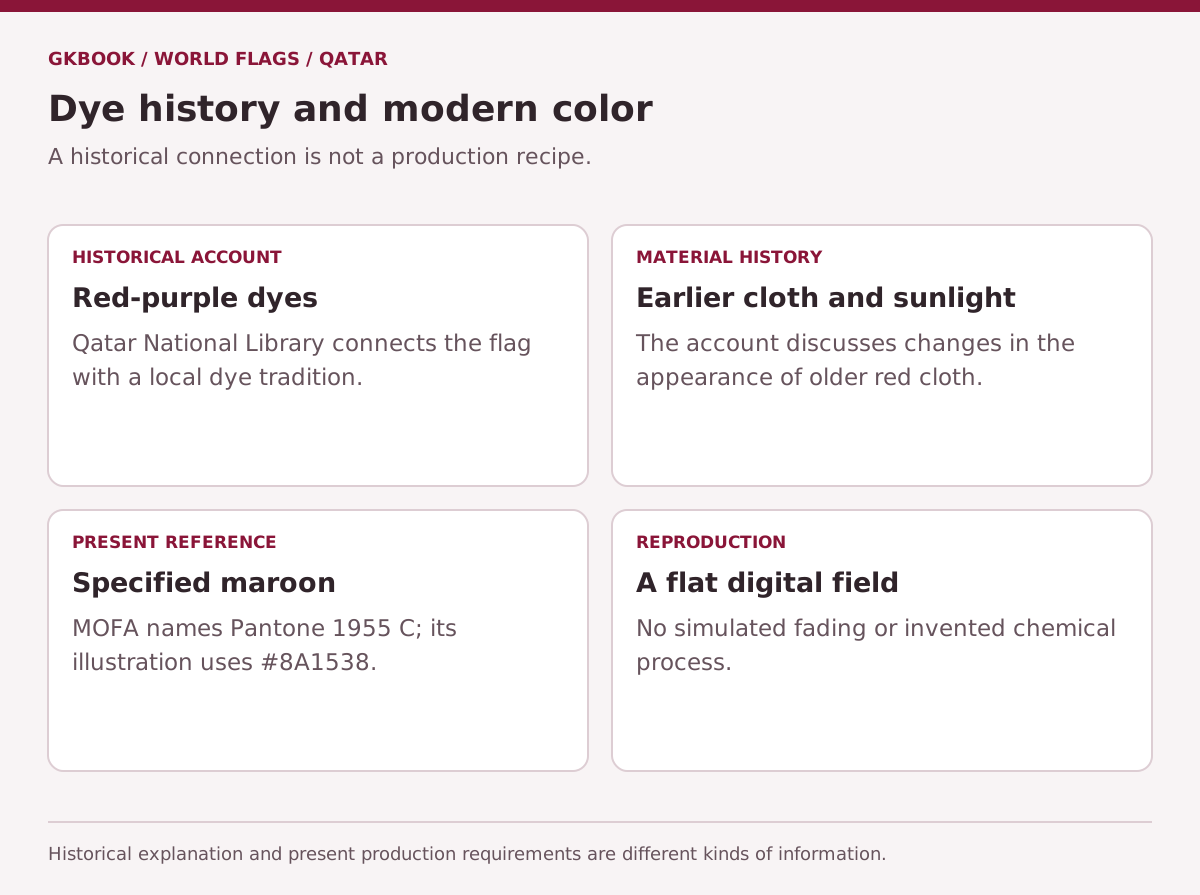
Material history and symbolism ask different questions. One concerns how colors were obtained and how cloth behaved; the other concerns what people understand a flag to represent. A careful explanation can discuss both without treating a natural-dye account as proof of a precise modern Pantone formula or a universally accepted symbolic meaning.
The gallery represents this connection through three labeled ideas: historical materials, the remembered maroon identity, and the present specified color. It does not draw a chemical process, identify an unverified species of dye-producing organism, or propose a textile experiment. Those would require evidence beyond the institutional historical account used here.
Where is early evidence about Qatar’s flag preserved?
Qatar Digital Library catalogs a British Library file about flags flown by the Sheikh of Qatar, covering 1929–1938. It includes correspondence, sketches, and a cloth specimen. That archival record provides evidence for studying historical designs, but its collection description alone does not certify the exact geometry of a modern flag reproduction.
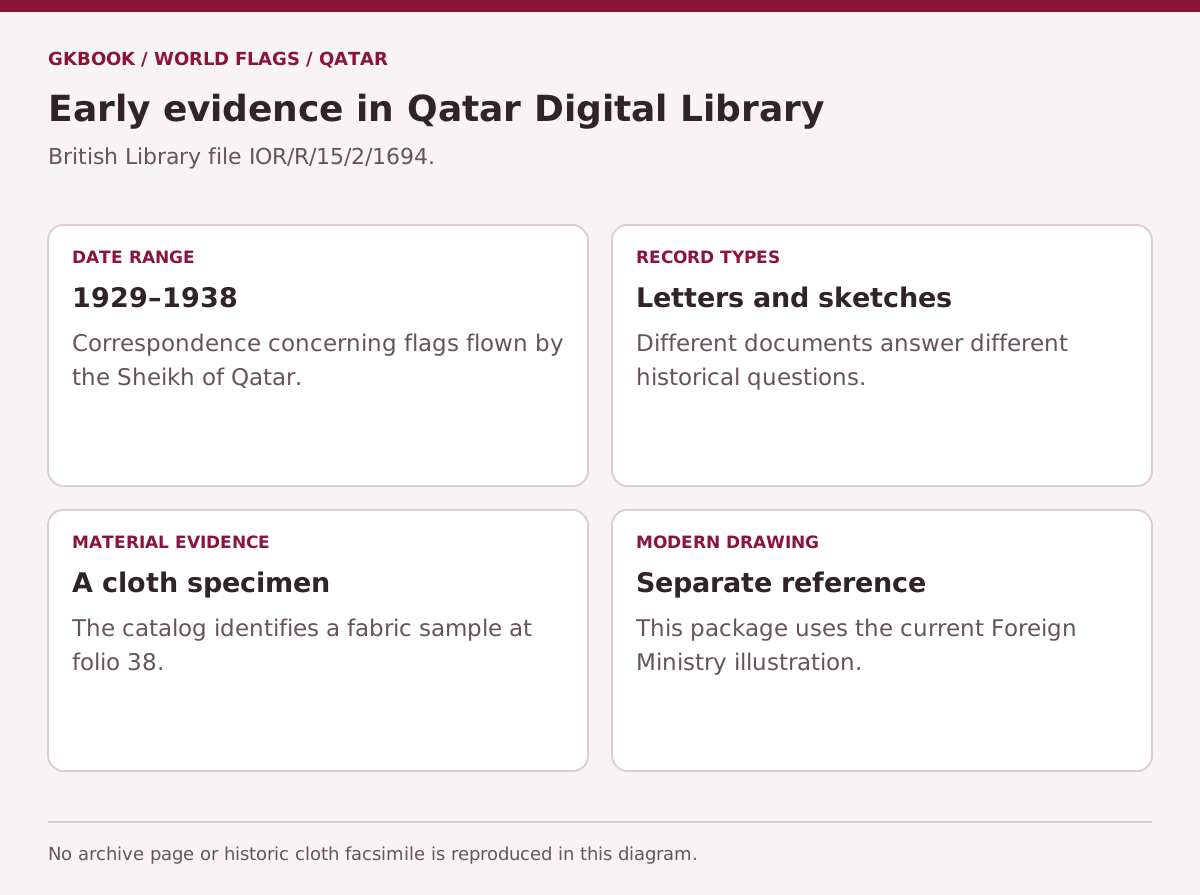
The file reference is IOR/R/15/2/1694. Its catalog identifies a collection of sixty-nine folios and notes a fabric sample at folio 38. A cloth sample, a written description, and a drawing each preserve different information. Color seen through a digitized image also depends on capture and display conditions, so the sample is not a screen calibration target.
Our archive card records the file identity and kinds of evidence rather than reproducing a historical page without context. Keeping the historical collection and the modern image reference separate makes it possible to trace each claim to the kind of evidence that actually supports it.
Does Qatar’s flag have a coat of arms?
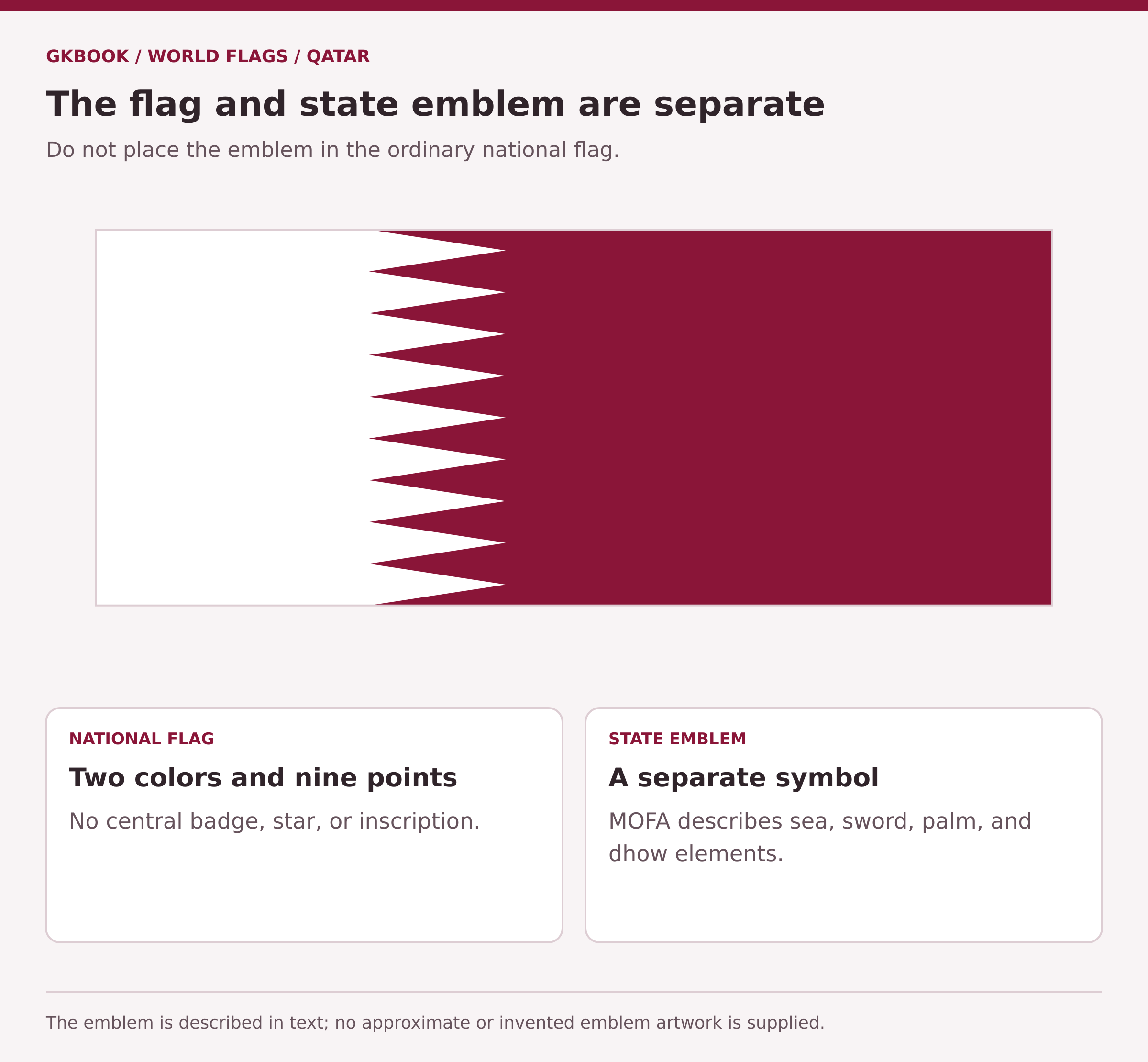
The ordinary Qatar national flag has no coat of arms, lettering, or central badge. Qatar’s state emblem is a separate symbol, described by the Foreign Ministry through its sea, sword, palm, and dhow elements. Combining that emblem with the maroon field would create a different composition from the national flag illustrated here.

A government webpage may display both symbols near one another, but their proximity does not place the emblem on the flag. Read the headings and captions as well as the images. The ministry’s national-flag section and its emblem section describe distinct visual objects with different roles in the state’s identity.
The comparison card keeps a clean national flag on one side and a text description of the separate emblem on the other. It does not approximate the emblem with invented heraldic artwork.
How is Qatar’s flag different from Bahrain’s flag?
Qatar’s flag is maroon and white with nine white points; Bahrain’s is red and white with five. Counting the points is a useful identification method when photographs make colors uncertain. Qatar’s elongated 11:28 outdoor format is another clue, although its law recognizes different proportions for indoor use and other contexts.
Both flags have a light hoist side and a serrated boundary, which explains why small or poorly labeled images can be confused. Check the complete pattern rather than relying on one blurred corner. A photograph may crop the top or bottom, making an otherwise reliable point count impossible until the full flag is visible.
Bahrain’s official flag guide describes the five-point design introduced in 2002. That history belongs to Bahrain and should not be transferred to Qatar’s nine-point pattern. For a side-by-side study, retain each country’s own label and use the dedicated Bahrain flag guide alongside this page.
Which side of the Qatar flag is white?
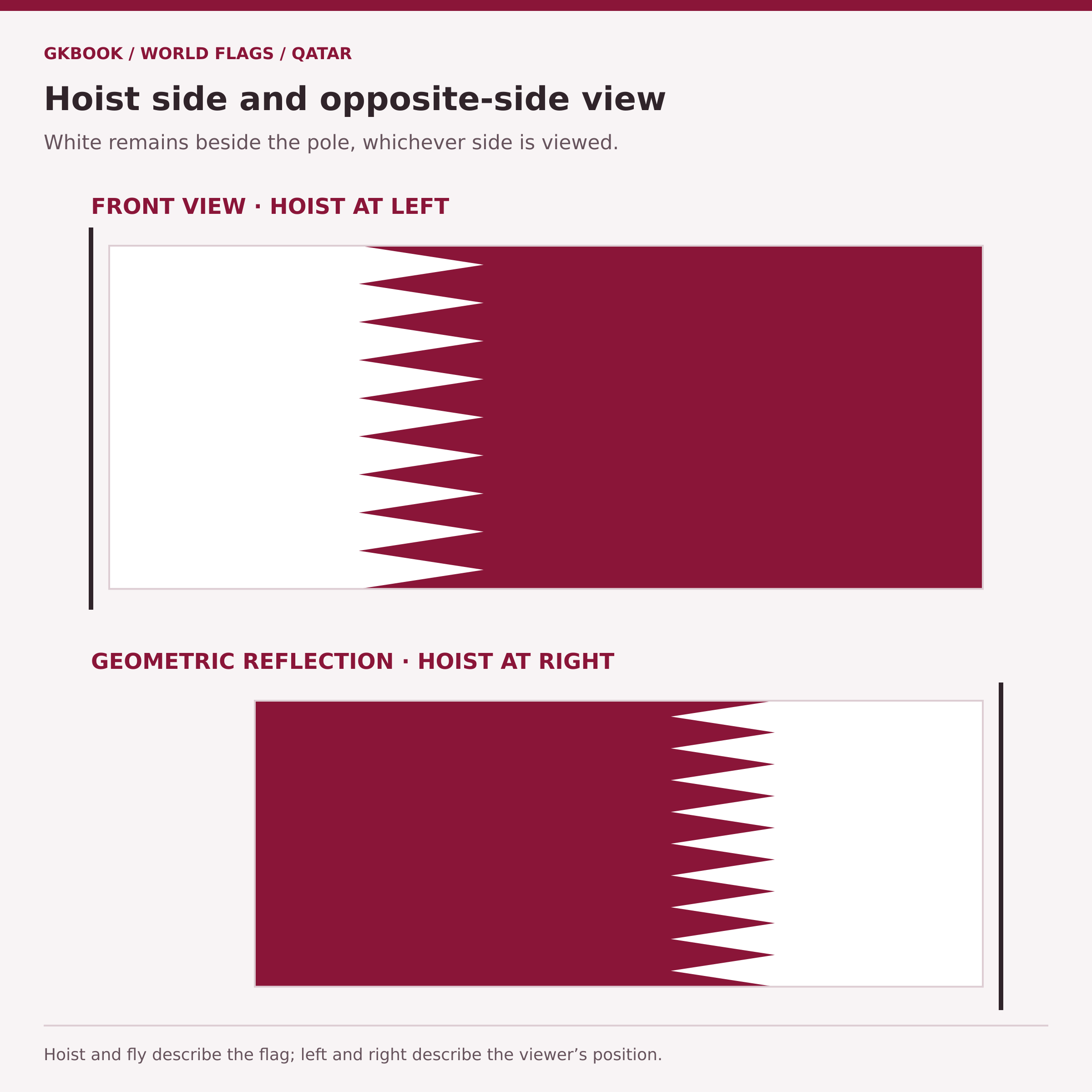
White is beside the hoist, the edge attached to the flagpole; maroon extends toward the free edge. In the usual front-view illustration with the pole at left, white therefore appears on the left. Seen from the opposite side, the same cloth has a mirrored appearance while white remains beside the pole.
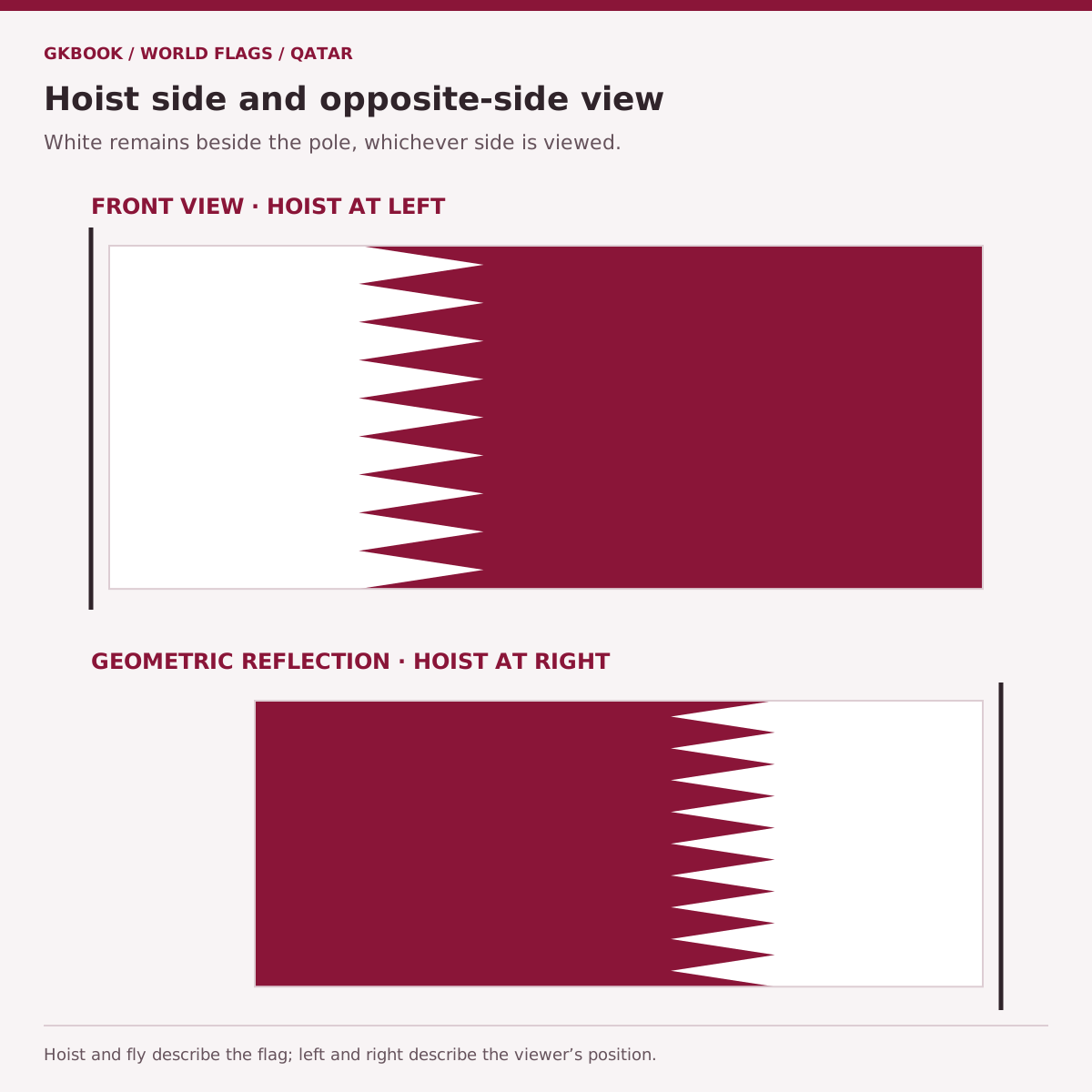
Left and right describe the viewer’s position, whereas hoist and fly describe the flag itself. That distinction is helpful when interpreting photographs taken from opposite sides of a street. A white area appearing on the right is not sufficient evidence of an incorrectly made flag if the pole is also on the right.
The reverse diagram is explicitly a geometric reflection of this flat illustration. It does not prescribe sewing methods or separate layers of fabric. For vertical installation, follow the relevant official protocol rather than treating an arbitrary rotated web image as an authorized hanging diagram. The download retains the normal horizontal reference view.
How should Qatar’s flag be treated when displayed?
The flag law requires dignified treatment and excludes damaged, torn, worn, or faded flags from display. Its protocol annex covers arrangements and handling. Keep the national design intact and use the applicable official instructions for a particular setting; a general educational illustration does not determine every ceremonial position or manufacturing requirement.
Condition is part of accurate presentation, alongside color and shape. A badly faded cloth may preserve nine points while no longer presenting the specified national colors. Similarly, a torn free edge can change the silhouette without changing the original pattern sewn near the hoist. These are reasons to assess the whole flag before display.
For a school explanation, distinguish a picture used to teach the design from an actual flag used in a formal ceremony. The article provides identification and historical context. Placement among other national flags, building installations, and specialized occasions require the corresponding protocol details, including the viewpoint from which positions are described.
What does flying Qatar’s flag at half-mast mean?
Half-mast is a display position associated with mourning, not a different Qatar flag design. Article 6 of the flag law directs these procedures to Annex 2. The maroon and white fields and nine points remain unchanged; a mourning explanation should not add a black band or invent a current official mourning period.
A photograph of a lowered flag records a position at a particular time. Without its date and context, it does not identify the event being commemorated or establish how long the display should continue. A historical caption should therefore attach the relevant occasion instead of implying that the same instruction applies today.
This package explains the distinction without issuing a ceremonial sequence or depicting an unverified current announcement. Where an actual observance is being organized, the applicable declaration and protocol determine the procedure. For recognition exercises, the useful point is that the same national pattern can appear at different heights on a pole.
When is Qatar’s National Day?
Qatar’s National Day is December 18. Official accounts connect it with Sheikh Jassim bin Mohammed Al Thani and the foundation of the modern state in 1878. This commemoration is separate from the September 3, 1971 independence date and from the 1960 simplification of the flag’s design described by Qatari institutions.
A national celebration can feature the flag prominently without commemorating the day its exact design was chosen. Distinguishing those subjects keeps a calendar caption accurate. December 18 identifies National Day; 1878 explains its historical focus. The other dates in this guide answer questions about visual development, independence, membership, or legislation.
The name-and-identity illustration can accompany a National Day discussion because it shows the current flag without turning a temporary campaign slogan into a permanent feature. Event branding, posters, and decorative arrangements may change from year to year. The clean reference drawing remains a separate resource for explaining the national symbol itself.
What image sizes preserve Qatar’s 11:28 flag?
Any width and height in the relationship 28:11 preserve the elongated flag. Examples include 504 × 198, 1,260 × 495, and 2,520 × 990. The main PNG is 5,040 × 1,980 pixels. Resize both dimensions together; cropping or stretching to a standard slide shape changes the flag’s proportions.

The smallest example remains useful for layout, although the nine points become easier to inspect at larger sizes. Vector artwork can be enlarged without creating blocky edges because it stores shapes rather than a fixed pixel grid. A PNG has a defined resolution and should be selected at a size suitable for its intended display.
If a page requires a square thumbnail or a wide social preview, place the complete flag inside that container with space around it. Do not force the fabric rectangle to fill the container. The separate sharing card follows this approach: its overall canvas is 1,200 × 630, while its internal flag retains 11:28.
| Use | Dimensions | Ratio preserved |
|---|---|---|
| Small reference | 504 × 198 | 28:11 |
| Medium reference | 1,260 × 495 | 28:11 |
| SVG master | 2,520 × 990 | 28:11 |
| Main PNG | 5,040 × 1,980 | 28:11 |
How should Qatar’s flag colors be reproduced in print?
Use the specified maroon reference and an appropriate production workflow rather than assuming that a screen preview is a physical color standard. The Foreign Ministry names Pantone 1955 C. The SVG’s #8A1538 value is useful for digital artwork, but a printed or dyed result also depends on its material and production conditions.
An uncoated sheet, a glossy poster, and woven fabric interact differently with light and ink or dye. The same digital input can therefore produce visibly different results. A comparison made on an uncalibrated phone is useful for general recognition but cannot establish compliance with a material specification or approve an entire production batch.
For an educational handout, preserve the vector geometry and keep the color explanation attached to the image. For actual flag production, use the applicable official specifications, including the material and performance provisions. The supplied files provide transparent drawing coordinates and a documented digital palette; they do not replace the required production reference or quality assessment.
What Qatar flag files are available here?
The gallery provides 24 subjects, each as SVG and PNG, including the clean flag and explanatory diagrams. A separate 1,200 × 630 sharing image is also included. The national flag files contain only maroon and white artwork; diagram canvases add external labels to explain proportions, history, interpretation, and the reproduction method.
Use the clean SVG when you need a scalable flag illustration, and the large PNG when the destination expects a raster image. Use a labeled diagram when the explanation itself is part of the lesson. Its title and surrounding notes belong to the educational page rather than to the flag design.
These files document an educational reproduction based on the ministry’s online illustration. They do not certify textile manufacture or grant blanket permission for advertising, branding, or regulated flag uses. The credits identify the drawing basis and the small spacing normalization, while the download names distinguish the plain reference from the explanatory subjects.
What mistakes should be avoided when drawing Qatar’s flag?
Keep nine white points, maroon at the fly, and white beside the hoist. Preserve the selected context’s proportions and avoid adding an emblem or inscription. Distinguish the 1960 design from 1971 independence and the 2012 law. When using these drawings, retain the stated ministry-illustration basis instead of calling their coordinates a verified statutory master.
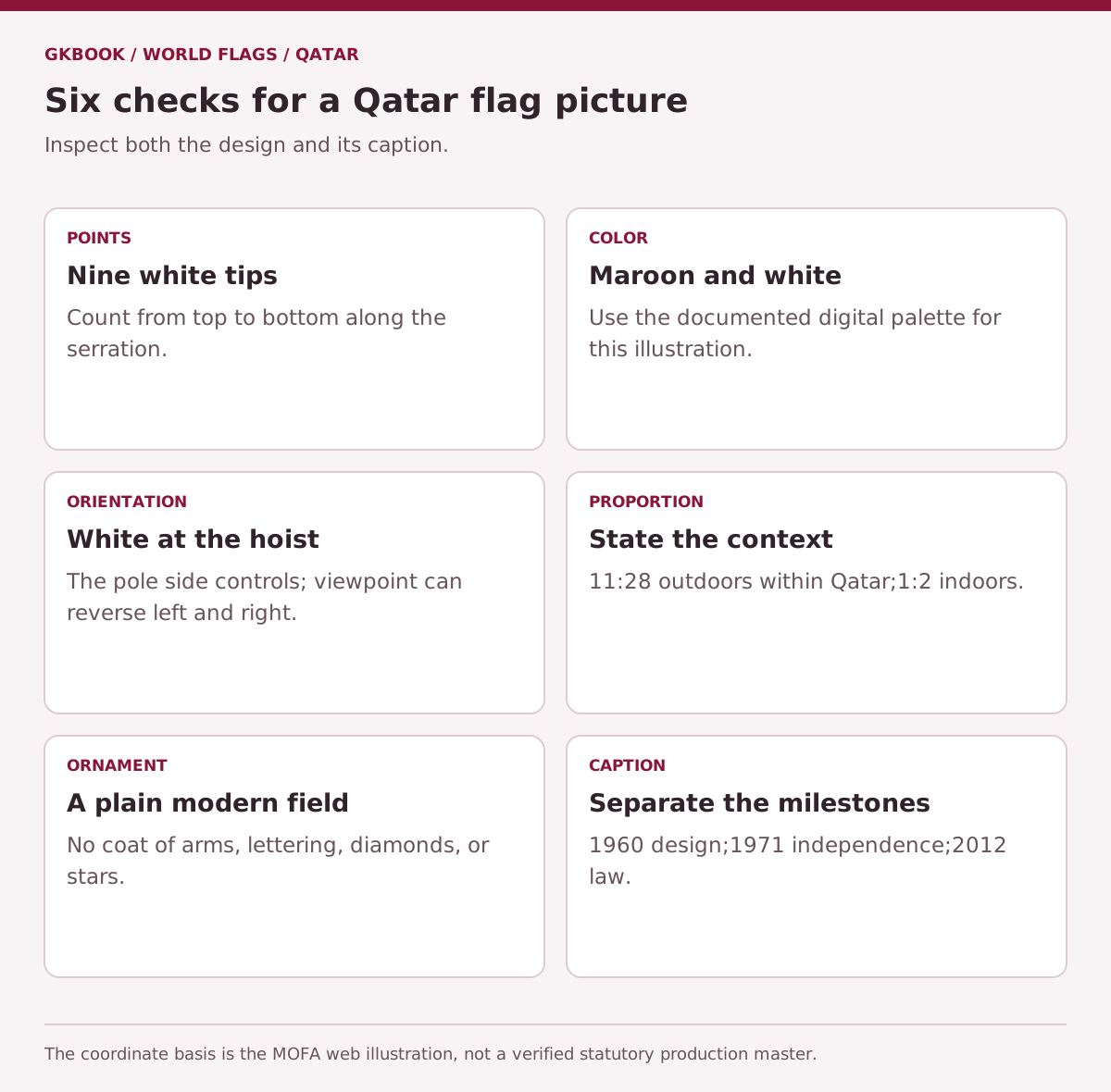
A useful final inspection begins with the silhouette, then the point count, then the colors and orientation. Review the caption as carefully as the geometry: a well-drawn present flag can still be mislabeled as a historical specimen or assigned an unsupported exact adoption day. Accuracy includes the explanation attached to the picture.
The clean download and the labeled diagrams serve complementary purposes. One provides an uncluttered reference; the others expose the measurements and historical distinctions needed to understand it. For further comparisons, continue through World Flags and keep each country’s source, proportion, and interpretation attached to its own design.
Download Qatar flag pictures
Download the clean national flag as SVG or 5,040 × 1,980 PNG. Its SVG coordinate system is 2,520 × 990, preserving the elongated 11:28 shape.
The gallery contains 24 subjects, each with an SVG and PNG. All artwork is vector in the SVG files. The national flag follows the Ministry of Foreign Affairs webpage illustration, with its tiny rounded half-step discrepancy normalized to exact equal spacing. Image credits and reproduction notes identify the source, normalization, digital palette, and limits of the reproduction. These educational files do not certify physical manufacture or clear regulated advertising and branding uses.
Explore more in World Flags, including the Bahrain flag and Oman flag.
World Flags/Qatar
Qatar flag pictures
Maroon and white with nine points; height:length 11:28. Geometry follows the Foreign Ministry’s online illustration with equalized point spacing.
GKBook original drawing and diagrams; geometric reference: Qatar Ministry of Foreign Affairs.Download SVGDownload PNGDigital maroon #8A1538 and white #FFFFFF follow the Ministry of Foreign Affairs drawing. Screen values are distinct from a physical production standard.
GKBook original drawing and diagrams; geometric reference: Qatar Ministry of Foreign Affairs.Download SVGDownload PNGThe finished illustration uses a flat maroon, with no artificial fading, texture, or gradient inside the flag.
GKBook original drawing and diagrams; geometric reference: Qatar Ministry of Foreign Affairs.Download SVGDownload PNGThe Interior Ministry and Qatar National Library offer different color explanations. Both are attributed; neither changes the visible design.
GKBook original drawing and diagrams; geometric reference: Qatar Ministry of Foreign Affairs.Download SVGDownload PNGExternal teaching numerals identify the nine tip heights; the clean flag download has no numerals or teaching marks.
GKBook original drawing and diagrams; geometric reference: Qatar Ministry of Foreign Affairs.Download SVGDownload PNGThe diagram separates the visible number from its attributed historical explanation. It does not reconstruct a 1916 flag.
GKBook original drawing and diagrams; geometric reference: Qatar Ministry of Foreign Affairs.Download SVGDownload PNGMeasurements refer to the flag rectangle only. The 11:28 requirement is context-specific, not a universal rule for every setting.
GKBook original drawing and diagrams; geometric reference: Qatar Ministry of Foreign Affairs.Download SVGDownload PNGAnnex 1 distinguishes 11:28 outdoors and 1:2 indoors within Qatar; abroad it refers to local specifications and its construction figures.
GKBook original drawing and diagrams; geometric reference: Qatar Ministry of Foreign Affairs.Download SVGDownload PNGThe MOFA webpage uses base x=400 and tip x=600 on a 1,400×550 canvas. Uniform scaling gives base 720 and tip 1080 here. These are illustration measurements, not verified annex coordinates.
GKBook original drawing and diagrams; geometric reference: Qatar Ministry of Foreign Affairs.Download SVGDownload PNGEach triangle in the 2,520×990 master has base 110, half-base 55, and depth 360. The upper and lower sloping sides are equal.
GKBook original drawing and diagrams; geometric reference: Qatar Ministry of Foreign Affairs.Download SVGDownload PNGThe nine points use eighteen half-steps of 55 units. Preliminary stages are instructional; only the final panel is the complete flag.
GKBook original drawing and diagrams; geometric reference: Qatar Ministry of Foreign Affairs.Download SVGDownload PNGOfficial historical accounts describe these milestones. The chart does not invent exact historical cloth specimens.
GKBook original drawing and diagrams; geometric reference: Qatar Ministry of Foreign Affairs.Download SVGDownload PNGThe design date, independence year, law date, and recorded publication date are not interchangeable.
GKBook original drawing and diagrams; geometric reference: Qatar Ministry of Foreign Affairs.Download SVGDownload PNGQatari historical accounts describe additional decorations around the 1932 development. Exact historical lettering and cloth dimensions are not reconstructed.
GKBook original drawing and diagrams; geometric reference: Qatar Ministry of Foreign Affairs.Download SVGDownload PNGThe present design is dated to 1960 by the Amiri Diwan and Qatar National Library. The modern flag is shown above a text comparison.
GKBook original drawing and diagrams; geometric reference: Qatar Ministry of Foreign Affairs.Download SVGDownload PNGQatar’s independence and admission to the United Nations are distinct dates in 1971. Neither is relabeled as a new serration construction rule.
GKBook original drawing and diagrams; geometric reference: Qatar Ministry of Foreign Affairs.Download SVGDownload PNGThe law refers specifications to Annex 1 and protocol to Annex 2. This educational picture is not manufacturing certification or a current ceremony instruction.
GKBook original drawing and diagrams; geometric reference: Qatar Ministry of Foreign Affairs.Download SVGDownload PNGThe name refers to the flag and its distinctive maroon identity. National Day is December 18; it is separate from the design and independence dates.
GKBook original drawing and diagrams; geometric reference: Qatar Ministry of Foreign Affairs.Download SVGDownload PNGThe National Library’s material-history account is distinguished from the present color reference. No chemical or textile manufacturing process is diagrammed.
GKBook original drawing and diagrams; geometric reference: Qatar Ministry of Foreign Affairs.Download SVGDownload PNGThe QDL catalog describes sixty-nine folios, including sketches and a fabric sample. The archive is not used as a modern color-calibration or legal-geometry master.
GKBook original drawing and diagrams; geometric reference: Qatar Ministry of Foreign Affairs.Download SVGDownload PNGThe modern flag has no coat of arms. The Foreign Ministry separately describes the state emblem; it is not added to this illustration.
GKBook original drawing and diagrams; geometric reference: Qatar Ministry of Foreign Affairs.Download SVGDownload PNGThe second image is a geometric reflection of the flat drawing. It explains viewpoint, not a mandated fabric-construction method or vertical-display rule.
GKBook original drawing and diagrams; geometric reference: Qatar Ministry of Foreign Affairs.Download SVGDownload PNGThe SVG master is 2,520×990 and the main PNG5,040×1,980. Both preserve the elongated 11:28 shape. Diagrams and sharing cards have their own canvases.
GKBook original drawing and diagrams; geometric reference: Qatar Ministry of Foreign Affairs.Download SVGDownload PNGThe review covers point count, colors, orientation, context-specific proportions, absence of ornament, and distinct historical dates.
GKBook original drawing and diagrams; geometric reference: Qatar Ministry of Foreign Affairs.Download SVGDownload PNGFrequently asked questions
What does the Qatar flag look like?
Qatar’s national flag combines a white hoist band with a maroon field. Nine white triangular points project into the maroon along their shared boundary. The familiar elongated version has height:length proportions of 11:28, specified for outdoor use within Qatar. Its ordinary national design contains no lettering, stars, or coat of arms.
What are the colors of the Qatar flag?
The Qatar flag is maroon and white. The Foreign Ministry identifies the maroon as Pantone 1955 C, while its embedded flag drawing uses #8A1538. That digital value corresponds to RGB 138, 21, 56. The supplied pictures use this maroon with #FFFFFF white, keeping screen values separate from physical production standards.
Why is the Qatar flag maroon?
Maroon is a defining feature of Qatar’s flag and its national visual identity. Qatar National Library connects it with the country’s historical dye tradition and the darkening of earlier red cloth. The modern flag uses a specified maroon; its appearance should not be recreated by deliberately fading or weathering red material.
What does the white on Qatar’s flag mean?
The Interior Ministry associates white with peace and maroon with blood shed in past wars. Qatar National Library explicitly disputes that familiar explanation and emphasizes the flag’s dye history. These institutional accounts differ, so the symbolism should be attributed to its source rather than presented as one uncontested explanation of the colors.
How many points are on the Qatar flag?
The Qatar flag has nine white triangular points extending into the maroon field. Count the tips pointing toward the free edge, from top to bottom. The maroon recesses between them are the complementary spaces along the same boundary; counting both colors’ corners together gives the wrong number for the flag’s defining feature.
What do the nine points on Qatar’s flag represent?
Official Qatari explanations associate the nine points with Qatar’s place as the ninth member in a historical Gulf treaty grouping following its 1916 agreement with Britain. This is a historical interpretation of the serration. The points do not represent nine present-day Qatari districts, nine rulers, or membership in today’s United Arab Emirates.
What is the Qatar flag’s ratio?
The elongated Qatar flag has a height:length ratio of 11:28, making its length about 2.545 times its height. Annex 1 of the flag law specifies this format for outdoor use within Qatar. It should not be described as the only permitted proportion in every indoor, international, or ceremonial setting.
Are Qatar’s indoor and outdoor flags the same shape?
The law’s annex distinguishes contexts: within Qatar, the outdoor format is 11:28 and the indoor format is 1:2, both stated here as height:length. For use abroad, it refers to local specifications and its associated construction figures. The main download illustrates the elongated outdoor format, rather than claiming to cover every prescribed setting.
How wide is the white part of the Qatar flag?
This reproduction follows the Foreign Ministry’s online drawing: on its 1,400 × 550 canvas, white triangle bases lie at x = 400 and tips at x = 600. Those are measurements of that published illustration. They are not presented as independently verified dimensions from the law’s unavailable construction figures.
Are the Qatar flag’s triangles equilateral?
The Foreign Ministry describes the nine triangles as isosceles, meaning that each has two equal sides. It does not call them equilateral. In this reproduction, each triangle has a vertical base of 110 units and a horizontal depth of 360 units, following the ministry’s illustration scaled to a 2,520 × 990 canvas.
How can you draw the Qatar flag accurately?
Start with an 11:28 rectangle for the outdoor illustration. Fill it maroon, then draw the white hoist area with nine evenly spaced points. For this ministry-based master, use width 2,520, height 990, a base line at x = 720, and a tip line at x = 1,080. Keep all explanatory labels outside.
How did Qatar’s flag develop?
Official accounts trace a maroon banner tradition to the nineteenth century, describe a nine-point design with additional decoration in 1932, and date the present simplified appearance to 1960. Independence followed in 1971. The 2012 flag law later specified the national symbol’s technical requirements and treatment, rather than creating its familiar appearance from nothing.
When was the present Qatar flag adopted?
The Amiri Diwan and Qatar National Library date the present simplified flag design to 1960. Qatar became independent in 1971, and Law No. 14 was issued in 2012. A careful adoption caption distinguishes the established design from independence and later legal standardization instead of assigning all three events to one date.
What changed in the Qatar flag in 1932?
Institutional histories describe a 1932 design with nine points, maroon coloring, the name Qatar in white, and diamond decorations near the serrated boundary. These additional elements distinguish that historical stage from today’s plain national flag. The gallery explains the change in text rather than inventing an exact reconstruction of the decorated banner.
What changed on the Qatar flag in 1960?
In 1960, the country name and diamond decorations were removed, leaving the maroon and white fields with nine points. Official accounts associate this simplification with Sheikh Ali bin Abdullah Al Thani. This is the present design milestone used in the article, distinct from Qatar’s subsequent independence and its later flag legislation.
What happened to Qatar’s flag in 1971?
Qatar became independent on September 3, 1971 and joined the United Nations on September 21. The maroon-and-white flag represented the independent state internationally. These political milestones followed the 1960 simplification described by Qatari institutions, so 1971 should not automatically be treated as the year when every element of the present design first appeared.
What law governs Qatar’s national flag?
Law No. 14 of 2012 concerns the Qatari flag. It places technical specifications in Annex 1 and use protocols in Annex 2. The law addresses respect, condition, alterations, and other uses. Its record is dated December 16, 2012, with Gazette publication listed as April 1, 2013; these are distinct documentary dates.
Why is Qatar’s flag called Al Adaam?
Al Adaam is a name associated with Qatar’s maroon flag and its distinctive color. English transliterations vary, including Al Adam and Al Adaam. The name expresses the flag’s established national identity; it is not a separate emblem or an instruction to print a word across the ordinary modern national flag.
Is Qatar’s maroon flag connected with a dye tradition?
Qatar National Library connects the flag’s maroon with the historical production and use of red-purple dyes, including an account associated with Bin Ghannam. It also discusses earlier red cloth darkening in sunlight. This historical narrative should be distinguished from a modern recipe: today’s flag color is specified, not produced by uncontrolled fading.
Where is early evidence about Qatar’s flag preserved?
Qatar Digital Library catalogs a British Library file about flags flown by the Sheikh of Qatar, covering 1929–1938. It includes correspondence, sketches, and a cloth specimen. That archival record provides evidence for studying historical designs, but its collection description alone does not certify the exact geometry of a modern flag reproduction.
Does Qatar’s flag have a coat of arms?
The ordinary Qatar national flag has no coat of arms, lettering, or central badge. Qatar’s state emblem is a separate symbol, described by the Foreign Ministry through its sea, sword, palm, and dhow elements. Combining that emblem with the maroon field would create a different composition from the national flag illustrated here.
How is Qatar’s flag different from Bahrain’s flag?
Qatar’s flag is maroon and white with nine white points; Bahrain’s is red and white with five. Counting the points is a useful identification method when photographs make colors uncertain. Qatar’s elongated 11:28 outdoor format is another clue, although its law recognizes different proportions for indoor use and other contexts.
Which side of the Qatar flag is white?
White is beside the hoist, the edge attached to the flagpole; maroon extends toward the free edge. In the usual front-view illustration with the pole at left, white therefore appears on the left. Seen from the opposite side, the same cloth has a mirrored appearance while white remains beside the pole.
How should Qatar’s flag be treated when displayed?
The flag law requires dignified treatment and excludes damaged, torn, worn, or faded flags from display. Its protocol annex covers arrangements and handling. Keep the national design intact and use the applicable official instructions for a particular setting; a general educational illustration does not determine every ceremonial position or manufacturing requirement.
What does flying Qatar’s flag at half-mast mean?
Half-mast is a display position associated with mourning, not a different Qatar flag design. Article 6 of the flag law directs these procedures to Annex 2. The maroon and white fields and nine points remain unchanged; a mourning explanation should not add a black band or invent a current official mourning period.
When is Qatar’s National Day?
Qatar’s National Day is December 18. Official accounts connect it with Sheikh Jassim bin Mohammed Al Thani and the foundation of the modern state in 1878. This commemoration is separate from the September 3, 1971 independence date and from the 1960 simplification of the flag’s design described by Qatari institutions.
What image sizes preserve Qatar’s 11:28 flag?
Any width and height in the relationship 28:11 preserve the elongated flag. Examples include 504 × 198, 1,260 × 495, and 2,520 × 990. The main PNG is 5,040 × 1,980 pixels. Resize both dimensions together; cropping or stretching to a standard slide shape changes the flag’s proportions.
How should Qatar’s flag colors be reproduced in print?
Use the specified maroon reference and an appropriate production workflow rather than assuming that a screen preview is a physical color standard. The Foreign Ministry names Pantone 1955 C. The SVG’s #8A1538 value is useful for digital artwork, but a printed or dyed result also depends on its material and production conditions.
What Qatar flag files are available here?
The gallery provides 24 subjects, each as SVG and PNG, including the clean flag and explanatory diagrams. A separate 1,200 × 630 sharing image is also included. The national flag files contain only maroon and white artwork; diagram canvases add external labels to explain proportions, history, interpretation, and the reproduction method.
What mistakes should be avoided when drawing Qatar’s flag?
Keep nine white points, maroon at the fly, and white beside the hoist. Preserve the selected context’s proportions and avoid adding an emblem or inscription. Distinguish the 1960 design from 1971 independence and the 2012 law. When using these drawings, retain the stated ministry-illustration basis instead of calling their coordinates a verified statutory master.
Explore all general-knowledge topics and the A-to-Z lists.











We Value Your Opinion Comments