
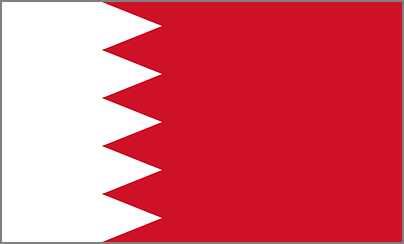
Bahrain flag picture

| Name | ʿAlam al-Baḥrayn (علم البحرين — Flag of Bahrain) |
|---|---|
| Adopted | February 14, 2002 (five points; Decree-Law No. 4) 1932 (serration) · 1820 (white band) |
| Proportion | 5 : 3 (fly : hoist) |
| Points | Five (28 in 1932, eight from 1972) |
| Law | Decree-Law No. 4 of 2002 (Articles I–IX) |
The Bahraini flag is a red field with a white band at the hoist, the two divided by a serration of five white points — a Gulf banner reshaped by a treaty in 1820, a serration in 1932 and a decree in 2002.
An overview
The national flag of Bahrain is a red field with a white band at the hoist, the two divided by a serrated line of five white points. The ratio is 3:5, the white takes up 13/40 of the flag, and the same design serves on land and at sea as national flag, civil ensign, and war flag.
It is a flag built by accretion. The banners of the Gulf were plain red; a treaty with Britain in 1820 added the white band; a need to stand apart from red-and-white neighbors cut the dividing line into a zigzag in 1932; and the points fell from 28 to eight in 1972 and to five on February 14, 2002 — the day the State of Bahrain became a kingdom, when King Hamad bin Isa Al Khalifa fixed the flag by Decree-Law No. 4 in nine articles.
The five points carry the flag’s meaning: one for each of the five pillars of Islam.
The five points
The flag carries no device — its identity is the serrated line where white meets red. The zigzag was added in 1932 to tell Bahrain’s red-and-white apart from the similar flags of its neighbors, and it began with 28 points. In 1972 the count fell to eight; on February 14, 2002 — the day the State of Bahrain became the Kingdom of Bahrain — Decree-Law No. 4 fixed it at five, so that each point could stand for one of the five pillars of Islam.
The serration is also the flag’s most common source of confusion: Qatar’s flag divides maroon from white with nine points, at a far longer ratio. Bahrain’s is red, five-pointed, and 3:5.
Official color specification
The decree of 2002 names the colors — red and white — and the national flag guide fixes the shade: Pantone 485 C, a bright, warm red, with RAL and CMYK values alongside. It is red, not the maroon of Qatar’s otherwise similar flag.
| Color | Hex | Pantone | RGB |
|---|---|---|---|
| Red | #DA291C | 485 C | 218, 41, 28 |
| White | #FFFFFF | White | 255, 255, 255 |
Symbolism and meaning
The flag’s meanings are a layer of history each: the red of the old Gulf banners, the white of a 19th-century treaty, and the five points of a 21st-century decree.
Only the last meaning was chosen on purpose: the 2002 decree reduced the points to five so that they could carry it.
Design and official specification
Decree-Law No. 4 of 2002 describes the flag as a rectangle in two main sections, red and white, and reserves a flag of his own to the King — the national flag with narrow white edges and a golden crown in the canton. The proportions and the five-point serration are the standardized design; the white band and its points take 13/40 of the flag.
| Element | Specification | Reference |
|---|---|---|
| Hoist (height) | 3 | 90 cm (35.4 in) |
| Fly (length) | 5 | 150 cm (59.1 in) |
| Ratio | 3 : 5 | The standardized proportions |
| Field | A white band at the hoist and a red field toward the fly | Decree-Law No. 4 of 2002, Article I |
| The serration | Five white isosceles triangles pointing into the red | Reduced from eight to five on February 14, 2002 |
| White share | 13/40 of the flag — 32.5% | The red 27/40 — 67.5% |
| Royal flag | The national flag with narrow white stripes along the top and bottom edges and a golden crown in the canton | By royal order under Article II |
| Uses | National flag, civil ensign and war flag — on land and at sea | — |
How the flag evolved
A red banner, a treaty stripe, a zigzag cut to stand apart, and a count of points settled three times — the flag’s two centuries in four moves.
1820
The treaty stripe

The earliest flags of Bahrain were plain red, the color of the Gulf's banners. In 1820 the Al Khalifa signed the General Maritime Treaty with Britain, and a white band was added at the hoist — a sign of the treaty and of peace, and a way to tell the signatories' flags from those the region's pirates flew.
1932
The serration

Several Gulf states now flew red and white, so in 1932 Bahrain cut the dividing line into a zigzag — 28 white points along the edge between band and field. What the 28 stood for, if anything, is not recorded.
1972
Eight points

The year after independence, the serration was simplified to eight points — the flag of the State of Bahrain for three decades, flown at the United Nations from 1971 and on the first Gulf Air jets.
2002
Five points for five pillars
On February 14, 2002, as the state became a kingdom, King Hamad bin Isa Al Khalifa issued Decree-Law No. 4, reducing the points to five — one for each pillar of Islam — and setting out in nine articles where and how the flag flies. The colors were later standardized in the national flag guide: Pantone 485 C red on white.
Who designed the Bahraini flag?
No one, in the sense of a single hand. The flag grew in four steps over two centuries — the red banner, the treaty band of 1820, the serration of 1932, the reductions of 1972 and 2002 — each a government decision rather than a designer’s drawing. The one named designer in Bahrain’s heraldry is Charles Belgrave, the British adviser to the ruler, who designed the coat of arms in 1932; its shield carries the flag’s serration.
The decisive act belongs to King Hamad bin Isa Al Khalifa, whose Decree-Law No. 4 of February 14, 2002, gave the flag its five points and its law.
December 16, and February 14
Bahrain keeps no flag day. The flag flies highest on National Day, December 16 — the anniversary of Sheikh Isa bin Salman Al Khalifa’s accession in 1961 — and on Accession Day, December 17. Its own date is February 14, 2002: the day the decree fixed its five points, and the day the state became a kingdom.
Legal status and display rules
Article 3 of the Constitution of 2002 leaves the flag to be specified by law, and the law is Decree-Law No. 4 of the same year — nine articles that fix where the flag flies, when, and what happens to those who misuse it. They are tabled here, article by article.
| Provision | The rule |
|---|---|
| Article I | The flag is a rectangle divided into two main sections, one red and one white |
| Article II | The King has a flag of his own, its shape, measures and places fixed by royal order |
| Article III | Hoisted on the Royal Court, the palaces, government buildings, public establishments, embassies and Bahraini offices abroad, and on Bahraini ships |
| Article IV | Every foreign ship entering Bahraini waters hoists the flag and keeps it flying until it leaves |
| Article V | On government buildings and public institutions the flag flies on public holidays and occasions from sunrise to sunset |
| Article VI | Not hoisted on vehicles, except official protocol vehicles |
| Article VIII | Not used for commercial purposes |
| Article IX | Any other use is punished with up to one month's imprisonment, a fine of up to BD 100, or both |
Half-mast and mourning
The decree gives mourning one article of its own.
| Provision | The rule |
|---|---|
| Article VII | The flag is hoisted at half-mast in a state of mourning |
| Who declares | Mourning is declared by the state — for the deaths of members of the royal family, heads of friendly states and national tragedies, by the practice on record |
Things you may not know
The flag once had 28 points. The serration of 1932 began with 28 white triangles — a number no one recorded a reason for. It was cut to eight in 1972 and to five in 2002, when the count was finally given a meaning.
The white band is a peace treaty. Before 1820 the flag was plain red. The General Maritime Treaty with Britain that year added the white band to the flags of the signatory sheikhdoms — a mark of the truce, and a way to tell them from pirates.
Foreign ships must fly it. Under Article IV of the 2002 decree, every non-Bahraini vessel entering the kingdom’s waters hoists the Bahraini flag and keeps it flying until it leaves — the courtesy flag written into law.
Frequently asked questions
What does the flag of Bahrain look like?
A red field with a white band at the hoist, the two divided by a serrated line of five white points that reach into the red. The ratio is 3:5, and the white takes up 13/40 of the flag. It has flown in this form since February 14, 2002.
What do the colors and the five points of the Bahraini flag mean?
Red is the traditional color of the Gulf's banners and of the ruling Al Khalifa, read today as the blood of the martyrs and the battles of Bahrain; white stands for peace, added in 1820 to mark the maritime treaty with Britain. The five points stand for the five pillars of Islam — the count was fixed at five in 2002 for that purpose.
Why does the Bahraini flag have a serrated edge?
To tell it apart from its neighbors. By the 1930s several Gulf states flew red-and-white flags, so in 1932 Bahrain cut the line between band and field into a zigzag of 28 points. The count fell to eight in 1972 and to five in 2002.
When was the Bahraini flag adopted?
The current design dates from February 14, 2002, when Decree-Law No. 4 fixed the serration at five points on the day Bahrain became a kingdom. The white band goes back to 1820, the serration to 1932 and the eight-point version to 1972.
How is the Bahraini flag different from Qatar's?
The two are often confused. Bahrain's flag is red with five white points at a 3:5 ratio; Qatar's is maroon with nine points and a much longer 11:28 ratio. Both descend from the red-and-white treaty flags of the Gulf.
What are the official colors of the Bahraini flag?
Pantone 485 C for the red — #DA291C, RGB 218-41-28, RAL 3028, CMYK 0-95-100-0 — and white (RAL 9016), as the national flag guide standardizes them.
What does Bahrain's flag law say?
Decree-Law No. 4 of 2002 sets out the flag in nine articles: it flies on the Royal Court, palaces, government buildings, embassies and Bahraini ships; foreign ships hoist it in Bahraini waters; on public buildings it flies on holidays from sunrise to sunset; it is not flown on vehicles except official ones, not used commercially, and flown at half-mast in mourning. Misuse carries up to a month in prison or a fine of up to BD 100.
Who designed the Bahraini flag?
No designer is recorded — the flag evolved: a red banner, a white band by treaty in 1820, a serration in 1932 and reductions of the points in 1972 and 2002. The coat of arms, by contrast, was designed in 1932 by Charles Belgrave, the British adviser to the ruler, and carries the same serration on its shield.
Does Bahrain have a flag day?
No. The flag's great day is National Day, December 16, the anniversary of Sheikh Isa bin Salman Al Khalifa's accession in 1961, followed by Accession Day on December 17; February 14, the date of the 2002 decree, is the anniversary of the kingdom.
Explore all general-knowledge topics and the A-to-Z lists.

We Value Your Opinion Comments