
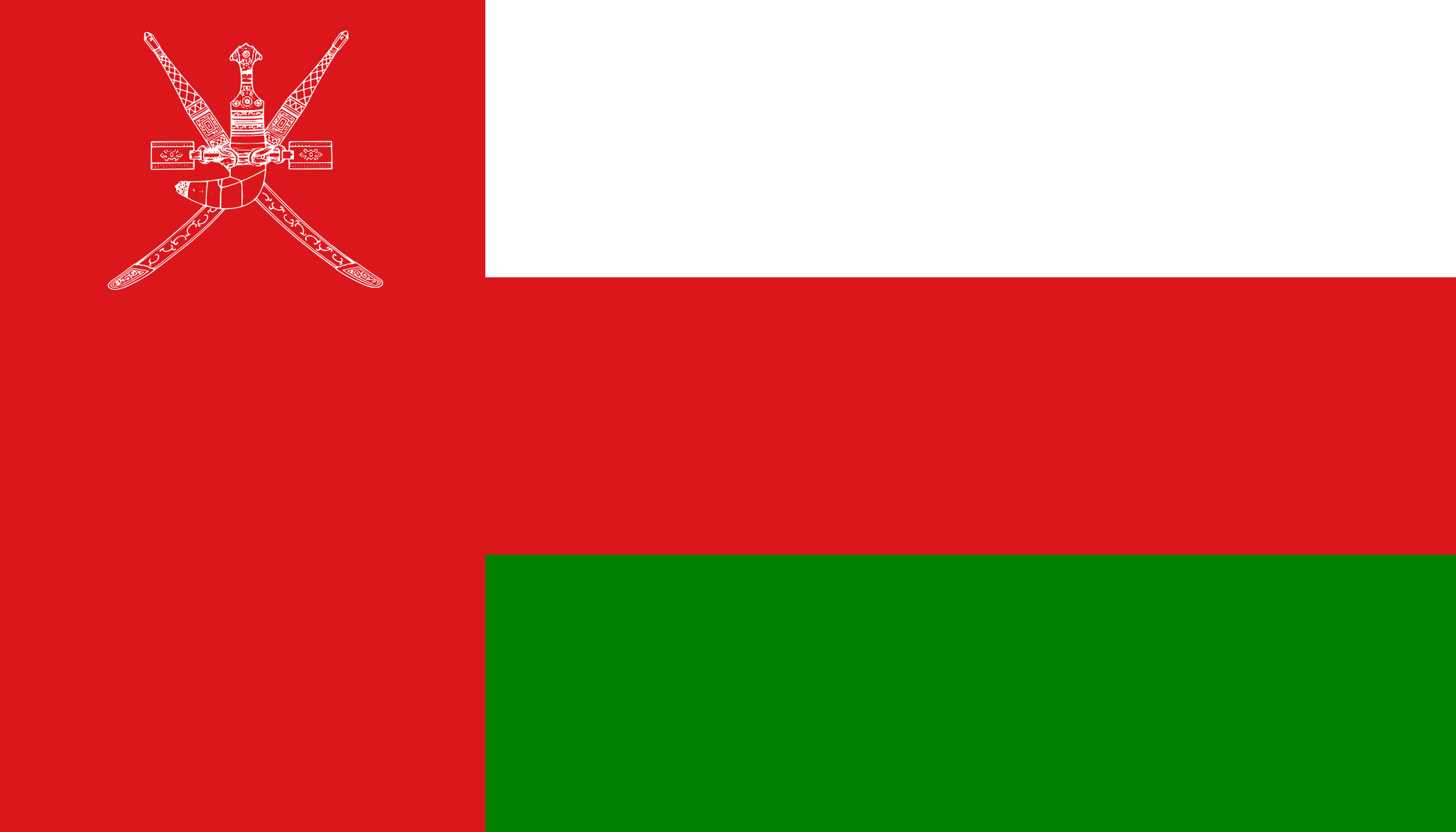
Oman flag picture
Explore the proportions, history, and picture gallery.
| Design | White, red, and green bandsEqual bands joined by a full-height red hoist panel. |
|---|---|
| Reference proportions | Height:length = 4:7The law also lists other sizes for particular uses. |
| Adopted | December 17, 1970Specifications updated by Royal Decree 53/2004. |
| Emblem | Sheathed khanjar, belt, and swordsWhite linework near the upper hoist. |
| Construction | Hoist = one-third of lengthEach horizontal band = one-third of height. |
| Later amendment | 2020: anthem textThe amendment did not replace the flag drawing. |
What does Oman’s flag look like?
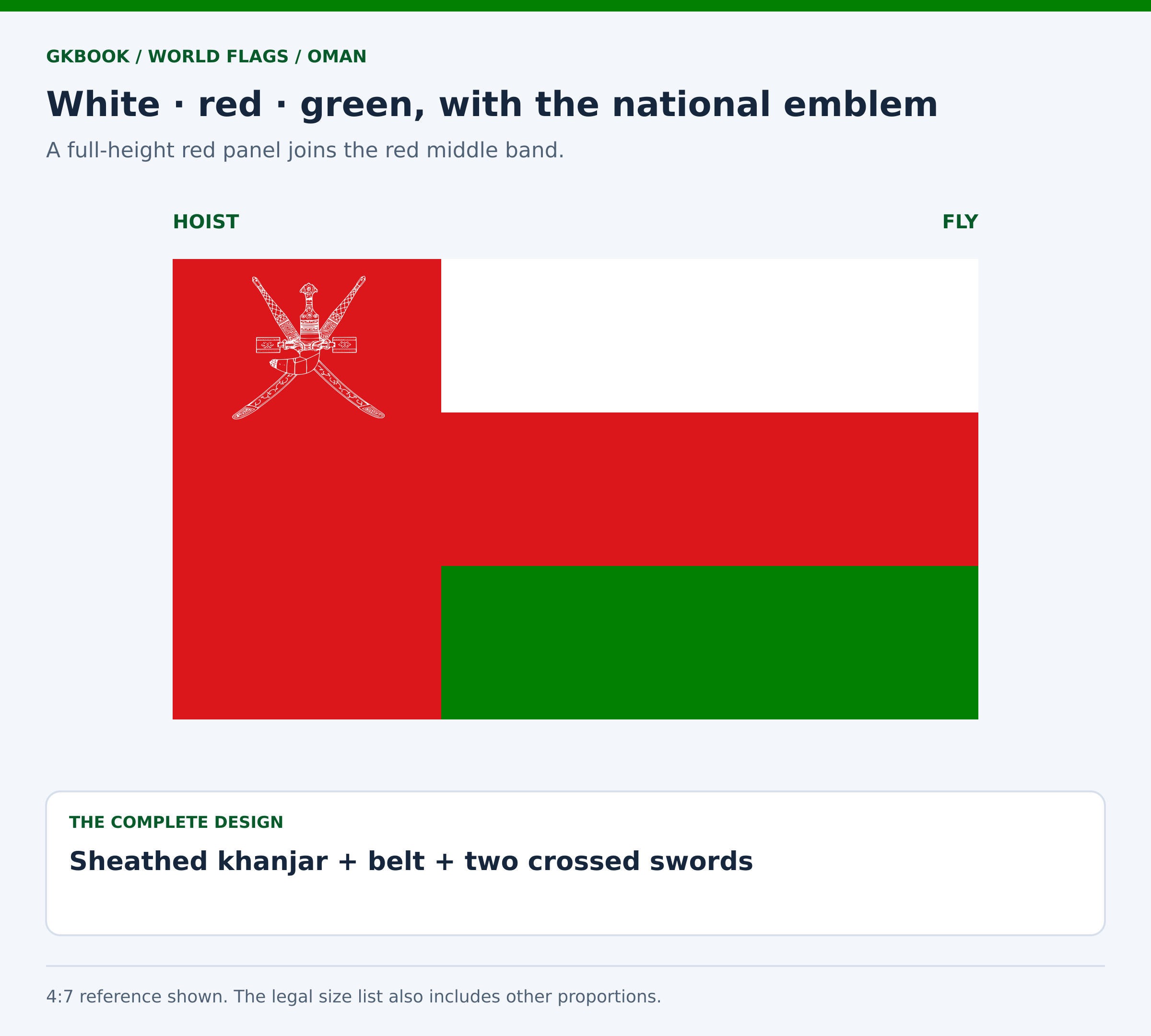
Oman’s flag has three equal horizontal bands of white, red, and green, joined at the hoist by a vertical red panel. A white national emblem appears near the upper hoist. This reference uses the 4:7 legal drawing; the law also specifies other sizes for particular uses.
Oman’s recognizable layout combines straightforward field geometry with a detailed national emblem. This guide explains the measured bands and hoist, the khanjar and crossed swords, and the difference between the 1970 adoption and later specifications. The reference drawing and use-specific size list are both retained.
What is the design of the Oman flag?
Oman’s national flag combines a red vertical panel beside the pole with white, red, and green horizontal bands extending toward the fly. The red areas join without a dividing line. A white emblem of a sheathed khanjar, belt, and crossed swords occupies the upper hoist area.
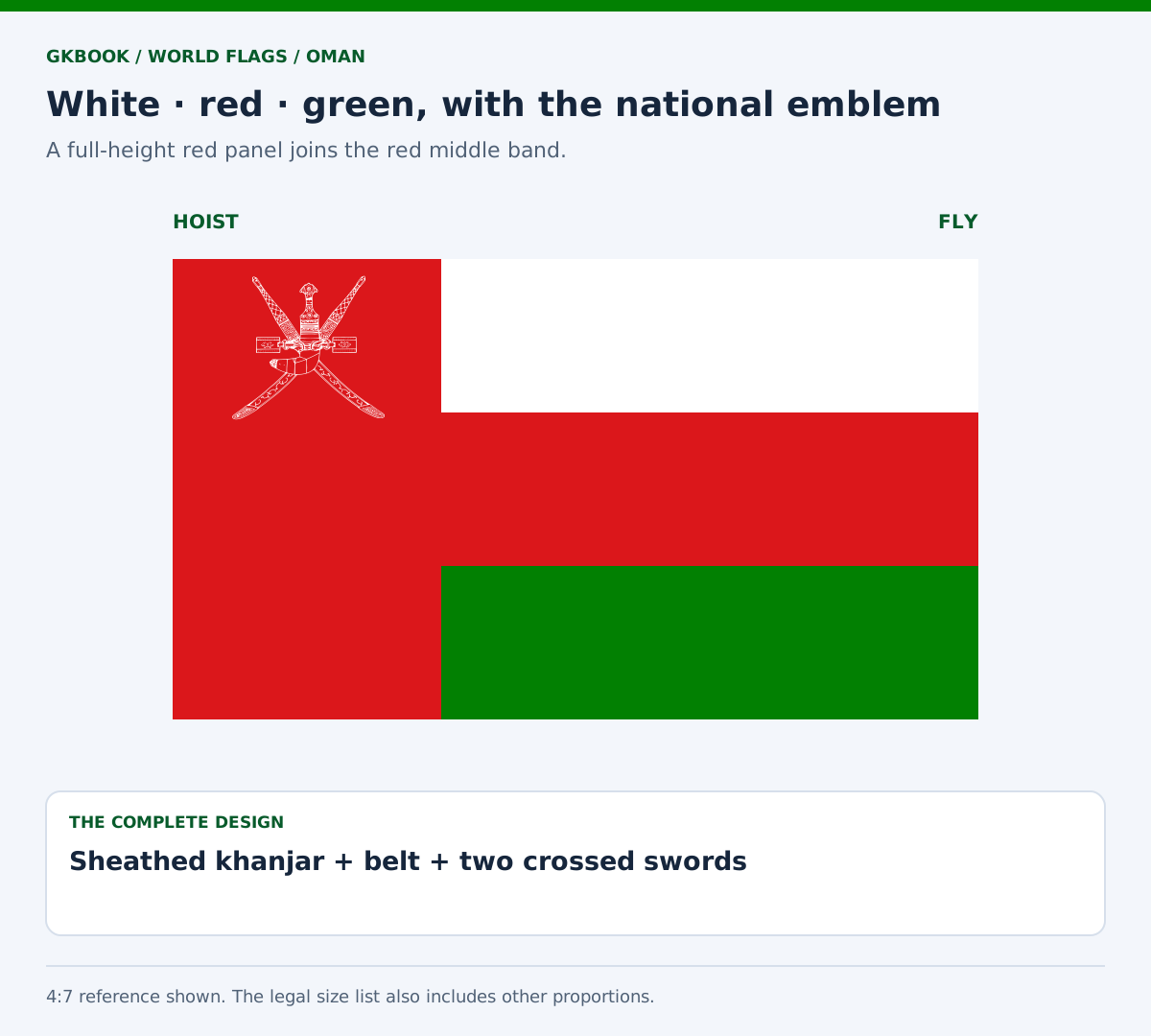
The hoist is the edge attached to the pole or halyard, and the fly is the opposite free edge. A conventional reference image puts the hoist on the left. This distinction is more useful than simply saying that the emblem always belongs on the left, because a reverse view changes the viewer’s orientation.
The horizontal bands are equal in height. The red vertical panel occupies one-third of the complete length, rather than one-third of the remaining fly area. No star, crescent, inscription, or additional central seal belongs on the ordinary national flag. The detailed white emblem is an essential part of the design.
What are the colors of the Oman flag?
Oman’s flag uses white, red, and green. The supplied artwork uses white #FFFFFF, red #DB171B, and green #028002, sampled from the Foreign Ministry’s downloadable reference. These are declared screen values, not universal statutory digital codes or a guarantee that every printed or woven flag will match them.
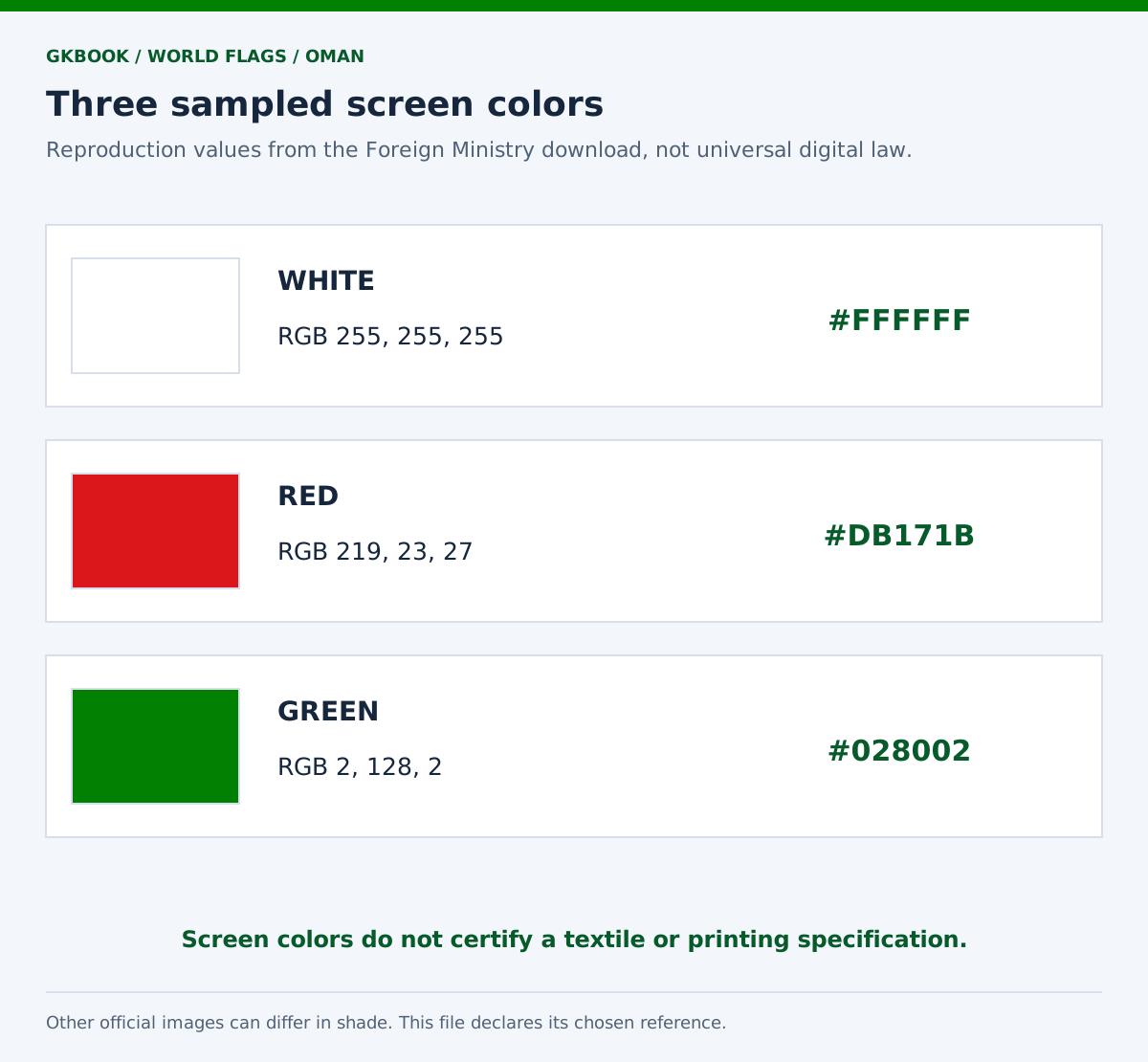
A digital image, a fabric specification, and a photograph answer different color questions. The law’s annex includes manufacturing and color references, but it does not provide a universal RGB or hexadecimal table. The screen palette here follows the dominant flat colors in the ministry download, with white kept fully opaque.
Other current official illustrations differ slightly in shade. That variation is a reason to state the reproduction reference clearly, rather than invent an exact conversion between textile terminology and RGB. Lighting, printing, cloth, and display settings also affect appearance. The gallery’s swatches identify the actual colors embedded in these files.
| Color | Hex | RGB | Location |
|---|---|---|---|
| White | #FFFFFF | 255, 255, 255 | Upper band and emblem |
| Red | #DB171B | 219, 23, 27 | Hoist panel and middle band |
| Green | #028002 | 2, 128, 2 | Lower band |
What does the Oman flag symbolize?
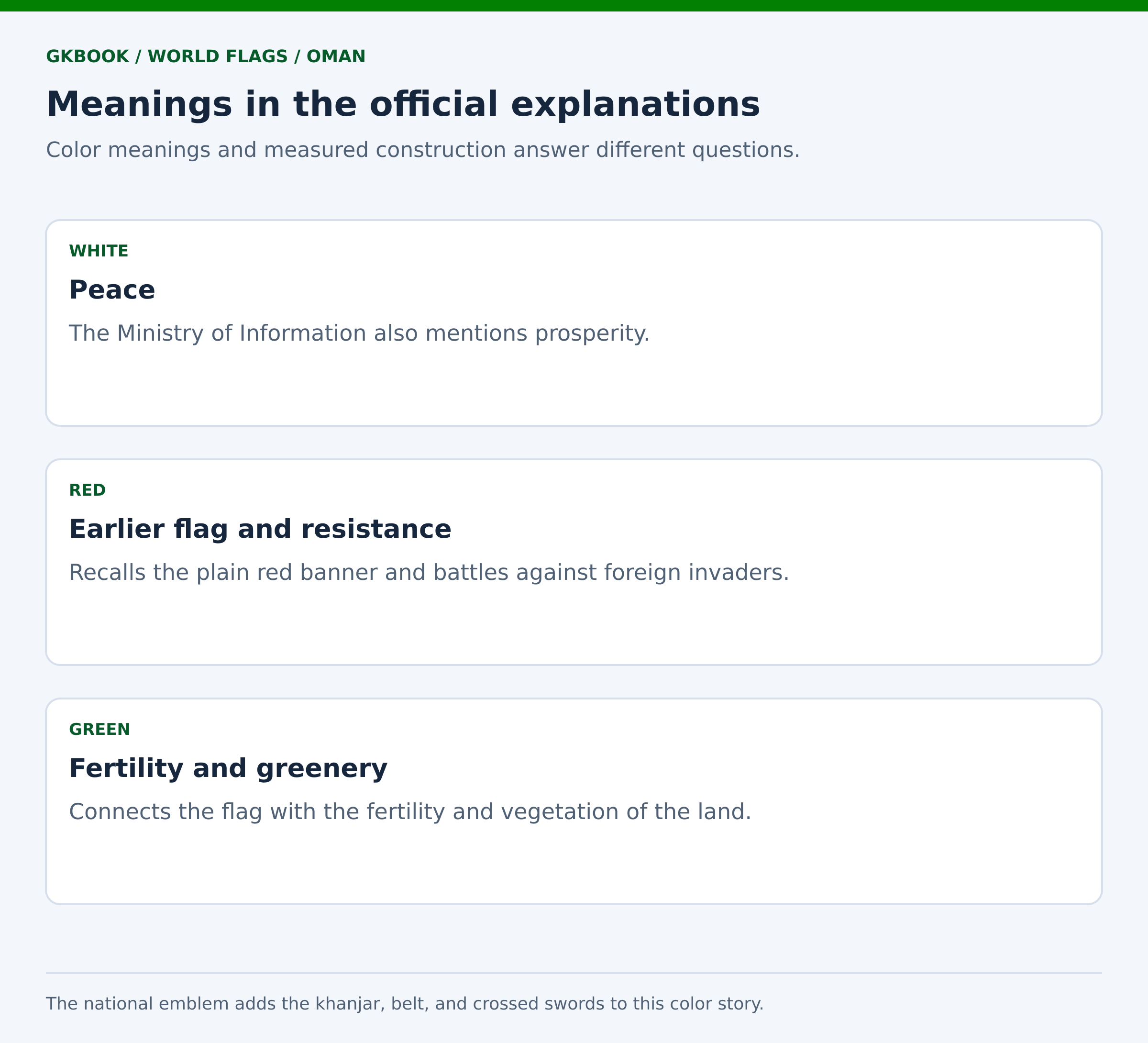
Official explanations associate white with peace, red with the former flag and battles against foreign invaders, and green with fertility and greenery. The khanjar and crossed swords connect the flag with Oman’s national emblem and heritage. These meanings accompany the design without changing its measured bands and hoist panel.

The Foreign Ministry and Ministry of Information provide closely related explanations. The latter also associates white with prosperity. These are useful descriptions of the flag’s public meaning, while the legal annex supplies its physical construction. Symbolism and dimensions should be read together without treating one as a substitute for the other.
The design also communicates continuity: red recalls the earlier plain banner, while the added white and green bands create the modern arrangement. The emblem adds a specifically Omani identity to colors found in other national flags. A simple three-color description therefore leaves out a significant part of the flag’s visual message.
What does white mean on Oman’s flag?
White represents peace in the Foreign Ministry’s explanation, while the Ministry of Information also mentions prosperity. It appears in the upper horizontal band and in the national emblem. In an accurate digital illustration, these areas are opaque white rather than transparent openings that reveal the background behind the flag.
The white upper band begins at the inner edge of the red hoist panel and continues to the fly. Its height equals those of the red middle band and green lower band. White linework also defines the emblem against the red field, making small ornamental details visible when the flag is reproduced at sufficient size.
Keeping the fill opaque matters on a colored webpage or in a downloaded graphic. Transparency would make the upper band appear to change color with its surroundings. The plain SVG and PNG retain the same white throughout; any decorative frame around an explanatory diagram belongs to the diagram rather than to the flag.
What does red mean on Oman’s flag?
Red recalls Oman’s earlier plain red flag and, in official explanations, the battles fought against foreign invaders. It forms both the vertical hoist panel and the middle horizontal band. These red regions connect into one continuous shape, while the white national emblem sits over the upper part of the panel.
Because the red middle band merges with the red hoist, the boundary between those two components is conceptual rather than a visible seam. Construction diagrams may mark that boundary to explain the measurements, but a finished reference flag should not add a line there. Both parts use exactly the same red fill.
The historical meaning should not be reduced to a generic claim about blood. Official descriptions specifically connect red with the older flag and resistance to foreign invasion. The continuity can be explained without assigning every part of the red shape a different political or religious meaning.
What does green mean on Oman’s flag?
Green represents fertility and the greenery of Oman’s land in the official explanation. It occupies the lower horizontal band, beginning beside the red hoist panel and extending to the fly. Its height equals the white and red bands, and its color is distinct from the red used above it.
The green band does not extend beneath the red hoist panel. That full-height red panel remains visible along the pole side, so the lower edge is red for its first third and green for the remaining two-thirds. This is a useful quick check when comparing a simplified icon with the complete flag.
Green can carry broader associations in different cultural settings, but the official national explanation used here emphasizes the land’s fertility and vegetation. It is better to retain that specific account than to substitute a general meaning borrowed from another country’s flag or from an unrelated three-color design.
What is the white symbol on Oman’s flag?
The white symbol is Oman’s national emblem: a sheathed khanjar and its belt superimposed on two crossed traditional swords. It is not a separate crest invented for the flag. The Foreign Ministry traces the emblem to the Al Bu Said royal crest, adopted in the middle of the eighteenth century.
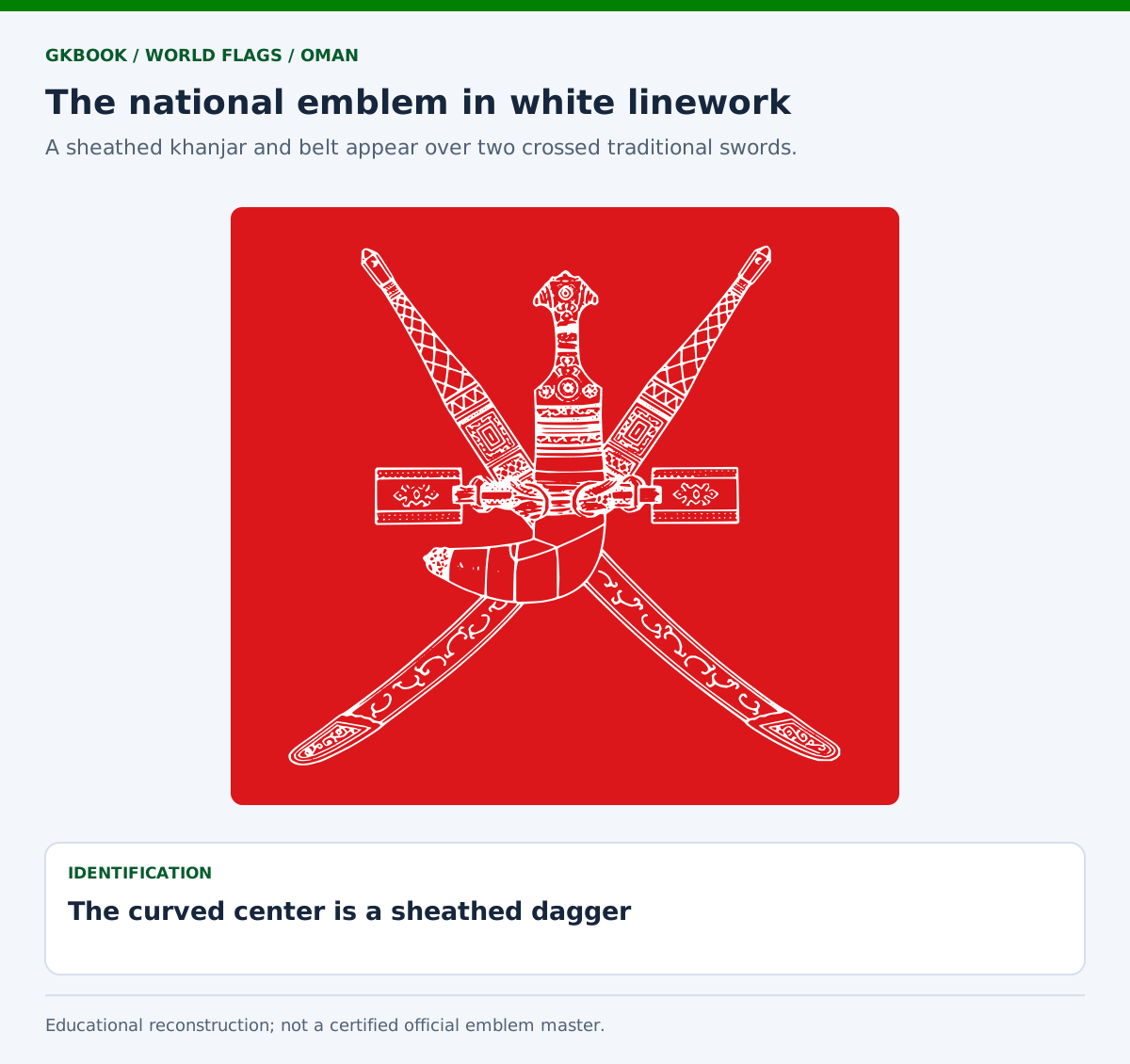
The central object is the khanjar in its curved sheath. The belt extends across the composition, and the two swords cross behind it. Identifying all three elements prevents common misreadings of the small device as an axe, a pair of daggers, or an abstract decorative mark. There is no lettering within the emblem on the flag.
The downloadable reference reconstructs the ministry artwork’s fine white linework. It preserves the recognizable arrangement rather than replacing it with a solid white silhouette. Small ornamental contours remain an approximate vector reconstruction, so the file is an educational reference and does not claim to be a certified government production master.
What is a khanjar, and how is it shown?
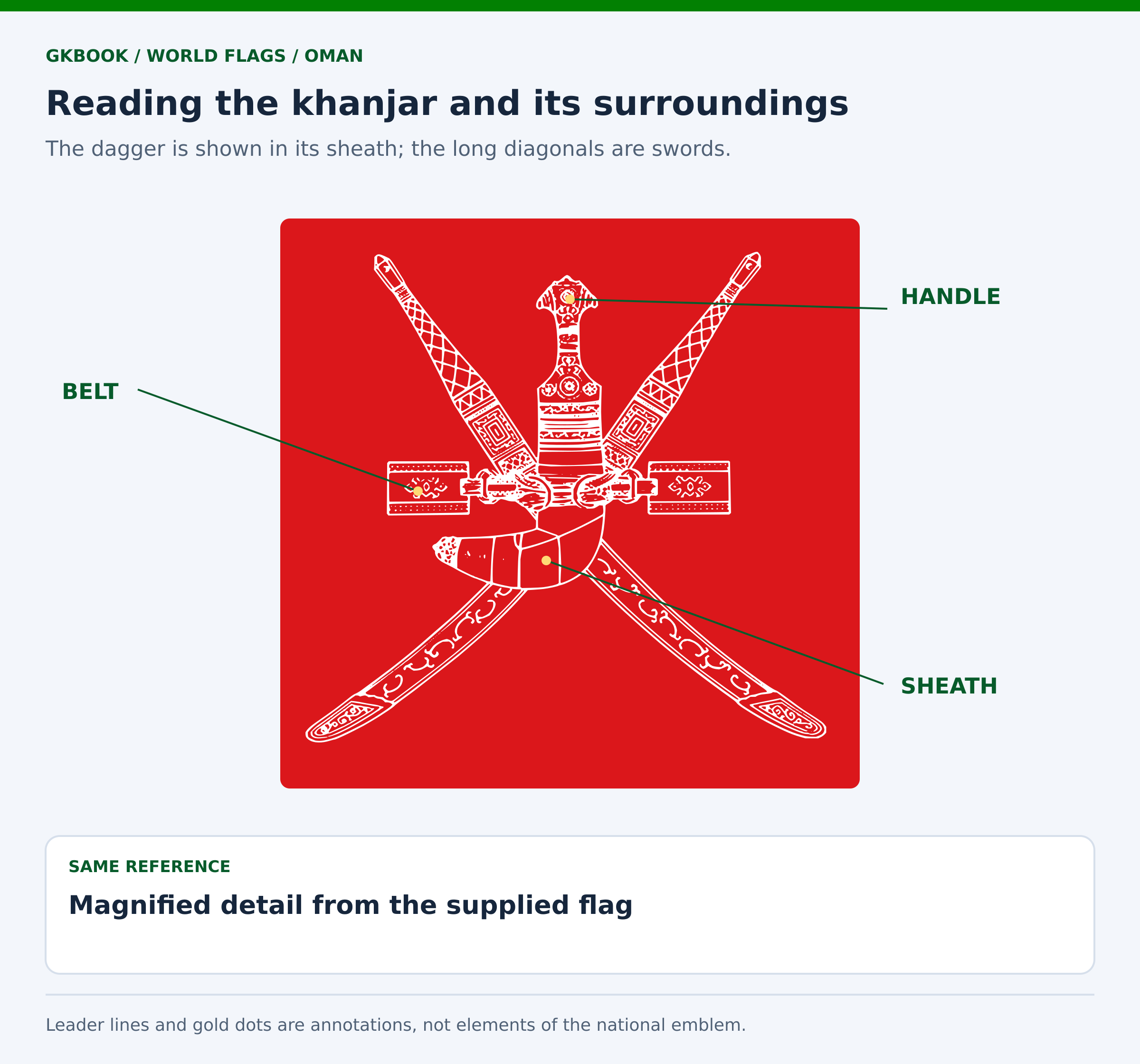
A khanjar is the traditional Omani dagger represented at the center of the national emblem. On the flag it is shown in its sheath, with the belt across the composition and crossed swords behind it. The curved lower shape belongs to the sheathed dagger, not to an exposed sword blade.
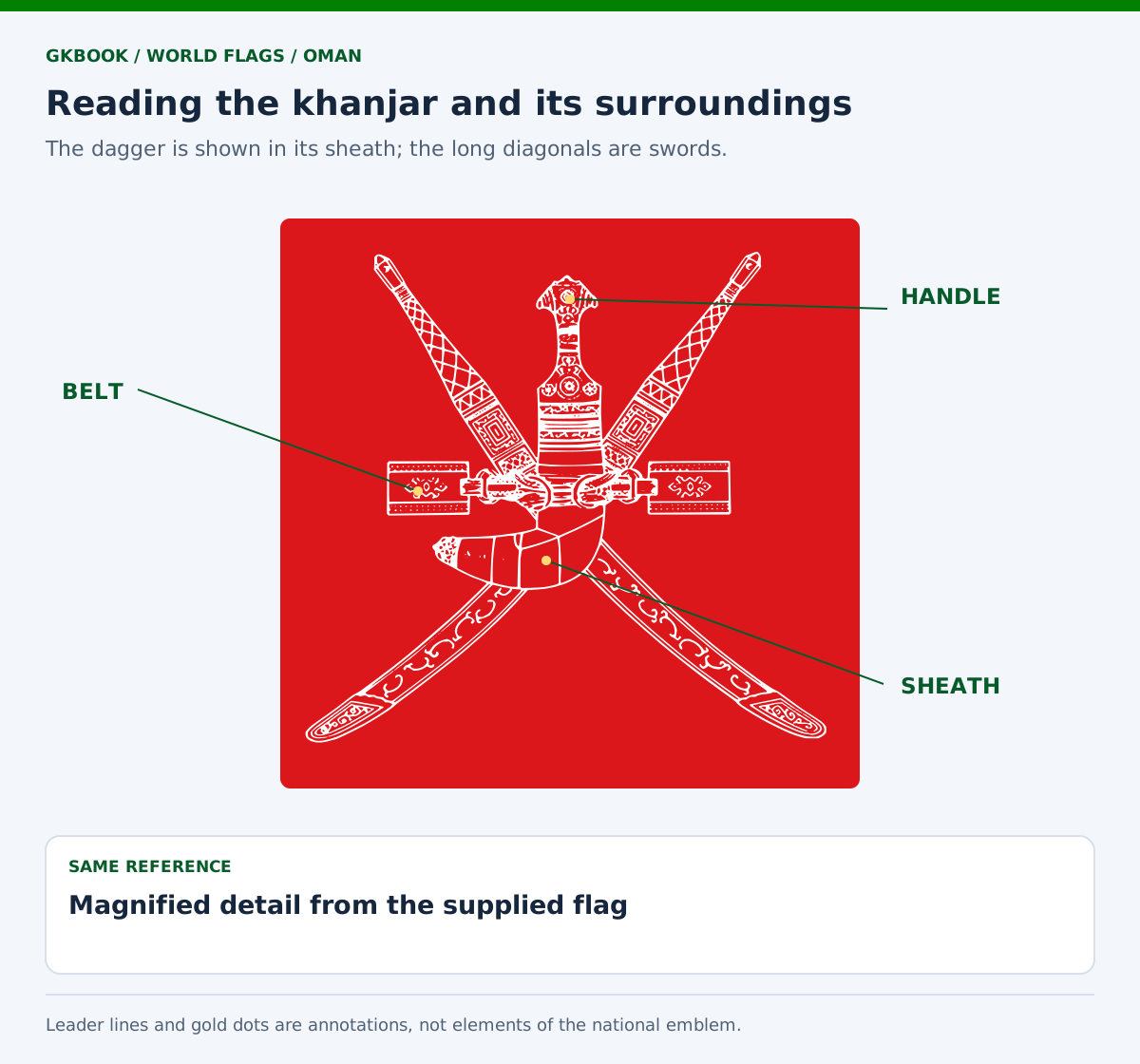
A large emblem detail makes the hierarchy easier to see: the dagger’s handle stands near the top center, the sheath curves below the belt, and the longer diagonal elements belong to the swords. These components should remain connected in a faithful reproduction. Rearranging them would change the emblem rather than merely simplify its decoration.
The gallery uses a magnified view of the same reconstructed emblem used on the plain flag. It does not add a new dagger illustration with invented proportions or decorative motifs. This consistent source helps readers connect the small white device on the flag with the larger cultural object it represents.
Where is the emblem placed on Oman’s flag?
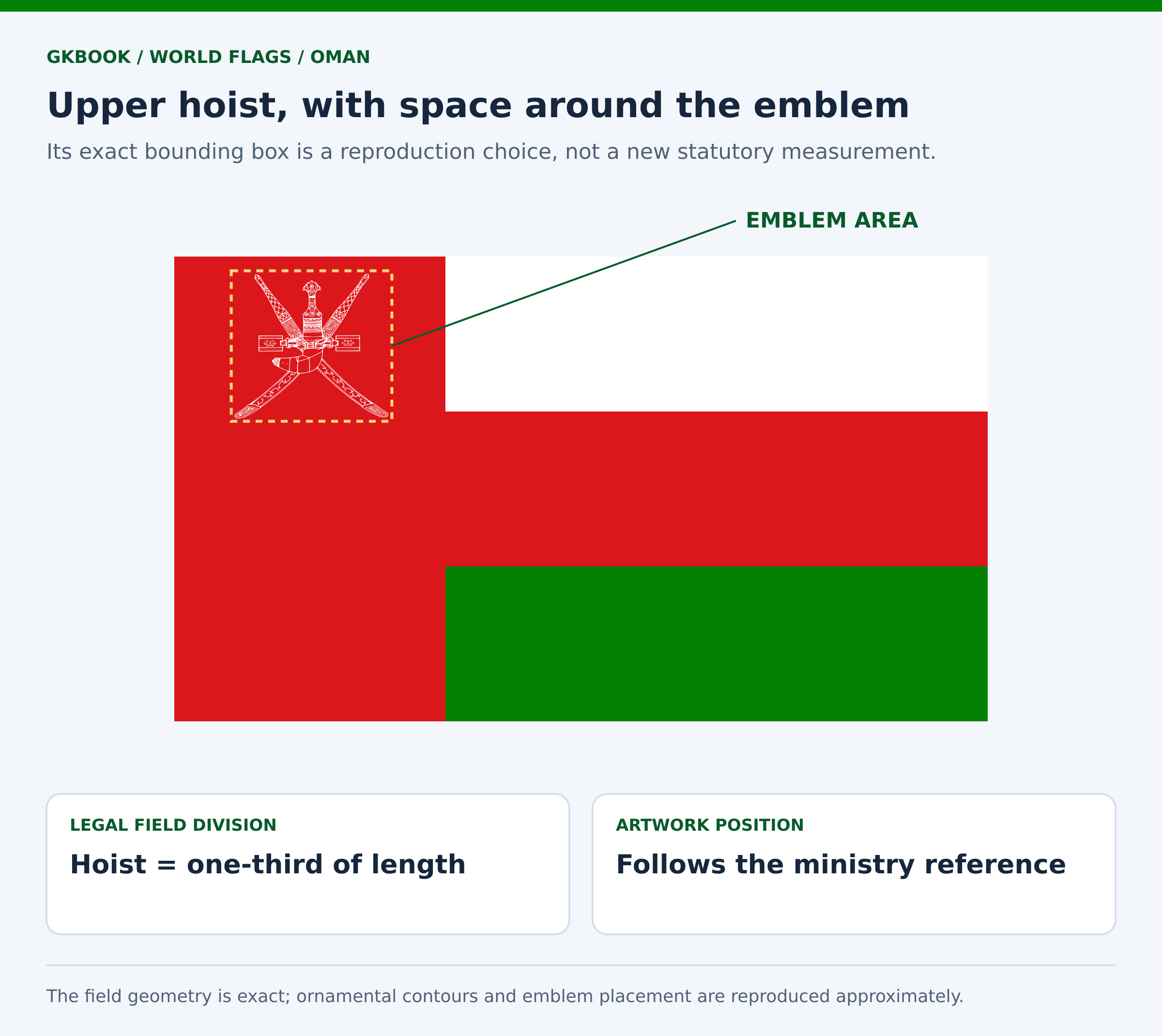
The white emblem belongs near the top of the red hoist panel, not at the center of the whole flag. The legal annex describes its upper placement without supplying a complete numerical bounding box. This artwork follows the Foreign Ministry reference for the emblem’s size and position within that area.
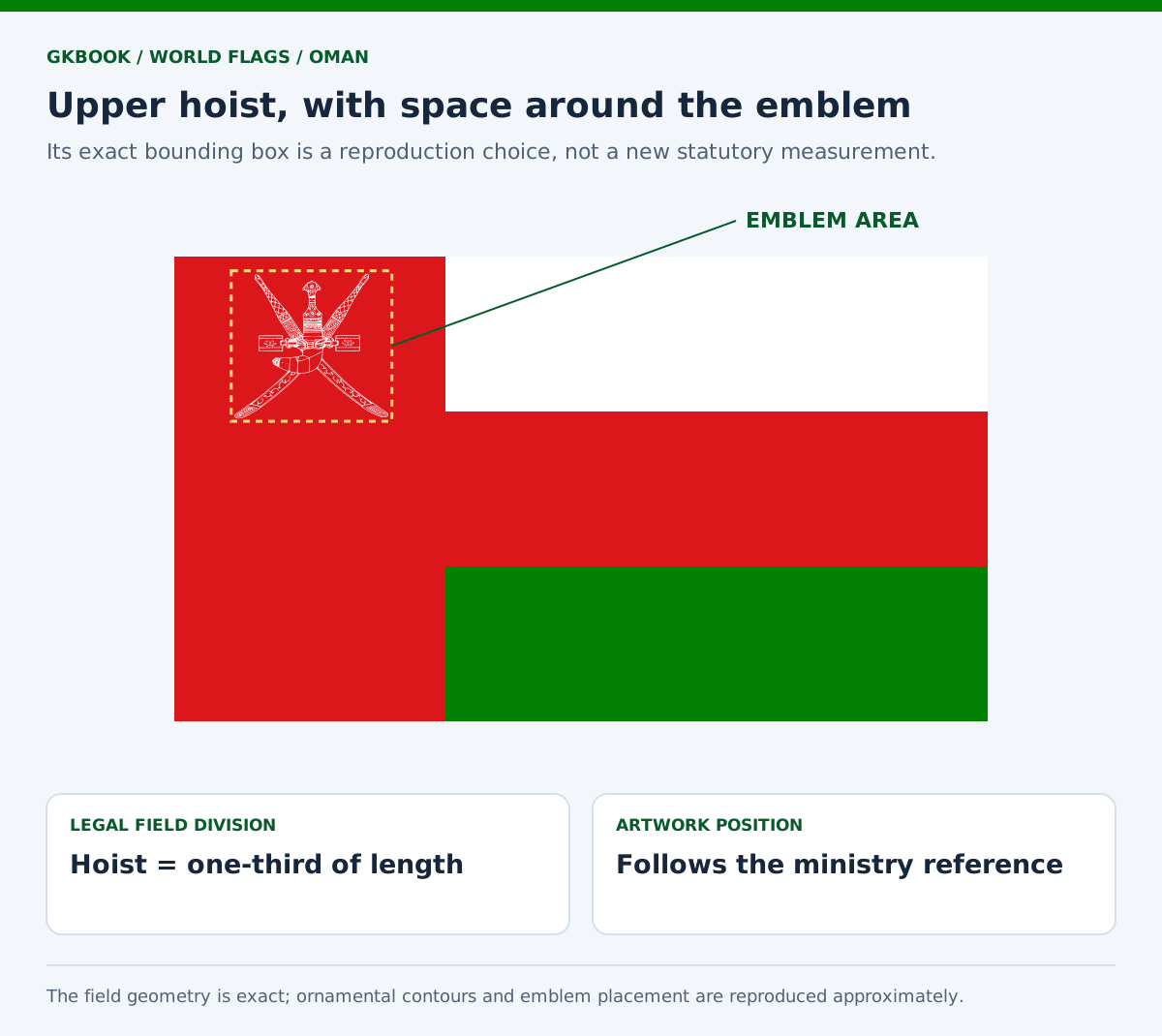
The outer flag dimensions and the one-third hoist division can be constructed exactly from the legal reference. The decorative emblem requires a different kind of fidelity: its shape, orientation, and placement are compared with the ministry artwork. The coordinates chosen for this reconstruction are documented as reproduction choices, not presented as additional statutory measurements.
Keep the emblem wholly within the red panel and preserve the spacing around it. Enlarging it to fill the entire panel or moving it to the central red band would give the design a substantially different balance. The position diagram distinguishes the legal field divisions from the artwork’s approximate emblem outline.
What is the official ratio of the Oman flag?
The legal construction drawing shows a flag 350 centimeters long and 200 centimeters high, giving a height:length ratio of 4:7. That is the reference used here. The same law also lists other dimensions for particular settings, so neither 4:7 nor 1:2 should be described as the only permitted ratio.

The order of a ratio matters. Height:length = 4:7 means that a 400-unit-high drawing is 700 units long; length:height is the inverse, 7:4. The Foreign Ministry download closely follows this reference, allowing for its integer pixel height. The supplied SVG uses an exact 2,100 × 1,200 coordinate system.
Flag-size lists often omit the use associated with a measurement. A 2 × 1 meter flag is indeed 1:2 in height:length, but the 3.50 × 2 meter version is 4:7. Keeping both facts avoids turning one listed size into an exclusive rule for every flag.
How wide is the red hoist panel?
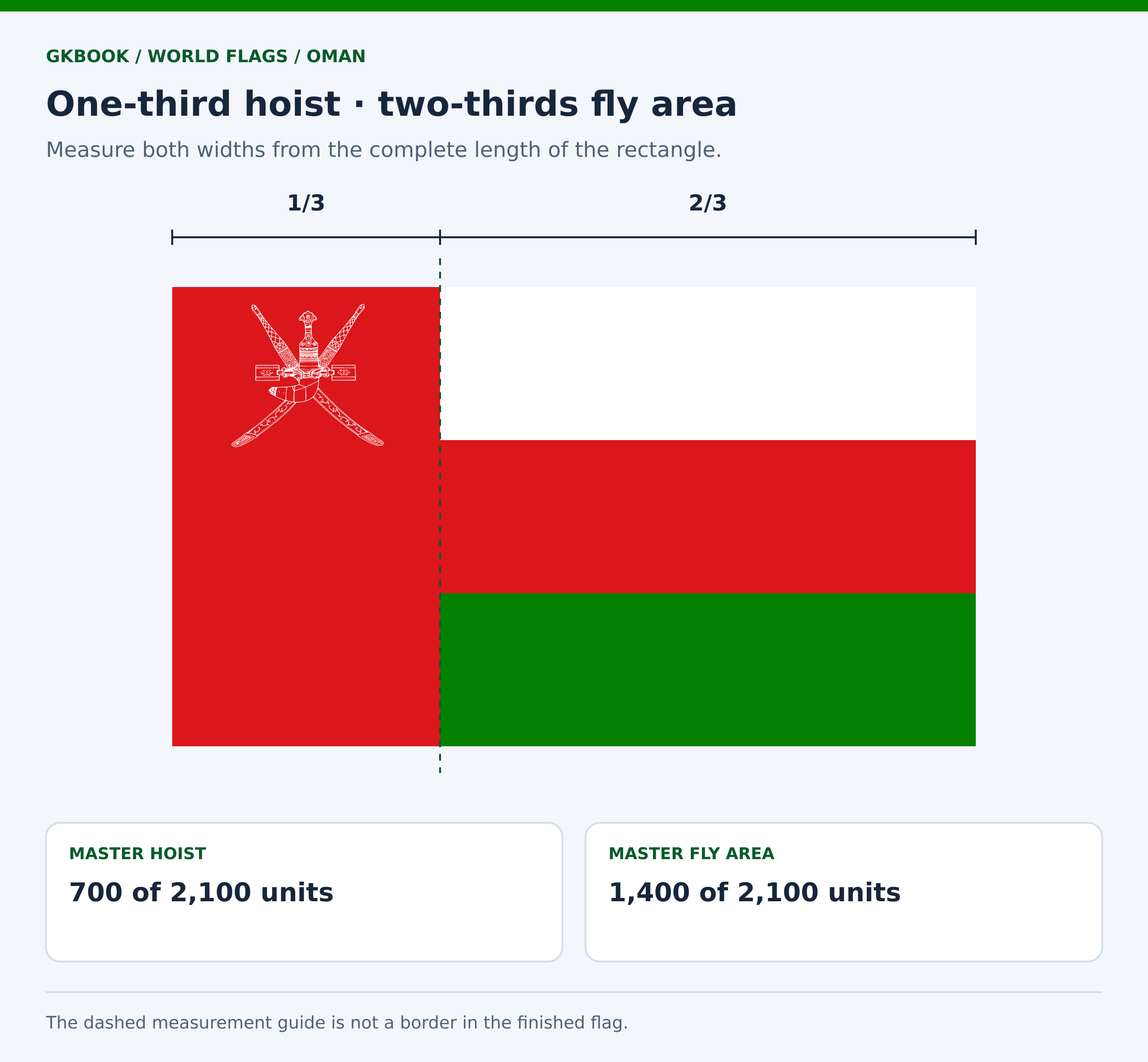
The red hoist panel is one-third of the flag’s total length and extends through its full height. The remaining two-thirds contain the three horizontal bands. On the supplied 2,100 × 1,200 master, the panel is 700 units wide and the bands extend another 1,400 units to the fly.
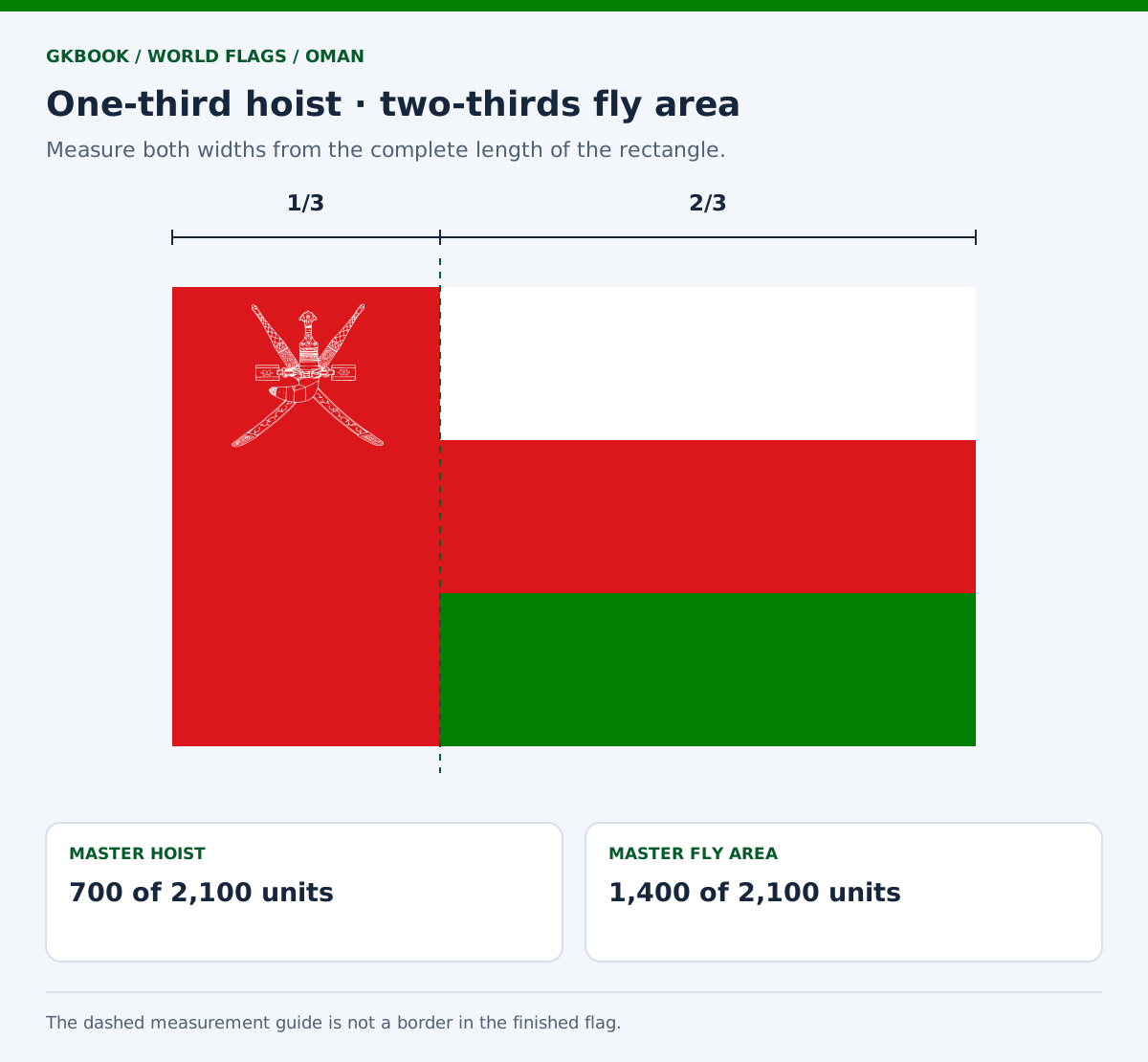
Measure the panel along the horizontal length, not as one-third of the height. On the legal 350 × 200 centimeter drawing, its width is 350/3 centimeters, approximately 116.67. The remaining band length is 700/3 centimeters, approximately 233.33. The repeating decimals simply arise from dividing the whole length into thirds.
Some older or simplified drawings show a narrower panel. The construction here follows the explicit one-third description in the legal annex and Ministry of Information explanation. Measurement guides are placed outside the complete flag so that the diagram does not introduce a visible border into the red field.
What is the order and height of the horizontal bands?
With the flag upright, the bands run white at the top, red in the middle, and green at the bottom. Each is one-third of the total height. They occupy the area beyond the vertical red panel, whose full-height red field remains beside all three bands on the hoist side.
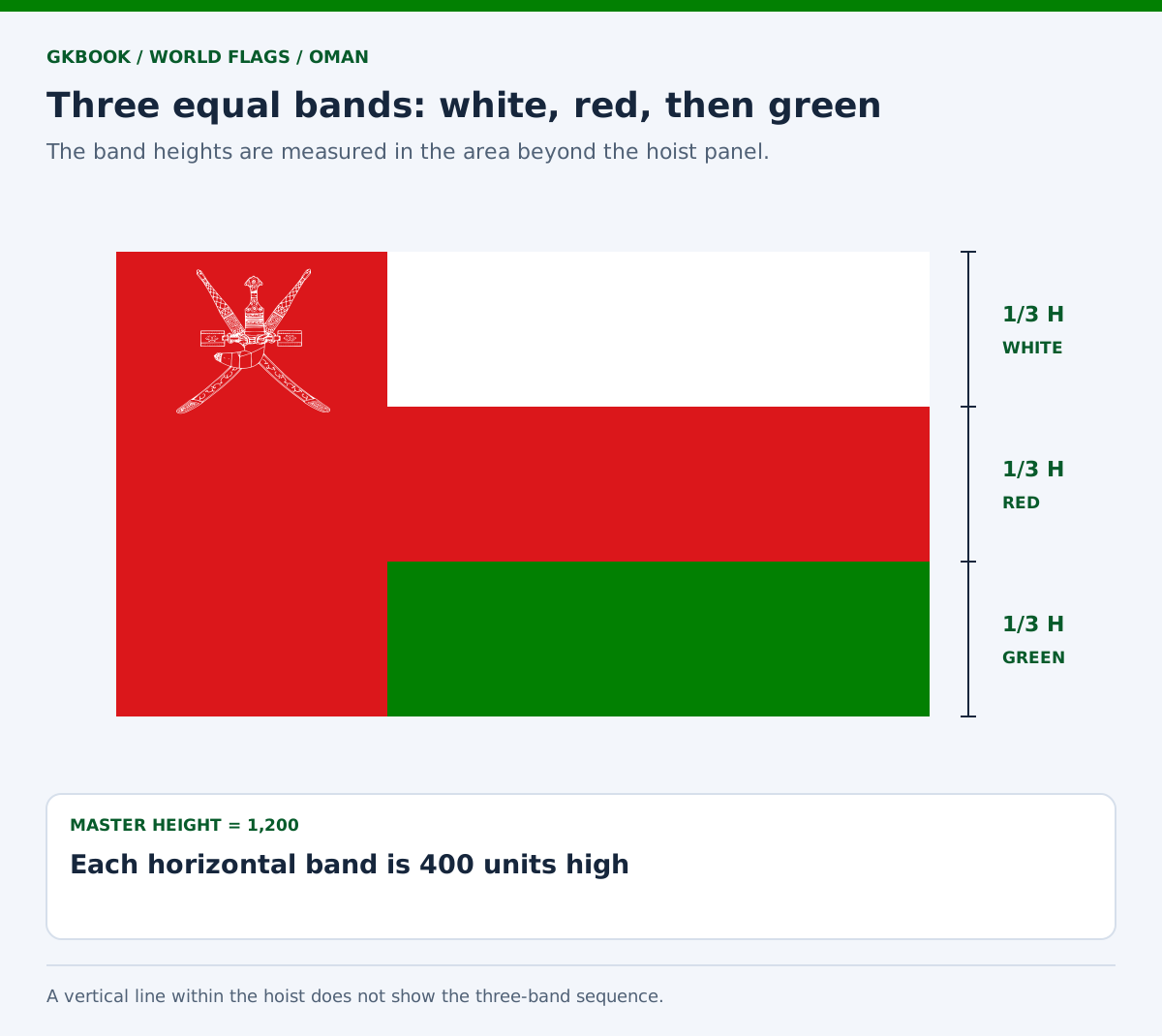
On the 1,200-unit-high master, the first boundary lies at y = 400 and the second at y = 800. A vertical line through the fly area therefore crosses three equal 400-unit segments. A line close to the pole stays within the red panel, apart from any white emblem linework that it intersects.
The red band joins the vertical panel continuously, giving the red region a sideways T appearance. This description is a convenient way to recognize the layout, not an instruction to draw a typographic letter. Construct the panel and equal-height bands from their measured rectangles.
How can you draw Oman’s flag accurately?
For the 4:7 reference, begin with a rectangle seven units long and four units high. Reserve its first third as a red hoist panel. Divide the remaining area into equal white, red, and green horizontal bands, then add the white national emblem near the top of the red panel.
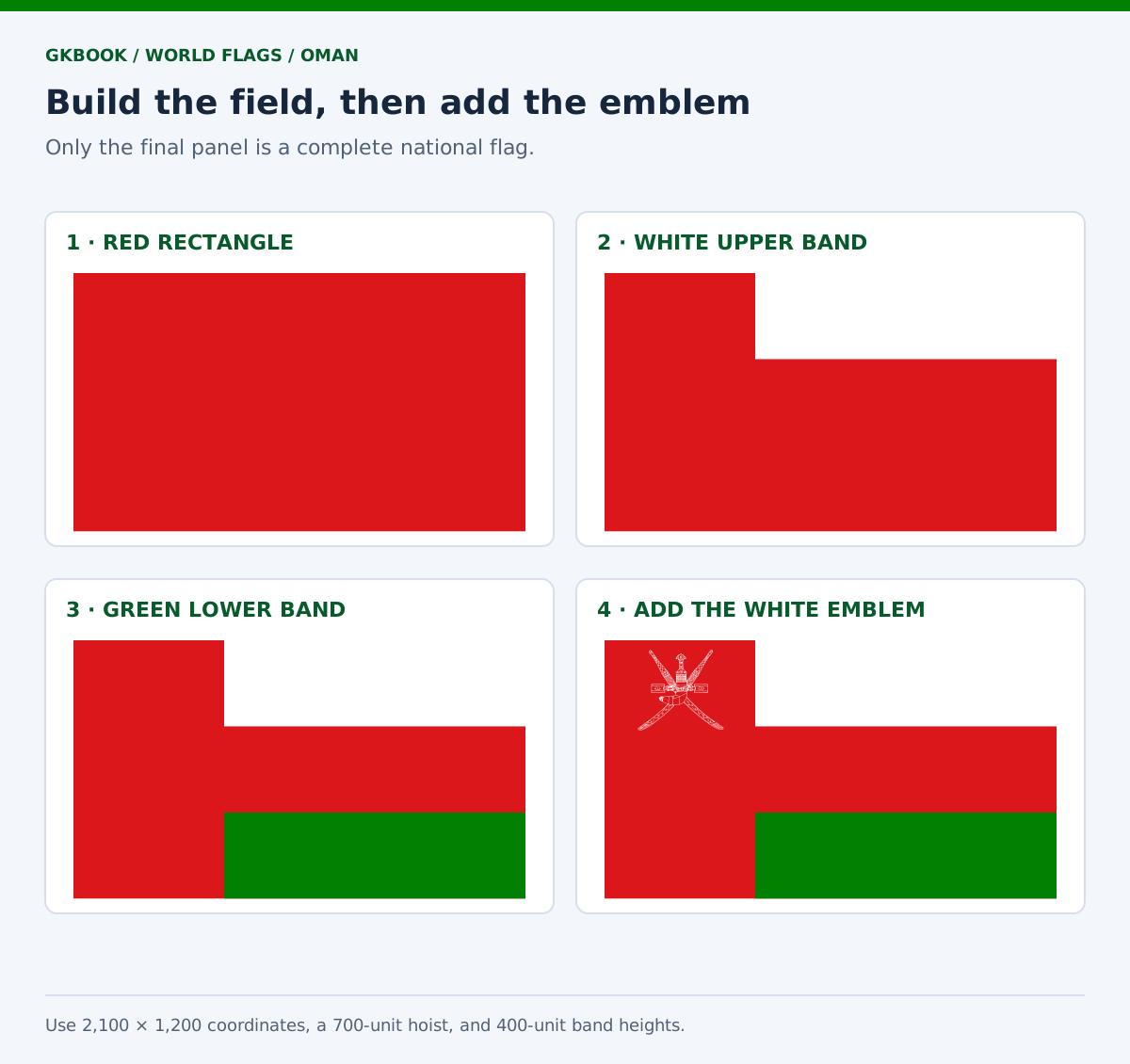
The downloadable master simplifies the fractions by using 2,100 × 1,200 coordinates: the hoist is 700 wide and each band is 400 high. A full red rectangle forms the base. White and green rectangles cover the upper and lower parts of the fly area, leaving the connected middle red region visible.
Add the emblem only after completing the field. Scaling the supplied reconstruction uniformly preserves its linework and proportions. Do not substitute a generic dagger icon or omit the crossed swords and belt. The construction diagram labels unfinished stages clearly; only the last panel represents the complete national flag.
What pixel sizes preserve the 4:7 reference?
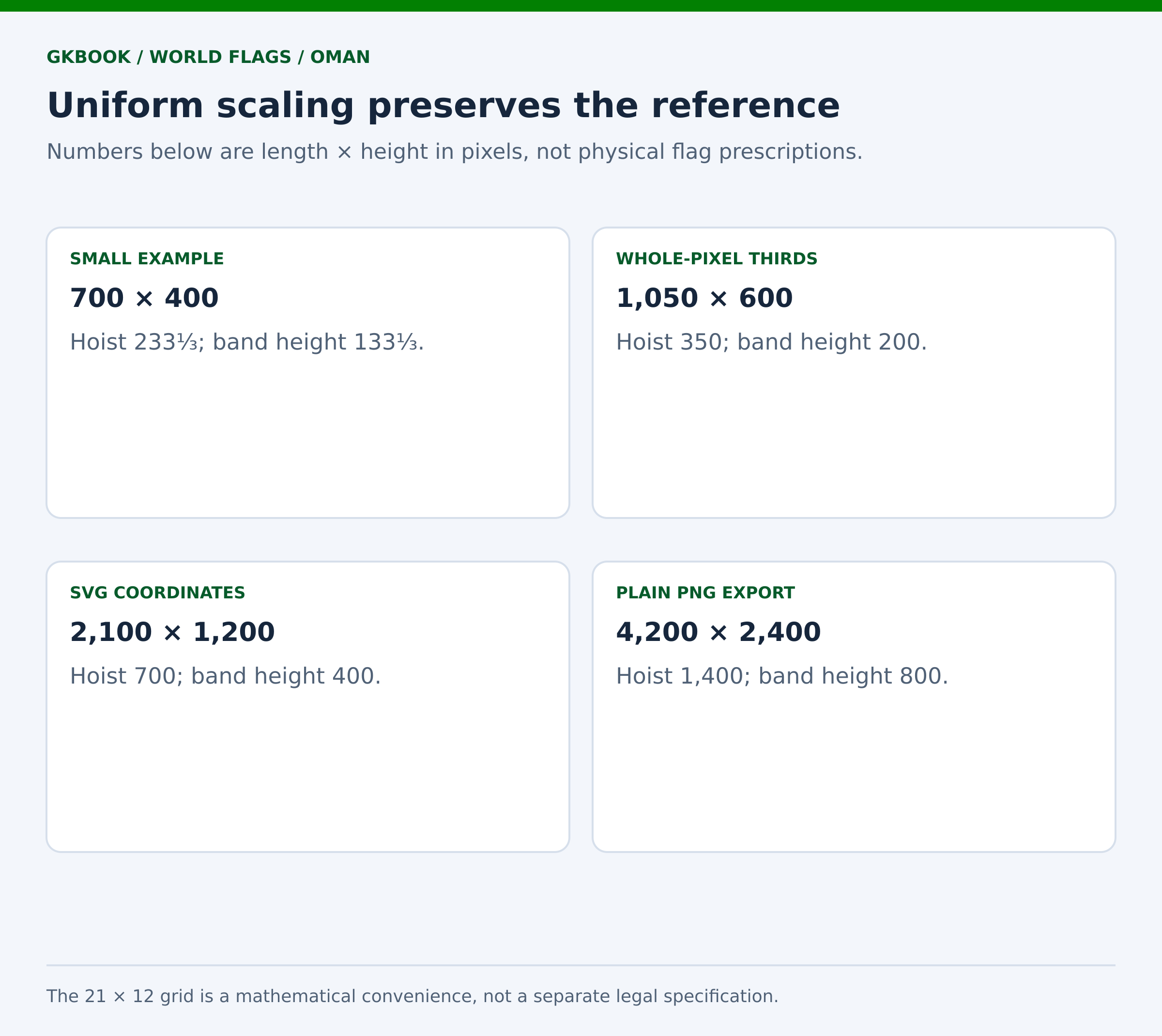
Examples of exact 4:7 height:length images include 700 × 400, 2,100 × 1,200, and 4,200 × 2,400 pixels, written length × height. Every component must scale with the rectangle. Multiples of the 21 × 12 construction grid also place both thirds on whole-pixel boundaries.

The 21 × 12 grid is a convenient mathematical rescaling of the legal 7 × 4 ratio, not a separate legal specification. It divides cleanly into a seven-unit hoist and three four-unit bands. At a scale of one hundred pixels per grid unit, those become the 700-unit panel and 400-unit bands in the SVG master.
An image can still preserve the ratio when a boundary falls between pixels. Ordinary antialiasing handles those edges, but small emblem details will become less legible at very small sizes. Prefer the SVG for scalable reference use and the larger PNG when a raster file is needed.
| Length × height | Hoist width | Band height |
|---|---|---|
| 700 × 400 | 233⅓ | 133⅓ |
| 1,050 × 600 | 350 | 200 |
| 2,100 × 1,200 | 700 | 400 |
| 4,200 × 2,400 | 1,400 | 800 |
Why do official Oman flags have different proportions?
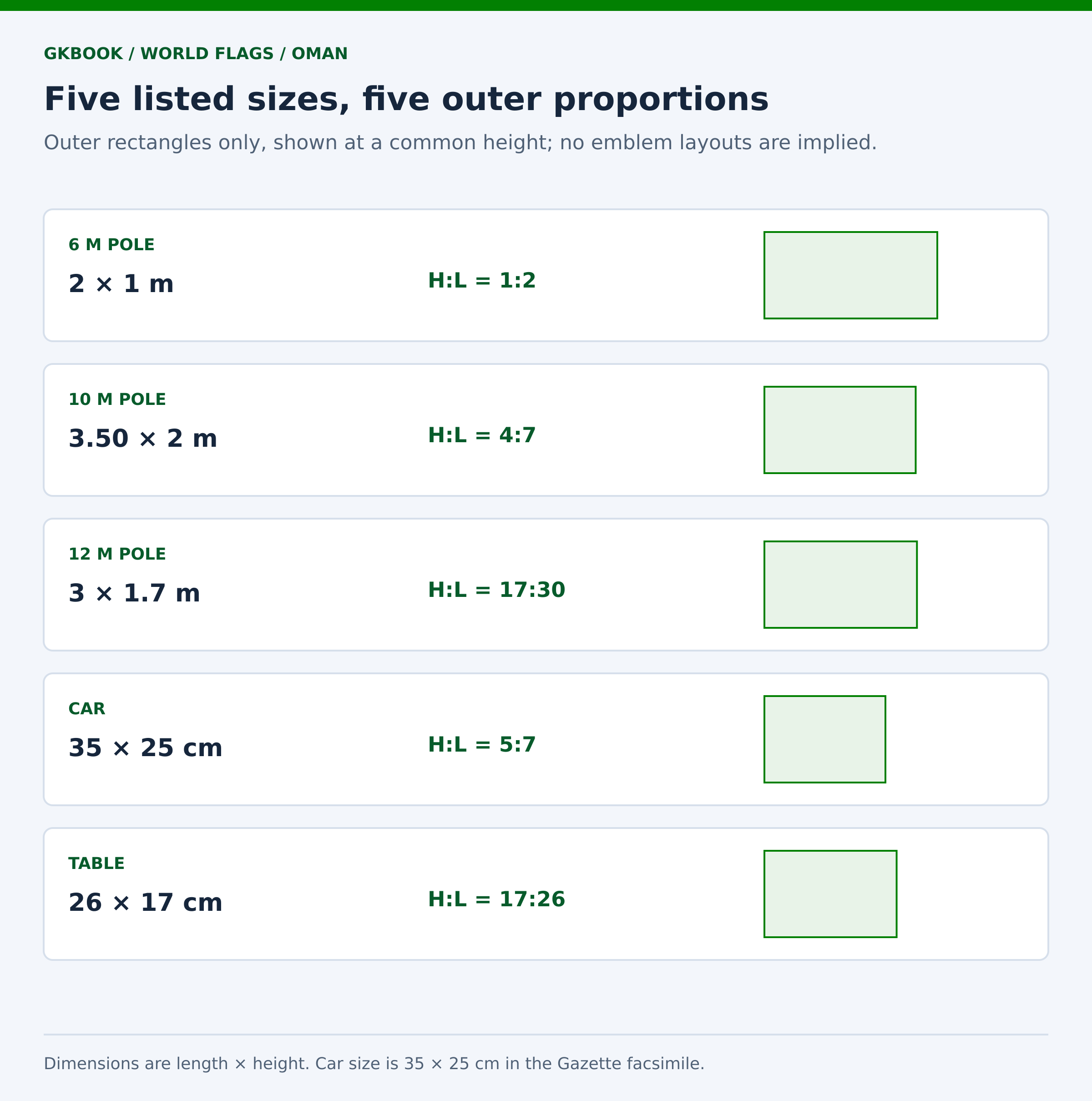
The law lists dimensions for different settings: 2 × 1 meters, 3.50 × 2 meters, and 3 × 1.7 meters for specified pole heights, plus 35 × 25 centimeters for cars and 26 × 17 centimeters for tables. These measurements produce several ratios rather than one universal rectangle.
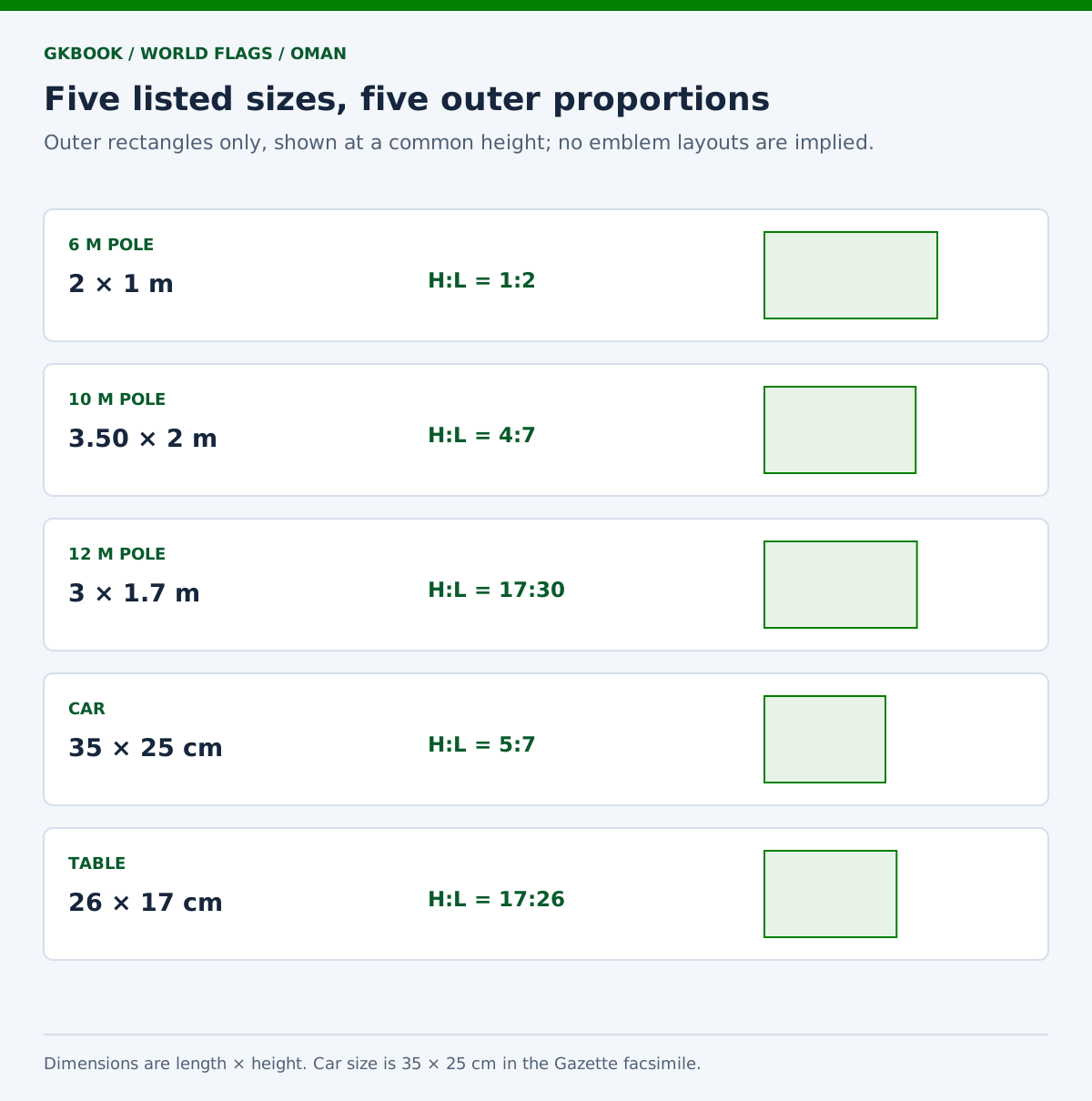
The pole-associated sizes are linked respectively to six-meter, ten-meter, and twelve-meter poles. The 3 × 1.7 meter example has height:length = 17:30, which is close to, but not exactly, 4:7. The table and car versions are more compact. They should be reported as the dimensions listed, without silently rounding them into another ratio.
For a general educational reference, this package uses the 350 × 200 centimeter construction drawing. The size comparison shows the listed outer rectangles at a common display height; it does not claim to supply separate certified emblem layouts for every use. Always label the dimensions and their order when comparing them.
| Setting | Dimensions | Height:length |
|---|---|---|
| 6 m pole | 2 × 1 m | 1:2 |
| 10 m pole | 3.50 × 2 m | 4:7 |
| 12 m pole | 3 × 1.7 m | 17:30 |
| Car | 35 × 25 cm | 5:7 |
| Table | 26 × 17 cm | 17:26 |
Is the Oman flag symmetrical?
Oman’s flag is not symmetric across either the horizontal or vertical centerline of a fixed hoist-left view. White and green occupy different heights, while the red panel and emblem sit toward one side. A half-turn also changes the arrangement, so the flag has a definite upright orientation.
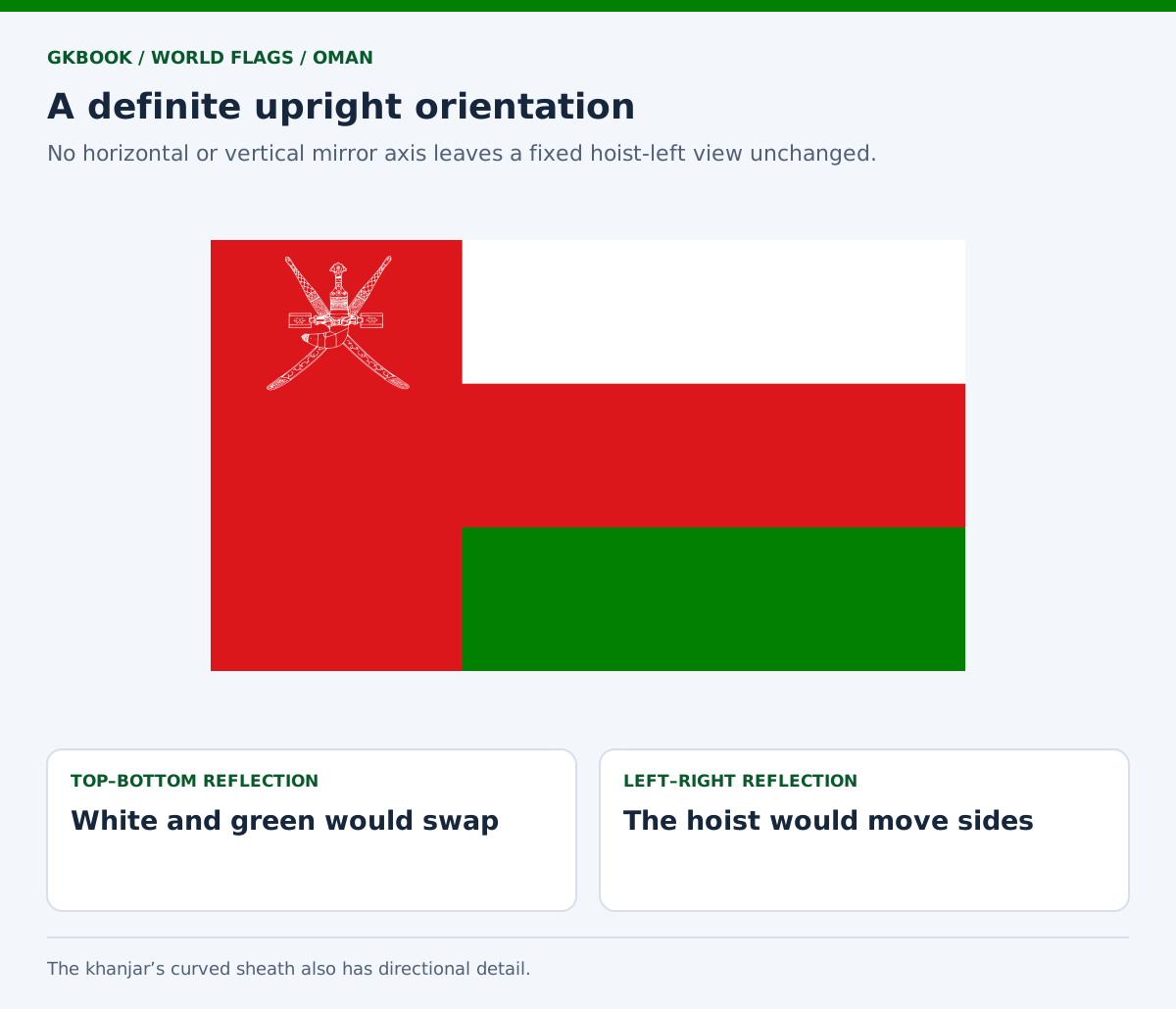
Reflecting the image top to bottom would exchange the white and green bands and move the emblem toward the lower hoist. Reflecting it left to right would move the panel to the other edge. That second operation can illustrate the reverse view of the cloth, but it does not establish mirror symmetry of one fixed reference image.
The emblem itself also has directional details, particularly the curved sheath. It should not be replaced by a perfectly symmetric invented symbol. Comparing the location of the white band, green band, hoist, and emblem provides a practical orientation check before a flag image is used in a layout.
What does the reverse side of Oman’s flag look like?
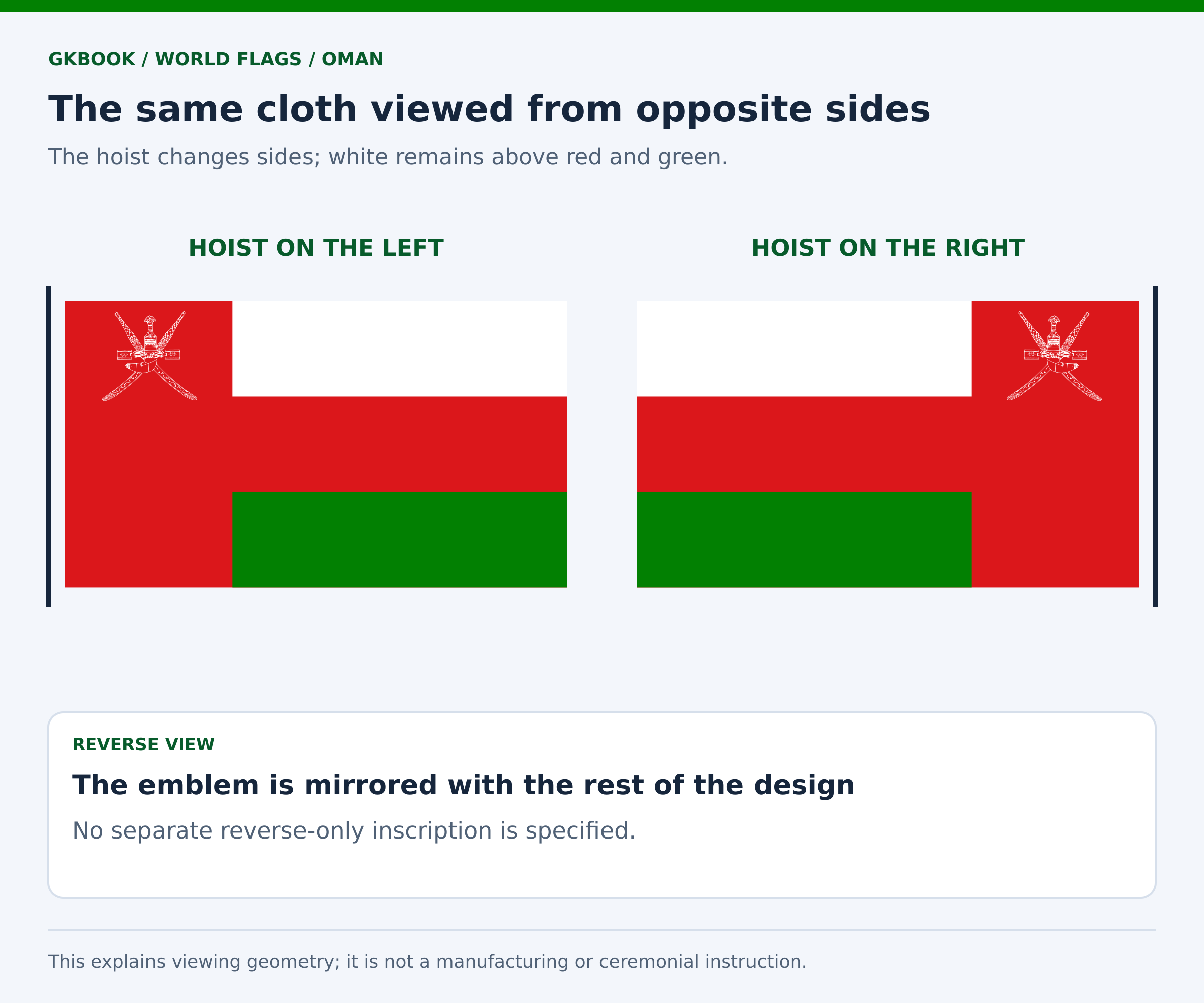
Viewed from the opposite side of the cloth, Oman’s flag has the same colors and emblem in a horizontally mirrored arrangement. The red panel appears on the right when the hoist is on the right. White remains above red and green; no separate reverse-only inscription or additional emblem is specified.
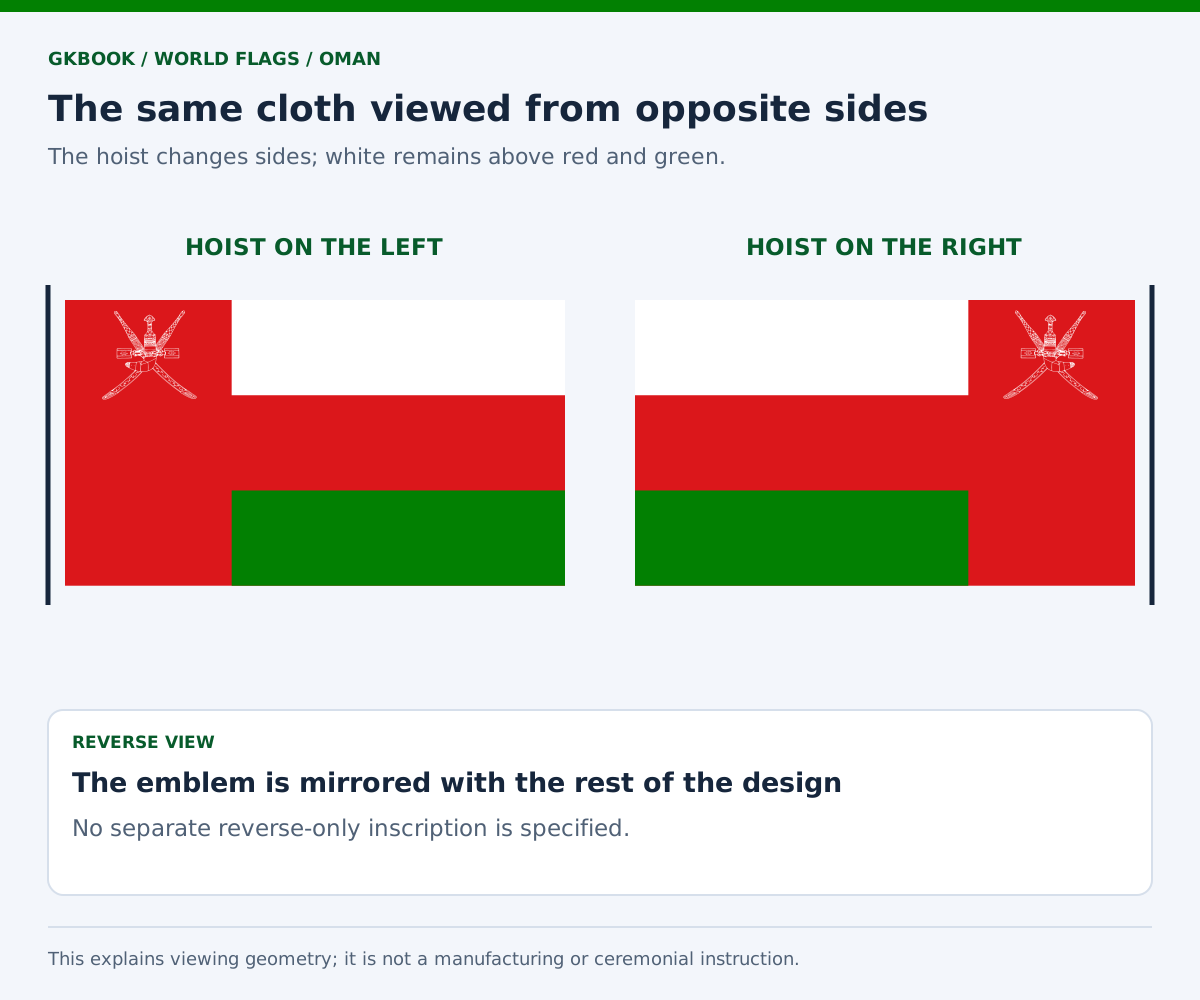
The mirror illustration changes the viewer’s side, not the flag’s identity. In both views, the red panel remains attached to the pole side and the white emblem remains near its upper portion. The khanjar’s curved sheath also appears mirrored in a view through the opposite side of the design.
The reference diagram marks the hoist on each flag so that a mirrored picture is not mistaken for an arbitrary reversal. It is a geometric explanation of the two views. It does not prescribe a particular sewing method or replace instructions for manufacturing a double-sided ceremonial flag.
What is the history of the Oman flag?
The modern white, red, and green flag was adopted on December 17, 1970, replacing the earlier plain red banner. Later specifications refined its presentation, with equal-band changes reported in 1995 and a comprehensive flag, emblem, and anthem law issued in 2004. An amendment in 2020 changed the anthem text.

The continuity of red links the modern design with the earlier flag, while the white and green bands and national emblem identify the new arrangement introduced under Sultan Qaboos. This makes 1970 the central adoption milestone even when a reference describes later changes to proportions, band widths, or legal specifications.
The timeline separates initial adoption, later visual adjustment, and legislation. The 1995 account is supported by specialist flag observations and should not be given an unverified exact day. The 2004 decree can be dated precisely from its text. The 2020 amendment concerns the anthem annex and does not establish a new flag design.
When was the Oman flag adopted?
Oman’s Foreign Ministry and Ministry of Information identify December 17, 1970, as the adoption date of the modern national flag. May 22, 2004, is a later legal update, not the first appearance of the white, red, and green design. These dates describe different stages in the flag’s development.
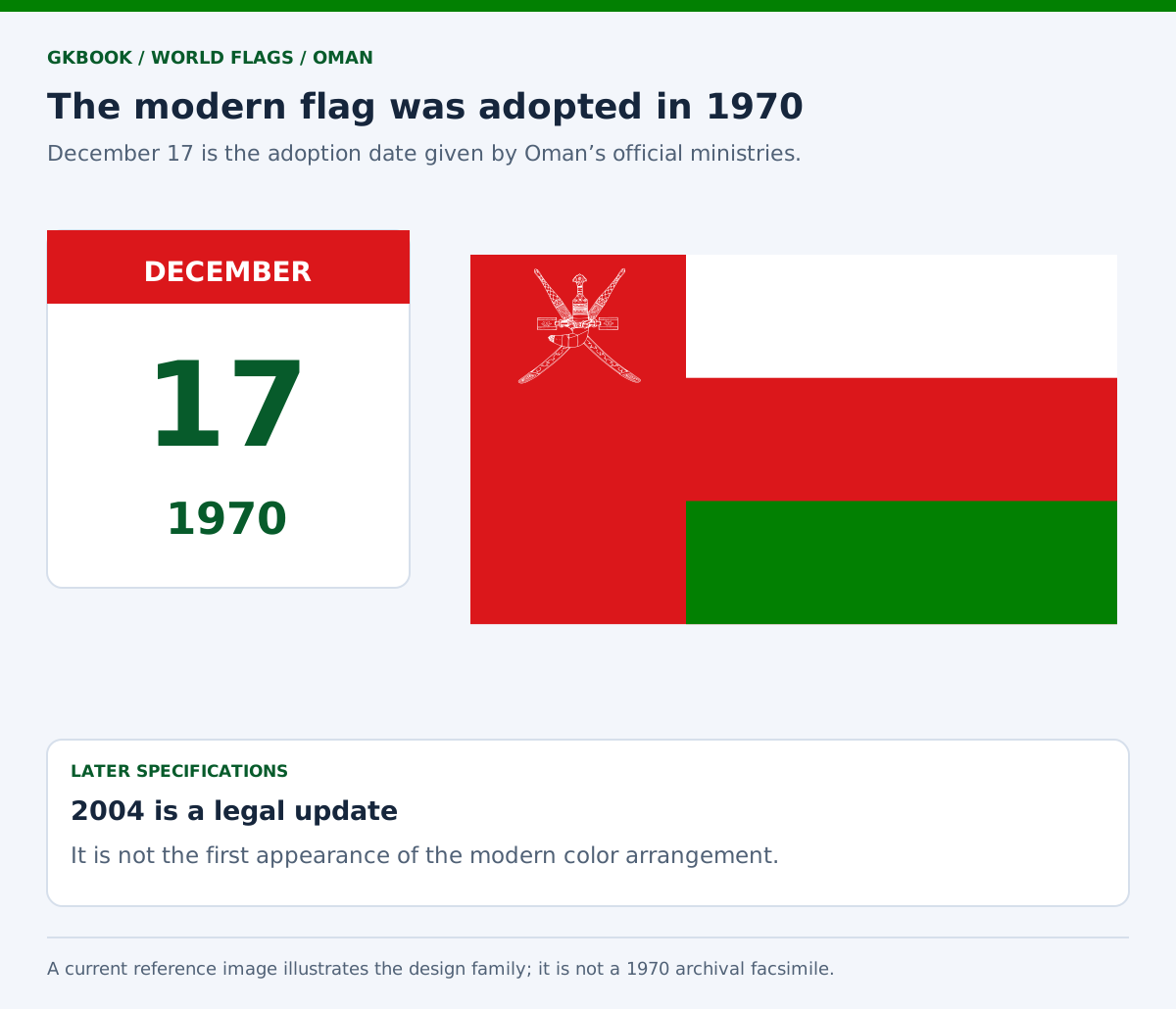
An adoption date answers when a national design entered official use. A later law may restate its appearance, set manufacturing details, regulate display, or update related state symbols. Treating every such law as the birth of a completely new flag erases the continuity that the official historical explanation preserves.
For a short caption, “adopted December 17, 1970; specifications updated in 2004” communicates the distinction. A longer history can then discuss the reported 1995 band adjustment and the legal size variants. The date in this article is written in the Gregorian calendar without adding an uncertain calendar conversion.
Who introduced the modern Oman flag?
The modern flag was introduced during the reign of Sultan Qaboos bin Said and adopted by royal decree in December 1970. The official summaries used here establish that institutional history. They do not identify an individual draftsman in sufficient detail to attribute every line of the design to one person.
Introducing a national flag, approving it by decree, and drawing its final artwork are related but different roles. A biography or a popular flag summary may compress those roles into a single designer credit. This article keeps the secure connection with Sultan Qaboos while avoiding a stronger personal authorship claim than the official evidence supports.
The emblem also predates the modern flag. Its connection with the Al Bu Said dynasty belongs to a longer history than the 1970 adoption. Adding that inherited emblem to a new arrangement of bands does not mean that the khanjar and crossed swords were first invented for the flag.
What flag was used before the modern design?
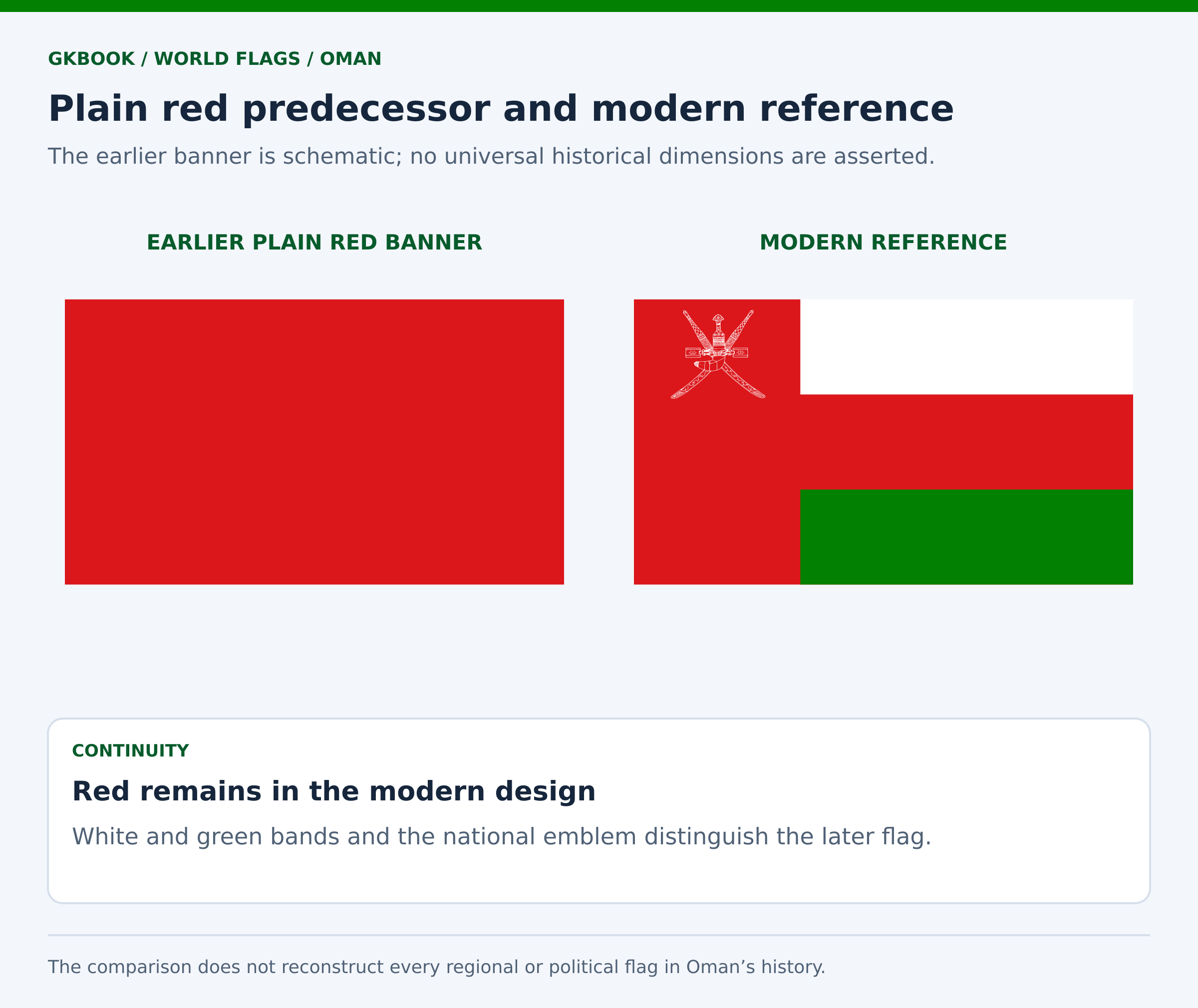
Before the modern design was introduced in 1970, the Sultanate used a plain red banner. The present flag retains red while adding white and green horizontal bands and the white national emblem. A plain red historical illustration therefore represents an earlier category, not an alternative complete version of today’s flag.

A comparison is most useful when its labels distinguish historical and current designs. The earlier example in the gallery is schematic: it demonstrates the absence of the modern bands and white emblem without claiming that one precise set of dimensions governed every older red banner used across different periods and settings.
Oman’s wider history includes other political and regional flag traditions. They should not be merged into a single invented sequence merely because they share a color. This guide concentrates on the plain red predecessor described in the official account and its relationship to the national design adopted in December 1970.
What changed in the Oman flag in 1995?
Specialist flag histories report a 1995 adjustment that made the horizontal bands equal in height, replacing a version with a narrower red middle band. Accounts also discuss changed proportions. The evidence supports the year more securely than a single exact day, so this article uses 1995 without assigning a disputed date.
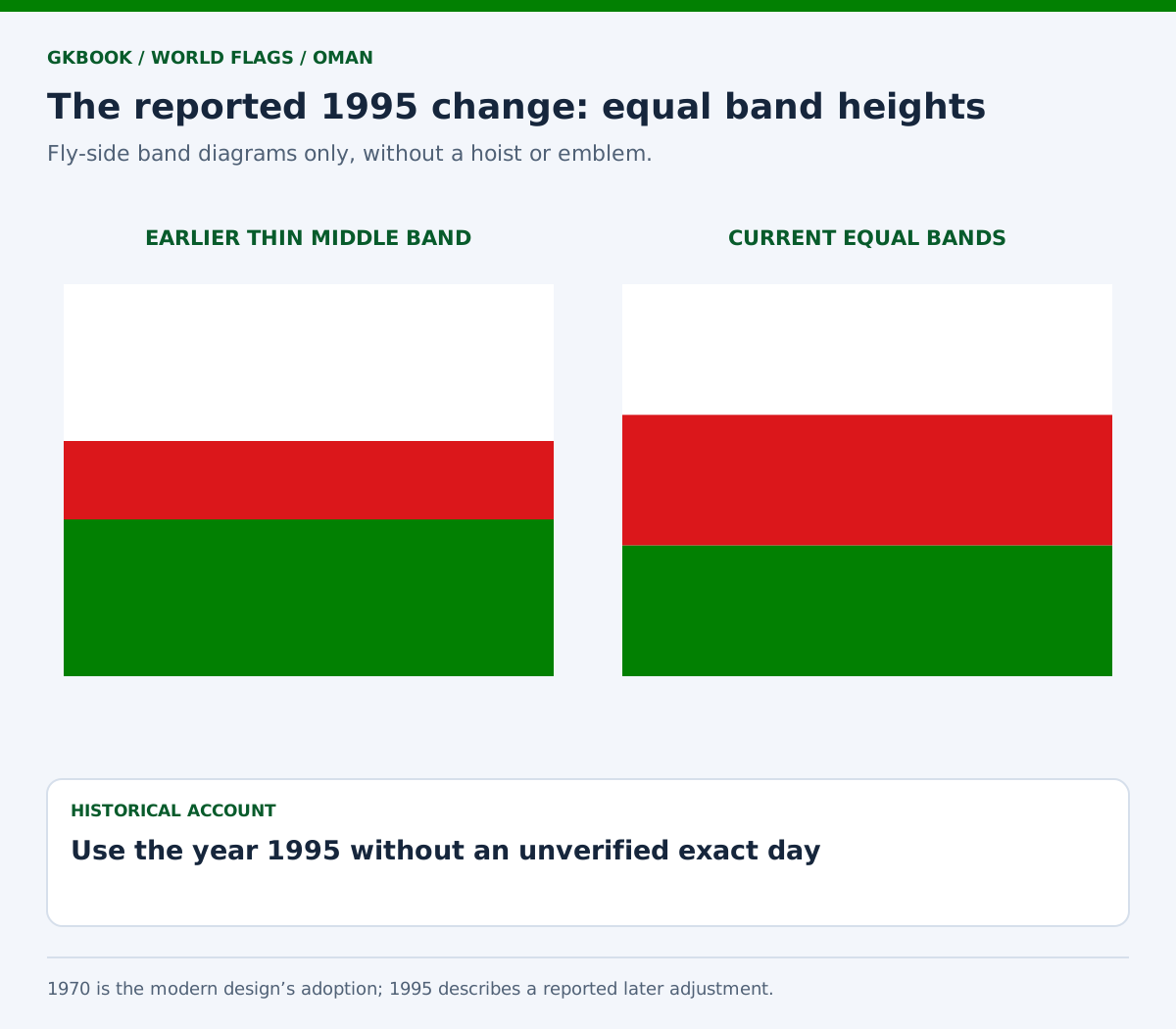
Historical observation and present legal construction have different evidentiary roles. Reports of flags seen in use help explain why older photographs can show a thin red middle stripe. The current legal annex and ministry description establish the equal bands used for the reference drawing here. Neither requires an unsupported exact transition date.
The gallery’s band comparison isolates this one feature in simplified fly-side diagrams. It does not reconstruct every historical emblem or claim that all surviving flags changed simultaneously. The adoption of the modern color arrangement remains 1970; the reported equalization of the bands is a later stage in its presentation.
What did the 2004 flag law establish?
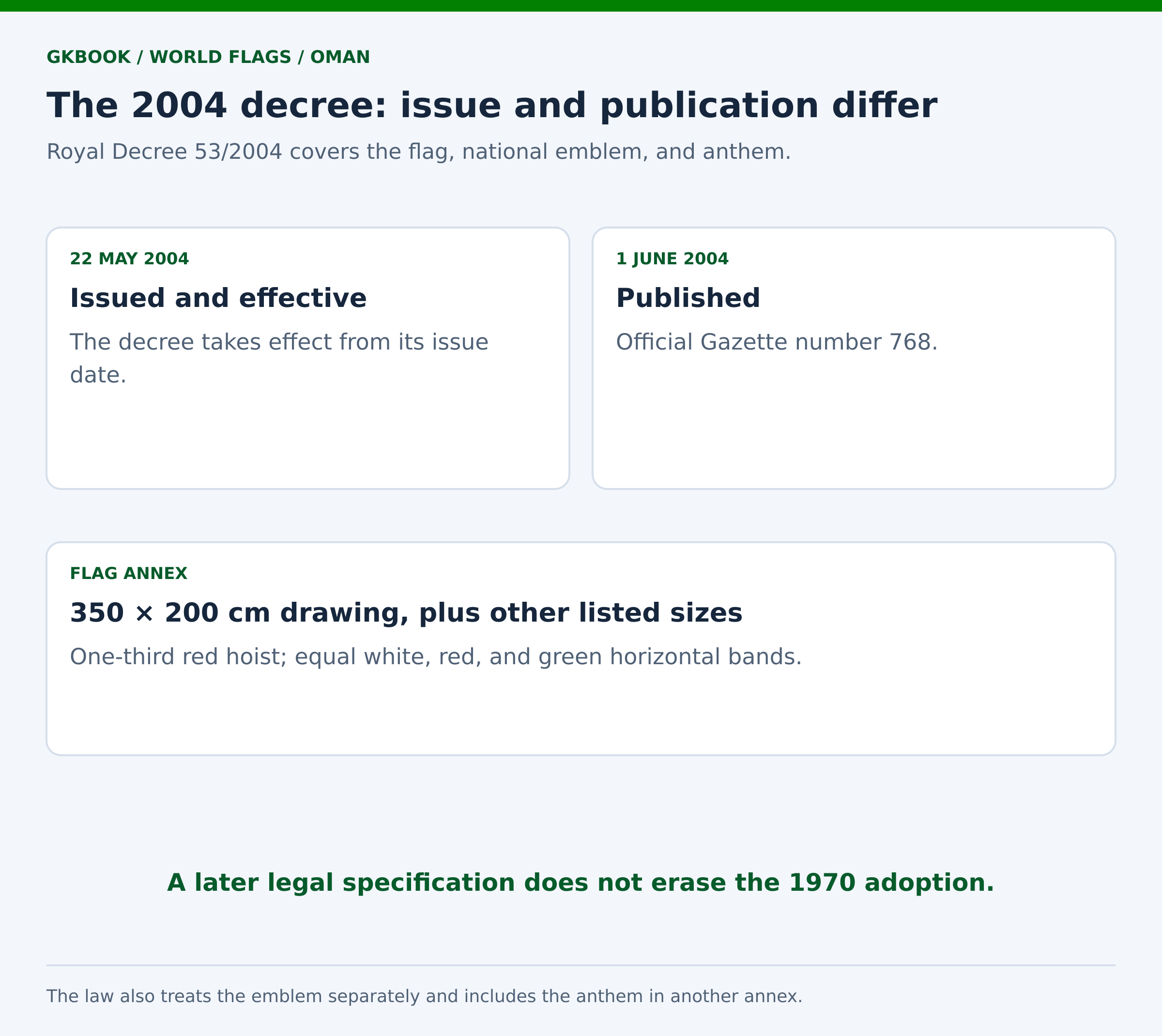
Royal Decree 53/2004 issued the law governing Oman’s flag, national emblem, and anthem on May 22, 2004. Its annexes include the flag drawing, dimensions, materials, and emblem. The decree took effect on issuance and was published on June 1, so its issue date and publication date should remain distinct.
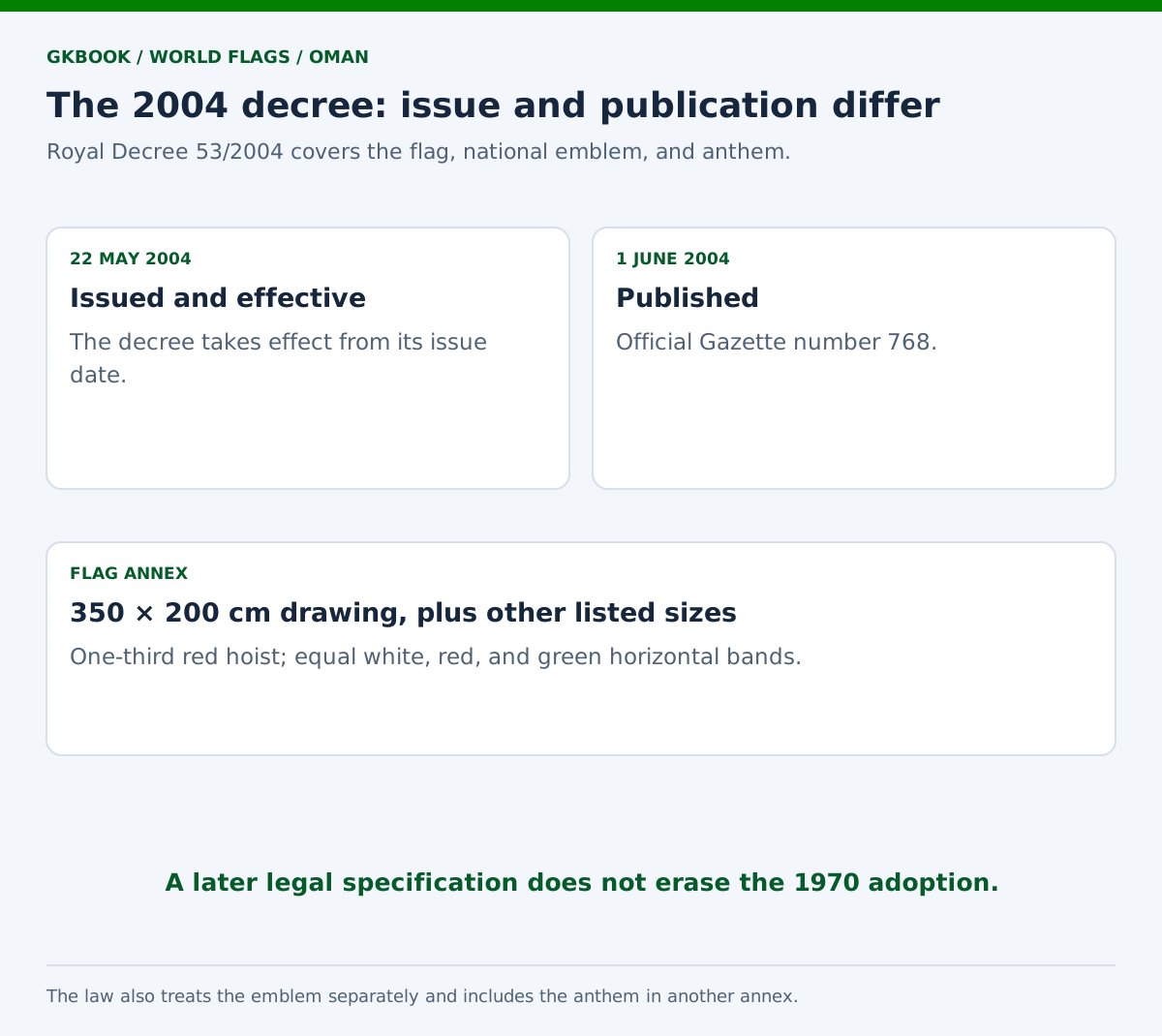
The legal drawing provides a 350 × 200 centimeter reference, a red hoist occupying one-third of the length, and equal horizontal bands. The physical-size list includes several other rectangles. Reading both parts is essential: the drawing is an exact reference, while the list prevents the claim that only that one ratio is officially contemplated.
The law also addresses official display and the treatment of national symbols. This educational article uses those provisions to explain the design and its context; it does not reproduce a complete operating manual for government protocol. The detailed emblem drawing is a separate annex, confirming that the emblem is itself an established state symbol.
Did Oman change its flag in 2020?
The 2020 amendment examined here changed the words of the national anthem, not the flag drawing. Royal Decree 2/2020 replaced the relevant text in Annex Three of the 2004 law. A shared law covering the flag, emblem, and anthem does not mean that every amendment changes all three symbols.

The decree was issued on February 20, 2020, and published on February 23. Its stated substitution concerns the anthem text. The flag’s white, red, and green fields and the khanjar emblem are not replaced by that provision. This is why a timeline should label the amendment by the subject that actually changed.
No anthem lyrics are needed to explain this distinction. The useful point for flag identification is the scope of the legal instrument: read the amended annex rather than infer a redesign from the law’s broad title. The current national flag continues to use the familiar color arrangement and white emblem.
Why is the khanjar important to Omani heritage?
The khanjar connects the national emblem with Omani dress, craftsmanship, and social tradition. UNESCO inscribed “Al-Khanjar, craft skills and social practices” on its Representative List in 2022. That recognition concerns the living cultural practice surrounding the dagger, rather than the flag image itself or a new adoption of the emblem.
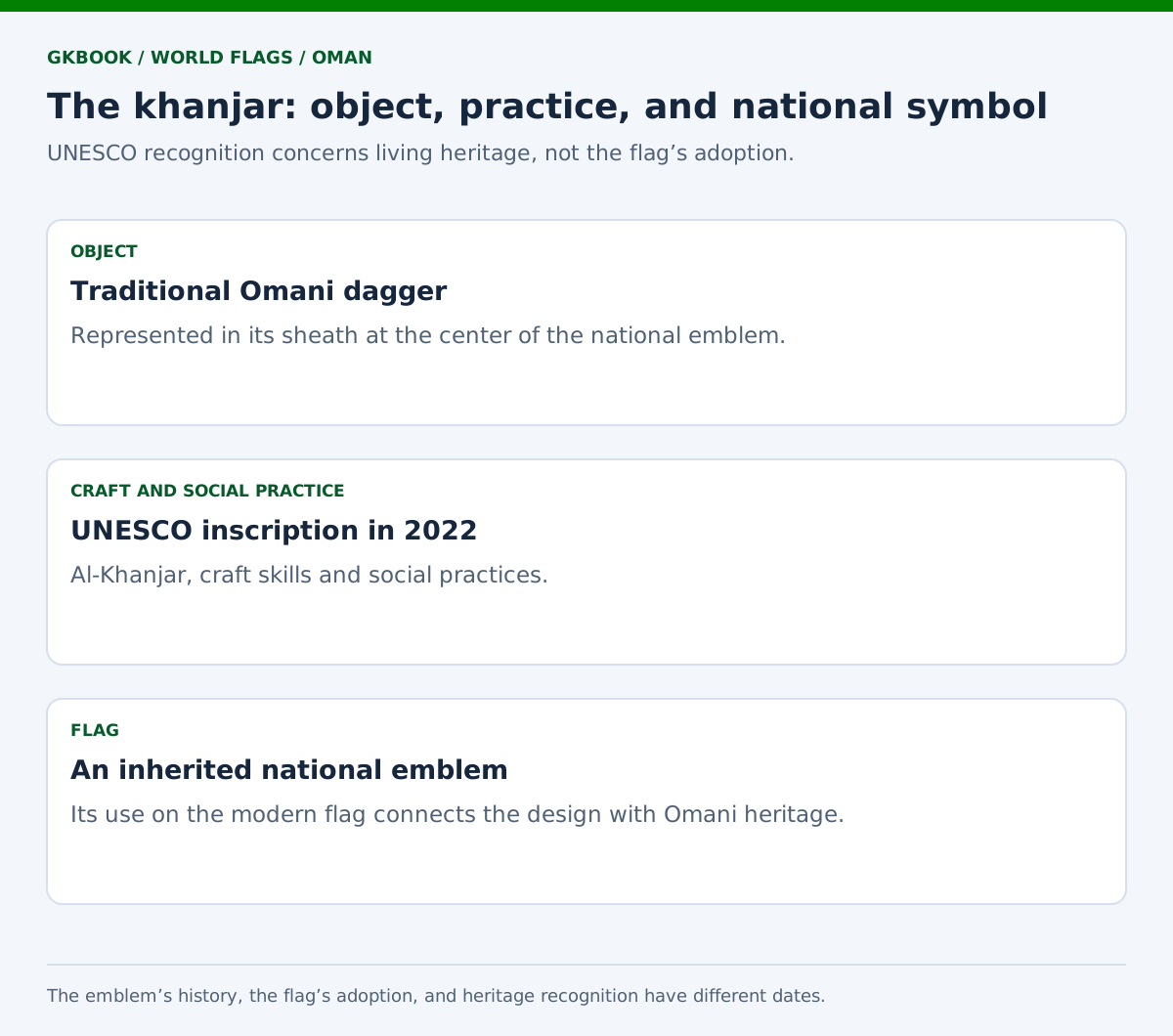
The distinction matters because a flag symbol can refer to an older living tradition. The emblem’s historical use and the modern safeguarding of khanjar craftsmanship belong to different timelines. UNESCO recognition does not create the national flag, define its proportions, or certify a particular vector illustration of the white device.
The heritage diagram connects the object, its cultural practice, and its use as a national symbol without presenting them as interchangeable. The flag’s emblem can be identified from its components alone, while an appreciation of the khanjar’s cultural role adds context to why this distinctive object has such prominence.
How is the national flag different from the national emblem?
The national flag is the complete colored rectangle with its bands, red hoist panel, and white emblem. The national emblem is the khanjar, belt, and crossed swords considered separately. A standalone emblem, government logo, or ceremonial standard should therefore not be substituted for an illustration of the ordinary national flag.
The 2004 law treats the flag and emblem as related state symbols with separate specifications. Their connection is visible because the emblem appears on the flag, but their identities are not identical. An emblem reproduced on a document does not become a flag simply because it belongs to the same country.
For educational labeling, name the whole rectangle “Oman flag” and the isolated device “national emblem of Oman.” If a different official or service flag is discussed, identify its specific function and verify its own design. The images in this package focus on the ordinary national flag and clearly marked explanatory details.
How should Oman’s flag be treated and displayed?
Oman’s law treats the national flag as a symbol of sovereignty and requires respectful handling. It addresses official display and also allows citizens to raise it for national, religious, and private celebrations under its conditions. Requirements for institutions and commercial uses should not be inferred from an educational drawing or download.
The practical distinction is between recognizing a design and determining the rules for a particular use. A school reference image explains the flag’s appearance; it does not by itself authorize a business to incorporate the emblem into a trademark or establish how an institution should fly a ceremonial flag.
The article therefore keeps protocol statements at the level supported by the cited law. It does not invent a universal daily schedule, a complete list of permitted occasions, or an unrestricted commercial license. For a real official or regulated use, the applicable current instructions and the responsible authority remain the relevant guides.
Can Oman’s flag be cropped into a square or circle?
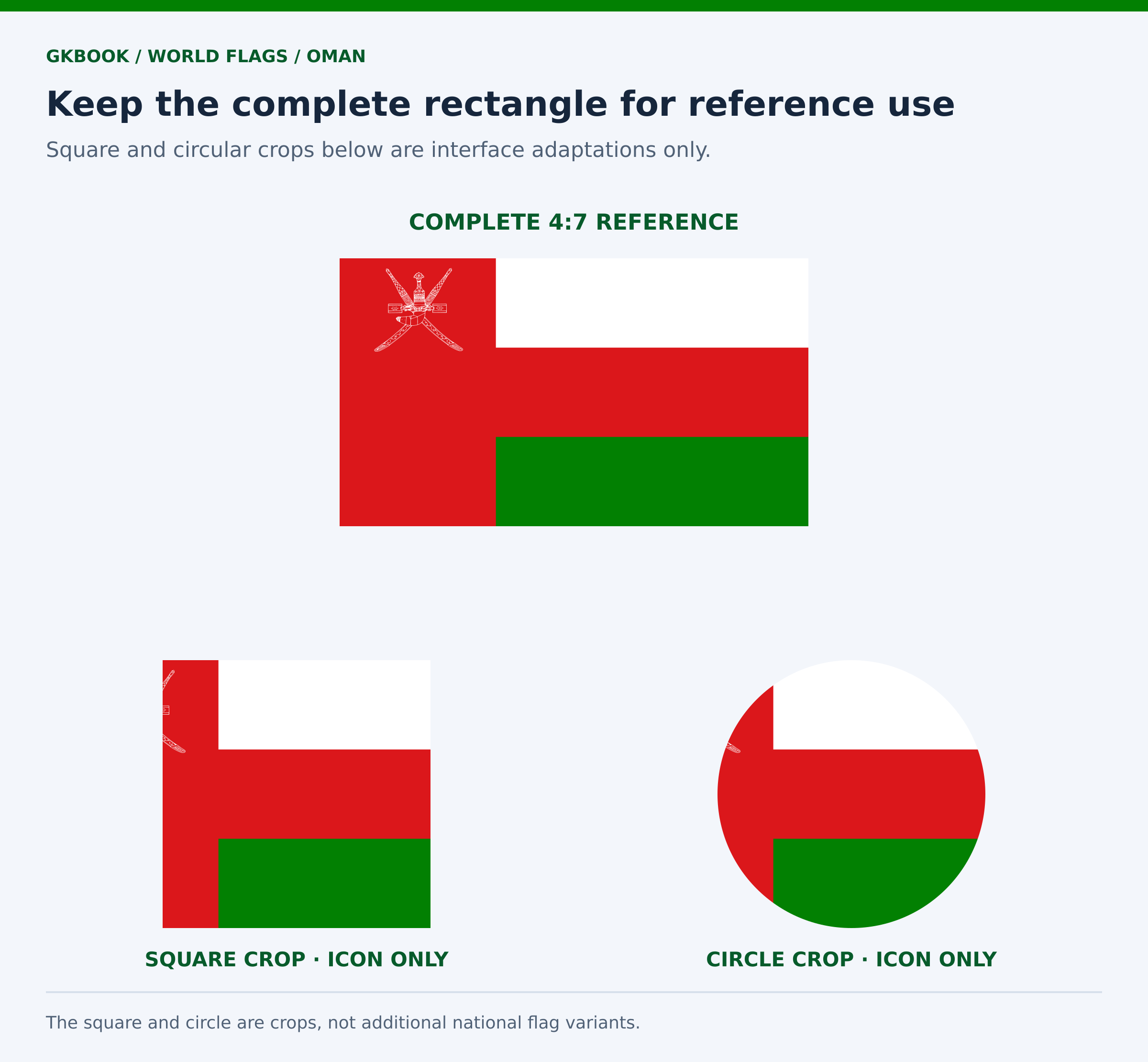
A square or circular crop can serve as an interface icon, but it is not the complete national flag. Cropping may remove the emblem, part of the hoist, or the ends of the horizontal bands. For accurate reference use, fit the whole rectangle inside the available space and retain its proportions.
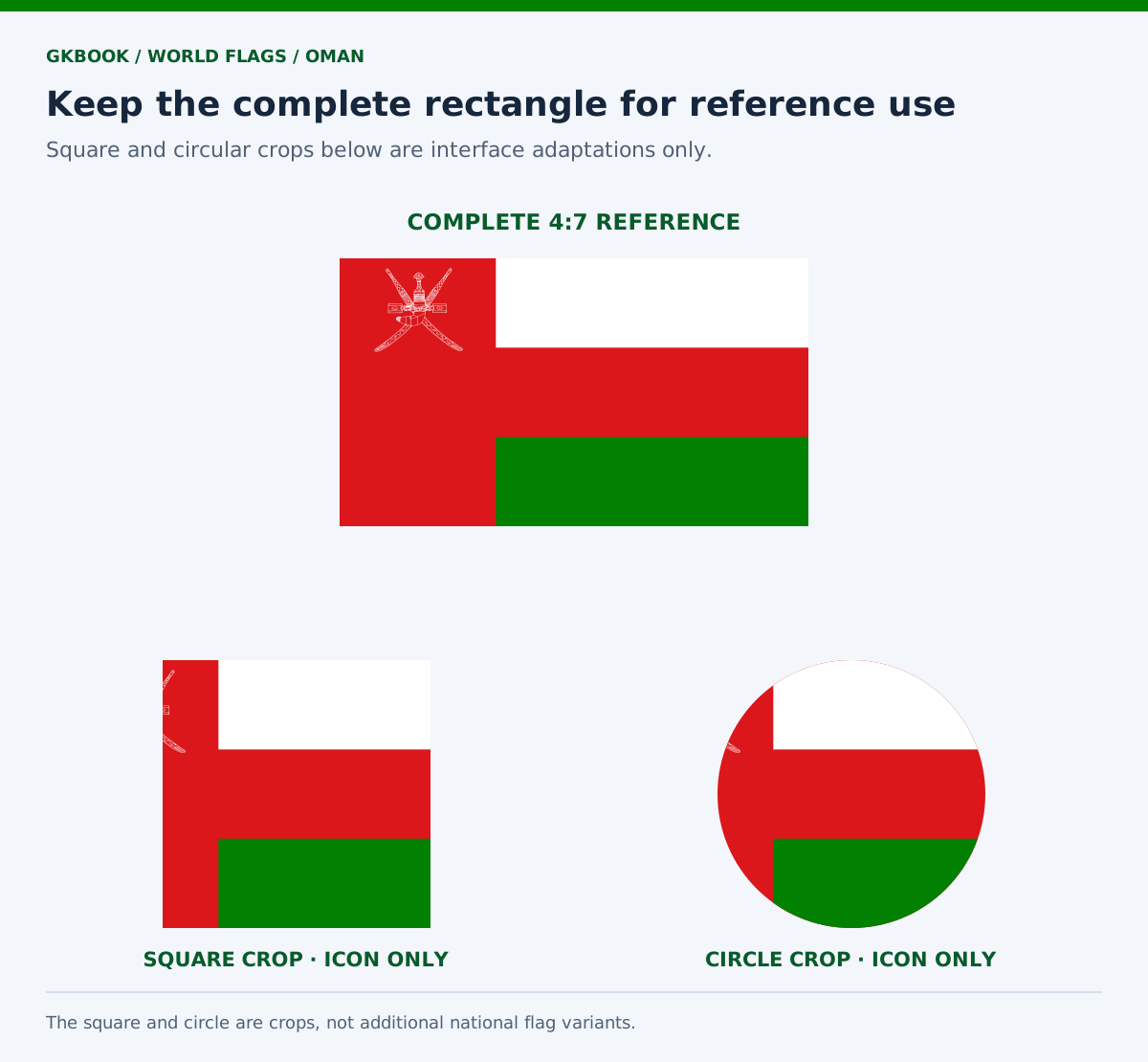
A centered crop is particularly risky because the emblem sits away from the canvas center. Moving the crop toward the hoist can preserve the emblem while sacrificing much of the fly. Neither choice reproduces the complete reference flag. The comparison diagram labels these treatments as icon crops so their purpose is clear.
For a square thumbnail, leave margins above and below an intact 4:7 flag rather than stretching the image into the square. The same principle applies to a social card: its outer canvas can have its own dimensions, provided the flag inside is scaled uniformly and shown without losing essential parts.
What are common mistakes when drawing Oman’s flag?
Common mistakes include reversing the white and green bands, narrowing the red hoist to one-quarter, omitting the belt or swords, and treating one listed size as the only official ratio. Captions can also confuse the 1970 adoption, 2004 law, and 2020 anthem amendment. Check the drawing and historical label together.

Start with the complete field: white above red above green, equal band heights, and a full-height red panel one-third of the total length. Then inspect the white emblem against a trustworthy reference. It should remain near the upper hoist and contain the sheathed khanjar, belt, and two crossed swords without added lettering.
For a caption, state which proportions are being shown and identify the screen palette as a reproduction choice. Keep the adoption date separate from later legal updates. These checks address different sources of error: geometry, emblem fidelity, color claims, and chronology all contribute to an accurate and useful flag reference.
Download Oman flag pictures
Download the plain flag as SVG or 4,200 × 2,400 PNG. The SVG uses a 2,100 × 1,200 coordinate system and remains scalable. The gallery contains 24 subjects with paired SVG and PNG files, including construction, history, and comparison diagrams. Image credits and construction notes record the reconstruction method and artwork status.
Explore more in World Flags, including the Norway flag and Niger flag.
World Flags/Oman
Oman flag pictures
Educational reconstruction of Oman’s flag on the 4:7 reference shown in the 2004 legal drawing. The law also specifies other sizes. Hoist width is one-third of length; horizontal bands are equal. The emblem is an approximate vector reconstruction of the Oman Foreign Ministry reference, not a certified official master. Screen colors #DB171B, #028002 and #FFFFFF are sampled reproduction values, not universal statutory digital codes.
GKBook educational composition; emblem reconstructed from Oman Foreign Ministry artwork.Download SVGDownload PNGEqual horizontal bands extend from a red hoist panel. The white emblem belongs near the upper hoist; the ordinary flag has no inscription, star, or crescent.
GKBook educational composition; emblem reconstructed from Oman Foreign Ministry artwork.Download SVGDownload PNGThe artwork uses white #FFFFFF, red #DB171B, and green #028002. These are the dominant flat values sampled from the ministry reference.
GKBook educational composition; emblem reconstructed from Oman Foreign Ministry artwork.Download SVGDownload PNGThe ministries connect white with peace, red with the older flag and resistance to invasion, and green with fertility and greenery.
GKBook educational composition; emblem reconstructed from Oman Foreign Ministry artwork.Download SVGDownload PNGThe central khanjar, its belt, and the crossed swords form a pre-existing national emblem. The linework here is an approximate vector reconstruction of the ministry reference.
GKBook educational composition; emblem reconstructed from Oman Foreign Ministry artwork.Download SVGDownload PNGLabels identify the central handle, curved sheath, and horizontal belt. The crossed swords remain visible behind the dagger.
GKBook educational composition; emblem reconstructed from Oman Foreign Ministry artwork.Download SVGDownload PNGThe white device sits near the upper hoist. The dashed rectangle marks the crop envelope used for this reconstruction, not a legal bounding box.
GKBook educational composition; emblem reconstructed from Oman Foreign Ministry artwork.Download SVGDownload PNGThe 350 × 200 centimeter construction gives a 4:7 height:length rectangle. The supplied master is an exact scaled version of that reference.
GKBook educational composition; emblem reconstructed from Oman Foreign Ministry artwork.Download SVGDownload PNGThe full-height red panel occupies one-third of the total length, as described in the legal annex and Ministry of Information explanation.
GKBook educational composition; emblem reconstructed from Oman Foreign Ministry artwork.Download SVGDownload PNGWhite is above red, and green is below it. All three bands have equal height; the red hoist remains beside them.
GKBook educational composition; emblem reconstructed from Oman Foreign Ministry artwork.Download SVGDownload PNGA red base, white upper fly band, green lower fly band, and white emblem produce the reference design. The middle red band stays joined to the hoist.
GKBook educational composition; emblem reconstructed from Oman Foreign Ministry artwork.Download SVGDownload PNGAll examples preserve the same outer ratio and internal thirds. Multiples of a 21 × 12 grid give whole-pixel band boundaries.
GKBook educational composition; emblem reconstructed from Oman Foreign Ministry artwork.Download SVGDownload PNGThe legal annex lists pole, car, and table dimensions. The 3 × 1.7 meter flag is 17:30, close to but not exactly 4:7.
GKBook educational composition; emblem reconstructed from Oman Foreign Ministry artwork.Download SVGDownload PNGThe different upper and lower colors, side panel, and emblem make the fixed reference asymmetric. A half-turn also changes the design.
GKBook educational composition; emblem reconstructed from Oman Foreign Ministry artwork.Download SVGDownload PNGThe reverse is shown as a horizontal mirror view with its hoist on the right. Both views retain the white upper band and green lower band.
GKBook educational composition; emblem reconstructed from Oman Foreign Ministry artwork.Download SVGDownload PNGThe timeline distinguishes the 1970 adoption, reported 1995 band adjustment, 2004 law, and 2020 anthem amendment.
GKBook educational composition; emblem reconstructed from Oman Foreign Ministry artwork.Download SVGDownload PNGOfficial explanations identify December 17, 1970. The 2004 decree belongs to the later development of the flag’s legal specifications.
GKBook educational composition; emblem reconstructed from Oman Foreign Ministry artwork.Download SVGDownload PNGThe earlier plain red banner is compared schematically with the modern reference. Equal display dimensions here are for comparison, not historical standardization.
GKBook educational composition; emblem reconstructed from Oman Foreign Ministry artwork.Download SVGDownload PNGThe schematic earlier fly shows a narrower red middle band; the present bands are equal. This isolates one reported feature and is not a complete historical flag master.
GKBook educational composition; emblem reconstructed from Oman Foreign Ministry artwork.Download SVGDownload PNGThe decree was issued on May 22 and published on June 1. Its annex includes both a 4:7 drawing and a list of use-specific sizes.
GKBook educational composition; emblem reconstructed from Oman Foreign Ministry artwork.Download SVGDownload PNGThe amendment concerns the anthem wording, not a new flag design. A law’s broad title does not imply that every symbol covered by it changed.
GKBook educational composition; emblem reconstructed from Oman Foreign Ministry artwork.Download SVGDownload PNGUNESCO’s 2022 inscription recognizes the khanjar’s craft skills and social practices. It does not create or certify the national flag design.
GKBook educational composition; emblem reconstructed from Oman Foreign Ministry artwork.Download SVGDownload PNGCrops can remove the emblem or band ends. For an accurate thumbnail, fit the complete flag inside the available space with margins.
GKBook educational composition; emblem reconstructed from Oman Foreign Ministry artwork.Download SVGDownload PNGCheck the band order and heights, hoist width, complete emblem, ratio context, palette status, and distinct historical milestones.
GKBook educational composition; emblem reconstructed from Oman Foreign Ministry artwork.Download SVGDownload PNGFrequently asked questions
What does Oman’s flag look like?
Oman’s flag has three equal horizontal bands of white, red, and green, joined at the hoist by a vertical red panel. A white national emblem appears near the upper hoist. This reference uses the 4:7 legal drawing; the law also specifies other sizes for particular uses.
What is the design of the Oman flag?
Oman’s national flag combines a red vertical panel beside the pole with white, red, and green horizontal bands extending toward the fly. The red areas join without a dividing line. A white emblem of a sheathed khanjar, belt, and crossed swords occupies the upper hoist area.
What are the colors of the Oman flag?
Oman’s flag uses white, red, and green. The supplied artwork uses white #FFFFFF, red #DB171B, and green #028002, sampled from the Foreign Ministry’s downloadable reference. These are declared screen values, not universal statutory digital codes or a guarantee that every printed or woven flag will match them.
What does the Oman flag symbolize?
Official explanations associate white with peace, red with the former flag and battles against foreign invaders, and green with fertility and greenery. The khanjar and crossed swords connect the flag with Oman’s national emblem and heritage. These meanings accompany the design without changing its measured bands and hoist panel.
What does white mean on Oman’s flag?
White represents peace in the Foreign Ministry’s explanation, while the Ministry of Information also mentions prosperity. It appears in the upper horizontal band and in the national emblem. In an accurate digital illustration, these areas are opaque white rather than transparent openings that reveal the background behind the flag.
What does red mean on Oman’s flag?
Red recalls Oman’s earlier plain red flag and, in official explanations, the battles fought against foreign invaders. It forms both the vertical hoist panel and the middle horizontal band. These red regions connect into one continuous shape, while the white national emblem sits over the upper part of the panel.
What does green mean on Oman’s flag?
Green represents fertility and the greenery of Oman’s land in the official explanation. It occupies the lower horizontal band, beginning beside the red hoist panel and extending to the fly. Its height equals the white and red bands, and its color is distinct from the red used above it.
What is the white symbol on Oman’s flag?
The white symbol is Oman’s national emblem: a sheathed khanjar and its belt superimposed on two crossed traditional swords. It is not a separate crest invented for the flag. The Foreign Ministry traces the emblem to the Al Bu Said royal crest, adopted in the middle of the eighteenth century.
What is a khanjar, and how is it shown?
A khanjar is the traditional Omani dagger represented at the center of the national emblem. On the flag it is shown in its sheath, with the belt across the composition and crossed swords behind it. The curved lower shape belongs to the sheathed dagger, not to an exposed sword blade.
Where is the emblem placed on Oman’s flag?
The white emblem belongs near the top of the red hoist panel, not at the center of the whole flag. The legal annex describes its upper placement without supplying a complete numerical bounding box. This artwork follows the Foreign Ministry reference for the emblem’s size and position within that area.
What is the official ratio of the Oman flag?
The legal construction drawing shows a flag 350 centimeters long and 200 centimeters high, giving a height:length ratio of 4:7. That is the reference used here. The same law also lists other dimensions for particular settings, so neither 4:7 nor 1:2 should be described as the only permitted ratio.
How wide is the red hoist panel?
The red hoist panel is one-third of the flag’s total length and extends through its full height. The remaining two-thirds contain the three horizontal bands. On the supplied 2,100 × 1,200 master, the panel is 700 units wide and the bands extend another 1,400 units to the fly.
What is the order and height of the horizontal bands?
With the flag upright, the bands run white at the top, red in the middle, and green at the bottom. Each is one-third of the total height. They occupy the area beyond the vertical red panel, whose full-height red field remains beside all three bands on the hoist side.
How can you draw Oman’s flag accurately?
For the 4:7 reference, begin with a rectangle seven units long and four units high. Reserve its first third as a red hoist panel. Divide the remaining area into equal white, red, and green horizontal bands, then add the white national emblem near the top of the red panel.
What pixel sizes preserve the 4:7 reference?
Examples of exact 4:7 height:length images include 700 × 400, 2,100 × 1,200, and 4,200 × 2,400 pixels, written length × height. Every component must scale with the rectangle. Multiples of the 21 × 12 construction grid also place both thirds on whole-pixel boundaries.
Why do official Oman flags have different proportions?
The law lists dimensions for different settings: 2 × 1 meters, 3.50 × 2 meters, and 3 × 1.7 meters for specified pole heights, plus 35 × 25 centimeters for cars and 26 × 17 centimeters for tables. These measurements produce several ratios rather than one universal rectangle.
Is the Oman flag symmetrical?
Oman’s flag is not symmetric across either the horizontal or vertical centerline of a fixed hoist-left view. White and green occupy different heights, while the red panel and emblem sit toward one side. A half-turn also changes the arrangement, so the flag has a definite upright orientation.
What does the reverse side of Oman’s flag look like?
Viewed from the opposite side of the cloth, Oman’s flag has the same colors and emblem in a horizontally mirrored arrangement. The red panel appears on the right when the hoist is on the right. White remains above red and green; no separate reverse-only inscription or additional emblem is specified.
What is the history of the Oman flag?
The modern white, red, and green flag was adopted on December 17, 1970, replacing the earlier plain red banner. Later specifications refined its presentation, with equal-band changes reported in 1995 and a comprehensive flag, emblem, and anthem law issued in 2004. An amendment in 2020 changed the anthem text.
When was the Oman flag adopted?
Oman’s Foreign Ministry and Ministry of Information identify December 17, 1970, as the adoption date of the modern national flag. May 22, 2004, is a later legal update, not the first appearance of the white, red, and green design. These dates describe different stages in the flag’s development.
Who introduced the modern Oman flag?
The modern flag was introduced during the reign of Sultan Qaboos bin Said and adopted by royal decree in December 1970. The official summaries used here establish that institutional history. They do not identify an individual draftsman in sufficient detail to attribute every line of the design to one person.
What flag was used before the modern design?
Before the modern design was introduced in 1970, the Sultanate used a plain red banner. The present flag retains red while adding white and green horizontal bands and the white national emblem. A plain red historical illustration therefore represents an earlier category, not an alternative complete version of today’s flag.
What changed in the Oman flag in 1995?
Specialist flag histories report a 1995 adjustment that made the horizontal bands equal in height, replacing a version with a narrower red middle band. Accounts also discuss changed proportions. The evidence supports the year more securely than a single exact day, so this article uses 1995 without assigning a disputed date.
What did the 2004 flag law establish?
Royal Decree 53/2004 issued the law governing Oman’s flag, national emblem, and anthem on May 22, 2004. Its annexes include the flag drawing, dimensions, materials, and emblem. The decree took effect on issuance and was published on June 1, so its issue date and publication date should remain distinct.
Did Oman change its flag in 2020?
The 2020 amendment examined here changed the words of the national anthem, not the flag drawing. Royal Decree 2/2020 replaced the relevant text in Annex Three of the 2004 law. A shared law covering the flag, emblem, and anthem does not mean that every amendment changes all three symbols.
Why is the khanjar important to Omani heritage?
The khanjar connects the national emblem with Omani dress, craftsmanship, and social tradition. UNESCO inscribed “Al-Khanjar, craft skills and social practices” on its Representative List in 2022. That recognition concerns the living cultural practice surrounding the dagger, rather than the flag image itself or a new adoption of the emblem.
How is the national flag different from the national emblem?
The national flag is the complete colored rectangle with its bands, red hoist panel, and white emblem. The national emblem is the khanjar, belt, and crossed swords considered separately. A standalone emblem, government logo, or ceremonial standard should therefore not be substituted for an illustration of the ordinary national flag.
How should Oman’s flag be treated and displayed?
Oman’s law treats the national flag as a symbol of sovereignty and requires respectful handling. It addresses official display and also allows citizens to raise it for national, religious, and private celebrations under its conditions. Requirements for institutions and commercial uses should not be inferred from an educational drawing or download.
Can Oman’s flag be cropped into a square or circle?
A square or circular crop can serve as an interface icon, but it is not the complete national flag. Cropping may remove the emblem, part of the hoist, or the ends of the horizontal bands. For accurate reference use, fit the whole rectangle inside the available space and retain its proportions.
What are common mistakes when drawing Oman’s flag?
Common mistakes include reversing the white and green bands, narrowing the red hoist to one-quarter, omitting the belt or swords, and treating one listed size as the only official ratio. Captions can also confuse the 1970 adoption, 2004 law, and 2020 anthem amendment. Check the drawing and historical label together.
Explore all general-knowledge topics and the A-to-Z lists.














We Value Your Opinion Comments