
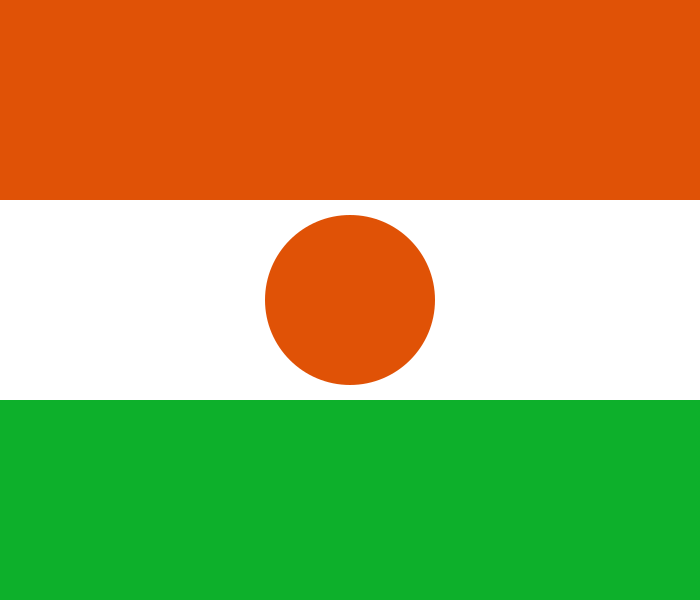
Niger flag picture
Explore the proportions, history, and picture gallery.
| Design | Orange, white, greenThree equal horizontal bands; an orange disk at the center. |
|---|---|
| Reference proportions | Height:length = 6:7Common drawing convention; no ratio is given in Article 4. |
| Adoption | November 23, 1959Adopted before independence on August 3, 1960. |
| Current description | 2025 Charter, Article 4The Charter was promulgated on March 26, 2025. |
| Central device | A solid orange sun diskThe legal description gives no numerical disk diameter. |
| National motto | Fraternité, Travail, ProgrèsFraternity, Work, Progress. |
What does Niger’s flag look like?
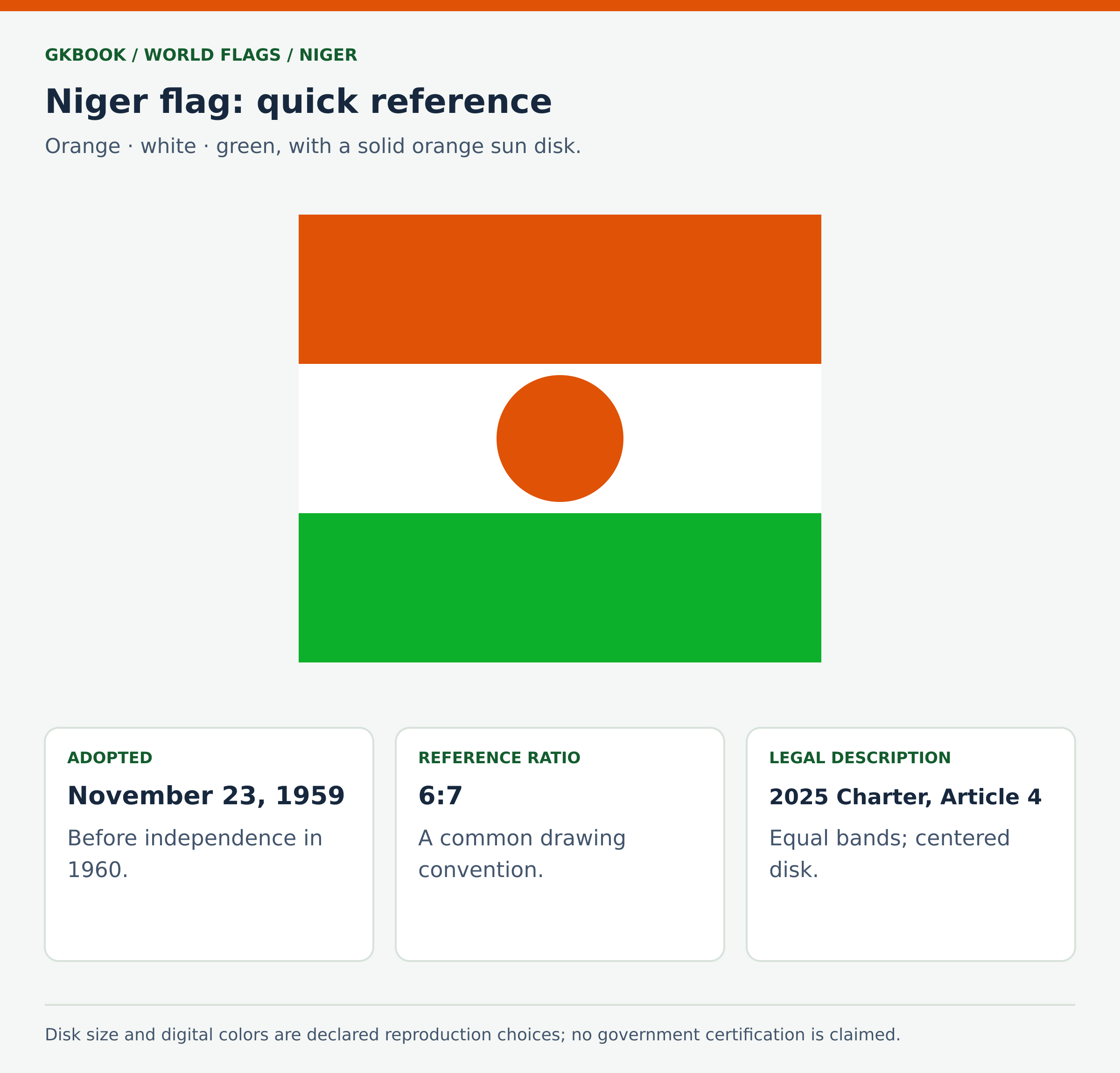
Niger’s flag has three equal horizontal bands: orange at the top, white in the middle, and green at the bottom. A solid orange disk sits at the center of the white band. Adopted on November 23, 1959, it is commonly illustrated in 6:7 proportions, although the current legal description specifies no numerical ratio.
The orange disk distinguishes Niger’s flag from other tricolors. The article explains the design described in the 2025 Charter, follows the flag’s history through adoption and independence, and provides a reproducible drawing with its chosen measurements clearly labeled.
What is the correct order of the colors on Niger’s flag?
Read Niger’s flag from top to bottom as orange, white, and green. The three bands are horizontal and equal in height. The orange disk belongs in the middle of the white band. Reversing the top and bottom bands, turning them into vertical stripes, or removing the disk changes the prescribed design.

Article 4 of the 2025 Charter describes rectangular, equal horizontal bands and gives their order explicitly. The disk is an additional orange element, not a fourth band. It is centered both across the length of the flag and within the white stripe.
In a standard horizontal illustration, the hoist is the edge attached to the pole, and the fly is the free end. Because the design has no lettering or feature offset toward either edge, identifying the hoist does not change the top-to-bottom color order.
What are the Niger flag’s colors and color codes?
Niger’s flag uses orange, white, and green, with the same orange used for the central disk. The current legal description names the colors but gives no hexadecimal, RGB, CMYK, or Pantone values. This package uses #E05206, #FFFFFF, and #0DB02B as declared digital reproductions, consistent with a government website’s illustrative bitmap.

The three values are practical screen colors, not a claimed government manufacturing standard. The inspected government and embassy images use these principal hues, while a presidency image has a slightly different green pixel value. A displayed or downloaded bitmap does not establish a textile specification.
The RGB values are orange (224, 82, 6), white (255, 255, 255), and green (13, 176, 43). Printing systems, screens, dyes, and lighting can produce different appearances. Use an approved reference for official fabrication rather than treating a web image as a certified color sample.
| Element | Named color | Illustrative HEX | Illustrative RGB |
|---|---|---|---|
| Top band and disk | Orange | #E05206 | 224, 82, 6 |
| Middle band | White | #FFFFFF | 255, 255, 255 |
| Bottom band | Green | #0DB02B | 13, 176, 43 |
What does the Niger flag symbolize?
Niger’s government links the orange band with the northern desert, the green band with the fertile southern Niger basin, and the orange disk with the sun. Official diplomatic explanations associate white with purity and hope. Together, these elements connect the national emblem with the country’s landscapes, aspirations, unity, and sovereignty.

The legal description establishes the arrangement and named colors; explanatory government pages discuss their meanings. Those are different kinds of evidence. Additional words such as peace, innocence, development, or sacrifice appear in various accounts, but they should not be combined into one supposedly exhaustive statutory definition.
The geographic reading is especially clear in the government’s own summary: desert in the north, fertile land in the south, and the sun at the center. The flag is a national symbol rather than a map, so its three bands do not define exact climatic or administrative boundaries.
| Feature | Interpretation |
|---|---|
| Orange upper band | Northern desert / Sahara |
| White middle band | Purity and hope in official diplomatic explanations |
| Green lower band | Fertile southern land and the Niger basin; hope |
| Orange disk | The sun |
What does the orange band on Niger’s flag mean?
The orange band primarily represents the desert in northern Niger, especially the Sahara. Government explanations connect this color with the country’s dry northern landscape, while some diplomatic interpretations also mention efforts toward development. The color is called orange in the legal description; it should not simply be renamed red or Indian saffron.
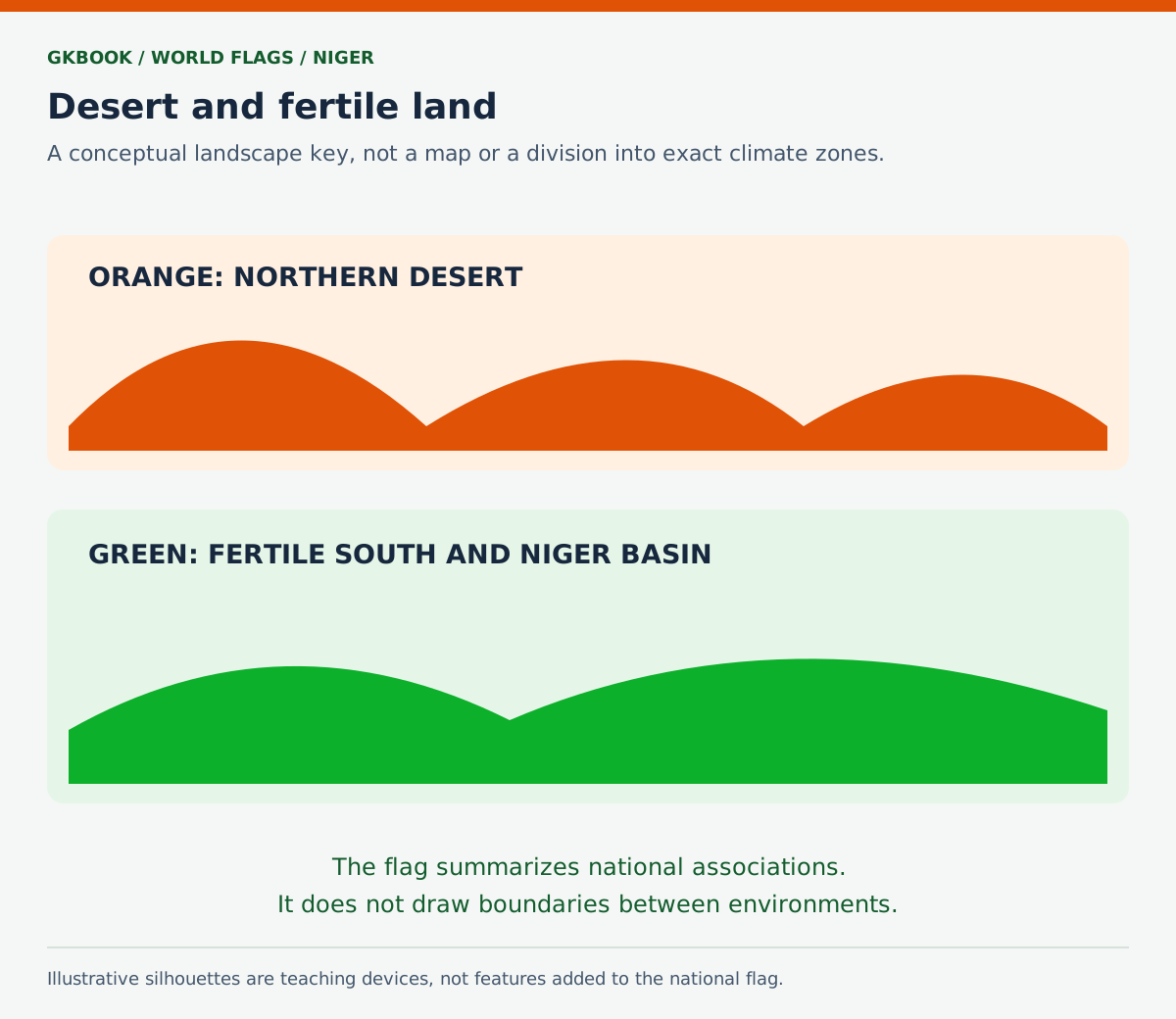
This interpretation relates a visible color to a major part of Niger’s environment. It does not mean that every northern surface is orange or that the top third of the cloth is a scaled map of the Sahara.
The orange disk and the orange band share a color but have different principal meanings: the band evokes the desert, while the disk represents the sun. Keeping the two meanings separate makes the design easier to explain.
What does the white band on Niger’s flag mean?
The white band is associated with purity and hope in current official diplomatic explanations. Peace and innocence also appear in broader reference accounts. The band provides the setting for the orange sun disk, which is centered within it. The Charter prescribes a white middle stripe but does not assign it a written symbolic meaning.
Explanatory sources use related but not identical terms for white. Purity and hope appear in official diplomatic explanations, while other accounts use words such as innocence. These interpretations explain the color’s meaning; the legal provision itself establishes its position and appearance.
White is part of the flag’s actual surface. In the downloadable images, it is opaque white rather than transparency. A transparent middle stripe would allow the background to alter the visible flag colors.
What does the green band on Niger’s flag mean?
The green band represents the fertile land of southern Niger, particularly the plains and valleys associated with the Niger River basin. Official diplomatic explanations also connect green with hope. Its position below the white band complements the orange desert band above, creating a broad contrast between the country’s northern and southern landscapes.
The landscape symbolism is deliberately broad. It does not state that all of southern Niger is continuously lush or that rainfall, vegetation, and land use stop at a sharp dividing line. The colors summarize important national associations.
Niger’s name and the river’s name are related in usage, but the flag does not contain a blue river stripe. The river basin is evoked through the green land symbolism; the central circular device is the sun.
What does the orange circle on Niger’s flag represent?
The orange circle represents the sun. It is a solid disk centered in the white band, using the same orange as the upper stripe. The national flag does not give it rays, a face, spokes, or an outline. Those additions would change the simple circular device described in the Charter.
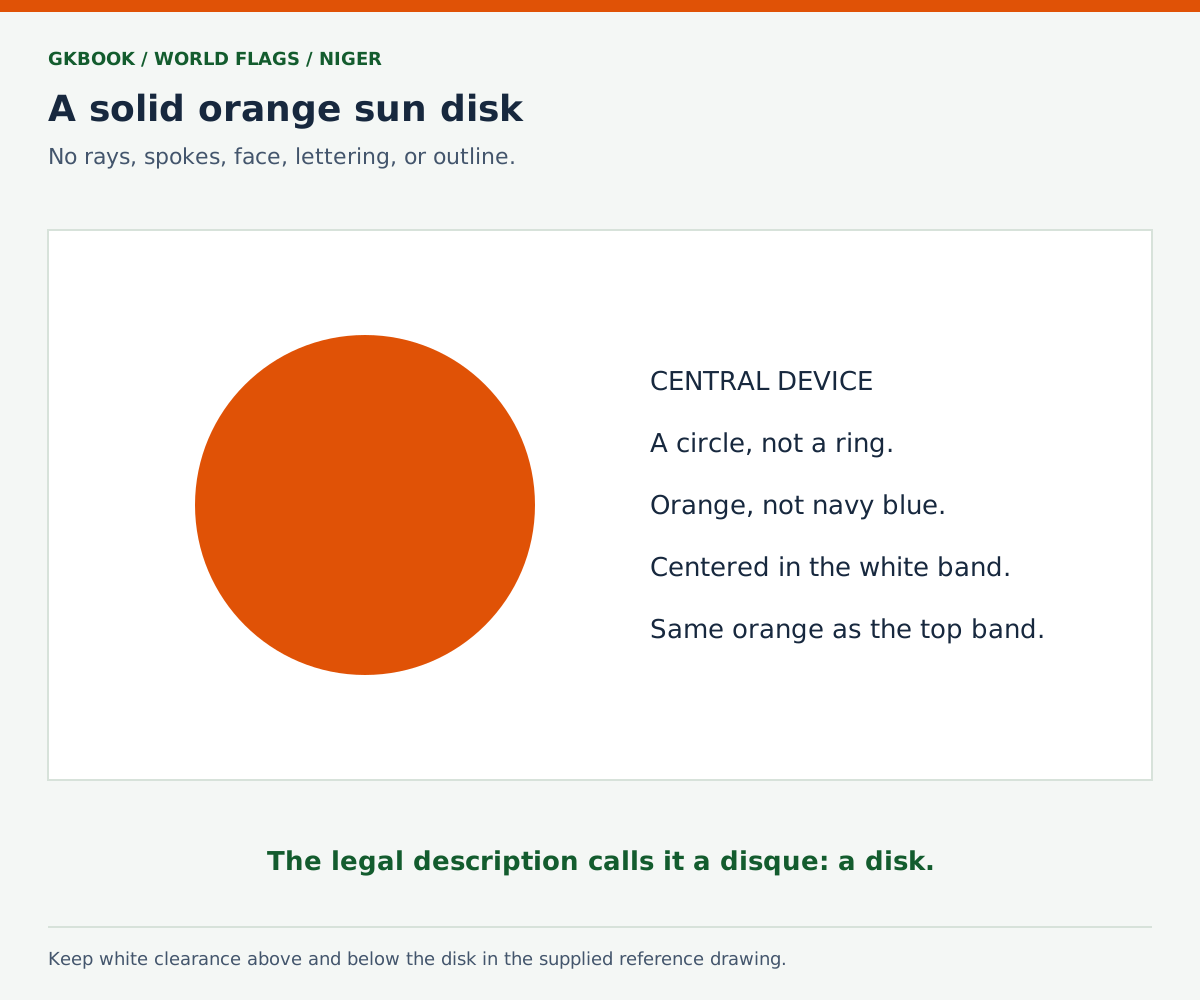
The French legal term is disque, meaning a disk. The source describes its color and location without specifying a numerical diameter. Official illustrations show clear white space above and below it.
A wheel and a sun disk are different graphic devices. Niger’s disk is solid orange; India’s central device is a navy-blue wheel with 24 spokes. That distinction is more reliable than comparing the apparent shades of two small online flag icons.
What is the Niger flag’s ratio?
Niger’s flag is commonly illustrated with a height:length ratio of 6:7, making it nearly square. That ratio is a drawing convention, not a numerical requirement stated in Article 4 of the 2025 Charter. Other proportions appear in references and use, including 2:3; they should not automatically be dismissed as unlawful.

The supplied main flag uses 700 × 600 SVG units and a 4200 × 3600 PNG. Its height:length ratio is exactly 6:7, while its length:height ratio is 7:6. The caption identifies this choice so readers do not mistake it for a statutory measurement.
The government’s small web illustration and the embassy’s larger illustration both closely approximate 6:7 after rounding to whole pixels. They corroborate the convention’s use, but neither substitutes for a law setting dimensions. The current Charter specifies the design without a numerical aspect ratio.
Why do pictures of Niger’s flag have different proportions?
Pictures of Niger’s flag vary because the legal description fixes the colors, equal horizontal bands, and centered orange disk without stating a numerical aspect ratio. Reference works record several formats, including 6:7, 2:3, 3:5, and 1:2. A picture’s proportions alone therefore cannot establish whether its maker followed an official dimensional standard.

Store norske leksikon explicitly discusses the variation and illustrates 2:3. Vexillological commentary has also questioned the origin of the often-repeated 6:7 value. This article uses 6:7 consistently while distinguishing the selected drawing from what the primary legal text actually says.
When comparing ratios, keep the three band heights equal and keep the disk circular. Stretching an existing image horizontally turns the disk into an ellipse. A new wider illustration should be drawn with its own rectangle and centered circle, rather than made by distorting the complete image.
How large should the orange disk be?
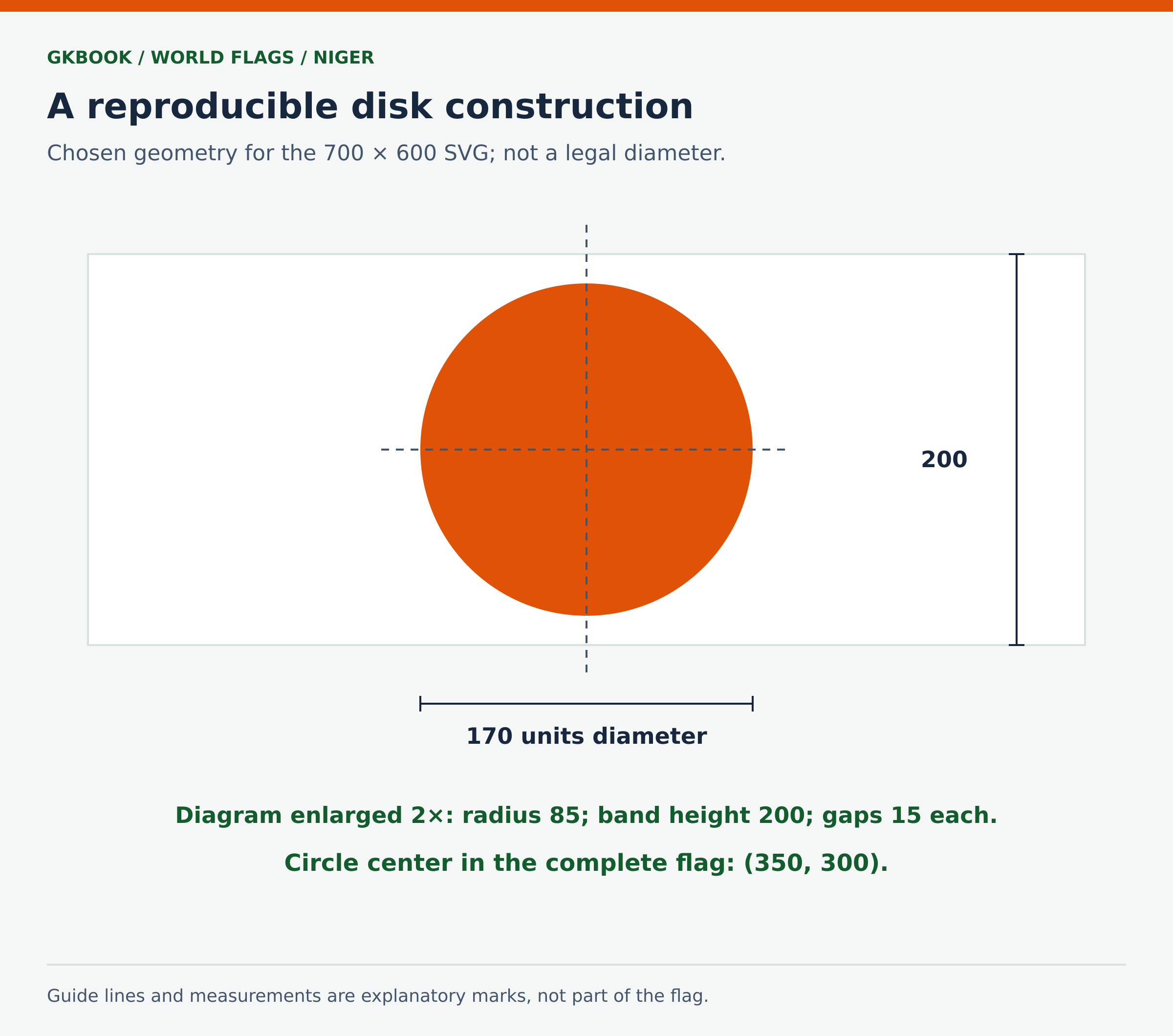
The current Charter does not prescribe a numerical diameter for Niger’s orange disk. This package uses a diameter equal to 85 percent of the white band’s height, matching the familiar proportions of the inspected illustrations approximately. That is a declared construction choice, with equal white clearance above and below the circle.
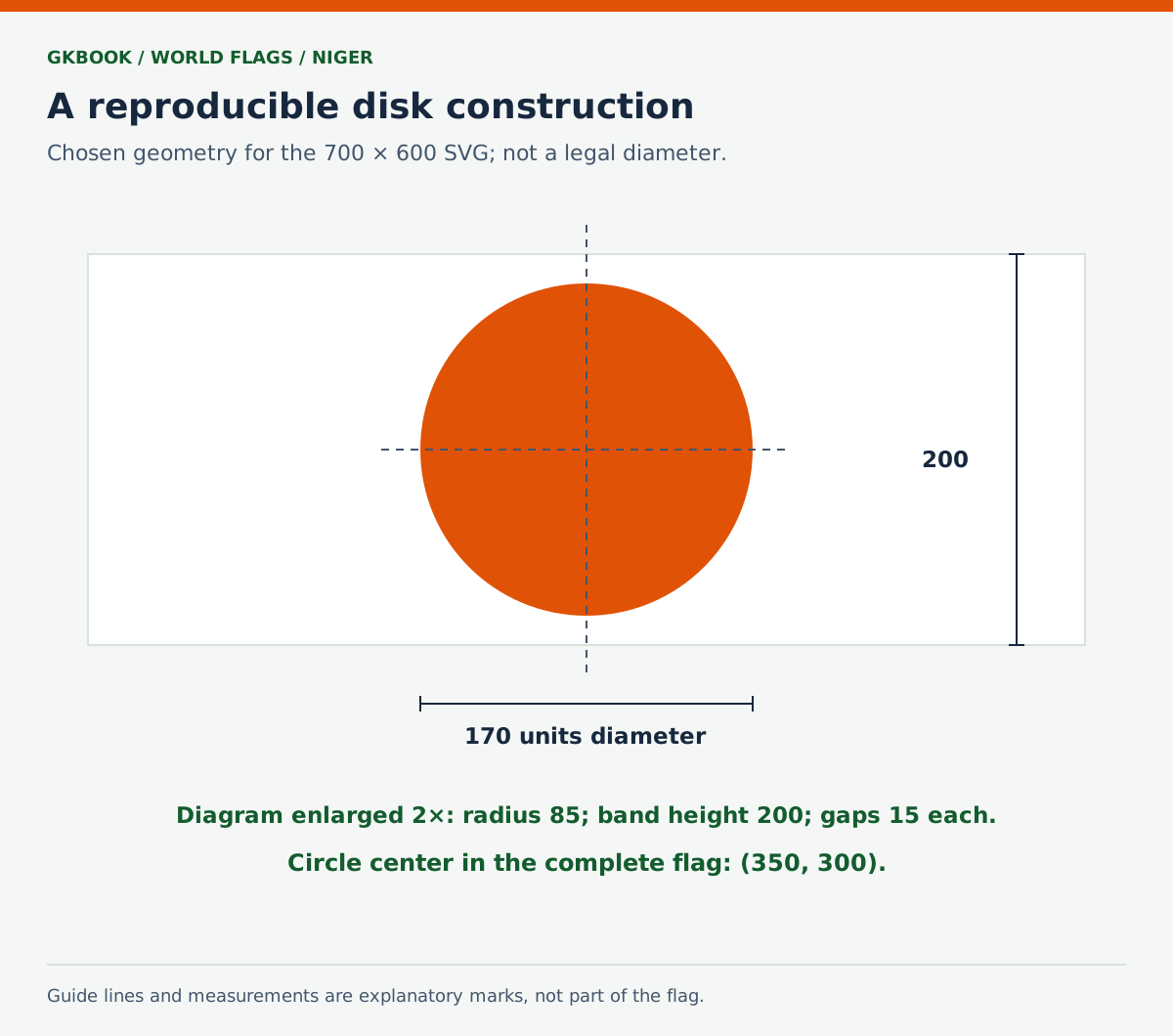
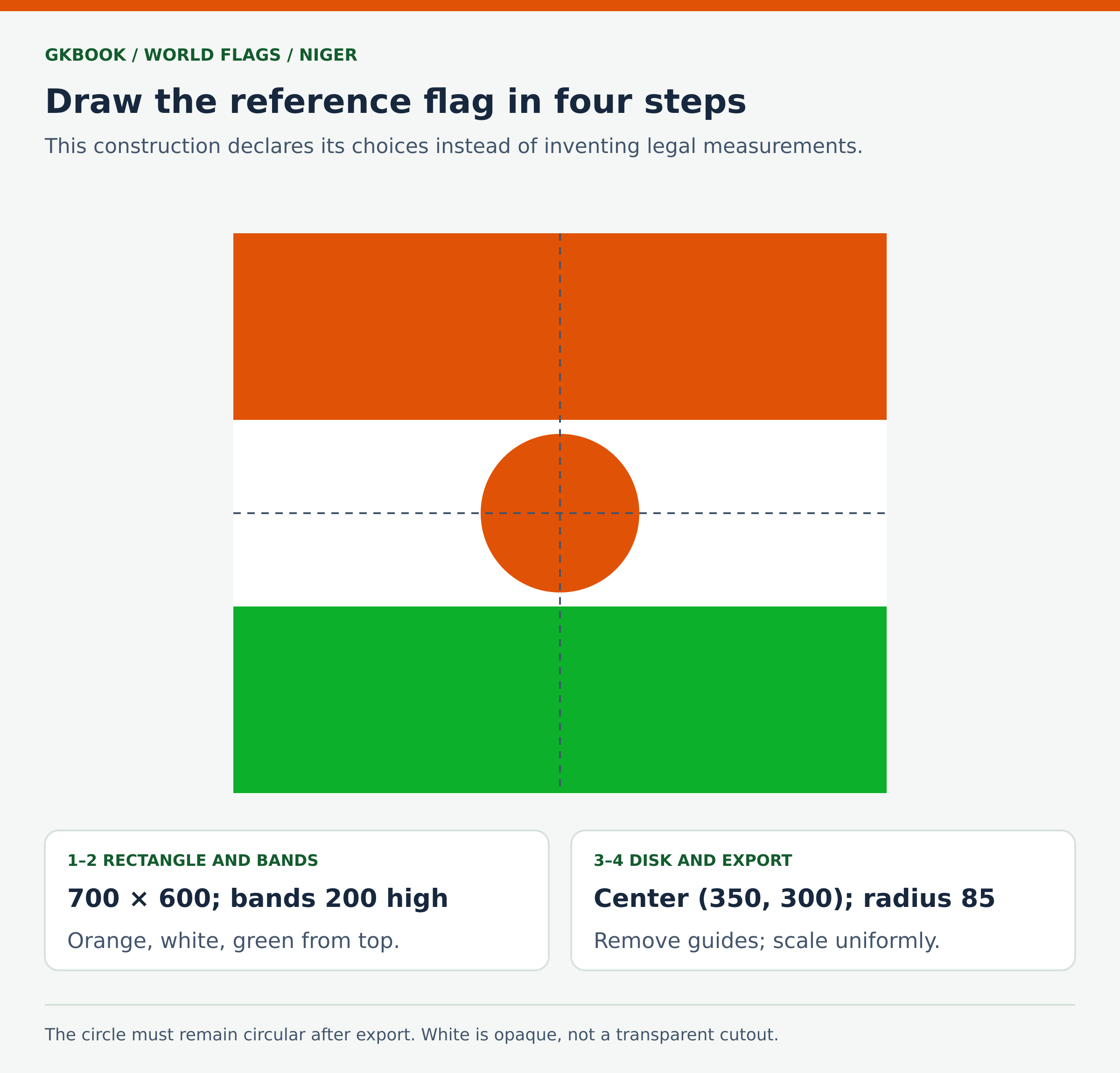
On the 700 × 600 SVG, each band is 200 units high. The disk has radius 85 and diameter 170, leaving 15 units of white above it and 15 below. Its center is at (350, 300). These values make the artwork reproducible without turning a convention into a legal claim.
A centered circle must fit within the white stripe. Its horizontal and vertical diameters must be equal. A ring, an oval, a disk touching the colored bands, or an off-center dot would depart from the reference image used here.
| Measurement | 700 × 600 SVG | 4200 × 3600 PNG |
|---|---|---|
| Band height | 200 | 1200 |
| Disk radius | 85 | 510 |
| Disk diameter | 170 | 1020 |
| White gap above and below | 15 each | 90 each |
| Disk center | 350, 300 | 2100, 1800 |
How do the flag’s dimensions scale?
For the 6:7 drawing used here, choose a height divisible into three equal bands and a length equal to seven sixths of that height. Scale the disk with the flag so that it stays centered and circular. The downloadable dimensions are exact for this reproduction, but they are not statutory production sizes.

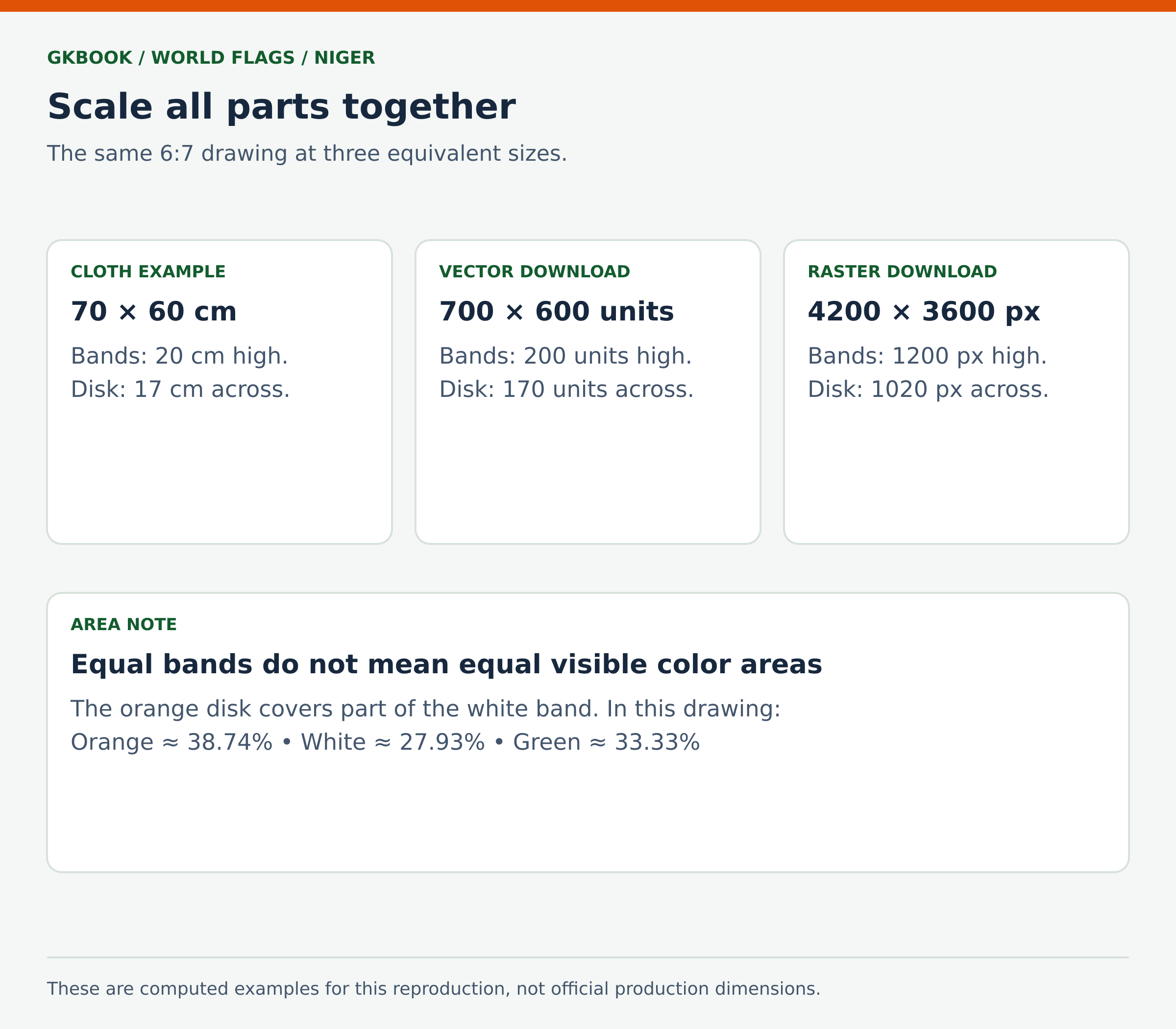
A 60 × 70 centimeter example has three bands 20 centimeters high. With this package’s disk convention, the circle is 17 centimeters across and the white clearances above and below it are 1.5 centimeters. The same relationships apply to pixels, millimeters, or other units.
The bands occupy equal thirds of the rectangle, but the visible color areas are not equal because the orange disk covers some white. Under this particular geometry, orange covers approximately 38.74 percent, white 27.93 percent, and green 33.33 percent of the surface.
| Height | Length | Band height | Disk diameter |
|---|---|---|---|
| 60 cm | 70 cm | 20 cm | 17 cm |
| 600 units | 700 units | 200 units | 170 units |
| 3600 px | 4200 px | 1200 px | 1020 px |
When was Niger’s flag adopted?
Niger’s flag was adopted on November 23, 1959, according to the government’s official symbols account. This was after the republic was proclaimed within the French Community on December 18, 1958, and before independence on August 3, 1960. The flag’s adoption, the republic’s proclamation, and independence are three different historical events.

The familiar orange-white-green design was therefore already a national emblem when Niger became independent. It should not be dated simply to 1960 because that was the year of independence.
The 2025 Charter retains the same basic design. Its later description is evidence of continuity, not a fresh adoption date. Differences among illustrated proportions should likewise be distinguished from the adoption of a different national flag.
How did Niger’s flag develop historically?
Niger’s modern flag emerged during the transition from French rule to independent statehood. The republic was proclaimed in December 1958, the orange-white-green flag was adopted in November 1959, and independence followed in August 1960. Later constitutional descriptions, including the 2025 Charter, retained the three bands and centered orange disk.

Niger had previously been under French sovereignty. Becoming a republic within the French Community in 1958 was not the same as gaining full international independence. The intervening 1959 adoption belongs to that transition, which explains why the flag predates independence.
Historical and contemporary reproductions vary in proportions and shades, but those differences should not automatically be treated as successive official national flags. The enduring identifying arrangement is horizontal orange, white, and green with an orange disk in the center.
| Date | Event |
|---|---|
| December 18, 1958 | Republic proclaimed within the French Community |
| November 23, 1959 | Present flag adopted |
| August 3, 1960 | Independence from France |
| November 25, 2010 | Earlier constitution repeats the basic flag description |
| March 26, 2025 | Charter promulgated; Article 4 retains the design |
Who designed Niger’s flag?
The authoritative sources used for this article establish Niger’s flag design and adoption date but do not reliably identify an individual designer. It would be misleading to attach a personal name without documentary support. The verified account is that the orange-white-green flag with its central disk was adopted on November 23, 1959.
An adoption record and a designer credit answer different questions. A political leader or legislative body involved in introducing a flag is not necessarily the person who drew it. The sources checked here do not justify assigning such a credit.
Niger must also be distinguished from Nigeria. Michael Taiwo Akinkunmi is associated with Nigeria’s green-white-green flag, not with the orange-white-green flag of Niger. Similar country names can produce a particularly persistent attribution error.
What law currently describes Niger’s flag?
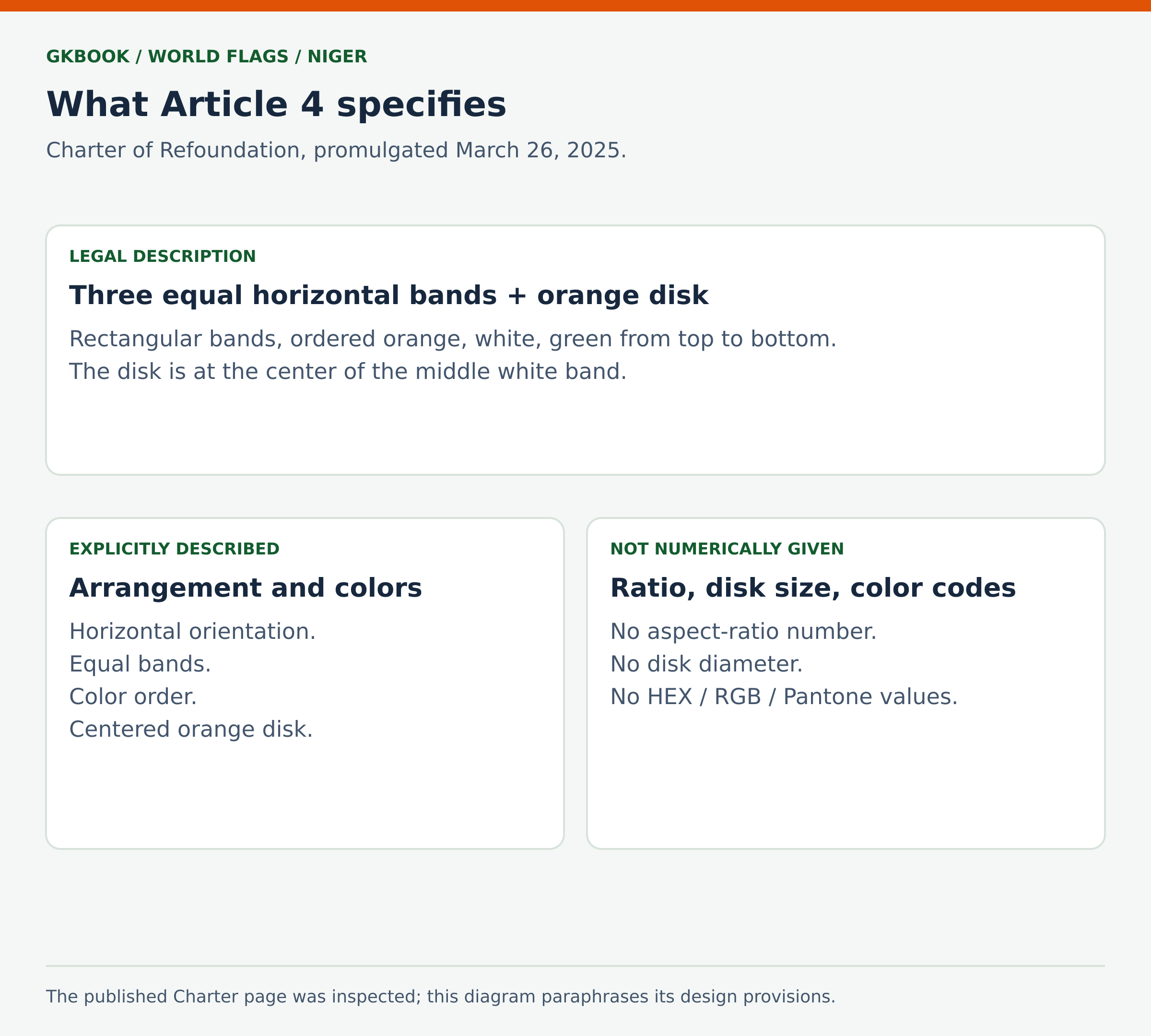
Article 4 of Niger’s Charter of Refoundation, promulgated on March 26, 2025, describes the national flag. It specifies three equal horizontal rectangular bands in orange, white, and green, with an orange disk centered in the white band. The article does not state an aspect ratio, disk diameter, or numerical color specifications.
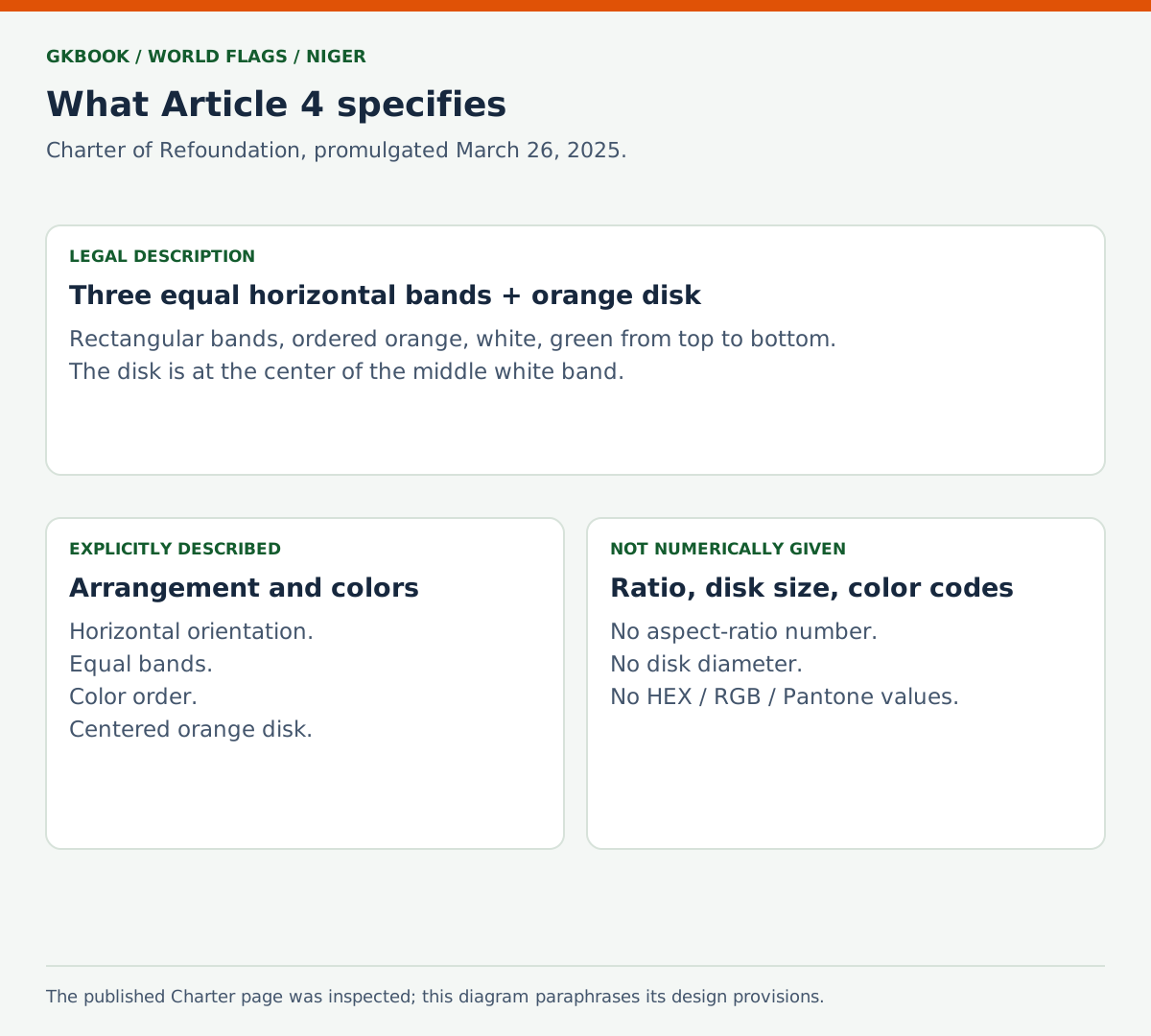
The Charter was promulgated by Decree No. 2025-160/P/CNSP and appears in the March 31, 2025 special edition of the official journal. Its flag description was checked directly in the published page image. UNHCR’s Refworld repository also catalogs the instrument as primary legislation.
Older websites often reproduce Article 1 of the 2010 constitution. That text is useful evidence of continuity, but it should not be presented as the sole current legal reference. The 2025 Charter retains the core flag design while providing the current institutional text considered here.
Why was Niger’s flag adopted before independence?
Niger had become a republic within the French Community before it achieved full independence. It could therefore adopt its own emblem during that earlier stage of self-government. The flag dates to November 23, 1959, whereas independence from France dates to August 3, 1960; the existing design continued into independent statehood.
The sequence is not unusual in a transition toward sovereignty: political identity, domestic institutions, and international independence can develop at different stages. Here, the republic’s proclamation in December 1958 provides the immediate historical context for the following year’s flag adoption.
The United States recognized Niger’s independence on August 3, 1960. That recognition corroborates the independence chronology, but it did not create the flag or set its proportions. Adoption, independence, and foreign recognition should remain separate in a historical account.
Which dates are important to the Niger flag’s history?
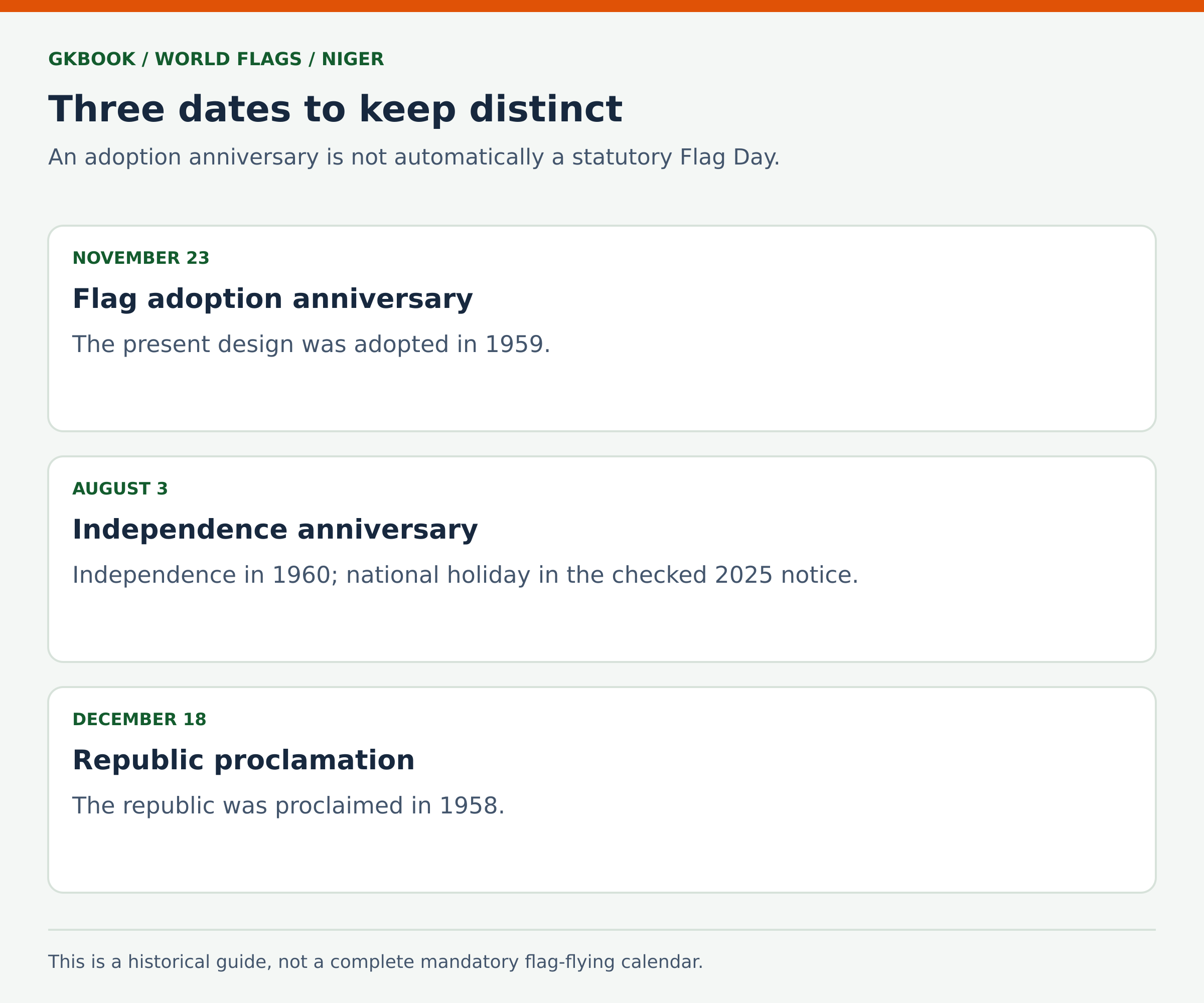
November 23 marks the flag’s 1959 adoption anniversary, August 3 marks independence in 1960, and December 18 recalls the republic’s proclamation in 1958. These dates should not be treated as interchangeable. The sources checked establish November 23 as an adoption anniversary, but do not establish a separate statutory national Flag Day on that date.

A government labor notice for 2025 identifies August 3 as the national holiday commemorating independence. Older sources discuss different national-holiday arrangements, so a historic calendar should not be copied into a current guide without checking its date.
A flag may be present at many official events, school ceremonies, sporting occasions, and diplomatic functions. The anniversary table explains history; it is not a complete legally mandatory flag-flying calendar or an instruction to fly at specified hours.
| Date | Meaning | Important distinction |
|---|---|---|
| November 23 | Flag adoption in 1959 | Adoption anniversary; no separate Flag Day law verified |
| August 3 | Independence in 1960 | Identified as the national holiday in the checked 2025 notice |
| December 18 | Republic proclaimed in 1958 | A different event from independence and flag adoption |
Is Niger’s coat of arms displayed on the national flag?
No. Niger’s national flag carries an orange disk, not the coat of arms. The coat of arms is a separate symbol described alongside the flag in the 2025 Charter. It includes a shield with a sun, weapons, millet, and a zebu head, supported by a grouping of four national flags.

The coat of arms may appear on official documents and other representations of the state, but inserting it into the flag’s central white stripe would produce a different design. The flag’s own central symbol remains the plain orange disk.
Article 4 also distinguishes the state seal from the arms. The seal’s specified 40-millimeter diameter is a measurement for the seal, not for the orange circle on the flag. Confusing those two circles would introduce a false flag-construction rule.
What anthem and motto accompany Niger’s flag?
Niger’s national motto is Fraternité, Travail, Progrès, meaning Fraternity, Work, Progress. The national anthem named in the 2025 Charter is L’Honneur de la Patrie, or The Honor of the Fatherland. It replaced La Nigérienne in 2023. Neither the motto nor the anthem’s words are printed on the national flag.
The legislature adopted the change of anthem on June 22, 2023, as reported by Niger’s national news agency. The 2025 Charter confirms the current title. Some older constitutional pages, reference works, and even inconsistent web-page versions still identify La Nigérienne; those statements should be dated historically.
Flag, anthem, motto, arms, and seal are related national symbols, but they are not interchangeable. A school ceremony may combine raising the flag with singing the anthem, while the graphic design of the flag itself remains unchanged.
How is Niger’s flag different from Nigeria’s flag?
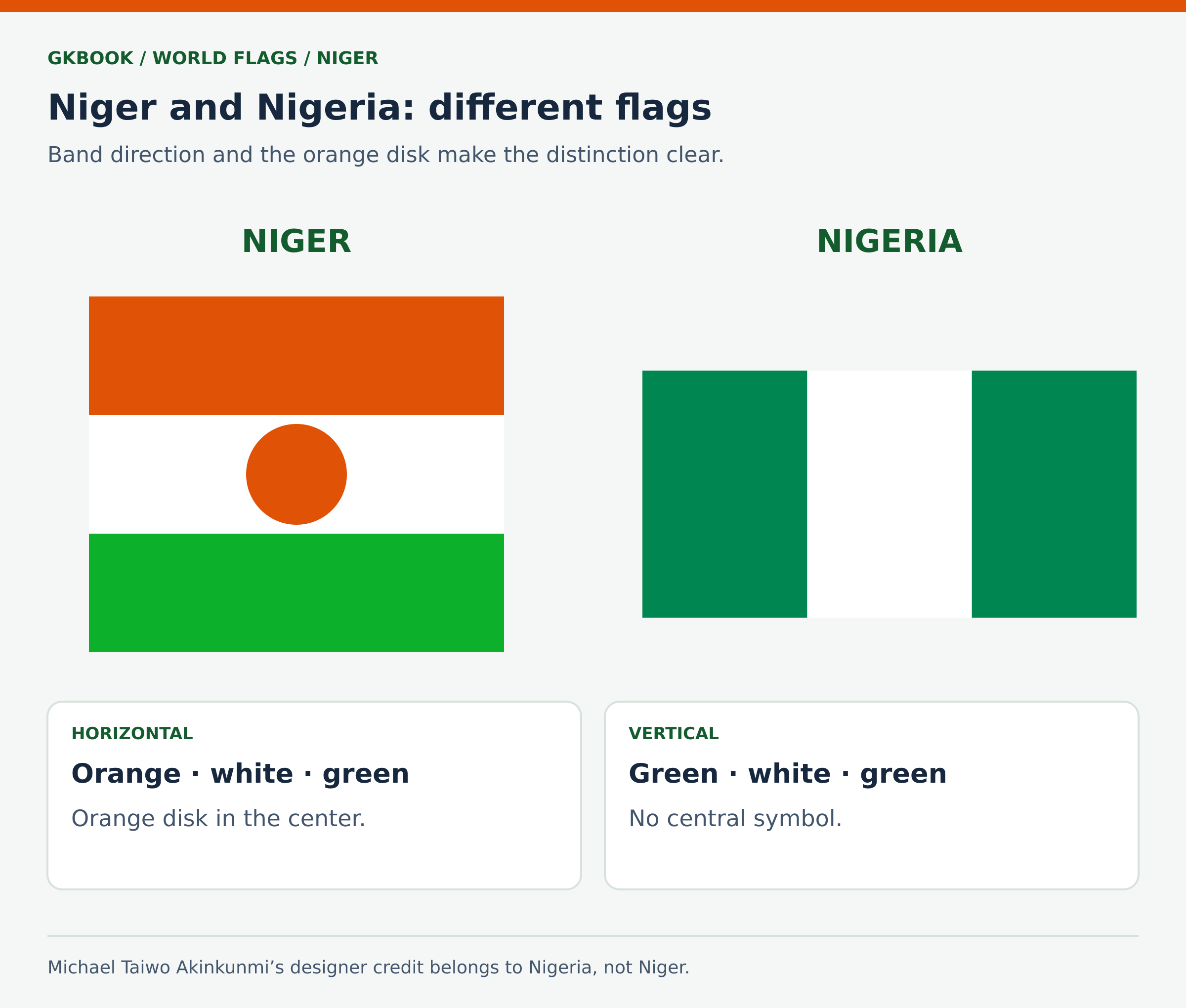
Niger’s flag has horizontal orange-white-green bands and an orange disk in the center. Nigeria’s flag has vertical green-white-green bands and no central symbol. Niger and Nigeria are separate countries with different flags, despite their similar names. The orange color and sun disk immediately distinguish Niger’s national emblem.

Nigeria’s official tourism authority credits Michael Taiwo Akinkunmi with its design and dates its official adoption to October 1, 1960. Those facts belong to Nigeria and should not be transferred to Niger’s 1959 flag.
In English, Nigerien usually refers to Niger, while Nigerian refers to Nigeria. In a classroom, naming the country before describing the flag helps prevent confusion. The comparison diagram focuses on band direction and central device rather than a potentially misleading difference in green shades.
How is Niger’s flag different from India’s flag?
Niger and India both use three horizontal bands in a warm upper color, white, and green, but their central devices differ. Niger has a solid orange sun disk. India has a navy-blue Ashoka Chakra with 24 spokes. India specifies 2:3 proportions; Niger’s often-shown 6:7 format is a convention rather than a ratio stated in its Charter.

India’s official description calls the upper band deep saffron, or kesari, and the lower band dark green. Niger’s legal text calls its colors orange, white, and green. The flags should not be described as identical except for a dot without acknowledging the different devices and specifications.
The shared broad color arrangement does not, by itself, establish that Niger copied India’s flag. No verified design document supporting that claim was found. Use the solid orange disk versus the 24-spoked navy wheel as the clearest visual distinction.
How does Niger’s flag differ from those of Ireland and Côte d’Ivoire?
Ireland and Côte d’Ivoire use vertical tricolors without a central disk, whereas Niger uses horizontal bands with an orange disk. Ireland places green next to the pole, followed by white and orange. Côte d’Ivoire places orange, white, and green in vertical bands. Sharing three color names does not make these flags equivalent.
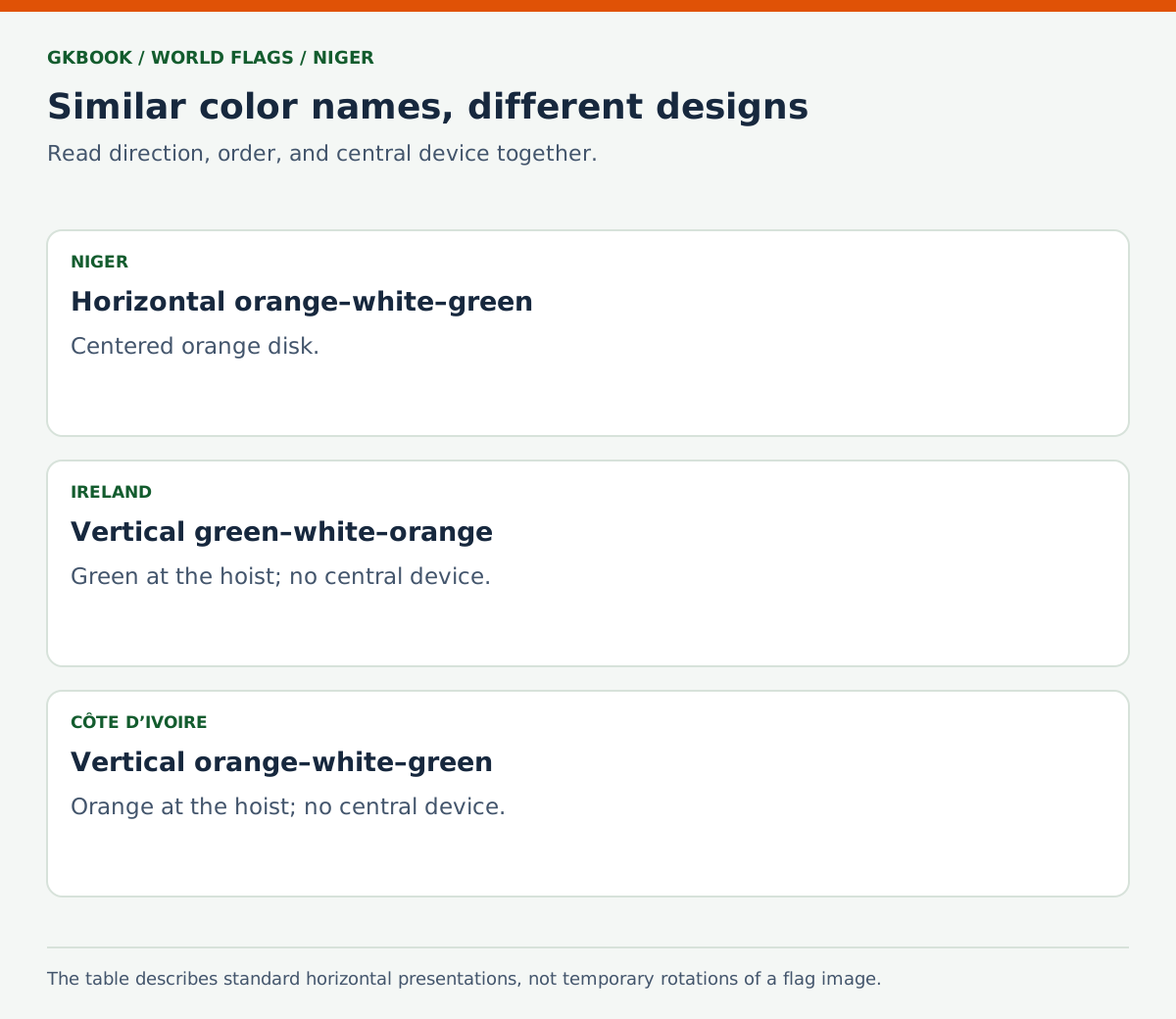
Band direction, order from the hoist, and the presence of an emblem are separate identification features. The orange disk remains essential when Niger’s flag is shown at a small size.
Rotating a picture of Niger’s flag does not turn it into Côte d’Ivoire’s or Ireland’s flag: the disk is still present, and a rotated display is not a new national design. The comparison table describes each flag in its standard horizontal presentation.
| Country | Band direction | Order / central device |
|---|---|---|
| Niger | Horizontal | Orange–white–green from top; orange disk |
| Ireland | Vertical | Green–white–orange from hoist; no device |
| Côte d’Ivoire | Vertical | Orange–white–green from hoist; no device |
Does Niger’s flag look the same from the reverse side?
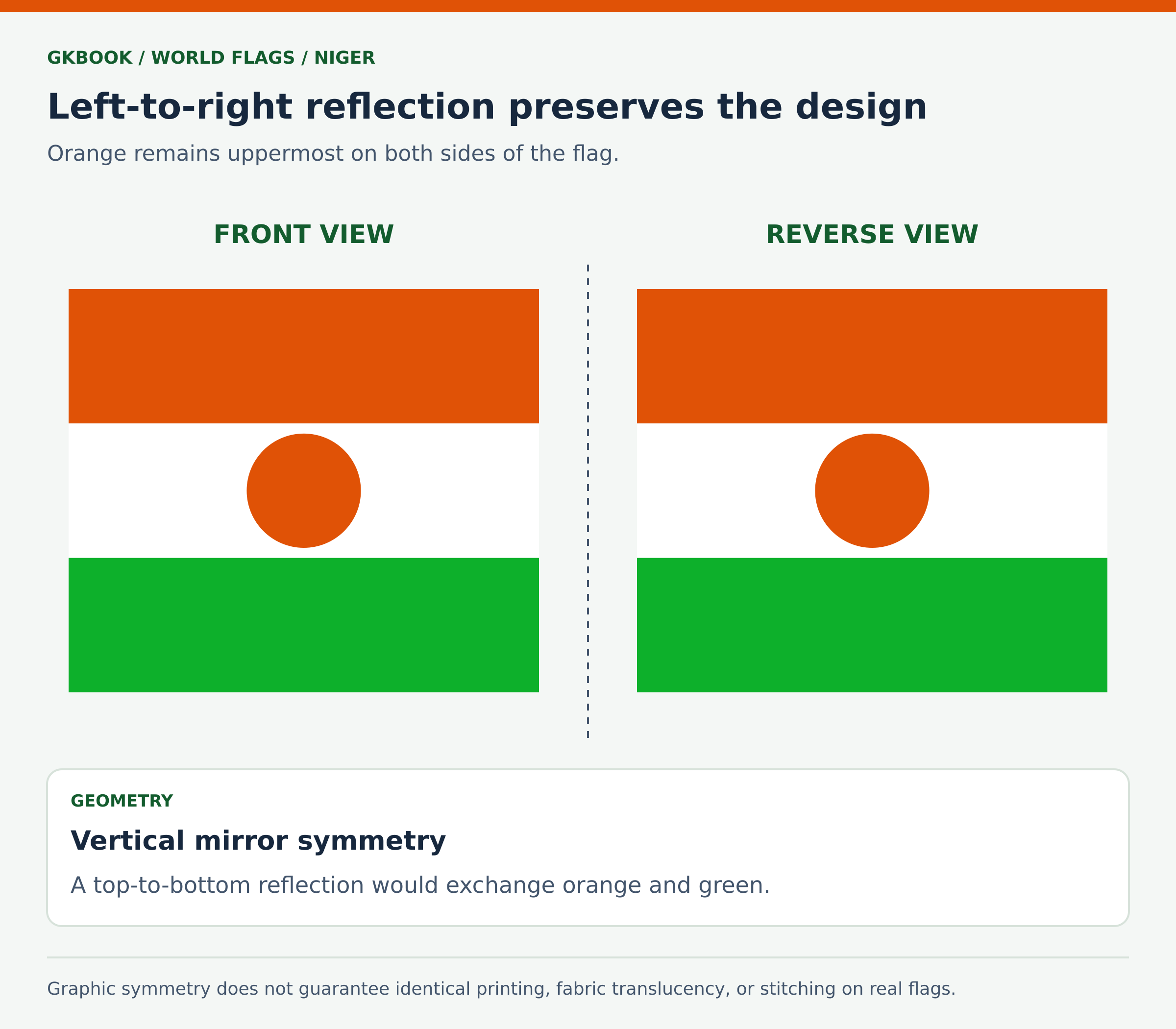
The graphic design of Niger’s flag looks the same after a left-to-right reflection because the bands run horizontally and the orange disk is centered. It is therefore unchanged when the cloth is viewed from the opposite side with orange still uppermost. An upside-down rotation is different because it puts green above orange.
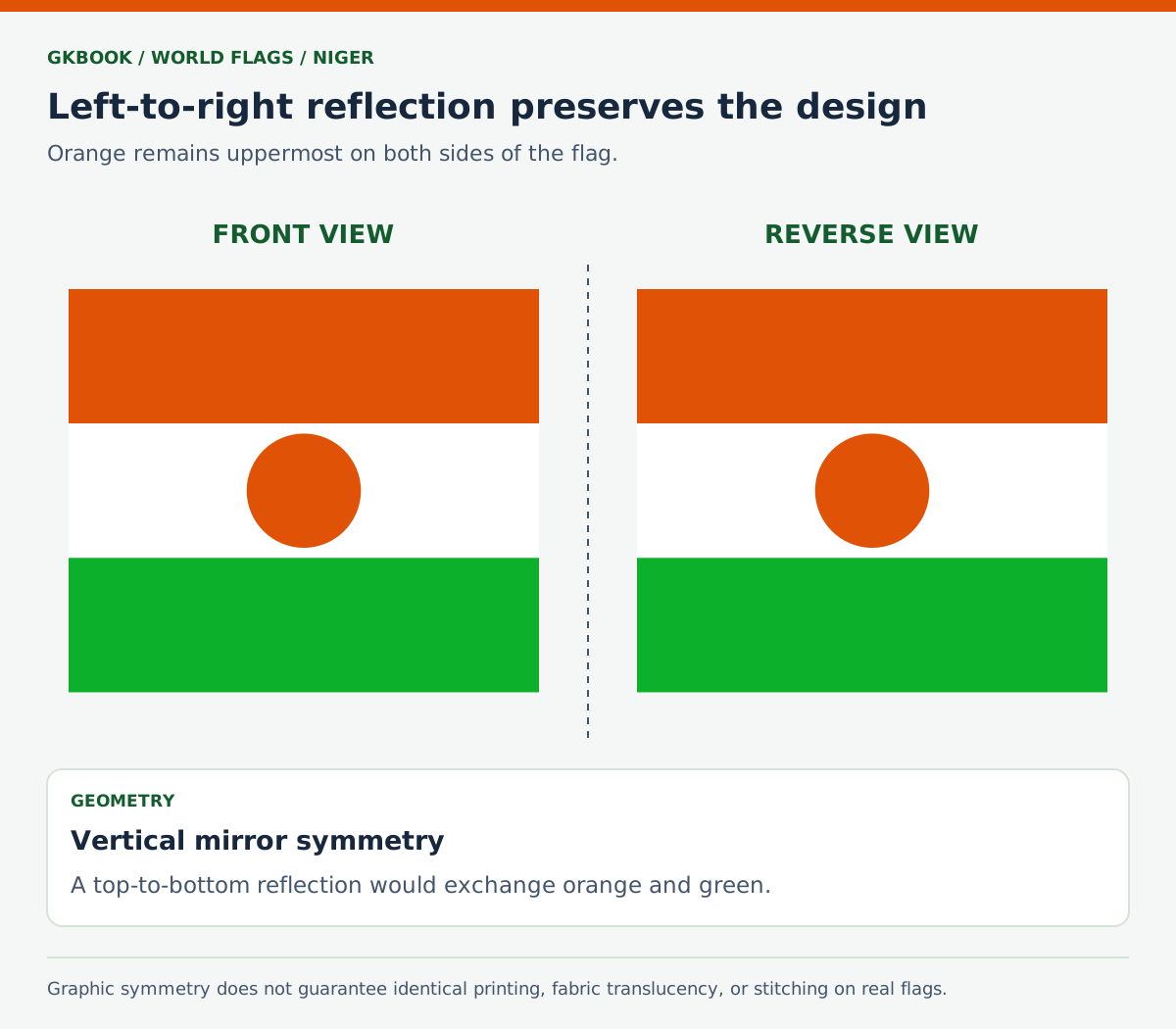
This is a property of the geometric design, not a guarantee about every manufactured flag’s stitching, seams, or printing. A one-sided print may look lighter through the reverse, but the arrangement itself remains symmetrical.
The design has a vertical mirror axis through its center. It does not have a horizontal mirror axis, since that would exchange orange and green. Its circular disk has many symmetries, but the complete flag must be considered together with the colored bands.
How should Niger’s flag be shown vertically?
A vertical presentation should preserve Niger’s complete design, including the three equal bands and the orange disk, without stretching the circle. The Charter’s description alone does not establish a detailed wall-hanging protocol. For formal display, follow the organizer’s or diplomatic authority’s instructions; the rotated teaching illustration here explains geometry, not a verified national orientation rule.
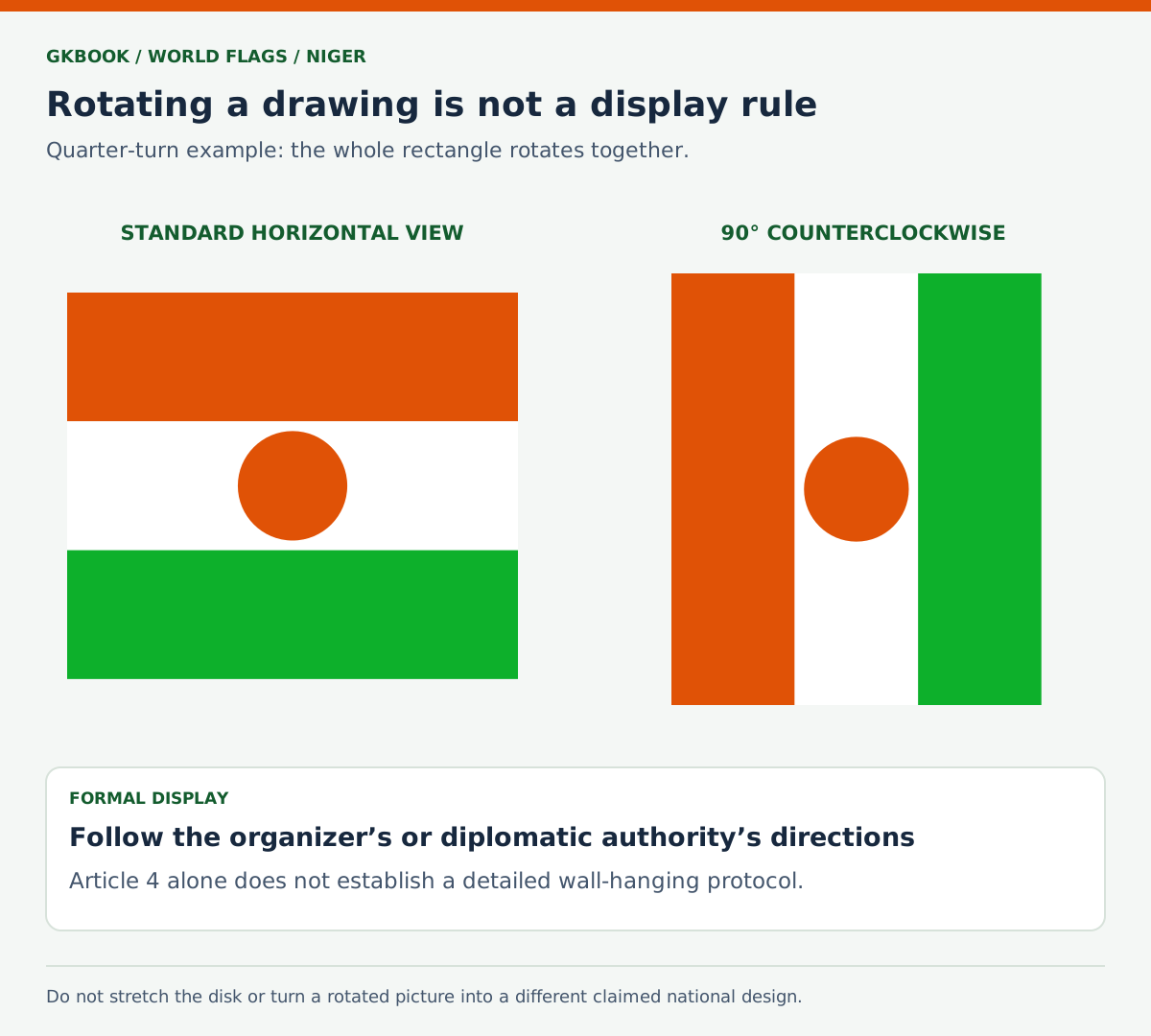
Rotating the complete rectangle through a quarter turn changes the displayed bands from horizontal to vertical. Rebuilding the design with a different order, moving the disk, or stretching the image is a separate alteration. The supplied rotation example is labeled as such.
For a normal flag-on-pole drawing, keep orange above white and green. For a tall publication layout, fitting the horizontal flag inside a larger canvas is often clearer than rotating it. Preserve the original image’s aspect ratio and leave any surrounding space outside the flag.
Where is Niger’s flag used, and how should it be handled?
Niger’s flag represents the state at official buildings, diplomatic missions, ceremonies, and international events, and it is used in school flag-raising activities. Keep the design intact and the cloth clean and undamaged. Detailed official arrangements, including mourning displays, should follow the responsible authority’s directions rather than assumed rules borrowed from another country.
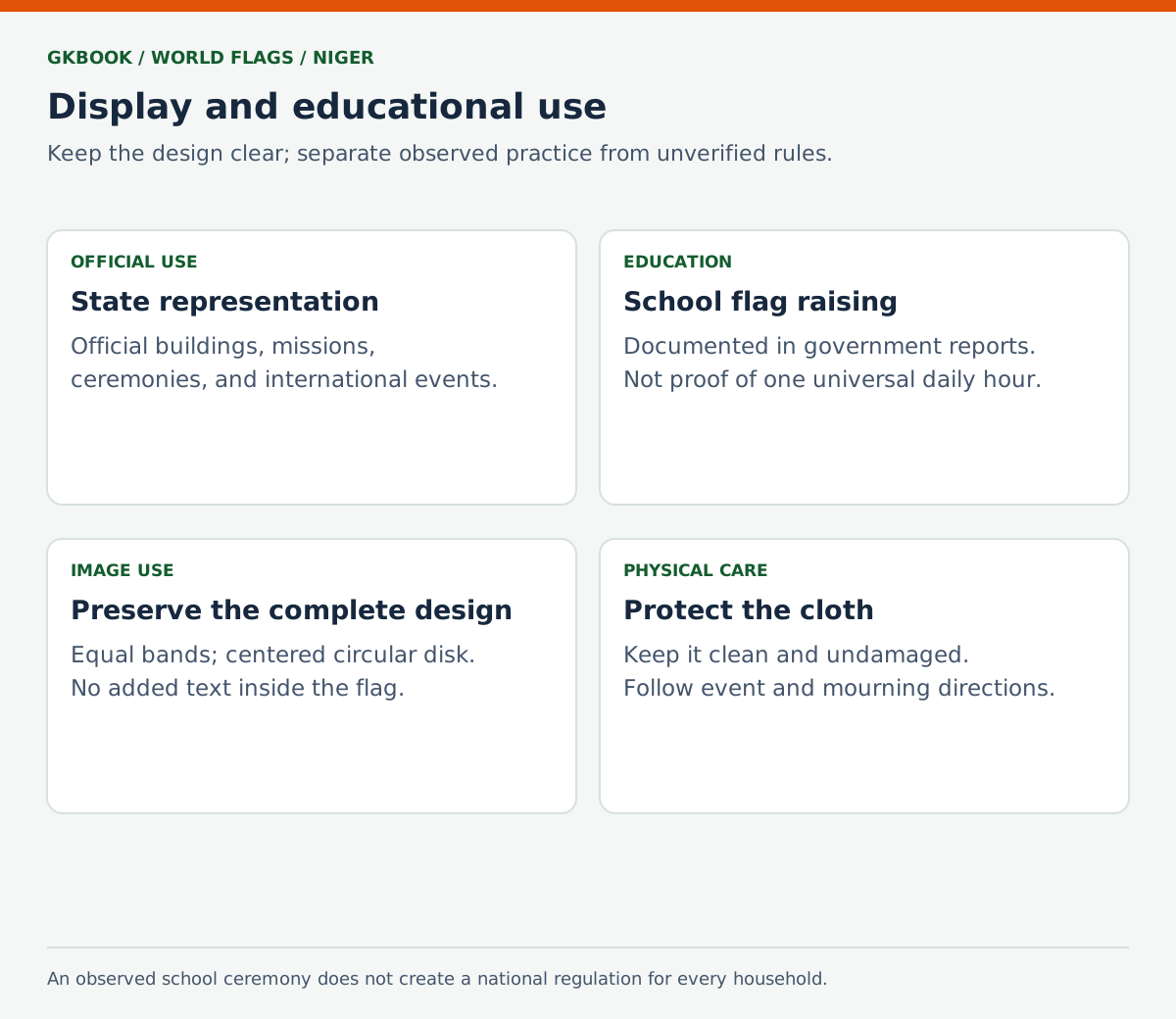
Recent government reporting documents school flag-raising ceremonies linked with civic education. Those reports establish an observed practice, not a complete national rule about the exact hour every school or household must raise or lower a flag.
For educational use, display a clear, correctly oriented image and avoid adding text, logos, shadows, or decorative outlines within the flag itself. Keeping the cloth supported and free from preventable damage is sensible general care; this article does not present an unverified disposal ritual, folding sequence, or half-mast measurement as Nigerien law.
How can you draw Niger’s flag accurately?
For this package’s 6:7 version, draw a rectangle 700 units long and 600 high, then divide it into three 200-unit horizontal bands. Fill them orange, white, and green from top to bottom. Place an orange circle of radius 85 at coordinate (350, 300), keeping it fully inside the white band.
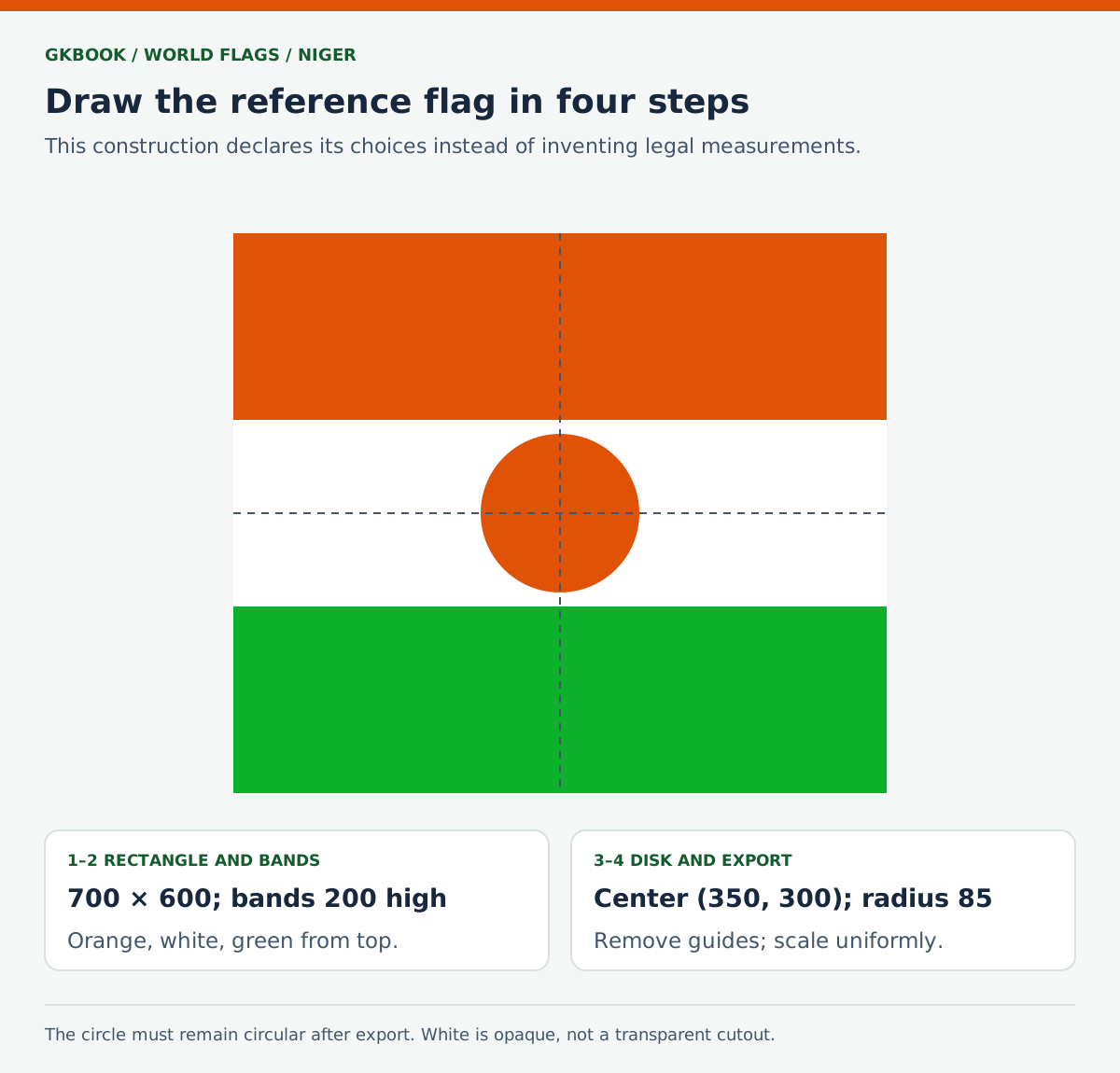
The rectangle and disk measurements are the declared construction convention used here. The legal requirements supported by Article 4 are the horizontal arrangement, equal bands, orange-white-green order, and orange disk centered in the middle stripe.
Export the drawing without dimension lines or guide marks. Keep the disk orange and circular, retain opaque white, and scale the entire design uniformly. A vector file preserves the geometry at any resolution; a raster file needs sufficient pixels for a smooth circular edge.
What mistakes should be avoided in Niger flag images?
Common mistakes include confusing Niger with Nigeria, replacing the orange disk with India’s wheel, reversing the bands, using vertical stripes, or stretching the circle into an oval. Research errors include calling 6:7 a proven statutory ratio, dating adoption to independence in 1960, or treating an old anthem reference as current.

Also check that all three bands are equal in height and that the disk sits at the flag’s center with white clearance above and below. Do not insert the coat of arms, sun rays, text, or a black border around the disk.
Separate established facts from reproduction choices. The adoption date is November 23, 1959; Article 4 of the 2025 Charter gives the current description checked here. The supplied 6:7 proportions, 85-percent-of-band disk diameter, and digital colors are stated choices rather than invented legal specifications.
Download Niger flag pictures
Download the national flag as SVG or 4200 × 3600 PNG. The gallery contains 24 subjects, each with SVG and PNG versions. Keep the full rectangular image and preserve its proportions. Both the SVG and PNG retain this drawing’s exact 6:7 shape, circular disk, and opaque white stripe. The disk diameter and digital colors are declared reproduction choices. The comparison diagrams identify features without presenting foreign-flag production masters. Image credits and reproduction notes accompany the artwork.
Explore more in World Flags, including the India flag and Nicaragua flag.
World Flags/Niger
Niger flag pictures
Orange-white-green horizontal bands with a centered orange disk. The 6:7 ratio and disk diameter of 85% of a band are declared drawing conventions.
GKBook original educational artwork; construction conventions and screen colors are declared.Download SVGDownload PNGRead orange, white, green from top to bottom. The disk is an additional orange element, not a fourth stripe.
GKBook original educational artwork; construction conventions and screen colors are declared.Download SVGDownload PNGThis artwork uses #E05206, #FFFFFF, and #0DB02B. These match principal colors of an inspected government illustration but are not a certified color standard.
GKBook original educational artwork; construction conventions and screen colors are declared.Download SVGDownload PNGOrange evokes the desert, green the fertile southern Niger basin, and the disk the sun. Official diplomatic explanations associate white with purity and hope.
GKBook original educational artwork; construction conventions and screen colors are declared.Download SVGDownload PNGAbstract orange dunes and green land explain the geographic associations of the upper and lower bands. This is not a map of Niger.
GKBook original educational artwork; construction conventions and screen colors are declared.Download SVGDownload PNGThe central device is a solid orange disk representing the sun. The isolated enlargement is a detail view, not a separate national emblem.
GKBook original educational artwork; construction conventions and screen colors are declared.Download SVGDownload PNGThe main drawing is 700 units long and 600 high. It is exactly 6:7, but this numerical ratio is not prescribed by Article 4 of the 2025 Charter.
GKBook original educational artwork; construction conventions and screen colors are declared.Download SVGDownload PNGReference works describe 6:7, 2:3, 3:5, and 1:2 portrayals. This teaching diagram preserves equal bands and a circular disk in each, without claiming four legally prescribed formats.
GKBook original educational artwork; construction conventions and screen colors are declared.Download SVGDownload PNGThe chosen diameter is 170 on a 200-high band, or 85%. The isolated band is displayed at twice those unit dimensions for readability. The Charter gives no numerical disk diameter.
GKBook original educational artwork; construction conventions and screen colors are declared.Download SVGDownload PNGEquivalent sizes retain the selected ratio and disk proportions. The disk increases orange’s visible area and reduces white’s; all three underlying bands remain equal.
GKBook original educational artwork; construction conventions and screen colors are declared.Download SVGDownload PNGThe flag was adopted on November 23, 1959, between the republic’s 1958 proclamation and independence in 1960.
GKBook original educational artwork; construction conventions and screen colors are declared.Download SVGDownload PNGA five-event timeline separates republic status, flag adoption, independence, and later legal descriptions. The 2025 text retains the familiar band-and-disk design.
GKBook original educational artwork; construction conventions and screen colors are declared.Download SVGDownload PNGArticle 4 of the 2025 Charter specifies the core design but not an aspect-ratio number, disk diameter, or numerical color standard.
GKBook original educational artwork; construction conventions and screen colors are declared.Download SVGDownload PNGNovember 23 concerns flag adoption, August 3 independence, and December 18 the republic’s proclamation. No separate statutory Flag Day on November 23 was verified.
GKBook original educational artwork; construction conventions and screen colors are declared.Download SVGDownload PNGThe 2025 Charter distinguishes the flag, arms, seal, motto, and anthem. The flag has an orange disk; it does not carry the arms or printed national motto.
GKBook original educational artwork; construction conventions and screen colors are declared.Download SVGDownload PNGNiger has horizontal orange-white-green bands and a sun disk. Nigeria has vertical green-white-green bands and no device. Nigeria is shown as an identification example using illustrative green.
GKBook original educational artwork; construction conventions and screen colors are declared.Download SVGDownload PNGNiger’s solid orange sun disk differs from India’s navy Ashoka Chakra with 24 spokes. The wheel here is a simplified teaching diagram, not a complete Indian manufacturing master.
GKBook original educational artwork; construction conventions and screen colors are declared.Download SVGDownload PNGNiger’s horizontal bands and orange disk distinguish it from the two vertical tricolors. Ireland and Côte d’Ivoire also have opposite color orders from the hoist.
GKBook original educational artwork; construction conventions and screen colors are declared.Download SVGDownload PNGReflecting the design left to right leaves it unchanged. A top-to-bottom reflection or 180-degree rotation changes the color order and is not the same design.
GKBook original educational artwork; construction conventions and screen colors are declared.Download SVGDownload PNGA 90-degree counterclockwise rotation moves orange to the left and preserves the orange disk. This is a geometric example, not a verified Nigerien vertical-display instruction.
GKBook original educational artwork; construction conventions and screen colors are declared.Download SVGDownload PNGOfficial and educational use is documented. General care recommendations are distinguished from legal claims; no unverified daily schedule, folding ritual, or half-mast measurement is supplied.
GKBook original educational artwork; construction conventions and screen colors are declared.Download SVGDownload PNGDraw a 700 × 600 rectangle, add three 200-high bands, and place an orange disk of radius 85 at (350,300). These numerical values are the package’s convention.
GKBook original educational artwork; construction conventions and screen colors are declared.Download SVGDownload PNGAvoid a wrong country, wheel, ray-emitting sun, unequal or reversed bands, and stretched disk. Keep adoption separate from independence and conventions separate from law.
GKBook original educational artwork; construction conventions and screen colors are declared.Download SVGDownload PNG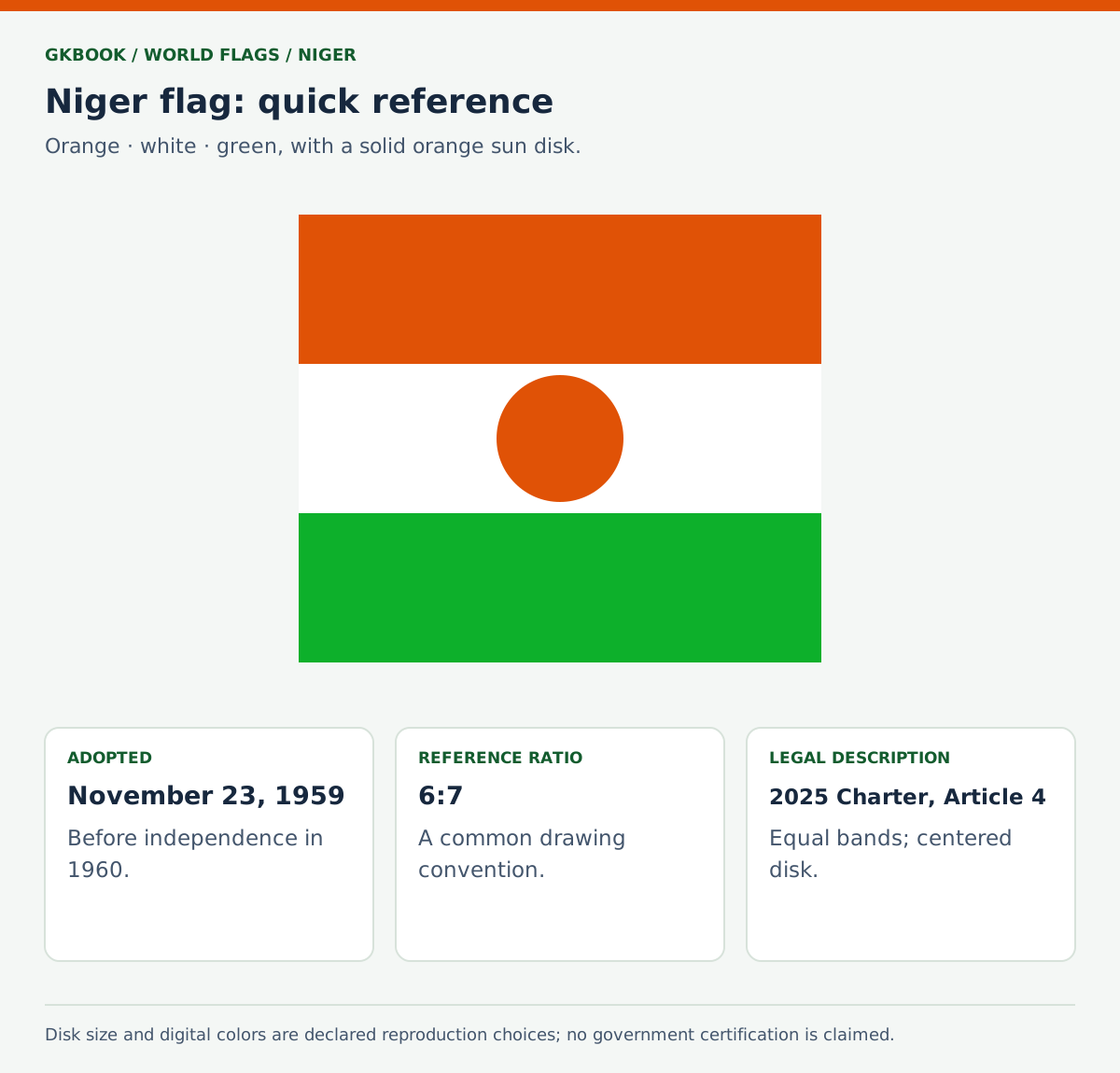
A compact flag reference gives the adoption date, the 6:7 illustration convention, and the current legal description in the 2025 Charter.
GKBook original educational artwork; construction conventions and screen colors are declared.Download SVGDownload PNGFrequently asked questions
What does Niger’s flag look like?
Niger’s flag has three equal horizontal bands: orange at the top, white in the middle, and green at the bottom. A solid orange disk sits at the center of the white band. Adopted on November 23, 1959, it is commonly illustrated in 6:7 proportions, although the current legal description specifies no numerical ratio.
What is the correct order of the colors on Niger’s flag?
Read Niger’s flag from top to bottom as orange, white, and green. The three bands are horizontal and equal in height. The orange disk belongs in the middle of the white band. Reversing the top and bottom bands, turning them into vertical stripes, or removing the disk changes the prescribed design.
What are the Niger flag’s colors and color codes?
Niger’s flag uses orange, white, and green, with the same orange used for the central disk. The current legal description names the colors but gives no hexadecimal, RGB, CMYK, or Pantone values. This package uses #E05206, #FFFFFF, and #0DB02B as declared digital reproductions, consistent with a government website’s illustrative bitmap.
What does the Niger flag symbolize?
Niger’s government links the orange band with the northern desert, the green band with the fertile southern Niger basin, and the orange disk with the sun. Official diplomatic explanations associate white with purity and hope. Together, these elements connect the national emblem with the country’s landscapes, aspirations, unity, and sovereignty.
What does the orange band on Niger’s flag mean?
The orange band primarily represents the desert in northern Niger, especially the Sahara. Government explanations connect this color with the country’s dry northern landscape, while some diplomatic interpretations also mention efforts toward development. The color is called orange in the legal description; it should not simply be renamed red or Indian saffron.
What does the white band on Niger’s flag mean?
The white band is associated with purity and hope in current official diplomatic explanations. Peace and innocence also appear in broader reference accounts. The band provides the setting for the orange sun disk, which is centered within it. The Charter prescribes a white middle stripe but does not assign it a written symbolic meaning.
What does the green band on Niger’s flag mean?
The green band represents the fertile land of southern Niger, particularly the plains and valleys associated with the Niger River basin. Official diplomatic explanations also connect green with hope. Its position below the white band complements the orange desert band above, creating a broad contrast between the country’s northern and southern landscapes.
What does the orange circle on Niger’s flag represent?
The orange circle represents the sun. It is a solid disk centered in the white band, using the same orange as the upper stripe. The national flag does not give it rays, a face, spokes, or an outline. Those additions would change the simple circular device described in the Charter.
What is the Niger flag’s ratio?
Niger’s flag is commonly illustrated with a height:length ratio of 6:7, making it nearly square. That ratio is a drawing convention, not a numerical requirement stated in Article 4 of the 2025 Charter. Other proportions appear in references and use, including 2:3; they should not automatically be dismissed as unlawful.
Why do pictures of Niger’s flag have different proportions?
Pictures of Niger’s flag vary because the legal description fixes the colors, equal horizontal bands, and centered orange disk without stating a numerical aspect ratio. Reference works record several formats, including 6:7, 2:3, 3:5, and 1:2. A picture’s proportions alone therefore cannot establish whether its maker followed an official dimensional standard.
How large should the orange disk be?
The current Charter does not prescribe a numerical diameter for Niger’s orange disk. This package uses a diameter equal to 85 percent of the white band’s height, matching the familiar proportions of the inspected illustrations approximately. That is a declared construction choice, with equal white clearance above and below the circle.
How do the flag’s dimensions scale?
For the 6:7 drawing used here, choose a height divisible into three equal bands and a length equal to seven sixths of that height. Scale the disk with the flag so that it stays centered and circular. The downloadable dimensions are exact for this reproduction, but they are not statutory production sizes.
When was Niger’s flag adopted?
Niger’s flag was adopted on November 23, 1959, according to the government’s official symbols account. This was after the republic was proclaimed within the French Community on December 18, 1958, and before independence on August 3, 1960. The flag’s adoption, the republic’s proclamation, and independence are three different historical events.
How did Niger’s flag develop historically?
Niger’s modern flag emerged during the transition from French rule to independent statehood. The republic was proclaimed in December 1958, the orange-white-green flag was adopted in November 1959, and independence followed in August 1960. Later constitutional descriptions, including the 2025 Charter, retained the three bands and centered orange disk.
Who designed Niger’s flag?
The authoritative sources used for this article establish Niger’s flag design and adoption date but do not reliably identify an individual designer. It would be misleading to attach a personal name without documentary support. The verified account is that the orange-white-green flag with its central disk was adopted on November 23, 1959.
What law currently describes Niger’s flag?
Article 4 of Niger’s Charter of Refoundation, promulgated on March 26, 2025, describes the national flag. It specifies three equal horizontal rectangular bands in orange, white, and green, with an orange disk centered in the white band. The article does not state an aspect ratio, disk diameter, or numerical color specifications.
Why was Niger’s flag adopted before independence?
Niger had become a republic within the French Community before it achieved full independence. It could therefore adopt its own emblem during that earlier stage of self-government. The flag dates to November 23, 1959, whereas independence from France dates to August 3, 1960; the existing design continued into independent statehood.
Which dates are important to the Niger flag’s history?
November 23 marks the flag’s 1959 adoption anniversary, August 3 marks independence in 1960, and December 18 recalls the republic’s proclamation in 1958. These dates should not be treated as interchangeable. The sources checked establish November 23 as an adoption anniversary, but do not establish a separate statutory national Flag Day on that date.
Is Niger’s coat of arms displayed on the national flag?
No. Niger’s national flag carries an orange disk, not the coat of arms. The coat of arms is a separate symbol described alongside the flag in the 2025 Charter. It includes a shield with a sun, weapons, millet, and a zebu head, supported by a grouping of four national flags.
What anthem and motto accompany Niger’s flag?
Niger’s national motto is Fraternité, Travail, Progrès, meaning Fraternity, Work, Progress. The national anthem named in the 2025 Charter is L’Honneur de la Patrie, or The Honor of the Fatherland. It replaced La Nigérienne in 2023. Neither the motto nor the anthem’s words are printed on the national flag.
How is Niger’s flag different from Nigeria’s flag?
Niger’s flag has horizontal orange-white-green bands and an orange disk in the center. Nigeria’s flag has vertical green-white-green bands and no central symbol. Niger and Nigeria are separate countries with different flags, despite their similar names. The orange color and sun disk immediately distinguish Niger’s national emblem.
How is Niger’s flag different from India’s flag?
Niger and India both use three horizontal bands in a warm upper color, white, and green, but their central devices differ. Niger has a solid orange sun disk. India has a navy-blue Ashoka Chakra with 24 spokes. India specifies 2:3 proportions; Niger’s often-shown 6:7 format is a convention rather than a ratio stated in its Charter.
How does Niger’s flag differ from those of Ireland and Côte d’Ivoire?
Ireland and Côte d’Ivoire use vertical tricolors without a central disk, whereas Niger uses horizontal bands with an orange disk. Ireland places green next to the pole, followed by white and orange. Côte d’Ivoire places orange, white, and green in vertical bands. Sharing three color names does not make these flags equivalent.
Does Niger’s flag look the same from the reverse side?
The graphic design of Niger’s flag looks the same after a left-to-right reflection because the bands run horizontally and the orange disk is centered. It is therefore unchanged when the cloth is viewed from the opposite side with orange still uppermost. An upside-down rotation is different because it puts green above orange.
How should Niger’s flag be shown vertically?
A vertical presentation should preserve Niger’s complete design, including the three equal bands and the orange disk, without stretching the circle. The Charter’s description alone does not establish a detailed wall-hanging protocol. For formal display, follow the organizer’s or diplomatic authority’s instructions; the rotated teaching illustration here explains geometry, not a verified national orientation rule.
Where is Niger’s flag used, and how should it be handled?
Niger’s flag represents the state at official buildings, diplomatic missions, ceremonies, and international events, and it is used in school flag-raising activities. Keep the design intact and the cloth clean and undamaged. Detailed official arrangements, including mourning displays, should follow the responsible authority’s directions rather than assumed rules borrowed from another country.
How can you draw Niger’s flag accurately?
For this package’s 6:7 version, draw a rectangle 700 units long and 600 high, then divide it into three 200-unit horizontal bands. Fill them orange, white, and green from top to bottom. Place an orange circle of radius 85 at coordinate (350, 300), keeping it fully inside the white band.
What mistakes should be avoided in Niger flag images?
Common mistakes include confusing Niger with Nigeria, replacing the orange disk with India’s wheel, reversing the bands, using vertical stripes, or stretching the circle into an oval. Research errors include calling 6:7 a proven statutory ratio, dating adoption to independence in 1960, or treating an old anthem reference as current.
Explore all general-knowledge topics and the A-to-Z lists.











We Value Your Opinion Comments