

Nicaragua flag picture
Explore the proportions, history, and picture gallery.
| Design | Blue, white, blueThree equal horizontal bands; arms in the center. |
|---|---|
| Proportions | Height:length = 3:5All emblem features scale with the flag. |
| Adoption | September 5, 1908Usual executive date; legislative text dated September 4. |
| Detailed specifications | 1971 symbols lawDecree No. 1908; published August 27, 1971. |
| National Flags Day | May 4Law 1249 replaced the former July 14 observance in 2025. |
| Constitutional status | Two flags recognizedThe 2025 text also recognizes the red-and-black flag. |
What does Nicaragua’s flag look like?
Nicaragua’s blue-and-white flag has three equal horizontal bands, blue above and below a white center containing the national coat of arms. Its height:length ratio is 3:5. The arms show five volcanoes, two seas, a rainbow, and a liberty cap inside a gold-edged triangle, surrounded by gold lettering.
This page concerns Nicaragua’s blue-white-blue flag. Since 2025, the constitution also recognizes the red-and-black flag among the national symbols. The article distinguishes that change from the blue-and-white design, explains the 2002 requirement to retain the arms, and gives the current May 4 National Flags Day.
What colors are on the Nicaragua flag?
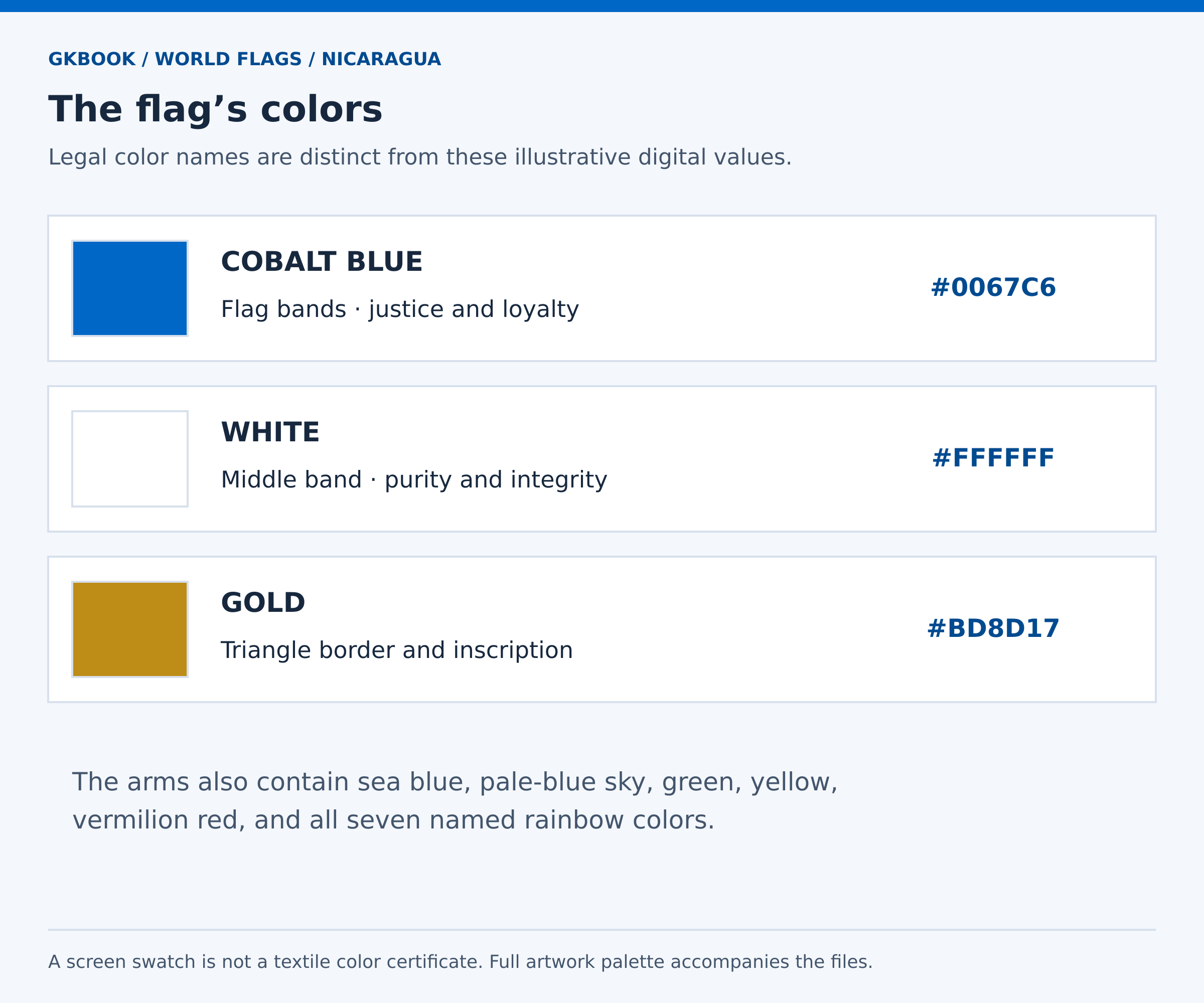
Nicaragua’s flag has cobalt-blue outer bands and a white middle band. Its coat of arms adds gold, yellow-green, ultramarine, pale blue, vermilion red, and the rainbow’s seven colors. The law names these colors but does not supply an authoritative hexadecimal or Pantone specification for this article’s digital reproductions.

Article 2 calls the blue azul cobalto. Article 43 separately describes the colors inside the coat of arms: yellow-green volcanoes with yellow illuminated faces, ultramarine seas with white wave crests, pale-blue sky, white rays, and a vermilion liberty cap. Gold is used for the triangle border and surrounding inscription.
The blue used in these original illustrations is #0067C6; white is #FFFFFF. These are declared screen choices, not government-certified color conversions. The full illustrative palette is supplied with the artwork. A downloaded image, even an SVG, is not a textile color standard.
| Element | Legal description | This artwork |
|---|---|---|
| Outer bands | Cobalt blue | #0067C6; illustrative |
| Middle band | White | #FFFFFF |
| Triangle and inscription | Gold | #BD8D17; illustrative |
| Liberty cap | Vermilion red | #E4472E; illustrative |
| Rainbow | Seven named colors | Separate illustrative hues; not official RGB codes |
What is the Nicaragua flag’s size and ratio?
The Nicaragua flag has a height:length ratio of 3:5, with three horizontal bands of equal height. Each band therefore occupies one third of the flag. A 150-centimeter-high flag is 250 centimeters long, and each stripe is 50 centimeters high. The complete coat of arms is centered in the white band.

The ratio describes the whole rectangle, not the coat of arms. At any size, divide the height into three equal parts and retain the full emblem. A 3:2 length:height ratio would be a different shape: Nicaragua’s length:height ratio is 5:3.
The supplied SVG uses a 1500 × 900 canvas, and the main PNG is 5000 × 3000 pixels. Both preserve 3:5 exactly. Scale width and height together; stretching the flag changes the triangle and the circular inscription as well as the rectangle.
| Height | Length | Height of each band |
|---|---|---|
| 90 cm | 150 cm | 30 cm |
| 150 cm | 250 cm | 50 cm |
| 900 px | 1500 px | 300 px |
| 3000 px | 5000 px | 1000 px |
What do the Nicaragua flag’s colors and symbols mean?
Nicaragua’s symbols law assigns justice and loyalty to blue, and purity and integrity to white. The National Assembly explains the triangle as equality, the rainbow as peace, and the liberty cap as freedom. The five volcanoes recall the five Central American republics and their historical connection and aspiration toward unity.

Descriptions linking the blue bands with Nicaragua’s surrounding waters are a familiar geographical interpretation. They should be distinguished from the explicit four virtues in Article 2. Likewise, the seas actually drawn inside the arms are separate features from the flag’s outer bands.
The coat of arms combines republican ideas with Central American history. Its five volcanoes are a regional symbol, not a ranked list of Nicaragua’s five largest volcanoes. The lettering identifies both the republic and its location in Central America.
| Feature | Meaning |
|---|---|
| Blue | Justice and loyalty |
| White | Purity and integrity |
| Equilateral triangle | Equality |
| Rainbow | Peace |
| Liberty cap | Freedom |
| Five volcanoes | Five Central American republics; fraternity and union |
What is in the coat of arms on Nicaragua’s flag?
Nicaragua’s coat of arms consists of a gold-edged equilateral triangle and a circular gold inscription. Inside the triangle are five resting volcanoes on an isthmus between two seas, a seven-color rainbow, and a red liberty cap emitting white rays. The national name appears above, with AMERICA CENTRAL beneath the triangle.

The law separates the arms into a central element and a peripheral element. The triangle contains the landscape and liberty symbols; the surrounding letters belong to the emblem too. Cropping off the inscription does not produce the complete arms specified for the flag.
The landscape includes white wave crests and a pale-blue sky. It does not include a wreath or a surrounding arrangement of flags. The enlarged drawing is an original educational reconstruction based on the statutory description; fine contours and letter spacing are interpretive, and it is not an approved production master.
Why is there a triangle on the Nicaragua flag?
The triangle in Nicaragua’s coat of arms represents equality. It is an equilateral triangle, meaning that all three sides have the same length, and it rests on a horizontal base. Its gold border encloses the volcanoes, seas, rainbow, liberty cap, and rays; it is not a free-standing pyramid symbol.
On the law’s reference flag of 1.50 × 2.50 meters, each outside edge of the triangle measures 32.5 centimeters. The gold border is 3.75 millimeters thick. Those figures scale with the rest of the flag.
The National Assembly’s explanation associates the triangle with equality. Claims that each corner officially stands for a named branch of government go beyond that explanation. A correct outline is upright and equilateral, without adding an eye or other symbols inside it.
What do the five volcanoes on Nicaragua’s flag represent?
The five volcanoes represent the five Central American republics associated with the former federation: Guatemala, El Salvador, Honduras, Nicaragua, and Costa Rica. They are shown at rest on a shared isthmus. Their regional meaning is historical and symbolic; the law does not identify them as five particular Nicaraguan mountains.

The 1971 construction text gives the nearest summit a greater apparent height than the farthest, describing equal mountains viewed in perspective. The nearest is toward heraldic right, which appears on the viewer’s left. The three remaining volcanoes lie between the two extremes.
A 2002 amendment shortened the general description in Article 42, but Article 44 still refers to the two extreme volcanoes and three intervening volcanoes. Read together, the provisions retain the five-volcano construction. Yellow lights the faces directed toward the cap’s rays.
Which five countries are represented on Nicaragua’s flag?
The countries represented by the five volcanoes are Guatemala, El Salvador, Honduras, Nicaragua, and Costa Rica. These were the five members of the Central American federation formed in the nineteenth century. Belize and Panama are Central American countries today, but they are not two additional volcanoes in Nicaragua’s emblem.

The United Provinces of Central America formed in 1823, following independence from Spain and the end of incorporation into Mexico. The federation began to break apart in 1838 and had ceased to function by the early 1840s. The five-country symbolism preserves the memory of that political association.
The arms do not label individual mountains with country names or prescribe a one-to-one left-to-right assignment. The country list in the illustration explains the collective symbol; it is not a geographical map or an official ordering of the volcanoes.
Which two seas appear in Nicaragua’s coat of arms?
The two bodies of water in Nicaragua’s coat of arms represent the Pacific and the Caribbean, the latter belonging to the Atlantic Ocean. They lie on opposite sides of the Central American isthmus. The law depicts one sea below the land and the other beyond it, with white-crested waves.

This is an emblematic landscape, not a map viewed from a specified compass direction. It should not be used to assign the lower painted water to a particular coast. The water is described as ultramarine, a separate color instruction from the cobalt-blue flag bands.
The law requires visible waves in both seas. The green land joins the sloping sides of the triangle, while the five volcanoes rise above it. These features make the Central American setting part of the arms’ design, rather than an interpretation based only on the blue stripes.
What does the rainbow on the Nicaragua flag mean?
The rainbow in Nicaragua’s coat of arms represents peace. It has seven concentric color bands, ordered from the outside inward as red, orange, yellow, green, blue, indigo, and violet. Its center lies at the midpoint of the horizon, and it arches over the volcanoes and the red liberty cap.
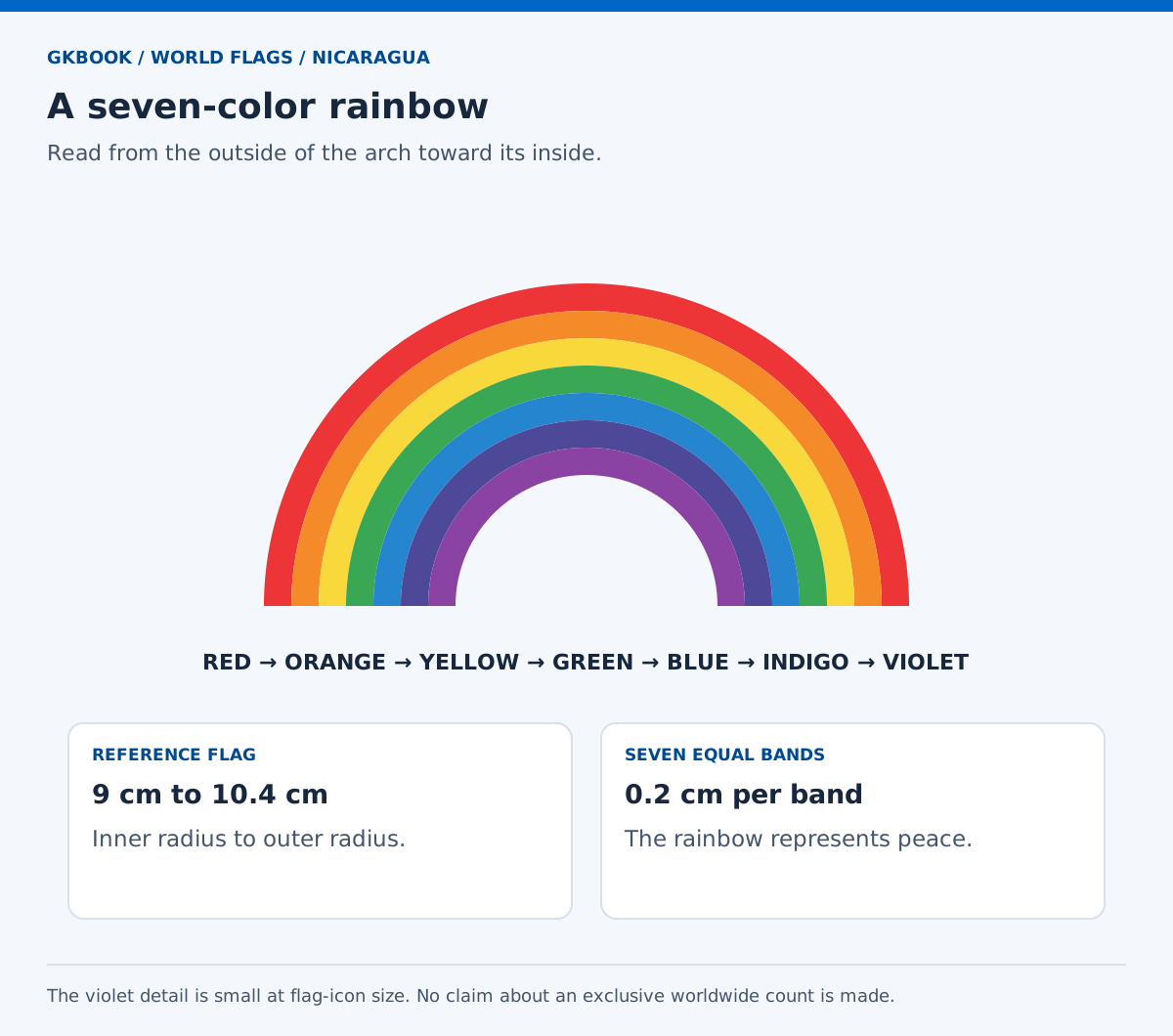
For a flag 1.50 meters high, Article 44 gives the rainbow an inner radius of 90 millimeters and an outer radius of 104 millimeters. The 14-millimeter difference is divided into seven equal bands, each 2 millimeters thick. Those dimensions belong to the reference-size flag, not every possible flag.
The rays of light stop at the rainbow; they are not painted over its colored bands. The triangle clips the outer part of the arch. The illustration retains the numerical radii, while the private construction notes identify a mismatch between those measurements and a separate qualitative clipping sentence in the law.
Does the Nicaragua flag contain purple?
Yes. The legally described rainbow in Nicaragua’s coat of arms includes violet, often grouped with purple in everyday color descriptions. It is a small detail within the central emblem, not one of the three main stripes. Indigo is also specified, immediately outside the innermost violet band of the rainbow.
At emoji size or in a small photograph, the rainbow can be too small to distinguish clearly. A simplified icon may merge several hues, but that does not remove violet from the legal description.
The useful fact is that Nicaragua’s flag includes violet in its arms. A claim that only two national flags in the world contain purple depends on definitions, versions, and the treatment of tiny emblems; this article does not make that unsupported absolute claim.
Is the red object in Nicaragua’s coat of arms a sun?
The red object is a liberty cap, commonly called a Phrygian cap, rather than a sun. Nicaragua’s law describes it in profile with a bent tip and hanging earflaps. It is vermilion red and emits white rays across the pale-blue sky, expressing the republican idea of liberty or freedom.

The bent tip faces heraldic right, the viewer’s left. Article 44 calls for 45 white rays, each 3 degrees wide, separated by 5-degree sectors of sky. Together, 45 repetitions of 8 degrees complete a circle; one ray points straight down toward the horizon.
The ray origin is placed on the triangle’s central axis, 35 millimeters above the horizon in the reference-size emblem. Other parts of the scene cover portions of the rays, so counting visible white slivers in a tiny image is not a reliable way to check the full construction.
What do the words around Nicaragua’s coat of arms say?
The gold inscription reads REPUBLICA DE NICARAGUA above the triangle and AMERICA CENTRAL below it, meaning Republic of Nicaragua and Central America. The lettering follows a circle around the central scene. The upper letters face inward at their bases, while the lower letters face inward at their tops.

The original statutory text and traditional emblem lettering use the unaccented uppercase forms shown in the artwork. The later consolidated legal transcription prints REPÚBLICA and AMÉRICA with the usual Spanish accents. These are orthographic presentations of the same words, not different national names.
Article 44 asks for gold, sans-serif, uniform-stroke characters. On its reference flag, the letters are 2.5 centimeters high and the letter A is 3 centimeters wide at its base. The full ring of lettering fits within a 45-centimeter-diameter circle.
How large is the coat of arms on the Nicaragua flag?
For a flag measuring 150 by 250 centimeters, Nicaragua’s law places the circular inscription within a 45-centimeter diameter and gives the triangle sides a length of 32.5 centimeters. All parts must scale proportionally for other flag sizes. The arms are centered in the white stripe, whose height is 50 centimeters.

The lettering circle’s diameter is 30 percent of the flag’s total height and 90 percent of the white stripe’s height. It is a construction boundary, not an extra gold circle to be printed. The gold triangle border and letter strokes share the stated 3.75-millimeter width.
These measurements provide a strong framework, but the legislation is not a complete digital drawing file. Some positional wording, particularly around the cap and rainbow, requires interpretation. The supplied artwork documents its choices and does not claim government approval for manufacture.
| Feature | Measurement |
|---|---|
| White stripe height | 50 cm |
| Outside circle for inscription | 45 cm diameter |
| Triangle outside side | 32.5 cm |
| Triangle border and letter strokes | 0.375 cm |
| Letter height; A base width | 2.5 cm; 3 cm |
| Horizon above triangle base | 7.5 cm |
| Rainbow inner and outer radii | 9 cm; 10.4 cm |
| Cap height; lower width | 3 cm; 2.5 cm |
| Ray origin above horizon | 3.5 cm |
When was the Nicaragua flag adopted?
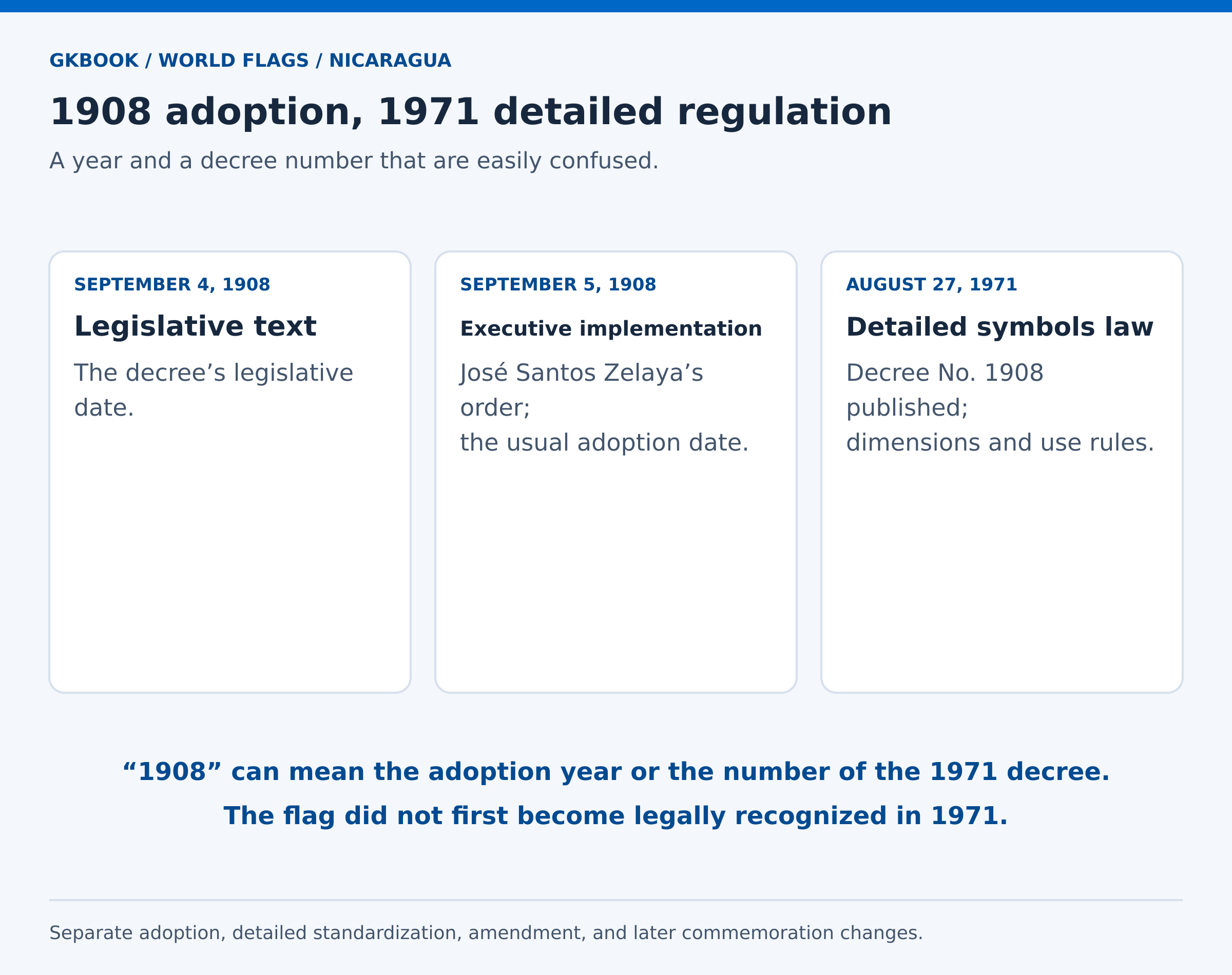
The present blue-white-blue flag and national arms are associated with the decree executed by President José Santos Zelaya on September 5, 1908. The legislative text was dated September 4. A separate symbols law published on August 27, 1971 supplied detailed dimensions and rules; 1971 was not the flag’s first legal adoption.
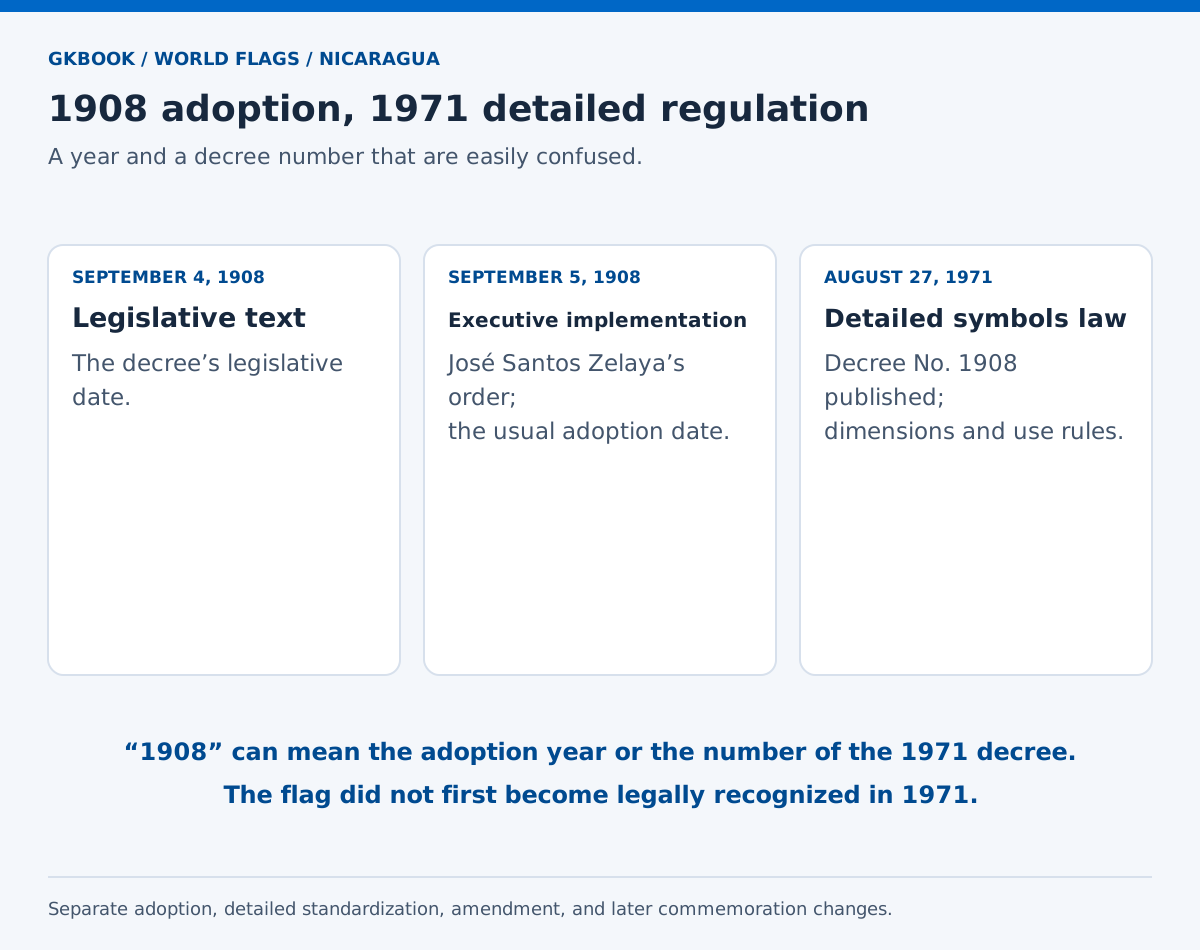
Official accounts usually give September 5, 1908 as the adoption date. The historical decree records both the legislature’s September 4 date and the following day’s executive order to implement it. Keeping those stages separate resolves the apparent one-day disagreement between summaries.
Do not confuse the year 1908 with Decree No. 1908, the number of the 1971 symbols law. Article 78 of that later law expressly retained the 1908 legislation. The modern design’s origin and the later technical regulation are different events.
How did Nicaragua’s flag develop over time?
Nicaragua’s flag belongs to the blue-white-blue tradition of the nineteenth-century Central American federation. The country also prescribed a different tricolor in 1854 before returning to the regional color tradition. The present flag and arms date to 1908, with detailed regulation in 1971 and later changes to use and national-symbol status.

The 1854 decree specified yellow above, white in the center, and a lower band called nácar, with a different coat of arms. Historical summaries sometimes vary the stripe order or translate the lower color loosely. The decree’s order is the sounder basis; this package does not invent a certified modern RGB value for nácar.
The blue-and-white design links Nicaragua with the federation’s wider visual heritage. Its full history involves changing political arrangements, inscriptions, and arms, rather than one uninterrupted image. The 2002 and 2025 legal developments below concern use, constitutional recognition, and commemoration; they should not be presented as a newly redrawn blue-white-blue flag.
| Date | What happened |
|---|---|
| 1823 | United Provinces of Central America formed; regional blue-white-blue heritage |
| April 21, 1854 | Decree prescribed yellow, white, and nácar bands |
| September 4–5, 1908 | Legislative text and executive implementation of present flag and arms |
| August 27, 1971 | Detailed symbols law published and took effect |
| July 18, 2002 | Law 432 published; earlier permission to omit arms removed |
| February 18, 2025 | Reformed constitutional text published, recognizing two flags |
| May 4, 2025 | Law 1249 made May 4 National Flags Day |
What did Nicaragua’s 1971 flag law establish?
Nicaragua’s 1971 symbols law established detailed specifications and rules for the flag, coat of arms, and anthem. For the flag it prescribed equal bands, a 3:5 rectangle, cobalt blue, and a centered emblem. It also addressed display, honors, care, and production, while retaining the earlier 1908 flag legislation.
The law is Decree No. 1908, published in La Gaceta No. 194 on August 27, 1971. Its number is easy to mistake for the year of adoption. The historical record includes legislative and executive stages earlier that August; publication is the effective date specified in Article 79.
A copy of the original 1971 text is not a complete statement of the position today. Law 432 amended it in 2002, and Law 1249 repealed its old flag-day article in 2025. A consolidated text published in 2022 incorporates earlier amendments but naturally predates the 2025 change.
May Nicaragua’s flag be shown without the coat of arms?
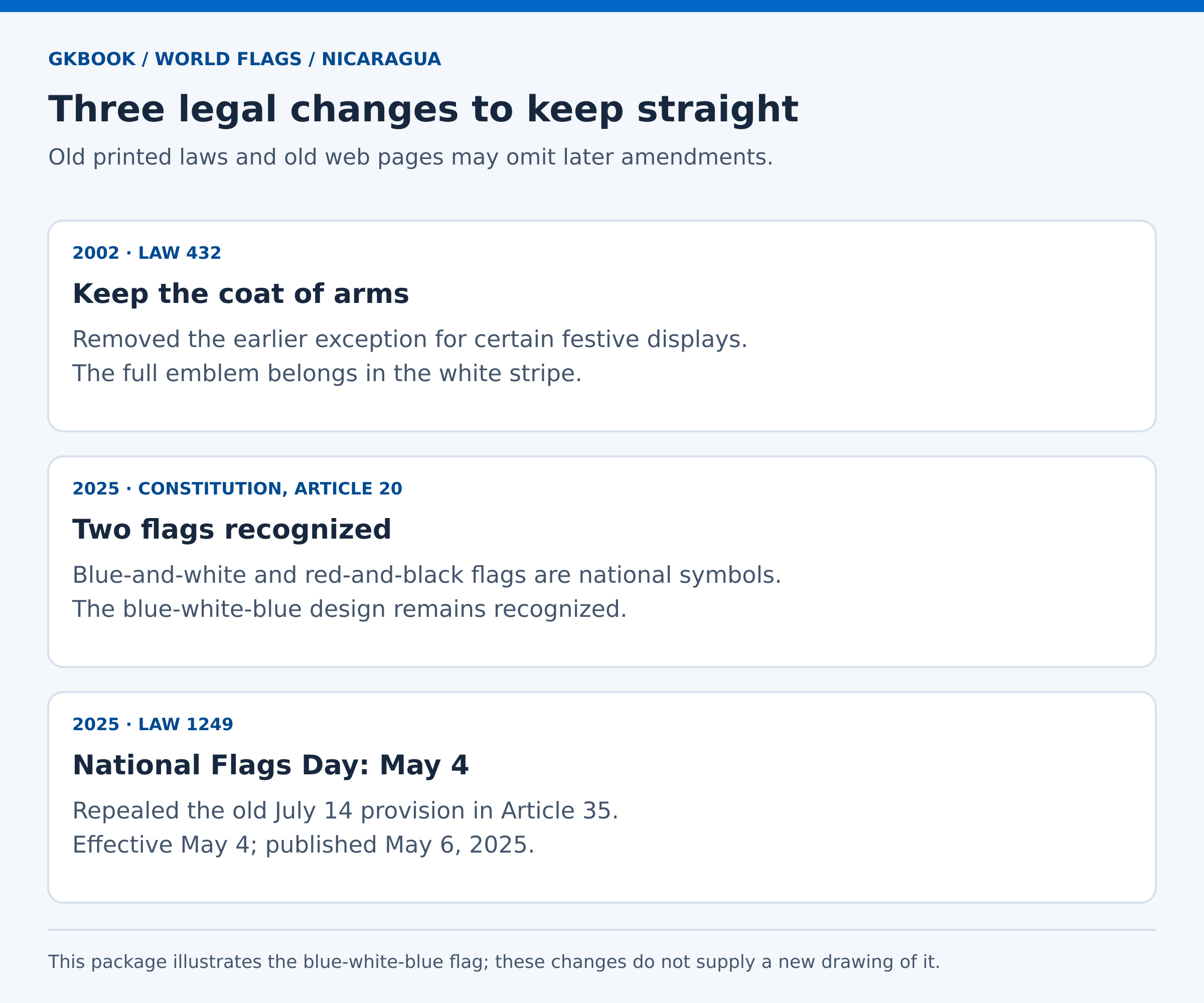
The current wording of Nicaragua’s symbols law requires the coat of arms in the white stripe. The original 1971 law allowed certain festive and public displays without it, but Law 432 removed that permission in 2002. A plain blue-white-blue flag should therefore not be labeled the current statutory civil flag.

The change is explicit. Amended Article 36 requires the arms for demonstrations and for decorating houses and plazas during patriotic and festive occasions. Amended Article 46 requires the arms in the central white stripe and removes its former cross-reference to the exception.
Plain versions may appear in older books, collections, decorations, or simplified icons. Their existence does not establish that the earlier legal permission still applies. For the current flag reference in this article, the triangle, landscape, and surrounding inscription are all retained.
Does Nicaragua now recognize two national flags?
Yes. Article 20 of Nicaragua’s reformed Constitution, published in February 2025, recognizes both the blue-and-white flag and the red-and-black flag among the national symbols. The latter is identified with Sandino’s struggle and the Sandinista revolution. This article illustrates the blue-white-blue flag and explains its established coat of arms and specifications.
Older descriptions that call the blue-white-blue flag the only constitutionally recognized flag are incomplete after this reform. Equally, recognition of the red-and-black flag does not mean that the blue-and-white design has ceased to be a national symbol.
The two banners have distinct histories and designs. This page does not transfer the blue-white-blue flag’s 1971 construction measurements to the red-and-black banner. Law 1249’s use of the plural Banderas Nacionales in 2025 follows the constitution’s recognition of both.
When is Nicaragua’s National Flags Day?
Nicaragua’s National Flags Day is May 4 under Law 1249, effective from May 4, 2025. The law uses the plural because the constitution recognizes the blue-and-white and red-and-black flags. It repealed the older provision naming July 14 as National Flag Day, so July 14 should now be identified historically.

The law was published in La Gaceta No. 79 on May 6, 2025, while its own commencement clause gives May 4 as the effective date. The same day is designated National Dignity Day.
Older educational materials and official web pages can still show July 14 because that date appeared in Article 35 of the 1971 law. The 2025 repeal expressly names that article. For a current calendar, use May 4 and distinguish the former observance when explaining history.
How is the flag used for Nicaragua’s independence commemorations?
Nicaragua’s flag is central to the commemorations of Central American independence on September 15, marking the 1821 declaration of independence from Spain. Article 19 of the symbols law requires Nicaraguan citizens to fly the national flag at the front of their homes for independence commemorations and other officially designated days.
This provision is a legal instruction, not merely a suggestion for private flag owners. It should be distinguished from rules in countries where all residential flag flying is optional. The flag used under the amended symbols law includes its coat of arms.
The September independence commemoration and May 4 National Flags Day mark different events. September 15 recalls the independence declaration; May 4 is the current statutory flags observance. Neither should be confused with September 5, the executive date of the 1908 flag decree.
How is Nicaragua’s flag different from those of Honduras and El Salvador?
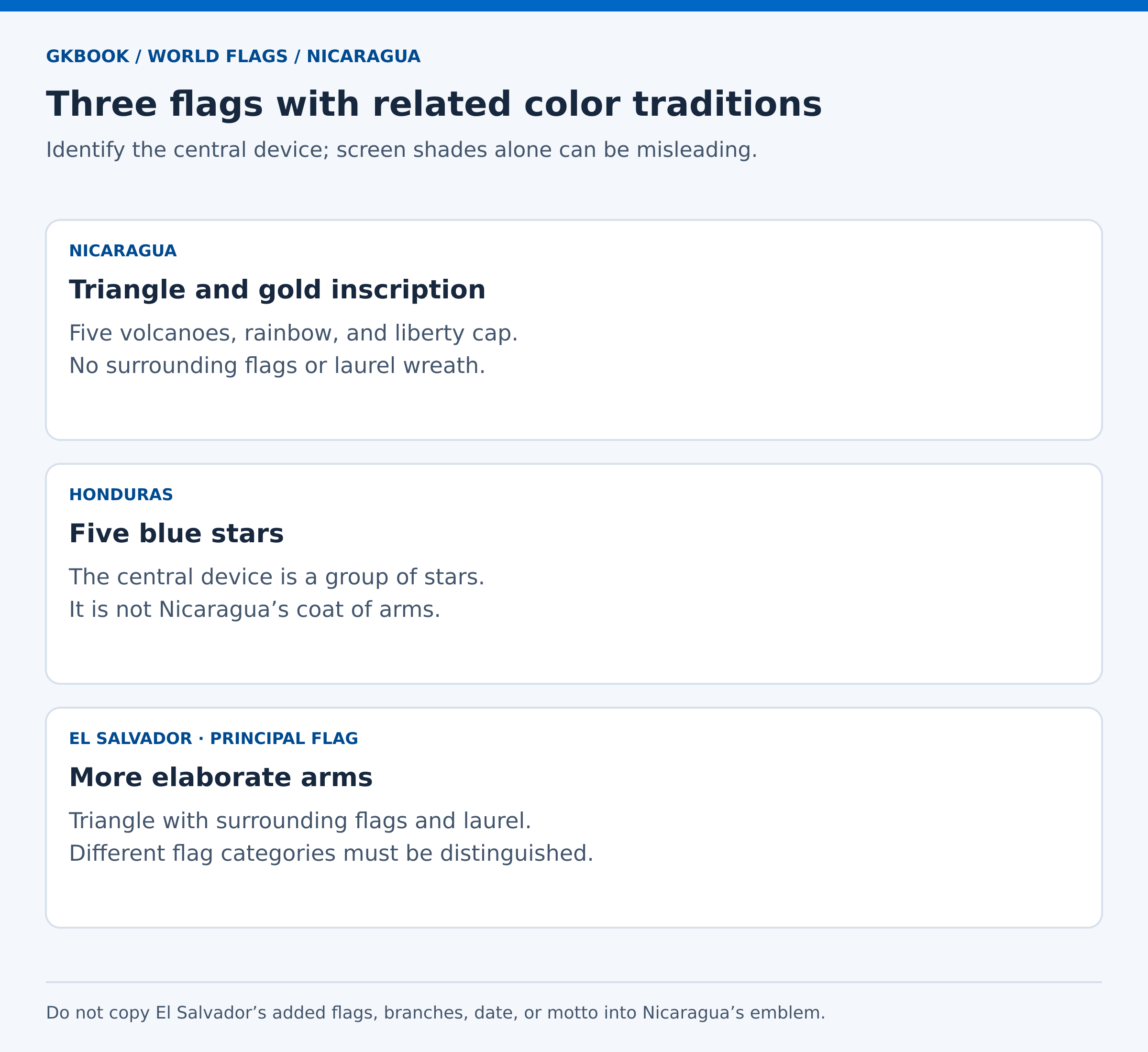
Nicaragua, Honduras, and El Salvador share blue-white-blue bands connected with Central American history, but their central devices differ. Nicaragua has its triangle and circular gold inscription. Honduras uses five blue stars. El Salvador’s principal flag carries more elaborate arms with surrounding flags and laurel branches, which Nicaragua’s arms do not have.

Nicaragua’s coat of arms can be recognized by the relatively spare arrangement of a triangle within lettering. Do not add El Salvador’s five surrounding flags, laurel branches, date, or motto. Honduras’s five stars are also a different central device, even though their regional symbolism involves the same five-country heritage.
This comparison is an identification guide, not a claim that all forms of the Salvadoran flag carry the same arms. Check the specific flag category and complete emblem. Blue shades alone are a poor identification test because screens, cloth, and historical reproductions vary.
What times should Nicaragua’s flag be raised and lowered?
Article 5 of Nicaragua’s symbols law gives 6:00 a.m. for raising the national flag and 6:00 p.m. for lowering it. Article 6 requires daily flying at the presidential premises and military installations. Other provisions cover schools, official offices, national commemorations, and ceremonial circumstances, so the hours belong within that wider framework.

A display schedule should distinguish daily outdoor flying from the permanent indoor presence of the flag in specified official rooms. The law also describes respectful conduct during raising and lowering: people nearby stop and face the flag, with separate instructions for civilians and military personnel.
The illustrations show the statutory times without inventing a general overnight-lighting exception. For a particular official ceremony, follow the applicable institutional directions as well as the symbols law.
Where should Nicaragua’s flag stand beside other flags?
When Nicaragua’s flag is displayed with foreign flags, its place of honor is its own right, which is the observer’s left. The symbols law calls for flags of equal size on poles of equal height. It also prohibits placing another flag or insignia on the same pole as Nicaragua’s flag.

Honors to the national flag precede honors to foreign flags in a shared ceremony. The law does not permit a foreign flag to occupy a more prominent position. For residential displays with a foreign flag, Article 20 calls for raising Nicaragua’s flag first, at equal height and on the observer’s left, while recognizing diplomatic and consular practice as an exception.
The diagram’s second flag is a neutral placeholder. It illustrates placement and equal pole height, not the exact national design or ratio of another country. When the flag appears beside a speaker, a pole is placed at the speaker’s right, not automatically the audience’s right.
How should Nicaragua’s flag be displayed on a stage or over a street?
On a speaker’s platform, Nicaragua’s flag belongs above or behind the speaker, or on a pole at the speaker’s right. It must hang clear of people, furniture, and the ground. For two-sided public suspension, the law specifies vertical display toward east or north; street flags should consistently face an approaching parade.
Article 18 prohibits using the flag to cover the speaker’s desk or upholster the platform front. Article 15 requires enough clearance that the flag does not brush furniture, the ground, or passersby. A printed educational illustration that includes a pole should place the pole on the observer’s left.
Articles 16 and 17 address particular public arrangements. They are not a complete digital rotation guide for every wall, window, or stage. Plan the display for its actual viewing direction and keep the arms identifiable; avoid applying another country’s canton-based orientation rule to Nicaragua’s centered emblem.
How is Nicaragua’s flag honored in schools?
Nicaragua’s symbols law provides for a flag ceremony on Monday before classes, with five pupils distinguished for their work and conduct raising the flag while pupils sing the national anthem. The same pupils lower it with honors after classes on the week’s final school day. These provisions apply to public and private education.
The school ceremony is described in Article 28, while Article 65 addresses singing the anthem at the beginning and end of each school week. Article 52 calls for a Ministry of Education edition of the coat of arms in each classroom.
These legal provisions describe the national framework. Local school calendars, holidays, and institutional directions determine the practical arrangements for a given week. The educational diagrams in this package explain the emblem; they are not represented as the ministry-issued classroom edition.
How should Nicaragua’s flag be flown at half-mast?
Nicaragua’s flag is flown at half-mast for national mourning when directed by the legislative or executive authority. The symbols law requires raising it promptly to the top before lowering it slowly to the mourning position. To take it down, first raise it to the top again and then lower it slowly.

Article 30 describes the sequence but does not give a universal numerical distance below the finial. The illustration therefore labels the intermediate position schematically rather than presenting an invented measurement.
A mourning order’s scope and dates matter. Do not treat every death or memorial as an automatic instruction for all flag owners. The full-mast pauses at the beginning and end are part of the described ceremonial sequence, even though the flag remains lower during the period of mourning.
How is Nicaragua’s flag folded after lowering?
Article 32 of Nicaragua’s symbols law says that two people should carefully fold the lowered flag into a triangle. The person carrying it should hold it with both hands, with the triangle’s base facing outward. The article specifies the final form and handling but does not give a complete fold-by-fold sequence.
A folding demonstration should be based on the relevant institution’s practice rather than a sequence borrowed from another country and presented as Nicaragua’s statutory method. Keep the fabric supported and prevent it from touching the ground.
The triangle described here is the shape of the folded cloth. It is separate from the equilateral triangle printed inside the coat of arms; the law does not say that the printed triangle must be exposed on the final fold.
How should a worn Nicaragua flag be treated?
Nicaragua’s symbols law calls for private incineration when a flag is too worn for dignified display, with an exception for historically valuable flags, which should be preserved with documentation. During ordinary handling, the flag must remain clear of the ground and other surfaces. Care should protect both the cloth and its full emblem.

Article 33 distinguishes routine disposal of an unserviceable flag from preservation of an important historical object. A flag with documented provenance may merit conservation rather than destruction. For a physical disposal procedure, use the responsible institution’s arrangements and applicable fire rules.
The law also gives specific conditions for use on a coffin: government direction, placement lengthwise with the ties toward the deceased’s head, and removal before burial. It does not authorize treating a flag as a general table covering or decorative wrap.
Can Nicaragua’s flag be altered or used in advertising?
Nicaragua’s symbols law prohibits adding wording to the national flag or using it as an advertisement, and it restricts flag designs on specified commercial objects. It also requires faithful reproduction of the arms and approval of models for flag and emblem manufacture. Educational downloads do not themselves provide that official production approval.
Article 25 addresses added legends and commercial uses, including examples such as trays, cushions, napkins, and boxes. Article 54 addresses fidelity and approval before models are put before the public. These provisions are distinct from copyright in an individual photograph or illustration.
The downloadable files are original explanatory artwork, with declared screen colors and documented construction choices. They are useful for study, layout, and checking the basic design, but they are not a government-issued master or a certification of a manufacturer’s sample. The credits file accompanies both the reference flag and the diagrams.
How can you draw the Nicaragua flag accurately?
Start with a 3:5 rectangle and divide its height into three equal horizontal bands. Color the outer bands cobalt blue and leave the center white. Center the complete coat of arms, including its gold inscription, in the white stripe. Scale the measured triangle, rainbow, lettering, and other emblem features together.
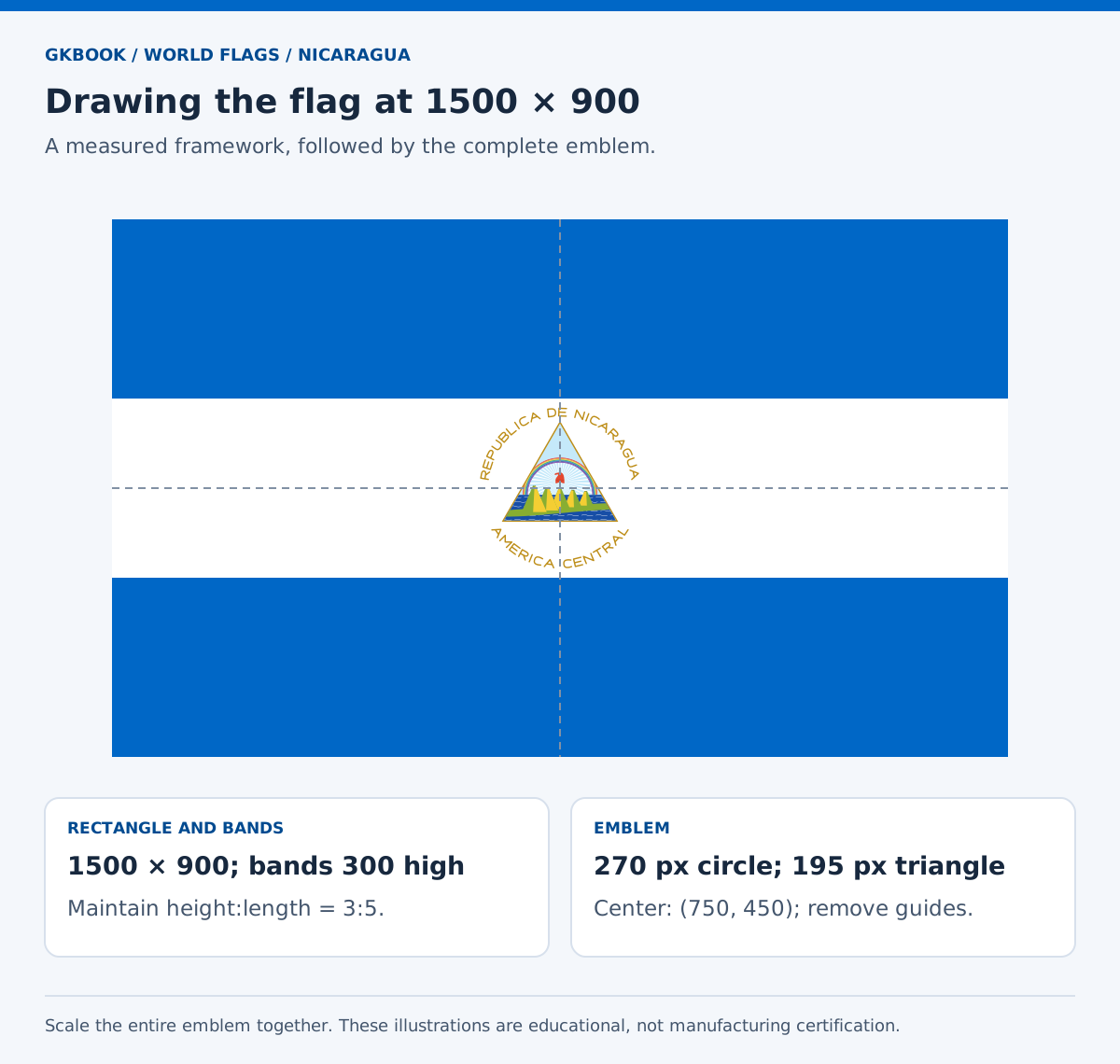
For a 1500 × 900 drawing, each band is 300 pixels high. The 45-centimeter lettering-circle diameter on a 150-centimeter-high reference flag becomes 270 pixels; the triangle side becomes 195 pixels. Center the emblem at coordinate (750, 450). The circle is a guide only and should not be printed as a ring.
Draw the central scene within the triangle: two seas separated by land, five resting volcanoes, a seven-color rainbow, and the red cap with white rays. Add the upper and lower inscriptions. Remove construction guides, check the ratio, and retain a readable enlarged emblem when teaching its details.
| Feature | 150 × 250 cm reference | 1500 × 900 px SVG |
|---|---|---|
| Flag height | 150 cm | 900 px |
| Flag length | 250 cm | 1500 px |
| Band height | 50 cm | 300 px |
| Lettering boundary diameter | 45 cm | 270 px |
| Triangle side | 32.5 cm | 195 px |
| Border / nominal letter stroke | 0.375 cm | 2.25 px |
What are common mistakes in Nicaragua flag images?
Common errors include unequal bands, a wrong rectangle ratio, an omitted coat of arms, and a triangular emblem missing its inscription. Other mistakes replace the liberty cap with a sun, add Salvadoran wreaths or flags, or omit rainbow colors. Historical errors include treating 1971 as first adoption or July 14 as the current flag day.

A correct current reference keeps the full arms and all five volcanoes. It distinguishes the flag’s cobalt blue from the ultramarine seas and avoids claiming that an arbitrary screen hex code is officially certified. The red cap is small, but its identity matters.
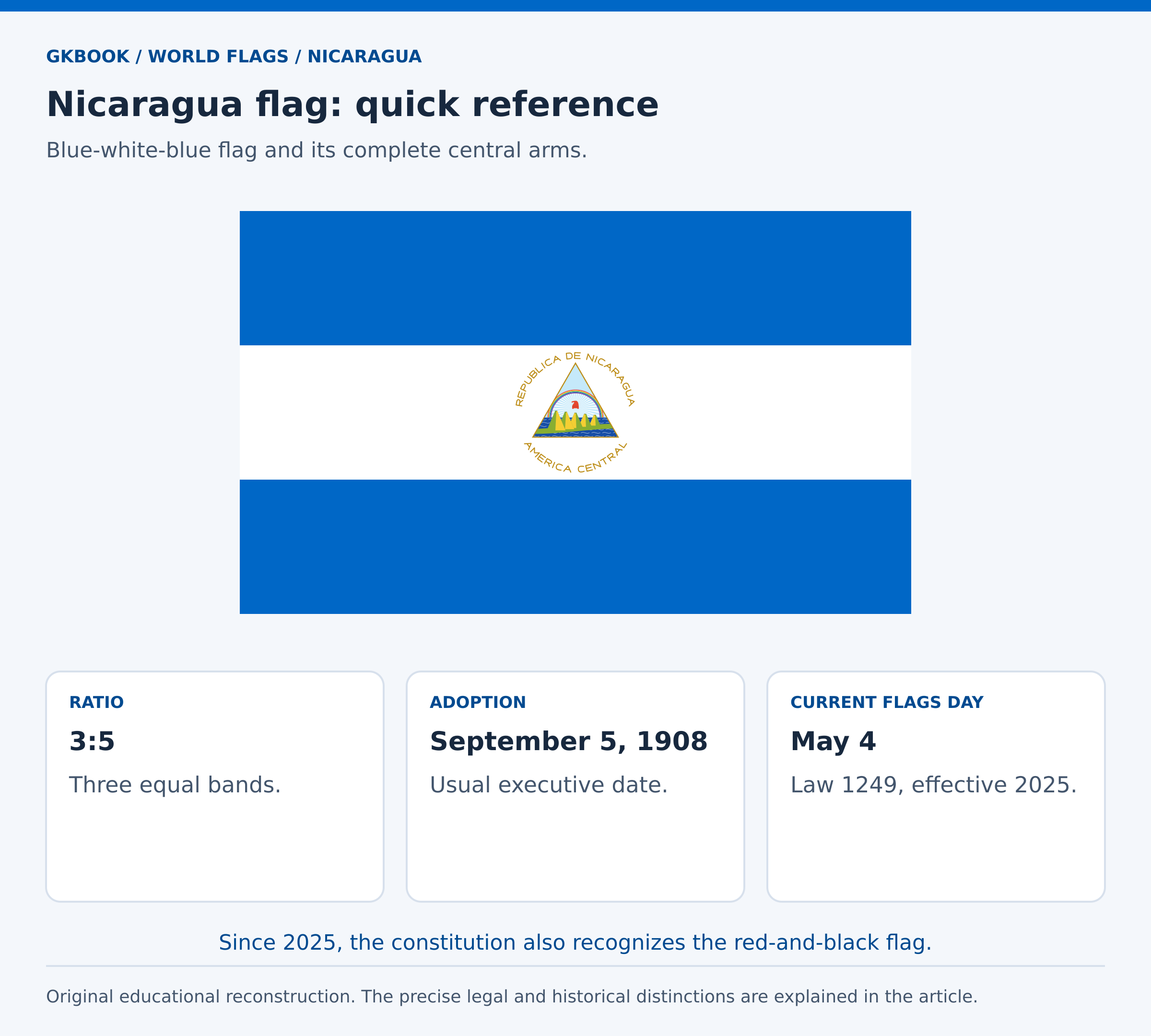
Check dates as carefully as geometry: September 5, 1908 concerns the flag decree; August 27, 1971 concerns detailed regulation; the 2002 amendment removed the omission exception; and the 2025 changes recognized two flags and established May 4 as National Flags Day. The quick-reference picture summarizes these points.
Download Nicaragua flag pictures
Download the national flag as SVG or 5000 × 3000 PNG. The gallery contains 24 subjects, each with SVG and PNG versions. Keep the full rectangular image and preserve its proportions. Both the SVG and PNG retain the exact 3:5 shape and opaque white stripe. The emblem is an original educational reconstruction, with screen colors and interpretive details documented. The comparison diagram identifies features without presenting foreign-flag production masters. Image credits and reproduction notes accompany the artwork.
Explore more in World Flags, including the New Zealand flag and Netherlands flag.
World Flags/Nicaragua
Nicaragua flag pictures
Equal blue-white-blue bands in a 3:5 rectangle, with the complete arms. Educational reconstruction using declared screen colors; not an approved production master.
GKBook original educational artwork; screen colors and fine emblem details are interpretive.Download SVGDownload PNGThe law names cobalt blue and white for the bands. #0067C6, #FFFFFF, and #BD8D17 are the declared screen values used here, not an official RGB standard.
GKBook original educational artwork; screen colors and fine emblem details are interpretive.Download SVGDownload PNGA 150 × 250 cm reference flag has three 50 cm bands. The 3:5 ratio applies at every size; numerical guides are not printed on the flag.
GKBook original educational artwork; screen colors and fine emblem details are interpretive.Download SVGDownload PNGBlue means justice and loyalty; white means purity and integrity. The triangle, rainbow, cap, and volcanoes express equality, peace, liberty, and Central American fraternity.
GKBook original educational artwork; screen colors and fine emblem details are interpretive.Download SVGDownload PNGThe full emblem includes the circular gold inscription and the triangular scene. Fine contours and letter spacing are original interpretations of the legal description.
GKBook original educational artwork; screen colors and fine emblem details are interpretive.Download SVGDownload PNGThe mountains stand for the five former Central American federal members. The construction text uses perspective, with the nearest at heraldic right, or viewer-left.
GKBook original educational artwork; screen colors and fine emblem details are interpretive.Download SVGDownload PNGGuatemala, El Salvador, Honduras, Nicaragua, and Costa Rica were the five members of the nineteenth-century federation. The list does not label individual volcanoes.
GKBook original educational artwork; screen colors and fine emblem details are interpretive.Download SVGDownload PNGThe seas evoke the Pacific and Caribbean/Atlantic sides of Central America. The stylized scene does not assign a compass bearing to its lower and upper waters.
GKBook original educational artwork; screen colors and fine emblem details are interpretive.Download SVGDownload PNGSeven equal bands run from red outside to violet inside. The isolated teaching arch is expanded for clarity; the actual flag arch is clipped by the triangle.
GKBook original educational artwork; screen colors and fine emblem details are interpretive.Download SVGDownload PNGThe law specifies a vermilion liberty cap with 45 white rays. Each ray spans 3 degrees and each intervening sky sector 5 degrees; other scene elements hide portions of the rays.
GKBook original educational artwork; screen colors and fine emblem details are interpretive.Download SVGDownload PNGThe upper inscription identifies the republic; the lower names Central America. Traditional unaccented forms are drawn; the consolidated law prints the Spanish accents.
GKBook original educational artwork; screen colors and fine emblem details are interpretive.Download SVGDownload PNGThe inscription fits within a 45 cm circle on the reference flag; the triangle sides are 32.5 cm. The guide circle is not printed on the national flag.
GKBook original educational artwork; screen colors and fine emblem details are interpretive.Download SVGDownload PNGThe legislature dated the text September 4, 1908; executive implementation followed September 5. The later Decree No. 1908 was published in 1971.
GKBook original educational artwork; screen colors and fine emblem details are interpretive.Download SVGDownload PNGSelected milestones distinguish regional heritage, the 1854 tricolor, 1908 adoption, 1971 specifications, the 2002 arms amendment, and the 2025 legal changes.
GKBook original educational artwork; screen colors and fine emblem details are interpretive.Download SVGDownload PNGThe 2002 amendment removed the omission exception. The 2025 constitution recognizes two flags, and Law 1249 moved the flags observance to May 4.
GKBook original educational artwork; screen colors and fine emblem details are interpretive.Download SVGDownload PNGLaw 1249, effective May 4, 2025 and published May 6, established the current plural National Flags Day and repealed the former July 14 provision.
GKBook original educational artwork; screen colors and fine emblem details are interpretive.Download SVGDownload PNGThe central device distinguishes Nicaragua’s arms, Honduras’s five stars, and El Salvador’s more elaborate arms on its principal flag. This is a feature guide, not full foreign-flag artwork.
GKBook original educational artwork; screen colors and fine emblem details are interpretive.Download SVGDownload PNGThe law specifies 6:00 a.m. for raising and 6:00 p.m. for lowering. Daily, indoor, school, and special ceremonial arrangements are distinct provisions.
GKBook original educational artwork; screen colors and fine emblem details are interpretive.Download SVGDownload PNGNicaragua occupies observer-left. The law calls for equal flag size and pole height, with no second flag on Nicaragua’s pole. The gray rectangle is a neutral placeholder.
GKBook original educational artwork; screen colors and fine emblem details are interpretive.Download SVGDownload PNGRaise to the top, lower slowly to the mourning position, and return to the top before final lowering. The diagram does not invent a statutory distance below the finial.
GKBook original educational artwork; screen colors and fine emblem details are interpretive.Download SVGDownload PNGKeep the flag clear of surfaces. Two people fold it into a triangle. The law distinguishes private incineration of worn flags from preservation of historical flags with documentation.
GKBook original educational artwork; screen colors and fine emblem details are interpretive.Download SVGDownload PNGOn a 1500 × 900 canvas, use three 300 px bands, center the emblem at (750,450), and use a 270 px lettering boundary and 195 px triangle side. The displayed flag is scaled to fit the diagram.
GKBook original educational artwork; screen colors and fine emblem details are interpretive.Download SVGDownload PNGCheck ratio, equal bands, complete arms, the liberty cap, and a distinct Nicaragua emblem. Dates also matter: adoption in 1908, detailed law in 1971, current flag day on May 4.
GKBook original educational artwork; screen colors and fine emblem details are interpretive.Download SVGDownload PNG
A compact reminder of the blue-white-blue flag, 3:5 ratio, usual 1908 adoption date, current May 4 flags observance, and 2025 recognition of two flags.
GKBook original educational artwork; screen colors and fine emblem details are interpretive.Download SVGDownload PNGFrequently asked questions
What does Nicaragua’s flag look like?
Nicaragua’s blue-and-white flag has three equal horizontal bands, blue above and below a white center containing the national coat of arms. Its height:length ratio is 3:5. The arms show five volcanoes, two seas, a rainbow, and a liberty cap inside a gold-edged triangle, surrounded by gold lettering.
What colors are on the Nicaragua flag?
Nicaragua’s flag has cobalt-blue outer bands and a white middle band. Its coat of arms adds gold, yellow-green, ultramarine, pale blue, vermilion red, and the rainbow’s seven colors. The law names these colors but does not supply an authoritative hexadecimal or Pantone specification for this article’s digital reproductions.
What is the Nicaragua flag’s size and ratio?
The Nicaragua flag has a height:length ratio of 3:5, with three horizontal bands of equal height. Each band therefore occupies one third of the flag. A 150-centimeter-high flag is 250 centimeters long, and each stripe is 50 centimeters high. The complete coat of arms is centered in the white band.
What do the Nicaragua flag’s colors and symbols mean?
Nicaragua’s symbols law assigns justice and loyalty to blue, and purity and integrity to white. The National Assembly explains the triangle as equality, the rainbow as peace, and the liberty cap as freedom. The five volcanoes recall the five Central American republics and their historical connection and aspiration toward unity.
What is in the coat of arms on Nicaragua’s flag?
Nicaragua’s coat of arms consists of a gold-edged equilateral triangle and a circular gold inscription. Inside the triangle are five resting volcanoes on an isthmus between two seas, a seven-color rainbow, and a red liberty cap emitting white rays. The national name appears above, with AMERICA CENTRAL beneath the triangle.
Why is there a triangle on the Nicaragua flag?
The triangle in Nicaragua’s coat of arms represents equality. It is an equilateral triangle, meaning that all three sides have the same length, and it rests on a horizontal base. Its gold border encloses the volcanoes, seas, rainbow, liberty cap, and rays; it is not a free-standing pyramid symbol.
What do the five volcanoes on Nicaragua’s flag represent?
The five volcanoes represent the five Central American republics associated with the former federation: Guatemala, El Salvador, Honduras, Nicaragua, and Costa Rica. They are shown at rest on a shared isthmus. Their regional meaning is historical and symbolic; the law does not identify them as five particular Nicaraguan mountains.
Which five countries are represented on Nicaragua’s flag?
The countries represented by the five volcanoes are Guatemala, El Salvador, Honduras, Nicaragua, and Costa Rica. These were the five members of the Central American federation formed in the nineteenth century. Belize and Panama are Central American countries today, but they are not two additional volcanoes in Nicaragua’s emblem.
Which two seas appear in Nicaragua’s coat of arms?
The two bodies of water in Nicaragua’s coat of arms represent the Pacific and the Caribbean, the latter belonging to the Atlantic Ocean. They lie on opposite sides of the Central American isthmus. The law depicts one sea below the land and the other beyond it, with white-crested waves.
What does the rainbow on the Nicaragua flag mean?
The rainbow in Nicaragua’s coat of arms represents peace. It has seven concentric color bands, ordered from the outside inward as red, orange, yellow, green, blue, indigo, and violet. Its center lies at the midpoint of the horizon, and it arches over the volcanoes and the red liberty cap.
Does the Nicaragua flag contain purple?
Yes. The legally described rainbow in Nicaragua’s coat of arms includes violet, often grouped with purple in everyday color descriptions. It is a small detail within the central emblem, not one of the three main stripes. Indigo is also specified, immediately outside the innermost violet band of the rainbow.
Is the red object in Nicaragua’s coat of arms a sun?
The red object is a liberty cap, commonly called a Phrygian cap, rather than a sun. Nicaragua’s law describes it in profile with a bent tip and hanging earflaps. It is vermilion red and emits white rays across the pale-blue sky, expressing the republican idea of liberty or freedom.
What do the words around Nicaragua’s coat of arms say?
The gold inscription reads REPUBLICA DE NICARAGUA above the triangle and AMERICA CENTRAL below it, meaning Republic of Nicaragua and Central America. The lettering follows a circle around the central scene. The upper letters face inward at their bases, while the lower letters face inward at their tops.
How large is the coat of arms on the Nicaragua flag?
For a flag measuring 150 by 250 centimeters, Nicaragua’s law places the circular inscription within a 45-centimeter diameter and gives the triangle sides a length of 32.5 centimeters. All parts must scale proportionally for other flag sizes. The arms are centered in the white stripe, whose height is 50 centimeters.
When was the Nicaragua flag adopted?
The present blue-white-blue flag and national arms are associated with the decree executed by President José Santos Zelaya on September 5, 1908. The legislative text was dated September 4. A separate symbols law published on August 27, 1971 supplied detailed dimensions and rules; 1971 was not the flag’s first legal adoption.
How did Nicaragua’s flag develop over time?
Nicaragua’s flag belongs to the blue-white-blue tradition of the nineteenth-century Central American federation. The country also prescribed a different tricolor in 1854 before returning to the regional color tradition. The present flag and arms date to 1908, with detailed regulation in 1971 and later changes to use and national-symbol status.
What did Nicaragua’s 1971 flag law establish?
Nicaragua’s 1971 symbols law established detailed specifications and rules for the flag, coat of arms, and anthem. For the flag it prescribed equal bands, a 3:5 rectangle, cobalt blue, and a centered emblem. It also addressed display, honors, care, and production, while retaining the earlier 1908 flag legislation.
May Nicaragua’s flag be shown without the coat of arms?
The current wording of Nicaragua’s symbols law requires the coat of arms in the white stripe. The original 1971 law allowed certain festive and public displays without it, but Law 432 removed that permission in 2002. A plain blue-white-blue flag should therefore not be labeled the current statutory civil flag.
Does Nicaragua now recognize two national flags?
Yes. Article 20 of Nicaragua’s reformed Constitution, published in February 2025, recognizes both the blue-and-white flag and the red-and-black flag among the national symbols. The latter is identified with Sandino’s struggle and the Sandinista revolution. This article illustrates the blue-white-blue flag and explains its established coat of arms and specifications.
When is Nicaragua’s National Flags Day?
Nicaragua’s National Flags Day is May 4 under Law 1249, effective from May 4, 2025. The law uses the plural because the constitution recognizes the blue-and-white and red-and-black flags. It repealed the older provision naming July 14 as National Flag Day, so July 14 should now be identified historically.
How is the flag used for Nicaragua’s independence commemorations?
Nicaragua’s flag is central to the commemorations of Central American independence on September 15, marking the 1821 declaration of independence from Spain. Article 19 of the symbols law requires Nicaraguan citizens to fly the national flag at the front of their homes for independence commemorations and other officially designated days.
How is Nicaragua’s flag different from those of Honduras and El Salvador?
Nicaragua, Honduras, and El Salvador share blue-white-blue bands connected with Central American history, but their central devices differ. Nicaragua has its triangle and circular gold inscription. Honduras uses five blue stars. El Salvador’s principal flag carries more elaborate arms with surrounding flags and laurel branches, which Nicaragua’s arms do not have.
What times should Nicaragua’s flag be raised and lowered?
Article 5 of Nicaragua’s symbols law gives 6:00 a.m. for raising the national flag and 6:00 p.m. for lowering it. Article 6 requires daily flying at the presidential premises and military installations. Other provisions cover schools, official offices, national commemorations, and ceremonial circumstances, so the hours belong within that wider framework.
Where should Nicaragua’s flag stand beside other flags?
When Nicaragua’s flag is displayed with foreign flags, its place of honor is its own right, which is the observer’s left. The symbols law calls for flags of equal size on poles of equal height. It also prohibits placing another flag or insignia on the same pole as Nicaragua’s flag.
How should Nicaragua’s flag be displayed on a stage or over a street?
On a speaker’s platform, Nicaragua’s flag belongs above or behind the speaker, or on a pole at the speaker’s right. It must hang clear of people, furniture, and the ground. For two-sided public suspension, the law specifies vertical display toward east or north; street flags should consistently face an approaching parade.
How is Nicaragua’s flag honored in schools?
Nicaragua’s symbols law provides for a flag ceremony on Monday before classes, with five pupils distinguished for their work and conduct raising the flag while pupils sing the national anthem. The same pupils lower it with honors after classes on the week’s final school day. These provisions apply to public and private education.
How should Nicaragua’s flag be flown at half-mast?
Nicaragua’s flag is flown at half-mast for national mourning when directed by the legislative or executive authority. The symbols law requires raising it promptly to the top before lowering it slowly to the mourning position. To take it down, first raise it to the top again and then lower it slowly.
How is Nicaragua’s flag folded after lowering?
Article 32 of Nicaragua’s symbols law says that two people should carefully fold the lowered flag into a triangle. The person carrying it should hold it with both hands, with the triangle’s base facing outward. The article specifies the final form and handling but does not give a complete fold-by-fold sequence.
How should a worn Nicaragua flag be treated?
Nicaragua’s symbols law calls for private incineration when a flag is too worn for dignified display, with an exception for historically valuable flags, which should be preserved with documentation. During ordinary handling, the flag must remain clear of the ground and other surfaces. Care should protect both the cloth and its full emblem.
Can Nicaragua’s flag be altered or used in advertising?
Nicaragua’s symbols law prohibits adding wording to the national flag or using it as an advertisement, and it restricts flag designs on specified commercial objects. It also requires faithful reproduction of the arms and approval of models for flag and emblem manufacture. Educational downloads do not themselves provide that official production approval.
How can you draw the Nicaragua flag accurately?
Start with a 3:5 rectangle and divide its height into three equal horizontal bands. Color the outer bands cobalt blue and leave the center white. Center the complete coat of arms, including its gold inscription, in the white stripe. Scale the measured triangle, rainbow, lettering, and other emblem features together.
What are common mistakes in Nicaragua flag images?
Common errors include unequal bands, a wrong rectangle ratio, an omitted coat of arms, and a triangular emblem missing its inscription. Other mistakes replace the liberty cap with a sun, add Salvadoran wreaths or flags, or omit rainbow colors. Historical errors include treating 1971 as first adoption or July 14 as the current flag day.
Explore all general-knowledge topics and the A-to-Z lists.








We Value Your Opinion Comments