
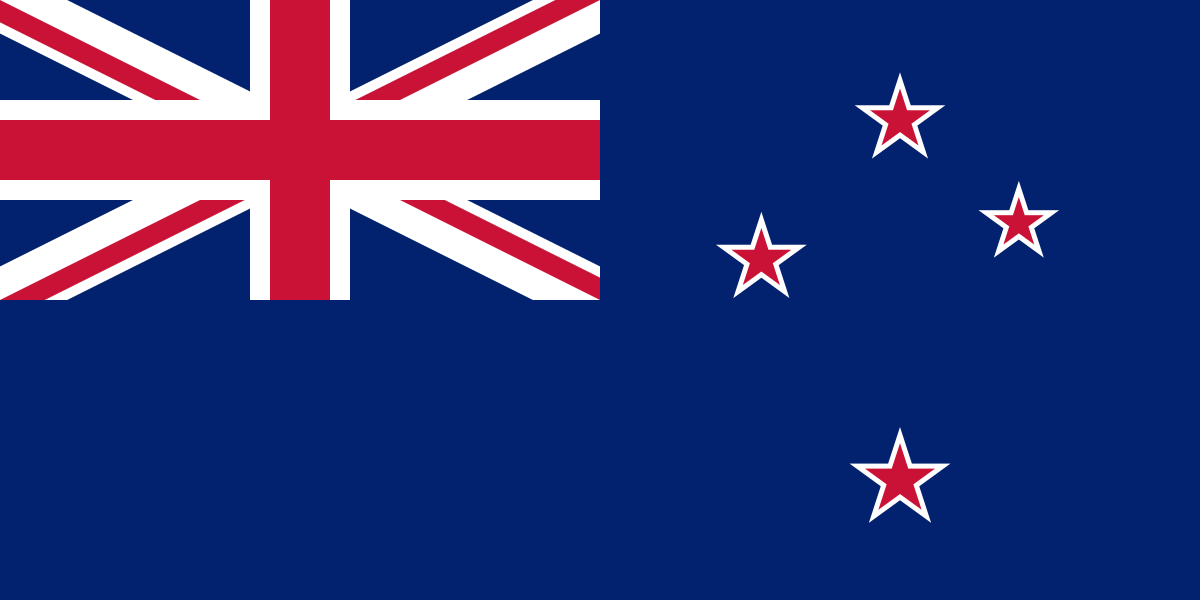
New Zealand flag picture
Explore the proportions, history, and picture gallery.
| Design | Blue field with Union JackCanton occupies the upper hoist quarter. |
|---|---|
| Southern Cross | Four red stars with white bordersEvery star has five points; sizes differ. |
| Proportions | Height:length = 1:2Length is twice the height. |
| Ensign origin | 1869Southern Cross design for government vessels. |
| Formal recognition | 1902Royal approval, proclamation, and specifications. |
| Current framework | 1981 ActFlags, Emblems, and Names Protection Act. |
What does New Zealand’s flag look like?
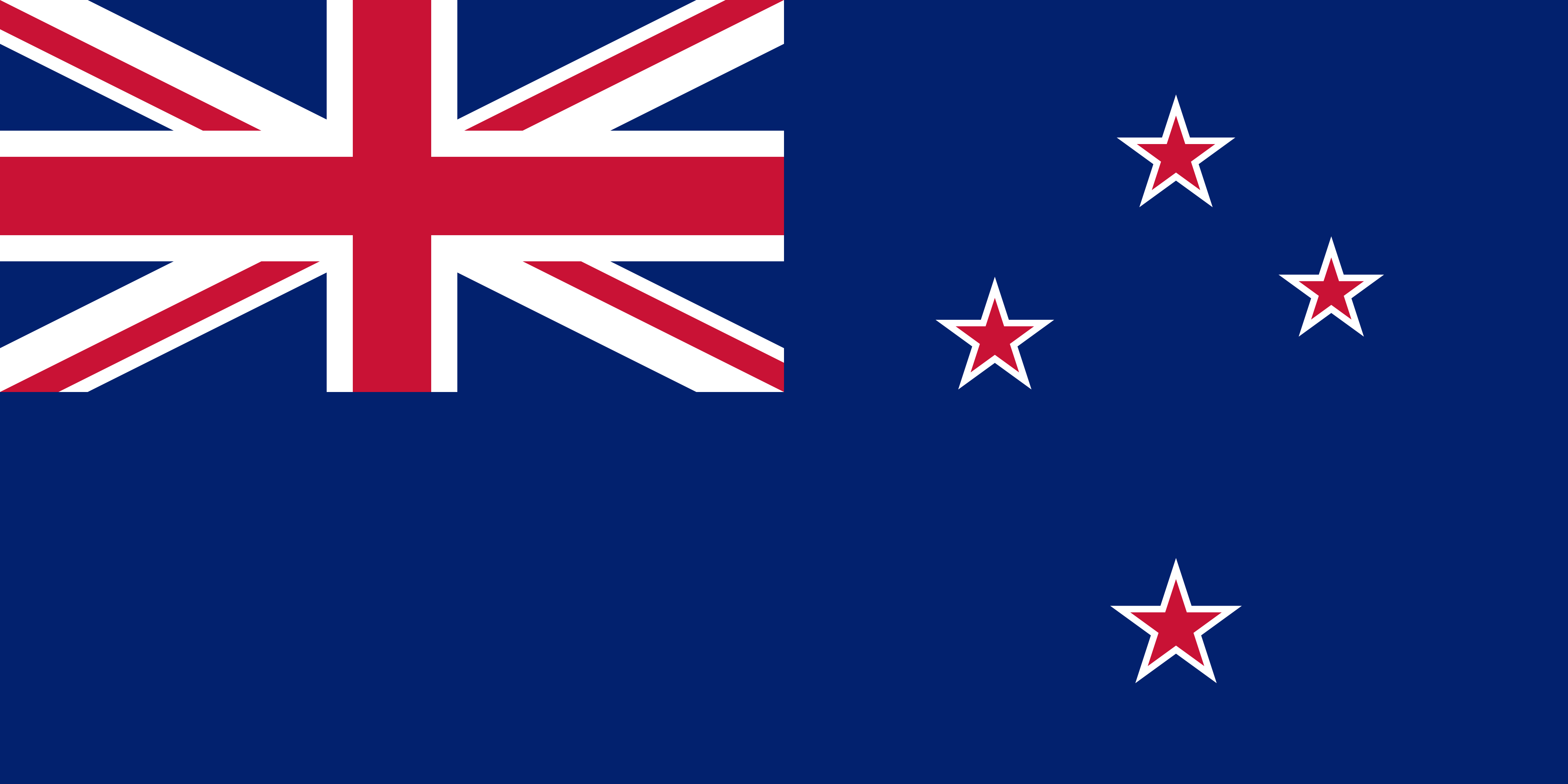
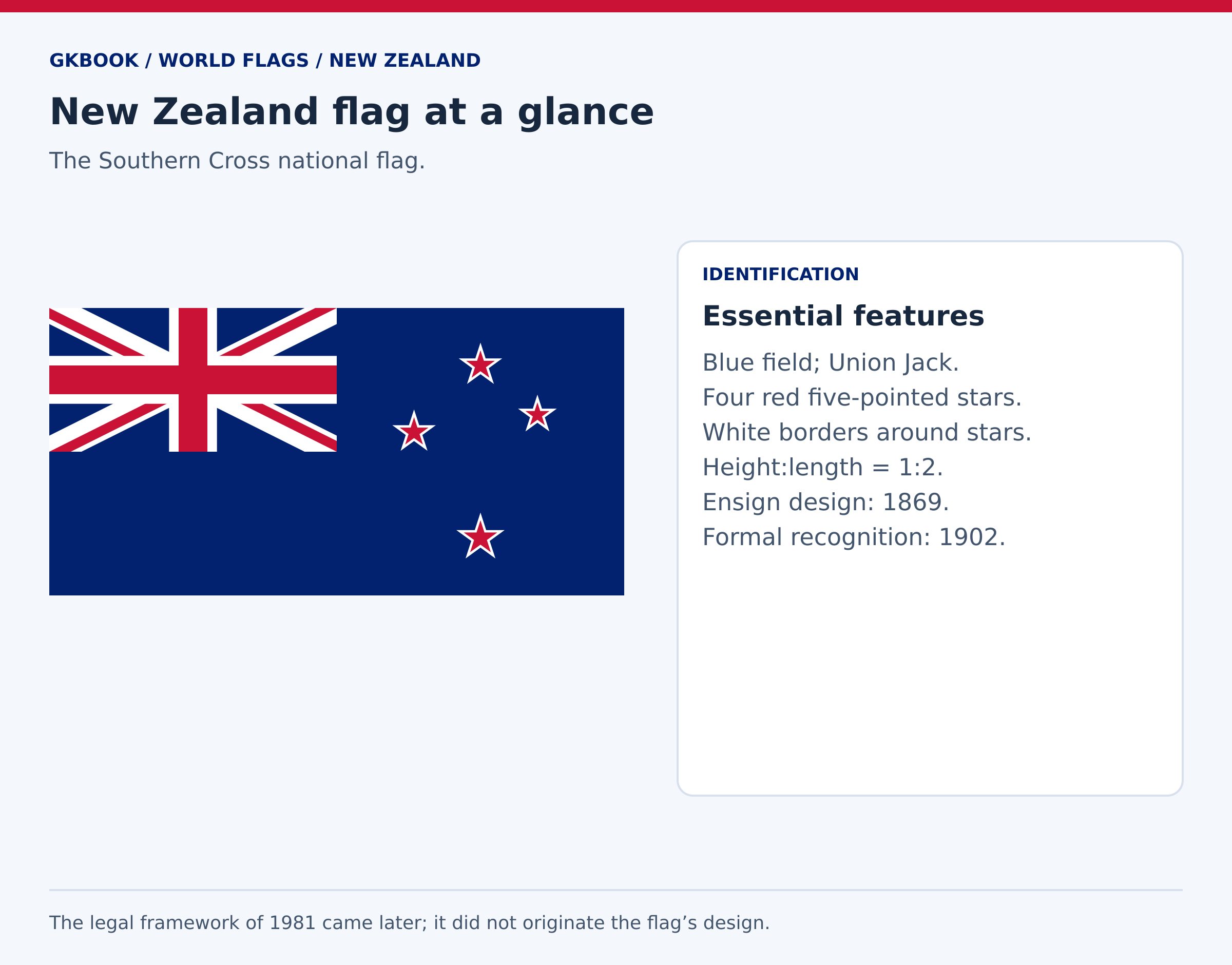
New Zealand’s national flag has a blue field, the Union Jack in the upper hoist quarter, and four red five-pointed stars with white borders on the fly. The stars represent the Southern Cross. Its proportions are 1:2, and the flag was formally recognized in 1902 after earlier use as a government ensign.
The illustrations below explain the exact rectangle, canton, star sizes, and star positions. They also distinguish the 1869 ensign design, formal recognition in 1902, modern legal framework, and current display guidance.
What colors are on the New Zealand flag?
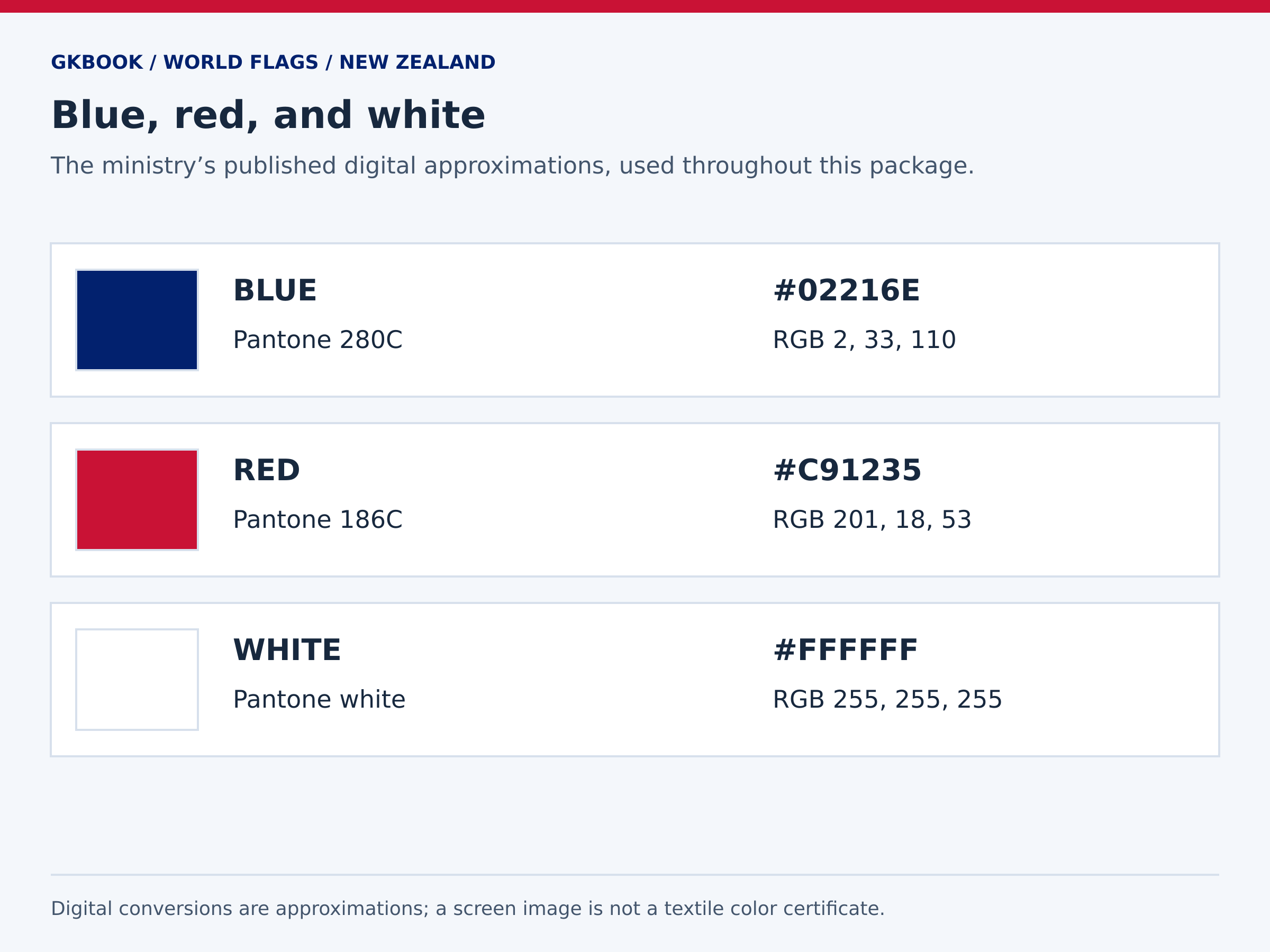
The New Zealand flag uses blue, red, and white. The Ministry for Culture and Heritage specifies Pantone 280C blue, Pantone 186C red, and white for official reproduction. Its published digital approximations are blue #02216E and red #C91235. The artwork here follows those approximations, with opaque white for the crosses and star borders.
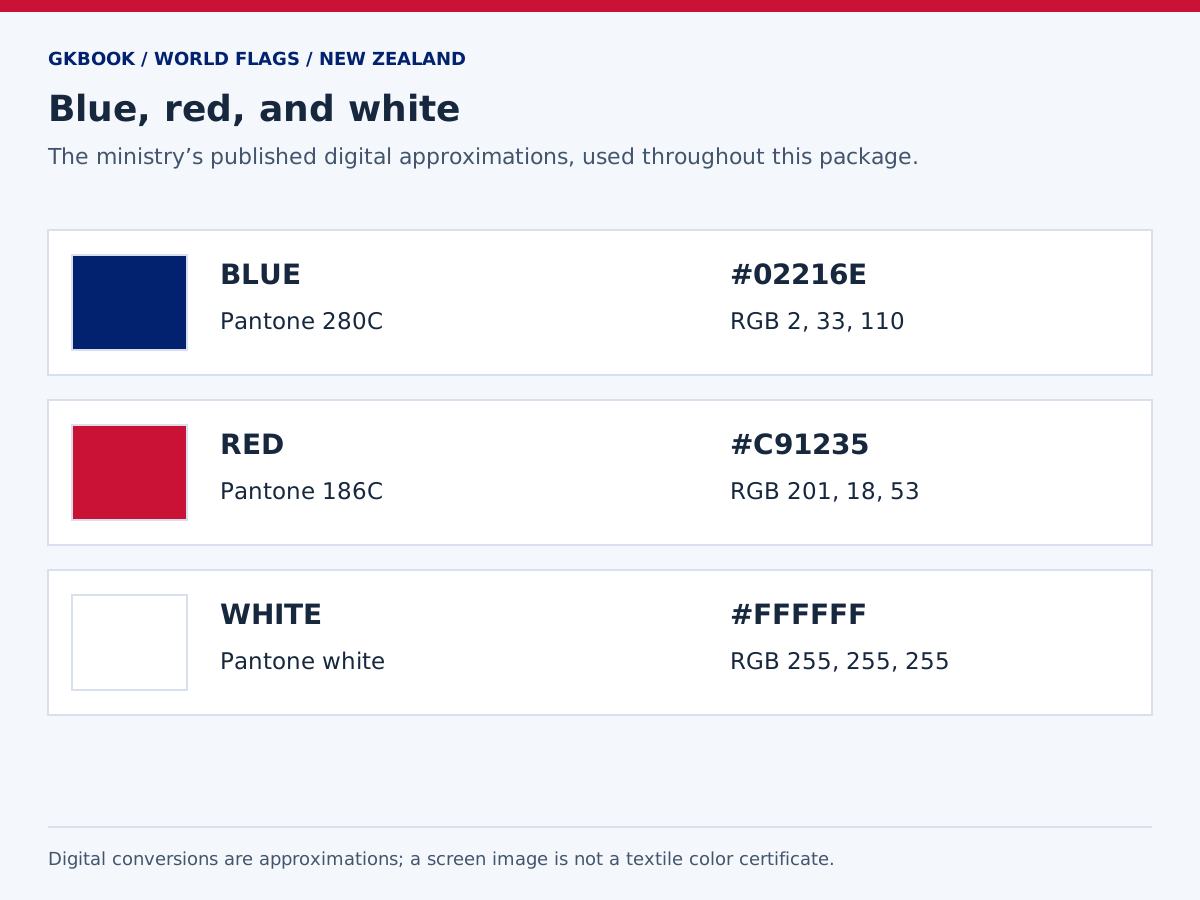
The ministry gives RGB 2, 33, 110 for blue and RGB 201, 18, 53 for red, attributing these conversions to the 2021 Pantone Color Bridge Guide. White is represented here by #FFFFFF, or RGB 255, 255, 255.
Pantone references and screen values are not interchangeable physical standards. A luminous display, printed paper, and dyed cloth can appear different even when each supplier follows its own color system. Preserve the stated palette when preparing digital illustrations, and use the appropriate production reference for fabric.
| Color | Official reproduction reference | HEX | RGB |
|---|---|---|---|
| Blue | Pantone 280C | #02216E | 2, 33, 110 |
| Red | Pantone 186C | #C91235 | 201, 18, 53 |
| White | Pantone white | #FFFFFF | 255, 255, 255 |
What is the ratio of the New Zealand flag?
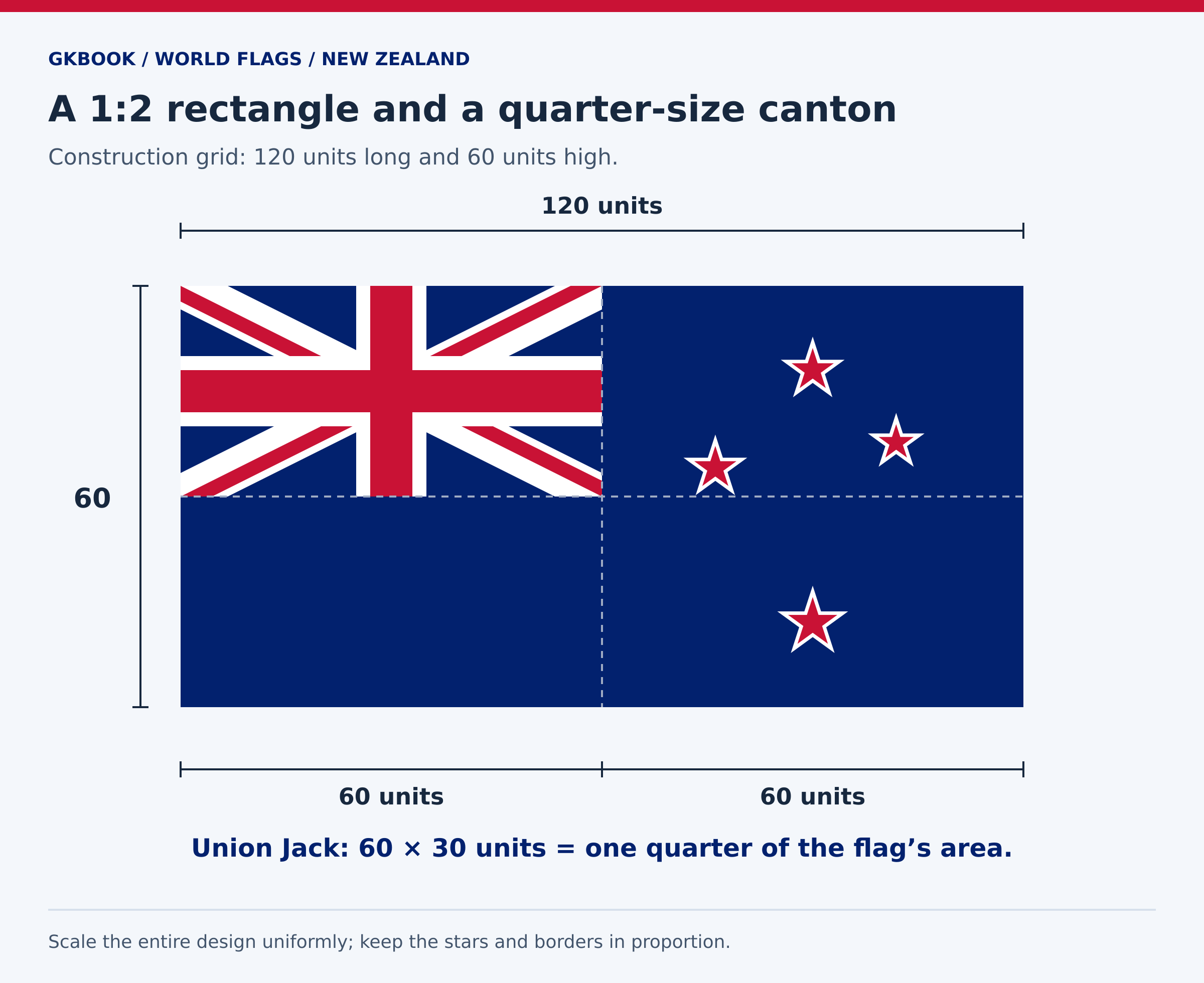
The New Zealand flag has a height-to-length ratio of 1:2: it is twice as long as it is high. The Union Jack occupies the upper hoist quarter, half the flag’s length and half its height. The four Southern Cross stars occupy the fly, the half farther from the flagpole.
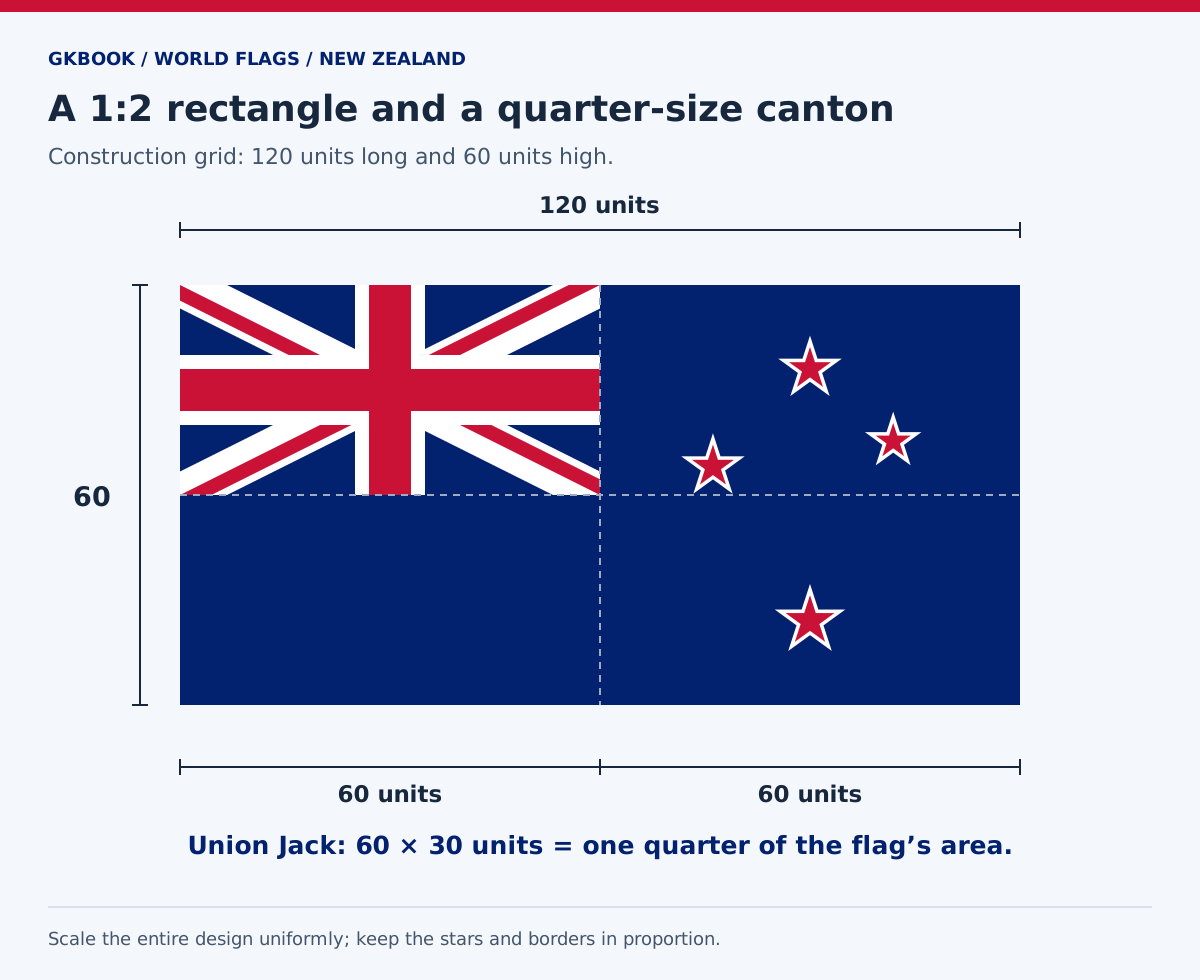
For example, a flag 90 centimeters high is 180 centimeters long, with a canton 90 centimeters long and 45 centimeters high. Changing the overall size must scale the stars and every border by the same factor.
The construction drawings use a 120-by-60 grid. The national SVG has a 1200 × 600 canvas, and the PNG is 4800 × 2400 pixels. Both preserve the exact 1:2 ratio. A flagpole or sleeve is not included in those rectangular image dimensions.
What does the New Zealand flag symbolize?
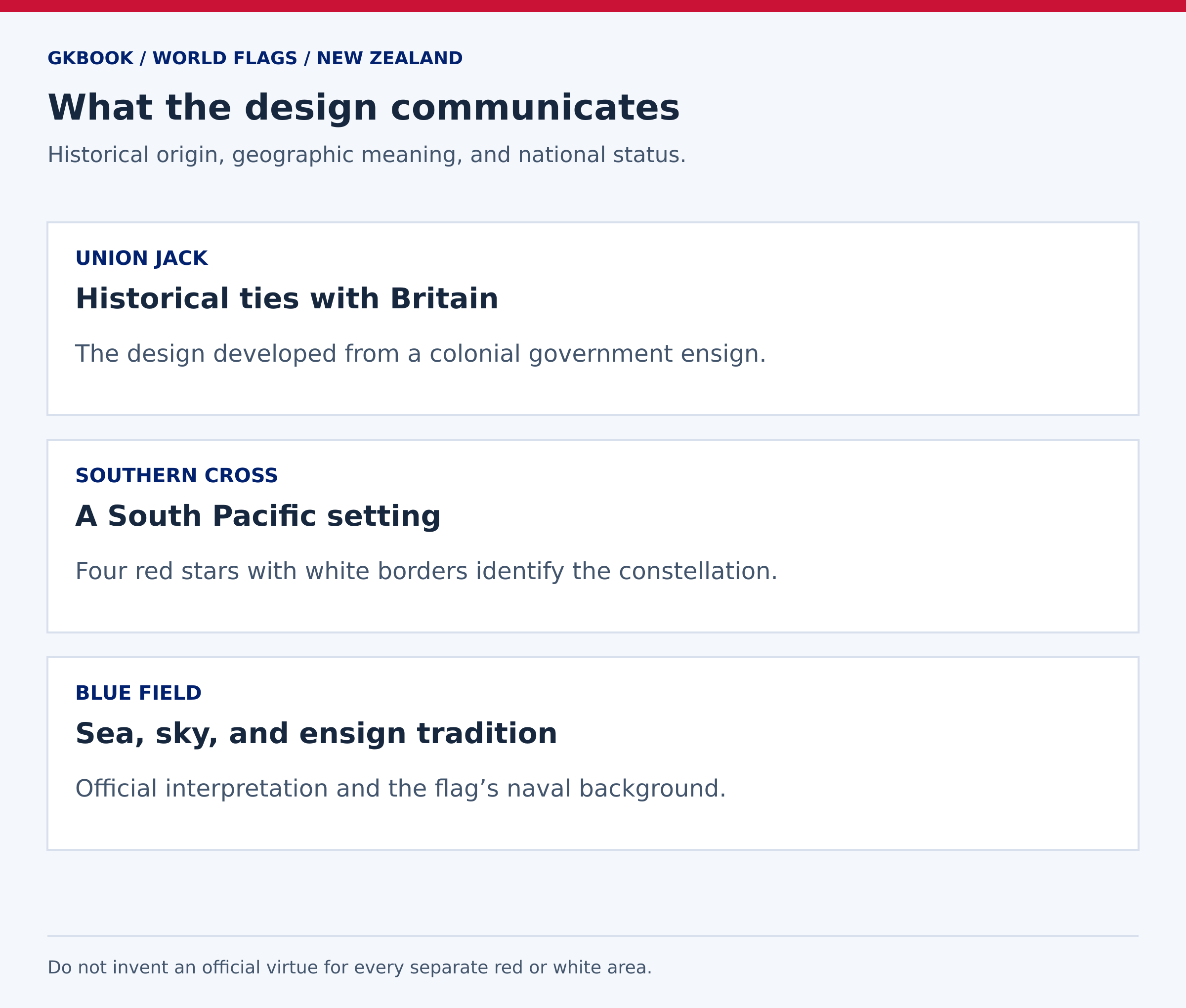
The New Zealand flag is legally the symbol of the Realm, Government, and people of New Zealand. Its Southern Cross identifies the country’s South Pacific setting, while the Union Jack records historical ties with Britain. Official explanations also associate the blue field with the surrounding sea and sky and with naval ensign tradition.
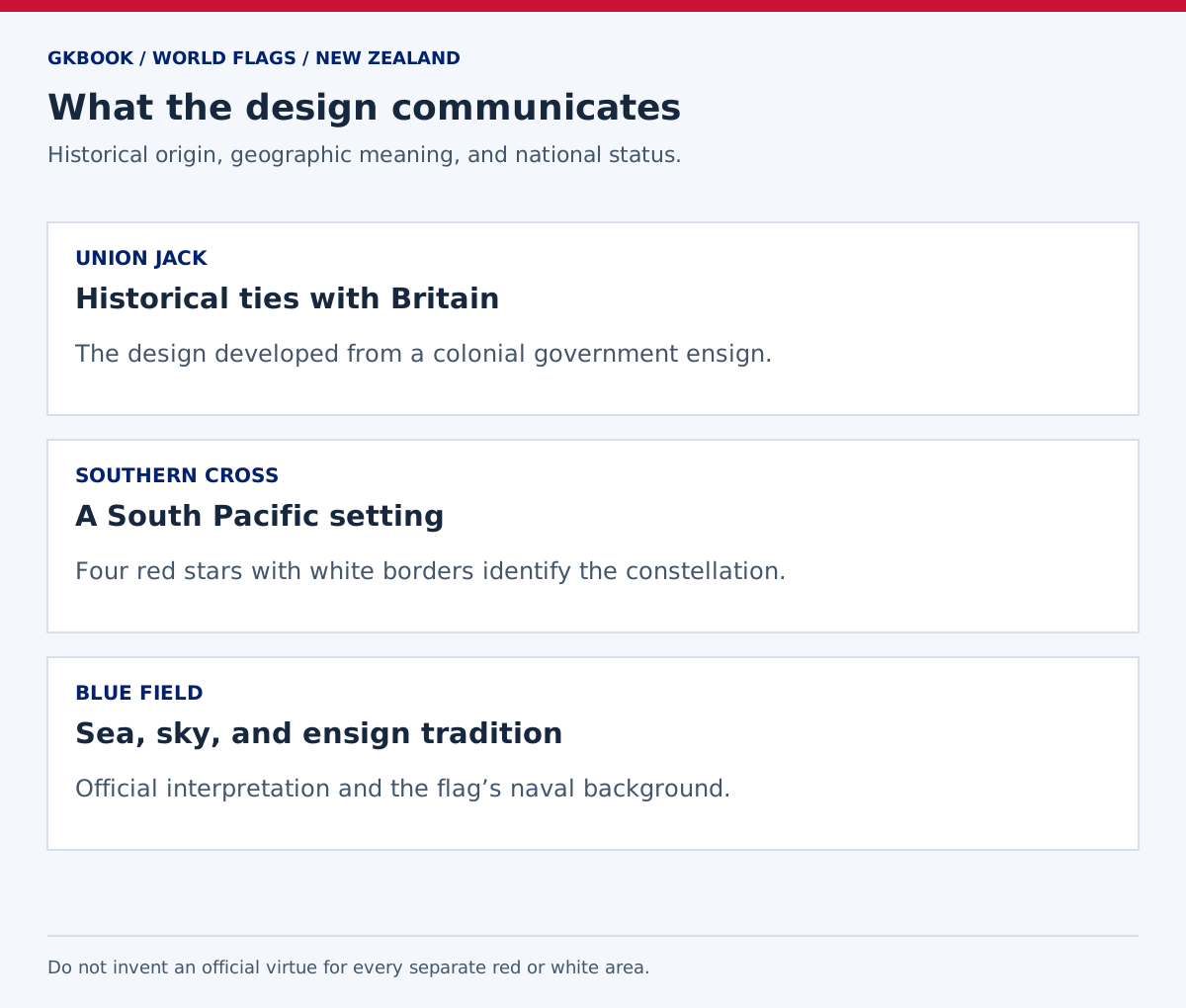
These explanations describe different aspects of the design. The blue ensign is a historical source of the flag’s form; sea and sky are an interpretation of its appearance. Neither requires inventing a separate official virtue for every red or white area.
The flag combines a shared inherited canton with a distinctive star arrangement. Understanding both parts is more useful than treating every blue flag bearing the Union Jack as the same national symbol.
Why does the New Zealand flag contain the Union Jack?
The Union Jack appears because New Zealand’s flag developed from the British Blue Ensign used by colonial government vessels. It records the country’s historical connection with Britain. In the standard front view, the canton occupies the upper left quarter; it is not a separate full-size British flag placed over the entire blue field.
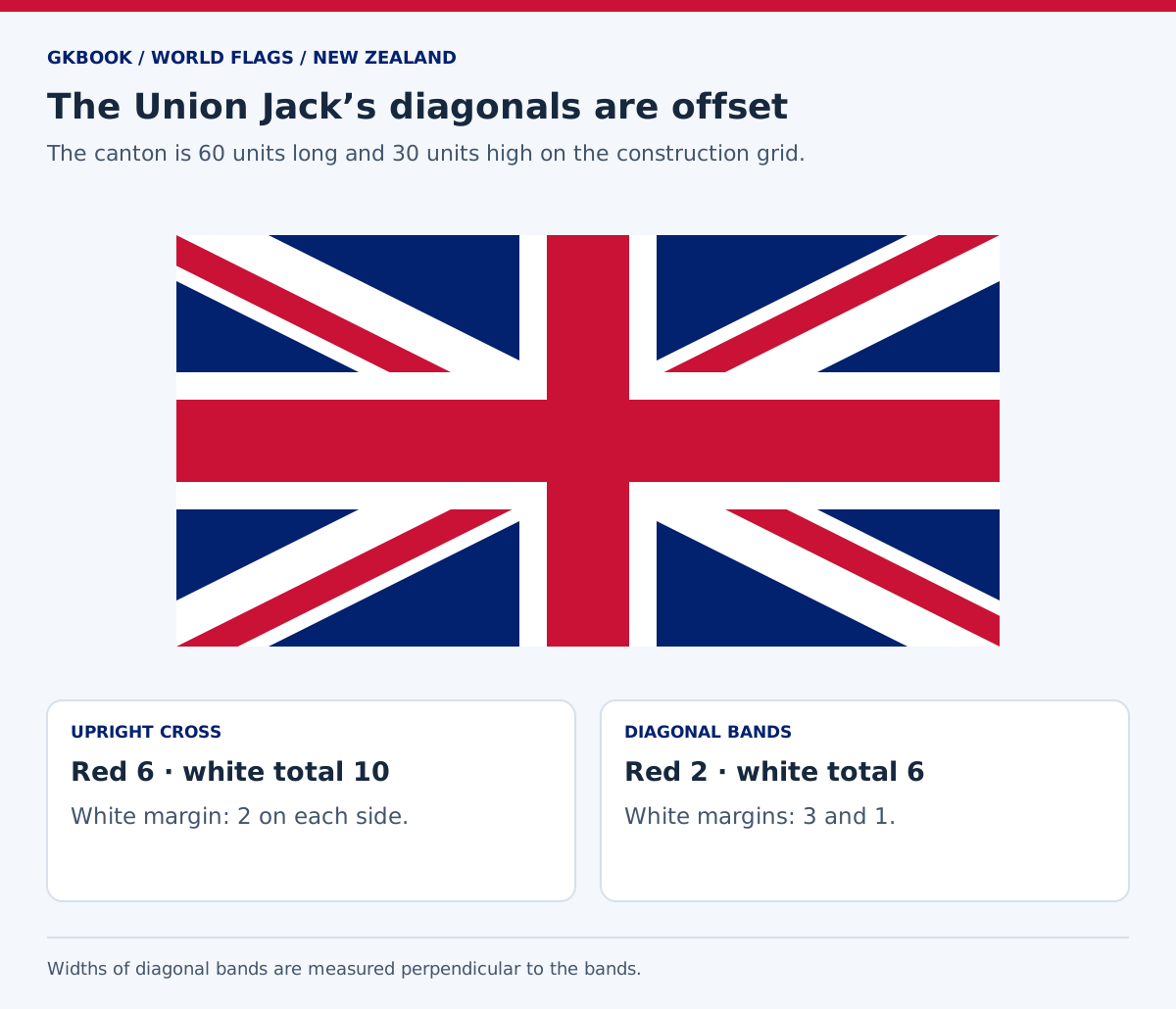
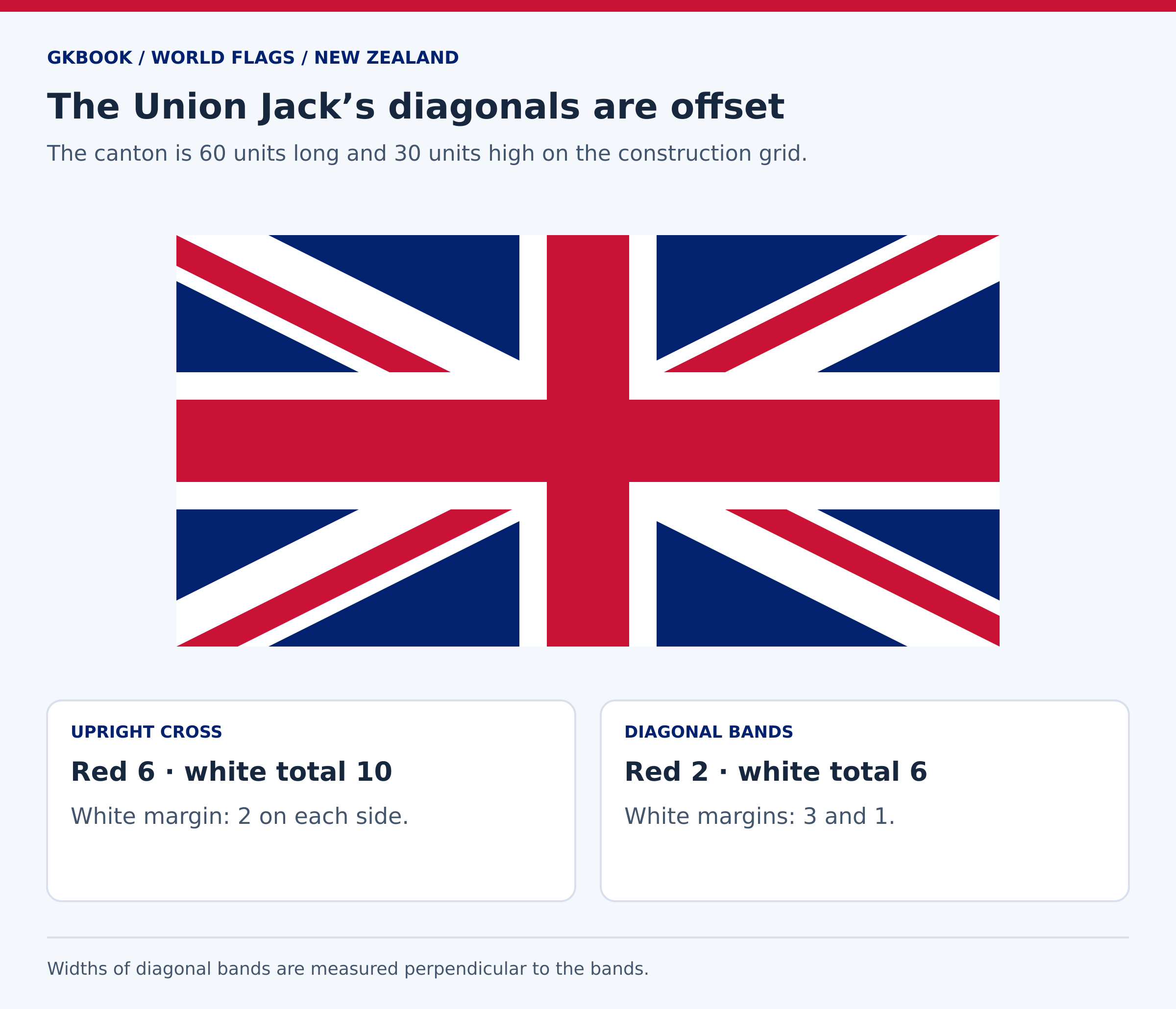
The Union Flag combines the cross of St. George, the saltire of St. Andrew, and the saltire of St. Patrick. Its diagonal red bands are offset within the white bands. Centering every diagonal red band would change the pattern.
On the construction grid, the upright red cross is 6 units wide inside a 10-unit white cross. Each white diagonal band is 6 units wide, containing 2 units of red with unequal white margins of 3 and 1 units.
What do the four stars on the New Zealand flag represent?
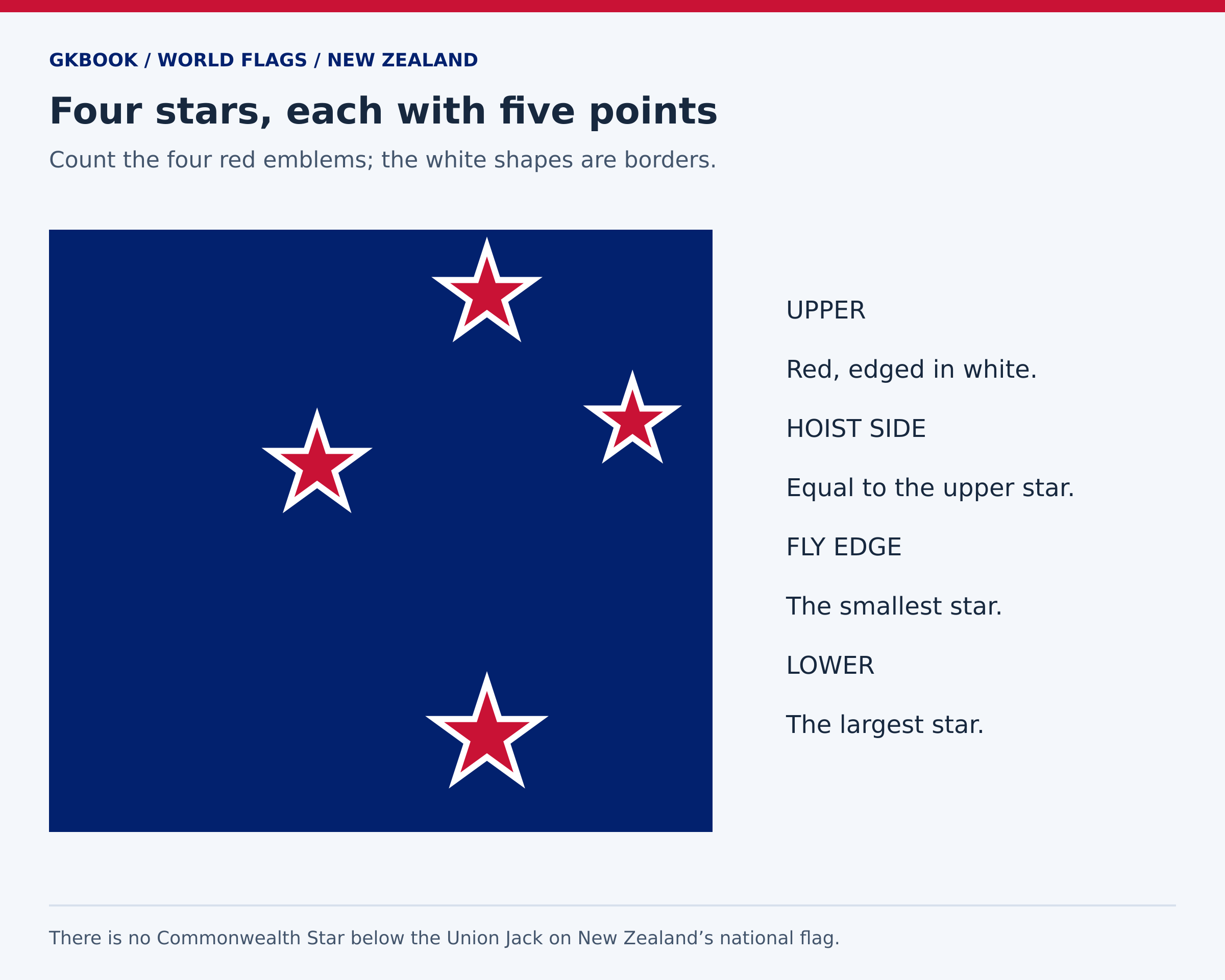
The four stars represent the principal cross-shaped pattern of the Southern Cross constellation. Each has five points, a red interior, and a white border. They indicate New Zealand’s location in the South Pacific; they do not stand for four provinces, four islands, or four separate political divisions of the country.
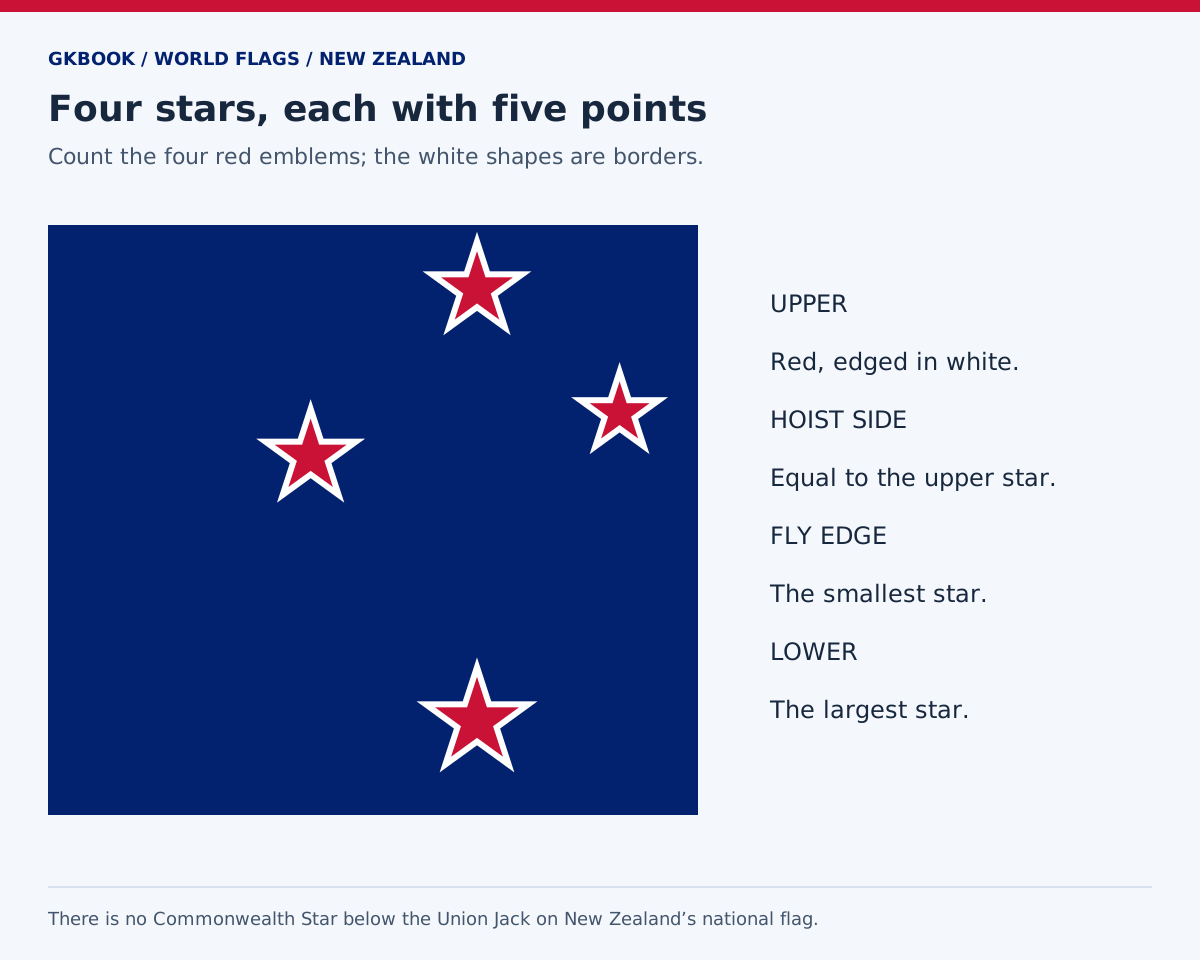
There are four stars in total on the national flag. The white around each red star is a border around the same emblem, not an extra white star to count separately.
The arrangement is a designed representation of a constellation, not a complete astronomical chart. The flag omits the smaller fifth Southern Cross star that appears on Australia’s national flag, and it has no large Commonwealth Star below the Union Jack.
Are all four stars the same size?
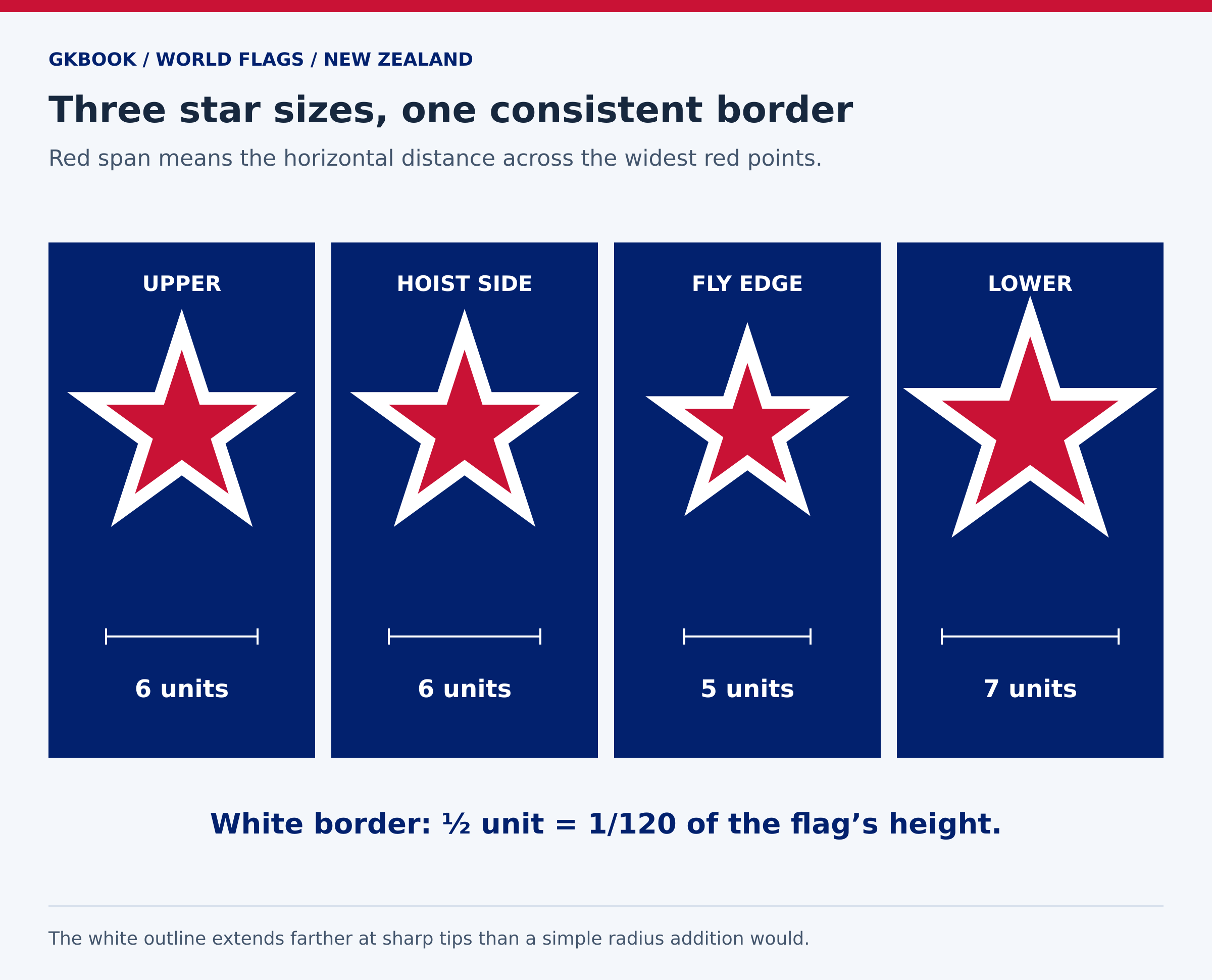
No. The lower star is largest, the star nearest the outer fly edge is smallest, and the upper and hoist-side stars are equal. Their red spans measure 7, 5, 6, and 6 units respectively on a grid with a 60-unit flag height. Every star has a white border one half-unit wide.
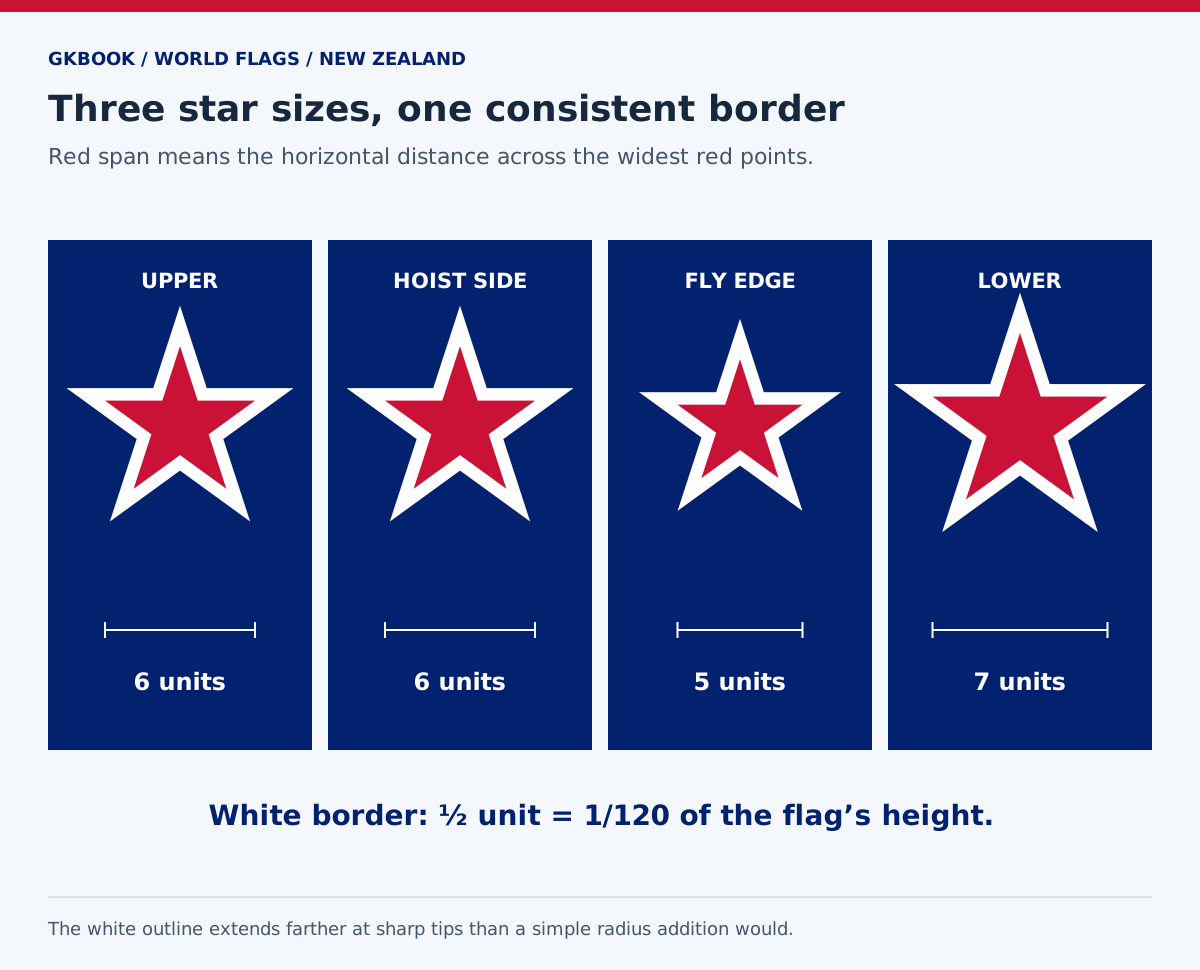
The 1902 specification measures across the red points, as indicated by the horizontal dimensions in the ministry’s construction diagram. A red span is therefore different from the complete outside width including white.
The white border is constructed at a consistent perpendicular distance from the red edges. Because a five-pointed star has sharp corners, simply adding the border width to the distance from the center to a tip would not produce the same outline.
| Star position | Red span | Red span as fraction of flag height | White border |
|---|---|---|---|
| Upper | 6 units | 6/60 = 1/10 | 1/2 unit = 1/120 of height |
| Nearest the hoist | 6 units | 6/60 = 1/10 | 1/2 unit = 1/120 of height |
| Nearest the fly edge | 5 units | 5/60 = 1/12 | 1/2 unit = 1/120 of height |
| Lower | 7 units | 7/60 | 1/2 unit = 1/120 of height |
How are the stars positioned on the New Zealand flag?
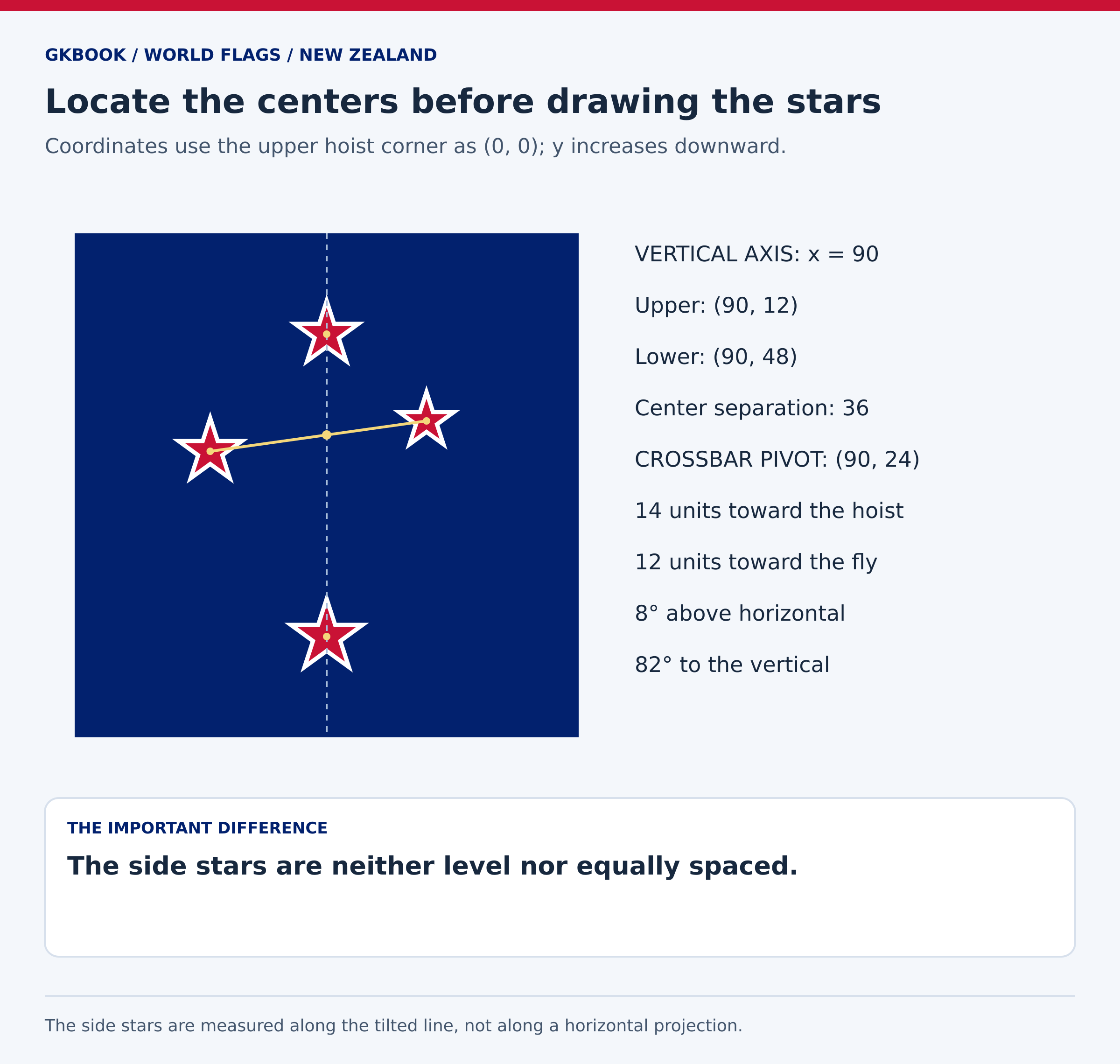
The upper and lower star centers lie on a vertical line through the middle of the fly, separated by three fifths of the flag’s height. The two side stars lie on a tilted crossbar, rising toward the outer fly edge. The crossbar meets the vertical line at an angle of 82 degrees.
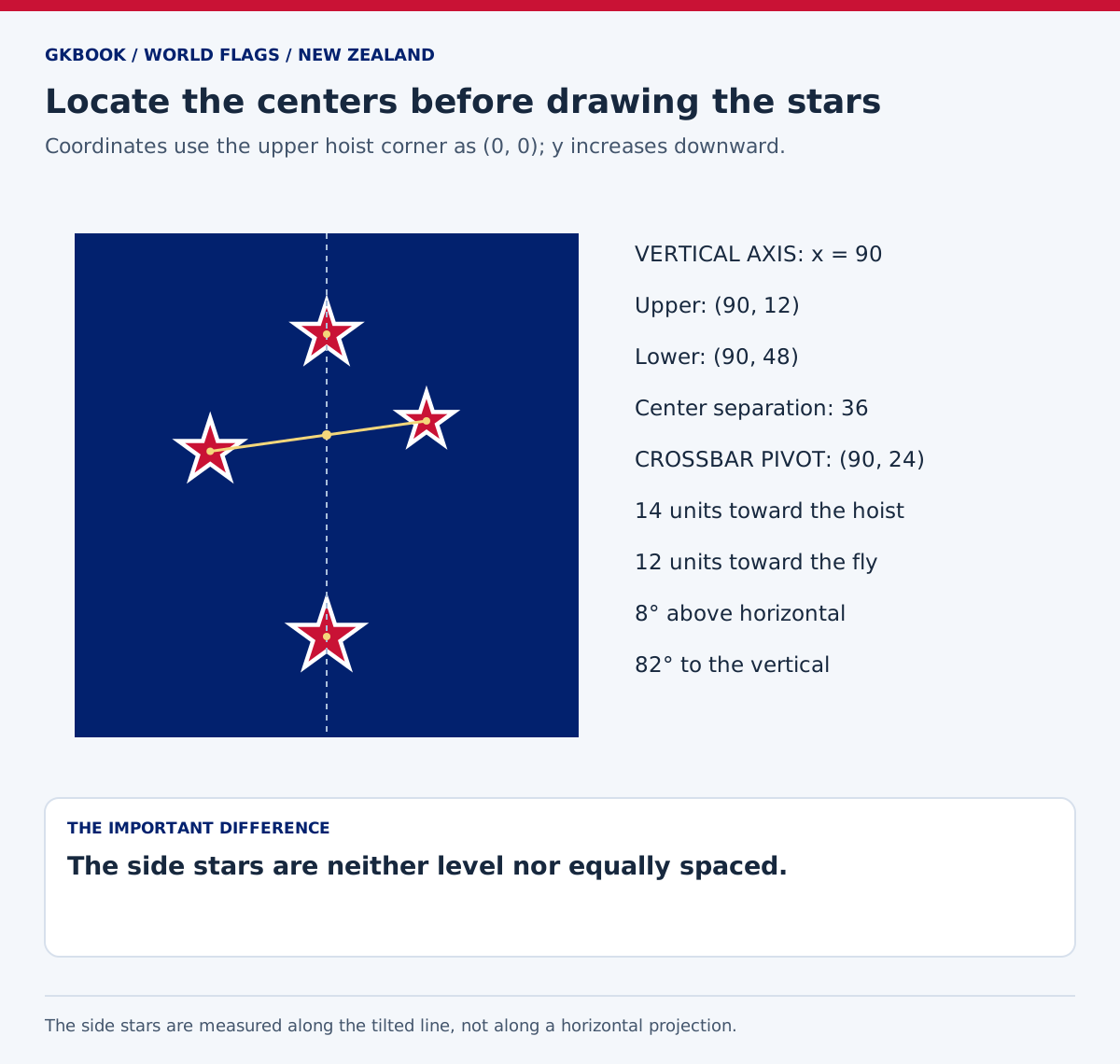
On the 120-by-60 construction grid, the vertical axis is at x = 90. The upper center is at y = 12 and the lower center at y = 48. The crossbar meets that axis at y = 24, twelve units below the upper center.
Measure 14 units along the crossbar toward the hoist for the left star and 12 units toward the fly edge for the right star. The line rises 8 degrees above horizontal toward the fly. Consequently, the side stars are neither level nor equally distant from the vertical axis.
Who designed the New Zealand flag?
Albert Hastings Markham is credited with designing the Southern Cross ensign in 1869. A Royal Navy officer who later became an admiral, he supplied the design associated with Governor Sir George Bowen’s administration. The design’s creation for government vessels should be distinguished from its later recognition as New Zealand’s national flag in 1902.
The ministry identifies Markham as the designer. The 1869 proclamation established the Southern Cross emblem for ships belonging to the colonial government, replacing an earlier identifying badge made from the letters NZ.
“Designed in 1869” does not mean every later measurement was fixed that year. The specifications published in June 1902 defined the star arrangement and size associated with formal recognition.
How did the New Zealand flag develop?
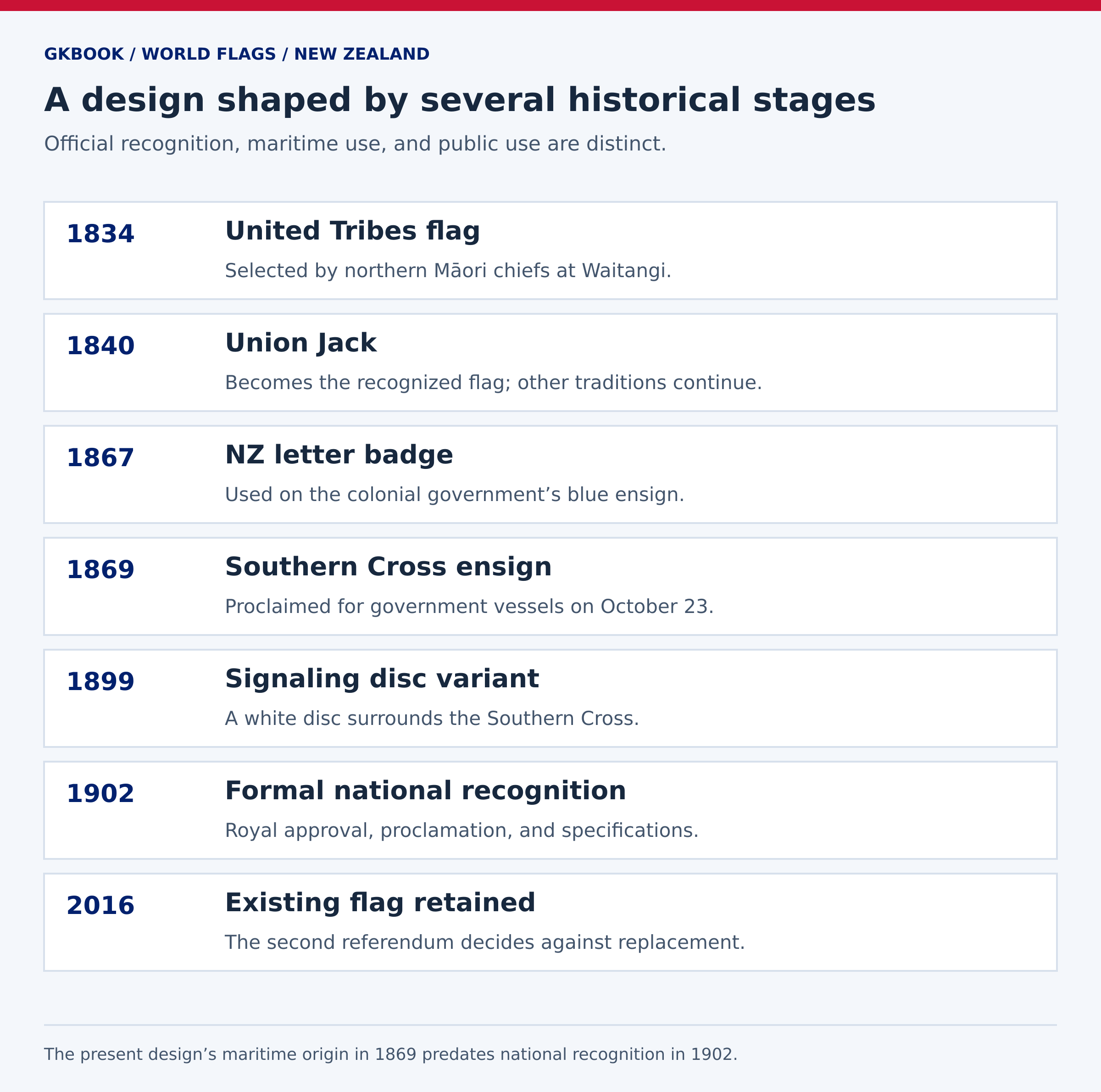
New Zealand’s flag history includes the United Tribes flag of 1834, the Union Jack, and the blue ensign tradition that produced today’s design. An NZ letter badge preceded the Southern Cross ensign adopted for government vessels in 1869. Formal national recognition followed in 1902, and voters retained the flag in 2016.
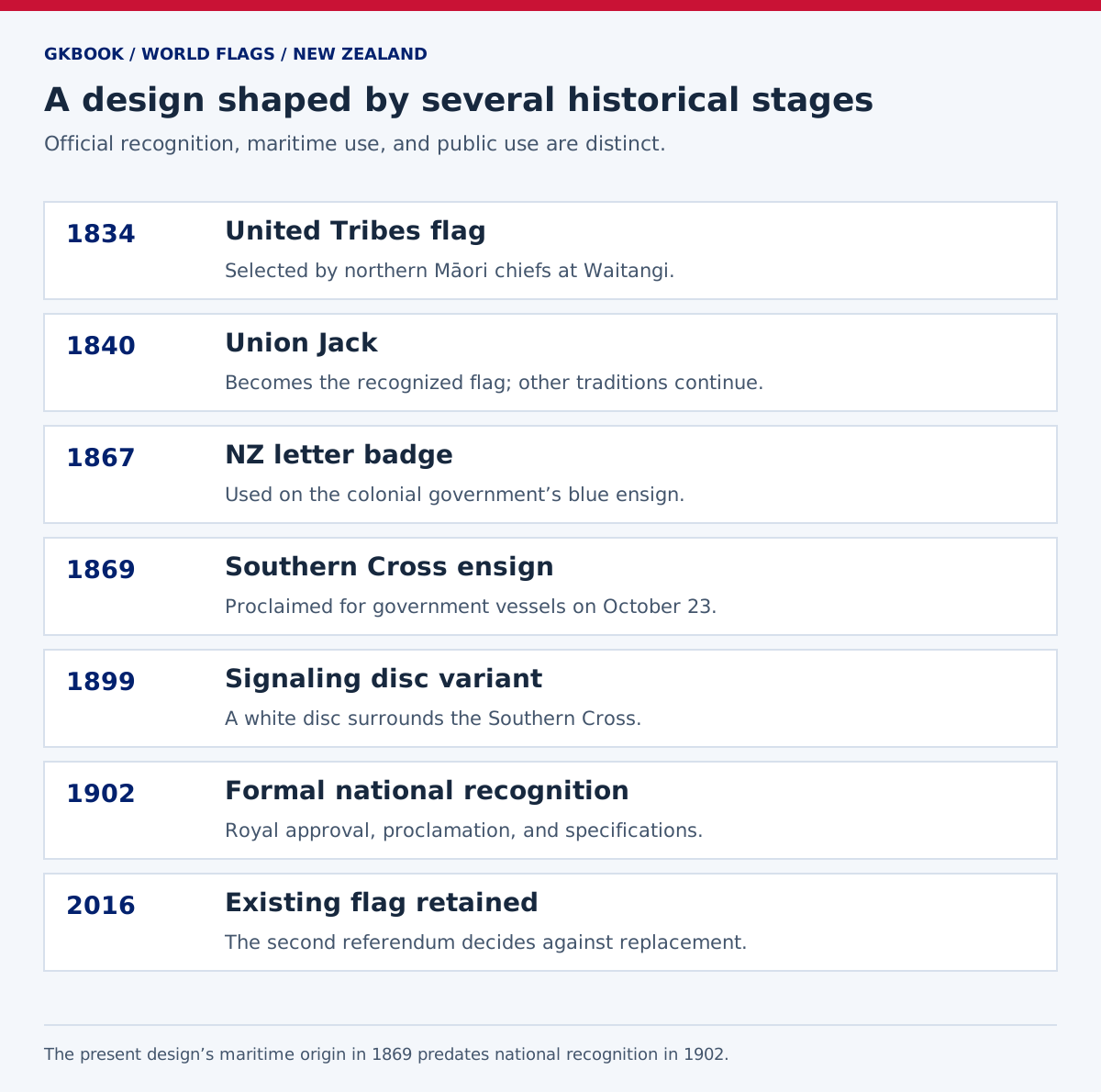
The sequence was not a simple replacement of one universally used flag by another. Maritime rules, official recognition, public use, and Māori traditions sometimes overlapped. A flag could become familiar ashore before acquiring its later legal status.
Surviving objects also record variation. Te Papa holds an 1899 presentation ensign with white Southern Cross stars, made for troops departing for South Africa. It is evidence of historical practice, not a pattern for reproducing the modern red-star national flag.
| Date or period | Event |
|---|---|
| March 20, 1834 | Chiefs at Waitangi select the flag later known as the United Tribes flag. |
| 1840 | The Union Jack becomes the recognized flag of New Zealand. |
| 1867 | An NZ letter badge identifies the colonial government’s blue ensign. |
| October 23, 1869 | A proclamation establishes the Southern Cross ensign for government vessels. |
| 1899 | A signaling version places the stars in a white disc. |
| 1902 | Royal approval, proclamation, and detailed specifications establish formal national recognition. |
| 2015–2016 | Two referendums select an alternative and then retain the existing flag. |
When was the New Zealand flag officially adopted?
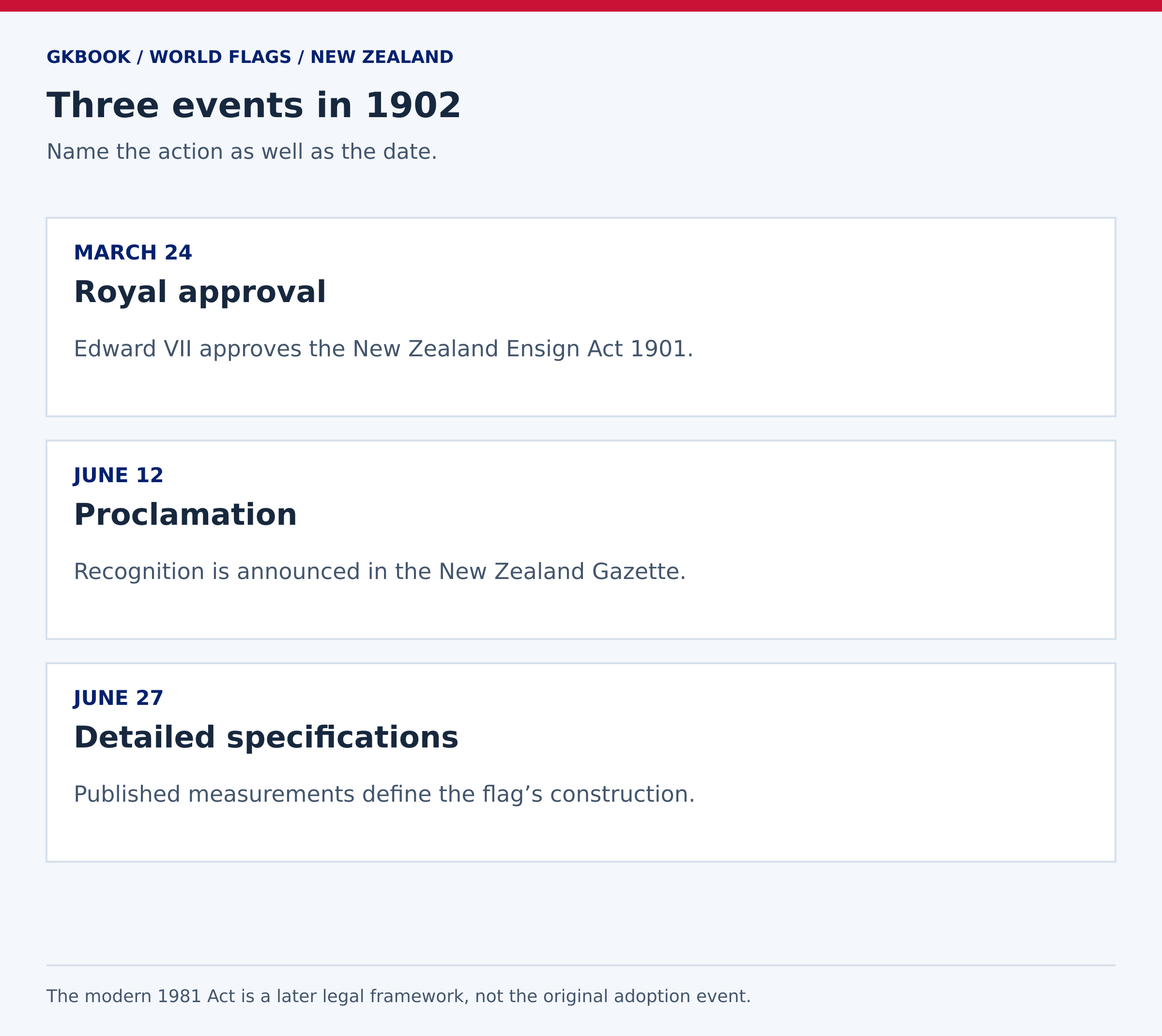
New Zealand’s flag was formally recognized in 1902. King Edward VII approved the New Zealand Ensign Act 1901 on March 24, 1902; the proclamation appeared on June 12, and detailed specifications followed on June 27. These dates mark separate steps, while the Southern Cross government ensign had already been introduced in 1869.
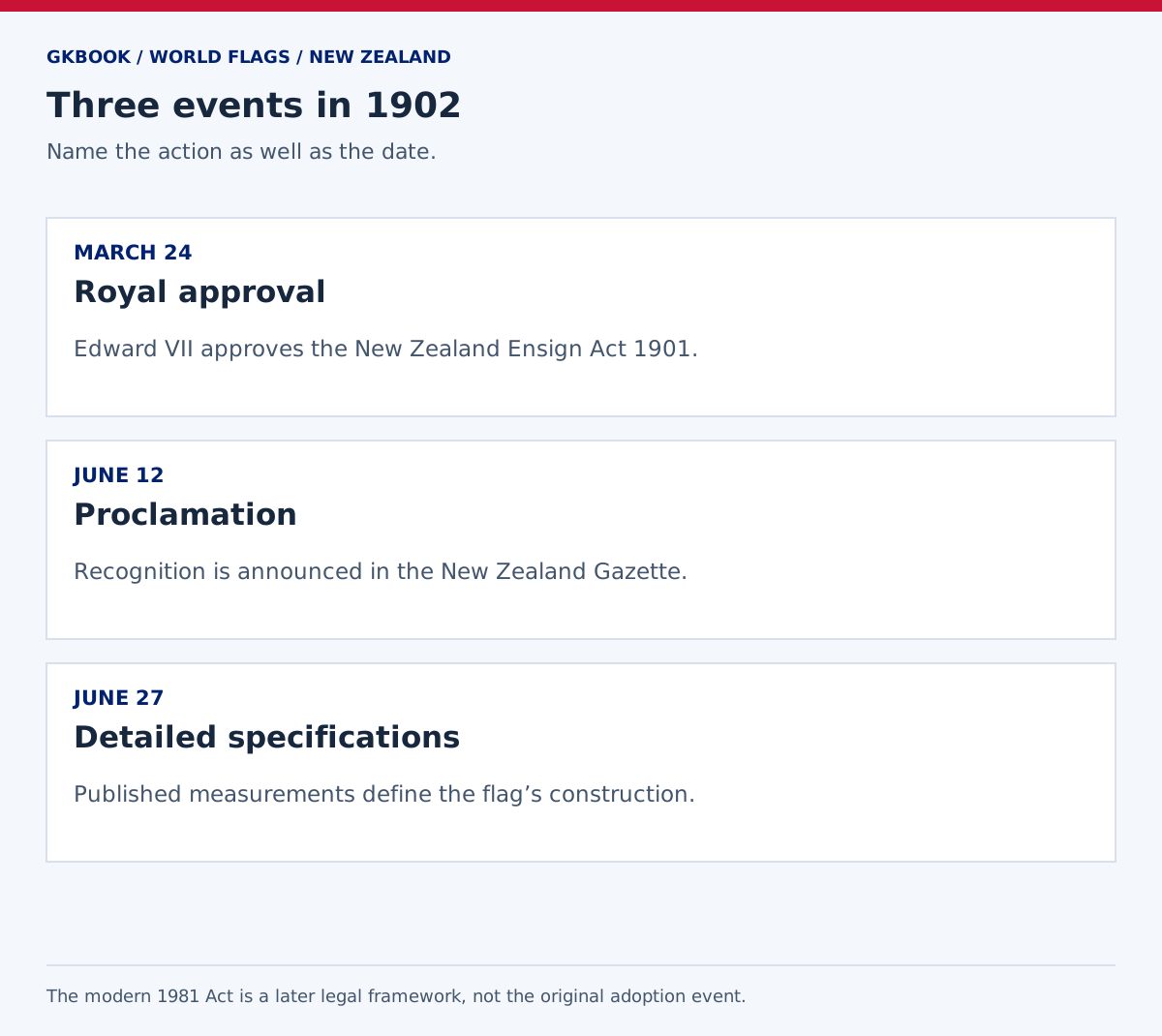
March 24 is commonly quoted as the adoption date. June 12 marks the gazetted proclamation of recognition, and June 27 concerns the drawing specifications. Naming the event alongside the date avoids treating these as competing claims about one identical action.
The Act’s title contains “1901,” but royal approval came in 1902. Te Papa’s account of the 1899 presentation flag independently corroborates the March 24 approval date, while NZHistory records the proclamation and specification dates.
What law recognizes the New Zealand flag today?
The Flags, Emblems, and Names Protection Act 1981 recognizes the New Zealand Flag and depicts it in Schedule 1. Section 5 identifies its national role; section 10 provides for government flag rules and etiquette guidance. This law continues the flag’s status rather than marking the first appearance or original adoption of the design.
The Act came into force on January 1, 1982. That commencement belongs to the modern legal framework, not the 1869 design or the 1902 recognition chronology.
Section 10 distinguishes prescribed government-land and government-building arrangements from general etiquette guidance, which does not itself have the force of law. Section 11 separately addresses unauthorized alterations and certain public acts intended to dishonor the flag. These are different kinds of provision and should not be conflated.
What was New Zealand’s first recognized flag?
The United Tribes flag, selected by northern Māori chiefs at Waitangi on March 20, 1834, is generally described as New Zealand’s first recognized national flag. It preceded the present blue ensign. The choice addressed the need for New Zealand-built ships to have an accepted national identity in international trade.
James Busby organized the selection, with designs supplied through missionary Henry Williams. British recognition enabled ships using the flag to be identified as belonging to New Zealand before the country became a British colony.
The Union Jack became the recognized flag in 1840, but the United Tribes flag retained significance for Māori, particularly in the north. Its continuing cultural importance should not be erased by a timeline of successive official flags.
Why do some historical New Zealand flags have a white disc?
A signaling ensign approved in 1899 placed the Southern Cross stars inside a white disc. Intended for maritime use, it also appeared ashore and contributed to uncertainty over the correct flag. The modern national flag has no disc: its four individually bordered red stars stand directly against the blue field.
The disc version helps explain why early photographs do not always match today’s design. It was a historical variant with a particular purpose, not proof that a large white circle belongs behind the current Southern Cross.
When identifying an old flag, consider its date and intended use before labeling it a mistake. When reproducing the current national flag, omit the disc and retain the separate white border around each red star.
Did New Zealand change its flag in the 2015–2016 referendums?
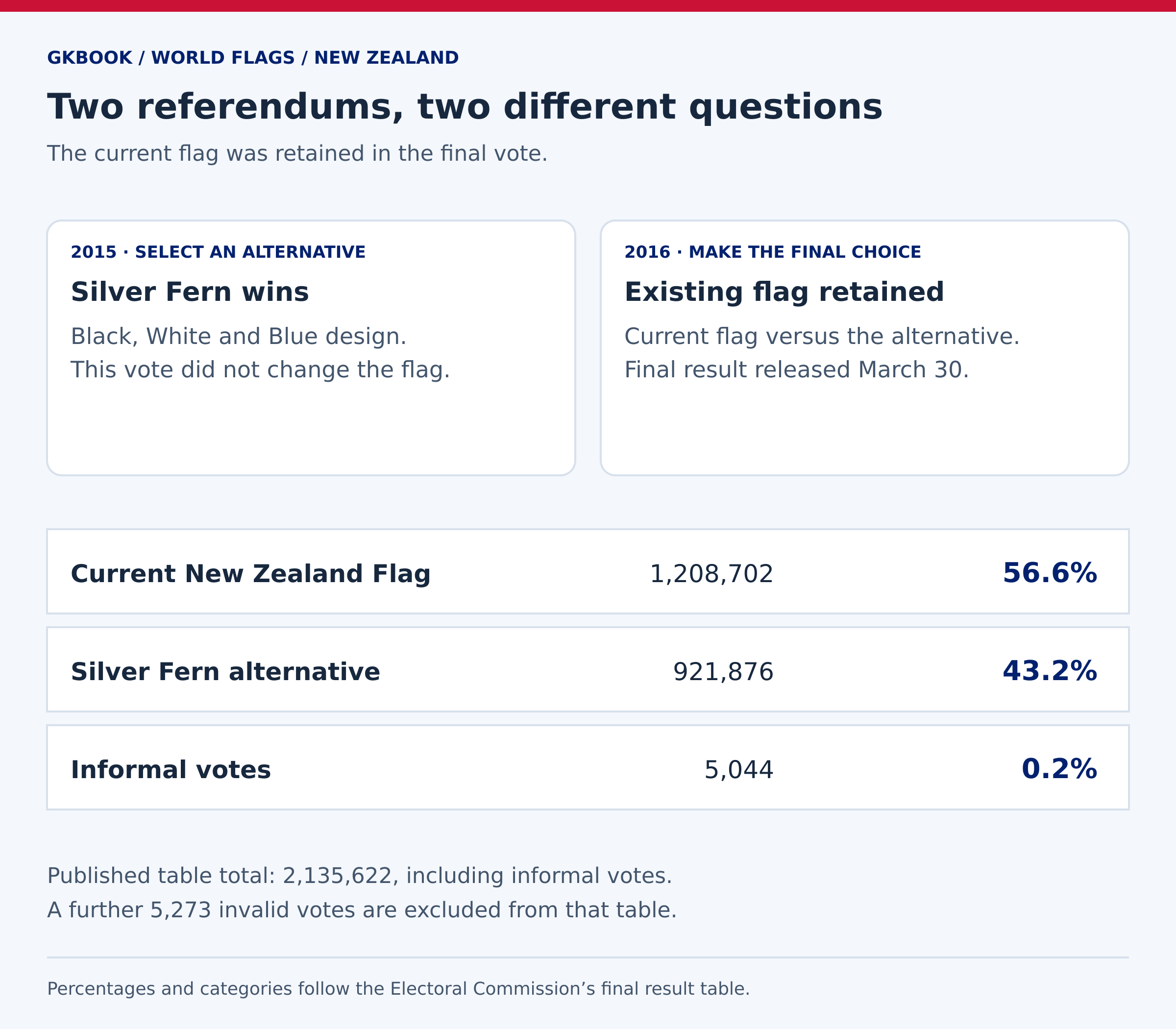
No. The first referendum in 2015 selected a silver-fern alternative; the second, held in March 2016, chose between that alternative and the existing flag. The Electoral Commission’s final result recorded 1,208,702 votes for the current flag, or 56.6 percent in its published table. The blue ensign therefore remained the national flag.
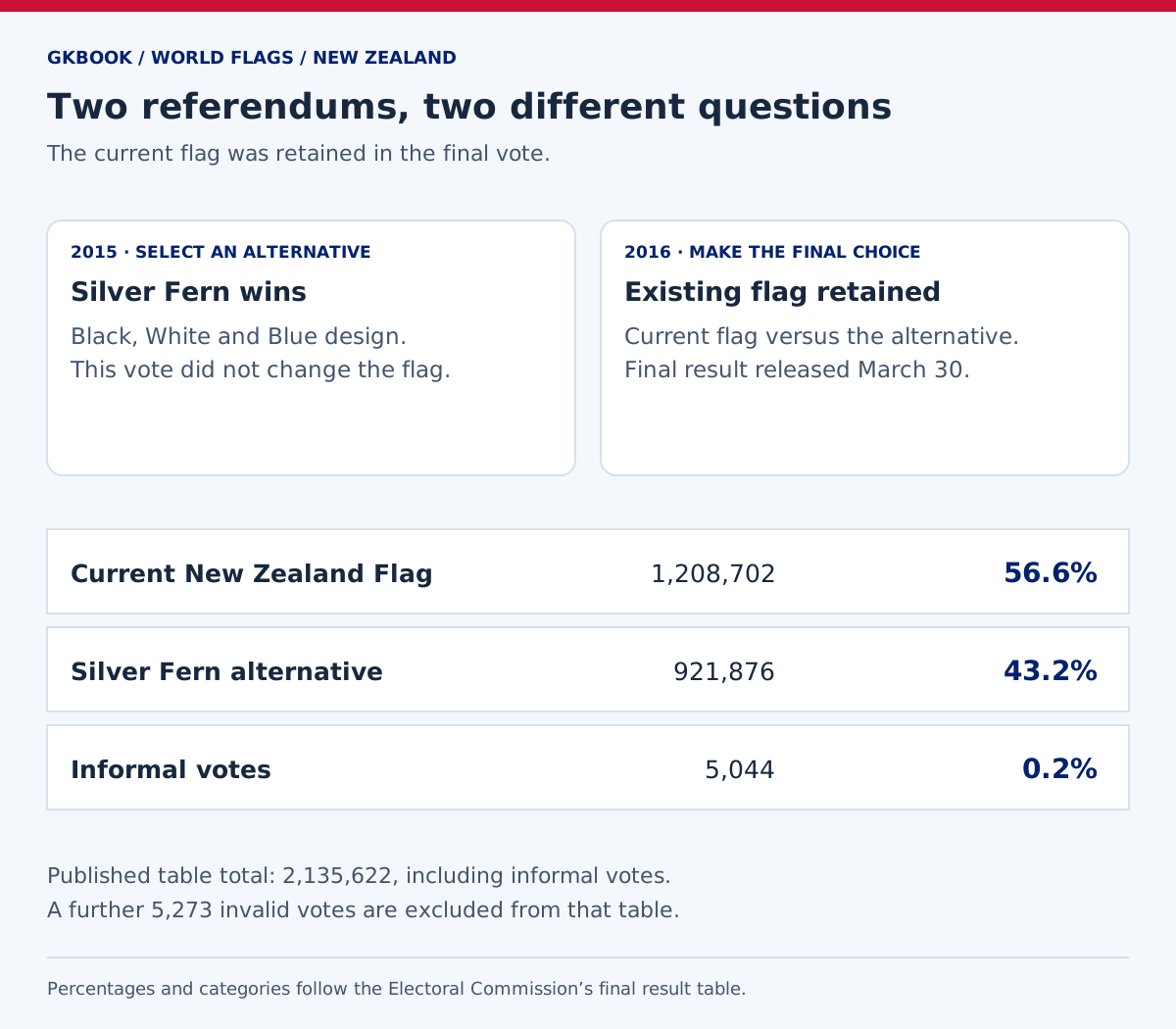
The two votes answered different questions. Choosing an alternative in the first referendum did not itself replace the national flag. The final decision required the second vote.
The result table’s published denominator includes 5,044 informal votes. A further 5,273 invalid votes were excluded from that table. Retaining the Commission’s labels and percentages avoids silently substituting a percentage calculated only from the two named choices.
| Category | Votes | Share in the published table |
|---|---|---|
| Current New Zealand Flag | 1,208,702 | 56.6% |
| Silver Fern alternative | 921,876 | 43.2% |
| Informal votes | 5,044 | 0.2% |
| Total reported as valid votes | 2,135,622 | 100% |
| Invalid votes, excluded from that total | 5,273 | Not included |
Is the silver fern New Zealand’s national flag?
A silver-fern design is not the statutory New Zealand national flag. Kyle Lockwood’s Silver Fern, Black, White and Blue, won the 2015 selection of an alternative but lost to the existing flag in 2016. Fern flags and fern imagery should therefore be distinguished from the blue national flag with the Union Jack.
The selected proposal retained Southern Cross stars and replaced the Union Jack with a fern-based composition. Its appearance in the referendum made it a proposed national design, not an adopted national flag.
For a present-day country label, use the flag defined in the 1981 Act and retained after the referendum. The word “fern” alone does not identify a single interchangeable flag design.
How is New Zealand’s flag different from Australia’s?
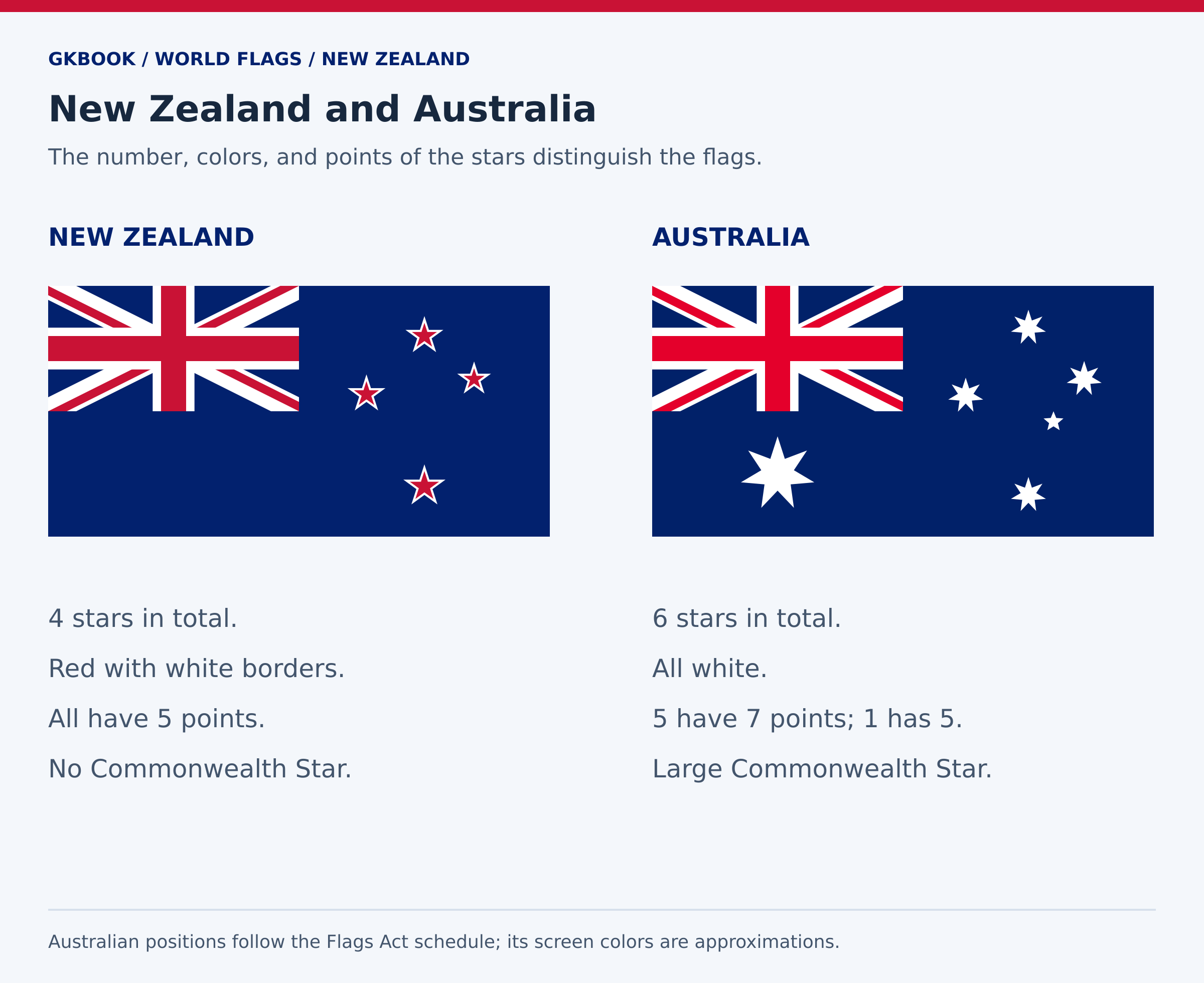
New Zealand’s flag has four red five-pointed stars with white borders. Australia’s flag has six white stars in total: five forming the Southern Cross and a larger Commonwealth Star below the Union Jack. Both use a blue field and Union Jack canton, so star number, color, and placement provide the clearest distinction.
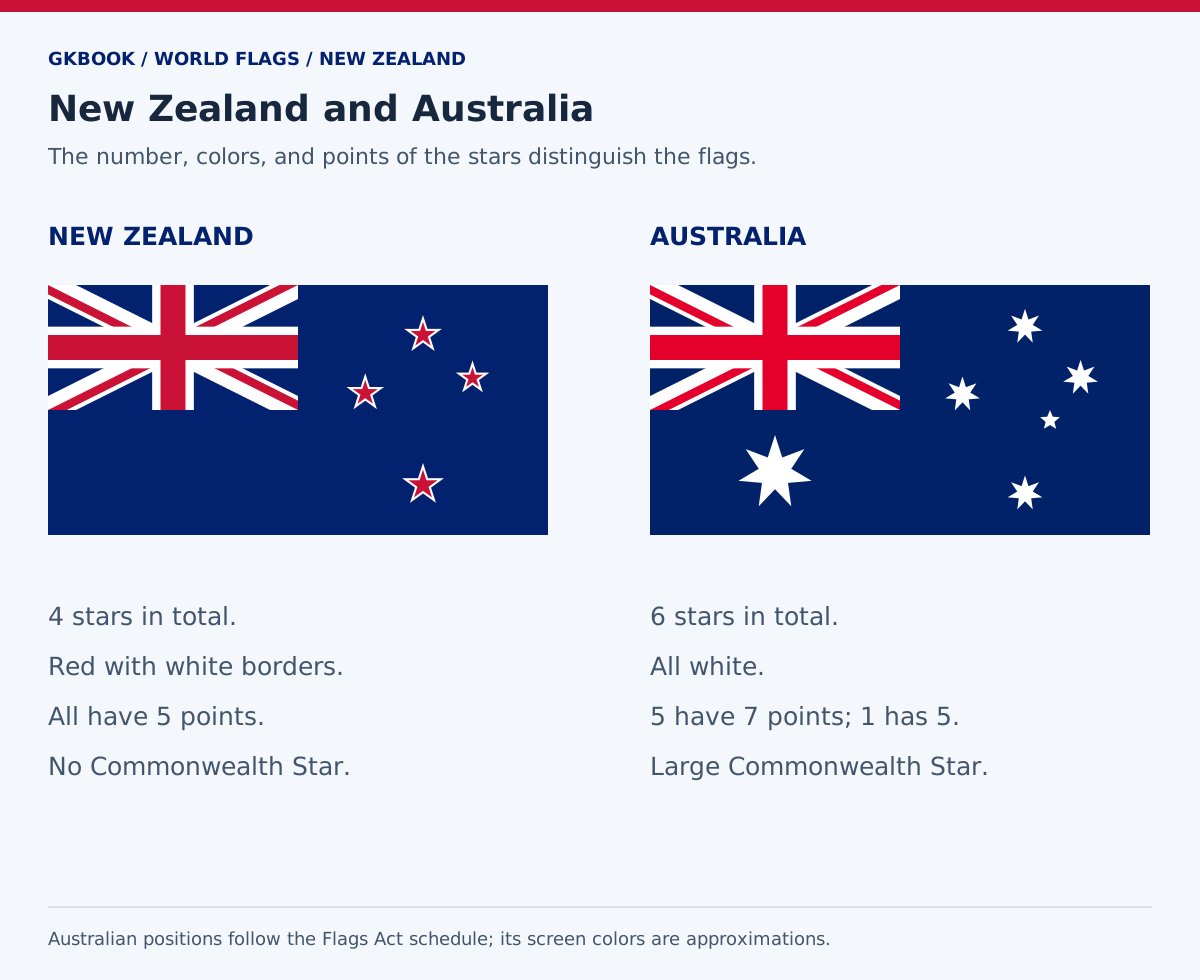
On Australia’s flag, the Commonwealth Star and four principal Southern Cross stars have seven points; the smaller fifth Southern Cross star has five. New Zealand’s four stars all have five points.
Both national flags use a 1:2 rectangle. Their shared proportions and canton explain the resemblance, but they do not eliminate the differences. The comparison preserves each country’s star arrangement rather than changing only the colors of one drawing.
| Feature | New Zealand | Australia |
|---|---|---|
| Total stars | 4 | 6 |
| Southern Cross stars | 4 | 5 |
| Star color | Red with white borders | White |
| Points on main stars | 5 | 7 |
| Large star below the Union Jack | None | Commonwealth Star |
| Height:length | 1:2 | 1:2 |
Did New Zealand’s flag design come before Australia’s?
New Zealand’s Southern Cross government ensign dates to 1869, before the design selected for Australia’s national flag in 1901. However, New Zealand’s formal national recognition followed in 1902. Comparing the flags therefore requires distinguishing the origin of a design from its later legal recognition and from subsequent changes to particular details.
Australia’s first national flag was flown on September 3, 1901. The Australian design itself subsequently changed, including the addition of a seventh point to the Commonwealth Star in 1908.
The chronology alone does not establish that one country simply copied the other’s completed flag. Both developed within an ensign tradition that already used the Union Jack and colonial identifying devices.
Is the Tino Rangatiratanga flag the same as the New Zealand flag?
No. The Tino Rangatiratanga flag is a distinct design recognized by Cabinet in December 2009 as the preferred national Māori flag. It complements the New Zealand flag rather than replacing the statutory national design. Its black, white, and red composition includes a koru, unlike the Union Jack and stars of the blue ensign.
Developed by members of Te Kawariki in 1989 and unveiled at Waitangi in 1990, it can be flown alongside the New Zealand flag on occasions such as Waitangi Day. Recognition as the preferred national Māori flag should not be confused with becoming the statutory national flag.
What is the New Zealand Red Ensign?
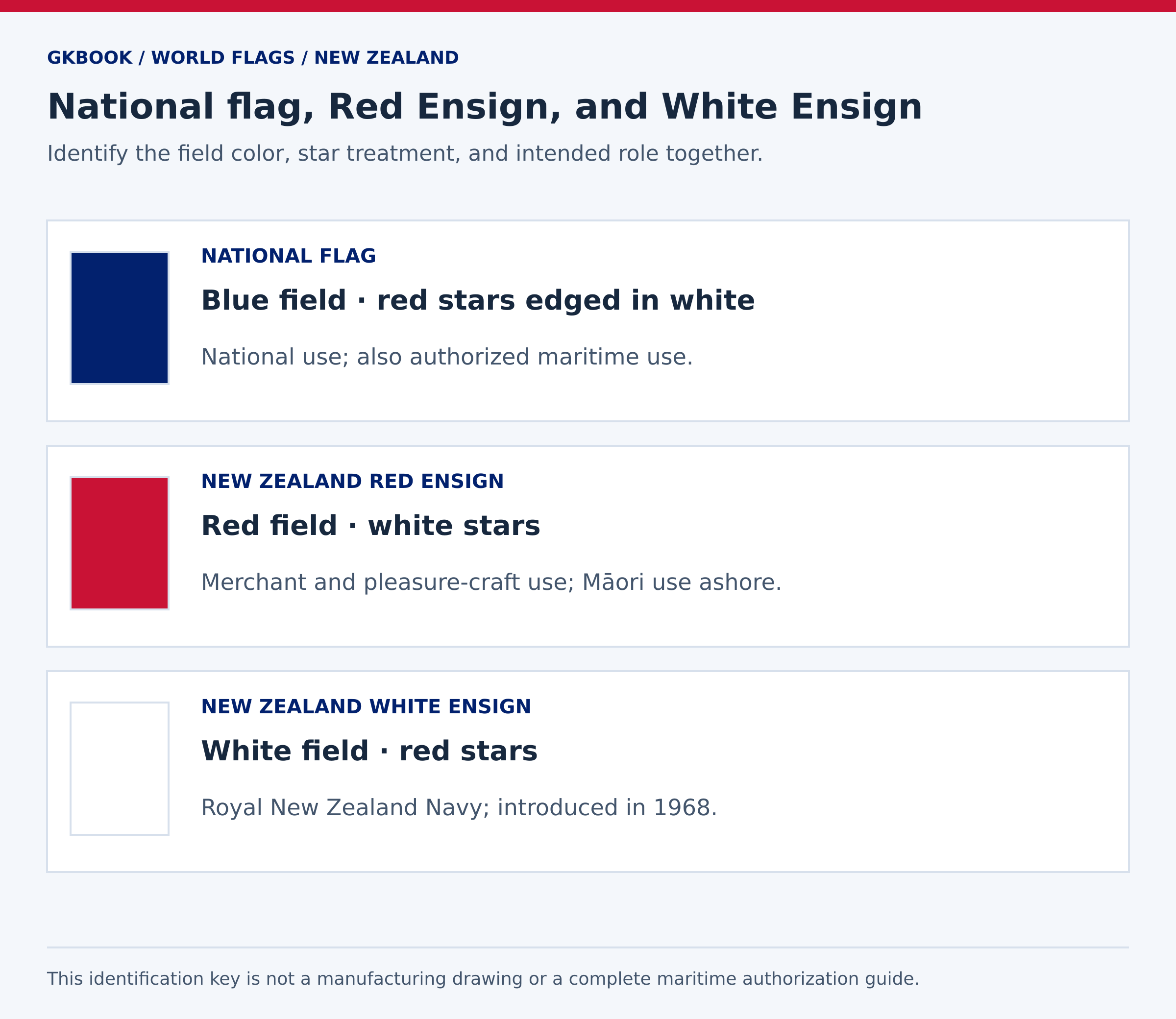
The New Zealand Red Ensign is a red flag with the Union Jack in the canton and four white Southern Cross stars. It is a separate ensign, not the ordinary blue national flag. Besides its maritime use, New Zealand law preserves its traditional display on land on occasions or at places of Māori significance.
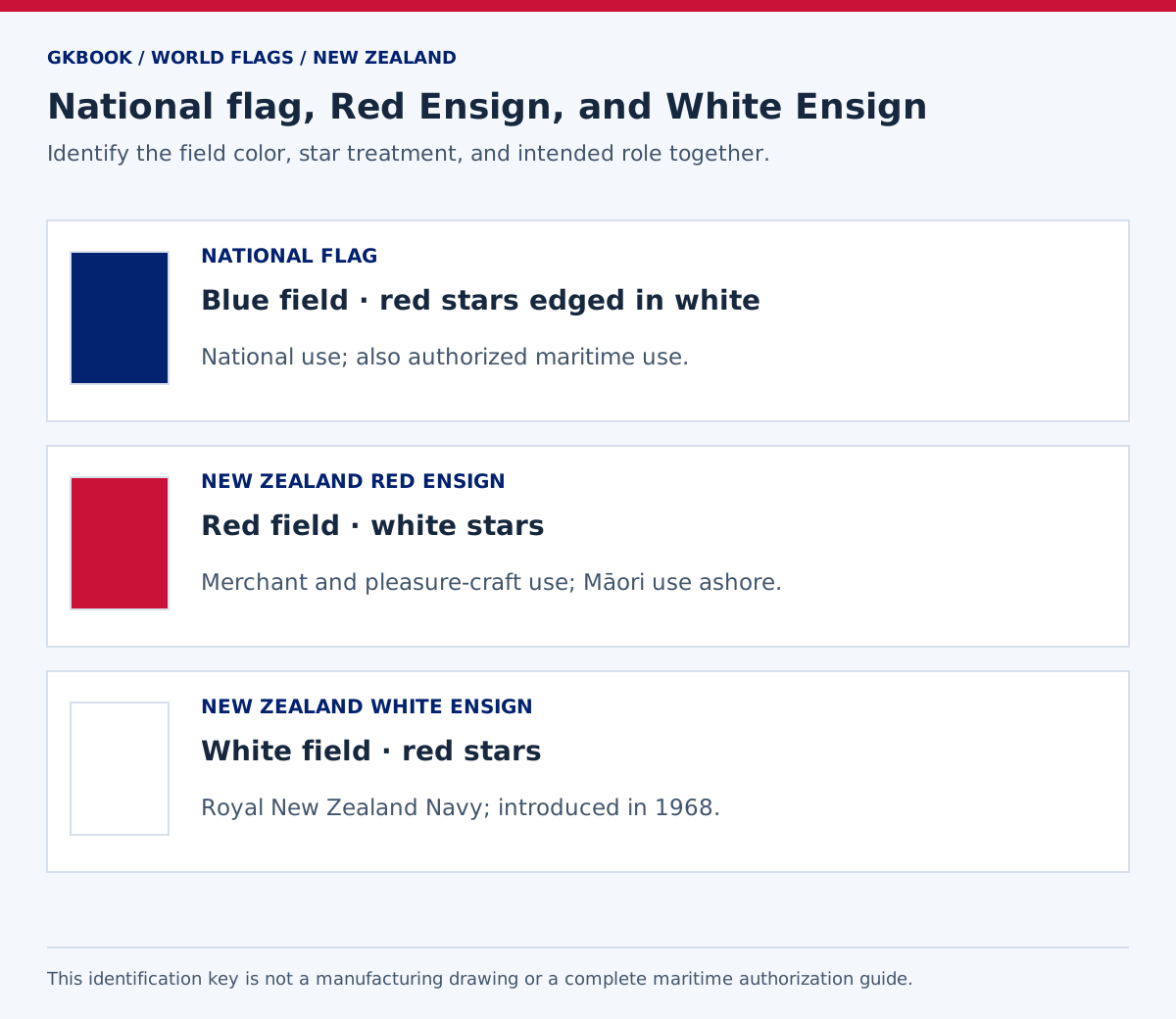
Current ministry guidance says non-government New Zealand ships may use the national flag, the Red Ensign, or another appropriately authorized flag. The Act provides for the national flag on government-owned ships alongside separate provisions for service ensigns. A shorthand description such as “merchant flag” should not be turned into an exclusive rule for every vessel.
The comparison diagram is for identification: red field and white stars distinguish the Red Ensign from the national flag’s blue field and bordered red stars.
What is the New Zealand White Ensign?
The New Zealand White Ensign has a white field, a Union Jack canton, and four red Southern Cross stars. It is the naval ensign used by the Royal New Zealand Navy and its commissioned shore establishments. Introduced in 1968, it is distinct from both the national blue flag and the British White Ensign.
The Navy Museum records royal approval on June 20, 1968, following the preparation of a distinctive New Zealand design. Earlier New Zealand naval service had used the British White Ensign.
Its white background is part of the ensign, not an empty or transparent area around a blue national flag. Likewise, changing the background of a national-flag illustration should never be treated as a purely decorative edit.
What other official flags are used in New Zealand?
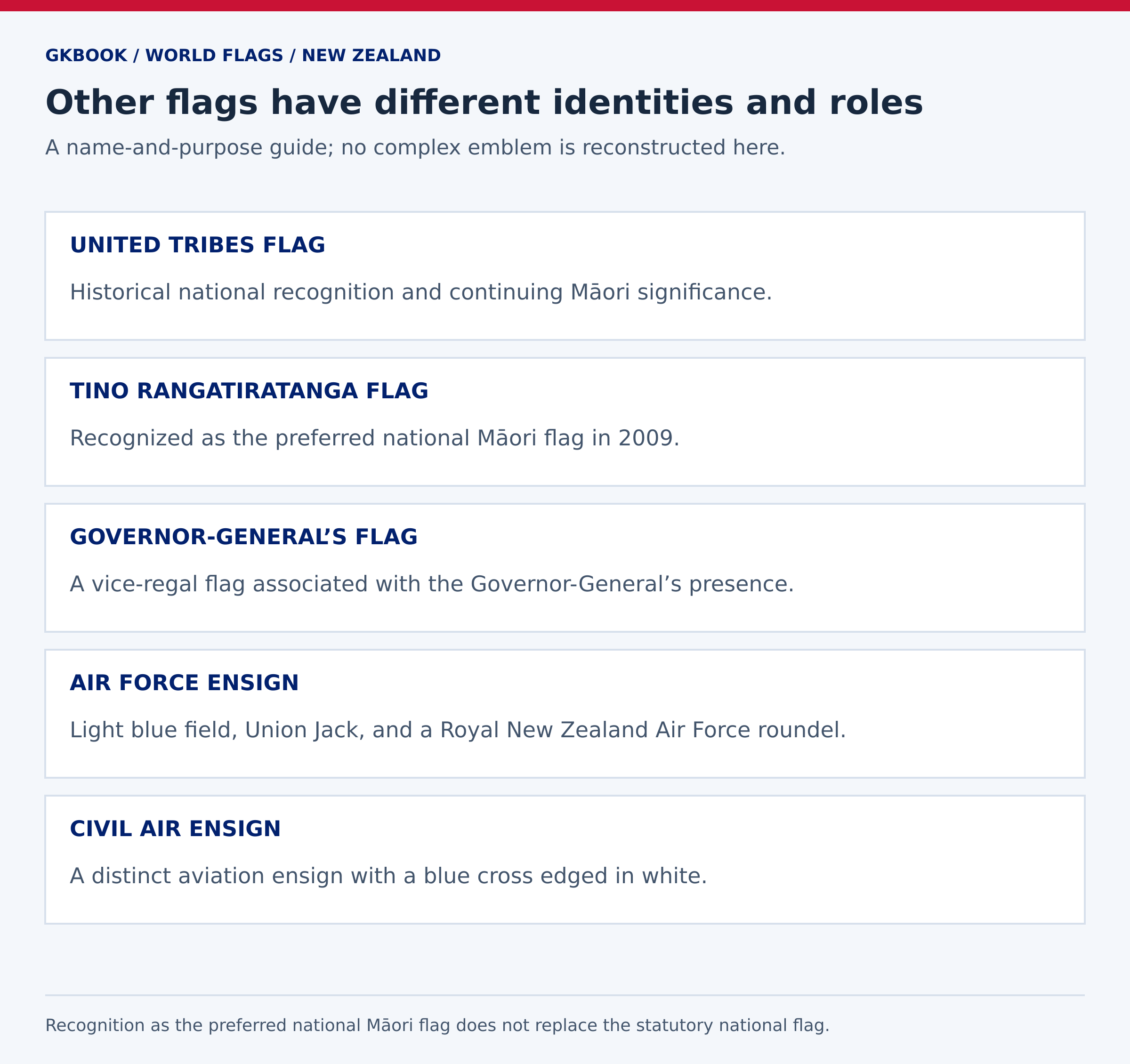
New Zealand uses several flags for particular offices or services, including the Governor-General’s flag, the Royal New Zealand Air Force Ensign, and the Civil Air Ensign. These have different designs and purposes from the national flag. The Governor-General’s flag takes precedence when flown to mark the Governor-General’s presence.
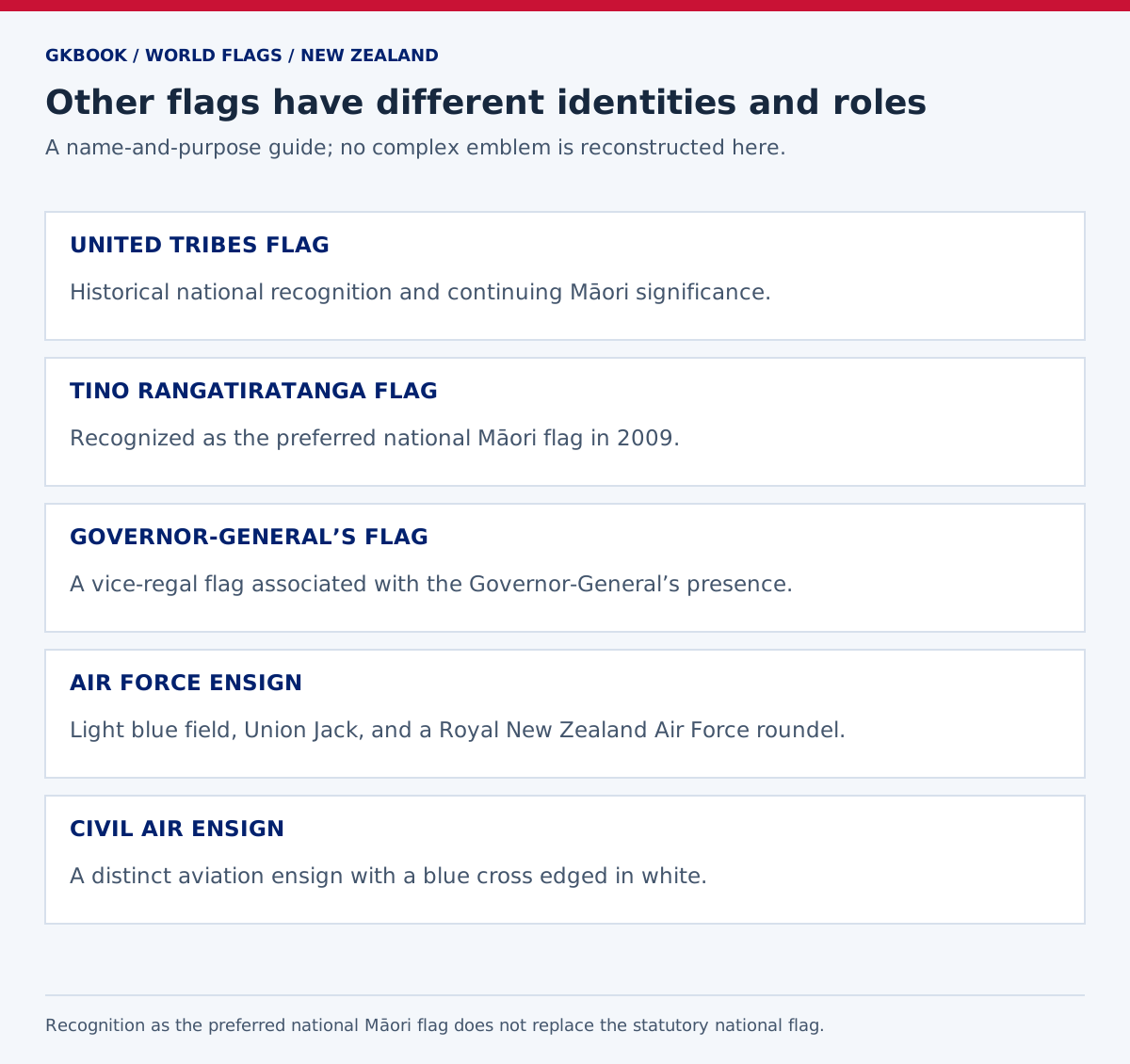
The air force ensign has a light blue field, a Union Jack, and the air force roundel. The Civil Air Ensign uses a light blue field divided by a dark blue cross edged in white, with the Union Jack and Southern Cross in designated quarters.
A service flag or personal-office flag should be identified by its role. Neither its official use nor the presence of a Union Jack makes it the national flag to use for a general country illustration.
On which days is the New Zealand flag especially flown?
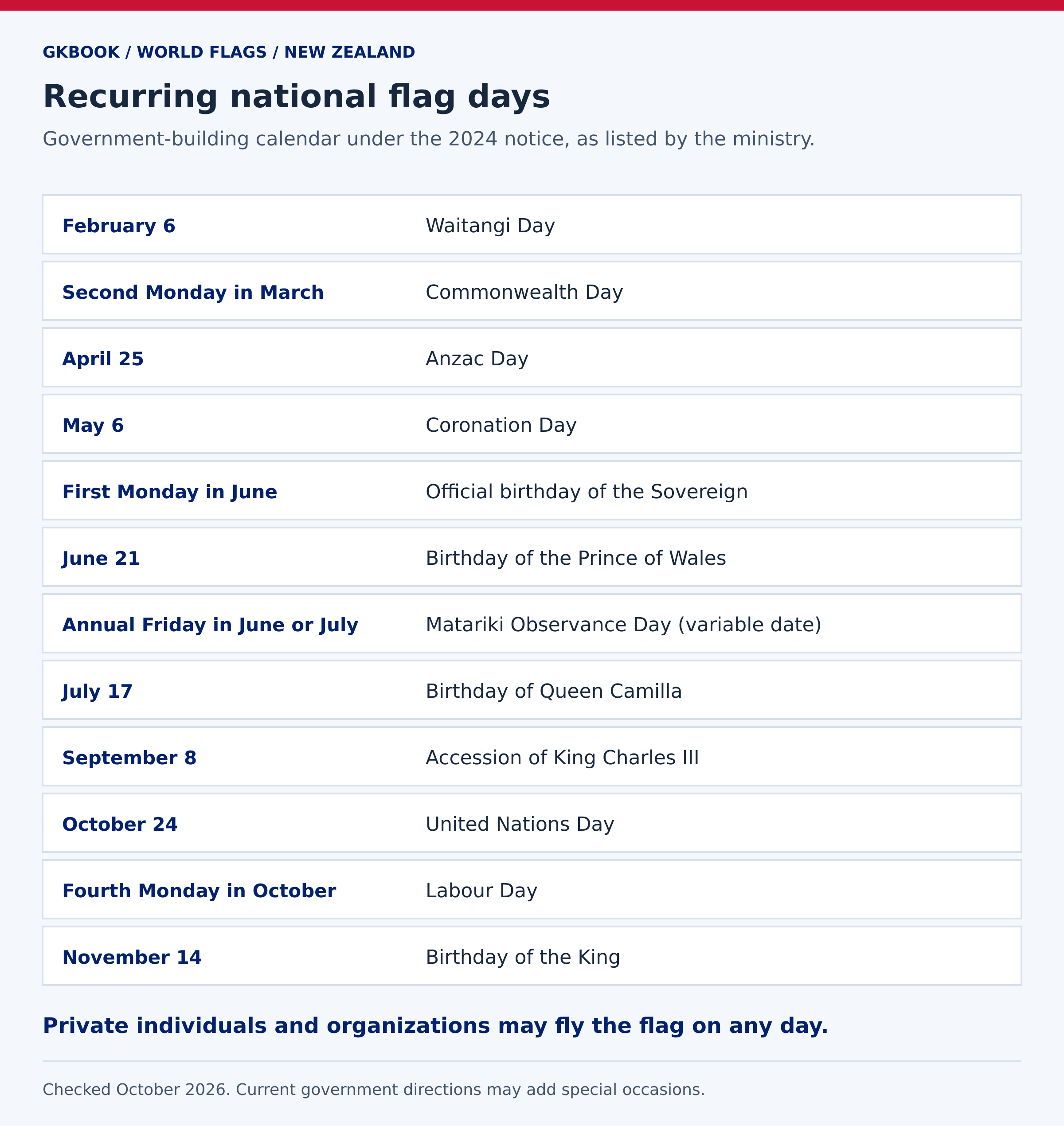
The ministry’s current calendar encourages display on designated commemorative days, including Waitangi Day, Anzac Day, Matariki, and royal anniversaries. Government flag arrangements are governed by the New Zealand Flag Notice 2024 and relevant directions. Private people and organizations may fly the national flag on any day and are not required to follow government display directives.
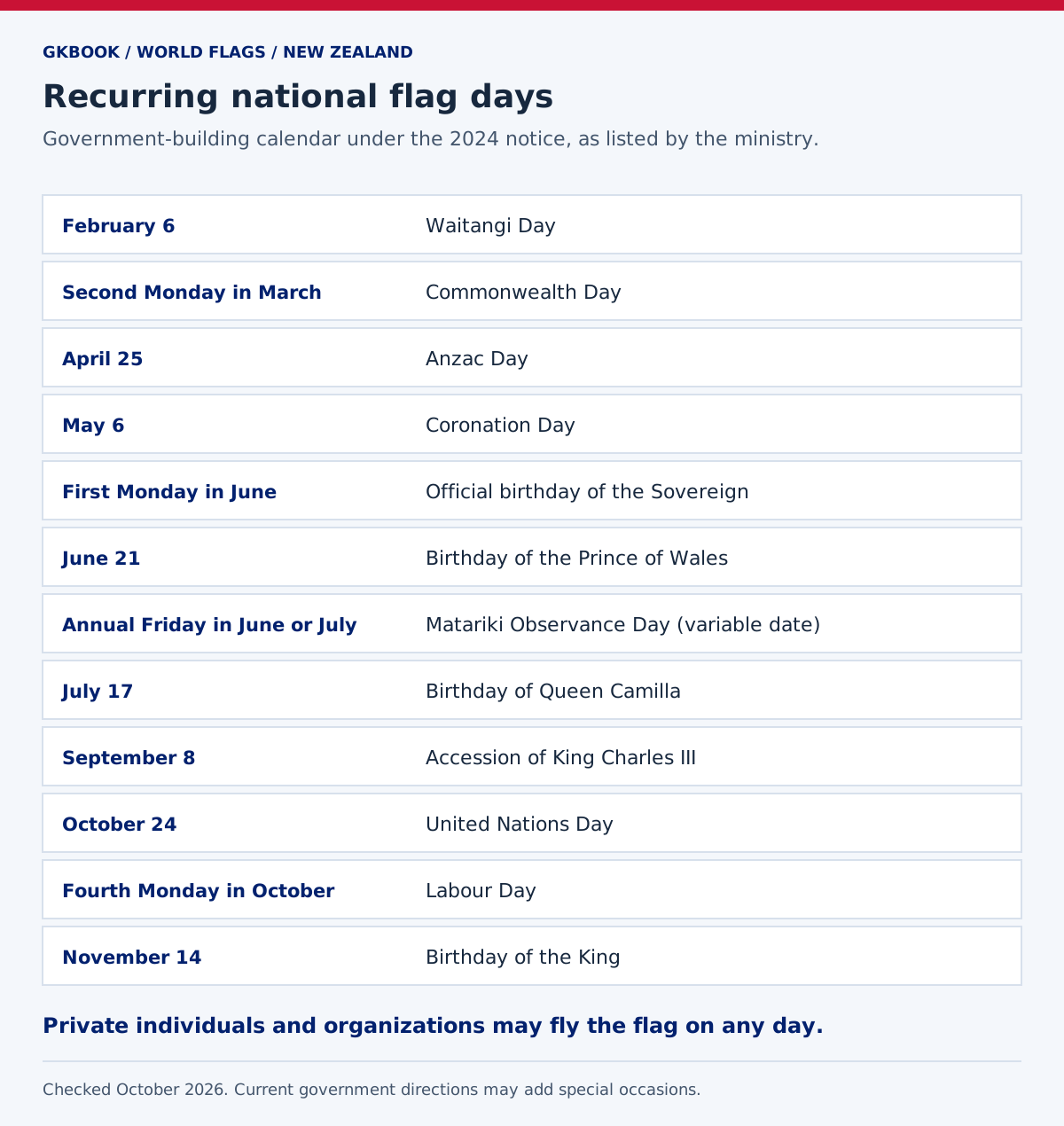
The list below follows the ministry’s published calendar checked in October 2026. Matariki has a different legislated observance date each year; it should not be assigned a permanent date such as June 24.
Other official occasions include royal and state visits in the places visited, and certain parliamentary or vice-regal ceremonies in Wellington. A special direction may affect the position or timing of a flag on an otherwise ordinary display day.
| Date | Occasion |
|---|---|
| February 6 | Waitangi Day |
| Second Monday in March | Commonwealth Day |
| April 25 | Anzac Day |
| May 6 | Coronation Day |
| First Monday in June | Official birthday of the Sovereign |
| June 21 | Birthday of the Prince of Wales |
| Annual Friday in June or July | Matariki Observance Day; use that year’s official date |
| July 17 | Birthday of Queen Camilla |
| September 8 | Accession of King Charles III |
| October 24 | United Nations Day |
| Fourth Monday in October | Labour Day |
| November 14 | Birthday of the King |
Is New Zealand’s flag flown at half-mast all day on Anzac Day?
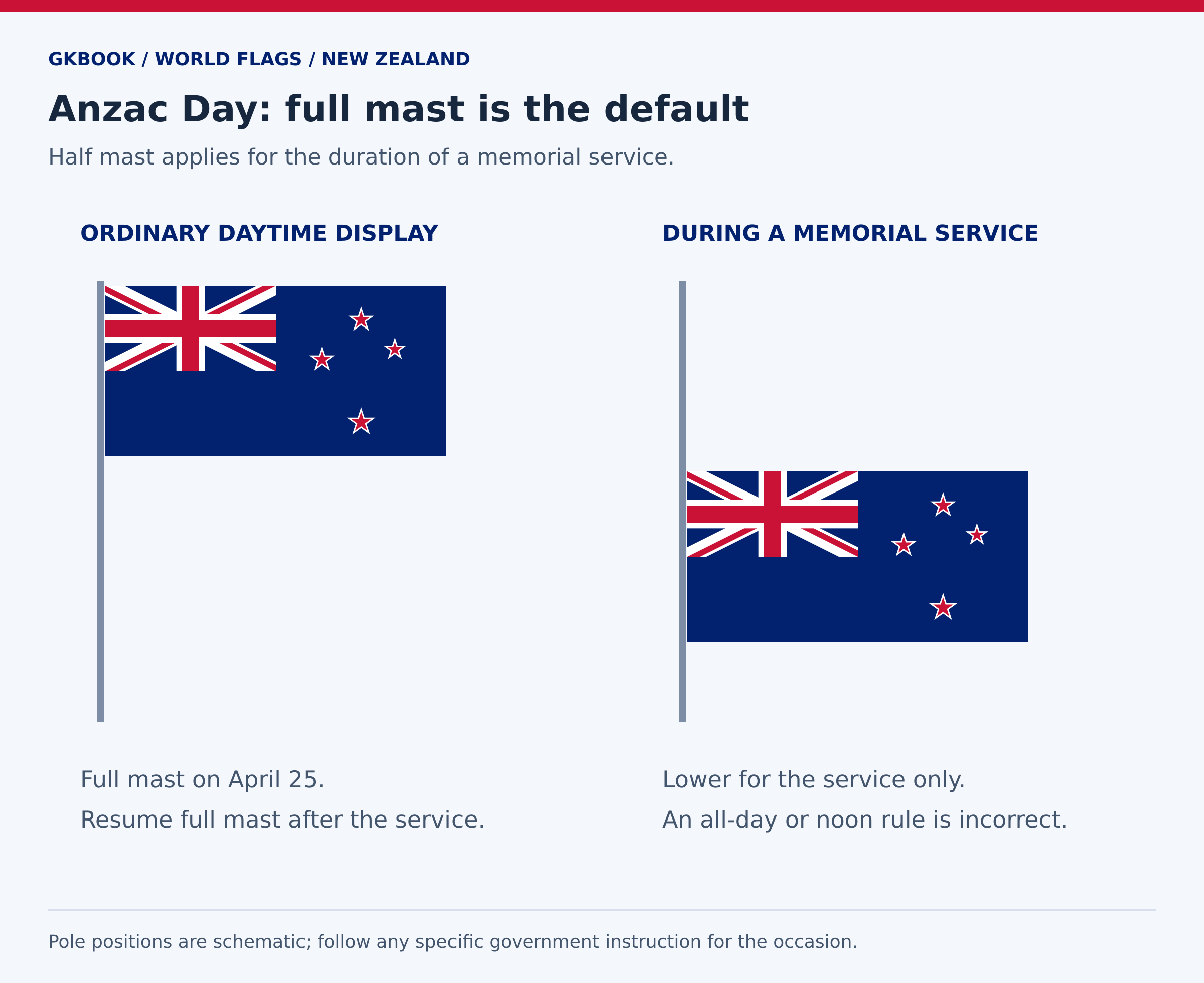
The ministry’s Anzac Day guidance calls for the New Zealand flag to be flown at full mast. At a place where a commemorative service is held, it may be lowered to half-mast for the duration of that service. This is not a general instruction to keep every New Zealand flag at half-mast all day.
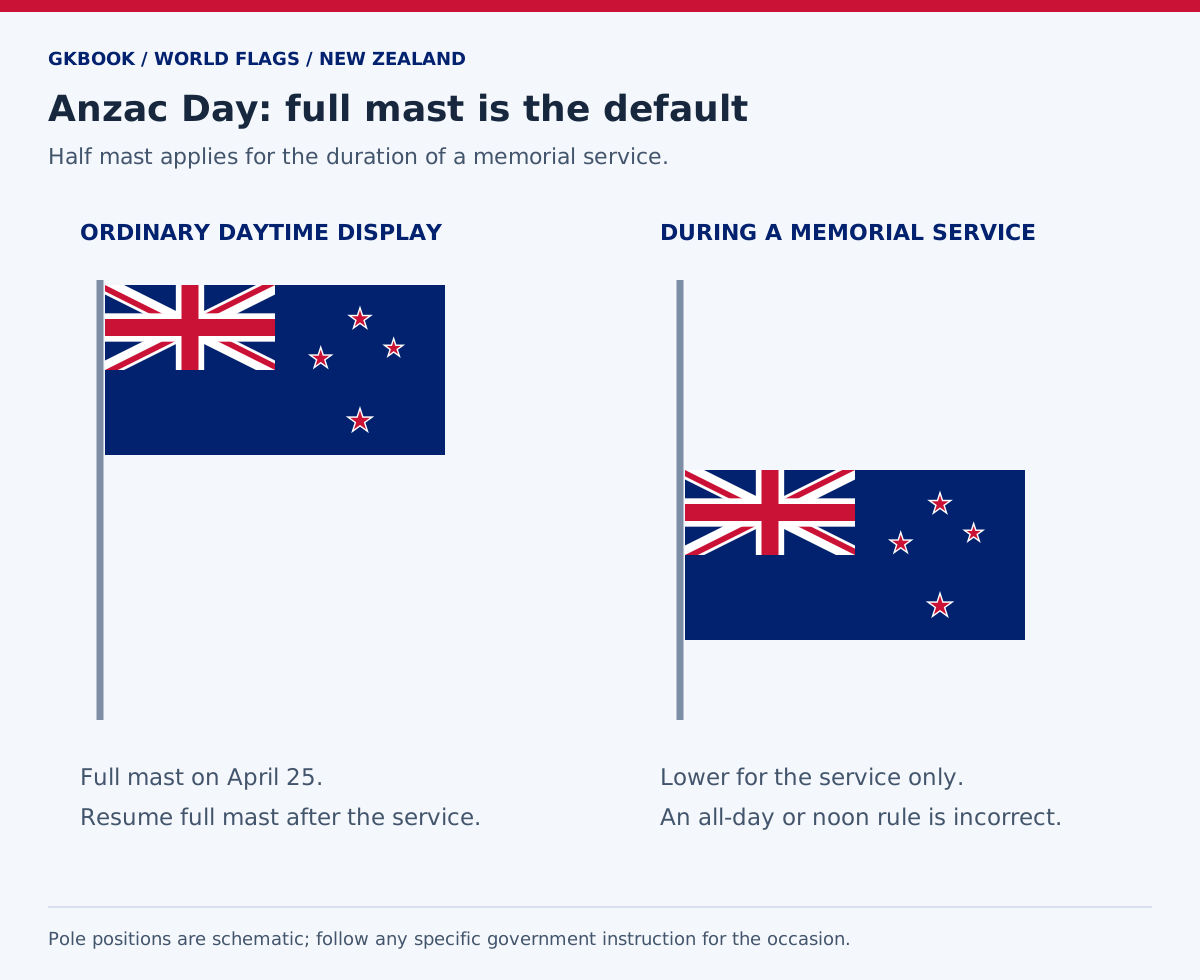
The commemorative date is April 25. The distinction is between the ordinary full-mast display and the temporary position used during a memorial service.
Apply the New Zealand instruction to a New Zealand display. An assumption drawn from another country’s flag customs can produce a wrong answer even when both countries observe Anzac Day.
How is the New Zealand flag flown at half-mast?
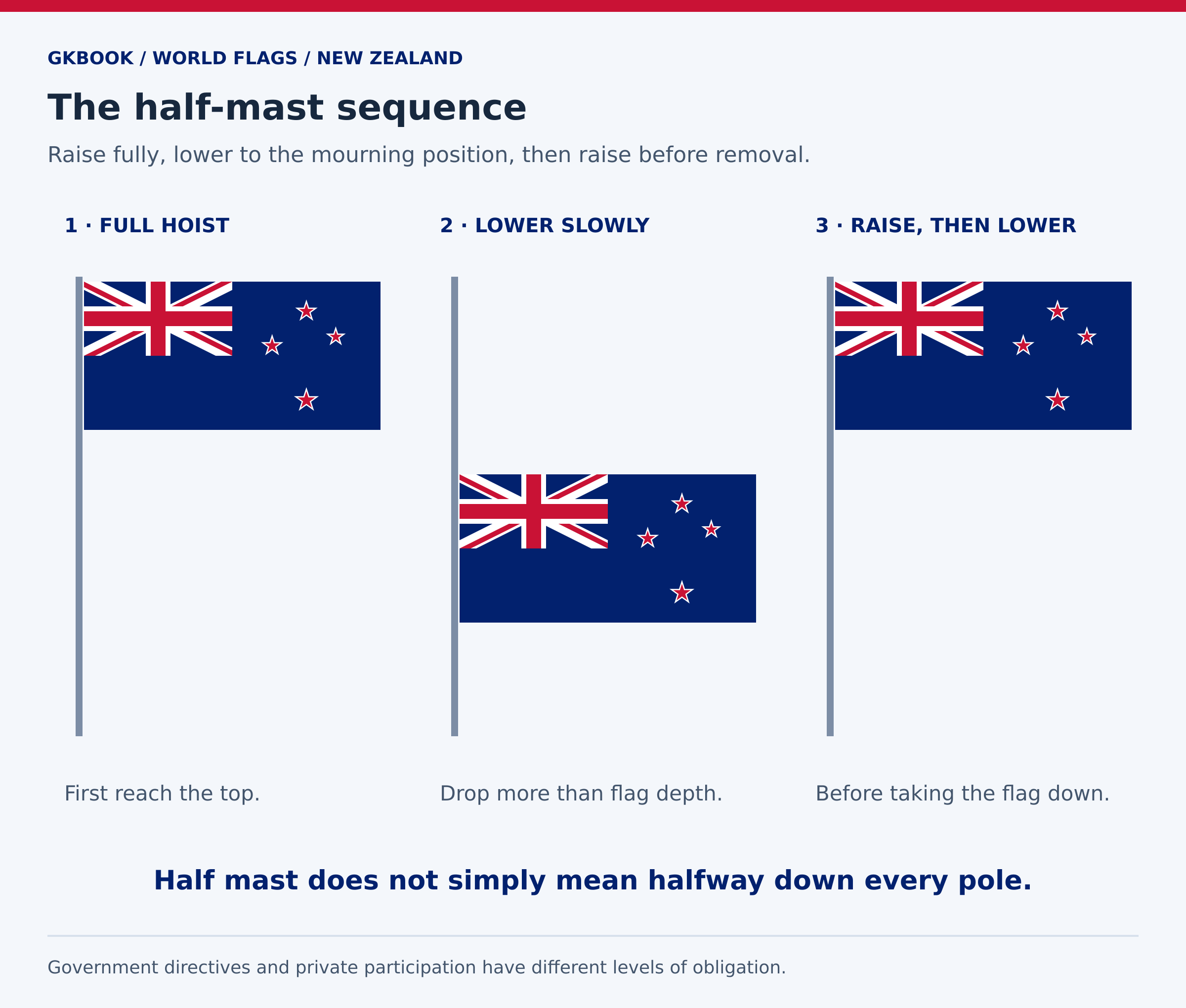
Raise the flag to the top of the pole before lowering it slowly to the half-mast position. Before taking it down, raise it fully again. Ministry guidance requires a clearly lowered position appropriate to the flag and pole, rather than assuming that the top edge must always sit exactly halfway down the mast.
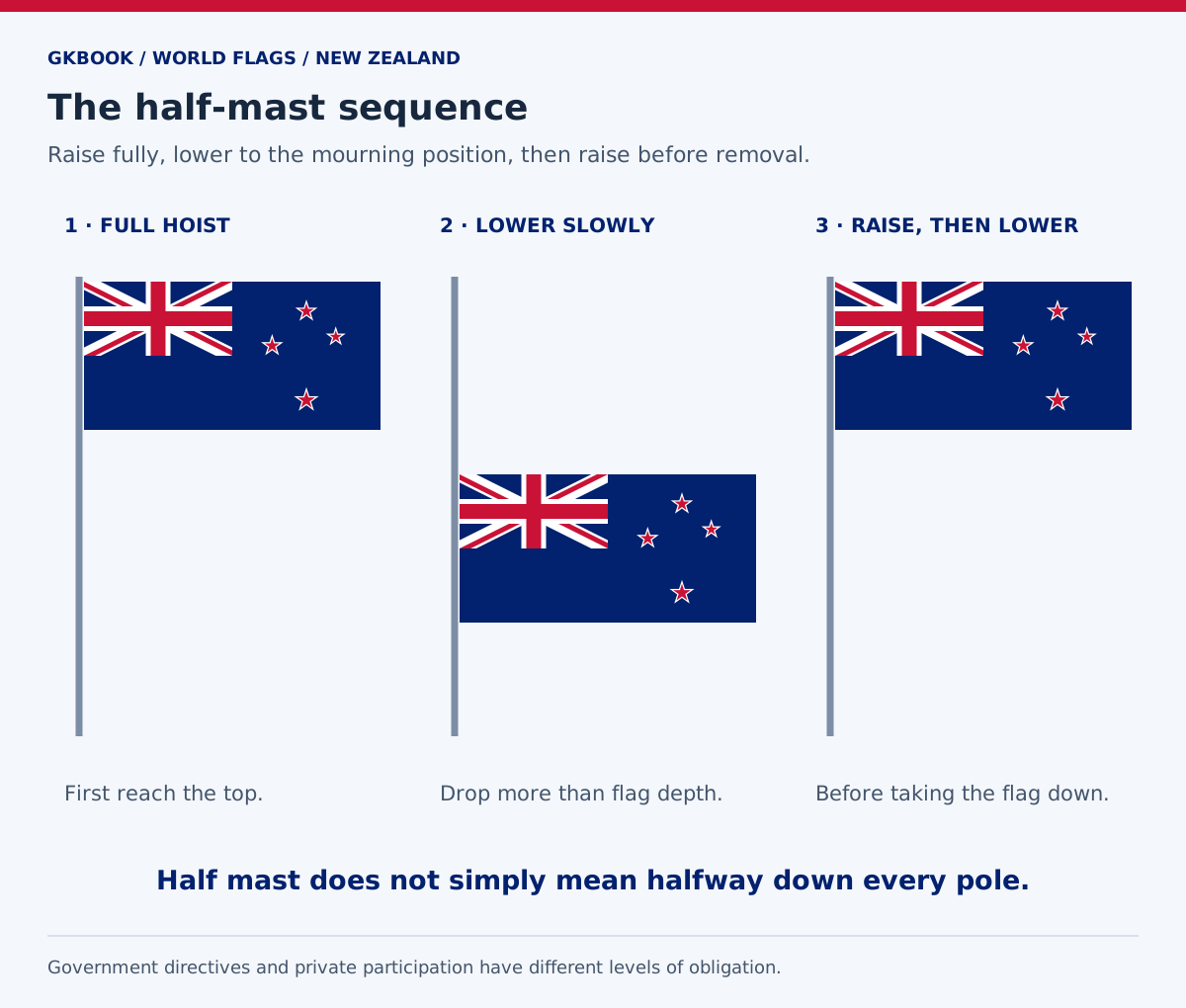
There should be more than the flag’s own depth between the pole top and the flag’s top edge. The diagram illustrates this clearance, not a universal pole-to-flag size formula.
Government buildings follow official half-masting directions. Where only a local authority or organization’s own flag is lowered for a local death, the ministry’s etiquette guidance keeps the New Zealand flag separately at full mast.
How should the New Zealand flag hang against a wall?
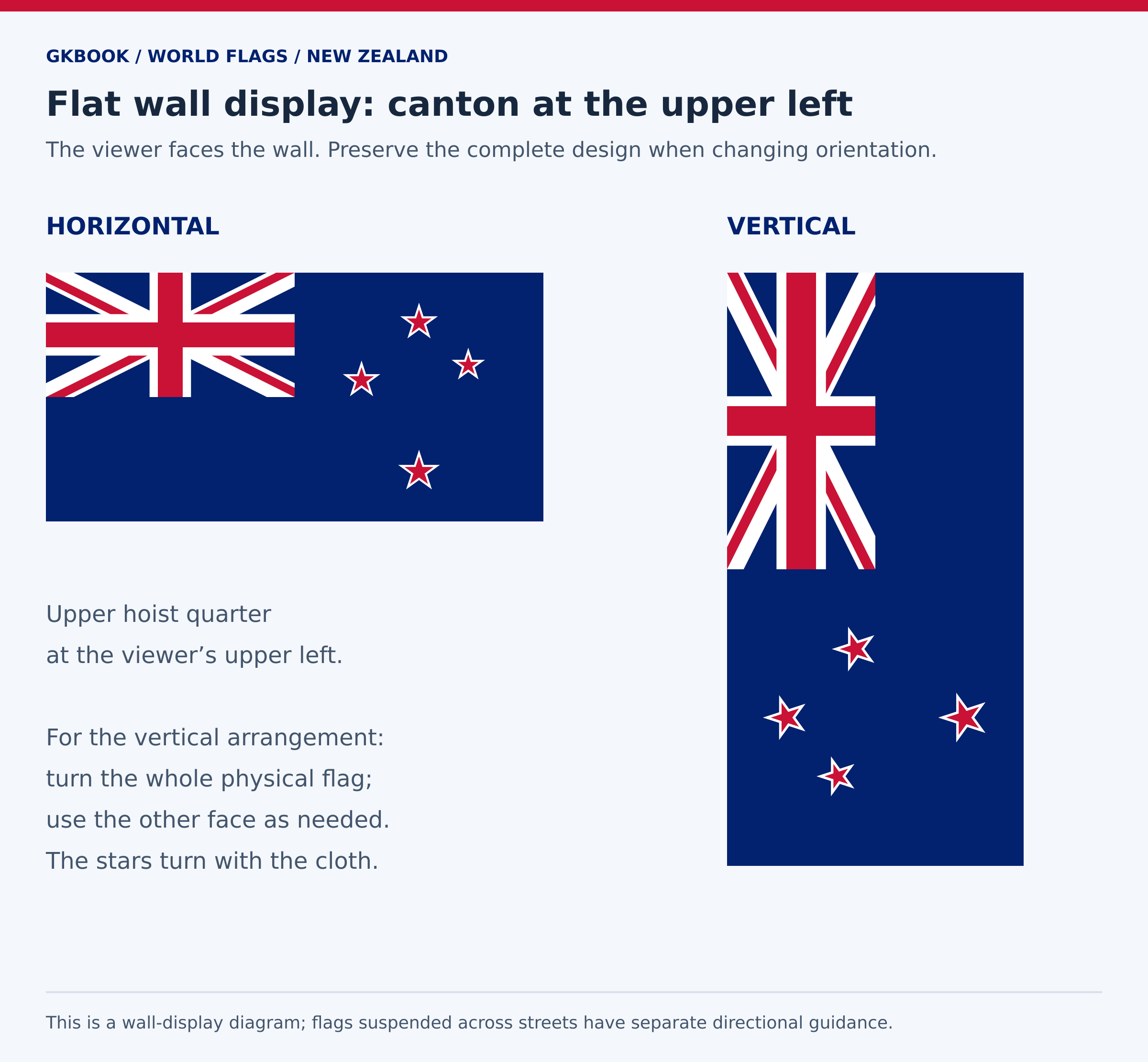
When the New Zealand flag is displayed flat against a wall, surface, or window, the Union Jack should be in the upper left as viewed by the observer. This applies to horizontal and vertical display. A vertical hanging must preserve the flag’s complete design while placing the canton in that position.
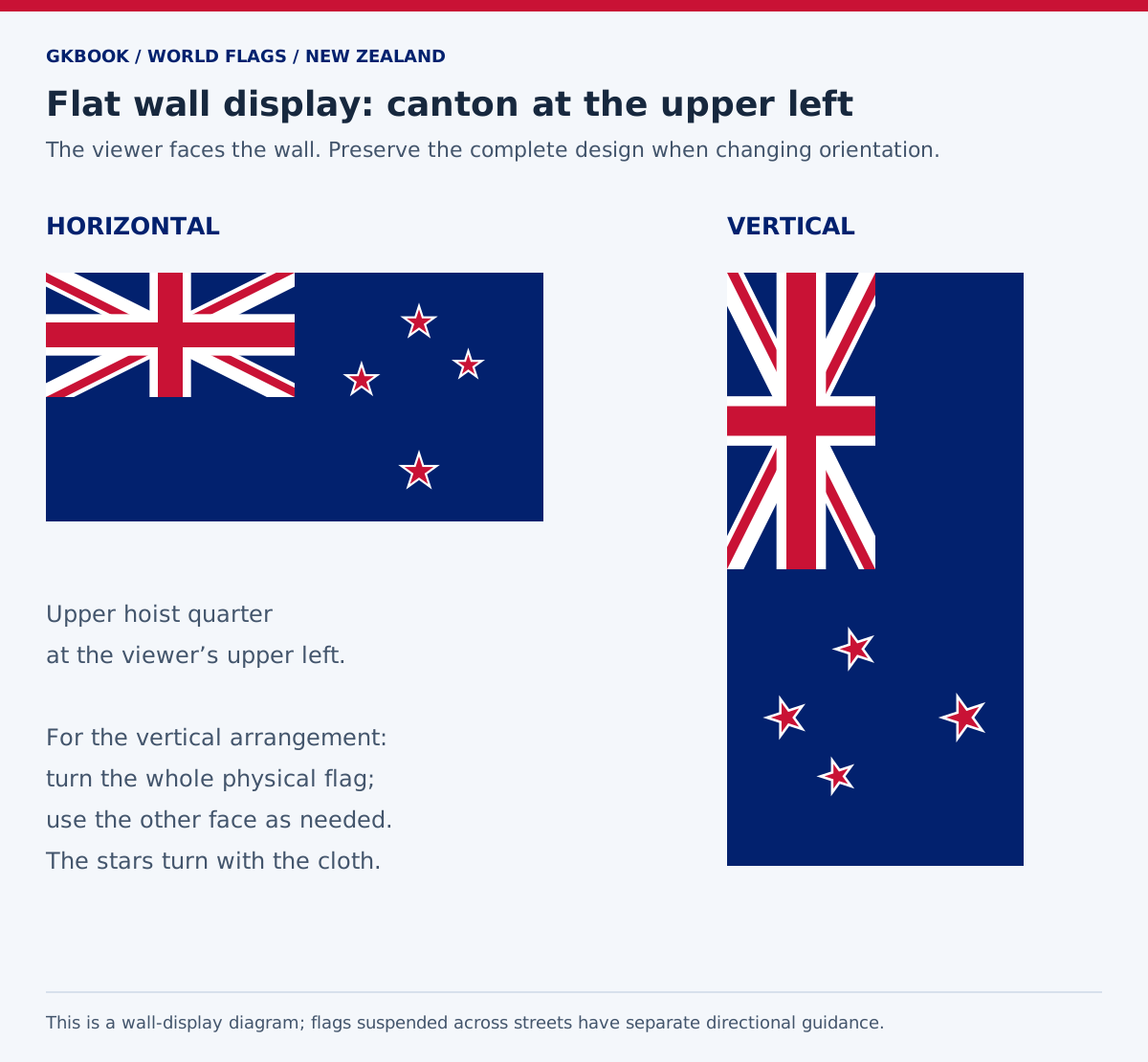
Simply rotating the usual front-view picture clockwise puts the canton at the upper right. The illustrated vertical display therefore uses the other face and an appropriate rotation, preserving the entire flag rather than moving individual emblems.
The stars rotate with the cloth in a vertical hanging. Do not redraw them upright independently or reposition the Southern Cross to make a new portrait-format flag.
Does the reverse of New Zealand’s flag have a different design?
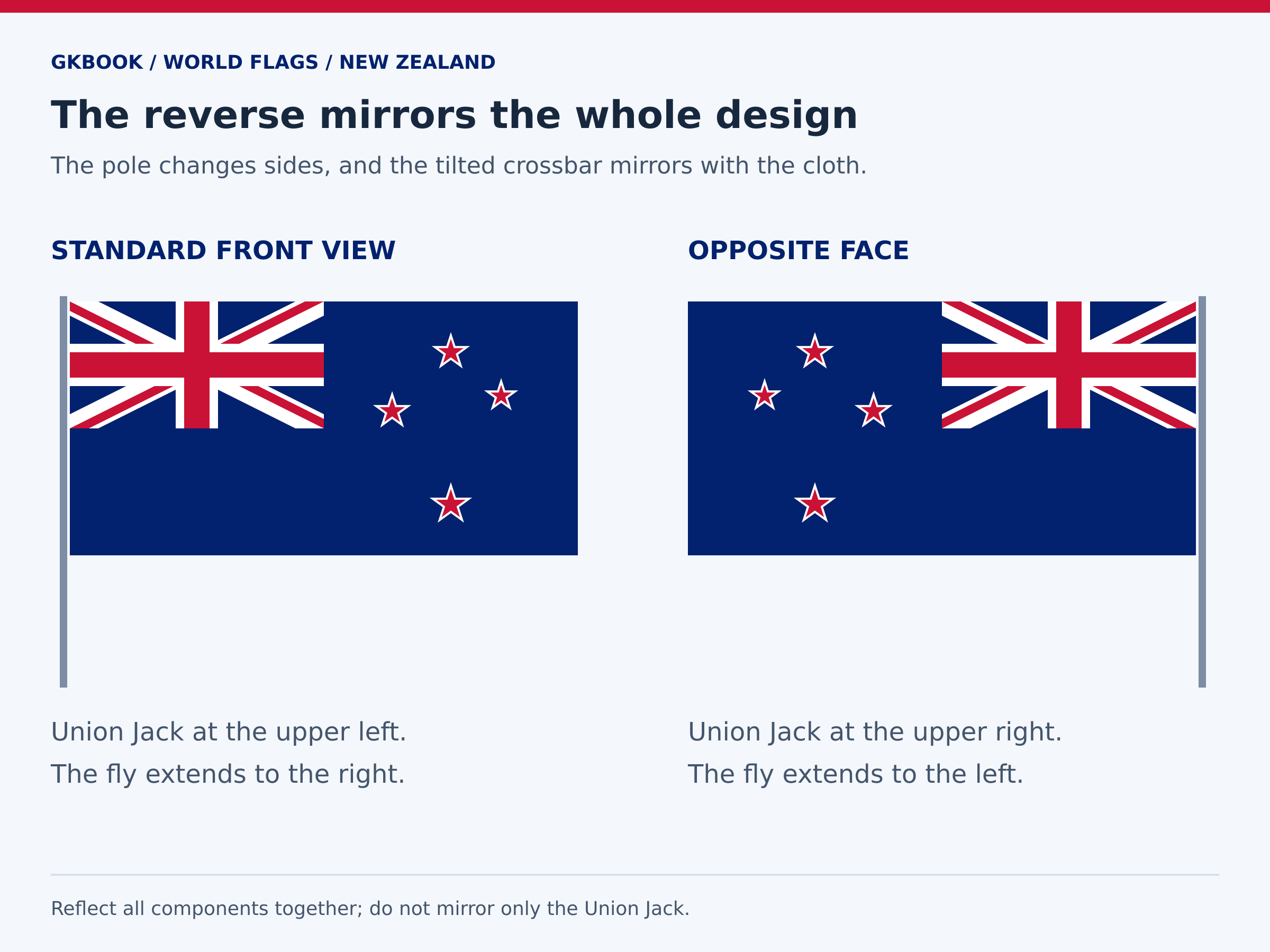
The reverse shows the same design seen from the opposite side, so it is a mirror image of the standard front view. The Union Jack appears at the upper right when the pole is on the viewer’s right. The Southern Cross arrangement also mirrors; it is not independently repositioned to imitate the front.
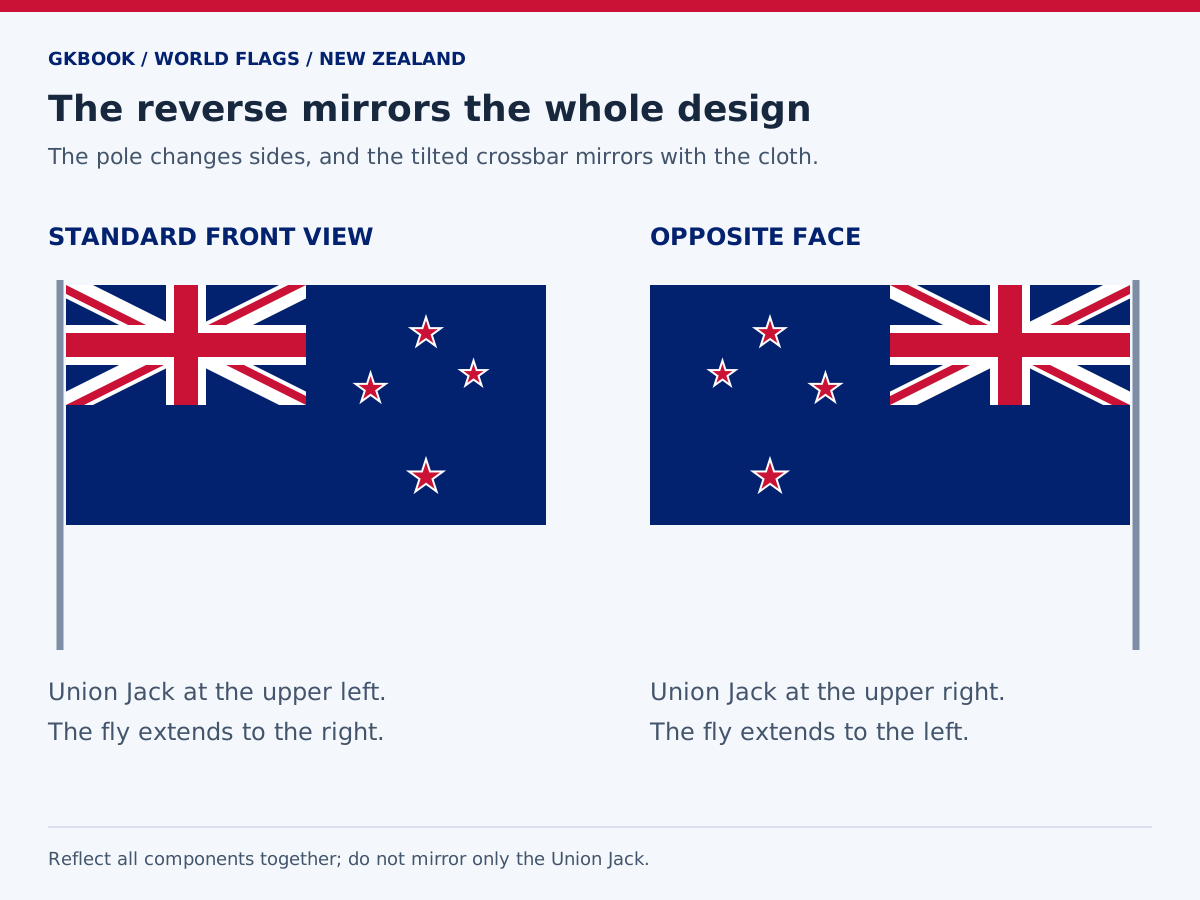
This matters because the four stars are not arranged symmetrically across a horizontal line. A genuine reverse changes the apparent direction of the tilted short arm as well as the side occupied by the canton.
For a normal front-view reference image, show the pole side at the left and the Union Jack above it. For a view of the other face, reflect the complete artwork rather than modifying only one component.
Where does New Zealand’s flag stand beside other national flags?
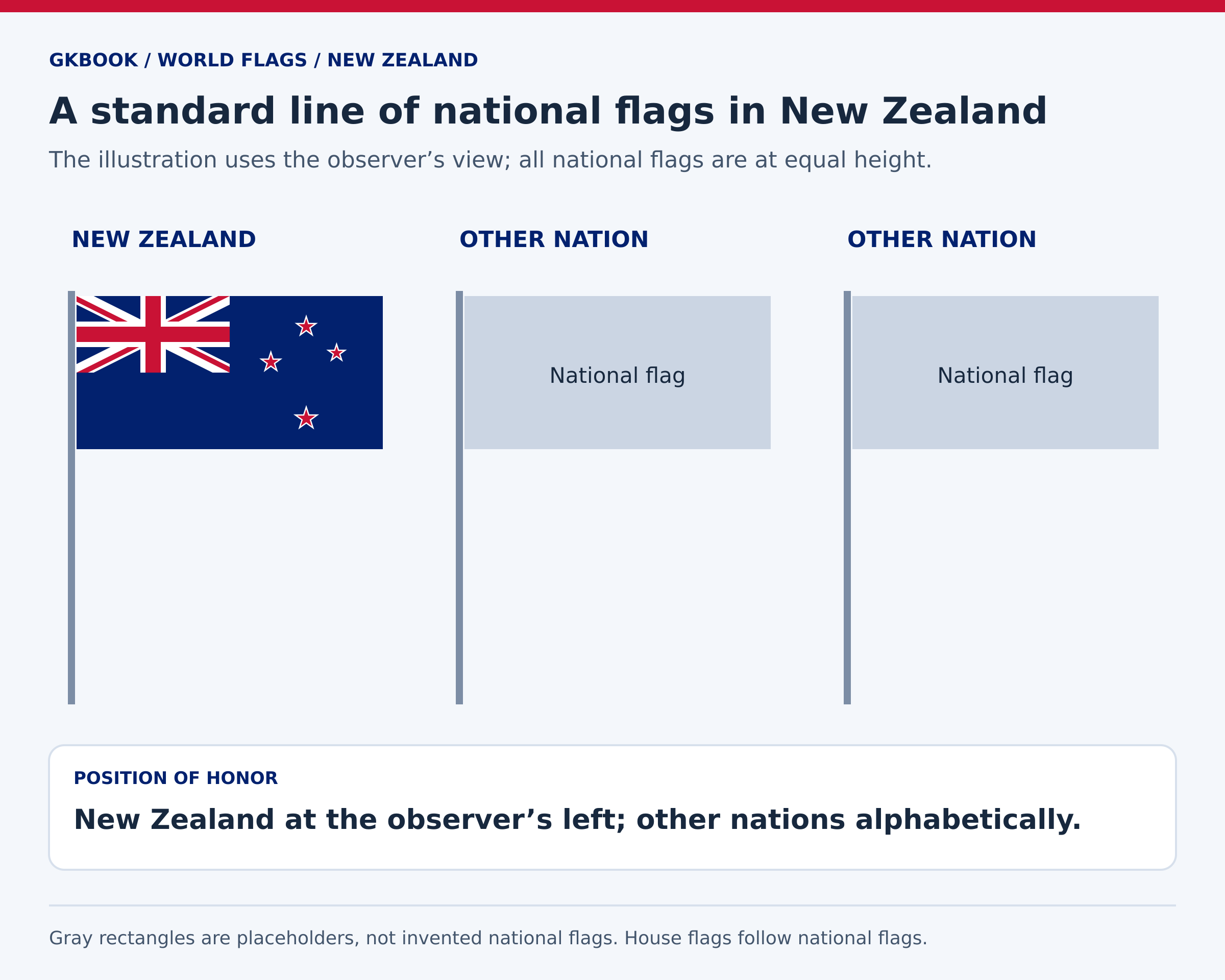
In a standard line of flags in New Zealand, the national flag takes the place of honor at the observer’s left, except where royal or vice-regal precedence applies. Other national flags should be the same size and flown on separate poles of equal height. One nation’s flag should not be placed above another in peacetime.
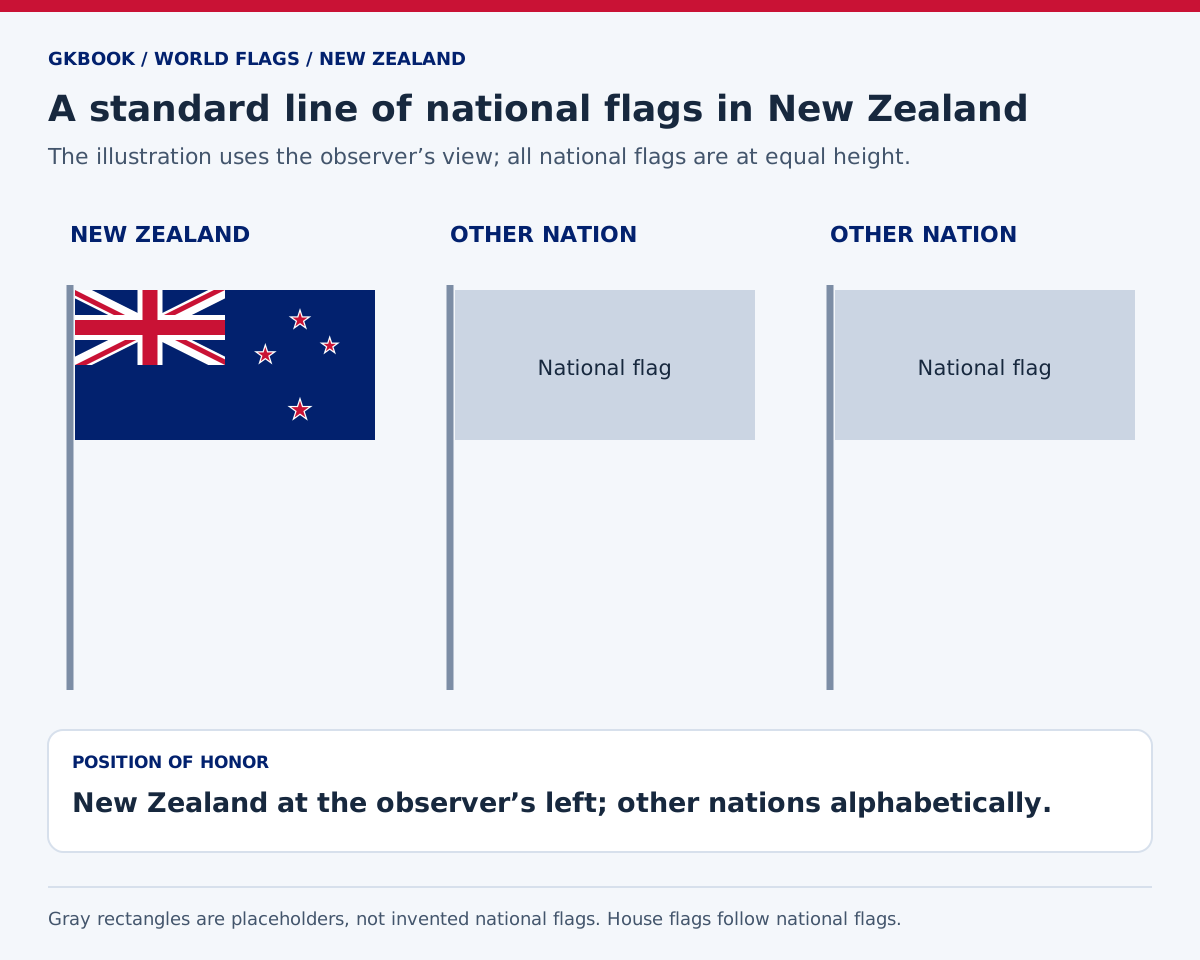
The ministry orders other national flags alphabetically in a standard line, followed by house flags. A semicircle places the New Zealand flag at the center; a closed circle places it opposite the main entrance.
“Left” and “right” must always identify the viewpoint. The diagram uses the audience’s view of a straight line. A procession’s direction of movement or a speaker’s own right side is a different frame of reference.
Can anyone fly the New Zealand flag or use it in advertising?
Individuals and organizations may fly the New Zealand flag on any day. Ministry guidance also permits its use in advertising when its true form and colors are preserved. Government-building display requirements are distinct from private choice. Separate legal provisions govern unauthorized alterations, protected emblems, and certain public acts intended to dishonor the flag.
Keep words and promotional graphics clearly separate from the flag image. A plain, intact flag displayed beside a caption is different from lettering inserted into the flag’s field.
The drawings on this page identify the national symbol and explain its construction. They do not imply government endorsement of a business, publication, or product that displays it.
How should a worn New Zealand flag be treated?
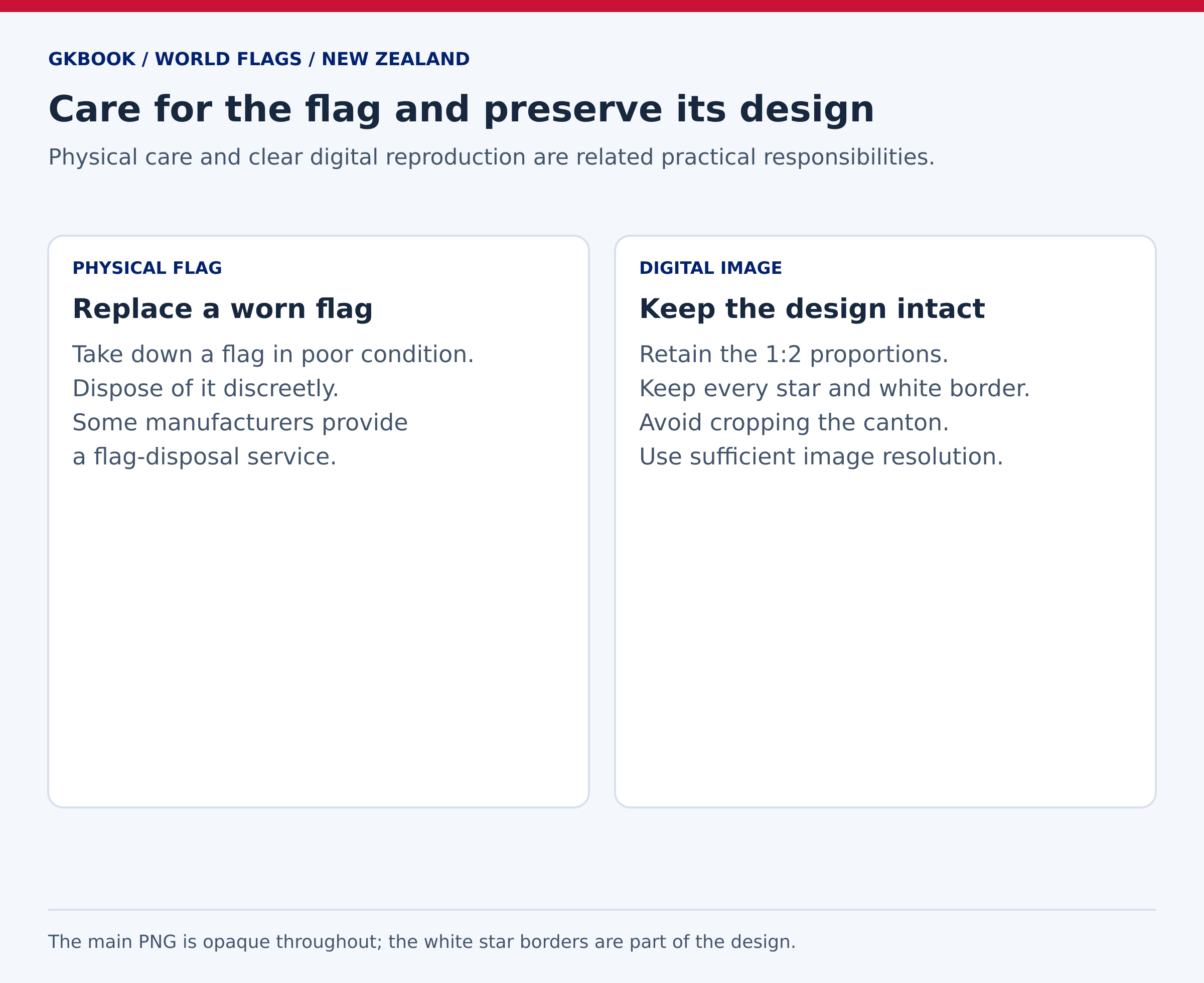
A New Zealand flag in poor condition should be taken down and replaced. Ministry guidance recommends disposing of an old flag discreetly, outside public view, and notes that some flag manufacturers provide disposal facilities. Respectful care concerns the physical flag’s condition; an explanatory illustration should likewise preserve a complete and recognizable design.
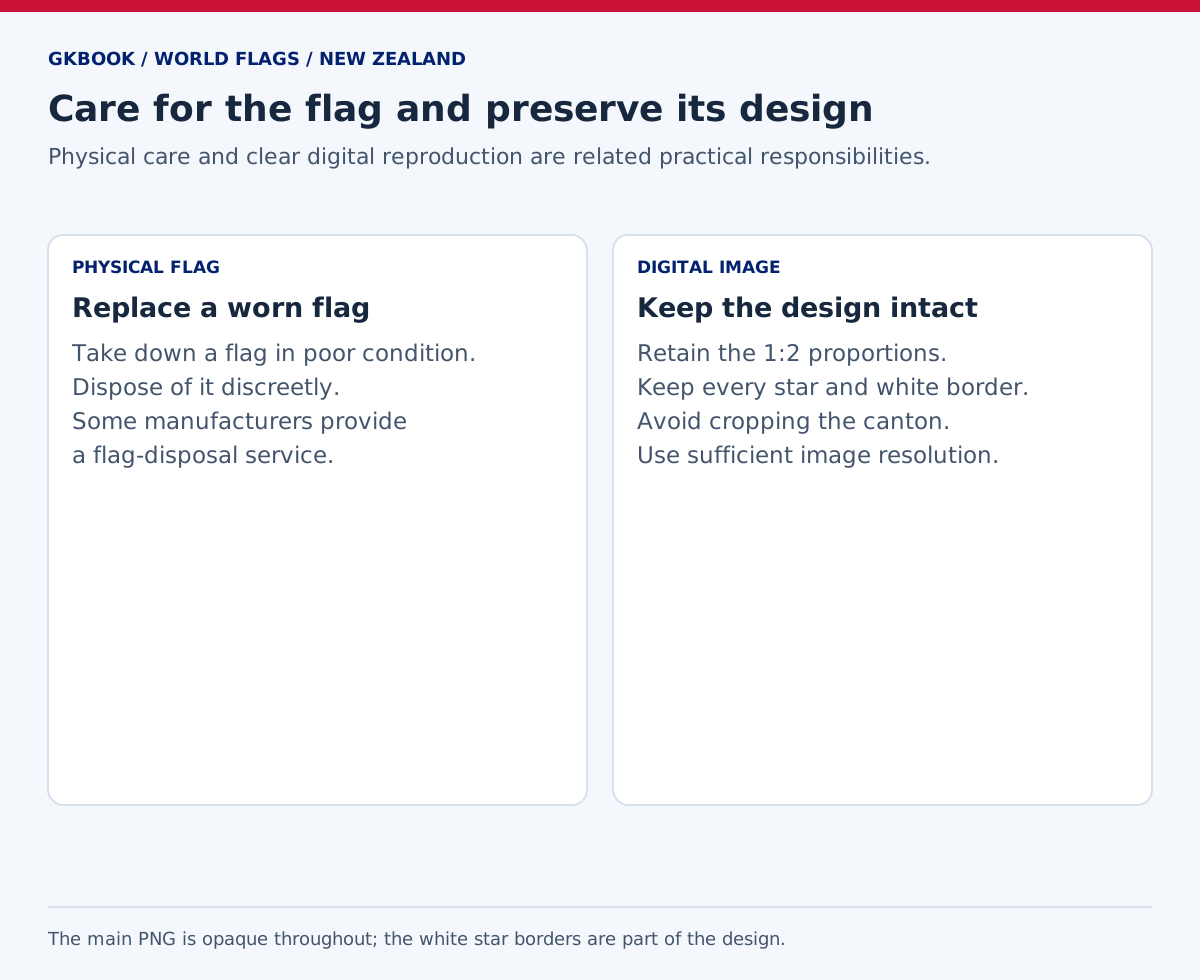
For a damaged physical flag, a manufacturer’s disposal service provides an alternative to leaving it on display. The ministry’s published advice includes discreet incineration, rather than public destruction or dumping.
For digital artwork, the corresponding practical check is clarity: use enough resolution for the star borders to remain visible, keep the 1:2 shape, and avoid cropping away the canton or a star.
How do you draw the New Zealand flag accurately?
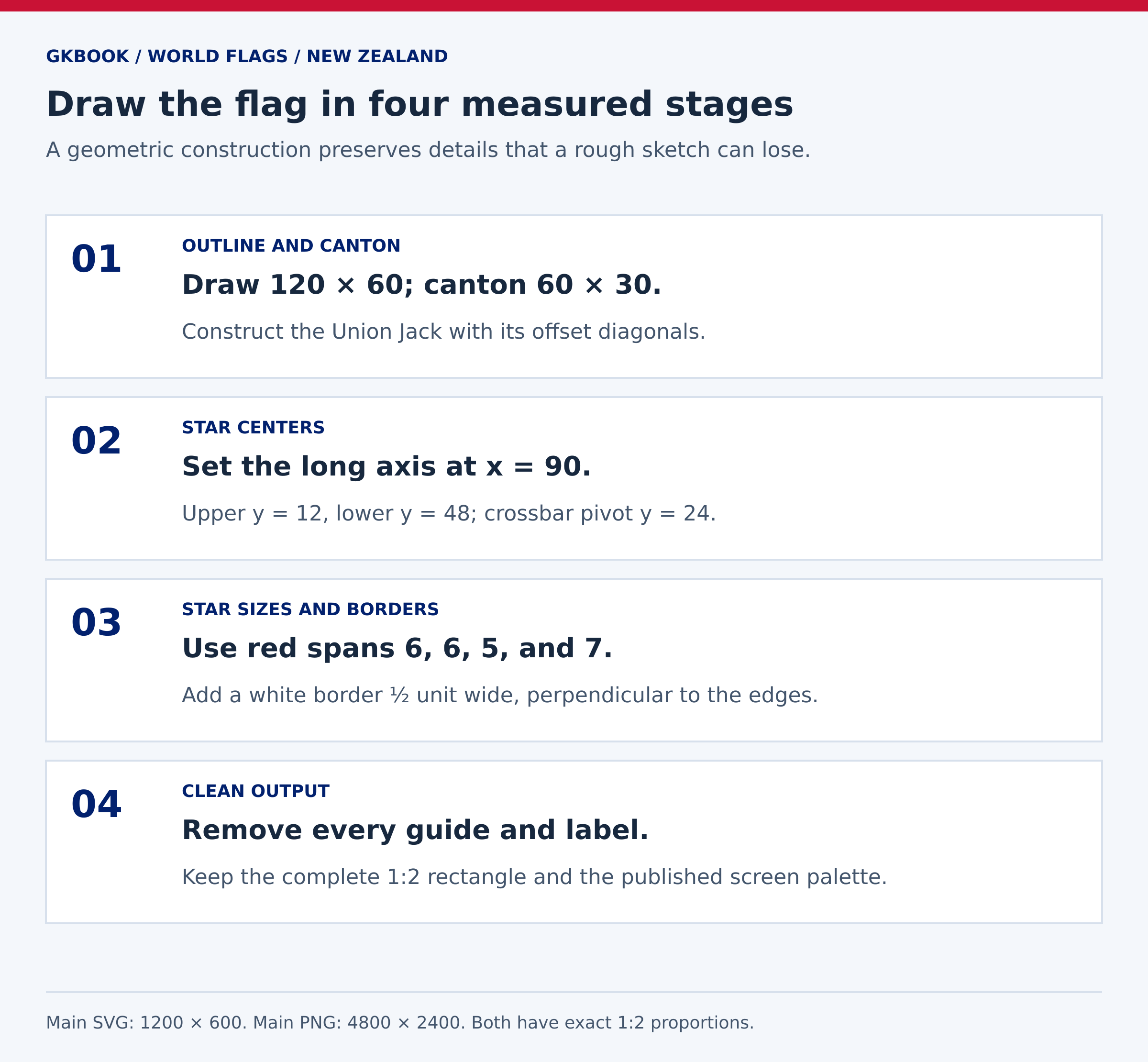
Start with a rectangle twice as long as it is high, then construct the Union Jack in its upper hoist quarter. Place the four star centers using the prescribed vertical axis and tilted crossbar. Draw five-pointed red stars of the correct unequal sizes, add consistent white borders, and remove the construction guides.
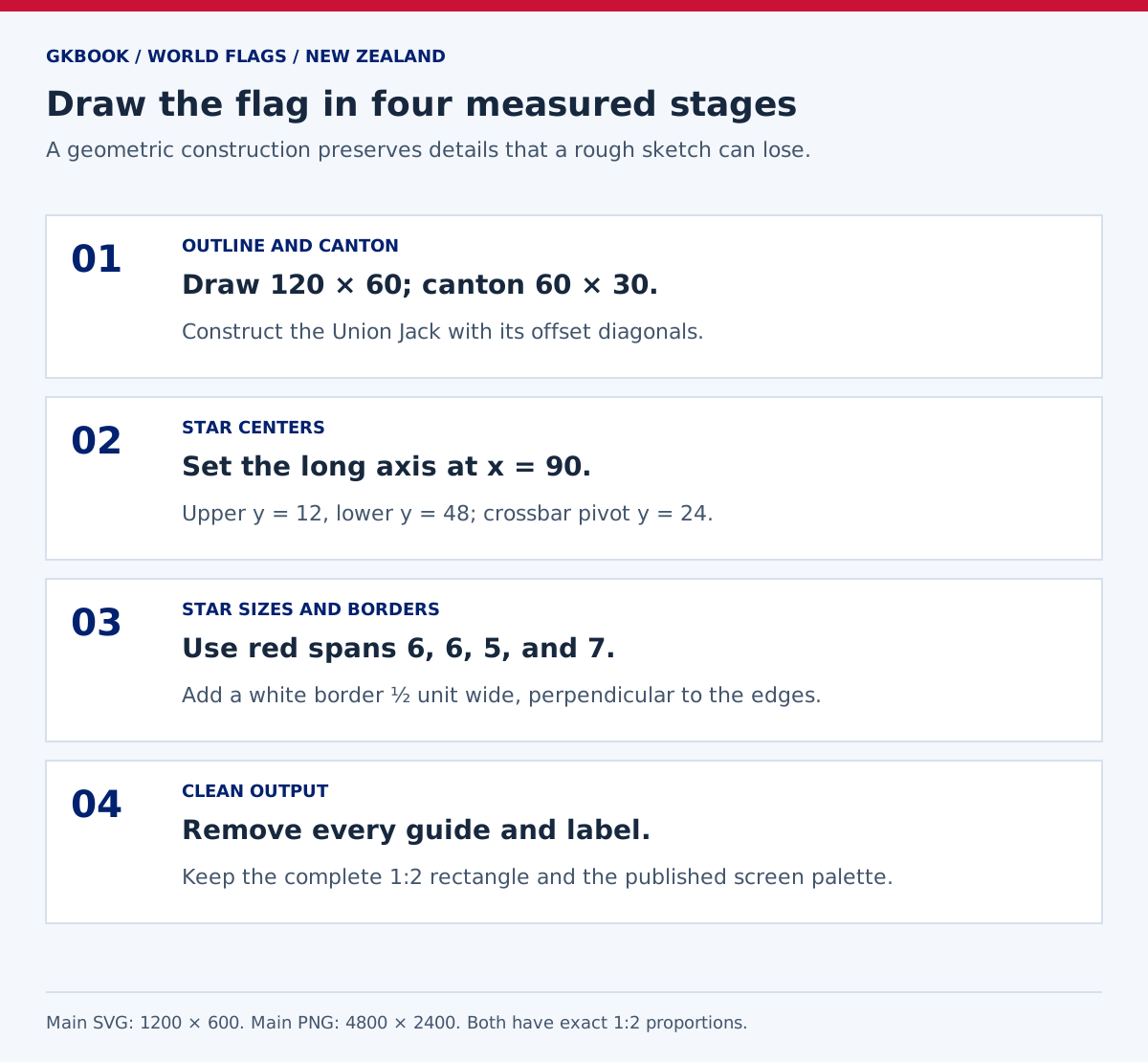
On a 120-by-60 grid, use the positions and spans in the star-position explanation and size table. Every star has a top-facing point in the normal horizontal front view.
For classroom work at small sizes, tracing the supplied vector is more reliable than guessing the diagonal offsets or star locations. The SVG preserves the calculations; the PNG provides the same design at 4800 × 2400 pixels.
What mistakes should you avoid when drawing New Zealand’s flag?
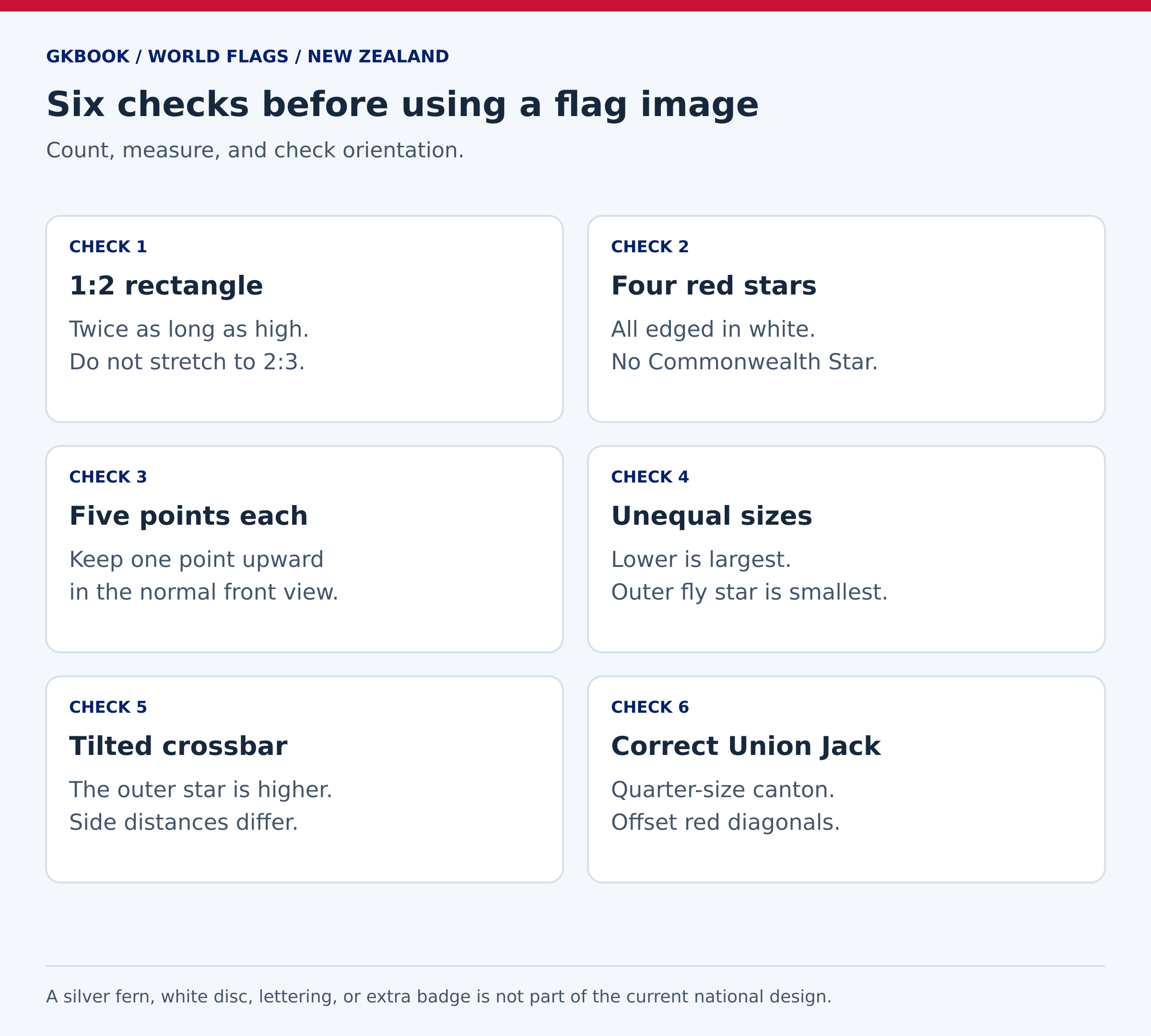
Frequent errors include adding Australia’s Commonwealth Star, making all four stars white or equal in size, leveling the crossbar, omitting the white borders, or using a 2:3 rectangle. Another error is making the Union Jack’s red diagonals symmetrical. The correct national design has four bordered red stars and a 1:2 outline.
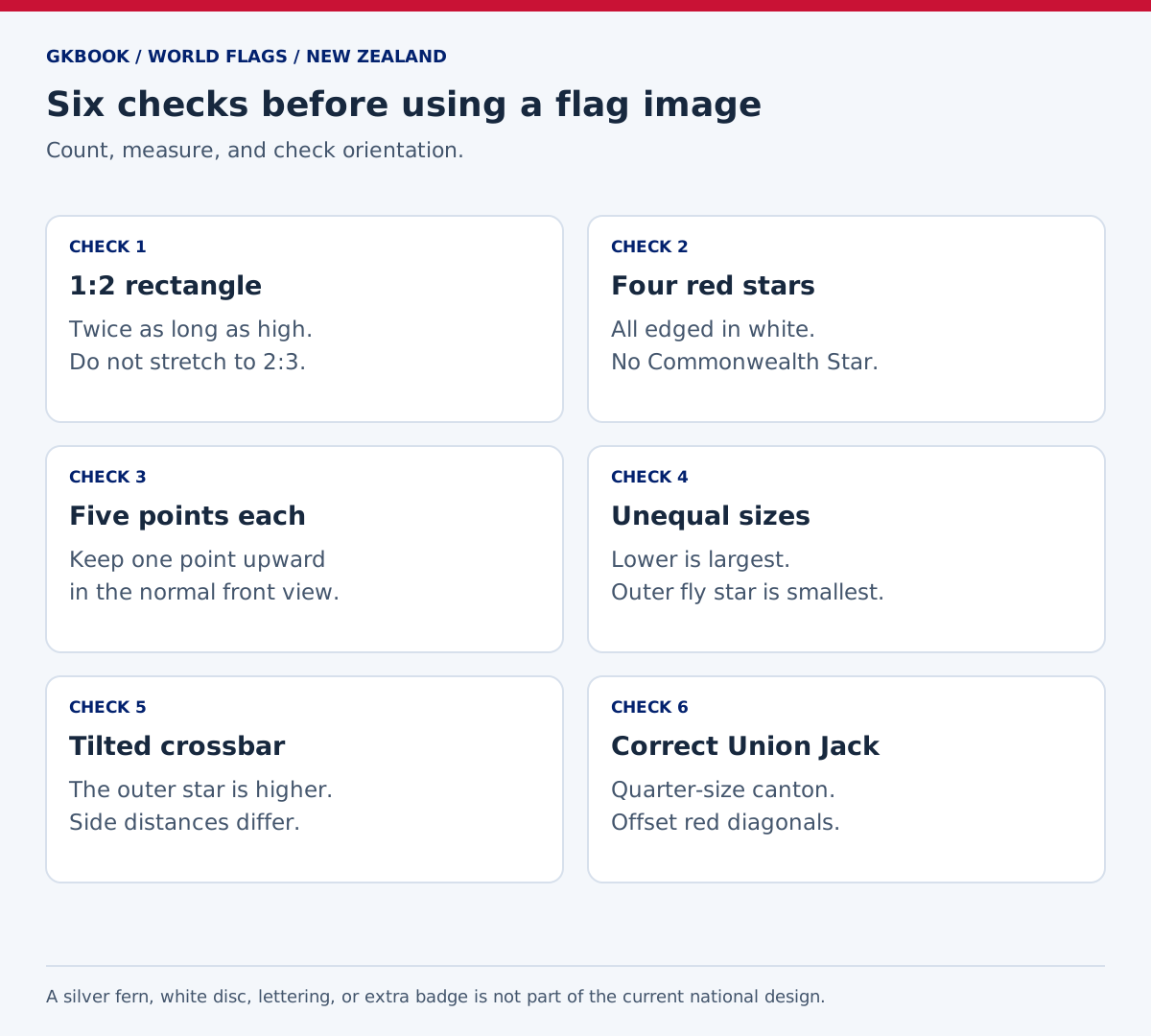
Check the shape, canton, and Southern Cross separately. Correct colors cannot compensate for a missing star, a wrong point count, or an inaccurate layout.
The main downloadable flag contains no labels, pole, white disc, fern, or extra badge. Such elements may be discussed in a historical or explanatory diagram, but they do not belong in the current national flag master.
Download New Zealand flag pictures
Download the national flag as SVG or 4800 × 2400 PNG. The gallery contains 24 subjects, each with SVG and PNG versions. Keep the full rectangular image and preserve its proportions. Both the SVG and PNG retain the exact 1:2 shape; white crosses and star borders are opaque. The comparison artwork preserves each illustrated ratio. Image credits and reproduction notes accompany the artwork.
Explore more in World Flags, including the Nepal flag and Netherlands flag.
World Flags/New Zealand
New Zealand flag pictures
A 1:2 blue flag with the Union Jack and four unequal red stars edged in white. Ministry digital approximations are used.
GKBook original explanatory artwork; source and reproduction notes supplied.Download SVGDownload PNGPantone 280C, 186C, and white are the ministry’s references. Its approximate digital values are #02216E, #C91235, and white.
GKBook original explanatory artwork; source and reproduction notes supplied.Download SVGDownload PNGHeight:length is 1:2. The canton measures half the length and half the height. Guide lines are not part of the flag.
GKBook original explanatory artwork; source and reproduction notes supplied.Download SVGDownload PNGThe Union Jack records historical ties; the Southern Cross locates the country in the South Pacific. The flag represents the Realm, Government, and people.
GKBook original explanatory artwork; source and reproduction notes supplied.Download SVGDownload PNGThe canton has unequal white margins beside its diagonal red bands. White-band widths include the red overlaid portion.
GKBook original explanatory artwork; source and reproduction notes supplied.Download SVGDownload PNGEach red five-pointed star has a white border. The sizes and locations are deliberately unequal.
GKBook original explanatory artwork; source and reproduction notes supplied.Download SVGDownload PNGThe red spans are 6, 6, 5, and 7 units; each border is half a unit wide when the flag is 60 units high.
GKBook original explanatory artwork; source and reproduction notes supplied.Download SVGDownload PNGThe side-star centers lie on a line rising 8° toward the fly, meeting the vertical axis at (90,24). Guide lines and dots are explanatory only.
GKBook original explanatory artwork; source and reproduction notes supplied.Download SVGDownload PNGSelected milestones from the United Tribes flag to the retention of the current flag in 2016. Historical and cultural uses overlap.
GKBook original explanatory artwork; source and reproduction notes supplied.Download SVGDownload PNGRoyal approval, proclamation, and publication of specifications are separate events. The Act’s title retains the year 1901.
GKBook original explanatory artwork; source and reproduction notes supplied.Download SVGDownload PNGOfficial published shares are 56.6% for the current flag, 43.2% for the alternative, and 0.2% informal. The denominator includes informal votes.
GKBook original explanatory artwork; source and reproduction notes supplied.Download SVGDownload PNGBoth flags have a Union Jack and 1:2 outline. New Zealand has four bordered red five-pointed stars; Australia has six white stars with two point counts.
GKBook original explanatory artwork; source and reproduction notes supplied.Download SVGDownload PNGA color-and-role identification key. The Red Ensign and White Ensign have distinct maritime functions; the national flag has broader use.
GKBook original explanatory artwork; source and reproduction notes supplied.Download SVGDownload PNGHistorical, Māori, vice-regal, military, and civil aviation flags should not be mislabeled as the current national flag.
GKBook original explanatory artwork; source and reproduction notes supplied.Download SVGDownload PNGThe ministry lists twelve recurring national flag days under the 2024 notice. Variable dates remain variable; private display is not limited to this list.
GKBook original explanatory artwork; source and reproduction notes supplied.Download SVGDownload PNGThe ministry’s rule is full mast throughout Anzac Day except during the duration of a memorial service, when half mast applies.
GKBook original explanatory artwork; source and reproduction notes supplied.Download SVGDownload PNGThe flag is lowered from full hoist by more than its own depth. It is raised again before being taken down. Exact pole geometry here is schematic.
GKBook original explanatory artwork; source and reproduction notes supplied.Download SVGDownload PNGFor flat wall display the canton remains at the observer’s upper left. The portrait arrangement transposes the complete flag geometry rather than moving individual emblems.
GKBook original explanatory artwork; source and reproduction notes supplied.Download SVGDownload PNGAn upright flag seen from the other side is a horizontal reflection of the full design. It is not a new arrangement of stars.
GKBook original explanatory artwork; source and reproduction notes supplied.Download SVGDownload PNGNew Zealand normally takes the observer’s left in a straight line, subject to royal or vice-regal precedence. Other national flags share equal pole height and flag size.
GKBook original explanatory artwork; source and reproduction notes supplied.Download SVGDownload PNGThe ministry advises replacing worn flags and discreet disposal. Digital reproduction should preserve a clear, complete design.
GKBook original explanatory artwork; source and reproduction notes supplied.Download SVGDownload PNGFour stages cover the rectangle, Union Jack, star centers, unequal red spans, and consistent white borders.
GKBook original explanatory artwork; source and reproduction notes supplied.Download SVGDownload PNGVerify proportions, star count, point count, unequal sizes, crossbar tilt, and Union Jack construction.
GKBook original explanatory artwork; source and reproduction notes supplied.Download SVGDownload PNG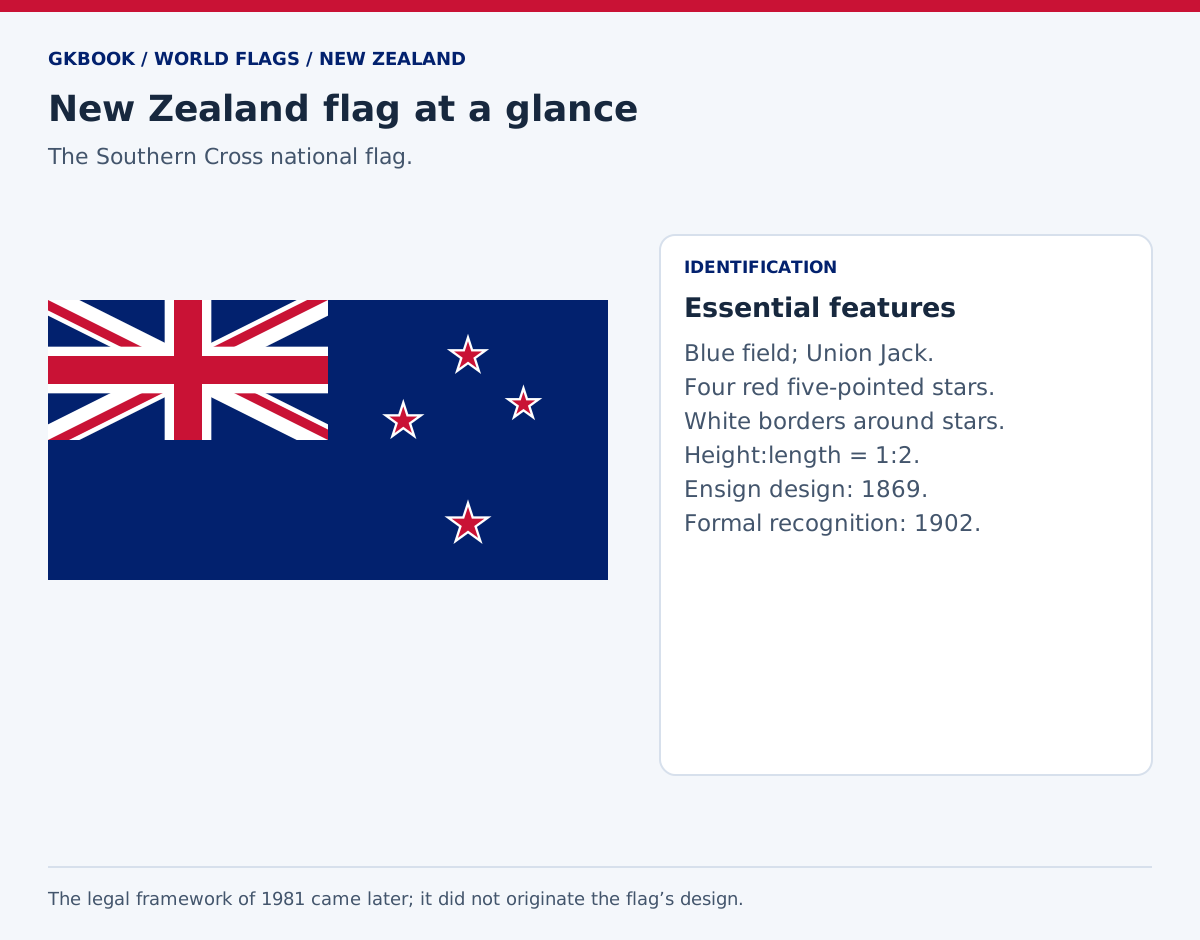
A compact reference to the 1:2 design, four bordered red stars, 1869 ensign origin, and 1902 recognition.
GKBook original explanatory artwork; source and reproduction notes supplied.Download SVGDownload PNGFrequently asked questions
What does New Zealand’s flag look like?
New Zealand’s national flag has a blue field, the Union Jack in the upper hoist quarter, and four red five-pointed stars with white borders on the fly. The stars represent the Southern Cross. Its proportions are 1:2, and the flag was formally recognized in 1902 after earlier use as a government ensign.
What colors are on the New Zealand flag?
The New Zealand flag uses blue, red, and white. The Ministry for Culture and Heritage specifies Pantone 280C blue, Pantone 186C red, and white for official reproduction. Its published digital approximations are blue #02216E and red #C91235. The artwork here follows those approximations, with opaque white for the crosses and star borders.
What is the ratio of the New Zealand flag?
The New Zealand flag has a height-to-length ratio of 1:2: it is twice as long as it is high. The Union Jack occupies the upper hoist quarter, half the flag’s length and half its height. The four Southern Cross stars occupy the fly, the half farther from the flagpole.
What does the New Zealand flag symbolize?
The New Zealand flag is legally the symbol of the Realm, Government, and people of New Zealand. Its Southern Cross identifies the country’s South Pacific setting, while the Union Jack records historical ties with Britain. Official explanations also associate the blue field with the surrounding sea and sky and with naval ensign tradition.
Why does the New Zealand flag contain the Union Jack?
The Union Jack appears because New Zealand’s flag developed from the British Blue Ensign used by colonial government vessels. It records the country’s historical connection with Britain. In the standard front view, the canton occupies the upper left quarter; it is not a separate full-size British flag placed over the entire blue field.
What do the four stars on the New Zealand flag represent?
The four stars represent the principal cross-shaped pattern of the Southern Cross constellation. Each has five points, a red interior, and a white border. They indicate New Zealand’s location in the South Pacific; they do not stand for four provinces, four islands, or four separate political divisions of the country.
Are all four stars the same size?
No. The lower star is largest, the star nearest the outer fly edge is smallest, and the upper and hoist-side stars are equal. Their red spans measure 7, 5, 6, and 6 units respectively on a grid with a 60-unit flag height. Every star has a white border one half-unit wide.
How are the stars positioned on the New Zealand flag?
The upper and lower star centers lie on a vertical line through the middle of the fly, separated by three fifths of the flag’s height. The two side stars lie on a tilted crossbar, rising toward the outer fly edge. The crossbar meets the vertical line at an angle of 82 degrees.
Who designed the New Zealand flag?
Albert Hastings Markham is credited with designing the Southern Cross ensign in 1869. A Royal Navy officer who later became an admiral, he supplied the design associated with Governor Sir George Bowen’s administration. The design’s creation for government vessels should be distinguished from its later recognition as New Zealand’s national flag in 1902.
How did the New Zealand flag develop?
New Zealand’s flag history includes the United Tribes flag of 1834, the Union Jack, and the blue ensign tradition that produced today’s design. An NZ letter badge preceded the Southern Cross ensign adopted for government vessels in 1869. Formal national recognition followed in 1902, and voters retained the flag in 2016.
When was the New Zealand flag officially adopted?
New Zealand’s flag was formally recognized in 1902. King Edward VII approved the New Zealand Ensign Act 1901 on March 24, 1902; the proclamation appeared on June 12, and detailed specifications followed on June 27. These dates mark separate steps, while the Southern Cross government ensign had already been introduced in 1869.
What law recognizes the New Zealand flag today?
The Flags, Emblems, and Names Protection Act 1981 recognizes the New Zealand Flag and depicts it in Schedule 1. Section 5 identifies its national role; section 10 provides for government flag rules and etiquette guidance. This law continues the flag’s status rather than marking the first appearance or original adoption of the design.
What was New Zealand’s first recognized flag?
The United Tribes flag, selected by northern Māori chiefs at Waitangi on March 20, 1834, is generally described as New Zealand’s first recognized national flag. It preceded the present blue ensign. The choice addressed the need for New Zealand-built ships to have an accepted national identity in international trade.
Why do some historical New Zealand flags have a white disc?
A signaling ensign approved in 1899 placed the Southern Cross stars inside a white disc. Intended for maritime use, it also appeared ashore and contributed to uncertainty over the correct flag. The modern national flag has no disc: its four individually bordered red stars stand directly against the blue field.
Did New Zealand change its flag in the 2015–2016 referendums?
No. The first referendum in 2015 selected a silver-fern alternative; the second, held in March 2016, chose between that alternative and the existing flag. The Electoral Commission’s final result recorded 1,208,702 votes for the current flag, or 56.6 percent in its published table. The blue ensign therefore remained the national flag.
Is the silver fern New Zealand’s national flag?
A silver-fern design is not the statutory New Zealand national flag. Kyle Lockwood’s Silver Fern, Black, White and Blue, won the 2015 selection of an alternative but lost to the existing flag in 2016. Fern flags and fern imagery should therefore be distinguished from the blue national flag with the Union Jack.
How is New Zealand’s flag different from Australia’s?
New Zealand’s flag has four red five-pointed stars with white borders. Australia’s flag has six white stars in total: five forming the Southern Cross and a larger Commonwealth Star below the Union Jack. Both use a blue field and Union Jack canton, so star number, color, and placement provide the clearest distinction.
Did New Zealand’s flag design come before Australia’s?
New Zealand’s Southern Cross government ensign dates to 1869, before the design selected for Australia’s national flag in 1901. However, New Zealand’s formal national recognition followed in 1902. Comparing the flags therefore requires distinguishing the origin of a design from its later legal recognition and from subsequent changes to particular details.
Is the Tino Rangatiratanga flag the same as the New Zealand flag?
No. The Tino Rangatiratanga flag is a distinct design recognized by Cabinet in December 2009 as the preferred national Māori flag. It complements the New Zealand flag rather than replacing the statutory national design. Its black, white, and red composition includes a koru, unlike the Union Jack and stars of the blue ensign.
What is the New Zealand Red Ensign?
The New Zealand Red Ensign is a red flag with the Union Jack in the canton and four white Southern Cross stars. It is a separate ensign, not the ordinary blue national flag. Besides its maritime use, New Zealand law preserves its traditional display on land on occasions or at places of Māori significance.
What is the New Zealand White Ensign?
The New Zealand White Ensign has a white field, a Union Jack canton, and four red Southern Cross stars. It is the naval ensign used by the Royal New Zealand Navy and its commissioned shore establishments. Introduced in 1968, it is distinct from both the national blue flag and the British White Ensign.
What other official flags are used in New Zealand?
New Zealand uses several flags for particular offices or services, including the Governor-General’s flag, the Royal New Zealand Air Force Ensign, and the Civil Air Ensign. These have different designs and purposes from the national flag. The Governor-General’s flag takes precedence when flown to mark the Governor-General’s presence.
On which days is the New Zealand flag especially flown?
The ministry’s current calendar encourages display on designated commemorative days, including Waitangi Day, Anzac Day, Matariki, and royal anniversaries. Government flag arrangements are governed by the New Zealand Flag Notice 2024 and relevant directions. Private people and organizations may fly the national flag on any day and are not required to follow government display directives.
Is New Zealand’s flag flown at half-mast all day on Anzac Day?
The ministry’s Anzac Day guidance calls for the New Zealand flag to be flown at full mast. At a place where a commemorative service is held, it may be lowered to half-mast for the duration of that service. This is not a general instruction to keep every New Zealand flag at half-mast all day.
How is the New Zealand flag flown at half-mast?
Raise the flag to the top of the pole before lowering it slowly to the half-mast position. Before taking it down, raise it fully again. Ministry guidance requires a clearly lowered position appropriate to the flag and pole, rather than assuming that the top edge must always sit exactly halfway down the mast.
How should the New Zealand flag hang against a wall?
When the New Zealand flag is displayed flat against a wall, surface, or window, the Union Jack should be in the upper left as viewed by the observer. This applies to horizontal and vertical display. A vertical hanging must preserve the flag’s complete design while placing the canton in that position.
Does the reverse of New Zealand’s flag have a different design?
The reverse shows the same design seen from the opposite side, so it is a mirror image of the standard front view. The Union Jack appears at the upper right when the pole is on the viewer’s right. The Southern Cross arrangement also mirrors; it is not independently repositioned to imitate the front.
Where does New Zealand’s flag stand beside other national flags?
In a standard line of flags in New Zealand, the national flag takes the place of honor at the observer’s left, except where royal or vice-regal precedence applies. Other national flags should be the same size and flown on separate poles of equal height. One nation’s flag should not be placed above another in peacetime.
Can anyone fly the New Zealand flag or use it in advertising?
Individuals and organizations may fly the New Zealand flag on any day. Ministry guidance also permits its use in advertising when its true form and colors are preserved. Government-building display requirements are distinct from private choice. Separate legal provisions govern unauthorized alterations, protected emblems, and certain public acts intended to dishonor the flag.
How should a worn New Zealand flag be treated?
A New Zealand flag in poor condition should be taken down and replaced. Ministry guidance recommends disposing of an old flag discreetly, outside public view, and notes that some flag manufacturers provide disposal facilities. Respectful care concerns the physical flag’s condition; an explanatory illustration should likewise preserve a complete and recognizable design.
How do you draw the New Zealand flag accurately?
Start with a rectangle twice as long as it is high, then construct the Union Jack in its upper hoist quarter. Place the four star centers using the prescribed vertical axis and tilted crossbar. Draw five-pointed red stars of the correct unequal sizes, add consistent white borders, and remove the construction guides.
What mistakes should you avoid when drawing New Zealand’s flag?
Frequent errors include adding Australia’s Commonwealth Star, making all four stars white or equal in size, leveling the crossbar, omitting the white borders, or using a 2:3 rectangle. Another error is making the Union Jack’s red diagonals symmetrical. The correct national design has four bordered red stars and a 1:2 outline.
Explore all general-knowledge topics and the A-to-Z lists.

We Value Your Opinion Comments