
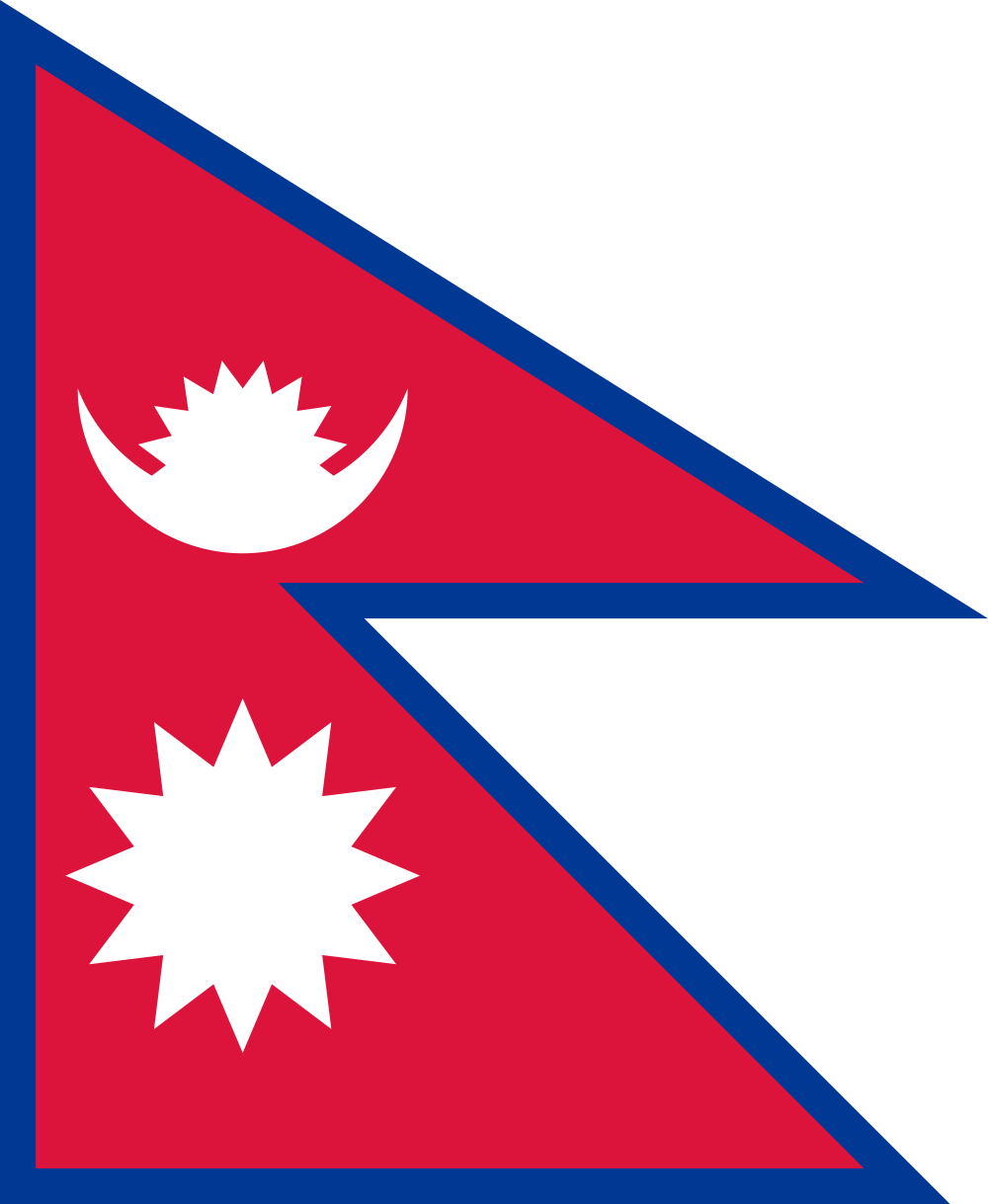
Nepal flag picture
Explore the complete proportions, history, and picture gallery.
| Design | Two joined triangular formsA five-sided double-pennon outline. |
|---|---|
| Colors | Crimson, deep blue, and whiteNamed in Article 8 of the constitution. |
| Modern standardization | December 16, 1962Conventional date; the tradition is older. |
| Current legal definition | Article 8 and Schedule 1Constitution of Nepal, 2015. |
| Emblems | Moon above; sun belowEight visible moon rays; twelve sun rays. |
| Complete proportions | Height:width ≈ 1.219:1Calculated from the bordered construction. |
What does Nepal’s national flag look like?
Nepal’s national flag consists of two joined crimson triangular forms with a deep blue border. A white crescent moon with eight visible rays occupies the upper part, and a white twelve-rayed sun occupies the lower part. Its distinctive outline and detailed construction are defined by the Constitution of Nepal.
The pictures below distinguish the inner crimson outline from the complete blue-edged flag, show how the emblems are constructed, and explain the history behind the modern standardized design.
Why is Nepal’s flag not rectangular?
Nepal retains a traditional double-pennon design instead of a rectangular flag. Two joined triangular forms create a five-sided outline with an inward corner. It is the only nonquadrilateral national flag of a sovereign state. The constitution preserves this inherited form and supplies a precise method for drawing it.
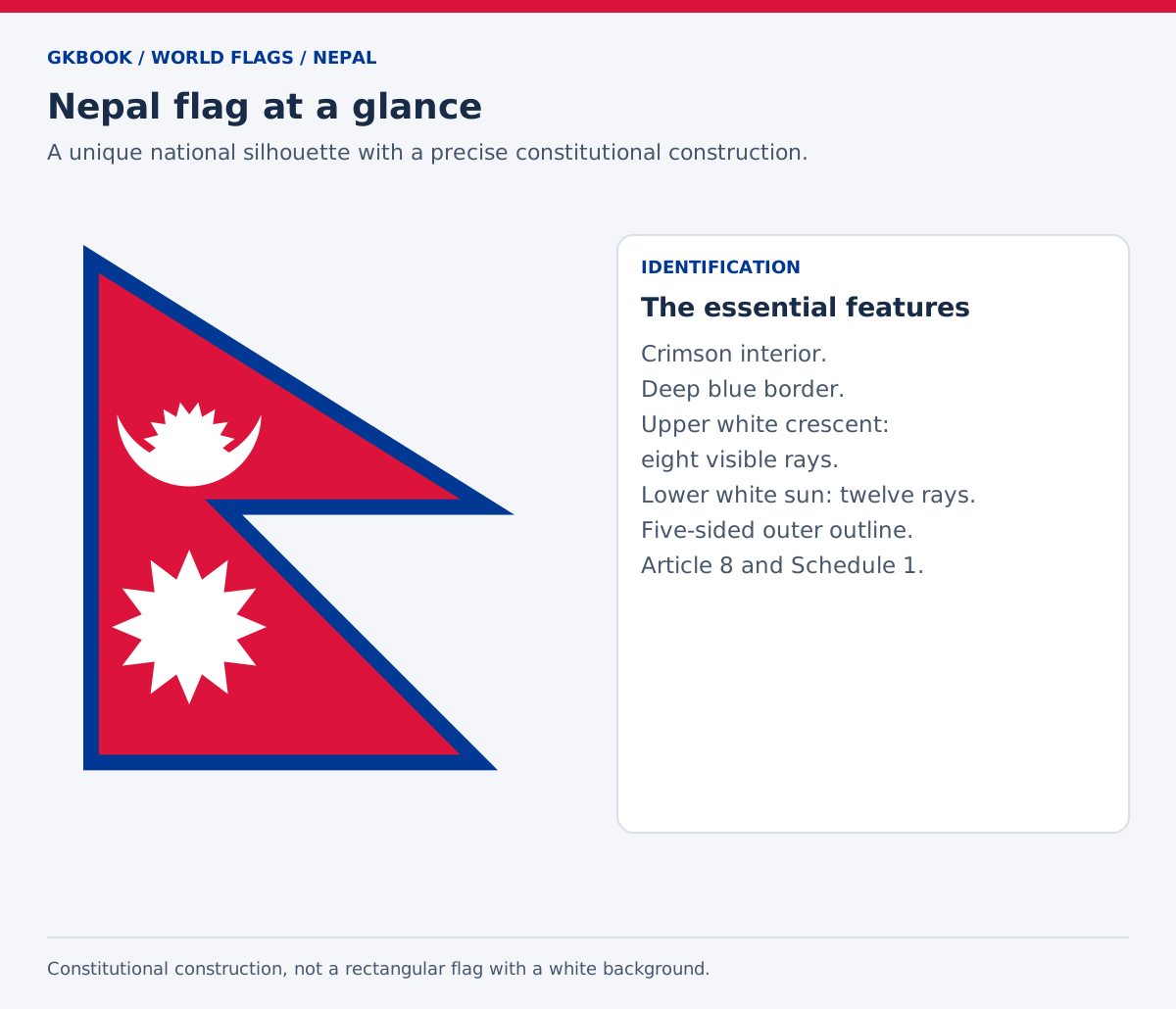
A pennon is a tapering flag. In Nepal’s design, the two pointed forms share a continuous hoist edge, the side attached to the support. Their combined outline is a concave pentagon: five straight sides, including a corner that points inward.
“Nonrectangular” is a familiar description, but “nonquadrilateral” is more exact. Square national flags still have four sides and are rectangles in geometry. Nepal’s five-sided silhouette belongs to a different category.
What colors are on the Nepal flag?
Nepal’s flag has a crimson field, a deep blue border, and two white celestial emblems. Article 8 of the constitution names these colors and places the moon above the sun. White belongs inside those emblems; any white rectangle surrounding a pictured flag is a display background, not flag material.
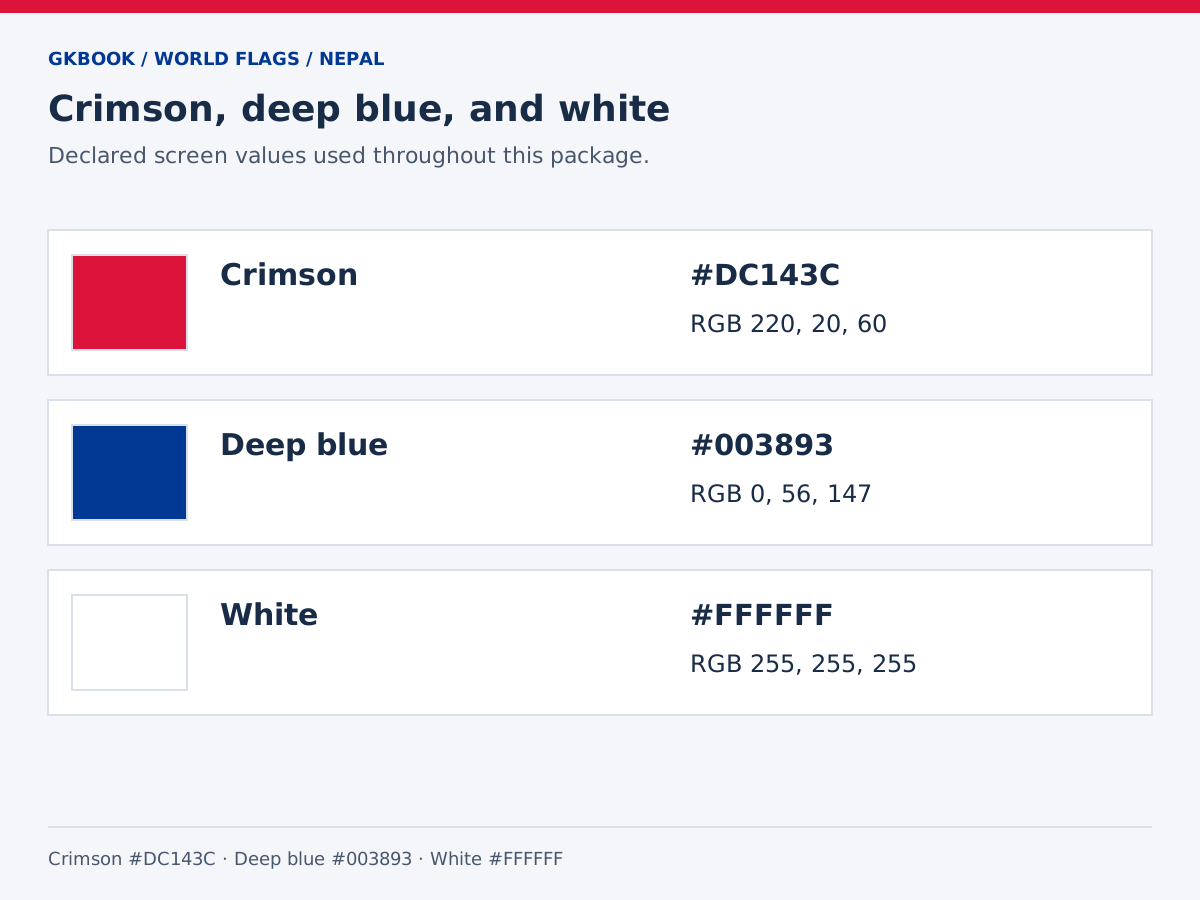
Crimson fills the connected triangular interior. Deep blue follows all five outside edges, including the horizontal edge beneath the upper point and the sloping edge that descends from the inward corner.
There is no separate white border around the flag and no white dividing line between its two parts. The upper crescent and lower sun are the only white components of the national design.
What does the Nepal flag symbolize?
Official explanatory material associates the blue border with peace, crimson with bravery and the rhododendron, and the sun and moon with Nepal’s enduring existence. These are interpretations of the design’s meaning. Article 8 and Schedule 1 define the flag’s appearance and construction without setting out a complete symbolic explanation.

The Film Development Board’s guide connects the celestial pair with the hope that Nepal will endure as long as the sun and moon. Its explanation is useful cultural context, separate from the measurements prescribed in the constitution.
Why is the flag’s field crimson?
Crimson is Nepal’s national color as well as the color prescribed for the flag’s interior. Article 9 identifies it separately among the country’s national symbols. That constitutional status explains why an accurate description uses crimson rather than treating every red shade as an equally specific account of the design.
Article 9 also names the national flower, Rhododendron arboreum, commonly called laligurans. The flower and the flag color are connected in public explanations, but the legal provisions identify the national flower and national color as distinct symbols.
A named color does not by itself establish a numerical screen or textile standard. The digital palette below identifies the particular crimson used in this package.
What is the upper symbol, and how many rays does it have?
The upper emblem is a white crescent moon with eight rays visible out of sixteen, as Article 8 describes it. The eight pointed rays rise from the crescent’s central portion. Its two curved horns are part of the crescent and should not be counted as two additional triangular rays.

The emblem is more detailed than a plain crescent. Its lower boundary is a semicircular arc, while the inner curve and the radiating points follow separate construction steps. The rays and crescent join into one white shape.
There is no human face, separate star, or colored central disk in the current emblem. The construction places the moon on the same vertical reference line as the center of the sun below.
How many rays does the sun on Nepal’s flag have?
The lower white sun has twelve rays. Schedule 1 constructs those rays between two concentric circles, with two opposite tips lying on the vertical reference line through the emblem’s center. The finished sun is a solid white shape with twelve outward points and twelve inward corners, without a face.

The two construction circles control the outer tips and the inner notches. They are guides, not visible rings on the finished flag. Joining the alternating vertices creates the sun’s straight-sided perimeter.
Count outward tips to obtain twelve. Counting every vertex instead would produce twenty-four, because each tip is followed by an inward corner. The upper moon uses a different ray count and different geometry.
Do the two triangles represent the Himalayas?
The Himalayas interpretation appears in official explanatory material: the two triangular forms are associated with Nepal’s mountains. The constitution itself describes and constructs the shapes without assigning that meaning. A cultural explanation of the triangles should therefore be distinguished from a constitutional rule about their size, placement, or angles.
The outline is an inherited national form, not a scaled drawing of two particular peaks. The legal construction names geometric points rather than mountains, religious communities, rulers, or regions. No specific summit is assigned to either tip in Article 8 or Schedule 1.
When was Nepal’s current flag adopted?
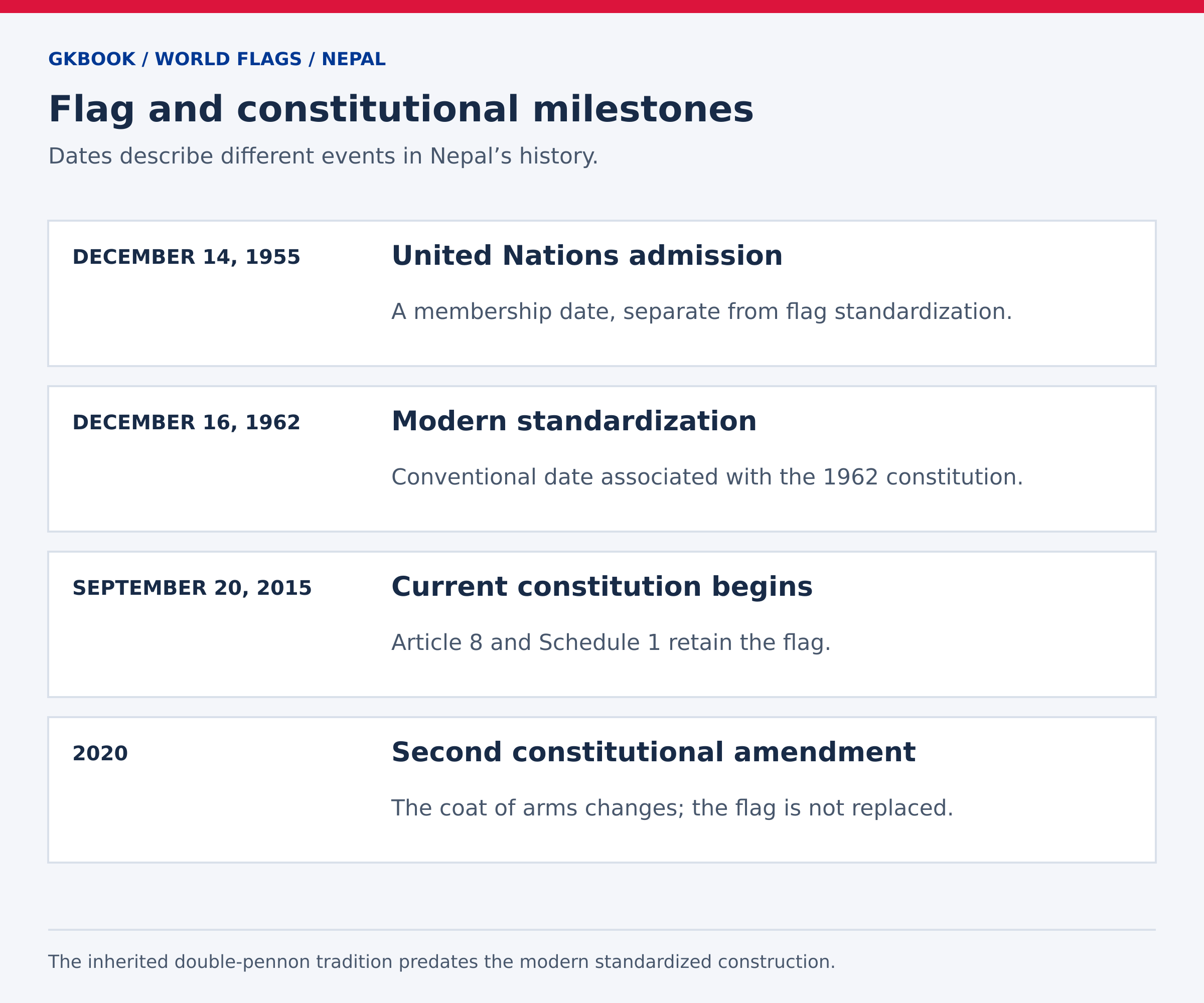
Nepal’s modern standardized flag is conventionally dated December 16, 1962, in connection with the 1962 constitution. The double-pennon tradition is older. The present constitution, which commenced on September 20, 2015, continues the design through Article 8 and Schedule 1; 2015 is therefore not its original adoption date.

The 1962 constitution already describes the upper moon with eight visible rays and the lower twelve-rayed sun. It also provides a geometric construction in Schedule 1. Its commencement clause gives Sunday, Poush 1, 2019, in the Bikram Sambat calendar.
Use the dates with their events: 1962 for the standardized modern design and 2015 for the current constitutional framework. Neither date establishes the first appearance of triangular banners or sun-and-moon imagery in Nepal.
| Date | What it identifies |
|---|---|
| December 14, 1955 | Nepal’s admission to the United Nations |
| December 16, 1962 | Conventional date for the modern standardized flag |
| September 20, 2015 | Commencement of the current Constitution of Nepal |
| 2020 | Second constitutional amendment; not a new flag adoption |
How old is Nepal’s flag tradition?
The flag’s double-pennon tradition predates the modern construction adopted in the twentieth century. The 1962 constitution expressly describes the national flag as inherited through tradition. That evidence supports an older lineage, but it does not establish a single ancient creation date or one documented inventor of the original form.
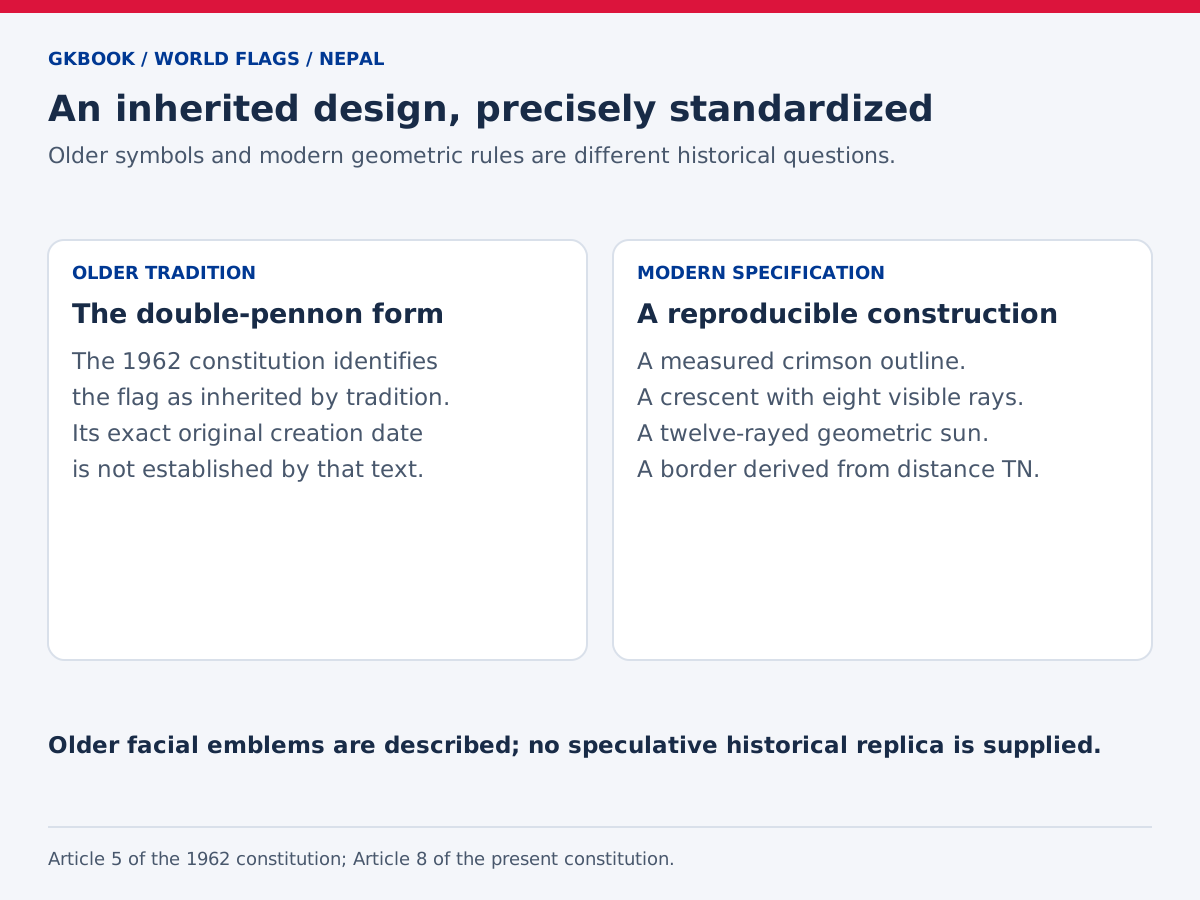
Three different questions are often compressed into one: when triangular banners were used, when a joined sun-and-moon flag became established, and when its precise modern geometry was standardized. Evidence for one event does not automatically date the others.
Claims that the present, fully specified flag is thousands of years old require more than the antiquity of its symbols. The article distinguishes the inherited design from the measurable modern construction.
Who designed the modern Nepal flag?
Engineer and architect Shankar Nath Rimal is associated with the modern standardization of Nepal’s flag. In his own account, he refined an existing traditional design rather than inventing its basic form. His contribution should therefore be described as redesign and specification, without assigning him authorship of the older double-pennon tradition.
Rimal’s published interview distinguishes his work on the modern design from the flag’s earlier history. The constitution itself supplies the construction but does not name a designer in Article 8 or Schedule 1.
Did older Nepal flags show faces on the sun and moon?
Yes. Historical flag references document earlier versions in which the celestial emblems carried human faces. The modern constitutional construction uses geometric white emblems without facial details. Those older variants should be identified by their period and evidence, rather than presented as one perfectly uniform design used throughout Nepal’s earlier history.
Specialist historical accounts reproduce differing older examples from flag books. Their variations are a reason to avoid labeling a newly invented illustration as an exact historical flag. This article describes the facial detail without supplying an unsupported historical facsimile.
Did Nepal replace its flag when it became a republic?
Nepal retained the double-pennon national flag through the transition to a republic and into the 2015 constitution. The current text still specifies crimson, deep blue, the upper crescent with eight visible rays, and the lower twelve-rayed sun. A change in government or constitutional framework does not necessarily mean a replacement flag.
The present constitution describes Nepal as a federal democratic republican state while retaining the familiar national flag. Reading those provisions together establishes the flag’s continued place in the republic.
The 2020 second amendment concerns the national coat of arms in Schedule 3. The national flag remains in Schedule 1. A change to the arms should not be reported as a redesign of the flag.
Is 1962 the date the United Nations recognized Nepal?
No. Nepal joined the United Nations on December 14, 1955, according to United Nations membership records. The 1962 date associated with the modern flag concerns its domestic constitutional standardization. UN membership, international recognition, and a country’s adoption or specification of its national flag are different historical events and should be dated separately.
UN records identify the membership decision as General Assembly resolution 995 (X). That provides a firm admission date; it does not turn the flag’s later standardization into a new admission or a general act of diplomatic recognition.
Accounts about international requests for consistent flag drawings should not be shortened into the claim that Nepal became recognized as a country in 1962.
Where is the Nepal flag defined in the constitution?
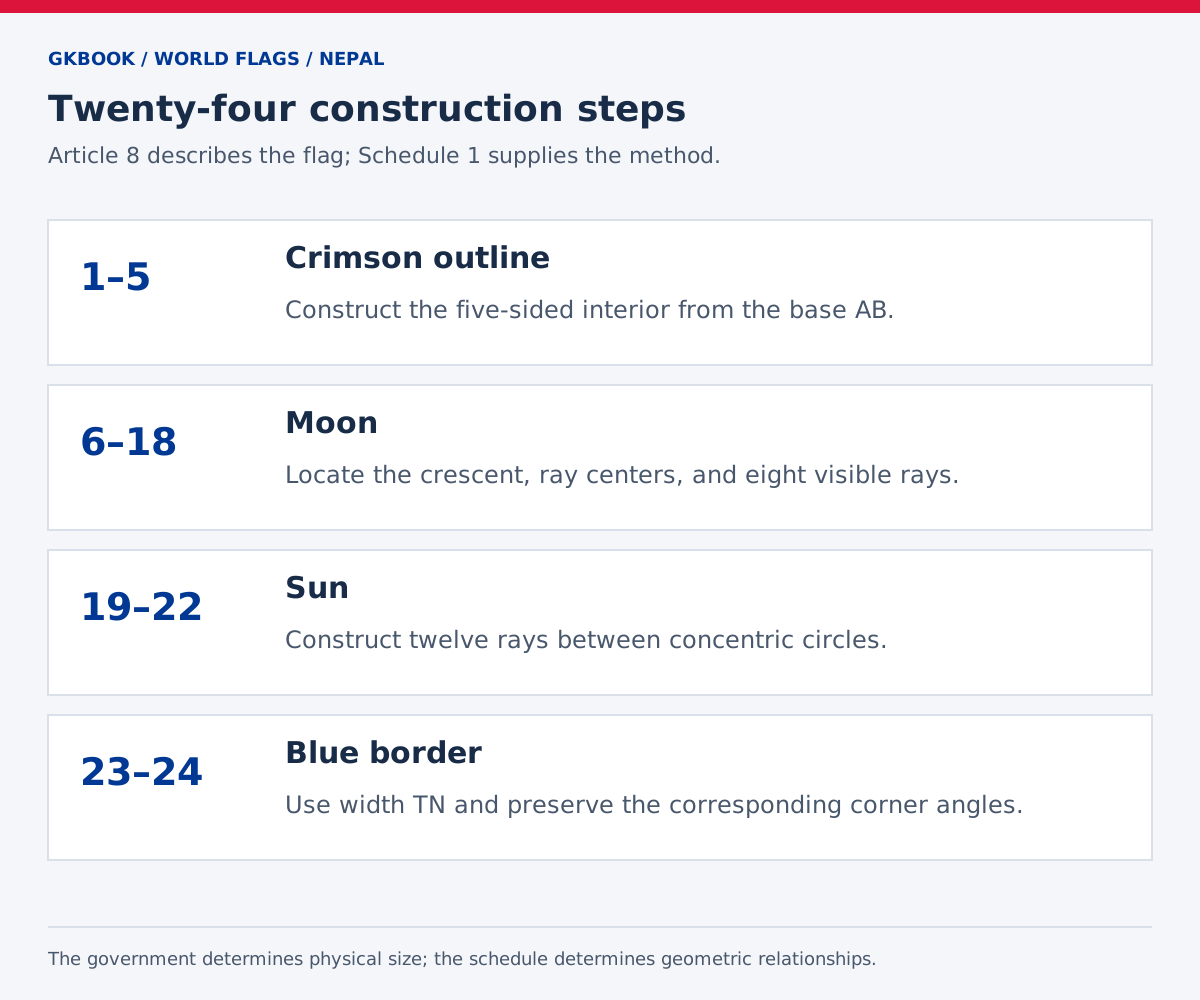
Article 8 of the Constitution of Nepal describes the national flag, and Schedule 1 provides its construction. The schedule contains twenty-four numbered steps covering the inner outline, moon, sun, and border. It also explains which drawing guides must disappear and allows the government to determine the flag’s physical size.
The section number depends on the constitution being cited. The 1962 text used Article 5; the present constitution uses Article 8. An older construction drawing labeled “Article 5” can reflect an earlier constitutional edition rather than a different flag.
Schedule 1 divides the method into four groups: five steps for the inner shape, thirteen for the moon, four for the sun, and two for the border. The explanatory lines and most circles are temporary construction aids.
| Steps | Subject | Result |
|---|---|---|
| 1–5 | Inner outline | Crimson shape before adding the border |
| 6–18 | Moon | Crescent and eight visible rays |
| 19–22 | Sun | Twelve rays between two circles |
| 23–24 | Border | Deep blue edge and provision for a pole attachment |
What are the overall proportions of Nepal’s flag?
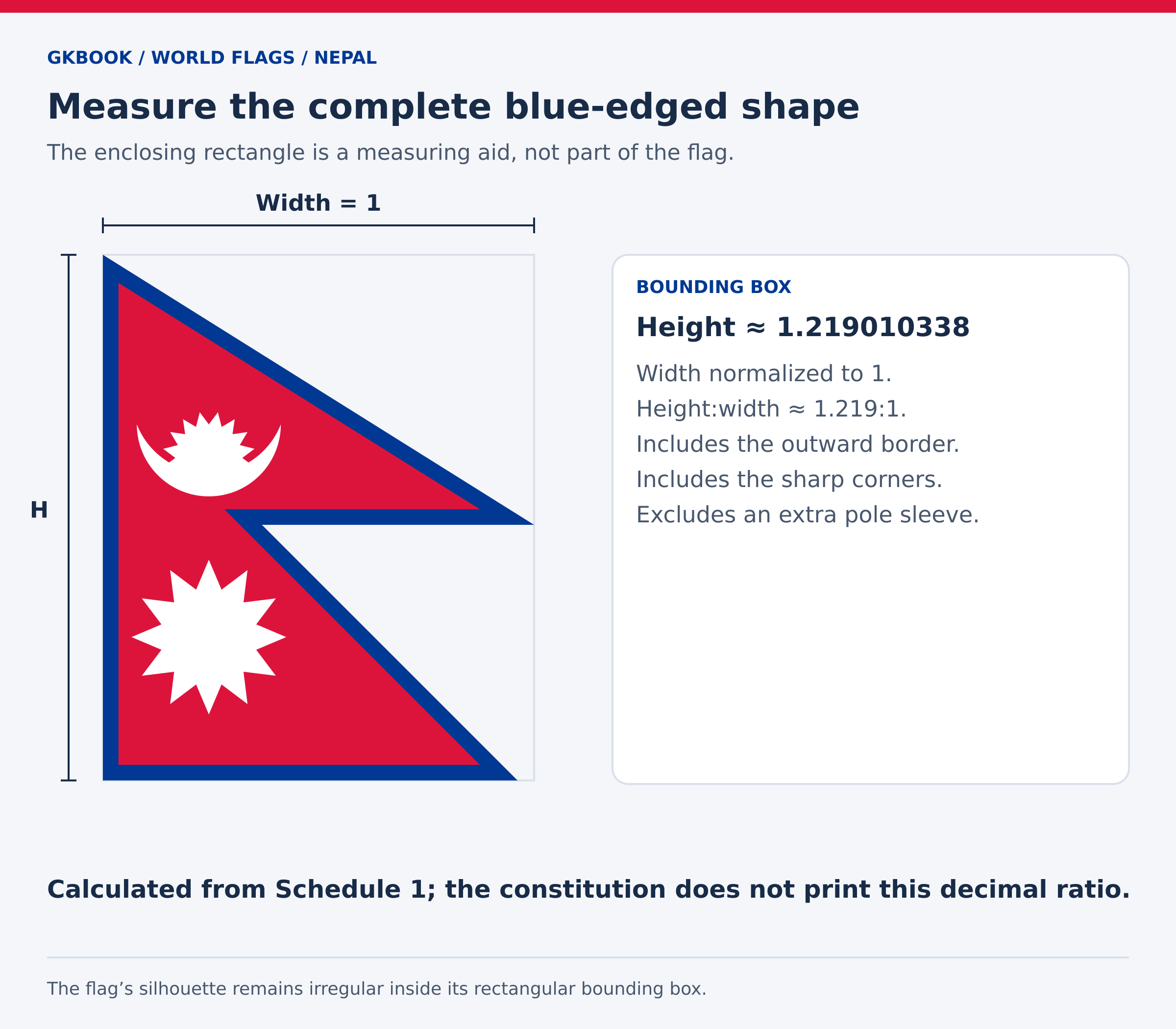
For the standard bordered construction, the flag’s bounding-box height is approximately 1.219010338 times its width. In height-to-width order, that is about 1.219:1. This value is calculated from Schedule 1, not printed there as a simple ratio. The irregular flag still occupies only part of that enclosing rectangle.
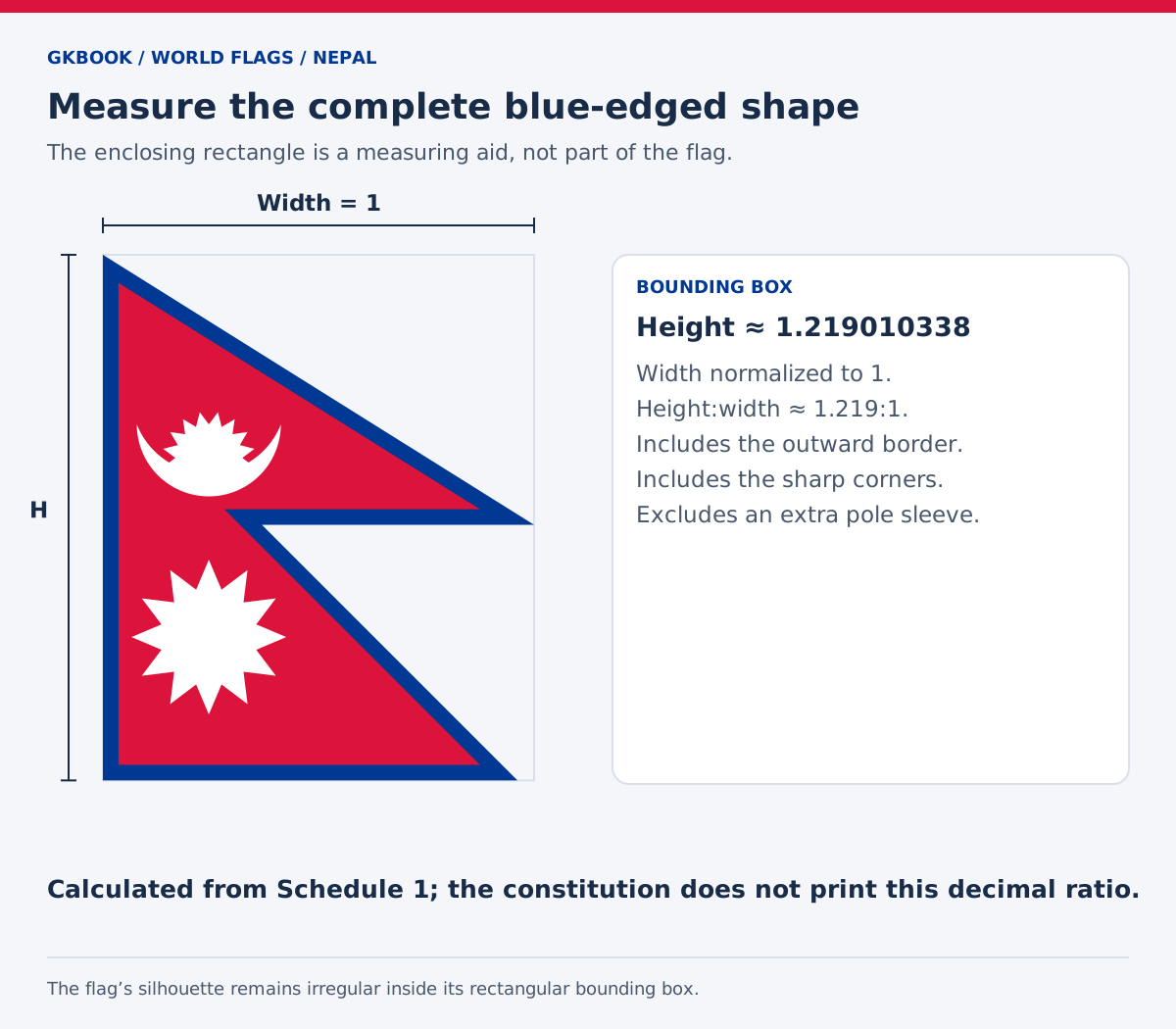
The bounding box is the smallest upright rectangle containing the complete blue-edged shape. It is a measuring device, not an additional background sewn onto the flag.
The calculation includes the outward blue border and its pointed corners. A wider hoist pocket permitted for attachment to a pole is a separate practical provision; it is not included in this standard geometric bounding box.
| Measurement | Ratio or multiplier |
|---|---|
| Complete bordered shape: height / width | Approximately 1.219010338 |
| Complete bordered shape: width / height | Approximately 0.820337588 |
| Inner crimson outline: width / height | 3 / 4 |
| Border width relative to inner base AB | Approximately 0.043038962 × AB |
Why is the flag sometimes described as 3:4?
The 3:4 proportion describes the width and height of the inner crimson construction before the blue border is added. Schedule 1 makes the vertical segment AC four-thirds of the base AB. The outward border changes the finished bounding box, so 3:4 is not the complete bordered flag’s width-to-height ratio.
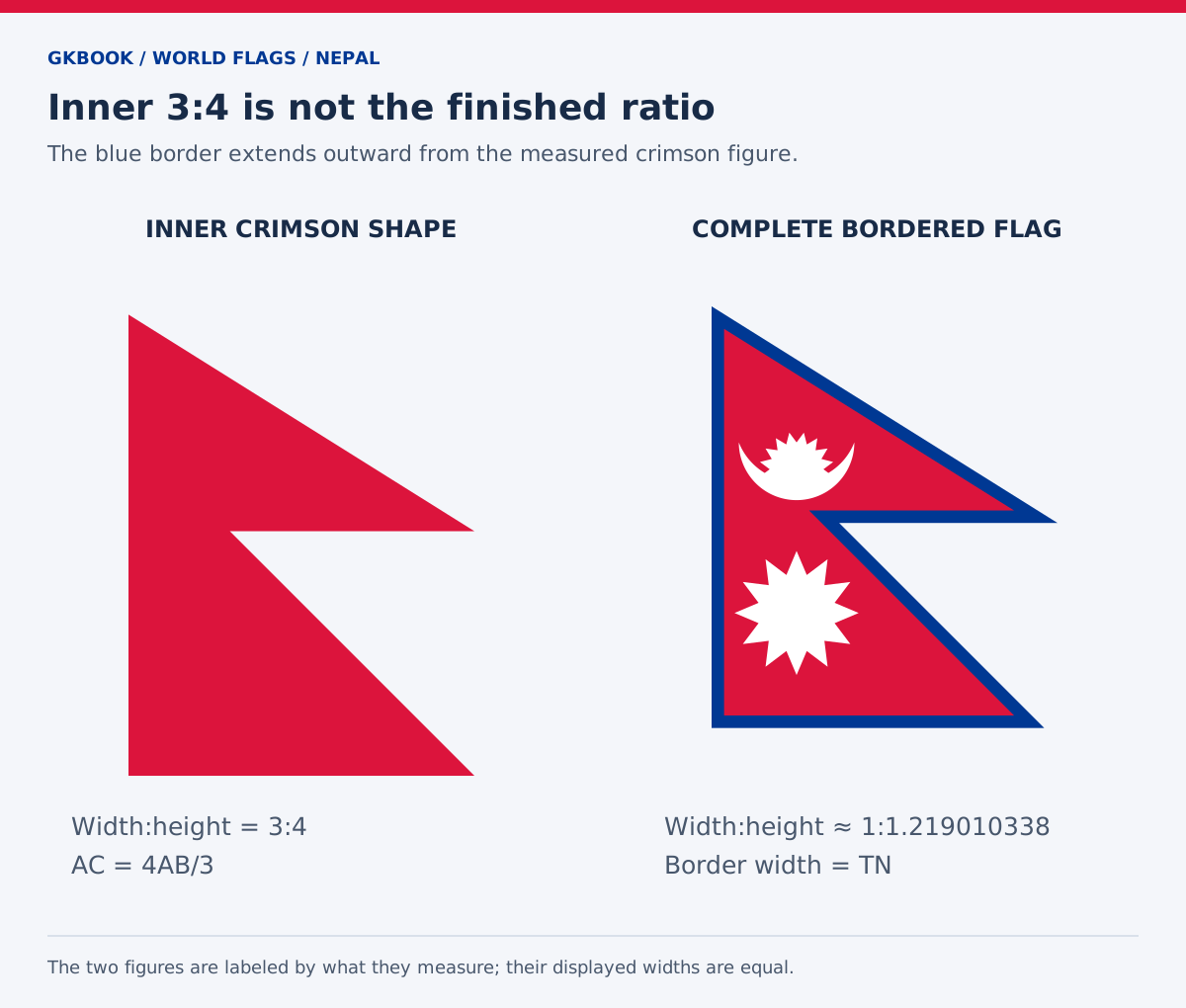
The distinction follows directly from the first construction steps and the later border rule. With AB set to 1, AC is 4/3, and the upper horizontal segment FG is also 1.
Adding a constant-width border does not preserve that bounding-box ratio. The sharp corners extend by different horizontal and vertical amounts, because their angles differ. That is why rounding the whole flag to 3:4 or 4:5 loses the constitutional geometry.
Are the two triangular parts identical?
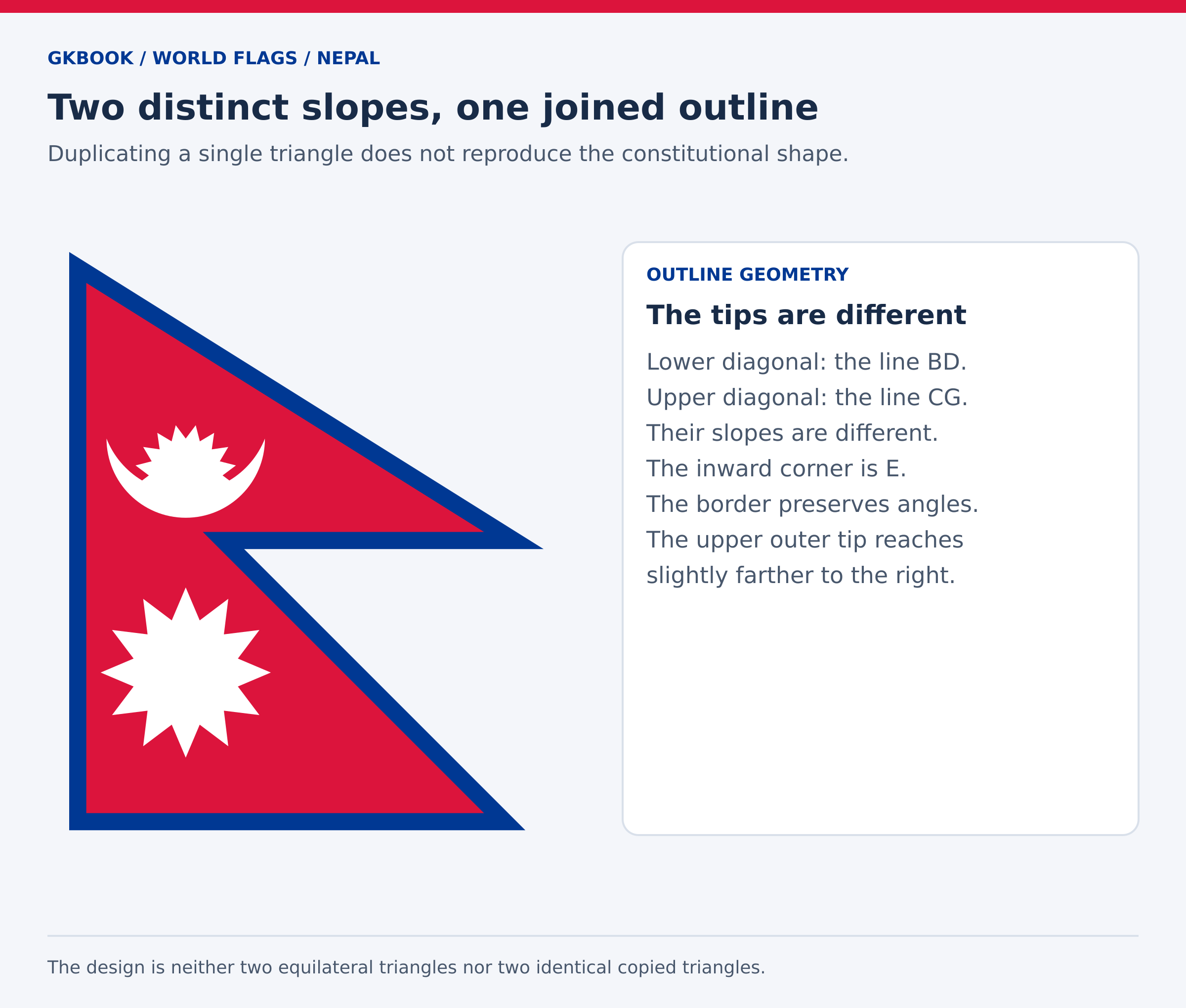
No. Nepal’s two triangular forms are not identical, equilateral triangles. The construction gives their sloping sides different angles and joins them into one continuous crimson figure. The upper point and lower point therefore have different corner geometry, and the outward border makes the upper point project slightly farther to the right.
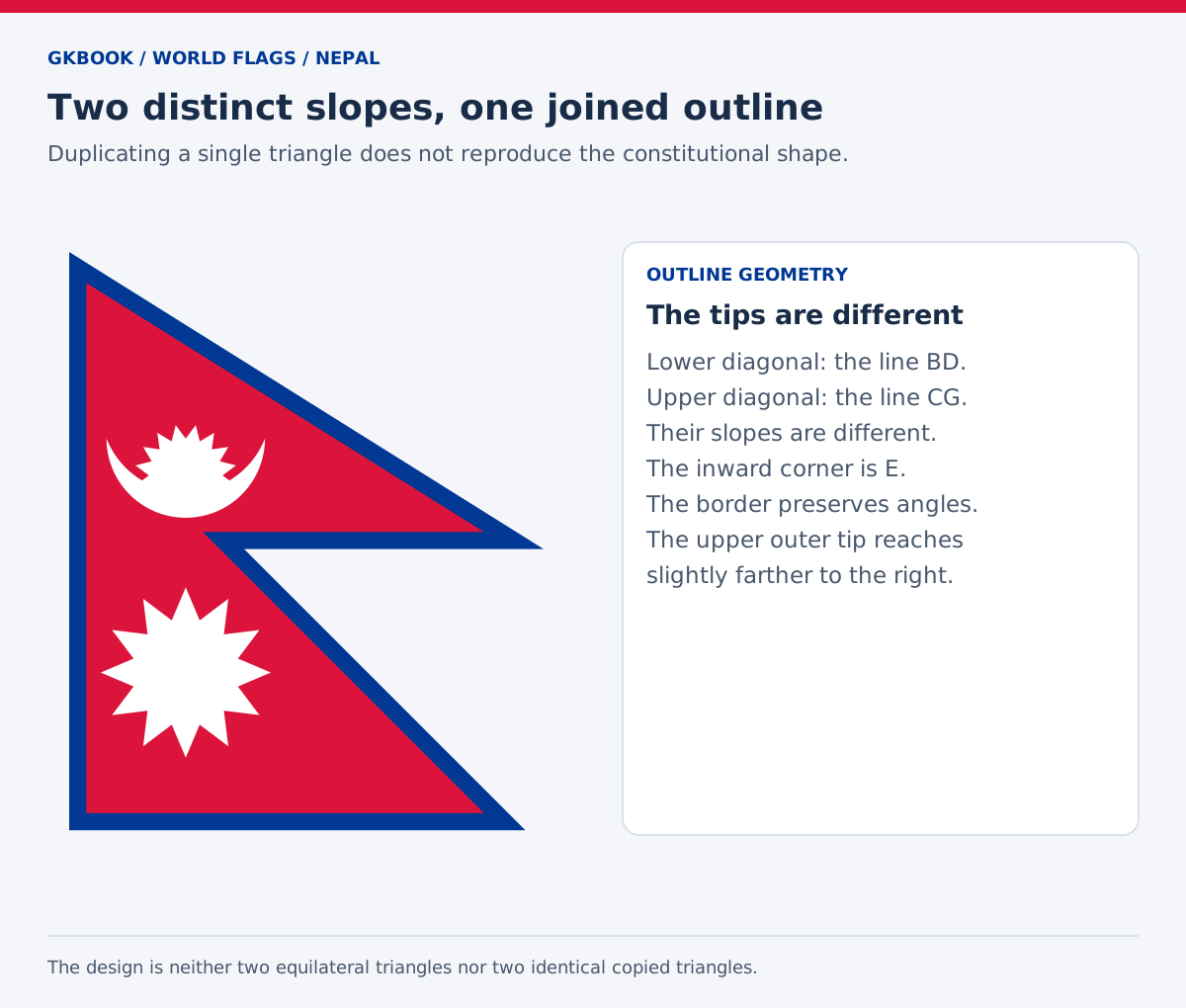
The lower construction uses a diagonal joining points B and D, where AB and AD have equal lengths. The upper sloping edge joins C to G. These lines do not have the same slope.
The outline should not be made by duplicating one triangle and moving it upward. Follow the specified intersections, including the inward point E, to preserve both the notch and the relative heights of the emblems.
How is Nepal’s flag constructed accurately?
Start with the inner outline, then locate the moon and sun using the constitution’s reference lines and circles, and finally add the blue border. All measurements derive from the chosen base AB. Scaling that base scales the entire construction, while drawing the emblems or border independently can disturb their required relationships.
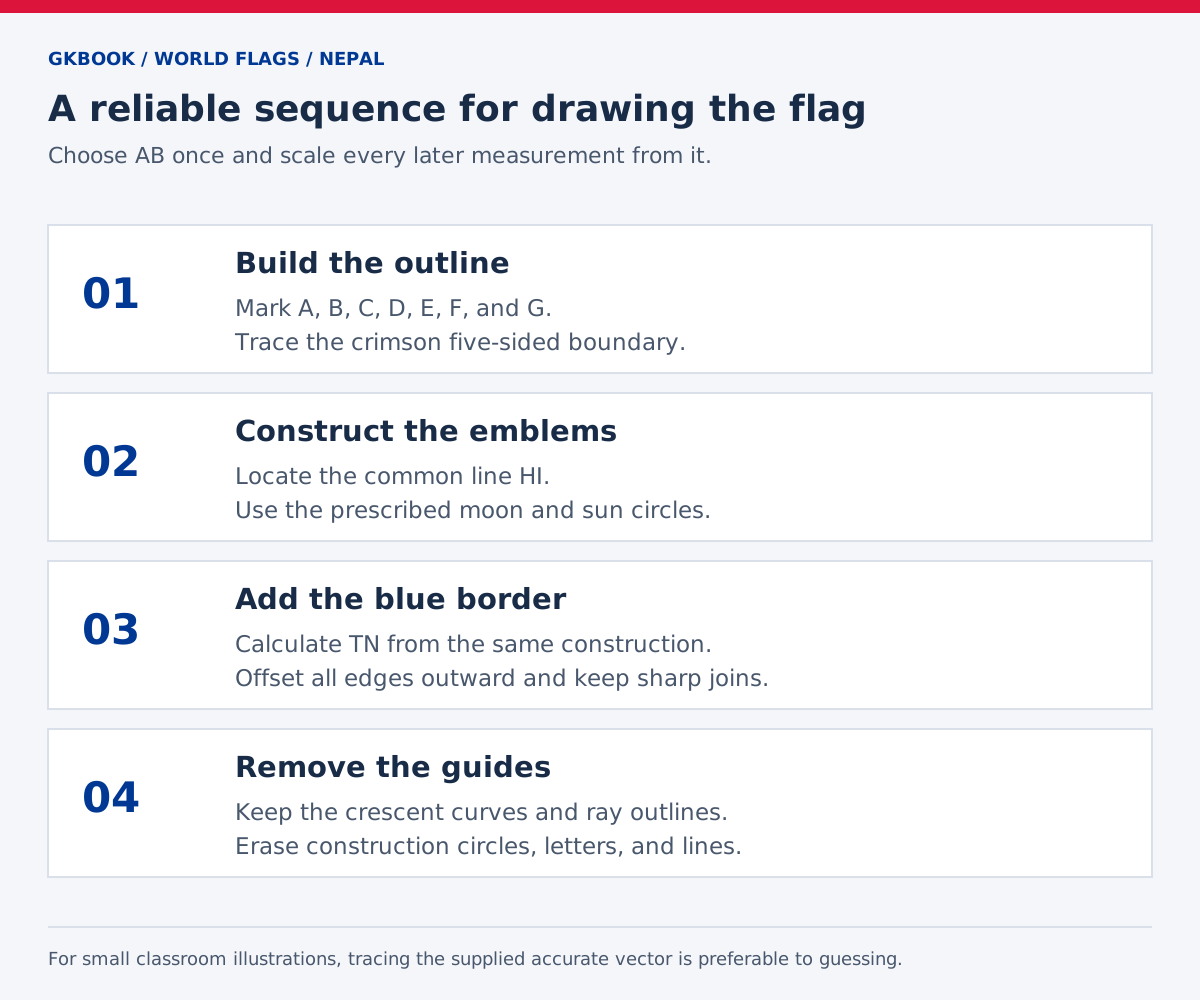
The method is a geometric recipe rather than a collection of unrelated pixel values. A compass-and-straightedge drawing and a coordinate-based vector drawing can implement the same relationships.
The diagrams retain the constitution’s point names so that the steps can be checked against Schedule 1. The finished flag removes those letters, reference lines, and construction circles.
How do you draw the flag’s crimson outline?
Choose a base AB, draw AC perpendicular to it with length four-thirds of AB, and mark D one base-length above A. Locate E on BD so that BE equals AB. Draw the horizontal FG through E with FG equal to AB, then join C to G to complete the upper slope.

Trace the crimson boundary in the order A–B–E–G–C–A. Point F lies on the hoist at the same height as E and G, but it is not an extra corner in that boundary.
In the coordinate model used here, A = (0, 0), B = (1, 0), C = (0, 4/3), E = (1 − 1/√2, 1/√2), and G = (1, 1/√2). Positive vertical coordinates point upward.
How is the moon’s crescent and ray pattern constructed?
The moon is built from several related circles, not from a standard crescent icon. Schedule 1 locates points L, M, N, and T, then uses their distances to form the crescent and the ray envelopes. Eight equal triangular rays occupy the upper band between arcs centered at T, above the crescent.
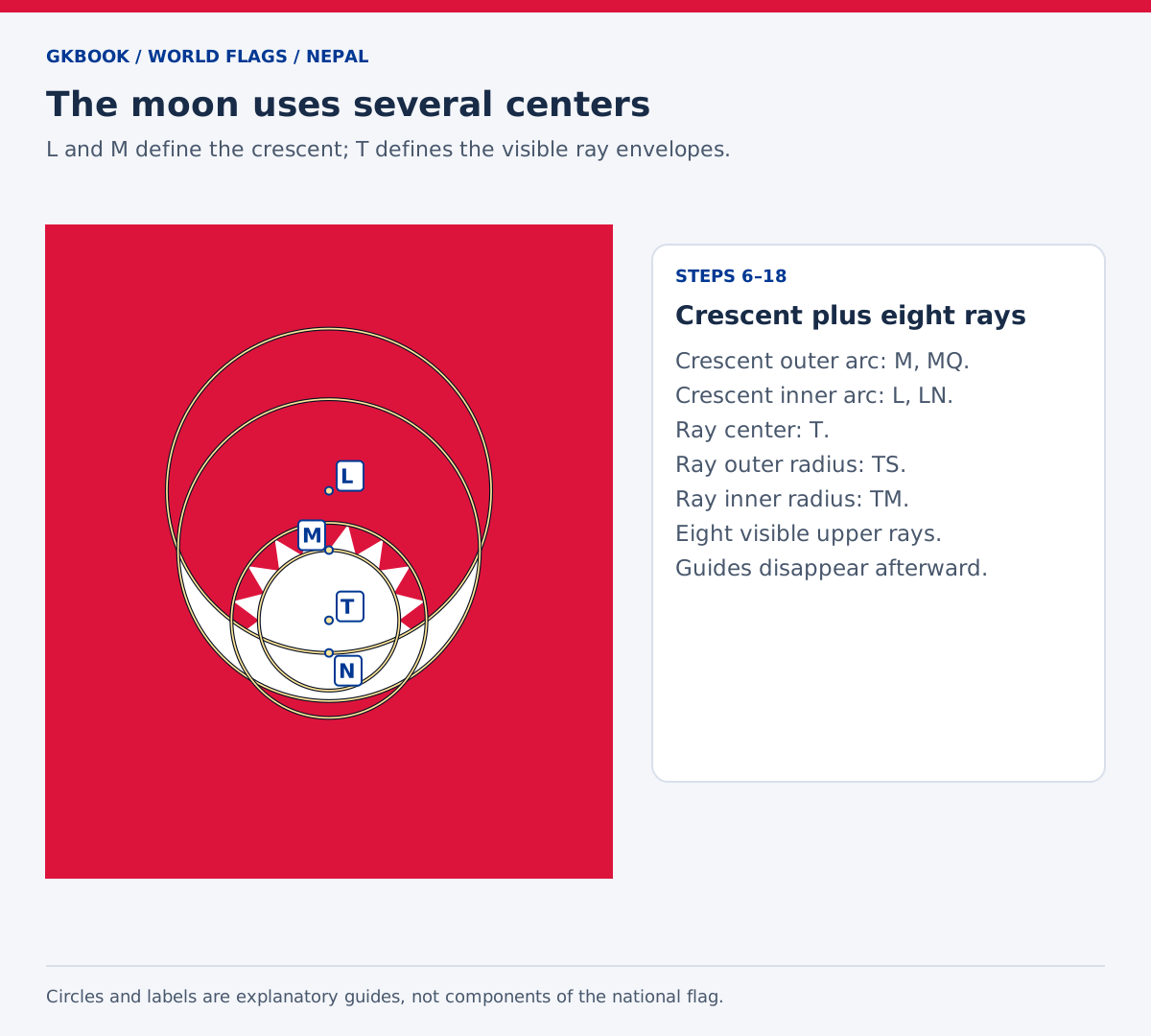
The lower crescent boundary is a semicircle centered at M with radius MQ. Its inner curve belongs to the circle centered at L with radius LN. Their intersections with the horizontal through M establish the two horns.
The ray envelope has outer radius TS and inner radius TM. The supplied vector follows these radii and joins the ray sides to the crescent at calculated intersections. The central axis passes through an inward notch between the two highest rays.
How is the twelve-rayed sun constructed?
Locate the sun’s center W where the vertical reference line HI meets the horizontal through U, the midpoint of AF. Draw concentric circles with radii MN and LN. Twelve equal triangular rays fit between them, with a tip directly above W and another directly below it on the same vertical line.
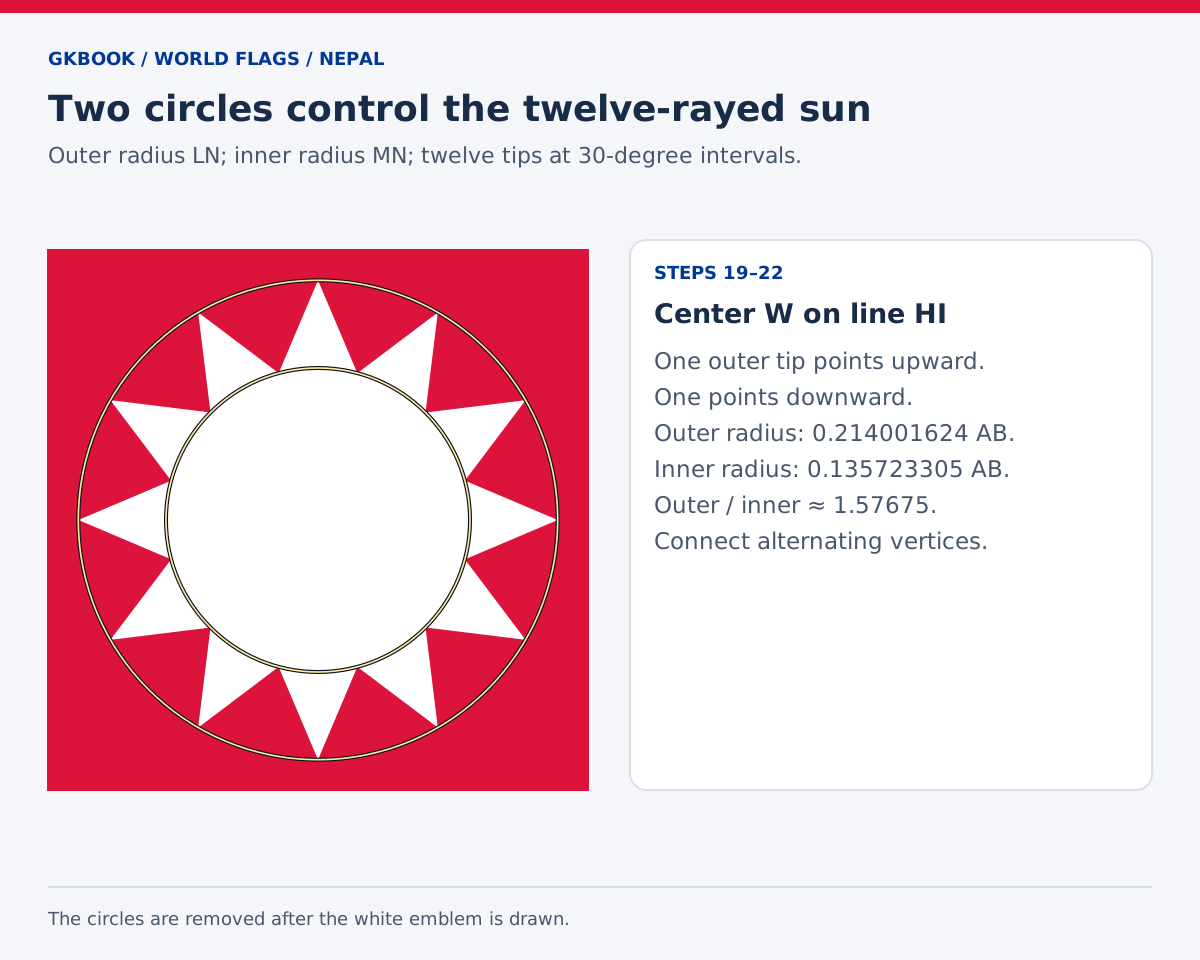
The outer radius is LN and the inner radius is MN. In this construction their ratio is about 1.57675, so substituting an arbitrary star with an inner radius exactly half its outer radius changes the emblem.
The twelve outer tips are spaced 30 degrees apart. The twelve inner vertices lie halfway between them, at 15-degree offsets. Connect them in alternating order, fill white, and remove the guide circles.
How wide should the blue border be?
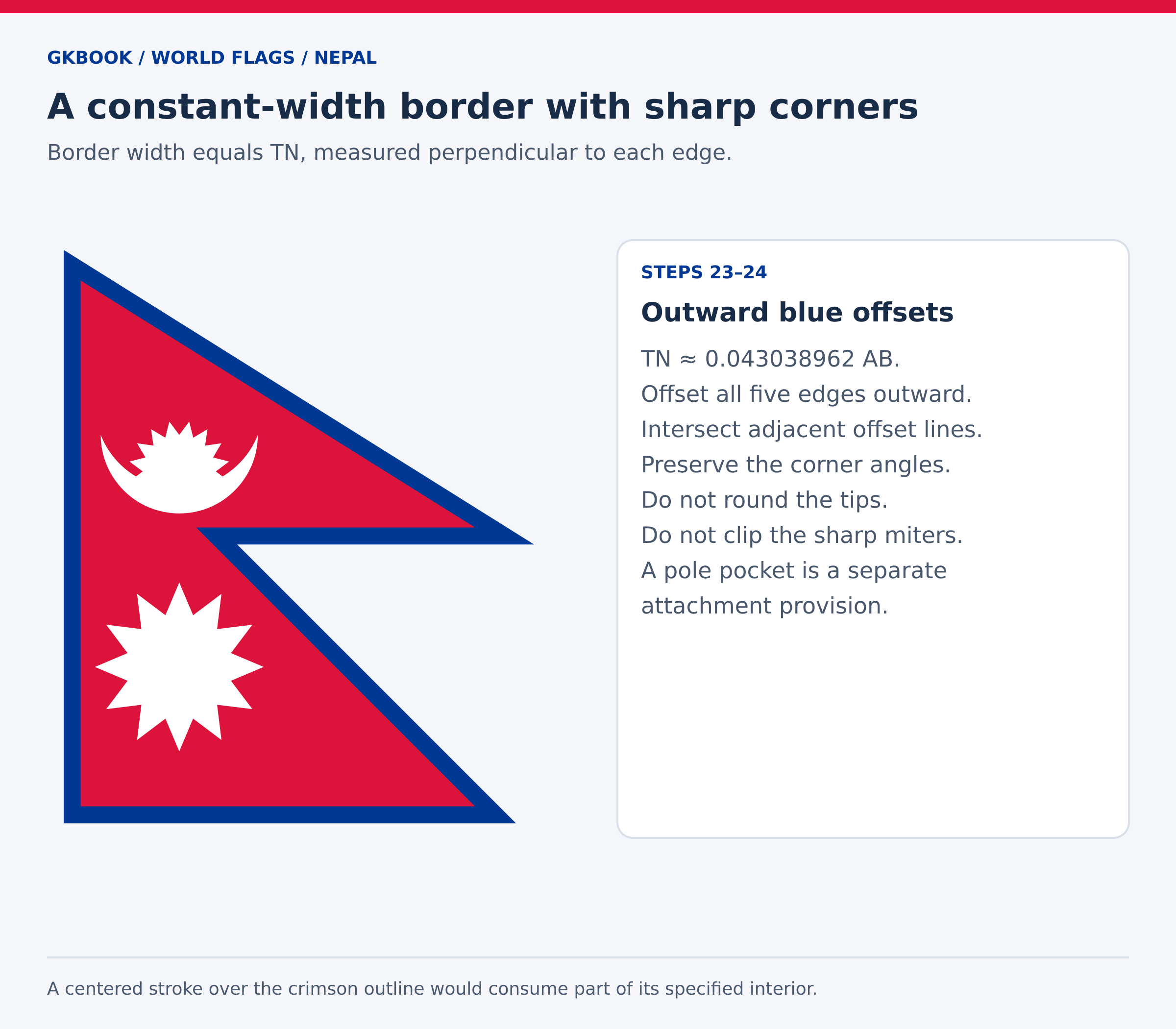
Schedule 1 makes the blue border’s width equal to the constructed distance TN. It runs around all five sides, with outer corners matching the corresponding inner angles. In the normalized drawing, TN is approximately 0.043038962 times AB. Measure that thickness perpendicular to each edge, rather than horizontally along every sloping side.
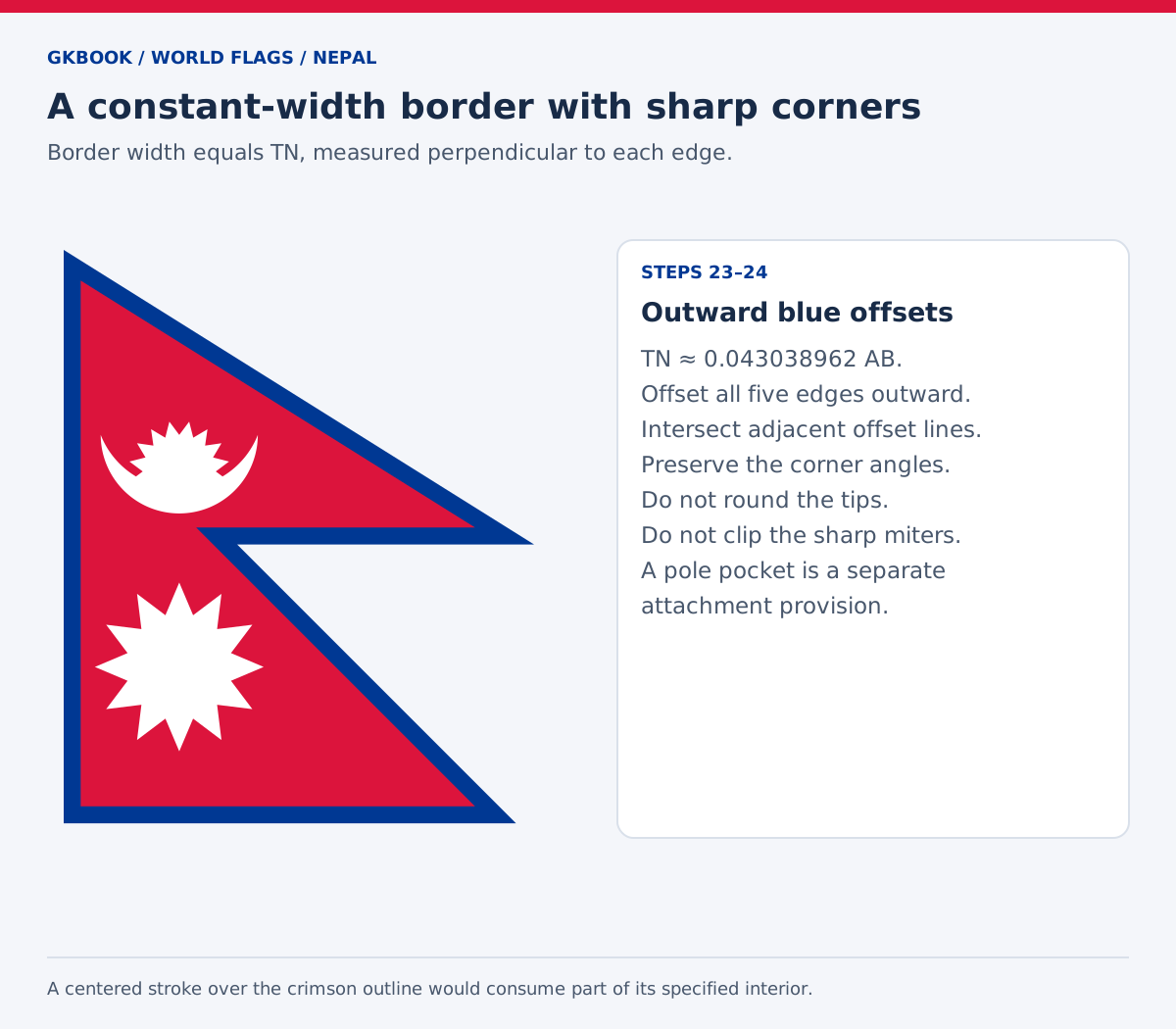
The border lies outside the crimson outline. Parallel offsets and sharp mitered intersections preserve the specified angles. A thick stroke drawn partly inside the crimson shape would reduce the interior unless its geometry were adjusted.
The acute upper tip extends farther under this offset than the lower tip. Rounded joins, shortened miters, and a rectangular blue frame all change the outline. Schedule 1 separately allows the hoist-side attachment to be extended as needed for a pole.
Where are the moon and sun positioned?
Both emblems are aligned on HI, the vertical line one-quarter of the inner base AB from the crimson hoist edge. The sun’s center lies halfway between A and F in height. The moon is positioned by the additional lines through J and M, so its center cannot be chosen by visual guesswork.
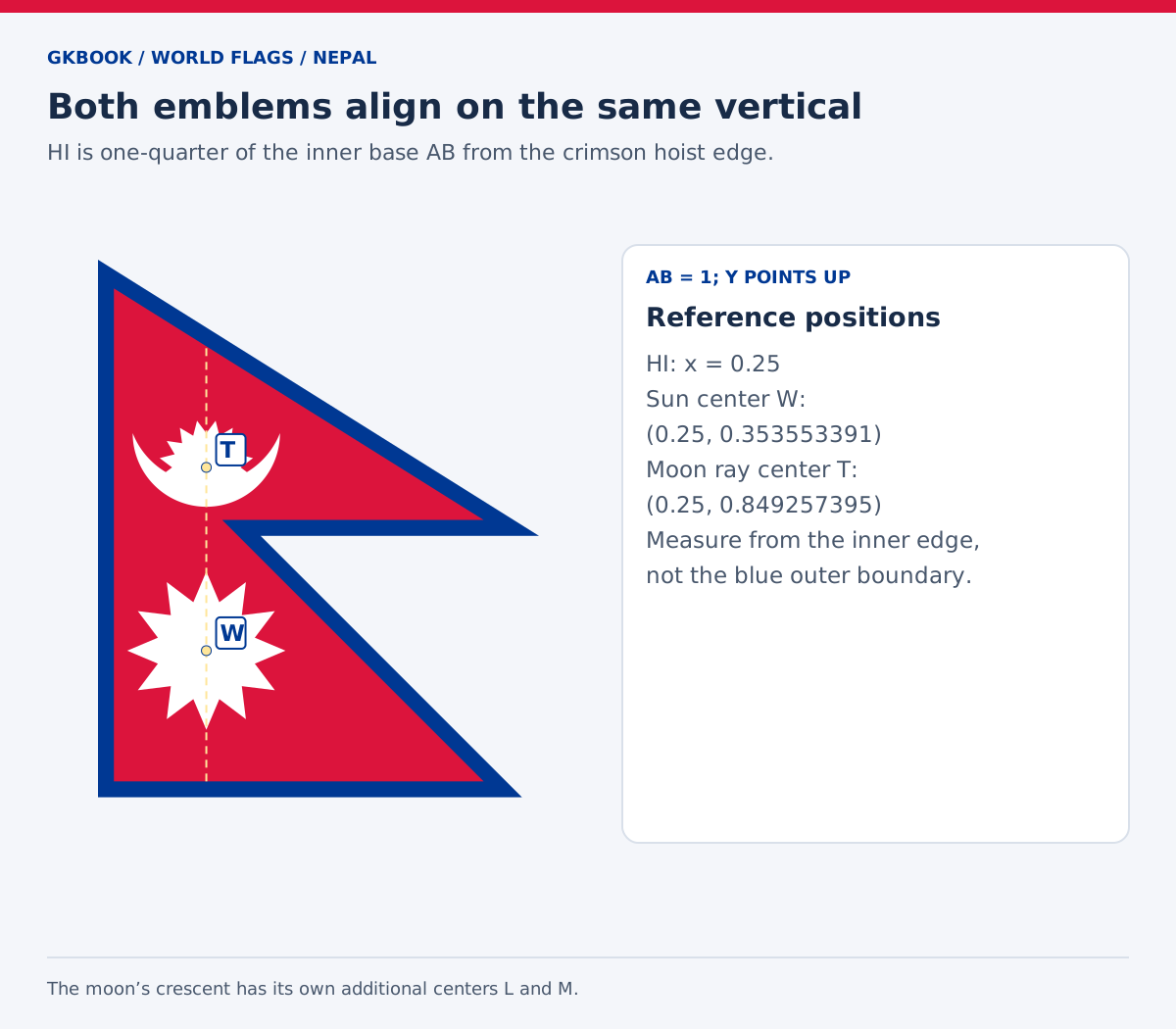
The quarter-base measurement starts at the inner crimson edge, not at the outside of the blue border. Using one-quarter of the finished bounding-box width gives a different position.
For AB = 1, the sun’s center W is (0.25, 0.353553391). The moon’s ray center T is approximately (0.25, 0.849257395). The crescent itself uses different centers, L and M; it is misleading to describe the entire moon with one circle.
What are the Nepal flag’s HEX and RGB colors?
The supplied digital artwork uses crimson #DC143C, deep blue #003893, and white #FFFFFF. These are declared screen choices, not numerical color values enacted in Article 8 or Schedule 1. The constitution specifies color names; a digital palette should not be presented as a certified match for every printed or woven flag.
The table gives the actual RGB components corresponding to the HEX values in these files. Conversion is exact within that color notation, although the appearance of a screen, printing process, and dyed cloth can differ.
No verified national Pantone requirement is asserted here. For formal production, use the relevant approved physical reference and manufacturing instructions rather than inferring a textile standard from a web image.
| Color | HEX | RGB |
|---|---|---|
| Crimson | #DC143C | 220, 20, 60 |
| Deep blue | #003893 | 0, 56, 147 |
| White | #FFFFFF | 255, 255, 255 |
Which way should Nepal’s flag face?
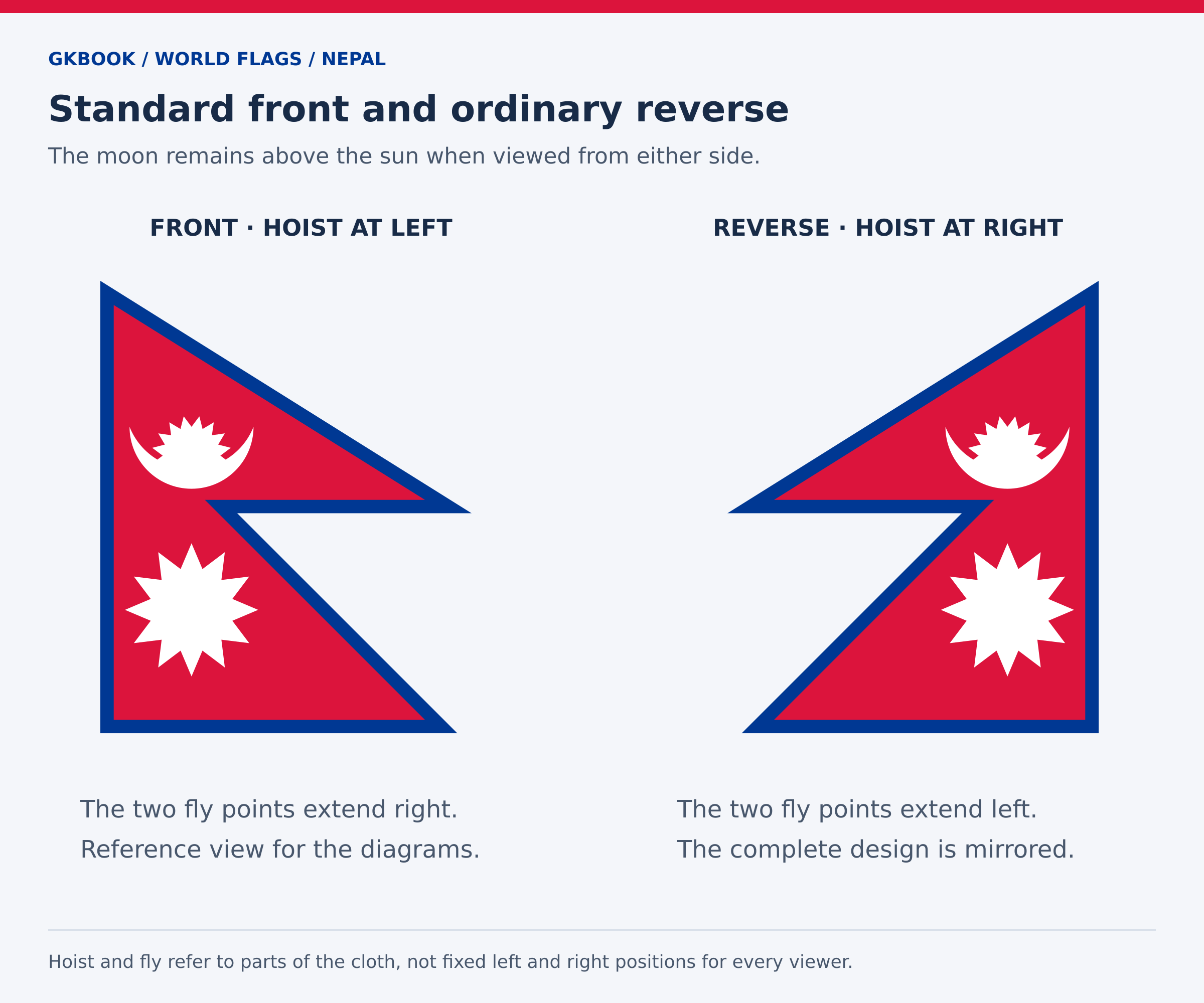
In the standard front-view drawing, the continuous hoist edge is vertical on the left, the two points extend to the right, the moon is above, and the sun is below. Viewing the same ordinary flag from behind reverses left and right while preserving the physical hoist edge and the emblems’ vertical order.
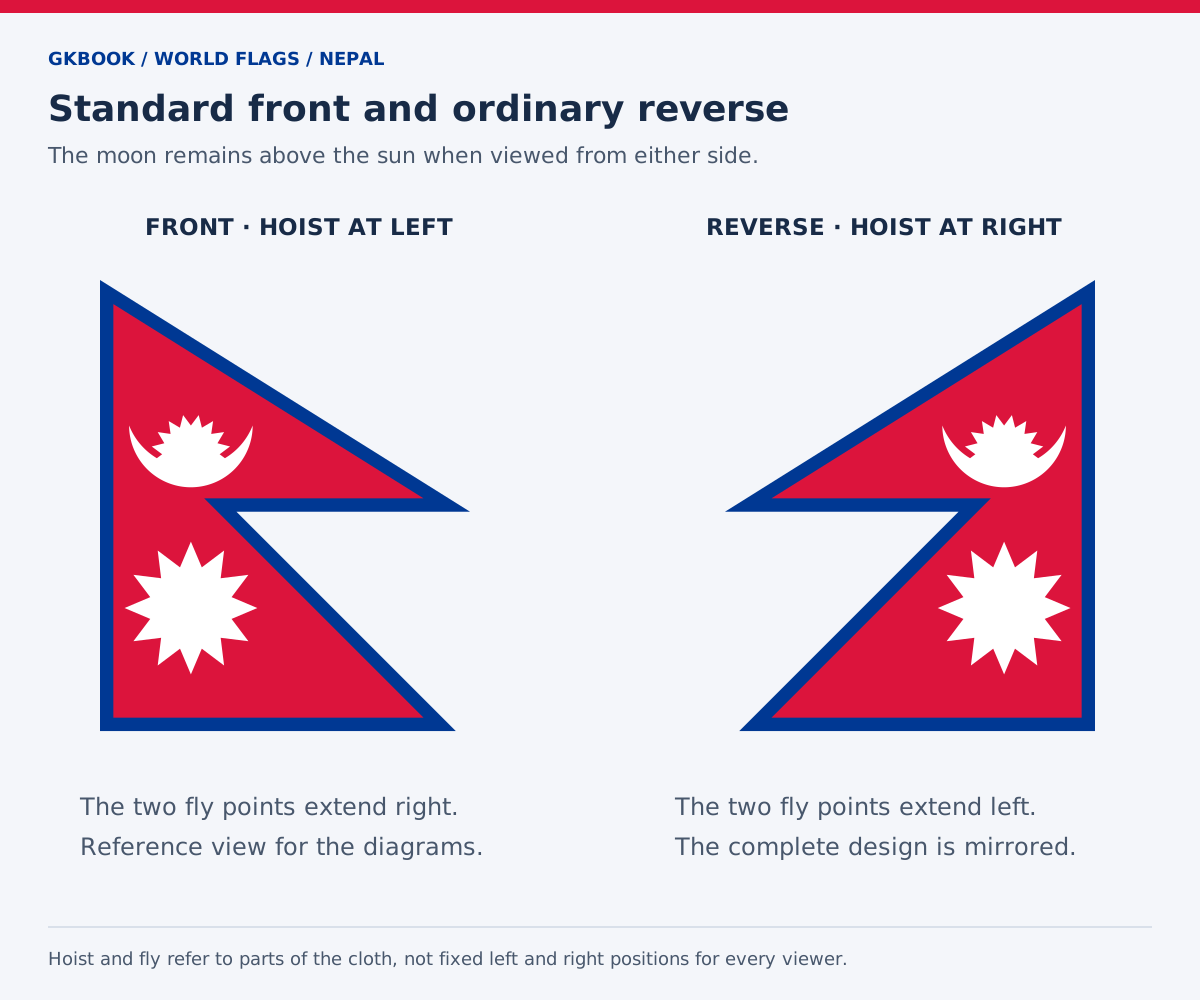
The reverse is a horizontal mirror of the whole design, not an upside-down flag. Moon and sun remain in their upper and lower positions. Changing only the emblems or moving the hoist independently would not represent that reverse view.
The construction establishes the reference orientation. It does not prescribe a universal rotation rule for every indoor banner or event display.
Is the white rectangle around some Nepal flag images part of the flag?
No. The national flag ends at its blue five-sided boundary. A white rectangle around it is usually a page, image canvas, or mounting background. The supplied main SVG and PNG leave the area outside the silhouette transparent, preserving the irregular outline when the image is placed on different backgrounds.

Raster images must still have rectangular pixel dimensions. Transparency records which pixels belong outside the flag; it does not add cloth to those areas.
On a dark background, the white moon and sun must remain white and opaque. Removing all white pixels would damage the emblems. Preserve the blue border, including both sharp fly points, when cropping or exporting.
Does Nepal prescribe physical sizes for different flag uses?
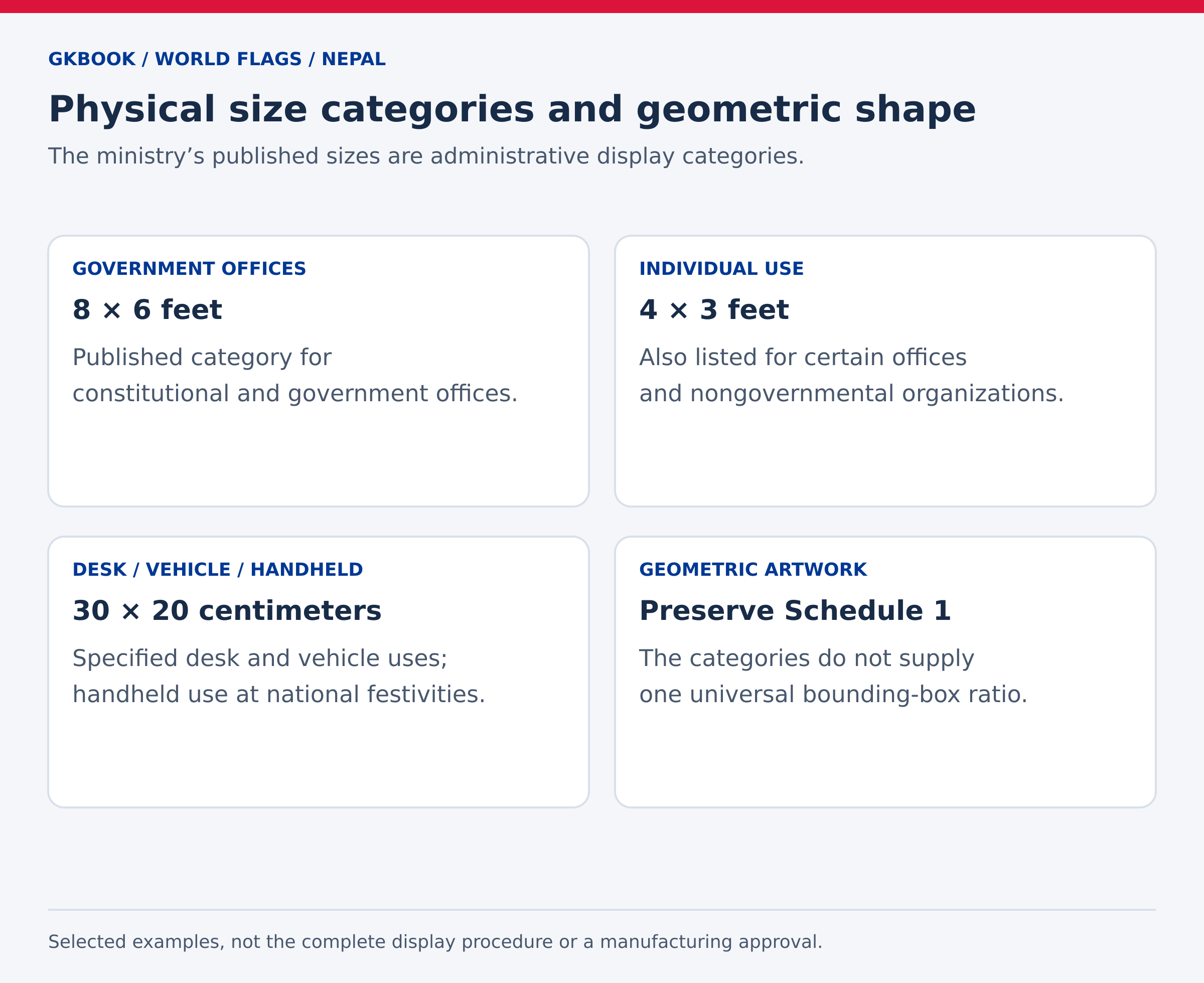
Yes. Schedule 1 leaves the physical size to the government, and the Ministry of Home Affairs has published size categories for different settings. Those administrative dimensions should be read alongside the constitutional construction. They are not a substitute for the geometric relationships used to draw the flag’s outline, emblems, and border.
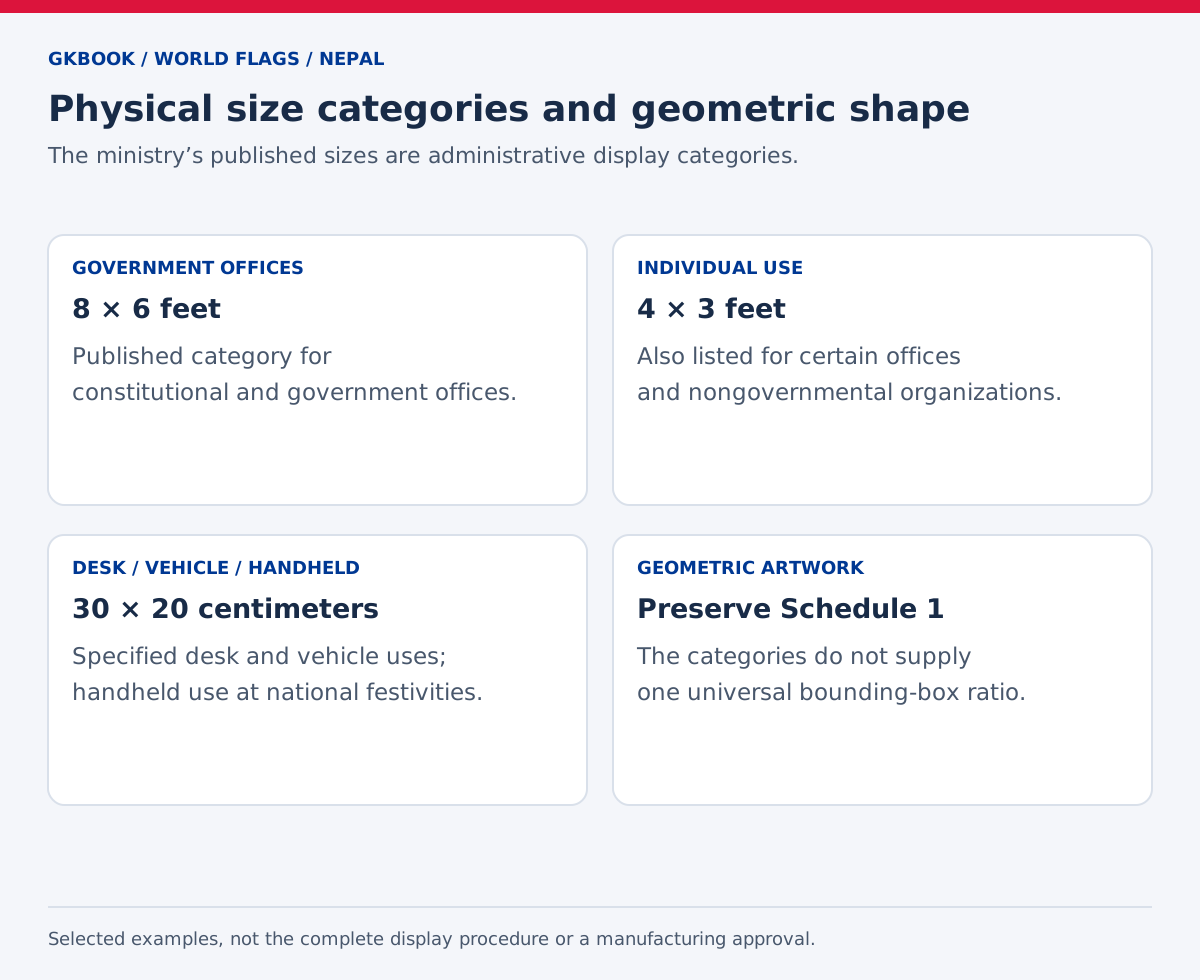
The ministry’s published notice lists, among other categories, 8 × 6 feet for government offices, 4 × 3 feet for individual use and certain office interiors, and 30 × 20 centimeters for specified desk, vehicle, and handheld uses. These examples follow the notice’s dimension order.
The categories use several nominal proportions. They therefore do not establish one universal mathematical bounding-box ratio. For a formal display, consult the applicable ministry instructions; for a vector drawing, preserve Schedule 1’s construction rather than stretching the design to a convenient rectangle.
What is a practical way for students to draw the Nepal flag?
Begin with a measured outline, establish the common vertical reference line for the emblems, and work through the moon and sun constructions before adding the border. Use the supplied labeled diagrams as guides. For a simple classroom picture, trace the accurate outline and emblems instead of replacing them with two identical triangles and ordinary stars.
A larger drawing makes the small ray intersections easier to handle. Keep AB as the reference length, and scale all subsequent distances from it. The circles are useful while drawing, even though they disappear in the finished image.
For a digital assignment, use the SVG when possible. It preserves smooth curves and sharp edges at different sizes. The PNG is useful for applications that do not support vector graphics.
What mistakes should be avoided when drawing Nepal’s flag?
Avoid turning the flag into a rectangle, using identical triangles, leaving out the moon’s rays, giving the sun the wrong point count, or treating the inner 3:4 proportion as the finished ratio. Also preserve the outward blue border, the common emblem alignment, and the distinction between transparent background pixels and white flag details.
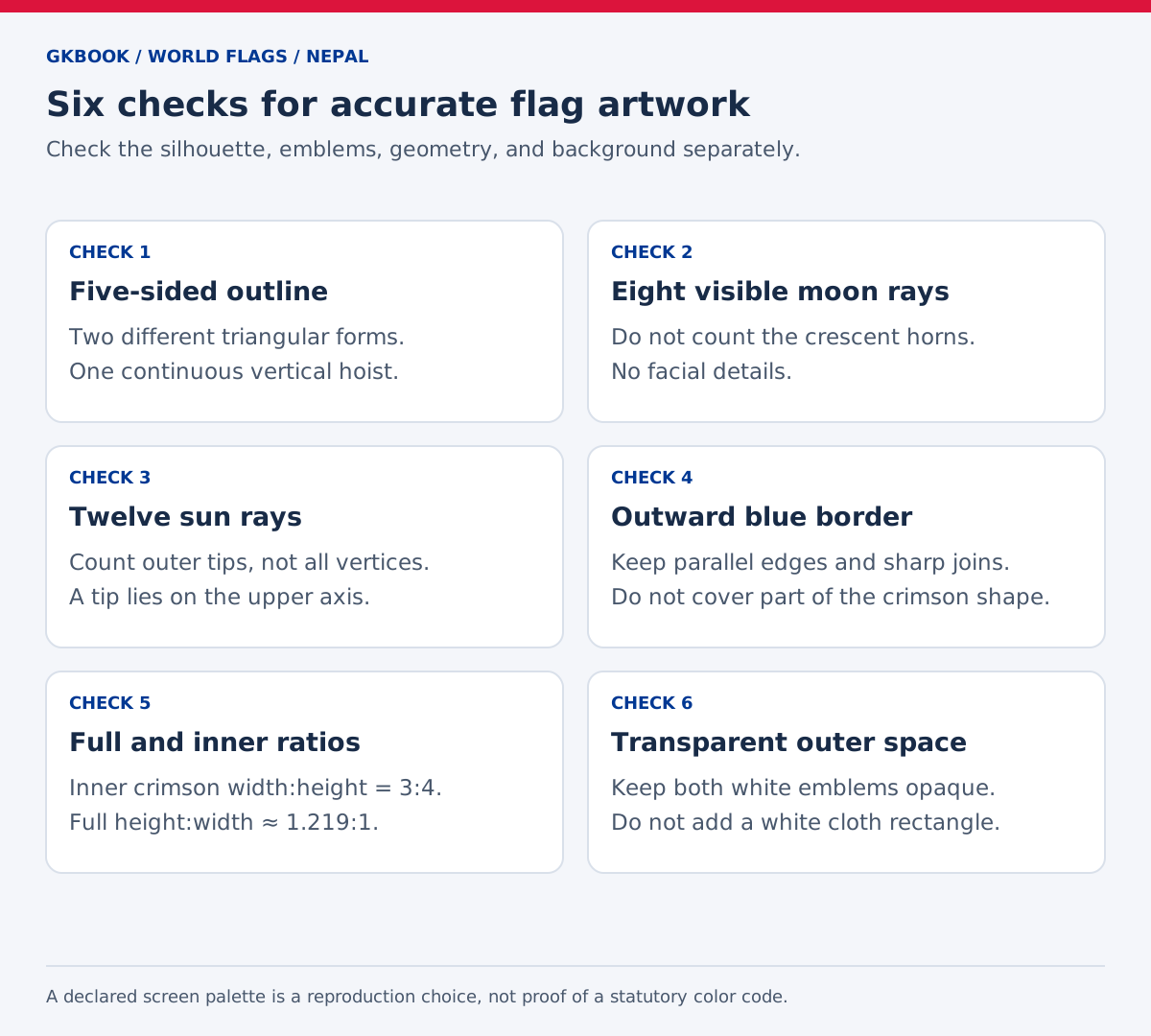
Check the ray counts independently: eight visible above the crescent and twelve around the sun. Keep the two highest moon rays on either side of the central notch, while the sun has a tip directly on its upper vertical axis.
Check the history as well as the artwork. The modern standardization belongs to 1962, the current constitution to 2015, and UN admission to 1955. A different digital red or blue alone is not evidence that Nepal adopted a new flag.
Download Nepal flag pictures
Download the national flag as SVG or 4000 × 4876 PNG. The gallery contains 22 subjects, each with SVG and PNG versions. Keep the irregular outline and transparent exterior intact. The PNG dimensions are rounded to whole pixels; the SVG preserves the calculated geometry. Image credits and reconstruction notes accompany the artwork.
Explore more in World Flags, including the Nauru flag and Namibia flag.
World Flags/Nepal
Nepal flag pictures
Constitutional double-pennon construction with transparent space outside the blue boundary. Screen colors are approximations.
GKBook original geometric reconstruction and explanatory artwork.Download SVGDownload PNGHEX and RGB values describe this artwork; the constitution prescribes named colors rather than these numerical codes.
GKBook original geometric reconstruction and explanatory artwork.Download SVGDownload PNGThese familiar meanings appear in official explanatory material; Article 8 and Schedule 1 define appearance and construction.
GKBook original geometric reconstruction and explanatory artwork.Download SVGDownload PNGArticle 8 describes eight visible rays out of sixteen; the horns of the crescent are not two extra rays.
GKBook original geometric reconstruction and explanatory artwork.Download SVGDownload PNGThe sun’s twelve outward tips follow the constitutional two-circle construction.
GKBook original geometric reconstruction and explanatory artwork.Download SVGDownload PNGThe modern flag’s conventional 1962 date is distinct from UN admission in 1955 and the current constitution in 2015.
GKBook original geometric reconstruction and explanatory artwork.Download SVGDownload PNGThe older flag tradition and the precise modern specification should not be collapsed into one creation date.
GKBook original geometric reconstruction and explanatory artwork.Download SVGDownload PNGThe schedule divides the drawing into outline, moon, sun, and border, then explains which guides must be removed.
GKBook original geometric reconstruction and explanatory artwork.Download SVGDownload PNGThe standard bordered flag has height-to-width ratio approximately 1.219010338:1, derived from the construction.
GKBook original geometric reconstruction and explanatory artwork.Download SVGDownload PNGThe crimson interior is 3:4 in width-to-height order; adding the outward border changes the full bounding-box ratio.
GKBook original geometric reconstruction and explanatory artwork.Download SVGDownload PNGThe two triangular forms have different slopes and sharp-tip geometry; the outline is one concave pentagon.
GKBook original geometric reconstruction and explanatory artwork.Download SVGDownload PNGThe boundary follows A, B, E, G, C, and back to A; D and F are auxiliary points rather than extra boundary corners.
GKBook original geometric reconstruction and explanatory artwork.Download SVGDownload PNGCircles centered at L, M, and T explain why an ordinary crescent-and-star icon cannot substitute for the national emblem.
GKBook original geometric reconstruction and explanatory artwork.Download SVGDownload PNGThe inner radius is not arbitrarily half the outer radius; both come from the earlier moon construction.
GKBook original geometric reconstruction and explanatory artwork.Download SVGDownload PNGThe border uses parallel outward offsets of width TN and exact line intersections at all corners.
GKBook original geometric reconstruction and explanatory artwork.Download SVGDownload PNGThe moon’s ray center and the sun center share x = AB/4 in the normalized Cartesian construction.
GKBook original geometric reconstruction and explanatory artwork.Download SVGDownload PNGAn ordinary reverse mirrors the complete flag horizontally; it does not swap the moon and sun vertically.
GKBook original geometric reconstruction and explanatory artwork.Download SVGDownload PNGOnly the area outside the blue silhouette is transparent; the white celestial emblems remain opaque.
GKBook original geometric reconstruction and explanatory artwork.Download SVGDownload PNGExamples follow the Home Ministry notice’s dimension order; the constitutional construction remains the basis of the geometric artwork.
GKBook original geometric reconstruction and explanatory artwork.Download SVGDownload PNGOutline, emblems, border, and guide removal form a reproducible workflow based on Schedule 1.
GKBook original geometric reconstruction and explanatory artwork.Download SVGDownload PNGThe checklist separates the frequent shape, ray-count, border, proportion, and transparency errors.
GKBook original geometric reconstruction and explanatory artwork.Download SVGDownload PNGA compact visual reference for the outline, color arrangement, emblems, and constitutional location.
GKBook original geometric reconstruction and explanatory artwork.Download SVGDownload PNGFrequently asked questions
What does Nepal’s national flag look like?
Nepal’s national flag consists of two joined crimson triangular forms with a deep blue border. A white crescent moon with eight visible rays occupies the upper part, and a white twelve-rayed sun occupies the lower part. Its distinctive outline and detailed construction are defined by the Constitution of Nepal.
Why is Nepal’s flag not rectangular?
Nepal retains a traditional double-pennon design instead of a rectangular flag. Two joined triangular forms create a five-sided outline with an inward corner. It is the only nonquadrilateral national flag of a sovereign state. The constitution preserves this inherited form and supplies a precise method for drawing it.
What colors are on the Nepal flag?
Nepal’s flag has a crimson field, a deep blue border, and two white celestial emblems. Article 8 of the constitution names these colors and places the moon above the sun. White belongs inside those emblems; any white rectangle surrounding a pictured flag is a display background, not flag material.
What does the Nepal flag symbolize?
Official explanatory material associates the blue border with peace, crimson with bravery and the rhododendron, and the sun and moon with Nepal’s enduring existence. These are interpretations of the design’s meaning. Article 8 and Schedule 1 define the flag’s appearance and construction without setting out a complete symbolic explanation.
Why is the flag’s field crimson?
Crimson is Nepal’s national color as well as the color prescribed for the flag’s interior. Article 9 identifies it separately among the country’s national symbols. That constitutional status explains why an accurate description uses crimson rather than treating every red shade as an equally specific account of the design.
What is the upper symbol, and how many rays does it have?
The upper emblem is a white crescent moon with eight rays visible out of sixteen, as Article 8 describes it. The eight pointed rays rise from the crescent’s central portion. Its two curved horns are part of the crescent and should not be counted as two additional triangular rays.
How many rays does the sun on Nepal’s flag have?
The lower white sun has twelve rays. Schedule 1 constructs those rays between two concentric circles, with two opposite tips lying on the vertical reference line through the emblem’s center. The finished sun is a solid white shape with twelve outward points and twelve inward corners, without a face.
Do the two triangles represent the Himalayas?
The Himalayas interpretation appears in official explanatory material: the two triangular forms are associated with Nepal’s mountains. The constitution itself describes and constructs the shapes without assigning that meaning. A cultural explanation of the triangles should therefore be distinguished from a constitutional rule about their size, placement, or angles.
When was Nepal’s current flag adopted?
Nepal’s modern standardized flag is conventionally dated December 16, 1962, in connection with the 1962 constitution. The double-pennon tradition is older. The present constitution, which commenced on September 20, 2015, continues the design through Article 8 and Schedule 1; 2015 is therefore not its original adoption date.
How old is Nepal’s flag tradition?
The flag’s double-pennon tradition predates the modern construction adopted in the twentieth century. The 1962 constitution expressly describes the national flag as inherited through tradition. That evidence supports an older lineage, but it does not establish a single ancient creation date or one documented inventor of the original form.
Who designed the modern Nepal flag?
Engineer and architect Shankar Nath Rimal is associated with the modern standardization of Nepal’s flag. In his own account, he refined an existing traditional design rather than inventing its basic form. His contribution should therefore be described as redesign and specification, without assigning him authorship of the older double-pennon tradition.
Did older Nepal flags show faces on the sun and moon?
Yes. Historical flag references document earlier versions in which the celestial emblems carried human faces. The modern constitutional construction uses geometric white emblems without facial details. Those older variants should be identified by their period and evidence, rather than presented as one perfectly uniform design used throughout Nepal’s earlier history.
Did Nepal replace its flag when it became a republic?
Nepal retained the double-pennon national flag through the transition to a republic and into the 2015 constitution. The current text still specifies crimson, deep blue, the upper crescent with eight visible rays, and the lower twelve-rayed sun. A change in government or constitutional framework does not necessarily mean a replacement flag.
Is 1962 the date the United Nations recognized Nepal?
No. Nepal joined the United Nations on December 14, 1955, according to United Nations membership records. The 1962 date associated with the modern flag concerns its domestic constitutional standardization. UN membership, international recognition, and a country’s adoption or specification of its national flag are different historical events and should be dated separately.
Where is the Nepal flag defined in the constitution?
Article 8 of the Constitution of Nepal describes the national flag, and Schedule 1 provides its construction. The schedule contains twenty-four numbered steps covering the inner outline, moon, sun, and border. It also explains which drawing guides must disappear and allows the government to determine the flag’s physical size.
What are the overall proportions of Nepal’s flag?
For the standard bordered construction, the flag’s bounding-box height is approximately 1.219010338 times its width. In height-to-width order, that is about 1.219:1. This value is calculated from Schedule 1, not printed there as a simple ratio. The irregular flag still occupies only part of that enclosing rectangle.
Why is the flag sometimes described as 3:4?
The 3:4 proportion describes the width and height of the inner crimson construction before the blue border is added. Schedule 1 makes the vertical segment AC four-thirds of the base AB. The outward border changes the finished bounding box, so 3:4 is not the complete bordered flag’s width-to-height ratio.
Are the two triangular parts identical?
No. Nepal’s two triangular forms are not identical, equilateral triangles. The construction gives their sloping sides different angles and joins them into one continuous crimson figure. The upper point and lower point therefore have different corner geometry, and the outward border makes the upper point project slightly farther to the right.
How is Nepal’s flag constructed accurately?
Start with the inner outline, then locate the moon and sun using the constitution’s reference lines and circles, and finally add the blue border. All measurements derive from the chosen base AB. Scaling that base scales the entire construction, while drawing the emblems or border independently can disturb their required relationships.
How do you draw the flag’s crimson outline?
Choose a base AB, draw AC perpendicular to it with length four-thirds of AB, and mark D one base-length above A. Locate E on BD so that BE equals AB. Draw the horizontal FG through E with FG equal to AB, then join C to G to complete the upper slope.
How is the moon’s crescent and ray pattern constructed?
The moon is built from several related circles, not from a standard crescent icon. Schedule 1 locates points L, M, N, and T, then uses their distances to form the crescent and the ray envelopes. Eight equal triangular rays occupy the upper band between arcs centered at T, above the crescent.
How is the twelve-rayed sun constructed?
Locate the sun’s center W where the vertical reference line HI meets the horizontal through U, the midpoint of AF. Draw concentric circles with radii MN and LN. Twelve equal triangular rays fit between them, with a tip directly above W and another directly below it on the same vertical line.
How wide should the blue border be?
Schedule 1 makes the blue border’s width equal to the constructed distance TN. It runs around all five sides, with outer corners matching the corresponding inner angles. In the normalized drawing, TN is approximately 0.043038962 times AB. Measure that thickness perpendicular to each edge, rather than horizontally along every sloping side.
Where are the moon and sun positioned?
Both emblems are aligned on HI, the vertical line one-quarter of the inner base AB from the crimson hoist edge. The sun’s center lies halfway between A and F in height. The moon is positioned by the additional lines through J and M, so its center cannot be chosen by visual guesswork.
What are the Nepal flag’s HEX and RGB colors?
The supplied digital artwork uses crimson #DC143C, deep blue #003893, and white #FFFFFF. These are declared screen choices, not numerical color values enacted in Article 8 or Schedule 1. The constitution specifies color names; a digital palette should not be presented as a certified match for every printed or woven flag.
Which way should Nepal’s flag face?
In the standard front-view drawing, the continuous hoist edge is vertical on the left, the two points extend to the right, the moon is above, and the sun is below. Viewing the same ordinary flag from behind reverses left and right while preserving the physical hoist edge and the emblems’ vertical order.
Is the white rectangle around some Nepal flag images part of the flag?
No. The national flag ends at its blue five-sided boundary. A white rectangle around it is usually a page, image canvas, or mounting background. The supplied main SVG and PNG leave the area outside the silhouette transparent, preserving the irregular outline when the image is placed on different backgrounds.
Does Nepal prescribe physical sizes for different flag uses?
Yes. Schedule 1 leaves the physical size to the government, and the Ministry of Home Affairs has published size categories for different settings. Those administrative dimensions should be read alongside the constitutional construction. They are not a substitute for the geometric relationships used to draw the flag’s outline, emblems, and border.
What is a practical way for students to draw the Nepal flag?
Begin with a measured outline, establish the common vertical reference line for the emblems, and work through the moon and sun constructions before adding the border. Use the supplied labeled diagrams as guides. For a simple classroom picture, trace the accurate outline and emblems instead of replacing them with two identical triangles and ordinary stars.
What mistakes should be avoided when drawing Nepal’s flag?
Avoid turning the flag into a rectangle, using identical triangles, leaving out the moon’s rays, giving the sun the wrong point count, or treating the inner 3:4 proportion as the finished ratio. Also preserve the outward blue border, the common emblem alignment, and the distinction between transparent background pixels and white flag details.
Explore all general-knowledge topics and the A-to-Z lists.












We Value Your Opinion Comments