
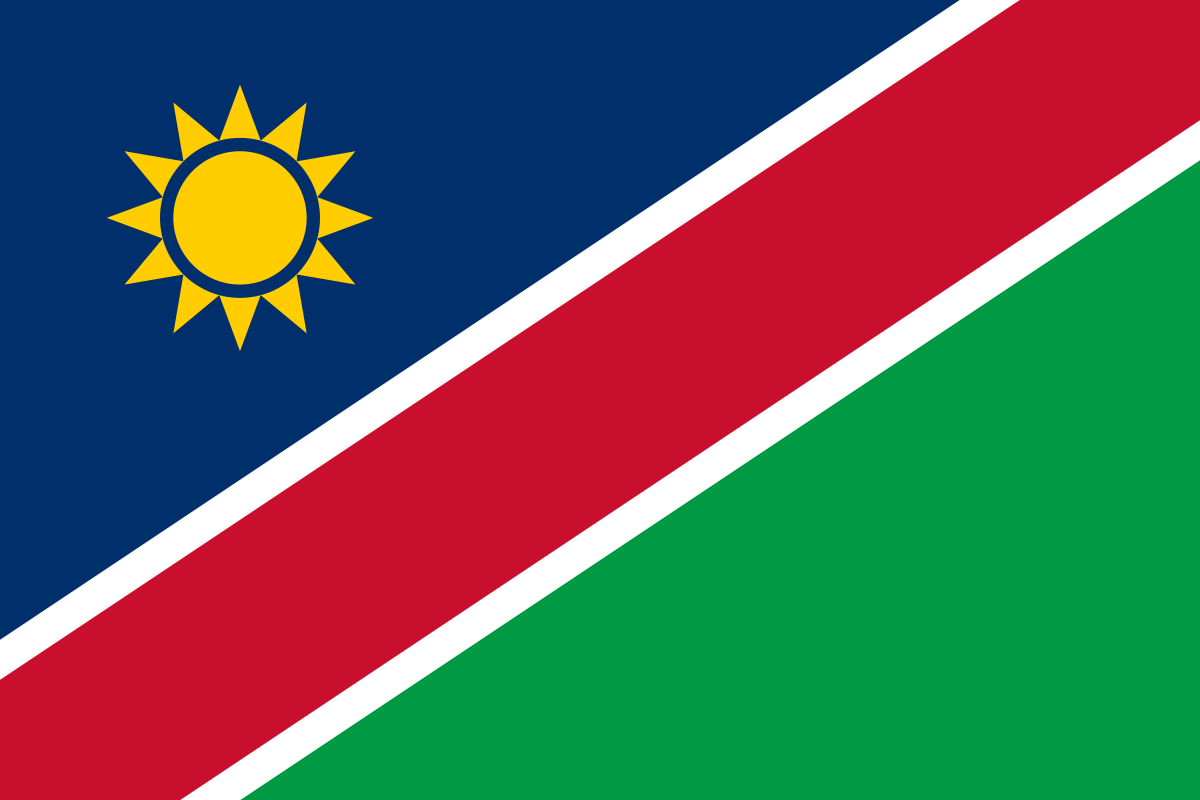
Namibia flag picture
Explore the construction drawing, history, and picture gallery.
| Design | Diagonal band and golden sunBlue, white, red, green, and gold. |
|---|---|
| Proportions | 2:3 height:lengthEquivalent to 3:2 length:height. |
| Design approval | February 2, 1990Unanimous Constituent Assembly decision. |
| First national use | March 21, 1990At independence from South African rule. |
| Constitutional provision | Article 2 and Schedule 6Geometry and design description. |
| Sun | Twelve straight raysGolden center separated by a blue ring. |
What does Namibia’s national flag look like?
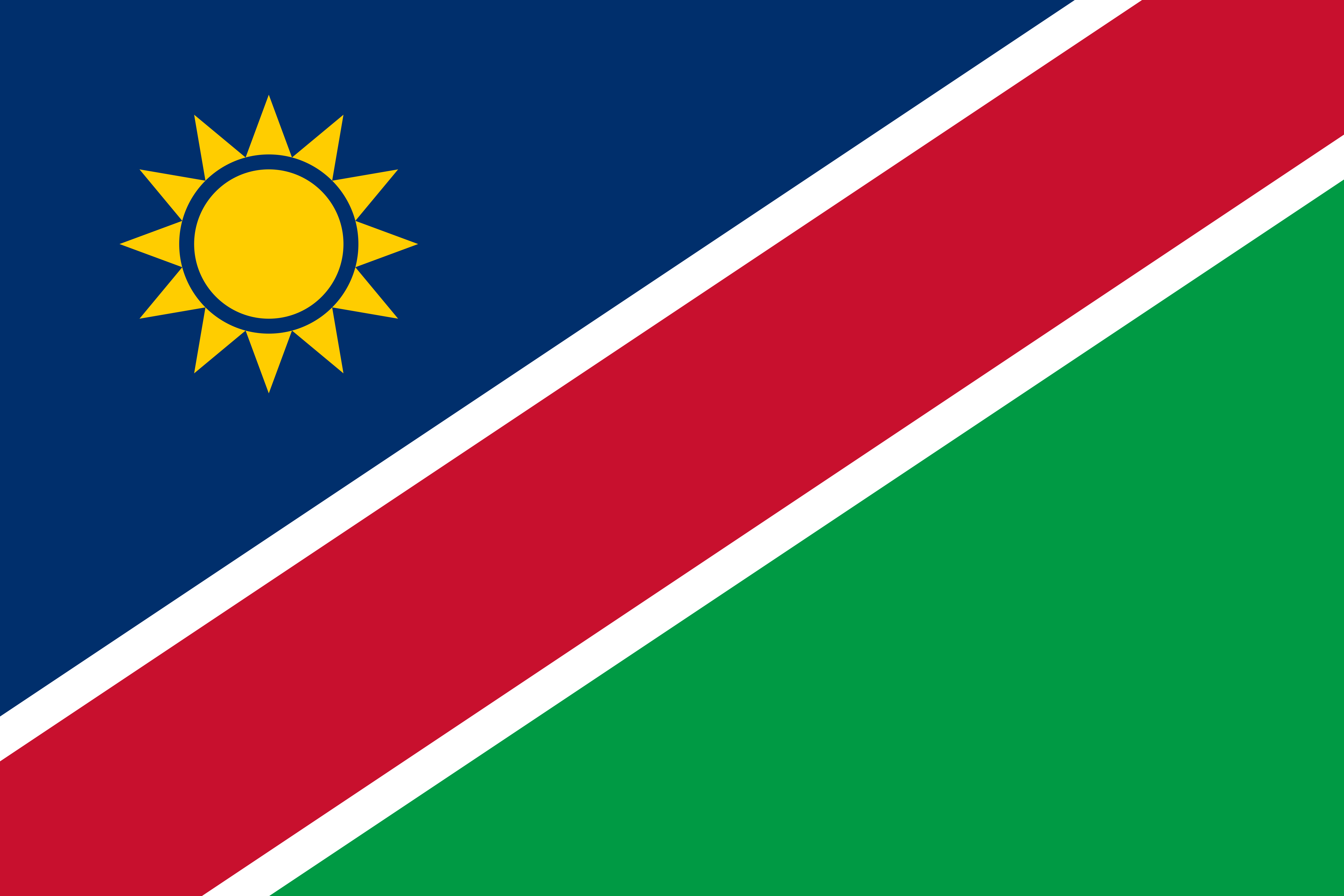
Namibia’s national flag has a blue upper-left triangle and a green lower-right triangle, separated by a red diagonal band edged in white. A golden sun with twelve straight rays appears in the blue area. The flag has 2:3 height-to-length proportions and first flew at independence on March 21, 1990.
The pictures below explain the flag’s proportions, its golden sun, and its development. The official meanings and constitutional construction lead the discussion, with digital drawing choices and practical reproduction advice clearly identified.
What are the colors of Namibia’s flag?
Namibia’s flag uses five colors: blue, red, green, white, and gold. Blue occupies the upper hoist, green the lower fly, and a white-edged red band runs between them. The golden sun sits entirely within the blue area. The 2018 national-symbols legislation supplies named print-color references for the four chromatic colors.
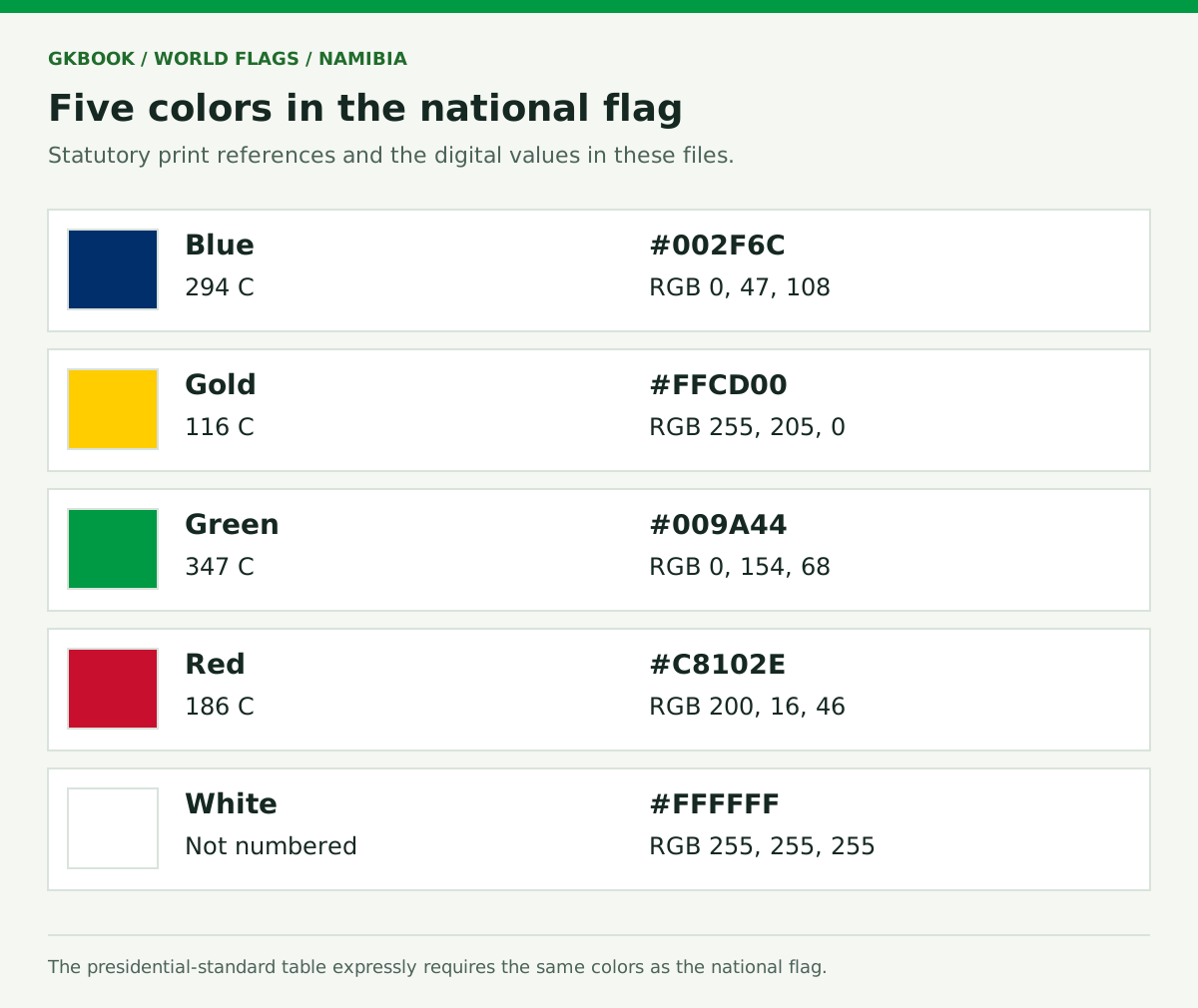
The blue and green areas are triangular; this is not a horizontal tricolor. White appears as two equal narrow edges along the red diagonal, and gold is confined to the sun. The small blue ring within the sun uses the same blue as the surrounding field.
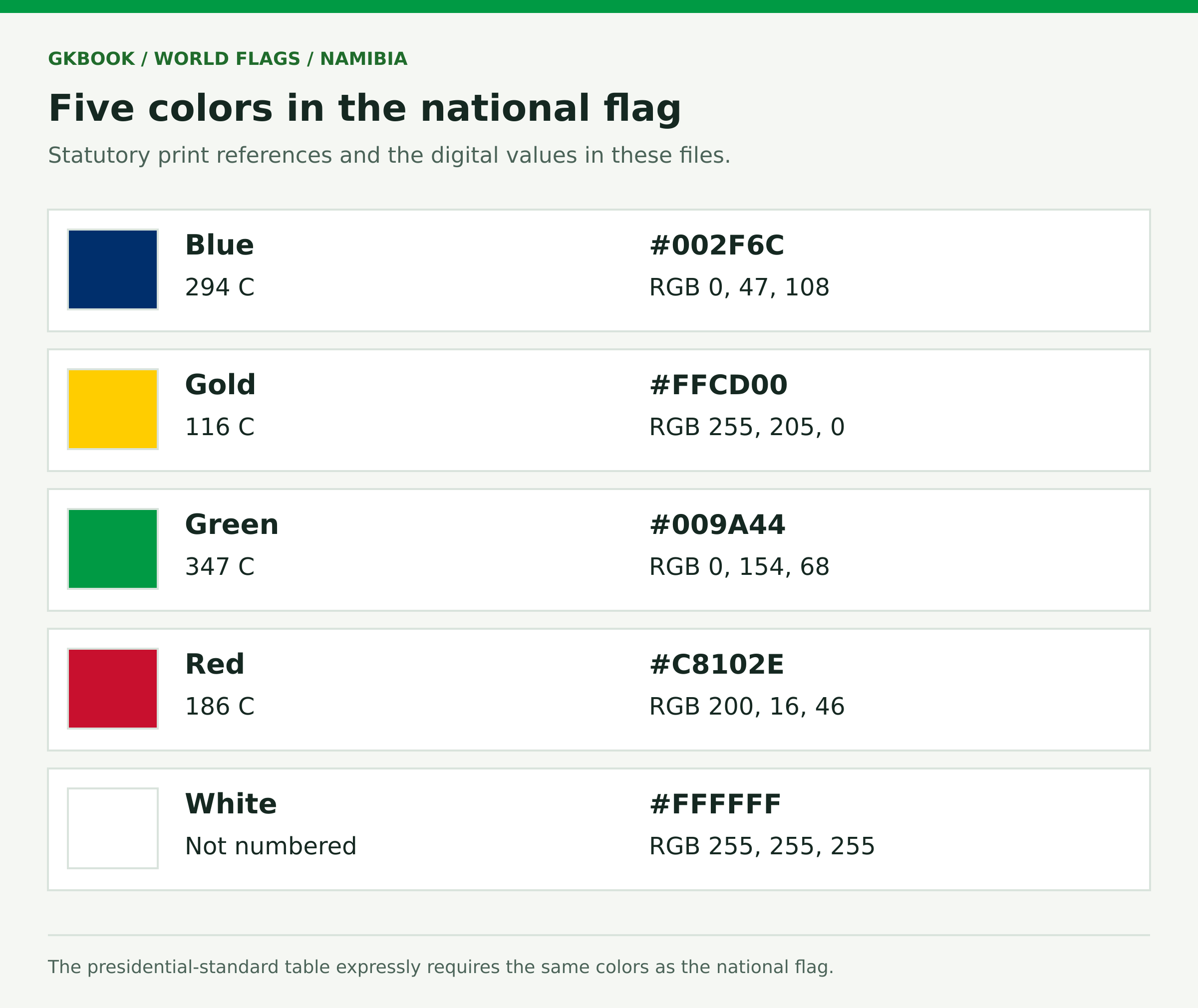
Schedule 4 of the National Symbols of the Republic of Namibia Act, 2018 lists the presidential standard’s colors and explicitly requires them to match those of the national flag. Its references are blue Pantone 294 C, gold 116 C, green 347 C, and red 186 C. White has no separate numerical specification in that table.
What does Namibia’s flag symbolize?
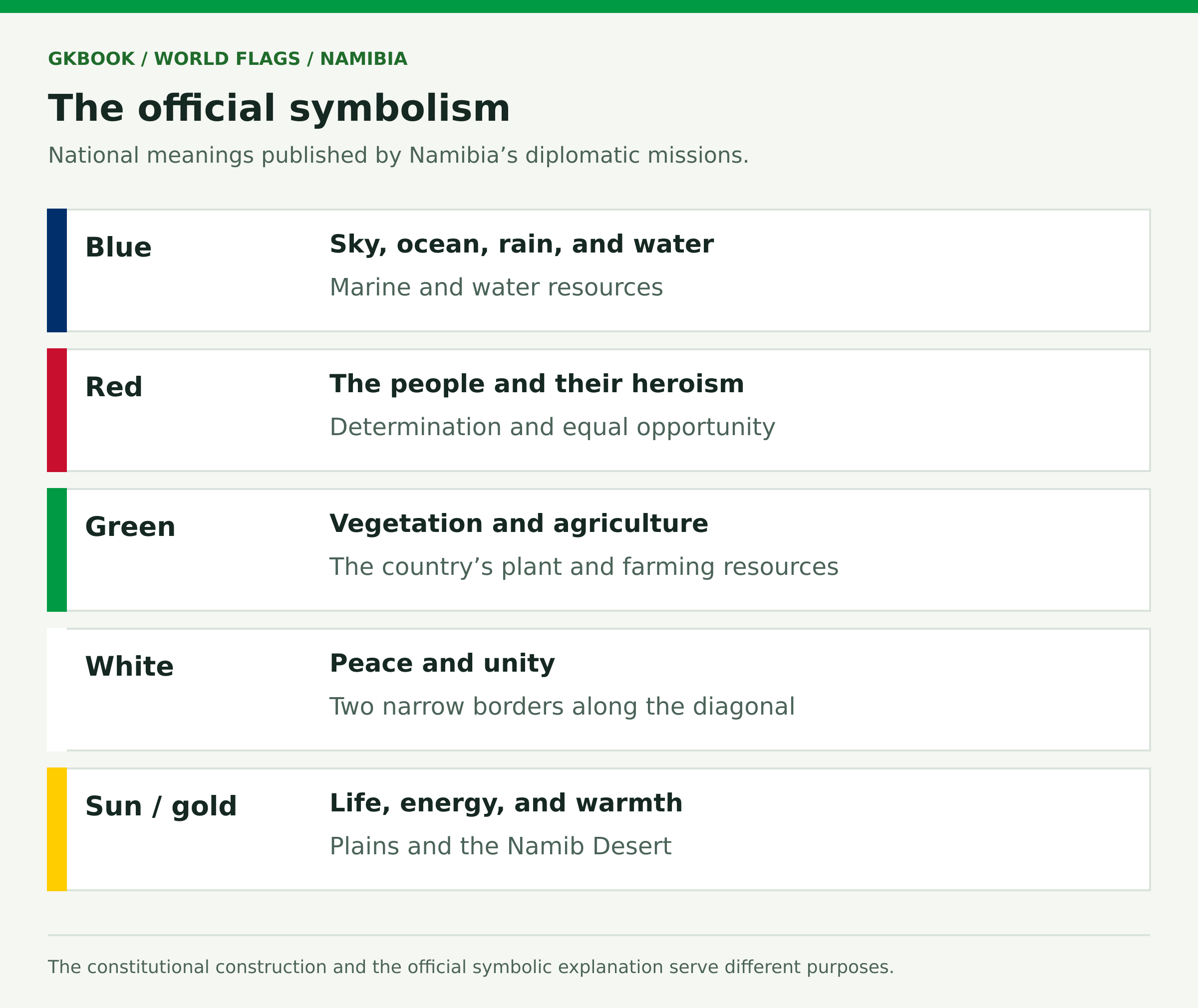
Namibia’s flag symbolizes national unity and common loyalty to the country. Its official explanation connects blue with sky and water, red with the people and their determination, green with vegetation and agriculture, white with peace and unity, and the golden sun with life, energy, warmth, and the landscape.
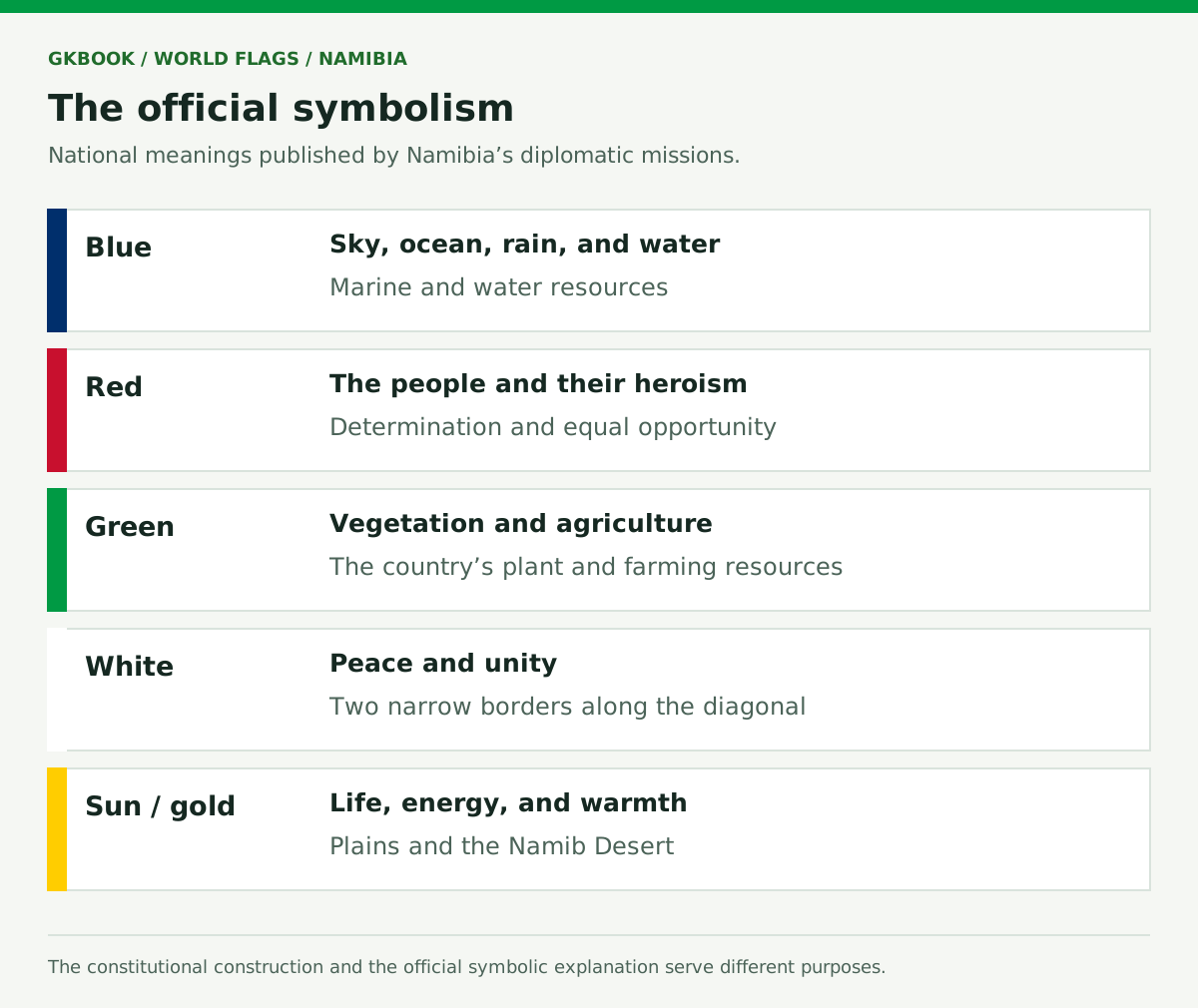
The government’s diplomatic missions publish the color meanings, while Schedule 6 of the Constitution specifies the physical design. These are complementary sources: the construction paragraph is not a complete explanation of symbolism.
The meanings concern the whole nation. Individual political parties may have used similar colors, but the national flag represents Namibia rather than functioning as the exclusive flag of a party, region, or community.
What does blue represent on Namibia’s flag?
Blue represents Namibia’s sky, the Atlantic Ocean, marine resources, and the importance of rain and water. It forms the upper triangle next to the hoist and also the narrow ring separating the sun’s center from its rays. The 2018 statutory color table identifies blue as Pantone 294 C.
The sun belongs in this blue area. In the standard front view, that means the upper-left part of the flag, not the green triangle and not the center of the red band.
The ocean and rain are explicitly included in the official interpretation. Reducing blue to a generic meaning such as loyalty would omit the geographically specific explanation supplied by Namibian official sources.
What does red represent on Namibia’s flag?
Red represents the Namibian people, their heroism, and their determination to build a future offering equal opportunities to everyone. It occupies the broad diagonal band rising from the lower hoist toward the upper fly. The band is bordered by white on both sides, and its specified print reference is Pantone 186 C.
Some informal explanations describe red only as blood shed in the independence struggle. The official account is broader and forward-looking: it emphasizes the people and their determination, as well as heroism.
The band’s thickness is measured at right angles to its diagonal edges. Its appearance at the vertical or horizontal edge of the flag is consequently not the correct place to measure the prescribed width.
What does green represent on Namibia’s flag?
Green represents Namibia’s vegetation and agricultural resources. It fills the lower-right triangular field in the normal front view, below the white-edged red diagonal. Schedule 4 of the 2018 national-symbols legislation names Pantone 347 C for green, while digital reproductions need their own clearly identified screen approximation of that color.
The official meaning refers to plants and agriculture. It does not require adding a leaf, crop, or other agricultural symbol to the flag; the green field itself carries that association.
Blue and green occupy opposite sides of the diagonal composition. Interchanging them would change the national design even if all five colors remained present.
What do the white stripes on Namibia’s flag mean?
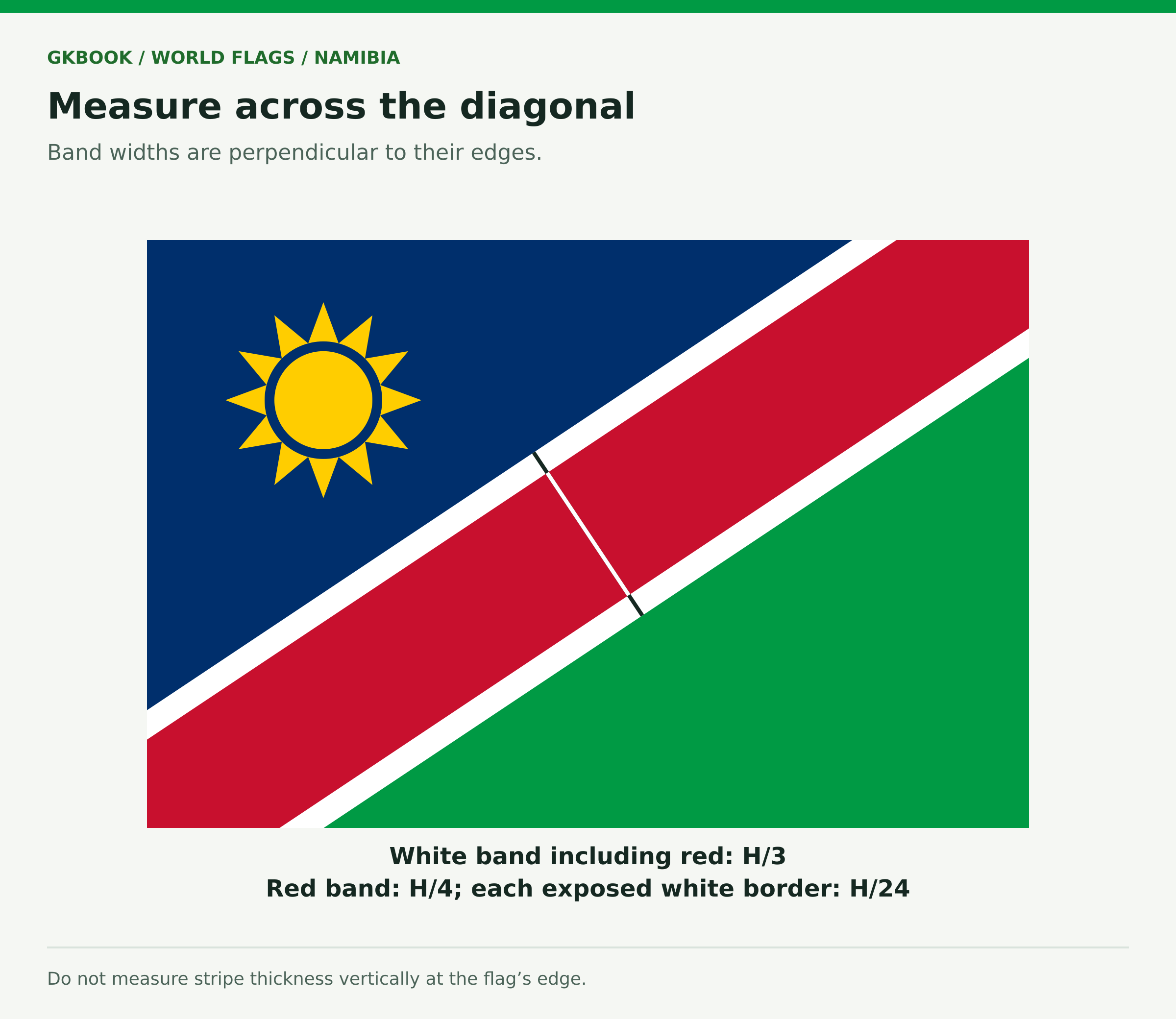
White represents peace and unity. On Namibia’s flag, it appears as two narrow, equal borders separating the red diagonal from the blue and green fields. These borders are part of the prescribed design, not optional outlines. Each visible white border is one twenty-fourth of the flag’s height when measured perpendicular to the diagonal.
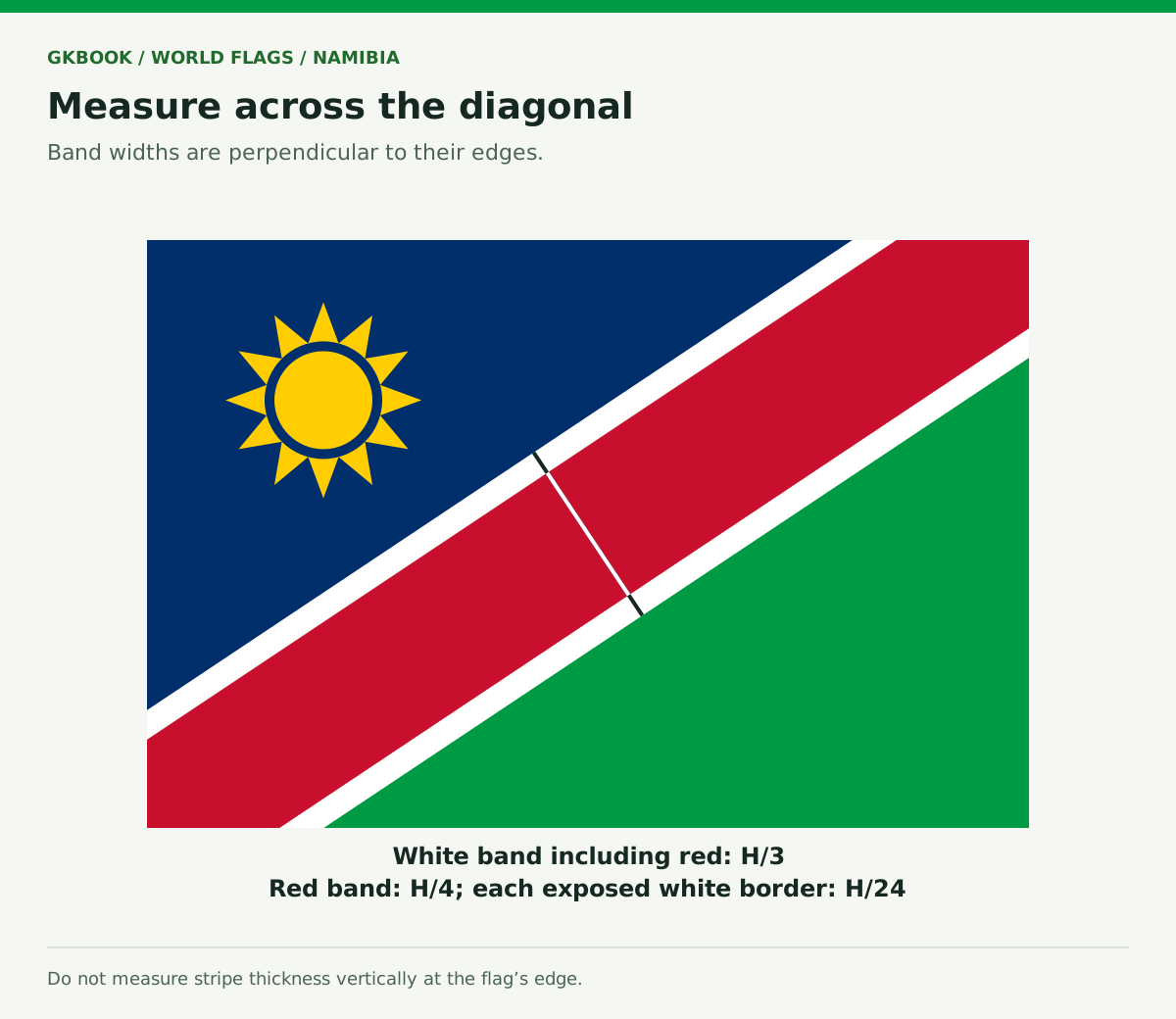
Schedule 6 describes a white diagonal band one-third of the flag height, overlaid by a red band one-quarter of the height. Subtracting those widths leaves one-twelfth of the height in total white, divided equally between the two sides.
The resulting width of each border is H/24, where H is the flag height. This figure is a calculation from the constitutional dimensions rather than a separate quoted measurement.
What does the golden sun on Namibia’s flag represent?
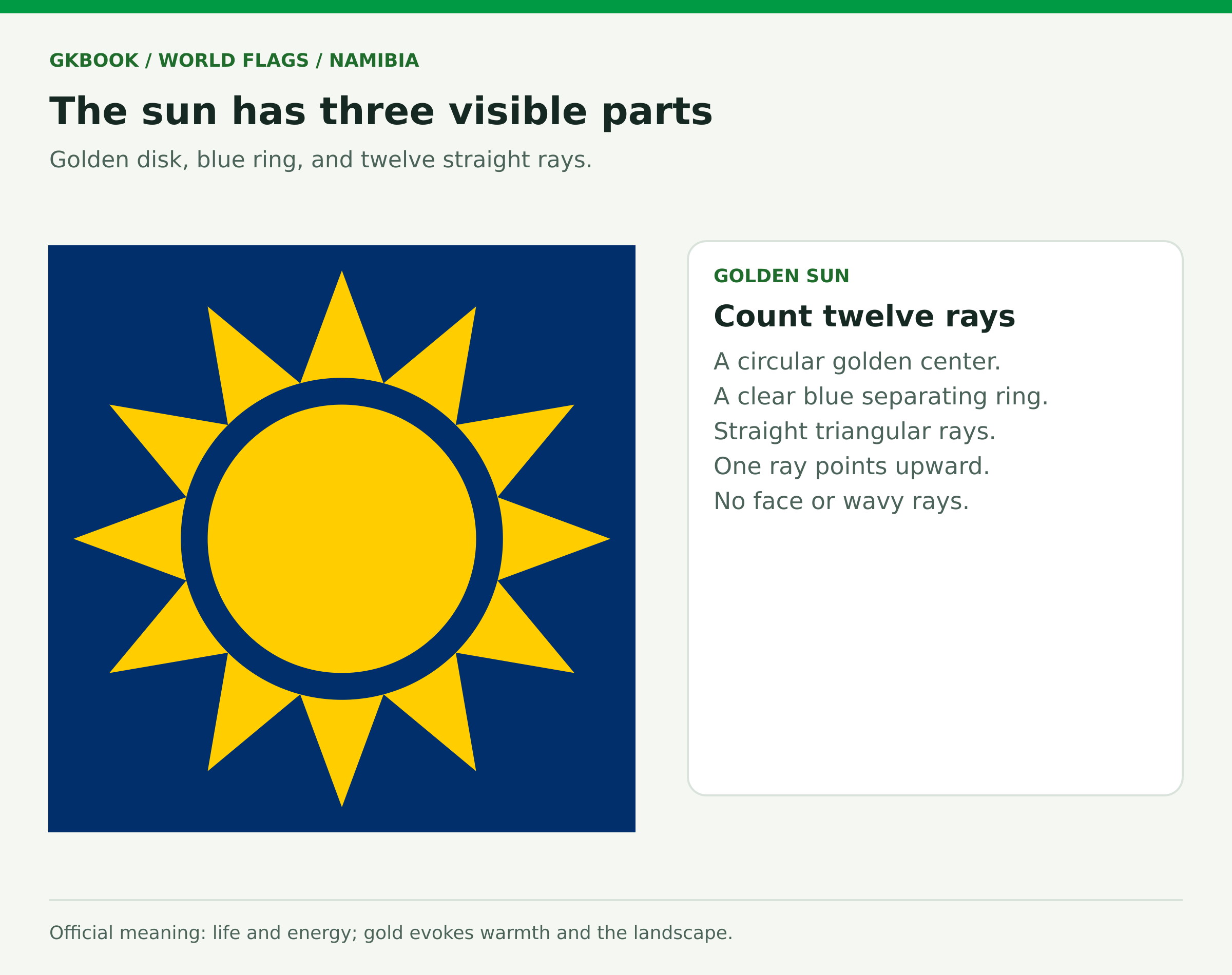
The sun represents life and energy, while its golden color recalls warmth and the plains and Namib Desert. The emblem has twelve straight, triangular rays around a circular golden center. A narrow blue ring separates the center from the rays, making the symbol more specific than a plain twelve-pointed star.
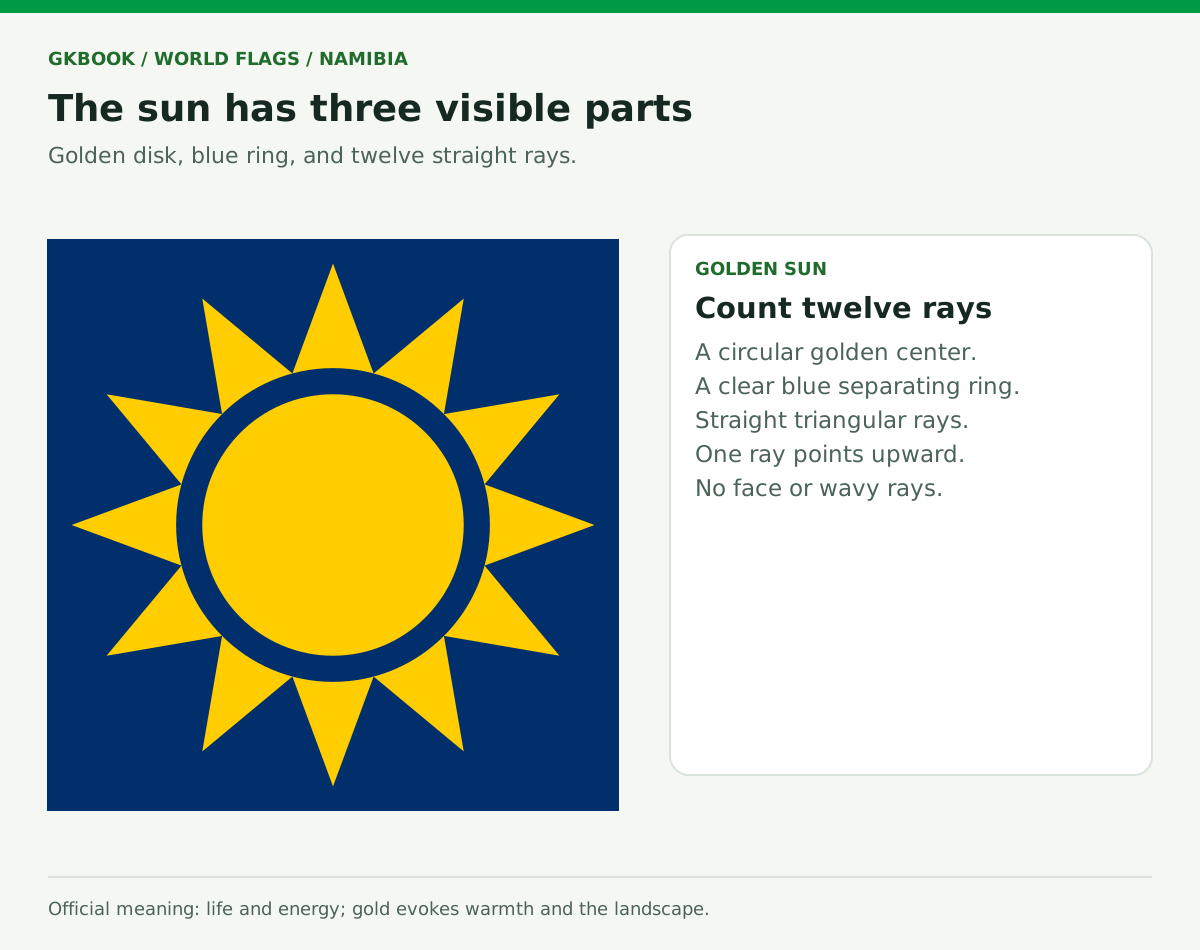
Keep the circular disk, blue ring, and triangular rays distinct. A solid starburst without the ring, a sun with wavy rays, or a sun with a face would not reproduce the constitutional design.
The rays are a design requirement. The official explanatory sources consulted here describe the sun as life and energy; they do not establish a one-to-one assignment of its twelve rays to named communities or administrative regions.
Do the sun’s twelve rays represent twelve ethnic groups?
Twelve rays are required by Namibia’s Constitution, but the official symbolism sources used here do not assign one ray to each ethnic group. They explain the sun as life and energy. Claims about twelve peoples, months, or regions should therefore be identified as additional interpretations unless supported by a specific authoritative source.
The Constitution defines the number and shape of the rays without giving an ethnic list. Namibia’s official diplomatic explanations likewise emphasize the sun’s meaning as a whole.
A numerical resemblance alone cannot establish symbolism. This page therefore records the twelve-ray design confidently while leaving unsupported per-ray interpretations out of its factual explanation.
What are the proportions of Namibia’s flag?
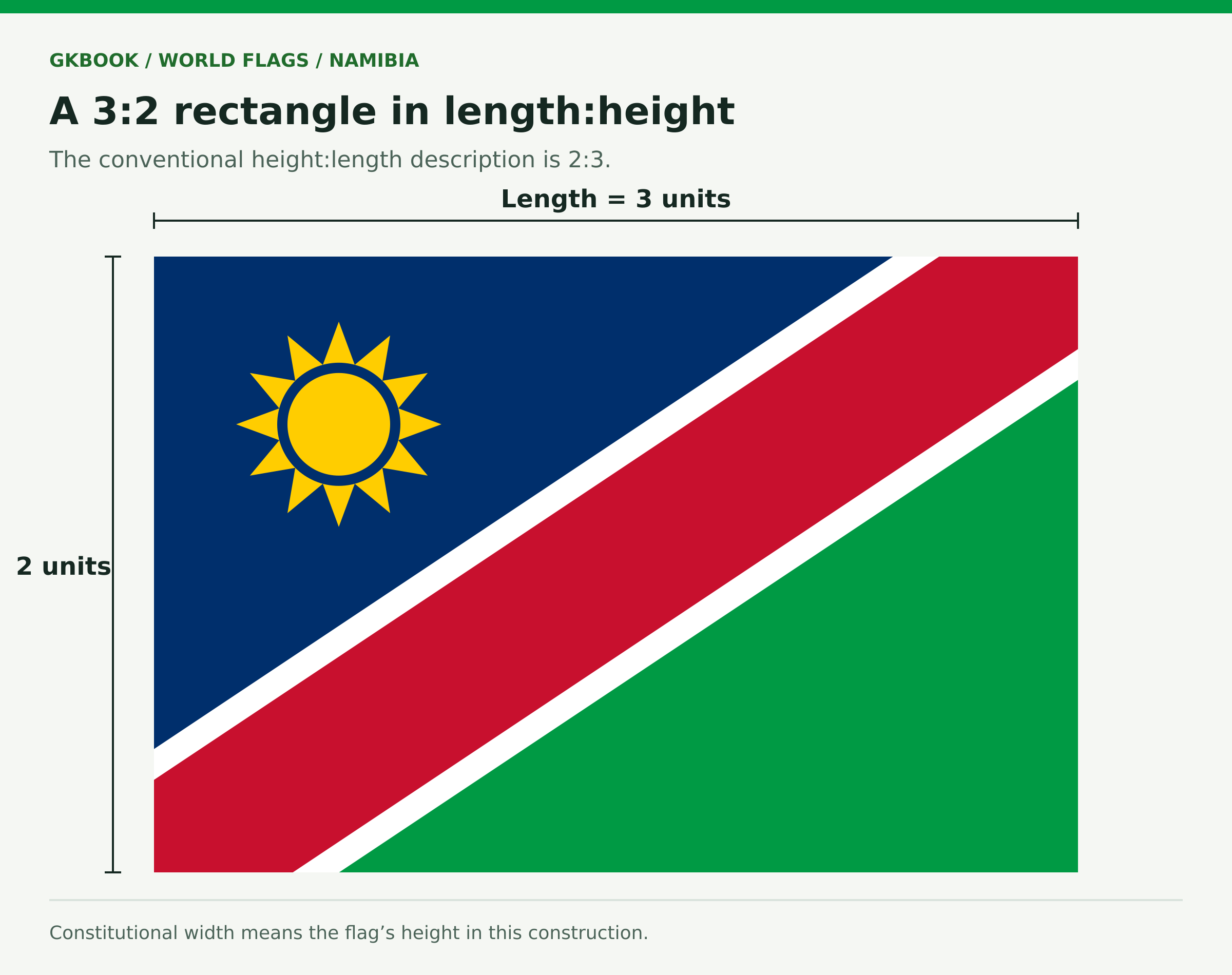
Namibia’s flag has a height-to-length ratio of 2:3, or a length-to-height ratio of 3:2. Schedule 6 of the Constitution states that the rectangle is three units long for every two units wide. In modern drawing terminology, that constitutional width is the flag’s vertical height, not its horizontal length.
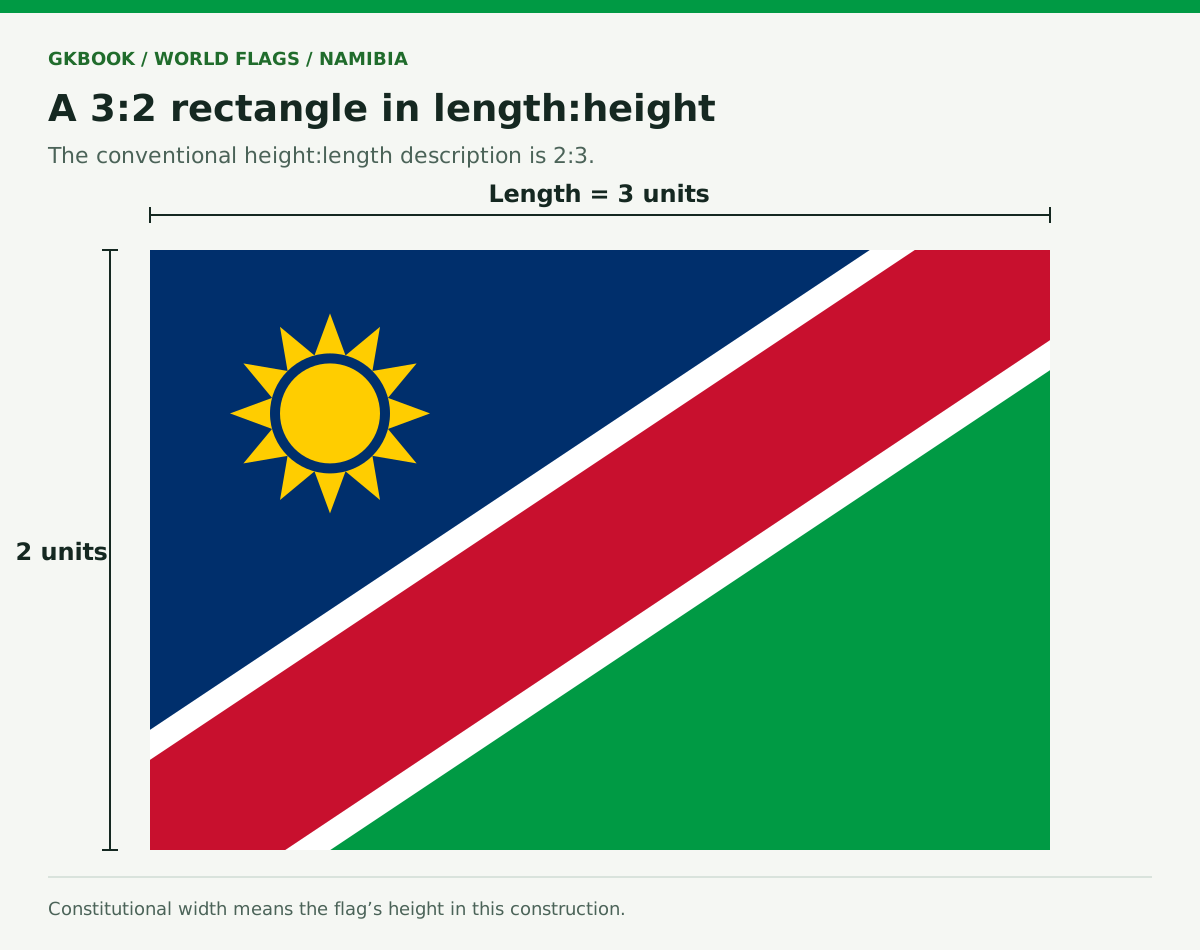
A flag 60 centimeters high is therefore 90 centimeters long. A 1200-by-800-pixel image also has the correct shape, because image software normally lists horizontal width before vertical height.
The diagonal stripe and sun must scale together with the outer rectangle. Changing only the canvas dimensions distorts the angle, band widths, and circular sun.
Which direction does Namibia’s diagonal stripe run?
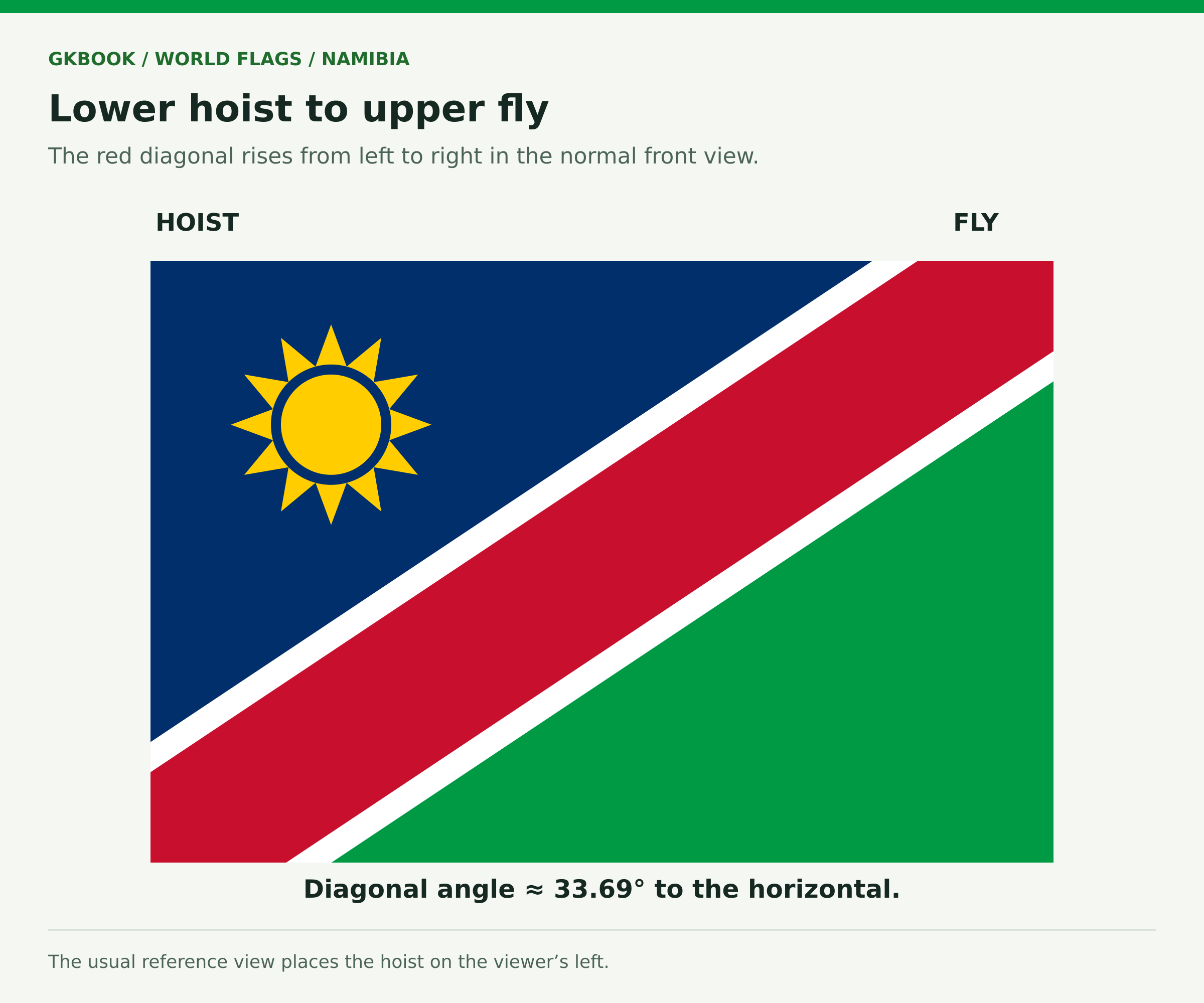
In the normal front view, Namibia’s red diagonal rises from the lower-left hoist corner toward the upper-right fly corner. Blue and the sun lie above it, while green lies below. The diagonal follows the rectangle’s corner-to-corner direction, so it is not a forty-five-degree line on a correctly proportioned 2:3 flag.
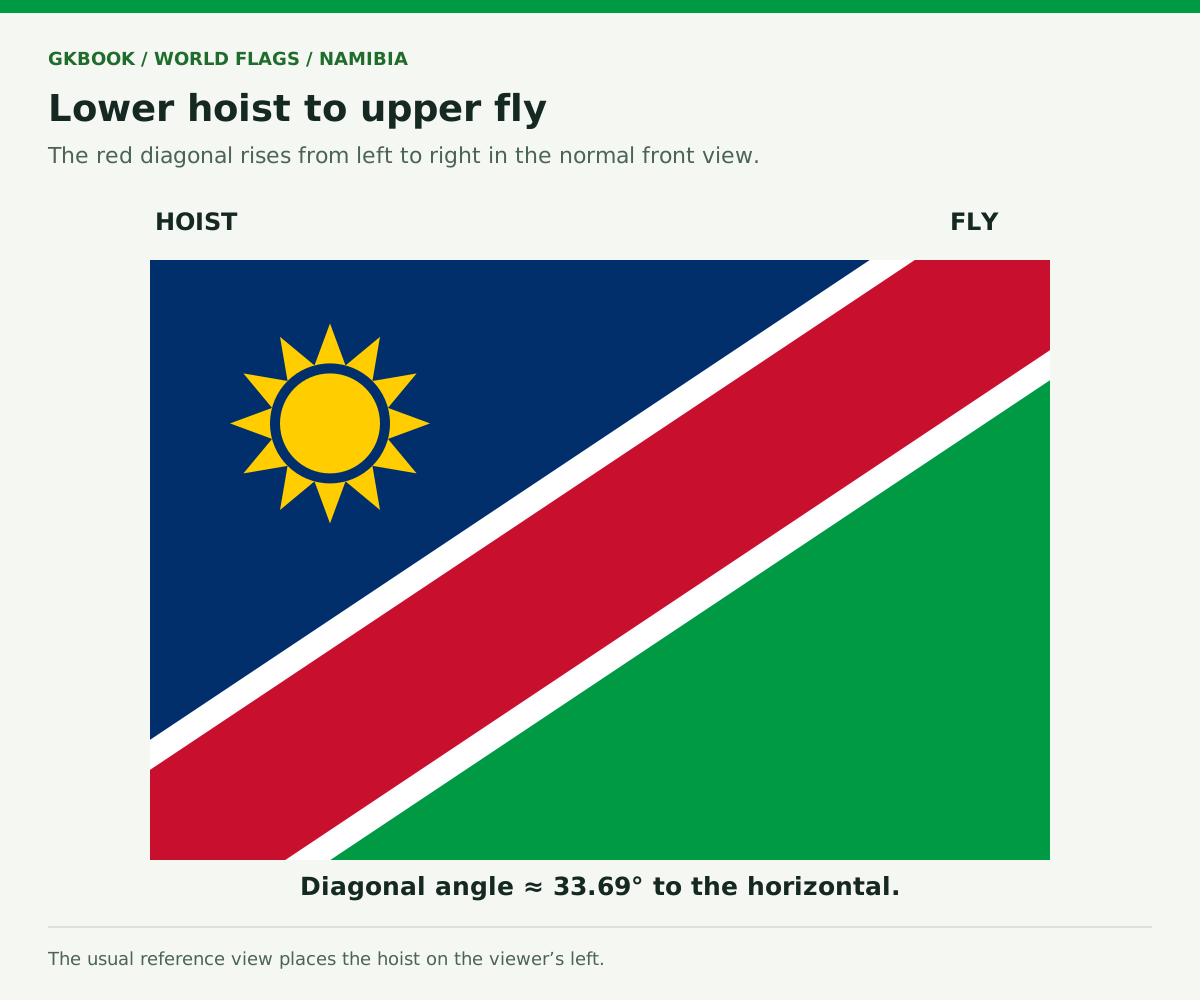
Hoist means the edge attached to the pole; fly means the opposite free edge. With the hoist on the viewer’s left, the stripe ascends from left to right.
For a rectangle three units long and two high, the diagonal makes an angle of arctan(2/3), approximately 33.69 degrees, with the horizontal. That angle is derived from the constitutional ratio; it is not a separately stated legal angle.
How wide are Namibia’s diagonal bands?
The complete white diagonal band is one-third of the flag’s height, with a red band one-quarter of that height centered over it. This leaves a visible white border of one twenty-fourth of the height on either side. All these thicknesses are measured perpendicular to the diagonal, rather than vertically.
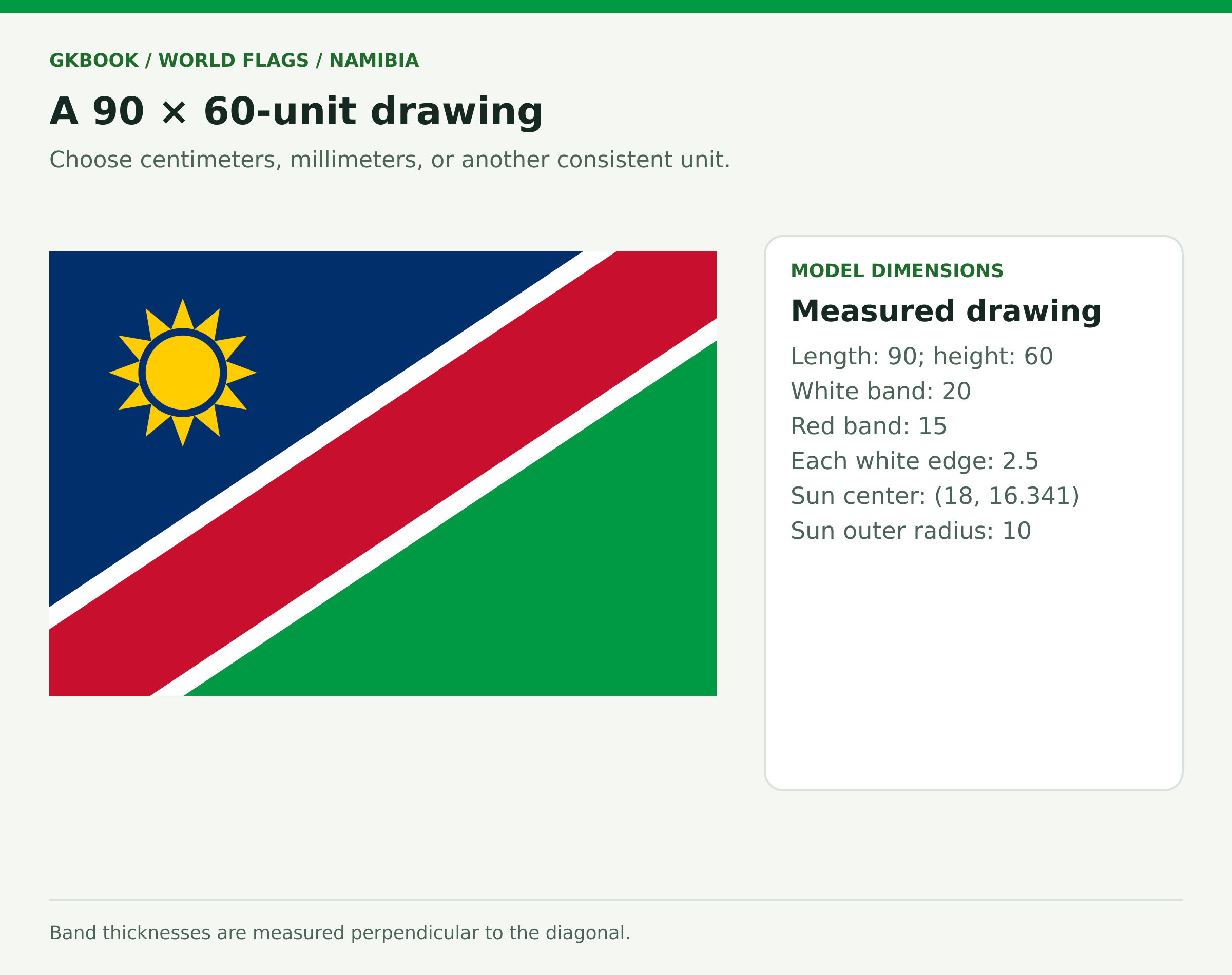
For a 60-centimeter-high flag, the underlying white band is 20 centimeters wide, the red band is 15 centimeters wide, and each exposed white edge is 2.5 centimeters wide. The red band is centered within the white one.
The sloping band intersects the outer rectangle at an angle. Measuring its vertical intercept at the hoist exaggerates its actual thickness. The construction diagram uses a normal, or perpendicular, measuring line to make the distinction visible.
Where is the sun placed on Namibia’s flag?
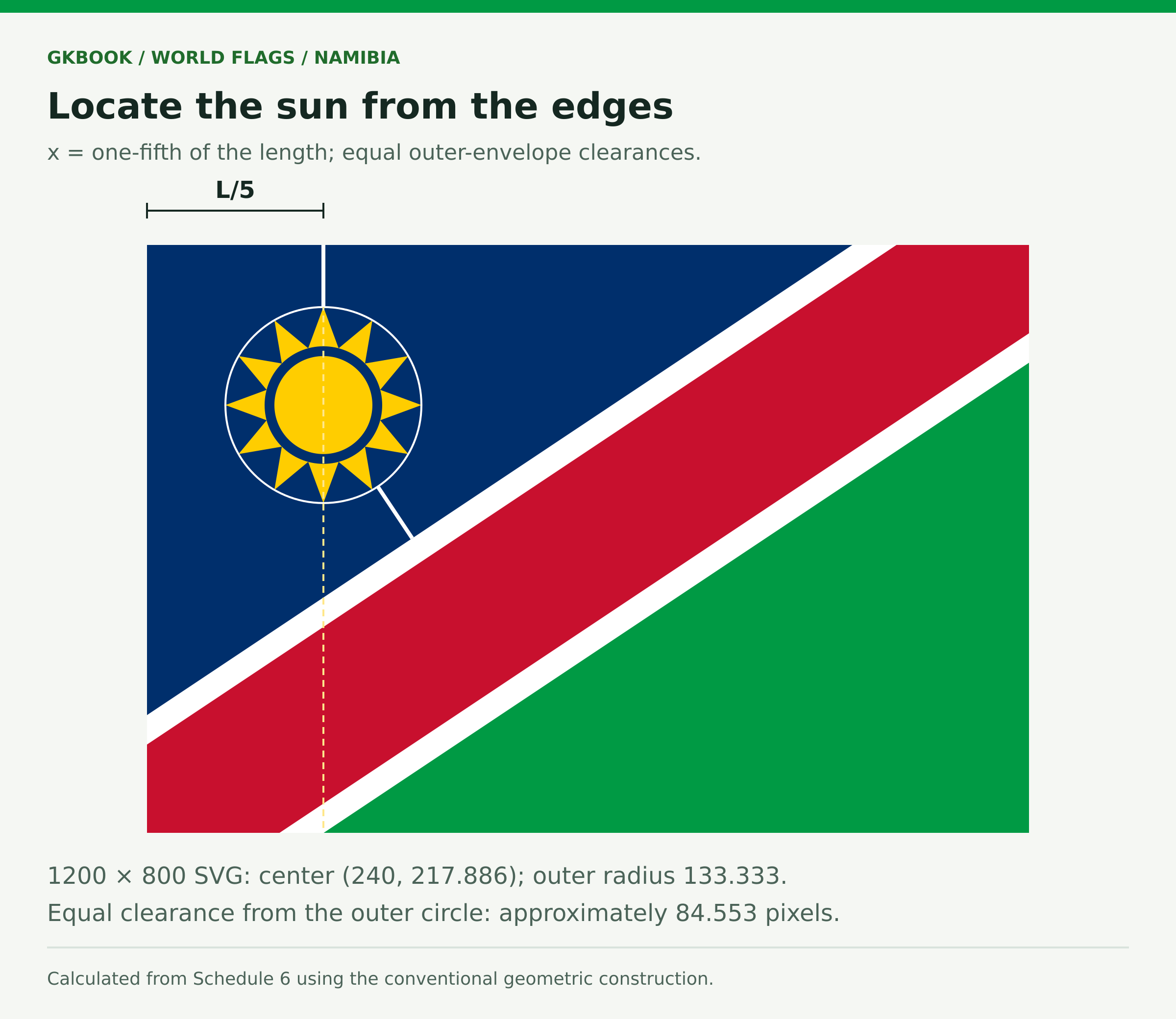
The sun lies in the upper blue field, with its vertical centerline one-fifth of the flag’s length from the hoist. Its position gives equal clearance from the top edge and the nearby white diagonal. The clearances are measured using the sun’s outer circular envelope, which includes the ray tips.
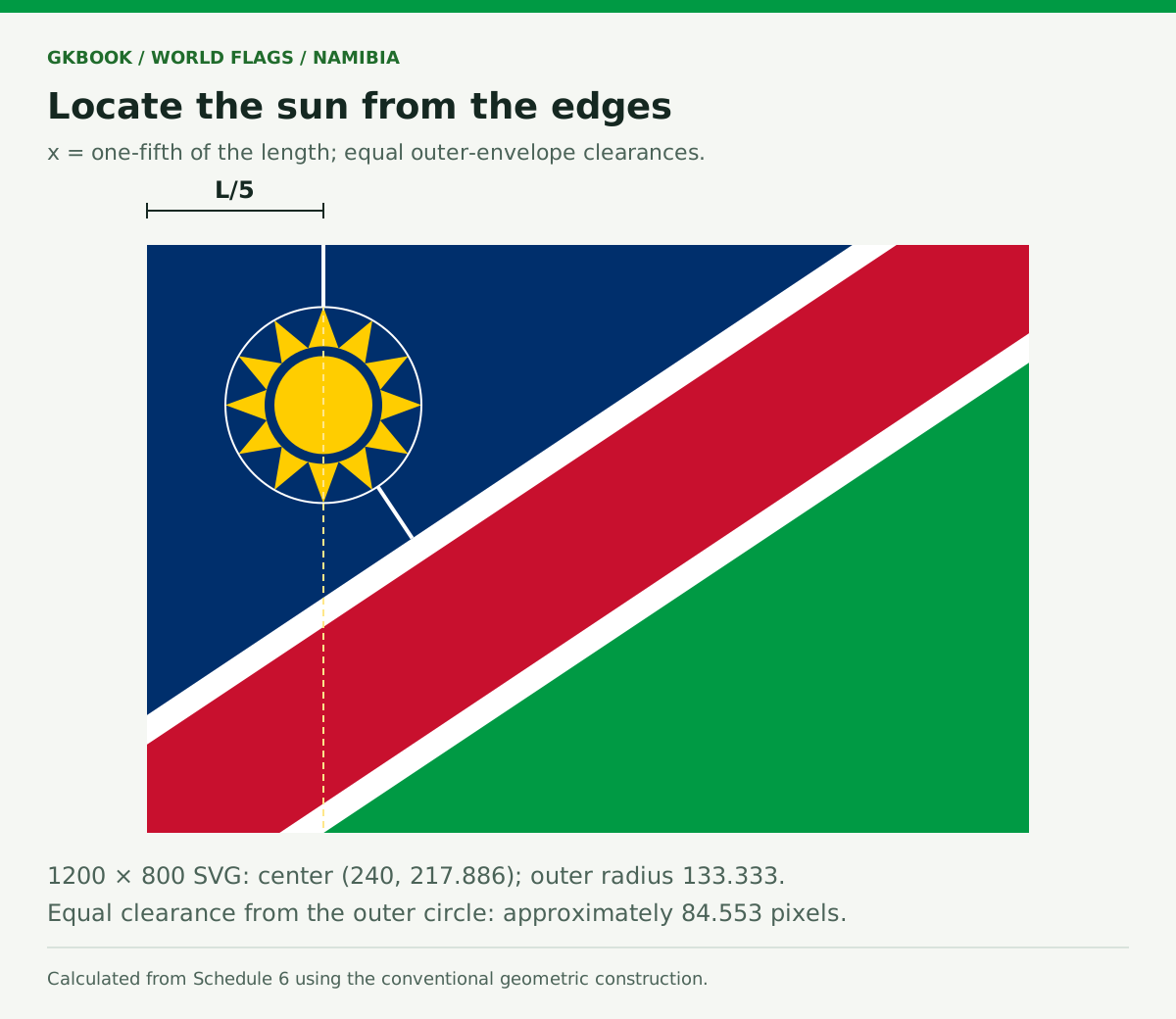
This conventional geometric reading of Schedule 6 is consistent with specialist construction diagrams tracing their source to the Ministry of Information’s 1990 flag policy. The original policy sheet was not independently obtained for this package.
For a 1200-by-800 drawing, the center is at x = 240 and approximately y = 217.886 pixels, measured from the upper-left corner. Its outer radius is 133.333 pixels. The equal clearance is approximately 84.553 pixels. These coordinates are calculated from the constitutional relationships, not quoted as enacted pixel values.
How are the sun, blue ring, and rays constructed?
The sun’s full diameter, including its rays, is one-third of the flag’s height. Each ray extends radially through two-fifths of the outer radius, and the blue ring is one-tenth of that radius thick. The remaining central golden disk therefore has a radius equal to half the sun’s outer radius.
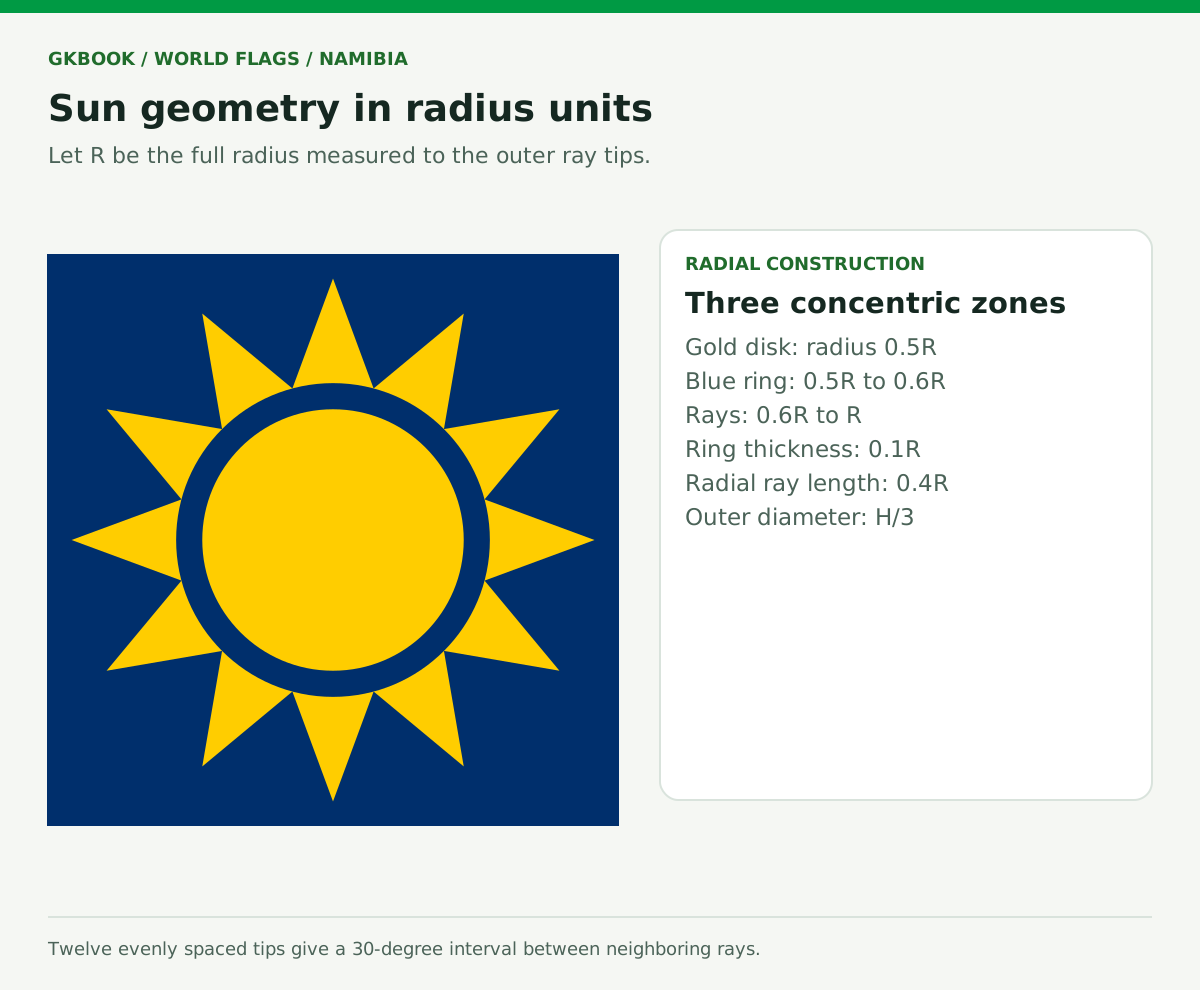
If the outer radius is R, the ring occupies radii 0.5R to 0.6R, and the rays extend outward from 0.6R to R. Twelve evenly spaced ray tips are separated by 30-degree angles. The drawing uses straight triangular sides and one tip pointing upward.
For a 60-centimeter-high flag, the sun’s full diameter is 20 centimeters. Its outer radius is 10 centimeters, central disk radius 5 centimeters, blue ring thickness 1 centimeter, and radial ray length 4 centimeters. The regular triangular implementation is documented as a geometric reconstruction.
What HEX and RGB colors should a Namibia flag image use?
The digital artwork here uses blue #002F6C, gold #FFCD00, green #009A44, red #C8102E, and white #FFFFFF. These values define the supplied screen images consistently. The statutory references are Pantone 294 C, 116 C, 347 C, and 186 C; the law does not itself prescribe these HEX or RGB values.
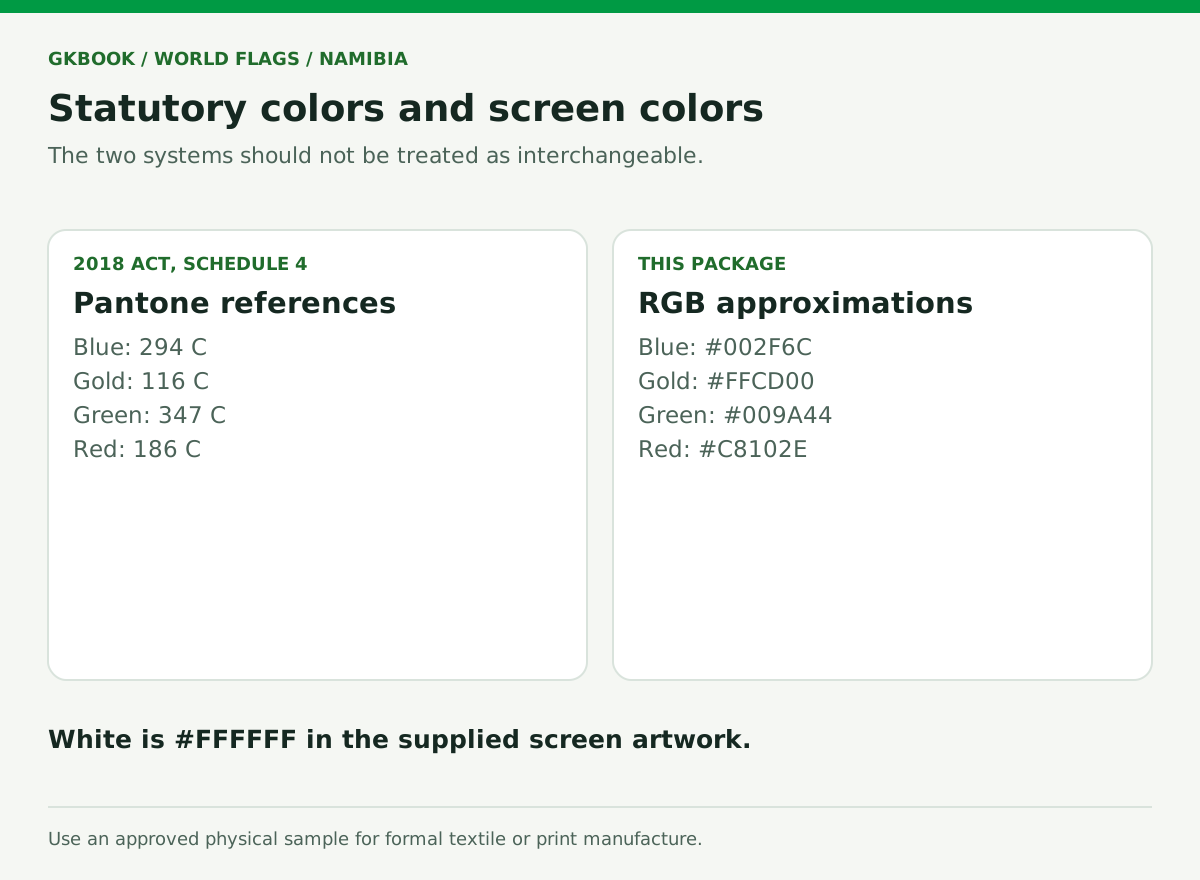
The corresponding RGB triplets are blue 0, 47, 108; gold 255, 205, 0; green 0, 154, 68; red 200, 16, 46; and white 255, 255, 255. A digital image is not a certified physical color sample.
Older flag manuals and event specifications have used other Pantone selections. The 2018 statutory table is the principal print reference for this article. Printing, textile dyes, illumination, and color profiles can all change perceived color; use an approved physical reference for formal manufacture.
How can students draw Namibia’s flag accurately?
Draw a rectangle 90 units long and 60 units high, then add a diagonal from the lower-left to the upper-right corner. Center a white band 20 units wide on that diagonal and a red band 15 units wide over it. Color the remaining upper field blue and lower field green, then add the sun.
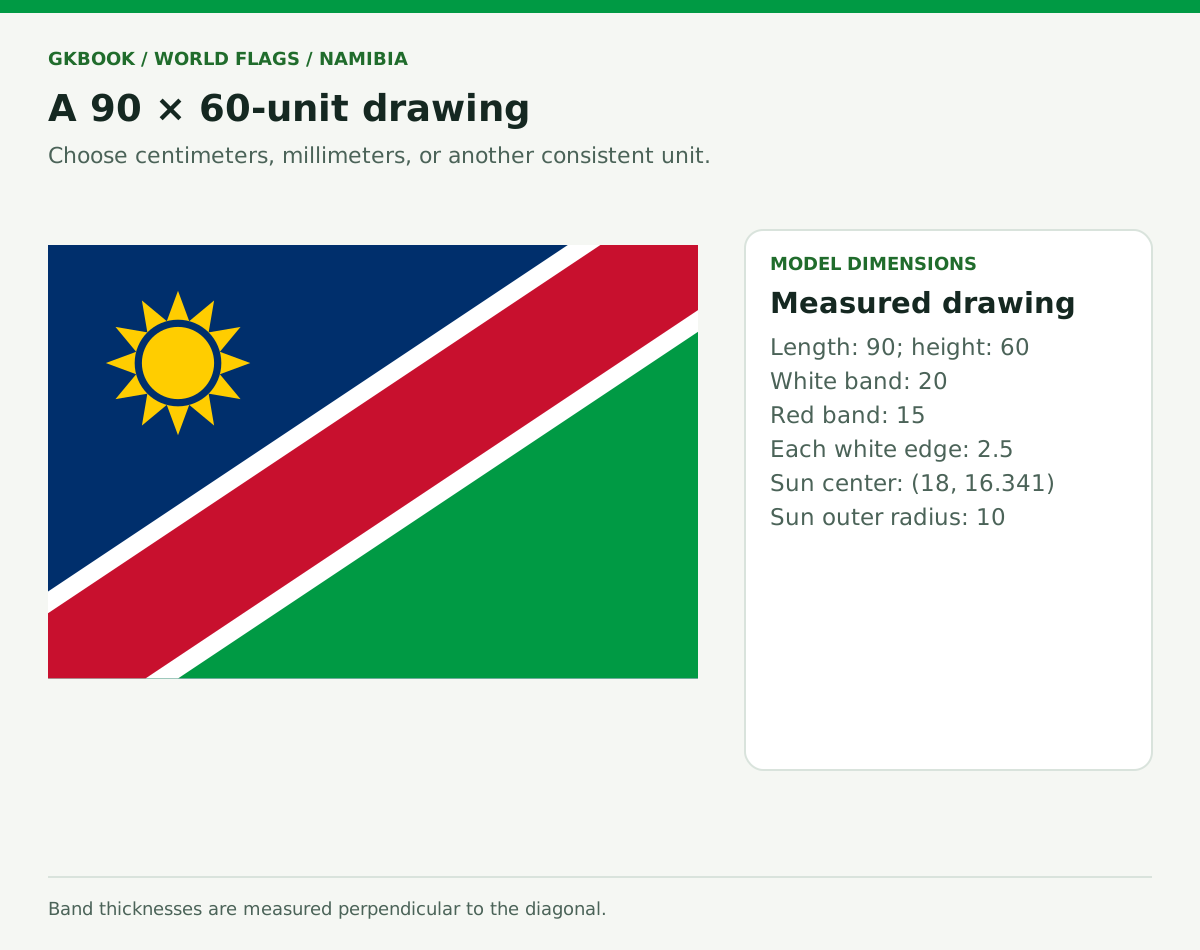
Measure the stripe widths at right angles to the diagonal. Place the sun’s center 18 units from the left edge and approximately 16.341 units below the top. Its outer radius is 10 units, its blue ring spans radii 5 to 6 units, and its gold disk has radius 5 units.
Use twelve straight rays rather than a five-pointed star. The SVG master provides the regular geometry for tracing or enlargement. Keep instructional labels and measurement lines outside a finished plain flag.
How did Namibia’s national flag develop?
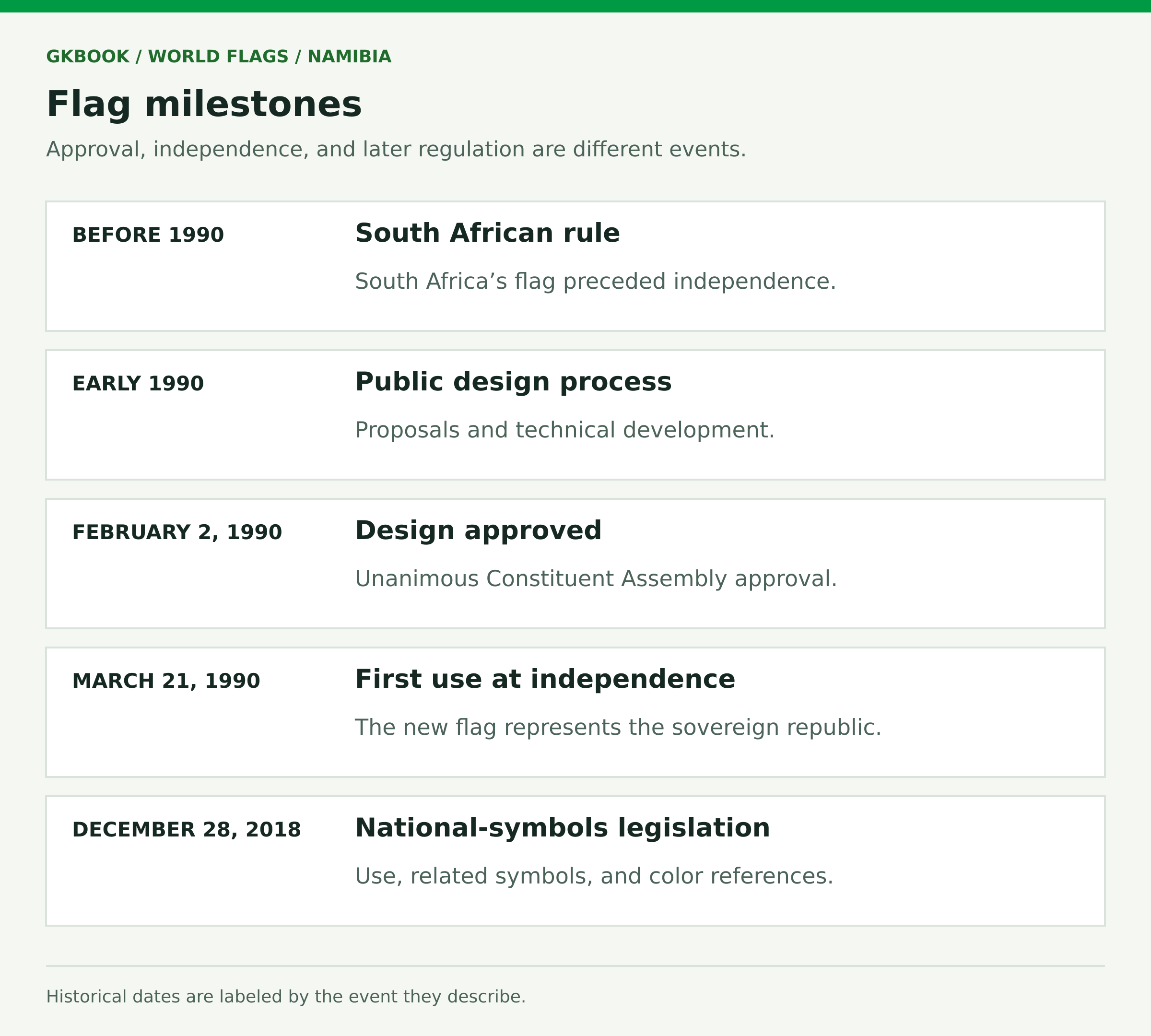
Namibia’s present flag emerged during preparations for independence in 1990. A national-symbols process invited public proposals, evaluated designs, and produced the diagonal composition approved by the Constituent Assembly. The new flag then replaced South Africa’s flag at the independence ceremony. Its colors connect the liberation period with a national message of peace and unity.
The Flag Institute links the design’s background to the colors of SWAPO and elements associated with the Democratic Turnhalle Alliance. These historical influences help explain the selection process; they do not make the national flag a party banner.
The flag’s constitutional description has remained the central design reference. Later legislation in 2018 addressed national symbols and their use, including color references, without creating a replacement national flag.
When was Namibia’s flag adopted?
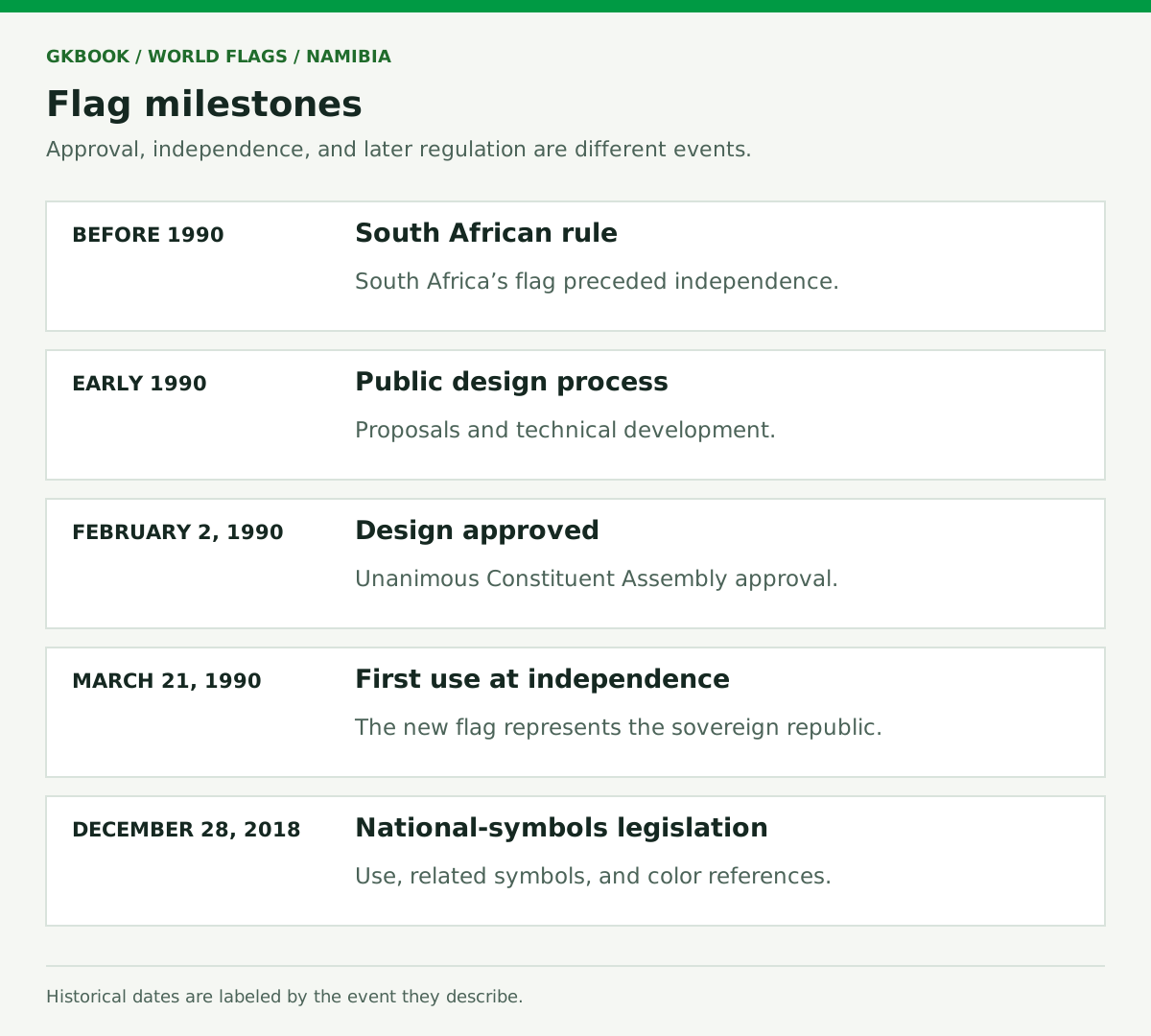
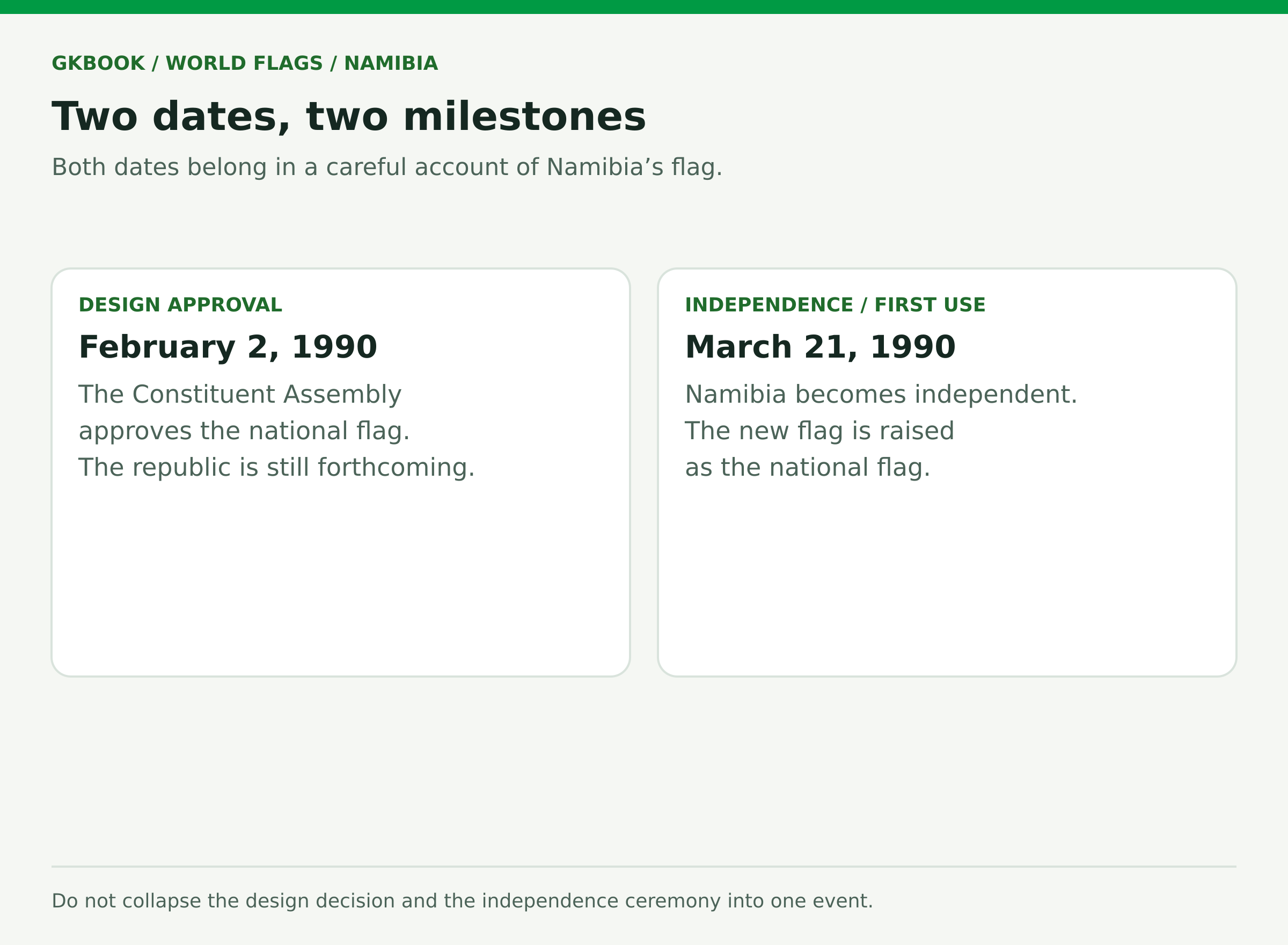
Namibia’s Constituent Assembly approved the national flag on February 2, 1990. It first flew as the independent country’s flag on March 21, 1990, the date commonly listed as its adoption or introduction date. These dates describe different stages: approval of the design and its use at the birth of the republic.
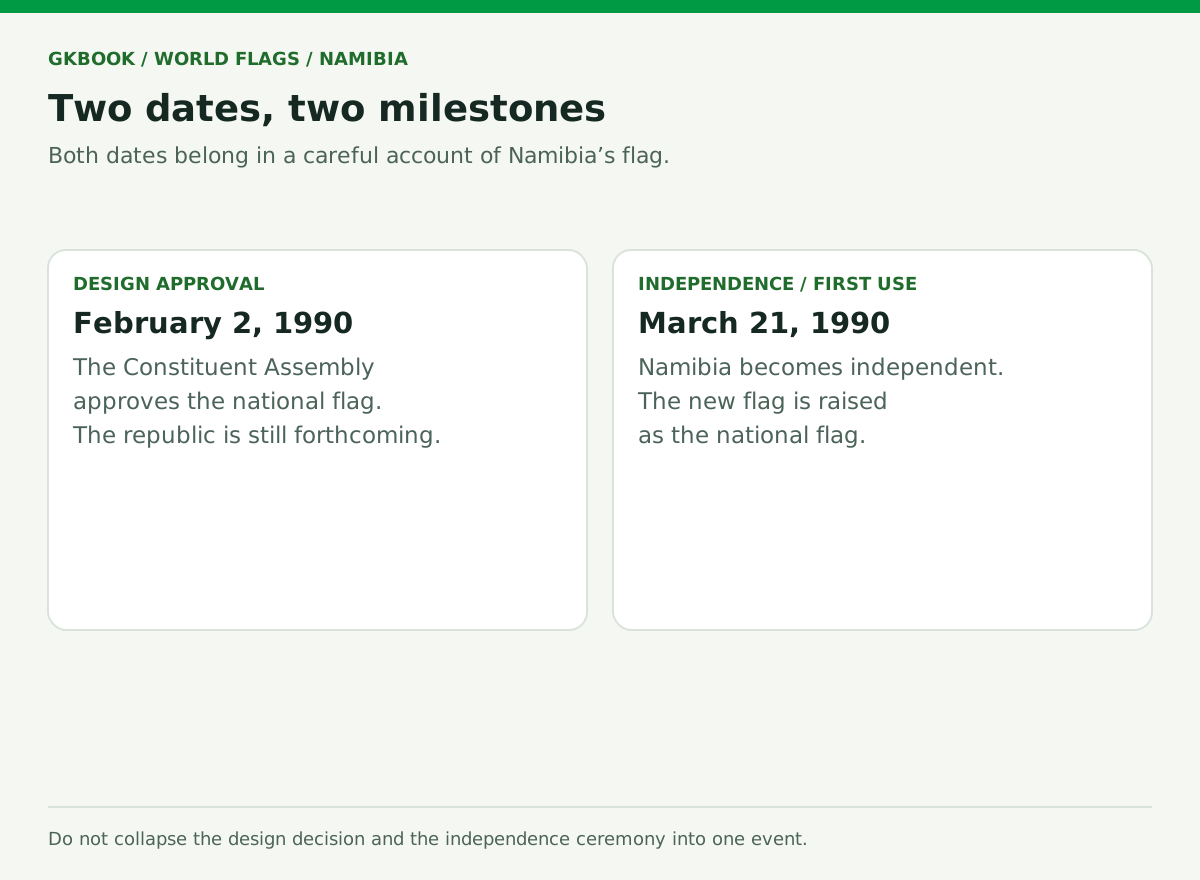
Namibia’s embassy in France explicitly identifies unanimous approval on February 2. The Flag Institute gives March 21 for adoption at independence, while an annotated constitutional edition explains the pre-independence selection and the later first hoisting.
A precise timeline should therefore label both events. Calling March 21 the first use at independence is clear; saying the design was first approved that day would erase the earlier Constituent Assembly decision.
Who designed Namibia’s national flag?
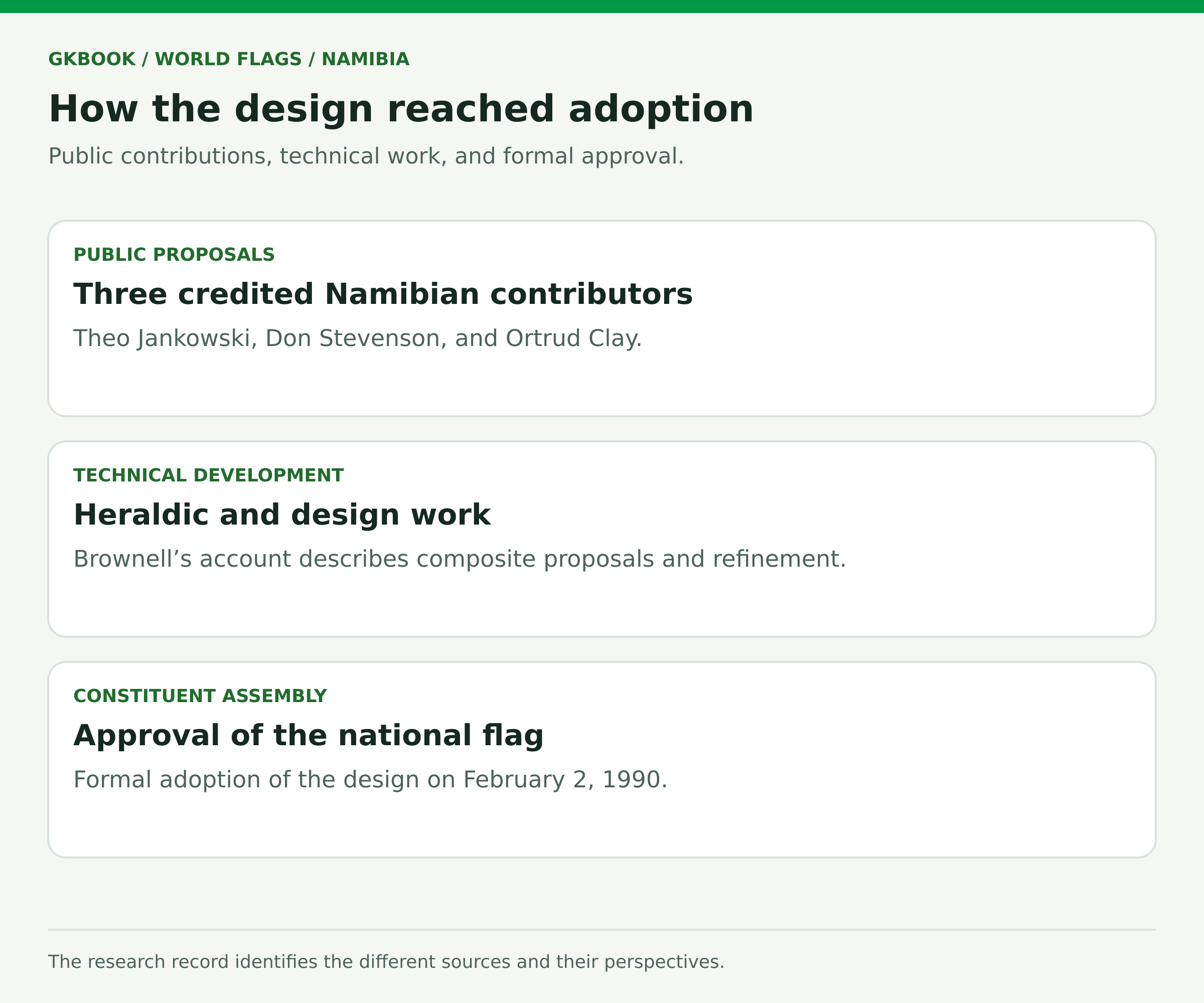
Namibia’s flag resulted from a public design process and subsequent technical development, so a single-name attribution is incomplete. Namibian accounts credit proposals by Theo Jankowski, Don Stevenson, and Ortrud Clay. Documentary and official accounts also describe the involvement of heraldist Frederick Brownell in developing Namibia’s national symbols during the transition to independence.
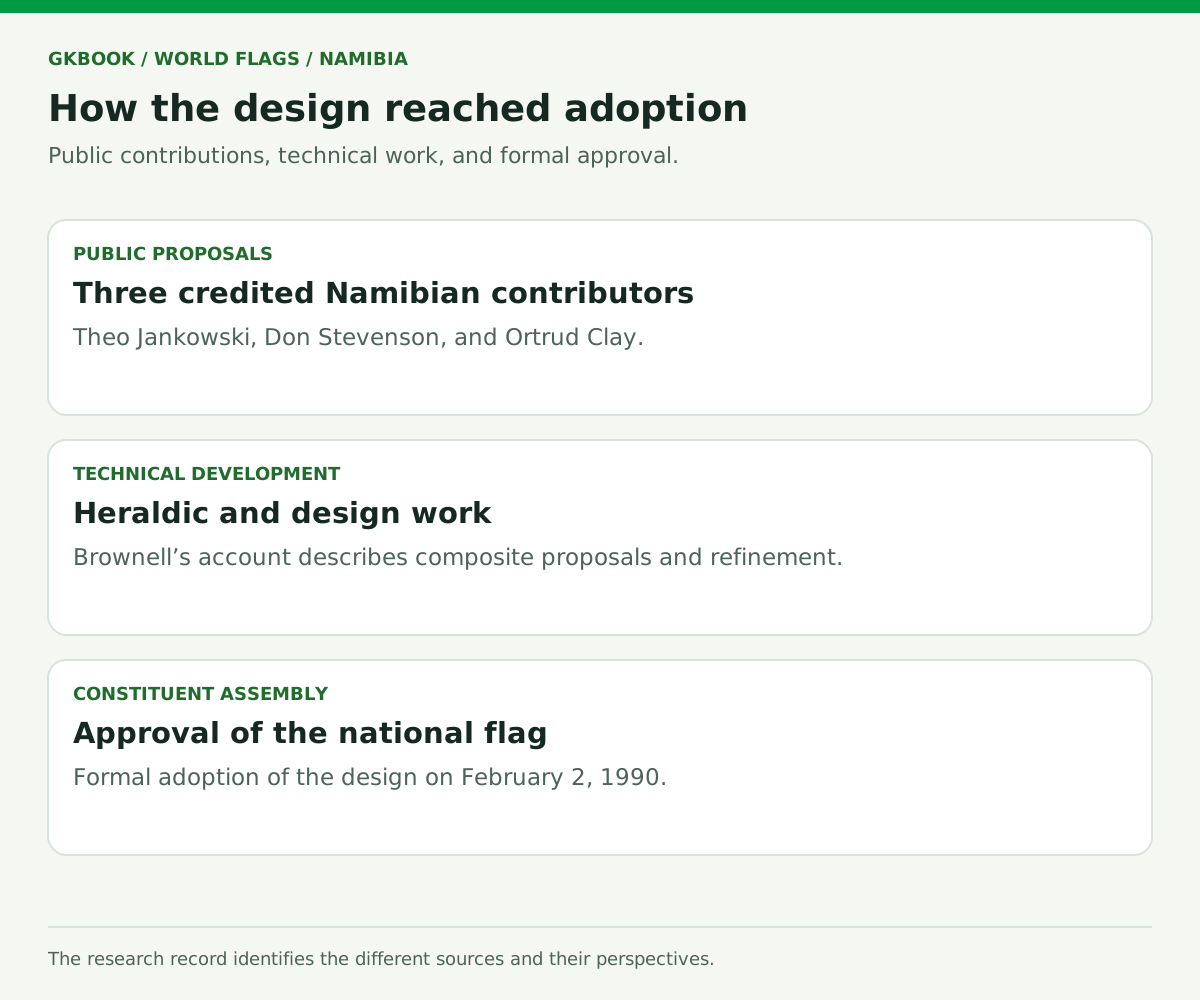
NBC’s interview with Theo Jankowski describes three selected designs being combined. New Era’s account names the three Namibian contributors. Brownell’s doctoral research describes the preparation of composite proposals with technical advisers and the adoption of an adapted proposal; South Africa’s government independently acknowledges his input into Namibia’s national symbols.
The sources do not support assigning every finished detail exclusively to one person. It is more accurate to distinguish public proposals, technical refinement, and the Constituent Assembly’s formal approval. Conflicting totals for competition submissions are also left out of the key facts rather than presented as an uncontested number.
What flag was used before Namibia’s independence?
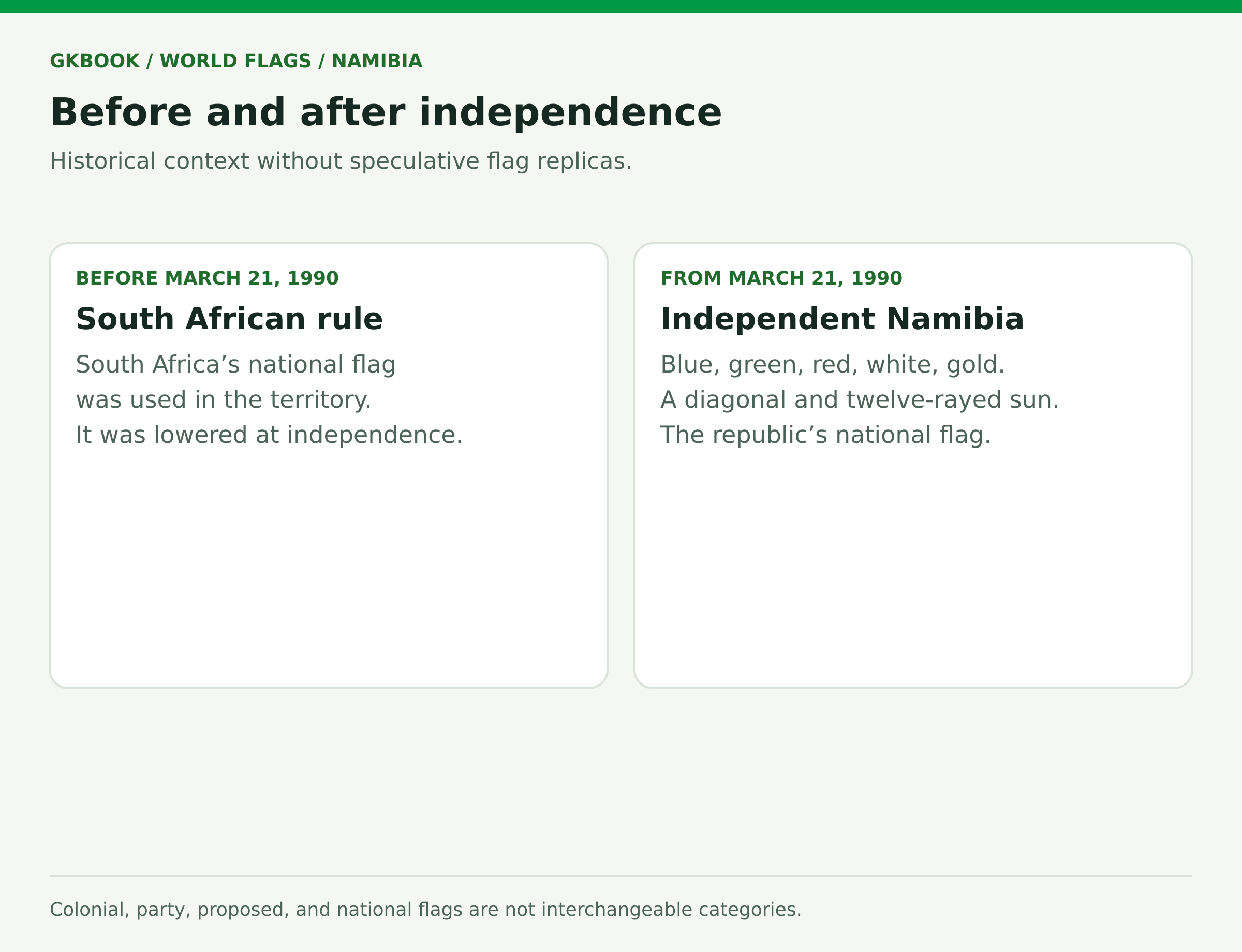
Before independence, South Africa’s national flag was used under South African rule in the territory then known as South West Africa. The Namibian national flag replaced it in March 1990. Colonial, administrative, liberation-movement, and proposed flags belong to different historical categories and should not all be labeled former national flags of independent Namibia.

The independence ceremony provides a documented transition between the South African flag and the new national flag. Earlier German and South African periods form part of the territory’s history, but the Republic of Namibia did not exist as an independent state during them.
The gallery uses text panels for this historical comparison. It does not reproduce hypothetical colonial proposals as if they had been officially flown, or invent exact artwork for inadequately documented variants.
What laws define Namibia’s flag?
Article 2 of Namibia’s Constitution establishes the national flag, and Schedule 6 describes its shape, diagonal bands, colors, and sun. The National Symbols of the Republic of Namibia Act, 2018 addresses use and display and specifies related national symbols. Its presidential-standard schedule explicitly links its color references to those of the national flag.
The two instruments serve different purposes. The Constitution supplies the national flag’s design; the 2018 Act regulates uses and also defines the coat of arms, anthem, seal, and presidential standard.
The color table appears under Schedule 4, Part A of the Act. Although that schedule concerns the presidential standard, its wording expressly says that the colors must be the same as the national flag’s. This is why the table is relevant without confusing the two designs.
Is Namibia’s national flag the same as the presidential standard?
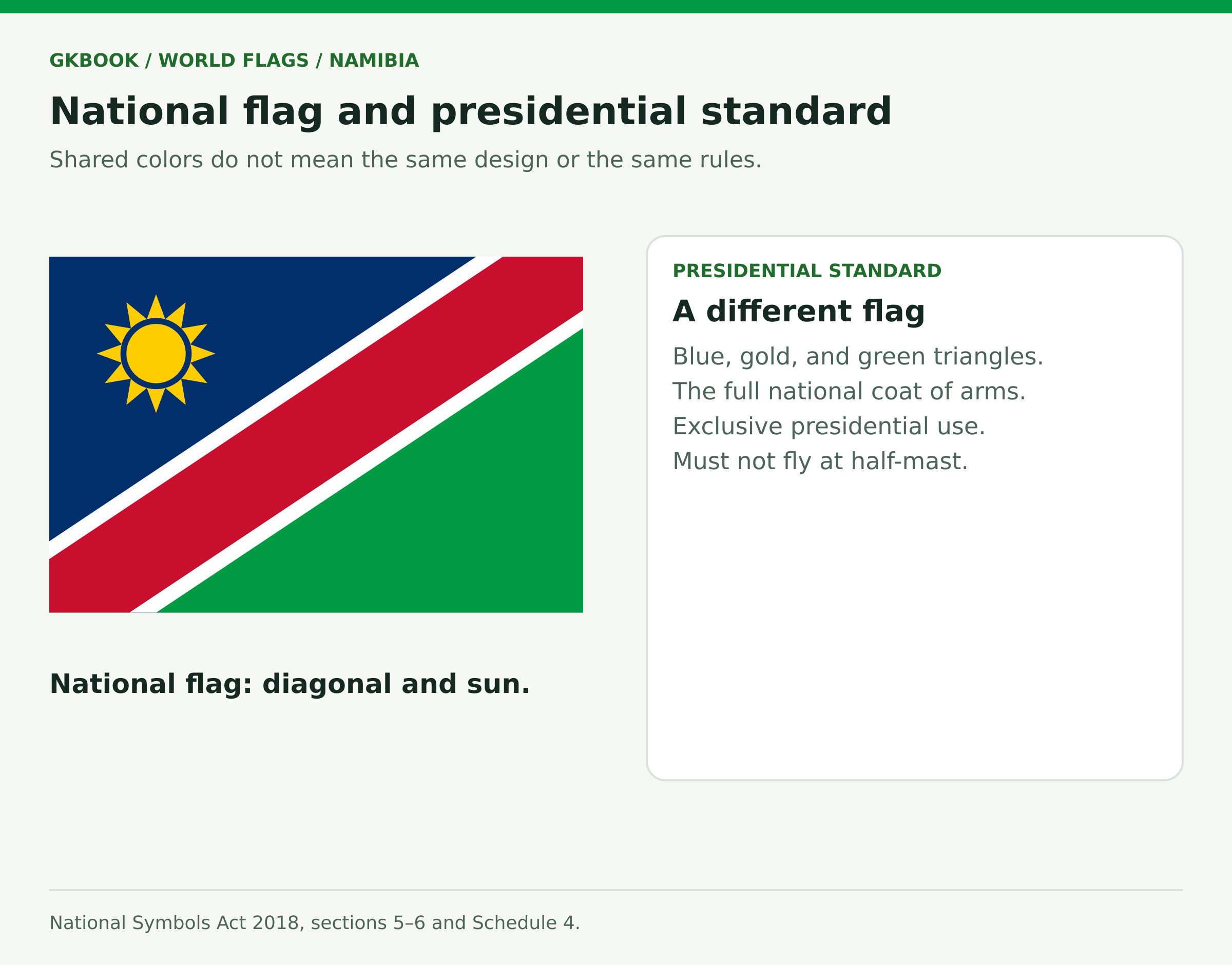
No. Namibia’s national flag has the white-edged red diagonal and golden sun. The presidential standard is a different flag, with blue, gold, and green triangular areas and the national coat of arms. The 2018 Act reserves that standard for the President and expressly states that it must not fly at half-mast.
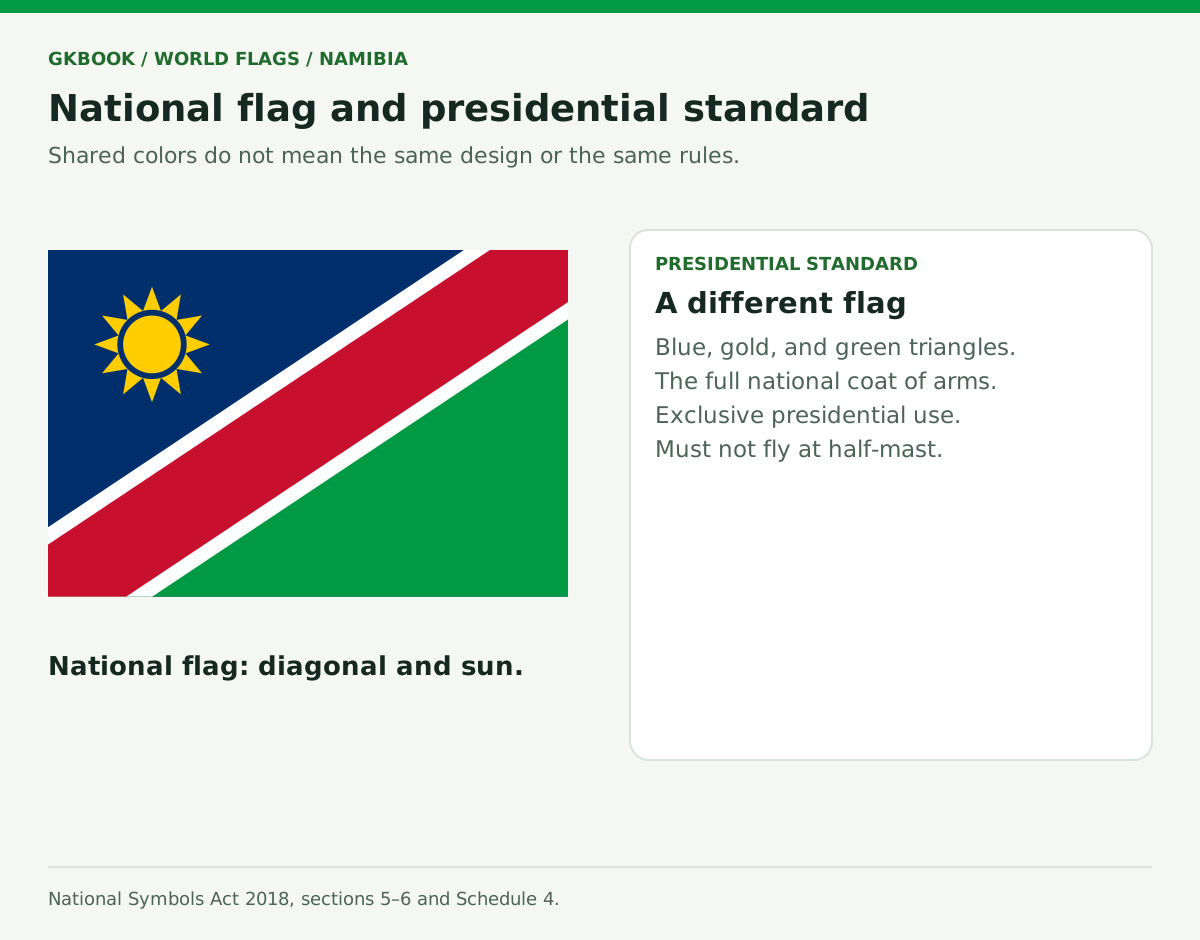
The national coat of arms incorporates a shield based on the flag, but the full arms also include other elements. Placing the entire coat of arms over the sun would create an incorrect version of the national flag.
The gallery distinguishes the symbols through descriptions instead of presenting an unverified drawing of the complex presidential arms. Shared colors do not make the national flag and presidential standard interchangeable.
Does Namibia’s flag look different on its reverse side?
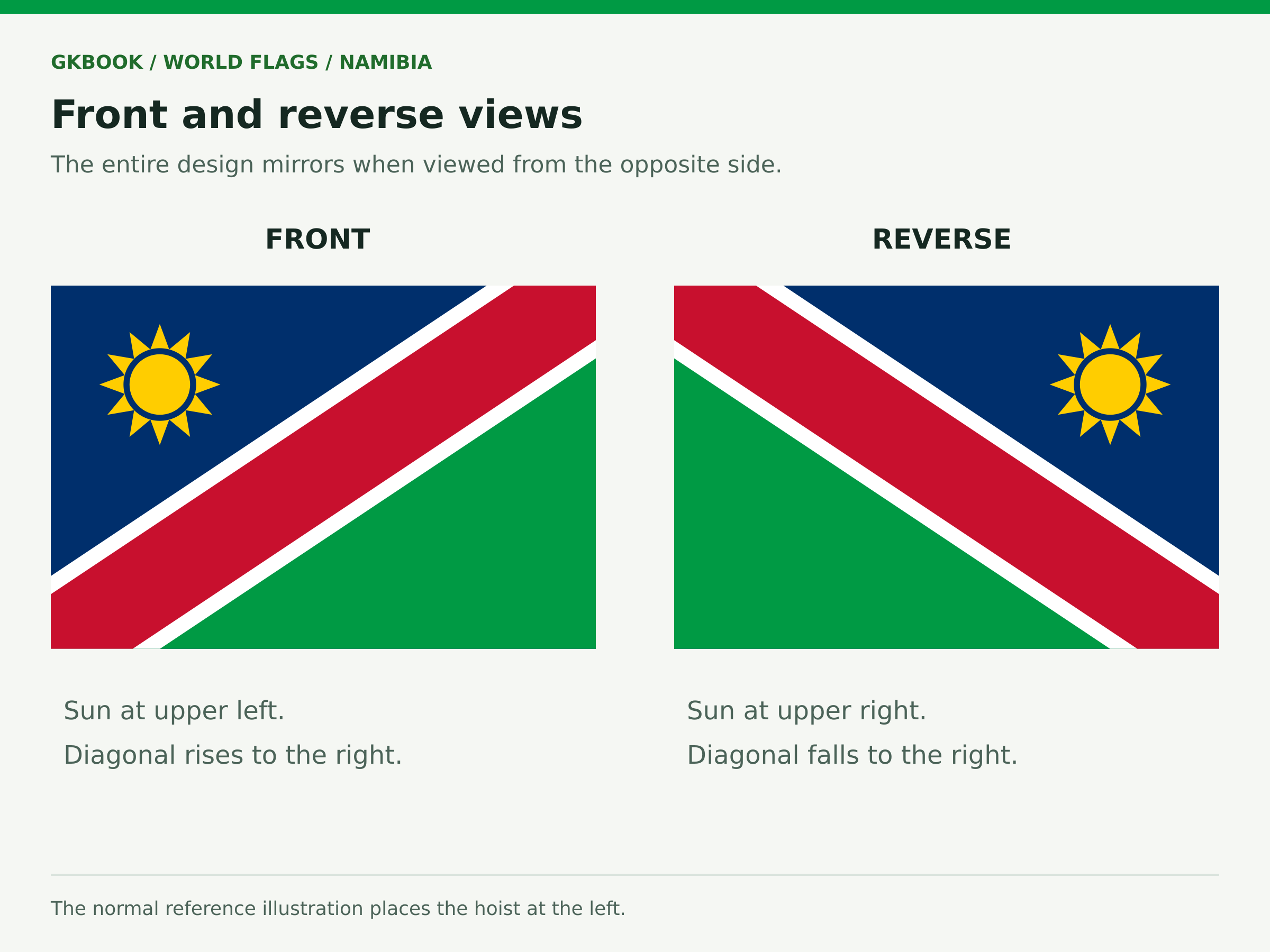
Yes. Seen through from the reverse of ordinary flag cloth, the design is horizontally mirrored. The sun then appears toward the viewer’s upper right, and the red diagonal slopes downward from left to right. This is the reverse view of the same flag, not a separate national design or an incorrectly turned flag.
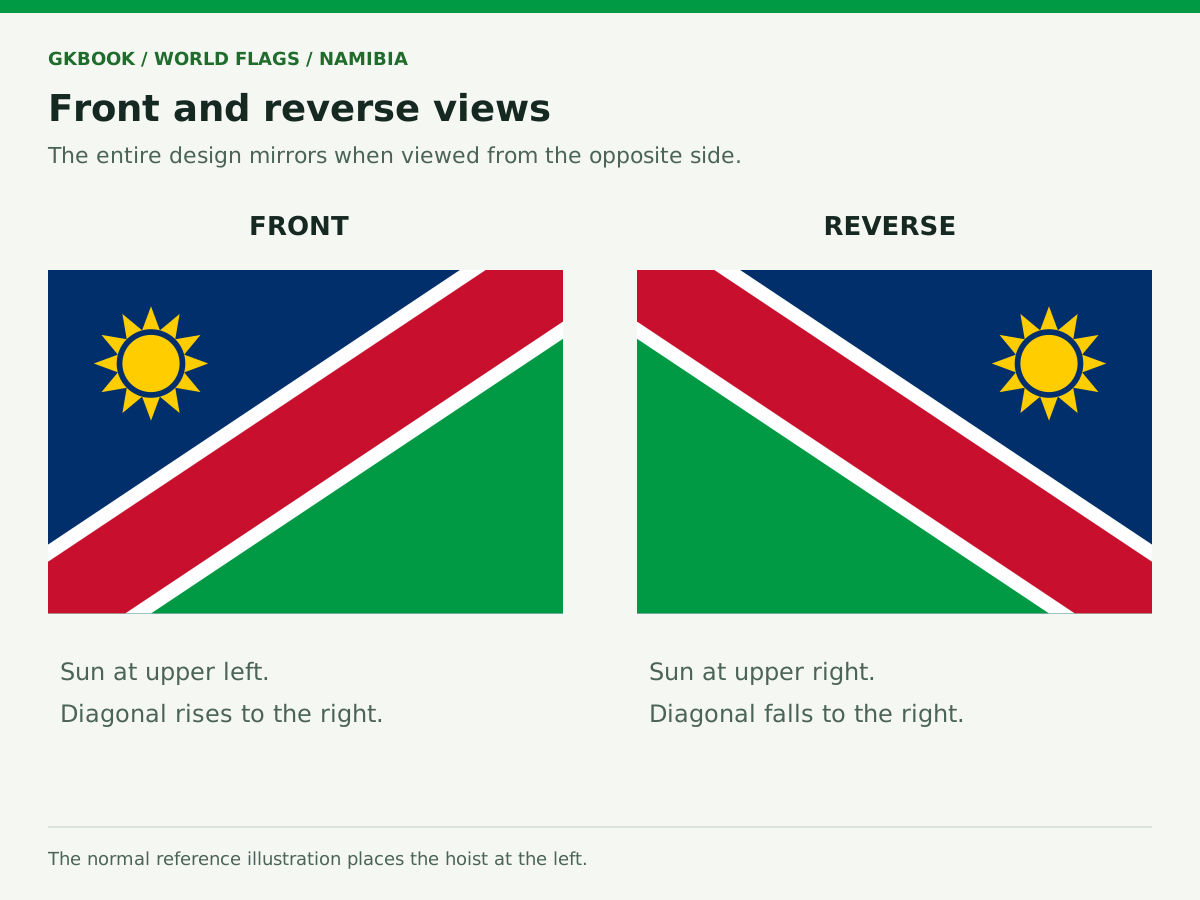
A reference illustration normally shows the front, with the hoist at the left. When someone stands on the opposite side of a flag, the pole and the whole pattern change sides in that person’s view.
Do not move only the sun while keeping the diagonal unchanged. A reverse-view diagram must mirror the complete design, including both colored fields and both white borders.
How should Namibia’s flag be displayed vertically?
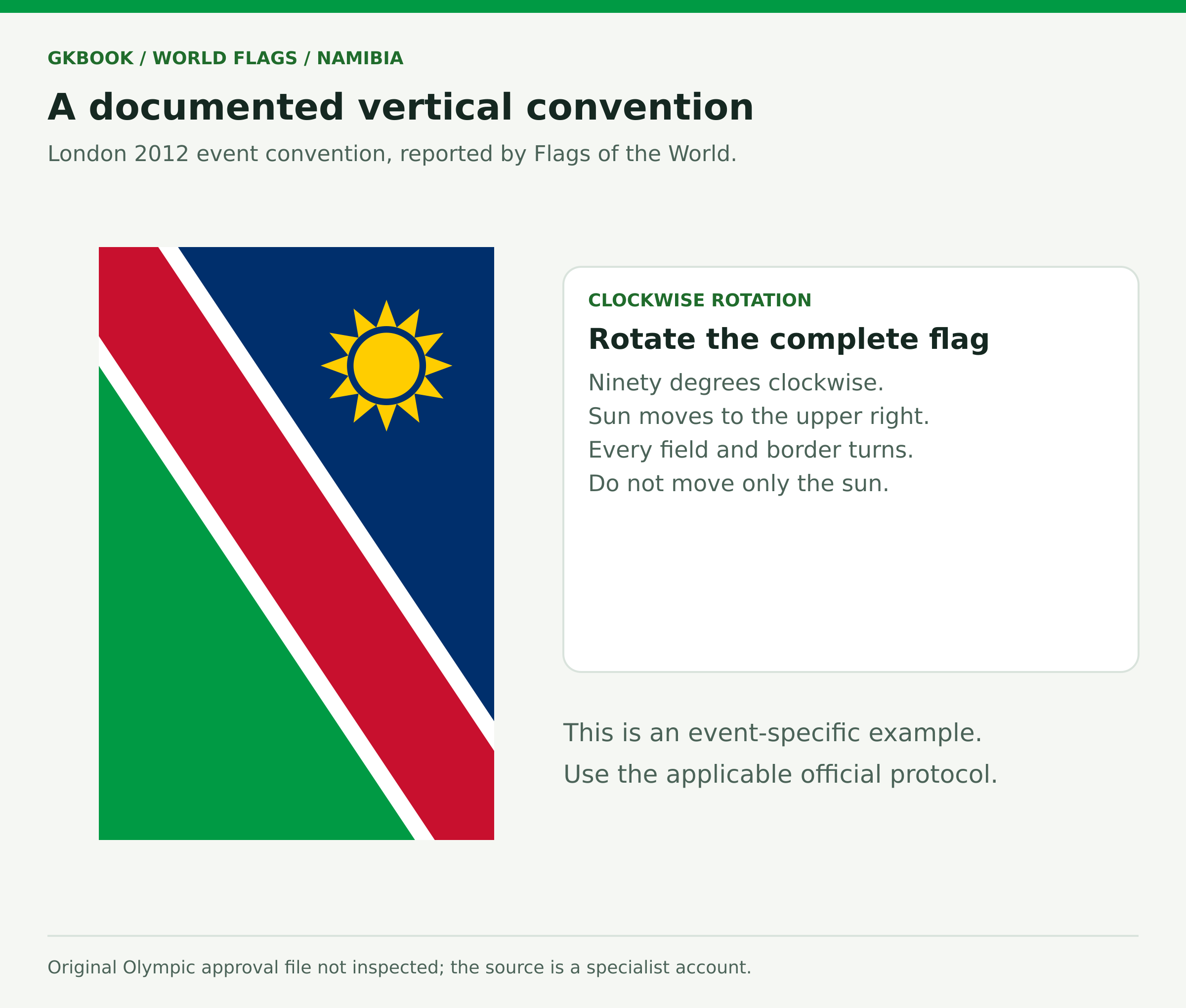
Use the applicable official or event protocol when displaying Namibia’s flag vertically. The constitutional description defines the ordinary horizontal rectangle, while the 2018 Act allows regulations on orientation. A documented London 2012 Olympic convention rotated the complete horizontal flag clockwise; that particular event convention should not be assumed to govern every vertical display.
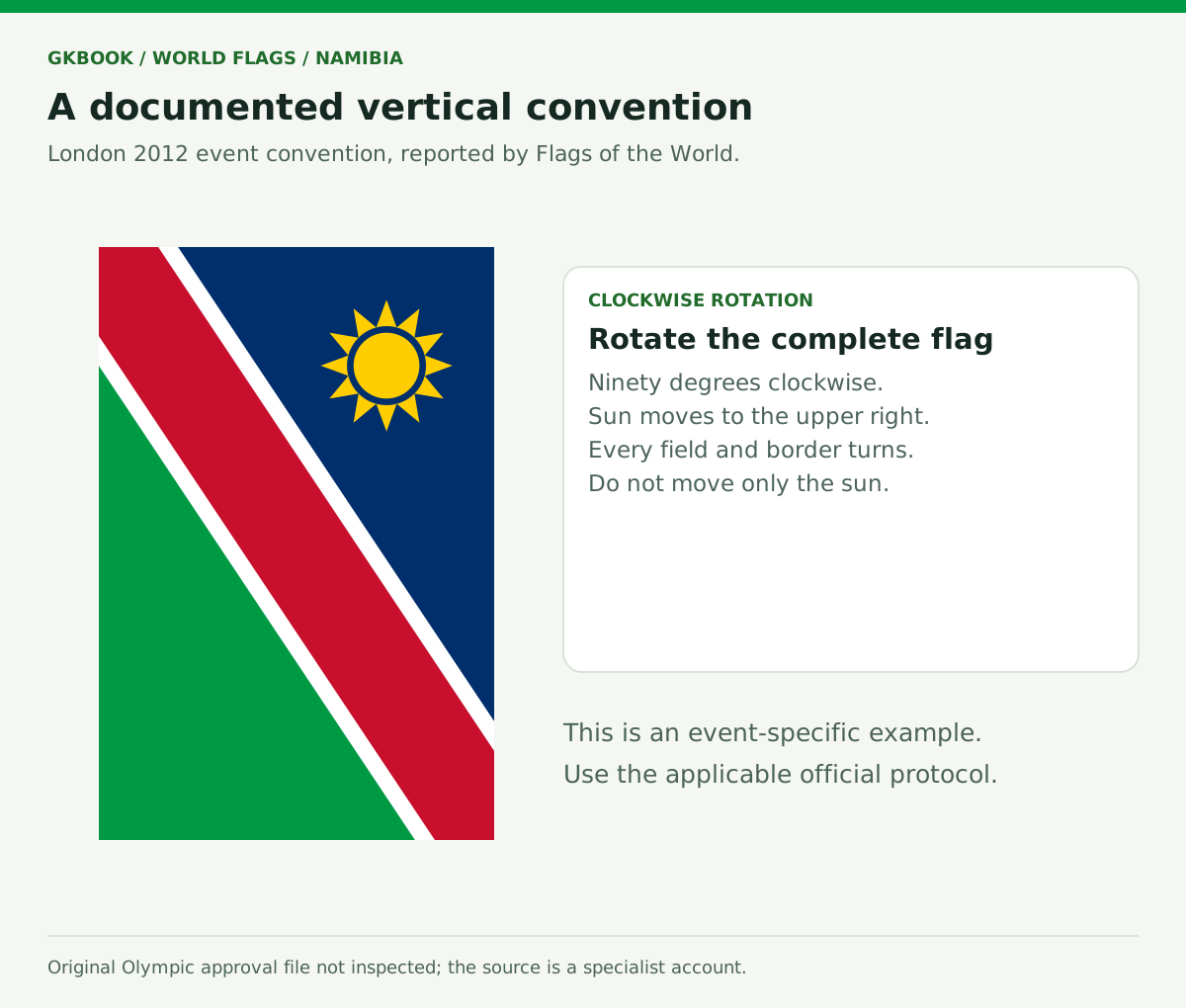
A clockwise rotation places the sun in the upper-right area of the vertical display. The diagonal and all colored regions rotate together. It is not a new portrait-format flag with independently rearranged elements.
The Olympic convention is reported in the specialist Flags of the World record; its original approval file was not independently inspected for this package. For a formal installation, obtain the current protocol applicable to that venue.
What rules govern flying Namibia’s national flag?
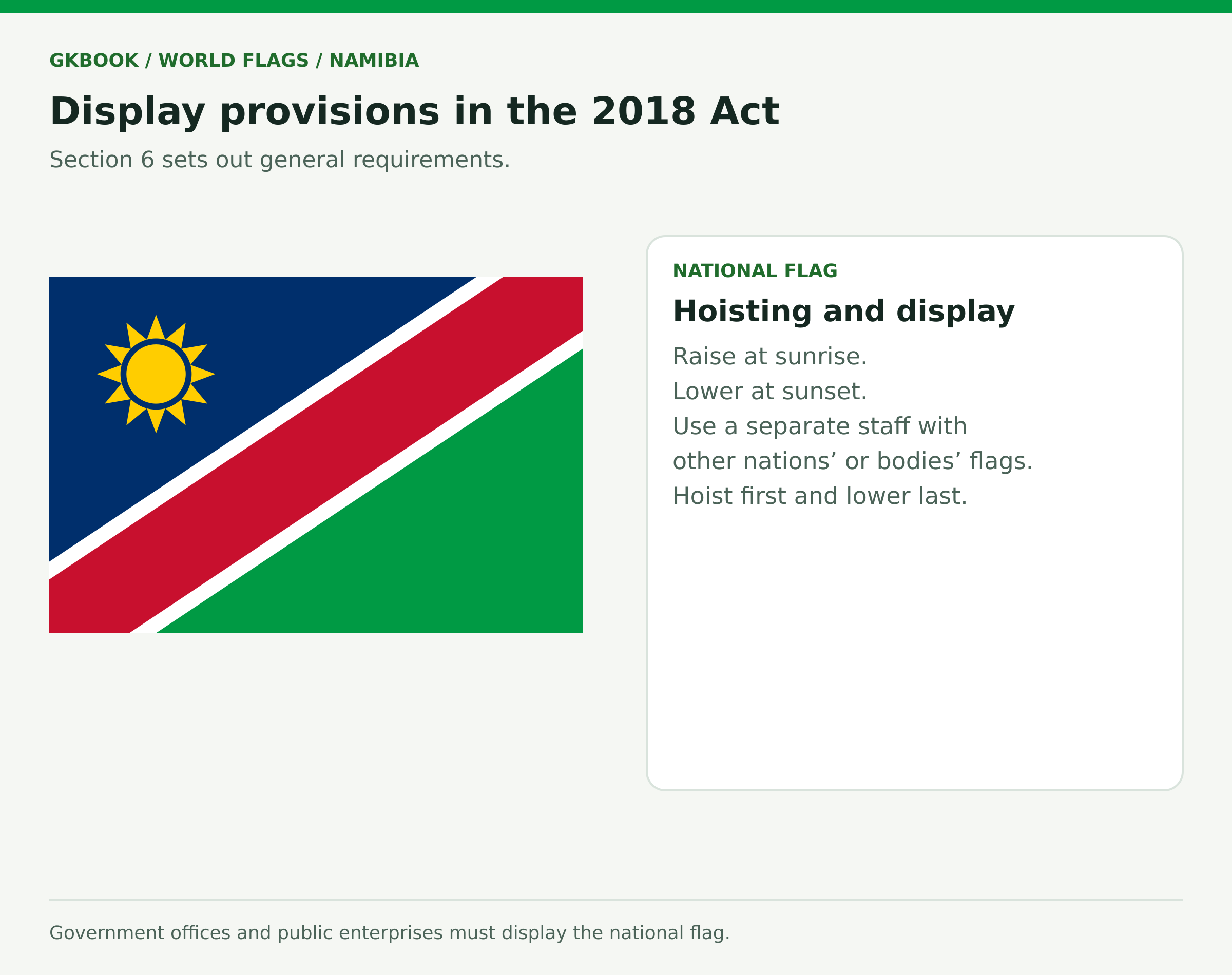
Section 6 of Namibia’s 2018 national-symbols law says the national flag must be raised at sunrise and lowered at sunset. When flown with other national flags or flags of international bodies, it must use a separate staff and be hoisted first and lowered last. Government offices and public enterprises must display it.
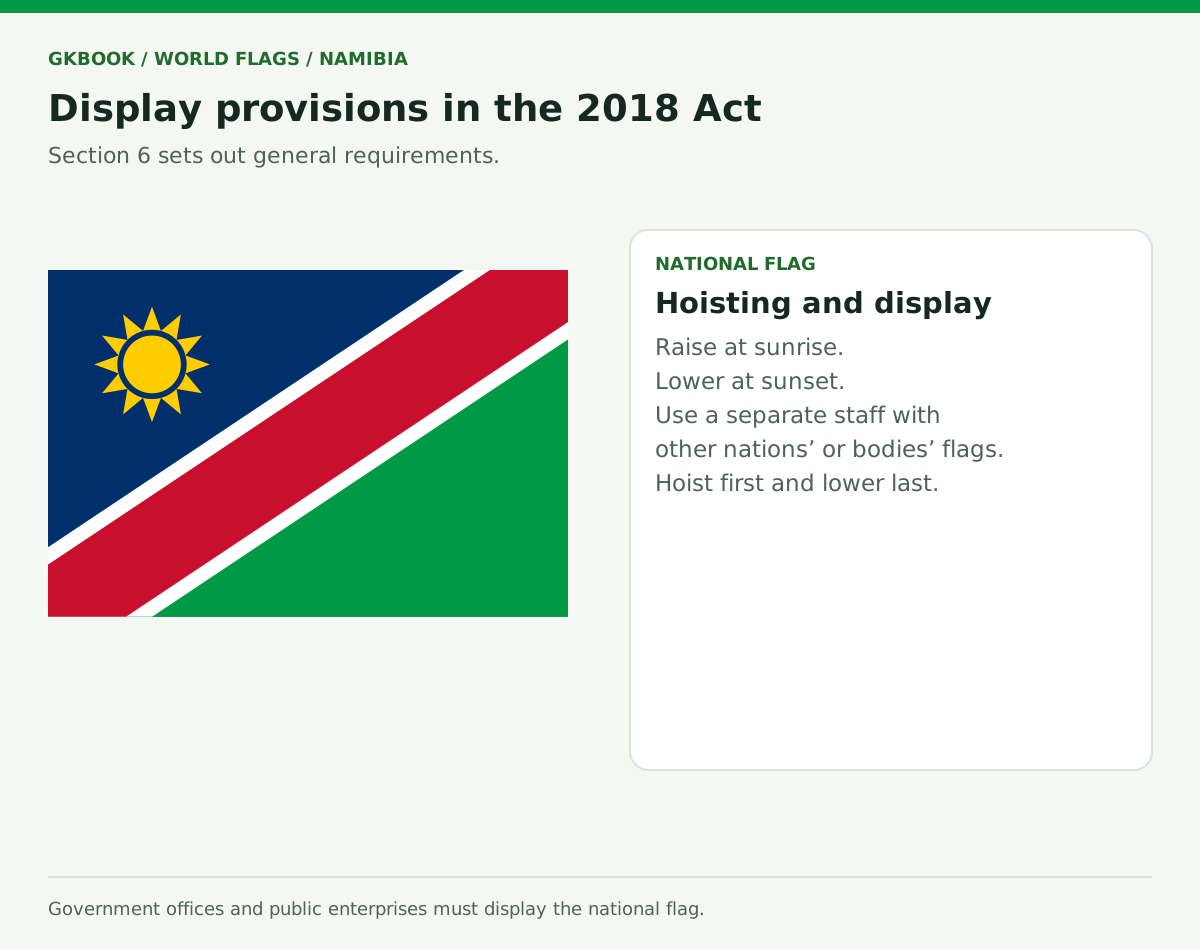
The law provides for display inside the relevant buildings or in the open in front of them. Its separate-staff requirement should not be confused with a rule that other countries’ flags may be subordinated on the same pole.
The general rule stated here comes from the Act itself. The page does not invent exceptions for illumination, particular events, or private installations; operational arrangements should follow the applicable official instructions.
When is Namibia’s flag flown at half-mast?
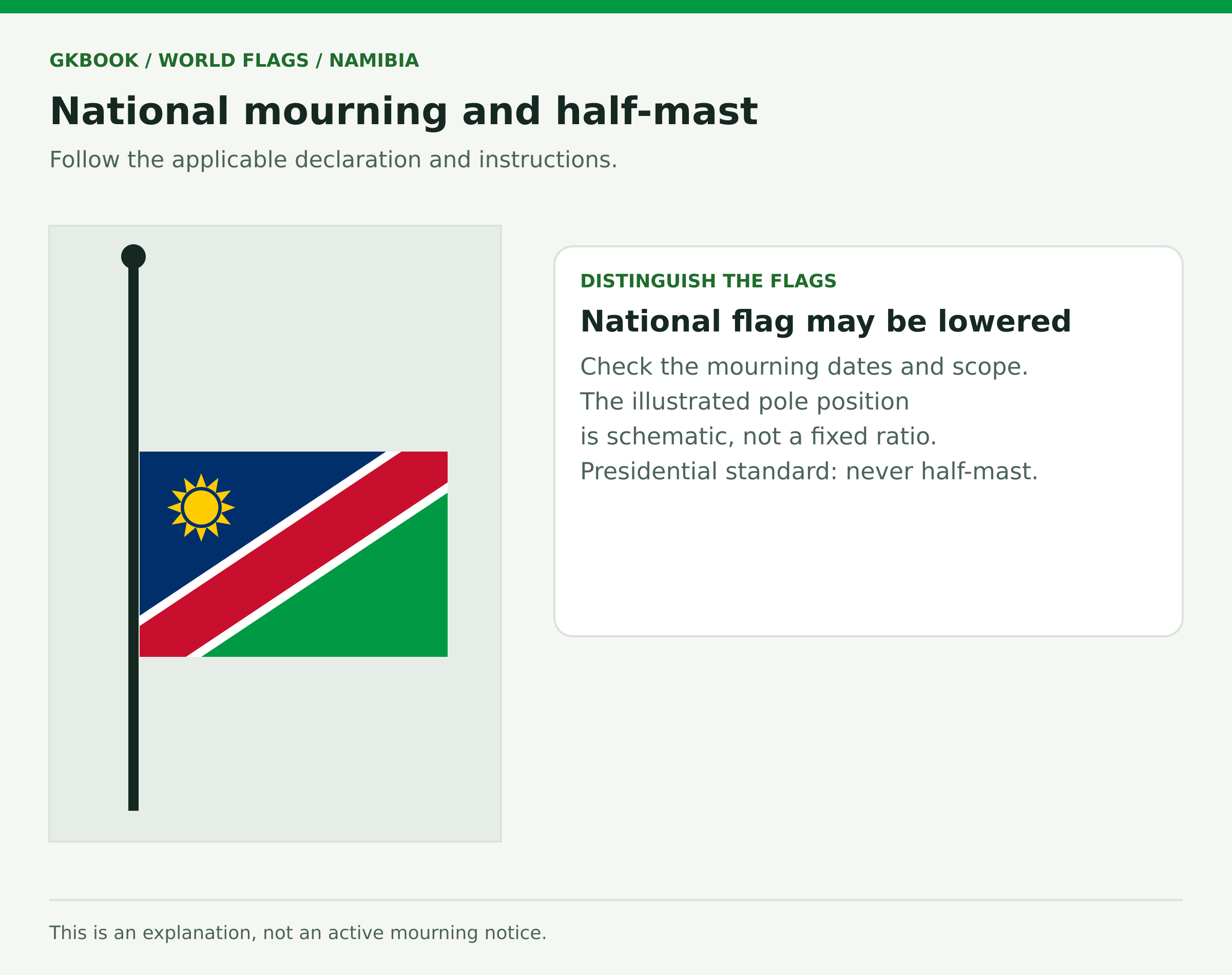
Namibia’s national flag may be lowered during an officially declared period of national mourning, according to the applicable proclamation and instructions. The 2018 Act provides for regulations on mourning duration and flag use. It separately prohibits the presidential standard from flying at half-mast, so the two flags must not be treated alike.
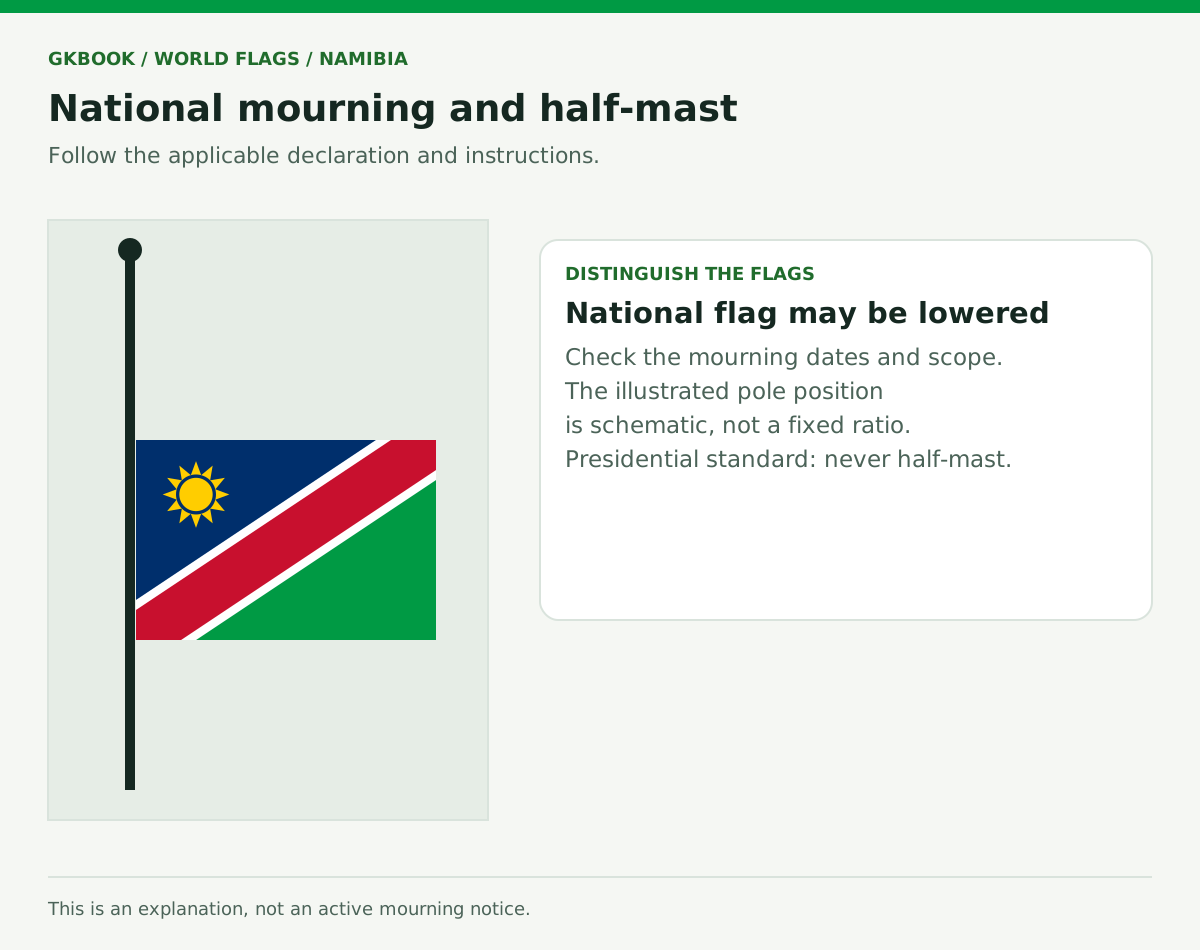
A mourning instruction needs dates and scope. The fact that a national flag was lowered on a past occasion does not establish a standing instruction for every death or anniversary.
The diagram shows a lowered national flag schematically. Neither a fixed percentage of pole height nor a specific current mourning period is asserted here. The presidential standard’s prohibition is explicit in section 6(8); regulation-making powers appear in section 7.
Can Namibia’s flag be used in a business logo?
The 2018 Act restricts using national symbols, or confusingly similar depictions, in connection with trade, business, professions, or goods without the specified prior written approval. This concerns uses likely to cause confusion. Downloading a flag image does not grant that approval or establish permission to present a business as officially connected with Namibia.
Section 6(6) provides for approval by the President or a designated person, and section 6(7) permits conditions. The scope of a proposed commercial use should be assessed against that wording rather than reduced to either a blanket ban or unlimited permission.
Image copyright, national-symbol restrictions, and official endorsement are different issues. The artwork is supplied as a reference illustration; its availability is not a government authorization.
What sizes preserve Namibia’s correct flag proportions?
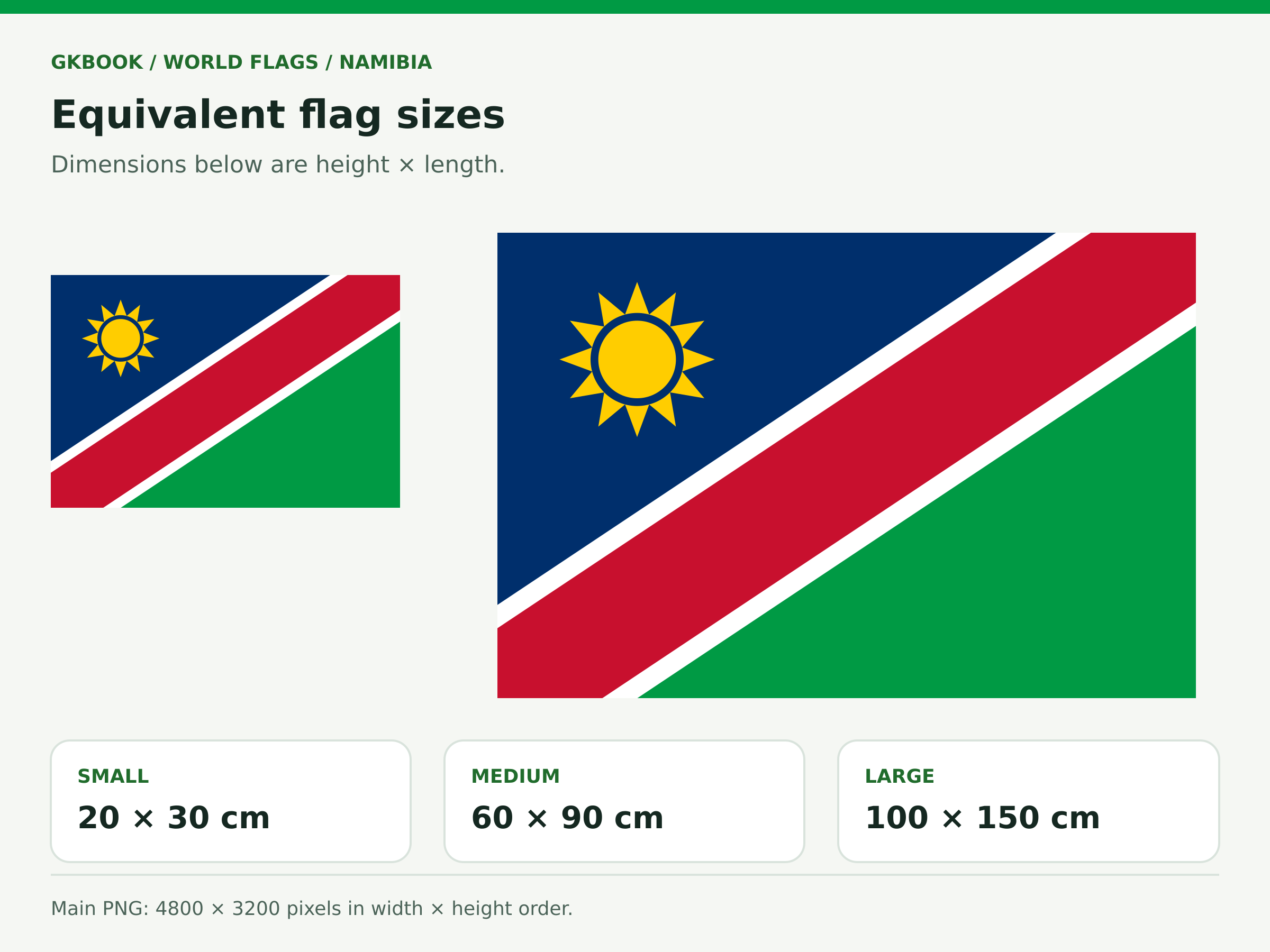
Any dimensions preserving two units of height for three units of length keep Namibia’s required proportions. Examples are 20 by 30, 60 by 90, and 100 by 150 centimeters. Scale the sun and diagonal bands with the rectangle, rather than stretching the field or changing the emblem independently.
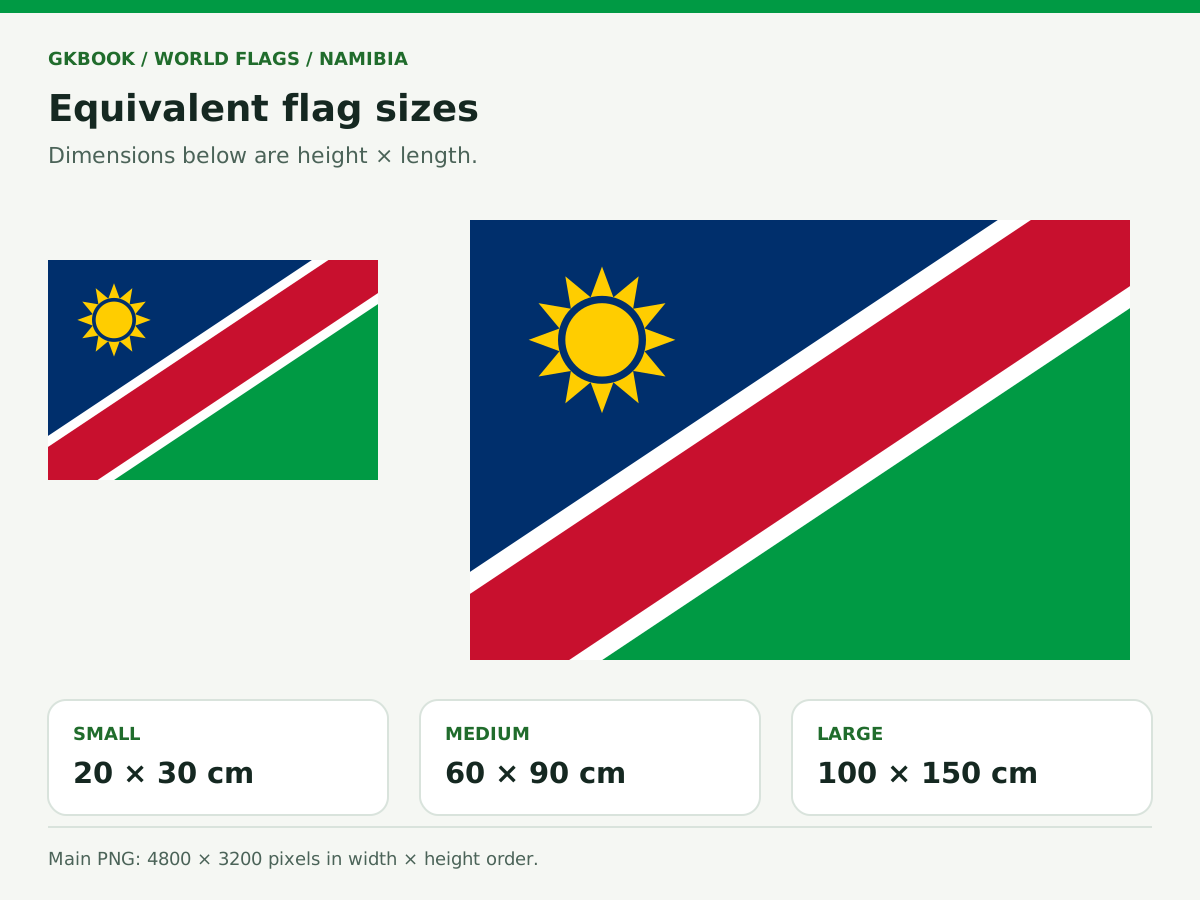
The main PNG supplied with this article is 4800 pixels wide and 3200 pixels high. The SVG uses a 1200-by-800 coordinate system and can scale without losing geometric precision.
For a print layout, preserve the image’s aspect ratio. Crop marks, captions, borders, and page margins belong outside the actual flag rectangle.
What are common mistakes in Namibia flag pictures?
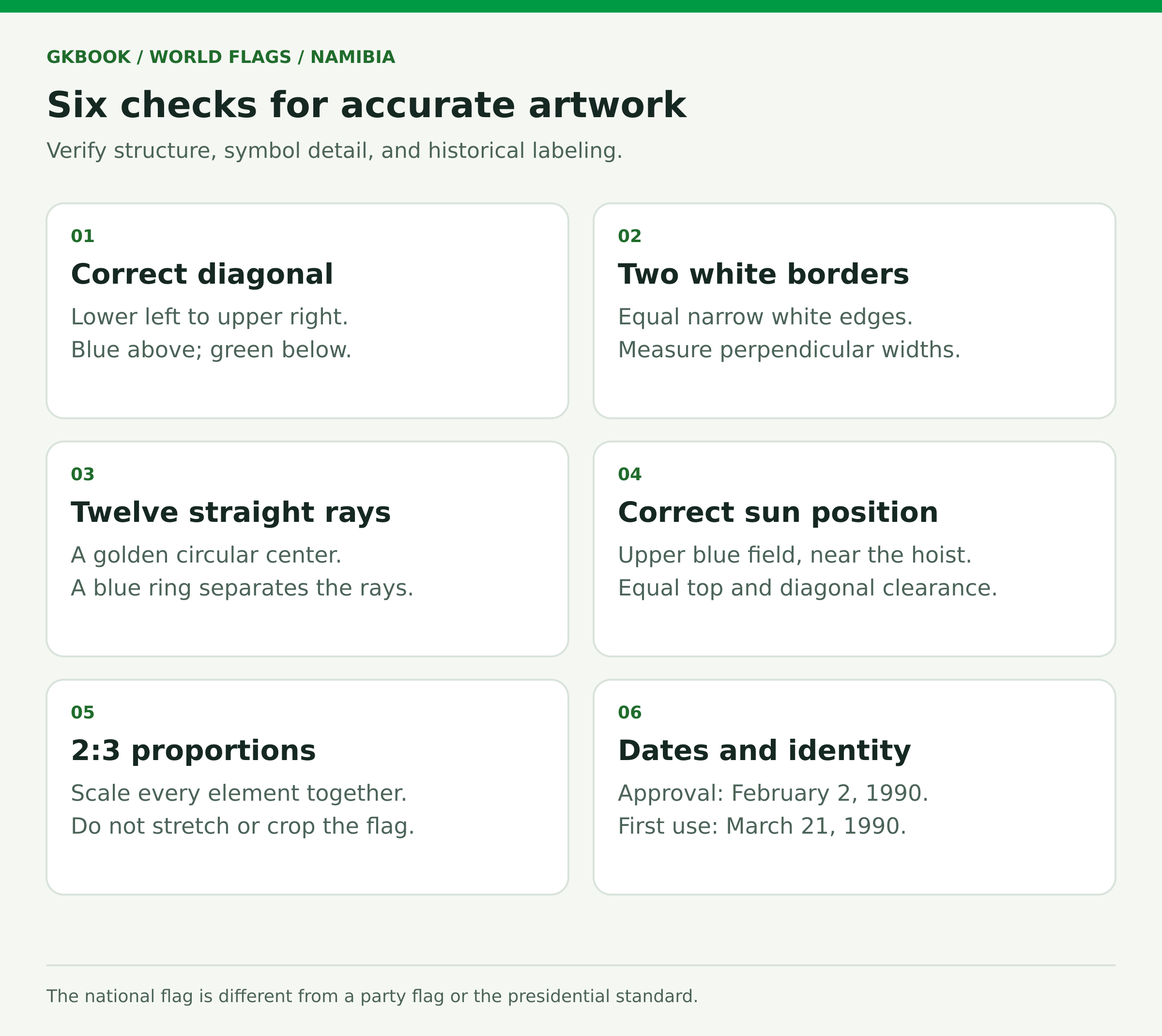
Common errors include reversing the diagonal, swapping blue and green, omitting the white borders, drawing the sun as a solid starburst, or using the wrong number of rays. Another error is measuring the diagonal band vertically. Accurate reproductions preserve the 2:3 rectangle, twelve rays, blue ring, and perpendicular band widths.
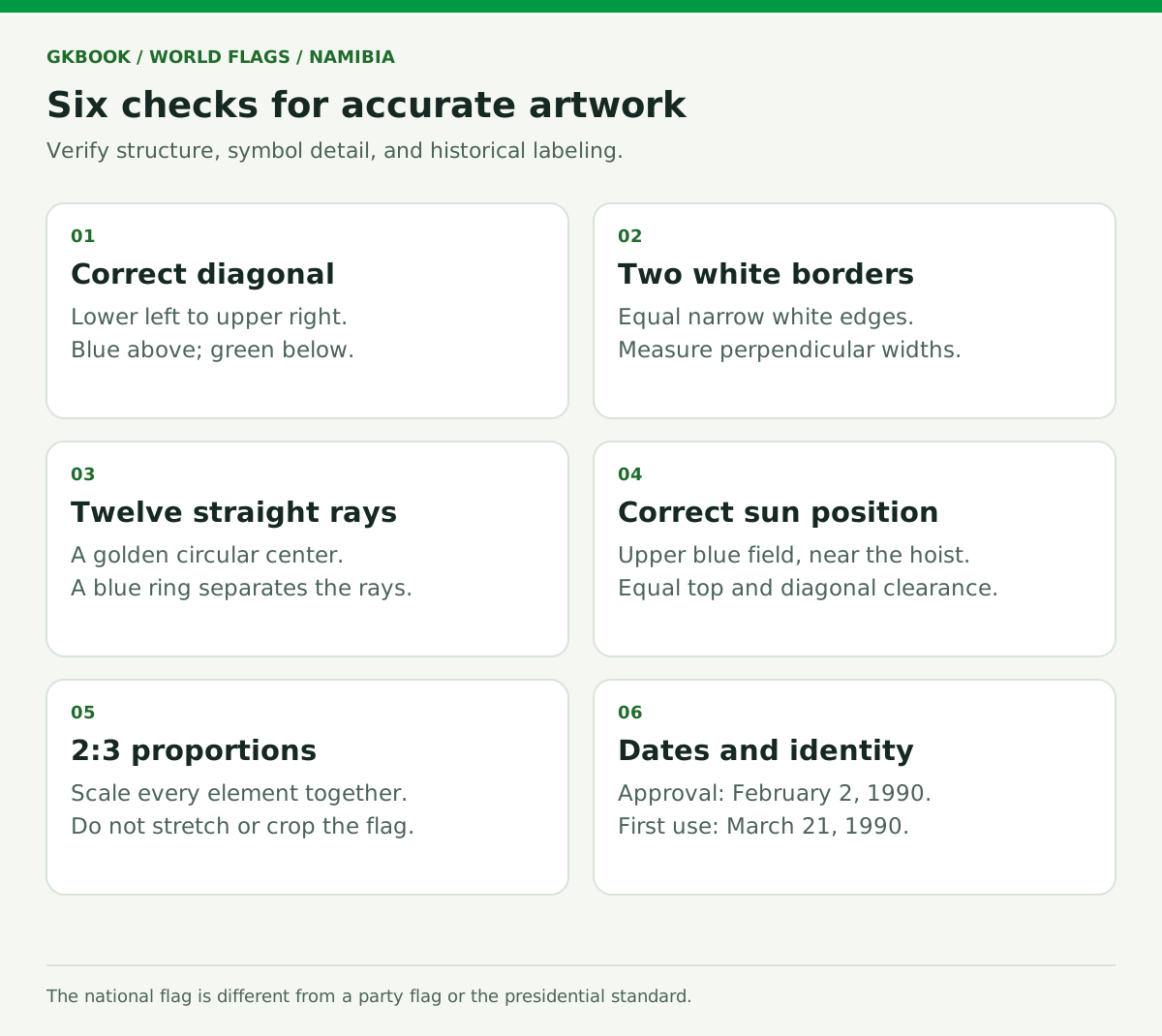
In a normal front view, the sun sits in the blue upper-left area. It must not be centered on the entire flag, moved onto the red band, or made so large that it touches a white border.
Check the historical caption as carefully as the artwork. February 2, 1990 is design approval; March 21, 1990 is first use at independence. A presidential standard or party flag should not be substituted for the national flag.
Which Namibia flag image format should I download?
Choose SVG for scalable artwork and precise geometric editing, or PNG for a ready-to-use image in documents and slides. Both versions here share the same construction and screen palette. Use the plain flag for reproduction and the labeled diagrams for teaching, while preserving the complete rectangular design and its correct proportions.
The gallery contains the flag, construction guides, historical information panels, and display explanations. These annotated teaching materials are not alternative official flags. The social-sharing image is also a presentation graphic rather than a flag-production master.
Reconstruction notes and research records accompany the download package. They identify the statutory color references, the chosen digital approximations, the calculated sun position, the historical source differences, and the limits of verification.
Download Namibia flag pictures
Download the national flag as SVG or 4800 × 3200 PNG. The gallery contains 22 subjects, each with SVG and PNG versions. Use the full image and preserve its proportions. Image credits and reconstruction notes accompany the artwork.
Explore more in World Flags, including the Mozambique flag and Myanmar flag.
World Flags/Namibia
Namibia flag pictures
2:3 proportions, measured diagonal bands, and a twelve-rayed golden sun with a blue ring. Digital colors are screen approximations.
GKBook original diagram based on the Namibian Constitution; digital construction notes supplied.Download SVGDownload PNGThe 2018 Act gives Pantone references through its presidential-standard schedule; the listed HEX values are screen choices.
GKBook original diagram based on the Namibian Constitution; digital construction notes supplied.Download SVGDownload PNGThe meanings concern the nation as a whole; the official sources consulted do not assign one community to each ray.
GKBook original diagram based on the Namibian Constitution; digital construction notes supplied.Download SVGDownload PNGThe complete white band is H/3; the red band is H/4; each remaining white border is H/24.
GKBook original diagram based on the Namibian Constitution; digital construction notes supplied.Download SVGDownload PNGThe blue ring separates the circular gold center from the triangular rays.
GKBook original diagram based on the Namibian Constitution; digital construction notes supplied.Download SVGDownload PNGAll elements scale with the 2:3 height-to-length rectangle.
GKBook original diagram based on the Namibian Constitution; digital construction notes supplied.Download SVGDownload PNGThe diagonal follows a 3-by-2 rectangle’s corner-to-corner line, not a 45-degree line.
GKBook original diagram based on the Namibian Constitution; digital construction notes supplied.Download SVGDownload PNGThe sun’s outer circular envelope is equally spaced from the top edge and the adjacent white band. Coordinates are calculated.
GKBook original diagram based on the Namibian Constitution; digital construction notes supplied.Download SVGDownload PNGThe outer radius divides into a half-radius gold disk, one-tenth-radius blue ring, and two-fifths-radius rays.
GKBook original diagram based on the Namibian Constitution; digital construction notes supplied.Download SVGDownload PNGThe statutory table names Pantone colors; the package defines its own screen values consistently.
GKBook original diagram based on the Namibian Constitution; digital construction notes supplied.Download SVGDownload PNGA 90-by-60 model has perpendicular stripe widths 20 and 15, white edges 2.5, and sun radius 10.
GKBook original diagram based on the Namibian Constitution; digital construction notes supplied.Download SVGDownload PNGThe national design was approved before independence; the 2018 Act did not replace it.
GKBook original diagram based on the Namibian Constitution; digital construction notes supplied.Download SVGDownload PNGFebruary 2 is approval; March 21 is first use at independence and the conventional adoption date.
GKBook original diagram based on the Namibian Constitution; digital construction notes supplied.Download SVGDownload PNGPublic contributions and technical development are distinguished rather than reduced to an exclusive single-name attribution.
GKBook original diagram based on the Namibian Constitution; digital construction notes supplied.Download SVGDownload PNGThe independence ceremony replaced South Africa’s flag with Namibia’s national flag.
GKBook original diagram based on the Namibian Constitution; digital construction notes supplied.Download SVGDownload PNGThe presidential standard contains the coat of arms and has separate use rules; it is described rather than reconstructed here.
GKBook original diagram based on the Namibian Constitution; digital construction notes supplied.Download SVGDownload PNGThe reverse is a horizontal reflection of the complete flag, not a different national design.
GKBook original diagram based on the Namibian Constitution; digital construction notes supplied.Download SVGDownload PNGA reported London 2012 convention rotates the flag clockwise; it is not presented as a universal statutory rule.
GKBook original diagram based on the Namibian Constitution; digital construction notes supplied.Download SVGDownload PNGThe law specifies sunrise and sunset handling and separate staffs when displayed with other national or international flags.
GKBook original diagram based on the Namibian Constitution; digital construction notes supplied.Download SVGDownload PNGThe national flag follows mourning instructions; the presidential standard has an explicit prohibition against half-mast display.
GKBook original diagram based on the Namibian Constitution; digital construction notes supplied.Download SVGDownload PNGScale every element together while preserving the 2:3 height-to-length ratio.
GKBook original diagram based on the Namibian Constitution; digital construction notes supplied.Download SVGDownload PNGSix checks cover direction, borders, sun detail and placement, proportions, and dates.
GKBook original diagram based on the Namibian Constitution; digital construction notes supplied.Download SVGDownload PNGFrequently asked questions
What does Namibia’s national flag look like?
Namibia’s national flag has a blue upper-left triangle and a green lower-right triangle, separated by a red diagonal band edged in white. A golden sun with twelve straight rays appears in the blue area. The flag has 2:3 height-to-length proportions and first flew at independence on March 21, 1990.
What are the colors of Namibia’s flag?
Namibia’s flag uses five colors: blue, red, green, white, and gold. Blue occupies the upper hoist, green the lower fly, and a white-edged red band runs between them. The golden sun sits entirely within the blue area. The 2018 national-symbols legislation supplies named print-color references for the four chromatic colors.
What does Namibia’s flag symbolize?
Namibia’s flag symbolizes national unity and common loyalty to the country. Its official explanation connects blue with sky and water, red with the people and their determination, green with vegetation and agriculture, white with peace and unity, and the golden sun with life, energy, warmth, and the landscape.
What does blue represent on Namibia’s flag?
Blue represents Namibia’s sky, the Atlantic Ocean, marine resources, and the importance of rain and water. It forms the upper triangle next to the hoist and also the narrow ring separating the sun’s center from its rays. The 2018 statutory color table identifies blue as Pantone 294 C.
What does red represent on Namibia’s flag?
Red represents the Namibian people, their heroism, and their determination to build a future offering equal opportunities to everyone. It occupies the broad diagonal band rising from the lower hoist toward the upper fly. The band is bordered by white on both sides, and its specified print reference is Pantone 186 C.
What does green represent on Namibia’s flag?
Green represents Namibia’s vegetation and agricultural resources. It fills the lower-right triangular field in the normal front view, below the white-edged red diagonal. Schedule 4 of the 2018 national-symbols legislation names Pantone 347 C for green, while digital reproductions need their own clearly identified screen approximation of that color.
What do the white stripes on Namibia’s flag mean?
White represents peace and unity. On Namibia’s flag, it appears as two narrow, equal borders separating the red diagonal from the blue and green fields. These borders are part of the prescribed design, not optional outlines. Each visible white border is one twenty-fourth of the flag’s height when measured perpendicular to the diagonal.
What does the golden sun on Namibia’s flag represent?
The sun represents life and energy, while its golden color recalls warmth and the plains and Namib Desert. The emblem has twelve straight, triangular rays around a circular golden center. A narrow blue ring separates the center from the rays, making the symbol more specific than a plain twelve-pointed star.
Do the sun’s twelve rays represent twelve ethnic groups?
Twelve rays are required by Namibia’s Constitution, but the official symbolism sources used here do not assign one ray to each ethnic group. They explain the sun as life and energy. Claims about twelve peoples, months, or regions should therefore be identified as additional interpretations unless supported by a specific authoritative source.
What are the proportions of Namibia’s flag?
Namibia’s flag has a height-to-length ratio of 2:3, or a length-to-height ratio of 3:2. Schedule 6 of the Constitution states that the rectangle is three units long for every two units wide. In modern drawing terminology, that constitutional width is the flag’s vertical height, not its horizontal length.
Which direction does Namibia’s diagonal stripe run?
In the normal front view, Namibia’s red diagonal rises from the lower-left hoist corner toward the upper-right fly corner. Blue and the sun lie above it, while green lies below. The diagonal follows the rectangle’s corner-to-corner direction, so it is not a forty-five-degree line on a correctly proportioned 2:3 flag.
How wide are Namibia’s diagonal bands?
The complete white diagonal band is one-third of the flag’s height, with a red band one-quarter of that height centered over it. This leaves a visible white border of one twenty-fourth of the height on either side. All these thicknesses are measured perpendicular to the diagonal, rather than vertically.
Where is the sun placed on Namibia’s flag?
The sun lies in the upper blue field, with its vertical centerline one-fifth of the flag’s length from the hoist. Its position gives equal clearance from the top edge and the nearby white diagonal. The clearances are measured using the sun’s outer circular envelope, which includes the ray tips.
How are the sun, blue ring, and rays constructed?
The sun’s full diameter, including its rays, is one-third of the flag’s height. Each ray extends radially through two-fifths of the outer radius, and the blue ring is one-tenth of that radius thick. The remaining central golden disk therefore has a radius equal to half the sun’s outer radius.
What HEX and RGB colors should a Namibia flag image use?
The digital artwork here uses blue #002F6C, gold #FFCD00, green #009A44, red #C8102E, and white #FFFFFF. These values define the supplied screen images consistently. The statutory references are Pantone 294 C, 116 C, 347 C, and 186 C; the law does not itself prescribe these HEX or RGB values.
How can students draw Namibia’s flag accurately?
Draw a rectangle 90 units long and 60 units high, then add a diagonal from the lower-left to the upper-right corner. Center a white band 20 units wide on that diagonal and a red band 15 units wide over it. Color the remaining upper field blue and lower field green, then add the sun.
How did Namibia’s national flag develop?
Namibia’s present flag emerged during preparations for independence in 1990. A national-symbols process invited public proposals, evaluated designs, and produced the diagonal composition approved by the Constituent Assembly. The new flag then replaced South Africa’s flag at the independence ceremony. Its colors connect the liberation period with a national message of peace and unity.
When was Namibia’s flag adopted?
Namibia’s Constituent Assembly approved the national flag on February 2, 1990. It first flew as the independent country’s flag on March 21, 1990, the date commonly listed as its adoption or introduction date. These dates describe different stages: approval of the design and its use at the birth of the republic.
Who designed Namibia’s national flag?
Namibia’s flag resulted from a public design process and subsequent technical development, so a single-name attribution is incomplete. Namibian accounts credit proposals by Theo Jankowski, Don Stevenson, and Ortrud Clay. Documentary and official accounts also describe the involvement of heraldist Frederick Brownell in developing Namibia’s national symbols during the transition to independence.
What flag was used before Namibia’s independence?
Before independence, South Africa’s national flag was used under South African rule in the territory then known as South West Africa. The Namibian national flag replaced it in March 1990. Colonial, administrative, liberation-movement, and proposed flags belong to different historical categories and should not all be labeled former national flags of independent Namibia.
What laws define Namibia’s flag?
Article 2 of Namibia’s Constitution establishes the national flag, and Schedule 6 describes its shape, diagonal bands, colors, and sun. The National Symbols of the Republic of Namibia Act, 2018 addresses use and display and specifies related national symbols. Its presidential-standard schedule explicitly links its color references to those of the national flag.
Is Namibia’s national flag the same as the presidential standard?
No. Namibia’s national flag has the white-edged red diagonal and golden sun. The presidential standard is a different flag, with blue, gold, and green triangular areas and the national coat of arms. The 2018 Act reserves that standard for the President and expressly states that it must not fly at half-mast.
Does Namibia’s flag look different on its reverse side?
Yes. Seen through from the reverse of ordinary flag cloth, the design is horizontally mirrored. The sun then appears toward the viewer’s upper right, and the red diagonal slopes downward from left to right. This is the reverse view of the same flag, not a separate national design or an incorrectly turned flag.
How should Namibia’s flag be displayed vertically?
Use the applicable official or event protocol when displaying Namibia’s flag vertically. The constitutional description defines the ordinary horizontal rectangle, while the 2018 Act allows regulations on orientation. A documented London 2012 Olympic convention rotated the complete horizontal flag clockwise; that particular event convention should not be assumed to govern every vertical display.
What rules govern flying Namibia’s national flag?
Section 6 of Namibia’s 2018 national-symbols law says the national flag must be raised at sunrise and lowered at sunset. When flown with other national flags or flags of international bodies, it must use a separate staff and be hoisted first and lowered last. Government offices and public enterprises must display it.
When is Namibia’s flag flown at half-mast?
Namibia’s national flag may be lowered during an officially declared period of national mourning, according to the applicable proclamation and instructions. The 2018 Act provides for regulations on mourning duration and flag use. It separately prohibits the presidential standard from flying at half-mast, so the two flags must not be treated alike.
Can Namibia’s flag be used in a business logo?
The 2018 Act restricts using national symbols, or confusingly similar depictions, in connection with trade, business, professions, or goods without the specified prior written approval. This concerns uses likely to cause confusion. Downloading a flag image does not grant that approval or establish permission to present a business as officially connected with Namibia.
What sizes preserve Namibia’s correct flag proportions?
Any dimensions preserving two units of height for three units of length keep Namibia’s required proportions. Examples are 20 by 30, 60 by 90, and 100 by 150 centimeters. Scale the sun and diagonal bands with the rectangle, rather than stretching the field or changing the emblem independently.
What are common mistakes in Namibia flag pictures?
Common errors include reversing the diagonal, swapping blue and green, omitting the white borders, drawing the sun as a solid starburst, or using the wrong number of rays. Another error is measuring the diagonal band vertically. Accurate reproductions preserve the 2:3 rectangle, twelve rays, blue ring, and perpendicular band widths.
Which Namibia flag image format should I download?
Choose SVG for scalable artwork and precise geometric editing, or PNG for a ready-to-use image in documents and slides. Both versions here share the same construction and screen palette. Use the plain flag for reproduction and the labeled diagrams for teaching, while preserving the complete rectangular design and its correct proportions.
Explore all general-knowledge topics and the A-to-Z lists.



We Value Your Opinion Comments