

Mozambique flag picture
Explore the construction drawing, history, and picture gallery.
| Design | Three broad bands and a red triangleGreen, black, and gold; white separators. |
|---|---|
| Proportions | 2:3 height:lengthEquivalent to 3:2 length:height. |
| Current flag | May 1, 1983Different from independence in 1975. |
| Independence | June 25, 1975The first independence flag differed. |
| Flag provision | Constitution, Article 305Older versions used Article 297. |
| Emblem | Star, book, rifle, and hoeInternational solidarity, study, production, defense. |
What does Mozambique’s national flag look like?
Mozambique’s flag has green, black, and golden-yellow horizontal bands separated by narrow white strips. A red triangle at the hoist carries a yellow five-pointed star, an open book, and a crossed rifle and hoe. The usual proportions are 2:3, and the present design dates from May 1, 1983.
The pictures below explain the flag’s proportions, its layered emblem, and its development. The constitutional meanings lead the discussion, with digital drawing conventions and practical reproduction advice clearly identified.
What are the colors of Mozambique’s flag?
The constitution names five colors: red, green, black, golden yellow, and white. Green, black, and gold form the main horizontal bands; white separates them, and red fills the hoist triangle. The star is yellow, while the book and crossed implements introduce white and black details within the triangle.
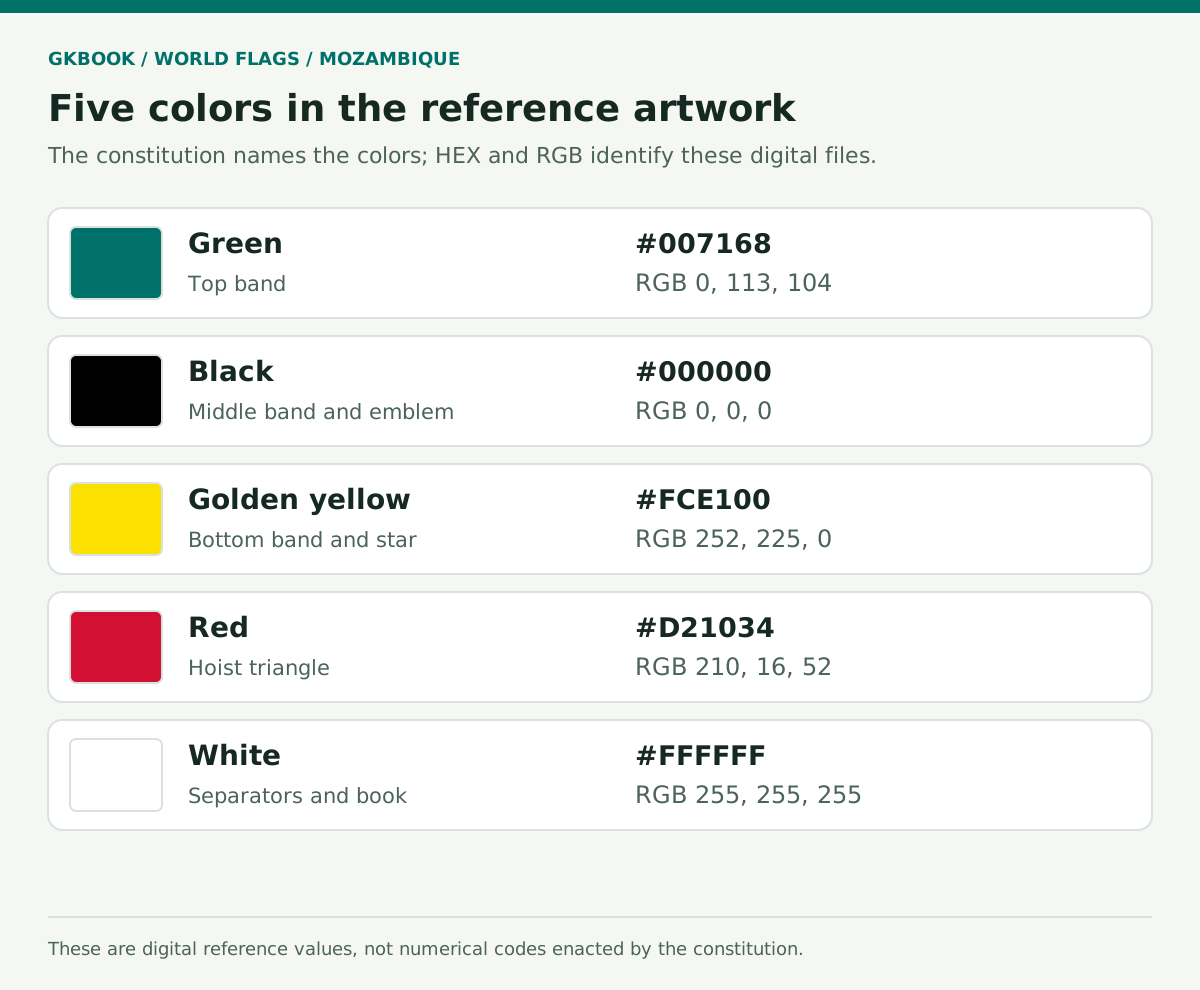
The sequence at the free edge is green, white, black, white, and golden yellow. These are five horizontal areas but only three broad bands. White is an essential part of the design, not a margin added by a printer.
The constitutional description specifies color names rather than numerical HEX, RGB, CMYK, or Pantone values. The table identifies the colors used in these downloadable illustrations. It does not present them as enacted national color codes.
| Color | HEX | RGB | Main position |
|---|---|---|---|
| Green | #007168 | 0, 113, 104 | Top band |
| Black | #000000 | 0, 0, 0 | Middle band and emblem |
| Golden yellow | #FCE100 | 252, 225, 0 | Bottom band and star |
| Red | #D21034 | 210, 16, 52 | Hoist triangle |
| White | #FFFFFF | 255, 255, 255 | Separators and open book |
What does Mozambique’s flag mean?
Mozambique’s flag joins a history of resistance with ideas of land, Africa, peace, study, production, and defense. Its meanings are stated in the constitution and repeated by national institutions. The star specifically represents international solidarity; the book, hoe, and rifle represent study, production, and defense, respectively.

The symbols work together. The field connects the country’s resources and African setting with its liberation history. The objects in the triangle connect learning and productive work with protection of the country.
Because Mozambique provides an official explanation, that explanation should lead an account of the flag. Broader political interpretations can be discussed as history, but they should not replace the constitution’s stated meanings.
What does the red triangle represent?
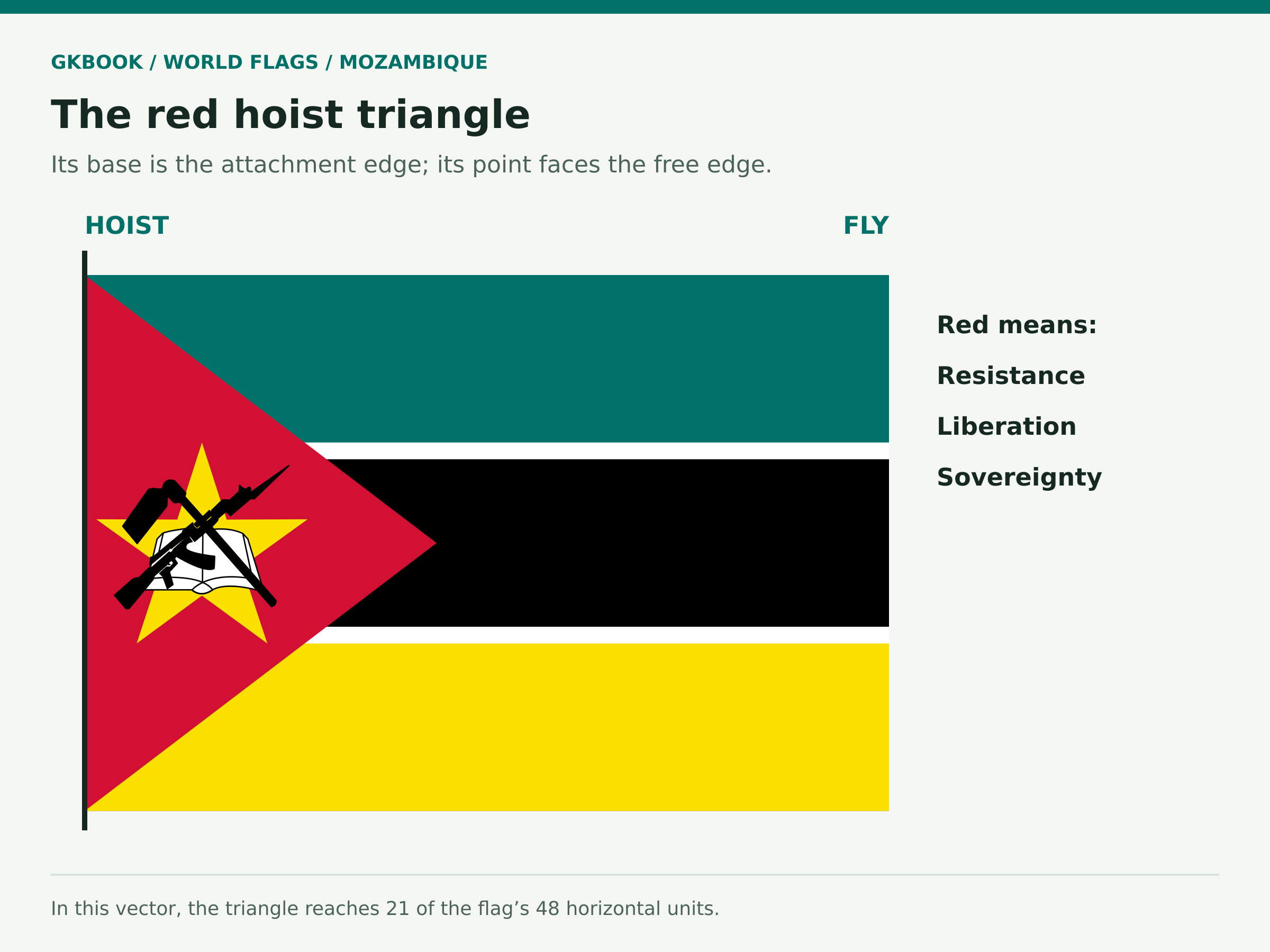
Red represents centuries of resistance to colonialism, the armed struggle for national liberation, and defense of sovereignty. Its official meaning therefore includes both the independence struggle and protection of the state. The color occupies an isosceles triangle whose vertical base follows the flag’s hoist edge.

A short caption that calls red simply “blood” leaves out much of the constitutional explanation. The fuller wording places resistance, liberation, and sovereignty in a continuous national story.
The triangle also organizes the composition: it holds the star and the book, hoe, and rifle. Its base reaches the upper and lower hoist corners, while its point faces the free edge of the flag.
What do the green, black, and gold bands mean?
Green represents the riches of the soil, black represents the African continent, and golden yellow represents the riches beneath the soil. Their order is fixed: green above black, with gold below. Agriculture and mineral wealth are useful explanations of the resource symbols, while the constitutional wording is broader.
The distinction between soil and subsoil matters. Green concerns the land and its productive wealth; golden yellow concerns resources below the surface. SADC’s explanatory manual connects these ideas with fertile soil and mineral wealth.
Black’s official meaning is the African continent. Describing it only as a particular population group narrows the published definition. Preserve the official meaning when writing an educational caption or preparing a classroom display.
Why are there two white stripes?
The two narrow white strips separate the black band from the green and golden-yellow bands. White represents peace and the justice of the Mozambican people’s struggle. Both strips share that meaning; the official description does not assign a separate message to the upper strip and the lower strip.
White also appears in the open book, where the book itself carries the meaning of study. A color’s role and an object’s role can coexist without creating a new official symbol.
In the downloadable construction, each separator is one unit high and each broad band is ten units high. That 10:1:10:1:10 sequence describes this reference drawing; the constitutional text does not prescribe those numerical widths.
What does the yellow star symbolize?
The star symbolizes the Mozambican people’s spirit of international solidarity. It has five points and sits behind the book and crossed implements in the red triangle. Although the star has been discussed in relation to Mozambique’s revolutionary politics, international solidarity is the meaning stated in the constitutional flag provision.
The constitutional text names a star without specifying its point count in words. The five-pointed form is established by the displayed flag and is expressly described in the SADC identity manual.
The star is a filled yellow figure, with one point upward. Its lower and side portions remain visible around the overlapping objects. It is not an outlined pentagram, and it should not be substituted with another kind of star.
What does the open book mean?
The open book represents study. Its white pages, outlined in black, appear over the star and behind the crossed rifle and hoe. Education is a natural explanation of this symbol, but the flag provision itself uses the idea of study alongside production and defense as the three linked meanings.

The open shape matters: the two page groups and central fold distinguish a book from a plain white patch. The downloadable vector retains those details so that the emblem remains recognizable when enlarged.
Mozambique’s full state emblem also includes a book, but its constitutional description uses the term education. The flag and the state emblem share imagery while remaining separately defined national symbols.
What does the hoe represent?
The hoe represents production, with agriculture providing its most immediate visual association. It crosses the rifle above the open book. In a normal front view, the hoe’s broad head is toward the upper left, and its handle runs down toward the right, helping distinguish it from the rifle.
The constitution’s concise word is production. SADC’s manual explains the implement through agriculture, while the full state emblem’s description also connects it with agricultural production and the peasantry.
Keep the hoe’s blade and long handle visible in reproductions. Replacing it with a pickaxe or a second rifle changes the design. The crossing objects are different implements with different official meanings.
Why is there a rifle on Mozambique’s flag?
The rifle represents defense. It is commonly identified as an AK-47 with a bayonet, and SADC’s manual explicitly names the AK-47. The constitution uses the broader word for a weapon. Its place beside the book and hoe links national defense with study and production in the flag’s official symbolism.
The depiction also connects the flag with the armed liberation struggle. That historical context explains why the rifle became a recognizable national symbol, but it does not change the official word assigned to it in the flag provision.
The depiction is a stylized symbol with a recognizable silhouette. Preserving that outline helps readers distinguish the rifle from the crossed agricultural implement.
What is the ratio of Mozambique’s flag?
Mozambique’s national flag is normally reproduced in a 2:3 height-to-length ratio, equivalent to 3:2 length-to-height. SADC’s institutional manual illustrates a flag measuring 1,200 by 1,800 millimeters. Those dimensions demonstrate the proportion; they do not mean that every physical flag must be made at that size.

A flag that is 60 centimeters high should therefore be 90 centimeters long. A digital image 1,200 pixels wide should be 800 pixels high. Scaling both dimensions by the same factor preserves the flag and its emblem.
The constitutional description establishes the design and meanings without stating a numerical aspect ratio. The 2:3 proportion is supported by institutional illustrations and established flag references.
How is Mozambique’s flag constructed?
This reference drawing uses a 48-unit length and a 32-unit height. Its bands follow a 10:1:10:1:10 sequence, and the red triangle reaches 21 units from the hoist. These measurements document the supplied artwork; they are a reproducible drawing convention rather than numerical requirements quoted from the constitution.

At 900 by 600 drawing units, one unit equals 18.75. The broad bands are each 187.5 units high, the white separators are each 18.75, and the triangle’s point is at 393.75, 300.
The star, book, rifle, and hoe form one detailed vector group. Keeping that group intact preserves the shapes and relationships among the overlapping objects.
For an official manufacturing commission, use the commissioning institution’s approved master and color sample. The constitution and SADC illustration do not establish every contour and coordinate in this downloadable reconstruction.
| Part | Vertical range or position | Measurement |
|---|---|---|
| Green band | y = 0 to 187.5 | 10 units |
| Upper white strip | y = 187.5 to 206.25 | 1 unit |
| Black band | y = 206.25 to 393.75 | 10 units |
| Lower white strip | y = 393.75 to 412.5 | 1 unit |
| Golden-yellow band | y = 412.5 to 600 | 10 units |
| Triangle point | x = 393.75; y = 300 | 21 units from the hoist |
How are the star, book, rifle, and hoe arranged?
The yellow star is the back layer of the emblem. The open white book lies over it, and the black rifle and hoe cross in front of the book. The entire group belongs inside the red triangle. Keep these layers together when resizing, rather than moving or enlarging individual objects independently.

In the front view, the rifle rises from lower left to upper right, while the hoe runs from upper left to lower right. The book’s pages remain visible below and around their crossing.
The downloadable artwork keeps all contours in vector form. Enlarging the emblem detail reveals the same paths used in the national flag picture, so the explanatory diagram and the flag remain consistent.
What sizes preserve the correct flag proportions?
Any dimensions in a 2:3 height-to-length ratio preserve the flag’s overall proportions. Examples include 20 by 30 centimeters, 60 by 90 centimeters, and 100 by 150 centimeters. These are scaling examples, not a statutory size schedule. Increase the emblem and all stripe widths by the same factor.
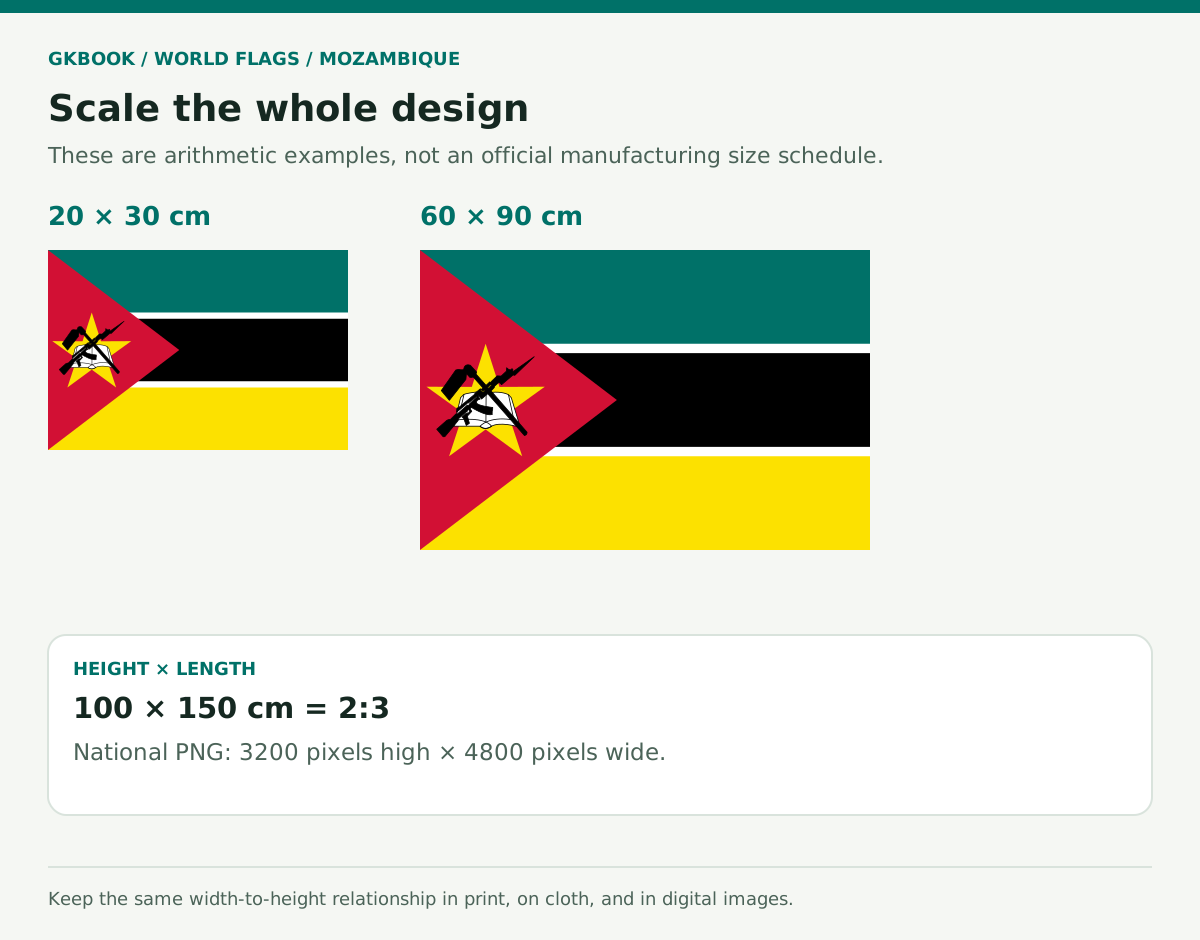
The SVG is the best starting point for enlargement because its paths remain sharp at different sizes. The national-flag PNG is supplied at 4,800 by 3,200 pixels for convenient raster use.
Always state which dimension comes first. “2:3” describes height:length here, while image software commonly lists width before height. Do not crop the triangle or stretch the rectangle to fit a different frame.
| Height | Length | Use of example |
|---|---|---|
| 20 cm | 30 cm | Small display |
| 60 cm | 90 cm | Medium display |
| 100 cm | 150 cm | Large display |
| 3,200 px | 4,800 px | Supplied national-flag PNG |
When was the current Mozambique flag adopted?
The present design was adopted on May 1, 1983. It followed an independence-era flag with diagonal fields and a brief 1983 design that still included a cogwheel. The current flag removed that wheel while retaining the star, book, hoe, and rifle in the red hoist triangle.

Jorge Bacelar Gouveia’s constitutional-law history distinguishes four stages: a 1974–1975 flag, the 1975–1983 flag, a short-lived April 1983 version, and the current design from May 1, 1983.
The adoption date belongs to the present arrangement. The rifle, hoe, and book had already appeared in the flag defined at independence, so their presence did not begin in 1983.
Was this flag adopted when Mozambique became independent?
Mozambique became independent on June 25, 1975, but the current flag dates from May 1, 1983. The country therefore used an earlier national flag at independence. Keeping the two dates separate avoids confusing the birth of the independent state with the later adoption of its present flag design.

The 1975 constitution described diagonal colored fields radiating from the upper hoist. Its emblem included a cogwheel around the book and crossed implements.
June 25 remains Independence Day. May 1 is also listed as International Workers’ Day in the government’s holiday information, but that calendar fact should not be turned into an unsupported claim that Mozambique has a separate official Flag Day.
What did Mozambique’s earlier flags look like?
The liberation-era flag tradition used horizontal green, black, and yellow bands with white separators and a red hoist triangle. The 1975 independence flag changed to diagonal colored fields and included a cogwheel emblem. The present horizontal arrangement returned in 1983, with the final simplification removing the wheel.

Article 68 of the 1975 constitution described green, red, black, and yellow areas separated by white and arranged diagonally from the upper left. It also explained the cogwheel as a symbol of workers and industrial production.
The historical comparison here uses labeled descriptions rather than speculative replicas. A historical flag should be tied to a dated source; a modern flag with an improvised emblem is not a reliable reconstruction.
What changed between the two 1983 versions?
The short-lived April 1983 version included a cogwheel within its emblem. The design adopted on May 1 removed that wheel, leaving the yellow star, open book, and crossed rifle and hoe. This distinguishes the present flag from its immediate predecessor even though their main color arrangement was closely related.
The month-long intermediate stage is recorded in the constitutional history. It is useful when identifying museum captions, archived images, or illustrations labeled simply “1983.”
A cogwheel should not be added to the current national flag. Mozambique’s separate state emblem still has a toothed wheel, which is one reason the two national symbols can be confused.
How is the national flag connected with FRELIMO?
The national flag’s horizontal bands and red triangle belong to the flag tradition of FRELIMO, the Mozambique Liberation Front. The state flag adds its distinctive star, book, hoe, and rifle composition. That historical relationship explains the visual resemblance, but a party banner and the national flag serve different purposes.
FRELIMO led the liberation movement, and its symbols influenced the independent state’s visual identity. The 1975 constitution itself records approval by FRELIMO’s Central Committee.
A plain triangle version should not be substituted for the current national flag. A party’s later branding may also differ from its earlier banner, so the date and institutional context matter when comparing images.
Who designed Mozambique’s national flag?
The current flag is best described through its FRELIMO origins and subsequent state adoption. The sources checked for this page do not establish a single named designer for the final May 1983 version. A person associated with an earlier flag or a later redesign proposal should not automatically receive that credit.
Designing the first independence symbols, revising an existing flag, and proposing a replacement are distinct activities. A reliable attribution needs evidence identifying both the person and the specific version.
The illustrations on this page use a documented public-domain vector lineage. Credit for that digital rendering is separate from authorship of Mozambique’s national design.
Has Mozambique considered changing the flag?
Yes. A public competition to redesign national symbols took place in 2005, and the rifle became a prominent subject of debate. The process did not replace the national flag. The current constitutional description and official national-symbol pages continue to include the star, book, rifle, and hoe.
Supporters of change questioned the symbolism of the weapon, while defenders connected it with liberation history. A proposal, a competition entry, and an adopted national flag are different stages.
The 2005 episode belongs in the flag’s history, but an unadopted design should never be captioned as the current flag. The source record documents the competition without assigning an unsupported official status to a proposal.
Which constitutional article defines the flag?
Article 305 in the revised constitutional text published by Mozambique’s Parliament defines the national flag and its symbolism. Older versions and translations number the provision Article 297. The numbering difference reflects constitutional revision, so a citation should identify the version being used instead of treating the older number as universal.
The revised provision preserves the five color names, their meanings, the horizontal arrangement, and the star, book, rifle, and hoe. Article 306 separately describes the full state emblem.
The 2023 constitutional amendment listed by the official gazette concerns Article 311(3), not the flag provision. The page uses the revised numbering and checks the design against the Presidency and Foreign Ministry descriptions.
Is the symbol on the flag Mozambique’s coat of arms?
The flag carries a smaller composition of a star, book, rifle, and hoe. Mozambique’s full state emblem has additional elements, including the national map, ocean, rising sun, toothed wheel, agricultural plants, and a ribbon. The two designs share symbols, but the full state emblem should not replace the flag’s simpler composition.
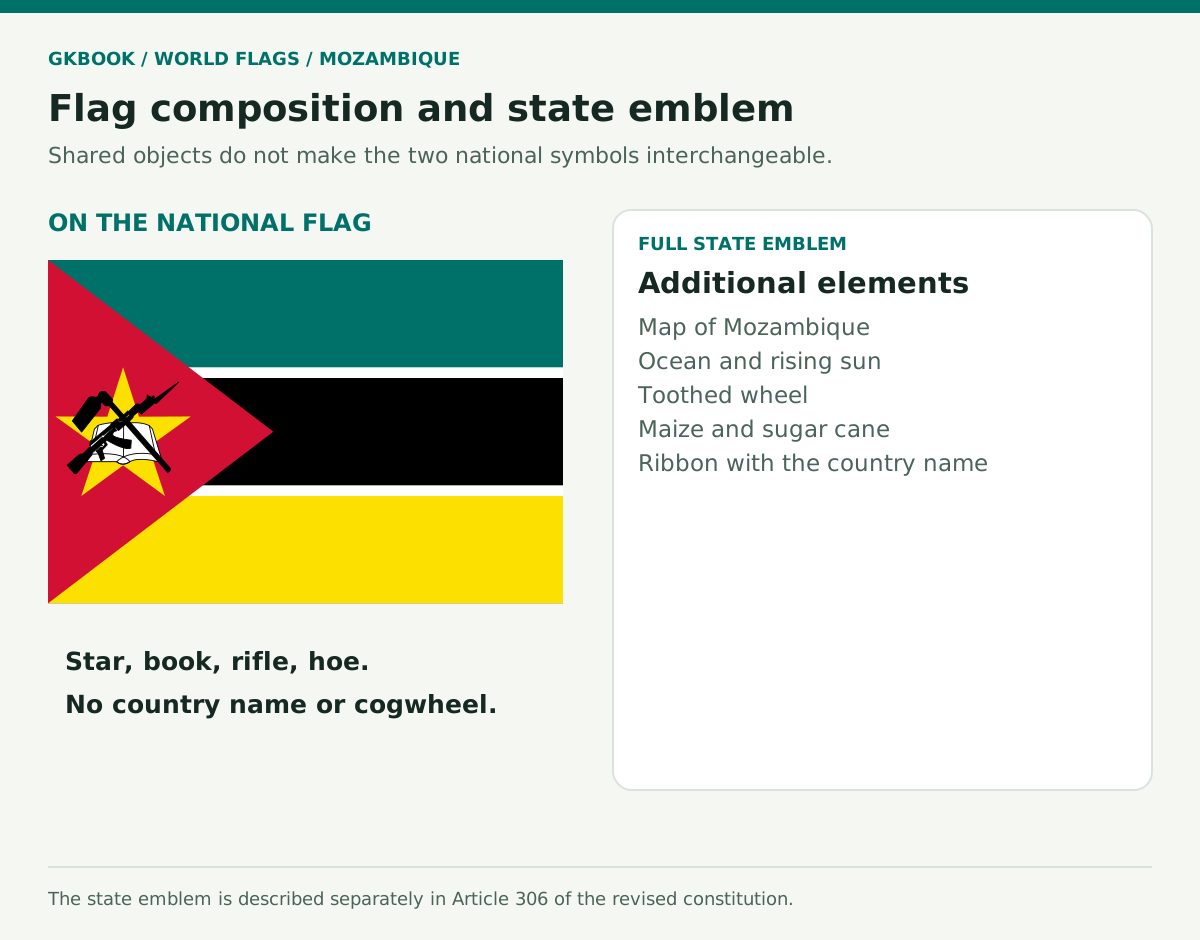
The constitution defines the flag and state emblem in separate articles. In the full emblem, the wheel represents workers and industry, while the surrounding crops express agricultural wealth.
The current flag has no map, sun, wheel, crop wreath, or written country name. These omissions are part of its actual design, not details lost in a small image.
How should a Mozambique flag be reproduced or manufactured?
Use a complete vector master, preserve the 2:3 shape, and keep both white separators and every part of the emblem. For printing or fabric production, agree on a physical color reference before manufacturing. Screen colors alone do not define how inks, dyes, threads, or different materials will appear.

SADC’s 2017 manual labels red as 185C, green as 355C, and yellow as 116C, with black also shown. Those are that institution’s reproduction references; the constitution does not enact those numerical codes. The web palette in this package follows the source vector and is visibly different from some print references.
Check a production proof at the intended size. The book’s outlines, rifle silhouette, and hoe blade must remain distinguishable. Thin white strips should not disappear into seams or stitching.
These are practical reproduction recommendations. No nationwide requirement for a particular fabric, hem, stitch count, or attachment method is claimed here.
| Reference | Red | Green | Golden yellow |
|---|---|---|---|
| Constitution | Named color | Named color | Named color |
| SADC 2017 manual, p. 67 | 185C | 355C | 116C |
| This digital artwork | #D21034 | #007168 | #FCE100 |
Where may Mozambique’s national flag be displayed?
Mozambique’s 2006 state-protocol rules provide for flag display at public institutions and also allow official and private uses. They expressly recognize a national citizen’s right to display the flag at a private residence. For formal ceremonies, the responsible protocol office should determine the arrangement and any additional event requirements.
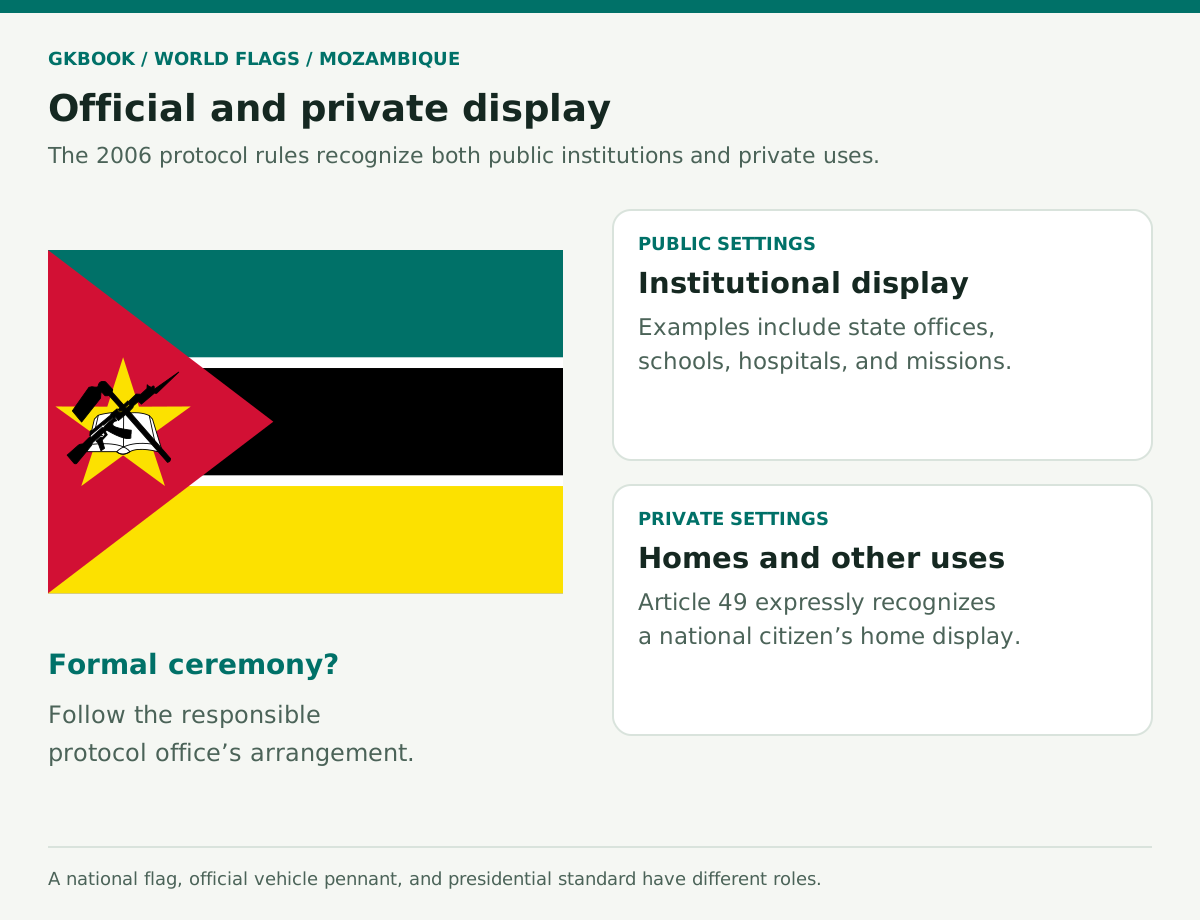
Article 49 lists many settings, including state institutions, diplomatic missions, schools, hospitals, ports, and border crossings. It also permits display in places such as sports grounds, offices, streets, and squares, and use in formations or parades.
The national flag, official vehicle pennants, and the presidential standard are not interchangeable. Articles 50 and 51 address the latter uses separately.
Keep the flag clean, readable, and free of obstruction as a practical display measure. This page does not invent a universal hoisting time or a statutory replacement procedure.
Which way should the flag face?
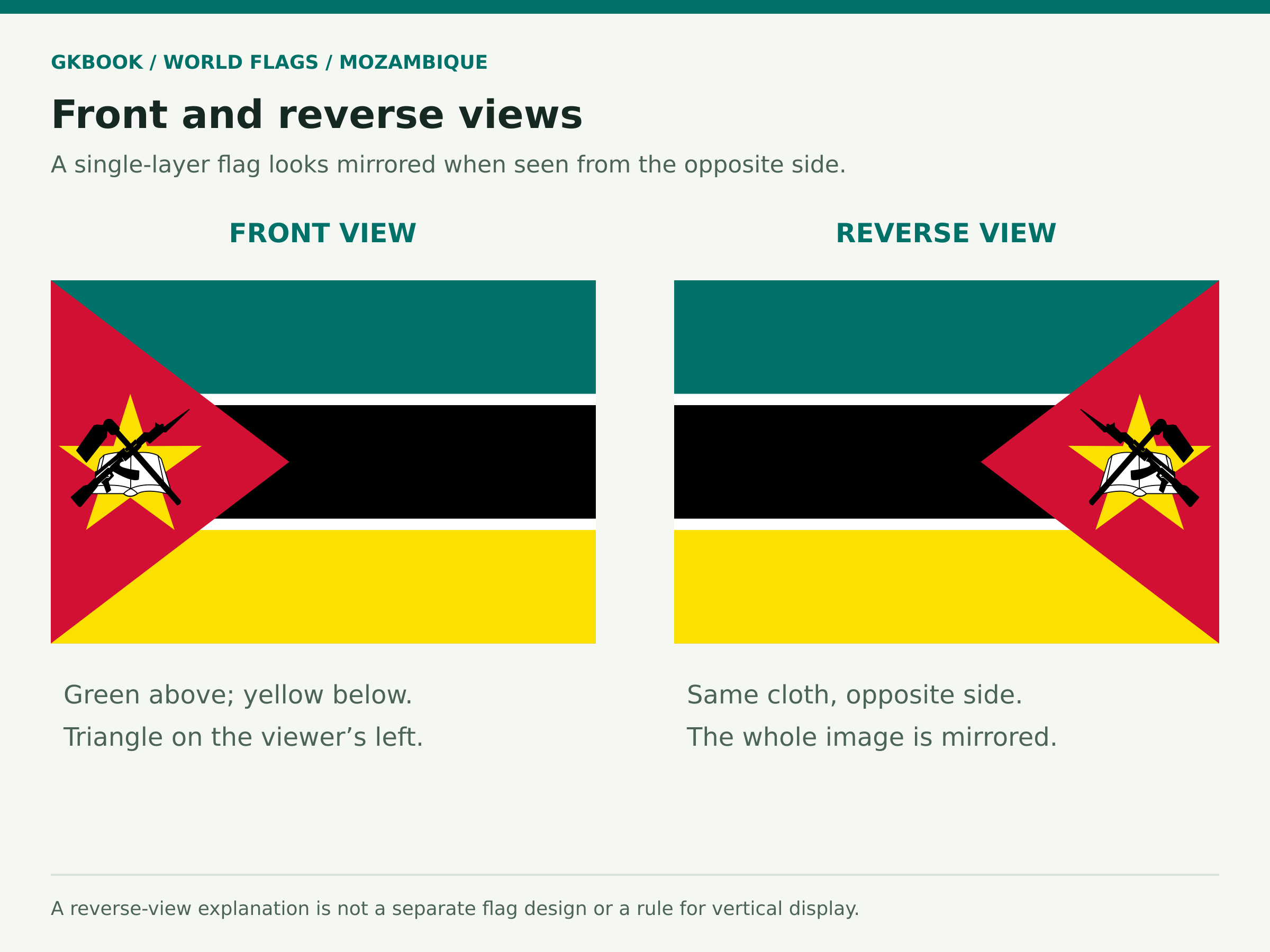
In the standard front view, green is at the top, golden yellow is at the bottom, and the red triangle is on the viewer’s left. The triangle’s base is the hoist. Looking through a single-layer flag from the opposite side naturally reverses the picture; that does not create a different national design.

The front-view rifle rises toward the upper right and the hoe’s head is toward the upper left. Those landmarks help identify accidental mirroring in a digital illustration.
A reverse-view diagram explains the behavior of fabric; it is not a separate specification for double-sided manufacture. For vertical ceremonial display, obtain the organizer’s approved arrangement rather than assuming that any rotation is acceptable.
Is Mozambique’s flag flown at half-staff during mourning?
Yes. National mourning orders can require Mozambique’s flag to be flown at half-staff. For example, the government’s April 2025 announcement for Pope Francis specified this treatment nationwide and at diplomatic and consular missions. The dates and places come from the particular order, so they should be checked for each occasion.

That announcement covered April 24–26, 2025 and included the presidential standard. It is a documented example, not a standing instruction to lower flags on those dates every year.
The mourning diagram shows the idea of a lowered flag. It does not prescribe a measured distance from the pole’s top or invent a national rule for ribbons, fixed wall displays, or raising and lowering sequences.
Which national occasions are associated with flag displays?
Independence Day on June 25 is a central national occasion associated with Mozambique’s flag. The government’s holiday calendar also lists Heroes’ Day, Victory Day, Armed Forces Day, and Peace and Reconciliation Day. The flag’s May 1 adoption anniversary should be distinguished from both Independence Day and the official Workers’ Day holiday.
The calendar dates are February 3 for Heroes’ Day, September 7 for Victory Day, September 25 for Armed Forces Day, and October 4 for Peace and Reconciliation Day.
These dates provide historical context. A holiday listing by itself does not establish a special flag position, a compulsory display schedule, or an official Flag Day. Follow the ceremony’s actual instructions.
What mistakes should be avoided when drawing the flag?
Common errors include omitting the white separators, reversing the green and yellow bands, removing the book or hoe, or placing the full state emblem inside the triangle. Also avoid stretching the flag, mirroring its front view accidentally, or presenting a 1975 or April 1983 design as the current national flag.

The five colors, layered emblem, hoist triangle, and correct band order should all be checked together. A recognizable color pattern alone is not enough when the central objects have been altered.
Use the supplied SVG for a crisp reference and compare the finished image with the national-flag picture. Historical and reverse-view illustrations are labeled so that they cannot easily be mistaken for the normal current front view.
What is the Mozambique flag emoji?
Mozambique’s flag emoji is 🇲🇿. Unicode identifies it with the regional-indicator sequence U+1F1F2 U+1F1FF, corresponding to MZ. Its visible artwork depends on the platform and can simplify the small emblem. Use a proper SVG or PNG when accurate proportions, colors, and symbol details matter in a document or display.

The sequence is text, not one fixed image file. A device may show a flag drawing or the regional-indicator letters, depending on its font and software support.
The downloadable national flag keeps the full star, book, rifle, and hoe. An emoji is convenient in a message, but enlarging a tiny platform glyph is not a substitute for a detailed flag illustration.
Download Mozambique flag pictures
Download the national flag as SVG or 4800 × 3200 PNG. The gallery contains 19 subjects, each with SVG and PNG versions. Use the full image and preserve its proportions. Image credits and reconstruction notes accompany the artwork.
Explore more in World Flags, including the Morocco flag and Montenegro flag.
World Flags/Mozambique
Mozambique flag pictures
Current national design in 2:3 proportions. The detailed source vector is retained, with equalized white separators; colors and internal measurements are reference conventions.
GKBook diagram; flag vector adapted from public-domain Wikimedia artwork via hampusborgos/country-flags.Download SVGDownload PNGFive swatches list the HEX and RGB values used in the package. The constitutional color names are separate from numerical digital conventions.
GKBook diagram; flag vector adapted from public-domain Wikimedia artwork via hampusborgos/country-flags.Download SVGDownload PNGThe five colors accompany international solidarity, study, production, and defense. These are official meanings, not speculative per-point interpretations.
GKBook diagram; flag vector adapted from public-domain Wikimedia artwork via hampusborgos/country-flags.Download SVGDownload PNGThe red triangle runs along the hoist and points toward the fly. Its official meaning covers resistance, national liberation, and defense of sovereignty.
GKBook diagram; flag vector adapted from public-domain Wikimedia artwork via hampusborgos/country-flags.Download SVGDownload PNGThe enlarged composition preserves the book’s outlines and the distinct silhouettes of the hoe and rifle over the yellow star.
GKBook diagram; flag vector adapted from public-domain Wikimedia artwork via hampusborgos/country-flags.Download SVGDownload PNGA 48 × 32 construction grid gives the 2:3 ratio. The triangle depth is 21 units in this downloadable reference drawing.
GKBook diagram; flag vector adapted from public-domain Wikimedia artwork via hampusborgos/country-flags.Download SVGDownload PNGThe three broad bands have equal heights and each white separator is one-tenth of a broad band in the supplied drawing. This numerical recipe is a reference convention.
GKBook diagram; flag vector adapted from public-domain Wikimedia artwork via hampusborgos/country-flags.Download SVGDownload PNGThe composition is built from a yellow star, an open white book, and crossed black implements. Each layer remains distinct in the vector artwork.
GKBook diagram; flag vector adapted from public-domain Wikimedia artwork via hampusborgos/country-flags.Download SVGDownload PNG20 × 30, 60 × 90, and 100 × 150 centimeters all retain 2:3 height:length. The supplied national PNG measures 4800 × 3200 pixels in width:height order.
GKBook diagram; flag vector adapted from public-domain Wikimedia artwork via hampusborgos/country-flags.Download SVGDownload PNGThe chronology separates the earlier flag tradition, independence in 1975, the two 1983 stages, and the unsuccessful 2005 redesign process.
GKBook diagram; flag vector adapted from public-domain Wikimedia artwork via hampusborgos/country-flags.Download SVGDownload PNGJune 25, 1975 is the independence date. May 1, 1983 is the current flag’s adoption date. The events should not be merged.
GKBook diagram; flag vector adapted from public-domain Wikimedia artwork via hampusborgos/country-flags.Download SVGDownload PNGText panels distinguish the diagonal independence flag, the intermediate 1983 version, and the current design without presenting conjectural flag replicas.
GKBook diagram; flag vector adapted from public-domain Wikimedia artwork via hampusborgos/country-flags.Download SVGDownload PNGThe full state emblem adds a map, ocean, sun, cogwheel, crops, and ribbon. These elements do not belong on the current national flag.
GKBook diagram; flag vector adapted from public-domain Wikimedia artwork via hampusborgos/country-flags.Download SVGDownload PNGUse a complete vector and an agreed physical color sample. SADC’s 2017 print references are identified as institutional guidance rather than constitutional color codes.
GKBook diagram; flag vector adapted from public-domain Wikimedia artwork via hampusborgos/country-flags.Download SVGDownload PNGArticle 49 of the 2006 state-protocol rules addresses institutional, official, and private display. Formal arrangements remain the responsibility of the relevant protocol office.
GKBook diagram; flag vector adapted from public-domain Wikimedia artwork via hampusborgos/country-flags.Download SVGDownload PNGThe ordinary front view places the red triangle on the left. The reverse of single-layer cloth mirrors the whole image, including the rifle and hoe.
GKBook diagram; flag vector adapted from public-domain Wikimedia artwork via hampusborgos/country-flags.Download SVGDownload PNGThe government’s April 2025 announcement required half-staff display for three days. The illustration explains a lowered flag without prescribing a measured position.
GKBook diagram; flag vector adapted from public-domain Wikimedia artwork via hampusborgos/country-flags.Download SVGDownload PNGSix checks cover band order, white separators, the full emblem, the distinction from state arms, proportions, orientation, and historical labels.
GKBook diagram; flag vector adapted from public-domain Wikimedia artwork via hampusborgos/country-flags.Download SVGDownload PNGThe emoji sequence uses regional indicators M and Z. A detailed SVG or PNG is more suitable when exact flag artwork is needed.
GKBook diagram; flag vector adapted from public-domain Wikimedia artwork via hampusborgos/country-flags.Download SVGDownload PNGFrequently asked questions
What does Mozambique’s national flag look like?
Mozambique’s flag has green, black, and golden-yellow horizontal bands separated by narrow white strips. A red triangle at the hoist carries a yellow five-pointed star, an open book, and a crossed rifle and hoe. The usual proportions are 2:3, and the present design dates from May 1, 1983.
What are the colors of Mozambique’s flag?
The constitution names five colors: red, green, black, golden yellow, and white. Green, black, and gold form the main horizontal bands; white separates them, and red fills the hoist triangle. The star is yellow, while the book and crossed implements introduce white and black details within the triangle.
What does Mozambique’s flag mean?
Mozambique’s flag joins a history of resistance with ideas of land, Africa, peace, study, production, and defense. Its meanings are stated in the constitution and repeated by national institutions. The star specifically represents international solidarity; the book, hoe, and rifle represent study, production, and defense, respectively.
What does the red triangle represent?
Red represents centuries of resistance to colonialism, the armed struggle for national liberation, and defense of sovereignty. Its official meaning therefore includes both the independence struggle and protection of the state. The color occupies an isosceles triangle whose vertical base follows the flag’s hoist edge.
What do the green, black, and gold bands mean?
Green represents the riches of the soil, black represents the African continent, and golden yellow represents the riches beneath the soil. Their order is fixed: green above black, with gold below. Agriculture and mineral wealth are useful explanations of the resource symbols, while the constitutional wording is broader.
Why are there two white stripes?
The two narrow white strips separate the black band from the green and golden-yellow bands. White represents peace and the justice of the Mozambican people’s struggle. Both strips share that meaning; the official description does not assign a separate message to the upper strip and the lower strip.
What does the yellow star symbolize?
The star symbolizes the Mozambican people’s spirit of international solidarity. It has five points and sits behind the book and crossed implements in the red triangle. Although the star has been discussed in relation to Mozambique’s revolutionary politics, international solidarity is the meaning stated in the constitutional flag provision.
What does the open book mean?
The open book represents study. Its white pages, outlined in black, appear over the star and behind the crossed rifle and hoe. Education is a natural explanation of this symbol, but the flag provision itself uses the idea of study alongside production and defense as the three linked meanings.
What does the hoe represent?
The hoe represents production, with agriculture providing its most immediate visual association. It crosses the rifle above the open book. In a normal front view, the hoe’s broad head is toward the upper left, and its handle runs down toward the right, helping distinguish it from the rifle.
Why is there a rifle on Mozambique’s flag?
The rifle represents defense. It is commonly identified as an AK-47 with a bayonet, and SADC’s manual explicitly names the AK-47. The constitution uses the broader word for a weapon. Its place beside the book and hoe links national defense with study and production in the flag’s official symbolism.
What is the ratio of Mozambique’s flag?
Mozambique’s national flag is normally reproduced in a 2:3 height-to-length ratio, equivalent to 3:2 length-to-height. SADC’s institutional manual illustrates a flag measuring 1,200 by 1,800 millimeters. Those dimensions demonstrate the proportion; they do not mean that every physical flag must be made at that size.
How is Mozambique’s flag constructed?
This reference drawing uses a 48-unit length and a 32-unit height. Its bands follow a 10:1:10:1:10 sequence, and the red triangle reaches 21 units from the hoist. These measurements document the supplied artwork; they are a reproducible drawing convention rather than numerical requirements quoted from the constitution.
How are the star, book, rifle, and hoe arranged?
The yellow star is the back layer of the emblem. The open white book lies over it, and the black rifle and hoe cross in front of the book. The entire group belongs inside the red triangle. Keep these layers together when resizing, rather than moving or enlarging individual objects independently.
What sizes preserve the correct flag proportions?
Any dimensions in a 2:3 height-to-length ratio preserve the flag’s overall proportions. Examples include 20 by 30 centimeters, 60 by 90 centimeters, and 100 by 150 centimeters. These are scaling examples, not a statutory size schedule. Increase the emblem and all stripe widths by the same factor.
When was the current Mozambique flag adopted?
The present design was adopted on May 1, 1983. It followed an independence-era flag with diagonal fields and a brief 1983 design that still included a cogwheel. The current flag removed that wheel while retaining the star, book, hoe, and rifle in the red hoist triangle.
Was this flag adopted when Mozambique became independent?
Mozambique became independent on June 25, 1975, but the current flag dates from May 1, 1983. The country therefore used an earlier national flag at independence. Keeping the two dates separate avoids confusing the birth of the independent state with the later adoption of its present flag design.
What did Mozambique’s earlier flags look like?
The liberation-era flag tradition used horizontal green, black, and yellow bands with white separators and a red hoist triangle. The 1975 independence flag changed to diagonal colored fields and included a cogwheel emblem. The present horizontal arrangement returned in 1983, with the final simplification removing the wheel.
What changed between the two 1983 versions?
The short-lived April 1983 version included a cogwheel within its emblem. The design adopted on May 1 removed that wheel, leaving the yellow star, open book, and crossed rifle and hoe. This distinguishes the present flag from its immediate predecessor even though their main color arrangement was closely related.
How is the national flag connected with FRELIMO?
The national flag’s horizontal bands and red triangle belong to the flag tradition of FRELIMO, the Mozambique Liberation Front. The state flag adds its distinctive star, book, hoe, and rifle composition. That historical relationship explains the visual resemblance, but a party banner and the national flag serve different purposes.
Who designed Mozambique’s national flag?
The current flag is best described through its FRELIMO origins and subsequent state adoption. The sources checked for this page do not establish a single named designer for the final May 1983 version. A person associated with an earlier flag or a later redesign proposal should not automatically receive that credit.
Has Mozambique considered changing the flag?
Yes. A public competition to redesign national symbols took place in 2005, and the rifle became a prominent subject of debate. The process did not replace the national flag. The current constitutional description and official national-symbol pages continue to include the star, book, rifle, and hoe.
Which constitutional article defines the flag?
Article 305 in the revised constitutional text published by Mozambique’s Parliament defines the national flag and its symbolism. Older versions and translations number the provision Article 297. The numbering difference reflects constitutional revision, so a citation should identify the version being used instead of treating the older number as universal.
Is the symbol on the flag Mozambique’s coat of arms?
The flag carries a smaller composition of a star, book, rifle, and hoe. Mozambique’s full state emblem has additional elements, including the national map, ocean, rising sun, toothed wheel, agricultural plants, and a ribbon. The two designs share symbols, but the full state emblem should not replace the flag’s simpler composition.
How should a Mozambique flag be reproduced or manufactured?
Use a complete vector master, preserve the 2:3 shape, and keep both white separators and every part of the emblem. For printing or fabric production, agree on a physical color reference before manufacturing. Screen colors alone do not define how inks, dyes, threads, or different materials will appear.
Where may Mozambique’s national flag be displayed?
Mozambique’s 2006 state-protocol rules provide for flag display at public institutions and also allow official and private uses. They expressly recognize a national citizen’s right to display the flag at a private residence. For formal ceremonies, the responsible protocol office should determine the arrangement and any additional event requirements.
Which way should the flag face?
In the standard front view, green is at the top, golden yellow is at the bottom, and the red triangle is on the viewer’s left. The triangle’s base is the hoist. Looking through a single-layer flag from the opposite side naturally reverses the picture; that does not create a different national design.
Is Mozambique’s flag flown at half-staff during mourning?
Yes. National mourning orders can require Mozambique’s flag to be flown at half-staff. For example, the government’s April 2025 announcement for Pope Francis specified this treatment nationwide and at diplomatic and consular missions. The dates and places come from the particular order, so they should be checked for each occasion.
Which national occasions are associated with flag displays?
Independence Day on June 25 is a central national occasion associated with Mozambique’s flag. The government’s holiday calendar also lists Heroes’ Day, Victory Day, Armed Forces Day, and Peace and Reconciliation Day. The flag’s May 1 adoption anniversary should be distinguished from both Independence Day and the official Workers’ Day holiday.
What mistakes should be avoided when drawing the flag?
Common errors include omitting the white separators, reversing the green and yellow bands, removing the book or hoe, or placing the full state emblem inside the triangle. Also avoid stretching the flag, mirroring its front view accidentally, or presenting a 1975 or April 1983 design as the current national flag.
What is the Mozambique flag emoji?
Mozambique’s flag emoji is 🇲🇿. Unicode identifies it with the regional-indicator sequence U+1F1F2 U+1F1FF, corresponding to MZ. Its visible artwork depends on the platform and can simplify the small emblem. Use a proper SVG or PNG when accurate proportions, colors, and symbol details matter in a document or display.
Explore all general-knowledge topics and the A-to-Z lists.







We Value Your Opinion Comments