
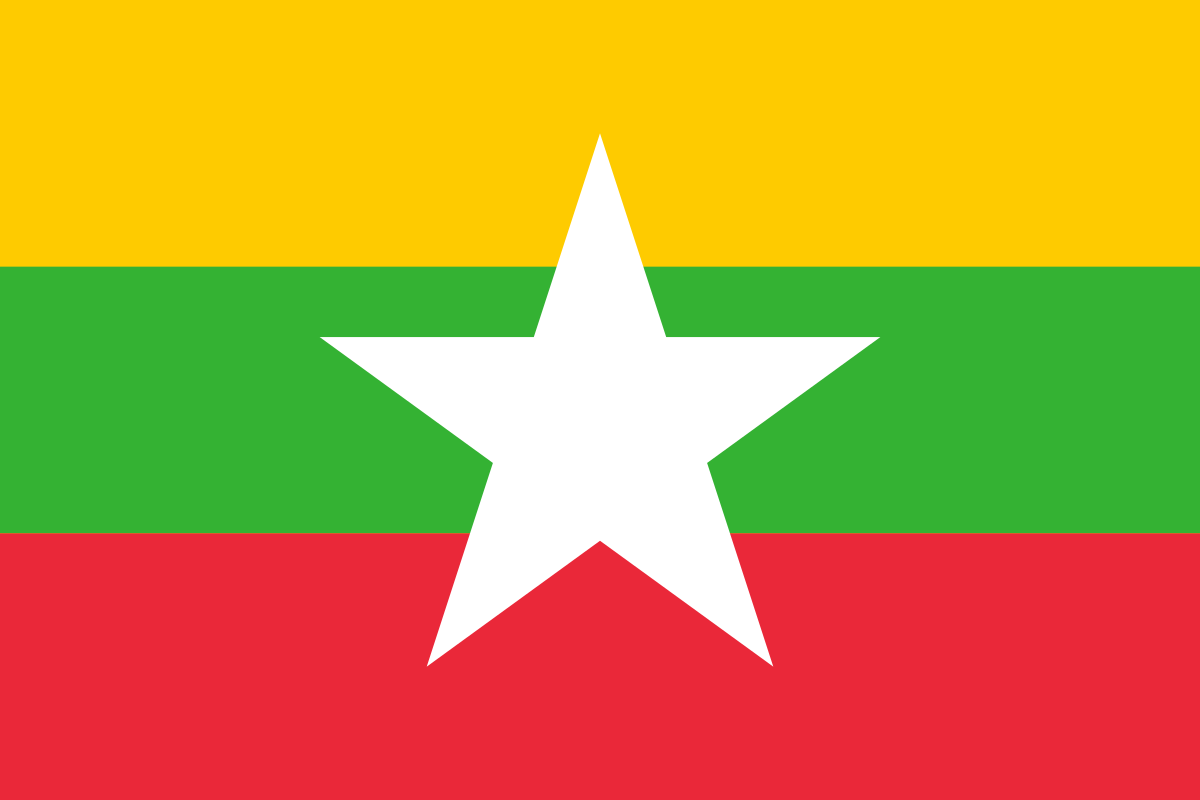
Myanmar flag picture
Explore the construction drawing, history, and picture gallery.
| Design | Yellow, green, and red bandsOne large white five-pointed star. |
|---|---|
| Proportions | 2:3 height:lengthEquivalent to 3:2 length:height. |
| Current flag | October 21, 2010Law No. 8/2010 and introduction. |
| Independence | January 4, 1948A different national flag was used. |
| Constitutional provision | Section 437 (2008)Detailed specifications followed in 2010. |
| Star placement | Equal top and bottom clearancesStar silhouette: two-thirds of flag height. |
What does Myanmar’s national flag look like?
Myanmar’s national flag has three equal horizontal bands of yellow, green, and red, with a large white five-pointed star extending across all three. Adopted on October 21, 2010, it has a height-to-length ratio of 2:3. The star points upward and is centered horizontally, with equal clearances above and below its silhouette.
The pictures below explain the flag’s proportions, its white star, and its development. The meanings stated in the flag law lead the discussion, with digital drawing choices and practical reproduction advice clearly identified.
What are the colors of Myanmar’s flag?
The Myanmar flag has four colors: yellow in the upper band, green in the middle band, red in the lower band, and white in the star. The three bands have equal heights. The 2010 Union Flag Law specifies Pantone references for the colored bands, while the star is white.

The order is always read from top to bottom in the normal horizontal display: yellow, green, red. White belongs to the superimposed star, rather than to a fourth stripe. There are no borders between the bands and no outline around the star.
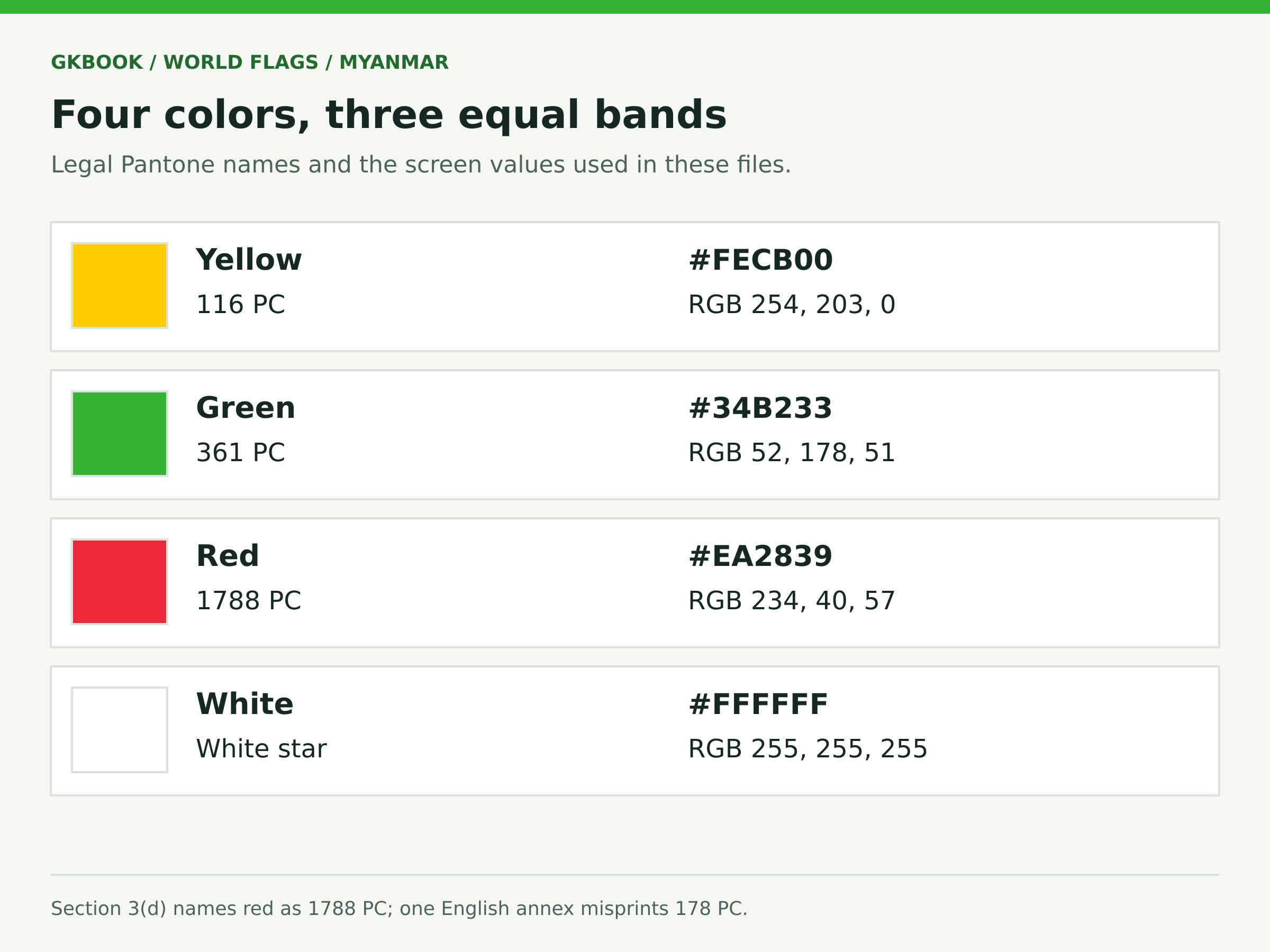
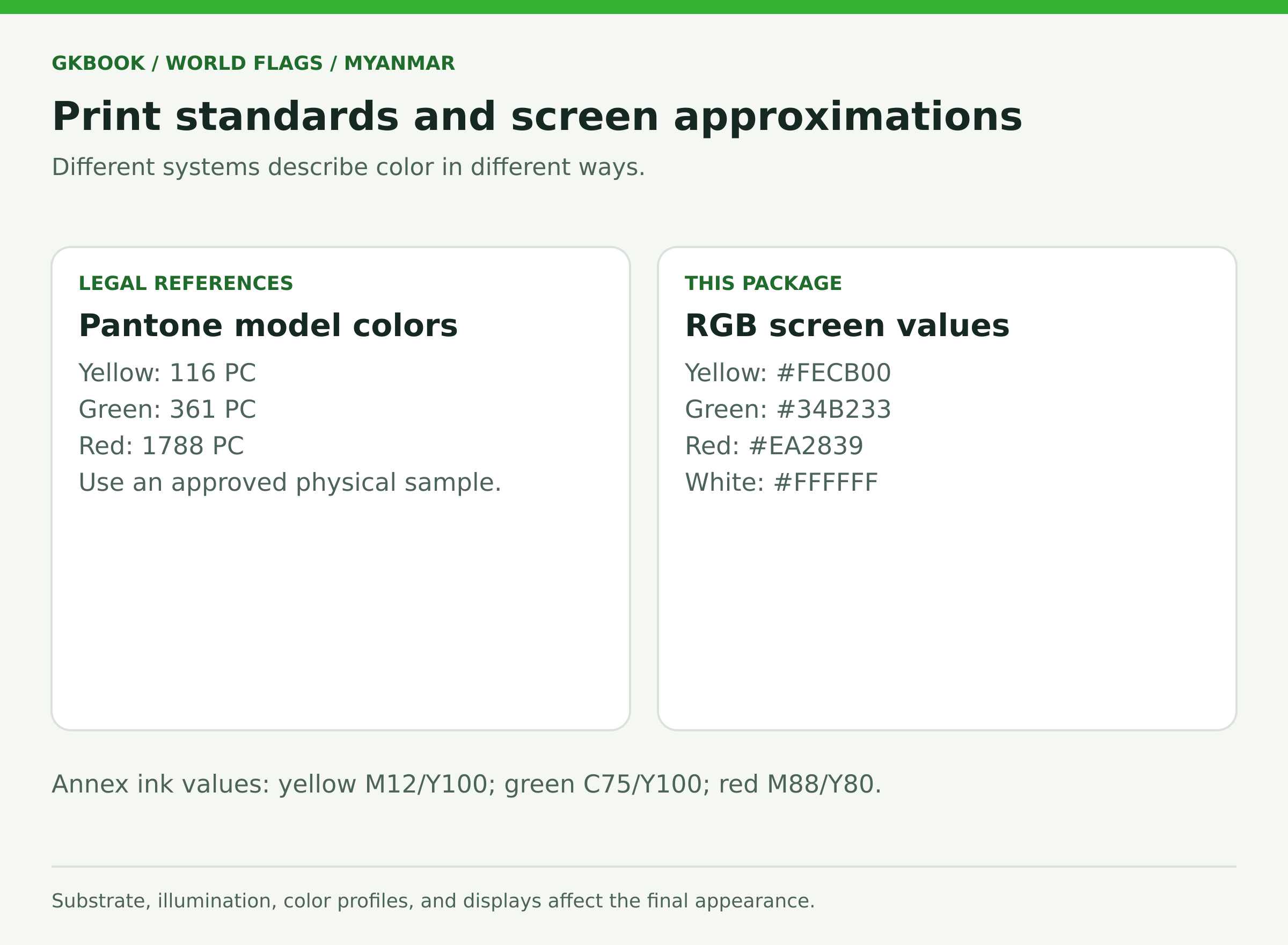
Section 3(d) of the Union Flag Law identifies yellow as Pantone 116 PC, green as Pantone 361 PC, and red as Pantone 1788 PC. These references are more precise than generic descriptions such as gold, grass green, or scarlet.
What does Myanmar’s flag symbolize?
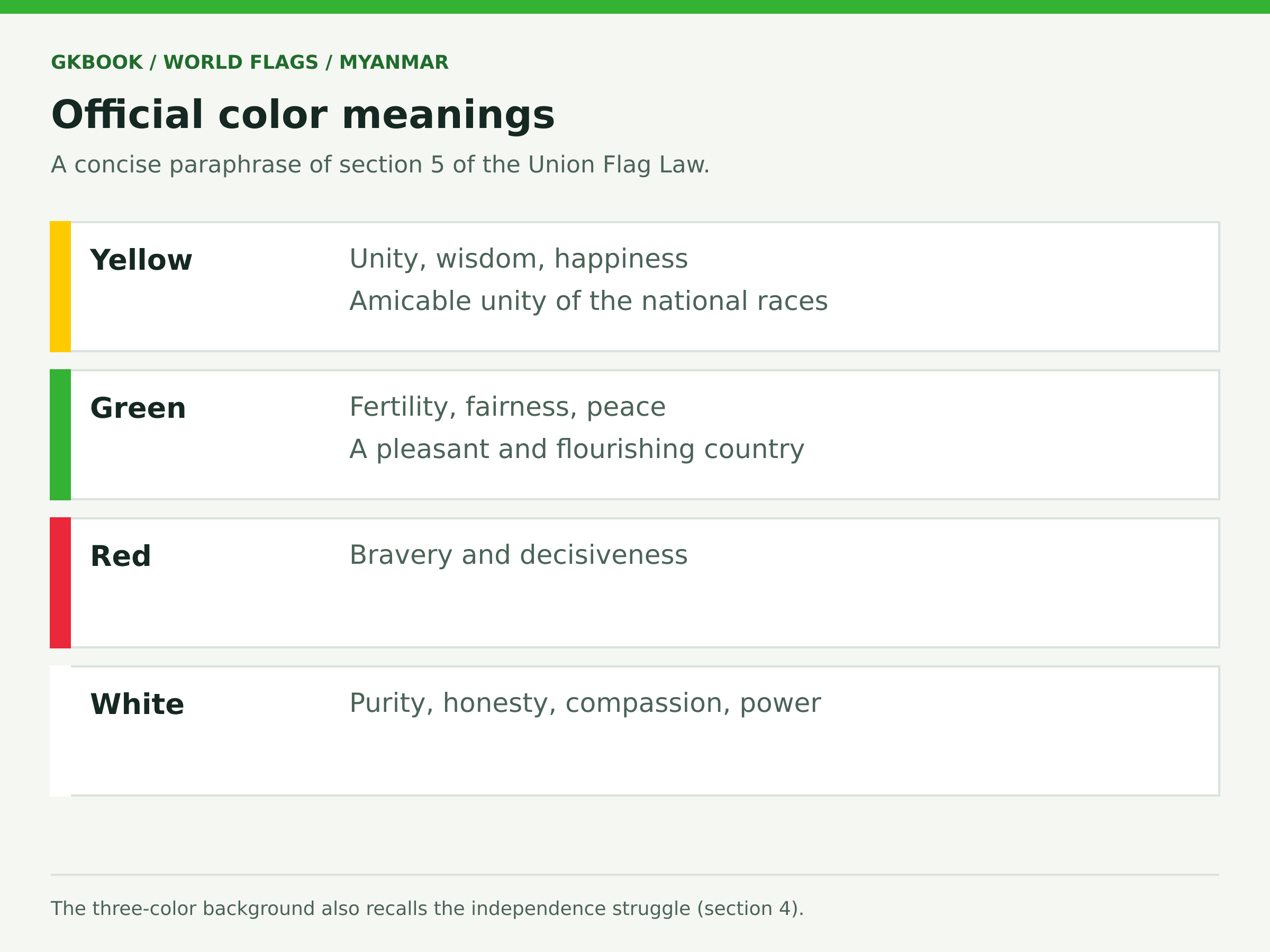
Myanmar’s flag law gives meanings for each color: yellow expresses unity, wisdom, and happiness; green conveys fertility, fairness, and a peaceful, flourishing country; red represents bravery and decisiveness; and the star’s white signifies purity, honesty, compassion, and power. The three-color background also recalls the country’s struggle for independence.
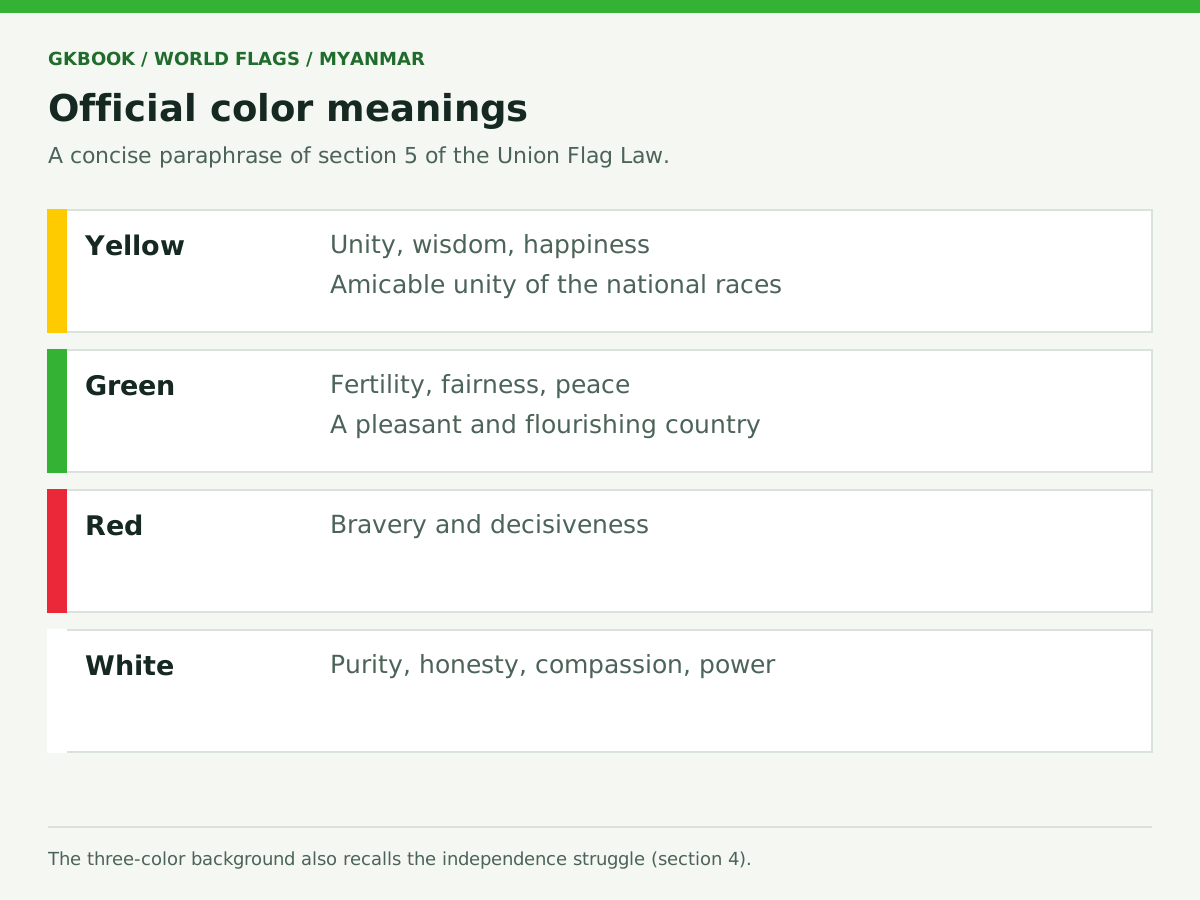
Section 5 is the controlling source for these meanings. Its English translation also uses the term conformity in the explanations of yellow and green. Short educational summaries often compress the meanings to solidarity, peace, and courage, but those summaries do not contain everything stated in the law.
These are official symbolic ideals. They describe what the colors are intended to express, rather than making a factual assessment of political or social conditions. The law does not assign a separate group, region, or religion to each point of the star.
What does yellow represent on Myanmar’s flag?
Yellow represents unity, harmony among the national races, wisdom, and happiness in the official explanation of Myanmar’s flag. It occupies the entire top third of the field, apart from the white star where that symbol overlaps it. The law names its model color as Pantone 116 PC.
The English law describes the amicable unity of all national races. In this context, that wording concerns the country’s different peoples; it is not a list that can be counted from the star’s points. Yellow is sometimes summarized as solidarity.
The stripe belongs to the historic yellow-green-red combination recalled in section 4. Claims that its sole official meaning is mineral wealth or Buddhism should not replace the meanings actually set out in section 5.
What does green represent on Myanmar’s flag?
Green represents fertility, fairness, and a country that is peaceful, pleasant, and flourishing. The official English explanation also includes conformity. Green forms the middle third of Myanmar’s flag, behind the central part of the white star. Its specified model color in the Union Flag Law is Pantone 361 PC.
Fertility is a meaning attached to the green color, rather than an instruction to add a plant, rice stalk, or agricultural emblem to the current flag. Those objects belong to discussions of earlier designs.
The center stripe has the same height as the yellow and red stripes. The star covers part of it, but that overlap does not change the stripe’s underlying dimensions.
What does red represent on Myanmar’s flag?
Red represents bravery and decisiveness under Myanmar’s Union Flag Law. It fills the lower third of the flag, with the two lower points of the white star extending into it. Section 3(d) specifies Pantone 1788 PC for the red band, which should not be confused with the annex’s inconsistent printed label.
The body of the law and specialist construction references agree on 1788 PC. One English annex hosted by the Myanmar Information Management Unit prints 178 PC beneath the red swatch, even though section 3 in the same document says 1788 PC. This page follows the operative text.
A printer should work from the named standard and an approved physical sample. A screen preview alone cannot establish whether a fabric or ink matches the intended red.
What does the white star mean on Myanmar’s flag?
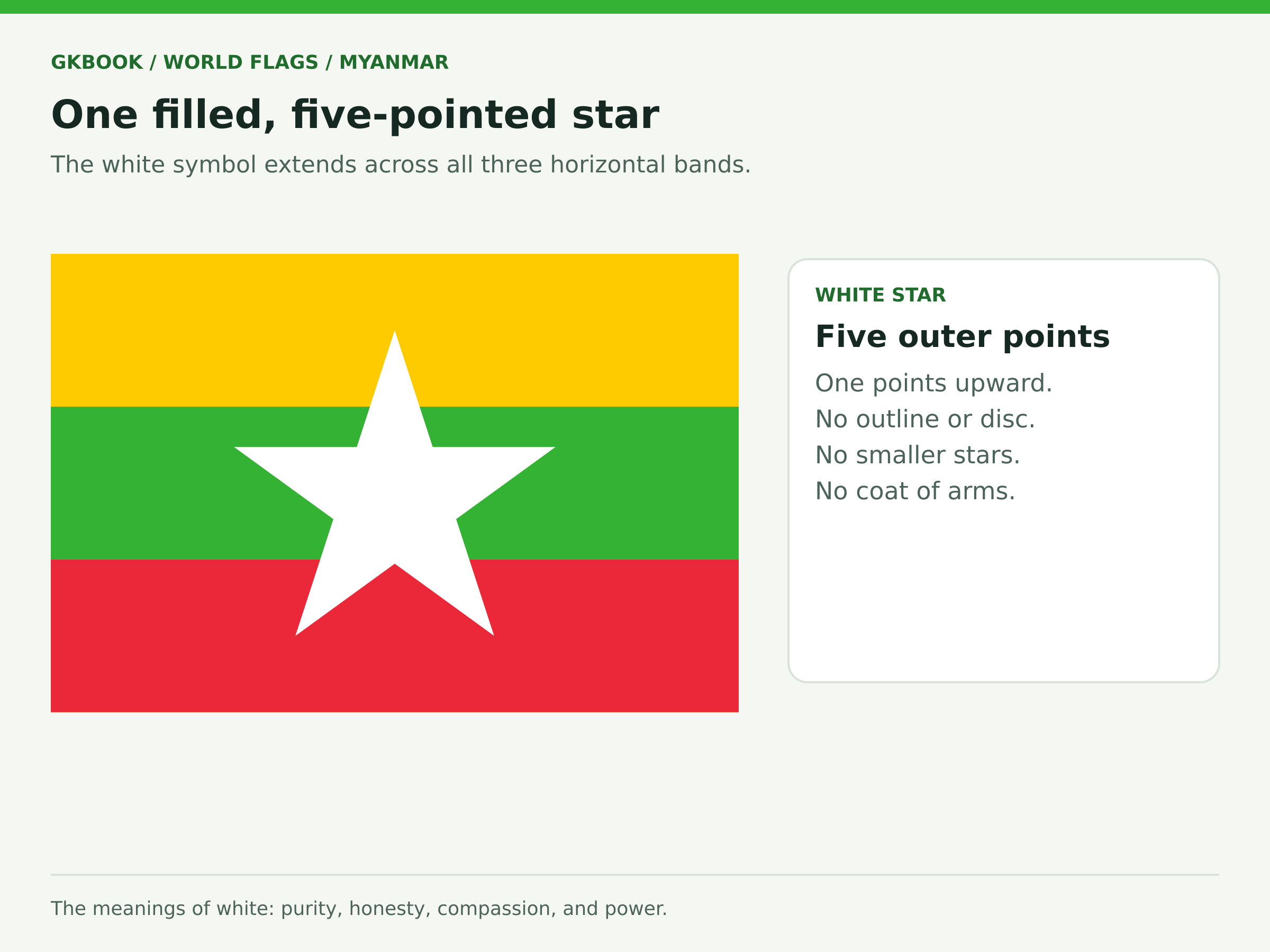
The white star’s color represents purity, honesty, compassion, and power according to the 2010 flag law. It has five points, with one pointing vertically upward. The law requires a single large star across the three bands; it does not assign an individual meaning to each of its five points.

The symbol is a filled white star, not an outlined pentagram and not a white disc. There is no coat of arms inside it. Its broad silhouette makes it distinguishable from the smaller stars that appeared on earlier national flags.
General descriptions sometimes associate the single star with national unity. That interpretation should be distinguished from section 5(d), which specifically explains the meaning of the color white.
What are the proportions of Myanmar’s flag?
Myanmar’s national flag has a height-to-length ratio of 2:3, equivalent to a length-to-height ratio of 3:2. The law’s model measures 6 feet high and 9 feet long. Each horizontal band is 2 feet high, so all three bands occupy equal thirds of the total height.
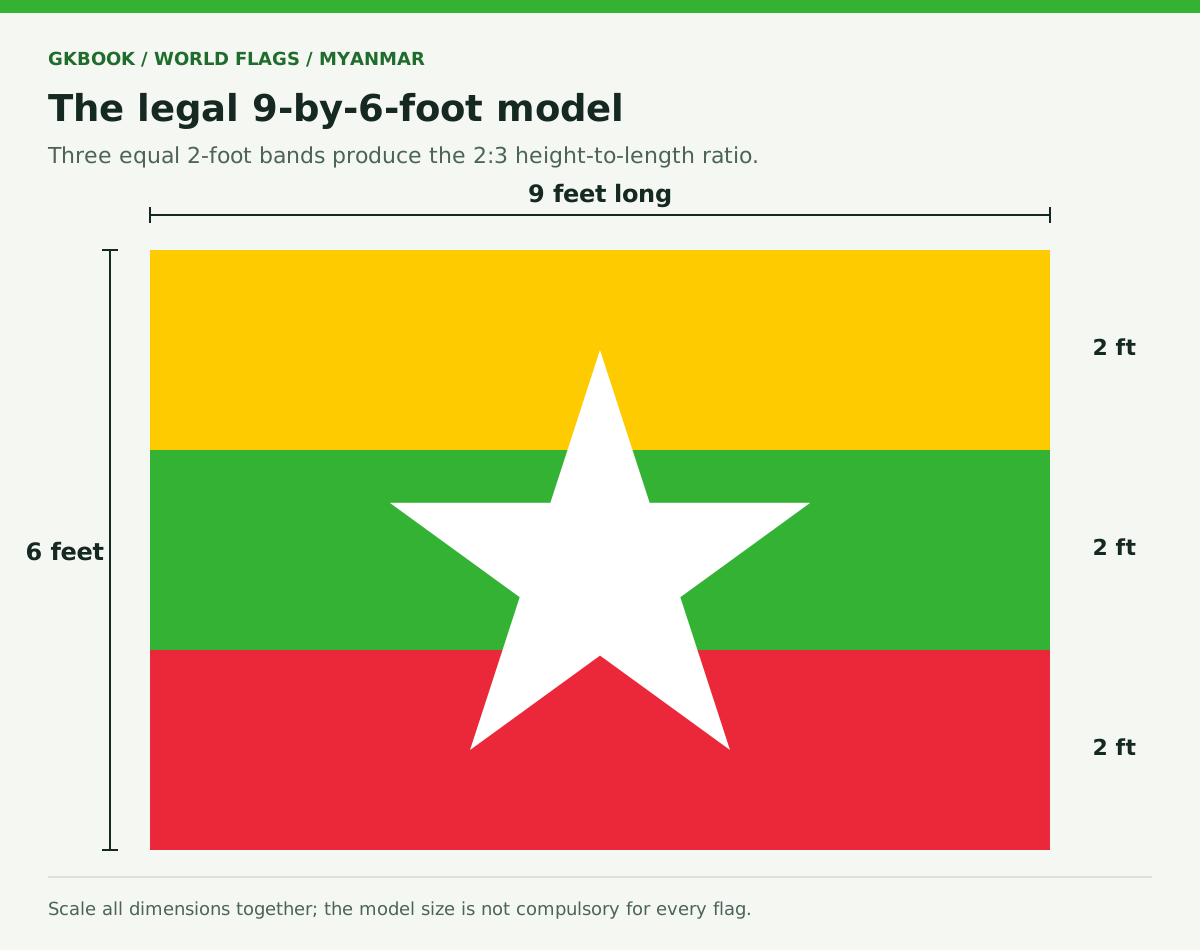
The legal translation uses length for the horizontal dimension and width for the vertical dimension. Here, height and length are used to avoid confusion with image software, which usually lists width before height.
Section 6 permits different sizes while requiring consistent proportions and colors. A 60-centimeter-high flag is therefore 90 centimeters long, with three 20-centimeter bands. The 9-by-6-foot model is a construction reference, not a compulsory size for every display.
How is the white star positioned and measured?
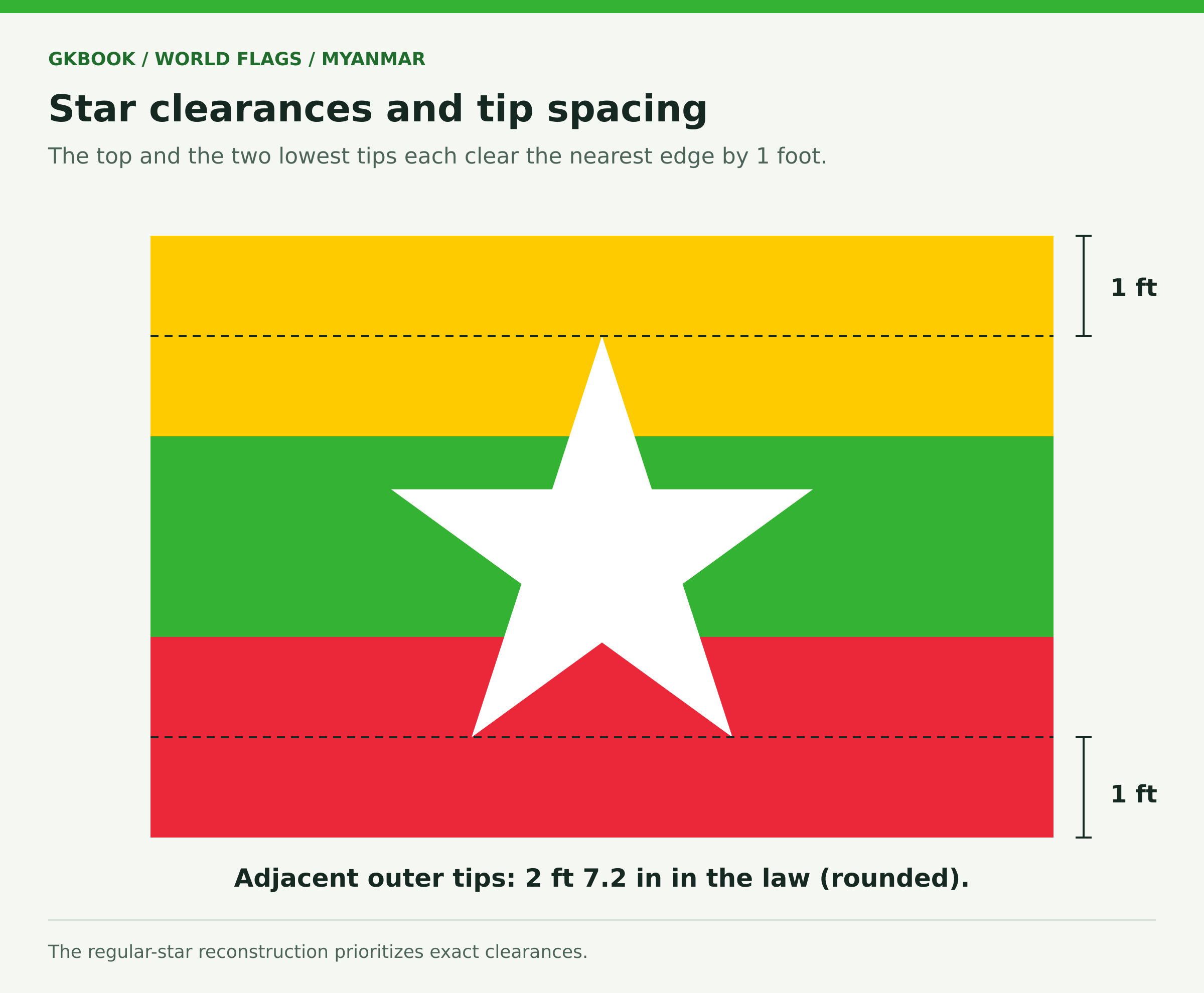
On the law’s 9-by-6-foot model, the star’s upper point lies halfway along the length, 1 foot below the upper edge. Its two lowest points sit 1 foot above the lower edge. The resulting star silhouette is 4 feet high, or two-thirds of the flag’s total height.

Section 3(c)(iv) also gives 2 feet 7.2 inches between adjacent outer tips of the star. For a mathematically regular five-pointed star with the prescribed 4-foot vertical span, that distance is approximately 2.59936 feet, or 2 feet 7.1923 inches. The law’s stated distance is consistent with rounding to a tenth of an inch.
The downloadable drawing preserves the exact one-foot clearances and a regular star. Its internal notches are derived from a regular pentagram construction; the law does not provide separate coordinates for them. In a 1200-by-800 drawing, the top point is at y = 133.333 and the two lowest points are at y = 666.667.
Is the star geometrically centered on the flag?
The star is centered horizontally, and its visible top and bottom have equal clearances from the flag’s edges. However, the center of the circle used to construct a regular five-pointed star is slightly below the flag’s horizontal midline. Centering that circle instead would produce unequal top and bottom margins.
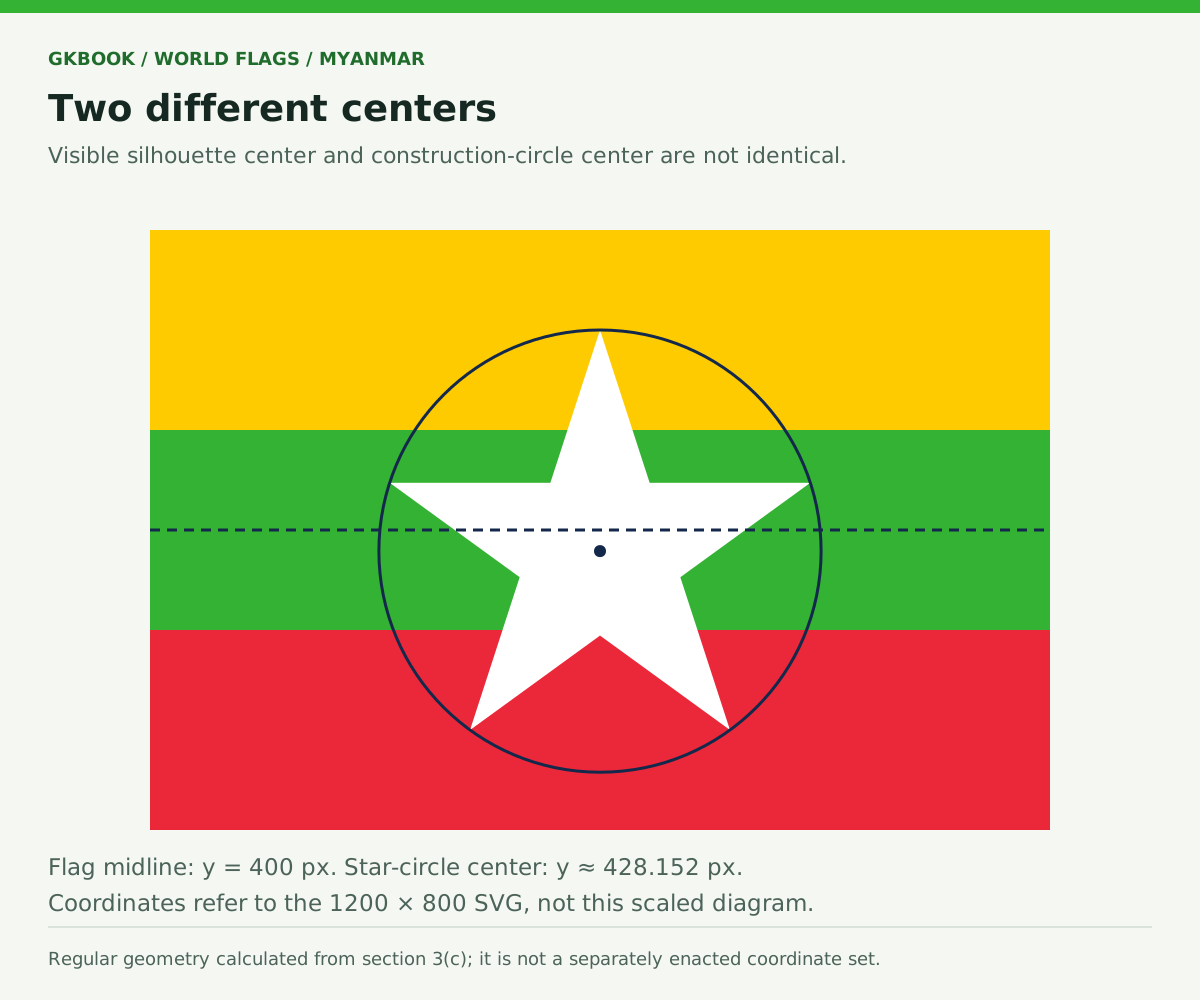
A regular star with one point upward has its two lowest points above the bottom of its circumscribed circle. This asymmetry of its vertical extent is why the circle center and the center of the visible bounding box differ.
For flag height H, the outer radius is R = (2H/3)/(1 + cos 36°). The circle center is at y = H/6 + R, measured down from the upper edge. In the supplied 800-pixel-high flag, R is approximately 294.819 pixels and the circle center is y = 428.152 pixels. These are calculated drawing values, not additional legal measurements.
What HEX and RGB colors should a digital Myanmar flag use?
This page’s digital artwork uses yellow #FECB00, green #34B233, red #EA2839, and white #FFFFFF. These are explicitly identified screen reference values, not HEX codes enacted by the flag law. The legal text instead specifies Pantone 116 PC, 361 PC, and 1788 PC for the three colored bands.

RGB values are yellow 254, 203, 0; green 52, 178, 51; red 234, 40, 57; and white 255, 255, 255. These values define the files supplied here consistently. They should not be treated as a guaranteed conversion of a particular Pantone edition, substrate, or viewing condition.
The English annex also lists ink percentages: yellow M12/Y100, green C75/Y100, and red M88/Y80. These are documentary print references, not universal color-managed formulas. The absence of a color profile is another reason not to claim exact equivalence between an RGB image, a printed swatch, and dyed cloth.
How can students draw Myanmar’s flag accurately?
Draw a rectangle three units long for every two units high, divide its height into three equal bands, and color them yellow, green, and red from top to bottom. Add one large white five-pointed star, pointing upward, with equal margins above its top and below its two lowest points.

For a convenient paper exercise, draw a 27-by-18-centimeter rectangle. Each band is 6 centimeters high. The star’s upper tip is at the horizontal midpoint, 3 centimeters below the top; its two lowest tips are 3 centimeters above the bottom. The star’s visible height is therefore 12 centimeters.
Use the supplied vector outline to transfer the regular star rather than guessing the inner points. Keep pencil construction lines out of the finished flag. Educational annotations in the diagrams are outside the flag or are clearly presented as measurement overlays, not additions to a ceremonial flag.
How has Myanmar’s national flag changed over time?
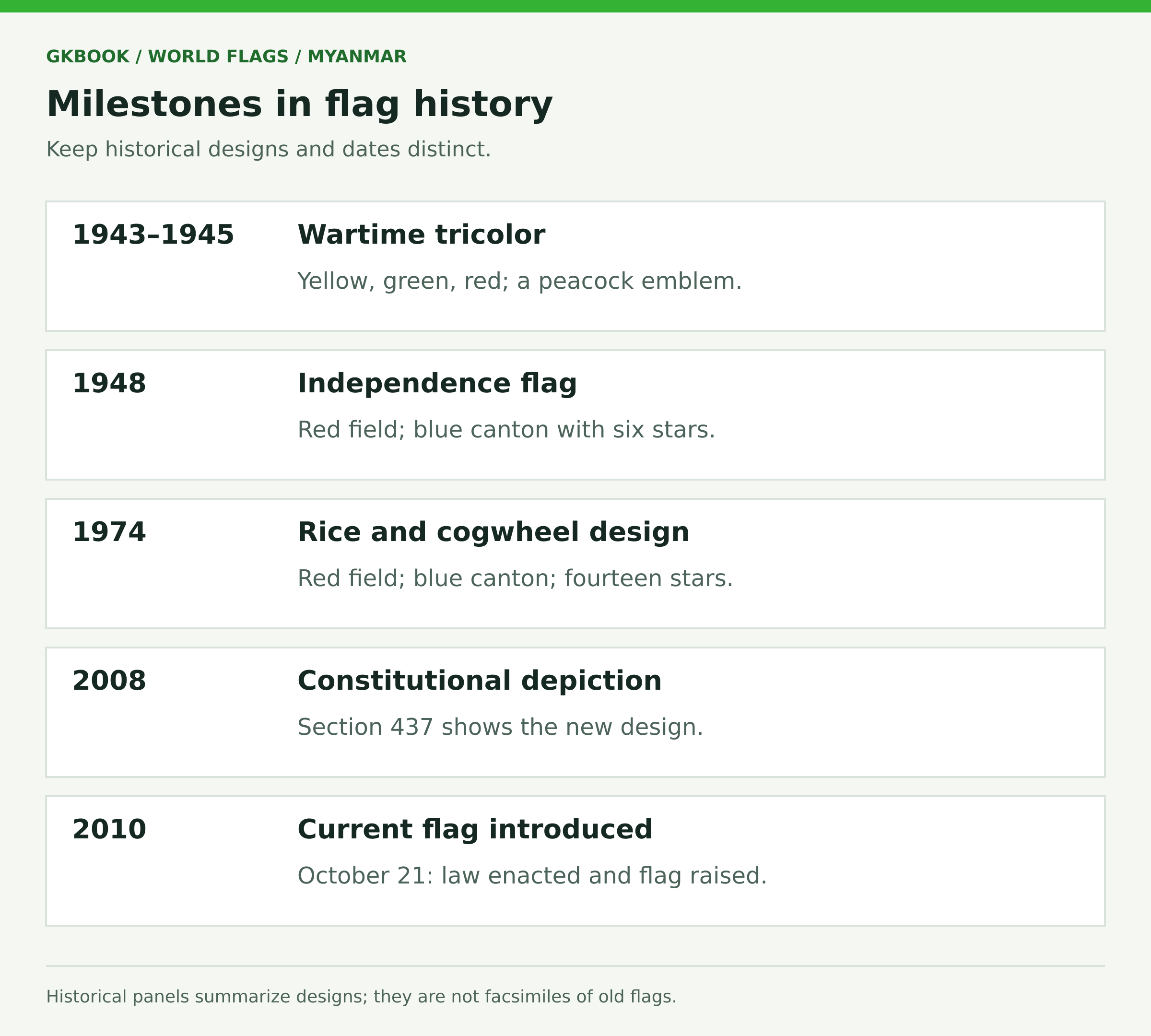
Myanmar’s flag history includes peacock imagery, the yellow-green-red wartime tricolor, a red independence flag with a blue canton and six white stars, and the later red flag with a rice-and-cogwheel emblem surrounded by fourteen stars. The present tricolor with one large white star replaced that last design in October 2010.
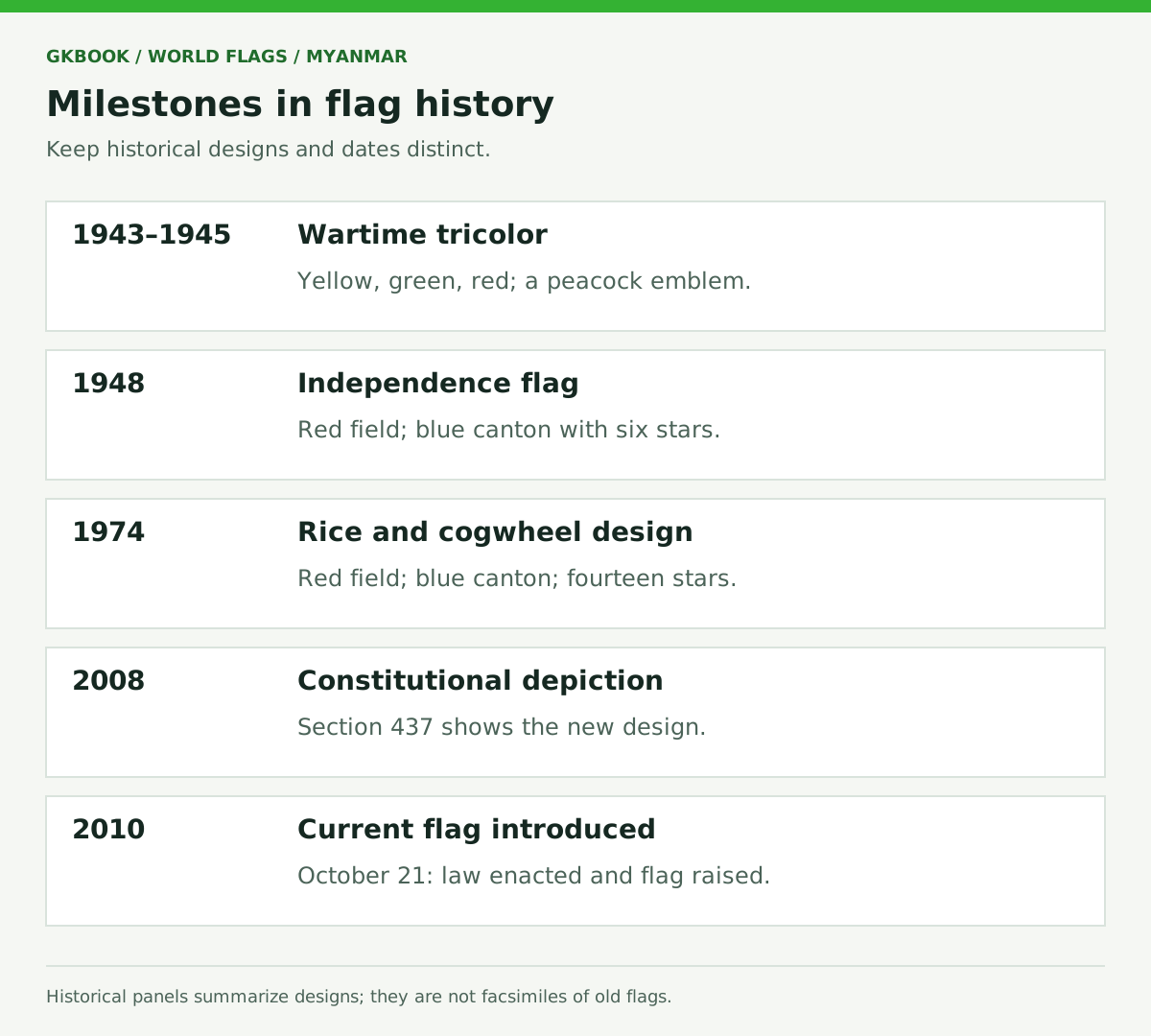
The wartime tricolor associated with the Japanese-sponsored administration of 1943–1945 had a peacock emblem. That history should not be confused with the sovereign independence achieved in 1948. The present law expressly links its three background colors to the independence struggle, but its white-star design is different.
The 1948 and 1974 designs both used a red field and blue upper-hoist rectangle. The current design changes that overall arrangement: the bands span the full length and there is no canton. The historical comparison below identifies broad design changes without presenting speculative reconstructions of every old emblem.
When was the current Myanmar flag adopted?
The current Myanmar flag was adopted on October 21, 2010, when the Union Flag Law was enacted and the new design was raised at government offices. Its design had already appeared in the 2008 Constitution. The constitutional description and the later introduction of the flag are therefore distinct milestones.
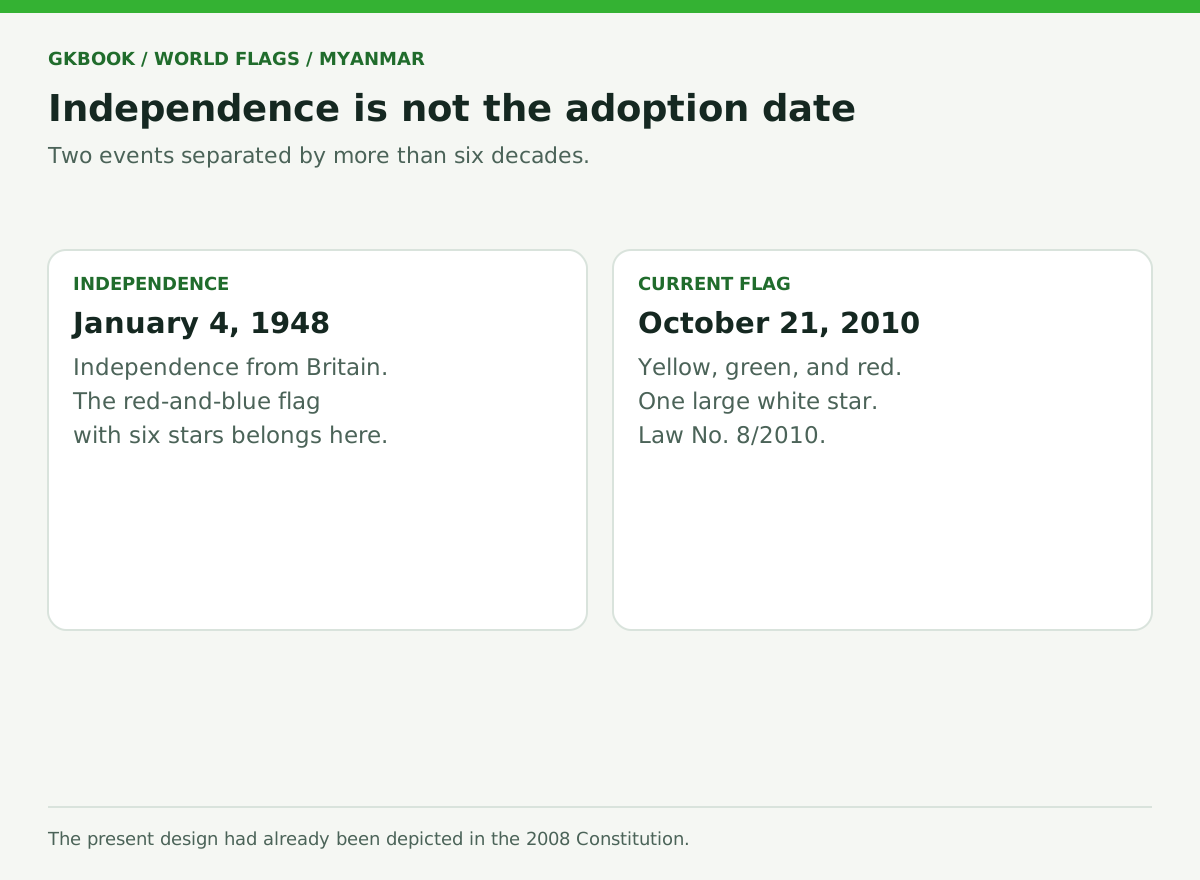
WIPO Lex records October 21, 2010 as both enactment and entry into force for Law No. 8/2010. Contemporary reporting describes replacement ceremonies around 3 p.m.; the state newspaper of October 22 reports the Nay Pyi Taw hoisting at that time on the previous day.
The change occurred shortly before the November 2010 election, during the military government’s implementation of the 2008 constitutional framework. The historical account here identifies the issuing authority without endorsing its political claims.
Was Myanmar’s current flag introduced at independence?
No. Myanmar became independent from Britain on January 4, 1948, but its present yellow-green-red flag with a white star was introduced on October 21, 2010. The independence-era flag was red with a blue canton containing one large white star and five smaller stars. The two dates describe different national milestones.
January 4 belongs to the history of sovereignty and the independence-era flag. October 21 belongs to the introduction of the current national design. Referring to 2010 as Myanmar’s independence year would be incorrect.
A photograph from 1948 should not be illustrated with the present flag unless the illustration is explicitly a modern comparison. Matching a flag design to its historical period is as important as getting its colors right.
What did Myanmar’s flags of 1948 and 1974 look like?
The independence-era flag had a red field and a blue upper-hoist canton with one large white star and five smaller stars. The 1974 design retained the red field and blue canton but replaced that arrangement with a rice-and-cogwheel emblem encircled by fourteen white stars. It remained in use until 2010.

The 1948 arrangement is documented in specialist flag histories. For the 1974 design, an archived U.S. government flag description confirms the white stars, cogwheel, and rice stalk. The 1974 constitution’s Article 190 also depicts the flag, although reproductions of its illustration vary in quality.
The rice and gear are commonly explained as agriculture and industry, while the fourteen stars refer to the administrative divisions. Neither the old rice emblem nor its ring of stars should be copied into the current white star.
Why is the peacock important in Burmese flag history?
The peacock is an important historical Burmese emblem and appeared on earlier flags, including the yellow-green-red design used under the Japanese-sponsored wartime administration. Myanmar’s current national flag does not contain a peacock: it uses a white star. Historical peacock banners and modern political flags should be identified by period and context.
A similar set of colors does not make the wartime and current flags identical. Their central devices, political settings, and dates differ. Contemporary reporting on the 2010 change explicitly noted the earlier tricolor and its peacock.
The gallery therefore uses a historical information panel rather than an invented peacock illustration. A faithful reconstruction would need a separately verified contemporary specimen or construction drawing.
What law defines Myanmar’s flag?
Section 437 of Myanmar’s 2008 Constitution depicts the state flag and provides for legislation concerning it. The Union Flag Law, Law No. 8/2010, supplies the design measurements, color standards, meanings, and rules for use. It was enacted on October 21, 2010 and expressly repealed the 1974 State Flag Law.
The constitutional image establishes the basic national symbol; the later law makes its construction and use more specific. Section 3 covers the model, sections 4–5 explain the colors, section 6 requires proportional consistency, and later chapters address display and prohibited uses.
This article describes the published flag instruments. It does not treat a description of a national symbol as a determination of the legitimacy of any government or of contested constitutional arrangements.
Who designed Myanmar’s current flag?
The consulted legal sources identify the authority that enacted Myanmar’s current flag but do not name an individual designer. The 2010 law was issued by the State Peace and Development Council and signed by Than Shwe as chairman. A signature on the law should not be treated as proof of artistic authorship.
A reliable attribution requires a design record, a documented competition result, or a comparable primary source. None of the core sources used for this article establishes an individual creator of the 2010 design.
Names associated with the 1948 or 1974 flags must not automatically be transferred to the present design. This page leaves that attribution unresolved rather than filling the gap with an unsupported name.
Are the Burma flag and Myanmar flag different?
Burma and Myanmar can refer to the same country, so a search for the Burma flag may return the current Myanmar flag. However, the phrase can also refer to historical designs. Always check the date: the present tricolor dates from 2010, whereas earlier red flags used a blue canton.
The English name change from Burma to Myanmar occurred in 1989, long before introduction of the current flag. Consequently, it is incorrect to assume that the 1974 design ceased to be used simply because the country’s English name changed.
For catalogs, school projects, and archives, a date range is clearer than relying on a country name alone. A label such as Myanmar national flag, adopted 2010 distinguishes this design from both historical and organizational flags.
How is Myanmar’s flag different from similar tricolors?
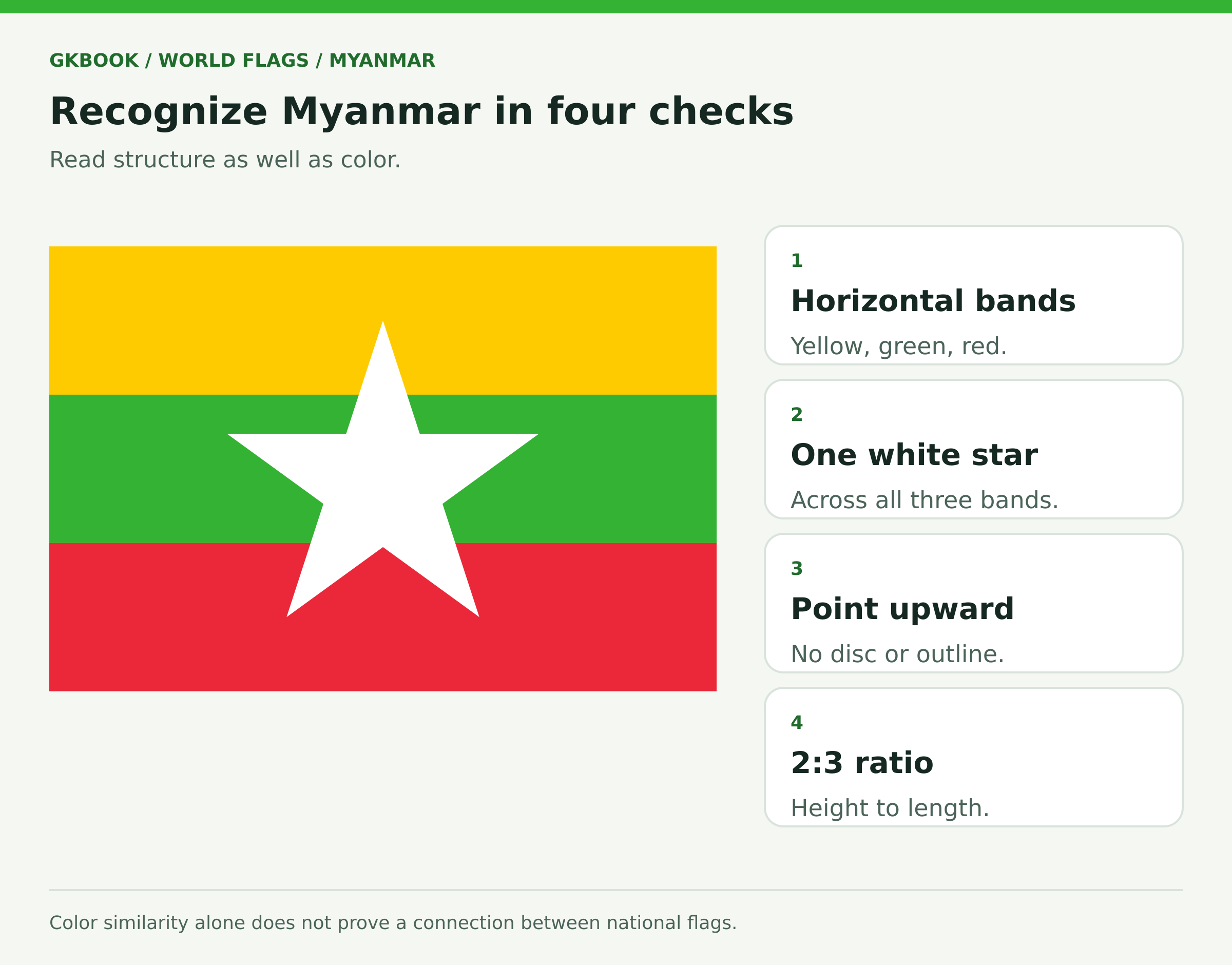
Myanmar is identified by horizontal yellow, green, and red bands with one large white star crossing all three. A matching color palette alone is not enough to identify a flag. Check the band order, orientation, central symbol, and proportions together, particularly when a small image makes details difficult to see.
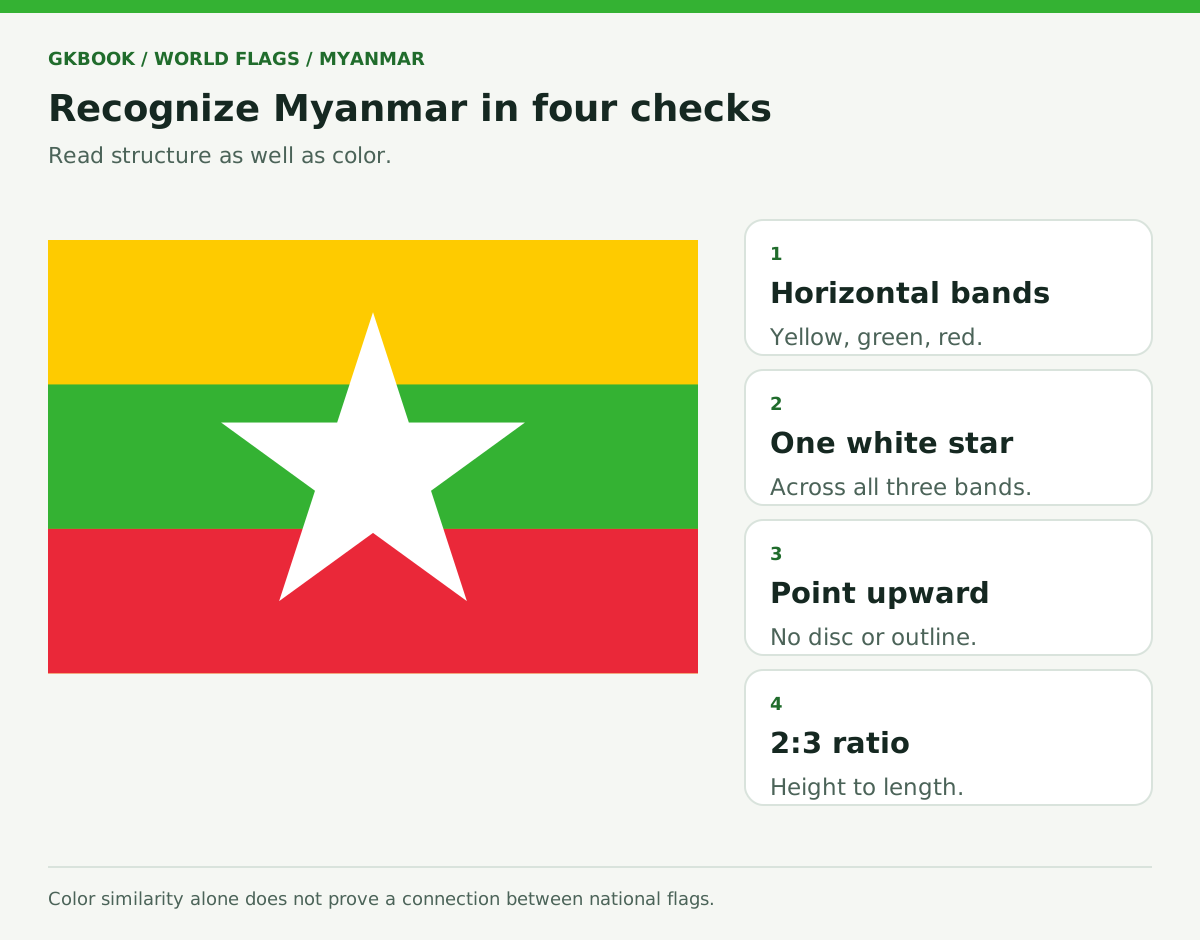
The strongest identification feature is the combination of three equal horizontal bands and the single large white star. Do not infer a political or historical relationship merely because another country uses yellow, green, and red.
The recognition guide isolates four features of Myanmar’s own design. It avoids relying on approximate colors, since screens and printing can shift the appearance of the bands.
Does the reverse side of Myanmar’s flag look different?
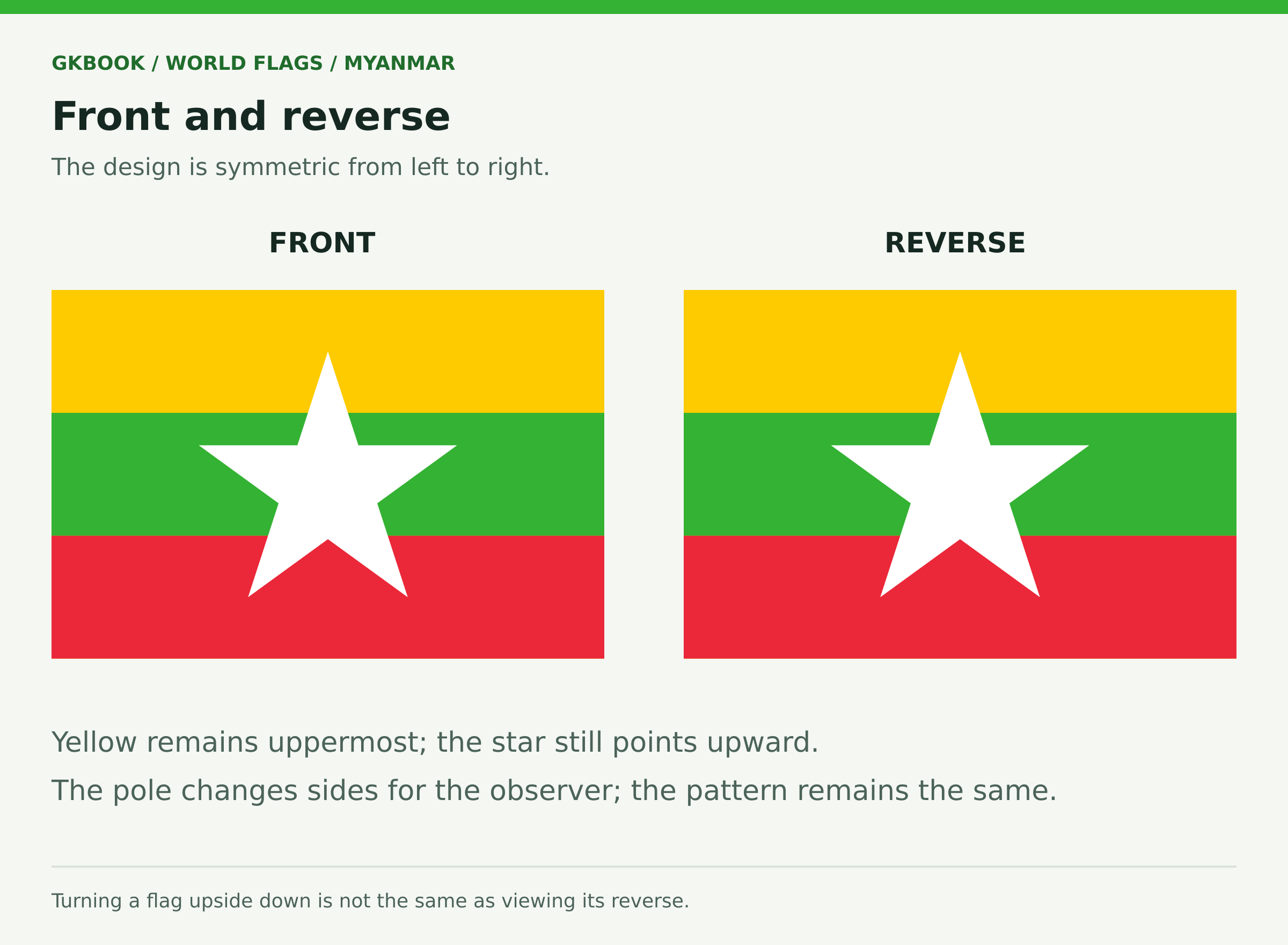
The current design has no lettering or asymmetrical emblem, so its reverse shows the same yellow-green-red bands and white star when viewed normally from the other side. The pole changes sides in the viewer’s perspective, but a horizontal mirror image does not change the appearance of the symmetrical flag design.
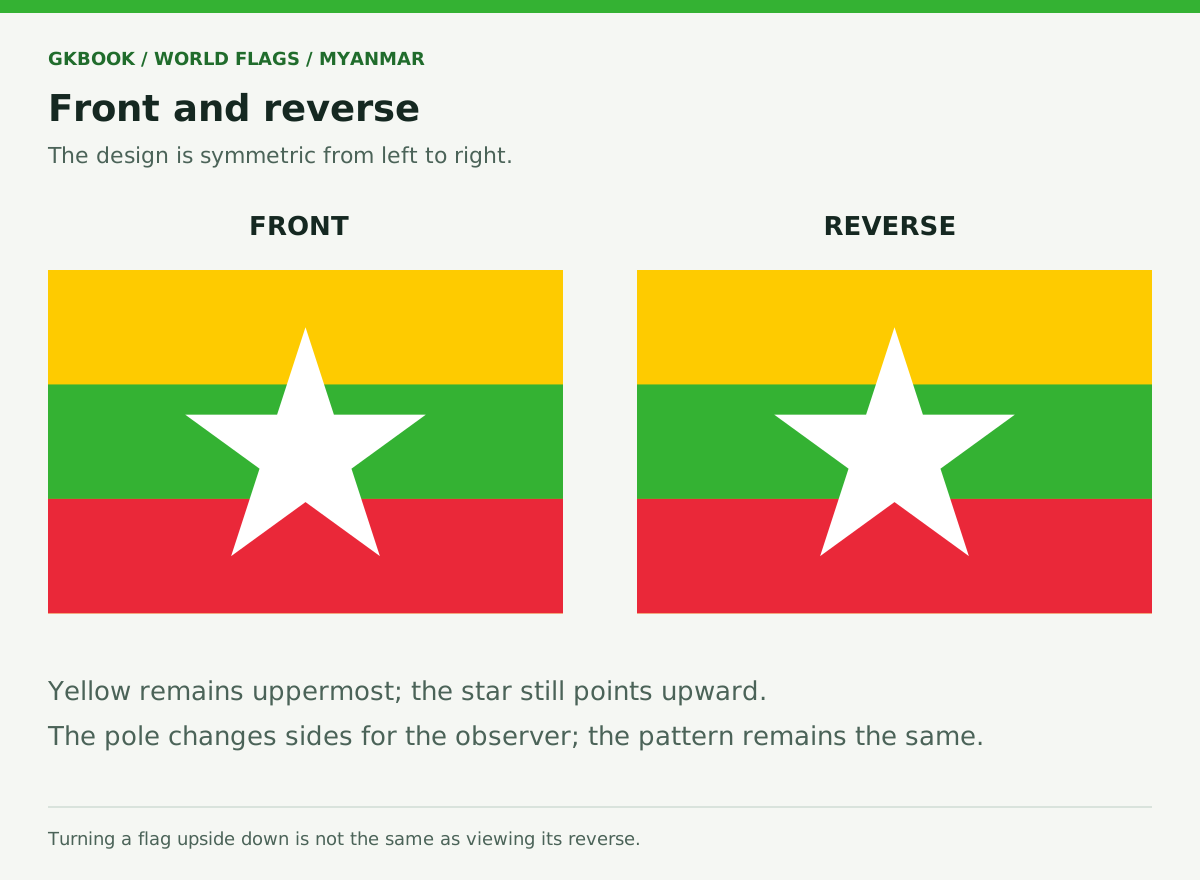
This is a consequence of the artwork’s left-right symmetry, not a provision for a different reverse emblem. A translucent cloth flag may look less saturated from the side facing away from the light; that is a material effect.
Keep the yellow band uppermost and the star pointing upward. Rotating the whole flag upside down is different from viewing its reverse.
How should Myanmar’s flag be shown vertically?
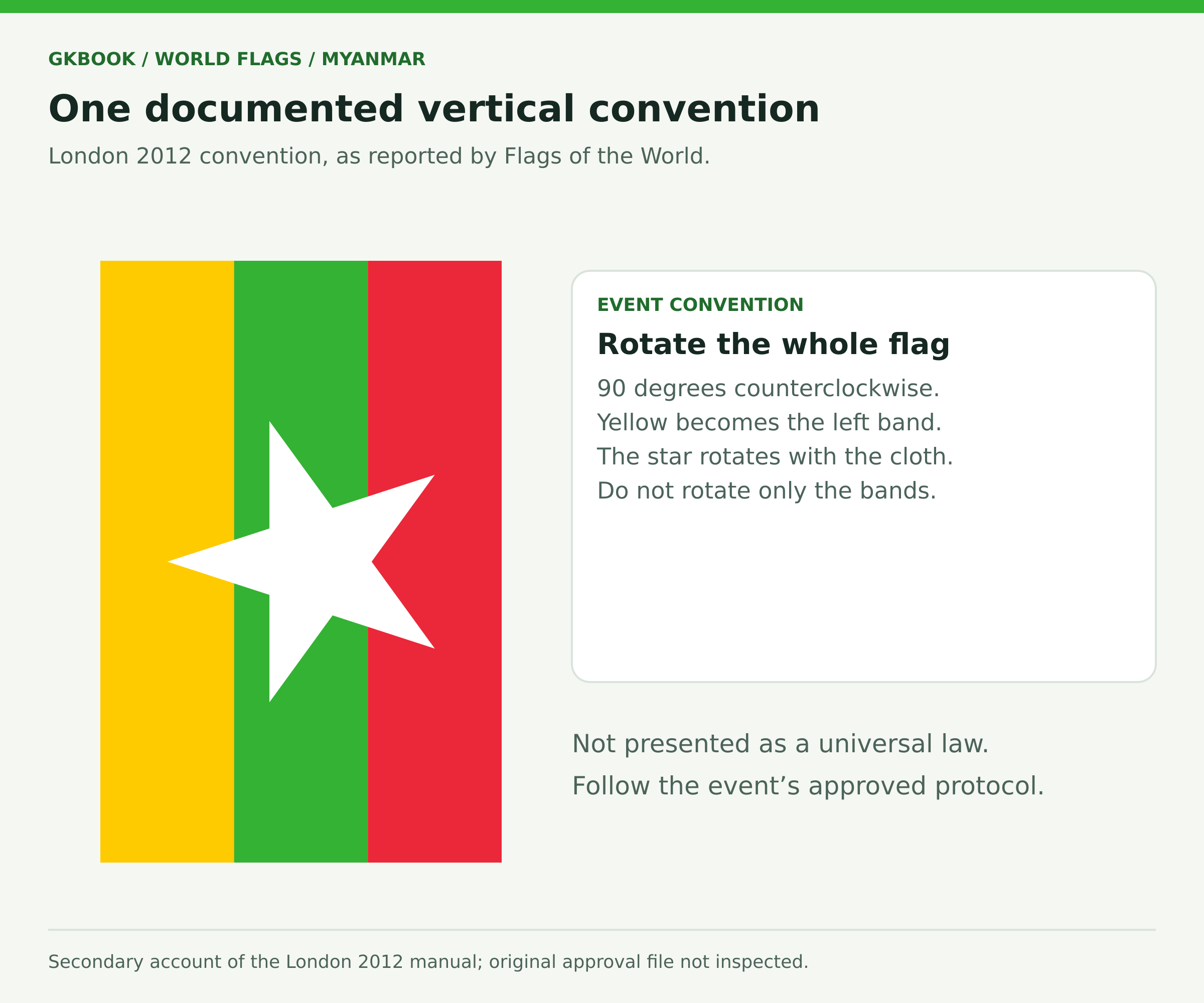
The law’s construction model shows Myanmar’s flag horizontally. For a formal vertical display, use the applicable event or official protocol rather than inventing a new upright-star design. A documented London 2012 Olympic convention rotated the complete horizontal flag ninety degrees counterclockwise; that event convention should not be mistaken for a universal legal rule.
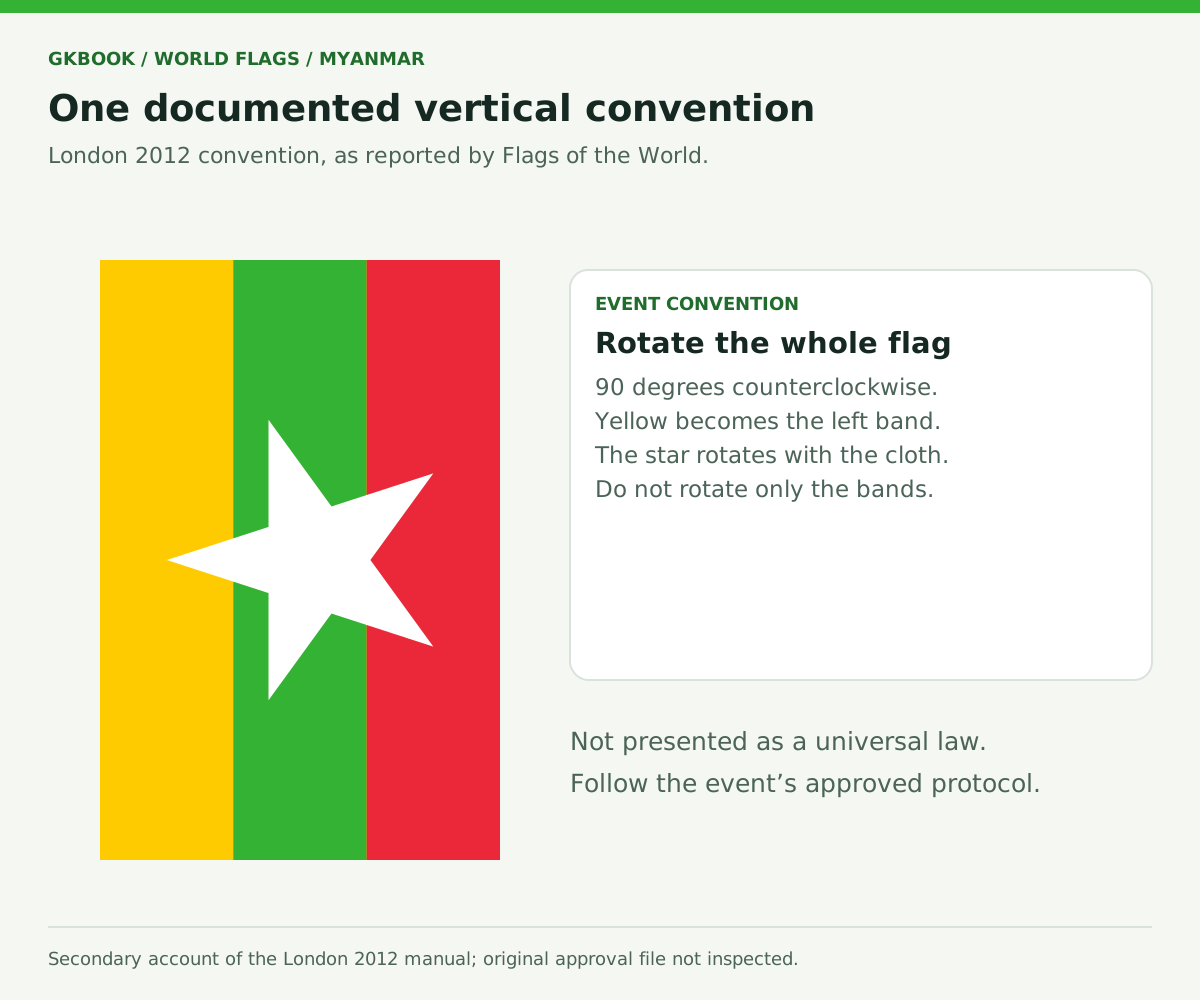
Under that rotation, the original yellow band becomes the left band when viewed from the front, and the star rotates with the entire flag. Redrawing only the star upright would create a different composition.
The gallery labels this example as an Olympic display convention, reported in the specialist Flags of the World record. The present article does not claim to have independently inspected the original Olympic approval file, or to establish a general rule for every Myanmar venue.
What display rules appear in Myanmar’s flag law?
The 2010 Union Flag Law covers official hoisting days, designated occasions, international use, and respectful condition. It calls for an upright flag without faded colors, torn cloth, or broken stitching. It also prohibits alterations and specified disrespectful uses, including allowing the flag to touch the ground or water during handling.

Sections 7–10 address government-designated days and uses, including diplomatic premises and international meetings. Section 13 also bars a local organization’s flag from being placed above or at the same level as the Union flag. That provision should not be recast as permission to place foreign national flags below it in international settings.
These are descriptions of the published 2010 text. A current ceremonial decision should follow the responsible authority’s applicable orders and protocol. The article does not invent a universal sunrise, sunset, indoor, or nighttime rule not established by its sources.
When may Myanmar’s flag be flown at half-mast?
Section 14(a) of the 2010 Union Flag Law prohibits flying the Union flag at half-mast without a government order. Half-mast display should therefore be tied to an authorized mourning instruction, not assumed for every death or anniversary. The law’s cited provision does not specify one universal numerical position on every pole.
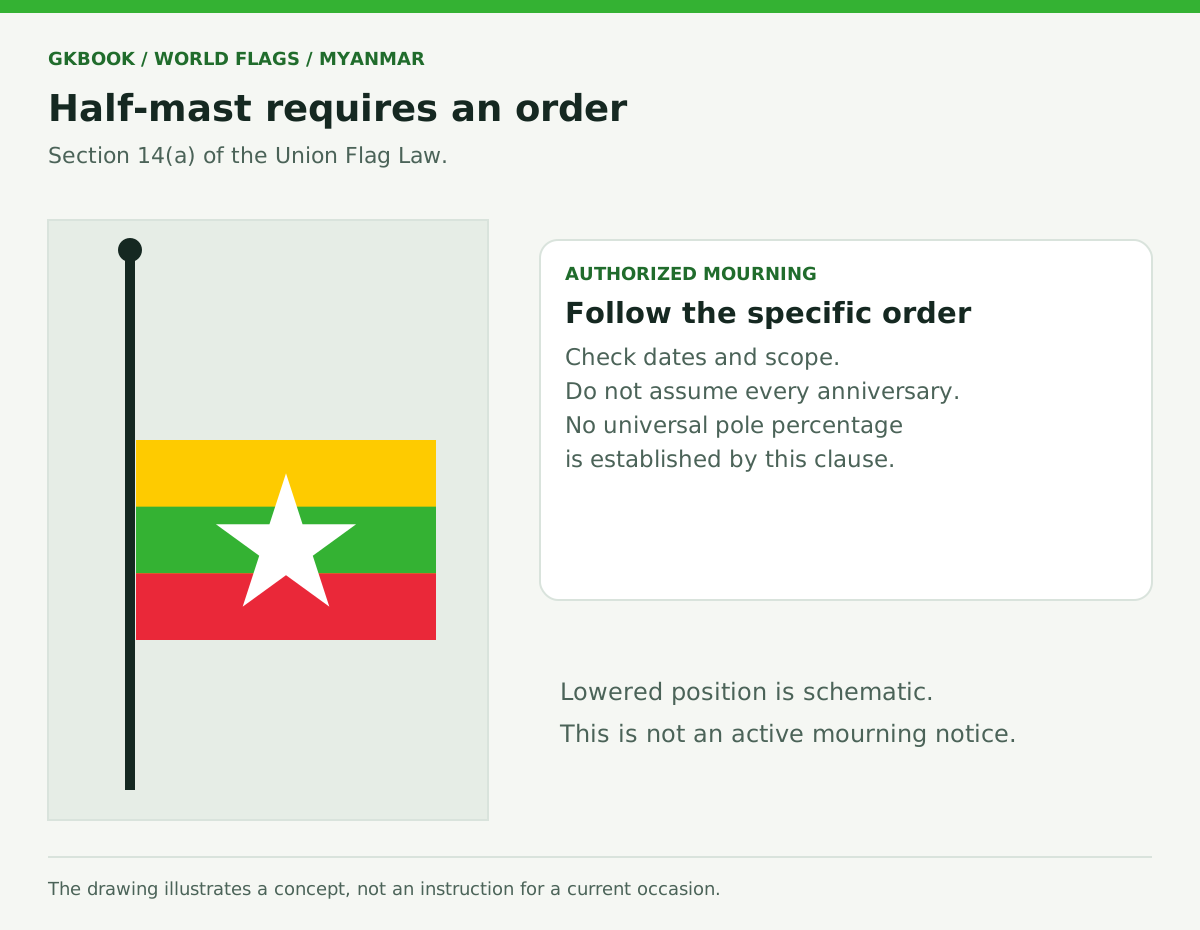
A diagram can show a lowered flag as an explanatory symbol, but it should not pretend that a particular percentage of the pole height is prescribed by this clause. Follow the actual order for the date, location, duration, and method of the display.
The same section limits use of the flag over a corpse to state or military funerals and prohibits burying it with the corpse. It also requires keeping the flag from touching the cemetery ground.
Can Myanmar’s flag be altered or used as a logo?
The 2010 flag law restricts marking or changing the Union flag and certain commercial or decorative uses. Section 15 addresses trademarks, clothing images, and decoration, with an exception framed around representing the Union or entire nation. A downloadable illustration does not itself grant legal permission for every intended use of the national flag.
Section 13 lists words, numbers, pictures, and symbols among additions prohibited on the flag. Use a separate caption outside a faithful flag image rather than inserting an advertising slogan into the star or bands.
The article presents the law’s wording as historical and legal documentation, not a determination that a proposed product is authorized. Classroom reproduction, publication rights in a diagram, trademark restrictions, and ceremonial use are separate questions.
What sizes preserve the correct Myanmar flag ratio?
Any size that preserves two units of height for three units of length keeps Myanmar’s required proportions. Examples include 20 by 30 centimeters, 60 by 90 centimeters, and 100 by 150 centimeters. The star and bands must scale together; resizing only the outer rectangle would distort the prescribed design.

The principal PNG supplied here is 4800 pixels wide and 3200 pixels high. Its three bands have equal mathematical heights in the vector master; rasterization may distribute boundary pixels between rows when the image height is not divisible by three.
The SVG is resolution-independent and is preferable when preparing a large print. Preserve the viewBox ratio and avoid software options that stretch the image to fill an unrelated page size.
What are common mistakes when drawing Myanmar’s flag?
Common errors include reversing the yellow-green-red order, making the star too small, using a yellow star, adding a blue canton, or centering the star’s construction circle instead of its visible silhouette. Another mistake is presenting an RGB approximation as a legal color standard. The official model and clearly labeled diagrams prevent these confusions.
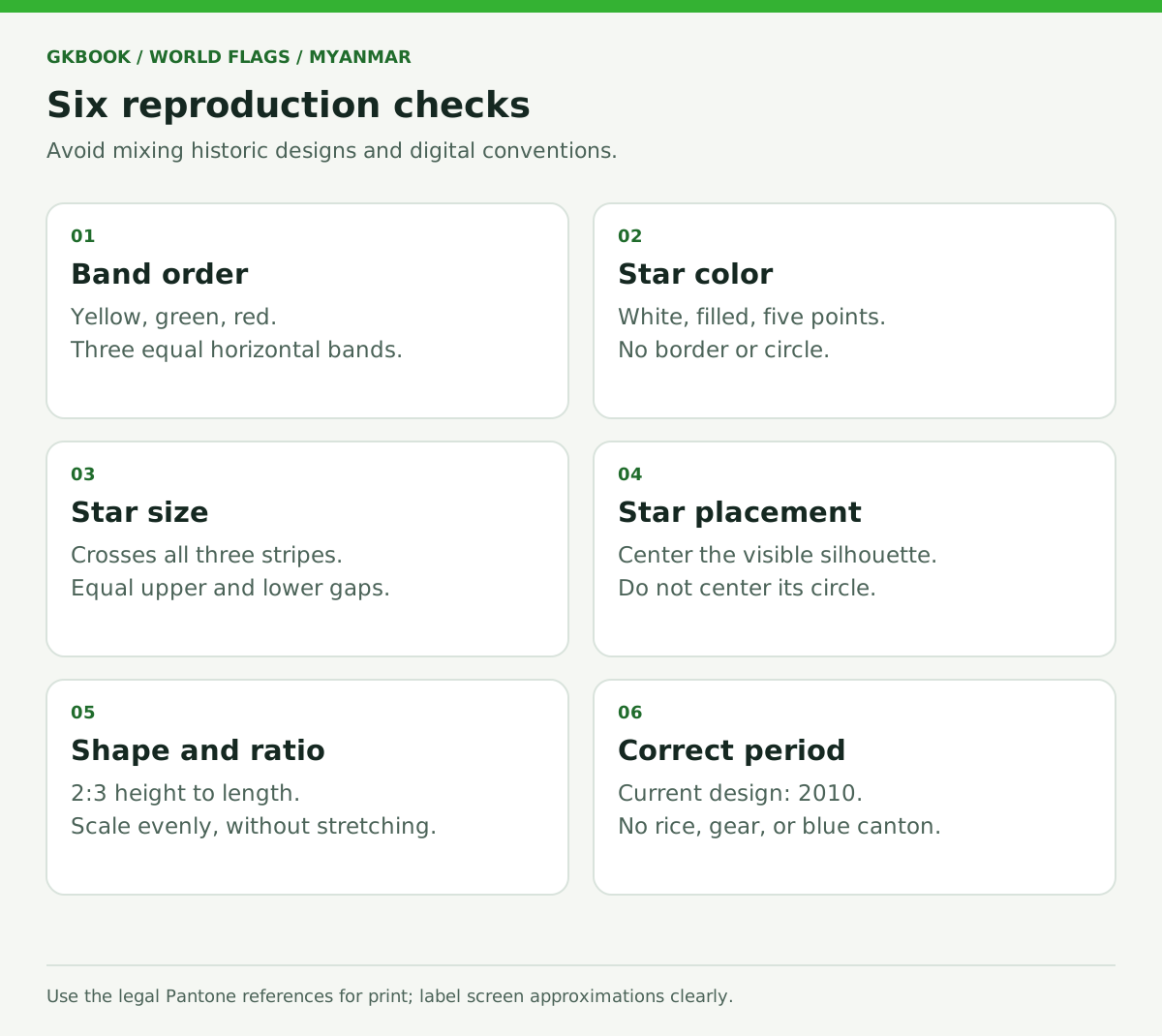
The star must extend into all three bands. A small star contained entirely within green is not the current legal pattern. A rice plant, cogwheel, peacock, ring of smaller stars, or surrounding circle also belongs to a different design or to an incorrect reconstruction.
The 2:3 proportion describes height to length. Confusing that with width-to-height notation can produce a tall rectangle instead of the intended horizontal flag.
Which Myanmar flag image format should I download?
Choose SVG for scalable artwork, precise outlines, and print preparation, or PNG for a ready-to-use raster image in documents and slides. Both versions here use the same underlying construction and palette. Preserve the complete rectangle, keep its proportions, and use the explanatory diagrams separately from the plain national flag.
The gallery includes the plain flag and labeled reference graphics. Measurement lines, text panels, and historical comparisons are teaching materials; they are not alternate official flags. The social-sharing image is likewise a presentation graphic, not the national flag rectangle itself.
The download package includes reconstruction notes recording the Pantone discrepancy, the rounded tip spacing, and the chosen screen values. This makes the drawing decisions reviewable without putting technical research records into the public article layout.
What are the key facts to remember about Myanmar’s flag?
Remember yellow, green, and red from top to bottom; one large white five-pointed star; a 2:3 height-to-length ratio; and adoption on October 21, 2010. Myanmar’s independence date is January 4, 1948. The law supplies specific meanings and Pantone colors, while digital reproductions require clearly identified drawing and color choices.
The current design is easy to recognize, but its geometry rewards careful reading: the star has equal top and bottom clearances, and the legal outer-tip spacing is rounded. The dated milestones also matter: independence, constitutional depiction, and actual adoption are not interchangeable.
Use the picture gallery to review the design, and return to World Flags to explore the wider series.
Download Myanmar flag pictures
Download the national flag as SVG or 4800 × 3200 PNG. The gallery contains 19 subjects, each with SVG and PNG versions. Use the full image and preserve its proportions. Image credits and reconstruction notes accompany the artwork.
Explore more in World Flags, including the Morocco flag and Montenegro flag.
World Flags/Myanmar
Myanmar flag pictures
2:3 proportions; equal bands; a regular white star with equal top and bottom clearances. Screen colors are reference approximations.
GKBook original diagram based on the Union Flag Law; digital construction notes supplied.Download SVGDownload PNGPantone references are legal specifications; the HEX and RGB values label these digital files.
GKBook original diagram based on the Union Flag Law; digital construction notes supplied.Download SVGDownload PNGThe law explains the four colors; it does not assign meanings to individual star points.
GKBook original diagram based on the Union Flag Law; digital construction notes supplied.Download SVGDownload PNGThe current flag uses a single filled white star across all three stripes.
GKBook original diagram based on the Union Flag Law; digital construction notes supplied.Download SVGDownload PNGThe model is 9 feet long and 6 feet high; each band is 2 feet high.
GKBook original diagram based on the Union Flag Law; digital construction notes supplied.Download SVGDownload PNGThe visible star spans four feet of a six-foot-high flag. The outer-tip distance is rounded in the legal text.
GKBook original diagram based on the Union Flag Law; digital construction notes supplied.Download SVGDownload PNGThe construction circle sits slightly below the flag’s midline while the visible star has equal top and bottom clearances.
GKBook original diagram based on the Union Flag Law; digital construction notes supplied.Download SVGDownload PNGScreen values are not asserted to be exact conversions of the legal Pantone references.
GKBook original diagram based on the Union Flag Law; digital construction notes supplied.Download SVGDownload PNGA 27-by-18-centimeter drawing uses three 6-centimeter bands and a 12-centimeter-high star.
GKBook original diagram based on the Union Flag Law; digital construction notes supplied.Download SVGDownload PNGA wartime predecessor, independence-era flag, 1974 design, constitutional depiction, and current adoption are separate stages.
GKBook original diagram based on the Union Flag Law; digital construction notes supplied.Download SVGDownload PNG1948 is the independence year; 2010 is the current flag’s adoption year.
GKBook original diagram based on the Union Flag Law; digital construction notes supplied.Download SVGDownload PNGEarlier red-and-blue flags differ fundamentally from the current horizontal tricolor.
GKBook original diagram based on the Union Flag Law; digital construction notes supplied.Download SVGDownload PNGFour features distinguish the design: stripe order, white star, orientation, and proportions.
GKBook original diagram based on the Union Flag Law; digital construction notes supplied.Download SVGDownload PNGHorizontal reflection leaves this symmetrical design unchanged.
GKBook original diagram based on the Union Flag Law; digital construction notes supplied.Download SVGDownload PNGA reported Olympic convention rotates the complete flag counterclockwise. This is not asserted as a general statutory rule.
GKBook original diagram based on the Union Flag Law; digital construction notes supplied.Download SVGDownload PNGThe law addresses appropriate days, sound condition, alterations, and respectful handling.
GKBook original diagram based on the Union Flag Law; digital construction notes supplied.Download SVGDownload PNGThe published law requires government authorization; this illustration does not prescribe an exact lowering distance.
GKBook original diagram based on the Union Flag Law; digital construction notes supplied.Download SVGDownload PNG20 by 30, 60 by 90, and 100 by 150 centimeters all preserve 2:3 height-to-length proportions.
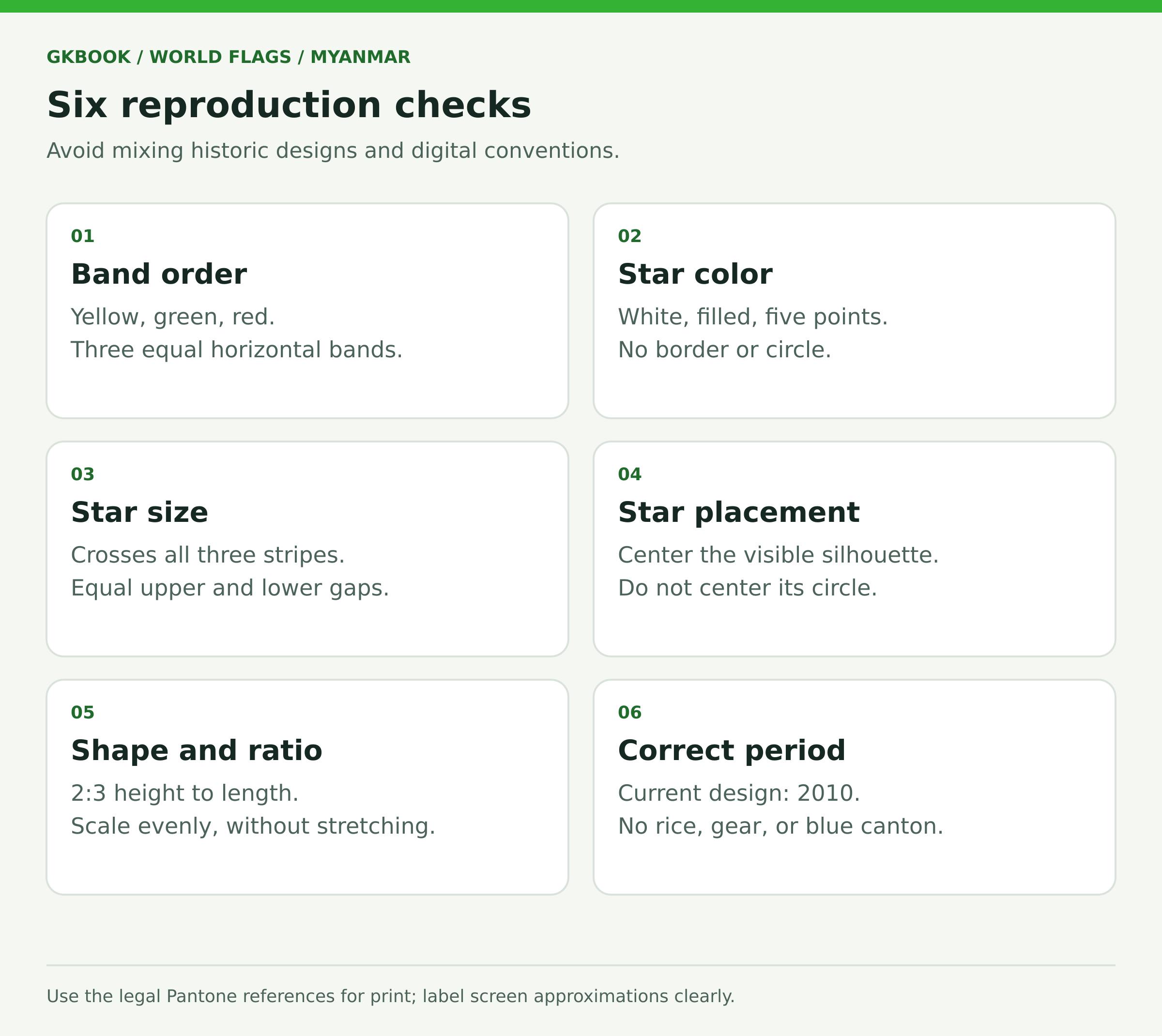
GKBook original diagram based on the Union Flag Law; digital construction notes supplied.Download SVGDownload PNGSix checks cover bands, star, scale, placement, proportions, and historical accuracy.
GKBook original diagram based on the Union Flag Law; digital construction notes supplied.Download SVGDownload PNGFrequently asked questions
What does Myanmar’s national flag look like?
Myanmar’s national flag has three equal horizontal bands of yellow, green, and red, with a large white five-pointed star extending across all three. Adopted on October 21, 2010, it has a height-to-length ratio of 2:3. The star points upward and is centered horizontally, with equal clearances above and below its silhouette.
What are the colors of Myanmar’s flag?
The Myanmar flag has four colors: yellow in the upper band, green in the middle band, red in the lower band, and white in the star. The three bands have equal heights. The 2010 Union Flag Law specifies Pantone references for the colored bands, while the star is white.
What does Myanmar’s flag symbolize?
Myanmar’s flag law gives meanings for each color: yellow expresses unity, wisdom, and happiness; green conveys fertility, fairness, and a peaceful, flourishing country; red represents bravery and decisiveness; and the star’s white signifies purity, honesty, compassion, and power. The three-color background also recalls the country’s struggle for independence.
What does yellow represent on Myanmar’s flag?
Yellow represents unity, harmony among the national races, wisdom, and happiness in the official explanation of Myanmar’s flag. It occupies the entire top third of the field, apart from the white star where that symbol overlaps it. The law names its model color as Pantone 116 PC.
What does green represent on Myanmar’s flag?
Green represents fertility, fairness, and a country that is peaceful, pleasant, and flourishing. The official English explanation also includes conformity. Green forms the middle third of Myanmar’s flag, behind the central part of the white star. Its specified model color in the Union Flag Law is Pantone 361 PC.
What does red represent on Myanmar’s flag?
Red represents bravery and decisiveness under Myanmar’s Union Flag Law. It fills the lower third of the flag, with the two lower points of the white star extending into it. Section 3(d) specifies Pantone 1788 PC for the red band, which should not be confused with the annex’s inconsistent printed label.
What does the white star mean on Myanmar’s flag?
The white star’s color represents purity, honesty, compassion, and power according to the 2010 flag law. It has five points, with one pointing vertically upward. The law requires a single large star across the three bands; it does not assign an individual meaning to each of its five points.
What are the proportions of Myanmar’s flag?
Myanmar’s national flag has a height-to-length ratio of 2:3, equivalent to a length-to-height ratio of 3:2. The law’s model measures 6 feet high and 9 feet long. Each horizontal band is 2 feet high, so all three bands occupy equal thirds of the total height.
How is the white star positioned and measured?
On the law’s 9-by-6-foot model, the star’s upper point lies halfway along the length, 1 foot below the upper edge. Its two lowest points sit 1 foot above the lower edge. The resulting star silhouette is 4 feet high, or two-thirds of the flag’s total height.
Is the star geometrically centered on the flag?
The star is centered horizontally, and its visible top and bottom have equal clearances from the flag’s edges. However, the center of the circle used to construct a regular five-pointed star is slightly below the flag’s horizontal midline. Centering that circle instead would produce unequal top and bottom margins.
What HEX and RGB colors should a digital Myanmar flag use?
This page’s digital artwork uses yellow #FECB00, green #34B233, red #EA2839, and white #FFFFFF. These are explicitly identified screen reference values, not HEX codes enacted by the flag law. The legal text instead specifies Pantone 116 PC, 361 PC, and 1788 PC for the three colored bands.
How can students draw Myanmar’s flag accurately?
Draw a rectangle three units long for every two units high, divide its height into three equal bands, and color them yellow, green, and red from top to bottom. Add one large white five-pointed star, pointing upward, with equal margins above its top and below its two lowest points.
How has Myanmar’s national flag changed over time?
Myanmar’s flag history includes peacock imagery, the yellow-green-red wartime tricolor, a red independence flag with a blue canton and six white stars, and the later red flag with a rice-and-cogwheel emblem surrounded by fourteen stars. The present tricolor with one large white star replaced that last design in October 2010.
When was the current Myanmar flag adopted?
The current Myanmar flag was adopted on October 21, 2010, when the Union Flag Law was enacted and the new design was raised at government offices. Its design had already appeared in the 2008 Constitution. The constitutional description and the later introduction of the flag are therefore distinct milestones.
Was Myanmar’s current flag introduced at independence?
No. Myanmar became independent from Britain on January 4, 1948, but its present yellow-green-red flag with a white star was introduced on October 21, 2010. The independence-era flag was red with a blue canton containing one large white star and five smaller stars. The two dates describe different national milestones.
What did Myanmar’s flags of 1948 and 1974 look like?
The independence-era flag had a red field and a blue upper-hoist canton with one large white star and five smaller stars. The 1974 design retained the red field and blue canton but replaced that arrangement with a rice-and-cogwheel emblem encircled by fourteen white stars. It remained in use until 2010.
Why is the peacock important in Burmese flag history?
The peacock is an important historical Burmese emblem and appeared on earlier flags, including the yellow-green-red design used under the Japanese-sponsored wartime administration. Myanmar’s current national flag does not contain a peacock: it uses a white star. Historical peacock banners and modern political flags should be identified by period and context.
What law defines Myanmar’s flag?
Section 437 of Myanmar’s 2008 Constitution depicts the state flag and provides for legislation concerning it. The Union Flag Law, Law No. 8/2010, supplies the design measurements, color standards, meanings, and rules for use. It was enacted on October 21, 2010 and expressly repealed the 1974 State Flag Law.
Who designed Myanmar’s current flag?
The consulted legal sources identify the authority that enacted Myanmar’s current flag but do not name an individual designer. The 2010 law was issued by the State Peace and Development Council and signed by Than Shwe as chairman. A signature on the law should not be treated as proof of artistic authorship.
Are the Burma flag and Myanmar flag different?
Burma and Myanmar can refer to the same country, so a search for the Burma flag may return the current Myanmar flag. However, the phrase can also refer to historical designs. Always check the date: the present tricolor dates from 2010, whereas earlier red flags used a blue canton.
How is Myanmar’s flag different from similar tricolors?
Myanmar is identified by horizontal yellow, green, and red bands with one large white star crossing all three. A matching color palette alone is not enough to identify a flag. Check the band order, orientation, central symbol, and proportions together, particularly when a small image makes details difficult to see.
Does the reverse side of Myanmar’s flag look different?
The current design has no lettering or asymmetrical emblem, so its reverse shows the same yellow-green-red bands and white star when viewed normally from the other side. The pole changes sides in the viewer’s perspective, but a horizontal mirror image does not change the appearance of the symmetrical flag design.
How should Myanmar’s flag be shown vertically?
The law’s construction model shows Myanmar’s flag horizontally. For a formal vertical display, use the applicable event or official protocol rather than inventing a new upright-star design. A documented London 2012 Olympic convention rotated the complete horizontal flag ninety degrees counterclockwise; that event convention should not be mistaken for a universal legal rule.
What display rules appear in Myanmar’s flag law?
The 2010 Union Flag Law covers official hoisting days, designated occasions, international use, and respectful condition. It calls for an upright flag without faded colors, torn cloth, or broken stitching. It also prohibits alterations and specified disrespectful uses, including allowing the flag to touch the ground or water during handling.
When may Myanmar’s flag be flown at half-mast?
Section 14(a) of the 2010 Union Flag Law prohibits flying the Union flag at half-mast without a government order. Half-mast display should therefore be tied to an authorized mourning instruction, not assumed for every death or anniversary. The law’s cited provision does not specify one universal numerical position on every pole.
Can Myanmar’s flag be altered or used as a logo?
The 2010 flag law restricts marking or changing the Union flag and certain commercial or decorative uses. Section 15 addresses trademarks, clothing images, and decoration, with an exception framed around representing the Union or entire nation. A downloadable illustration does not itself grant legal permission for every intended use of the national flag.
What sizes preserve the correct Myanmar flag ratio?
Any size that preserves two units of height for three units of length keeps Myanmar’s required proportions. Examples include 20 by 30 centimeters, 60 by 90 centimeters, and 100 by 150 centimeters. The star and bands must scale together; resizing only the outer rectangle would distort the prescribed design.
What are common mistakes when drawing Myanmar’s flag?
Common errors include reversing the yellow-green-red order, making the star too small, using a yellow star, adding a blue canton, or centering the star’s construction circle instead of its visible silhouette. Another mistake is presenting an RGB approximation as a legal color standard. The official model and clearly labeled diagrams prevent these confusions.
Which Myanmar flag image format should I download?
Choose SVG for scalable artwork, precise outlines, and print preparation, or PNG for a ready-to-use raster image in documents and slides. Both versions here use the same underlying construction and palette. Preserve the complete rectangle, keep its proportions, and use the explanatory diagrams separately from the plain national flag.
What are the key facts to remember about Myanmar’s flag?
Remember yellow, green, and red from top to bottom; one large white five-pointed star; a 2:3 height-to-length ratio; and adoption on October 21, 2010. Myanmar’s independence date is January 4, 1948. The law supplies specific meanings and Pantone colors, while digital reproductions require clearly identified drawing and color choices.
Explore all general-knowledge topics and the A-to-Z lists.









We Value Your Opinion Comments