
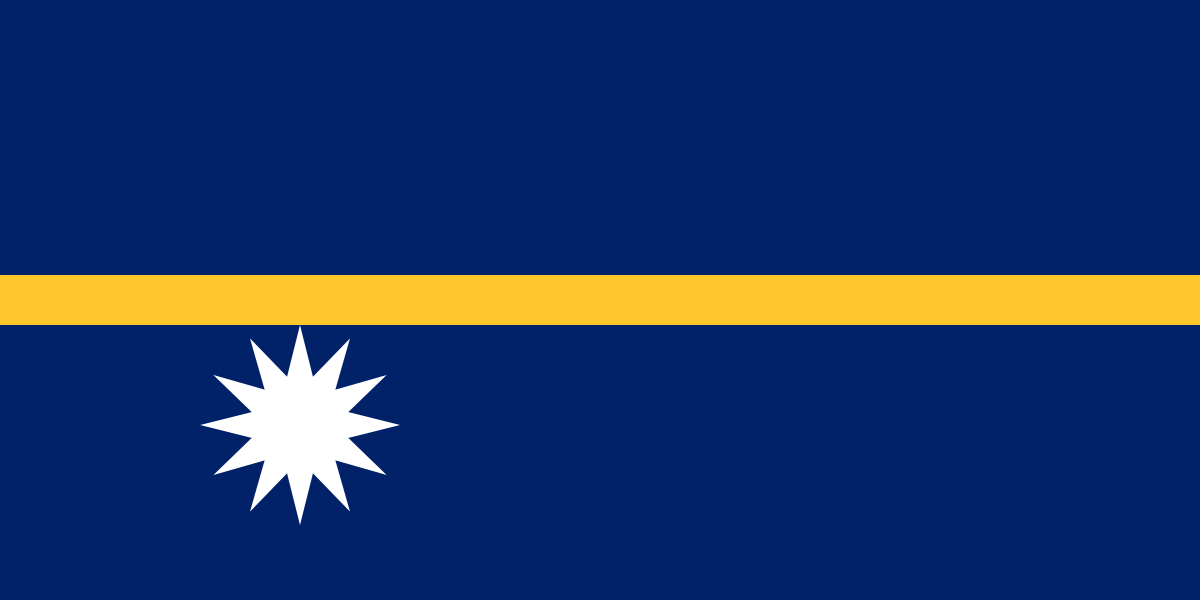
Nauru flag picture
Explore the construction drawing, history, and picture gallery.
| Design | Equator stripe and twelve-pointed starDark blue, yellow / gold, and white. |
|---|---|
| Proportions | 1:2 height:lengthLength is twice the height. |
| Adoption | January 31, 1968Introduced at independence. |
| Current country name | Republic of NaoeroOfficial designation confirmed in 2026. |
| Legal description | 2018 Act, section 13 and Schedule 3Current consolidated wording uses Naoero. |
| Star | Twelve original tribesAlso marks the island south of the equator. |
What does Nauru’s national flag look like?
Nauru’s national flag has a dark blue field, a narrow yellow horizontal band across the center, and a white twelve-pointed star below the band near the hoist. Its proportions are 1:2. Adopted at independence on January 31, 1968, the design continues under the country’s current name, Naoero.
The country’s current official name is Naoero. The pictures below explain its flag’s proportions, geographic symbolism, and history. The text distinguishes the statutory description from measured construction conventions and digital color choices.
Is Nauru now called Naoero?
Yes. The government confirmed the official designation Republic of Naoero in 2026, restoring the traditional name in international usage. The national flag retains its blue field, yellow equatorial band, and white twelve-pointed star. Nauru remains a familiar historical and search name for this same country and flag.

The government’s August 2026 bulletin explains the change to Naoero and the notifications to other countries and international organizations. The updated flag legislation also uses Naoero. A change of country name should not be confused with adoption of a new flag design.
This article uses Nauru in its title to connect familiar references with the current name. The flag’s introduction still belongs to 1968; 2026 belongs to the country-name chronology.
What colors are on the Nauru flag?
The Nauru flag uses dark blue, yellow or gold, and white. Blue covers most of the rectangle, yellow forms the narrow central band, and white fills the twelve-pointed star. The legal description names blue, yellow, and white without prescribing hexadecimal values or a numerical digital color standard.

The government’s flag explanation calls the field navy blue. Its media fact sheet describes the stripe as gold, while the statutory schedule uses yellow. These descriptions refer to the same horizontal element.
The downloadable artwork uses a consistent screen palette. Its numeric values are reproduction choices, not colors enacted in the flag law.
What does the Nauru flag symbolize?
The flag combines geography and cultural identity. Its blue field represents the Pacific Ocean, its yellow band represents the equator, and its white star marks the island south of that line. The star’s twelve points represent the twelve original tribes, bringing the country’s location and people into one design.

The symbolism can be read as a simplified geographic diagram: ocean, equator, then island. The twelve-pointed outline adds a second meaning, so the star represents both the island and its traditional tribal communities.
The statutory explanation provides this core interpretation. It does not turn the flag into a map at a fixed scale or assign named tribes to particular compass positions around the star.
Why is the Nauru flag blue?
Blue represents the Pacific Ocean surrounding Nauru. The same blue appears above and below the yellow band, forming two equally high blue areas. This makes the ocean the background for the equator and island symbols, rather than a separate emblem confined to one part of the flag.
Both the official flag explanation and Schedule 3 connect blue with the ocean. The field is not a picture of an island coastline, a reef, or a particular ocean current.
Descriptions such as navy blue and dark blue are useful for recognition. For physical production, a color-controlled sample is more dependable than a color name alone.
What does the yellow stripe represent?
The yellow stripe represents the equator. It runs horizontally across the middle of the blue field and is much narrower than either blue portion. The white star sits below it because Nauru lies south of the equator. Gold is another description used for the stripe in official explanatory material.
The band crosses the entire flag from hoist to fly. It is centered vertically, so the blue field above it and the blue field below it have equal height.
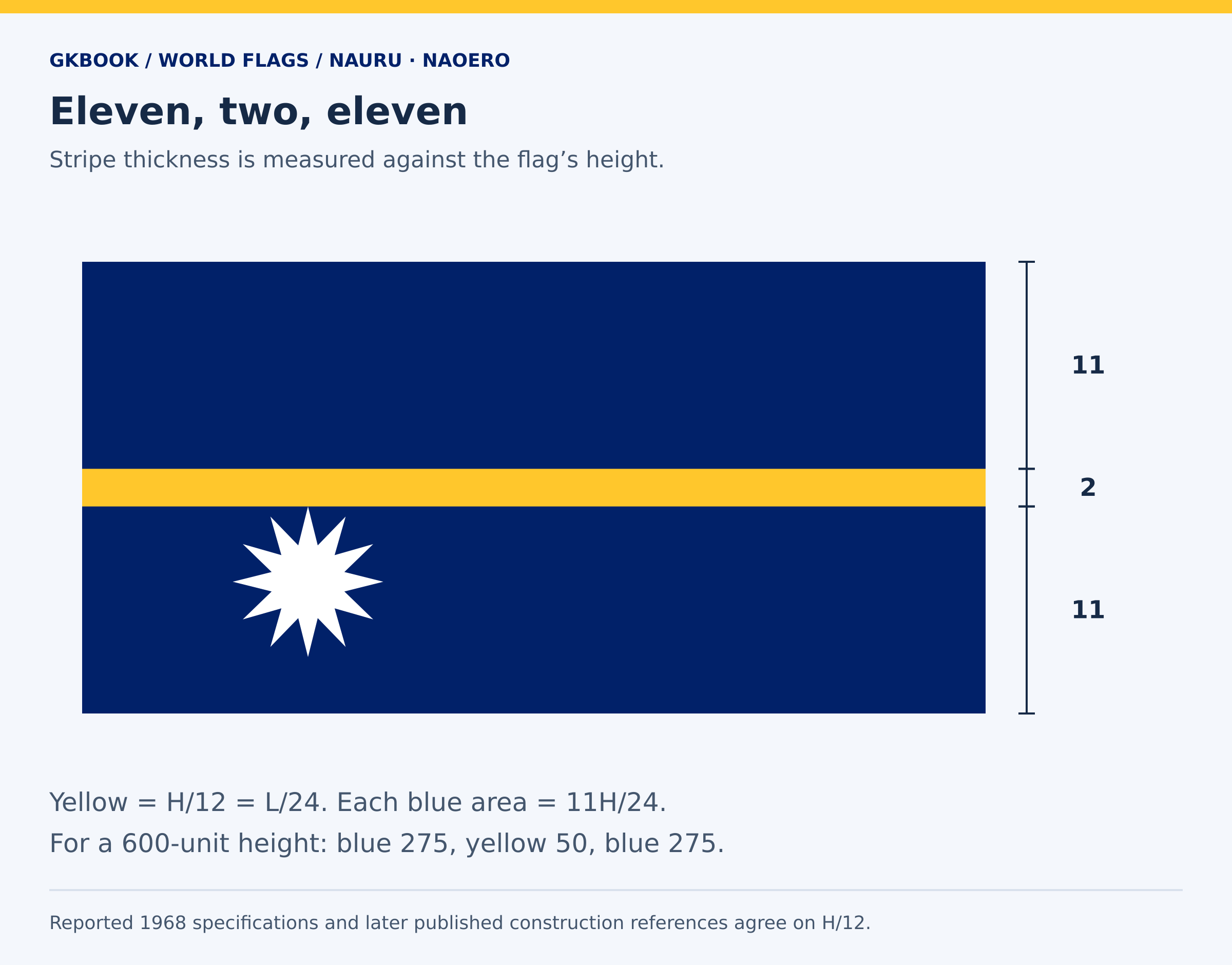
Its narrowness matters: enlarging the stripe into one of three equal bands would change the design. The measured construction uses a stripe one-twelfth of the flag’s height.
Why does the Nauru flag have a twelve-pointed star?
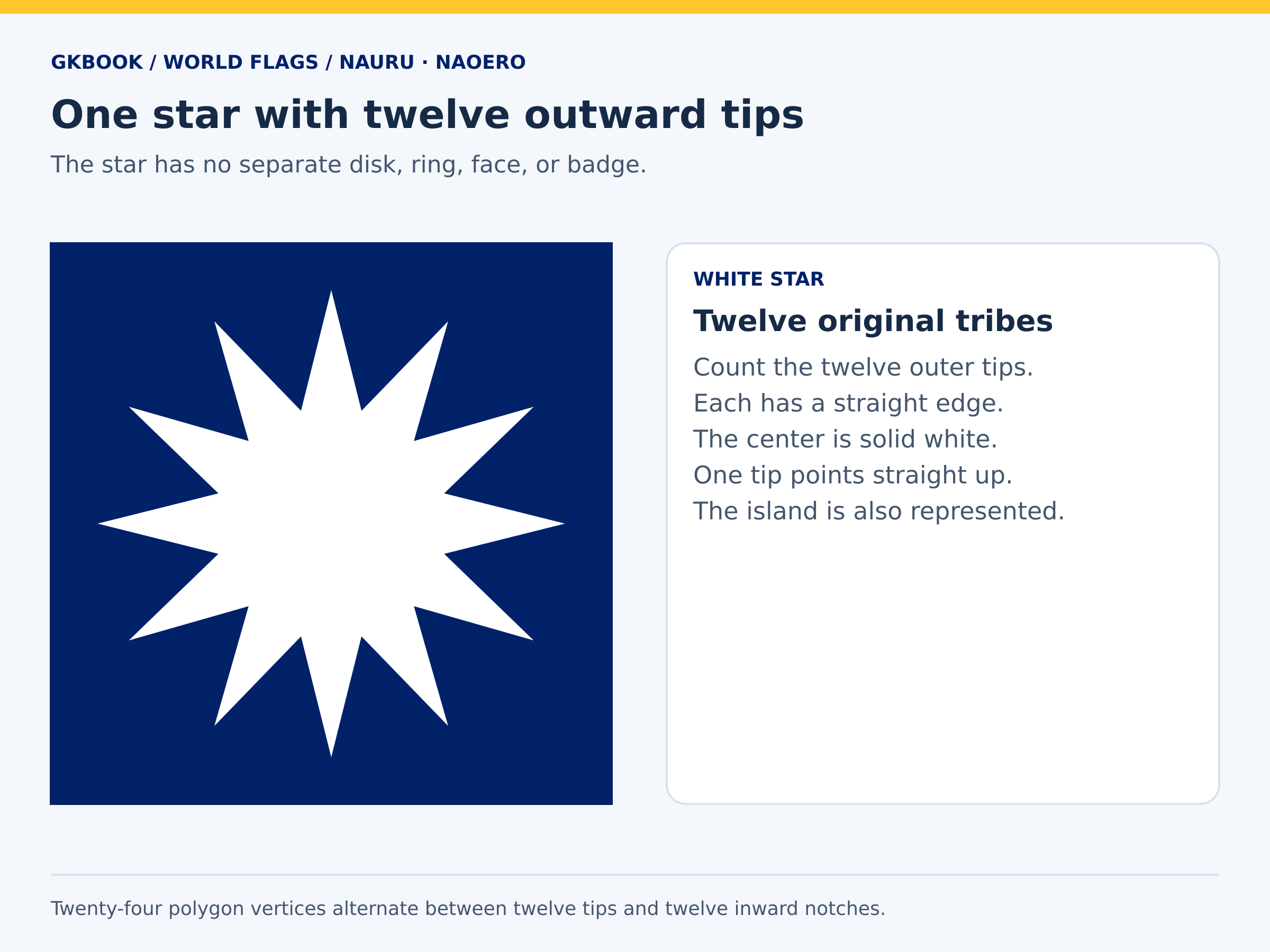
The white star represents Nauru, and its twelve points represent the twelve original tribes. It belongs below the equatorial stripe on the hoist side. The points are straight and evenly spaced in the conventional drawing, producing a single twelve-pointed star rather than twelve separate stars arranged in a group.

Count the twelve outward tips, not the twenty-four alternating corners of the polygon. Each outward tip is separated from the next by an inward notch.
The star has no face, central colored disk, outline, or additional badge. Adding any of those would change the national design.
Which twelve tribes are represented by the star?
The government lists the twelve tribes as Eamwit, Eamwitmwit, Eaoru, Eamwidara, Iruwa, Eano, Iwi, Irutsi, Deiboe, Ranibok, Emea, and Emangum. The star commemorates all twelve original tribes. Government accounts identify Iwi and Irutsi as extinct tribal lineages, but their places remain in the flag’s symbolism.
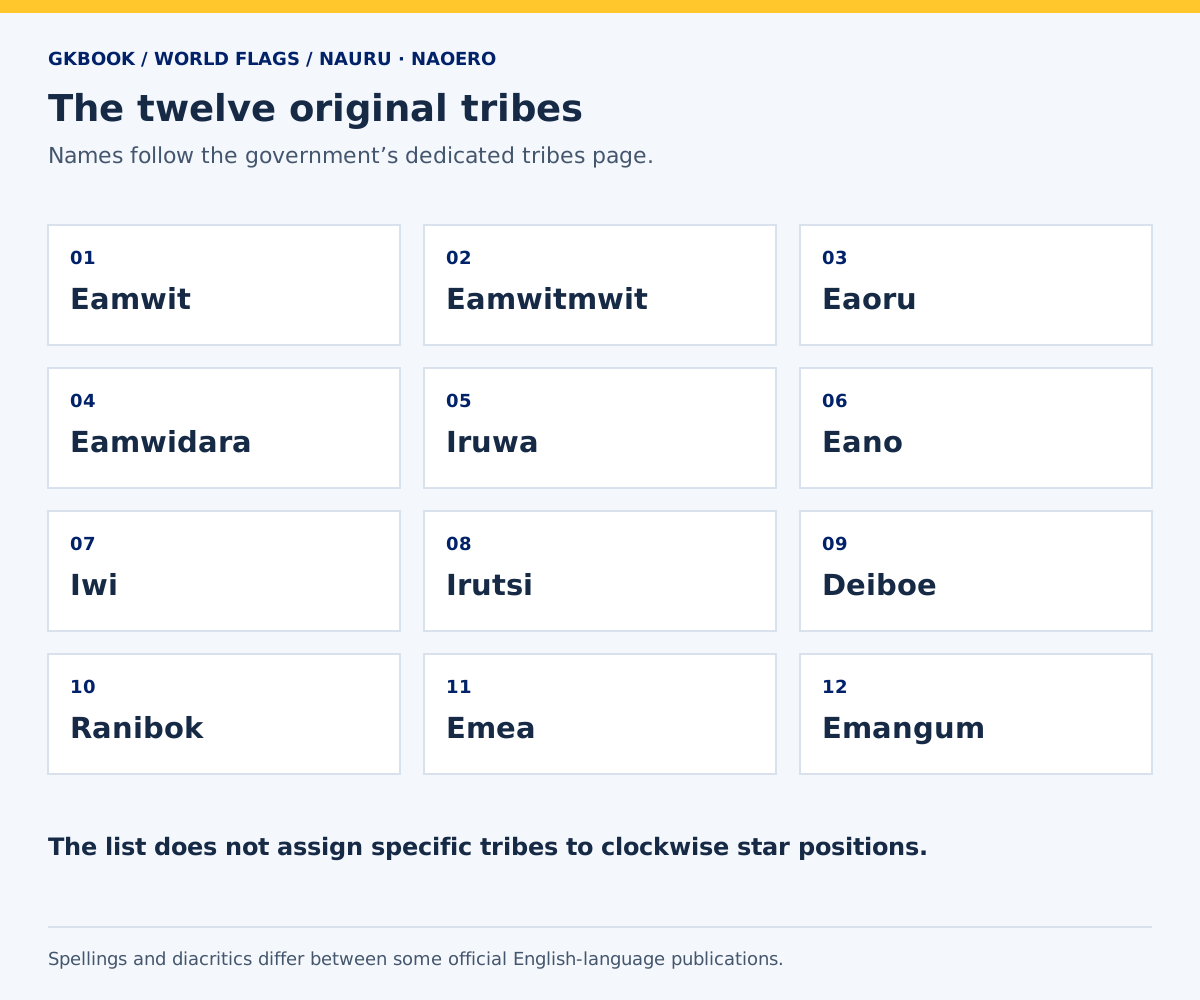
Spellings and diacritics vary between official English-language pages and cultural reports. The names here follow the government’s dedicated tribes page; its 2020 bulletin uses some accented forms.
The flag does not label individual rays. The list below identifies the represented communities without inventing a clockwise assignment of names to points.
| Group in this table | Tribal names |
|---|---|
| 1–3 | Eamwit; Eamwitmwit; Eaoru |
| 4–6 | Eamwidara; Iruwa; Eano |
| 7–9 | Iwi; Irutsi; Deiboe |
| 10–12 | Ranibok; Emea; Emangum |
Does the white star represent phosphate?
Some reference accounts connect the star’s white color with phosphate, a resource central to Nauru’s economic history. The statutory flag explanation instead explicitly identifies the star with the island’s position and its twelve original tribes. The phosphate interpretation should therefore be distinguished from the meanings actually stated in the law.
The phosphate explanation appears in historical World Factbook descriptions and other reference works. It is a supplementary interpretation, not wording found in Schedule 3 of the flag legislation.
For a concise official explanation, use the island-and-tribes meaning. Do not replace that explanation with phosphate alone.
How does the flag show Nauru’s location?
The flag places the island’s white star below the yellow equator against the blue Pacific Ocean. The government describes Nauru as about 42 kilometers south of the equator. The design communicates that relationship symbolically; the star’s distance from the band is not a geographic scale or an exact latitude measurement.

Some reference accounts use “one degree south,” while others give different approximate distances. None of those numbers is encoded as a scale in the flag. The essential relationship is that the island lies just south of the equator.
The star is also offset toward the hoist. This placement is a design feature; the flag supplies no longitude grid or scale from which a viewer could calculate the island’s position.
What are the proportions of the Nauru flag?
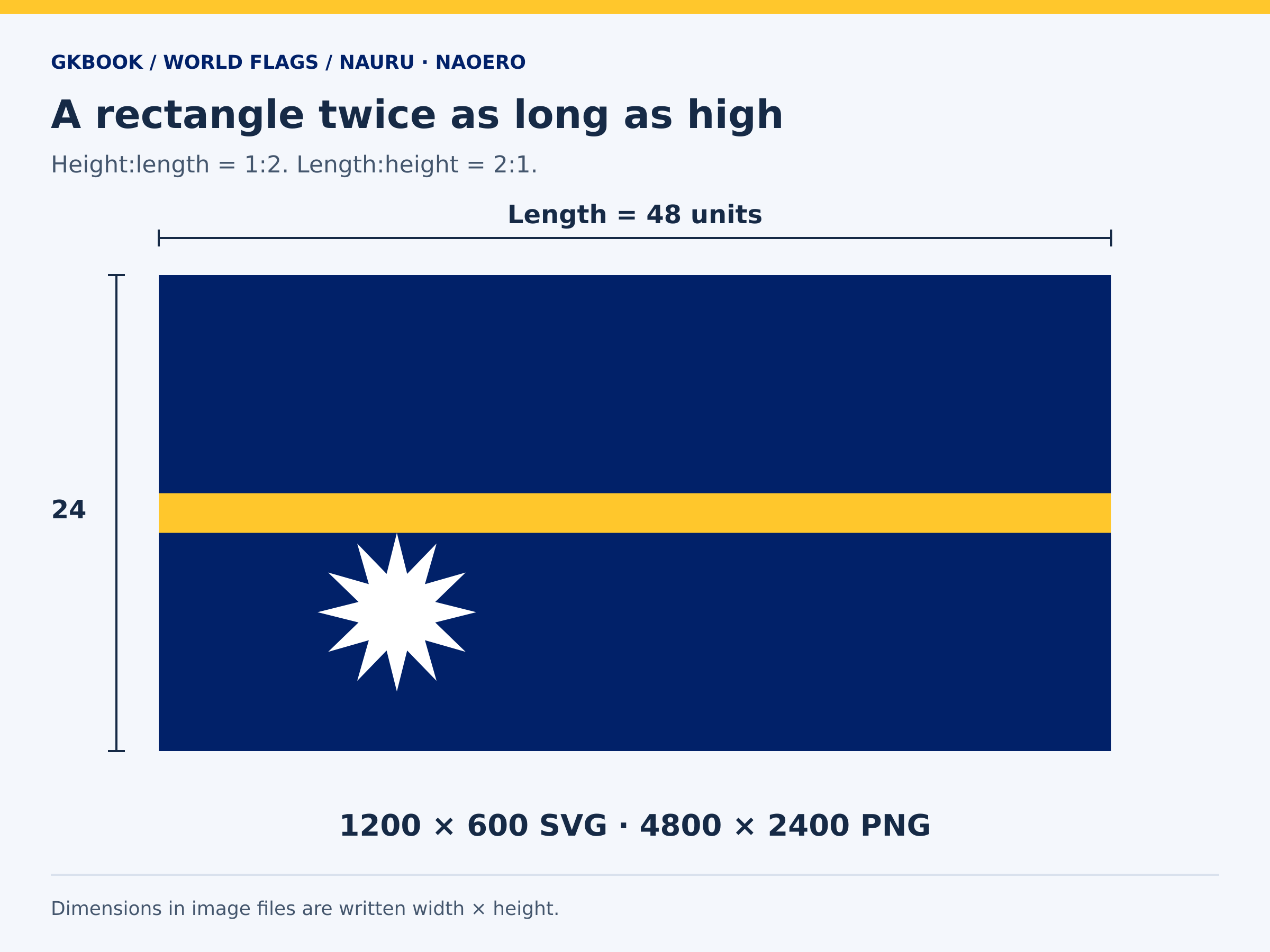
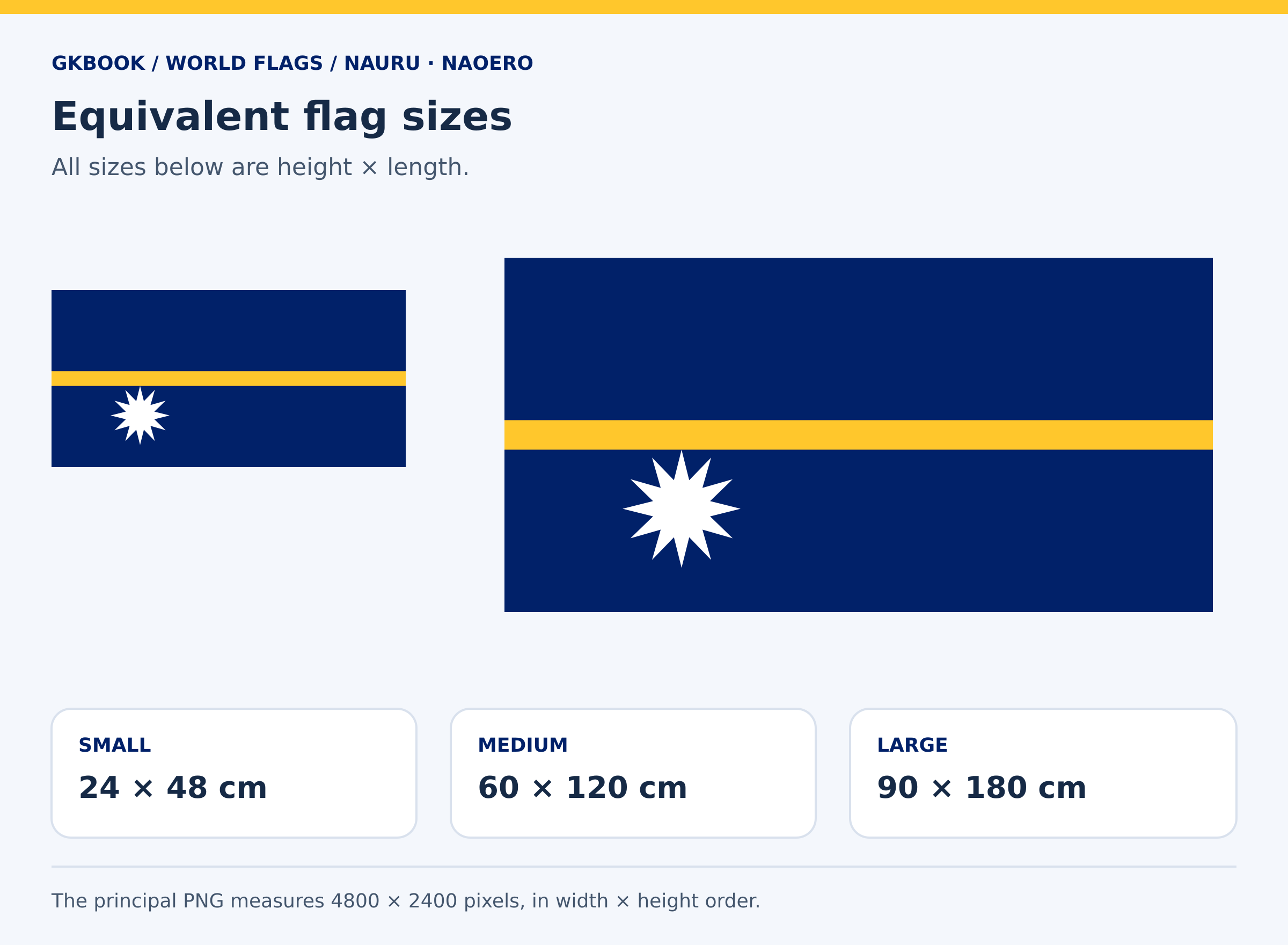
The flag’s height-to-length ratio is 1:2, so its length is twice its height. The same shape is described as 2:1 when length is stated first. A flag 60 centimeters high is therefore 120 centimeters long, and every stripe and star dimension must scale with that rectangle.

The reported May 31, 1968 specifications explicitly identify the long dimension as the fly and the short dimension as the hoist. The 1:2 convention used in this article states height first.
A size written without its dimension order can be misleading. The supplied SVG is 1200 pixels wide by 600 pixels high; the main PNG is 4800 pixels wide by 2400 pixels high.
| Height | Length | Yellow band thickness |
|---|---|---|
| 24 cm | 48 cm | 2 cm |
| 60 cm | 120 cm | 5 cm |
| 90 cm | 180 cm | 7.5 cm |
How wide is the yellow band?
In the documented construction, the yellow band is one-twelfth of the flag’s height, equivalent to one-twenty-fourth of its length. Each blue portion is eleven twenty-fourths of the height. On a 48-by-24 grid, the horizontal layers measure 11 units blue, 2 units yellow, and 11 units blue.

The denominator refers to the hoist, meaning the height of the flag. Calling the stripe one-twelfth of the length would double its correct thickness.
For the 1200-by-600 master, yellow extends from y = 275 to y = 325. Coordinates start at the upper-left corner. The two blue areas are each 275 units high.
Where exactly is the white star placed?
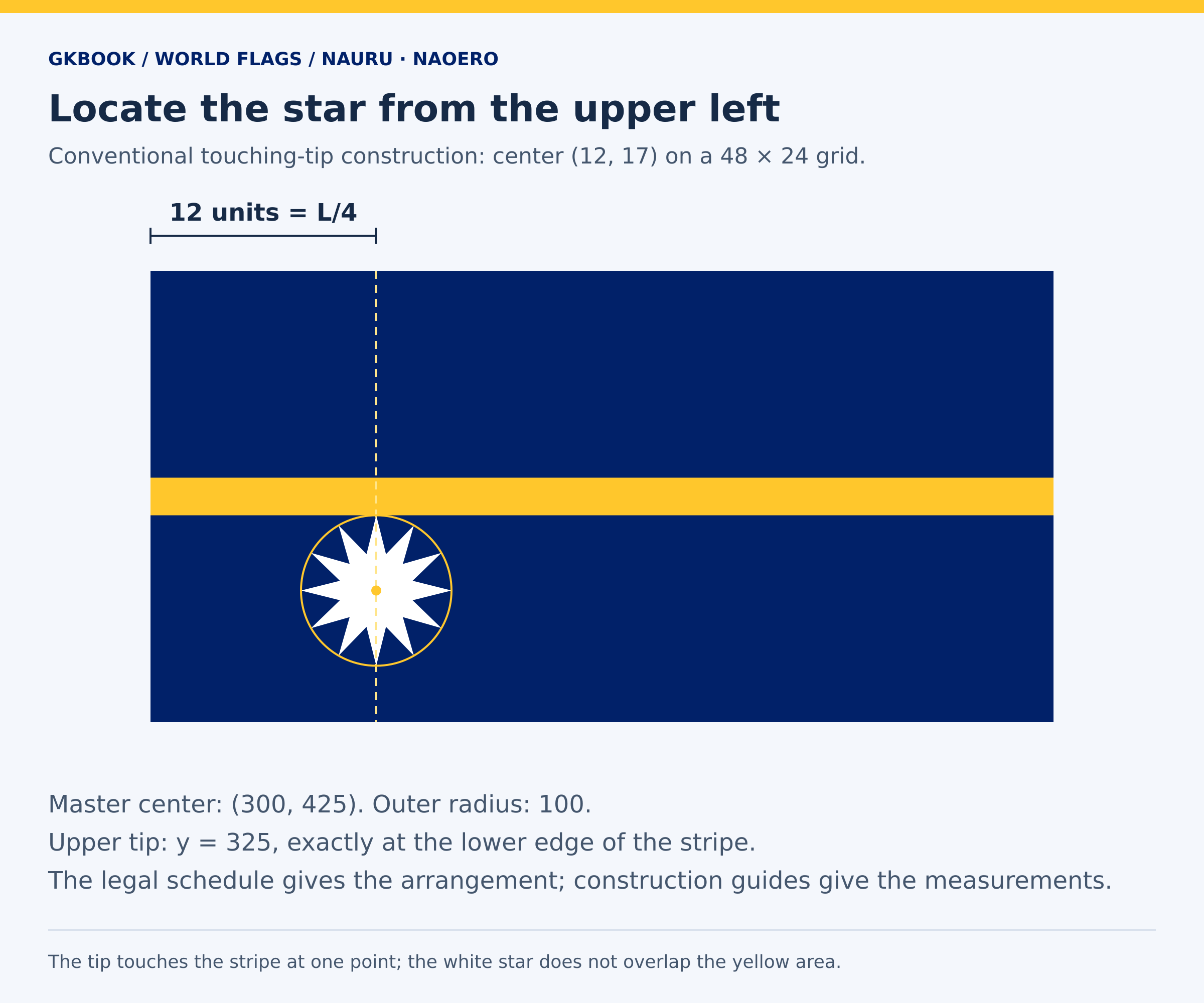
The star’s center is one-quarter of the flag’s length from the hoist. This artwork follows the published construction in which its upper tip touches the lower edge of the yellow band. With an outer diameter of one-third of the flag’s height, the center lies seventeen twenty-fourths of the height below the top.
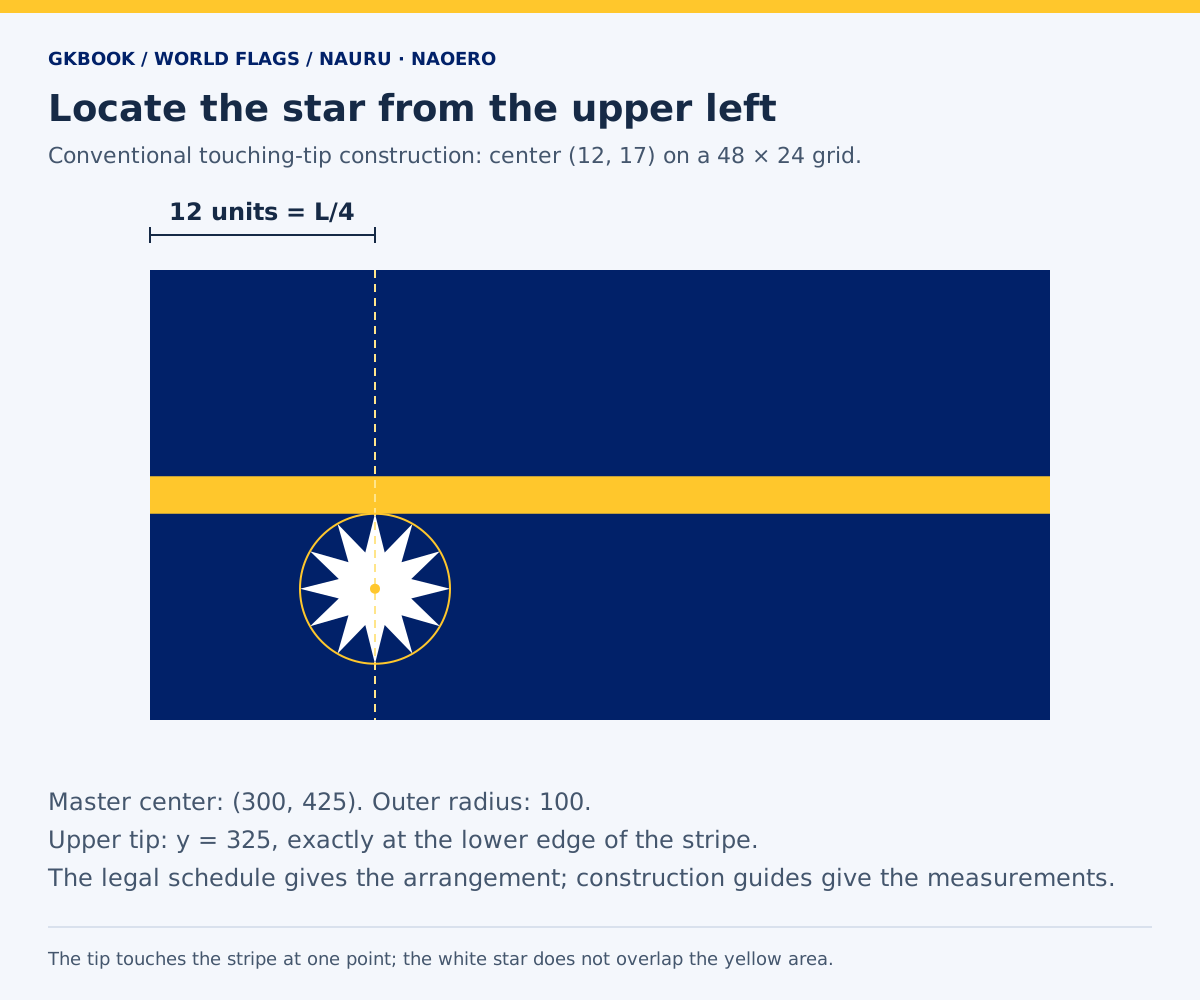
For the 1200-by-600 drawing, the center is (300, 425), the outer radius is 100, and the highest point is at y = 325. The lowest point is at y = 525, leaving 75 units of blue below it.
Schedule 3 specifies a star below the stripe on the hoist side and illustrates the design. It does not provide a numerical vertical coordinate. The touching-tip construction is documented in specialist construction references and is consistent with the statutory illustration.
How is the twelve-pointed star constructed?
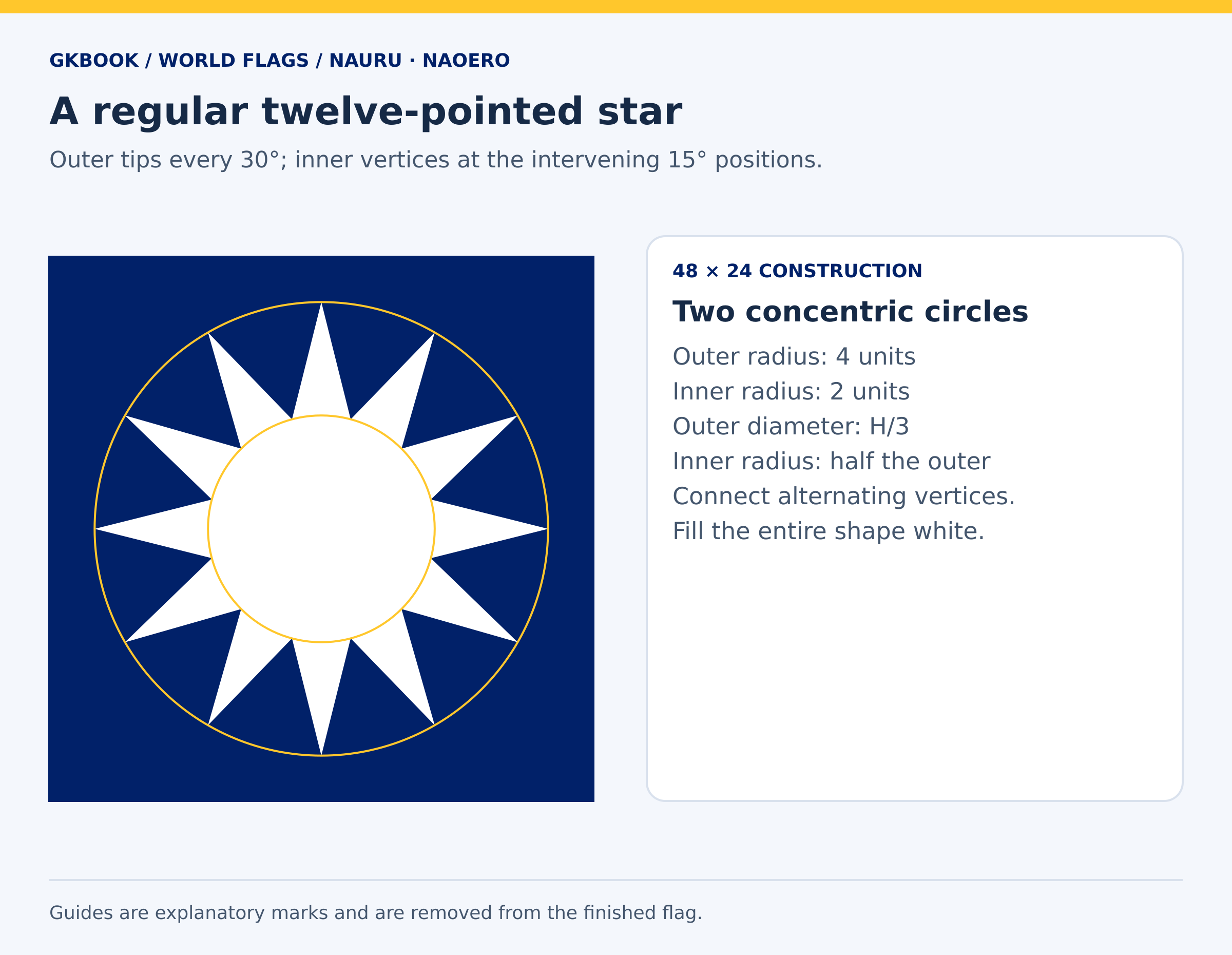
Draw twelve outer points at equal thirty-degree intervals, with one point facing upward. Alternate them with twelve inner points halfway between those angles. In the construction used here, the inner radius is half the outer radius, and the outer diameter is one-third of the flag’s height.

Connect the twenty-four alternating vertices in order. This creates straight triangular points and an uninterrupted white center. The inner points fall at fifteen-degree offsets from neighboring outer points.
On the 48-by-24 grid, the outer diameter is 8 units and the inner diameter is 4. These are conventional construction dimensions; the statutory description itself specifies the twelve-pointed form without listing all these measurements.
What are the flag’s HEX, RGB, and Pantone colors?
The supplied screen artwork uses blue #012169, yellow #FFC72C, and white #FFFFFF. Specialist references commonly report Pantone 280 C and 123 C for blue and yellow. These references should not be confused with statutory RGB values: the flag schedule names the colors but does not prescribe numerical color codes.
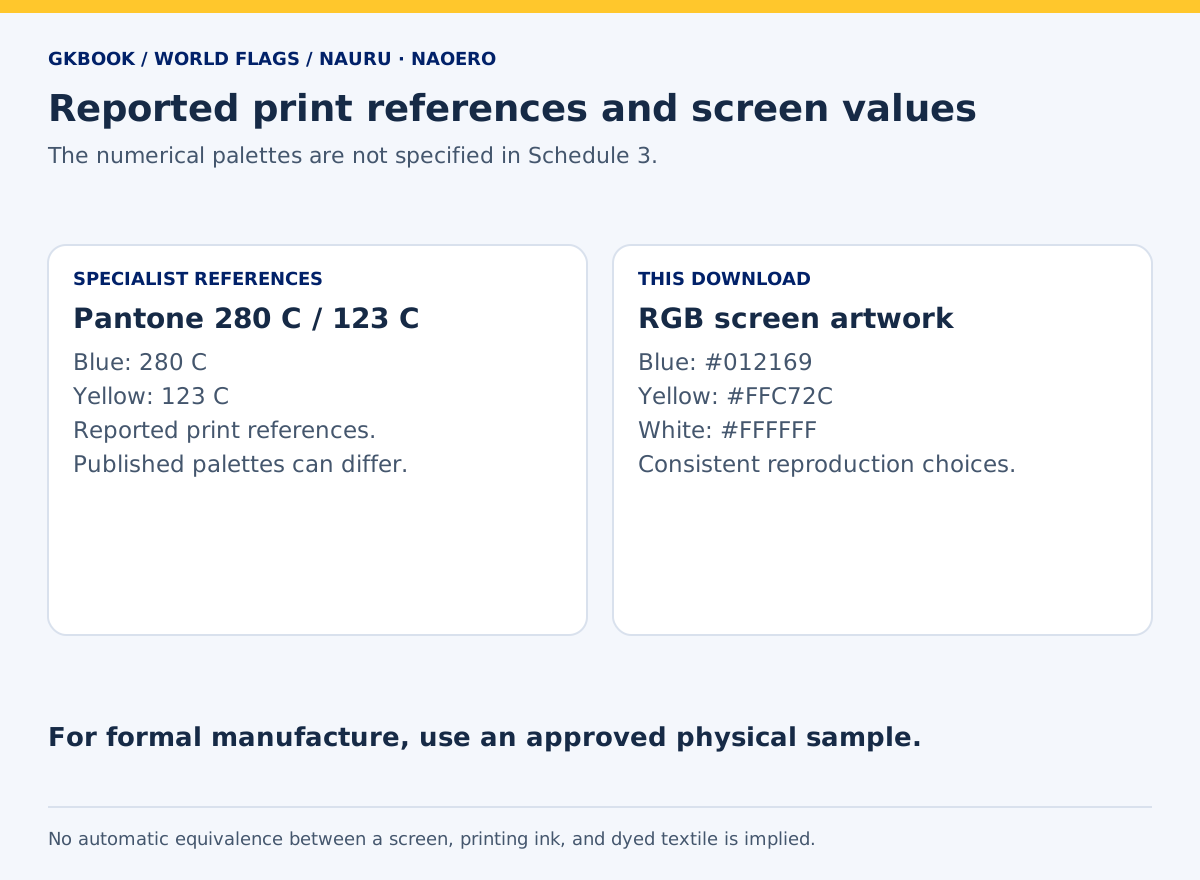
The RGB values below define this download consistently. They are not a guarantee that every monitor, printer, ink, or cloth will reproduce a physical Pantone sample identically.
Published event manuals and flag references have used differing numerical palettes. Use an approved physical reference for formal manufacture, and identify any digital palette as an approximation.
| Color | HEX | RGB | Reported Pantone reference |
|---|---|---|---|
| Blue | #012169 | 1, 33, 105 | 280 C |
| Yellow / gold | #FFC72C | 255, 199, 44 | 123 C |
| White | #FFFFFF | 255, 255, 255 | White; no number specified here |
When was the Nauru flag adopted?
Nauru adopted its national flag on January 31, 1968, when the country became independent. A later specification document is reported as dated May 31, 1968. The national-symbols protection law commenced in 2018. These dates concern introduction, construction documentation, and legal protection respectively, rather than three different flag adoptions.

The independence-era flag is documented in institutional accounts and photographs. ICAO’s historical description identifies the flag as chosen through a local competition and first raised at independence.
The later legal framework describes and protects the national symbol. It should not be used to replace the independence date in a flag-adoption table.
| Date | Event |
|---|---|
| January 31, 1968 | Adoption and first raising at independence |
| May 31, 1968 | Date of specifications reported by a specialist source |
| January 26, 2018 | Protection Act commenced |
| March 18, 2019 | Approval regulations commenced |
| 2026 | Naoero name incorporated in updated official records |
Who designed the Nauru flag?
The flag is documented as the result of a local design competition before its introduction at independence. The official and institutional accounts examined do not establish a named individual as its sole designer. Reports linking its preparation to the Australian manufacturer Evans should not be converted into an unsupported personal attribution.
A competition, a winning idea, and the technical preparation of a usable flag can involve different people. The available record supports the competition more clearly than a specific individual credit.
The independence photograph shows national and trustee representatives with the new flag. Presence at that presentation is not evidence that any one of them drew the design.
What is the flag’s pre-independence context?
Before independence, Nauru was a United Nations trust territory administered by Australia on behalf of Australia, New Zealand, and the United Kingdom. Its 1968 flag belongs to the independent republic. Flags of administering powers, local proposals, and official service flags should be identified separately from that national design.

The United Nations records the trusteeship arrangement and the territory’s transition to independence in 1968. This political history explains why the introduction of a national flag was an important independence event.
Some flag histories also describe a proposed local distinguishing flag in the 1920s. A proposal is not proof of adoption or ordinary use. The historical illustration here uses labeled text rather than presenting an uncertain design as a former national flag.
Which law defines and protects the national flag?
The Naoero National Anthem, Emblem and Flag Protection Act 2018 defines the flag through section 13 and Schedule 3. It also addresses display, ceremony, mourning, commercial use, and disposal. The consolidated text incorporates later amendments and the Naoero name, while retaining the familiar three-color design and twelve-pointed star.
Schedule 3 describes equal blue portions above and below a yellow central stripe, with a white twelve-pointed star below the stripe near the hoist. It also states the ocean, equator, location, and tribal meanings.
The 2019 regulations provide application forms, approval procedures, and a register for authorized uses. The law’s original commencement in 2018 is separate from the flag’s introduction fifty years earlier.
Has the flag changed since independence?
The basic national design introduced in 1968 remains the design in the current statutory schedule: blue, a central yellow stripe, and a white twelve-pointed star near the lower hoist. Later legislation and the adoption of Naoero as the official country name should not be described as replacements of that flag.

Variations in digital blue, stripe thickness, or star drawing can occur between reproductions. Such differences alone do not establish that a new national design was adopted.
The flag carries no written country name, so changing official references from Nauru to Naoero does not require replacing lettering on the flag. The national emblem is a separate symbol and does include a name ribbon.
Where may the Nauru flag be displayed?
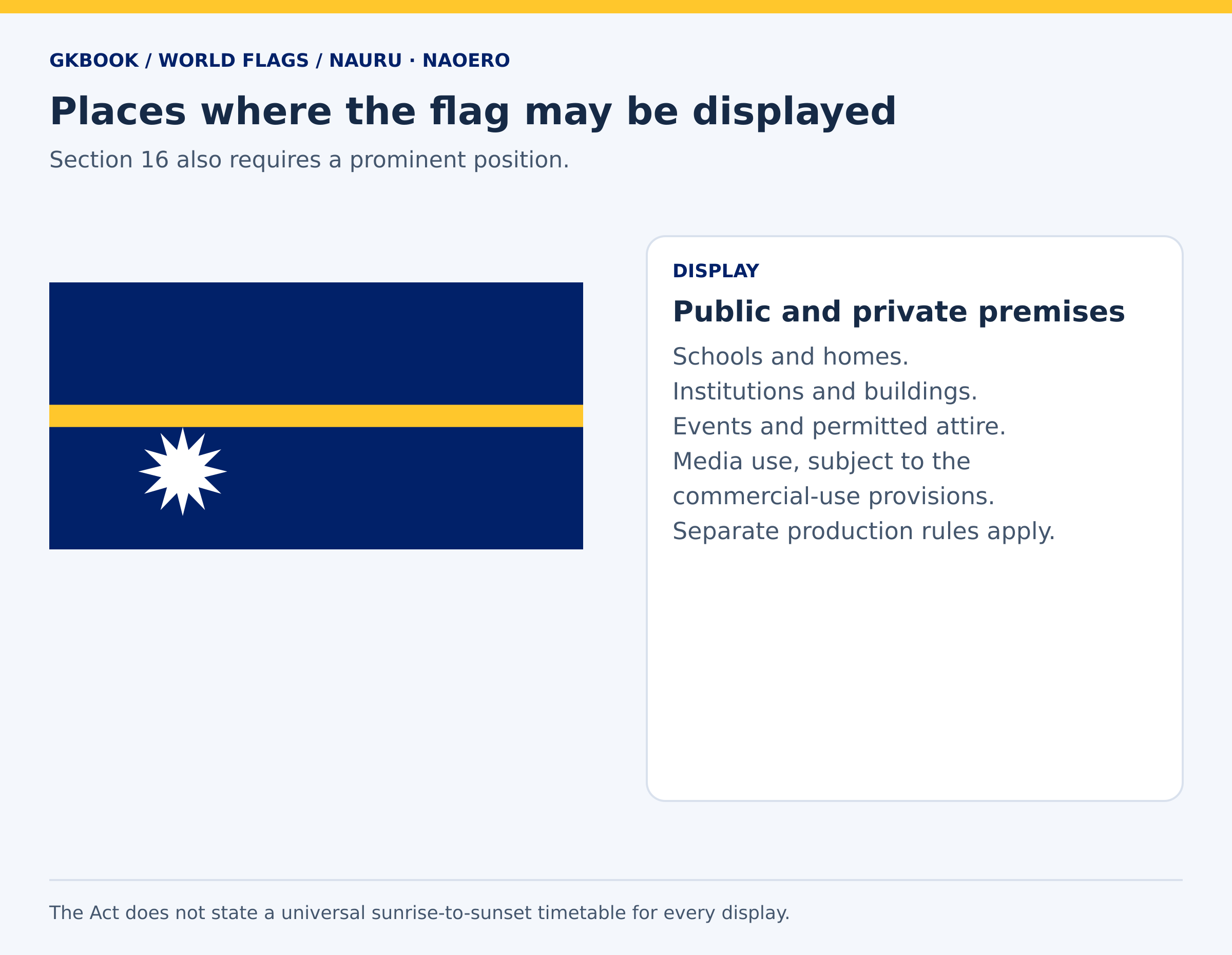
Section 16 permits the flag to be displayed at places including schools, homes, institutions, buildings, and events. Whether on public or private premises, it must occupy a prominent position. The section also permits use in national sporting or entertainment attire, while other provisions regulate production and commercial uses.

The distinction between wearing a flag at an event and producing flag merchandise matters. Permission for one form of display should not be read as an unlimited commercial license.
The inspected Act does not provide a universal sunrise-to-sunset timetable for all flags. Follow the applicable event or official instructions rather than importing another country’s timetable.
What should people do when the flag is raised or lowered?
Section 15 requires people in a public place or area where the flag is being raised or lowered to stand still until the ceremony is complete. It also requires drivers in or entering that area to keep their vehicles stationary during the raising or lowering of the flag.
This provision concerns the place where the ceremony occurs. It should be explained in that context, without inventing a nationwide traffic-stopping rule whenever any flag is handled.
Section 14 separately states the general duty to respect the flag. The ceremonial rule and the broader respect provision are related but distinct.
When is the Nauru flag flown at half-mast?
Section 17 provides for half-mast display as a token of mourning for the funerals of the President, a Cabinet Minister, and other people approved by the Minister. In this Act, Minister means the President. Actual mourning dates and operational instructions should come from the relevant official announcement.
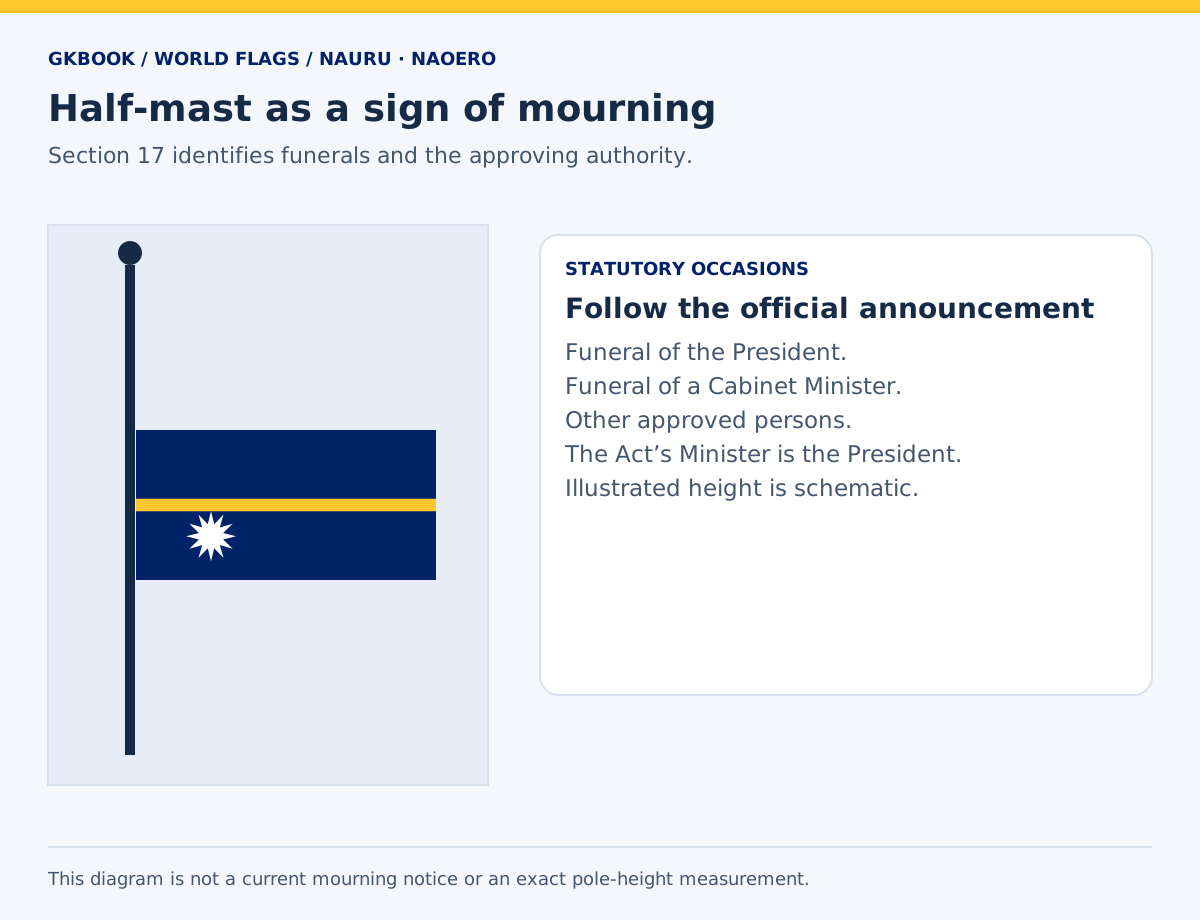
The law identifies the occasions and authority. It does not define half-mast as an exact percentage of a pole’s height or establish a permanent mourning calendar.
The illustration shows a lowered position schematically. It is not an instruction that a current mourning period is in force.
Can the flag be used on merchandise or in advertising?
Sections 20 and 21 require prior written ministerial approval for specified commercial uses and production involving the flag or its parts. These provisions cover advertising, logos, trademarks, and depiction on merchandise or other items. An available image file does not itself supply that approval or settle the applicable legal requirements.
The 2019 regulations establish an application and approval process. This article summarizes the flag provisions; it does not grant an authorization or determine how they apply to a particular product.
Section 22 also prohibits use as a political party or candidate logo during a national election campaign. Image ownership and national-symbol restrictions are separate questions.
How does the law address worn or damaged flags?
Section 23 addresses a flag that is no longer fit for use or display. It provides for dignified disposal by burning in private after Cabinet approval has been granted. This is a specific legal disposal procedure and should be distinguished from public destruction or other conduct covered by the Act’s separate prohibitions.
A worn flag should not be treated as an invitation to improvise a public disposal ceremony. The provision expressly includes approval and privacy as part of the process.
The relevant authority should supply instructions for an actual disposal. The article’s explanation is a description of the statutory rule, not an approval to carry it out.
What does the reverse side of the flag look like?
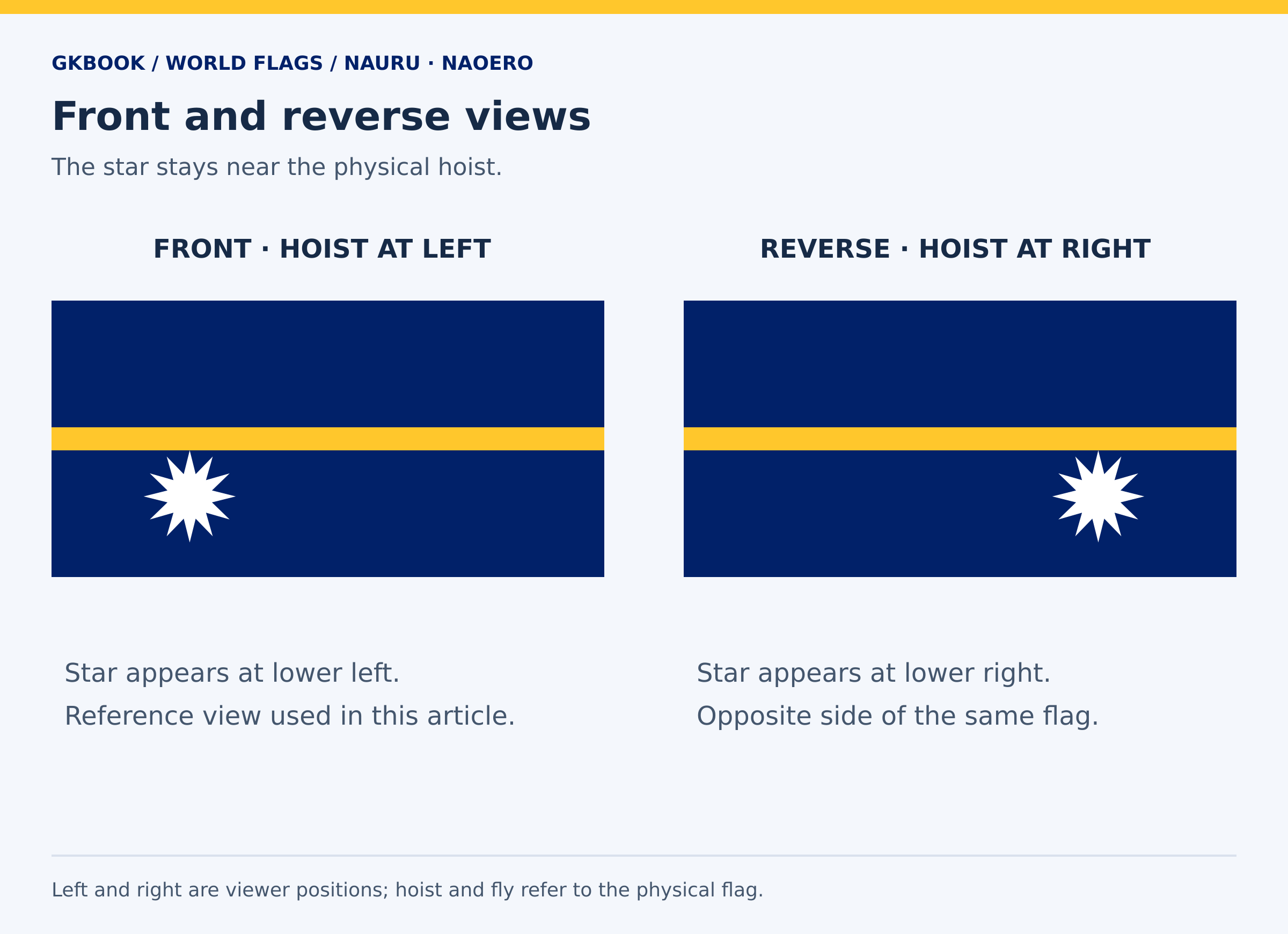
Viewed from the opposite side of an ordinary flag, the design appears horizontally mirrored. The star is below the stripe near the viewer’s right, because the hoist is now on that side. The yellow band remains horizontal and centered; this reversed view is not a separate national flag design.
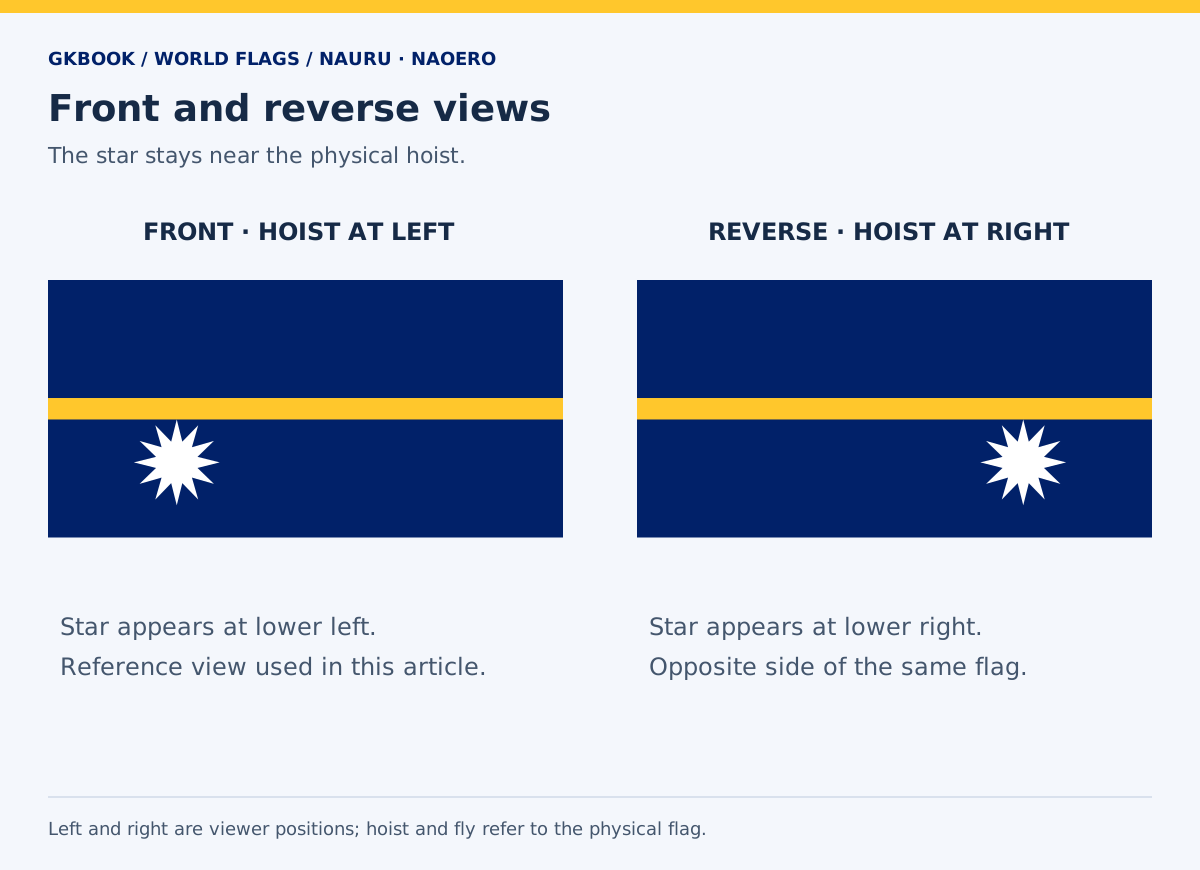
A standard reference picture shows the flag’s front with the hoist at the left. The reverse illustration changes the viewing direction while retaining the star’s relationship to the physical hoist.
Do not move the star to the fly edge when sewing or displaying a flag. Apparent left and right depend on which side the viewer faces.
How can the flag be shown vertically?
A reported London 2012 event convention turns the complete Nauru flag ninety degrees clockwise for vertical display. Under that convention, the yellow stripe becomes vertical and the star appears in the upper-left portion. This is a documented event example, not a universal vertical-hanging instruction stated in the flag Act.

A rotation moves the stripe, star, and field together. Rotating only the star or independently repositioning it would no longer be a rotation of the complete design.
For an actual installation, follow the organizer’s applicable official protocol. The legal schedule describes the usual horizontal flag and does not provide a detailed general vertical-hanging diagram.
How can the Nauru flag be recognized quickly?
Look for three features together: a dark blue rectangle twice as long as it is high, a thin yellow stripe through the center, and one white twelve-pointed star immediately below the stripe near the hoist. The stripe-and-star relationship distinguishes this flag more reliably than any single color viewed alone.
The star is a single cultural and geographic symbol. It is not a cluster of stars, a sun with a separate disk, or the full national coat of arms.
Use the complete arrangement when identifying a small or folded flag. A cropped white point or an isolated blue-and-yellow area may hide the most distinctive features.
How do you draw the Nauru flag accurately?
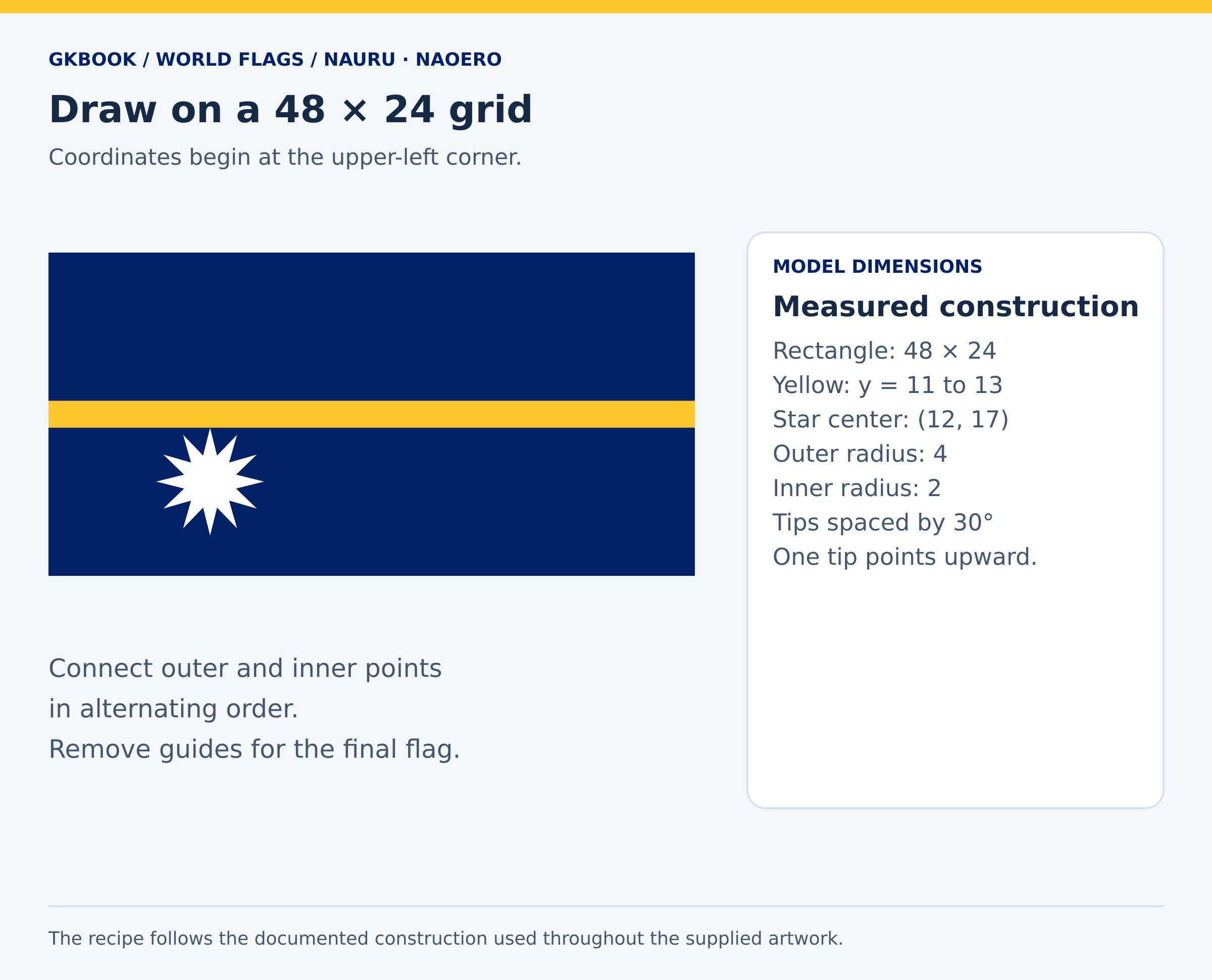
Start with a rectangle 48 units long and 24 units high. Draw a two-unit yellow stripe centered vertically, leaving eleven blue units above and below. Place the star center at (12, 17), measured from the upper left, with outer radius four and inner radius two units.

Mark twelve outer tips every 30 degrees, beginning directly above the center. Mark twelve inner vertices at the intervening 15-degree positions, then connect alternating outer and inner vertices.
The top tip reaches y = 13, the lower edge of the stripe. Fill the star white and the remaining field blue. Keep construction guides outside the final artwork or remove them after drawing.
What mistakes should be avoided in Nauru flag artwork?
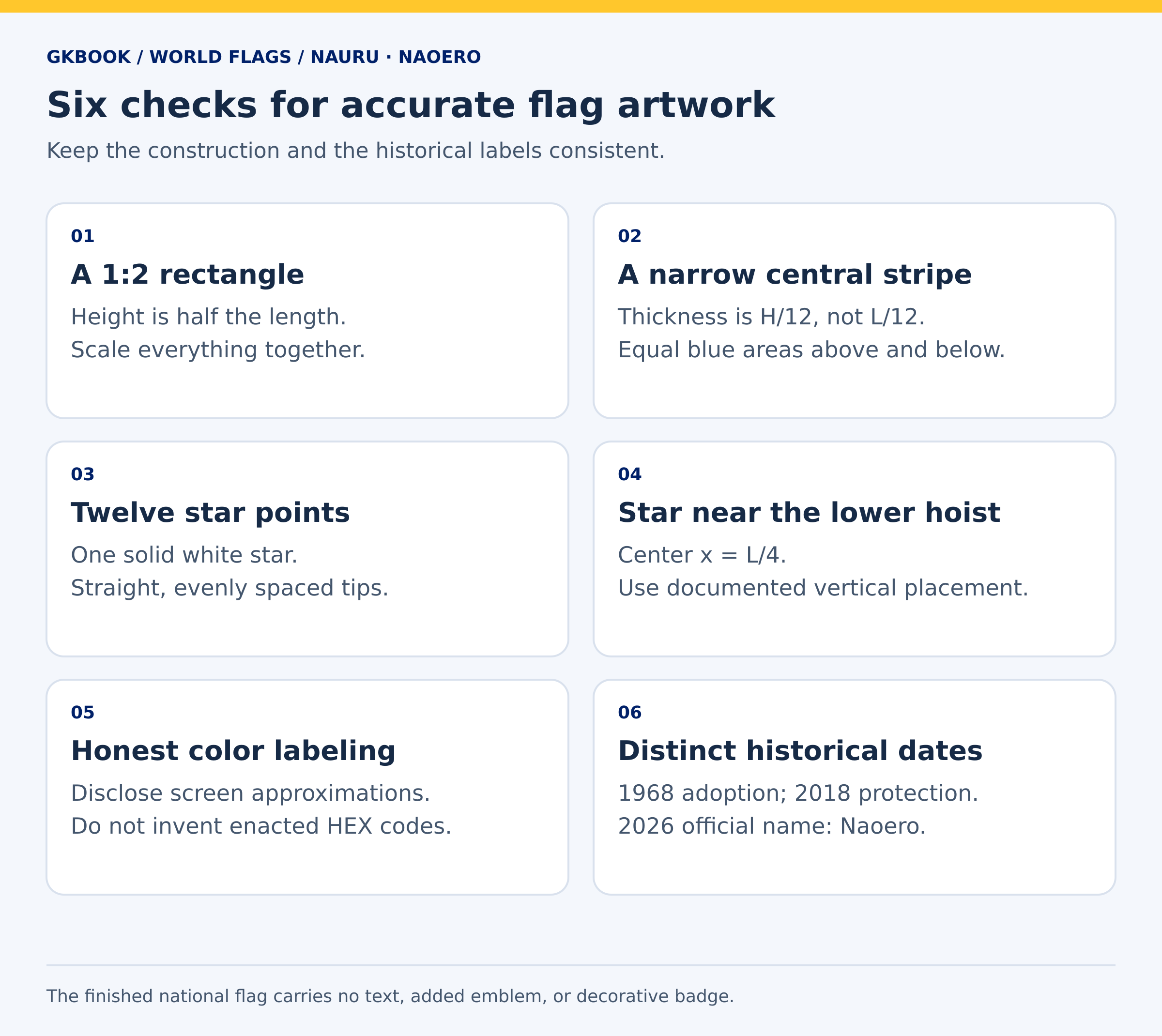
Avoid a thick stripe, a centered or misplaced star, the wrong number of points, stretched proportions, and unsupported official color claims. Keep the rectangle at 1:2, the stripe at one-twelfth of the height, and the twelve-pointed star below the stripe near the hoist, using a clearly documented construction.

Historical labels also need care: 1968 is the flag’s adoption year, 2018 concerns legal protection, and 2026 concerns the official country name. Those events should remain distinct.
Keep lettering, slogans, and decorative additions off the flag itself. Explanatory labels in these diagrams sit around the reference artwork or are clearly identified as construction guides.
Download Nauru flag pictures
Download the national flag as SVG or 4800 × 2400 PNG. The gallery contains 22 subjects, each with SVG and PNG versions. Use the full image and preserve its proportions. Image credits and reconstruction notes accompany the artwork.
Explore more in World Flags, including the Namibia flag and Myanmar flag.
World Flags/Nauru
Nauru flag pictures
1:2 flag with the documented touching-tip star construction. Screen colors are approximations.
GKBook original explanatory artwork; construction and source notes supplied.Download SVGDownload PNGBlue #012169, yellow #FFC72C, and white #FFFFFF are the package’s screen choices, not enacted RGB standards.
GKBook original explanatory artwork; construction and source notes supplied.Download SVGDownload PNGThe blue field, yellow stripe, and star express the country’s setting and traditional tribal identity.
GKBook original explanatory artwork; construction and source notes supplied.Download SVGDownload PNGA single white twelve-pointed star appears below the equatorial stripe.
GKBook original explanatory artwork; construction and source notes supplied.Download SVGDownload PNGAll twelve original tribes remain represented; official accounts identify Iwi and Irutsi as extinct lineages.
GKBook original explanatory artwork; construction and source notes supplied.Download SVGDownload PNGThe yellow line represents the equator and the star represents the island to its south. Distances are symbolic.
GKBook original explanatory artwork; construction and source notes supplied.Download SVGDownload PNGThe master preserves 1:2 height-to-length proportions and scales all elements together.
GKBook original explanatory artwork; construction and source notes supplied.Download SVGDownload PNGThe central band occupies one-twelfth of the height, not one-twelfth of the length.
GKBook original explanatory artwork; construction and source notes supplied.Download SVGDownload PNGThe center is L/4 from the hoist and 17H/24 from the top in the adopted construction.
GKBook original explanatory artwork; construction and source notes supplied.Download SVGDownload PNGThe conventional star alternates twelve outer points with twelve inner points at half the radius.
GKBook original explanatory artwork; construction and source notes supplied.Download SVGDownload PNGThe screen palette is declared explicitly and is not presented as a statutory or certified physical color match.
GKBook original explanatory artwork; construction and source notes supplied.Download SVGDownload PNGThe 1968 flag date remains distinct from later documentation, regulation, and the 2026 name change.
GKBook original explanatory artwork; construction and source notes supplied.Download SVGDownload PNGGovernment records confirm Naoero as the official designation in 2026; the name change is distinct from flag adoption.
GKBook original explanatory artwork; construction and source notes supplied.Download SVGDownload PNGAdministering-power flags, service flags, and proposals are different categories from the independent national flag.
GKBook original explanatory artwork; construction and source notes supplied.Download SVGDownload PNGThe flag has a stripe and star; the emblem has a shield, surrounding details, name ribbon, and motto.
GKBook original explanatory artwork; construction and source notes supplied.Download SVGDownload PNGThe Act permits display on a range of premises while requiring prominence and retaining separate use restrictions.
GKBook original explanatory artwork; construction and source notes supplied.Download SVGDownload PNGThe lowered flag illustrates mourning; exact dates and operational instructions depend on the applicable announcement.
GKBook original explanatory artwork; construction and source notes supplied.Download SVGDownload PNGAn ordinary reverse view mirrors the whole design horizontally; it is not a separate flag.
GKBook original explanatory artwork; construction and source notes supplied.Download SVGDownload PNGThe clockwise convention is reported in a specialist account of the London 2012 manual; it is not a general statutory instruction.
GKBook original explanatory artwork; construction and source notes supplied.Download SVGDownload PNGThe model preserves the band, star dimensions, and touching-tip placement in whole grid units.
GKBook original explanatory artwork; construction and source notes supplied.Download SVGDownload PNG
Scale the entire design in the 1:2 height-to-length ratio; do not crop or stretch individual components.
GKBook original explanatory artwork; construction and source notes supplied.Download SVGDownload PNGSix checks cover proportions, stripe thickness, star form and position, color claims, and historical dates.
GKBook original explanatory artwork; construction and source notes supplied.Download SVGDownload PNGFrequently asked questions
What does Nauru’s national flag look like?
Nauru’s national flag has a dark blue field, a narrow yellow horizontal band across the center, and a white twelve-pointed star below the band near the hoist. Its proportions are 1:2. Adopted at independence on January 31, 1968, the design continues under the country’s current name, Naoero.
Is Nauru now called Naoero?
Yes. The government confirmed the official designation Republic of Naoero in 2026, restoring the traditional name in international usage. The national flag retains its blue field, yellow equatorial band, and white twelve-pointed star. Nauru remains a familiar historical and search name for this same country and flag.
What colors are on the Nauru flag?
The Nauru flag uses dark blue, yellow or gold, and white. Blue covers most of the rectangle, yellow forms the narrow central band, and white fills the twelve-pointed star. The legal description names blue, yellow, and white without prescribing hexadecimal values or a numerical digital color standard.
What does the Nauru flag symbolize?
The flag combines geography and cultural identity. Its blue field represents the Pacific Ocean, its yellow band represents the equator, and its white star marks the island south of that line. The star’s twelve points represent the twelve original tribes, bringing the country’s location and people into one design.
Why is the Nauru flag blue?
Blue represents the Pacific Ocean surrounding Nauru. The same blue appears above and below the yellow band, forming two equally high blue areas. This makes the ocean the background for the equator and island symbols, rather than a separate emblem confined to one part of the flag.
What does the yellow stripe represent?
The yellow stripe represents the equator. It runs horizontally across the middle of the blue field and is much narrower than either blue portion. The white star sits below it because Nauru lies south of the equator. Gold is another description used for the stripe in official explanatory material.
Why does the Nauru flag have a twelve-pointed star?
The white star represents Nauru, and its twelve points represent the twelve original tribes. It belongs below the equatorial stripe on the hoist side. The points are straight and evenly spaced in the conventional drawing, producing a single twelve-pointed star rather than twelve separate stars arranged in a group.
Which twelve tribes are represented by the star?
The government lists the twelve tribes as Eamwit, Eamwitmwit, Eaoru, Eamwidara, Iruwa, Eano, Iwi, Irutsi, Deiboe, Ranibok, Emea, and Emangum. The star commemorates all twelve original tribes. Government accounts identify Iwi and Irutsi as extinct tribal lineages, but their places remain in the flag’s symbolism.
Does the white star represent phosphate?
Some reference accounts connect the star’s white color with phosphate, a resource central to Nauru’s economic history. The statutory flag explanation instead explicitly identifies the star with the island’s position and its twelve original tribes. The phosphate interpretation should therefore be distinguished from the meanings actually stated in the law.
How does the flag show Nauru’s location?
The flag places the island’s white star below the yellow equator against the blue Pacific Ocean. The government describes Nauru as about 42 kilometers south of the equator. The design communicates that relationship symbolically; the star’s distance from the band is not a geographic scale or an exact latitude measurement.
What are the proportions of the Nauru flag?
The flag’s height-to-length ratio is 1:2, so its length is twice its height. The same shape is described as 2:1 when length is stated first. A flag 60 centimeters high is therefore 120 centimeters long, and every stripe and star dimension must scale with that rectangle.
How wide is the yellow band?
In the documented construction, the yellow band is one-twelfth of the flag’s height, equivalent to one-twenty-fourth of its length. Each blue portion is eleven twenty-fourths of the height. On a 48-by-24 grid, the horizontal layers measure 11 units blue, 2 units yellow, and 11 units blue.
Where exactly is the white star placed?
The star’s center is one-quarter of the flag’s length from the hoist. This artwork follows the published construction in which its upper tip touches the lower edge of the yellow band. With an outer diameter of one-third of the flag’s height, the center lies seventeen twenty-fourths of the height below the top.
How is the twelve-pointed star constructed?
Draw twelve outer points at equal thirty-degree intervals, with one point facing upward. Alternate them with twelve inner points halfway between those angles. In the construction used here, the inner radius is half the outer radius, and the outer diameter is one-third of the flag’s height.
What are the flag’s HEX, RGB, and Pantone colors?
The supplied screen artwork uses blue #012169, yellow #FFC72C, and white #FFFFFF. Specialist references commonly report Pantone 280 C and 123 C for blue and yellow. These references should not be confused with statutory RGB values: the flag schedule names the colors but does not prescribe numerical color codes.
When was the Nauru flag adopted?
Nauru adopted its national flag on January 31, 1968, when the country became independent. A later specification document is reported as dated May 31, 1968. The national-symbols protection law commenced in 2018. These dates concern introduction, construction documentation, and legal protection respectively, rather than three different flag adoptions.
Who designed the Nauru flag?
The flag is documented as the result of a local design competition before its introduction at independence. The official and institutional accounts examined do not establish a named individual as its sole designer. Reports linking its preparation to the Australian manufacturer Evans should not be converted into an unsupported personal attribution.
What is the flag’s pre-independence context?
Before independence, Nauru was a United Nations trust territory administered by Australia on behalf of Australia, New Zealand, and the United Kingdom. Its 1968 flag belongs to the independent republic. Flags of administering powers, local proposals, and official service flags should be identified separately from that national design.
Which law defines and protects the national flag?
The Naoero National Anthem, Emblem and Flag Protection Act 2018 defines the flag through section 13 and Schedule 3. It also addresses display, ceremony, mourning, commercial use, and disposal. The consolidated text incorporates later amendments and the Naoero name, while retaining the familiar three-color design and twelve-pointed star.
Has the flag changed since independence?
The basic national design introduced in 1968 remains the design in the current statutory schedule: blue, a central yellow stripe, and a white twelve-pointed star near the lower hoist. Later legislation and the adoption of Naoero as the official country name should not be described as replacements of that flag.
Where may the Nauru flag be displayed?
Section 16 permits the flag to be displayed at places including schools, homes, institutions, buildings, and events. Whether on public or private premises, it must occupy a prominent position. The section also permits use in national sporting or entertainment attire, while other provisions regulate production and commercial uses.
What should people do when the flag is raised or lowered?
Section 15 requires people in a public place or area where the flag is being raised or lowered to stand still until the ceremony is complete. It also requires drivers in or entering that area to keep their vehicles stationary during the raising or lowering of the flag.
When is the Nauru flag flown at half-mast?
Section 17 provides for half-mast display as a token of mourning for the funerals of the President, a Cabinet Minister, and other people approved by the Minister. In this Act, Minister means the President. Actual mourning dates and operational instructions should come from the relevant official announcement.
Can the flag be used on merchandise or in advertising?
Sections 20 and 21 require prior written ministerial approval for specified commercial uses and production involving the flag or its parts. These provisions cover advertising, logos, trademarks, and depiction on merchandise or other items. An available image file does not itself supply that approval or settle the applicable legal requirements.
How does the law address worn or damaged flags?
Section 23 addresses a flag that is no longer fit for use or display. It provides for dignified disposal by burning in private after Cabinet approval has been granted. This is a specific legal disposal procedure and should be distinguished from public destruction or other conduct covered by the Act’s separate prohibitions.
What does the reverse side of the flag look like?
Viewed from the opposite side of an ordinary flag, the design appears horizontally mirrored. The star is below the stripe near the viewer’s right, because the hoist is now on that side. The yellow band remains horizontal and centered; this reversed view is not a separate national flag design.
How can the flag be shown vertically?
A reported London 2012 event convention turns the complete Nauru flag ninety degrees clockwise for vertical display. Under that convention, the yellow stripe becomes vertical and the star appears in the upper-left portion. This is a documented event example, not a universal vertical-hanging instruction stated in the flag Act.
How can the Nauru flag be recognized quickly?
Look for three features together: a dark blue rectangle twice as long as it is high, a thin yellow stripe through the center, and one white twelve-pointed star immediately below the stripe near the hoist. The stripe-and-star relationship distinguishes this flag more reliably than any single color viewed alone.
How do you draw the Nauru flag accurately?
Start with a rectangle 48 units long and 24 units high. Draw a two-unit yellow stripe centered vertically, leaving eleven blue units above and below. Place the star center at (12, 17), measured from the upper left, with outer radius four and inner radius two units.
What mistakes should be avoided in Nauru flag artwork?
Avoid a thick stripe, a centered or misplaced star, the wrong number of points, stretched proportions, and unsupported official color claims. Keep the rectangle at 1:2, the stripe at one-twelfth of the height, and the twelve-pointed star below the stripe near the hoist, using a clearly documented construction.
Explore all general-knowledge topics and the A-to-Z lists.









We Value Your Opinion Comments