
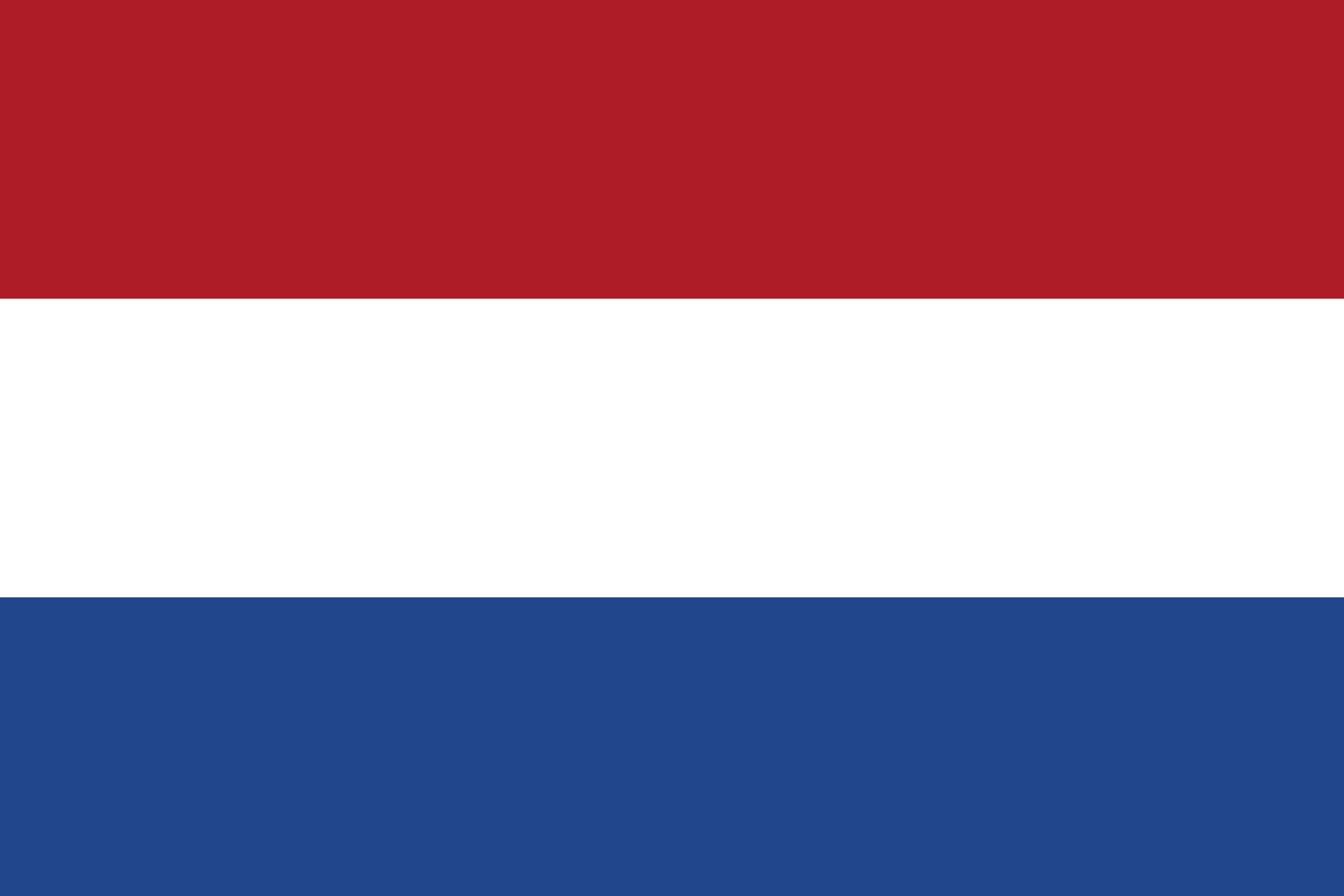
Netherlands flag picture
Explore the proportions, history, and picture gallery.
| Design | Horizontal tricolorThree bands of equal height. |
|---|---|
| Colors | Red, white, and blueIn order from top to bottom. |
| Usual proportions | Height:length = 2:3Length is one and a half times height. |
| Formal color confirmation | February 19, 1937Royal Decree No. 93; the tradition is older. |
| Emblem | NoneThe national design is a plain tricolor. |
| Royal addition | Separate orange pennantFor the royal occasions in the flag instructions. |
What does the Netherlands flag look like?
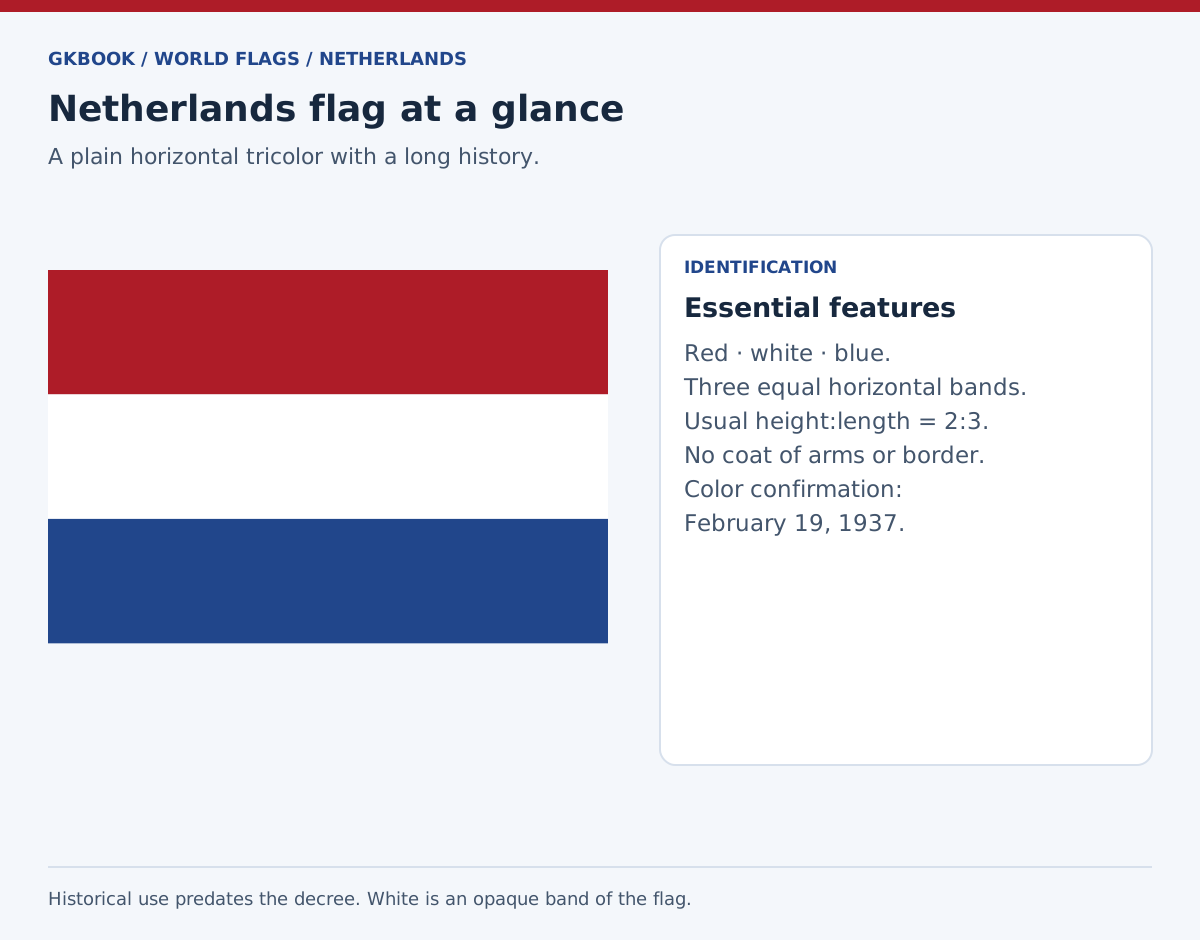
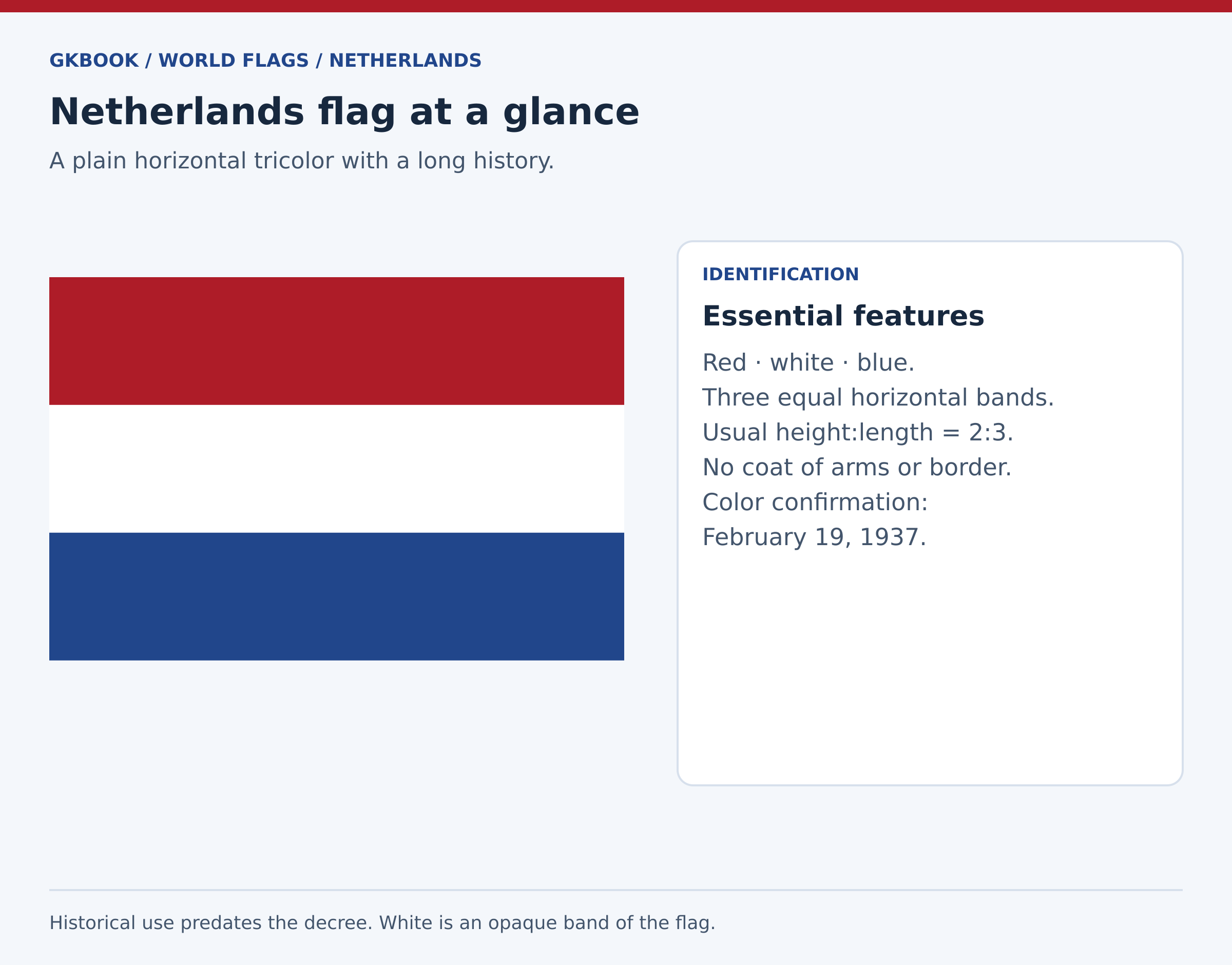
The national flag of the Netherlands has three equal horizontal bands: red at the top, white in the middle, and blue at the bottom. Its usual height-to-length ratio is 2:3. The plain tricolor has no coat of arms, and its colors were formally confirmed by royal decree in 1937.
The illustrations below separate the national design from historical variants, royal additions, and display customs. They also distinguish the 1937 color decree from later technical standards and digital reproduction choices.
What colors are on the Netherlands flag?
The Netherlands flag is red, white, and blue, arranged in three equal horizontal bands from top to bottom. Official descriptions call the shades bright vermilion, white, and cobalt blue. The red and blue are distinct from the orange associated with the royal family and the lighter blue of Luxembourg’s flag.
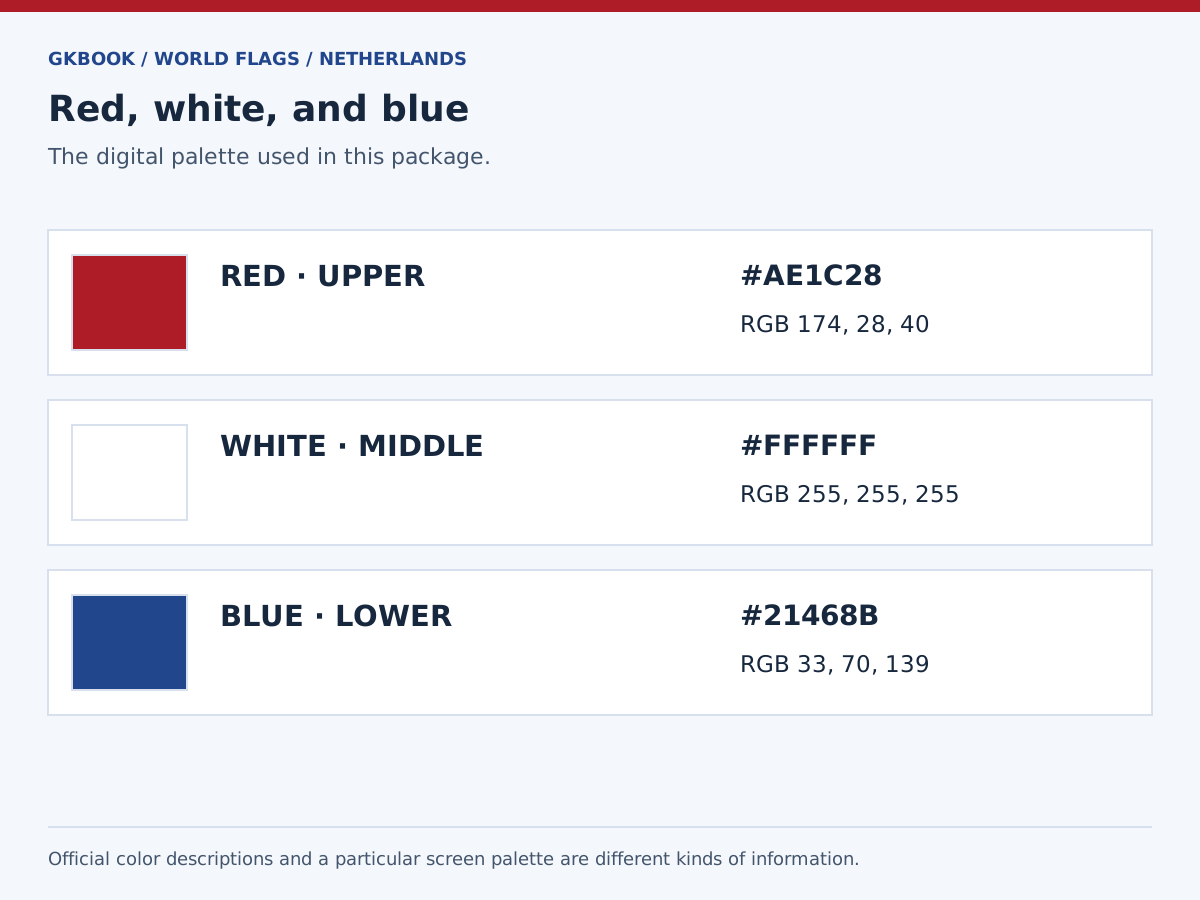
Each color extends across the complete length of the flag. There is no gap between the bands, no fourth stripe, and no ornamental border. White is an opaque part of the cloth, not a transparent opening.
The color names and their position identify the design. A particular digital file also needs numerical values; those reproduction choices are explained separately under HEX and RGB colors.
What is the ratio of the Netherlands flag?
The usual Netherlands flag ratio is 2:3, meaning two units high and three units long. Each horizontal band occupies one third of the total height. The 1937 royal decree establishes the colors but does not prescribe this ratio; official display guidance describes 3:2 length to height as the general form.

A flag 100 centimeters high is therefore 150 centimeters long. Each stripe is 33⅓ centimeters high. The same construction can be enlarged or reduced without changing the relationship between the three bands.
For convenient whole-number drawing, use a rectangle 9 units long and 6 units high, then give each band a height of 2 units. The 1800 × 1200 SVG and 4500 × 3000 PNG supplied here preserve exactly the same proportions.
| Example | Length | Total height | Each band |
|---|---|---|---|
| Classroom grid | 9 units | 6 units | 2 units |
| SVG artwork | 1800 units | 1200 units | 400 units |
| PNG artwork | 4500 pixels | 3000 pixels | 1000 pixels |
What does the Netherlands flag symbolize?
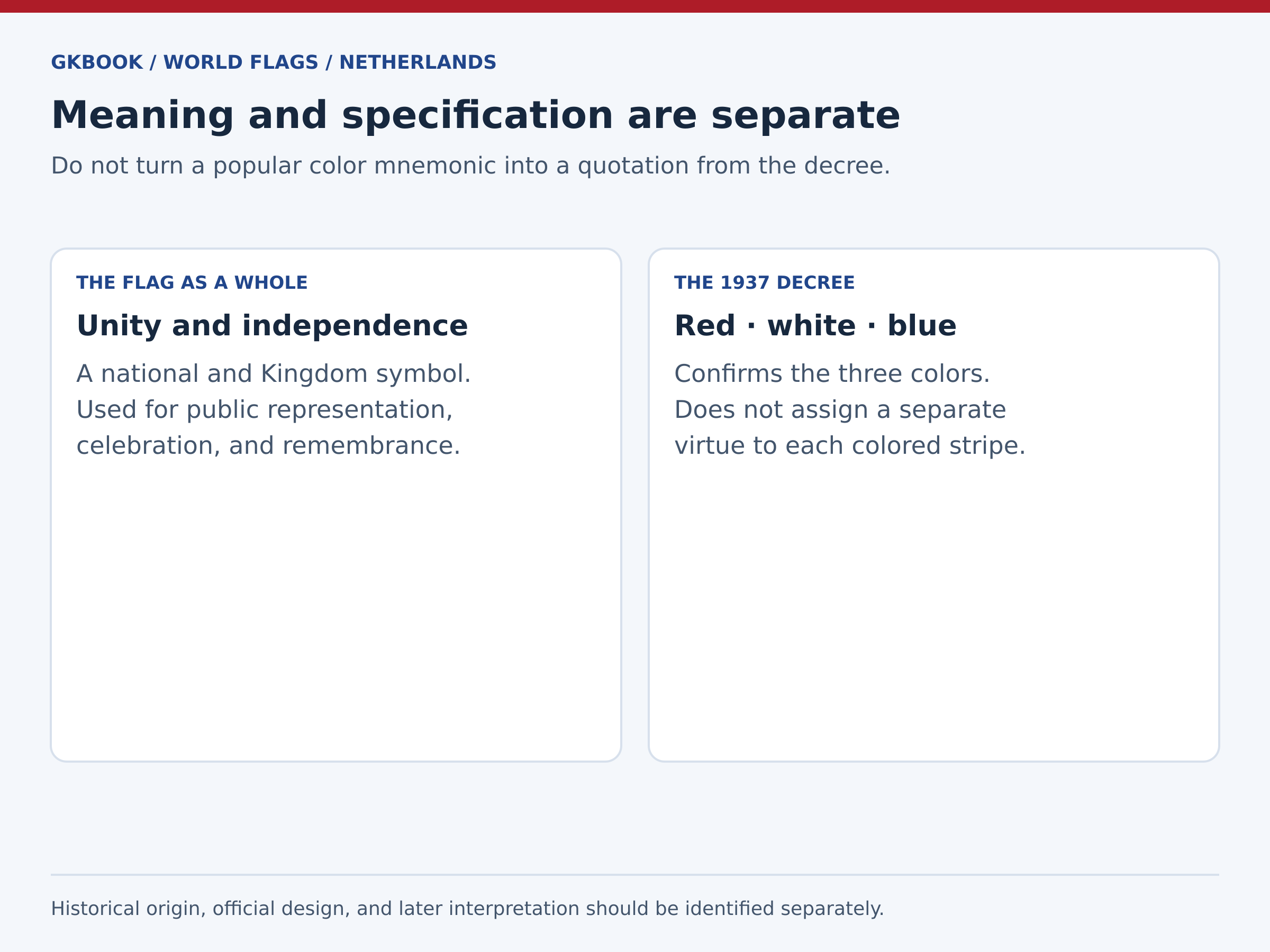
The Netherlands flag represents the country and the unity and independence of the Kingdom of the Netherlands. The 1937 decree specifies its colors without assigning a separate virtue to each stripe. Claims that red officially means bravery, white peace, and blue loyalty should therefore be treated as interpretations, not that decree’s wording.

The historical explanation concerns the development of a tricolor associated with the House of Orange and Dutch political life. That origin is different from a modern mnemonic that assigns one abstract value to each color.
National meaning also comes from use: the same flag can accompany public celebration, remembrance, official representation, or a personal milestone. Its position and any accompanying pennant help distinguish those occasions.
Why is orange associated with the Netherlands if its flag is red, white, and blue?
Orange is associated with the House of Orange and the earlier orange, white, and blue flag tradition. The modern national flag instead uses red, white, and blue. Royal occasions can combine the tricolor with a separate orange pennant, preserving the orange connection without replacing the flag’s upper red band.
The Royal House traces the older orange band to the principality of Orange and the white and blue to its livery. It also places the custom of adding an orange pennant around the restoration of independence and the return of the House of Orange in 1813.
An orange garment, decoration, or pennant is therefore compatible with Dutch identity while remaining distinct from the three colors of the national flag itself.
What was the Prince’s Flag?
The Prince’s Flag, commonly called the Prinsenvlag, is the historical orange, white, and blue tricolor associated with the House of Orange. It belongs to the ancestry of the Dutch flag. The current national flag uses red instead of orange, so an orange upper band identifies a different historical design.
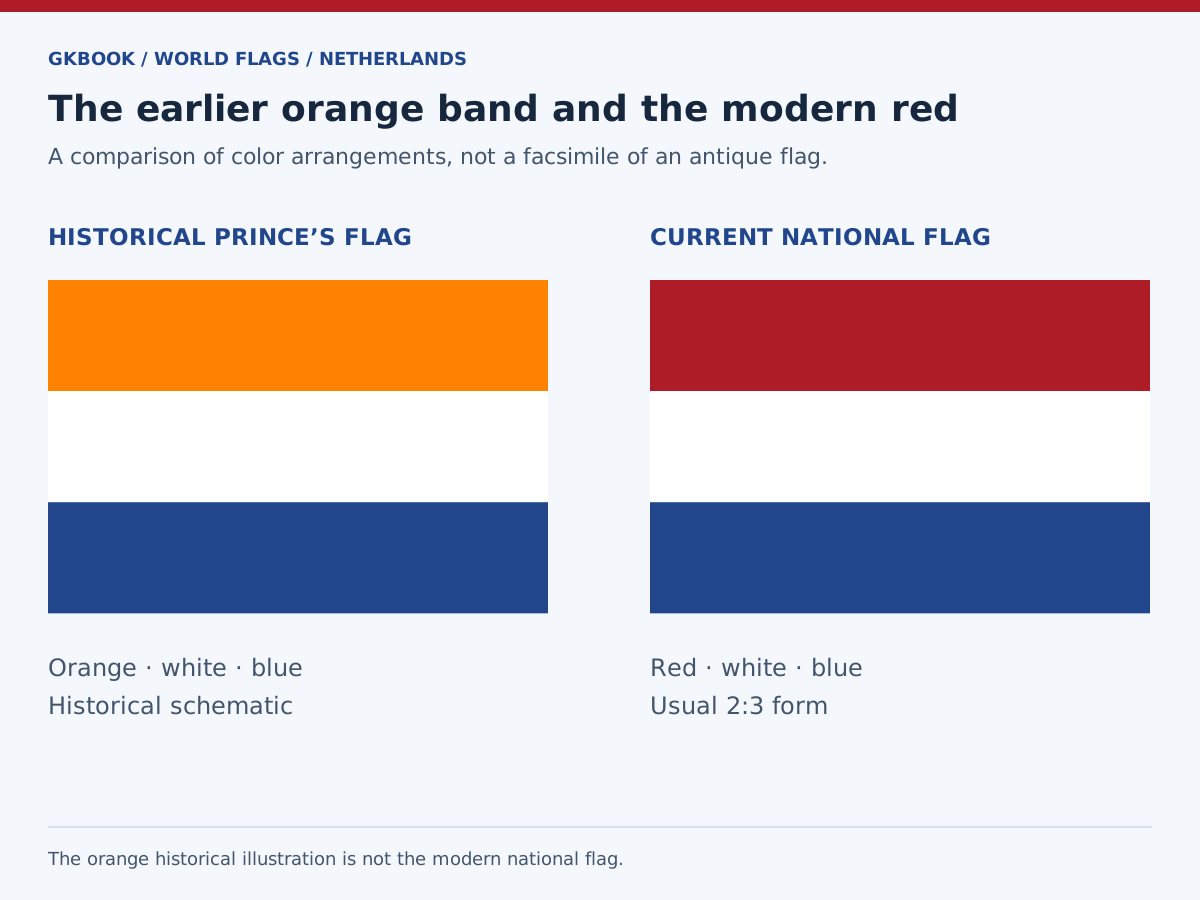
The Royal House dates its first reference to the orange, white, and blue flag to 1572. This is a reference point in the documented tradition, not proof that every surviving historical flag had one standardized shade or proportion.
The comparison below isolates the principal color difference. Its orange flag is a schematic historical illustration rather than a reproduction of a particular museum object.
Why did red replace orange on the Dutch flag?
Red gradually replaced orange during the seventeenth century. The Royal House presents better visibility at sea as a reported explanation, rather than a conclusively proven single cause. The change was a historical development, not a modern decision to remove the royal family’s color from an otherwise newly designed flag.
Popular explanations also invoke dye behavior or political loyalties. A precise account should identify evidence for such claims instead of turning a repeated story into a universal rule. The official historical summary supports the gradual change and qualifies the visibility explanation.
Nor did red, white, and blue automatically exclude support for the House of Orange. The Rijksmuseum holds an ornamented red, white, and blue flag dated 1787–1795 that includes an orange tree and an Orangist inscription.
How did the Netherlands flag develop over time?
The Dutch flag developed through several political periods rather than one design competition. Orange, white, and blue appears in the sixteenth-century tradition; red gradually replaced orange in the seventeenth century. Revolutionary and French rule brought changes, the tricolor returned after 1813, and a royal decree confirmed red, white, and blue in 1937.

In the late eighteenth century, the red, white, and blue flag acquired a figure of the Dutch maiden during the Batavian period. Louis Napoleon removed that emblem during his reign from 1806 to 1810. Annexation by France in 1810 interrupted the Dutch national flag’s use.
Following independence in 1813, red, white, and blue was preferred for government buildings even though the orange variant remained part of public debate and practice. The 1937 decree settled the color question. These stages distinguish an inherited flag tradition from its later legal confirmation.
| Period or date | Development |
|---|---|
| 1572 | First reference to orange, white, and blue in the Royal House’s historical account. |
| Seventeenth century | Red gradually takes the place of orange. |
| Late eighteenth century | A Dutch maiden is added to the tricolor in the Batavian period. |
| 1806–1810 | Louis Napoleon restores the plain tricolor. |
| 1810 | French annexation interrupts use of the Dutch national flag. |
| 1813 | Independence returns; government buildings favor red, white, and blue. |
| February 19, 1937 | Royal Decree No. 93 confirms the three colors. |
When was the Netherlands flag officially adopted?
February 19, 1937 is the date commonly given for the Netherlands flag’s formal adoption because Queen Wilhelmina issued Royal Decree No. 93 that day. More precisely, the decree confirmed red, white, and blue as the Kingdom’s flag colors. The tricolor itself had already been used for centuries before that decision.
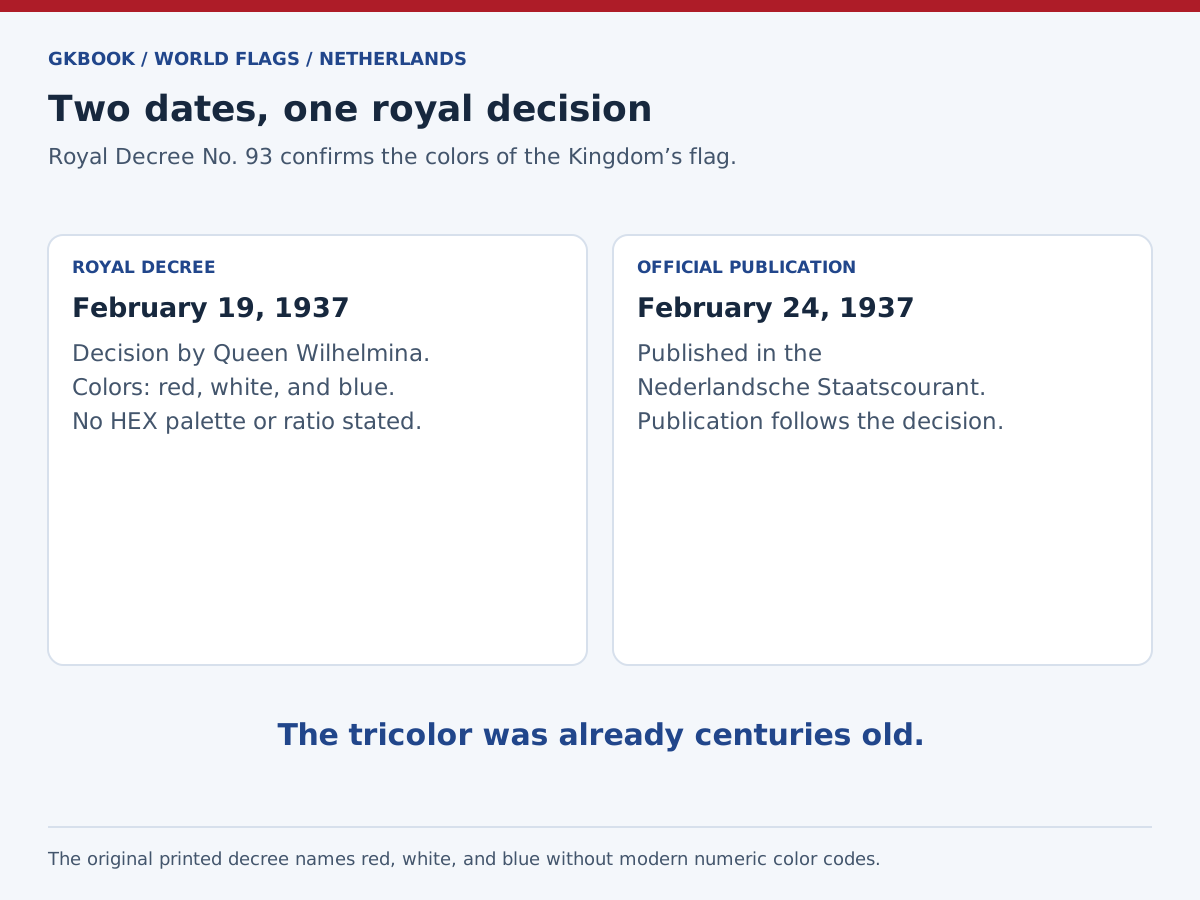
Calling 1937 the flag’s “birth” would erase its much older history. The date is best labeled formal color confirmation. It is also separate from the return of independence in 1813 and from later technical work on textile colors.
The decree was published in the Nederlandsche Staatscourant on February 24, 1937. The signing date and publication date describe different steps in the same official decision.
What exactly did the 1937 flag decree establish?
Royal Decree No. 93 states that the colors of the flag of the Kingdom of the Netherlands are red, white, and blue. It does not supply stripe measurements, a drawing, HEX values, or individual symbolic meanings. More detailed modern descriptions should not be presented as if all appeared in that short decree.
The surviving printed text uses the ordinary Dutch color words rood, wit, and blauw. Modern explanatory pages describe the shades more specifically, but the original legal text is the appropriate evidence when asking what the 1937 decision itself says.
This distinction matters when labeling an image “official.” A faithful drawing can follow established proportions and named colors without claiming that its exact screen pixels were enacted in 1937.
Who designed the Netherlands flag?
The Netherlands flag is not generally attributed to a single modern designer. It evolved from an older tricolor tradition connected with the House of Orange, followed by the gradual replacement of orange with red. Queen Wilhelmina’s 1937 decree confirmed the colors; it did not credit an artist with inventing the entire design.
William of Orange is central to the historical association behind the Prince’s Flag. That association should not be converted into an unsupported claim that he personally drew a modern flag specification.
Likewise, the monarch who formally confirms a flag’s colors is not necessarily its designer. The Dutch example is better understood as a long development followed by official recognition.
What are the Netherlands flag’s HEX and RGB colors?
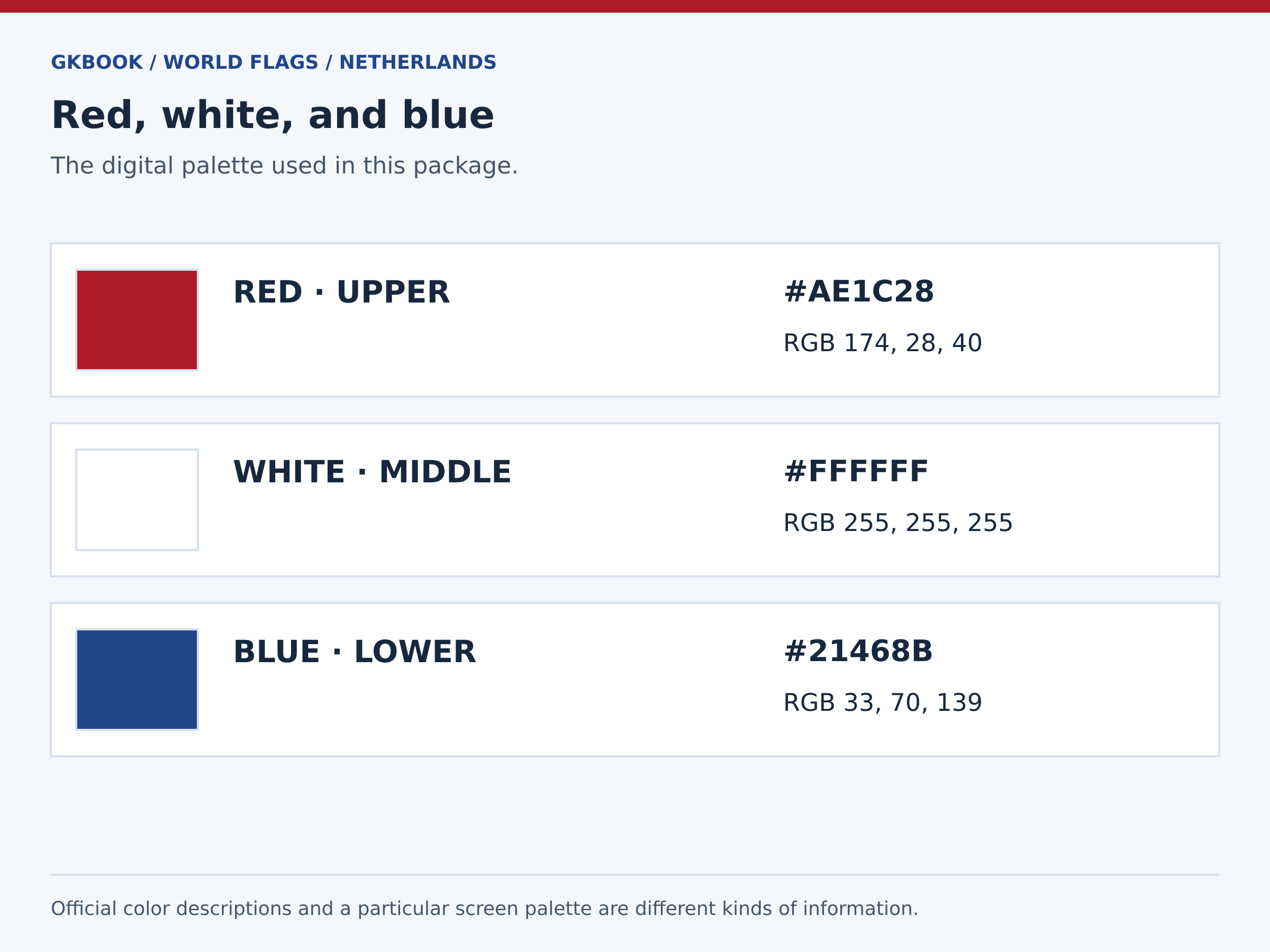
The artwork on this page uses red #AE1C28, white #FFFFFF, and blue #21468B. Their RGB values are 174, 28, 40; 255, 255, 255; and 33, 70, 139. These are declared screen approximations, not numerical color values enacted by the 1937 decree or a guarantee of matching printed cloth.
A color name, a textile measurement, a display value, and a printing ink reference serve different purposes. Matching a screen to fabric requires attention to the material, lighting, and production process; copying a HEX value alone cannot certify the result.
The files consistently use the palette below. No mandatory Pantone or universal CMYK formula is claimed. For a manufactured flag, agree on the required physical color reference with the supplier rather than treating an online swatch as a certified textile sample.
| Band | HEX | RGB | Status |
|---|---|---|---|
| Red, upper | #AE1C28 | 174, 28, 40 | Screen approximation |
| White, middle | #FFFFFF | 255, 255, 255 | Opaque white |
| Blue, lower | #21468B | 33, 70, 139 | Screen approximation |
Is NEN 3055 still a current Dutch flag color standard?
NEN’s catalog lists NEN 3055:1958, the textile standard for the Dutch flag’s red and blue, as withdrawn on April 13, 2026. It should therefore be identified as a historical standard rather than described as currently active. Its withdrawal is not, by itself, evidence that the national flag’s colors changed.

The catalog gives November 1, 1958 as its publication date. That technical history is separate from the 1937 decree. The status reported here was checked on October 19, 2026; the artwork does not claim certification under the withdrawn standard.
Does the flag represent the Netherlands or the whole Kingdom?
The tricolor is the national flag of the Netherlands, and the 1937 decree expressly calls it the flag of the Kingdom of the Netherlands. The Kingdom comprises four countries: the Netherlands, Aruba, Curaçao, and Sint Maarten. The country of the Netherlands also includes Bonaire, Sint Eustatius, and Saba in the Caribbean.

The country and the Kingdom are related constitutional terms, not interchangeable geographical labels. A description that treats the Netherlands as only its European territory misses its Caribbean public bodies.
The Kingdom’s flag should also be distinguished from the separate flags of its constituent countries and local territories. A diagram of the constitutional relationship is more useful here than assuming that every flag seen within the Kingdom is the same tricolor.
Is the Holland flag the same as the Netherlands flag?
People often say “Holland flag” when they mean the national flag of the Netherlands: red, white, and blue. Strictly, Holland refers to North Holland and South Holland, two of the country’s twelve provinces. Those provincial identities should not be confused with the national tricolor or with the wider Kingdom.
For an educational label, “Netherlands flag” or “Dutch national flag” is the clearest choice. “Holland” remains familiar in informal usage, but it does not name all twelve provinces.
This naming distinction does not create a second national design. A search for a Holland flag may return the national tricolor, while a request for a particular province’s flag is a different question.
When is an orange pennant flown with the Dutch flag?
Under the government flag instructions, an orange pennant accompanies the Dutch tricolor on King’s Day and the birthdays of Queen Máxima, Princess Beatrix, and the Princess of Orange. It is a separate royal addition above the flag. Other ordinary flag days use the national tricolor without that orange pennant.

The current recurring dates are January 31 for Princess Beatrix, April 27 for King’s Day, May 17 for Queen Máxima, and December 7 for Princess Catharina-Amalia, the Princess of Orange. The official calendar includes alternative dates in specified circumstances.
The pennant does not turn the upper red stripe orange, add a fourth stripe, or replace the national flag with the royal standard. May 4 remembrance and May 5 liberation displays do not use it.
On which days do Dutch government buildings fly the flag?
Dutch government instructions specify recurring royal birthdays, national commemorations, and other occasions for flying the flag. Some dates apply to all central government buildings, while others apply only to selected buildings. These instructions provide optional guidance for private citizens and organizations, and special instructions may be issued for particular events.

The schedule below follows the central government’s general instructions as checked in October 2026. “All” means all central government buildings; “selected” covers the designated principal government and constitutional institutions. Prinsjesdag applies only in The Hague.
An alternative in parentheses applies when the ordinary date falls on Sunday or a recognized Christian holiday. King’s Day moves to April 26 in that situation. May 4 is always commemorated on May 4. Special instructions can supplement the recurring calendar.
| Date; alternative where specified | Occasion | Coverage | Display |
|---|---|---|---|
| January 31 (February 1) | Princess Beatrix’s birthday | Selected | Full staff; orange pennant |
| April 27 (April 26) | King’s Day | All | Full staff; orange pennant |
| May 4 | Remembrance Day | All | Half staff, 6 p.m. to sunset; no pennant |
| May 5 | Liberation Day | All | Full staff; no pennant |
| May 17 (May 18) | Queen Máxima’s birthday | Selected | Full staff; orange pennant |
| Last Saturday in June | Veterans Day | All | Full staff; no pennant |
| August 15 (August 16) | Formal end of World War II | All | Full staff; no pennant |
| Third Tuesday in September | Prinsjesdag | All, in The Hague only | Full staff; no pennant |
| December 7 (December 8) | Princess Catharina-Amalia’s birthday | Selected | Full staff; orange pennant |
| December 15 (December 16) | Kingdom Day | Selected | Full staff; no pennant |
How is the Dutch flag flown on May 4?
On May 4, the Dutch flag is flown at half staff without an orange pennant for Remembrance Day. Government instructions specify 6 p.m. until sunset on state buildings. The National Committee for 4 and 5 May asks residents to fly it at half staff throughout daylight, from sunrise until sunset.

These timings address different audiences: the government’s institutional instruction and the committee’s public invitation. The commemoration remains on May 4 even when that date falls on Sunday or a religious holiday.
How is the Dutch flag flown on May 5?
On May 5, Liberation Day, the Dutch flag is flown at full staff without an orange pennant. This differs from the half-staff remembrance display on May 4. The government calendar includes May 5 among the days for all central government buildings to fly the flag, and private participation is voluntary.
The change in position distinguishes celebration of liberation from the preceding day’s remembrance. The national tricolor itself remains unchanged. Use the ordinary daytime display custom and illuminate the colors clearly if the flag remains out at night.
Is the Netherlands flag flown at half staff on August 15?
The recurring August 15 instruction is to fly the Netherlands flag at full staff, without an orange pennant, to mark the formal end of World War II. It is not the same half-staff display used on May 4. The government calendar gives August 16 as the specified alternative date when applicable.
The occasion is commemorative, but that does not automatically mean half staff. The published flag instruction determines the position. The national remembrance committee likewise specifies full staff for August 15 and notes the following-day observance when the date falls on Sunday.
Can people fly the Netherlands flag on any day?
Yes. Dutch government guidance says that citizens, businesses, and organizations may fly the national flag on any day. The recurring instructions for government buildings are not compulsory for private users. Weddings, successful examinations, and personal mourning are examples of occasions on which people may choose to display the flag.
The government distinguishes its own institutional instructions from the customs observed by the public. Courtesy guidance includes keeping the flag clear of the ground and ensuring that it does not obstruct traffic.
This freedom of ordinary display does not require a special royal occasion or permission to use the national colors. The orange pennant remains associated with the royal occasions described in the official instructions.
How is the Netherlands flag raised to half staff?
The customary half-staff sequence is to raise the Dutch flag fully, then lower it slowly to the mourning position and secure the line. Before taking it down, raise it fully again and then lower it. Published municipal guidance describes this sequence and requires enough clearance to keep the flag off the ground.

Kampen’s published protocol describes the flag’s center reaching half the normal height. It also says not to tie the flag itself into a bundle. The diagram illustrates the order of actions rather than supplying measurements for every type of mast.
Follow the instruction issued for the particular commemoration when choosing the time and duration. The routine May 4 instruction should not be extended automatically to every death, disaster, or other remembrance event.
Can the Dutch flag remain outside at night?
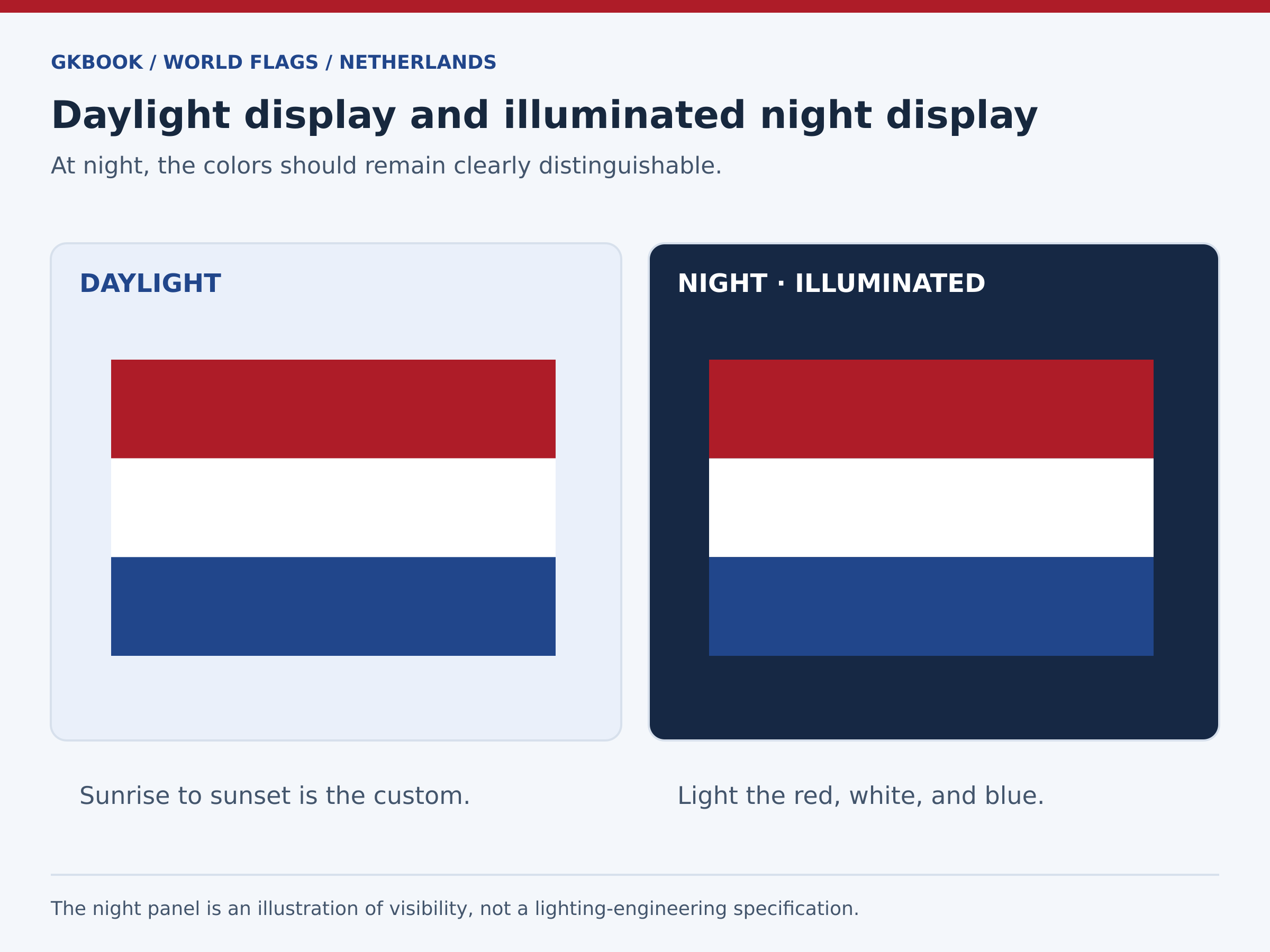
Dutch custom is to display the national flag between sunrise and sunset. Government guidance says that, if the flag remains outside at night, good practice is to illuminate it so that its colors are clearly visible. This is display etiquette, distinct from a general prohibition on private citizens flying the flag.

Lighting should make the red, white, and blue distinguishable. A dark silhouette on an unlit pole does not meet that stated purpose. The flag should also remain clear of the ground and any traffic.
Daylight and illuminated nighttime displays use the same design and proportions. There is no separate Dutch “night flag” with altered colors or added symbols.
Does the Netherlands flag look different on the reverse?
The Netherlands flag has no separate reverse design. Its plain horizontal bands remain red at the top, white in the middle, and blue at the bottom when viewed from either side of an upright flag. The attachment side changes relative to the observer, but there is no emblem or lettering to reverse.

Geometrically, reflecting a horizontal tricolor left to right leaves its colored pattern unchanged. Turning it upside down is a different operation: that puts blue above white and red, so it does not show the ordinary upright arrangement.
The front-and-back comparison below concerns an upright, freely flying flag. It is not a direction to rotate the artwork for a formal vertical wall display.
Is the Dutch royal standard the same as the national flag?
No. The royal standard is a separate flag associated with the monarch, while the national flag is the red, white, and blue tricolor. The royal standard has an orange field, a Nassau-blue cross, and heraldic elements. Adding an orange pennant to the national flag does not turn it into that standard.

The Royal House describes the standard as flying at Noordeinde Palace and Huis ten Bosch Palace when the King is in the Netherlands. Its central design includes the crowned arms and the insignia of the Military Order of William; bugle horns appear in the four quarters.
The underlying standard dates to Queen Wilhelmina in 1908, with a detail modified for the current King. Royal personal standards are not lowered to half staff; mourning is indicated with a black pennant. These practices should not be confused with the national flag’s half-staff use.
How is the Netherlands flag different from Luxembourg’s flag?
Both flags have horizontal red, white, and blue bands, but Luxembourg uses a distinctly lighter, sky-blue lower band. The Dutch flag’s blue is darker. Proportions also help: the Netherlands commonly uses 2:3, while Luxembourg’s law allows 3:5 or 1:2. The comparison here uses Luxembourg’s 3:5 form and declared screen approximations.

Do not identify these flags solely by their three color names. Inspect the shade of blue and the overall shape together. Lighting, fading, and compressed photographs can make a color-only judgment unreliable.
The comparison preserves each illustrated ratio instead of stretching both flags into identical rectangles. Luxembourg’s national tricolor is also distinct from its red-lion flag, which is a different design.
How is the Netherlands flag different from Russia’s flag?
The Netherlands and Russia both use three equal horizontal bands, but their order is different. The Netherlands places red above white above blue; Russia places white above blue above red. Read the colors from top to bottom rather than identifying either country from the presence of red, white, and blue alone.

Both can appear in a 2:3 rectangular format, so proportions alone do not distinguish them. The upper band provides an immediate check: red for the Netherlands and white for Russia.
Flipping the Dutch flag upside down produces blue, white, and red. That is not Russia’s white, blue, and red sequence. The comparison separates a changed stripe order from a simple upside-down display.
How is the Netherlands flag different from France’s flag?
The Netherlands flag has horizontal red, white, and blue bands. France’s flag has vertical blue, white, and red bands, with blue next to the flagpole. The direction of the bands is therefore the first distinction. Their shared color names do not make the two national designs interchangeable in ordinary upright display.

For the Dutch flag, read from top to bottom. For the French flag, read from the hoist toward the free edge. This difference in reading direction is as important as remembering the colors.
Rotating an illustration can create a misleading resemblance, particularly when the pole is omitted. Label the country and preserve the intended orientation when arranging comparison pictures.
How do you draw the Netherlands flag accurately?
Draw a rectangle three units long and two units high. Divide its height into three equal horizontal bands, then fill them red, white, and blue from top to bottom. Keep the edges straight and the bands touching. Do not add a coat of arms, orange stripe, decorative border, or lettering.

A 9-by-6 grid makes the construction especially easy: draw horizontal boundaries 2 and 4 units below the top. After filling the three areas, remove any measurement labels and construction lines from the finished flag.
The supplied vector uses 1800 units of length and 1200 units of height. Each stripe is 400 units high. It can be scaled proportionally without recalculating the design, while the PNG provides a ready-made raster image.
What are common mistakes when drawing the Netherlands flag?
Common errors include reversing the stripe order, using orange instead of red, choosing Luxembourg’s pale blue, making the bands unequal, or stretching the rectangle. Another mistake is adding the royal coat of arms to the plain national flag. A correct drawing keeps three equal horizontal bands and a consistent, declared color palette.

Check geometry separately from color. A picture can have the right shades but the wrong proportions, or the correct 2:3 outline with one band noticeably deeper than the others.
For a clean downloadable flag, keep captions, pole drawings, measurement arrows, and comparison labels outside the flag image. Those features can help an explanatory diagram, but they are not part of the national design.
Does the Dutch coat of arms belong on the national flag?
The ordinary Netherlands national flag is a plain tricolor without a coat of arms, crown, lion, or inscription. Heraldic designs appear on other Dutch symbols, including the royal standard. Adding them to the red, white, and blue rectangle creates a variant illustration rather than the unadorned national flag shown here.
Some historical flags carried emblems or messages, and the Rijksmuseum preserves examples. Their existence does not make those additions part of the present national design.
The identification sheet below summarizes the features that belong in the basic flag image. The separate gallery provides construction, history, and display diagrams without altering the downloadable national flag master.
Download Netherlands flag pictures
Download the national flag as SVG or 4500 × 3000 PNG. The gallery contains 22 subjects, each with SVG and PNG versions. Keep the full rectangular image and preserve its proportions. Both the SVG and PNG retain the exact 2:3 shape; the white band is opaque. Image credits and reproduction notes accompany the artwork.
Explore more in World Flags, including the Nepal flag and Nauru flag.
World Flags/Netherlands
Netherlands flag pictures
The usual 2:3 rectangle with three equal bands. Digital colors are approximations.
GKBook original explanatory artwork; source and reproduction notes supplied.Download SVGDownload PNGRed #AE1C28, white #FFFFFF, and blue #21468B are declared screen approximations, not enacted HEX values.
GKBook original explanatory artwork; source and reproduction notes supplied.Download SVGDownload PNGHeight:length is 2:3; each band is one third of the height. Guide lines are not part of the flag.
GKBook original explanatory artwork; source and reproduction notes supplied.Download SVGDownload PNGThe flag represents unity and independence; the 1937 decree does not assign individual meanings to its three colors.
GKBook original explanatory artwork; source and reproduction notes supplied.Download SVGDownload PNGThe historical orange, white, and blue tradition is distinguished from the current red, white, and blue design. Historical shades and proportions varied.
GKBook original explanatory artwork; source and reproduction notes supplied.Download SVGDownload PNGThe inherited tricolor tradition, political changes, and 1937 legal confirmation are separate historical stages.
GKBook original explanatory artwork; source and reproduction notes supplied.Download SVGDownload PNGThe decree is dated February 19, 1937; its official newspaper publication followed on February 24.
GKBook original explanatory artwork; source and reproduction notes supplied.Download SVGDownload PNGNEN reports the 1958 textile standard withdrawn in 2026. That catalog status does not itself change the national flag.
GKBook original explanatory artwork; source and reproduction notes supplied.Download SVGDownload PNGSchematic display of a separate orange pennant above the national tricolor. The pennant is not a fourth stripe and its proportions here are illustrative.
GKBook original explanatory artwork; source and reproduction notes supplied.Download SVGDownload PNGThe Netherlands is one of four countries in the Kingdom; Bonaire, Sint Eustatius, and Saba are public bodies within the Netherlands.
GKBook original explanatory artwork; source and reproduction notes supplied.Download SVGDownload PNGA locator for the recurring dates. Consult the article’s table for alternative dates, selected versus all buildings, pennants, and May 4 timing.
GKBook original explanatory artwork; source and reproduction notes supplied.Download SVGDownload PNGMay 4: half staff; state buildings from 6 p.m., with an all-day public invitation from the remembrance committee. May 5: full staff.
GKBook original explanatory artwork; source and reproduction notes supplied.Download SVGDownload PNGThe customary sequence is documented in municipal protocol. This schematic shows the order, not universal mast measurements.
GKBook original explanatory artwork; source and reproduction notes supplied.Download SVGDownload PNGGovernment guidance recommends illuminating a flag left outside at night so that its colors can be distinguished.
GKBook original explanatory artwork; source and reproduction notes supplied.Download SVGDownload PNGThe plain horizontal tricolor has the same pattern on both sides when upright. Turning it upside down is a different operation.
GKBook original explanatory artwork; source and reproduction notes supplied.Download SVGDownload PNGThe national tricolor, monarch’s standard, naval jack, and commissioning pennant have distinct roles. Complex heraldic designs are described, not reconstructed here.
GKBook original explanatory artwork; source and reproduction notes supplied.Download SVGDownload PNGLuxembourg has a lighter blue and permits 3:5 or 1:2 proportions. Its 3:5 form is shown here; all screen colors are approximations.
GKBook original explanatory artwork; source and reproduction notes supplied.Download SVGDownload PNGThe shared color names are arranged in different orders. Both flags are shown in a 2:3 form with illustrative screen palettes.
GKBook original explanatory artwork; source and reproduction notes supplied.Download SVGDownload PNGThe Dutch flag is horizontal; the French flag is vertical with blue at the hoist. Comparison colors are screen approximations.
GKBook original explanatory artwork; source and reproduction notes supplied.Download SVGDownload PNGOutline, equal divisions, color fills, and guide removal produce a clean flag image.
GKBook original explanatory artwork; source and reproduction notes supplied.Download SVGDownload PNGCheck band order, equal heights, proportions, color identification, and unwanted emblems.
GKBook original explanatory artwork; source and reproduction notes supplied.Download SVGDownload PNGThe basic design is a plain 2:3 horizontal tricolor; 1937 is the formal color-confirmation date.
GKBook original explanatory artwork; source and reproduction notes supplied.Download SVGDownload PNGFrequently asked questions
What does the Netherlands flag look like?
The national flag of the Netherlands has three equal horizontal bands: red at the top, white in the middle, and blue at the bottom. Its usual height-to-length ratio is 2:3. The plain tricolor has no coat of arms, and its colors were formally confirmed by royal decree in 1937.
What colors are on the Netherlands flag?
The Netherlands flag is red, white, and blue, arranged in three equal horizontal bands from top to bottom. Official descriptions call the shades bright vermilion, white, and cobalt blue. The red and blue are distinct from the orange associated with the royal family and the lighter blue of Luxembourg’s flag.
What is the ratio of the Netherlands flag?
The usual Netherlands flag ratio is 2:3, meaning two units high and three units long. Each horizontal band occupies one third of the total height. The 1937 royal decree establishes the colors but does not prescribe this ratio; official display guidance describes 3:2 length to height as the general form.
What does the Netherlands flag symbolize?
The Netherlands flag represents the country and the unity and independence of the Kingdom of the Netherlands. The 1937 decree specifies its colors without assigning a separate virtue to each stripe. Claims that red officially means bravery, white peace, and blue loyalty should therefore be treated as interpretations, not that decree’s wording.
Why is orange associated with the Netherlands if its flag is red, white, and blue?
Orange is associated with the House of Orange and the earlier orange, white, and blue flag tradition. The modern national flag instead uses red, white, and blue. Royal occasions can combine the tricolor with a separate orange pennant, preserving the orange connection without replacing the flag’s upper red band.
What was the Prince’s Flag?
The Prince’s Flag, commonly called the Prinsenvlag, is the historical orange, white, and blue tricolor associated with the House of Orange. It belongs to the ancestry of the Dutch flag. The current national flag uses red instead of orange, so an orange upper band identifies a different historical design.
Why did red replace orange on the Dutch flag?
Red gradually replaced orange during the seventeenth century. The Royal House presents better visibility at sea as a reported explanation, rather than a conclusively proven single cause. The change was a historical development, not a modern decision to remove the royal family’s color from an otherwise newly designed flag.
How did the Netherlands flag develop over time?
The Dutch flag developed through several political periods rather than one design competition. Orange, white, and blue appears in the sixteenth-century tradition; red gradually replaced orange in the seventeenth century. Revolutionary and French rule brought changes, the tricolor returned after 1813, and a royal decree confirmed red, white, and blue in 1937.
When was the Netherlands flag officially adopted?
February 19, 1937 is the date commonly given for the Netherlands flag’s formal adoption because Queen Wilhelmina issued Royal Decree No. 93 that day. More precisely, the decree confirmed red, white, and blue as the Kingdom’s flag colors. The tricolor itself had already been used for centuries before that decision.
What exactly did the 1937 flag decree establish?
Royal Decree No. 93 states that the colors of the flag of the Kingdom of the Netherlands are red, white, and blue. It does not supply stripe measurements, a drawing, HEX values, or individual symbolic meanings. More detailed modern descriptions should not be presented as if all appeared in that short decree.
Who designed the Netherlands flag?
The Netherlands flag is not generally attributed to a single modern designer. It evolved from an older tricolor tradition connected with the House of Orange, followed by the gradual replacement of orange with red. Queen Wilhelmina’s 1937 decree confirmed the colors; it did not credit an artist with inventing the entire design.
What are the Netherlands flag’s HEX and RGB colors?
The artwork on this page uses red #AE1C28, white #FFFFFF, and blue #21468B. Their RGB values are 174, 28, 40; 255, 255, 255; and 33, 70, 139. These are declared screen approximations, not numerical color values enacted by the 1937 decree or a guarantee of matching printed cloth.
Is NEN 3055 still a current Dutch flag color standard?
NEN’s catalog lists NEN 3055:1958, the textile standard for the Dutch flag’s red and blue, as withdrawn on April 13, 2026. It should therefore be identified as a historical standard rather than described as currently active. Its withdrawal is not, by itself, evidence that the national flag’s colors changed.
Does the flag represent the Netherlands or the whole Kingdom?
The tricolor is the national flag of the Netherlands, and the 1937 decree expressly calls it the flag of the Kingdom of the Netherlands. The Kingdom comprises four countries: the Netherlands, Aruba, Curaçao, and Sint Maarten. The country of the Netherlands also includes Bonaire, Sint Eustatius, and Saba in the Caribbean.
Is the Holland flag the same as the Netherlands flag?
People often say “Holland flag” when they mean the national flag of the Netherlands: red, white, and blue. Strictly, Holland refers to North Holland and South Holland, two of the country’s twelve provinces. Those provincial identities should not be confused with the national tricolor or with the wider Kingdom.
When is an orange pennant flown with the Dutch flag?
Under the government flag instructions, an orange pennant accompanies the Dutch tricolor on King’s Day and the birthdays of Queen Máxima, Princess Beatrix, and the Princess of Orange. It is a separate royal addition above the flag. Other ordinary flag days use the national tricolor without that orange pennant.
On which days do Dutch government buildings fly the flag?
Dutch government instructions specify recurring royal birthdays, national commemorations, and other occasions for flying the flag. Some dates apply to all central government buildings, while others apply only to selected buildings. These instructions provide optional guidance for private citizens and organizations, and special instructions may be issued for particular events.
How is the Dutch flag flown on May 4?
On May 4, the Dutch flag is flown at half staff without an orange pennant for Remembrance Day. Government instructions specify 6 p.m. until sunset on state buildings. The National Committee for 4 and 5 May asks residents to fly it at half staff throughout daylight, from sunrise until sunset.
How is the Dutch flag flown on May 5?
On May 5, Liberation Day, the Dutch flag is flown at full staff without an orange pennant. This differs from the half-staff remembrance display on May 4. The government calendar includes May 5 among the days for all central government buildings to fly the flag, and private participation is voluntary.
Is the Netherlands flag flown at half staff on August 15?
The recurring August 15 instruction is to fly the Netherlands flag at full staff, without an orange pennant, to mark the formal end of World War II. It is not the same half-staff display used on May 4. The government calendar gives August 16 as the specified alternative date when applicable.
Can people fly the Netherlands flag on any day?
Yes. Dutch government guidance says that citizens, businesses, and organizations may fly the national flag on any day. The recurring instructions for government buildings are not compulsory for private users. Weddings, successful examinations, and personal mourning are examples of occasions on which people may choose to display the flag.
How is the Netherlands flag raised to half staff?
The customary half-staff sequence is to raise the Dutch flag fully, then lower it slowly to the mourning position and secure the line. Before taking it down, raise it fully again and then lower it. Published municipal guidance describes this sequence and requires enough clearance to keep the flag off the ground.
Can the Dutch flag remain outside at night?
Dutch custom is to display the national flag between sunrise and sunset. Government guidance says that, if the flag remains outside at night, good practice is to illuminate it so that its colors are clearly visible. This is display etiquette, distinct from a general prohibition on private citizens flying the flag.
Does the Netherlands flag look different on the reverse?
The Netherlands flag has no separate reverse design. Its plain horizontal bands remain red at the top, white in the middle, and blue at the bottom when viewed from either side of an upright flag. The attachment side changes relative to the observer, but there is no emblem or lettering to reverse.
Is the Dutch royal standard the same as the national flag?
No. The royal standard is a separate flag associated with the monarch, while the national flag is the red, white, and blue tricolor. The royal standard has an orange field, a Nassau-blue cross, and heraldic elements. Adding an orange pennant to the national flag does not turn it into that standard.
Is the Dutch naval jack the same as the national flag?
No. Dutch naval practice distinguishes the national flag, the naval jack, and the commissioning pennant. They are separate items with different functions, even when displayed on the same ship. A photograph showing a jack or a narrow pennant should not be used as the master image of the Netherlands national flag.
How is the Netherlands flag different from Luxembourg’s flag?
Both flags have horizontal red, white, and blue bands, but Luxembourg uses a distinctly lighter, sky-blue lower band. The Dutch flag’s blue is darker. Proportions also help: the Netherlands commonly uses 2:3, while Luxembourg’s law allows 3:5 or 1:2. The comparison here uses Luxembourg’s 3:5 form and declared screen approximations.
How is the Netherlands flag different from Russia’s flag?
The Netherlands and Russia both use three equal horizontal bands, but their order is different. The Netherlands places red above white above blue; Russia places white above blue above red. Read the colors from top to bottom rather than identifying either country from the presence of red, white, and blue alone.
How is the Netherlands flag different from France’s flag?
The Netherlands flag has horizontal red, white, and blue bands. France’s flag has vertical blue, white, and red bands, with blue next to the flagpole. The direction of the bands is therefore the first distinction. Their shared color names do not make the two national designs interchangeable in ordinary upright display.
How do you draw the Netherlands flag accurately?
Draw a rectangle three units long and two units high. Divide its height into three equal horizontal bands, then fill them red, white, and blue from top to bottom. Keep the edges straight and the bands touching. Do not add a coat of arms, orange stripe, decorative border, or lettering.
What are common mistakes when drawing the Netherlands flag?
Common errors include reversing the stripe order, using orange instead of red, choosing Luxembourg’s pale blue, making the bands unequal, or stretching the rectangle. Another mistake is adding the royal coat of arms to the plain national flag. A correct drawing keeps three equal horizontal bands and a consistent, declared color palette.
Does the Dutch coat of arms belong on the national flag?
The ordinary Netherlands national flag is a plain tricolor without a coat of arms, crown, lion, or inscription. Heraldic designs appear on other Dutch symbols, including the royal standard. Adding them to the red, white, and blue rectangle creates a variant illustration rather than the unadorned national flag shown here.
Explore all general-knowledge topics and the A-to-Z lists.







We Value Your Opinion Comments