

Norway flag picture
Explore the proportions, history, and picture gallery.
| Design | White-bordered blue Nordic crossOn a red field; cross offset toward the hoist. |
|---|---|
| Proportions | Height:length = 8:11Equivalent to the statutory 16:22 rectangle. |
| Design approved | July 13, 1821Royal resolution after parliamentary decisions in May. |
| Designer | Frederik MeltzerBergen merchant and parliamentary representative. |
| Construction | 6:1:2:1:12 across6:1:2:1:6 vertically; one common unit. |
| Later milestones | 1899 and 1905Union mark removed from merchant and naval flags. |
What does Norway’s flag look like?
Norway’s national flag has a red field with a dark blue Nordic cross outlined in white. The cross stands closer to the hoist than to the fly. The ordinary rectangular flag has height:length proportions of 8:11, and its familiar design was approved in 1821.
The flag’s familiar appearance rests on precise measurements: two square red panels beside the hoist, two longer panels toward the fly, and a two-unit blue cross edged in one-unit white borders. This guide connects that geometry with Meltzer’s 1821 proposal and the later history of the Norwegian–Swedish union.
What is the design of the Norway flag?
The Norwegian flag consists of four red panels divided by a dark blue cross with a white border. Both cross arms reach the edges. The vertical arm is offset toward the flagpole, leaving two square red panels near the hoist and two wider red panels toward the fly.

The hoist is the edge attached to the pole or halyard; the fly is the opposite, free edge. A standard reference picture places the hoist on the viewer’s left. These terms describe the cloth itself, so they remain useful when the flag is viewed from the other side.
The ordinary flag contains no lettering, stars, crown, lion, or central seal. Its three colors and cross are the complete design. Norway also uses specialized flags, but their distinctive outlines and devices should not be added to an illustration of the rectangular national flag.
What are the colors of the Norwegian flag?
Norway’s flag uses red, dark blue, and white. The law describes the colors in words rather than prescribing universal digital codes. This artwork uses red #BA0C2F, blue #00205B, and white #FFFFFF as declared screen values, matching a palette published by Nordic cooperation for digital reproduction.

The distinction between a color name and a numerical specification matters. A hex code describes an RGB screen color; it does not by itself guarantee the appearance of woven cloth, coated paper, ink, or a weathered flag seen in daylight. The supplied files use opaque, flat fills throughout.
In a written parliamentary answer dated May 25, 2023, Norway’s foreign minister explained that the legislation does not define the colors more precisely. Technical recommendations depend on materials and viewing conditions. Consequently, a useful reference palette should be identified as a reproduction choice rather than presented as a universally binding legal standard.
| Color | Hex | RGB | Role |
|---|---|---|---|
| Red | #BA0C2F | 186, 12, 47 | Field and four panels |
| Dark blue | #00205B | 0, 32, 91 | Inner cross |
| White | #FFFFFF | 255, 255, 255 | Border around the blue cross |
What does the Norway flag symbolize?
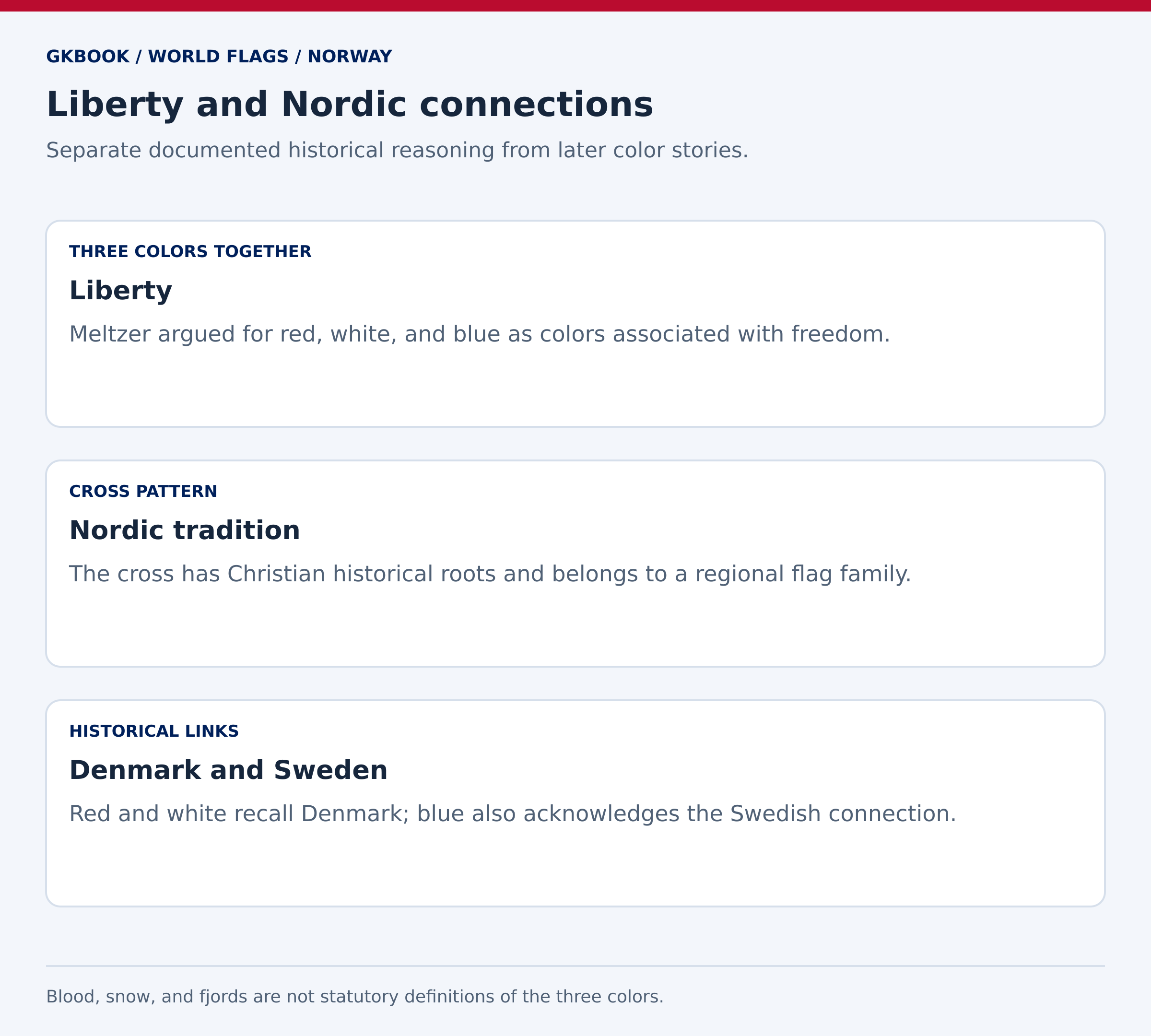
The red, white, and blue combination was proposed as an expression of liberty. Its cross belongs to the Nordic flag tradition. Historical explanations also connect the red and white with Denmark and the blue with Sweden, reflecting Norway’s relationships with both kingdoms when the design was chosen.

Meltzer argued for the three colors together by pointing to countries whose flags were associated with freedom. This documented reasoning is more reliable than assigning a separate, supposedly official virtue to every stripe or panel. The flag’s symbolism grew from both political aspiration and familiar regional forms.
Red for blood, white for snow, and blue for fjords are memorable modern interpretations, but they are not definitions supplied by the flag law or Meltzer’s recorded explanation. Such associations should not replace the historical account. The white border also performs a practical visual role by separating the dark blue cross from the red field.
Why does Norway use a Nordic cross?
Norway’s flag uses the Nordic cross pattern shared by several northern European countries. The cross historically reflects Christian tradition, while its position toward the hoist distinguishes this flag family. Norway’s particular version combines a red field, a white border, and a dark blue inner cross.
The pattern is often called a Scandinavian cross, although Nordic is the broader useful description for a family that also includes Finland and Iceland. Shared structure does not mean that the flags have identical dimensions. Each country’s colors, border treatment, and proportions must be checked separately.
A cross centered in the rectangle would change Norway’s design. The offset creates a compact hoist-side block and a longer fly-side extension. In this flag, the geometry is precisely measurable: the cross intersection lies eight units from the hoist in a rectangle twenty-two units long.
What is the official ratio of the Norway flag?
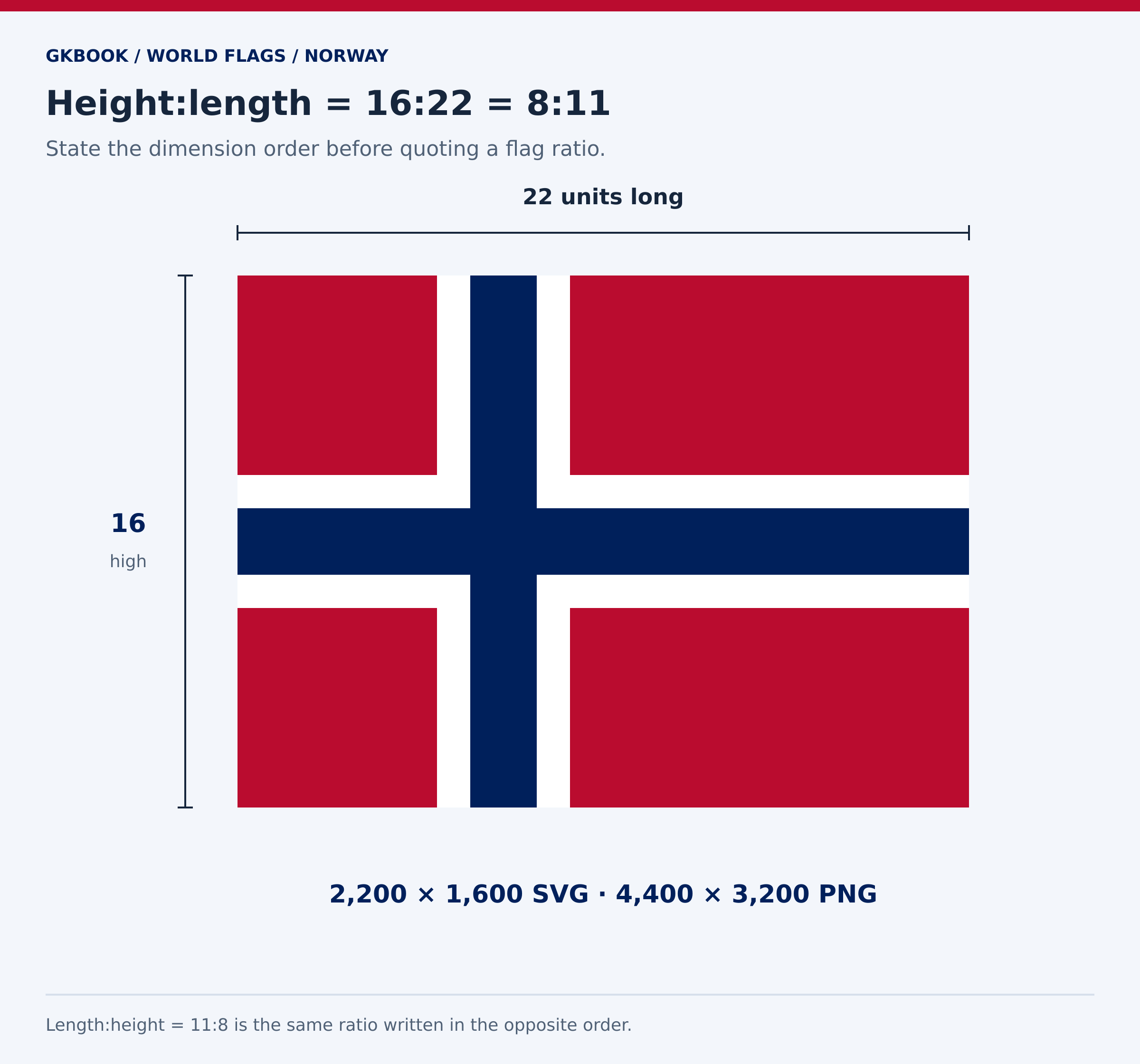
The ordinary rectangular Norway flag has a height:length ratio of 16:22, which simplifies to 8:11. Written in the opposite order, length:height is 11:8. These proportions apply to the national and merchant rectangle, rather than to the longer state and naval flag with its split fly.

A flag 160 centimeters high is therefore 220 centimeters long. For any chosen height H, multiply by 11/8 to obtain the length. Conversely, multiply a chosen length by 8/11 to find the matching height. Scaling this way preserves the entire design rather than only its outer silhouette.
The downloadable SVG uses 2,200 × 1,600 coordinates, and the plain PNG measures 4,400 × 3,200 pixels. Both are exact 8:11 rectangles. Diagrams and social cards use larger explanatory canvases, so their overall dimensions should not be mistaken for the ratio of the flag pictured inside them.
How are the horizontal measurements divided?
From the hoist to the fly, Norway’s rectangular flag is divided into 6:1:2:1:12 units. These represent red, white, blue, white, and red when measured across a red panel’s height. The five widths total twenty-two units, placing the cross noticeably closer to the hoist.
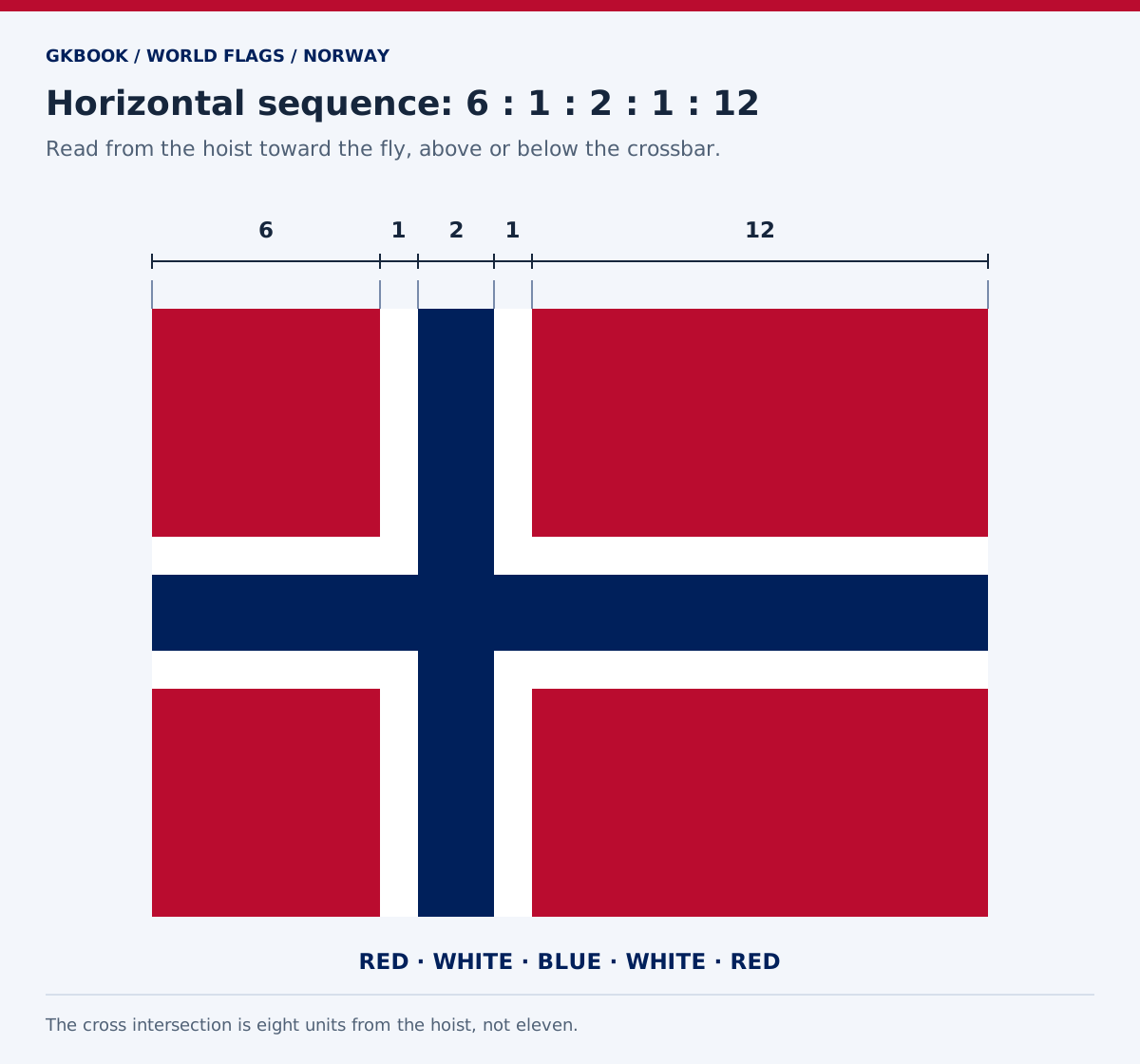
On the 2,200-unit master, the boundaries fall at x = 600, 700, 900, and 1,000. The blue vertical arm occupies x = 700 through 900, while the wider white underlay occupies x = 600 through 1,000. The final red fly panel extends from x = 1,000 to 2,200.
Choose a horizontal measurement line above or below the horizontal cross arm to see all five color segments. A line through the middle of the flag lies entirely inside the blue horizontal arm, so it cannot reveal this five-part sequence. Measurement diagrams mark their sampling direction explicitly.
How are the vertical measurements divided?
From top to bottom, the Norwegian flag’s divisions are 6:1:2:1:6 units. The two red panels have equal heights, and the blue horizontal arm is centered vertically. Its white border adds one unit above and one below, making the complete bordered arm four units thick.

The master’s horizontal boundaries are y = 600, 700, 900, and 1,000. A vertical line outside the vertical arm passes through red, white, blue, white, and red in that order. The two six-unit red heights, two one-unit borders, and two-unit blue arm add up to sixteen.
The vertical and horizontal measurement sequences use the same unit. Independently scaling their unit sizes would distort the cross and turn the hoist-side squares into rectangles. All coordinates should be multiplied by one common factor whenever the flag is resized.
How wide are the white borders and blue cross?
Each white border is one unit wide, while the blue cross arm is two units wide. A bordered arm therefore measures four units overall: one white, two blue, and one white. Relative to the flag’s height, each border is 1/16 and the blue arm is 1/8.

The white color is an opaque part of the flag, not empty space. A transparent border would show a website background or fabric behind the illustration and could change the design’s appearance. In the supplied SVG, a white cross is drawn first and a narrower blue cross is laid over it.
At the intersection, the blue arms join continuously. There is no white line crossing through their center. The white region surrounds the joined blue cross along its exposed sides; it is not a white rectangular frame around the outside edge of the whole flag.
Where is the cross positioned on Norway’s flag?
On a twenty-two-by-sixteen grid, the cross intersection is at coordinates (8, 8), measured from the upper-left corner with the hoist on the left. It is halfway down the flag but only 4/11 of the way along its length, making it offset toward the hoist.
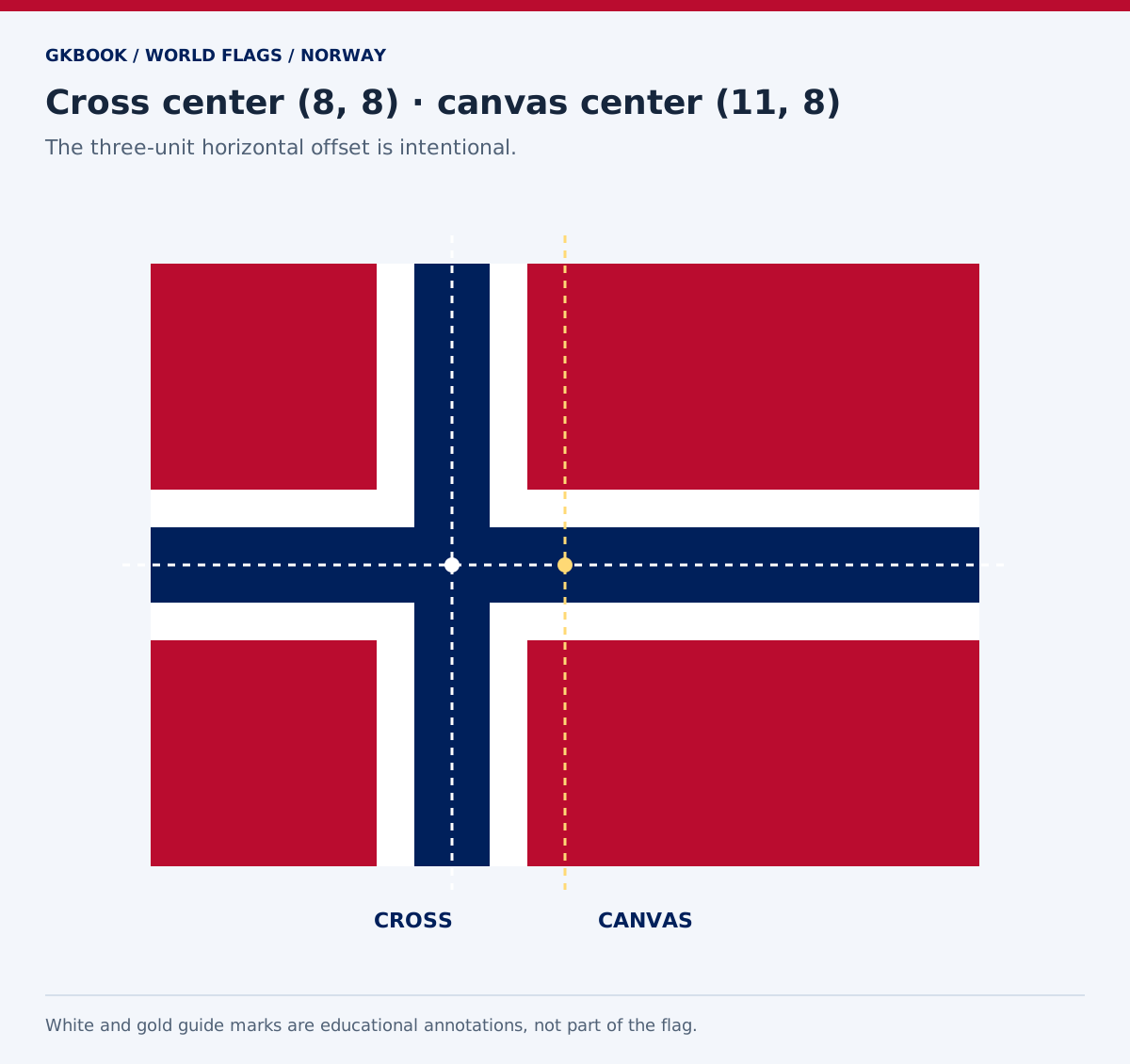
The rectangle’s geometric center is (11, 8), three units farther toward the fly than the cross intersection. The difference is intentional. Centering an imported cross object on the whole canvas, a common graphics-editor shortcut, would produce the wrong national flag.
On the 2,200 × 1,600 master, the cross center is (800, 800); the canvas center is (1,100, 800). These locations provide a useful independent check after editing or resizing. The pole-side red panels should still look compact, with the fly-side red panels twice as long.
What are the sizes of the four red panels?
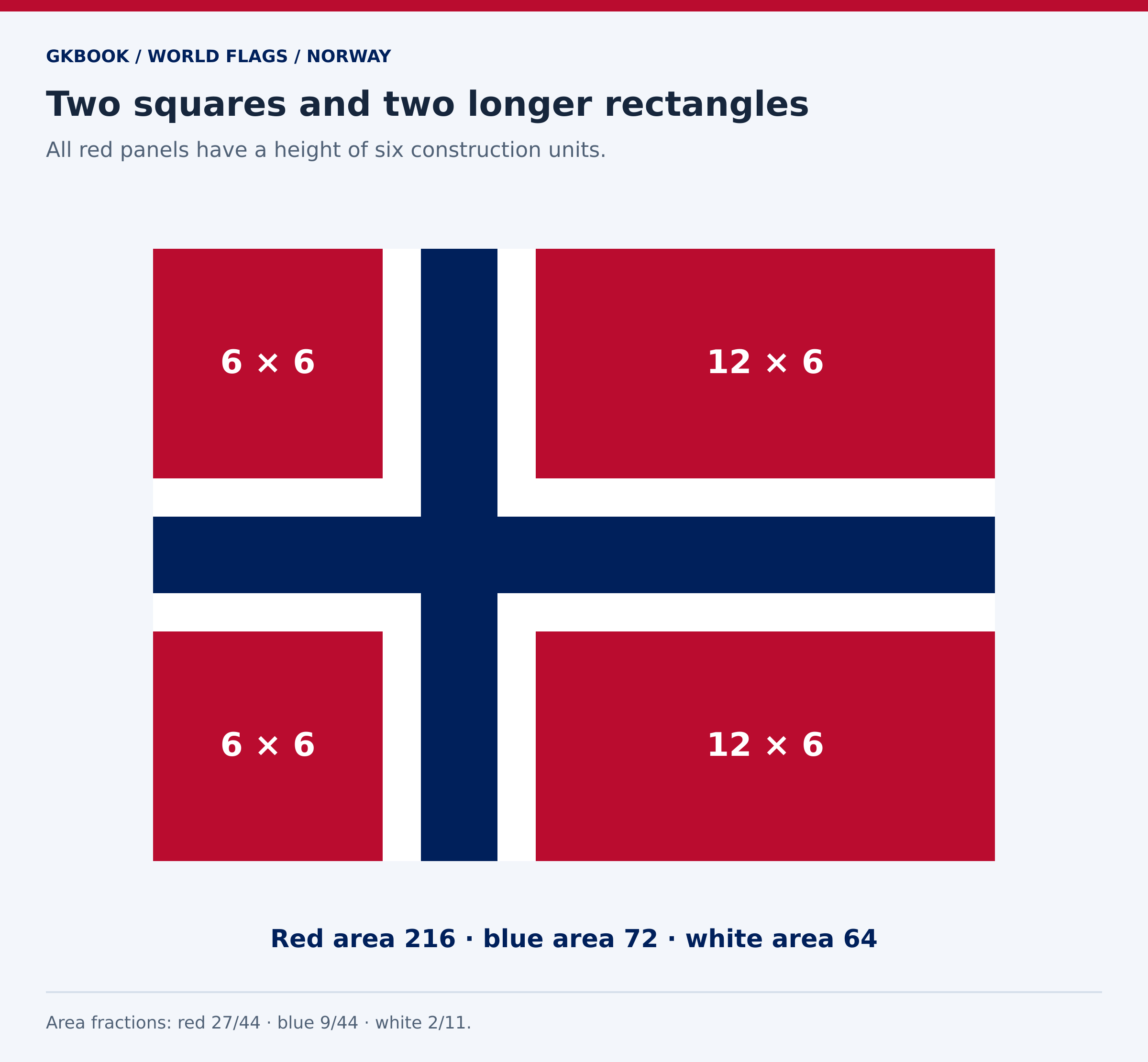
The two red panels nearest the hoist are six-by-six squares. The two panels toward the fly are twelve-by-six rectangles. Each fly-side panel has twice the area of a hoist-side square, while all four share the same height and use the same red fill.
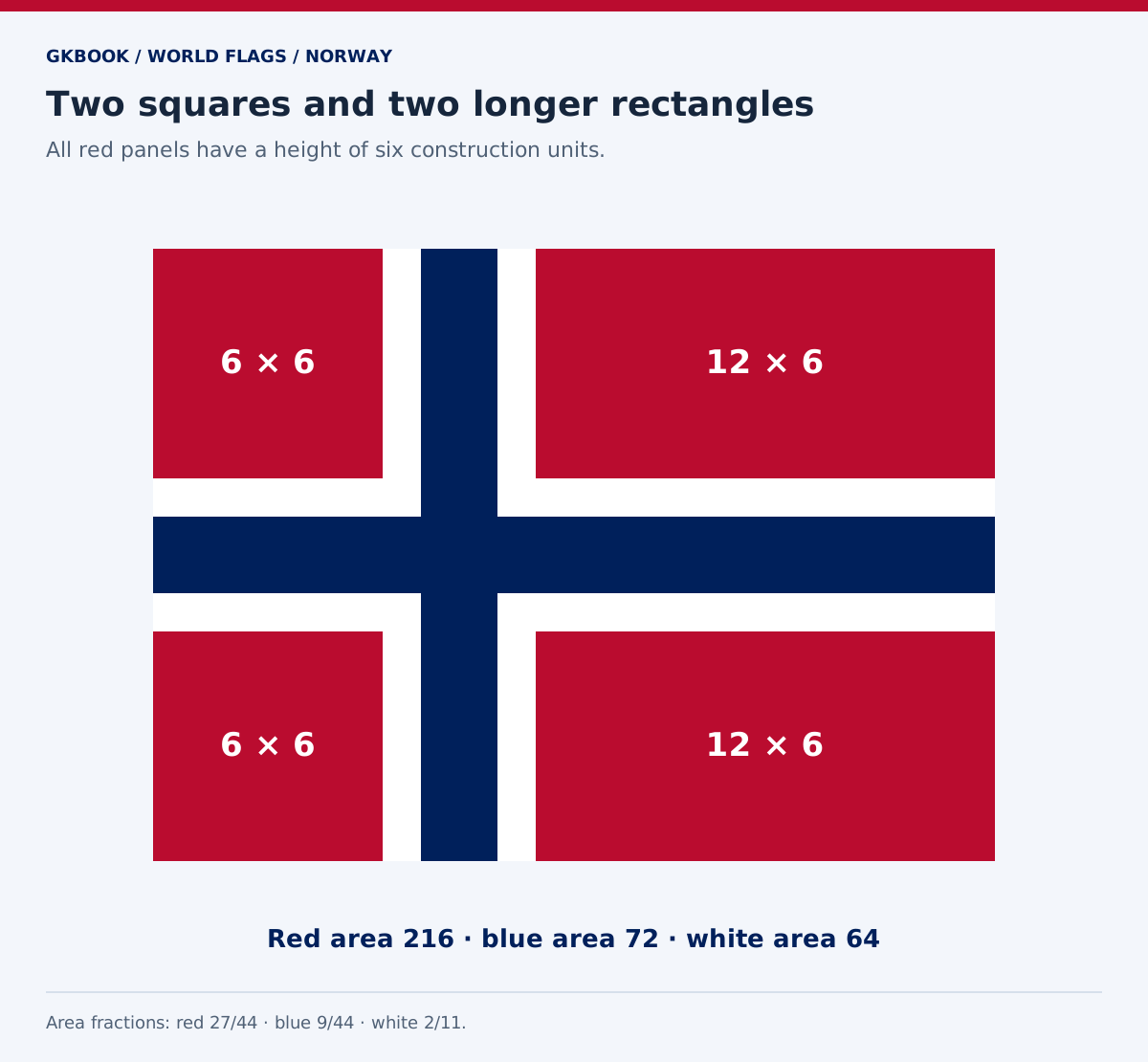
Together, the red panels occupy 216 of the flag’s 352 square units, or 27/44 of the total area. The joined blue cross occupies 72 square units, and the visible white border occupies 64. These values follow from the legal dimensions and count the cross intersection only once.
The area calculations are geometric observations, not additional symbolic meanings or manufacturing requirements. They can help validate a large flat raster export: with this axis-aligned master and integer scaling, every pixel can fall cleanly within one of the three specified colors.
| Color | Square units | Fraction of whole |
|---|---|---|
| Red | 216 | 27/44 |
| Blue | 72 | 9/44 |
| White | 64 | 2/11 |
| Total | 352 | 1 |
How can you draw the Norwegian flag accurately?
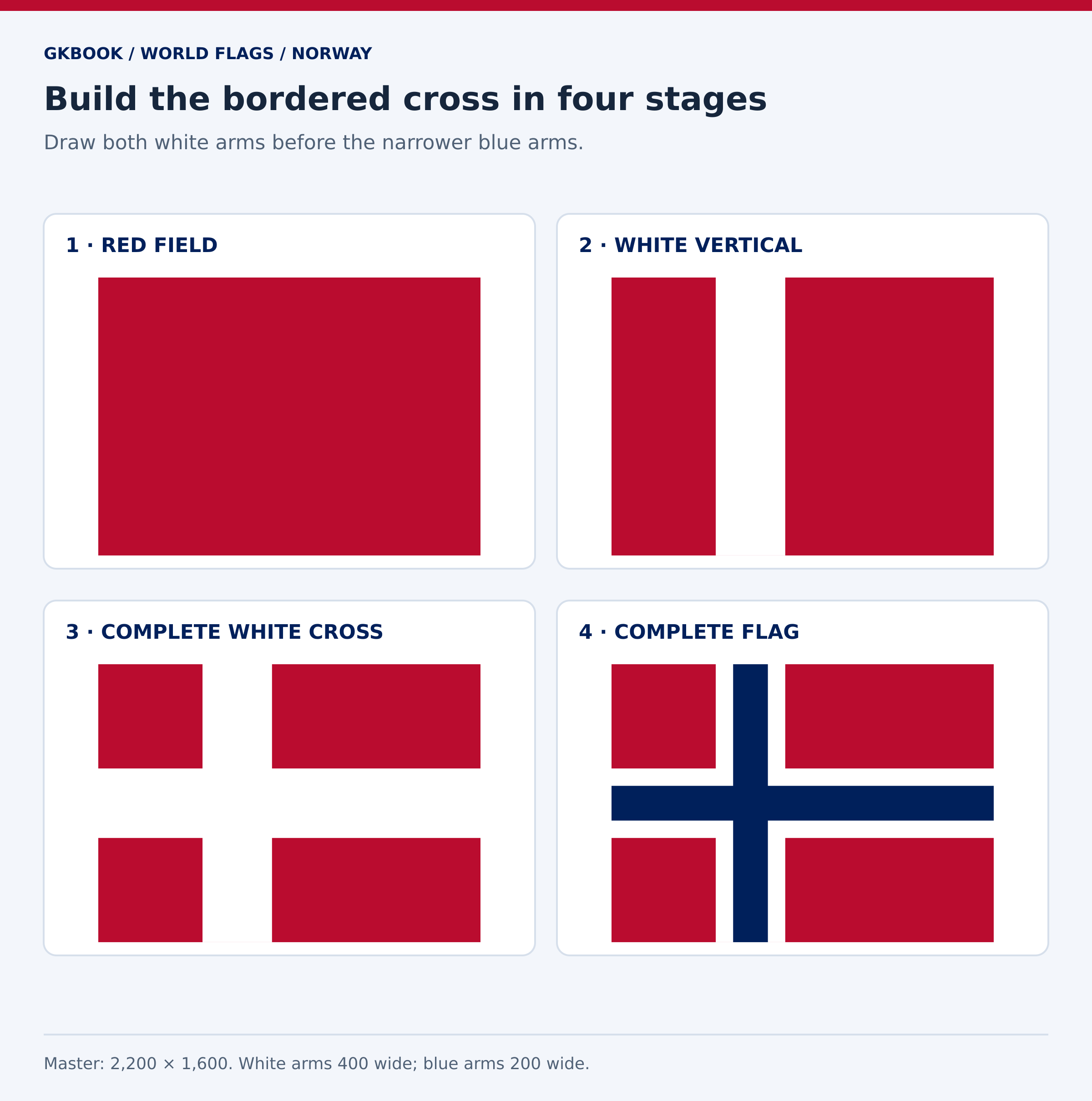
Begin with a red rectangle twenty-two units long and sixteen units high. Add a white vertical band from x = 6 to 10 and a white horizontal band from y = 6 to 10. Overlay blue bands from x = 7 to 9 and y = 7 to 9.

This sequence builds the bordered cross without having to calculate separate white corner polygons. The vertical bands span the full height; the horizontal bands span the full length. Draw both white bands before either blue band so that their overlap cannot leave a white stripe across the blue center.
Keep fills solid and omit decorative outlines, gradients, shadows, and rounded corners from the plain reference flag. Those effects can belong to a surrounding illustration, but they are not flag geometry. Use the completed fourth panel in the construction diagram as the final design; earlier stages are deliberately unfinished.
What sizes preserve Norway’s flag proportions?
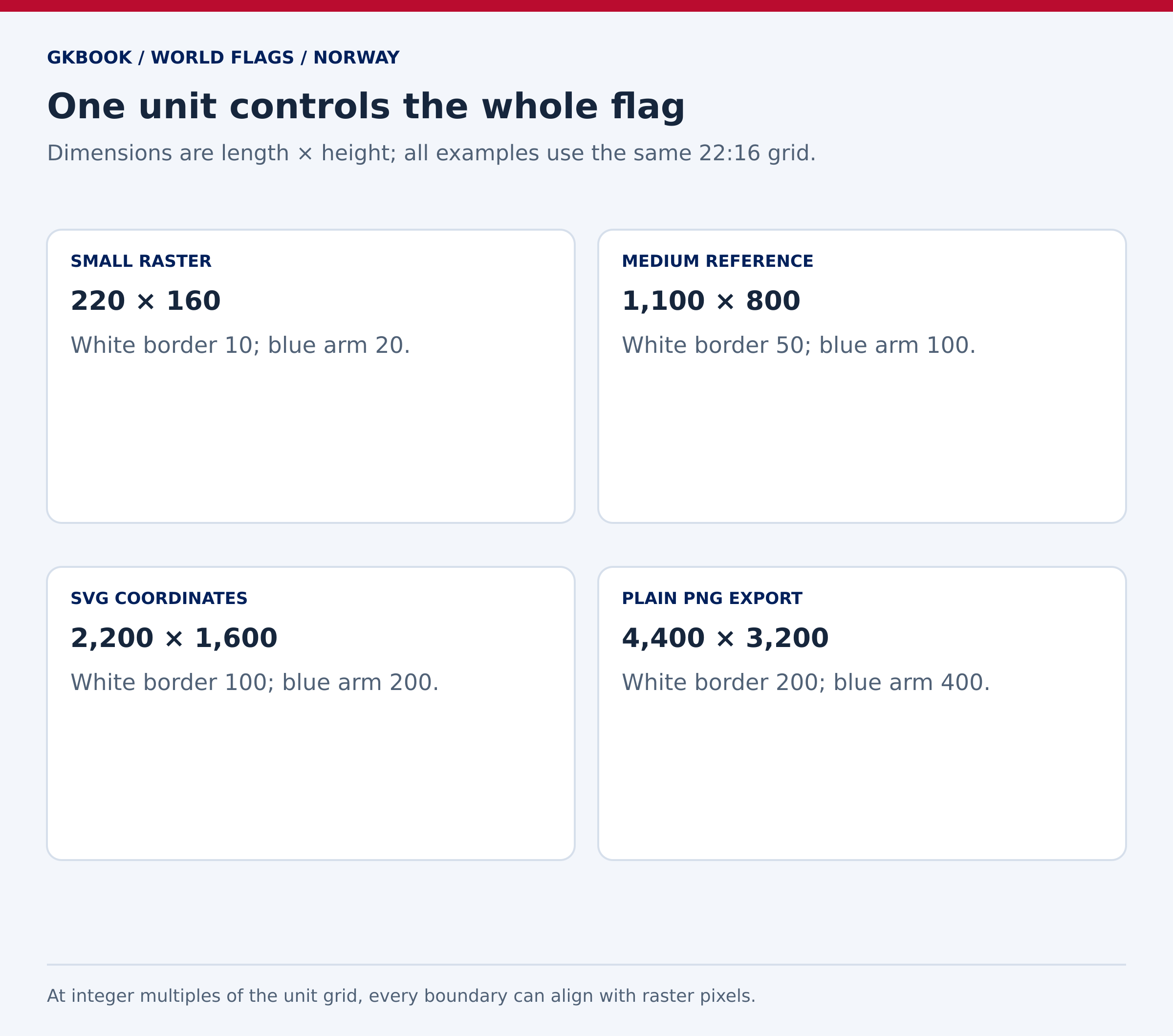
Any size preserves the design if its length and height remain in the ratio 22:16 and every component scales together. Examples include 220 × 160, 1,100 × 800, and 2,200 × 1,600. These numbers are length × height and can represent pixels, centimeters, or another consistent unit.

Let one construction unit equal u. The finished flag is 22u long and 16u high, each white border is u, and each blue arm is 2u. At 220 × 160 pixels, those widths are ten and twenty pixels. At 1,100 × 800, they become fifty and one hundred.
For a crisp small icon, dimensions that are whole multiples of twenty-two and sixteen align every boundary to the pixel grid. Other sizes can be displayed using ordinary antialiasing, but the image must still be scaled uniformly. A square thumbnail should contain the complete rectangle with surrounding space.
| Size | One unit / white border | Blue arm |
|---|---|---|
| 220 × 160 | 10 | 20 |
| 1,100 × 800 | 50 | 100 |
| 2,200 × 1,600 | 100 | 200 |
| 4,400 × 3,200 | 200 | 400 |
Is the Norway flag symmetrical?
The rectangular Norwegian flag is symmetric across a horizontal line through its center: the upper and lower halves match. It is not symmetric across the vertical centerline because the cross is offset toward the hoist. A half-turn also moves the short panels to the opposite side.

These statements describe the flat drawing with the hoist fixed on the left. The red top and bottom panels match in pairs, and the white borders are equally wide above and below the blue arm. Reflecting the picture top to bottom therefore leaves the design unchanged.
Reflecting it left to right instead creates the view seen from the opposite side of the same cloth. That view is legitimate when the hoist is correspondingly on the right, but it should not be confused with vertical mirror symmetry of a single fixed reference image.
What does the reverse side of Norway’s flag look like?
The reverse of the Norwegian flag shows the same red, white, and blue design viewed through the opposite side of the cloth. In a flat comparison, the cross appears nearer the right edge when the hoist is on the right. No separate emblem or reverse-only inscription is added.

The important reference is the pole side, not an absolute left side of every photograph. In both views, the two square red panels remain beside the hoist and the longer panels extend toward the fly. A mirrored photograph can still show a plausible reverse view when those relationships are preserved.
The comparison drawing labels the hoist on both views. It illustrates geometric reversal rather than prescribing a ceremonial hanging method. Because the design is top-to-bottom symmetric, a picture alone also cannot always reveal which physical edge of the cloth was originally sewn as the top.
What is the history of the Norway flag?
Norway’s present cross design was chosen in 1821, during its union with Sweden. A joint union mark was added in 1844. The unmarked merchant flag returned in 1899 under the 1898 Flag Act, while the naval flag retained the union mark until Norway’s break with Sweden in 1905.

The design emerged after Norway’s long association with Denmark ended in 1814. Norway adopted a constitution that year and subsequently entered a union with Sweden. A distinctive merchant flag became an important expression of national identity within that political arrangement.
The timeline involves changes in permission and use as well as changes in appearance. In 1838, restrictions on where Norwegian merchant ships could use their own flag were lifted. Later disputes over the union mark made the flag a visible part of the constitutional struggle between the Norwegian parliament and the monarchy.
Who designed the Norwegian flag?
Frederik Meltzer, a merchant and parliamentary representative from Bergen, proposed the design that became Norway’s flag in 1821. His name is also written Fredrik Meltzer. He advocated a recognizable cross flag in red, white, and blue, combining a familiar Nordic form with colors associated with liberty.

The proposal formed part of a wider parliamentary debate that considered several alternatives. The surviving official history connects Meltzer with both the visual proposal and its explanation. A simple cross could be reproduced and recognized more easily than an elaborate painted emblem aboard a merchant vessel.
Designer attribution does not mean that one person alone determined the flag’s legal status. Representatives voted on the proposal, the two parliamentary divisions considered it, and the king approved the commercial flag through a royal resolution. The separate adoption stages are explained in the next section.
When was the Norway flag adopted?
The design was selected by the Odelsting on May 4, 1821, approved by the Lagting on May 16, and submitted for royal approval on May 17. King Carl Johan approved the commercial flag by royal resolution on July 13, 1821. These dates describe different stages of adoption.
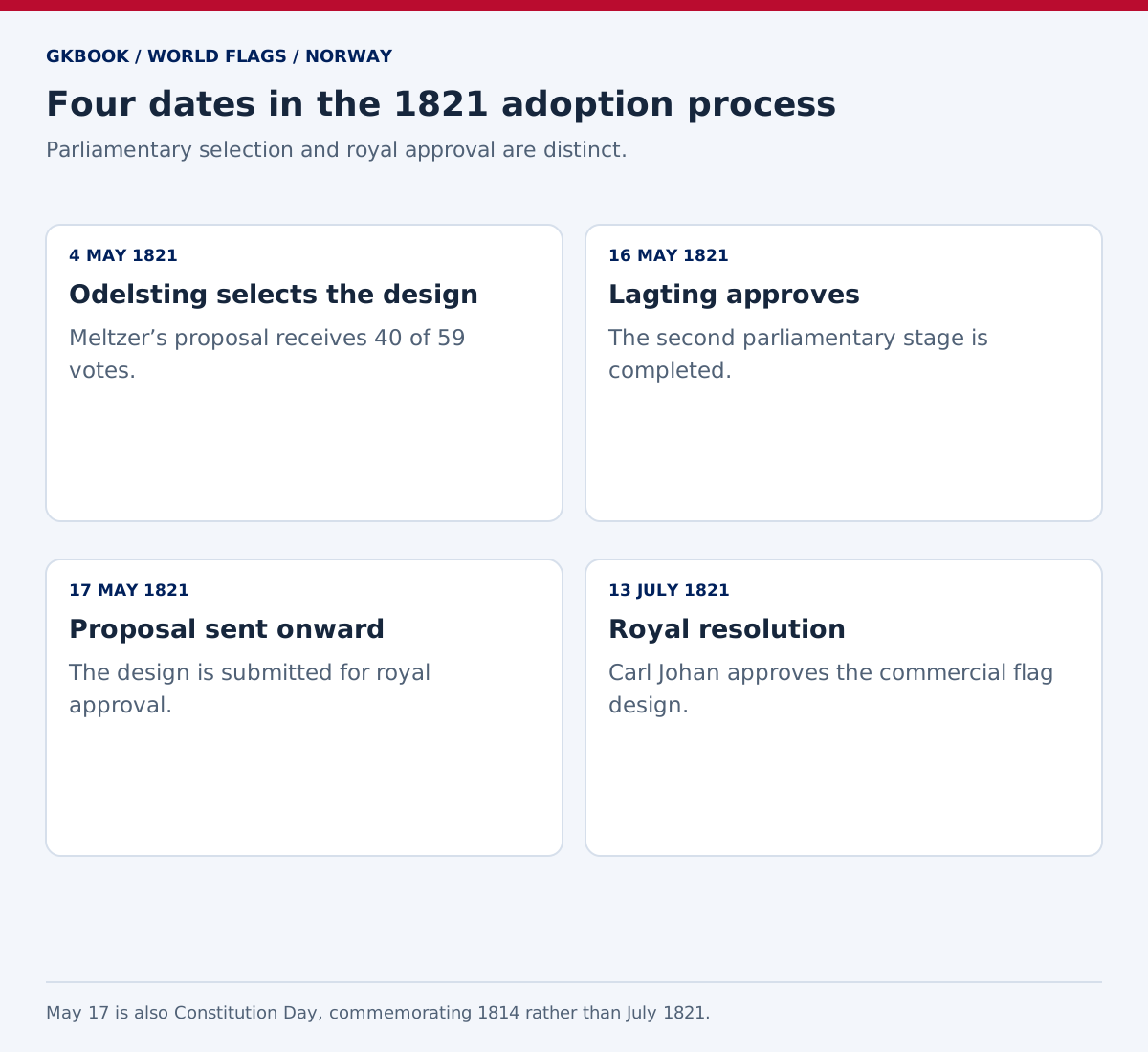
The May 4 vote favored Meltzer’s proposal by forty votes out of fifty-nine. The National Archives preserves the royal resolution and its attached drawing, providing direct evidence for the July 13 approval. The parliamentary decision and royal act should not be compressed into an invented single May adoption event.
The constitutional issue remained contentious: the king accepted the flag’s design while resisting parliament’s claimed authority to determine it by law. Calling the July decision a royal resolution avoids implying that he straightforwardly sanctioned the proposed statute. The later 1898 law belongs to a different phase of this struggle.
| Date | Milestone |
|---|---|
| May 4 | Odelsting selects Meltzer’s proposal |
| May 16 | Lagting approves |
| May 17 | Proposal forwarded for royal approval |
| July 13 | Royal resolution approves the commercial flag |
What flags were used before the 1821 design?
Before the 1821 cross design, Norway used flags connected to its unions with neighboring kingdoms. In 1814, a Norwegian lion was added to the Danish red-and-white flag. During the early union with Sweden, merchant shipping also used a Swedish-based flag with a red-and-white canton.
These earlier arrangements reflected the rapid political changes of 1814 and the need for ships to carry recognized national identification. They should be described with their period and function; treating every early nineteenth-century Norwegian flag as the same cross design hides important differences.
The 1821 proposal provided a distinct Norwegian merchant flag without a lion or complicated central badge. Its red, white, and blue palette still acknowledged familiar northern European flag traditions. The present article’s plain downloadable flag represents the unmarked rectangular design, not a reconstruction of every earlier ensign.
Why is 1838 important in Norway’s flag history?
In 1838, Norwegian merchant ships gained permission to use the national merchant flag on all voyages, at their own risk. Earlier use had been geographically restricted because recognition and protection at sea were concerns. This change expanded the flag’s maritime use without introducing a new cross design.

A ship’s flag was more than decoration: it identified the authority from which the vessel expected diplomatic recognition and assistance. Early restrictions were linked to shipping security and relations with Mediterranean powers. The debate therefore concerned international treatment of vessels as well as national pride.
The parliamentary history records the change in April 1838. It should be distinguished from the 1821 approval of the design and the 1844 introduction of the union mark. A chronology that labels all three as flag adoptions would obscure what actually changed at each stage.
What was the union mark on Norway’s flag?
The union mark was a small multicolored device placed in the upper hoist corner of the Norwegian and Swedish flags from 1844. It combined elements of both countries’ colors to express their union. In Norway, the mark later became a focus of demands for an unmarked national flag.

The device became widely known by a nickname translated as herring salad, referring to its mixed colors. Its initial introduction was seen by many Norwegians as a gain in equality because earlier union arrangements had been dominated by Swedish imagery. Its political meaning changed as opposition to the union intensified.
For Norway’s merchant flag, the marked period lasted until 1899. The naval flag kept the device until 1905. A historical illustration therefore needs both a date and a flag type. The upper hoist red square of today’s rectangular national flag is plain and contains no union badge.
What did the 1898 Flag Act change?
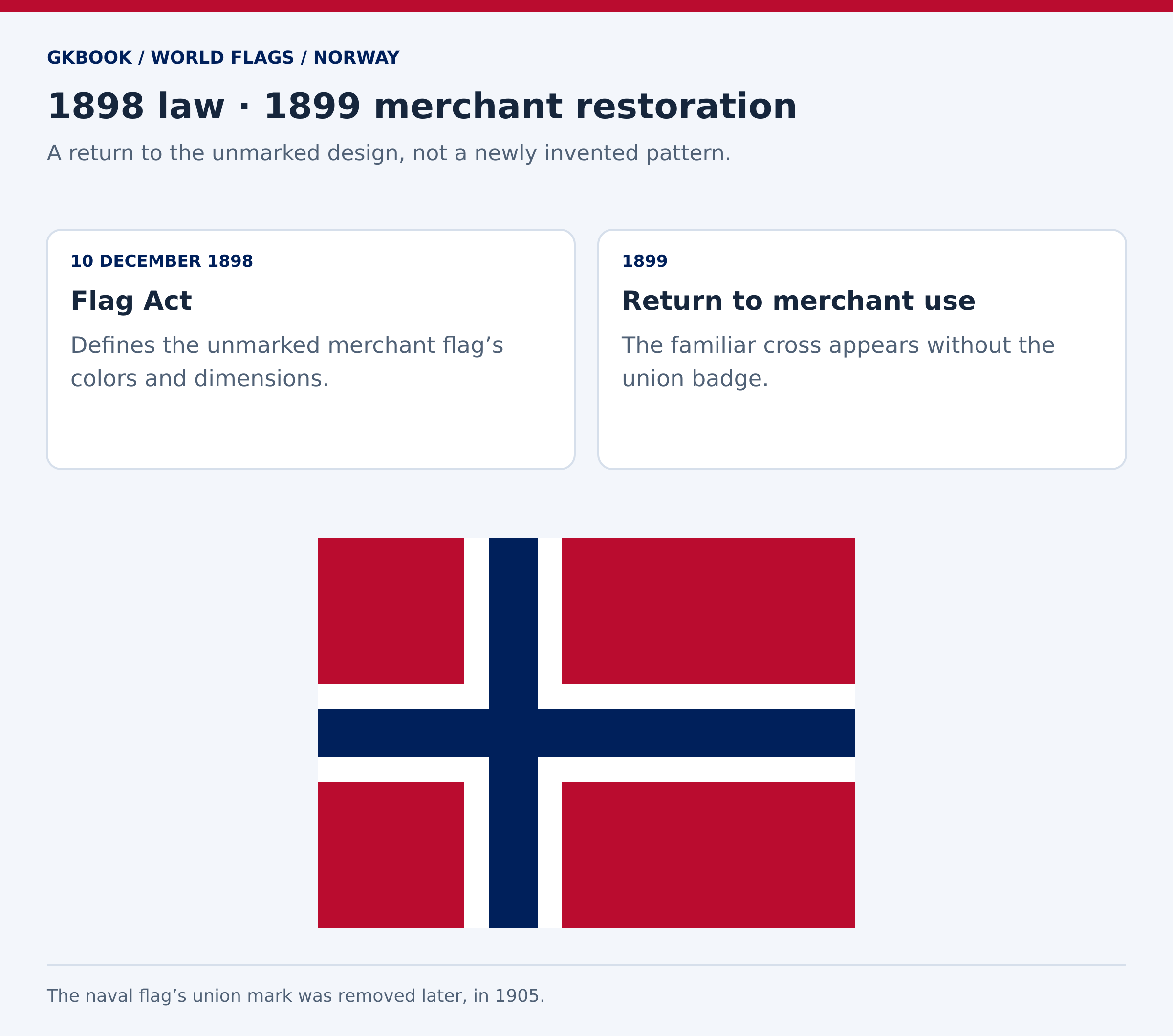
The Flag Act of December 10, 1898, established the unmarked Norwegian merchant flag and specified its colors and proportions. The plain merchant flag returned to use in 1899. This restored the familiar cross design without the union badge; it did not create a completely new national pattern.

The law arose from a prolonged constitutional and political contest. Parliament had repeatedly pursued the unmarked flag, while the monarch resisted. The 1898 outcome allowed the law to be promulgated without royal sanction, making the flag dispute part of the broader development of parliamentary authority.
The law’s date and the return to actual merchant use are separate milestones. The restoration belongs to 1899, while the naval change is treated separately under 1905. Keeping these categories distinct explains why a historical picture from around 1900 may show a plain merchant flag beside a naval flag that still carries the union badge.
Did Norway adopt a new national flag in 1905?
Norway did not invent its present rectangular flag in 1905. The design dated from 1821, and the unmarked merchant version had returned in 1899. During the dissolution of the union with Sweden in 1905, the union mark was removed from the Norwegian naval flag as well.
The parliamentary account dates removal from the naval flag to June 9, 1905. That event followed the Storting’s June 7 declaration that the union was dissolved. Political negotiations and recognition unfolded over the following months, so the whole separation should not be reduced to a single flag ceremony.
In a short factbox, 1821 identifies the origin and approval of the familiar national design. The years 1899 and 1905 explain the disappearance of the union mark from different categories of flag. Keeping those meanings distinct makes historical captions and classroom timelines much more accurate.
How do Norway’s civil, state, and naval flags differ?
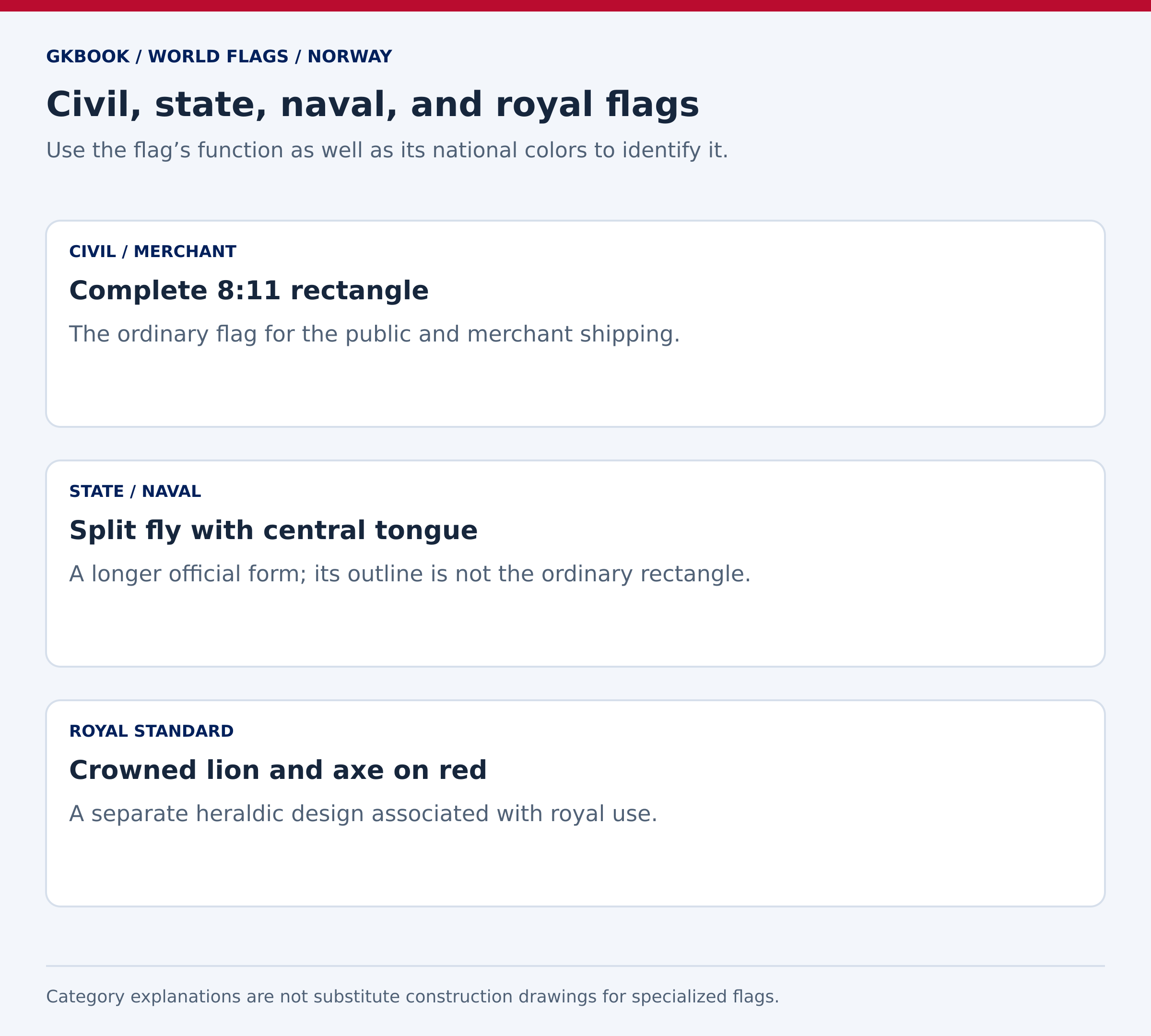
Norway’s ordinary civil and merchant flag is a complete 8:11 rectangle. The state and naval form uses the same red, white, and blue cross but has a longer fly divided into a split and central tongue. Its outline and authorized uses distinguish it from the familiar rectangular national flag.

The state form is not made by merely cutting a V into the ordinary downloadable rectangle. Its longer outline follows a different construction. Government regulations reserve the state flag for specified official uses; a private celebration does not automatically justify substituting it for the ordinary civil flag.
Other official service flags can add their own authorized devices. For example, the regulations describe special postal and customs versions. Those additions belong to particular functions and should not appear on a general reference image labeled simply Norway flag. The comparison graphic here explains categories without supplying speculative tail geometry.
Is Norway’s royal standard the same as its national flag?
Norway’s royal standard is a separate flag: a red field bearing a crowned golden lion holding an axe with a silver blade. It is associated with the monarch and royal use. The ordinary national flag instead carries the white-bordered blue Nordic cross and contains no lion.
The resolution of November 15, 1905, describes the royal standard with height:length proportions of 5:7. Its heraldic device requires more than a generic lion silhouette: crown, stance, axe, and colors all belong to the description. This package explains the distinction without presenting a newly improvised royal emblem.
A photograph of the Royal Palace may therefore show a valid Norwegian royal flag that looks unlike the everyday national flag. Correct identification depends on the flag’s function and setting. The royal standard, state flag, and ordinary civil flag should retain their own labels.
Why is the flag prominent on May 17?
May 17 is Norway’s Constitution Day, commemorating the constitution adopted in 1814. Norwegian flags are prominent in celebrations and children’s parades. The holiday predates the 1821 cross design, so May 17 should not be described simply as the anniversary of the present flag’s royal approval.

Flags carried by children, displayed on buildings, and used during community celebrations make the national colors especially visible on this day. The celebration concerns the constitution and national civic life; its meaning does not depend on the flag having existed in its current form in 1814.
May 17 also appears in the 1821 adoption sequence because the parliamentary proposal was sent for royal approval on that date. That coincidence does not change the holiday’s origin. The royal resolution approving the commercial flag was issued later, on July 13.
Who uses Norway’s rectangular flag?
The rectangular national flag is the ordinary form used by the public and by merchant shipping. State institutions use the designated state flag under government regulations. Rules for official flag days and government display should be read in their institutional context, rather than treated as universal instructions for every private household.
The official regulation lists state flag days and provisions governing state use, including raising and lowering times. Municipal flagging is also governed by its own framework. These distinctions matter when moving from a general educational description to planning an official ceremony or display.
This article focuses on identifying and reproducing the flag accurately. It does not present a comprehensive ceremonial code or a full, permanently fixed calendar of official observances. For a specific institutional event, the responsible authority’s current instructions determine the appropriate flag and arrangements.
Which Norway flag file should you use: SVG or PNG?
Use the SVG when you need a scalable flag for a website, layout, or vector editor. Use the PNG when you need a ready-made raster image. Both supplied plain files preserve the 8:11 ratio, use the same declared palette, and include the complete flag without surrounding labels.
The plain PNG is 4,400 × 3,200 pixels. The SVG uses a 2,200 × 1,600 coordinate system and can be enlarged without turning its straight edges into a fixed pixel grid. The gallery’s educational graphics have their own captions, measurement guides, or explanatory text; they are separate from the clean flag asset.
If a layout needs a different box shape, fit the image proportionally and allow margins. Do not stretch it to fill an arbitrary width and height. The social card is a separate 1,200 × 630 composition containing the flag and a title, not an alternative national flag ratio.
Can Norway’s flag be cropped into a square or circle?
A square or circular crop can serve as a decorative icon, but it does not preserve Norway’s complete national flag. Cropping removes part of the 8:11 rectangle and can change the visible balance of the cross. For an accurate reference image, keep the whole flag and add margins instead.
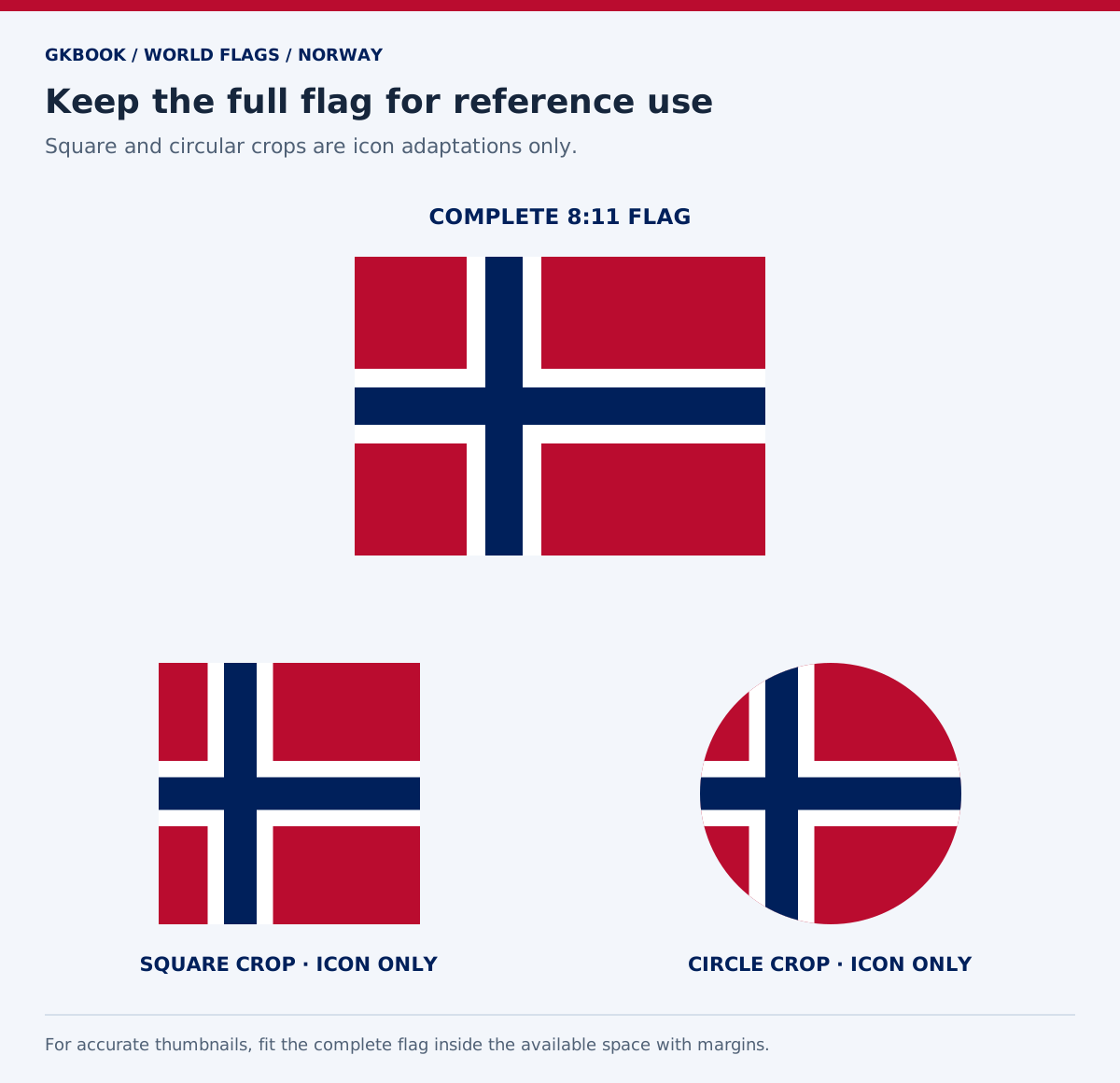
The gallery deliberately labels its cropped examples as icons. They demonstrate the loss of information rather than propose official variants. In a circular crop, curved edges replace the flag’s rectangular boundary; a centered square crop also removes different amounts of the short hoist and long fly regions.
A better solution for educational thumbnails is a complete flag fitted inside a square or circular container with a neutral surrounding background. The container can be decorative while the flag remains intact. Never use the icon’s outer shape to infer the country’s official flag proportions.
What are common mistakes when drawing Norway’s flag?
Common mistakes include centering the cross, using a 2:3 rectangle, making the white border transparent, or giving the blue arm and white border equal widths. Historical captions can also confuse 1821, 1899, and 1905. Check the geometry, color status, flag type, and date together before publishing.

The quickest geometric review is to confirm the 22 × 16 unit grid, the six-unit hoist squares, twelve-unit fly panels, two-unit blue arms, and one-unit white borders. Then inspect the cross intersection: it should be blue throughout, and its center should lie at (8, 8).
For captions, distinguish a digital color choice from a statutory specification and a civil rectangle from the split state or naval form. Use 1821 for approval of the present design, 1899 for the unmarked merchant flag’s return, and 1905 for removal of the naval union mark. These checks address different kinds of accuracy.
Download Norway flag pictures
Download the plain flag as SVG or 4,400 × 3,200 PNG. The SVG uses a 2,200 × 1,600 coordinate system and remains scalable. The gallery contains 24 subjects with paired SVG and PNG files, including construction, history, and comparison diagrams. Image credits and construction notes record the status of the original artwork.
Explore more in World Flags, including the Netherlands flag and North Macedonia flag.
World Flags/Norway
Norway flag pictures
Original educational vector construction of Norway’s rectangular flag. Geometry follows the statutory 16:22 proportions and 6:1:2:1:12 / 6:1:2:1:6 divisions. Screen colors #BA0C2F, #00205B and #FFFFFF are declared reproduction values, not universally legislated color codes or certified textile specifications.
GKBook original artwork; statutory geometry and declared screen colors.Download SVGDownload PNGTwo square red panels sit beside the hoist; two longer panels extend toward the fly. No words, lion, crown, or union badge appear on the ordinary flag.
GKBook original artwork; statutory geometry and declared screen colors.Download SVGDownload PNGThe supplied artwork uses #BA0C2F red, #00205B dark blue, and #FFFFFF white, matching the Nordic cooperation reference palette. These are declared reproduction values.
GKBook original artwork; statutory geometry and declared screen colors.Download SVGDownload PNGThe three-color combination was associated with liberty. The cross and historical color connections place the design in its Nordic setting.
GKBook original artwork; statutory geometry and declared screen colors.Download SVGDownload PNGThe ordinary rectangular flag has statutory 16:22 proportions, equivalent to 8:11. The state and naval form has a different outline.
GKBook original artwork; statutory geometry and declared screen colors.Download SVGDownload PNGThe 6:1:2:1:12 sequence totals twenty-two units. It is measured across a red panel’s height, outside the horizontal blue arm.
GKBook original artwork; statutory geometry and declared screen colors.Download SVGDownload PNGThe vertical sequence totals sixteen units and places the horizontal blue arm at mid-height. Top and bottom red panels are equally high.
GKBook original artwork; statutory geometry and declared screen colors.Download SVGDownload PNGEach white border is one unit and the blue arm is two units. The complete bordered arm is four units wide.
GKBook original artwork; statutory geometry and declared screen colors.Download SVGDownload PNGThe cross is centered vertically but sits at x = 8 on the twenty-two-unit length. The geometric center of the canvas is x = 11.
GKBook original artwork; statutory geometry and declared screen colors.Download SVGDownload PNGHoist-side red panels are 6 × 6 squares; fly-side panels are 12 × 6 rectangles. Derived areas total 352 square units.
GKBook original artwork; statutory geometry and declared screen colors.Download SVGDownload PNGThe field, white arms, and blue overlay form the exact statutory geometry. Only the fourth panel is a finished flag.
GKBook original artwork; statutory geometry and declared screen colors.Download SVGDownload PNGAll dimensions scale uniformly. These are mathematical examples and file sizes, not prescribed physical cloth dimensions.
GKBook original artwork; statutory geometry and declared screen colors.Download SVGDownload PNGThe flag is symmetric top to bottom. It is not symmetric left to right, and a 180-degree turn moves the short red panels to the other side.
GKBook original artwork; statutory geometry and declared screen colors.Download SVGDownload PNGA reverse view is mirrored horizontally when the hoist changes from left to right. The design on the cloth is the same.
GKBook original artwork; statutory geometry and declared screen colors.Download SVGDownload PNGThe chronology distinguishes the original design, expanded merchant use, addition of the union mark, and its later removal.
GKBook original artwork; statutory geometry and declared screen colors.Download SVGDownload PNGOfficial parliamentary and archival histories identify Frederik Meltzer with the adopted 1821 proposal. His first name also appears as Fredrik.
GKBook original artwork; statutory geometry and declared screen colors.Download SVGDownload PNGThe May parliamentary decisions preceded the July 13 royal resolution. The king’s acceptance of the design did not settle the constitutional dispute over flag legislation.
GKBook original artwork; statutory geometry and declared screen colors.Download SVGDownload PNGGeographic restrictions were lifted in 1838. The red, white, and blue cross design had already been approved in 1821.
GKBook original artwork; statutory geometry and declared screen colors.Download SVGDownload PNGThe union badge was introduced in 1844. Its removal occurred at different times for the merchant and naval flags.
GKBook original artwork; statutory geometry and declared screen colors.Download SVGDownload PNGThe 1898 Flag Act and the merchant flag’s return in 1899 are separate milestones. The existing cross design continued without the upper-hoist union badge.
GKBook original artwork; statutory geometry and declared screen colors.Download SVGDownload PNGThe ordinary national flag, split state or naval form, and royal standard have distinct designs and functions.
GKBook original artwork; statutory geometry and declared screen colors.Download SVGDownload PNGMay 17 commemorates the 1814 constitution. Its association with flags and children’s parades does not make it the date of the flag’s royal approval.
GKBook original artwork; statutory geometry and declared screen colors.Download SVGDownload PNGThe icon examples remove part of the rectangle and alter its visible proportions. They are explicitly labeled as crops, not national flag variants.
GKBook original artwork; statutory geometry and declared screen colors.Download SVGDownload PNGReview the ratio, cross offset, border width, color status, flag category, and historical milestone before publishing.
GKBook original artwork; statutory geometry and declared screen colors.Download SVGDownload PNGFrequently asked questions
What does Norway’s flag look like?
Norway’s national flag has a red field with a dark blue Nordic cross outlined in white. The cross stands closer to the hoist than to the fly. The ordinary rectangular flag has height:length proportions of 8:11, and its familiar design was approved in 1821.
What is the design of the Norway flag?
The Norwegian flag consists of four red panels divided by a dark blue cross with a white border. Both cross arms reach the edges. The vertical arm is offset toward the flagpole, leaving two square red panels near the hoist and two wider red panels toward the fly.
What are the colors of the Norwegian flag?
Norway’s flag uses red, dark blue, and white. The law describes the colors in words rather than prescribing universal digital codes. This artwork uses red #BA0C2F, blue #00205B, and white #FFFFFF as declared screen values, matching a palette published by Nordic cooperation for digital reproduction.
What does the Norway flag symbolize?
The red, white, and blue combination was proposed as an expression of liberty. Its cross belongs to the Nordic flag tradition. Historical explanations also connect the red and white with Denmark and the blue with Sweden, reflecting Norway’s relationships with both kingdoms when the design was chosen.
Why does Norway use a Nordic cross?
Norway’s flag uses the Nordic cross pattern shared by several northern European countries. The cross historically reflects Christian tradition, while its position toward the hoist distinguishes this flag family. Norway’s particular version combines a red field, a white border, and a dark blue inner cross.
What is the official ratio of the Norway flag?
The ordinary rectangular Norway flag has a height:length ratio of 16:22, which simplifies to 8:11. Written in the opposite order, length:height is 11:8. These proportions apply to the national and merchant rectangle, rather than to the longer state and naval flag with its split fly.
How are the horizontal measurements divided?
From the hoist to the fly, Norway’s rectangular flag is divided into 6:1:2:1:12 units. These represent red, white, blue, white, and red when measured across a red panel’s height. The five widths total twenty-two units, placing the cross noticeably closer to the hoist.
How are the vertical measurements divided?
From top to bottom, the Norwegian flag’s divisions are 6:1:2:1:6 units. The two red panels have equal heights, and the blue horizontal arm is centered vertically. Its white border adds one unit above and one below, making the complete bordered arm four units thick.
How wide are the white borders and blue cross?
Each white border is one unit wide, while the blue cross arm is two units wide. A bordered arm therefore measures four units overall: one white, two blue, and one white. Relative to the flag’s height, each border is 1/16 and the blue arm is 1/8.
Where is the cross positioned on Norway’s flag?
On a twenty-two-by-sixteen grid, the cross intersection is at coordinates (8, 8), measured from the upper-left corner with the hoist on the left. It is halfway down the flag but only 4/11 of the way along its length, making it offset toward the hoist.
What are the sizes of the four red panels?
The two red panels nearest the hoist are six-by-six squares. The two panels toward the fly are twelve-by-six rectangles. Each fly-side panel has twice the area of a hoist-side square, while all four share the same height and use the same red fill.
How can you draw the Norwegian flag accurately?
Begin with a red rectangle twenty-two units long and sixteen units high. Add a white vertical band from x = 6 to 10 and a white horizontal band from y = 6 to 10. Overlay blue bands from x = 7 to 9 and y = 7 to 9.
What sizes preserve Norway’s flag proportions?
Any size preserves the design if its length and height remain in the ratio 22:16 and every component scales together. Examples include 220 × 160, 1,100 × 800, and 2,200 × 1,600. These numbers are length × height and can represent pixels, centimeters, or another consistent unit.
Is the Norway flag symmetrical?
The rectangular Norwegian flag is symmetric across a horizontal line through its center: the upper and lower halves match. It is not symmetric across the vertical centerline because the cross is offset toward the hoist. A half-turn also moves the short panels to the opposite side.
What does the reverse side of Norway’s flag look like?
The reverse of the Norwegian flag shows the same red, white, and blue design viewed through the opposite side of the cloth. In a flat comparison, the cross appears nearer the right edge when the hoist is on the right. No separate emblem or reverse-only inscription is added.
What is the history of the Norway flag?
Norway’s present cross design was chosen in 1821, during its union with Sweden. A joint union mark was added in 1844. The unmarked merchant flag returned in 1899 under the 1898 Flag Act, while the naval flag retained the union mark until Norway’s break with Sweden in 1905.
Who designed the Norwegian flag?
Frederik Meltzer, a merchant and parliamentary representative from Bergen, proposed the design that became Norway’s flag in 1821. His name is also written Fredrik Meltzer. He advocated a recognizable cross flag in red, white, and blue, combining a familiar Nordic form with colors associated with liberty.
When was the Norway flag adopted?
The design was selected by the Odelsting on May 4, 1821, approved by the Lagting on May 16, and submitted for royal approval on May 17. King Carl Johan approved the commercial flag by royal resolution on July 13, 1821. These dates describe different stages of adoption.
What flags were used before the 1821 design?
Before the 1821 cross design, Norway used flags connected to its unions with neighboring kingdoms. In 1814, a Norwegian lion was added to the Danish red-and-white flag. During the early union with Sweden, merchant shipping also used a Swedish-based flag with a red-and-white canton.
Why is 1838 important in Norway’s flag history?
In 1838, Norwegian merchant ships gained permission to use the national merchant flag on all voyages, at their own risk. Earlier use had been geographically restricted because recognition and protection at sea were concerns. This change expanded the flag’s maritime use without introducing a new cross design.
What was the union mark on Norway’s flag?
The union mark was a small multicolored device placed in the upper hoist corner of the Norwegian and Swedish flags from 1844. It combined elements of both countries’ colors to express their union. In Norway, the mark later became a focus of demands for an unmarked national flag.
What did the 1898 Flag Act change?
The Flag Act of December 10, 1898, established the unmarked Norwegian merchant flag and specified its colors and proportions. The plain merchant flag returned to use in 1899. This restored the familiar cross design without the union badge; it did not create a completely new national pattern.
Did Norway adopt a new national flag in 1905?
Norway did not invent its present rectangular flag in 1905. The design dated from 1821, and the unmarked merchant version had returned in 1899. During the dissolution of the union with Sweden in 1905, the union mark was removed from the Norwegian naval flag as well.
How do Norway’s civil, state, and naval flags differ?
Norway’s ordinary civil and merchant flag is a complete 8:11 rectangle. The state and naval form uses the same red, white, and blue cross but has a longer fly divided into a split and central tongue. Its outline and authorized uses distinguish it from the familiar rectangular national flag.
Is Norway’s royal standard the same as its national flag?
Norway’s royal standard is a separate flag: a red field bearing a crowned golden lion holding an axe with a silver blade. It is associated with the monarch and royal use. The ordinary national flag instead carries the white-bordered blue Nordic cross and contains no lion.
Why is the flag prominent on May 17?
May 17 is Norway’s Constitution Day, commemorating the constitution adopted in 1814. Norwegian flags are prominent in celebrations and children’s parades. The holiday predates the 1821 cross design, so May 17 should not be described simply as the anniversary of the present flag’s royal approval.
Who uses Norway’s rectangular flag?
The rectangular national flag is the ordinary form used by the public and by merchant shipping. State institutions use the designated state flag under government regulations. Rules for official flag days and government display should be read in their institutional context, rather than treated as universal instructions for every private household.
Which Norway flag file should you use: SVG or PNG?
Use the SVG when you need a scalable flag for a website, layout, or vector editor. Use the PNG when you need a ready-made raster image. Both supplied plain files preserve the 8:11 ratio, use the same declared palette, and include the complete flag without surrounding labels.
Can Norway’s flag be cropped into a square or circle?
A square or circular crop can serve as a decorative icon, but it does not preserve Norway’s complete national flag. Cropping removes part of the 8:11 rectangle and can change the visible balance of the cross. For an accurate reference image, keep the whole flag and add margins instead.
What are common mistakes when drawing Norway’s flag?
Common mistakes include centering the cross, using a 2:3 rectangle, making the white border transparent, or giving the blue arm and white border equal widths. Historical captions can also confuse 1821, 1899, and 1905. Check the geometry, color status, flag type, and date together before publishing.
Explore all general-knowledge topics and the A-to-Z lists.









We Value Your Opinion Comments