

North Macedonia flag picture
Explore the proportions, history, and picture gallery.
| Design | Eight-rayed yellow sunA centered disk and widening rays on red. |
|---|---|
| Proportions | Height:length = 1:2The rectangle is twice as long as it is high. |
| Adopted | October 5, 1995Law published October 6 in Official Gazette 47. |
| Sun disk | Diameter = length / 7Equivalent to two-sevenths of the height. |
| Designer attribution | Grčev and Tančev–DinkataProposals and final drawing; accounts differ. |
| Country-name change | February 2019The existing flag design continued. |
What does North Macedonia’s flag look like?
North Macedonia’s flag shows a golden-yellow sun on a red field, with eight widening rays extending toward the edges. Its height:length ratio is 1:2, and the central disk has a diameter equal to one-seventh of the length. The current design was adopted on October 5, 1995.
The sunburst’s bold geometry makes it recognizable at a distance, while its history requires careful dates and attribution. This guide explains the legal dimensions, the cultural association with liberty, the 1995 replacement of the earlier flag, and the continued use of the design after the 2019 country-name change.
What is the design of North Macedonia’s flag?
The flag consists of a red rectangle, a centered golden-yellow disk, and eight golden-yellow rays that widen toward the boundary. Two rays run horizontally, two vertically, and four toward the corners. A narrow red separation around the disk appears in the adopted graphic, giving the center a distinct circular outline.
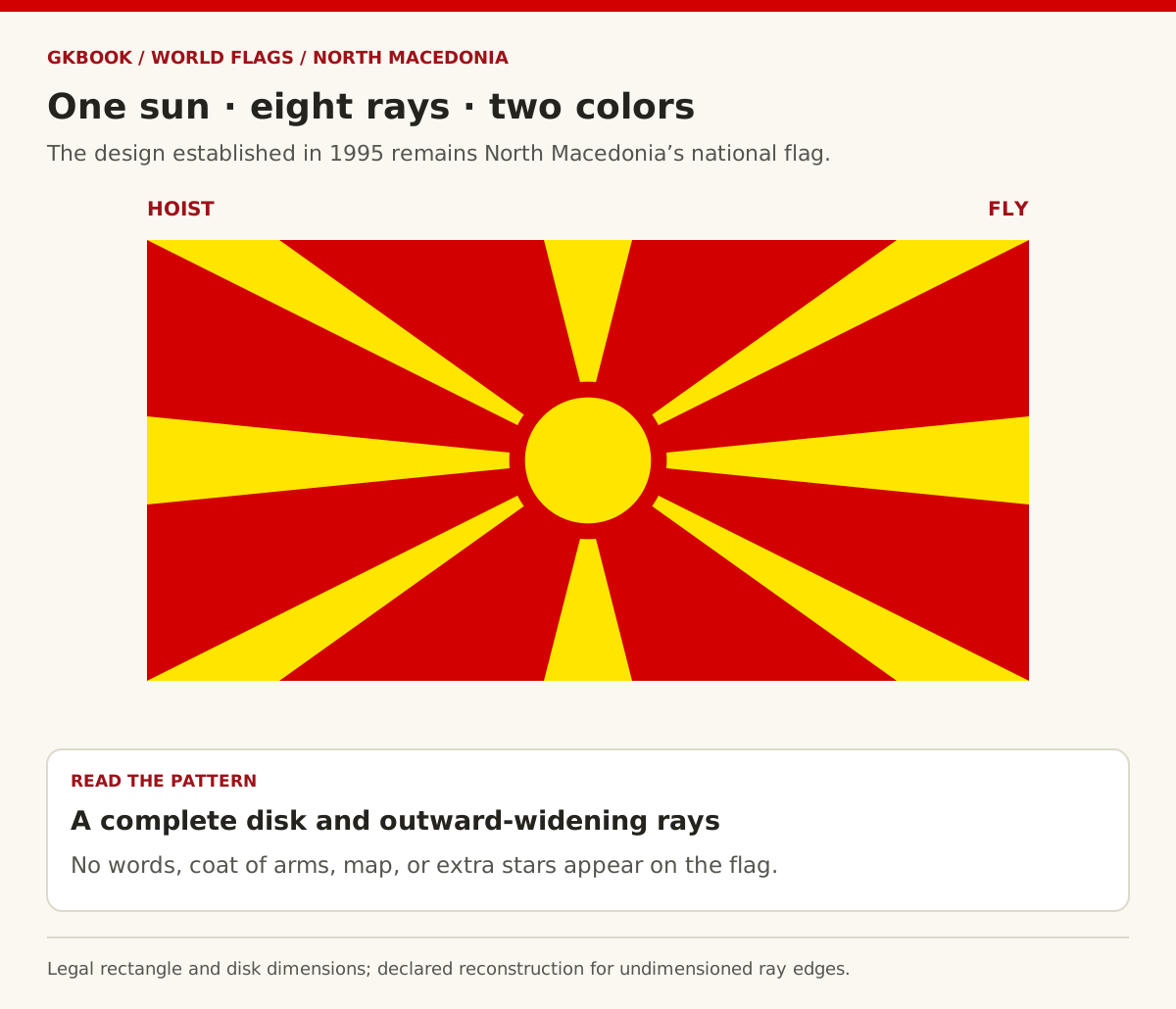
This is a sunburst design: the rays become broader as they move away from the middle. The flag contains no lettering, map, coat of arms, or separate stars. Its yellow regions share one color, while the spaces between them remain part of the red field.
The 1995 law combines a written description with an accompanying graphic. Reading both explains details that the short verbal definition leaves undimensioned. The original artwork supplied here preserves the legal outline and disk dimensions while documenting its chosen ray construction.
What are the flag’s colors and digital color codes?
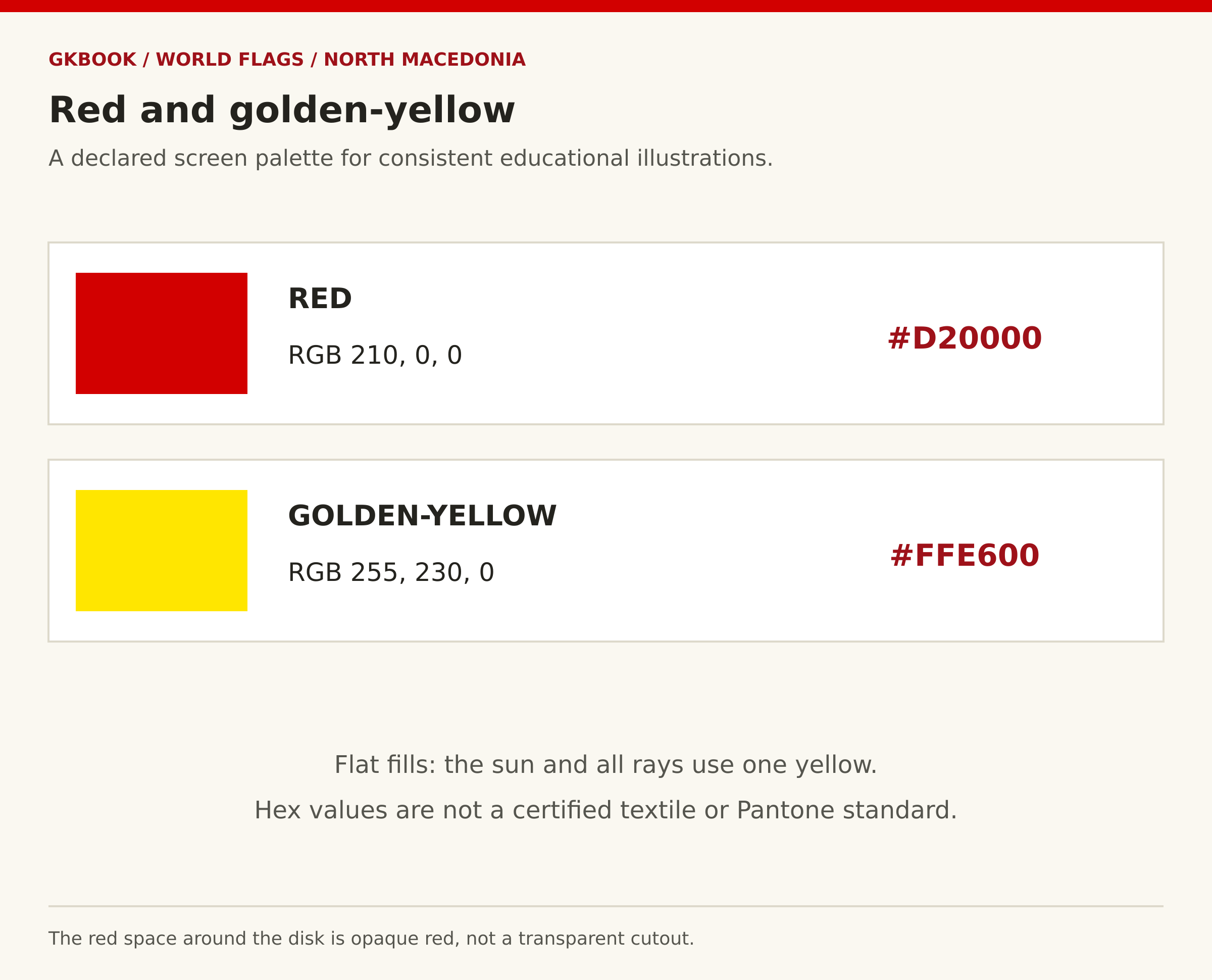
The law describes the colors as red and golden-yellow. These illustrations use #D20000 for red and #FFE600 for yellow, corresponding to RGB 210, 0, 0 and RGB 255, 230, 0. Those values are declared digital reproduction choices; the law’s color words do not themselves establish hexadecimal or Pantone specifications.

Golden-yellow describes a hue; it does not require metallic foil or a gradient. In these files, the disk and all eight rays have one flat yellow fill. The red clearance around the disk uses the same red as the rest of the field.
An RGB value specifies a screen color, while a physical flag also depends on fabric, dye, lighting, and production tolerances. For consistent printed work, agree on the color-managed output and a physical proof. Do not relabel an automatic CMYK conversion as an official national standard.
| Color | Hexadecimal | RGB |
|---|---|---|
| Red | #D20000 | 210, 0, 0 |
| Golden-yellow | #FFE600 | 255, 230, 0 |
What does North Macedonia’s flag symbolize?
The sun is commonly connected with freedom and the national anthem’s image of a new sun of liberty. Red and yellow also maintain continuity with earlier Macedonian state flags. The 1995 flag law defines the design rather than assigning a separate official meaning to every color or individual ray.
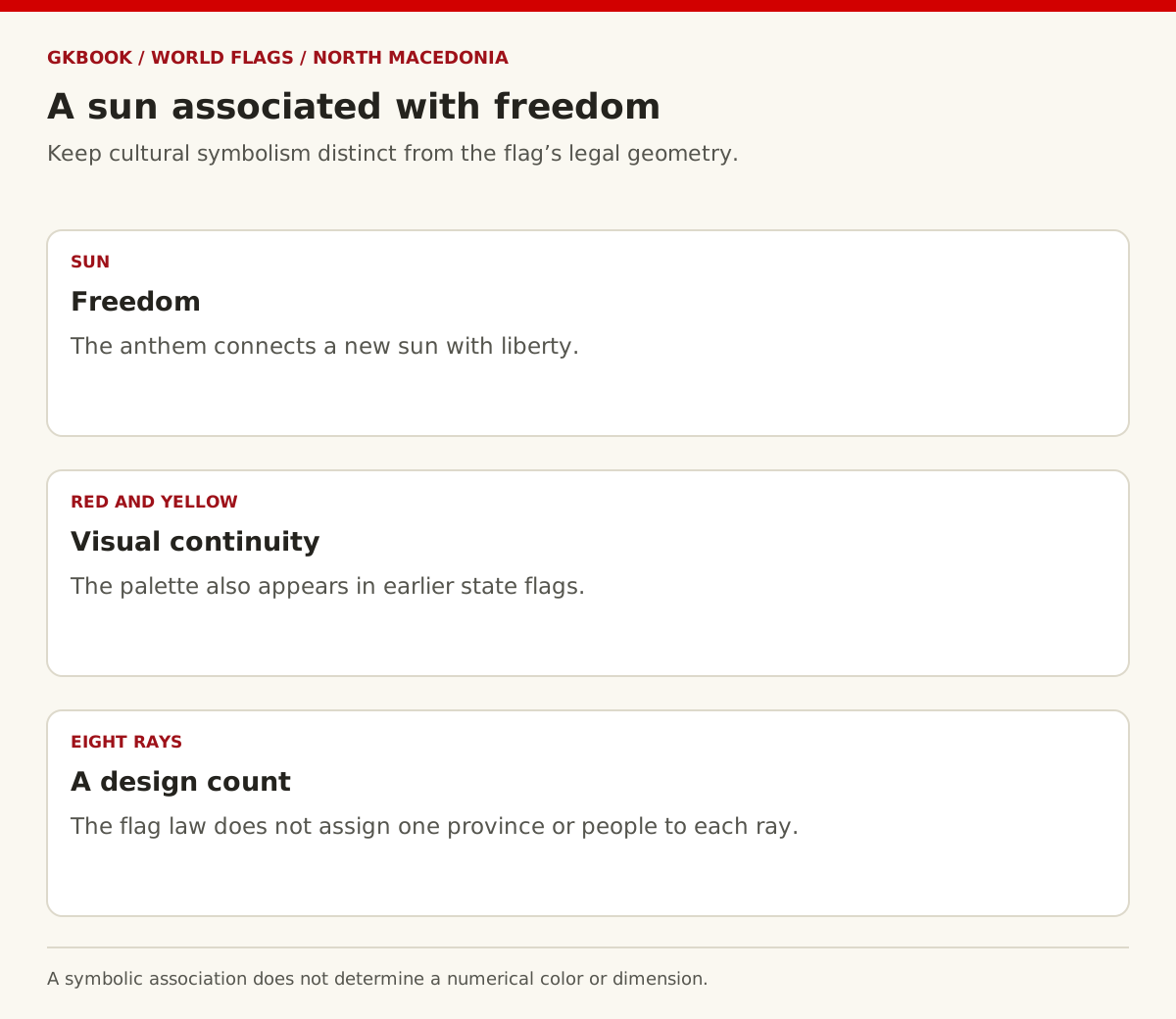
The anthem offers a direct cultural connection between sunlight and liberation. This makes the sun a useful starting point for explaining the flag’s symbolism, without claiming that the drawing represents an astronomical event or a specific historical sunrise.
Color explanations found online sometimes add blood, courage, wealth, or prosperity. Such interpretations should not be presented as clauses of the flag law. The clearest distinction is between a legally described design, a cultural association, and a later commentator’s interpretation.
What does the yellow sun represent?
The yellow sun is generally understood as a symbol of freedom, linked to the anthem’s imagery of liberty. It is drawn as a complete disk with eight outward-widening rays. Although the former national flag also used a sun, the current device is a different design from the sixteen-rayed Vergina Sun.
The complete disk matters visually: the flag does not depict a half-sun rising over a horizon. There is no landscape inside the flag’s central circle. Sun imagery also appears in the state emblem, but that separate composition is not placed on the national flag.
A shared theme does not make two emblems interchangeable. To identify this flag, look for the broad rays reaching the rectangle’s boundary, then count them. The sunburst’s structure is more diagnostic than the presence of yellow alone.
How many rays are on North Macedonia’s flag?
North Macedonia’s current flag has eight rays: two horizontal, two vertical, and four directed toward the corners. They widen outward and are arranged in opposite pairs. The law specifies their number and directions, but it does not identify the rays as eight provinces, ethnic groups, regions, or historical leaders.

Count each continuous yellow arm outside the red clearance once. The circular center is the sun’s disk, not an additional ray. The four corner-directed arms are single rays even where the rectangle’s boundary gives their broad ends a sharp corner.
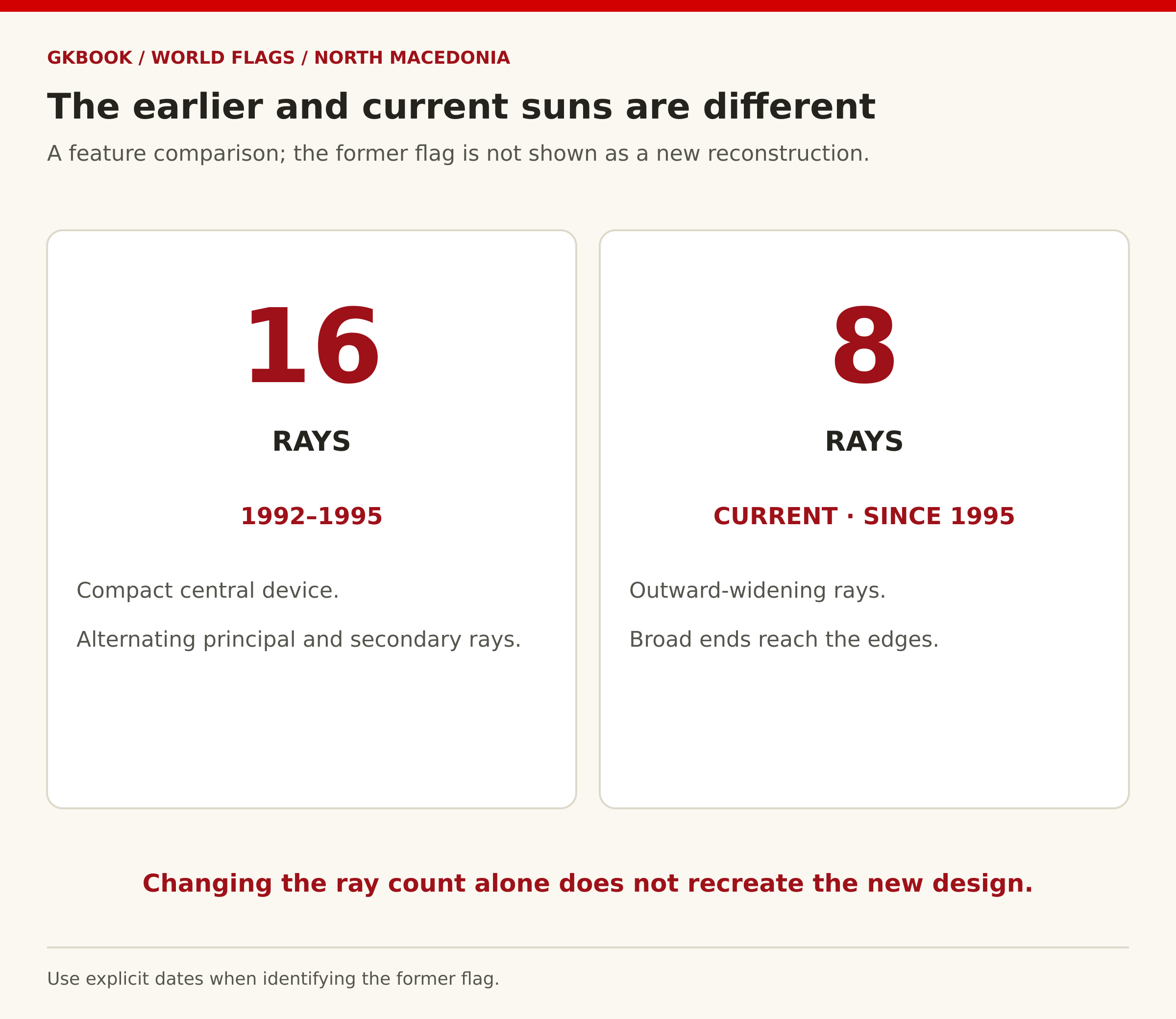
The eight-rayed device is a quick way to distinguish the current flag from the sixteen-rayed flag used between 1992 and 1995. A ray count is a design fact; an alleged meaning for each ray needs separate evidence.
What are the proportions of North Macedonia’s flag?
The legal height:length ratio is 1:2, so the flag is twice as long as it is high. A drawing 700 units high must therefore be 1,400 units long. Stating the measurement order prevents confusion: length:height is 2:1, which expresses the same rectangle in the opposite order.
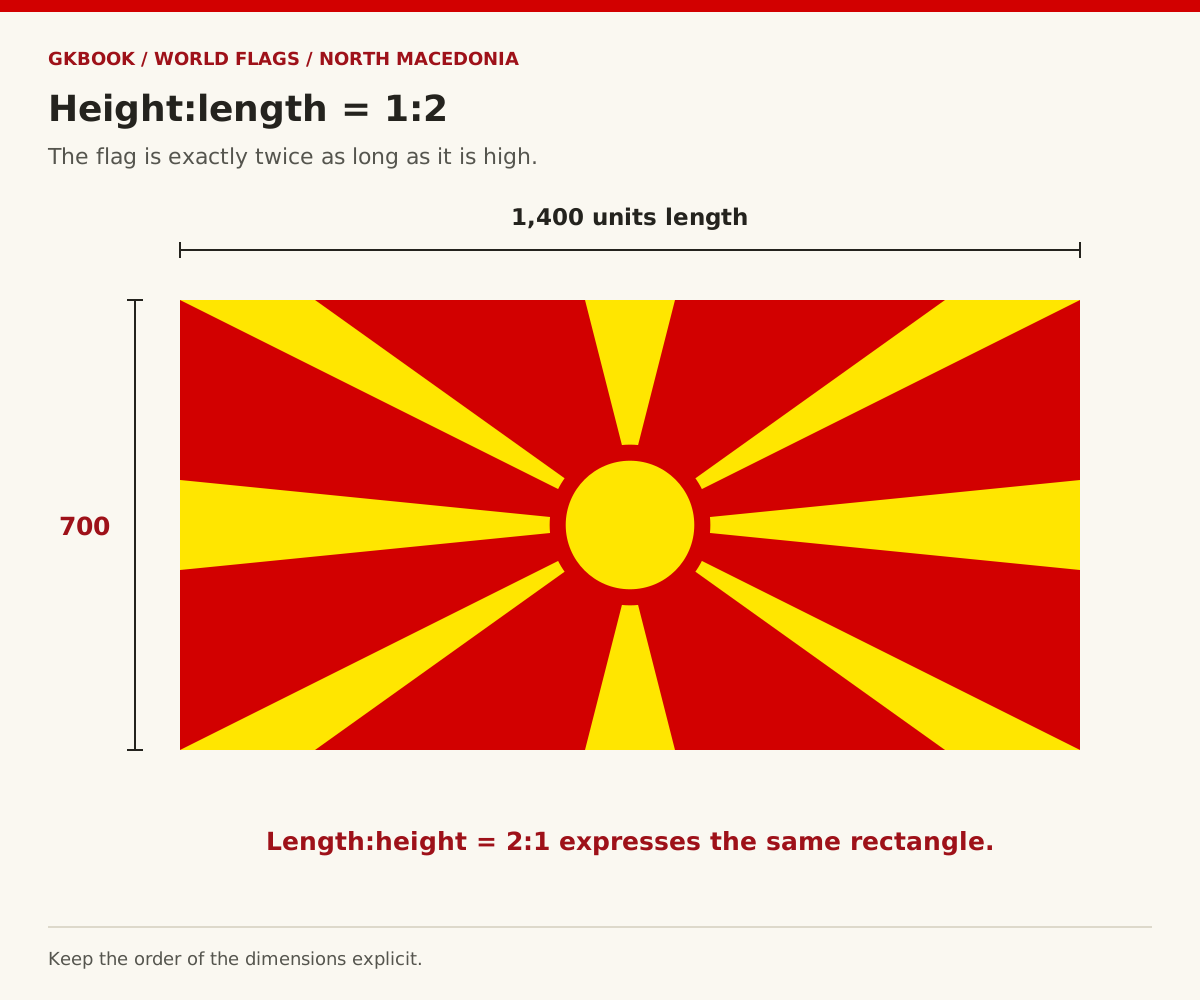
The law uses the equivalent language of width and length. This article consistently uses height for the short vertical dimension and length for the long horizontal dimension. That convention makes the diagrams and export sizes easier to compare.
A small icon may be displayed within a square container, but the flag itself can retain its 1:2 shape with empty space around it. Stretching the complete flag to fill the square changes both the rectangle and the circular sun.
How large is the sun’s disk?
The sun’s disk has a diameter equal to one-seventh of the flag’s length. Because the length is twice the height, the diameter is also two-sevenths of the height. On a 1,400 by 700 drawing, the disk is 200 units across and its radius is 100 units.

A common mistake is to substitute the height for the length in the one-seventh rule. That produces a disk only half the required diameter. Another error is to treat the specified diameter as a radius, creating a disk twice as wide as intended.
Use the plain yellow circle when measuring the disk. The surrounding red separation and the outward rays do not belong in its diameter. The distinction between a circle’s radius and diameter is essential when entering measurements in vector software.
| Quantity | Formula | Example for H = 700, L = 1,400 |
|---|---|---|
| Length | L = 2H | 1,400 |
| Disk diameter | D = L/7 = 2H/7 | 200 |
| Disk radius | R = L/14 = H/7 | 100 |
Where is the sun positioned on the flag?
The sun is centered at the intersection of the rectangle’s diagonals. Its center is halfway along the length and halfway down the height. On the 1,400 by 700 master drawing, those coordinates are x = 700 and y = 350, measured from the upper-left corner of the flag.

Both diagonals pass through this point, so drawing them provides a simple classroom method for finding the center. They are construction guides only and disappear from the completed flag. The hoist is the attachment edge; the opposite edge is the fly.
Centering the sun does not mean giving every ray identical angular spacing. The wide rectangle and the differing ray shapes determine the surrounding pattern. First locate the circle correctly, then construct the rays around it.
Why is there a red gap around the sun?
The adopted graphic shows a red separation between the yellow disk and the eight rays. This makes the disk read as a distinct circle. The law’s text does not give a numerical gap width; the downloadable reconstruction uses a 25-unit radial clearance around a disk of 100-unit radius.
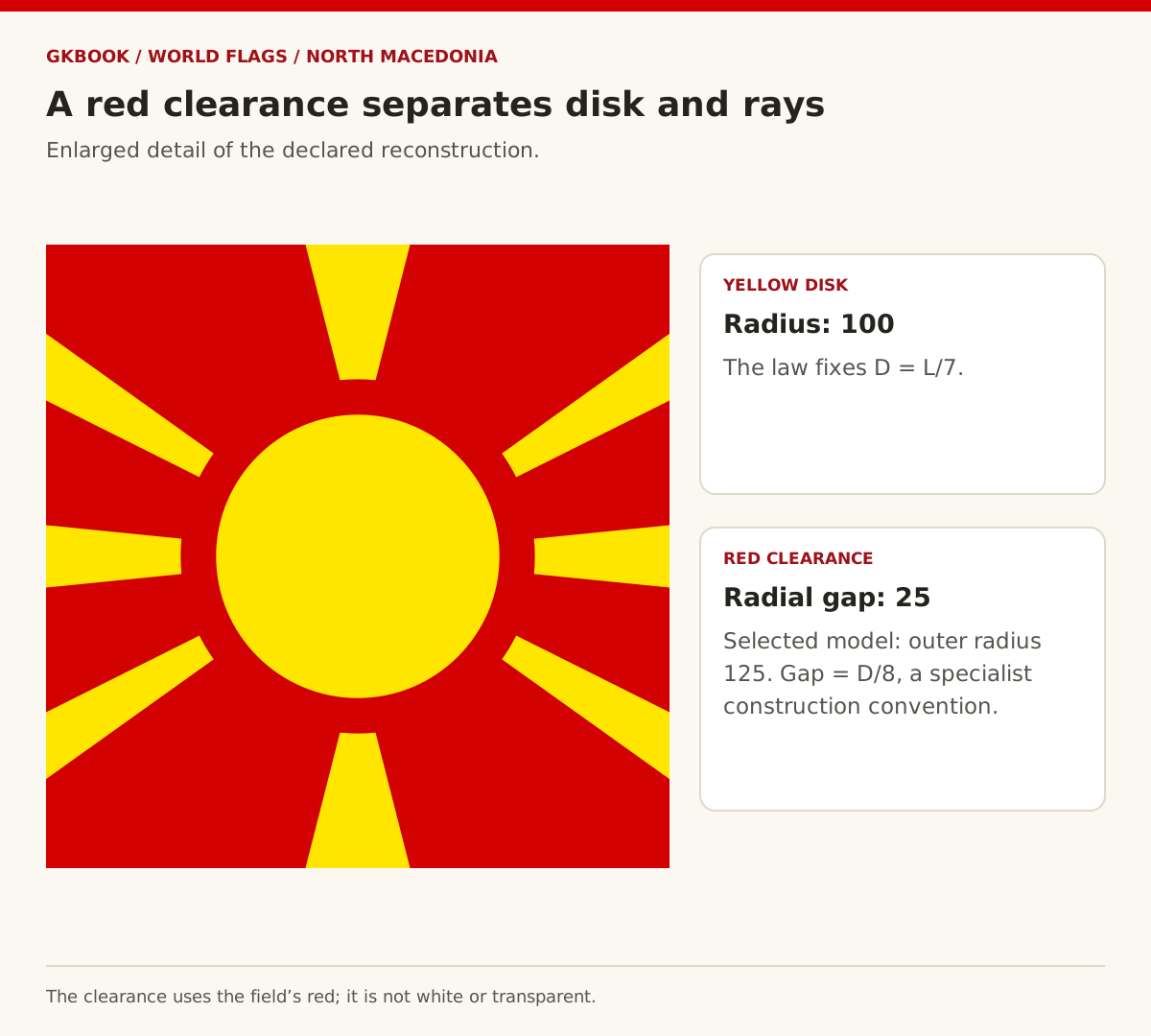
The clearance is red, not transparent, white, or a third flag color. Its outer edge trims the ray bases into short arcs. In a vector drawing, a larger red circle can cover the inward portions of the rays before the smaller yellow disk is placed over it.
The selected clearance equals one-eighth of the disk diameter, following a published specialist construction convention. It is documented as a reproduction choice rather than presented as an additional number written into Article 2 of the law.
Are the eight rays equally spaced at 45 degrees?
The flag should not be drawn by placing eight identical wedges at equal 45-degree intervals. Its rays are organized around horizontal, vertical, and corner-directed positions within a 1:2 rectangle. The adopted graphic gives the three sets different shapes, and a specialist reconstruction is needed to assign detailed edge coordinates.

Equal division of a full turn gives 45 degrees, but that calculation alone does not reproduce this rectangular composition. The upper corners of a 1:2 rectangle lie about 26.565 degrees above its horizontal centerline. This is a geometric observation, not a complete formula for the ray edges.
The supplied master uses symmetric polygons, a circular red clearance, and a circular disk. Its private construction record lists every vertex. The statutory dimensions are exact; the undimensioned ray edges are a declared reconstruction informed by the appendix.
How can you draw North Macedonia’s flag accurately?
Begin with a red 1:2 rectangle and locate its center. Add eight outward-widening yellow rays, then create the red clearance and a yellow disk whose diameter is one-seventh of the length. Use a documented construction for the ray edges, and scale every element uniformly when changing the drawing’s size.

For the included master, the canvas is 1,400 by 700. The circle center is (700,350), the yellow disk radius is 100, and the outer clearance radius is 125. The vertical rays use narrower inner ends than triangles simply aimed at the center would produce.
Layer order is important: field, rays, red clearance, yellow disk. If the red circle is placed last, it hides the sun. If the rays are placed over the disk, they can erase the separation. The completed SVG uses flat fills without gradients or external images.
What sizes preserve the correct flag proportions?
Any size with length exactly twice the height preserves the flag’s outer proportions. Examples include 140 by 70, 700 by 350, and 1,400 by 700 units. The downloadable PNG is 5,600 by 2,800 pixels, while the SVG remains scalable. These are reproduction examples, not prescribed physical flag sizes.

The sun must scale with the rectangle. At 700 by 350, the disk diameter is 100; at 1,400 by 700, it is 200. Maintaining only the outer ratio while leaving the disk unchanged produces a different internal design.
Physical and pixel dimensions are separate. A pixel count describes a raster image’s resolution, while centimeters or inches describe a printed object. Choose sufficient raster resolution for the intended print size, or use the vector master when the production workflow supports it.
| Flag dimensions | Disk diameter | Disk radius |
|---|---|---|
| 140 × 70 | 20 | 10 |
| 700 × 350 | 100 | 50 |
| 1,400 × 700 | 200 | 100 |
| 5,600 × 2,800 | 800 | 400 |
What symmetry does North Macedonia’s flag have?
The reconstructed flag has reflection symmetry across its horizontal and vertical centerlines, and it also matches itself after a half-turn. These properties follow from the centered disk and opposite pairs of matching rays. A quarter-turn changes the landscape rectangle into a portrait rectangle, so it is not the same oriented flag.

Reflection symmetry helps check a digital drawing: corresponding vertices should have equal distances from the centerline. A circle remains a circle under reflection, and the red clearance should have the same width on every side of the disk.
The rectangle’s proportions limit its rotational symmetry. A 180-degree rotation returns the long edges to their original positions; a 90-degree rotation does not. This is a mathematical property of the drawing, not a ceremonial instruction about how to hang a flag.
Does the reverse side have a different design?
No separate reverse emblem is specified in the 1995 flag design. A mirror view of the symmetric red-and-yellow pattern looks the same as the front. There are no letters that would read backward. A manufactured flag’s seams, print density, and attachment hardware can differ without creating a different national design.
A thin cloth flag may show the design through the fabric, while a double-sided product may use separate printed faces. Those production methods do not alter the disk diameter, number of rays, or national colors.
The side-by-side illustration mirrors the geometric master. Because the master is horizontally symmetric, the displayed shapes coincide. This comparison concerns the design itself; it does not prescribe a particular method of sewing or printing.
How should the flag be shown vertically?
A complete quarter-turn preserves the flag’s shapes while changing its displayed outline from landscape to portrait. The circular sun remains circular, and all eight rays rotate with the field. This geometric demonstration is not a universal hanging rule; formal installations should use the responsible institution’s approved orientation and artwork.

Do not stretch a landscape image vertically to fill a portrait panel. Stretching would turn the disk into an ellipse and alter the ray slopes. Rotating the entire rectangle avoids that distortion while keeping the original design intact.
A decorative banner made by cropping or redesigning the rays is a separate adaptation. Label such adaptations appropriately. For the standard landscape flag in a webpage or document, use its full 1:2 rectangle and leave the viewBox unchanged.
What is the history of North Macedonia’s national flag?
The modern sequence runs from a red flag with a yellow-bordered red star during the Yugoslav period, through the sixteen-rayed sun flag used from 1992 to 1995, to the current eight-rayed sun adopted in October 1995. The country’s change of name in 2019 did not introduce a new flag design.
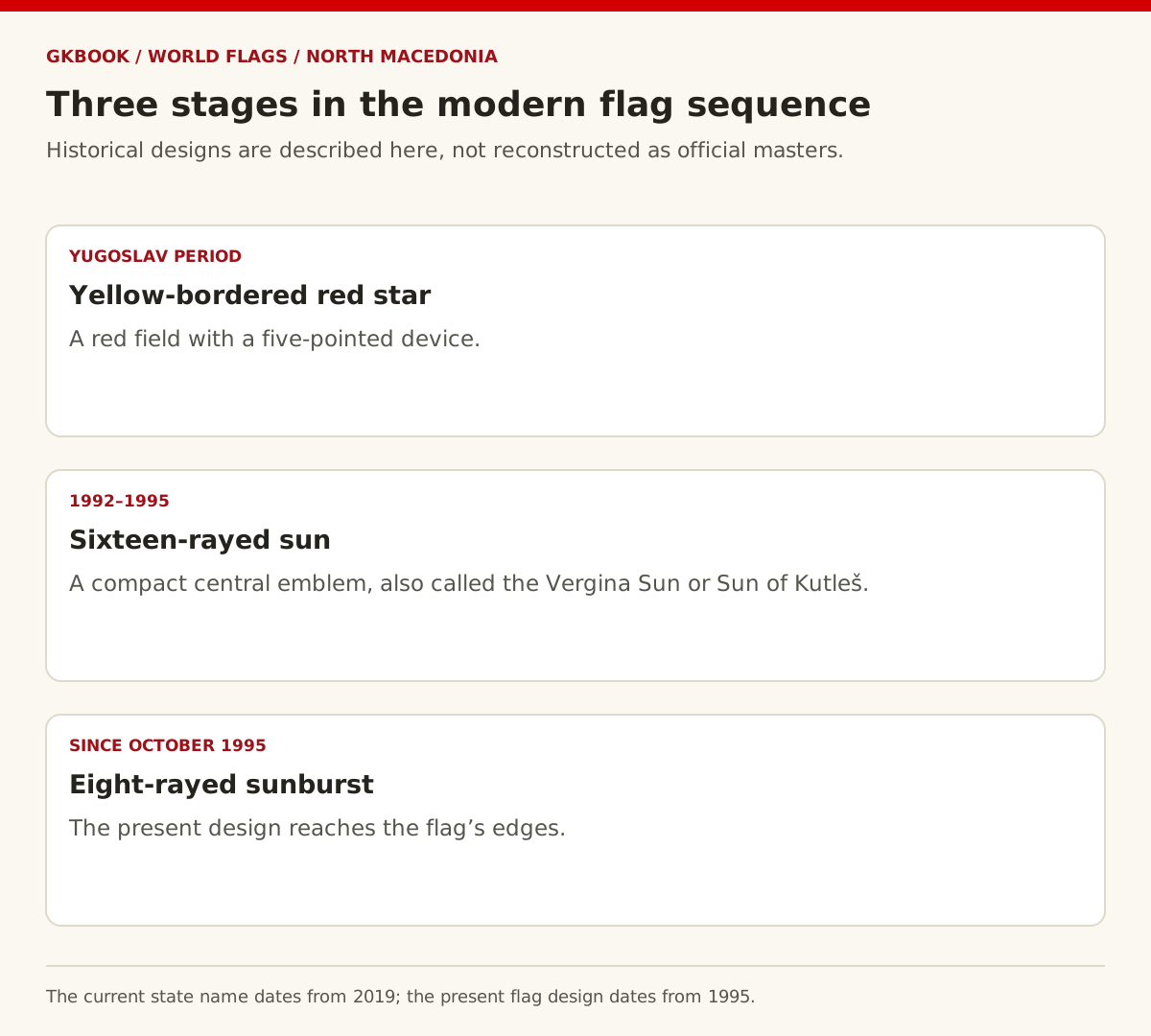
These stages should be kept distinct from the much longer history of Macedonian cultural and political symbols. An emblem’s earlier use does not by itself establish when a particular national flag became law. The current article focuses on the modern state flag.
The recurring red-and-yellow palette gives the sequence visual continuity, while the device changes substantially. A five-pointed star, a compact sixteen-rayed sun, and an eight-rayed sunburst reaching the edges are three different designs. Date historical images rather than presenting them as current alternatives.
When was the current flag adopted?
The Assembly adopted the current flag law on October 5, 1995. It was published in Official Gazette number 47 on October 6, and the law provided for entry into force on publication. Adoption, publication, and first ceremonial hoisting are different events, so their dates should not be silently substituted for one another.

The parliamentary transcript records the final vote as 110 in favor, one against, and four abstentions. It also preserves speeches and an amendment discussion. That primary record does not support the claim, repeated in some later summaries, that there was no debate.
For a compact factbox, October 5, 1995 is the adoption date. A detailed legal timeline can add October 6 as publication and commencement. Neither date should be changed to 2019 merely because the country now has a different official name.
What flag was used from 1992 to 1995?
Between 1992 and 1995, the country used a red flag bearing a golden sixteen-rayed sun, commonly called the Vergina Sun or Sun of Kutleš. Its compact central emblem differed from the current eight broad rays reaching the edges. The earlier flag is historical and should be dated whenever it is illustrated.
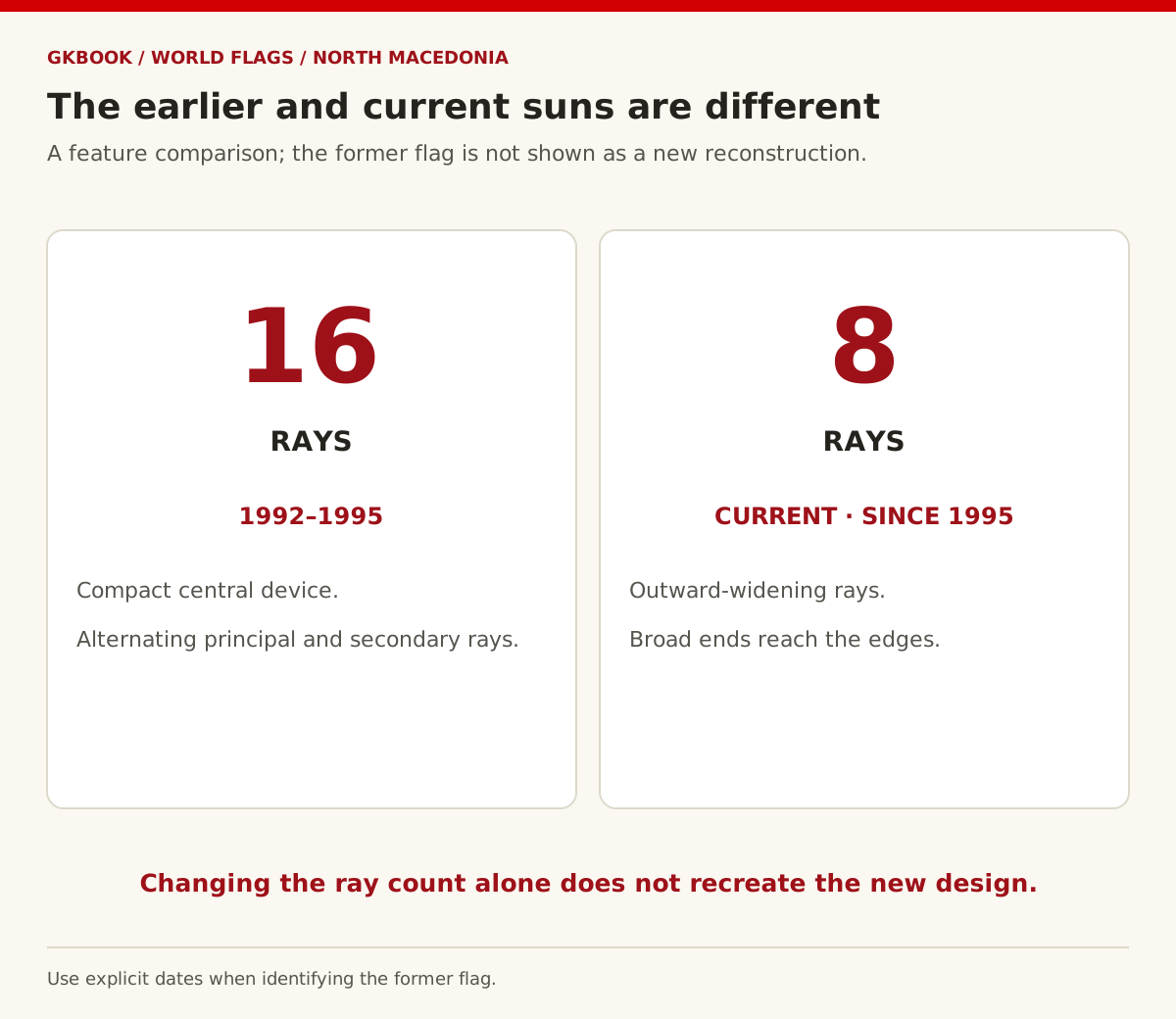
The older emblem had alternating principal and secondary rays around its disk. The present design replaces that compact device with an expansive sunburst. Saying that the change merely removed eight points misses the different shape, proportions, and relationship to the field.
Names for the older emblem reflect different linguistic and cultural contexts. This article supplies both common names for identification and uses neutral descriptions of the two designs. The comparison graphic summarizes their features without offering a newly invented historical construction.
Why did the flag change in 1995?
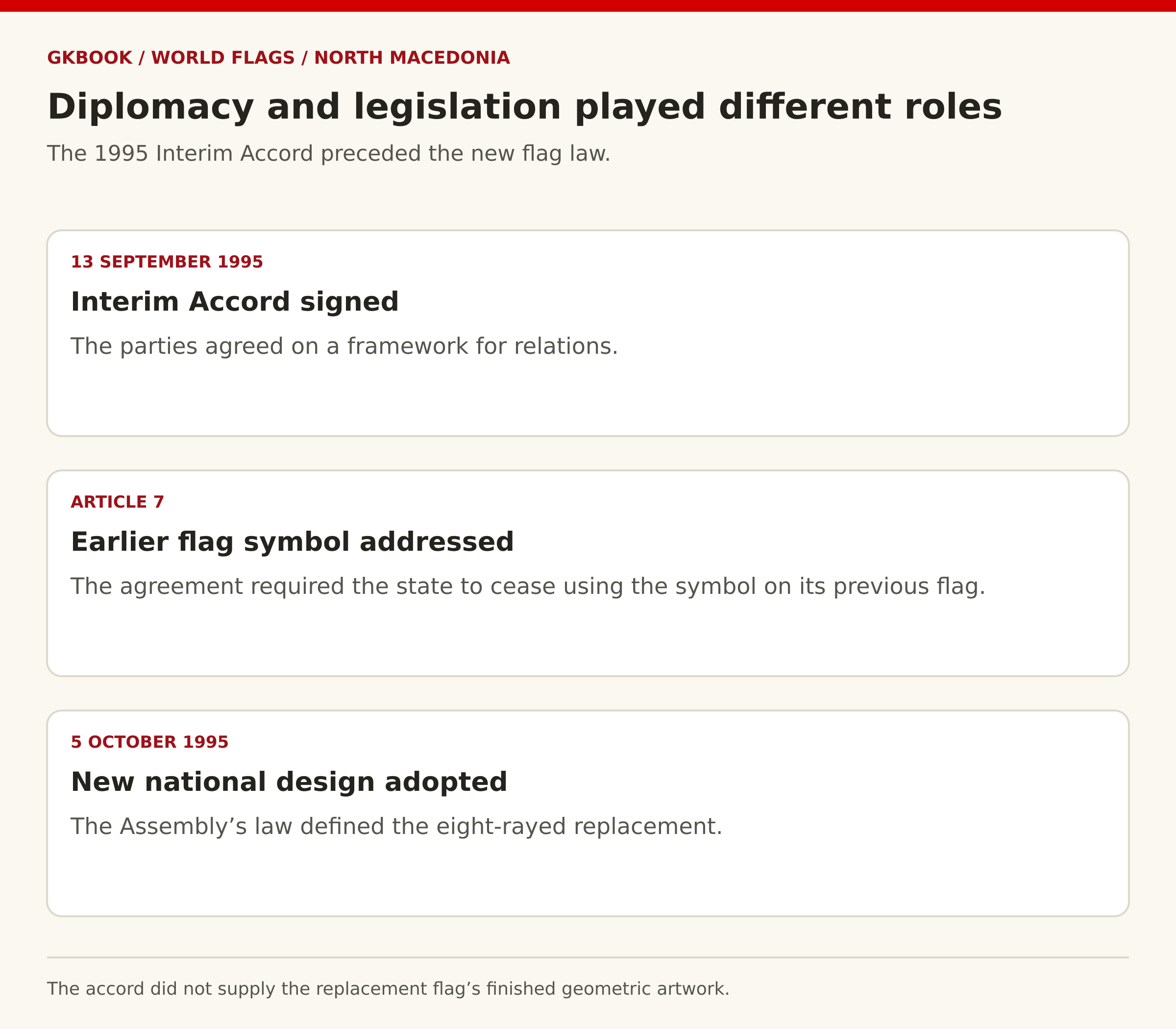
The change followed the Interim Accord between Greece and the then Republic of Macedonia, signed on September 13, 1995. Article 7 required the latter state to stop using the symbol displayed on its previous flag. A new national law then established the eight-rayed sun design while retaining red and yellow.

The dispute concerned a specific symbol and its historical associations, alongside a broader disagreement over the country’s name. The accord supplied the diplomatic framework; the Assembly’s October law supplied the new flag’s domestic legal definition.
The agreement did not include a ready-made vector file for the replacement flag. The choice and adoption of the new drawing were separate design and legislative steps. Explaining those steps is more informative than reducing the entire history to an undifferentiated claim that the flag was changed by a foreign government.
Who designed North Macedonia’s flag?
Miroslav Grčev developed proposals for the 1995 flag, but the adopted version differs from his proposal. Research by the Macedonian Heraldic Society also identifies Kostadin Tančev–Dinkata with the final design and recommends a combined attribution. Their accounts of authorship differ, so naming a single undisputed designer would oversimplify the evidence.

Grčev’s work is associated with the sunburst concept; the final form includes the 1:2 rectangle and red separation around the disk. Dinkata claimed an independent design contribution. The competing accounts are part of the documented history, rather than a reason to omit the attribution question altogether.
The factbox therefore names both designers with a qualification. The private research record distinguishes first-person claims, later historical analysis, and the law itself. Legislative approval establishes the adopted flag, but it does not resolve every question about who originated each design feature.
Did the flag change when the country became North Macedonia?
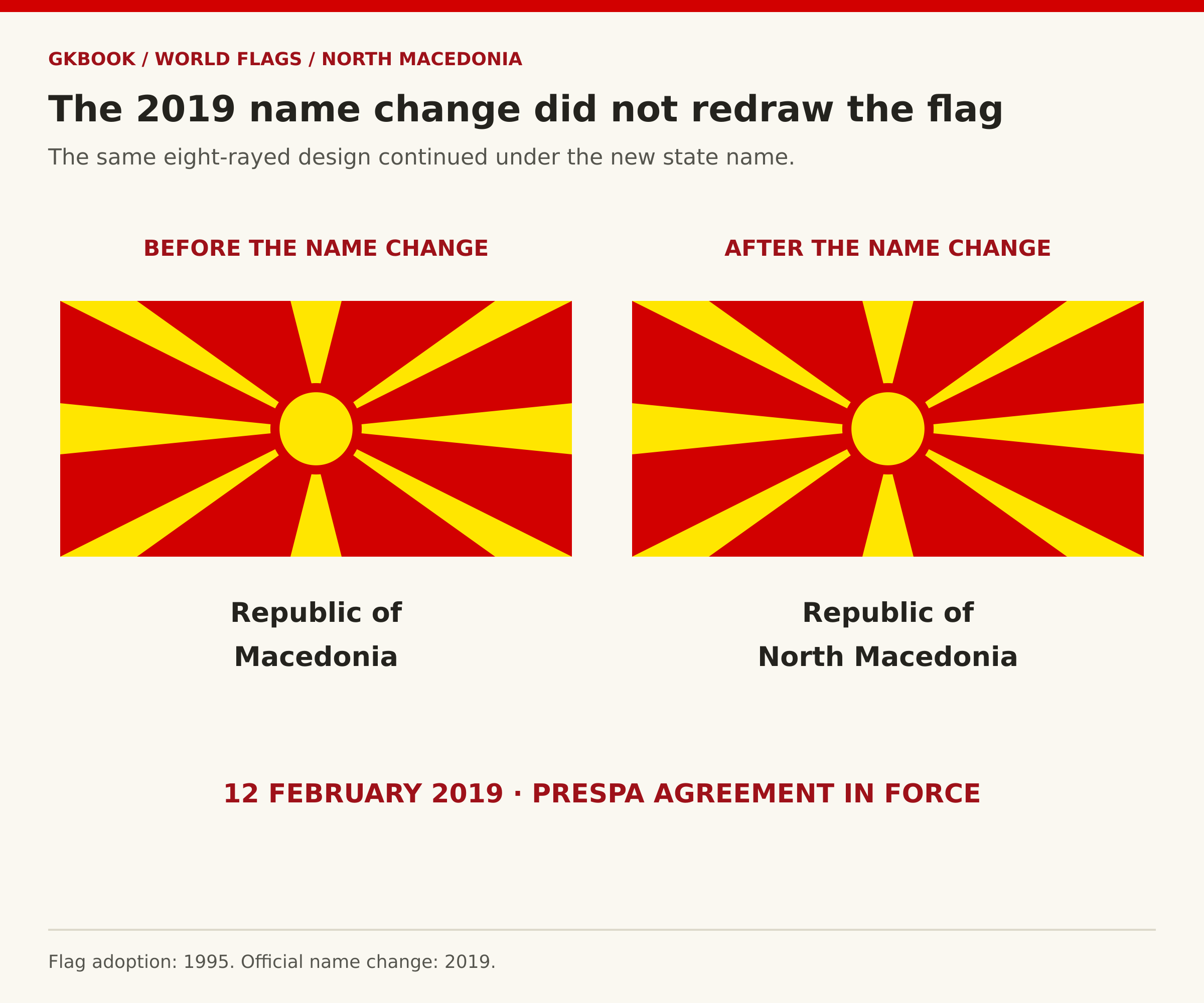
No new national flag design accompanied the country’s change of name to the Republic of North Macedonia in February 2019. The eight-rayed flag remained the design adopted in 1995. The Prespa Agreement was signed in June 2018 and entered into force on February 12, 2019, separating the name-change timeline from flag adoption.

Historical documents use the state name applicable when they were written. A law titled with Republic of Macedonia can therefore be the source for a flag now described as North Macedonia’s national flag. Updating an English caption does not require redrawing the sunburst.
For research and teaching, attach dates to the two events: 1995 for the current design, 2019 for the official name change. This prevents a familiar metadata mistake in which a renamed country is assigned an invented new flag-adoption date.
What did the Prespa Agreement say about the former symbol?
Article 8 of the Prespa Agreement addresses the symbol shown on the former national flag. It provides for its removal from public sites and public usages in the state’s territory, while excluding archaeological artifacts from that provision. This concerns the earlier symbol; it does not replace the current eight-rayed flag.
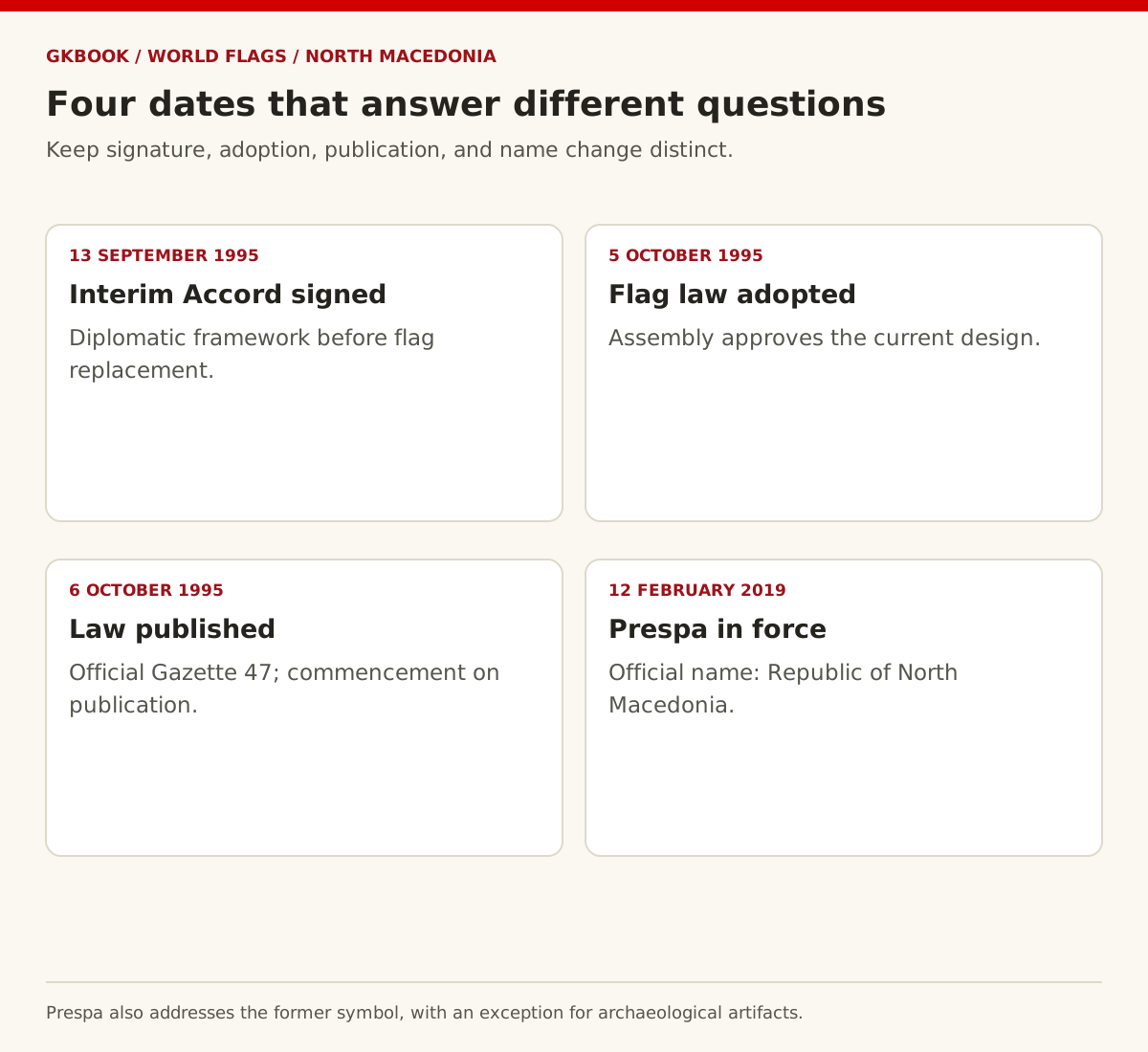
The treaty’s actual scope matters. A summary that says every appearance of the old symbol was prohibited everywhere omits the archaeological exception and blurs the obligations undertaken by the parties. The agreement also addresses historical terminology and cooperation beyond the flag question.
The 1995 and 2018 agreements belong to different moments. The earlier accord preceded the flag replacement; the later agreement settled the name issue and addressed continuing symbol questions. The chronology is clearer when those roles are explained separately.
How is the flag connected with the national anthem?
The national anthem, Denes nad Makedonija, is commonly translated as Today over Macedonia. Its opening imagery connects a new sun with liberty, which helps explain the sun’s symbolic reading on the flag. The anthem is a musical state symbol with its own history; it does not prescribe the flag’s geometric measurements.
The archived presidential account identifies Vlado Maleski as the lyricist and Todor Skalovski as the composer. It dates the song to 1941 and its establishment by law as the independent state’s anthem to 1992.
The connection is thematic: light and freedom in the anthem complement the flag’s sun. The 1995 law, rather than the song, specifies the eight rays, centered disk, and 1:2 rectangle. No lyrics are written on the flag itself.
Is the national flag the same as the coat of arms?
The national flag and the state coat of arms are separate symbols. The flag is a red-and-yellow sunburst, while the coat of arms contains a landscape and surrounding plant elements. North Macedonia’s ordinary national flag does not carry that coat of arms inside its sun or elsewhere on the field.

A country can use related imagery across different official symbols without combining them into one design. The sun is the connection here, but the coat of arms’ mountain, water, and framing plants do not belong in the flag’s yellow disk.
When preparing an educational illustration, begin with the specification for the particular symbol being drawn. A seal or emblem added to the sunburst creates a different graphic. The gallery keeps the flag unobstructed and uses text cards to explain the separate state symbols.
How can you recognize North Macedonia’s flag quickly?
Look for a wide red rectangle with a yellow central disk and eight yellow rays expanding all the way to the edges. The combination of a centered sunburst, two colors, and 1:2 proportions is distinctive. A red-and-yellow image alone is insufficient; check the ray count and the full arrangement.
Start with the complete silhouette and color pattern before inspecting the details. The broad horizontal rays reach the hoist and fly, the vertical rays reach the top and bottom, and the diagonal rays open toward the corners.
A flag emoji is useful as a small identifier, but its platform-specific rendering is not a construction drawing. It may be curved, shaded, or too small to show the clearance clearly. Use the SVG reference for close inspection or precise reproduction.
Can the flag be cropped into a square or circle?
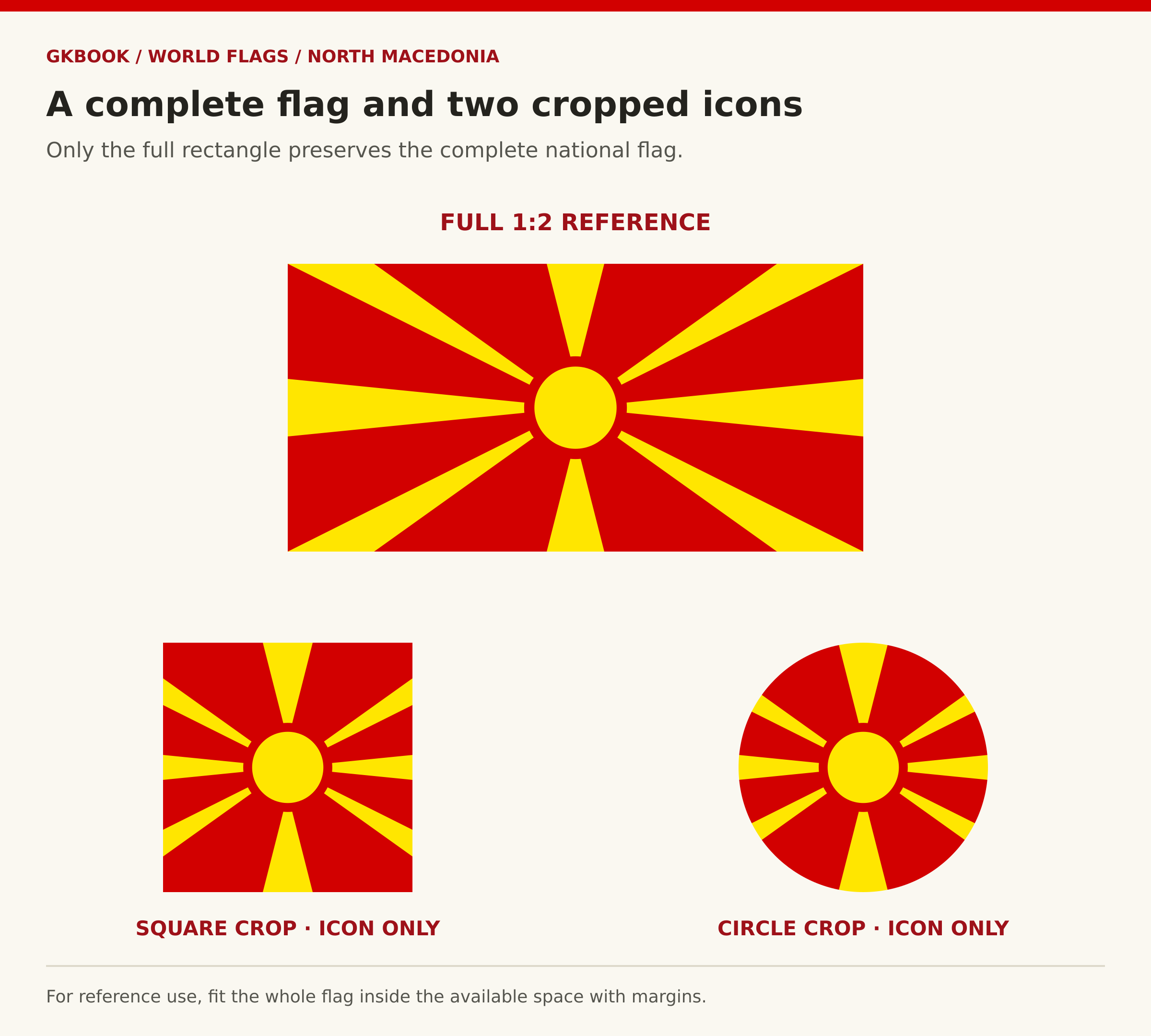
A square or circular crop can function as a decorative icon, but it removes parts of the national flag’s 1:2 rectangle and may cut off rays. For an accurate reference picture, preserve the entire flag. Fit it inside the available space with margins instead of stretching or cropping the original artwork.
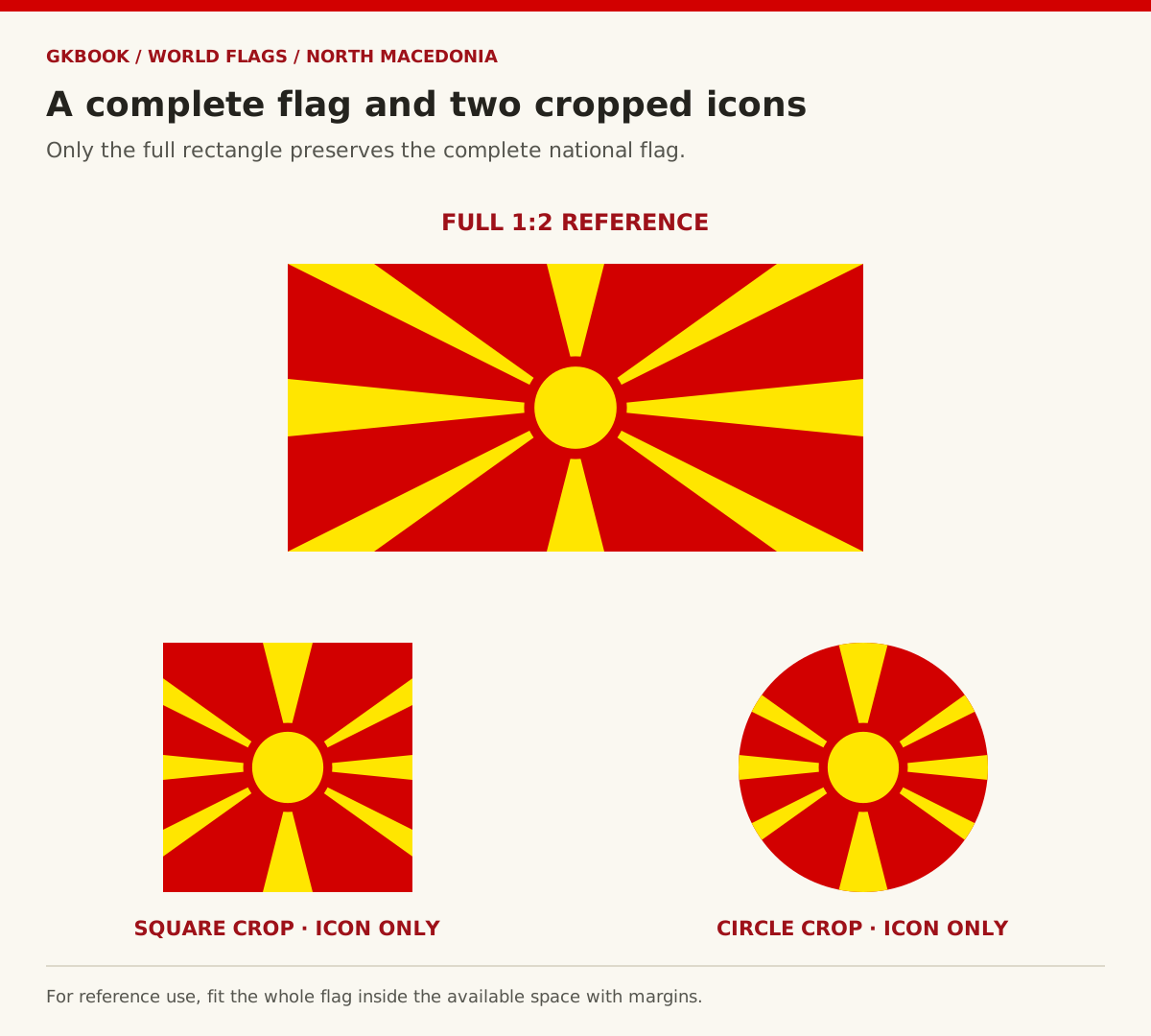
In a center crop, the sun may remain visible while the horizontal ends disappear. That can make the symbol recognizable without preserving the full design. Recognizability and faithful reproduction are different goals, so label an icon as an adaptation when context requires precision.
Responsive webpages can set an image’s width to 100 percent and its height to auto. This scales the whole rectangle proportionally. The article uses that approach for flag pictures and allows detailed explanatory diagrams to scroll on narrow displays.
Which file format is best for a flag picture?
Use SVG when you need a scalable illustration with crisp circles and ray edges. Use PNG when your software requires a raster image or when inserting a ready-sized picture. Both supplied formats show the same reconstruction. Preserve the 1:2 aspect ratio, retain relevant captions, and avoid repeated resizing of the PNG.
The master SVG uses explicit polygons and circles, with no embedded photograph or external dependency. Its 1,400 by 700 viewBox is a coordinate system rather than a limit on print size. The corresponding PNG measures 5,600 by 2,800 pixels.
The gallery provides 24 subjects as paired SVG and PNG files, with a separate social-sharing card. Explanatory sheets include labels and margins; their overall canvas ratios are not flag ratios. Download the plain flag file when you need only the national design.
What should be checked before reproducing or displaying the flag?
Check the complete rectangle, two colors, eight rays, centered disk, and undistorted proportions before using the image. For formal display, follow the relevant institution’s instructions and approved artwork. The educational files explain their construction choices; they do not establish a complete national protocol for ceremonies, mourning, commercial use, or manufactured products.
Practical care starts with choosing the right file and keeping the design clear. Do not place a slogan, watermark, or crest over the yellow center when presenting it as an unaltered national flag. Keep any explanatory caption outside the flag’s rectangle.
For a printed or sewn flag, review the finished proof at its intended size and agree on color and material requirements. A mathematical image check cannot assess a fabric supplier’s dyes, stitching, or weather resistance. Those are separate production questions.
What are the most common North Macedonia flag mistakes?
Common errors include using sixteen rays for the current flag, making the disk one-seventh of the height, stretching the circle into an oval, omitting the red separation, and treating 2019 as the adoption year. Another mistake is presenting reconstructed ray coordinates or chosen screen colors as numbers explicitly prescribed by the law.

Check captions and images together. A correct description of the eight-rayed flag beside a historical sixteen-rayed picture still misleads the reader. Likewise, a 1:2 label does not repair an image that has been stretched to another ratio.
The picture gallery brings the reference flag and its explanatory diagrams together. For related national designs, continue to World Flags. Keep historical dates and reconstruction notes with any educational reuse.
Download North Macedonia flag pictures
Download the plain flag as SVG or 5,600 × 2,800 PNG. The SVG uses a 1,400 × 700 coordinate system and remains scalable. The gallery contains 24 subjects with paired SVG and PNG files, including construction, history, and comparison diagrams. Image credits and construction notes record the status of the original artwork.
Explore more in World Flags, including the Namibia flag and Nauru flag.
World Flags/North Macedonia
North Macedonia flag pictures
Educational reconstruction: statutory 1:2 rectangle, centered disk of diameter L/7, and eight rays. Ray-edge coordinates and the 25-unit red clearance are declared drawing conventions informed by the published appendix and a specialist construction sheet; digital colors are reproduction choices, not certified manufacturing standards.
GKBook original artwork; construction choices and digital colors are declared.Download SVGDownload PNGThe yellow disk is centered, and eight rays expand toward the rectangle’s edges. The red clearance keeps the disk visually distinct.
GKBook original artwork; construction choices and digital colors are declared.Download SVGDownload PNGThe original files use #D20000 red and #FFE600 yellow as reproduction choices. The law names red and golden-yellow without prescribing these hex codes.
GKBook original artwork; construction choices and digital colors are declared.Download SVGDownload PNGThe sun has a cultural association with freedom, while the colors connect the modern design with earlier flags. Individual ray-to-region meanings are not specified by the law.
GKBook original artwork; construction choices and digital colors are declared.Download SVGDownload PNGNumbers outside the flag identify each ray clockwise from the top. They are teaching labels and are not part of the flag.
GKBook original artwork; construction choices and digital colors are declared.Download SVGDownload PNGThe statutory 1:2 height:length ratio is represented on a 1,400 by 700 coordinate system. Dimensions in the diagram refer to the complete rectangle.
GKBook original artwork; construction choices and digital colors are declared.Download SVGDownload PNGThe yellow disk diameter is L/7, equivalent to 2H/7. On the 1,400 by 700 master it is 200 units, not 100.
GKBook original artwork; construction choices and digital colors are declared.Download SVGDownload PNGThe disk is centered horizontally and vertically. Diagonals and centerlines locate the same point.
GKBook original artwork; construction choices and digital colors are declared.Download SVGDownload PNGThe appendix shows red clearance between the disk and rays. The model uses a 25-unit radial gap; that number is a documented reproduction choice.
GKBook original artwork; construction choices and digital colors are declared.Download SVGDownload PNGHorizontal, vertical, and corner-directed rays have different outlines. The detailed coordinates in the downloadable master are reconstruction choices, not a fully dimensioned legal annex.
GKBook original artwork; construction choices and digital colors are declared.Download SVGDownload PNGFour snapshots show the order of the field, rays, red clearance, and yellow disk. The first three are incomplete construction stages.
GKBook original artwork; construction choices and digital colors are declared.Download SVGDownload PNGAll four examples retain 1:2 proportions and D = L/7. These dimensions are mathematical examples and export sizes, not mandatory cloth sizes.
GKBook original artwork; construction choices and digital colors are declared.Download SVGDownload PNGThe modeled design is symmetric across both centerlines and under a half-turn. A quarter-turn does not return the landscape rectangle to its original orientation.
GKBook original artwork; construction choices and digital colors are declared.Download SVGDownload PNGA complete quarter-turn produces a portrait rectangle while preserving the circular disk and all ray shapes. Formal display should follow the relevant institution’s instructions.
GKBook original artwork; construction choices and digital colors are declared.Download SVGDownload PNGThe modern sequence includes a socialist-era star flag, the sixteen-rayed flag of 1992–1995, and the current eight-rayed flag.
GKBook original artwork; construction choices and digital colors are declared.Download SVGDownload PNGOctober 5 is the adoption date; October 6 is publication and commencement under Article 5. The Assembly transcript records discussion and a final vote.
GKBook original artwork; construction choices and digital colors are declared.Download SVGDownload PNGThe historical sixteen-rayed emblem was replaced by an eight-rayed sunburst with a different structure. Both used red and yellow.
GKBook original artwork; construction choices and digital colors are declared.Download SVGDownload PNGThe Interim Accord addressed use of the former symbol. The national flag law then established the new design and its dimensions.
GKBook original artwork; construction choices and digital colors are declared.Download SVGDownload PNGSpecialist accounts connect Grčev with the proposals and Dinkata with the final design. The relationship between their contributions is disputed.
GKBook original artwork; construction choices and digital colors are declared.Download SVGDownload PNGThe country’s official name changed when the Prespa Agreement entered into force in February 2019. The 1995 flag design continued.
GKBook original artwork; construction choices and digital colors are declared.Download SVGDownload PNGThe timeline separates the 1995 flag-law sequence from the 2019 entry into force of the Prespa Agreement.
GKBook original artwork; construction choices and digital colors are declared.Download SVGDownload PNGThe flag, coat of arms, and anthem are distinct. Related sun imagery does not make their designs interchangeable.
GKBook original artwork; construction choices and digital colors are declared.Download SVGDownload PNGThe square and circular crops remove the outer ends of rays. They are illustrative icon adaptations, not the complete 1:2 national flag.
GKBook original artwork; construction choices and digital colors are declared.Download SVGDownload PNGThe checks cover ray count, disk size, distortion, clearance, dates, and the status of technical measurements.
GKBook original artwork; construction choices and digital colors are declared.Download SVGDownload PNGFrequently asked questions
What does North Macedonia’s flag look like?
North Macedonia’s flag shows a golden-yellow sun on a red field, with eight widening rays extending toward the edges. Its height:length ratio is 1:2, and the central disk has a diameter equal to one-seventh of the length. The current design was adopted on October 5, 1995.
What is the design of North Macedonia’s flag?
The flag consists of a red rectangle, a centered golden-yellow disk, and eight golden-yellow rays that widen toward the boundary. Two rays run horizontally, two vertically, and four toward the corners. A narrow red separation around the disk appears in the adopted graphic, giving the center a distinct circular outline.
What are the flag’s colors and digital color codes?
The law describes the colors as red and golden-yellow. These illustrations use #D20000 for red and #FFE600 for yellow, corresponding to RGB 210, 0, 0 and RGB 255, 230, 0. Those values are declared digital reproduction choices; the law’s color words do not themselves establish hexadecimal or Pantone specifications.
What does North Macedonia’s flag symbolize?
The sun is commonly connected with freedom and the national anthem’s image of a new sun of liberty. Red and yellow also maintain continuity with earlier Macedonian state flags. The 1995 flag law defines the design rather than assigning a separate official meaning to every color or individual ray.
What does the yellow sun represent?
The yellow sun is generally understood as a symbol of freedom, linked to the anthem’s imagery of liberty. It is drawn as a complete disk with eight outward-widening rays. Although the former national flag also used a sun, the current device is a different design from the sixteen-rayed Vergina Sun.
How many rays are on North Macedonia’s flag?
North Macedonia’s current flag has eight rays: two horizontal, two vertical, and four directed toward the corners. They widen outward and are arranged in opposite pairs. The law specifies their number and directions, but it does not identify the rays as eight provinces, ethnic groups, regions, or historical leaders.
What are the proportions of North Macedonia’s flag?
The legal height:length ratio is 1:2, so the flag is twice as long as it is high. A drawing 700 units high must therefore be 1,400 units long. Stating the measurement order prevents confusion: length:height is 2:1, which expresses the same rectangle in the opposite order.
How large is the sun’s disk?
The sun’s disk has a diameter equal to one-seventh of the flag’s length. Because the length is twice the height, the diameter is also two-sevenths of the height. On a 1,400 by 700 drawing, the disk is 200 units across and its radius is 100 units.
Where is the sun positioned on the flag?
The sun is centered at the intersection of the rectangle’s diagonals. Its center is halfway along the length and halfway down the height. On the 1,400 by 700 master drawing, those coordinates are x = 700 and y = 350, measured from the upper-left corner of the flag.
Why is there a red gap around the sun?
The adopted graphic shows a red separation between the yellow disk and the eight rays. This makes the disk read as a distinct circle. The law’s text does not give a numerical gap width; the downloadable reconstruction uses a 25-unit radial clearance around a disk of 100-unit radius.
Are the eight rays equally spaced at 45 degrees?
The flag should not be drawn by placing eight identical wedges at equal 45-degree intervals. Its rays are organized around horizontal, vertical, and corner-directed positions within a 1:2 rectangle. The adopted graphic gives the three sets different shapes, and a specialist reconstruction is needed to assign detailed edge coordinates.
How can you draw North Macedonia’s flag accurately?
Begin with a red 1:2 rectangle and locate its center. Add eight outward-widening yellow rays, then create the red clearance and a yellow disk whose diameter is one-seventh of the length. Use a documented construction for the ray edges, and scale every element uniformly when changing the drawing’s size.
What sizes preserve the correct flag proportions?
Any size with length exactly twice the height preserves the flag’s outer proportions. Examples include 140 by 70, 700 by 350, and 1,400 by 700 units. The downloadable PNG is 5,600 by 2,800 pixels, while the SVG remains scalable. These are reproduction examples, not prescribed physical flag sizes.
What symmetry does North Macedonia’s flag have?
The reconstructed flag has reflection symmetry across its horizontal and vertical centerlines, and it also matches itself after a half-turn. These properties follow from the centered disk and opposite pairs of matching rays. A quarter-turn changes the landscape rectangle into a portrait rectangle, so it is not the same oriented flag.
Does the reverse side have a different design?
No separate reverse emblem is specified in the 1995 flag design. A mirror view of the symmetric red-and-yellow pattern looks the same as the front. There are no letters that would read backward. A manufactured flag’s seams, print density, and attachment hardware can differ without creating a different national design.
How should the flag be shown vertically?
A complete quarter-turn preserves the flag’s shapes while changing its displayed outline from landscape to portrait. The circular sun remains circular, and all eight rays rotate with the field. This geometric demonstration is not a universal hanging rule; formal installations should use the responsible institution’s approved orientation and artwork.
What is the history of North Macedonia’s national flag?
The modern sequence runs from a red flag with a yellow-bordered red star during the Yugoslav period, through the sixteen-rayed sun flag used from 1992 to 1995, to the current eight-rayed sun adopted in October 1995. The country’s change of name in 2019 did not introduce a new flag design.
When was the current flag adopted?
The Assembly adopted the current flag law on October 5, 1995. It was published in Official Gazette number 47 on October 6, and the law provided for entry into force on publication. Adoption, publication, and first ceremonial hoisting are different events, so their dates should not be silently substituted for one another.
What flag was used from 1992 to 1995?
Between 1992 and 1995, the country used a red flag bearing a golden sixteen-rayed sun, commonly called the Vergina Sun or Sun of Kutleš. Its compact central emblem differed from the current eight broad rays reaching the edges. The earlier flag is historical and should be dated whenever it is illustrated.
Why did the flag change in 1995?
The change followed the Interim Accord between Greece and the then Republic of Macedonia, signed on September 13, 1995. Article 7 required the latter state to stop using the symbol displayed on its previous flag. A new national law then established the eight-rayed sun design while retaining red and yellow.
Who designed North Macedonia’s flag?
Miroslav Grčev developed proposals for the 1995 flag, but the adopted version differs from his proposal. Research by the Macedonian Heraldic Society also identifies Kostadin Tančev–Dinkata with the final design and recommends a combined attribution. Their accounts of authorship differ, so naming a single undisputed designer would oversimplify the evidence.
Did the flag change when the country became North Macedonia?
No new national flag design accompanied the country’s change of name to the Republic of North Macedonia in February 2019. The eight-rayed flag remained the design adopted in 1995. The Prespa Agreement was signed in June 2018 and entered into force on February 12, 2019, separating the name-change timeline from flag adoption.
What did the Prespa Agreement say about the former symbol?
Article 8 of the Prespa Agreement addresses the symbol shown on the former national flag. It provides for its removal from public sites and public usages in the state’s territory, while excluding archaeological artifacts from that provision. This concerns the earlier symbol; it does not replace the current eight-rayed flag.
How is the flag connected with the national anthem?
The national anthem, Denes nad Makedonija, is commonly translated as Today over Macedonia. Its opening imagery connects a new sun with liberty, which helps explain the sun’s symbolic reading on the flag. The anthem is a musical state symbol with its own history; it does not prescribe the flag’s geometric measurements.
Is the national flag the same as the coat of arms?
The national flag and the state coat of arms are separate symbols. The flag is a red-and-yellow sunburst, while the coat of arms contains a landscape and surrounding plant elements. North Macedonia’s ordinary national flag does not carry that coat of arms inside its sun or elsewhere on the field.
How can you recognize North Macedonia’s flag quickly?
Look for a wide red rectangle with a yellow central disk and eight yellow rays expanding all the way to the edges. The combination of a centered sunburst, two colors, and 1:2 proportions is distinctive. A red-and-yellow image alone is insufficient; check the ray count and the full arrangement.
Can the flag be cropped into a square or circle?
A square or circular crop can function as a decorative icon, but it removes parts of the national flag’s 1:2 rectangle and may cut off rays. For an accurate reference picture, preserve the entire flag. Fit it inside the available space with margins instead of stretching or cropping the original artwork.
Which file format is best for a flag picture?
Use SVG when you need a scalable illustration with crisp circles and ray edges. Use PNG when your software requires a raster image or when inserting a ready-sized picture. Both supplied formats show the same reconstruction. Preserve the 1:2 aspect ratio, retain relevant captions, and avoid repeated resizing of the PNG.
What should be checked before reproducing or displaying the flag?
Check the complete rectangle, two colors, eight rays, centered disk, and undistorted proportions before using the image. For formal display, follow the relevant institution’s instructions and approved artwork. The educational files explain their construction choices; they do not establish a complete national protocol for ceremonies, mourning, commercial use, or manufactured products.
What are the most common North Macedonia flag mistakes?
Common errors include using sixteen rays for the current flag, making the disk one-seventh of the height, stretching the circle into an oval, omitting the red separation, and treating 2019 as the adoption year. Another mistake is presenting reconstructed ray coordinates or chosen screen colors as numbers explicitly prescribed by the law.
Explore all general-knowledge topics and the A-to-Z lists.









We Value Your Opinion Comments