
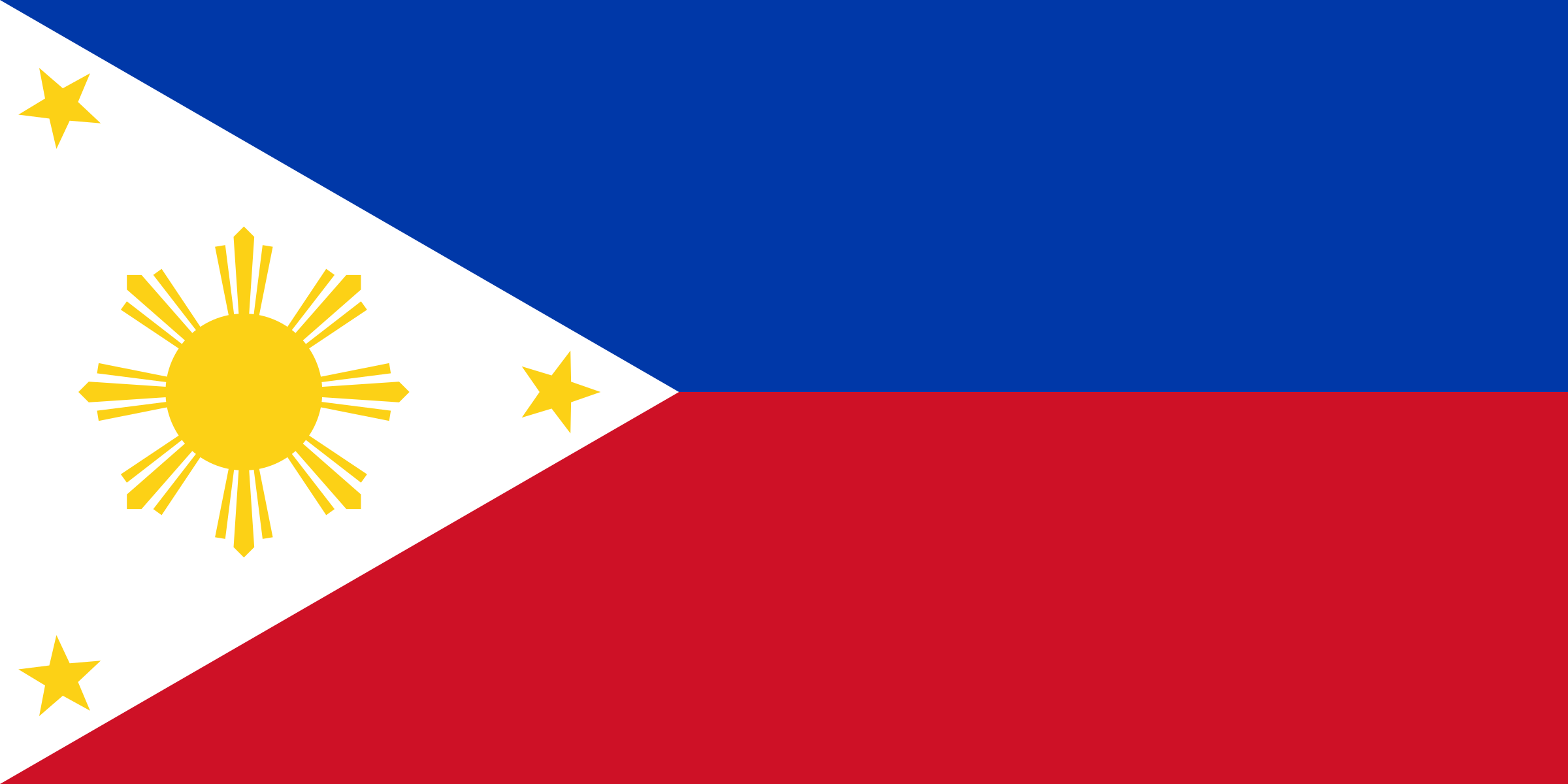
Philippines flag picture
Explore the proportions, history, and picture gallery.
| Design | Blue and red fields; white triangleGolden eight-rayed sun and three five-pointed stars. |
|---|---|
| Proportions | Height:length = 1:2SVG: 2,400 × 1,200; PNG: 4,800 × 2,400. |
| Origins | 1898Made in Hong Kong; associated with Emilio Aguinaldo. |
| First public display | May 28, 1898After the Alapan victory; Kawit proclamation followed June 12. |
| Current code | Republic Act 8491Approved February 12, 1998; specifies ratio and Cable colors. |
| Flag Days | May 28 through June 12National Flag Day through Independence Day. |
What does the Philippine flag look like?
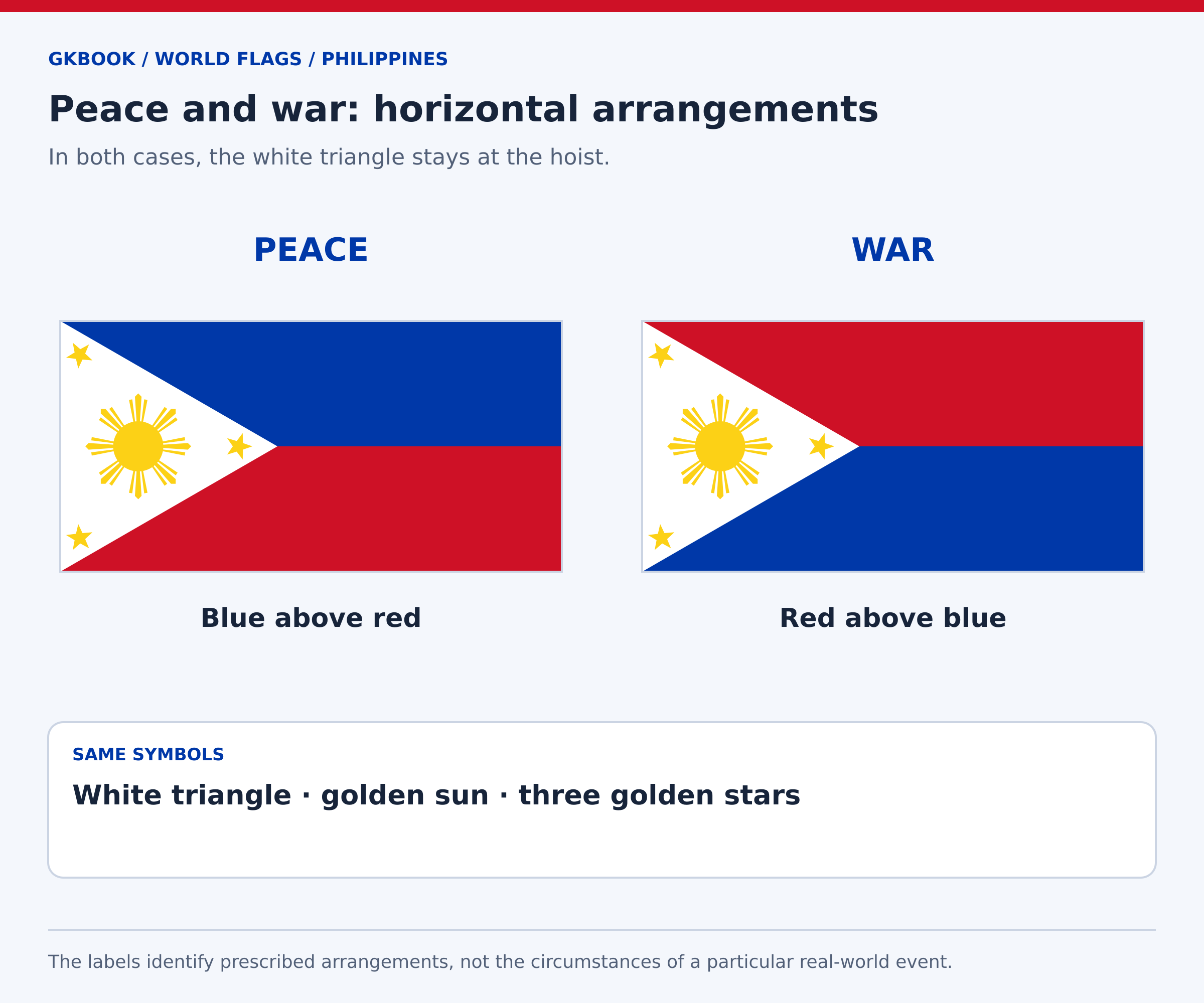
The Philippines flag has equal blue and red horizontal fields, a white equilateral triangle at the hoist, a golden sun with eight rays, and three golden five-pointed stars. Its height:length ratio is 1:2. Blue appears above red in peace; the order reverses in war. The design originated in 1898.
The Philippine flag combines a strong geometric structure with a history of revolution, independence, and later standardization. This guide distinguishes the original declaration’s wording from modern symbolism, explains the two display arrangements, and shows how the sun and stars are constructed. The gallery includes unannotated flags and clearly labeled educational diagrams.
What are the colors of the Philippines flag?
The flag uses blue, red, white, and golden yellow. Republic Act 8491 specifies Cable numbers 80173, 80108, 80001, and 80068 respectively. These downloads use blue #0038A8, red #CE1126, white #FFFFFF, and yellow #FCD116 as declared screen approximations, rather than claiming that the law itself prescribes hexadecimal color codes.
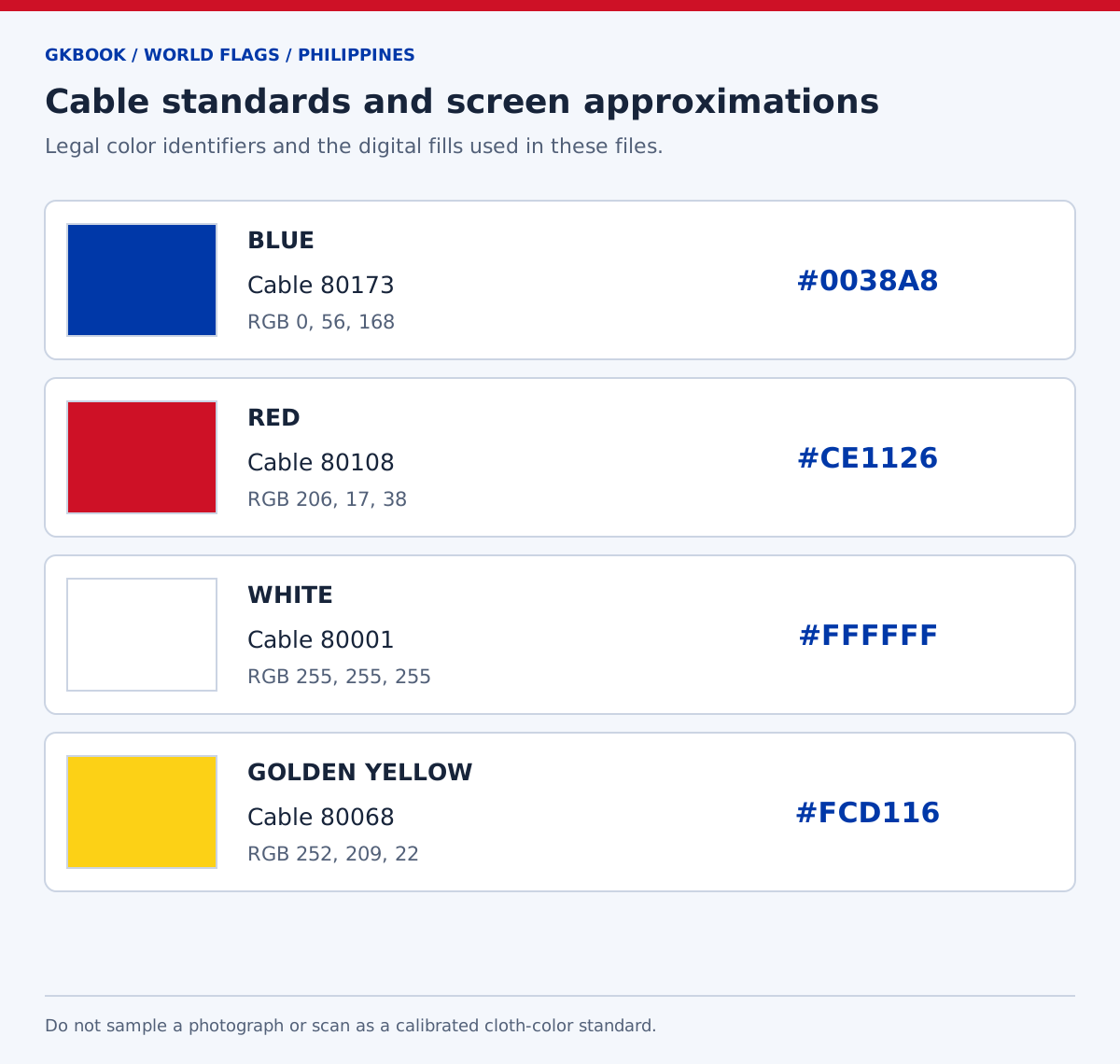
The legal color identifiers refer to a color standard, whereas a hexadecimal value specifies a digital fill. A photograph, a printed sheet, and dyed fabric can look different even when intended to represent the same color. The palette here records exactly which screen values the artwork uses.
The white triangle is opaque, so a background cannot show through it. Blue and red remain flat colors inside the flag; decorative shading belongs outside its boundary. When comparing pictures, check their color settings and lighting before interpreting a slightly different blue as evidence of a historical version.
| Color | Cable number | Screen HEX | RGB |
|---|---|---|---|
| Blue | 80173 | #0038A8 | 0, 56, 168 |
| Red | 80108 | #CE1126 | 206, 17, 38 |
| White | 80001 | #FFFFFF | 255, 255, 255 |
| Golden yellow | 80068 | #FCD116 | 252, 209, 22 |
What do the colors and symbols mean?
An NHCP account connects blue with peace, truth, and justice; red with patriotism and valor; the white triangle with equality; and the sun with liberty. The three stars express the country’s three main island groups. These civic explanations should be distinguished from the particular wording of the 1898 independence declaration.

Symbols can acquire a stable public meaning while their earliest explanations remain historically specific. The independence declaration connected the triangle to the Katipunan and discussed the colors in relation to the United States. Later descriptions often emphasize civic ideals instead. Neither account should be silently rewritten as the other.
A useful reading moves from the whole design to its details: the national community, its island groups, and the revolutionary struggle recalled by the sun. The diagram follows that sequence. It is an interpretive guide, not a claim that every geometric measurement has an additional hidden symbolic meaning.
What is the official ratio of the Philippines flag?
The official height:length ratio is 1:2, so the flag is twice as long as it is high. Section 27 of Republic Act 8491 also makes each side of the white triangle equal to the flag’s height. A flag measuring 100 centimeters high should therefore measure 200 centimeters long.
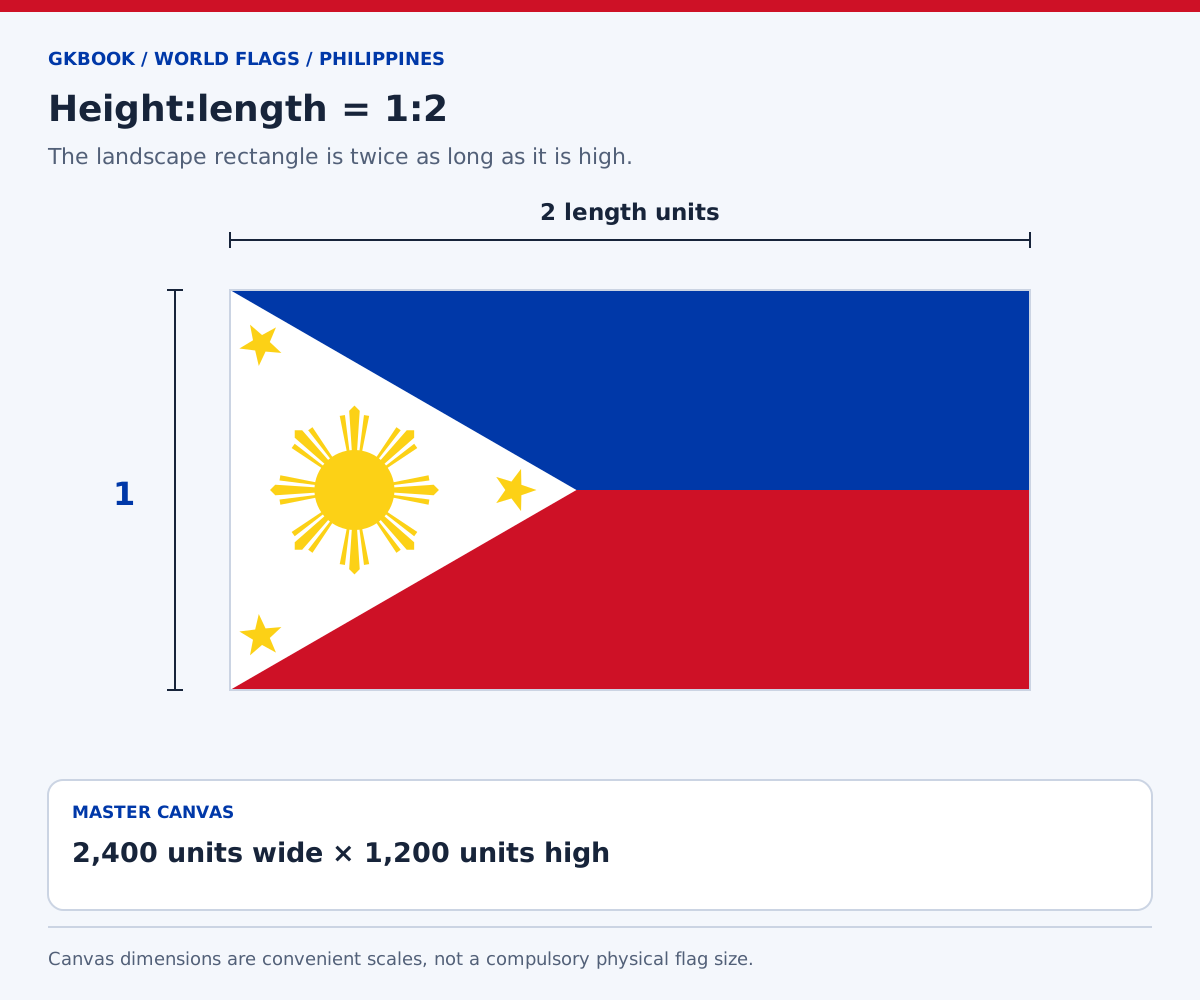
The term width in the legal specification describes the shorter dimension. Image software usually calls the longer horizontal dimension width. To avoid that vocabulary trap, the diagrams explicitly label height and length, while downloadable image sizes are written as width × height. The relationship is identical in either notation.
The main SVG uses 2,400 × 1,200 coordinate units. Those numbers are a convenient drawing canvas, not a required cloth size. Enlarging both dimensions together preserves the shape; enlarging only one distorts the triangle, changes the star proportions, and turns the sun’s circular center into an oval.
Are the blue and red fields equal in size?
The two horizontal fields have equal heights, with their boundary halfway down the flag. The white triangle overlays their hoist ends symmetrically, leaving equal visible areas of blue and red. On the 2,400 × 1,200 master, the dividing line is at y = 600, measured from the top edge.
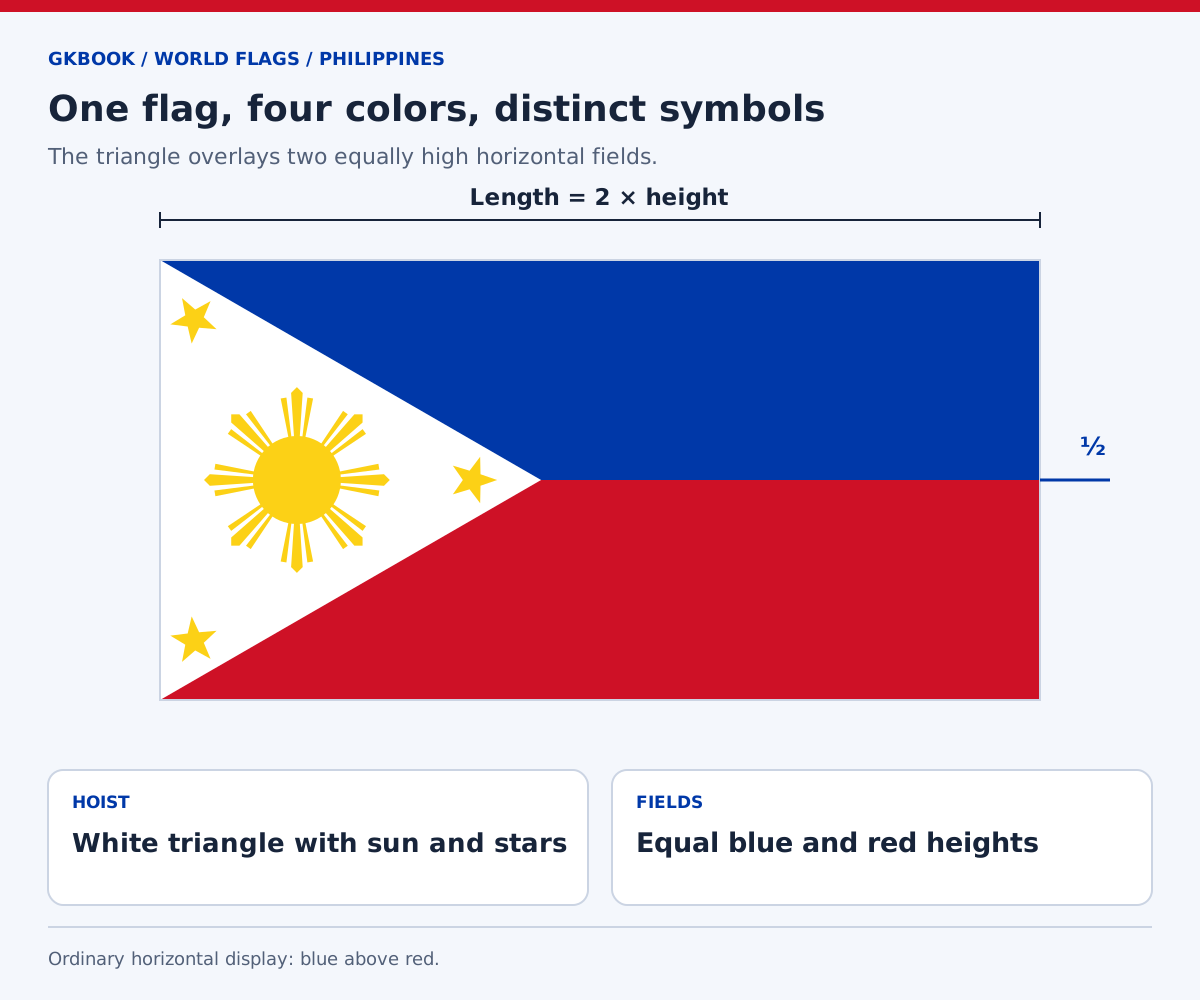
The triangle interrupts the bands; it is not an extra vertical stripe. Looking only at the rectangular area beyond the triangle’s point can make the field construction easier to see. Both colors continue to the fly edge, and their shared boundary is straight and horizontal in the ordinary display.
Equal visible colored areas follow from the triangle’s symmetry about that boundary. This is a geometric observation rather than a separately legislated percentage. The yellow sun and stars occupy the triangle, so measuring the remaining white area requires subtracting those symbols from the triangular area first.
Is the white triangle equilateral?
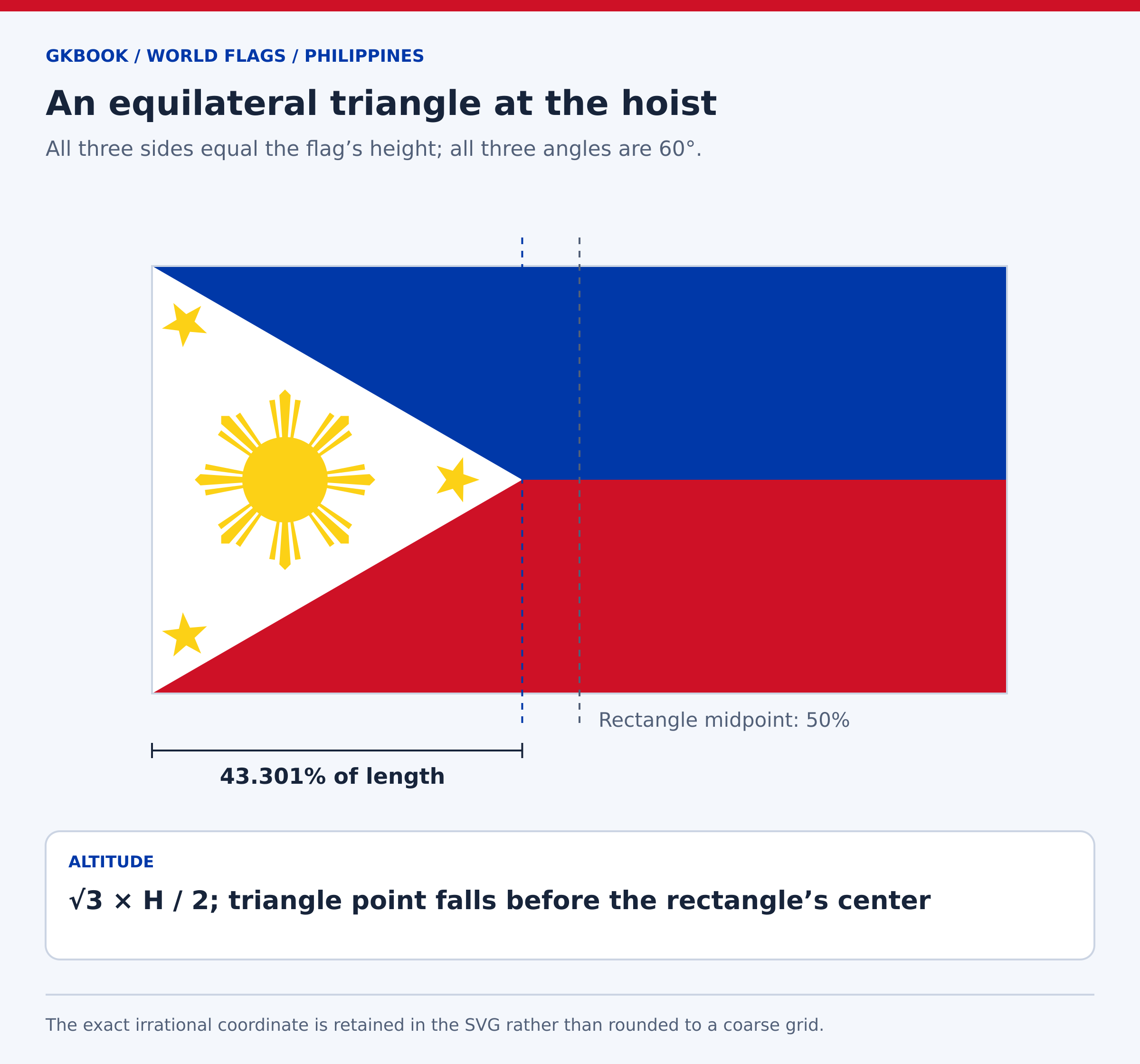
Yes. Each of the white triangle’s three sides equals the flag’s height, making it equilateral with three 60-degree angles. Its point reaches approximately 43.3 percent of the flag’s full length. It does not reach the rectangular flag’s center, even though its point lies on the horizontal midline.
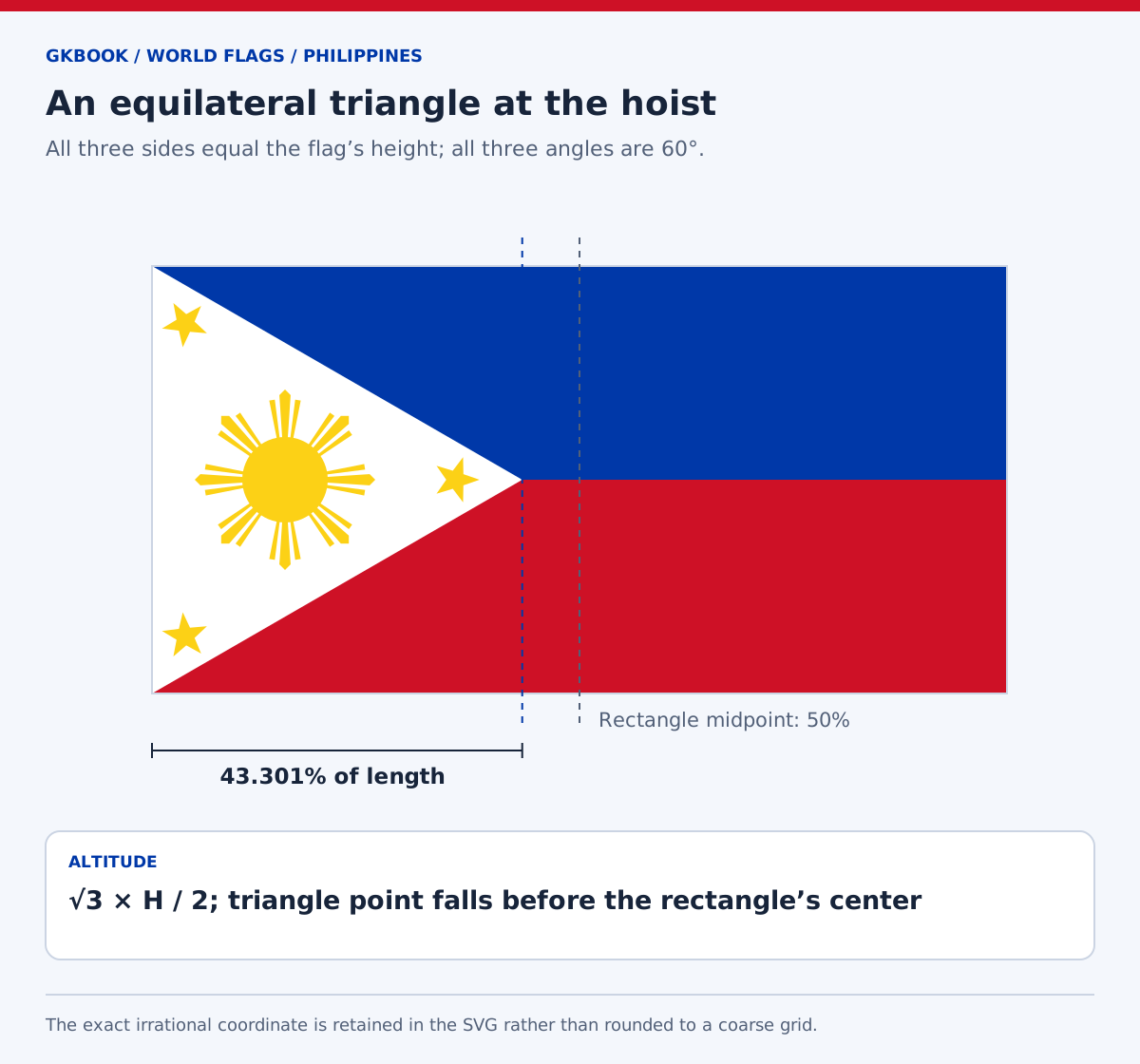
If the flag height is H, the triangle’s horizontal altitude is √3 × H ÷ 2. The rectangle’s length is 2H, so the triangle reaches √3 ÷ 4 of that length. This explains why a triangle drawn all the way to the rectangle’s midpoint would be too long.
The altitude is an irrational measurement: a digital drawing should preserve its fractional coordinate rather than rounding it to a coarse grid. In the supplied master, the triangle’s point is approximately (1,039.2305, 600). Its left edge spans the complete 1,200-unit height, and its white fill has no outline.
What does the sun look like on the Philippines flag?
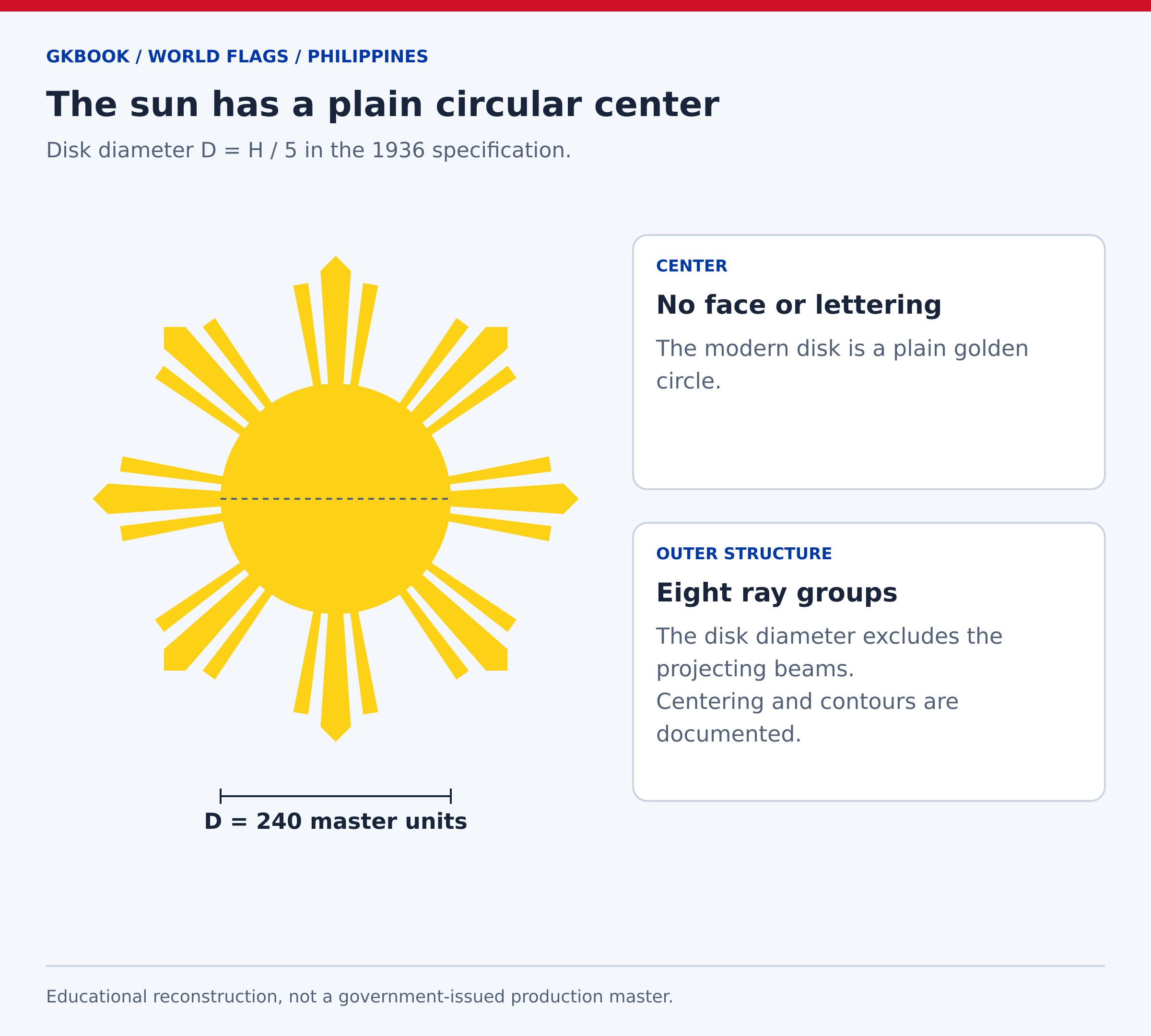
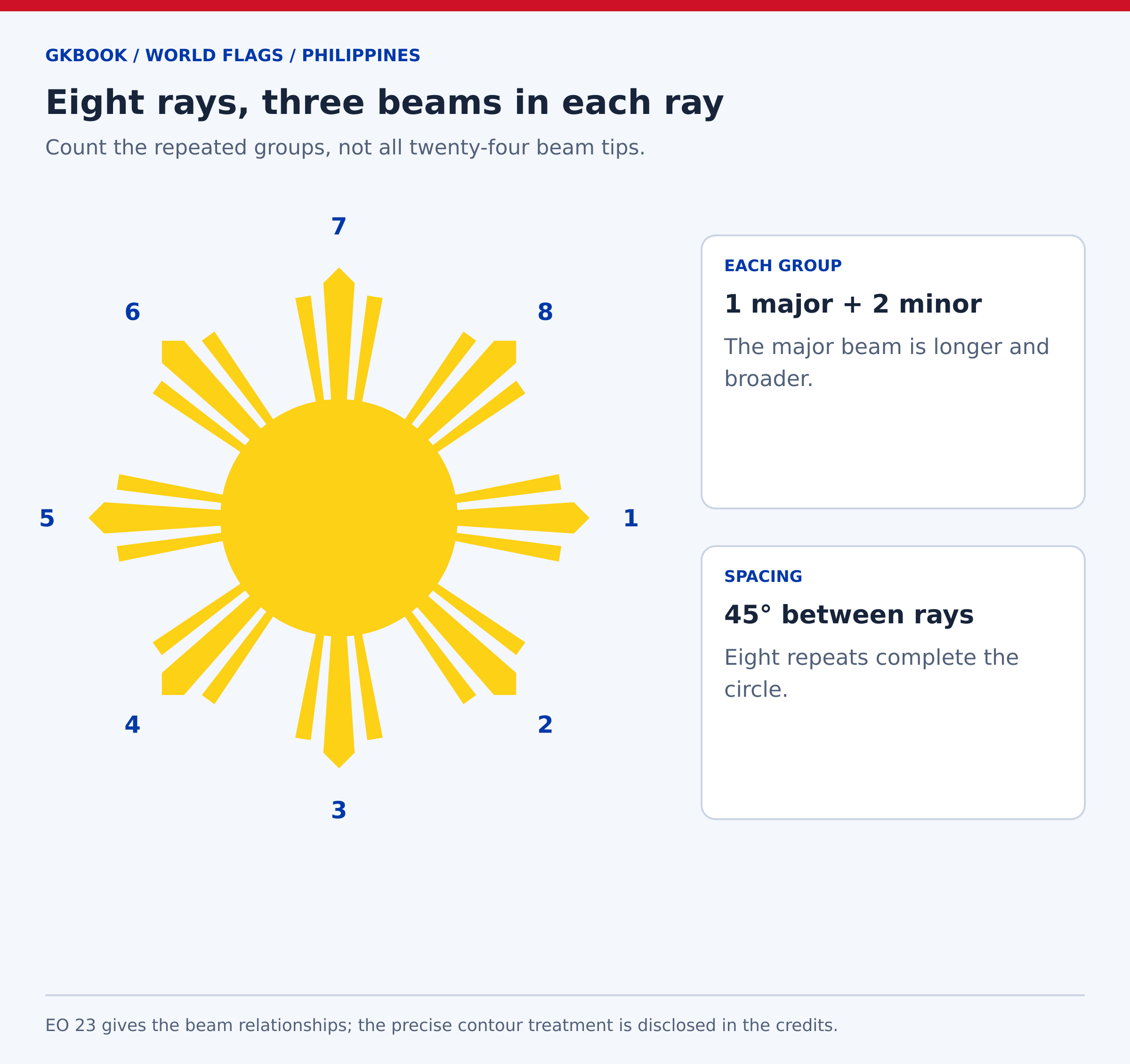
The golden sun has a plain circular center and eight evenly spaced rays. It has no face in the modern construction. Each ray contains one major beam and two smaller beams. The circular center’s diameter is one fifth of the flag’s height in the construction described by Executive Order 23.
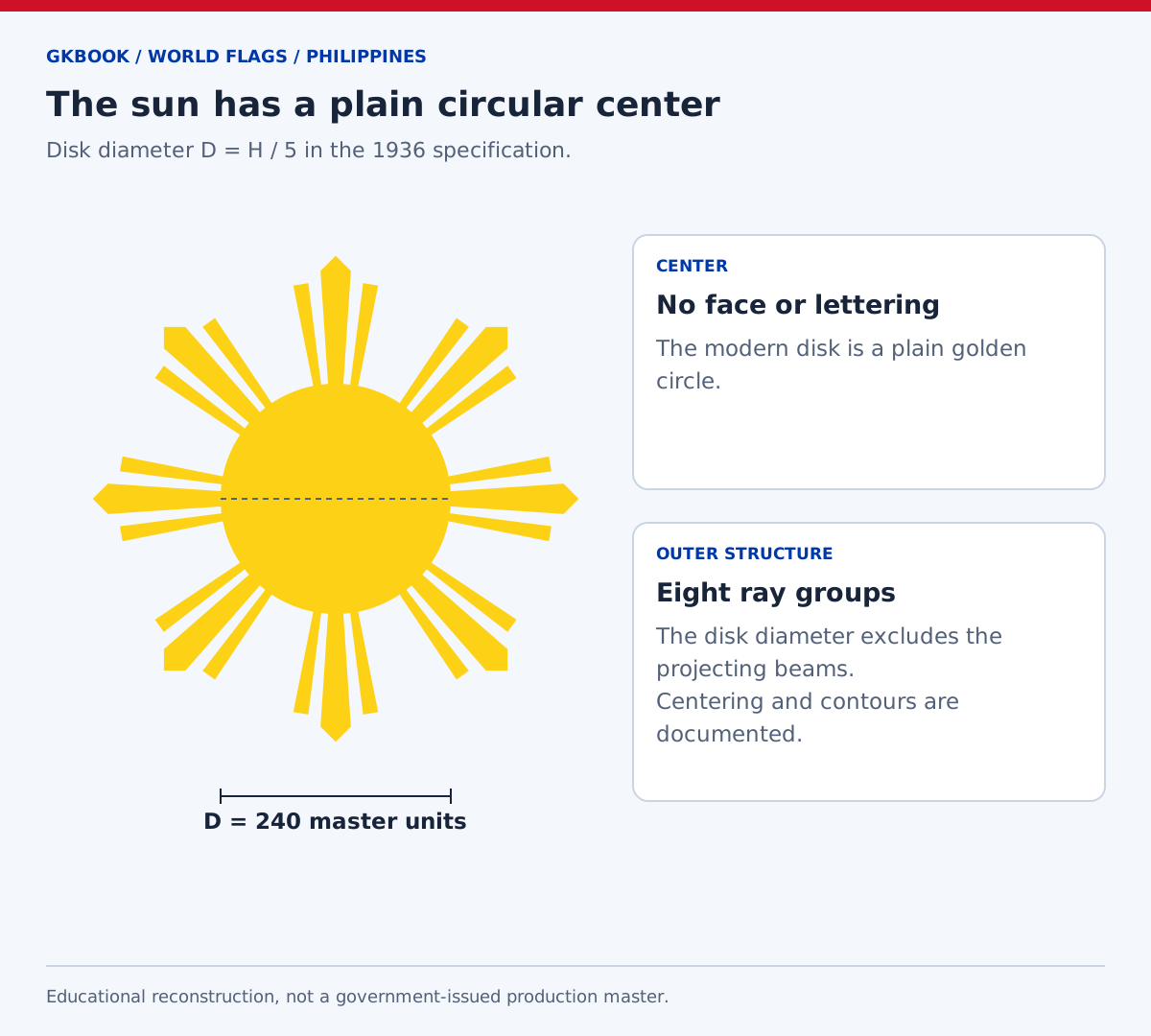
The diameter refers to the central disk, not the full tip-to-tip sunburst. Confusing those measurements produces a very small sun. In this reconstruction the disk is 240 units across, while the long beams extend beyond it. The separate sun illustration makes the disk and the surrounding structure easy to distinguish.
The sun is placed in the white triangle, away from all three stars. This artwork uses the NHI plate’s clearance of half the disk diameter between the hoist and the nearest major-beam tip. The remaining contour choices are documented; the downloadable vector is an educational reconstruction rather than a government-issued manufacturing master.
Why are there eight rays rather than twenty-four?
There are eight principal rays, and each contains three beams: one larger central beam and two smaller side beams. Counting the individual beam tips yields twenty-four, but the traditional and legal description still calls this an eight-rayed sun. The ray groups are spaced at equal 45-degree intervals around the disk.
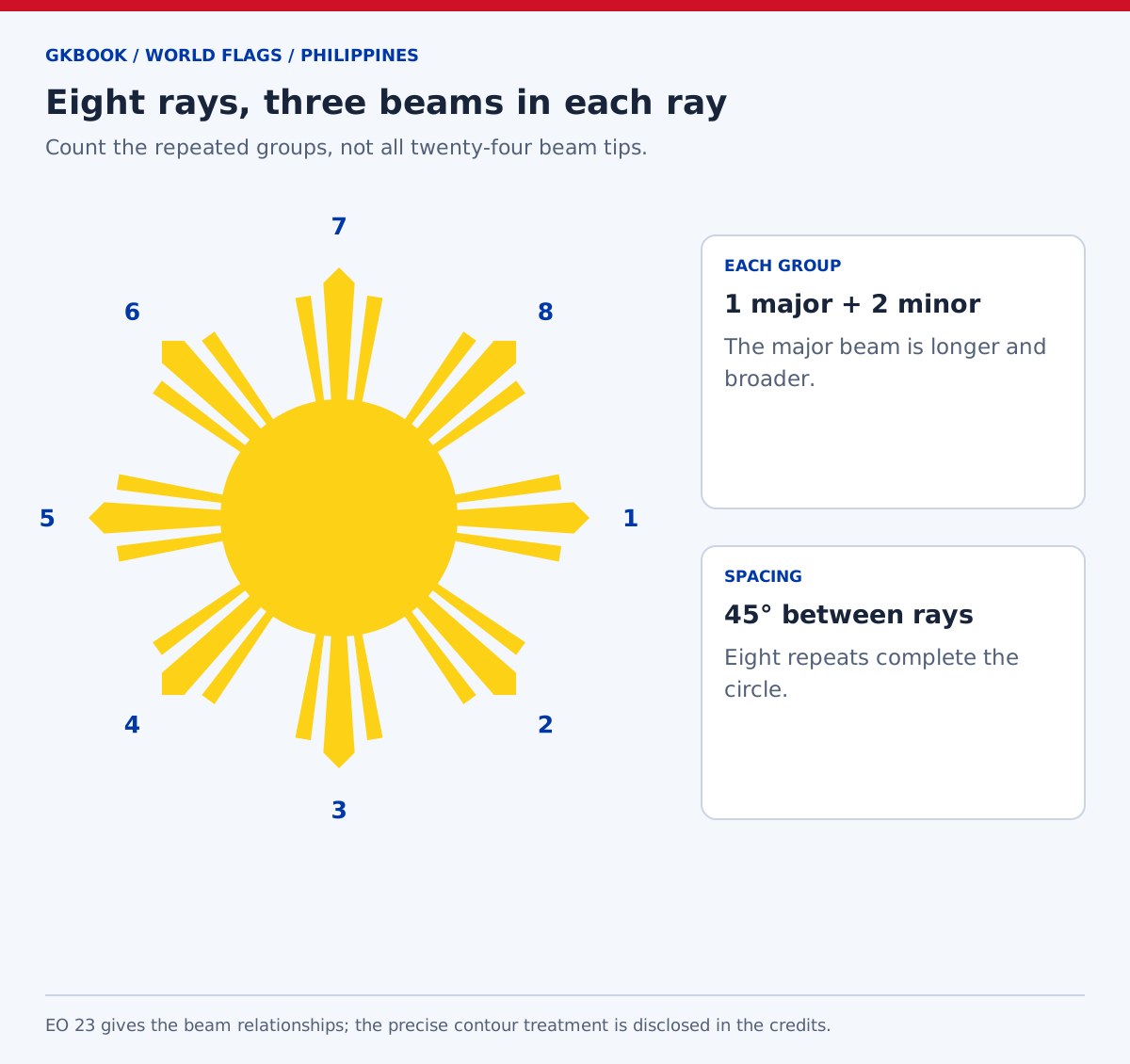
Begin with the upward ray group, then move around the circle through the diagonal, horizontal, and remaining directions. Each group repeats the same three-part arrangement. Counting groups rather than tips preserves the distinction between the symbolic number eight and the finer details used to draw the sunburst.
The 1936 specification makes the major beam longer and broader than either neighboring minor beam. The illustrations retain these relationships and identify their contour treatment as a reconstruction choice. A generic sun icon with eight simple triangles would lose the characteristic three-beam structure even if its main count were correct.
Which eight provinces do the sun’s rays represent?
The rays commemorate eight provinces associated with the early revolution. A common later list names Manila, Cavite, Bulacan, Pampanga, Nueva Ecija, Tarlac, Laguna, and Batangas. However, the 1898 declaration reproduced in an NCCA sourcebook names Bataan instead of Tarlac. A careful explanation identifies the historical account behind the list.

The seven shared names make the disagreement easy to overlook. The comparison diagram highlights only the differing name, leaving the remaining seven together. It does not replace a province silently or imply that the flag acquired an extra ray when later explanations used a different provincial list.
The Boy Scouts of the Philippines’ educational text supplies the later Tarlac list; the NCCA sourcebook preserves the declaration’s Bataan wording. These are distinct documentary contexts. Historical labels also need care: Manila in a nineteenth-century list should not automatically be interpreted as the boundaries of today’s city or metropolitan region.
What do the three stars represent?
The three golden stars are commonly explained as Luzon, Visayas, and Mindanao, the country’s three main island groups. The 1898 declaration instead named Luzon, Panay, and Mindanao. Panay is an island within the Visayas. Present-day symbolism and the declaration’s original wording therefore need separate labels when discussing the flag’s history.
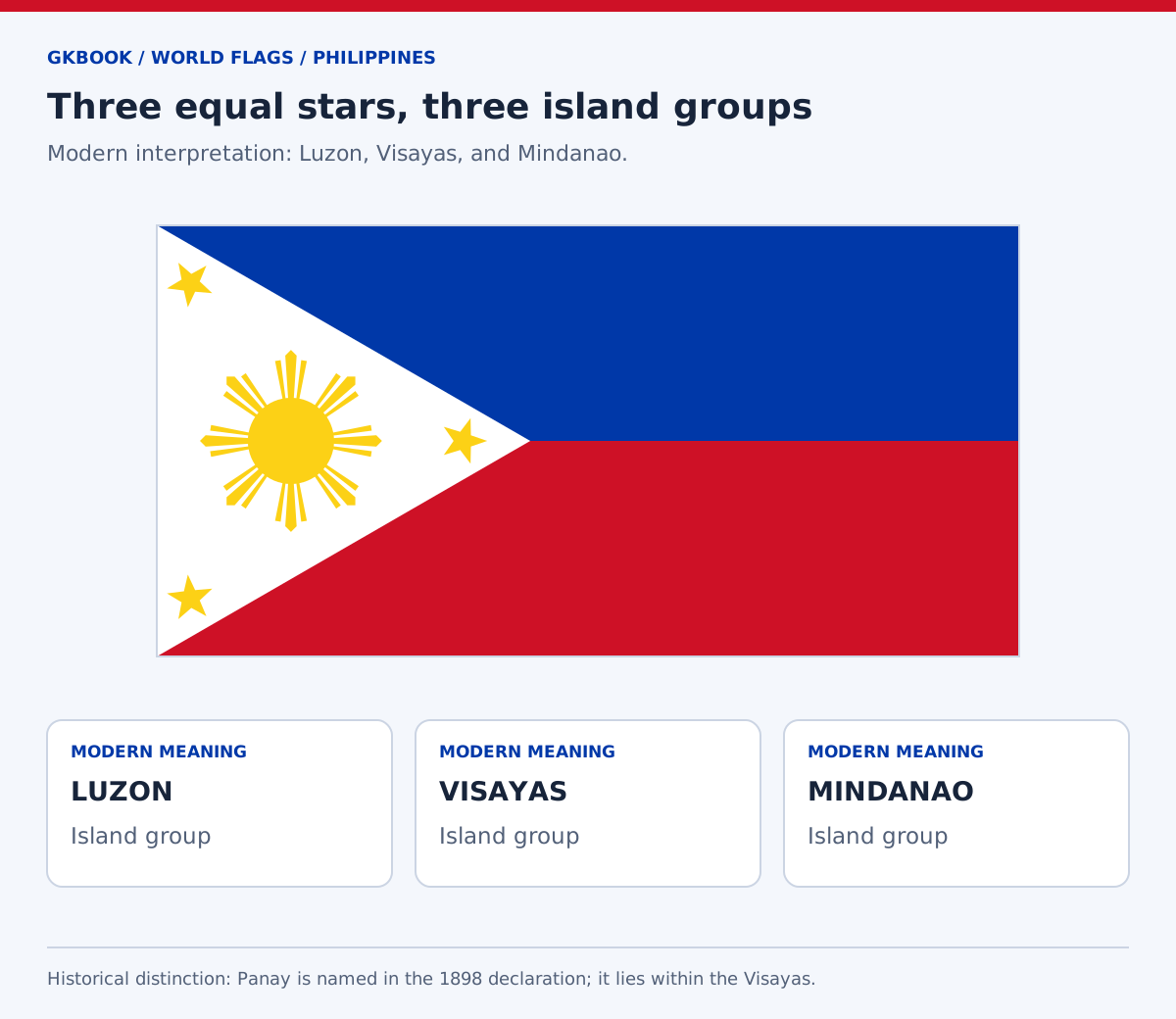
Each star has five points and occupies a different corner region of the white triangle. The design does not depict the islands’ shapes, relative areas, or exact geographic positions. A star is a symbolic marker, so its placement should not be read as a scaled map of the archipelago.
The modern island-group interpretation expresses a broader national grouping than the declaration’s explicit naming of Panay. Explaining the change in language does not require redrawing the flag: there are three stars in both accounts. The gallery labels all three equally and avoids assigning an unsupported compass position to a particular island group.
Which way should the stars point?
One point of each star faces the nearby vertex of the white triangle. Consequently, the three stars do not all stand upright in the same orientation. The upper hoist star points toward the upper corner, the lower hoist star toward the lower corner, and the inner star toward the triangle’s right-hand tip.
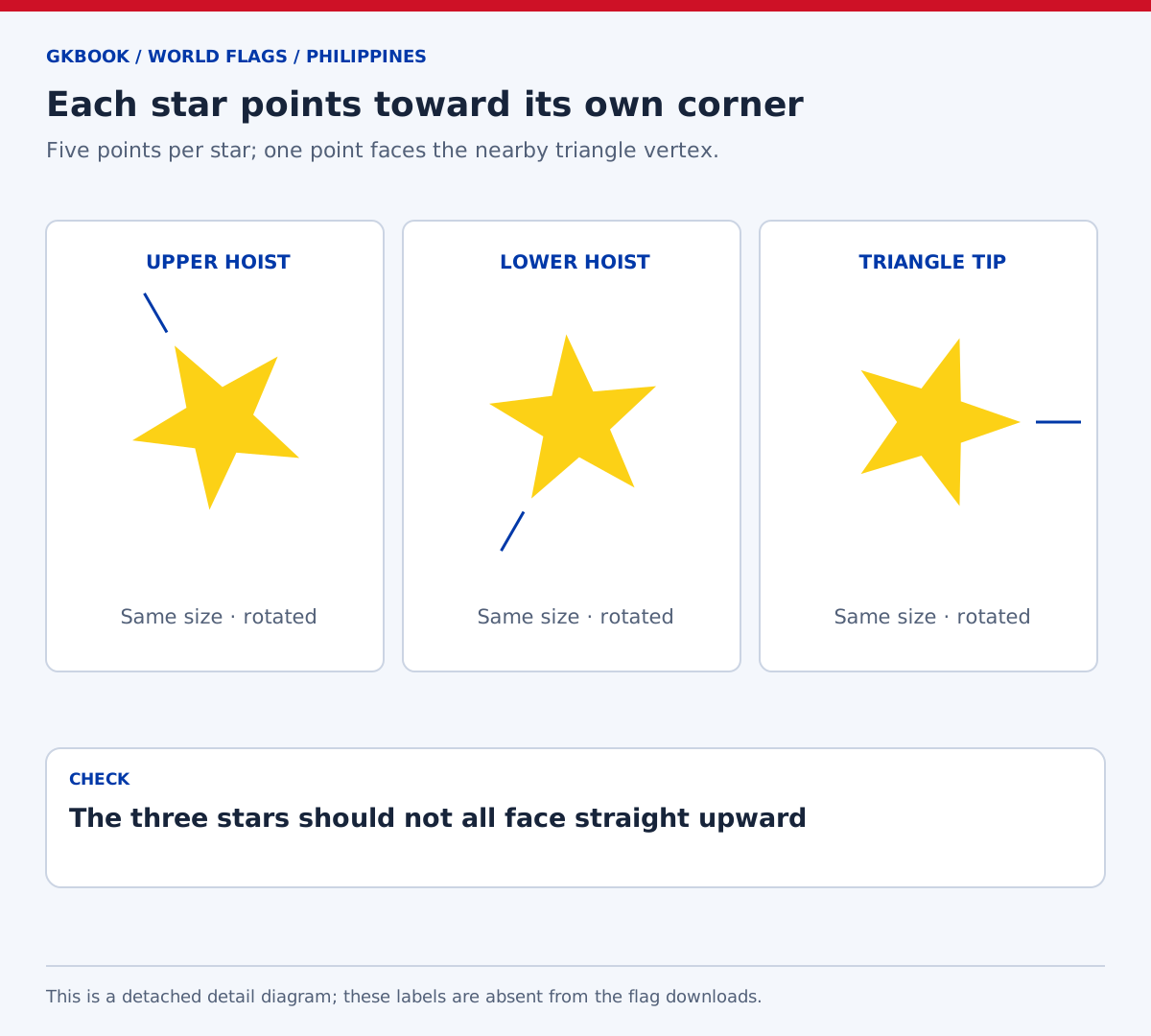
The stars share the same size and five-point construction; their orientations change with their positions. A useful check is to imagine a line from each star’s center to its associated triangle vertex. One outer tip should lie along that line, facing outward toward the corner rather than toward the sun.
The 1936 text gives the diameters of the stars’ outer and inner circles. Here those dimensions are converted into alternating polygon radii, with a 0.4 inner-to-outer ratio. The corner clearance is explicitly interpreted as the distance from the vertex to the nearest star tip, so that placement can be reproduced consistently.
How is the flag displayed in peacetime?
When flown from a pole in peacetime, the blue field is above the red field. The white triangle stays at the hoist, next to the pole or attachment edge. For vertical hanging, the blue field is on the observer’s left. These two arrangements describe different display positions of the same flag.
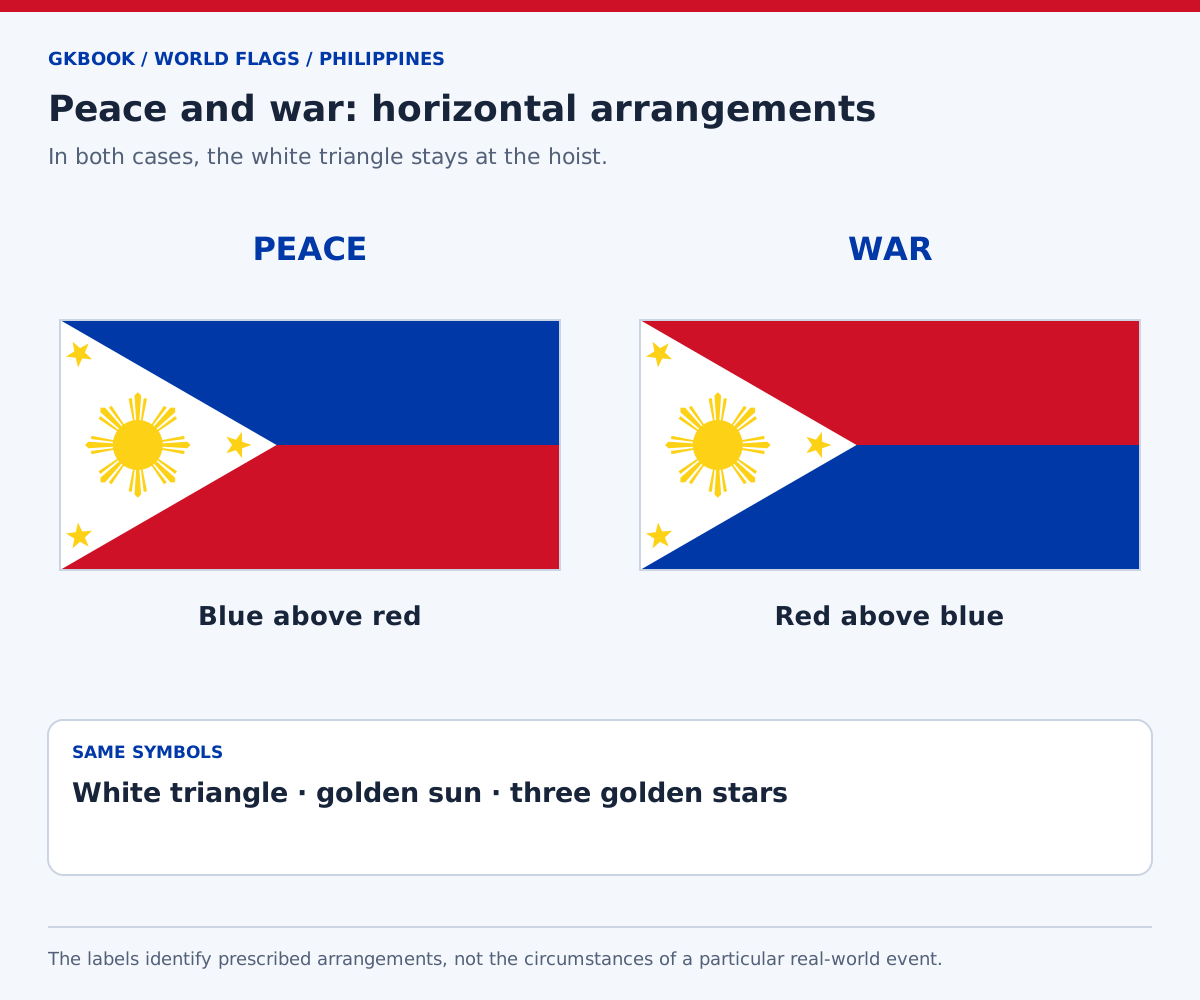
The observer’s viewpoint is essential. A direction described from the flag’s own right can appear on the viewer’s left, which is why an unlabeled instruction to put blue on the right causes confusion. The illustrations consistently identify the viewer-facing arrangement and show the attachment edge where necessary.
For a conventional horizontal flag picture, the hoist is drawn at the left and the fly at the right. That convention is useful for identification, but a photograph taken from the opposite side can show the hoist on the right. Blue above red remains the relevant horizontal color order.
What changes when the Philippines flag is used in war?
The red field is displayed above the blue field when the flag is flown from a pole in time of war. For vertical hanging, red appears on the observer’s left. The white triangle, golden sun, and three stars remain part of the design; no additional emblem is introduced.
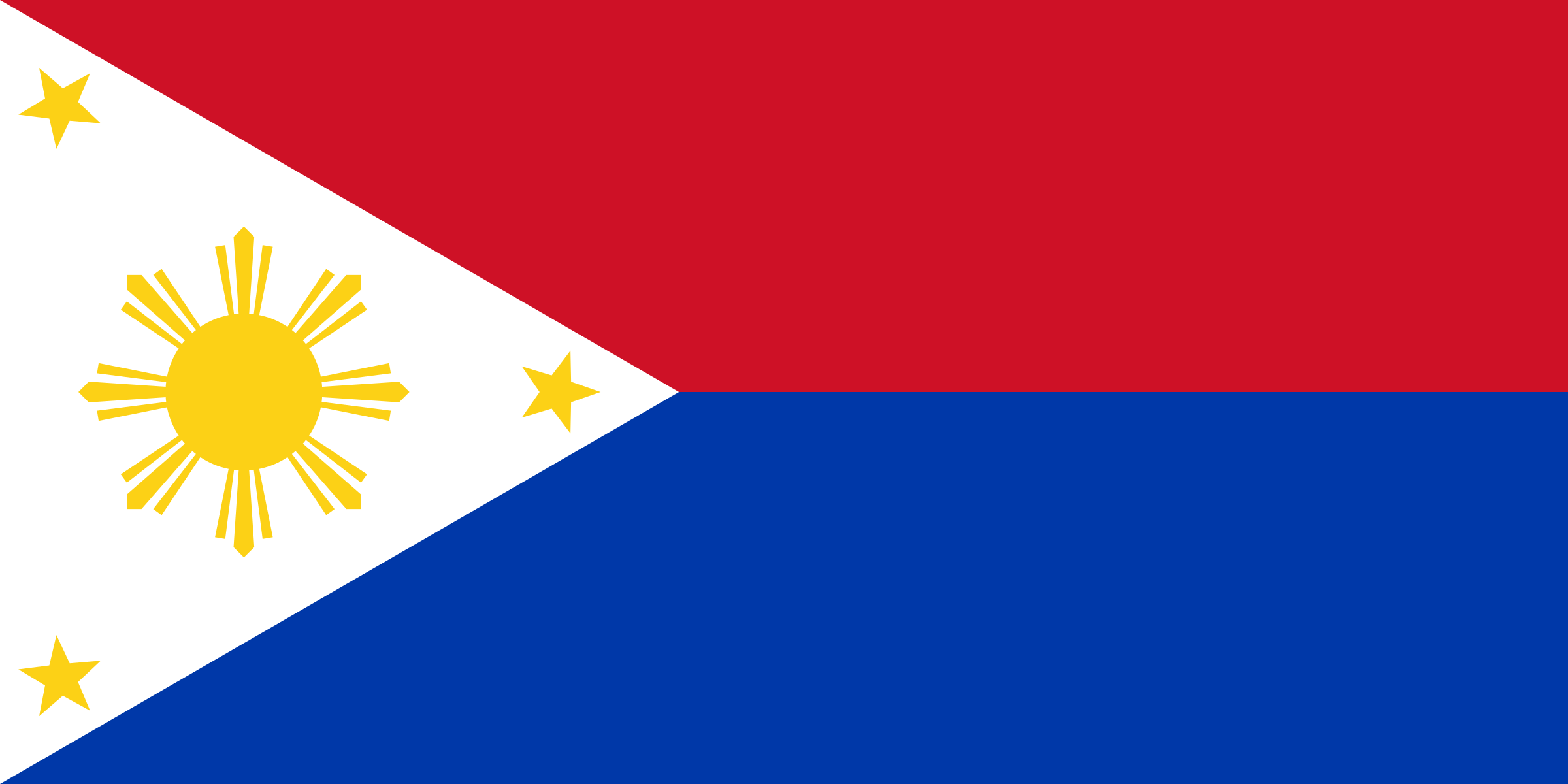
The war arrangement changes the ordering of the colored fields. It does not authorize moving the triangle to the fly or replacing the eight-rayed sun. The separate war download is labeled explicitly so that it cannot easily be mistaken for the ordinary peacetime image in a collection of flag files.
The code’s rule is sufficient to explain the distinction without making a worldwide superlative about uniqueness. Similarly, an accidentally inverted image does not by itself establish the political circumstances of a real event. Captions should identify whether they show the legally described arrangement, a historical scene, or a display error.
How should the Philippines flag hang vertically?
When hanging vertically, the triangle containing the sun and stars is at the top. In peacetime, blue is on the observer’s left and red on the observer’s right; in wartime, those colors exchange sides. Simply rotating the usual horizontal picture clockwise would put the peacetime colors on the wrong sides.

This is a practical example of why rotation and reflection are different operations. Turning a left-hoist horizontal image clockwise moves its blue upper half to the right. The approved viewer-facing vertical arrangement therefore needs the corresponding face or transformation that preserves the required color order and places the hoist above.
The diagram shows both cases side by side with explicit labels. It depicts a flat vertical hanging arrangement, not a wind-blown flag. Across a street, the code also gives compass-direction rules; those depend on the street’s orientation and should not be inferred merely from the left-right layout in a picture.
Does the reverse of the flag have a different design?
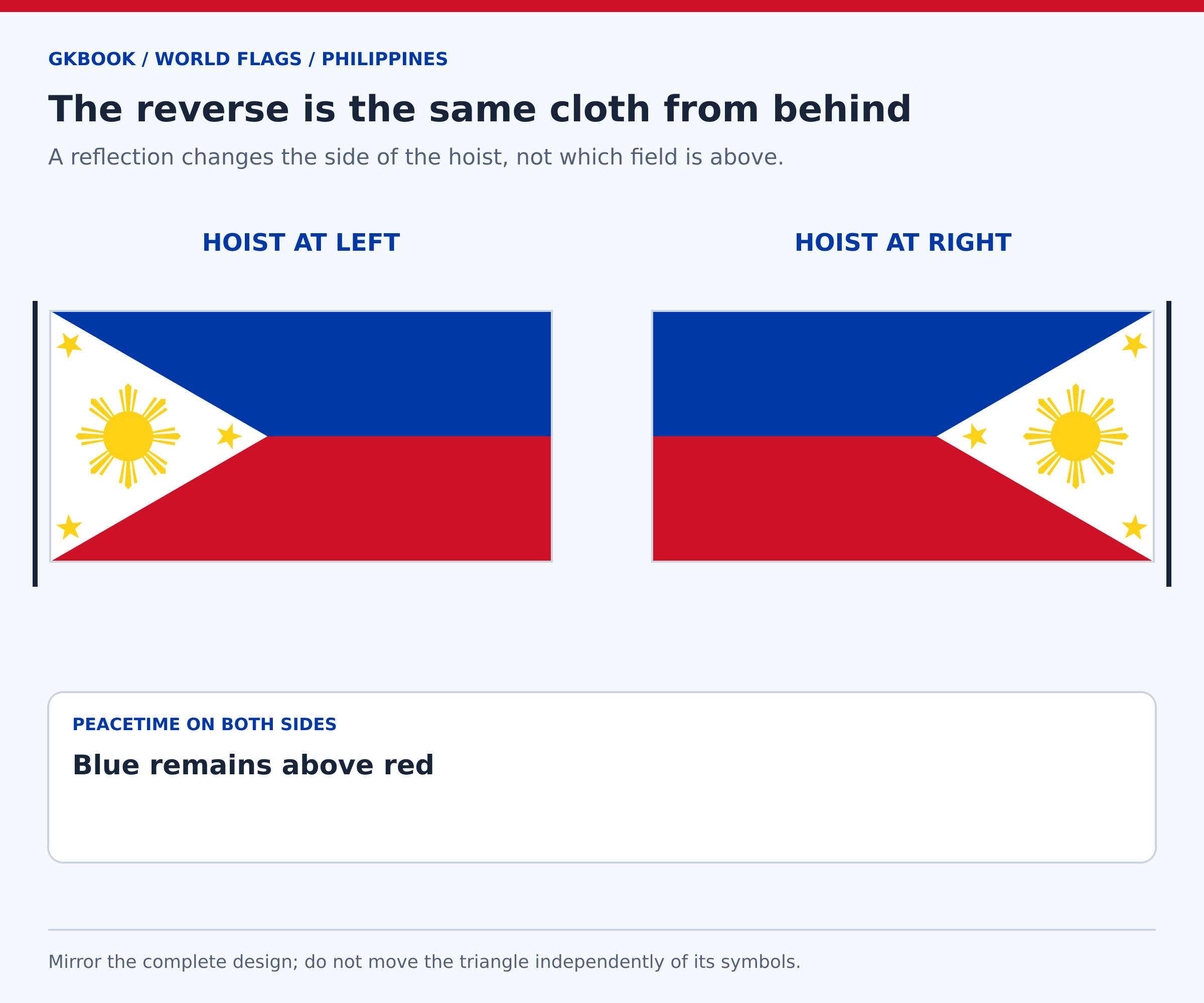
The reverse carries the same flag design seen from the opposite side, so a horizontal illustration appears reflected left to right. The triangle then lies at the right-hand hoist edge. In peacetime blue is still above red. The reverse is not a separate emblem-bearing version of the national flag.
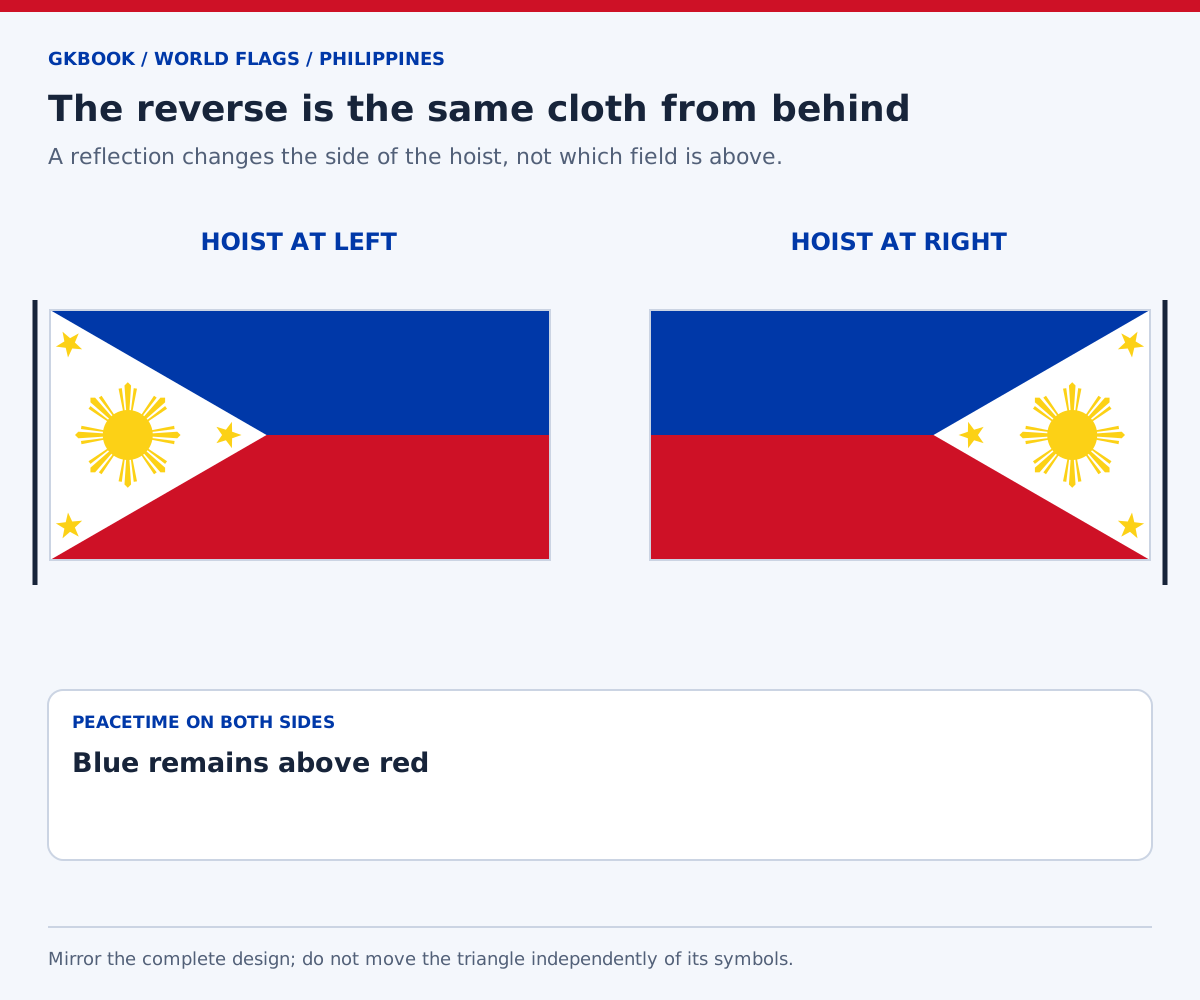
A transparent mental model helps: stand behind the same flat cloth while keeping the top edge above you. The pole changes sides in your view, while the blue upper field remains above the red lower field. This is different from turning a printed picture upside down.
Because the stars point toward the triangle’s corners, their directions also reflect with the whole design. Mirroring only the triangle while leaving its symbols fixed would break their relationship. The comparison uses the same complete vector group on both sides, with an external hoist marker to make the viewing change explicit.
What image dimensions preserve the flag’s shape?
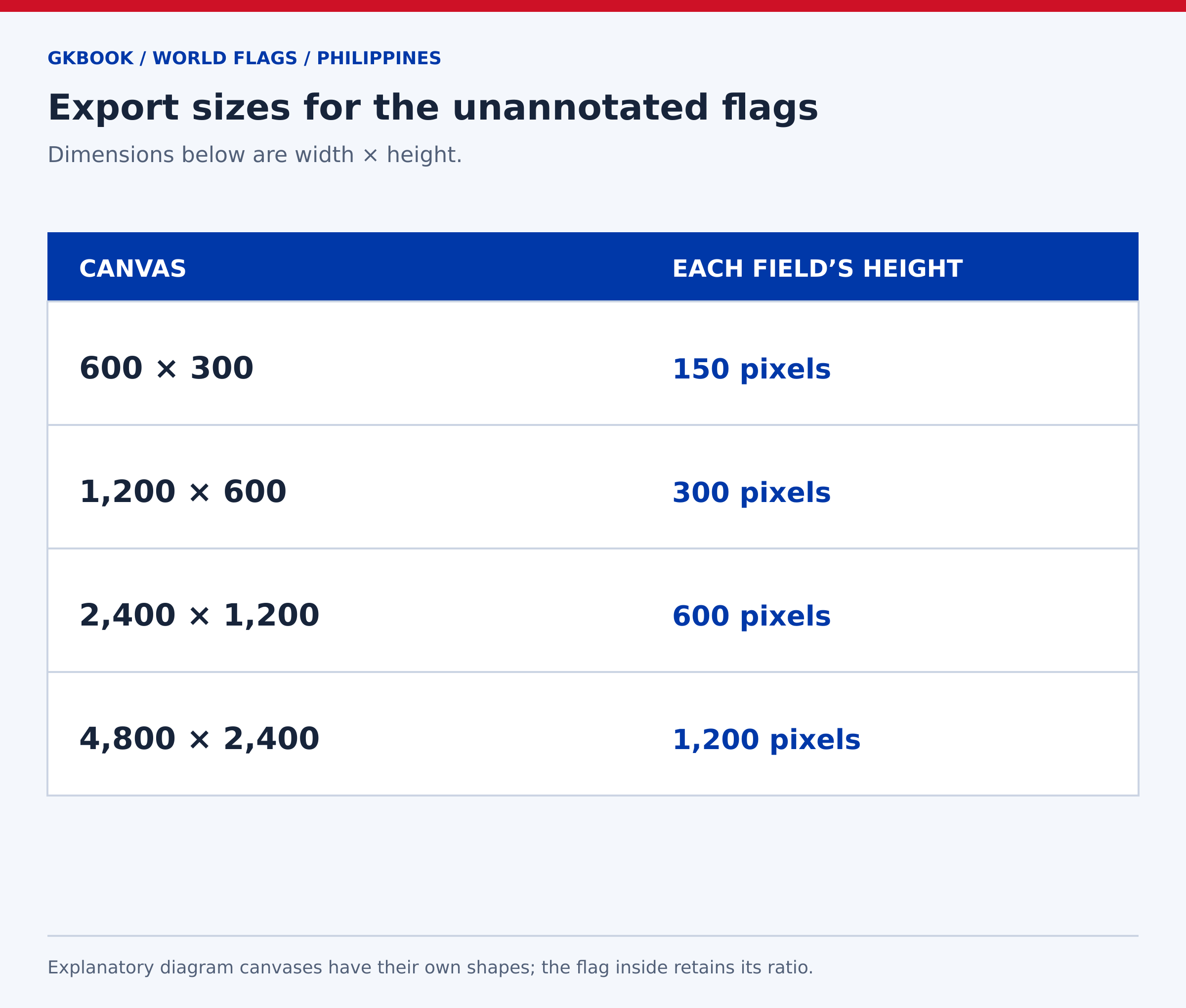
Width × height sizes such as 600 × 300, 1,200 × 600, 2,400 × 1,200, and 4,800 × 2,400 preserve the Philippines flag’s 2:1 landscape shape. The main PNG uses 4,800 × 2,400 pixels. Its SVG uses a 2,400 × 1,200 viewBox and scales uniformly without changing the geometry.

A high-resolution PNG is useful when a program cannot display vector artwork. The SVG is preferable when the output must remain sharp at different sizes, because its circles and polygons are described geometrically. The diagram files contain labels and margins and therefore have their own canvas ratios.
Keep the distinction between a flag’s boundary and a whole illustration’s boundary. A tall explanatory poster may contain a correctly proportioned flag without itself being twice as wide as it is high. Cropping the poster to its inner flag is different from stretching the poster to a flag ratio.
How can you draw the Philippines flag accurately?
Start with a rectangle twice as long as it is high, divide it horizontally into equal fields, and add an equilateral white triangle at the hoist. Place the eight-rayed golden sun and three correctly oriented stars within the triangle. Use blue above red for the ordinary peacetime drawing.

Establish the triangle before placing the emblems. If the point is incorrectly placed at the rectangle’s center, even carefully drawn stars will sit in the wrong space. Draw the sun’s disk and repeated ray groups separately so that the eightfold structure is controlled instead of approximated by an unrelated decorative icon.
Work at a generous scale before reducing the image. Small previews can hide mistakes such as unequal star sizes or merged minor beams. The construction sequence shows the order of operations, while the plain download removes every teaching label, guide line, panel border, and dimension mark from the flag itself.
When did the Philippines flag originate?
The design originated during the independence struggle in 1898. A flag made in Hong Kong was displayed after the Battle of Alapan on May 28 and at the independence proclamation in Kawit on June 12. Later measures standardized its construction and colors, including the 1936 specifications and the 1998 Flag and Heraldic Code.

A single adoption date cannot explain every part of that sequence. The first public display, the proclamation ceremony, an official construction standard, and the enactment of a comprehensive code are different milestones. The timeline assigns a descriptive label to each date instead of combining them into one ambiguous birthday.
The artwork throughout this article represents the modern design using a stated digital palette. It is not presented as a photographic copy of the original 1898 cloth. Historical flag reconstruction requires separate evidence about material, shade, stitching, and emblem details, especially where an early artifact or drawing has not survived securely.
Who designed the Philippines flag?
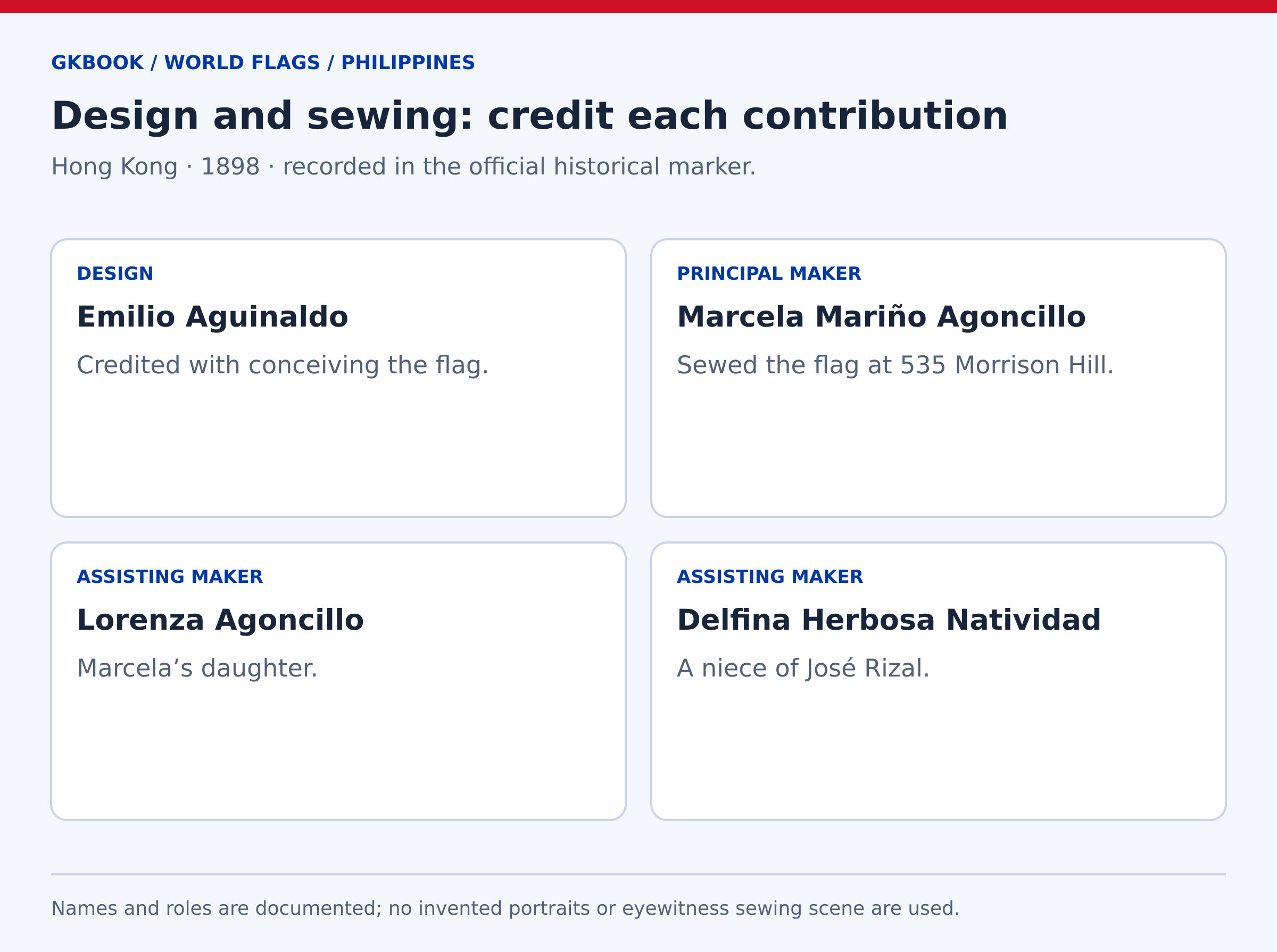
The design is attributed to Emilio Aguinaldo, who conceived it during his exile in Hong Kong. The NHCP’s historical marker credits him with the design and separately names the women who sewed the flag. Designing the national emblem and physically making its first cloth example were related but distinct contributions.

Aguinaldo’s role belongs within the revolutionary context rather than a modern commercial design process. The flag brought together a triangle, sun, stars, and colored fields into an emblem of the struggle for independence. The historical marker is particularly useful because it states the attribution without erasing the makers.
When writing a short caption, include the action attached to each person: conceived, designed, or sewed. That small distinction prevents an otherwise accurate name from being used to imply sole authorship of every stage. The accompanying maker diagram keeps the design credit and the sewing credits visually separate.
Who sewed the first Philippines flag?
Marcela Mariño Agoncillo sewed the flag in Hong Kong with help from her daughter Lorenza Agoncillo and Delfina Herbosa Natividad. The historical marker identifies the location as 535 Morrison Hill. Their work produced the flag Aguinaldo brought back to the Philippines in 1898, connecting skilled making with the independence movement.
The three women should be named individually. A caption that mentions only the principal maker loses the collaborative work recorded by the official marker. Delfina was a niece of José Rizal; Lorenza was Marcela’s daughter. Their relationships help identify them but do not replace their names or their contribution.
The gallery uses a typographic credit diagram rather than invented portraits or a simulated photograph of the sewing room. This keeps the visual evidence honest: the panel communicates documented names, roles, and location without claiming to show the original people, furnishings, working positions, or an eyewitness view of the event.
Was the first display on May 28 or June 12, 1898?
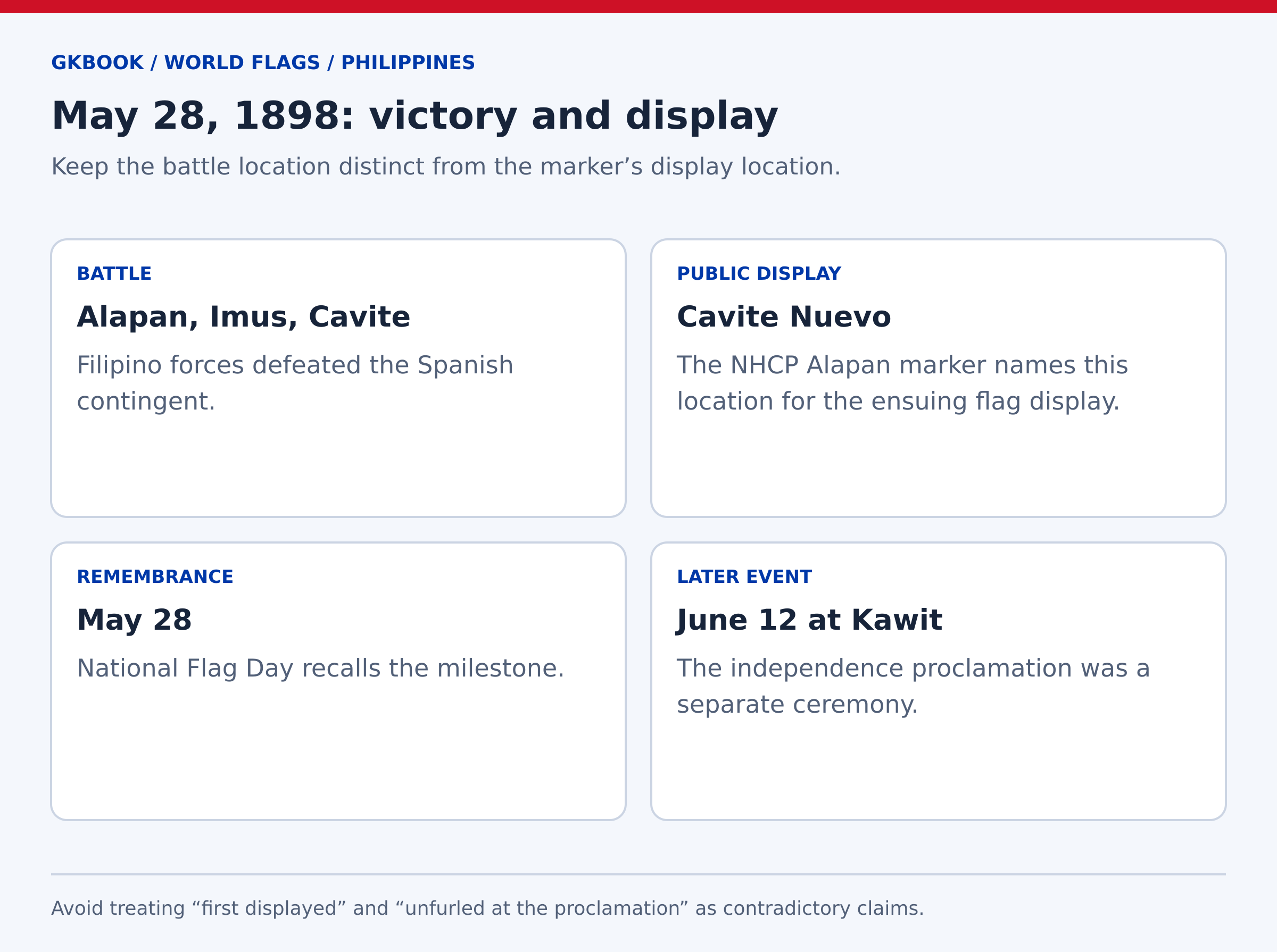
May 28, 1898 marks the flag’s first public display in connection with the victory at Alapan. June 12 marks its ceremonial use during the proclamation of independence in Kawit. These dates refer to different events. The NHCP’s Alapan marker specifically connects the victory with a display at Cavite Nuevo.
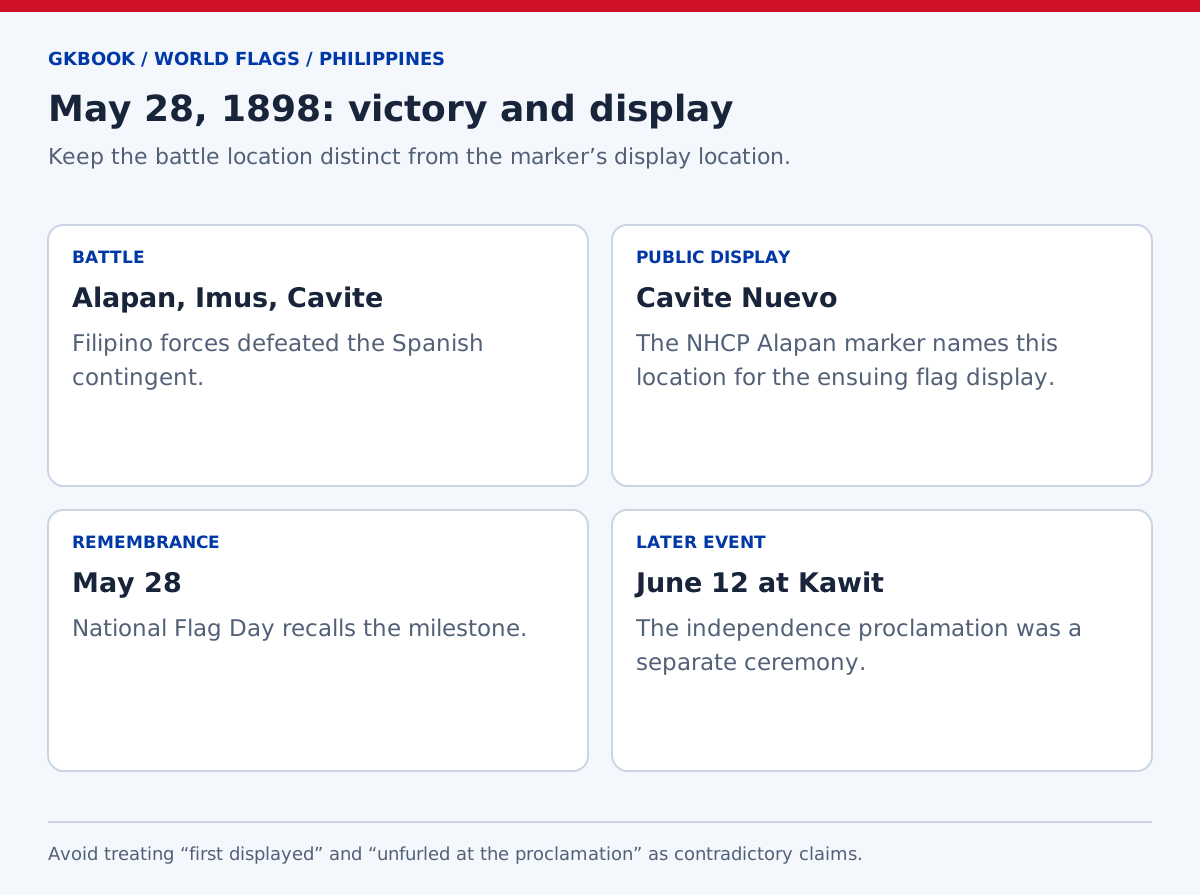
Alapan is the battle location in Imus, while Cavite Nuevo is named in the marker’s description of the ensuing display. The phrase first raised at Alapan is often used as commemorative shorthand. A more exact historical caption distinguishes the battle that prompted the display from the location the marker actually names.
This distinction does not diminish the role of May 28 in national remembrance. It explains why two places can appear in descriptions of the same milestone. The diagram joins the battle and the subsequent display as related events, and the next illustration treats the Kawit proclamation as a separate occasion.
What happened to the flag on June 12, 1898?
The flag was unfurled at Kawit, Cavite, during the proclamation of Philippine independence on June 12, 1898. The NHCP marker records that the band of San Francisco de Malabon played the Marcha Nacional Filipina, composed by Julián Felipe. This ceremonial milestone followed the May display associated with the victory at Alapan.

The proclamation gives the flag a specific documentary setting: it was the emblem of a declared independent nation, not merely a decorative object at a public gathering. Its text also explained the symbols. Reading that explanation alongside later civic interpretations reveals why historical wording deserves its own context.
The date is observed as Independence Day. It should not be substituted for May 28 when answering a question about the flag’s first public display. Likewise, the later 1998 code did not create the flag from nothing; it supplied a legal framework for a national symbol already rooted in these events.
Was the Philippines flag once prohibited?
Yes. Act 1696 of 1907 restricted public display of flags and emblems associated with rebellion against United States authority, including Katipunan devices. Act 2871 repealed that measure in 1919. The repeal’s text is dated October 22, 1919, a detail that should be distinguished from later commemorative celebrations or conflicting secondary dates.
The restriction belongs to the period of American colonial rule. Reading the law’s scope is more informative than saying that every conceivable Philippine symbol was forbidden in every setting. It concerned specified rebellious flags, banners, emblems, and devices, and the repeal directly identified the act being removed.
The repeal also provided for a designated celebration of the restored use of the flag. That helps explain why a celebration date and the approval date may appear separately in historical narratives. This article uses the date printed in the repeal text and avoids collapsing those different events into one entry.
What did the 1936 flag specifications establish?
Executive Order 23, dated March 25, 1936, addressed inconsistent flag construction. It described the equilateral triangle, a plain sun with eight equally spaced rays, the major and minor beams, and the size and orientation of the stars. The current fixed 1:2 proportion is stated explicitly in the later 1998 code.
The order’s preamble explains its practical purpose: flags were being made with inconsistent proportions and symbols. Standardization turns a recognizable general design into repeatable instructions. Its formulas distinguish the disk, beams, and star circles, which is more precise than asking an illustrator to copy a small picture by eye.
The historical text allowed a range of lengths, so it should not be quoted alone as the complete current dimensional rule. The reconstruction combines the later fixed field ratio with the documented emblem relationships. Small contour and placement decisions are disclosed, rather than being promoted into measurements supposedly written in the statute.
Has the shade of blue changed over time?
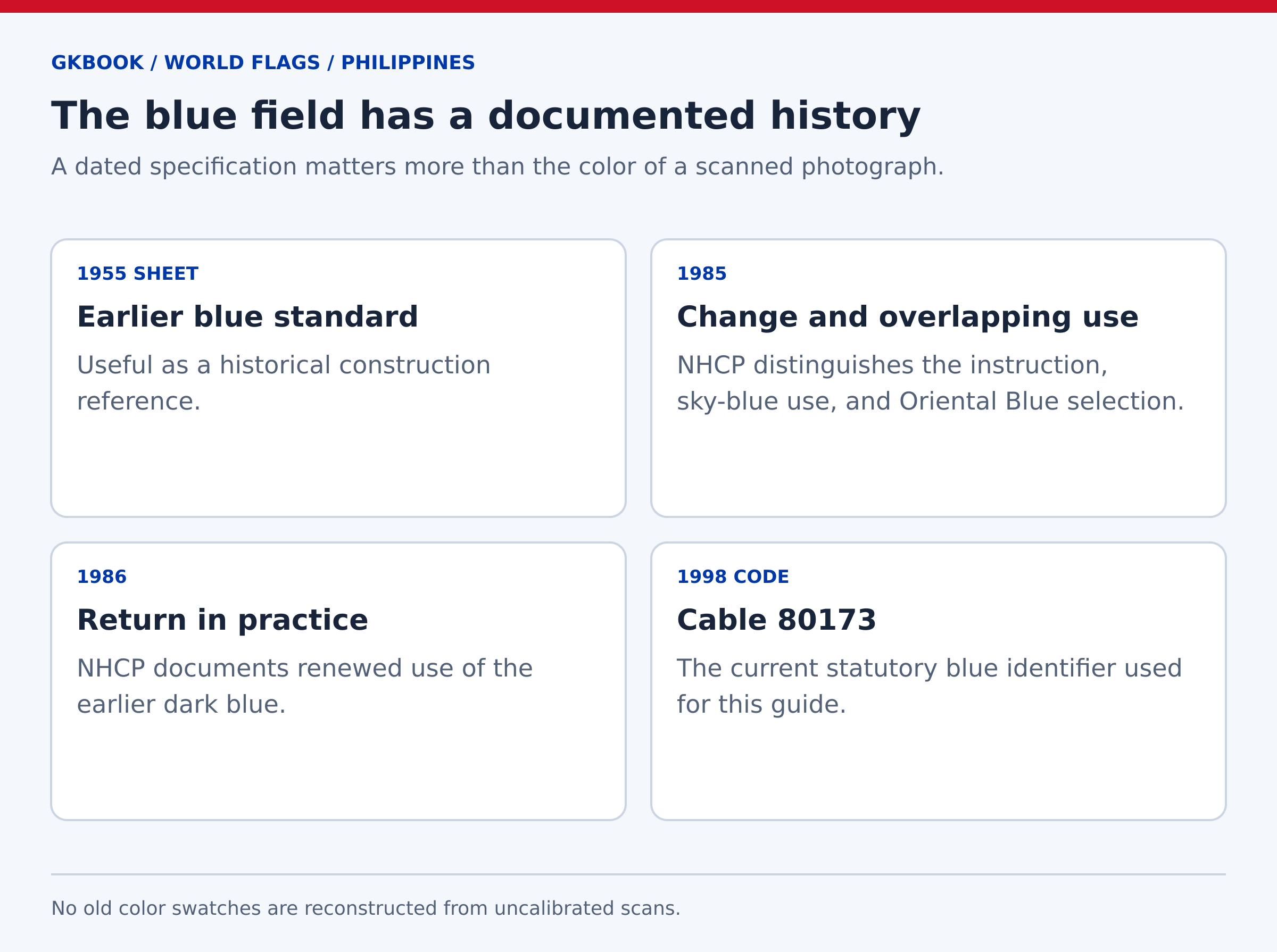
Yes. NHCP research documents changes and debate over the blue field, especially in 1985 and 1986. A 1955 construction sheet used an earlier blue standard, while the 1998 code specifies Cable 80173. Historical pictures should therefore be dated and interpreted carefully instead of being recolored automatically to match a modern screen palette.

The NHCP account distinguishes an executive instruction to restore an earlier shade, an unofficially used sky blue, and the Oriental Blue subsequently specified by the historical institute. These distinctions show why a simple old-blue versus new-blue story can conceal overlapping practices and uncertainty in photographic evidence.
The dated 1955 sheet is useful for studying construction, but its color chart should not override the later statutory Cable numbers. The gallery therefore presents a text timeline instead of pretending that scanned paper colors are calibrated swatches. Fading, scan settings, and display settings can each alter an apparent shade.
When are National Flag Day and Flag Days?
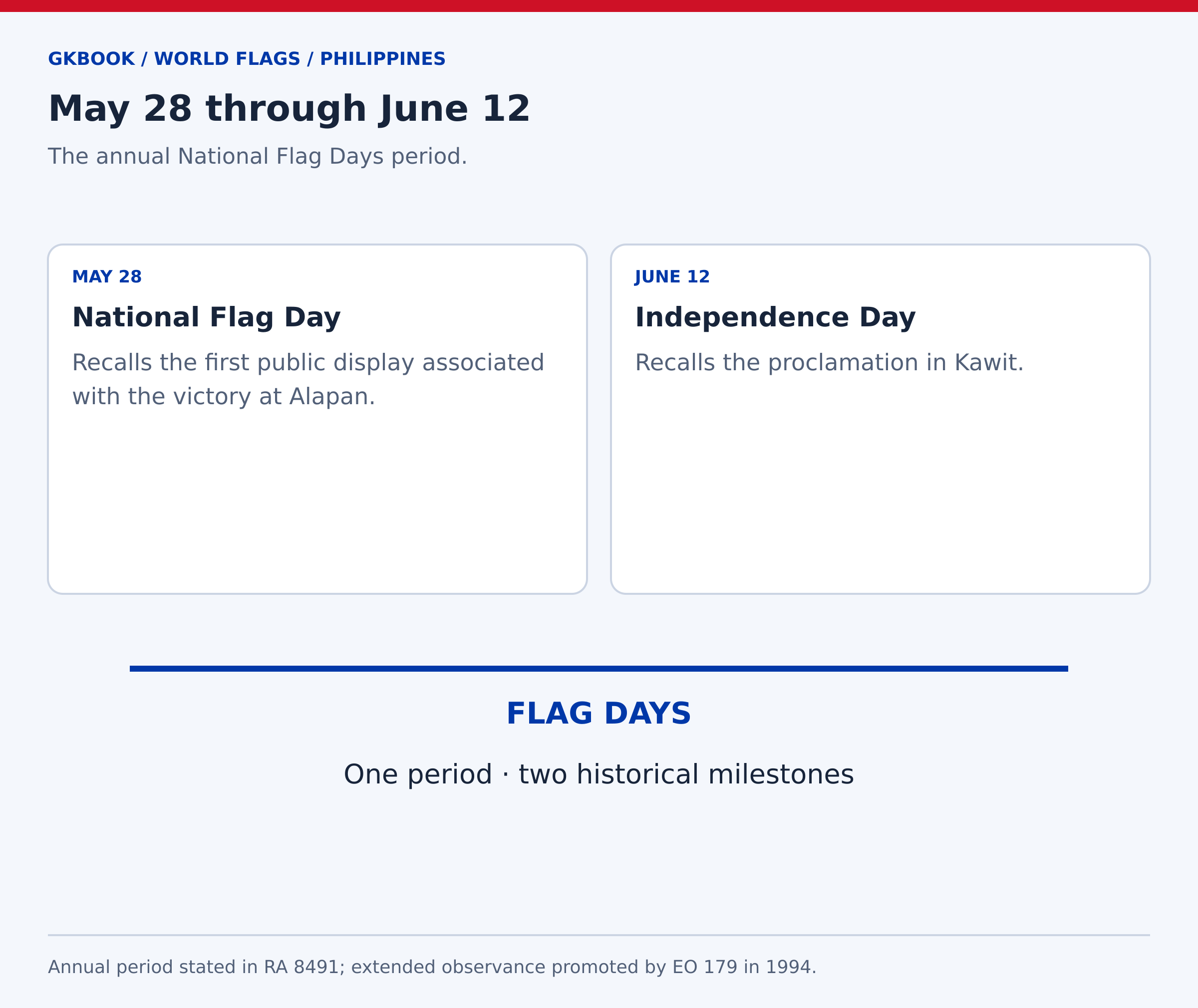
National Flag Day is May 28, commemorating the 1898 display associated with the victory at Alapan. The annual Flag Days period runs from May 28 through June 12, ending on Independence Day. The 1998 code states that period, following the extended observance promoted by Executive Order 179 in 1994.

The opening and closing dates form a period of remembrance, not two competing answers to the same question. May 28 points to the first display; June 12 points to the proclamation. A calendar or classroom poster should retain those event labels so that the sequence remains understandable.
The general annual period should also be distinguished from a particular year’s program of ceremonies. A local event can occur on another date without changing the underlying observance. The illustration uses a simple two-date layout and does not invent a timetable, a public holiday entitlement, or instructions for a particular institution.
What are the main rules for respectful flag display?
Display the flag with the correct orientation, keep it clear of the ground, and handle it respectfully. Republic Act 8491 sets rules for hoisting, lowering, illumination, mourning, and placement with other flags. The precise arrangement depends on the setting, so a wall display and a flagpole ceremony should not be treated identically.
A good preparation sequence begins with the display location and the viewer’s position. Establish the hoist, confirm whether the flag is horizontal or vertical, and then check the blue-red ordering. This prevents a familiar flat illustration from being copied into a physical setting that requires a different arrangement.
The article’s diagrams explain recognition and orientation; they are not a substitute for the complete instructions governing an official ceremony. If a school or public office is planning an event, its organizers should use the applicable protocol for that occasion, including any specific mourning announcement, rather than infer details from a gallery image.
Can words, logos, or advertising be added to the flag?
The Flag and Heraldic Code prohibits adding words, figures, advertisements, and other marks to the flag. It also restricts several decorative and commercial uses. In these illustrations, explanatory labels sit outside the flag or appear only on clearly identified teaching diagrams; the downloadable flag itself contains no text, logo, watermark, or measurement guides.
A caption beside a flag serves a different visual function from lettering printed across its fields. For an educational page, preserving the complete flag as a distinct object helps readers understand which marks belong to the national design and which belong to the explanation surrounding it.
The credits attached to these files describe authorship and reconstruction choices. They do not confer government endorsement or certify a proposed product or commercial use. Anyone preparing an actual physical display or a product should assess the intended use itself; a downloadable image does not erase the rules governing that use.
Do civilian and military users have different national flag designs?
The national flag’s core design remains the blue-red field, white triangle, sun, and three stars. The NHI specification distinguishes national, naval-ensign, and merchant-marine use without adding separate coats of arms to that design. The red-above-blue war arrangement concerns the prescribed condition of display, not an extra military badge.
Government agencies, military services, and officeholders may also have separate organizational flags or standards. Those should be identified by their own names. A presidential or service flag is not a replacement illustration for the ordinary national flag simply because it contains a familiar sun or set of stars.
The gallery provides two unannotated national-flag files: the peacetime arrangement and the war arrangement. The remaining subjects explain geometry, symbols, history, and viewing orientation. This structure makes each download’s purpose explicit and avoids introducing an invented civilian version with missing symbols or an invented state version carrying a coat of arms.
What mistakes should you check in a Philippines flag image?
Check the 1:2 height:length ratio, equilateral triangle, eight three-beam ray groups, three equal stars, and their outward orientations. Confirm blue above red for ordinary horizontal peacetime display. Keep the white opaque and distinguish legal Cable color standards from screen approximations. Historical captions should identify the event and date they actually describe.
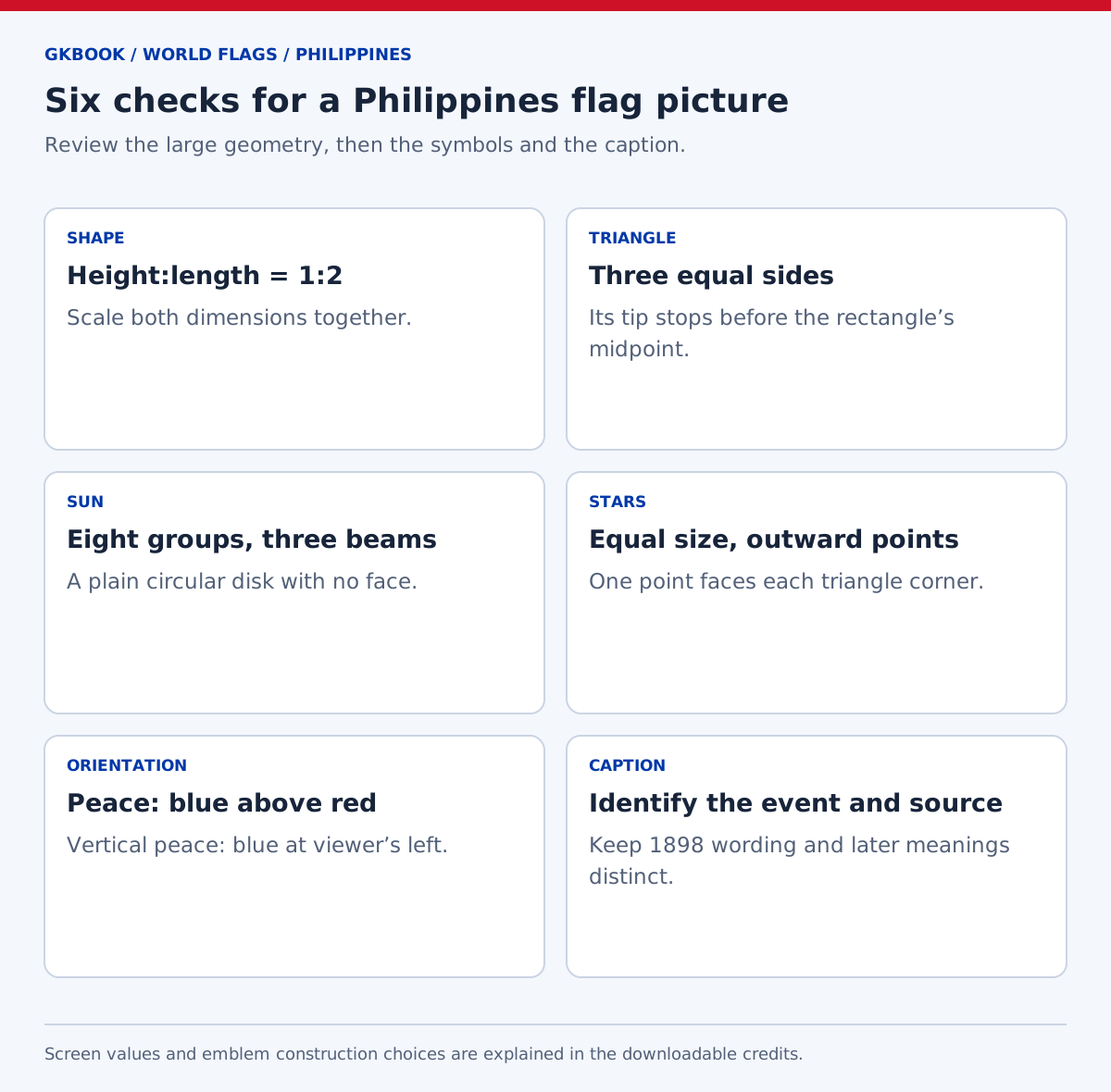
A quick visual review should begin with the large geometry and then move inward. Check the rectangle and triangle before counting the rays and stars. Finally, examine the edges at a larger scale: an apparently correct thumbnail can conceal merged beams, an accidental outline, or a clipped star tip.
The file format matters as well. A vector can preserve exact coordinates while still embodying a mistaken construction choice, and a large raster can reproduce a small error very sharply. The best review therefore combines measurement with a comparison against the documentary references and a clear account of what the reconstruction claims.
Download Philippines flag pictures
Download the national flag in its peacetime arrangement as SVG or 4,800 × 2,400 PNG. The SVG uses a 2,400 × 1,200 coordinate system. The separately labeled war arrangement SVG and war arrangement PNG place red above blue.
The gallery contains 24 subjects, each with an SVG and PNG. The flag geometry is reconstructed from legislative and NHI references; the files are educational artwork, with explicit screen colors and emblem construction conventions. Image credits and construction notes explain those choices.
Explore more in World Flags, including the Myanmar flag and Papua New Guinea flag.
World Flags/Philippines
Philippines flag pictures
Blue above red, with a white equilateral hoist triangle, an eight-rayed golden sun, and three golden stars. Field ratio 1:2; emblem construction conventions are documented.
Artwork: GKBook; construction references: Philippine legislation and NHI/NHCP plates.Download SVGDownload PNGRed above blue is the arrangement prescribed for a flag flown from a pole in time of war. This is not the ordinary peacetime image.
Artwork: GKBook; construction references: Philippine legislation and NHI/NHCP plates.Download SVGDownload PNGThe triangle is an overlay at the hoist, not a third stripe. Its symmetry leaves equal visible areas of blue and red.
Artwork: GKBook; construction references: Philippine legislation and NHI/NHCP plates.Download SVGDownload PNGRA 8491 specifies Cable identifiers. The HEX and RGB entries are declared screen approximations, not statutory digital conversions.
Artwork: GKBook; construction references: Philippine legislation and NHI/NHCP plates.Download SVGDownload PNGAn NHCP account connects the colors and symbols with civic ideals. The 1898 declaration has its own wording.
Artwork: GKBook; construction references: Philippine legislation and NHI/NHCP plates.Download SVGDownload PNGSection 27 of RA 8491 specifies one unit of height for two units of length. Pixel dimensions here are written width × height.
Artwork: GKBook; construction references: Philippine legislation and NHI/NHCP plates.Download SVGDownload PNGThe triangle altitude is √3H/2, equivalent to √3/4 of the full length. It reaches about 43.3%, not 50%, across the flag.
Artwork: GKBook; construction references: Philippine legislation and NHI/NHCP plates.Download SVGDownload PNGThe sun’s disk and its projecting beams are different measurements. The reconstruction uses D = H/5 and the NHI plate’s D/2 clearance between hoist and nearest major-beam tip.
Artwork: GKBook; construction references: Philippine legislation and NHI/NHCP plates.Download SVGDownload PNGEight principal rays each contain one major and two minor beams. Twenty-four tips do not mean twenty-four symbolic rays.
Artwork: GKBook; construction references: Philippine legislation and NHI/NHCP plates.Download SVGDownload PNGThe declaration’s Bataan wording differs from the later Tarlac list. The illustration keeps each list’s documentary context explicit.
Artwork: GKBook; construction references: Philippine legislation and NHI/NHCP plates.Download SVGDownload PNGThe usual modern explanation names three island groups. The 1898 declaration instead names Luzon, Panay, and Mindanao. No compass-position assignment is implied.
Artwork: GKBook; construction references: Philippine legislation and NHI/NHCP plates.Download SVGDownload PNGEO 23 directs one point of each star toward its enclosing triangle vertex. The stars retain equal size while their angles differ.
Artwork: GKBook; construction references: Philippine legislation and NHI/NHCP plates.Download SVGDownload PNGSection 10 of RA 8491 places blue above red in peace and red above blue in war when the flag is flown from a pole.
Artwork: GKBook; construction references: Philippine legislation and NHI/NHCP plates.Download SVGDownload PNGVertical hanging places blue on the observer’s left in peace and red on the observer’s left in war. A clockwise rotation of the ordinary horizontal image gives the wrong peacetime ordering.
Artwork: GKBook; construction references: Philippine legislation and NHI/NHCP plates.Download SVGDownload PNGA left-right reflection places the triangle at the opposite edge while preserving blue above red. The reverse has no separate coat of arms.
Artwork: GKBook; construction references: Philippine legislation and NHI/NHCP plates.Download SVGDownload PNGAll listed canvases preserve the 2:1 landscape ratio. The downloadable peacetime and war PNGs are 4,800 × 2,400 pixels.
Artwork: GKBook; construction references: Philippine legislation and NHI/NHCP plates.Download SVGDownload PNGStart with the 2:1 rectangle, establish the horizontal fields, add the equilateral triangle, and finish with the correctly constructed sun and stars.
Artwork: GKBook; construction references: Philippine legislation and NHI/NHCP plates.Download SVGDownload PNGThe flag’s history includes several different kinds of dates. The 1936 and 1998 measures standardized an existing national symbol.
Artwork: GKBook; construction references: Philippine legislation and NHI/NHCP plates.Download SVGDownload PNGThe NHCP marker credits Aguinaldo’s design and names Marcela, Lorenza, and Delfina for the sewing.
Artwork: GKBook; construction references: Philippine legislation and NHI/NHCP plates.Download SVGDownload PNGThe Alapan marker connects the victory with the first flag display at Cavite Nuevo. June 12 is a later milestone.
Artwork: GKBook; construction references: Philippine legislation and NHI/NHCP plates.Download SVGDownload PNGThe NHCP marker records the flag’s ceremonial unfurling and the band’s performance during the independence proclamation.
Artwork: GKBook; construction references: Philippine legislation and NHI/NHCP plates.Download SVGDownload PNGMay 28 opens the annual observance, which continues through Independence Day on June 12. These dates refer to different events in 1898.
Artwork: GKBook; construction references: Philippine legislation and NHI/NHCP plates.Download SVGDownload PNGNHCP documents changes and overlapping practices, especially in 1985–1986. A historical sheet’s color chart is not the current statutory standard.
Artwork: GKBook; construction references: Philippine legislation and NHI/NHCP plates.Download SVGDownload PNGThe review covers geometry, sun structure, star direction, display orientation, and historically specific captions.
Artwork: GKBook; construction references: Philippine legislation and NHI/NHCP plates.Download SVGDownload PNGFrequently asked questions
What does the Philippine flag look like?
The Philippines flag has equal blue and red horizontal fields, a white equilateral triangle at the hoist, a golden sun with eight rays, and three golden five-pointed stars. Its height:length ratio is 1:2. Blue appears above red in peace; the order reverses in war. The design originated in 1898.
What are the colors of the Philippines flag?
The flag uses blue, red, white, and golden yellow. Republic Act 8491 specifies Cable numbers 80173, 80108, 80001, and 80068 respectively. These downloads use blue #0038A8, red #CE1126, white #FFFFFF, and yellow #FCD116 as declared screen approximations, rather than claiming that the law itself prescribes hexadecimal color codes.
What do the colors and symbols mean?
An NHCP account connects blue with peace, truth, and justice; red with patriotism and valor; the white triangle with equality; and the sun with liberty. The three stars express the country’s three main island groups. These civic explanations should be distinguished from the particular wording of the 1898 independence declaration.
What is the official ratio of the Philippines flag?
The official height:length ratio is 1:2, so the flag is twice as long as it is high. Section 27 of Republic Act 8491 also makes each side of the white triangle equal to the flag’s height. A flag measuring 100 centimeters high should therefore measure 200 centimeters long.
Are the blue and red fields equal in size?
The two horizontal fields have equal heights, with their boundary halfway down the flag. The white triangle overlays their hoist ends symmetrically, leaving equal visible areas of blue and red. On the 2,400 × 1,200 master, the dividing line is at y = 600, measured from the top edge.
Is the white triangle equilateral?
Yes. Each of the white triangle’s three sides equals the flag’s height, making it equilateral with three 60-degree angles. Its point reaches approximately 43.3 percent of the flag’s full length. It does not reach the rectangular flag’s center, even though its point lies on the horizontal midline.
What does the sun look like on the Philippines flag?
The golden sun has a plain circular center and eight evenly spaced rays. It has no face in the modern construction. Each ray contains one major beam and two smaller beams. The circular center’s diameter is one fifth of the flag’s height in the construction described by Executive Order 23.
Why are there eight rays rather than twenty-four?
There are eight principal rays, and each contains three beams: one larger central beam and two smaller side beams. Counting the individual beam tips yields twenty-four, but the traditional and legal description still calls this an eight-rayed sun. The ray groups are spaced at equal 45-degree intervals around the disk.
Which eight provinces do the sun’s rays represent?
The rays commemorate eight provinces associated with the early revolution. A common later list names Manila, Cavite, Bulacan, Pampanga, Nueva Ecija, Tarlac, Laguna, and Batangas. However, the 1898 declaration reproduced in an NCCA sourcebook names Bataan instead of Tarlac. A careful explanation identifies the historical account behind the list.
What do the three stars represent?
The three golden stars are commonly explained as Luzon, Visayas, and Mindanao, the country’s three main island groups. The 1898 declaration instead named Luzon, Panay, and Mindanao. Panay is an island within the Visayas. Present-day symbolism and the declaration’s original wording therefore need separate labels when discussing the flag’s history.
Which way should the stars point?
One point of each star faces the nearby vertex of the white triangle. Consequently, the three stars do not all stand upright in the same orientation. The upper hoist star points toward the upper corner, the lower hoist star toward the lower corner, and the inner star toward the triangle’s right-hand tip.
How is the flag displayed in peacetime?
When flown from a pole in peacetime, the blue field is above the red field. The white triangle stays at the hoist, next to the pole or attachment edge. For vertical hanging, the blue field is on the observer’s left. These two arrangements describe different display positions of the same flag.
What changes when the Philippines flag is used in war?
The red field is displayed above the blue field when the flag is flown from a pole in time of war. For vertical hanging, red appears on the observer’s left. The white triangle, golden sun, and three stars remain part of the design; no additional emblem is introduced.
How should the Philippines flag hang vertically?
When hanging vertically, the triangle containing the sun and stars is at the top. In peacetime, blue is on the observer’s left and red on the observer’s right; in wartime, those colors exchange sides. Simply rotating the usual horizontal picture clockwise would put the peacetime colors on the wrong sides.
Does the reverse of the flag have a different design?
The reverse carries the same flag design seen from the opposite side, so a horizontal illustration appears reflected left to right. The triangle then lies at the right-hand hoist edge. In peacetime blue is still above red. The reverse is not a separate emblem-bearing version of the national flag.
What image dimensions preserve the flag’s shape?
Width × height sizes such as 600 × 300, 1,200 × 600, 2,400 × 1,200, and 4,800 × 2,400 preserve the Philippines flag’s 2:1 landscape shape. The main PNG uses 4,800 × 2,400 pixels. Its SVG uses a 2,400 × 1,200 viewBox and scales uniformly without changing the geometry.
How can you draw the Philippines flag accurately?
Start with a rectangle twice as long as it is high, divide it horizontally into equal fields, and add an equilateral white triangle at the hoist. Place the eight-rayed golden sun and three correctly oriented stars within the triangle. Use blue above red for the ordinary peacetime drawing.
When did the Philippines flag originate?
The design originated during the independence struggle in 1898. A flag made in Hong Kong was displayed after the Battle of Alapan on May 28 and at the independence proclamation in Kawit on June 12. Later measures standardized its construction and colors, including the 1936 specifications and the 1998 Flag and Heraldic Code.
Who designed the Philippines flag?
The design is attributed to Emilio Aguinaldo, who conceived it during his exile in Hong Kong. The NHCP’s historical marker credits him with the design and separately names the women who sewed the flag. Designing the national emblem and physically making its first cloth example were related but distinct contributions.
Who sewed the first Philippines flag?
Marcela Mariño Agoncillo sewed the flag in Hong Kong with help from her daughter Lorenza Agoncillo and Delfina Herbosa Natividad. The historical marker identifies the location as 535 Morrison Hill. Their work produced the flag Aguinaldo brought back to the Philippines in 1898, connecting skilled making with the independence movement.
Was the first display on May 28 or June 12, 1898?
May 28, 1898 marks the flag’s first public display in connection with the victory at Alapan. June 12 marks its ceremonial use during the proclamation of independence in Kawit. These dates refer to different events. The NHCP’s Alapan marker specifically connects the victory with a display at Cavite Nuevo.
What happened to the flag on June 12, 1898?
The flag was unfurled at Kawit, Cavite, during the proclamation of Philippine independence on June 12, 1898. The NHCP marker records that the band of San Francisco de Malabon played the Marcha Nacional Filipina, composed by Julián Felipe. This ceremonial milestone followed the May display associated with the victory at Alapan.
Was the Philippines flag once prohibited?
Yes. Act 1696 of 1907 restricted public display of flags and emblems associated with rebellion against United States authority, including Katipunan devices. Act 2871 repealed that measure in 1919. The repeal’s text is dated October 22, 1919, a detail that should be distinguished from later commemorative celebrations or conflicting secondary dates.
What did the 1936 flag specifications establish?
Executive Order 23, dated March 25, 1936, addressed inconsistent flag construction. It described the equilateral triangle, a plain sun with eight equally spaced rays, the major and minor beams, and the size and orientation of the stars. The current fixed 1:2 proportion is stated explicitly in the later 1998 code.
Has the shade of blue changed over time?
Yes. NHCP research documents changes and debate over the blue field, especially in 1985 and 1986. A 1955 construction sheet used an earlier blue standard, while the 1998 code specifies Cable 80173. Historical pictures should therefore be dated and interpreted carefully instead of being recolored automatically to match a modern screen palette.
When are National Flag Day and Flag Days?
National Flag Day is May 28, commemorating the 1898 display associated with the victory at Alapan. The annual Flag Days period runs from May 28 through June 12, ending on Independence Day. The 1998 code states that period, following the extended observance promoted by Executive Order 179 in 1994.
What are the main rules for respectful flag display?
Display the flag with the correct orientation, keep it clear of the ground, and handle it respectfully. Republic Act 8491 sets rules for hoisting, lowering, illumination, mourning, and placement with other flags. The precise arrangement depends on the setting, so a wall display and a flagpole ceremony should not be treated identically.
Can words, logos, or advertising be added to the flag?
The Flag and Heraldic Code prohibits adding words, figures, advertisements, and other marks to the flag. It also restricts several decorative and commercial uses. In these illustrations, explanatory labels sit outside the flag or appear only on clearly identified teaching diagrams; the downloadable flag itself contains no text, logo, watermark, or measurement guides.
Do civilian and military users have different national flag designs?
The national flag’s core design remains the blue-red field, white triangle, sun, and three stars. The NHI specification distinguishes national, naval-ensign, and merchant-marine use without adding separate coats of arms to that design. The red-above-blue war arrangement concerns the prescribed condition of display, not an extra military badge.
What mistakes should you check in a Philippines flag image?
Check the 1:2 height:length ratio, equilateral triangle, eight three-beam ray groups, three equal stars, and their outward orientations. Confirm blue above red for ordinary horizontal peacetime display. Keep the white opaque and distinguish legal Cable color standards from screen approximations. Historical captions should identify the event and date they actually describe.
Explore all general-knowledge topics and the A-to-Z lists.










We Value Your Opinion Comments