

Papua New Guinea flag picture
Explore the proportions, history, and picture gallery.
| Design | Two triangles, bird, and Southern CrossRed upper-right; black lower-left; five white five-pointed stars. |
|---|---|
| Proportions | Height:length = 3:4Four equal large stars and one half-diameter Epsilon. |
| Designer | Susan KarikeFifteen-year-old schoolgirl in 1971; later Susan Karike Huhume. |
| Official introduction | July 1, 1971Before self-government in 1973 and independence in 1975. |
| Construction basis | Consolidated National Identity ActBoth coordinate axes use fractions of the full flag length. |
| Artwork status | Measured field/stars; reference birdDeclared digital palette; no exact statutory bird tracing claimed. |
What does Papua New Guinea’s flag look like?
Papua New Guinea’s flag has a red upper-right triangle bearing a yellow bird of paradise and a black lower-left triangle bearing five white stars of the Southern Cross. Its height:length ratio is 3:4. Designed by Susan Karike, it became official on July 1, 1971, before independence in 1975.
The soaring bird and Southern Cross form a distinctive national design. This guide explains their meanings, the 1971 selection and adoption, and the later constitutional milestones. The diagrams apply the published field and star measurements, while identifying the reference bird artwork and digital color choices separately.
What is the design of the Papua New Guinea flag?
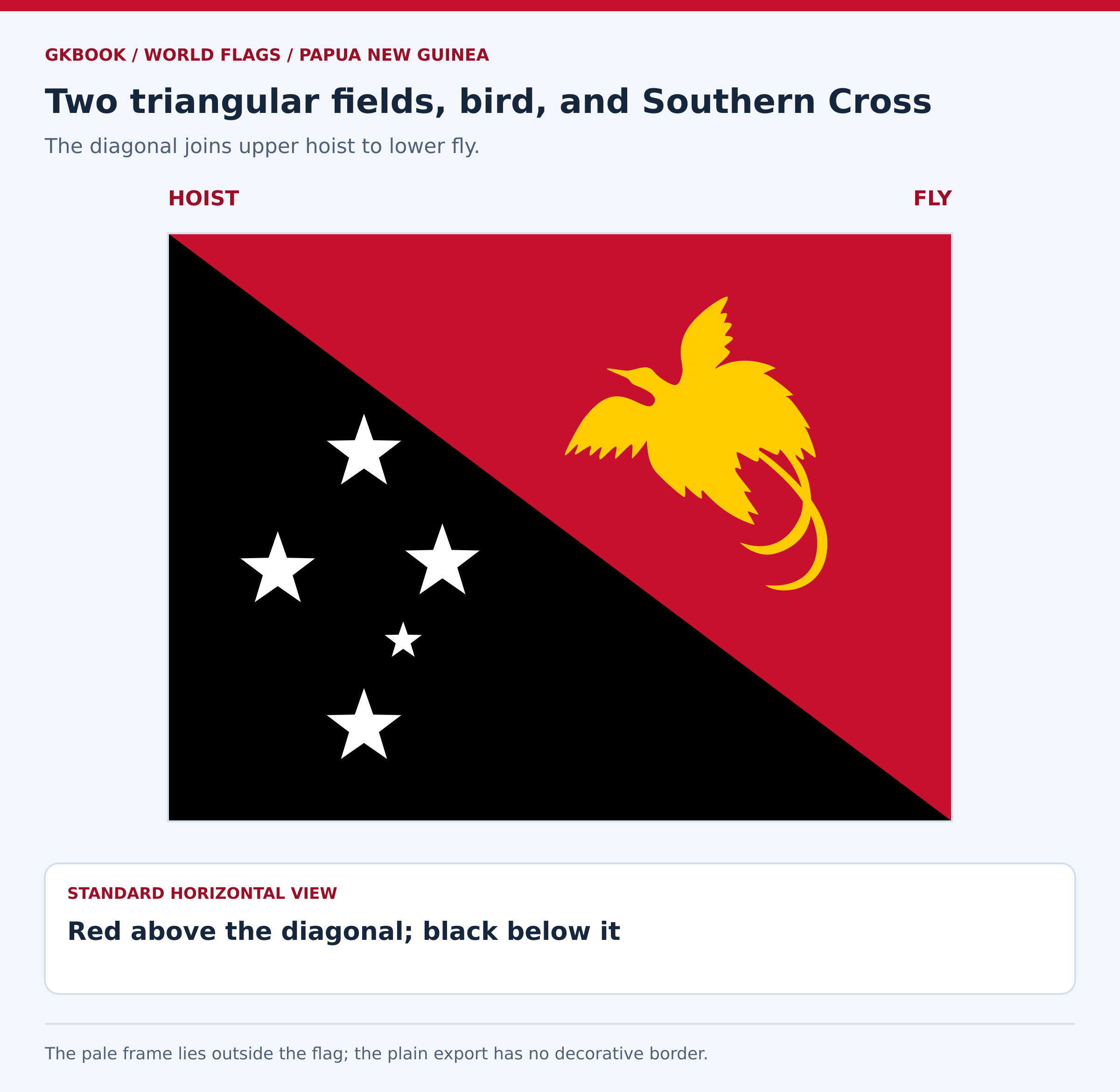
The flag is a 3:4 rectangle divided diagonally from the upper hoist to the lower fly. Above the diagonal is a red triangle with a yellow bird of paradise; below it is a black triangle with five white five-pointed stars. Four stars are large and one is smaller.

The hoist is the attachment edge and the fly is the opposite free edge. In the usual horizontal reference, the hoist is on the viewer’s left. The diagonal runs downward from left to right, placing the bird in the upper-right region and the constellation in the lower-left region.
The plain national design contains no lettering, coat of arms, framing stroke, or decorative shading. Educational diagrams may add labels and dimension lines outside or over a reference, but those additions are explanatory. The separate plain SVG and PNG preserve the rectangular field without a surrounding illustration frame.
What colors and digital values are used for the Papua New Guinea flag?
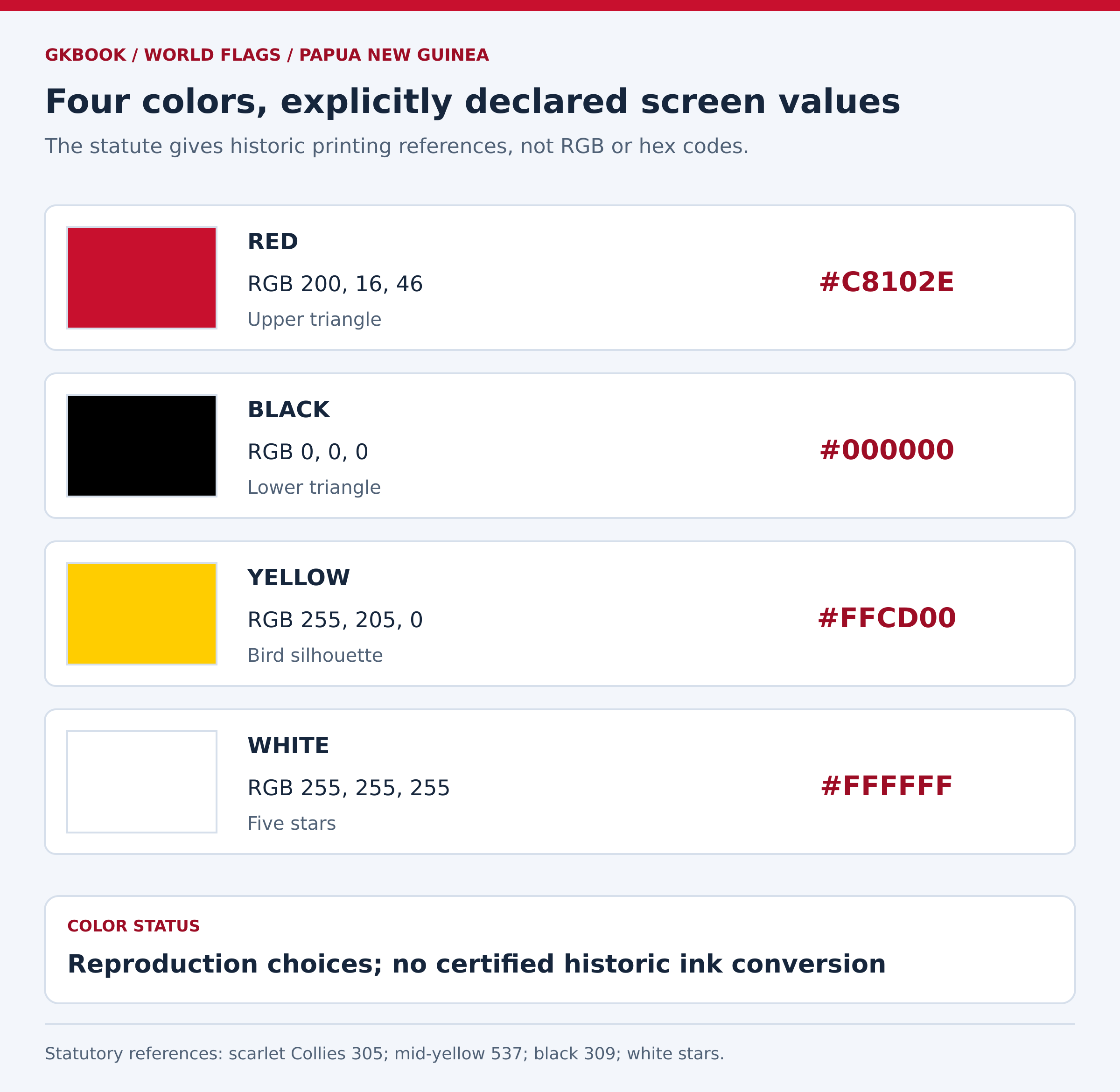
The flag contains four colors: red, black, yellow, and white. This package uses red #C8102E, black #000000, yellow #FFCD00, and white #FFFFFF. These hexadecimal values are declared screen reproduction choices. The consulted statute names printing colors but does not provide an official RGB or hexadecimal specification.

Red fills the upper triangle, black fills the lower triangle, yellow forms the bird silhouette, and white forms all five stars. Each element has a flat, uniform fill. In particular, the stars are white rather than yellow, and the bird is yellow rather than white.
A fixed digital palette keeps the SVGs, PNGs, social image, and explanatory diagrams consistent with one another. It does not establish an exact match to historical ink, dyed cloth, or every display. Color labels in the download notes distinguish the legal color descriptions from the numerical choices used for these files.
| Color | Hexadecimal | RGB | Element |
|---|---|---|---|
| Red | #C8102E | 200, 16, 46 | Upper-right triangle |
| Black | #000000 | 0, 0, 0 | Lower-left triangle |
| Yellow | #FFCD00 | 255, 205, 0 | Bird of paradise |
| White | #FFFFFF | 255, 255, 255 | Five stars |
What color references does the National Identity Act actually name?
Schedule 1 names scarlet Collies No. 305, mid-yellow Collies No. 537, and black Collies No. 309, with white stars. It also describes scarlet overprinted on mid-yellow. Those are the statute’s printing references; converting them into a modern screen or textile specification requires additional evidence, not an assumed universal equivalence.
Keep the source system attached to a color number. A historic ink reference, an RGB triplet, and a Pantone designation belong to different specifications. Similar-looking swatches cannot by themselves prove that one numerical entry is the legally defined replacement for another, particularly across paper, screen, and fabric.
The artwork therefore records its modern palette as a reproduction decision and retains the statutory color wording in the editorial record. The upper field is rendered as one solid red fill. The historical overprinting instruction is not interpreted as a request for transparency, a visible yellow border, or a red-to-yellow gradient.
What does the Papua New Guinea flag symbolize?
Government teaching material connects the flag’s traditional colors with Papua New Guinean cultural identity, the soaring bird with emergence into nationhood, and the Southern Cross with Australia and South Pacific friendships. These meanings concern the design as a national symbol; its triangles and stars are not population or province charts.

The Department of Education’s Grade 7 course identifies black, red, and yellow as traditional colors and explains the two principal charges separately. The bird emphasizes the country’s national emergence. The constellation places that identity within a wider regional setting, including the historical relationship with Australia and friendships in the South Pacific.
Avoid assigning a separate, supposedly official story to every colored patch unless the source actually makes that assignment. The two equal triangular backgrounds do not establish two equal populations, and five stars do not supply an administrative count. The flag’s documented cultural and regional associations are more useful than invented numerical symbolism.
What does the yellow bird of paradise mean?
The soaring bird of paradise represents Papua New Guinea’s emergence into nationhood in government educational explanations. Its raised wings and trailing plumes give the flag a distinctive national image. The legal description calls for a stylized yellow silhouette viewed from underneath, rather than a naturalistic, multicolored picture of a perched bird.
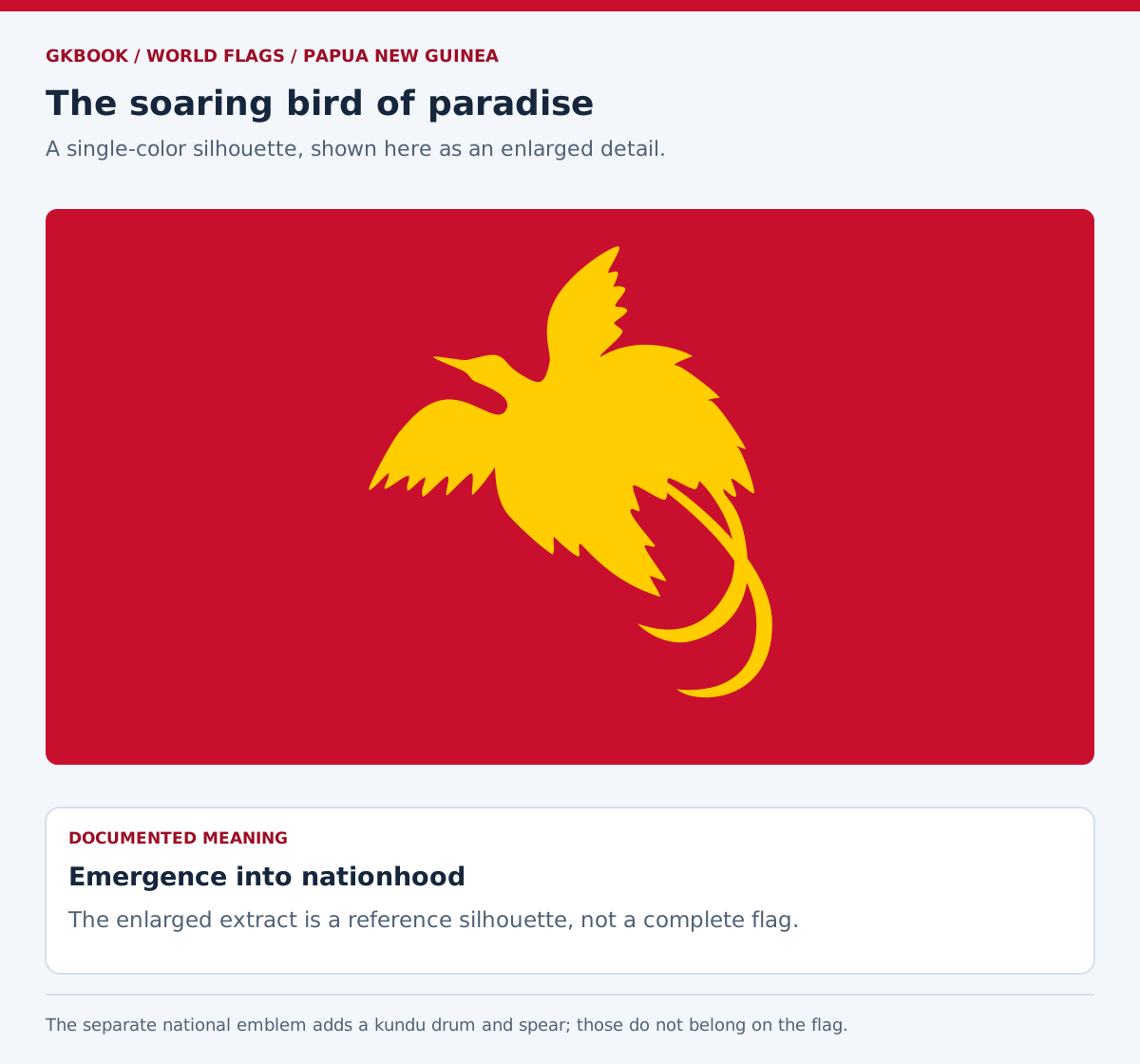
Bird-of-paradise feathers also have cultural importance, including their use in ceremonial decoration, as discussed by the State Library of New South Wales. That context helps explain the image’s resonance. The flag, however, compresses a recognizable bird into a single yellow silhouette rather than reproducing every color or anatomical detail.
The direction of flight and the long trailing feathers are part of the familiar artwork. Substituting a generic eagle, shortening the tail into an ordinary fan, or adding a branch would change its character. Enlarged bird details in the gallery are labeled as extracts, so they cannot be mistaken for a complete flag.
Which species is the bird on the Papua New Guinea flag?
The State Library of New South Wales identifies the flag’s bird as the Raggiana bird of paradise, Paradisaea raggiana. The statutory flag description itself uses the broader term bird of paradise. Keeping those two statements distinct preserves the familiar species identification without pretending that the law explicitly gives that scientific name.
A species identification and a drawing specification answer different questions. One connects the emblematic image with a real bird; the other describes the form required on the flag. The silhouette is stylized and yellow throughout, so it should not be treated as a field-guide illustration of natural plumage.
The separate national emblem also uses a bird of paradise but gives it a different setting and a fuller color description. That emblem should not be used to supply extra objects or natural colors to the flag’s bird. For the flag reference, retain the soaring silhouette against its red triangular field.
What do the five stars on the Papua New Guinea flag represent?
The five white stars represent the Southern Cross. The National Identity Act names Alpha, Beta, Gamma, Delta, and Epsilon Crucis in its construction table. Government teaching material associates the constellation with ties to Australia and friendship with South Pacific countries. The stars are not an official count of Papua New Guinea’s provinces.

The constellation belongs in the black triangle and includes four equal large stars with a smaller fifth star. Its arrangement is recognizable through the upper, lower, left, and right principal stars, with the smaller Epsilon between the right-hand and lower stars. Every star on this flag has five points.
A constellation on a flag is an emblematic arrangement, not a complete astronomical chart. The legal table supplies the design’s positions; the artwork does not recalculate them from celestial coordinates or change them with the date. Identifying the stars by name is enough to explain the pattern without inventing a territorial meaning.
Which named star occupies each position?
In the standard horizontal flag, Gamma Crucis is the upper large star, Alpha Crucis the lower large star, Beta Crucis the left large star, and Delta Crucis the right large star. Epsilon Crucis is the smaller star below and to the left of Delta. The legal table fixes their individual positions.
The names identify specific members of the Southern Cross and prevent a diagram from treating all five marks as interchangeable decorations. Alpha and Gamma share the same horizontal coordinate in the consolidated schedule, while Beta and Delta are not placed at exactly the same height. Their small vertical difference is deliberate in this construction.
Read the labels from the standard view with the hoist on the left. Looking through the opposite side of a cloth reverses the viewer’s left and right, but does not rename the stars. A reverse-view illustration should therefore explain the observer’s position instead of silently changing the underlying constellation assignments.
How large are the stars on the Papua New Guinea flag?
The four large stars have an outer-circle diameter of one-tenth of the flag’s length and an inner-circle diameter of four-hundredths of that length. Epsilon has half those diameters. On the 2,400-unit master, the large diameters are 240 and 96 units; the small diameters are 120 and 48 units.

These measurements describe the circles through the outer tips and inner corners, not the visible top-to-bottom height of an upright star. With a 120-unit outer radius, that visible height is approximately 217.082 units. Replacing the specified diameter with a 240-unit visible height would make the star too large.
The four principal stars use identical geometry. Epsilon is a uniform half-scale copy, so both its outer and inner dimensions shrink together. Measuring only a bounding box or choosing a generic star icon can conceal the difference between the prescribed circle dimensions and the actual outline that they generate.
How are the five-pointed stars constructed?
Each star uses five evenly spaced outer points alternating with five inner corners. The statute’s inner-to-outer diameter ratio is 0.4, which is also the radius ratio. In these illustrations one outer point faces upward. Ten vertices spaced at 36-degree intervals produce a consistent five-pointed outline with the prescribed relative depths.

Use an outer radius R and an inner radius 0.4R, alternating them around the radial center. Begin at the upward vertical direction, then advance by 36 degrees for each successive vertex. Closing the ten-vertex polygon creates a solid star without intersecting construction strokes or an added outline.
The value 0.4 comes directly from the stated inner and outer diameters. It differs from the approximately 0.381966 ratio of a regular pentagram, so a default star drawing tool may need adjustment. Upright orientation follows the standard reference artwork; the numerical circle ratio follows the consolidated legal schedule.
Where are the star centers placed?
The consolidated schedule measures every star center from the upper hoist corner using fractions of the flag’s total length L. Alpha is at (0.25L, 0.63L), Beta at (0.14L, 0.43L), Gamma at (0.25L, 0.28L), Delta at (0.35L, 0.42L), and Epsilon at (0.30L, 0.52L). The second coordinate is also length-based.

Take the upper-left corner as the origin, with x increasing toward the fly and y increasing downward. The center is the radial construction center of the star, not the midpoint of its bounding box. Because an upright five-pointed star is not vertically symmetric, those two candidate centers do not coincide.
The table below converts the same fractions into the 2,400 × 1,800 master used throughout this package. All coordinates are measured before any scaling, reflection, or rotation for a diagram. Preserve the complete set from the same consolidated schedule rather than combining positions from differently normalized historical tables.
| Star | x/L | y/L | Master center (x, y) |
|---|---|---|---|
| Alpha | 0.25 | 0.63 | 600, 1,512 |
| Beta | 0.14 | 0.43 | 336, 1,032 |
| Gamma | 0.25 | 0.28 | 600, 672 |
| Delta | 0.35 | 0.42 | 840, 1,008 |
| Epsilon | 0.30 | 0.52 | 720, 1,248 |
Why is one star smaller than the other four?
Epsilon Crucis is the smaller fifth member of the Southern Cross shown on the flag. The legal construction gives it half the outer and inner diameters of each principal star. Because both linear dimensions are halved, its geometric area is one-quarter that of a large star, not one-half.

The distinction is structural, not an accidental difference in rendering. Replacing Epsilon with a fifth full-sized star changes the prescribed constellation. Its center remains at its own table position; it is not obtained by moving a large star toward the center of the black triangle or by centering the entire group again.
The area relationship follows from uniform scaling. Multiplying every distance by one-half multiplies area by one-quarter, while preserving the five points and the 0.4 inner-radius ratio. This is a useful check on the digital artwork, but it does not supply an additional political, demographic, or ceremonial meaning for the smaller star.
What is the height:length ratio of the Papua New Guinea flag?
The flag’s height:length ratio is 3:4, equivalent to width:height 4:3. A flag 300 units high is therefore 400 units long. The supplied vector master measures 2,400 × 1,800 units, and the plain PNG measures 4,800 × 3,600 pixels. Both preserve the same complete rectangular proportion.

Always state which dimension comes first. The statute describes proportions four to three, while many flag lists present height before length and therefore write three to four. These expressions agree when their ordering is understood. Neither describes a square flag or a portrait rectangle in the ordinary horizontal view.
The dimensions used here are scalable drawing coordinates, not a claim that all physical flags must be made at one size. A larger or smaller reproduction can preserve the same proportions by multiplying the outer rectangle, star coordinates, radii, and bird artwork by a single common scale factor.
How is the diagonal division measured?
The dividing line joins the upper hoist corner to the lower fly corner. With width L and height H, its equation is y = Hx/L. For the 4:3 rectangle, its downward angle is about 36.87 degrees from horizontal, not 45 degrees. It creates two equal triangular backgrounds before the charges are added.

On the 2,400 × 1,800 master, the line runs from (0, 0) to (2,400, 1,800), giving y = 0.75x. Its length is 3,000 units by the Pythagorean theorem. A 45-degree line would have the wrong slope and could not connect those two opposite corners of this rectangle.
The red and black background triangles each have half the flag’s total area. Once the bird and stars cover parts of those fields, the visible red and black areas are smaller and need not be equal. Equal background areas do not make the complete colored design mirror-symmetric or justify a population interpretation.
Why are vertical measurements also based on the flag’s length?
The statute expressly states that the table distances are fractions of the flag’s length, including distances measured down the hoist. Use L for both axes and H = 0.75L for the rectangle. Substituting height for the vertical fractions would compress the constellation upward and change the specified positions.

A convenient working grid divides the full length into 100 parts. The rectangle is then 100 units wide and 75 units high. Alpha’s center, for example, is 25 units across and 63 units down; its vertical fraction is not 63 percent of the 75-unit height.
The 100-part grid is the normalization of the consulted consolidated schedule. Earlier published construction descriptions use a different 96-part basis. They should not be spliced into the later table one number at a time. For a reproducible drawing, record the schedule used and apply its coordinates consistently to every measured element.
Can the bird be reconstructed exactly from the statute’s numerical table?
The consulted bird table supplies a guide circle and several landmarks, but its statement that the listed points lie on that circle is internally inconsistent. This package therefore uses a documented reference silhouette for the bird, while constructing the field and stars from the statute. It does not claim a fully exact statutory bird reconstruction.
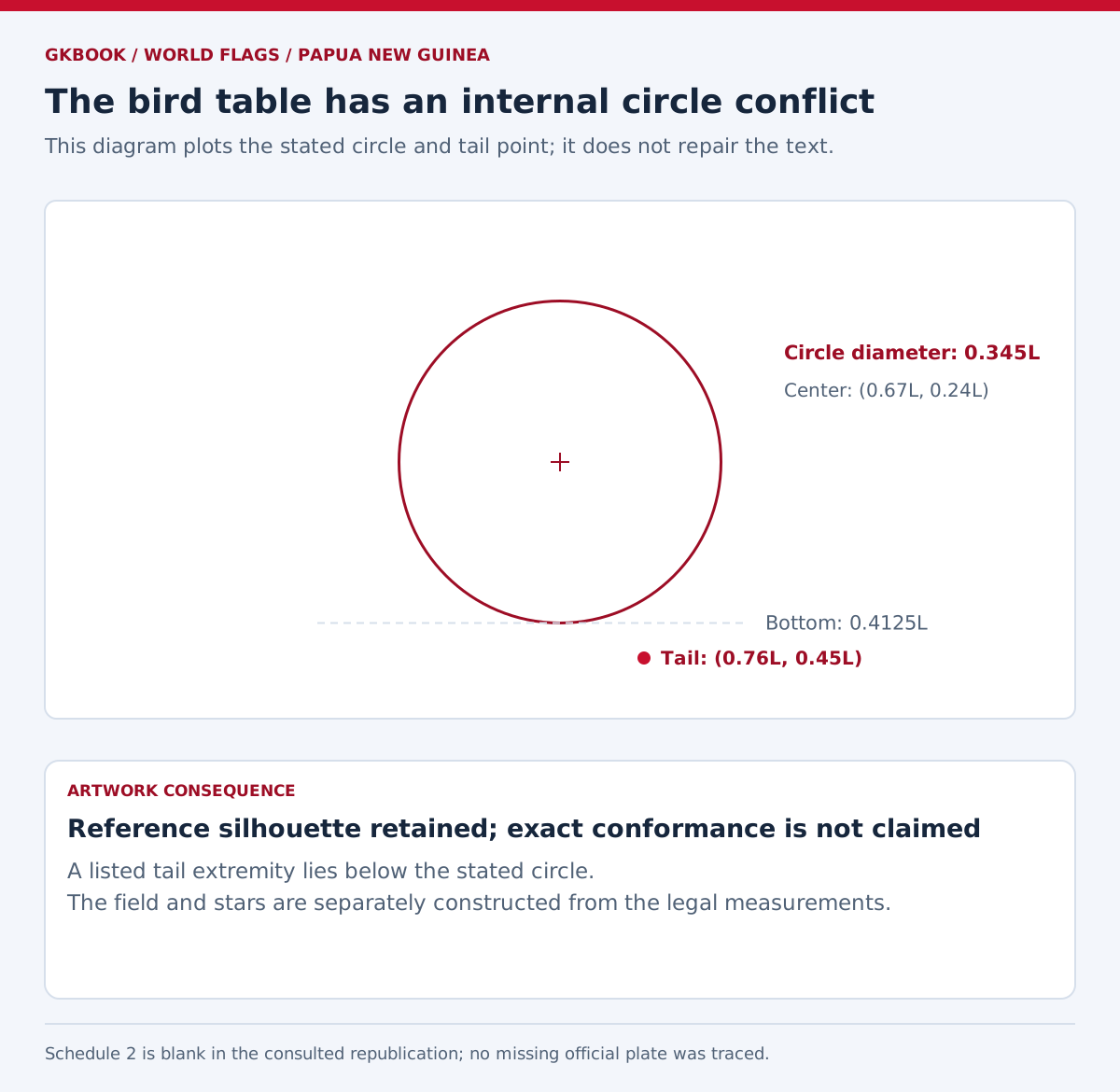
The stated circle has diameter 0.345L and center (0.67L, 0.24L), giving a lowest point at y = 0.4125L. One listed tail extremity is at y = 0.45L, below that boundary. This arithmetic conflict cannot be resolved by simply tracing a circle through every listed point.
The downloadable bird retains the outline and placement of a documented Wikimedia-derived reference vector, uniformly scaled with the flag. The editorial notes preserve the source path and its provenance. The supplied legal republication has no visible Schedule 2 flag image, so that missing plate is not presented as a verified tracing source.
How can you draw the Papua New Guinea flag step by step?
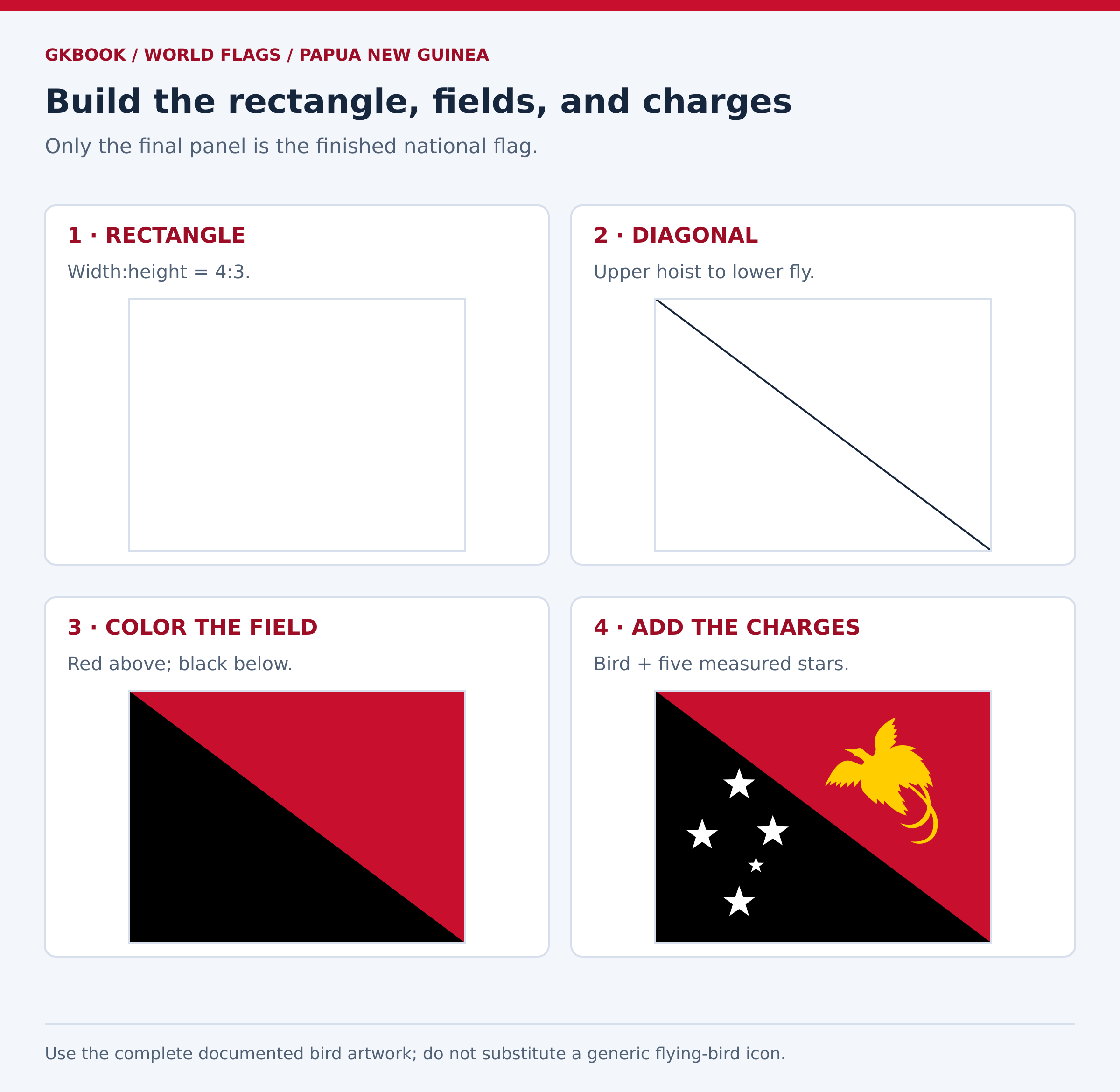
Begin with a rectangle four units wide and three high. Draw the diagonal from upper hoist to lower fly, fill the upper triangle red and the lower triangle black, then add the yellow bird and five white stars. Use the measured star positions and sizes, keeping Epsilon half the principal stars’ diameter.
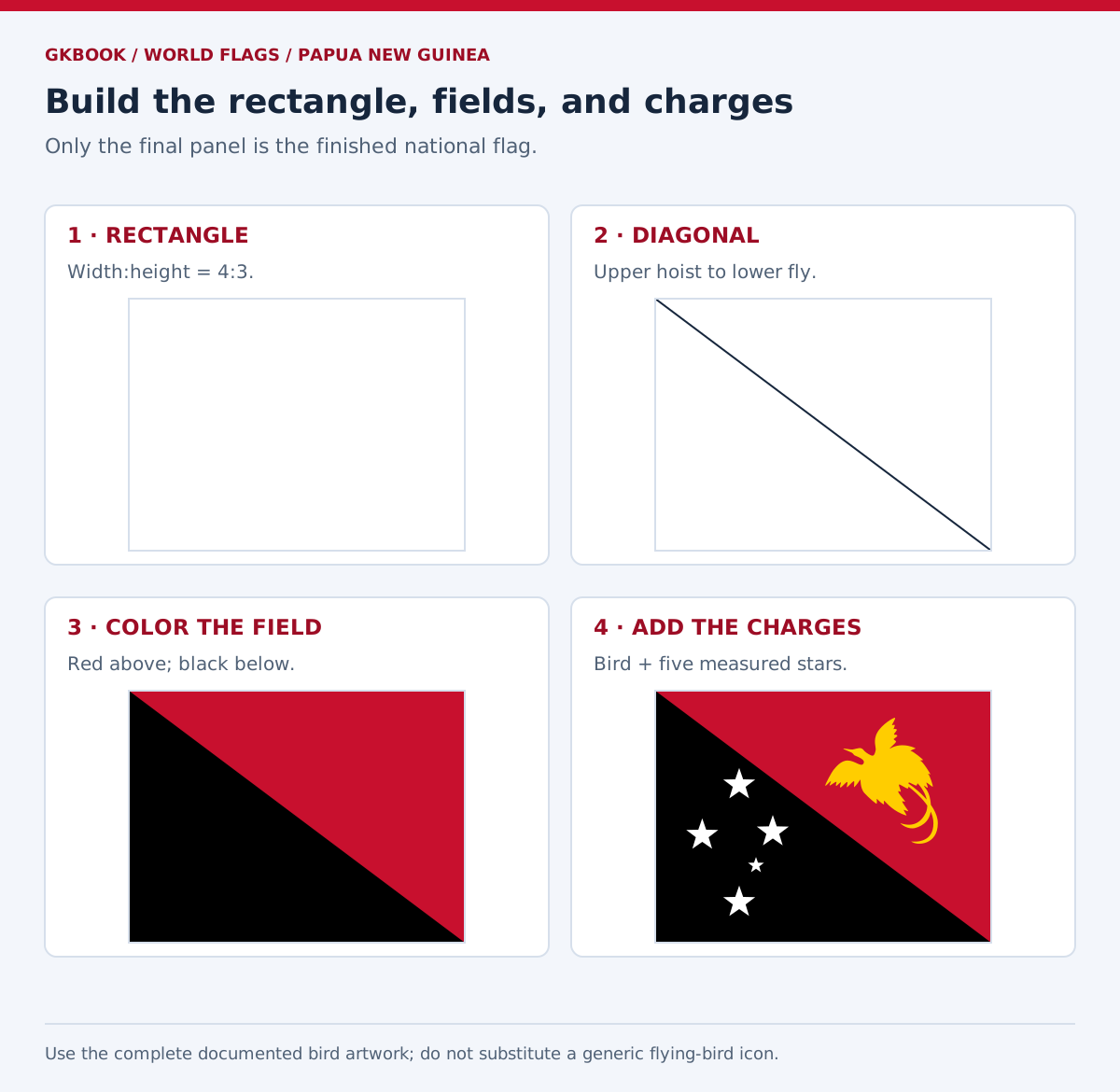
Set up the rectangle and diagonal before placing any charges. Then construct the four principal stars from their radial centers and circle dimensions, followed by the half-scale Epsilon. Use the complete documented bird silhouette as a vector element, preserving its proportions and placement instead of sketching an unrelated flying bird.
Remove temporary guides from the final plain version. The gallery’s staged drawing panels are deliberately incomplete until the final step and are labeled accordingly. If the image will be resized later, group the field and all charges together so one scale factor controls every coordinate, rather than resizing the bird and stars independently.
What dimensions work for different digital export sizes?
Any proportional export can preserve the 4:3 width:height rectangle. Examples include 400 × 300, 800 × 600, 2,400 × 1,800, and 4,800 × 3,600 pixels. The principal outer star diameter is always one-tenth of the width, with Epsilon half that amount; all centers and bird dimensions scale by the same factor.

The table expresses digital sizes, not mandated cloth measurements. At 800 pixels wide, a principal star’s outer-circle diameter is 80 pixels and Epsilon’s is 40 pixels. Their inner-circle diameters are 32 and 16 pixels respectively. The same relationships continue to hold at every listed size.
SVG is useful when a clean outline is needed across many sizes, while PNG provides a ready-made raster image. Very small exports may visually soften fine feather details and star tips through antialiasing. That rendering effect is a reason to keep a precise master, rather than permanently enlarging the charges to compensate.
| Canvas: width × height | Large outer diameter | Small outer diameter |
|---|---|---|
| 400 × 300 | 40 | 20 |
| 800 × 600 | 80 | 40 |
| 2,400 × 1,800 | 240 | 120 |
| 4,800 × 3,600 | 480 | 240 |
What does the reverse side of the flag look like?
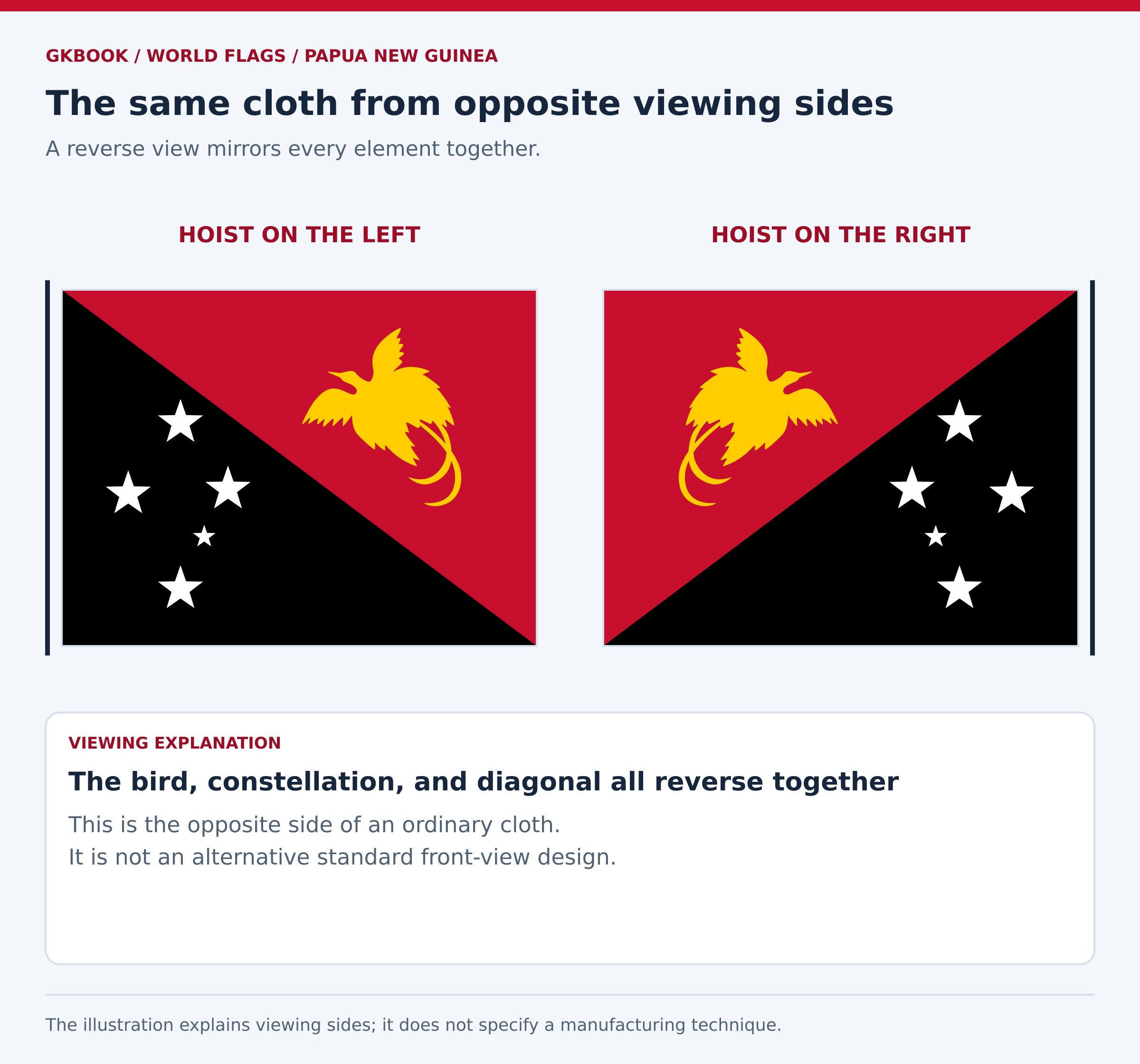
Looking at the opposite side of an ordinary cloth gives a horizontally mirrored view of the complete design. The hoist is then on the viewer’s right, and the bird, diagonal, and constellation all reverse together. This viewing explanation does not authorize mirroring only the bird or exchanging elements in the standard front reference.

A reverse-view diagram describes the observer’s position relative to the same cloth. It is different from turning a downloaded front-view image into an alternative national design. Labeling the attachment edge in both views makes the relationship clear even when the bird and stars appear on different sides of the illustration.
The gallery mirrors the entire measured flag as one group. It does not redraw the bird to keep it facing the same screen direction, and it does not reorder individual stars. The diagram is a geometric explanation; it does not prescribe whether a particular manufacturer uses printing, appliqué, or another construction method.
How is a vertical rotation different from official display guidance?
Rotating the complete horizontal artwork clockwise produces a portrait image with the former hoist across the top. Every element rotates together, including the stars and bird. The gallery labels this as a geometric rotation example. The consulted sources do not establish a universal vertical-display rule for every Papua New Guinean ceremonial setting.
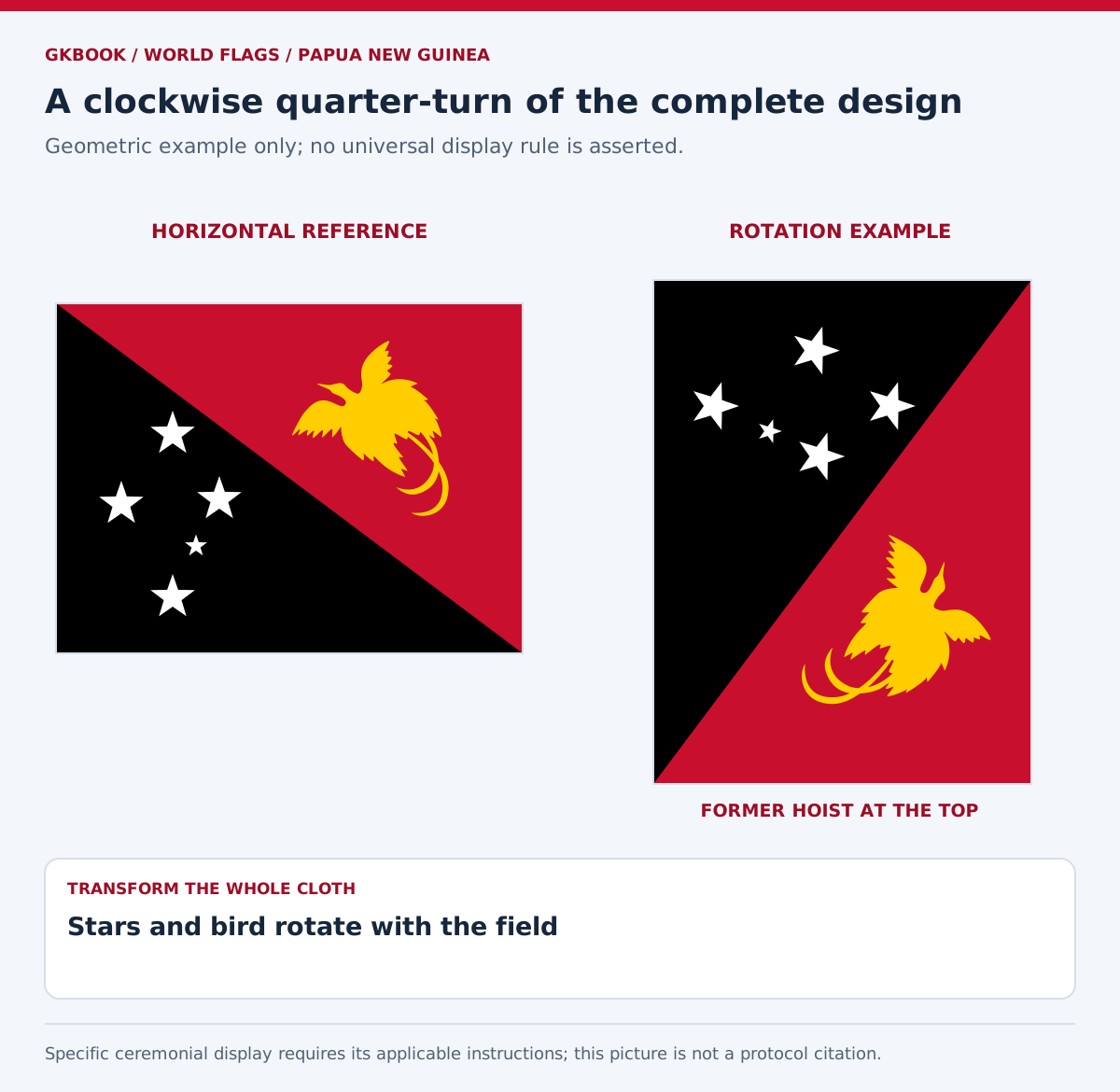
A quarter-turn changes the canvas from four units wide by three high to three wide by four high. It preserves all internal distances, but the stars no longer point toward the top of the screen. Individually straightening them would alter the relationship between the charges and the rotated cloth.
Use the normal horizontal reference for ordinary flag illustrations. A venue requiring portrait suspension should follow its applicable ceremonial instructions rather than treating a mathematical transformation as an official protocol citation. The educational portrait diagram explains the transformation only and explicitly distinguishes that purpose from a general legal or ceremonial directive.
What are the main milestones in the flag’s history?
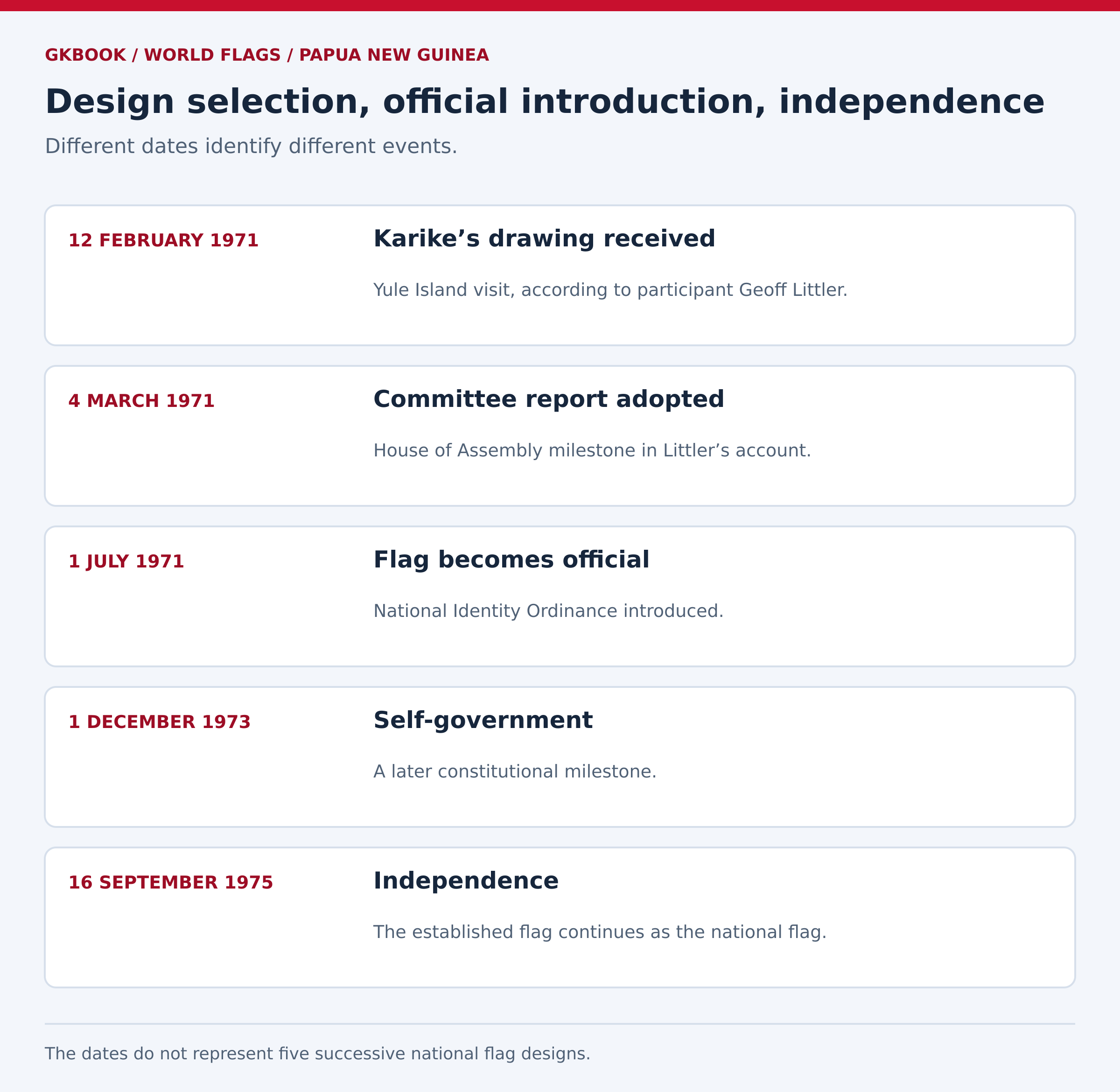
Susan Karike’s design emerged during the national-symbol selection process in 1971. The House of Assembly adopted the committee’s report on March 4, and the flag became official on July 1. Self-government followed on December 1, 1973, and independence on September 16, 1975. These dates mark different events, not four successive flag designs.
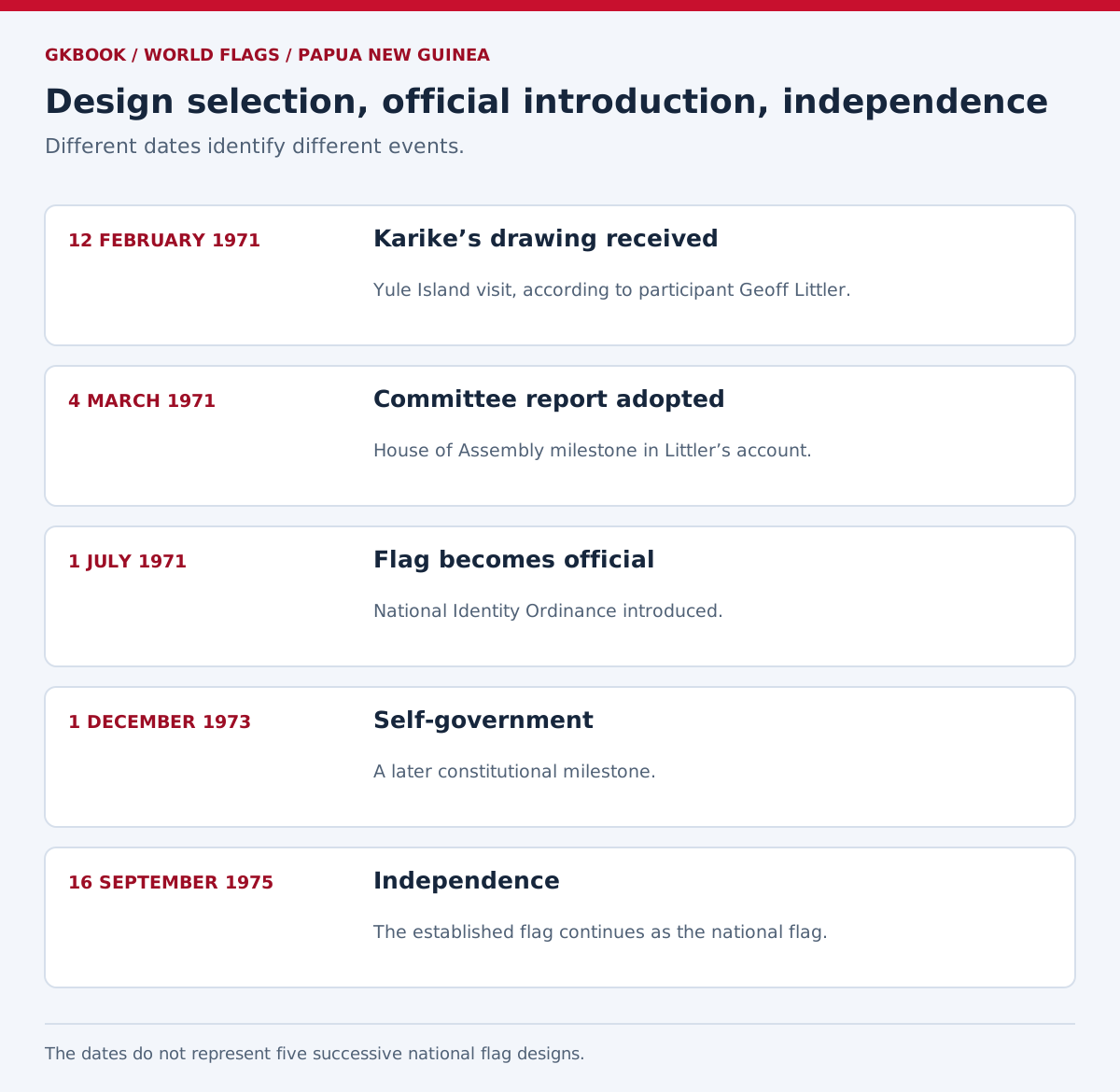
Committee participant Geoff Littler’s retrospective account describes consultation across the territory and the reception of Karike’s diagonal design at Yule Island. It places the House’s adoption of the report in March. The contemporary Australian administrative report to the United Nations separately records the July introduction of the National Identity Ordinance.
The National Archives of Australia supplies the later constitutional milestones of self-government and independence. Keeping these stages separate explains how a national flag could exist before sovereign independence. The timeline identifies each event by its role, rather than attaching the word adoption to every political development in the period.
Who designed the Papua New Guinea flag?
Susan Karike, later known as Susan Karike Huhume, designed the flag as a fifteen-year-old schoolgirl in 1971. She attended the Catholic mission school on Yule Island and came from Gulf Province. Government education material and an official national tribute identify her contribution; the flag’s authorship should not be transferred to an earlier proposal’s artist.
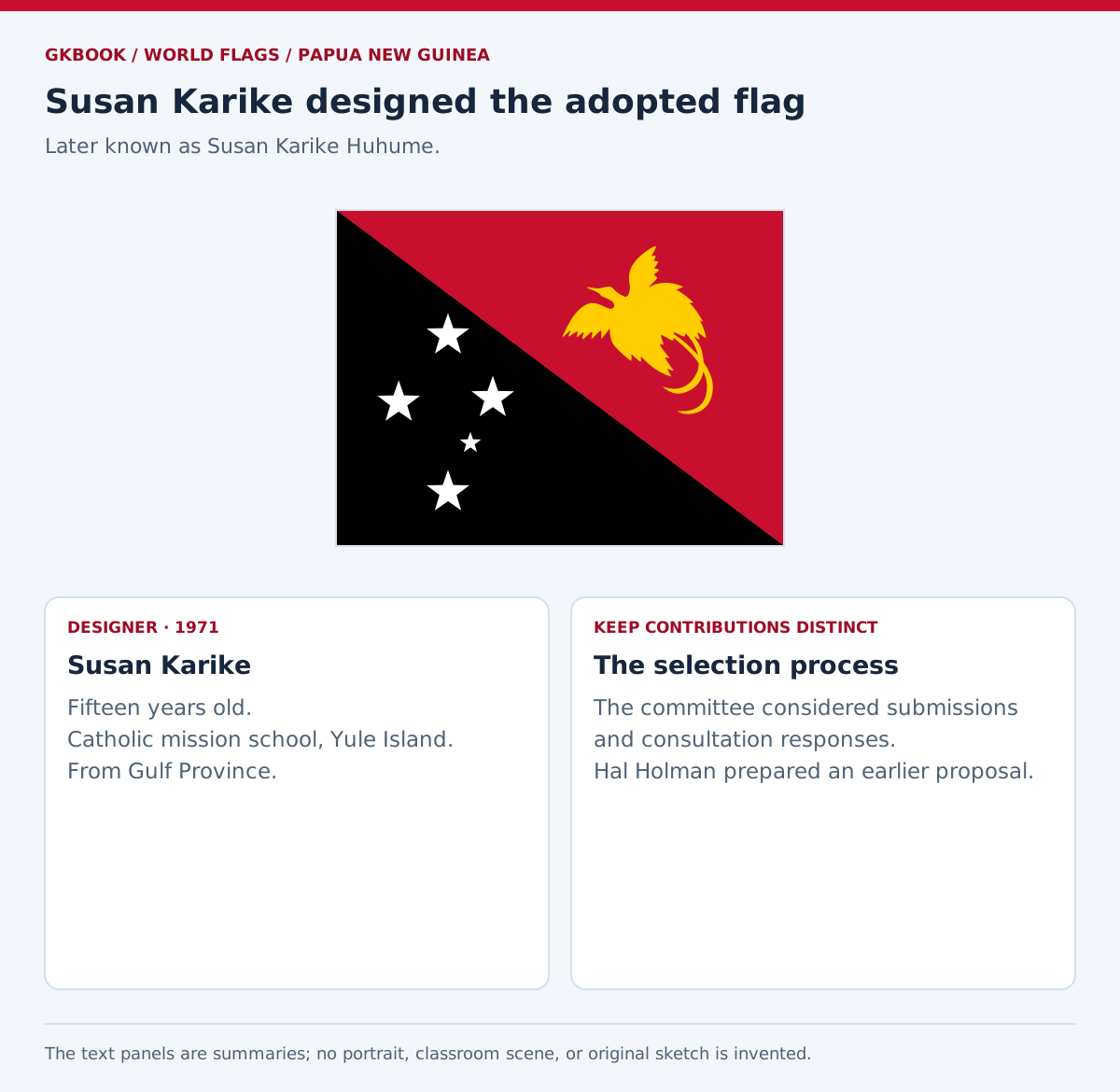
The Department of Education places her school and age in the national history curriculum. A later official tribute also recognizes Susan Karike Huhume as the young designer. Use that documented age rather than repeating conflicting secondary descriptions, and distinguish the designer’s own work from the institutions that selected and adopted it.
Littler’s participant account gives February 12, 1971 as the date she handed him her reworked drawing during the committee’s Yule Island visit. The gallery uses a text credit panel with the present-day flag. It does not invent a portrait, recreate an undocumented classroom scene, or imply that modern vector outlines are her original paper sketch.
How did Susan Karike’s design become the selected flag?
The selection involved public submissions and a House of Assembly committee’s consultation process. Participant Geoff Littler describes an earlier blue, gold, and green proposal prepared by Hal Holman, followed by Karike’s diagonal design during the 1971 tour. Government teaching material summarizes her selection as winning a competition; the participant account supplies the fuller sequence.
Littler records that the earlier tricolor proposal was poorly received during consultations and that Karike supplied her revised drawing at Yule Island. He describes a cloth version made by Pat Johnson during the committee’s subsequent consideration. Those details are attributed to his retrospective account, rather than presented as newly inspected original committee minutes.
Different accounts compress the process differently, but they need not erase the distinct roles. Holman prepared an earlier proposal and contributed to national-emblem work; Karike receives the adopted flag’s design credit. Public consultation, practical cloth production, committee approval, and legislative action are related stages rather than interchangeable descriptions of one person’s authorship.
When was the Papua New Guinea flag officially adopted?
The flag became official on July 1, 1971. Government education material gives that date, and the contemporary administrative report to the United Nations records the National Identity Ordinance’s introduction that day. March 4, 1971 refers to the House adopting the committee’s report; September 16, 1975 marks independence, not the flag’s initial adoption.

The July date is also listed in the United Nations Vienna protocol flag reference. The contemporary report connects the ordinance with the national name, flag, and emblem, making it stronger evidence than an undated flag caption alone. Its publication occurred later, but it reports the administrative events of the relevant period.
A useful caption can therefore say adopted July 1, 1971 and separately note continued use at independence in 1975. It should not imply that Karike first designed the flag in 1975. The earlier March parliamentary milestone belongs in a fuller chronology, clearly labeled as adoption of the committee’s report.
Was the flag created when Papua New Guinea became independent?
No. The flag was already official in 1971, four years before independence on September 16, 1975. Papua New Guinea achieved self-government on December 1, 1973. The established flag accompanied those later constitutional milestones, so its design date, official introduction, self-government, and independence should remain distinct in captions and timelines.
A symbol of national identity can be adopted during a transition toward independence. That is the relevant sequence here: the national-symbol process and ordinance came first, followed by further constitutional change. The flag’s presence at independence does not make the independence ceremony its original legal starting point.
The dates also help avoid a common visual-history mistake. A gallery showing the familiar flag beside 1971, 1973, and 1975 is marking its use across successive milestones, not documenting three newly designed flags. Unless an actual design change is established, the timeline should not invent altered colors, extra stars, or different birds for those years.
What does the National Identity Act contribute to the flag specification?
The National Identity Act supplies the flag’s rectangular proportion, diagonal division, colors, bird description, and measured star construction. Its consolidated Schedule 1 is the numerical basis used here. The Act also addresses other national symbols, so the separate emblem description should not be merged into the flag or mistaken for additional flag charges.
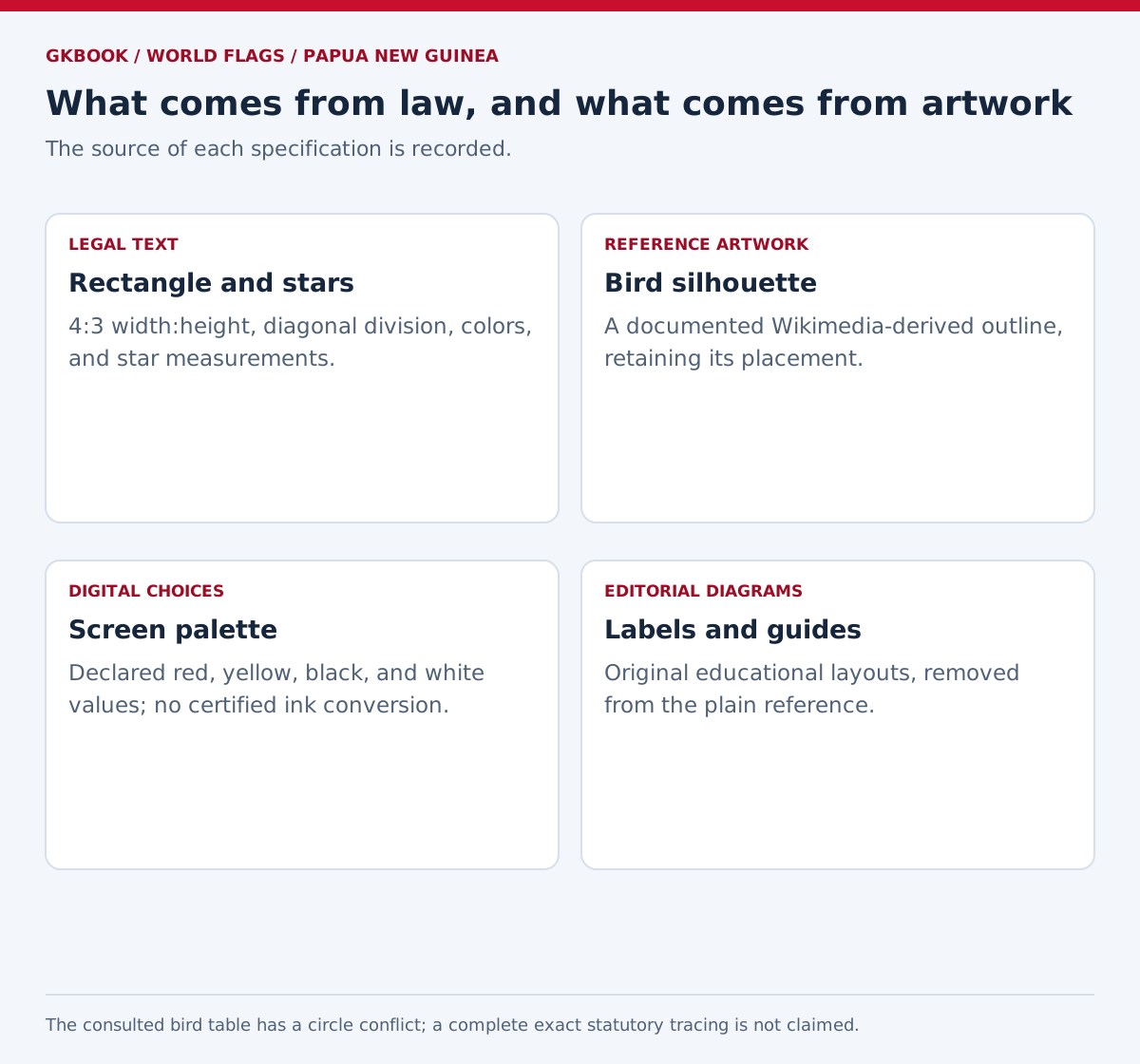
The consulted text is Chapter 9 as republished through the International Labour Organization’s NATLEX collection. It provides a readable legal description and construction tables. The accompanying Schedule 2 reproduction is not visible in that copy, a limitation recorded when choosing the separate reference bird artwork for this package.
Distinguish specification from implementation. The law supplies the field geometry and star measurements; this package supplies a scalable digital construction, a declared screen palette, and explanatory layouts. The source record identifies which conclusions follow from the text and which are reproduction choices, without claiming that a digital illustration is a certified government manufacturing master.
Is the bird on the flag the complete national emblem?
No. The flag contains a soaring yellow bird silhouette on its red triangle. The separate national emblem places a bird of paradise on a kundu drum with a ceremonial spear. Those additional objects belong to the emblem’s own description and are not added to the ordinary Papua New Guinea national flag.
The National Identity Act describes the flag and emblem in separate schedules. Their shared bird imagery can make them seem interchangeable at a glance, but their compositions differ. The emblem has a perched display arrangement and named supporting objects; the flag uses the soaring silhouette within a two-color diagonal field.
When selecting artwork for a flag page, check the whole composition rather than searching for any yellow bird image. A valid illustration of the national emblem may still be the wrong asset for a flag. The gallery concentrates on the flag and its construction and does not insert the drum or spear into its red triangle.
How should the flag fit inside a square thumbnail?
Place the complete 4:3 flag inside the square with space above and below, rather than cropping it or stretching it into a square. If the flag fills a square’s width S, its height is 0.75S and each vertical margin is 0.125S. The surrounding square is an interface frame, not a national flag variant.

Keeping the complete rectangle protects both the diagonal’s corner-to-corner relationship and the positions of the bird and stars. Cropping to a square can remove part of the constellation or bird, while stretching changes every angle and circle. Neither operation preserves the construction explained in this article.
Use neutral surrounding space that is visibly separate from the flag. The gallery thumbnail includes a labeled frame for that reason. At small sizes, retain the full image and allow the renderer to scale it uniformly; do not replace the detailed bird or small star with unrelated interface symbols to fill the available space.
What are the most common Papua New Guinea flag errors?
Common errors include reversing the diagonal, using a 2:3 rectangle, making all five stars equal, drawing seven-pointed stars, and measuring vertical coordinates from height instead of length. Captions can also mislead by calling screen hex values statutory or dating the flag’s first adoption to independence in 1975. Check artwork and wording together.

Begin with the complete rectangle and its attachment edge: red with the bird is above the descending diagonal, black with the constellation below. Count five white stars, verify four equal principal sizes and the smaller Epsilon, then check the 0.4 inner-to-outer circle ratio and the length-based centers.
Finally read the caption and credit. Susan Karike designed the adopted flag as a fifteen-year-old in 1971; July 1 is its official introduction date. The bird silhouette and modern palette used here have their own documented reproduction status. A careful explanation should preserve those distinctions without presenting an internally inconsistent source table as fully resolved.
Download Papua New Guinea flag pictures
Download the plain flag as SVG or 4,800 × 3,600 PNG. The SVG uses a 2,400 × 1,800 coordinate system and remains scalable. The gallery contains 24 subjects with paired SVG and PNG files, including construction, history, and viewing-side diagrams. Image credits and construction notes record the reconstruction method and artwork status.
Explore more in World Flags, including the New Zealand flag and Palau flag.
World Flags/Papua New Guinea
Papua New Guinea flag pictures
3:4 height:length. Field and stars follow the consulted consolidated National Identity Act; bird outline and placement retain a documented reference silhouette. Screen colors are declared reproduction choices, not statutory hexadecimal codes. No fully exact statutory bird reconstruction or manufacturing certification is claimed.
GKBook geometry and educational layout; reference bird silhouette via hampusborgos/country-flags / Wikimedia Commons (Nightstallion and contributors).Download SVGDownload PNGA 4:3 rectangle contains a red upper-right triangle with a yellow bird and a black lower-left triangle with five white stars.
GKBook geometry and educational layout; reference bird silhouette via hampusborgos/country-flags / Wikimedia Commons (Nightstallion and contributors).Download SVGDownload PNGThis package uses red #C8102E, black #000000, yellow #FFCD00, and white #FFFFFF as declared screen choices. The Act names Collies printing colors.
GKBook geometry and educational layout; reference bird silhouette via hampusborgos/country-flags / Wikimedia Commons (Nightstallion and contributors).Download SVGDownload PNGGovernment teaching material connects traditional colors with cultural identity, the bird with national emergence, and the Southern Cross with regional ties.
GKBook geometry and educational layout; reference bird silhouette via hampusborgos/country-flags / Wikimedia Commons (Nightstallion and contributors).Download SVGDownload PNGThe legal description specifies a stylized bird viewed from underneath with raised wings and trailing plumes. The supplied outline is documented reference artwork.
GKBook geometry and educational layout; reference bird silhouette via hampusborgos/country-flags / Wikimedia Commons (Nightstallion and contributors).Download SVGDownload PNGThe four large stars are Alpha, Beta, Gamma, and Delta Crucis; Epsilon is half their diameter. All five have five points.
GKBook geometry and educational layout; reference bird silhouette via hampusborgos/country-flags / Wikimedia Commons (Nightstallion and contributors).Download SVGDownload PNGThe four principal stars have outer and inner diameters 0.10L and 0.04L. Epsilon has half those values. Auxiliary circles show the measured quantity.
GKBook geometry and educational layout; reference bird silhouette via hampusborgos/country-flags / Wikimedia Commons (Nightstallion and contributors).Download SVGDownload PNGThe statute’s diameter ratio is 4/10, so the radius ratio is also 0.4. Upright stars use alternating vertices every 36 degrees.
GKBook geometry and educational layout; reference bird silhouette via hampusborgos/country-flags / Wikimedia Commons (Nightstallion and contributors).Download SVGDownload PNGThe 100-part consolidated schedule gives each radial center. Both coordinates use L; vertical fractions are not fractions of H.
GKBook geometry and educational layout; reference bird silhouette via hampusborgos/country-flags / Wikimedia Commons (Nightstallion and contributors).Download SVGDownload PNGEpsilon has half the diameters and one-quarter the area of a principal star, while retaining five points and the same inner-radius ratio.
GKBook geometry and educational layout; reference bird silhouette via hampusborgos/country-flags / Wikimedia Commons (Nightstallion and contributors).Download SVGDownload PNGThe horizontal flag is three units high and four long. Both the 2,400 × 1,800 vector master and 4,800 × 3,600 PNG preserve that ratio.
GKBook geometry and educational layout; reference bird silhouette via hampusborgos/country-flags / Wikimedia Commons (Nightstallion and contributors).Download SVGDownload PNGThe upper-hoist to lower-fly diagonal has slope 3/4 and divides the background into equal triangular areas. Its master length is 3,000 units.
GKBook geometry and educational layout; reference bird silhouette via hampusborgos/country-flags / Wikimedia Commons (Nightstallion and contributors).Download SVGDownload PNGThe consolidated schedule normalizes both axes by L. A full flag is 100 units wide and 75 high; Alpha is at (25, 63).
GKBook geometry and educational layout; reference bird silhouette via hampusborgos/country-flags / Wikimedia Commons (Nightstallion and contributors).Download SVGDownload PNGThe guide circle ends at y = 0.4125L, but one stated tail extremity is at y = 0.45L. The point cannot lie on that circle.
GKBook geometry and educational layout; reference bird silhouette via hampusborgos/country-flags / Wikimedia Commons (Nightstallion and contributors).Download SVGDownload PNGFour stages establish the outer rectangle, diagonal, colored triangles, and final charges. The last stage includes the reference bird and statutory star geometry.
GKBook geometry and educational layout; reference bird silhouette via hampusborgos/country-flags / Wikimedia Commons (Nightstallion and contributors).Download SVGDownload PNGFour digital export sizes retain the 4:3 rectangle and the prescribed outer star diameters. All other coordinates scale with them.
GKBook geometry and educational layout; reference bird silhouette via hampusborgos/country-flags / Wikimedia Commons (Nightstallion and contributors).Download SVGDownload PNGThe horizontally mirrored view moves the attachment edge to the viewer’s right and reverses the whole design as one group.
GKBook geometry and educational layout; reference bird silhouette via hampusborgos/country-flags / Wikimedia Commons (Nightstallion and contributors).Download SVGDownload PNGA clockwise quarter-turn changes the canvas to 3:4 width:height and places the former hoist along the top. It is explicitly a transformation example.
GKBook geometry and educational layout; reference bird silhouette via hampusborgos/country-flags / Wikimedia Commons (Nightstallion and contributors).Download SVGDownload PNGThe timeline separates Karike’s 1971 design process, official introduction on July 1, 1971, self-government in 1973, and independence in 1975.
GKBook geometry and educational layout; reference bird silhouette via hampusborgos/country-flags / Wikimedia Commons (Nightstallion and contributors).Download SVGDownload PNGGovernment sources credit Susan Karike, a fifteen-year-old schoolgirl in 1971. An earlier proposal by Hal Holman is a separate contribution.
GKBook geometry and educational layout; reference bird silhouette via hampusborgos/country-flags / Wikimedia Commons (Nightstallion and contributors).Download SVGDownload PNGJuly 1, 1971 is the official introduction date. The March report milestone and later self-government and independence dates have different meanings.
GKBook geometry and educational layout; reference bird silhouette via hampusborgos/country-flags / Wikimedia Commons (Nightstallion and contributors).Download SVGDownload PNGThe law controls the field and star measurements. The bird outline, screen palette, and educational layouts have separately documented provenance and status.
GKBook geometry and educational layout; reference bird silhouette via hampusborgos/country-flags / Wikimedia Commons (Nightstallion and contributors).Download SVGDownload PNGA square container can hold the complete rectangle with neutral space around it. For a flag filling width S, height is 0.75S and each vertical margin is 0.125S.
GKBook geometry and educational layout; reference bird silhouette via hampusborgos/country-flags / Wikimedia Commons (Nightstallion and contributors).Download SVGDownload PNGCheck the 4:3 rectangle, descending diagonal, five-pointed stars, Epsilon size, length-based coordinates, declared artwork status, and 1971 adoption date.
GKBook geometry and educational layout; reference bird silhouette via hampusborgos/country-flags / Wikimedia Commons (Nightstallion and contributors).Download SVGDownload PNGFrequently asked questions
What does Papua New Guinea’s flag look like?
Papua New Guinea’s flag has a red upper-right triangle bearing a yellow bird of paradise and a black lower-left triangle bearing five white stars of the Southern Cross. Its height:length ratio is 3:4. Designed by Susan Karike, it became official on July 1, 1971, before independence in 1975.
What is the design of the Papua New Guinea flag?
The flag is a 3:4 rectangle divided diagonally from the upper hoist to the lower fly. Above the diagonal is a red triangle with a yellow bird of paradise; below it is a black triangle with five white five-pointed stars. Four stars are large and one is smaller.
What colors and digital values are used for the Papua New Guinea flag?
The flag contains four colors: red, black, yellow, and white. This package uses red #C8102E, black #000000, yellow #FFCD00, and white #FFFFFF. These hexadecimal values are declared screen reproduction choices. The consulted statute names printing colors but does not provide an official RGB or hexadecimal specification.
What color references does the National Identity Act actually name?
Schedule 1 names scarlet Collies No. 305, mid-yellow Collies No. 537, and black Collies No. 309, with white stars. It also describes scarlet overprinted on mid-yellow. Those are the statute’s printing references; converting them into a modern screen or textile specification requires additional evidence, not an assumed universal equivalence.
What does the Papua New Guinea flag symbolize?
Government teaching material connects the flag’s traditional colors with Papua New Guinean cultural identity, the soaring bird with emergence into nationhood, and the Southern Cross with Australia and South Pacific friendships. These meanings concern the design as a national symbol; its triangles and stars are not population or province charts.
What does the yellow bird of paradise mean?
The soaring bird of paradise represents Papua New Guinea’s emergence into nationhood in government educational explanations. Its raised wings and trailing plumes give the flag a distinctive national image. The legal description calls for a stylized yellow silhouette viewed from underneath, rather than a naturalistic, multicolored picture of a perched bird.
Which species is the bird on the Papua New Guinea flag?
The State Library of New South Wales identifies the flag’s bird as the Raggiana bird of paradise, Paradisaea raggiana. The statutory flag description itself uses the broader term bird of paradise. Keeping those two statements distinct preserves the familiar species identification without pretending that the law explicitly gives that scientific name.
What do the five stars on the Papua New Guinea flag represent?
The five white stars represent the Southern Cross. The National Identity Act names Alpha, Beta, Gamma, Delta, and Epsilon Crucis in its construction table. Government teaching material associates the constellation with ties to Australia and friendship with South Pacific countries. The stars are not an official count of Papua New Guinea’s provinces.
Which named star occupies each position?
In the standard horizontal flag, Gamma Crucis is the upper large star, Alpha Crucis the lower large star, Beta Crucis the left large star, and Delta Crucis the right large star. Epsilon Crucis is the smaller star below and to the left of Delta. The legal table fixes their individual positions.
How large are the stars on the Papua New Guinea flag?
The four large stars have an outer-circle diameter of one-tenth of the flag’s length and an inner-circle diameter of four-hundredths of that length. Epsilon has half those diameters. On the 2,400-unit master, the large diameters are 240 and 96 units; the small diameters are 120 and 48 units.
How are the five-pointed stars constructed?
Each star uses five evenly spaced outer points alternating with five inner corners. The statute’s inner-to-outer diameter ratio is 0.4, which is also the radius ratio. In these illustrations one outer point faces upward. Ten vertices spaced at 36-degree intervals produce a consistent five-pointed outline with the prescribed relative depths.
Where are the star centers placed?
The consolidated schedule measures every star center from the upper hoist corner using fractions of the flag’s total length L. Alpha is at (0.25L, 0.63L), Beta at (0.14L, 0.43L), Gamma at (0.25L, 0.28L), Delta at (0.35L, 0.42L), and Epsilon at (0.30L, 0.52L). The second coordinate is also length-based.
Why is one star smaller than the other four?
Epsilon Crucis is the smaller fifth member of the Southern Cross shown on the flag. The legal construction gives it half the outer and inner diameters of each principal star. Because both linear dimensions are halved, its geometric area is one-quarter that of a large star, not one-half.
What is the height:length ratio of the Papua New Guinea flag?
The flag’s height:length ratio is 3:4, equivalent to width:height 4:3. A flag 300 units high is therefore 400 units long. The supplied vector master measures 2,400 × 1,800 units, and the plain PNG measures 4,800 × 3,600 pixels. Both preserve the same complete rectangular proportion.
How is the diagonal division measured?
The dividing line joins the upper hoist corner to the lower fly corner. With width L and height H, its equation is y = Hx/L. For the 4:3 rectangle, its downward angle is about 36.87 degrees from horizontal, not 45 degrees. It creates two equal triangular backgrounds before the charges are added.
Why are vertical measurements also based on the flag’s length?
The statute expressly states that the table distances are fractions of the flag’s length, including distances measured down the hoist. Use L for both axes and H = 0.75L for the rectangle. Substituting height for the vertical fractions would compress the constellation upward and change the specified positions.
Can the bird be reconstructed exactly from the statute’s numerical table?
The consulted bird table supplies a guide circle and several landmarks, but its statement that the listed points lie on that circle is internally inconsistent. This package therefore uses a documented reference silhouette for the bird, while constructing the field and stars from the statute. It does not claim a fully exact statutory bird reconstruction.
How can you draw the Papua New Guinea flag step by step?
Begin with a rectangle four units wide and three high. Draw the diagonal from upper hoist to lower fly, fill the upper triangle red and the lower triangle black, then add the yellow bird and five white stars. Use the measured star positions and sizes, keeping Epsilon half the principal stars’ diameter.
What dimensions work for different digital export sizes?
Any proportional export can preserve the 4:3 width:height rectangle. Examples include 400 × 300, 800 × 600, 2,400 × 1,800, and 4,800 × 3,600 pixels. The principal outer star diameter is always one-tenth of the width, with Epsilon half that amount; all centers and bird dimensions scale by the same factor.
What does the reverse side of the flag look like?
Looking at the opposite side of an ordinary cloth gives a horizontally mirrored view of the complete design. The hoist is then on the viewer’s right, and the bird, diagonal, and constellation all reverse together. This viewing explanation does not authorize mirroring only the bird or exchanging elements in the standard front reference.
How is a vertical rotation different from official display guidance?
Rotating the complete horizontal artwork clockwise produces a portrait image with the former hoist across the top. Every element rotates together, including the stars and bird. The gallery labels this as a geometric rotation example. The consulted sources do not establish a universal vertical-display rule for every Papua New Guinean ceremonial setting.
What are the main milestones in the flag’s history?
Susan Karike’s design emerged during the national-symbol selection process in 1971. The House of Assembly adopted the committee’s report on March 4, and the flag became official on July 1. Self-government followed on December 1, 1973, and independence on September 16, 1975. These dates mark different events, not four successive flag designs.
Who designed the Papua New Guinea flag?
Susan Karike, later known as Susan Karike Huhume, designed the flag as a fifteen-year-old schoolgirl in 1971. She attended the Catholic mission school on Yule Island and came from Gulf Province. Government education material and an official national tribute identify her contribution; the flag’s authorship should not be transferred to an earlier proposal’s artist.
How did Susan Karike’s design become the selected flag?
The selection involved public submissions and a House of Assembly committee’s consultation process. Participant Geoff Littler describes an earlier blue, gold, and green proposal prepared by Hal Holman, followed by Karike’s diagonal design during the 1971 tour. Government teaching material summarizes her selection as winning a competition; the participant account supplies the fuller sequence.
When was the Papua New Guinea flag officially adopted?
The flag became official on July 1, 1971. Government education material gives that date, and the contemporary administrative report to the United Nations records the National Identity Ordinance’s introduction that day. March 4, 1971 refers to the House adopting the committee’s report; September 16, 1975 marks independence, not the flag’s initial adoption.
Was the flag created when Papua New Guinea became independent?
No. The flag was already official in 1971, four years before independence on September 16, 1975. Papua New Guinea achieved self-government on December 1, 1973. The established flag accompanied those later constitutional milestones, so its design date, official introduction, self-government, and independence should remain distinct in captions and timelines.
What does the National Identity Act contribute to the flag specification?
The National Identity Act supplies the flag’s rectangular proportion, diagonal division, colors, bird description, and measured star construction. Its consolidated Schedule 1 is the numerical basis used here. The Act also addresses other national symbols, so the separate emblem description should not be merged into the flag or mistaken for additional flag charges.
Is the bird on the flag the complete national emblem?
No. The flag contains a soaring yellow bird silhouette on its red triangle. The separate national emblem places a bird of paradise on a kundu drum with a ceremonial spear. Those additional objects belong to the emblem’s own description and are not added to the ordinary Papua New Guinea national flag.
How should the flag fit inside a square thumbnail?
Place the complete 4:3 flag inside the square with space above and below, rather than cropping it or stretching it into a square. If the flag fills a square’s width S, its height is 0.75S and each vertical margin is 0.125S. The surrounding square is an interface frame, not a national flag variant.
What are the most common Papua New Guinea flag errors?
Common errors include reversing the diagonal, using a 2:3 rectangle, making all five stars equal, drawing seven-pointed stars, and measuring vertical coordinates from height instead of length. Captions can also mislead by calling screen hex values statutory or dating the flag’s first adoption to independence in 1975. Check artwork and wording together.
Explore all general-knowledge topics and the A-to-Z lists.








We Value Your Opinion Comments