

Palau flag picture
Explore the proportions, history, and picture gallery.
| Design | Sky blue and golden yellowA full moon shifted slightly toward the hoist. |
|---|---|
| Proportions | Height:length = 5:8Moon diameter = three-fifths of height. |
| Introduced | January 1, 1981Current government’s adoption date; the flag law dates from 1980. |
| Design credit | Blau J. SkebongSelected entry credited in the archived government history. |
| Moon position | Center = (0.7H, 0.5H)H is the height; x is measured from the hoist. |
| Independence | October 1, 1994The same national flag design continued. |
What does Palau’s flag look like?
Palau’s flag has a golden-yellow full moon on a sky-blue field, with the moon shifted slightly toward the hoist. Its height:length ratio is 5:8. Introduced on January 1, 1981, the design is credited to Blau J. Skebong and remained in use when Palau became independent in 1994.
A simple circle and rectangle form a carefully measured national design. This guide explains the moon’s size and offset, the documented symbolism, and the different dates behind selection, approval, introduction, and independence. Its diagrams preserve the geometry while making the status of digital color choices explicit.
What is the design of the Palau flag?
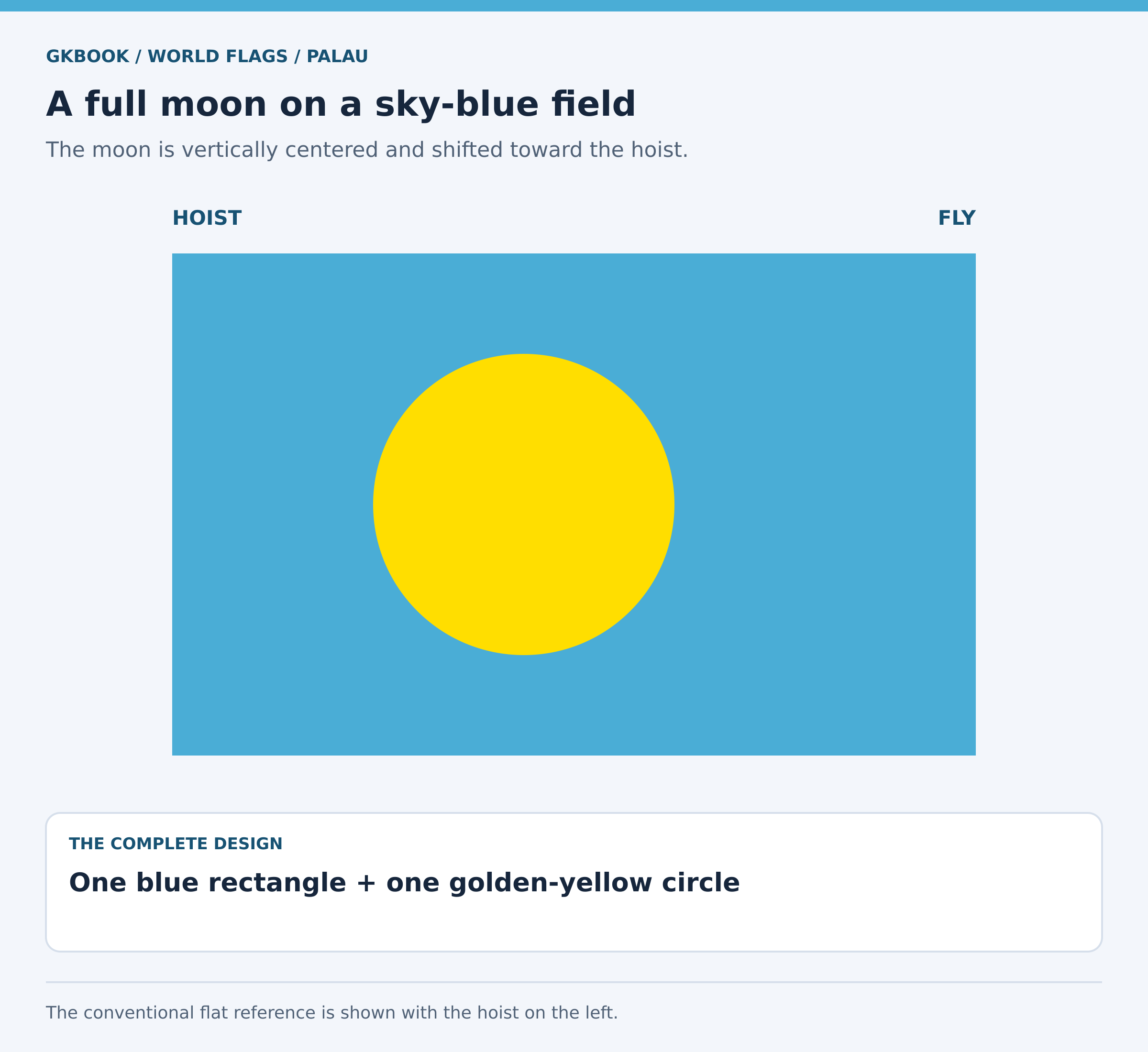
Palau’s national flag consists of a sky-blue rectangle and one golden-yellow circular disk representing the full moon. The disk is vertically centered but sits closer to the hoist than the fly. There are no stars, stripes, lettering, rays, borders, or additional emblems inside the standard design.
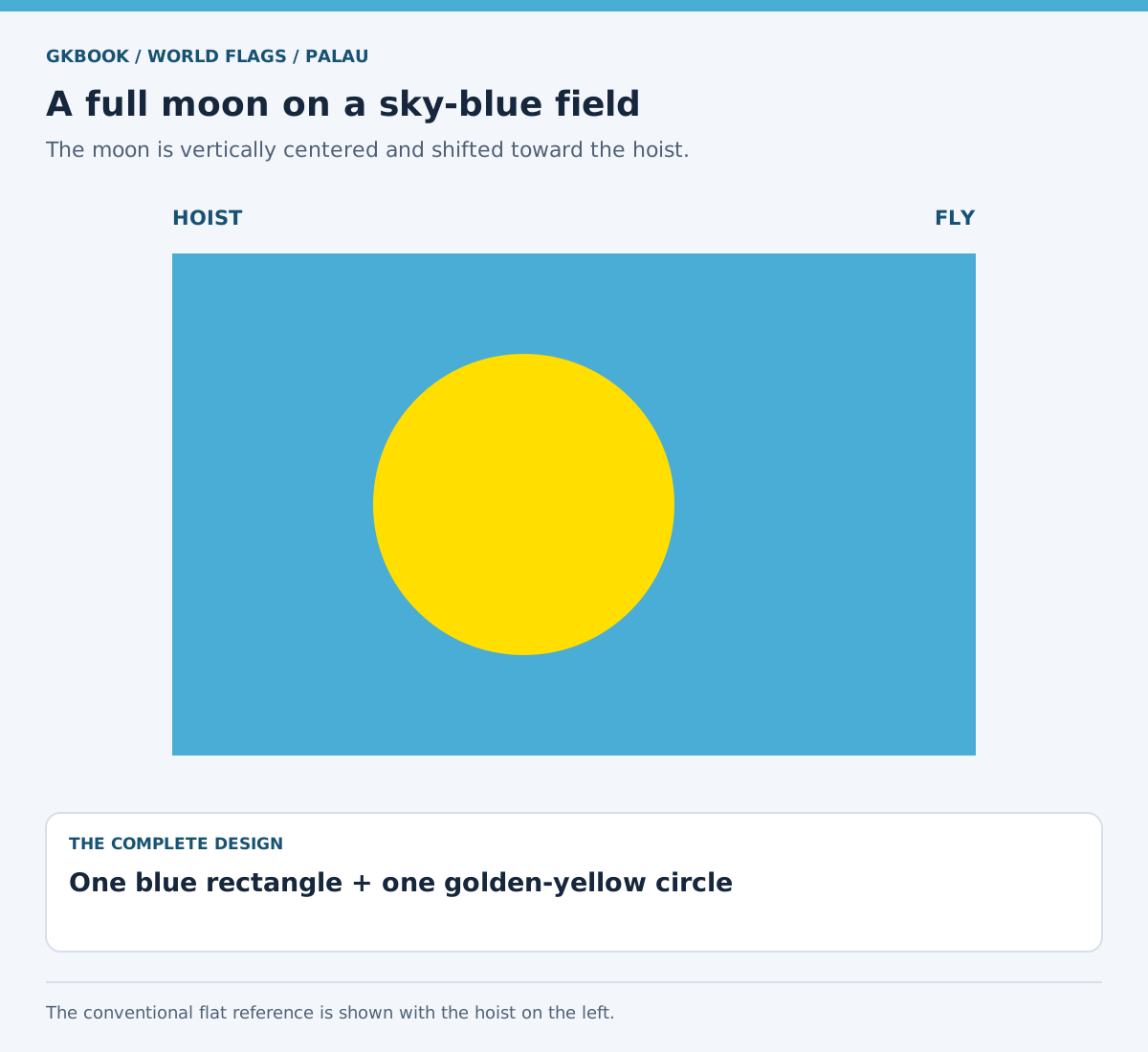
The hoist is the edge attached to a pole or halyard, while the fly is the opposite free edge. In the usual reference view, the hoist is on the left. This convention explains why the moon appears left of the rectangle’s center in most flat illustrations.
The blue extends continuously behind the moon to all four edges. The disk is a solid, opaque shape rather than a cutout or a photograph of the lunar surface. The plain reference therefore needs only a rectangle and a circle; everything else in a construction diagram is explanatory annotation.
What are the colors of the Palau flag?
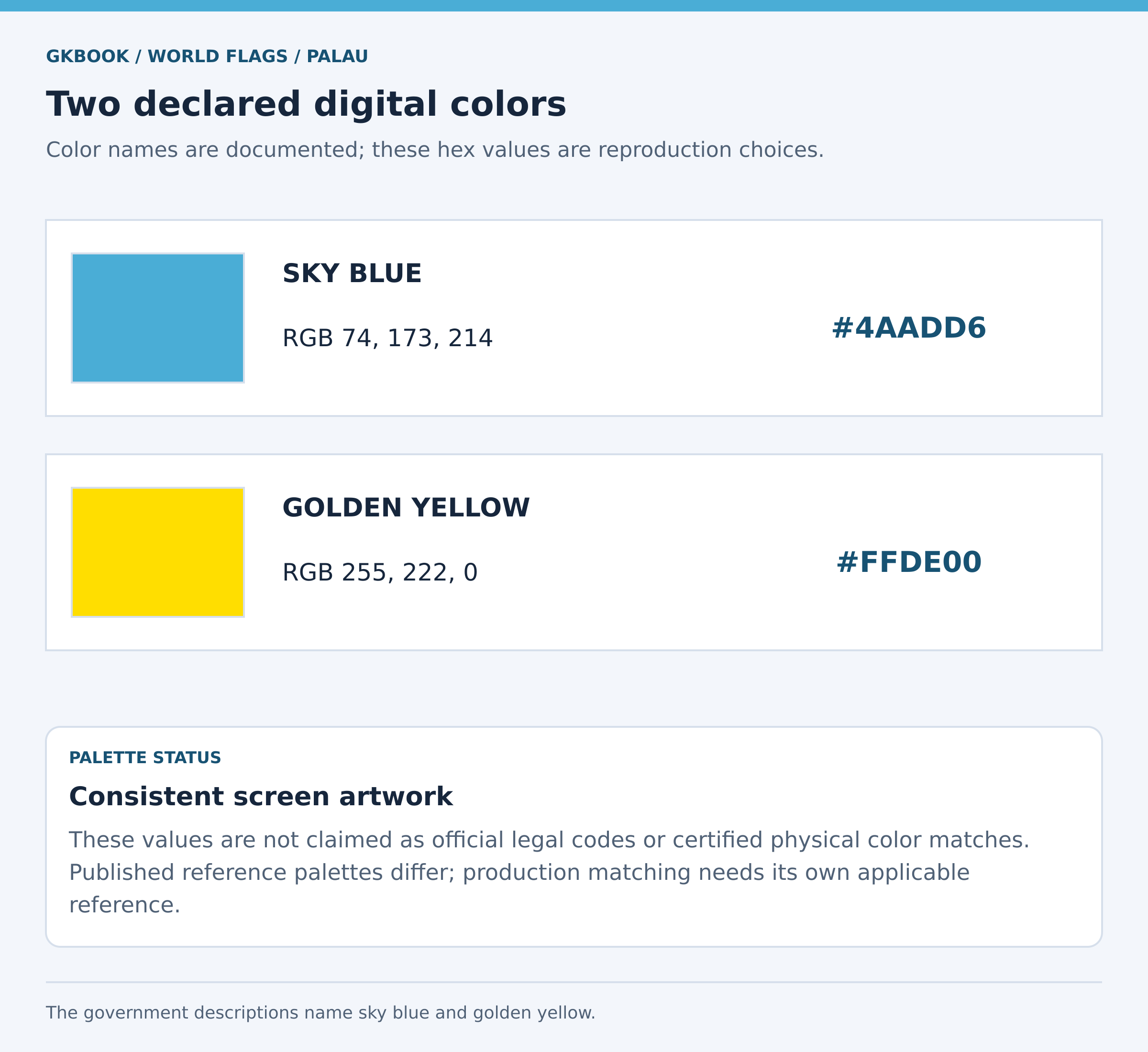
The flag’s colors are sky blue and golden yellow. This package uses #4AADD6 for blue and #FFDE00 for yellow as declared screen choices. These hexadecimal values make the downloadable images consistent, but they are not presented as legally prescribed codes or certified matches for printed ink or fabric.

The color names describe the national design; the numerical values describe these particular digital files. For this palette, blue has RGB components 74, 173, and 214, while yellow has components 255, 222, and 0. The same two fills are used throughout the plain flag and its scaled copies.
A monitor emits light, whereas paper and cloth reflect it. A printer’s profile, the material, and viewing conditions can therefore affect the result even when an image file is unchanged. Keep the declared screen values with the artwork, and obtain an applicable production reference before claiming a certified physical match.
| Element | Color name | Hexadecimal | RGB |
|---|---|---|---|
| Field | Sky blue | #4AADD6 | 74, 173, 214 |
| Full moon | Golden yellow | #FFDE00 | 255, 222, 0 |
Does Palau prescribe exact Pantone or RGB flag colors?
The government description consulted names sky blue and golden yellow without supplying a unique RGB or Pantone specification. Published flag references and event manuals use differing color values. Consequently, this guide distinguishes the named colors from its chosen digital palette and does not label one commercial color conversion as universally official.
A code printed in an event manual can identify the reproduction chosen for that event. It does not automatically establish a permanent national color law. Likewise, a convenient hex value on a flag website may be useful for digital consistency without being a measured government manufacturing specification.
The available evidence supports the color names more strongly than any single universal numerical match. This is a limit on the claim made here, rather than proof that no further production guidance could exist. For accurate artwork, retain two solid colors and state the palette’s status clearly beside the reference.
What does the Palau flag symbolize?
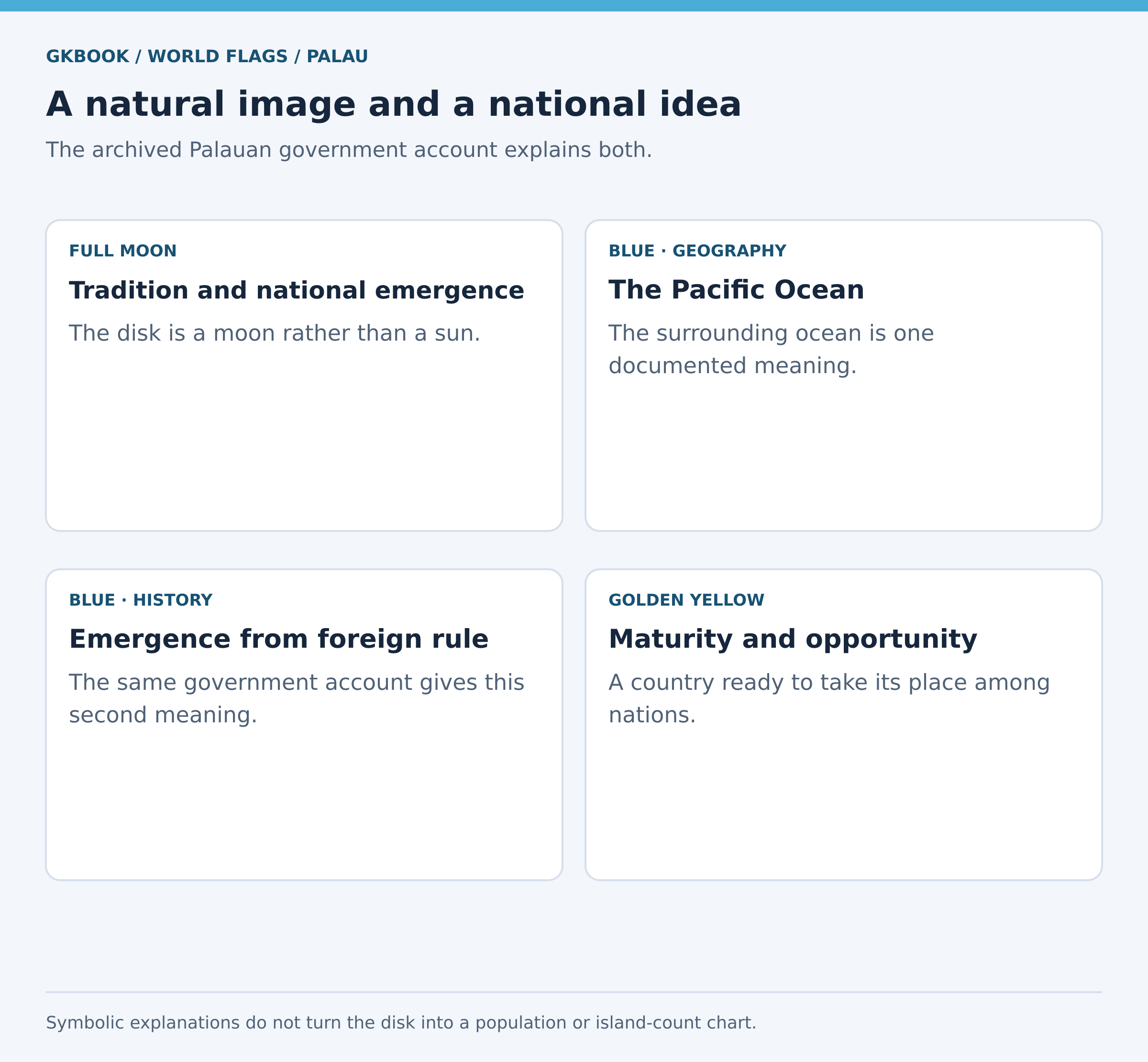
The full moon connects the flag with Palauan traditions and the country’s emergence as a nation. An archived government account gives blue two meanings: the surrounding Pacific Ocean and emergence from foreign rule. It connects golden yellow with national maturity and a future offering opportunities to the people of Palau.

The flag joins an environmental image with a political idea. The moon is recognizable as a natural form, while the official explanation also uses it to express the country’s development. Those meanings can coexist without making the flag a literal picture of one particular night or place.
The proportions serve a different purpose from the symbolism. Nothing in the documented explanation assigns a population percentage to the yellow disk or a number of islands to its diameter. A clear caption can explain the national meaning while leaving measurements to the construction diagram.
Is the yellow circle a moon or a sun?
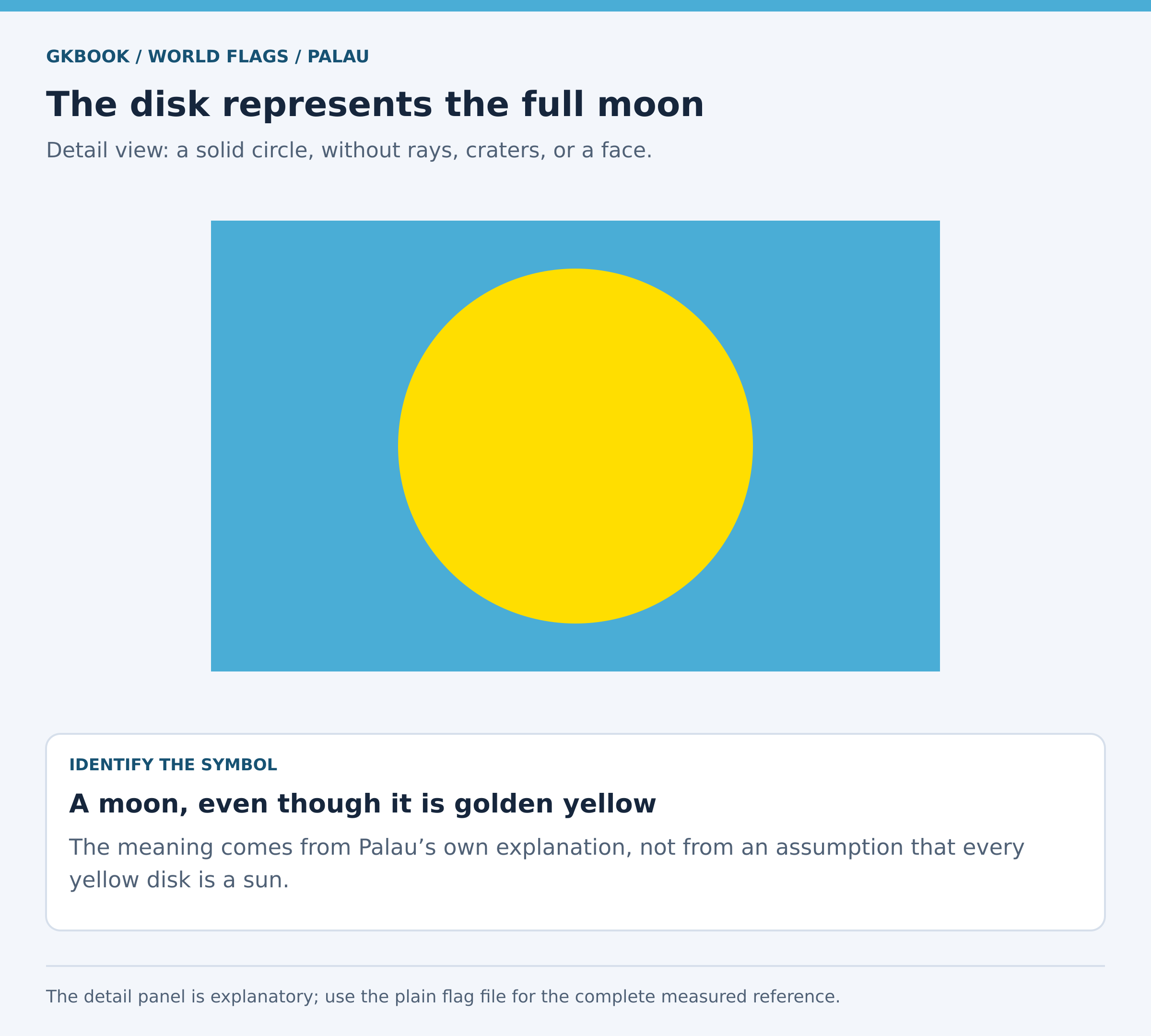
The yellow circle represents the full moon, not the sun. Palauan government descriptions identify it explicitly as a moon and connect it with traditional timing and national emergence. Its circular shape is intentionally simple: the national flag does not add sun rays, a face, craters, or a crescent-shaped opening.
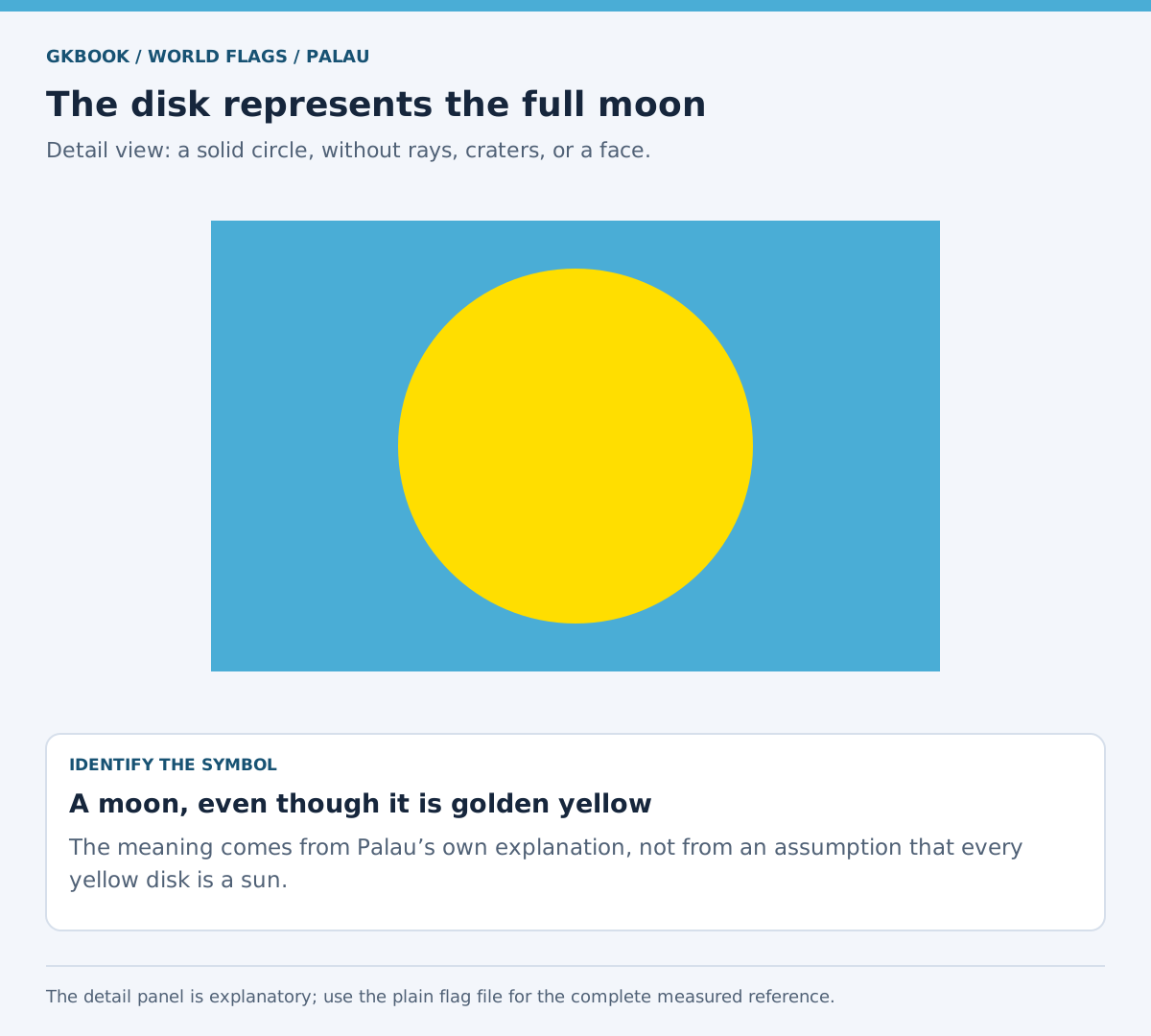
A plain disk can represent different things on different flags. Its meaning must therefore come from the explanation of this particular national symbol, rather than from the color yellow alone. Calling Palau’s disk a sun would replace the documented meaning with an assumption based on appearance.
For drawing purposes, the moon remains a complete geometric circle. A decorative moon icon with a shaded edge would introduce another shape or tone. The explanatory illustration isolates the disk to identify it, but the isolated circle is a detail of the flag, not a separate national flag.
Does the blue represent the ocean or self-government?
Both meanings appear in the archived Palauan government explanation: blue refers to the Pacific Ocean and emergence from the rule of other countries. The current government’s shorter flag page emphasizes the ocean. Presenting these as complementary documented meanings is more accurate than insisting that only one interpretation is permitted.
Short descriptions often select one part of a longer explanation. That editorial choice does not necessarily indicate a redesign or a formal rejection of another meaning. Here the archived account is especially useful because it explicitly discusses both ideas in the same passage about the blue field.
The artwork cannot by itself decide which sentence a caption should use. Its blue rectangle stays the same whether the accompanying paragraph discusses geography or political history. Readers should distinguish the visual design, the government’s explanation, and later writers’ abbreviated summaries instead of treating every difference in wording as a change of flag.
Why is the full moon significant in the flag’s explanation?
Official explanations connect the full moon with traditional activities such as fishing, planting, and harvesting. The archived account also places the moon within a wider Palauan cultural narrative. These are statements about the symbol’s cultural significance; they should not be rewritten as a scientific guarantee that every activity succeeds at full moon.
The important distinction is between describing a tradition and making a universal causal claim. The flag conveys a shared national image; it is not an agricultural timetable, fishing forecast, or assertion that every person follows identical practices. Cultural meaning deserves precise attribution rather than an exaggerated claim about an entire population.
A teaching illustration can show the relationship between the moon and the explanation without inventing a specific ceremony, costume, or historical scene. This gallery therefore uses measured shapes and text. It does not present a fictional ritual photograph as evidence of the flag’s origin or meaning.
What is the ratio of the Palau flag?
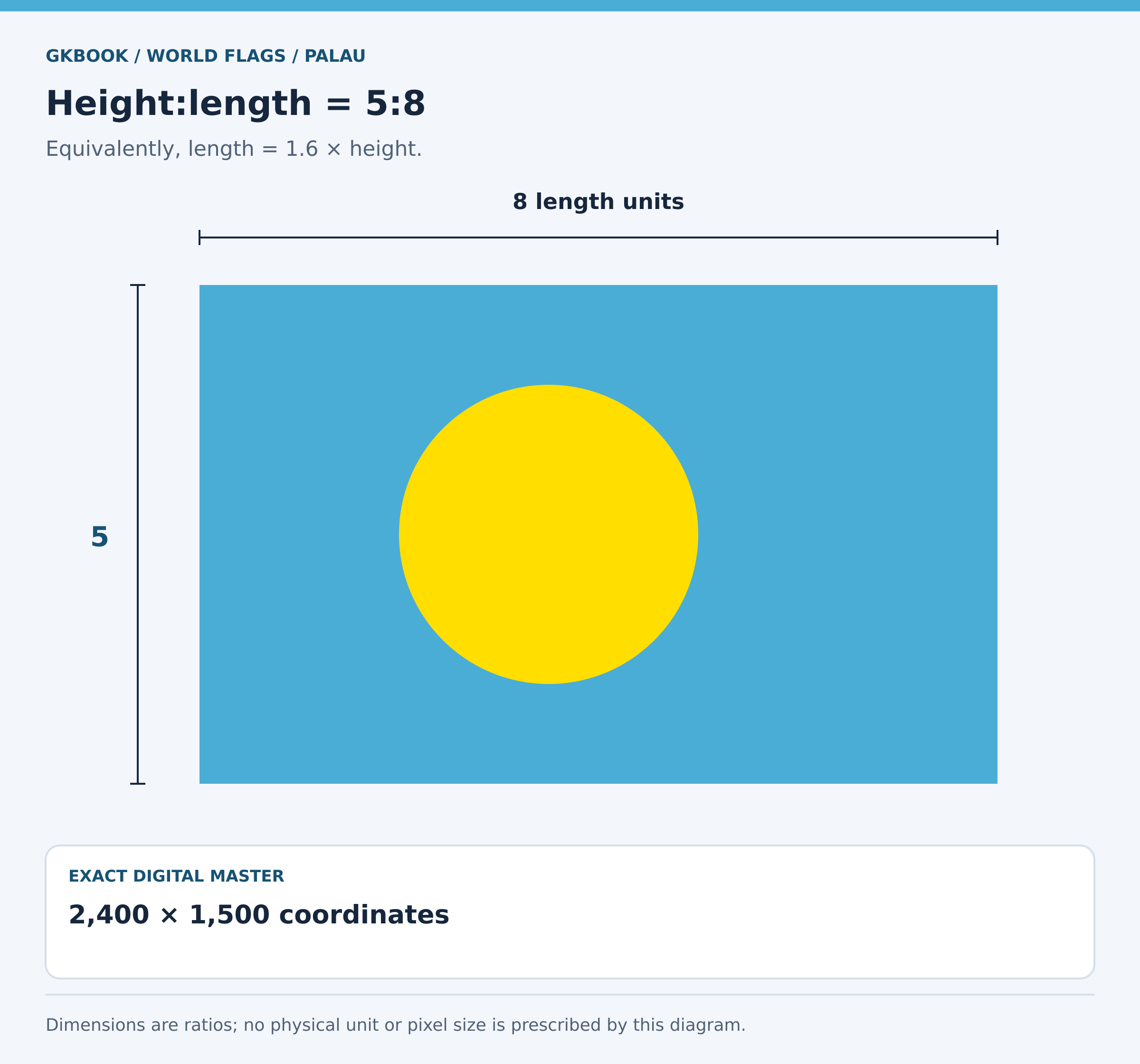
Palau’s flag has a height:length ratio of 5:8, equivalent to length:height 8:5. The archived government description expresses the relationship as 1.0 to 1.6. A flag 1,500 units high is therefore 2,400 units long, and all internal measurements should scale with those same outer dimensions.

In older flag descriptions, width commonly means the vertical dimension. Naming the height and horizontal length explicitly avoids reversing the ratio. An image labeled simply “5:8” should therefore be understood as a landscape rectangle five units high and eight units long, not as a portrait rectangle.
The proportion applies to the whole blue field. It is not the ratio of the moon’s diameter to the flag’s length. If a layout needs a different shape, place the intact flag within that space rather than stretching it. The disk would become an ellipse under unequal horizontal and vertical scaling.
How large is the moon on the Palau flag?
The moon’s diameter is three-fifths of the flag’s height, or 0.6H. Its radius is three-tenths of the height, or 0.3H. On the supplied 2,400 × 1,500 master, the diameter is 900 units and the radius is 450 units, with no outline stroke added.

Diameter measures the full distance across the circle through its center; radius measures from the center to the edge. Confusing those two quantities would double or halve the intended disk. The diameter rule refers to the flag’s height, not to its longer horizontal dimension.
Using the length instead gives the equivalent diameter 3L/8 and radius 3L/16. Both expressions describe the same circle because L = 8H/5. The diagram shows a line across the complete disk so the measured quantity is unambiguous. Its guide line and label do not belong on the finished flag.
Where is the moon’s center placed?
The moon’s center is halfway down the flag and 0.7 times the flag height from the hoist. With the hoist on the left, its coordinates are x = 0.7H and y = 0.5H. On the 2,400 × 1,500 master, that point is (1,050, 750).
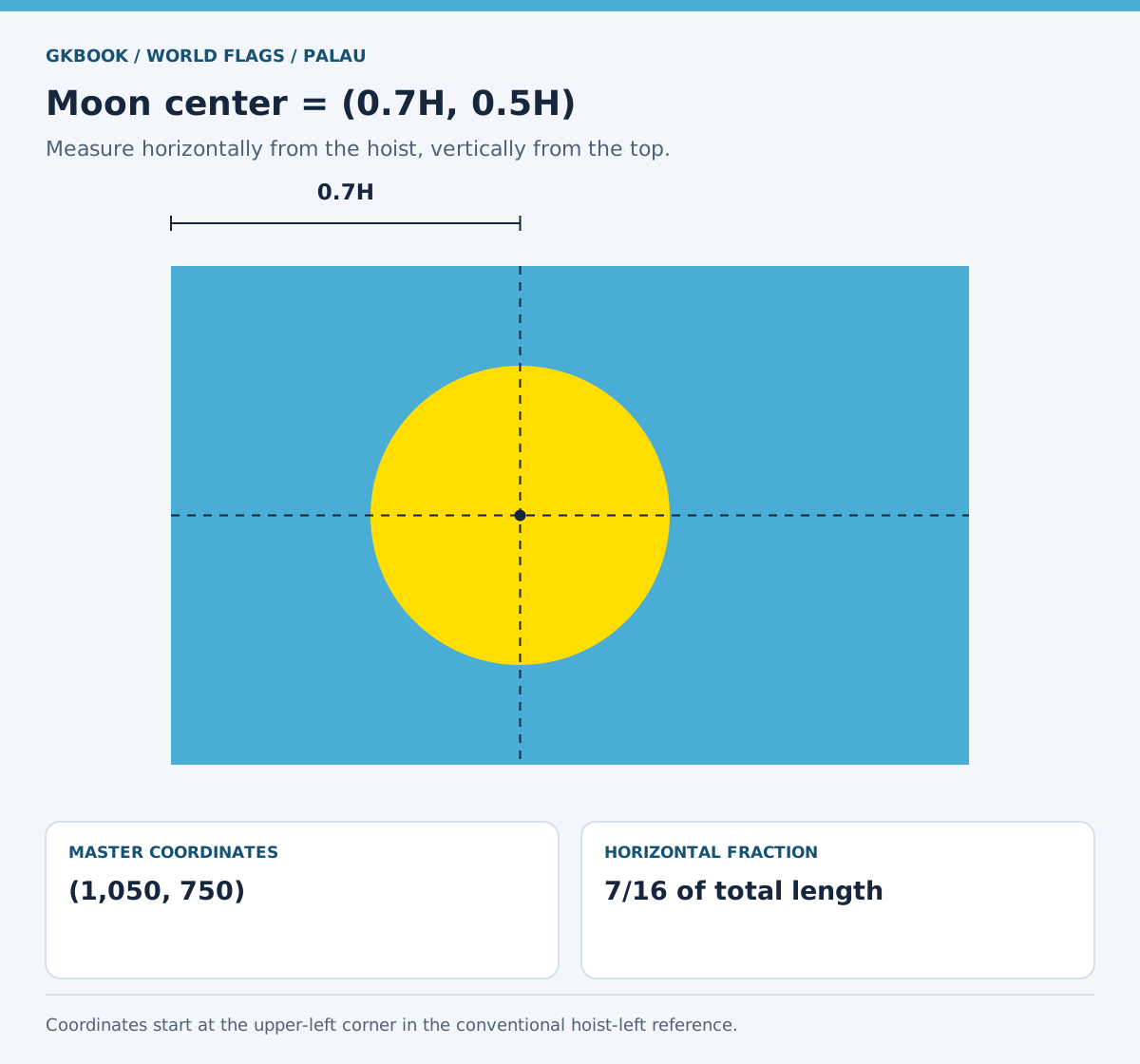
The exact hoist measurement comes from the published transcription of the flag law. The archived government account independently confirms equal distances from the top and bottom to the center. Together these references establish an intentionally displaced circle rather than a disk placed at the rectangle’s geometric midpoint.
Expressed in total length, the horizontal coordinate is 7L/16, or 43.75 percent of L. The vertical coordinate is 50 percent of H. These percentages use different dimensions as their bases. Applying 43.75 percent to the height, or 70 percent to the length, would produce an incorrect position.
Why is the moon off-center toward the hoist?
The offset is part of the design, not an error in reproduction. The government’s flag page explains that it helps the moon appear centered when the flag hangs. Geometrically, the center is displaced toward the hoist by one-sixteenth of the total length, equal to one-tenth of the flag’s height.
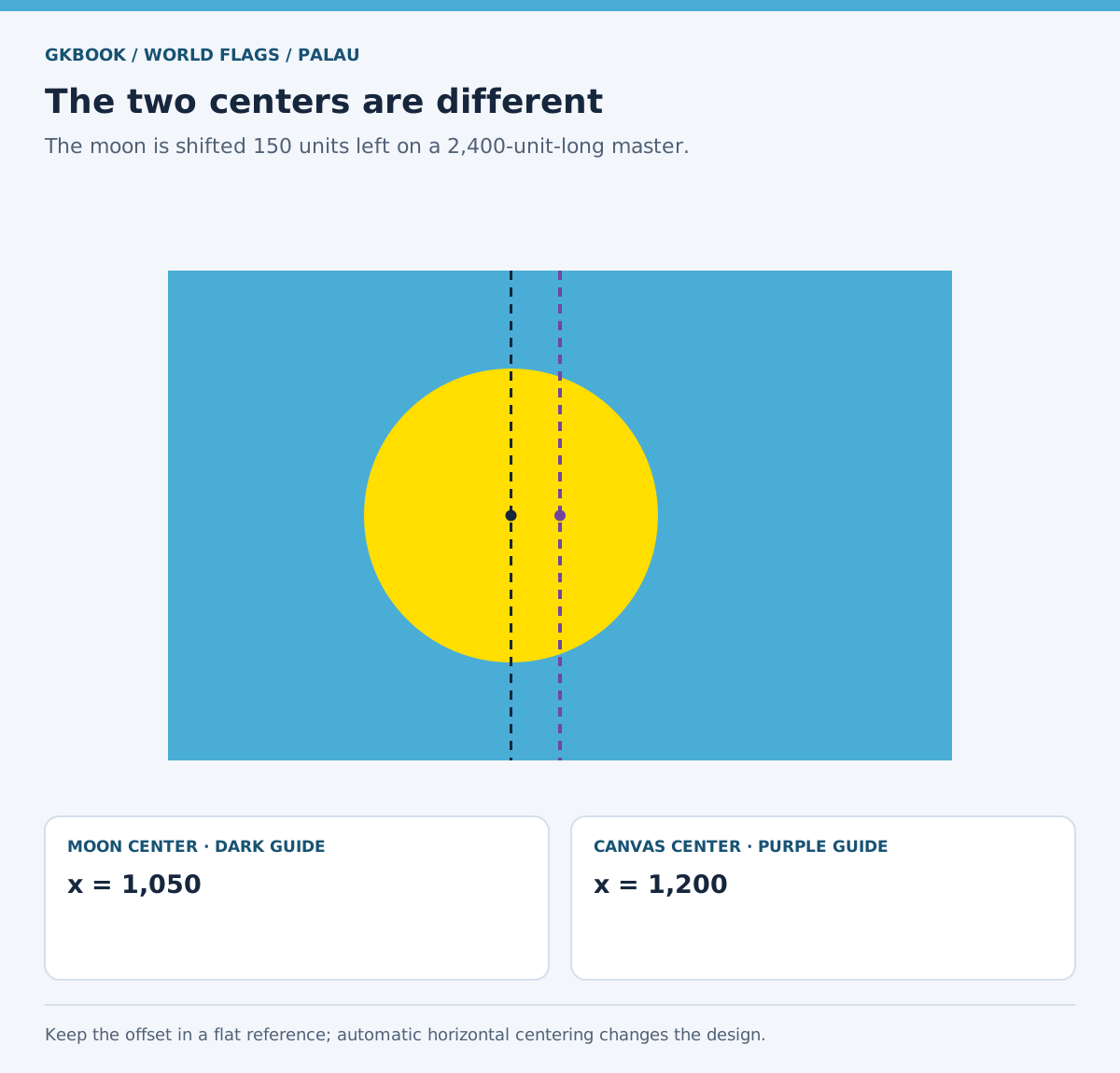
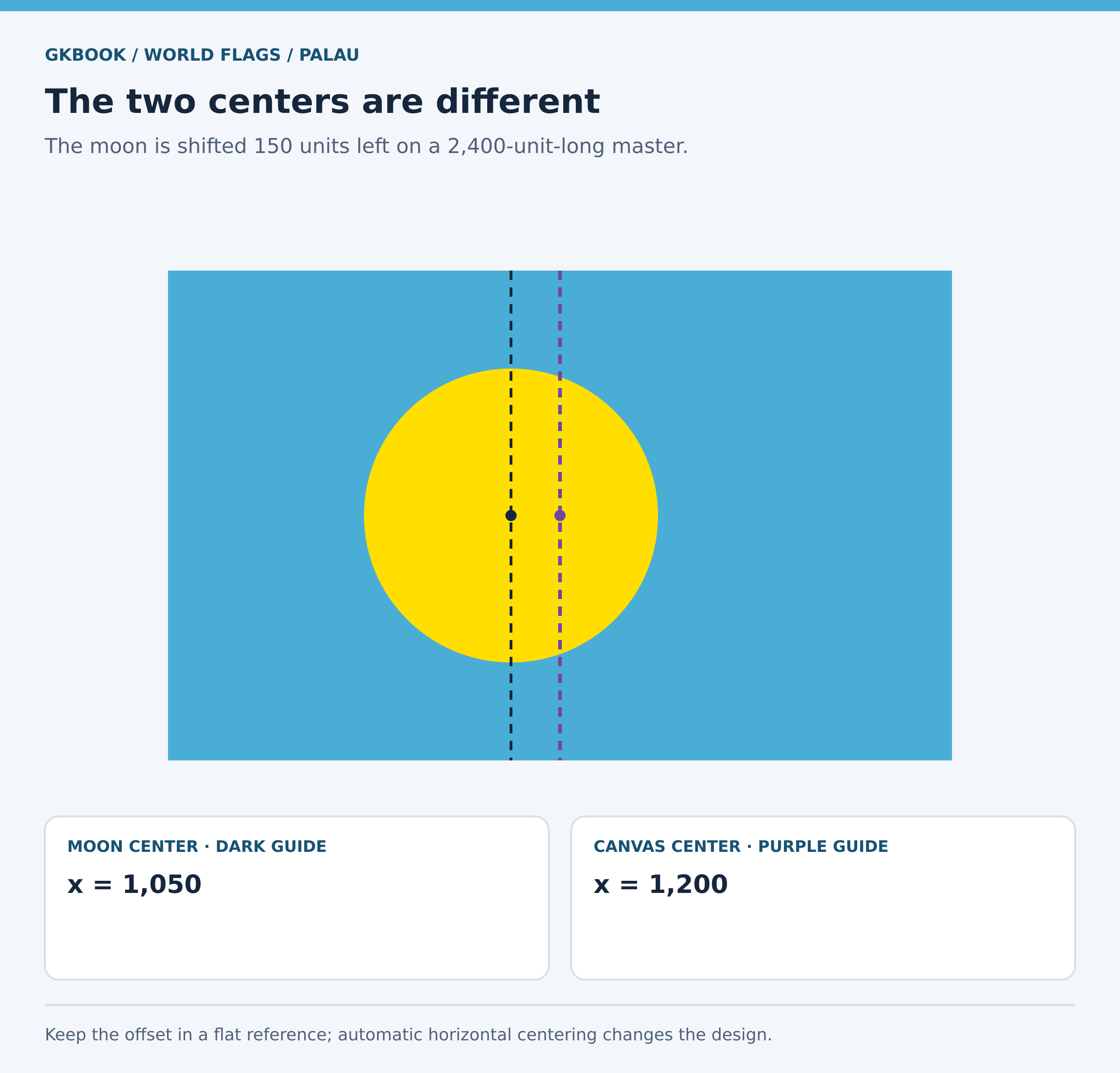
On the master, the canvas midpoint is x = 1,200 and the moon center is x = 1,050, making the difference 150 units. The gallery marks both positions separately. This small but visible shift produces more blue space beyond the moon on the fly side.
The government’s explanation concerns perceived balance in a hanging flag. It does not mean every fold or viewing angle will create the same visual effect. For a flat reference, keep the measured offset even if a drawing program offers to center objects automatically. Automatic canvas centering would alter the design.
How much blue space surrounds the moon?
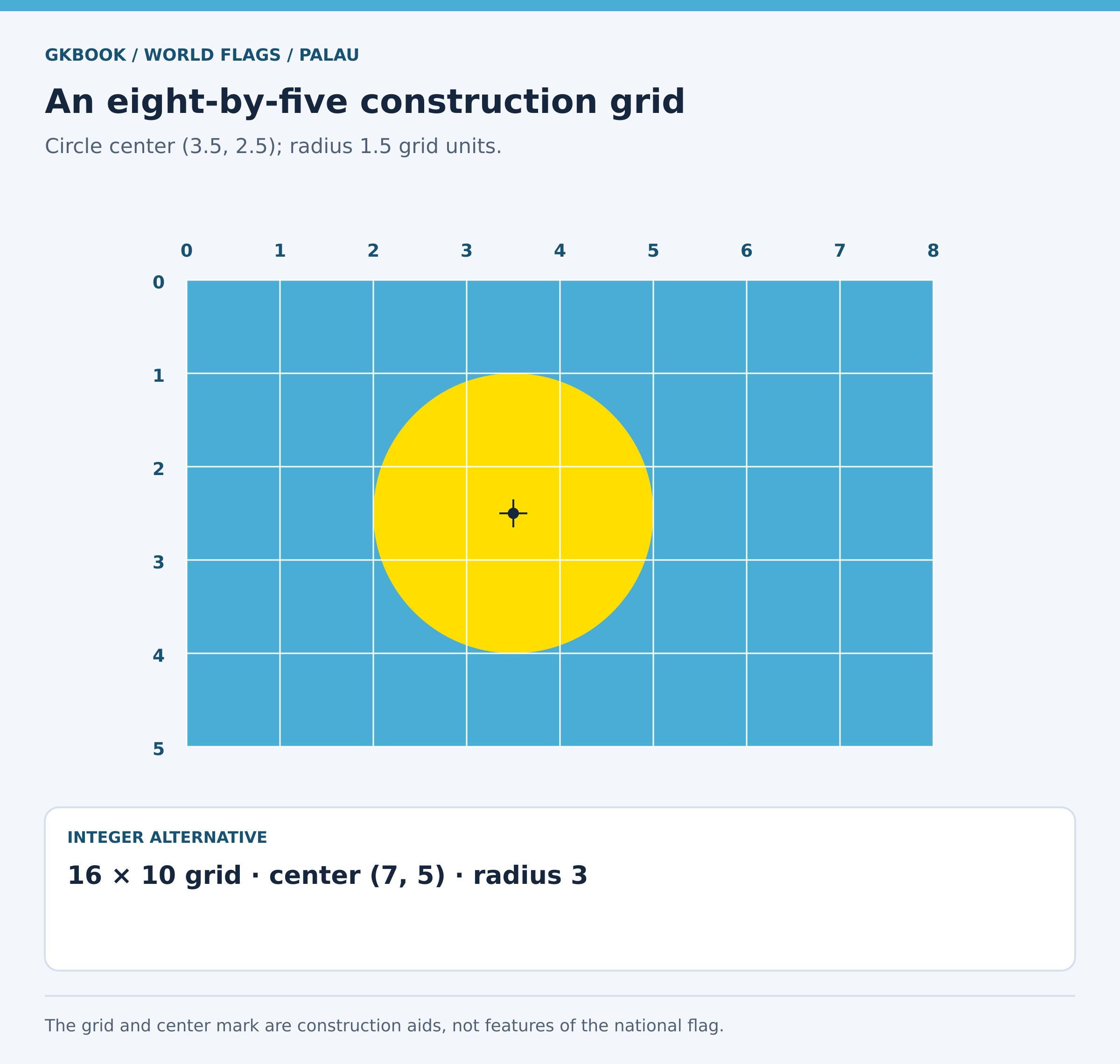
On an eight-by-five construction grid, the moon occupies three units across. The blue margins are two units at the hoist, three at the fly, and one each above and below. Thus the horizontal sequence is 2 + 3 + 3, while the vertical sequence is 1 + 3 + 1.
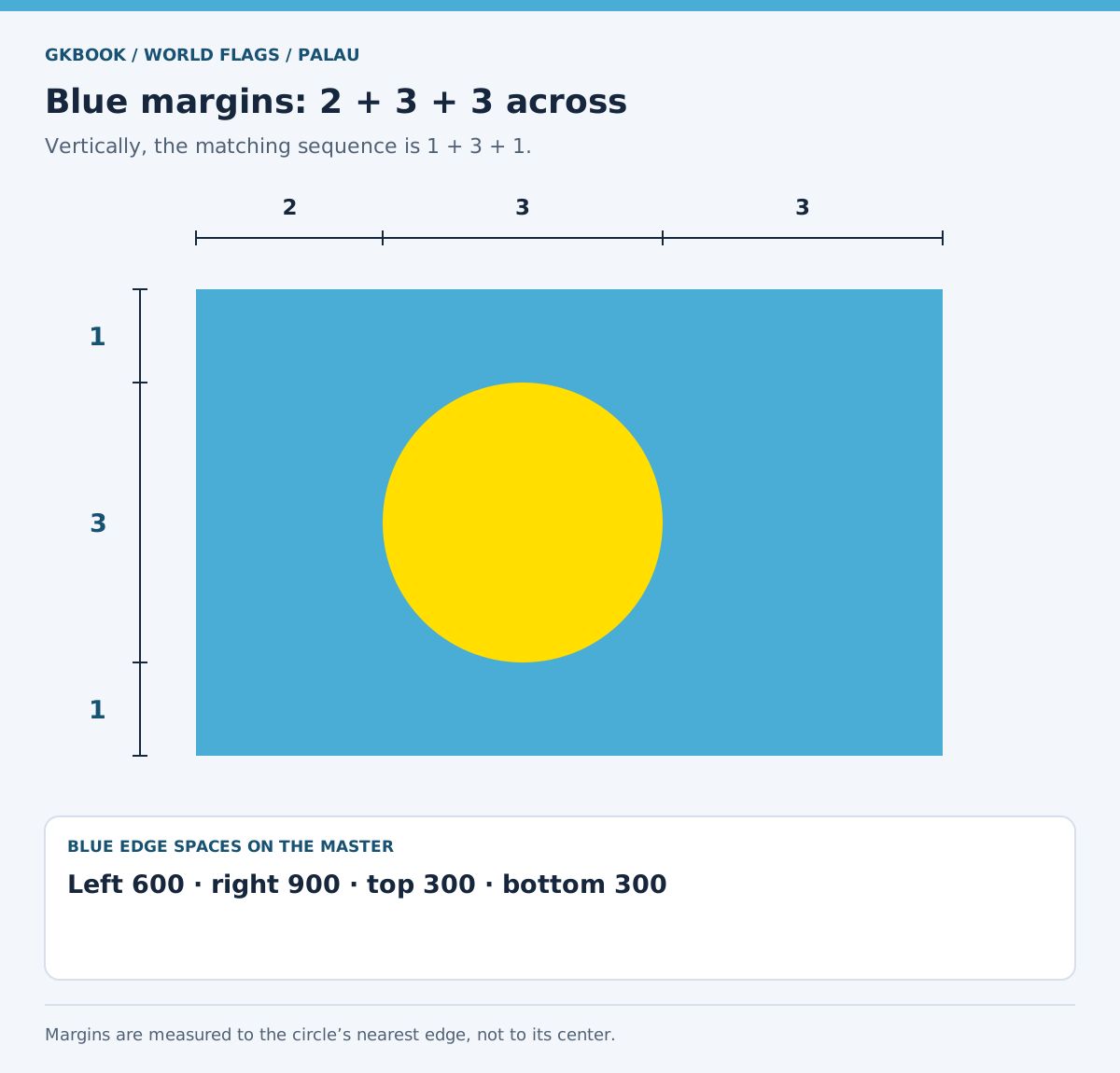
These margins are measured from the circle’s nearest edge, not from its center. In height-based terms, the left margin is 0.4H and the right margin is 0.6H; both vertical margins are 0.2H. The unequal side spaces are a direct consequence of the hoistward offset.
For the 2,400 × 1,500 master, the margins are 600 and 900 units horizontally, and 300 units above and below. Adding the moon’s 900-unit diameter recovers the full length and height. This gives a useful independent check on a drawing without relying on the center coordinates alone.
What construction grid is easiest to use?
An eight-unit length and five-unit height make a convenient Palau flag grid. Put the moon center at (3.5, 2.5) and give it radius 1.5 units. For whole-number coordinates, double everything to a sixteen-by-ten grid with center (7, 5) and radius 3, preserving exactly the same design.

The grid is a drawing aid, not a set of stripes on the flag. A single chosen unit can represent a centimeter, a millimeter, or a scalable vector coordinate. Once that unit is fixed, the rectangle, circle center, and radius follow without separate visual adjustments.
The doubled grid is useful for classroom work because every defining coordinate is an integer. A printed construction sheet can retain the grid and center marks as explanations. A finished flag reference should remove them. The supplied plain SVG contains only the blue rectangle and golden-yellow moon.
How can you draw the Palau flag accurately?
Draw a rectangle eight units long and five high, then fill it sky blue. Mark a point 3.5 units from the hoist and 2.5 units from the top. Draw a golden-yellow circle of radius 1.5 units at that point, then remove every construction line and center mark.
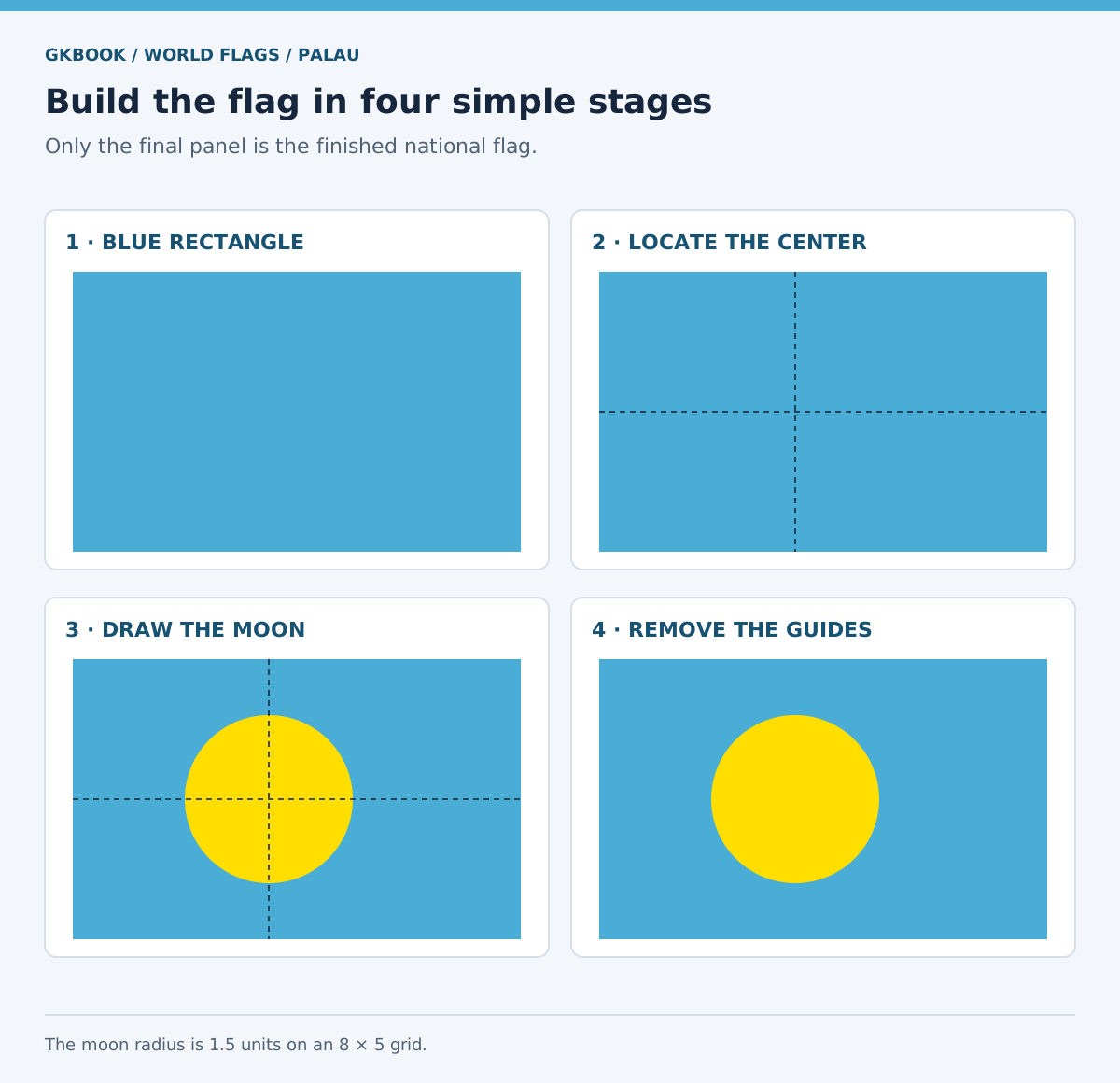
Start from the outer dimensions rather than drawing a circle first and fitting a rectangle around it. This keeps the diameter, offset, and margins tied to one consistent scale. A compass or a vector circle tool is preferable to a freehand oval when the goal is a measured reference.
The four-stage illustration distinguishes the empty field, center guides, completed circle with guides, and finished flag. Those unfinished stages are instructional steps, not historical variants. The final image should have flat fills, sharp rectangular corners, and no decorative border, shading, text, or additional symbol.
What digital dimensions preserve the flag correctly?
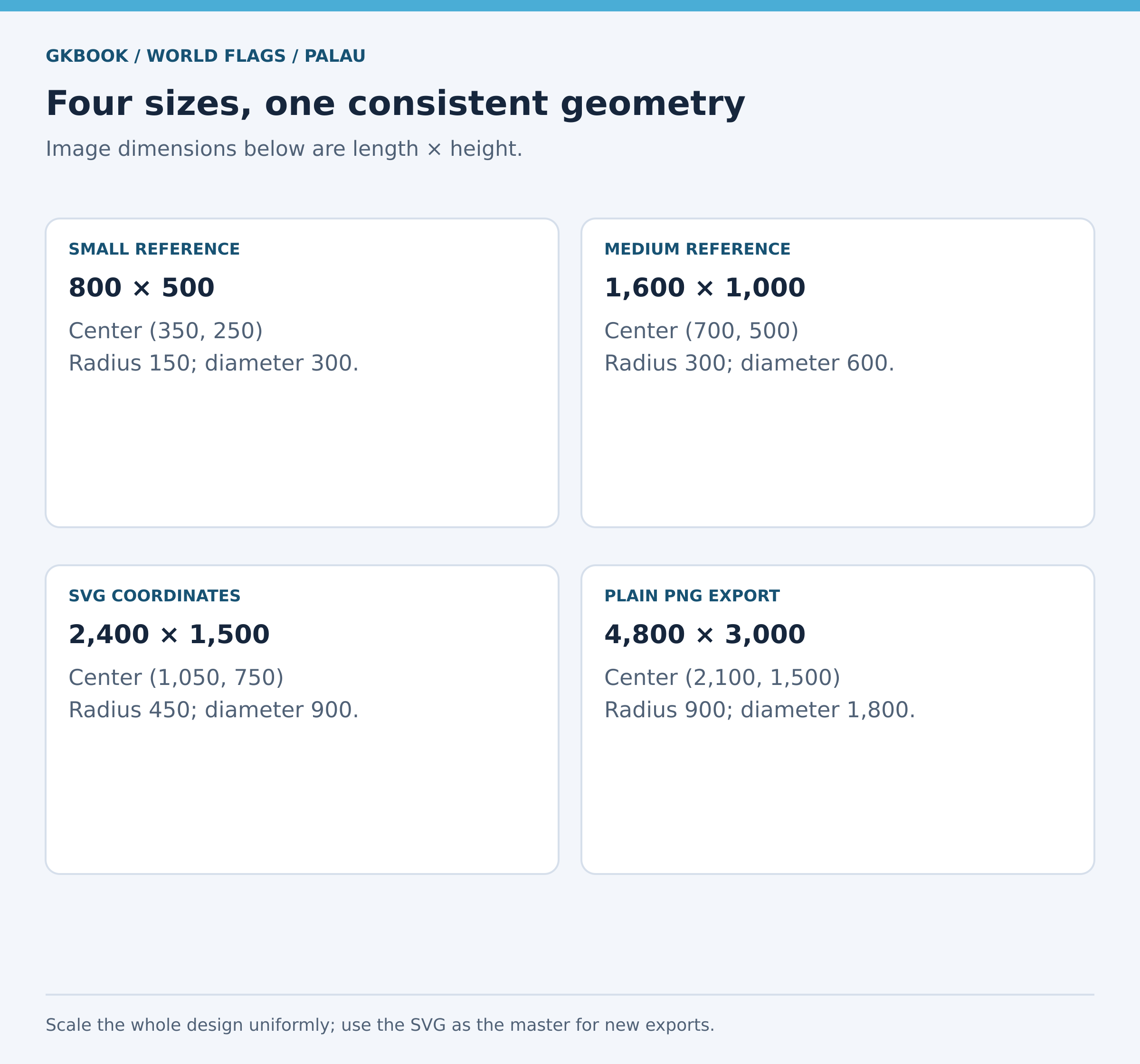
Any uniformly scaled 8:5 image preserves the standard geometry. Examples include 800 × 500, 1,600 × 1,000, and 2,400 × 1,500 pixels, written length × height. The supplied plain PNG is 4,800 × 3,000 pixels. These are practical digital examples, not a government-prescribed list of physical flag sizes.
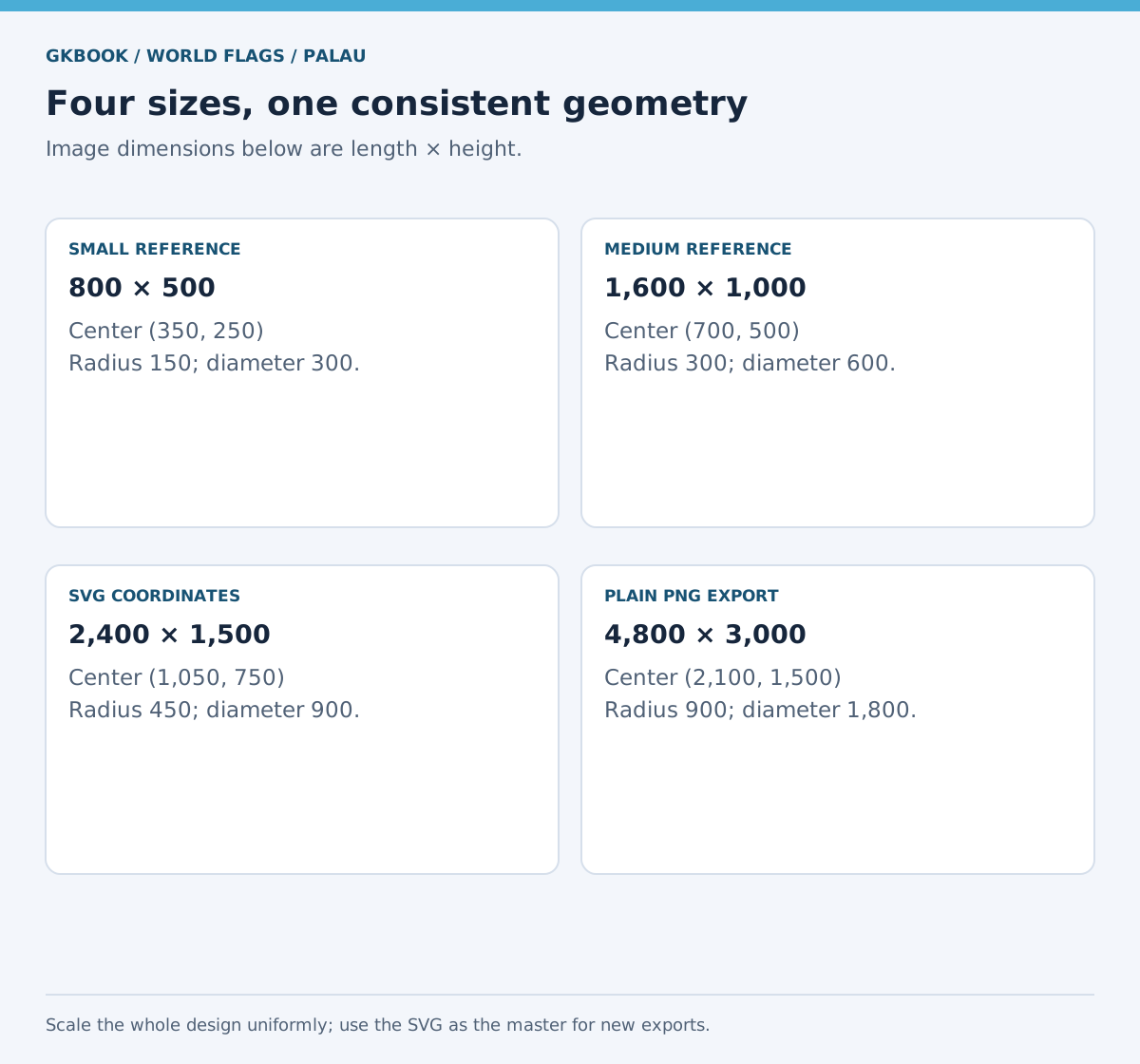
Each example uses the same fractional rules. At 800 × 500, the center is (350, 250) and the radius is 150. Doubling both image dimensions doubles those three numbers. The larger raster export follows exactly the same process, so it does not need a separately redrawn moon.
The SVG is the scalable master. When preparing a small PNG, render directly from that vector at the desired size instead of repeatedly resizing a previously reduced image. Antialiasing may soften boundary pixels, but it should not change the circle’s intended location or the surrounding blue margins.
| Length × height | Moon center | Radius | Diameter |
|---|---|---|---|
| 800 × 500 | (350, 250) | 150 | 300 |
| 1,600 × 1,000 | (700, 500) | 300 | 600 |
| 2,400 × 1,500 | (1,050, 750) | 450 | 900 |
| 4,800 × 3,000 | (2,100, 1,500) | 900 | 1,800 |
How can you check that the moon is a true circle?
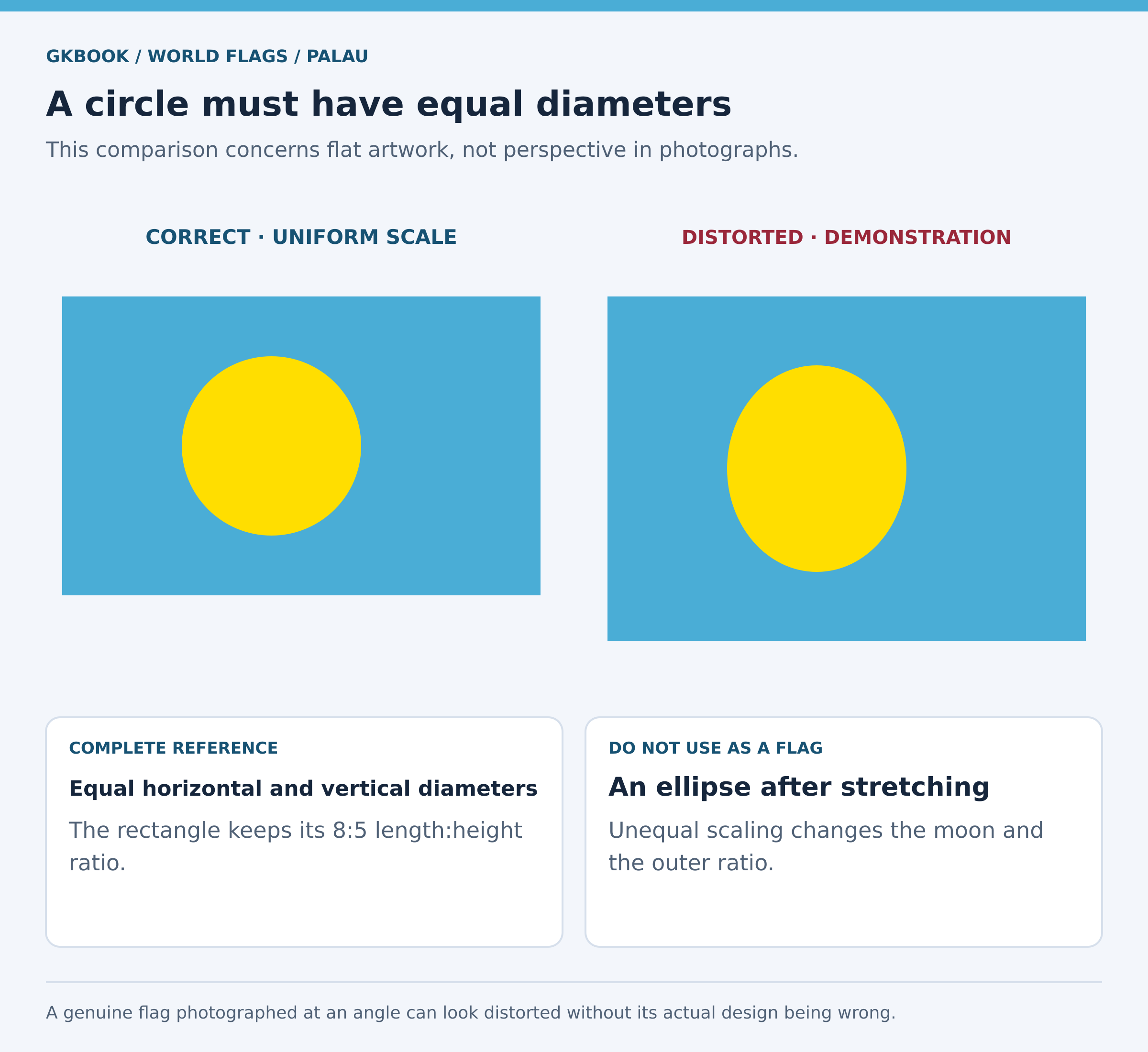
Measure the disk’s horizontal and vertical diameters: they must be equal in a flat, undistorted reference. Both should equal three-fifths of the flag height. If the rectangle has been stretched to a different ratio, the disk usually becomes an ellipse, even when its center still appears to be correctly placed.
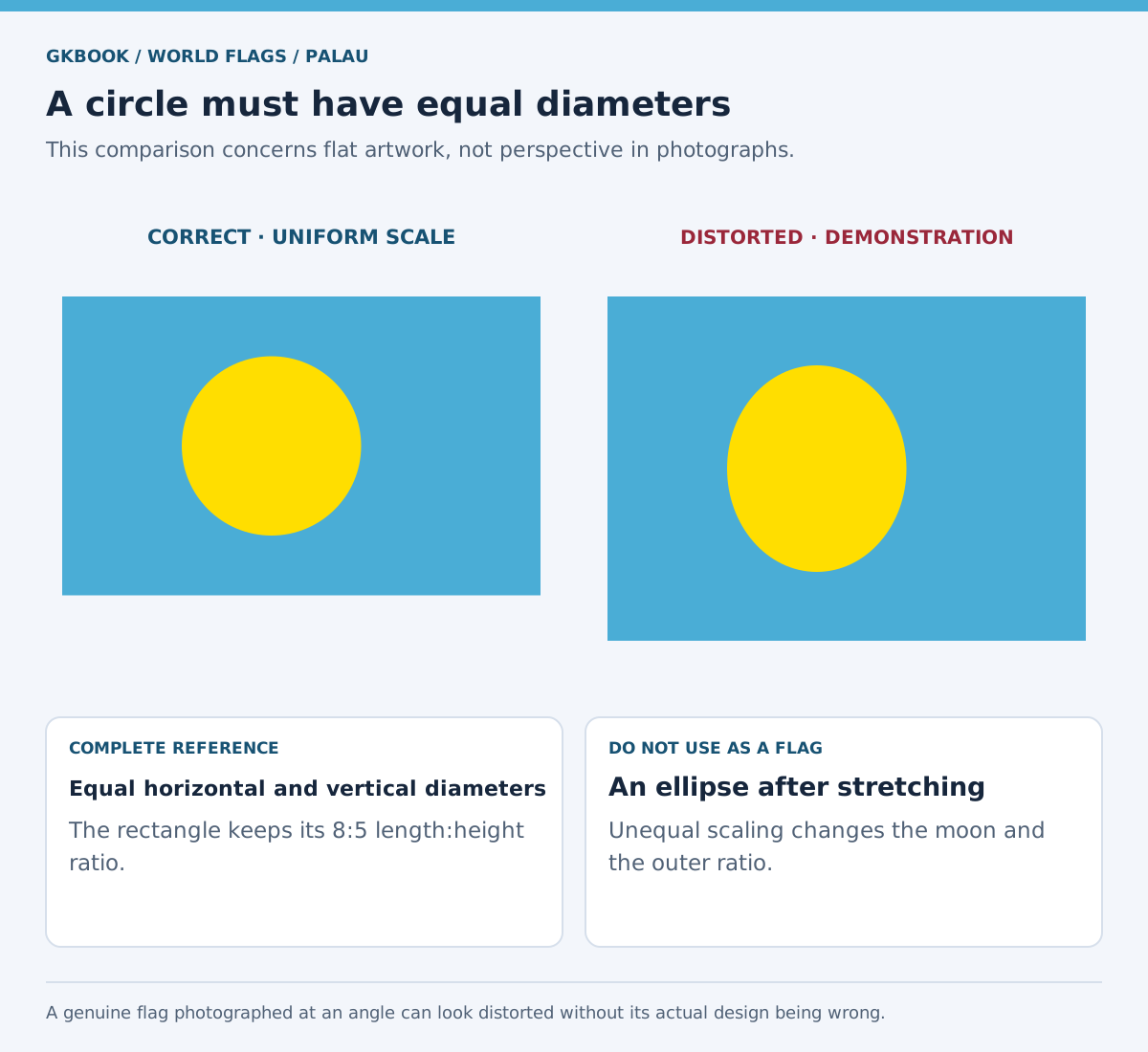
A vector circle is defined by one radius, which makes equal diameters automatic before any transformation. Nonuniform scaling can still distort that circle at display time. Check both the underlying artwork and the dimensions assigned to the displayed image rather than trusting one of those checks alone.
A photograph of cloth is different: folds and perspective can make a genuine circular device appear oval. The gallery’s comparison addresses flat artwork, where that photographic explanation does not apply. Its deliberately distorted example is clearly marked as a demonstration and should not be used as a national flag reference.
Is the Palau flag symmetrical?
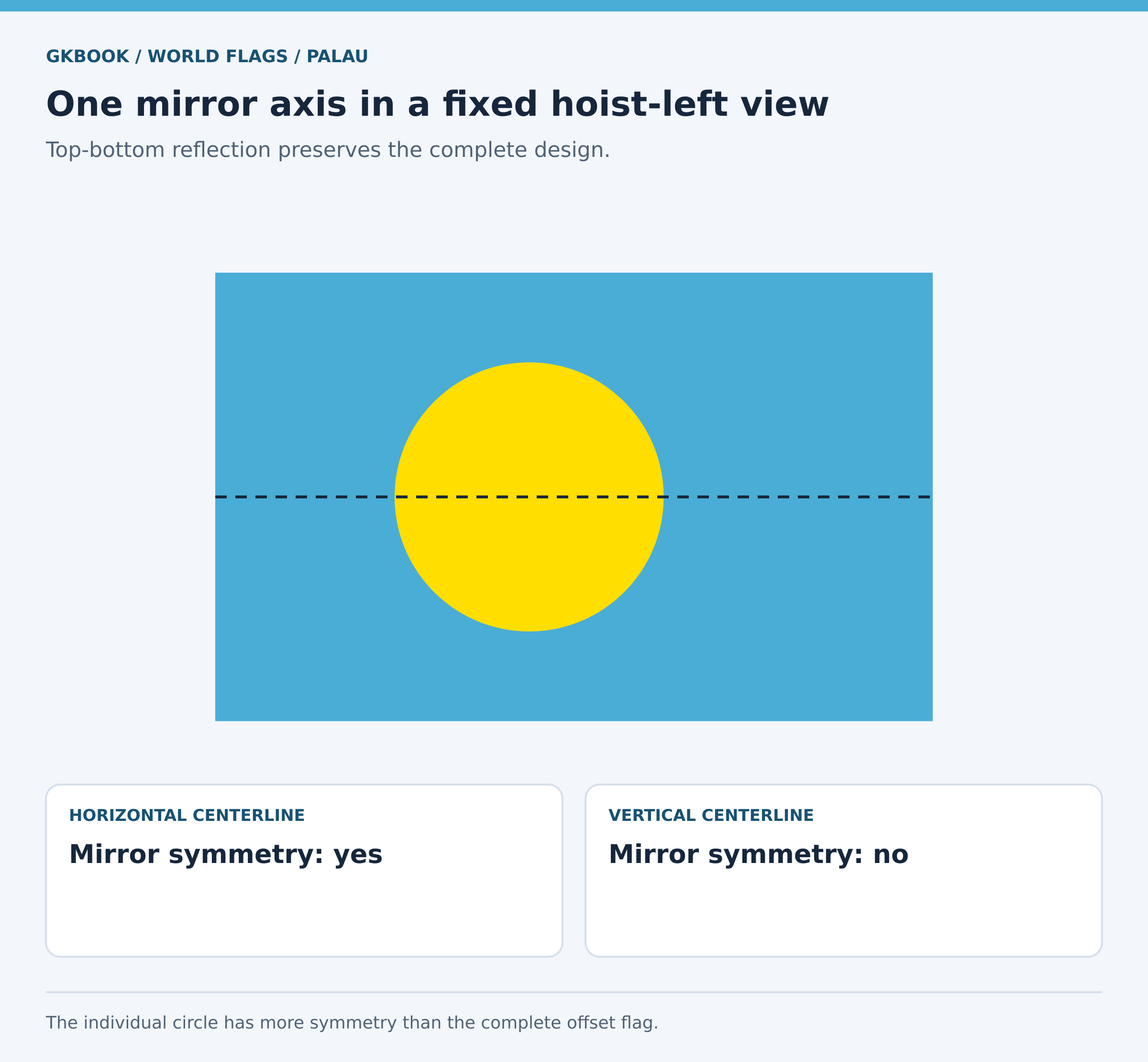
In a fixed hoist-left view, Palau’s flag has mirror symmetry across its horizontal centerline. It does not have mirror symmetry across the vertical centerline because the moon is offset. A half-turn also changes that fixed reference. The circle itself is more symmetric than the complete rectangular flag around it.
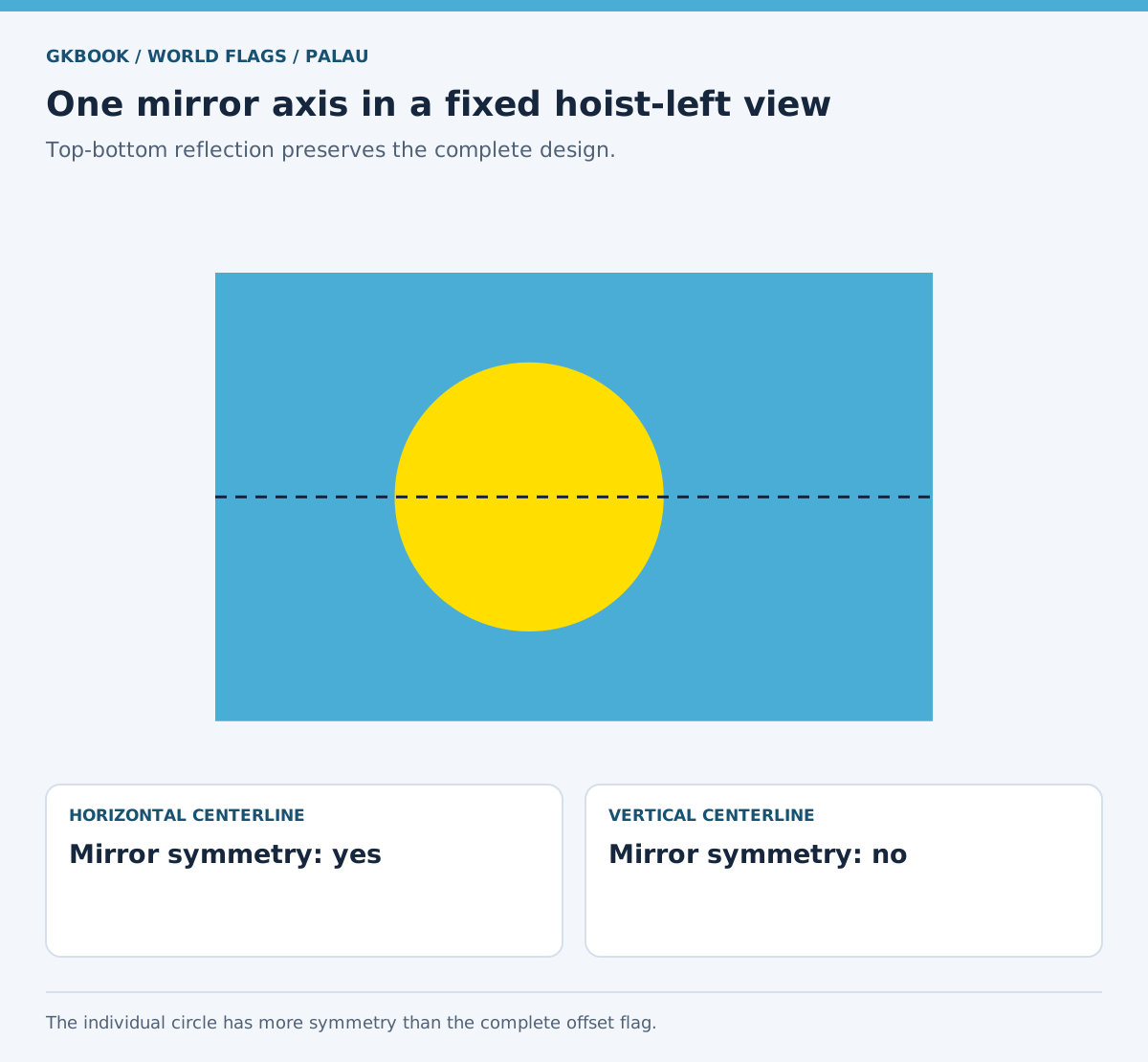
Reflecting the image top to bottom preserves the rectangle and the disk because the moon’s center lies halfway down the height. Reflecting it left to right moves the moon to the opposite side of the canvas midpoint. That result is meaningful as a reverse view, but it is a different fixed orientation.
This distinction helps explain why the plain design has no visual top-bottom difference when the hoist remains on the same side. It does not authorize arbitrary handling of a physical flag. The mathematical statement concerns reflection of the flat artwork and should be kept separate from ceremonial practice.
What does the reverse side of the Palau flag look like?
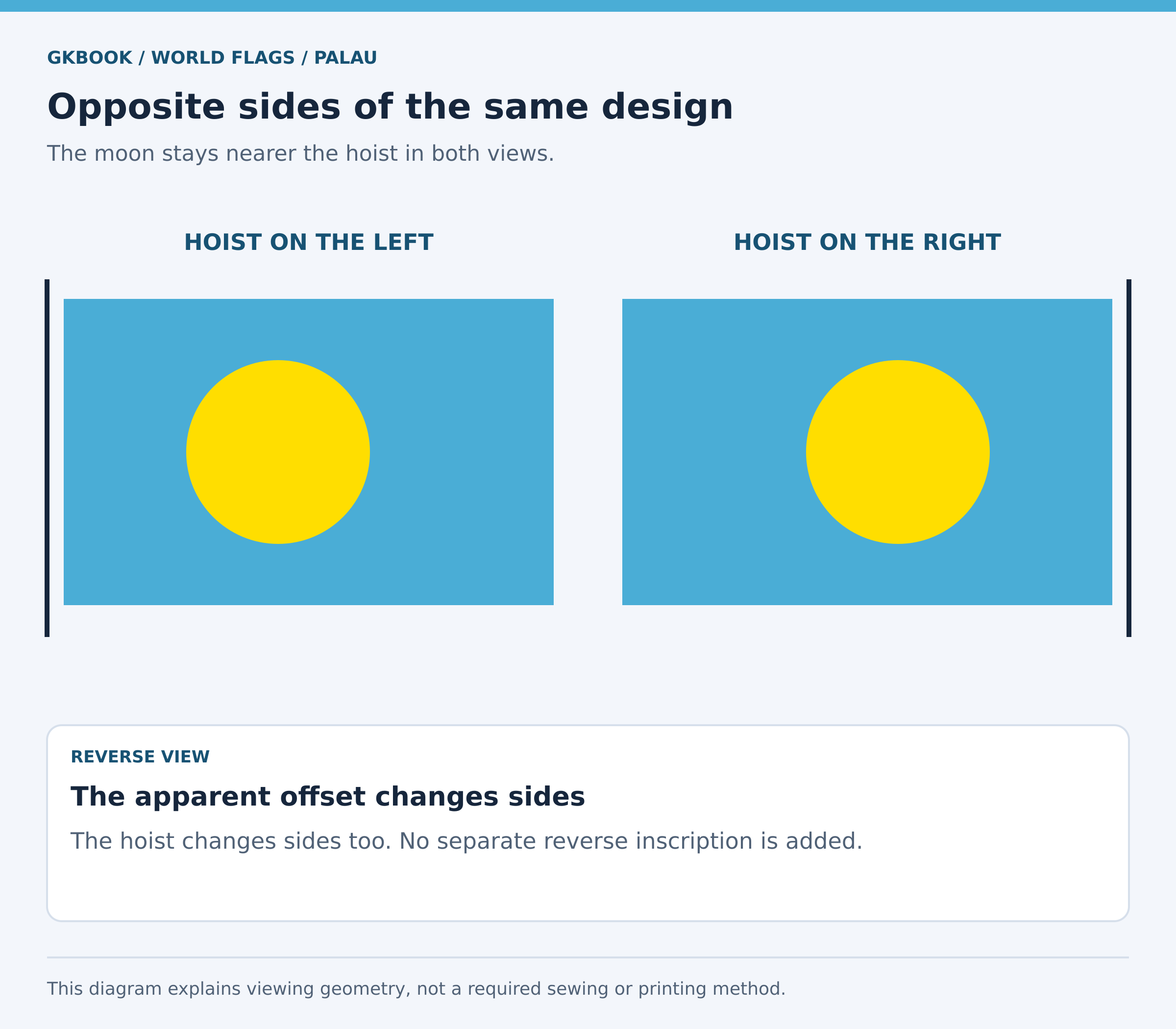
From the opposite side of the same flag, the design appears horizontally mirrored. When the hoist is on the viewer’s right, the moon sits slightly right of the rectangle’s center, still closer to the hoist. The design has no separate reverse inscription or additional emblem that needs to be inserted.
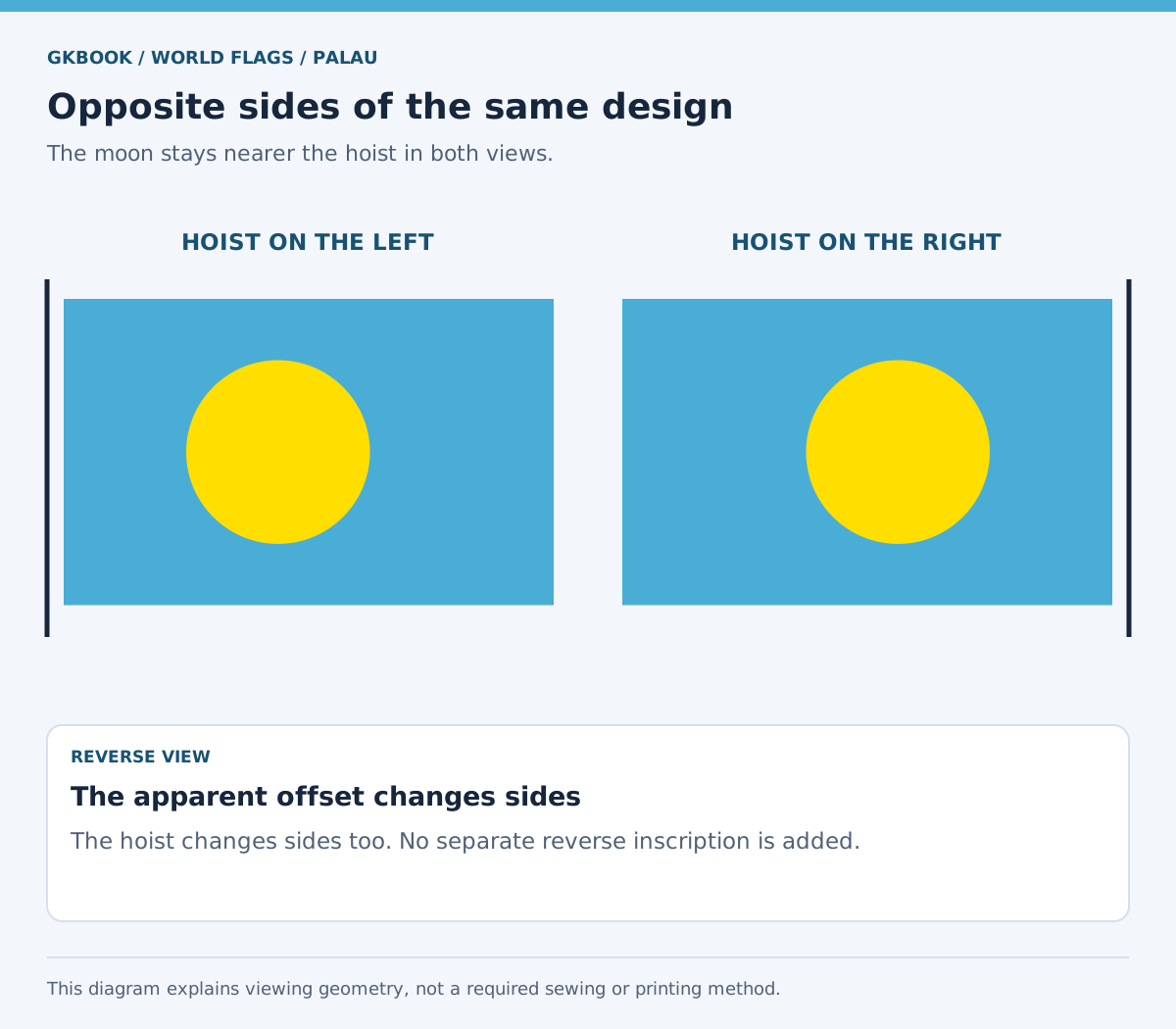
The important relationship is to the pole-side edge, not permanently to the viewer’s left. The reverse illustration therefore places poles on opposite sides of its two examples. This makes it clear that the moon has not been arbitrarily moved away from the hoist in the second view.
For a website’s standard flat reference, use the conventional hoist-left presentation. Use the mirrored version only when explaining the opposite viewing side. This geometric account does not prescribe how a manufacturer should print, sew, or assemble a particular double-sided ceremonial flag.
What happens when the flag is shown vertically?
Rotating the complete hoist-left reference ninety degrees clockwise places the original hoist at the top and shifts the moon slightly above the vertical image’s center. The gallery shows this geometric transformation explicitly. It is an educational orientation example, not a claim that this review verified a universal Palauan rule for vertical display.
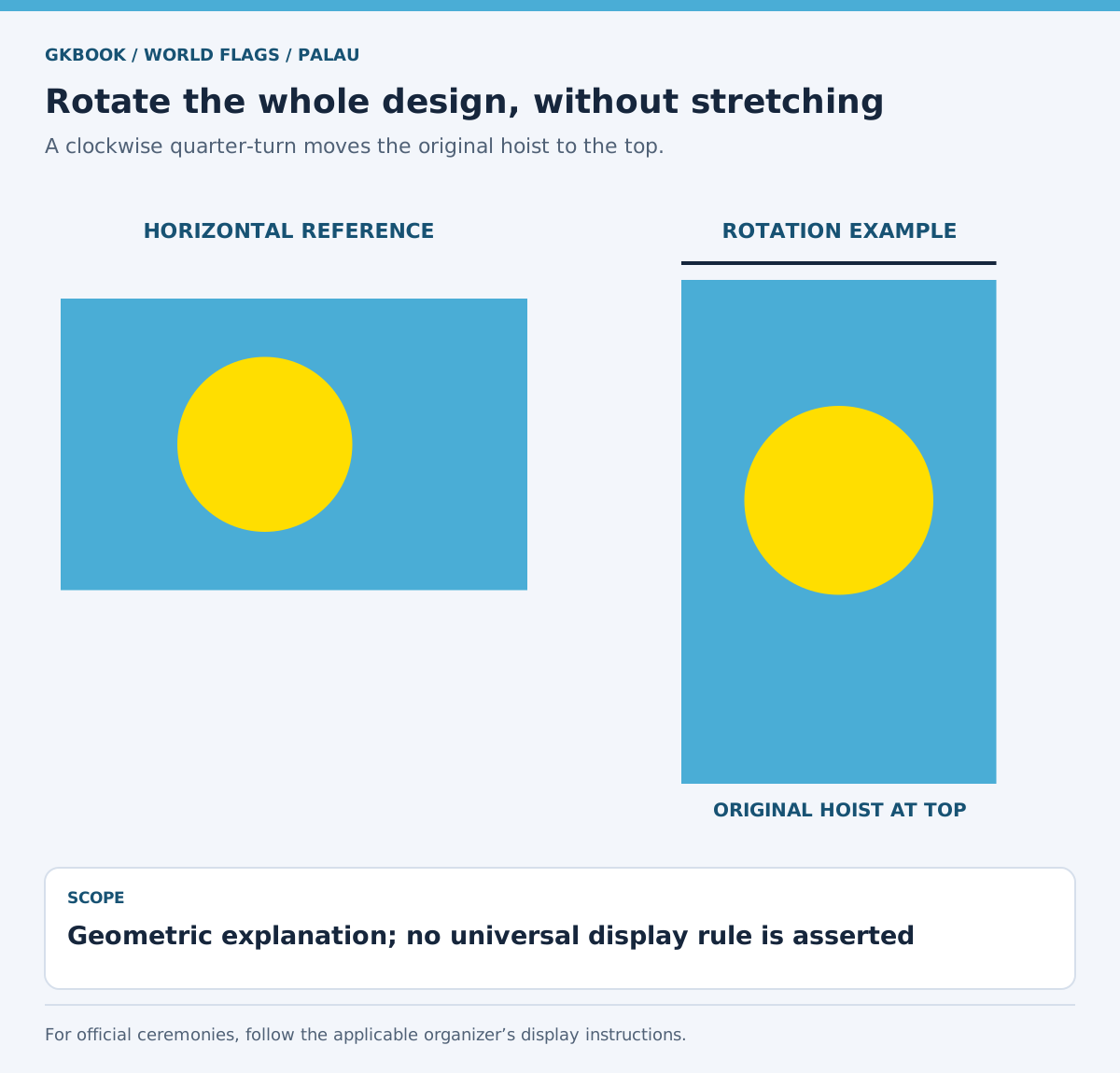
The rotated canvas has width:height 5:8, while the moon remains circular. On a rotated 1,500 × 2,400 master, its center is (750, 1,050) and its radius is still 450. The shorter margin remains beside the original hoist, now at the top of the image.
Rotation and stretching are different operations. Turning the whole design preserves every distance and proportion; squeezing a horizontal flag into a tall box does not. For an actual official ceremony, use the relevant organizer’s instructions rather than treating a mathematical demonstration as a complete protocol manual.
What is the history of the Palau flag?
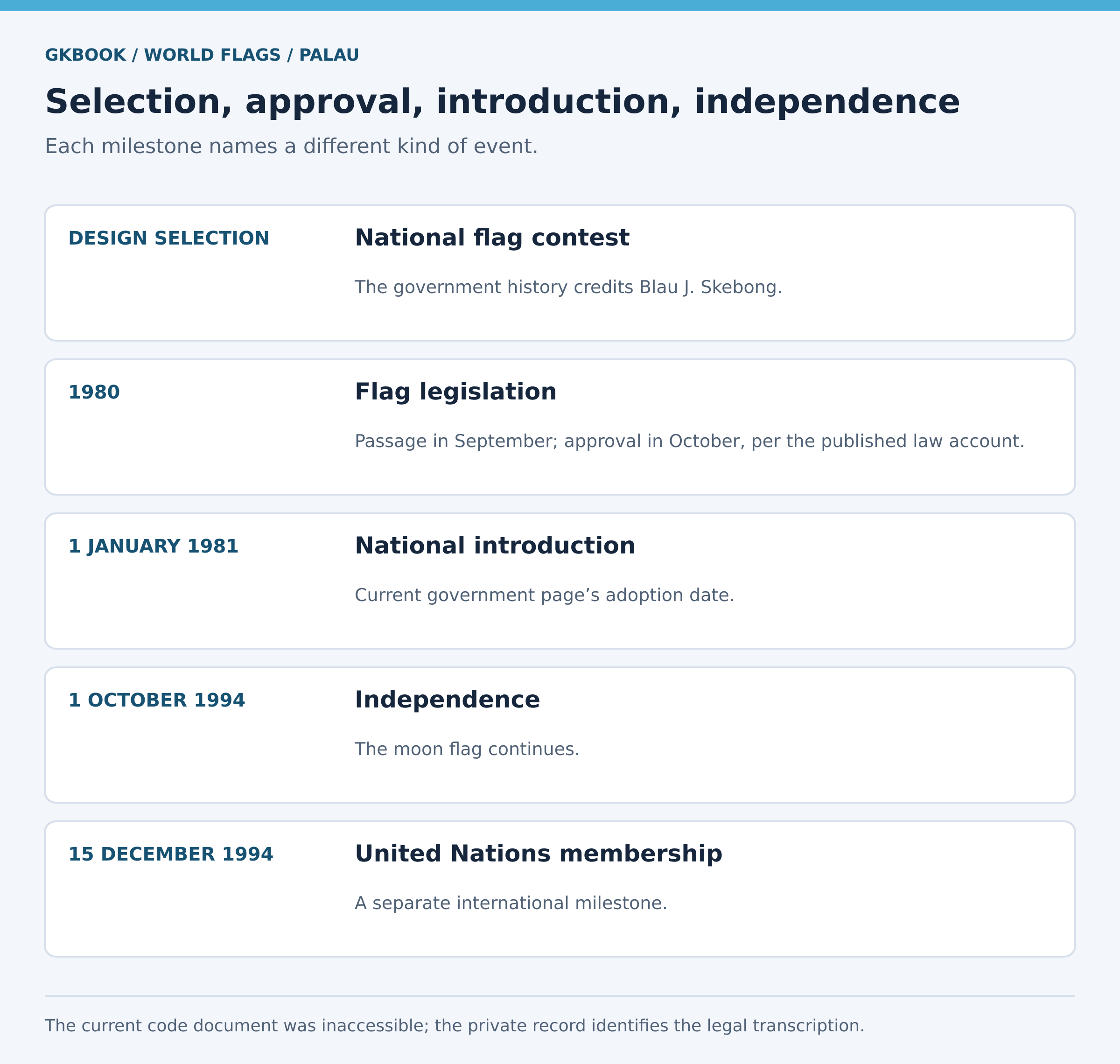
The design emerged from Palau’s transition toward its own constitutional government. Blau J. Skebong’s entry was selected in a national flag competition, and the flag law followed in 1980. The familiar design was introduced with the republic in 1981 and continued when independence came on October 1, 1994.

The history is best read as a sequence of different events: selecting a design, legally approving it, introducing it publicly, and later attaining independence. A single undifferentiated “adoption” date can obscure those distinctions. The timeline labels what happened at each stage rather than treating every milestone as a new flag.
The same caution applies to illustrations. The gallery’s historical cards identify events using the present geometric reference; they are not facsimiles of surviving ceremonial cloths or photographs of particular flag raisings. Differences in a modern drawing’s screen palette do not by themselves establish a historical redesign.
Who designed the Palau flag?
The archived Palauan government history credits Blau J. Skebong of Ngeremlengui with the entry selected as the national flag. Shorter accounts often write his name as Blau Skebong. This design credit should be distinguished from the commission’s selection, legislative approval, and any separate work of sewing or manufacturing a physical flag.

The government account describes an organized national contest and a commission reviewing submissions. That provides context for the individual credit: a designer proposed an image, while public bodies handled the selection and adoption process. It is unnecessary to assign every role in that process to the designer.
The gallery uses a typographic credit card rather than an invented portrait. It also avoids a definitive total of competition entries because the consulted accounts differ in detail. Naming the documented designer does not require repeating every unverified anecdote about the contest or the first cloth produced.
When was the Palau flag adopted?
Palau’s current government flag page gives January 1, 1981, as the adoption date. The underlying flag law belongs to 1980: the published legislative account records passage on September 18 and approval on October 22. These dates describe different stages, while October 1, 1994, marks national independence rather than a new flag design.
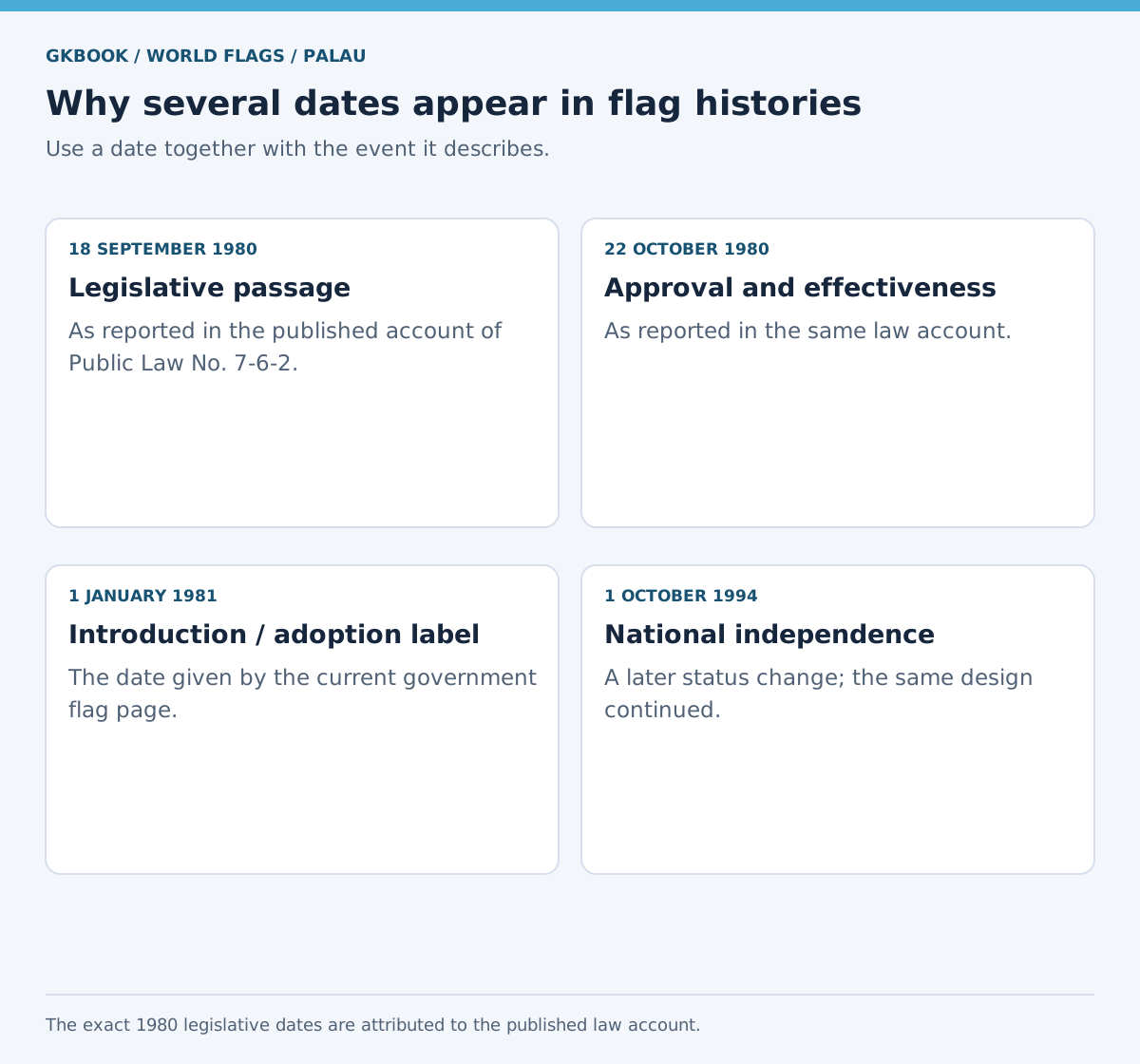
For a short public label, January 1, 1981 follows the current government’s presentation. A fuller historical account should also explain the earlier legislative dates instead of silently replacing one with another. The gallery separates passage, approval, introduction, and independence so readers can see exactly what each date describes.
The exact 1980 sequence is attributed here to the specialist’s published account of the act; the current code document was not retrievable during this review. That access limit matters when evaluating legal detail, but it does not justify changing the clearly documented 1981 introduction into a 1994 adoption.
| Date | Event |
|---|---|
| September 18, 1980 | Legislative passage, as reported in the law account |
| October 22, 1980 | Approval and effectiveness, as reported in the law account |
| January 1, 1981 | Introduction; current government’s adoption date |
| October 1, 1994 | Independence and entry into force of free association |
What was Public Law No. 7-6-2?
Public Law No. 7-6-2 was the 1980 act establishing the flag of the Republic of Palau. Its published transcription specifies the blue field, yellow moon, outer proportions, disk diameter, and hoistward placement. This article uses those construction details while documenting that the complete current code text could not be retrieved.
The reported legislative setting is the Seventh Palau Legislature’s sixth regular session. That historical body and date should not be casually replaced with a later institutional label. The law’s description provides a construction basis, while the subsequent government history supplies additional explanation of the design and its meanings.
The article does not extend a limited construction passage into unverified claims about penalties, compulsory display schedules, or permission for every use. Those subjects would require the applicable complete provisions. The private research record distinguishes the directly read government account, the legal transcription, and the inaccessible current code document.
Was Palau fully independent when the flag appeared in 1981?
No. The flag’s 1981 introduction accompanied Palau’s constitutional republic, but full independence came in 1994. The United States’ historical account places the end of U.S. trusteeship and the start of free association on October 1, 1994. A flag can represent a developing national government before that later international status is reached.
The terms “republic,” “self-government,” and “independence” answer different historical questions. A concise flag page may compress the transition into a sentence, but that should not lead a reader to conclude that the international trusteeship had already ended in 1981. The separate dates preserve the distinction.
For teaching, pair each year with its event: introduction of the national flag in 1981, independence in 1994. This approach is clearer than asking one date to stand for the entire constitutional process. It also explains why the continuing flag does not need a new design simply because political status changes.
Did Palau change its flag at independence in 1994?
The blue-and-yellow moon flag continued when Palau became independent on October 1, 1994. Independence did not introduce a new national design. The earlier flag had already represented Palau’s emerging government, so its continued use links the 1981 introduction with the country’s later sovereign status and free association with the United States.

A retained flag can acquire a new historical context without gaining a new stripe, emblem, or proportion. Here the political milestone and the visual continuity belong in the same account. A timeline should therefore show a change of status at 1994 rather than depict an invented replacement flag.
The comparison card uses identical geometric references on both sides of the milestone. This demonstrates continuity of design only. It makes no claim that two actual ceremonial flags had precisely identical dyes, stitching, folds, or dimensions, and it does not pretend to reproduce archival photographs.
When did Palau join the United Nations?
Palau became a United Nations member on December 15, 1994, according to its permanent mission. That was after independence on October 1 of the same year. UN admission is a separate international milestone; it is neither the flag’s 1981 introduction nor evidence that the national design changed in December 1994.
Keeping admission separate from independence helps when reading captions for international flag displays. A country’s flag may appear in photographs of its admission ceremony, but the date of that ceremony is not automatically the date when the design was first adopted or used nationally.
The timeline in this guide labels December 15 specifically as UN membership. Its use of the familiar moon flag identifies Palau in that event without claiming a new symbol was created for it. The political history and the design history intersect, but they should not be collapsed into a single date.
Does the Palau flag include the government seal?
The ordinary national flag contains only the blue field and yellow moon; it does not include the government seal. An official seal, a presidential display, and the national flag are different kinds of symbol. Adding a seal, text, or decorative badge would change the plain reference shown in this guide.

A government document may place several national identifiers on the same page. That arrangement does not make all of them components of the flag. When checking a flag image, compare its contents with the design description rather than copying every symbol visible on a government website or ceremonial backdrop.
The gallery explains this distinction with text beside an intact flag. It does not invent a simplified official seal or offer an unverified presidential standard as a substitute. A separate emblem would require its own accurate artwork, source history, and intended-use caption.
Can the Palau flag be cropped into a square or circle?
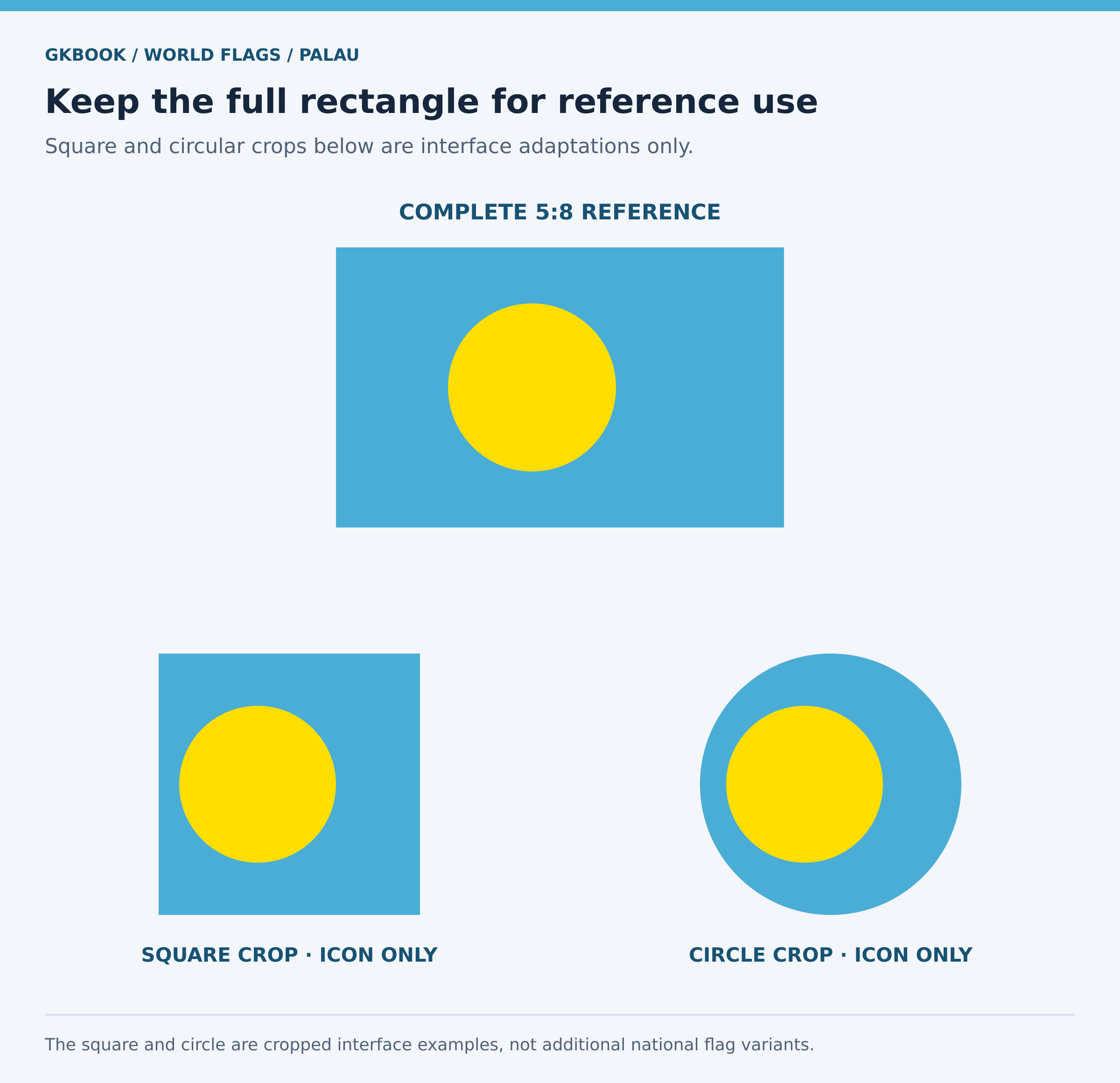
A square or circular crop can serve as an interface icon, but it no longer shows the complete 5:8 national flag. Cropping removes blue space and can obscure the moon’s deliberate offset. For an accurate reference, fit the intact rectangle inside the thumbnail area and preserve all four outer edges.
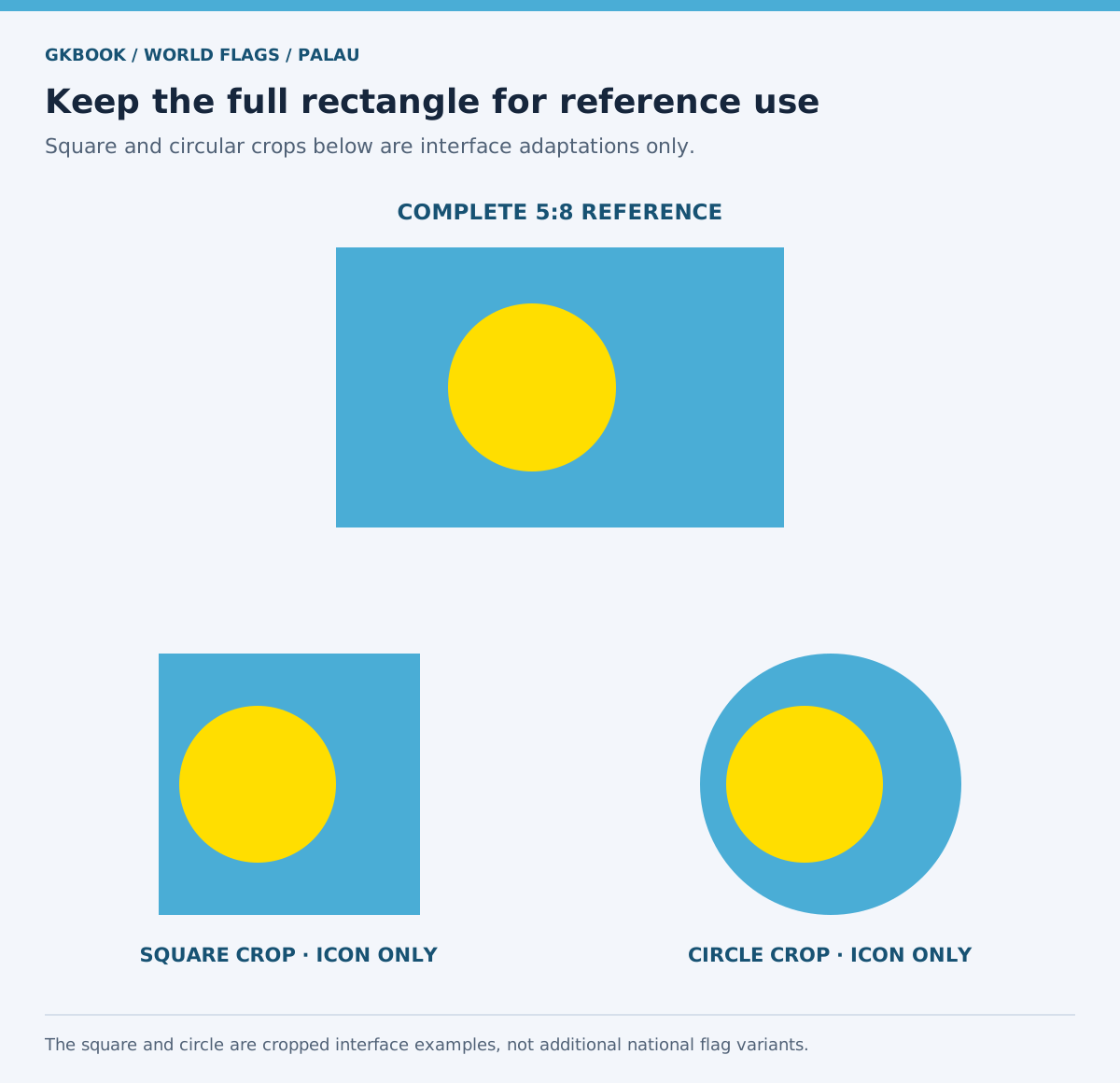
An icon is a layout adaptation, not a new legal flag variant. Its apparent balance depends on how the crop is positioned, so a viewer may incorrectly infer that the disk is centered or has different margins. The gallery labels both cropped examples as icons only.
A practical alternative is to use a neutral surrounding card and scale the complete flag within it. The extra space belongs to the interface, outside the flag. Keep that distinction visible: do not draw a white frame inside the national design or stretch the blue field to fill the card.
What are the most common mistakes in drawing or describing the flag?
Common mistakes include centering the moon horizontally, using the wrong rectangle ratio, drawing an ellipse, calling the moon a sun, adding a seal, and treating 1994 as the flag’s first adoption. Also avoid presenting convenient hex colors as certified official standards or confusing the moon’s radius with its diameter.
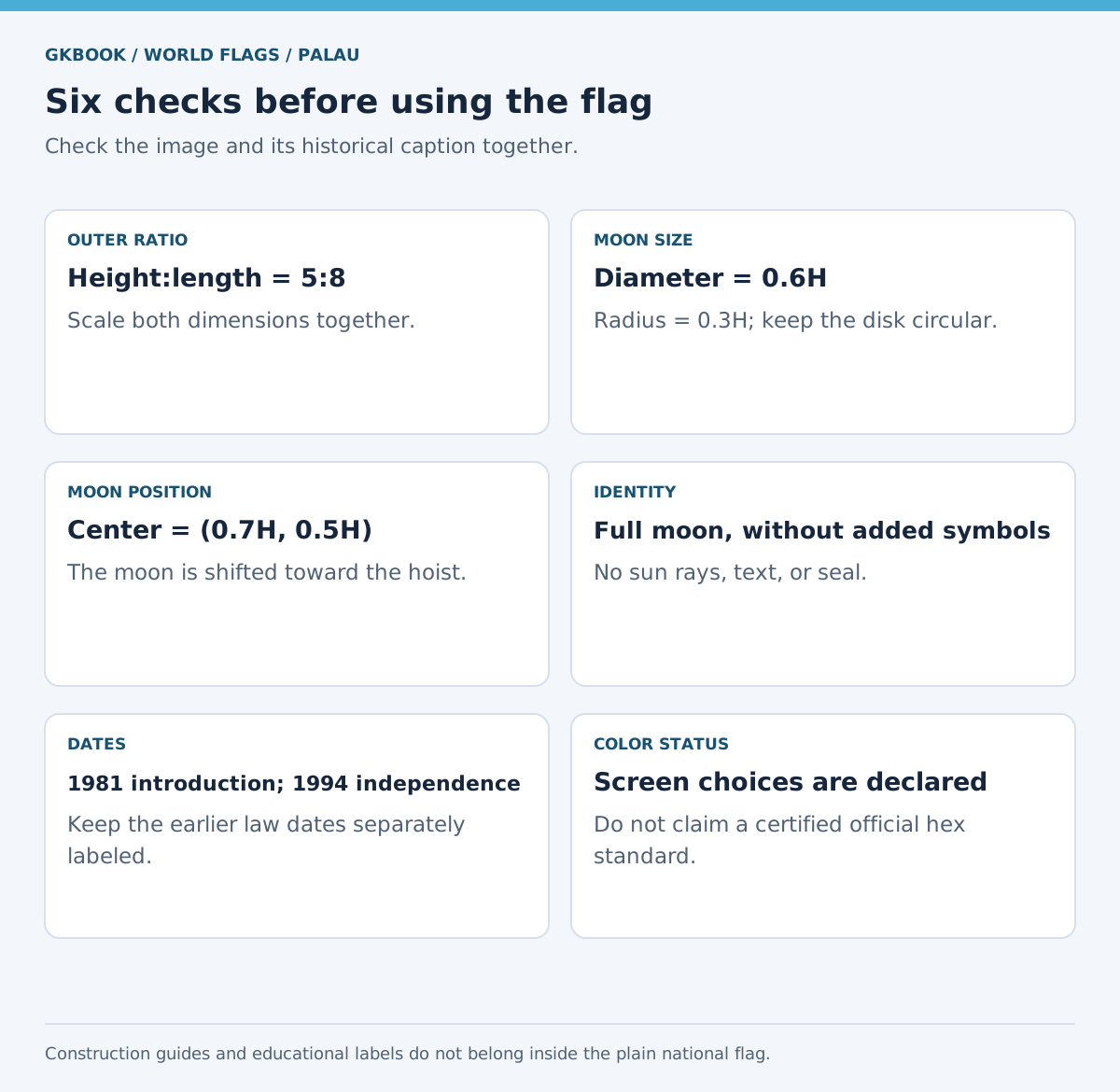
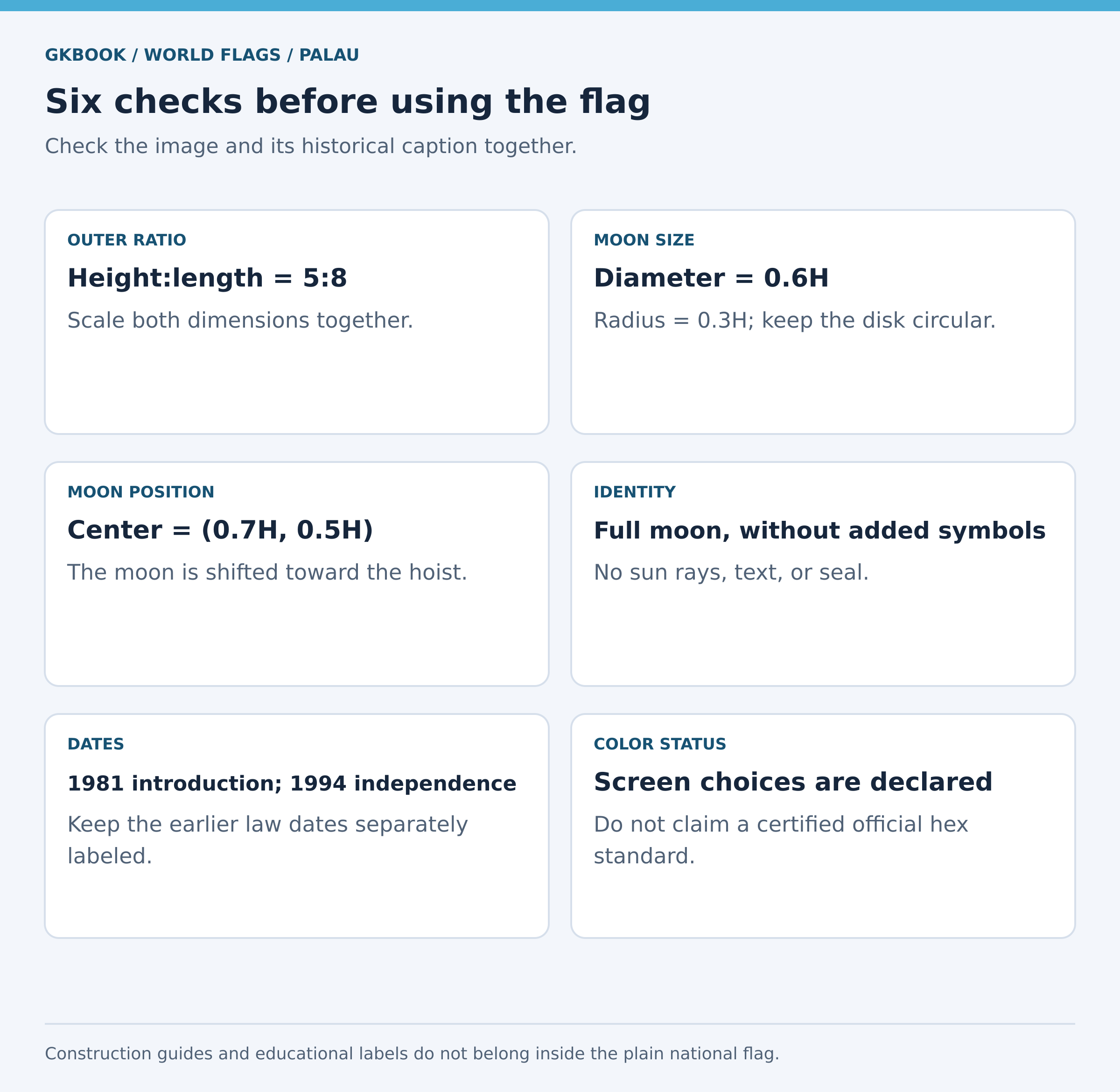
Check the design in a consistent order: outer rectangle, disk size, disk center, and then color status. The margins provide a second geometric check. For the historical caption, identify whether a date refers to passage, approval, introduction, independence, or UN membership before attaching it to the word “adopted.”
The supplied files keep the plain flag separate from annotated educational compositions. Dimension lines, center marks, titles, and explanatory cards are useful for learning but are not parts of the national symbol. Choose the plain SVG or PNG when the intended use calls for an intact flag reference.
Download Palau flag pictures
Download the plain flag as SVG or 4,800 × 3,000 PNG. The SVG uses a 2,400 × 1,500 coordinate system and remains scalable. The gallery contains 24 subjects with paired SVG and PNG files, including construction, history, and comparison diagrams. Image credits and construction notes record the reconstruction method and artwork status.
Explore more in World Flags, including the Nauru flag and New Zealand flag.
World Flags/Palau
Palau flag pictures
GKBook educational reconstruction. The 5:8 rectangle and moon diameter follow the archived Palauan government description; the exact hoist offset follows the published transcription of Public Law No. 7-6-2. Screen colors #4AADD6 and #FFDE00 are declared digital choices, not certified official color codes.
GKBook original educational vector construction.Download SVGDownload PNGThe ordinary national design contains a blue field and a yellow full moon, with no stripes, stars, lettering, border, or seal.
GKBook original educational vector construction.Download SVGDownload PNGThe supplied artwork uses blue #4AADD6 and yellow #FFDE00. These are declared screen choices, not certified official color codes.
GKBook original educational vector construction.Download SVGDownload PNGThe government history connects the moon with tradition and national emergence, blue with the ocean and emergence from foreign rule, and yellow with maturity and opportunity.
GKBook original educational vector construction.Download SVGDownload PNGThe isolated disk is a detail of the national flag. It remains a simple filled circle rather than a realistic lunar illustration.
GKBook original educational vector construction.Download SVGDownload PNGThe complete rectangle is eight units long and five high. All dimensions, including the disk and its offset, scale together.
GKBook original educational vector construction.Download SVGDownload PNGThe disk diameter is 0.6H and radius is 0.3H. H is the complete flag height, not its longer horizontal length.
GKBook original educational vector construction.Download SVGDownload PNGThe exact hoist offset follows the published law transcription. The moon is halfway down the height and 43.75 percent along the complete length.
GKBook original educational vector construction.Download SVGDownload PNGThe hoistward shift equals L/16 or H/10. The government page explains the shift in terms of apparent balance when the flag hangs.
GKBook original educational vector construction.Download SVGDownload PNGThe three-unit disk leaves two units of blue at the hoist and three at the fly; one unit remains above and below. These are edge-to-edge spaces.
GKBook original educational vector construction.Download SVGDownload PNGDoubling the eight-by-five grid gives whole-number center coordinates and radius without changing any proportions.
GKBook original educational vector construction.Download SVGDownload PNGConstruct the 8:5 rectangle, locate the measured center, add the circle, then remove the guides. Intermediate panels are instructional stages.
GKBook original educational vector construction.Download SVGDownload PNGThese uniformly scaled examples preserve the same 5:8 height:length ratio and all internal measurements. They are not a prescribed physical-size list.
GKBook original educational vector construction.Download SVGDownload PNGUnequal horizontal and vertical scaling turns the moon into an ellipse. The altered example is deliberately labeled as a demonstration.
GKBook original educational vector construction.Download SVGDownload PNGThe complete flag has horizontal mirror symmetry, but its hoistward moon offset prevents vertical mirror symmetry or half-turn symmetry in a fixed reference.
GKBook original educational vector construction.Download SVGDownload PNGThe reverse appears horizontally mirrored. With the hoist on the right, the disk sits right of center but remains nearer the hoist.
GKBook original educational vector construction.Download SVGDownload PNGA clockwise rotation preserves the circle and places the moon slightly above the center of the tall canvas. This is an educational transformation, not verified universal protocol.
GKBook original educational vector construction.Download SVGDownload PNGThe sequence separates national selection, the 1980 law, the 1981 introduction, independence in October 1994, and UN membership in December 1994.
GKBook original educational vector construction.Download SVGDownload PNGThe archived Bureau of Domestic Affairs account names Blau J. Skebong of Ngeremlengui. Shorter sources often use Blau Skebong.
GKBook original educational vector construction.Download SVGDownload PNGThe law’s reported passage and approval precede the January 1, 1981 introduction. Independence in 1994 is a separate event.
GKBook original educational vector construction.Download SVGDownload PNGThe blue-and-yellow moon flag continued at independence on October 1, 1994. The diagram uses matching modern references to show that continuity.
GKBook original educational vector construction.Download SVGDownload PNGThe national flag description contains only the blue field and yellow moon. The gallery does not substitute an invented seal or presidential standard.
GKBook original educational vector construction.Download SVGDownload PNGCrops remove blue margins and can obscure the intentional offset. Fit the intact 5:8 rectangle inside a thumbnail for an accurate reference.
GKBook original educational vector construction.Download SVGDownload PNGCheck ratio, disk size, hoistward offset, full-moon identity, historical dates, and the status of numerical colors.
GKBook original educational vector construction.Download SVGDownload PNGFrequently asked questions
What does Palau’s flag look like?
Palau’s flag has a golden-yellow full moon on a sky-blue field, with the moon shifted slightly toward the hoist. Its height:length ratio is 5:8. Introduced on January 1, 1981, the design is credited to Blau J. Skebong and remained in use when Palau became independent in 1994.
What is the design of the Palau flag?
Palau’s national flag consists of a sky-blue rectangle and one golden-yellow circular disk representing the full moon. The disk is vertically centered but sits closer to the hoist than the fly. There are no stars, stripes, lettering, rays, borders, or additional emblems inside the standard design.
What are the colors of the Palau flag?
The flag’s colors are sky blue and golden yellow. This package uses #4AADD6 for blue and #FFDE00 for yellow as declared screen choices. These hexadecimal values make the downloadable images consistent, but they are not presented as legally prescribed codes or certified matches for printed ink or fabric.
Does Palau prescribe exact Pantone or RGB flag colors?
The government description consulted names sky blue and golden yellow without supplying a unique RGB or Pantone specification. Published flag references and event manuals use differing color values. Consequently, this guide distinguishes the named colors from its chosen digital palette and does not label one commercial color conversion as universally official.
What does the Palau flag symbolize?
The full moon connects the flag with Palauan traditions and the country’s emergence as a nation. An archived government account gives blue two meanings: the surrounding Pacific Ocean and emergence from foreign rule. It connects golden yellow with national maturity and a future offering opportunities to the people of Palau.
Is the yellow circle a moon or a sun?
The yellow circle represents the full moon, not the sun. Palauan government descriptions identify it explicitly as a moon and connect it with traditional timing and national emergence. Its circular shape is intentionally simple: the national flag does not add sun rays, a face, craters, or a crescent-shaped opening.
Does the blue represent the ocean or self-government?
Both meanings appear in the archived Palauan government explanation: blue refers to the Pacific Ocean and emergence from the rule of other countries. The current government’s shorter flag page emphasizes the ocean. Presenting these as complementary documented meanings is more accurate than insisting that only one interpretation is permitted.
Why is the full moon significant in the flag’s explanation?
Official explanations connect the full moon with traditional activities such as fishing, planting, and harvesting. The archived account also places the moon within a wider Palauan cultural narrative. These are statements about the symbol’s cultural significance; they should not be rewritten as a scientific guarantee that every activity succeeds at full moon.
What is the ratio of the Palau flag?
Palau’s flag has a height:length ratio of 5:8, equivalent to length:height 8:5. The archived government description expresses the relationship as 1.0 to 1.6. A flag 1,500 units high is therefore 2,400 units long, and all internal measurements should scale with those same outer dimensions.
How large is the moon on the Palau flag?
The moon’s diameter is three-fifths of the flag’s height, or 0.6H. Its radius is three-tenths of the height, or 0.3H. On the supplied 2,400 × 1,500 master, the diameter is 900 units and the radius is 450 units, with no outline stroke added.
Where is the moon’s center placed?
The moon’s center is halfway down the flag and 0.7 times the flag height from the hoist. With the hoist on the left, its coordinates are x = 0.7H and y = 0.5H. On the 2,400 × 1,500 master, that point is (1,050, 750).
Why is the moon off-center toward the hoist?
The offset is part of the design, not an error in reproduction. The government’s flag page explains that it helps the moon appear centered when the flag hangs. Geometrically, the center is displaced toward the hoist by one-sixteenth of the total length, equal to one-tenth of the flag’s height.
How much blue space surrounds the moon?
On an eight-by-five construction grid, the moon occupies three units across. The blue margins are two units at the hoist, three at the fly, and one each above and below. Thus the horizontal sequence is 2 + 3 + 3, while the vertical sequence is 1 + 3 + 1.
What construction grid is easiest to use?
An eight-unit length and five-unit height make a convenient Palau flag grid. Put the moon center at (3.5, 2.5) and give it radius 1.5 units. For whole-number coordinates, double everything to a sixteen-by-ten grid with center (7, 5) and radius 3, preserving exactly the same design.
How can you draw the Palau flag accurately?
Draw a rectangle eight units long and five high, then fill it sky blue. Mark a point 3.5 units from the hoist and 2.5 units from the top. Draw a golden-yellow circle of radius 1.5 units at that point, then remove every construction line and center mark.
What digital dimensions preserve the flag correctly?
Any uniformly scaled 8:5 image preserves the standard geometry. Examples include 800 × 500, 1,600 × 1,000, and 2,400 × 1,500 pixels, written length × height. The supplied plain PNG is 4,800 × 3,000 pixels. These are practical digital examples, not a government-prescribed list of physical flag sizes.
How can you check that the moon is a true circle?
Measure the disk’s horizontal and vertical diameters: they must be equal in a flat, undistorted reference. Both should equal three-fifths of the flag height. If the rectangle has been stretched to a different ratio, the disk usually becomes an ellipse, even when its center still appears to be correctly placed.
Is the Palau flag symmetrical?
In a fixed hoist-left view, Palau’s flag has mirror symmetry across its horizontal centerline. It does not have mirror symmetry across the vertical centerline because the moon is offset. A half-turn also changes that fixed reference. The circle itself is more symmetric than the complete rectangular flag around it.
What does the reverse side of the Palau flag look like?
From the opposite side of the same flag, the design appears horizontally mirrored. When the hoist is on the viewer’s right, the moon sits slightly right of the rectangle’s center, still closer to the hoist. The design has no separate reverse inscription or additional emblem that needs to be inserted.
What happens when the flag is shown vertically?
Rotating the complete hoist-left reference ninety degrees clockwise places the original hoist at the top and shifts the moon slightly above the vertical image’s center. The gallery shows this geometric transformation explicitly. It is an educational orientation example, not a claim that this review verified a universal Palauan rule for vertical display.
What is the history of the Palau flag?
The design emerged from Palau’s transition toward its own constitutional government. Blau J. Skebong’s entry was selected in a national flag competition, and the flag law followed in 1980. The familiar design was introduced with the republic in 1981 and continued when independence came on October 1, 1994.
Who designed the Palau flag?
The archived Palauan government history credits Blau J. Skebong of Ngeremlengui with the entry selected as the national flag. Shorter accounts often write his name as Blau Skebong. This design credit should be distinguished from the commission’s selection, legislative approval, and any separate work of sewing or manufacturing a physical flag.
When was the Palau flag adopted?
Palau’s current government flag page gives January 1, 1981, as the adoption date. The underlying flag law belongs to 1980: the published legislative account records passage on September 18 and approval on October 22. These dates describe different stages, while October 1, 1994, marks national independence rather than a new flag design.
What was Public Law No. 7-6-2?
Public Law No. 7-6-2 was the 1980 act establishing the flag of the Republic of Palau. Its published transcription specifies the blue field, yellow moon, outer proportions, disk diameter, and hoistward placement. This article uses those construction details while documenting that the complete current code text could not be retrieved.
Was Palau fully independent when the flag appeared in 1981?
No. The flag’s 1981 introduction accompanied Palau’s constitutional republic, but full independence came in 1994. The United States’ historical account places the end of U.S. trusteeship and the start of free association on October 1, 1994. A flag can represent a developing national government before that later international status is reached.
Did Palau change its flag at independence in 1994?
The blue-and-yellow moon flag continued when Palau became independent on October 1, 1994. Independence did not introduce a new national design. The earlier flag had already represented Palau’s emerging government, so its continued use links the 1981 introduction with the country’s later sovereign status and free association with the United States.
When did Palau join the United Nations?
Palau became a United Nations member on December 15, 1994, according to its permanent mission. That was after independence on October 1 of the same year. UN admission is a separate international milestone; it is neither the flag’s 1981 introduction nor evidence that the national design changed in December 1994.
Does the Palau flag include the government seal?
The ordinary national flag contains only the blue field and yellow moon; it does not include the government seal. An official seal, a presidential display, and the national flag are different kinds of symbol. Adding a seal, text, or decorative badge would change the plain reference shown in this guide.
Can the Palau flag be cropped into a square or circle?
A square or circular crop can serve as an interface icon, but it no longer shows the complete 5:8 national flag. Cropping removes blue space and can obscure the moon’s deliberate offset. For an accurate reference, fit the intact rectangle inside the thumbnail area and preserve all four outer edges.
What are the most common mistakes in drawing or describing the flag?
Common mistakes include centering the moon horizontally, using the wrong rectangle ratio, drawing an ellipse, calling the moon a sun, adding a seal, and treating 1994 as the flag’s first adoption. Also avoid presenting convenient hex colors as certified official standards or confusing the moon’s radius with its diameter.
Explore all general-knowledge topics and the A-to-Z lists.









We Value Your Opinion Comments