

Peru flag picture
Explore the proportions, history, and picture gallery.
| Design | Three equal vertical bandsRed, white, red; ordinary national flag has no emblem. |
|---|---|
| Proportions | Height:length = 2:3SVG: 2,400 × 1,600; PNG: 4,800 × 3,200. |
| Foundational adoption | February 25, 1825Date identified by the current symbols law. |
| Plain ordinary form | March 31, 1950Historical regulation without a central emblem. |
| Current framework | Law 32251, published January 19, 2025National, state, and military flags distinguished. |
| Flag Day | June 7Commemorates the Battle of Arica in 1880. |
What does Peru’s flag look like?
Peru’s national flag is a rectangle divided into three equal vertical bands: red, white, and red. The ordinary national flag has no emblem. Its height:length ratio is 2:3. The foundational adoption dates to February 25, 1825; the plain form was regulated in 1950 and is expressly described in the 2025 symbols law.
Peru’s plain national flag is complete without a coat of arms. This guide explains its colors, proportions, and historical milestones, then distinguishes the current state and military versions. The gallery includes exact plain-flag geometry, clearly labeled official emblem references, and diagrams for learning and reuse.
What are the colors of the Peru flag?
Peru’s national flag uses red and white, arranged red, white, red from left to right. These illustrations use #D91023 and #FFFFFF as declared screen values. The 2025 law names the colors and assigns numerical color specifications to its implementing regulation; these hexadecimal choices are not presented as a verified statutory color standard.

A color name and a production specification answer different questions. Red identifies the two outer bands; a numerical value tells a screen or design program which red to display. The downloadable national flag uses a consistent solid fill, without a fabric texture, highlight, shadow, or artificial gradient inside the flag itself.
The flag’s white center is opaque white, rather than a transparent opening. This matters when the image is placed against a colored background. The palette table describes these particular files. It should not be treated as a certified conversion between screen RGB, printing inks, and dyed fabric; those processes require their own color controls.
| Color | Hexadecimal | RGB |
|---|---|---|
| Red | #D91023 | 217, 16, 35 |
| White | #FFFFFF | 255, 255, 255 |
What do the red and white colors mean?
Red is commonly associated with the sacrifice and blood of those who fought for Peru’s independence; white is associated with peace and purity. The Municipality of Miraflores also connects white with justice and national harmony. These civic interpretations explain the colors’ significance without proving a single historical reason for their original selection.

Miraflores used these associations when describing its red and white decorations for the independence celebrations in July 2024. The explanation connects the flag with remembrance and the aspiration to live together peacefully. It is an attributed interpretation, rather than an exclusive legal dictionary assigning one word to each stripe.
Meaning should also be separated from origin. A modern explanation of sacrifice does not by itself establish what San Martín personally intended in 1820. The familiar story involving red and white birds belongs to a different discussion about literary tradition. Both subjects can be taught without turning later symbolism into eyewitness evidence.
What is the official ratio of the Peru flag?
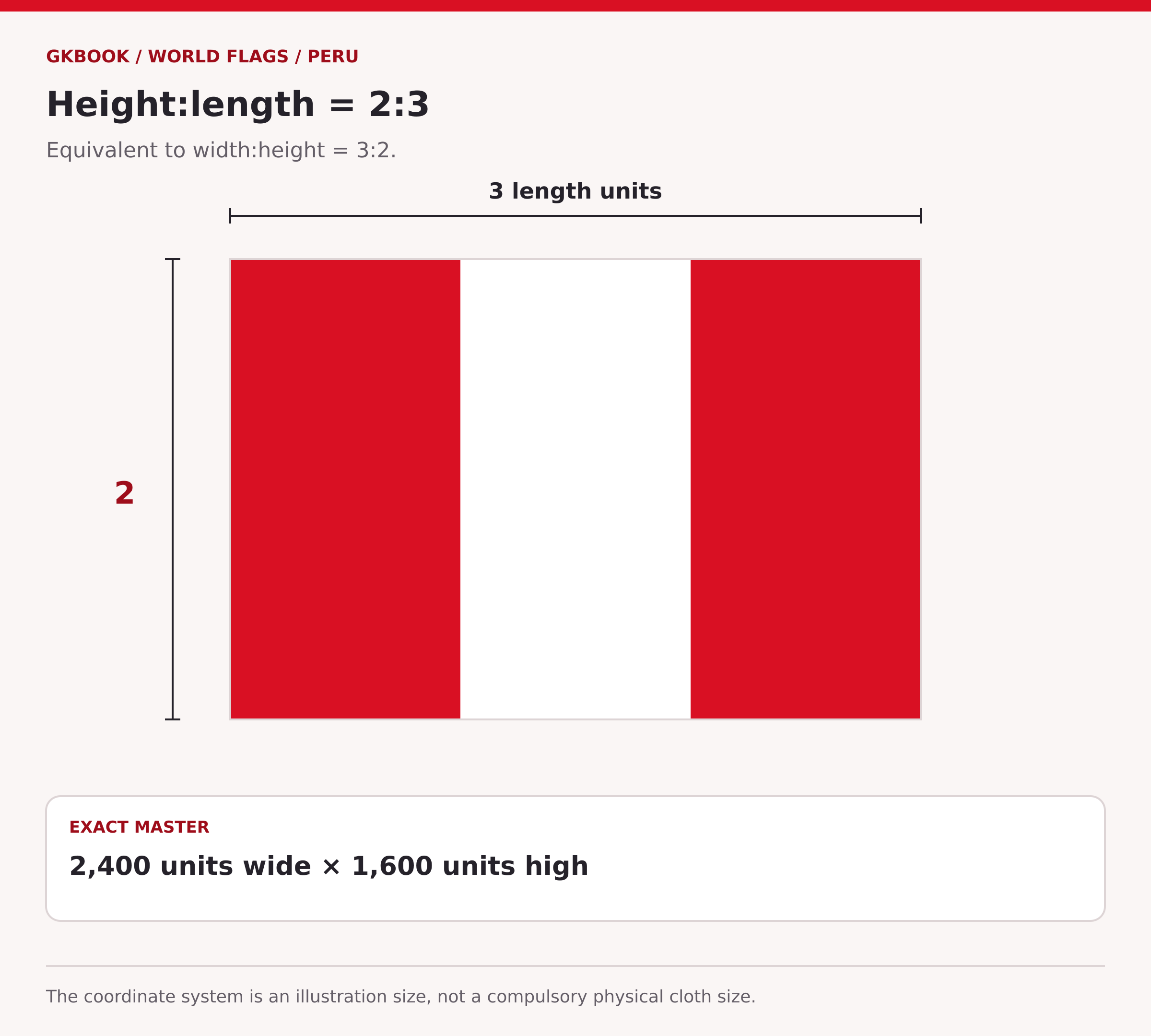
The national flag’s height:length ratio is 2:3, equivalent to width:height of 3:2. Articles 4 and 23 of Law 32251 specify this rectangular proportion. A flag 100 centimeters high is therefore 150 centimeters long. The scalable master provided here uses a 2,400 by 1,600 coordinate system, preserving exactly the same relationship.
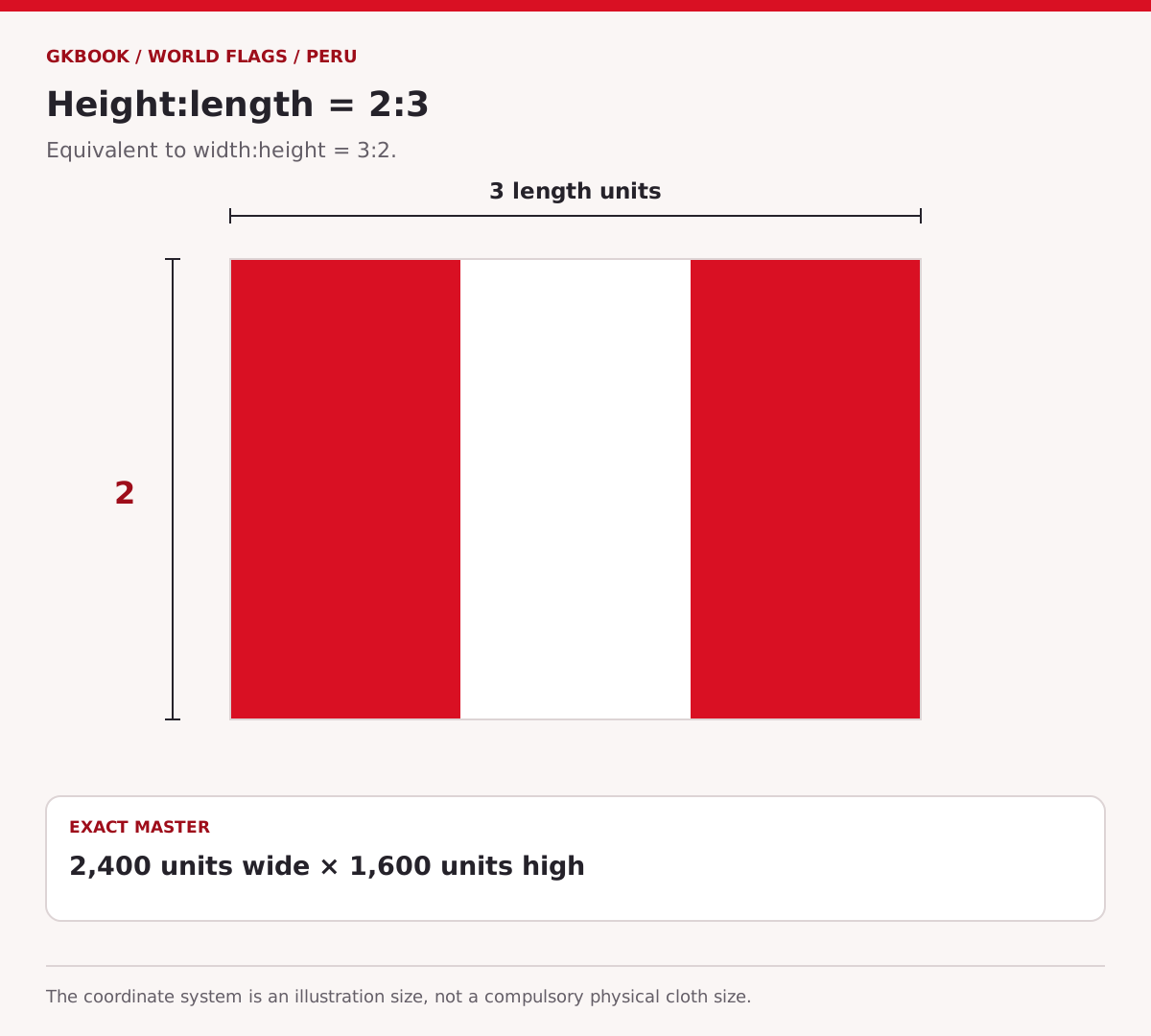
Always name the order of the measurements. A bare expression such as 2:3 can otherwise be mistaken for width followed by height. For the usual horizontal display, Peru’s flag is wider than it is tall. The three bands run vertically through the full height of that wider rectangle.
The ratio determines shape, not one compulsory size for every use. Multiplying both dimensions by the same number preserves the flag. Multiplying only the width creates a stretched image. The dimension diagram includes an external frame and measurement marks for explanation; those additions are absent from the plain SVG and PNG downloads.
How wide are the three stripes of Peru’s flag?
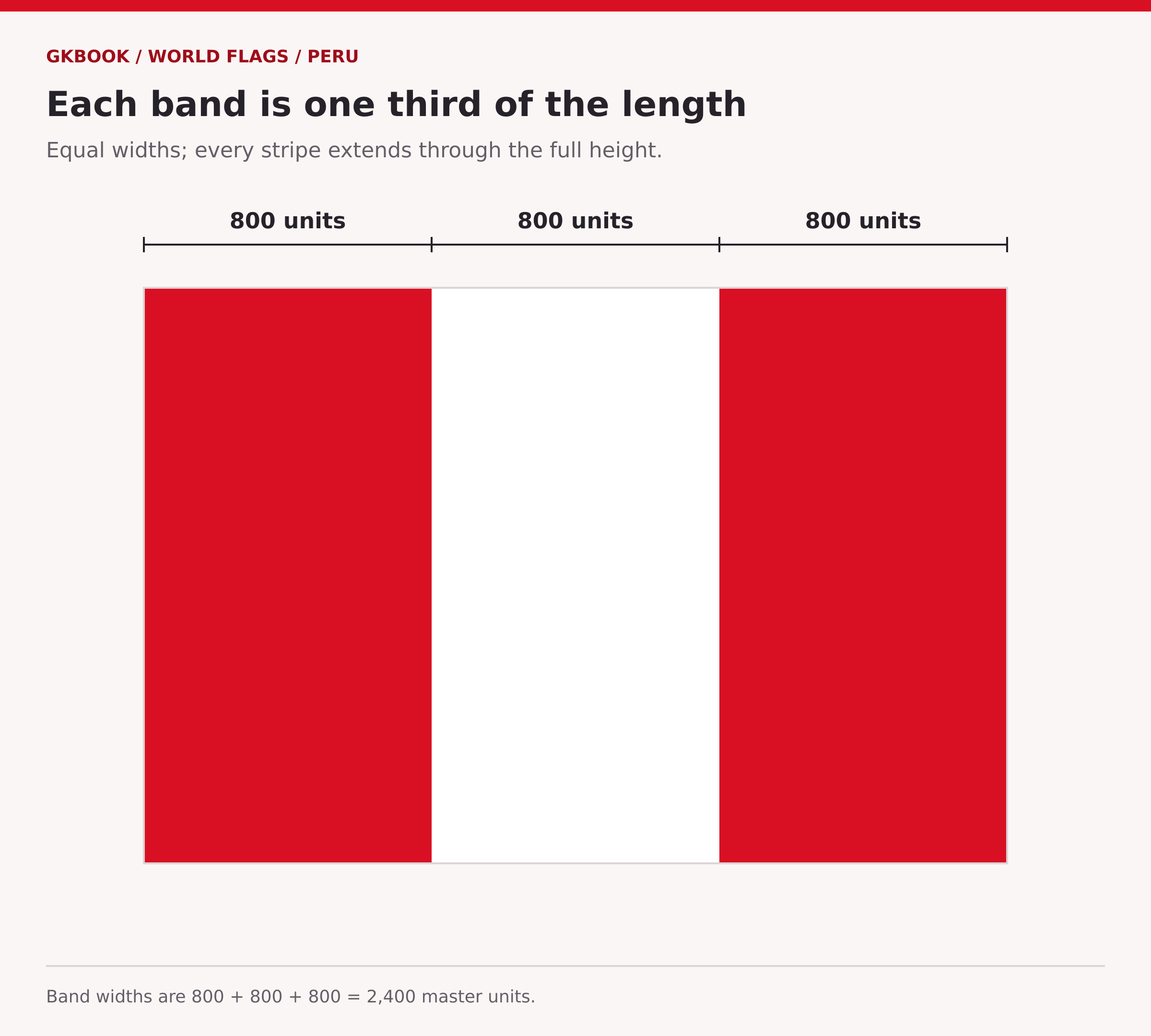
Each vertical band occupies one third of the flag’s length, and every band extends through its full height. On the 2,400 by 1,600 master, each stripe is 800 units wide. The two red stripes together cover two thirds of the plain flag; the white stripe covers the remaining third.

For a drawing measured from the upper-left corner, the first boundary is at x = 800 and the second at x = 1,600. The red band at the hoist and the red band at the fly have equal dimensions. The center is not wider merely because some related official flags carry an emblem there.
Area follows directly from this construction. Each stripe has 800 × 1,600 square coordinate units, or one third of the whole. These fractions are geometric results, not additional historical meanings. The equal divisions can also be checked in the plain-flag illustration printed in the official annex to the 2025 law.
How can you draw an accurate plain Peru flag?
Draw a rectangle three units long and two units high. Divide its length into three equal vertical bands, then fill them red, white, and red. Keep the center free of emblems and lettering. This constructs the ordinary national flag; the state and military versions require separate, correctly identified official emblems.
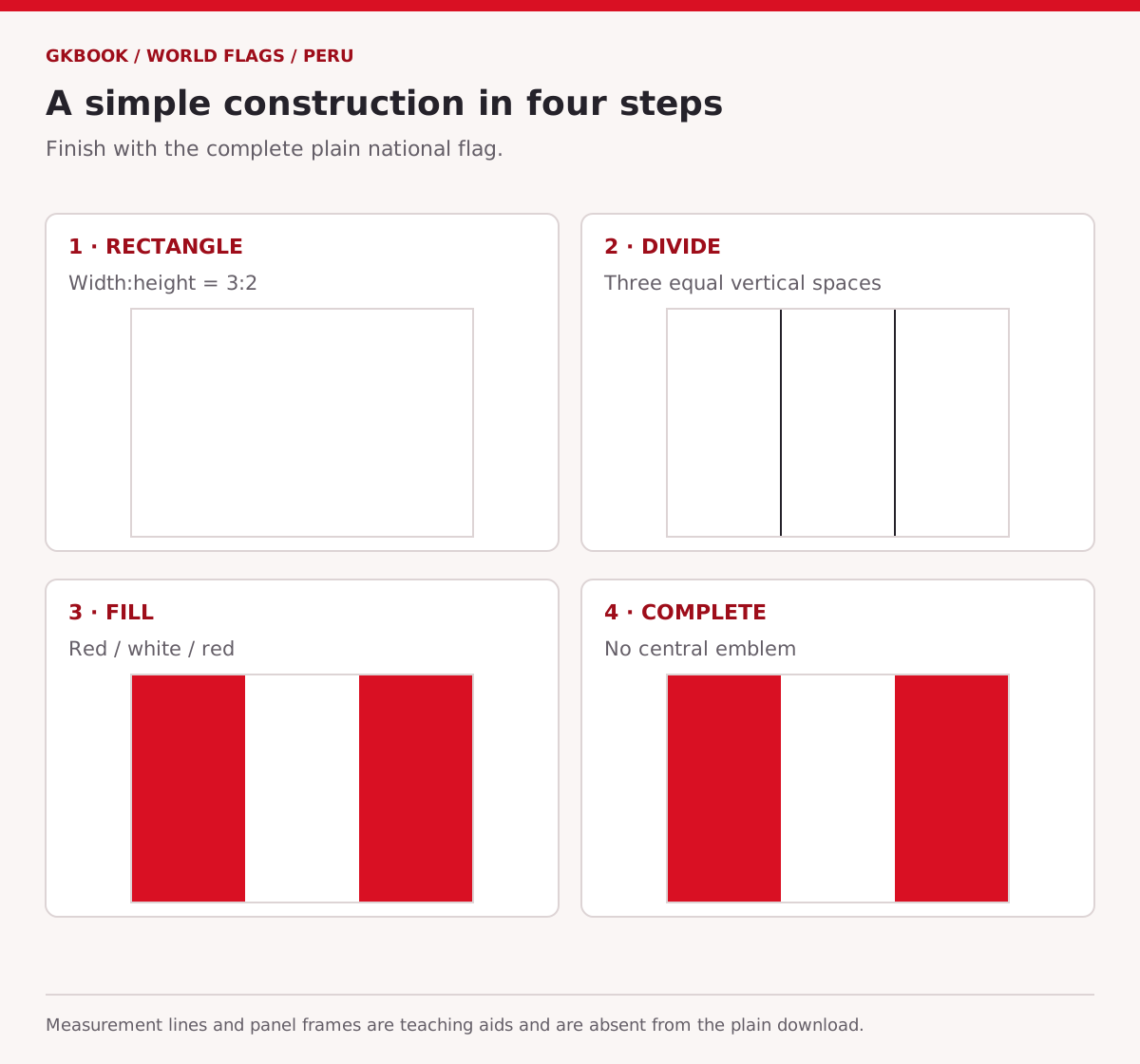
Start with the outer rectangle before adding the stripe boundaries. On squared paper, a grid six squares long and four squares high gives an easy example: each stripe is two squares wide. A ruler helps keep the dividing lines parallel to the short edges and prevents the white center from tapering.
For digital artwork, use adjoining rectangles without gaps or visible strokes between them. Do not add a crest merely to make the drawing appear more complete: the uncharged design is itself the complete national flag. The gallery’s construction sequence finishes with this plain design, while separate illustrations explain the other versions.
What pixel sizes preserve Peru’s flag proportions?
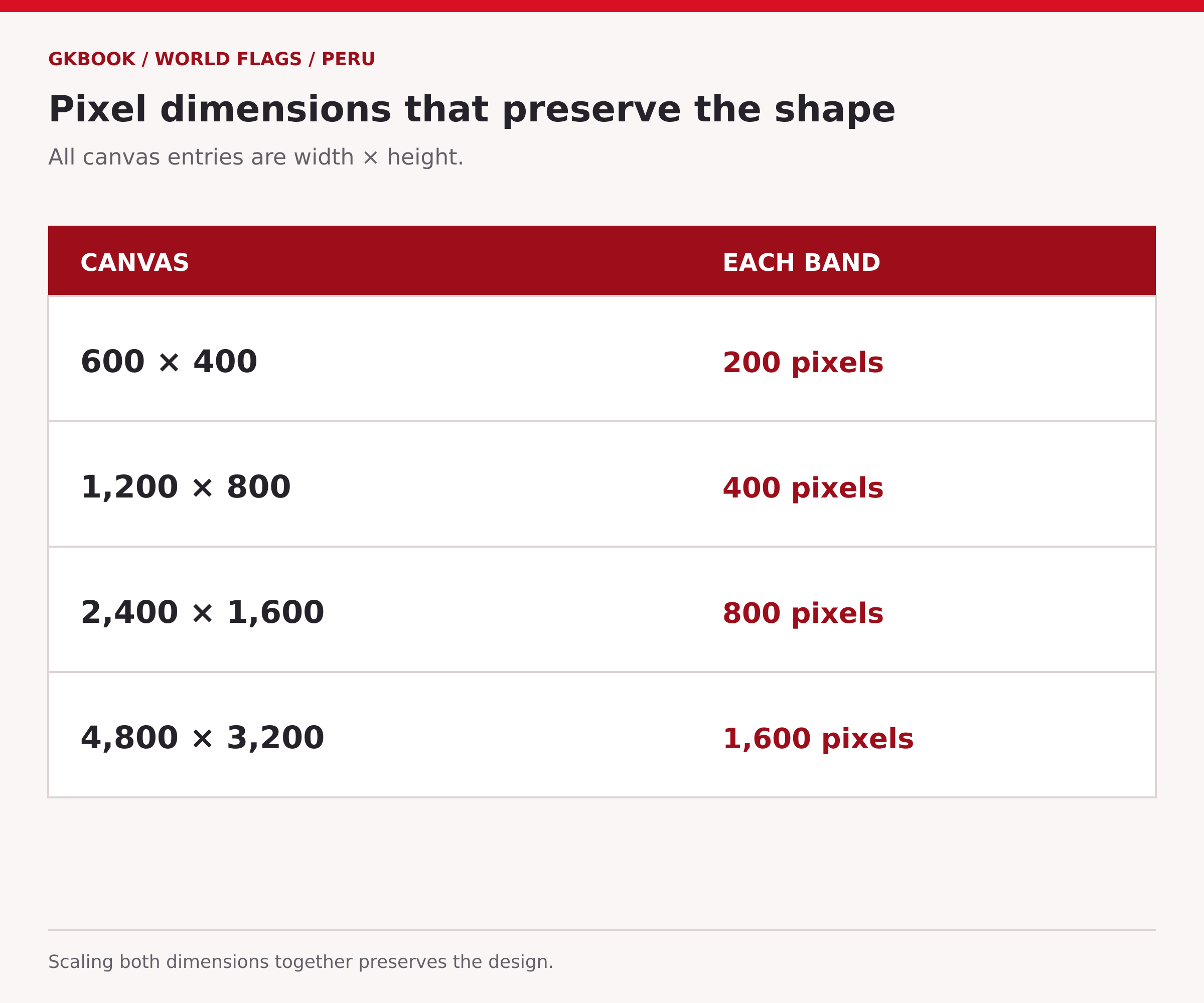
Suitable width by height sizes include 600 × 400, 1,200 × 800, 2,400 × 1,600, and 4,800 × 3,200 pixels. Each preserves the required 3:2 shape and permits equal integer stripe widths. The main PNG download uses 4,800 × 3,200 pixels, while its SVG remains scalable without changing the stripe geometry.

At 600 pixels wide, each band is 200 pixels wide; at 1,200 pixels, each is 400 pixels. The same rule applies at every scale: divide the canvas width by three. Choosing a width divisible by three avoids assigning a spare raster pixel to one stripe and makes the boundaries particularly clean.
When inserting a picture into a document, keep the aspect ratio locked and adjust a single size control. For a very large printed flag, use an appropriate production workflow instead of assuming that a high pixel count guarantees a fabric color match.
| Width × height | Width of each band |
|---|---|
| 600 × 400 | 200 |
| 1,200 × 800 | 400 |
| 2,400 × 1,600 | 800 |
| 4,800 × 3,200 | 1,600 |
Where is the center of the Peru flag?
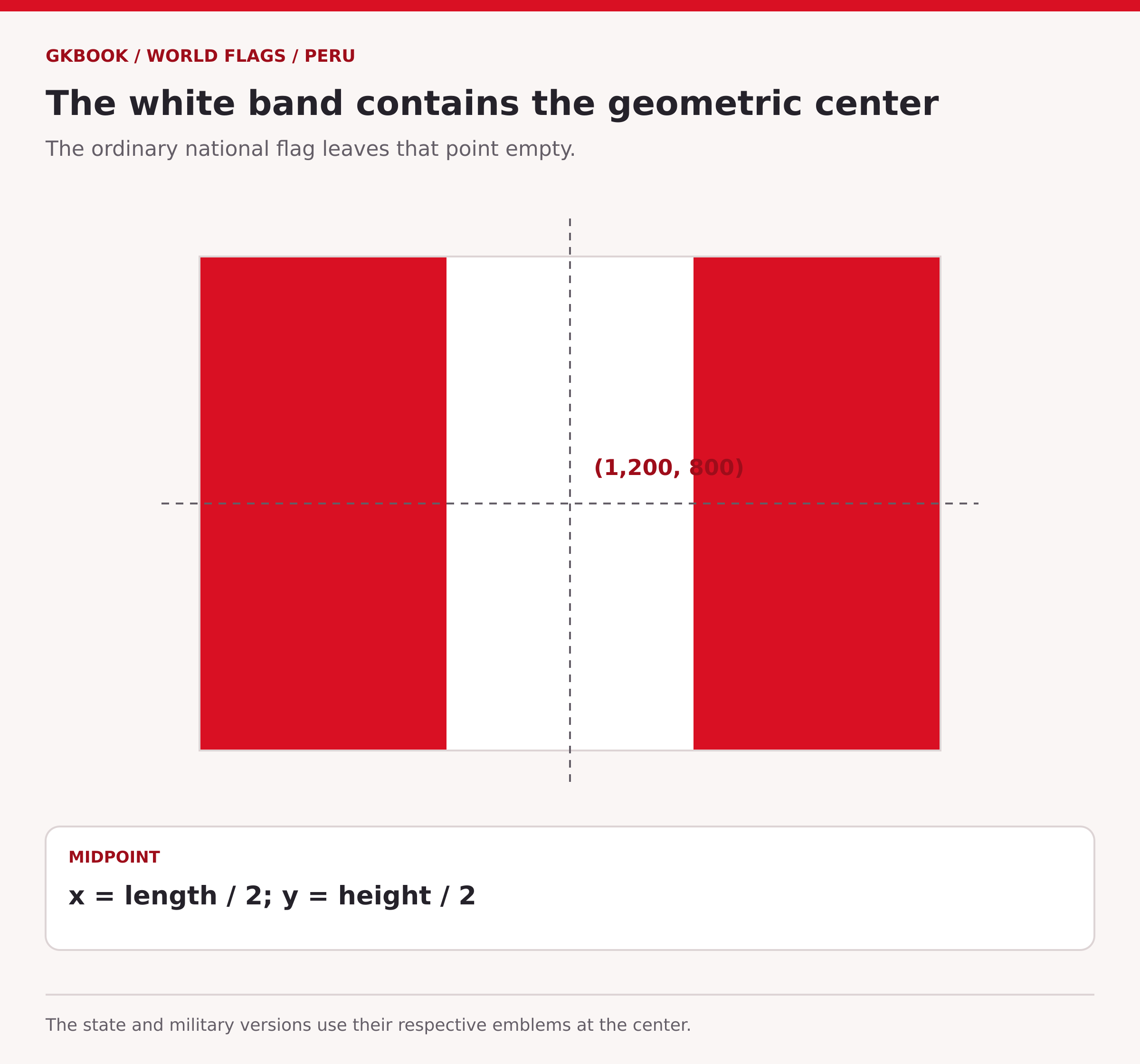
The geometric center lies halfway along the length and halfway down the height, inside the white stripe. On this article’s 2,400 by 1,600 master, that point is (1,200, 800). The plain national flag leaves it empty; the state and military flags place their respective emblems centrally in the white band.

Coordinates provide a useful way to describe placement without inventing an extra mark on the flag. The center point is the intersection of the horizontal and vertical midlines. Each boundary of the white stripe is equally distant from the vertical midline, giving 400 master units of space on either side.
A centered emblem must also fit comfortably inside the white band. Its outer flags or branches count as part of the artwork, rather than optional decoration to crop off. The reference illustrations here use a declared emblem size; the law’s central placement is not presented as proof of that particular numerical scale.
Does the plain Peru flag look the same on both sides?
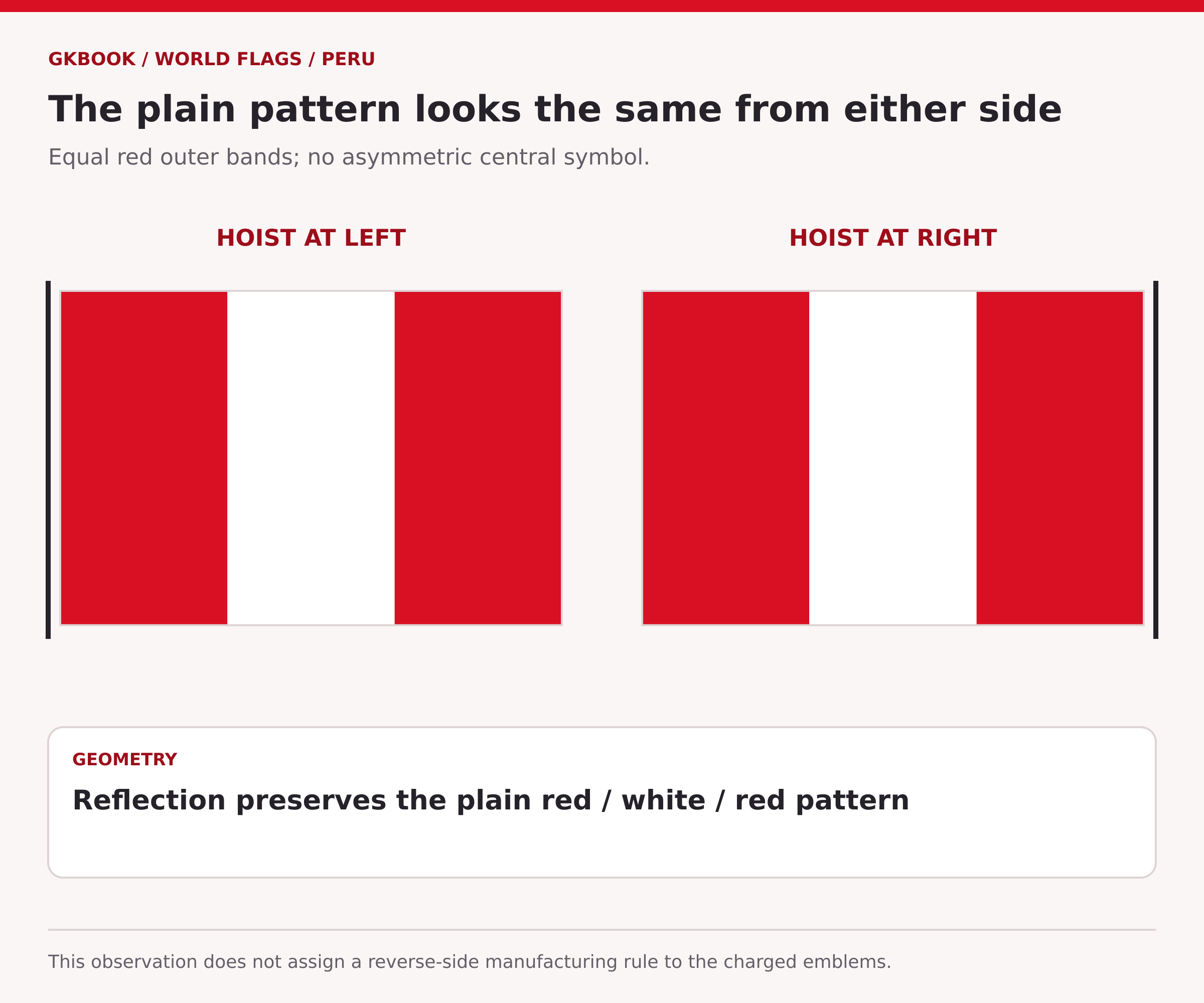
Yes. The plain national flag has no lettering or asymmetric emblem, and its red, white, red arrangement remains unchanged when seen from the opposite side. Its flat design is symmetric about both midlines. This observation applies to the ordinary flag and should not be extended to the detailed emblems on state or military flags.

The attachment edge still changes sides for an observer walking around a hanging flag. That physical change does not alter the plain pattern, because the outer bands match. A flat horizontal reflection therefore reproduces the same three colors in the same sequence, although the cloth’s pole, seams, folds, and lighting may differ.
Turning the plain rectangle through a half-turn also leaves the flat design unchanged. A quarter-turn is different: it makes the long dimension vertical and the bands horizontal in the picture. The diagram explains these geometric facts only; it does not invent a ceremonial rule for hanging every official Peruvian flag.
Can the Peru flag be used as a coloring worksheet?
A coloring outline can show the same 3:2 rectangle divided into three equal vertical spaces. Color the left and right spaces red and leave the center white. The black outlines are worksheet guides, not elements of the national flag. A finished reference image should show adjoining colored bands without internal black borders.
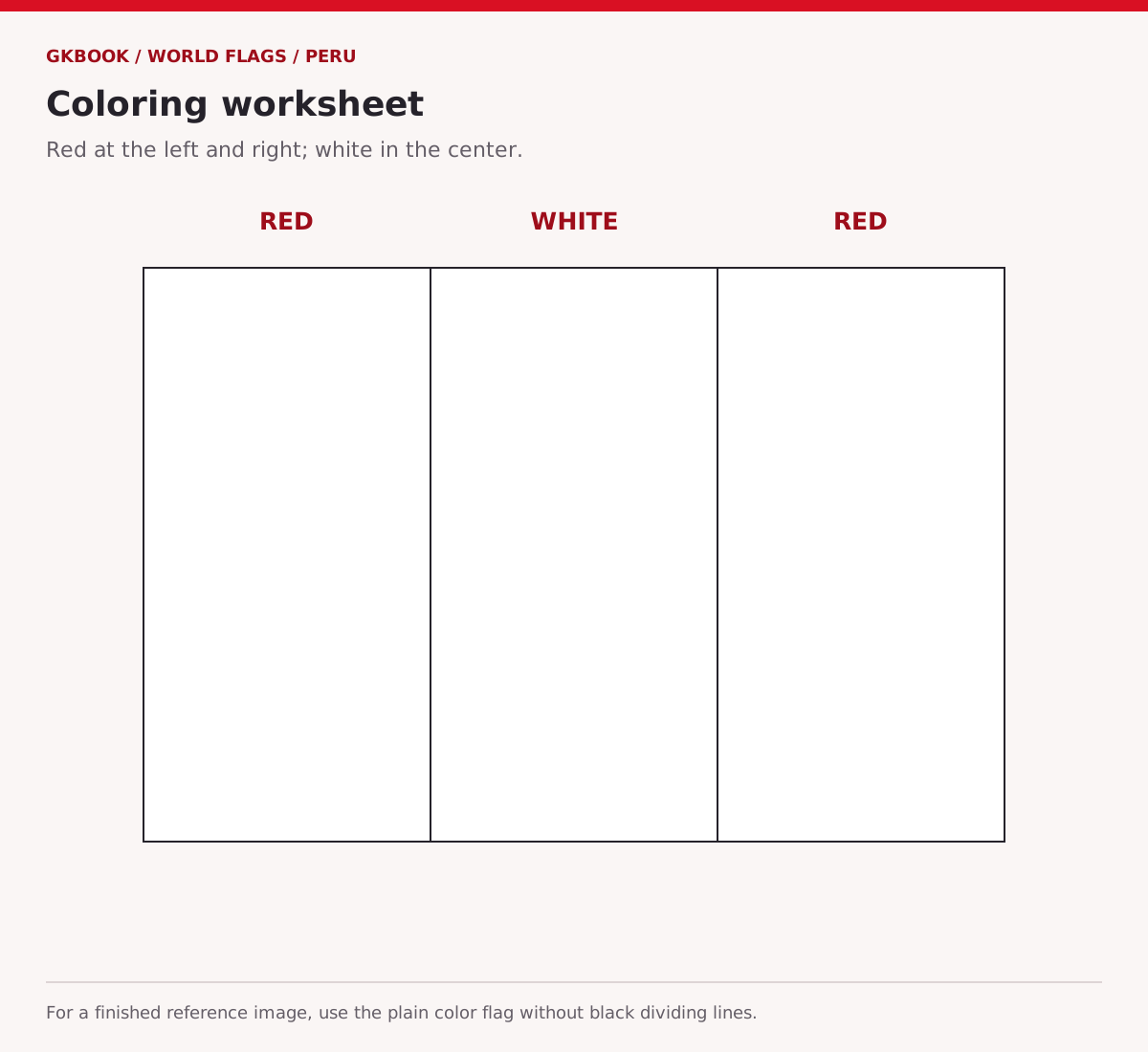
The worksheet in the gallery preserves the proportions of the main flag and marks the stripe divisions clearly. It is deliberately identified as a learning aid. Children can compare its three spaces with the completed flag before coloring, checking that the middle space has the same width as each outer space.
A printer may shrink the entire worksheet to fit a page, which is harmless if both dimensions change together. Stretching only one direction changes the intended proportion. For display or reuse outside the exercise, choose the plain color download; its construction contains no instructional words, measurement arrows, or outlines.
How should Peru’s flag fit inside a square icon?
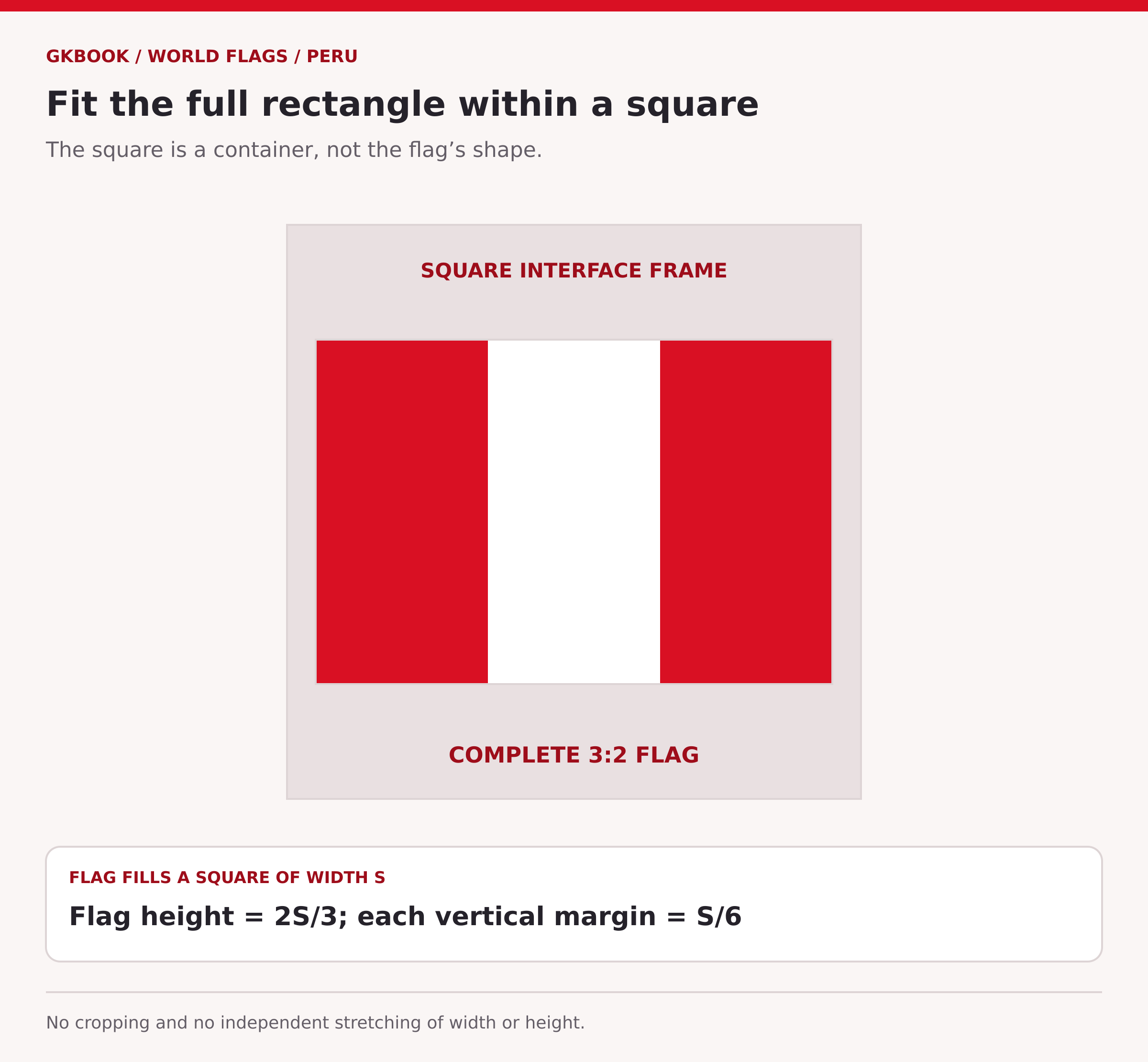
Place the complete 3:2 flag inside the square without stretching or cropping it. When the flag fills the square’s width, its height is two thirds of that width, leaving equal top and bottom margins of one sixth. A contrasting surrounding frame helps preserve the visible edge of the white center band.
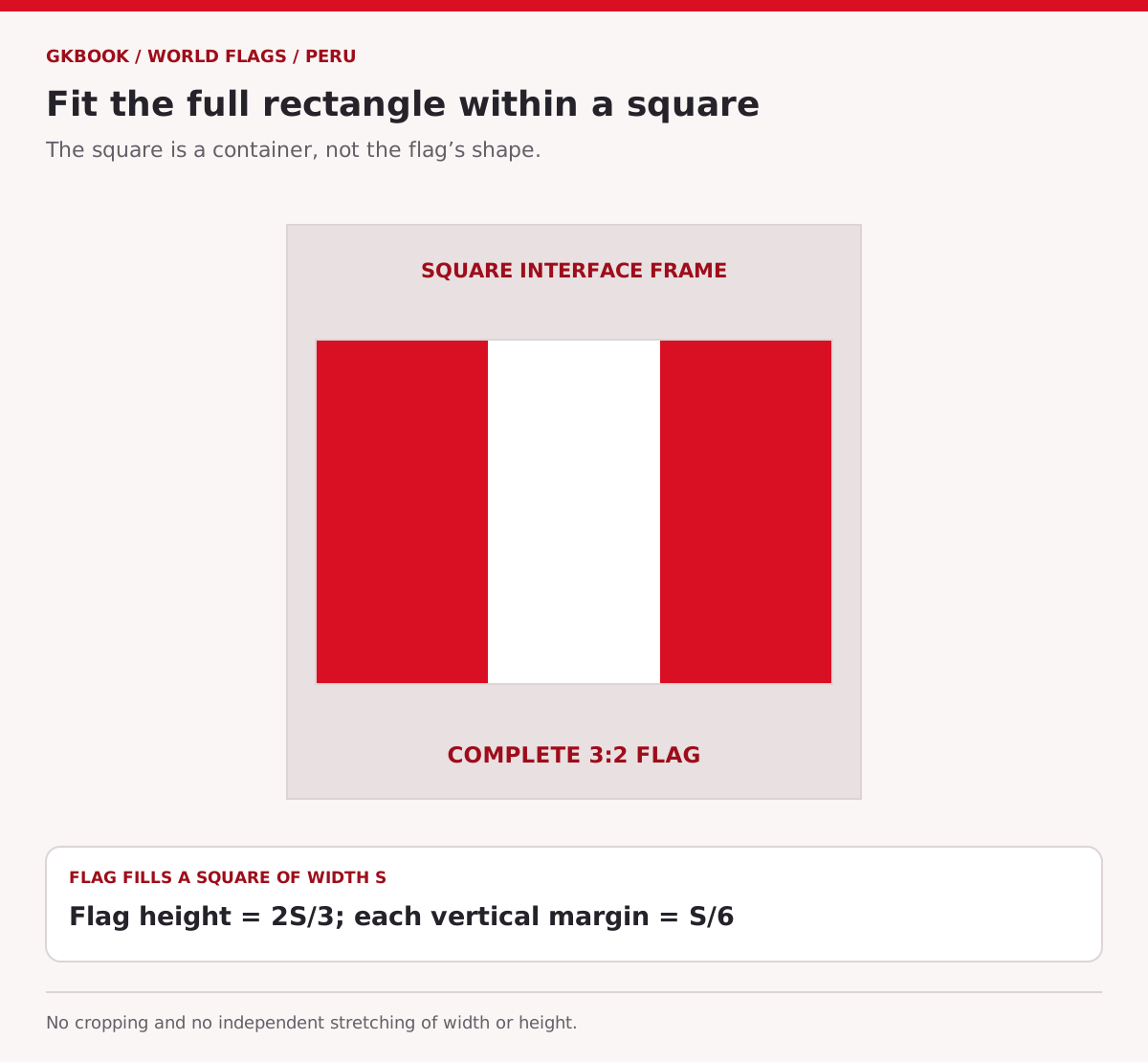
A square application tile and a national flag do not need to have the same shape. The tile is a container; the flag remains a rectangle within it. Neutral space above and below the flag is usually clearer than cutting off its red edges or forcing its height to match the container.
For example, a 600-pixel square can contain a 600 × 400 flag, with 100 pixels above and below. The diagram uses a smaller inset rectangle so its edges remain easy to see. Its surrounding pale field is presentation space, not an added border or a fourth component of the national flag.
Does Peru’s national flag have a coat of arms?
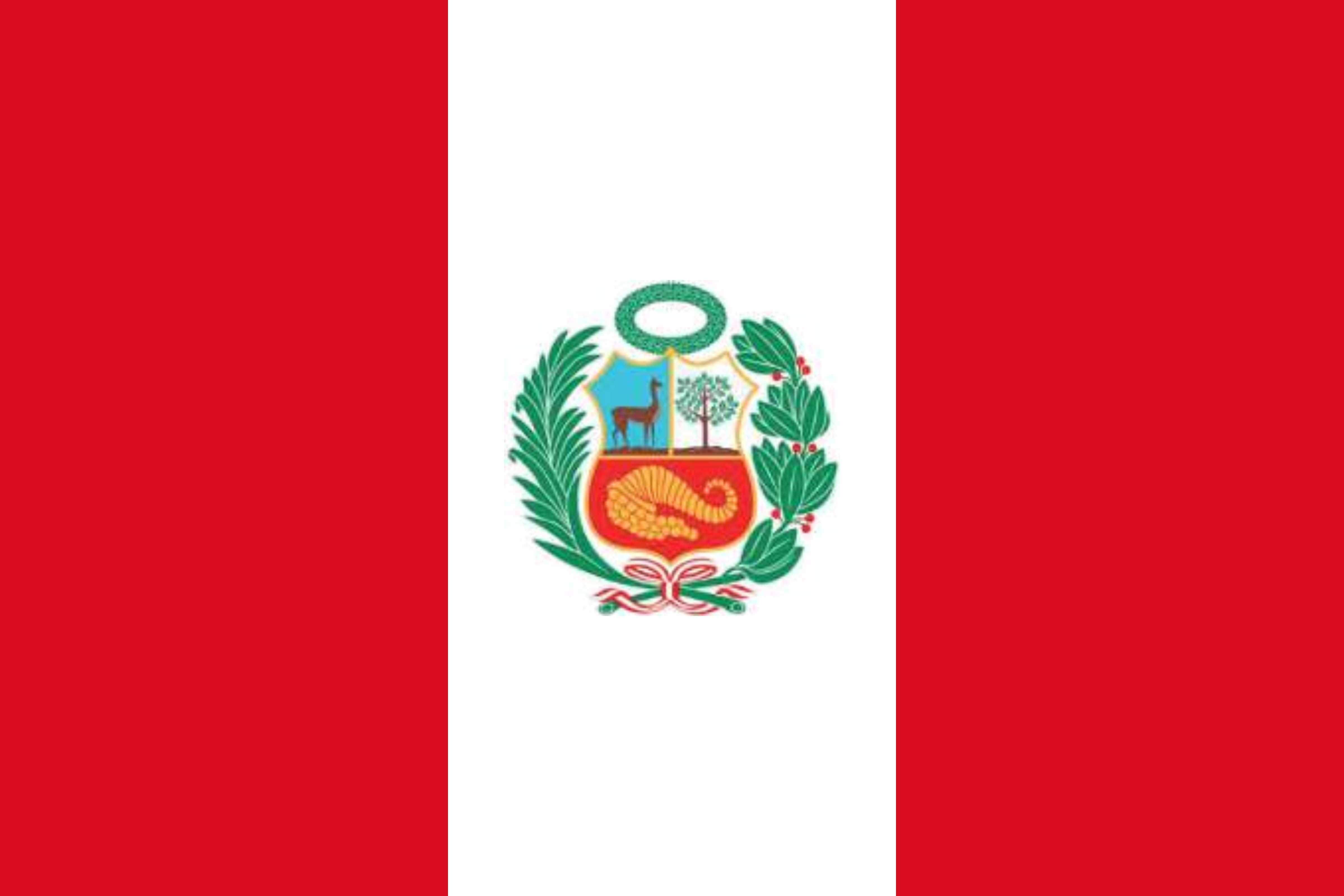
The ordinary national flag does not have a coat of arms. Article 4 of the 2025 symbols law explicitly describes it without a shield. Peru also has a national state flag and a military flag that add different emblems. Identifying the intended version is therefore essential when choosing a picture or writing a caption.
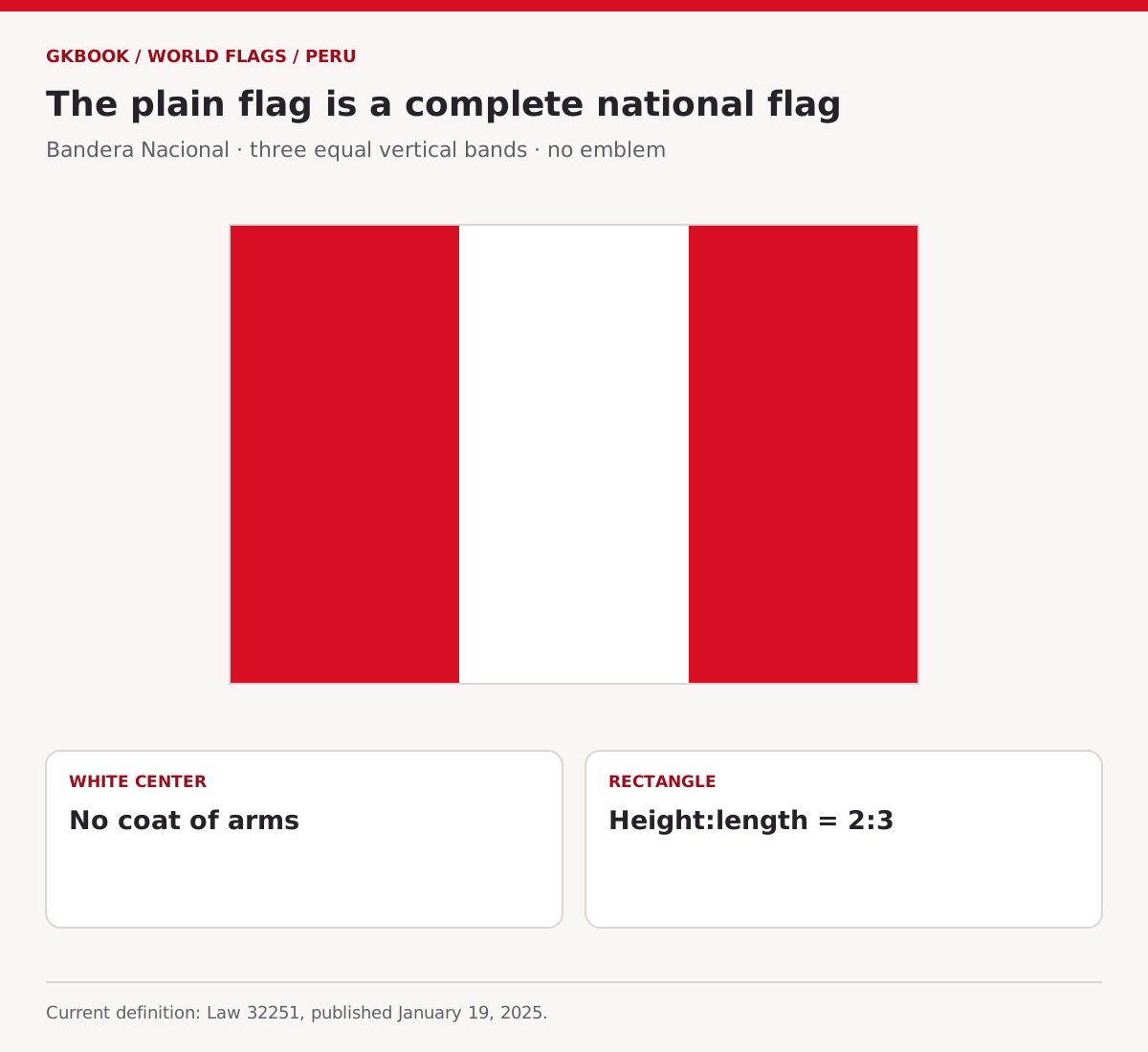
A plain red and white flag is not missing a compulsory central detail. It is the correct design for the national flag defined by the current law. The common English expression “Peru flag” can refer loosely to more than one image, which helps explain why search results show both plain and charged versions.
Use the Spanish names when a distinction matters: bandera nacional for the plain flag, pabellón nacional for the state version, and bandera de guerra for the military version. The gallery places them in separate, labeled panels so a reader can identify the emblem before reusing an image.
What is Peru’s Pabellón Nacional?
Under Article 8 of Law 32251, the Pabellón Nacional is the national flag with the escudo nacional at its center. That emblem includes the shield and civic wreath supported by national flags and standards. Its use is reserved for state institutions, and the law specifies that it carries no additional inscription or text.
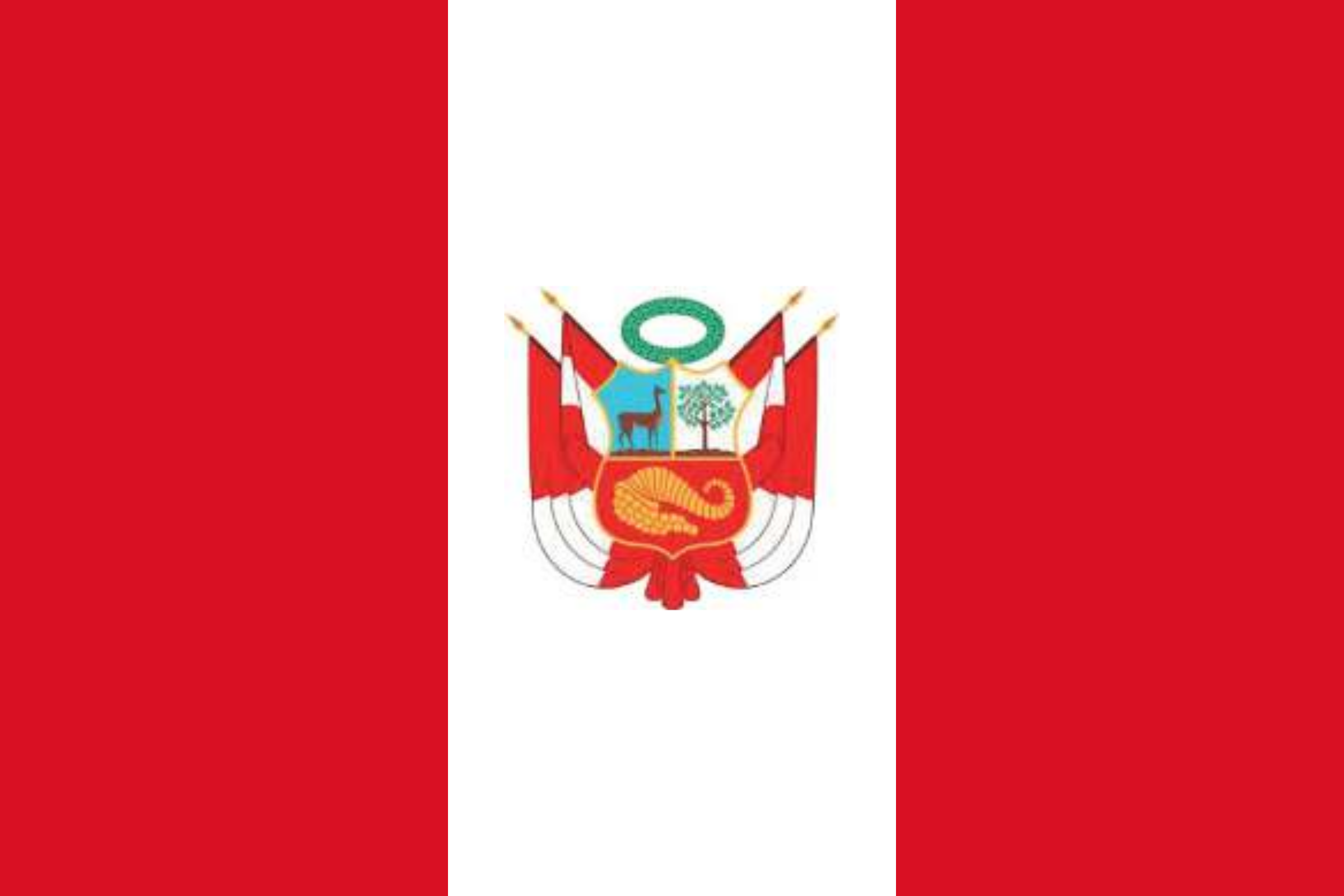
The current annex depicts the state flag with the flag-supported national emblem. This is a significant identification detail: older illustrations often label a flag with the palm-and-laurel emblem as the state flag. A historical caption should retain its date, while an explanation of the current law should follow the current terminology and annex.
The gallery’s state reference uses the official annex’s emblem image inside an analytically drawn red and white field. The emblem retains the source’s limited raster detail, even in the SVG container. It is an educational reference rather than a newly invented coat of arms or a claim to possess an official high-resolution vector master.
What is Peru’s Bandera de Guerra?
The Bandera de Guerra represents Peru’s Armed Forces and National Police. Article 10 of Law 32251 gives it the escudo de armas in the center of the white band. This emblem uses palm and laurel branches. A gold inscription naming the relevant unit or institution may appear below the shield.

The military flag shares the national flag’s red, white, red field, but its central emblem distinguishes its function. The 2025 annex depicts the branch-supported arms on this version. Its name does not mean that the ordinary national flag changes during a conflict; it identifies a separate flag used by the designated institutions.
The reference image here omits a unit name because it does not represent one particular military or police organization. Adding a fictional inscription would turn a general educational picture into an unsupported unit flag. The image reproduces the official annex emblem, with its source-resolution limitation recorded alongside the other artwork details.
How do Peru’s three principal flag versions differ?
The plain Bandera Nacional has no emblem. The Pabellón Nacional carries the flag-supported escudo nacional. The Bandera de Guerra carries the palm-and-laurel escudo de armas and may include a unit inscription. These distinctions follow the 2025 law and its annex; older naming conventions should be identified by their historical context.

Begin a comparison with the central white band. An empty center identifies the plain design. Flags surrounding the shield identify the national emblem used on the current state flag. Branches around the shield identify the arms used on the current military flag. The underlying three-band field remains consistent across the comparison.
These are categories of flag, rather than three successive historical designs replacing one another. They coexist for different purposes. The comparison table uses current legal definitions, while the history sections explain the earlier adoption and simplification. Keeping those two comparisons separate prevents an old state-flag picture from being mistaken for the current ordinary flag.
| Spanish name | Central design | Principal association |
|---|---|---|
| Bandera Nacional | No emblem | National sovereignty and identity |
| Pabellón Nacional | Escudo nacional; flag supporters | State institutions |
| Bandera de Guerra | Escudo de armas; palm and laurel | Armed Forces and National Police |
What appears in the shield on Peru’s official flags?
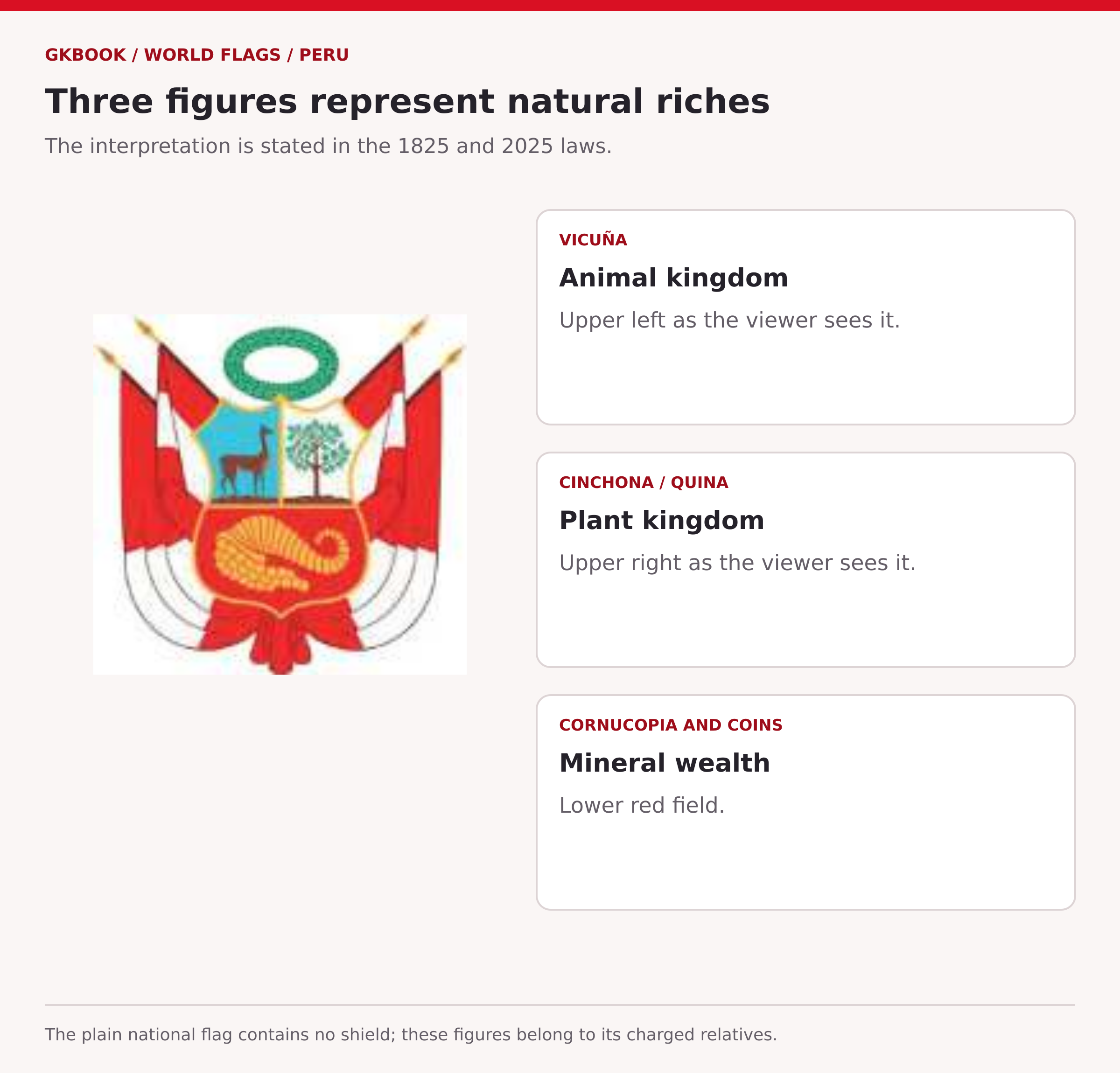
The shield contains a vicuña on a light blue field, a cinchona tree on white, and a cornucopia spilling coins on red. The 2025 law specifies twenty-five coins and a civic wreath above the shield. The same central shield appears in the two emblems, but their surrounding flags or branches distinguish them.
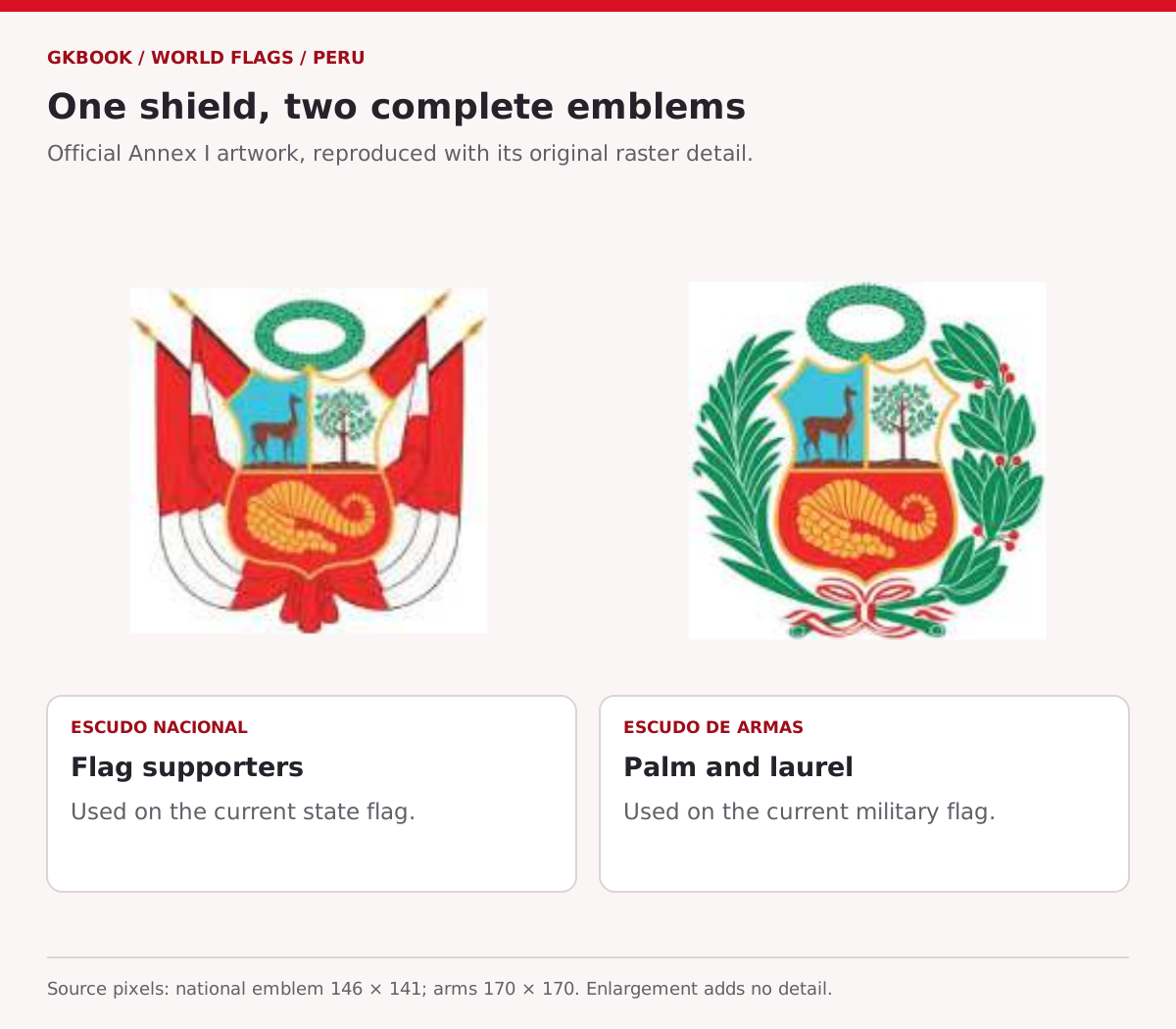
Read the upper fields in the viewer’s orientation: the vicuña appears at the left and the tree at the right. Heraldic descriptions reverse that verbal viewpoint because they refer to the bearer’s sides. The lower red field contains the cornucopia. The law places the horizontal division halfway down the shield’s height.
The shield itself has a four-to-three height-to-width proportion under the law. That measurement describes the shield, not the full emblem including its supporters and not the flag’s outer rectangle. Confusing these three boundaries can produce an incorrectly stretched coat of arms even when the surrounding flag has the correct 3:2 shape.
What do the vicuña, cinchona tree, and cornucopia represent?
The three shield figures represent Peru’s natural riches: the vicuña stands for the animal kingdom, the cinchona tree for the plant kingdom, and the cornucopia with coins for mineral wealth. This interpretation appears in the foundational 1825 description and is retained in the 2025 law’s explanation of the three natural kingdoms.

The symbolism belongs to the shield on the charged official flags, rather than to an invisible emblem on the plain national flag. A teacher can explain the two red bands and the white center first, then introduce the shield as a separate component used on the state and military versions.
Keep the figures identifiable: the animal is a vicuña, the tree is cinchona or quina, and the object below is a horn of plenty spilling coins. Replacing them with a generic deer, an unrelated tree, or a flower changes the heraldic content. The gallery labels the official detail instead of substituting decorative icons.
Why do some Peruvian emblems have flags and others branches?
The surrounding elements distinguish two emblems that share the same shield. The escudo nacional has national flags and standards as supporters. The escudo de armas has palm and laurel branches tied with a red, white, red ribbon. The current state flag uses the former; the military flag uses the latter.
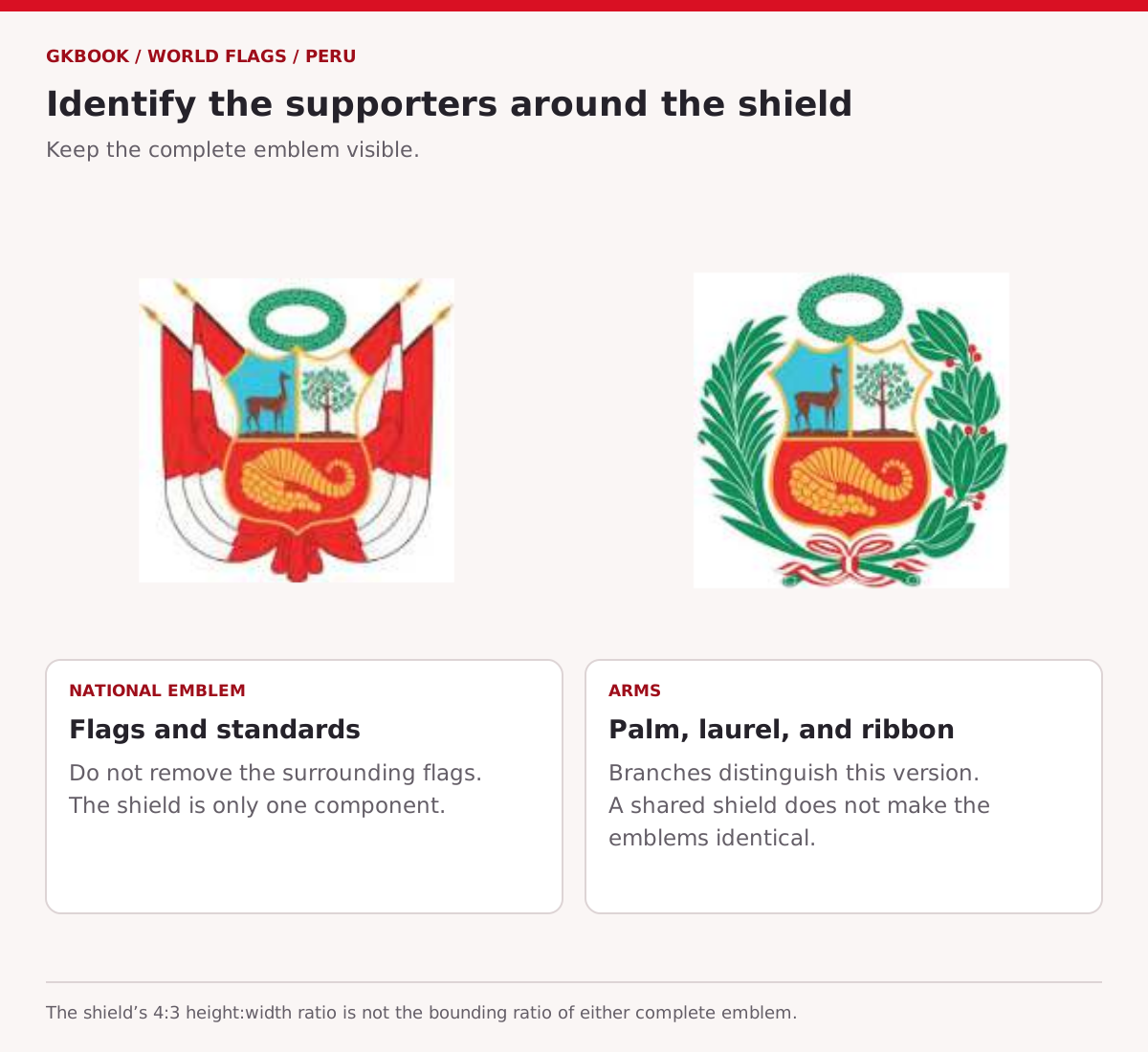
The small flags are part of the complete national emblem. They should not be clipped away to make the shield fit a narrow space. Likewise, the branches and ribbon are identifying parts of the escudo de armas. Removing either set of supporters can conceal the distinction the current law makes between the two compositions.
The law also describes details of the branches, including two bent palm tips and eight red laurel berries. Those details matter for an official production master. This gallery preserves the published annex images and discloses their limited resolution, rather than claiming that enlarged pixels independently certify every tiny element in a manufacturing specification.
How has Peru’s flag changed over time?
Peru’s flag history includes San Martín’s diagonal design of 1820, two revisions under Torre Tagle in 1822, the foundational flag and arms law of 1825, and the plain national flag regulated in 1950. The 2025 law consolidates current definitions. These dates describe different stages and should not be treated as interchangeable adoption dates.
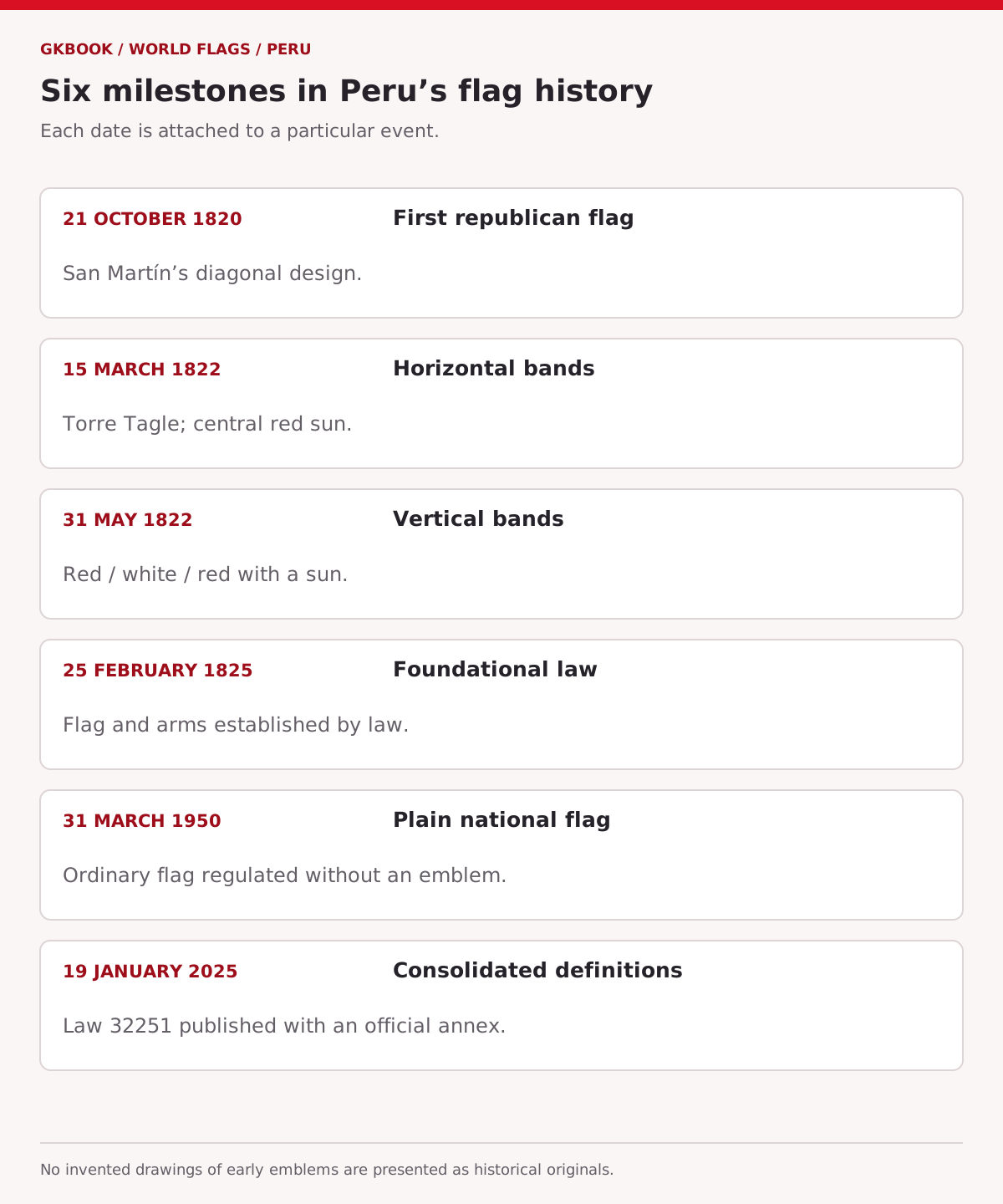
A timeline makes that distinction clearer than a single undated row of flag pictures. It also prevents the first flag associated with independence from being mistaken for the plain vertical triband used in the main image today.
The history illustration names the milestones without inventing detailed reconstructions of early emblems. The 1820 and 1822 designs require their own period references, whereas the current ordinary flag can be constructed exactly from its rectangular field and equal bands. The following sections explain which question each of the principal dates actually answers.
When was the Peru flag adopted?
February 25, 1825 is the foundational adoption date identified by Peru’s current symbols law. March 31, 1950 marks the regulation of the ordinary flag without an emblem. October 21, 1820 belongs to San Martín’s earlier flag. Giving the event with the date explains why reliable histories can mention more than one milestone.
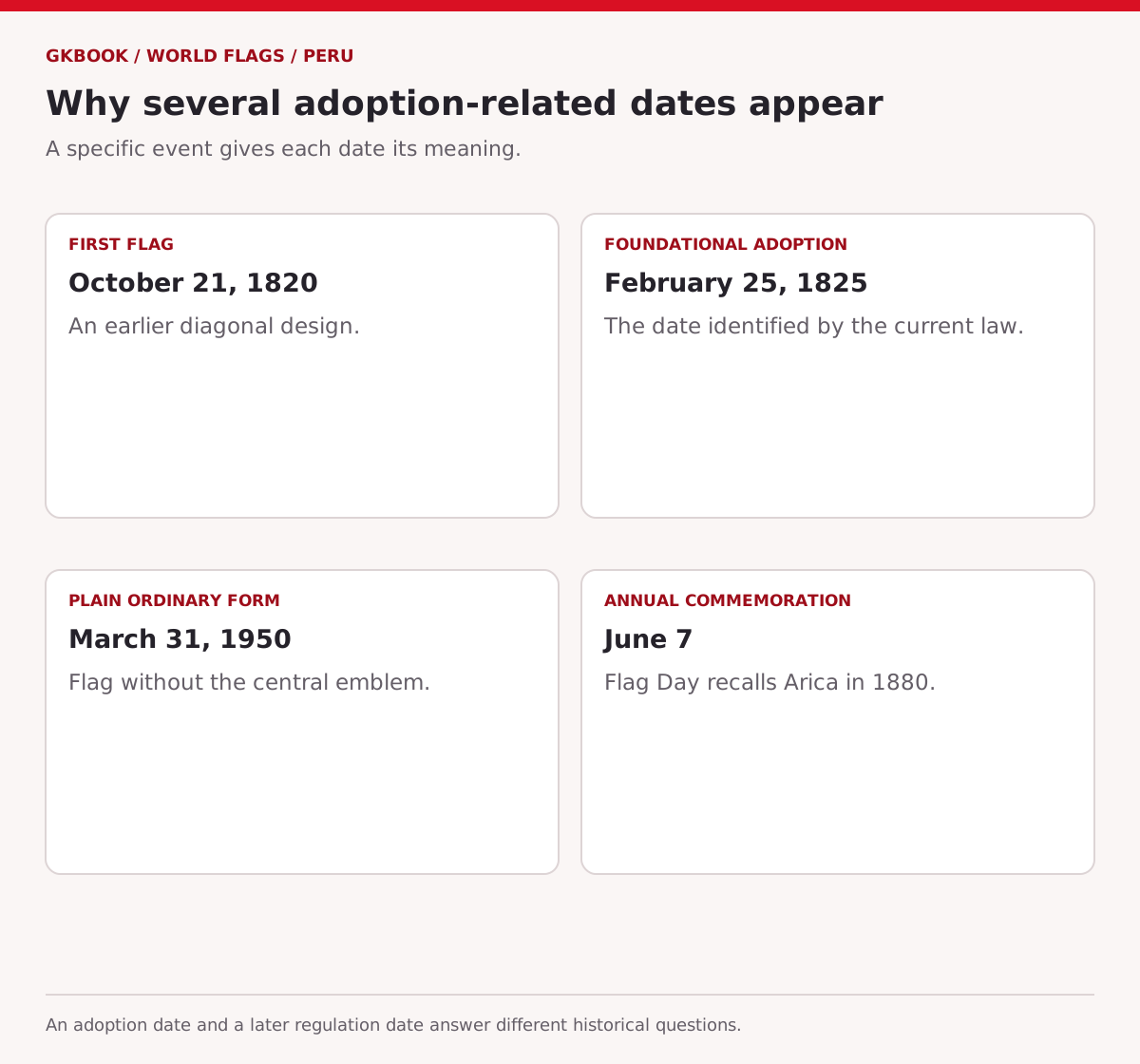
For a short answer about the established national flag, state the 1825 date and immediately explain the later plain version if the accompanying picture has no emblem. The 1825 legislation described the vertical red, white, red field with arms, while also providing a plain merchant flag. It was not identical in every usage to today’s scheme.
Adoption, redesign, consolidation, and commemoration are different events. The 2025 law did not create Peru’s red and white colors from nothing, and annual Flag Day is not the anniversary of the 1825 law. A precise caption keeps the familiar date useful without erasing the distinctions between the earlier charged design and the ordinary plain flag.
When was Peru’s first republican flag created?
José de San Martín created the first republican flag by a decree dated October 21, 1820, issued at Pisco. Its field was divided diagonally into four areas, with white above and below and red at the sides, surrounding a central emblem. It therefore differed substantially from the modern plain vertical triband.
The Ministry of Defense commemorates October 21 as the creation of that first flag. Its date precedes the July 1821 proclamation of independence in Lima. Calling 1821 the beginning of every aspect of the flag’s history would miss the earlier decree and the role of the independence expedition at Pisco.
The central emblem included a landscape and rising sun, with a surrounding laurel wreath. That combination belongs to the first design and should not be pasted into a current plain flag. The timeline treats it as a historical stage, while the main gallery download consistently presents the present national rectangle without a central charge.
What changed in Peru’s flag during 1822?
Torre Tagle authorized two important revisions in 1822. The March 15 design used horizontal red, white, red bands with a red sun; the May 31 change used vertical bands with the sun in the white center. The vertical arrangement anticipated the later flag, but the sun was not the modern coat of arms.
The congressional museum describes the March revision as a simpler arrangement than the diagonal flag. Its account then relates the May change to difficulty distinguishing the horizontal design from the Spanish flag at a distance. This explanation concerns the historical sequence; it does not make Spain’s colors part of Peru’s present design.
The two revisions should receive separate dates rather than being combined into a single “1822 flag.” A learner can remember the progression as diagonal fields, horizontal bands, then vertical bands. The adoption of the later shield in 1825 is another step, and the plain national flag’s 1950 regulation is another still.
Why is 1950 important in Peru’s flag history?
On March 31, 1950, Decree Law 11323 regulated the ordinary national flag without a coat of arms and distinguished it from the charged national state flag. That explains the familiar plain design. The decree is historically important, but the 2025 law repealed it and now supplies the current consolidated definitions.
This distinction corrects two common shortcuts. Saying the flag was simply “invented in 1950” overlooks the earlier red and white designs and the 1825 legislation. Saying nothing changed after 1825 overlooks the later regulation of the plain ordinary flag and the separate treatment of flags used by state institutions.
A repealed rule can remain central to an accurate history. Its repeal does not erase the event it records. For present descriptions, however, use the later law’s definitions and annex rather than treating every older provision as still operative. This article accordingly uses 1950 for the historical simplification and 2025 for the current principal legal framework.
What did Peru’s 2025 symbols law change or clarify?
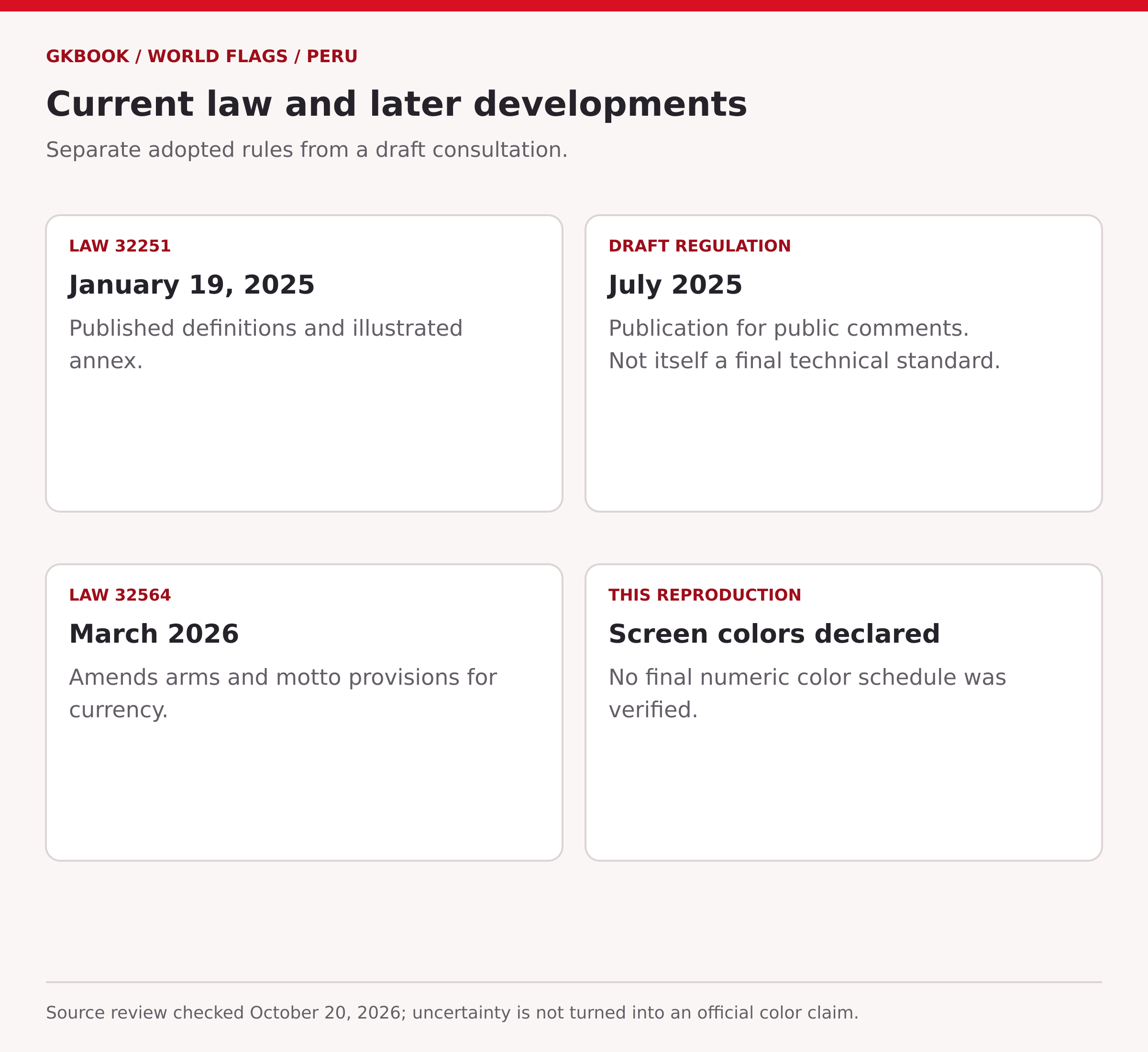
Law 32251, published on January 19, 2025, consolidates definitions and illustrations for Peru’s national and state symbols. It expressly distinguishes the plain flag, the flag-supported state emblem, and the branch-supported military emblem. A March 2026 amendment concerns the arms and motto on currency; it does not replace the plain flag’s red, white, red design.

The law names the ordinary flag, national emblem, and national anthem as symbols of the patria, while defining a separate group of state symbols. Its illustrated annex is especially useful when older captions use terminology differently. For this article, the text and annex are read together rather than allowing an older stock image to determine the labels.
Technical color codes were assigned to the implementing regulation. A July 2025 publication invited comments on a draft regulation; a consultation document is not automatically a final enacted standard. The source review did not establish a final numerical color schedule, so the gallery identifies its screen palette as a reproduction choice.
Who designed the Peru flag?
San Martín is associated with the first flag of 1820, and Torre Tagle with the two 1822 revisions. The current law describes the national flag’s authorship as anonymous and attributes the national emblem to José Gregorio Paredes y Ayala. These distinct roles should not be compressed into one unsupported claim about a sole designer.
Naming one of them as the designer of every later version obscures that process. The article therefore keeps the first flag, subsequent revisions, legal adoption, and heraldic authorship separate.
The 2025 law provides an unusually direct answer to the question of authorship for the national flag: anonymous. It does not prevent discussion of San Martín’s historical role. It does prevent a caption from presenting a confident modern personal attribution that goes beyond the source, particularly when the picture shows the later plain triband.
When is Peru’s Flag Day, and what does it commemorate?
Peru observes Flag Day on June 7, commemorating the Battle of Arica on June 7, 1880. The observance honors the courage and sacrifice associated with the defense of the flag, including Francisco Bolognesi and Alfonso Ugarte. It is a day of remembrance, rather than the anniversary of the flag’s 1825 adoption.

The National Library connects the annual observance with the Battle of Arica and ceremonies renewing fidelity to the flag. That commemorative setting explains why the date belongs in an article about the flag even though it falls long after the early nineteenth-century design changes. Its subject is national memory rather than stripe construction.
A useful classroom comparison places three labels beside three dates: Flag Day on June 7, the proclamation of independence on July 28, and foundational flag adoption on February 25, 1825. Keeping the event names visible avoids turning one national celebration into the supposed origin of all the others.
Is Peru’s Flag Day the same as Independence Day?
No. Flag Day is June 7 and recalls the Battle of Arica in 1880. July 28 marks San Martín’s proclamation of independence in Lima in 1821. Both are important patriotic occasions involving the flag, but they commemorate different events. Neither changes the separate February 25, 1825 date attached to the foundational flag law.
The flag can appear at many commemorations without making all of them flag-adoption anniversaries. July celebrations connect the red and white colors with the declaration of national independence. June remembrance connects the flag with its defense during the War of the Pacific. A photograph’s date alone therefore does not identify the historical origin of its design.
For a school calendar, write the event beside the day and month. For a history timeline, include the year as well. The 1820 creation of the first flag belongs before the 1821 proclamation, and the 1825 law belongs after it. That sequence provides a more accurate lesson than a single combined “birthday of the flag.”
Did San Martín choose the colors after dreaming about flamingos?
The familiar story of San Martín dreaming about red and white parihuanas is a literary tradition associated with Abraham Valdelomar. It should not be presented as a verified eyewitness account of the flag’s design. The decree establishing the first flag and the later story about its inspiration are different kinds of evidence.

The Regional Archive of Arequipa identifies Valdelomar as the writer who popularized the story. Its appeal makes it memorable for children, but a memorable narrative is not the same as a contemporary record of a decision. The distinction allows the tale to be appreciated without asking it to prove the historical cause of the colors.
In a lesson, introduce it explicitly as a story or tradition, then return to the dated decrees for the design sequence. Avoid replacing one uncertain origin story with another asserted as fact. The gallery’s legend card separates documented adoption milestones from literary explanation and does not depict an imagined scene as a historical photograph.
How should the Peru flag be described and displayed respectfully?
Use the correct flag version, preserve its proportions and colors, and keep it in good condition. The 2025 law emphasizes respectful treatment and rejects altered, damaged, or faded symbols. It also permits use of the national flag outside mandatory occasions without prior local authorization, subject to the applicable rules for its use.
For an educational illustration, the practical priorities are clear: keep the entire rectangle visible, maintain equal bands, and attach an accurate label. Treat the plain national flag as complete. If a state or military version is shown, keep its identifying emblem intact and explain which flag the picture represents.
A general flag article does not establish every ceremonial arrangement for every institution or occasion. Rules concerning required dates, official formations, or local display requirements should be read in their current setting. The diagrams here explain appearance and historical meaning; their frames, captions, and measurement lines are teaching aids rather than a ceremonial display protocol.
What are the most common mistakes in Peru flag pictures?
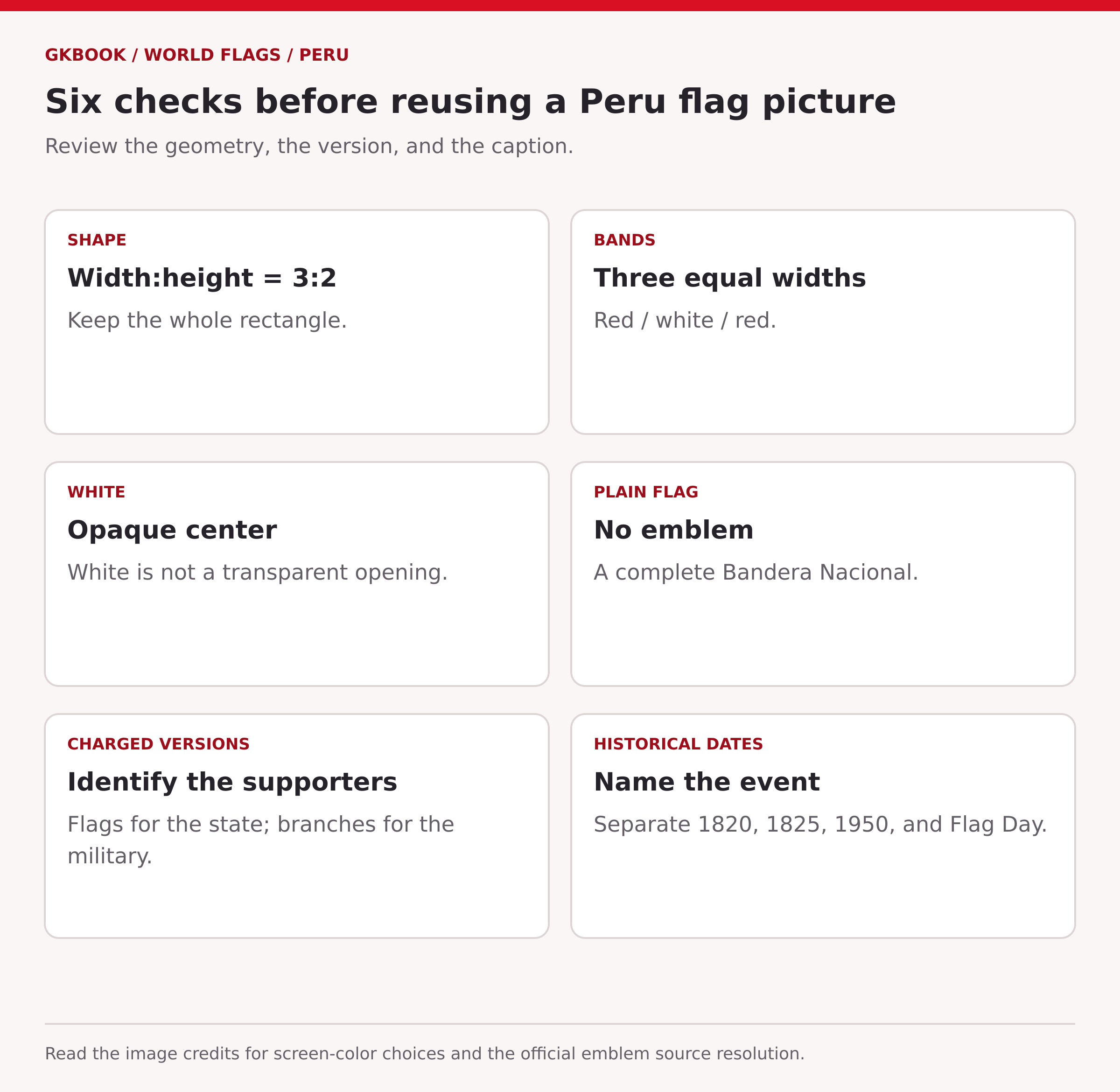
Common mistakes include unequal stripes, an incorrect rectangle, a transparent center, adding an emblem to the plain flag, and using outdated labels for the charged versions. Historical captions can also confuse 1820, 1825, 1950, and Flag Day. Check both the artwork and the event attached to each date before reusing a picture.

A simple review begins with the ordinary flag: three vertical bands, equal widths, red at both ends, opaque white in the center, and a 3:2 width-to-height ratio. The plain reference should contain no emblem, slogan, border, or shadow. Decorative page elements should remain visibly outside the flag’s own rectangle.
Then review any related official version against the current definitions. A flag-supported emblem belongs to the Pabellón Nacional in the 2025 law; a branch-supported emblem belongs to the Bandera de Guerra. Finally, match the caption to the depicted period. A historically accurate old image can still become misleading when labeled as the current ordinary flag.
Download Peru flag pictures
Download the plain national flag as SVG or 4,800 × 3,200 PNG. Its 2,400 × 1,600 SVG contains only the exact vector field. Related references are available for the state flag SVG and state flag PNG, and the military flag SVG and military flag PNG.
The gallery contains 24 subjects with SVG and PNG pairs. The charged references embed the official annex’s raster emblems; enlargement does not add heraldic detail. Their emblem sizes and the screen palette are stated reproduction choices. Image credits and construction notes explain the artwork and its limits.
Explore more in World Flags, including the Paraguay flag and Panama flag.
World Flags/Peru
Peru flag pictures
Exact 3:2 vector field with three equal vertical bands and no emblem. The screen red is #D91023; white is #FFFFFF.
GKBook diagrams; national flag geometry from Law 32251; emblem artwork reproduced from its official Annex I, El Peruano, January 19, 2025.Download SVGDownload PNGArticle 4 of Law 32251 explicitly defines the national flag without a shield. State and military versions have separate names.
GKBook diagrams; national flag geometry from Law 32251; emblem artwork reproduced from its official Annex I, El Peruano, January 19, 2025.Download SVGDownload PNGRed #D91023 and white #FFFFFF are declared screen reproduction values. No final enacted technical color schedule was verified in the source review.
GKBook diagrams; national flag geometry from Law 32251; emblem artwork reproduced from its official Annex I, El Peruano, January 19, 2025.Download SVGDownload PNGThe Municipality of Miraflores relates red to the sacrifice of independence heroes and white to peace, purity, justice, and harmony.
GKBook diagrams; national flag geometry from Law 32251; emblem artwork reproduced from its official Annex I, El Peruano, January 19, 2025.Download SVGDownload PNGLaw 32251 specifies three length units for two height units. The diagrams use the exact 2,400 × 1,600 coordinate equivalent.
GKBook diagrams; national flag geometry from Law 32251; emblem artwork reproduced from its official Annex I, El Peruano, January 19, 2025.Download SVGDownload PNGIn the master, the boundaries are x = 800 and x = 1,600. Red occupies two thirds of the plain field; white occupies one third.
GKBook diagrams; national flag geometry from Law 32251; emblem artwork reproduced from its official Annex I, El Peruano, January 19, 2025.Download SVGDownload PNGEstablish the outer 3:2 rectangle, divide its length equally, and apply red, white, red. The fourth panel confirms that no emblem is missing.
GKBook diagrams; national flag geometry from Law 32251; emblem artwork reproduced from its official Annex I, El Peruano, January 19, 2025.Download SVGDownload PNGEach listed size preserves a 3:2 width-to-height ratio and an integer width for every band. The main PNG is 4,800 × 3,200.
GKBook diagrams; national flag geometry from Law 32251; emblem artwork reproduced from its official Annex I, El Peruano, January 19, 2025.Download SVGDownload PNGOn the 2,400 × 1,600 master the midpoint is (1,200, 800). Guide lines explain coordinates; they are not part of the flag.
GKBook diagrams; national flag geometry from Law 32251; emblem artwork reproduced from its official Annex I, El Peruano, January 19, 2025.Download SVGDownload PNGThe attachment edge changes sides for the observer, but reflecting the plain field leaves its color sequence unchanged.
GKBook diagrams; national flag geometry from Law 32251; emblem artwork reproduced from its official Annex I, El Peruano, January 19, 2025.Download SVGDownload PNGThe outline preserves the 3:2 rectangle and three equal spaces. Black guides and labels belong to the worksheet, not to the national flag.
GKBook diagrams; national flag geometry from Law 32251; emblem artwork reproduced from its official Annex I, El Peruano, January 19, 2025.Download SVGDownload PNGPreserve the whole flag inside a square container. The displayed inset leaves additional side space; the formula describes a flag filling the square width.
GKBook diagrams; national flag geometry from Law 32251; emblem artwork reproduced from its official Annex I, El Peruano, January 19, 2025.Download SVGDownload PNGCurrent category follows Law 32251 and its annex. Exact vector field with the official raster emblem embedded; limited emblem resolution and a declared 600-unit image-box width. No official vector-master claim.
GKBook diagrams; national flag geometry from Law 32251; emblem artwork reproduced from its official Annex I, El Peruano, January 19, 2025.Download SVGDownload PNGCurrent category follows Law 32251 and its annex. Exact vector field with the official raster emblem embedded; limited emblem resolution and a declared 600-unit image-box width. No official vector-master claim.
GKBook diagrams; national flag geometry from Law 32251; emblem artwork reproduced from its official Annex I, El Peruano, January 19, 2025.Download SVGDownload PNGThe plain flag, flag-supported state emblem, and branch-supported military arms are distinct categories. Official annex emblem rasters are retained.
GKBook diagrams; national flag geometry from Law 32251; emblem artwork reproduced from its official Annex I, El Peruano, January 19, 2025.Download SVGDownload PNGBoth share the vicuña, cinchona tree, cornucopia, and civic wreath. The supporters distinguish the compositions. These are embedded official raster images.
GKBook diagrams; national flag geometry from Law 32251; emblem artwork reproduced from its official Annex I, El Peruano, January 19, 2025.Download SVGDownload PNGThe vicuña, cinchona tree, and cornucopia represent animal, plant, and mineral riches. Viewer-side orientation is specified to avoid heraldic ambiguity.
GKBook diagrams; national flag geometry from Law 32251; emblem artwork reproduced from its official Annex I, El Peruano, January 19, 2025.Download SVGDownload PNGLaw 32251 distinguishes the flag-supported escudo nacional from the palm-and-laurel escudo de armas. The official annex rasters preserve their published appearance.
GKBook diagrams; national flag geometry from Law 32251; emblem artwork reproduced from its official Annex I, El Peruano, January 19, 2025.Download SVGDownload PNGThe timeline separates the first flag, the two 1822 revisions, the 1825 foundation, the 1950 plain form, and the 2025 consolidated law.
GKBook diagrams; national flag geometry from Law 32251; emblem artwork reproduced from its official Annex I, El Peruano, January 19, 2025.Download SVGDownload PNGFebruary 25, 1825 is the foundational adoption; March 31, 1950 concerns the plain ordinary flag. Neither is annual Flag Day.
GKBook diagrams; national flag geometry from Law 32251; emblem artwork reproduced from its official Annex I, El Peruano, January 19, 2025.Download SVGDownload PNGThe 2025 law is enacted; the July 2025 regulation publication is a consultation. The inspected 2026 amendment does not redesign the plain flag.
GKBook diagrams; national flag geometry from Law 32251; emblem artwork reproduced from its official Annex I, El Peruano, January 19, 2025.Download SVGDownload PNGJune 7 commemorates Arica in 1880; July 28 commemorates the 1821 proclamation of independence. Neither date is February 25, 1825.
GKBook diagrams; national flag geometry from Law 32251; emblem artwork reproduced from its official Annex I, El Peruano, January 19, 2025.Download SVGDownload PNGThe Regional Archive of Arequipa identifies Valdelomar’s role in popularizing the parihuana story. The story is not treated as proof of the colors’ origin.
GKBook diagrams; national flag geometry from Law 32251; emblem artwork reproduced from its official Annex I, El Peruano, January 19, 2025.Download SVGDownload PNGCheck the rectangle, stripe widths, opaque white, absence of an emblem on the plain flag, current charged-version labels, and specific historical dates.
GKBook diagrams; national flag geometry from Law 32251; emblem artwork reproduced from its official Annex I, El Peruano, January 19, 2025.Download SVGDownload PNGFrequently asked questions
What does Peru’s flag look like?
Peru’s national flag is a rectangle divided into three equal vertical bands: red, white, and red. The ordinary national flag has no emblem. Its height:length ratio is 2:3. The foundational adoption dates to February 25, 1825; the plain form was regulated in 1950 and is expressly described in the 2025 symbols law.
What are the colors of the Peru flag?
Peru’s national flag uses red and white, arranged red, white, red from left to right. These illustrations use #D91023 and #FFFFFF as declared screen values. The 2025 law names the colors and assigns numerical color specifications to its implementing regulation; these hexadecimal choices are not presented as a verified statutory color standard.
What do the red and white colors mean?
Red is commonly associated with the sacrifice and blood of those who fought for Peru’s independence; white is associated with peace and purity. The Municipality of Miraflores also connects white with justice and national harmony. These civic interpretations explain the colors’ significance without proving a single historical reason for their original selection.
What is the official ratio of the Peru flag?
The national flag’s height:length ratio is 2:3, equivalent to width:height of 3:2. Articles 4 and 23 of Law 32251 specify this rectangular proportion. A flag 100 centimeters high is therefore 150 centimeters long. The scalable master provided here uses a 2,400 by 1,600 coordinate system, preserving exactly the same relationship.
How wide are the three stripes of Peru’s flag?
Each vertical band occupies one third of the flag’s length, and every band extends through its full height. On the 2,400 by 1,600 master, each stripe is 800 units wide. The two red stripes together cover two thirds of the plain flag; the white stripe covers the remaining third.
How can you draw an accurate plain Peru flag?
Draw a rectangle three units long and two units high. Divide its length into three equal vertical bands, then fill them red, white, and red. Keep the center free of emblems and lettering. This constructs the ordinary national flag; the state and military versions require separate, correctly identified official emblems.
What pixel sizes preserve Peru’s flag proportions?
Suitable width by height sizes include 600 × 400, 1,200 × 800, 2,400 × 1,600, and 4,800 × 3,200 pixels. Each preserves the required 3:2 shape and permits equal integer stripe widths. The main PNG download uses 4,800 × 3,200 pixels, while its SVG remains scalable without changing the stripe geometry.
Where is the center of the Peru flag?
The geometric center lies halfway along the length and halfway down the height, inside the white stripe. On this article’s 2,400 by 1,600 master, that point is (1,200, 800). The plain national flag leaves it empty; the state and military flags place their respective emblems centrally in the white band.
Does the plain Peru flag look the same on both sides?
Yes. The plain national flag has no lettering or asymmetric emblem, and its red, white, red arrangement remains unchanged when seen from the opposite side. Its flat design is symmetric about both midlines. This observation applies to the ordinary flag and should not be extended to the detailed emblems on state or military flags.
Can the Peru flag be used as a coloring worksheet?
A coloring outline can show the same 3:2 rectangle divided into three equal vertical spaces. Color the left and right spaces red and leave the center white. The black outlines are worksheet guides, not elements of the national flag. A finished reference image should show adjoining colored bands without internal black borders.
How should Peru’s flag fit inside a square icon?
Place the complete 3:2 flag inside the square without stretching or cropping it. When the flag fills the square’s width, its height is two thirds of that width, leaving equal top and bottom margins of one sixth. A contrasting surrounding frame helps preserve the visible edge of the white center band.
Does Peru’s national flag have a coat of arms?
The ordinary national flag does not have a coat of arms. Article 4 of the 2025 symbols law explicitly describes it without a shield. Peru also has a national state flag and a military flag that add different emblems. Identifying the intended version is therefore essential when choosing a picture or writing a caption.
What is Peru’s Pabellón Nacional?
Under Article 8 of Law 32251, the Pabellón Nacional is the national flag with the escudo nacional at its center. That emblem includes the shield and civic wreath supported by national flags and standards. Its use is reserved for state institutions, and the law specifies that it carries no additional inscription or text.
What is Peru’s Bandera de Guerra?
The Bandera de Guerra represents Peru’s Armed Forces and National Police. Article 10 of Law 32251 gives it the escudo de armas in the center of the white band. This emblem uses palm and laurel branches. A gold inscription naming the relevant unit or institution may appear below the shield.
How do Peru’s three principal flag versions differ?
The plain Bandera Nacional has no emblem. The Pabellón Nacional carries the flag-supported escudo nacional. The Bandera de Guerra carries the palm-and-laurel escudo de armas and may include a unit inscription. These distinctions follow the 2025 law and its annex; older naming conventions should be identified by their historical context.
What appears in the shield on Peru’s official flags?
The shield contains a vicuña on a light blue field, a cinchona tree on white, and a cornucopia spilling coins on red. The 2025 law specifies twenty-five coins and a civic wreath above the shield. The same central shield appears in the two emblems, but their surrounding flags or branches distinguish them.
What do the vicuña, cinchona tree, and cornucopia represent?
The three shield figures represent Peru’s natural riches: the vicuña stands for the animal kingdom, the cinchona tree for the plant kingdom, and the cornucopia with coins for mineral wealth. This interpretation appears in the foundational 1825 description and is retained in the 2025 law’s explanation of the three natural kingdoms.
Why do some Peruvian emblems have flags and others branches?
The surrounding elements distinguish two emblems that share the same shield. The escudo nacional has national flags and standards as supporters. The escudo de armas has palm and laurel branches tied with a red, white, red ribbon. The current state flag uses the former; the military flag uses the latter.
How has Peru’s flag changed over time?
Peru’s flag history includes San Martín’s diagonal design of 1820, two revisions under Torre Tagle in 1822, the foundational flag and arms law of 1825, and the plain national flag regulated in 1950. The 2025 law consolidates current definitions. These dates describe different stages and should not be treated as interchangeable adoption dates.
When was the Peru flag adopted?
February 25, 1825 is the foundational adoption date identified by Peru’s current symbols law. March 31, 1950 marks the regulation of the ordinary flag without an emblem. October 21, 1820 belongs to San Martín’s earlier flag. Giving the event with the date explains why reliable histories can mention more than one milestone.
When was Peru’s first republican flag created?
José de San Martín created the first republican flag by a decree dated October 21, 1820, issued at Pisco. Its field was divided diagonally into four areas, with white above and below and red at the sides, surrounding a central emblem. It therefore differed substantially from the modern plain vertical triband.
What changed in Peru’s flag during 1822?
Torre Tagle authorized two important revisions in 1822. The March 15 design used horizontal red, white, red bands with a red sun; the May 31 change used vertical bands with the sun in the white center. The vertical arrangement anticipated the later flag, but the sun was not the modern coat of arms.
Why is 1950 important in Peru’s flag history?
On March 31, 1950, Decree Law 11323 regulated the ordinary national flag without a coat of arms and distinguished it from the charged national state flag. That explains the familiar plain design. The decree is historically important, but the 2025 law repealed it and now supplies the current consolidated definitions.
What did Peru’s 2025 symbols law change or clarify?
Law 32251, published on January 19, 2025, consolidates definitions and illustrations for Peru’s national and state symbols. It expressly distinguishes the plain flag, the flag-supported state emblem, and the branch-supported military emblem. A March 2026 amendment concerns the arms and motto on currency; it does not replace the plain flag’s red, white, red design.
Who designed the Peru flag?
San Martín is associated with the first flag of 1820, and Torre Tagle with the two 1822 revisions. The current law describes the national flag’s authorship as anonymous and attributes the national emblem to José Gregorio Paredes y Ayala. These distinct roles should not be compressed into one unsupported claim about a sole designer.
When is Peru’s Flag Day, and what does it commemorate?
Peru observes Flag Day on June 7, commemorating the Battle of Arica on June 7, 1880. The observance honors the courage and sacrifice associated with the defense of the flag, including Francisco Bolognesi and Alfonso Ugarte. It is a day of remembrance, rather than the anniversary of the flag’s 1825 adoption.
Is Peru’s Flag Day the same as Independence Day?
No. Flag Day is June 7 and recalls the Battle of Arica in 1880. July 28 marks San Martín’s proclamation of independence in Lima in 1821. Both are important patriotic occasions involving the flag, but they commemorate different events. Neither changes the separate February 25, 1825 date attached to the foundational flag law.
Did San Martín choose the colors after dreaming about flamingos?
The familiar story of San Martín dreaming about red and white parihuanas is a literary tradition associated with Abraham Valdelomar. It should not be presented as a verified eyewitness account of the flag’s design. The decree establishing the first flag and the later story about its inspiration are different kinds of evidence.
How should the Peru flag be described and displayed respectfully?
Use the correct flag version, preserve its proportions and colors, and keep it in good condition. The 2025 law emphasizes respectful treatment and rejects altered, damaged, or faded symbols. It also permits use of the national flag outside mandatory occasions without prior local authorization, subject to the applicable rules for its use.
What are the most common mistakes in Peru flag pictures?
Common mistakes include unequal stripes, an incorrect rectangle, a transparent center, adding an emblem to the plain flag, and using outdated labels for the charged versions. Historical captions can also confuse 1820, 1825, 1950, and Flag Day. Check both the artwork and the event attached to each date before reusing a picture.
Explore all general-knowledge topics and the A-to-Z lists.













We Value Your Opinion Comments