
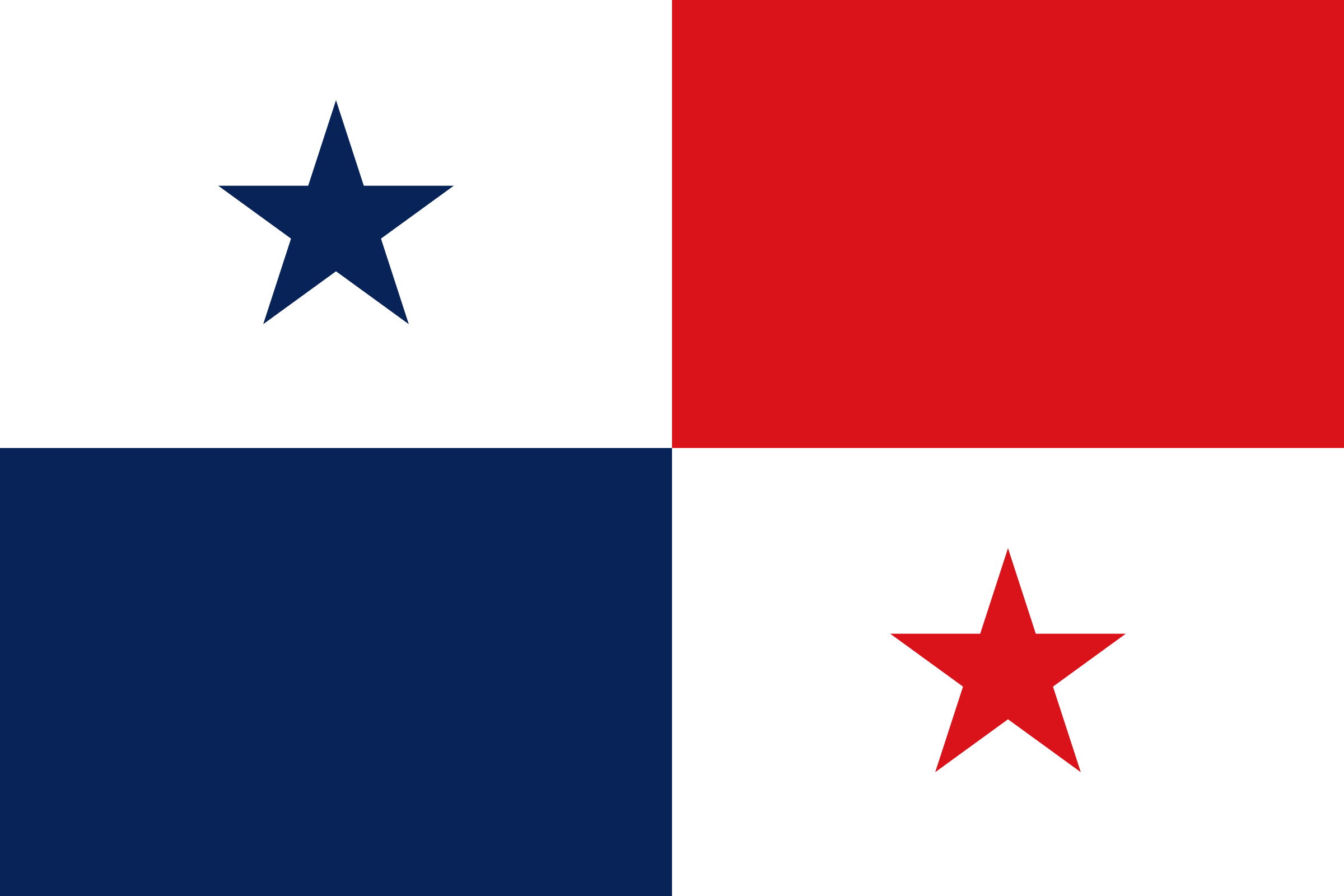
Panama flag picture
Explore the proportions, history, and picture gallery.
| Design | Four quarters and two starsBlue and red stars sit in opposite white quarters. |
|---|---|
| Proportions | Height:length = 2:3Each upright star has visible height H/4. |
| Origin | November 1903Early revision established the familiar honor canton. |
| Design credit | Manuel Encarnación AmadorDistinct from his father, Manuel Amador Guerrero. |
| Legal adoption | 1904 provisional; 1925 definitiveLaw 64 of June 4, 1904; Law 48 of March 10, 1925. |
| Digital palette | Blue, red, and whitePublished RGB/hex values in the official 2017 manual. |
What does Panama’s flag look like?
Panama’s flag has four equal quarters: white with a blue star at the upper hoist, red at the upper fly, blue at the lower hoist, and white with a red star at the lower fly. Its height:length ratio is 2:3. The design originated in 1903 and received definitive adoption in 1925.
Four quarters and two stars form a carefully measured national design. This guide explains their civic symbolism, the official color references, and the difference between origin, provisional adoption, definitive adoption, and later standards. The diagrams preserve the published dimensions and identify the additional geometric choices used to construct the artwork.
What is the design of the Panama flag?
Panama’s national flag is a rectangle divided into four equal quarters. With the hoist on the left, the upper-left quarter is white with a blue five-pointed star, the upper-right is red, the lower-left is blue, and the lower-right is white with a red five-pointed star. Both stars point upward.

The hoist is the edge attached to a pole or halyard; the fly is the opposite free edge. Reading the flag from the hoist matters because exchanging the two sides changes its appearance. The white quarter containing the blue star occupies the upper position beside the hoist.
The ordinary national design includes no coat of arms, lettering, decorative outline, or additional stars. The four quarters fill the complete rectangle without gaps or dividing strokes. Labels, guides, and borders around the educational diagrams explain the construction; they are separate from the downloadable plain flag artwork.
What are the colors and official digital codes of the Panama flag?
The flag uses blue, red, and white. Panama’s official 2017 manual gives blue as RGB 7, 35, 87, or #072357; red as RGB 218, 18, 26, or #DA121A; and white as RGB 255, 255, 255, or #FFFFFF. These published digital values are used consistently in the supplied artwork.

Each blue element uses the same fill: the lower hoist quarter and the star above it. The upper fly quarter and the lower fly star likewise share the same red. The two remaining quarter backgrounds are pure white, including the spaces between each star’s points.
A numerical palette makes repeated digital exports consistent. It does not guarantee that every display, printer, or textile reproduces an identical physical color. The files retain the manual’s stated RGB and hexadecimal values; no filter, gradient, shading, or simulated fabric texture is added inside the plain national flag.
| Color | Hexadecimal | RGB | Used for |
|---|---|---|---|
| Blue | #072357 | 7, 35, 87 | Lower hoist quarter and upper hoist star |
| Red | #DA121A | 218, 18, 26 | Upper fly quarter and lower fly star |
| White | #FFFFFF | 255, 255, 255 | Two star-bearing quarter backgrounds |
Which Pantone references does the official manual give?
The official manual lists blue as Pantone 295 C on coated stock and 296 U on uncoated stock. It lists red as Pantone 187 C and 186 U respectively. White is pure white. These references accompany the manual’s separate RGB, hexadecimal, and CMYK entries; they are not interchangeable conversion formulas.
The suffixes identify different reference systems for coated and uncoated printing surfaces. Keeping the suffix with the number prevents a short color label from losing part of its meaning. The manual prints CMYK entries of 100, 46, 0, 70 for blue and 0, 100, 79, 20 for red.
Those published entries should be recorded as parallel specifications, rather than presented as values calculated from the RGB numbers by a universal conversion. The downloadable vectors use the RGB/hexadecimal column. A physical production proof requires its own material and printing context; this article does not certify an ink or fabric match.
| Color | Pantone coated | Pantone uncoated | CMYK as printed |
|---|---|---|---|
| Blue | 295 C | 296 U | 100, 46, 0, 70 |
| Red | 187 C | 186 U | 0, 100, 79, 20 |
| White | Pure white | Pure white | 0, 0, 0, 0 |
What does the Panama flag symbolize?
The flag brings together political reconciliation and civic ideals. Blue recalls the Conservative Party and red the Liberal Party, while white represents peace for the new nation. The blue star represents purity and honesty in civic life; the red star represents the authority and law that uphold those virtues.

The meanings belong to particular elements, so the colored quarters and stars should not be collapsed into one vague explanation. The party associations explain the presence of red and blue, while the stars give those same colors an additional civic role. White provides the shared setting for both stars.
This reading follows the national-symbols statute and the government’s explanatory material. It also explains why generic color stories can mislead: substituting oceans for blue or blood for red leaves out the documented political context. The arrangement is a national symbol, not a chart of party support or demographic proportions.
Why are red and blue used together?
Red and blue recall the Liberal and Conservative parties respectively. Their presence in one national design expresses a shared political setting rather than the exclusive identity of either party. White supplies the message of peace, while the two stars add the distinct ideals of honesty, purity, authority, and law.
The association is historical. It does not make the present flag an endorsement of a contemporary party or require viewers to interpret today’s political organizations through the same colors. The design combines both colors in equal-sized solid quarters and repeats each one in a star of the same size.
That visual balance can be measured, but its measurements should not be turned into invented historical statistics. Equal colored areas do not establish equal membership, election results, or population shares. Understanding the political references requires identifying the parties named in the official explanation, then reading them alongside the white quarters and civic stars.
What does white mean on the Panama flag?
White represents the peace in which the new nation was to live. It appears in two diagonally opposed quarters, each containing a colored star. Before the stars are added, the white quarter backgrounds occupy half the flag’s area; the visible white area is slightly smaller once both stars are included.
The upper hoist white quarter is especially significant because it is the canton of honor. It contains the blue star, while the other white quarter lies diagonally across the rectangle and contains the red star. The white backgrounds remain connected visually through their matching size and shared meaning.
Distinguish the area of a quarter from the area of a particular visible color. Saying that two of four quarter backgrounds are white is exact. Saying that precisely half of the finished image is white overlooks the colored stars. Neither observation changes the documented symbolic meaning of peace.
What do the two stars on the Panama flag mean?
The blue star represents purity and honesty that should guide civic life. The red star represents the authority and law that uphold those virtues. Each star has five points and sits in a white quarter. The two stars are not an official count of provinces, oceans, continents, or political districts.

The official explanation treats the stars as civic ideals rather than a geographic enumeration. Their different colors matter: switching the blue and red stars would change the documented arrangement, even though the overall count would remain two. Both stars share the same size and upright orientation in the horizontal reference.
Panama’s coat of arms is a separate symbol with a different composition and its own stars. A meaning attached to that emblem should not be transferred automatically to the two stars on the flag. Read each national symbol according to its own description instead of assuming every star serves the same purpose.
What is the height:length ratio of the Panama flag?
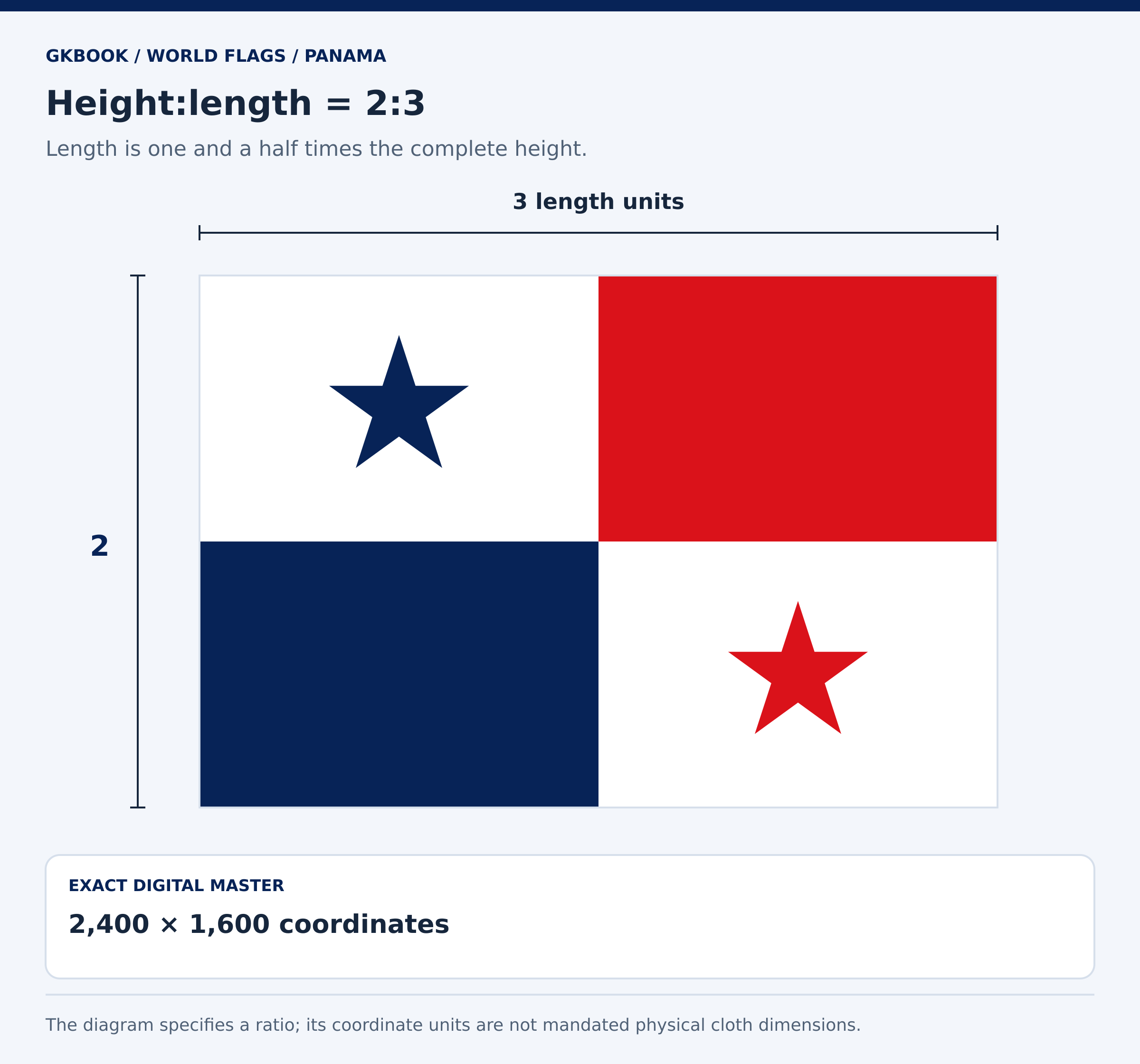
The standard horizontal reference has a height:length ratio of 2:3, equivalent to one unit high by one and a half units long. A flag 160 units high is therefore 240 units long. The supplied SVG uses a 2,400 × 1,600 coordinate system, preserving this proportion exactly.

The ratio describes the complete rectangle, not an individual quarter or the star’s surrounding circle. Length is one and a half times height; height is two-thirds of length. Stating the order of the dimensions prevents 2:3 from being mistaken for a tall portrait canvas.
All examples in this package use this standard reference. The statute allows specified exceptional representations in the applicable manual, so the ratio should not be generalized into an unsupported claim about every specialized use. For ordinary flat illustrations and downloads, preserve the full 2:3 rectangle and scale every internal distance with it.
How are the four quarters measured?
A vertical division at half the length and a horizontal division at half the height produce four equal quarters. Each quarter is L/2 wide and H/2 high, where L and H describe the whole flag. On the 2,400 × 1,600 master, every quarter measures 1,200 × 800 units.

The word quarter refers to area: each rectangle occupies one-fourth of the complete field. It does not mean that the quarter must be square. Because both dimensions are halved, each quarter retains the whole flag’s width:height ratio of 3:2, making it wider than it is tall.
The division lines are coordinates used for construction. They do not become black seams, outlines, or white gutters in the finished vector. Adjacent fills meet precisely at x = 1,200 and y = 800. Keeping those joins exact also prevents thin unintended strips when the artwork is exported.
Where are the stars positioned?
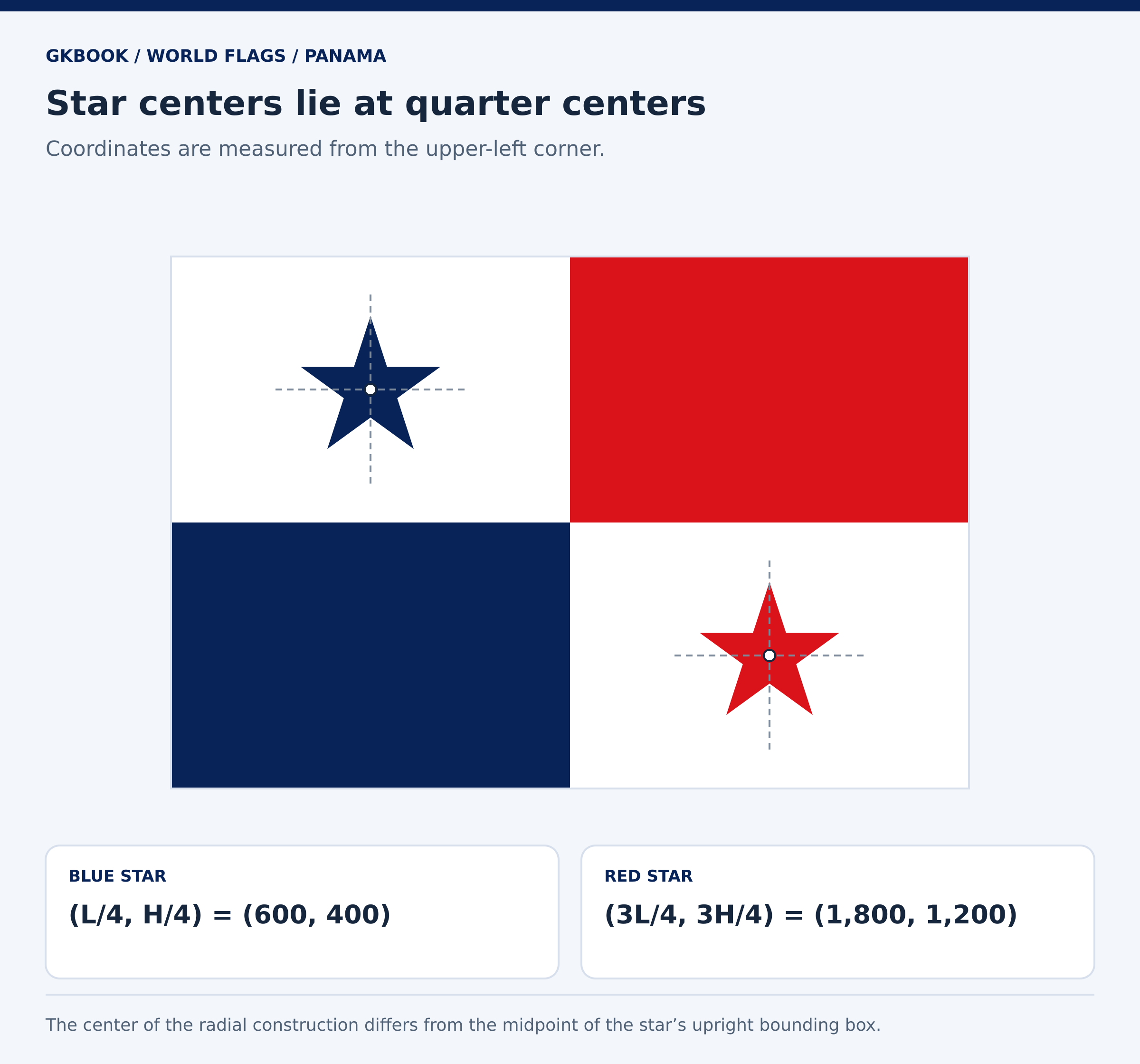
The blue star is centered in the upper hoist white quarter, and the red star is centered in the lower fly white quarter. On the master, their radial centers are (600, 400) and (1,800, 1,200). These equal (L/4, H/4) and (3L/4, 3H/4) measured from the upper-left corner.
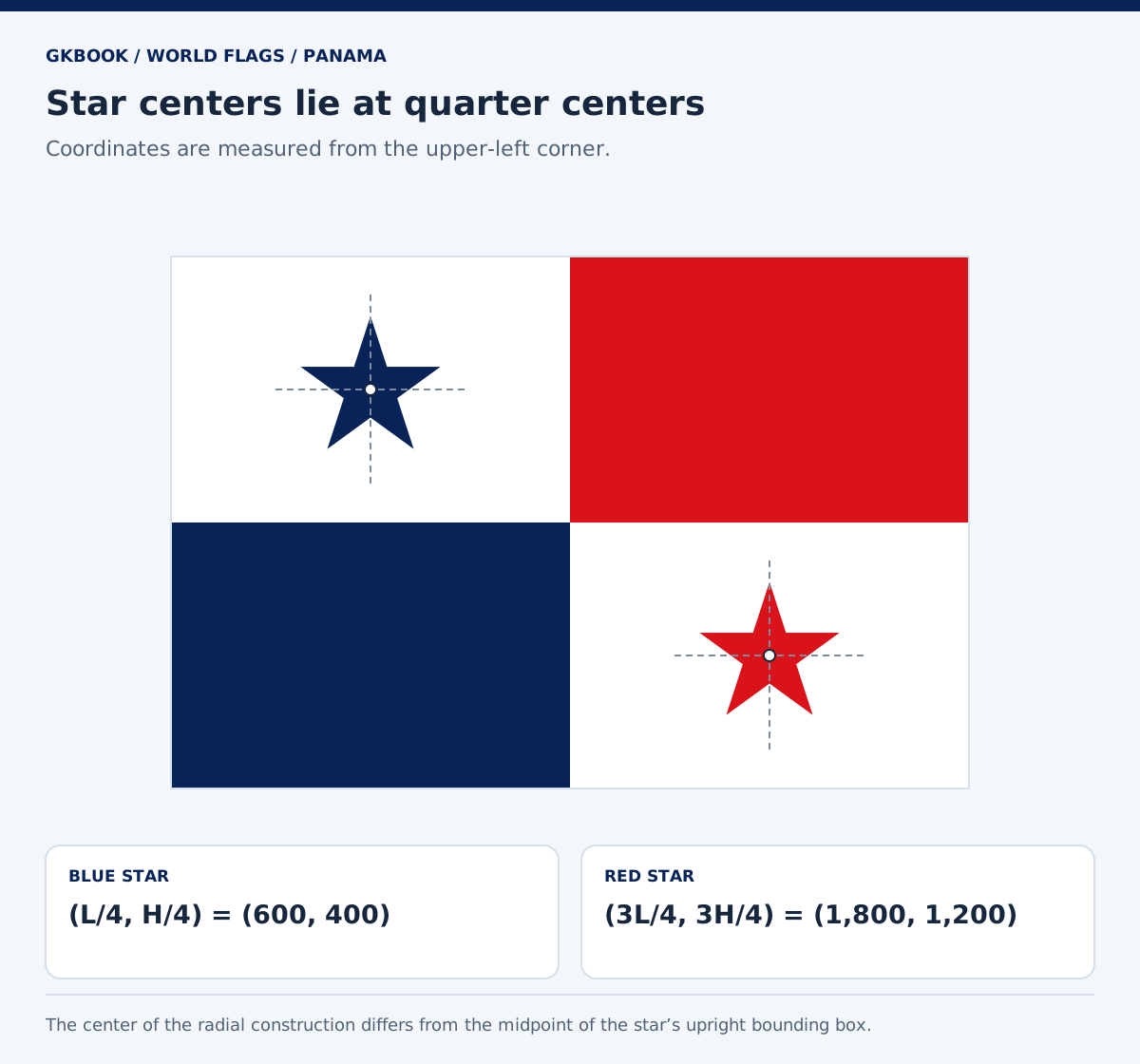
The construction uses the star’s radial center: the center from which its five outer points are arranged. This matches the center guides in the manual’s diagram. It is different from the midpoint of the smallest upright rectangle enclosing the star, because an upward-pointing star extends differently above and below its radial center.
Consequently, using a graphics program’s generic vertical bounding-box alignment can shift the shape slightly. Draw the star around its intended center first, then apply its size. The two center coordinates are exact fractions of the complete flag, so their placement remains consistent at every uniform scale.
How large are the stars on the Panama flag?
Each star has a visible top-to-bottom height of one-quarter of the complete flag’s height, equivalent to one-sixth of its length. The official manual illustrates this dimension beside the red star. On a 2,400 × 1,600 master, each upright star is therefore 400 units high, measured between its extreme points.

This measurement is not the diameter of the star’s circumcircle. An upright regular five-pointed star has one point at the top and two lower outer points; those lower points do not reach the bottom of the surrounding circle. Treating the specified height as that circle’s diameter produces a smaller star.
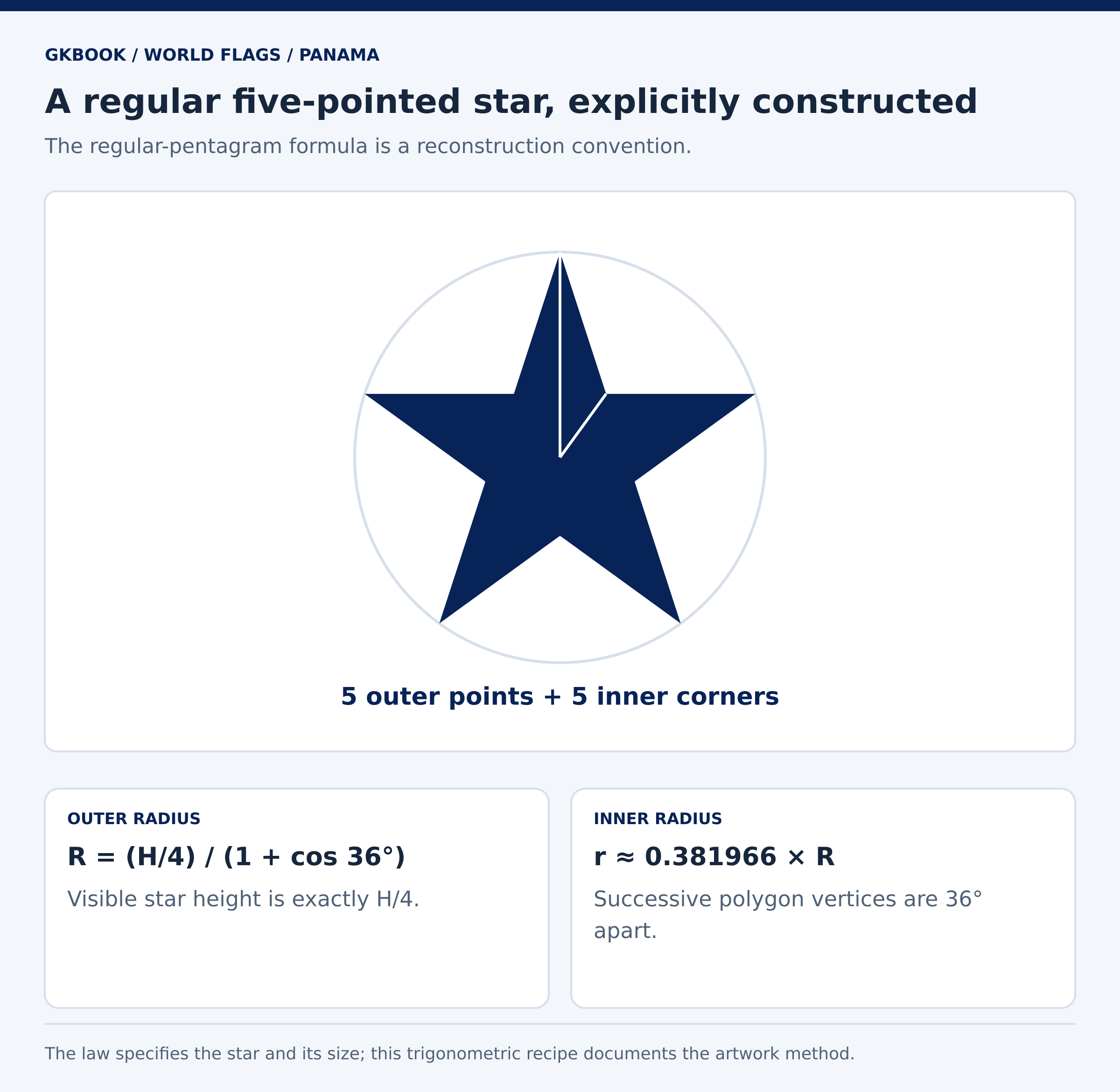
For the regular-star construction used here, the outer radius is approximately 221.115 units. The resulting visible height is exactly 400 units, while the outer-circle diameter is approximately 442.229 units. The construction diagram distinguishes the measured star height from the auxiliary circle to make that difference clear.
How are the five-pointed stars constructed?
The supplied artwork uses regular pentagram geometry: five equally spaced outer points alternate with five inner corners. One outer point faces upward. The inner radius is approximately 0.381966 times the outer radius. This precise geometric method is a documented reconstruction convention; the legal text itself does not prescribe that trigonometric formula.
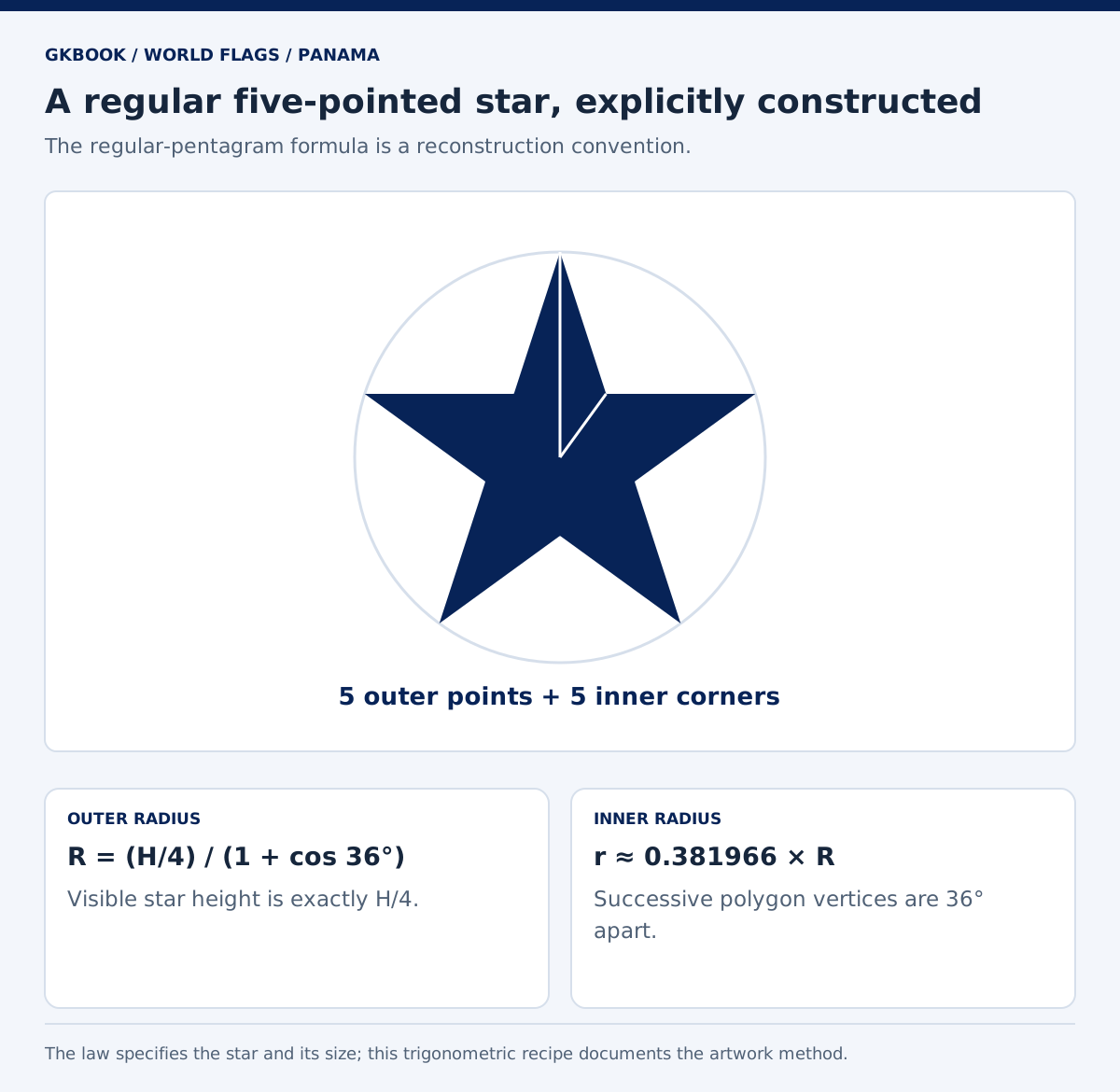
Start with outer points separated by 72 degrees around the chosen center. Place an inner corner halfway between each neighboring pair of outer directions, producing ten polygon vertices with angular steps of 36 degrees. Join the alternating outer and inner vertices to obtain the filled five-pointed outline.
For an upright regular star, visible height equals the outer radius multiplied by one plus the cosine of 36 degrees. Set that height to H/4 before calculating the radius. This keeps the measured result tied to the official dimension while making the additional regular-pentagram assumption transparent and reproducible.
How can you draw the Panama flag accurately?
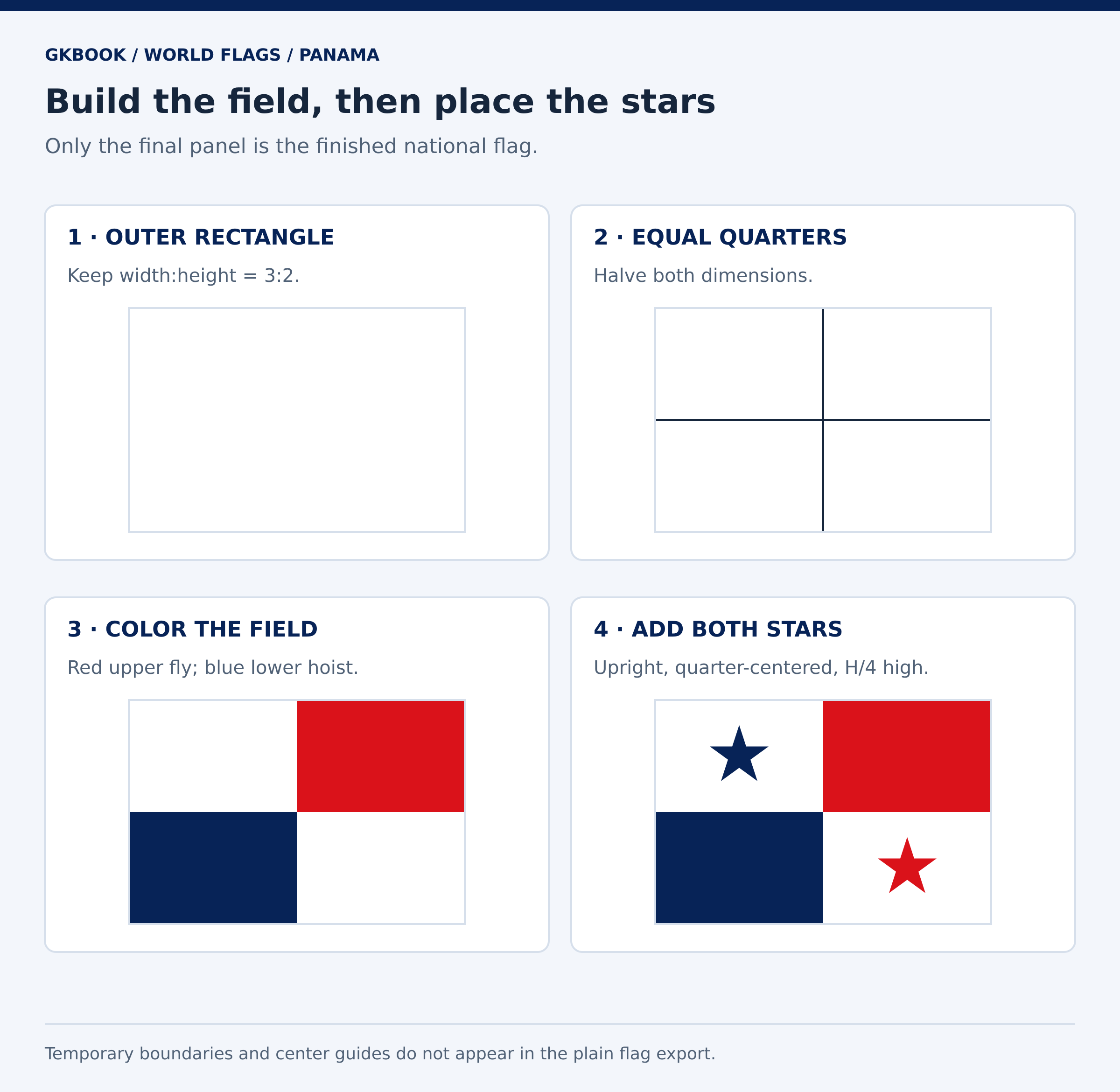
Begin with a 2:3 rectangle and divide it into four equal quarters. Keep the upper hoist and lower fly quarters white; fill the upper fly red and lower hoist blue. Add a centered blue star in the upper white quarter and a centered red star in the lower white quarter, each upright and H/4 high.
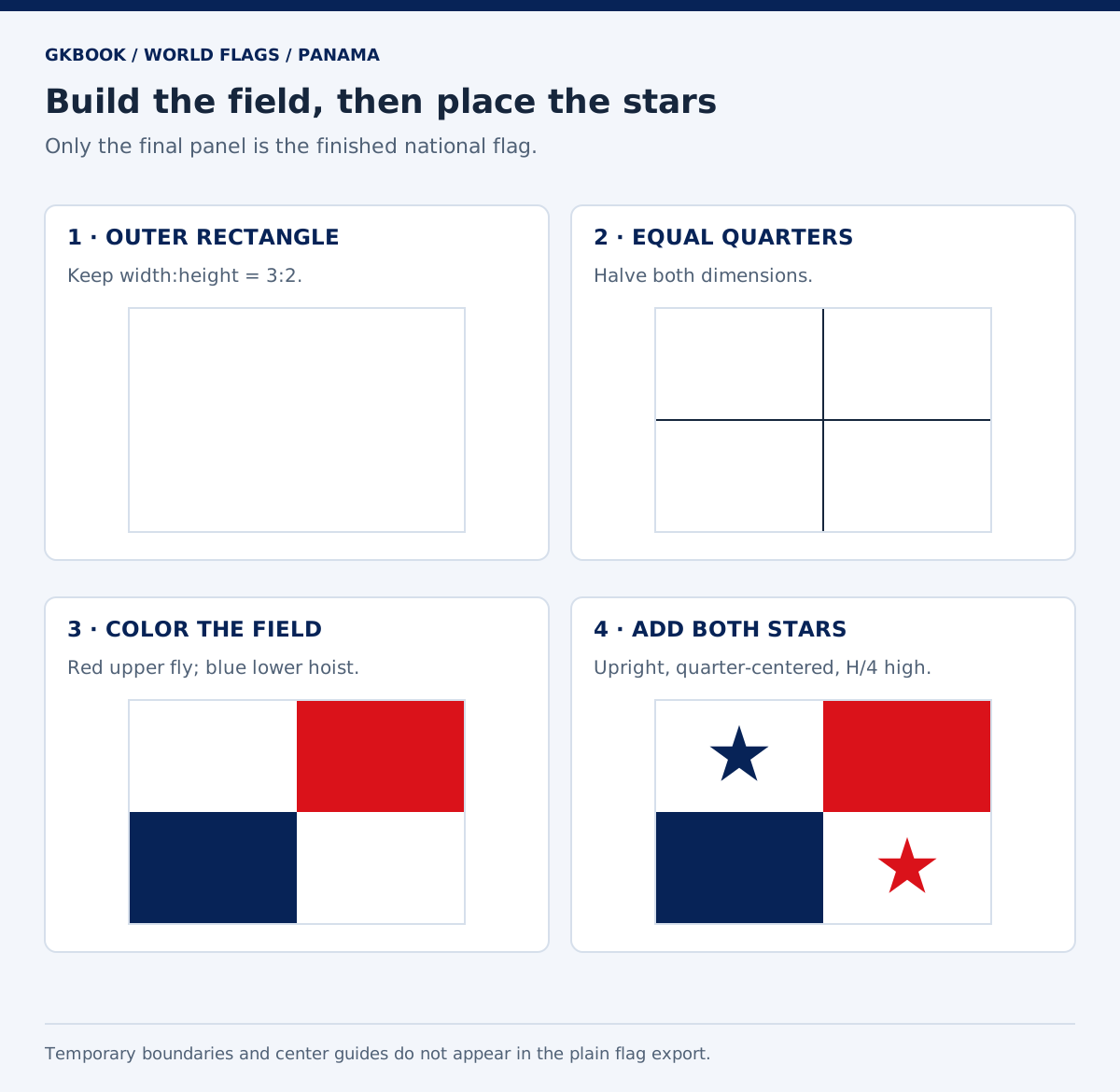
A reliable drawing order separates the field from the symbols. Establish the outer proportions first, then halve each dimension. Mark the centers of the two white quarters with temporary guides. Construct one measured star, duplicate it without changing its size, and apply the correct color to each copy.
Remove all guides from the finished reference. There should be no visible dividing lines between quarters and no outline around either star. The illustrated intermediate stages are labeled as construction steps; only the final stage is the complete national flag. Export the entire canvas so the intended edge positions remain intact.
What dimensions work for different image sizes?
Any uniformly scaled 3:2 width:height canvas preserves the standard design. Examples include 600 × 400, 1,200 × 800, and 2,400 × 1,600. The corresponding star heights are 100, 200, and 400 units. The supplied plain PNG is 4,800 × 3,200 pixels, with stars 800 pixels high before raster edge smoothing.
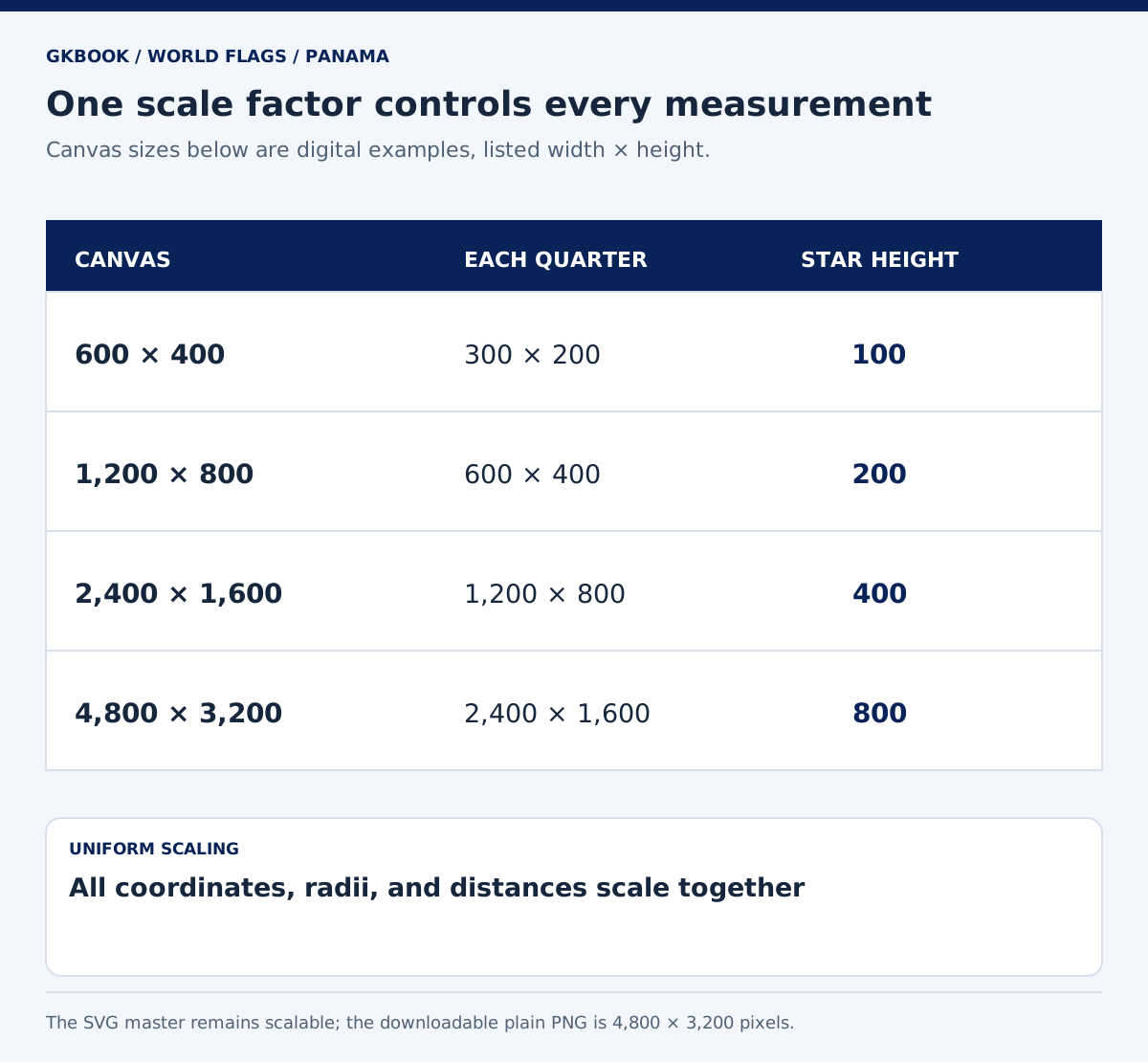
Choose the image size according to its intended use, then derive the internal measurements from the same scale factor. At 600 × 400, each quarter is 300 × 200 and the star centers are (150, 100) and (450, 300). At twice that size, every coordinate and distance doubles.
Pixel dimensions are export choices rather than mandated physical cloth sizes. A vector can be resized continuously, whereas a small raster image may show softened star points because its boundaries cross pixels. Retaining the vector master and exporting at the required size avoids repeatedly enlarging a low-resolution copy.
| Canvas | Each quarter | Star height | Star centers |
|---|---|---|---|
| 600 × 400 | 300 × 200 | 100 | (150, 100); (450, 300) |
| 1,200 × 800 | 600 × 400 | 200 | (300, 200); (900, 600) |
| 2,400 × 1,600 | 1,200 × 800 | 400 | (600, 400); (1,800, 1,200) |
| 4,800 × 3,200 | 2,400 × 1,600 | 800 | (1,200, 800); (3,600, 2,400) |
Is the Panama flag symmetrical?
The fixed, correctly colored horizontal flag is not unchanged by a horizontal reflection, vertical reflection, or half-turn. Its quarters and stars occupy specific positions. Each individual upright regular star has a vertical line of symmetry, and the equal quarters balance the layout, but these local properties do not make the whole flag symmetrical.

A half-turn exchanges the red and blue solid quarters and reverses the direction of the stars. A left-right reflection moves the blue-star white quarter to the upper right. A top-bottom reflection places it at the lower left. Each operation changes the standard hoist-left reference in a visible way.
Equal areas and geometric symmetry are different ideas. Red and blue occupy equal total areas in this reconstruction because their solid quarters are equal and their stars are congruent. That balance does not permit exchanging their positions. The gallery marks the standard arrangement and explains the transformations without presenting altered versions as approved alternatives.
What does the reverse side of the Panama flag look like?
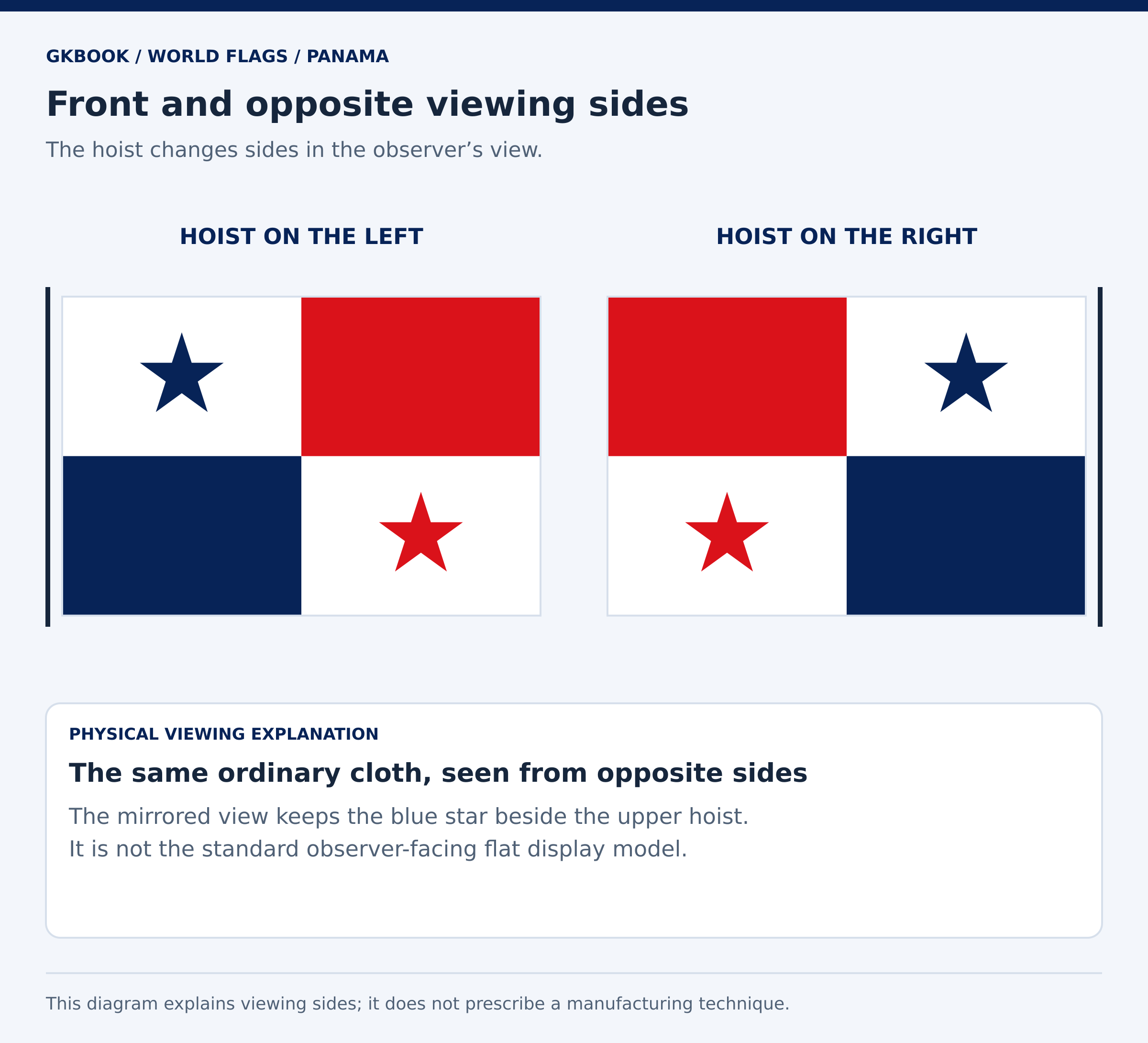
Viewed through the opposite side of the same ordinary flag, the design appears horizontally mirrored and the hoist appears on the right. The blue star is then in the upper-right white quarter, while the red star is in the lower-left white quarter. Both stars remain upward-pointing in this horizontal reverse view.
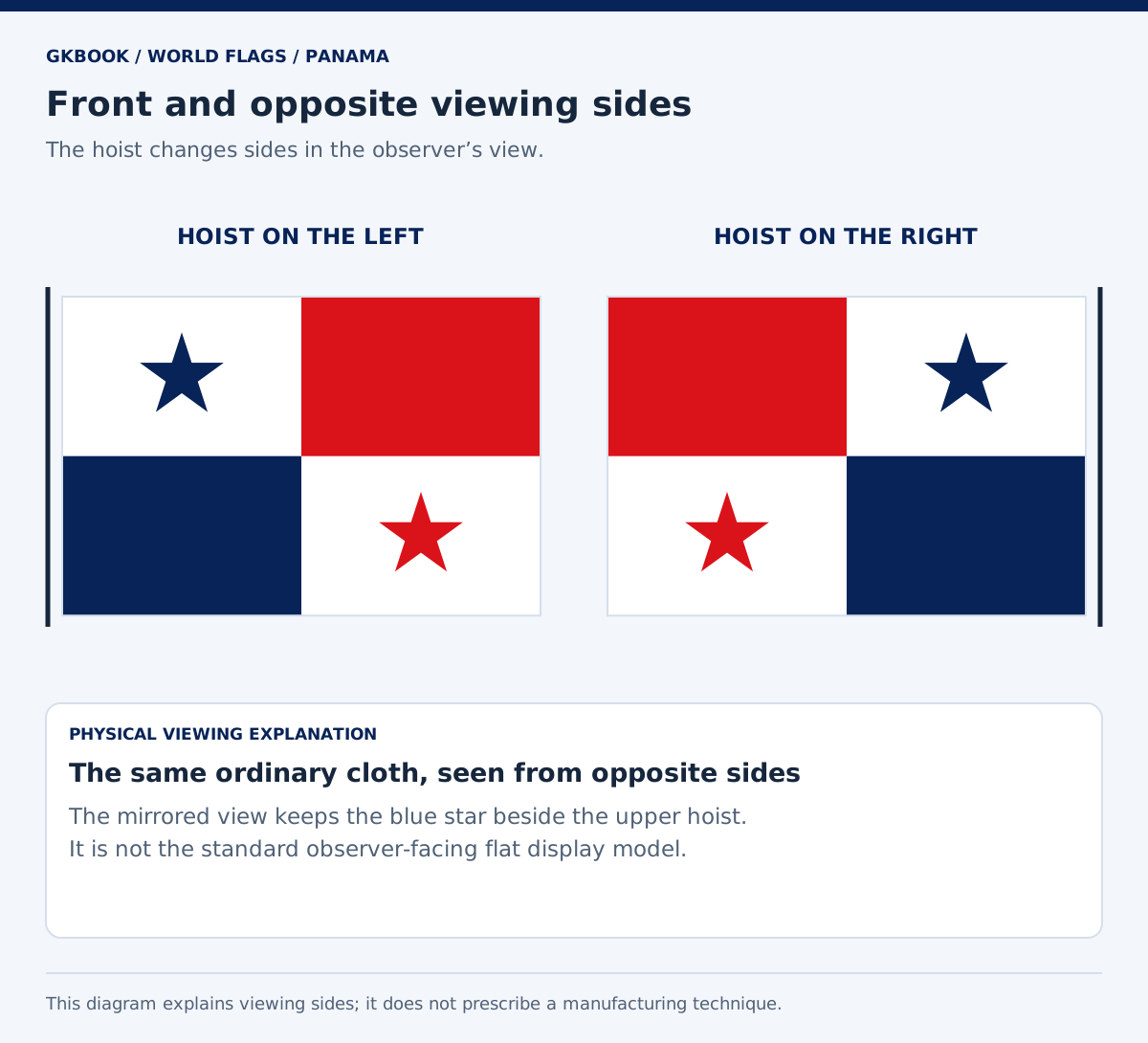
Mirroring changes the observer’s left and right; it does not exchange the colors attached to the cloth. The blue star remains beside the upper hoist, even though that hoist now appears on the viewer’s right. This relationship is easier to follow when the attachment edge is labeled in both views.
A reverse-side illustration is a viewing explanation, not a substitute for the conventional flat reference. The public display model places the canton of honor at the observer’s upper left. Keep that display convention separate from the physical fact that the opposite side of a flag can be seen while it flies.
How should the Panama flag appear in vertical display?
The official manual’s vertical model keeps the white quarter with the blue star at the viewer’s upper left. Blue occupies the upper right, red the lower left, and white with the red star the lower right. Both stars point left in this portrait model, so simply rotating the usual front view clockwise is incorrect.
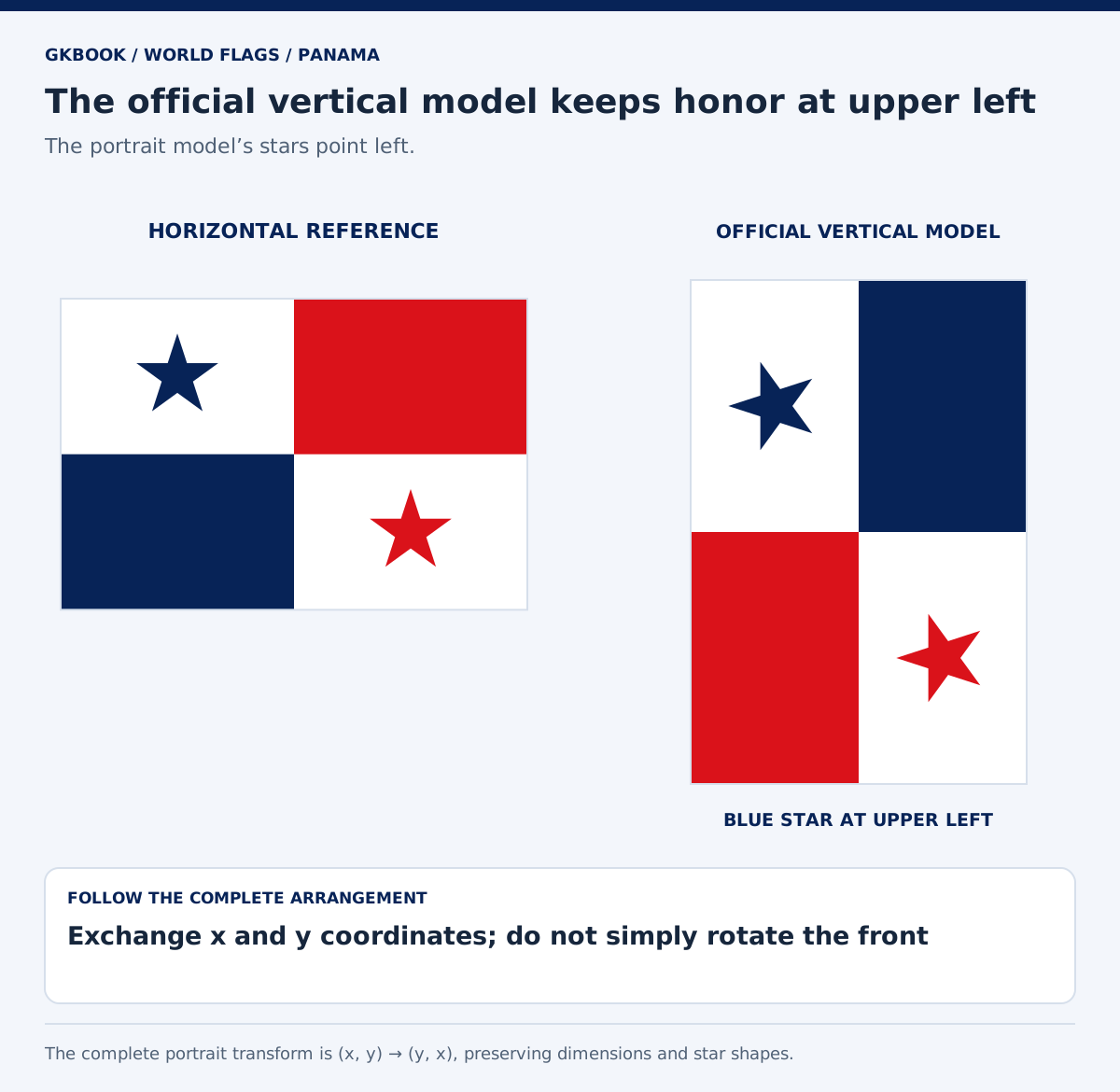
The supplied portrait diagram follows the manual’s actual arrangement. Its relationship to the horizontal reference can be expressed by exchanging the x and y coordinates: (x, y) becomes (y, x). The resulting canvas is 1,600 units wide and 2,400 high, with the complete design transformed together.
This operation preserves distances while changing orientation. It keeps the canton of honor at the upper left and turns the upward star points toward the left. Stretching the horizontal artwork into a tall rectangle would distort the stars; rotating it clockwise would put the canton of honor on the wrong side.
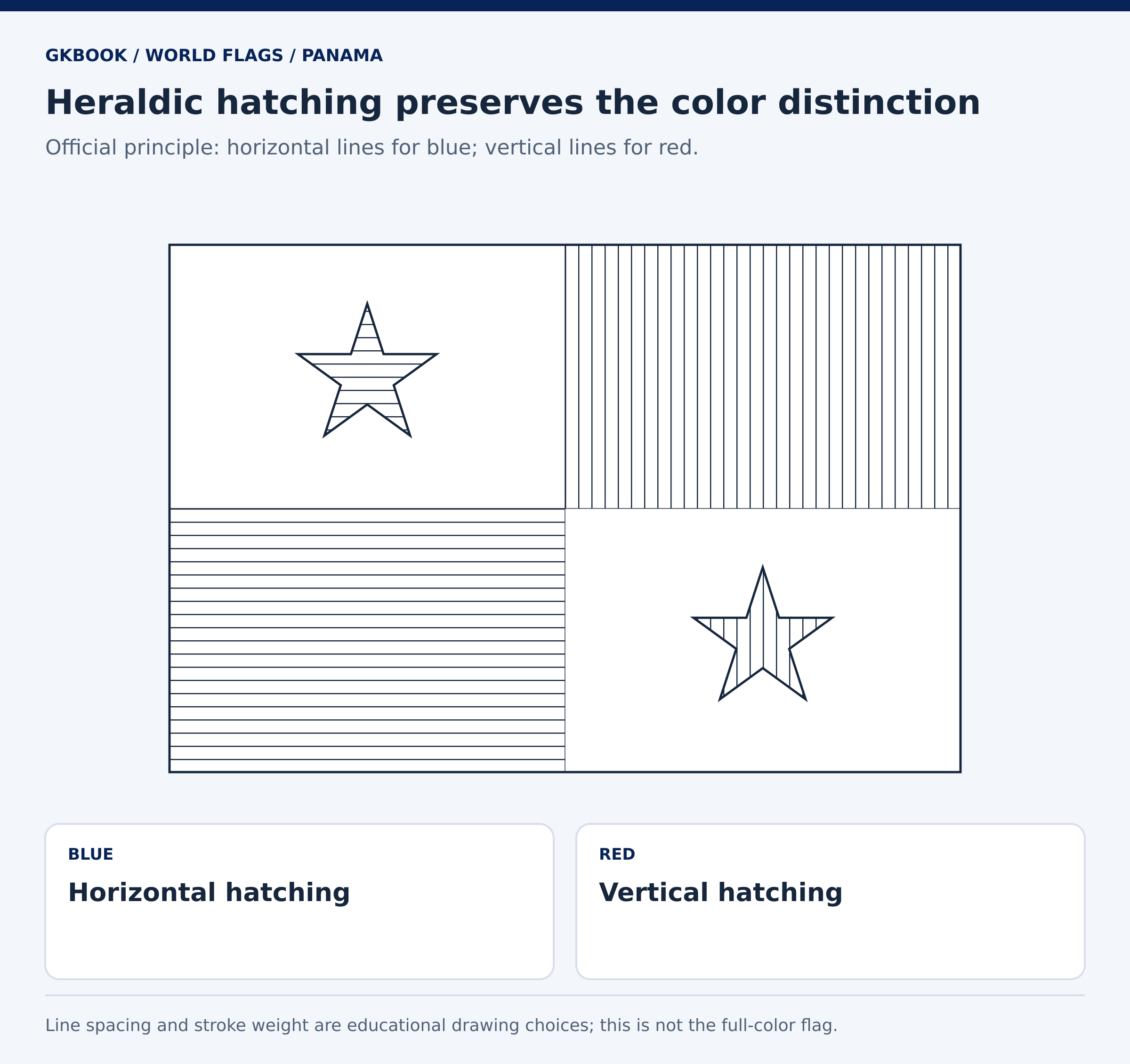
How does the official manual represent the flag in black and white?
The manual includes a heraldic hatching model for monochrome reproduction. Horizontal lines identify blue, vertical lines identify red, and white remains unhatched. The same distinction applies to the stars as to the solid quarters. This is an explanatory black-and-white representation, separate from the ordinary blue, red, and white flag.
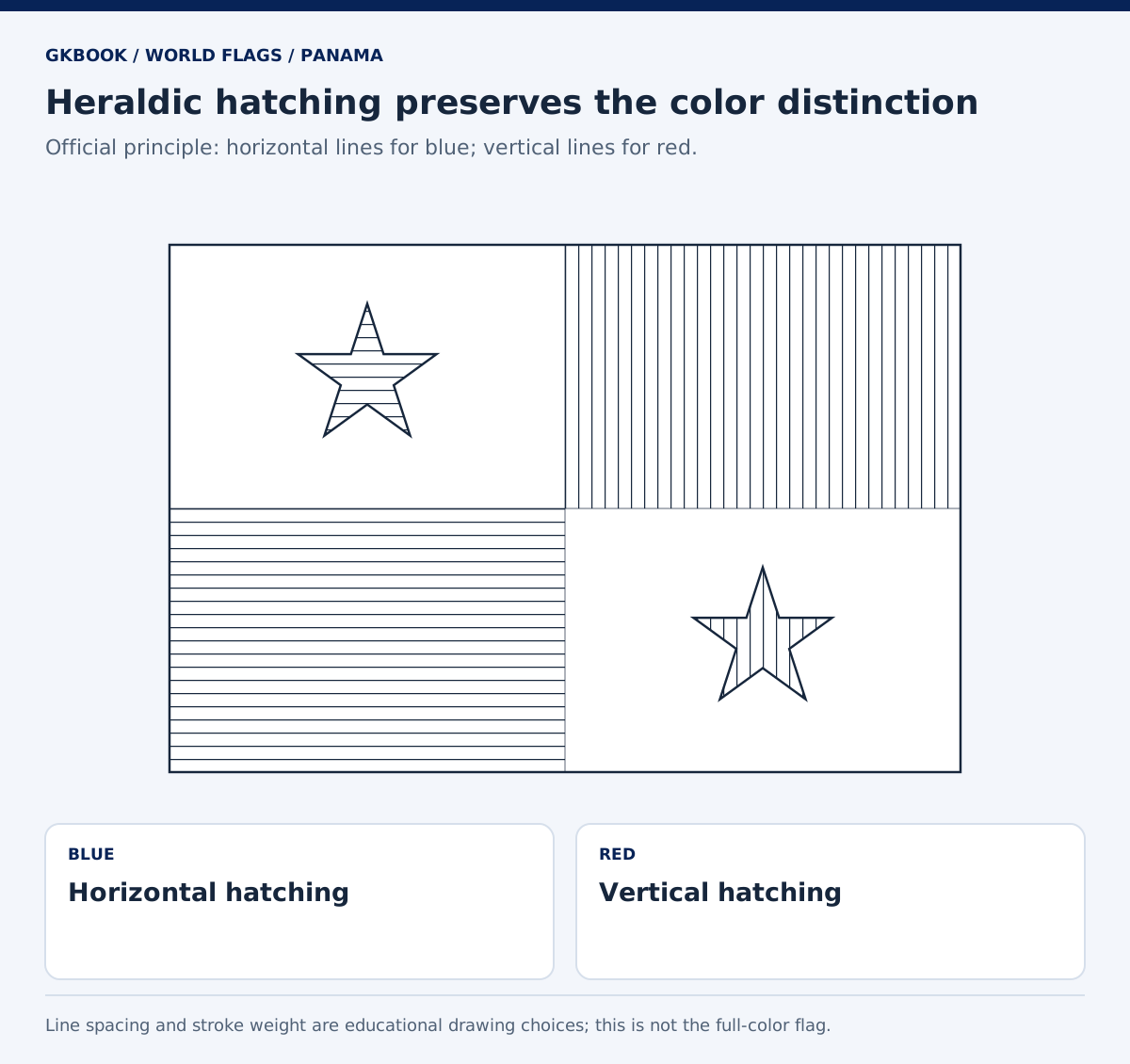
Hatching preserves information that could disappear in an undifferentiated grayscale conversion. A blue quarter and blue star share horizontal lines; a red quarter and red star share vertical lines. Their placement, size, and surrounding white areas remain recognizable without relying on a reader’s ability to distinguish two shades of gray.
The gallery recreates that principle with regular line spacing and outlines chosen for legibility. The line thickness and spacing in this educational drawing are not additional legal measurements. Hatching belongs only to the labeled monochrome model and is not added to the downloadable full-color national flag.
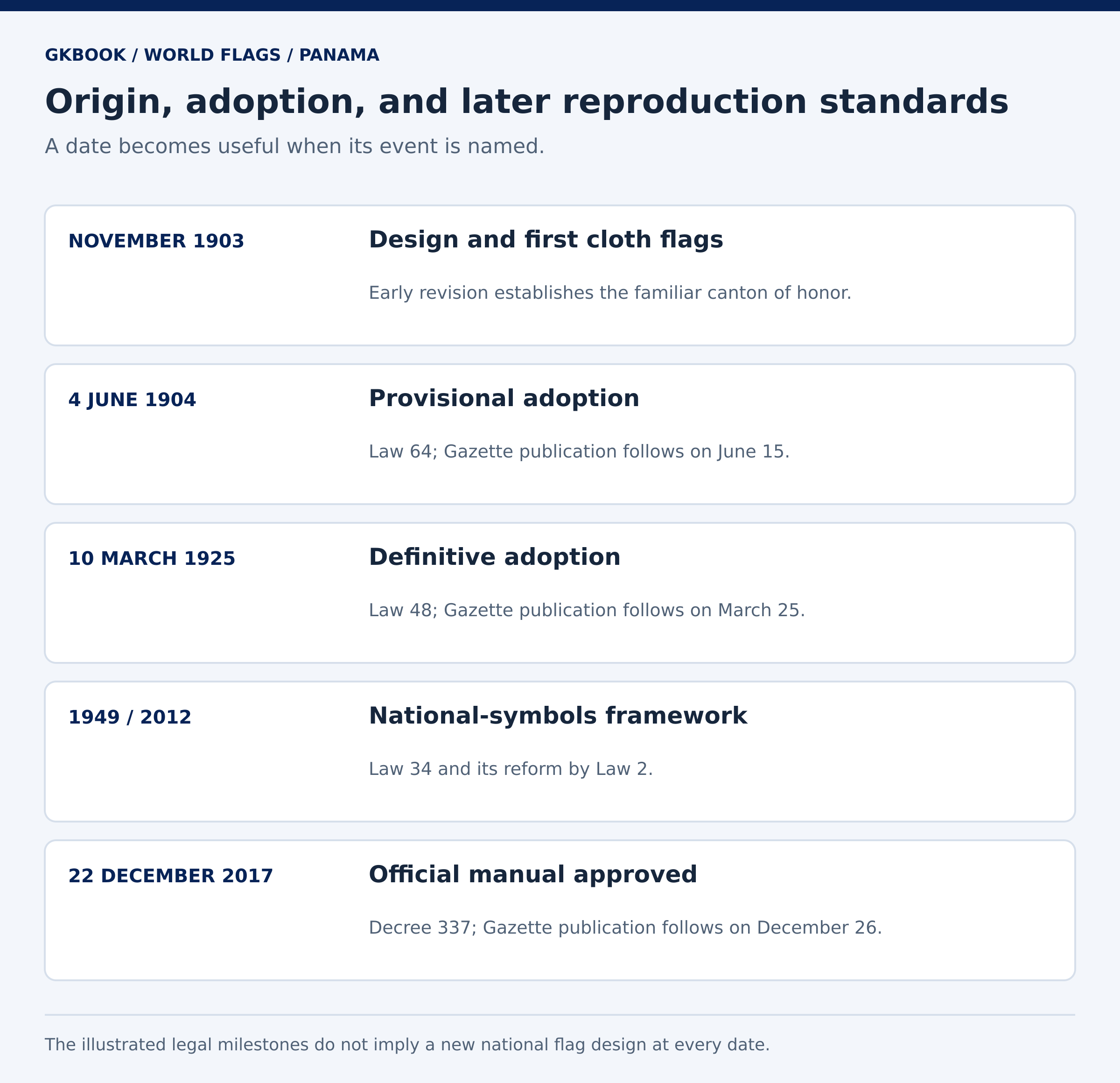
What is the history of the Panama flag?
The flag originated during Panama’s separation from Colombia in November 1903. Manuel Encarnación Amador designed it, and María Ossa de Amador helped make the first flags. A revised arrangement established the familiar canton of honor. Provisional legal adoption followed in 1904, definitive adoption in 1925, and later legislation regulated the national symbols.
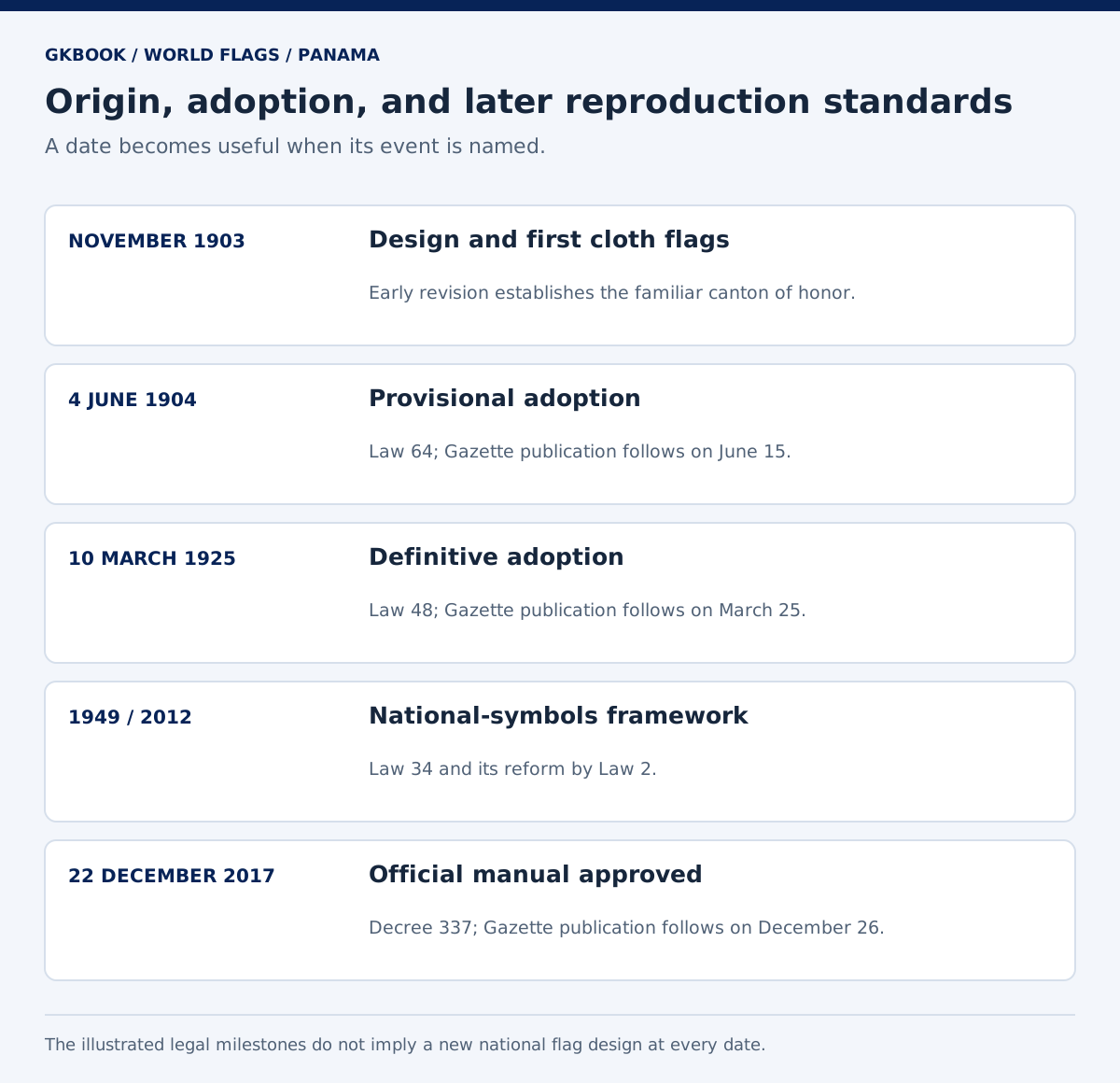
A useful timeline separates invention, making the first cloths, adjusting the arrangement, and legislative adoption. Those events happened at different times and involved different people or institutions. The flag’s origin in 1903 therefore does not conflict with a later law describing its definitive adoption in 1925.
The historical illustrations are modern educational summaries. They do not claim to reproduce the fabric, stitching, dyes, or wear of a particular surviving flag. Similarly, the modern construction manual records how the symbol should be represented; its publication in 2017 does not move the flag’s creation date into the twenty-first century.
Who designed the Panama flag?
The government’s historical account credits Manuel Encarnación Amador, also identified in the flag law as Manuel E. Amador T. He developed the design on November 1, 1903. He should not be confused with his father, Manuel Amador Guerrero, Panama’s first president, or with María Ossa de Amador, associated with sewing the first flags.

The similar names can obscure the distinction between the designer and his father. Using the fuller name Manuel Encarnación Amador makes the attribution clearer, while retaining Manuel E. Amador in discussions of the statutory wording. The article credits the design role separately from political leadership and the making of cloth flags.
The official biography describes the combination of party colors and white in the proposed national symbol. The accompanying creator card uses names and roles rather than a speculative portrait or reconstructed private scene. This keeps the visual credit focused on what the consulted records support directly.
Who sewed the first Panama flags?
The Ministry of Government’s biography credits María Ossa de Amador and Angélica B. de Ossa with sewing the first flags during the night of November 2, 1903. It describes their presentation on November 3 and public procession on November 4. This making of the first cloths is distinct from Manuel Encarnación Amador’s design work.
A flag’s history includes both the person who conceived its arrangement and the people who turned that design into a usable physical object. Crediting the sewing therefore adds an essential contribution without transferring the design attribution. The two roles can be named together while remaining historically distinct.
The government biography supplies the sequence used here. This article does not expand that account into an invented dialogue, photographic scene, or definitive list of every helper mentioned in later retellings. The gallery’s text-based creator panel records the supported names and contributions without pretending to show the original room, cloth, or tools.
When was the Panama flag officially adopted?
Law 64 of June 4, 1904 adopted the flag provisionally. Law 48 of March 10, 1925 provided definitive adoption, and its Gazette publication followed on March 25, 1925. The design’s November 1903 origin is earlier than both laws. These dates should be labeled by event rather than treated as interchangeable adoption dates.

The original 1925 Gazette scan distinguishes the law’s date from the issue’s publication date. Its heading names Law 48 of March 10, while the Gazette masthead is dated March 25. Article 3 continues the flag described in Article 6 of the 1904 law, linking the two legislative stages.
A short caption can state “originated in 1903; definitively adopted in 1925.” A detailed chronology should preserve the legal numbers and date labels. Calling the 1925 measure Law 4, or treating March 25 as the date printed in the law’s heading, would lose information visible in the primary record.
| Date | Event |
|---|---|
| November 1903 | Design, first cloth flags, and early arrangement revision |
| June 4, 1904 | Law 64: provisional adoption |
| June 15, 1904 | Publication in Gazette 29 |
| March 10, 1925 | Law 48: definitive adoption |
| March 25, 1925 | Publication in Gazette 4601 |
Was the earliest arrangement different from today’s flag?
Yes. The official CONASINA presentation shows an initial arrangement with blue at the upper hoist, white with a red star at the upper fly, white with a blue star at the lower hoist, and red at the lower fly. It says the designer revised the arrangement before the end of November 1903.

The same presentation explains the change through the canton of honor: a solid party color was replaced in that position by the white quarter bearing the blue star. The familiar arrangement therefore belongs to the flag’s early development, rather than to a newly invented design in the later adoption laws.
The historical comparison here reproduces only that documented arrangement, using modern measured stars and the declared manual palette for consistency. It is labeled as a schematic, not a facsimile of an original cloth. Its purpose is to explain which quarter moved, without asserting exact historical dye values or stitching dimensions.
What do the 1949 law and 2012 reform cover?
Law 34 of December 15, 1949 established a broader legal framework for Panama’s national symbols, including the flag, anthem, and coat of arms. Law 2 of January 23, 2012 amended that framework. The consolidated text describes the flag’s quarters, star placement, proportions, star size, and symbolism alongside provisions governing national-symbol use.
The consolidated text is useful because it presents the amended provisions together. Its flag articles specify the standard rectangle, the two colored stars, their orientation in the horizontal design, and the civic meanings assigned to the colors and symbols. Those details provide a legal foundation for the measured reference.
The existence of a later framework should not be mistaken for the first appearance of the flag. The design and earlier adoption laws already existed. This article focuses on identification and construction; it does not turn a few summarized provisions into a complete legal opinion about every ceremonial, commercial, or specialized use.
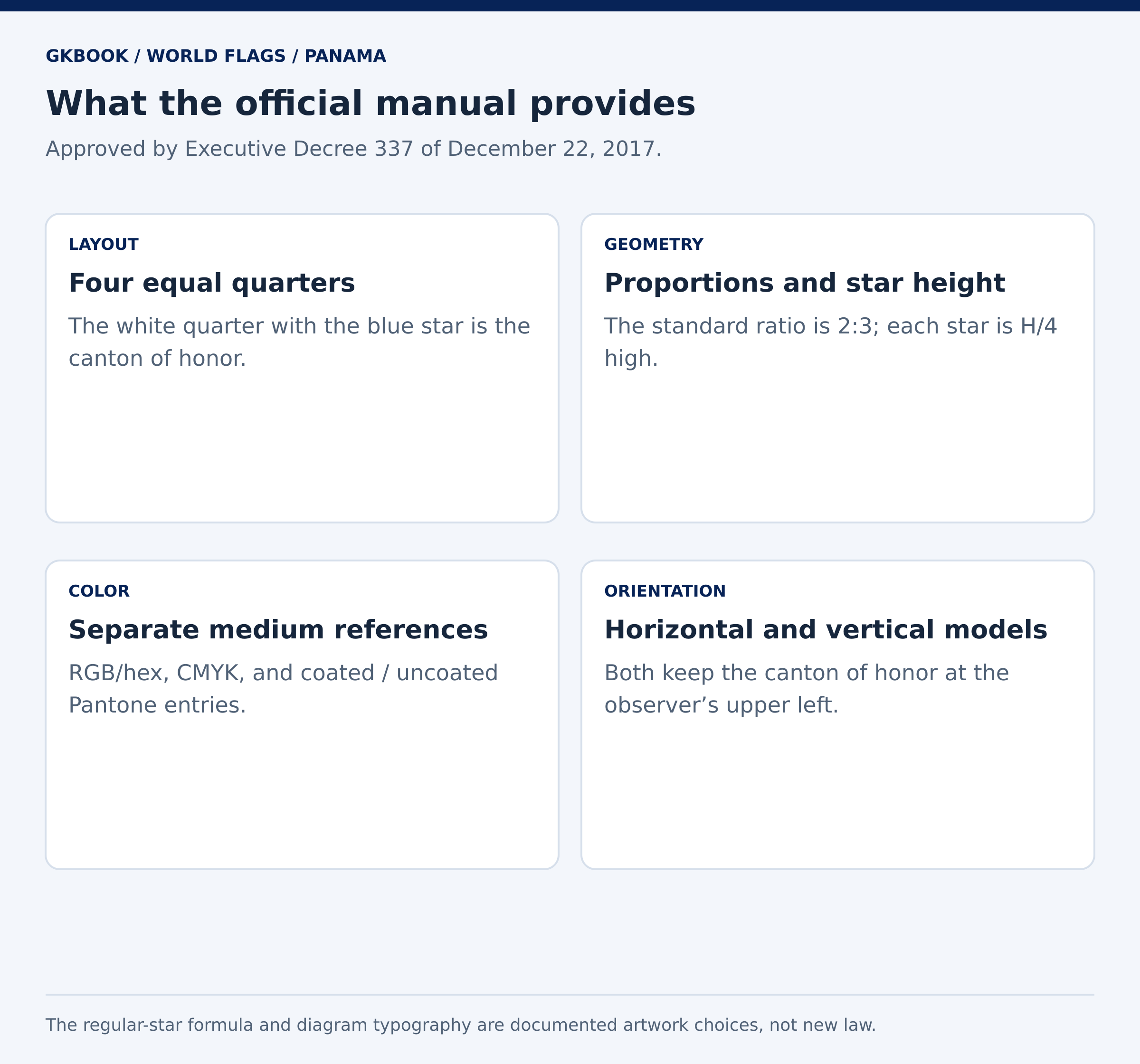
What does the 2017 official manual add?
Executive Decree 337 of December 22, 2017 approved a manual on the procedure, design, and use of Panama’s national symbols. Its illustrated annex supplies color references, construction guides, a monochrome model, and orientation examples. The manual clarifies reproduction of the established flag; it does not represent adoption of a new national design.
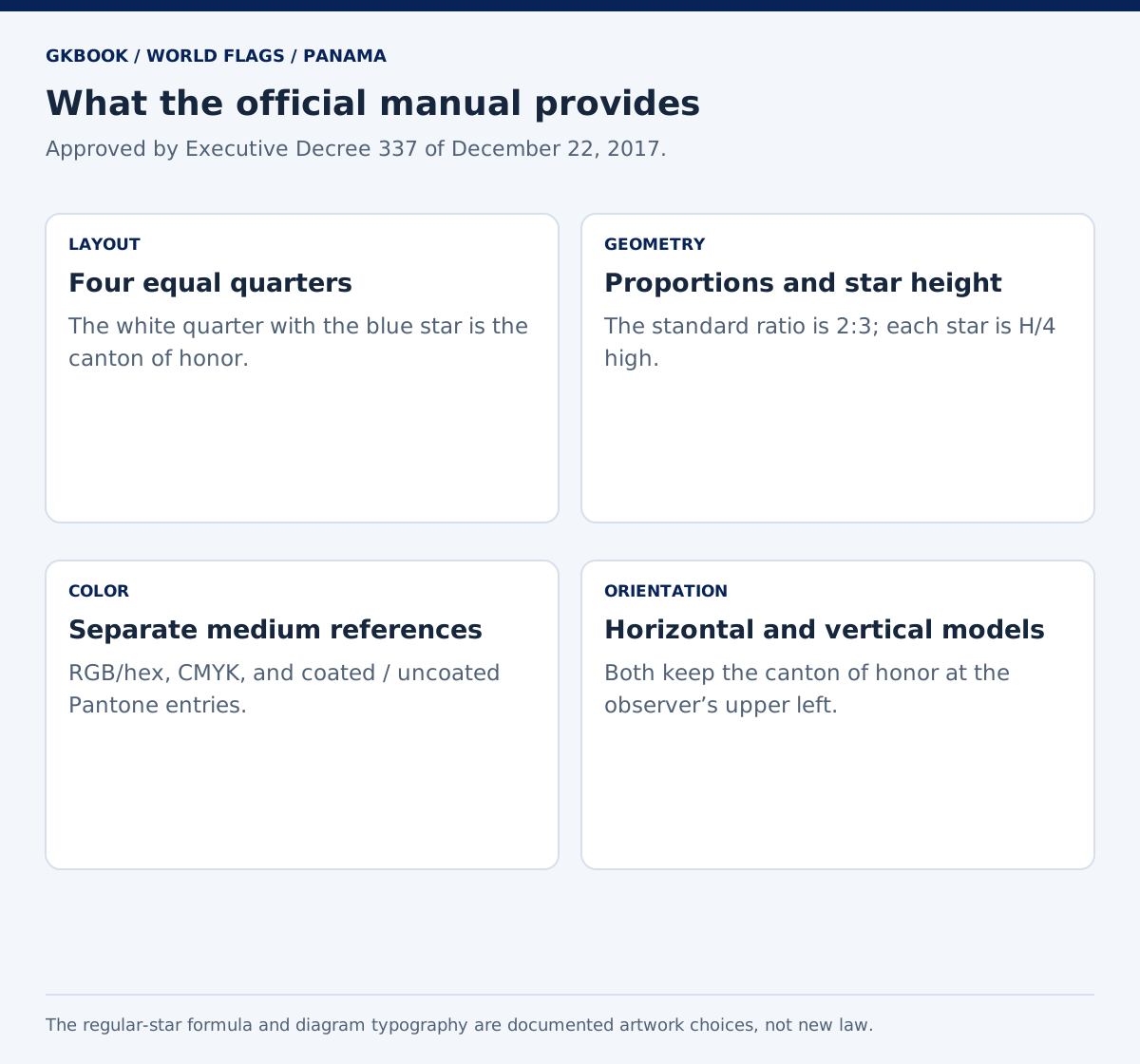
The annex is especially helpful where a short verbal description leaves room for a drawing error. It labels the star’s quarter-height measurement, shows the honor canton in the standard layout, and illustrates the vertical arrangement. Its color table also distinguishes screen values from coated and uncoated printing references.
This package combines those illustrated instructions with an explicit geometric reconstruction method. The official proportions and published palette are distinguished from the regular-star formula and diagram typography chosen for the artwork. That separation makes it possible to check the result without presenting every implementation detail as a sentence from the law.
What is celebrated on November 4 in Panama?
November 4 is celebrated as the Day of the National Symbols, or Día de los Símbolos de la Nación. The observance honors the flag, anthem, and coat of arms. Older references often call it Flag Day, but the current official name makes clear that the celebration encompasses all three national symbols.

The date is closely associated with the flag’s early public history, but it should not replace the distinct dates of the 1904 and 1925 laws. A commemorative day, a first public appearance, and a legislative adoption can all matter without describing the same event. The calendar illustration keeps those categories separate.
Current official reporting uses the broader national-symbols name and describes ceremonies involving the flag and anthem. For a concise caption, give both the date and the observance’s name. Avoid describing every November national celebration as the same holiday or assigning the flag a new adoption anniversary merely because it is honored publicly.
Does the Panama national flag include the coat of arms?
The ordinary national flag does not contain the coat of arms. Its complete design consists of four quarters and two colored stars on white. The coat of arms is a separate national symbol with its own statutory description. Adding it to the plain flag would produce a different image from the standard reference shown here.
The flag, anthem, and coat of arms appear together in national-symbols legislation because each represents the country, not because their visual contents must be merged. A government publication may display more than one symbol on the same page while keeping each design distinct. That presentation does not redefine the flag itself.
Specialized standards and other official representations require their own evidence and context. This gallery supplies the ordinary national flag and explanatory diagrams rather than inventing a badge-bearing variant. The star meanings discussed here therefore concern the two stars on the flag, not the separate stars or other elements of the coat of arms.
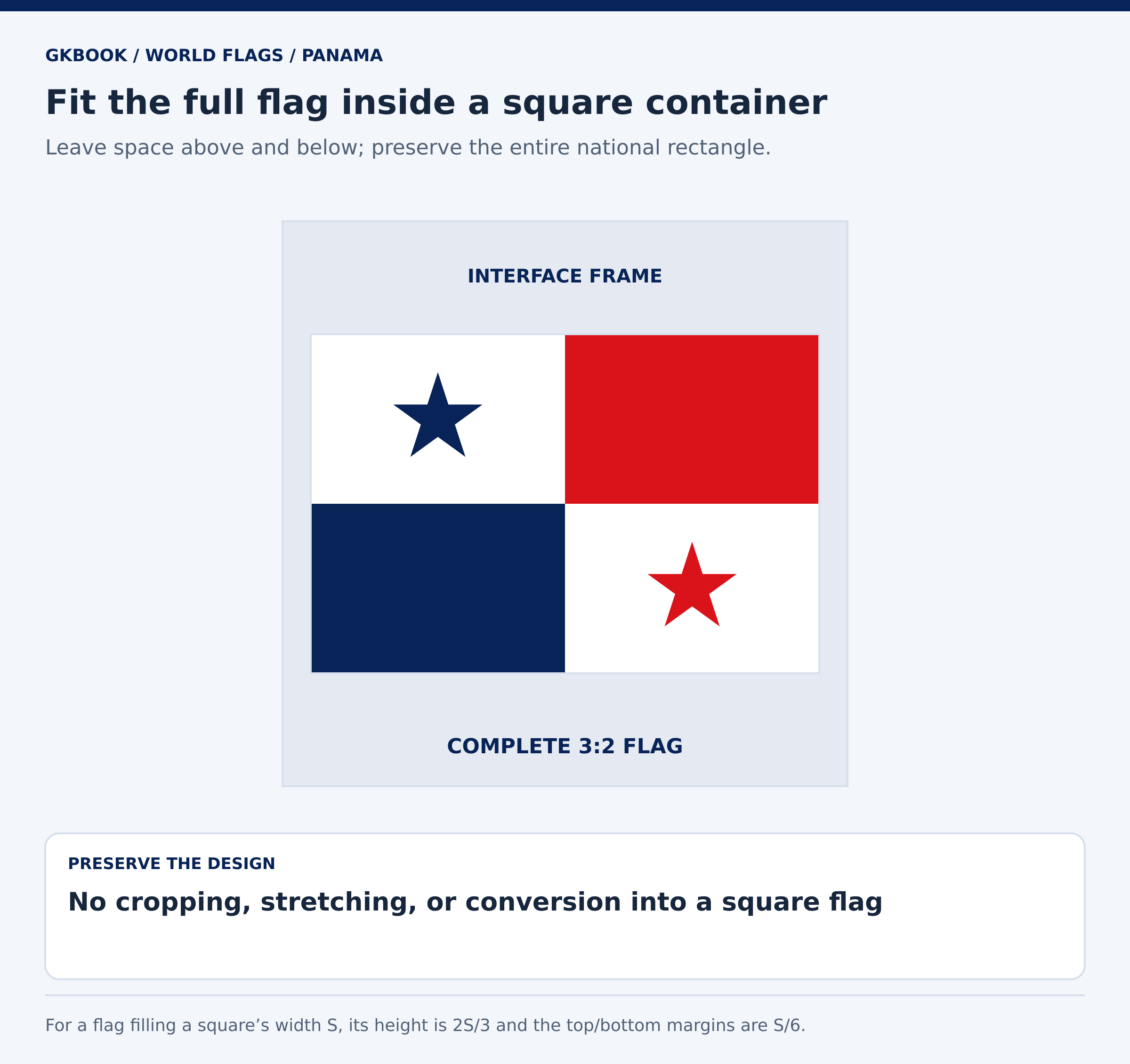
How should the flag fit into a square thumbnail?
Fit the complete 3:2 width:height rectangle inside the square, leaving space above and below. This preserves every quarter and both stars without stretching or cropping the national design. The gallery demonstrates a complete reference within a square container; the container is an interface frame, not a new square version of Panama’s flag.
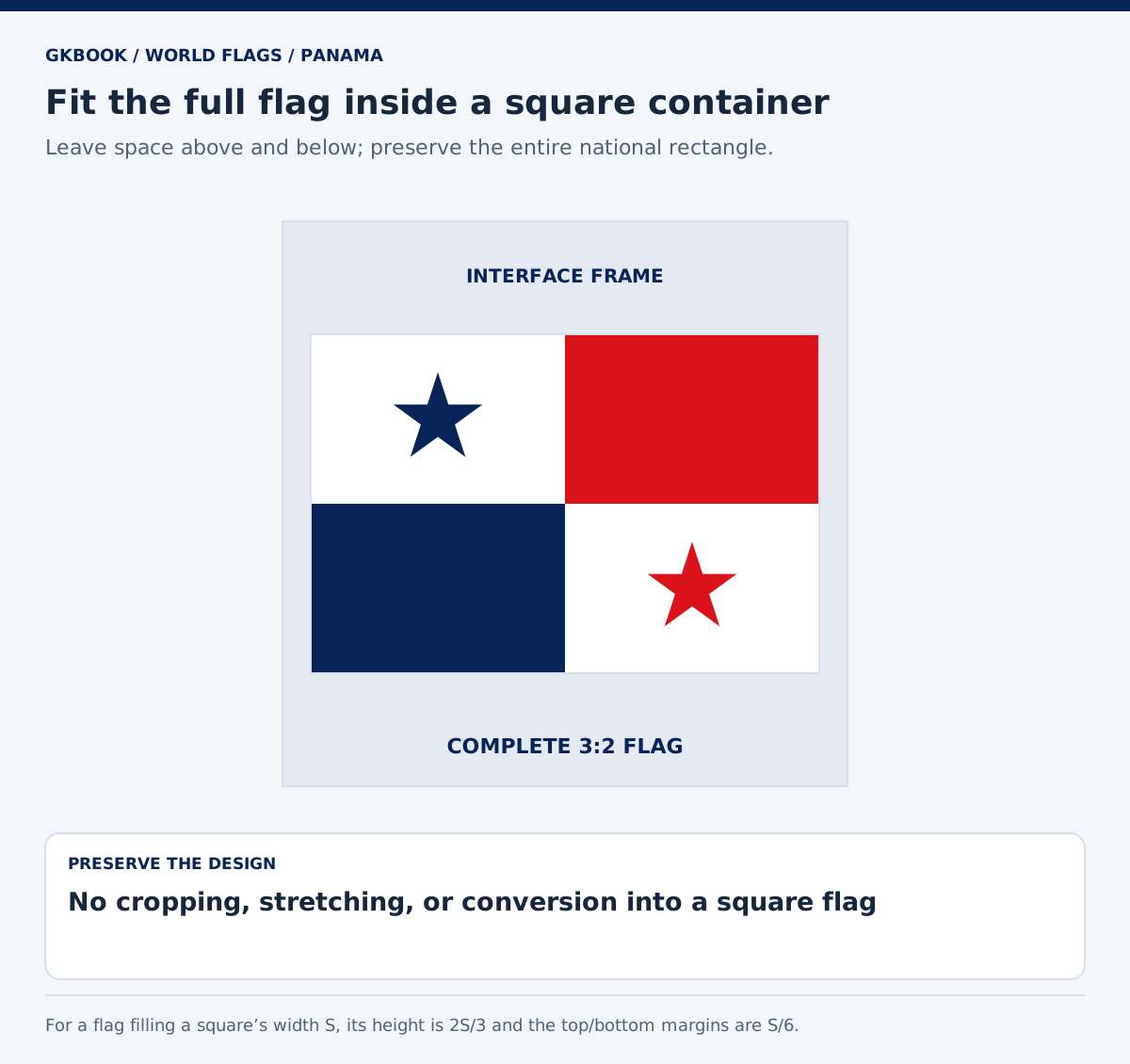
For a square container with side S, a fitted horizontal flag can have width S and height 2S/3. Centering it leaves a margin of S/6 above and below. A smaller flag can provide additional breathing room, provided its own proportions and internal geometry remain unchanged.
Cropping to fill the square can remove part of the colored quarters or change the apparent placement of the stars. Stretching changes the stars’ angles and the quarter proportions. A neutral surrounding frame is easier to interpret because the entire national rectangle remains visible and distinguishable from the layout around it.
What are the most common Panama flag drawing and caption errors?
Common errors include swapping the quarters, reversing the star colors, enlarging the stars, confusing star height with circumcircle diameter, and rotating the horizontal front view incorrectly for vertical display. Historical captions also need care: 1903 marks the origin, 1904 provisional adoption, and Law 48 of 1925 definitive adoption, with Gazette publication separately dated.

Check the flag from the attachment edge outward. The upper hoist must be white with a blue star; the upper fly red; the lower hoist blue; and the lower fly white with a red star. Both stars must match in size and point upward in the standard horizontal view.
Then check the supporting label. Use the official manual’s digital palette, distinguish designer from makers of the first cloths, and keep the legal milestones in order. Guides and educational labels should sit outside the plain reference. A sound final review evaluates the picture and its caption together, because either can introduce a misleading claim.
Download Panama flag pictures
Download the plain flag as SVG or 4,800 × 3,200 PNG. The SVG uses a 2,400 × 1,600 coordinate system and remains scalable. The gallery contains 24 subjects with paired SVG and PNG files, including construction, history, and comparison diagrams. Image credits and construction notes record the reconstruction method and artwork status.
Explore more in World Flags, including the Nicaragua flag and Palau flag.
World Flags/Panama
Panama flag pictures
Panama flag educational reconstruction: height:length 2:3; four equal quarters; stars centered by their radial centers and upright in the horizontal reference; each star has visible top-to-bottom height H/4. Regular pentagram geometry is a documented reconstruction convention. Blue #072357, red #DA121A and white #FFFFFF follow the RGB/hex table in the 2017 official manual. No physical color certification or official endorsement is implied.
GKBook original educational vector construction.Download SVGDownload PNGThe complete national design has four equal quarters and two upright stars, with the blue-star white quarter beside the upper hoist.
GKBook original educational vector construction.Download SVGDownload PNGThe manual specifies blue #072357, red #DA121A, and white #FFFFFF. Coated and uncoated Pantone entries are separate print references.
GKBook original educational vector construction.Download SVGDownload PNGRed and blue recall the Liberal and Conservative parties; white represents peace. The blue and red stars express distinct civic ideals.
GKBook original educational vector construction.Download SVGDownload PNGThe blue star represents purity and honesty; the red star represents authority and law. Neither is a province or ocean counter.
GKBook original educational vector construction.Download SVGDownload PNGThe standard horizontal flag is two units high and three units long. The master uses 2,400 × 1,600 coordinates.
GKBook original educational vector construction.Download SVGDownload PNGHalving both dimensions creates four equal rectangles, each measuring 1,200 × 800 in the master. Dashed construction guides are annotations.
GKBook original educational vector construction.Download SVGDownload PNGThe stars use radial centers at the centers of the two white quarters. Their bounding-box midpoints are not substituted for those radial centers.
GKBook original educational vector construction.Download SVGDownload PNGEach star’s visible vertical height is one-quarter of the flag height. A regular star’s circumcircle diameter is larger than that measured height.
GKBook original educational vector construction.Download SVGDownload PNGFive evenly spaced outer points alternate with five inner corners. The radius is chosen so the finished upright star has the official H/4 height.
GKBook original educational vector construction.Download SVGDownload PNGFour labeled stages establish the outer ratio, equal quarters, colored field, and two measured stars. Only the fourth panel is complete.
GKBook original educational vector construction.Download SVGDownload PNGFour useful export sizes preserve the 3:2 width:height ratio, quarter dimensions, and H/4 star height. These are not mandated cloth sizes.
GKBook original educational vector construction.Download SVGDownload PNGEqual quarters and matching stars balance the design, but neither reflection nor a half-turn preserves the complete colored flag.
GKBook original educational vector construction.Download SVGDownload PNGA horizontal reverse-side view mirrors the complete design, moving the hoist and blue-star white quarter to the viewer’s right.
GKBook original educational vector construction.Download SVGDownload PNGThe official portrait model has white/blue-star upper left, blue upper right, red lower left, and white/red-star lower right, with both stars pointing left.
GKBook original educational vector construction.Download SVGDownload PNGThe official manual identifies blue with horizontal hatching and red with vertical hatching, including the stars. White stays unhatched.
GKBook original educational vector construction.Download SVGDownload PNGThe timeline separates the 1903 origin, provisional adoption in 1904, definitive adoption in 1925, and later legal and reproduction standards.
GKBook original educational vector construction.Download SVGDownload PNGManuel Encarnación Amador receives design credit. The government biography credits María Ossa de Amador and Angélica B. de Ossa with sewing the first flags.
GKBook original educational vector construction.Download SVGDownload PNGLaw 64 of June 4, 1904 is provisional; Law 48 of March 10, 1925 is definitive. Their Gazette publication dates are June 15, 1904 and March 25, 1925.
GKBook original educational vector construction.Download SVGDownload PNGCONASINA illustrates an initial solid-blue upper hoist and a revision before the end of November 1903. The gallery reconstructs only the documented layout.
GKBook original educational vector construction.Download SVGDownload PNGThe 2017 manual’s annex provides construction, color, monochrome, and orientation guidance for the established national symbol.
GKBook original educational vector construction.Download SVGDownload PNGNovember 4 is the Day of the National Symbols, honoring the flag, anthem, and coat of arms. It is distinct from the dated adoption laws.
GKBook original educational vector construction.Download SVGDownload PNGA square interface container can hold the complete rectangular flag with surrounding space. The square is a frame, not a national flag variant.
GKBook original educational vector construction.Download SVGDownload PNGCheck quarter order, star height, radial centers, official vertical orientation, published color codes, and correctly labeled historical milestones.
GKBook original educational vector construction.Download SVGDownload PNGFrequently asked questions
What does Panama’s flag look like?
Panama’s flag has four equal quarters: white with a blue star at the upper hoist, red at the upper fly, blue at the lower hoist, and white with a red star at the lower fly. Its height:length ratio is 2:3. The design originated in 1903 and received definitive adoption in 1925.
What is the design of the Panama flag?
Panama’s national flag is a rectangle divided into four equal quarters. With the hoist on the left, the upper-left quarter is white with a blue five-pointed star, the upper-right is red, the lower-left is blue, and the lower-right is white with a red five-pointed star. Both stars point upward.
What are the colors and official digital codes of the Panama flag?
The flag uses blue, red, and white. Panama’s official 2017 manual gives blue as RGB 7, 35, 87, or #072357; red as RGB 218, 18, 26, or #DA121A; and white as RGB 255, 255, 255, or #FFFFFF. These published digital values are used consistently in the supplied artwork.
Which Pantone references does the official manual give?
The official manual lists blue as Pantone 295 C on coated stock and 296 U on uncoated stock. It lists red as Pantone 187 C and 186 U respectively. White is pure white. These references accompany the manual’s separate RGB, hexadecimal, and CMYK entries; they are not interchangeable conversion formulas.
What does the Panama flag symbolize?
The flag brings together political reconciliation and civic ideals. Blue recalls the Conservative Party and red the Liberal Party, while white represents peace for the new nation. The blue star represents purity and honesty in civic life; the red star represents the authority and law that uphold those virtues.
Why are red and blue used together?
Red and blue recall the Liberal and Conservative parties respectively. Their presence in one national design expresses a shared political setting rather than the exclusive identity of either party. White supplies the message of peace, while the two stars add the distinct ideals of honesty, purity, authority, and law.
What does white mean on the Panama flag?
White represents the peace in which the new nation was to live. It appears in two diagonally opposed quarters, each containing a colored star. Before the stars are added, the white quarter backgrounds occupy half the flag’s area; the visible white area is slightly smaller once both stars are included.
What do the two stars on the Panama flag mean?
The blue star represents purity and honesty that should guide civic life. The red star represents the authority and law that uphold those virtues. Each star has five points and sits in a white quarter. The two stars are not an official count of provinces, oceans, continents, or political districts.
What is the height:length ratio of the Panama flag?
The standard horizontal reference has a height:length ratio of 2:3, equivalent to one unit high by one and a half units long. A flag 160 units high is therefore 240 units long. The supplied SVG uses a 2,400 × 1,600 coordinate system, preserving this proportion exactly.
How are the four quarters measured?
A vertical division at half the length and a horizontal division at half the height produce four equal quarters. Each quarter is L/2 wide and H/2 high, where L and H describe the whole flag. On the 2,400 × 1,600 master, every quarter measures 1,200 × 800 units.
Where are the stars positioned?
The blue star is centered in the upper hoist white quarter, and the red star is centered in the lower fly white quarter. On the master, their radial centers are (600, 400) and (1,800, 1,200). These equal (L/4, H/4) and (3L/4, 3H/4) measured from the upper-left corner.
How large are the stars on the Panama flag?
Each star has a visible top-to-bottom height of one-quarter of the complete flag’s height, equivalent to one-sixth of its length. The official manual illustrates this dimension beside the red star. On a 2,400 × 1,600 master, each upright star is therefore 400 units high, measured between its extreme points.
How are the five-pointed stars constructed?
The supplied artwork uses regular pentagram geometry: five equally spaced outer points alternate with five inner corners. One outer point faces upward. The inner radius is approximately 0.381966 times the outer radius. This precise geometric method is a documented reconstruction convention; the legal text itself does not prescribe that trigonometric formula.
How can you draw the Panama flag accurately?
Begin with a 2:3 rectangle and divide it into four equal quarters. Keep the upper hoist and lower fly quarters white; fill the upper fly red and lower hoist blue. Add a centered blue star in the upper white quarter and a centered red star in the lower white quarter, each upright and H/4 high.
What dimensions work for different image sizes?
Any uniformly scaled 3:2 width:height canvas preserves the standard design. Examples include 600 × 400, 1,200 × 800, and 2,400 × 1,600. The corresponding star heights are 100, 200, and 400 units. The supplied plain PNG is 4,800 × 3,200 pixels, with stars 800 pixels high before raster edge smoothing.
Is the Panama flag symmetrical?
The fixed, correctly colored horizontal flag is not unchanged by a horizontal reflection, vertical reflection, or half-turn. Its quarters and stars occupy specific positions. Each individual upright regular star has a vertical line of symmetry, and the equal quarters balance the layout, but these local properties do not make the whole flag symmetrical.
What does the reverse side of the Panama flag look like?
Viewed through the opposite side of the same ordinary flag, the design appears horizontally mirrored and the hoist appears on the right. The blue star is then in the upper-right white quarter, while the red star is in the lower-left white quarter. Both stars remain upward-pointing in this horizontal reverse view.
How should the Panama flag appear in vertical display?
The official manual’s vertical model keeps the white quarter with the blue star at the viewer’s upper left. Blue occupies the upper right, red the lower left, and white with the red star the lower right. Both stars point left in this portrait model, so simply rotating the usual front view clockwise is incorrect.
How does the official manual represent the flag in black and white?
The manual includes a heraldic hatching model for monochrome reproduction. Horizontal lines identify blue, vertical lines identify red, and white remains unhatched. The same distinction applies to the stars as to the solid quarters. This is an explanatory black-and-white representation, separate from the ordinary blue, red, and white flag.
What is the history of the Panama flag?
The flag originated during Panama’s separation from Colombia in November 1903. Manuel Encarnación Amador designed it, and María Ossa de Amador helped make the first flags. A revised arrangement established the familiar canton of honor. Provisional legal adoption followed in 1904, definitive adoption in 1925, and later legislation regulated the national symbols.
Who designed the Panama flag?
The government’s historical account credits Manuel Encarnación Amador, also identified in the flag law as Manuel E. Amador T. He developed the design on November 1, 1903. He should not be confused with his father, Manuel Amador Guerrero, Panama’s first president, or with María Ossa de Amador, associated with sewing the first flags.
Who sewed the first Panama flags?
The Ministry of Government’s biography credits María Ossa de Amador and Angélica B. de Ossa with sewing the first flags during the night of November 2, 1903. It describes their presentation on November 3 and public procession on November 4. This making of the first cloths is distinct from Manuel Encarnación Amador’s design work.
When was the Panama flag officially adopted?
Law 64 of June 4, 1904 adopted the flag provisionally. Law 48 of March 10, 1925 provided definitive adoption, and its Gazette publication followed on March 25, 1925. The design’s November 1903 origin is earlier than both laws. These dates should be labeled by event rather than treated as interchangeable adoption dates.
Was the earliest arrangement different from today’s flag?
Yes. The official CONASINA presentation shows an initial arrangement with blue at the upper hoist, white with a red star at the upper fly, white with a blue star at the lower hoist, and red at the lower fly. It says the designer revised the arrangement before the end of November 1903.
What do the 1949 law and 2012 reform cover?
Law 34 of December 15, 1949 established a broader legal framework for Panama’s national symbols, including the flag, anthem, and coat of arms. Law 2 of January 23, 2012 amended that framework. The consolidated text describes the flag’s quarters, star placement, proportions, star size, and symbolism alongside provisions governing national-symbol use.
What does the 2017 official manual add?
Executive Decree 337 of December 22, 2017 approved a manual on the procedure, design, and use of Panama’s national symbols. Its illustrated annex supplies color references, construction guides, a monochrome model, and orientation examples. The manual clarifies reproduction of the established flag; it does not represent adoption of a new national design.
What is celebrated on November 4 in Panama?
November 4 is celebrated as the Day of the National Symbols, or Día de los Símbolos de la Nación. The observance honors the flag, anthem, and coat of arms. Older references often call it Flag Day, but the current official name makes clear that the celebration encompasses all three national symbols.
Does the Panama national flag include the coat of arms?
The ordinary national flag does not contain the coat of arms. Its complete design consists of four quarters and two colored stars on white. The coat of arms is a separate national symbol with its own statutory description. Adding it to the plain flag would produce a different image from the standard reference shown here.
How should the flag fit into a square thumbnail?
Fit the complete 3:2 width:height rectangle inside the square, leaving space above and below. This preserves every quarter and both stars without stretching or cropping the national design. The gallery demonstrates a complete reference within a square container; the container is an interface frame, not a new square version of Panama’s flag.
What are the most common Panama flag drawing and caption errors?
Common errors include swapping the quarters, reversing the star colors, enlarging the stars, confusing star height with circumcircle diameter, and rotating the horizontal front view incorrectly for vertical display. Historical captions also need care: 1903 marks the origin, 1904 provisional adoption, and Law 48 of 1925 definitive adoption, with Gazette publication separately dated.
Explore all general-knowledge topics and the A-to-Z lists.












We Value Your Opinion Comments