

Paraguay flag picture
Explore the proportions, history, and picture gallery.
| Design | Equal horizontal red, white, and blue bandsA different circular emblem is centered on each face. |
|---|---|
| Proportions | Height:length = 11:20Digital master: 2,400 × 1,320; PNG: 4,800 × 2,640. |
| Obverse | Star, palm, and oliveBlack country-name inscription on an uncolored ring. |
| Reverse | Lion, pike, and liberty capPaz y Justicia; lion faces the observer’s right. |
| Formal adoption | November 25, 1842Detailed modern regulation: July 15, 2013. |
| Flag Day | August 14Separate from the adoption anniversary. |
What does Paraguay’s flag look like?
Paraguay’s flag has three equal horizontal bands of red, white, and blue, with a different emblem on each side. The front shows a yellow star within palm and olive branches; the reverse shows a lion beneath a liberty cap. Its standard height:length ratio is 11:20, and formal adoption dates to November 25, 1842.
Paraguay’s two emblems make both viewing sides essential to the explanation. This guide distinguishes their meanings, the 1842 adoption, and the 2013 detailed model. The diagrams separate the decree’s specifications from declared reproduction choices and provide independent downloads for the front and reverse.
What is the design of the Paraguay flag?
The Paraguay flag is a horizontal red, white, and blue tricolor with equal bands. A circular emblem occupies the center of the white band. The obverse bears the national arms with a star and branches; the reverse bears the Treasury emblem with a lion, liberty cap, and the motto Paz y Justicia.
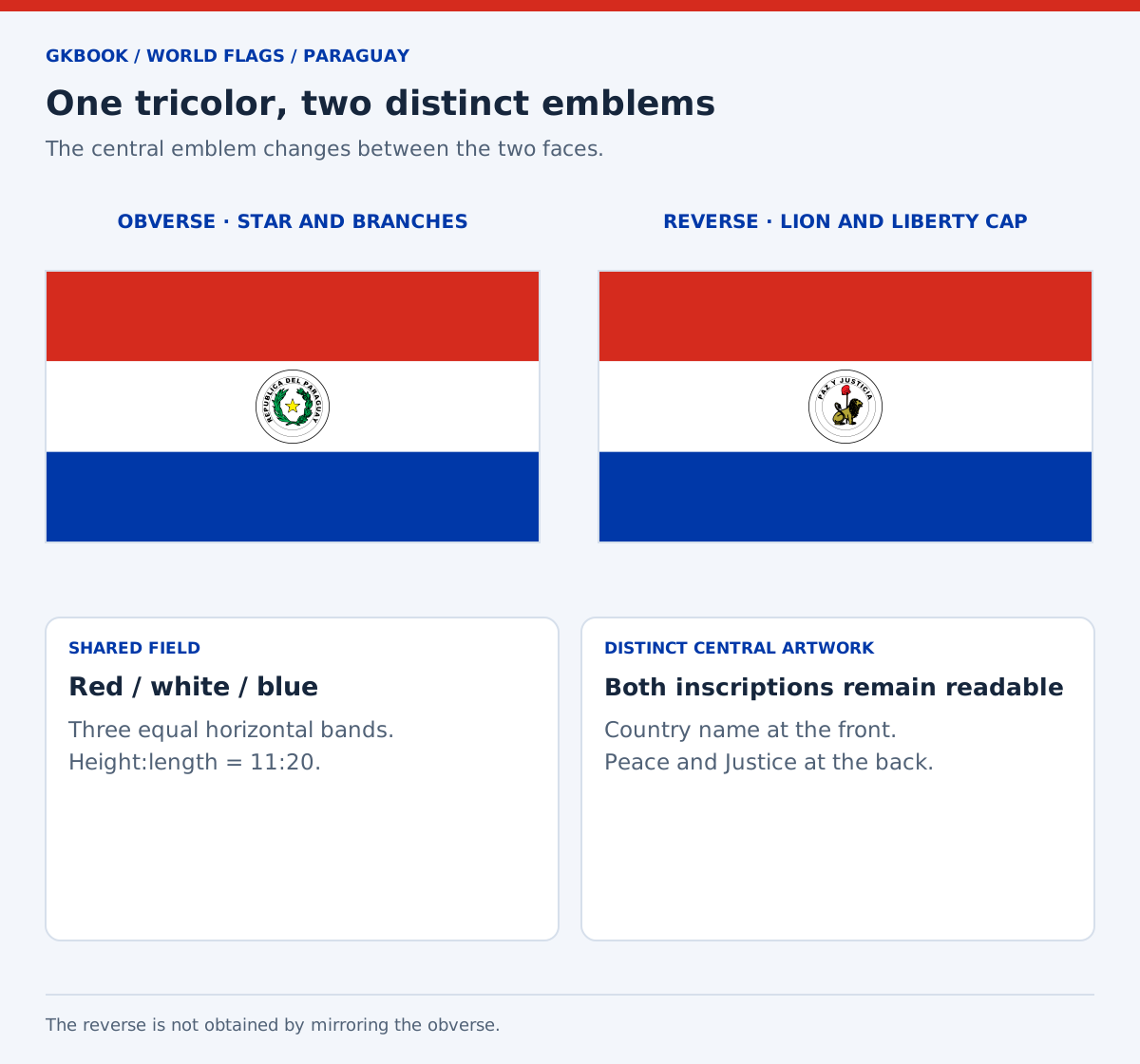
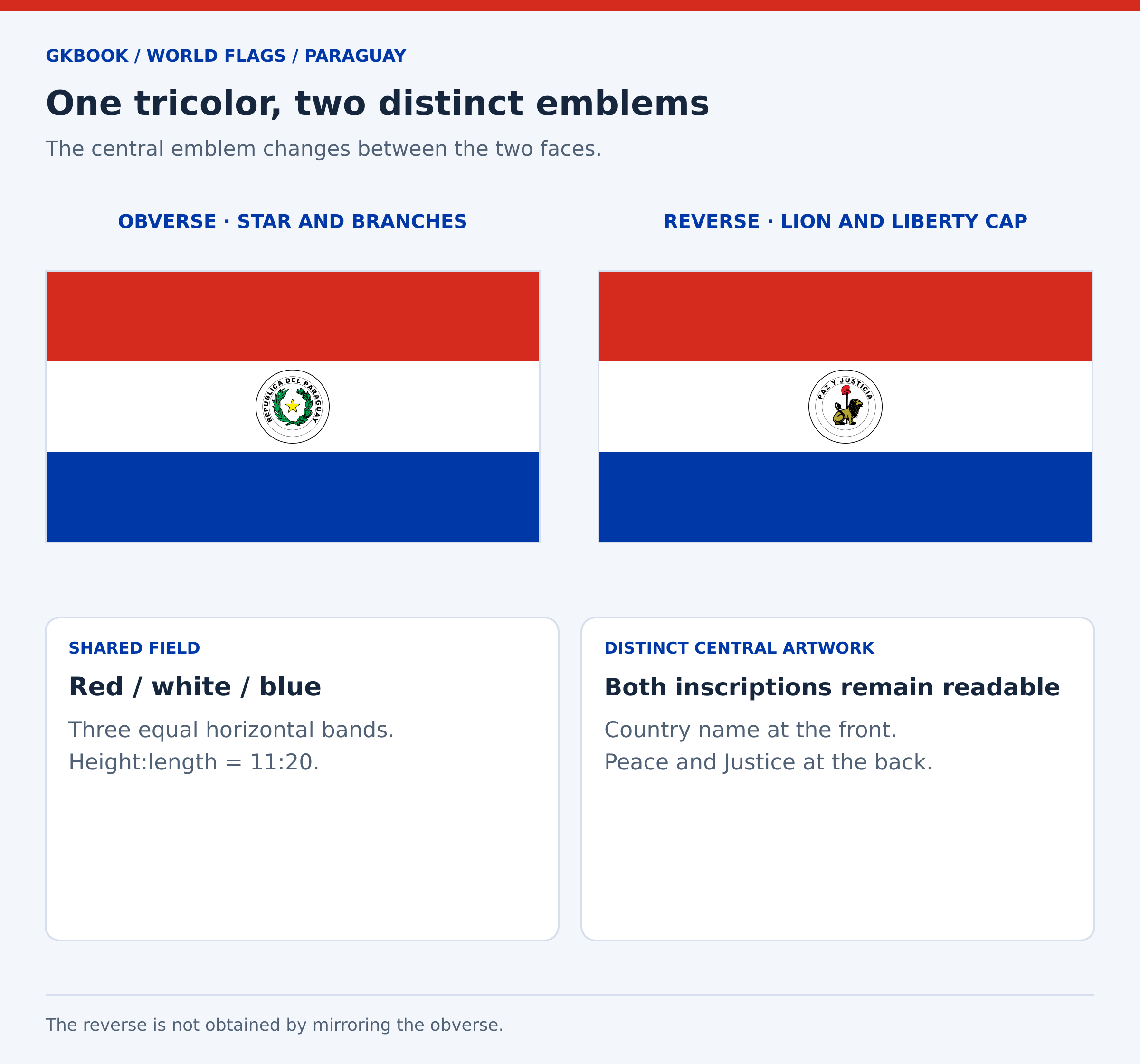
Read the bands from top to bottom: red, white, then blue. The horizontal rectangle is longer than it is high. Its central emblem stays entirely within the white band, leaving the upper and lower colors uninterrupted. Labels, frames, shadows, and explanatory arrows in a teaching diagram are additional presentation elements.
The two faces need separate reference pictures because their central designs differ. A front image alone cannot show the lion, and a simple horizontal reflection cannot produce it. The gallery therefore provides independent plain obverse and reverse downloads, as well as a comparison that identifies the attachment edge on each viewing side.
What are the Paraguay flag’s colors and digital values?
The three bands are red, white, and blue. This package uses #D52B1E, #FFFFFF, and #0038A8 respectively as declared screen values. Decree 11400 describes the band colors without giving their RGB codes. Its appendix does specify numerical colors for the emblems, which must be distinguished from the broad stripe palette.
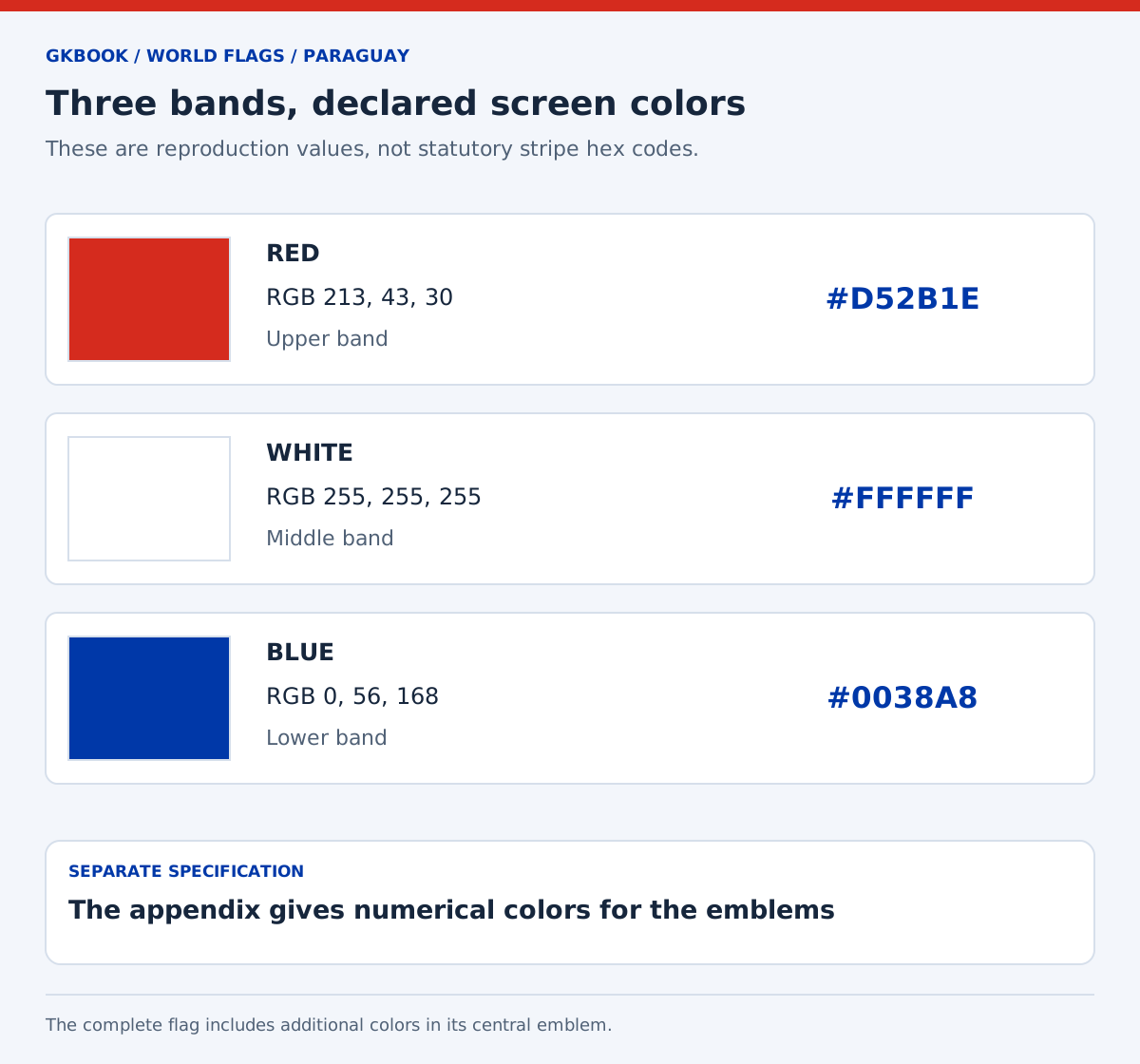
For a digital drawing, apply one flat color to each band. The red chosen for the cloth is separate from the appendix’s red for the Phrygian cap. Reusing a cap swatch as the supposedly mandatory stripe red would erase a distinction between the decree’s band description and its emblem specification.
White serves both as the middle stripe and as the uncolored ground of the circular emblems. The complete flag consequently contains more colors than its three main bands. Consistent screen values make these downloadable illustrations comparable, but do not certify a match to every printing process, fabric dye, or display.
| Band | Hexadecimal | RGB |
|---|---|---|
| Upper red | #D52B1E | 213, 43, 30 |
| Middle white | #FFFFFF | 255, 255, 255 |
| Lower blue | #0038A8 | 0, 56, 168 |
What do the colors of the Paraguay flag mean?
Paraguay’s Radio Nacional explains red as justice, white as peace, and blue as liberty. Other institutional accounts give broader associations, including courage, purity, unity, and knowledge. These are explanations of national symbolism; the decree’s construction rules do not turn each color into a single, exhaustive list of officially exclusive meanings.

The justice, peace, and liberty reading gives a concise way to remember the three bands. Radio Nacional used that explanation in its 2025 Flag Day account, drawing on the Ministry of Foreign Affairs. It fits the flag’s wider civic language, including the reverse inscription that explicitly names peace and justice.
Itaipu’s institutional account offers a longer interpretation of the same colors. These accounts need not be forced into one supposedly definitive glossary. When teaching the flag, identify the interpretation being used and keep its symbolic language separate from measurable features such as equal stripe heights, the central placement, and the rectangular proportion.
What appears on the front of the Paraguay flag?
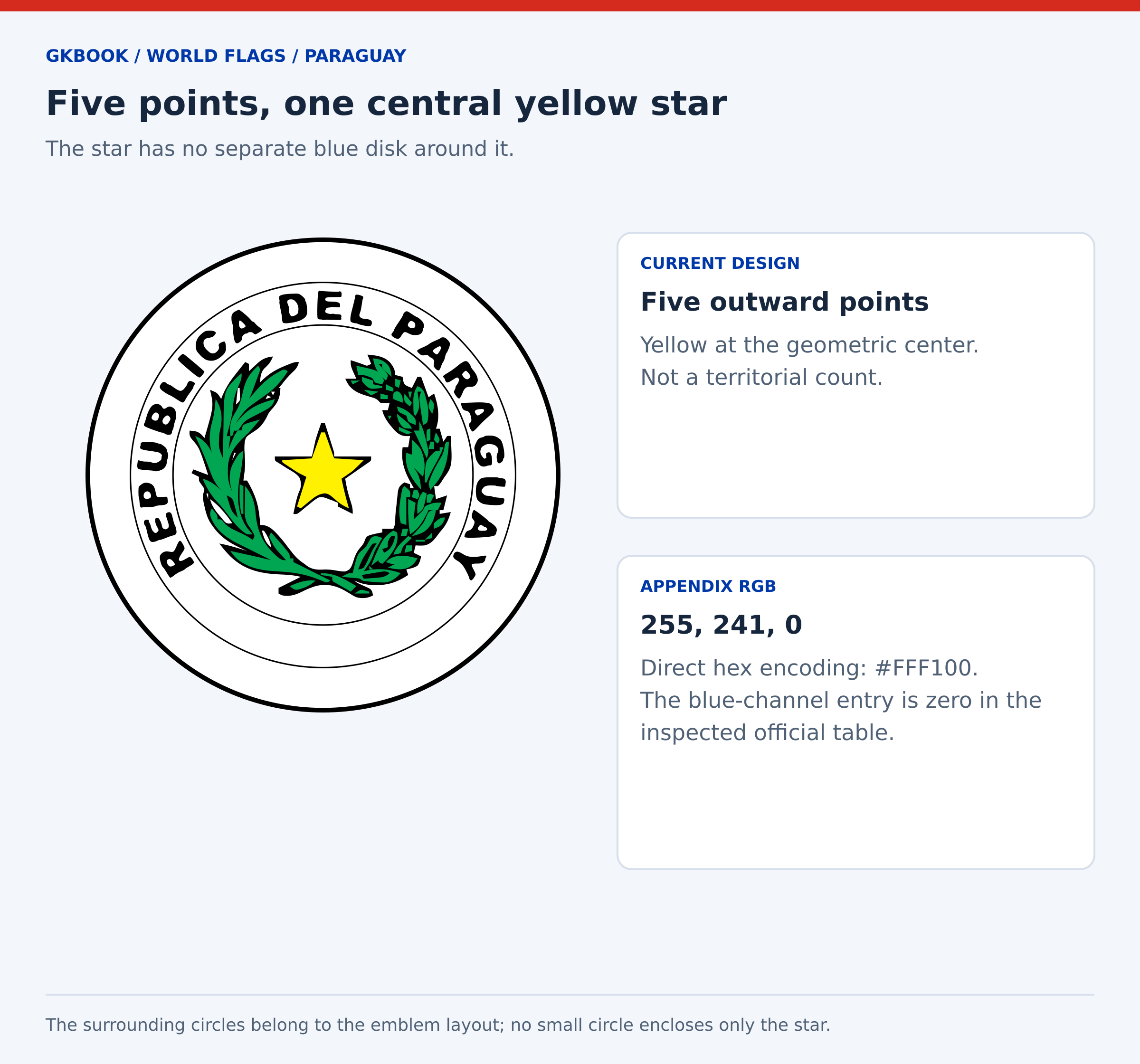
The obverse shows a circular emblem with a yellow five-pointed star at its geometric center. Green palm and olive branches curve around the star and cross at their base. Black lettering names the Republic of Paraguay on an uncolored ring. The current construction does not place a blue disk behind the star.

The obverse is the front reference normally shown with the hoist at the viewer’s left. Its emblem is often called the national coat of arms or national seal in general descriptions. The decree also defines the national seal separately, so those everyday names should not obscure the flag’s own two-face specification.
The appendix supplies an illustrated model of the branches, star, circles, and lettering. The downloadable emblems are educational vector reconstructions from that official plate. They preserve its identifying features and published colors, while the original government vector master and a certified manufacturing drawing are not claimed for these files.
How many points does the star on the Paraguay flag have?
The current obverse star has five points and is yellow. Decree 11400 places it at the geometric center of the emblem without a separate enclosing circle immediately around the star. The appendix prints its RGB value as 255, 241, 0, encoded here as #FFF100; this is distinct from some online transcriptions.

Count the five outward tips rather than the surrounding leaves or circular guide lines. The star is a single central charge, not a constellation or a count of departments. An isolated star enlarged for study is an emblem detail, and should be labeled accordingly rather than presented as a complete national flag.
The consulted official scan is decisive for the numerical color entry: its blue channel is printed as zero. A frequently reproduced value with blue channel eight is not silently substituted here. The file notes record the source page and the chosen transcription so future editors can check the same evidence directly.
Which branches surround the star on Paraguay’s flag?
The decree specifies palm and olive branches, interlaced at their base and curved around the star. In the illustrated front view, the palm is on the viewer’s left and the olive on the right. Both are green. The appendix gives RGB 0, 166, 81, used here as the hexadecimal value #00A651.
The two branches have different leaf shapes. The palm’s long leaves and the olive’s smaller grouped leaves should remain distinguishable, even when both use the same green fill. Replacing them with two identical generic laurel sprays would lose a feature explicitly identified in the legal description and its accompanying plate.
Itaipu associates the palm with justice, victory, and love, and the star with hope and good fortune. That institutional explanation supplies cultural context without changing the prescribed botanical identities. No additional species identification is needed to draw the emblem, and the number of leaves is not treated here as a territorial code.
What is on the reverse of the Paraguay flag?
The reverse carries the Treasury emblem: an ochre lion sitting beside a vertical brown pike topped by a red Phrygian cap. Above it, black letters read Paz y Justicia, meaning Peace and Justice. The lion faces the observer’s right. This separate design replaces the star-and-branches emblem when viewing the opposite face.

The reverse uses the same red, white, and blue stripe order and the same rectangular dimensions as the front. Its central circular field remains white, with black outlines and lettering. It is the emblem, rather than the background tricolor, that gives this side its immediately recognizable difference.
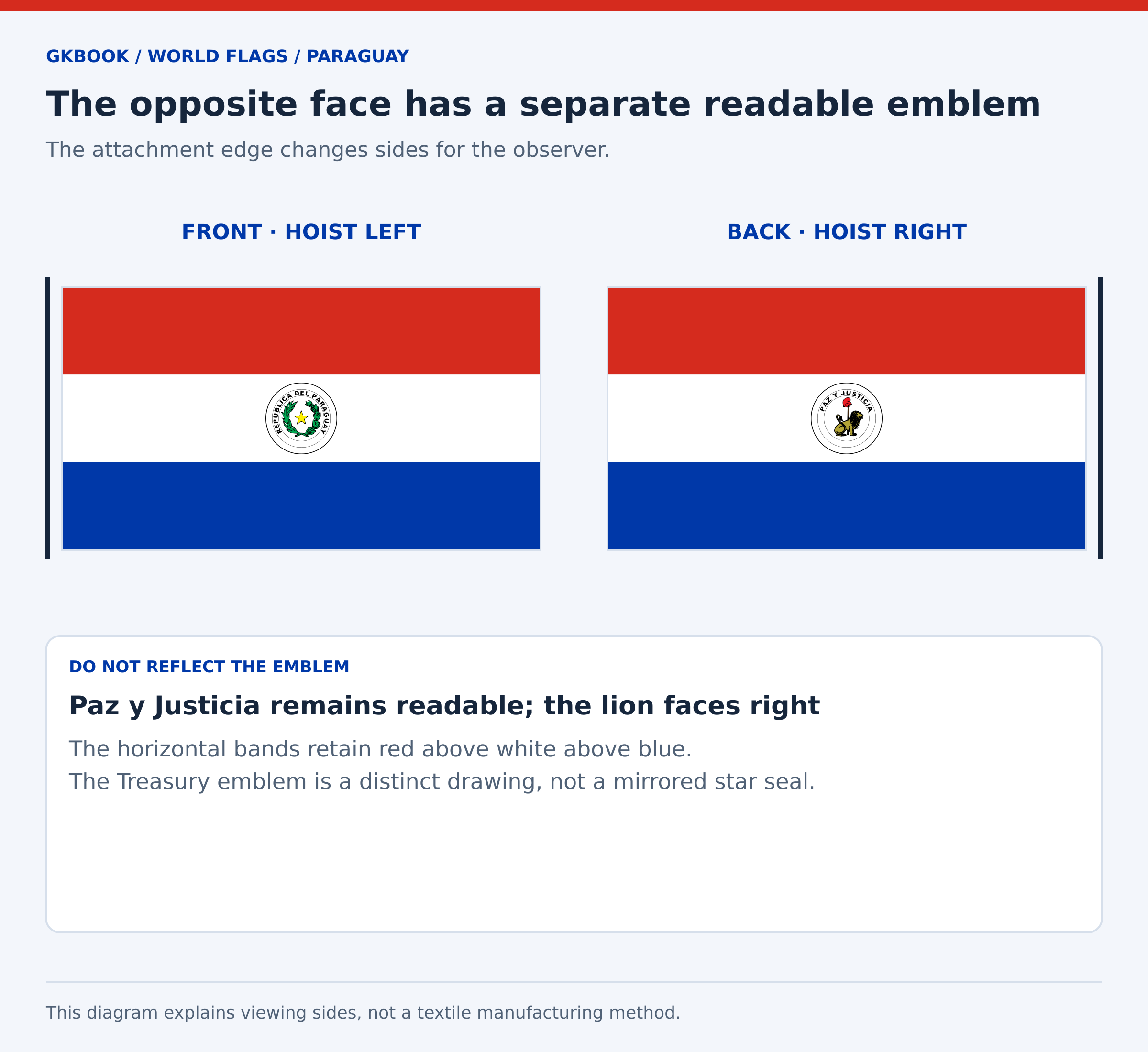
The term reverse does not mean that the words should be written backward. A dedicated reverse drawing keeps the inscription readable and follows the lion’s prescribed direction. A side-by-side viewing diagram can put the hoist on the right for this face without reflecting the Treasury emblem itself.
Which way does the lion on Paraguay’s flag face?
The lion on the reverse faces the observer’s right. Decree 11400 describes a seated lion in profile, roaring, with its raised tail curving beside the hindquarters. The appendix identifies the lion’s color as ochre. Facing direction is stated from the viewer’s perspective, so it should not be reversed through heraldic terminology.

The official plate helps connect that verbal description with an actual silhouette: hindquarters to the left, head and forelegs to the right, and a raised curling tail. The mane, open mouth, and seated posture distinguish this image from a walking lion, an upright rampant lion, or a generic animal icon.
Its color uses the appendix’s RGB 178, 163, 54, represented digitally as #B2A336. Black linework describes the figure within that ochre area. The gallery’s enlarged Treasury detail retains the lion together with the cap and pike, because their relationship is part of the emblem rather than a collection of interchangeable decorations.
What does the red cap on the reverse symbolize?
The red Phrygian cap symbolizes liberty, an identification explicitly given in Decree 11400. It sits at the upper end of a brown pike positioned behind the lion on the emblem’s vertical diameter. The cap is part of the Treasury emblem on the reverse; it does not appear above the obverse star.

The cap is a soft, bent form rather than a crown, helmet, or ordinary brimmed hat. Its relationship to the upright pike should remain visible. The decree describes the pike as standing behind the lion, so the pole is partly interrupted by the animal instead of being drawn across its body.
The appendix supplies red RGB 237, 28, 36 and brown RGB 136, 83, 33 for these elements. Their direct hexadecimal encodings are #ED1C24 and #885321. These entries belong to the emblem palette; they do not establish an additional red stripe, a brown band, or a compulsory textile color conversion.
What do the words on Paraguay’s flag say?
The front inscription names the República del Paraguay, or Republic of Paraguay. The reverse inscription is Paz y Justicia, translated as Peace and Justice. Both use black lettering on an uncolored ring. The 2013 appendix identifies Arial Black as the lettering style, while its illustrated uppercase artwork is preserved in the reference reconstructions.

The two inscriptions identify different faces and should be read with their associated charges. The country name belongs with the star and branches. Peace and Justice belongs with the seated lion and liberty cap. Swapping the inscriptions would produce a hybrid emblem that neither matches the written description nor the official plate.
Accents in ordinary Spanish prose and the appearance of uppercase lettering in a specific plate are separate editorial questions. These files retain the plate’s lettering as outlines instead of substituting a locally available font. A diagram’s nearby explanatory caption can give the normal Spanish wording and its English translation without altering the emblem.
What is the official proportion of the Paraguay flag?
The standard height:length proportion is 11:20. Decree 11400 calls for the larger and smaller dimensions to be as close as possible to 1:0.55, which is equivalent to 20:11 length:height. The digital masters use that relationship exactly: 2,400 units long and 1,320 units high, with equal horizontal bands.

Ratio labels must state their order. Height:length equals 11:20, while width:height equals 20:11; both describe the same landscape rectangle. A drawing labeled simply eleven to twenty can be misunderstood if the viewer assumes the first number represents the horizontal dimension. The gallery therefore spells out the measured directions.
The decree’s wording allows a practical approximation, whereas a digital canvas can implement the ratio without rounding. This distinction explains why the files use exact coordinates without claiming that the statute fixes one compulsory cloth size. Dimensions such as 1,200 by 660 pixels or 2,400 by 1,320 pixels preserve the same shape.
Are the three bands of the Paraguay flag equal?
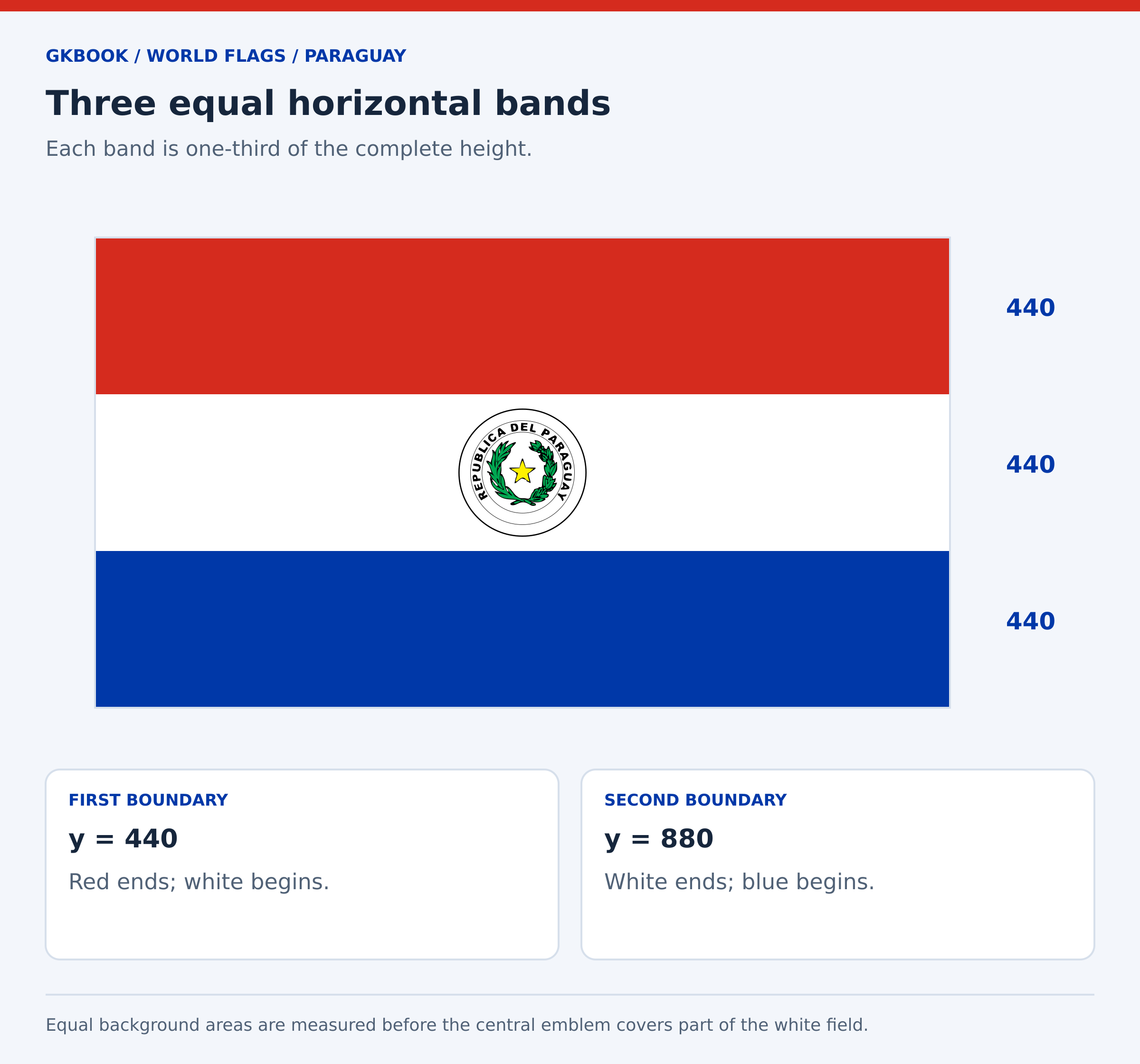
Yes. The current decree specifies three horizontal bands of identical dimensions. Each occupies one-third of the total height before the emblem is added. On the 2,400 by 1,320 master, the boundaries are y = 440 and y = 880, so each band is 440 units high across the full flag length.

The white stripe is not enlarged to accommodate the emblem in this construction. Instead, the circular artwork fits within its allotted middle third. A large white field in an old illustration or an inaccurate modern graphic should not be used to replace the equal-band rule in the current specification.
The three equal background areas do not mean that the finished flag contains exactly equal quantities of red, white, and blue ink. The emblem covers some of the white region with other colors and black outlines. Equal bands describes the underlying layout, before those central charges are placed on it.
Where is the emblem centered on the Paraguay flag?
Each side’s emblem is centered in the white band, which is also the geometric center of the full flag. For the 2,400 by 1,320 master, that point is (1,200, 660), measured from the upper-left corner of the drawing. Both faces share this center even though their internal figures and inscriptions differ.

Locate the center by halving the total width and total height. The middle of the white stripe is halfway between its upper boundary at 440 and lower boundary at 880. That produces the same vertical coordinate, 660, and avoids centering the emblem by eye within only part of the cloth.
The star is centered inside the obverse emblem, but the lion is an asymmetric figure within the reverse composition. Do not shift the whole Treasury circle merely because the lion’s visible body has more mass to one side. The circular emblem, including its inscription and surrounding field, supplies the placement reference.
How large should the emblem be on these flag drawings?
These illustrations use a 360-unit outer painted diameter on the 2,400 by 1,320 master. That leaves 40 units between the emblem and each edge of the white band. This size is an explicit reproduction choice: the consulted decree centers the emblems but does not provide this numerical diameter relative to the full flag.

The distinction matters when a diagram includes precise measurements. A number can accurately describe the supplied file without being a measurement prescribed by law. Here the master’s white stripe is 440 units high, and the circular emblem’s painted outside extent is 360 units, so the remaining clearance divides equally above and below.
Both faces use the same outer diameter and center, making them consistent as a pair. Internal shapes are scaled together rather than enlarged separately to fill gaps. The private geometry record identifies the source plate reconstruction and this size choice, allowing another publisher to change the reproduction scale without misquoting the decree.
How do you draw the Paraguay flag accurately?
Begin with a 20:11 landscape rectangle, divide its height into three equal bands, and fill them red, white, and blue from top to bottom. Center the appropriate circular emblem in the white band. Use the star-and-branches artwork for the obverse and the lion-and-cap artwork for the reverse, preserving readable inscriptions.

Construct the rectangle and stripe boundaries first, because stretching a finished emblem to repair a wrongly proportioned canvas will distort its circles. Add the emblem with a uniform scale in both directions. Keep the black outlines and lettering intact, and use the published emblem colors rather than treating every yellow object as the same swatch.
For a learning exercise, a simplified sketch can establish the overall layout. For a reusable digital reference, retain the complete documented emblem artwork and identify any reconstruction limits. The gallery separates construction stages from finished flags so an empty tricolor or a labeled intermediate panel is not confused with the complete pabellón.
What pixel dimensions preserve the Paraguay flag ratio?
Suitable width-by-height dimensions include 600 by 330, 1,200 by 660, 2,400 by 1,320, and 4,800 by 2,640 pixels. All preserve the 20:11 width:height ratio. The plain SVG masters use 2,400 by 1,320 coordinates, and both plain PNG downloads are 4,800 by 2,640 pixels, with the full design retained.

Pixel dimensions describe a digital export, not a legally required fabric measurement. At any of the listed sizes, divide the height by three to locate the stripes. The selected examples have integer band heights, which helps keep their horizontal boundaries crisp during raster export instead of falling between rows of pixels.
Scale the emblem by the same factor used for the rectangle. Doubling the width and height doubles its diameter and every distance from the center, while leaving proportions unchanged. A high-resolution PNG contains more pixels but does not provide new evidence about the original drawing; its provenance remains that of the vector reconstruction.
Is Paraguay’s reverse flag just a mirrored front?
No. Paraguay uses different central emblems on the two faces. The reverse must show the Treasury lion and liberty cap with readable Paz y Justicia lettering, not a reflected star-and-branches seal. In a viewing-side comparison, the front has its hoist on the left and the reverse has its hoist on the right.

The stripes themselves look the same after horizontal reflection because they extend across the complete width. That symmetry can hide a mistake if an editor only checks the background. The decisive inspection is the central emblem: its subject, wording, and lion direction must match the appropriate face.
This guide describes the actual difference without relying on an unqualified claim about every other flag in the world. Flags with lettering, asymmetric charges, and separately constructed reverse faces can raise different classification questions. For Paraguay, the useful fact is specific and verifiable: the prescribed star-and-branches and lion-and-cap emblems are distinct.
How are Paraguay’s colors arranged in a vertical display?
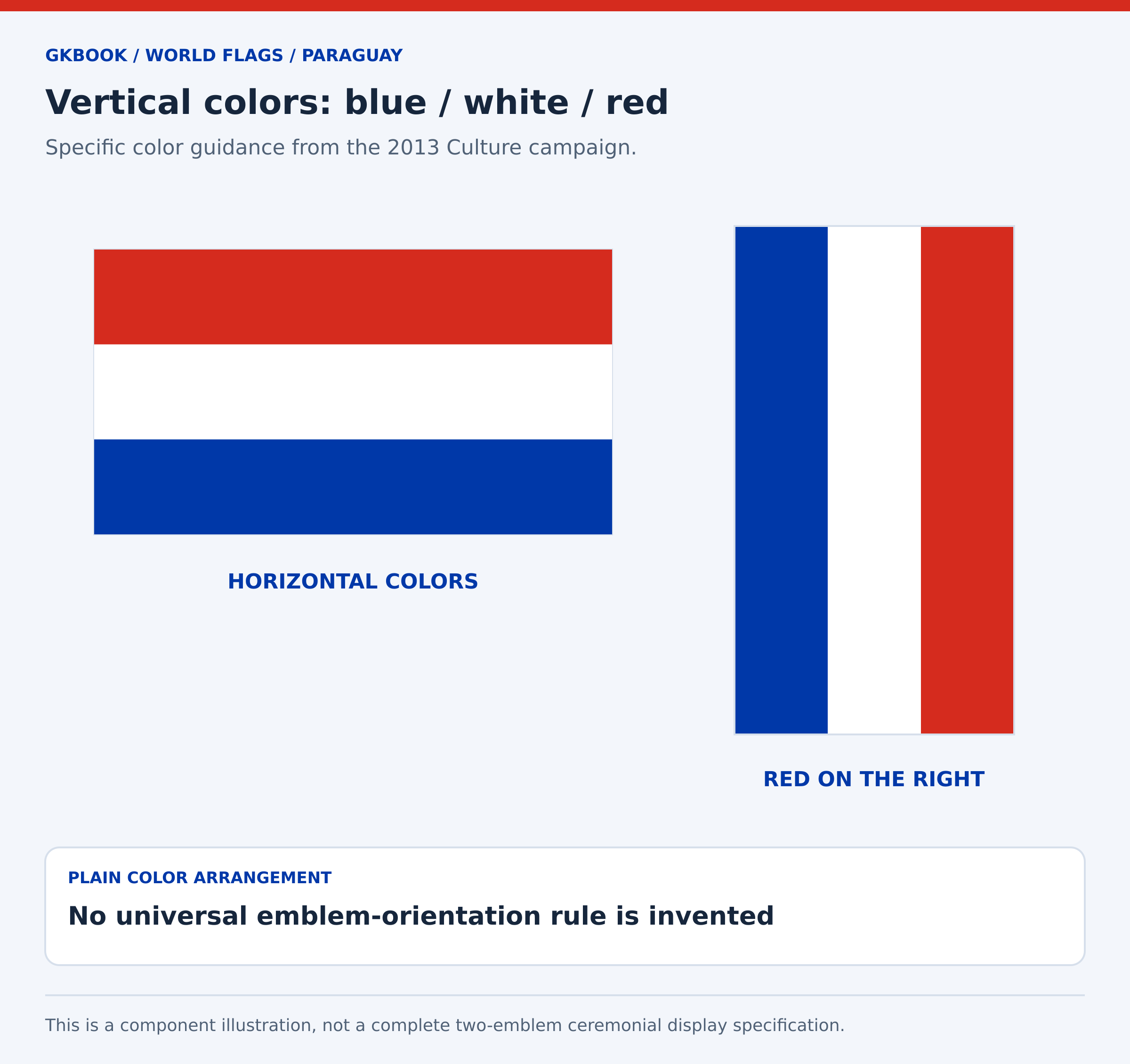
A 2013 Secretariat of Culture campaign instructs that red should be on the right in a vertical display. The gallery illustrates that arrangement with the plain colors: blue at the viewer’s left, white in the center, and red at the right. It does not invent a universal rule for rotating or repositioning both emblems.

A clockwise quarter-turn of the horizontal tricolor produces the illustrated sequence. This is a useful geometric explanation of the campaign’s color guidance. The portrait rectangle retains the original cloth proportion after rotation; the bands are not stretched independently to fill an unrelated poster shape or a square frame.
A complete ceremonial display may involve additional instructions about placement, supporting structures, or the treatment of an emblem. The diagram deliberately shows the plain colors for the specific point the campaign addresses. Its caption identifies that scope, so a reader does not mistake an educational color arrangement for a complete manufacturing or protocol standard.
What are the main dates in Paraguay’s flag history?
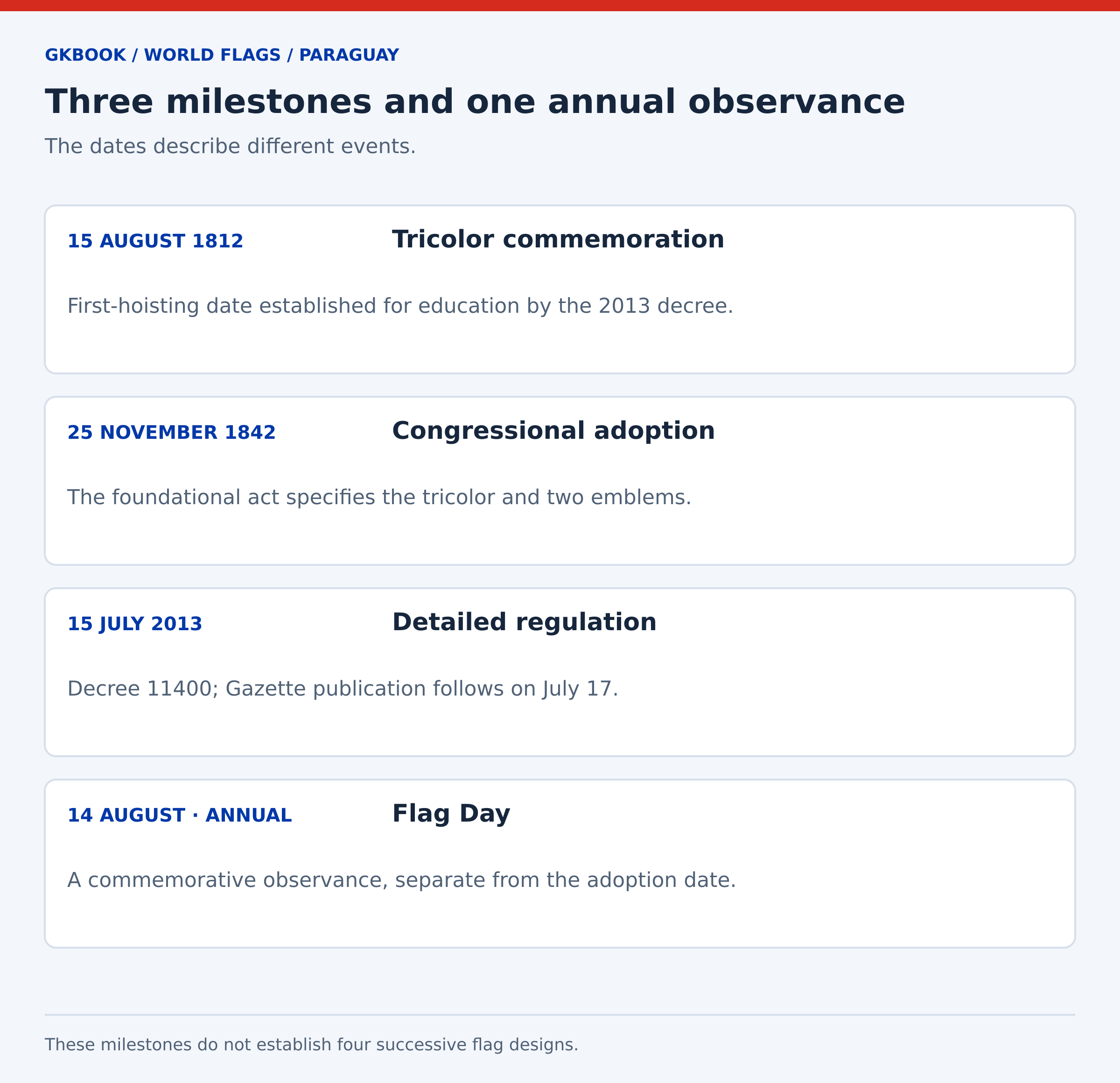
Three dates answer different historical questions: August 15, 1812 is the first-hoisting date established by the 2013 decree for educational commemoration; November 25, 1842 is the formal adoption milestone; and July 15, 2013 is the modern design-regulation date. Flag Day is observed annually on August 14, rather than on the November adoption anniversary.

The sequence distinguishes the emergence of the tricolor, a congressional act defining the national banner, and a later decree standardizing its detailed appearance. Treating all three as competing adoption dates makes the history less clear. Each can be accurate when paired with the event it actually describes.
The timeline uses text milestones rather than invented historical flag drawings. Early accounts describe several designs and variations, but those accounts do not by themselves establish a precise modern vector for every year. The present reference images therefore accompany the current design, while the dated panels explain the historical and legal sequence separately.
When was the Paraguay flag officially adopted?
The formal adoption date used here is November 25, 1842, when the Extraordinary General Congress established the national banner with its tricolor and two emblems. A later oath ceremony took place on December 25. The 2013 decree standardized the design; it did not make 2013 the beginning of Paraguay’s red, white, and blue flag.

The Secretariat of Culture’s historical account separates the November congressional decision from the December ceremony. That distinction is especially useful because dates from signatures, certifications, commemorations, and later reproductions can appear together in discussions of the same document. A caption should identify the event instead of collapsing them into an unexplained date.
The 1842 text names the horizontal red, white, and blue bands and gives different central devices for the two sides. Modern drawing details are supplied by the later regulation and appendix. Combining the historical adoption date with the current construction model produces a clearer reference than pretending that every present contour was specified in 1842.
Why is August 15, 1812 also associated with the flag?
Article 3 of Decree 11400 establishes August 15, 1812 as the first-hoisting date for educational purposes and historical commemoration, linking it with the flag’s definitive colors. That attribution should be stated with its source and purpose. It is separate from the 1842 congressional adoption and from the annual August 14 Flag Day.
The wording of the decree is more precise than an unsupported statement that every detail of today’s emblem appeared in its current form in 1812. It identifies a commemorative origin for the definitive colors. The current emblem plates, including their lettering style and numerical palette, belong to the much later design regulation.
For readers comparing dates, keep the question attached to the answer. A first-hoisting commemoration asks about the tricolor’s historical emergence; an adoption date asks about a formal legislative act; a design-standard date asks about the detailed model used for reproduction. These distinctions allow the dates to coexist without forcing a false choice.
What changed in the Paraguay flag standard in 2013?
Decree 11400, dated July 15, 2013, regulated the flag and emblems and supplied an illustrated appendix with color and lettering specifications. The current model has black inscriptions on uncolored rings and no blue disk immediately around the obverse star. The decree was published in the Official Gazette on July 17, a separate publication date.

The detailed model retains the familiar horizontal tricolor and the distinction between the star emblem and Treasury emblem. The change is therefore better understood through the appearance of the arms than through a claim that Paraguay abandoned its historical national colors. The appendix shows the intended components and their relationships.
For digital work, use the current plate consistently instead of combining an older red inscription ring with the newer black lettering and other modern details. The supplied educational reconstructions follow the inspected 2013 plate. Their palette uses its printed RGB entries, while their chosen emblem diameter on the cloth is documented separately.
When is Paraguay’s Flag Day?
Paraguay observes Flag Day on August 14. Radio Nacional explains that a teachers’ association requested that date in 1913 to avoid overlapping with Asunción’s founding commemoration on August 15. The annual observance is distinct from the flag’s November 25, 1842 adoption and from the July 2013 decree that standardized the emblems.
The difference between an annual holiday and an adoption anniversary is easy to miss in short captions. A picture labeled Flag Day should use the August observance, while a historical adoption timeline should retain the November date. Neither date needs to be replaced simply because another milestone is more prominent in school celebrations.
A commemorative poster can display both sides of the present flag, with clear labels explaining the national arms and Treasury emblem. Dates, titles, and celebratory text belong outside the flag rectangle. Adding a year across the white stripe or replacing an inscription with a slogan would change the reference design.
Who designed the Paraguay flag?
The sources consulted do not establish one individual as the designer of every part of Paraguay’s present flag. Its form developed through historical use, the 1842 congressional act, and later regulation. Carlos Antonio López’s role in the 1842 document does not, by itself, prove that he personally drew the flag or its modern emblems.
Authorship requires evidence different from the signature on a law. A legislator can approve a design, an official can promulgate a decree, and an illustrator can prepare a later technical plate. Those roles should remain distinct unless a reliable account explicitly connects a named person with the artistic work being discussed.
The 2013 regulation records institutional work on the symbols, and its appendix gives a reproducible visual model. This article credits the official model and identifies the present educational reconstruction without inventing a historical artist. The absence of a single verified designer is a limitation of attribution, not a reason to omit the documented adoption history.
What is the difference between bandera and pabellón?
In Decree 11400, bandera describes the three-band flag, while Pabellón de la República means that flag with its two emblems placed on the respective faces. Everyday English often calls the complete design Paraguay’s flag. The distinction is useful when reading the regulation, especially because plain patriotic tricolors and fully charged banners are not identical pictures.

The decree’s definition explains why a guide to national colors can show an uncharged tricolor while the main national reference includes the appropriate emblem. It also prevents a publisher from treating a plain color diagram as proof that the Treasury lion is optional in the complete two-sided banner being described.
The gallery’s terminology panel labels its plain field as a component illustration and the two charged faces as the complete reference pair. It does not turn a short definition into blanket advice about every private, military, diplomatic, or ceremonial use. Specific display questions require the applicable instructions for their setting.
Which official documents define Paraguay’s national flag?
The 1842 congressional resolution is the foundational adoption text. Article 139 of the Constitution recognizes the national symbols, and Decree 11400 of July 15, 2013 provides the detailed flag and emblem regulation used here. Its illustrated appendix supplies the emblem models, numerical color entries, and Arial Black lettering specification.
Read the description and appendix together. The written articles identify the three equal bands, proportional relationship, placement, inscriptions, branches, star, lion, pike, and cap. The illustrated pages show how those elements are composed and which palette entries apply to them. Neither a generic flag icon nor an unsourced color chart replaces that evidence.
The consulted decree does not prescribe the 360-unit emblem diameter selected for these digital masters. Its size provision refers to the intended use, support, and display space. Recording which measurements come from law and which belong to an educational reproduction keeps the download useful without giving file coordinates a false legal status.
Has a recent proposal already changed Paraguay’s flag?
As checked on October 20, 2026, the legislative registry lists proposal D-2694226 as still in progress, not as a promulgated law. A proposed change therefore is not treated here as an adopted flag standard. The reference artwork follows the verified 2013 decree and appendix, with this status check recorded for future editorial review.
A committee opinion, an introduced bill, and a completed law are different stages. News reports about a proposed emblem can be useful leads, but the registry entry must be checked before replacing a national reference. The current file identifies the proposal and its status so the conclusion can be revisited if legislation advances.
This is a dated verification rather than a prediction about the bill’s eventual outcome. An editor updating the article should review the same legislative file and any resulting promulgated text, then compare the final legal model with the existing assets. An illustration of a proposal should remain explicitly labeled until adoption is established.
How should Paraguay’s flag fit inside a square thumbnail?
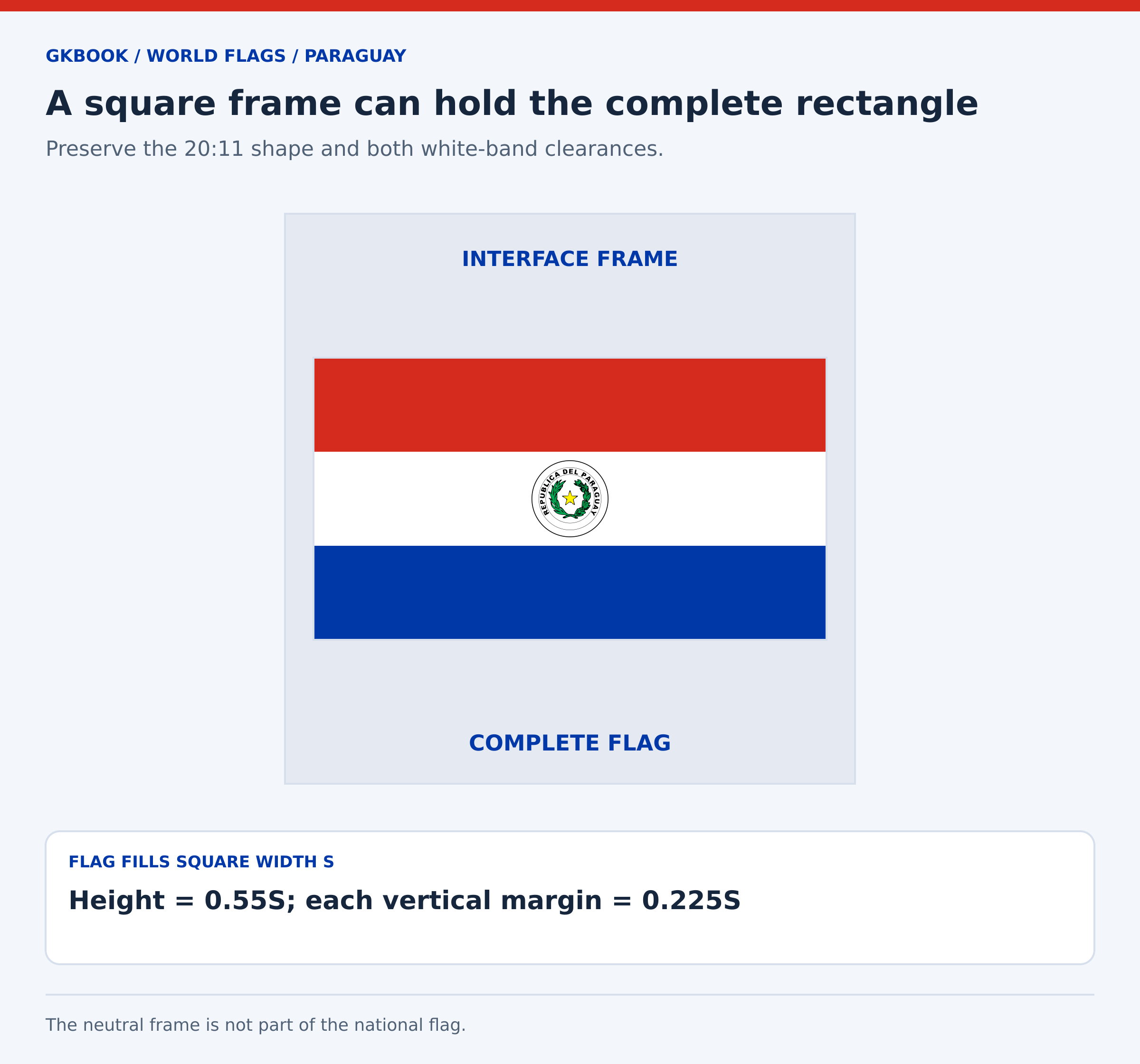
Place the complete 20:11 rectangle inside the square with neutral space above and below. If the flag fills a square’s width S, its height is 0.55S and each vertical margin is 0.225S. Do not stretch the rectangle, crop its bands, or enlarge the emblem independently just to fill the available interface frame.

At small sizes, the overall tricolor remains recognizable while fine emblem lettering naturally becomes less legible. A larger accessible image and a descriptive alternative text can provide the missing detail. Increasing the emblem alone changes the established composition and can make the two sides inconsistent with the downloadable reference pair.
A square frame is a layout container, not a new national flag shape. Keep its border and background visibly separate from the cloth. When a gallery shows front and reverse thumbnails, give each a distinct label and download link so a reader does not assume that the two images are interchangeable resolutions of one picture.
What are common mistakes in drawing or describing Paraguay’s flag?
Common mistakes include unequal bands, a generic ratio, the same emblem on both faces, mirrored inscriptions, a left-facing reverse lion, and mixing older emblem features with the 2013 model. Historical captions can also confuse the 1812 commemoration, 1842 adoption, and 2013 standardization. Check the design, dates, and source status together before reuse.
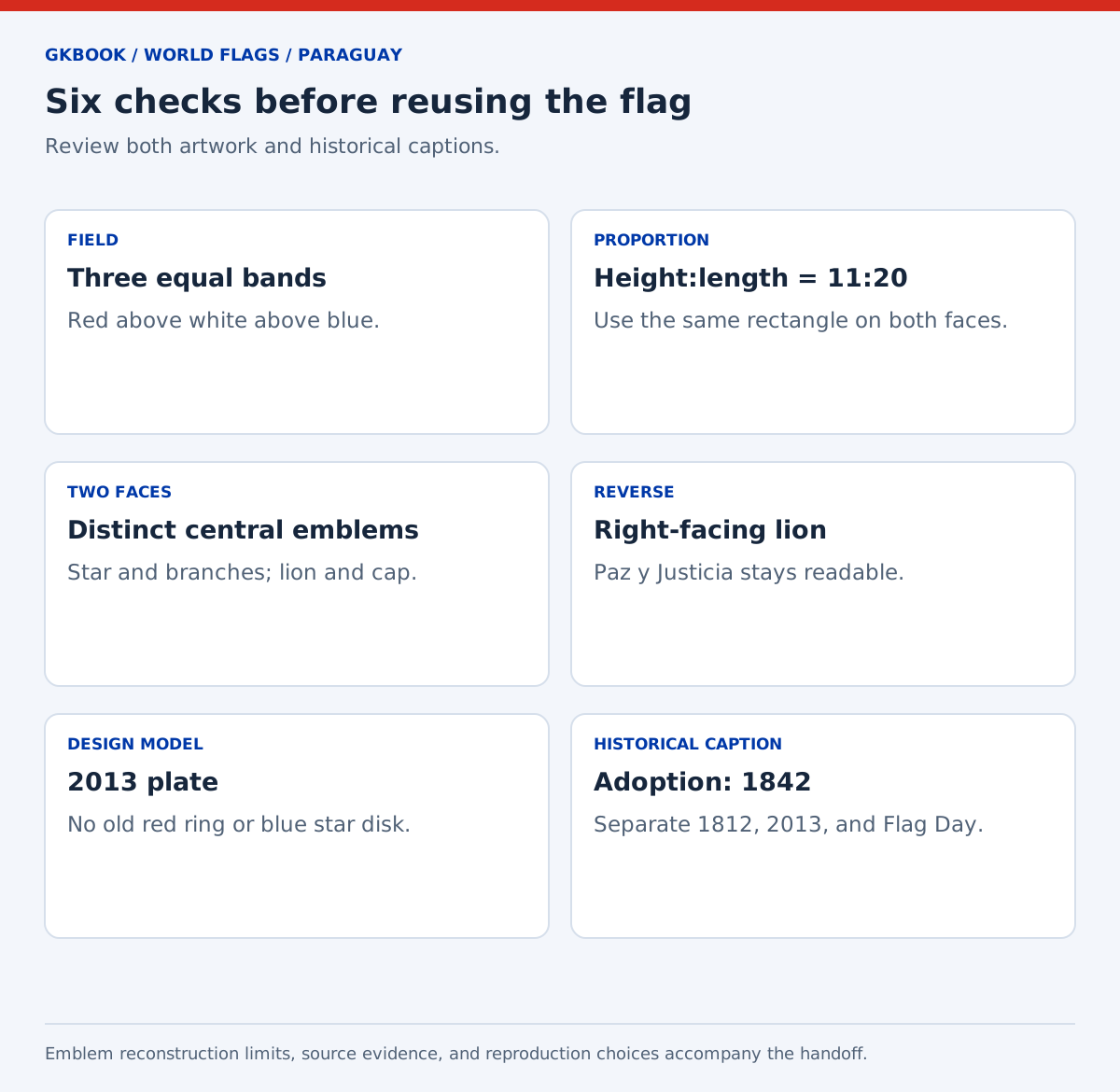
Start with the complete rectangle and equal red, white, and blue bands. Then inspect the circular center on each face: star and branches at the front, lion and liberty cap at the back. Confirm readable black wording, the right-facing seated lion, and the absence of a blue disk immediately surrounding the obverse star.
Finally review the caption and color notes. The stripe hex values are declared reproduction choices; the emblem RGB values follow the inspected appendix. The emblem outlines are documented educational reconstructions, and their diameter on these files is a stated drawing choice. Those distinctions support accurate reuse without overstating what the source actually specifies.
Download Paraguay flag pictures
Download the plain flag as SVG or 4,800 × 2,640 PNG. The SVG uses a 2,400 × 1,320 coordinate system and remains scalable. The reverse is separately available as SVG and 4,800 × 2,640 PNG. The gallery contains 24 subjects with paired SVG and PNG files, including both plain faces, construction, history, and emblem details. Image credits and construction notes record the reconstruction method and artwork status.
Explore more in World Flags, including the Netherlands flag and Panama flag.
World Flags/Paraguay
Paraguay flag pictures
Educational reconstruction from the official 2013 emblem plates. Height:length 11:20; equal bands. Stripe screen colors and 360-unit emblem diameter on a 2400 by 1320 master are declared reproduction choices. Emblem colors follow the printed appendix RGB table. Not an original government vector master or certified manufacturing drawing.
GKBook educational artwork; emblems reconstructed from Paraguay’s official Decree 11400 appendix (2013).Download SVGDownload PNGEducational reconstruction from the official 2013 emblem plates. Height:length 11:20; equal bands. Stripe screen colors and 360-unit emblem diameter on a 2400 by 1320 master are declared reproduction choices. Emblem colors follow the printed appendix RGB table. Not an original government vector master or certified manufacturing drawing.
GKBook educational artwork; emblems reconstructed from Paraguay’s official Decree 11400 appendix (2013).Download SVGDownload PNGBoth faces share the tricolor and dimensions, but use different centered emblems.
GKBook educational artwork; emblems reconstructed from Paraguay’s official Decree 11400 appendix (2013).Download SVGDownload PNGRed #D52B1E, white #FFFFFF, and blue #0038A8 are declared screen reproduction choices. Decree 11400 does not give stripe RGB values.
GKBook educational artwork; emblems reconstructed from Paraguay’s official Decree 11400 appendix (2013).Download SVGDownload PNGThe inspected appendix prints yellow RGB 255, 241, 0 and green CMYK 100, 0, 100, 0; differing online transcriptions are not substituted.
GKBook educational artwork; emblems reconstructed from Paraguay’s official Decree 11400 appendix (2013).Download SVGDownload PNGRadio Nacional associates red with justice, white with peace, and blue with liberty. Other institutional explanations provide additional associations.
GKBook educational artwork; emblems reconstructed from Paraguay’s official Decree 11400 appendix (2013).Download SVGDownload PNGEducational vector reconstruction from the official 2013 plate; this enlarged emblem is not a complete flag.
GKBook educational artwork; emblems reconstructed from Paraguay’s official Decree 11400 appendix (2013).Download SVGDownload PNGEducational vector reconstruction from the official 2013 plate; this enlarged emblem is not a complete flag.
GKBook educational artwork; emblems reconstructed from Paraguay’s official Decree 11400 appendix (2013).Download SVGDownload PNGThe current star is yellow, has five points, and occupies the emblem’s geometric center. The inspected RGB table gives 255, 241, 0.
GKBook educational artwork; emblems reconstructed from Paraguay’s official Decree 11400 appendix (2013).Download SVGDownload PNGBlack inscriptions name the country on the obverse and Peace and Justice on the reverse. The reconstructed artwork preserves the plate’s uppercase letter shapes.
GKBook educational artwork; emblems reconstructed from Paraguay’s official Decree 11400 appendix (2013).Download SVGDownload PNGThe decree’s approximately 1:0.55 larger-to-smaller relationship is encoded exactly as 20:11 width:height in these files.
GKBook educational artwork; emblems reconstructed from Paraguay’s official Decree 11400 appendix (2013).Download SVGDownload PNGEach band is 440 units high in the 1,320-unit master. The white band is not enlarged to accommodate the emblem.
GKBook educational artwork; emblems reconstructed from Paraguay’s official Decree 11400 appendix (2013).Download SVGDownload PNGBoth circular emblems share the center (1,200, 660) on the 2,400 × 1,320 master. The asymmetric lion does not move the circle off center.
GKBook educational artwork; emblems reconstructed from Paraguay’s official Decree 11400 appendix (2013).Download SVGDownload PNGThe outer painted emblem diameter is 360 master units, leaving 40 units above and below within the 440-unit white band. This is a reproduction choice.
GKBook educational artwork; emblems reconstructed from Paraguay’s official Decree 11400 appendix (2013).Download SVGDownload PNGThe construction establishes the outer rectangle and equal stripes before adding the separate obverse and reverse emblems.
GKBook educational artwork; emblems reconstructed from Paraguay’s official Decree 11400 appendix (2013).Download SVGDownload PNGFour exports preserve the exact 20:11 width:height ratio, equal bands, and uniform scaling of the chosen emblem diameter.
GKBook educational artwork; emblems reconstructed from Paraguay’s official Decree 11400 appendix (2013).Download SVGDownload PNGThe hoist is shown on the left for the obverse and on the right for the reverse. The reverse inscription stays readable and its lion faces the viewer’s right.
GKBook educational artwork; emblems reconstructed from Paraguay’s official Decree 11400 appendix (2013).Download SVGDownload PNGA clockwise turn puts blue at the viewer’s left, white in the center, and red on the right. The diagram illustrates the Culture campaign’s color guidance using a plain tricolor.
GKBook educational artwork; emblems reconstructed from Paraguay’s official Decree 11400 appendix (2013).Download SVGDownload PNGThe timeline separates the educational first-hoisting date, the 1842 adoption, the 2013 regulation, and annual Flag Day.
GKBook educational artwork; emblems reconstructed from Paraguay’s official Decree 11400 appendix (2013).Download SVGDownload PNGNovember 25, 1842 marks the foundational congressional adoption. December 25 is the later ceremony; July 2013 is the modern regulation.
GKBook educational artwork; emblems reconstructed from Paraguay’s official Decree 11400 appendix (2013).Download SVGDownload PNGThe inspected decree and appendix supply the detailed emblem model. As checked October 20, 2026, proposal D-2694226 is still in progress.
GKBook educational artwork; emblems reconstructed from Paraguay’s official Decree 11400 appendix (2013).Download SVGDownload PNGThe decree distinguishes the plain tricolor from the banner carrying its two emblems. The top panel is explicitly a component illustration.
GKBook educational artwork; emblems reconstructed from Paraguay’s official Decree 11400 appendix (2013).Download SVGDownload PNGFit the complete 20:11 rectangle within a square; do not stretch or crop the cloth or enlarge the emblem independently.
GKBook educational artwork; emblems reconstructed from Paraguay’s official Decree 11400 appendix (2013).Download SVGDownload PNGReview equal stripes, ratio, separate emblems, readable text, lion direction, the 2013 design model, and distinct historical dates.
GKBook educational artwork; emblems reconstructed from Paraguay’s official Decree 11400 appendix (2013).Download SVGDownload PNGFrequently asked questions
What does Paraguay’s flag look like?
Paraguay’s flag has three equal horizontal bands of red, white, and blue, with a different emblem on each side. The front shows a yellow star within palm and olive branches; the reverse shows a lion beneath a liberty cap. Its standard height:length ratio is 11:20, and formal adoption dates to November 25, 1842.
What is the design of the Paraguay flag?
The Paraguay flag is a horizontal red, white, and blue tricolor with equal bands. A circular emblem occupies the center of the white band. The obverse bears the national arms with a star and branches; the reverse bears the Treasury emblem with a lion, liberty cap, and the motto Paz y Justicia.
What are the Paraguay flag’s colors and digital values?
The three bands are red, white, and blue. This package uses #D52B1E, #FFFFFF, and #0038A8 respectively as declared screen values. Decree 11400 describes the band colors without giving their RGB codes. Its appendix does specify numerical colors for the emblems, which must be distinguished from the broad stripe palette.
What do the colors of the Paraguay flag mean?
Paraguay’s Radio Nacional explains red as justice, white as peace, and blue as liberty. Other institutional accounts give broader associations, including courage, purity, unity, and knowledge. These are explanations of national symbolism; the decree’s construction rules do not turn each color into a single, exhaustive list of officially exclusive meanings.
What appears on the front of the Paraguay flag?
The obverse shows a circular emblem with a yellow five-pointed star at its geometric center. Green palm and olive branches curve around the star and cross at their base. Black lettering names the Republic of Paraguay on an uncolored ring. The current construction does not place a blue disk behind the star.
How many points does the star on the Paraguay flag have?
The current obverse star has five points and is yellow. Decree 11400 places it at the geometric center of the emblem without a separate enclosing circle immediately around the star. The appendix prints its RGB value as 255, 241, 0, encoded here as #FFF100; this is distinct from some online transcriptions.
Which branches surround the star on Paraguay’s flag?
The decree specifies palm and olive branches, interlaced at their base and curved around the star. In the illustrated front view, the palm is on the viewer’s left and the olive on the right. Both are green. The appendix gives RGB 0, 166, 81, used here as the hexadecimal value #00A651.
What is on the reverse of the Paraguay flag?
The reverse carries the Treasury emblem: an ochre lion sitting beside a vertical brown pike topped by a red Phrygian cap. Above it, black letters read Paz y Justicia, meaning Peace and Justice. The lion faces the observer’s right. This separate design replaces the star-and-branches emblem when viewing the opposite face.
Which way does the lion on Paraguay’s flag face?
The lion on the reverse faces the observer’s right. Decree 11400 describes a seated lion in profile, roaring, with its raised tail curving beside the hindquarters. The appendix identifies the lion’s color as ochre. Facing direction is stated from the viewer’s perspective, so it should not be reversed through heraldic terminology.
What does the red cap on the reverse symbolize?
The red Phrygian cap symbolizes liberty, an identification explicitly given in Decree 11400. It sits at the upper end of a brown pike positioned behind the lion on the emblem’s vertical diameter. The cap is part of the Treasury emblem on the reverse; it does not appear above the obverse star.
What do the words on Paraguay’s flag say?
The front inscription names the República del Paraguay, or Republic of Paraguay. The reverse inscription is Paz y Justicia, translated as Peace and Justice. Both use black lettering on an uncolored ring. The 2013 appendix identifies Arial Black as the lettering style, while its illustrated uppercase artwork is preserved in the reference reconstructions.
What is the official proportion of the Paraguay flag?
The standard height:length proportion is 11:20. Decree 11400 calls for the larger and smaller dimensions to be as close as possible to 1:0.55, which is equivalent to 20:11 length:height. The digital masters use that relationship exactly: 2,400 units long and 1,320 units high, with equal horizontal bands.
Are the three bands of the Paraguay flag equal?
Yes. The current decree specifies three horizontal bands of identical dimensions. Each occupies one-third of the total height before the emblem is added. On the 2,400 by 1,320 master, the boundaries are y = 440 and y = 880, so each band is 440 units high across the full flag length.
Where is the emblem centered on the Paraguay flag?
Each side’s emblem is centered in the white band, which is also the geometric center of the full flag. For the 2,400 by 1,320 master, that point is (1,200, 660), measured from the upper-left corner of the drawing. Both faces share this center even though their internal figures and inscriptions differ.
How large should the emblem be on these flag drawings?
These illustrations use a 360-unit outer painted diameter on the 2,400 by 1,320 master. That leaves 40 units between the emblem and each edge of the white band. This size is an explicit reproduction choice: the consulted decree centers the emblems but does not provide this numerical diameter relative to the full flag.
How do you draw the Paraguay flag accurately?
Begin with a 20:11 landscape rectangle, divide its height into three equal bands, and fill them red, white, and blue from top to bottom. Center the appropriate circular emblem in the white band. Use the star-and-branches artwork for the obverse and the lion-and-cap artwork for the reverse, preserving readable inscriptions.
What pixel dimensions preserve the Paraguay flag ratio?
Suitable width-by-height dimensions include 600 by 330, 1,200 by 660, 2,400 by 1,320, and 4,800 by 2,640 pixels. All preserve the 20:11 width:height ratio. The plain SVG masters use 2,400 by 1,320 coordinates, and both plain PNG downloads are 4,800 by 2,640 pixels, with the full design retained.
Is Paraguay’s reverse flag just a mirrored front?
No. Paraguay uses different central emblems on the two faces. The reverse must show the Treasury lion and liberty cap with readable Paz y Justicia lettering, not a reflected star-and-branches seal. In a viewing-side comparison, the front has its hoist on the left and the reverse has its hoist on the right.
How are Paraguay’s colors arranged in a vertical display?
A 2013 Secretariat of Culture campaign instructs that red should be on the right in a vertical display. The gallery illustrates that arrangement with the plain colors: blue at the viewer’s left, white in the center, and red at the right. It does not invent a universal rule for rotating or repositioning both emblems.
What are the main dates in Paraguay’s flag history?
Three dates answer different historical questions: August 15, 1812 is the first-hoisting date established by the 2013 decree for educational commemoration; November 25, 1842 is the formal adoption milestone; and July 15, 2013 is the modern design-regulation date. Flag Day is observed annually on August 14, rather than on the November adoption anniversary.
When was the Paraguay flag officially adopted?
The formal adoption date used here is November 25, 1842, when the Extraordinary General Congress established the national banner with its tricolor and two emblems. A later oath ceremony took place on December 25. The 2013 decree standardized the design; it did not make 2013 the beginning of Paraguay’s red, white, and blue flag.
Why is August 15, 1812 also associated with the flag?
Article 3 of Decree 11400 establishes August 15, 1812 as the first-hoisting date for educational purposes and historical commemoration, linking it with the flag’s definitive colors. That attribution should be stated with its source and purpose. It is separate from the 1842 congressional adoption and from the annual August 14 Flag Day.
What changed in the Paraguay flag standard in 2013?
Decree 11400, dated July 15, 2013, regulated the flag and emblems and supplied an illustrated appendix with color and lettering specifications. The current model has black inscriptions on uncolored rings and no blue disk immediately around the obverse star. The decree was published in the Official Gazette on July 17, a separate publication date.
When is Paraguay’s Flag Day?
Paraguay observes Flag Day on August 14. Radio Nacional explains that a teachers’ association requested that date in 1913 to avoid overlapping with Asunción’s founding commemoration on August 15. The annual observance is distinct from the flag’s November 25, 1842 adoption and from the July 2013 decree that standardized the emblems.
Who designed the Paraguay flag?
The sources consulted do not establish one individual as the designer of every part of Paraguay’s present flag. Its form developed through historical use, the 1842 congressional act, and later regulation. Carlos Antonio López’s role in the 1842 document does not, by itself, prove that he personally drew the flag or its modern emblems.
What is the difference between bandera and pabellón?
In Decree 11400, bandera describes the three-band flag, while Pabellón de la República means that flag with its two emblems placed on the respective faces. Everyday English often calls the complete design Paraguay’s flag. The distinction is useful when reading the regulation, especially because plain patriotic tricolors and fully charged banners are not identical pictures.
Which official documents define Paraguay’s national flag?
The 1842 congressional resolution is the foundational adoption text. Article 139 of the Constitution recognizes the national symbols, and Decree 11400 of July 15, 2013 provides the detailed flag and emblem regulation used here. Its illustrated appendix supplies the emblem models, numerical color entries, and Arial Black lettering specification.
Has a recent proposal already changed Paraguay’s flag?
As checked on October 20, 2026, the legislative registry lists proposal D-2694226 as still in progress, not as a promulgated law. A proposed change therefore is not treated here as an adopted flag standard. The reference artwork follows the verified 2013 decree and appendix, with this status check recorded for future editorial review.
How should Paraguay’s flag fit inside a square thumbnail?
Place the complete 20:11 rectangle inside the square with neutral space above and below. If the flag fills a square’s width S, its height is 0.55S and each vertical margin is 0.225S. Do not stretch the rectangle, crop its bands, or enlarge the emblem independently just to fill the available interface frame.
What are common mistakes in drawing or describing Paraguay’s flag?
Common mistakes include unequal bands, a generic ratio, the same emblem on both faces, mirrored inscriptions, a left-facing reverse lion, and mixing older emblem features with the 2013 model. Historical captions can also confuse the 1812 commemoration, 1842 adoption, and 2013 standardization. Check the design, dates, and source status together before reuse.
Explore all general-knowledge topics and the A-to-Z lists.












We Value Your Opinion Comments