

Pakistan flag picture
Explore the proportions, history, and picture gallery.
| Design | Green and whiteWhite hoist stripe, crescent, and five-pointed star. |
|---|---|
| Proportions | Height:length = 2:3White stripe = one-quarter of the complete length. |
| Adopted | August 11, 1947Constituent Assembly, Karachi. |
| Design credit | Amiruddin KidwaiOfficial diplomatic attribution; proposer and presiding leader had separate roles. |
| Geometry | Green-field diagonalCrescent opens toward the upper fly; star tilted about 41.63°. |
| Current standards | Paper TPX; fabric TCX2025 color codes retained in instructions amended through August 13, 2026. |
What does Pakistan’s flag look like?
Pakistan’s national flag has a dark green field with a white crescent and five-pointed star, plus a full-height white stripe beside the hoist. Its height:length ratio is 2:3. The Constituent Assembly adopted it on August 11, 1947, and its symbols express religious identity, inclusion, progress, and enlightenment.
Pakistan’s flag combines a simple quarter-width division with carefully positioned circular and star geometry. This guide explains those measurements, the official symbolism, and the Assembly’s recorded adoption debate. It also separates the 1947 design from the later instructions governing color, size, and display.
What is the design of the Pakistan flag?
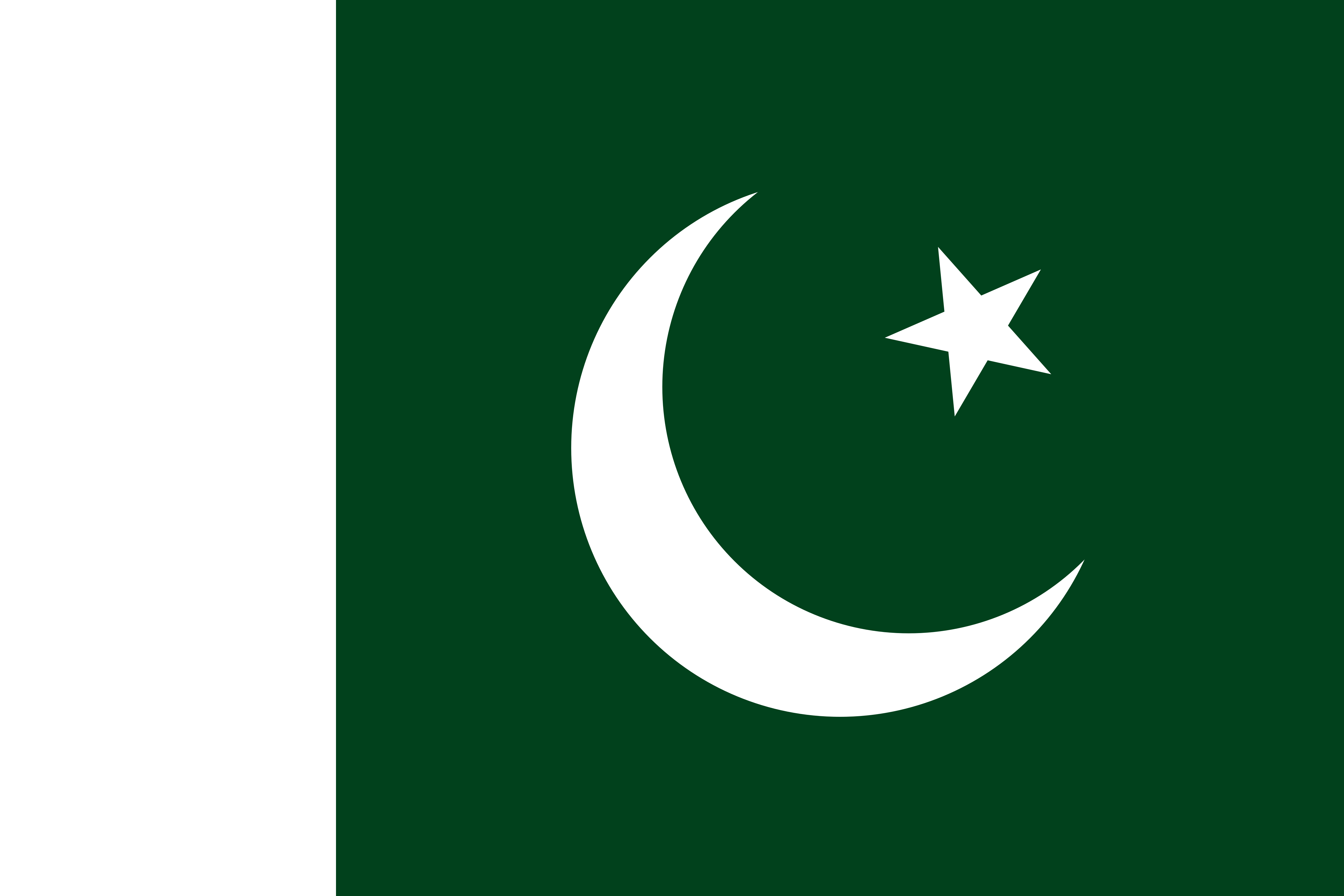
Pakistan’s flag is a rectangle with a white vertical stripe along the pole side and a larger dark green field toward the fly. A white crescent and five-pointed star occupy the green field. In the usual hoist-left view, the crescent opens diagonally toward the upper right.

The hoist is the edge attached to the pole or halyard; the fly is the opposite free edge. In a conventional reference image, the hoist appears on the left. The white stripe extends through the full height, while the green field occupies the remaining three-quarters of the total length.
The crescent and star are separate white shapes within that green field. Their placement follows its rising diagonal, so the star is tilted rather than drawn with one point straight upward. No inscription, border, shield, or additional state emblem belongs inside the ordinary national flag.
What are the colors of the Pakistan flag?
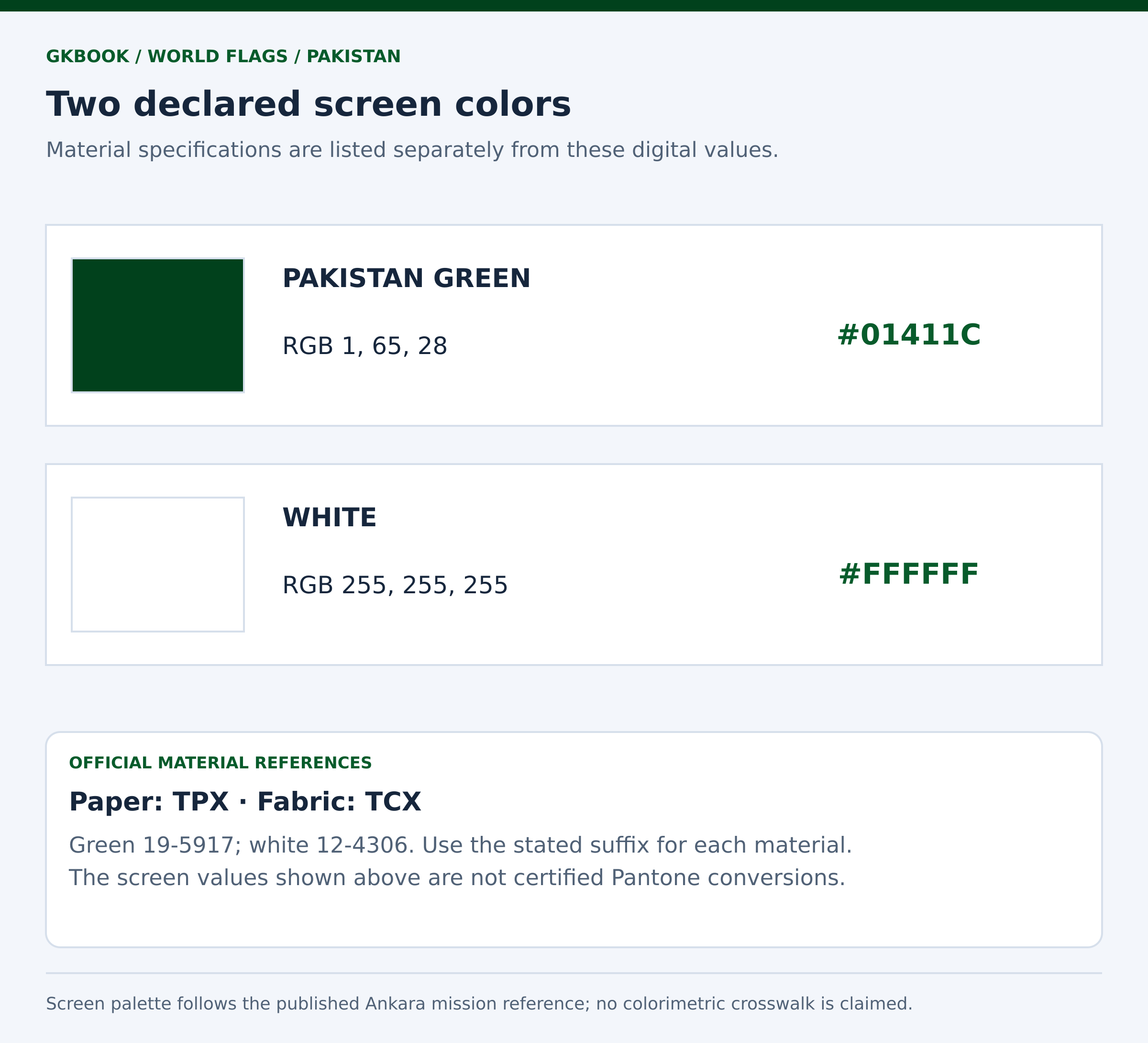
Pakistan’s flag uses dark green and white. Current instructions specify Pantone 19-5917 TPX and 12-4306 TPX for paper, and 19-5917 TCX and 12-4306 TCX for fabric. This artwork uses screen values #01411C and #FFFFFF, without claiming that they are certified conversions of those material standards.

A color name, a screen value, and a material specification serve different purposes. The paper and fabric codes are explicitly distinguished in the current instructions. Their suffixes therefore matter: replacing TPX or TCX with a different Pantone system would change the reference being cited, even if the printed number looked similar.
The screen palette here follows values published by Pakistan’s diplomatic mission in Ankara. It makes these digital files consistent and reproducible. It does not establish a measured match on every monitor, printer, ink, or cloth. Production matching should follow the applicable material standard instead of an assumed hexadecimal crosswalk.
| Color | Paper flags | Fabric flags | Screen reference |
|---|---|---|---|
| Pakistan Green | 19-5917 TPX | 19-5917 TCX | #01411C |
| White | 12-4306 TPX | 12-4306 TCX | #FFFFFF |
What does the Pakistan flag symbolize?
Official explanations connect green with Islam and Pakistan’s Muslim majority, and the white stripe with religious minorities. The crescent represents progress, while the star represents light, knowledge, or enlightenment. Together these elements combine the country’s religious identity with a stated place for minorities and aspirations for its future.

These meanings are attached to specific parts of the design. The white stripe is the feature associated with religious minorities; the crescent and star have their own explanations even though they share its color. Treating every white area as a separate population category would go beyond the official account.
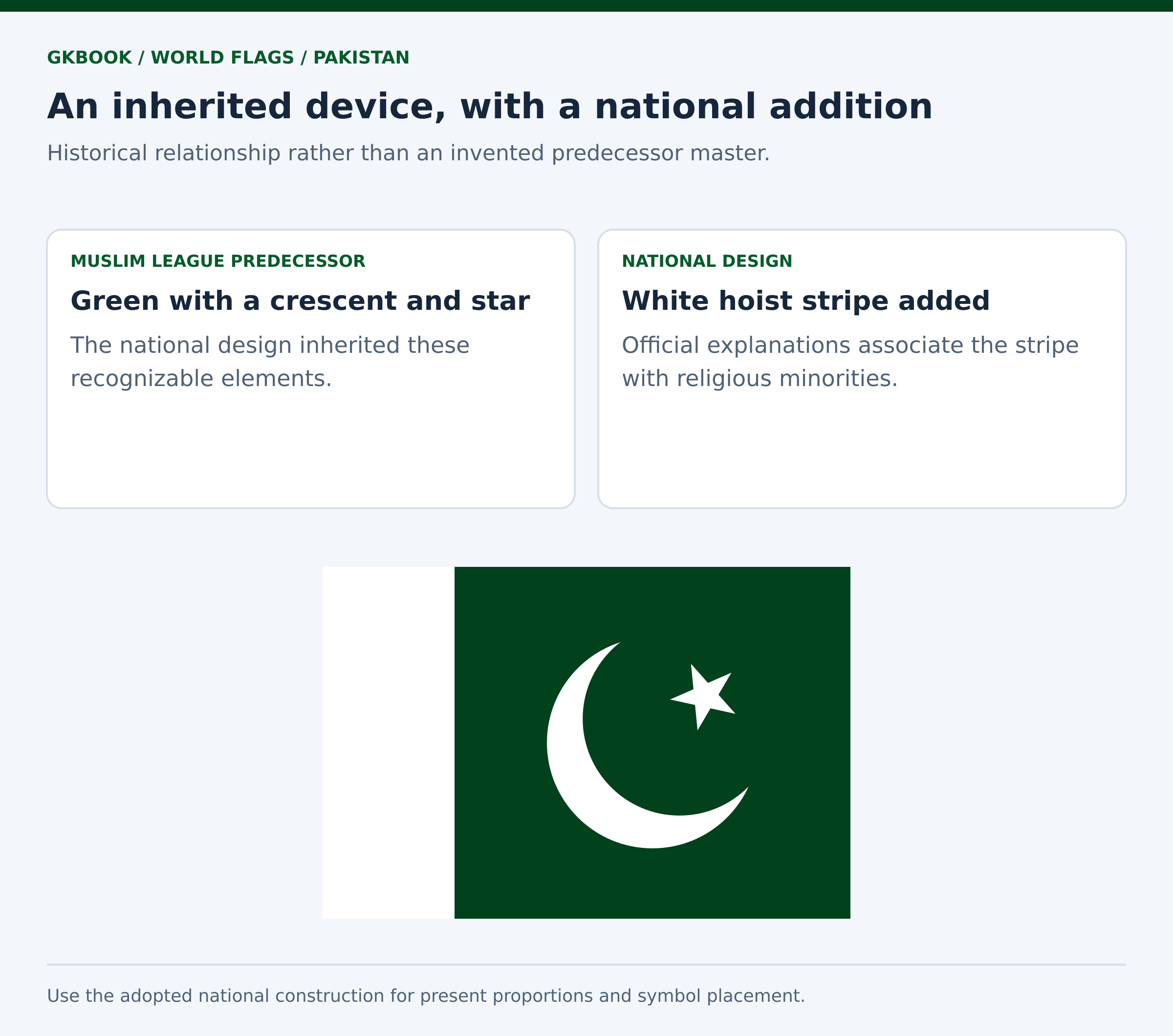
The symbolism also has a historical context. The green crescent-and-star design developed from the Muslim League flag, while the national flag added a prominent white hoist stripe. The measured widths are design instructions, not a population chart or a formula assigning a demographic percentage to each community.
What does green mean on Pakistan’s flag?
Green represents Islam and the Muslim majority in official descriptions of Pakistan’s flag. It forms the large field beyond the white hoist stripe and provides the background for the white crescent and star. Its symbolic meaning does not turn the field’s three-quarter width into a demographic measurement.
The green field is rectangular, measuring three-quarters of the complete length and the full height. On the supplied 2,400 × 1,600 master it begins at x = 600 and extends to x = 2,400. Its own center, rather than the center of the whole canvas, anchors the crescent construction.
The green visible within the crescent’s opening is the same green as the surrounding field. It is not a third color or a transparent hole. Keeping a single green fill across those areas ensures that the symbol remains visually coherent when the flag is placed on a webpage or exported.
What does the white stripe mean on Pakistan’s flag?
The white stripe represents Pakistan’s religious minorities in official explanations. It runs beside the hoist for the full height and occupies one-quarter of the total length. The crescent and star are also white, so the flag’s total white area is greater than the area of the stripe alone.
During the 1947 Assembly debate, Liaquat Ali Khan explained the white portion in relation to minorities. The record also preserves members’ concerns about participation in choosing the national design. Those discussions give the stripe historical meaning without implying that everyone initially agreed on the adoption process.
Its quarter-width is a construction rule, not a claim that minorities form one-quarter of the population. For a drawing, measure the stripe from the complete flag length. For interpretation, retain the official association with religious minorities rather than replacing it with a generic explanation borrowed from another flag.
What does the crescent on Pakistan’s flag mean?
The white crescent represents progress in official explanations of Pakistan’s flag. It is constructed from two offset circles and opens toward the upper fly in a hoist-left view. Its symbolic meaning and geometric shape are separate facts: the idea of progress does not determine its radii or position.
The crescent is a familiar element in Islamic visual traditions, but its particular stated meaning on this national flag is progress. The official explanation should take precedence over invented associations with a specific lunar date, a phase observed on adoption day, or a count of regions.
In the supplied artwork, an opaque white outer circle is partly covered by an opaque green inner circle. The remaining white area forms the crescent. Construction guides show the complete circles only in explanatory diagrams; those guide outlines are not additional marks on the finished national flag.
What does the star on Pakistan’s flag mean?
The five-pointed white star represents light, knowledge, or enlightenment in official explanations. It lies within the crescent’s open side, with one point directed along the green field’s diagonal toward the upper fly. The five points are not identified in these sources as a count of Pakistan’s provinces.
Official descriptions use closely related words for the star’s meaning. “Light and knowledge” and “enlightenment” convey the same general aspiration without requiring a different interpretation for each point. The star is a single national symbol, not five individually labeled emblems.
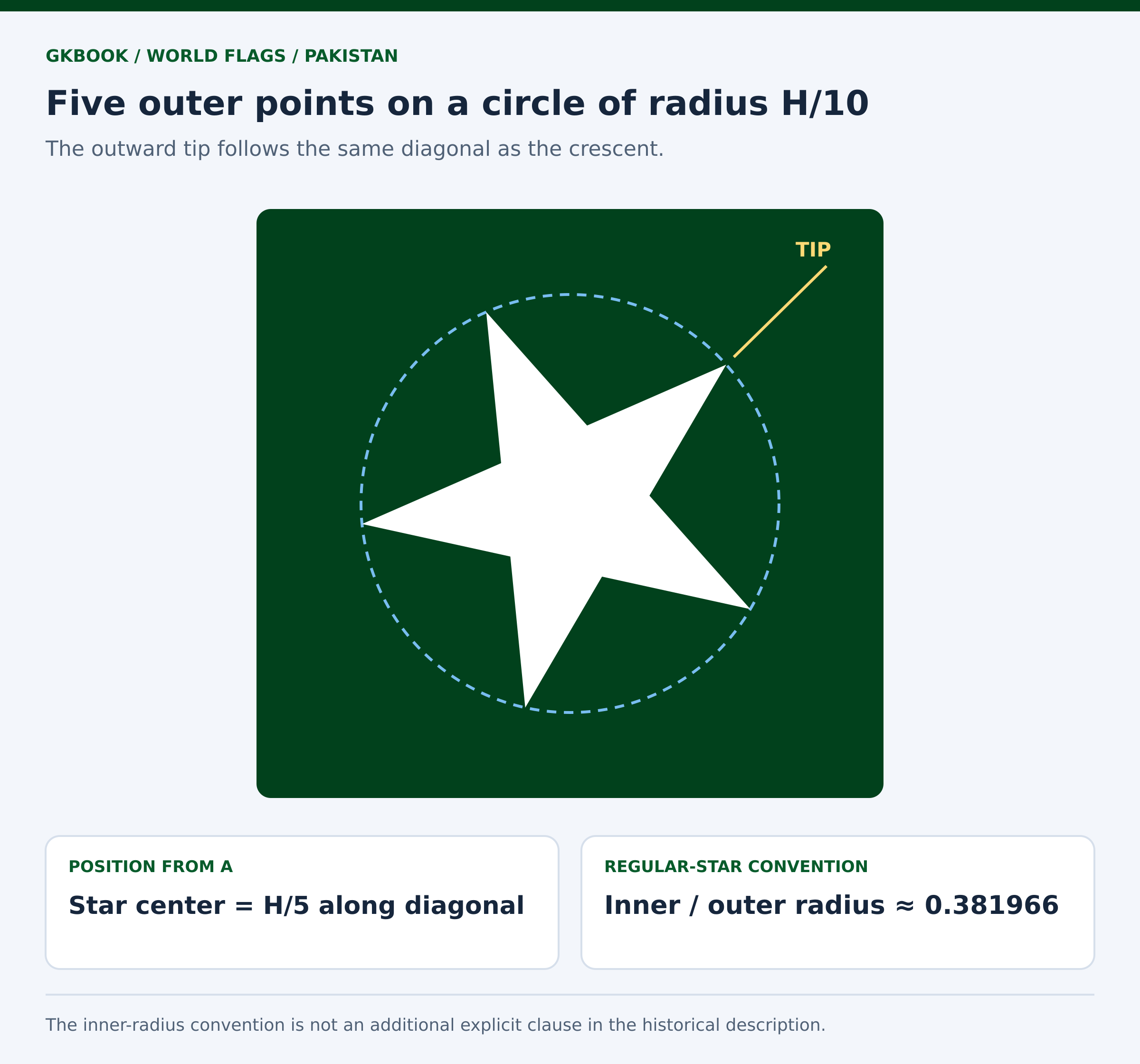
The outer points lie on a construction circle with radius one-tenth of the flag height. This package uses a regular five-pointed star, including the standard pentagram inner-radius relationship. That mathematical choice makes the illustration reproducible; it is documented as a reconstruction convention rather than an extra clause in the official description.
What is the official ratio of the Pakistan flag?
Pakistan’s national flag has a height:length ratio of 2:3, equivalently a length:height ratio of 3:2. A rectangle 1,600 units high is therefore 2,400 units long. This proportion applies to the complete flag, including the white stripe, and every internal element should scale uniformly with it.

The 1947 resolution states the ratio in length-and-width order. In that wording, width means the vertical height. Explicitly naming the dimensions avoids reversing the ratio or mistaking the green field alone for the whole flag. The remaining green rectangle has different proportions because the white stripe occupies part of the length.
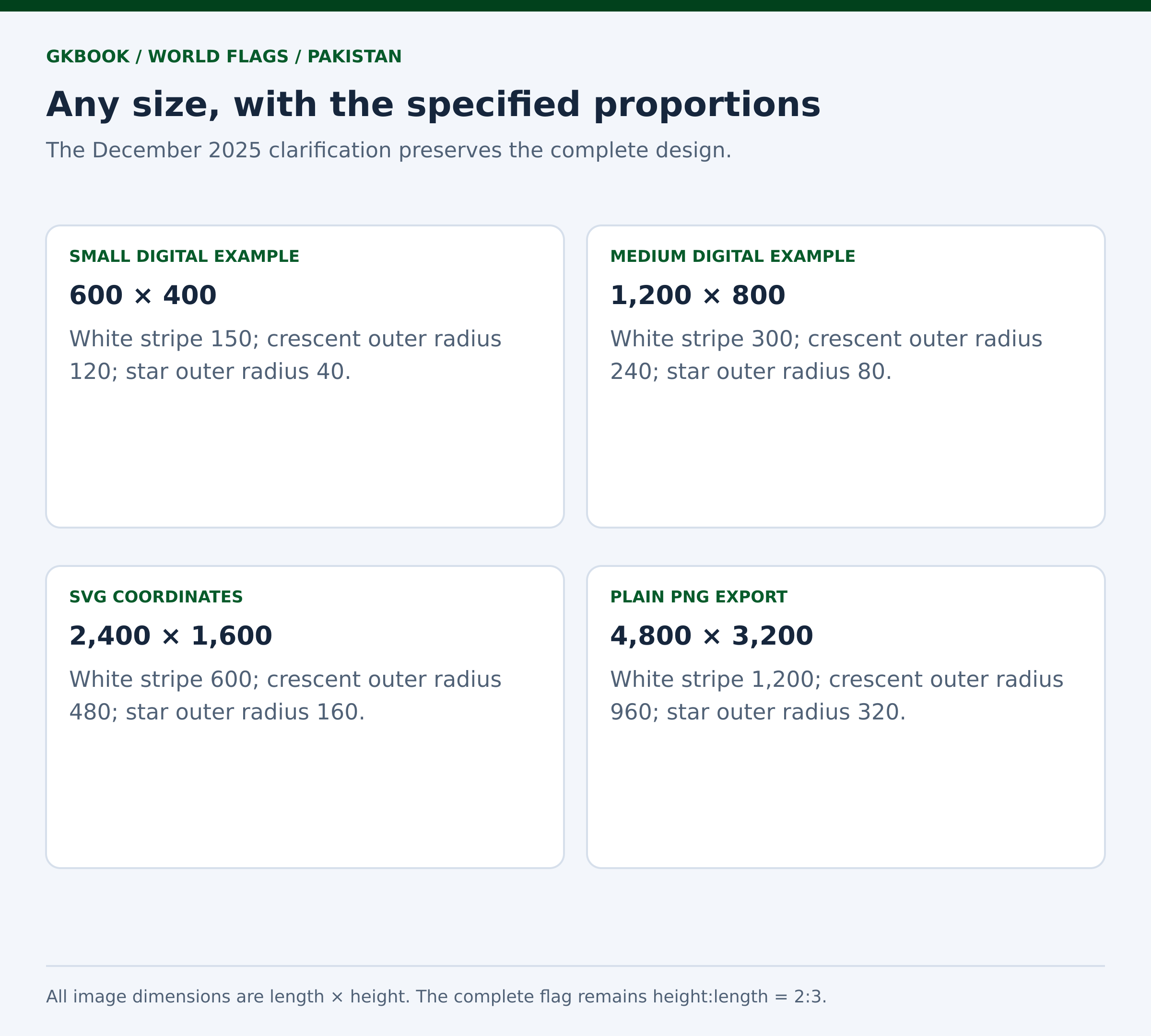
For a digital image, common examples include 600 × 400, 1,200 × 800, and 2,400 × 1,600 pixels, written length × height. These are scaling examples, not a prescribed list of physical flag sizes. Stretching either dimension independently would distort the crescent and star as well as the rectangle.
How wide is the white stripe on Pakistan’s flag?
The white hoist stripe is one-quarter of the flag’s total length and extends through its full height. The green field occupies the other three-quarters. On the 2,400 × 1,600 master, the stripe is 600 units wide and the green field is 1,800 units wide.

The fraction refers to the complete horizontal length, not to the height or to the green area alone. A 1,200 × 800 image therefore has a 300-unit white stripe, followed by a 900-unit green field. This simple boundary is a useful first check before examining the more detailed symbols.
The stripe itself covers one-quarter of the flag’s area because it has the full height. The complete white area also includes the crescent and star, which lie beyond the stripe. Keeping that distinction prevents a correct width rule from becoming an incorrect claim about the total amount of white.
Where are the crescent and star placed?
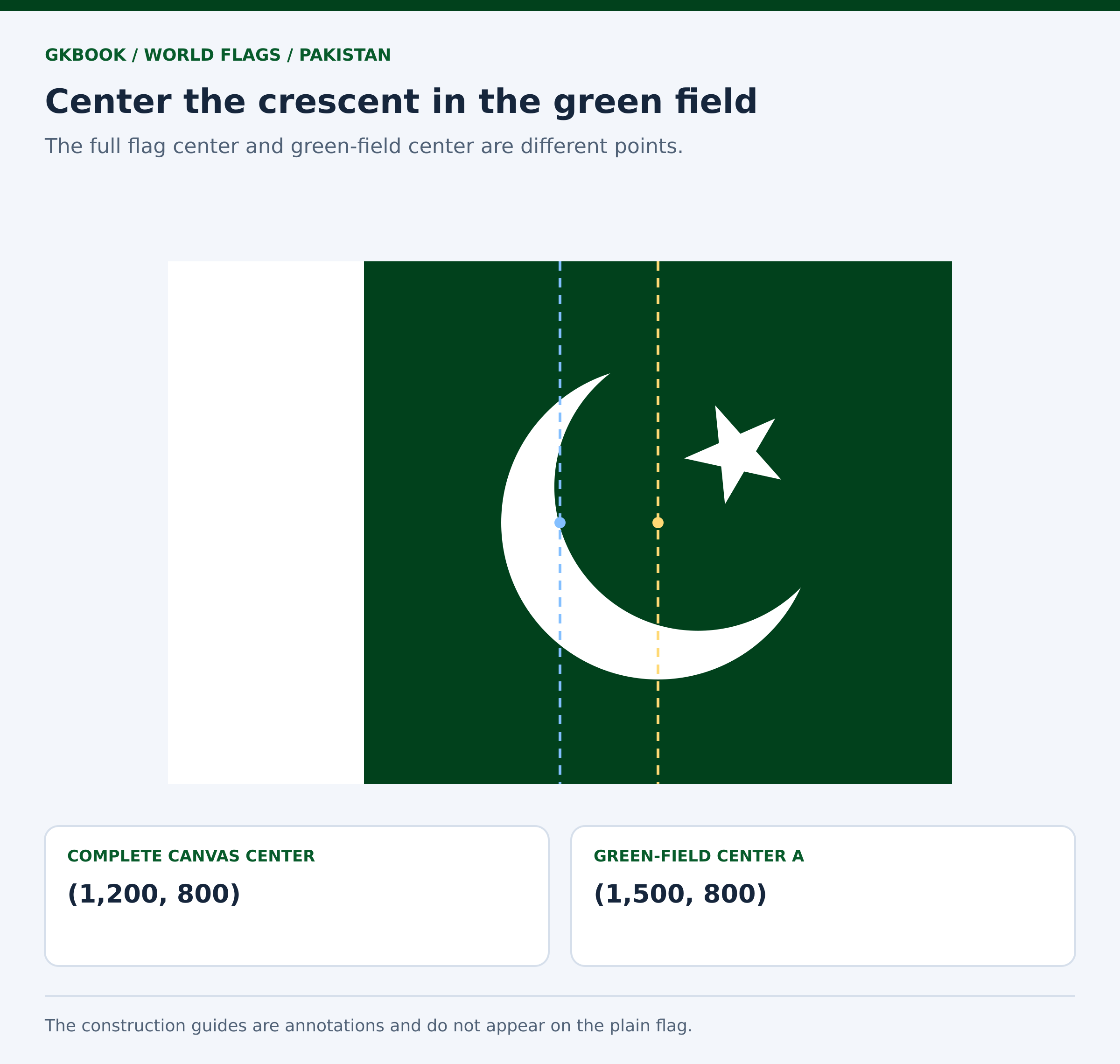
The crescent’s outer circle is centered in the green field, not in the complete flag. The star lies toward the upper fly along that field’s diagonal. With length L and height H, the outer-circle center is at x = 5L/8 and y = H/2 in a hoist-left drawing.

The white stripe shifts the green field’s midpoint to the right of the complete canvas midpoint. On the supplied master, the whole flag center is (1,200, 800), while the green-field center A is (1,500, 800). Using the former for the crescent would move the design noticeably toward the hoist.
The star and the inner circle are positioned along the same diagonal that passes through A. They are not centered independently by eye. This relationship maintains the intended balance between the crescent, the star, and the surrounding green space when the flag is enlarged or reduced.
Why are the crescent and star tilted?
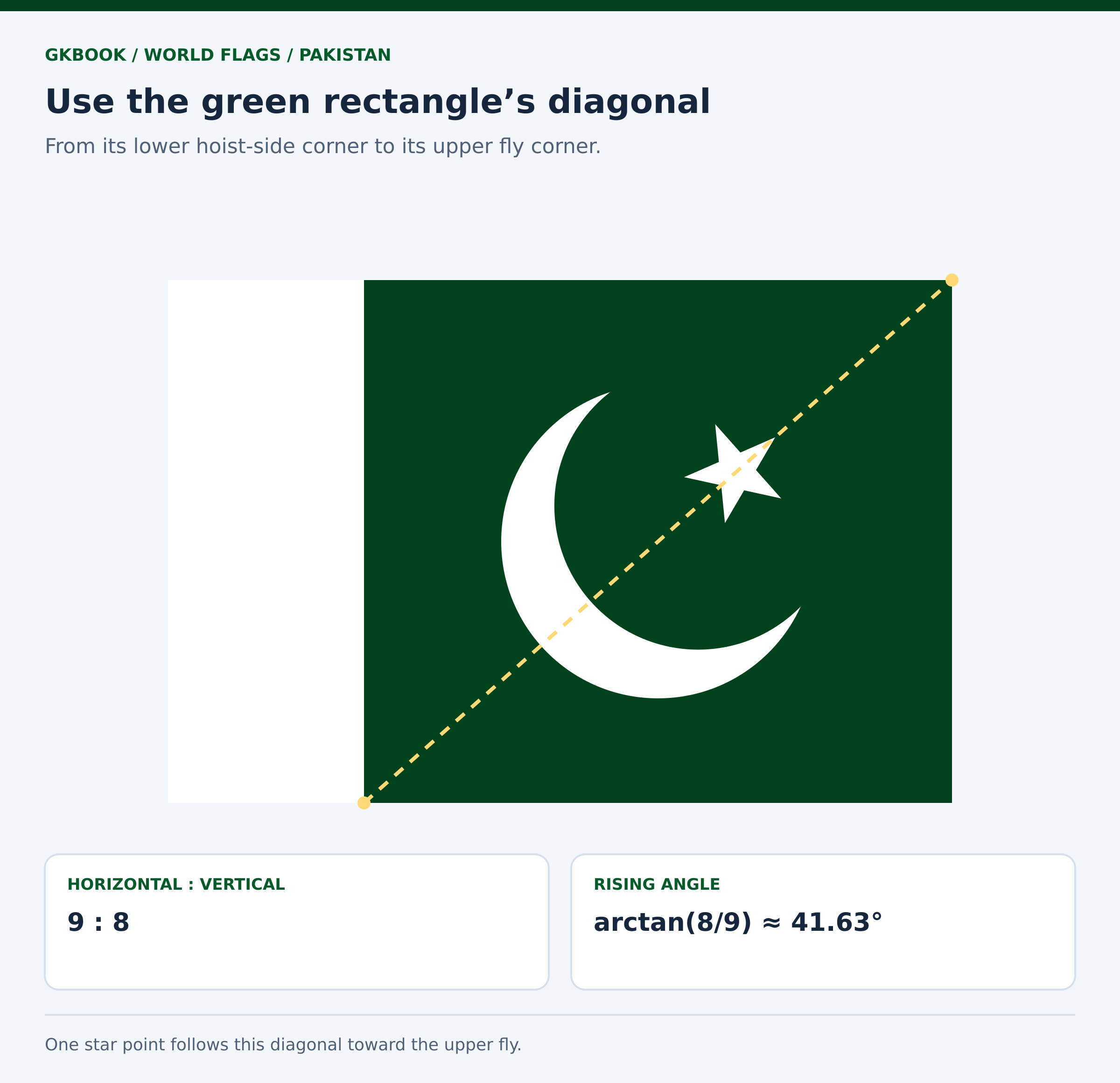
Their construction follows the diagonal from the green field’s lower hoist-side corner to its upper fly corner. Because that rectangle is not square, the diagonal rises about 41.63 degrees above horizontal, not 45 degrees. The star’s outward point and the crescent opening follow this same direction.

For a flag three units long and two units high, the green field is 2.25 units long and two units high. Its rising diagonal therefore has horizontal and vertical components in the ratio 9:8. The angle is arctan(8/9), approximately 41.633539 degrees; the illustration retains the full calculation internally.
The relevant lower corner is where the white stripe meets the bottom edge of the green field. Drawing a diagonal across the entire flag would produce a different angle and misplace the symbols. Likewise, rotating a generic upright crescent-and-star icon by exactly 45 degrees does not reproduce this construction.
How is the crescent constructed accurately?
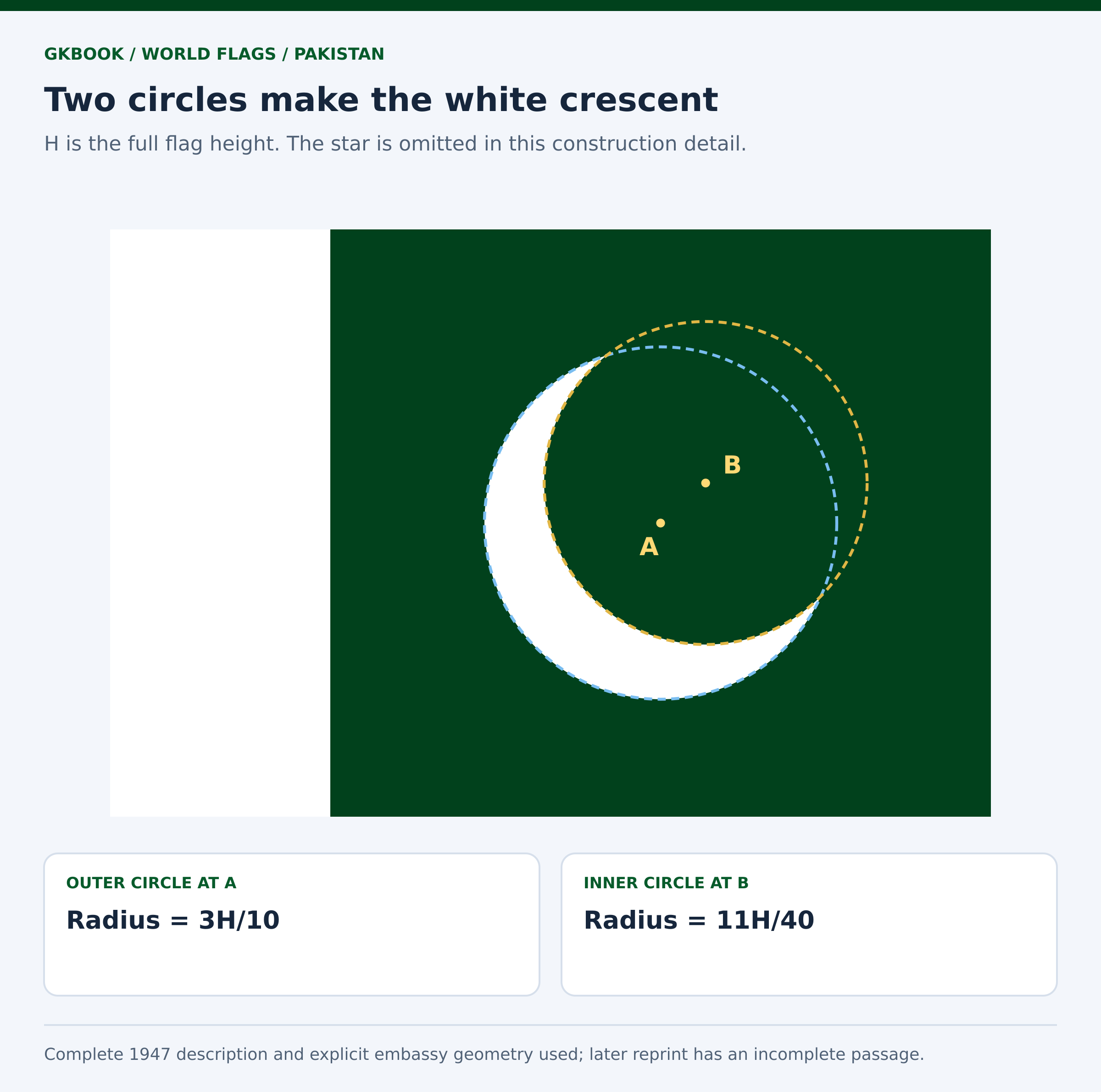
Use a white outer circle centered at the green field’s center A, with radius 3H/10. Place inner-circle center B on the same diagonal, 13H/20 from the upper fly corner, and use radius 11H/40. Cover the inner circle with green to leave the white crescent.

Here H means the full flag height. On the 1,600-unit-high master, the outer radius is 480 and the inner radius is 440. Center B is approximately (1,622.694309, 690.938392), measured from the complete flag’s upper-left corner. The distance from the upper fly corner to B is exactly 1,040 units.
This reconstruction follows the complete 1947 description together with the explicit embassy construction. A later reprint contains an incomplete circle passage, so it cannot safely be read in isolation as a new oversized radius. The diagram distinguishes the two centers and the two circles before showing their resulting crescent.
| Quantity | Rule | For H = 1,600 |
|---|---|---|
| Outer radius | 3H/10 | 480 |
| Inner radius | 11H/40 | 440 |
| Upper fly corner to B | 13H/20 | 1,040 |
| Outer center A | Center of green field | (1,500, 800) |
How is the five-pointed star positioned and sized?
The star’s five outer points lie on a circle of radius H/10. Its outward point meets the green field’s diagonal where the completed outer crescent circle would intersect it toward the upper fly. The star’s center consequently lies H/5 from the green-field center along that direction.

On the master, the star’s outer radius is 160. Its center is approximately (1,739.170982, 587.403572), while its outward tip is approximately (1,858.756473, 481.105357). Those coordinates come from the same diagonal unit vector used for the crescent, rather than separate visual adjustments.
The supplied regular star alternates five outer points with five inner corners. Its inner radius equals the outer radius multiplied by sin(18°)/sin(54°), about 0.381966. That familiar pentagram convention is a documented drawing choice; the historical description specifies the five-pointed heraldic star and its outer circle without that explicit inner-radius formula.
How can you draw Pakistan’s flag accurately?
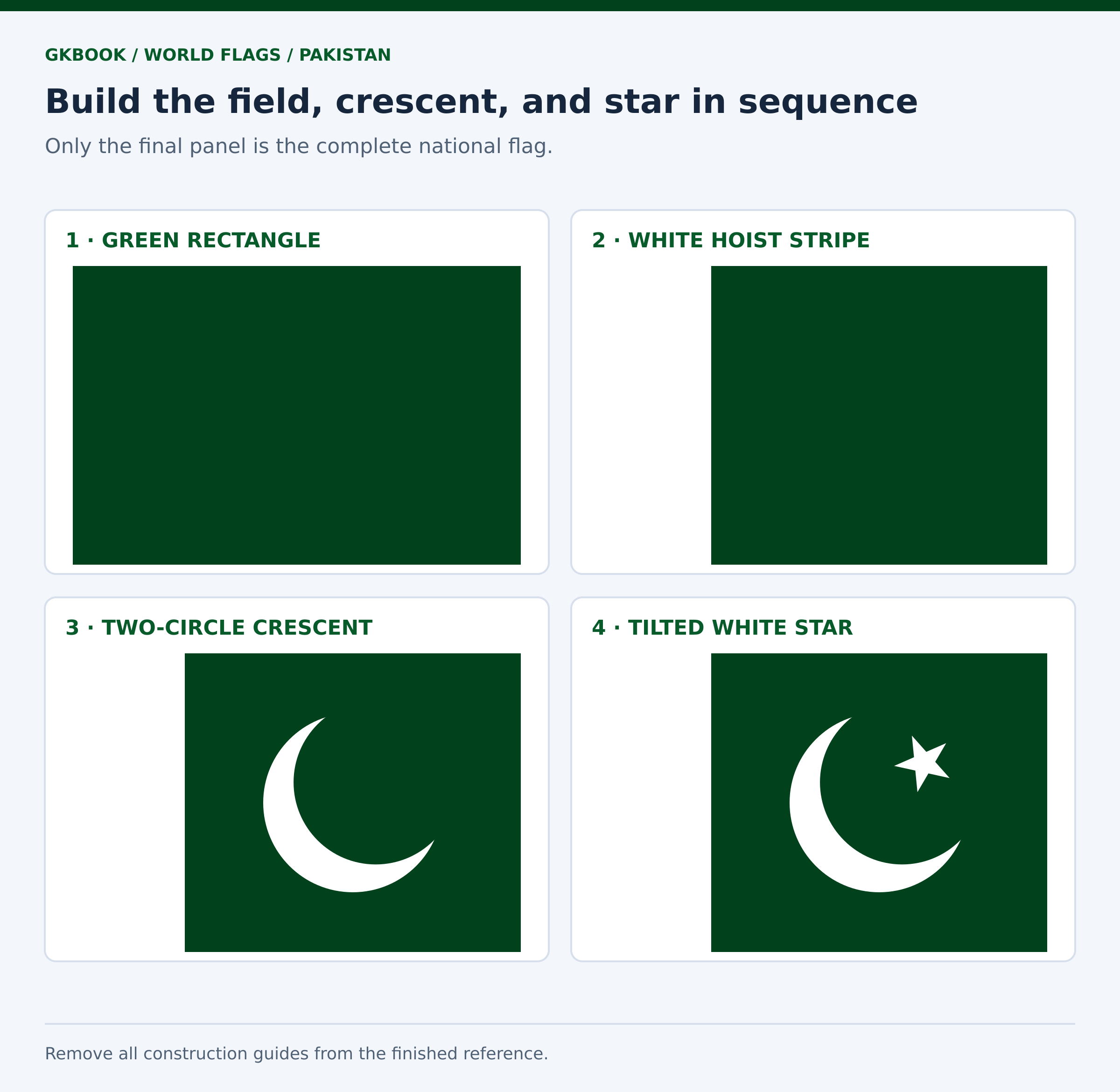
Begin with a 3:2 length:height rectangle, reserve the first quarter of its length for white, and fill the remainder dark green. Construct the crescent from its two measured circles on the green field’s diagonal. Add the tilted five-pointed white star using its specified outer circle and tip position.
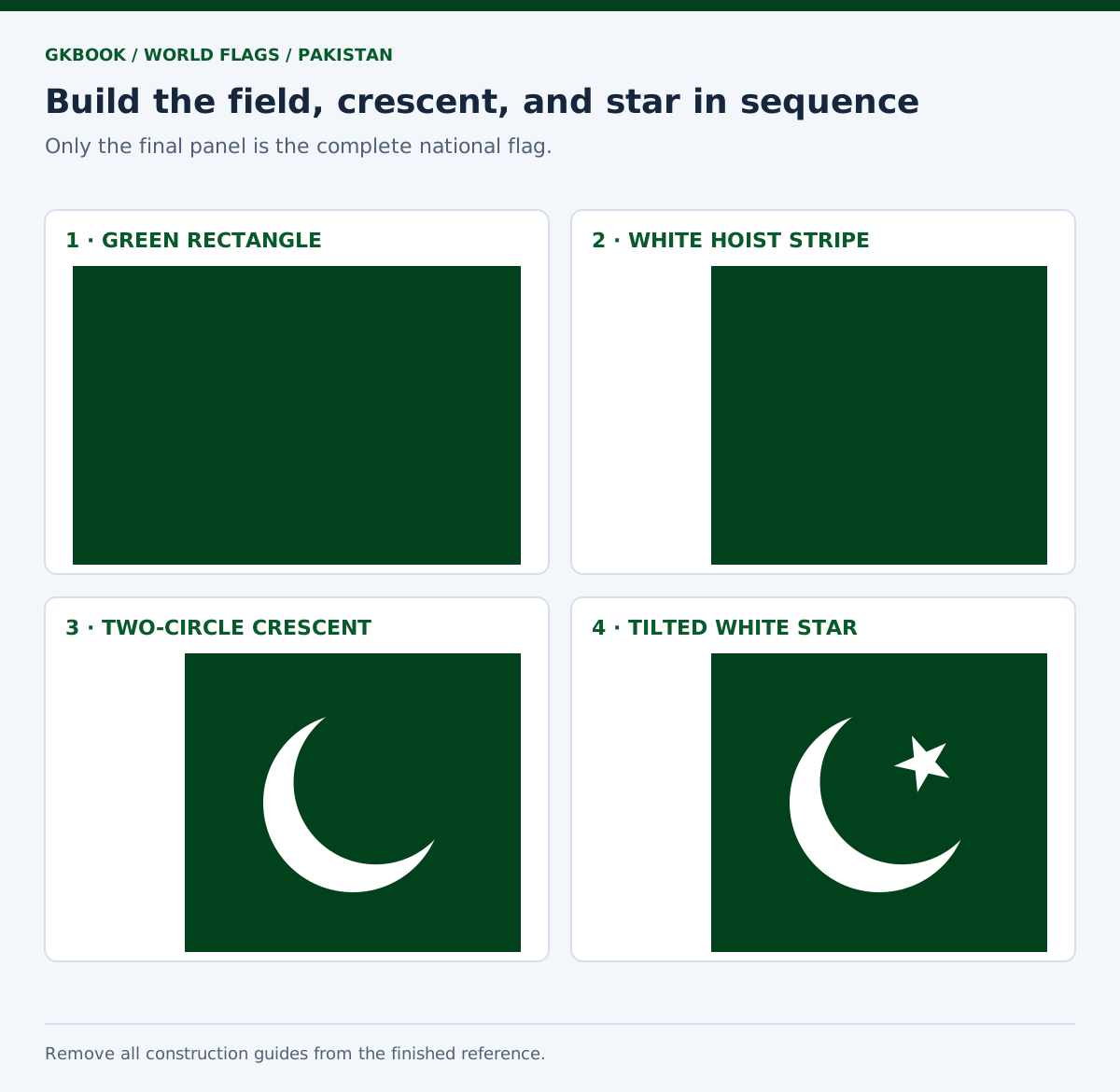
A convenient coordinate system is 2,400 × 1,600: the white stripe is 600 wide, the green center is (1,500, 800), and the crescent radii are 480 and 440. Complete the field first, then the crescent, then the star. Each stage depends on the same outer dimensions.
The construction illustration labels unfinished stages so they cannot be mistaken for alternate national flags. Remove circle guides, center marks, dimension lines, and stage numbers from the finished reference. The supplied plain SVG contains only the two colors and the required shapes, making uniform scaling straightforward.
What sizes can the Pakistan flag be?
Current instructions allow flags for official residences, ceremonies, motorcars, and desktops to be any size, provided the prescribed proportions, color divisions, and symbol geometry are preserved. A December 31, 2025 clarification states this explicitly. The digital examples here all maintain the complete flag’s 2:3 height:length ratio.

Older reference pages still list particular physical sizes, including small car and table flags. Those lists should not be copied as the complete current requirement without checking the later clarification. The current consolidated instructions retain the design rules while allowing the stated uses to vary in size.
The downloadable SVG uses 2,400 × 1,600 coordinates, and its plain PNG export is 4,800 × 3,200 pixels. These dimensions are production choices for this package, not government-prescribed pixel sizes. At small raster resolutions, curved edges require antialiasing; preserving the vector geometry remains more important than forcing every symbol edge onto whole pixels.
| Image dimensions | White stripe | Outer crescent radius | Star outer radius |
|---|---|---|---|
| 600 × 400 | 150 | 120 | 40 |
| 1,200 × 800 | 300 | 240 | 80 |
| 2,400 × 1,600 | 600 | 480 | 160 |
| 4,800 × 3,200 | 1,200 | 960 | 320 |
Is the Pakistan flag symmetrical?
The complete Pakistan flag is not symmetric across either the horizontal or vertical centerline of a fixed hoist-left view. The white stripe occupies only one side, and the crescent-and-star arrangement tilts upward. A half-turn also changes the design, so the flag has a definite upright orientation.

Reflecting the flag left to right moves the white stripe to the other edge. Reflecting it top to bottom keeps that stripe on the same side but moves the crescent opening and star downward. Neither reflection leaves the fixed reference image unchanged, even though the underlying circles are individually symmetric shapes.
The crescent-and-star device has a useful construction axis along the green field’s diagonal. That local relationship does not give the entire rectangular flag a diagonal mirror axis. A diagram can discuss the symmetry of an individual symbol while still recognizing that the complete flag has a specific orientation.
What does the reverse side of Pakistan’s flag look like?
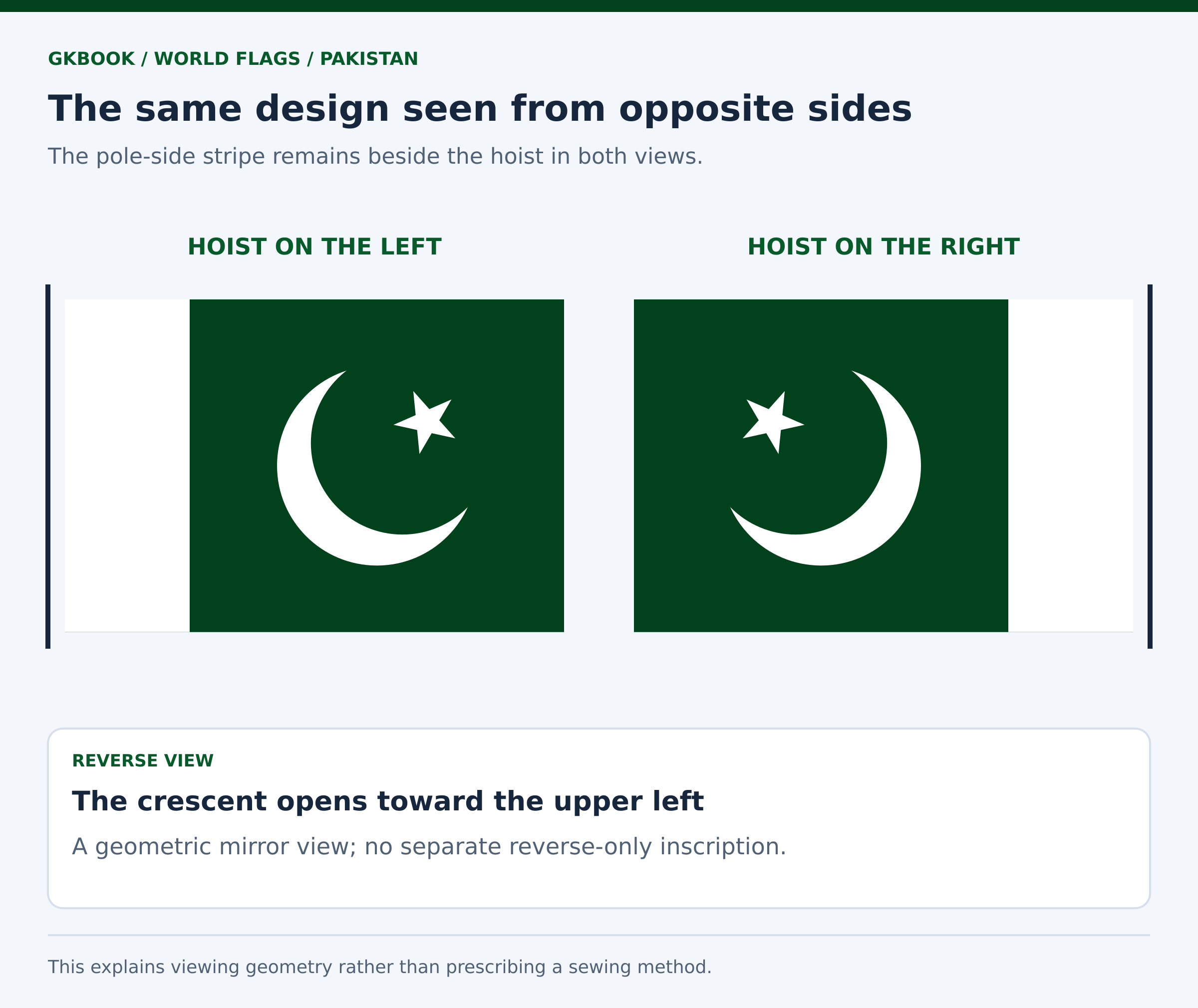
Viewed from the opposite side of the same cloth, the design appears horizontally mirrored: the white stripe is on the right when the hoist is on the right, and the crescent opens toward the upper left. The colors and symbols remain the same, without a separate reverse-only inscription.

The pole-side stripe stays attached to the hoist in both views. A mirrored picture is therefore meaningful only when its viewing side is clear. The reverse illustration places the pole on the opposite side and labels it explicitly, avoiding the impression that the stripe has been arbitrarily moved within a standard reference.
This explanation concerns the appearance of opposite views through the same design. It does not prescribe a sewing process or a special construction method for double-sided ceremonial flags. For the ordinary upright reference used in the article, the hoist remains on the left and the crescent opens toward the upper right.
What is the history of Pakistan’s flag?
Pakistan’s flag developed from the Muslim League’s green crescent-and-star flag, with a white hoist stripe added for religious minorities. The Constituent Assembly adopted the national design on August 11, 1947. It remained the national flag when Pakistan became a republic in 1956; later instructions refined its specifications and display rules.

The design belongs to the period immediately before independence. It combined a recognizable political movement’s visual identity with a new feature intended to represent minorities in the state. The Assembly record supplies the formal adoption and construction, while later official explanations describe the familiar symbolism of its colors and devices.
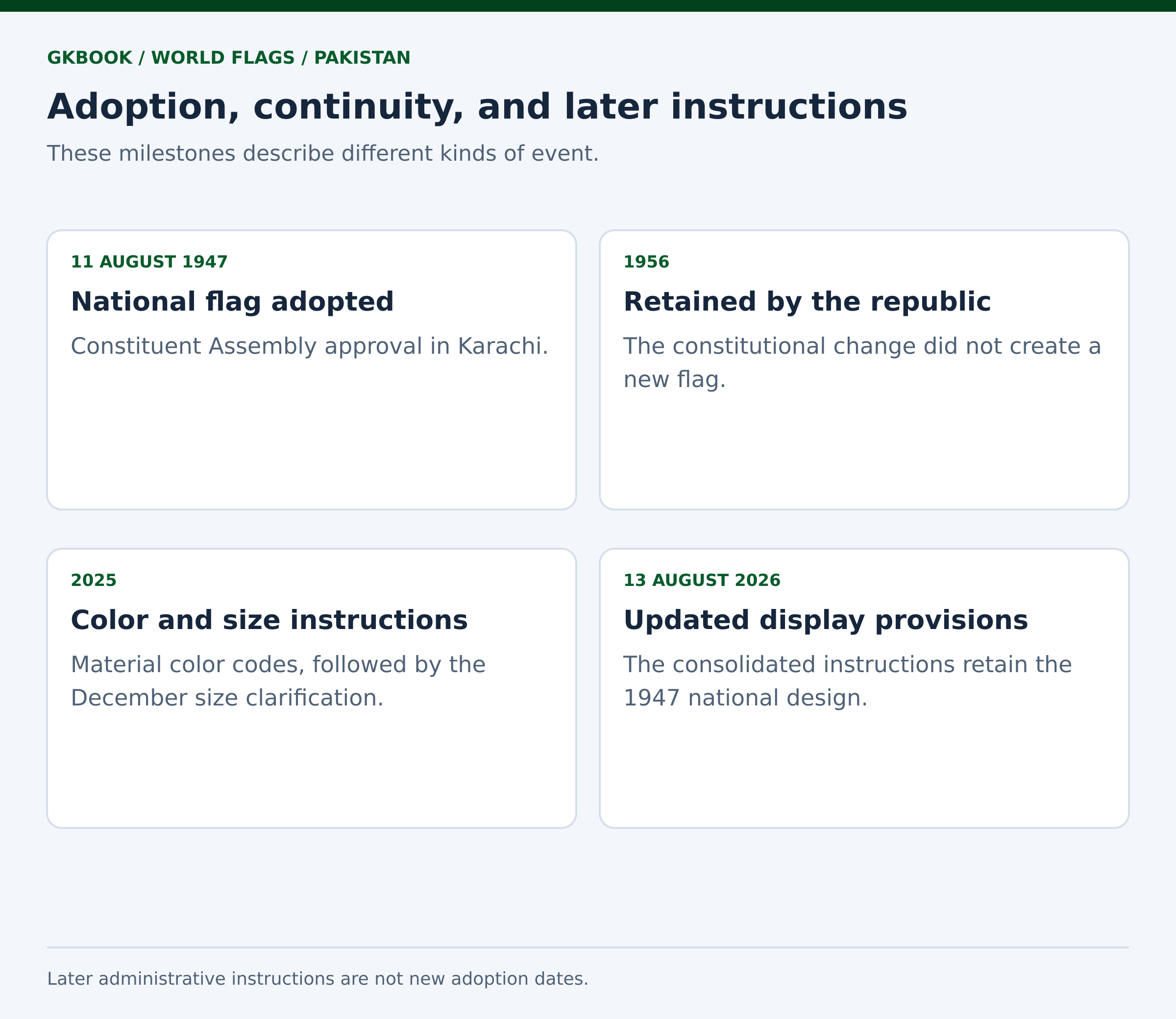
A history timeline should distinguish adoption from subsequent administration. The 2025 color specifications and later size clarification are not the creation of a new national flag. The August 2026 consolidated instructions also update display provisions while continuing to refer to the design adopted in 1947.
When was the Pakistan flag adopted?
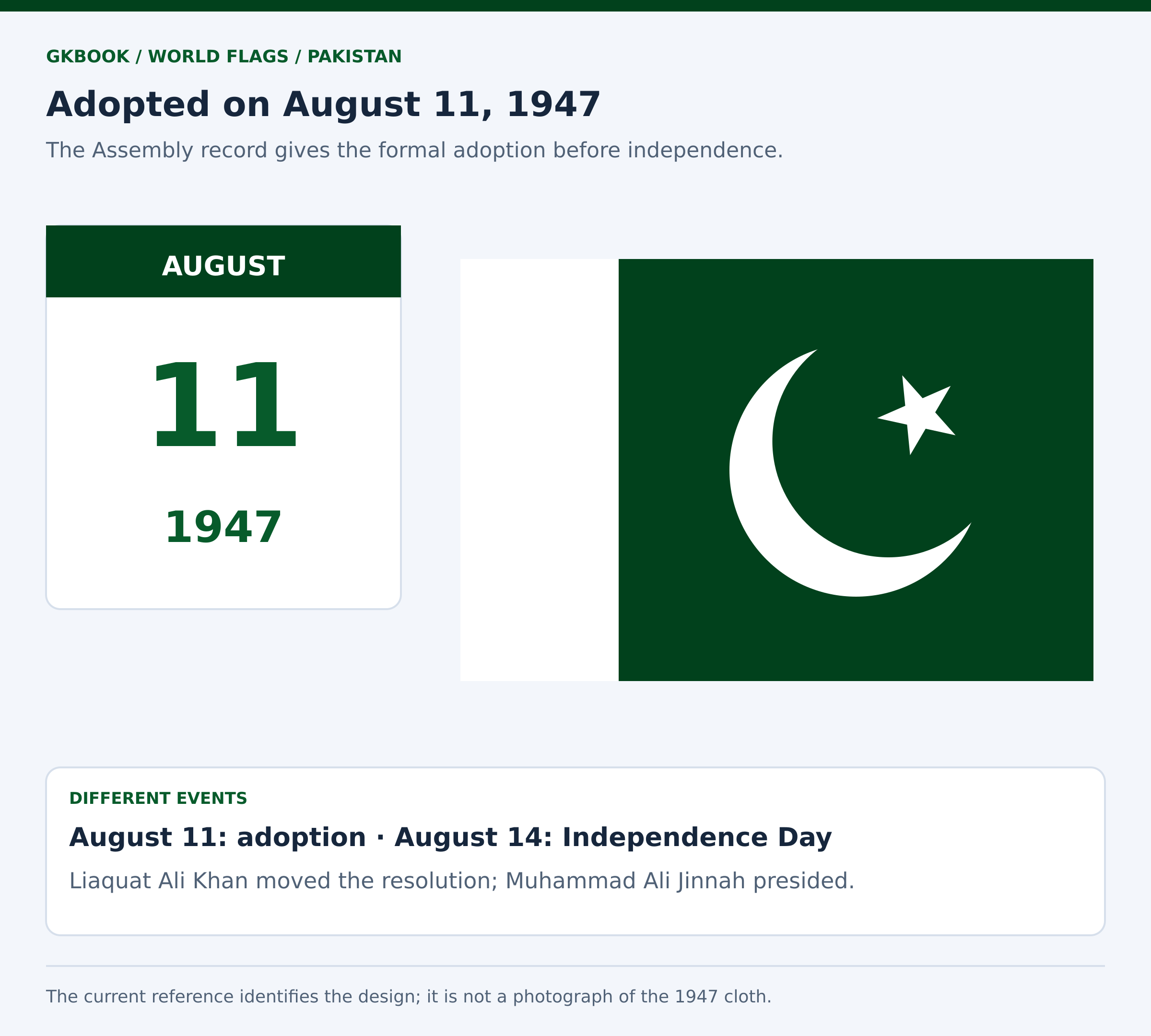
The Constituent Assembly adopted Pakistan’s national flag on August 11, 1947, in Karachi. Liaquat Ali Khan moved the resolution, and Muhammad Ali Jinnah presided over the Assembly. This adoption date is distinct from August 14, the date on which Pakistan celebrates Independence Day, and from later changes to flag instructions.

The original proceedings record the proposed design, a debate, an amendment seeking a committee, and the adoption of the main resolution. The flag was therefore formally approved before the national independence celebration associated with August 14. Using the holiday date as the flag’s adoption date would conflate two different events.
The current Cabinet instructions expressly trace the design back to the August 11 resolution. Later issue dates on a flag document identify that document or amendment, not a fresh adoption of the crescent-and-star flag. A clear caption can state the adoption date without trying to compress every constitutional milestone into it.
Who designed the Pakistan flag?
Pakistan’s official diplomatic descriptions credit Amiruddin Kidwai, also written Syed Amir-uddin Kedwaii, with the flag’s design. Liaquat Ali Khan presented the adoption resolution, and Muhammad Ali Jinnah presided. These are different roles; a designer credit should also be kept separate from claims about who sewed the first physical flag.
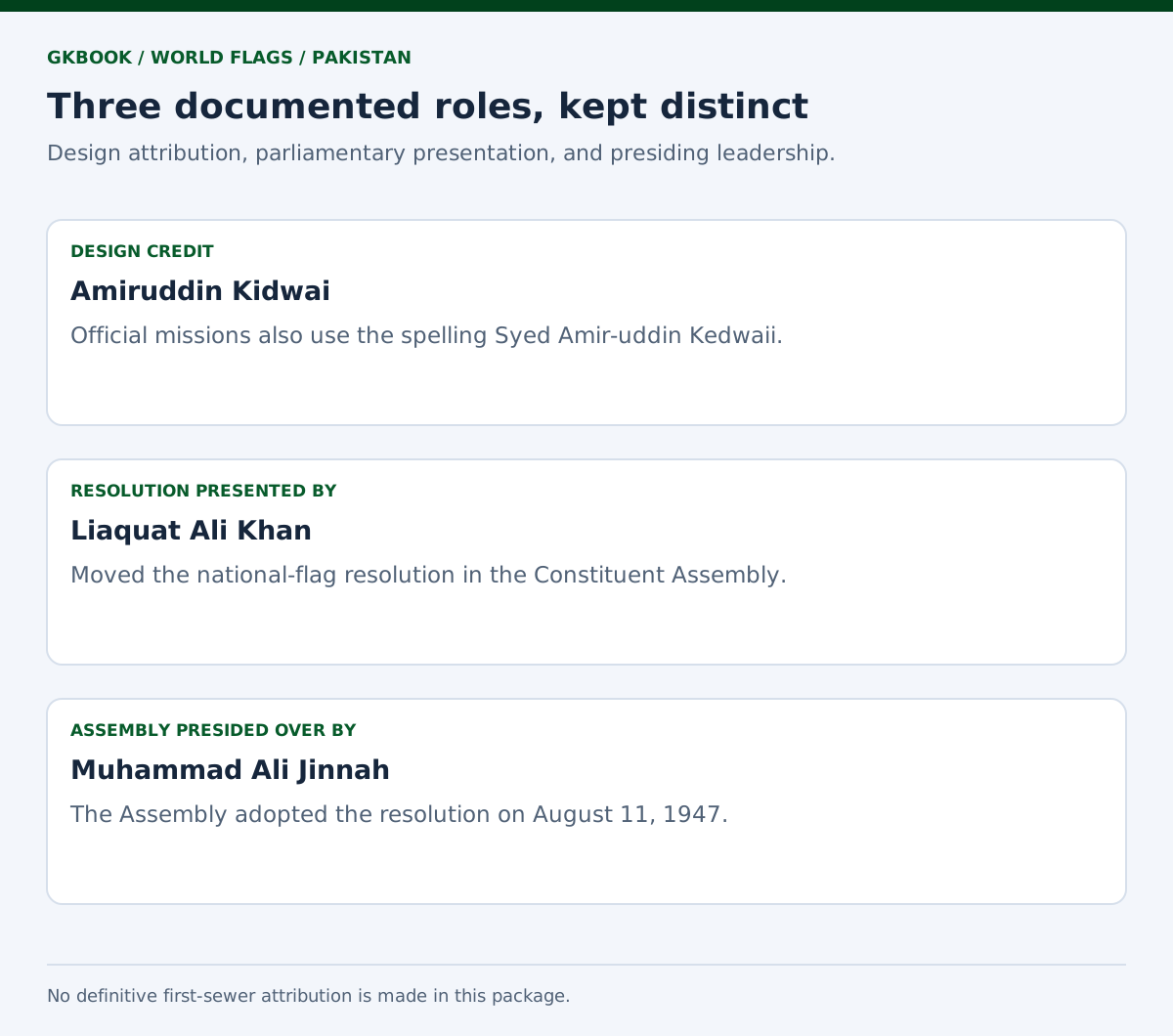
The surviving Assembly debate describes the design as having been prepared in Delhi by a small group. That contemporary account provides context for the later individual attribution, rather than requiring every aspect of the design and approval process to be assigned to one person. Scholarly historical work also discusses Kidwai’s design role.
This article follows the attribution used by official missions while distinguishing drafting, political approval, parliamentary presentation, and cloth manufacture. Accounts of the first flag’s sewing are not sufficiently settled here to name a definitive maker. The diagram therefore identifies documented roles without adding a speculative portrait or first-sewer caption.
Was the flag adopted without debate?
No. The August 11, 1947 proceedings record a debate and a proposal to refer the design to a committee. That amendment was rejected, and the original flag resolution was adopted. Kiran Sankar Roy then expressed acceptance of the flag after the vote, so “adopted without debate” misrepresents the record.
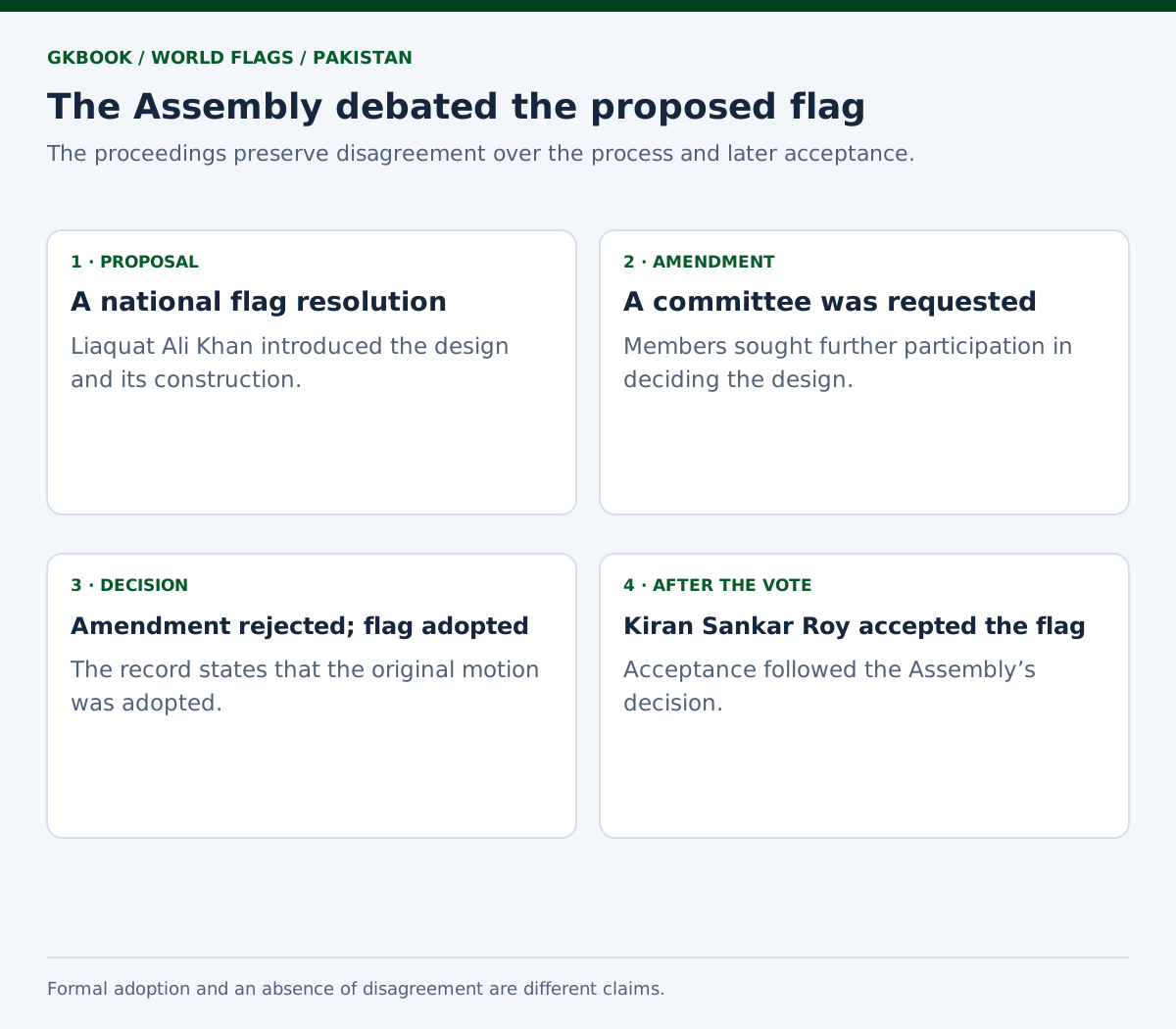
Minority members raised concerns about their participation in determining the national flag. Liaquat Ali Khan explained the urgency of having a flag ready and defended the place given to white in the design. The proceedings preserve both the disagreement over process and the eventual acceptance of the Assembly’s decision.
The record says that the original motion was adopted; it does not justify replacing the debate with an unqualified story of unanimous initial agreement. A careful account can recognize the adopted national symbol while also describing how it was discussed. The sequence diagram separates the amendment, its rejection, adoption, and Roy’s subsequent statement.
How is Pakistan’s flag related to the Muslim League flag?
Pakistan’s national flag developed from the All-India Muslim League’s green flag bearing a white crescent and star. The national design added the white hoist stripe associated with religious minorities. This historical relationship explains the inherited symbols, but it does not make every surviving League flag illustration an exact national construction master.

Political banners can vary across surviving photographs and reproductions. The useful historical comparison here concerns the inherited green field and white crescent-and-star device, followed by the added white national stripe. The gallery uses a textual comparison rather than inventing a single precisely measured League flag for all periods.
For the national flag’s proportions and symbol placement, use the adopted description and its construction. A predecessor’s resemblance does not supply missing measurements or override the quarter-width white stripe. The distinction also explains why a green crescent-and-star image with no white hoist stripe is incomplete as a present national reference.
Did Pakistan adopt a different flag when it became a republic?
The green-and-white crescent-and-star flag remained Pakistan’s national flag when the country became a republic in 1956. Its adoption belongs to August 11, 1947, rather than to the later republican milestone. Constitutional status and national flag design have related histories, but their dates should not be treated as interchangeable.

The embassy’s historical account distinguishes retention in 1956 from the original adoption. This is a useful corrective when a flag caption lists a later constitutional date without explaining what happened then. The familiar white stripe, green field, crescent, and star were not newly invented for the republic.
The gallery labels 1947 as adoption and 1956 as retention through constitutional change. The illustration uses the present geometric reference to identify the continuing design; it does not claim to reproduce the texture, manufacturing details, or exact appearance of a particular ceremonial flag photographed in either year.
What is Pakistan’s flag called, and does it contain writing?
The flag is commonly called Parcham-e-Sitara-o-Hilal, meaning “Flag of the Crescent and Star.” Its ordinary national design contains no writing. The white crescent and five-pointed star are geometric symbols, and the separate state emblem or an added slogan should not be placed inside the flag as part of its standard design.
The name describes the two white devices on the green field. Romanized spellings vary because the words are being represented in Latin letters. The descriptive translation is sufficient to identify the flag without reproducing anthem lyrics or treating one transliteration as an additional construction requirement.
A commemorative poster may place words beside an intact flag, but that surrounding caption is not part of the national design. The same distinction applies to educational labels, dimension marks, and gallery titles. The plain downloadable reference includes neither those annotations nor a separate government seal.
What changed in Pakistan’s recent flag instructions?
The 2025 instructions introduced explicit Pantone specifications for paper and fabric flags, and a December 2025 clarification allowed varied sizes while preserving the design. The consolidated instructions amended through August 13, 2026 also update display provisions. These administrative changes retain the national design adopted on August 11, 1947.

The 2025 notification was issued on October 20 and published in the Gazette on October 21. Its color table distinguishes paper TPX references from fabric TCX references. The later size note is dated December 31, 2025, so an older fixed-size table should not be presented as the whole current position.
The 2026 additions address authorized flags on public government property, with stated diplomatic exceptions, and permission for continuous national-flag display at gazetted iconic places. These are specific provisions within a larger set of instructions. They do not change the white stripe, crescent, star, or 2:3 outer proportions.
How should Pakistan’s flag be oriented when displayed?
The current instructions say that a flag displayed flat against a wall has its white portion on the viewer’s left. When suspended vertically over the middle of a street, the white portion is uppermost. These are distinct display situations; preserve the complete design and identify the applicable orientation before arranging it.

The wall view corresponds to the conventional hoist-left reference used throughout this article. The street example rotates the complete flag so that its hoist edge becomes the top edge. It does not detach, redraw, or independently turn the crescent and star. The gallery labels both situations to make the distinction clear.
The instructions also require respectful treatment and address official display settings. The familiar sunrise-to-sunset provision has exceptions, including specified continuous displays and permissions. A short educational explanation should not turn that qualified provision into an absolute claim that the flag can never remain displayed at night.
How do Pakistan’s instructions address half-mast display?
Half-mast display is governed by authorized orders and the exceptions stated in Pakistan’s instructions. When the flag is flown at half-mast, it is first raised to the peak, then lowered; it returns to the peak before final lowering. This procedure should not be confused with permission to declare a mourning display.
The current text identifies the Prime Minister’s authority and particular provisions involving provincial governments and Pakistan’s missions abroad. Those conditions matter because deciding when to use half-mast is different from physically carrying out the sequence. An illustration of a flag alone cannot establish an authorized mourning occasion.
This article summarizes the distinction rather than presenting a complete protocol manual for every institution. For an actual official occasion, the relevant order and current instructions determine the setting and timing. The geometric downloads explain the design and retain the full flag regardless of its height on a pole.
Can Pakistan’s flag be cropped into a square or circle?
A square or circular crop may be used as an interface icon, but it does not show the complete national flag. Cropping can remove part of the white stripe or the green field and distort their apparent balance. For reference use, fit the entire 2:3 rectangle inside the available space.

A centered square crop removes material from both ends of the original rectangle. A circular crop also cuts the corners, including parts of the hoist stripe. Even if the crescent and star remain recognizable, the cropped image no longer preserves the complete measured field or its quarter-width division.
The comparison diagram labels these treatments as icon crops. For an accurate square thumbnail, leave margins above and below an intact flag instead of stretching it or filling the square by cropping. A social card can have different overall dimensions while the complete flag inside remains uniformly scaled and uncropped.
What are common mistakes when drawing Pakistan’s flag?
Common errors include using the wrong stripe width, centering the crescent on the whole flag, tilting the symbols exactly 45 degrees, or drawing an upright star. Captions can also confuse August 11 adoption with Independence Day, omit current Pantone specifications, or present screen colors as certified material conversions.

Check the rectangle and stripe first: height:length is 2:3, and the white hoist is one-quarter of total length. Then locate the green-field center and its diagonal before constructing the crescent and star. Both circular radii and the star’s tip placement matter; a generic crescent icon is not a measured replacement.
Finally, review the description beside the image. State the digital palette honestly, preserve the distinction between adoption and later instructions, and credit the designer separately from the proposer and presiding leader. Geometry, historical evidence, and color specifications answer different questions, and an accurate reference keeps all three consistent.
Download Pakistan flag pictures
Download the plain flag as SVG or 4,800 × 3,200 PNG. The SVG uses a 2,400 × 1,600 coordinate system and remains scalable. The gallery contains 24 subjects with paired SVG and PNG files, including construction, history, and comparison diagrams. Image credits and construction notes record the reconstruction method and artwork status.
Explore more in World Flags, including the Oman flag and Nepal flag.
World Flags/Pakistan
Pakistan flag pictures
Original educational vector construction of Pakistan’s national flag: height:length 2:3, white hoist one-quarter of length, and crescent and star aligned on the green field’s diagonal. Geometry follows the 1947 resolution with the explicit embassy circle construction. The regular star’s inner radius is a geometric reconstruction convention. Screen colors #01411C and #FFFFFF are declared display values, not a certified conversion of the current Pantone material specifications.
GKBook original educational vector construction.Download SVGDownload PNGThe white stripe occupies the full height beside the hoist. A crescent and five-pointed star lie on the green field, with no inscription or separate state emblem.
GKBook original educational vector construction.Download SVGDownload PNGThe digital artwork uses #01411C and #FFFFFF. Current instructions separately specify 19-5917 TPX / 12-4306 TPX for paper and 19-5917 TCX / 12-4306 TCX for fabric.
GKBook original educational vector construction.Download SVGDownload PNGGreen is associated with Islam and the Muslim majority; the white stripe with religious minorities; the crescent with progress; and the star with light, knowledge, or enlightenment.
GKBook original educational vector construction.Download SVGDownload PNGThe complete flag has length:height 3:2, or height:length 2:3. Uniform scaling preserves the field, circles, and star together.
GKBook original educational vector construction.Download SVGDownload PNGThe white stripe is one-quarter of total length and the full height. Additional white in the crescent and star makes the total white area larger than one-quarter.
GKBook original educational vector construction.Download SVGDownload PNGThe outer crescent circle is centered at x = 5L/8, y = H/2. The blue guide marks the canvas center; the gold guide marks the green-field center A.
GKBook original educational vector construction.Download SVGDownload PNGThe green field has width:height 9:8, giving an angle of about 41.633539 degrees above horizontal. A whole-flag diagonal or an exact 45-degree tilt would differ.
GKBook original educational vector construction.Download SVGDownload PNGA is the green-field center. B is on the same diagonal, 13H/20 from the upper fly corner. The white outer circle minus the offset green inner circle forms the crescent.
GKBook original educational vector construction.Download SVGDownload PNGThe tip meets the completed outer crescent circle on the upper-fly diagonal. A regular pentagram supplies the inner corners; that inner-radius rule is a documented reconstruction choice.
GKBook original educational vector construction.Download SVGDownload PNGStart with the 3:2 rectangle, add the quarter-width white stripe, construct the crescent, and add the measured star. Intermediate stages are not alternate national flags.
GKBook original educational vector construction.Download SVGDownload PNGCurrent instructions permit varied sizes for the stated settings while preserving proportions and symbol placement. These pixel dimensions are examples, not a prescribed physical-size list.
GKBook original educational vector construction.Download SVGDownload PNGThe full-height stripe makes the two sides different, and the tilted symbols distinguish top from bottom. The device’s local diagonal axis is not a mirror axis of the complete flag.
GKBook original educational vector construction.Download SVGDownload PNGIn the opposite-side view, the stripe is on the right and the crescent opens toward the upper left. The pole positions make the viewing direction explicit.
GKBook original educational vector construction.Download SVGDownload PNGThe timeline distinguishes adoption in 1947, retention in 1956, the 2025 specifications, and the 2026 display updates.
GKBook original educational vector construction.Download SVGDownload PNGThe Constituent Assembly adopted the flag in Karachi on August 11, 1947. August 14 is the independence celebration, not the flag-adoption date.
GKBook original educational vector construction.Download SVGDownload PNGOfficial diplomatic descriptions credit Kidwai with the design. Liaquat Ali Khan’s role as proposer and Jinnah’s role as presiding leader are distinct from drafting and sewing.
GKBook original educational vector construction.Download SVGDownload PNGThe August 11 record includes a committee amendment, its rejection, the original resolution’s adoption, and Roy’s subsequent statement accepting the flag.
GKBook original educational vector construction.Download SVGDownload PNGThe national flag developed from the League’s green crescent-and-star flag and added the white stripe. No universal geometry for all historical League banners is asserted.
GKBook original educational vector construction.Download SVGDownload PNGThe national flag remained in use when Pakistan became a republic. Its adoption date remains August 11, 1947.
GKBook original educational vector construction.Download SVGDownload PNGThe current consolidated instructions preserve the material color codes, the December 2025 size clarification, and the August 2026 display updates.
GKBook original educational vector construction.Download SVGDownload PNGA flat wall display has white to the viewer’s left. The street example rotates the complete design clockwise so the white hoist portion is at the top.
GKBook original educational vector construction.Download SVGDownload PNGCrops remove parts of the measured field and white stripe. Fit the intact 2:3 rectangle inside a square thumbnail when an accurate reference is needed.
GKBook original educational vector construction.Download SVGDownload PNGCheck the complete ratio, quarter-width stripe, green-field center, measured symbol alignment, August 11 adoption, and the distinction between screen colors and material standards.
GKBook original educational vector construction.Download SVGDownload PNGFrequently asked questions
What does Pakistan’s flag look like?
Pakistan’s national flag has a dark green field with a white crescent and five-pointed star, plus a full-height white stripe beside the hoist. Its height:length ratio is 2:3. The Constituent Assembly adopted it on August 11, 1947, and its symbols express religious identity, inclusion, progress, and enlightenment.
What is the design of the Pakistan flag?
Pakistan’s flag is a rectangle with a white vertical stripe along the pole side and a larger dark green field toward the fly. A white crescent and five-pointed star occupy the green field. In the usual hoist-left view, the crescent opens diagonally toward the upper right.
What are the colors of the Pakistan flag?
Pakistan’s flag uses dark green and white. Current instructions specify Pantone 19-5917 TPX and 12-4306 TPX for paper, and 19-5917 TCX and 12-4306 TCX for fabric. This artwork uses screen values #01411C and #FFFFFF, without claiming that they are certified conversions of those material standards.
What does the Pakistan flag symbolize?
Official explanations connect green with Islam and Pakistan’s Muslim majority, and the white stripe with religious minorities. The crescent represents progress, while the star represents light, knowledge, or enlightenment. Together these elements combine the country’s religious identity with a stated place for minorities and aspirations for its future.
What does green mean on Pakistan’s flag?
Green represents Islam and the Muslim majority in official descriptions of Pakistan’s flag. It forms the large field beyond the white hoist stripe and provides the background for the white crescent and star. Its symbolic meaning does not turn the field’s three-quarter width into a demographic measurement.
What does the white stripe mean on Pakistan’s flag?
The white stripe represents Pakistan’s religious minorities in official explanations. It runs beside the hoist for the full height and occupies one-quarter of the total length. The crescent and star are also white, so the flag’s total white area is greater than the area of the stripe alone.
What does the crescent on Pakistan’s flag mean?
The white crescent represents progress in official explanations of Pakistan’s flag. It is constructed from two offset circles and opens toward the upper fly in a hoist-left view. Its symbolic meaning and geometric shape are separate facts: the idea of progress does not determine its radii or position.
What does the star on Pakistan’s flag mean?
The five-pointed white star represents light, knowledge, or enlightenment in official explanations. It lies within the crescent’s open side, with one point directed along the green field’s diagonal toward the upper fly. The five points are not identified in these sources as a count of Pakistan’s provinces.
What is the official ratio of the Pakistan flag?
Pakistan’s national flag has a height:length ratio of 2:3, equivalently a length:height ratio of 3:2. A rectangle 1,600 units high is therefore 2,400 units long. This proportion applies to the complete flag, including the white stripe, and every internal element should scale uniformly with it.
How wide is the white stripe on Pakistan’s flag?
The white hoist stripe is one-quarter of the flag’s total length and extends through its full height. The green field occupies the other three-quarters. On the 2,400 × 1,600 master, the stripe is 600 units wide and the green field is 1,800 units wide.
Where are the crescent and star placed?
The crescent’s outer circle is centered in the green field, not in the complete flag. The star lies toward the upper fly along that field’s diagonal. With length L and height H, the outer-circle center is at x = 5L/8 and y = H/2 in a hoist-left drawing.
Why are the crescent and star tilted?
Their construction follows the diagonal from the green field’s lower hoist-side corner to its upper fly corner. Because that rectangle is not square, the diagonal rises about 41.63 degrees above horizontal, not 45 degrees. The star’s outward point and the crescent opening follow this same direction.
How is the crescent constructed accurately?
Use a white outer circle centered at the green field’s center A, with radius 3H/10. Place inner-circle center B on the same diagonal, 13H/20 from the upper fly corner, and use radius 11H/40. Cover the inner circle with green to leave the white crescent.
How is the five-pointed star positioned and sized?
The star’s five outer points lie on a circle of radius H/10. Its outward point meets the green field’s diagonal where the completed outer crescent circle would intersect it toward the upper fly. The star’s center consequently lies H/5 from the green-field center along that direction.
How can you draw Pakistan’s flag accurately?
Begin with a 3:2 length:height rectangle, reserve the first quarter of its length for white, and fill the remainder dark green. Construct the crescent from its two measured circles on the green field’s diagonal. Add the tilted five-pointed white star using its specified outer circle and tip position.
What sizes can the Pakistan flag be?
Current instructions allow flags for official residences, ceremonies, motorcars, and desktops to be any size, provided the prescribed proportions, color divisions, and symbol geometry are preserved. A December 31, 2025 clarification states this explicitly. The digital examples here all maintain the complete flag’s 2:3 height:length ratio.
Is the Pakistan flag symmetrical?
The complete Pakistan flag is not symmetric across either the horizontal or vertical centerline of a fixed hoist-left view. The white stripe occupies only one side, and the crescent-and-star arrangement tilts upward. A half-turn also changes the design, so the flag has a definite upright orientation.
What does the reverse side of Pakistan’s flag look like?
Viewed from the opposite side of the same cloth, the design appears horizontally mirrored: the white stripe is on the right when the hoist is on the right, and the crescent opens toward the upper left. The colors and symbols remain the same, without a separate reverse-only inscription.
What is the history of Pakistan’s flag?
Pakistan’s flag developed from the Muslim League’s green crescent-and-star flag, with a white hoist stripe added for religious minorities. The Constituent Assembly adopted the national design on August 11, 1947. It remained the national flag when Pakistan became a republic in 1956; later instructions refined its specifications and display rules.
When was the Pakistan flag adopted?
The Constituent Assembly adopted Pakistan’s national flag on August 11, 1947, in Karachi. Liaquat Ali Khan moved the resolution, and Muhammad Ali Jinnah presided over the Assembly. This adoption date is distinct from August 14, the date on which Pakistan celebrates Independence Day, and from later changes to flag instructions.
Who designed the Pakistan flag?
Pakistan’s official diplomatic descriptions credit Amiruddin Kidwai, also written Syed Amir-uddin Kedwaii, with the flag’s design. Liaquat Ali Khan presented the adoption resolution, and Muhammad Ali Jinnah presided. These are different roles; a designer credit should also be kept separate from claims about who sewed the first physical flag.
Was the flag adopted without debate?
No. The August 11, 1947 proceedings record a debate and a proposal to refer the design to a committee. That amendment was rejected, and the original flag resolution was adopted. Kiran Sankar Roy then expressed acceptance of the flag after the vote, so “adopted without debate” misrepresents the record.
How is Pakistan’s flag related to the Muslim League flag?
Pakistan’s national flag developed from the All-India Muslim League’s green flag bearing a white crescent and star. The national design added the white hoist stripe associated with religious minorities. This historical relationship explains the inherited symbols, but it does not make every surviving League flag illustration an exact national construction master.
Did Pakistan adopt a different flag when it became a republic?
The green-and-white crescent-and-star flag remained Pakistan’s national flag when the country became a republic in 1956. Its adoption belongs to August 11, 1947, rather than to the later republican milestone. Constitutional status and national flag design have related histories, but their dates should not be treated as interchangeable.
What is Pakistan’s flag called, and does it contain writing?
The flag is commonly called Parcham-e-Sitara-o-Hilal, meaning “Flag of the Crescent and Star.” Its ordinary national design contains no writing. The white crescent and five-pointed star are geometric symbols, and the separate state emblem or an added slogan should not be placed inside the flag as part of its standard design.
What changed in Pakistan’s recent flag instructions?
The 2025 instructions introduced explicit Pantone specifications for paper and fabric flags, and a December 2025 clarification allowed varied sizes while preserving the design. The consolidated instructions amended through August 13, 2026 also update display provisions. These administrative changes retain the national design adopted on August 11, 1947.
How should Pakistan’s flag be oriented when displayed?
The current instructions say that a flag displayed flat against a wall has its white portion on the viewer’s left. When suspended vertically over the middle of a street, the white portion is uppermost. These are distinct display situations; preserve the complete design and identify the applicable orientation before arranging it.
How do Pakistan’s instructions address half-mast display?
Half-mast display is governed by authorized orders and the exceptions stated in Pakistan’s instructions. When the flag is flown at half-mast, it is first raised to the peak, then lowered; it returns to the peak before final lowering. This procedure should not be confused with permission to declare a mourning display.
Can Pakistan’s flag be cropped into a square or circle?
A square or circular crop may be used as an interface icon, but it does not show the complete national flag. Cropping can remove part of the white stripe or the green field and distort their apparent balance. For reference use, fit the entire 2:3 rectangle inside the available space.
What are common mistakes when drawing Pakistan’s flag?
Common errors include using the wrong stripe width, centering the crescent on the whole flag, tilting the symbols exactly 45 degrees, or drawing an upright star. Captions can also confuse August 11 adoption with Independence Day, omit current Pantone specifications, or present screen colors as certified material conversions.
Explore all general-knowledge topics and the A-to-Z lists.









We Value Your Opinion Comments