

North Korea flag picture
Explore the proportions, history, and picture gallery.
| Design | Stripes and a red starBlue-white-red-white-blue; a white disk toward the hoist. |
|---|---|
| Current proportions | Height:length = 20:33Article 166 of the 2026 Constitution; formerly 1:2. |
| Formal adoption | September 8, 1948Earlier hoisting July 10; state founding September 9. |
| Designer attribution | Accounts differOfficial DPRK narrative and historical research are distinguished. |
| Current illustration | Reference reconstructionThe outer ratio is confirmed; internal dimensions are provisional. |
| Historical illustration | Separate 1:2 constructionReconstructed from the older National Flag Law translation. |
What does North Korea’s flag look like?
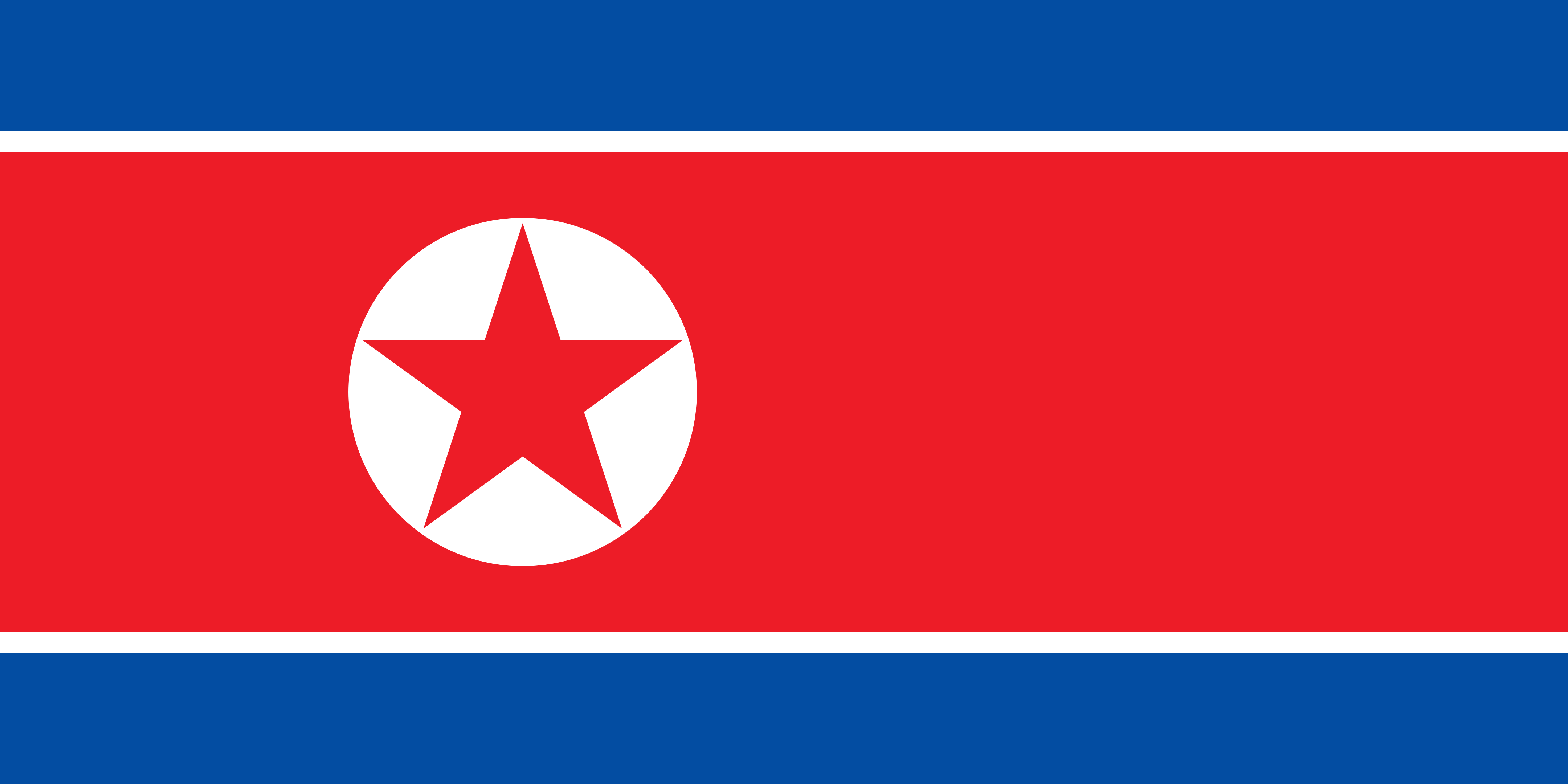
North Korea’s flag has blue outer bands, narrow white stripes, and a broad red center containing a red five-pointed star in a white disk toward the hoist. Its 2026 constitutional height:length ratio is 20:33. The current-ratio illustration here is a reference reconstruction with explicitly provisional internal measurements.
The red star, white disk, and five-band arrangement remain recognizable across the dated versions. This article separates the constitutional design from the provisional current drawing, explains attributed symbolism and historical evidence, and distinguishes the national flag from the party flag and other Korean symbols.
What is the design of North Korea’s flag?
The flag has five horizontal bands arranged blue, white, red, white, and blue. The red middle band is substantially wider than the other bands. A white disk containing one red five-pointed star appears toward the hoist, the edge attached to the flagpole, rather than at the rectangle’s center.

Read the color sequence vertically, from the upper edge to the lower edge. The two white stripes separate the central red field from the blue bands. The white disk is an additional shape within the red field, so it should not be confused with a sixth horizontal stripe.
The general arrangement is described in Article 166 of the 2026 Constitution. Recognizing the arrangement is easier than confirming every measurement: the Constitution gives an outer ratio, but its short description does not supply a complete dimensional drawing.
What are the colors and digital color codes of the flag?
The flag uses red, blue, and white. This article’s original illustrations use #ED1C27 red, #034DA2 blue, and #FFFFFF white as declared screen colors. These hexadecimal values are reproduction choices; the research did not establish a certified 2026 digital, Pantone, CMYK, or textile specification for the national flag.

The central band and the star use the same red in these files. Both outer bands use the same blue, while the stripes and disk use opaque white. An SVG background does not need transparency to represent the white portions of the flag.
The older National Flag Law translation describes a color reference but does not provide these hexadecimal codes. Color on a monitor also depends on its settings and color management. A production order therefore needs an approved physical or technical reference, beyond a web illustration.
| Color | Hexadecimal | RGB |
|---|---|---|
| Red | #ED1C27 | 237, 28, 39 |
| Blue | #034DA2 | 3, 77, 162 |
| White | #FFFFFF | 255, 255, 255 |
What do North Korea’s flag colors mean?
DPRK state explanations associate red with revolutionary struggle and sacrifice, blue with aspiration, peace, and progress, and white with purity and Korean tradition. Older accounts also connect white with national identity and loyalty. These are attributed symbolic interpretations, not independent descriptions of the country’s government, society, or current conditions.

A 2021 Kim Il Sung University account explains the colors within the state’s revolutionary narrative. Another university account connects red with anti-Japanese struggle, white with personal virtues, and blue with peace and progress. Such explanations should retain their attribution and historical context.
Symbolism does not determine a color’s numerical value. Nor does the presence of three colors imply that each stands for a province, ethnic group, political branch, or geographical region. No such numerical mapping is established by the constitutional design.
What does the red star represent?
The five-pointed red star is associated with socialist and communist political symbolism. On North Korea’s flag it sits within a white disk and shares the red color of the central band. The five tips should not be presented as a verified count of provinces, battles, leaders, or administrative divisions.
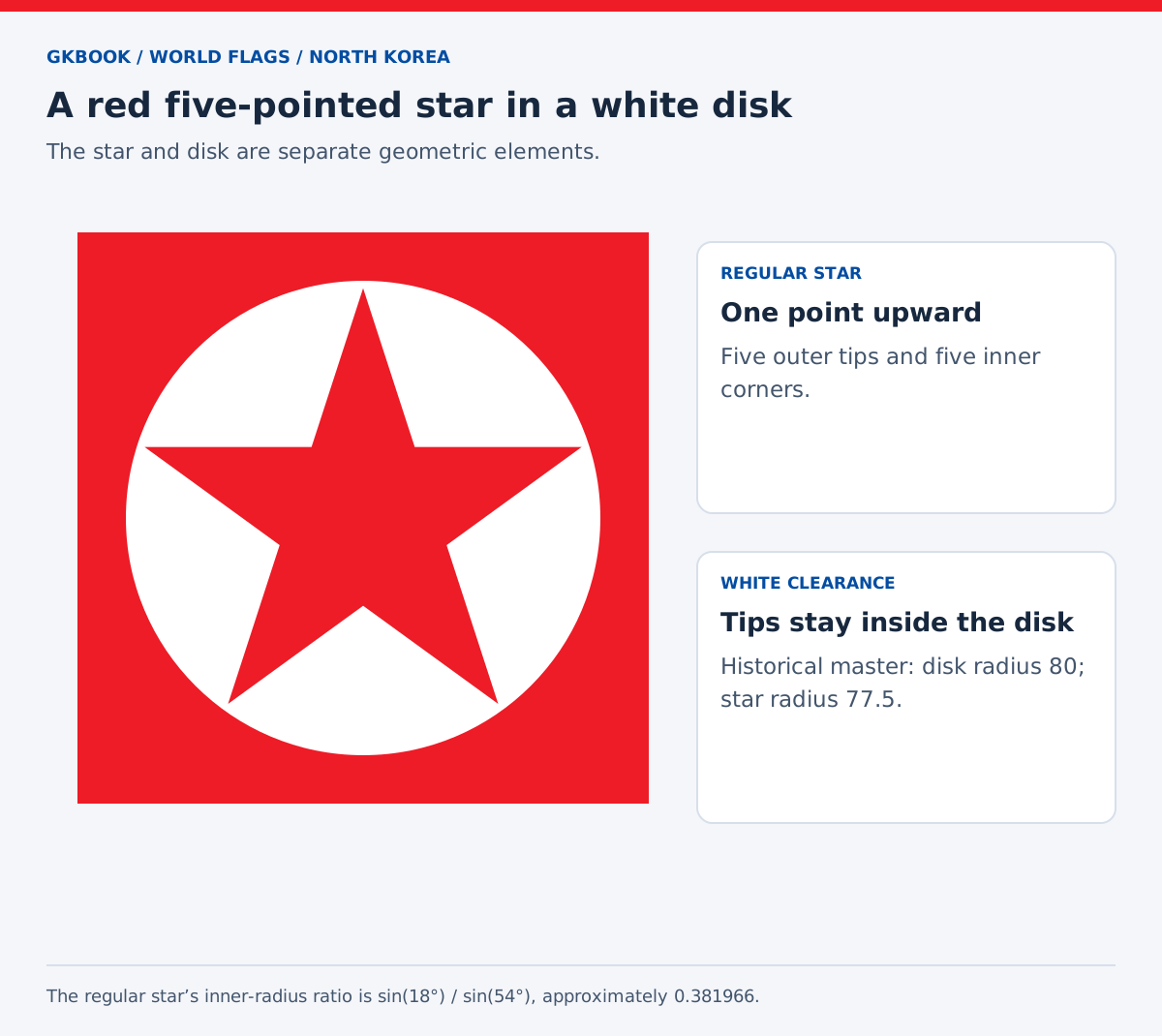
The Constitution identifies the device as a red five-pointed star. KBS’s historical discussion places it within the broader symbolism of socialism and communism. That political association is distinct from the exact geometric construction of its points.
The original drawings use a regular star with one outer point upward. Its alternating inner and outer vertices form a closed, filled polygon. There is no outline stroke, separate badge, or text inside the disk.
Why is there a white disk around the star?
The white disk separates the red star visually from the surrounding red field, making its five points visible. The Constitution specifies the disk as part of the design. Historical construction rules leave a white gap between the star’s outer tips and the disk’s edge; the star is not a cutout.
Without a contrasting background, a red star placed on a red band would merge with the field. That is a geometric explanation of the disk’s visual function, rather than a claim about a single official symbolic interpretation.
The historical model has a disk radius of 8 units and a star outer radius of 7.75 units on a 36-unit flag height. The difference is 0.25 units at each outer tip. The current reference retains these relative sizes provisionally; their continuation has not been certified from a revised annex.
Where is the star placed on North Korea’s flag?
The star and white disk are positioned toward the hoist and share a center. The older documented construction places that center one third of the flag’s length from the hoist and halfway down its height. The current reference uses a provisional two-fifths position; an updated official coordinate was not verified.

The word hoist describes the attached side, while fly describes the free edge. In an ordinary obverse illustration with the hoist on the left, the disk therefore lies left of the rectangle’s midpoint. On a reverse view, its screen position changes with the hoist.
A constitutional phrase such as “toward the hoist” is a positional description, not a numerical coordinate. The guide distinguishes that confirmed description from the more precise values required to create an actual vector illustration.
What is North Korea’s current flag ratio?
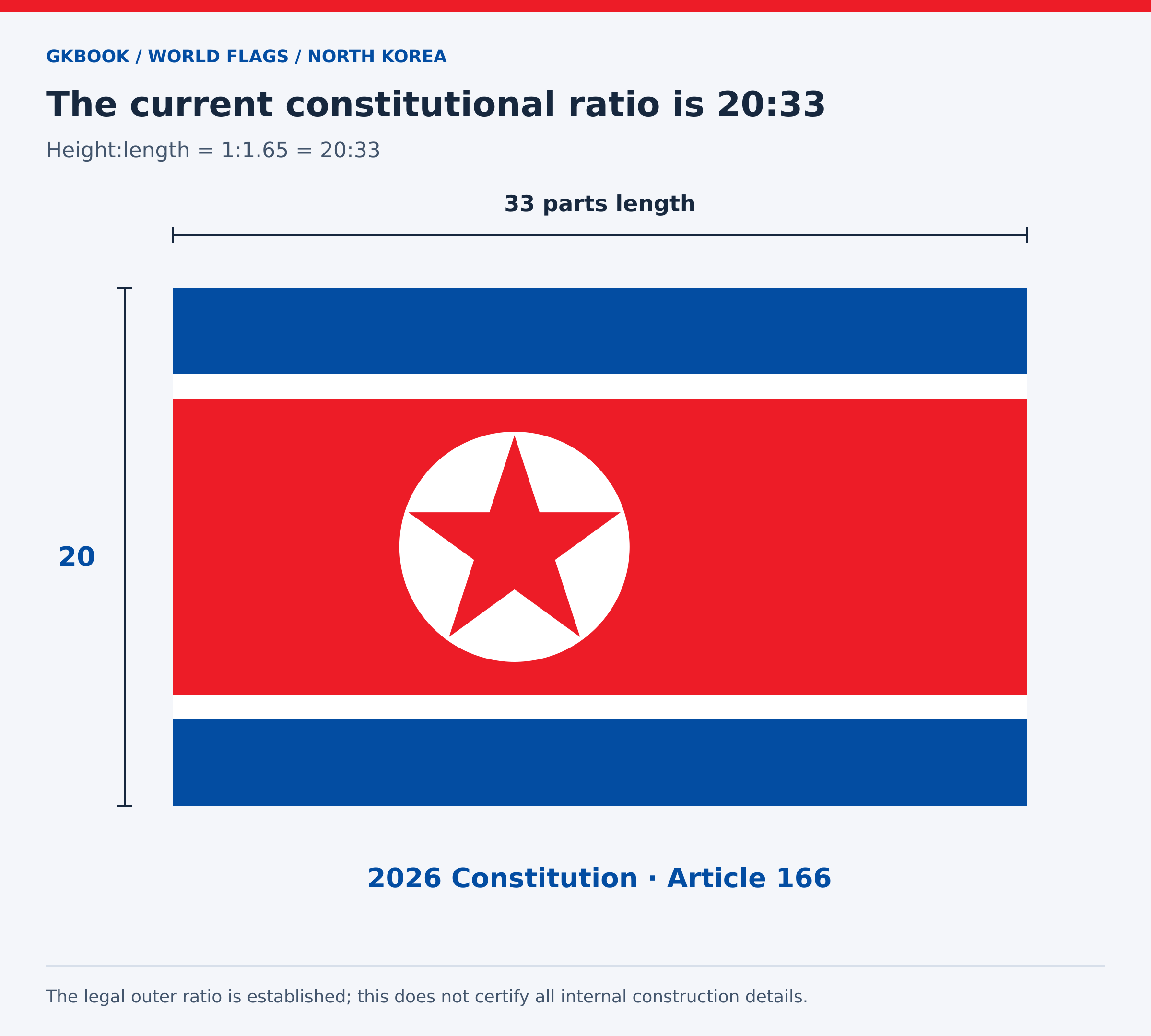
Article 166 of the Constitution adopted in March 2026 gives the flag’s height:length ratio as 1:1.65, equivalent to 20:33. A rectangle 20 units high is therefore 33 units long. The familiar 1:2 ratio belongs to earlier constitutional versions and should be identified as historical when discussing the current standard.

Multiplying both sides of 1:1.65 by 20 gives 20:33. In the opposite order, length:height is 33:20. Stating which dimension comes first avoids mistaking a landscape flag for a portrait rectangle.
The Korean text reproduced by the Unification and North Korean Law Society and the English translation hosted by North Korea Leadership Watch agree on the ratio. A May 2026 National Assembly Library summary independently identifies the constitutional change from 2:1 to 1.65:1 in length:height terms.
Did North Korea change its flag in 2026?
The 2026 Constitution changed the stated height:length ratio from 1:2 to 1:1.65 while retaining the recognizable stripes, disk, and red star in its description. At equal height, the new rectangle is 17.5 percent shorter. The precise revised internal measurements and first physical use are less securely established here.

The calculation compares an old length of 2H with a new length of 1.65H: the difference, 0.35H, is 17.5 percent of 2H. At a fixed height, the rectangular area decreases by the same percentage. This does not mean the star or every stripe must shrink by that amount.
Reports and photographs suggest changes to the internal arrangement, but publicly circulated vector reconstructions disagree. March 23 is the date attached to the revised constitutional text; it should not automatically be described as the first day on which any revised physical flag appeared.
Are all measurements in the current illustration official?
No. The current illustration has the confirmed 20:33 outer ratio, but its internal measurements are a declared reference reconstruction. On a 360-unit height it uses bands of 60, 17, 206, 17, and 60 units, with the disk centered at two fifths of the length. These choices are provisional.
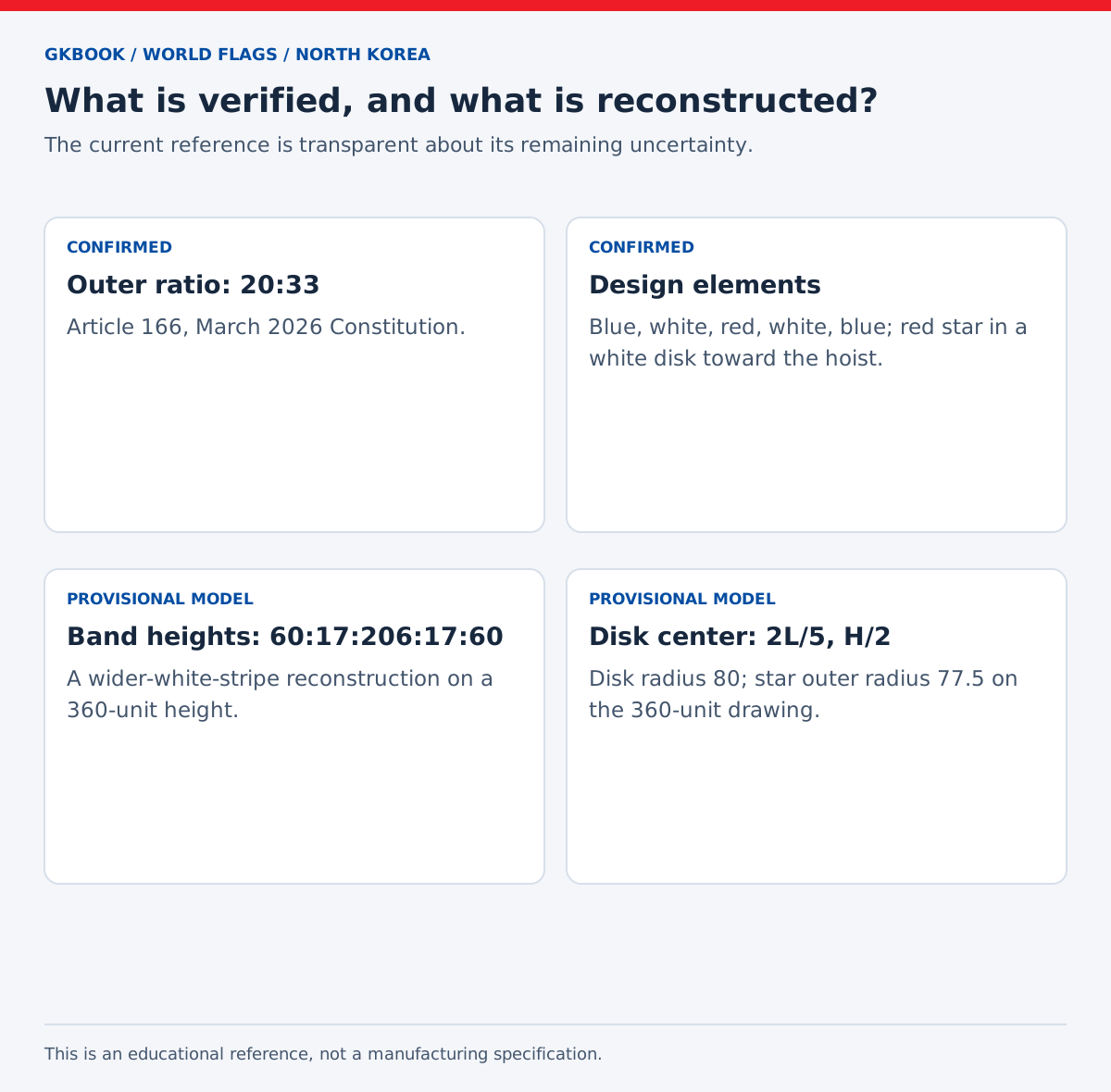
The reconstruction reflects reports of wider white stripes and a disk nearer the rectangle’s midpoint. A Korean reference page reports a 1.7-fold increase in white-stripe thickness, but its underlying placard image could not be independently inspected during this research. That report is a modeling lead, not a certified specification.
The model retains the older disk and star radii relative to flag height, while placing their common center at (237.6, 180) on a 594 × 360 canvas. All these internal choices are recorded so the drawing can be revised when an authenticated current construction annex becomes available.
How was the older 1:2 flag constructed?
The older construction can be expressed on a 72-by-36 rectangle. Its band heights are 6:1:22:1:6, the disk center is at coordinates (24,18), its radius is 8, and the star’s outer radius is 7.75. These measurements reconstruct the historical law-based design, rather than certify the revised 2026 flag.

Appendix I of the 2012 National Flag Law translation divides the flag into blue outer sixths and a central region that contains the white separators and red field. Converting those instructions into a common 36-unit height produces the band sequence shown in the diagram.
The historical master multiplies all coordinates by ten, yielding a 720 × 360 SVG. The circle remains circular and the regular star keeps its shape. This file is separately named and captioned so a reader cannot mistake a familiar older drawing for a verified current construction.
| Element | Historical measurement |
|---|---|
| Canvas | 72 long × 36 high |
| Bands, top to bottom | 6 : 1 : 22 : 1 : 6 |
| Disk and star center | (24, 18) |
| Disk radius | 8 |
| Star outer radius | 7.75 |
What sizes are available for the flag pictures?
The current-ratio reference is supplied as a 594 × 360 SVG and a 4752 × 2880 PNG. The historical drawing is a 720 × 360 SVG and a 4320 × 2160 PNG. These are downloadable image sizes, not prescribed cloth dimensions; each file retains its own ratio and descriptive status.

SVG stores shapes and coordinates, so it can scale without the pixel structure of a raster image. PNG provides a ready-rendered version for software that does not handle SVG. Both formats preserve the same geometry within each dated model.
Resize width and height together. Squeezing the historical image horizontally until it fits a 20:33 box would turn its white disk into an ellipse and distort the star. A revised flag drawing needs a deliberately reconstructed layout, not merely a changed display width.
When was North Korea’s flag adopted?
The formal adoption date is September 8, 1948, associated with the first DPRK Constitution. A trial hoisting and replacement ceremony had already occurred on July 10, 1948. The state was founded on September 9. These closely related events explain why more than one 1948 date appears in discussions of the flag.

KBS’s historical account distinguishes the July ceremony from the formal September adoption. Nozomi Kariyasu’s vexillological study also identifies September 8, 1948 as the adoption date. These sources support keeping the legal milestone separate from an earlier public introduction.
For a compact caption, “adopted September 8, 1948; constitutional ratio revised in 2026” is more informative than replacing the original adoption date with 2026. A later change to a flag’s proportions does not erase the earlier history of its principal design.
How do the flag’s main dates differ?
July 10, 1948 refers to the earlier hoisting ceremony; September 8, 1948 to formal adoption; and September 9, 1948 to the DPRK’s founding. March 23, 2026 dates the revised constitutional text containing the new ratio. These dates identify different milestones and should not be collapsed into one anniversary.
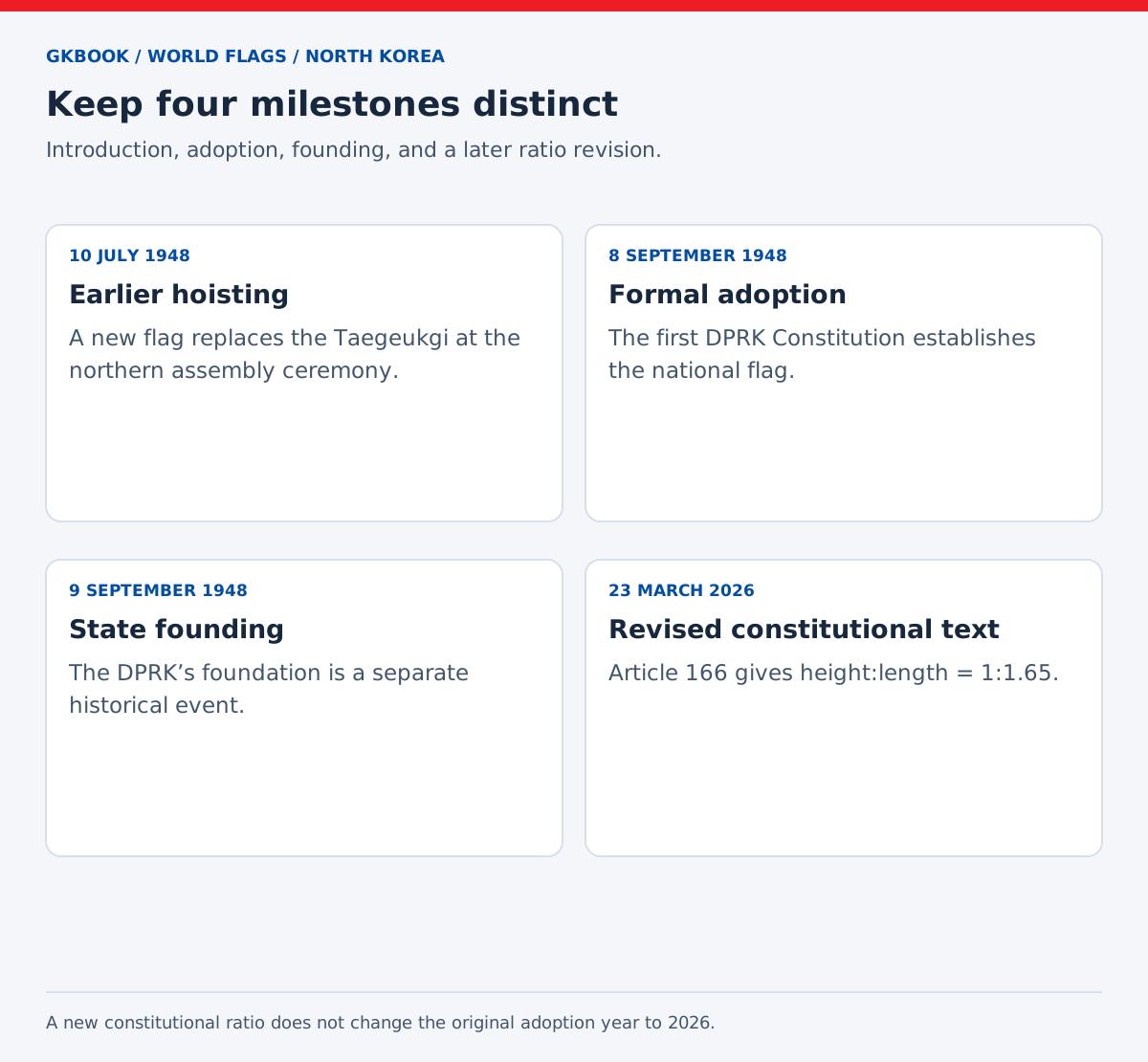
A historical timeline should say what happened on each date. “First shown,” “adopted,” “state founded,” and “ratio revised” describe different kinds of evidence. A photograph of an earlier appearance cannot, by itself, establish the date on which a constitutional provision took effect.
The illustration follows that distinction. It does not imply a new annual Flag Day, a mandatory nationwide display schedule, or a precise date on which every older physical flag was withdrawn. Those claims would require separate current evidence.
What flag was used before the present design?
The Taegeuk flag was used in northern Korea before the red-star design emerged in 1948. A northern commemorative stamp issued in 1946 depicts a Taegeuk flag. Its earlier use belongs to the shared history of Korean symbols and should not be mistaken for evidence that today’s two national flags are identical.

Kariyasu’s study uses the 1946 stamp as evidence of northern Taegeuk usage. The later red-star design belongs to the political formation of a separate northern state. The timeline illustrates those stages with dates and descriptions rather than an invented series of exact early flag drawings.
Historical Taegeuk flags varied. A modern South Korean production drawing should not automatically be inserted into a nineteenth-century or immediate postwar scene as if every detail were already standardized. Dated original images remain the appropriate evidence for particular historical examples.
Who designed North Korea’s flag?
The designer cannot be reduced to an uncontested single name. DPRK state accounts credit Kim Il Sung’s guidance, while historical research identifies Soviet involvement and examines other early attributions, including artist Kim Chu-gyong. A rigorous description distinguishes the official narrative, archival interpretation, artistic work, and political approval instead of merging them.

Fyodor Tertitskiy’s 2016 study examines Soviet documentation and testimony and challenges the later state attribution to Kim Il Sung. A 2022 art-historical study examines early writings and the changing presentation of the flag and state emblem, including material associated with Kim Chu-gyong.
The evidence is therefore best presented as attributed accounts. This article does not treat a leader’s approval, an artist’s participation, a politician’s explanation, and the initial drafting of a design as interchangeable activities.
What is North Korea’s flag called?
In English, “North Korea’s flag” and “the national flag of the Democratic People’s Republic of Korea” identify the same state flag. DPRK is the abbreviation of the country’s official name. Korean descriptions include references to a blue-and-red republic flag or a red five-pointed-star flag; romanized spellings can vary between systems.
KBS explains that South Korean usage includes Ingonggi, while North Korean descriptions emphasize the blue-and-red republic flag or the red star. These names are useful search terms, but the constitutional designation remains the national flag of the DPRK.
Names do not replace visual identification. In particular, a red flag used by the Workers’ Party or a military organization should not automatically be described as the national flag simply because it appears at the same event.
What law describes the national flag?
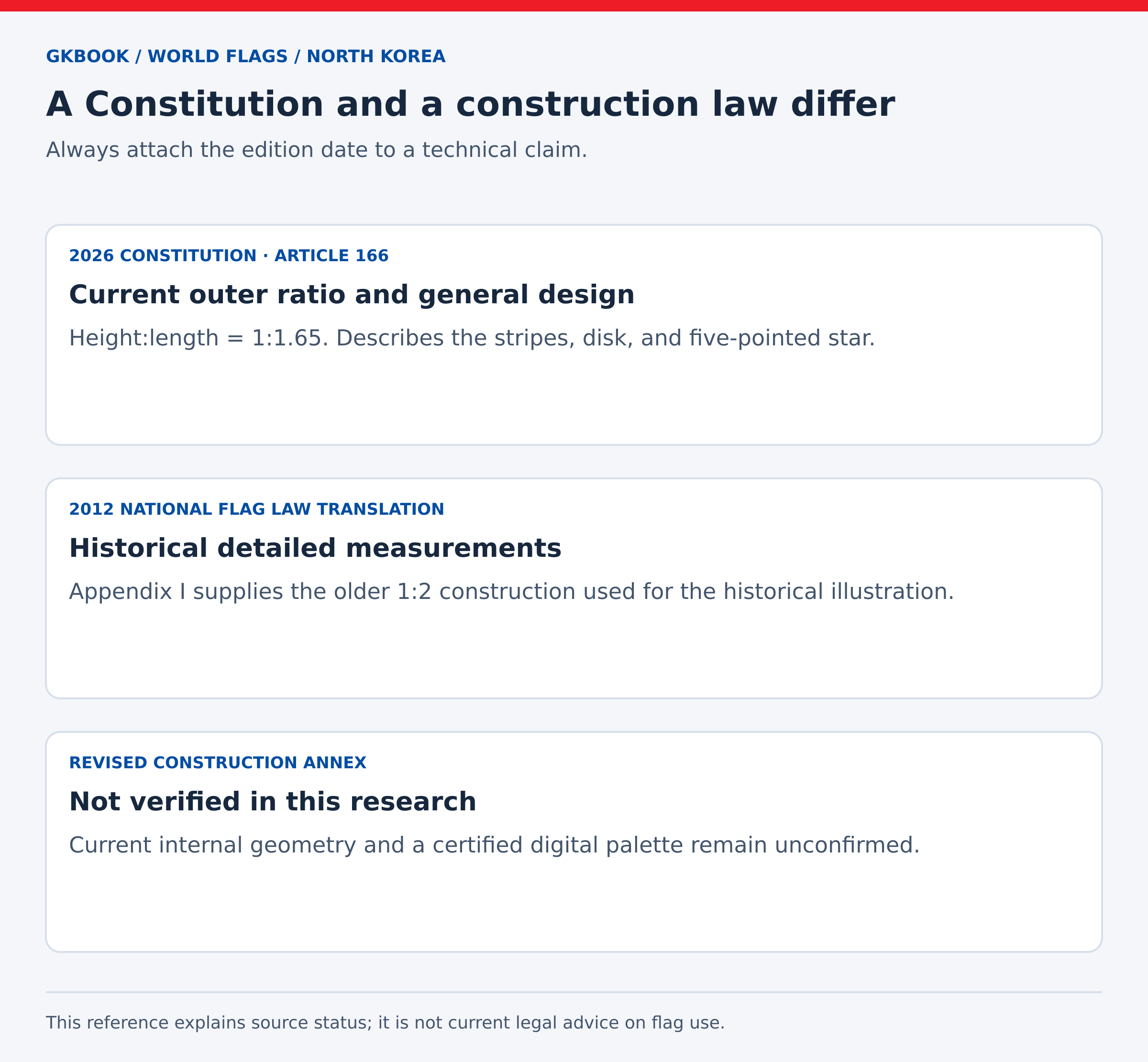
Article 166 of the 2026 Constitution describes the flag and its 20:33 ratio. A separate National Flag Law was adopted in 1992 and later amended. The accessible 2012 translation provides older construction details, but it is not sufficient evidence for every current manufacturing, display, or ceremonial rule after subsequent revisions.

The constitutional provision supplies the broad national design. The separate law deals with more detailed specifications and use. A report of a later legislative amendment establishes that the law changed, but does not reveal the full amended wording unless that text is also available.
For this article, the 2012 text is used as dated historical construction evidence. The guide does not convert its old 1:2 provision into a current rule or invent revised technical instructions from a modern photograph.
Does the flag contain North Korea’s state emblem?
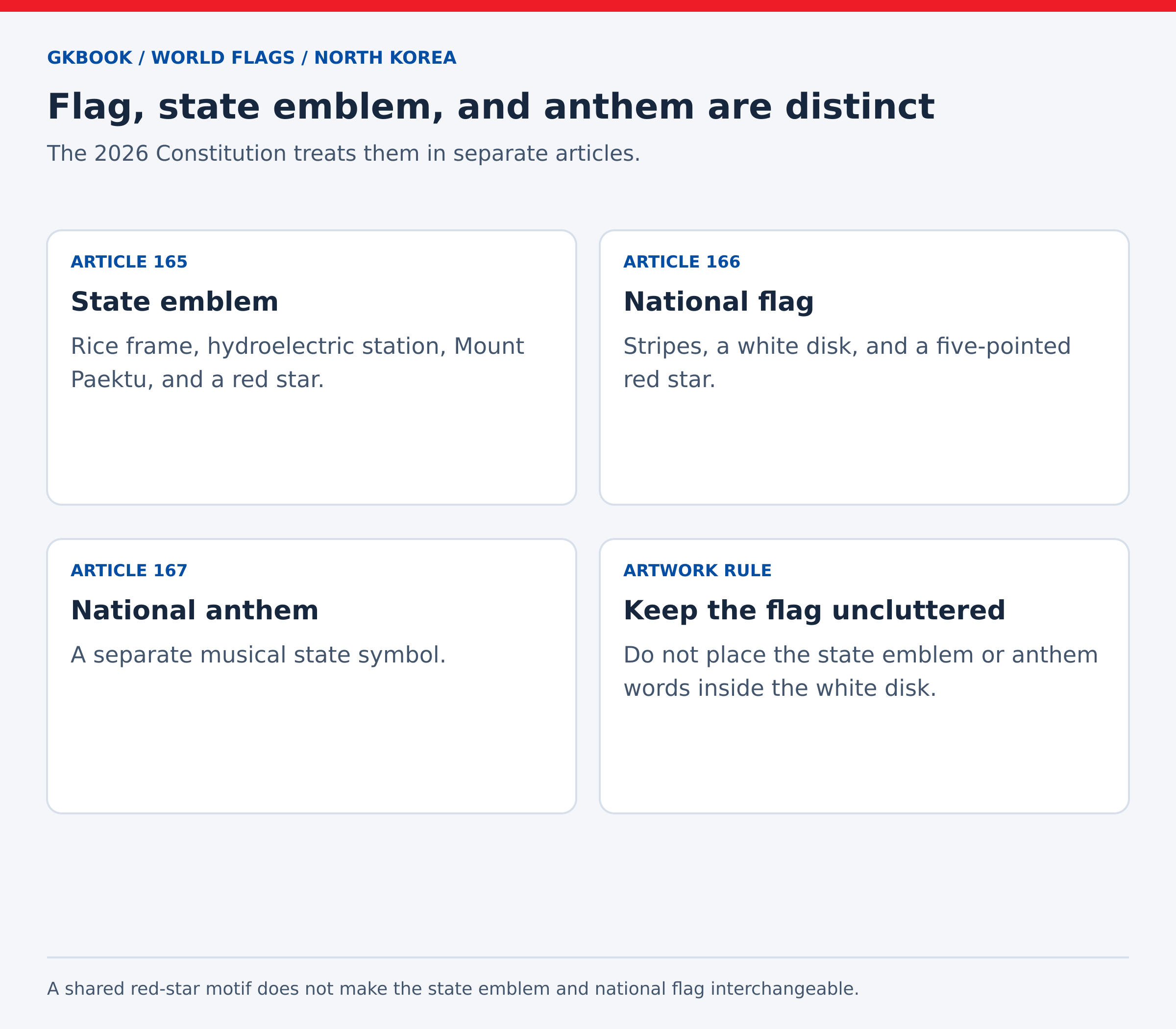
No. The national flag’s device is a red star within a white disk, not the complete state emblem. The 2026 Constitution describes the emblem separately, including a hydroelectric station, Mount Paektu, a red star, and a rice frame. Sharing a star motif does not make the two designs interchangeable.
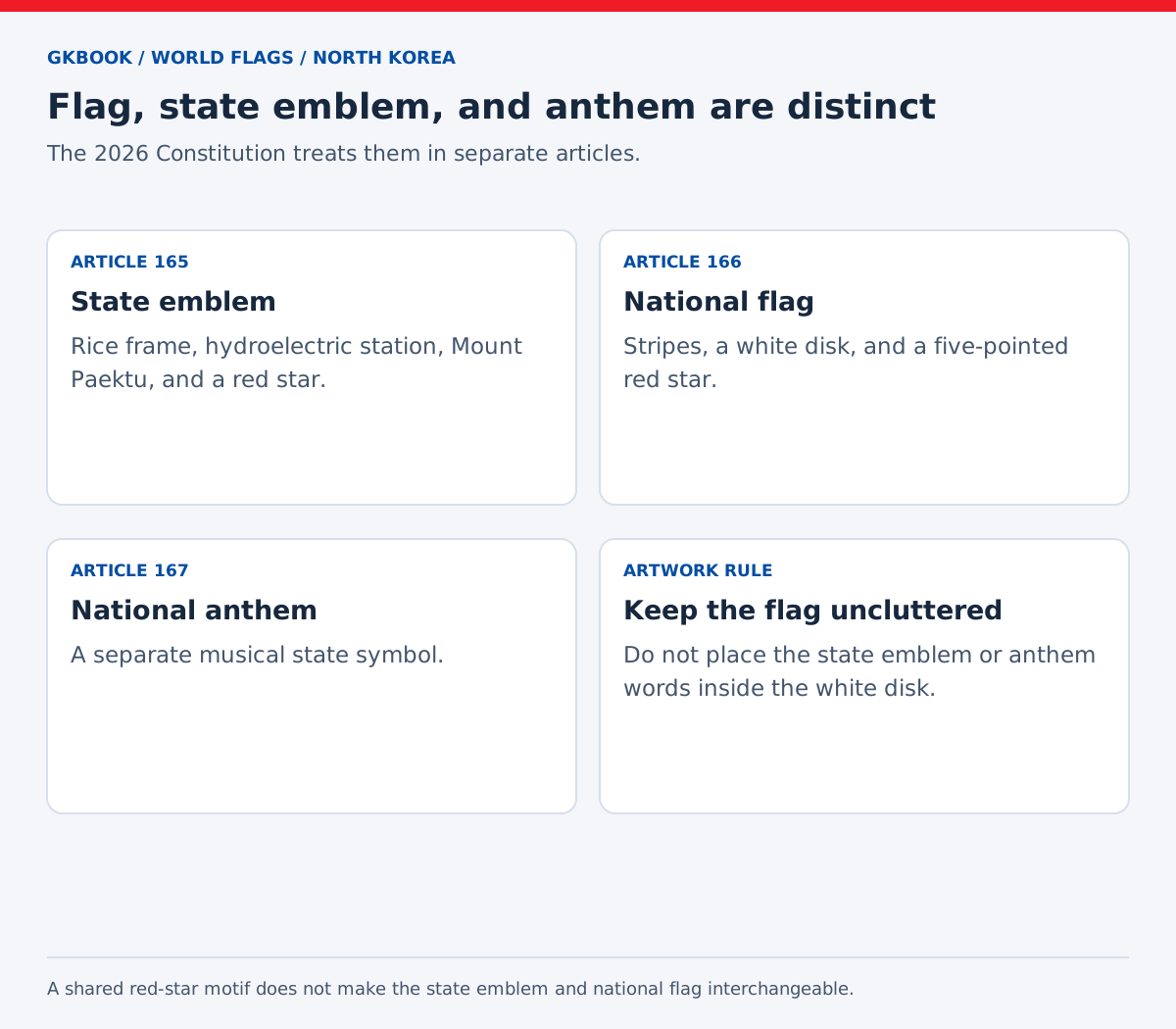
Article 165 concerns the state emblem, and Article 166 concerns the flag. The emblem includes multiple landscape and agricultural elements that are absent from the flag. Adding those elements to the disk would change the national flag drawing.
The comparison chart identifies the separate constitutional categories without presenting an approximate emblem illustration as authoritative. That approach preserves the flag’s simple device while explaining why some other North Korean official images look much more elaborate.
Is the national anthem part of the flag design?
The anthem is a separate national symbol, not an element printed on the flag. The 2026 Constitution addresses it in Article 167, following the flag provision in Article 166. Older sources may use the title “The Patriotic Song”; their wording and dates should be checked before treating them as current.
The National Assembly Library’s summary of the 2026 constitutional revision notes a change in the anthem’s designation. This article does not reproduce its lyrics or assume that a historical English title is the only current official form.
For the flag artwork, the practical point is straightforward: no anthem words, musical notation, slogan, or country name belongs inside the white disk. A ceremonial performance associated with raising a flag does not become a graphical component of that flag.
How does the national flag differ from the Workers’ Party flag?
The national flag identifies the DPRK state through its blue, white, and red bands and star-in-disk device. The Workers’ Party flag has a red field with a hammer, sickle, and writing brush emblem. They represent different institutions and can appear together; the party emblem is not part of the national flag.

Dean Thomas’s research presentation identifies the party emblem’s three tools with workers, farmers, and intellectuals. That emblem is visually distinct from the single five-pointed red star of the national flag.
When describing a ceremony or photograph, first identify the actual motif. The presence of a red background alone is insufficient. National flags, party flags, and military colors may share colors while communicating different affiliations.
How is North Korea’s flag different from South Korea’s?
North Korea’s flag uses horizontal blue, white, and red bands with a red star in a white disk toward the hoist. South Korea’s Taegeukgi has a white field, a central red-and-blue taegeuk symbol, and four black trigrams. Similar colors and a shared Korean history do not make the designs equivalent.

The Republic of Korea’s official symbols guide describes the Taegeukgi’s taegeuk and trigrams. The DPRK constitutional description instead identifies stripes and a red star. The presence or absence of black trigrams is an immediate visual distinction.
The comparison is intentionally based on complete identifying features. A small circular symbol, a red patch, or a white background viewed in isolation can be misleading, especially when a flag is folded or cropped in a photograph.
Is the Korean Unification Flag North Korea’s national flag?
No. The Korean Unification Flag, a blue Korean Peninsula silhouette on white, has been used for joint sporting appearances. The two Korean delegations marched behind it at the 2018 PyeongChang Olympic opening ceremony. That specific sporting arrangement did not replace either country’s national flag or establish a single Korean state flag.
The IOC’s account records the agreement for a joint opening march and a unified women’s ice hockey team. The role of the unification flag should be explained in that event-specific context, rather than assumed to apply to every sport or later international gathering.
This guide describes its identifying silhouette without inventing a geographical master. Details of islands and particular event versions can require their own documented specifications.
Did United Nations membership create a new North Korean flag?
The DPRK’s admission to the United Nations on September 17, 1991 was an international membership milestone, not the original adoption of its national flag. The flag’s principal design dates to 1948. A flag appearing at the UN identifies the member state; membership alone does not establish a new national design.
The UN’s published membership list records the admission date. That date belongs in diplomatic history and should not replace the 1948 adoption date in a flag fact box.
The same principle applies to photographs from international institutions: an event can document a flag’s use at a particular time without proving that its dimensions, manufacturing details, or legal adoption were decided at that event.
What does the reverse of North Korea’s flag look like?
A simple view through the reverse mirrors the arrangement horizontally, so the disk remains near the hoist even when that edge appears on the right. The star itself has vertical mirror symmetry, but its off-center position prevents the whole flag from being left-right symmetric. Fabric and stitching can vary between manufactured flags.
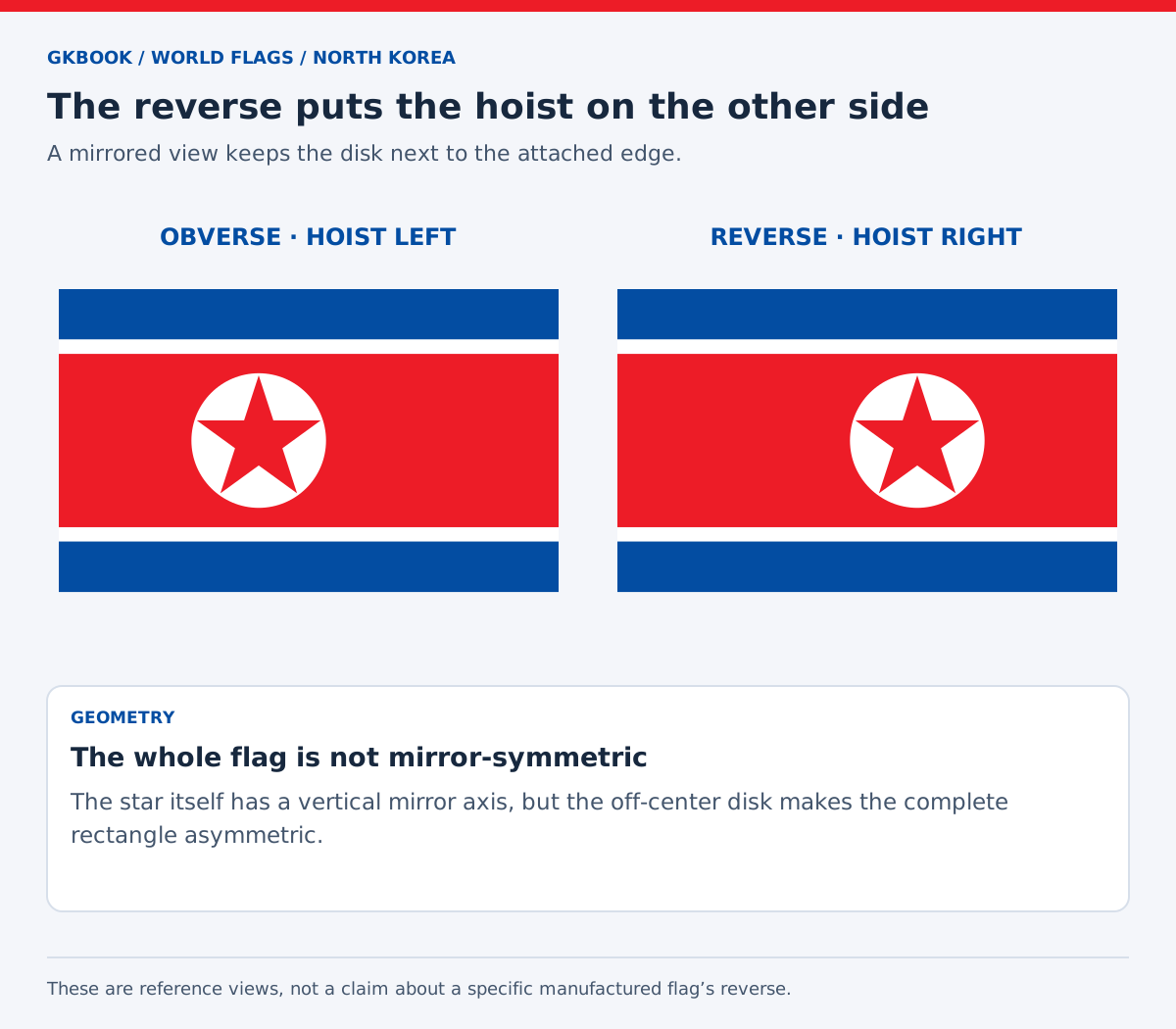
The diagram compares two views of the same mathematical reference. It does not move the star to the fly edge or invent a second reverse-side emblem. “Left” and “right” describe a viewer’s image, while “hoist” describes a structural edge of the flag.
Photographs of the reverse can therefore look different from the standard hoist-left illustration without showing an incorrect flag. Check where the cloth is attached before judging the device’s placement.
Is the North Korean flag symmetrical?
The horizontal bands are balanced above and below the centerline, but the complete flag is not top-bottom or left-right mirror-symmetric. Reflecting vertically inverts the upright star, while reflecting horizontally moves the off-center disk. A half-turn also moves the disk and turns the star upside down, so the whole design changes.
This is a property of the geometry used in both the reference and historical drawings. A symmetric component does not guarantee a symmetric complete design: the circle is symmetric, the band layout has several symmetries, and the regular star has its own axes.
For the complete flag, those components must remain in their correct relative positions. Rotating or mirroring a file is therefore not interchangeable with resizing it proportionally.
Can the flag simply be rotated for vertical display?
Rotating the whole image by ninety degrees turns both the bands and the star, producing a geometry demonstration rather than an automatically correct ceremonial banner. Historical vertical variants exist, but a current universal vertical-display specification was not verified. Formal displays should use artwork and orientation approved for the particular event or institution.

A quarter-turn preserves the shapes themselves but changes their orientation: the star’s upper point no longer points upward on the page. Keeping the star upright while turning the field would instead be a separate adaptation, which requires its own justification.
The rotated gallery image is prominently labeled as a geometric demonstration. It is not supplied as an approved vertical national flag master.
How can I draw the flag accurately for this reference?
Begin with the dated version you intend to illustrate. For the current reference, use a 594-by-360 rectangle and the declared provisional band and emblem measurements. For the historical version, use the separate 720-by-360 construction. Preserve circular geometry, use one red consistently, keep white opaque, and retain the appropriate explanatory caption.

A regular five-pointed star can be constructed from ten alternating vertices. The outer radius describes the five tips; the inner radius is the outer radius multiplied by sin(18°)/sin(54°), approximately 0.381966. The construction starts with an outer point above the common center.
This mathematical recipe ensures a regular star, but it does not authenticate a provisional current radius or disk position. Exact execution of a declared reconstruction is different from verification of the underlying national specification.
What should be checked before displaying or reproducing the flag?
Check the version, proportions, device, orientation, and caption, then follow the applicable institution’s current display instructions. This guide supplies educational artwork and a dated historical reconstruction, not comprehensive legal permission or ceremonial rules. It does not establish current flag-flying hours, commercial-use authorization, mourning schedules, or mandatory vertical adaptations for every setting.
For a classroom or reference page, keep the complete rectangle visible and identify the reconstruction accurately. For a formal event or manufactured flag, obtain approved current artwork and the governing instructions from the organizer or responsible authority.
Practical image care is simpler: preserve the SVG viewBox, avoid nonuniform stretching, retain adequate raster resolution, and keep captions with downloaded images. For cloth, follow the fabric supplier’s cleaning and storage directions. These are practical suggestions, not quoted national legal duties.
What are the most common North Korea flag mistakes?
Common mistakes include presenting the old 1:2 ratio as current, using the state or party emblem inside the disk, centering the disk in the rectangle, stretching it into an oval, and treating a reconstruction as an official production drawing. Historical captions can also confuse July’s hoisting, September’s adoption, and the state’s founding.

A useful review compares both the image and its metadata. A file can retain an older 1:2 viewBox even after a webpage caption has been updated to discuss the 2026 ratio. Conversely, changing the viewBox alone can crop or stretch the old artwork rather than reconstruct it.
The downloadable files separate the two versions, state their dimensions, and record the current reference’s provisional internal geometry. The picture gallery provides the drawings and explanatory diagrams together, while World Flags leads to the wider series.
Download North Korea flag pictures
Download the current-ratio reference as SVG or 4752 × 2880 PNG. Its 20:33 outer ratio is confirmed; its internal geometry is provisional. The historical 1:2 construction is available separately as historical SVG or 4320 × 2160 PNG. The gallery contains 24 subjects with paired SVG and PNG files. Retain each drawing’s caption and preserve its proportions. Image credits and reconstruction notes explain the status of the artwork.
Explore more in World Flags, including the Nigeria flag and Nepal flag
World Flags/North Korea
North Korea flag pictures
20:33 outer ratio confirmed by the 2026 Constitution. Stripe widths and emblem geometry in this reference reconstruction are provisional, not a verified 2026 construction standard.
GKBook original artwork; reconstruction status and digital colors are declared.Download SVGDownload PNG
Historical 1:2 construction reconstructed from the 2012 National Flag Law translation, Appendix I. Not the current constitutional ratio.
GKBook original artwork; reconstruction status and digital colors are declared.Download SVGDownload PNGThe constitutional design has a broad red center, narrow white separators, blue outer bands, and a red star in a white disk. 20:33 outer ratio confirmed by the 2026 Constitution. Stripe widths and emblem geometry in this reference reconstruction are provisional, not a verified 2026 construction standard.
GKBook original artwork; reconstruction status and digital colors are declared.Download SVGDownload PNGThe illustrations use red #ED1C27, blue #034DA2, and white #FFFFFF. No verified 2026 Pantone, CMYK, or textile conversion is asserted.
GKBook original artwork; reconstruction status and digital colors are declared.Download SVGDownload PNGThe meanings summarize attributed state explanations and historical interpretation; they are not independent claims about present political conditions.
GKBook original artwork; reconstruction status and digital colors are declared.Download SVGDownload PNGThe enlarged device illustrates the historical radii used in both GKBook drawings. The current reconstruction retains those radii as a declared provisional choice.
GKBook original artwork; reconstruction status and digital colors are declared.Download SVGDownload PNGThe current reference uses x = 2L/5 and y = H/2 as provisional coordinates. The historical law-based drawing uses x = L/3. Neither places the disk at the rectangle’s center.
GKBook original artwork; reconstruction status and digital colors are declared.Download SVGDownload PNGArticle 166 of the 2026 Constitution gives 1:1.65 height:length, equivalent to 20:33. The diagram’s internal details remain a provisional reconstruction.
GKBook original artwork; reconstruction status and digital colors are declared.Download SVGDownload PNGAt a fixed height, changing length from 2H to 1.65H shortens the flag by 17.5 percent. The exact-ratio outlines isolate the constitutional rectangle change without asserting revised internal measurements.
GKBook original artwork; reconstruction status and digital colors are declared.Download SVGDownload PNGThe chosen internal geometry reflects a reported wider-stripe design, while preserving circular geometry. A revised official construction annex has not been verified; these internal values are not certified.
GKBook original artwork; reconstruction status and digital colors are declared.Download SVGDownload PNGThe historical drawing uses a 72 × 36 unit model, stripe heights 6:1:22:1:6, disk center (24,18), disk radius 8, and star outer radius 7.75. It is not a current 2026 construction certificate.
GKBook original artwork; reconstruction status and digital colors are declared.Download SVGDownload PNGThe current reference and historical files use different ratios and filenames. Dimensions are export examples, not a list of prescribed physical flag sizes.
GKBook original artwork; reconstruction status and digital colors are declared.Download SVGDownload PNGSeptember 8, 1948 is the formal adoption date supported by historical references. July 10 marks an earlier hoisting; September 9 marks the state’s founding.
GKBook original artwork; reconstruction status and digital colors are declared.Download SVGDownload PNGThe March 2026 constitutional date does not establish the first physical appearance of every revised flag. Historical adoption remains a 1948 event.
GKBook original artwork; reconstruction status and digital colors are declared.Download SVGDownload PNGThe timeline links earlier Taegeuk usage, the 1948 flag, the 1992 law, and the 2026 constitutional ratio. It does not invent a sequence of undocumented intermediate flag masters.
GKBook original artwork; reconstruction status and digital colors are declared.Download SVGDownload PNGThis diagram distinguishes state attribution from scholarly investigation. It does not present a leader’s official design story as an uncontested biographical fact.
GKBook original artwork; reconstruction status and digital colors are declared.Download SVGDownload PNGThe current constitutional ratio and historical detailed law are distinct sources. Older technical measurements are not silently treated as a current annex.
GKBook original artwork; reconstruction status and digital colors are declared.Download SVGDownload PNGArticles 165–167 distinguish the state emblem, flag, and anthem. This chart summarizes the distinction without reproducing anthem lyrics or inventing emblem artwork.
GKBook original artwork; reconstruction status and digital colors are declared.Download SVGDownload PNGThe two national flags and the Korean Unification Flag serve different purposes. The 2018 joint march did not replace either state’s national flag.
GKBook original artwork; reconstruction status and digital colors are declared.Download SVGDownload PNGThe national flag represents the state, while the Workers’ Party uses a different flag and emblem. The national reference drawing has provisional current internal geometry.
GKBook original artwork; reconstruction status and digital colors are declared.Download SVGDownload PNGThis geometric illustration mirrors the current reference. It does not imply separate emblems on the cloth’s two sides or prescribe stitching methods.
GKBook original artwork; reconstruction status and digital colors are declared.Download SVGDownload PNGThe rotated illustration demonstrates a quarter-turn only. The star turns with the field; this is not certified vertical flag artwork or a national hanging instruction.
GKBook original artwork; reconstruction status and digital colors are declared.Download SVGDownload PNGThese steps reproduce the GKBook current-ratio reconstruction. Only the general design and outer ratio are constitutionally confirmed; internal numbers are declared modeling choices.
GKBook original artwork; reconstruction status and digital colors are declared.Download SVGDownload PNGAvoid outdated current-ratio labels, incorrect devices, a stretched disk, centered placement, and unsupported precision. Captions and artwork must refer to the same dated design.
GKBook original artwork; reconstruction status and digital colors are declared.Download SVGDownload PNGFrequently asked questions
What does North Korea’s flag look like?
North Korea’s flag has blue outer bands, narrow white stripes, and a broad red center containing a red five-pointed star in a white disk toward the hoist. Its 2026 constitutional height:length ratio is 20:33. The current-ratio illustration here is a reference reconstruction with explicitly provisional internal measurements.
What is the design of North Korea’s flag?
The flag has five horizontal bands arranged blue, white, red, white, and blue. The red middle band is substantially wider than the other bands. A white disk containing one red five-pointed star appears toward the hoist, the edge attached to the flagpole, rather than at the rectangle’s center.
What are the colors and digital color codes of the flag?
The flag uses red, blue, and white. This article’s original illustrations use #ED1C27 red, #034DA2 blue, and #FFFFFF white as declared screen colors. These hexadecimal values are reproduction choices; the research did not establish a certified 2026 digital, Pantone, CMYK, or textile specification for the national flag.
What do North Korea’s flag colors mean?
DPRK state explanations associate red with revolutionary struggle and sacrifice, blue with aspiration, peace, and progress, and white with purity and Korean tradition. Older accounts also connect white with national identity and loyalty. These are attributed symbolic interpretations, not independent descriptions of the country’s government, society, or current conditions.
What does the red star represent?
The five-pointed red star is associated with socialist and communist political symbolism. On North Korea’s flag it sits within a white disk and shares the red color of the central band. The five tips should not be presented as a verified count of provinces, battles, leaders, or administrative divisions.
Why is there a white disk around the star?
The white disk separates the red star visually from the surrounding red field, making its five points visible. The Constitution specifies the disk as part of the design. Historical construction rules leave a white gap between the star’s outer tips and the disk’s edge; the star is not a cutout.
Where is the star placed on North Korea’s flag?
The star and white disk are positioned toward the hoist and share a center. The older documented construction places that center one third of the flag’s length from the hoist and halfway down its height. The current reference uses a provisional two-fifths position; an updated official coordinate was not verified.
What is North Korea’s current flag ratio?
Article 166 of the Constitution adopted in March 2026 gives the flag’s height:length ratio as 1:1.65, equivalent to 20:33. A rectangle 20 units high is therefore 33 units long. The familiar 1:2 ratio belongs to earlier constitutional versions and should be identified as historical when discussing the current standard.
Did North Korea change its flag in 2026?
The 2026 Constitution changed the stated height:length ratio from 1:2 to 1:1.65 while retaining the recognizable stripes, disk, and red star in its description. At equal height, the new rectangle is 17.5 percent shorter. The precise revised internal measurements and first physical use are less securely established here.
Are all measurements in the current illustration official?
No. The current illustration has the confirmed 20:33 outer ratio, but its internal measurements are a declared reference reconstruction. On a 360-unit height it uses bands of 60, 17, 206, 17, and 60 units, with the disk centered at two fifths of the length. These choices are provisional.
How was the older 1:2 flag constructed?
The older construction can be expressed on a 72-by-36 rectangle. Its band heights are 6:1:22:1:6, the disk center is at coordinates (24,18), its radius is 8, and the star’s outer radius is 7.75. These measurements reconstruct the historical law-based design, rather than certify the revised 2026 flag.
What sizes are available for the flag pictures?
The current-ratio reference is supplied as a 594 × 360 SVG and a 4752 × 2880 PNG. The historical drawing is a 720 × 360 SVG and a 4320 × 2160 PNG. These are downloadable image sizes, not prescribed cloth dimensions; each file retains its own ratio and descriptive status.
When was North Korea’s flag adopted?
The formal adoption date is September 8, 1948, associated with the first DPRK Constitution. A trial hoisting and replacement ceremony had already occurred on July 10, 1948. The state was founded on September 9. These closely related events explain why more than one 1948 date appears in discussions of the flag.
How do the flag’s main dates differ?
July 10, 1948 refers to the earlier hoisting ceremony; September 8, 1948 to formal adoption; and September 9, 1948 to the DPRK’s founding. March 23, 2026 dates the revised constitutional text containing the new ratio. These dates identify different milestones and should not be collapsed into one anniversary.
What flag was used before the present design?
The Taegeuk flag was used in northern Korea before the red-star design emerged in 1948. A northern commemorative stamp issued in 1946 depicts a Taegeuk flag. Its earlier use belongs to the shared history of Korean symbols and should not be mistaken for evidence that today’s two national flags are identical.
Who designed North Korea’s flag?
The designer cannot be reduced to an uncontested single name. DPRK state accounts credit Kim Il Sung’s guidance, while historical research identifies Soviet involvement and examines other early attributions, including artist Kim Chu-gyong. A rigorous description distinguishes the official narrative, archival interpretation, artistic work, and political approval instead of merging them.
What is North Korea’s flag called?
In English, “North Korea’s flag” and “the national flag of the Democratic People’s Republic of Korea” identify the same state flag. DPRK is the abbreviation of the country’s official name. Korean descriptions include references to a blue-and-red republic flag or a red five-pointed-star flag; romanized spellings can vary between systems.
What law describes the national flag?
Article 166 of the 2026 Constitution describes the flag and its 20:33 ratio. A separate National Flag Law was adopted in 1992 and later amended. The accessible 2012 translation provides older construction details, but it is not sufficient evidence for every current manufacturing, display, or ceremonial rule after subsequent revisions.
Does the flag contain North Korea’s state emblem?
No. The national flag’s device is a red star within a white disk, not the complete state emblem. The 2026 Constitution describes the emblem separately, including a hydroelectric station, Mount Paektu, a red star, and a rice frame. Sharing a star motif does not make the two designs interchangeable.
Is the national anthem part of the flag design?
The anthem is a separate national symbol, not an element printed on the flag. The 2026 Constitution addresses it in Article 167, following the flag provision in Article 166. Older sources may use the title “The Patriotic Song”; their wording and dates should be checked before treating them as current.
How does the national flag differ from the Workers’ Party flag?
The national flag identifies the DPRK state through its blue, white, and red bands and star-in-disk device. The Workers’ Party flag has a red field with a hammer, sickle, and writing brush emblem. They represent different institutions and can appear together; the party emblem is not part of the national flag.
How is North Korea’s flag different from South Korea’s?
North Korea’s flag uses horizontal blue, white, and red bands with a red star in a white disk toward the hoist. South Korea’s Taegeukgi has a white field, a central red-and-blue taegeuk symbol, and four black trigrams. Similar colors and a shared Korean history do not make the designs equivalent.
Is the Korean Unification Flag North Korea’s national flag?
No. The Korean Unification Flag, a blue Korean Peninsula silhouette on white, has been used for joint sporting appearances. The two Korean delegations marched behind it at the 2018 PyeongChang Olympic opening ceremony. That specific sporting arrangement did not replace either country’s national flag or establish a single Korean state flag.
Did United Nations membership create a new North Korean flag?
The DPRK’s admission to the United Nations on September 17, 1991 was an international membership milestone, not the original adoption of its national flag. The flag’s principal design dates to 1948. A flag appearing at the UN identifies the member state; membership alone does not establish a new national design.
What does the reverse of North Korea’s flag look like?
A simple view through the reverse mirrors the arrangement horizontally, so the disk remains near the hoist even when that edge appears on the right. The star itself has vertical mirror symmetry, but its off-center position prevents the whole flag from being left-right symmetric. Fabric and stitching can vary between manufactured flags.
Is the North Korean flag symmetrical?
The horizontal bands are balanced above and below the centerline, but the complete flag is not top-bottom or left-right mirror-symmetric. Reflecting vertically inverts the upright star, while reflecting horizontally moves the off-center disk. A half-turn also moves the disk and turns the star upside down, so the whole design changes.
Can the flag simply be rotated for vertical display?
Rotating the whole image by ninety degrees turns both the bands and the star, producing a geometry demonstration rather than an automatically correct ceremonial banner. Historical vertical variants exist, but a current universal vertical-display specification was not verified. Formal displays should use artwork and orientation approved for the particular event or institution.
How can I draw the flag accurately for this reference?
Begin with the dated version you intend to illustrate. For the current reference, use a 594-by-360 rectangle and the declared provisional band and emblem measurements. For the historical version, use the separate 720-by-360 construction. Preserve circular geometry, use one red consistently, keep white opaque, and retain the appropriate explanatory caption.
What should be checked before displaying or reproducing the flag?
Check the version, proportions, device, orientation, and caption, then follow the applicable institution’s current display instructions. This guide supplies educational artwork and a dated historical reconstruction, not comprehensive legal permission or ceremonial rules. It does not establish current flag-flying hours, commercial-use authorization, mourning schedules, or mandatory vertical adaptations for every setting.
What are the most common North Korea flag mistakes?
Common mistakes include presenting the old 1:2 ratio as current, using the state or party emblem inside the disk, centering the disk in the rectangle, stretching it into an oval, and treating a reconstruction as an official production drawing. Historical captions can also confuse July’s hoisting, September’s adoption, and the state’s founding.
Explore all general-knowledge topics and the A-to-Z lists.








We Value Your Opinion Comments