
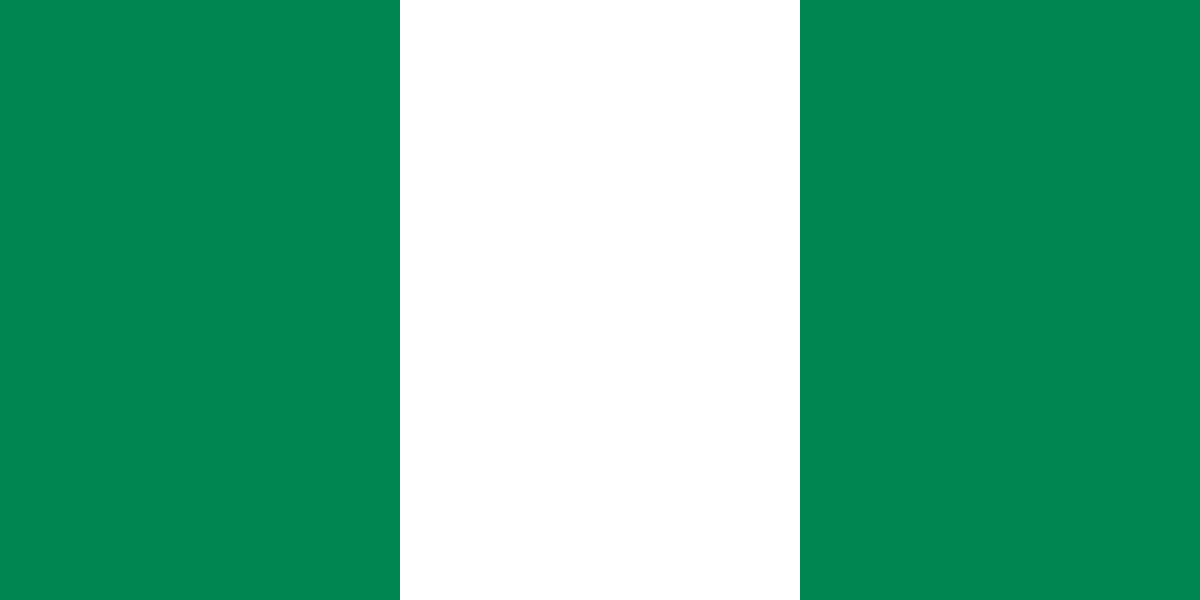
Nigeria flag picture
Explore the proportions, history, and picture gallery.
| Design | Green, white, greenThree equal vertical panels; no central emblem. |
|---|---|
| Proportions | Height:length = 1:2The rectangle is twice as long as it is high. |
| Adoption | October 1, 1960Adopted at independence from Britain. |
| Designer | Michael Taiwo AkinkunmiOfficial accounts date the design to 1959. |
| Flag standard | NIS 237:1987 catalogue entryFull technical standard not retrieved; screen colors are declared. |
| National motto | Unity and Faith, Peace and ProgressAssociated with the separate coat of arms. |
What does Nigeria’s flag look like?
Nigeria’s national flag has three equal vertical bands: green at the hoist, white in the center, and green at the fly. Its height:length ratio is 1:2, and the plain flag has no emblem. Designed by Michael Taiwo Akinkunmi, it was officially adopted on October 1, 1960, when Nigeria became independent.
The two green panels share one color and frame a plain white center. This article explains the design and its meanings, follows the flag from competition to independence, and distinguishes the national flag from special official flags and other national symbols.
What is the correct color order of Nigeria’s flag?
Nigeria’s flag reads green, white, green from the hoist to the fly. All three bands are vertical and equal in width, running through the full height of the rectangle. The hoist is the edge attached to the flagpole. Because both outer bands are green, viewing the reverse preserves the same color order.

In a conventional horizontal illustration, the hoist appears at the left and the fly at the right. Each green panel occupies one third of the flag’s length; the white panel occupies the middle third. There is no dividing line between the colors.
The plain national flag has no star, sun, lettering, tree, or coat of arms. Adding one of these features changes the design being illustrated. Official special flags should be identified separately, with their intended function made clear.
What are Nigeria’s flag colors and color codes?
Nigeria’s national flag uses green and white. The downloadable artwork uses green #008751, equivalent to RGB 0, 135, 81, and white #FFFFFF, equivalent to RGB 255, 255, 255. These are declared screen colors. SON’s catalogue lists NIS 237:1987 for the national flag, but its full color specifications were not retrieved.

A catalogue entry establishes that a standard exists; it does not reveal all of that standard’s requirements. The Standards Organisation of Nigeria lists the title as Standard on Nigeria National Flag. This article does not claim that the selected hexadecimal green is a certified conversion of that document.
Screens, printing inks, cloth, dyes, and lighting affect color appearance. Both green panels should use the same color, and the white stripe should remain opaque. For an official production order, use the commissioning authority’s approved specification and physical reference.
| Color | HEX | RGB | Placement |
|---|---|---|---|
| Green | #008751 | 0, 135, 81 | Both outer bands |
| White | #FFFFFF | 255, 255, 255 | Central band |
What does Nigeria’s flag symbolize?
The green bands represent Nigeria’s agricultural wealth and natural resources, while the white band represents peace and unity. Official explanations emphasize these shared national aspirations. The flag’s simple arrangement brings two green panels around a white center, expressing these meanings without adding a separate emblem, written motto, or religious symbol.
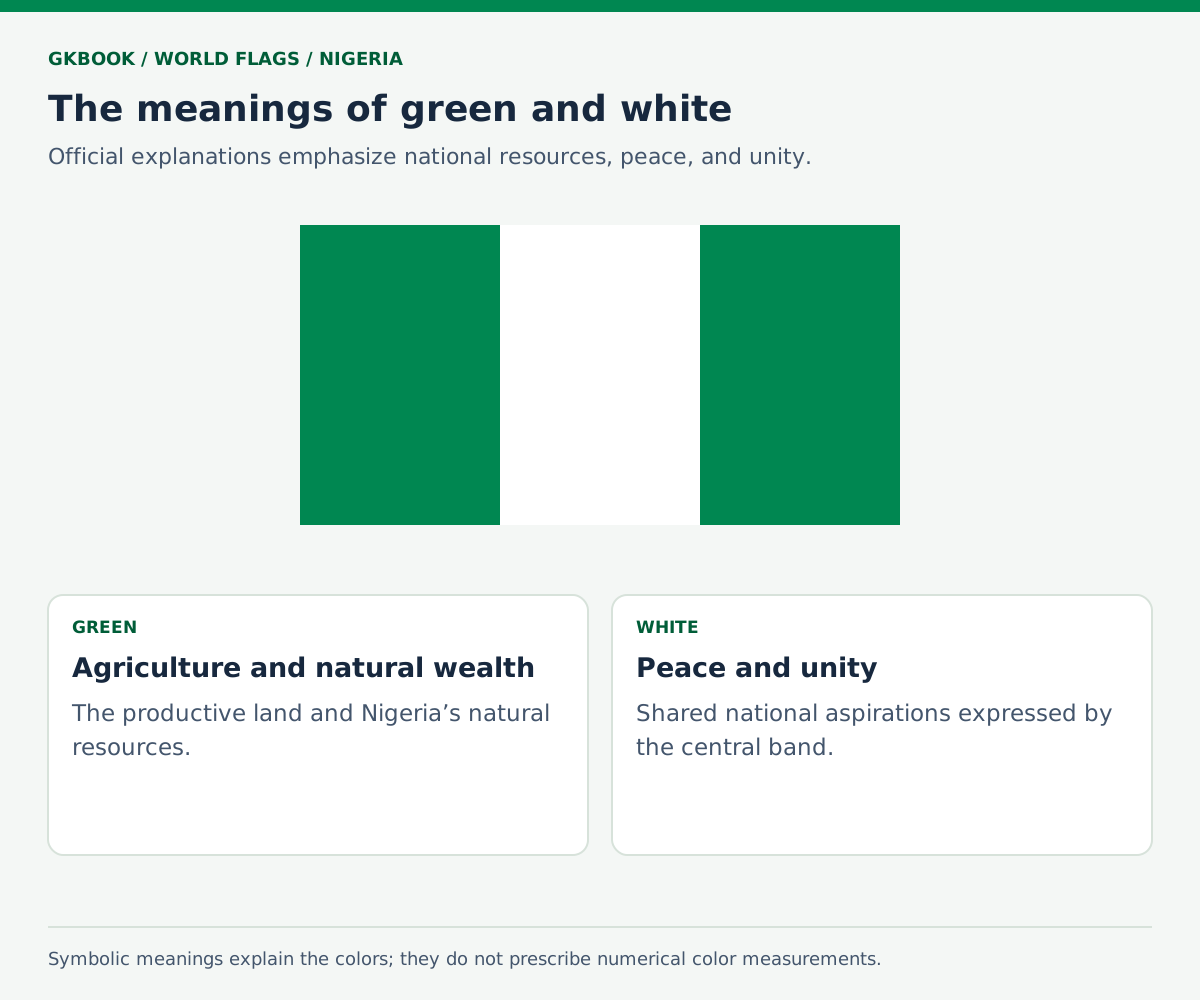
The Nigerian Tourism Development Authority describes green in terms of natural wealth and white in terms of peace. The Nigerian embassy in the United States expands the explanation to natural resources, peace, and unity. These accounts complement one another.
Symbolism explains the colors; it does not divide the population into three groups or turn the panels into a map. A claim that each stripe represents a particular religion, ethnic community, or former region needs evidence beyond the familiar color arrangement.
| Element | Main association |
|---|---|
| Two green bands | Agriculture, natural wealth, and resources |
| White central band | Peace and unity |
What do the two green bands on Nigeria’s flag mean?
The two green bands express Nigeria’s agricultural wealth and natural resources. They share one meaning and use the same green; they are not two differently colored regional symbols. Their equal widths frame the central white band, giving green two thirds of the flag’s total visible area in the plain national design.
The agricultural interpretation connects the flag with the land and its productive potential. Official descriptions also use the broader phrase natural wealth, so an explanation need not reduce the color to one crop or one part of the country.
The area fraction follows directly from the geometry: two of three equal panels are green. It is a mathematical property of the drawing, not a claim that agriculture occupies exactly two thirds of Nigeria’s land or economy.
What does the white band on Nigeria’s flag mean?
The central white band represents peace and unity in official explanations of Nigeria’s flag. It occupies one third of the flag’s length and extends through its full height. White is an actual part of the design, not an empty or transparent space that should take on the color of its background.
The white panel separates two identical green panels while remaining equal to each of them in width. Its central position is a visible design feature; the ideas of peace and unity come from explanations of the national symbol.
A digital flag with a transparent middle would change appearance when placed over a colored background. The supplied SVG and PNG therefore use opaque white, including in the plain flag download and in each complete Nigerian flag shown in the diagrams.
What is the ratio of Nigeria’s flag?
Nigeria’s flag has a height:length ratio of 1:2, so the rectangle is twice as long as it is high. Each of the three vertical panels occupies one third of that length. A 1200 × 600 drawing therefore has three panels measuring 400 units wide and 600 units high.

The Nigerian High Commission in Kenya identifies the ratio as 1:2. Writing height:length explicitly avoids a common ambiguity: the same rectangle has a length:height ratio of 2:1. It is neither square nor a 2:3 rectangle.
Uniform scaling preserves the flag’s proportions. Increasing the length without increasing the height changes the overall ratio, even if the panel widths remain equal. The main vector and raster downloads retain exactly the same 1:2 geometry.
What dimensions should a Nigerian flag have?
Choose dimensions that preserve Nigeria’s 1:2 height:length ratio and divide the length into three equal panels. For example, a flag 60 centimeters high and 120 centimeters long has panels 40 centimeters wide. This package supplies a 1200 × 600 SVG and a 4800 × 2400 PNG with exactly corresponding proportions.
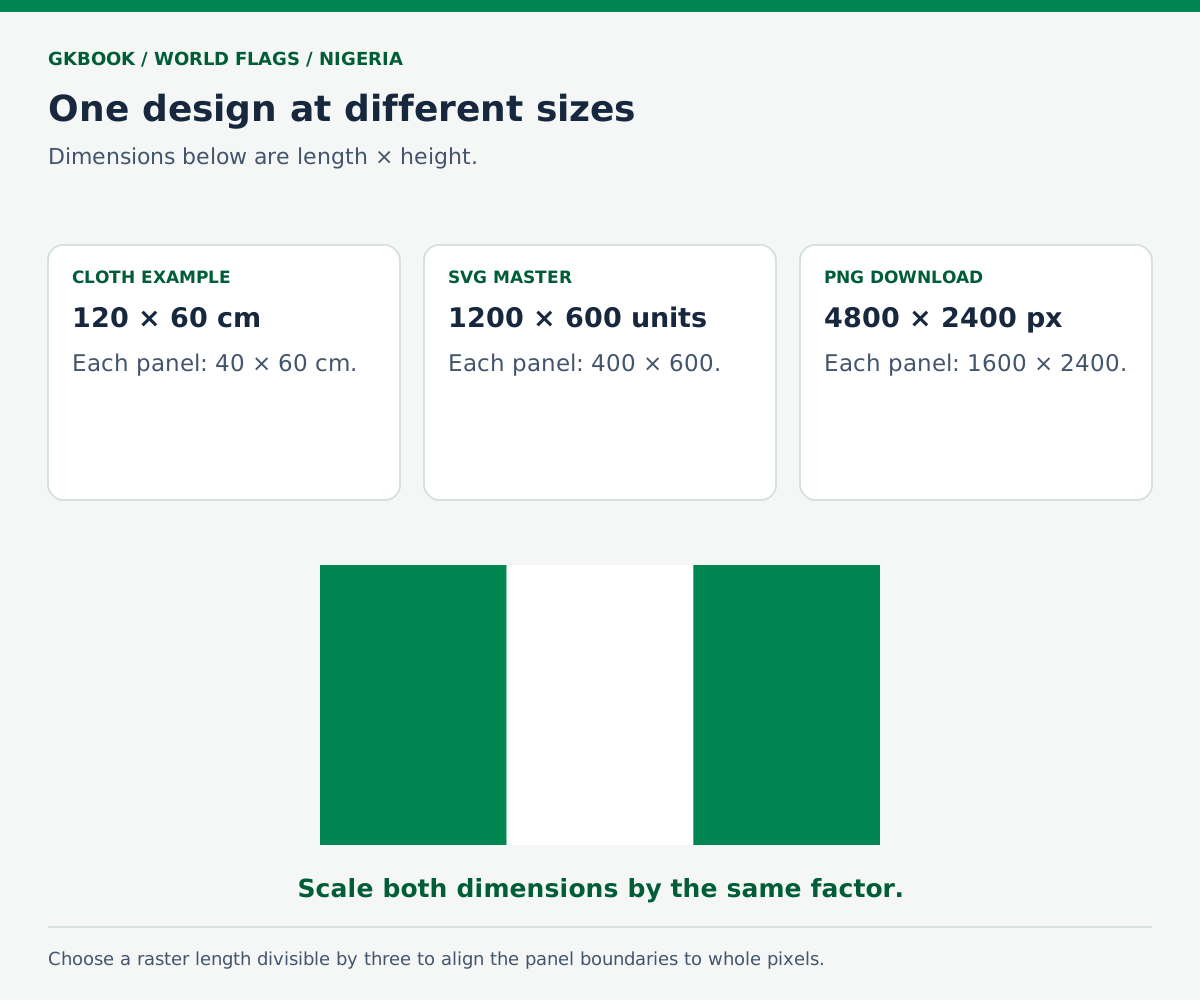
Those examples demonstrate scaling; they are not a claim that one physical size is compulsory for every flagpole or event. A production order also needs appropriate cloth, finishing, attachment, and color specifications.
For clean raster boundaries, use a pixel length divisible by three. The supplied PNG has three 1600-pixel-wide panels, each 2400 pixels high. No antialiasing is needed at these integer-aligned vertical boundaries.
| Use | Overall size | Each panel |
|---|---|---|
| Cloth example | 120 × 60 cm | 40 × 60 cm |
| SVG master | 1200 × 600 units | 400 × 600 units |
| PNG download | 4800 × 2400 pixels | 1600 × 2400 pixels |
Does Nigeria’s flag have two colors or three?
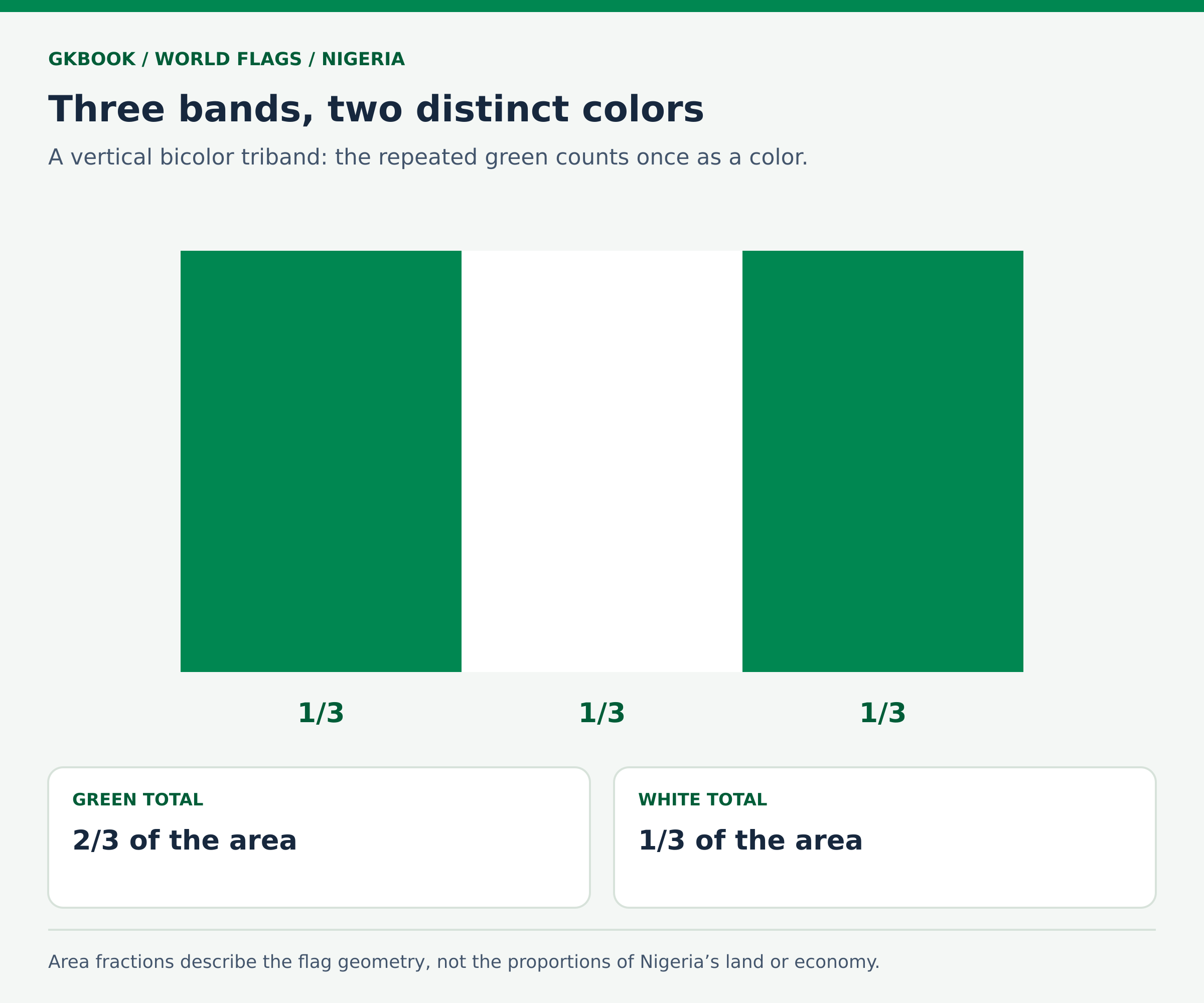
Nigeria’s flag has two colors arranged in three bands. It is a vertical bicolor triband: green, white, green. Each band covers one third of the rectangle, but the two green bands together cover two thirds. White covers the remaining third because the plain national flag has no additional central device.

Band count and color count answer different questions. Calling the design a triband describes its three panels. Calling it a bicolor describes the two distinct colors. A tricolor would normally imply three different colors.
On the 1200 × 600 master, each panel covers 240,000 square units. The green total is 480,000 square units and the white total is 240,000, within an overall area of 720,000. These fractions remain unchanged at any uniform scale.
Who designed Nigeria’s national flag?
Michael Taiwo Akinkunmi designed Nigeria’s national flag. Official tourism and diplomatic accounts date his winning design to 1959, during preparations for independence. He entered a flag design competition while studying in Britain. The final adopted version retained his green-white-green arrangement after the sun in his submitted proposal was removed.

The designer’s full name helps distinguish this history from that of neighboring Niger, whose flag is a different design. Akinkunmi’s contribution belongs to Nigeria’s transition to independence and its choice of a new national symbol.
Accounts differ on some incidental details, including competition totals and the spelling of the institution where he studied. Those details are not necessary to establish the designer, the basic proposal, or the adopted flag, and they are omitted here.
Did Akinkunmi’s original flag design include a sun?
Yes. Accounts of Akinkunmi’s competition proposal describe a red sun with rays in the white center. The judging process removed that feature before adoption, leaving the plain green-white-green triband. The proposed sun should therefore be explained as part of the design’s development, not displayed as an element of Nigeria’s current national flag.
The essential change was subtraction: the colors and vertical arrangement remained, while the central device disappeared. That distinction explains why an illustration of the adopted flag must leave the white panel clear.
The accompanying design-story diagram describes the proposal in words. It does not invent an archival facsimile, a precise ray count, or a sun diameter. A competition submission and an officially adopted national flag are different historical objects.
When was Nigeria’s flag adopted?
Nigeria’s national flag was officially adopted on October 1, 1960, the day the country became independent from Britain. The design had been selected during preparations for independence, with official accounts dating Akinkunmi’s design to 1959. Selection of the design and adoption of the national flag are therefore distinct milestones.

The Nigerian Tourism Development Authority gives October 1, 1960 as the official adoption date. The Nigerian embassy in the United States describes the first official hoisting on the same day. The independence date is independently confirmed by the U.S. Office of the Historian.
A source that mentions the design in 1959 is not necessarily contradicting the 1960 adoption date. It may be describing the competition stage rather than the point at which the flag became the national symbol of independent Nigeria.
What is the history of Nigeria’s flag?
Nigeria’s flag emerged from the preparations for independence. Akinkunmi’s green-white-green proposal won the design competition, its red sun was removed, and the plain triband was officially adopted on October 1, 1960. Later changes in government and the restoration of an earlier national anthem did not add a device to this national flag.

The main sequence is a competition design in 1959, followed by adoption and independence in 1960. Preparatory work is sometimes discussed under 1958; that earlier planning context should not be collapsed into the official adoption date.
Nigeria became a republic in 1963. The flag’s identity is still the green-white-green triband. An anthem change, a new administration, or the use of a special official standard does not by itself establish that the plain national flag has been redesigned.
Was Nigeria’s flag adopted at independence or when it became a republic?
The flag was adopted at independence on October 1, 1960. Nigeria became a republic in 1963, a later constitutional milestone. These events should not be merged into one date. The adoption date belongs to the transition from British rule, while republic status concerns the subsequent form of the Nigerian state.

Independence and republic status answer different historical questions. The first marks the end of British sovereignty; the second marks a change in the state’s constitutional arrangements. A country can become independent before it becomes a republic.
This distinction also prevents an inaccurate label on a flag timeline. October 1, 1960 should be attached to adoption and independence, while 1963 belongs to the republic milestone. The ordinary national design remains green-white-green.
What flag was used in Nigeria before independence?
Before independence, British colonial authorities used flags belonging to the British ensign system, including designs with the Union Flag in the canton and colonial badges. A surviving Nigeria Marine ensign documents one such official use. These colonial flags differ fundamentally from the plain green-white-green national flag adopted in 1960.
Royal Museums Greenwich preserves an ensign catalogued for the Director of Nigeria Marine. It combines a blue field, a Union Flag canton, and a badge associated with colonial Nigeria. The museum records its use immediately before independence.
That object is evidence for a particular marine service, not proof that every colonial office, vessel, or governor used one identical flag. No museum photograph or reconstructed colonial badge is included in the downloadable national flag master.
What law governs Nigeria’s national flag?
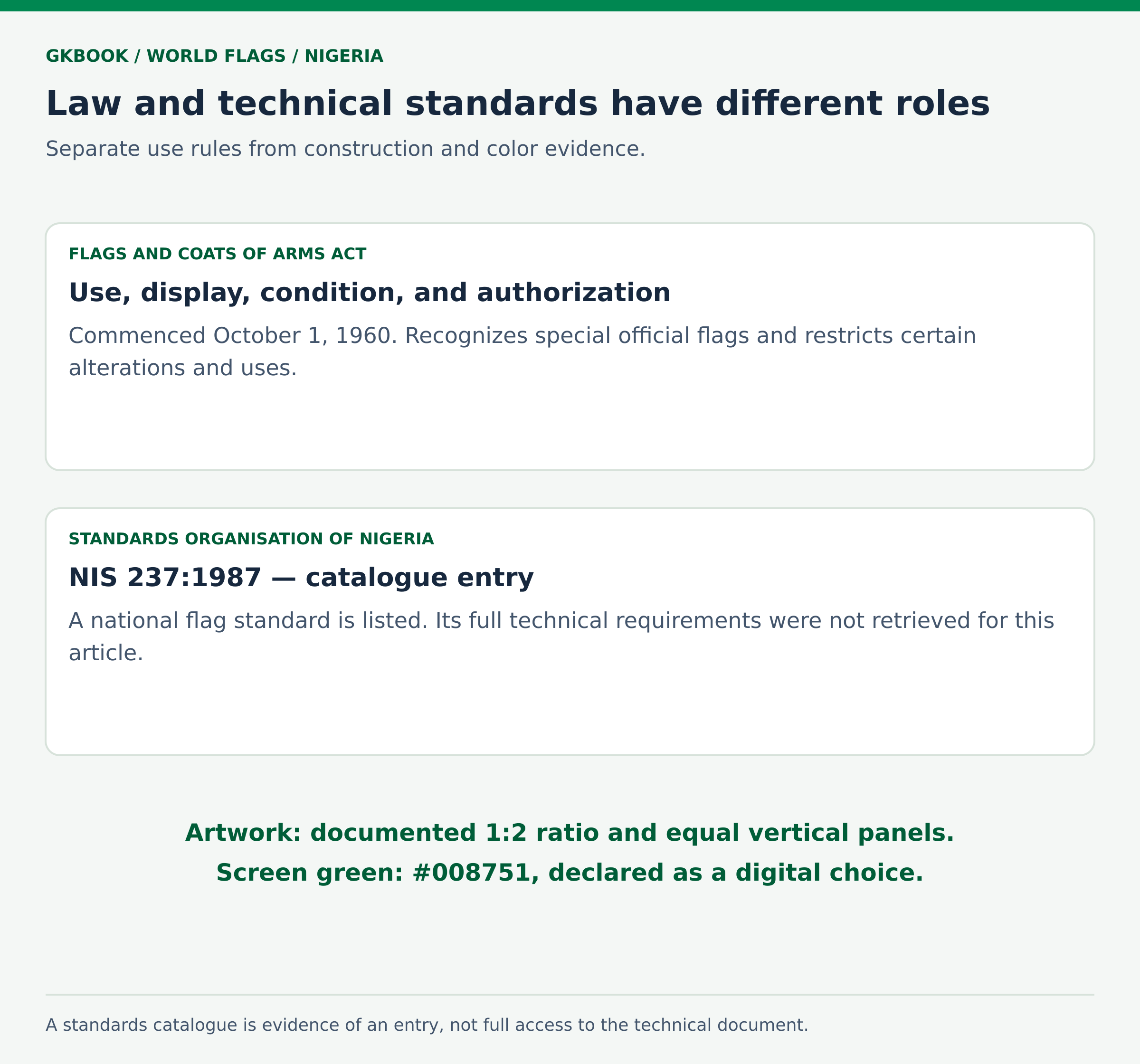
The Flags and Coats of Arms Act governs national and official flags, their display, alteration, and certain uses. It began on October 1, 1960. A separate SON catalogue entry identifies NIS 237:1987 for the national flag. The Act’s use rules and a technical production standard serve different purposes.

The Act addresses matters such as unauthorized alterations, special official flags, display with other flags, condition, and licensing. Its reproduced text should not be treated as if it were a complete technical drawing or a table of screen colors.
The accessible SON catalogue confirms the standard’s identifier and title, but the full standard was not available for inspection. This article therefore distinguishes documented legal provisions, official descriptions, and the digital reproduction choices used in the artwork.
| Document | Purpose established here | Evidence limit |
|---|---|---|
| Flags and Coats of Arms Act | Use, display, condition, and authorization rules | Legal text reproduced by PLAC |
| NIS 237:1987 catalogue entry | Identifies a national flag standard | Full technical standard not retrieved |
Does Nigeria’s national flag include the coat of arms?
The plain national flag does not include Nigeria’s coat of arms. It consists only of the three green-white-green panels. Flags carrying arms appear in official imagery and special contexts, but they should be identified separately. The national coat of arms is a distinct symbol, not a missing part of the plain flag.

Nigeria’s coat of arms includes a black shield with a white wavy Y, representing the Niger and Benue rivers, together with supporting horses and an eagle above. Its motto is Unity and Faith, Peace and Progress. Those features belong to the arms.
Some official web pages illustrate a flag carrying the arms even while discussing national symbols generally. That presentation is not a reason to insert the arms into every plain flag download. Captions should state which design is being shown.
Are there other official Nigerian flags?
Yes. Nigeria distinguishes its plain national flag from flags associated with particular offices and services. The Flags and Coats of Arms Act expressly recognizes presidential, naval, and departmental flags and restricts their use. A photograph of a special official flag should not be treated as a replacement for the ordinary green-white-green national design.

A flag can identify an office, vessel, or service as well as a country. Its authorized design and users depend on that role. The Act’s recognition of special flags does not supply a complete illustrated catalogue of all current variants.
This gallery explains the distinction without inventing military or presidential artwork. For a project that specifically needs one of those flags, use a verified current design from the responsible authority and identify its function in the caption.
What is Nigeria’s current national anthem, and is it part of the flag?
Nigeria’s current national anthem is Nigeria, We Hail Thee, restored on May 29, 2024. It replaced Arise, O Compatriots, which had been used since 1978. The anthem and flag are separate national symbols: the restoration did not put lyrics, musical notation, or a new emblem on the green-white-green flag.
The State House reported the signing of the National Anthem Bill on May 29, 2024 and identified the restored anthem. The Nigerian High Commission in Kenya also records the change. Older national-symbols pages may still display the former title.
The national motto, Unity and Faith, Peace and Progress, is associated with the coat of arms. Neither the motto nor the anthem title belongs inside the plain national flag. Their roles can be explained together without combining their artwork.
Which dates are associated with Nigeria’s flag?
October 1 is the anniversary of Nigeria’s independence and the flag’s official adoption in 1960. A separate 2024 National Orientation Agency policy statement designated September 16 for national-symbols enlightenment. These dates describe different events; a symbols-awareness observance should not be substituted for the flag’s documented adoption date.
October 1 connects the adopted flag directly with independence. The 2024 NOA publication discusses September 16 in the context of national symbols and civic education, rather than announcing a new national flag design.
Descriptions of the September observance have varied: a 2025 Voice of Nigeria report used the name National Ordinance Day. The article retains the date and context without inventing a separate statutory Flag Day or a permanent list of mandatory flag-flying dates.
How should Nigeria’s flag be displayed with other flags?
The Flags and Coats of Arms Act sets specific display restrictions. It prohibits sharing a staff or crossbar with certain other flags and requires the national flag to be at least as large as a Nigerian state flag and above it. That state-flag provision should not be extended automatically to foreign national flags.
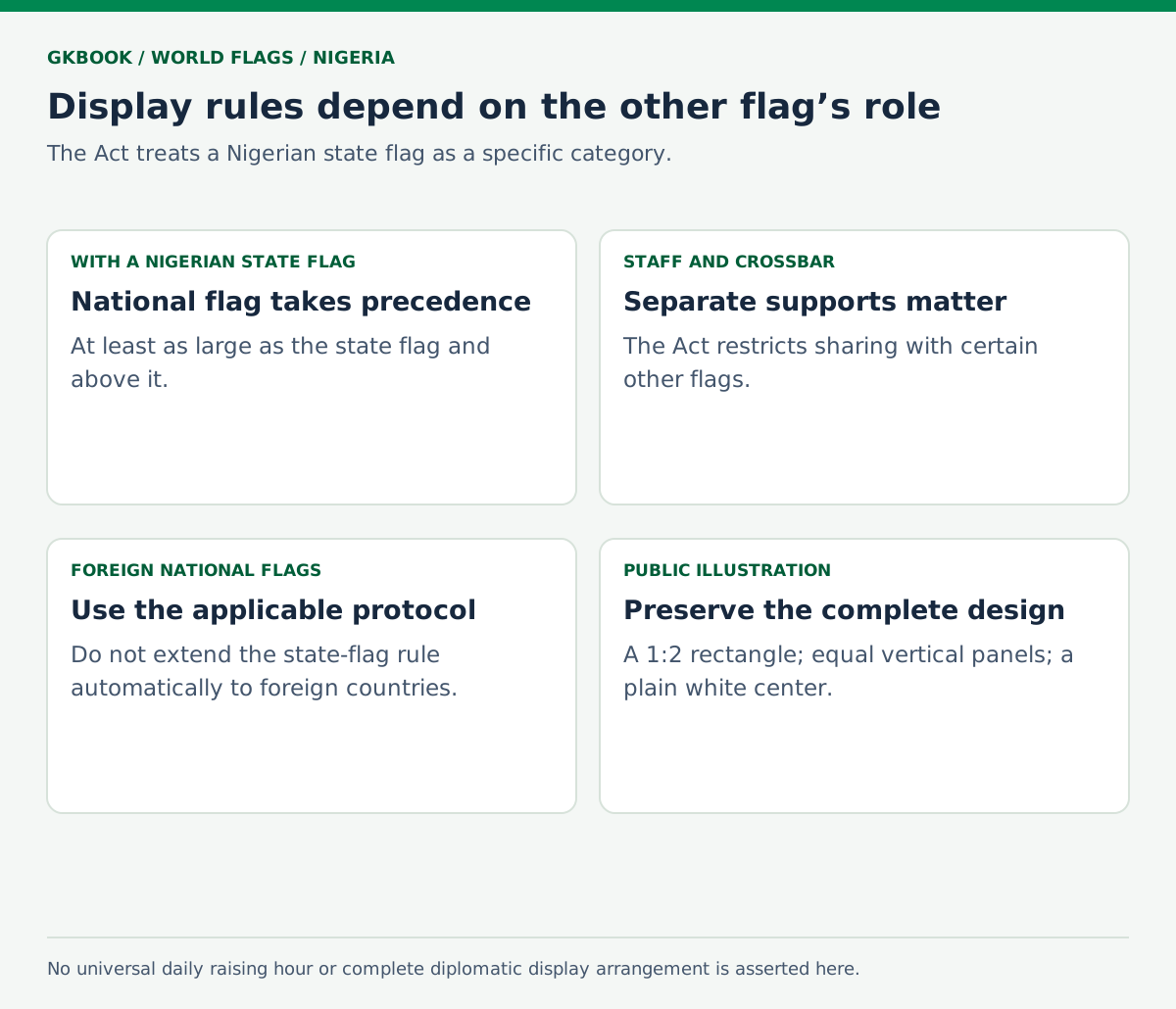
Different categories of flags matter. A Nigerian state flag and the flag of another sovereign country are not interchangeable examples. Formal events should follow the applicable national, diplomatic, and organizer instructions for the exact display being arranged.
For an ordinary illustration, preserve the complete 1:2 rectangle and its three equal vertical panels. For cloth flags, use sound attachments and suitable clearance. Practical care advice does not establish a universal daily raising hour or a detailed diplomatic seating plan.
When is Nigeria’s flag flown at half-mast?
Nigeria’s flag may be lowered for officially directed mourning. For example, the presidency ordered flags at half-staff following former President Muhammadu Buhari’s death in July 2025. That was a dated mourning instruction, not a permanent display rule. For a current ceremony, follow the applicable official notice and its stated duration.

Half-mast and half-staff both describe a lowered position used to mark mourning. The historical example demonstrates an official direction; it does not determine the position or duration for every later occasion.
The explanatory picture is schematic and does not prescribe a measured fraction of a pole. Pole height, flag size, and ceremonial instructions matter. An expired mourning announcement should never be presented as an order that remains in force today.
How should a Nigerian flag be cared for?
Keep a Nigerian flag clean, intact, and recognizable. The Flags and Coats of Arms Act addresses flags that are defaced, tattered, faded, or in bad condition. Replace damaged cloth and preserve the correct colors and proportions in digital copies. Specific cleaning, repair, storage, and disposal methods depend on the material and applicable instructions.

For fabric, follow the manufacturer’s care directions and avoid storing it damp. These are practical preservation measures rather than a claim that one household washing or folding ritual is prescribed nationwide.
For images, retain opaque white, use the same green in both outer bands, and scale the rectangle uniformly. A distressing filter or faded texture may be an artistic effect, but it is unsuitable for a clean educational reference showing the national design.
Can Nigeria’s flag be used in a logo or commercial design?
Commercial use should not be assumed unrestricted. The Flags and Coats of Arms Act distinguishes patriotic display from use connected with business, trade, professions, and other bodies, and includes authorization provisions. Before incorporating the flag or arms into a commercial identity, check the applicable requirements and obtain any necessary authority.
Section 5 provides for patriotic display without a license in its stated circumstances. That provision should not be read as blanket approval for every business logo or altered version of a national symbol.
An educational image download supplies artwork; it does not grant government authorization or imply official endorsement. The restrictions on special official flags also remain relevant when an emblem could suggest a connection with an office or service.
Does Nigeria’s flag look the same on the reverse?
Yes. The plain graphic design looks the same when reflected left to right, reflected top to bottom, or rotated 180 degrees. The identical green outer bands and uninterrupted vertical panels create these symmetries. Real cloth may still show different seams, printing strength, or translucency on its two sides.

A left-to-right reflection exchanges the two green panels, so their positions remain visually equivalent. A top-to-bottom reflection also preserves every panel because each extends through the full height. A half-turn combines these two reflections.
A quarter-turn is different: rotating the whole rectangle 90 degrees produces horizontal green-white-green bands inside a tall rectangle. That is a rotated presentation of the flag, not the standard landscape orientation shown in the master download.
What happens when Nigeria’s flag is displayed vertically?
Rotating the entire Nigerian flag through 90 degrees produces a tall rectangle with horizontal green-white-green bands. Both directions of rotation give the same color order because the outer panels match. This geometric result does not establish a national hanging protocol; formal vertical display should follow the responsible authority’s instructions.

Rotate the complete image if a layout calls for a rotated depiction. Do not squeeze a landscape flag into a tall box while retaining vertical bands; that distorts the rectangle and changes the proportions of its panels.
The rotation diagram is a teaching aid, with its role stated in the caption. It does not supply an unverified rule about which edge must face a viewer in every wall display, procession, or diplomatic setting.
What is the difference between Nigeria’s flag and Niger’s flag?
Nigeria uses vertical green-white-green bands and has no central emblem on its plain national flag. Niger uses horizontal orange-white-green bands with an orange sun disk in the center. The countries have similar names but distinct flags. Band direction, the orange color, and the disk provide quick identification clues.

Nigeria’s flag was designed by Michael Taiwo Akinkunmi and adopted on October 1, 1960. Niger’s flag was adopted on November 23, 1959. Those names and dates should not be transferred from one country’s history to the other.
The comparison shows Nigeria in its documented 1:2 proportions and Niger in a familiar 6:7 reference format. The Niger drawing uses a stated illustrative disk size and palette; it is included to explain identification features.
| Feature | Nigeria | Niger |
|---|---|---|
| Bands | Vertical green–white–green | Horizontal orange–white–green |
| Central device | None on the plain national flag | Orange sun disk |
| Flag adoption | October 1, 1960 | November 23, 1959 |
How is Nigeria’s flag different from Norfolk Island’s flag?
Nigeria and Norfolk Island both use vertical green-white-green arrangements, but their designs differ. Nigeria has three equal panels and no central emblem. Norfolk Island has a green pine tree in a wider white panel, with band widths in the ratio 7:9:7. Norfolk Island is an Australian external territory, not a separate sovereign state.

Norfolk Island’s Flag and Public Seal Act specifies an overall 1:2 ratio and the band fractions 7/23, 9/23, and 7/23. Nigeria also uses 1:2 overall proportions, but its three panel widths are equal.
The identification chart describes those distinctions without drawing an approximate pine and labeling it an exact official flag. A similar color order is not enough to establish that two flags are the same design.
| Feature | Nigeria | Norfolk Island |
|---|---|---|
| Overall height:length | 1:2 | 1:2 |
| Panel width ratio | 1:1:1 | 7:9:7 |
| Center | Plain white | Green Norfolk Island pine |
How do you draw Nigeria’s flag accurately?
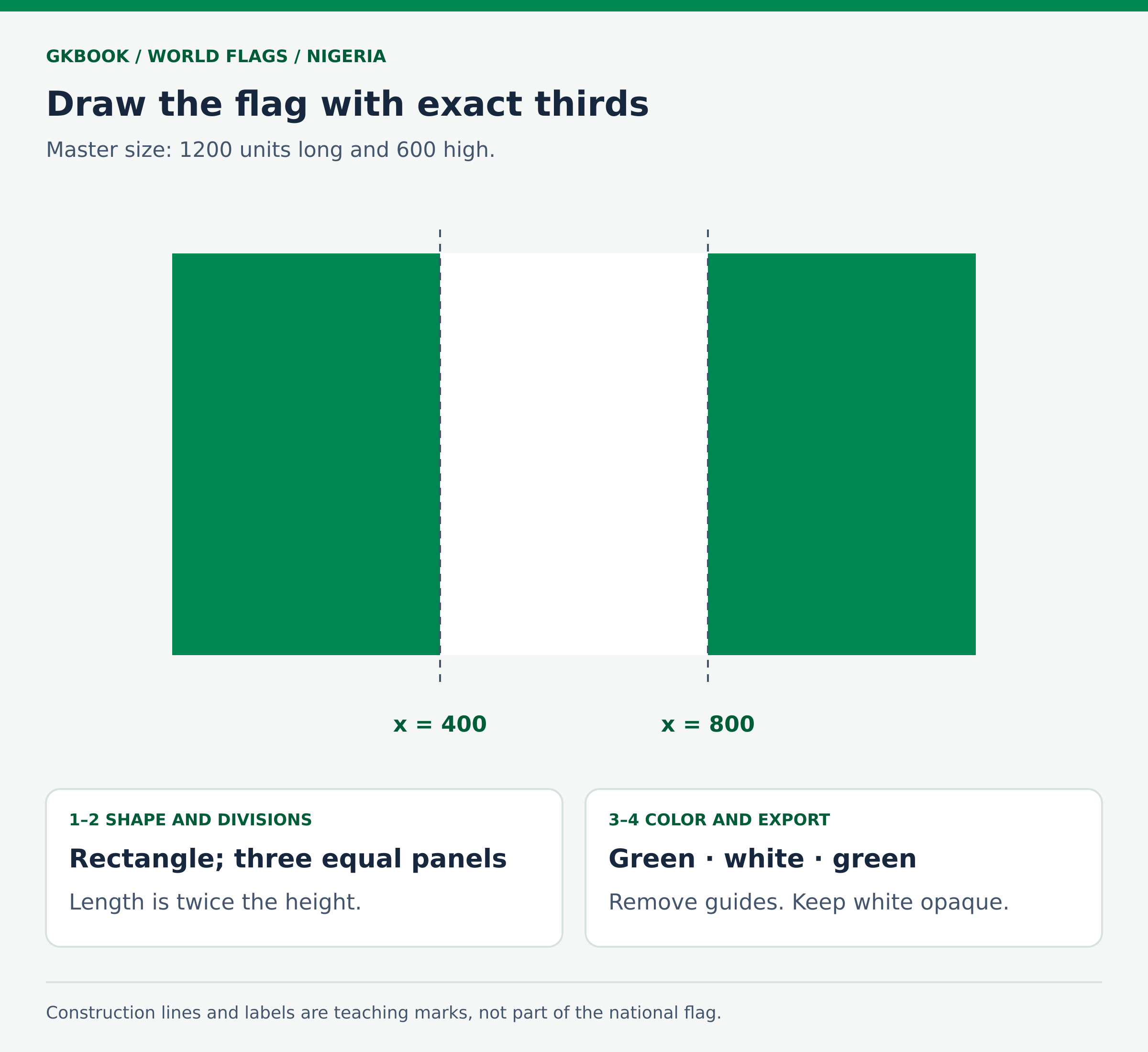
Draw a rectangle twice as long as it is high, then divide its length into three equal vertical panels. Fill the outer panels green and the middle panel opaque white. Add no emblem. For the supplied 1200 × 600 master, place the two internal boundaries at 400 and 800 units.

Start with exact dimensions rather than estimating the panels by eye. On a 1200-unit length, the three intervals are 0–400, 400–800, and 800–1200. Every panel shares the same 600-unit height.
Use a vector export for sharp edges at arbitrary sizes. When producing a PNG, retain the same ratio and align the panel boundaries to whole pixels where possible. Remove construction lines and labels from the final plain flag.
What common mistakes should be avoided when drawing Nigeria’s flag?
Avoid unequal panels, horizontal bands in the standard landscape view, a nonwhite center, different greens, and an added sun or coat of arms on the plain flag. Preserve the 1:2 ratio. Also keep Nigeria separate from Niger, and distinguish the 1959 design competition from official adoption on October 1, 1960.

A quick visual check asks four questions: Is the rectangle twice as long as high? Are the three panels equal and vertical? Are the outer panels the same green? Is the center plain opaque white? These checks catch most identification and construction errors.
The historical check is separate from the drawing check. Correct geometry does not make an incorrect designer, adoption date, or claim about official color certification accurate. A reliable caption distinguishes documented history from the choices made for a digital reproduction.
Download Nigeria flag pictures
Download the national flag as SVG or 4800 × 2400 PNG. The gallery contains 24 subjects, each with SVG and PNG versions. Keep the full rectangular image and preserve its proportions. Both formats retain the exact 1:2 ratio, three equal vertical panels, and opaque white center. The chosen digital colors are stated explicitly. The comparison diagrams distinguish other flags without presenting them as certified production masters. Image credits and reproduction notes accompany the artwork.
Explore more in World Flags, including the Niger flag and Nicaragua flag.
World Flags/Nigeria
Nigeria flag pictures
Three equal vertical green-white-green panels in 1:2 height:length proportions. The screen palette is #008751 and opaque #FFFFFF.
GKBook original educational artwork; digital color choices are declared.Download SVGDownload PNGAll three panels are equal in width. The two outside panels are the same green, and the center is plain opaque white.
GKBook original educational artwork; digital color choices are declared.Download SVGDownload PNGThe artwork uses #008751 green and #FFFFFF white. SON lists NIS 237:1987, but the selected screen colors are not claimed as a certified conversion of it.
GKBook original educational artwork; digital color choices are declared.Download SVGDownload PNGGreen represents agricultural and natural wealth. White represents peace and unity. The bands do not label three ethnic or religious communities.
GKBook original educational artwork; digital color choices are declared.Download SVGDownload PNGThe 1200 × 600 SVG is exactly 1:2. Each of the three vertical panels is 400 × 600 units; guide labels describe the master rather than the illustration’s display size.
GKBook original educational artwork; digital color choices are declared.Download SVGDownload PNGThree equivalent examples preserve the 1:2 ratio and equal vertical panels. They are scaling examples, not a claim that only one physical flag size is permitted.
GKBook original educational artwork; digital color choices are declared.Download SVGDownload PNGEach panel covers one third. Two green panels together cover two thirds; the white panel covers one third. There is no emblem covering part of the white area.
GKBook original educational artwork; digital color choices are declared.Download SVGDownload PNGThe competition proposal included a red sun; the judges removed it before adoption. This text diagram distinguishes the proposal from the adopted flag without inventing the original sun’s geometry.
GKBook original educational artwork; digital color choices are declared.Download SVGDownload PNGThe timeline distinguishes the 1959 design accounts, adoption and independence in 1960, republic status in 1963, and the 2024 anthem restoration.
GKBook original educational artwork; digital color choices are declared.Download SVGDownload PNGOctober 1, 1960 is both Nigeria’s independence date and the official adoption date of the green-white-green flag. The design competition came earlier.
GKBook original educational artwork; digital color choices are declared.Download SVGDownload PNGThe Act concerns use and display, while SON’s catalogue identifies a flag standard. The chosen screen palette is not represented as a certified conversion of the inaccessible standard.
GKBook original educational artwork; digital color choices are declared.Download SVGDownload PNGThe ordinary flag is a plain triband. The arms, motto, and current anthem are separate symbols; the 2024 anthem restoration did not change the flag.
GKBook original educational artwork; digital color choices are declared.Download SVGDownload PNGThe Act recognizes special presidential, naval, and departmental flags. Their presence does not replace the plain national triband. This diagram does not invent current variant designs.
GKBook original educational artwork; digital color choices are declared.Download SVGDownload PNGOctober 1, 1960 marks independence and flag adoption. Republic status came in 1963. September 16 was designated for national-symbols enlightenment in a 2024 NOA statement.
GKBook original educational artwork; digital color choices are declared.Download SVGDownload PNGThe Act’s state-flag precedence provision is distinct from rules concerning foreign flags. Formal displays require the instructions applicable to their setting.
GKBook original educational artwork; digital color choices are declared.Download SVGDownload PNGAn official July 2025 mourning direction illustrates half-staff use. The pole drawing is schematic; it does not claim a precise national lowering measurement or a continuing order.
GKBook original educational artwork; digital color choices are declared.Download SVGDownload PNGThe Act addresses poor flag condition. Practical cloth care follows material instructions; digital care preserves the complete rectangle, equal panels, and opaque colors.
GKBook original educational artwork; digital color choices are declared.Download SVGDownload PNGLeft-to-right reflection, top-to-bottom reflection, and 180-degree rotation all preserve the plain flag’s appearance. Fabric construction may still differ between sides.
GKBook original educational artwork; digital color choices are declared.Download SVGDownload PNGA 90-degree rotation creates a tall rectangle with horizontal green-white-green bands. This demonstrates geometry and does not establish a national wall-hanging rule.
GKBook original educational artwork; digital color choices are declared.Download SVGDownload PNGNigeria has vertical green-white-green panels and no central device. Niger has horizontal orange-white-green bands and an orange disk. Niger’s 6:7 drawing and disk measurements are illustrative conventions.
GKBook original educational artwork; digital color choices are declared.Download SVGDownload PNGNigeria has equal panels and no emblem; Norfolk Island has 7:9:7 panels and a green pine. The Norfolk panel-width diagram explicitly omits the pine and is not a complete flag.
GKBook original educational artwork; digital color choices are declared.Download SVGDownload PNGOn the 1200 × 600 master, place internal boundaries at x = 400 and x = 800. Fill the panels green-white-green, remove guides, and export without stretching.
GKBook original educational artwork; digital color choices are declared.Download SVGDownload PNGAvoid unequal panels, wrong orientation or ratio, added devices, inconsistent greens, and confusion with Niger. Keep the design year distinct from adoption.
GKBook original educational artwork; digital color choices are declared.Download SVGDownload PNG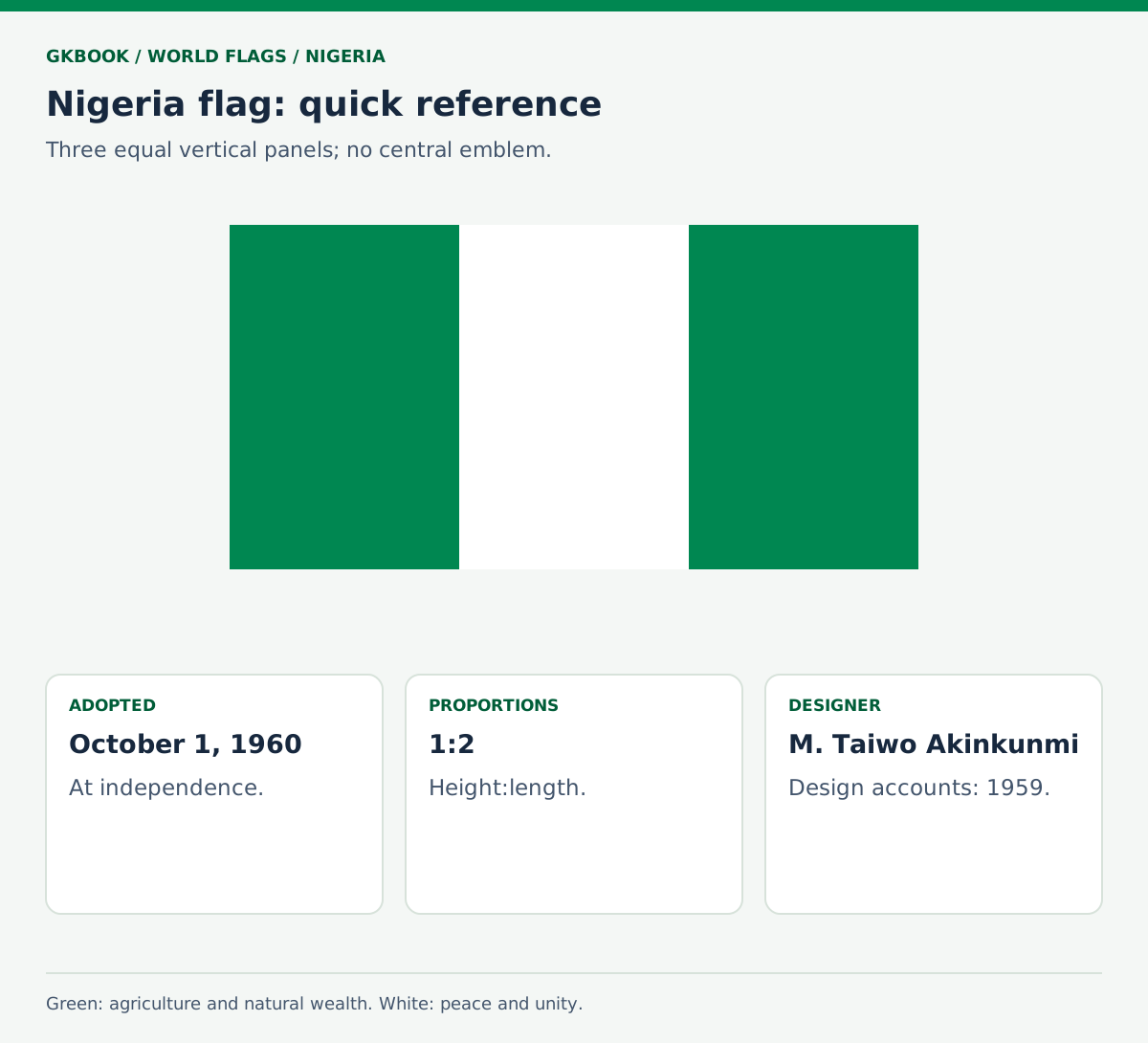
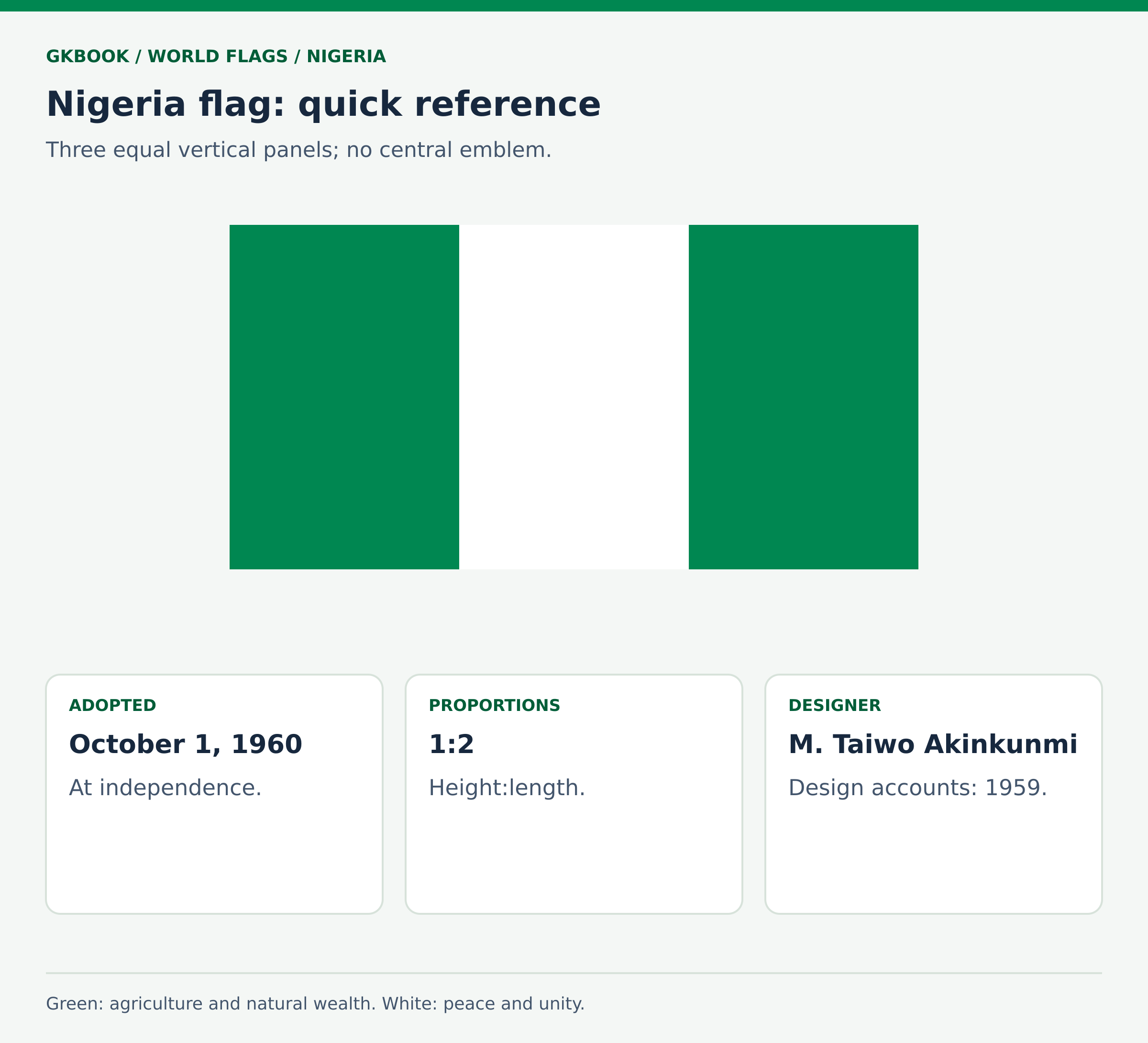
A compact reference combines the plain flag, October 1, 1960 adoption, 1:2 ratio, and designer Michael Taiwo Akinkunmi.
GKBook original educational artwork; digital color choices are declared.Download SVGDownload PNGFrequently asked questions
What does Nigeria’s flag look like?
Nigeria’s national flag has three equal vertical bands: green at the hoist, white in the center, and green at the fly. Its height:length ratio is 1:2, and the plain flag has no emblem. Designed by Michael Taiwo Akinkunmi, it was officially adopted on October 1, 1960, when Nigeria became independent.
What is the correct color order of Nigeria’s flag?
Nigeria’s flag reads green, white, green from the hoist to the fly. All three bands are vertical and equal in width, running through the full height of the rectangle. The hoist is the edge attached to the flagpole. Because both outer bands are green, viewing the reverse preserves the same color order.
What are Nigeria’s flag colors and color codes?
Nigeria’s national flag uses green and white. The downloadable artwork uses green #008751, equivalent to RGB 0, 135, 81, and white #FFFFFF, equivalent to RGB 255, 255, 255. These are declared screen colors. SON’s catalogue lists NIS 237:1987 for the national flag, but its full color specifications were not retrieved.
What does Nigeria’s flag symbolize?
The green bands represent Nigeria’s agricultural wealth and natural resources, while the white band represents peace and unity. Official explanations emphasize these shared national aspirations. The flag’s simple arrangement brings two green panels around a white center, expressing these meanings without adding a separate emblem, written motto, or religious symbol.
What do the two green bands on Nigeria’s flag mean?
The two green bands express Nigeria’s agricultural wealth and natural resources. They share one meaning and use the same green; they are not two differently colored regional symbols. Their equal widths frame the central white band, giving green two thirds of the flag’s total visible area in the plain national design.
What does the white band on Nigeria’s flag mean?
The central white band represents peace and unity in official explanations of Nigeria’s flag. It occupies one third of the flag’s length and extends through its full height. White is an actual part of the design, not an empty or transparent space that should take on the color of its background.
What is the ratio of Nigeria’s flag?
Nigeria’s flag has a height:length ratio of 1:2, so the rectangle is twice as long as it is high. Each of the three vertical panels occupies one third of that length. A 1200 × 600 drawing therefore has three panels measuring 400 units wide and 600 units high.
What dimensions should a Nigerian flag have?
Choose dimensions that preserve Nigeria’s 1:2 height:length ratio and divide the length into three equal panels. For example, a flag 60 centimeters high and 120 centimeters long has panels 40 centimeters wide. This package supplies a 1200 × 600 SVG and a 4800 × 2400 PNG with exactly corresponding proportions.
Does Nigeria’s flag have two colors or three?
Nigeria’s flag has two colors arranged in three bands. It is a vertical bicolor triband: green, white, green. Each band covers one third of the rectangle, but the two green bands together cover two thirds. White covers the remaining third because the plain national flag has no additional central device.
Who designed Nigeria’s national flag?
Michael Taiwo Akinkunmi designed Nigeria’s national flag. Official tourism and diplomatic accounts date his winning design to 1959, during preparations for independence. He entered a flag design competition while studying in Britain. The final adopted version retained his green-white-green arrangement after the sun in his submitted proposal was removed.
Did Akinkunmi’s original flag design include a sun?
Yes. Accounts of Akinkunmi’s competition proposal describe a red sun with rays in the white center. The judging process removed that feature before adoption, leaving the plain green-white-green triband. The proposed sun should therefore be explained as part of the design’s development, not displayed as an element of Nigeria’s current national flag.
When was Nigeria’s flag adopted?
Nigeria’s national flag was officially adopted on October 1, 1960, the day the country became independent from Britain. The design had been selected during preparations for independence, with official accounts dating Akinkunmi’s design to 1959. Selection of the design and adoption of the national flag are therefore distinct milestones.
What is the history of Nigeria’s flag?
Nigeria’s flag emerged from the preparations for independence. Akinkunmi’s green-white-green proposal won the design competition, its red sun was removed, and the plain triband was officially adopted on October 1, 1960. Later changes in government and the restoration of an earlier national anthem did not add a device to this national flag.
Was Nigeria’s flag adopted at independence or when it became a republic?
The flag was adopted at independence on October 1, 1960. Nigeria became a republic in 1963, a later constitutional milestone. These events should not be merged into one date. The adoption date belongs to the transition from British rule, while republic status concerns the subsequent form of the Nigerian state.
What flag was used in Nigeria before independence?
Before independence, British colonial authorities used flags belonging to the British ensign system, including designs with the Union Flag in the canton and colonial badges. A surviving Nigeria Marine ensign documents one such official use. These colonial flags differ fundamentally from the plain green-white-green national flag adopted in 1960.
What law governs Nigeria’s national flag?
The Flags and Coats of Arms Act governs national and official flags, their display, alteration, and certain uses. It began on October 1, 1960. A separate SON catalogue entry identifies NIS 237:1987 for the national flag. The Act’s use rules and a technical production standard serve different purposes.
Does Nigeria’s national flag include the coat of arms?
The plain national flag does not include Nigeria’s coat of arms. It consists only of the three green-white-green panels. Flags carrying arms appear in official imagery and special contexts, but they should be identified separately. The national coat of arms is a distinct symbol, not a missing part of the plain flag.
Are there other official Nigerian flags?
Yes. Nigeria distinguishes its plain national flag from flags associated with particular offices and services. The Flags and Coats of Arms Act expressly recognizes presidential, naval, and departmental flags and restricts their use. A photograph of a special official flag should not be treated as a replacement for the ordinary green-white-green national design.
What is Nigeria’s current national anthem, and is it part of the flag?
Nigeria’s current national anthem is Nigeria, We Hail Thee, restored on May 29, 2024. It replaced Arise, O Compatriots, which had been used since 1978. The anthem and flag are separate national symbols: the restoration did not put lyrics, musical notation, or a new emblem on the green-white-green flag.
Which dates are associated with Nigeria’s flag?
October 1 is the anniversary of Nigeria’s independence and the flag’s official adoption in 1960. A separate 2024 National Orientation Agency policy statement designated September 16 for national-symbols enlightenment. These dates describe different events; a symbols-awareness observance should not be substituted for the flag’s documented adoption date.
How should Nigeria’s flag be displayed with other flags?
The Flags and Coats of Arms Act sets specific display restrictions. It prohibits sharing a staff or crossbar with certain other flags and requires the national flag to be at least as large as a Nigerian state flag and above it. That state-flag provision should not be extended automatically to foreign national flags.
When is Nigeria’s flag flown at half-mast?
Nigeria’s flag may be lowered for officially directed mourning. For example, the presidency ordered flags at half-staff following former President Muhammadu Buhari’s death in July 2025. That was a dated mourning instruction, not a permanent display rule. For a current ceremony, follow the applicable official notice and its stated duration.
How should a Nigerian flag be cared for?
Keep a Nigerian flag clean, intact, and recognizable. The Flags and Coats of Arms Act addresses flags that are defaced, tattered, faded, or in bad condition. Replace damaged cloth and preserve the correct colors and proportions in digital copies. Specific cleaning, repair, storage, and disposal methods depend on the material and applicable instructions.
Can Nigeria’s flag be used in a logo or commercial design?
Commercial use should not be assumed unrestricted. The Flags and Coats of Arms Act distinguishes patriotic display from use connected with business, trade, professions, and other bodies, and includes authorization provisions. Before incorporating the flag or arms into a commercial identity, check the applicable requirements and obtain any necessary authority.
Does Nigeria’s flag look the same on the reverse?
Yes. The plain graphic design looks the same when reflected left to right, reflected top to bottom, or rotated 180 degrees. The identical green outer bands and uninterrupted vertical panels create these symmetries. Real cloth may still show different seams, printing strength, or translucency on its two sides.
What happens when Nigeria’s flag is displayed vertically?
Rotating the entire Nigerian flag through 90 degrees produces a tall rectangle with horizontal green-white-green bands. Both directions of rotation give the same color order because the outer panels match. This geometric result does not establish a national hanging protocol; formal vertical display should follow the responsible authority’s instructions.
What is the difference between Nigeria’s flag and Niger’s flag?
Nigeria uses vertical green-white-green bands and has no central emblem on its plain national flag. Niger uses horizontal orange-white-green bands with an orange sun disk in the center. The countries have similar names but distinct flags. Band direction, the orange color, and the disk provide quick identification clues.
How is Nigeria’s flag different from Norfolk Island’s flag?
Nigeria and Norfolk Island both use vertical green-white-green arrangements, but their designs differ. Nigeria has three equal panels and no central emblem. Norfolk Island has a green pine tree in a wider white panel, with band widths in the ratio 7:9:7. Norfolk Island is an Australian external territory, not a separate sovereign state.
How do you draw Nigeria’s flag accurately?
Draw a rectangle twice as long as it is high, then divide its length into three equal vertical panels. Fill the outer panels green and the middle panel opaque white. Add no emblem. For the supplied 1200 × 600 master, place the two internal boundaries at 400 and 800 units.
What common mistakes should be avoided when drawing Nigeria’s flag?
Avoid unequal panels, horizontal bands in the standard landscape view, a nonwhite center, different greens, and an added sun or coat of arms on the plain flag. Preserve the 1:2 ratio. Also keep Nigeria separate from Niger, and distinguish the 1959 design competition from official adoption on October 1, 1960.
Explore all general-knowledge topics and the A-to-Z lists.








We Value Your Opinion Comments