

Ivory Coast flag picture
A quick way to recognize the Ivorian flag: look for orange beside the pole, three equal panels, and a rectangle one and a half times as wide as it is tall.


| Country | Ivory Coast (Côte d’Ivoire)West Africa; both names identify the same national flag. |
|---|---|
| Design | Equal vertical tricolorOrange at the hoist, white in the center, green at the fly. |
| Adopted | December 3, 1959Law No. 59-240; adopted before independence. |
| Independence | August 7, 1960A separate historical milestone from flag adoption. |
| Proportions | 2:3 height:widthEquivalent to 3:2 width:height. |
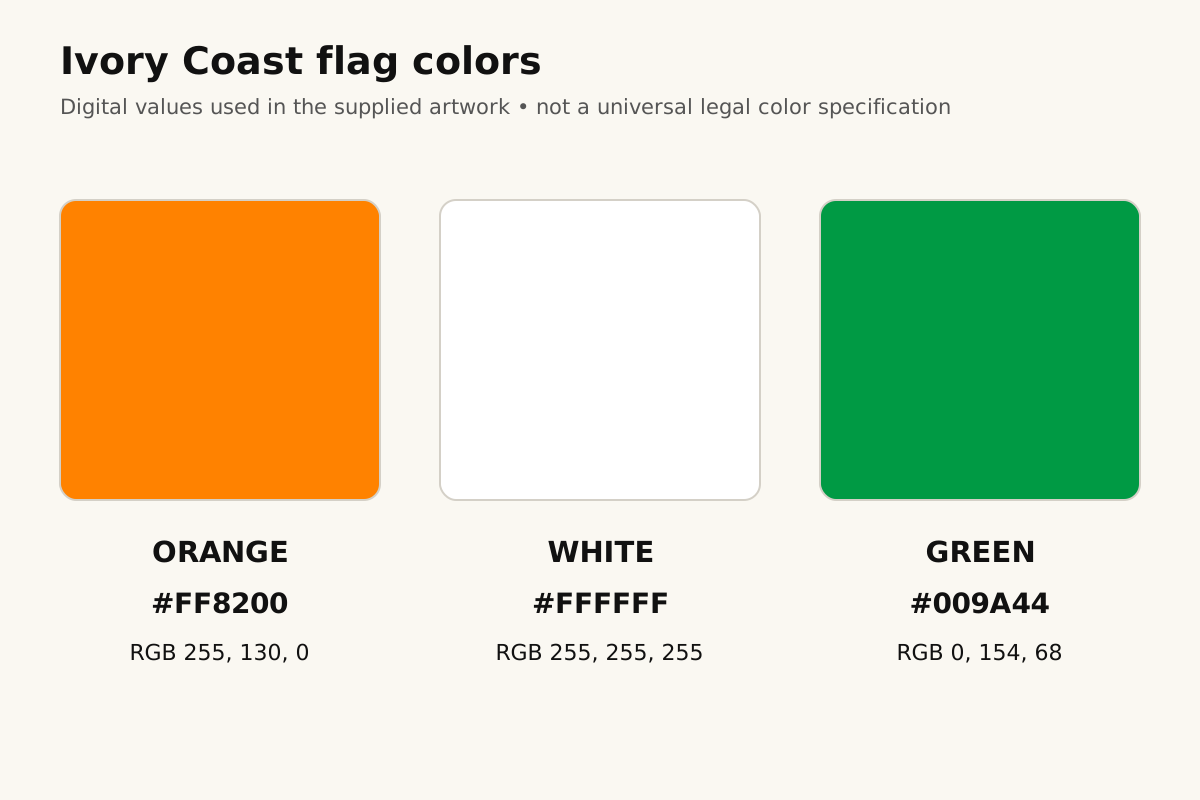
| Colors | Orange · White · GreenSelected digital values: #FF8200 · #FFFFFF · #009A44. |
| Emblem | None on the plain flagThe national coat of arms is a separate symbol. |
| Flag emoji | 🇨🇮Regional indicators C + I; distinct from Ireland’s 🇮🇪. |
| Related flag | Ireland flagOpposite hoist color and different proportions. |
| Explore | World FlagsDiscover more national flags and their meanings. |
An emblem of the country’s land, peace, and future.
Explore this flag guide
What is the flag of Ivory Coast?
The flag of Ivory Coast, officially Côte d’Ivoire, is a vertical tricolor of orange, white, and green. The three bands have equal widths, with orange beside the flagpole. Adopted on December 3, 1959, it uses a 2:3 height-to-width ratio and has no central emblem.
Read the colors from the hoist, the edge attached to the pole, toward the fly, the free edge. In a standard front-view illustration, that produces orange on the left, white in the middle, and green on the right. Explore other national designs in World Flags.
Are Ivory Coast and Côte d’Ivoire the same flag?
Ivory Coast and Côte d’Ivoire refer to the same country and the same national flag. Côte d’Ivoire is the French name used officially, while Ivory Coast is its familiar English translation. A flag labeled “Côte d’Ivoire,” “Ivory Coast,” or “Ivorian flag” should show the same orange-white-green design.
The country name does not create a second version of the flag. The French accent and apostrophe can vary in search queries, but neither changes the flag’s identity. The emoji also follows the country code CI, rather than the initials of its English translation.
What are the main features of the Ivorian flag?
Three uninterrupted vertical bands identify the Ivorian flag. Each occupies one-third of the total width and extends through the full height. Orange touches the hoist, white separates the two colored panels, and green reaches the fly. The plain national design contains no star, circle, lettering, or elephant.
| Feature | Correct arrangement |
|---|---|
| Bands | Three vertical rectangles of equal width |
| Order from the hoist | Orange → white → green |
| Shape | Rectangle, 3 units wide by 2 units high |
| Central symbol | None |
| White panel | An opaque band, not a transparent gap |
What are the Ivory Coast flag colors and HEX codes?
The Ivory Coast flag uses orange, white, and green. The digital artwork on this page uses orange #FF8200, white #FFFFFF, and green #009A44. These values identify the supplied images; they should not be mistaken for a universal legal specification for every textile, printing process, or government identity system.
| Color | HEX | RGB | Position |
|---|---|---|---|
| Orange | #FF8200 | 255, 130, 0 | Hoist / left |
| White | #FFFFFF | 255, 255, 255 | Center |
| Green | #009A44 | 0, 154, 68 | Fly / right |
Published reference palettes differ. For a physical order, agree on the required color standard and approve a sample on the actual material. A flag photographed in shade, bright sunlight, or artificial light is a poor color master.
What do the three colors symbolize?
Official Ivorian civic explanations connect orange with the country’s rich land and struggle for emancipation, white with peace grounded in justice, and green with confidence in a better future. Together, the colors express national identity and aspirations. Their meaning comes from Ivorian history, rather than from another country’s similar tricolor.

Why are savannas and forests mentioned in flag explanations?
Landscape explanations link orange with savanna land and green with forest and nature. Ivorian diplomatic materials use these associations alongside peace, unity, and a better future. They help explain the colors, but the flag is not a geographical map: its three equal panels do not mark borders or allocate regions.
The vertical placement should therefore be read as a flag design. It does not mean that all savannas lie to the west or all forests to the east. Regional landscape associations and the broader civic interpretation can be discussed together without treating either colored band as a literal territory.
Is the Ivory Coast flag ratio 2:3 or 3:2?
Both expressions can describe the same rectangle when their order is stated. The flag is 2:3 in height-to-width notation, or 3:2 in width-to-height notation. A correct image is therefore one and a half times as wide as it is tall, with three equal vertical panels inside that rectangle.
For example, a flag 90 centimeters high should be 135 centimeters wide. Its bands are each 45 centimeters wide. A 90-by-180-centimeter rectangle has different proportions, even if its three colors appear in the correct order.
How do you draw the Ivory Coast flag accurately?
Start with a rectangle three units wide and two units high. Divide its width into three equal parts, then fill them orange, white, and green from left to right. Keep every panel full height. The diagram’s labels, measurement lines, and outer framing explain the construction and are not part of the flag.
- Choose a height H and set the width to 1.5 × H.
- Place vertical boundaries at one-third and two-thirds of the width.
- Fill the first panel orange, the middle panel white, and the last panel green.
- Keep the finished national flag free of labels, shadows, gradients, and extra symbols.
What sizes preserve the correct proportions?
Any size can preserve the illustrated flag’s shape if width remains one and a half times height and each stripe stays one-third of the width. The examples below are calculated dimensions for artwork and practical planning. They are not presented as an official Ivorian catalog of approved flag sizes.
| Width × height | Width of each band | Example use |
|---|---|---|
| 30 × 20 cm | 10 cm | Small display |
| 90 × 60 cm | 30 cm | Medium display |
| 135 × 90 cm | 45 cm | Larger display |
| 180 × 120 cm | 60 cm | Large display |
| 1800 × 1200 pixels | 600 pixels | PNG supplied here |

When was the Ivory Coast flag adopted?
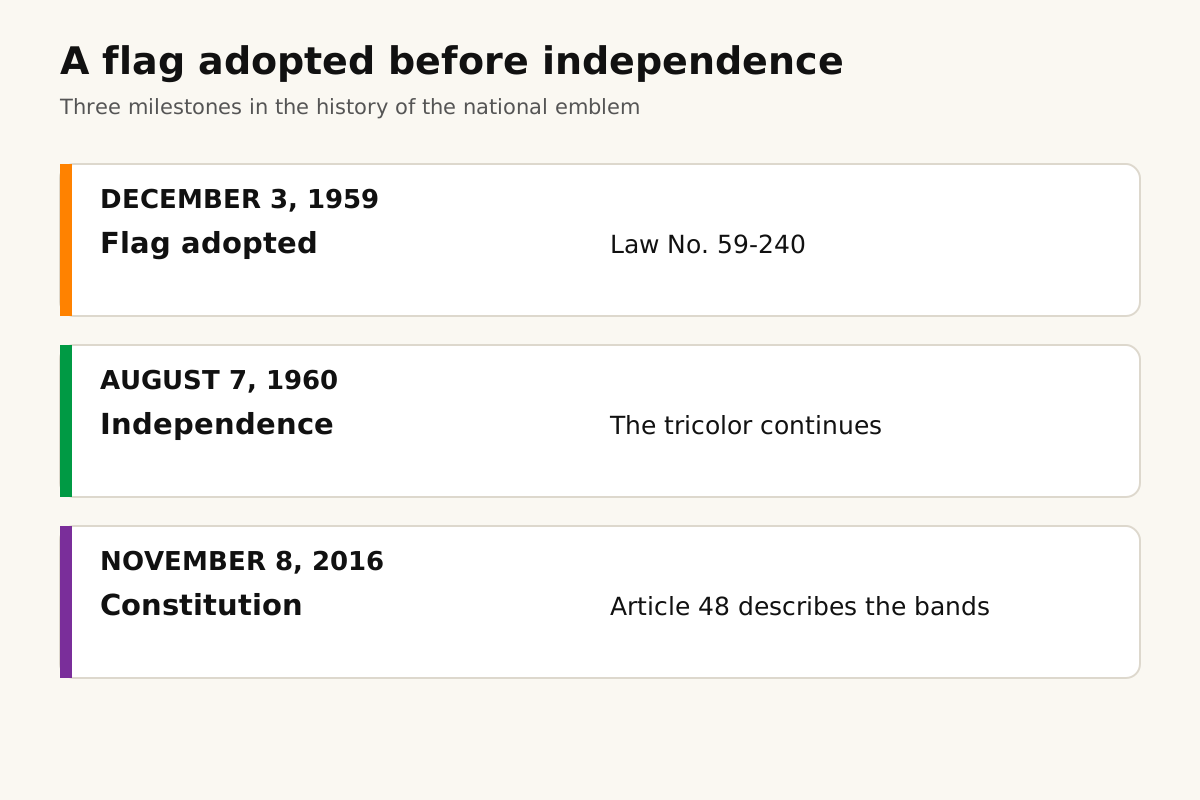
The Ivorian national flag was adopted on December 3, 1959, under Law No. 59-240, before independence from France on August 7, 1960. The orange-white-green tricolor continued as the independent country’s flag. Adoption and independence are separate milestones, so 1960 should not replace 1959 as the design’s adoption year.
National flag adopted
Law No. 59-240 establishes the orange-white-green emblem.
Independence
The country becomes independent from France with its tricolor already adopted.
Constitutional description
Article 48 of the 2016 Constitution describes the three equal vertical bands.
Why does the flag’s adoption date come before independence?
A territory can adopt national symbols while preparing for independence. Ivory Coast’s flag was established in December 1959, during that transition, and was already available when independence was proclaimed the following August. The two dates describe different events: choosing the national emblem and becoming an independent sovereign state.
This distinction also helps when reading captions. A photograph from an independence anniversary does not establish the first adoption date of the flag it shows. The present article uses 1959 for adoption and 1960 for independence consistently.
Who designed the Ivory Coast flag?
Pierre Achille is credited with design work in a family-published transcript of his 1984 recollection. That account describes collaboration with Ivorian political leaders. It should be identified as a historical testimony, while the formal adoption of the national emblem is separately documented by the December 3, 1959 law.
The transcript, published by the family of Louis Thomas Achille, describes Pierre Achille preparing designs at Philippe Yacé’s request. It also attributes the insertion of the white band to Félix Houphouët-Boigny. These details explain the attribution without treating a recollection as independently verified evidence of a single sole designer.
What does the Constitution say about the flag?
Article 48 of Côte d’Ivoire’s 2016 Constitution identifies the national emblem as an orange, white, and green tricolor with equal vertical bands. This describes the design’s essential arrangement. The article should not be treated as a source for every digital color code, printing specification, or detailed ceremonial procedure.
Some older summaries refer to Article 29 of the 2000 Constitution. That older numbering explains the discrepancy a reader may encounter; it does not describe a different national flag. Government civic materials now cite Article 48 of the 2016 text.
How is the Ivory Coast flag different from Ireland’s?
Ivory Coast places orange at the hoist, followed by white and green. Ireland places green at the hoist, followed by white and orange. Their proportions also differ: Ivory Coast is 2:3 in height-to-width notation, while Ireland is 1:2. Reversing the colors alone does not reproduce both flags accurately.
| Feature | Ivory Coast | Ireland |
|---|---|---|
| Order from the hoist | Orange, white, green | Green, white, orange |
| Height:width | 2:3 | 1:2 |
| Width for the same height | 1.5 × height | 2 × height |
| Central emblem | None | None |
| Flag emoji | 🇨🇮 | 🇮🇪 |
See the Ireland flag article for its own history and symbolism. A photograph can show the back of a cloth flag, so inspect the pole position before identifying a flag solely by apparent left-to-right color order.
How does it differ from the flags of Niger and India?
Ivory Coast uses vertical orange-white-green bands with no central symbol. Niger uses horizontal orange-white-green bands and an orange disk in the center. India uses horizontal saffron-white-green bands with a navy blue Ashoka Chakra. Band direction and central symbols distinguish these flags even when their broad color families appear similar.
| Country | Band direction | Center |
|---|---|---|
| Ivory Coast | Vertical | Plain white band |
| Niger | Horizontal | Orange disk |
| India | Horizontal | Navy blue wheel with 24 spokes |
Do not rotate an Ivorian flag and call it the Niger or India flag. Each has its own complete design. A similar color palette does not make their meanings, proportions, or rules interchangeable.
Which side of the Ivory Coast flag is orange?
Orange is the hoist color, beside the flagpole or attachment edge. In the usual front-view illustration with the pole on the left, orange appears on the left and green on the right. The reverse side of a real cloth flag can show the opposite visual order without being a different flag.

The design is symmetrical from top to bottom. Turning it upside down while keeping the hoist edge fixed does not create a visible change in its plain rectangular panels. Turning an image through a half rotation, however, moves orange to the other side. For identification, use the hoist and the proportions together.
Can the flag simply be rotated for a vertical display?
A portrait banner and a horizontal national flag are different display arrangements. For an ordinary reference picture, retain the standard orange-left, white-center, green-right rectangle. When an institution needs a hanging banner or ceremonial installation, confirm its required orientation and finishing with the organizer before rotating or manufacturing the artwork.
A rotated picture puts the colored bands across the display instead of running from top to bottom. That can confuse readers who are comparing national flags. Captions should identify any special display view rather than presenting it as the standard construction drawing.
What is the connection between the flag and August 7?
August 7 is Ivory Coast’s Independence Day, commemorating independence in 1960, and is a major occasion for national ceremonies and flag display. December 3 marks the flag’s 1959 adoption. These anniversaries have different meanings; the adoption date alone does not establish a separate official annual holiday called Flag Day.
For an actual ceremony, use the organizer’s current program. National anniversaries can coincide with special mourning instructions, as happened in 2023. A calendar date by itself is not enough to determine every detail of an official display.
What is the “salut aux couleurs” ceremony?
Salut aux couleurs is a ceremony honoring the national flag, commonly involving its raising and the national anthem, L’Abidjanaise. Ivorian institutions use such ceremonies to express civic commitment. The Public Service Ministry has documented a first-Monday-of-the-month practice, but an institution’s schedule should not be assumed to govern every private household.
For example, the ministry described its August 3, 2026 ceremony as a gathering around the symbols of the Republic, with a solemn flag raising and the anthem. Participants should follow the directions of the institution or ceremony leader for that event.
When is the Ivory Coast flag flown at half-mast?
Official half-mast display follows a mourning instruction issued for a particular occasion. After former president Henri Konan Bédié’s death, a 2023 presidential communiqué ordered state flags lowered during ten days of national mourning, including at embassies abroad. That historical order illustrates the practice; it is not a continuing instruction today.
The announcement covered August 2–11, 2023. An Abidjan district report on the August 7 ceremony described the flag being raised fully and then lowered to half height. For a new event, check its specific dates, institutions, and directions instead of copying an expired notice or another country’s mast-height rule.
Does the national flag include an elephant or coat of arms?
The plain national flag has no elephant, shield, text, or other emblem in its white band. Côte d’Ivoire’s coat of arms is a separate national symbol that includes an elephant’s head. Seeing the arms on an official object does not mean they belong on every reproduction of the national flag.
For a general reference image, use the unadorned tricolor. A specialized institutional flag or marked ceremonial object needs its own identification. The downloads on this page represent the plain national flag and do not add the coat of arms.
How should the flag be prepared for printing?
Use the SVG for artwork that must scale cleanly, or a sufficiently large PNG for a fixed-size layout. Preserve the 3:2 width-to-height ratio, equal band widths, and opaque white center. Agree on the printer’s color settings and finished dimensions, then inspect a proof before producing a larger batch.
The supplied PNG is 1800 × 1200 pixels. At 300 pixels per inch, that corresponds to 6 × 4 inches without resampling. Larger physical prints can use the SVG. Bleed, hems, sleeves, and seams should be planned outside or around the visible design so they do not accidentally narrow a finished band.
How can a physical Ivorian flag be cared for?
Inspect the cloth, seams, and attachment points regularly, especially after wind or rain. Follow the manufacturer’s cleaning guidance, dry the flag before storing it, and replace badly faded or torn material. These are practical care suggestions; they do not establish a special mandatory Ivorian folding ritual or disposal procedure.
Keep the white panel clean and the outer edges intact so the design remains recognizable. Fold or roll dry fabric gently for storage, away from moisture and direct sunlight. Institutions should use their own procedures when retiring a flag used in official ceremonies.
What is the Ivory Coast flag emoji?
The Ivory Coast flag emoji is 🇨🇮. It is encoded using the regional indicator symbols for C and I: U+1F1E8 and U+1F1EE. Different devices may draw the flag differently or show letters instead. The emoji identifies Côte d’Ivoire and should not be confused with Ireland’s 🇮🇪 sequence.
| Item | Value |
|---|---|
| Emoji | 🇨🇮 |
| Regional indicator letters | C + I |
| Unicode code points | U+1F1E8 U+1F1EE |
| Accessible text | Flag of Ivory Coast (Côte d’Ivoire) |
A flag image with descriptive alternative text is more dependable when exact appearance matters. Emoji artwork may have waving edges, shadows, or platform-specific colors, which makes it unsuitable as a manufacturing master.
Which Ivory Coast flag mistakes should be avoided?
Common mistakes include putting green at the hoist, stretching the flag to Ireland’s proportions, arranging the bands horizontally, adding an elephant, or making the center transparent. Another frequent error is using independence in 1960 as the adoption date. Check color order, equal widths, overall shape, and historical dates separately.
Keep the essentials
- Orange beside the pole.
- Three equal vertical bands.
- Width 1.5 times height.
- Solid white in the center.
- December 3, 1959 for adoption.
Check the context
- A reverse cloth view can change apparent color order.
- Emoji colors are not a printing standard.
- A coat of arms is a separate symbol.
- An old mourning order has its own dates.
- Decorative gradients are not part of the flag.
Which Ivory Coast flag pictures can be downloaded?
The downloads include a plain SVG flag, an 1800-by-1200-pixel PNG, and original diagrams explaining construction, colors, symbolism, orientation, history, sizes, and the comparison with Ireland. The plain flag files contain no labels. Diagrams are educational illustrations, with captions that distinguish their added explanatory elements from the national design.
| Download | Format | Purpose |
|---|---|---|
| Plain Ivory Coast flag | SVG | Scalable flag artwork |
| Ivory Coast flag, 1800 × 1200 | PNG | Opaque raster image |
| Illustrated picture gallery | SVG | Eight flag pictures and explanatory subjects |
Keep country names beside comparison pictures so readers can identify the two flags without relying on color alone. Every gallery item below has its own download link.
Ivory Coast flag pictures
Three equal vertical bands of orange, white, and green. Standard front view; width:height 3:2.
GKBook drawing; simple national flag geometry, public domain.Download image
A 3-by-2 rectangle with three panels, each 1 unit wide and 2 units high. Measurement marks sit outside the flag.
Original GKBook explanatory illustration.Download image
The selected SVG and PNG palette is #FF8200, #FFFFFF, and #009A44. Printing and textile colors require an agreed production specification.
Original GKBook explanatory illustration.Download image
Orange: land and emancipation. White: peace with justice. Green: hope and confidence in a better future. These labeled panels are explanatory artwork.
Original GKBook explanatory illustration.Download image
The Ivorian flag is orange-white-green and 3:2 wide-to-high. Ireland is green-white-orange and 2:1. Equal-height comparison preserves both shapes.
Original GKBook explanatory illustration.Download image
Orange remains adjacent to the pole. Seen from behind, a cloth flag can appear green-white-orange while still being the Ivorian flag.
Original GKBook explanatory illustration.Download image
The adoption date is December 3, 1959. Independence followed on August 7, 1960. The 2016 Constitution describes the equal vertical tricolor.
Original GKBook explanatory illustration.Download image
Examples are 30 × 20 cm, 90 × 60 cm, and 180 × 120 cm. Each keeps three equal bands; the illustrations do not share one physical scale.
Original GKBook explanatory illustration.Download imageFrequently asked questions
What is the flag of Ivory Coast?
The flag of Ivory Coast, officially Côte d’Ivoire, is a vertical tricolor of orange, white, and green. The three bands have equal widths, with orange beside the flagpole. Adopted on December 3, 1959, it uses a 2:3 height-to-width ratio and has no central emblem.
Are Ivory Coast and Côte d’Ivoire the same flag?
Ivory Coast and Côte d’Ivoire refer to the same country and the same national flag. Côte d’Ivoire is the French name used officially, while Ivory Coast is its familiar English translation. A flag labeled “Côte d’Ivoire,” “Ivory Coast,” or “Ivorian flag” should show the same orange-white-green design.
What are the main features of the Ivorian flag?
Three uninterrupted vertical bands identify the Ivorian flag. Each occupies one-third of the total width and extends through the full height. Orange touches the hoist, white separates the two colored panels, and green reaches the fly. The plain national design contains no star, circle, lettering, or elephant.
What are the Ivory Coast flag colors and HEX codes?
The Ivory Coast flag uses orange, white, and green. The digital artwork on this page uses orange #FF8200, white #FFFFFF, and green #009A44. These values identify the supplied images; they should not be mistaken for a universal legal specification for every textile, printing process, or government identity system.
What do the three colors symbolize?
Official Ivorian civic explanations connect orange with the country’s rich land and struggle for emancipation, white with peace grounded in justice, and green with confidence in a better future. Together, the colors express national identity and aspirations. Their meaning comes from Ivorian history, rather than from another country’s similar tricolor.
Why are savannas and forests mentioned in flag explanations?
Landscape explanations link orange with savanna land and green with forest and nature. Ivorian diplomatic materials use these associations alongside peace, unity, and a better future. They help explain the colors, but the flag is not a geographical map: its three equal panels do not mark borders or allocate regions.
Is the Ivory Coast flag ratio 2:3 or 3:2?
Both expressions can describe the same rectangle when their order is stated. The flag is 2:3 in height-to-width notation, or 3:2 in width-to-height notation. A correct image is therefore one and a half times as wide as it is tall, with three equal vertical panels inside that rectangle.
How do you draw the Ivory Coast flag accurately?
Start with a rectangle three units wide and two units high. Divide its width into three equal parts, then fill them orange, white, and green from left to right. Keep every panel full height. The diagram’s labels, measurement lines, and outer framing explain the construction and are not part of the flag.
What sizes preserve the correct proportions?
Any size can preserve the illustrated flag’s shape if width remains one and a half times height and each stripe stays one-third of the width. The examples below are calculated dimensions for artwork and practical planning. They are not presented as an official Ivorian catalog of approved flag sizes.
When was the Ivory Coast flag adopted?
The Ivorian national flag was adopted on December 3, 1959, under Law No. 59-240, before independence from France on August 7, 1960. The orange-white-green tricolor continued as the independent country’s flag. Adoption and independence are separate milestones, so 1960 should not replace 1959 as the design’s adoption year.
Why does the flag’s adoption date come before independence?
A territory can adopt national symbols while preparing for independence. Ivory Coast’s flag was established in December 1959, during that transition, and was already available when independence was proclaimed the following August. The two dates describe different events: choosing the national emblem and becoming an independent sovereign state.
Who designed the Ivory Coast flag?
Pierre Achille is credited with design work in a family-published transcript of his 1984 recollection. That account describes collaboration with Ivorian political leaders. It should be identified as a historical testimony, while the formal adoption of the national emblem is separately documented by the December 3, 1959 law.
What does the Constitution say about the flag?
Article 48 of Côte d’Ivoire’s 2016 Constitution identifies the national emblem as an orange, white, and green tricolor with equal vertical bands. This describes the design’s essential arrangement. The article should not be treated as a source for every digital color code, printing specification, or detailed ceremonial procedure.
How is the Ivory Coast flag different from Ireland’s?
Ivory Coast places orange at the hoist, followed by white and green. Ireland places green at the hoist, followed by white and orange. Their proportions also differ: Ivory Coast is 2:3 in height-to-width notation, while Ireland is 1:2. Reversing the colors alone does not reproduce both flags accurately.
How does it differ from the flags of Niger and India?
Ivory Coast uses vertical orange-white-green bands with no central symbol. Niger uses horizontal orange-white-green bands and an orange disk in the center. India uses horizontal saffron-white-green bands with a navy blue Ashoka Chakra. Band direction and central symbols distinguish these flags even when their broad color families appear similar.
Which side of the Ivory Coast flag is orange?
Orange is the hoist color, beside the flagpole or attachment edge. In the usual front-view illustration with the pole on the left, orange appears on the left and green on the right. The reverse side of a real cloth flag can show the opposite visual order without being a different flag.
Can the flag simply be rotated for a vertical display?
A portrait banner and a horizontal national flag are different display arrangements. For an ordinary reference picture, retain the standard orange-left, white-center, green-right rectangle. When an institution needs a hanging banner or ceremonial installation, confirm its required orientation and finishing with the organizer before rotating or manufacturing the artwork.
What is the connection between the flag and August 7?
August 7 is Ivory Coast’s Independence Day, commemorating independence in 1960, and is a major occasion for national ceremonies and flag display. December 3 marks the flag’s 1959 adoption. These anniversaries have different meanings; the adoption date alone does not establish a separate official annual holiday called Flag Day.
What is the “salut aux couleurs” ceremony?
Salut aux couleurs is a ceremony honoring the national flag, commonly involving its raising and the national anthem, L’Abidjanaise. Ivorian institutions use such ceremonies to express civic commitment. The Public Service Ministry has documented a first-Monday-of-the-month practice, but an institution’s schedule should not be assumed to govern every private household.
When is the Ivory Coast flag flown at half-mast?
Official half-mast display follows a mourning instruction issued for a particular occasion. After former president Henri Konan Bédié’s death, a 2023 presidential communiqué ordered state flags lowered during ten days of national mourning, including at embassies abroad. That historical order illustrates the practice; it is not a continuing instruction today.
Does the national flag include an elephant or coat of arms?
The plain national flag has no elephant, shield, text, or other emblem in its white band. Côte d’Ivoire’s coat of arms is a separate national symbol that includes an elephant’s head. Seeing the arms on an official object does not mean they belong on every reproduction of the national flag.
How should the flag be prepared for printing?
Use the SVG for artwork that must scale cleanly, or a sufficiently large PNG for a fixed-size layout. Preserve the 3:2 width-to-height ratio, equal band widths, and opaque white center. Agree on the printer’s color settings and finished dimensions, then inspect a proof before producing a larger batch.
How can a physical Ivorian flag be cared for?
Inspect the cloth, seams, and attachment points regularly, especially after wind or rain. Follow the manufacturer’s cleaning guidance, dry the flag before storing it, and replace badly faded or torn material. These are practical care suggestions; they do not establish a special mandatory Ivorian folding ritual or disposal procedure.
What is the Ivory Coast flag emoji?
The Ivory Coast flag emoji is 🇨🇮. It is encoded using the regional indicator symbols for C and I: U+1F1E8 and U+1F1EE. Different devices may draw the flag differently or show letters instead. The emoji identifies Côte d’Ivoire and should not be confused with Ireland’s 🇮🇪 sequence.
Which Ivory Coast flag mistakes should be avoided?
Common mistakes include putting green at the hoist, stretching the flag to Ireland’s proportions, arranging the bands horizontally, adding an elephant, or making the center transparent. Another frequent error is using independence in 1960 as the adoption date. Check color order, equal widths, overall shape, and historical dates separately.
Which Ivory Coast flag pictures can be downloaded?
The downloads include a plain SVG flag, an 1800-by-1200-pixel PNG, and original diagrams explaining construction, colors, symbolism, orientation, history, sizes, and the comparison with Ireland. The plain flag files contain no labels. Diagrams are educational illustrations, with captions that distinguish their added explanatory elements from the national design.
Are the three bands the same width?
Yes. Each band is one-third of the flag’s width and runs through its full height. On an image 1800 pixels wide and 1200 pixels high, each panel is 600 pixels wide. The equal division applies to the finished visible design, not to extra fabric used for hems or fittings.
Is the white stripe transparent?
No. White is one of the three colors of the national flag and should remain visible on any background. The supplied SVG includes a white rectangle, and the PNG has an opaque white center. Removing that panel would allow another background color to show through and change the flag’s appearance.
Can an Ivorian flag look like Ireland’s when seen from behind?
Yes. The reverse of an Ivorian cloth flag can appear green-white-orange, especially in a photograph where the pole is on the right. Identify the attachment edge and the rectangle’s proportions before naming it. Orange remains the Ivorian hoist color, while the Irish flag has green at its hoist.
Do the downloadable flag images contain a coat of arms?
No. The plain SVG and PNG reproduce only the three equal orange, white, and green bands. They do not include an elephant, shield, inscription, or watermark. The separate explanatory diagrams add labels and measurements around their illustrations so readers can understand the design without changing the plain flag master.
Explore all general-knowledge topics and the A-to-Z lists.


We Value Your Opinion Comments