
Ireland flag picture
Explore the construction sheet, adoption milestones, and horizontal and vertical display.

| Design | Green · white · orangeThree equal vertical bands; green nearest the staff. |
|---|---|
| Proportion | 2:1 width:heightAlso written 1:2 when height comes first. |
| First raising | March 7, 1848Thomas Francis Meagher, 33 The Mall, Waterford. |
| State adoption | 1922Adopted by the Irish Free State. |
| Constitution | 1937 · Article 7Expressly recognizes the three national colors. |
| Color reference | PMS 347 · white · PMS 151Government guide; screen codes are listed separately below. |
| Flag Day | March 16The Meagher Foundation’s annual school observance. |
| National Day | March 17St. Patrick’s Day; a national public holiday. |
The Irish tricolor has a 2:1 rectangle and three plain vertical panels. The Free State adopted it in 1922; Article 7 of the 1937 Constitution confirms its national status.
What does the flag of Ireland look like?
Ireland’s national flag is a rectangle divided into three equal vertical bands: green beside the staff, white in the center, and orange at the free edge. It is twice as wide as it is high. The design has no harp, shamrock, cross, lettering, or other emblem.
The flag is commonly called the Irish tricolor. Its Irish name is An Bhratach Náisiúnta, meaning the national flag. A clean front-view drawing places green on the viewer’s left. When cloth is seen from the other side, green still remains beside the staff even though the apparent left-to-right order changes.
What are Ireland’s flag colors and their color codes?
Ireland’s flag colors are green, white, and orange. The government guide specifies PMS 347 green and PMS 151 orange. This downloadable digital reference uses green #169B62, white #FFFFFF, and orange #FF883E. Its HEX and RGB values describe this artwork; they are not presented as official or exact conversions of the Pantone references.
| Color | Government guide | HEX in this artwork | RGB in this artwork |
|---|---|---|---|
| Green | PMS 347 | #169B62 | 22, 155, 98 |
| White | White; no Pantone number stated | #FFFFFF | 255, 255, 255 |
| Orange | PMS 151 | #FF883E | 255, 136, 62 |
The guide does not give these HEX values, RGB values, a CMYK recipe, or a coated/uncoated suffix after its Pantone numbers. Adding “C” or “U” and calling it the government’s exact specification would go beyond the source. A screen swatch and a dyed cloth sample also behave differently under changing light.
For an accurate print or textile order, preserve the specified color identities and consult the agreed physical color standard. Orange is part of the design: yellow or gold is not a substitute for the orange panel.
What do the colors of Ireland’s flag mean?
Green represents the older Gaelic tradition, commonly associated with Ireland’s mainly Catholic community. Orange represents the Protestant tradition associated with William of Orange. White expresses peace and reconciliation between them. The overall message is inclusion and a hoped-for union of people from different traditions, rather than a division into permanent opposing camps.
Thomas Francis Meagher explained the white band as “a lasting truce between Orange and Green.” The central white panel therefore has a connecting role. It is not simply unused space between two colored stripes.
This historical interpretation does not limit who belongs beneath the flag today. The government describes the national flag as an inclusive symbol for people of different ethnic origins, religions, and political convictions. Green is not merely a picture of Ireland’s landscape, and orange is not an accidental shade chosen to resemble gold.
What is the aspect ratio of Ireland’s flag?
Ireland’s flag has a width-to-height ratio of 2:1: its horizontal length is twice its vertical height. The same relationship is sometimes written 1:2 when height is listed first. The three upright bands have equal width, so each occupies one-third of the total width and extends through the full height.
| Total width | Total height | Width of each band |
|---|---|---|
| 1200 units | 600 units | 400 units |
| 180 cm | 90 cm | 60 cm |
| 90 cm | 45 cm | 30 cm |
| 30 cm | 15 cm | 10 cm |
| 3600 pixels | 1800 pixels | 1200 pixels |
| 6000 pixels | 3000 pixels | 2000 pixels |
Always state which dimension comes first. Writing “1:2” without a label can make a correct ratio look like the opposite of “2:1.” The horizontal flag is the wide rectangle. A vertical wall display rotates that same rectangle; it does not redefine the national flag’s proportions.
How can Ireland’s flag be drawn accurately?
Start with a rectangle twice as wide as it is high, then divide its width into three equal parts. Fill the first part green, the second white, and the third orange. On a 1200×600 grid, the dividing lines are at x=400 and x=800. Keep all teaching labels outside the clean flag.
If height is H, width is 2H and each panel is 2H/3 wide. For a 90-centimeter-high flag, the total width is 180 centimeters and each panel is 60 centimeters wide. There are no additional stars, badges, or lettering to position.
The white band is an opaque white panel, not a transparent gap. Keep that distinction when exporting an image for use over a colored background. Dimension marks and thin outlines are useful on a teaching sheet, but the national master should contain only the three fields.
What sizes can an Irish flag be made in?
The government guide allows any convenient size if the correct proportions are preserved. Examples include 180×90, 90×45, and 30×15 centimeters, with width first. Each follows the same 2:1 construction. These are calculated examples, while some military and naval uses have their own published size specifications for particular settings.
A Defence Forces magazine reference from February 2014 identifies the national flag as the Naval Service ensign and lists the following sizes. This is a dated service reference, not a claim that every civilian supplier must use one of these sizes.
| Naval ensign size in the 2014 reference | Fly × hoist |
|---|---|
| Large | 12 × 6 ft |
| Normal | 9 × 4.5 ft |
| Small | 6 × 3 ft |
| Boat | 4 × 2 ft |
The service reference describes wool bunting or a wool-and-nylon mixture. That material specification belongs to the naval context. The general government design guide does not make one fabric mandatory for every household, school, indoor display, or digital reproduction.
How did Ireland’s national flag develop over time?
The tricolor’s history extends from early nineteenth-century references through Meagher’s famous 1848 raising and the Easter Rising of 1916. It was adopted by the Irish Free State in 1922 and recognized in the Constitution in 1937. Those milestones describe different stages: public introduction, wider acceptance, state use, and constitutional status.
The green-harp tradition
Green flags bearing a harp appear in the older history described by the government. Later uses include the Irish Volunteers and United Irishmen.
Early references to tricolors
The official historical account mentions Irish tricolors before 1848. Their existence does not establish one fully standardized modern arrangement.
The Waterford raising
Thomas Francis Meagher raises a tricolor at 33 The Mall. This is the celebrated first-raising milestone identified in the government’s account.
The Paris flag and Dublin explanation
Meagher brings a flag from Paris and explains the colors as a message of reconciliation.
Limited early use
The tricolor remains known, but the older green flag with a harp is more prominent through much of this period.
Flags above the GPO
The tricolor flies alongside a green flag bearing the words Irish Republic. They are two different designs.
Adoption by the Irish Free State
The tricolor becomes the flag of the new state.
Recognition in the Constitution
Article 7 expressly identifies the national flag as green, white, and orange.
What flags were used before the Irish tricolor became prominent?
A green flag with a harp was an important older Irish symbol. The government’s historical account traces that tradition through the seventeenth century and later movements, including the Irish Volunteers and United Irishmen. Early Irish tricolors are mentioned in 1830 and 1844, but the green-harp flag remained prominent before the 1916 Rising.
These were historical traditions with variations, not a single modern manufacturing standard that can safely be projected across every century. Harp shapes, lettering, cloth proportions, and the circumstances of use varied. A generic green rectangle with an arbitrary harp should not be labeled an exact surviving flag of 1642 or 1798.
The tricolor was not immediately universal after 1848. The government account says it saw relatively little use between 1848 and 1916. Understanding that interval avoids the misleading impression that one new design instantly replaced all older Irish flags.
When and where was the Irish tricolor first raised?
The celebrated first raising took place on March 7, 1848, when Thomas Francis Meagher flew a tricolor at 33 The Mall in Waterford. The government identifies this as the flag’s first-flown milestone. Its fuller history also records earlier references to Irish tricolors, so 1848 should not be treated as proof that the colors had never appeared before.
The Waterford building was associated with the Wolfe Tone Club. The flag remained flying until the authorities removed it. The official account also records a tricolor in a procession to Vinegar Hill in County Wexford that day.
Meagher is central to the flag’s public introduction and explanation. That does not establish him as the sole inventor of every element or as the maker of every early cloth. Early band arrangements were not fully standardized; the government records examples with orange at the staff and one arranged orange, green, and white.
How was the Irish flag connected with France in 1848?
Meagher’s connection with the French revolution of 1848 helped give the Irish tricolor its international context. In April he brought a flag from Paris to a meeting in Dublin and explained its message of peace between Irish traditions. That presentation followed the March 7 Waterford raising; it was not the same event.
The three upright bands recall the broader tricolor tradition associated with France, but Ireland’s green, white, and orange have their own meaning. They should not be explained by simply borrowing the French flag’s historical interpretations.
Descriptions of a flag brought back from France are sometimes compressed into a single origin story. Keeping March and April separate makes the chronology clear. The artwork on this page shows the standardized present design; it is not claimed to reproduce the exact stitching, shades, or band order of a particular 1848 cloth.
What role did the Irish flag play in the 1916 Easter Rising?
During the Easter Rising, the tricolor flew over Dublin’s General Post Office alongside a different green flag bearing the words Irish Republic. Its association with the Rising helped establish it in the public imagination as the national flag. The green lettered flag and the tricolor should not be confused with one another.
The National Museum of Ireland identifies the surviving Irish Republic flag from the GPO among the material in its Easter Week collection. That artifact is evidence of the separate green design; it is not a green-white-orange tricolor with an inscription added.
The government also distinguishes the Citizen Army’s Starry Plough flag at the Imperial Hotel during the Rising. Several flags therefore belonged to the history of Easter Week. Reducing the event to a single flag can obscure what the surviving objects and historical accounts actually show.
The GPO photograph included below was taken in August 2003. It documents a modern tricolor above the building and is not presented as a photograph from 1916.
When was Ireland’s flag officially adopted?
The government dates adoption of the tricolor by the Irish Free State to 1922. Its position as the national flag was formally confirmed in Article 7 of the 1937 Constitution. The famous Waterford raising in 1848 and the flag’s prominence in 1916 came earlier; they are historical milestones, not interchangeable constitutional adoption dates.
| Date | Meaning |
|---|---|
| March 7, 1848 | Celebrated first raising at Waterford |
| Easter 1916 | Prominent use during the Rising |
| 1922 | Adopted by the Irish Free State |
| 1937 | Expressly recognized in Article 7 |
A reference table can legitimately emphasize either 1922 state adoption or 1937 constitutional recognition, provided it identifies which event it means. This page records both. It does not imply that the colors were invented in 1937 or that the current state existed in 1848.
What does Ireland’s Constitution say about the national flag?
Article 7 of Ireland’s Constitution identifies the national flag as the tricolor of green, white, and orange. It does not itself provide the aspect ratio, Pantone numbers, or a complete display manual. Those technical and ceremonial details are set out in guidance from the Department of the Taoiseach, whose role is advisory.
The 2025 government guide expressly describes its display provisions as guidelines rather than statutory requirements imposed on each individual. The constitutional identification of the flag and the advisory character of the protocol should therefore be kept separate.
This distinction also matters for reproduction. The guide supplies equal panels, a 2:1 rectangle, green at the staff, and two Pantone references. Those details should not be quoted as though every one of them were written into Article 7. The guide’s principles extend to respectful printed and electronic representations.
Is a harp or shamrock part of Ireland’s national flag?
No harp or shamrock appears on the national tricolor. They are separate Irish state emblems, and the President’s standard is a different flag with a gold harp on blue. St. Patrick’s saltire, a red diagonal cross on white, is another distinct symbol. None of these should be added to the three-band national design.
A plain tricolor, with separate state symbols
The harp’s role in Irish state symbolism does not make it a missing part of the flag. The presidential standard identifies a separate institution and use. The President’s official explanation describes a gold harp on a blue background, flown at Áras an Uachtaráin when the President is present.
A decorative gold fringe around a ceremonial flag is different from an emblem drawn over its panels. The government guide treats a fringe as an addition outside the flag’s integral design and permits it indoors or on outdoor ceremonial occasions.
St. Patrick’s saltire appears in the history of the Union Flag, whose current combination dates from 1801. It is not a substitute for the tricolor in identifying the national flag of Ireland today. The comparison here labels the two symbols separately.
Is the Irish tricolor the official flag of Northern Ireland?
The tricolor is the national flag of the state of Ireland. It is also used by many Irish nationalists in Northern Ireland, but that cultural or political use is different from official governmental status. The United Kingdom government identifies the Union Flag as Northern Ireland’s official flag, with separate rules governing designated government buildings.
The island of Ireland and the state named Ireland are not interchangeable geographic terms. The tricolor’s message of inclusion concerns people and traditions across the island; it does not, by itself, describe the current jurisdiction or flag rules of every institution on the island.
The July 2024 parliamentary answer states that the Union Flag is Northern Ireland’s only official flag. Current UK flag guidance continues to distinguish Northern Ireland’s statutory framework from the general UK government-building guidance. Sporting and community flags have their own contexts and should not be automatically treated as national state flags.
When is Ireland’s Flag Day?
The Thomas F. Meagher Foundation identifies March 16, the eve of St. Patrick’s Day, as its annual National Flag Day. Its school program emphasizes citizenship, inclusion, and respect for the flag. This is distinct from the March 7 anniversary of the 1848 first raising and from Ireland’s National Day on March 17.
The Foundation’s program invites schools to raise the Irish flag and recognize the national backgrounds represented in their communities. “National Flag Day” is the organizer’s name for this educational observance; it should not be turned into an unsupported claim that March 16 is a separate statutory public holiday.
Anniversary ceremonies may also take place on or around March 7 in Waterford and elsewhere. The existence of those commemorations does not make every flag-related event the same annual observance.
When is Ireland’s National Day and why is the flag flown then?
Ireland’s National Day is St. Patrick’s Day, March 17. It is also a public holiday and an important occasion for displaying the national flag. The date is separate from the Foundation’s March 16 Flag Day and the March 7 first-raising anniversary. It does not mark the tricolor’s adoption in 1922 or constitutional recognition in 1937.
The government’s flag guide lists St. Patrick’s Day among the occasions when the flag is flown from state buildings equipped with flagpoles. Private displays, festivals, and community celebrations also make the tricolor widely visible.
The guide additionally names the St. Brigid’s Day/Imbolc public holiday, Easter Sunday and Easter Monday, and the National Day of Commemoration. The last is observed on the Sunday closest to July 11, associated with the 1921 Anglo-Irish Truce. These are distinct occasions, with different historical meanings.
How should Ireland’s flag be displayed horizontally or vertically?
For a horizontal wall display, green belongs on the observer’s left, followed by white and orange. For a vertical wall display, green must be uppermost, white in the middle, and orange at the bottom. When the flag flies from a staff, green stays beside the staff regardless of which side of the cloth is visible.
The GPO photograph is a useful example of a reverse view. The pole stands to the right of the visible cloth, and the green band remains nearest it. The picture has not been digitally flipped to imitate a front-view reference.
For a platform display, the government guidance places the flag above and behind the speaker’s desk. It should not be used as a desk cover or draped across the platform itself. Keep an illustrated reference’s caption clear about whether it depicts flying cloth, a wall display, or a rotated diagram.
Where should the Irish flag stand beside other flags?
In an ordinary row of equal-height staffs, Ireland’s flag takes the place of honor at the observer’s left. If the European Union flag is included, it goes immediately to its right in that arrangement. Full EU-member displays have separate ordering rules. The government guide also describes special arrangements for a higher central staff.
For national flags displayed together, the guide calls for equal widths and separate staffs of equal height. Preserve each flag’s actual proportions: equal width does not mean stretching every design into an identical rectangle. No other flag or pennant should fly above the Irish flag.
For the complete EU-member grouping, the guide uses the countries’ names in their own primary languages for protocol order, with the EU flag first. It also allows an alternative arrangement beginning with Ireland and placing the EU flag at the far right. These specialized arrangements should not be confused with the ordinary short row shown in the diagram.
Where an existing central staff is higher, the guide assigns it to the Irish flag; it does not call for another Irish flag elsewhere in that group. With crossed staffs, the Irish flag is at the observer’s left and its staff is in front.
How should the Irish flag be carried and saluted?
When carried with other flags, the Irish flag occupies the marching right, which appears on the left to an observer facing the approaching group. It should be carried aloft and free. The guidance discourages dipping it as a salute, except to the dead during memorial ceremonies, and distinguishes civilian attention from uniformed hand salutes.
At a ceremonial raising or lowering, or when the flag passes in a parade, civilians acknowledge it by standing to attention and facing it. Uniformed personnel who normally salute by hand use that salute. The government guide describes beginning the parade salute when the flag is six paces away and maintaining it until the flag has passed.
When Amhrán na bhFiann, the national anthem, is played in the flag’s presence, the guidance calls for facing the flag and remaining at attention through the last note. This article does not reproduce the anthem’s lyrics.
Carried-flag protocol and a ship’s exchange of ensign salutes are different contexts. The 2014 Naval Service reference describes answering a vessel’s dipped ensign; that specialized naval practice should not be mistaken for a general instruction to dip a parade flag.
Can Ireland’s flag be flown at night?
Yes. The September 2025 government guide permits the flag to fly at night if it is properly illuminated throughout, preferably by a spotlight. Ordinary outdoor display is described as sunrise to sunset, with exceptions for the duration of public meetings, processions, and funerals. A blanket claim that nighttime display is always forbidden would be inaccurate.
The guide also supplies conventional hoisting and lowering times, rather than a daily astronomical sunrise-and-sunset calculator. The Defence Forces identify the same timetable for military purposes. These fixed times should not be confused with the actual changing times of dawn and dusk at every location.
| Period | Conventional raising time |
|---|---|
| March–October | 08:00 |
| November–February | 08:30 |
| Period | Conventional lowering time |
|---|---|
| January and December | 15:30 |
| February and November | 16:30 |
| March and October | 17:30 |
| April | 18:00 |
| May and September | 19:00 |
| June–August | 20:00 |
Arrange lighting so the flag is visibly illuminated for the entire nighttime display. Check the instructions applicable to the particular building or ceremony as well as the general national guidance.
How is Ireland’s flag flown at half-mast?
The government guide describes half-mast as about two-thirds up the pole, leaving at least one flag-depth of clear space above the flag and never going below the staff’s midpoint. Raise it to the peak before lowering to that position, and return it to the peak before taking it down. No other flag should fly alongside during mourning.
The name “half-mast” does not mean placing the flag automatically at exactly half the pole’s height. The guide’s clearance and midpoint conditions matter, especially when the flag is large relative to its staff. The diagram uses a 600-unit pole and a 120-unit-deep flag; its lowered top is 400 units above the base, leaving 200 units clear above it.
For prominent government buildings, the Department of the Taoiseach advises half-masting following the death of a national or international figure and may advise it after other tragedies. Local mourning may recognize a prominent local figure. The guide also permits an illuminated flag to remain at half-mast day and night for the duration of a funeral.
This explains the protocol; it does not announce a current mourning order. The instruction that no other flag should be flown accompanies the Irish mourning display and differs from countries where neighboring flags remain raised.
How is the Irish flag placed on a coffin?
When the Irish flag drapes a coffin, the green portion belongs at the head. The Defence Forces describe placing the flag lengthwise and evenly over the coffin at a state or military funeral. Their ceremonial specification is a flag measuring 9 by 4.5 feet with loops; it should not be generalized into a rule for every civilian flag.
The green-at-the-head rule is the essential orientation point. The government’s general guidance identifies coffin draping as an exception to the ordinary instruction that a flag should be carried aloft and free rather than flat.
Military instructions also govern the placement of headgear and other service items. Those arrangements depend on the ceremony and personnel involved. The simple schematic here shows the color orientation only, so it can explain the flag without pretending to replace a full military funeral plan.
Is there a prescribed ceremonial fold for Ireland’s flag?
The government guide describes a military folding tradition for a flag removed from a coffin, which others may follow. Orange is folded beneath white, then those layers beneath green. A further fold keeps green facing outward; larger flags may need another fold. This is a funeral tradition, not a universal requirement to make a triangular packet.
After the first two movements, the guide identifies the layer order as green on top, orange in the middle, and white underneath. The folded flag is normally presented to the deceased person’s next of kin. Bearers should coordinate their handoffs so the cloth stays secure.
For ordinary storage, follow the fabric’s care instructions and avoid putting damp cloth away. The ceremonial sequence and routine storage serve different purposes. Neither should be confused with the triangular folding conventions associated with some other national flags.
How should an Irish flag be cared for and retired?
Keep the flag clear of the ground, water, branches, and other obstructions, and do not display worn or frayed cloth. The government guide calls for dignified destruction or disposal when a flag is no longer fit for display. It does not prescribe burning as the only method. Cleaning and storage should suit the actual fabric.
Inspect the fastenings, edges, seams, and color fields. Follow the manufacturer’s cleaning directions and dry the flag before storing it. For historically important cloth, seek conservation advice rather than treating an archival object like an ordinary replaceable outdoor flag.
Respect also concerns the design: the guidance says not to add slogans, logos, pictures, or lettering, including at sporting events. It permits suitable small decorative uses, such as lapel buttons or table arrangements, while keeping the flag’s identity clear. Bunting in the national colors is different from altering the national flag itself.
What common mistakes should be avoided with Ireland’s flag?
Common mistakes include substituting yellow or gold for orange, reversing the front-view color order, using unequal bands, or stretching the flag into a 3:2 rectangle. Adding a harp, shamrock, slogan, or sports logo changes the national design. Also avoid treating a reverse-facing photograph, a decorative fringe, or a historical symbol as a different modern national flag.
| Check | Correct reference |
|---|---|
| Front-view order | Green, white, orange |
| Proportions | 2:1 width:height |
| Panel width | One-third of total width each |
| Vertical wall display | Green uppermost |
| Emblem or text | None |
| Orange panel | Orange, not yellow or gold |
| Coffin drape | Green at the head |
| Digital values | File-specific; do not invent exact Pantone conversions |
A gold fringe belongs outside the plain rectangular design. It does not make a gold-colored third panel acceptable. In the same way, a photograph of green at the camera’s right is not automatically wrong: first identify the staff and determine which side of the cloth the camera sees.
How is Ireland’s flag different from Côte d’Ivoire, Italy, and France?
Ireland’s front-view flag is green-white-orange with a 2:1 width-to-height ratio. Côte d’Ivoire is orange-white-green and usually shown in a 3:2 rectangle. Italy is green-white-red, while France is blue-white-red; their references here are also 3:2. Check both the color beside the staff and the flag’s proportions rather than relying on a thumbnail alone.
| Flag | Hoist → center → fly | Width:height of reference |
|---|---|---|
| Ireland | Green → white → orange | 2:1 |
| Côte d’Ivoire | Orange → white → green | 3:2 |
| Italy | Green → white → red | 3:2 |
| France | Blue → white → red | 3:2 |
A reverse view of Irish cloth can superficially resemble the front view of Côte d’Ivoire’s flag. The staff relationship resolves the ambiguity: green remains at Ireland’s hoist. The references also use their own distinct shades; this comparison does not recolor them to force a match.
What do real photographs show about Ireland’s flag?
The two photographs show the tricolor above Dublin’s General Post Office in August 2003 and at a diplomatic meeting at Shannon International Airport on May 24, 2021. One illustrates a reverse view of flying cloth; the other shows an indoor flag with fringe. Their dates and settings distinguish documentary use from flat reference artwork.
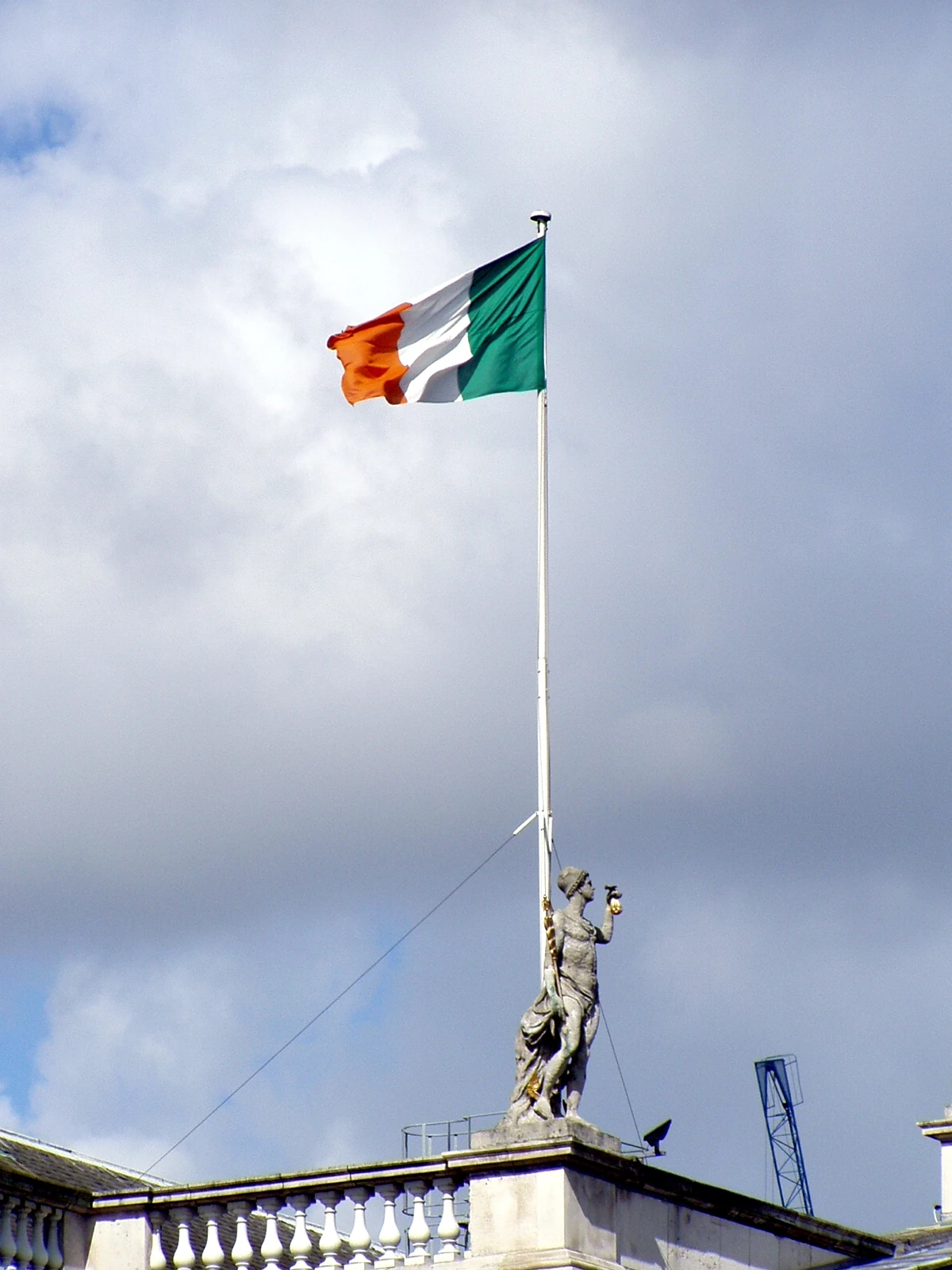
Thorsten Pohl released the GPO photograph into the public domain. Its 2005 upload date is not the date it was photographed. Ron Przysucha made the Shannon image for the U.S. Department of State; its original caption identifies Simon Coveney and Antony Blinken at their 2021 meeting.
Both delivered photographs retain the full original frame and natural orientation. Smaller WebP files provide responsive copies. Folds, shadows, lighting, and perspective are part of the scene, so the photos are not used as measurements of official dye shades or exact geometric proportions.
What is the Ireland flag emoji?
The Ireland flag emoji is 🇮🇪. It consists of the regional indicator symbols I and E, with Unicode code points U+1F1EE and U+1F1EA. Platforms may display that sequence as a flag or as letters. Its small, platform-specific artwork is useful in text but is not a substitute for the full national reference drawing.
The sequence corresponds to the country code IE. An emoji may appear as a waving shape, so measuring its visible outline is not a reliable way to establish the underlying flag’s 2:1 ratio.
For printing, teaching, or comparing panel widths, use the SVG or the large PNG. They preserve the complete rectangle and its equal vertical thirds without depending on a particular operating system’s emoji design.
Which Ireland flag pictures can be downloaded here?
The downloads include a clean 2:1 SVG, a 6000×3000 PNG, labeled construction and orientation sheets, a historical timeline, observance and mourning diagrams, comparison graphics, and two documentary photographs. Each gallery item has a local download with an explanatory caption. The national master contains only the green, white, and orange panels, without teaching labels or borders.
| Download | Purpose |
|---|---|
| National SVG | Scalable clean flag; intrinsic size 3600×1800 |
| National PNG | 6000×3000 raster flag |
| Explanatory SVGs | Geometry, history, protocol, and comparisons |
| Documentary WebP | Dated photographs with visible credits |
| Credits text | Local filenames, captions, creators, and rights |
Download Ireland flag SVG · Download large PNG · Download credits.
The 1200×630 social preview includes a heading and supporting text, so it serves a different purpose from the plain national flag. None of the explanatory drawings is represented as an original nineteenth-century artifact or an official manufacturer’s certification.
Ireland flag pictures

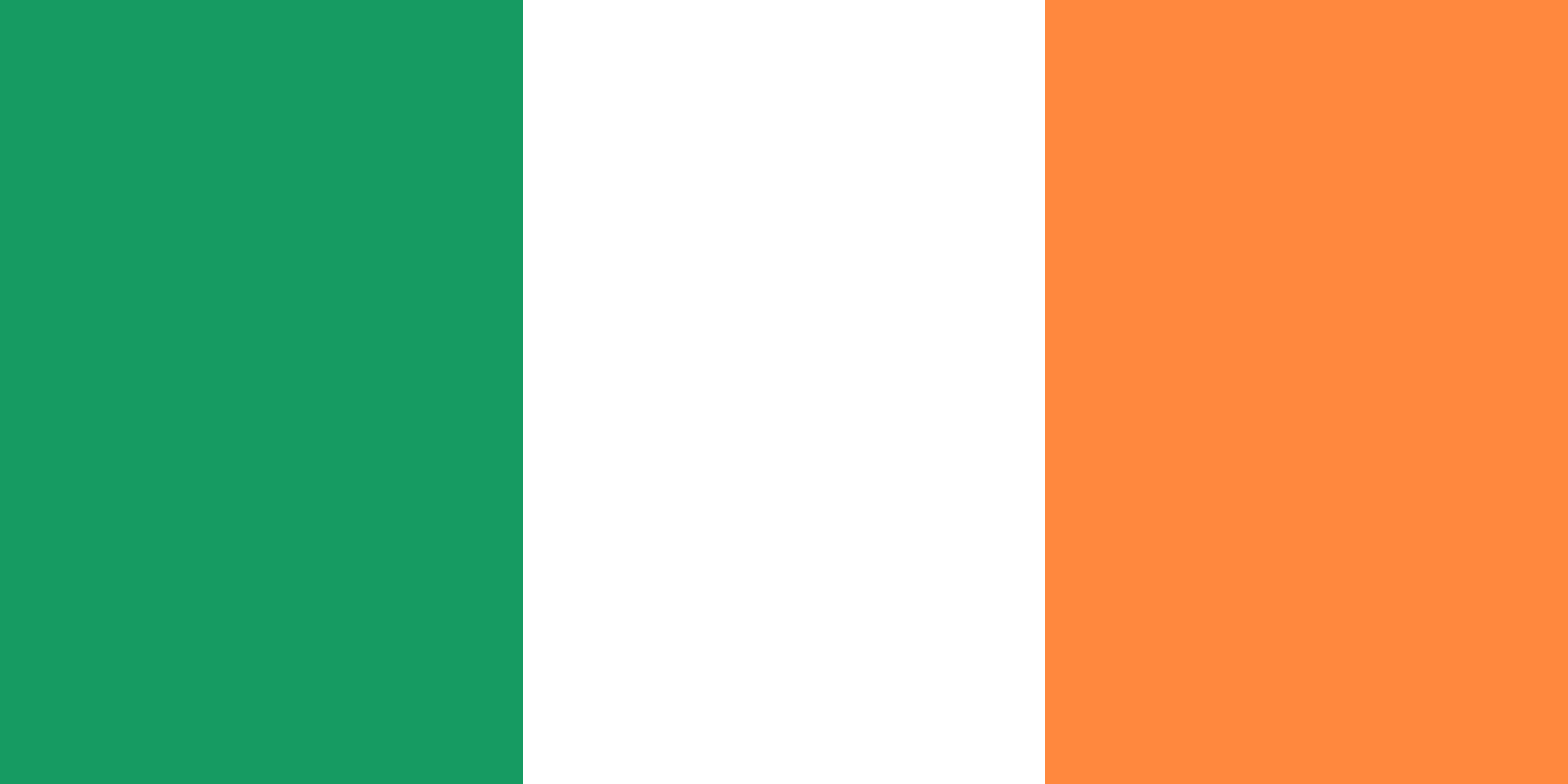
Ireland’s national flag consists of three equal vertical bands of green, white, and orange, with green at the hoist. Its width:height ratio is 2:1. This clean digital reference uses #169B62, #FFFFFF, and #FF883E.
Ireland national design, public domain; reference vector by SKopp and Commons contributors. GKBook preparation.Download image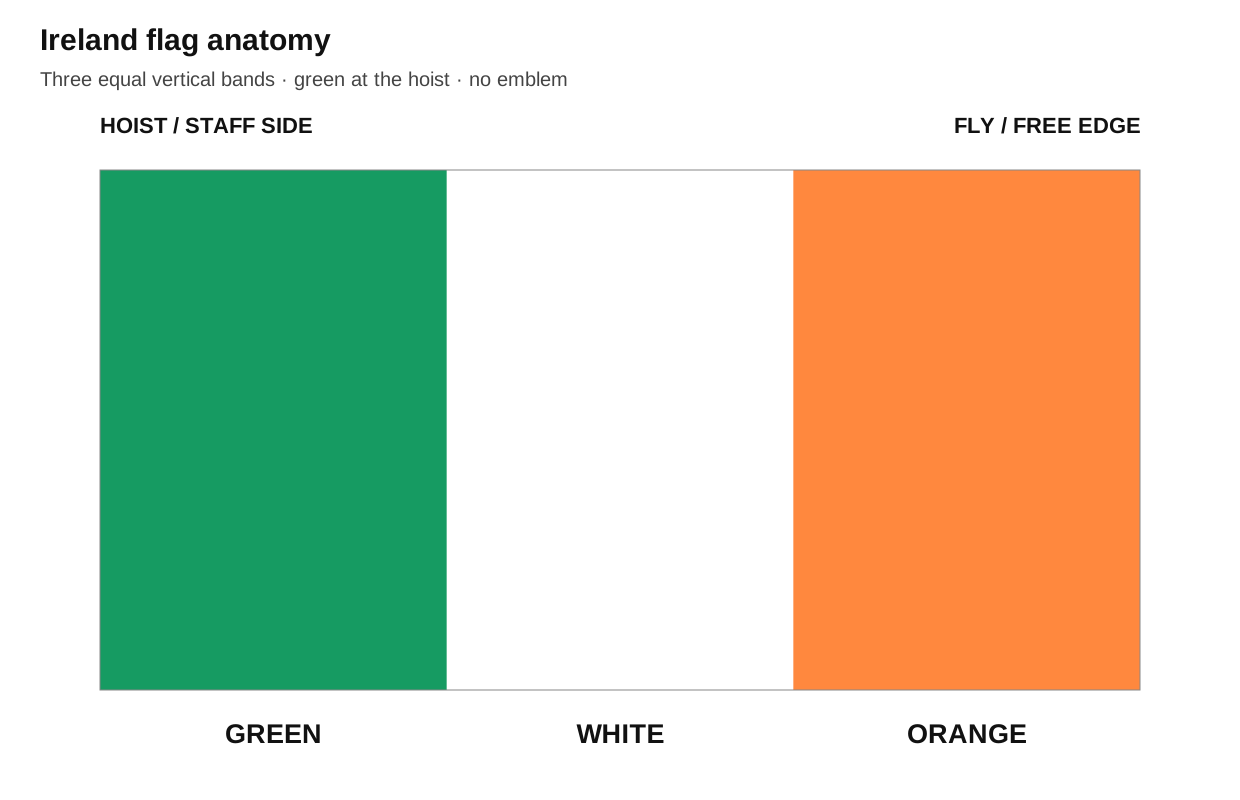
Green is nearest the staff, white occupies the middle third, and orange is at the free edge. Each band runs the full height. The national tricolor has no harp, shamrock, cross, lettering, or other emblem.
GKBook composition, CC0; flag reference geometry, public domain.Download image
The supplied digital palette is green #169B62, white #FFFFFF, and orange #FF883E. The government guide separately names PMS 347 green and PMS 151 orange. The screen values are not claimed as official or exact Pantone conversions.
GKBook composition, CC0; flag reference geometry, public domain.Download image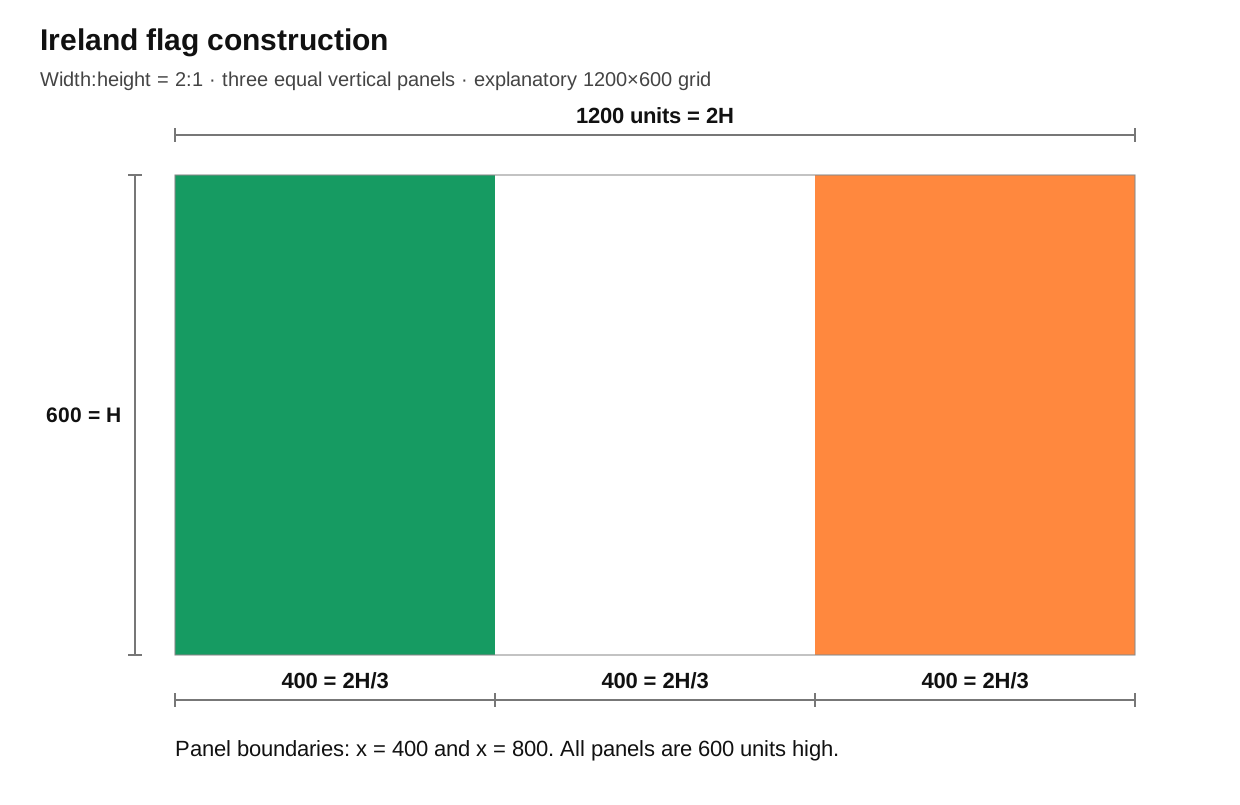
On a 1200×600 coordinate grid, the vertical boundaries fall at x=400 and x=800. Each band is 400 units wide and 600 units high. For any height H, total width is 2H and each panel width is 2H/3.
GKBook composition, CC0; flag reference geometry, public domain.Download image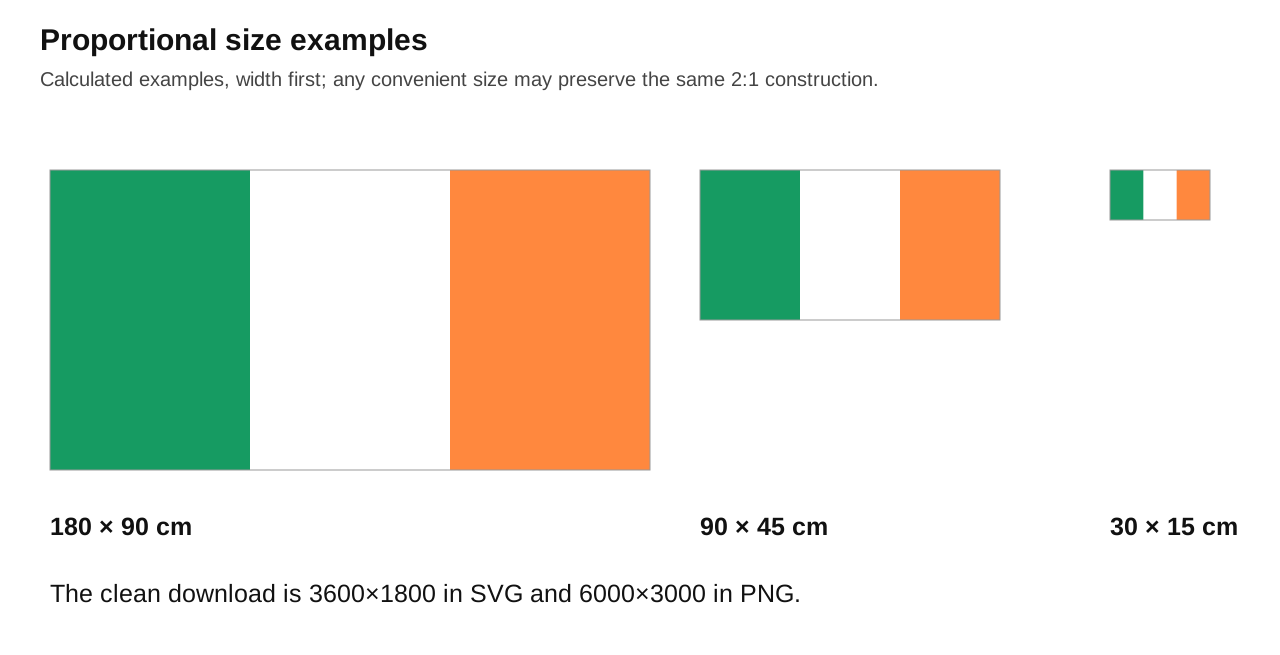
The 180×90, 90×45, and 30×15 centimeter examples all preserve the 2:1 ratio. These examples explain proportional scaling; they are not assigned by this page to particular buildings, boats, or ceremonies.
GKBook composition, CC0; flag reference geometry, public domain.Download image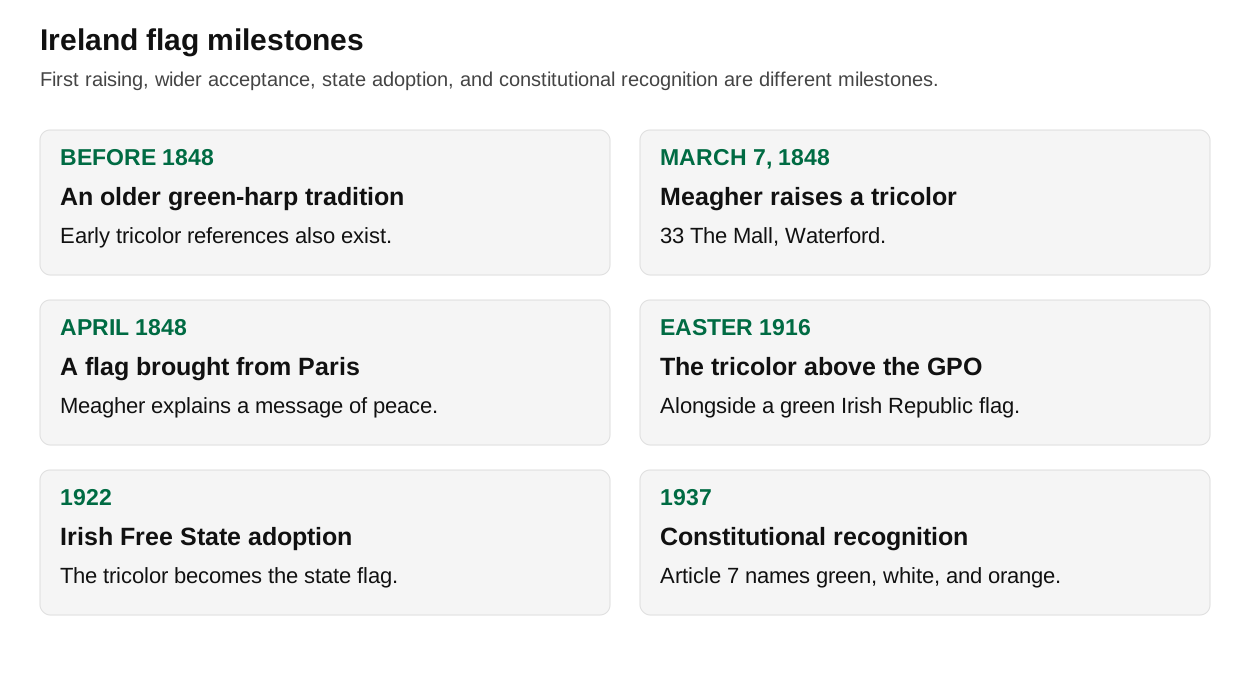
This timeline distinguishes Meagher’s March 7, 1848 raising in Waterford, his April presentation of a flag from Paris, the 1916 Easter Rising, the Free State’s 1922 adoption, and Article 7 of the 1937 Constitution. It does not depict a claimed exact 1848 original.
GKBook composition, CC0; flag reference geometry, public domain.Download image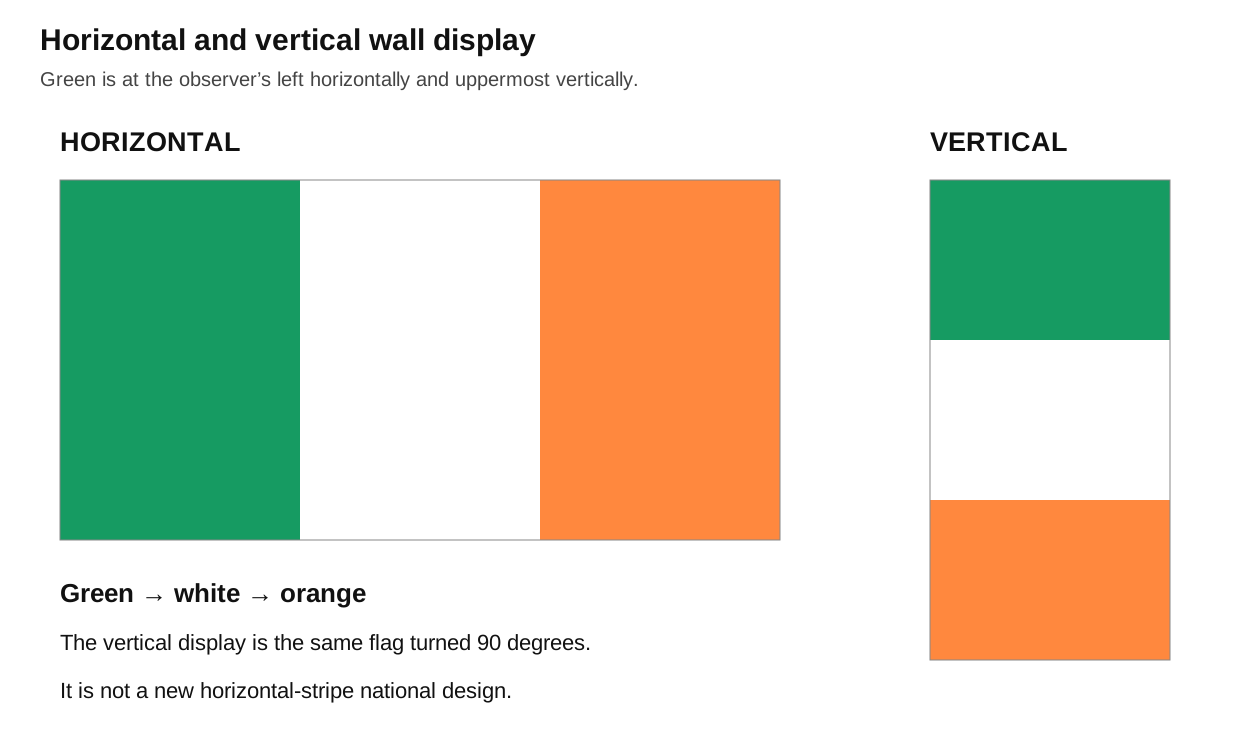
In a horizontal wall display, green belongs at the observer’s left. In a vertical display, green belongs at the top, white in the middle, and orange at the bottom. These arrangements follow the government and Defence Forces guidance.
GKBook composition, CC0; flag reference geometry, public domain.Download image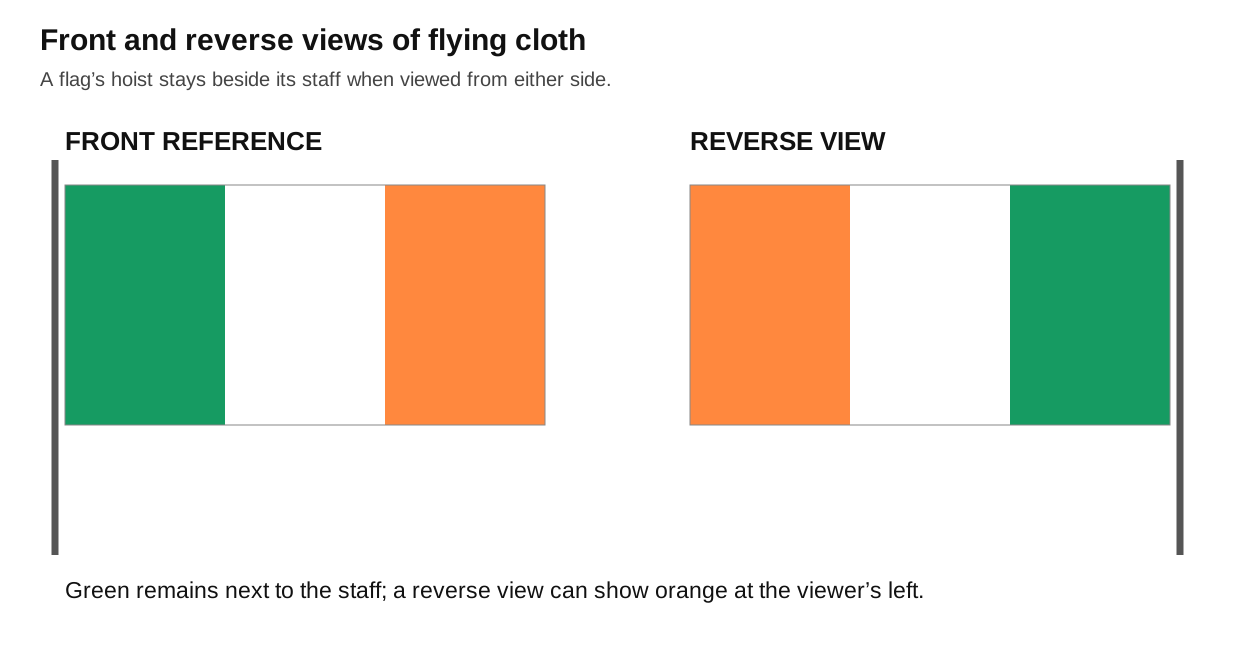
The clean front reference is green-white-orange from left to right. From the opposite side of a flying flag, the apparent order reverses while green still adjoins the staff. A reverse-facing photograph should not be mistaken for a newly designed Irish flag.
GKBook composition, CC0; flag reference geometry, public domain.Download image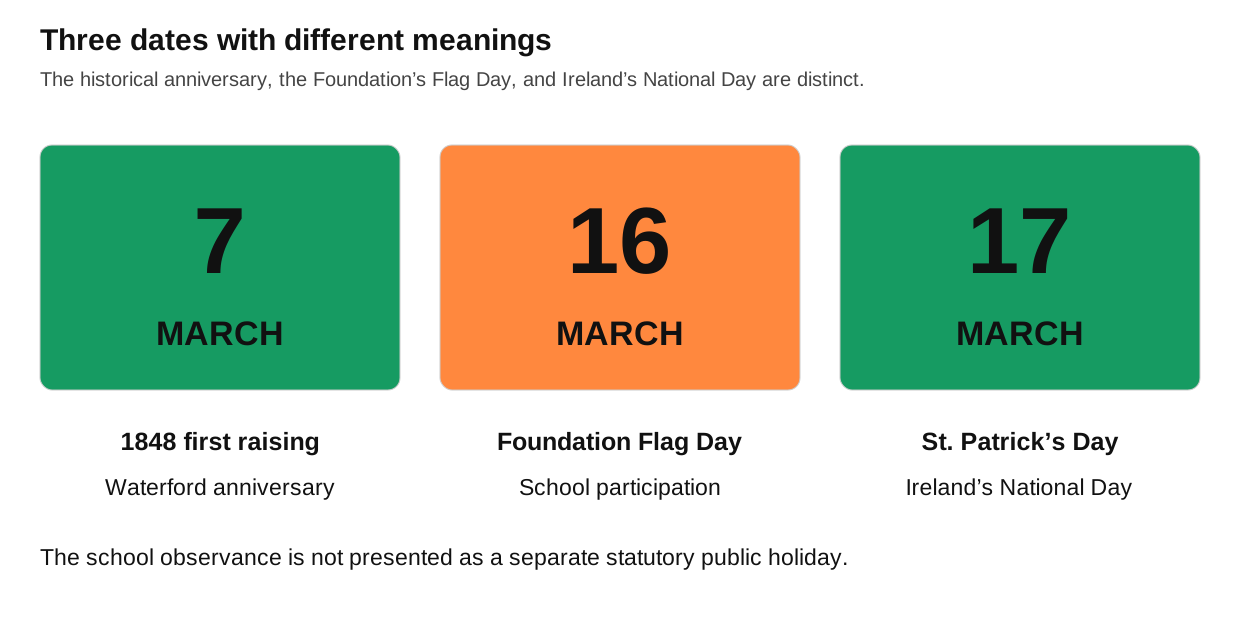
March 7 commemorates Meagher’s 1848 first raising. The Thomas F. Meagher Foundation identifies March 16 as its annual Flag Day for schools. March 17, St. Patrick’s Day, is Ireland’s National Day and a public holiday.
GKBook composition, CC0; flag reference geometry, public domain.Download image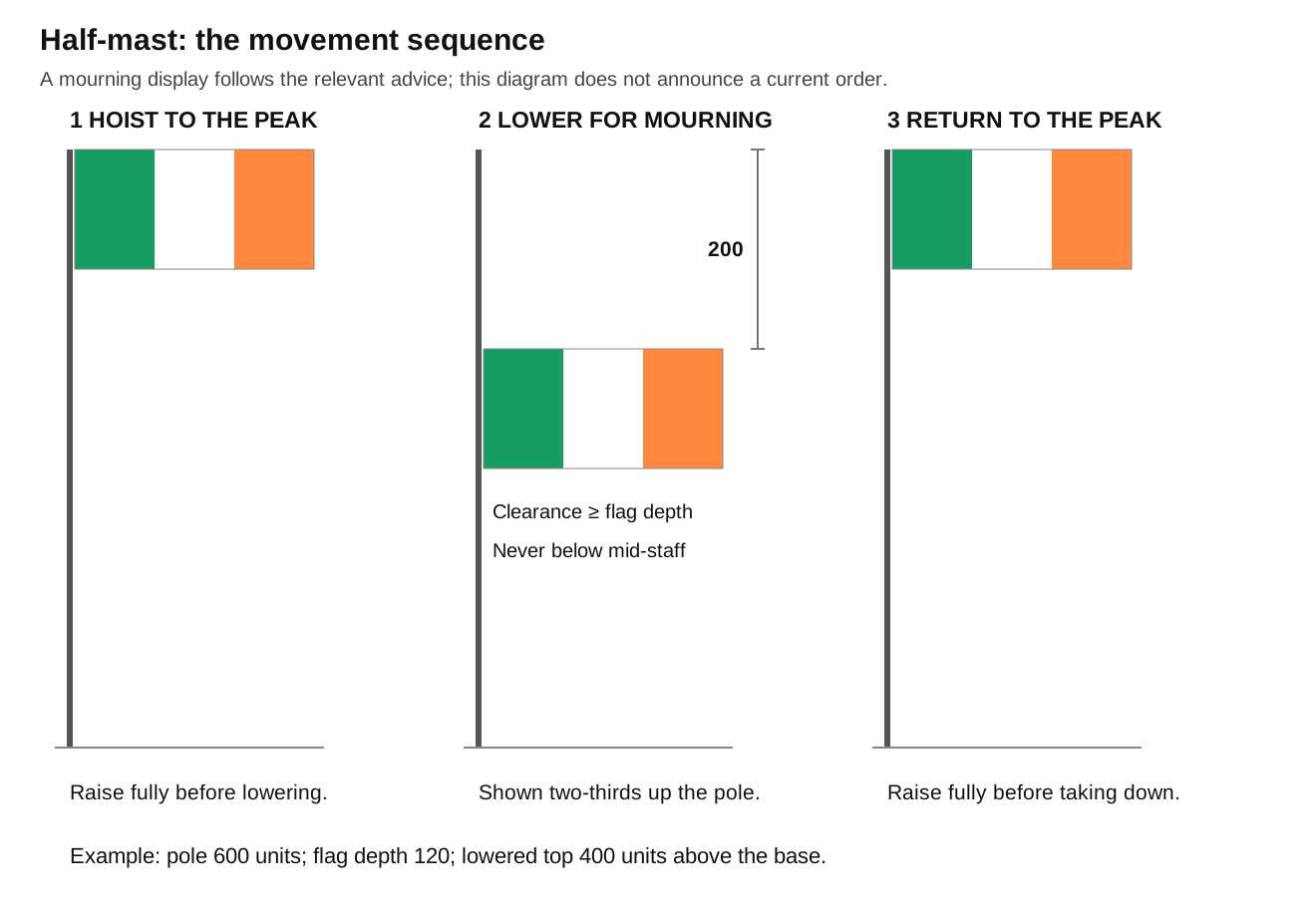
The government guide describes half-mast as about two-thirds up the pole, with at least one flag-depth of clearance above it and never below the staff’s midpoint. Raise to the peak before and after the mourning position. The example satisfies both clearance and height conditions.
GKBook composition, CC0; flag reference geometry, public domain.Download image
For a coffin drape, the green band is placed at the head. The Defence Forces describe laying the flag lengthwise and evenly over the coffin. This schematic shows that color orientation only; service-specific ceremonial arrangements are separate.
GKBook composition, CC0; flag reference geometry, public domain.Download image
For an ordinary row on equal-height staffs, the Irish flag occupies the observer’s left; an included EU flag is immediately to its right. The flags keep their own proportions. This diagram does not replace the guide’s separate rules for a complete EU-member lineup or unequal-height staffs.
GKBook composition, CC0; flag reference geometry, public domain.Download image
Handle the flag respectfully, preserve its unaltered design, and take worn or frayed cloth out of display. The government guide calls for dignified disposal without prescribing burning as the only method. Drying and fabric-specific cleaning are practical care recommendations.
GKBook composition, CC0; flag reference geometry, public domain.Download image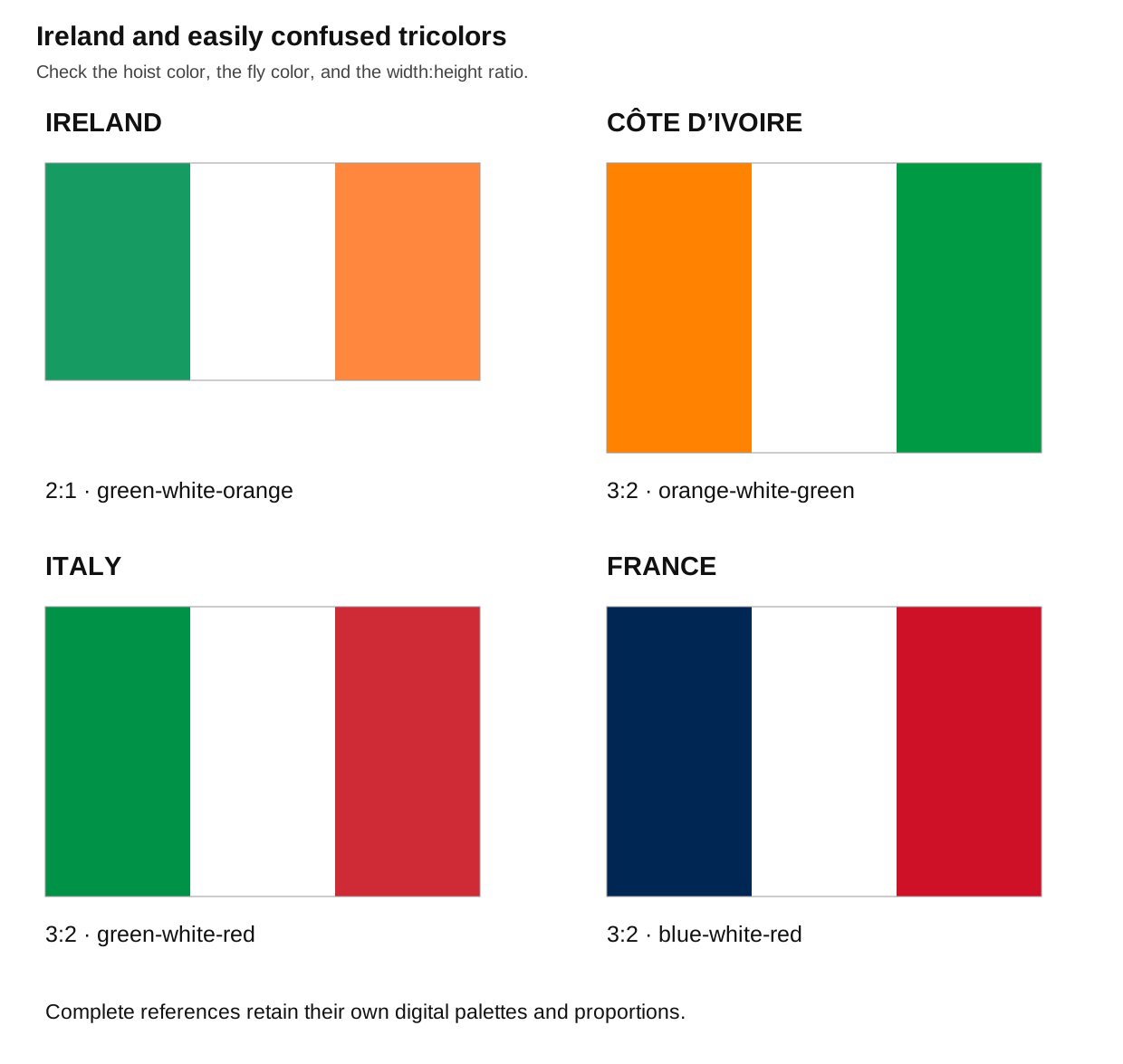
Ireland’s front reference is green-white-orange and twice as wide as high. Côte d’Ivoire reverses that color order and uses 3:2. Italy has red at the fly; France has blue at the hoist and red at the fly. Each comparison preserves its own source palette.
GKBook composition, CC0; flag reference geometry, public domain.Download image
The green-white-orange national flag differs from St. Patrick’s saltire, a red diagonal cross on white associated with Ireland in the Union Flag’s history. The saltire reference retains its source proportions; it is not presented as Ireland’s current national flag.
GKBook composition, CC0; flag reference geometry, public domain.Download image
The Irish tricolor flies above the General Post Office in Dublin in August 2003. The staff is on the right of the cloth in this reverse view; green remains next to it.
Thorsten Pohl (Thpohl). Public domain, released by the photographer.Download image
Irish and U.S. flags stand beside Simon Coveney and Antony Blinken during their meeting at Shannon International Airport on May 24, 2021. The Irish flag has a decorative gold fringe.
Ron Przysucha, U.S. Department of State. Public domain, U.S. government work.Download imageFrequently asked questions
What does the flag of Ireland look like?
Ireland’s national flag is a rectangle divided into three equal vertical bands: green beside the staff, white in the center, and orange at the free edge. It is twice as wide as it is high. The design has no harp, shamrock, cross, lettering, or other emblem.
What are Ireland’s flag colors and their color codes?
Ireland’s flag colors are green, white, and orange. The government guide specifies PMS 347 green and PMS 151 orange. This downloadable digital reference uses green #169B62, white #FFFFFF, and orange #FF883E. Its HEX and RGB values describe this artwork; they are not presented as official or exact conversions of the Pantone references.
What do the colors of Ireland’s flag mean?
Green represents the older Gaelic tradition, commonly associated with Ireland’s mainly Catholic community. Orange represents the Protestant tradition associated with William of Orange. White expresses peace and reconciliation between them. The overall message is inclusion and a hoped-for union of people from different traditions, rather than a division into permanent opposing camps.
What is the aspect ratio of Ireland’s flag?
Ireland’s flag has a width-to-height ratio of 2:1: its horizontal length is twice its vertical height. The same relationship is sometimes written 1:2 when height is listed first. The three upright bands have equal width, so each occupies one-third of the total width and extends through the full height.
How can Ireland’s flag be drawn accurately?
Start with a rectangle twice as wide as it is high, then divide its width into three equal parts. Fill the first part green, the second white, and the third orange. On a 1200×600 grid, the dividing lines are at x=400 and x=800. Keep all teaching labels outside the clean flag.
What sizes can an Irish flag be made in?
The government guide allows any convenient size if the correct proportions are preserved. Examples include 180×90, 90×45, and 30×15 centimeters, with width first. Each follows the same 2:1 construction. These are calculated examples, while some military and naval uses have their own published size specifications for particular settings.
How did Ireland’s national flag develop over time?
The tricolor’s history extends from early nineteenth-century references through Meagher’s famous 1848 raising and the Easter Rising of 1916. It was adopted by the Irish Free State in 1922 and recognized in the Constitution in 1937. Those milestones describe different stages: public introduction, wider acceptance, state use, and constitutional status.
What flags were used before the Irish tricolor became prominent?
A green flag with a harp was an important older Irish symbol. The government’s historical account traces that tradition through the seventeenth century and later movements, including the Irish Volunteers and United Irishmen. Early Irish tricolors are mentioned in 1830 and 1844, but the green-harp flag remained prominent before the 1916 Rising.
When and where was the Irish tricolor first raised?
The celebrated first raising took place on March 7, 1848, when Thomas Francis Meagher flew a tricolor at 33 The Mall in Waterford. The government identifies this as the flag’s first-flown milestone. Its fuller history also records earlier references to Irish tricolors, so 1848 should not be treated as proof that the colors had never appeared before.
How was the Irish flag connected with France in 1848?
Meagher’s connection with the French revolution of 1848 helped give the Irish tricolor its international context. In April he brought a flag from Paris to a meeting in Dublin and explained its message of peace between Irish traditions. That presentation followed the March 7 Waterford raising; it was not the same event.
What role did the Irish flag play in the 1916 Easter Rising?
During the Easter Rising, the tricolor flew over Dublin’s General Post Office alongside a different green flag bearing the words Irish Republic. Its association with the Rising helped establish it in the public imagination as the national flag. The green lettered flag and the tricolor should not be confused with one another.
When was Ireland’s flag officially adopted?
The government dates adoption of the tricolor by the Irish Free State to 1922. Its position as the national flag was formally confirmed in Article 7 of the 1937 Constitution. The famous Waterford raising in 1848 and the flag’s prominence in 1916 came earlier; they are historical milestones, not interchangeable constitutional adoption dates.
What does Ireland’s Constitution say about the national flag?
Article 7 of Ireland’s Constitution identifies the national flag as the tricolor of green, white, and orange. It does not itself provide the aspect ratio, Pantone numbers, or a complete display manual. Those technical and ceremonial details are set out in guidance from the Department of the Taoiseach, whose role is advisory.
Is a harp or shamrock part of Ireland’s national flag?
No harp or shamrock appears on the national tricolor. They are separate Irish state emblems, and the President’s standard is a different flag with a gold harp on blue. St. Patrick’s saltire, a red diagonal cross on white, is another distinct symbol. None of these should be added to the three-band national design.
Is the Irish tricolor the official flag of Northern Ireland?
The tricolor is the national flag of the state of Ireland. It is also used by many Irish nationalists in Northern Ireland, but that cultural or political use is different from official governmental status. The United Kingdom government identifies the Union Flag as Northern Ireland’s official flag, with separate rules governing designated government buildings.
When is Ireland’s Flag Day?
The Thomas F. Meagher Foundation identifies March 16, the eve of St. Patrick’s Day, as its annual National Flag Day. Its school program emphasizes citizenship, inclusion, and respect for the flag. This is distinct from the March 7 anniversary of the 1848 first raising and from Ireland’s National Day on March 17.
When is Ireland’s National Day and why is the flag flown then?
Ireland’s National Day is St. Patrick’s Day, March 17. It is also a public holiday and an important occasion for displaying the national flag. The date is separate from the Foundation’s March 16 Flag Day and the March 7 first-raising anniversary. It does not mark the tricolor’s adoption in 1922 or constitutional recognition in 1937.
How should Ireland’s flag be displayed horizontally or vertically?
For a horizontal wall display, green belongs on the observer’s left, followed by white and orange. For a vertical wall display, green must be uppermost, white in the middle, and orange at the bottom. When the flag flies from a staff, green stays beside the staff regardless of which side of the cloth is visible.
Where should the Irish flag stand beside other flags?
In an ordinary row of equal-height staffs, Ireland’s flag takes the place of honor at the observer’s left. If the European Union flag is included, it goes immediately to its right in that arrangement. Full EU-member displays have separate ordering rules. The government guide also describes special arrangements for a higher central staff.
How should the Irish flag be carried and saluted?
When carried with other flags, the Irish flag occupies the marching right, which appears on the left to an observer facing the approaching group. It should be carried aloft and free. The guidance discourages dipping it as a salute, except to the dead during memorial ceremonies, and distinguishes civilian attention from uniformed hand salutes.
Can Ireland’s flag be flown at night?
Yes. The September 2025 government guide permits the flag to fly at night if it is properly illuminated throughout, preferably by a spotlight. Ordinary outdoor display is described as sunrise to sunset, with exceptions for the duration of public meetings, processions, and funerals. A blanket claim that nighttime display is always forbidden would be inaccurate.
How is Ireland’s flag flown at half-mast?
The government guide describes half-mast as about two-thirds up the pole, leaving at least one flag-depth of clear space above the flag and never going below the staff’s midpoint. Raise it to the peak before lowering to that position, and return it to the peak before taking it down. No other flag should fly alongside during mourning.
How is the Irish flag placed on a coffin?
When the Irish flag drapes a coffin, the green portion belongs at the head. The Defence Forces describe placing the flag lengthwise and evenly over the coffin at a state or military funeral. Their ceremonial specification is a flag measuring 9 by 4.5 feet with loops; it should not be generalized into a rule for every civilian flag.
Is there a prescribed ceremonial fold for Ireland’s flag?
The government guide describes a military folding tradition for a flag removed from a coffin, which others may follow. Orange is folded beneath white, then those layers beneath green. A further fold keeps green facing outward; larger flags may need another fold. This is a funeral tradition, not a universal requirement to make a triangular packet.
How should an Irish flag be cared for and retired?
Keep the flag clear of the ground, water, branches, and other obstructions, and do not display worn or frayed cloth. The government guide calls for dignified destruction or disposal when a flag is no longer fit for display. It does not prescribe burning as the only method. Cleaning and storage should suit the actual fabric.
What common mistakes should be avoided with Ireland’s flag?
Common mistakes include substituting yellow or gold for orange, reversing the front-view color order, using unequal bands, or stretching the flag into a 3:2 rectangle. Adding a harp, shamrock, slogan, or sports logo changes the national design. Also avoid treating a reverse-facing photograph, a decorative fringe, or a historical symbol as a different modern national flag.
How is Ireland’s flag different from Côte d’Ivoire, Italy, and France?
Ireland’s front-view flag is green-white-orange with a 2:1 width-to-height ratio. Côte d’Ivoire is orange-white-green and usually shown in a 3:2 rectangle. Italy is green-white-red, while France is blue-white-red; their references here are also 3:2. Check both the color beside the staff and the flag’s proportions rather than relying on a thumbnail alone.
What do real photographs show about Ireland’s flag?
The two photographs show the tricolor above Dublin’s General Post Office in August 2003 and at a diplomatic meeting at Shannon International Airport on May 24, 2021. One illustrates a reverse view of flying cloth; the other shows an indoor flag with fringe. Their dates and settings distinguish documentary use from flat reference artwork.
What is the Ireland flag emoji?
The Ireland flag emoji is 🇮🇪. It consists of the regional indicator symbols I and E, with Unicode code points U+1F1EE and U+1F1EA. Platforms may display that sequence as a flag or as letters. Its small, platform-specific artwork is useful in text but is not a substitute for the full national reference drawing.
Which Ireland flag pictures can be downloaded here?
The downloads include a clean 2:1 SVG, a 6000×3000 PNG, labeled construction and orientation sheets, a historical timeline, observance and mourning diagrams, comparison graphics, and two documentary photographs. Each gallery item has a local download with an explanatory caption. The national master contains only the green, white, and orange panels, without teaching labels or borders.
Explore all general-knowledge topics and the A-to-Z lists.

We Value Your Opinion Comments