
Guinea-Bissau flag picture
Explore the construction sheet, the Independence Day observance, and the historical sequence.

| Design | Red panel; yellow over greenA black star appears within the full-height red hoist panel. |
|---|---|
| Proportion | 2:1 width:heightCustomary reference; the constitutional descriptions do not fix this number. |
| Adopted | September 24, 1973Associated with the proclamation of independence. |
| National Day | September 24Independence Day; a separate statutory Flag Day was not verified. |
| Colors | Red · yellow · green · blackThe three fields and the black five-pointed star. |
| Black star | African unityThe meaning given by the Presidency’s national-symbols page. |
| Constitutional record | 1973, Article 2; later Article 22The later text is Parliament’s published 1984/1996 version; current consolidation unverified. |
| National motto | Unity, Struggle, ProgressUnidade, Luta, Progresso; not printed on the national flag. |
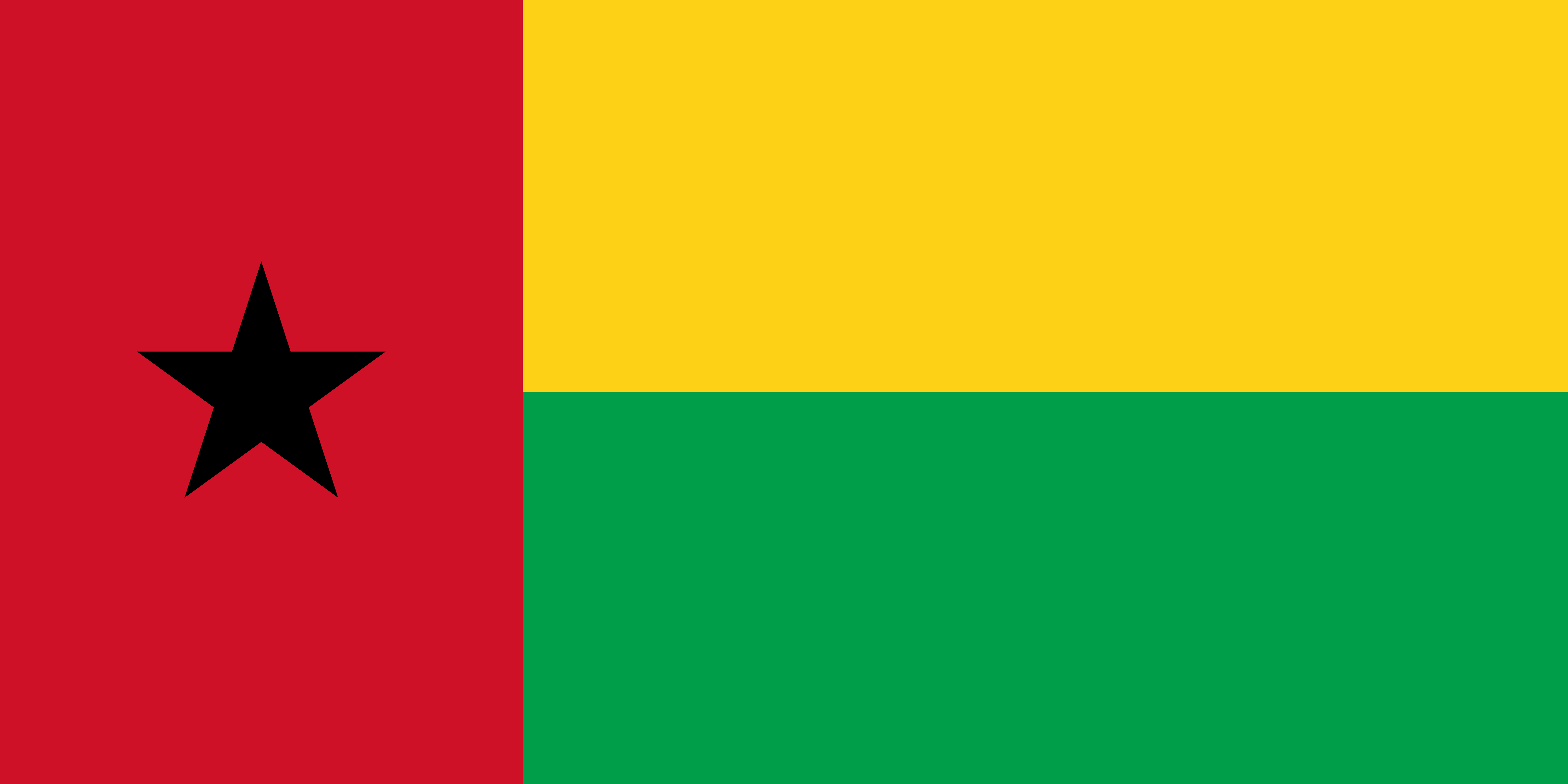
Red spans the full height at the hoist; yellow sits above green beside it, and a black star marks the red panel. The flag’s adoption is associated with the independence proclamation of September 24, 1973.
What is the national flag of Guinea-Bissau?
Guinea-Bissau’s national flag has a red vertical panel at the hoist with a black five-pointed star. To its right, yellow sits above green in two horizontal fields. The customary reference ratio is 2:1 width to height. The national design contains no party initials, coat of arms, or motto inscription.
The mixed vertical-and-horizontal arrangement makes this flag distinctive. The black star belongs to the red panel at the attachment edge; it does not sit in the center of the whole rectangle.
The design is closely connected to the independence movement and the proclamation of September 24, 1973. Its history also connects it with the former national flag of Cabo Verde, while its present arrangement distinguishes it from Guinea, Ghana, and Senegal.
Explore the black star, construction sheet, historical timeline, Independence Day, and downloadable pictures.
How are Guinea-Bissau’s flag panels arranged?
The red panel runs through the full height beside the pole or attachment edge. Yellow fills the upper part of the remaining field, with green directly below it. In the usual reference, red occupies one-third of the total width, and the two horizontal fields share the remaining two-thirds equally in height.
The hoist is the side fastened to a pole or other support. It appears on the left in the usual flat front view. The opposite free edge reaches both the yellow and green fields.
There are three colored panels, but they are not three parallel stripes. The red panel spans the full height. The other two are wider and shorter, each occupying half the height beside it.
What digital color values are used for Guinea-Bissau’s flag?
The delivered reference uses red #CE1126, yellow #FCD116, green #009E49, and black #000000. Their RGB values are 206, 17, 38; 252, 209, 22; 0, 158, 73; and 0, 0, 0. These values describe the artwork; no binding national numerical color standard was authenticated in the sources reviewed.
| Element | HEX | RGB | Status |
|---|---|---|---|
| Red panel | #CE1126 | 206, 17, 38 | Source artwork |
| Yellow field | #FCD116 | 252, 209, 22 | Source artwork |
| Green field | #009E49 | 0, 158, 73 | Source artwork |
| Black star | #000000 | 0, 0, 0 | Source artwork |
The reviewed constitutional descriptions name the colors without assigning HEX, RGB, CMYK, or Pantone values. The palette above records the actual vector fills so that the files can be reproduced consistently.
No binding Pantone or CMYK specification was authenticated. A printer should select an appropriate production profile and assess a proof on the intended material. A conversion from screen color alone would not create an official national standard.
What do Guinea-Bissau’s flag colors symbolize?
The Presidency’s national-symbols page explains red as the blood shed during the struggle for independence, yellow as the sun, green as hope, and the black star as African unity. Together, these meanings connect the liberation struggle with hope for the future and solidarity beyond the country’s borders.
This explanation follows the Presidency’s account of the national symbols, also reflected on Parliament’s website. The meanings give the flag a narrative of struggle, light, hope, and African solidarity.
A shared palette does not make every Pan-African flag identical. National designs express related ideas through different layouts, stars, and historical associations. Guinea-Bissau’s red hoist panel and black star are especially useful identifying features.
What does the black star on Guinea-Bissau’s flag represent?
The black star represents African unity in the Presidency’s explanation. It belongs to the wider Pan-African tradition and is often described as the Black Star of Africa. It has five points and stands within the red hoist panel. The reviewed official account does not assign a separate meaning to each point.
The star is an integral part of the flag, not a reduced version of the entire national coat of arms. Its placement on red is as important to identification as its black color.
Keep one point upright in the normal horizontal display. The other points form the familiar five-pointed shape. A gold star, green star, additional circle, or surrounding wreath would depart from the national reference shown here.
The star also makes a useful comparison with Ghana’s flag, which places a black star on yellow, and Senegal’s flag, which uses a green star.
Where is the black star centered in the reference?
In the 1200-by-600 reference, the star’s circumcircle is centered at (200, 300), the center of the red panel. Its radius is 100 units, making the diameter one-third of the flag’s height. These are measurements of the supplied reference, not dimensions prescribed by the constitutional descriptions reviewed for this article.
“Centered” here refers to the center of the star’s circumcircle. A five-pointed star’s top tip extends farther above that center than its two lower tips extend below it. Centering the visible bounding box instead would subtly shift the source geometry.
On the downloadable SVG, the corresponding center is (500, 750), and the radius is 250. On the large PNG, the center is (1000, 1500), and the radius is 500 pixels. All coordinates use the upper-left corner of the full flag as their origin.
What is Guinea-Bissau’s usual flag ratio?
The customary reference proportion is 2:1 width to height, meaning the rectangle is twice as wide as it is tall. A height-first source may write the same relationship as 1:2. The constitutional descriptions specify the fields and star without giving that numerical ratio, so the reference and legal wording should remain distinct.
This page writes width before height. Therefore, 2:1 means twice as wide as tall; a height:length notation of 1:2 describes the same rectangle. A 1200-by-600 reference and a 3000-by-1500 master share that shape.
The ratio is documented in specialist flag references and in the complete vector used for these downloads. It is kept separate from the constitutional wording, which describes the fields and star without prescribing that numerical proportion.
How is the downloadable Guinea-Bissau flag constructed?
The SVG uses a 3000-by-1500 rectangle. Its red panel is 1000 units wide, while the yellow and green fields are each 2000 by 750. The star’s circumcircle is centered at (500, 750) with radius 250. The large PNG doubles those dimensions to 6000 by 3000 without changing the arrangement.
| Feature | 1200 × 600 reference | Delivered SVG | Large PNG |
|---|---|---|---|
| Full rectangle | 1200 × 600 | 3000 × 1500 | 6000 × 3000 |
| Red panel | 400 × 600 | 1000 × 1500 | 2000 × 3000 |
| Yellow field | 800 × 300 | 2000 × 750 | 4000 × 1500 |
| Green field | 800 × 300 | 2000 × 750 | 4000 × 1500 |
| Star circumcenter | (200, 300) | (500, 750) | (1000, 1500) |
| Star circumradius | 100 | 250 | 500 |
For width W and height H in this reference, W = 2H. The red panel’s width is W/3. Each remaining field has width 2W/3 and height H/2. The star’s circumcircle has radius H/6 and is centered at (W/6, H/2).
The national master contains no visible labels, border, motto, or party lettering. Accessibility titles inside the SVG describe the artwork without adding an inscription to the flag.
Do Guinea-Bissau’s three colored panels have equal areas?
Yes, the three structural panels have equal areas in the supplied reference. On a 1200-by-600 grid, red measures 400 by 600, while yellow and green each measure 800 by 300. Each occupies one-third of the rectangle. The star overlays the red panel, reducing the area of visible red color without changing its boundaries.
The arithmetic is straightforward: 400 × 600 = 800 × 300 = 240,000 square units. Three such panels fill the 720,000-square-unit rectangle. On the large PNG, each structural panel occupies six million pixels before considering the star overlay.
This does not mean the file contains six million pixels of each red, yellow, and green shade. The black star replaces some of the red, and its rendered edges include antialiasing. A panel-area statement and a visible-color count answer different questions.
Which flag sizes preserve Guinea-Bissau’s proportions?
Sizes such as 100 by 50, 150 by 75, and 200 by 100 centimeters preserve the customary 2:1 width:height ratio. These are calculated examples, not a government retail-size schedule. Scale the star and fields together, and allow separately for sleeves, hems, reinforcement, and any shrinkage expected in the chosen fabric.
For a 150-by-75-centimeter finished flag, the red panel is 50 centimeters wide. Yellow and green each measure 100 by 37.5 centimeters. The star’s reference circumcircle has a diameter of 25 centimeters.
Use the finished visible area when planning fabric work. A pole sleeve or seam allowance can otherwise consume part of a panel. These calculations explain the artwork; they are not a prescribed government catalog of retail sizes.
How did Guinea-Bissau’s flag develop?
The design grew from the flag tradition of the African Party for the Independence of Guinea and Cape Verde, or PAIGC. The party reference includes its initials beneath the black star; the national flag omits them. The shared liberation movement also explains the resemblance to Cabo Verde’s national flag used from 1975 to 1992.
An RTP archive record dated September 12, 1963 describes Portugal’s flag being raised at an Air Force ceremony in Bissau.
The proclamation at Boé and the first Constitution establish the independent republic and its red, yellow, green, and black-star flag.
Portugal’s presidential archive records the signed recognition declaration; the U.S. Office of the Historian records American recognition on the same date.
João Carvalho photographed the raising of Guinea-Bissau’s flag after Portugal’s flag was lowered. The source gives no exact day.
Cabo Verde’s early national flag used a related arrangement with a maize wreath and shell around the star.
Article 22 of the constitutional text published by Parliament describes the national flag and separate arms.
Cabo Verde’s government associates the later blue flag with the 1992 constitutional revision.
The first Constitution expressed an aim of union with Cabo Verde. That political objective helps explain the shared symbolism, but it should not be described as proof that an already functioning unified state had replaced the two countries.
The historical comparisons below preserve the party lettering and Cabo Verde’s additional emblem details. Those features are essential to understanding the relationship without treating every similar flag as Guinea-Bissau’s national design.
When was Guinea-Bissau’s national flag adopted?
The flag was adopted with Guinea-Bissau’s proclamation of independence on September 24, 1973. The Presidency associates adoption with that proclamation, and the first Constitution already describes the red panel, black star, and yellow-over-green fields. Later international recognition in 1974 is a separate historical milestone and does not move the flag’s origin to that year.
The Presidency links the flag to the independence proclamation. The declaration preserved in the United Nations record ends with the People’s National Assembly at Boé on September 24, 1973; the accompanying first Constitution describes the flag in Article 2.
The UN document’s October 1973 transmission dates identify its circulation as an international record. They do not replace the September proclamation date. The recognition events of September 1974 likewise belong to a later stage of the country’s history.
What does the published constitutional text say about the flag?
Article 22 of Parliament’s published 1984/1996 constitutional text describes a vertical red panel and horizontal yellow and green fields, with a black five-pointed star on red. The 1973 Constitution describes the same basic arrangement. Constitutional changes were reported in 2026; a fully consolidated current text was not authenticated for this article.
The first Constitution’s Article 2 describes three equal-size bands, one red and vertical with a black star, and the other two horizontal, yellow above green. In Parliament’s published later text, Article 22 sets out the arrangement and specifies a five-pointed star.
The same later article describes the arms separately. Its flag paragraph does not supply numerical RGB values, a star-coordinate grid, or a complete ceremonial procedure.
Reports in September 2026 describe constitutional changes following a referendum. A fully consolidated current primary text was not authenticated for this article. References to “Article 22” here therefore identify the Parliament-published 1984/1996 text; they do not certify the numbering or full legal position under a newer consolidation.
Who designed Guinea-Bissau’s flag?
The verified sources establish the flag’s PAIGC origins and the importance of Amílcar Cabral to the liberation movement, but they do not establish an individual flag artist with equal certainty. This article therefore separates historical leadership from graphic authorship. Credits attached to modern SVG files identify digital reproductions, not necessarily the national design’s original creator.
Amílcar Cabral is central to the liberation movement’s history. That does not, on its own, establish that he personally drew or finalized every element of the national flag. The sources reviewed do not identify an individual artist with enough certainty for an unqualified designer credit.
The distinction also applies to contemporary files. SKopp and other Commons contributors are credited for the digital reference artwork used here. Their work reproduces a national symbol that predates the SVG file.
How should Guinea-Bissau’s flag be prepared for printing?
Preserve the full panel arrangement, the centered upright star, and uniform proportions. Use the supplied digital palette as a documented artwork reference, then have the printer manage ink, substrate, and color profile. The downloadable SVG is suitable for accurate scaling; it does not certify a finished textile or establish an official manufacturing authorization.
Keep the complete geometry
Scale the whole flag uniformly. Preserve the red panel’s width, the yellow-green boundary, and the star’s center, size, and upright orientation.
Review the production proof
Assess the result on the intended material. Screen brightness, ink, fabric, lighting, and color profiles affect appearance.
The SVG is useful for scalable graphics and production preparation. The large PNG is a ready-made raster alternative. Neither file is a certificate of textile quality, an official license, or a substitute for an institution’s procurement specifications.
Measurement arrows and descriptive labels belong to the explanatory sheets. Use the plain national master when the finished product should show only the flag.
What guidance exists for respecting Guinea-Bissau’s flag?
A March 2011 preliminary civic-education framework from Guinea-Bissau’s INDE teaches students to stand facing the flag respectfully and avoid tearing, dirtying, crumpling, or dropping it on the ground. This is documented educational guidance, not a complete legal flag code. Formal institutions may issue more specific instructions for their own ceremonies.
The educational source is a March 2011 preliminary framework prepared through the national education system’s INDE. Its classroom examples address respectful conduct around national symbols and the teaching of civic responsibilities.
It supports practical care: keep the flag from the ground, prevent deliberate damage, and maintain a respectful manner during the anthem. Its preliminary educational status should remain clear; it is not presented here as a comprehensive, binding flag-protocol statute.
For official events, obtain the responsible institution’s actual instructions on placement, order, personnel, and timing. The reviewed material does not establish a universal daily hoisting hour, prescribed salute speed, or detailed precedence rule.
How is the flag used during official ceremonies?
Guinea-Bissau’s Judicial Police reported a flag-oath ceremony for new criminal-investigation agents during its forty-third anniversary on March 12, 2026 in Bissau. The report describes ninety-six agents taking office. It illustrates the flag’s role in public-service commitments without supplying a universal oath, salute, raising speed, or daily display timetable.
The Judicial Police’s own account places the ceremony in Bissau on March 12, 2026. The flag oath formed part of the institution’s anniversary and the new agents’ entry into service.
The earlier civic-education framework also proposes classroom simulation of raising and lowering the flag. Together, these sources show institutional and educational uses without requiring an invented universal sequence of commands.
An event report establishes what that event involved. It does not automatically prescribe the same oath text, duration, music, or movements for every school, embassy, or public office.
How does the flag appear from the reverse side?
From behind, the red panel and black star appear on the viewer’s right because the attachment edge is there. Yellow remains above green. The whole image is horizontally reversed, while the upright star’s symmetrical shape looks familiar. This physical reverse view should not be mistaken for a different national flag or an inverted design.
In an ordinary front view, the hoist is on the viewer’s left. Moving behind a flag changes that viewpoint. The red panel and star then appear on the right, but they are still at the attachment edge.
This is a physical viewing relationship, not a separate officially adopted reverse design. A rotated vertical banner raises a different question; the sources reviewed did not establish a binding national vertical-hanging specification.
Does Guinea-Bissau have an annual Flag Day?
September 24 is Guinea-Bissau’s Independence Day, commemorating the 1973 proclamation and the national flag’s adoption. The Presidency identifies it as a public holiday. The sources reviewed did not establish a separate statutory annual Flag Day. The article therefore labels September 24 as Independence Day rather than inventing a distinct flag observance.
The established national observance is Independence Day on September 24. It commemorates the proclamation of 1973 and naturally provides an occasion for displaying the national flag.
The infobox therefore uses the label “National Day.” Calling the date a separate statutory “Flag Day” would add a legal designation that was not established in the reviewed sources.
The date should also be distinguished from September 10, 1974, when Portugal and the United States recognized independence. Those recognition records do not move the annual independence anniversary to September 10.
Why do Guinea-Bissau’s records mention both 1973 and 1974?
Guinea-Bissau proclaimed independence on September 24, 1973, while international recognition developed afterward. The U.S. Office of the Historian records American recognition on September 10, 1974. These dates answer different questions. The flag’s adoption belongs to the 1973 proclamation; a later recognition date should not be treated as a new flag-adoption date.
| Milestone | Date | Meaning |
|---|---|---|
| Independence proclamation | September 24, 1973 | The founding proclamation and flag-adoption context |
| Portugal’s recognition | September 10, 1974 | Recognition declaration recorded by Portugal’s presidential archive |
| U.S. recognition | September 10, 1974 | Recognition recorded by the U.S. Office of the Historian |
| Canjadude photograph | 1974; exact day unspecified | A documented local change of flags |
Portugal’s presidential museum archive catalogs an RTP recording of António de Spínola reading and signing the recognition declaration at the Palace of Belém in Lisbon on September 10, 1974.
The U.S. record independently identifies recognition on that date through President Gerald Ford’s communication to Luís Cabral. Neither entry claims that recognition by all countries began only then.
When has Guinea-Bissau ordered flags to half-mast?
A January 9, 2012 Lusa report carried by RTP records a government communiqué ordering seven days of mourning after President Malam Bacai Sanhá’s death. The period began at 00:00 on January 10, with national flags at half-mast on public buildings. This historical instruction does not establish an automatic duration for future mourning.
The contemporary Lusa report, carried by RTP on January 9, 2012, attributes the order to a government communiqué. It specifies public buildings and a seven-day period beginning at midnight on January 10.
This is a historical example, not a current mourning notice or a standing rule that every death requires seven days. Future observances depend on the competent authority’s actual instruction.
The report does not define an exact fraction of pole height, a measured clearance, or a universal raising-and-lowering sequence. The drawing shows the concept of a lowered flag without supplying those unsupported details.
How should a Guinea-Bissau flag be cared for?
Keep the flag clean, protect its attachment points, and dry wet fabric before storing it. Replace badly worn display copies while treating historically significant textiles as conservation objects. The educational framework supports respectful handling, but the reviewed sources do not establish a mandatory folding pattern, retirement ritual, or particular method for disposing of damaged flags.
Check the fabric and attachment points before display. Let wet cloth dry fully, and store it in a clean place where repeated pressure will not damage folds or decorative stitching. Follow the maker’s care instructions for the particular material.
A historically significant flag may require conservation advice instead of ordinary washing or repair. Preserve any reliable information about its date, place, maker, and use.
The reviewed educational material encourages respect and protection from damage. It does not establish a mandatory folding geometry, burning ceremony, or other specific retirement method.
Does Guinea-Bissau’s flag include its coat of arms?
No. The national flag contains a black star on red, not the entire coat of arms. The published Constitution describes the arms separately, with two palms, a yellow shell, a ribbon carrying the motto, and a black star above. Adding that whole emblem to the flag would change the ordinary national design.
The star appears in both national symbols, which can cause confusion. The complete arms include additional elements that the flag lacks: the palms, shell, and motto ribbon described in Article 22 of the published constitutional text.
Do not insert that full emblem into the red panel or the center of the yellow and green fields. Use the national master to reproduce the flag, and identify the arms separately when discussing state symbolism.
What are Guinea-Bissau’s motto and national anthem?
The national motto is Unidade, Luta, Progresso, meaning Unity, Struggle, Progress. It appears in the 1973 Constitution and on the ribbon described for the national arms in the later published constitutional text. It is not written on the flag. The anthem is separately identified as Esta é a Nossa Pátria Bem Amada.
The motto’s three Portuguese words express unity, struggle, and progress. They belong to the constitutional description of national symbolism and the arms’ ribbon, not to a required inscription across the flag.
The anthem title translates as “This Is Our Beloved Homeland.” The song is a separate national symbol. Its name can identify a ceremonial element without reproducing lyrics or transferring anthem authorship to the flag’s graphic design.
How does Guinea-Bissau’s flag differ from the PAIGC party flag?
The historical PAIGC reference has the party’s initials beneath its black star, while Guinea-Bissau’s national flag has no lettering. They share the red hoist panel and yellow-over-green fields because of their historical relationship. The party illustration is presented as historical context, without certifying its current legal status after political developments in 2026.
The party initials are a useful diagnostic detail. Their presence beneath the star identifies the illustrated PAIGC reference; the ordinary national flag has no letters.
The comparison is historical. It does not certify present authorization for party-flag use, and a modern vector reference is not an original independence-era textile. The national download remains the plain design without party initials.
Why did Cabo Verde have a flag resembling Guinea-Bissau’s?
Guinea-Bissau and Cabo Verde shared the PAIGC liberation movement, and their early national flags reflected that connection. Cabo Verde’s 1975–1992 flag added a maize wreath and shell around the black star and used different reference proportions. Its government identifies the 1992 constitutional revision as the change to the later blue flag with ten stars.
The 1975–1992 Cabo Verde reference surrounds its black star with a maize wreath and shell. Those emblem details and its proportions distinguish it from Guinea-Bissau’s simpler national rectangle.
Cabo Verde’s government associates the later blue flag with the 1992 constitutional revision. Its ten yellow stars and horizontal white-red-white stripes create a substantially different design.
The history sheet retains each complete reference at its own proportions. It does not stretch all the flags into a single shape or remove the old Cabo Verde emblem to make the designs appear identical.
How can Guinea-Bissau’s flag be distinguished from Ghana’s and Senegal’s?
Guinea-Bissau puts its black star in a red vertical hoist panel beside yellow-over-green fields. Ghana has three horizontal bands with a black star centered on yellow. Senegal has three vertical bands with a green star on yellow. The star’s color and position, band direction, and overall proportions distinguish the complete designs.
| Country | Main arrangement | Star |
|---|---|---|
| Guinea-Bissau | Red vertical panel beside yellow over green | Black; in red at the hoist |
| Ghana | Red, yellow, green horizontal bands | Black; centered on yellow |
| Senegal | Green, yellow, red vertical bands | Green; centered on yellow |
A close crop containing only a star or one color can conceal these differences. Identify the attachment edge and the whole arrangement before assigning a country name to a photographed or illustrated flag.
Are Guinea-Bissau, Guinea, and Equatorial Guinea the same?
No. Guinea-Bissau and Guinea are separate countries with different national flags. Guinea-Bissau uses a black star on a red hoist panel beside yellow and green horizontal fields. Guinea uses a plain red-yellow-green vertical tricolor. Equatorial Guinea is another distinct country, whose flag includes a blue triangle and national arms within horizontal bands.
For Guinea, look for three uninterrupted vertical bands with red at the hoist and no star. For Equatorial Guinea, look for the blue hoist triangle and arms in the white horizontal band.
The comparison retains the full Equatorial Guinea emblem. Omitting it would remove a useful identifying feature. None of these references is recolored to force agreement with Guinea-Bissau’s digital palette.
What is Guinea-Bissau’s flag emoji?
Guinea-Bissau’s flag emoji is 🇬🇼, formed from the regional-indicator letters G and W, U+1F1EC and U+1F1FC. The sequence differs from Guinea’s GN flag emoji. Depending on the device, it may appear as a flag, letters, or another fallback. Use the SVG or PNG for precise geometry and consistent colors.
The sequence is U+1F1EC U+1F1FC, corresponding to GW. The second regional indicator is W. Similar names do not make Guinea’s GN sequence interchangeable with Guinea-Bissau’s.
Emoji artwork can vary by device and may use waving shapes or shading. The supplied rectangular SVG and PNG are better suited to lessons, printing, and comparisons that require the documented geometry.
What does the Canjadude flag-raising photograph document?
João Carvalho’s photograph records Guinea-Bissau’s flag being raised after Portugal’s flag was lowered at Canjadude in 1974. The source supplies the year and location, not an exact day. This local transition ceremony should not be mislabeled as the September 24, 1973 proclamation of independence at Boé or as a contemporary scene.
The visible flag at the pole is partly furled, as cloth often is during an outdoor ceremony. Its photograph provides historical context; the flat national reference is the clearer guide to exact colors and measurements.
The source identifies Canjadude and the year 1974, with João Carvalho as photographer. It does not identify an exact day or month. The image should not be captioned as the 1973 proclamation at Boé.
The downloadable WebP copies retain the full original frame. The source revision credits OsvaldoGago with color and shadow adjustments in 2005; no additional color editing or cropping was applied to these derivatives. The photographer dedicated the image to the public domain.
Which mistakes should be avoided when drawing Guinea-Bissau’s flag?
Keep the red panel at the hoist, yellow above green, and the black star within the red panel. Do not replace the mixed layout with three vertical bands, put the star on yellow, add party initials, or insert the national arms. Preserve the complete reference geometry and distinguish historical illustrations from the national master.
Check the entire design
Three vertical bands suggest Guinea’s plain tricolor. A black star centered on a yellow horizontal band suggests Ghana. Party initials or a wreath introduce other historical references.
Keep the star’s circumcenter at the red panel’s center, and scale the complete reference uniformly. Do not recenter the visible star bounding box, stretch the rectangle, or add explanatory labels inside the national flag.
Historical captions deserve the same care. Separate the 1973 adoption, the 1974 recognition records, and the photograph’s year-only date.
Which Guinea-Bissau flag files can be downloaded?
The package includes the national SVG and large PNG, anatomy and star details, a digital palette, construction and equal-area sheets, size and orientation guides, historical and country comparisons, a date diagram, and a conceptual mourning illustration. A genuine 1974 photograph adds historical context. All gallery downloads are served locally from the article directory.
Download the national SVG or the 6000 × 3000 PNG. The SVG is the scalable master; the PNG is the large raster version.
The picture gallery provides local downloads for the diagrams, comparisons, history sheet, and 1974 photograph. The comparison sheets and mourning illustration include explanatory labels and should not replace the plain national master.
Download the plain-text image credits. Creator names and reuse notices accompany the local images without external navigation.
Guinea-Bissau flag pictures

Guinea-Bissau’s flag has a red hoist panel with a black five-pointed star beside yellow-over-green horizontal fields. This customary 2:1 reference preserves the complete source geometry; its digital colors are not claimed as statutory codes.
GKBook composition, CC0; SKopp and Commons contributors, public-domain reference artwork.Download image
The red panel spans the full height at the attachment edge. Yellow and green split the remaining width horizontally, with yellow above green. A black five-pointed star is centered in the red panel; there is no inscription on the national flag.
GKBook composition, CC0; SKopp and Commons contributors, public-domain reference artwork.Download image
A complete close-up of the five-pointed black star on red. Its source construction is upright and centered in the red panel. On the 1200-by-600 reference, the circumcircle has center (200, 300) and radius 100; these measurements document the artwork.
GKBook composition, CC0; SKopp and Commons contributors, public-domain reference artwork.Download image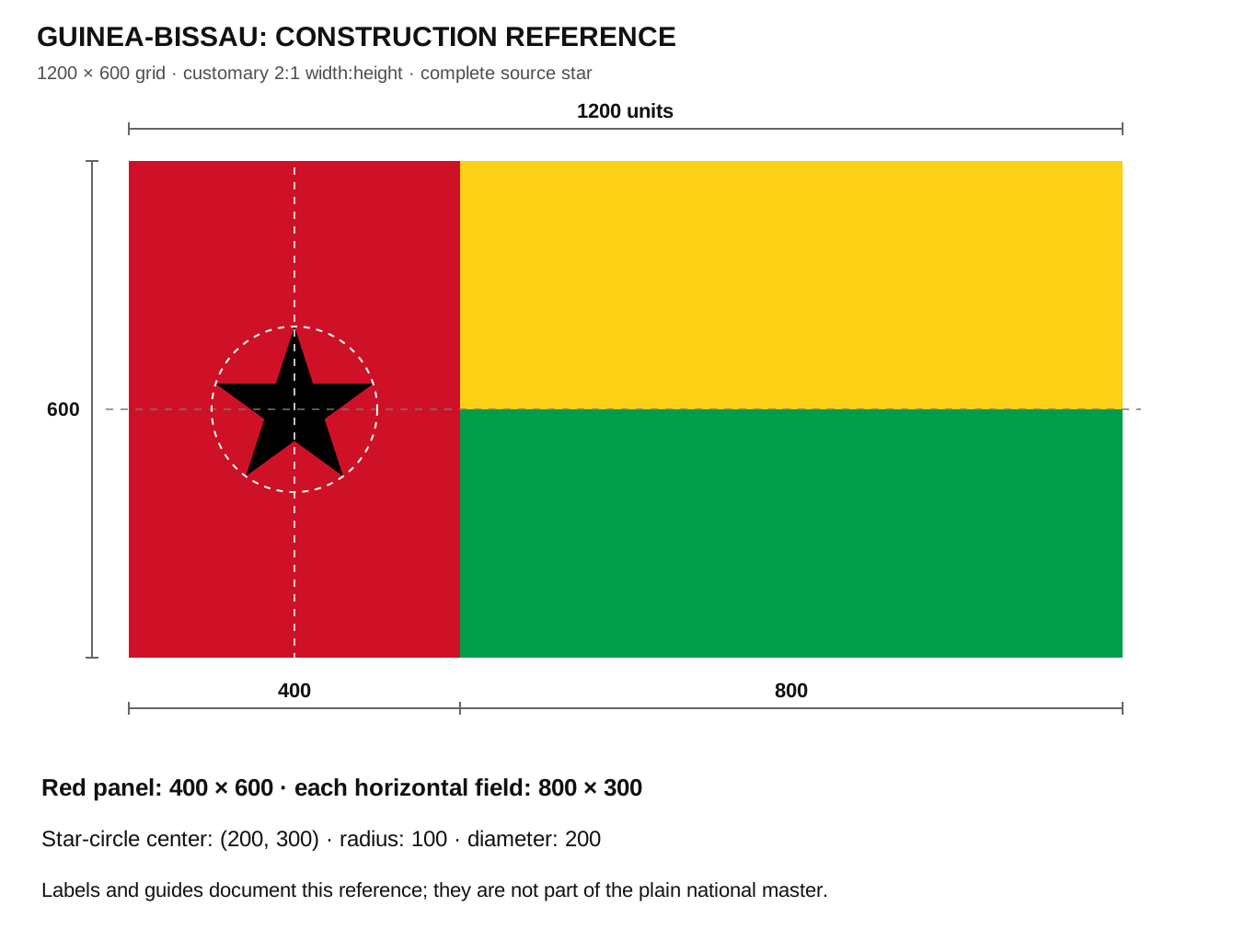
The 1200-by-600 reference uses a 400-by-600 red panel and two 800-by-300 fields. The star’s circumcircle has center (200, 300) and diameter 200. These source measurements are distinguished from the descriptive constitutional text.
GKBook composition, CC0; SKopp and Commons contributors, public-domain reference artwork.Download image
On the 1200-by-600 grid, the red panel and each yellow or green field occupy 240,000 square units, one-third of the rectangle. The black star overlays the red panel. Equal structural panel areas do not mean equal quantities of visible colored ink.
GKBook composition, CC0; SKopp and Commons contributors, public-domain reference artwork.Download image
The delivered reference uses red #CE1126, yellow #FCD116, green #009E49, and black #000000. These HEX and RGB values describe the artwork. They are not presented as officially legislated color codes or universal textile standards.
GKBook composition, CC0; SKopp and Commons contributors, public-domain reference artwork.Download image
Calculated examples of the customary 2:1 ratio include 100 by 50, 150 by 75, and 200 by 100 centimeters. Keep the star and all panels proportional. These dimensions are educational examples rather than legally mandated retail sizes.
GKBook composition, CC0; SKopp and Commons contributors, public-domain reference artwork.Download image
From behind, the red panel and black star appear on the viewer’s right because the attachment edge is there. Yellow remains above green. The complete image mirrors together; no separate national reverse or vertical hanging specification is asserted.
GKBook composition, CC0; SKopp and Commons contributors, public-domain reference artwork.Download image
Independence was proclaimed on September 24, 1973, the flag’s adoption date and annual Independence Day. The United States recognized Guinea-Bissau on September 10, 1974. The recognition milestone does not change the national flag’s 1973 origin.
GKBook composition, CC0; SKopp and Commons contributors, public-domain reference artwork.Download image
The PAIGC party reference includes its initials below the star. Guinea-Bissau’s national flag omits them. Cabo Verde’s 1975–1992 flag added a maize wreath and shell around the star; its later national flag uses blue, stripes, and ten yellow stars. Each full reference retains its native ratio.
GKBook layout, CC0; SKopp, Thommy, Editor at Large, Waldir, and Commons contributors: public-domain source artwork.Download image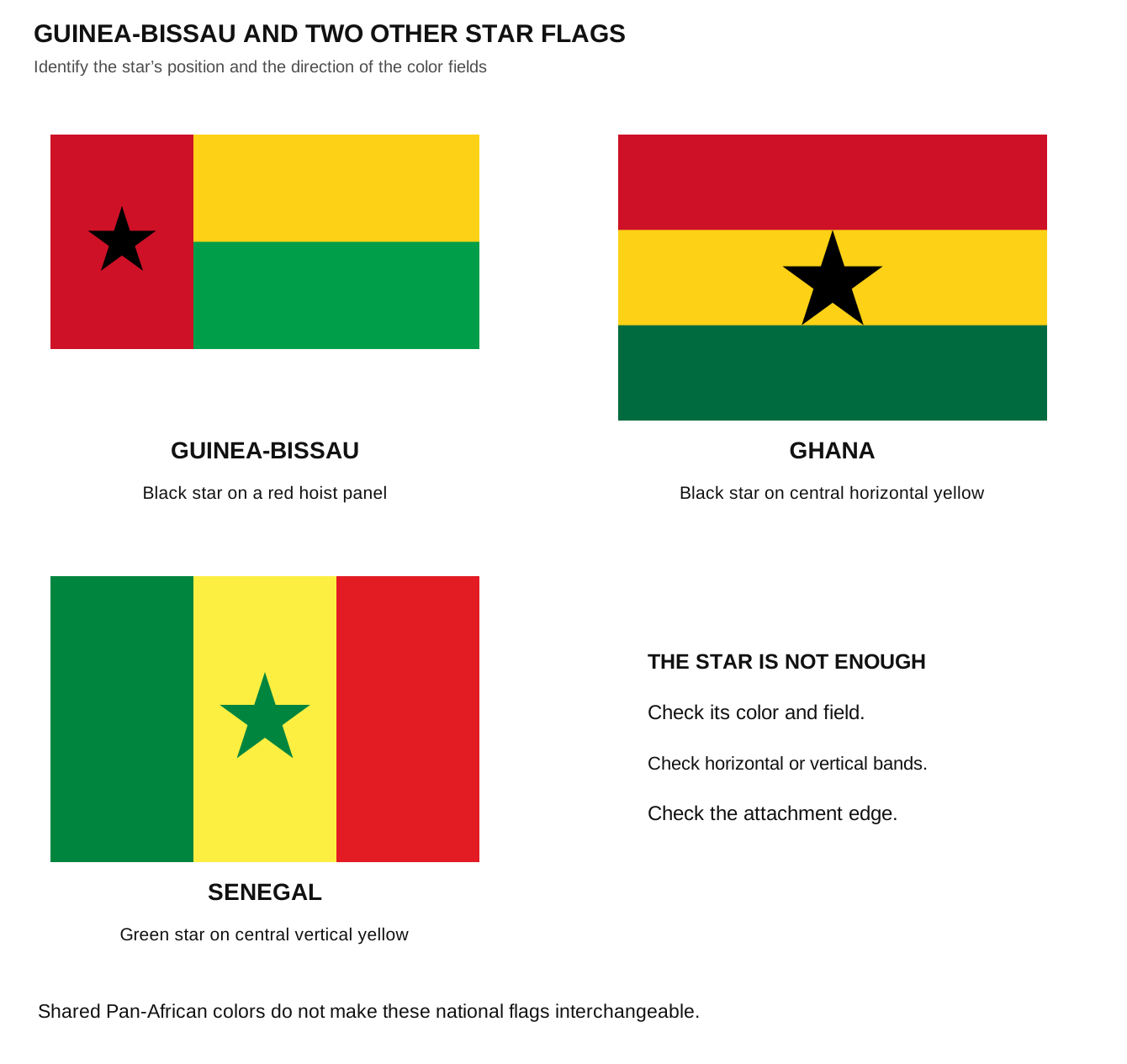
Guinea-Bissau places a black star on the red hoist panel. Ghana places a black star in the middle yellow horizontal band. Senegal has a green star within the middle yellow vertical band. The complete designs have different arrangements and proportions.
GKBook layout, CC0; public-domain flag references by SKopp, Nightstallion, Openclipart, and Commons contributors.Download image
Guinea-Bissau uses a black star in a red hoist panel beside yellow and green fields. Guinea uses a plain vertical tricolor. Equatorial Guinea uses a blue triangle and its coat of arms within horizontal green-white-red bands. These flags identify different countries.
GKBook composition, CC0; SKopp and Commons contributors, public-domain reference artwork.Download image
A January 9, 2012 report of a government communiqué records seven days of mourning starting at 00:00 on January 10 after President Malam Bacai Sanhá’s death. It specified half-mast at public buildings. This drawing illustrates a lowered flag, not a prescribed numeric height.
GKBook composition, CC0; SKopp and Commons contributors, public-domain reference artwork.Download image
Guinea-Bissau’s flag is raised after Portugal’s flag was lowered at Canjadude in 1974, in a photograph by João Carvalho. The image records a local transition ceremony; it is not identified as the September 24, 1973 independence proclamation at Boé.
João Carvalho, public-domain photograph; 2005 source color and shadow revision by OsvaldoGago.Download imageFrequently asked questions
What does Guinea-Bissau’s flag look like?
Guinea-Bissau’s national flag has a red vertical panel at the hoist with a black five-pointed star. To its right, yellow sits above green in two horizontal fields. The customary reference ratio is 2:1 width to height. The national design contains no party initials, coat of arms, or motto inscription.
How are the panels arranged on Guinea-Bissau’s flag?
The red panel runs through the full height beside the pole or attachment edge. Yellow fills the upper part of the remaining field, with green directly below it. In the usual reference, red occupies one-third of the total width, and the two horizontal fields share the remaining two-thirds equally in height.
What are the digital colors of Guinea-Bissau’s flag?
The delivered reference uses red #CE1126, yellow #FCD116, green #009E49, and black #000000. Their RGB values are 206, 17, 38; 252, 209, 22; 0, 158, 73; and 0, 0, 0. These values describe the artwork; no binding national numerical color standard was authenticated in the sources reviewed.
What do Guinea-Bissau’s flag colors symbolize?
The Presidency’s national-symbols page explains red as the blood shed during the struggle for independence, yellow as the sun, green as hope, and the black star as African unity. Together, these meanings connect the liberation struggle with hope for the future and solidarity beyond the country’s borders.
What does the black star on Guinea-Bissau’s flag mean?
The black star represents African unity in the Presidency’s explanation. It belongs to the wider Pan-African tradition and is often described as the Black Star of Africa. It has five points and stands within the red hoist panel. The reviewed official account does not assign a separate meaning to each point.
Where is the star placed, and how large is it?
In the 1200-by-600 reference, the star’s circumcircle is centered at (200, 300), the center of the red panel. Its radius is 100 units, making the diameter one-third of the flag’s height. These are measurements of the supplied reference, not dimensions prescribed by the constitutional descriptions reviewed for this article.
What is the proportion of Guinea-Bissau’s flag?
The customary reference proportion is 2:1 width to height, meaning the rectangle is twice as wide as it is tall. A height-first source may write the same relationship as 1:2. The constitutional descriptions specify the fields and star without giving that numerical ratio, so the reference and legal wording should remain distinct.
How is the Guinea-Bissau flag download constructed?
The SVG uses a 3000-by-1500 rectangle. Its red panel is 1000 units wide, while the yellow and green fields are each 2000 by 750. The star’s circumcircle is centered at (500, 750) with radius 250. The large PNG doubles those dimensions to 6000 by 3000 without changing the arrangement.
Do the three colored panels have equal areas?
Yes, the three structural panels have equal areas in the supplied reference. On a 1200-by-600 grid, red measures 400 by 600, while yellow and green each measure 800 by 300. Each occupies one-third of the rectangle. The star overlays the red panel, reducing the area of visible red color without changing its boundaries.
Which flag sizes preserve Guinea-Bissau’s reference proportions?
Sizes such as 100 by 50, 150 by 75, and 200 by 100 centimeters preserve the customary 2:1 width:height ratio. These are calculated examples, not a government retail-size schedule. Scale the star and fields together, and allow separately for sleeves, hems, reinforcement, and any shrinkage expected in the chosen fabric.
Where did Guinea-Bissau’s national flag originate?
The design grew from the flag tradition of the African Party for the Independence of Guinea and Cape Verde, or PAIGC. The party reference includes its initials beneath the black star; the national flag omits them. The shared liberation movement also explains the resemblance to Cabo Verde’s national flag used from 1975 to 1992.
When was Guinea-Bissau’s flag adopted?
The flag was adopted with Guinea-Bissau’s proclamation of independence on September 24, 1973. The Presidency associates adoption with that proclamation, and the first Constitution already describes the red panel, black star, and yellow-over-green fields. Later international recognition in 1974 is a separate historical milestone and does not move the flag’s origin to that year.
What does the published Constitution say about the flag?
Article 22 of Parliament’s published 1984/1996 constitutional text describes a vertical red panel and horizontal yellow and green fields, with a black five-pointed star on red. The 1973 Constitution describes the same basic arrangement. Constitutional changes were reported in 2026; a fully consolidated current text was not authenticated for this article.
Who designed Guinea-Bissau’s flag?
The verified sources establish the flag’s PAIGC origins and the importance of Amílcar Cabral to the liberation movement, but they do not establish an individual flag artist with equal certainty. This article therefore separates historical leadership from graphic authorship. Credits attached to modern SVG files identify digital reproductions, not necessarily the national design’s original creator.
How should Guinea-Bissau’s flag be prepared for printing?
Preserve the full panel arrangement, the centered upright star, and uniform proportions. Use the supplied digital palette as a documented artwork reference, then have the printer manage ink, substrate, and color profile. The downloadable SVG is suitable for accurate scaling; it does not certify a finished textile or establish an official manufacturing authorization.
What guidance is available on respecting Guinea-Bissau’s flag?
A March 2011 preliminary civic-education framework from Guinea-Bissau’s INDE teaches students to stand facing the flag respectfully and avoid tearing, dirtying, crumpling, or dropping it on the ground. This is documented educational guidance, not a complete legal flag code. Formal institutions may issue more specific instructions for their own ceremonies.
How is the flag used in official ceremonies?
Guinea-Bissau’s Judicial Police reported a flag-oath ceremony for new criminal-investigation agents during its forty-third anniversary on March 12, 2026 in Bissau. The report describes ninety-six agents taking office. It illustrates the flag’s role in public-service commitments without supplying a universal oath, salute, raising speed, or daily display timetable.
What does Guinea-Bissau’s flag look like from behind?
From behind, the red panel and black star appear on the viewer’s right because the attachment edge is there. Yellow remains above green. The whole image is horizontally reversed, while the upright star’s symmetrical shape looks familiar. This physical reverse view should not be mistaken for a different national flag or an inverted design.
Does Guinea-Bissau have a separate Flag Day?
September 24 is Guinea-Bissau’s Independence Day, commemorating the 1973 proclamation and the national flag’s adoption. The Presidency identifies it as a public holiday. The sources reviewed did not establish a separate statutory annual Flag Day. The article therefore labels September 24 as Independence Day rather than inventing a distinct flag observance.
Why do both 1973 and 1974 appear in Guinea-Bissau’s history?
Guinea-Bissau proclaimed independence on September 24, 1973, while international recognition developed afterward. The U.S. Office of the Historian records American recognition on September 10, 1974. These dates answer different questions. The flag’s adoption belongs to the 1973 proclamation; a later recognition date should not be treated as a new flag-adoption date.
When has Guinea-Bissau flown its flag at half-mast?
A January 9, 2012 Lusa report carried by RTP records a government communiqué ordering seven days of mourning after President Malam Bacai Sanhá’s death. The period began at 00:00 on January 10, with national flags at half-mast on public buildings. This historical instruction does not establish an automatic duration for future mourning.
How should Guinea-Bissau’s flag be cared for?
Keep the flag clean, protect its attachment points, and dry wet fabric before storing it. Replace badly worn display copies while treating historically significant textiles as conservation objects. The educational framework supports respectful handling, but the reviewed sources do not establish a mandatory folding pattern, retirement ritual, or particular method for disposing of damaged flags.
Is Guinea-Bissau’s coat of arms printed on the flag?
No. The national flag contains a black star on red, not the entire coat of arms. The published Constitution describes the arms separately, with two palms, a yellow shell, a ribbon carrying the motto, and a black star above. Adding that whole emblem to the flag would change the ordinary national design.
What is Guinea-Bissau’s national motto?
The national motto is Unidade, Luta, Progresso, meaning Unity, Struggle, Progress. It appears in the 1973 Constitution and on the ribbon described for the national arms in the later published constitutional text. It is not written on the flag. The anthem is separately identified as Esta é a Nossa Pátria Bem Amada.
What is the difference between the national flag and the PAIGC flag?
The historical PAIGC reference has the party’s initials beneath its black star, while Guinea-Bissau’s national flag has no lettering. They share the red hoist panel and yellow-over-green fields because of their historical relationship. The party illustration is presented as historical context, without certifying its current legal status after political developments in 2026.
Why did Cabo Verde once have a similar flag?
Guinea-Bissau and Cabo Verde shared the PAIGC liberation movement, and their early national flags reflected that connection. Cabo Verde’s 1975–1992 flag added a maize wreath and shell around the black star and used different reference proportions. Its government identifies the 1992 constitutional revision as the change to the later blue flag with ten stars.
How does Guinea-Bissau’s flag differ from Ghana’s and Senegal’s?
Guinea-Bissau puts its black star in a red vertical hoist panel beside yellow-over-green fields. Ghana has three horizontal bands with a black star centered on yellow. Senegal has three vertical bands with a green star on yellow. The star’s color and position, band direction, and overall proportions distinguish the complete designs.
Are Guinea-Bissau and Guinea the same country or flag?
No. Guinea-Bissau and Guinea are separate countries with different national flags. Guinea-Bissau uses a black star on a red hoist panel beside yellow and green horizontal fields. Guinea uses a plain red-yellow-green vertical tricolor. Equatorial Guinea is another distinct country, whose flag includes a blue triangle and national arms within horizontal bands.
What is Guinea-Bissau’s flag emoji?
Guinea-Bissau’s flag emoji is 🇬🇼, formed from the regional-indicator letters G and W, U+1F1EC and U+1F1FC. The sequence differs from Guinea’s GN flag emoji. Depending on the device, it may appear as a flag, letters, or another fallback. Use the SVG or PNG for precise geometry and consistent colors.
What does the 1974 Canjadude photograph show?
João Carvalho’s photograph records Guinea-Bissau’s flag being raised after Portugal’s flag was lowered at Canjadude in 1974. The source supplies the year and location, not an exact day. This local transition ceremony should not be mislabeled as the September 24, 1973 proclamation of independence at Boé or as a contemporary scene.
What common drawing mistakes should be avoided?
Keep the red panel at the hoist, yellow above green, and the black star within the red panel. Do not replace the mixed layout with three vertical bands, put the star on yellow, add party initials, or insert the national arms. Preserve the complete reference geometry and distinguish historical illustrations from the national master.
Which Guinea-Bissau flag pictures are included?
The package includes the national SVG and large PNG, anatomy and star details, a digital palette, construction and equal-area sheets, size and orientation guides, historical and country comparisons, a date diagram, and a conceptual mourning illustration. A genuine 1974 photograph adds historical context. All gallery downloads are served locally from the article directory.
Explore all general-knowledge topics and the A-to-Z lists.

We Value Your Opinion Comments