
Guinea flag picture
Explore the construction sheet, the documented Flag Day event, and the historical sequence.

| Design | Red · yellow · greenEqual vertical bands, with red at the attachment edge. |
|---|---|
| Proportion | 3:2 width:heightUsual reference ratio; not specified in Constitution Article 4. |
| Adopted | November 10, 1958The adoption date stated by Guinea’s government. |
| Independence | October 2, 1958A separate event preceding flag adoption. |
| Current description | Constitution, Article 4The Constitution of September 26, 2025 retains the tricolor. |
| Graphic standards | Government charter, 2021Numerical RGB, HEX, and CMYK palette on printed page 07. |
| Flag Day event | September 28, 2026Documented ceremony; a standing annual legal date was not verified. |
| National motto | Work, Justice, SolidarityTravail, Justice, Solidarité; not printed on the flag. |
Equal vertical bands read red, yellow, and green from the attachment edge. The flag was adopted on November 10, 1958, after independence on October 2. Its usual reference ratio is 3:2.
What is the national flag of Guinea?
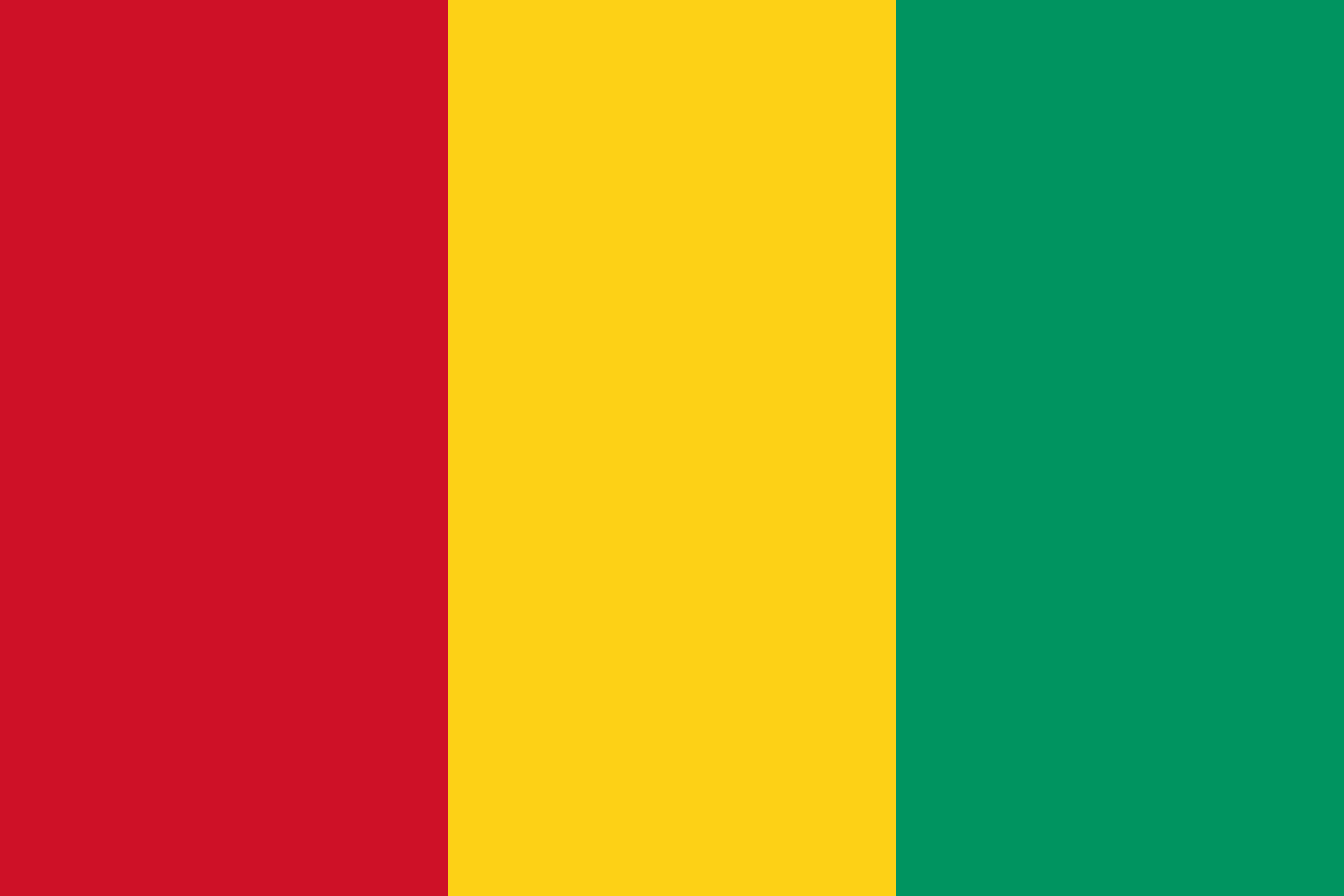
Guinea’s national flag is a plain vertical tricolor with equal red, yellow, and green bands, in that order from the attachment edge. It has no star, coat of arms, or inscription. The usual reference proportion is 3:2 width to height, although the constitutional description does not specify a ratio.
The flag identifies the Republic of Guinea through a simple arrangement: three colors, three equal bands, and no central emblem. Its red hoist band is particularly useful for distinguishing it from Mali’s similarly colored flag.
The design emerged in the independence period of 1958. Its constitutional description and the government’s later graphic standards answer different questions: the Constitution establishes the arrangement, while the graphic charter supplies numerical reproduction colors.
Explore the official graphic palette, construction sheet, history, documented Flag Day event, and downloadable pictures.
How are Guinea’s three bands arranged?
Red is the band at the hoist, the edge attached to the pole or halyard. Yellow occupies the middle third, and green is at the fly, the free edge. Each band extends through the full height. In the usual front-facing drawing, the sequence reads red, yellow, green from left to right.
The hoist is an attachment edge, not a color name or an absolute left side in every photograph. In the standard flat reference it is on the left. The green band reaches the free edge on the right.
The yellow band does not widen around a symbol because there is no symbol to accommodate. All three bands have the same width from top to bottom, and there are no gaps between them.
What are the official graphic color values?
The government’s 2021 graphic charter specifies red #CE1126, RGB 206, 17, 38; yellow #FCD116, RGB 252, 209, 22; and green #009460, RGB 0, 148, 96. It also supplies CMYK values. These are official government graphic specifications; the Constitution names the three colors without providing numerical codes.
| Color | HEX | RGB | CMYK: C, M, Y, K |
|---|---|---|---|
| Red | #CE1126 | 206, 17, 38 | 5, 100, 100, 1 |
| Yellow | #FCD116 | 252, 209, 22 | 0, 17, 100, 0 |
| Green | #009460 | 0, 148, 96 | 97, 12, 87, 2 |
The CMYK entries reproduce the charter’s table; they are not values calculated by a generic conversion from RGB. Printing results depend on the production profile, inks, material, and lighting. An on-screen sample cannot certify the appearance of a finished woven or printed flag.
These numbers are official government graphic guidance. Article 4 itself simply names red, yellow, and green. The reviewed charter does not provide a Pantone specification, so no commercial matching number is presented here as a constitutional or statutory requirement.
What do the colors of Guinea’s flag symbolize?
Official explanations connect red with the sacrifice of those who resisted colonial rule, yellow with mineral wealth and the sun, and green with vegetation, agricultural potential, and unity. The government graphic charter and symbols pages emphasize these related ideas. The three colors are also part of the broader Pan-African color tradition.
The 2021 graphic charter ties red to the struggle against colonial occupation, yellow to underground resources and sunlight, and green to vegetation and unity. Government symbols pages also emphasize agricultural potential when explaining green.
These interpretations connect history with the land and its resources. They should be read as explanations of national symbolism, rather than numerical statements about the present economy or the proportion of the population engaged in farming.
How does the flag relate to Pan-African colors?
Guinea’s government identifies its red, yellow, and green as Pan-African colors, connecting the national design with a wider African tradition. Their local meanings also refer to sacrifice, resources, vegetation, and unity. Shared colors do not create a shared flag: band direction, order, and any added symbols distinguish each country’s design.
The government explicitly identifies the palette with Pan-African colors. A useful comparison therefore examines both the shared red-yellow-green vocabulary and the separate choices made for each national design.
Guinea uses vertical bands without a star. Ghana arranges the colors horizontally and adds a black star. Senegal uses green-yellow-red vertical bands with a green star. Mali keeps a plain vertical arrangement but reverses the positions of Guinea’s red and green.
A historical interpretation reported by Flags of the World, citing Bernard Charles’s 1963 account, also associates the colors with the motto’s ideas of work, justice, and solidarity. That is an attributed historical interpretation, separate from the wording of Article 4 and the later graphic charter.
What is the usual proportion of Guinea’s flag?
The customary reference ratio is 3:2 width to height, equivalent to 2:3 when height is stated first. A flag 100 centimeters high is therefore 150 centimeters wide. Article 4 of the 2025 Constitution requires equal vertical bands but does not prescribe that numerical ratio, so the two kinds of evidence remain distinct.
This article consistently writes width before height. Consequently, 3:2 and a source’s height:length notation of 2:3 can describe the same rectangle. The mathematical width-to-height factor is 1.5.
Equal bands are part of the constitutional description. The 3:2 ratio comes from the customary flag reference, also documented by Flags of the World. Keeping those sources distinct avoids attributing a measurement to a constitutional provision that does not contain it.
How are the downloadable flag’s dimensions organized?
The national master uses a 3000-by-2000 rectangle with three 1000-unit vertical bands. Red fills the first third, yellow the middle, and green the last. Its 6000-by-4000 PNG has 2000 pixels per band. The artwork follows the official graphic palette and customary 3:2 proportion, without adding symbols or measurement labels.
| Feature | 900 × 600 reference | Delivered SVG | Large PNG |
|---|---|---|---|
| Full rectangle | 900 × 600 | 3000 × 2000 | 6000 × 4000 |
| Each band’s width | 300 units | 1000 units | 2000 pixels |
| First boundary | x = 300 | x = 1000 | x = 2000 |
| Second boundary | x = 600 | x = 2000 | x = 4000 |
| Center | (450, 300) | (1500, 1000) | (3000, 2000) |
The boundaries run vertically through the full height. The master contains only the three colored fields; its title and description are accessibility metadata, not visible lettering inside the flag.
For a width W and height H in the usual proportion, W = 3H/2. Each band’s width is W/3, which also equals H/2. This makes it possible to lay out the flag accurately without tracing a small or distorted photograph.
Which finished flag sizes preserve the reference ratio?
Calculated examples include 90 by 60, 150 by 100, and 225 by 150 centimeters, with width stated first. Each preserves the customary 3:2 rectangle and three equal bands. These are useful scaling examples, not a government stock-size schedule. Account separately for hems, sleeves, reinforcement, and other manufacturing allowances.
A 150-by-100-centimeter visible rectangle has three 50-centimeter bands. A 90-by-60-centimeter rectangle has three 30-centimeter bands. The same calculation works for a classroom drawing, a digital thumbnail, or a larger display.
Sewing allowances should be considered before cutting. A sleeve can consume part of a panel if the maker measures only the raw cloth; the finished visible design is what the proportional drawing describes.
The SVG remains scalable because it uses vector geometry. The PNG provides a ready-made raster copy with precise band boundaries at 2000 and 4000 pixels across its 6000-pixel width.
How did Guinea’s present flag develop?
The red-yellow-green vertical tricolor dates to November 10, 1958, soon after independence. The first Constitution described those three equal bands, and the 2025 Constitution retains the same arrangement. Later constitutional and graphic-standard publications document the national design; they should not be mistaken for the adoption of entirely new flags.
The “No” vote recalled in the constitutional preamble preceded independence.
Guinea became independent; October 2 is the national day.
Law No. 4/AN/58 adopted the Constitution; official symbols pages give this as the flag’s adoption date.
The Supreme Court’s constitutional reprint cites publication in this dated special issue.
The government communication service published numerical graphic colors and national-symbol guidance.
Article 4 retains red, yellow, and green in equal vertical bands.
The modern flag belongs to Guinea’s break with French colonial rule. The 2025 constitutional preamble recalls both the September referendum and the October proclamation of independence, providing a primary source for their separate places in the chronology.
Article 1 of the 1958 Constitution already described the red, yellow, and green arrangement in equal vertical bands. Article 4 of the 2025 Constitution repeats the essential design. A new constitutional text therefore does not, by itself, mean the flag was redesigned.
The historical union reconstruction shown later concerns a supranational association. It is not inserted into this sequence as though Guinea had replaced its national tricolor with a three-star flag.
Why are November 10 and November 12 both found in the records?
Guinea’s government gives November 10, 1958 as the flag’s adoption date. The first Constitution was adopted through Law No. 4/AN/58 on that date and described the tricolor. Its cited official gazette issue is dated November 12. Independence on October 2 was an earlier, separate milestone, not the flag’s adoption date.
The Supreme Court’s reprint is headed as the Constitution of November 10, 1958. Its opening identifies Law No. 4/AN/58 and an Assembly adoption on November 10. The footnote then cites the official gazette’s November 12 special issue, pages 87–90.
Adoption and publication are related but separate events. November 10 remains the flag-adoption date given by official government symbols pages. The later gazette date should not silently replace it, and the earlier independence date should not be substituted for either.
What does the 2025 Constitution establish?
Article 4 of the Constitution of September 26, 2025 describes the national emblem as a tricolor of red, yellow, and green in equal vertical bands from left to right. It also names the anthem and motto. The article does not provide a numerical flag ratio, digital color codes, or a complete ceremonial manual.
Article 4 sets out several national symbols together. Alongside the flag, it gives the anthem as Liberté and the motto as Travail, Justice, Solidarité. It states that national seals and arms are determined through legislation.
Article 6 also identifies the inviolability of national heritage, symbols, and state property among the foundational principles. That general protection is not a complete list of flag-display procedures or a basis for inventing a particular fine or criminal sentence.
The Constitution and graphic charter have different functions. Use the former for the basic national-symbol description and the latter for the documented government graphic palette. Neither source, as reviewed here, supplies a complete textile-manufacturing specification.
Who is credited with designing Guinea’s flag?
The official constitutional and government sources reviewed here establish the flag’s design and adoption date but do not identify an individual designer. A named creator should therefore not be supplied without stronger evidence. Fodéba Keita appears in official material about the national anthem; that attribution should not be transferred to the flag.
The official sources identify the national arrangement and its date but do not give a named flag artist. This is a specific limit in the reviewed evidence, not a claim that no person participated in developing the design.
Anthem authorship is a separate question. Official symbols material discusses Fodéba Keita in connection with the anthem; placing his name next to a flag-designer label would merge distinct attributions.
Modern vector contributors also have a different role. The public-domain reference used here credits SKopp and subsequent file-history work. Those credits concern a digital reproduction of an existing national symbol.
How should Guinea’s flag be prepared for print or fabric?
Keep the three bands equal, preserve the 3:2 reference rectangle, and use the government charter’s color values as the graphic starting point. Ask the printer to manage the actual ink, substrate, and color profile. The educational download supplies geometry and documented colors; it does not certify a finished textile or replace institutional specifications.
Preserve the visible design
Use equal full-height bands, the correct hoist order, and uniform scaling. Keep explanatory labels, credits, and measurement arrows outside the national flag artwork.
Check the finished result
A proof should be assessed on the intended material. A bright screen and a printed or woven surface reproduce color differently.
The CMYK values in the palette table come from the charter itself. They should travel with the production brief alongside the HEX and RGB entries, clearly labeled by color system. A printer may need to explain how its workflow interprets the supplied values.
The reviewed sources do not establish a special manufacture-license application process, compulsory fabric weight, stitch count, or mandatory list of retail sizes. This page therefore does not supply invented approvals or production requirements.
How should Guinea’s flag be displayed in a formal setting?
Preserve the national design and use the responsible institution’s current instructions for formal display. The Constitution defines the tricolor and protects national symbols, while the reviewed sources do not supply a comprehensive flag-etiquette code. Exact placement, raising schedules, military honors, and arrangements with other flags should not be invented from another country’s rules.
The flag should be recognizable as the plain national tricolor. Place institutional emblems, explanatory signs, and sponsor marks separately from the flag’s colored rectangle when preparing a display.
For an official ceremony, the responsible institution’s protocol instructions determine the operational details. The sources reviewed for this article do not settle every arrangement involving multiple flags, the observer’s viewpoint for ceremonial precedence, or an exact daily raising and lowering time.
A general constitutional protection of symbols should not be expanded into a detailed etiquette rule that is absent from the text. The documented ceremony below shows one actual use without being treated as a universal protocol manual.
What happens during a documented Guinean flag ceremony?
A documented Flag Day ceremony at the Prytanée militaire de Guinée in Conakry on September 28, 2026 included the national anthem, a raising of the colors, student performances, and a historical presentation. The Prime Minister’s office reported those activities. This provides a real ceremonial example without establishing a universal sequence for every institution.
The Prime Minister’s office describes students performing the anthem and the raising of the colors at the Prytanée militaire de Guinée, located at camp Alpha Yaya Diallo. Student presentations and an account of flag history accompanied the ceremony.
The report situates the event in the history of September 28, 1958 and emphasizes sovereignty and national cohesion. It gives useful evidence of how the flag functions in civic and educational life.
It does not prescribe a universal speed for hoisting, a mandatory public salute for every situation, or a nationwide clock-time schedule. Those details should come from the applicable institutional instructions, rather than being copied from another country’s flag code.
Why does the apparent band order change on the reverse?
A flag viewed from behind reverses the visible left-to-right order. If the hoist appears on the viewer’s right, Guinea’s flag can read green, yellow, red while red still touches the attachment edge. Check the pole, viewing direction, and context before identifying it as Mali’s flag or declaring it incorrectly made.
The reverse illustration is a geometric explanation of one physical flag. It is not a second national design. A transparent or single-layer textile naturally presents a reversed left-to-right image from behind.
Because Mali’s ordinary front view reads green-yellow-red, an isolated reverse photograph can be ambiguous. Look for the attachment edge and contextual identification. A flat reference downloaded for ordinary use should keep Guinea’s red band at the left-hand hoist.
No special vertical-banner construction rule is inferred from this illustration. Rotating a rectangle in a design application is not evidence of an officially prescribed hanging arrangement.
What is known about Guinea’s Flag Day observance?
The Prime Minister’s office documents a national Flag Day ceremony on September 28, 2026, at the Prytanée militaire de Guinée in Conakry. The report invokes the September 28, 1958 referendum. It does not by itself establish a permanent annual statutory observance or public holiday, so that broader claim remains unverified here.
The official report dates the ceremony to September 28, 2026 and identifies the setting as the Prytanée militaire de Guinée in Conakry. It connects the occasion with the legacy of the September 28, 1958 referendum.
That supports a clear statement that a national Flag Day ceremony occurred on that date. The reviewed report does not establish a standing annual legal designation or a general public-holiday entitlement. This article therefore labels the date as a documented event.
November 10, 1958 remains the flag’s adoption date. October 2 is the national day. Neither should be relabeled as a legally established annual Flag Day on the basis of the sources reviewed here.
How is Independence Day different from flag adoption?
No. Guinea became independent on October 2, 1958, and the government identifies October 2 as the national day. The flag was adopted on November 10, 1958. September 28, 1958 belongs to the referendum that preceded independence. Each date marks a different event and should keep its own label in a historical timeline.
| Date | Event | How it relates to the flag |
|---|---|---|
| September 28, 1958 | Referendum | Historical context recalled by the 2026 Flag Day ceremony |
| October 2, 1958 | Independence | The national day identified by the government charter |
| November 10, 1958 | Flag adoption | Official adoption date and date of the first Constitution |
| November 12, 1958 | Gazette publication | Publication issue cited in the Supreme Court’s reprint |
The national day can feature the flag without being the flag’s legal adoption anniversary. This distinction is useful when labeling classroom timelines, event graphics, or commemorative captions.
When was Guinea’s flag ordered to half-mast?
A government communiqué dated December 6, 2013 ordered three days of national mourning following Nelson Mandela’s death, with Guinea’s national flags at half-mast during that period. This is a documented historical instruction, not an ongoing alert or automatic rule for every death. The notice does not prescribe a measured fraction of mast height.
The government communiqué was dated December 6, 2013, following Mandela’s death on December 5. It specified three days of mourning beginning that Friday and directed that national flags be at half-mast during the period.
The communiqué was signed by government spokesman Damantang Albert Camara and transmitted through the Presidency’s press office; its text was republished by Guinean news outlets. The dates and duration describe that historical decision.
The notice does not define an exact fraction of the pole, a standard clearance below the finial, or an automatic duration for future events. The drawing explains the visual idea of a lowered flag. A current ceremony requires the instruction applicable to that occasion.
How can Guinea’s flag be maintained and stored?
As practical care, keep the flag clean, allow wet fabric to dry before storage, and replace badly damaged or faded display copies. Preserve historically important textiles through appropriate conservation advice. The sources reviewed here do not establish a specific Guinean folding pattern or retirement ritual, so those suggestions are not presented as legal requirements.
Inspect the attachment points and edges, where wear can become visible first. Let wet cloth dry before folding it for storage, and follow the material’s care instructions when cleaning. These are practical conservation suggestions rather than Guinean statutory rules.
A damaged modern display copy and a historically significant textile may require different treatment. Seek appropriate conservation advice before altering or discarding an object of historical value.
No mandatory folding geometry, burning ceremony, or disposal ritual was established by the reviewed sources. Do not import such a rule from another country and label it Guinean law.
Is there a coat of arms on Guinea’s national flag?
No. Guinea’s national flag is the plain red-yellow-green tricolor. The coat of arms is a separate national symbol, presented separately in the government graphic charter. A shield, bird, motto ribbon, or other emblem should not be added to the ordinary national flag simply because it appears in official stationery or government branding.
The graphic charter presents the arms and the flag as separate elements of government identity. Its arms-specific guidance about reproduction, clear space, and background treatment does not add an emblem to the plain tricolor.
Article 4 likewise distinguishes the flag description from its statement concerning seals and arms. On the national flag master, the center is therefore entirely yellow, with no shield, bird, ribbon, or text.
A government logo, stationery design, or official publication can combine several national symbols on a page. That composition should not be mistaken for a different ordinary national flag.
What motto and anthem accompany Guinea’s national symbols?
Article 4 of the 2025 Constitution gives the motto as Travail, Justice, Solidarité, meaning Work, Justice, Solidarity, and names the anthem Liberté, meaning Liberty. Neither is written on the national flag. They belong to the wider set of national symbols and can accompany a ceremony without becoming part of the flag’s graphic design.
The English translations explain the meaning of the French names; they are not additional flag inscriptions. A plain flag should remain free of wording even when it appears beside a printed motto or an anthem program.
The documented September 2026 ceremony included a performance of the anthem. That provides an example of these symbols being used together while remaining distinct: the anthem is performed, and the colors are raised.
How is the Union of African States flag related to Guinea?
The union flag belongs to the historical association of Ghana, Guinea, and later Mali, rather than a replacement for Guinea’s national tricolor. The illustrated three-star version is a modern reconstruction associated with the three-member union in 1961. Specialist historical accounts record uncertainty over star placement, so it is not presented as conclusively fixed official geometry.
The specialist history dates the Ghana-Guinea union to November 1958 and explains the later inclusion of Mali in 1961. Its account discusses stars corresponding to members and records uncertainty over whether the three-star arrangement formed a line or another pattern.
The downloadable reconstruction uses three black stars in a horizontal row on horizontal red-yellow-green bands. Its modern creator, Thommy, released the reference into the public domain. The illustration is identified as a reconstruction rather than a photograph of an original historical flag.
This supranational association helps explain Guinea’s place in early Pan-African cooperation. It does not change the identification of Guinea’s own plain vertical tricolor or supply a new national adoption date.
How can Guinea’s flag be distinguished from Mali’s?
In their ordinary front-facing views with the hoist at the left, Guinea has red, yellow, and green bands, while Mali has green, yellow, and red. Both are plain vertical tricolors. Band order and the attachment edge are more dependable identification cues than subtle color-shade differences, especially in folded cloth or photographs.
The reliable comparison starts at the hoist: Guinea begins with red; Mali begins with green. Yellow remains in the middle in both flags. Neither national reference shown here has a star.
Some summaries focus on differences between green shades. In practice, fabric, light, camera processing, and varying digital references make band order a better first check. A reverse image should be evaluated with its attachment edge visible.
How do nearby Pan-African tricolors differ?
Guinea’s flag has vertical red-yellow-green bands without a star. Senegal’s flag has vertical green-yellow-red bands with a green star in the center. Ghana’s flag has horizontal red-yellow-green bands and a black central star. Their shared palette reflects a broad regional tradition, but their full arrangements remain clearly different national designs.
| Country | Bands | Main identifying feature |
|---|---|---|
| Guinea | Vertical red-yellow-green | Plain design; red at the hoist |
| Mali | Vertical green-yellow-red | Plain design; green at the hoist |
| Senegal | Vertical green-yellow-red | Green star in the yellow center |
| Ghana | Horizontal red-yellow-green | Black star in the yellow center |
The comparison preserves complete star geometry and does not alter another country’s artwork to force a uniform palette. It is an identification guide, not a claim that every country follows Guinea’s government color standards.
Which flags belong to the three Guinea-named countries?
No. Guinea uses a plain vertical red-yellow-green tricolor. Guinea-Bissau has a red panel at the hoist with a black star, alongside horizontal yellow and green fields. Equatorial Guinea uses a blue triangle, horizontal green-white-red bands, and its national arms. The three names refer to different countries with distinct national designs.
Guinea’s capital is Conakry. Its national flag is the plain vertical tricolor shown in the main reference. Keep the country name attached to the correct design when preparing maps, classroom materials, or lists of national flags.
Guinea-Bissau’s red hoist panel and black star make it visually different from Guinea’s three equal vertical bands. Equatorial Guinea’s blue triangle and central arms provide a separate set of identification cues.
The detailed Equatorial Guinea reference retains its full coat of arms and stars. A simplified shield or missing emblem would weaken the comparison precisely where the flags need to be distinguished.
What is Guinea’s flag emoji and Unicode sequence?
Guinea’s flag emoji is 🇬🇳, formed by the regional-indicator letters G and N: U+1F1EC and U+1F1F3. A device may render the sequence as a flag, letters, or a fallback depending on its software. Emoji are convenient in text, but their tiny stylized rendering is not a precise color or construction reference.
The regional-indicator sequence is U+1F1EC U+1F1F3, corresponding to GN. Guinea-Bissau and Equatorial Guinea have different country sequences; a similar country name does not make the emoji interchangeable.
Small emoji often use shaded or waving artwork, and some systems show regional letters instead. For an exact rectangular image with documented colors, use the supplied SVG or PNG rather than enlarging an emoji screenshot.
Where is Guinea’s flag visible in the summit photograph?
The photograph shows Guinea’s red-yellow-green flag printed on its country placard at the U.S.-Africa Leaders Summit in Washington, D.C., on August 6, 2014. John Kerry speaks with Alpha Condé and the Liberian representative. The U.S. State Department image documents diplomatic use of the design; it is not a calibrated flag-color sample.
The flag is clearly printed beside “GUINEA” on the country placard toward the right side of the image. This is a specific visible use of the national design; the caption does not depend on identifying partially folded cloth flags in the background.
The original State Department description identifies Washington, D.C., August 6, 2014, and the first summit session, “Investing in Africa’s Future.” It names John Kerry, Guinea’s President Alpha Condé, and the Liberian representative.
The local WebP versions retain the full original frame and have proportionally reduced dimensions. Lighting and photographic processing affect the apparent colors, so the flat national master remains the color and geometry reference.
What errors should be avoided in a Guinea flag drawing?
Keep the bands vertical, equal, and ordered red-yellow-green from the hoist. Do not add a star, national arms, motto, or border inside the flag. Preserve the reference proportions and documented palette. Check that a reverse photograph has not been mistaken for the front, and distinguish Guinea from Mali and the other Guinea-named countries.
Check the hoist before checking the shade
Guinea’s red band belongs at the attachment edge. Reversing red and green in a normal front-facing master produces Mali’s basic band arrangement.
A star would also change the design. Keep the national flag plain, and place teaching labels or the country name outside its rectangle. The national motto and coat of arms remain separate symbols.
Date labels require the same care as color labels. Independence, flag adoption, constitutional publication, and the documented 2026 observance are different events. A newer reference drawing does not establish a newer adoption date.
Which Guinea flag pictures can be downloaded?
The package includes the national SVG and large PNG, anatomy and color sheets, construction and size guides, a front-and-reverse illustration, country comparisons, a founding-date diagram, a qualified historical union reconstruction, and a mourning diagram. A documentary photograph adds diplomatic context. All gallery files are served locally from the Guinea article directory.
Download the national SVG or the 6000 × 4000 PNG. The SVG is the scalable master; the PNG is a large ready-to-use raster copy.
The picture gallery provides local downloads for all construction sheets, comparisons, historical context, and the summit photograph. The union reconstruction retains its historical qualification and should not be substituted for the present national flag.
Download the plain-text image credits. Creator names and reuse notices are included without external navigation.
Guinea flag pictures

Guinea’s national flag has equal vertical bands of red, yellow, and green from the hoist. This 3:2 width:height reference uses the government’s 2021 graphic-charter colors and contains no emblem.
GKBook composition, CC0; Guinea reference by SKopp and Commons contributors, public domain.Download image
Red occupies the attachment-side third, yellow the center, and green the free-edge third. All bands are vertical and equal. The national flag has no star, shield, inscription, or other emblem.
GKBook composition, CC0; Guinea reference by SKopp and Commons contributors, public domain.Download image
The 2021 government charter specifies red #CE1126, yellow #FCD116, and green #009460. RGB and CMYK values are reproduced from its color table. These graphic specifications are separate from the constitutional description.
GKBook composition, CC0; Guinea reference by SKopp and Commons contributors, public domain.Download image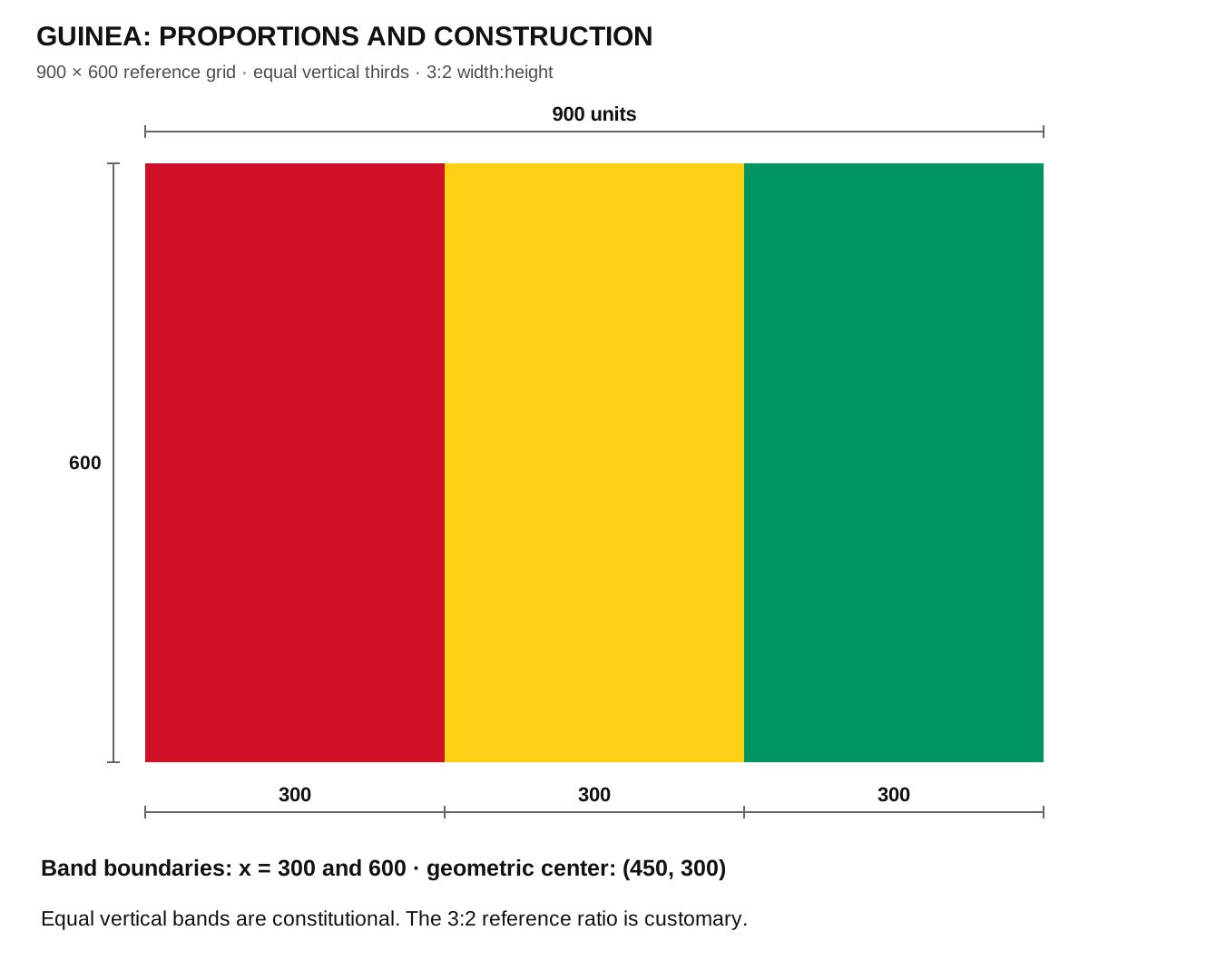
A 900-by-600 reference has three bands each 300 units wide. The delivered SVG is 3000 by 2000 with 1000 units per band. Article 4 requires equal vertical bands but does not prescribe the 3:2 ratio.
GKBook composition, CC0; Guinea reference by SKopp and Commons contributors, public domain.Download image
Calculated 3:2 examples include 90 by 60, 150 by 100, and 225 by 150 centimeters. These maintain the reference proportion and equal bands; they are not a government list of mandated manufactured sizes.
GKBook composition, CC0; Guinea reference by SKopp and Commons contributors, public domain.Download image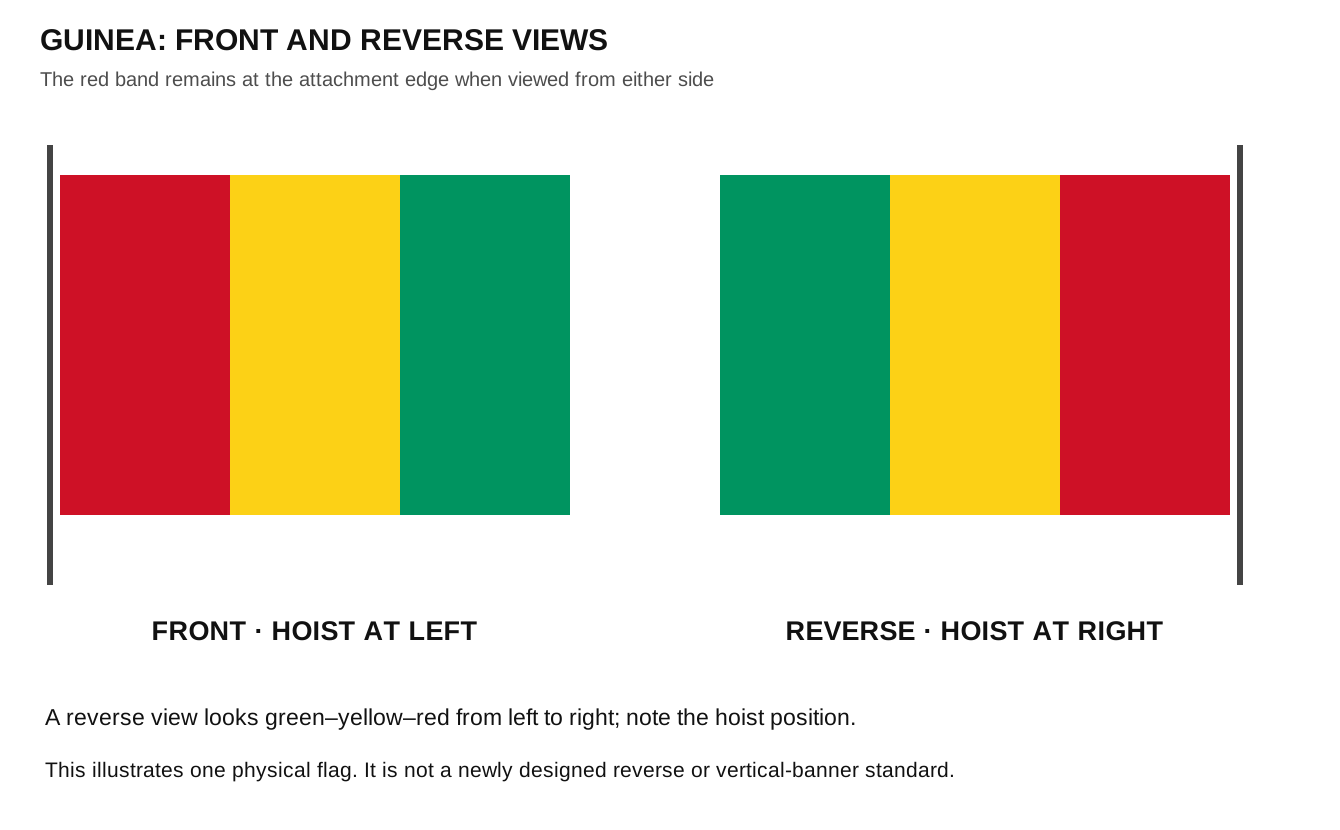
The front reference has red at viewer-left with the hoist there. Seen from behind, the whole flag reverses and the hoist appears at viewer-right. The red band still touches the attachment edge; reading order alone without the hoist can mislead.
GKBook composition, CC0; Guinea reference by SKopp and Commons contributors, public domain.Download image
With both attachment edges at viewer-left, Guinea reads red-yellow-green and Mali reads green-yellow-red. Their band order is the clearest distinction; camera lighting and reverse views can obscure identification.
GKBook composition, CC0; Guinea reference and Mali artwork by SKopp, public domain.Download image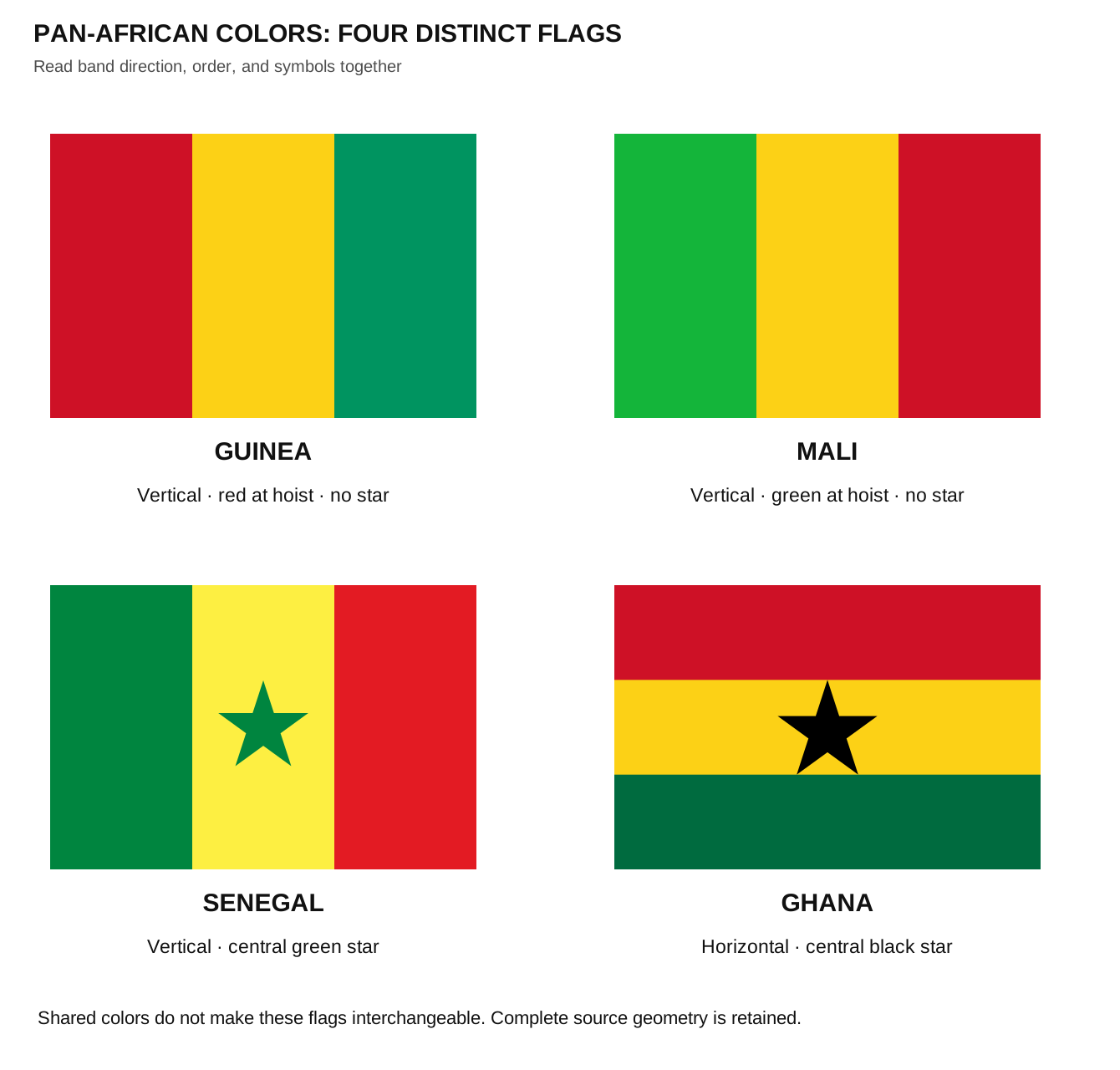
Guinea and Mali have plain vertical bands in opposite red-green order. Senegal adds a green star to green-yellow-red vertical bands. Ghana uses horizontal red-yellow-green bands and a black star.
GKBook composition, CC0; public-domain flag references by SKopp, Nightstallion, Openclipart, and Commons file-history contributors.Download image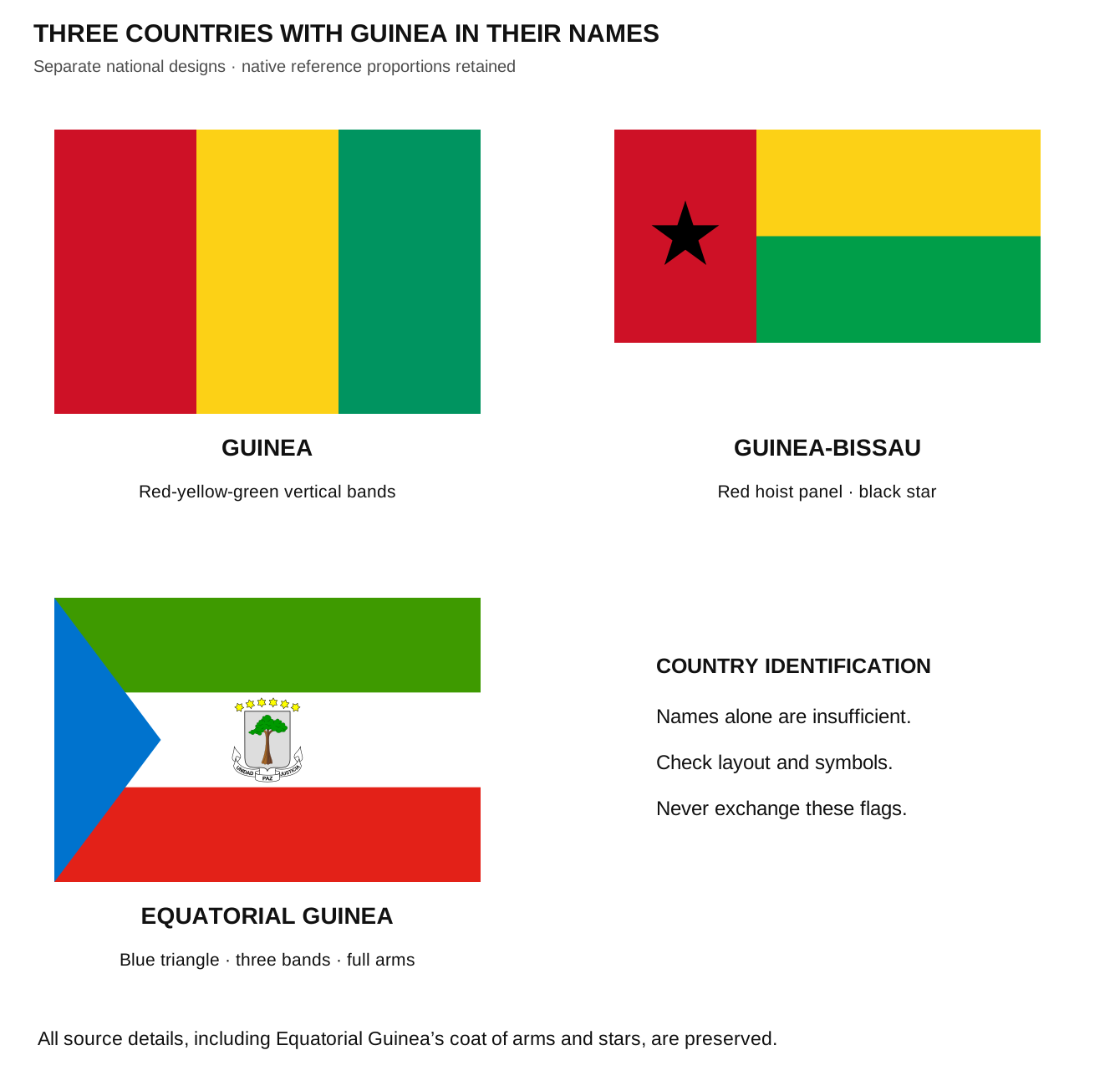
Guinea uses a plain vertical tricolor. Guinea-Bissau has a red hoist panel with a black star and horizontal yellow-green fields. Equatorial Guinea has a blue triangle, horizontal bands, and its full national arms. These are three different countries.
GKBook composition, CC0; Guinea and Equatorial Guinea references, public domain or CC0; Guinea-Bissau by SKopp, public domain.Download image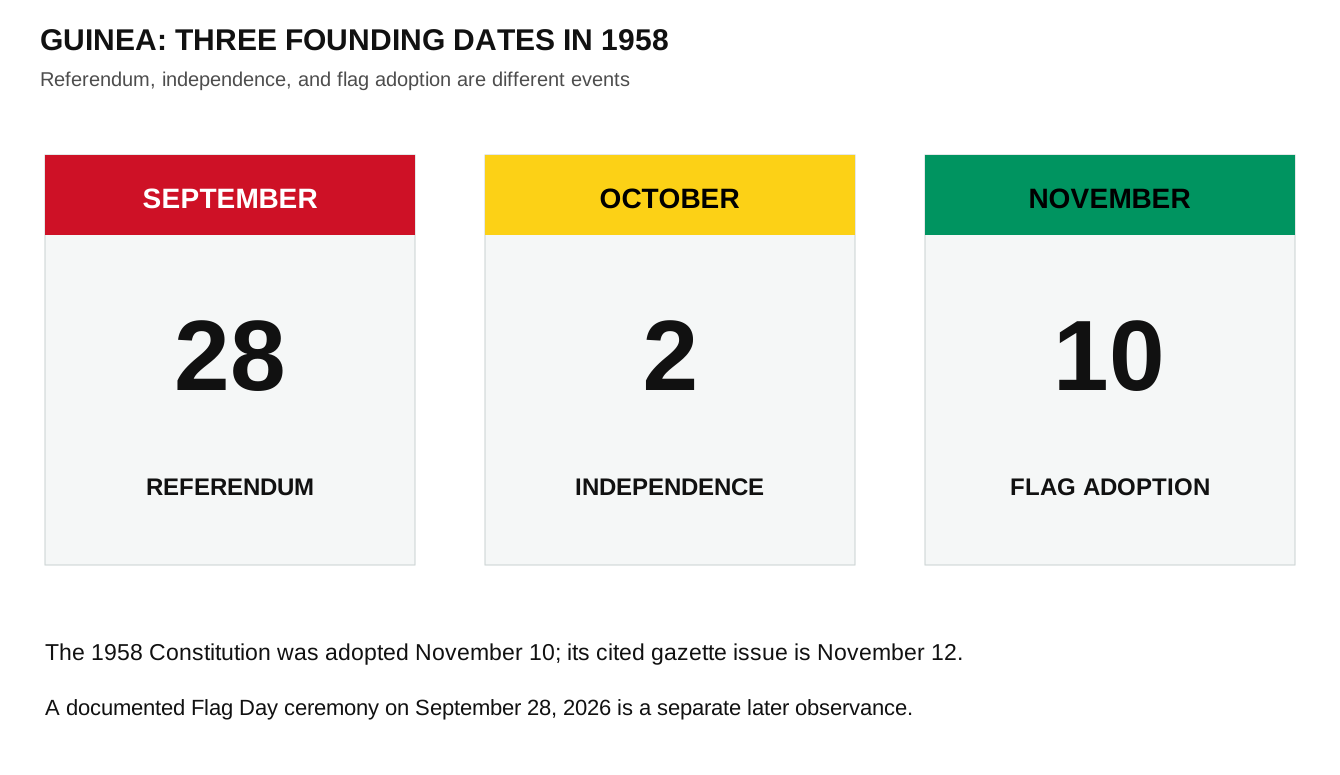
September 28, 1958 marks the referendum, October 2 independence, and November 10 flag adoption. The original Constitution’s official publication is cited as November 12. A later Flag Day ceremony does not change these founding dates.
GKBook composition, CC0; Guinea reference by SKopp and Commons contributors, public domain.Download image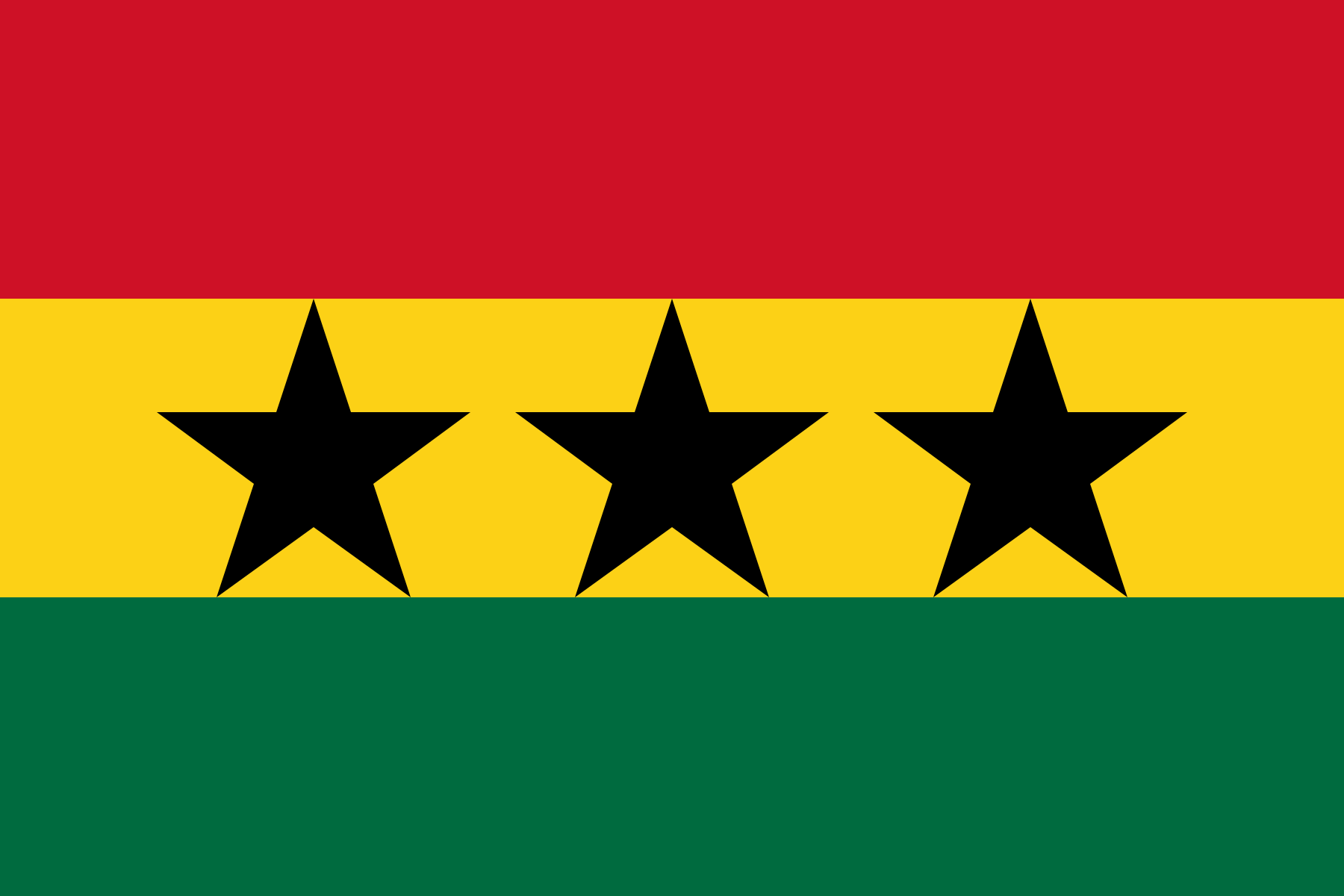
Modern reconstruction associated with the Ghana-Guinea-Mali union in 1961. It uses horizontal red-yellow-green bands and three black stars. Historical star placement is not conclusively established; this union design did not replace Guinea’s plain vertical national flag.
Thommy, public-domain reconstruction; GKBook presentation.Download image
Guinea’s government ordered three days of national mourning beginning December 6, 2013 after Nelson Mandela’s death, with national flags at half-mast. The lowered height here is illustrative, not an exact measurement specified in that notice.
GKBook composition, CC0; Guinea reference by SKopp and Commons contributors, public domain.Download image
Guinea’s red-yellow-green flag is printed beside its country name on a placard at the U.S.-Africa Leaders Summit in Washington, D.C., on August 6, 2014. John Kerry speaks with Alpha Condé and the Liberian representative in this U.S. State Department photograph.
U.S. Department of State. Public domain in the United States; official federal photograph.Download imageFrequently asked questions
What does Guinea’s flag look like?
Guinea’s national flag is a plain vertical tricolor with equal red, yellow, and green bands, in that order from the attachment edge. It has no star, coat of arms, or inscription. The usual reference proportion is 3:2 width to height, although the constitutional description does not specify a ratio.
Which color is next to the pole on Guinea’s flag?
Red is the band at the hoist, the edge attached to the pole or halyard. Yellow occupies the middle third, and green is at the fly, the free edge. Each band extends through the full height. In the usual front-facing drawing, the sequence reads red, yellow, green from left to right.
What are Guinea’s official flag color codes?
The government’s 2021 graphic charter specifies red #CE1126, RGB 206, 17, 38; yellow #FCD116, RGB 252, 209, 22; and green #009460, RGB 0, 148, 96. It also supplies CMYK values. These are official government graphic specifications; the Constitution names the three colors without providing numerical codes.
What do Guinea’s flag colors mean?
Official explanations connect red with the sacrifice of those who resisted colonial rule, yellow with mineral wealth and the sun, and green with vegetation, agricultural potential, and unity. The government graphic charter and symbols pages emphasize these related ideas. The three colors are also part of the broader Pan-African color tradition.
Why does Guinea use red, yellow, and green?
Guinea’s government identifies its red, yellow, and green as Pan-African colors, connecting the national design with a wider African tradition. Their local meanings also refer to sacrifice, resources, vegetation, and unity. Shared colors do not create a shared flag: band direction, order, and any added symbols distinguish each country’s design.
What is the ratio of Guinea’s flag?
The customary reference ratio is 3:2 width to height, equivalent to 2:3 when height is stated first. A flag 100 centimeters high is therefore 150 centimeters wide. Article 4 of the 2025 Constitution requires equal vertical bands but does not prescribe that numerical ratio, so the two kinds of evidence remain distinct.
How is the Guinea flag download constructed?
The national master uses a 3000-by-2000 rectangle with three 1000-unit vertical bands. Red fills the first third, yellow the middle, and green the last. Its 6000-by-4000 PNG has 2000 pixels per band. The artwork follows the official graphic palette and customary 3:2 proportion, without adding symbols or measurement labels.
Which sizes preserve Guinea’s flag proportions?
Calculated examples include 90 by 60, 150 by 100, and 225 by 150 centimeters, with width stated first. Each preserves the customary 3:2 rectangle and three equal bands. These are useful scaling examples, not a government stock-size schedule. Account separately for hems, sleeves, reinforcement, and other manufacturing allowances.
How has Guinea’s national flag developed?
The red-yellow-green vertical tricolor dates to November 10, 1958, soon after independence. The first Constitution described those three equal bands, and the 2025 Constitution retains the same arrangement. Later constitutional and graphic-standard publications document the national design; they should not be mistaken for the adoption of entirely new flags.
When was Guinea’s flag adopted?
Guinea’s government gives November 10, 1958 as the flag’s adoption date. The first Constitution was adopted through Law No. 4/AN/58 on that date and described the tricolor. Its cited official gazette issue is dated November 12. Independence on October 2 was an earlier, separate milestone, not the flag’s adoption date.
What does Guinea’s current Constitution say about the flag?
Article 4 of the Constitution of September 26, 2025 describes the national emblem as a tricolor of red, yellow, and green in equal vertical bands from left to right. It also names the anthem and motto. The article does not provide a numerical flag ratio, digital color codes, or a complete ceremonial manual.
Who designed Guinea’s flag?
The official constitutional and government sources reviewed here establish the flag’s design and adoption date but do not identify an individual designer. A named creator should therefore not be supplied without stronger evidence. Fodéba Keita appears in official material about the national anthem; that attribution should not be transferred to the flag.
How should the flag artwork be prepared for printing?
Keep the three bands equal, preserve the 3:2 reference rectangle, and use the government charter’s color values as the graphic starting point. Ask the printer to manage the actual ink, substrate, and color profile. The educational download supplies geometry and documented colors; it does not certify a finished textile or replace institutional specifications.
What guidance applies to displaying Guinea’s flag?
Preserve the national design and use the responsible institution’s current instructions for formal display. The Constitution defines the tricolor and protects national symbols, while the reviewed sources do not supply a comprehensive flag-etiquette code. Exact placement, raising schedules, military honors, and arrangements with other flags should not be invented from another country’s rules.
How is Guinea’s flag used in official ceremonies?
A documented Flag Day ceremony at the Prytanée militaire de Guinée in Conakry on September 28, 2026 included the national anthem, a raising of the colors, student performances, and a historical presentation. The Prime Minister’s office reported those activities. This provides a real ceremonial example without establishing a universal sequence for every institution.
Why can Guinea’s flag appear green-yellow-red in a photograph?
A flag viewed from behind reverses the visible left-to-right order. If the hoist appears on the viewer’s right, Guinea’s flag can read green, yellow, red while red still touches the attachment edge. Check the pole, viewing direction, and context before identifying it as Mali’s flag or declaring it incorrectly made.
When is Guinea’s Flag Day?
The Prime Minister’s office documents a national Flag Day ceremony on September 28, 2026, at the Prytanée militaire de Guinée in Conakry. The report invokes the September 28, 1958 referendum. It does not by itself establish a permanent annual statutory observance or public holiday, so that broader claim remains unverified here.
Is Guinea’s Independence Day the same as its flag-adoption date?
No. Guinea became independent on October 2, 1958, and the government identifies October 2 as the national day. The flag was adopted on November 10, 1958. September 28, 1958 belongs to the referendum that preceded independence. Each date marks a different event and should keep its own label in a historical timeline.
When has Guinea flown its flag at half-mast?
A government communiqué dated December 6, 2013 ordered three days of national mourning following Nelson Mandela’s death, with Guinea’s national flags at half-mast during that period. This is a documented historical instruction, not an ongoing alert or automatic rule for every death. The notice does not prescribe a measured fraction of mast height.
How should a Guinea flag be cared for?
As practical care, keep the flag clean, allow wet fabric to dry before storage, and replace badly damaged or faded display copies. Preserve historically important textiles through appropriate conservation advice. The sources reviewed here do not establish a specific Guinean folding pattern or retirement ritual, so those suggestions are not presented as legal requirements.
Does Guinea’s flag contain the national coat of arms?
No. Guinea’s national flag is the plain red-yellow-green tricolor. The coat of arms is a separate national symbol, presented separately in the government graphic charter. A shield, bird, motto ribbon, or other emblem should not be added to the ordinary national flag simply because it appears in official stationery or government branding.
What are Guinea’s national motto and anthem?
Article 4 of the 2025 Constitution gives the motto as Travail, Justice, Solidarité, meaning Work, Justice, Solidarity, and names the anthem Liberté, meaning Liberty. Neither is written on the national flag. They belong to the wider set of national symbols and can accompany a ceremony without becoming part of the flag’s graphic design.
Did the Union of African States flag replace Guinea’s flag?
The union flag belongs to the historical association of Ghana, Guinea, and later Mali, rather than a replacement for Guinea’s national tricolor. The illustrated three-star version is a modern reconstruction associated with the three-member union in 1961. Specialist historical accounts record uncertainty over star placement, so it is not presented as conclusively fixed official geometry.
How do Guinea’s and Mali’s flags differ?
In their ordinary front-facing views with the hoist at the left, Guinea has red, yellow, and green bands, while Mali has green, yellow, and red. Both are plain vertical tricolors. Band order and the attachment edge are more dependable identification cues than subtle color-shade differences, especially in folded cloth or photographs.
How does Guinea’s flag differ from Senegal’s and Ghana’s?
Guinea’s flag has vertical red-yellow-green bands without a star. Senegal’s flag has vertical green-yellow-red bands with a green star in the center. Ghana’s flag has horizontal red-yellow-green bands and a black central star. Their shared palette reflects a broad regional tradition, but their full arrangements remain clearly different national designs.
Are Guinea, Guinea-Bissau, and Equatorial Guinea the same flag?
No. Guinea uses a plain vertical red-yellow-green tricolor. Guinea-Bissau has a red panel at the hoist with a black star, alongside horizontal yellow and green fields. Equatorial Guinea uses a blue triangle, horizontal green-white-red bands, and its national arms. The three names refer to different countries with distinct national designs.
What is Guinea’s flag emoji?
Guinea’s flag emoji is 🇬🇳, formed by the regional-indicator letters G and N: U+1F1EC and U+1F1F3. A device may render the sequence as a flag, letters, or a fallback depending on its software. Emoji are convenient in text, but their tiny stylized rendering is not a precise color or construction reference.
What does the summit photograph show?
The photograph shows Guinea’s red-yellow-green flag printed on its country placard at the U.S.-Africa Leaders Summit in Washington, D.C., on August 6, 2014. John Kerry speaks with Alpha Condé and the Liberian representative. The U.S. State Department image documents diplomatic use of the design; it is not a calibrated flag-color sample.
What mistakes should be avoided when drawing Guinea’s flag?
Keep the bands vertical, equal, and ordered red-yellow-green from the hoist. Do not add a star, national arms, motto, or border inside the flag. Preserve the reference proportions and documented palette. Check that a reverse photograph has not been mistaken for the front, and distinguish Guinea from Mali and the other Guinea-named countries.
Which Guinea flag downloads are included?
The package includes the national SVG and large PNG, anatomy and color sheets, construction and size guides, a front-and-reverse illustration, country comparisons, a founding-date diagram, a qualified historical union reconstruction, and a mourning diagram. A documentary photograph adds diplomatic context. All gallery files are served locally from the Guinea article directory.
Explore all general-knowledge topics and the A-to-Z lists.

We Value Your Opinion Comments