
Equatorial Guinea flag picture
Explore the construction sheet, the coat of arms, and the historical sequence.

| Country | Equatorial GuineaRepublic of Equatorial Guinea, in Central Africa. |
|---|---|
| Design | Green, white, and redEqual horizontal bands, a blue hoist triangle, and the national arms. |
| Reference proportions | 3:2 width:heightAlso written 2:3 height:width; Article 4 gives no numeric ratio. |
| National origins | October 12, 1968Independence from Spain; early flag illustrations and actual examples vary. |
| Arms restored | 1979The familiar tree, six stars, and motto returned after the Macías period. |
| Principal description | Constitution, Article 4Equal bands, blue triangle, and arms in the flag’s center. |
| National motto | Unidad, Paz, JusticiaUnity, Peace, Justice. |
| National Day | October 12Independence Day; no separate recurring national Flag Day verified. |
The three bands are equal in height. The tree shield, six six-pointed stars, and UNIDAD PAZ JUSTICIA motto form the central arms. Independence in 1968 and the restoration of the familiar arms in 1979 are separate milestones.
What is the flag of Equatorial Guinea?
Equatorial Guinea’s flag has three equal horizontal bands of green, white, and red, a blue triangle at the hoist, and the national coat of arms in the center. The arms contain a silk-cotton tree, six six-pointed stars, and the Spanish motto UNIDAD PAZ JUSTICIA, meaning Unity, Peace, Justice.
The combination is easy to recognize: green above white above red, with blue beside the pole. The white band gives the central arms a clear background. The tree’s broad crown, the arc of stars, and the three words on the scroll distinguish the emblem from a generic tree-and-shield design.
The flag’s national history begins with independence from Spain on October 12, 1968. The central emblem changed during the 1970s and the familiar tree arms returned in 1979. Early photographs and later flag books do not present a completely uniform sequence, so the historical sections distinguish documented examples from simplified adoption summaries.
The clean downloadable illustration uses a 3:2 width-to-height ratio. That is the same shape often described as 2:3 when height comes first. The construction sheet explains the reference’s measurements, while the constitutional description identifies what Article 4 actually specifies.
How is the flag arranged?
The three horizontal bands have equal height, with green at the top, white in the middle, and red at the bottom. A blue triangle covers the hoist edge and points toward the fly. The arms occupy the center of the complete rectangular flag, rather than the center of its remaining striped area.
Hoist means the attachment edge next to the pole. Fly means the free end. A photograph taken from the other side can reverse their apparent left-right positions without depicting a different national flag.
The triangle overlays the bands. It does not divide the flag into four horizontal stripes. Likewise, the tree, shield, stars, and motto are components of one coat of arms rather than independent devices scattered across the field.
Perspective, folds, and lighting can hide the central white band or make the blue triangle seem longer. Check a flat reference before treating a photographic distortion as a formal design variant.
What is on the coat of arms?
Equatorial Guinea’s coat of arms shows a silk-cotton tree on a silver or gray shield. Six yellow six-pointed stars form an arc above it, and a scroll below carries UNIDAD PAZ JUSTICIA. The tree has a green crown and brown trunk in the reference artwork supplied with this article.
| Part | Identifying detail |
|---|---|
| Shield | A silver or gray field with a rounded lower outline. |
| Tree | A broad leafy crown and a rooted trunk; commonly identified as silk-cotton or kapok. |
| Stars | Six stars, each with six points, arranged above the shield. |
| Scroll | A light ribbon carrying the three-part national motto. |
| Motto | UNIDAD PAZ JUSTICIA — Unity, Peace, Justice. |
The tree is often called a ceiba or kapok. Historical explanations connect it with local treaty traditions, but accounts differ about the precise episode. The secure visual identification is the silk-cotton tree in the national arms; the picture itself cannot establish the date or parties to a treaty.
Silver is a heraldic color that can appear as gray in a digital drawing. Yellow represents the stars’ gold. Those conventions explain why a flat screen illustration need not use metallic ink, embroidery, or reflective foil to depict the same heraldic elements.
What do the six stars represent?
The six stars traditionally represent Río Muni on the mainland and the island components Bioko, Annobón, Corisco, Elobey Grande, and Elobey Chico. Each star has six points. This customary geographic grouping explains the emblem without making it a map, a provincial count, or a complete inventory of every island and islet.
The official government account describes the stars collectively as representing the country’s territories and islands. The expanded six-name list is familiar in flag literature. Older accounts call Bioko Fernando Poo; that historical name should not be mistaken for a seventh component.
Do not equate the stars with six administrative provinces or assume that every small island must have its own star. National emblems often preserve a historical grouping. Administrative changes and geographic inventories answer different questions from the emblem’s traditional symbolism.
For an accurate reproduction, check both numbers separately: six stars, and six points on each. Substituting familiar five-pointed clip-art stars changes a conspicuous feature of the arms.
Flag colors and digital reproduction
The field has four colors: green, white, red, and blue. The supplied vector uses #3E9A00, #FFFFFF, #E32118, and #0073CE respectively. These values identify the actual downloadable artwork. Article 4 names the colors and their arrangement without assigning HEX, RGB, CMYK, or Pantone specifications.
| Part | HEX in this SVG | RGB |
|---|---|---|
| Green upper band | #3E9A00 | 62, 154, 0 |
| White middle band | #FFFFFF | 255, 255, 255 |
| Red lower band | #E32118 | 227, 33, 24 |
| Blue hoist triangle | #0073CE | 0, 115, 206 |
| Stars in the arms | #FFFF00 | 255, 255, 0 |
| Shield in the arms | #DDDDDD | 221, 221, 221 |
The distinction between a field palette and an emblem palette matters. Saying that the flag has four principal field colors does not mean that its detailed arms use only four colors. The tree’s leaves in this file use a different green from the upper band, and the trunk includes brown tones.
Published reference drawings differ in shade and in some fine construction details. For digital consistency, preserve the supplied file’s fills. For textile production, agree on a physical proof and the responsible institution’s approved artwork rather than claiming that an automatic color conversion is a legal standard.
What do the colors and motto mean?
The government’s explanation connects green with forest wealth, white with peace, red with the blood of the independence struggle, and blue with the sea linking mainland and islands. The arms add a tree, six territorial stars, and the national motto Unity, Peace, Justice, bringing landscape and civic ideals into one design.
The sea explanation is especially helpful for remembering why the blue triangle belongs with the green-white-red tricolor. Equatorial Guinea has both a mainland component and island components; the blue is described as connecting them, not separating them into unrelated countries.
The motto is written in Spanish: Unidad, Paz, Justicia. On the scroll the words appear in capitals. Translating them into English helps explain the design, but an English translation should not replace the Spanish lettering in a reproduction of the arms.
Symbolism and construction answer different questions. A color’s meaning explains why it matters; its position explains how to draw the flag. The constitutional description and the government’s symbolic account complement one another without being identical kinds of evidence.
What are the flag’s proportions?
The supplied reference has a 3:2 width-to-height ratio. Its three bands each occupy one-third of the height, and the blue triangle reaches one-quarter of the width from the hoist. These numeric measurements describe this artwork; Article 4 specifies equal bands and the central arms without providing a detailed dimensional blueprint.
| Feature | Reference measurement | Example at 120 × 80 cm |
|---|---|---|
| Width to height | 3:2 | 120 × 80 cm |
| Each underlying band | Height ÷ 3 | 26⅔ cm high |
| Triangle base | Full height | 80 cm |
| Triangle depth | Width ÷ 4 | 30 cm |
| Center of the rectangle | Half-width, half-height | 60 cm across, 40 cm down |
In the source coordinate system the rectangle is 3600 by 2400 units. The triangle’s apex is at 900, 1200. Scaling those coordinates uniformly preserves both the outline and the detailed arms. Moving the arms to the midpoint between the triangle’s tip and the fly would shift them away from the center of the whole flag.
Equal band heights do not imply equal exposed areas. The blue triangle occupies more of the middle third than of either outer third. Do not narrow or widen a band to compensate for that overlap: the underlying bands remain equal.
How has the flag changed over time?
The flag emerged with independence in 1968, passed through a changed central emblem during the Macías period, and regained the familiar tree arms in 1979. Its green-white-red bands and blue triangle provide continuity, while the early presence of the arms and the exact dating of some changes require careful qualification.
Independence and national symbols
The republic became independent from Spain. The official government account dates the national arms to independence.
Early flag examples
Flag researchers report photographs showing flags without the central arms. Early usage was not illustrated uniformly.
A changed central emblem
The Macías-era flag retained the colored field but used different central arms. Catalogs commonly label that design 1973–1979.
Political change and restoration
The Macías regime ended on August 3; the familiar tree arms returned in 1979. These are related but distinct events.
Promulgated constitutional text
Article 4 describes equal green-white-red bands, a blue hoist triangle, central arms, and the national motto.
Diplomatic use
A U.S.-Africa Leaders Summit photograph records the national design on Equatorial Guinea’s table placard.
A dated mourning order
An official order specified a bounded period for flags at half-staff and named the institutions covered.
Fiftieth independence anniversary
The official report describes flag raising and a military and popular parade in Malabo.
A timeline can place independence, design changes, constitutional wording, and public use in sequence without treating them as equivalent acts. A photograph records an example; a constitutional article defines a national symbol; a catalog summarizes a design’s period. Each contributes a different kind of evidence.
The 2012 constitutional text did not originate the familiar colors, and the 2018 anniversary did not mark a new adoption. The national flag predates both by decades.
Did the first flag have the arms?
Emblemless flags are reported in photographs of the 1968 independence celebrations, while the government dates the national arms to independence itself. Those facts do not establish that every early flag was identical. The first years are better described through particular examples than by claiming a universally observed changeover date for the emblem.
Flag researcher Jos Poels drew attention to contemporary photographs and newspaper material showing early flags without the arms. Some references place the plain design in a longer early period, but the surviving examples and later summaries do not support a simple statement that every cloth followed one uniform schedule.
A national coat of arms can have an adoption history distinct from the timing of its appearance on every manufactured flag. The short interval around independence, different illustration sources, and the production of actual cloth or paper flags all complicate the visual record.
The reconstruction here preserves the familiar field and removes the arms solely to explain those reported examples. Its modern colors and precise geometry should not be treated as measurements taken from an original 1968 flag.
The Macías-era emblem and the 1979 restoration
During Francisco Macías Nguema’s rule, the central emblem changed while the striped field and blue triangle continued. The altered design is commonly cataloged as 1973–1979, although specialist accounts do not all give the same starting year. It belongs to the 1970s phase of the flag’s history.
The familiar tree shield, six stars, and UNIDAD PAZ JUSTICIA motto returned in 1979. The end of the regime on August 3 and the restoration of national symbols should be recorded as distinct historical events. An account that gives a political change date is not automatically an adopting instrument for the flag.
Flag catalogs often give August 21, 1979 for the restored design. That day is retained here as an attributed catalog date, not presented as a decree date independently established from the original instrument. The restoration year is the appropriate concise fact for the infobox.
The change principally concerns the central emblem. A small or folded photograph showing only the green, white, red, and blue field may therefore be insufficient to distinguish a 1970s flag from the familiar later design. Read the central device and establish the image’s date before identifying a historical version.
What does the constitution specify?
Article 4 describes three equal horizontal bands of green, white, and red, a blue triangle at the edge nearest the pole, and the national arms in the center. It also identifies the motto Unity, Peace, Justice. The article does not supply a numeric aspect ratio, triangle depth, or complete digital color specification.
| Question | What Article 4 establishes |
|---|---|
| Band arrangement | Green, white, and red horizontal bands of equal dimensions. |
| Blue triangle | Placed on the side nearest the flagpole. |
| Arms | Located in the center of the flag; the arms themselves are established by law. |
| Motto | Unidad, Paz y Justicia in the constitutional wording. |
| Numeric construction | No aspect ratio or triangle-depth number is supplied in this article. |
| Physical production | No complete textile, printing, or HEX palette is supplied in this article. |
Article 15 separately requires inhabitants to respect the country and its national symbols, among the other institutions it names. That general duty should not be expanded into an invented folding method, mandatory fabric, or detailed public display timetable.
The constitution’s reference to arms established by law matters: its short flag description is not a substitute for every possible rule on national symbols. Likewise, a reference SVG is a practical drawing, not a legal document establishing every measurement it contains.
For an official ceremony or manufacturing contract, the institution’s applicable instructions and approved artwork take precedence over assumptions drawn from a small website image.
Who designed the flag?
A 2018 CPDS retrospective credits Atanasio Ndong Miyono and Saturnino Ibongo Iyanga with Equatorial Guinea’s national symbols collectively. It does not establish a sole flag artist through an original design commission. The credit is therefore best stated with that qualification, rather than converting a shared historical account into an unsupported exclusive attribution.
The retrospective concerns the national symbols as a group. The official government page separately names Atanasio Ndongo Miyono in connection with the anthem’s words. An anthem credit, a political role in creating national symbols, and authorship of a particular flag drawing are related topics, but they are not interchangeable.
The supplied vector is a modern digital rendering by reference-art contributors. Its public-domain or CC0 status explains how the artwork can be reused; it does not make those contributors the historical designers of the national flag.
Making and reproducing the flag
Begin with the complete vector rather than rebuilding the arms from unrelated clip art. Keep the three band heights equal, the blue triangle at the hoist, and the arms centered on the complete rectangle. At small sizes, the tree and star arc may remain legible after the motto becomes difficult to read.
- Choose the finished size. Scale the complete reference uniformly and distinguish the visible field from seam allowances.
- Proof the field. Check the top-to-bottom order and the full-height blue triangle.
- Inspect the arms. Keep the tree, shield, six six-pointed stars, and all three motto words.
- Approve color on the intended material. A backlit display and printed or woven fabric can look different.
- Review the attachment and reverse. A sleeve, grommets, lining, or double-sided construction should suit the intended display.
These are practical production checks. The cited constitutional text does not prescribe a specific fabric weight, stitch count, dye system, or commercial size range. Formal orders should follow the commissioning institution’s requirements.
Current flag, simplified drawings, and historical variants
The complete coat-of-arms design is the national flag described by Article 4. Some flag books have described a plain civil variant, while later researchers question that classification and connect emblemless examples with early history. A field-only drawing should therefore carry a clear purpose and period label.
| Image type | How to interpret it |
|---|---|
| Current complete flag | The colored field with the national arms in the center. |
| Enlarged arms | A detail of the emblem, not an alternative rectangular flag. |
| Field-only construction plate | A teaching device that removes the emblem to show geometry. |
| Early emblemless reconstruction | An illustration of reported historical examples, with uncertain uniformity and dates. |
| 1970s changed emblem | A historical design associated with the Macías period. |
| Folded, reversed, or oblique photograph | A view of a physical flag that may hide or distort details. |
A small pictogram that omits the arms for legibility is a simplified representation. It should not be used to prove the existence of a legally separate civil flag. Similarly, an enlarged shield extracted from the SVG belongs in an emblem explanation, not on a pole by itself as a substitute national design.
The downloads distinguish these uses in their titles and captions. The clean flag file is the appropriate starting point when the full current design is required.
Displaying the flag respectfully
For a formal display, use the complete national design, keep the cloth clean and intact, and follow the host institution’s ceremony instructions. The constitution establishes respect for national symbols, but its short provisions do not answer every question about flag precedence, pole positions, indoor arrangements, or lowering procedures.
A horizontal front-view illustration places the hoist at the left. Real flags can be seen from either side, and a photograph from the reverse naturally changes the apparent side of the triangle. Do not digitally mirror a documentary photograph merely to make it resemble a textbook diagram.
When flags are displayed together, confirm the organizer’s protocol for order, equal treatment, and local placement. Rules for one institution or international event should not be presented as a universal law of Equatorial Guinea without a supporting instruction.
For a vertical installation, request the institution’s approved orientation rather than inventing a new layout of bands or moving the arms. A rotated flag, a purpose-made vertical banner, and a ceremonial standard are different production questions that require the intended use to be clear.
When is Equatorial Guinea’s National Day?
Equatorial Guinea’s Independence Day is October 12, marking independence from Spain in 1968. Official anniversary celebrations have included raising the national flag and holding military and popular parades. This supported national commemoration is distinct from an assumed annual Flag Day based only on a date appearing in a flag catalog.
The official account of the fiftieth anniversary, on October 12, 2018, places the celebrations on Malabo’s seafront. It reports a flag raising followed by a parade and aerial displays. The event shows how the national colors function within a public independence ceremony.
The same report describes aircraft tracing the national colors in the air. A ceremonial color display can evoke the flag without reproducing every star or letter in the arms. It should be identified as an anniversary display, not substituted for a flat construction reference.
October 12 is used in this page’s National Day link and infobox. The frequently cited August 21 restoration date does not by itself establish a separate annual holiday, and the August 3 political anniversary is not the date of independence.
When is the flag flown at half-staff?
Follow the applicable official mourning declaration and the institution’s instructions. A November 2016 order specified a defined period and covered public institutions, military sites, armed-forces ships, and diplomatic and consular missions abroad. It provides a documented example of half-staff use, not a permanent duration rule or a current mourning announcement.
The order reported on November 28, 2016, declared mourning from noon on November 29 until midnight on December 1 following Fidel Castro’s death. Both the time interval and the named locations are part of that particular instruction.
A past three-day observance does not mean that every later death or disaster requires three days of half-staff display. Check the new declaration’s beginning, end, and scope. The lowering distance shown in an explanatory drawing is not a substitute for the responsible institution’s procedure.
English uses both half-staff and half-mast. The practical question is the applicable order, not which of those equivalent labels appears in a general description.
The flag in a diplomatic photograph
The national design also identifies a country on documents, signs, and meeting placards. The photograph below records a printed use at the U.S.-Africa Leaders Summit in Washington, D.C., on August 6, 2014. The small flag is visible on Equatorial Guinea’s table placard at the lower right.
John Kerry is greeting Teodoro Obiang Nguema Mbasogo before a summit session. The photograph is useful evidence of the flag as a country identifier in diplomacy; it is not presented as an independence ceremony, a flag raising, or a detailed cloth specification.
The full frame has been retained. The surrounding meeting context explains why the flag appears at a small scale. Use the enlarged vector illustration for studying the stars and motto, since those details cannot be reliably measured from the placard in this view.
Care, storage, and replacement
A clean, well-maintained flag keeps the design legible and avoids damage around the attachment edge. Follow the fabric maker’s cleaning guidance, dry the cloth before storage, and inspect seams and fittings regularly. These are practical care recommendations, not additional constitutional rules.
Useful care practices
- Store clean, dry cloth away from dampness and direct sunlight.
- Inspect the hoist, seams, and fly edge for wear.
- Use a suitable pole attachment that does not tear the cloth.
- Handle embroidered or aged flags with support for heavy areas.
Damage to avoid
- Putting away wet fabric or trapping it in an airtight container.
- Applying bleach or strong cleaners without material guidance.
- Pulling on the emblem, tassels, or weakened seams.
- Treating an old ceremonial or historical flag as disposable household fabric.
When a flag is damaged beyond serviceable repair, ask the owner or institution about replacement and retirement. No specific compulsory burning ceremony, numbered folding ritual, or disposal procedure is inferred from the sources used here. A historically important flag may need conservation rather than routine replacement.
How does it differ from Guinea and Guinea-Bissau?
Equatorial Guinea has horizontal green-white-red bands, a blue triangle, and tree arms. Guinea has vertical red-yellow-green bands. Guinea-Bissau has a red hoist containing a black five-pointed star, with yellow above green toward the fly. The similar country names therefore correspond to clearly different layouts, colors, and emblem details.
| Country | First recognition clue | Emblem clue |
|---|---|---|
| Equatorial Guinea | Three horizontal bands plus a blue triangle | Tree shield, six six-pointed stars, and motto. |
| Guinea | Three vertical red-yellow-green bands | No central coat of arms in the illustrated national design. |
| Guinea-Bissau | Red hoist with yellow and green toward the fly | One black five-pointed star in the red area. |
When a photograph is folded or distant, the presence of white and blue can be a useful clue for Equatorial Guinea. A clear caption and setting still matter: a partial view may hide the very feature needed to identify a flag confidently.
Common mistakes and useful distinctions
| Mistake | Correction |
|---|---|
| The blue triangle is a fourth horizontal band. | It overlays the hoist; there are three horizontal bands. |
| Equal bands must show equal exposed colored areas. | The triangle overlaps the middle and outer bands differently. |
| The arms should sit halfway between the triangle and the fly. | Article 4 places them at the center of the flag. |
| The stars have five points. | There are six stars, each six-pointed. |
| The stars count modern provinces. | Their traditional explanation concerns the mainland and island components. |
| Every early independence flag had exactly the same arms. | Reported early examples and later references are not uniform. |
| 1979 is the country’s independence year. | Independence was in 1968; 1979 concerns restoration of the familiar arms. |
| The 2012 constitution introduced a new flag. | It describes a national symbol with an earlier history. |
| August 21 is automatically an annual Flag Day. | A catalog restoration date does not establish a holiday. |
| The reference HEX values are compulsory textile specifications. | They describe the supplied digital illustration. |
| A field-only teaching plate proves an official civil variant. | The omission must be interpreted according to the image’s stated purpose. |
Equatorial Guinea flag at a glance
Remember green, white, red, a blue hoist triangle, and the central tree arms. Count six six-pointed stars above the shield and read UNIDAD PAZ JUSTICIA on the scroll. The flag’s origins are in 1968, and the familiar arms returned in 1979.
| Quick reference | Answer |
|---|---|
| Country | Republic of Equatorial Guinea |
| Region | Central Africa |
| Motto translation | Unity, Peace, Justice |
| Reference proportions | 3:2 width:height, or 2:3 height:width |
| Constitutional description | Article 4 |
| National Day | October 12, Independence Day |
| Best clean download | The complete unannotated flag SVG |
| Gallery subjects | Current flag, arms, stars, construction, early reconstruction, comparison, mourning, sizing, and diplomatic photograph |
The gallery labels distinguish a national flag illustration from an explanatory diagram, a modern reconstruction, and a documentary photograph. Keep those captions with reused teaching material so that a historical or simplified image remains identifiable.
Equatorial Guinea flag pictures

Equatorial Guinea’s flag has equal green, white, and red horizontal bands, a blue triangle at the hoist, and the national arms in the center. This reference uses a 3:2 width-to-height ratio.
GKBook composition, CC0; underlying Equatorial Guinea flag artwork, CC0.Download image
The hoist is the attachment edge and the fly is the free edge. The blue triangle extends from the full hoist toward the center of the flag. The coat of arms is centered on the complete rectangular field.
GKBook composition, CC0; underlying Equatorial Guinea flag artwork, CC0.Download image
A 12-by-8 grid expresses the supplied 3:2 flag. The blue triangle has a depth of three units, one-quarter of the width. Dashed guides locate the center at six units across and four down. These numeric choices describe the reference SVG, not dimensions specified in Article 4.
GKBook composition, CC0; underlying Equatorial Guinea flag artwork, CC0.Download image
The enlarged national arms show six yellow six-pointed stars above a silver-gray shield containing a silk-cotton tree. A scroll below reads UNIDAD PAZ JUSTICIA, meaning Unity, Peace, Justice.
GKBook composition, CC0; underlying Equatorial Guinea flag artwork, CC0.Download image
Six six-pointed stars traditionally stand for Río Muni, Bioko, Annobón, Corisco, Elobey Grande, and Elobey Chico. This explanatory list does not assign a particular star to each place and is not an exhaustive modern geographic or administrative inventory.
GKBook composition, CC0; underlying Equatorial Guinea flag artwork, CC0.Download image
A field-only teaching diagram makes the triangle’s overlap visible. The underlying green, white, and red bands have equal height, but the exposed colored areas differ. The arms are intentionally omitted for explanation, not to define a current official variant.
GKBook composition, CC0; underlying Equatorial Guinea flag artwork, CC0.Download image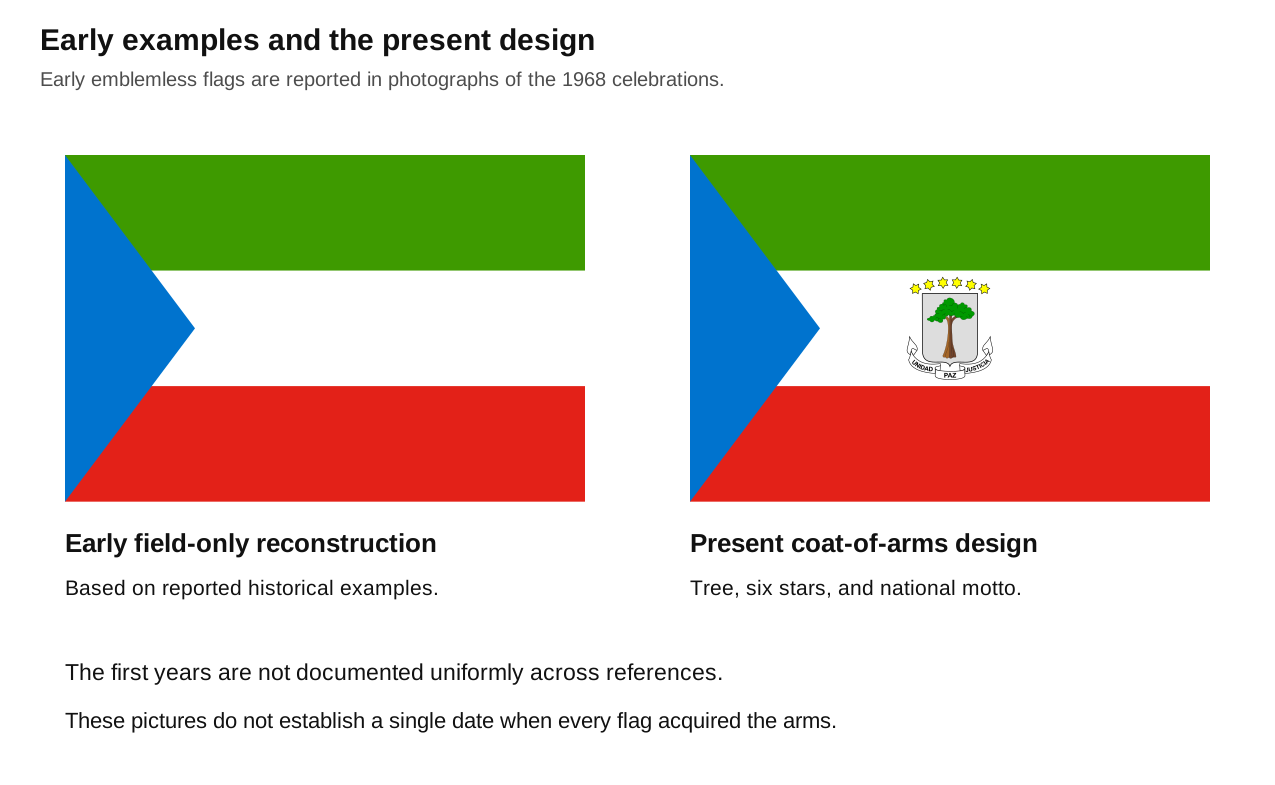
An original reconstruction without the arms illustrates early examples reported for the 1968 independence celebrations. The current flag appears alongside it. The comparison does not prove that every flag used before a particular year was emblemless.
GKBook composition, CC0; underlying Equatorial Guinea flag artwork, CC0.Download image
Equatorial Guinea has three horizontal green-white-red bands, a blue triangle, and tree arms. Guinea has vertical red-yellow-green bands. Guinea-Bissau has a red hoist with a black five-pointed star and horizontal yellow-green bands.
GKBook comparison, CC0; Equatorial Guinea reference, CC0; Guinea and Guinea-Bissau artwork, public domain.Download image
A lowered flag illustrates official mourning. The November 28, 2016 order specified a bounded observance and named the institutions concerned. This schematic gives neither a current mourning notice nor a universal halyard measurement.
GKBook composition, CC0; underlying Equatorial Guinea flag artwork, CC0.Download image
Thirty by twenty, ninety by sixty, and one hundred fifty by one hundred centimeters are example 3:2 sizes. They are not statutory cloth dimensions. The drawings use different display scales while each preserves the complete flag’s proportions.
GKBook composition, CC0; underlying Equatorial Guinea flag artwork, CC0.Download image
John Kerry greets Teodoro Obiang Nguema Mbasogo at the U.S.-Africa Leaders Summit in Washington, D.C., on August 6, 2014. Equatorial Guinea’s flag appears on the table placard at lower right.
U.S. Department of State photo; public domain. Full-frame WebP conversion and resizing.Download imageFrequently asked questions
What does Equatorial Guinea’s flag look like?
Equatorial Guinea’s flag has three equal horizontal bands of green, white, and red, a blue triangle at the hoist, and the national coat of arms in the center. The arms show a tree, six six-pointed stars, and a scroll bearing the words UNIDAD PAZ JUSTICIA.
What is the order of the flag’s colors?
Read the horizontal bands from top to bottom: green, white, then red. Blue forms the triangle beside the flagpole, rather than an additional stripe. The coat of arms sits centrally on white. Its smaller colored details belong to the emblem and do not change the three-band arrangement.
What does the green band mean?
The official government explanation associates green with the country’s forest wealth. Broader accounts also connect it with natural resources and vegetation. It is the top horizontal band of the flag, while the separate green tree inside the arms forms part of the central emblem’s distinct design.
What does the blue triangle symbolize?
Blue represents the sea connecting Equatorial Guinea’s mainland and islands in the government’s explanation. The triangle occupies the hoist, or attachment edge, and points toward the fly. That meaning helps explain the design without making the triangle a geographic map or assigning its corners to particular islands.
What do white and red symbolize?
White stands for peace, while red recalls blood associated with the struggle for independence in the official explanation. White occupies the middle band and red the bottom band. These meanings should be distinguished from the constitution’s physical description, which specifies their position without recounting every symbolic interpretation.
What tree appears on the flag?
The central shield contains a silk-cotton or kapok tree, commonly called a ceiba. It has a broad green crown and a brown trunk in the supplied illustration. The tree belongs to the national coat of arms; it should not be replaced with a palm or another generic tropical tree.
What do the six stars represent?
The stars traditionally represent the mainland component, Río Muni, and five island components: Bioko, Annobón, Corisco, Elobey Grande, and Elobey Chico. This is a customary explanation of the emblem’s six-part grouping. It is not a count of modern provinces or an exhaustive list of every island and islet.
How many points does each star have?
Each of the six stars above the shield has six points. The number of stars and the number of points are separate details: there are six stars, each six-pointed. A simplified drawing with five-pointed stars changes the emblem, even when the green, white, red, and blue field looks correct.
What does UNIDAD PAZ JUSTICIA mean?
UNIDAD PAZ JUSTICIA means “Unity, Peace, Justice” in English. These are the three ideals written on the scroll beneath the tree shield. Article 4 also identifies the national motto. It is not an independence date, a president’s name, or a longer sentence hidden in the small lettering.
What are the flag’s proportions?
The reference flag supplied here has a 3:2 width-to-height ratio, equivalently 2:3 when height is stated first. A 90-by-60-centimeter example preserves that shape. Article 4 specifies equal bands and the placement of the triangle and arms, but does not itself prescribe a numeric overall aspect ratio.
How far does the blue triangle extend?
In the supplied reference artwork, the triangle’s apex lies one-quarter of the total width from the hoist. Its base spans the full height. Historical and modern illustrations have varied, and Article 4 does not give a numeric triangle depth, so this measurement describes the downloadable SVG rather than a statutory construction rule.
Are the three bands equal in area?
The three underlying horizontal bands have equal height, each one-third of the flag’s height. Their exposed areas are not equal because the blue triangle overlaps them differently. The arms also cover part of white. Equal band dimensions therefore should not be confused with equal visible areas of every color.
What are the flag’s HEX colors?
The supplied SVG uses green #3E9A00, white #FFFFFF, red #E32118, and blue #0073CE for the field. The arms add yellow, gray, brown, black, and another green. These are the actual file’s digital fills, not a complete legally mandated palette for cloth, print, or every official image.
When was Equatorial Guinea’s flag adopted?
The national flag originated at independence from Spain on October 12, 1968. Its central emblem changed during the Macías period, and the familiar tree arms returned in 1979. A single adoption date can therefore conceal the distinction between the independence design, later changes, and the restoration of the present emblem.
Did the first flag have a coat of arms?
Flag researchers report emblemless examples in photographs of the 1968 independence celebrations. Other accounts associate the national arms with independence, and references do not give a uniform early sequence. It is safer to identify a particular documented example than to claim that every flag before one fixed year lacked the arms.
What changed during the Macías period?
The central emblem was replaced during the 1970s, while the familiar striped field and blue triangle continued. The altered arms are commonly cataloged as a 1973–1979 design. References differ on the precise beginning, so the broad period is more secure than an exact date inferred only from an illustration’s filename.
When were the familiar tree arms restored?
The familiar tree, six stars, and three-part motto returned in 1979 after the end of the Macías regime. Flag catalogs often specify August 21. The restoration year is used here, while the precise day is treated as a catalog attribution because its original adopting instrument was not located.
Who designed Equatorial Guinea’s flag?
A 2018 CPDS retrospective credits Atanasio Ndong Miyono and Saturnino Ibongo Iyanga with the national symbols collectively. That account does not isolate a sole flag artist or reproduce an original design commission. The historical credit should therefore remain qualified and separate from authorship of the modern downloadable vector artwork.
Does the 2012 constitution mark a new flag adoption?
No. Article 4 of the constitutional text promulgated in 2012 describes national symbols that have an earlier history. The flag originated with independence in 1968 and the familiar arms were restored in 1979. A later constitutional description should not automatically be treated as the date of a new flag design.
Is a flag without the arms an official civil version?
Some flag references have described an emblemless civil variant, while later researchers question that classification and connect plain examples with early history. Article 4 expressly places the arms in the flag’s center. The field-only diagrams here are teaching or historical illustrations, not confirmation of a separate current official civil flag.
When is Equatorial Guinea’s National Day?
Equatorial Guinea celebrates independence on October 12, recalling the end of Spanish colonial rule in 1968. Official anniversary ceremonies have included raising the national flag and military and popular parades. The date is presented here as Independence Day, without inventing a separate annual nationwide Flag Day from an adoption anniversary.
Is August 21 a national Flag Day?
Flag catalogs often give August 21, 1979 as the restoration date for the familiar arms. That catalog date does not by itself establish an annual public holiday or nationwide Flag Day. No separate recurring observance on that date was verified for this article; October 12 is the supported independence commemoration.
When is the flag flown at half-staff?
Follow the applicable official mourning order and the instructions of the institution concerned. A 2016 order specified dates and covered public institutions, military sites, armed-forces ships, and diplomatic and consular missions abroad. That historical example does not establish a permanent three-day rule or announce a current mourning period.
Does half-staff mean an exact halfway measurement?
The historical order cited here directs flags to be lowered for mourning but supplies no universal numerical halyard position. The diagram is consequently schematic. Confirm the responsible institution’s procedure and the current order rather than measuring halfway down a pole solely because an illustration shows a flag in a lower position.
How is Equatorial Guinea’s flag different from Guinea’s?
Equatorial Guinea has horizontal green-white-red bands, a blue triangle, and tree arms. Guinea has vertical red-yellow-green bands without that triangle or coat of arms. The shared word Guinea does not identify one country, and the direction of the bands is a useful first clue before examining smaller emblem details.
How is it different from Guinea-Bissau’s flag?
Guinea-Bissau’s flag has a red hoist containing one black five-pointed star, with yellow above green toward the fly. Equatorial Guinea instead has a blue triangle, three horizontal green-white-red bands, and six six-pointed stars within its arms. Both the field arrangement and the star details distinguish the two designs.
Can the flag be stretched to fit a banner?
Scale the complete artwork uniformly so the flag’s rectangular proportions, triangle, tree, and stars remain consistent. Cropping or stretching the master changes the design. Extra space for a webpage banner can sit around the flag; it need not be created by widening the emblem or cutting off the hoist triangle.
What should a printer check before producing the flag?
Check the band order, the blue triangle at the hoist, the complete central arms, all six six-pointed stars, and the readable national motto. Agree on the finished dimensions and color proof. Hems and sleeves need production allowances, but those allowances should not be mistaken for part of the visible flag design.
What does the summit photograph show?
The photograph shows John Kerry greeting Teodoro Obiang Nguema Mbasogo at the U.S.-Africa Leaders Summit in Washington, D.C., on August 6, 2014. Equatorial Guinea’s flag appears on a table placard at lower right. It documents a printed diplomatic use of the design, rather than a flag-raising ceremony.
Which download should be used for a clean flag image?
Use the unannotated flag SVG for the complete national design. The construction sheets, emblem close-ups, comparison plates, and historical reconstruction serve different explanatory purposes. They retain labels so that a teaching diagram or field-only reconstruction is not mistaken for the current complete flag when downloaded or printed separately.
Explore all general-knowledge topics and the A-to-Z lists.

We Value Your Opinion Comments