

Zambia flag picture
The 2:3 rectangle follows the Act. The construction guide distinguishes stated measurements from reconstructed eagle width. Source eagle paths and the declared digital palette are credited in the artwork notes.
| Country | Republic of ZambiaNational flag and ensign. |
|---|---|
| Adopted | October 24, 1964Adopted at independence; distinct from the 1965 Act. |
| Designer | Gabriel EllisonCredited by the National Assembly and ICAO. |
| Proportions | Height:length = 2:3Schedule Part I; reference grid 336 × 224. |
| Bird | African fish eagleOrange, above the fly-side stripe block. |
| Stripes | Red · black · orangeThree equal vertical rectangles at the lower fly. |
| Independence Day | October 24One of the occasions named in the 2011 regulations. |
| Legal colors | BCC 100 · 210 · 220 · 57British Colour Council references, separate from digital approximations. |
| Working palette | #147F55 · #D40829 · #000000 · #F99815Declared source-vector RGB values, not certified BCC conversions. |
Source notes separate cultural explanations, legal evidence and the attributed artwork’s reproduction choices.
What does the Zambia flag look like?
Zambia’s flag is a green rectangle with an orange African fish eagle above a block of three vertical stripes at the lower fly. In the standard front view, the stripes run red, black and orange from left to right. Its height-to-length ratio is 2:3, and the flag was adopted at independence on October 24, 1964.
The combination of a broad green field and devices concentrated at the free edge makes Zambia’s flag easy to recognize. This guide separates the legal description and construction measurements from symbolic explanations, historical revisions and digital reproduction choices. It includes a clean scalable master, a large opaque PNG and labeled teaching graphics, with visible sources for each answer.
Sources: National Flag and Armorial Ensigns Act — ZambiaLII/Laws.Africa reproduction · State House — National Symbols · Embassy of Zambia in Washington — About Zambia, flag section
What is Zambia’s national flag called?
It is the national flag of the Republic of Zambia. Its official legal designation is the National Flag, distinct from the President’s Standard and the Armorial Ensigns. The familiar design combines a green field, an orange eagle and a compact block of red, black and orange stripes at the fly.
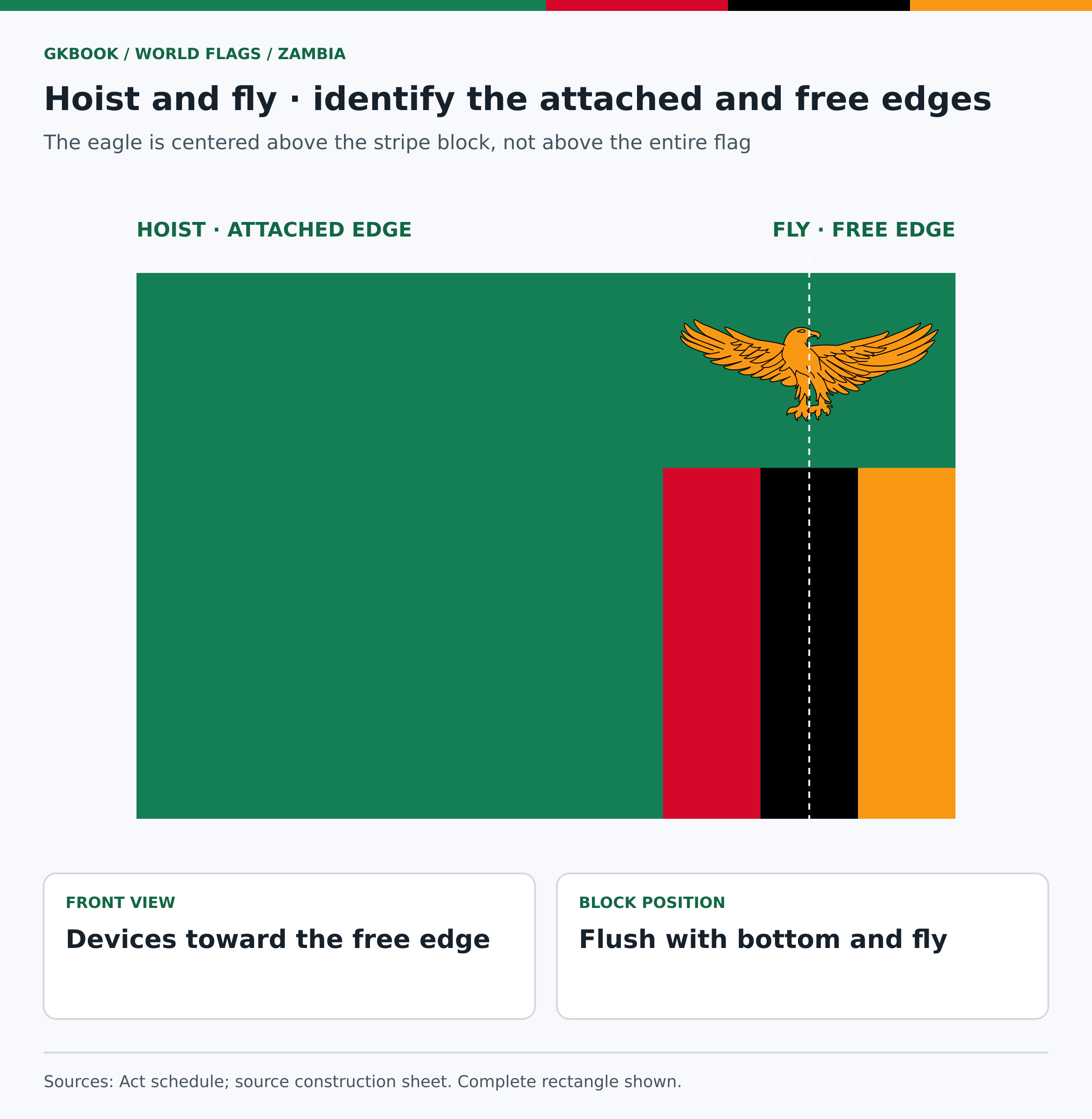
The fly is the free edge opposite the flagpole; the hoist is the attached edge. In the usual front-view drawing, the hoist is on the left and the decorated fly is on the right. These terms explain the design more reliably than simply saying that its symbols are in a corner, especially when comparing the front and reverse.
The legislation names three separate national devices. A picture of the coat of arms or an orange presidential flag should therefore not replace the green national flag in a country list. A useful caption identifies the country, the current design and the image’s role, such as a clean reference, a construction diagram or a historical illustration.
Sources: National Flag and Armorial Ensigns Act — ZambiaLII/Laws.Africa reproduction · ZambiaLII — Constitution of Zambia Act, consolidated through December 18, 2025 · Drawing method and calculations
What are the Zambia flag colors and HEX codes?
Zambia’s flag uses green, red, black and orange. The law specifies British Colour Council references 100, 210, 220 and 57 respectively. This digital reference uses #147F55, #D40829, #000000 and #F99815, retained from the identified source vector. These HEX values are reproduction choices, not a certified conversion of the legal color standards.

The statutory names are Spectrum Green, Union Jack Red, Jet Black and Spectrum Orange. Those named reference shades are a stronger basis for describing the legal palette than an unattributed online color table. The numeric RGB values in the downloads are disclosed so that the clean flag and teaching graphics remain internally consistent and can be reproduced exactly.
Different flag references and production manuals publish different digital or Pantone approximations. A parliamentary response in December 2012 explicitly discussed inconsistent flag colors and the importance of complying with the prescribed specifications. This page consequently keeps the historical color-reference system separate from screen values, and does not present a quick RGB-to-CMYK conversion as a national manufacturing standard.
| Color | British Colour Council | HEX | RGB |
|---|---|---|---|
| Green | Spectrum Green · 100 | #147F55 | 20, 127, 85 |
| Red | Union Jack Red · 210 | #D40829 | 212, 8, 41 |
| Black | Jet Black · 220 | #000000 | 0, 0, 0 |
| Orange | Spectrum Orange · 57 | #F99815 | 249, 152, 21 |
Sources: National Flag and Armorial Ensigns Act — ZambiaLII/Laws.Africa reproduction · National Assembly — December 6, 2012 response on flag colors · Wikimedia Commons — Flag of Zambia.svg, source rendition · Drawing method and calculations
What do the colors of Zambia’s flag mean?
Official explanations associate green with natural resources and vegetation, red with the struggle for freedom, black with the people of Zambia, and orange with mineral wealth, especially copper. The eagle adds the idea of freedom and the ability to rise above difficulties. These symbolic explanations complement the law’s description of the visible design.
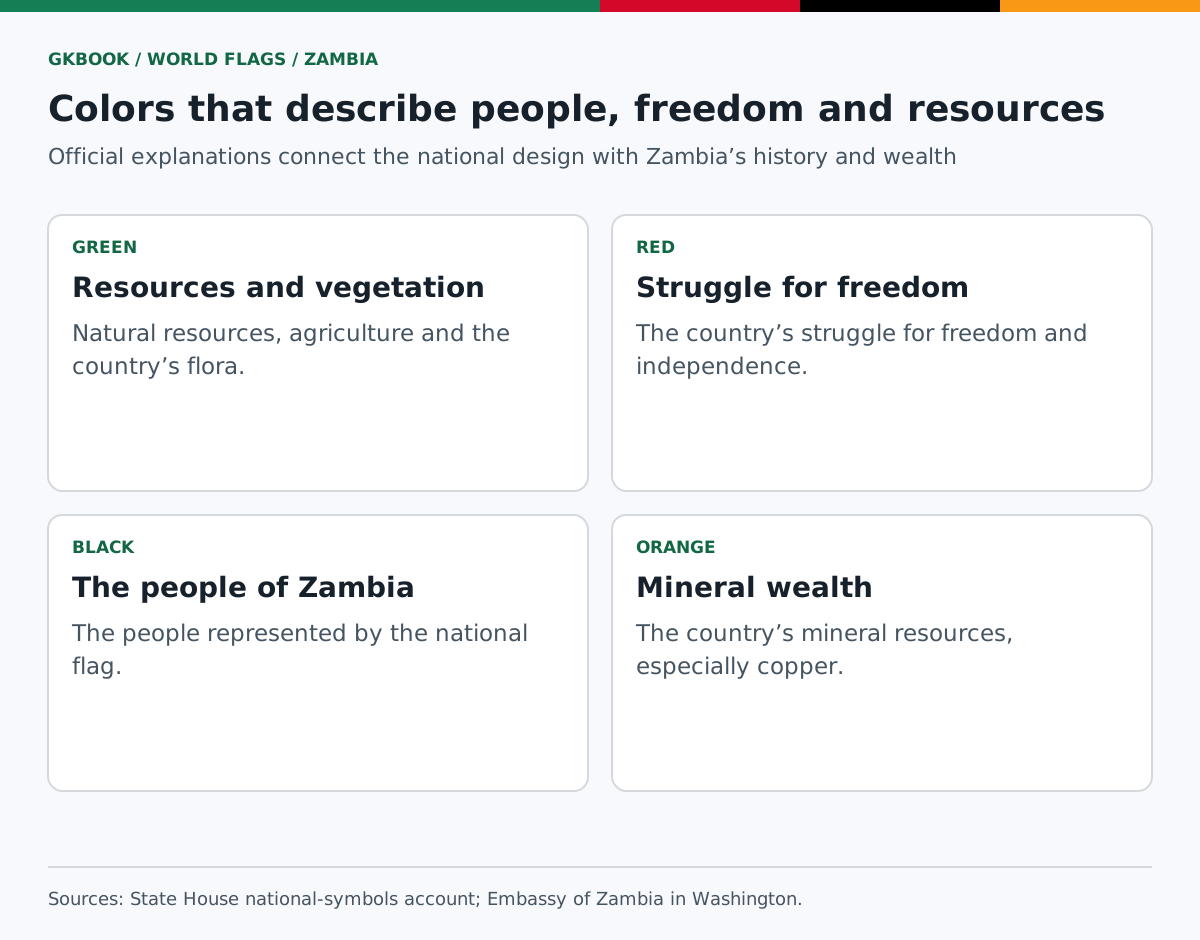
The Embassy in Washington describes the four colors in terms of the country’s resources, freedom struggle and people. State House gives a closely related explanation, mentioning agriculture, flora and copper. These accounts describe the symbolism of the whole national flag; the rectangular stripes are not a diagram of three named provinces or three administrative regions.
The colors have unequal areas in the actual drawing. Green forms the background, while the three vertical stripes occupy only the lower fly. Their meanings should not be translated into four equal quarters or four full-height bands. Similarly, mineral wealth is represented by the prescribed orange rather than by adding a copper nugget, coin or metallic gradient.
Sources: Embassy of Zambia in Washington — About Zambia, flag section · State House — National Symbols · National Flag and Armorial Ensigns Act — ZambiaLII/Laws.Africa reproduction · Drawing method and calculations
What bird appears on Zambia’s flag?
The bird is an orange African fish eagle, shown in flight above the vertical stripes. Official explanations connect it with freedom and the people’s ability to rise above the nation’s problems. It is a stylized national emblem, not a natural-color wildlife illustration, and the flag does not include the entire coat of arms.
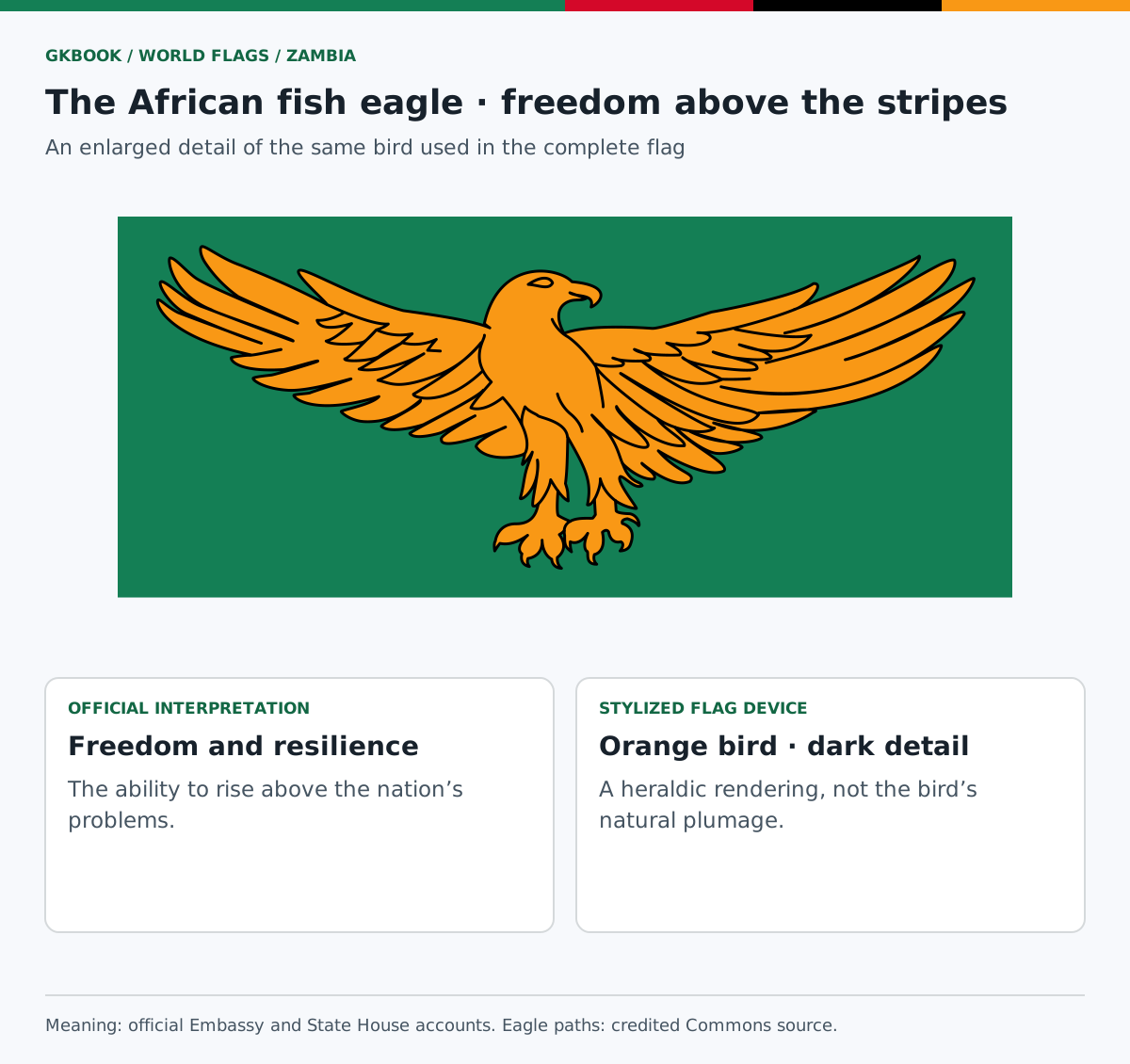
The flag’s eagle has spread wings, visible feet and a head turned toward the fly in the front-view reference. The orange fill and dark detail lines belong to the heraldic rendering. Replacing it with an eagle emoji, a photograph, a generic bird silhouette or a different country’s heraldic eagle changes the identity of the flag.
The enlarged eagle graphic uses the same paths as the clean master, preserving the shape through every size. Its separate presentation is a detail view for study, not another complete flag or an authorization to use the emblem as a commercial logo. The supplied source record identifies the vector file and distinguishes that digital rendition from an official production master.
Sources: State House — National Symbols · Embassy of Zambia in Washington — About Zambia, flag section · National Flag and Armorial Ensigns Act — ZambiaLII/Laws.Africa reproduction · Wikimedia Commons — Flag of Zambia.svg, source rendition · Drawing method and calculations
Why are the eagle and stripes at the fly?
The eagle and stripe block are placed toward the free end of the flag, called the fly. This unusual arrangement is an identifying feature of Zambia’s design. In a conventional front view, the stripes meet the lower and right edges, with the eagle above them; the large remaining area is green.

The law’s schedule illustrates the arrangement, and State House specifically remarks on the fly-side placement. The inspected sources establish where the devices belong without supplying a documented design-room explanation for every compositional decision. The symbolic account of rising above problems describes the eagle; it does not prove an invented story about why the artist selected a particular corner.
The eagle is centered over the stripe block rather than over the whole rectangle. The block itself touches the fly and bottom edges, so there is no narrow green border around those two sides. A drawing that moves both devices to the hoist, centers the eagle across the entire field or adds an enclosing border changes the front-view composition.
Sources: National Flag and Armorial Ensigns Act — ZambiaLII/Laws.Africa reproduction · State House — National Symbols · MapGrid — Flag of Zambia construction sheet and explanation · Drawing method and calculations
What are Zambia’s official flag proportions?
The flag’s height-to-length ratio is 2:3, expressed as overall dimensions 3:2 in the law’s length-first description. The construction can be shown on a 336-by-224-unit grid. The downloadable master uses a 900-by-600 drawing canvas and a 9,000-by-6,000-pixel PNG, all preserving exactly the same rectangular proportion.
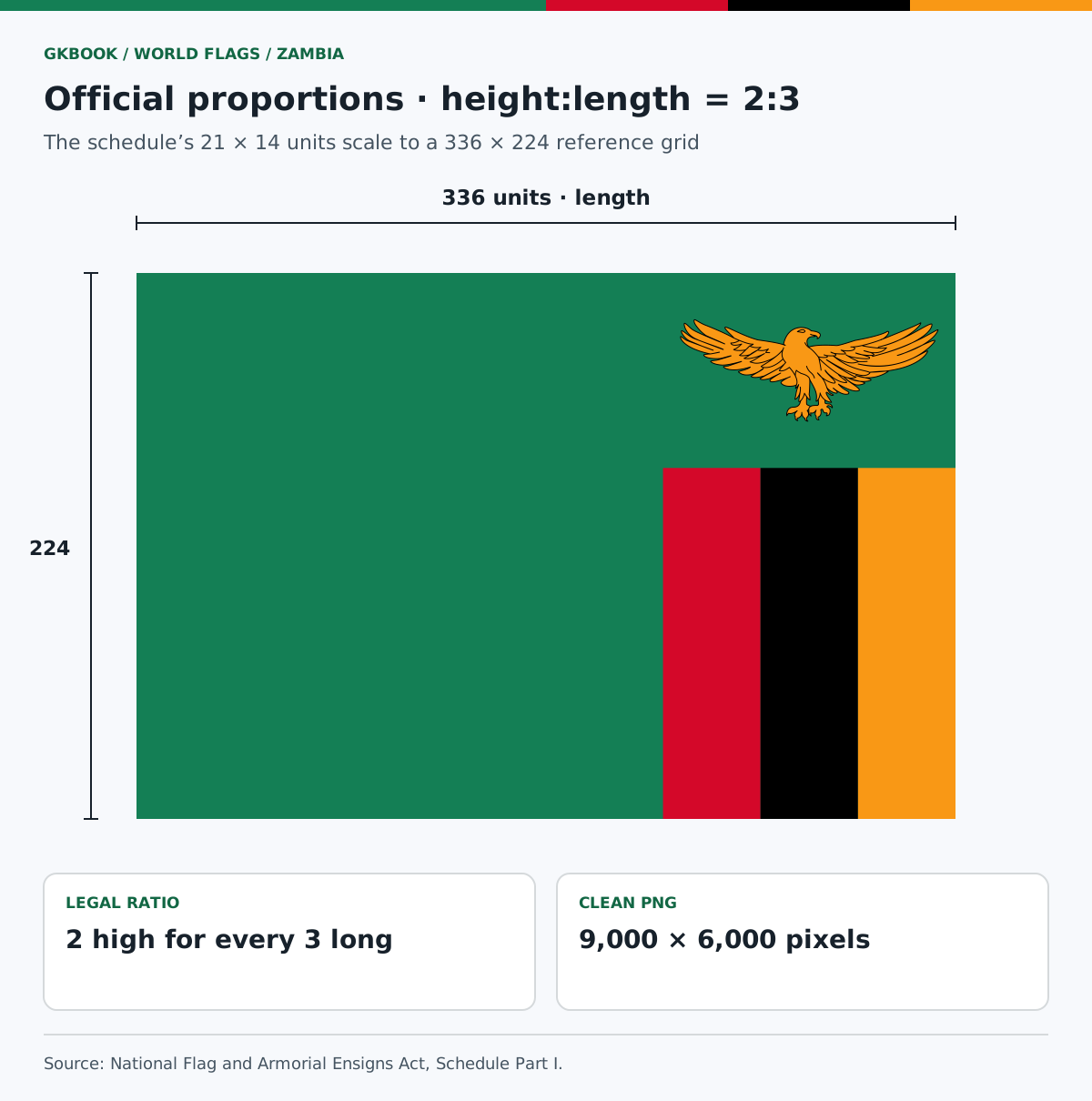
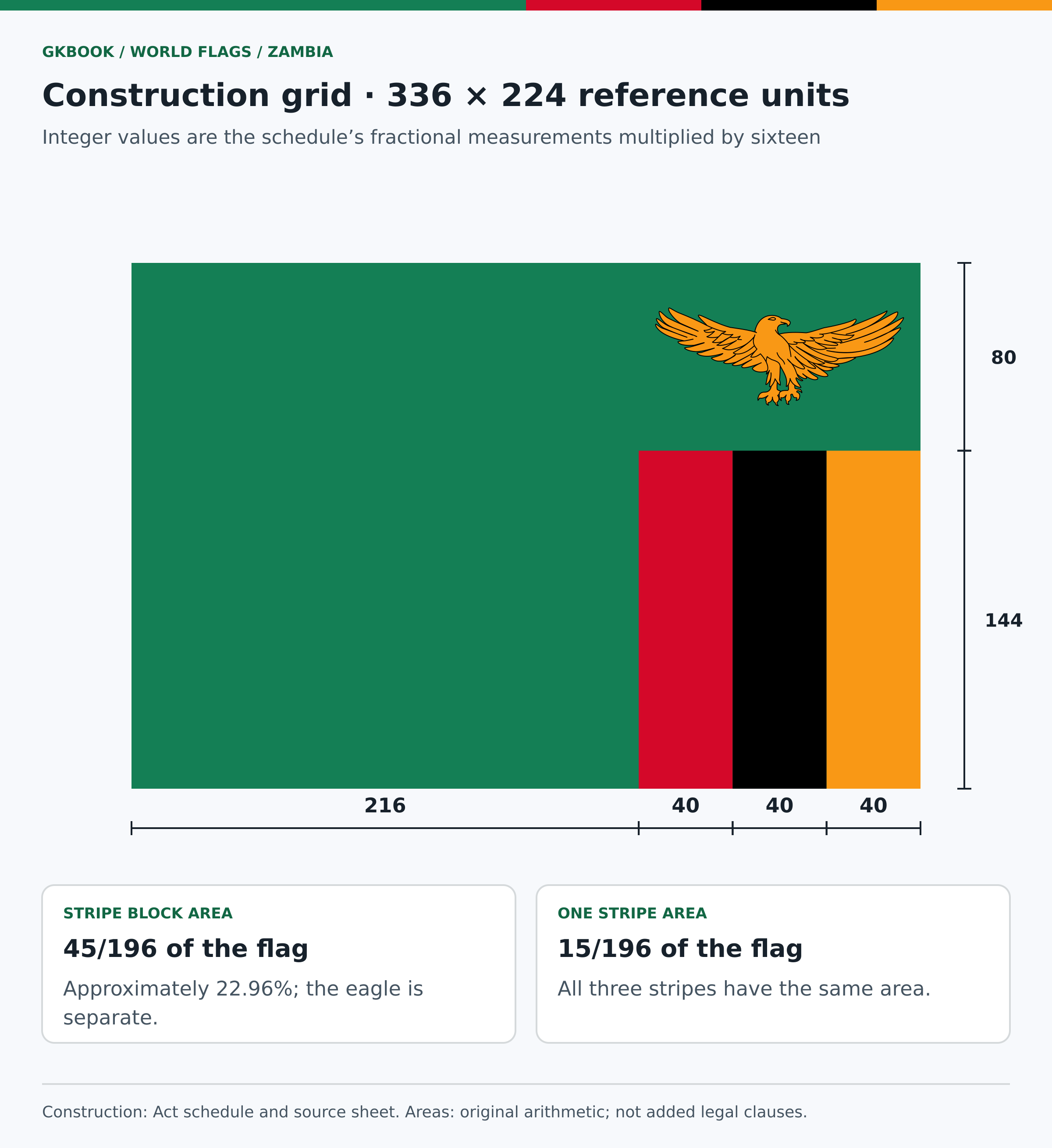
The diagram attached to the Act uses 21 units along the length and 14 along the height. Multiplying every measurement by sixteen removes its fractional labels and gives the 336 × 224 reference grid used in the construction explanation. This rescaling changes the unit of measurement, not the flag’s shape or the relative position of its devices.
Use one scale factor for the entire image, including the eagle. For example, a flag 150 centimeters long should be 100 centimeters high. Stretching just the field, squeezing the eagle or cropping the fly to fit a square thumbnail breaks the relationships established by the construction. Put the complete flag inside a larger frame when a different display format is needed.
Sources: National Flag and Armorial Ensigns Act — ZambiaLII/Laws.Africa reproduction · MapGrid — Flag of Zambia construction sheet and explanation · Drawing method and calculations
How are Zambia’s three vertical stripes arranged?
The lower-fly stripes run red, black and orange from left to right in the standard front view. They have equal widths and equal heights, but do not extend to the top of the flag. On the 336 × 224 grid, each stripe is 40 units wide and 144 units high.

Their combined block is 120 units wide, beginning at x = 216 and y = 80. The red stripe occupies x = 216–256, black x = 256–296 and orange x = 296–336. All three end at y = 224. The top-left coordinate origin makes it straightforward to reproduce the layout in SVG, a drawing program or a classroom grid.
The block occupies five fourteenths of the total length and nine fourteenths of the total height. These fractions describe the same rectangle as the integer grid. Calling Zambia a simple vertical tricolor misses the dominant green field and the eagle above the stripes; the three-color block is only one component of the complete flag.
| Stripe | Left edge x | Top edge y | Width | Height |
|---|---|---|---|---|
| Red | 216 | 80 | 40 | 144 |
| Black | 256 | 80 | 40 | 144 |
| Orange | 296 | 80 | 40 | 144 |
Sources: National Flag and Armorial Ensigns Act — ZambiaLII/Laws.Africa reproduction · MapGrid — Flag of Zambia construction sheet and explanation · Drawing method and calculations
How do you draw Zambia’s flag accurately?
Begin with a 3:2 green rectangle. Add three equal vertical rectangles at the lower fly, ordered red, black and orange, using the construction grid. Place the specified orange eagle above their combined block. Keep the entire flag proportional, and remove measurement guides from the clean illustration while retaining the bird’s distinctive outline.

A practical integer construction uses a 336 × 224 rectangle, a 120 × 144 stripe block starting at (216,80), and an eagle region centered over that block. The eagle’s reference height is 42 units, with 19 units above and below it within the 80-unit green space. The width of approximately 106 units follows the identified reconstruction rather than an explicitly labeled statutory width.
The package reconstructs the rectangular fields and preserves the attributed source eagle paths without substituting a newly invented bird. The same geometry produces the clean download and the complete flags inside the diagrams. Labels, dimension arrows and explanatory panels are separate teaching additions, so they do not become accidental features of the national flag master.
Sources: National Flag and Armorial Ensigns Act — ZambiaLII/Laws.Africa reproduction · MapGrid — Flag of Zambia construction sheet and explanation · Wikimedia Commons — Flag of Zambia.svg, source rendition · Drawing method and calculations
What do the construction measurements mean?
The flag’s 336 × 224 grid scales the schedule’s 21 × 14 diagram by sixteen. Its horizontal divisions are 216 + 40 + 40 + 40; the stripe block starts 80 units below the top. Above the stripes, the eagle reference region divides vertically into 19 + 42 + 19 units.

These numbers are proportional units, not compulsory centimeters or inches. On the 900 × 600 master canvas, one reference-grid unit equals 900/336 drawing units. The block consequently begins approximately 578.571 units from the hoist and 214.286 units from the top. Fractional coordinates are expected: rounding each rectangle independently can create gaps or shift the fly edge.
The three stripe rectangles together cover 17,280 square reference units out of a total 75,264, or 45/196 of the flag’s area. Each stripe covers 15/196. The green background surrounds the block and the eagle, but the visible green area is not simply the remainder after subtracting the block: the eagle and its detail strokes also cover part of it.
| Element | Measurement | Status |
|---|---|---|
| Whole flag | 336 × 224 | Scaled from the schedule’s 21 × 14 |
| Stripe block | 120 × 144 at (216,80) | Scaled schedule geometry |
| Each stripe | 40 × 144 | Equal divisions |
| Eagle reference height | 42 | Scaled schedule height |
| Eagle reference width | Approximately 106 | Measured reconstruction, not a printed legal width |
| Block area / flag area | 45/196 ≈ 22.96% | Calculated |
Sources: National Flag and Armorial Ensigns Act — ZambiaLII/Laws.Africa reproduction · MapGrid — Flag of Zambia construction sheet and explanation · Drawing method and calculations
How large is the eagle on Zambia’s flag?
On the 336 × 224 reference grid, the eagle is 42 units high and approximately 106 units wide, centered above the stripes. The schedule provides its height, while the width is reconstructed from the drawing. The supplied vector fits the reference box from x = 223 to 329 and y = 19 to 61.
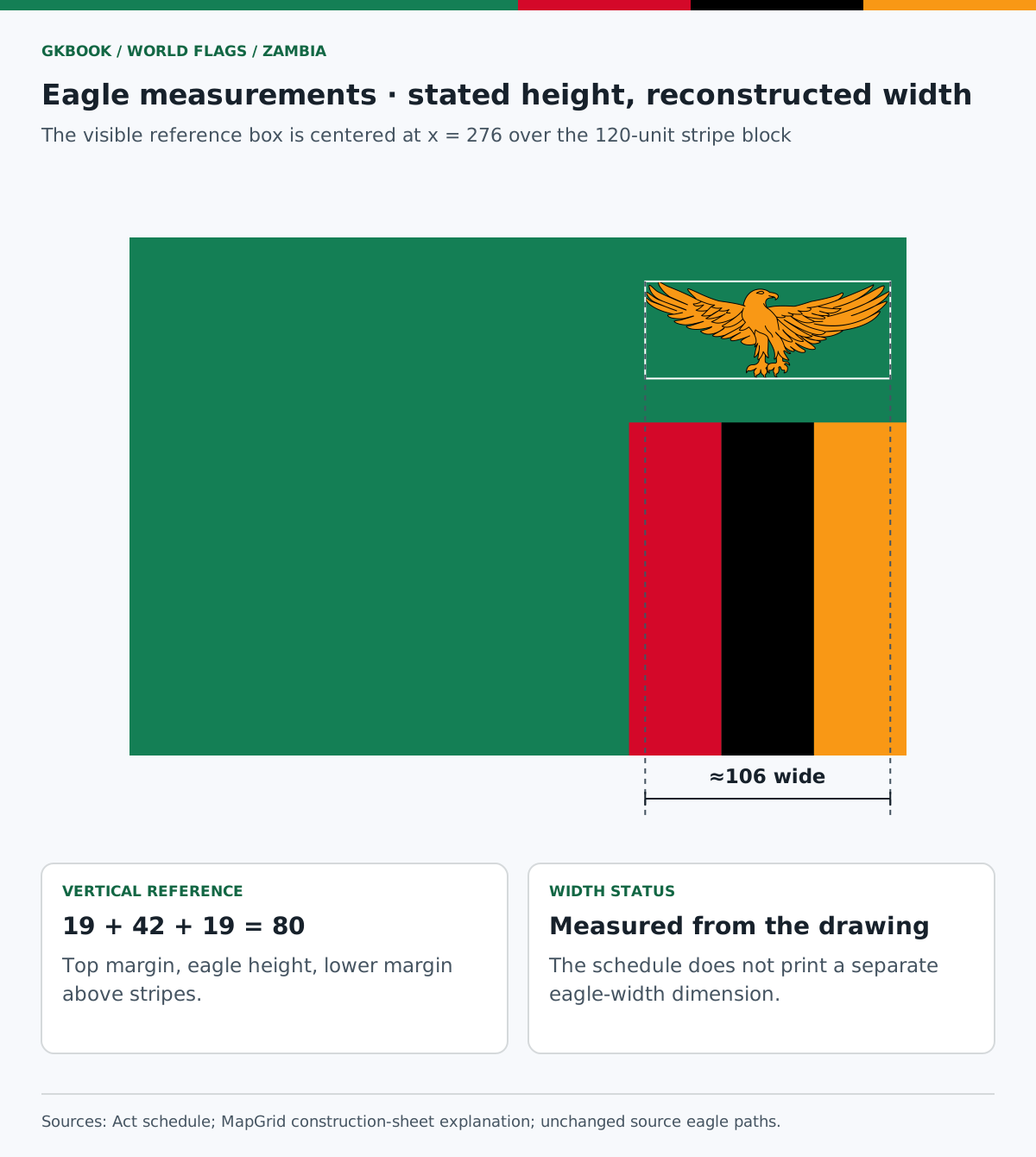
The eagle’s horizontal center is x = 276, also the center of the 120-unit stripe block. Its visible bounds leave seven units to either side of that block and nineteen units above and below within the upper green area. These are bounds of the reproduced bird, including its outline, rather than a requirement to draw an invisible rectangle onto the flag.
The distinction between a stated height and an inferred width matters for precise documentation. The source construction sheet explicitly notes that the law does not label an eagle width. The downloads use that sheet’s established digital rendition consistently, while the article avoids claiming that every feather coordinate or a 106-unit wingspan is separately specified in the legislation.
Sources: National Flag and Armorial Ensigns Act — ZambiaLII/Laws.Africa reproduction · MapGrid — Flag of Zambia construction sheet and explanation · Wikimedia Commons — Flag of Zambia.svg, source rendition · Drawing method and calculations
When was Zambia’s flag adopted?
Zambia adopted its national flag on October 24, 1964, when the country became independent. State House gives that adoption date. The National Flag and Armorial Ensigns Act commenced on June 4, 1965, so the flag’s first adoption and the later statute are separate events rather than competing dates for the same action.

The Embassy in Washington describes the first hoisting as taking place at midnight on October 23, while State House dates adoption to Independence Day, October 24. The account is best read as the midnight transition into independence. For a concise flag caption, October 24, 1964 is the clear official adoption date; the midnight wording can be explained in the surrounding history.
The legal text subsequently declared the national flag, President’s Standard and Armorial Ensigns in separate parts of its schedule. A modern webpage’s update date, a PDF generation date or a contributor’s upload timestamp is not an adoption date. The research record keeps those document dates separate so that a recently downloaded file does not appear to describe a newly adopted flag.
Sources: State House — National Symbols · Embassy of Zambia in Washington — About Zambia, flag section · National Flag and Armorial Ensigns Act — ZambiaLII/Laws.Africa reproduction · ICAO Postal History — Zambia, 40th Anniversary issue
How is the flag connected with Independence Day?
Independence Day on October 24 marks Zambia’s independence in 1964 and the adoption of its national flag. It is also one of the four public holidays named in the 2011 flag regulations as occasions when any person may fly the flag, subject to the provisions on respectful display, condition and daylight hours.
The flag’s colors and eagle connect this anniversary with the country’s freedom struggle, people and resources. An Independence Day illustration should still preserve the legal design rather than add an anniversary number or slogan inside the flag. Decorative text can sit beside the complete flag as a separate element, as it does in the article’s social-sharing card.
The anniversary date does not supply a schedule for every school, office or local ceremony in a particular year. The page gives the historical connection and the regulation’s named occasion without inventing contemporary event times. It also does not rename the observance as a distinct statutory Flag Day when the cited regulations call it Independence Day.
Sources: State House — National Symbols · Government of Zambia — S.I. 69 of 2011, National Flag and Armorial Ensigns Regulations · Embassy of Zambia in Washington — About Zambia, flag section · Drawing method and calculations
Who designed Zambia’s flag?
Gabriel Ellison, the Zambian artist and writer, is credited with designing the national flag. A National Assembly answer on August 6, 2010 names her directly, and ICAO’s postal-history account also attributes the flag to her. Her wider work included stamp design and the national coat of arms, alongside other artistic commissions.

The parliamentary answer provides a stronger attribution than a modern image filename or an unsourced list of designers. ICAO’s account places the flag alongside Ellison’s stamp work and identifies her as a painter, sculptor, illustrator and writer. These sources support the name and professional context without requiring a fictional scene of the flag being drawn.
The national design’s authorship is separate from the authorship of a later SVG file. Commons contributors prepared and revised the digital rendition used here; GKBook supplies the field reconstruction, explanatory layouts and calculations. The credits preserve all three levels rather than describing the entire national emblem as newly created artwork or attributing a modern software file to the original designer.
Sources: National Assembly — debate of August 6, 2010 · ICAO Postal History — Zambia, 40th Anniversary issue · Wikimedia Commons — Flag of Zambia.svg, source rendition · Drawing method and calculations
What are the main stages of Zambia’s flag history?
The main sequence is the colonial flag context of Northern Rhodesia, Zambia’s independence flag adopted in 1964, the 1965 Act defining the national symbols, the 1996 visual changes described by State House, and the 2011 replacement display regulations. These are different kinds of developments: political transition, legislation, visual revision and rules of use.

State House identifies the earlier Northern Rhodesian flag as a defaced Blue Ensign. The modern national flag introduced the green field and its distinctive fly-side composition at independence. This article concentrates on the present flag and the milestones necessary to understand it, rather than presenting an incomplete collection of regional, colonial, party and military banners as an exhaustive history.
Chronology also prevents a legal-document error. The Act’s 1994 amendment and the described 1996 visual revision are not interchangeable labels, while the 2011 instrument concerns the use of national symbols and revokes older regulations. The timeline names each event in its own terms instead of suggesting that Zambia adopted an entirely different national flag on every listed date.
Sources: State House — National Symbols · National Flag and Armorial Ensigns Act — ZambiaLII/Laws.Africa reproduction · Government of Zambia — S.I. 69 of 2011, National Flag and Armorial Ensigns Regulations · Flags of the World — Zambia, construction commentary
What changed in Zambia’s flag in 1996?
State House describes two changes in 1996: the green became lighter and brighter, and the eagle was adjusted to resemble the one used in the coat of arms more closely. The basic composition remained the same. The sources inspected do not establish a separately verified exact day or a certified before-and-after digital color table.

The current flag file and historical descriptions should not be used to manufacture precise old textile colors. A screen swatch chosen today cannot establish the appearance of every 1964 flag. The revision graphic therefore explains the reported changes and the evidence limits instead of presenting a recolored current eagle as an authenticated image of the earlier design.
The available Act continues to name the four British Colour Council references. A parliamentary discussion in 2012 also addressed inconsistent colors in flags sold to the public. These facts support careful source labeling: the State House historical account explains a visual revision, while the legal shade names and the chosen digital artwork each need their own clear identification.
Sources: State House — National Symbols · National Flag and Armorial Ensigns Act — ZambiaLII/Laws.Africa reproduction · National Assembly — December 6, 2012 response on flag colors · Wikimedia Commons — Flag of Zambia.svg, source rendition
Which laws and regulations define Zambia’s flag?
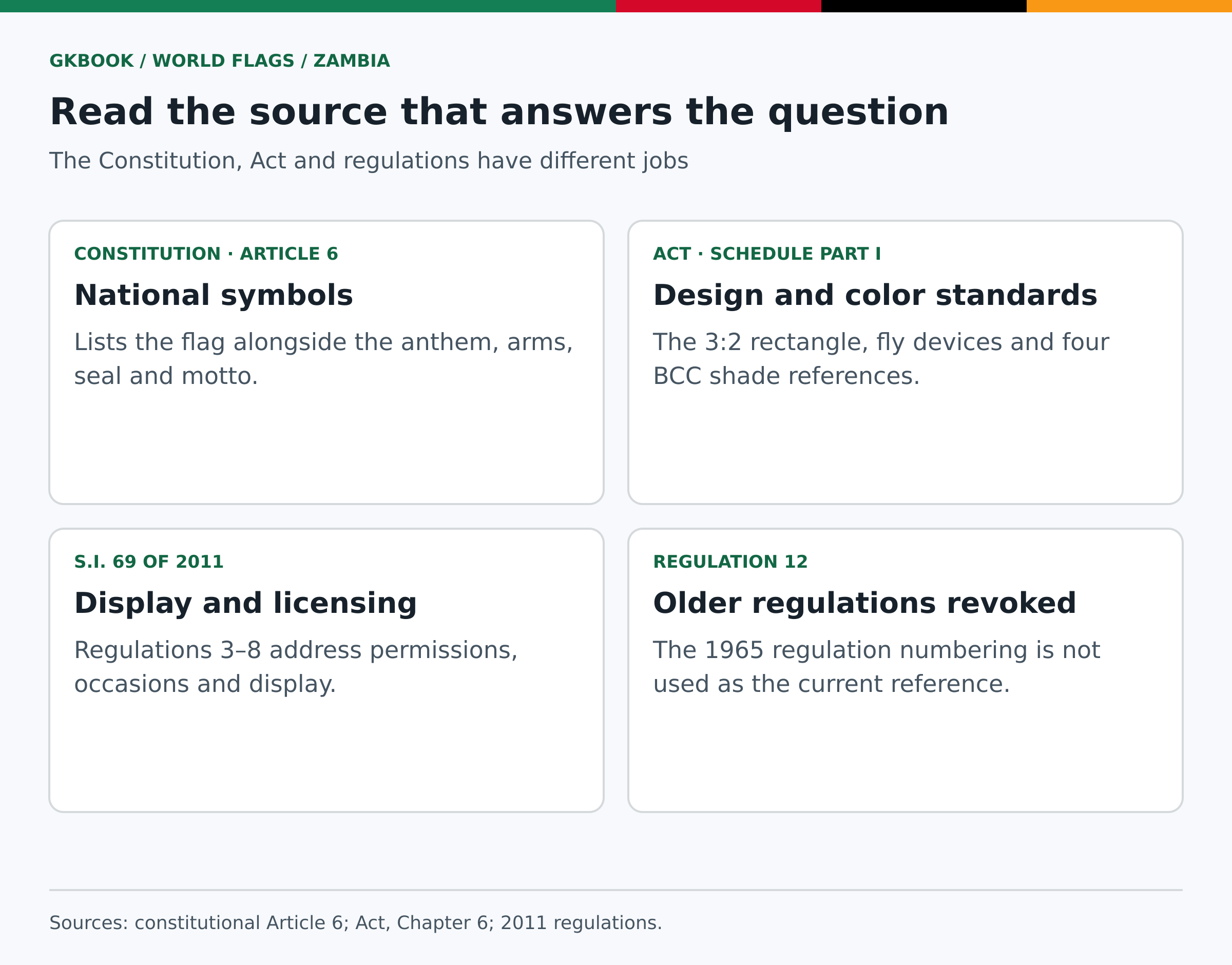
Article 6 of the Constitution lists the national symbols. The National Flag and Armorial Ensigns Act, Chapter 6, declares the flag and supplies its design in the schedule. Statutory Instrument No. 69 of 2011 provides the flag regulations. Its Regulation 12 revokes the 1965 regulations, so older numbering should not be presented as current.

The legal record distinguishes the principal Act from subsidiary legislation made under it. Section 2 of the Act declares the three symbols, its schedule describes their appearance, and Section 4 regulates certain uses. In the 2011 regulations, daylight display is Regulation 6; the often-repeated reference to Regulation 7 belongs to the older set of rules.
The 2011 scan was checked directly, including its revocation provision and the signature page dated June 24, 2011. The principal Act was inspected through the ZambiaLII reproduction when the Parliament PDF could not be downloaded. The constitutional reference uses the accessible indexed consolidated text through December 18, 2025, and the source notes identify that access method.
Sources: ZambiaLII — Constitution of Zambia Act, consolidated through December 18, 2025 · National Flag and Armorial Ensigns Act — ZambiaLII/Laws.Africa reproduction · National Assembly — National Flag and Armorial Ensigns Act · Government of Zambia — S.I. 69 of 2011, National Flag and Armorial Ensigns Regulations · Blackhall Zambia Laws — 2011 flag regulations, public text
Is the national flag the same as the President’s Standard?
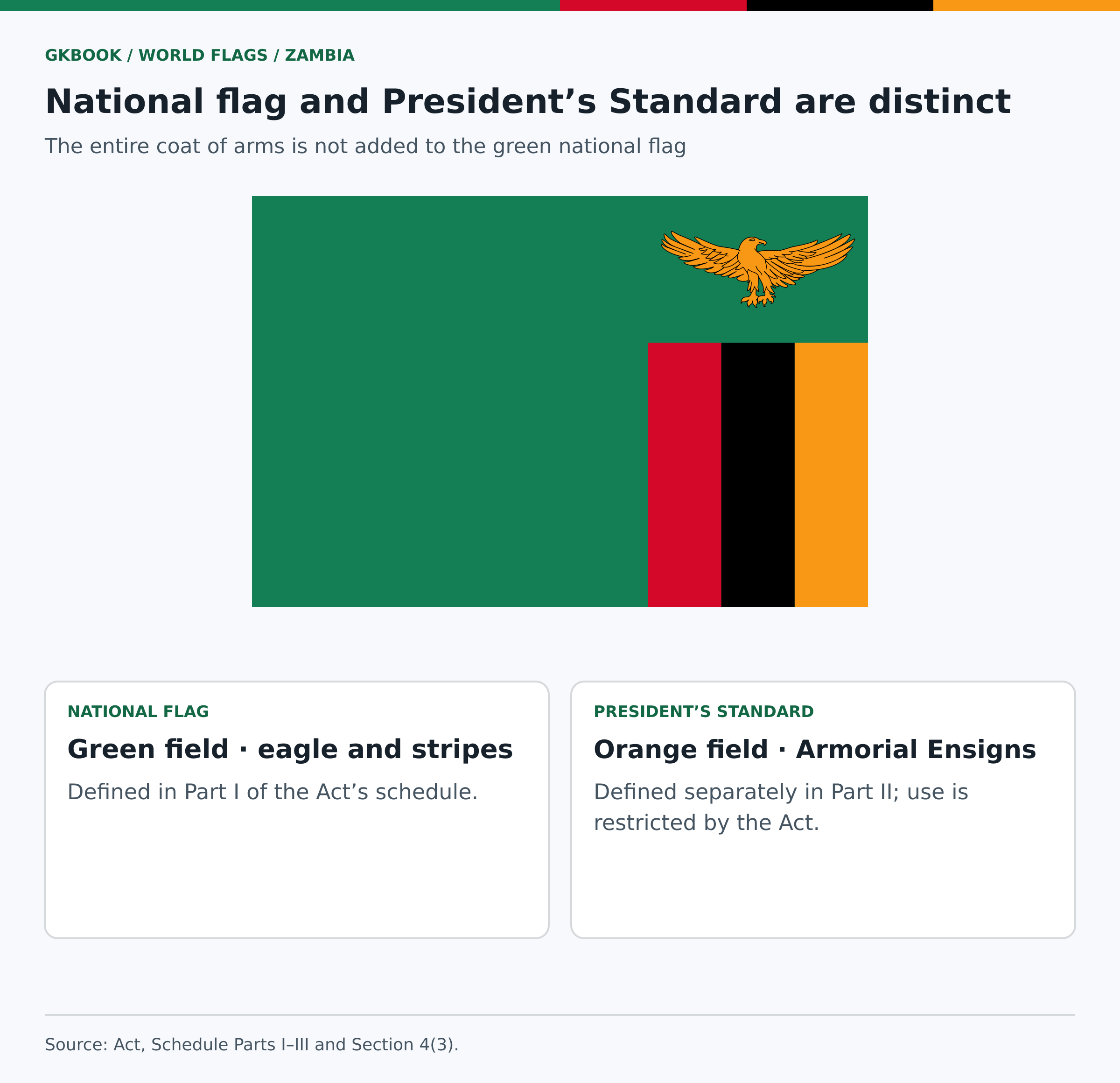
No. The Act defines them separately. Zambia’s national flag has a green field with an eagle above three lower-fly stripes. The President’s Standard is an orange flag bearing the Armorial Ensigns. The complete coat of arms is a third distinct symbol; it is not placed on the ordinary green national flag.

Part II of the schedule describes the Standard as a 3:2 flag in Spectrum Orange, with the Armorial Ensigns in 1:1 dimensions. Section 4 reserves its use to the President or a person authorized by the President. The explanatory graphic identifies these distinctions without supplying a loosely drawn substitute coat of arms or an unverified presidential production template.
The national arms include a shield, human supporters, agricultural and mining references, and the motto One Zambia One Nation. Their eagle is related to the national flag’s bird, but the two complete compositions are different. A flag reference should not add the shield, motto ribbon or supporters to the clean green flag merely because they also belong to Zambia’s national symbolism.
Sources: National Flag and Armorial Ensigns Act — ZambiaLII/Laws.Africa reproduction · ZambiaLII — Constitution of Zambia Act, consolidated through December 18, 2025 · State House — National Symbols
Who may fly Zambia’s flag, and how should it be displayed?
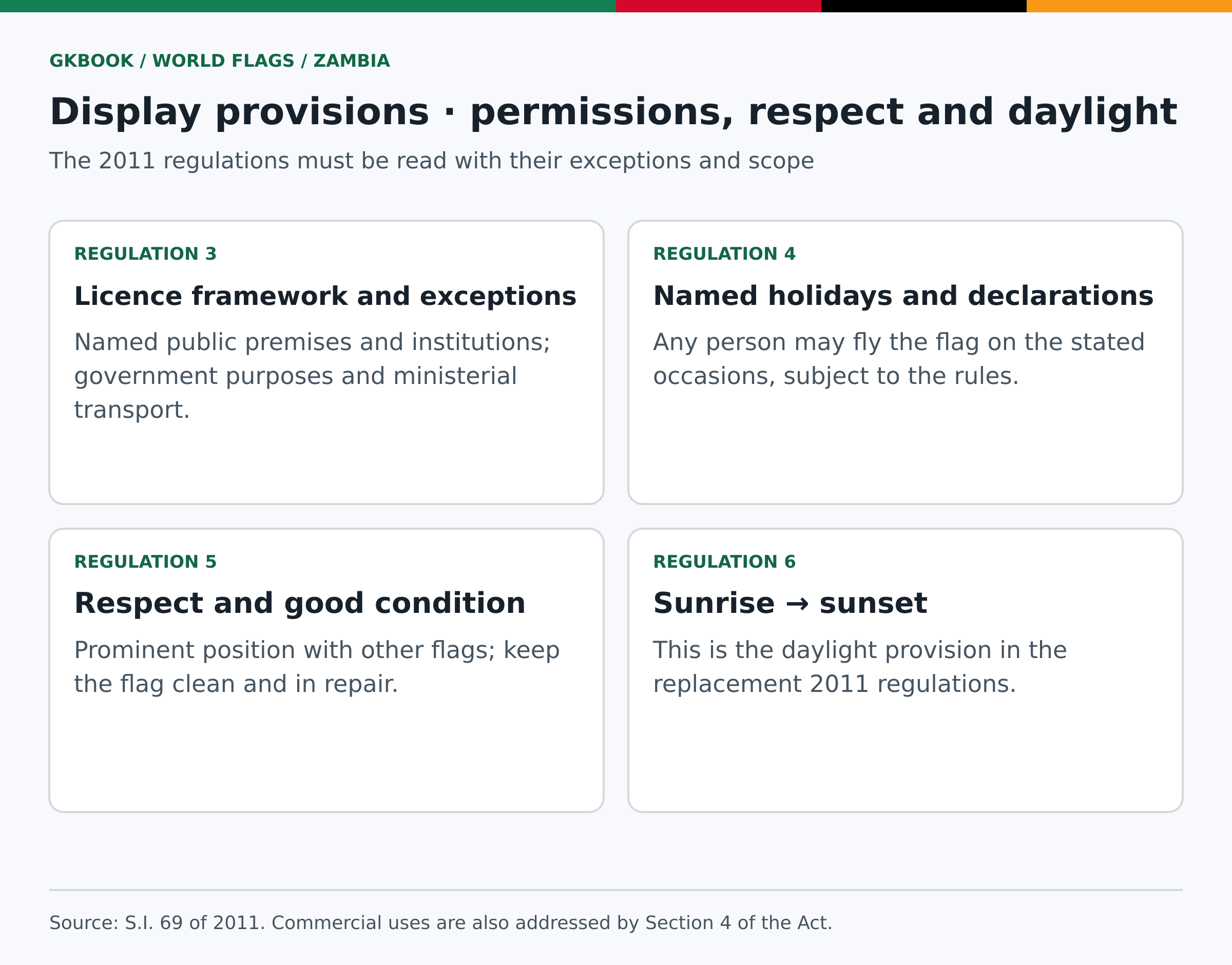
The 2011 regulations establish a licensing framework with stated exceptions for government and specified public premises, institutions and ministerial transport. They also allow display by any person on named holidays and other declared occasions. Regulation 5 requires respectful display and good condition; Regulation 6 limits flying to the period between sunrise and sunset.

Regulation 3 lists government and local-authority premises, statutory bodies or corporations, public or aided educational institutions, and vehicles, boats or ships carrying a Minister. Government purposes are also addressed. These provisions should not be flattened into either a universal daily obligation for every household or a statement that all use of a flag image is unrestricted.
The Act separately addresses goods bearing the flag and uses suggesting official authorization, while Regulation 8 sets out licence applications. The permissions for artwork copyright and the national-symbol rules are different questions. For an actual commercial or ceremonial use, consult the applicable instrument and responsible authority; this reference does not issue a licence or reproduce a current fee quotation.
| Regulation | Subject |
|---|---|
| 3 | Licensing framework and listed exceptions |
| 4 | Named holidays and other declared occasions |
| 5 | Respectful prominence, cleanliness and repair |
| 6 | Sunrise-to-sunset flying |
| 8 | Licence application procedure |
| 12 | Revocation of the 1965 regulations |
Sources: National Flag and Armorial Ensigns Act — ZambiaLII/Laws.Africa reproduction · Government of Zambia — S.I. 69 of 2011, National Flag and Armorial Ensigns Regulations · Blackhall Zambia Laws — 2011 flag regulations, public text · National Assembly — December 6, 2012 response on flag colors
On which holidays may any person fly the flag?
Regulation 4 of the 2011 instrument names Africa Freedom Day, Heroes Day, Unity Day and Independence Day. It also allows other days or occasions declared by the Minister. These permissions remain subject to Regulations 5 and 6, covering respectful display, cleanliness and repair, and flying between sunrise and sunset.
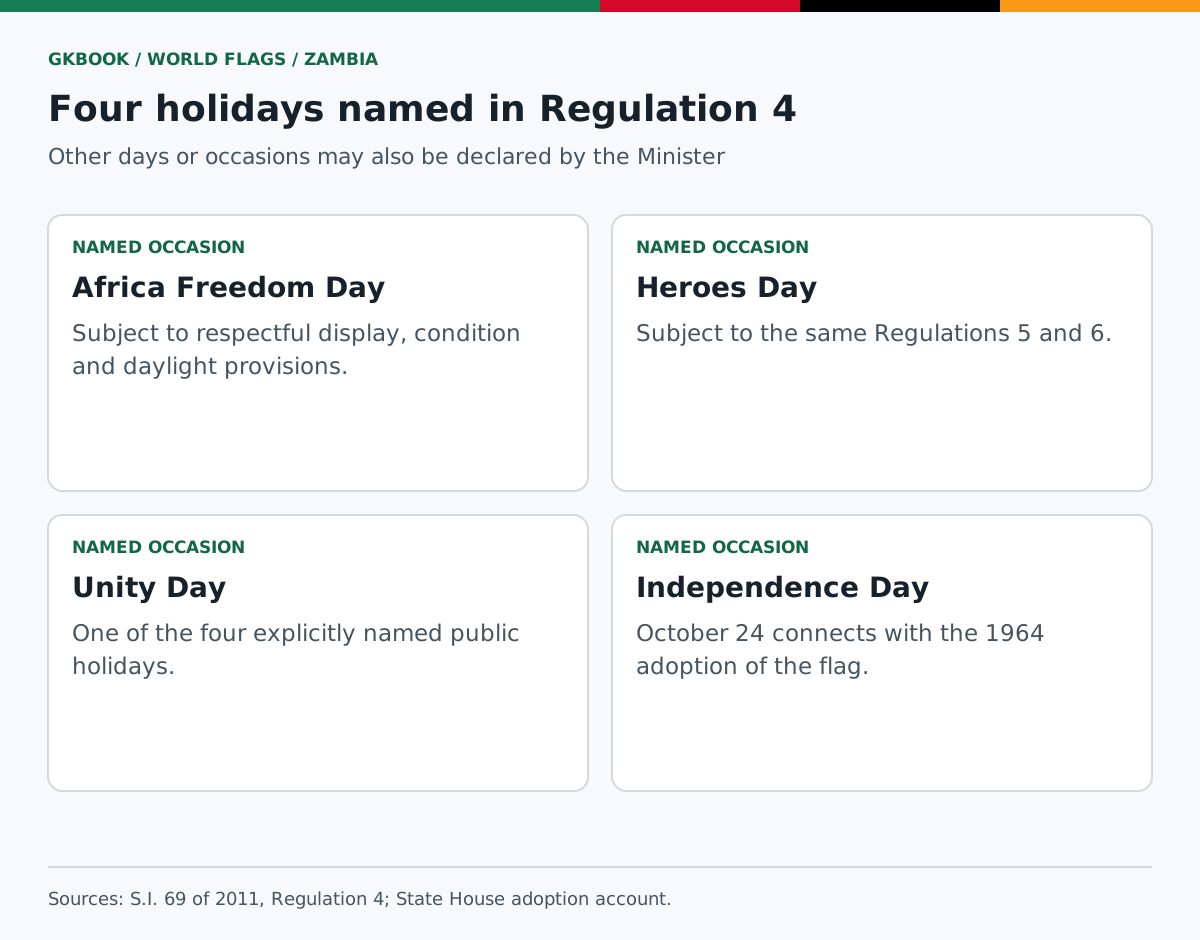
The regulation lists four named public holidays rather than saying every holiday automatically falls under this particular exception. It is therefore useful to preserve the names when explaining the provision. Additional declarations and the separate exceptions in Regulation 3 need to be read alongside it; the four-name list is not a complete account of all authorized flag use.
Independence Day has the direct historical connection with October 24, 1964. For the other occasions, this page retains the statutory names without producing an assumed calendar for a particular year. Official calendars, local arrangements and special declarations should be checked when planning an event, especially where a substitute day or additional public observance may be involved.
Sources: Government of Zambia — S.I. 69 of 2011, National Flag and Armorial Ensigns Regulations · Blackhall Zambia Laws — 2011 flag regulations, public text · State House — National Symbols
How is Zambia’s flag used during national mourning?
Official mourning announcements can direct that flags fly at half-mast. For example, the Embassy’s June 17, 2021 announcement following Kenneth Kaunda’s death specified that treatment during the declared mourning period. The occasion, duration and any accompanying instructions come from the relevant announcement; this article does not announce a current period of mourning.
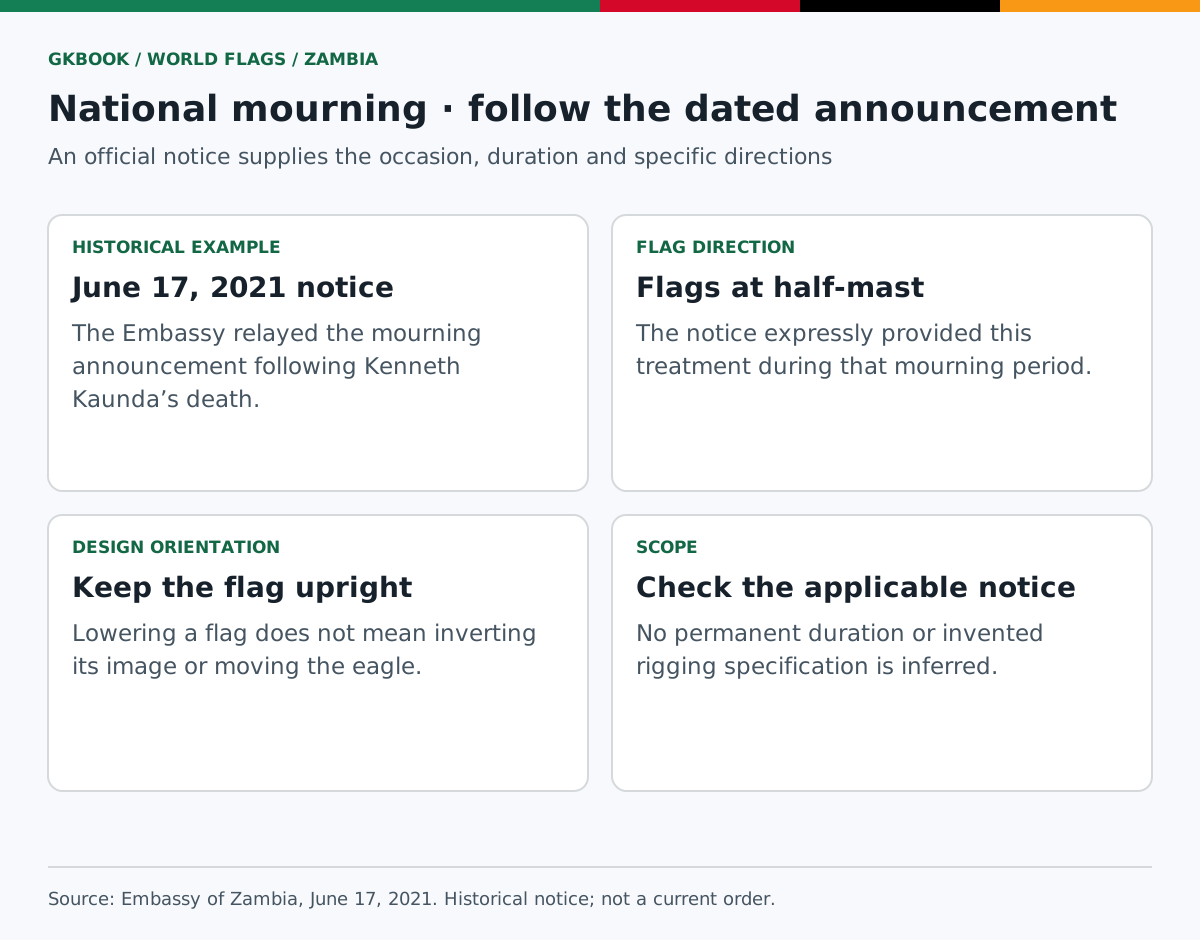
The mourning graphic explains the distinction between a general display provision and a dated official direction. It uses a historical notice as evidence of half-mast practice, without turning that notice’s duration into a permanent rule for every death or importing a different country’s exact pole fraction, ribbon specification or sequence of hoisting movements.
Keep the design itself complete and upright when following an authorized mourning instruction. Lowering a flag on a pole does not mean rotating its image or moving the eagle beneath the stripes. For a real ceremony, the current notice and institutional instructions determine what is required; a general flag-history page is not a substitute for that event-specific direction.
Sources: Embassy of Zambia — announcement following Kenneth Kaunda’s death, June 17, 2021 · Government of Zambia — S.I. 69 of 2011, National Flag and Armorial Ensigns Regulations · Drawing method and calculations
Which way round should Zambia’s flag be shown?
In the standard front view with the hoist at the left, the eagle is above the stripe block at the right-hand fly. The stripes meet the bottom edge and run red, black, orange from left to right. An upside-down image puts the block at the top and turns the eagle over.
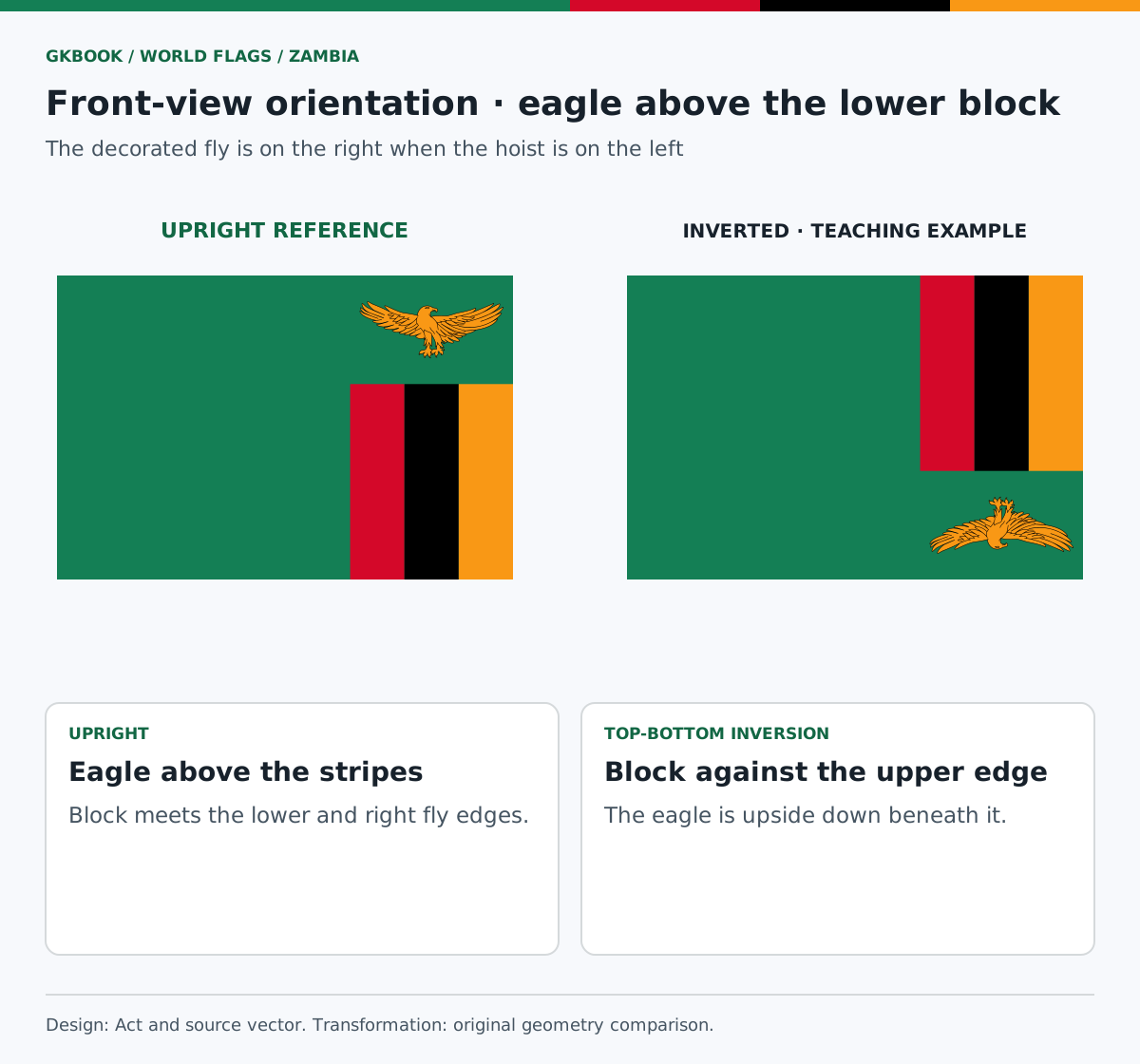
Both the upper position of the eagle and the lower position of the block help identify the intended orientation. A photograph of a moving flag may hide part of the design in a fold, so inspect the pole attachment and the whole cloth before diagnosing an error from one small visible area. The flat master provides an unambiguous front-view reference.
The orientation diagram deliberately includes an inverted teaching example, labeled as such. It should not be downloaded in place of the clean master for a normal country illustration. An inversion also differs from the physical reverse, which mirrors the front left to right while preserving the top and bottom of the cloth.
Sources: National Flag and Armorial Ensigns Act — ZambiaLII/Laws.Africa reproduction · Wikimedia Commons — Flag of Zambia.svg, source rendition · Drawing method and calculations
What does the reverse of Zambia’s flag look like?
A physical reverse view mirrors the front left to right. The eagle and stripe block therefore appear on the viewer’s left, while the attachment edge appears on the right. The visible stripe order becomes orange, black, red. The eagle remains above the block, but its profile and feather details are mirrored.
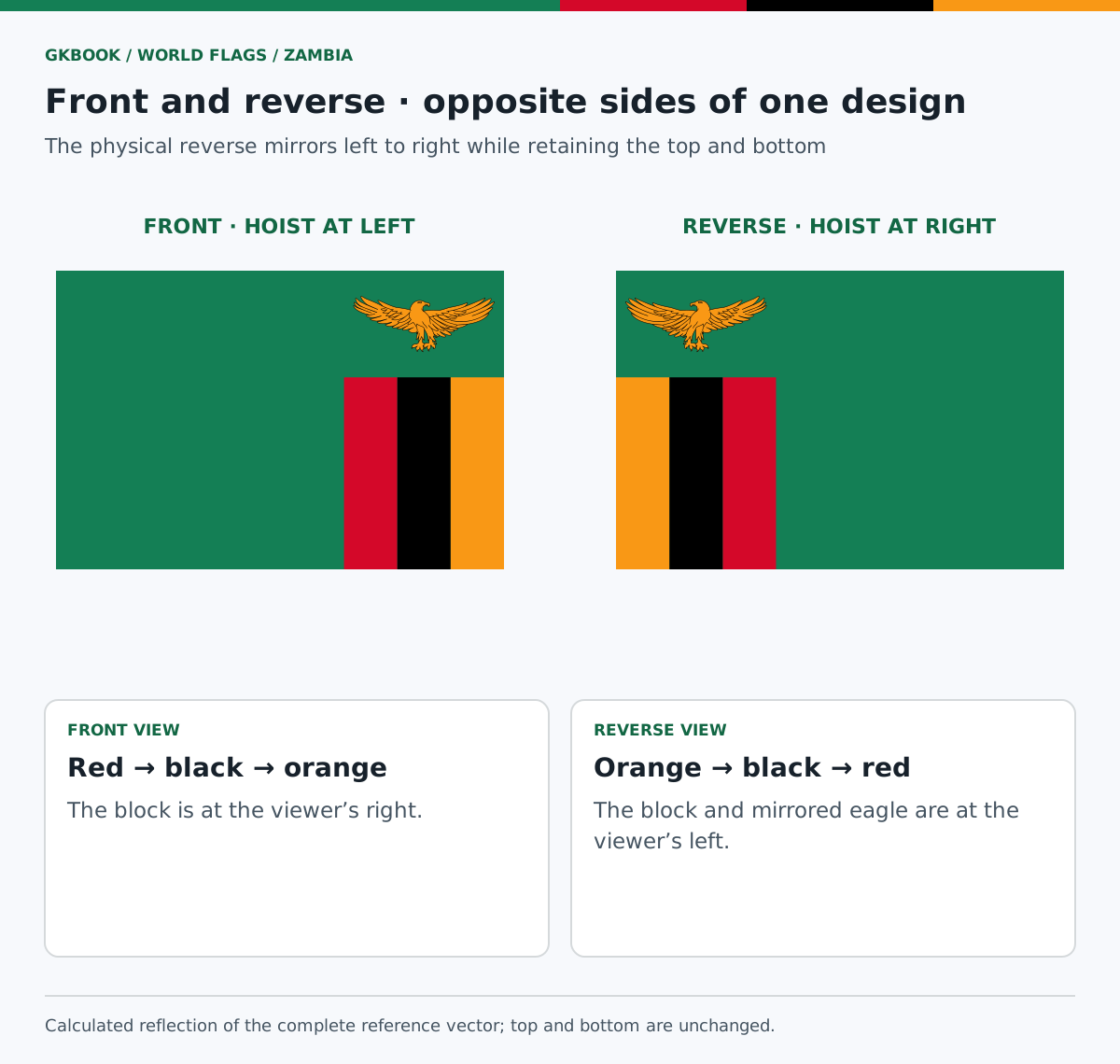
This is a consequence of viewing the opposite side of the same design, not evidence that the flag has moved its devices from the fly to the hoist. The fly remains the edge away from the pole on both sides. Describing which edge is attached prevents a mirrored photograph from being mistaken for an incorrectly constructed front-view graphic.
The paired illustration reflects the complete master, including the eagle’s head and detail strokes. It does not move the block while leaving the bird unmirrored. No separate reverse artwork specification or particular textile manufacturing method is asserted here; the graphic explains the physical geometry of an opposite-side view and distinguishes it from turning the flag upside down.
Sources: National Flag and Armorial Ensigns Act — ZambiaLII/Laws.Africa reproduction · Wikimedia Commons — Flag of Zambia.svg, source rendition · Drawing method and calculations
Is Zambia’s flag symmetrical?
The complete colored flag has neither left-right nor top-bottom reflection symmetry, and it is not unchanged by a half-turn. Its fly-side block and eagle make the composition asymmetric. The outline of the rectangular cloth has symmetries of its own, but those do not determine the symmetry of the colored national design.
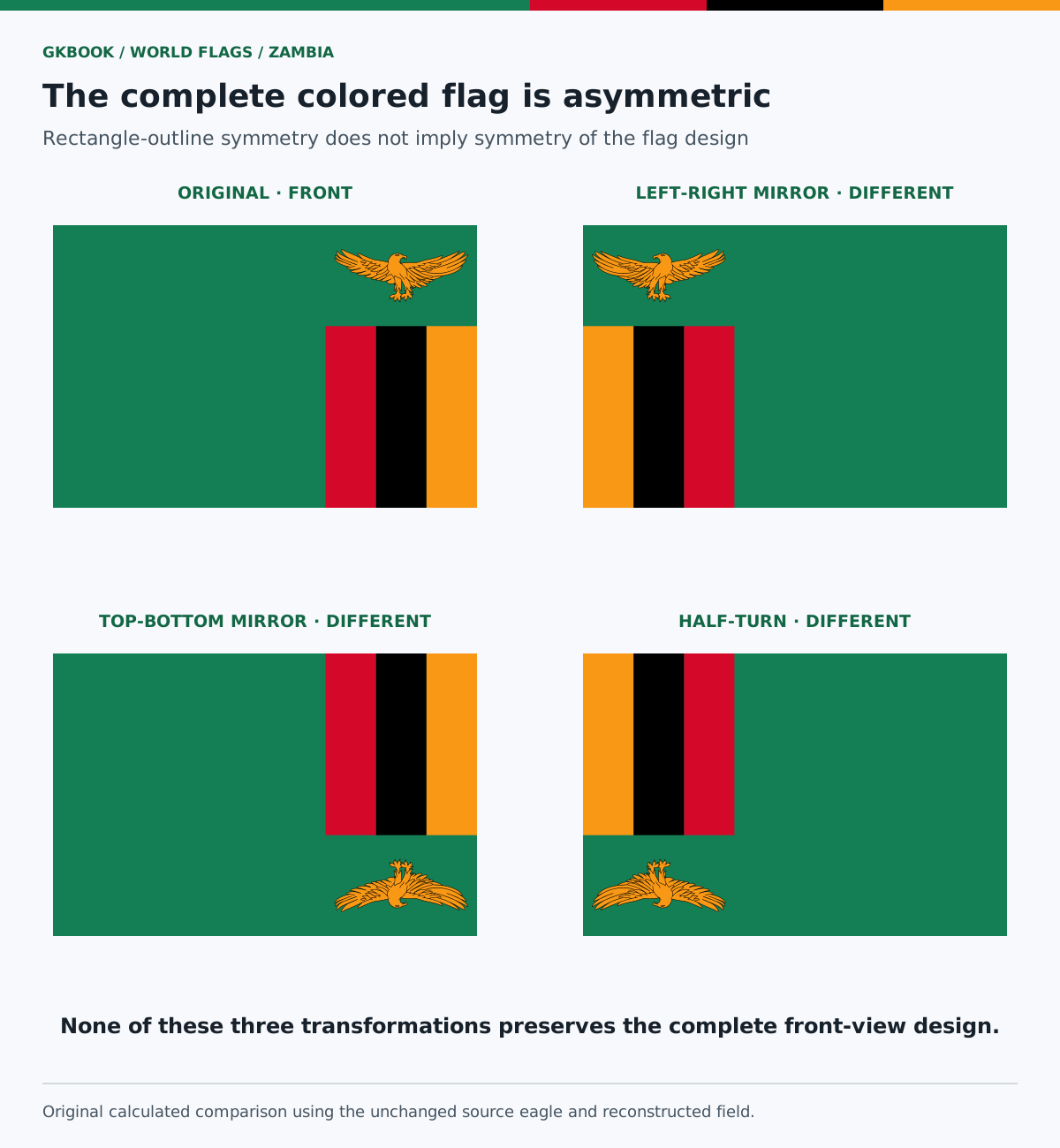
A left-right reflection places the devices on the other side of the image and reverses the order of the stripe colors. A top-bottom reflection puts the block against the top edge. A half-turn combines both changes and inverts the eagle. These transformations are useful classroom comparisons when each altered view is clearly separated from the official front reference.
The eagle itself should not be treated as a generic symmetric icon merely because it has two spread wings. Its head direction, feet and feather details are not interchangeable. The supplied comparison uses the actual vector paths rather than approximate rectangles and a simplified bird, so the displayed differences belong to the complete reproduced flag.
Sources: National Flag and Armorial Ensigns Act — ZambiaLII/Laws.Africa reproduction · Wikimedia Commons — Flag of Zambia.svg, source rendition · Drawing method and calculations
Can Zambia’s flag be displayed vertically?
The horizontal 2:3 drawing is the legal reference used here. Rotating an image for a tall layout is a geometric operation, but it does not by itself establish a general national hanging protocol. The sources inspected do not provide a verified universal vertical-display template, so the page does not invent one.
A tall poster can simply place the complete horizontal flag above or beside text. This keeps the eagle and stripe block in their recognizable front-view positions without needing to reinterpret the hoist. Stretching the image into a narrow portrait rectangle would alter both the statutory proportion and the eagle’s shape, even if all four colors remained visible.
An event-specific flag manual may prescribe a vertical treatment for its own venue. That instruction should be identified by event and date rather than silently presented as Zambia’s universal legal rule. The downloads therefore provide the complete horizontal master, and the separate orientation and reverse diagrams teach transformations without prescribing an unsupported vertical ceremony layout.
Sources: National Flag and Armorial Ensigns Act — ZambiaLII/Laws.Africa reproduction · Government of Zambia — S.I. 69 of 2011, National Flag and Armorial Ensigns Regulations · Drawing method and calculations
How do Zambia’s and Zimbabwe’s flags differ?
Zambia’s flag has a large green field, an orange flying eagle and three vertical stripes at the lower fly. Zimbabwe’s flag has seven horizontal stripes and a white hoist triangle containing a red star and the Zimbabwe Bird. The similar country names and shared colors should not obscure these very different layouts.
The Zimbabwe Embassy describes its bird as the national symbol associated with the stone-carved Zimbabwe Bird. It should not be substituted for Zambia’s spreading-wing eagle. Checking the background structure, the location of the device and the presence or absence of a star is more reliable than trying to identify either country from a small orange or yellow bird alone.
This comparison concerns identification, not a claim that the two countries prescribe identical pigments or use their emblems in the same way. The current Zambia master contains no star, white triangle or full-width horizontal stripes. Labels and captions should give the country name clearly, particularly when several southern African flags appear together in a classroom or website gallery.
Sources: National Flag and Armorial Ensigns Act — ZambiaLII/Laws.Africa reproduction · Embassy of Zimbabwe in Washington — country profile, flag section · State House — National Symbols
What is the Zambia flag emoji and its Unicode sequence?
The Zambia flag emoji is 🇿🇲. It is encoded as the two regional indicator characters U+1F1FF and U+1F1F2, corresponding to Z and M. Unicode identifies the sequence as flag: Zambia. The actual appearance depends on the platform, font and software, so an emoji is not a precise production drawing.
Some environments render the sequence as a colored flag, while others may show letters or an unsupported symbol. The two-character encoding does not contain SVG coordinates, physical proportions or a certified color palette. Use the included image files when the eagle shape, block position and consistent reproduction are important to the reader’s understanding.
For accessibility, an image can use descriptive alternative text such as “Zambia flag, green with an orange eagle above red, black and orange stripes at the lower fly.” In a sentence where the country name is already present, repeated emoji may add little information. The page provides both a readable country label and artwork with useful descriptions.
Sources: Unicode — Full Emoji List, version 17.0 · Unicode — Emoji and Pictographs FAQ · Drawing method and calculations
How large can the downloadable Zambia flag be printed?
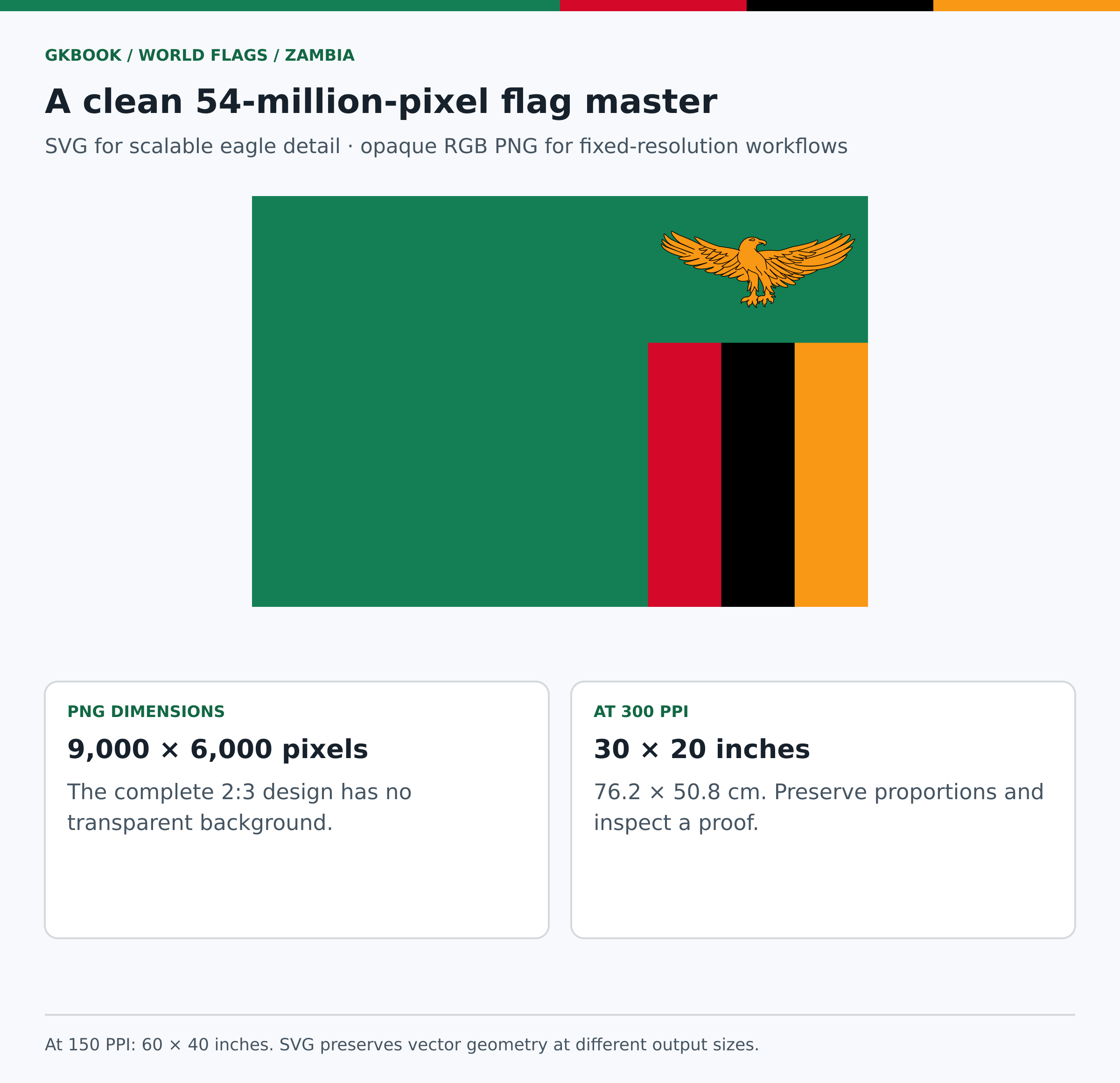
The clean PNG is 9,000 × 6,000 pixels, totaling 54 million pixels. At 300 pixels per inch it prints at 30 × 20 inches, or 76.2 × 50.8 centimeters. At 150 pixels per inch it prints at 60 × 40 inches. The SVG can be scaled without a fixed raster-resolution limit.

The SVG is preferable when a workflow supports vector artwork and needs to preserve the eagle’s feather detail at different sizes. The PNG is an opaque RGB reference for workflows requiring a fixed image. Keep the complete rectangle visible, preserve its ratio and inspect a proof; thin dark lines in the bird need more care than a plain block of color.
These print dimensions are calculations from the image size, not official fabric, ink or dye specifications. The digital palette is explicitly declared and should not be treated as a certified match to the British Colour Council shades. A production supplier may need material-specific color management and technical instructions beyond the educational geometry documented here.
Sources: Drawing method and calculations · National Flag and Armorial Ensigns Act — ZambiaLII/Laws.Africa reproduction · Wikimedia Commons — Flag of Zambia.svg, source rendition
Which flag graphics and downloads are included?
The gallery contains 24 subjects, each in SVG and PNG, including the clean current flag and 23 explanatory graphics. A separate social-sharing card is also supplied. The illustrations cover colors, symbolism, eagle details, proportions, construction, history, legal distinctions, display and transformations, with source credits and clear labels for teaching examples.
The clean master is the appropriate starting point for a standard Zambia flag illustration. Use the annotated files when explaining measurements or historical and legal context. The eagle detail is an enlarged component, and the inverted or mirrored views are comparisons; those images are not alternate national designs. Each downloadable pair carries a title, description and traceable credit.
The article’s source links, artwork credits and declared palette explain the basis of the files. The original source vector is preserved with the offline rebuild inputs, while the public downloads use the reconstructed field and unchanged eagle geometry. This makes the package reproducible without silently describing a contributor’s vector as a certified government-issued master.
Sources: Wikimedia Commons — Flag of Zambia.svg, source rendition · MapGrid — Flag of Zambia construction sheet and explanation · Drawing method and calculations
How can you check whether a Zambia flag image is accurate?
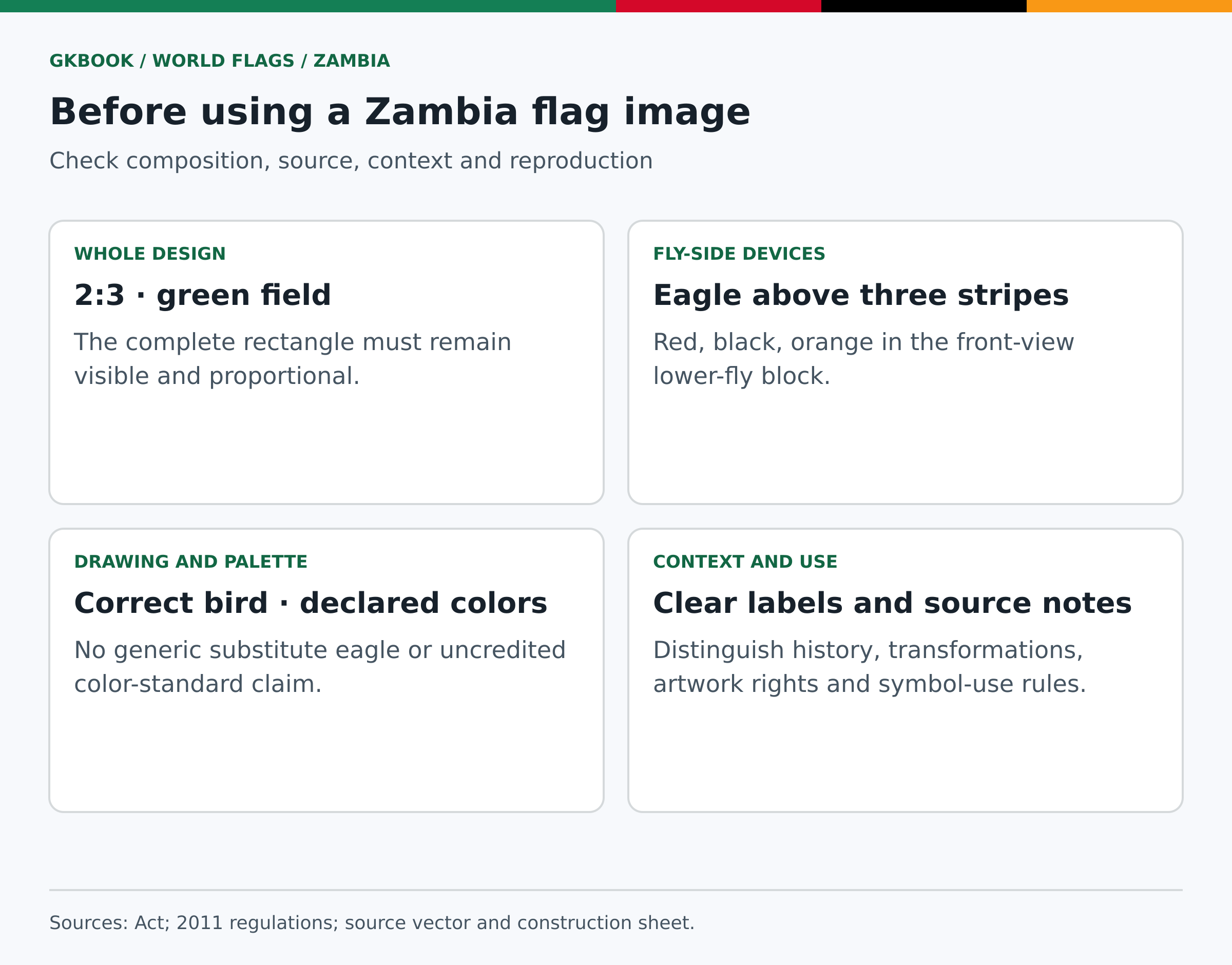
Check the 2:3 rectangle, green background, orange eagle above the lower-fly block, and red-black-orange stripe order in the front view. Confirm equal stripe widths, correct block dimensions and the distinctive bird. Preserve the complete flag, use a declared palette, and keep historical, mirrored or inverted examples clearly labeled.

At small sizes, the eagle’s details can merge, but its overall shape and position should remain recognizable. A star, full coat of arms, white triangle or four equal full-height bands indicates that the image has been altered or confused with another design. A decorative crop may be useful in a layout, but should not be presented as the complete reference flag.
Finally, check the caption and source record as well as the pixels. The 1964 adoption, 1965 statute, reported 1996 revision and 2011 regulations answer different questions. Numeric screen values are not certified statutory color conversions, and a downloadable illustration does not grant a national-symbol licence. Those distinctions make an accurate picture useful as a responsible reference.
Sources: National Flag and Armorial Ensigns Act — ZambiaLII/Laws.Africa reproduction · Government of Zambia — S.I. 69 of 2011, National Flag and Armorial Ensigns Regulations · State House — National Symbols · Wikimedia Commons — Flag of Zambia.svg, source rendition · Drawing method and calculations
Sources and research notes
This article uses the National Flag and Armorial Ensigns Act, the 2011 regulations, constitutional Article 6, official historical and symbolic explanations, and attributed artwork references. Each answer has visible source links. The bibliography and artwork credits record access methods, legal editions and drawing decisions.
The schedule supplies the 3:2 rectangle and construction drawing; the source sheet explains the eagle width as a reconstruction. The selected SVG palette is disclosed separately from the four statutory British Colour Council references. The Act reproduction and the 2011 scan were inspected directly. Some Parliament, State House and constitutional evidence was available through indexed text after direct requests failed; those limits are recorded.
Download Zambia flag pictures
Download the complete flag as scalable SVG or 9,000 × 6,000 PNG. Both preserve the 2:3 rectangle, green field, source eagle and lower-fly stripe block. The clean PNG is opaque, and the bird is retained as vector paths in the SVG.
The gallery includes 24 subjects, each in SVG and PNG, covering construction, symbolism, history, display and transformations. A separate 1,200 × 630 social-sharing card places the complete flag beside the article title. Use the clean master for a country illustration and the annotated graphics for teaching.
Read the construction guide, display notes and artwork credits, or explore more designs in World Flags.
World Flags/Zambia
Zambia flag pictures
Green field with an orange eagle above red, black and orange lower-fly stripes. The source eagle paths and declared digital palette are retained.
Flag eagle: Wikimedia Commons contributors, Flag of Zambia.svg (public-domain file). Field reconstruction and explanatory graphics: GKBook. Statutory color names and declared digital reference values are distinguished.Download SVGDownload PNGThe law names BCC shades 100, 210, 220 and 57. The displayed HEX and RGB values come from the selected digital rendition; they are not certified BCC conversions.
Flag eagle: Wikimedia Commons contributors, Flag of Zambia.svg (public-domain file). Field reconstruction and explanatory graphics: GKBook. Statutory color names and declared digital reference values are distinguished.Download SVGDownload PNGThese symbolic explanations come from official State House and Embassy accounts. The law separately identifies the visible design and color standards.
Flag eagle: Wikimedia Commons contributors, Flag of Zambia.svg (public-domain file). Field reconstruction and explanatory graphics: GKBook. Statutory color names and declared digital reference values are distinguished.Download SVGDownload PNGThis is a detail view, not a complete flag. The source paths, head direction, feather detail and outline are preserved; no substitute generic eagle is drawn.
Flag eagle: Wikimedia Commons contributors, Flag of Zambia.svg (public-domain file). Field reconstruction and explanatory graphics: GKBook. Statutory color names and declared digital reference values are distinguished.Download SVGDownload PNGThe center guide marks the stripe block and eagle reference region. It is an annotation and does not appear in the clean download.
Flag eagle: Wikimedia Commons contributors, Flag of Zambia.svg (public-domain file). Field reconstruction and explanatory graphics: GKBook. Statutory color names and declared digital reference values are distinguished.Download SVGDownload PNGAll measurements scale together. The reference grid, native canvas and large PNG express the same 2:3 height-to-length ratio.
Flag eagle: Wikimedia Commons contributors, Flag of Zambia.svg (public-domain file). Field reconstruction and explanatory graphics: GKBook. Statutory color names and declared digital reference values are distinguished.Download SVGDownload PNGThe three equal stripes reach the bottom and fly edges. They begin 80 reference units below the top and do not divide the whole flag into full-height bands.
Flag eagle: Wikimedia Commons contributors, Flag of Zambia.svg (public-domain file). Field reconstruction and explanatory graphics: GKBook. Statutory color names and declared digital reference values are distinguished.Download SVGDownload PNGThe eagle width is a reconstruction from the schedule drawing; it is not an explicitly printed legal width. The clean vector contains no labels or measurement lines.
Flag eagle: Wikimedia Commons contributors, Flag of Zambia.svg (public-domain file). Field reconstruction and explanatory graphics: GKBook. Statutory color names and declared digital reference values are distinguished.Download SVGDownload PNGThe colored rectangle is divided 216 + 40 + 40 + 40 across its length, and 80 + 144 at the fly. Area fractions are calculated from these dimensions.
Flag eagle: Wikimedia Commons contributors, Flag of Zambia.svg (public-domain file). Field reconstruction and explanatory graphics: GKBook. Statutory color names and declared digital reference values are distinguished.Download SVGDownload PNGThe outlined region identifies the source rendition’s visible eagle bounds, including its stroke. Its width is a documented reconstruction, not an independently stated legal dimension.
Flag eagle: Wikimedia Commons contributors, Flag of Zambia.svg (public-domain file). Field reconstruction and explanatory graphics: GKBook. Statutory color names and declared digital reference values are distinguished.Download SVGDownload PNGThe Embassy describes the first hoisting at the midnight transition into independence. PDF creation and SVG upload dates are not adoption dates.
Flag eagle: Wikimedia Commons contributors, Flag of Zambia.svg (public-domain file). Field reconstruction and explanatory graphics: GKBook. Statutory color names and declared digital reference values are distinguished.Download SVGDownload PNGNo invented portrait, signature or historical design-room scene is supplied. Credits distinguish the national designer from the contributors to later digital artwork.
Flag eagle: Wikimedia Commons contributors, Flag of Zambia.svg (public-domain file). Field reconstruction and explanatory graphics: GKBook. Statutory color names and declared digital reference values are distinguished.Download SVGDownload PNGThis is a selective timeline. The 1994 amendment to the Act is not presented as the same event as the 1996 visual changes.
Flag eagle: Wikimedia Commons contributors, Flag of Zambia.svg (public-domain file). Field reconstruction and explanatory graphics: GKBook. Statutory color names and declared digital reference values are distinguished.Download SVGDownload PNGNo recolored copy of the current bird is passed off as an authenticated 1964 flag. The legal BCC shade names and the chosen screen palette remain separately identified.
Flag eagle: Wikimedia Commons contributors, Flag of Zambia.svg (public-domain file). Field reconstruction and explanatory graphics: GKBook. Statutory color names and declared digital reference values are distinguished.Download SVGDownload PNGThe principal Act was inspected in a ZambiaLII reproduction and the 2011 instrument in a scan. Access methods and source dates are recorded.
Flag eagle: Wikimedia Commons contributors, Flag of Zambia.svg (public-domain file). Field reconstruction and explanatory graphics: GKBook. Statutory color names and declared digital reference values are distinguished.Download SVGDownload PNGThis comparison explains the legal distinction. It does not supply an unverified coat-of-arms drawing or a presidential production template.
Flag eagle: Wikimedia Commons contributors, Flag of Zambia.svg (public-domain file). Field reconstruction and explanatory graphics: GKBook. Statutory color names and declared digital reference values are distinguished.Download SVGDownload PNGThe graphic is a source guide, not a licence. Copyright permissions for the downloaded artwork do not remove national-symbol rules.
Flag eagle: Wikimedia Commons contributors, Flag of Zambia.svg (public-domain file). Field reconstruction and explanatory graphics: GKBook. Statutory color names and declared digital reference values are distinguished.Download SVGDownload PNGThis is the instrument’s list, not a complete annual events calendar or a statement that all other flag use is prohibited. Regulation 3 has separate exceptions.
Flag eagle: Wikimedia Commons contributors, Flag of Zambia.svg (public-domain file). Field reconstruction and explanatory graphics: GKBook. Statutory color names and declared digital reference values are distinguished.Download SVGDownload PNGThis is a historical source example, not a current mourning announcement. The graphic does not import another country’s ribbon, pole fraction or hoisting sequence.
Flag eagle: Wikimedia Commons contributors, Flag of Zambia.svg (public-domain file). Field reconstruction and explanatory graphics: GKBook. Statutory color names and declared digital reference values are distinguished.Download SVGDownload PNGThe inverted view is labeled as a teaching transformation. Use the separate clean master for a standard country illustration.
Flag eagle: Wikimedia Commons contributors, Flag of Zambia.svg (public-domain file). Field reconstruction and explanatory graphics: GKBook. Statutory color names and declared digital reference values are distinguished.Download SVGDownload PNGThe entire source design is mirrored, including the eagle head and detail strokes. No separate reverse manufacturing specification is asserted.
Flag eagle: Wikimedia Commons contributors, Flag of Zambia.svg (public-domain file). Field reconstruction and explanatory graphics: GKBook. Statutory color names and declared digital reference values are distinguished.Download SVGDownload PNGAll four rectangles are complete. The eagle, stripes and green field are transformed together rather than comparing the empty cloth outline.
Flag eagle: Wikimedia Commons contributors, Flag of Zambia.svg (public-domain file). Field reconstruction and explanatory graphics: GKBook. Statutory color names and declared digital reference values are distinguished.Download SVGDownload PNGPrint sizes are calculations, not certified dye or ink specifications. The declared screen values are not authenticated BCC conversions.
Flag eagle: Wikimedia Commons contributors, Flag of Zambia.svg (public-domain file). Field reconstruction and explanatory graphics: GKBook. Statutory color names and declared digital reference values are distinguished.Download SVGDownload PNGThe source record identifies statutory geometry, reconstructed eagle width, the selected digital rendition and the applicable legal texts.
Flag eagle: Wikimedia Commons contributors, Flag of Zambia.svg (public-domain file). Field reconstruction and explanatory graphics: GKBook. Statutory color names and declared digital reference values are distinguished.Download SVGDownload PNGFrequently asked questions
What does the Zambia flag look like?
Zambia’s flag is a green rectangle with an orange African fish eagle above a block of three vertical stripes at the lower fly. In the standard front view, the stripes run red, black and orange from left to right. Its height-to-length ratio is 2:3, and the flag was adopted at independence on October 24, 1964.
What is Zambia’s national flag called?
It is the national flag of the Republic of Zambia. Its official legal designation is the National Flag, distinct from the President’s Standard and the Armorial Ensigns. The familiar design combines a green field, an orange eagle and a compact block of red, black and orange stripes at the fly.
What are the Zambia flag colors and HEX codes?
Zambia’s flag uses green, red, black and orange. The law specifies British Colour Council references 100, 210, 220 and 57 respectively. This digital reference uses #147F55, #D40829, #000000 and #F99815, retained from the identified source vector. These HEX values are reproduction choices, not a certified conversion of the legal color standards.
What do the colors of Zambia’s flag mean?
Official explanations associate green with natural resources and vegetation, red with the struggle for freedom, black with the people of Zambia, and orange with mineral wealth, especially copper. The eagle adds the idea of freedom and the ability to rise above difficulties. These symbolic explanations complement the law’s description of the visible design.
What bird appears on Zambia’s flag?
The bird is an orange African fish eagle, shown in flight above the vertical stripes. Official explanations connect it with freedom and the people’s ability to rise above the nation’s problems. It is a stylized national emblem, not a natural-color wildlife illustration, and the flag does not include the entire coat of arms.
Why are the eagle and stripes at the fly?
The eagle and stripe block are placed toward the free end of the flag, called the fly. This unusual arrangement is an identifying feature of Zambia’s design. In a conventional front view, the stripes meet the lower and right edges, with the eagle above them; the large remaining area is green.
What are Zambia’s official flag proportions?
The flag’s height-to-length ratio is 2:3, expressed as overall dimensions 3:2 in the law’s length-first description. The construction can be shown on a 336-by-224-unit grid. The downloadable master uses a 900-by-600 drawing canvas and a 9,000-by-6,000-pixel PNG, all preserving exactly the same rectangular proportion.
How are Zambia’s three vertical stripes arranged?
The lower-fly stripes run red, black and orange from left to right in the standard front view. They have equal widths and equal heights, but do not extend to the top of the flag. On the 336 × 224 grid, each stripe is 40 units wide and 144 units high.
How do you draw Zambia’s flag accurately?
Begin with a 3:2 green rectangle. Add three equal vertical rectangles at the lower fly, ordered red, black and orange, using the construction grid. Place the specified orange eagle above their combined block. Keep the entire flag proportional, and remove measurement guides from the clean illustration while retaining the bird’s distinctive outline.
What do the construction measurements mean?
The flag’s 336 × 224 grid scales the schedule’s 21 × 14 diagram by sixteen. Its horizontal divisions are 216 + 40 + 40 + 40; the stripe block starts 80 units below the top. Above the stripes, the eagle reference region divides vertically into 19 + 42 + 19 units.
How large is the eagle on Zambia’s flag?
On the 336 × 224 reference grid, the eagle is 42 units high and approximately 106 units wide, centered above the stripes. The schedule provides its height, while the width is reconstructed from the drawing. The supplied vector fits the reference box from x = 223 to 329 and y = 19 to 61.
When was Zambia’s flag adopted?
Zambia adopted its national flag on October 24, 1964, when the country became independent. State House gives that adoption date. The National Flag and Armorial Ensigns Act commenced on June 4, 1965, so the flag’s first adoption and the later statute are separate events rather than competing dates for the same action.
How is the flag connected with Independence Day?
Independence Day on October 24 marks Zambia’s independence in 1964 and the adoption of its national flag. It is also one of the four public holidays named in the 2011 flag regulations as occasions when any person may fly the flag, subject to the provisions on respectful display, condition and daylight hours.
Who designed Zambia’s flag?
Gabriel Ellison, the Zambian artist and writer, is credited with designing the national flag. A National Assembly answer on August 6, 2010 names her directly, and ICAO’s postal-history account also attributes the flag to her. Her wider work included stamp design and the national coat of arms, alongside other artistic commissions.
What are the main stages of Zambia’s flag history?
The main sequence is the colonial flag context of Northern Rhodesia, Zambia’s independence flag adopted in 1964, the 1965 Act defining the national symbols, the 1996 visual changes described by State House, and the 2011 replacement display regulations. These are different kinds of developments: political transition, legislation, visual revision and rules of use.
What changed in Zambia’s flag in 1996?
State House describes two changes in 1996: the green became lighter and brighter, and the eagle was adjusted to resemble the one used in the coat of arms more closely. The basic composition remained the same. The sources inspected do not establish a separately verified exact day or a certified before-and-after digital color table.
Which laws and regulations define Zambia’s flag?
Article 6 of the Constitution lists the national symbols. The National Flag and Armorial Ensigns Act, Chapter 6, declares the flag and supplies its design in the schedule. Statutory Instrument No. 69 of 2011 provides the flag regulations. Its Regulation 12 revokes the 1965 regulations, so older numbering should not be presented as current.
Is the national flag the same as the President’s Standard?
No. The Act defines them separately. Zambia’s national flag has a green field with an eagle above three lower-fly stripes. The President’s Standard is an orange flag bearing the Armorial Ensigns. The complete coat of arms is a third distinct symbol; it is not placed on the ordinary green national flag.
Who may fly Zambia’s flag, and how should it be displayed?
The 2011 regulations establish a licensing framework with stated exceptions for government and specified public premises, institutions and ministerial transport. They also allow display by any person on named holidays and other declared occasions. Regulation 5 requires respectful display and good condition; Regulation 6 limits flying to the period between sunrise and sunset.
On which holidays may any person fly the flag?
Regulation 4 of the 2011 instrument names Africa Freedom Day, Heroes Day, Unity Day and Independence Day. It also allows other days or occasions declared by the Minister. These permissions remain subject to Regulations 5 and 6, covering respectful display, cleanliness and repair, and flying between sunrise and sunset.
How is Zambia’s flag used during national mourning?
Official mourning announcements can direct that flags fly at half-mast. For example, the Embassy’s June 17, 2021 announcement following Kenneth Kaunda’s death specified that treatment during the declared mourning period. The occasion, duration and any accompanying instructions come from the relevant announcement; this article does not announce a current period of mourning.
Which way round should Zambia’s flag be shown?
In the standard front view with the hoist at the left, the eagle is above the stripe block at the right-hand fly. The stripes meet the bottom edge and run red, black, orange from left to right. An upside-down image puts the block at the top and turns the eagle over.
What does the reverse of Zambia’s flag look like?
A physical reverse view mirrors the front left to right. The eagle and stripe block therefore appear on the viewer’s left, while the attachment edge appears on the right. The visible stripe order becomes orange, black, red. The eagle remains above the block, but its profile and feather details are mirrored.
Is Zambia’s flag symmetrical?
The complete colored flag has neither left-right nor top-bottom reflection symmetry, and it is not unchanged by a half-turn. Its fly-side block and eagle make the composition asymmetric. The outline of the rectangular cloth has symmetries of its own, but those do not determine the symmetry of the colored national design.
Can Zambia’s flag be displayed vertically?
The horizontal 2:3 drawing is the legal reference used here. Rotating an image for a tall layout is a geometric operation, but it does not by itself establish a general national hanging protocol. The sources inspected do not provide a verified universal vertical-display template, so the page does not invent one.
How do Zambia’s and Zimbabwe’s flags differ?
Zambia’s flag has a large green field, an orange flying eagle and three vertical stripes at the lower fly. Zimbabwe’s flag has seven horizontal stripes and a white hoist triangle containing a red star and the Zimbabwe Bird. The similar country names and shared colors should not obscure these very different layouts.
What is the Zambia flag emoji and its Unicode sequence?
The Zambia flag emoji is 🇿🇲. It is encoded as the two regional indicator characters U+1F1FF and U+1F1F2, corresponding to Z and M. Unicode identifies the sequence as flag: Zambia. The actual appearance depends on the platform, font and software, so an emoji is not a precise production drawing.
How large can the downloadable Zambia flag be printed?
The clean PNG is 9,000 × 6,000 pixels, totaling 54 million pixels. At 300 pixels per inch it prints at 30 × 20 inches, or 76.2 × 50.8 centimeters. At 150 pixels per inch it prints at 60 × 40 inches. The SVG can be scaled without a fixed raster-resolution limit.
Which flag graphics and downloads are included?
The gallery contains 24 subjects, each in SVG and PNG, including the clean current flag and 23 explanatory graphics. A separate social-sharing card is also supplied. The illustrations cover colors, symbolism, eagle details, proportions, construction, history, legal distinctions, display and transformations, with source credits and clear labels for teaching examples.
How can you check whether a Zambia flag image is accurate?
Check the 2:3 rectangle, green background, orange eagle above the lower-fly block, and red-black-orange stripe order in the front view. Confirm equal stripe widths, correct block dimensions and the distinctive bird. Preserve the complete flag, use a declared palette, and keep historical, mirrored or inverted examples clearly labeled.
Every general-knowledge topic and the A-to-Z lists.
The world A to Z: flags, countries, the sciences, places, people, subjects.









We Value Your Opinion Comments