
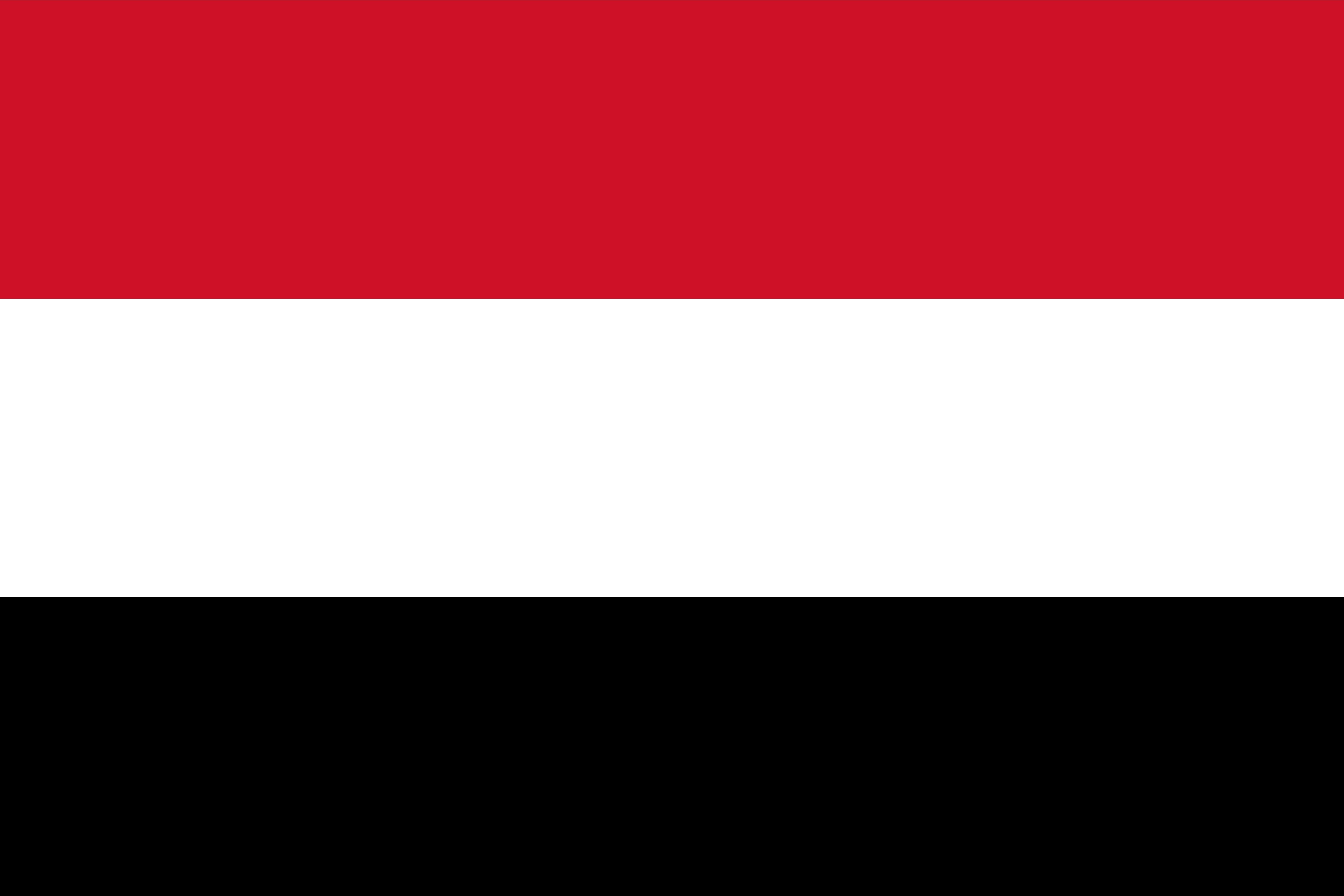
Yemen flag picture
This original drawing follows the 2:3 proportion in the 1990 flag law. The construction guide explains the equal bands and distinguishes legal requirements from declared screen colors. Historical examples appear in the predecessor comparison.
| Country | Republic of YemenNational flag; a plain red-white-black tricolor. |
|---|---|
| Adopted | May 22, 1990Law No. 1 of 1990; effective from its issue date. |
| Historical setting | UnificationYemen Arab Republic and People’s Democratic Republic of Yemen. |
| Design | 3 equal horizontal bandsRed at the top, white in the middle, black at the bottom. |
| Emblem | None on the national flagThe national emblem is defined by a separate law. |
| Proportions | Height:length = 2:3Article 2 also requires equal band dimensions. |
| National Day | May 22Law No. 4 of 1990; unification anniversary. |
| Working palette | #CE1126 · #FFFFFF · #000000Declared screen values, not statutory HEX codes. |
Source notes separate cultural explanations, legal evidence and the original drawing’s reproduction choices.
What does the Yemen flag look like?
Yemen’s national flag consists of three equal horizontal bands: red at the top, white in the middle and black at the bottom. It has a legally specified 2:3 height-to-length ratio and no emblem, star or inscription. The current design was adopted on May 22, 1990, when North and South Yemen unified.
This guide brings together the 1990 flag law, the published constitutional color order, official explanations and documented historical references. The downloadable artwork follows the legal rectangle and equal bands, while clearly declaring its digital color choices. Historical comparisons distinguish the two predecessor flags from today’s plain tricolor, and the display notes retain the scope and wording of the inspected legal provisions.
Sources: National Information Center — Law No. 1 of 1990 on the national flag · National Information Center — published Constitution, Article 156 · United Nations — Yemen member-state record
What is Yemen’s national flag called?
Yemen’s flag is the national flag of the Republic of Yemen. The Arabic legal term is al-ʿalam al-waṭanī, meaning national flag. It is a plain horizontal red-white-black tricolor. The current design dates from the unification of the Yemen Arab Republic and the People’s Democratic Republic of Yemen in 1990.
The country’s official name is Republic of Yemen, or al-Jumhūriyyah al-Yamaniyyah. Tricolor describes the three colors; triband describes the three horizontal bands. Neither term implies a hidden emblem or an inscription. A useful English caption is “Yemen national flag, adopted May 22, 1990,” particularly when the image appears alongside historical Yemeni flags.
The inspected legal text identifies a state decision rather than naming an individual graphic designer. The signature of a political officeholder on that decision should not be turned into an unsupported artist attribution. The page therefore explains the law and historical setting without inventing a designer, signature facsimile or portrait for the current flag.
Sources: National Information Center — Law No. 1 of 1990 on the national flag · Embassy of Yemen in Japan — flag and national emblem · United Nations — Yemen member-state record
What are the Yemen flag colors and HEX codes?
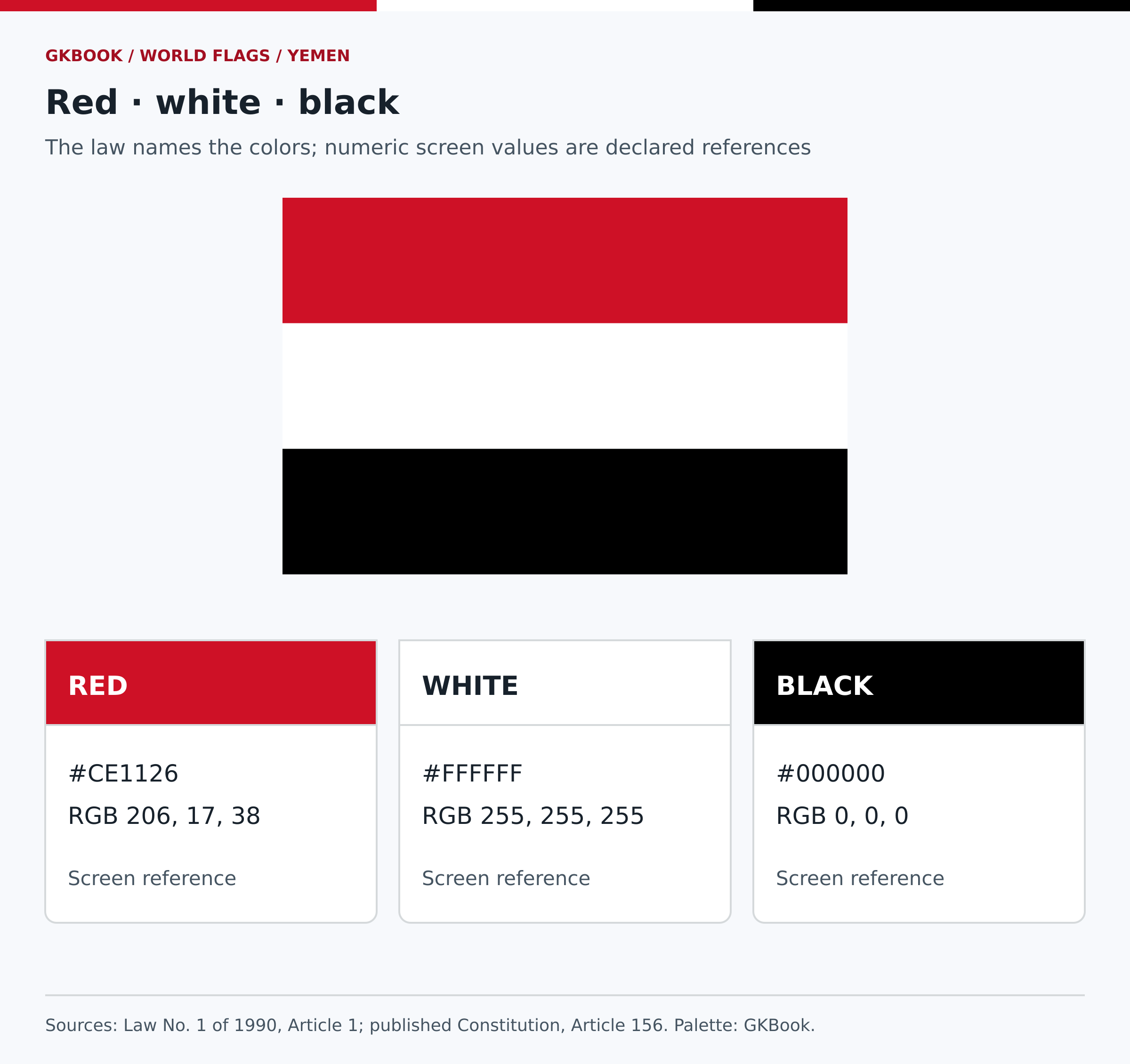
Yemen’s national flag is red at the top, white in the middle and black at the bottom. This artwork uses red #CE1126, white #FFFFFF and black #000000. The law names the colors but supplies no numerical digital palette, so these HEX and RGB values are declared screen references rather than certified national color standards.

The color order appears in Article 1 of Law No. 1 of 1990 and in Article 156 of the published Constitution. The downloadable files use the same three values throughout the current-flag artwork. Historical comparison graphics introduce green or light blue only where they are needed to identify a predecessor design, and those illustrations are labeled accordingly.
No Pantone, CMYK, textile dye or official color-tolerance table was established from the primary sources inspected. Converting an RGB value into another color system does not automatically create a government specification. For printing, use a color-managed production workflow and inspect a proof; screen brightness, paper, fabric and lighting can all affect how the selected red appears.
| Band | HEX | RGB |
|---|---|---|
| Red | #CE1126 | 206, 17, 38 |
| White | #FFFFFF | 255, 255, 255 |
| Black | #000000 | 0, 0, 0 |
Sources: National Information Center — Law No. 1 of 1990 on the national flag · National Information Center — published Constitution, Article 156 · Drawing method and calculations
What do the colors of Yemen’s flag mean?
Official Yemeni explanations associate red with revolution, white with its principles and purity, and black with the earlier era described as darkness and reactionary rule. Other flag references describe sacrifice, a bright future and a dark past. These are attributed interpretations; the flag law itself defines the visible design without assigning symbolic meanings.

The Foreign Ministry and the Embassy in Kuala Lumpur present the revolutionary interpretation. The Flag Institute gives a related account connecting red with unity and the blood of martyrs, white with a brighter future, and black with the past. The wording differs, so the page identifies the source instead of claiming one universal, legally prescribed sentence for each color.
These explanations belong to the history and political language surrounding the symbol. Describing the official interpretation does not require endorsing every judgment it makes about an earlier regime. Nor does a symbolic meaning authorize adding a picture, slogan or decorative motif to a band: the national flag remains the simple, unmarked tricolor defined in the law.
Sources: Ministry of Foreign Affairs and Expatriates — brief overview of Yemen · Embassy of Yemen in Kuala Lumpur — Arabic country overview · Flag Institute — Flag of Yemen, Alex Crouch, May 18, 2015 · National Information Center — Law No. 1 of 1990 on the national flag
What are the official proportions of Yemen’s flag?
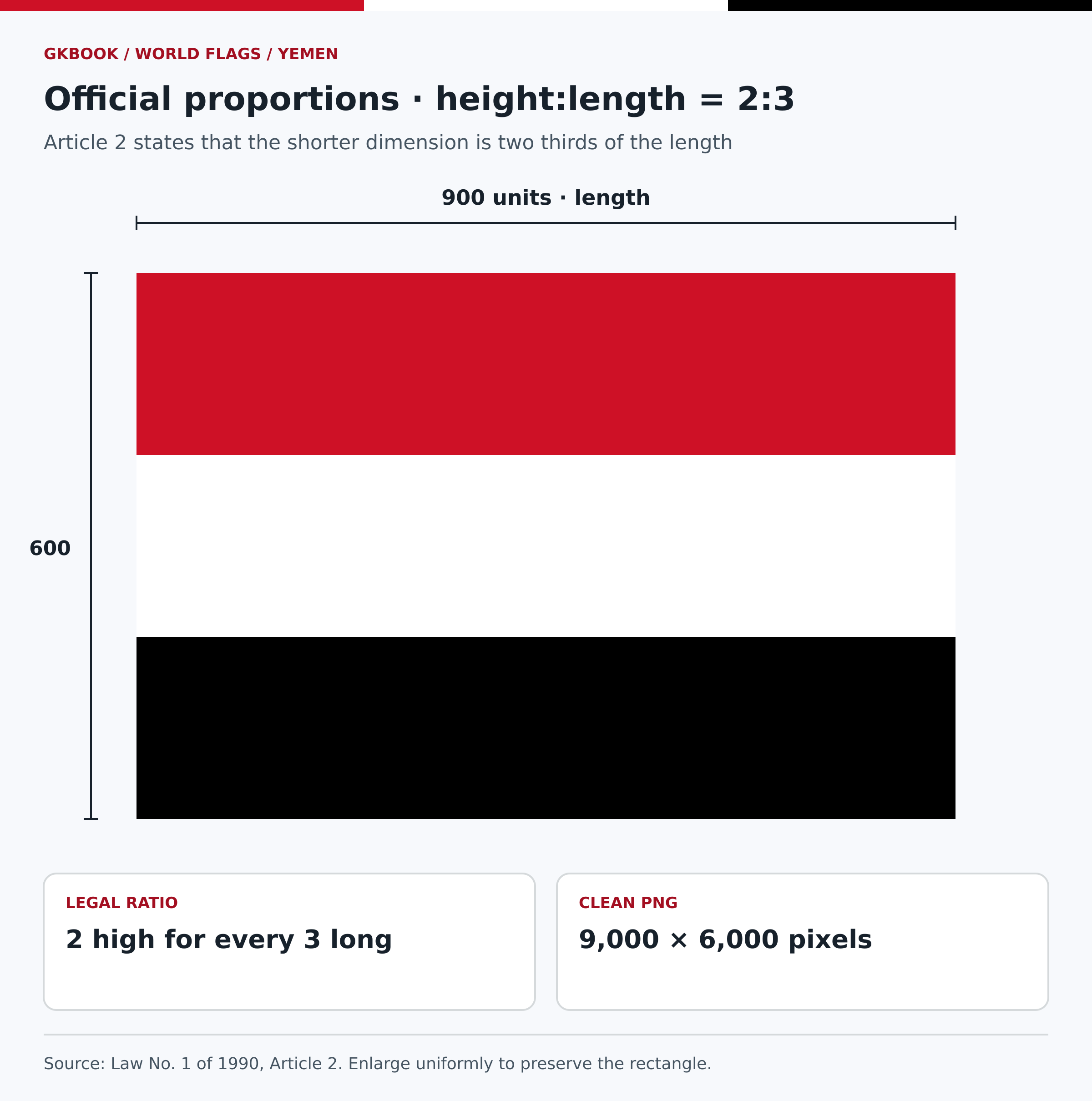
Yemen’s flag has a height-to-length ratio of 2:3. Article 2 of the 1990 flag law states that the rectangle’s width is two thirds of its length. Here width in that translated legal description means the shorter dimension. The supplied drawing is 900 units long and 600 units high.

Flag descriptions sometimes use width for the short vertical dimension, while digital image tools normally write dimensions as width × height. Stating both conventions prevents confusion: this flag is 900 × 600 on the native drawing grid and 9,000 × 6,000 in the large PNG. Both express the same legally specified rectangular proportion.
To scale the flag, multiply its length and height by the same number. For example, a 150-centimeter length requires a 100-centimeter height. Stretching the rectangle independently in one direction changes the design even if all three bands remain equal. A surrounding frame can have another shape, but the complete flag placed inside it should retain its ratio.
Sources: National Information Center — Law No. 1 of 1990 on the national flag · Yemen Public Prosecution — national flag law reproduction · Drawing method and calculations
Are the three bands equal in size?
Yes. Article 2 requires three rectangles of equal dimensions extending along the flag’s length. Each band therefore occupies one third of the total height and one third of the flag’s area. On the 900 × 600 construction grid, the red, white and black bands are each exactly 200 units high.
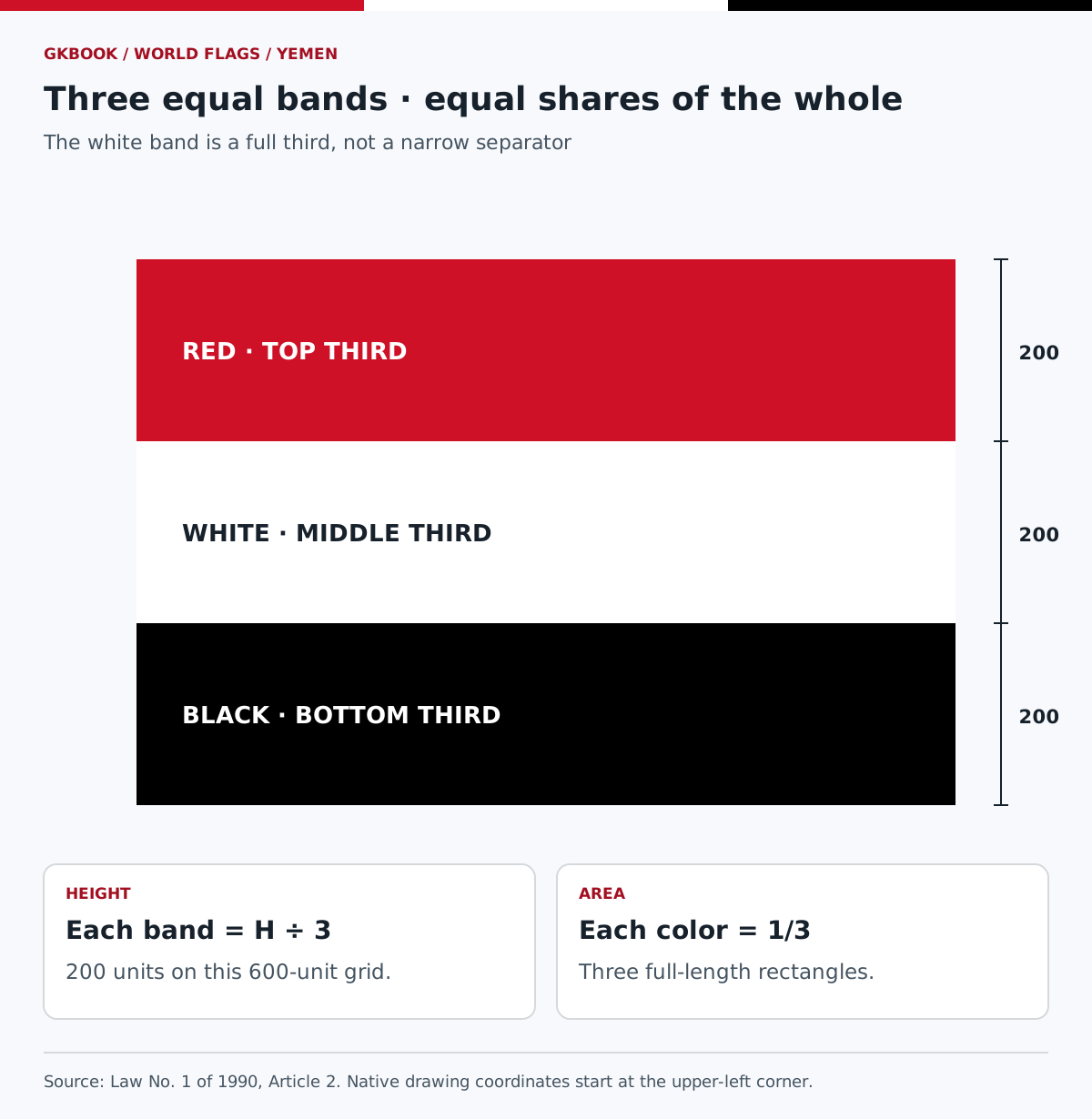
The white band is not a narrow separator between two larger color fields. It has the same height as the red and black bands, including on the clean master where a white background could make its boundaries less obvious. A subtle frame outside the displayed image can help readers see the rectangle without altering the flag itself.
The legal description implies straight, parallel horizontal boundaries and full-length bands. There are no gaps, decorative outlines or tapering stripes in the flat reference. When preparing a raster image at a size whose height is not divisible by three, antialiasing may distribute a boundary across pixels; this does not change the underlying equal-thirds vector geometry.
| Band | Top edge y | Bottom edge y | Share of area |
|---|---|---|---|
| Red | 0 | 200 | 1/3 |
| White | 200 | 400 | 1/3 |
| Black | 400 | 600 | 1/3 |
Sources: National Information Center — Law No. 1 of 1990 on the national flag · Drawing method and calculations
How do you draw Yemen’s flag accurately?
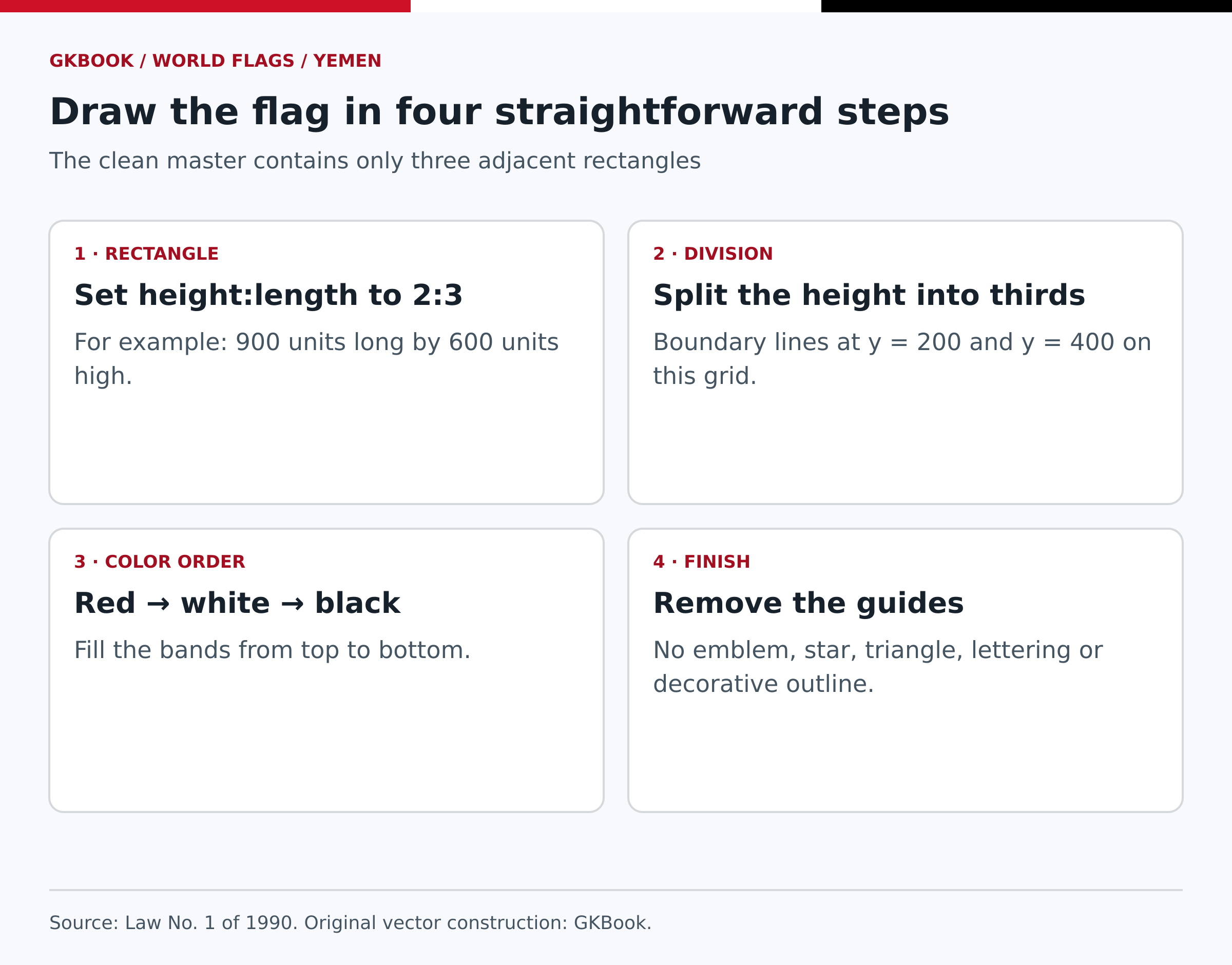
Draw a rectangle three units long for every two units high. Divide its height into three equal parts, then fill the upper band red, the middle band white and the lower band black. Add no star, triangle, eagle or lettering. The construction guides belong outside the clean national-flag artwork.
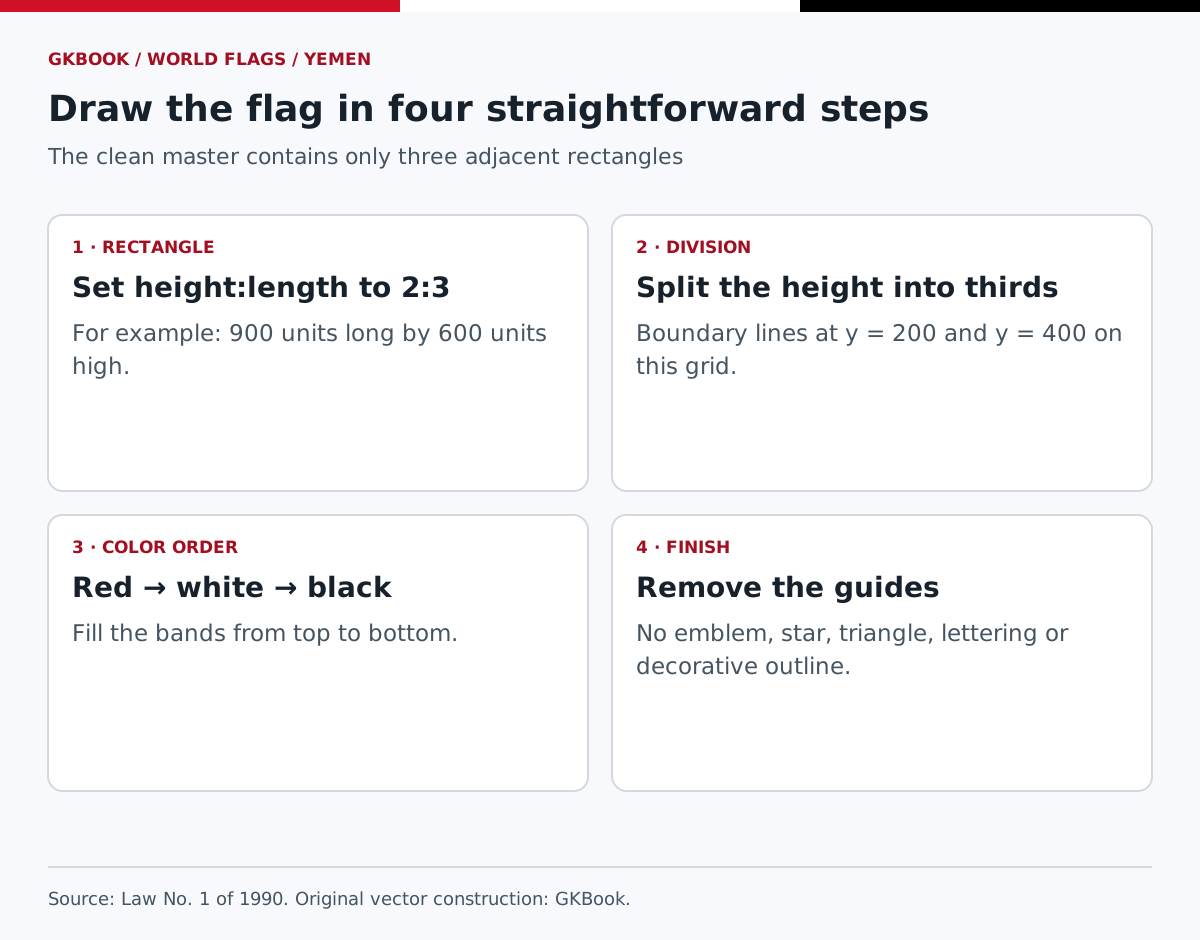
The SVG master uses three adjacent rectangles on a 900 × 600 coordinate system. Their upper edges are at y = 0, 200 and 400, with each rectangle 900 units long and 200 high. The coordinate origin is the upper-left corner. This is a direct implementation of the statutory proportions rather than a reconstruction from a photograph.
The color names and geometry come from the law; the numeric red value is an editorial reproduction choice. The teaching diagrams use measurement lines and panels to explain those facts, but the clean master has only the three bands. Removing the guides is an essential final step when an annotated worksheet is converted into a standalone flag illustration.
Sources: National Information Center — Law No. 1 of 1990 on the national flag · Drawing method and calculations
When was Yemen’s current flag adopted?
The current flag was adopted on May 22, 1990, the day Yemen unified. Law No. 1 of 1990, dated that day, describes the red-white-black design and its proportions. Article 8 makes the decision effective from its issue date. This date is distinct from the earlier republican and independence milestones in the two predecessor states.

The National Information Center and Public Prosecution reproduce the flag law, including its May 22 date. The United Nations separately records the merger of the two countries on the same day. These sources support both the legal adoption and the unification context without relying on an undated caption or an assumed meaning of a stock-image filename.
The original 1990 Gazette scan was not obtained for this package; the legal account is based on the identified institutional text reproductions. That access distinction is recorded in the source notes. The date checked for this article is a research date and should not be mistaken for the page’s publication date or for a later revision of the national flag.
Sources: National Information Center — Law No. 1 of 1990 on the national flag · Yemen Public Prosecution — national flag law reproduction · United Nations — Yemen member-state record
Why was a new flag introduced in 1990?
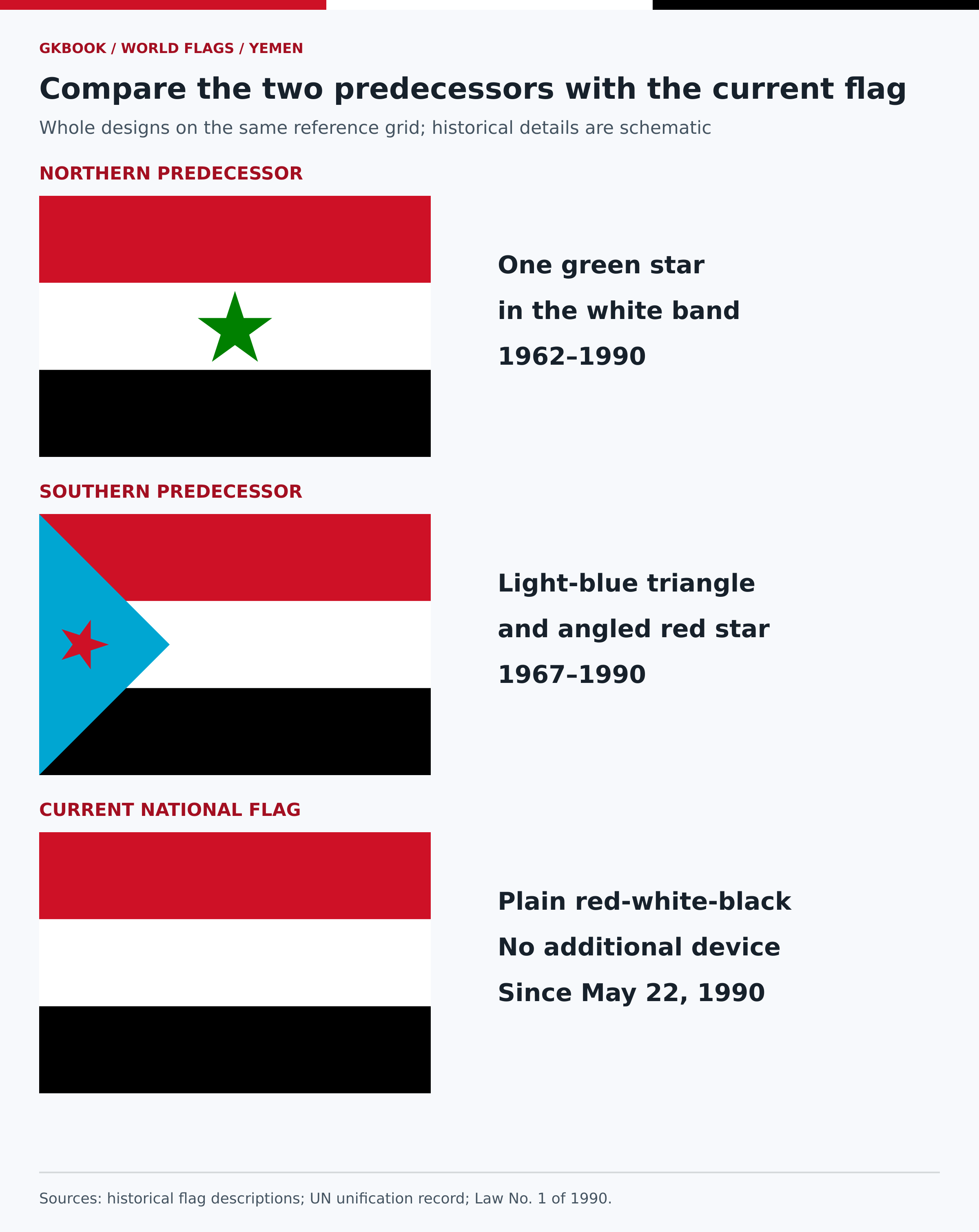
The Yemen Arab Republic and the People’s Democratic Republic of Yemen united on May 22, 1990, forming the Republic of Yemen. The plain red-white-black tricolor retained the bands shared by their flags while omitting their distinguishing additions: the north’s green star and the south’s light-blue triangle containing a red star.

The United Nations explains that the two countries have since been represented as one member named Yemen. This is the institutional event associated with the current flag’s adoption. The illustration shows two predecessor labels leading to one current reference; it does not imply that the modern flag was created by physically sewing halves of the older flags together.
Describing the visible simplification is different from claiming access to every negotiation over the design. The inspected sources establish the resulting flag and its date, but do not justify an invented account of a particular designer’s private intentions. The guide therefore connects the common bands and omitted devices to the documented political transition without fabricating a design-room narrative.
Sources: United Nations — Yemen member-state record · National Information Center — Law No. 1 of 1990 on the national flag · Flags of the World — North Yemen (1962–1990) · Flags of the World — South Yemen (1967–1990) · Drawing method and calculations
What are the main milestones in Yemen’s flag history?
The modern sequence includes the kingdom in the north before the 1962 republican revolution, the Yemen Arab Republic’s green-star tricolor, South Yemen’s blue-triangle and red-star flag from the independence period beginning in 1967, and the unified republic’s plain tricolor in 1990. This is a selective timeline rather than a complete catalog of every regional banner.

Yemen’s earlier political history includes several states and local flags, especially in the south before independence. A short national-flag page should not compress those distinct entities into a single undifferentiated “old Yemen” flag. The timeline identifies the two immediate national predecessors and the transition most relevant to understanding the present design, with the earlier kingdom noted as background.
The historical illustrations in this package are explanatory reconstructions, not photographs or authenticated textile facsimiles. Their additional star and triangle dimensions are disclosed as reference choices. For an exhibition devoted to an exact historical artifact, the original object, dated photograph or contemporary specification would provide evidence beyond the deliberately simplified comparisons supplied here.
Sources: Embassy of Yemen in Ankara — national flag and historical overview · Flags of the World — North Yemen (1962–1990) · Flags of the World — South Yemen (1967–1990) · National Information Center — Law No. 1 of 1990 on the national flag · Drawing method and calculations
What did North Yemen’s flag look like?
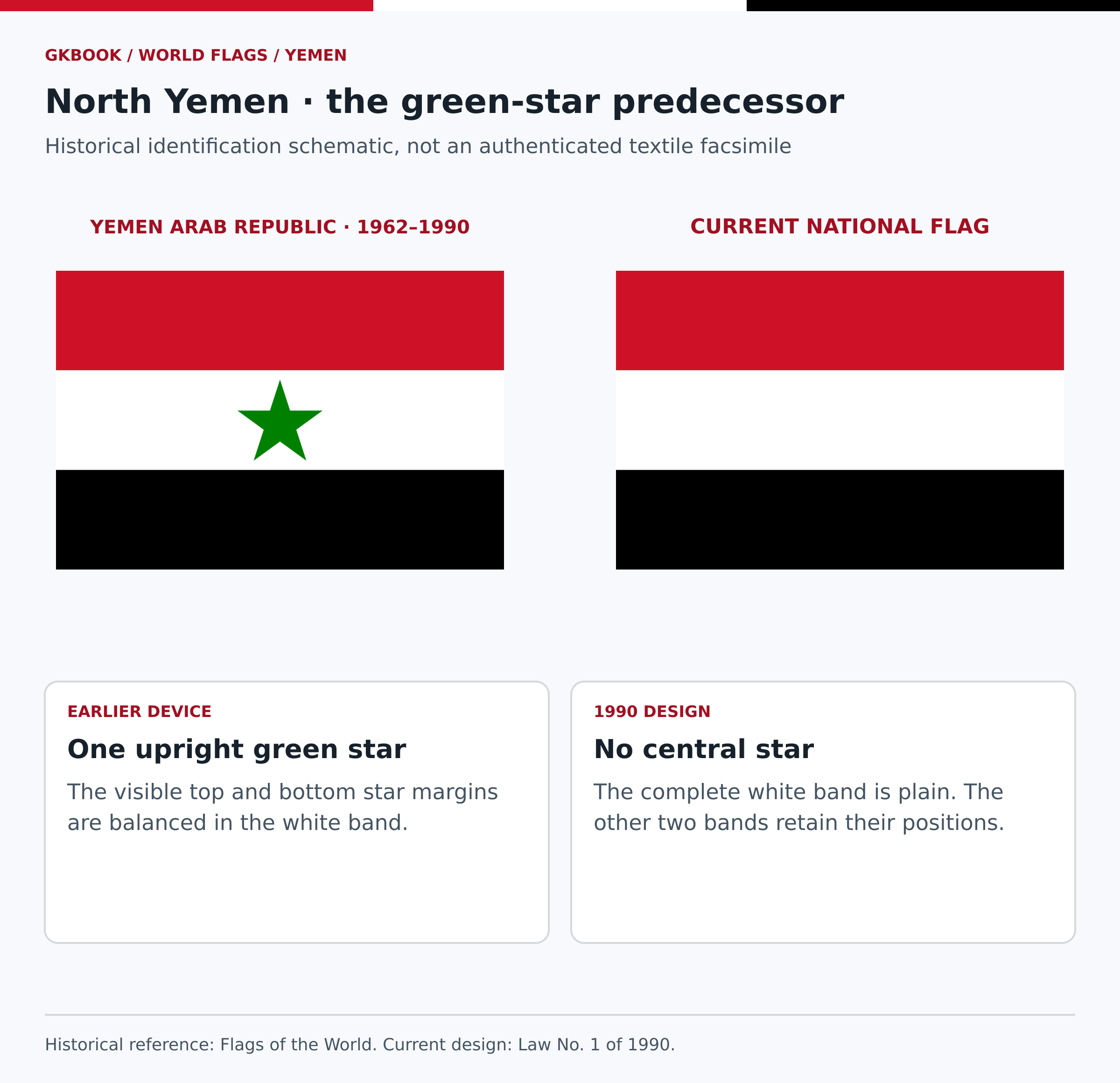
The Yemen Arab Republic, commonly called North Yemen, used a red-white-black tricolor with one green five-pointed star in the middle white band. This predecessor design belongs to the republican period beginning in 1962 and ending at unification in 1990. The current national flag keeps the three bands and has no green star.
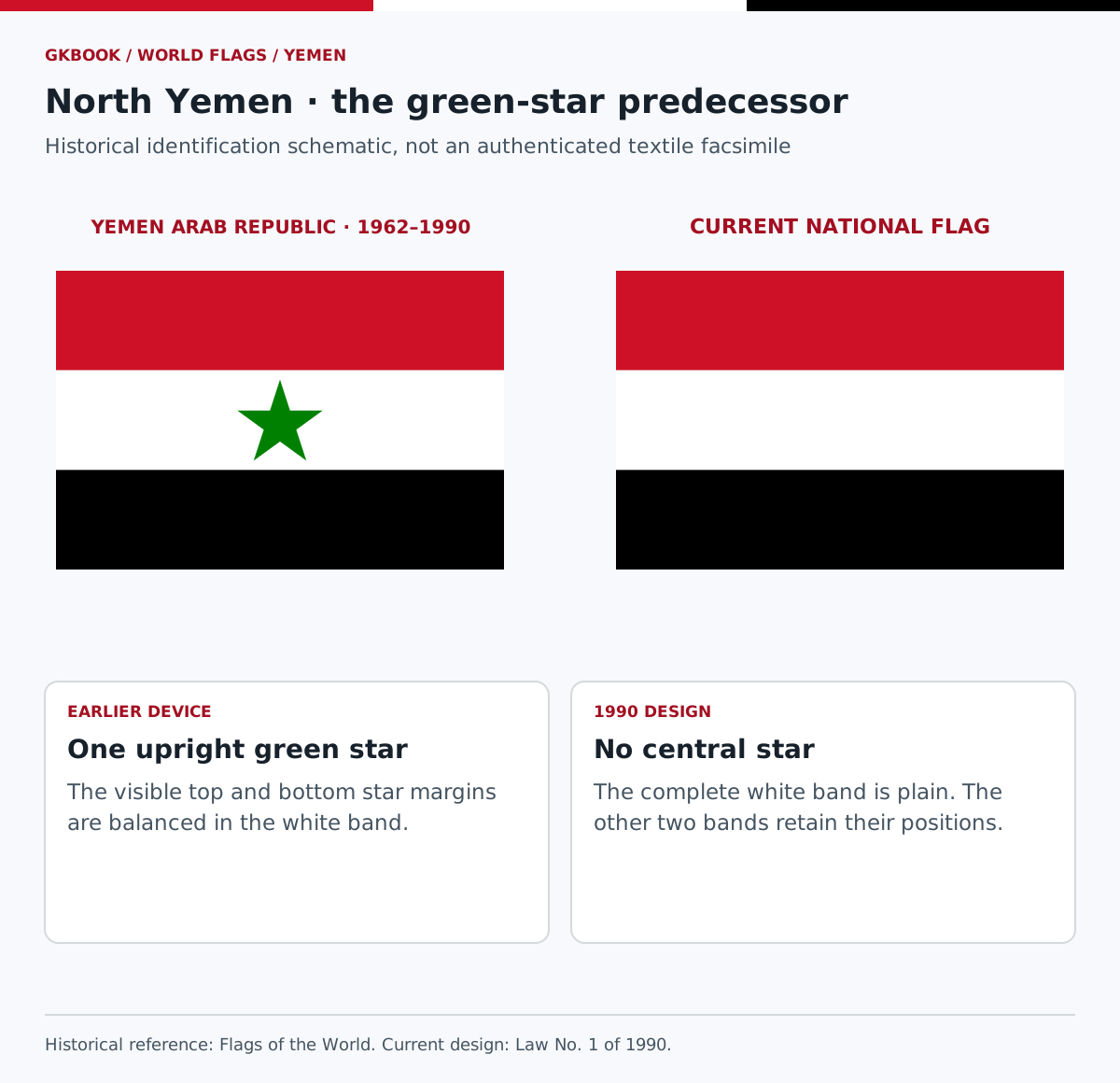
Flags of the World describes the star as centered by its visible height within the white band and records a formal raising on November 1, 1962. That should be distinguished from the September 26 revolution that established the republic. The page uses the broader period label where an exact day is not necessary for identifying the flag.
The supplied schematic follows the reported appearance: an upright green star with balanced visible top and bottom margins. Its size and green screen value are declared reconstruction choices, not a newly discovered historical production standard. The star stays wholly inside the white band, and the diagram labels the earlier design so it cannot be mistaken for today’s flag.
Sources: Flags of the World — North Yemen (1962–1990) · Embassy of Yemen in Japan — flag and national emblem · Drawing method and calculations
What did South Yemen’s flag look like?
South Yemen’s flag used red, white and black horizontal bands with a light-blue triangle at the hoist containing a red five-pointed star. The star was angled toward the fly. This design is associated with the independent southern state from 1967 to unification in 1990; those additions are absent from Yemen’s current national flag.

The hoist is the edge attached to the pole; the fly is the free edge. The historical reference describes the triangle as extending about one third of the flag’s length, with the star near the triangle’s centroid and one point directed toward the fly. These details help distinguish the design from a tricolor with an upright star placed in the center.
The drawing reproduces those identifying features using a declared geometric schematic. It does not claim exact historical cloth colors or a complete statutory construction sheet. The caption uses South Yemen as a geographic shorthand for the predecessor state and does not treat a historical illustration as evidence about present-day territorial control or the intentions of everyone who displays a similar flag.
Sources: Flags of the World — South Yemen (1967–1990) · Flag Institute — Flag of Yemen, Alex Crouch, May 18, 2015 · United Nations — Yemen member-state record · Drawing method and calculations
How do the two predecessor flags compare with the current flag?
All three designs share horizontal red, white and black bands. The northern predecessor adds one green star in the white band; the southern predecessor adds a light-blue hoist triangle with an angled red star. The Republic of Yemen’s current flag has neither addition. Side-by-side comparison makes the 1990 change easy to identify.
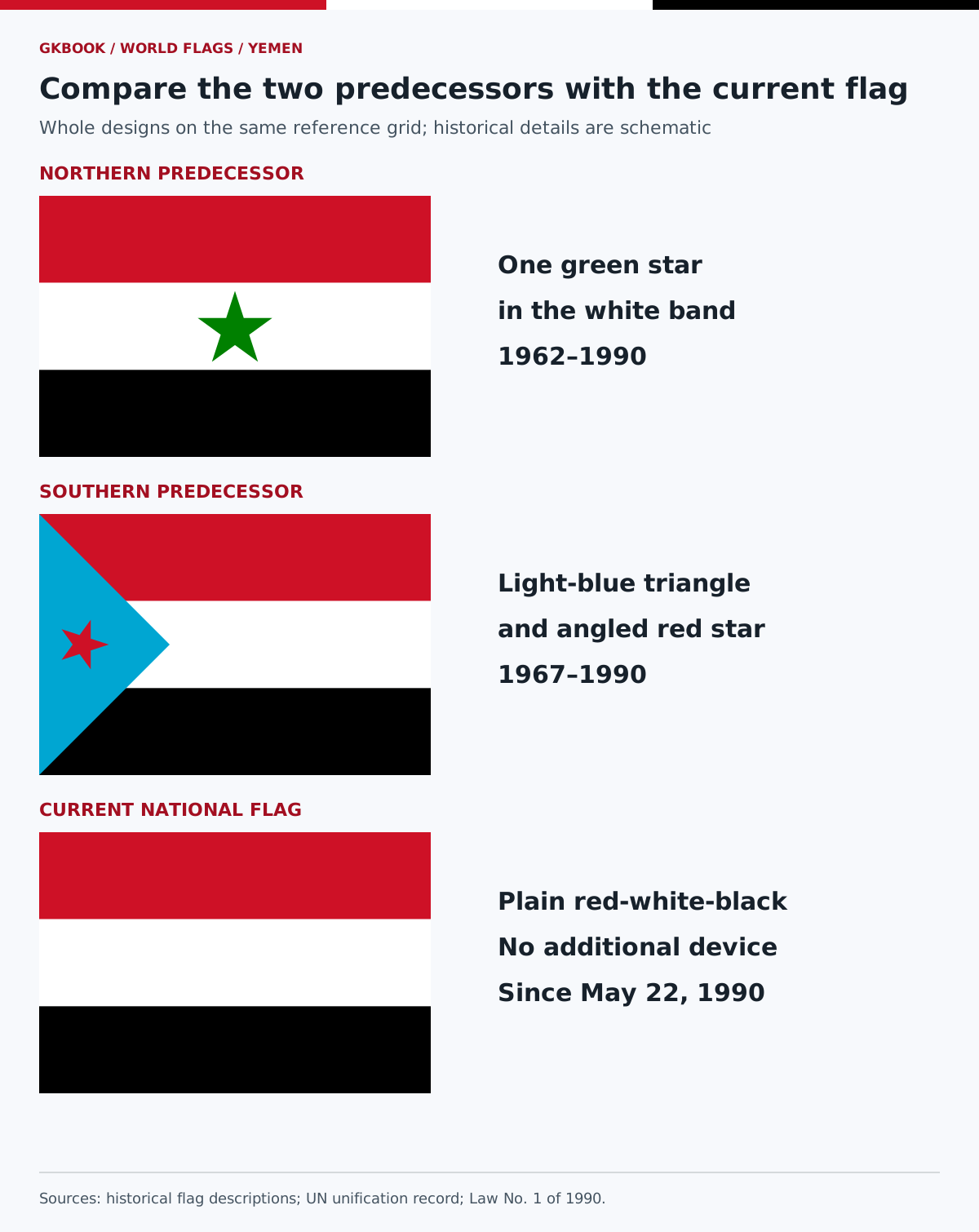
The comparison places complete flags on the same 2:3 reference canvas so that additions can be compared without changing the surrounding bands. Its purpose is identification rather than the authentication of an individual historical textile. Captions name the two predecessor states, give their broad periods and explicitly identify the plain flag as the current national design.
Historical accuracy also depends on context. A photograph taken before unification should retain the flag that was present when the photograph was made. Replacing its star or triangle with the current design would alter the record. Conversely, a newly created country-reference illustration should not accidentally use one of those earlier flags under an undated caption identifying today’s Republic of Yemen.
| Context | Identifying addition | Period used here |
|---|---|---|
| Yemen Arab Republic / North Yemen | One green star in the white band | 1962–1990 |
| South Yemen | Light-blue hoist triangle; red star pointing flyward | 1967–1990 |
| Republic of Yemen | No additional device | Since May 22, 1990 |
Sources: Flags of the World — North Yemen (1962–1990) · Flags of the World — South Yemen (1967–1990) · National Information Center — Law No. 1 of 1990 on the national flag · Drawing method and calculations
Why does Yemen’s flag resemble other Arab flags?
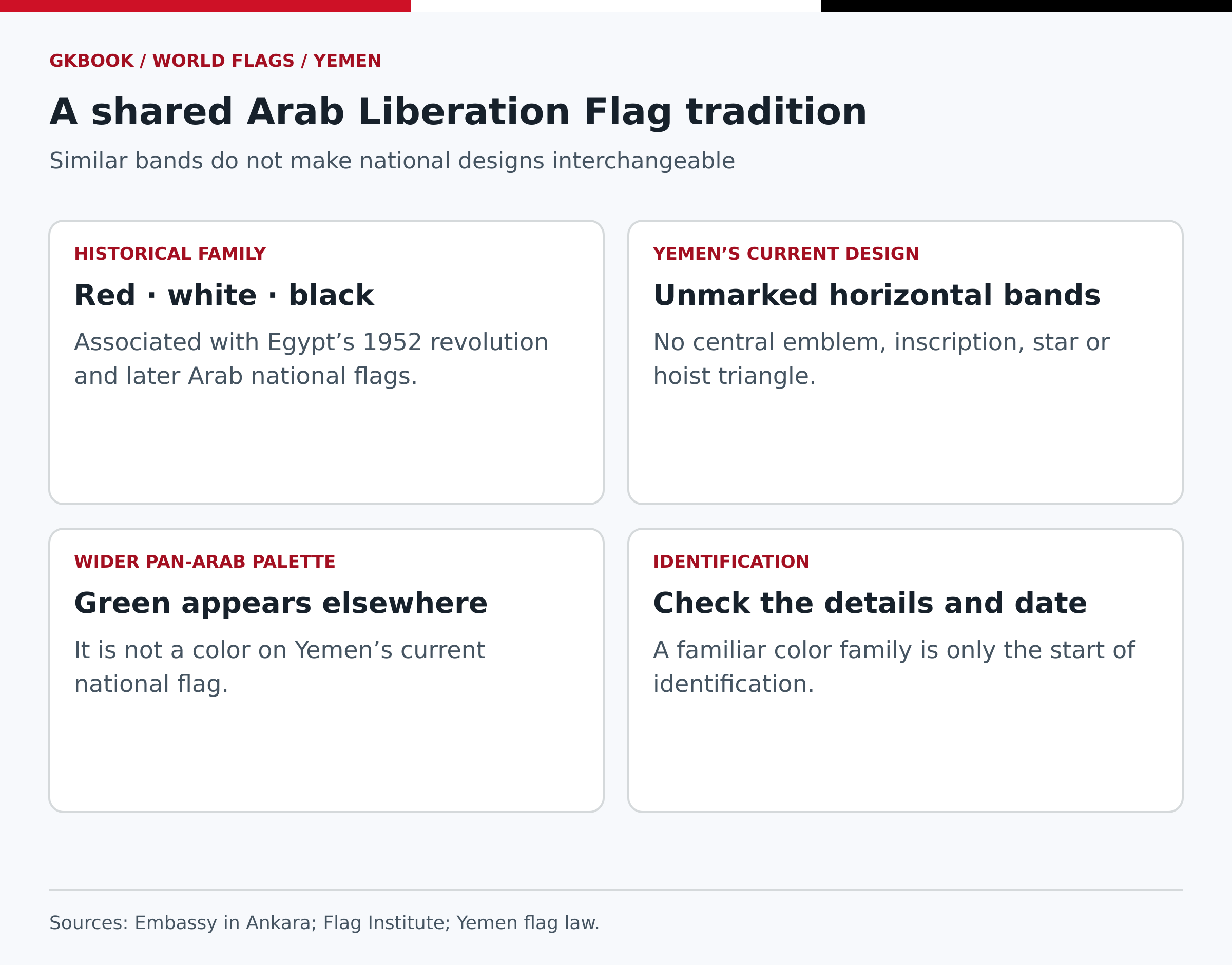
The red-white-black pattern belongs to the Arab Liberation Flag tradition associated with Egypt’s 1952 revolution. Several national flags developed from that design family. Yemen’s version is distinctive because its three bands are unmarked. Shared colors express a historical relationship, but each country’s flag has its own legal description and identifying details.

The Embassy in Ankara connects Yemen’s design with this revolutionary tricolor tradition, and the Flag Institute gives the same broad historical relationship. Green is also associated with the wider pan-Arab palette, but Yemen’s current national flag does not include a green band, star or triangle. A color family is not a requirement that every member display every associated color.
The family resemblance is a useful starting point for identification, not a substitute for checking the actual design. Look for an eagle, an inscription, stars, a hoist triangle or different band proportions before assigning a country name. Use a dated source when discussing historical examples, because a national flag can change while retaining some of the family’s colors.
Sources: Embassy of Yemen in Ankara — national flag and historical overview · Flag Institute — Flag of Yemen, Alex Crouch, May 18, 2015 · National Information Center — Law No. 1 of 1990 on the national flag
Does Yemen’s national flag have a star or an inscription?
No. The current national flag consists only of the three equal red, white and black bands. It has no star, crescent, eagle, sword or written inscription. Stars appear on the immediate predecessor flags, and other national or institutional symbols have separate roles. Their presence in a Yemen-related image does not make them part of the national flag.
The absence of a device is a positive identifying feature, especially at small sizes where the tricolor can otherwise resemble another country’s flag. The central white band should be completely plain. A logo placed over it for a social-media campaign or an institutional graphic is an addition to the reference, not a detail required by the 1990 flag law.
The downloadable clean SVG deliberately contains only three colored rectangles. Its title and description are accessibility metadata, which do not appear as lettering on the flag. Labels, dates, measurement lines and comparison stars are confined to clearly identified explanatory graphics so that readers can choose a clean national-flag image without removing educational annotations themselves.
Sources: National Information Center — Law No. 1 of 1990 on the national flag · National Information Center — Law No. 2 of 1990 on the emblem and seal · Drawing method and calculations
Is Yemen’s national emblem part of the flag?
No. Yemen’s national emblem and national flag are defined separately. The emblem features an eagle and a shield with references to the Marib Dam and coffee plant, together with the country’s name. Law No. 2 of 1990 addresses that emblem, while Law No. 1 defines the plain national tricolor.

The emblem law lists several official applications, including the presidential flag in the terminology of the 1990 text. That does not convert every national flag into an eagle-bearing variant. The distinction is especially useful when an embassy website displays the emblem above a heading and the national flag nearby: two separate symbols are being presented together.
This article does not invent a presidential-standard drawing from the emblem law’s mention alone. A specific standard requires its own verified layout and dimensions. The explanatory panel describes the separate symbols without placing a substitute eagle on the national flag, while the source link allows readers to inspect the emblem’s legal description and the embassy’s illustrated account.
Sources: National Information Center — Law No. 2 of 1990 on the emblem and seal · Embassy of Yemen in Japan — flag and national emblem · National Information Center — Law No. 1 of 1990 on the national flag
Which legal sources define Yemen’s flag?
Law No. 1 of 1990 is the main flag statute. Article 1 sets the red-white-black order, Article 2 establishes the 2:3 rectangle and equal bands, and later articles address display and use. Article 156 of the published Constitution repeats the color order. The emblem and National Day are covered by separate 1990 laws.
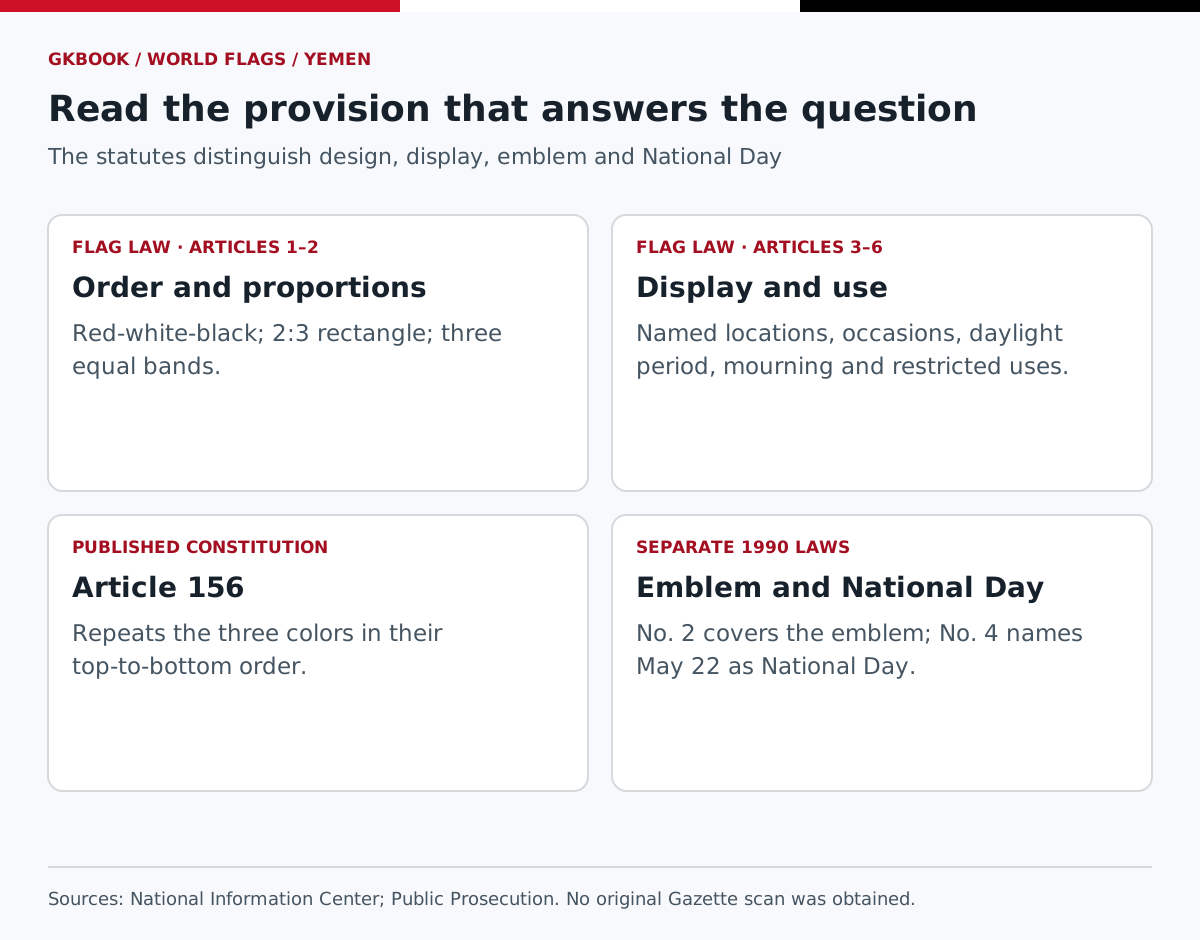
The institutional reproductions identify the flag decision as issued on May 22, 1990. The Public Prosecution’s page states that it was published in Official Gazette issue 1 of 1990. This guide inspected the reproduced legal text, rather than claiming possession of the original printed Gazette or an authenticated government vector production file.
English descriptions here are editorial paraphrases of Arabic sources. The research record separates the full law text that was retrievable from the constitutional provision available through indexed text when direct requests failed. A proposed or draft constitution should not silently replace the cited provision, and historical office titles in the 1990 wording should not be presented as a current government organization chart.
Sources: National Information Center — Law No. 1 of 1990 on the national flag · Yemen Public Prosecution — national flag law reproduction · National Information Center — published Constitution, Article 156 · National Information Center — Law No. 2 of 1990 on the emblem and seal · National Information Center — Law No. 4 of 1990 on National Day
When is Yemen’s National Day, and is it also Flag Day?
May 22 is Yemen’s National Day and the anniversary of unification and adoption of the current flag. Law No. 4 of 1990 explicitly designates May 22 as National Day and an official holiday. The inspected sources do not establish a separate nationwide statutory observance called Flag Day, so the two labels should not be treated as interchangeable.

The date has a direct connection with the flag because the symbols legislation and the unification occurred on May 22, 1990. This makes it an appropriate occasion for explaining the current tricolor’s history. The legal wording nevertheless names a national day, rather than creating a differently titled flag observance with a separate annual date.
The holiday provision is part of the cited law; the practical arrangements for a particular year, institution or location require the relevant announcement. A historical anniversary page does not itself provide a complete contemporary office or school calendar. The guide therefore gives the statutory date and its meaning without inventing event times or assuming every local ceremony follows one schedule.
Sources: National Information Center — Law No. 4 of 1990 on National Day · National Information Center — Law No. 1 of 1990 on the national flag · United Nations — Yemen member-state record
Where and when does Yemen’s law provide for flag display?
Article 3 identifies government buildings, specified presidential locations, diplomatic missions abroad, and Yemeni ships and aircraft. It also permits display on private buildings for public and private celebrations. Article 4 requires government display on official holidays and public occasions from sunrise to sunset. These provisions should be read with their stated settings and occasions.

The wording is not a universal instruction that every private home must raise a flag every day. It distinguishes the named official locations from permitted private displays, and ties the sunrise-to-sunset requirement to official holidays and public occasions on government premises. A real installation may also be subject to instructions appropriate to its particular institution or ceremony.
Article 6 addresses uses such as trademarks and advertising, as well as displaying a torn or unsuitable flag. The download’s artwork license does not remove those national-symbol provisions. Keep the flag complete, correctly oriented and in sound condition, and avoid treating an educational file as blanket approval for a commercial branding or promotional use.
| Article | Subject | Scope described in the law |
|---|---|---|
| 3 | Official locations | Government and specified presidential premises; diplomatic missions; Yemeni ships and aircraft |
| 3 | Private buildings | Permitted for public and private celebrations |
| 4 | Display period | Sunrise to sunset on official holidays and public occasions at government premises |
| 6 | Condition and uses | Torn or unsuitable flags; trademark and advertising uses |
Sources: National Information Center — Law No. 1 of 1990 on the national flag · Yemen Public Prosecution — national flag law reproduction
How is Yemen’s flag displayed during official mourning?
Article 5 directs that the flag be raised to the middle of the pole when official mourning is declared in the republic. It also addresses Yemeni embassies and legations abroad when mourning is declared in their host country. The applicable announcement determines the occasion; this reference does not announce that mourning is currently in effect.

The graphic marks the midpoint of an illustrative pole and keeps the flag upright, with red above white and black. It explains the placement in the statutory wording without borrowing another country’s ribbon, fold or two-stage hoisting procedure. The inspected article does not supply those additional ceremonial details, so they are not presented as Yemeni requirements.
The pole’s drawn dimensions are instructional rather than a required real-world mast size. The midpoint marker shows how the legal phrase is represented in the diagram, not a complete engineering specification for the rope or fittings. For an actual event, confirm the mourning announcement, institutional scope and any accompanying instructions before applying the general provision.
Sources: National Information Center — Law No. 1 of 1990 on the national flag · Yemen Public Prosecution — national flag law reproduction · Drawing method and calculations
Which way up should Yemen’s flag be?
The standard horizontal flag has red at the top, white in the middle and black at the bottom. Turning it upside down exchanges the red and black bands while leaving white in the center. The national law fixes the order explicitly, so correct colors alone are insufficient if their positions are reversed.
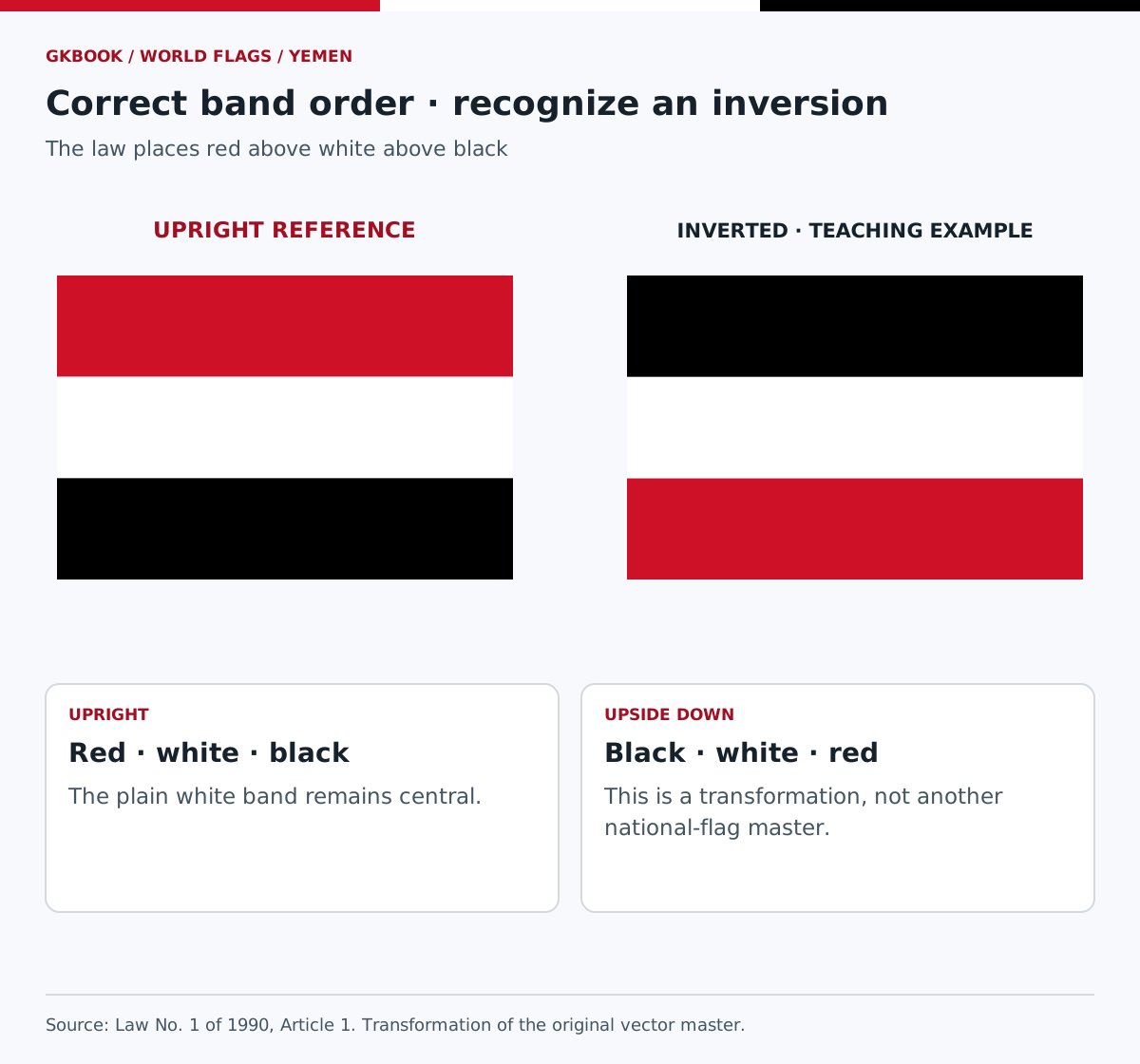
The upper edge is easy to identify even though the current design has no emblem that points upward. When a flag appears in a photograph, examine the mounting and the entire rectangle before interpreting a fold or partly hidden stripe. The flat reference provides the unambiguous order used for a conventional horizontal drawing.
The orientation graphic labels an intentionally inverted version as a teaching example. It is not another valid national-flag master or an announcement of a special signal. The clean download keeps the prescribed order and should be used when the purpose is simply to represent Yemen in an article, country list, classroom display or reference collection.
Sources: National Information Center — Law No. 1 of 1990 on the national flag · Drawing method and calculations
What does the reverse of Yemen’s flag look like?
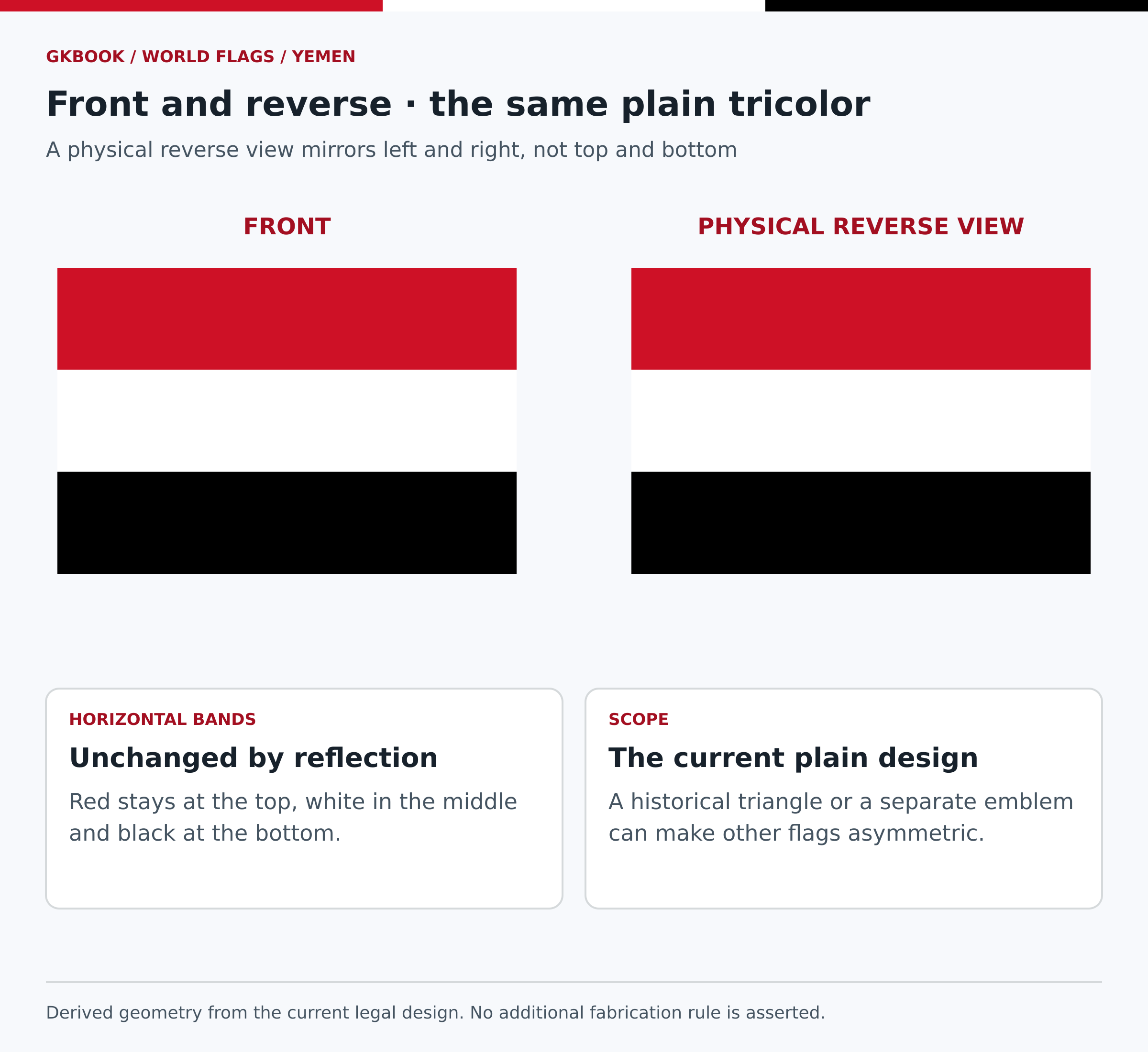
The reverse of Yemen’s plain tricolor has the same appearance as the front: red above white above black. A physical reverse view mirrors the image left to right, and uninterrupted horizontal bands remain unchanged by that reflection. This is different from turning the flag upside down, which exchanges the upper and lower colors.
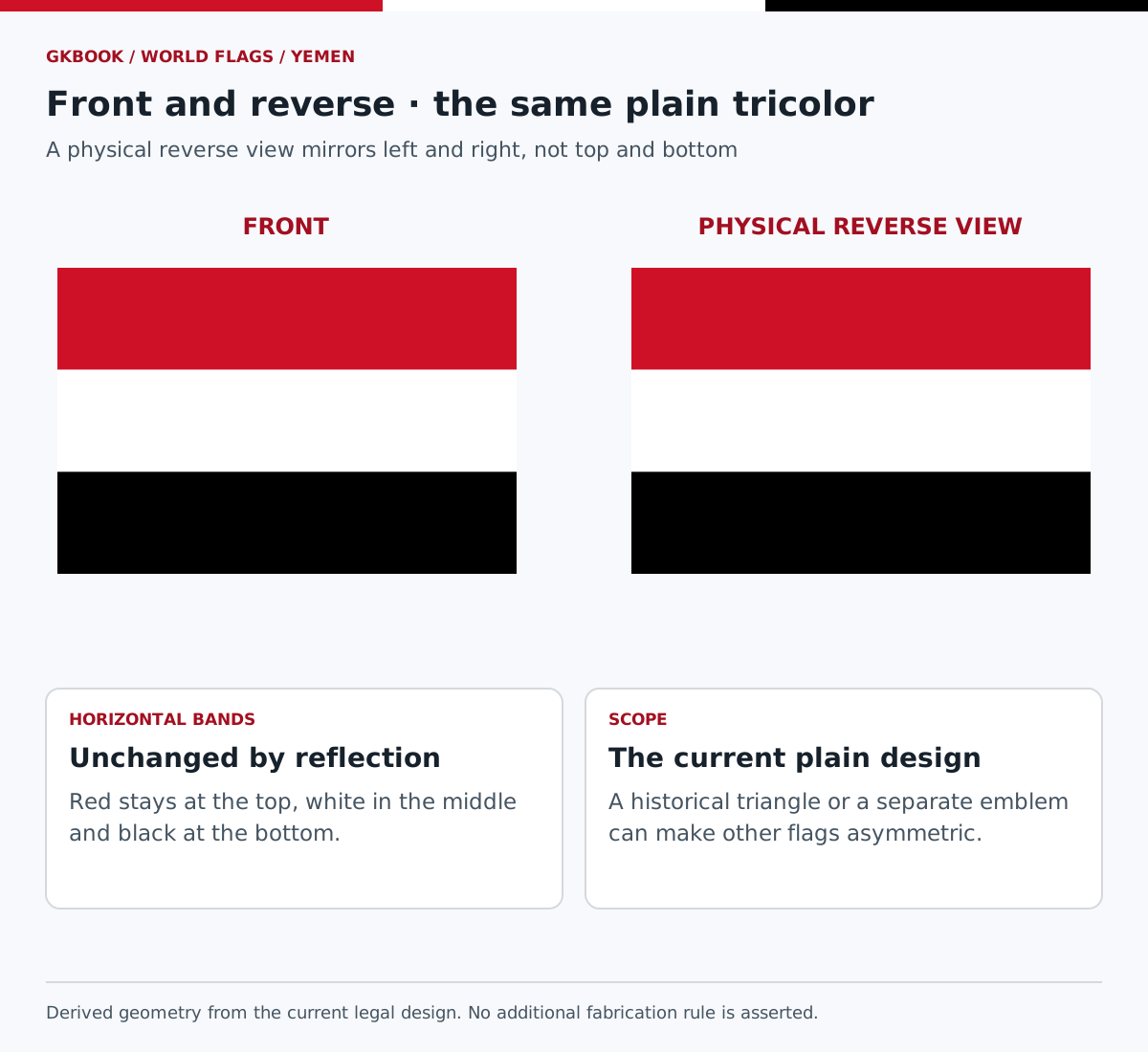
The diagram applies a horizontal mirror to the whole current design. Because there is no lettering, hoist triangle or off-center emblem, nothing changes its apparent position within the rectangle. This simple symmetry explains why an ordinary reverse view cannot be identified from the color pattern alone when the pole and other context are excluded.
Historical flags can behave differently. South Yemen’s hoist triangle, for example, appears on the opposite side to a viewer looking through the fabric from behind. The reverse section therefore makes its claim specifically about the plain current national design, rather than extending it to every Yemeni historical, presidential or organizational flag.
Sources: National Information Center — Law No. 1 of 1990 on the national flag · Flags of the World — South Yemen (1967–1990) · Drawing method and calculations
What symmetry does the complete Yemen flag have?
The complete flag has left-to-right mirror symmetry about its vertical centerline. It does not have top-to-bottom mirror symmetry or half-turn symmetry, because those operations swap red and black. The rectangular outline alone has more symmetry than the colored design. Every claim about flag symmetry must include the colors as well as the shape.

The four-view graphic shows the original, its horizontal reflection, its vertical reflection and a rotation through 180 degrees. The horizontal reflection matches exactly. The last two views share the inverted color order, which illustrates why a transformation can preserve the rectangular border and equal stripe sizes while changing the national design.
This is a geometric explanation derived from the legal band order, not a separate rule about ceremonial conduct. The graphic uses explicit labels to distinguish matching and nonmatching transformations. Its examples can be useful for image-editing checks, but the current clean master remains the upright tricolor with red at the top.
Sources: National Information Center — Law No. 1 of 1990 on the national flag · Drawing method and calculations
Can Yemen’s flag be placed in a portrait layout?
Yes, the complete horizontal flag can be placed within a portrait page or poster while preserving its 2:3 proportions. A quarter-turn changes the bands into vertical stripes, and the inspected law does not supply a detailed national hanging template for every vertical installation. A rotated layout should not be mislabeled as verified official protocol.
For an educational document, leaving space above and below the complete horizontal image is a straightforward way to keep the legal design intact. Cropping the rectangle to fill a narrow frame can remove part of the bands or create a misleading aspect ratio. The supplied files keep the full field available for proportional placement.
If the task is a real building display or ceremony, obtain the relevant institutional instructions rather than borrowing a vertical-hanging convention from another country. The absence of a detailed installation rule in the inspected text is not permission to invent one. This guide distinguishes a mathematical rotation from an authoritative arrangement for a particular display setting.
Sources: National Information Center — Law No. 1 of 1990 on the national flag · Drawing method and calculations
How does Yemen’s flag differ from Egypt’s?
Both use horizontal red, white and black bands, but Egypt’s current flag has a golden eagle in the center of the white band. Yemen’s current national flag has no emblem or inscription. The absence of a central device is therefore an important identifying feature, especially when the two tricolors appear at similar sizes.
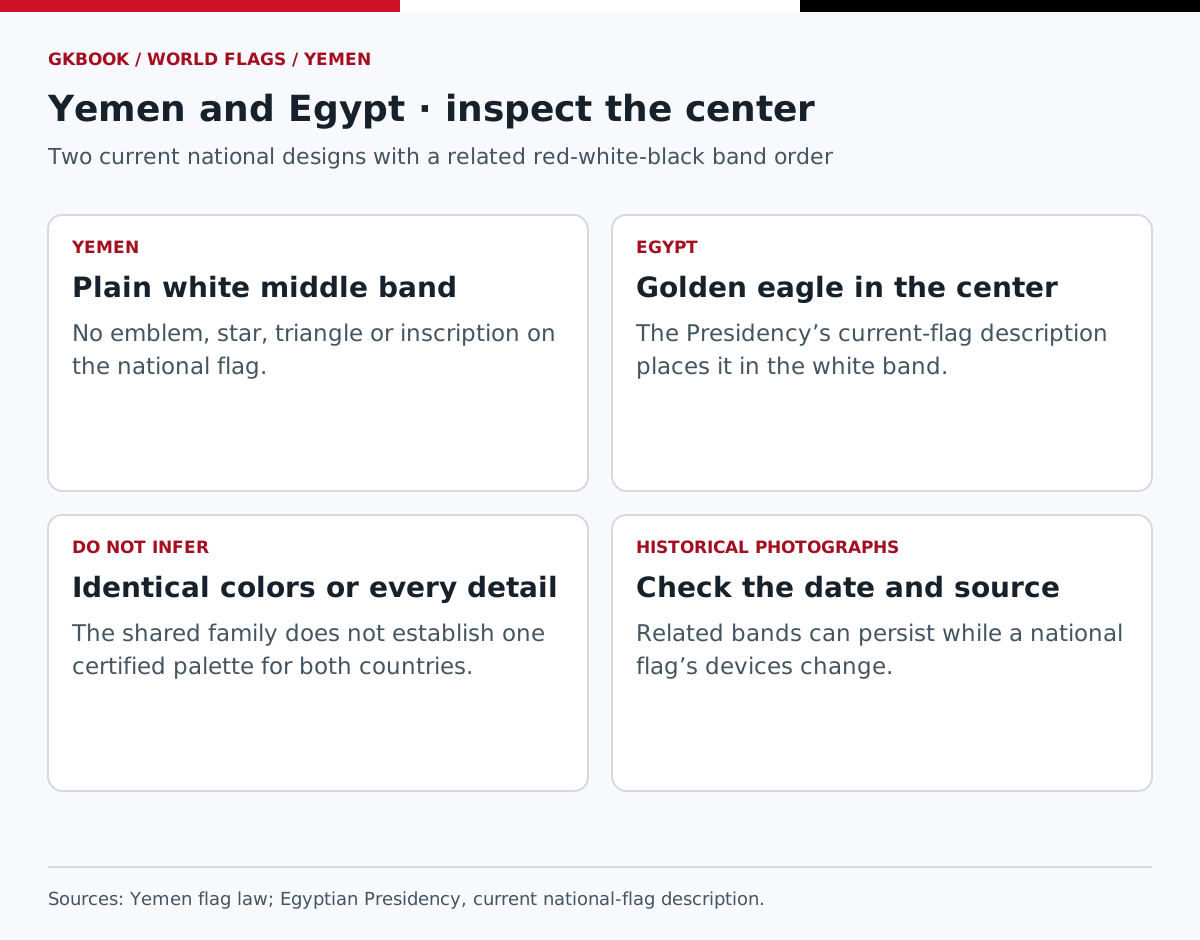
The Egyptian Presidency’s current-flag page describes the eagle in the white band. This comparison uses that primary description and Yemen’s flag law instead of assuming that the shared colors make the designs interchangeable. It does not claim that the two countries prescribe identical red pigments or that their flags are distinguished only by a reusable icon pasted onto one common file.
The companion graphic gives written identification notes rather than an unverified Egyptian vector master. For historical photographs, use a date-specific reference: a country may have used different devices while keeping related bands. The 1990 Yemen flag in this package is a current national reference, while the separate North and South Yemen examples are explicitly historical.
Sources: National Information Center — Law No. 1 of 1990 on the national flag · Egyptian Presidency — current national flag · Drawing method and calculations
Does an upside-down Yemen flag resemble the old German flag?
An upside-down Yemen tricolor reads black-white-red, resembling the band order associated with the German Empire. That resemblance does not establish identical historical proportions, colors or meaning. Germany’s current national colors are black-red-gold. For Yemen, the legally specified horizontal order remains red-white-black, and an inverted image should be identified as such.
The German Federal Agency for Civic Education distinguishes the empire’s black-white-red flag from the present federal black-red-gold design. The historical comparison explains a common visual confusion without treating an inverted modern flag as an authenticated German artifact. A reliable identification considers the date, proportions and context as well as the sequence of colors.
The orientation diagram is therefore labeled only as a transformation of the supplied Yemen drawing. It is not offered as a downloadable German historical flag. When a search result or collection caption claims a national identity, inspect the source rather than relying on a familiar three-color pattern viewed in isolation.
Sources: German Federal Agency for Civic Education — emblem, flag and anthem · National Information Center — Law No. 1 of 1990 on the national flag · Drawing method and calculations
What is the Yemen flag emoji?
The Yemen flag emoji is 🇾🇪. Its sequence consists of the regional indicator symbols Y and E, encoded as U+1F1FE and U+1F1EA. Platforms may render the sequence as a flag, letters or another fallback. Emoji artwork identifies a region; it is not a precise construction file or a certified national-color reference.
The Unicode chart records the sequence, while Unicode’s explanatory guidance notes that software vendors control the images shown on their platforms. A small flag glyph may have shading, a waving effect or proportions chosen for that interface. Those presentation choices should not be copied into a technical drawing as though they amended Yemen’s flag law.
Include the country name in text when clarity or accessibility matters, especially where a flag glyph might not be supported. For a large illustration, download the supplied SVG or PNG instead of enlarging an emoji screenshot. The reference files preserve the complete rectangle, equal bands and declared screen colors, with descriptive metadata and an accompanying source record.
Sources: Unicode — Full Emoji List, version 16.0 · Unicode — Emoji and Pictographs FAQ · National Information Center — Law No. 1 of 1990 on the national flag · Drawing method and calculations
How large can the Yemen flag PNG be printed?
The clean PNG is 9,000 × 6,000 pixels, or 54 million pixels. At 300 pixels per inch it measures 30 × 20 inches, equivalent to 76.2 × 50.8 centimeters. At 150 pixels per inch it measures 60 × 40 inches. The SVG scales without a fixed raster-resolution limit.

These measurements are arithmetic conversions, not assurances about every printer, fabric or viewing distance. Keep the 2:3 proportion, and account for the production supplier’s seam, hem or finishing instructions without distorting the visible design. The master’s three bands have exactly equal pixel heights because 6,000 divides evenly by three.
The PNG is opaque RGB: the middle band is actual white, not a transparent opening that changes color with the background. That distinction matters when placing the image on a colored page. Use the SVG when the workflow supports scalable vectors, and check the final proof for the selected red, complete edges and correct band order.
| Density | Inches | Centimeters |
|---|---|---|
| 300 PPI | 30 × 20 | 76.2 × 50.8 |
| 150 PPI | 60 × 40 | 152.4 × 101.6 |
Sources: National Information Center — Law No. 1 of 1990 on the national flag · Drawing method and calculations
Which Yemen flag pictures and download formats are included?
The gallery includes 24 subjects in both SVG and PNG, covering the clean flag, proportions, colors, meaning, construction, history, predecessor comparisons and display. A separate social-sharing card is included. The annotated graphics identify historical reconstructions and calculated details, while the clean master contains only the current national flag’s three bands.
The original vector implementation and explanatory graphics are released under CC0 1.0 without claiming ownership of Yemen’s national design or official approval of a particular use. No externally authored flag image or photograph is embedded. The source record credits the publications used for facts and historical descriptions while distinguishing them from the newly drawn illustrations.
Artwork rights and national-symbol use rules are separate. The flag law addresses advertising, trademarks, condition and other uses, so a freely reusable drawing is not a blanket legal authorization for every application. Keep the credits and historical captions with adapted educational material, particularly when extracting one diagram from the surrounding article.
Sources: National Information Center — Law No. 1 of 1990 on the national flag · Drawing method and calculations
What should you check before using a Yemen flag image?
Check the 2:3 rectangle, three equal horizontal bands and red-white-black order. The current national flag must remain free of stars, triangles, emblems and inscriptions. Confirm whether a picture is current or historical, preserve the complete design when scaling, and distinguish declared screen colors from legally authenticated production specifications.

For historical comparisons, identify the northern green star or southern light-blue triangle and red star in the caption. For transformations, label an inverted or mirrored view according to what is actually being demonstrated. A correct teaching illustration can become misleading if it is copied into another page without the explanation that distinguishes it from the clean current master.
Finally, review the practical presentation: visible edges, an opaque white middle band, useful alternative text, readable labels and working download links. The accompanying records make the drawing reproducible and identify source-access limits. Keeping that evidence with the artwork helps the next editor preserve both the visual accuracy and the historical context of the page.
Sources: National Information Center — Law No. 1 of 1990 on the national flag · Flags of the World — North Yemen (1962–1990) · Flags of the World — South Yemen (1967–1990) · Drawing method and calculations
Sources and research notes
This article uses institutional reproductions of the 1990 flag law, the published constitutional color provision, official explanations, the UN unification record and identified historical references. Every answer has visible source links. The bibliography and artwork credits record access methods and drawing decisions.
The 2:3 rectangle and three equal bands follow Article 2 of Law No. 1. Numeric screen colors and the additional dimensions in historical schematics are declared reproduction choices. The original 1990 Gazette scan was not obtained, and direct constitutional and UN page requests had access limits; these are recorded with the indexed evidence used. English descriptions paraphrase the linked Arabic texts, while source-specific historical judgments remain attributed.
Download Yemen flag pictures
Download the complete flag as scalable SVG or 9,000 × 6,000 PNG. Both preserve the legal 2:3 rectangle and three equal red, white and black bands. The white band is opaque, and the clean national-flag artwork has no emblem or lettering.
The gallery includes 24 subjects, each available in SVG and PNG, covering legal construction, attributed symbolism, unification, predecessor flags, orientation and use. A separate 1,200 × 630 social-sharing card places a complete flag beside the article title. Use the clean master for a flag illustration and the annotated graphics for teaching.
Read the construction guide, display notes and artwork credits, or continue exploring designs in World Flags.
World Flags/Yemen
Yemen flag pictures
Three equal horizontal bands, red above white above black. There is no emblem, star or inscription on the national flag.
Original GKBook vector implementation. Current design: Law No. 1 of 1990, Articles 1–2. Numeric screen colors and historical detail dimensions are editorial references.Download SVGDownload PNGThis package uses red #CE1126, white #FFFFFF and black #000000. No statutory HEX, Pantone or CMYK table was established from the inspected sources.
Original GKBook vector implementation. Current design: Law No. 1 of 1990, Articles 1–2. Numeric screen colors and historical detail dimensions are editorial references.Download SVGDownload PNGThe graphic attributes the revolutionary explanation to Yemeni official sources and related wording to the Flag Institute. It does not endorse every historical judgment in those accounts.
Original GKBook vector implementation. Current design: Law No. 1 of 1990, Articles 1–2. Numeric screen colors and historical detail dimensions are editorial references.Download SVGDownload PNGWidth in the translated legal description denotes the shorter dimension. Digital image dimensions here are written width × height.
Original GKBook vector implementation. Current design: Law No. 1 of 1990, Articles 1–2. Numeric screen colors and historical detail dimensions are editorial references.Download SVGDownload PNGAll labels and measurement lines are annotations. The underlying national flag has no visible lettering or border between its bands.
Original GKBook vector implementation. Current design: Law No. 1 of 1990, Articles 1–2. Numeric screen colors and historical detail dimensions are editorial references.Download SVGDownload PNGThe dimensions and color order implement Articles 1–2. The exact RGB red value is a declared digital reproduction choice.
Original GKBook vector implementation. Current design: Law No. 1 of 1990, Articles 1–2. Numeric screen colors and historical detail dimensions are editorial references.Download SVGDownload PNGLegal details were checked in institutional text reproductions. No original Gazette scan or certified official vector was obtained.
Original GKBook vector implementation. Current design: Law No. 1 of 1990, Articles 1–2. Numeric screen colors and historical detail dimensions are editorial references.Download SVGDownload PNGThe flow diagram identifies the political merger. It does not suggest that halves of the older flags were sewn together to produce the new flag.
Original GKBook vector implementation. Current design: Law No. 1 of 1990, Articles 1–2. Numeric screen colors and historical detail dimensions are editorial references.Download SVGDownload PNGThe timeline does not claim to catalog all earlier regional, colonial, royalist or organizational flags.
Original GKBook vector implementation. Current design: Law No. 1 of 1990, Articles 1–2. Numeric screen colors and historical detail dimensions are editorial references.Download SVGDownload PNGHistorical star size, exact position and green value are declared reconstruction choices. The general appearance follows the cited specialist description.
Original GKBook vector implementation. Current design: Law No. 1 of 1990, Articles 1–2. Numeric screen colors and historical detail dimensions are editorial references.Download SVGDownload PNGTriangle depth, star dimensions and historical screen colors are schematic choices. No contemporary territorial-control claim is implied by this historical comparison.
Original GKBook vector implementation. Current design: Law No. 1 of 1990, Articles 1–2. Numeric screen colors and historical detail dimensions are editorial references.Download SVGDownload PNGAll three rectangles are shown completely. This is an identification comparison rather than a claim of exact historical pigments or textile measurements.
Original GKBook vector implementation. Current design: Law No. 1 of 1990, Articles 1–2. Numeric screen colors and historical detail dimensions are editorial references.Download SVGDownload PNGThe historical relationship is attributed to the Embassy and Flag Institute. The graphic does not claim that every related flag uses an identical palette or current design.
Original GKBook vector implementation. Current design: Law No. 1 of 1990, Articles 1–2. Numeric screen colors and historical detail dimensions are editorial references.Download SVGDownload PNGThe emblem law mentions separate official applications, including a presidential flag. This panel does not invent the layout of a presidential standard.
Original GKBook vector implementation. Current design: Law No. 1 of 1990, Articles 1–2. Numeric screen colors and historical detail dimensions are editorial references.Download SVGDownload PNGEnglish descriptions are editorial paraphrases of Arabic texts. Source notes identify institutional reproductions and constitutional access limits.
Original GKBook vector implementation. Current design: Law No. 1 of 1990, Articles 1–2. Numeric screen colors and historical detail dimensions are editorial references.Download SVGDownload PNGA particular year’s local ceremony or institutional schedule still needs its own notice. The guide does not invent event times.
Original GKBook vector implementation. Current design: Law No. 1 of 1990, Articles 1–2. Numeric screen colors and historical detail dimensions are editorial references.Download SVGDownload PNGThe law is not paraphrased as a universal daily flag requirement for every private household. Historical office titles are not a current government chart.
Original GKBook vector implementation. Current design: Law No. 1 of 1990, Articles 1–2. Numeric screen colors and historical detail dimensions are editorial references.Download SVGDownload PNGThe pole is an illustrative model. The midpoint upper-hoist marker is the diagram’s explicit interpretation of the law’s placement wording, not a complete rigging specification.
Original GKBook vector implementation. Current design: Law No. 1 of 1990, Articles 1–2. Numeric screen colors and historical detail dimensions are editorial references.Download SVGDownload PNGThe deliberately inverted right-hand example is labeled for teaching. It is not a historical German flag reconstruction or an alternative current Yemen design.
Original GKBook vector implementation. Current design: Law No. 1 of 1990, Articles 1–2. Numeric screen colors and historical detail dimensions are editorial references.Download SVGDownload PNGThe whole-image left-to-right reflection preserves the current flag exactly. This claim does not extend to every historical or institutional Yemeni flag.
Original GKBook vector implementation. Current design: Law No. 1 of 1990, Articles 1–2. Numeric screen colors and historical detail dimensions are editorial references.Download SVGDownload PNGA vertical-axis reflection is unchanged. A horizontal-axis reflection and a 180-degree rotation swap red and black.
Original GKBook vector implementation. Current design: Law No. 1 of 1990, Articles 1–2. Numeric screen colors and historical detail dimensions are editorial references.Download SVGDownload PNGThis is a written identification comparison. No unverified Egyptian vector artwork is supplied as a companion master.
Original GKBook vector implementation. Current design: Law No. 1 of 1990, Articles 1–2. Numeric screen colors and historical detail dimensions are editorial references.Download SVGDownload PNGPrint sizes are calculated from pixel density. They are not certified dye, ink or material specifications.
Original GKBook vector implementation. Current design: Law No. 1 of 1990, Articles 1–2. Numeric screen colors and historical detail dimensions are editorial references.Download SVGDownload PNGThe source record distinguishes legal requirements, attributed interpretation and editorial historical reconstructions.
Original GKBook vector implementation. Current design: Law No. 1 of 1990, Articles 1–2. Numeric screen colors and historical detail dimensions are editorial references.Download SVGDownload PNGFrequently asked questions
What does the Yemen flag look like?
Yemen’s national flag consists of three equal horizontal bands: red at the top, white in the middle and black at the bottom. It has a legally specified 2:3 height-to-length ratio and no emblem, star or inscription. The current design was adopted on May 22, 1990, when North and South Yemen unified.
What is Yemen’s national flag called?
Yemen’s flag is the national flag of the Republic of Yemen. The Arabic legal term is al-ʿalam al-waṭanī, meaning national flag. It is a plain horizontal red-white-black tricolor. The current design dates from the unification of the Yemen Arab Republic and the People’s Democratic Republic of Yemen in 1990.
What are the Yemen flag colors and HEX codes?
Yemen’s national flag is red at the top, white in the middle and black at the bottom. This artwork uses red #CE1126, white #FFFFFF and black #000000. The law names the colors but supplies no numerical digital palette, so these HEX and RGB values are declared screen references rather than certified national color standards.
What do the colors of Yemen’s flag mean?
Official Yemeni explanations associate red with revolution, white with its principles and purity, and black with the earlier era described as darkness and reactionary rule. Other flag references describe sacrifice, a bright future and a dark past. These are attributed interpretations; the flag law itself defines the visible design without assigning symbolic meanings.
What are the official proportions of Yemen’s flag?
Yemen’s flag has a height-to-length ratio of 2:3. Article 2 of the 1990 flag law states that the rectangle’s width is two thirds of its length. Here width in that translated legal description means the shorter dimension. The supplied drawing is 900 units long and 600 units high.
Are the three bands equal in size?
Yes. Article 2 requires three rectangles of equal dimensions extending along the flag’s length. Each band therefore occupies one third of the total height and one third of the flag’s area. On the 900 × 600 construction grid, the red, white and black bands are each exactly 200 units high.
How do you draw Yemen’s flag accurately?
Draw a rectangle three units long for every two units high. Divide its height into three equal parts, then fill the upper band red, the middle band white and the lower band black. Add no star, triangle, eagle or lettering. The construction guides belong outside the clean national-flag artwork.
When was Yemen’s current flag adopted?
The current flag was adopted on May 22, 1990, the day Yemen unified. Law No. 1 of 1990, dated that day, describes the red-white-black design and its proportions. Article 8 makes the decision effective from its issue date. This date is distinct from the earlier republican and independence milestones in the two predecessor states.
Why was a new flag introduced in 1990?
The Yemen Arab Republic and the People’s Democratic Republic of Yemen united on May 22, 1990, forming the Republic of Yemen. The plain red-white-black tricolor retained the bands shared by their flags while omitting their distinguishing additions: the north’s green star and the south’s light-blue triangle containing a red star.
What are the main milestones in Yemen’s flag history?
The modern sequence includes the kingdom in the north before the 1962 republican revolution, the Yemen Arab Republic’s green-star tricolor, South Yemen’s blue-triangle and red-star flag from the independence period beginning in 1967, and the unified republic’s plain tricolor in 1990. This is a selective timeline rather than a complete catalog of every regional banner.
What did North Yemen’s flag look like?
The Yemen Arab Republic, commonly called North Yemen, used a red-white-black tricolor with one green five-pointed star in the middle white band. This predecessor design belongs to the republican period beginning in 1962 and ending at unification in 1990. The current national flag keeps the three bands and has no green star.
What did South Yemen’s flag look like?
South Yemen’s flag used red, white and black horizontal bands with a light-blue triangle at the hoist containing a red five-pointed star. The star was angled toward the fly. This design is associated with the independent southern state from 1967 to unification in 1990; those additions are absent from Yemen’s current national flag.
How do the two predecessor flags compare with the current flag?
All three designs share horizontal red, white and black bands. The northern predecessor adds one green star in the white band; the southern predecessor adds a light-blue hoist triangle with an angled red star. The Republic of Yemen’s current flag has neither addition. Side-by-side comparison makes the 1990 change easy to identify.
Why does Yemen’s flag resemble other Arab flags?
The red-white-black pattern belongs to the Arab Liberation Flag tradition associated with Egypt’s 1952 revolution. Several national flags developed from that design family. Yemen’s version is distinctive because its three bands are unmarked. Shared colors express a historical relationship, but each country’s flag has its own legal description and identifying details.
Does Yemen’s national flag have a star or an inscription?
No. The current national flag consists only of the three equal red, white and black bands. It has no star, crescent, eagle, sword or written inscription. Stars appear on the immediate predecessor flags, and other national or institutional symbols have separate roles. Their presence in a Yemen-related image does not make them part of the national flag.
Is Yemen’s national emblem part of the flag?
No. Yemen’s national emblem and national flag are defined separately. The emblem features an eagle and a shield with references to the Marib Dam and coffee plant, together with the country’s name. Law No. 2 of 1990 addresses that emblem, while Law No. 1 defines the plain national tricolor.
Which legal sources define Yemen’s flag?
Law No. 1 of 1990 is the main flag statute. Article 1 sets the red-white-black order, Article 2 establishes the 2:3 rectangle and equal bands, and later articles address display and use. Article 156 of the published Constitution repeats the color order. The emblem and National Day are covered by separate 1990 laws.
When is Yemen’s National Day, and is it also Flag Day?
May 22 is Yemen’s National Day and the anniversary of unification and adoption of the current flag. Law No. 4 of 1990 explicitly designates May 22 as National Day and an official holiday. The inspected sources do not establish a separate nationwide statutory observance called Flag Day, so the two labels should not be treated as interchangeable.
Where and when does Yemen’s law provide for flag display?
Article 3 identifies government buildings, specified presidential locations, diplomatic missions abroad, and Yemeni ships and aircraft. It also permits display on private buildings for public and private celebrations. Article 4 requires government display on official holidays and public occasions from sunrise to sunset. These provisions should be read with their stated settings and occasions.
How is Yemen’s flag displayed during official mourning?
Article 5 directs that the flag be raised to the middle of the pole when official mourning is declared in the republic. It also addresses Yemeni embassies and legations abroad when mourning is declared in their host country. The applicable announcement determines the occasion; this reference does not announce that mourning is currently in effect.
Which way up should Yemen’s flag be?
The standard horizontal flag has red at the top, white in the middle and black at the bottom. Turning it upside down exchanges the red and black bands while leaving white in the center. The national law fixes the order explicitly, so correct colors alone are insufficient if their positions are reversed.
What does the reverse of Yemen’s flag look like?
The reverse of Yemen’s plain tricolor has the same appearance as the front: red above white above black. A physical reverse view mirrors the image left to right, and uninterrupted horizontal bands remain unchanged by that reflection. This is different from turning the flag upside down, which exchanges the upper and lower colors.
What symmetry does the complete Yemen flag have?
The complete flag has left-to-right mirror symmetry about its vertical centerline. It does not have top-to-bottom mirror symmetry or half-turn symmetry, because those operations swap red and black. The rectangular outline alone has more symmetry than the colored design. Every claim about flag symmetry must include the colors as well as the shape.
Can Yemen’s flag be placed in a portrait layout?
Yes, the complete horizontal flag can be placed within a portrait page or poster while preserving its 2:3 proportions. A quarter-turn changes the bands into vertical stripes, and the inspected law does not supply a detailed national hanging template for every vertical installation. A rotated layout should not be mislabeled as verified official protocol.
How does Yemen’s flag differ from Egypt’s?
Both use horizontal red, white and black bands, but Egypt’s current flag has a golden eagle in the center of the white band. Yemen’s current national flag has no emblem or inscription. The absence of a central device is therefore an important identifying feature, especially when the two tricolors appear at similar sizes.
Does an upside-down Yemen flag resemble the old German flag?
An upside-down Yemen tricolor reads black-white-red, resembling the band order associated with the German Empire. That resemblance does not establish identical historical proportions, colors or meaning. Germany’s current national colors are black-red-gold. For Yemen, the legally specified horizontal order remains red-white-black, and an inverted image should be identified as such.
What is the Yemen flag emoji?
The Yemen flag emoji is 🇾🇪. Its sequence consists of the regional indicator symbols Y and E, encoded as U+1F1FE and U+1F1EA. Platforms may render the sequence as a flag, letters or another fallback. Emoji artwork identifies a region; it is not a precise construction file or a certified national-color reference.
How large can the Yemen flag PNG be printed?
The clean PNG is 9,000 × 6,000 pixels, or 54 million pixels. At 300 pixels per inch it measures 30 × 20 inches, equivalent to 76.2 × 50.8 centimeters. At 150 pixels per inch it measures 60 × 40 inches. The SVG scales without a fixed raster-resolution limit.
Which Yemen flag pictures and download formats are included?
The gallery includes 24 subjects in both SVG and PNG, covering the clean flag, proportions, colors, meaning, construction, history, predecessor comparisons and display. A separate social-sharing card is included. The annotated graphics identify historical reconstructions and calculated details, while the clean master contains only the current national flag’s three bands.
What should you check before using a Yemen flag image?
Check the 2:3 rectangle, three equal horizontal bands and red-white-black order. The current national flag must remain free of stars, triangles, emblems and inscriptions. Confirm whether a picture is current or historical, preserve the complete design when scaling, and distinguish declared screen colors from legally authenticated production specifications.
Every general-knowledge topic and the A-to-Z lists.
The world A to Z: flags, countries, the sciences, places, people, subjects.












We Value Your Opinion Comments