

Vietnam flag picture
This original drawing follows the constitutional 2:3 proportion. The construction guide separates official dimensions from calculated star geometry and editorial screen colors.
| Country | Socialist Republic of VietnamCurrent national flag; cờ đỏ sao vàng. |
|---|---|
| National adoption | September 5, 1945Decree No. 5 of the Democratic Republic of Vietnam. |
| Star revision | November 30, 1955Decree 249-SL specifies straight star contours. |
| Reunified state | July 2, 1976Flag retained by the unified National Assembly. |
| Designer attribution | Nguyễn Hữu TiếnWidely credited; historical authorship has been debated. |
| Design | Red field · 1 yellow starFive points; one point straight up. |
| Proportions | Height:length = 2:3Star radius = one fifth of flag length. |
| Working palette | #DA251D · #FFFF00Editorial screen values, not statutory HEX codes. |
Source notes separate cultural explanations, legal evidence and the original drawing’s reproduction choices.
What does the Vietnam flag look like?
Vietnam’s national flag is a red rectangle with one yellow five-pointed star at its center. Its height-to-length ratio is 2:3, and one star point faces upward. The design developed from the red-star flag used in 1940, was nationally adopted in 1945, revised in 1955, and retained by reunified Vietnam in 1976.
This guide combines the current constitutional description with the Ministry’s construction guidance, archival decrees and historical context. The original downloadable drawings preserve the specified rectangle, star center and outer radius. Explanatory diagrams identify derived geometry, historical reconstructions and display examples separately, while the source notes record conflicting attributions and the limits of the research.
Sources: Vietnam Constitution — 2025 consolidated text, Article 13 · Ministry of Culture — flag construction and display guidance 3420 · 1945 Decree No. 5 — archival scan and drawing annex · Government legal database — Decree 249-SL, November 30, 1955 · Vietnam National Museum of History — the unified National Assembly’s 1976 session
What is Vietnam’s national flag called?
Vietnam’s flag is commonly called cờ đỏ sao vàng, meaning red flag with a yellow star. Quốc kỳ means national flag, while cờ Tổ quốc refers to the flag of the homeland. The flag represents the Socialist Republic of Vietnam and has one centered, upright, five-pointed yellow star.
Vietnam and Viet Nam are two English spellings used for the country; neither denotes a different national flag. The Vietnamese name describes the visible design directly. Golden star is also found in English accounts, but this wording does not mean that an ordinary illustration needs metallic ink, a gradient or a reflective gold surface.
A useful catalog caption identifies the country, the design and the historical period. “Vietnam national flag, current design” is clearer than calling every Vietnamese flag the same symbol. Historical flags, party flags and flags used by diaspora communities have their own contexts, which should remain visible when they appear in an exhibition or lesson.
Sources: Vietnam Constitution — 2025 consolidated text, Article 13 · Embassy of Vietnam — National Flag · Uông Bí government — archival essay on the red-star flag
What are the Vietnam flag colors and HEX codes?
The flag has a bright red background and a bright yellow star. This edition uses red #DA251D and yellow #FFFF00 consistently in its downloadable artwork. These are editorial screen references. The official guidance reviewed names the colors but does not establish these HEX values as a mandatory national digital standard.

A stated RGB palette lets a designer reproduce the same colors across the clean flag, the explanatory diagrams and the social card. Here, red is RGB 218, 37, 29, and yellow is RGB 255, 255, 0. The SVG and PNG files share those values; antialiased star edges contain intermediate colors when rasterized.
Fabric, paint and printing require more than a screen value. A printer’s CMYK conversion depends on the output profile and material, while a textile supplier works with dyes and physical samples. Do not treat an automatically generated conversion or an unsourced Pantone number as national certification. Agree on the production specification and review an appropriate proof.
| Color | HEX | RGB | Status |
|---|---|---|---|
| Red | #DA251D | 218, 37, 29 | Editorial digital reference |
| Yellow | #FFFF00 | 255, 255, 0 | Editorial digital reference |
Sources: Ministry of Culture — flag construction and display guidance 3420 · Drawing method and calculations
What do the red field and yellow star symbolize?
Vietnamese official explanations connect the red field with revolutionary struggle and sacrifice, and the yellow star with the unity of the people. These meanings describe the flag’s historical and political context. They are distinct from the constitutional description, which specifies the red rectangle and centered yellow five-pointed star without listing symbolic interpretations.

The Uông Bí government’s archival essay explains the design through the revolutionary movement and the solidarity of different social groups. Reading that explanation alongside the legal description keeps two kinds of evidence separate: what the symbol has been understood to express, and how the national flag must be drawn and recognized.
The clean flag therefore contains only the red field and the star. A lesson about sacrifice or unity can place explanatory words beside the picture, but those words should not be added inside the national design. The accompanying symbolism graphic is a teaching aid, and its labels are not part of the downloadable flag master.
Sources: Uông Bí government — archival essay on the red-star flag · Hải Phòng procuracy — explanation of the national flag · Vietnam Constitution — 2025 consolidated text, Article 13 · Drawing method and calculations
What do the five points of Vietnam’s star represent?
A common official explanation associates the five points with intellectuals, peasants, workers, merchants and soldiers united in the nation. The Vietnamese grouping is sĩ, nông, công, thương, binh. This is a symbolic interpretation of social unity, not a map of five provinces, a count of ethnic groups, or five separate stars.

Translations vary: peasants may be rendered as farmers, and intellectuals as scholars. Those choices describe the same familiar five-part explanation. The sources reviewed do not assign one named group to a particular top, left or lower point, so the diagram lists the groups together without inventing a clockwise order for them.
There is one star with five outer points, not a cluster of five stars. That distinction matters when identifying a small image or comparing Vietnam with China. It also matters in drawing: the five inward corners complete a single continuous outline. They do not create five independently positioned symbols or additional yellow shapes.
Sources: Uông Bí government — archival essay on the red-star flag · Hải Phòng procuracy — explanation of the national flag · Drawing method and calculations
What is the official ratio of the Vietnam flag?
Vietnam’s national flag has a height-to-length ratio of 2:3. Article 13 of the Constitution states that the shorter dimension is two thirds of the longer dimension. A flag 60 centimeters high is therefore 90 centimeters long. The clean artwork uses a 900-by-600 construction grid and a 9,000-by-6,000-pixel PNG.

Flag descriptions sometimes use width for the shorter, vertical dimension and length for the horizontal one. Image software instead normally calls the horizontal dimension width. To avoid reversing the proportions, this page always writes height:length when stating 2:3, and width × height when giving pixel dimensions such as 9,000 × 6,000.
Uniform enlargement preserves the design. Doubling a 90-by-60 rectangle produces a 180-by-120 rectangle, with every star measurement doubled too. A square crop, a stretched widescreen image or a narrow banner changes the flag’s outline. When a page or slide has another shape, place the complete rectangle inside it with surrounding space.
| Height | Length | Outer star radius |
|---|---|---|
| 20 cm | 30 cm | 6 cm |
| 60 cm | 90 cm | 18 cm |
| 600 units | 900 units | 180 units |
| 6,000 px | 9,000 px | 1,800 px |
Sources: Vietnam Constitution — 2025 consolidated text, Article 13 · Ministry of Culture — flag construction and display guidance 3420 · Drawing method and calculations
How large is the star on the Vietnam flag?
The distance from the star’s center to each outer tip is one fifth of the flag’s length. On the 900-unit-long reference, that radius is 180 units. The surrounding construction circle is therefore 360 units across, or three fifths of the flag’s height. The visible star does not fill that circle’s square.

Radius and diameter are different measurements. Using one fifth of the flag length as the star’s total diameter would make the star half as large as intended. For a 90-centimeter-long flag, the outer radius is 18 centimeters and the construction-circle diameter is 36 centimeters. The circle itself is not printed on the flag.
The regular upright star is approximately 342.380 units wide and 325.623 units tall on this grid. Those bounding-box dimensions are calculated from its points; they are not additional dimensions quoted from the guidance. A graphics editor that asks for the object’s visible width needs that distinction, especially when centering or scaling a replacement star.
Sources: Ministry of Culture — flag construction and display guidance 3420 · Drawing method and calculations
Where exactly is the star centered?
The star’s center lies at the intersection of the flag’s diagonals. In the 900-by-600 grid, that point is (450, 300). Center the star’s construction circle there, rather than centering its visible bounding box. An upright five-pointed star extends farther above its center than below it, so its red margins are unequal.

With an outer radius of 180 units, the upper tip is at y = 120. The two lowest tips reach approximately y = 445.623, leaving about 154.377 units below them. The upper red margin is 120 units. These unequal gaps follow naturally from the upright star; they do not indicate that it has slipped out of position.
A common editing mistake is to select the star and use vertical bounding-box alignment against the rectangle. That would move this star downward by about 17.188 units. Use its known center coordinates instead. The centering diagram shows both the circle center and the different bounding-box center so that the error can be checked visually.
Sources: Ministry of Culture — flag construction and display guidance 3420 · Drawing method and calculations
How can you draw the Vietnam flag accurately?
Draw a 3-by-2 red rectangle, locate the intersection of its diagonals, and center a five-pointed yellow star there. Set the outer radius to one fifth of the rectangle’s length and point one tip straight upward. Use a regular pentagram outline with straight edges; the current guidance excludes swollen or rounded star arms.
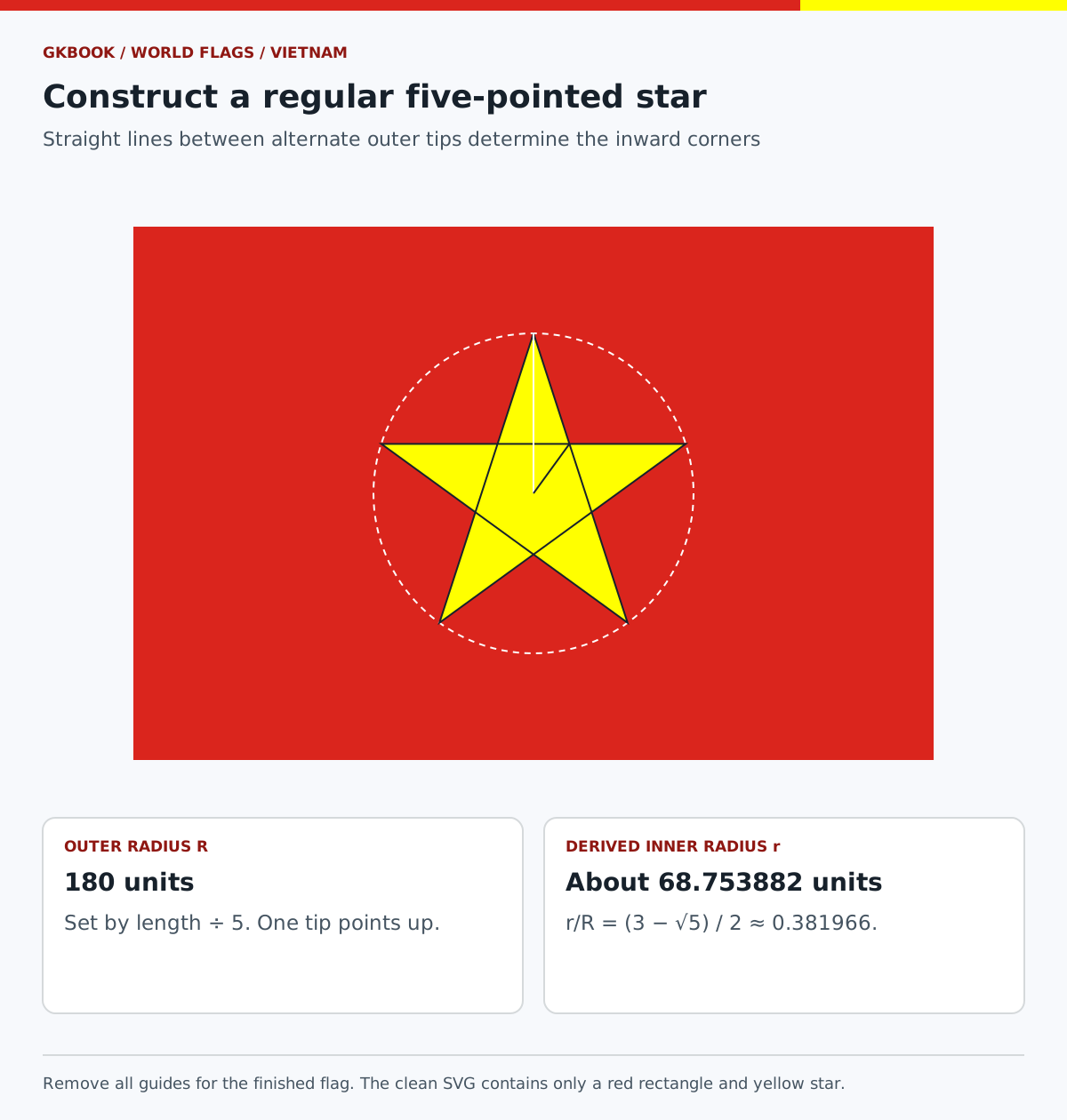
For the supplied 900-by-600 construction, place five outer points on a radius-180 circle at angles −90°, −18°, 54°, 126° and 198° in screen coordinates. Connect alternate outer points to form a pentagram, then keep the exterior outline. This construction derives the inward corners from straight intersecting lines, rather than choosing an arbitrary inner radius.
The resulting inner-to-outer radius ratio is (3 − √5) / 2, approximately 0.381966. The inner radius is therefore about 68.754 units. This formula is a geometric derivation, not a separately numbered statutory requirement. Remove construction lines, circles and labels from the finished flag; the SVG master already contains only the two colored shapes.
| Item | Value | Evidence |
|---|---|---|
| Canvas | 900 × 600 units | 2:3 constitutional proportions |
| Star center | (450, 300) | Intersection of diagonals |
| Outer radius R | 180 units = length / 5 | Ministry guidance |
| Inner radius r | 68.753882 units | Regular-pentagram derivation |
| Top tip | (450, 120) | Calculated from center and radius |
Sources: Ministry of Culture — flag construction and display guidance 3420 · Drawing method and calculations
What is the history of Vietnam’s red flag with a yellow star?
The red-star flag is associated with the Nam Kỳ uprising of November 23, 1940. It became the Democratic Republic of Vietnam’s national flag in 1945, received a revised star specification in 1955, and was retained by reunified Vietnam in 1976. These stages explain its development more accurately than a single undifferentiated adoption date.

The Embassy of Vietnam links the early flag to the uprising against French colonial rule. The surviving 1945 decree provides a different kind of evidence: an official national designation and an attached drawing. The 1955 decree then documents an alteration to the star’s contour. Together, these sources connect political history with changes in the graphic specification.
A timeline should keep the country’s changing institutional names visible. The Democratic Republic of Vietnam was proclaimed in 1945; the name Socialist Republic of Vietnam belongs to the reunified state established in 1976. Describing the entire period with today’s state name can blur the historical sequence, even though the red-star design links the periods.
Sources: Embassy of Vietnam — National Flag · 1945 Decree No. 5 — archival scan and drawing annex · Government legal database — Decree 249-SL, November 30, 1955 · Vietnam National Museum of History — the unified National Assembly’s 1976 session
When was the Vietnam flag adopted?
September 5, 1945 is the date of Decree No. 5 establishing the red flag with a five-pointed yellow star as the national flag of the Democratic Republic of Vietnam. The star was revised on November 30, 1955. On July 2, 1976, the reunified National Assembly retained the design for the Socialist Republic of Vietnam.

The 1945 archival scan bears Võ Nguyên Giáp’s signature on behalf of the provisional president. This is more specific evidence about the signatory than the Embassy’s short historical overview, which attributes the decree’s signing to Hồ Chí Minh. The article follows the actual document when describing that signature, while retaining the overview’s broader historical context.
The first Constitution, adopted on November 9, 1946, also identified the red flag with a yellow star. Constitutional recognition, a new drawing specification and retention by a reunified state are different actions. When a database permits only one date, label exactly which event that date records rather than treating 1945, 1955 and 1976 as competing answers.
| Date | Event |
|---|---|
| November 23, 1940 | Early use associated with the Nam Kỳ uprising |
| September 5, 1945 | National-flag decree of the Democratic Republic |
| November 9, 1946 | Constitutional recognition |
| November 30, 1955 | Revised star specification |
| July 2, 1976 | Flag retained by reunified Vietnam |
Sources: 1945 Decree No. 5 — archival scan and drawing annex · Uông Bí government — archival essay on the red-star flag · Government legal database — Decree 249-SL, November 30, 1955 · Vietnam National Museum of History — the unified National Assembly’s 1976 session · Embassy of Vietnam — National Flag
How did the Vietnam flag change in 1955?
Decree 249-SL of November 30, 1955 changed the star’s prescribed contour to straight lines instead of the earlier curved treatment. The red field and central yellow star remained. The accompanying comparison reconstructs the 1945 annex’s radial measurements beside the modern regular star; it does not claim to trace every historical cloth flag exactly.

The 1945 annex specifies an outer radius of one fifth of the flag length and an inner radius of one tenth. Their ratio is 0.5. The modern straight pentagram outline has an inner-to-outer ratio of approximately 0.381966, so its inward corners sit closer to the center. Both teaching drawings use the same outer radius for comparison.
Historical specimens and printed reproductions can vary, and the archival hand drawing is not a modern vector master. The older graphic here is explicitly a schematic radial reconstruction. It demonstrates the numerical difference without claiming that every pre-1955 star had identical straight segments, identical curves or today’s chosen digital red and yellow colors.
Sources: 1945 Decree No. 5 — archival scan and drawing annex · Government legal database — Decree 249-SL, November 30, 1955 · Ministry of Culture — flag construction and display guidance 3420 · Drawing method and calculations
Who designed the Vietnam flag?
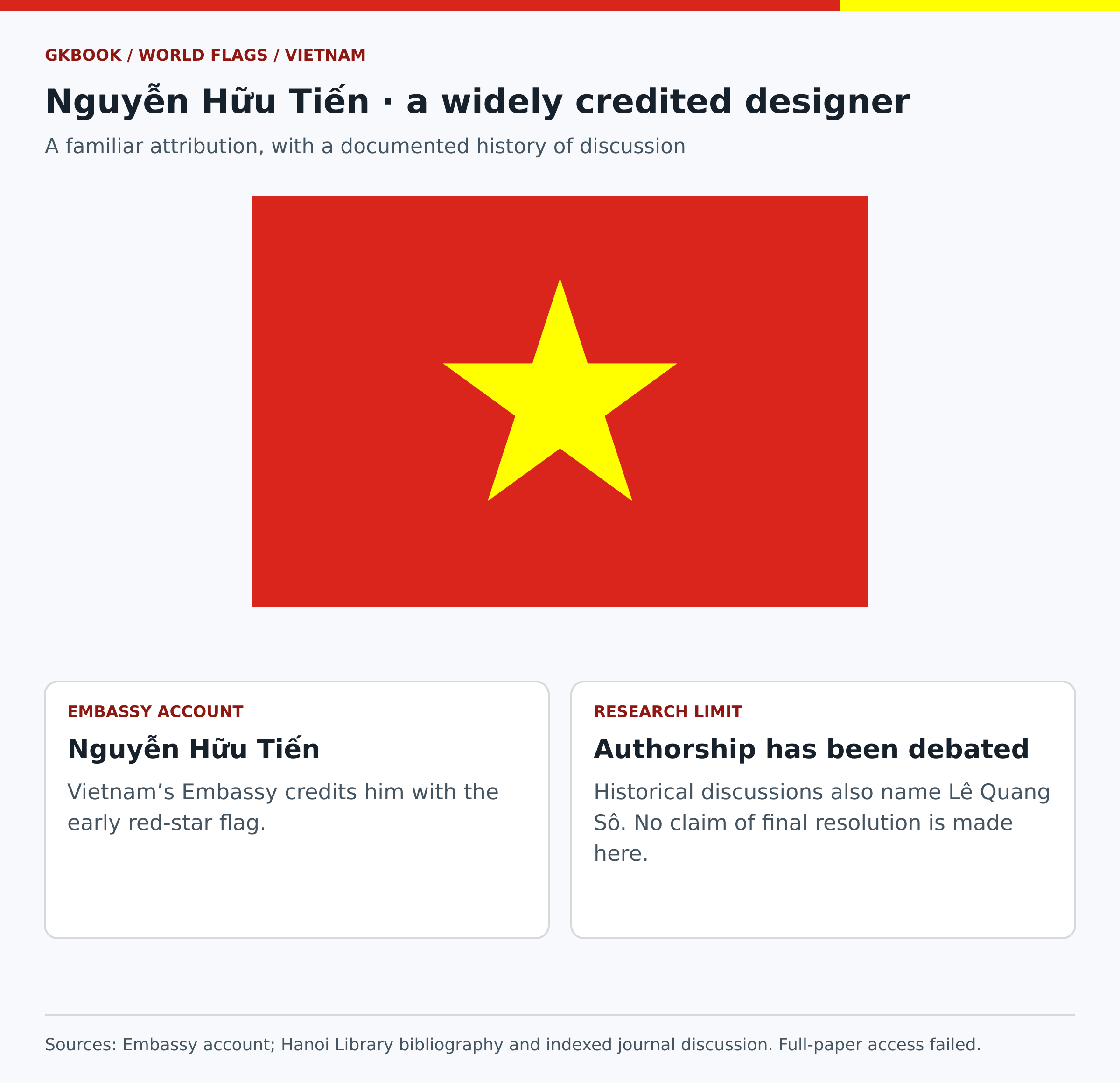
Nguyễn Hữu Tiến is widely credited with creating the red-star flag, including in Vietnam’s Embassy account. The authorship has also been debated, with Lê Quang Sô proposed in historical discussions. This page identifies the common attribution without presenting the debate as settled or confusing the original design with this edition’s newly constructed digital artwork.

Hanoi Library’s indexed bibliography describes research discussing both names and explicitly identifies the discussion as an author’s viewpoint. The original journal PDF could not be retrieved in full during this research. That access limit matters: a search excerpt can establish that a debate exists, but it cannot substitute for evaluating every archival argument in the paper.
The legal documents provide firmer evidence for the flag’s adopted appearance than for a single uncontested creative origin. The 1945 decree, the 1955 revision and current construction guidance can be examined independently of the attribution question. No speculative portrait, imagined signature or invented drawing scene is included among this page’s original graphics.
Sources: Embassy of Vietnam — National Flag · Hanoi Library — 2025 bibliography on the August Revolution · Đà Lạt University repository — discussion of red-star flag authorship · 1945 Decree No. 5 — archival scan and drawing annex
Why is the flag associated with September 2?
September 2 is Vietnam’s National Day, marking Hồ Chí Minh’s declaration of independence in 1945. The red-star flag is closely associated with that event and its commemorations. National Day is distinct from the September 5 flag decree, the November 1955 design revision, and the formal reunification decisions of July 1976.

Article 13 of the current Constitution identifies September 2, 1945 as the National Day reference. The Embassy’s historical account places red flags at the independence declaration in Ba Đình Square. These sources support the connection between the flag and the anniversary without requiring a fabricated claim about the exact appearance of every flag carried that day.
For an educational calendar, place the anniversary and the original event in separate fields: September 2 recurs annually; the declaration happened in 1945. A local holiday display notice may specify particular start and end dates for that year. Such a notice should be followed in its own context instead of being replaced with a permanent timetable inferred from an illustration.
Sources: Vietnam Constitution — 2025 consolidated text, Article 13 · Embassy of Vietnam — National Flag · Ministry of Culture — 2026 reply to Đồng Tháp on July 27 flag display
When did the red-star flag become the flag of reunified Vietnam?
On July 2, 1976, the unified National Assembly adopted the country name Socialist Republic of Vietnam and retained the red flag with a yellow star as the national flag. The Vietnam National Museum of History records these decisions. This formal state decision is distinct from the events of April 30, 1975.
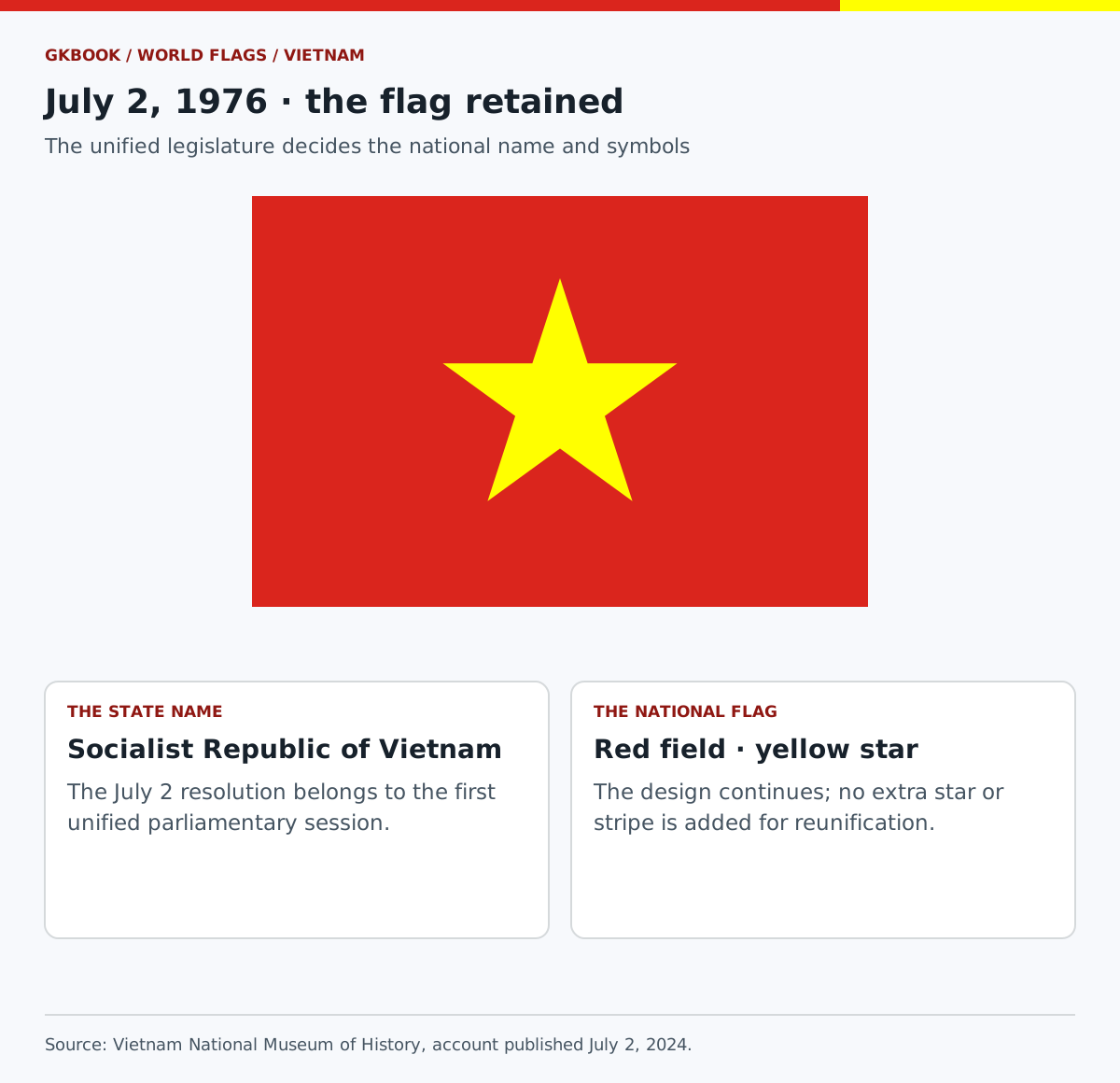
The museum describes the first session of the unified legislature, held from June 24 to July 3, 1976. Its July 2 decisions covered the national name, flag, emblem, capital and anthem. That account gives a precise institutional setting for the present flag’s nationwide status rather than treating reunification as a single undated transition.
The flag did not acquire extra stars or a new stripe to represent the two formerly separate administrations. Retention meant continuing the red-star design within the newly unified state. A historical chart should identify which government and period each flag represents, particularly when it includes the former Republic of Vietnam or revolutionary flags used in the south.
Sources: Vietnam National Museum of History — the unified National Assembly’s 1976 session · Vietnam Constitution — 2025 consolidated text, Article 13
Which laws and official guidance define the Vietnam flag?
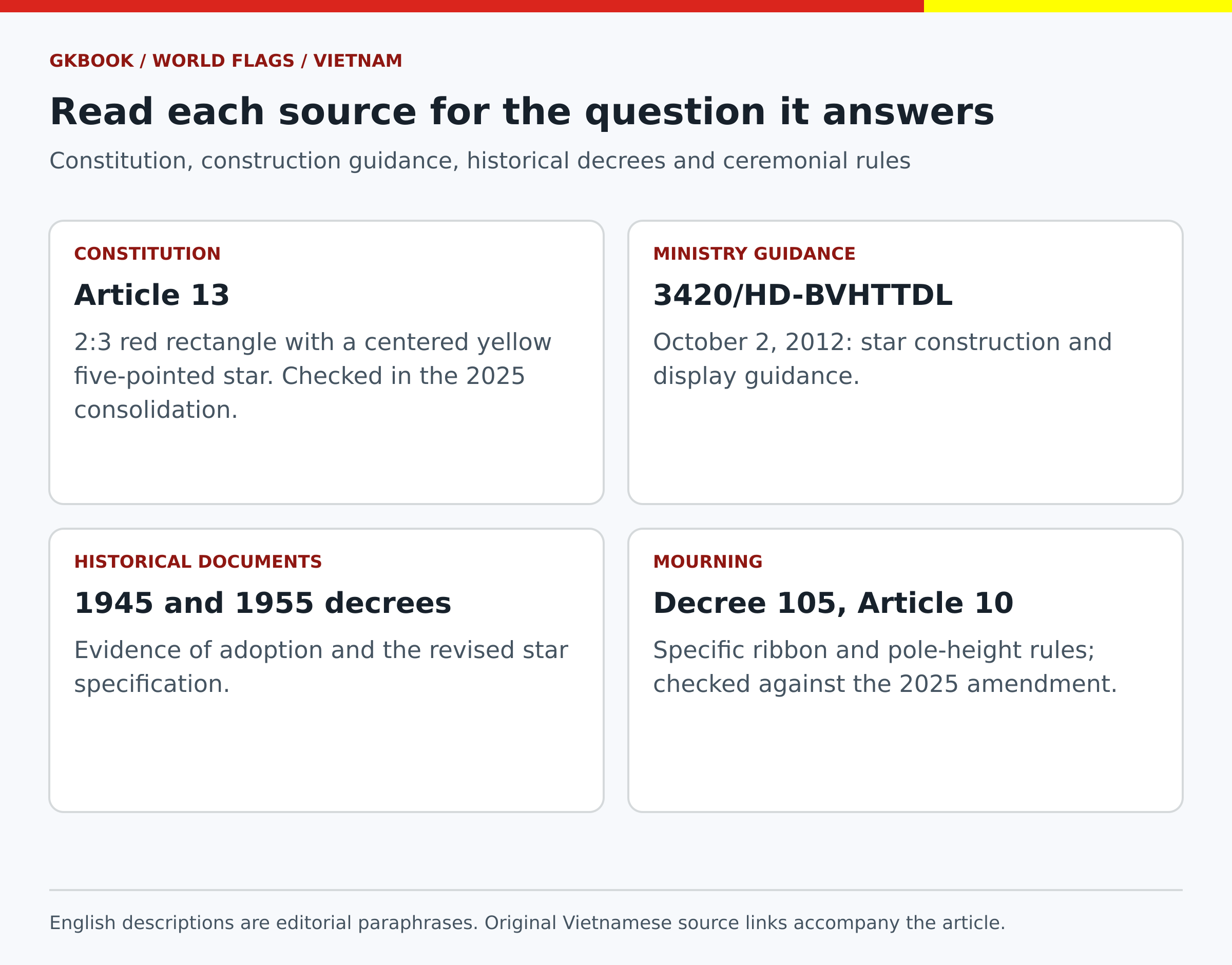
Article 13 of the Constitution defines the red rectangle, 2:3 proportions and centered yellow five-pointed star. Ministry guidance 3420/HD-BVHTTDL, dated October 2, 2012, gives construction and display details. This page checks the Constitution’s 2025 consolidated text and distinguishes that current article number from the older Article 141 cited in historical guidance.

A document may remain useful while citing the constitution in force when it was written. The 2012 guidance refers to the 1992 Constitution; the present constitutional definition is in Article 13. The Ministry’s 2026 reply about flag display still refers to guidance 3420, providing evidence of its continuing administrative use rather than relying only on an old repost.
Different sources answer different questions. The Constitution establishes national symbols, the guidance describes their practical form and use, and the mourning decree governs a special ceremony. Historical decrees explain development. English wording on this page is an editorial paraphrase of the Vietnamese materials, with original links supplied for readers who need the precise wording and context.
Sources: Vietnam Constitution — 2025 consolidated text, Article 13 · Ministry of Culture — flag construction and display guidance 3420 · Ministry of Culture — 2026 reply to Đồng Tháp on July 27 flag display · Government legal database — Decree 249-SL, November 30, 1955 · Decree 105/2012/NĐ-CP — Article 10, national mourning · Decree 237/2025/NĐ-CP — amendment to the mourning decree
How should the Vietnam flag be displayed?
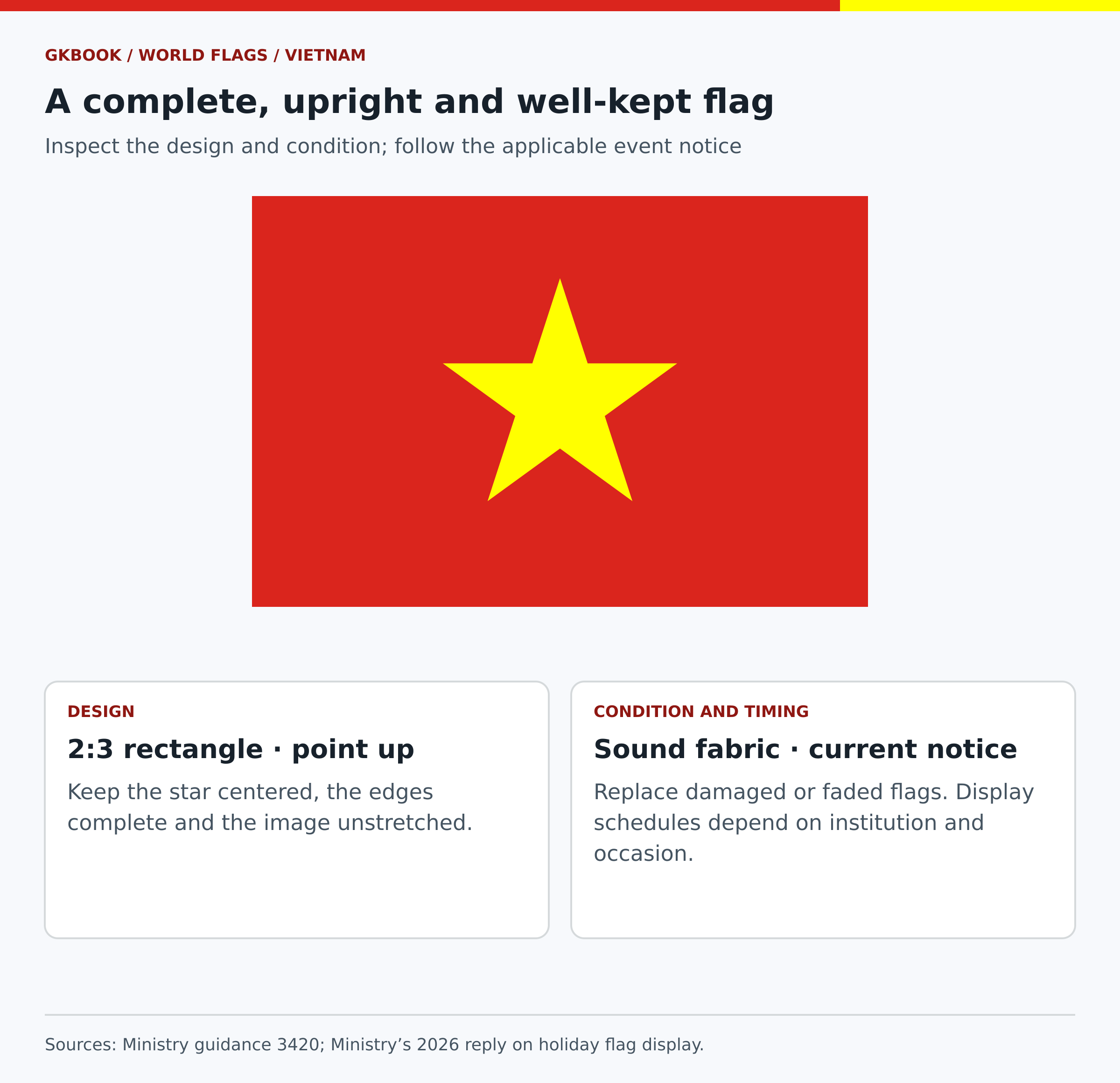
Use the complete flag with an upright star, sound fabric and the correct proportions. Ministry guidance rejects damaged, faded or badly creased flags and describes appropriate placement at institutions and events. Display times depend on the type of institution and the relevant announcement; one timetable should not be applied indiscriminately to every household or occasion.
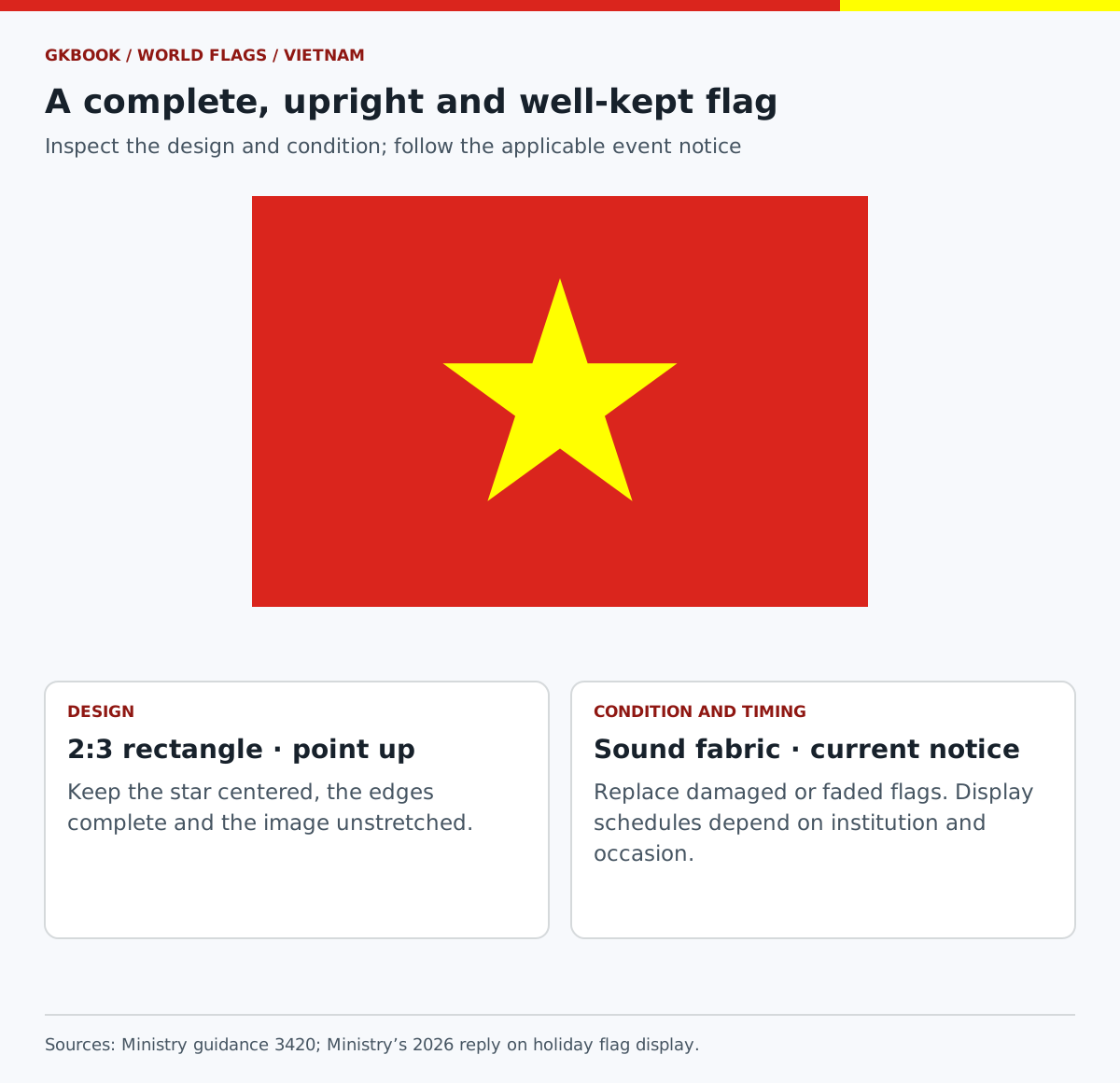
Before an event, inspect both the object and the installation: the star should be recognizable, its upper point correctly oriented, and the rectangle free from unintended folds or obstructions. A picture printed on a board also needs the complete outline. Cropping away the red margins changes the specified design even if the star remains visible.
The guidance includes several categories of institutional display, some with different schedules. This article does not turn those categories into a universal daily instruction. For a ceremony, public building or neighborhood holiday display, use the responsible authority’s current notice and the organizer’s layout. The diagram is a design and condition checklist, not a substitute event order.
Sources: Ministry of Culture — flag construction and display guidance 3420 · Ministry of Culture — 2026 reply to Đồng Tháp on July 27 flag display · Drawing method and calculations
On which occasions is the Vietnam flag flown?
Official guidance describes outdoor flag display for major holidays, political events, traditional Tết celebrations and occasions announced by central or local authorities. September 2 is National Day. A Ministry reply in 2026 still referred to this framework while considering a proposal concerning July 27; the proposal itself was not a newly enacted nationwide display requirement.
Annual instructions often identify dates and practical arrangements for a particular locality or institution. Read the notice’s year and jurisdiction before reusing it. A poster from an earlier celebration can illustrate historical practice, but it cannot establish the exact display period for a later year or for another province, school or workplace.
The 2026 response to Đồng Tháp is especially useful for reading administrative language carefully. It discusses studying and proposing guidance for War Invalids and Martyrs Day. That is a statement of work under consideration, not evidence that the requested blanket obligation had already taken effect. The page therefore avoids printing an invented permanent national flag calendar.
Sources: Ministry of Culture — flag construction and display guidance 3420 · Ministry of Culture — 2026 reply to Đồng Tháp on July 27 flag display · Vietnam Constitution — 2025 consolidated text, Article 13
How is Vietnam’s flag displayed with other countries’ flags?
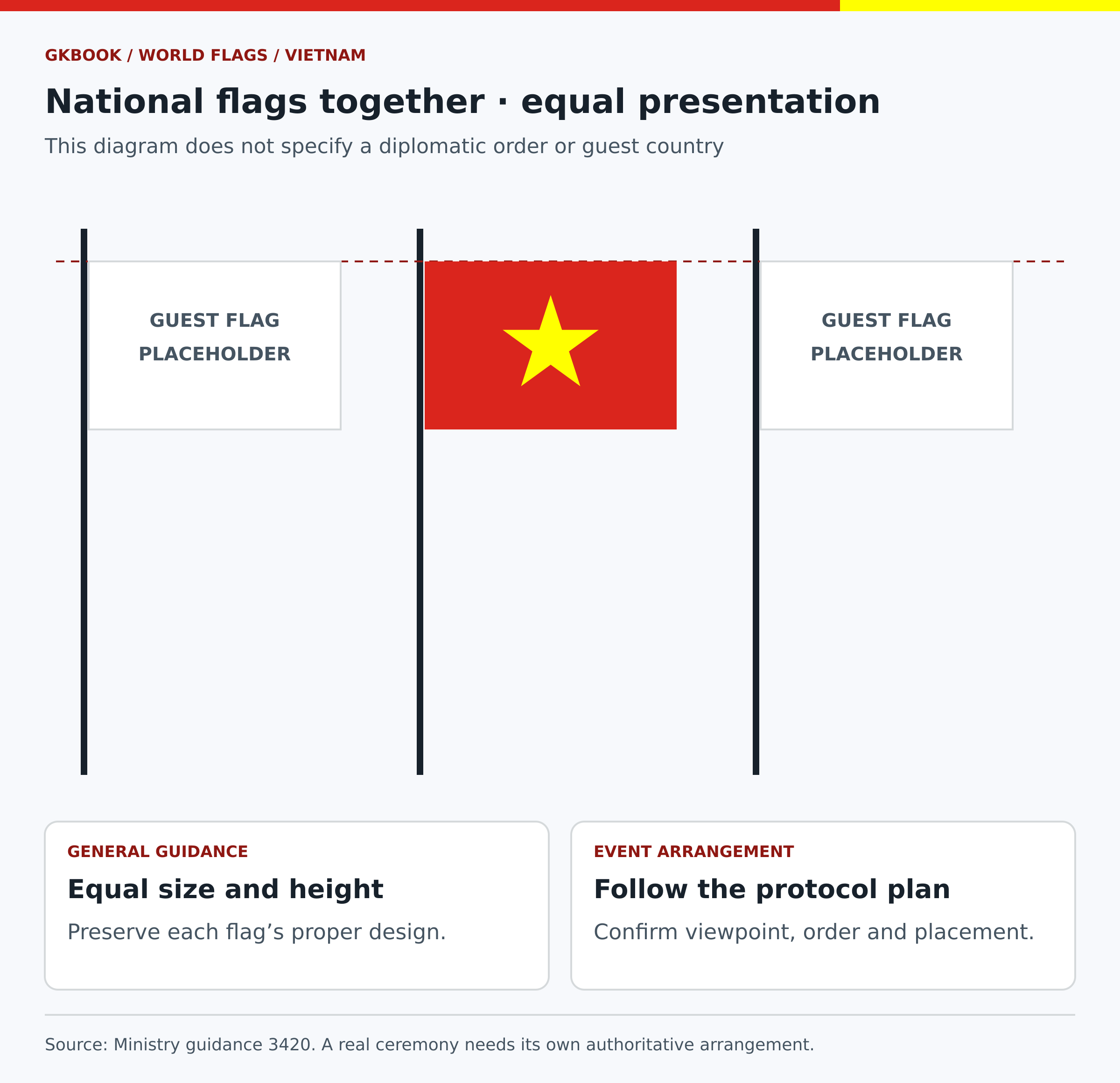
The Ministry’s guidance calls for national flags displayed together to have equal size and equal height, with their proper designs preserved. Detailed placement depends on the ceremony and the participating countries. Do not infer a universal left-to-right order from a photograph, since the observer’s viewpoint and the event’s protocol both affect how positions are described.

A planning drawing should name the viewing direction and identify each flag rather than relying on unlabeled left and right. For an actual diplomatic event, the responsible protocol office should resolve arrangement, dimensions and precedence. The supplied graphic uses plain placeholders for companion flags, so it does not invent other countries’ artwork or imply a specific guest list.
Equal presentation also requires avoiding accidental visual disadvantages. A folded flag, a short pole or a cropped printed panel can undermine an otherwise even arrangement. The educational diagram emphasizes level tops and comparable presentation while leaving exact ceremonial order to the event instructions. It is not a manufacturing rule requiring every national design to share one aspect ratio.
Sources: Ministry of Culture — flag construction and display guidance 3420 · Drawing method and calculations
How is Vietnam’s flag displayed during national mourning?
Article 10 of Decree 105/2012/NĐ-CP prescribes a mourning flag with a black ribbon, raised to two thirds of the pole’s height and tied so it does not fly freely. The ribbon is one tenth of the flag’s height in width and one flag-length long. The 2025 amending decree leaves this article unchanged.
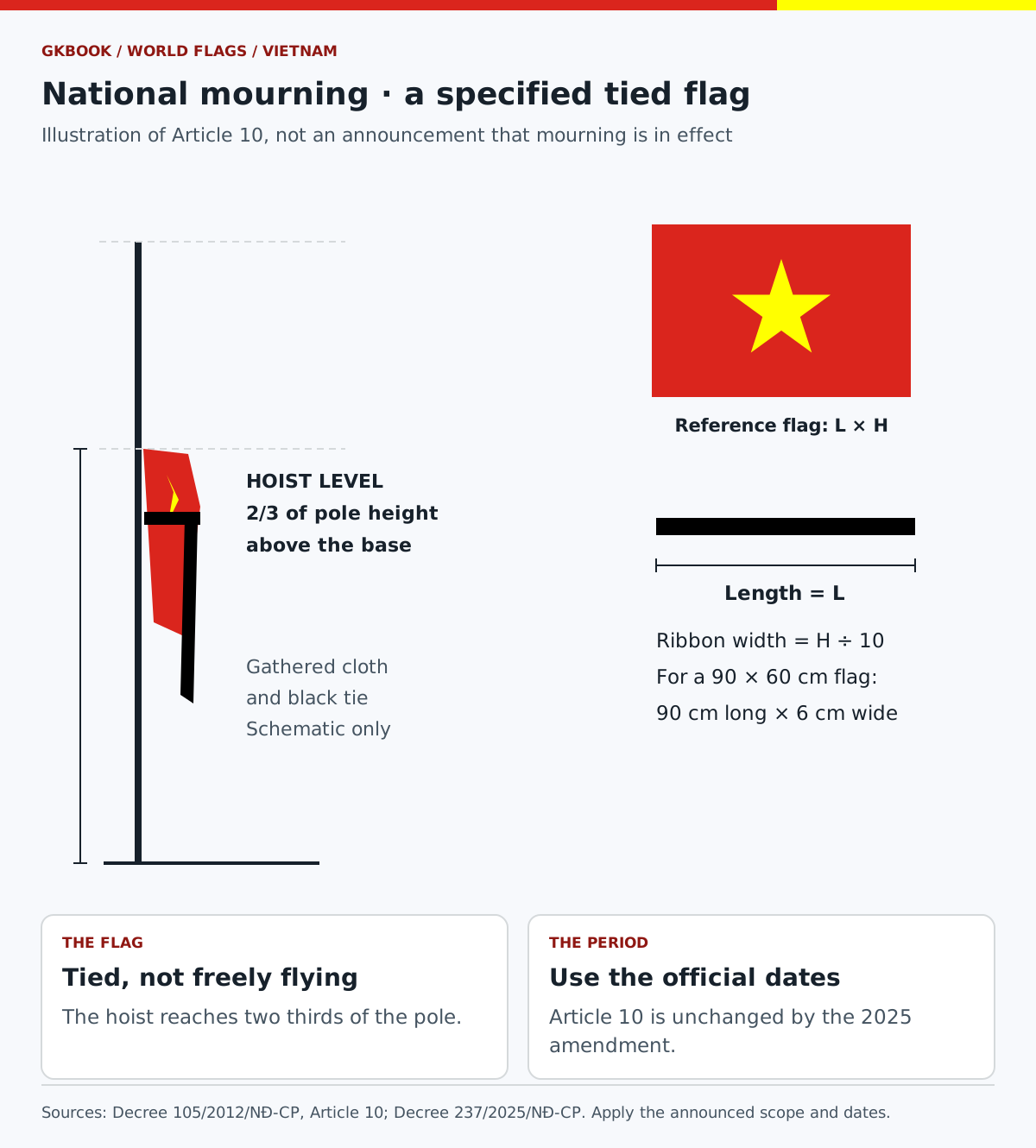
The drawing shows a gathered and tied cloth at the specified height, rather than a normal fully extended flag lower on the pole. For an unfolded reference flag 60 centimeters high and 90 centimeters long, the ribbon measurements are 6 by 90 centimeters. These are cloth dimensions, not percentages of the drawing’s page or of the pole diameter.
Apply mourning arrangements during the officially announced period and within the decree’s stated institutional scope. The original article specifies two days for national mourning, but the relevant current announcement should establish the actual dates. A teaching diagram does not announce that mourning is in effect today. It also should not import another country’s usual halfway-pole convention into Vietnam’s specification.
Sources: Decree 105/2012/NĐ-CP — Article 10, national mourning · Decree 237/2025/NĐ-CP — amendment to the mourning decree · Government portal — Ministry’s September 2018 national-mourning notice · Drawing method and calculations
Which way up should the Vietnam flag be?
In the standard horizontal display, one star point faces straight upward, toward the top of the flagstaff. The two lower points form the bottom pair. Turning the complete flag upside down changes this arrangement, even though the field remains red. The orientation graphic labels the inverted example as incorrect for the standard upright reference.
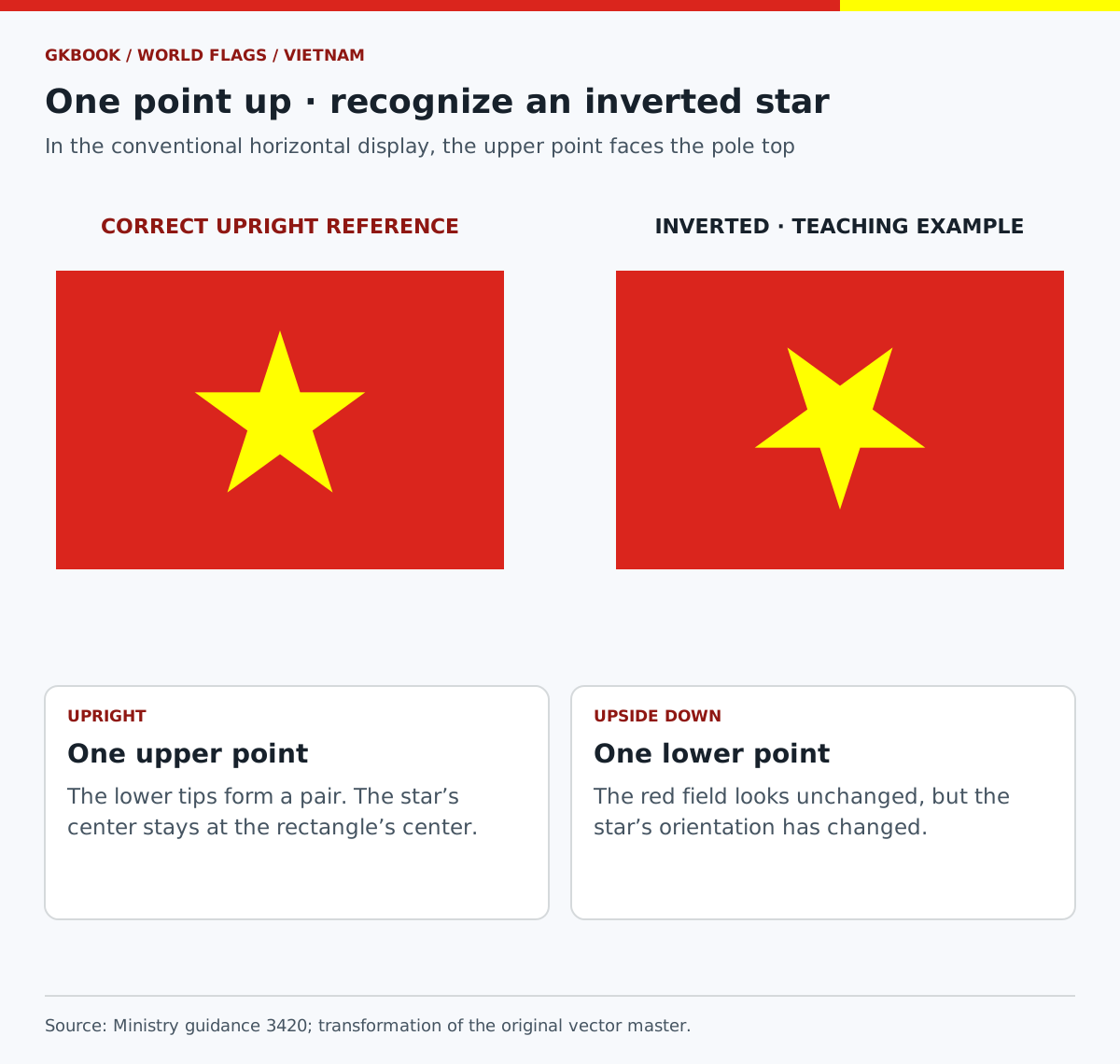
A five-pointed star is not unchanged by a half-turn. After a rotation of 180 degrees, the original upper point faces down and two tips appear at the top. This difference is easy to miss in a very small thumbnail because the colors and rectangular outline remain the same. Inspect the star before approving a printed or digital image.
Use the master’s native orientation when inserting it into a document, and scale the rectangle uniformly. A negative vertical scale or a half-turn transformation can invert the star without any obvious warning in editing software. The illustrated incorrect example is retained only as a teaching comparison; the clean download always shows the upright national design.
Sources: Ministry of Culture — flag construction and display guidance 3420 · Drawing method and calculations
Does the Vietnam flag look the same on both sides?
Yes, the national design looks the same from either side when the flag is held upright. Official guidance requires the yellow stars on its two faces to coincide. A left-to-right mirror leaves the centered upright star unchanged because it has vertical reflection symmetry. This does not mean that turning the flag upside down is equivalent.

A physical reverse view exchanges left and right, not top and bottom. Vietnam’s design contains no lettering, off-center emblem or uneven stripe order that would make that mirror visibly different. Its single regular star is centered on the vertical axis, so the red field and yellow outline match the front view in the accompanying flat illustration.
The reverse diagram describes the geometry of the national design, not a required textile manufacturing method. Printed, woven or appliquéd flags may be made differently, and seams can affect the appearance of a real object. The relevant design requirement is alignment of the stars; a manufacturer should not rotate one face’s star downward to represent the back.
Sources: Ministry of Culture — flag construction and display guidance 3420 · Drawing method and calculations
What kinds of symmetry does the Vietnam flag have?
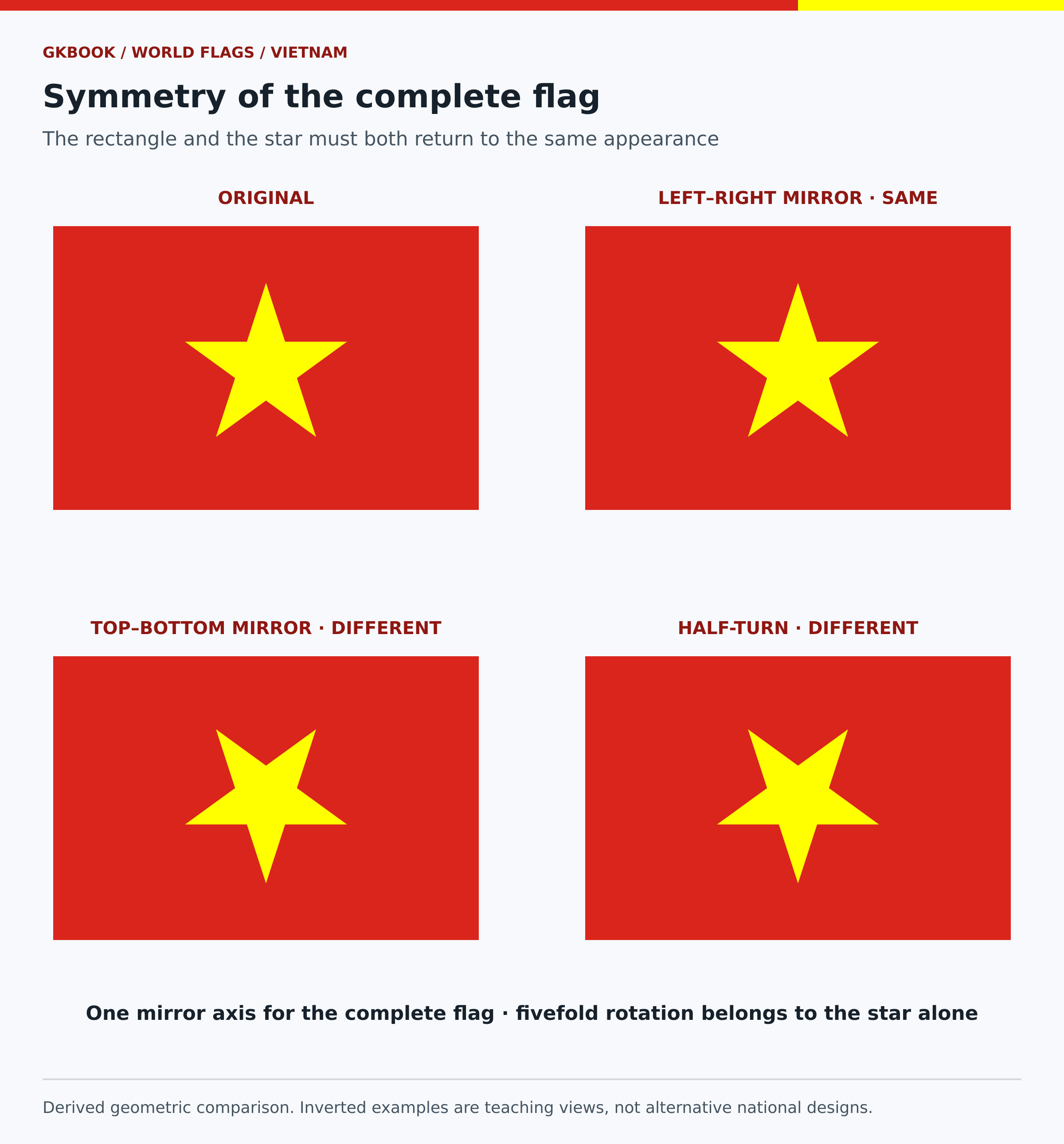
The complete upright Vietnam flag has reflection symmetry across its vertical centerline. It does not have horizontal reflection symmetry or 180-degree rotational symmetry. The isolated regular star has fivefold rotational symmetry, but the surrounding 2:3 rectangle removes that symmetry from the complete flag. Always specify whether a symmetry claim concerns the star or the whole design.
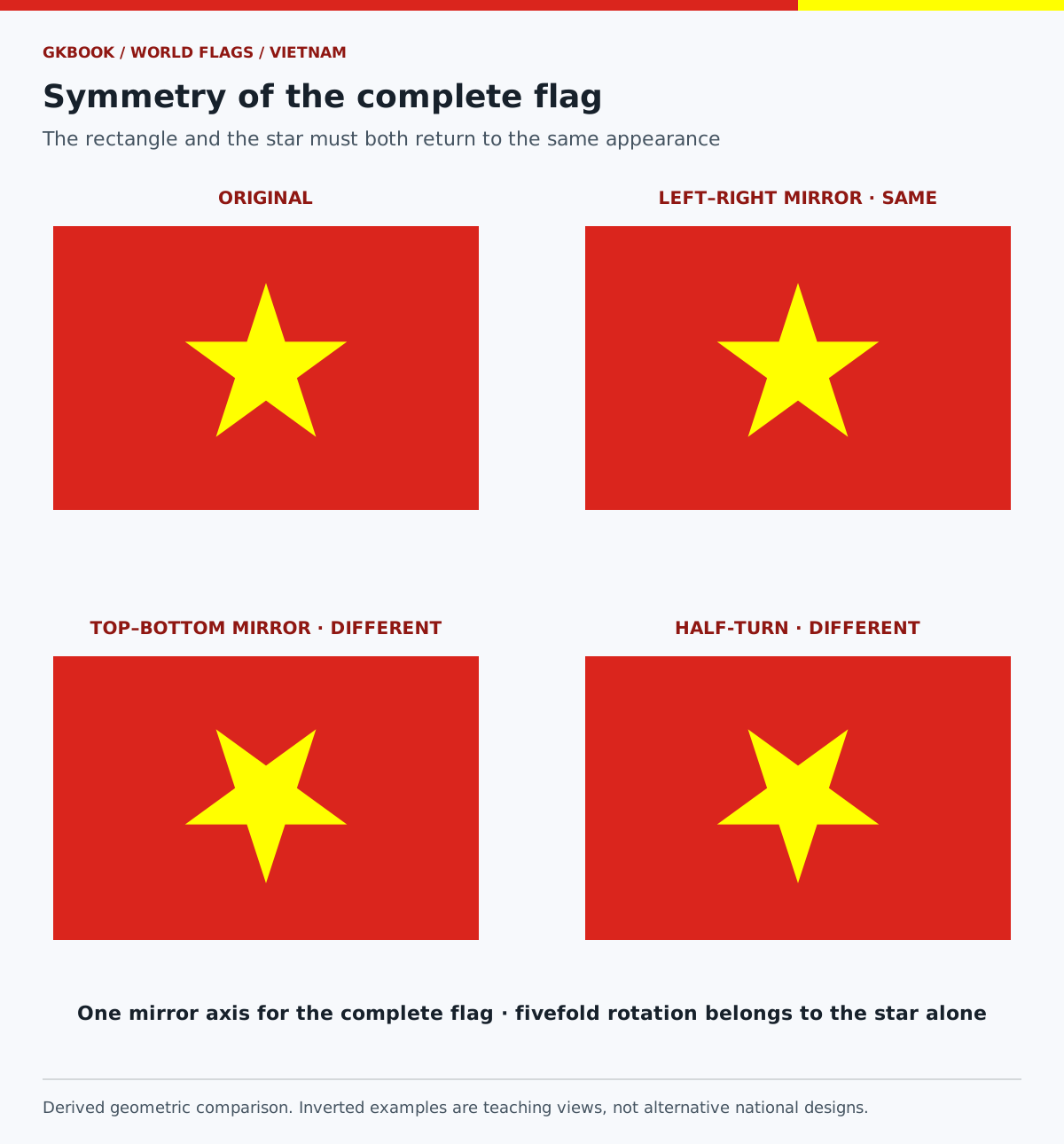
Reflecting the flag left to right exchanges its two side pairs of star points while leaving the upper point fixed. Reflecting it top to bottom creates a downward-facing single point. A half-turn produces the same inverted outline in this particular design because the star already has left-to-right symmetry. Neither operation preserves the upright flag.
Rotating the isolated star by 72 degrees returns its outline to the same position, but rotating the entire rectangular flag by that angle does not. A classroom diagram can therefore use the same picture to discuss two different objects: a regular star and a complete national flag. The labels in this package keep that distinction explicit.
Sources: Drawing method and calculations · Ministry of Culture — flag construction and display guidance 3420
Can the Vietnam flag be turned into a vertical banner?
A complete flag can be shown in a rotated educational illustration, but rotating it also turns the star’s point relative to the page. The sources reviewed do not establish a separate universal vertical-banner template. The supplied quarter-turn graphic is labeled as geometry only; official installations should follow the applicable display instructions instead of treating it as approved protocol.
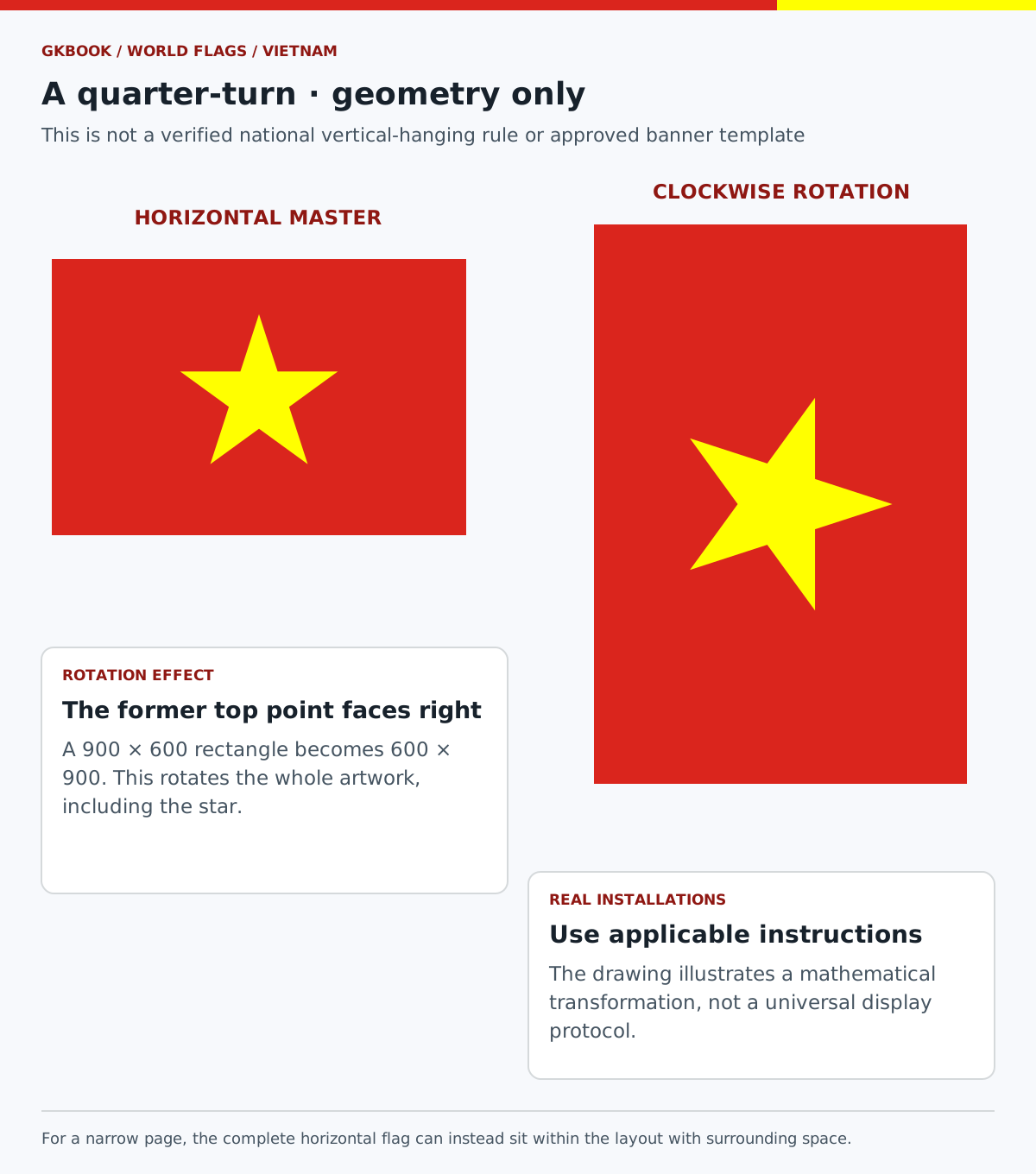
A clockwise quarter-turn changes the 900-by-600 horizontal rectangle into a 600-by-900 portrait rectangle. The point that originally faced upward then faces right. Rotating only the background while redrawing the star upright would create a different transformation, so an illustration must explain which operation it depicts rather than silently combining incompatible conventions.
For a narrow poster, a simple solution is to place the complete horizontal flag within the layout and keep the article title outside it. This preserves the specified rectangle and upright star without proposing a new flag shape. If a real hanging arrangement requires a portrait presentation, obtain the responsible organizer’s instructions for that particular use.
Sources: Ministry of Culture — flag construction and display guidance 3420 · Drawing method and calculations
Is the national emblem or Communist Party symbol part of the flag?
No. Vietnam’s national flag consists of a red field and one yellow star. The national emblem is a separate constitutional symbol that also includes rice ears, part of a cogwheel and the country’s name. A red flag bearing a hammer and sickle is a party flag, not an alternative version of the national flag.
Article 13 defines the national flag and national emblem in separate clauses. Their shared red and yellow colors do not make the two drawings interchangeable. Adding the emblem’s circular frame, agricultural elements, gear or inscription to the flag would produce a different design. The clean files therefore include no arms, motto or printed country name.
A ceremonial backdrop may display state and party symbols in the same setting, which can explain why several red images appear in one photograph. Caption each symbol by its actual identity. Do not crop a party emblem from a background and label it Vietnam’s national flag simply because its colors resemble those of the constitutional design.
Sources: Vietnam Constitution — 2025 consolidated text, Article 13 · Ministry of Culture — flag construction and display guidance 3420
How is Vietnam’s flag different from China’s flag?
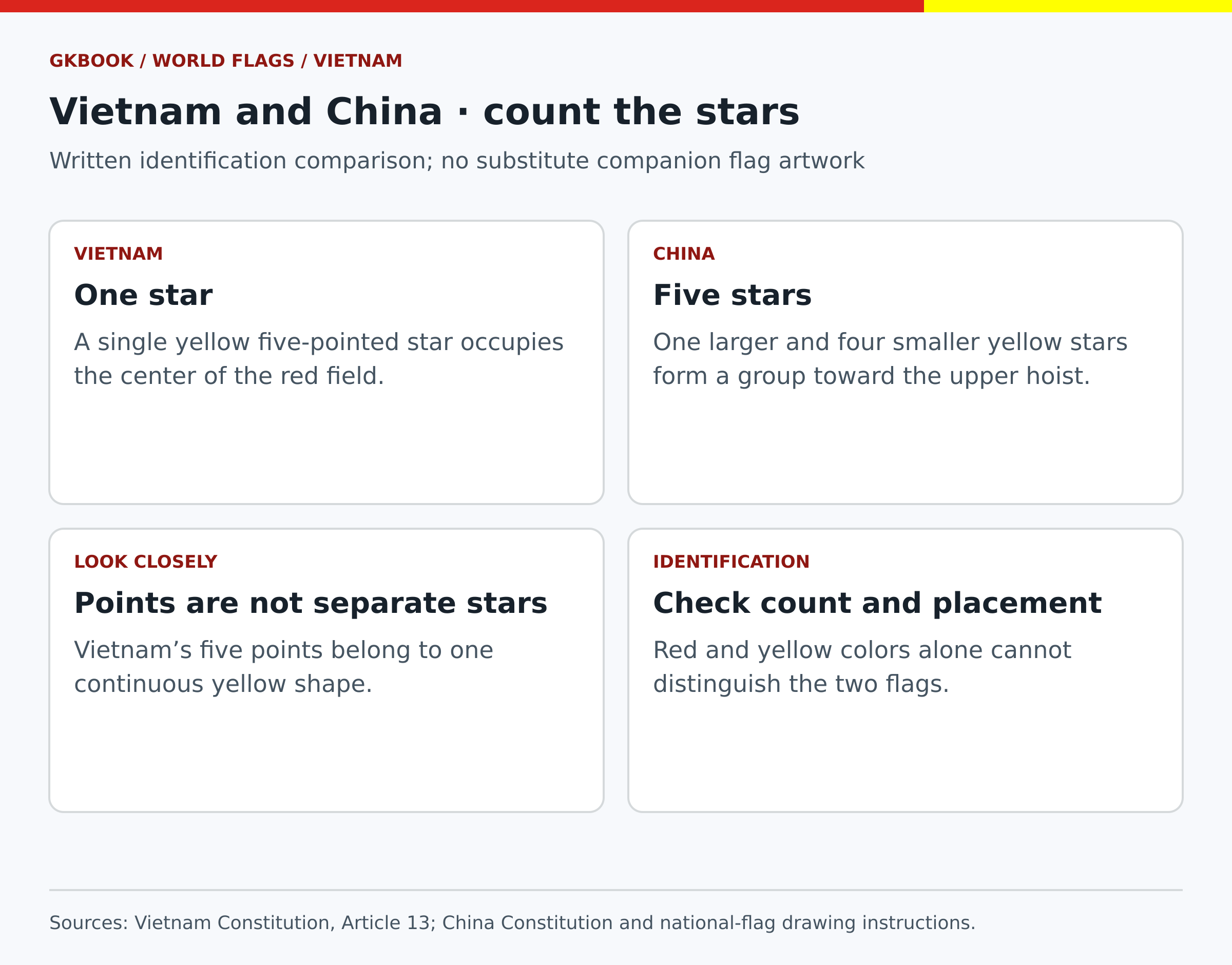
Vietnam has one large yellow star centered on a red field. China has five yellow stars, with one larger star and four smaller stars grouped toward the upper hoist. Both use red and yellow, but their star counts and placement are different. Color alone is therefore insufficient for identifying either national flag.

The comparison uses written identification panels rather than an unverified substitute drawing of China’s flag. China’s Constitution identifies its national flag as a red flag with five stars; Vietnam’s Constitution describes a centered five-pointed star. The visual difference is between five distinct stars and the five points of one star, not between five and one star points.
When an icon is too small to read clearly, enlarge it before assigning a country label. Decorative star patterns can also resemble national colors without constituting either national flag. A useful identification checklist asks how many separate stars appear, where they sit within the rectangle, and whether the complete field has been preserved in the image.
Sources: Vietnam Constitution — 2025 consolidated text, Article 13 · China Ministry of Justice — Constitution, Article 141 · China Supreme People’s Court — national-flag drawing directions · Drawing method and calculations
What is the yellow Vietnamese flag with three red stripes?
The yellow flag with three horizontal red stripes is associated with the former Republic of Vietnam, commonly called South Vietnam, and remains meaningful in some Vietnamese diaspora communities. It is historically and culturally distinct from the current national flag of the Socialist Republic of Vietnam. Identify its context rather than presenting the two designs as interchangeable.
A Smithsonian Folklife account of a Vietnamese American monument in Fort Smith describes the former flag’s importance to refugees and later generations. That community context explains why the striped design can appear outside Vietnam today. Its presence is not evidence that the current Vietnamese state has replaced the red flag with the single yellow star.
Historical displays should provide a date range, a state or community name, and an explanation of the object’s use. Avoid treating all Vietnamese people or diaspora communities as having one uniform relationship to either symbol. This article describes the distinction without assigning political views to an individual merely because a particular flag appears nearby.
Sources: Smithsonian Folklife — Vietnamese American flag monument in Fort Smith · Vietnam Constitution — 2025 consolidated text, Article 13
What is the Vietnam flag emoji and its Unicode sequence?
The Vietnam flag emoji is 🇻🇳. It consists of the regional indicator symbols V and N, encoded as U+1F1FB and U+1F1F3. Unicode identifies the sequence as flag: Vietnam. Its appearance depends on the platform, so use the supplied SVG or PNG when exact proportions, star geometry and consistent colors matter.
The two regional indicators form a sequence rather than a single dedicated picture character. A supported device may display a colored flag, while another environment may show letter-like indicators or an unsupported-glyph box. Copying the sequence correctly does not force every application to render it with the same artwork or level of detail.
An emoji is useful in compact text, but it is not an official construction drawing or a dependable print master. For accessible content, write the country name in ordinary text when identification matters. The article’s image files also include descriptive alternative text, and the vector graphics contain titles and descriptions that identify their subject.
Sources: Unicode — Full Emoji List, version 16.0 · Drawing method and calculations
What size can the Vietnam flag PNG be printed?
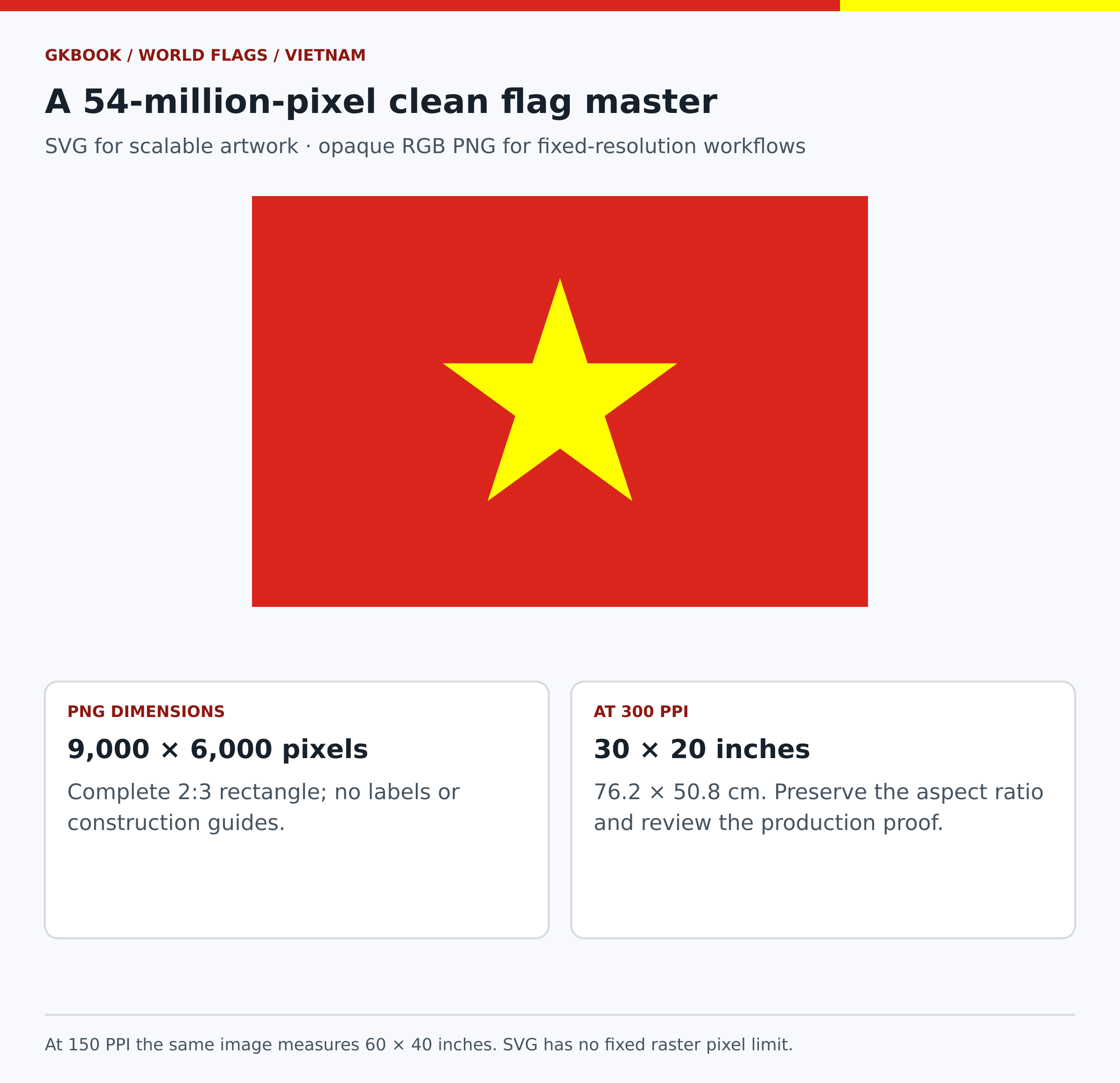
The clean PNG measures 9,000 by 6,000 pixels, or 54 million pixels. At 300 pixels per inch, it prints at 30 by 20 inches, approximately 76.2 by 50.8 centimeters. The SVG scales without a fixed pixel limit. Keep the complete 2:3 rectangle and obtain a color proof for the intended production process.

Print dimensions follow a simple calculation: divide the pixel count by the chosen pixel density. At 150 pixels per inch, the same PNG corresponds to 60 by 40 inches. That arithmetic does not guarantee suitability for every viewing distance, fabric or printer. The production supplier should specify the appropriate effective resolution for the actual item.
Use the SVG when the workflow accepts vector artwork, especially for large flat illustrations. Use the PNG when an application requires a raster image. Neither file needs to be stretched to match a page’s aspect ratio. Position the flag within the available area, preserve its sharp star corners, and keep captions or explanatory labels outside the national rectangle.
| Pixel density | Width × height, inches | Width × height, cm |
|---|---|---|
| 300 PPI | 30 × 20 | 76.2 × 50.8 |
| 150 PPI | 60 × 40 | 152.4 × 101.6 |
Sources: Drawing method and calculations
Which Vietnam flag pictures and downloads are included?
The page provides 24 gallery subjects, each in SVG and PNG, including a clean flag, color references, construction diagrams, history panels and display explanations. A separate 1,200-by-630 social card is also included. Use the clean master for the national flag itself and the labeled illustrations for lessons, articles and reference material.
The clean PNG is the 9,000-by-6,000 master; other gallery PNGs are 2,400 pixels wide. Every diagram has a matching vector source, a descriptive caption and an explicit distinction between official dimensions and calculated or illustrative details. The historical-star and vertical-rotation examples carry labels that prevent them from being mistaken for current approved flag templates.
The accompanying credits document the original artwork, declared palette and research sources. The original vector implementation and explanatory graphics are released under CC0 1.0, without claiming ownership of the national design or official endorsement. That artwork notice does not replace rules governing national symbols. Keep source notes with adapted educational graphics so their context remains available.
Sources: Drawing method and calculations · Ministry of Culture — flag construction and display guidance 3420
Sources and research notes
This article draws on the current Constitution, Ministry guidance, archival decrees, the National Museum of History and other identified sources. Every answer has visible source links. The bibliography and artwork credits document access methods, source discrepancies and the original drawing calculations.
The 1945 decree scan controls the identification of its signatory. Designer attribution is qualified because historical authorship has been debated; unavailable full-text research is identified in the notes. The 2:3 rectangle and outer star radius follow official specifications, while the inner-radius formula is derived geometry and the numeric screen colors are editorial choices. English descriptions paraphrase the linked Vietnamese sources.
Download Vietnam flag pictures
Download the complete flag as scalable SVG or 9,000 × 6,000 PNG. Both preserve the 2:3 proportion, red field and centered upright yellow star.
The gallery includes 24 subjects, each available in SVG and PNG, covering construction, symbolism, history, orientation, and use. A separate 1,200 × 630 social-sharing card places a complete flag beside the article title. Use the clean master for a flag illustration and the annotated graphics for teaching.
Read the construction guide, display notes and artwork credits, or continue exploring designs in World Flags.
World Flags/Vietnam
Vietnam flag pictures
Red field with one centered yellow five-pointed star. The star’s outer radius is one fifth of the flag length; its upper point faces straight up.
Original GKBook vector implementation. Design: Constitution, Article 13; Ministry guidance 3420/HD-BVHTTDL. Numeric screen colors are editorial choices.Download SVGDownload PNGThe same two RGB colors are used across the artwork. Production colors require their own profile and proof.
Original GKBook vector implementation. Design: Constitution, Article 13; Ministry guidance 3420/HD-BVHTTDL. Numeric screen colors are editorial choices.Download SVGDownload PNGThe article attributes these meanings to Vietnamese official explanatory sources. They are not additional elements printed on the flag.
Original GKBook vector implementation. Design: Constitution, Article 13; Ministry guidance 3420/HD-BVHTTDL. Numeric screen colors are editorial choices.Download SVGDownload PNGA common explanation names five social groups. It does not mean five provinces, five ethnic groups or five separate stars.
Original GKBook vector implementation. Design: Constitution, Article 13; Ministry guidance 3420/HD-BVHTTDL. Numeric screen colors are editorial choices.Download SVGDownload PNGThe Constitution sets the shorter dimension at two thirds of the longer dimension. Pixel dimensions are written width × height.
Original GKBook vector implementation. Design: Constitution, Article 13; Ministry guidance 3420/HD-BVHTTDL. Numeric screen colors are editorial choices.Download SVGDownload PNGThe star is inscribed in a circle whose radius is one fifth of the flag length. The star’s visible bounding box is smaller than the circle’s square.
Original GKBook vector implementation. Design: Constitution, Article 13; Ministry guidance 3420/HD-BVHTTDL. Numeric screen colors are editorial choices.Download SVGDownload PNGWhite diagonal guides meet at the construction-circle center. The dark dashed box and short marker identify the different visible-box center.
Original GKBook vector implementation. Design: Constitution, Article 13; Ministry guidance 3420/HD-BVHTTDL. Numeric screen colors are editorial choices.Download SVGDownload PNGThe inner-radius formula is a geometric derivation from a regular pentagram, not an additional dimension quoted from the guidance.
Original GKBook vector implementation. Design: Constitution, Article 13; Ministry guidance 3420/HD-BVHTTDL. Numeric screen colors are editorial choices.Download SVGDownload PNGThe dates refer to different historical actions, rather than four interchangeable adoption dates.
Original GKBook vector implementation. Design: Constitution, Article 13; Ministry guidance 3420/HD-BVHTTDL. Numeric screen colors are editorial choices.Download SVGDownload PNGThe signatory follows the inspected 1945 archival scan, which differs from the Embassy overview’s wording.
Original GKBook vector implementation. Design: Constitution, Article 13; Ministry guidance 3420/HD-BVHTTDL. Numeric screen colors are editorial choices.Download SVGDownload PNGThe left graphic reconstructs the 1945 annex’s radius ratio with a simple polygon. It does not claim exact historical contours or historical digital colors.
Original GKBook vector implementation. Design: Constitution, Article 13; Ministry guidance 3420/HD-BVHTTDL. Numeric screen colors are editorial choices.Download SVGDownload PNGThe attribution is qualified. No invented portrait or signature is presented as historical evidence.
Original GKBook vector implementation. Design: Constitution, Article 13; Ministry guidance 3420/HD-BVHTTDL. Numeric screen colors are editorial choices.Download SVGDownload PNGThe current Constitution identifies the National Day date. The flag decree should not be relabeled September 2.
Original GKBook vector implementation. Design: Constitution, Article 13; Ministry guidance 3420/HD-BVHTTDL. Numeric screen colors are editorial choices.Download SVGDownload PNGThe museum records the July 2 decisions. They are distinct from the events of April 30, 1975.
Original GKBook vector implementation. Design: Constitution, Article 13; Ministry guidance 3420/HD-BVHTTDL. Numeric screen colors are editorial choices.Download SVGDownload PNGThe older Article 141 citation belongs to the 1992 Constitution. The current constitutional definition is Article 13.
Original GKBook vector implementation. Design: Constitution, Article 13; Ministry guidance 3420/HD-BVHTTDL. Numeric screen colors are editorial choices.Download SVGDownload PNGA general checklist does not create a universal daily schedule for every household or institution.
Original GKBook vector implementation. Design: Constitution, Article 13; Ministry guidance 3420/HD-BVHTTDL. Numeric screen colors are editorial choices.Download SVGDownload PNGThe outer rectangles are unassigned placeholders, not companion national-flag reconstructions. Their positions do not assert precedence.
Original GKBook vector implementation. Design: Constitution, Article 13; Ministry guidance 3420/HD-BVHTTDL. Numeric screen colors are editorial choices.Download SVGDownload PNGThe left image is a folded-cloth schematic, not a flat national-flag template. The ribbon pattern at right is scaled to the separate 300 × 200 reference flag.
Original GKBook vector implementation. Design: Constitution, Article 13; Ministry guidance 3420/HD-BVHTTDL. Numeric screen colors are editorial choices.Download SVGDownload PNGThe right-hand image is intentionally incorrect for standard horizontal display and is labeled as a comparison.
Original GKBook vector implementation. Design: Constitution, Article 13; Ministry guidance 3420/HD-BVHTTDL. Numeric screen colors are editorial choices.Download SVGDownload PNGThe reverse is a whole-image horizontal mirror. It is not a half-turn or an instruction about a particular sewing technique.
Original GKBook vector implementation. Design: Constitution, Article 13; Ministry guidance 3420/HD-BVHTTDL. Numeric screen colors are editorial choices.Download SVGDownload PNGOnly the left-to-right reflection preserves the upright flag. The isolated star’s 72-degree rotational symmetry does not preserve the 2:3 rectangle.
Original GKBook vector implementation. Design: Constitution, Article 13; Ministry guidance 3420/HD-BVHTTDL. Numeric screen colors are editorial choices.Download SVGDownload PNGThis deliberately labeled transformation shows how the star turns with the rectangle. It is not a verified national hanging rule.
Original GKBook vector implementation. Design: Constitution, Article 13; Ministry guidance 3420/HD-BVHTTDL. Numeric screen colors are editorial choices.Download SVGDownload PNGThe comparison describes the countries’ official designs without repurposing one country’s drawing as the other.
Original GKBook vector implementation. Design: Constitution, Article 13; Ministry guidance 3420/HD-BVHTTDL. Numeric screen colors are editorial choices.Download SVGDownload PNGPrint dimensions are calculated from pixel density. They are not a guarantee of textile color matching or suitability for every process.
Original GKBook vector implementation. Design: Constitution, Article 13; Ministry guidance 3420/HD-BVHTTDL. Numeric screen colors are editorial choices.Download SVGDownload PNGFrequently asked questions
What does the Vietnam flag look like?
Vietnam’s national flag is a red rectangle with one yellow five-pointed star at its center. Its height-to-length ratio is 2:3, and one star point faces upward. The design developed from the red-star flag used in 1940, was nationally adopted in 1945, revised in 1955, and retained by reunified Vietnam in 1976.
What is Vietnam’s national flag called?
Vietnam’s flag is commonly called cờ đỏ sao vàng, meaning red flag with a yellow star. Quốc kỳ means national flag, while cờ Tổ quốc refers to the flag of the homeland. The flag represents the Socialist Republic of Vietnam and has one centered, upright, five-pointed yellow star.
What are the Vietnam flag colors and HEX codes?
The flag has a bright red background and a bright yellow star. This edition uses red #DA251D and yellow #FFFF00 consistently in its downloadable artwork. These are editorial screen references. The official guidance reviewed names the colors but does not establish these HEX values as a mandatory national digital standard.
What do the red field and yellow star symbolize?
Vietnamese official explanations connect the red field with revolutionary struggle and sacrifice, and the yellow star with the unity of the people. These meanings describe the flag’s historical and political context. They are distinct from the constitutional description, which specifies the red rectangle and centered yellow five-pointed star without listing symbolic interpretations.
What do the five points of Vietnam’s star represent?
A common official explanation associates the five points with intellectuals, peasants, workers, merchants and soldiers united in the nation. The Vietnamese grouping is sĩ, nông, công, thương, binh. This is a symbolic interpretation of social unity, not a map of five provinces, a count of ethnic groups, or five separate stars.
What is the official ratio of the Vietnam flag?
Vietnam’s national flag has a height-to-length ratio of 2:3. Article 13 of the Constitution states that the shorter dimension is two thirds of the longer dimension. A flag 60 centimeters high is therefore 90 centimeters long. The clean artwork uses a 900-by-600 construction grid and a 9,000-by-6,000-pixel PNG.
How large is the star on the Vietnam flag?
The distance from the star’s center to each outer tip is one fifth of the flag’s length. On the 900-unit-long reference, that radius is 180 units. The surrounding construction circle is therefore 360 units across, or three fifths of the flag’s height. The visible star does not fill that circle’s square.
Where exactly is the star centered?
The star’s center lies at the intersection of the flag’s diagonals. In the 900-by-600 grid, that point is (450, 300). Center the star’s construction circle there, rather than centering its visible bounding box. An upright five-pointed star extends farther above its center than below it, so its red margins are unequal.
How can you draw the Vietnam flag accurately?
Draw a 3-by-2 red rectangle, locate the intersection of its diagonals, and center a five-pointed yellow star there. Set the outer radius to one fifth of the rectangle’s length and point one tip straight upward. Use a regular pentagram outline with straight edges; the current guidance excludes swollen or rounded star arms.
What is the history of Vietnam’s red flag with a yellow star?
The red-star flag is associated with the Nam Kỳ uprising of November 23, 1940. It became the Democratic Republic of Vietnam’s national flag in 1945, received a revised star specification in 1955, and was retained by reunified Vietnam in 1976. These stages explain its development more accurately than a single undifferentiated adoption date.
When was the Vietnam flag adopted?
September 5, 1945 is the date of Decree No. 5 establishing the red flag with a five-pointed yellow star as the national flag of the Democratic Republic of Vietnam. The star was revised on November 30, 1955. On July 2, 1976, the reunified National Assembly retained the design for the Socialist Republic of Vietnam.
How did the Vietnam flag change in 1955?
Decree 249-SL of November 30, 1955 changed the star’s prescribed contour to straight lines instead of the earlier curved treatment. The red field and central yellow star remained. The accompanying comparison reconstructs the 1945 annex’s radial measurements beside the modern regular star; it does not claim to trace every historical cloth flag exactly.
Who designed the Vietnam flag?
Nguyễn Hữu Tiến is widely credited with creating the red-star flag, including in Vietnam’s Embassy account. The authorship has also been debated, with Lê Quang Sô proposed in historical discussions. This page identifies the common attribution without presenting the debate as settled or confusing the original design with this edition’s newly constructed digital artwork.
Why is the flag associated with September 2?
September 2 is Vietnam’s National Day, marking Hồ Chí Minh’s declaration of independence in 1945. The red-star flag is closely associated with that event and its commemorations. National Day is distinct from the September 5 flag decree, the November 1955 design revision, and the formal reunification decisions of July 1976.
When did the red-star flag become the flag of reunified Vietnam?
On July 2, 1976, the unified National Assembly adopted the country name Socialist Republic of Vietnam and retained the red flag with a yellow star as the national flag. The Vietnam National Museum of History records these decisions. This formal state decision is distinct from the events of April 30, 1975.
Which laws and official guidance define the Vietnam flag?
Article 13 of the Constitution defines the red rectangle, 2:3 proportions and centered yellow five-pointed star. Ministry guidance 3420/HD-BVHTTDL, dated October 2, 2012, gives construction and display details. This page checks the Constitution’s 2025 consolidated text and distinguishes that current article number from the older Article 141 cited in historical guidance.
How should the Vietnam flag be displayed?
Use the complete flag with an upright star, sound fabric and the correct proportions. Ministry guidance rejects damaged, faded or badly creased flags and describes appropriate placement at institutions and events. Display times depend on the type of institution and the relevant announcement; one timetable should not be applied indiscriminately to every household or occasion.
On which occasions is the Vietnam flag flown?
Official guidance describes outdoor flag display for major holidays, political events, traditional Tết celebrations and occasions announced by central or local authorities. September 2 is National Day. A Ministry reply in 2026 still referred to this framework while considering a proposal concerning July 27; the proposal itself was not a newly enacted nationwide display requirement.
How is Vietnam’s flag displayed with other countries’ flags?
The Ministry’s guidance calls for national flags displayed together to have equal size and equal height, with their proper designs preserved. Detailed placement depends on the ceremony and the participating countries. Do not infer a universal left-to-right order from a photograph, since the observer’s viewpoint and the event’s protocol both affect how positions are described.
How is Vietnam’s flag displayed during national mourning?
Article 10 of Decree 105/2012/NĐ-CP prescribes a mourning flag with a black ribbon, raised to two thirds of the pole’s height and tied so it does not fly freely. The ribbon is one tenth of the flag’s height in width and one flag-length long. The 2025 amending decree leaves this article unchanged.
Which way up should the Vietnam flag be?
In the standard horizontal display, one star point faces straight upward, toward the top of the flagstaff. The two lower points form the bottom pair. Turning the complete flag upside down changes this arrangement, even though the field remains red. The orientation graphic labels the inverted example as incorrect for the standard upright reference.
Does the Vietnam flag look the same on both sides?
Yes, the national design looks the same from either side when the flag is held upright. Official guidance requires the yellow stars on its two faces to coincide. A left-to-right mirror leaves the centered upright star unchanged because it has vertical reflection symmetry. This does not mean that turning the flag upside down is equivalent.
What kinds of symmetry does the Vietnam flag have?
The complete upright Vietnam flag has reflection symmetry across its vertical centerline. It does not have horizontal reflection symmetry or 180-degree rotational symmetry. The isolated regular star has fivefold rotational symmetry, but the surrounding 2:3 rectangle removes that symmetry from the complete flag. Always specify whether a symmetry claim concerns the star or the whole design.
Can the Vietnam flag be turned into a vertical banner?
A complete flag can be shown in a rotated educational illustration, but rotating it also turns the star’s point relative to the page. The sources reviewed do not establish a separate universal vertical-banner template. The supplied quarter-turn graphic is labeled as geometry only; official installations should follow the applicable display instructions instead of treating it as approved protocol.
Is the national emblem or Communist Party symbol part of the flag?
No. Vietnam’s national flag consists of a red field and one yellow star. The national emblem is a separate constitutional symbol that also includes rice ears, part of a cogwheel and the country’s name. A red flag bearing a hammer and sickle is a party flag, not an alternative version of the national flag.
How is Vietnam’s flag different from China’s flag?
Vietnam has one large yellow star centered on a red field. China has five yellow stars, with one larger star and four smaller stars grouped toward the upper hoist. Both use red and yellow, but their star counts and placement are different. Color alone is therefore insufficient for identifying either national flag.
What is the yellow Vietnamese flag with three red stripes?
The yellow flag with three horizontal red stripes is associated with the former Republic of Vietnam, commonly called South Vietnam, and remains meaningful in some Vietnamese diaspora communities. It is historically and culturally distinct from the current national flag of the Socialist Republic of Vietnam. Identify its context rather than presenting the two designs as interchangeable.
What is the Vietnam flag emoji and its Unicode sequence?
The Vietnam flag emoji is 🇻🇳. It consists of the regional indicator symbols V and N, encoded as U+1F1FB and U+1F1F3. Unicode identifies the sequence as flag: Vietnam. Its appearance depends on the platform, so use the supplied SVG or PNG when exact proportions, star geometry and consistent colors matter.
What size can the Vietnam flag PNG be printed?
The clean PNG measures 9,000 by 6,000 pixels, or 54 million pixels. At 300 pixels per inch, it prints at 30 by 20 inches, approximately 76.2 by 50.8 centimeters. The SVG scales without a fixed pixel limit. Keep the complete 2:3 rectangle and obtain a color proof for the intended production process.
Which Vietnam flag pictures and downloads are included?
The page provides 24 gallery subjects, each in SVG and PNG, including a clean flag, color references, construction diagrams, history panels and display explanations. A separate 1,200-by-630 social card is also included. Use the clean master for the national flag itself and the labeled illustrations for lessons, articles and reference material.
Every general-knowledge topic and the A-to-Z lists.
The world A to Z: flags, countries, the sciences, places, people, subjects.








We Value Your Opinion Comments