
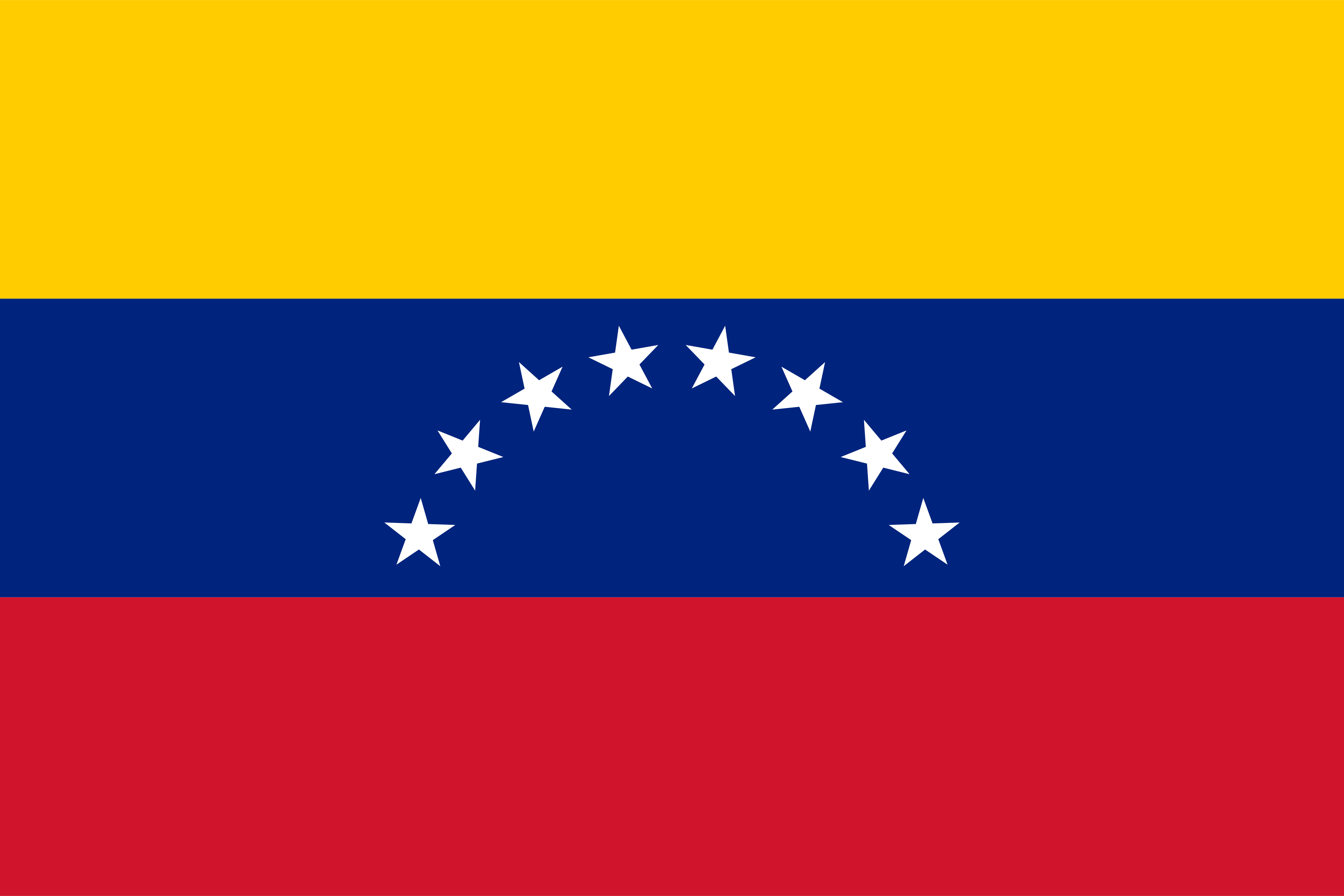
Venezuela flag picture
This drawing uses a 2:3 reference convention. The construction guide distinguishes legal elements from the exact geometry and screen colors chosen for these files. The arms version is also included.
| Country | Bolivarian Republic of VenezuelaBandera Nacional; the national tricolor. |
|---|---|
| Current law | March 9, 2006Official Gazette No. 38.394; effective on publication. |
| Earlier tradition | 1806 · 1811 · 1817Miranda; First Republic; Bolívar’s eighth-star decree. |
| Design | 3 equal bands · 8 white starsYellow, blue, red; upward-convex circular star arc. |
| Versions | With and without armsArms required for specified official uses; merchant flag without arms. |
| Flag Day | August 3Commemorates the 1806 raising at La Vela de Coro. |
| Reference proportions | Height:length = 2:3An editorial convention; the law specifies equal band heights. |
| Working palette | #FFCC00 · #00247D · #CF142B · #FFFFFFScreen references, not statutory color codes. |
Source notes separate cultural explanations, legal evidence and the original drawing’s reproduction choices.
What does the Venezuela flag look like?
Venezuela’s current national flag has three equal horizontal bands of yellow, blue and red, with eight white five-pointed stars forming an upward-convex arc in the blue band. The 2006 law requires the national arms near the hoist in the yellow band for specified official uses. The merchant version has no arms.
This guide follows the 2006 symbols law, the 2016 display resolution and identified historical sources. It separates legal requirements from the 2:3 drawing convention, numerical star geometry and screen colors chosen for these downloads. Both flag versions are supplied, together with detailed arms artwork, annotated diagrams and notes explaining conflicting dates, historical star counts and the limits of the available specifications.
Sources: Official Gazette 38.394 — national symbols law, March 9, 2006 · Official Gazette 41.019 — Resolution No. 143, October 28, 2016 · Foreign Ministry — explanation of the national flag (2026 page)
What is Venezuela’s national flag called?
Venezuela’s national flag is called the Bandera Nacional in Spanish and is often described as the tricolor. It represents the Bolivarian Republic of Venezuela. Its defining features are three equal horizontal bands of yellow, blue and red, with eight white five-pointed stars arranged in an upward-curving arc.
Tricolor describes the three bands; it does not exclude the white stars or the additional colors in the coat of arms. Bandera Nacional is the legal wording used in the 2006 symbols law. Pabellón nacional also occurs in Spanish discussion of the national flag, but a caption should still identify the particular version being shown.
For a museum label, classroom handout or image library, include both the date and the variant. “Venezuela, current eight-star flag without arms” is more informative than simply “Venezuelan flag.” This matters because seven-star historical designs and the present version bearing the national arms can otherwise be mistaken for errors in one another.
Sources: Official Gazette 38.394 — national symbols law, March 9, 2006 · Ministry of Culture — Día de la Bandera Nacional
What are the Venezuela flag colors and HEX codes?
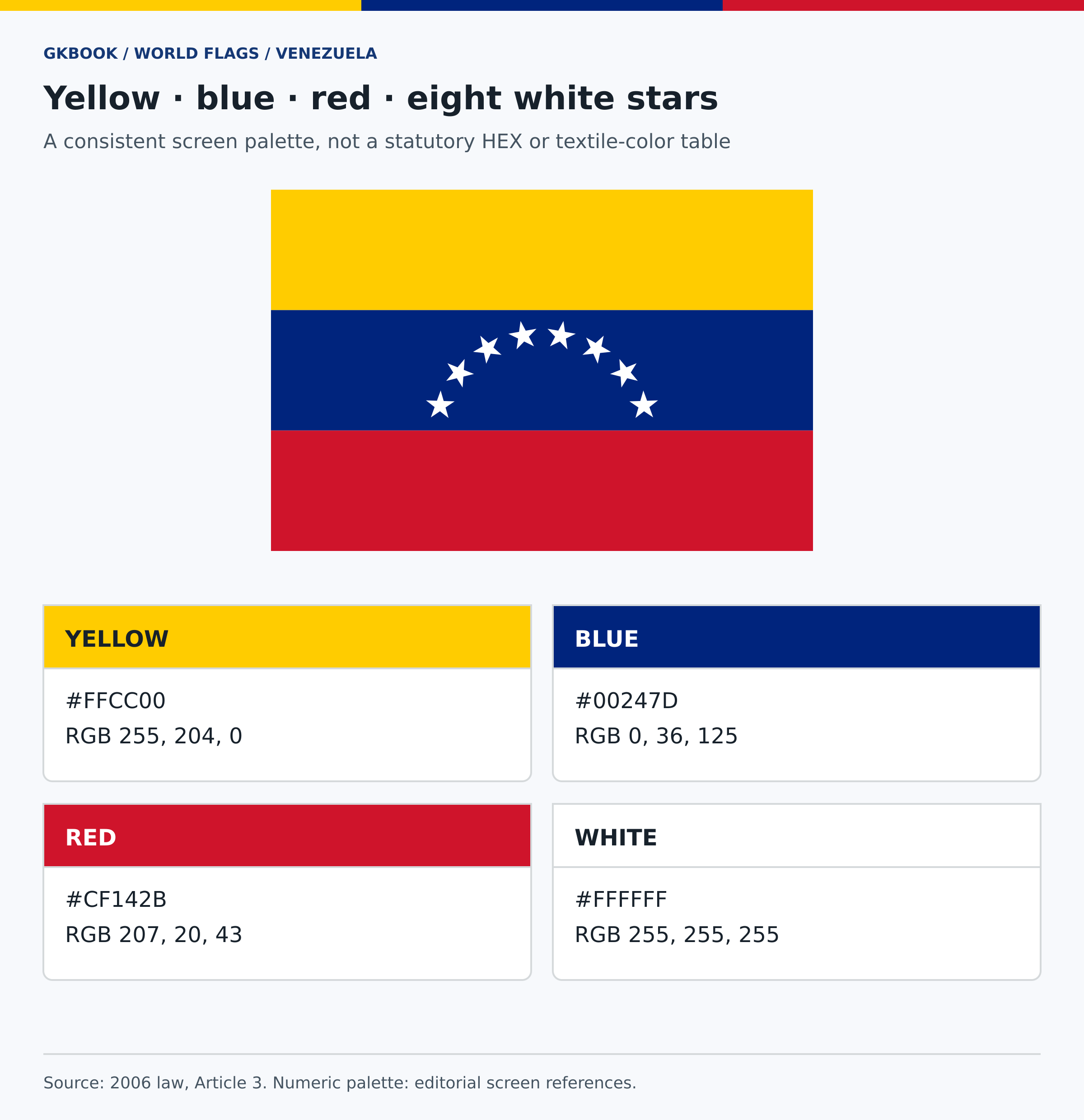
The bands are yellow at the top, blue in the middle and red at the bottom; the eight stars are white. This artwork uses #FFCC00, #00247D, #CF142B and #FFFFFF. These are declared screen references, not color codes prescribed by the 2006 flag law or certified textile specifications.

Article 3 names the colors and requires equal horizontal bands, but it supplies no HEX, RGB, CMYK or Pantone table. The four values below make the downloadable artwork internally consistent. They should not be promoted as a legally authenticated national palette merely because similar values appear in familiar online flag drawings or reference collections.
The coat of arms includes additional colors, shading and very small details inherited from the credited reference artwork. Its miniature flags are part of that illustration, rather than a separate digital palette standard. For printed cloth or paper, use the supplier’s color-managed process and inspect a physical proof before treating a screen preview as a production match.
| Element | HEX | RGB |
|---|---|---|
| Yellow band | #FFCC00 | 255, 204, 0 |
| Blue band | #00247D | 0, 36, 125 |
| Red band | #CF142B | 207, 20, 43 |
| White stars | #FFFFFF | 255, 255, 255 |
Sources: Official Gazette 38.394 — national symbols law, March 9, 2006 · Foreign Ministry — explanation of the national flag (2026 page) · Drawing method and calculations
What do the colors of Venezuela’s flag mean?
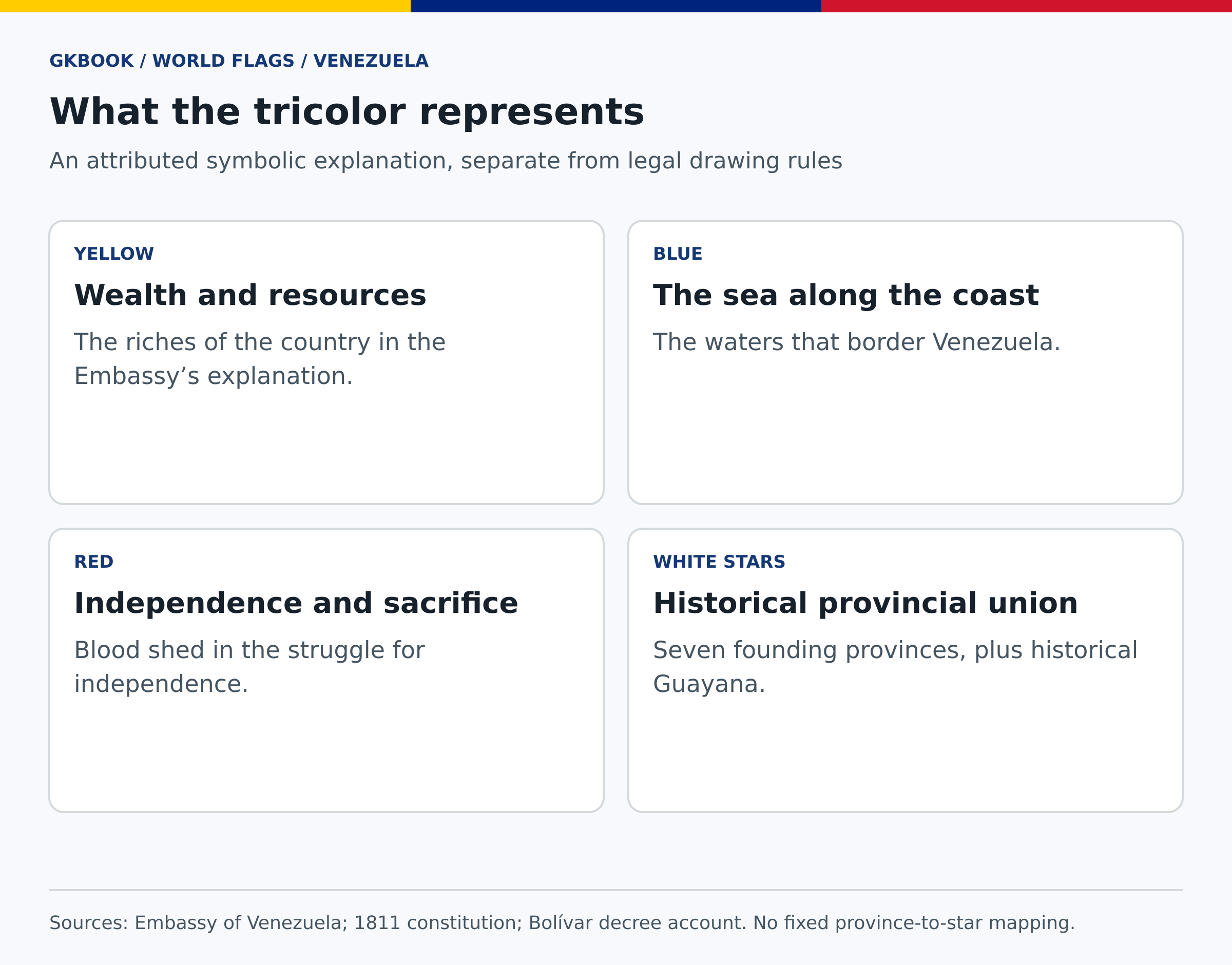
A familiar official explanation associates yellow with the country’s wealth, blue with the sea along its coasts, and red with the blood shed in the struggle for independence. These meanings explain the tricolor’s symbolism. They are separate from the legal instructions specifying the bands, white stars and official-use coat of arms.

The Embassy of Venezuela in Poland gives this interpretation in its account of national symbols. Symbolic explanations help readers remember a design, but they do not change the order or size of its bands. Yellow remains the upper third even when an author describes its meaning using different words such as riches or natural resources.
No extra emblem should be drawn into a band to illustrate its meaning on the clean flag. The explanatory graphic therefore places its labels outside a complete flag reference. It also avoids presenting an appealing story about the designer’s personal inspiration as a documented fact when the inspected sources do not establish that story.
Sources: Embassy of Venezuela in Poland — national symbols overview · Official Gazette 38.394 — national symbols law, March 9, 2006 · Drawing method and calculations
How many stars are on the Venezuela flag?
The current national flag has eight white five-pointed stars in the blue band. They form an arc that is convex upward, with the middle stars higher than the stars at the ends. The current count comes from the 2006 law; a seven-star flag belongs to an earlier national design.
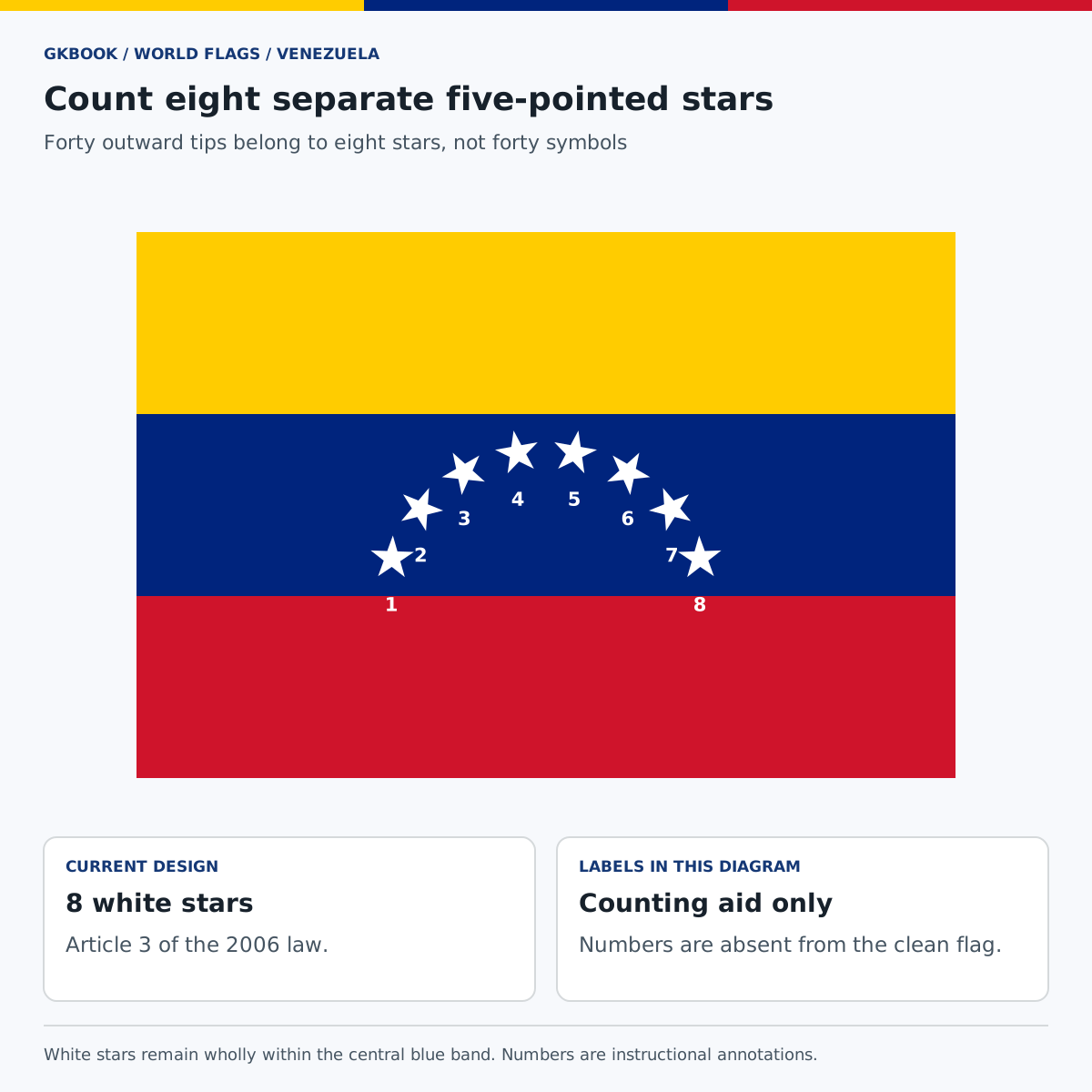
Count the separate white shapes, not their individual points. Every star has five outward tips, so the full group contains forty tips but only eight stars. A five-pointed star can be rotated while remaining five-pointed; star count, arrangement and orientation are different properties that should be checked separately when reviewing a drawing.
The stars in this reference are equal in size and distributed symmetrically about the vertical centerline. Their outward points follow the arc’s radial directions. The law establishes the count, color, five-point form and upward-convex circular arrangement, while the exact spacing, size and rotations used here are disclosed as drawing choices rather than additional statutory measurements.
Sources: Official Gazette 38.394 — national symbols law, March 9, 2006 · Drawing method and calculations
Which provinces do Venezuela’s stars represent?
The seven traditional provinces are Caracas, Cumaná, Barcelona, Barinas, Margarita, Mérida and Trujillo. The eighth star commemorates the historical province of Guayana and Bolívar’s 1817 decree. The stars should therefore not be explained as eight provinces that all declared independence together in 1811, or as a count of Venezuela’s present states.
The preamble to the 1811 federal constitution names the seven provinces represented in that founding union. This provides a firmer basis for the list than a modern caption that compresses different historical events into one sentence. Spelling accents are retained here, while the order of the names is not intended to assign a province to each visible star.
Guayana in the eighth-star explanation is a historical province. It should not be silently substituted with the name of the modern country Guyana or used to imply a settled contemporary international boundary. The diagram uses a written historical list, avoiding a modern territorial map that would require a different set of geographic and political qualifications.
| Group | Names or meaning |
|---|---|
| Seven founding provinces | Caracas; Cumaná; Barcelona; Barinas; Margarita; Mérida; Trujillo |
| Eighth star | Historical province of Guayana; Bolívar’s decree of November 20, 1817 |
| No fixed position map | No province-to-star-position assignment is made in this guide |
Sources: Biblioteca Virtual Miguel de Cervantes — 1811 federal constitution · Ministry of Education — March commemorations · Embassy of Venezuela — November 20, 1817 eighth-star decree account
Why was an eighth star added to Venezuela’s flag?
The eighth star recalls Simón Bolívar’s decree of November 20, 1817, which called for an additional star for the province of Guayana. The present eight-star design was established by the law published on March 9, 2006. These are related historical and modern legal events, separated by nearly two centuries.

The Embassy’s account reproduces the substance of Bolívar’s decree: the addition recognized Guayana’s incorporation into the republic. That is a more precise explanation than saying an eighth star was simply invented in 2006. The historical decree explains the commemorative rationale; the modern law establishes the design applicable to the present national flag.
The eighth star is the same color and size as its companions in the supplied reference. No highlighted, oversized or differently colored star identifies Guayana on the flag itself. A teaching diagram can explain the seven-plus-one history in accompanying text, but such annotation must not be confused with an extra graphic feature of the national design.
Sources: Embassy of Venezuela — November 20, 1817 eighth-star decree account · Official Gazette 38.394 — national symbols law, March 9, 2006 · Drawing method and calculations
How are the eight stars arranged?
The stars occupy the center of the blue band in a circular arc that bulges upward. The law does not provide a numerical arc radius, star size or rotation table. This reference uses eight equally spaced centers on a 180-unit radius, with radial star orientations, inside a 900 × 600 drawing.

On this grid the arc center is at (450, 420), with star centers at angles from −160° to −20° in 20° steps. Coordinates begin at the upper-left corner, and the vertical coordinate increases downward. The circle center is a construction point below the blue band, not a ninth star or a visible element of the flag.
Each star’s outer radius is 25 units. Its outer point on the radial direction faces away from the arc center, producing the familiar fan-like arrangement. These choices keep every white shape inside the blue band. They make this package reproducible, but they should not be quoted elsewhere as measurements stated in Article 3.
Sources: Official Gazette 38.394 — national symbols law, March 9, 2006 · Foreign Ministry — explanation of the national flag (2026 page) · Drawing method and calculations
What are the proportions of Venezuela’s flag?
A 2:3 height-to-length ratio is a common reference convention and is used in this package. The 2006 law specifies three equal horizontal bands but does not state an overall numerical ratio. Here the native canvas is 900 units long and 600 high, making each band exactly 200 units high.

The distinction between equal band heights and the rectangle’s outer dimensions is important. Equal thirds are explicit in Article 3; a 2:3 rectangle is the declared implementation chosen for these files. The Foreign Ministry’s explanatory page also acknowledges that the legislation does not fix the overall proportions or every numerical detail of the star arc.
The clean PNG files measure 9,000 × 6,000 pixels, with dimensions written width first. Enlarging either version uniformly preserves the chosen rectangle, the equal bands and the relative position of every star. Stretching a flag to fill an arbitrary banner frame changes those relationships, even when the colors and number of stars remain recognizable.
Sources: Official Gazette 38.394 — national symbols law, March 9, 2006 · Foreign Ministry — explanation of the national flag (2026 page) · Wikimedia Commons — Flag of Venezuela.svg reference metadata · Drawing method and calculations
How is the downloadable flag constructed?
The drawing begins with a 900 × 600 rectangle divided into three 200-unit bands. Eight regular five-pointed white stars follow the declared circular arc in the blue band. The official-use version adds the credited coat of arms near the hoist in the yellow band. Exact coordinates and source provenance accompany the files.

A regular star is built from alternating outer and inner vertices. For these drawings the inner radius equals the outer radius multiplied by (3 − √5) / 2, approximately 0.381966. This is a geometric construction of a regular pentagram, not a separate formula quoted from Venezuelan legislation. The finished clean artwork contains no measurement lines or labels.
The arms are positioned inside a 156 × 174-unit viewport beginning at (28, 12). Their original aspect ratio is preserved within that box. Those placement numbers are editorial, while yellow-band placement near the hoist is the legal requirement. The source drawing is retained with its attribution and checksum so that its detailed appearance can be traced and rebuilt.
| Item | Value |
|---|---|
| Canvas; bands | 900 × 600; three bands of 200 units |
| Arc center; radius | (450, 420); 180 units |
| Star-center angles | −160°, −140°, −120°, −100°, −80°, −60°, −40°, −20° |
| Star radii | Outer 25; inner 25(3 − √5)/2 ≈ 9.549150 |
| Arms viewport | x=28; y=12; width=156; height=174; aspect ratio preserved |
Sources: Official Gazette 38.394 — national symbols law, March 9, 2006 · Wikimedia Commons — Coat of arms of Venezuela.svg · Drawing method and calculations
Why do some Venezuelan flags have a coat of arms?
The 2006 law requires the arms on flags used by the Presidency, armed forces and national, state and municipal public buildings. It expressly describes the merchant flag without arms. The eight-star version without arms is commonly called the civil flag; the arms version is commonly called the state flag.
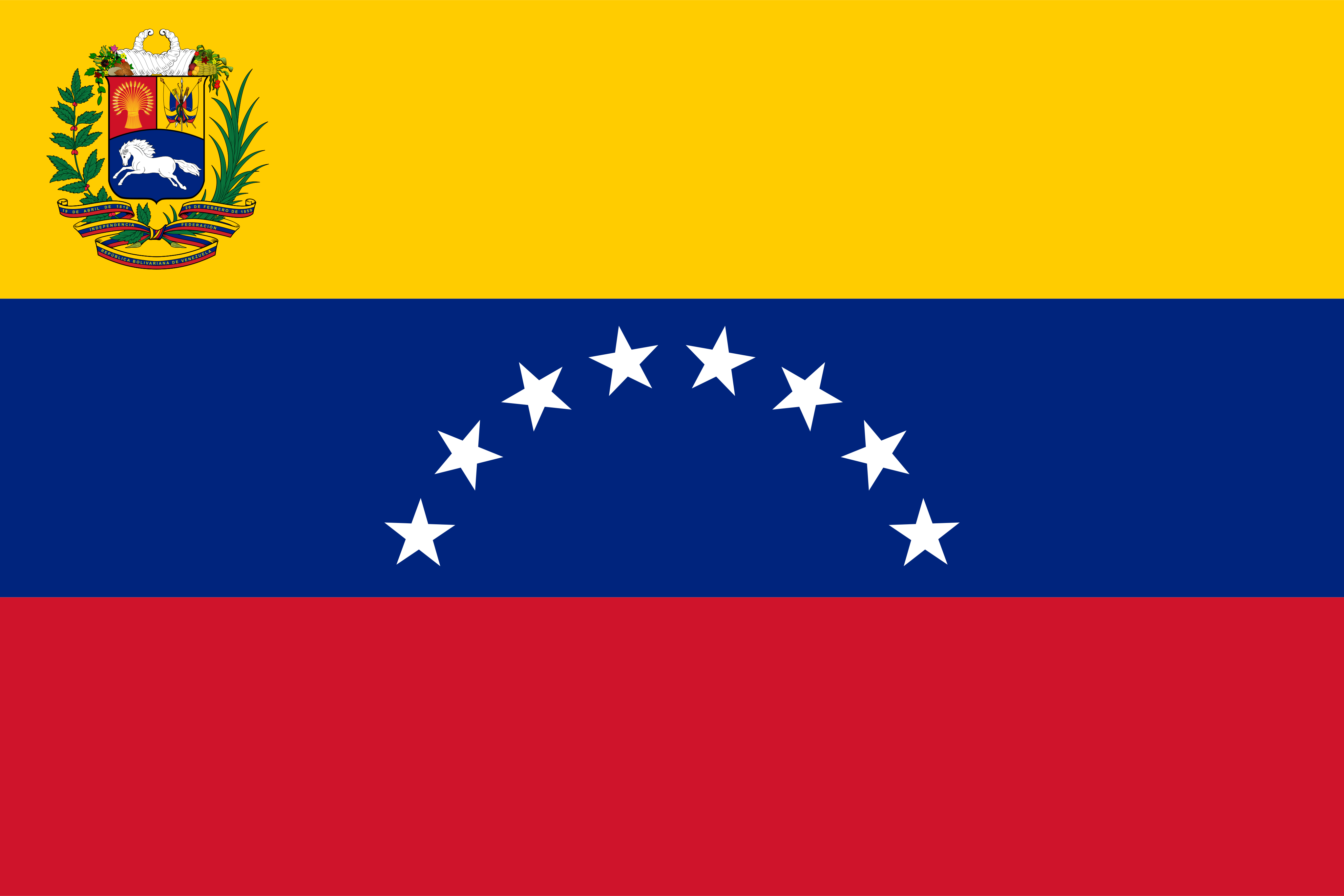
Both versions retain the same three equal bands and eight-star arc. The arms belong in the yellow band near the hoist, which is the edge attached to the pole. They do not replace a star, move the arc or sit in the center of the blue band. The distinction is tied to use, rather than decorative preference.
The download gallery includes a clean master of each version. Choose the appropriate reference for the context being illustrated, and retain the variant name in its caption. A plain national-flag icon can reasonably identify Venezuela in a country list, while an illustration explicitly showing a government building should account for the law’s arms requirement.
Sources: Official Gazette 38.394 — national symbols law, March 9, 2006 · Wikimedia Commons — Flag of Venezuela.svg reference metadata · Drawing method and calculations
What is shown in Venezuela’s coat of arms?
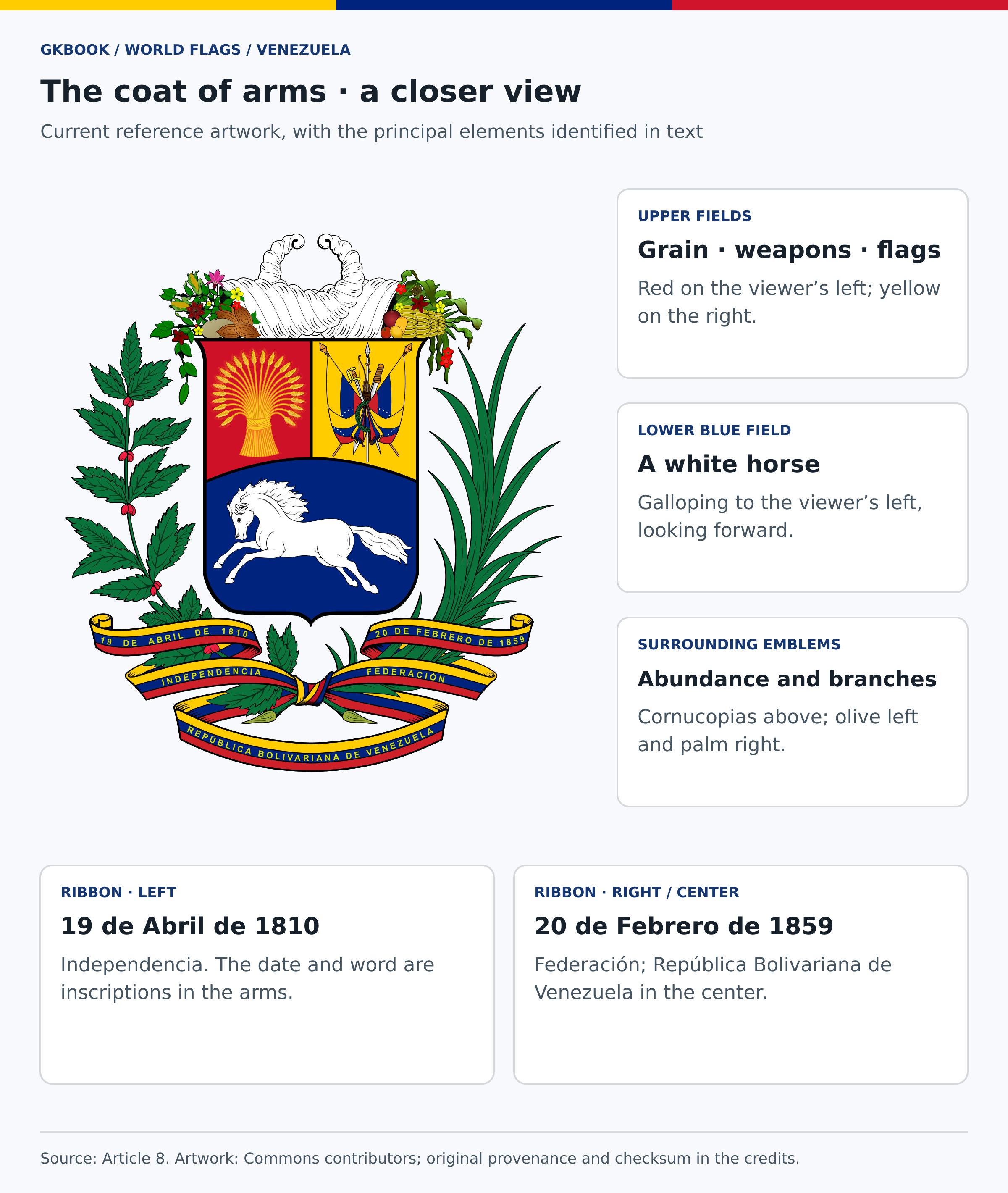
The arms contain a red field with a sheaf of grain, a yellow field with weapons and flags, and a blue lower field with a white horse. Cornucopias, an olive branch, a palm branch and a tricolor ribbon surround the shield. Article 8 describes these elements and the ribbon inscriptions.

Viewed from the front, the red upper field is on the left and the yellow upper field is on the right. The law links the number of grain ears to the number of states; this article does not substitute an unsupported current administrative count. The yellow field contains a sword, lance, bow, arrow in a quiver, machete, two flags and laurel.
The paired cornucopias above the shield express abundance. The side branches are olive on the viewer’s left and palm on the right. Gold lettering on the ribbon records April 19, 1810 and Independence, February 20, 1859 and Federation, and the country’s name. The enlarged reference helps readers see details that become tiny when the arms appear on a flag.
Sources: Official Gazette 38.394 — national symbols law, March 9, 2006 · Foreign Ministry — coat-of-arms description · Wikimedia Commons — Coat of arms of Venezuela.svg
Which way does the horse on Venezuela’s arms face?
The current legal description specifies an untamed white horse galloping toward the viewer’s left and looking forward. It appears in the blue lower field of the arms and symbolizes independence and liberty. Viewer’s left is stated explicitly to avoid confusion with heraldic left, which uses the shield bearer’s perspective.
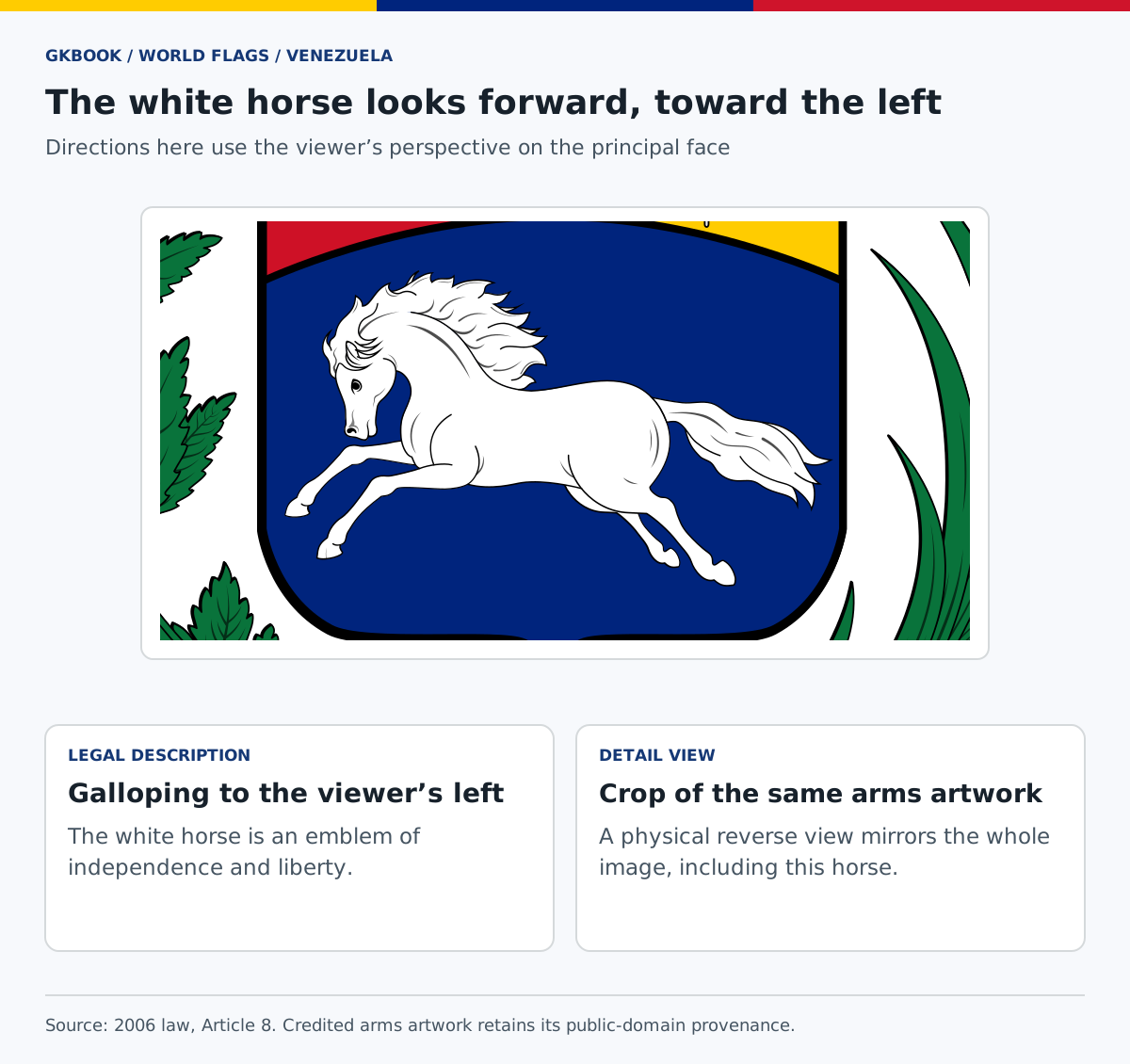
The horse is an element of the arms, so it appears on the official-use flag but not on the clean version without arms. The enlarged illustration is a crop of the credited current arms artwork. It is not a separately generated animal or a replacement crest that would silently alter the surrounding heraldic details.
The legal description concerns the principal face of the arms. When a single piece of printed fabric is viewed through its reverse, the entire image is mirrored, including the horse and lettering. That physical reverse view should not be mistaken for a new national emblem. Production methods for a double-sided flag may require separate decisions by the manufacturer.
Sources: Official Gazette 38.394 — national symbols law, March 9, 2006 · Wikimedia Commons — Coat of arms of Venezuela.svg · Drawing method and calculations
When was the current Venezuelan flag adopted?
The current eight-star specification is in the law published in Official Gazette No. 38.394 on March 9, 2006. The National Assembly’s closing date on the text is March 7, and presidential promulgation is dated March 9. These document dates should be distinguished from the March 12 commemorations sometimes cited in summaries.
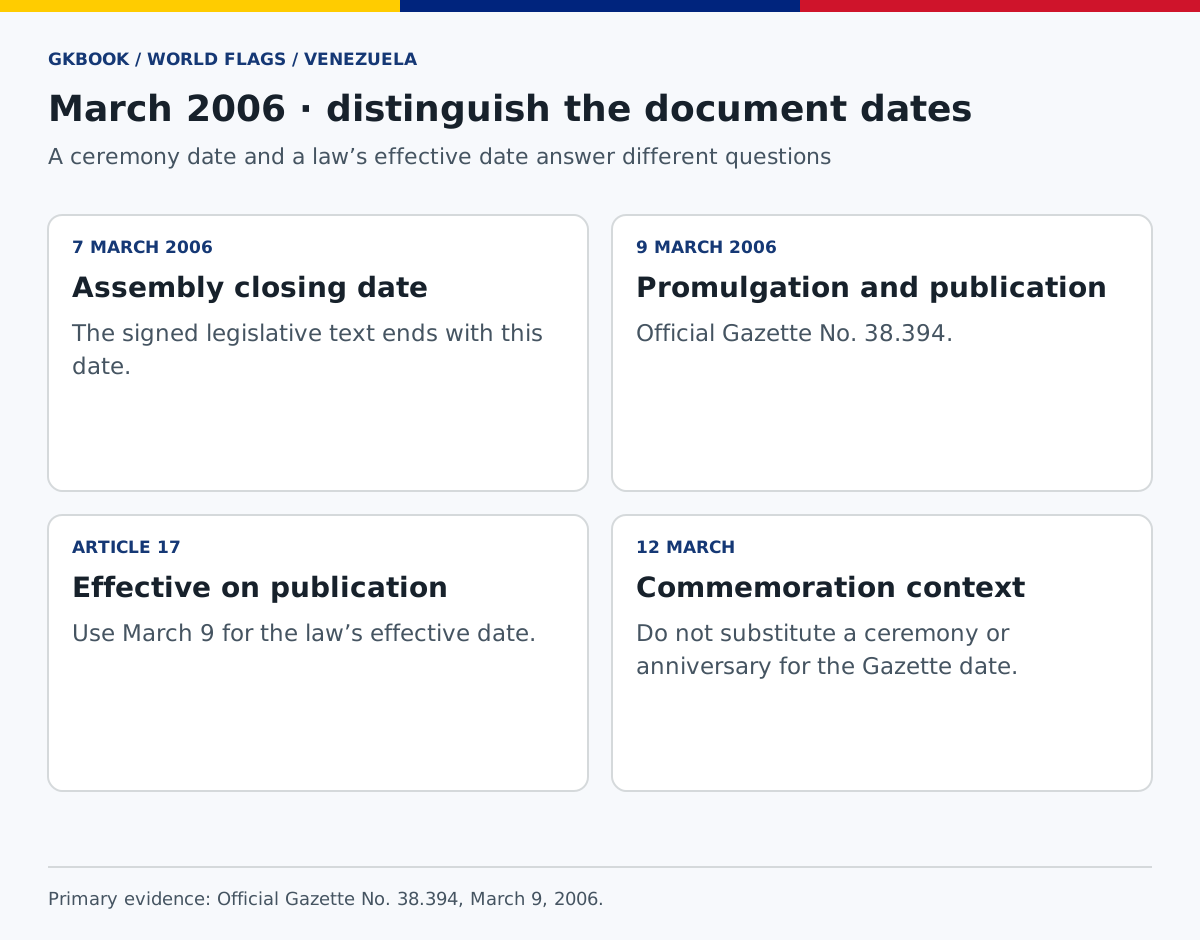
Article 17 makes the law effective upon publication in the Official Gazette. The scanned issue therefore provides a direct basis for the March 9 effective date. A later ceremonial raising can be historically significant without changing when the legal text entered into force. The article uses the date and action together instead of treating all March dates as interchangeable.
The broader tricolor tradition is older: Miranda raised his colors in 1806, and the First Republic adopted a tricolor in 1811. Neither of those statements means the exact current eight-star arrangement and current arms were already in use. A reliable timeline separates the origin of the colors, early national adoption and the present statutory design.
Sources: Official Gazette 38.394 — national symbols law, March 9, 2006 · Foreign Ministry — historical account of the national flag · Ministry of Culture — Día de la Bandera Nacional
How has Venezuela’s flag developed over time?
The main milestones are Miranda’s tricolor in 1806, its adoption by the First Republic in 1811, Bolívar’s eighth-star decree in 1817, later seven-star designs, and the present eight-star law in 2006. These stages explain continuity in the colors alongside changes in stars, emblems and the political setting of the flag.

This is a selective timeline, not a claim that only five designs ever existed. Historical illustrations show changes in star arrangements and arms over the nineteenth and twentieth centuries. Reconstructing every variation would require separate dated evidence for its geometry, so this page uses a documented milestone chart and one clearly labeled seven-versus-eight-star schematic.
The relationship to the wider yellow-blue-red flag family is also historical. Colombia, Ecuador and Venezuela share the tricolor tradition, but each has its own design and use rules. Their modern flags cannot be produced accurately merely by changing the country label on this artwork. The comparison section identifies the most useful visible differences.
Sources: Foreign Ministry — historical account of the national flag · Embassy of Venezuela — November 20, 1817 eighth-star decree account · Official Gazette 38.394 — national symbols law, March 9, 2006 · Wikimedia Commons — Flag of Venezuela.svg reference metadata
What was Francisco de Miranda’s role?
Francisco de Miranda is associated with the yellow-blue-red tricolor from which Venezuela’s flag developed. He raised it aboard the Leander at Jacmel, Haiti, on March 12, 1806, and in Venezuela at La Vela de Coro on August 3. His early flag should not be pictured as the unchanged modern eight-star design.
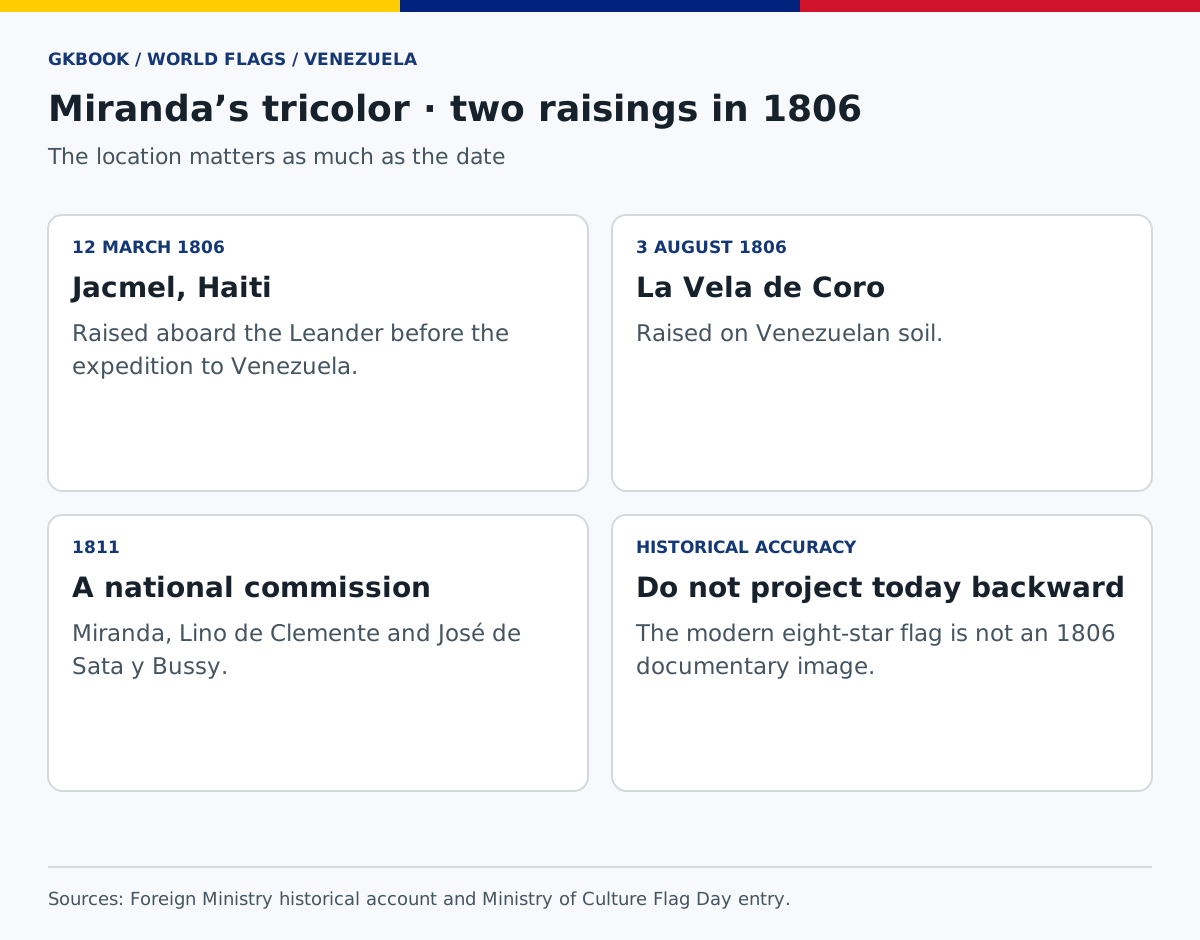
The Foreign Ministry’s historical account places Miranda alongside Lino de Clemente and José de Sata y Bussy on the commission preparing the First Republic’s national standard in 1811. This institutional setting is more precise than attributing every later change to one designer. The committee’s work belongs to the early national adoption, while the current law is a separate event.
The accompanying graphic uses dates, places and text rather than an invented portrait, ship photograph or imagined historical ceremony. It also avoids drawing the current flag onto an 1806 vessel as though such an image were documentary evidence. Modern reference artwork can illustrate today’s design, but historical scenes need their own evidence and labeling.
Sources: Foreign Ministry — historical account of the national flag · Ministry of Culture — Día de la Bandera Nacional
What changed in Venezuela’s flag in 2006?
The 2006 law specifies eight stars instead of the preceding seven-star design and revises the national coat of arms. The current arms include the forward-looking horse galloping toward the viewer’s left. The yellow-blue-red bands remain. The gallery’s seven-versus-eight comparison isolates the star-count change using clearly labeled reference drawings.
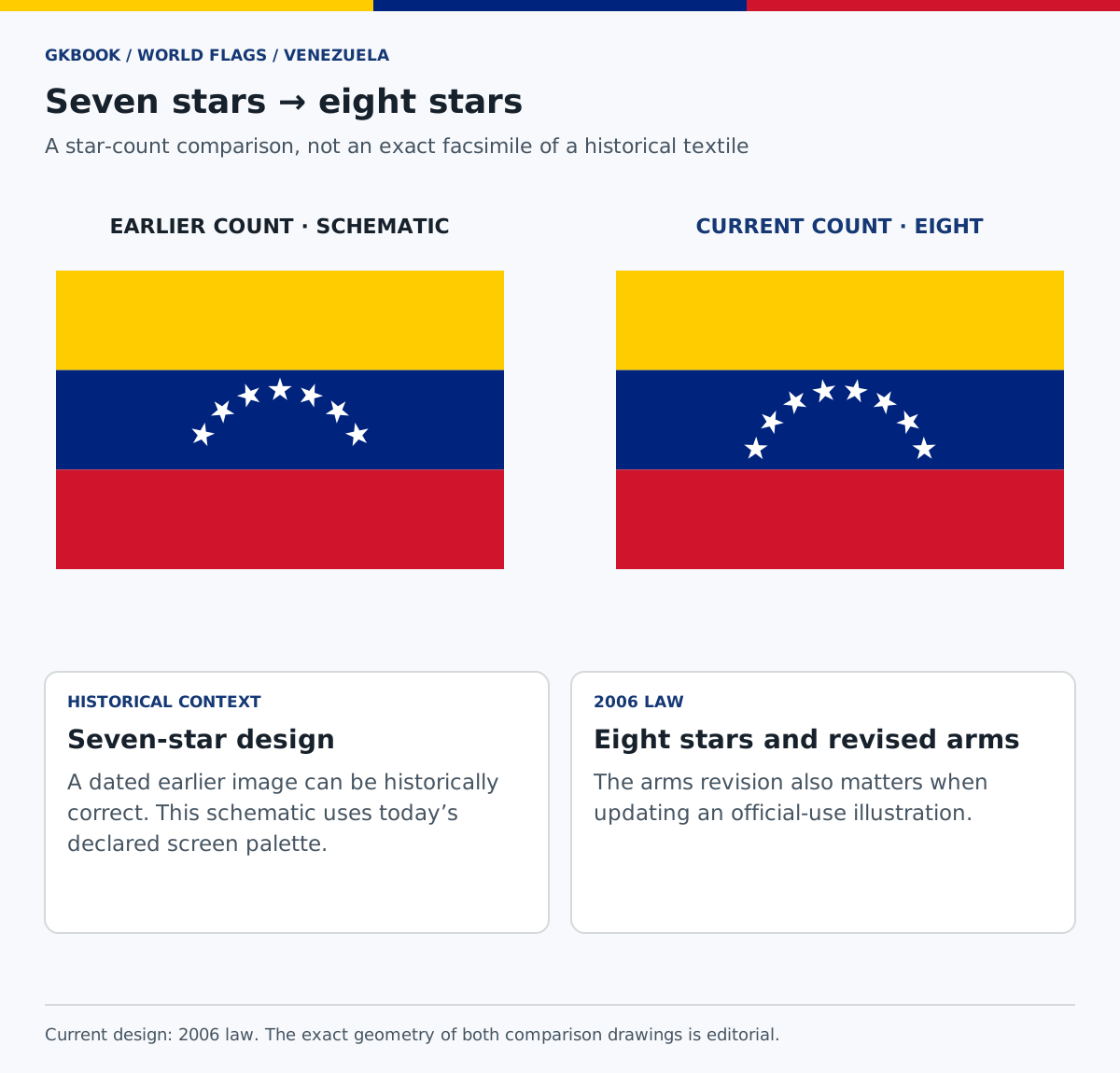
The comparison is deliberately schematic. It uses the same modern screen palette and a declared circular layout on both sides so that readers can count the stars easily. It is not a facsimile of a particular pre-2006 textile, nor does it claim that all historical versions used exactly the same star size, spacing or pigment values.
The arms revision also matters when evaluating an official-use flag. Adding an eighth star to an old image while retaining an outdated coat of arms can create a hybrid illustration. The supplied state reference uses the current credited arms artwork. For archival material, preserve the original image and explain its date instead of retouching historical evidence into the current design.
Sources: Official Gazette 38.394 — national symbols law, March 9, 2006 · Embassy of Venezuela — November 20, 1817 eighth-star decree account · Wikimedia Commons — Coat of arms of Venezuela.svg · Drawing method and calculations
When is Venezuela’s Flag Day?
Venezuela observes National Flag Day on August 3. The date commemorates Miranda’s raising of the tricolor at La Vela de Coro on August 3, 1806, and was established as the observance in 2006. March 12 recalls the earlier raising aboard the Leander in Haiti and was the previous commemorative date.
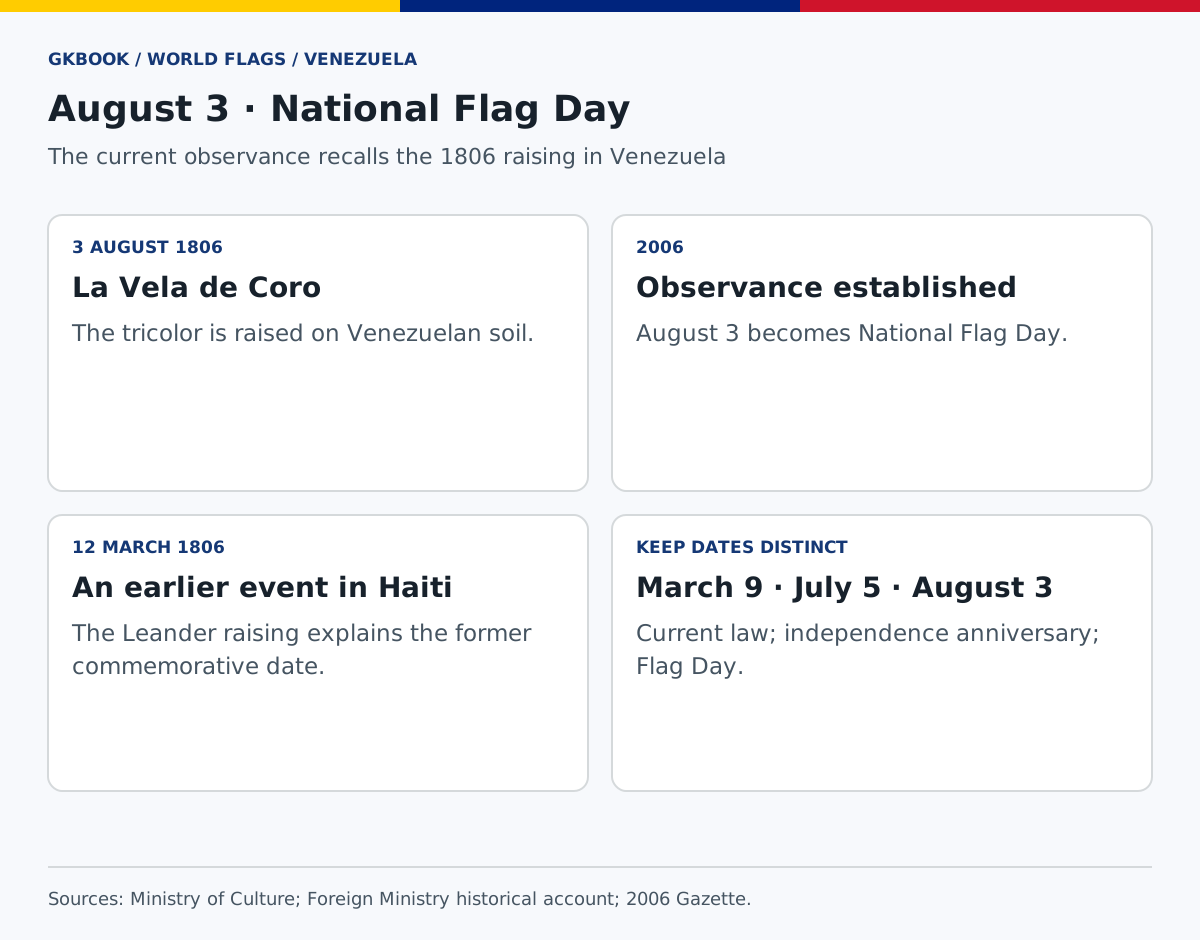
The Ministry of Culture lists August 3 as Día de la Bandera Nacional, and the Foreign Ministry explains the 2006 change of observance. These accounts distinguish the first raising in Venezuela from the earlier maritime event. Both dates belong in a history lesson, but they answer different questions about where and when the tricolor appeared.
Flag Day is also distinct from the law’s effective date of March 9, 2006 and Independence Day on July 5. An anniversary label should say which event it commemorates. This article does not infer a universal paid holiday, school closure or business closure from the existence of a national commemorative date; those are separate scheduling questions.
Sources: Ministry of Culture — Día de la Bandera Nacional · Foreign Ministry — historical account of the national flag · Official Gazette 38.394 — national symbols law, March 9, 2006
Which legal sources define the flag and its use?
The central design source is the 2006 Law on the National Flag, National Anthem and Coat of Arms, published in Gazette No. 38.394. Article 3 describes the flag and Article 8 the arms. Resolution No. 143, published in Gazette No. 41.019 in 2016, supplies additional rules for specified display settings.

The original Gazette scans were checked for the relevant provisions. The 2016 resolution addresses government bodies, educational institutions and other named facilities, rather than supplying a universal construction manual. Its requirement that a flag’s size suit the pole and building does not establish a numerical aspect ratio or a precise star-coordinate table.
The source notes identify archive mirrors, official explanatory pages and access limitations separately. English descriptions here are editorial paraphrases of Spanish texts, not official translations. A design reference can explain the applicable passages, but a specific ceremony still needs its institution’s instructions and any event notice that determines the place, dates and participants involved.
Sources: Official Gazette 38.394 — national symbols law, March 9, 2006 · Official Gazette 41.019 — Resolution No. 143, October 28, 2016 · Foreign Ministry — explanation of the national flag (2026 page)
How should Venezuela’s flag be displayed?
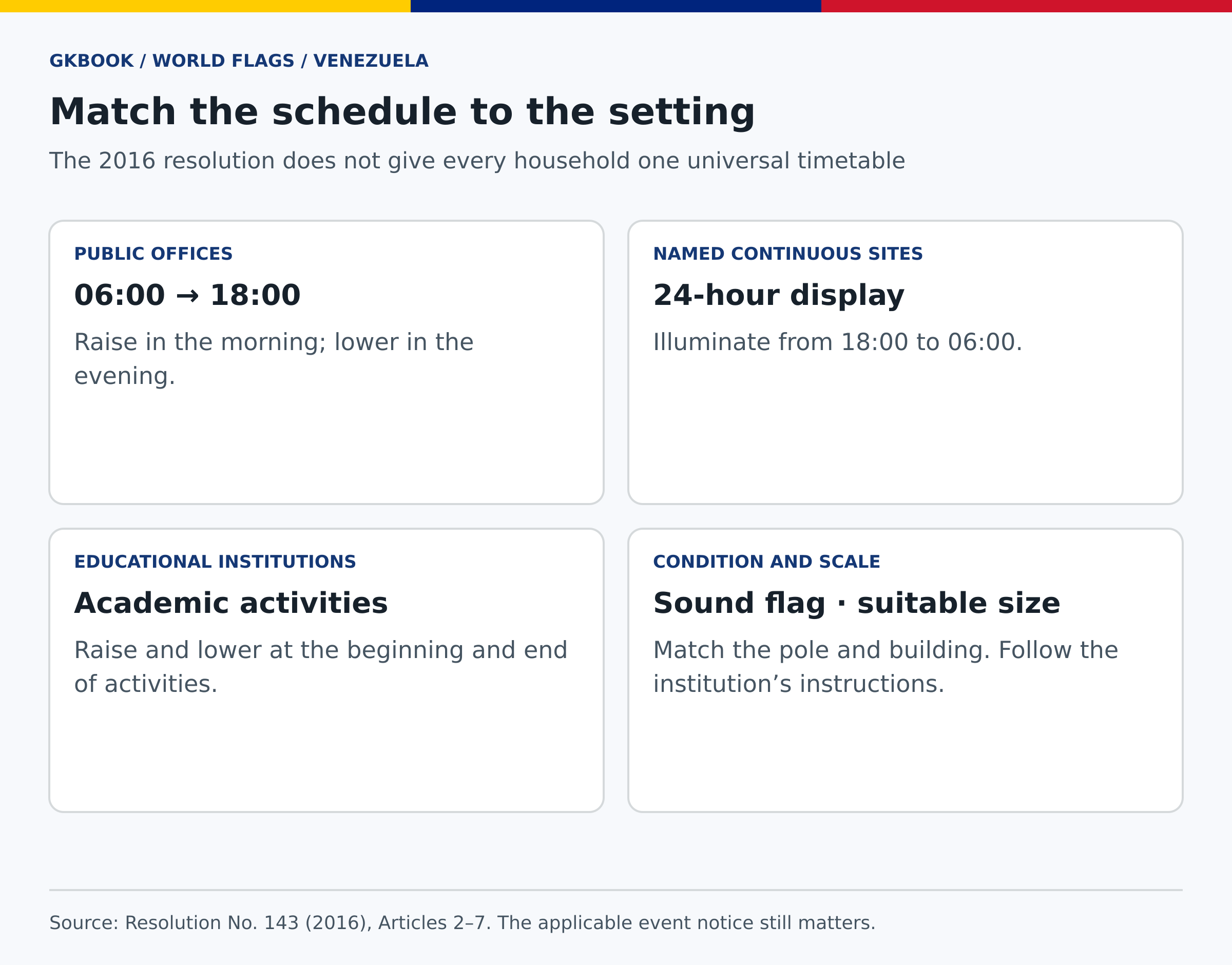
The 2006 law identifies official uses, provides for display on national holidays and permits daily display. The 2016 resolution sets schedules for specified public settings: public offices generally raise it at 06:00 and lower it at 18:00, while certain continuously displaying facilities must illuminate it overnight. School timing follows academic activities.

Article 3 of the 2016 resolution distinguishes public offices from principal roads, transit terminals and mission centers, where display continues around the clock with lighting between 18:00 and 06:00. Article 4 addresses schools at the beginning and end of academic activities. These distinctions should not be compressed into a single rule governing every private household.
The resolution also requires good condition and a size appropriate to the pole and building, and prohibits use as a decorative element within its scope. The 2006 law calls for respectful behavior at raising, lowering and public anthem ceremonies, subject to special rules. Keep the flag’s complete design legible and follow the actual instructions for the setting.
| Setting or topic | Provision |
|---|---|
| Public offices | Raise at 06:00; lower at 18:00 |
| Named continuous-display facilities | 24-hour display; illuminate from 18:00 to 06:00 |
| Educational institutions | Beginning and end of academic activities |
| Condition and size | Good condition; size proportionate to pole and building |
Sources: Official Gazette 38.394 — national symbols law, March 9, 2006 · Official Gazette 41.019 — Resolution No. 143, October 28, 2016
How is Venezuela’s flag displayed during official mourning?
Article 5 of the 2016 resolution directs that the flag first be raised to full height and then lowered to half-mast during officially decreed national, state or municipal mourning. The applicable announcement determines the period. The illustration shows this two-stage action and does not claim a numerical pole-position formula or announce current mourning.

The drawing uses the arms version because its example concerns an official public setting. A downward arrow explains the movement after the initial raising; it does not indicate that the flag is inverted. Yellow remains above blue and red throughout. The lower flag position is illustrative, with no additional measurement attributed to the resolution.
An official Foreign Ministry report from April 2025 describes a defined three-day mourning period following Pope Francis’s death. That is a historical example of an announcement specifying dates, not an instruction still in effect. Before applying the mourning procedure to a real event, identify the relevant order and whether its geographic and institutional scope includes that display.
Sources: Official Gazette 41.019 — Resolution No. 143, October 28, 2016 · Foreign Ministry — April 2025 mourning notice reported in Bolivia · Drawing method and calculations
Which way up should the Venezuelan flag be?
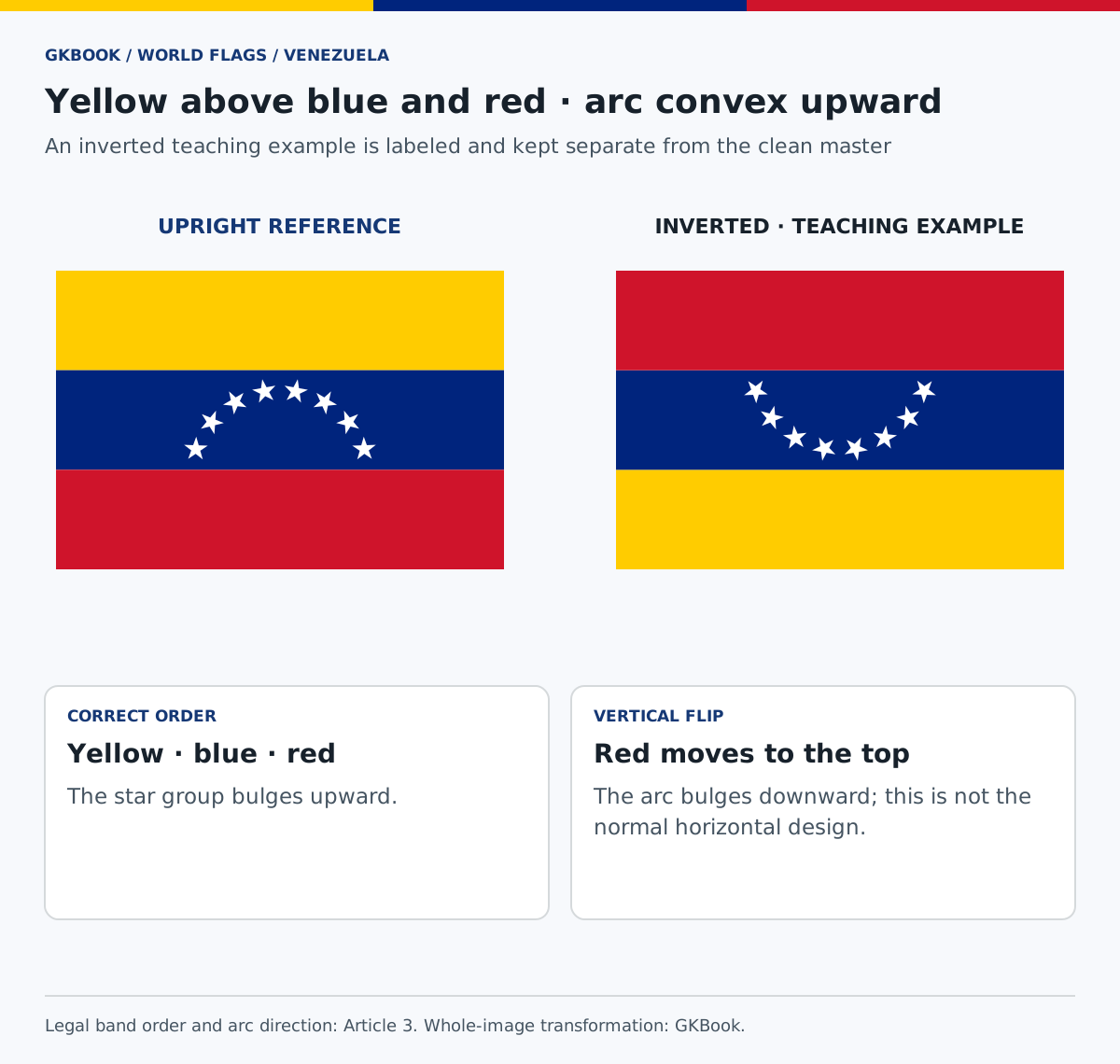
In the standard horizontal view, yellow is above blue and red, and the star arc bulges upward. On the principal face of the arms version, the coat of arms is near the hoist in the yellow band. A vertically flipped image reverses the band order and turns the arc downward.
The hoist is the attachment edge, while the fly is the free edge. In a conventional front-view drawing with the hoist on the viewer’s left, the arms are in the upper-left part of the yellow band. The law describes the position relative to the hoist, which remains the useful reference when a real flag is mounted.
The comparison graphic labels its inverted example clearly so that it cannot be mistaken for a second valid master. The correct artwork is available separately without teaching labels. When checking a small icon, inspect both the bands and the arc: a recognizable tricolor alone does not establish that the star arrangement has been reproduced correctly.
Sources: Official Gazette 38.394 — national symbols law, March 9, 2006 · Drawing method and calculations
What does the reverse of Venezuela’s flag look like?
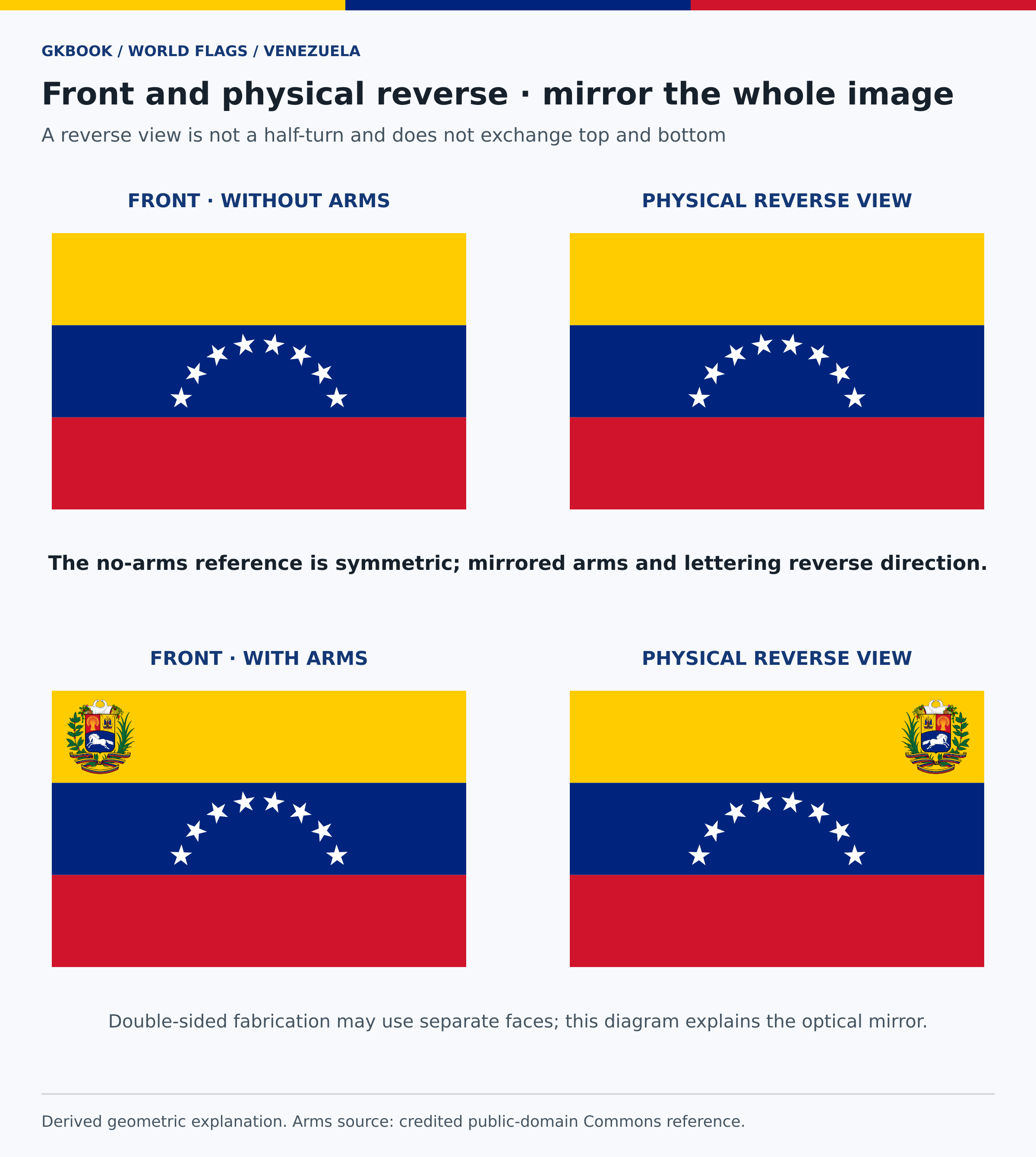
A physical reverse view mirrors the flag from left to right while keeping yellow at the top. The symmetrical no-arms reference therefore looks the same. On a mirrored arms flag, the arms move to the viewer’s right and their horse and lettering are reversed. This is a viewing effect, not a different legal design.

The diagram mirrors the whole supplied reference, rather than moving only the shield while leaving its internal details unchanged. That makes the optical explanation consistent. The two outer stars exchange places, but the symmetric radial arrangement of the group preserves the appearance of the version without arms when viewed from the other side.
A manufactured double-sided flag can use a lining or separate printed faces, so its production artwork may not behave like ink seen through a single layer. The inspected law does not provide a complete fabrication specification for that process. The reverse-view diagram is therefore an explanation of geometry, not an assertion that every physical flag must be manufactured identically.
Sources: Official Gazette 38.394 — national symbols law, March 9, 2006 · Drawing method and calculations
Can Venezuela’s flag be shown vertically?
The law describes a flag with horizontal bands; the inspected national sources do not establish a complete numerical template for every vertical installation. For a narrow page or poster, a reliable option is to preserve the complete horizontal reference inside the portrait layout. A rotated graphic should not be presented as verified official hanging protocol.
A quarter-turn moves the bands and turns the star arc and any coat of arms with the rectangle. Rotating only the background while independently resetting the stars or arms creates a new composition that cannot be justified by the ordinary horizontal drawing alone. A portrait-shaped space does not itself authorize changing the national design.
For an actual building display or ceremony, obtain the applicable institutional arrangement rather than borrowing another country’s vertical-flag convention. The downloads provide the complete horizontal versions and enough surrounding explanatory material to use them in portrait documents without cropping. This keeps the educational illustration accurate while leaving installation-specific decisions with the relevant protocol authority.
Sources: Official Gazette 38.394 — national symbols law, March 9, 2006 · Official Gazette 41.019 — Resolution No. 143, October 28, 2016 · Drawing method and calculations
How does Venezuela’s flag differ from Colombia’s and Ecuador’s?
Venezuela has three equal bands and an eight-star arc. Colombia’s yellow band occupies half the flag’s height, with blue and red each occupying a quarter. Ecuador also uses a double-height yellow band, and its familiar official flag bears central arms. Shared colors therefore do not make the three national designs interchangeable.

The comparison uses each country’s official descriptions for the relevant visible features. It does not attempt to cover every civil, state, naval or historical variant of Colombia and Ecuador. In particular, the presence or absence of an emblem should be interpreted in the context of that country’s own rules, rather than copied from Venezuela’s distinction between flag versions.
For quick identification, first compare the band heights, then inspect the center for stars or arms. An eight-star arc in a blue band is a strong identifying feature of Venezuela’s current national flag. The graphic gives a written comparison so that an unverified companion-country vector is not accidentally supplied as an authoritative downloadable national flag.
| Country | Bands | Central or official emblem |
|---|---|---|
| Venezuela | Three equal thirds | Eight white stars; arms near hoist for specified official uses |
| Colombia | Yellow half; blue and red quarters | No Venezuelan eight-star arc |
| Ecuador | Yellow half; blue and red quarters | Central arms in the familiar official version |
Sources: Official Gazette 38.394 — national symbols law, March 9, 2006 · Colombia Foreign Ministry — Circular 36 of 2021, national-symbol guidance · Presidency of Ecuador — national flag commemoration
Is a seven-star Venezuelan flag always a mistake?
A seven-star design is historically meaningful and can be correct in a dated pre-2006 context. It does not match the current eight-star specification in the 2006 law. The appropriate caption depends on whether an image documents an earlier period, illustrates today’s national flag, or records another explicitly identified use.
An archive photograph should retain the flag that was actually present when the image was made. Updating its star count would alter historical evidence. Likewise, a collection of historical flags needs labels that identify dates and variants, rather than a blanket rule that every image must display the current design regardless of its subject.
Conversely, a newly created country-reference page should not accidentally use a seven-star stock image under a caption saying “current national flag.” This package supplies an eight-star clean master and a separately labeled seven-star teaching schematic. The schematic is useful for understanding the 2006 change, but it is not offered as a precise facsimile of every earlier flag.
Sources: Official Gazette 38.394 — national symbols law, March 9, 2006 · Wikimedia Commons — Flag of Venezuela.svg reference metadata · Drawing method and calculations
What is the Venezuela flag emoji?
The Venezuela flag emoji is 🇻🇪. Its underlying sequence combines the regional indicator symbols V and E, encoded as U+1F1FB and U+1F1EA. A platform may display a flag graphic, letters or another fallback. Emoji artwork is a platform rendering and should not be used as a precise national-flag construction drawing.
The Unicode reference identifies the country sequence; it does not prescribe a vendor’s exact pixels, star geometry or treatment of the coat of arms. At small sizes the details may be simplified or difficult to count. Text remains useful alongside the symbol, especially for accessibility, search results and interfaces where the flag glyph might not render.
For an article illustration, use the supplied SVG or PNG with descriptive alternative text instead of enlarging an emoji screenshot. The source files give a complete and traceable reference, while the emoji remains convenient in ordinary text. Neither a missing glyph nor a different vendor appearance means that Venezuela has changed its official flag.
Sources: Unicode — Full Emoji List, version 16.0 · Drawing method and calculations
How large can the flag PNG files be printed?
Each clean flag PNG is 9,000 × 6,000 pixels, or 54 million pixels. At 300 pixels per inch, that corresponds to 30 × 20 inches, approximately 76.2 × 50.8 centimeters. The SVG versions scale without a fixed pixel limit. These calculations describe image resolution, not a guarantee of color or manufacturing quality.

At 150 pixels per inch, the same PNG corresponds to 60 × 40 inches. The appropriate density depends on viewing distance and production method, particularly for large fabric flags. Keep the chosen 2:3 reference proportion, allow for the manufacturer’s finishing requirements, and avoid trimming the star arc or coat of arms to fit an unrelated image frame.
The arms contain fine lines and lettering that need more care than the three bands and stars. Use the vector source when the print workflow supports it, and inspect a proof at the intended final size. The package declares its screen palette and arms provenance, but it does not supply certified ink recipes or authorize any particular use of national symbols.
| Density | Inches | Centimeters |
|---|---|---|
| 300 PPI | 30 × 20 | 76.2 × 50.8 |
| 150 PPI | 60 × 40 | 152.4 × 101.6 |
Sources: Drawing method and calculations · Wikimedia Commons — Coat of arms of Venezuela.svg · Official Gazette 38.394 — national symbols law, March 9, 2006
Which flag pictures and download formats are included?
The gallery contains 24 subjects, each supplied as SVG and PNG, including clean versions with and without arms. The other graphics explain colors, stars, construction, history, the arms and display. A separate social-sharing card is included. Credits distinguish original diagrams from the incorporated public-domain arms reference and identify the research sources.
The clean masters are appropriate when an illustration needs only the flag. Annotated diagrams have their own captions and explanatory labels, including prominent notices where a measurement is an editorial convention or a historical comparison is schematic. Keeping those distinctions visible prevents a teaching graphic from becoming an incorrectly labeled official construction sheet.
The original GKBook drawing and explanatory additions are offered under CC0 1.0, while the coat-of-arms source retains the public-domain provenance recorded on Wikimedia Commons. No claim of exclusive ownership or official approval is made for the national symbols. Copyright status and national-symbol use rules are different matters; retain the credit file when reusing or adapting the artwork.
Sources: Drawing method and calculations · Wikimedia Commons — Coat of arms of Venezuela.svg · Official Gazette 38.394 — national symbols law, March 9, 2006
What should you check before using a Venezuela flag image?
Check for three equal yellow-blue-red bands, eight white five-pointed stars in an upward-convex arc, and the correct arms variant for the intended context. Keep the complete image proportional and identify any historical example. Confirm that numerical color and geometry claims are supported, and preserve the source credit for the detailed arms artwork.

For the current official-use version, inspect the arms in the yellow band near the hoist and the forward-looking horse on its principal face. For the version without arms, confirm that the arc still has eight stars. A reversed physical view, an intentionally inverted teaching example and a historical seven-star schematic all need captions that explain what the reader is seeing.
Finally, check the practical output: clear labels, meaningful alternative text, working download links and legible details at the intended size. The accompanying source record separates legal requirements, attributed historical explanations and the package’s drawing choices. That distinction is especially useful when an image is copied into another lesson, publication or website without the surrounding article.
Sources: Official Gazette 38.394 — national symbols law, March 9, 2006 · Official Gazette 41.019 — Resolution No. 143, October 28, 2016 · Wikimedia Commons — Coat of arms of Venezuela.svg · Drawing method and calculations
Sources and research notes
This article draws on the original 2006 symbols law and 2016 display resolution, official historical explanations and other identified sources. Every answer has visible source links. The bibliography and artwork credits record retrieval limits, conflicting dates and the arms provenance.
The Gazette controls the March 9, 2006 effective date. Seven founding provinces are distinguished from the historical Guayana eighth-star explanation. Equal bands and the eight-star arc are legal requirements; the 2:3 rectangle, exact numerical star geometry and screen colors are reference choices. The incorporated coat of arms is a credited public-domain reference, not a certified government digital master. English descriptions paraphrase the linked Spanish texts.
Download Venezuela flag pictures
Download the complete flag as scalable SVG or 9,000 × 6,000 PNG. The complete eight-star reference preserves three equal yellow, blue and red bands. Also download the arms version as SVG or 9,000 × 6,000 PNG. Both use the declared 2:3 reference convention.
The gallery includes 24 subjects, each available in SVG and PNG, covering the two versions, arms details, construction, symbolism, history, orientation and use. A separate 1,200 × 630 social-sharing card places a complete flag beside the article title. Use the clean master for a flag illustration and the annotated graphics for teaching.
Read the construction guide, display notes and artwork credits, or continue exploring designs in World Flags.
World Flags/Venezuela
Venezuela flag pictures
Three equal bands and eight white stars in an upward-convex arc. The 2:3 rectangle and exact star geometry are declared reference conventions.
GKBook reference construction. Coat of arms, where shown: Wikimedia Commons contributors, public-domain file; see credits. Numerical geometry and screen colors are editorial.Download SVGDownload PNGThe arms appear near the hoist in the yellow band. Article 3 requires this version for specified official uses; the exact artwork scale and placement are reference choices.
GKBook reference construction. Coat of arms, where shown: Wikimedia Commons contributors, public-domain file; see credits. Numerical geometry and screen colors are editorial.Download SVGDownload PNGArticle 3 names the colors without numerical codes. These values apply to the field and stars; the credited arms artwork contains additional colors.
GKBook reference construction. Coat of arms, where shown: Wikimedia Commons contributors, public-domain file; see credits. Numerical geometry and screen colors are editorial.Download SVGDownload PNGColor meanings are attributed to the Embassy account. The province explanation is checked against the 1811 and 1817 records.
GKBook reference construction. Coat of arms, where shown: Wikimedia Commons contributors, public-domain file; see credits. Numerical geometry and screen colors are editorial.Download SVGDownload PNGNumbers identify the eight visible shapes for counting. They do not assign named provinces to particular positions.
GKBook reference construction. Coat of arms, where shown: Wikimedia Commons contributors, public-domain file; see credits. Numerical geometry and screen colors are editorial.Download SVGDownload PNGStar-center angles use screen coordinates, with y increasing downward. Each star’s radial tip points away from the arc center.
GKBook reference construction. Coat of arms, where shown: Wikimedia Commons contributors, public-domain file; see credits. Numerical geometry and screen colors are editorial.Download SVGDownload PNGA 900 × 600 grid produces three bands of 200 units. Equal thirds are statutory; the 2:3 outer ratio is this package’s declared convention.
GKBook reference construction. Coat of arms, where shown: Wikimedia Commons contributors, public-domain file; see credits. Numerical geometry and screen colors are editorial.Download SVGDownload PNGThe complete no-arms flag is shown. The arms viewport measurements apply only to the separate official-use version. All numerical positions are editorial.
GKBook reference construction. Coat of arms, where shown: Wikimedia Commons contributors, public-domain file; see credits. Numerical geometry and screen colors are editorial.Download SVGDownload PNGThe law describes the components in Article 8. This detailed public-domain reference is by Wikimedia Commons contributors; it is not claimed as a certified government digital master.
GKBook reference construction. Coat of arms, where shown: Wikimedia Commons contributors, public-domain file; see credits. Numerical geometry and screen colors are editorial.Download SVGDownload PNGThis is a labeled crop of the supplied arms reference, not a newly invented animal or an alternate coat of arms.
GKBook reference construction. Coat of arms, where shown: Wikimedia Commons contributors, public-domain file; see credits. Numerical geometry and screen colors are editorial.Download SVGDownload PNGThe March 7 and March 9 dates come from the inspected Gazette scan. Some summary sources use March 12 without distinguishing the type of event.
GKBook reference construction. Coat of arms, where shown: Wikimedia Commons contributors, public-domain file; see credits. Numerical geometry and screen colors are editorial.Download SVGDownload PNGLater seven-star designs belong between the early decree and the current law. Historical colors and exact geometry are not reconstructed in this timeline.
GKBook reference construction. Coat of arms, where shown: Wikimedia Commons contributors, public-domain file; see credits. Numerical geometry and screen colors are editorial.Download SVGDownload PNGThis text timeline avoids inventing a historical ship scene or a portrait. It separates the early tricolor from the current detailed design.
GKBook reference construction. Coat of arms, where shown: Wikimedia Commons contributors, public-domain file; see credits. Numerical geometry and screen colors are editorial.Download SVGDownload PNGHistorical Guayana is the province named in the decree. This is not a map or a claim about a settled contemporary international boundary.
GKBook reference construction. Coat of arms, where shown: Wikimedia Commons contributors, public-domain file; see credits. Numerical geometry and screen colors are editorial.Download SVGDownload PNGThe left drawing isolates the earlier count using a declared arc. It does not authenticate historical dimensions, pigments or every pre-2006 variant.
GKBook reference construction. Coat of arms, where shown: Wikimedia Commons contributors, public-domain file; see credits. Numerical geometry and screen colors are editorial.Download SVGDownload PNGA commemorative date is not by itself evidence of a universal paid holiday or closure schedule.
GKBook reference construction. Coat of arms, where shown: Wikimedia Commons contributors, public-domain file; see credits. Numerical geometry and screen colors are editorial.Download SVGDownload PNGThe original Gazette scans were checked. Explanatory Ministry pages supplement the law rather than supplying a certified digital production template.
GKBook reference construction. Coat of arms, where shown: Wikimedia Commons contributors, public-domain file; see credits. Numerical geometry and screen colors are editorial.Download SVGDownload PNGResolution 143 names government, educational and other settings. Its decorative-use prohibition is discussed in the article with that scope retained.
GKBook reference construction. Coat of arms, where shown: Wikimedia Commons contributors, public-domain file; see credits. Numerical geometry and screen colors are editorial.Download SVGDownload PNGThe lower position illustrates half-mast without claiming a statutory fraction or measured offset. The arms version is shown for the official public setting.
GKBook reference construction. Coat of arms, where shown: Wikimedia Commons contributors, public-domain file; see credits. Numerical geometry and screen colors are editorial.Download SVGDownload PNGThe right-hand image is deliberately inverted for identification practice. It is not an alternative national-flag master.
GKBook reference construction. Coat of arms, where shown: Wikimedia Commons contributors, public-domain file; see credits. Numerical geometry and screen colors are editorial.Download SVGDownload PNGThe lower reverse mirrors the arms, horse and lettering together. This is not a separate legal arms design or a universal manufacturing specification.
GKBook reference construction. Coat of arms, where shown: Wikimedia Commons contributors, public-domain file; see credits. Numerical geometry and screen colors are editorial.Download SVGDownload PNGThis is a written identification comparison, not a catalog of every civil, state, naval or historical variant.
GKBook reference construction. Coat of arms, where shown: Wikimedia Commons contributors, public-domain file; see credits. Numerical geometry and screen colors are editorial.Download SVGDownload PNGPrint sizes are arithmetic conversions, not certified color or fabric specifications. Fine arms details need particular attention at small sizes.
GKBook reference construction. Coat of arms, where shown: Wikimedia Commons contributors, public-domain file; see credits. Numerical geometry and screen colors are editorial.Download SVGDownload PNGUse the source record to distinguish statutory elements, historical explanations and editorial drawing conventions.
GKBook reference construction. Coat of arms, where shown: Wikimedia Commons contributors, public-domain file; see credits. Numerical geometry and screen colors are editorial.Download SVGDownload PNGFrequently asked questions
What does the Venezuela flag look like?
Venezuela’s current national flag has three equal horizontal bands of yellow, blue and red, with eight white five-pointed stars forming an upward-convex arc in the blue band. The 2006 law requires the national arms near the hoist in the yellow band for specified official uses. The merchant version has no arms.
What is Venezuela’s national flag called?
Venezuela’s national flag is called the Bandera Nacional in Spanish and is often described as the tricolor. It represents the Bolivarian Republic of Venezuela. Its defining features are three equal horizontal bands of yellow, blue and red, with eight white five-pointed stars arranged in an upward-curving arc.
What are the Venezuela flag colors and HEX codes?
The bands are yellow at the top, blue in the middle and red at the bottom; the eight stars are white. This artwork uses #FFCC00, #00247D, #CF142B and #FFFFFF. These are declared screen references, not color codes prescribed by the 2006 flag law or certified textile specifications.
What do the colors of Venezuela’s flag mean?
A familiar official explanation associates yellow with the country’s wealth, blue with the sea along its coasts, and red with the blood shed in the struggle for independence. These meanings explain the tricolor’s symbolism. They are separate from the legal instructions specifying the bands, white stars and official-use coat of arms.
How many stars are on the Venezuela flag?
The current national flag has eight white five-pointed stars in the blue band. They form an arc that is convex upward, with the middle stars higher than the stars at the ends. The current count comes from the 2006 law; a seven-star flag belongs to an earlier national design.
Which provinces do Venezuela’s stars represent?
The seven traditional provinces are Caracas, Cumaná, Barcelona, Barinas, Margarita, Mérida and Trujillo. The eighth star commemorates the historical province of Guayana and Bolívar’s 1817 decree. The stars should therefore not be explained as eight provinces that all declared independence together in 1811, or as a count of Venezuela’s present states.
Why was an eighth star added to Venezuela’s flag?
The eighth star recalls Simón Bolívar’s decree of November 20, 1817, which called for an additional star for the province of Guayana. The present eight-star design was established by the law published on March 9, 2006. These are related historical and modern legal events, separated by nearly two centuries.
How are the eight stars arranged?
The stars occupy the center of the blue band in a circular arc that bulges upward. The law does not provide a numerical arc radius, star size or rotation table. This reference uses eight equally spaced centers on a 180-unit radius, with radial star orientations, inside a 900 × 600 drawing.
What are the proportions of Venezuela’s flag?
A 2:3 height-to-length ratio is a common reference convention and is used in this package. The 2006 law specifies three equal horizontal bands but does not state an overall numerical ratio. Here the native canvas is 900 units long and 600 high, making each band exactly 200 units high.
How is the downloadable flag constructed?
The drawing begins with a 900 × 600 rectangle divided into three 200-unit bands. Eight regular five-pointed white stars follow the declared circular arc in the blue band. The official-use version adds the credited coat of arms near the hoist in the yellow band. Exact coordinates and source provenance accompany the files.
Why do some Venezuelan flags have a coat of arms?
The 2006 law requires the arms on flags used by the Presidency, armed forces and national, state and municipal public buildings. It expressly describes the merchant flag without arms. The eight-star version without arms is commonly called the civil flag; the arms version is commonly called the state flag.
What is shown in Venezuela’s coat of arms?
The arms contain a red field with a sheaf of grain, a yellow field with weapons and flags, and a blue lower field with a white horse. Cornucopias, an olive branch, a palm branch and a tricolor ribbon surround the shield. Article 8 describes these elements and the ribbon inscriptions.
Which way does the horse on Venezuela’s arms face?
The current legal description specifies an untamed white horse galloping toward the viewer’s left and looking forward. It appears in the blue lower field of the arms and symbolizes independence and liberty. Viewer’s left is stated explicitly to avoid confusion with heraldic left, which uses the shield bearer’s perspective.
When was the current Venezuelan flag adopted?
The current eight-star specification is in the law published in Official Gazette No. 38.394 on March 9, 2006. The National Assembly’s closing date on the text is March 7, and presidential promulgation is dated March 9. These document dates should be distinguished from the March 12 commemorations sometimes cited in summaries.
How has Venezuela’s flag developed over time?
The main milestones are Miranda’s tricolor in 1806, its adoption by the First Republic in 1811, Bolívar’s eighth-star decree in 1817, later seven-star designs, and the present eight-star law in 2006. These stages explain continuity in the colors alongside changes in stars, emblems and the political setting of the flag.
What was Francisco de Miranda’s role?
Francisco de Miranda is associated with the yellow-blue-red tricolor from which Venezuela’s flag developed. He raised it aboard the Leander at Jacmel, Haiti, on March 12, 1806, and in Venezuela at La Vela de Coro on August 3. His early flag should not be pictured as the unchanged modern eight-star design.
What changed in Venezuela’s flag in 2006?
The 2006 law specifies eight stars instead of the preceding seven-star design and revises the national coat of arms. The current arms include the forward-looking horse galloping toward the viewer’s left. The yellow-blue-red bands remain. The gallery’s seven-versus-eight comparison isolates the star-count change using clearly labeled reference drawings.
When is Venezuela’s Flag Day?
Venezuela observes National Flag Day on August 3. The date commemorates Miranda’s raising of the tricolor at La Vela de Coro on August 3, 1806, and was established as the observance in 2006. March 12 recalls the earlier raising aboard the Leander in Haiti and was the previous commemorative date.
Which legal sources define the flag and its use?
The central design source is the 2006 Law on the National Flag, National Anthem and Coat of Arms, published in Gazette No. 38.394. Article 3 describes the flag and Article 8 the arms. Resolution No. 143, published in Gazette No. 41.019 in 2016, supplies additional rules for specified display settings.
How should Venezuela’s flag be displayed?
The 2006 law identifies official uses, provides for display on national holidays and permits daily display. The 2016 resolution sets schedules for specified public settings: public offices generally raise it at 06:00 and lower it at 18:00, while certain continuously displaying facilities must illuminate it overnight. School timing follows academic activities.
How is Venezuela’s flag displayed during official mourning?
Article 5 of the 2016 resolution directs that the flag first be raised to full height and then lowered to half-mast during officially decreed national, state or municipal mourning. The applicable announcement determines the period. The illustration shows this two-stage action and does not claim a numerical pole-position formula or announce current mourning.
Which way up should the Venezuelan flag be?
In the standard horizontal view, yellow is above blue and red, and the star arc bulges upward. On the principal face of the arms version, the coat of arms is near the hoist in the yellow band. A vertically flipped image reverses the band order and turns the arc downward.
What does the reverse of Venezuela’s flag look like?
A physical reverse view mirrors the flag from left to right while keeping yellow at the top. The symmetrical no-arms reference therefore looks the same. On a mirrored arms flag, the arms move to the viewer’s right and their horse and lettering are reversed. This is a viewing effect, not a different legal design.
Can Venezuela’s flag be shown vertically?
The law describes a flag with horizontal bands; the inspected national sources do not establish a complete numerical template for every vertical installation. For a narrow page or poster, a reliable option is to preserve the complete horizontal reference inside the portrait layout. A rotated graphic should not be presented as verified official hanging protocol.
How does Venezuela’s flag differ from Colombia’s and Ecuador’s?
Venezuela has three equal bands and an eight-star arc. Colombia’s yellow band occupies half the flag’s height, with blue and red each occupying a quarter. Ecuador also uses a double-height yellow band, and its familiar official flag bears central arms. Shared colors therefore do not make the three national designs interchangeable.
Is a seven-star Venezuelan flag always a mistake?
A seven-star design is historically meaningful and can be correct in a dated pre-2006 context. It does not match the current eight-star specification in the 2006 law. The appropriate caption depends on whether an image documents an earlier period, illustrates today’s national flag, or records another explicitly identified use.
What is the Venezuela flag emoji?
The Venezuela flag emoji is 🇻🇪. Its underlying sequence combines the regional indicator symbols V and E, encoded as U+1F1FB and U+1F1EA. A platform may display a flag graphic, letters or another fallback. Emoji artwork is a platform rendering and should not be used as a precise national-flag construction drawing.
How large can the flag PNG files be printed?
Each clean flag PNG is 9,000 × 6,000 pixels, or 54 million pixels. At 300 pixels per inch, that corresponds to 30 × 20 inches, approximately 76.2 × 50.8 centimeters. The SVG versions scale without a fixed pixel limit. These calculations describe image resolution, not a guarantee of color or manufacturing quality.
Which flag pictures and download formats are included?
The gallery contains 24 subjects, each supplied as SVG and PNG, including clean versions with and without arms. The other graphics explain colors, stars, construction, history, the arms and display. A separate social-sharing card is included. Credits distinguish original diagrams from the incorporated public-domain arms reference and identify the research sources.
What should you check before using a Venezuela flag image?
Check for three equal yellow-blue-red bands, eight white five-pointed stars in an upward-convex arc, and the correct arms variant for the intended context. Keep the complete image proportional and identify any historical example. Confirm that numerical color and geometry claims are supported, and preserve the source credit for the detailed arms artwork.
Every general-knowledge topic and the A-to-Z lists.
The world A to Z: flags, countries, the sciences, places, people, subjects.













We Value Your Opinion Comments