

Vatican City flag picture
The square reference follows the official model. The construction guide identifies the chosen digital drawing. The source emblem, actual palette and legal-reference distinctions are recorded in the artwork notes.
| State | Vatican City StateDistinct from the Holy See; closely related institutions. |
|---|---|
| Adopted | 7 June 1929Original Fundamental Law, Article 19. |
| First hoisting | 8 June 1929Date reported by the Governorate’s flag history. |
| Proportions | Height:length = 1:1Square model; equal vertical yellow and white fields. |
| Emblem | Crossed keys and triple tiaraGold and silver keys, white ribbons and red cord. |
| Current law | 31 July 2026 · Article 24Annex A supplies the flag model. |
| National design | Developed from papal traditionsNo sole individual designer established by the reviewed sources. |
| Digital artwork | Goran tek-en / Wikimedia CommonsCredited contributor vector; not an official production file. |
| Field palette | #FFF200 · #FFFFFFActual effective SVG fills, not statutory RGB values. |
Source notes separate cultural explanations, legal evidence and the attributed artwork’s reproduction choices.
What does the Vatican City flag look like?
The Vatican City flag is a square yellow-and-white bicolor. Yellow stands beside the flagpole; the white half carries crossed gold and silver keys beneath a triple papal tiara, joined by red cord. The recognizable state flag dates to 1929 and draws on older papal symbols.
Read the flag in two stages: first its divided field, then the emblem within the white half. The outer square and the two equal panels make the layout easy to recognize, while the keys, crowns, ribbons and cord require closer inspection. This page supplies a clean reference image as well as enlarged details and measured explanatory diagrams. The artwork used here is an identified public-domain vector, checked visually against the current official annex. It is a reproducible educational rendition, rather than a government-issued manufacturing file. Its exact screen colors and coordinates are disclosed so that a reader can distinguish the national design from choices made in a particular digital drawing.
Sources: Fundamental Law of Vatican City State — 31 July 2026, Articles 24–25 · 2026 Fundamental Law — Annex A, official flag model · Goran tek-en — Flag of Vatican City (2023–present).svg, Wikimedia Commons · Drawing method and calculations
What colors are on the Vatican City flag?
Yellow and white form the two large panels. The emblem adds gold, silver, red and black outlines, with shading in this rendition. The download uses yellow #FFF200 and white #FFFFFF. These are declared digital values from the chosen artwork, not official Pantone specifications or guaranteed printing matches.

The source SVG contains a useful trap for anyone extracting colors mechanically: its yellow rectangle has a fill attribute of #FFE000 but an inline style of fill:#FFF200. The inline style controls the rendered result. Copying only the attribute would produce a different yellow even though the source appeared to have been followed. The package resolves that conflict explicitly.
Gold and yellow also have different jobs. Yellow fills the entire hoist panel; gold colors a key and the tiara ornament. Silver is represented by gray and white rather than reflective metallic ink. Fine black strokes distinguish overlapping parts. The palette table records actual fills, including secondary shades, without converting them into an unsupported national color standard.
Commons also places this source file in its “Flags with invalid colors” category. That warning reinforces the distinction between an attributed digital rendition and a certified palette. The exact effective colors are published here for reproducibility; the scanned legal annex is not treated as a calibrated color swatch.
| Part | HEX | RGB |
|---|---|---|
| Yellow field | #FFF200 | 255, 242, 0 |
| White field | #FFFFFF | 255, 255, 255 |
| Main gold | #FFCC20 | 255, 204, 32 |
| Secondary gold | #FFCC21 | 255, 204, 33 |
| Silver | #BDBEC0 | 189, 190, 192 |
| Red cord and details | #C9252C | 201, 37, 44 |
| Outlines | #000000 | 0, 0, 0 |
| Gold shadow | #A88D37 | 168, 141, 55 |
| Silver shadow | #515356 | 81, 83, 86 |
Sources: Goran tek-en — Flag of Vatican City (2023–present).svg, Wikimedia Commons · NAVA — official yellow of the Vatican flag, 12 December 2024 · Drawing method and calculations
What does the Vatican City flag mean?
The flag combines the papal colors with symbols of the authority of Saint Peter and his successors in Catholic tradition. Gold and silver appear in the crossed keys, while the tiara identifies papal office. The design expresses the historical relationship between the sovereign Vatican City State and the Holy See.

A useful explanation begins with what is actually present: two colored panels and an ecclesiastical emblem. It should then identify the tradition being described. The keys refer to the Gospel passage in which Christ entrusts Peter with the keys of the kingdom of heaven. This is a Catholic interpretation of a religious symbol, not a claim that the cloth itself has religious authority.
Avoid assigning an unsupported modern slogan to every color. Popular summaries sometimes say that white simply means peace or yellow simply means wealth. Such generic associations do not adequately explain this particular flag. Here the paired metals, papal history and relationship to the keys provide the relevant context; the legal description establishes composition rather than a complete dictionary of symbolic meanings.
Sources: Holy See — explanation of Benedict XVI’s coat of arms · Holy See Press Office — Flag, Coat of Arms and Seal · Fundamental Law of Vatican City State — 31 July 2026, Articles 24–25
What do the crossed keys represent?
The crossed keys refer to Saint Peter and the authority associated with him in Catholic teaching, drawing on Matthew 16:19. One key is gold and the other silver. Official heraldic explanations connect them with heavenly and earthly authority, while the crossing and connecting cord express their relationship.

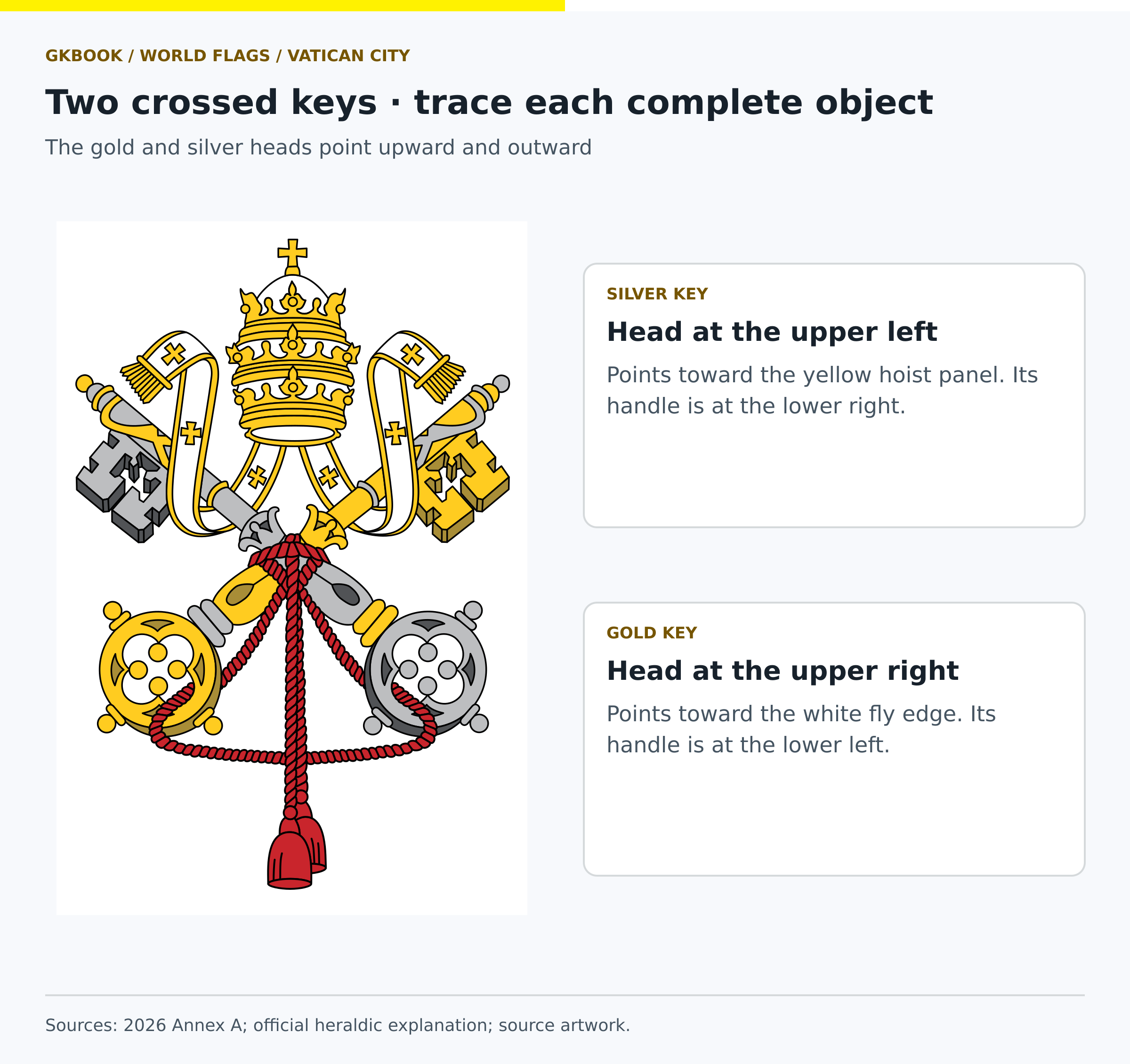
The keys are rendered as substantial ceremonial objects, with ornate round handles, diagonal shafts and shaped teeth. Their heads point upward and outward. Looking only at the handles can be misleading because each shaft crosses the other: the lower-left gold handle belongs to the upper-right gold head. Trace the whole object to identify it correctly.
Different historical drawings vary in the ornament of the handles and teeth. That artistic variation does not turn the emblem into a pair of ordinary house keys. For a faithful educational illustration, preserve the recognized outline and the contrasting metals. The enlarged figure keeps every source path, so the relationship between handles, shafts and upper teeth can be followed without inventing simplified heraldry.
Sources: Holy See Press Office — Flag, Coat of Arms and Seal · Holy See — explanation of Benedict XVI’s coat of arms · Goran tek-en — Flag of Vatican City (2023–present).svg, Wikimedia Commons · Drawing method and calculations
Which key is gold, and which way do the keys point?
In the standard front view, the silver key head points upward toward the yellow panel, at the viewer’s left. The gold key head points upward toward the outer white edge, at the viewer’s right. Their handles occupy opposite lower corners because the two complete keys cross diagonally.
Use viewer directions when explaining the illustration to a general reader. Heraldic right and left can refer to the perspective of a shield bearer, which reverses the viewer’s directions. A statement such as “the right key is gold” is therefore ambiguous unless it specifies which perspective and which part of the key it means.
The reference image removes that ambiguity: silver head upper left, gold head upper right; gold handle lower left, silver handle lower right. A physical reverse view mirrors those positions along with the entire flag. Moving only the heads or swapping the key colors would create a different drawing, so our reverse diagram transforms the complete vector in one operation.
Sources: 2026 Fundamental Law — Annex A, official flag model · The Flag Institute — Flag of the Vatican City, 2015 · Drawing method and calculations
What is the triple crown on the Vatican City flag?
The headdress above the keys is the papal tiara, also called the triregnum because it has three crowns. A small cross stands at its top, and two decorated ribbons descend behind the keys. The tiara remains a heraldic emblem even though modern popes do not use it for coronation.

The three crowns have received several traditional interpretations. The Vatican’s tiara account mentions the Church militant, suffering and triumphant; its explanation of Benedict XVI’s arms discusses orders, jurisdiction and teaching authority. These are alternative interpretive traditions, not a single numbered legend printed in the flag law. The page therefore identifies the object first and qualifies its symbolic readings.
The current annex is the visual reference for reproduction. It shows gold crown bands with a light-colored body and ribbons. Do not replace the tiara with a bishop’s mitre merely because a modern pope uses a mitre in his personal arms. Those personal arms and the state flag are different compositions, and a change in one does not automatically alter the other.
Sources: Holy See — Triregnum / Papal Tiara · Holy See — explanation of Benedict XVI’s coat of arms · 2026 Fundamental Law — Annex A, official flag model
What are the red cord and white ribbons?
The red cord connects the crossed keys and descends into tassels. The white ribbons belong to the tiara and carry small gold crosses. These are different elements: the ribbons frame the upper emblem, while the cord links the lower handles and crossing. Both should remain visible in a detailed reproduction.

At small sizes the red strands can merge into a single dark line. The supplied enlargement shows their braided treatment and the hanging ends. It also shows that the ribbons curl outward before returning beside the keys. Their crosses should not be confused with the cross at the very top of the tiara.
This distinction matters when preparing a simplified icon. An icon may intentionally omit fine lines, but it should be labeled as an adaptation and should not become the production source for a large flag. For the main download, the source paths retain the cord, tassels, ribbon borders and crosses together, preserving their overlaps and their place within the larger emblem.
Sources: 2026 Fundamental Law — Annex A, official flag model · Goran tek-en — Flag of Vatican City (2023–present).svg, Wikimedia Commons · Drawing method and calculations
Is the Vatican City flag square?
The standard reference flag is square, with a height-to-length ratio of 1:1. The current official annex illustrates that square form. This package follows it consistently: the clean PNG is 7,200 by 7,200 pixels, and the SVG uses a 1,000 by 1,000 coordinate grid with two equal vertical panels.

The law’s prose identifies the colors and emblem but does not present a numerical height-to-length equation. The square form is supplied by the model and established flag references. Rectangular flags encountered in photographs or commercial catalogs do not justify silently stretching this reference image. A viewer should be told which form a reproduction follows.
An equal width and height also makes print sizing straightforward. A twenty-centimeter-high rendition is twenty centimeters wide; each field is ten centimeters wide before the emblem is considered. The downloadable master preserves that relation at every scale. White belongs to the flag itself, so it should not be cropped away or mistaken for empty page margin.
Sources: 2026 Fundamental Law — Annex A, official flag model · The Flag Institute — Flag of the Vatican City, 2015 · Drawing method and calculations
How are the yellow and white panels arranged?
The flag is divided vertically into equal halves. Yellow is next to the staff, called the hoist, and white is at the free edge, called the fly. In a conventional front view the yellow panel appears on the left. The tiara-and-keys emblem sits entirely within the white half.

On the package’s grid the yellow field extends from x = 0 to x = 500, and the white half extends from x = 500 to x = 1,000. Both run from the top to the bottom of the square. The emblem is centered around the white panel’s central region, rather than the center of the full flag.
Equal panels describe the underlying field geometry. They do not imply that half of every rendered pixel is visibly white, because the emblem covers part of that field. This distinction prevents a common measurement error: counting only exposed white pixels gives a smaller area, even though the two underlying panels are equal. Our layout diagram marks the field boundary independently of the ornamental drawing.
Sources: Fundamental Law of Vatican City State — 31 July 2026, Articles 24–25 · 2026 Fundamental Law — Annex A, official flag model · Drawing method and calculations
How can the flag be drawn accurately?
Start with a square, divide it at the midpoint, fill the hoist half yellow and the fly half white, then place the identified tiara-and-keys artwork in the white field. Scale the entire composition uniformly. The included construction grid describes this particular vector rendition rather than claiming an official engineering specification.
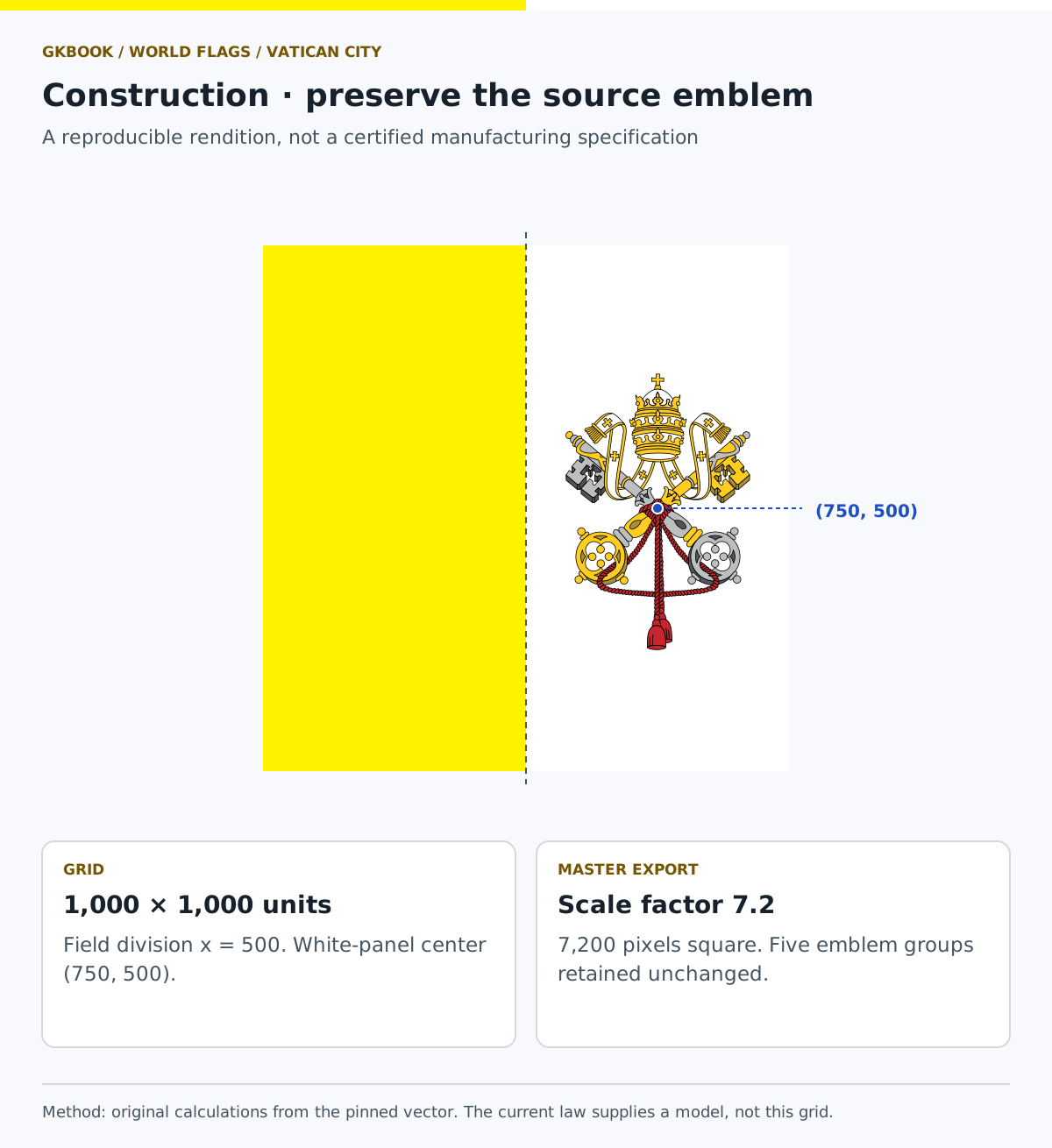
The source artwork already contains the detailed emblem, so the build preserves its five top-level device groups unchanged. Only the two simple background fields are reconstructed. This avoids a generic crown, a reversed pair of keys or an improvised red knot entering the design. The source file and its checksum accompany the rebuild materials for inspection.
At the master export size, each native unit becomes 7.2 pixels. The field boundary is therefore exactly at x = 3,600 pixels. Curved outlines are antialiased during rasterization; they need not land on whole-pixel coordinates. A manufacturing drawing would require additional material and color specifications, which cannot be derived merely by reading the pixel dimensions of an educational SVG.
| Feature | Native grid | 7,200-pixel master |
|---|---|---|
| Whole flag | 1,000 × 1,000 | 7,200 × 7,200 |
| Yellow field | 500 × 1,000 | 3,600 × 7,200 |
| White field | 500 × 1,000 | 3,600 × 7,200 |
| White panel center | (750, 500) | (5,400, 3,600) |
| Scale factor | 1 native unit | 7.2 pixels |
Sources: Goran tek-en — Flag of Vatican City (2023–present).svg, Wikimedia Commons · Drawing method and calculations
How large should the emblem be?
The official annex supplies a model, not a table of emblem coordinates. This download keeps the proportions and placement of its credited source vector. The keys, tiara, ribbons and cord are treated as one group. Their shape is not stretched to fill the white half or enlarged until it touches the edges.

A center guide is useful, but it must not be mistaken for a new legal dimension. An ornate emblem can have different geometric, bounding-box and optical centers. The cross at the top and the tassels below also make a simple circular placement rule unsuitable. Preserving the source’s complete group avoids changing those relationships by guesswork.
For layout work, add space around the whole square rather than moving the emblem inside it. If the flag must fit a wide thumbnail, use a neutral background around the square. This is how the social-sharing image keeps the full flag visible within a 1,200 by 630 canvas. Cropping the square or increasing the emblem independently would misrepresent the chosen reference.
Sources: 2026 Fundamental Law — Annex A, official flag model · Goran tek-en — Flag of Vatican City (2023–present).svg, Wikimedia Commons · Drawing method and calculations
When was the Vatican City flag adopted?
The flag of the modern Vatican City State dates to 7 June 1929, when the original Fundamental Law defined it. The Governorate’s history separately records the first hoisting of the modern flag on 8 June 1929. The Lateran Treaty had been signed earlier, on 11 February of the same year.
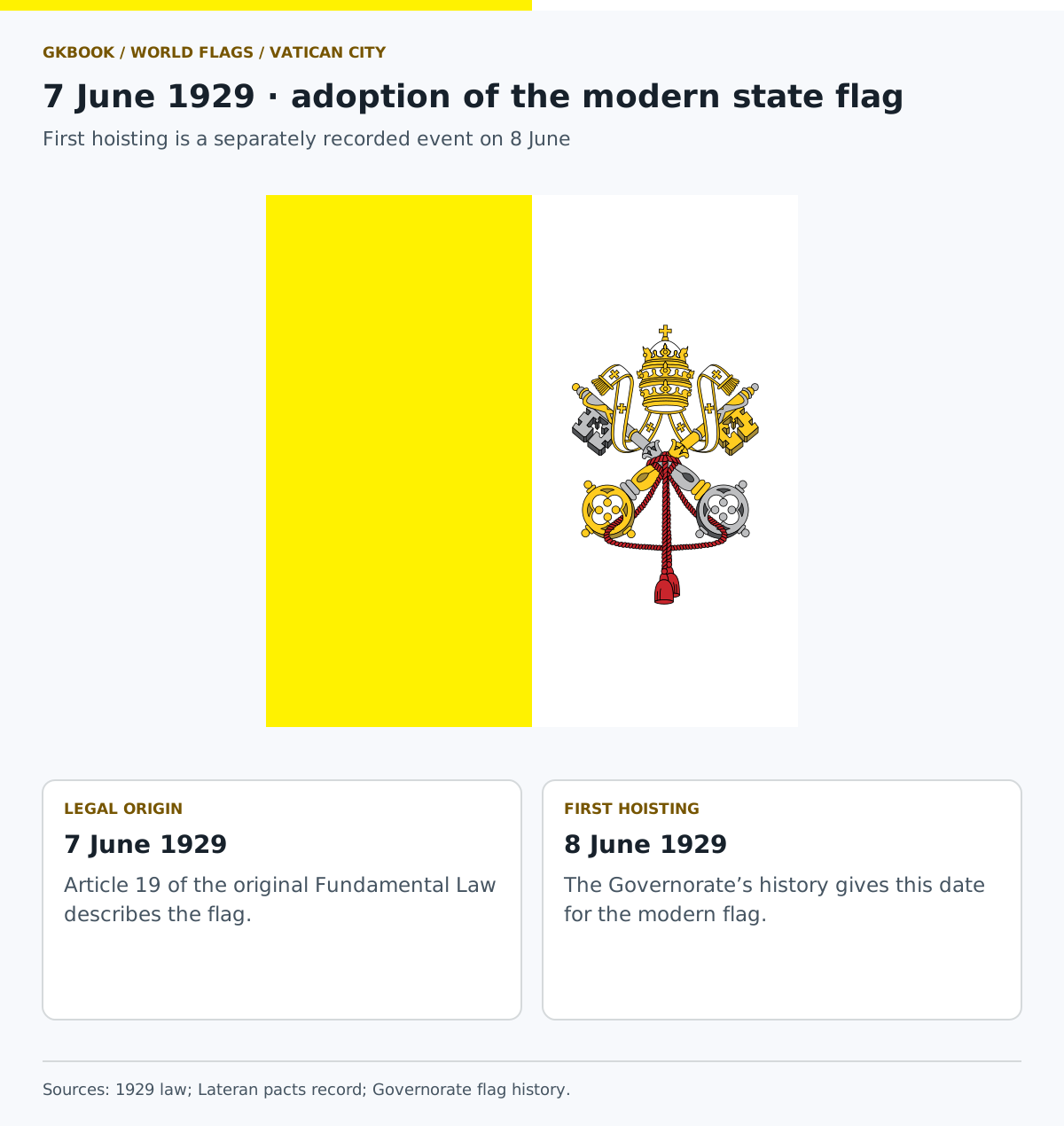
These dates answer different questions. The February signature belongs to the Lateran settlement; the June exchange of ratifications brought that settlement into effect. The original flag provision appears in Article 19 of the law dated 7 June. The next day’s first hoisting, reported by the state’s own flag history, is an event rather than a competing legal adoption date.
A chronology should therefore retain the distinction instead of choosing whichever day appears most often in a search result. Likewise, a later law, digital file revision or modern reproduction does not reset the flag’s historical origin. The download filenames identify the country and subject; the research record supplies the specific legal and artwork dates behind them.
Sources: Vatican City 1929 laws — original Fundamental Law, Article 19 and Annex A · Holy See — Lateran Pacts, official archival record · Governorate of Vatican City State — Flag
How did the flag develop before 1929?
The yellow-and-white combination predates Vatican City State. Pius VII introduced those cockade colors for troops loyal to him in 1808. Nineteenth-century papal flags developed several forms. Specialist accounts connect the modern design with the Papal States’ merchant flag and its square format with the papal infantry tradition.

Sources emphasize different stages. The Governorate describes an early diagonal yellow-and-white flag in 1824; the Flag Institute discusses the 1825 merchant ensign and an 1862 infantry flag. These statements concern different uses and arrangements, so they should not be collapsed into a single unsupported date for the first appearance of every feature.
The history figure uses a dated textual timeline instead of invented images of each predecessor. A historical flag illustration would need its own reliable model, dimensions and attribution. The complete modern flag is shown elsewhere, while this chronology explains the transition from papal colors and military or maritime uses to the state flag recognized in 1929.
Sources: Governorate of Vatican City State — Flag · The Flag Institute — Flag of the Vatican City, 2015 · Vatican City 1929 laws — original Fundamental Law, Article 19 and Annex A
Who designed the Vatican City flag?
The reviewed official sources do not identify one individual as the sole designer of the modern national flag. Its elements developed through papal heraldry and earlier flags before being specified for Vatican City State in 1929. The modern SVG used here is separately credited to the illustrator Goran tek-en.
National design and digital execution are different kinds of authorship. A person who traces a flag into vector paths does not thereby become the designer of the national symbol. Conversely, a pope who promulgates a law is not automatically the artist who drew every part of its annex. This page avoids assigning either role without evidence.
The source file’s revision history matters for a different reason: it identifies the exact drawing distributed with the package. The selected Commons revision is dated 17 October 2024 and describes its basis as the 2023 annex. It has been compared here with the 2026 annex, while remaining an attributed contributor rendition rather than an official downloadable master.
Sources: Goran tek-en — Flag of Vatican City (2023–present).svg, Wikimedia Commons · Vatican City 1929 laws — original Fundamental Law, Article 19 and Annex A · Governorate of Vatican City State — Flag · 2026 Fundamental Law — Annex A, official flag model
What law currently defines the Vatican City flag?
Article 24 of the Fundamental Law issued on 31 July 2026 defines the flag and refers to Annex A for its model. The same article refers separately to the state arms and seal. Article 25 replaced the 2023 Fundamental Law and made the new law effective immediately.

This is a point where an otherwise useful older page can become misleading. The 2023 law placed the flag in Article 23, and the 2000 law used Article 20. Those citations belong in a legal chronology, not in a sentence presenting the current article number. The research date for this package is 28 October 2026.
The Italian legal text and its linked annexes are the controlling sources for this discussion. English explanations here are paraphrases, not a certified translation. The law identifies the design by words and model; it does not supply the HEX palette, pixel dimensions or export settings used in this package. Those technical choices are documented in the drawing specification.
Sources: Fundamental Law of Vatican City State — 31 July 2026, Articles 24–25 · Fundamental Law — 13 May 2023, now superseded · Fundamental Law — 26 November 2000, WIPO Lex English text · 2026 Fundamental Law — Annex A, official flag model
Why do different Vatican flag illustrations look different?
Published illustrations can differ in tiara contours, key ornament, cord treatment and yellow shade. Some also reproduce older legal annexes. The underlying bicolor and papal emblem remain recognizable, but a page should identify its reference. This package compares a credited vector based on the 2023 model with the current 2026 annex.

The 1929 and current annexes were inspected directly for this research. The former is a historical legal illustration, while the current annex is the relevant model for present description. The old 2023 annex links returned an error during retrieval; their contents were not silently treated as freshly inspected. The source vector’s statement about its 2023 basis is recorded as provenance.
Do not label every online variation a deliberate redesign or every red detail an error. Red legitimately appears in the connecting cord and in small ornament in this drawing. A useful comparison asks exactly which feature differs and which dated model supports the judgment. The visual reference and the source-file history make that question answerable without relying on an unattributed internet image.
Sources: Vatican City 1929 laws — original Fundamental Law, Article 19 and Annex A · 2026 Fundamental Law — Annex A, official flag model · Goran tek-en — Flag of Vatican City (2023–present).svg, Wikimedia Commons · NAVA — official yellow of the Vatican flag, 12 December 2024
Are Vatican City, the Holy See and the pope’s arms the same?
They are related but distinct. Vatican City is the territorial state; the Holy See is the central authority of the Catholic Church. The state flag, state coat of arms, Holy See arms and an individual pope’s personal arms are different designs. Shared keys and tiaras do not make them interchangeable.
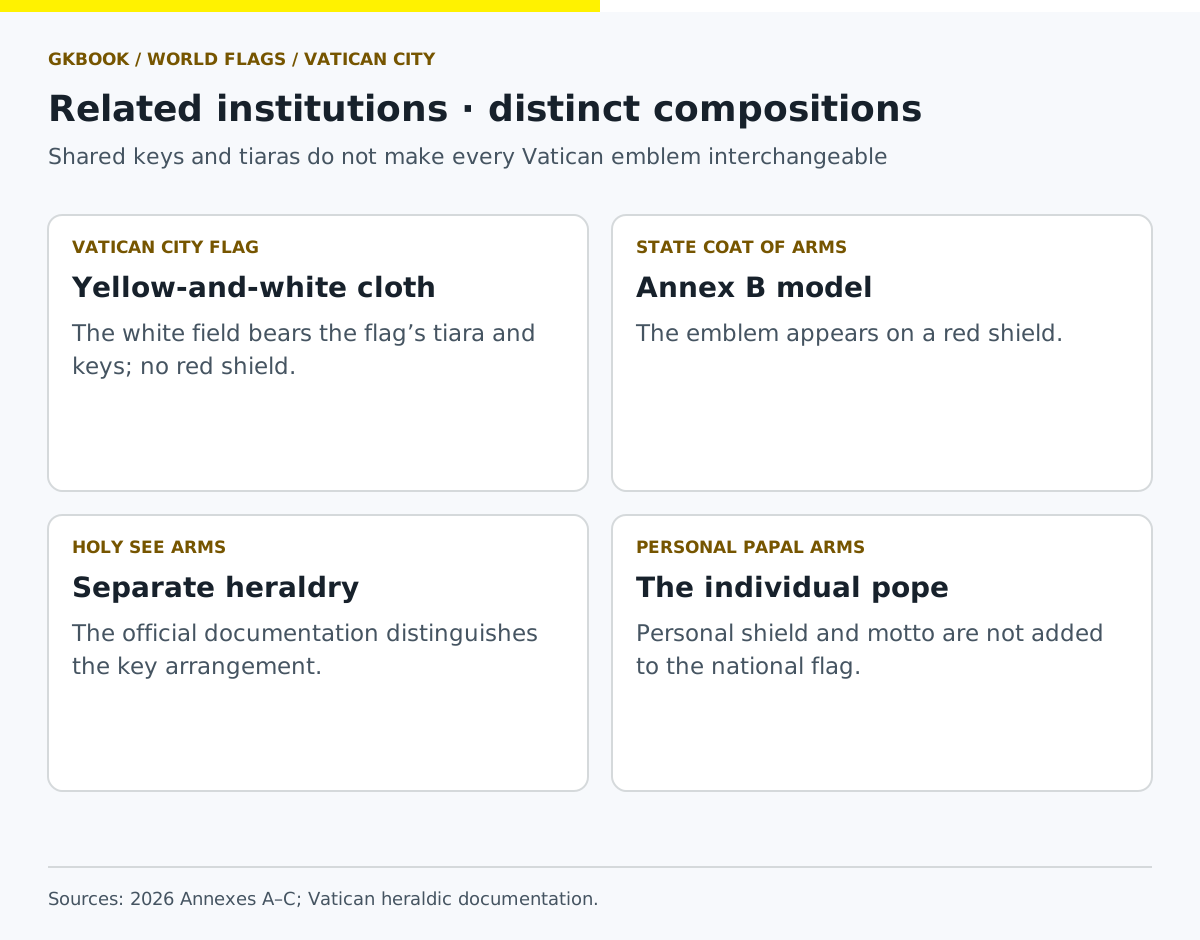
The current law separates the flag model in Annex A, the state arms in Annex B and the seal in Annex C. Annex B places its emblem on a red shield. That shield is not added to the white field in the flag. A design copied from an arms page can therefore look plausible while still being the wrong graphic for the national flag.
Official heraldic documentation also distinguishes the Holy See’s key arrangement from the state’s, and illustrates personal papal arms separately. When labeling a graphic, identify the complete composition and institutional context, rather than relying on a search title containing the word “Vatican.” Our comparison diagram explains these categories without inventing substitute coats of arms.
Sources: Fundamental Law of Vatican City State — 31 July 2026, Articles 24–25 · 2026 Fundamental Law — Annex B, state coat of arms · 2026 Fundamental Law — Annex C, state seal · Holy See Press Office — Flag, Coat of Arms and Seal
Does the flag change when a new pope is elected?
The state flag is not a portrait or a personal papal coat of arms, so the election of a new pope does not by itself replace its emblem. The tiara and keys identify enduring institutions. Changes to the legal model would need their own evidence; they should not be inferred from a pope’s personal heraldry.

During a vacant papal see, special institutional symbols and ceremonial practices can appear. That does not establish a new yellow-and-white national flag bearing any particular vacancy emblem. The current Fundamental Law provides for continuity of state powers during the vacancy, while its flag provision remains a separate rule.
For a country reference page, keep the national flag and the biography of the reigning pope separate. A current pope’s name may be relevant when identifying the law he issued, but it is unnecessary inside the flag image. This keeps the artwork useful through changes of pontificate and prevents a personal motto, shield or election date from being mistakenly incorporated into the state design.
Sources: Fundamental Law of Vatican City State — 31 July 2026, Articles 24–25 · Holy See Press Office — Flag, Coat of Arms and Seal · Holy See — explanation of Benedict XVI’s coat of arms · Drawing method and calculations
How should the Vatican City flag be displayed?
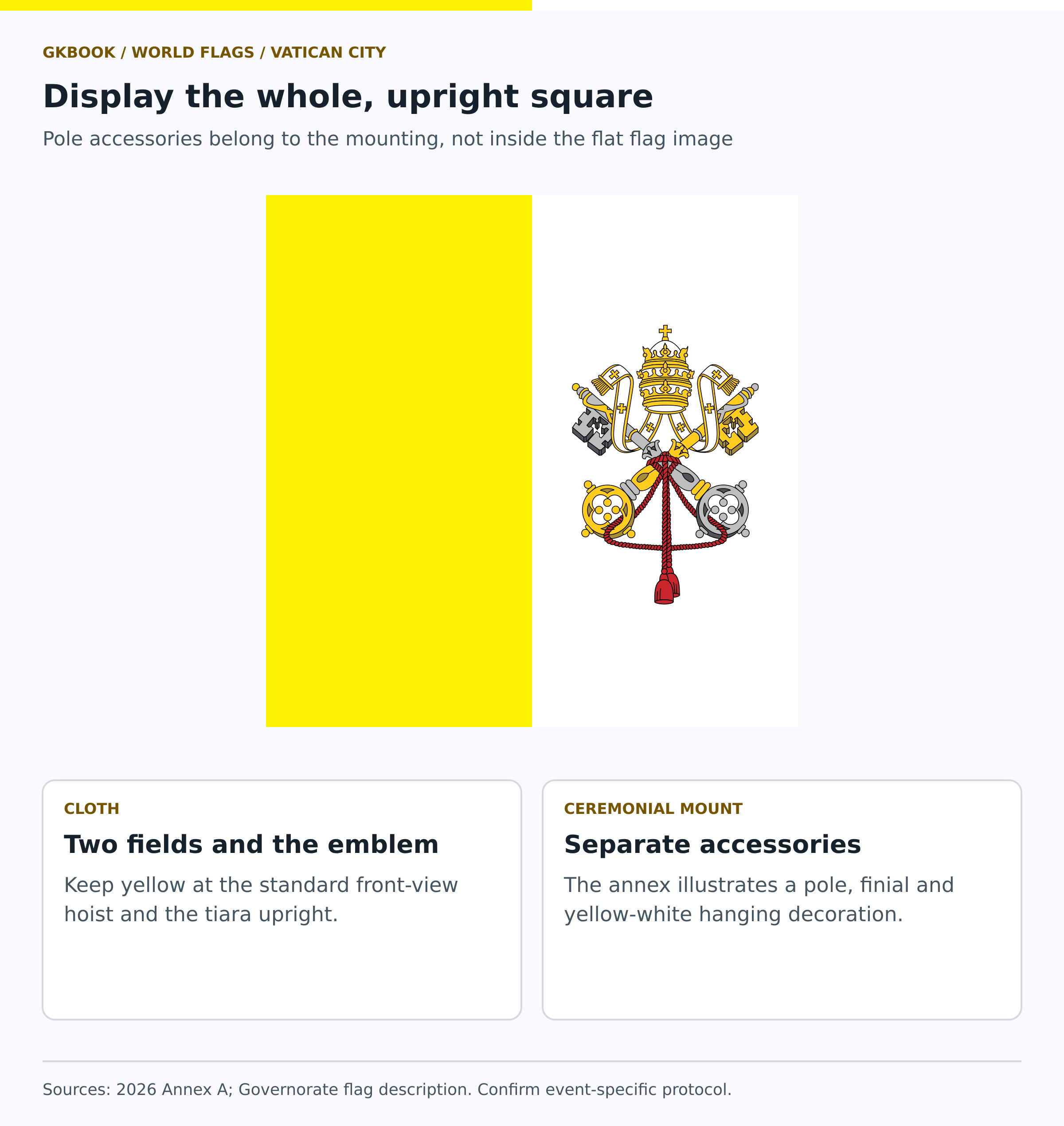
For a standard front-facing image, keep the square complete, yellow at the left-hand hoist and the tiara upright in the white half. For physical display, follow the host institution’s instructions and the event’s protocol. The official annex includes ceremonial pole accessories, which are separate from the flat flag design.

The clean download represents the cloth, so it contains no pole, spear, bow, fringe or hanging cravat. Those objects can be appropriate in a ceremonial illustration, but adding them inside the square would confuse the flag with its mounting. The display figure labels the difference and retains the same upright emblem as the master.
A respectful practical presentation also gives the flag enough space to be recognized and avoids covering it with captions or logos. These are editorial recommendations for clarity, not a newly asserted Vatican flag code. The reviewed sources do not establish a universal schedule for daylight display, a mandatory folding ritual or a special digital background that applies to every institution.
Sources: 2026 Fundamental Law — Annex A, official flag model · Governorate of Vatican City State — Flag · Drawing method and calculations
Is the Vatican flag flown at half-mast for mourning?
Half-mast display is associated with papal mourning, but the applicable notice and institution determine the arrangements. Nine days of funeral liturgies, known as the Novendiali, should not automatically be treated as a universal nine-day flag order. The diagram here explains lowered display without prescribing a current instruction or exact pole fraction.
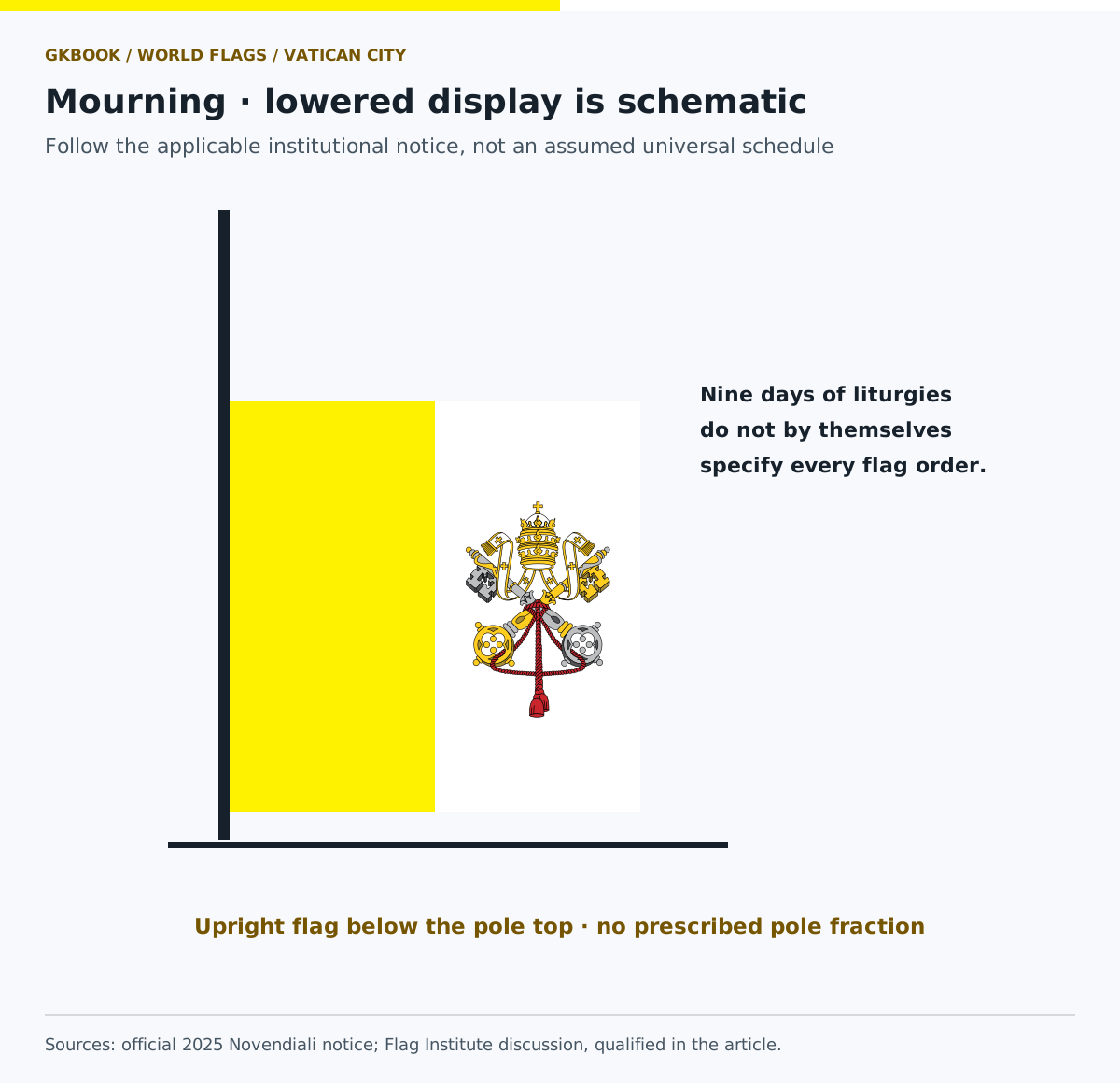
The official notice after Pope Francis’s death scheduled the first Novendiali Mass on 26 April 2025, followed by the remaining liturgies. That document establishes a liturgical schedule. It does not itself provide a general rule for how long every Vatican flag everywhere must remain lowered. A Flag Institute summary gives a broader nine-day description, which is therefore not adopted here as a universal legal requirement.
Other countries and organizations issue their own mourning directions, sometimes for different dates and for their own flags. Those orders cannot simply be imported into Vatican protocol. For an actual ceremony, consult the relevant dated notice. Our illustration preserves an upright flag below the pole top and labels the rigging as schematic, leaving ceremonial instructions to the responsible institution.
Sources: Office of Liturgical Celebrations — Novendiali notice, 23 April 2025 · The Flag Institute — Flag of the Vatican City, 2015 · Drawing method and calculations
How can you tell whether the flag is upside down?
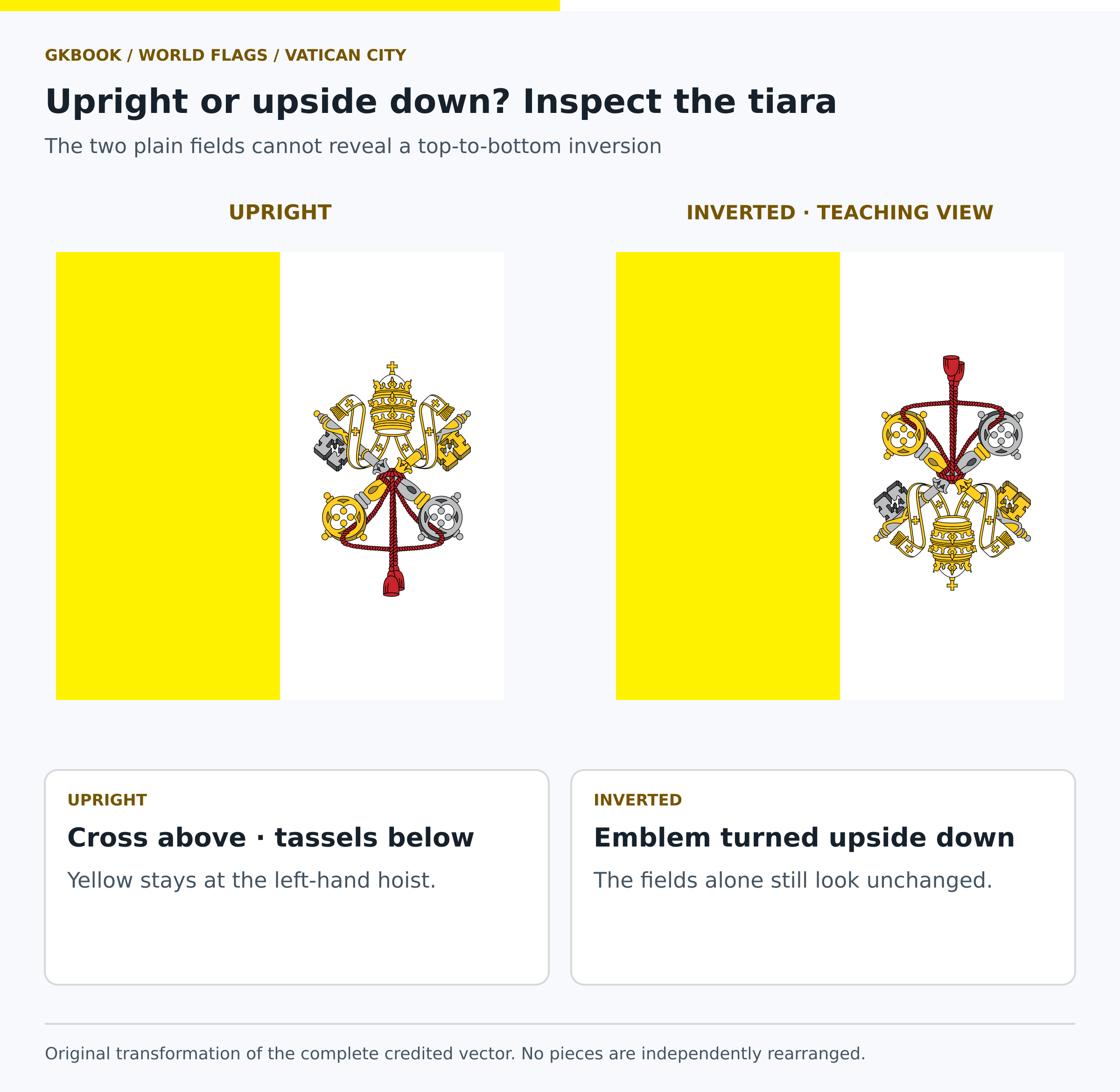
Look at the tiara, not just the two colored panels. In an upright front view the small cross is at the top of the emblem and the cord tassels hang below. A top-to-bottom flip leaves yellow on the left but turns the entire emblem upside down, making the inversion visible.

The plain bicolor has a horizontal axis of reflection symmetry: its top and bottom look alike. The ornament breaks that symmetry. This is why checking only the yellow-white order is insufficient. The side-by-side diagram flips every part of the source vector so that the error can be seen rather than merely described.
An upside-down example is included solely as a labeled teaching image. The research did not establish inversion as a Vatican distress signal, so the page assigns no such message to it. For publication, use the clean upright master and keep the transformed teaching views within their captions. A thumbnail detached from its explanation can otherwise communicate the wrong reference design.
Sources: Goran tek-en — Flag of Vatican City (2023–present).svg, Wikimedia Commons · Drawing method and calculations
What does the reverse of the Vatican City flag look like?
A geometric reverse of a single-layer flag mirrors the whole design horizontally. The yellow hoist then appears on the viewer’s right, and the keys exchange their apparent left-right positions. The tiara stays upright. This is a view from the other side of the cloth, not a separately invented national design.
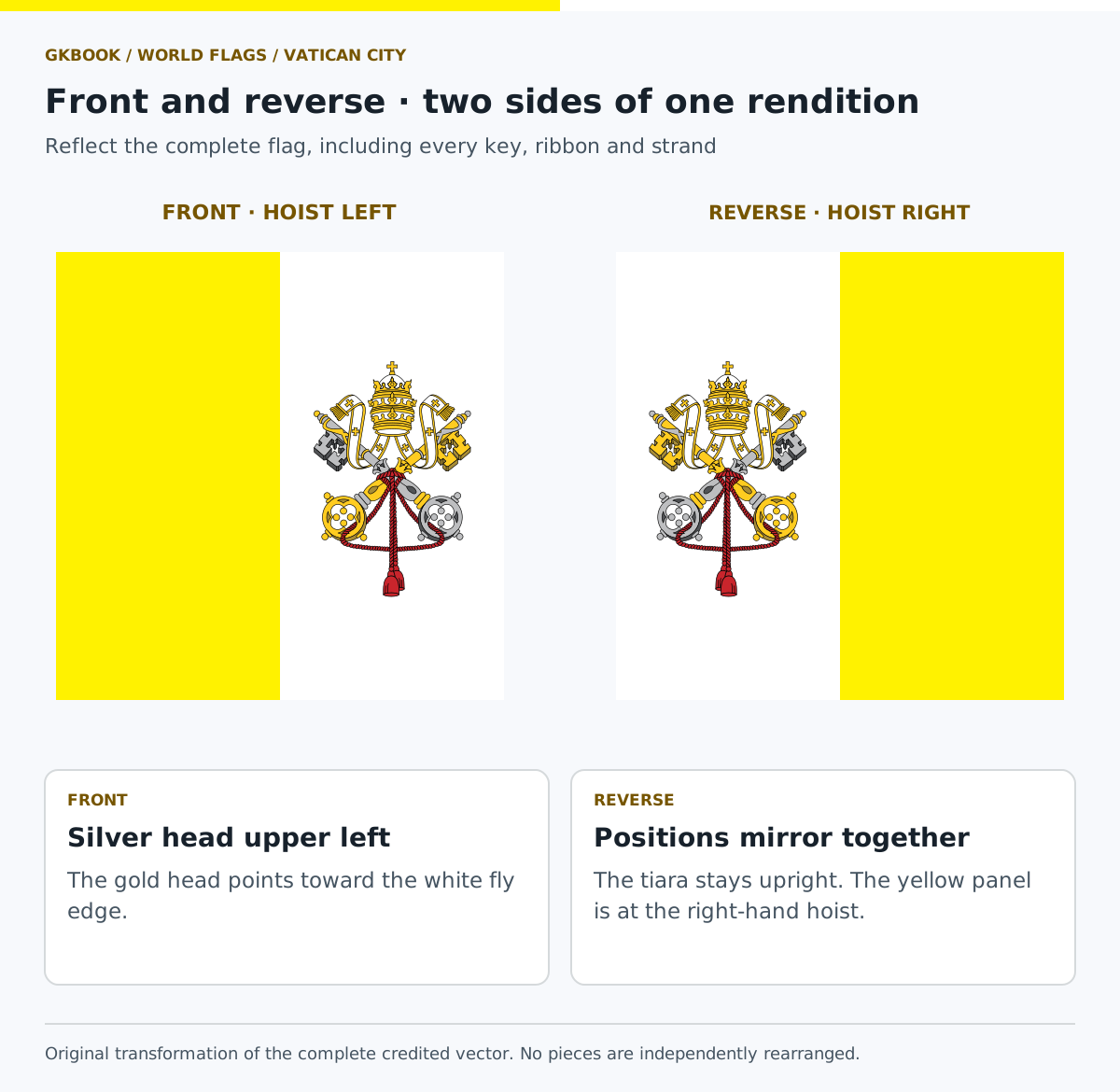
The mirror operation includes the complete emblem: shafts, handles, teeth, ribbons, crosses and cord. Moving the yellow panel to the opposite side while leaving the artwork unchanged would not reproduce the reverse of this source. Our figure uses a single transform on the entire flag, which makes the operation explicit and reproducible.
A sewn or lined commercial flag may be manufactured differently, including separate printed faces. This diagram does not certify any supplier’s construction or assert a statutory reverse-face manufacturing standard. It answers the geometric question for the provided artwork. When preparing a physical order, specify the intended viewing sides and ask the maker how the chosen material will transmit or conceal the opposite face.
Sources: Goran tek-en — Flag of Vatican City (2023–present).svg, Wikimedia Commons · Drawing method and calculations
Is the complete Vatican City flag symmetrical?
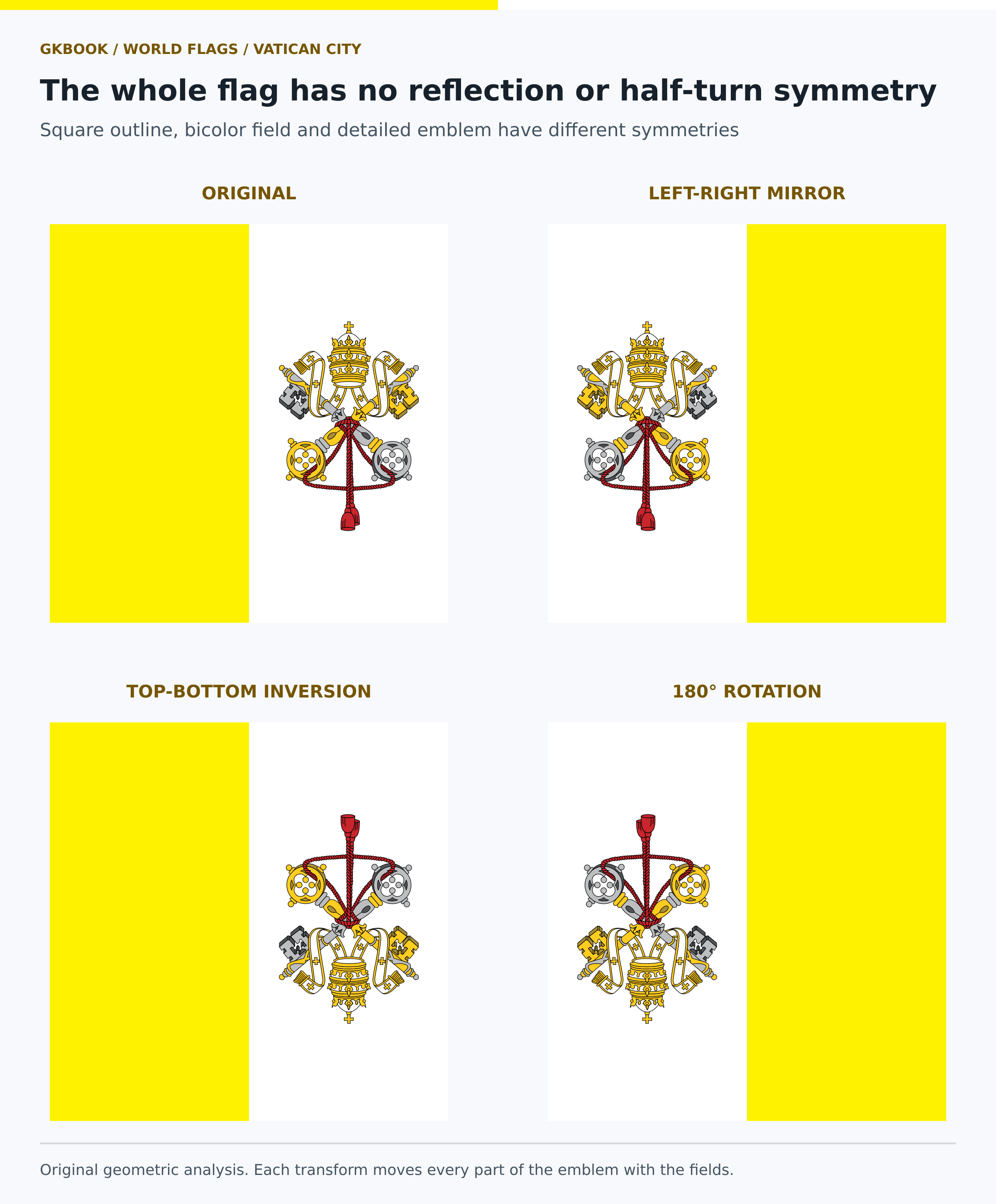
The complete front-view design has no exact horizontal or vertical reflection symmetry and no half-turn symmetry. The yellow-white field alone survives a top-to-bottom reflection, but the upright tiara and hanging cord do not. A left-to-right reflection swaps the panels and the colored keys, changing the whole appearance.

Symmetry must be tested on the object actually being discussed. The square outline has many symmetries, the two-panel field has fewer, and the detailed national flag has fewer still. These nested levels explain why the same answer cannot be applied to the outline, field and complete drawing without qualification.
The comparison graphic shows four complete views: original, horizontal mirror, top-bottom inversion and 180-degree rotation. None of the transformed copies is presented as an additional official variant. The source paths are identical before transformation, so visible differences arise from the geometry rather than from an artist redrawing each example. This makes the figure useful for teaching both flags and elementary transformations.
Sources: Goran tek-en — Flag of Vatican City (2023–present).svg, Wikimedia Commons · Drawing method and calculations
How should the flag be shown in a vertical hanging example?
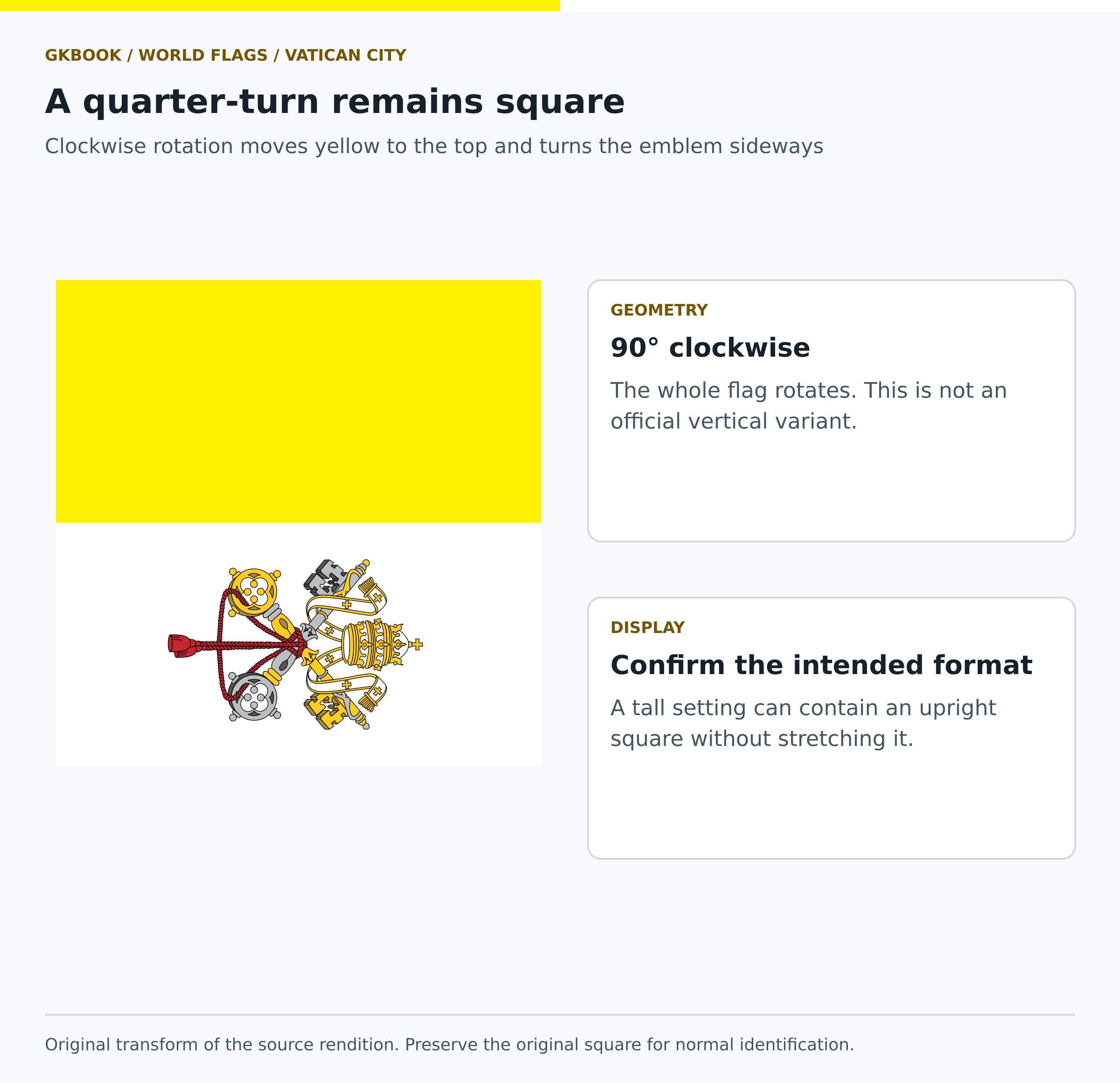
Because the reference flag is already square, it has no distinct portrait aspect ratio. Rotating it ninety degrees still produces a square but moves the yellow panel and turns the emblem sideways. The included rotation is explicitly a geometric demonstration, not an official vertical-hanging specification or an instruction to alter the emblem.

A clockwise quarter-turn takes the original left-hand yellow field to the top and the white field to the bottom. Every detail rotates together. Leaving the tiara upright while turning only the panels would create a new arrangement that is not the same mathematical operation. The diagram makes both the movement and its limits clear.
For a tall banner, a safer layout choice is to place the complete upright square within a longer neutral support or page, unless the responsible institution supplies another approved model. Do not stretch the square into a tall rectangle simply to fill available space. The source research did not establish one universal Vatican vertical-display convention for every ceremonial and architectural setting.
Sources: 2026 Fundamental Law — Annex A, official flag model · Goran tek-en — Flag of Vatican City (2023–present).svg, Wikimedia Commons · Drawing method and calculations
How does the Vatican City flag compare with Switzerland’s?
Vatican City and Switzerland are both associated with square national flags, but their designs differ sharply. Vatican City uses yellow and white with an asymmetric papal emblem. Switzerland uses a white cross on red. The shared square format does not give the Vatican flag the rotational symmetry of the simple Swiss cross design.
The Swiss government’s own flag description confirms its square national form. A comparison should focus on the specified reference designs rather than assume that every flag flown commercially or in a sporting setting has the same proportions. For this page, the relevant takeaway is that a square flag should remain square in the principal reference download.
A practical classroom test is to cover the emblem temporarily and examine the underlying bicolor, then uncover it and compare the available symmetries. The change comes from the Vatican design itself, not from the shape of its outer boundary. This explains a meaningful difference between the two flags without requiring a misleading composite or a newly drawn Swiss production specification.
Sources: Swiss Federal Department of Foreign Affairs — Swiss flag · Drawing method and calculations
What is the Vatican City flag emoji?
The Vatican City flag emoji is 🇻🇦. Unicode represents it with the regional-indicator sequence U+1F1FB U+1F1E6, corresponding to VA. Its appearance depends on the platform and font, so it should be used as a compact label rather than as the source for a detailed, color-controlled flag reproduction.
The code-point sequence identifies the flag independently of the particular picture drawn by an operating system. Some environments may display regional-indicator letters instead of a colored flag. A tiny emoji can also simplify the keys, tiara and cord so much that it is unsuitable for explaining their exact arrangement.
For accessible prose, spell out “Vatican City flag” alongside the symbol when its meaning matters. For an educational image, use the supplied SVG or PNG and descriptive alternative text. The Unicode data file cited here is version 15.1, consulted for the stable sequence identity; this citation is not a claim that 15.1 is the newest release.
Sources: Unicode Emoji 15.1 — emoji-sequences.txt · Drawing method and calculations
What size can the flag image be printed?
The clean PNG contains 7,200 by 7,200 pixels, or 51.84 million pixels. At 300 pixels per inch it prints at 24 by 24 inches, equivalent to 60.96 by 60.96 centimeters. The SVG scales without raster enlargement, while actual print quality still depends on materials, process and color proofing.
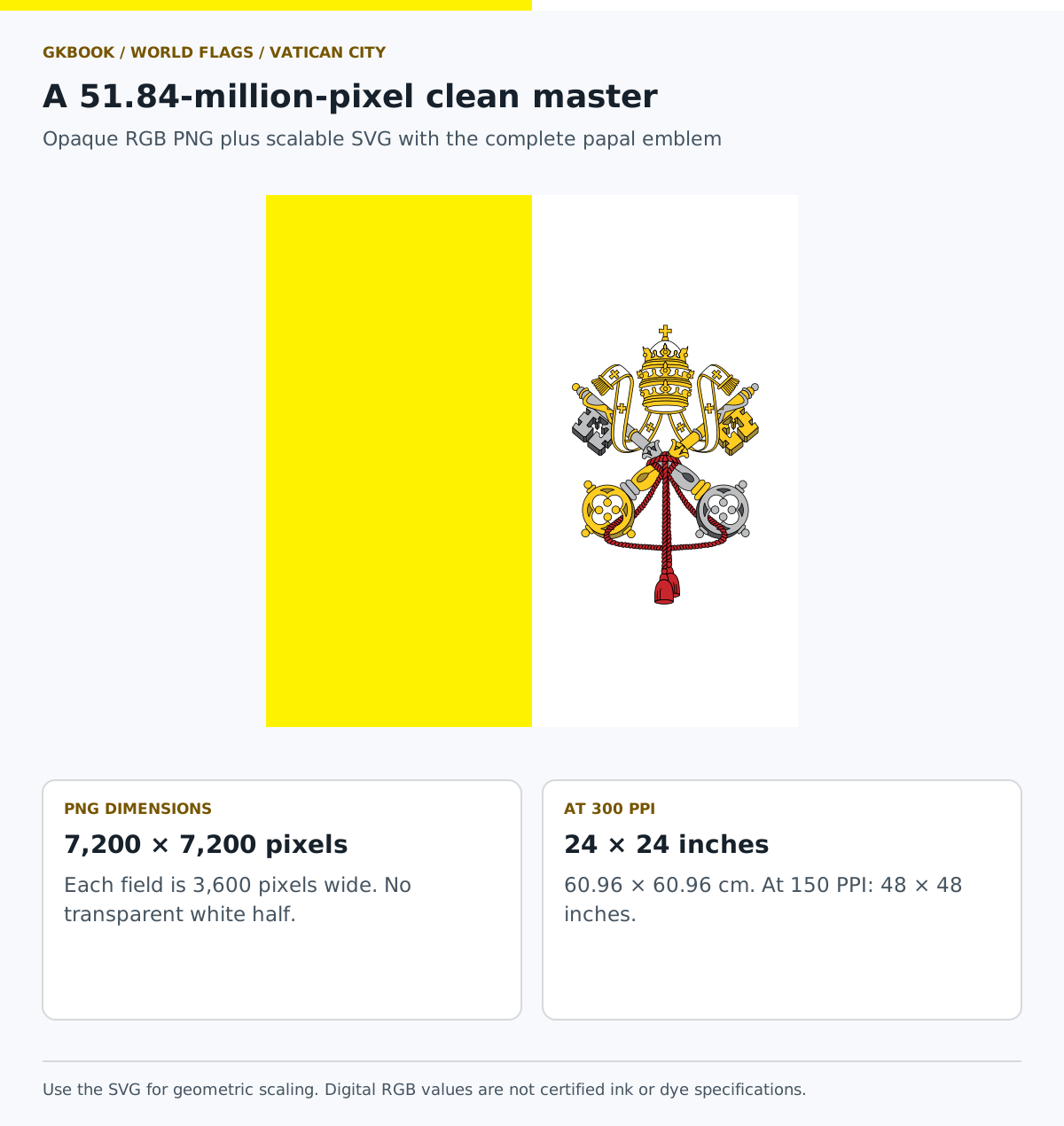
At 150 pixels per inch the same PNG covers 48 by 48 inches, or 121.92 centimeters square. These are arithmetic sizes, not guarantees about a particular printer or viewing distance. The intricate emblem makes a physical proof especially useful: thin outlines, gray silver details and small red strands can reproduce differently on paper, fabric and coated stock.
Keep the image square and turn off options that stretch it to a rectangular page. If a bleed or seam allowance is required, have the production provider add it outside the finished reference dimensions. The digital yellow, metallic-looking fills and antialiasing are screen-rendering choices; no universal CMYK recipe or certified fabric-dye match is supplied.
| Resolution | Inches | Centimeters |
|---|---|---|
| 300 PPI | 24 × 24 | 60.96 × 60.96 |
| 200 PPI | 36 × 36 | 91.44 × 91.44 |
| 150 PPI | 48 × 48 | 121.92 × 121.92 |
Sources: Goran tek-en — Flag of Vatican City (2023–present).svg, Wikimedia Commons · NAVA — official yellow of the Vatican flag, 12 December 2024 · Drawing method and calculations
Can the flag graphics be reused?
The selected Commons vector carries a public-domain dedication, and GKBook’s original explanatory additions are offered under CC0. Attribution and source notes remain included for traceability. Artwork copyright is separate from rules protecting official symbols or preventing misleading endorsement; the download is not a universal commercial-use authorization from the Holy See.
The Secretariat of State has stated that it safeguards the Holy See’s official symbols and coats of arms and monitors misuse. That statement should not be expanded into an unsupported claim that every educational display requires a permit. It does explain why an artwork license alone cannot settle every use of an official emblem in branding or merchandise.
For editorial reproduction, preserve the source credit and avoid implying that the Vatican approved this page or issued its digital master. For a specific commercial project, check the requirements applicable to that use and jurisdiction. This article supplies evidence and artwork provenance, not individualized legal advice, a trademark clearance or a fee schedule for permissions.
Sources: Goran tek-en — Flag of Vatican City (2023–present).svg, Wikimedia Commons · Secretariat of State communiqué — 22 February 2017 · Drawing method and calculations
Which Vatican City flag file should I download?
Choose the clean SVG for scalable artwork and the 7,200-pixel PNG for a ready-to-use raster image. The gallery provides 24 subjects in both formats, including details, construction and transformations. A separate 1,200 by 630 sharing card includes the complete square flag alongside the title rather than cropping it.
The clean master contains only the flag. Annotated diagrams add labels, measurements and explanatory panels, so they are intended for teaching and should not replace the master in a country selector or formal flag collection. Each diagram has a descriptive caption and a separate PNG export for software that does not support SVG.
White in the clean image is opaque, because it is part of the flag. A transparent background substitution would let an underlying color show through the white half and change the design. The package also includes an offline article preview, artwork credits and a media census with dimensions and checksums, making it possible to identify the intended file without guessing from a thumbnail.
Sources: Drawing method and calculations
What should be checked before publishing a Vatican flag image?
Check the square proportions, equal vertical fields, yellow hoist, upright tiara and correctly oriented gold and silver keys. Retain the cord and ribbons, identify the source drawing, and label transformed or historical examples. Use the current legal reference and describe digital color values as rendition choices rather than official universal standards.

Then inspect the actual exported image at both small and large sizes. Confirm that white has not become transparent, the top cross and lower tassels are not clipped, and the yellow field has the intended effective fill. A correct SVG can still be embedded with a wrong aspect ratio or cropped by a thumbnail container, so the surrounding layout also deserves attention.
Finally check the caption, alternative text and download target together. They should describe the same image and distinguish the national flag from the state arms, the Holy See arms and personal papal heraldry. Keep the article’s research date separate from its publication date. The accompanying validation report records which file and content checks were actually completed and which live-site checks remain for staging.
Sources: 2026 Fundamental Law — Annex A, official flag model · Fundamental Law of Vatican City State — 31 July 2026, Articles 24–25 · Goran tek-en — Flag of Vatican City (2023–present).svg, Wikimedia Commons · Drawing method and calculations
Sources and research notes
This article uses the current Fundamental Law and its annexes, the original 1929 law, official Vatican heraldic explanations, Governorate history and identified specialist sources. Every answer has source links. The bibliography and artwork notes identify editions, methods and access limits.
Research was checked on 28 October 2026. The current reference is Article 24 of the law dated 31 July 2026; Article 23 belongs to the superseded 2023 law. Current Annexes A–C and the historical 1929 flag annex were inspected directly. Old 2023 annex links were unavailable. The contributor vector is compared with the current model, with its colors and placement disclosed as rendition choices.
Download Vatican City flag pictures
Download the complete flag as scalable SVG or 7,200 × 7,200 PNG. Both retain the square, equal fields and detailed keys, tiara, ribbons and cord. The clean PNG is opaque, and the source emblem remains vector artwork in the SVG.
The gallery includes 24 subjects, each in SVG and PNG. A separate 1,200 × 630 sharing card places the complete square beside the title. Use the clean master for country identification and the annotated figures for teaching.
Read the construction guide, display notes and artwork credits, or explore more designs in World Flags.
World Flags/Vatican City
Vatican City flag pictures
Square yellow-and-white field with crossed gold and silver keys, papal tiara and red cord. Source emblem paths and effective colors are preserved.
Flag vector: Goran tek-en / Wikimedia Commons (public-domain dedication). Explanatory graphics: GKBook. Compared with the 2026 Fundamental Law, Annex A; not an official production master.Download SVGDownload PNGThe rendered source yellow is #FFF200. Gold, silver and red describe emblem fills; they are not additional field panels. All nine effective colors are listed in the article.
Flag vector: Goran tek-en / Wikimedia Commons (public-domain dedication). Explanatory graphics: GKBook. Compared with the 2026 Fundamental Law, Annex A; not an official production master.Download SVGDownload PNGMeaning is explained in its Catholic and historical context. Generic claims that yellow simply means wealth or white simply means peace are not substituted for the documented symbolism.
Flag vector: Goran tek-en / Wikimedia Commons (public-domain dedication). Explanatory graphics: GKBook. Compared with the 2026 Fundamental Law, Annex A; not an official production master.Download SVGDownload PNGEnlarged emblem detail, not a whole flag. Viewer directions are specified to avoid confusion with heraldic right and left. All source device paths are preserved.
Flag vector: Goran tek-en / Wikimedia Commons (public-domain dedication). Explanatory graphics: GKBook. Compared with the 2026 Fundamental Law, Annex A; not an official production master.Download SVGDownload PNGA cropped detail of the credited emblem. The official accounts offer several interpretations of the three crowns; the page does not invent a single statutory meaning.
Flag vector: Goran tek-en / Wikimedia Commons (public-domain dedication). Explanatory graphics: GKBook. Compared with the 2026 Fundamental Law, Annex A; not an official production master.Download SVGDownload PNGDetail view of the keys’ lower handles and connecting red cord. White tiara ribbons are a separate upper element and can be inspected in the full emblem figure.
Flag vector: Goran tek-en / Wikimedia Commons (public-domain dedication). Explanatory graphics: GKBook. Compared with the 2026 Fundamental Law, Annex A; not an official production master.Download SVGDownload PNGThe official model and established references support the square form. The legal prose does not itself state a numerical ratio.
Flag vector: Goran tek-en / Wikimedia Commons (public-domain dedication). Explanatory graphics: GKBook. Compared with the 2026 Fundamental Law, Annex A; not an official production master.Download SVGDownload PNGThe central division is x = 500 on the 1,000-unit grid. Visible white pixel area is smaller than its underlying panel because the emblem covers part of it.
Flag vector: Goran tek-en / Wikimedia Commons (public-domain dedication). Explanatory graphics: GKBook. Compared with the 2026 Fundamental Law, Annex A; not an official production master.Download SVGDownload PNGThe crosshair marks the white-panel center, not a newly prescribed legal anchor point for an ornate emblem. The source placement is retained.
Flag vector: Goran tek-en / Wikimedia Commons (public-domain dedication). Explanatory graphics: GKBook. Compared with the 2026 Fundamental Law, Annex A; not an official production master.Download SVGDownload PNGThe thin outline marks an inspection region around the emblem. Exact statutory emblem coordinates are not asserted; the credited vector’s placement is preserved.
Flag vector: Goran tek-en / Wikimedia Commons (public-domain dedication). Explanatory graphics: GKBook. Compared with the 2026 Fundamental Law, Annex A; not an official production master.Download SVGDownload PNGThe Lateran Treaty was signed on 11 February 1929, before the June ratification exchange and state law. The dates describe different steps.
Flag vector: Goran tek-en / Wikimedia Commons (public-domain dedication). Explanatory graphics: GKBook. Compared with the 2026 Fundamental Law, Annex A; not an official production master.Download SVGDownload PNGThe 1824 and 1825 references concern different accounts and uses, not an asserted single date for every feature. Historical predecessor graphics would require their own verified models.
Flag vector: Goran tek-en / Wikimedia Commons (public-domain dedication). Explanatory graphics: GKBook. Compared with the 2026 Fundamental Law, Annex A; not an official production master.Download SVGDownload PNGCurrent law is distinguished from earlier numbering: Article 19 in 1929, Article 20 in 2000 and Article 23 in 2023. English summaries are paraphrases of Italian legal text.
Flag vector: Goran tek-en / Wikimedia Commons (public-domain dedication). Explanatory graphics: GKBook. Compared with the 2026 Fundamental Law, Annex A; not an official production master.Download SVGDownload PNGThe source file describes a 2023 basis. The old 2023 annex links were unavailable in this research; comparison was made directly with the retrieved 2026 annex.
Flag vector: Goran tek-en / Wikimedia Commons (public-domain dedication). Explanatory graphics: GKBook. Compared with the 2026 Fundamental Law, Annex A; not an official production master.Download SVGDownload PNGThis is a category comparison, not a set of invented arms drawings. State seal and arms also have their own annexes.
Flag vector: Goran tek-en / Wikimedia Commons (public-domain dedication). Explanatory graphics: GKBook. Compared with the 2026 Fundamental Law, Annex A; not an official production master.Download SVGDownload PNGThe state, the Holy See and an individual pope have related but distinct symbols. A vacancy emblem is not automatically a replacement national flag.
Flag vector: Goran tek-en / Wikimedia Commons (public-domain dedication). Explanatory graphics: GKBook. Compared with the 2026 Fundamental Law, Annex A; not an official production master.Download SVGDownload PNGThe clean artwork intentionally represents the cloth. Practical display advice is separated from institutional ceremonial instructions.
Flag vector: Goran tek-en / Wikimedia Commons (public-domain dedication). Explanatory graphics: GKBook. Compared with the 2026 Fundamental Law, Annex A; not an official production master.Download SVGDownload PNGThe 2025 Novendiali notice supplies a liturgical schedule, not a universal flag-order duration. This drawing is not a current mourning instruction or a measured rigging standard.
Flag vector: Goran tek-en / Wikimedia Commons (public-domain dedication). Explanatory graphics: GKBook. Compared with the 2026 Fundamental Law, Annex A; not an official production master.Download SVGDownload PNGAn upside-down teaching view is not asserted to be a Vatican distress signal. The entire emblem transforms with the cloth.
Flag vector: Goran tek-en / Wikimedia Commons (public-domain dedication). Explanatory graphics: GKBook. Compared with the 2026 Fundamental Law, Annex A; not an official production master.Download SVGDownload PNGThe reverse is a geometric mirror of a single-layer rendition, not a separate statutory manufacturing specification.
Flag vector: Goran tek-en / Wikimedia Commons (public-domain dedication). Explanatory graphics: GKBook. Compared with the 2026 Fundamental Law, Annex A; not an official production master.Download SVGDownload PNGThe original complete design differs from each reflection and from a half-turn. The underlying bicolor alone survives top-bottom reflection.
Flag vector: Goran tek-en / Wikimedia Commons (public-domain dedication). Explanatory graphics: GKBook. Compared with the 2026 Fundamental Law, Annex A; not an official production master.Download SVGDownload PNGMathematical demonstration only. No universal Vatican vertical-hanging rule was established in the reviewed sources.
Flag vector: Goran tek-en / Wikimedia Commons (public-domain dedication). Explanatory graphics: GKBook. Compared with the 2026 Fundamental Law, Annex A; not an official production master.Download SVGDownload PNGPrint dimensions are calculations, not a guarantee of a specific process or material. Proof fine emblem lines and colors with the intended provider.
Flag vector: Goran tek-en / Wikimedia Commons (public-domain dedication). Explanatory graphics: GKBook. Compared with the 2026 Fundamental Law, Annex A; not an official production master.Download SVGDownload PNGThe clean flag is the identification master. Historical or transformed examples stay attached to their explanatory captions.
Flag vector: Goran tek-en / Wikimedia Commons (public-domain dedication). Explanatory graphics: GKBook. Compared with the 2026 Fundamental Law, Annex A; not an official production master.Download SVGDownload PNGFrequently asked questions
What does the Vatican City flag look like?
The Vatican City flag is a square yellow-and-white bicolor. Yellow stands beside the flagpole; the white half carries crossed gold and silver keys beneath a triple papal tiara, joined by red cord. The recognizable state flag dates to 1929 and draws on older papal symbols.
What colors are on the Vatican City flag?
Yellow and white form the two large panels. The emblem adds gold, silver, red and black outlines, with shading in this rendition. The download uses yellow #FFF200 and white #FFFFFF. These are declared digital values from the chosen artwork, not official Pantone specifications or guaranteed printing matches.
What does the Vatican City flag mean?
The flag combines the papal colors with symbols of the authority of Saint Peter and his successors in Catholic tradition. Gold and silver appear in the crossed keys, while the tiara identifies papal office. The design expresses the historical relationship between the sovereign Vatican City State and the Holy See.
What do the crossed keys represent?
The crossed keys refer to Saint Peter and the authority associated with him in Catholic teaching, drawing on Matthew 16:19. One key is gold and the other silver. Official heraldic explanations connect them with heavenly and earthly authority, while the crossing and connecting cord express their relationship.
Which key is gold, and which way do the keys point?
In the standard front view, the silver key head points upward toward the yellow panel, at the viewer’s left. The gold key head points upward toward the outer white edge, at the viewer’s right. Their handles occupy opposite lower corners because the two complete keys cross diagonally.
What is the triple crown on the Vatican City flag?
The headdress above the keys is the papal tiara, also called the triregnum because it has three crowns. A small cross stands at its top, and two decorated ribbons descend behind the keys. The tiara remains a heraldic emblem even though modern popes do not use it for coronation.
What are the red cord and white ribbons?
The red cord connects the crossed keys and descends into tassels. The white ribbons belong to the tiara and carry small gold crosses. These are different elements: the ribbons frame the upper emblem, while the cord links the lower handles and crossing. Both should remain visible in a detailed reproduction.
Is the Vatican City flag square?
The standard reference flag is square, with a height-to-length ratio of 1:1. The current official annex illustrates that square form. This package follows it consistently: the clean PNG is 7,200 by 7,200 pixels, and the SVG uses a 1,000 by 1,000 coordinate grid with two equal vertical panels.
How are the yellow and white panels arranged?
The flag is divided vertically into equal halves. Yellow is next to the staff, called the hoist, and white is at the free edge, called the fly. In a conventional front view the yellow panel appears on the left. The tiara-and-keys emblem sits entirely within the white half.
How can the flag be drawn accurately?
Start with a square, divide it at the midpoint, fill the hoist half yellow and the fly half white, then place the identified tiara-and-keys artwork in the white field. Scale the entire composition uniformly. The included construction grid describes this particular vector rendition rather than claiming an official engineering specification.
How large should the emblem be?
The official annex supplies a model, not a table of emblem coordinates. This download keeps the proportions and placement of its credited source vector. The keys, tiara, ribbons and cord are treated as one group. Their shape is not stretched to fill the white half or enlarged until it touches the edges.
When was the Vatican City flag adopted?
The flag of the modern Vatican City State dates to 7 June 1929, when the original Fundamental Law defined it. The Governorate’s history separately records the first hoisting of the modern flag on 8 June 1929. The Lateran Treaty had been signed earlier, on 11 February of the same year.
How did the flag develop before 1929?
The yellow-and-white combination predates Vatican City State. Pius VII introduced those cockade colors for troops loyal to him in 1808. Nineteenth-century papal flags developed several forms. Specialist accounts connect the modern design with the Papal States’ merchant flag and its square format with the papal infantry tradition.
Who designed the Vatican City flag?
The reviewed official sources do not identify one individual as the sole designer of the modern national flag. Its elements developed through papal heraldry and earlier flags before being specified for Vatican City State in 1929. The modern SVG used here is separately credited to the illustrator Goran tek-en.
What law currently defines the Vatican City flag?
Article 24 of the Fundamental Law issued on 31 July 2026 defines the flag and refers to Annex A for its model. The same article refers separately to the state arms and seal. Article 25 replaced the 2023 Fundamental Law and made the new law effective immediately.
Why do different Vatican flag illustrations look different?
Published illustrations can differ in tiara contours, key ornament, cord treatment and yellow shade. Some also reproduce older legal annexes. The underlying bicolor and papal emblem remain recognizable, but a page should identify its reference. This package compares a credited vector based on the 2023 model with the current 2026 annex.
Are Vatican City, the Holy See and the pope’s arms the same?
They are related but distinct. Vatican City is the territorial state; the Holy See is the central authority of the Catholic Church. The state flag, state coat of arms, Holy See arms and an individual pope’s personal arms are different designs. Shared keys and tiaras do not make them interchangeable.
Does the flag change when a new pope is elected?
The state flag is not a portrait or a personal papal coat of arms, so the election of a new pope does not by itself replace its emblem. The tiara and keys identify enduring institutions. Changes to the legal model would need their own evidence; they should not be inferred from a pope’s personal heraldry.
How should the Vatican City flag be displayed?
For a standard front-facing image, keep the square complete, yellow at the left-hand hoist and the tiara upright in the white half. For physical display, follow the host institution’s instructions and the event’s protocol. The official annex includes ceremonial pole accessories, which are separate from the flat flag design.
Is the Vatican flag flown at half-mast for mourning?
Half-mast display is associated with papal mourning, but the applicable notice and institution determine the arrangements. Nine days of funeral liturgies, known as the Novendiali, should not automatically be treated as a universal nine-day flag order. The diagram here explains lowered display without prescribing a current instruction or exact pole fraction.
How can you tell whether the flag is upside down?
Look at the tiara, not just the two colored panels. In an upright front view the small cross is at the top of the emblem and the cord tassels hang below. A top-to-bottom flip leaves yellow on the left but turns the entire emblem upside down, making the inversion visible.
What does the reverse of the Vatican City flag look like?
A geometric reverse of a single-layer flag mirrors the whole design horizontally. The yellow hoist then appears on the viewer’s right, and the keys exchange their apparent left-right positions. The tiara stays upright. This is a view from the other side of the cloth, not a separately invented national design.
Is the complete Vatican City flag symmetrical?
The complete front-view design has no exact horizontal or vertical reflection symmetry and no half-turn symmetry. The yellow-white field alone survives a top-to-bottom reflection, but the upright tiara and hanging cord do not. A left-to-right reflection swaps the panels and the colored keys, changing the whole appearance.
How should the flag be shown in a vertical hanging example?
Because the reference flag is already square, it has no distinct portrait aspect ratio. Rotating it ninety degrees still produces a square but moves the yellow panel and turns the emblem sideways. The included rotation is explicitly a geometric demonstration, not an official vertical-hanging specification or an instruction to alter the emblem.
How does the Vatican City flag compare with Switzerland’s?
Vatican City and Switzerland are both associated with square national flags, but their designs differ sharply. Vatican City uses yellow and white with an asymmetric papal emblem. Switzerland uses a white cross on red. The shared square format does not give the Vatican flag the rotational symmetry of the simple Swiss cross design.
What is the Vatican City flag emoji?
The Vatican City flag emoji is 🇻🇦. Unicode represents it with the regional-indicator sequence U+1F1FB U+1F1E6, corresponding to VA. Its appearance depends on the platform and font, so it should be used as a compact label rather than as the source for a detailed, color-controlled flag reproduction.
What size can the flag image be printed?
The clean PNG contains 7,200 by 7,200 pixels, or 51.84 million pixels. At 300 pixels per inch it prints at 24 by 24 inches, equivalent to 60.96 by 60.96 centimeters. The SVG scales without raster enlargement, while actual print quality still depends on materials, process and color proofing.
Can the flag graphics be reused?
The selected Commons vector carries a public-domain dedication, and GKBook’s original explanatory additions are offered under CC0. Attribution and source notes remain included for traceability. Artwork copyright is separate from rules protecting official symbols or preventing misleading endorsement; the download is not a universal commercial-use authorization from the Holy See.
Which Vatican City flag file should I download?
Choose the clean SVG for scalable artwork and the 7,200-pixel PNG for a ready-to-use raster image. The gallery provides 24 subjects in both formats, including details, construction and transformations. A separate 1,200 by 630 sharing card includes the complete square flag alongside the title rather than cropping it.
What should be checked before publishing a Vatican flag image?
Check the square proportions, equal vertical fields, yellow hoist, upright tiara and correctly oriented gold and silver keys. Retain the cord and ribbons, identify the source drawing, and label transformed or historical examples. Use the current legal reference and describe digital color values as rendition choices rather than official universal standards.
Every general-knowledge topic and the A-to-Z lists.
The world A to Z: flags, countries, the sciences, places, people, subjects.










We Value Your Opinion Comments