
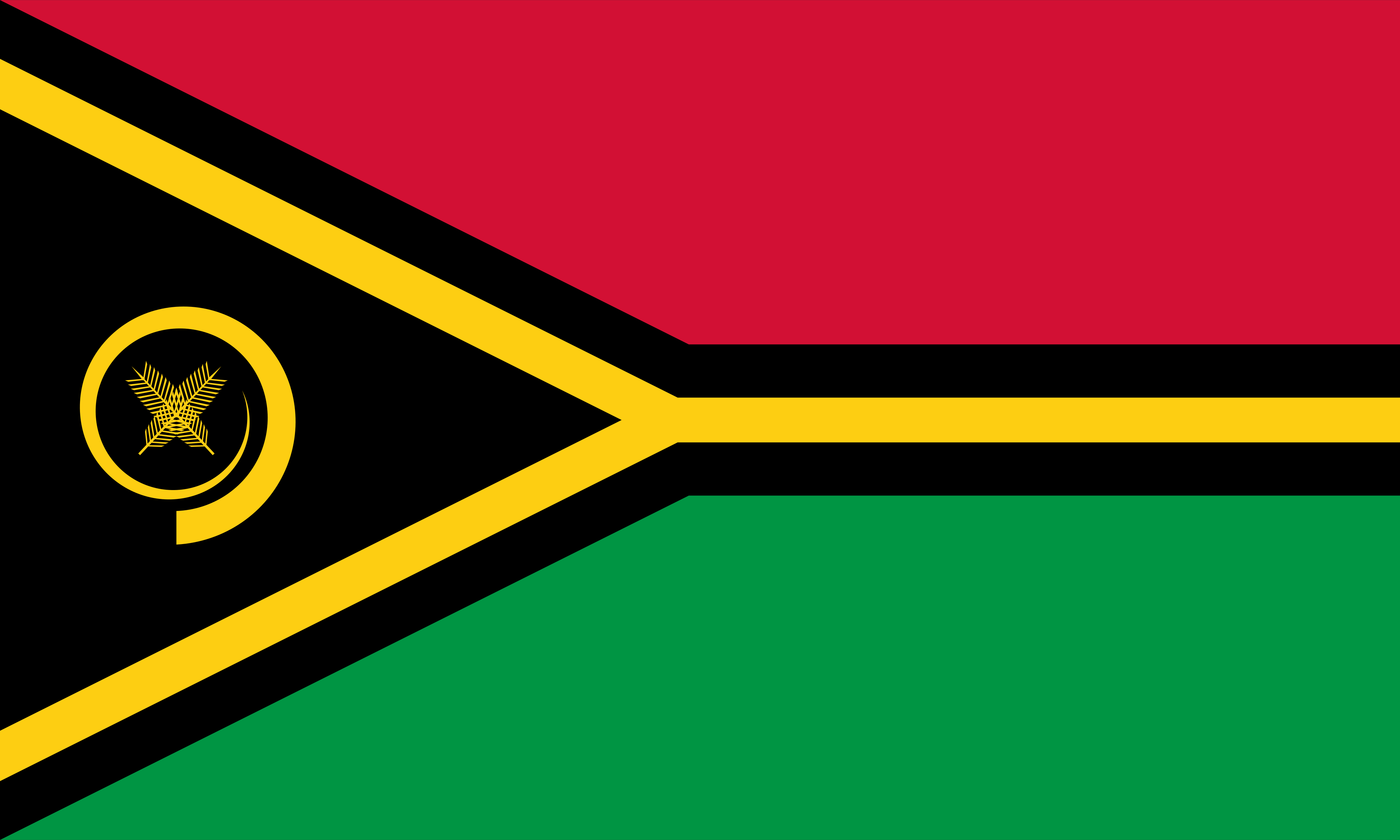
Vanuatu flag picture
This original drawing uses a 3:5 reference proportion. Published proportions differ; the construction notes distinguish reference coordinates from verified law.
| Country | Republic of VanuatuNational flag; State Flag in the legislative register. |
|---|---|
| Adopted | February 18, 1980UN Office at Vienna flag reference. |
| Independence | July 30, 1980A different event from flag adoption. |
| Designer | Kalontas MalonGovernment memorial attribution, May 2025. |
| Fields and division | Red · green · black · yellowBlack-edged yellow Y; black hoist triangle. |
| Hoist emblem | 1 curled tusk · 2 namele frondsNamele is a cycad, not a fern. |
| Reference ratio | Height:length = 3:5Other published ratios are discussed below. |
| Working palette | #D21034 · #009543 · #FDCE12 · #000000Editorial screen values, not statutory HEX codes. |
Source notes separate cultural explanations, legal evidence and the original drawing’s reproduction choices.
What does the Vanuatu flag look like?
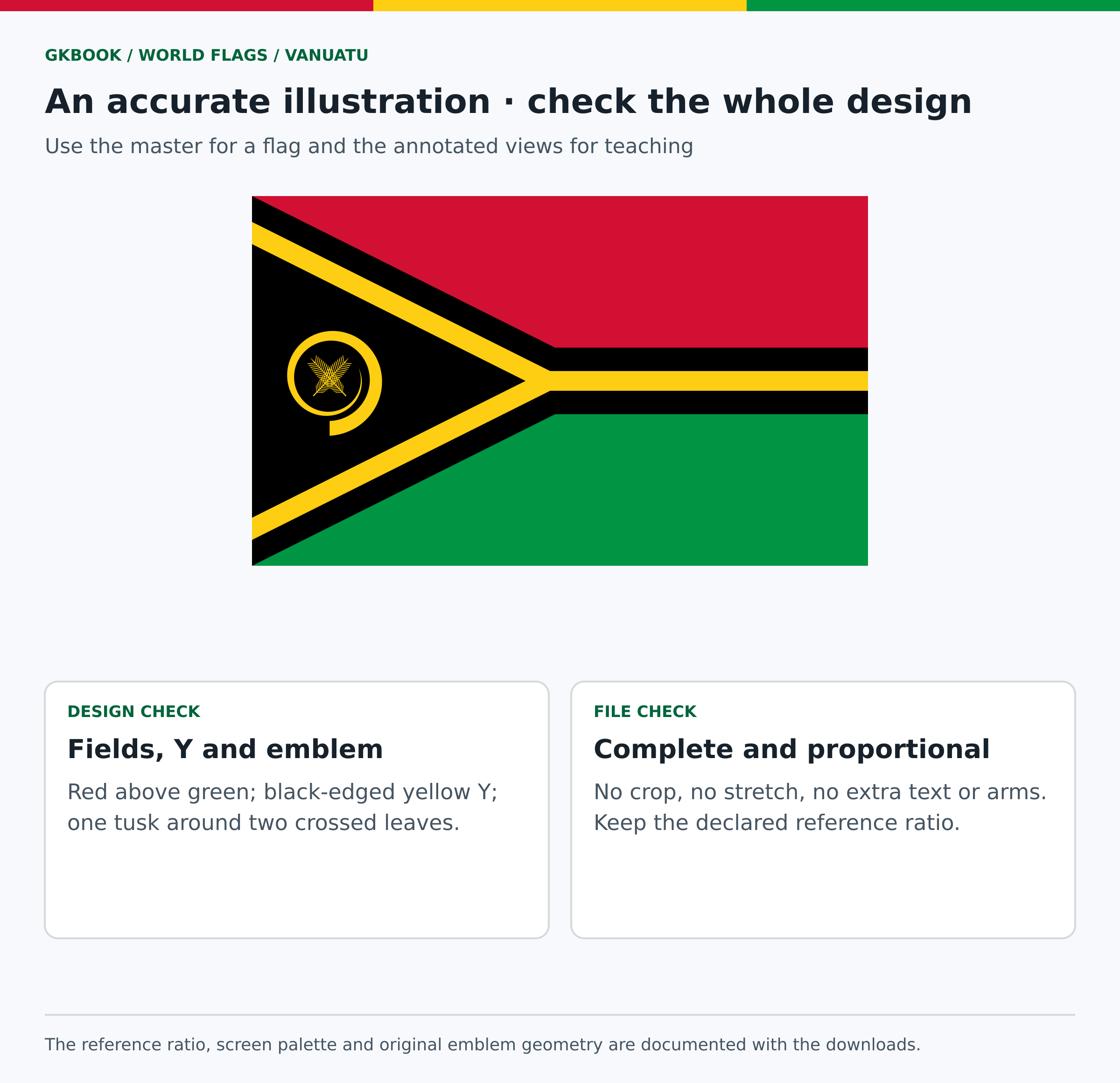
Vanuatu’s national flag has red above green, divided by a black-edged yellow Y. A yellow curled boar’s tusk surrounds two crossed namele leaves in the black hoist triangle. The design was adopted in February 1980. This page supplies a documented 3:5 reference drawing while explaining differences among published proportions.
The flag combines a readily recognized field pattern with an emblem rooted in Vanuatu’s cultural life. Read the colors and the Y first, then examine the tusk and crossed cycad fronds. The article links its answers to government, United Nations, botanical and museum sources, and identifies reconstruction choices where authoritative numerical specifications could not be established.
Sources: United Nations Office at Vienna — national flag reference, PDF page 47 · Vanuatu Tourism Office — Stopover Handbook 2026/2027, printed page 7 · Drawing method and calculations
What is Vanuatu’s national flag called?
It is usually called the national flag of Vanuatu; the country’s legislative register uses the term State Flag. It represents the Republic of Vanuatu. The design is identified by its yellow Y, black hoist triangle, red and green fields, and distinctive yellow boar’s tusk surrounding two crossed namele leaves.
State flag is the terminology used in the State Flag and Armorial Bearings Act. It does not, by itself, mean that the picture belongs to a provincial government or that every ordinary display is prohibited. The national flag, presidential standard and armorial bearings are distinct symbols mentioned in the government’s regulatory material.
In a catalog, filename or classroom caption, “Vanuatu flag” provides the clearest short identification. A caption can then describe the emblem and the reference proportion used in that particular picture. This is more useful than assigning an undocumented nickname or presenting a commercial product name as the country’s official name for its flag.
Sources: Vanuatu Trade Portal — regulations register · United Nations Office at Vienna — national flag reference, PDF page 47 · Drawing method and calculations
What are the Vanuatu flag colors and HEX codes?
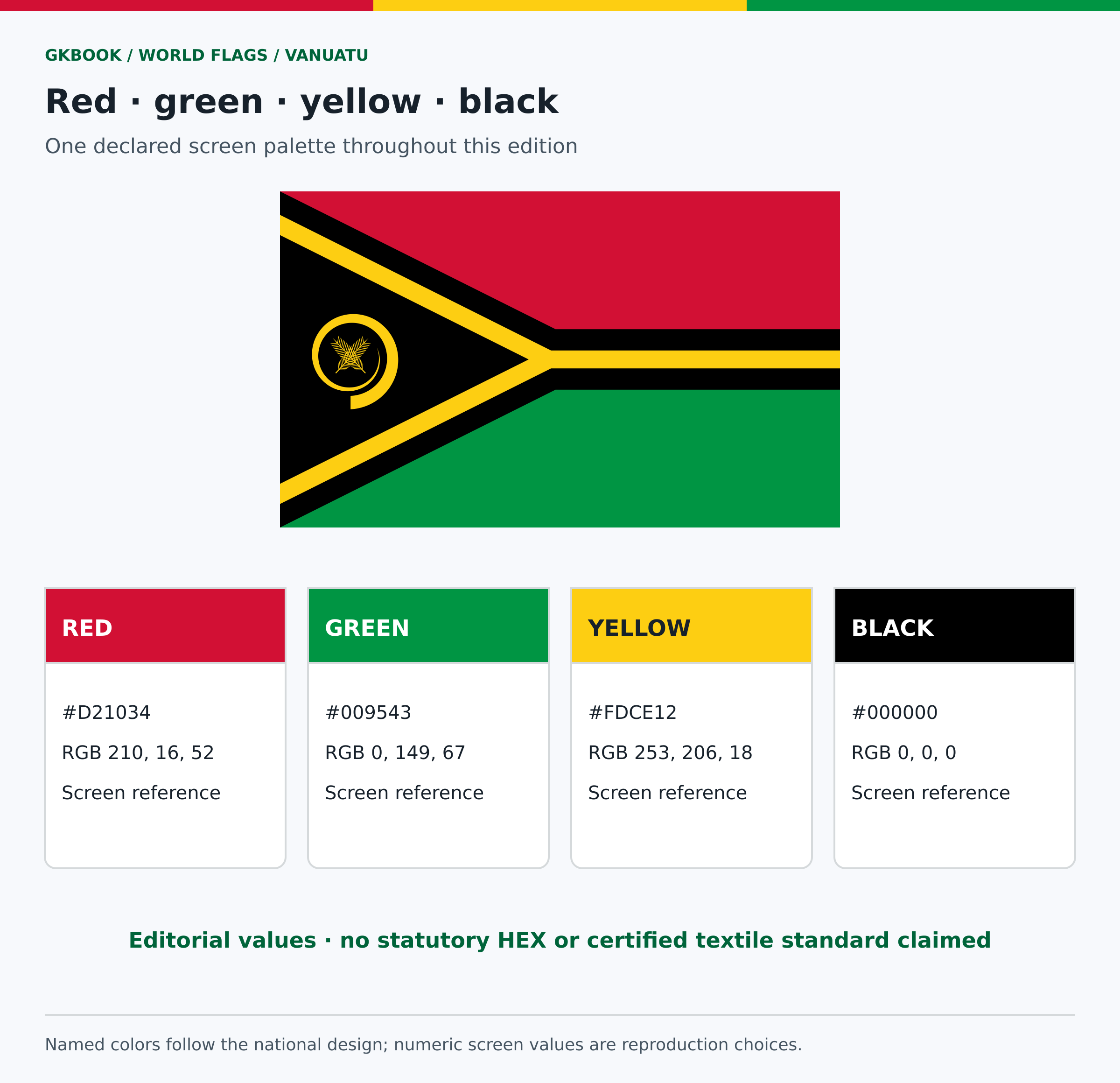
The flag uses red, green, yellow and black. This package consistently uses #D21034, #009543, #FDCE12 and #000000. These are declared digital reproduction values, not a verified statutory HEX table. The colors appear in the fields, the black-edged yellow Y, and the yellow tusk-and-namele emblem at the hoist.
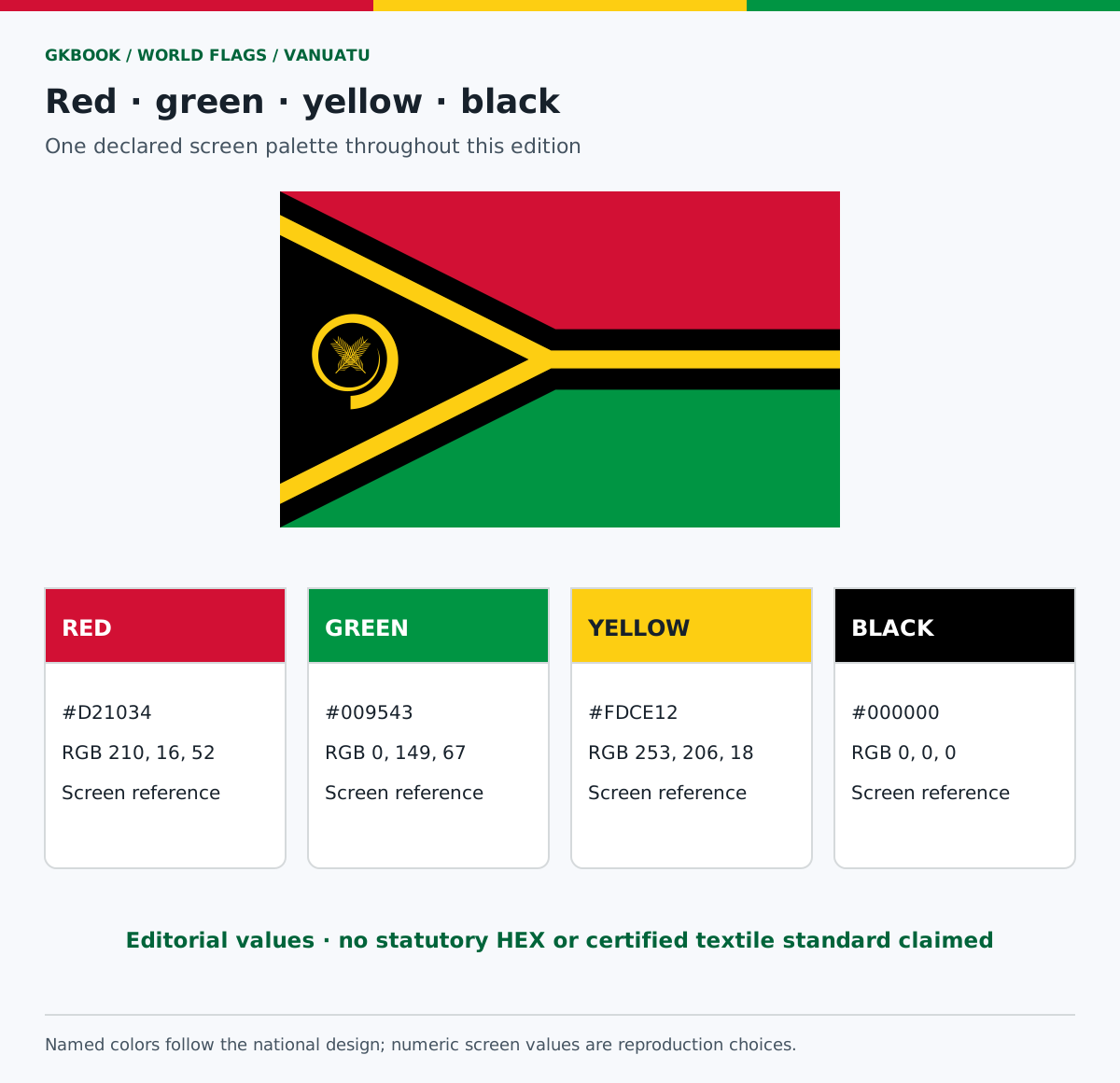
For a digital drawing, specifying an RGB palette makes the files reproducible. The same red should appear in the clean flag, a construction illustration and the social card. A value sampled from a compressed photograph would be less dependable because lighting, fabric, shadows and compression all change the recorded appearance of a color.
Screen colors do not automatically define an ink recipe or textile dye. Converting RGB to CMYK depends on the output profile, and a Pantone number copied from an event manual is not proof of a Vanuatu national standard. For official production, obtain the relevant approved artwork and shade requirements, then review an appropriate physical sample.
| Color | HEX | RGB | Status |
|---|---|---|---|
| Red | #D21034 | 210, 16, 52 | Editorial screen reference |
| Green | #009543 | 0, 149, 67 | Editorial screen reference |
| Yellow | #FDCE12 | 253, 206, 18 | Editorial screen reference |
| Black | #000000 | 0, 0, 0 | Editorial screen reference |
Sources: United Nations Office at Vienna — national flag reference, PDF page 47 · Vanuatu Tourism Office — Stopover Handbook 2026/2027, printed page 7 · Drawing method and calculations
What do the colors and symbols of Vanuatu’s flag mean?
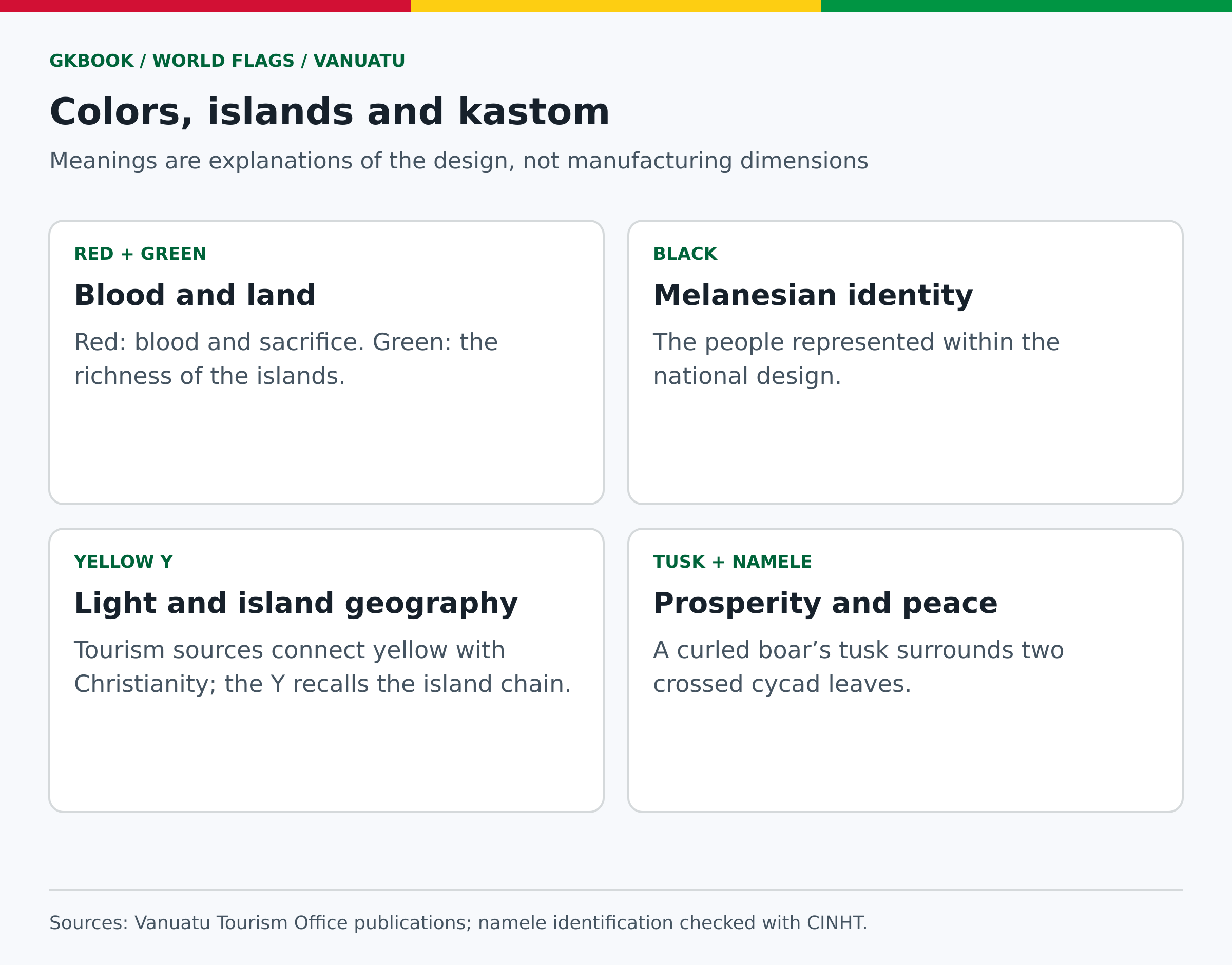
Vanuatu Tourism explanations associate red with blood, green with the islands’ richness, black with Melanesian identity, and yellow with light and Christianity or with peace and prosperity. The Y recalls the island chain. The curled tusk signifies prosperity, while the crossed namele leaves are described as symbols of peace.
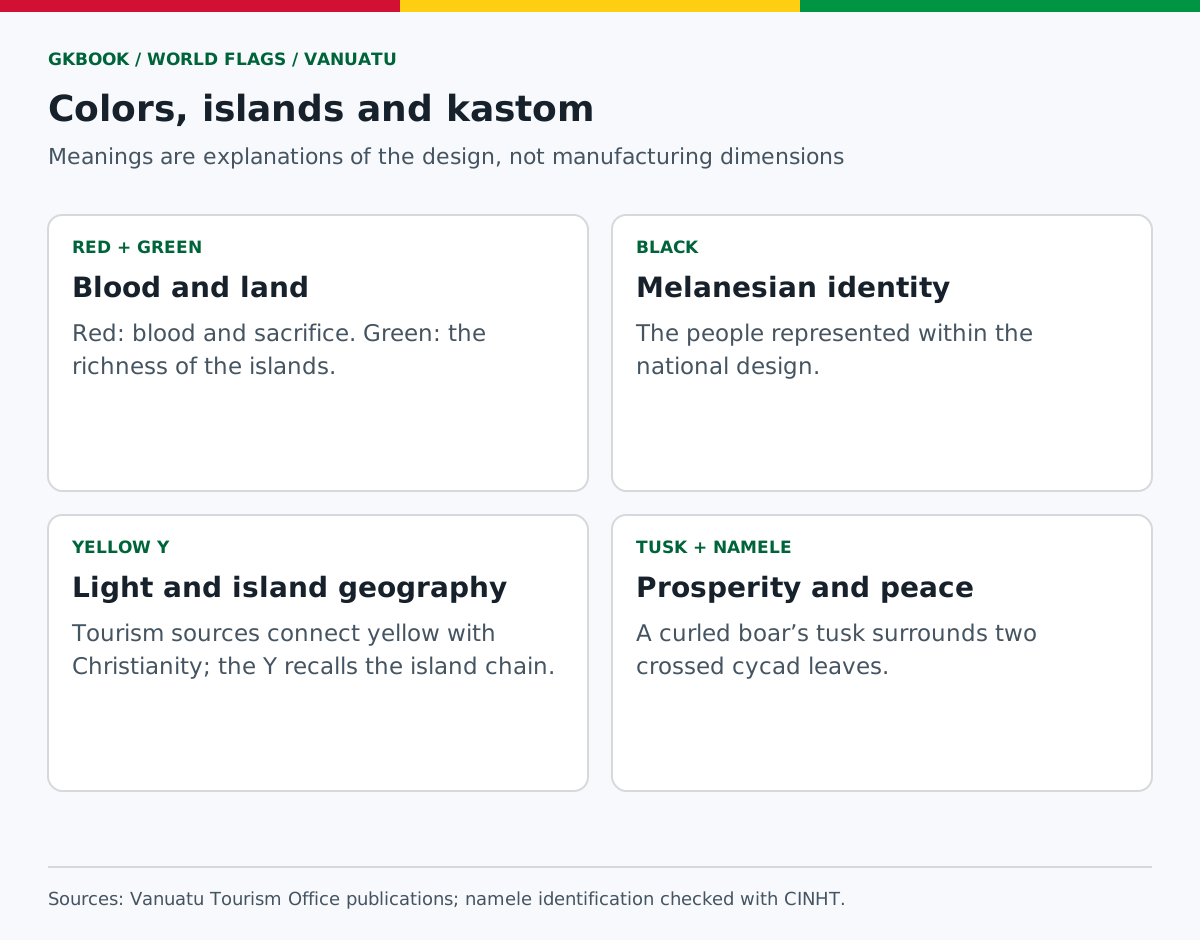
These interpretations come from explanatory publications rather than a dimensioned construction rule. The tourism handbook and traveler factsheet do not use identical wording for yellow. The page therefore attributes their explanations instead of pretending that every publication gives a single fixed sentence or that a color has only one possible cultural association.
A helpful way to read the design is in layers: its four-color field, its branching yellow division and its small cultural emblem. Each layer contributes to identification. Changing the field order or replacing the tusk with a generic ring would alter the recognizable flag even if a caption still repeated the correct symbolic meanings.
Sources: Vanuatu Tourism Office — Stopover Handbook 2026/2027, printed page 7 · Vanuatu Tourism Office — Vanuatu Facts for Travelers · Drawing method and calculations
Why does the Vanuatu flag have a yellow Y?
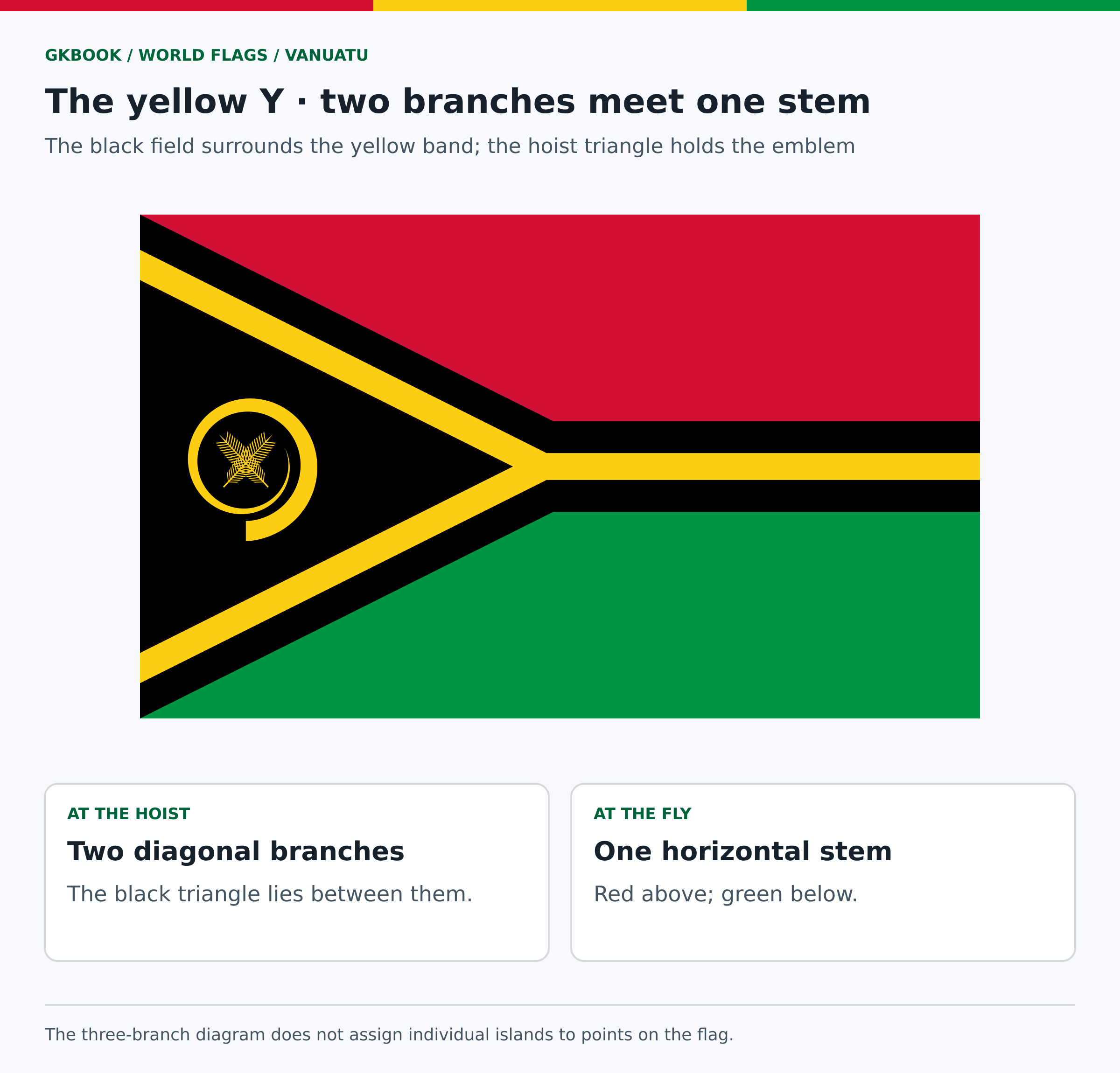
The sideways yellow Y recalls the arrangement of Vanuatu’s island chain. Two diagonal branches extend toward the hoist, meet near the middle, and continue as a horizontal stem toward the fly. Black surrounds the yellow band and forms the triangle containing the emblem. The design is an abstraction, not a literal map.
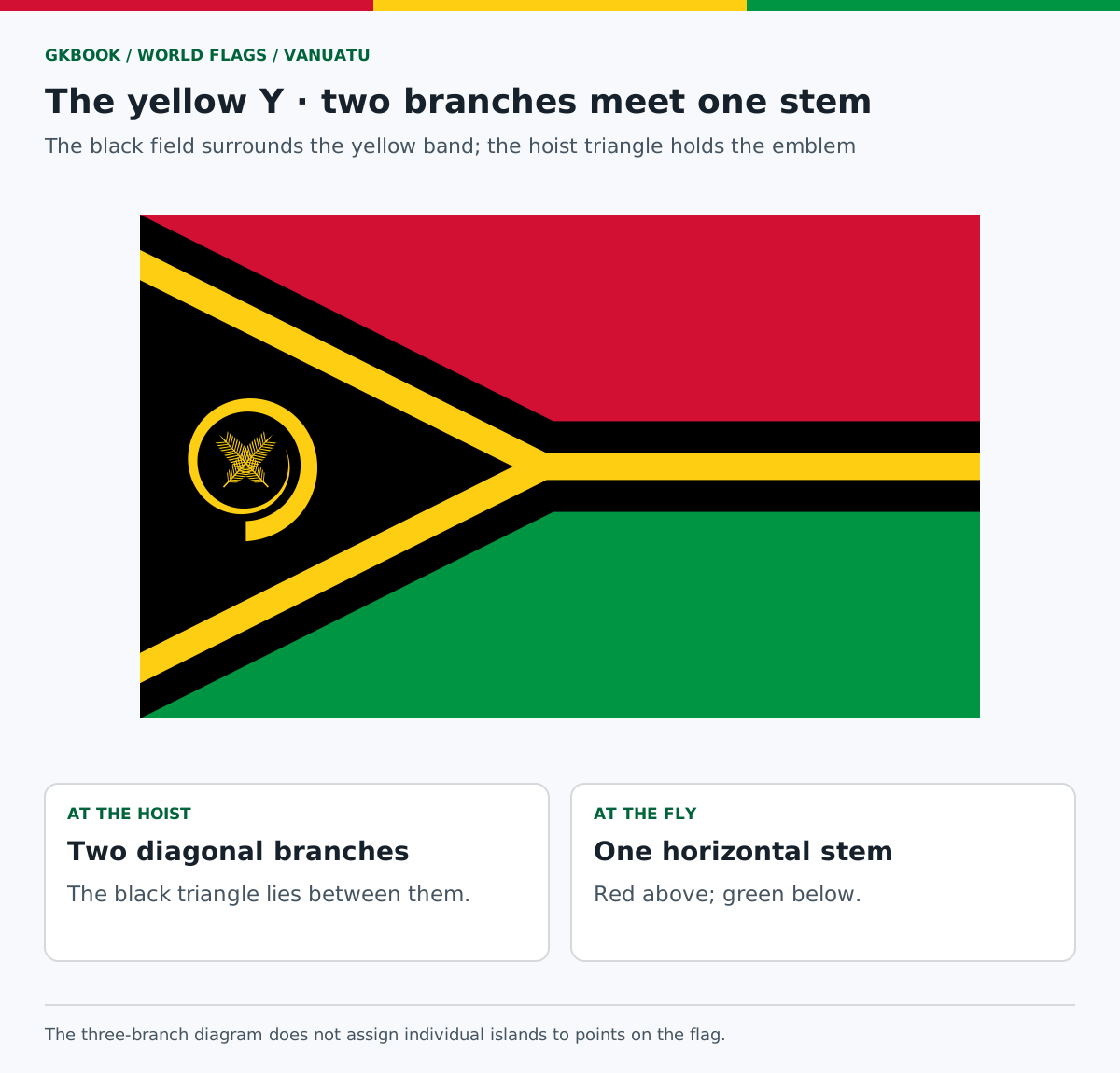
Hoist means the edge attached to the staff or halyard; fly means the free end. In the conventional front illustration, the hoist is at the left. The Y’s open side faces that hoist, while its single horizontal stem runs to the right. The red field is above the stem and the green field below it.
A classroom comparison can place an island map next to the flag, but should not bend the flag into a coastline diagram. The emblem does not mark Port Vila, and the Y does not provide named locations for individual islands. Its branches communicate a broad geographical idea while remaining a deliberately simple graphic shape.
Sources: Vanuatu Tourism Office — Stopover Handbook 2026/2027, printed page 7 · Government of Vanuatu — About Vanuatu · Drawing method and calculations
What is the yellow curled symbol on Vanuatu’s flag?
It is a boar’s tusk, curled around two crossed namele leaves. Tourism accounts connect the tusk with prosperity. Museum research also explains the importance of curled pig tusks as valued ornaments and ceremonial possessions in parts of the Pacific. It is not a moon, a horn, or a plain decorative circle.
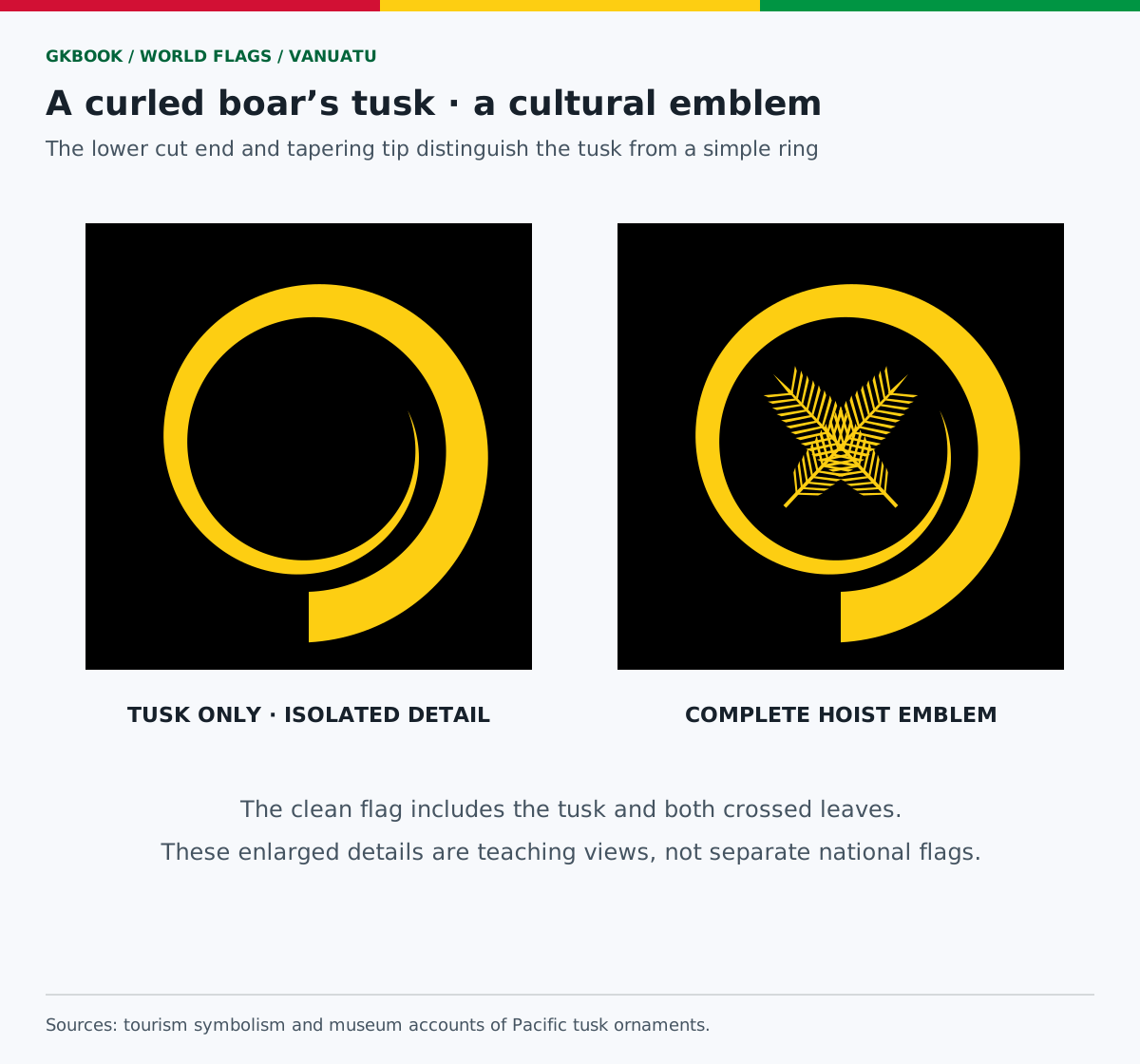
National Museums Scotland describes the extra value attached to tusks that curl into a complete ring or farther, reflecting the time and care involved in their growth. That material context helps explain why a small yellow outline can carry cultural meaning. The symbol refers to a recognizable object, rather than to abstract wealth alone.
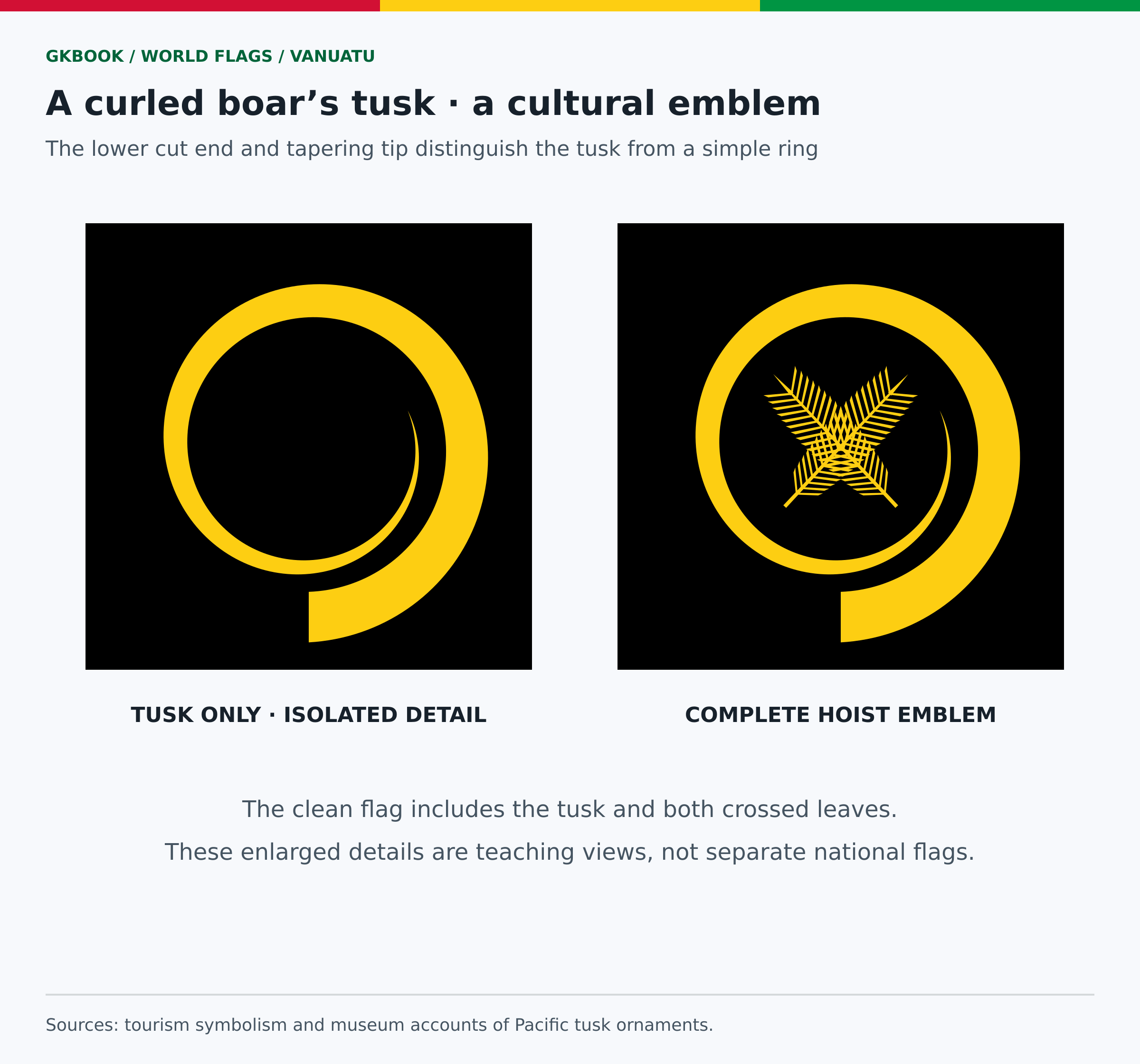
In this original illustration, a tapering curved ribbon forms the tusk, with a cut end below and a pointed end curling inward. Its asymmetry is preserved in every enlargement and transformation. The drawing is stylized: it is neither an anatomical diagram nor a claim that all ceremonial tusks have exactly these contours or dimensions.
Sources: Vanuatu Tourism Office — Stopover Handbook 2026/2027, printed page 7 · National Museums Scotland — Introduction to Pacific Collections · Drawing method and calculations
Are the leaves on Vanuatu’s flag ferns or palms?
They are namele leaves, conventionally shown as a crossed pair. The Cook Islands Natural Heritage Trust identifies namele in Vanuatu as the cycad Cycas seemannii. Although flag descriptions sometimes call them fern or palm leaves, cycad is the more precise botanical description. Their many narrow leaflets should not be mistaken for many separate fronds.
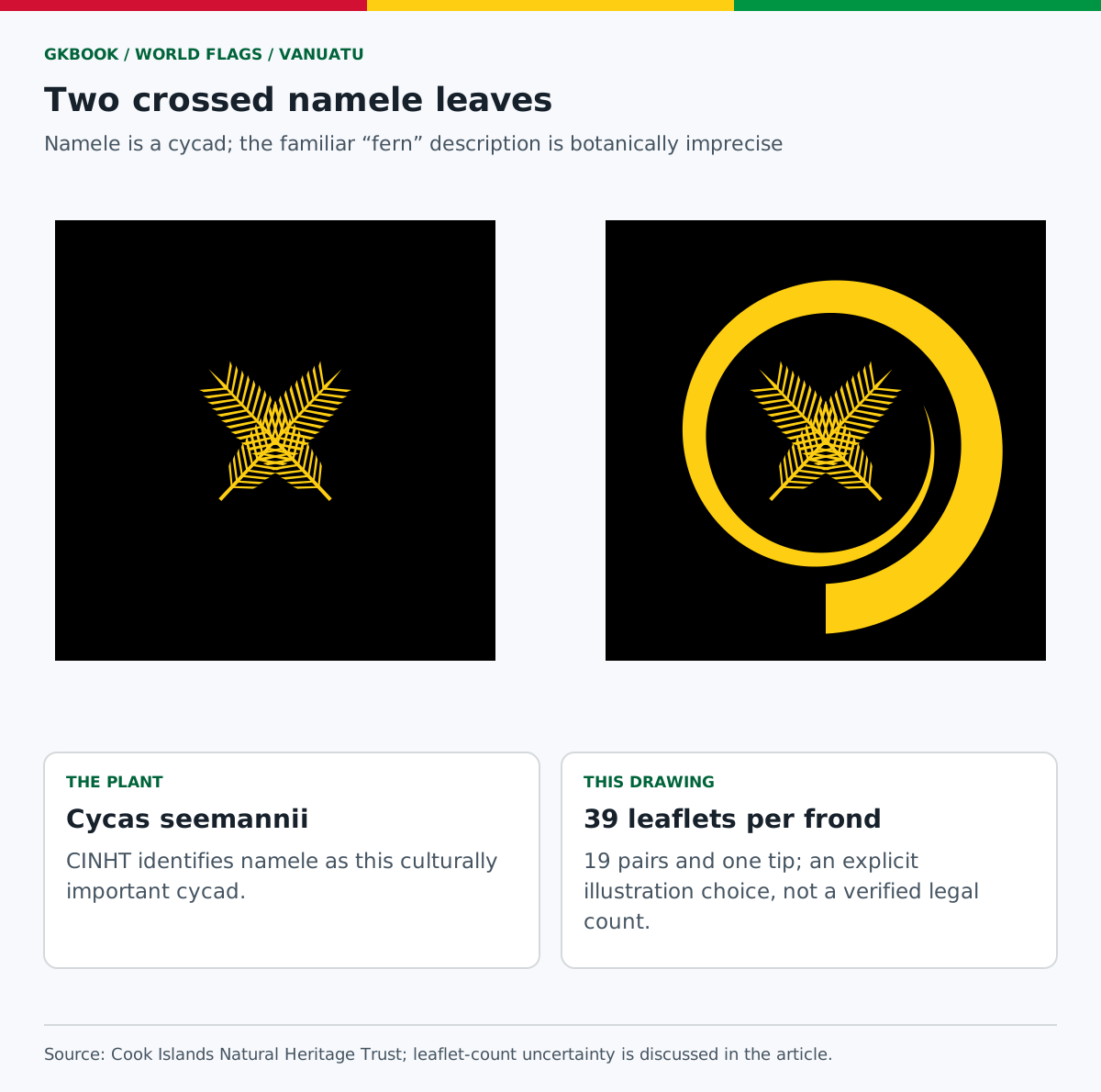
The botanical source links namele with cultural importance and customary restrictions, including markers at entrances and protected fishing grounds. Those uses show that the plant has a broader role than the brief word “peace” in a flag summary. They should not be turned into a universal instruction about how to interpret every actual leaf placed in a community.
For drawing purposes, distinguish the stem of each frond from the small leaflets along it. Two crossed stems remain visible inside the tusk. A single fan-shaped palm icon, an olive branch or a five-pointed leaf would lose that structure. The enlarged illustration isolates the pair before showing it again in the complete hoist emblem.
Sources: Cook Islands Natural Heritage Trust — Cycads and their Golden Age · Vanuatu Ministry of Education — Bislama Spelling Dictionary, 2007 · Drawing method and calculations
Do the namele leaflets represent thirty-nine members of Parliament?
A widely repeated explanation connects thirty-nine divisions of the namele leaves with an earlier legislative assembly. Published drawings and descriptions are inconsistent about counting individual leaflets or pairs. This page does not treat that explanation as a verified legal construction requirement. Vanuatu’s Parliament describes its present institution as having fifty-two members.
Flags of the World records the historical explanation and also preserves discussion about how the leaves have been drawn. That is useful evidence of a source tradition, but it is not an authenticated instruction to print a particular number of pairs. A low-resolution emblem cannot reliably settle a counting dispute where its fine strokes merge together.
The supplied reconstruction uses thirty-nine small leaflets on each frond: nineteen pairs and one terminal tip. This choice is disclosed so that the artwork can be checked and rebuilt. It does not imply that today’s Parliament has thirty-nine seats, or that a change in parliamentary membership requires the national flag’s emblem to be redrawn.
Sources: Flags of the World — Vanuatu · Parliament of Vanuatu — About Us · Drawing method and calculations
What is the correct ratio of the Vanuatu flag?
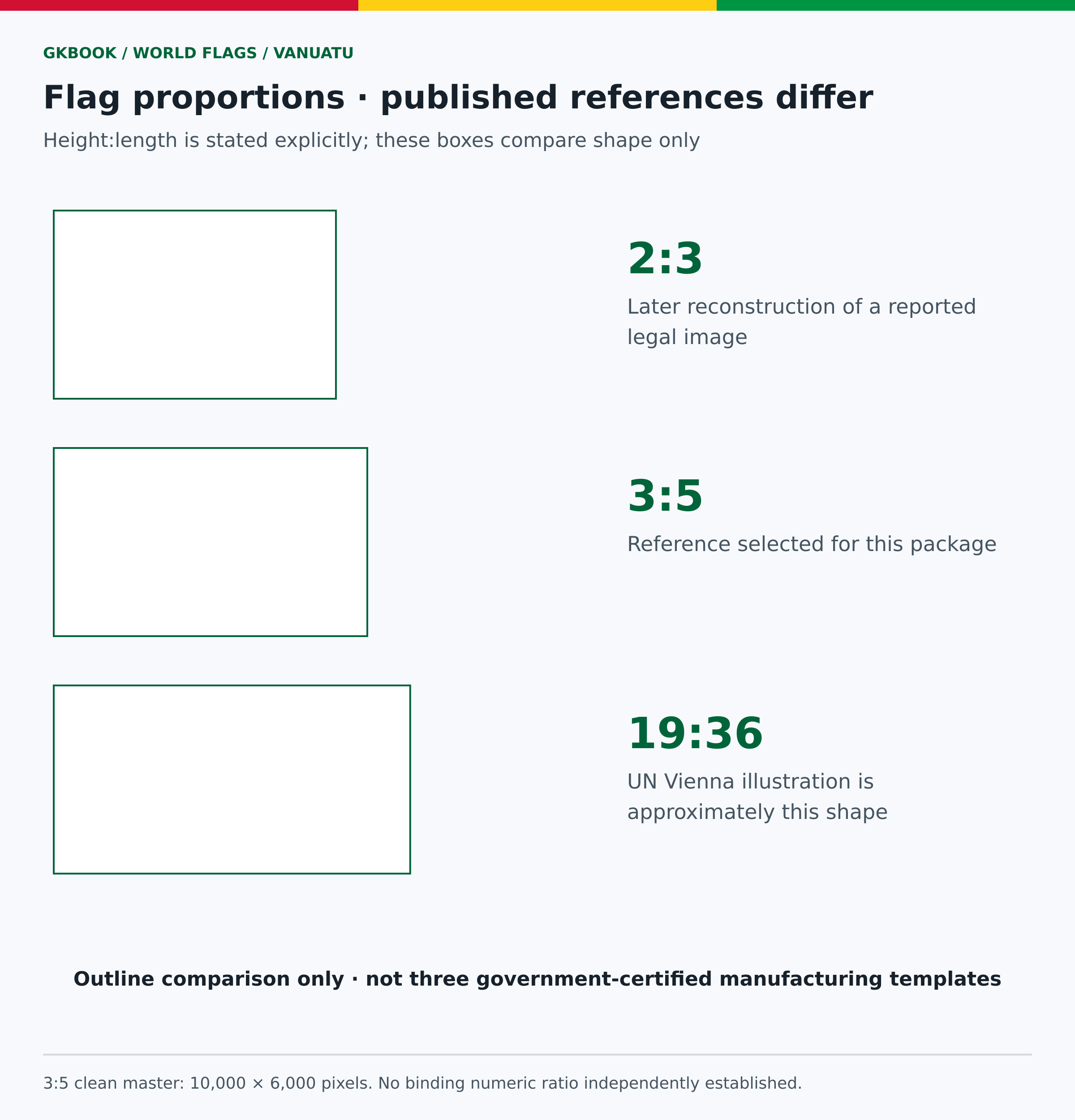
Published references use more than one proportion, including 2:3, 3:5 and 19:36. This package uses a clearly labeled 3:5 height-to-length reference. The inspected material did not establish one binding numerical manufacturing ratio. A flag illustration in an official publication and a later measured construction sheet are different kinds of evidence.
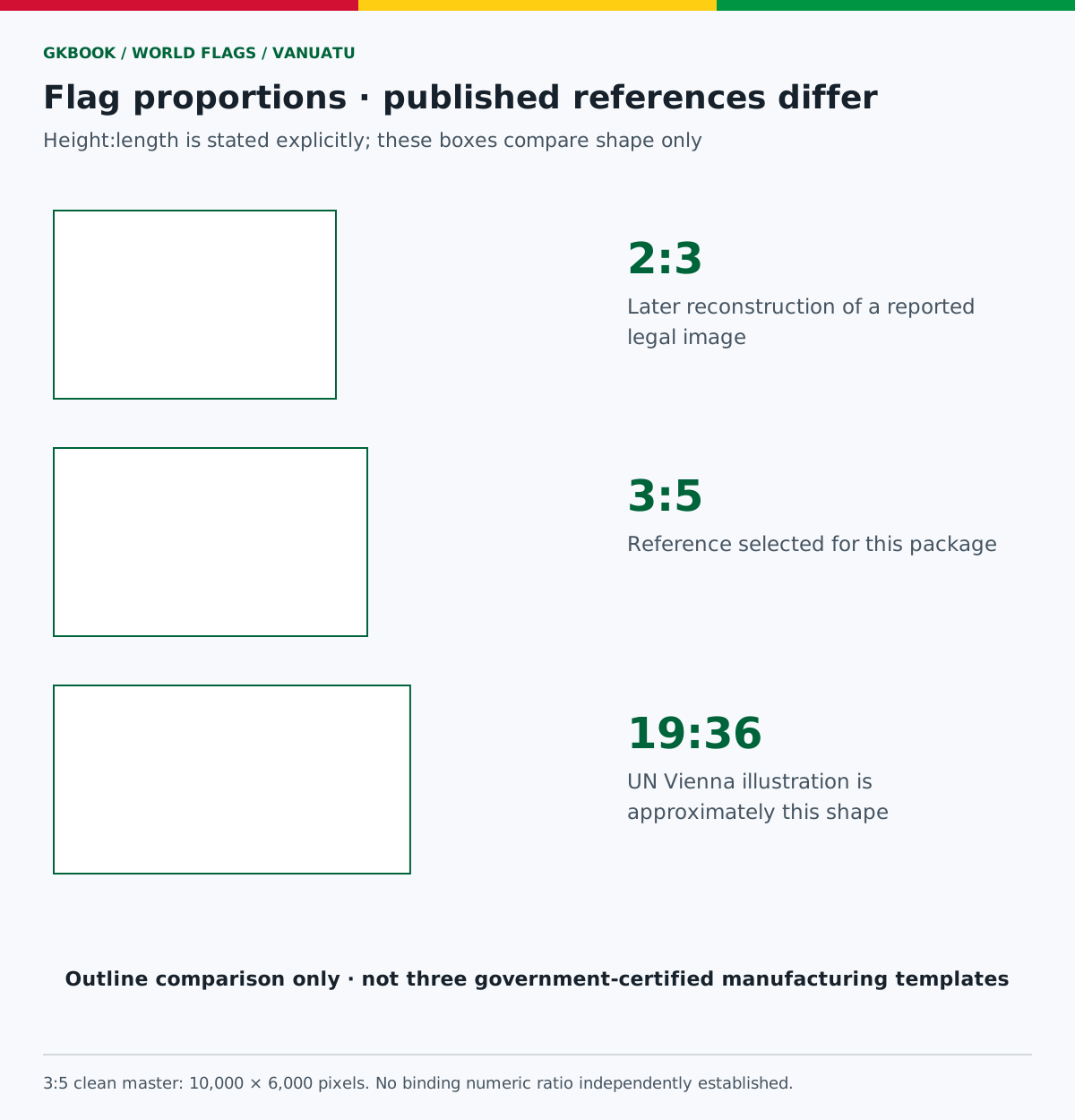
The tourism handbook’s displayed flag is approximately 3:5, while the UN Vienna illustration is approximately 19:36. A later Commons construction sheet interprets a reported legal schedule as approximately 2:3. Because the original declaration could not be retrieved, this article does not certify that interpretation, declare the variants legally equivalent, or claim that a later image supersedes an earlier rule.
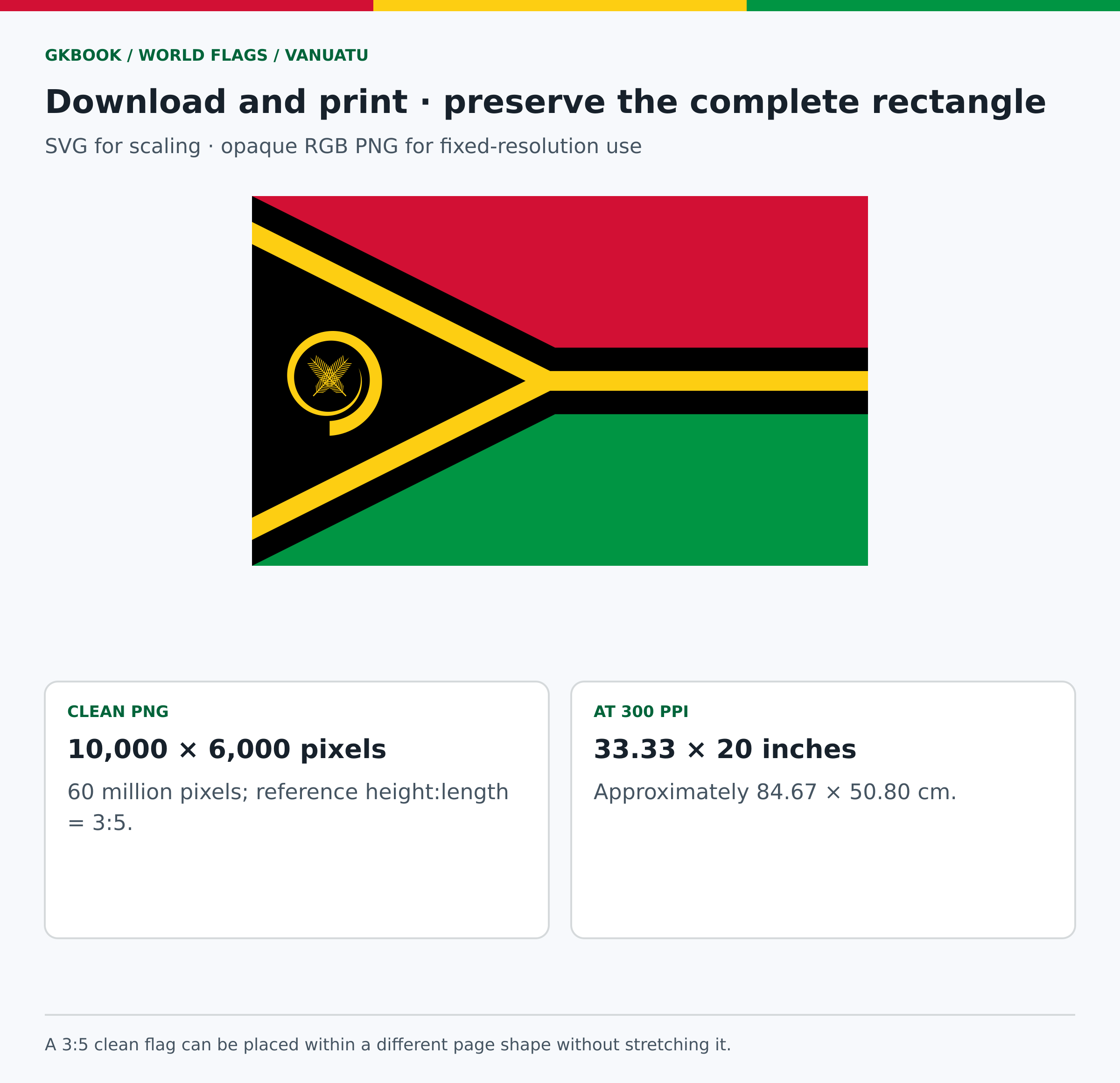
Always state which measurement comes first. For the chosen 3:5 reference, a flag six units high is ten units long. The clean PNG is consequently 10,000 pixels long and 6,000 pixels high. Changing only its displayed width would stretch the emblem; fitting the whole image within a larger frame preserves the intended drawing.
| Height:length | Evidence or role | What this page claims |
|---|---|---|
| 2:3 | Later interpretation of a reported legal schedule | Original legal image not independently retrieved |
| 3:5 | Published reference form; selected for these files | Explicit educational reconstruction |
| 19:36 | Approximately the UN Vienna displayed shape; also reported by FOTW | Published form, not a verified exclusive legal ratio |
Sources: United Nations Office at Vienna — national flag reference, PDF page 47 · Vanuatu Tourism Office — Stopover Handbook 2026/2027, printed page 7 · Wikimedia Commons — Vanuatu construction-sheet source account · Flags of the World — Vanuatu · Drawing method and calculations
How is this Vanuatu flag reference constructed?
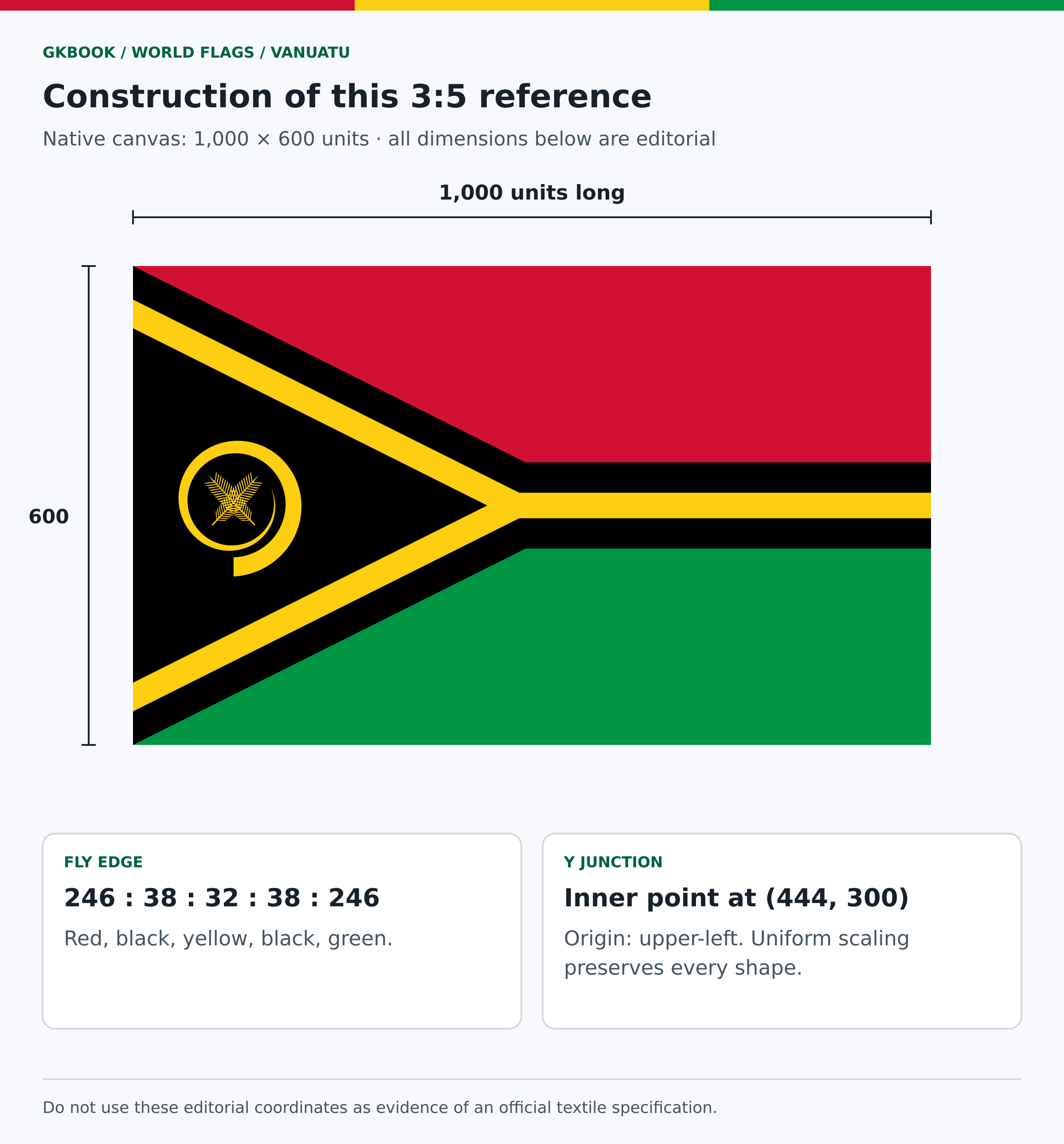
The supplied drawing uses a 1,000-by-600 coordinate canvas. At the fly, the vertical sequence is 246 units red, 38 black, 32 yellow, 38 black and 246 green. Diagonal yellow branches join the horizontal stem around the black hoist triangle. These measurements document this reconstruction; they are not quoted statutory dimensions.
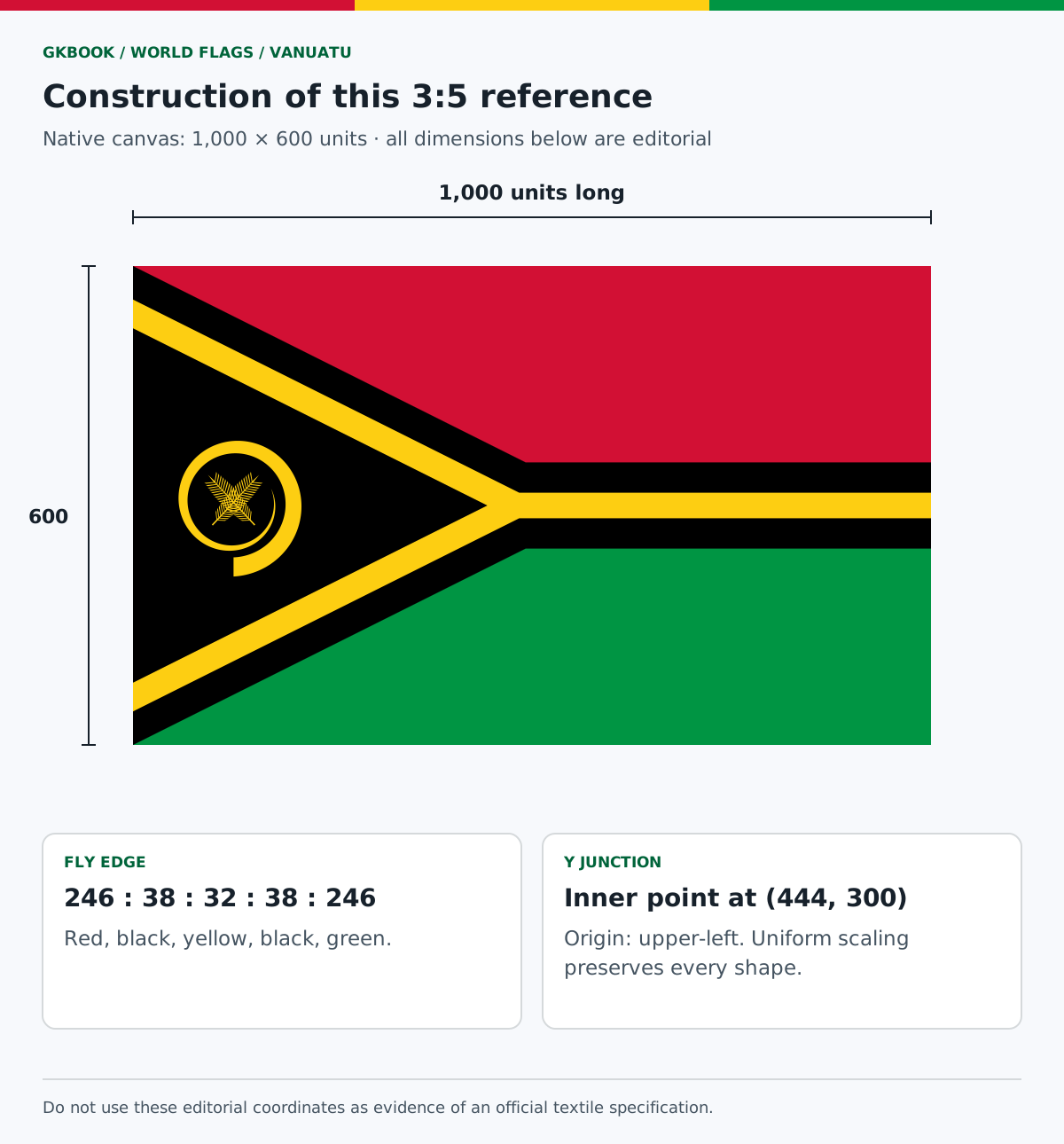
The origin is the upper-left corner, with x increasing to the right and y downward. The centerline is y = 300. The horizontal yellow stem spans y = 284 to 316, and its surrounding black band spans y = 246 to 354. The inner point of the black hoist field is at (444, 300).
The red polygon runs through (0,0), (1000,0), (1000,246) and (492,246); the green polygon mirrors its outline vertically. The yellow Y is a separate filled polygon on the black base. Each native coordinate is multiplied by ten for the clean PNG. This documented grid makes the original artwork reproducible without suggesting official certification.
| Element | Native measurement | Status |
|---|---|---|
| Canvas | 1,000 × 600 | 3:5 reference |
| Yellow horizontal band | y = 284–316 | 32-unit height |
| Black central band | y = 246–354 | 108-unit total height |
| Inner hoist-triangle point | (444, 300) | Editorial coordinate |
| PNG enlargement | 10 pixels per native unit | 10,000 × 6,000 output |
Sources: Drawing method and calculations
Where should the tusk and crossed leaves be placed?
The yellow emblem belongs inside the black triangle at the hoist. The tusk surrounds the crossed namele leaves, and clear black space separates it from the Y. It is not centered on the whole rectangular flag. The supplied enlargement shows the same original emblem contours used in the clean master.

The reconstruction places the emblem around native coordinate (126,296), close to the vertical middle of the hoist area. That coordinate describes this file, not a government placement rule. The complete design is checked to keep the tusk and both fronds within the triangle, with no piece touching the red or green fields.
At very small sizes, the thin leaflets may become difficult to distinguish. Use a larger image or the supplied enlarged detail when teaching the emblem. Moving it out of the triangle or replacing it with the full national coat of arms is not a solution to lost detail; either change would misidentify what appears on the flag.
Sources: United Nations Office at Vienna — national flag reference, PDF page 47 · Vanuatu Tourism Office — Stopover Handbook 2026/2027, printed page 7 · Drawing method and calculations
When was the Vanuatu flag adopted?
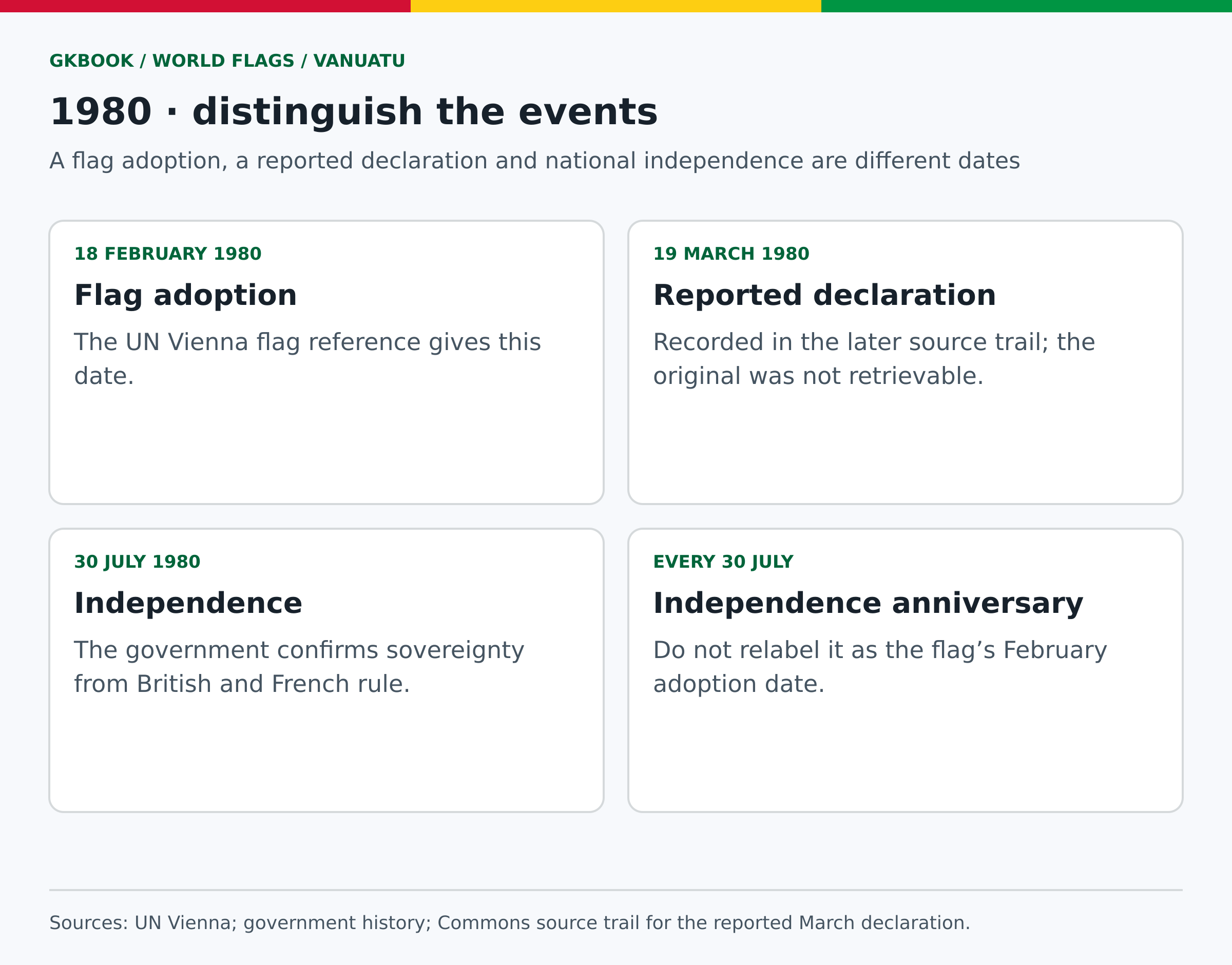
The UN Office at Vienna’s flag reference gives February 18, 1980 as the adoption date. That precedes Vanuatu’s independence on July 30, 1980. A later source trail reports a public declaration dated March 19, 1980, but the original declaration was not retrievable during this research, so that date is explicitly attributed.
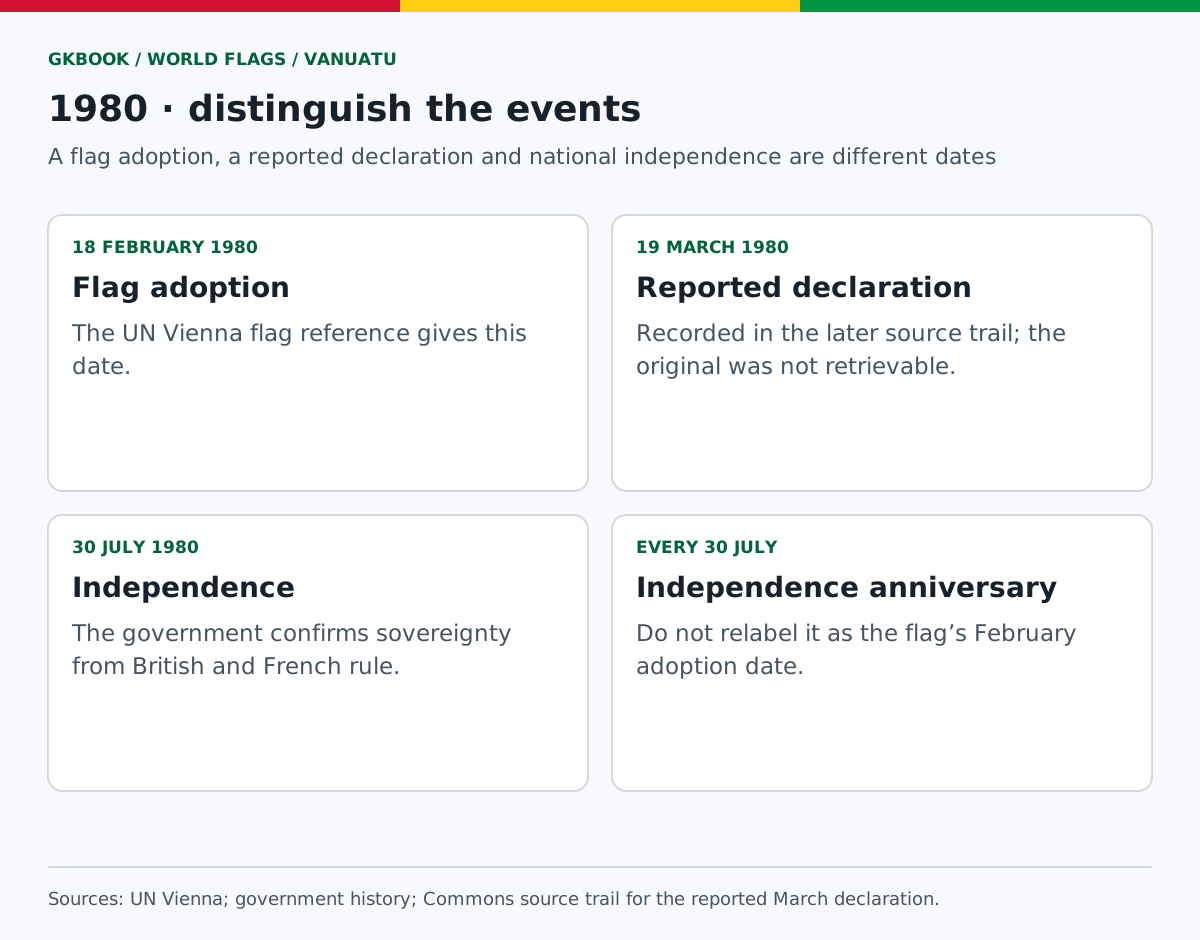
The distinction matters because adoption, formal legal documentation and independence need not occur on the same day. A historical timeline should identify the event beside each date. Simply printing “1980” is accurate but incomplete; treating all three dates as rival answers to exactly the same question obscures what the sources actually describe.
The primary adoption reference was inspected directly, including its illustrated Vanuatu entry. The March date is presented with a different confidence level because it depends on the cited later account. This page does not invent a commencement provision from the unavailable document or label February 18 a statutory public holiday without a supporting holiday instrument.
Sources: United Nations Office at Vienna — national flag reference, PDF page 47 · Wikimedia Commons — Vanuatu construction-sheet source account · PacLII — State Flag and Armorial Bearings Public Declaration · Government of Vanuatu — About Vanuatu · Drawing method and calculations
Who designed the Vanuatu flag?
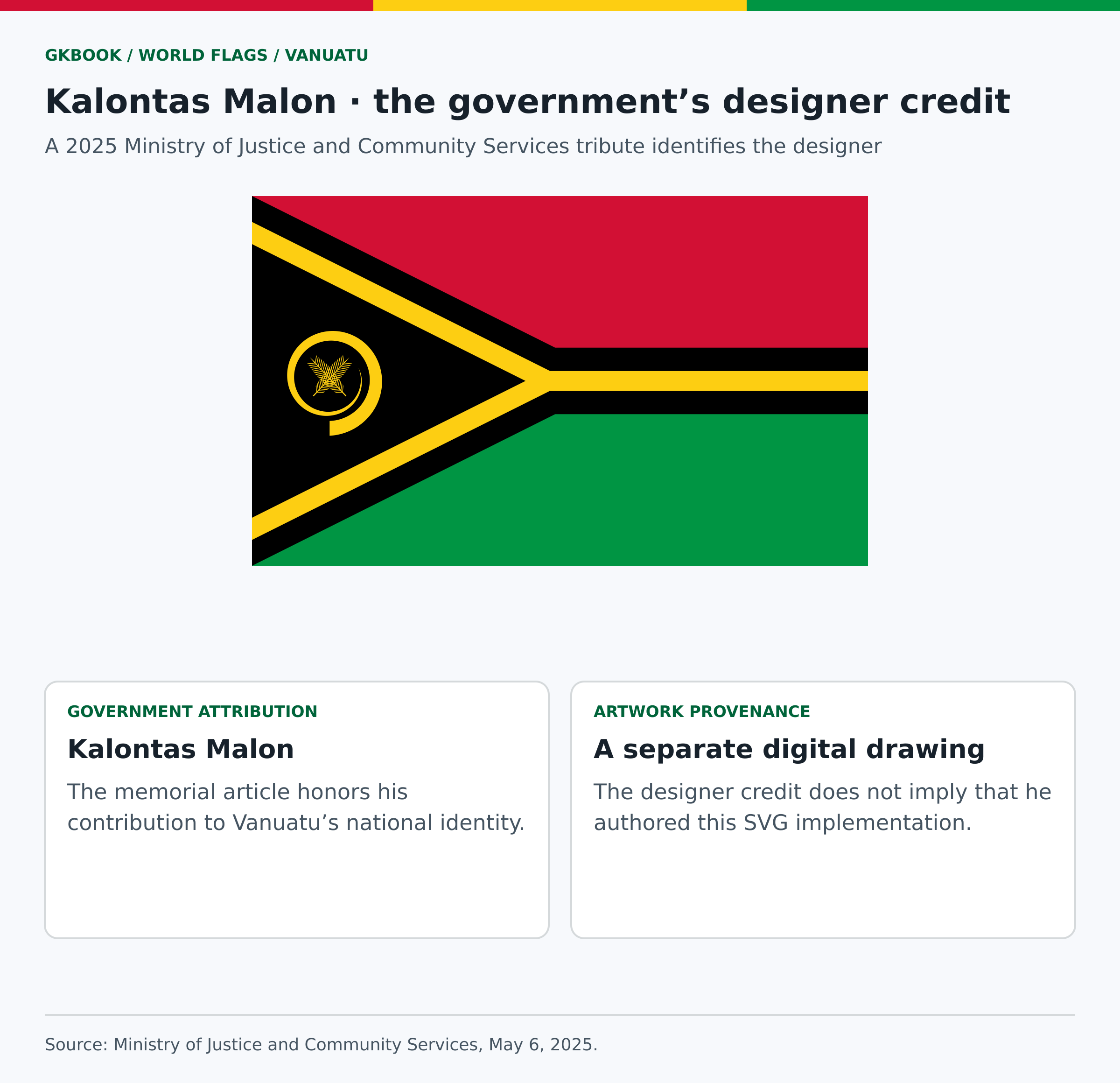
Vanuatu’s Ministry of Justice and Community Services credits Kalontas Malon as the flag’s designer in a May 2025 memorial report. This page follows the Ministry’s spelling. The government attribution concerns the national design; it does not identify the author of every later vector file, commercial flag, or educational reconstruction.
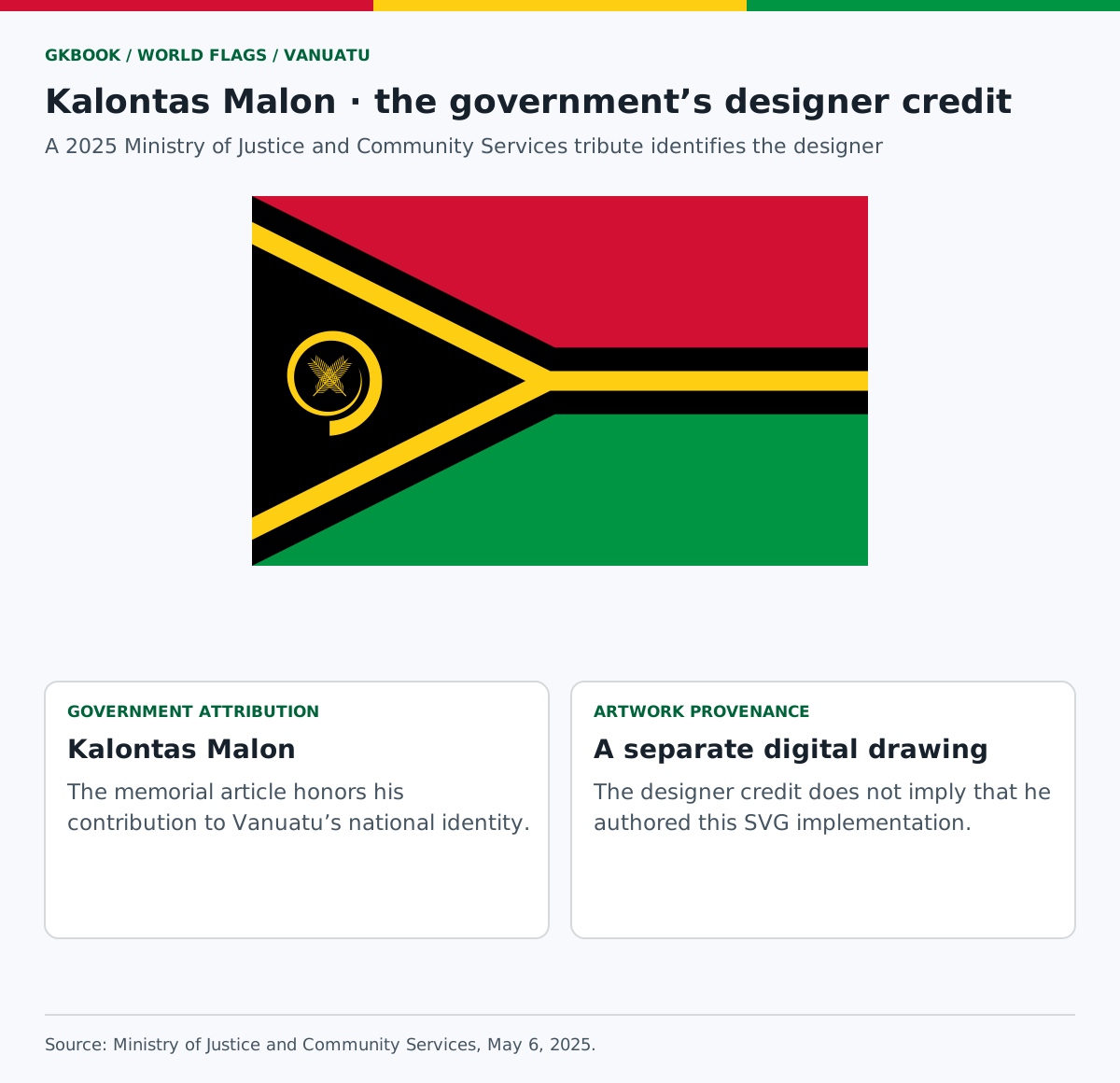
The Ministry describes a tribute involving chiefs and Malon’s family, linking his contribution with national identity. It also reports calls to name a school in his honor. A call for a memorial is not proof that the renaming has been completed. The article therefore uses the verified designer credit without inventing an accomplished later event.
The source does not provide a complete technical record of every drafting decision. Accordingly, this page does not attach an unverified competition entry count, a fabricated quotation or a guessed signature to the artwork. The downloadable graphics have their own provenance statement, separate from the national designer’s name and from the authorities that use the flag.
Sources: Ministry of Justice and Community Services — A Nation Remembers · Drawing method and calculations
What is the history behind the Vanuatu flag?
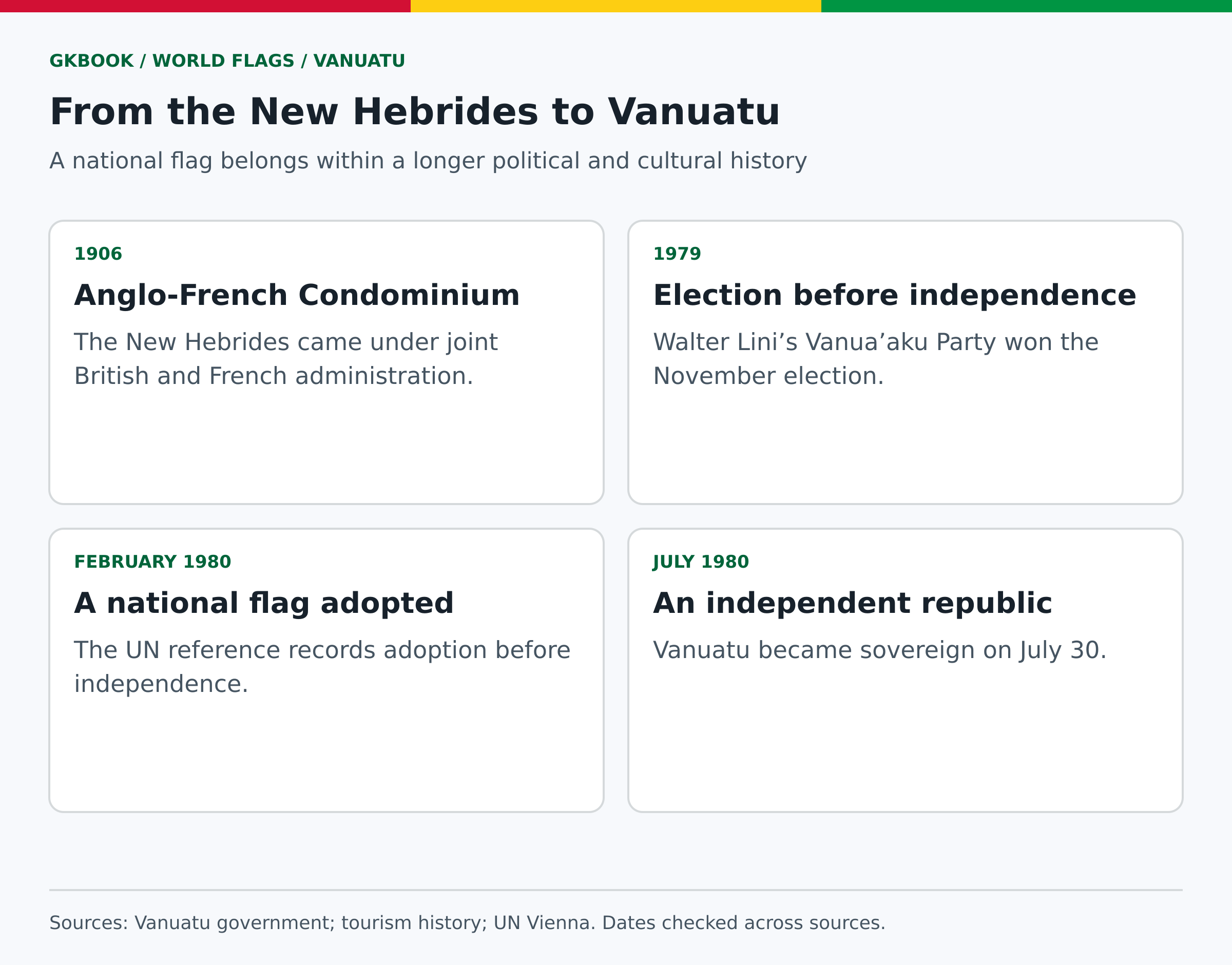
The modern flag belongs to Vanuatu’s transition from the New Hebrides to an independent republic in 1980. The islands had been jointly administered by Britain and France under the condominium established in 1906. The national design brought indigenous cultural symbols and the island-chain Y into the representation of the new state.
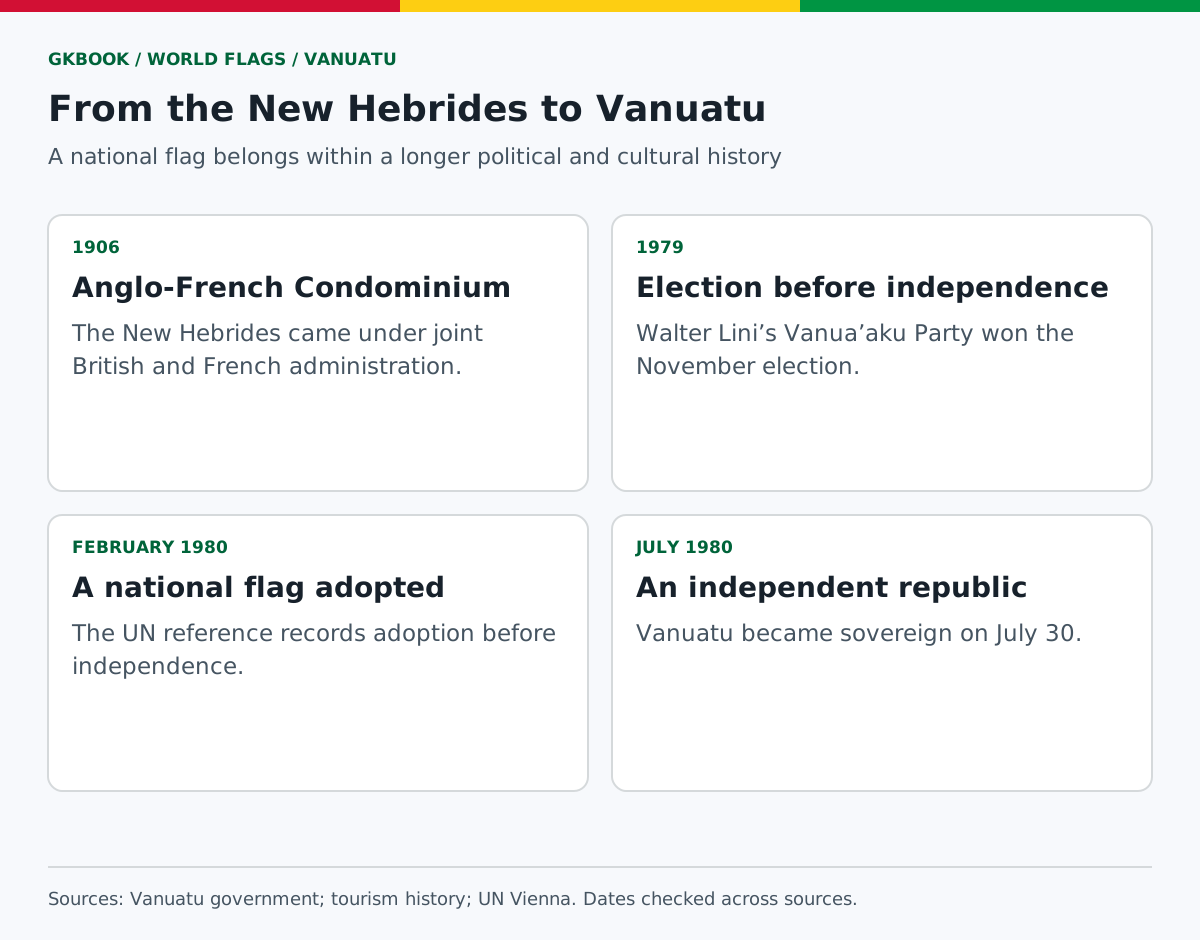
The government’s historical overview establishes the condominium and independence framework. Tourism history also records Walter Lini’s Vanua’aku Party winning the November 1979 election. Those political events provide context for the flag’s adoption. They do not, without further evidence, prove every detailed story about who selected a particular border width or revised an individual leaf.
A historical illustration should distinguish national, administrative, party and separatist flags rather than flattening them into one uninterrupted succession. This package uses a dated timeline instead of inventing a single predecessor flag for the entire condominium. Its main subject is the national design adopted in 1980, with earlier history included to explain the transition.
Sources: Government of Vanuatu — About Vanuatu · Vanuatu Tourism Office — History · United Nations Office at Vienna — national flag reference, PDF page 47 · Drawing method and calculations
Is Vanuatu’s flag adoption date the same as Independence Day?
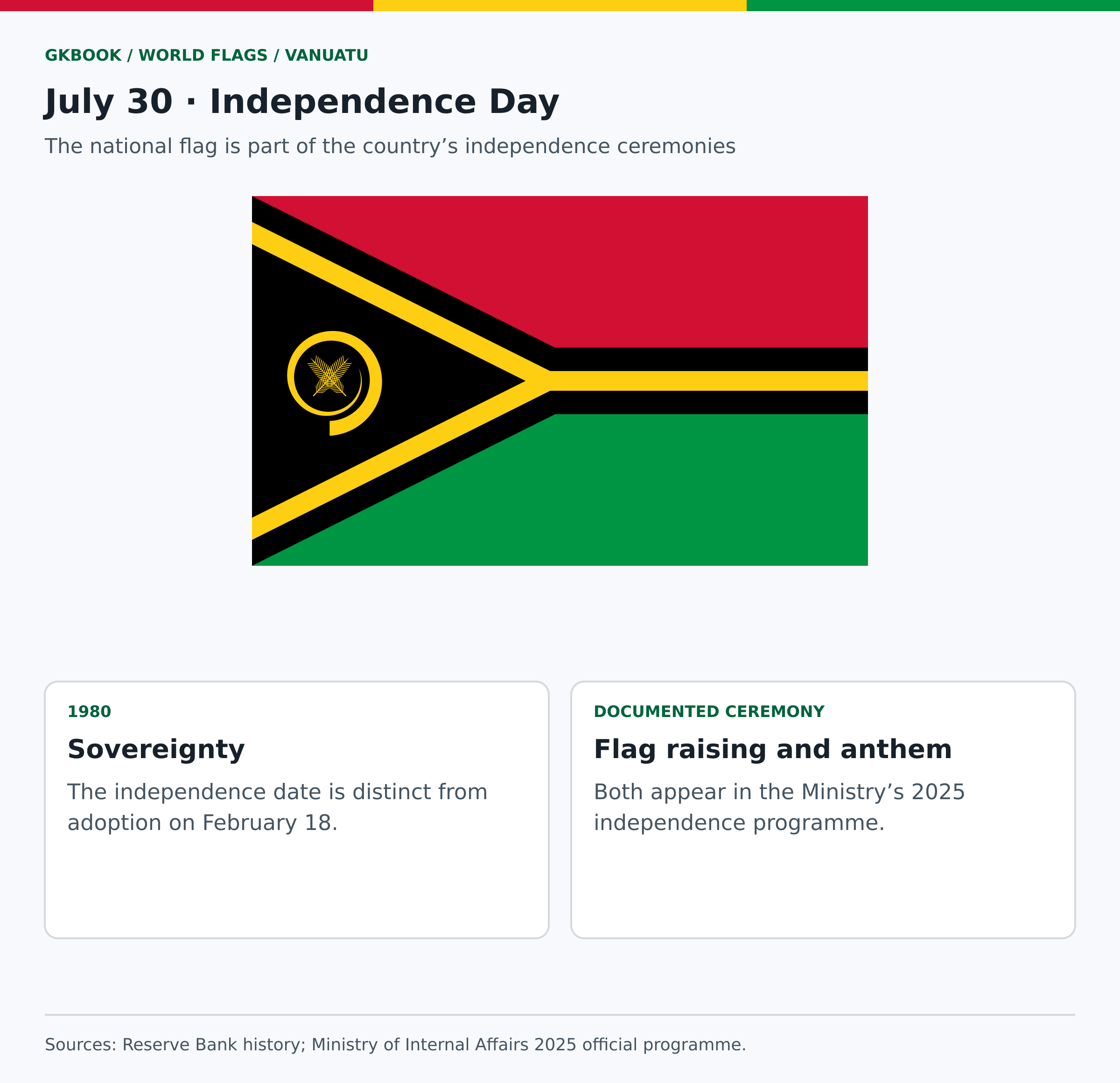
No. The flag adoption reference gives February 18, 1980, while Vanuatu became independent on July 30, 1980. July 30 is the independence anniversary associated with major national ceremonies. The Ministry of Internal Affairs’ 2025 programme specifically includes the national flag, its raising, and the national anthem within the celebrations.
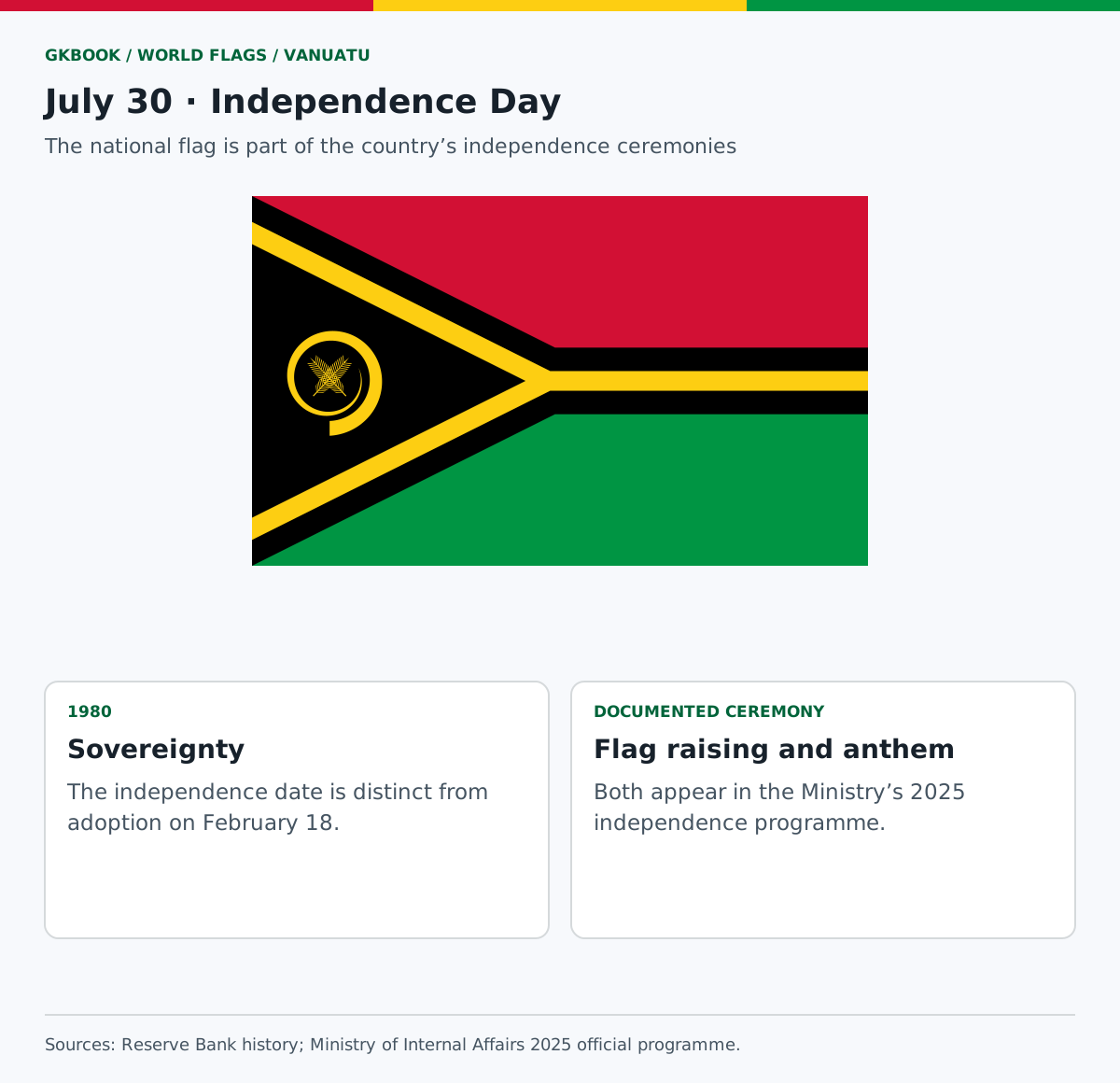
The Reserve Bank’s institutional history independently confirms independence from Britain and France on July 30. That helps cross-check the national chronology without relying on a flag seller’s summary. The date belongs to the history of sovereignty; it should not be changed to match a separate adoption entry in an international flag reference.
An official anniversary programme is useful evidence of how the flag participates in civic life. It is not an evergreen instruction that every future ceremony must begin at the same hour or follow precisely the same sequence. For a school, embassy or community event, use the organizer’s current programme and the relevant official directions.
Sources: United Nations Office at Vienna — national flag reference, PDF page 47 · Reserve Bank of Vanuatu — History · Ministry of Internal Affairs — 45th Independence official programme, 2025 · Drawing method and calculations
Does the flag’s Y show all of Vanuatu’s islands?
The Y symbolizes the broad arrangement of the archipelago, not an exact inventory or map of its islands. No individual island is labeled on the flag. A geography lesson can connect the symbol with Vanuatu’s Pacific setting, but should use a proper map for locations, coastlines, distances, provinces or disputed territorial claims.
An abstract geographical emblem necessarily leaves out details. The yellow branches are straight graphic elements, whereas an archipelago contains islands of different sizes and irregular spacing. The flag is therefore a starting point for discussing geography, not a navigation aid. Its hoist emblem should not be interpreted as a map pin for the national capital.
The page deliberately avoids assigning one island to each leaflet or treating the tusk’s circular opening as a lagoon. Those are visual guesses, not statements supported by the inspected references. When a classroom project adds a map or island labels, keep them in an explanatory panel beside the flag and identify the map’s own source.
Sources: Vanuatu Tourism Office — Stopover Handbook 2026/2027, printed page 7 · Government of Vanuatu — About Vanuatu · Drawing method and calculations
Which law governs Vanuatu’s flag and national symbols?
The relevant framework is the State Flag and Armorial Bearings Act, Chapter 107. The government Trade Portal lists the Act, and the inspected Official Gazette contains its Forms and Fees Order No. 102 of 2020. The original Act and public-declaration texts linked through PacLII were unavailable, limiting what could be independently verified.

The Gazette is a directly inspected legal source for the 2020 order, including its application and permit schedules. The Trade Portal separately identifies the Ministry of Internal Affairs and controls concerning goods bearing state symbols. These sources establish a regulatory framework; they do not supply a recovered, fully dimensioned master drawing of the national flag.
The article does not substitute an internet construction sheet for the missing original legal material. It also avoids quoting a historical fee as a guaranteed current charge. Before manufacturing, importing or distributing goods, confirm the applicable law, forms, fees and approval requirements with the responsible office. This page provides a researched overview, not an individual legal determination.
Sources: Vanuatu Trade Portal — regulations register · Official Gazette No. 56 of 2020 — Forms and Fees Order No. 102 · PacLII — State Flag and Armorial Bearings Act · PacLII — State Flag and Armorial Bearings Public Declaration · Drawing method and calculations
Can the Vanuatu flag be used on merchandise?
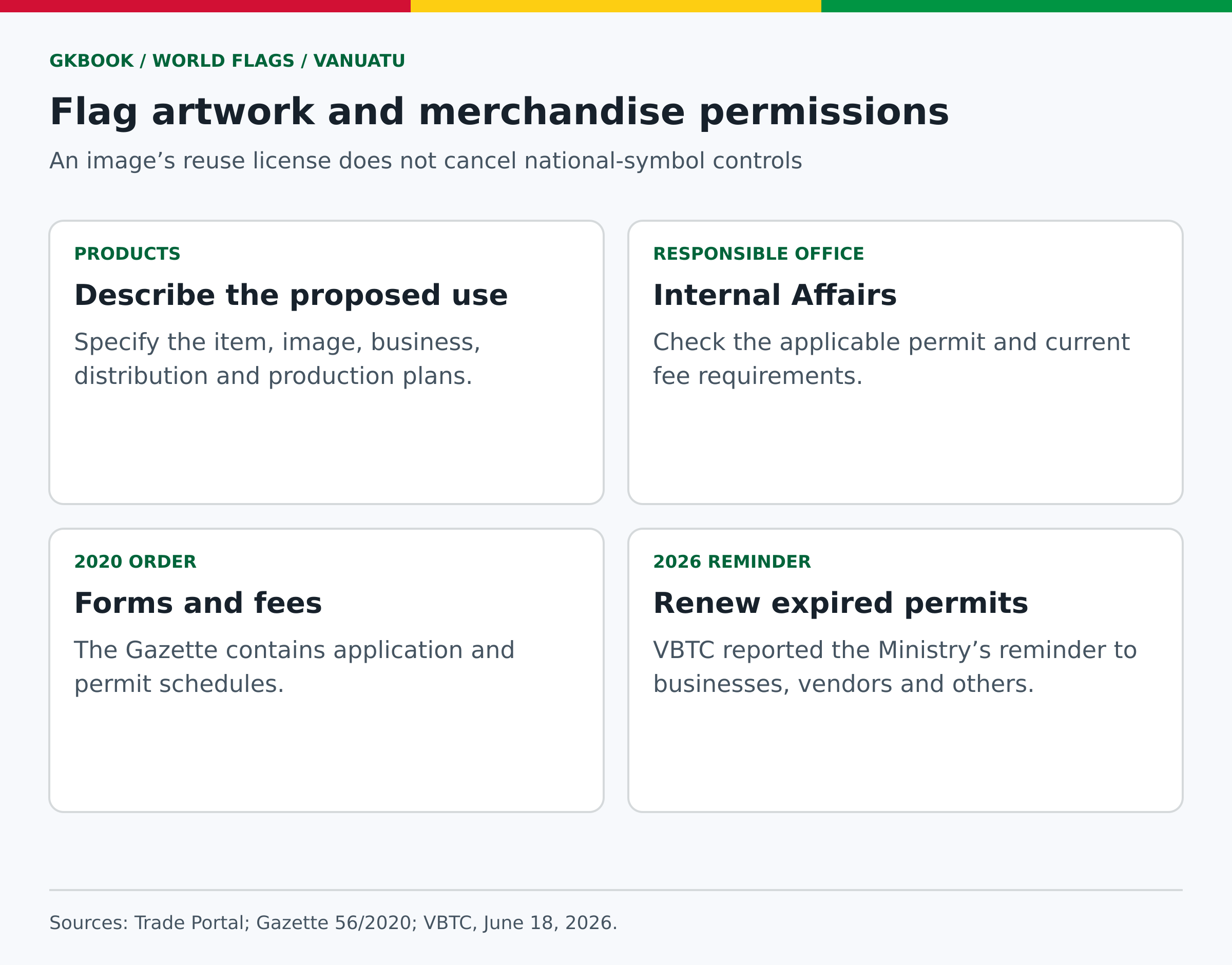
National-symbol controls must be considered before producing or selling merchandise. The Trade Portal lists goods bearing the flag, arms or presidential standard, and the 2020 Gazette provides permit forms and fees. In June 2026, VBTC reported the Ministry’s reminder about permits for items featuring these symbols and renewal of expired permits.

The proposed activity matters: a business should describe what it plans to manufacture, import, distribute or sell, and which symbol appears on the item. The 2020 application form asks for applicant and business details and particulars of the symbols involved. An attractive downloadable image does not answer those administrative questions or grant an approval.
The CC0 notice in this package applies to its original vector implementation and explanatory graphics. It does not waive a government’s controls over national symbols, imply official endorsement, or authorize every use in a logo or campaign. Check current requirements with Internal Affairs, including whether the intended product and distribution arrangement need a particular permit.
Sources: Vanuatu Trade Portal — regulations register · Official Gazette No. 56 of 2020 — Forms and Fees Order No. 102 · Vanuatu Broadcasting and Television Corporation — Permit reminder · Drawing method and calculations
How should the Vanuatu flag be displayed at ceremonies?
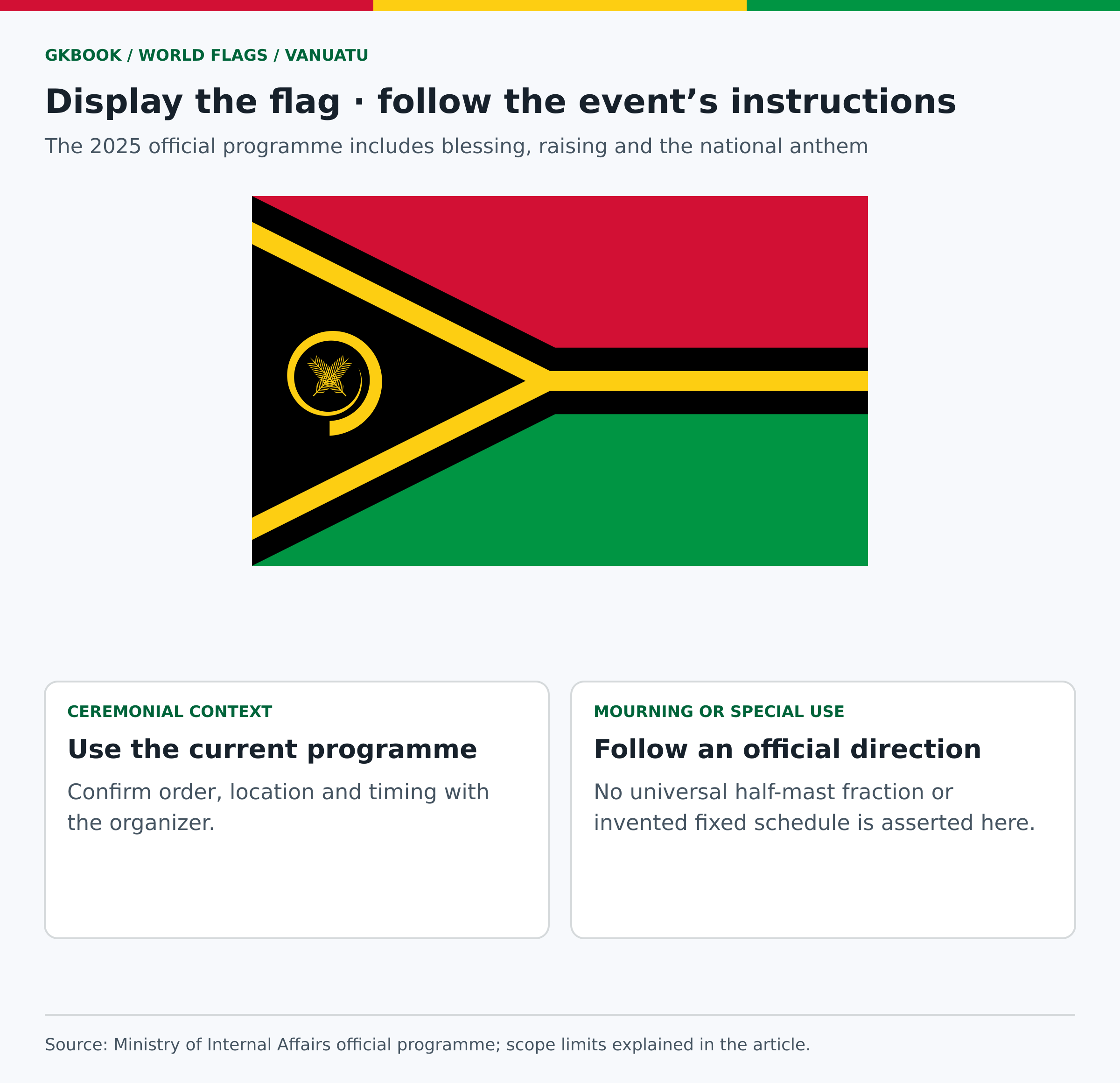
Use a complete, correctly oriented flag and follow the current instructions for the event. The inspected 2025 independence programme includes a blessing of the national flag, flag raising and the anthem. It does not establish a universal daily timetable, precedence diagram, or fixed half-mast measurement for every Vanuatu display.
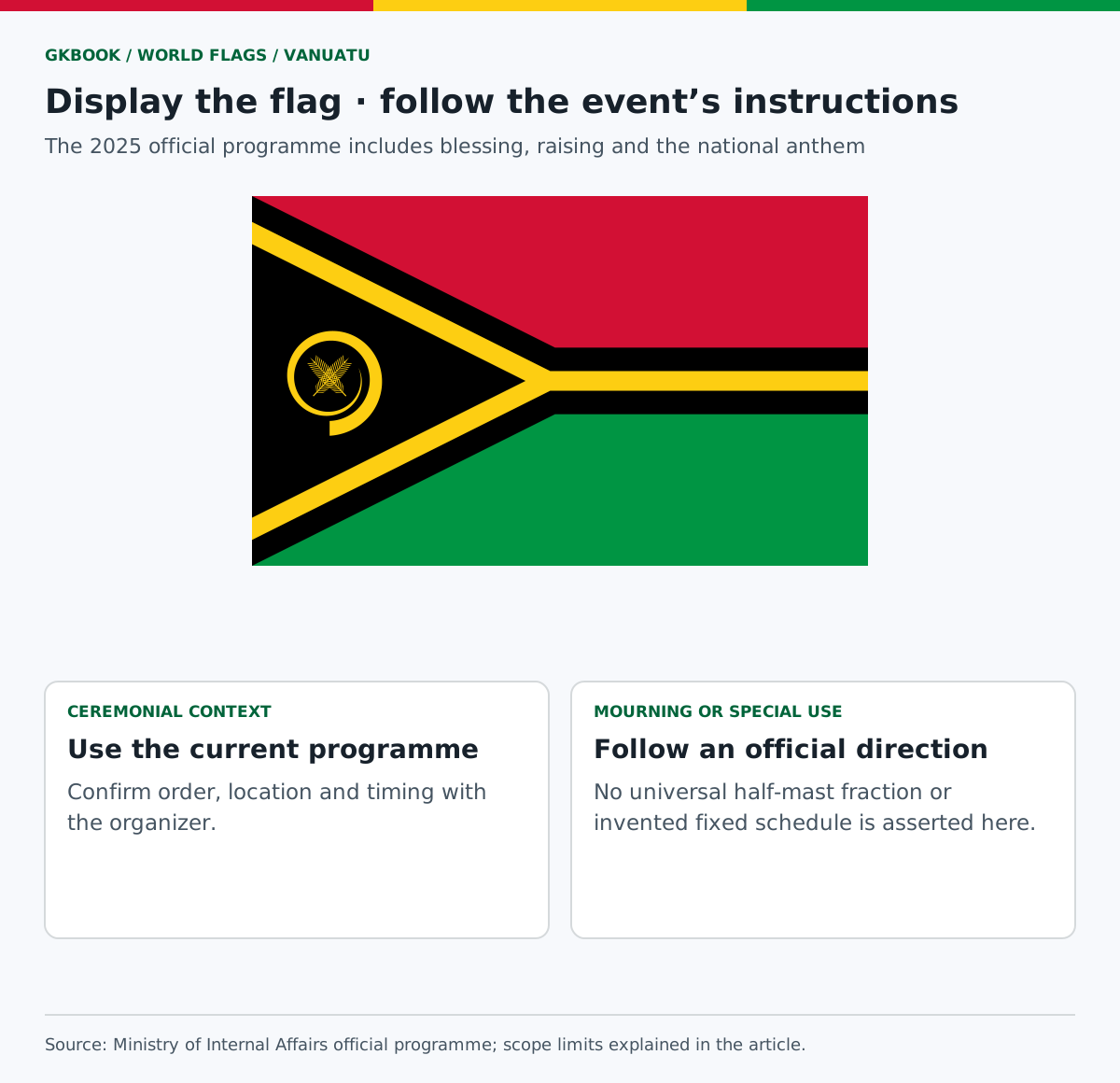
For a practical event, establish the position of the staff, the direction from which the audience views the flag and the sequence given by the organizer. The black triangle belongs at the hoist. Keep the actual illustration distinct from stage decorations: a colored backdrop or promotional logo need not reproduce the flag’s full rectangular form.
Mourning instructions and arrangements beside other flags require their own authority. This page does not import another country’s pole fraction, salute, retirement ritual or nighttime rule and call it Vanuatu protocol. The display graphic is intentionally a general reference image, while specific official arrangements should follow a current direction from the responsible institution.
Sources: Ministry of Internal Affairs — 45th Independence official programme, 2025 · Vanuatu Trade Portal — regulations register · Drawing method and calculations
Which way up does the Vanuatu flag go?
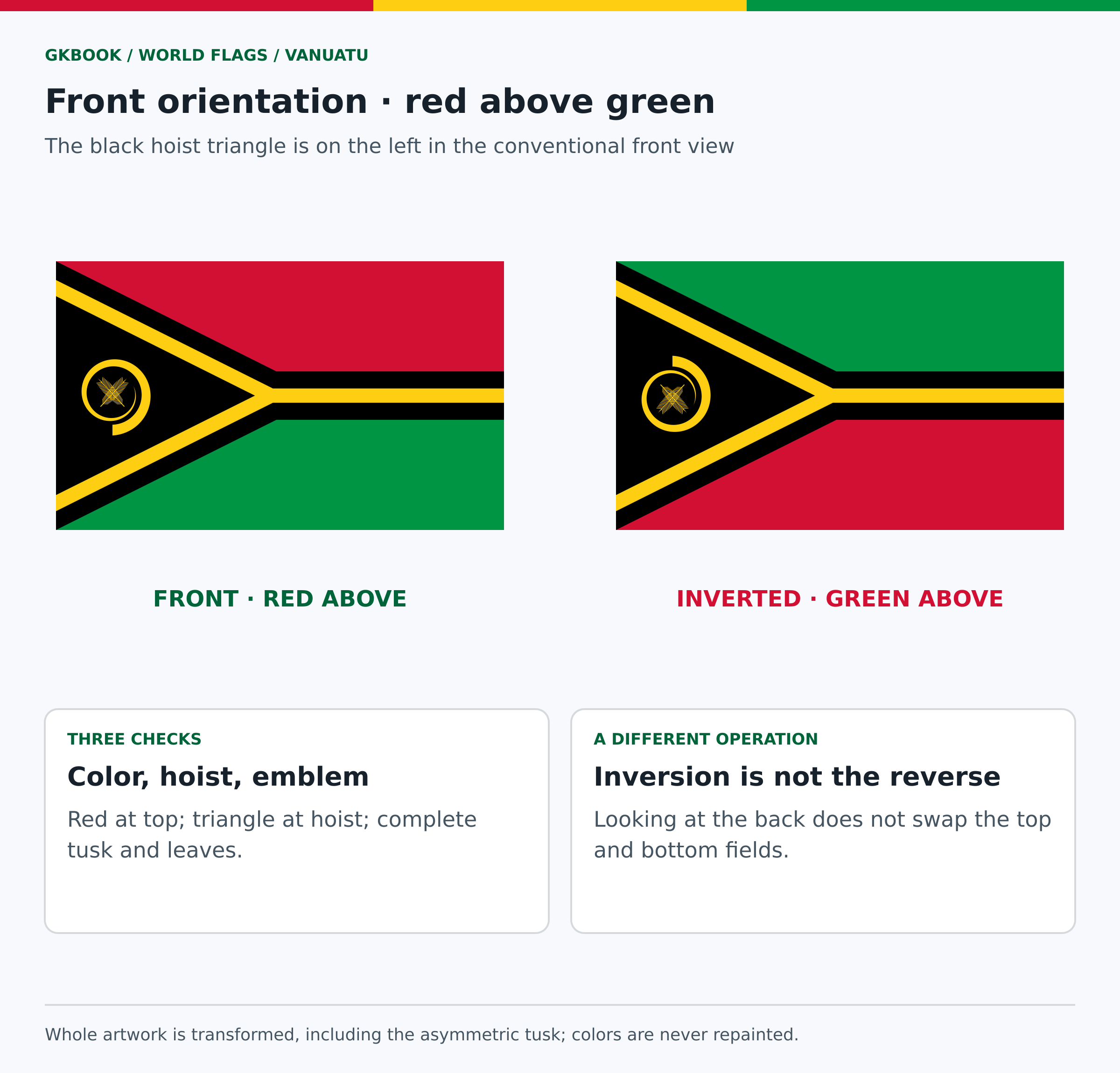
In the conventional horizontal front view, red is above green, and the black triangle containing the yellow emblem is at the left-hand hoist. The yellow Y opens toward that hoist and runs horizontally to the fly. Turning the picture upside down reverses the color order and is different from viewing its reverse.
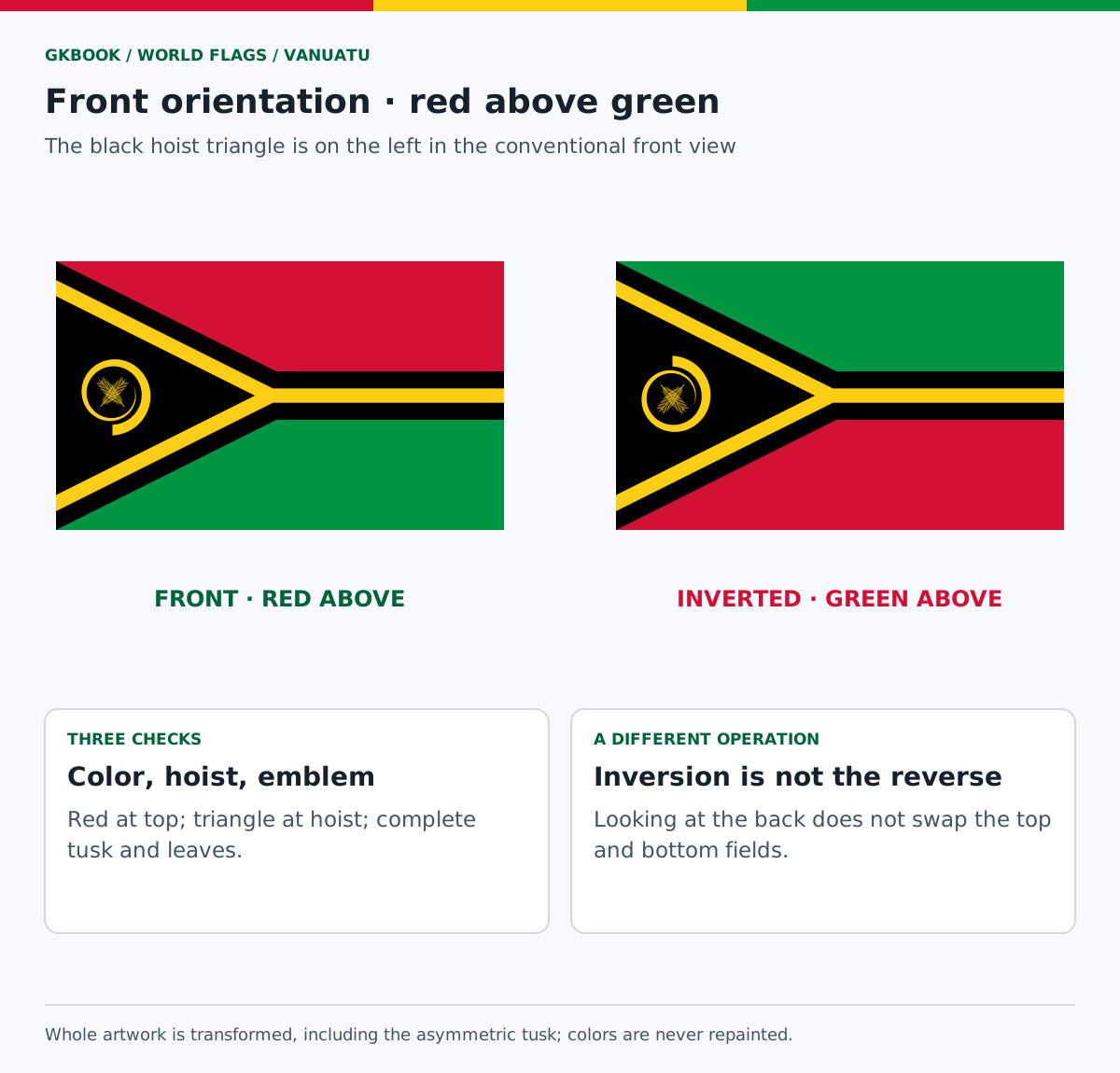
Use the red and green fields as a quick orientation check, then inspect the emblem. The tusk is asymmetric, so flipping the artwork changes more than the field colors. The diagnostic diagram transforms the complete original drawing instead of repainting the fields while leaving the emblem untouched. This makes the difference visible and reproducible.
A photograph of a flag blowing around a pole may show the reverse or fold away a portion of the cloth. Identify the staff edge and the top before deciding whether it is inverted. For a flat article illustration, use the supplied clean front-view file, which keeps all edges visible and avoids the ambiguity of folds.
Sources: United Nations Office at Vienna — national flag reference, PDF page 47 · Vanuatu Tourism Office — Stopover Handbook 2026/2027, printed page 7 · Drawing method and calculations
What does the reverse of the Vanuatu flag look like?
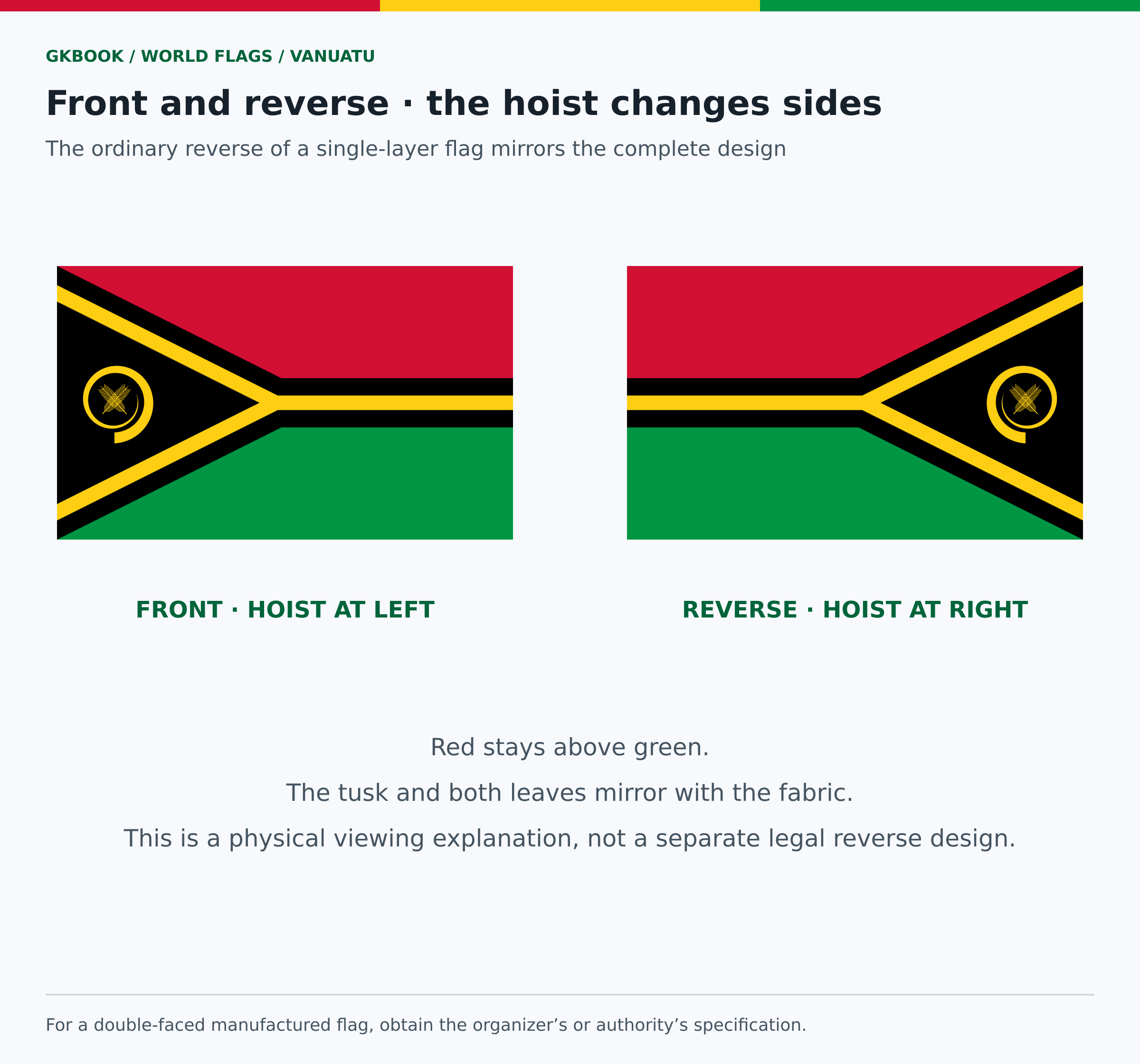
The ordinary view through the back of a single-layer flag is a left-right mirror of its front. The hoist appears on the right, while red remains above green. The tusk and crossed leaves mirror with the rest of the cloth. This physical viewing explanation is not a claim about a separately prescribed reverse design.
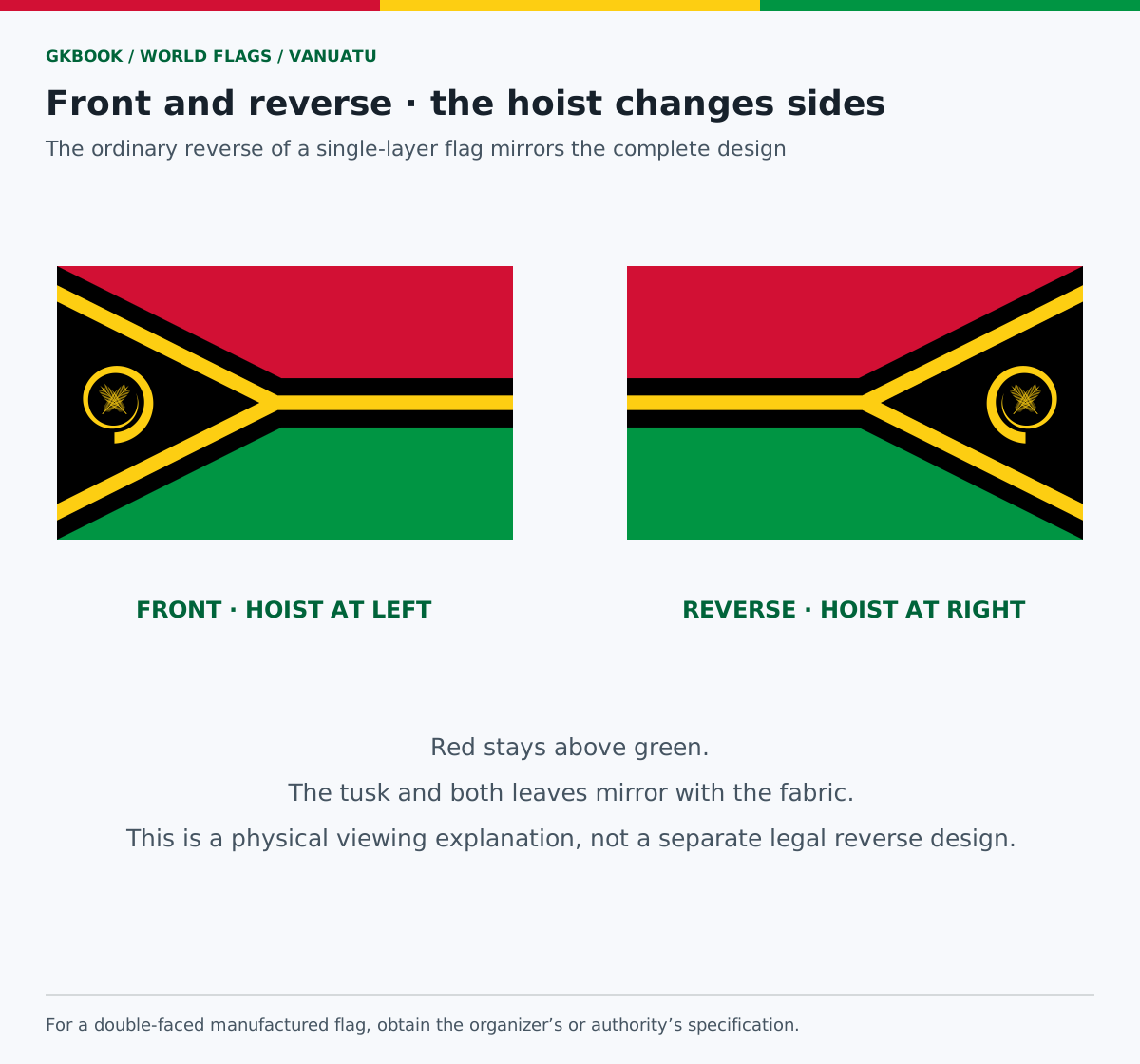
A horizontal reflection changes the direction of the Y and the orientation of the asymmetric tusk together. It does not exchange the upper and lower fields. The reverse diagram applies one transformation to the whole flag, making clear why a back view can be correct even though it differs from the usual front-facing picture.
Construction of a double-faced textile may involve two printed panels rather than one translucent sheet. That is a manufacturing question for the supplier and the applicable specification. The sources inspected here did not establish a special Vanuatu reverse rule, so the article does not invent a blank reverse or prescribe independently repositioned emblems for official flags.
Sources: Drawing method and calculations · United Nations Office at Vienna — national flag reference, PDF page 47
How can the Vanuatu flag be shown vertically?
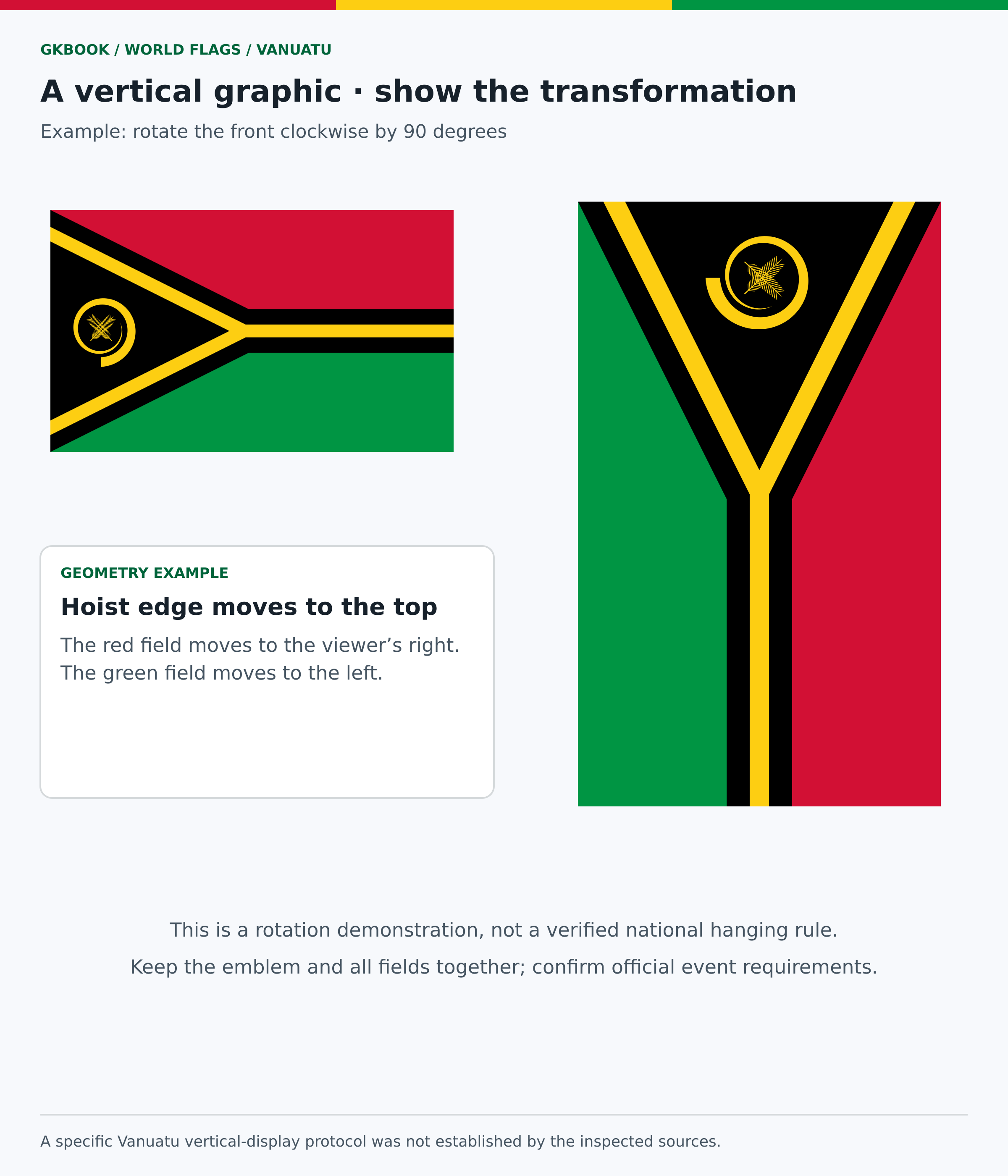
The graphic in this package demonstrates a clockwise quarter-turn of the complete front image: the hoist moves to the top, red moves right, and green moves left. It is labeled as a geometric example. The inspected sources did not establish a specific nationwide vertical-hanging rule for official Vanuatu displays.
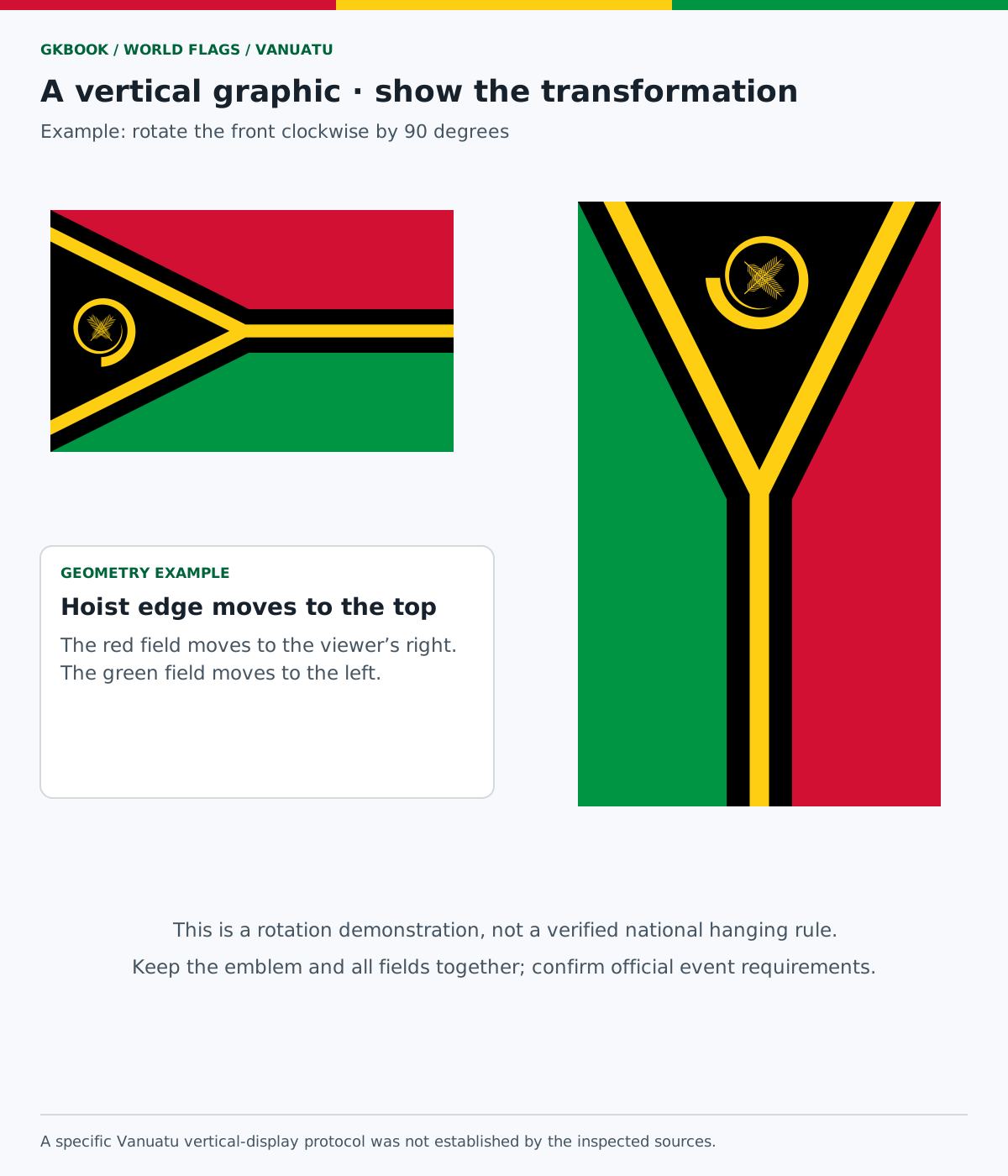
A rotation must carry the emblem, black triangle and colored fields together. Moving the tusk back to an imagined upper-left corner after rotating the cloth would create a new layout. Likewise, stretching the landscape flag into a narrow vertical rectangle would deform the tusk and the Y rather than show the same flag in another orientation.
For an official hall or ceremony, obtain the organizer’s approved hanging arrangement instead of assuming that the mathematical example is a protocol instruction. For teaching, label the transformation and show the original landscape view alongside it. That paired presentation makes the orientation easy to understand while preserving the distinction between geometry and national usage rules.
Sources: Drawing method and calculations · Ministry of Internal Affairs — 45th Independence official programme, 2025
Is the Vanuatu flag symmetrical?
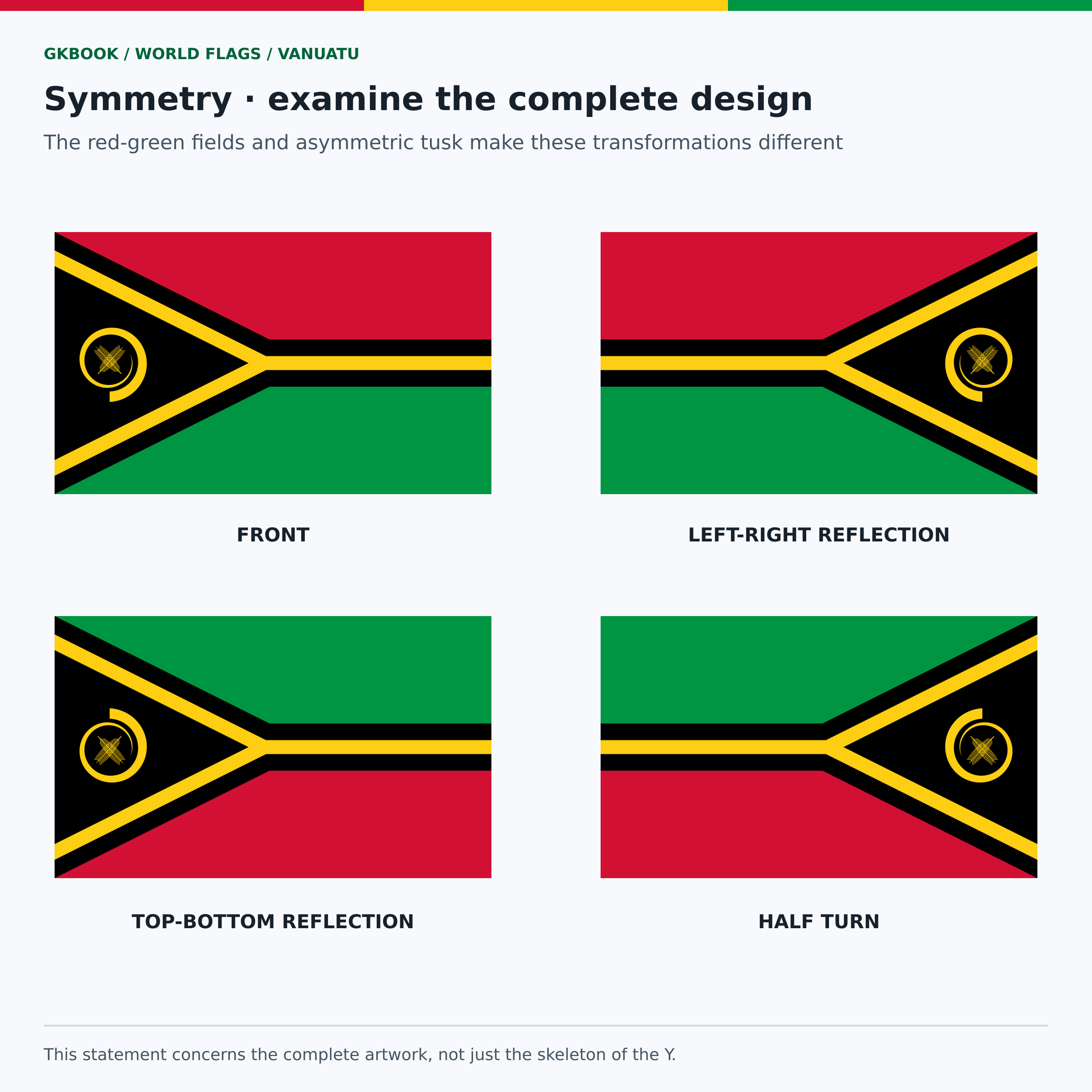
The complete colored flag is not unchanged by a left-right reflection, a top-bottom reflection, or a half-turn. The hoist emblem, the red-over-green order and the asymmetric tusk matter. Some background outlines have geometric relationships, but those relationships should not be mistaken for symmetry of the entire national design.

Reflecting top to bottom would exchange the red and green fields. Reflecting left to right would move the hoist triangle to the opposite edge. A half-turn combines those changes. Even if a simplified Y outline appears balanced, the finished picture contains color and emblem information that prevents those transformations from reproducing its original front view.
The four-view diagram offers a direct comparison using the same artwork and scale. Nothing is redrawn between views, so differences arise only from the stated transformations. This is useful in geometry lessons: ask which features change, rather than assuming that a flag with a horizontal centerline must have complete mirror symmetry.
Sources: Drawing method and calculations
Is the flag emblem the same as Vanuatu’s coat of arms?
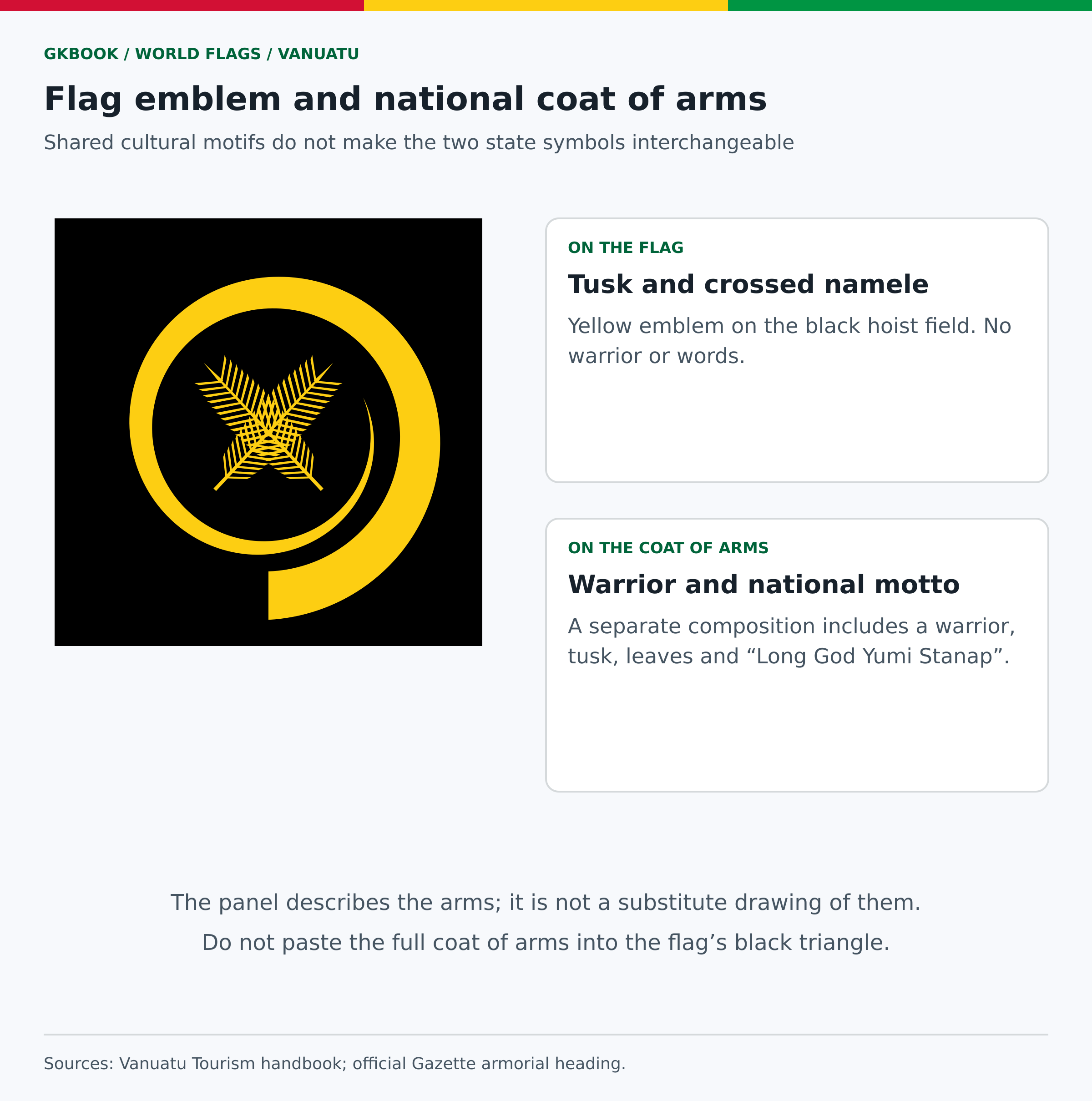
No. The flag contains a yellow tusk and crossed namele leaves on black. The national coat of arms is a fuller composition that includes a warrior and the Bislama motto Long God Yumi Stanap. The shared motifs connect the symbols culturally, but the complete arms should not be inserted into the flag.
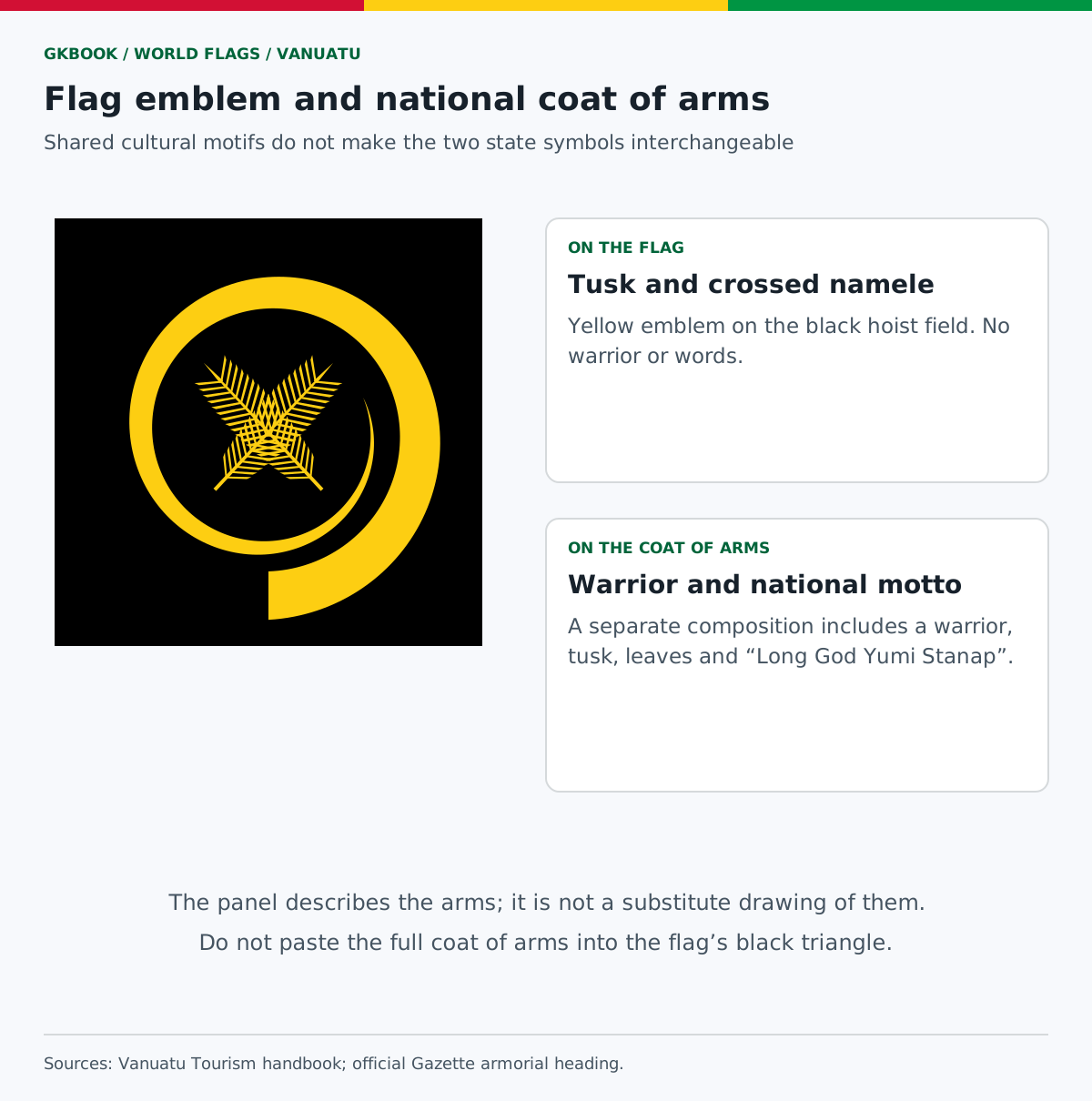
The tourism handbook explains the arms separately from the flag, and the official Gazette displays the armorial device in its heading. This page describes that distinction without supplying an unverified reconstruction of the complete arms. Its enlarged yellow emblem is specifically a detail of the national flag, not a simplified official coat of arms.
In an illustration library, label each file by what it actually depicts. A cropped tusk-and-leaves image is an emblem detail; the clean rectangular drawing is a flag. Keeping those names distinct helps a designer avoid choosing the wrong graphic for an article, school worksheet or event program, especially when both symbols appear in the same source publication.
Sources: Vanuatu Tourism Office — Stopover Handbook 2026/2027, printed page 7 · Official Gazette No. 56 of 2020 — Forms and Fees Order No. 102 · Drawing method and calculations
Are the presidential standard and provincial flags the national flag?
They are separate categories of symbols. Vanuatu’s regulatory material distinguishes the State Flag, presidential standard and armorial bearings. Provincial or institutional flags may use related colors or motifs, but that does not make them interchangeable with the national flag. Identify the office, territory or organization before choosing an illustration.
The word “Vanuatu” in an image filename is not enough to establish which symbol it shows. A specialized standard can have a different field or device, and an older administrative flag can belong to a different historical period. A reliable caption should name that specific subject and, for historical artwork, give the period it represents.
This package concentrates on the national flag and its component details. It does not manufacture unverified variants merely to fill a gallery, or label a decorative redesign as an official presidential or maritime flag. If a future page adds those subjects, each should receive its own source trail, accurate artwork and clear identification.
Sources: Vanuatu Trade Portal — regulations register · Official Gazette No. 56 of 2020 — Forms and Fees Order No. 102 · Drawing method and calculations
How is Vanuatu’s flag different from South Africa’s flag?
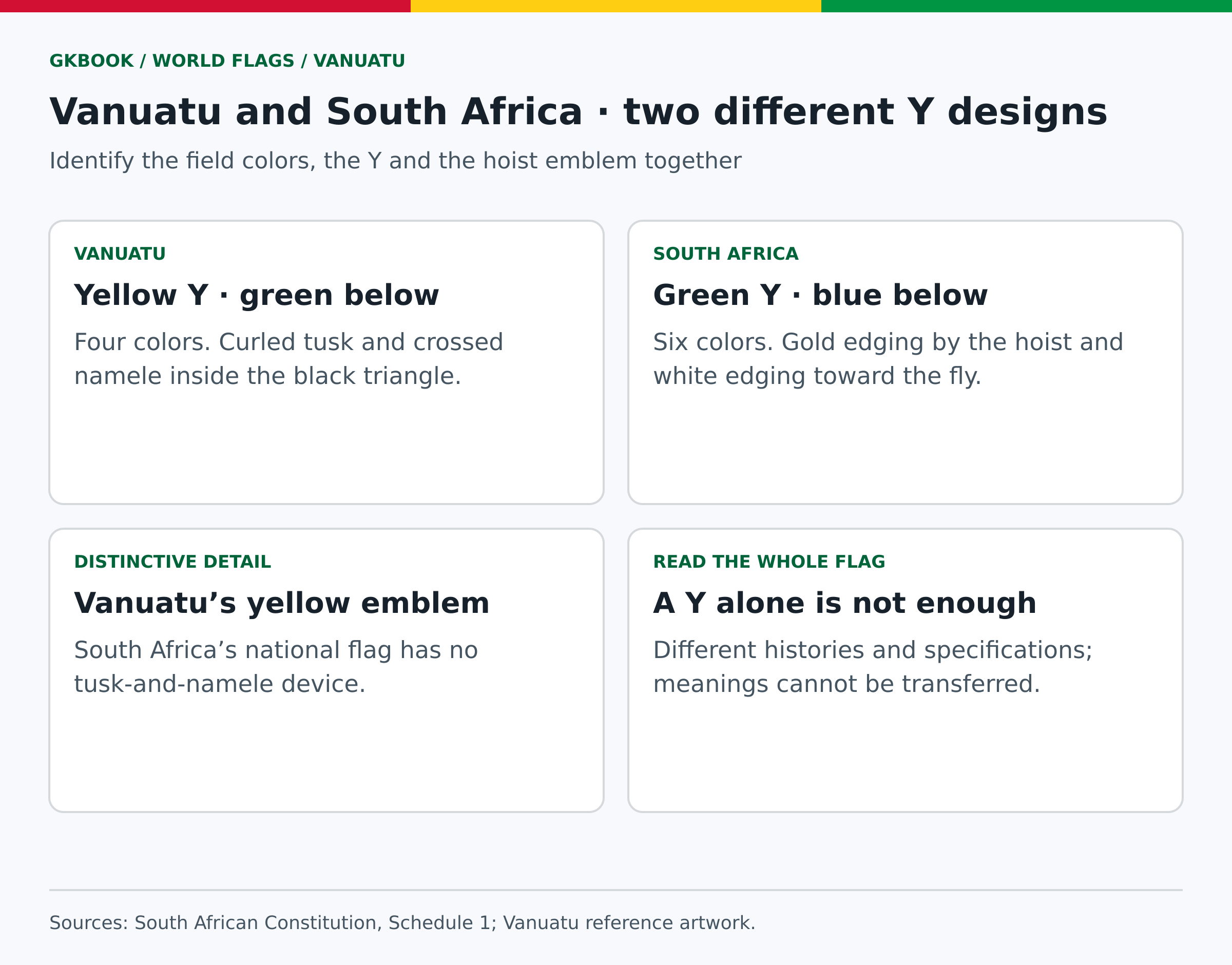
Both use a sideways Y, but their complete designs differ. Vanuatu has a yellow Y, a green lower field and the tusk-and-namele emblem. South Africa has a green Y, a blue lower field, white and gold edging, and no such emblem. South Africa’s Constitution specifies six colors, while Vanuatu’s design uses four.
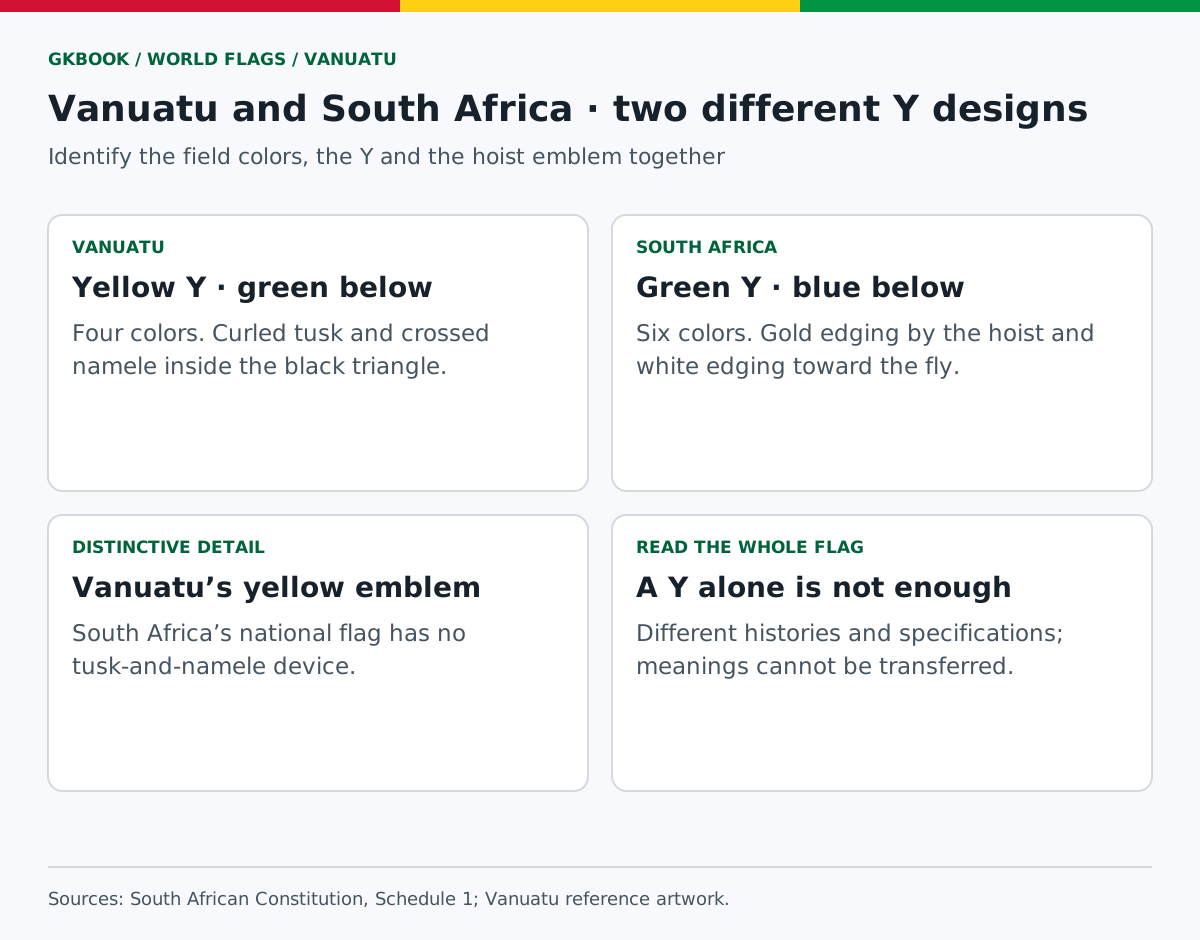
South Africa’s constitutional schedule is the primary source for its comparison here. It gives a red upper field, blue lower field and a black triangle next to the flagstaff, with different edging on the two sides of the green Y. Those features provide a dependable identification check without transferring either country’s symbolism to the other.
Look at the lower field and the black triangle first when comparing small images. Blue below and an empty black triangle point toward South Africa’s design; green below and a yellow tusk-and-leaves device identify Vanuatu’s. The page uses a text comparison rather than an unverified companion drawing, since each national flag deserves its own construction work.
Sources: South African Constitution — Schedule 1: National Flag · United Nations Office at Vienna — national flag reference, PDF page 47 · Drawing method and calculations
What is the Vanuatu flag emoji and country code?
The Vanuatu flag emoji is 🇻🇺. Unicode represents it with the regional-indicator pair U+1F1FB and U+1F1FA, corresponding to V and U. Its appearance depends on the device or platform. Some systems show a flag, while others show letters; the encoded sequence does not provide this page’s detailed vector artwork.
The two regional-indicator symbols form a flag sequence when supported together. They are not a photograph embedded in the text. A font or platform chooses the visible rendering, including tiny emblem details and apparent proportions. That is why two readers can see different-looking symbols even when a message contains exactly the same underlying characters.
Use the downloadable SVG or PNG when a lesson needs visible leaves, accurate color placement or a clearly declared reference shape. The emoji is convenient for a short label, but its miniature appearance is not a manufacturing standard or reliable source for counting leaflets. Accessible text should still identify the country by name beside it.
Sources: Unicode — Emoji List, version 16.0 · Drawing method and calculations
What size can the downloadable Vanuatu flag be printed?
The clean PNG measures 10,000 by 6,000 pixels. At 300 pixels per inch, it corresponds to 33.33 by 20 inches, approximately 84.67 by 50.80 centimeters. The SVG can be scaled without a fixed pixel limit. Both files retain this edition’s declared 3:5 reference shape and complete emblem.
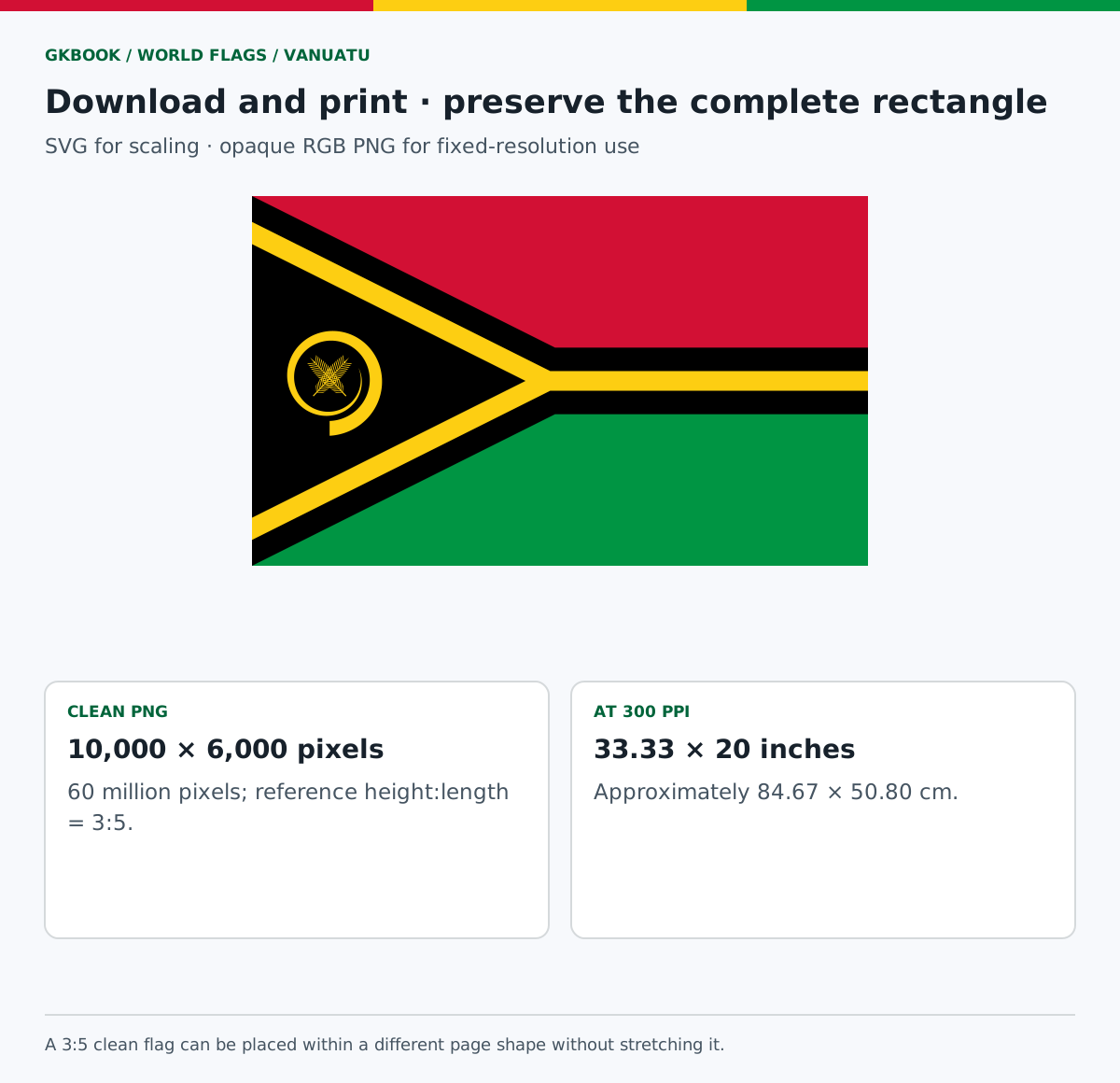
Print dimensions are calculated by dividing each pixel dimension by the chosen pixel density. At a lower density, the same PNG occupies a larger physical area; at a higher density, it occupies a smaller one. This arithmetic concerns sampling resolution, not a promise that a printer, fabric or ink process will reproduce the screen colors exactly.
Keep the full rectangle inside the printable area and apply one uniform scale. If a page has a different aspect ratio, leave margins or place the flag inside a separate layout rather than cropping its edges. For professional textiles or official procurement, the responsible authority’s artwork, color proof and production requirements take precedence over this educational reference.
| Density | Width × height, inches | Width × height, centimeters |
|---|---|---|
| 150 PPI | 66.67 × 40.00 | 169.33 × 101.60 |
| 300 PPI | 33.33 × 20.00 | 84.67 × 50.80 |
| 600 PPI | 16.67 × 10.00 | 42.33 × 25.40 |
Sources: Drawing method and calculations
Which Vanuatu flag graphics are included in this page?
The gallery contains twenty-four subjects, each supplied as SVG and PNG, including the clean flag and twenty-three explanatory graphics. A separate 1,200-by-630 social card is also included in both formats. The illustrations cover color, symbolism, construction, history, orientation, comparisons and use, with captions and downloadable files for each subject.
Choose the clean master when a publication simply needs the national flag. Choose an annotated illustration when the purpose is to explain a particular point, such as the two namele fronds or the difference between front and reverse. Labels, guide lines, isolated details and comparison panels are teaching devices and are absent from the clean flag.
The SVGs contain their own titles and descriptions, and the PNGs include artwork and source metadata. The article supplies descriptive alternative text for embedded images. Credits document the original reconstruction and source limits. The social card preserves a complete flag within a wider composition, rather than stretching the flag to match the sharing image’s dimensions.
Sources: Drawing method and calculations
What mistakes should be avoided when drawing Vanuatu’s flag?
Keep red above green, preserve the black-edged yellow Y, and place one curled tusk around two crossed namele fronds inside the hoist triangle. Avoid replacing the emblem with a moon or the full coat of arms. Preserve the chosen reference proportions, and distinguish documented design facts from unverified claims about dimensions.
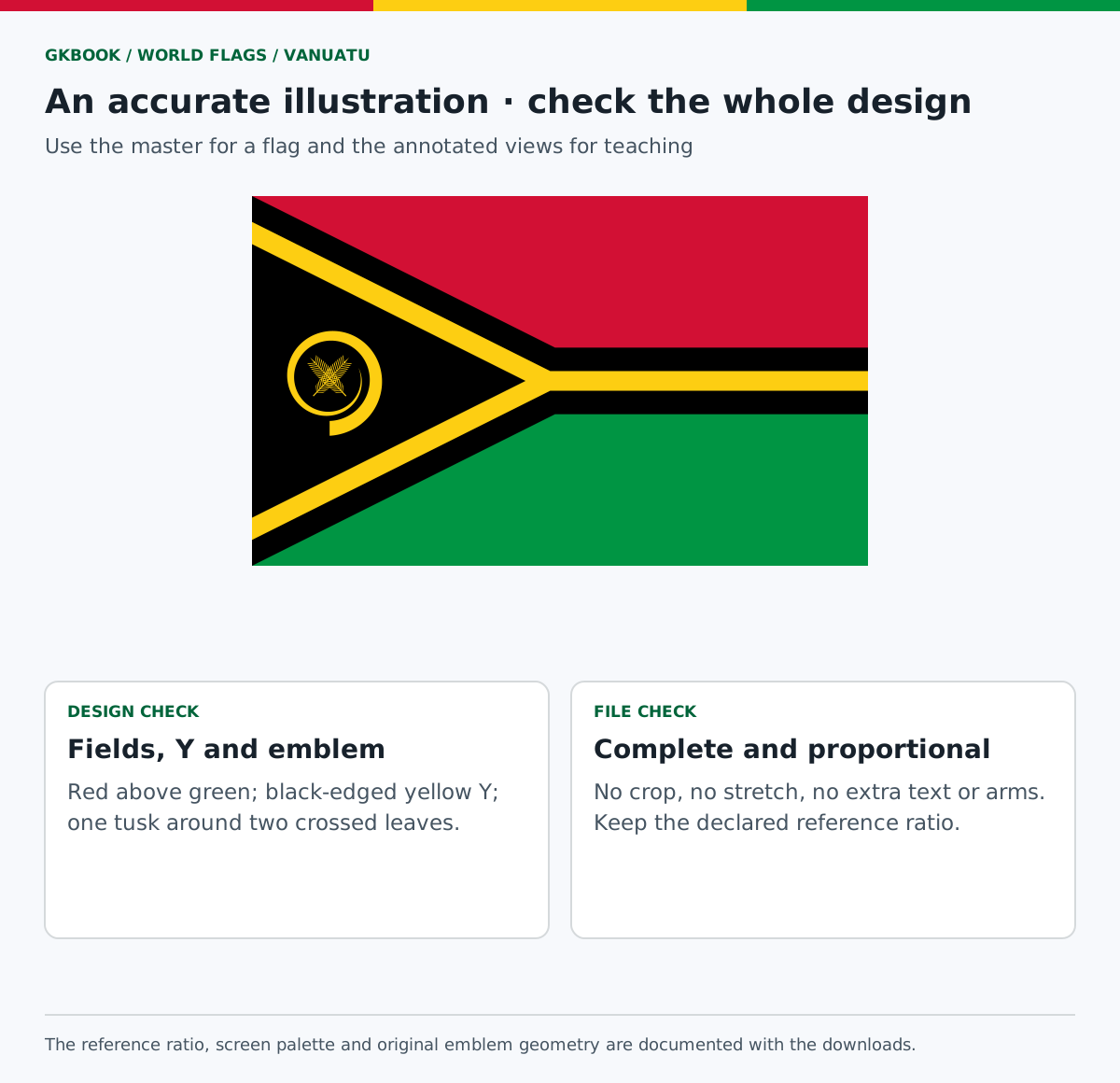
Check the file at two sizes: large enough to inspect the tusk and leaves, and small enough to see whether the whole flag remains recognizable. A missing leaflet in a tiny preview may be a rendering limitation, whereas missing one of the two fronds is a substantive drawing error. Captions should explain enlarged or isolated teaching details.
Finally, check the source labels. An original reconstruction can be carefully drawn and thoroughly tested without being an authenticated government manufacturing master. This package states its ratio, palette and coordinates openly, distinguishes inaccessible legal material from inspected sources, and keeps image-reuse terms separate from national-symbol permissions. Those distinctions make the reference easier to use responsibly.
Sources: Drawing method and calculations · United Nations Office at Vienna — national flag reference, PDF page 47 · Vanuatu Trade Portal — regulations register
Sources and research notes
This article draws on UN Vienna’s flag reference, Vanuatu government and tourism publications, the official Gazette, parliamentary information, botanical and museum accounts, and clearly identified specialist discussions. Source links accompany every answer. The bibliography and artwork credits record access limitations, conflicting proportion references, and the original drawing method.
The original Act and declaration linked through PacLII could not be retrieved. The article therefore distinguishes the verified adoption date and regulatory sources from the reported declaration date. Its 3:5 proportions, numeric screen palette, emblem contours and leaflet count describe a reproducible educational reference; they are not presented as an authenticated manufacturing specification.
Download Vanuatu flag pictures
Download the complete flag as scalable SVG or 10,000 × 6,000 PNG. Both preserve the 3:5 reference proportion, red and green fields, black-edged yellow Y, and complete tusk-and-namele emblem.
The gallery includes 24 subjects, each available in SVG and PNG, covering construction, symbolism, history, orientation, and use. A separate 1,200 × 630 social-sharing card places a complete flag beside the article title. Use the clean master for a flag illustration and the annotated graphics for teaching.
Read the construction guide, national-symbol use notes and artwork credits, or continue exploring designs in World Flags.
World Flags/Vanuatu
Vanuatu flag pictures
Complete flag with red above green, a black-edged yellow Y, and a yellow tusk surrounding crossed namele leaves. This is an original 3:5 reference reconstruction.
Original GKBook vector reconstruction; appearance checked against UN Vienna and Vanuatu Tourism references. Coordinates and screen colors are editorial choices.Download SVGDownload PNGThe digital palette is explicit and reproducible. Printed and woven colors need their own proof and production approval.
Original GKBook vector reconstruction; appearance checked against UN Vienna and Vanuatu Tourism references. Coordinates and screen colors are editorial choices.Download SVGDownload PNGVanuatu Tourism publications provide the cultural explanation; wording varies between publications.
Original GKBook vector reconstruction; appearance checked against UN Vienna and Vanuatu Tourism references. Coordinates and screen colors are editorial choices.Download SVGDownload PNGThe yellow Y is an abstract geographical reference, not a coastline map or a letter printed over ordinary stripes.
Original GKBook vector reconstruction; appearance checked against UN Vienna and Vanuatu Tourism references. Coordinates and screen colors are editorial choices.Download SVGDownload PNGA tapering spiral reconstructs the curled tusk. Its contours are original artwork, not measured legal geometry.
Original GKBook vector reconstruction; appearance checked against UN Vienna and Vanuatu Tourism references. Coordinates and screen colors are editorial choices.Download SVGDownload PNGTwo fronds are distinct from their many small leaflets. The pair is preserved in the complete emblem.
Original GKBook vector reconstruction; appearance checked against UN Vienna and Vanuatu Tourism references. Coordinates and screen colors are editorial choices.Download SVGDownload PNGAll outline rectangles have the same height. The three published proportions are not declared legally interchangeable.
Original GKBook vector reconstruction; appearance checked against UN Vienna and Vanuatu Tourism references. Coordinates and screen colors are editorial choices.Download SVGDownload PNGThese measurements describe the supplied original drawing, rather than a recovered statutory dimension sheet.
Original GKBook vector reconstruction; appearance checked against UN Vienna and Vanuatu Tourism references. Coordinates and screen colors are editorial choices.Download SVGDownload PNGThe enlarged view shows the original contours and leaflets used throughout this package.
Original GKBook vector reconstruction; appearance checked against UN Vienna and Vanuatu Tourism references. Coordinates and screen colors are editorial choices.Download SVGDownload PNGThe March entry is explicitly attributed and unverified against the original instrument.
Original GKBook vector reconstruction; appearance checked against UN Vienna and Vanuatu Tourism references. Coordinates and screen colors are editorial choices.Download SVGDownload PNGDesigner attribution follows the Ministry’s spelling. No unverified portrait or signature is supplied.
Original GKBook vector reconstruction; appearance checked against UN Vienna and Vanuatu Tourism references. Coordinates and screen colors are editorial choices.Download SVGDownload PNGNo single invented “colonial flag” is used to stand for the whole dual-administration period.
Original GKBook vector reconstruction; appearance checked against UN Vienna and Vanuatu Tourism references. Coordinates and screen colors are editorial choices.Download SVGDownload PNGAn actual programme documents ceremonial use; its timetable is not a permanent schedule for every year.
Original GKBook vector reconstruction; appearance checked against UN Vienna and Vanuatu Tourism references. Coordinates and screen colors are editorial choices.Download SVGDownload PNGVerified register and Gazette evidence are distinguished from unavailable original material.
Original GKBook vector reconstruction; appearance checked against UN Vienna and Vanuatu Tourism references. Coordinates and screen colors are editorial choices.Download SVGDownload PNGThe diagram explains the verified administrative context; it does not promise approval or quote an unverified current fee.
Original GKBook vector reconstruction; appearance checked against UN Vienna and Vanuatu Tourism references. Coordinates and screen colors are editorial choices.Download SVGDownload PNGThis graphic illustrates a complete flag; it is not a diagram of official precedence or a current mourning instruction.
Original GKBook vector reconstruction; appearance checked against UN Vienna and Vanuatu Tourism references. Coordinates and screen colors are editorial choices.Download SVGDownload PNGThe right-hand example is deliberately inverted for diagnosis and is not the correct front-view orientation.
Original GKBook vector reconstruction; appearance checked against UN Vienna and Vanuatu Tourism references. Coordinates and screen colors are editorial choices.Download SVGDownload PNGThe reverse is shown with a whole-flag reflection, preserving the relationship between the emblem and hoist.
Original GKBook vector reconstruction; appearance checked against UN Vienna and Vanuatu Tourism references. Coordinates and screen colors are editorial choices.Download SVGDownload PNGThe right-hand flag is a complete clockwise rotation with no cropping, stretching or independent emblem movement.
Original GKBook vector reconstruction; appearance checked against UN Vienna and Vanuatu Tourism references. Coordinates and screen colors are editorial choices.Download SVGDownload PNGNone of these nontrivial transformations leaves the complete colored front design unchanged.
Original GKBook vector reconstruction; appearance checked against UN Vienna and Vanuatu Tourism references. Coordinates and screen colors are editorial choices.Download SVGDownload PNGOnly the national flag’s emblem is drawn here. The fuller armorial design has separate elements and uses.
Original GKBook vector reconstruction; appearance checked against UN Vienna and Vanuatu Tourism references. Coordinates and screen colors are editorial choices.Download SVGDownload PNGA text comparison avoids presenting an unverified companion flag reconstruction.
Original GKBook vector reconstruction; appearance checked against UN Vienna and Vanuatu Tourism references. Coordinates and screen colors are editorial choices.Download SVGDownload PNGPrint size depends on the chosen pixel density. The file is an RGB reference, not a certified textile proof.
Original GKBook vector reconstruction; appearance checked against UN Vienna and Vanuatu Tourism references. Coordinates and screen colors are editorial choices.Download SVGDownload PNGThe checklist helps catch recognizable drawing errors without implying official manufacturing certification.
Original GKBook vector reconstruction; appearance checked against UN Vienna and Vanuatu Tourism references. Coordinates and screen colors are editorial choices.Download SVGDownload PNGFrequently asked questions
What does the Vanuatu flag look like?
Vanuatu’s national flag has red above green, divided by a black-edged yellow Y. A yellow curled boar’s tusk surrounds two crossed namele leaves in the black hoist triangle. The design was adopted in February 1980. This page supplies a documented 3:5 reference drawing while explaining differences among published proportions.
What is Vanuatu’s national flag called?
It is usually called the national flag of Vanuatu; the country’s legislative register uses the term State Flag. It represents the Republic of Vanuatu. The design is identified by its yellow Y, black hoist triangle, red and green fields, and distinctive yellow boar’s tusk surrounding two crossed namele leaves.
What are the Vanuatu flag colors and HEX codes?
The flag uses red, green, yellow and black. This package consistently uses #D21034, #009543, #FDCE12 and #000000. These are declared digital reproduction values, not a verified statutory HEX table. The colors appear in the fields, the black-edged yellow Y, and the yellow tusk-and-namele emblem at the hoist.
What do the colors and symbols of Vanuatu’s flag mean?
Vanuatu Tourism explanations associate red with blood, green with the islands’ richness, black with Melanesian identity, and yellow with light and Christianity or with peace and prosperity. The Y recalls the island chain. The curled tusk signifies prosperity, while the crossed namele leaves are described as symbols of peace.
Why does the Vanuatu flag have a yellow Y?
The sideways yellow Y recalls the arrangement of Vanuatu’s island chain. Two diagonal branches extend toward the hoist, meet near the middle, and continue as a horizontal stem toward the fly. Black surrounds the yellow band and forms the triangle containing the emblem. The design is an abstraction, not a literal map.
What is the yellow curled symbol on Vanuatu’s flag?
It is a boar’s tusk, curled around two crossed namele leaves. Tourism accounts connect the tusk with prosperity. Museum research also explains the importance of curled pig tusks as valued ornaments and ceremonial possessions in parts of the Pacific. It is not a moon, a horn, or a plain decorative circle.
Are the leaves on Vanuatu’s flag ferns or palms?
They are namele leaves, conventionally shown as a crossed pair. The Cook Islands Natural Heritage Trust identifies namele in Vanuatu as the cycad Cycas seemannii. Although flag descriptions sometimes call them fern or palm leaves, cycad is the more precise botanical description. Their many narrow leaflets should not be mistaken for many separate fronds.
Do the namele leaflets represent thirty-nine members of Parliament?
A widely repeated explanation connects thirty-nine divisions of the namele leaves with an earlier legislative assembly. Published drawings and descriptions are inconsistent about counting individual leaflets or pairs. This page does not treat that explanation as a verified legal construction requirement. Vanuatu’s Parliament describes its present institution as having fifty-two members.
What is the correct ratio of the Vanuatu flag?
Published references use more than one proportion, including 2:3, 3:5 and 19:36. This package uses a clearly labeled 3:5 height-to-length reference. The inspected material did not establish one binding numerical manufacturing ratio. A flag illustration in an official publication and a later measured construction sheet are different kinds of evidence.
How is this Vanuatu flag reference constructed?
The supplied drawing uses a 1,000-by-600 coordinate canvas. At the fly, the vertical sequence is 246 units red, 38 black, 32 yellow, 38 black and 246 green. Diagonal yellow branches join the horizontal stem around the black hoist triangle. These measurements document this reconstruction; they are not quoted statutory dimensions.
Where should the tusk and crossed leaves be placed?
The yellow emblem belongs inside the black triangle at the hoist. The tusk surrounds the crossed namele leaves, and clear black space separates it from the Y. It is not centered on the whole rectangular flag. The supplied enlargement shows the same original emblem contours used in the clean master.
When was the Vanuatu flag adopted?
The UN Office at Vienna’s flag reference gives February 18, 1980 as the adoption date. That precedes Vanuatu’s independence on July 30, 1980. A later source trail reports a public declaration dated March 19, 1980, but the original declaration was not retrievable during this research, so that date is explicitly attributed.
Who designed the Vanuatu flag?
Vanuatu’s Ministry of Justice and Community Services credits Kalontas Malon as the flag’s designer in a May 2025 memorial report. This page follows the Ministry’s spelling. The government attribution concerns the national design; it does not identify the author of every later vector file, commercial flag, or educational reconstruction.
What is the history behind the Vanuatu flag?
The modern flag belongs to Vanuatu’s transition from the New Hebrides to an independent republic in 1980. The islands had been jointly administered by Britain and France under the condominium established in 1906. The national design brought indigenous cultural symbols and the island-chain Y into the representation of the new state.
Is Vanuatu’s flag adoption date the same as Independence Day?
No. The flag adoption reference gives February 18, 1980, while Vanuatu became independent on July 30, 1980. July 30 is the independence anniversary associated with major national ceremonies. The Ministry of Internal Affairs’ 2025 programme specifically includes the national flag, its raising, and the national anthem within the celebrations.
Does the flag’s Y show all of Vanuatu’s islands?
The Y symbolizes the broad arrangement of the archipelago, not an exact inventory or map of its islands. No individual island is labeled on the flag. A geography lesson can connect the symbol with Vanuatu’s Pacific setting, but should use a proper map for locations, coastlines, distances, provinces or disputed territorial claims.
Which law governs Vanuatu’s flag and national symbols?
The relevant framework is the State Flag and Armorial Bearings Act, Chapter 107. The government Trade Portal lists the Act, and the inspected Official Gazette contains its Forms and Fees Order No. 102 of 2020. The original Act and public-declaration texts linked through PacLII were unavailable, limiting what could be independently verified.
Can the Vanuatu flag be used on merchandise?
National-symbol controls must be considered before producing or selling merchandise. The Trade Portal lists goods bearing the flag, arms or presidential standard, and the 2020 Gazette provides permit forms and fees. In June 2026, VBTC reported the Ministry’s reminder about permits for items featuring these symbols and renewal of expired permits.
How should the Vanuatu flag be displayed at ceremonies?
Use a complete, correctly oriented flag and follow the current instructions for the event. The inspected 2025 independence programme includes a blessing of the national flag, flag raising and the anthem. It does not establish a universal daily timetable, precedence diagram, or fixed half-mast measurement for every Vanuatu display.
Which way up does the Vanuatu flag go?
In the conventional horizontal front view, red is above green, and the black triangle containing the yellow emblem is at the left-hand hoist. The yellow Y opens toward that hoist and runs horizontally to the fly. Turning the picture upside down reverses the color order and is different from viewing its reverse.
What does the reverse of the Vanuatu flag look like?
The ordinary view through the back of a single-layer flag is a left-right mirror of its front. The hoist appears on the right, while red remains above green. The tusk and crossed leaves mirror with the rest of the cloth. This physical viewing explanation is not a claim about a separately prescribed reverse design.
How can the Vanuatu flag be shown vertically?
The graphic in this package demonstrates a clockwise quarter-turn of the complete front image: the hoist moves to the top, red moves right, and green moves left. It is labeled as a geometric example. The inspected sources did not establish a specific nationwide vertical-hanging rule for official Vanuatu displays.
Is the Vanuatu flag symmetrical?
The complete colored flag is not unchanged by a left-right reflection, a top-bottom reflection, or a half-turn. The hoist emblem, the red-over-green order and the asymmetric tusk matter. Some background outlines have geometric relationships, but those relationships should not be mistaken for symmetry of the entire national design.
Is the flag emblem the same as Vanuatu’s coat of arms?
No. The flag contains a yellow tusk and crossed namele leaves on black. The national coat of arms is a fuller composition that includes a warrior and the Bislama motto Long God Yumi Stanap. The shared motifs connect the symbols culturally, but the complete arms should not be inserted into the flag.
Are the presidential standard and provincial flags the national flag?
They are separate categories of symbols. Vanuatu’s regulatory material distinguishes the State Flag, presidential standard and armorial bearings. Provincial or institutional flags may use related colors or motifs, but that does not make them interchangeable with the national flag. Identify the office, territory or organization before choosing an illustration.
How is Vanuatu’s flag different from South Africa’s flag?
Both use a sideways Y, but their complete designs differ. Vanuatu has a yellow Y, a green lower field and the tusk-and-namele emblem. South Africa has a green Y, a blue lower field, white and gold edging, and no such emblem. South Africa’s Constitution specifies six colors, while Vanuatu’s design uses four.
What is the Vanuatu flag emoji and country code?
The Vanuatu flag emoji is 🇻🇺. Unicode represents it with the regional-indicator pair U+1F1FB and U+1F1FA, corresponding to V and U. Its appearance depends on the device or platform. Some systems show a flag, while others show letters; the encoded sequence does not provide this page’s detailed vector artwork.
What size can the downloadable Vanuatu flag be printed?
The clean PNG measures 10,000 by 6,000 pixels. At 300 pixels per inch, it corresponds to 33.33 by 20 inches, approximately 84.67 by 50.80 centimeters. The SVG can be scaled without a fixed pixel limit. Both files retain this edition’s declared 3:5 reference shape and complete emblem.
Which Vanuatu flag graphics are included in this page?
The gallery contains twenty-four subjects, each supplied as SVG and PNG, including the clean flag and twenty-three explanatory graphics. A separate 1,200-by-630 social card is also included in both formats. The illustrations cover color, symbolism, construction, history, orientation, comparisons and use, with captions and downloadable files for each subject.
What mistakes should be avoided when drawing Vanuatu’s flag?
Keep red above green, preserve the black-edged yellow Y, and place one curled tusk around two crossed namele fronds inside the hoist triangle. Avoid replacing the emblem with a moon or the full coat of arms. Preserve the chosen reference proportions, and distinguish documented design facts from unverified claims about dimensions.
Every general-knowledge topic and the A-to-Z lists.
The world A to Z: flags, countries, the sciences, places, people, subjects.





We Value Your Opinion Comments