

Uzbekistan flag picture
Explore the three, four, and five star rows, proportions, and picture gallery.
| Official name | State Flag of the Republic of UzbekistanO‘zbekiston Respublikasining Davlat bayrog‘i. |
|---|---|
| Adopted | November 18, 1991Law 407-XII. |
| Proportions | Height:length = 1:2Reference cloth: 125 × 250 cm. |
| Bands | Blue · white · greenTwo narrow red borders separate them. |
| White emblems | 1 crescent · 12 starsFive-pointed stars in 3–4–5 rows. |
| Emblem envelope | 75 × 30 cmConstruction area in the upper blue band. |
| Flag anniversary | November 18Day of Adoption of the State Flag. |
| Working palette | #0099B5 · #FFFFFF · #1EB53A · #CE1126Editorial RGB references, not statutory HEX codes. |
The law defines the measured design; official explanations describe its cultural meanings.
What does the Uzbekistan flag look like?
Uzbekistan’s flag is a 1:2 rectangle with blue, white, and green horizontal bands separated by two thin red borders. A white crescent and twelve white five-pointed stars occupy the upper blue band near the hoist. Adopted on November 18, 1991, it is the state symbol of the republic’s sovereignty.
The twelve stars are arranged in rows of three, four, and five. The broad bands have equal heights, while each red border is much narrower. This guide separates the law’s measured construction from official explanations of meaning, records important source discrepancies, and distinguishes the front from its mirrored reverse. It includes complete vector and high-resolution raster artwork, original teaching diagrams, current source links, and an account of the 2023 changes to permitted uses.
Sources: LexUZ — Law 407-XII on the State Flag, consolidated Russian text · LexUZ — Dimensioned schematic attached to the State Flag Law
What is the national flag of Uzbekistan called?
The official name is the State Flag of the Republic of Uzbekistan, in Uzbek O‘zbekiston Respublikasining Davlat bayrog‘i. It represents the country’s sovereignty and international identity. The familiar design combines blue, white, and green horizontal bands, two narrow red borders, and a white crescent with twelve stars near the upper hoist.
Davlat bayrog‘i means state flag. The term identifies the national symbol established by Law 407-XII, rather than a political party banner, regional flag, or decorative arrangement of the same colors. The law expressly assigns it the role of representing the republic internationally, and the Constitution places state symbols under state protection.
The emoji 🇺🇿 is encoded by the regional-indicator pair U+1F1FA U+1F1FF, corresponding to U and Z. Different devices draw that sequence differently, and some show letters instead of a flag. For an exact educational illustration, use the downloadable SVG or PNG rather than assuming that a platform’s emoji preserves every small detail.
Sources: LexUZ — Law 407-XII on the State Flag, consolidated Russian text · LexUZ — Constitution of April 30, 2023, English translation · Unicode — Uzbekistan flag emoji sequence
What are Uzbekistan’s flag colors and HEX codes?
The flag uses blue, white, green, and red, with white for the crescent and stars. This edition uses #0099B5, #FFFFFF, #1EB53A, and #CE1126 respectively. These are declared digital reproduction choices. The cited law specifies named colors and approved illustrations; it does not establish these particular HEX values as statutory color codes.

A screen color has three RGB components, whereas printed ink and woven cloth behave differently under lighting and on different materials. The package keeps one consistent RGB palette across the clean master, explanatory diagrams, and social card. That consistency makes the drawings reproducible without pretending that a monitor can certify a finished textile.
For official production, Article 10 requires conformity with the law’s colored and schematic illustrations. Obtain the responsible authority’s production specification and a physical proof where required. Do not infer an official Pantone or CMYK standard from an approximate internet conversion, a government website’s interface colors, or the pixel colors of a compressed reference image.
| Element | HEX | RGB | Status |
|---|---|---|---|
| Blue band | #0099B5 | 0, 153, 181 | Editorial digital reference |
| White band and emblems | #FFFFFF | 255, 255, 255 | White |
| Green band | #1EB53A | 30, 181, 58 | Editorial digital reference |
| Red borders | #CE1126 | 206, 17, 38 | Editorial digital reference |
Sources: LexUZ — Law 407-XII on the State Flag, consolidated Russian text · LexUZ — Dimensioned schematic attached to the State Flag Law · Drawing method and calculations
What do the colors and symbols of the flag mean?
Official explanations associate blue with sky and water, white with peace and good fortune, green with nature and renewal, and red with life’s energy. The new moon represents the newly independent republic. The twelve stars refer to cultural traditions, the ancient solar calendar, and aspirations toward perfection rather than a list printed on the flag.

The presidency’s explanation also connects blue with the historical tradition of Amir Temur. This is an account of symbolic association; it does not mean that the modern tricolor, its red borders, or its twelve-star arrangement is a surviving medieval flag. The modern national design was adopted through a specific law in 1991.
Symbolic interpretation and construction instructions answer different questions. An explanation of peace or renewal tells the reader why a color matters, while Article 4 tells the maker where it belongs and how wide its band is. Keep those sources distinct: a meaningful interpretation cannot justify changing the number, placement, or shape of the emblems.
Sources: Presidency of Uzbekistan — State symbols · Uzbekcosmos Agency — One Homeland, one nation, one flag · LexUZ — Law 407-XII on the State Flag, consolidated Russian text
Why does the flag have two thin red stripes?
The two red borders separate the white middle band from the blue above and green below. Official symbolism describes them as the energy or power of life. Each border is 2.5 centimeters high in the law’s 125-centimeter-high reference flag, so together they occupy four percent of the total height.

The three broad bands are equal to one another, but they are not each one third of the finished flag. Two additional red borders must fit inside its total height. The exact vertical division is 40 + 2.5 + 40 + 2.5 + 40 = 125 centimeters, giving each broad band 32 percent of the height.
For the 10,000-by-5,000-pixel master supplied here, each broad band is 1,600 pixels high and each red border is 100 pixels high. If the red lines disappear in a small icon, the icon has lost a distinguishing part of the design. Preserve both borders and use adequate display resolution instead of drawing three simple touching bands.
Sources: LexUZ — Law 407-XII on the State Flag, consolidated Russian text · Presidency of Uzbekistan — State symbols · Drawing method and calculations
What does the crescent mean, and which way does it face?
The white crescent represents the new moon and, in the presidency’s explanation, the newly independent republic. In the conventional front view it sits near the hoist in the upper blue band, opening toward the stars and the free edge. The law places it within a circle thirty centimeters in diameter in the reference flag.

Its outer construction circle begins twenty centimeters from the hoist, not twenty centimeters from the flag’s center. In the scaled drawing used here, that circle has center (350, 200) and radius 150 on a 2,500-by-1,250 canvas. Its top and bottom remain within the blue band, with clear blue space above and below.
The crescent is a geometric emblem, not a photograph of a particular lunar phase. The official schematic and colored views guide its profile. This implementation reconstructs it from two equal-radius circles offset horizontally by fifty native units; that inner-circle offset is a documented reconstruction from the drawing, not a separately numbered dimension in Article 4.
Sources: Presidency of Uzbekistan — State symbols · LexUZ — Law 407-XII on the State Flag, consolidated Russian text · LexUZ — Dimensioned schematic attached to the State Flag Law · Drawing method and calculations
How many stars are on Uzbekistan’s flag?
There are twelve white five-pointed stars beside the crescent. They form three horizontal rows: three stars above, four in the middle, and five below. Every star has the same size and an upward-facing point in the front view. Neither the crescent’s tips nor the spaces between stars are additional stars.

The law gives each star a circumscribed circle six centimeters in diameter. A circumscribed circle passes through the five outer tips; it is a construction aid, not a visible ring on the national flag. The five inward notches are also not additional points. In this original vector implementation, each star is a regular five-pointed polygon.
Star count is one of the quickest ways to distinguish Uzbekistan’s flag from other crescent-bearing designs. Count individual stars row by row, then check their equal size and position in the blue band. A generic crescent-and-star icon or a random cluster of twelve stars does not reproduce the prescribed national layout.
Sources: LexUZ — Law 407-XII on the State Flag, consolidated Russian text · LexUZ — Dimensioned schematic attached to the State Flag Law · Drawing method and calculations
How are the twelve stars arranged and spaced?
The front-view rows contain three, four, and five stars from top to bottom, aligned on the right. Each construction circle is six centimeters across, with six centimeters of clear space between adjacent circles. The resulting center-to-center spacing is twelve centimeters. Successive lower rows extend one star farther toward the crescent.

On the native 2,500-by-1,250 drawing, the star centers are at y = 80, 200, and 320. The upper row uses x = 680, 800, 920; the middle uses 560, 680, 800, 920; and the bottom uses 440, 560, 680, 800, 920. These coordinates translate the law and annex into a consistent digital grid.
The schematic’s 3.5-centimeter annotation is a horizontal clearance near the lower crescent tip and the first bottom-row star’s construction circle. It should not be misread as a requirement to move the entire bottom row vertically below the crescent. The enlarged grid diagram shows both the construction circles and the complete emblem group to make that distinction visible.
| Row | Center y | Center x coordinates | Count |
|---|---|---|---|
| Top | 80 | 680, 800, 920 | 3 |
| Middle | 200 | 560, 680, 800, 920 | 4 |
| Bottom | 320 | 440, 560, 680, 800, 920 | 5 |
Sources: LexUZ — Law 407-XII on the State Flag, consolidated Russian text · LexUZ — Dimensioned schematic attached to the State Flag Law · Drawing method and calculations
What do the twelve stars symbolize?
The presidency links the twelve stars with historical traditions, the ancient solar calendar, cultural heritage, and the pursuit of perfection. Other official explanations emphasize the region’s historical interest in the heavens. The design law establishes the number and layout, but does not assign a named province, person, or month to each individual star.
A calendar-based explanation should not be turned into twelve invented labels on the artwork. The official account provides a collective meaning, not a legend specifying that one particular star is January and another December. The same care applies to claims that the pattern forms a word: the inspected law and schematic do not prescribe lettering.
The stars are also not a literal map of a named constellation. Their regular spacing and stepped rows are parts of a national emblem. The diagram in this package numbers or groups them only to explain counting and geometry; those teaching annotations are absent from the clean national-flag master and have no separate official symbolic status.
Sources: Presidency of Uzbekistan — State symbols · Uzbekcosmos Agency — One Homeland, one nation, one flag · LexUZ — Law 407-XII on the State Flag, consolidated Russian text · LexUZ — Dimensioned schematic attached to the State Flag Law
Do the twelve stars represent Uzbekistan’s twelve regions?
The official explanations consulted do not assign one star to each region. They describe historical and calendar-related symbolism. Uzbekistan has twelve regions, the Republic of Karakalpakstan, and Tashkent city as distinct top-level administrative units, so the number twelve should not be presented as a complete count of all such units or a statutory star-to-region key.
A numerical coincidence does not establish an official interpretation. The constitutional description of territorial organization and the government’s administrative overview are separate evidence from the flag law. Neither provides a list matching particular regions to particular star positions. A map with stars individually assigned to regions would therefore add information that the cited specification does not contain.
Tashkent region and Tashkent city are distinct administrative entries, and Karakalpakstan has its own constitutional status within Uzbekistan. These distinctions matter when comparing a country’s geography with a symbolic number. The flag represents the republic as a whole; its artwork should not be revised or relabeled merely because a reader is counting administrative names.
Sources: Presidency of Uzbekistan — State symbols · Single government services portal — Uzbekistan for foreigners · LexUZ — Constitution of April 30, 2023, English translation · LexUZ — Law 407-XII on the State Flag, consolidated Russian text
What is the ratio and reference size of the Uzbekistan flag?
The flag has a height-to-length ratio of 1:2. Article 4 describes a reference cloth 125 centimeters high and 250 centimeters long, while Cabinet Resolution 316 allows other sizes with the same ratio. The downloadable clean PNG is 10,000 by 5,000 pixels, and the SVG scales without changing the proportions.

Width can be ambiguous in translated flag descriptions: in the cited law it refers to the shorter, vertical measurement. This page therefore states height and length explicitly. The outer rectangle is twice as long as it is high, and the blue, white, green, and red divisions are all measured inside that complete rectangle.
Scaling must apply equally in both directions. A square thumbnail should contain the whole landscape flag with surrounding space rather than stretching it into a square or cropping away the fly. The crescent’s construction circles must remain circles, and the regular stars must keep their shape. The social card includes a complete flag inside a separate rectangular composition.
Sources: LexUZ — Law 407-XII on the State Flag, consolidated Russian text · LexUZ — Cabinet Resolution 316 of December 30, 1991 · Drawing method and calculations
Does the flag have three stripes or five?
It has three broad horizontal bands—blue, white, and green—separated by two narrow red borders. Counting every colored horizontal strip gives five, but they are not five equal bands. From top to bottom the sequence is blue, red, white, red, green, with relative heights of 16:1:16:1:16.

The ratio 16:1 follows directly from forty centimeters divided by 2.5 centimeters. The full vertical total is fifty of these small units: sixteen blue, one red, sixteen white, one red, and sixteen green. This is a compact construction rule that works for a classroom drawing, a vector canvas, or a textile pattern at another size.
At the fly, all five horizontal strips are uninterrupted and easy to inspect. At the upper hoist, the white crescent and stars occupy part of the blue area without creating extra stripes. Do not confuse the white emblem shapes with the broad central white band, or widen the red borders simply to make a tiny icon more conspicuous.
Sources: LexUZ — Law 407-XII on the State Flag, consolidated Russian text · Drawing method and calculations
How can the flag be drawn accurately?
Start with a 2,500-by-1,250 rectangle. Divide its height into 400 blue, 25 red, 400 white, 25 red, and 400 green units. Place the crescent’s 300-unit construction circle twenty centimeters from the hoist at the reference scale, then add twelve equal sixty-unit-diameter stars in the prescribed three, four, and five rows.

This coordinate system uses ten native units per centimeter of the statutory reference size. The upper blue band ends at y = 400; the first red border ends at 425; the white band ends at 825; the second border ends at 850; and green fills the remaining four hundred units. The master PNG applies a uniform fourfold enlargement.
The stars and crescent are original vector paths generated from the measured layout. The annex is the authority for the visual arrangement, including details that a prose description alone can leave ambiguous. Use the source-linked drawing specification for reconstruction; do not add outlines around the white emblems, decorative gradients, shadows, text, or an unrelated coat of arms to the clean flag.
| Element | Measurement | Native drawing |
|---|---|---|
| Whole flag | 250 × 125 cm | 2,500 × 1,250 |
| Broad band height | 40 cm | 400 |
| Each red border | 2.5 cm | 25 |
| Crescent outer circle | 30 cm diameter | 300 |
| Outer circle left edge | 20 cm from hoist | 200 |
| Each star circle | 6 cm diameter | 60 |
| Circle-to-circle clear gap | 6 cm | 60 |
Sources: LexUZ — Law 407-XII on the State Flag, consolidated Russian text · LexUZ — Dimensioned schematic attached to the State Flag Law · Drawing method and calculations
Where do the crescent and stars fit in the blue band?
The law places the crescent and twelve stars within a 75-by-30-centimeter rectangle, centered vertically in the forty-centimeter blue band. Its left edge is twenty centimeters from the hoist. In the supplied drawing, this construction area runs from x = 200 to 950 and y = 50 to 350 native units.

The rectangle is an invisible construction envelope, not a differently colored canton. Blue continues across the entire top band and around all thirteen white emblem shapes. Each star’s circumscribed circle remains within the envelope, as does the crescent’s outer circle. The rightmost star circles reach x = 950, even though the actual star tips do not fill every point of their circles.
One official archival overview reproduces a seventy-centimeter envelope, but the inspected LexUZ law and its dimensioned annex both specify seventy-five centimeters. This page follows the law and schematic, records that discrepancy, and does not silently average the two values. The exact coordinate rectangle is shown only in the teaching diagram, never as an extra border on the clean flag.
Sources: LexUZ — Law 407-XII on the State Flag, consolidated Russian text · LexUZ — Dimensioned schematic attached to the State Flag Law · Uzarchive — State Flag of the Republic of Uzbekistan · Drawing method and calculations
When was the current Uzbekistan flag adopted?
The State Flag of the Republic of Uzbekistan was adopted on November 18, 1991, by Law 407-XII. This is the flag’s adoption date, distinct from the August 31 declaration of independence and September 1 Independence Day. Later changes to rules governing flag use should not be confused with adoption of a different national design.

The signed law and its attached illustrations provide the strongest basis for the date and layout. Government descriptions identify the Supreme Council as the adopting institution. Some short commemorative summaries disagree about session numbering, so this page relies on the unambiguous date and law number without making a disputed session number part of its key facts.
A date on a later consolidated legal page does not necessarily identify a new flag. Amendments can update government-body names, permitted public uses, or display procedures while leaving the design intact. The article separates the 1991 adoption from the significant 2023 use amendment and the 2024 wording change concerning state-border crossing points.
Sources: LexUZ — Law 407-XII on the State Flag, consolidated Russian text · Ministry of Higher Education — September 1 Independence Day · LexUZ — Law O‘RQ-853 / ZRU-853, July 7, 2023 · LexUZ — Law O‘RQ-974 / ZRU-974, October 10, 2024
How did the modern flag develop after independence?
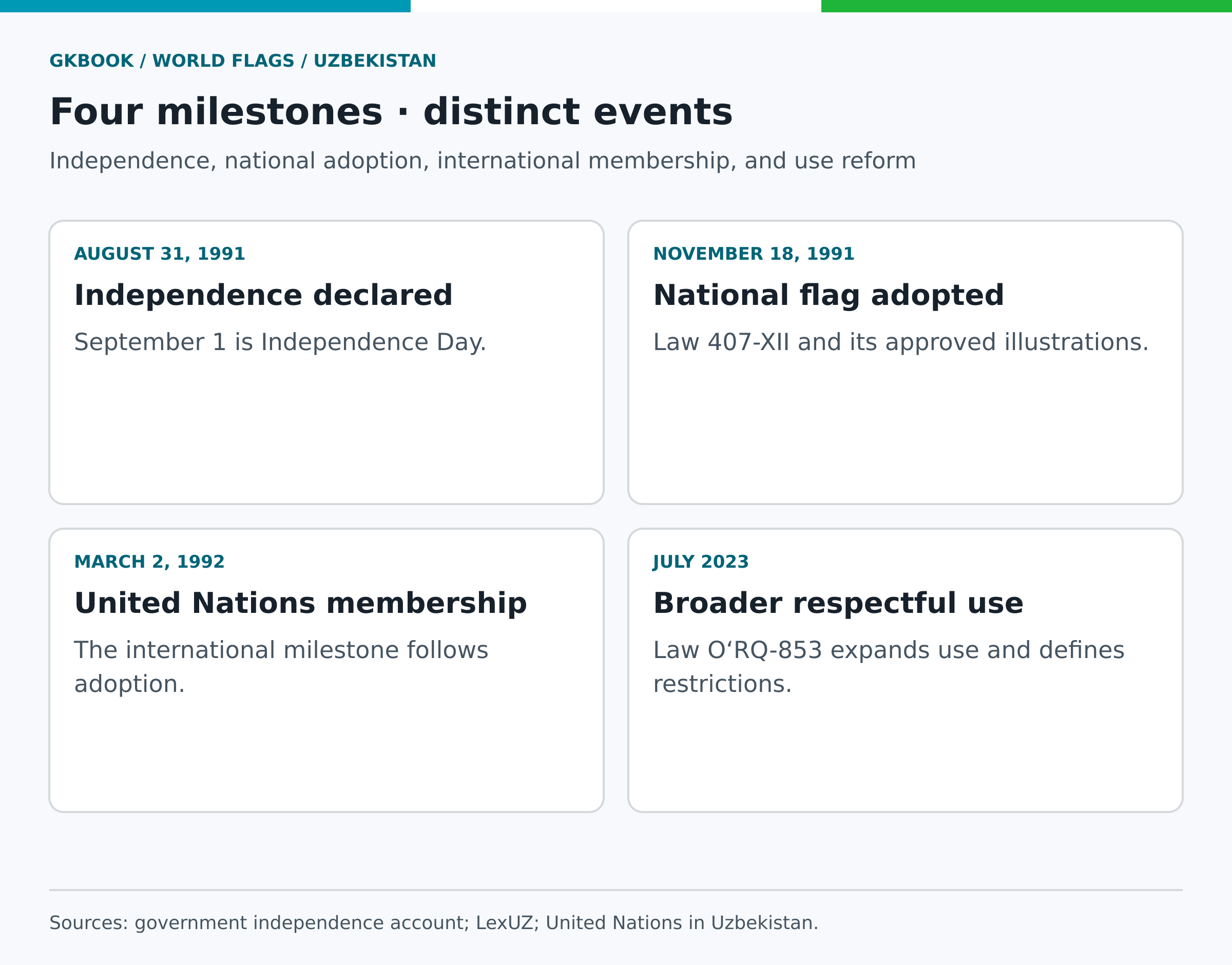
Uzbekistan declared independence on August 31, 1991, adopted its state flag on November 18 that year, and joined the United Nations on March 2, 1992. The modern design belongs to that independence period. Subsequent legislation refined its use and protection while retaining the recognizable crescent, twelve stars, three broad bands, and red borders.
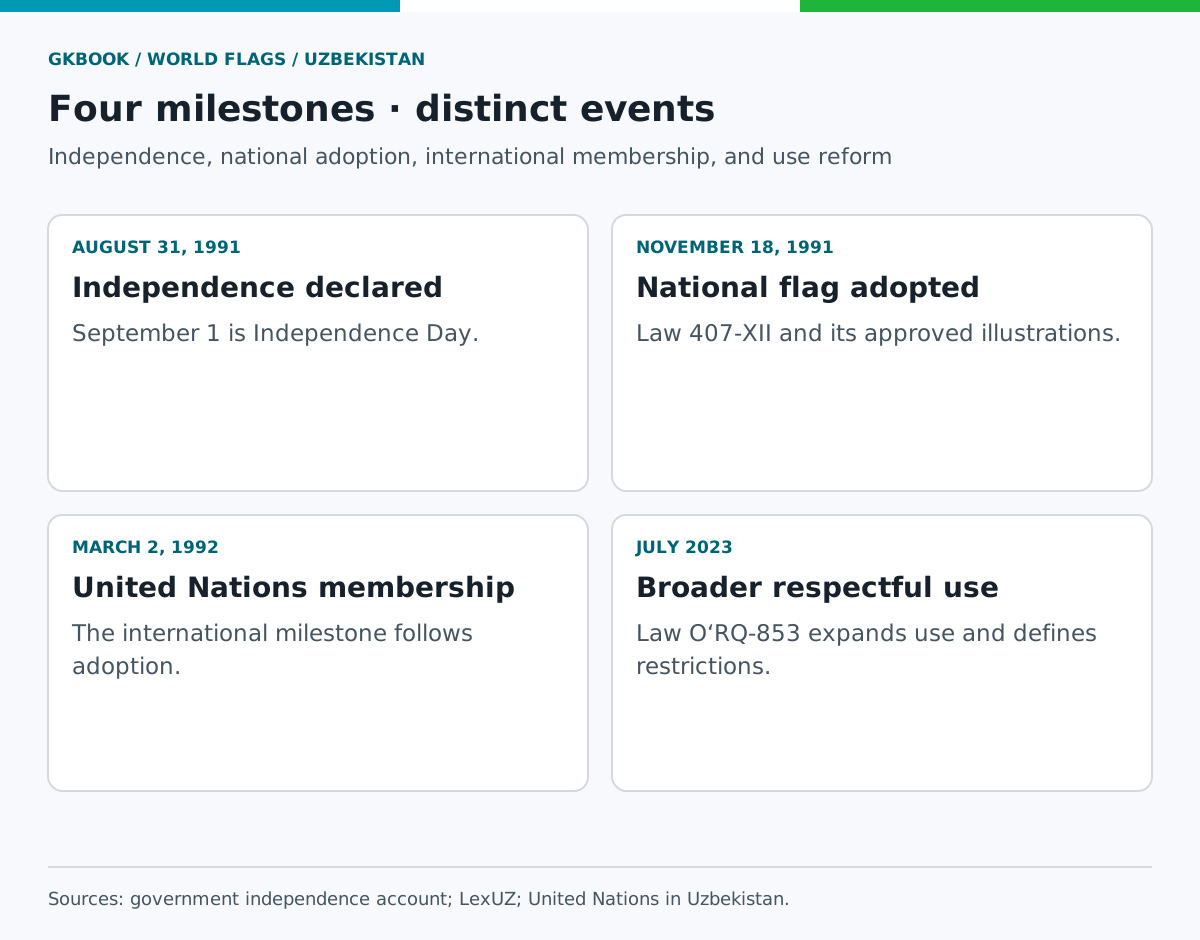
Cabinet Resolution 316, issued on December 30, 1991, established manufacturing, storage, and retirement procedures and repealed several Soviet-era flag-use instructions. That legal transition is documented directly; it is not necessary to invent a seamless sequence of historic banners or treat every earlier regional emblem as a former flag of the present republic.
The United Nations records the membership date as March 2, 1992. Membership is a separate international milestone from adoption of the national flag. The timeline makes that order clear and also identifies the 2023 use reform. Dates for the national emblem and anthem belong to those separate symbols, not to a later introduction of the flag’s crescent and stars.
Sources: Ministry of Higher Education — September 1 Independence Day · LexUZ — Law 407-XII on the State Flag, consolidated Russian text · LexUZ — Cabinet Resolution 316 of December 30, 1991 · United Nations in Uzbekistan — About the UN · LexUZ — Law O‘RQ-853 / ZRU-853, July 7, 2023
Who designed the Uzbekistan flag?
The Islam Karimov scientific and educational memorial complex credits artist Anvar Mamajonov with the flag and state emblem in an account of a meeting with him. This attribution is reported with that source identified. The legally decisive act remains the Supreme Council’s adoption of the flag and its illustrations through Law 407-XII in 1991.
Design authorship, participation in a national-symbol competition, and formal approval are different roles. The memorial account describes a competition and subsequent review rather than a design becoming law through an artist’s decision alone. The indexed passage was available during research, while the live article returned a maintenance page; that access limitation is retained in the research notes.
The original code-generated artwork provided here is a modern implementation of the published geometry, not a claim to authorship of the national symbol. It should not be credited as a newly designed Uzbek flag. Likewise, a historical account about work on the state emblem should not be used to invent undocumented choices about every star or crescent measurement.
Sources: Islam Karimov memorial complex — Meeting with an artist · LexUZ — Law 407-XII on the State Flag, consolidated Russian text · Drawing method and calculations
When is Uzbekistan’s Flag Day?
November 18 marks the adoption of Uzbekistan’s state flag in 1991 and is commemorated as the Day of Adoption of the State Flag, commonly called Flag Day. Official agencies hold educational and civic events around this anniversary. It is distinct from Independence Day on September 1 and should not automatically be described as a nationwide nonworking holiday.

The government’s event calendar labels the date by the adoption of the flag, and the Youth Affairs Agency describes ceremonies, exhibitions, and educational discussions. These sources support the anniversary and its civic observance. They do not, by themselves, establish a general entitlement to a day off work or prescribe a single ceremony for every school, household, or organization.
The enduring date is November 18; the anniversary number changes with the year. A reusable reference page should not call every future celebration the thirty-fourth or thirty-fifth anniversary. For a particular local event, consult its organizer’s current notice for the time and venue rather than treating an older government news report as a permanent schedule.
Sources: Government of Uzbekistan — Date of adoption of the State Flag · Youth Affairs Agency — November 18, Day of Adoption of the National Flag · LexUZ — Law 407-XII on the State Flag, consolidated Russian text
What does the Constitution say about the flag?
Article 5 of the 2023 Constitution recognizes the flag, emblem, and anthem as state symbols approved by law and places them under state protection. The flag’s detailed design comes from the separate flag law and its annex. Article 1 describes Uzbekistan as a secular state, so the crescent should not be treated as a constitutional declaration of an official religion.
The crescent has cultural and religious associations in many settings, but the presidency’s explanation of this flag emphasizes the newly independent republic. A symbol’s wider history and a country’s constitutional character are not the same question. The page presents the official interpretation and constitutional wording together, without reducing the entire national design to a single religious meaning.
The Constitution provides the framework; the flag statute supplies dimensions, use rules, and protection provisions. A general constitutional statement cannot answer how far apart the stars are or how the reverse should look. Those details must be checked against Article 4 and the attached illustrations, which are linked in the construction sections of this page.
Sources: LexUZ — Constitution of April 30, 2023, English translation · Presidency of Uzbekistan — State symbols · LexUZ — Law 407-XII on the State Flag, consolidated Russian text
Which laws govern the Uzbekistan flag today?
The central instrument is Law 407-XII of November 18, 1991, read in its consolidated form. The 2023 amendment, Law O‘RQ-853, broadened respectful uses and specified prohibited treatment. Law O‘RQ-974 of 2024 updated an Uzbek-language provision about border crossing points. Cabinet Resolution 316 addresses manufacture, storage, and retirement procedures.

For an actual display or production decision, use the current consolidated text and the provisions relevant to that setting. An archived 1991 version is valuable for historical comparison but omits later permissions and restrictions. The research checked the LexUZ consolidation, the 2023 amending law, and the relevant 2024 amendment instead of presenting the adoption-year text as the whole current framework.
This article is a source-linked general explanation, not a determination of a specific person’s liability or a substitute for the responsible institution’s advice. It does not quote old penalty amounts as current fines. The drawings explain design and selected display relationships; they do not approve a commercial campaign, official procurement, or a particular event’s legal arrangements.
Sources: LexUZ — Law 407-XII on the State Flag, consolidated Russian text · LexUZ — Law O‘RQ-853 / ZRU-853, July 7, 2023 · LexUZ — Law O‘RQ-974 / ZRU-974, October 10, 2024 · LexUZ — Cabinet Resolution 316 of December 30, 1991
Can individuals display the Uzbekistan flag?
Yes. The law, as expanded in 2023, allows respectful use in public places, homes, workplaces, adjacent areas, and vehicle interiors, as well as various civic and family occasions. These permissions coexist with rules against disrespectful treatment and restrictions on commercial promotion. The flag is not reserved exclusively for government officials or official buildings.

The law distinguishes required official displays from other permitted uses. Article 5 lists institutions and settings where the flag is raised, while later paragraphs expressly allow broader respectful use, including some uses without a staff. A summary that lists only ministries and embassies misses those later permissions and can leave ordinary readers with an outdated impression.
Article 6 also sets times for particular categories: for example, the national-holiday displays referenced there run from 06:00 to 22:00. That provision should not be rewritten as a universal sunrise-to-sunset rule or automatically applied to every indoor illustration. Match a timing requirement to the exact category it governs, and consult the organizer for the setting in question.
Sources: LexUZ — Law 407-XII on the State Flag, consolidated Russian text · LexUZ — Law O‘RQ-853 / ZRU-853, July 7, 2023
Can the flag appear on clothing or merchandise?
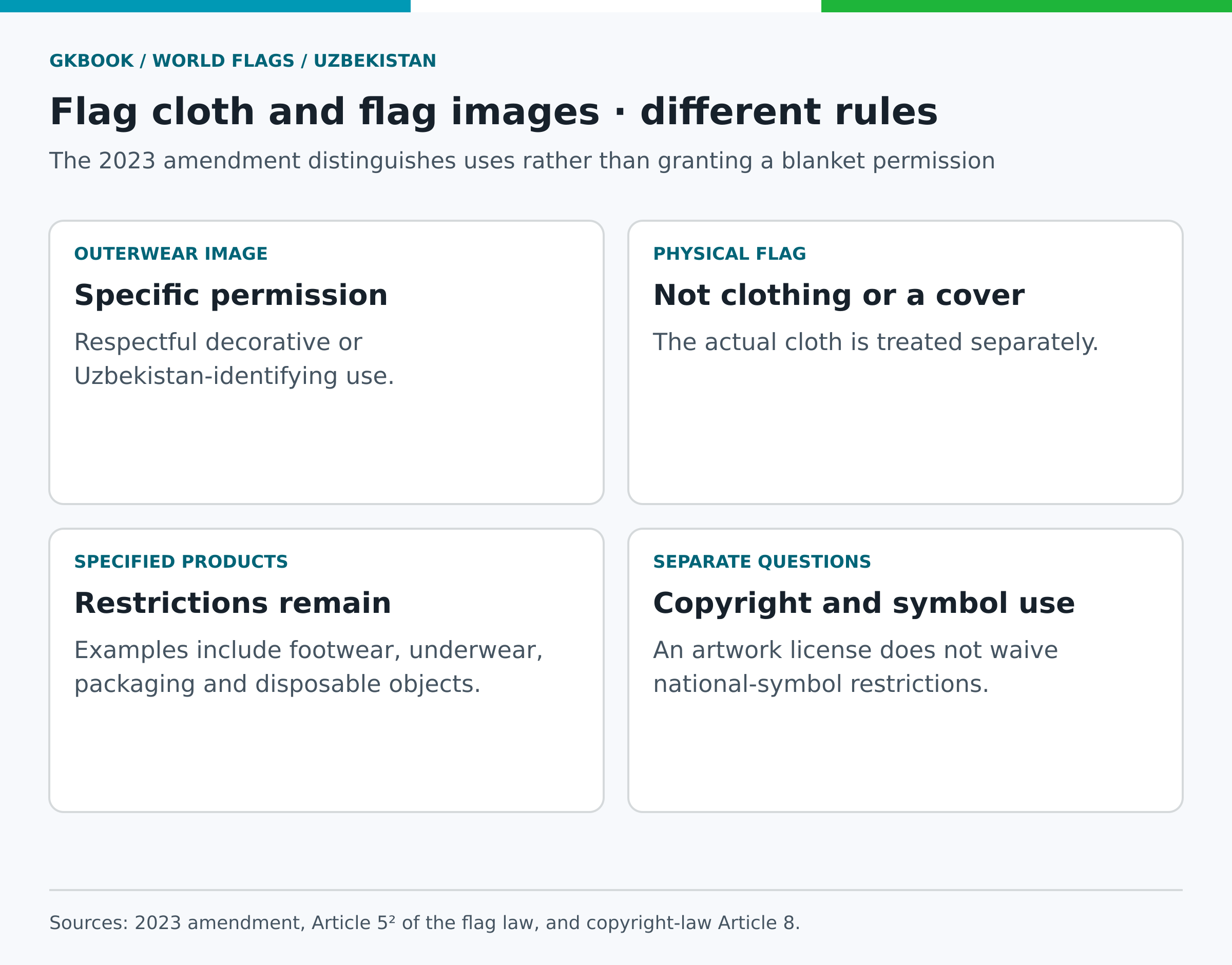
The 2023 amendment permits respectful flag images on outerwear for decorative purposes or to identify association with Uzbekistan, and addresses official and sports clothing. It also restricts commercial promotion and specified uses such as footwear, underwear, towels, packaging, and disposable objects. Using the actual flag cloth as clothing is distinguished from an allowed image on outerwear.

That distinction is easy to lose in a slogan such as “the flag is allowed on clothing.” The law separately discusses the physical flag, representations of it, official insignia, sportswear, and the exception for outerwear. A faithful educational summary preserves those categories rather than promising that any item bearing the colors or emblem may be sold without restriction.
Copyright status is a different issue from symbol-use rules. Uzbekistan’s copyright law excludes official documents and state symbols from copyright objects, but that does not cancel the flag statute’s restrictions on treatment or promotion. The package’s CC0 notice concerns its original vector implementation and teaching diagrams; it is not a license from the state for a proposed commercial use.
Sources: LexUZ — Law 407-XII on the State Flag, consolidated Russian text · LexUZ — Law O‘RQ-853 / ZRU-853, July 7, 2023 · LexUZ — Copyright Law O‘RQ-42, Article 8
Which way up should the Uzbekistan flag be shown?
In the conventional horizontal front view, blue is at the top, white in the middle, and green at the bottom. The crescent and stars are near the upper left, beside the hoist, and the crescent opens toward the stars. The red borders stay immediately above and below the white band.

A front-view illustration normally places the hoist at the viewer’s left and the fly at the right. This convention helps readers inspect the official colored front. A top-to-bottom inversion puts green above blue and moves the emblems downward; it is shown only as a labeled teaching comparison, never as an alternative national design.
A portrait poster containing a complete landscape flag is different from turning the cloth into a vertical hanging. The inspected sources do not supply a separate universal portrait-wall transformation in the passages used here. This page therefore does not import another country’s vertical-display convention or rotate just the crescent and stars while leaving the bands unchanged.
Sources: LexUZ — Law 407-XII on the State Flag, consolidated Russian text · LexUZ — Official colored front view · LexUZ — Dimensioned schematic attached to the State Flag Law · Drawing method and calculations
What does the reverse of the Uzbekistan flag look like?
The official reverse illustration mirrors the front horizontally: the crescent and stars appear near the upper right, beside the hoist, and the crescent opens left toward the stars. Blue remains above white and green. Article 4 specifies the white emblems on both sides, so the reverse is not an empty blue band.
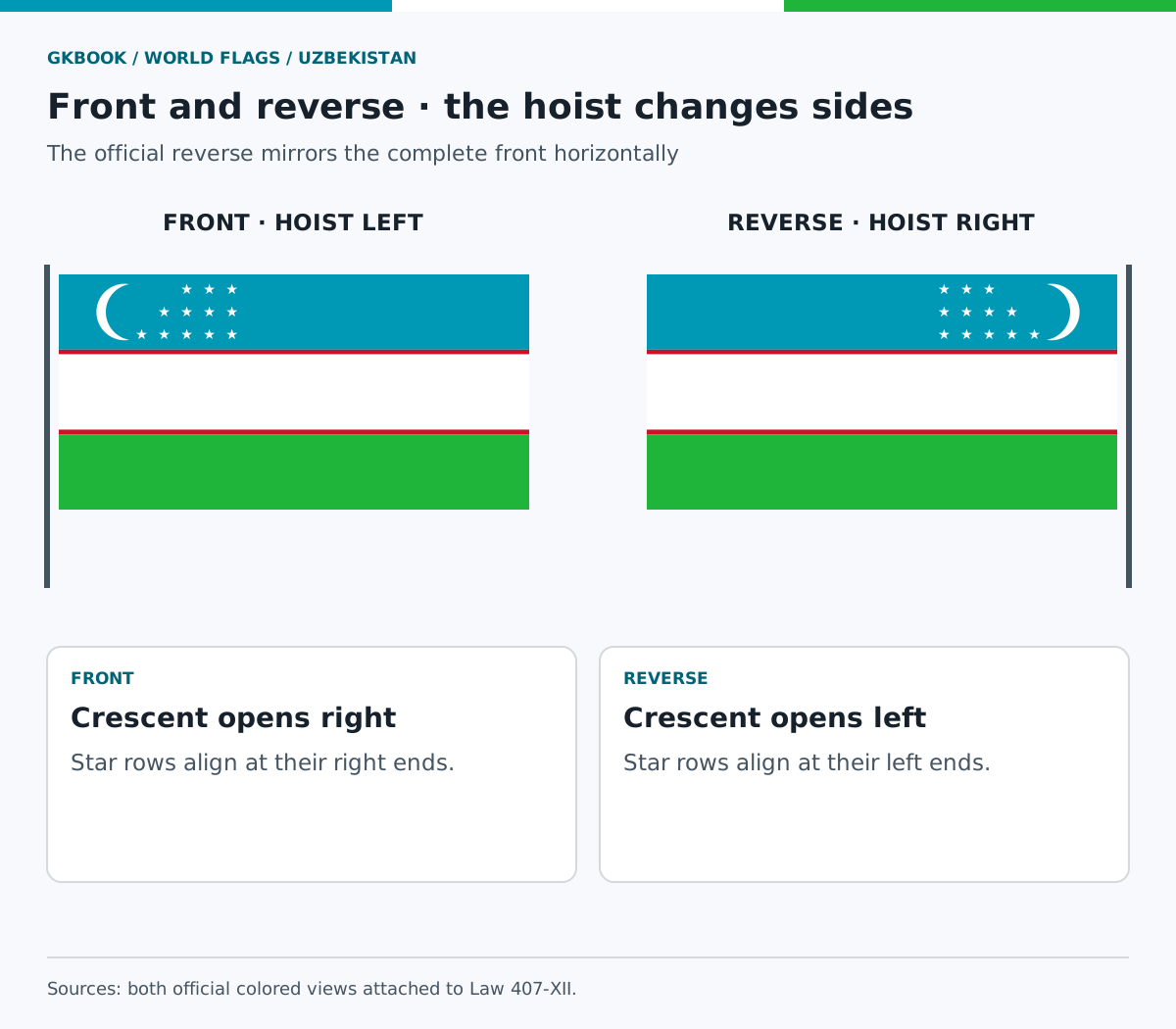
Looking at the back of a single flag changes the viewer’s relationship to the hoist. The right-aligned front-view star rows become left-aligned in the reverse illustration, while their counts remain three, four, and five. The white stars keep an upward outer point, and neither red border moves to a new level.
This is why “crescent on the right” is not enough to diagnose an error. First establish which side of the flag is shown and where the staff is located. The paired diagram includes poles and viewpoint labels, and its reverse transforms the entire flag consistently. It does not move the crescent alone or treat a natural back view as an upside-down flag.
Sources: LexUZ — Law 407-XII on the State Flag, consolidated Russian text · LexUZ — Official colored front view · LexUZ — Official colored reverse view · Drawing method and calculations
Is the Uzbekistan flag symmetrical?
The complete flag has no left-right mirror symmetry, no top-bottom mirror symmetry, and no half-turn symmetry. The crescent and stepped star group occupy only the upper hoist, and blue and green occupy different levels. A reversed view can be physically correct without being identical to the original front-view image.

A left-right reflection retains the band order but moves and mirrors the emblems. A top-bottom reflection reverses the vertical band sequence and points the stars downward. A 180-degree rotation changes both the position and orientation of the upper emblems. Each is a distinct geometric operation and should be labeled accurately in an educational illustration.
The broad bands alone do have left-right mirror symmetry because each extends across the full length in a single color. The complete flag loses that symmetry when its emblems are included. This distinction is useful when teaching transformations: test the whole object being discussed, rather than inferring its symmetry from only the largest background shapes.
Sources: LexUZ — Dimensioned schematic attached to the State Flag Law · LexUZ — Official colored front view · LexUZ — Official colored reverse view · Drawing method and calculations
How is the flag placed beside other flags?
Article 7 distinguishes two situations. With Karakalpakstan’s flag, Uzbekistan’s flag goes on the left when facing the building facade and must not be smaller or lower. With foreign-state or international-organization flags, it is the same size and level, with placement governed by international norms and diplomatic protocol. The stated viewpoint matters.
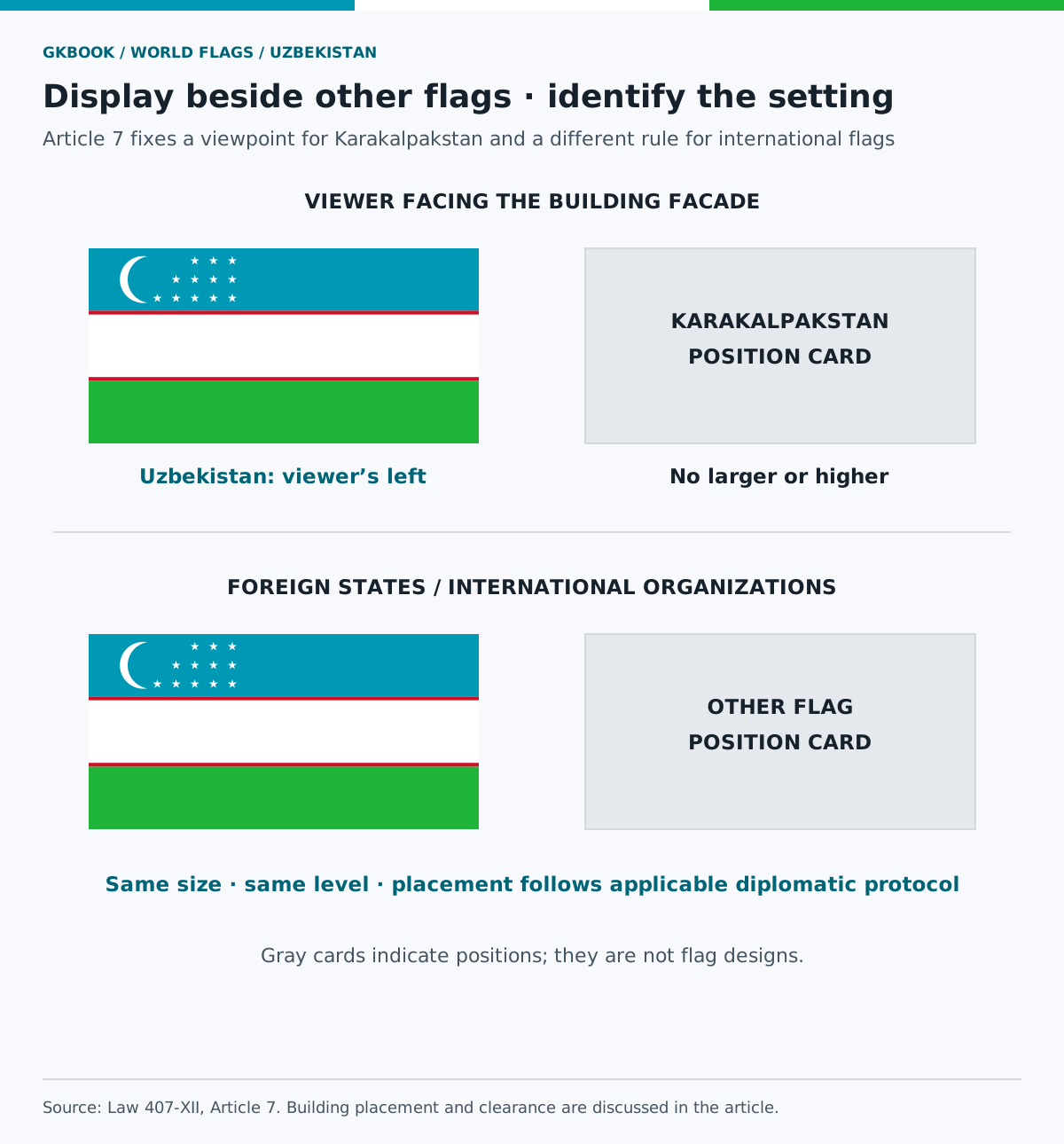
The diagram uses labeled position cards for the comparison flags, avoiding an invented design for a generic foreign or organizational flag. Its first panel fixes the viewer facing the facade, so left cannot be confused with the flag’s own right. Its second panel explains equal size and height rather than prescribing a universal order for an international lineup.
Article 8 also addresses suitable building placement, an angle of no more than forty-five degrees between a building-mounted staff and the facade, and a raised cloth at least 2.5 meters above ground. These details belong to the cited installations. The diagram is schematic and does not certify the dimensions, access arrangements, or suitability of a real mounting location.
Sources: LexUZ — Law 407-XII on the State Flag, consolidated Russian text · Drawing method and calculations
How is the flag displayed during official mourning?
Article 9 provides for mourning display by presidential decree. It describes a black ribbon at the staff top, with width one twentieth of the flag’s height and two ends hanging its full height. For a flag on a flagpole, it specifies lowering by one third of the pole’s length, rather than a generic halfway position.

The ribbon measurements use the flag’s shorter dimension: on the 125-centimeter reference flag, its width is 6.25 centimeters and each hanging end is 125 centimeters long. The pole instruction is measured from the top by one third of the pole’s length. These are different measurements, and neither should be replaced with a rule copied from another country.
The illustration separates the ribbon detail from the pole-lowering schematic so that both can be read clearly. It shows the specified displacement, not a currently active mourning period. Actual dates and implementation follow the relevant presidential decree and responsible authority; a standing reference article should not announce that the country is presently in mourning.
Sources: LexUZ — Law 407-XII on the State Flag, consolidated Russian text · Drawing method and calculations
How should the flag be cared for or retired?
The law requires the flag and its representations to remain whole, clean, unfaded, and appropriately used. Cabinet Resolution 316 addresses storage and the documented handling of flags that have lost their original condition. Follow the current responsible institution’s procedure for retirement; a damaged everyday flag and a historically significant object may require different treatment.
Inspect the edges, seams, colors, and small emblems before display. A missing star, torn red border, or severely faded band can change the recognizable design as well as its condition. The 2023 amendment explicitly places responsibility for suitable use on the persons and organizations using the flag, including state bodies.
The 1991 resolution describes handing over worn flags by a record and decisions by local commissions. Its institutional terminology reflects its period, so confirm the currently responsible office instead of treating old administrative titles as an up-to-date contact directory. No universal triangular fold, private burning ritual, or method of destroying a museum textile is invented in this guide.
Sources: LexUZ — Law 407-XII on the State Flag, consolidated Russian text · LexUZ — Law O‘RQ-853 / ZRU-853, July 7, 2023 · LexUZ — Cabinet Resolution 316 of December 30, 1991
How does Uzbekistan’s flag differ from similar flags?
Uzbekistan has a white middle band, thin red borders, and twelve five-pointed stars beside a crescent in the upper blue band. Karakalpakstan has a yellow middle band and five stars. Azerbaijan has a red middle band with a central crescent and one eight-pointed star. Compare the entire layout, not the crescent alone.
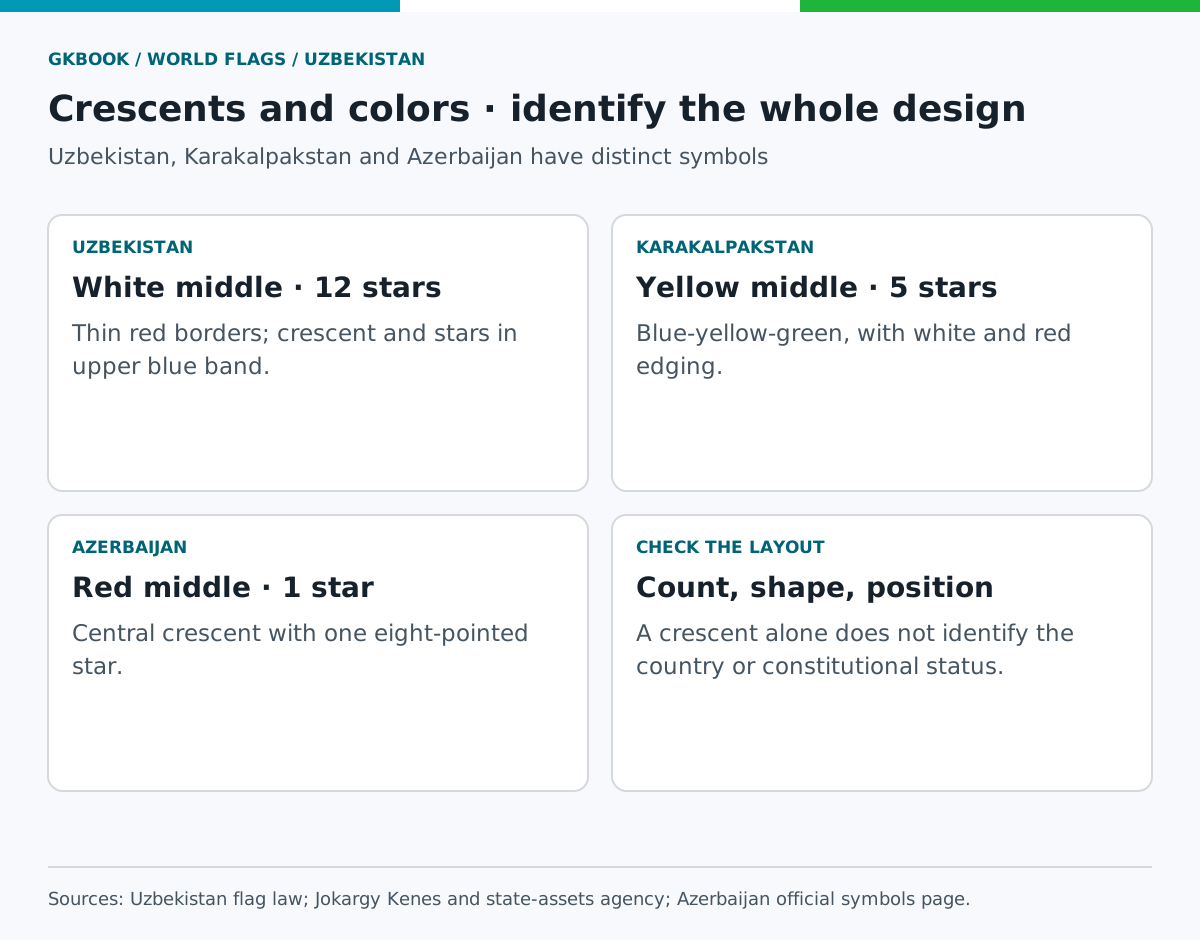
Karakalpakstan is constitutionally part of Uzbekistan and has its own state flag. Its official description specifies blue, yellow, and green bands with red and white edging around the yellow. It is therefore a separate symbol with a distinct design and status, not an optional yellow version of Uzbekistan’s national flag.
Azerbaijan’s official description places its crescent and eight-pointed star in the red central band. Similar blue and green colors do not make that layout interchangeable with Uzbekistan’s. The comparison graphic is an identification guide, not a construction specification for either other flag; use each symbol’s own authoritative drawings when reproducing it.
Sources: LexUZ — Law 407-XII on the State Flag, consolidated Russian text · Jokargy Kenes — National flags · Azerbaijan Judicial-Legal Council — State symbols · LexUZ — Constitution of April 30, 2023, English translation
Which flag file should I download or print?
Use the clean SVG for scalable artwork or the opaque 10,000-by-5,000 PNG for a fixed-resolution image. Both preserve the 1:2 ratio, the two narrow red borders, the crescent, and twelve stars. At 300 pixels per inch, the PNG prints approximately 33.33 by 16.67 inches, or 84.67 by 42.33 centimeters.

Those print sizes describe pixel density, not the printer’s mechanical dot resolution or a guarantee of color matching. Keep proportional scaling enabled and check the complete outer rectangle before exporting. A page background or crop mask should not remove the fly edge, narrow borders, or the blue clearance around the emblem group.
The annotated SVG and PNG diagrams are teaching aids with labels outside the cloth. The social card is a separate 1,200-by-630 composition for a page preview and should not be used as the national flag itself. Use the clean master for a flag illustration, and read the source-linked production and use notes before commissioning an official textile or commercial object.
Sources: LexUZ — Law 407-XII on the State Flag, consolidated Russian text · LexUZ — Cabinet Resolution 316 of December 30, 1991 · Drawing method and calculations
Sources and research notes
This article uses the consolidated Uzbekistan flag law and its official drawings, the 2023 and 2024 amendments, the Constitution, Cabinet Resolution 316, and official historical and cultural accounts. Source links accompany every answer. The bibliography and artwork credits explain source access, discrepancies, and reproduction choices.
The measured artwork follows the law’s 75-centimeter emblem envelope and the dimensioned schematic, while the screen palette and reconstructed inner crescent circle are identified explicitly. The article distinguishes actual flag cloth from flag images, historical adoption from later use reforms, and a mirrored reverse from an inverted flag.
Download Uzbekistan flag pictures
Download the complete national flag as scalable SVG or 10,000 × 5,000 PNG. Both preserve the 1:2 height-to-length ratio, three broad bands, two red borders, crescent, and twelve equal five-pointed stars.
The gallery includes 24 subjects, each available in SVG and PNG, covering construction, symbolism, history, orientation, and selected use rules. A separate 1,200 × 630 social-sharing card places a complete flag beside the article title. Use the clean master for flag illustrations and the annotated diagrams for teaching.
Read the construction guide and use notes, or continue exploring national designs in World Flags.
World Flags/Uzbekistan
Uzbekistan flag pictures
Complete national flag with three broad bands, two red borders, a crescent and twelve stars in rows of three, four and five.
Original GKBook vector implementation; measured layout: Law 407-XII, Article 4 and attached schematic, LexUZ. HEX values are declared editorial screen references.Download SVGDownload PNGOne explicit palette is used throughout the package. Physical manufacturing should follow the approved references and a suitable material proof.
Original GKBook vector implementation; measured layout: Law 407-XII, Article 4 and attached schematic, LexUZ. HEX values are declared editorial screen references.Download SVGDownload PNGSymbolic explanations do not replace the legal drawing dimensions.
Original GKBook vector implementation; measured layout: Law 407-XII, Article 4 and attached schematic, LexUZ. HEX values are declared editorial screen references.Download SVGDownload PNGThe borders sit directly above and below the white band and together occupy four percent of the flag height.
Original GKBook vector implementation; measured layout: Law 407-XII, Article 4 and attached schematic, LexUZ. HEX values are declared editorial screen references.Download SVGDownload PNGThe complete flag gives context; the enlarged detail preserves the crescent and all twelve stars.
Original GKBook vector implementation; measured layout: Law 407-XII, Article 4 and attached schematic, LexUZ. HEX values are declared editorial screen references.Download SVGDownload PNGThe stepped rows align at their right ends in the front view.
Original GKBook vector implementation; measured layout: Law 407-XII, Article 4 and attached schematic, LexUZ. HEX values are declared editorial screen references.Download SVGDownload PNGThe 3.5 cm annotation is a horizontal clearance near the lower crescent tip, not a downward shift of the bottom row.
Original GKBook vector implementation; measured layout: Law 407-XII, Article 4 and attached schematic, LexUZ. HEX values are declared editorial screen references.Download SVGDownload PNGWidth in the translated legal description means the shorter height. This guide labels both axes explicitly.
Original GKBook vector implementation; measured layout: Law 407-XII, Article 4 and attached schematic, LexUZ. HEX values are declared editorial screen references.Download SVGDownload PNGThe three broad bands occupy 32 percent each; the red borders occupy two percent each.
Original GKBook vector implementation; measured layout: Law 407-XII, Article 4 and attached schematic, LexUZ. HEX values are declared editorial screen references.Download SVGDownload PNGThe enlarged raster is exactly four times the native dimensions. White shapes have no added outlines.
Original GKBook vector implementation; measured layout: Law 407-XII, Article 4 and attached schematic, LexUZ. HEX values are declared editorial screen references.Download SVGDownload PNGThe legal rectangle contains the crescent circle and twelve star circles. It is not a white canton or visible border.
Original GKBook vector implementation; measured layout: Law 407-XII, Article 4 and attached schematic, LexUZ. HEX values are declared editorial screen references.Download SVGDownload PNGThe adoption date is separate from later amendments regulating use.
Original GKBook vector implementation; measured layout: Law 407-XII, Article 4 and attached schematic, LexUZ. HEX values are declared editorial screen references.Download SVGDownload PNGThe timeline does not depict conjectural historical flags or treat a use amendment as a new design.
Original GKBook vector implementation; measured layout: Law 407-XII, Article 4 and attached schematic, LexUZ. HEX values are declared editorial screen references.Download SVGDownload PNGThe anniversary date is stable; event schedules and anniversary numbers change.
Original GKBook vector implementation; measured layout: Law 407-XII, Article 4 and attached schematic, LexUZ. HEX values are declared editorial screen references.Download SVGDownload PNGA historical version and the current consolidation answer different questions.
Original GKBook vector implementation; measured layout: Law 407-XII, Article 4 and attached schematic, LexUZ. HEX values are declared editorial screen references.Download SVGDownload PNGThe article links the current provisions and separates required official displays from broader permissions.
Original GKBook vector implementation; measured layout: Law 407-XII, Article 4 and attached schematic, LexUZ. HEX values are declared editorial screen references.Download SVGDownload PNGThis is an educational summary; a proposed product or campaign requires its own assessment.
Original GKBook vector implementation; measured layout: Law 407-XII, Article 4 and attached schematic, LexUZ. HEX values are declared editorial screen references.Download SVGDownload PNGThe right-hand image is deliberately labeled as a transformed teaching comparison.
Original GKBook vector implementation; measured layout: Law 407-XII, Article 4 and attached schematic, LexUZ. HEX values are declared editorial screen references.Download SVGDownload PNGBlue remains on top and green remains below; the crescent and all stars stay present.
Original GKBook vector implementation; measured layout: Law 407-XII, Article 4 and attached schematic, LexUZ. HEX values are declared editorial screen references.Download SVGDownload PNGThese are labeled mathematical transformations, not alternative national designs.
Original GKBook vector implementation; measured layout: Law 407-XII, Article 4 and attached schematic, LexUZ. HEX values are declared editorial screen references.Download SVGDownload PNGThe cards explain relationships without inventing another flag or prescribing a universal diplomatic order.
Original GKBook vector implementation; measured layout: Law 407-XII, Article 4 and attached schematic, LexUZ. HEX values are declared editorial screen references.Download SVGDownload PNGThe 660-unit pole schematic lowers the flag by 220 units. The ribbon detail is separate and enlarged for clarity.
Original GKBook vector implementation; measured layout: Law 407-XII, Article 4 and attached schematic, LexUZ. HEX values are declared editorial screen references.Download SVGDownload PNGThis is an identification guide, not another country’s manufacturing specification.
Original GKBook vector implementation; measured layout: Law 407-XII, Article 4 and attached schematic, LexUZ. HEX values are declared editorial screen references.Download SVGDownload PNGPrint size follows from pixel dimensions and selected sampling density. It is not a textile color certificate.
Original GKBook vector implementation; measured layout: Law 407-XII, Article 4 and attached schematic, LexUZ. HEX values are declared editorial screen references.Download SVGDownload PNGFrequently asked questions
What does the Uzbekistan flag look like?
Uzbekistan’s flag is a 1:2 rectangle with blue, white, and green horizontal bands separated by two thin red borders. A white crescent and twelve white five-pointed stars occupy the upper blue band near the hoist. Adopted on November 18, 1991, it is the state symbol of the republic’s sovereignty.
What is the national flag of Uzbekistan called?
The official name is the State Flag of the Republic of Uzbekistan, in Uzbek O‘zbekiston Respublikasining Davlat bayrog‘i. It represents the country’s sovereignty and international identity. The familiar design combines blue, white, and green horizontal bands, two narrow red borders, and a white crescent with twelve stars near the upper hoist.
What are Uzbekistan’s flag colors and HEX codes?
The flag uses blue, white, green, and red, with white for the crescent and stars. This edition uses #0099B5, #FFFFFF, #1EB53A, and #CE1126 respectively. These are declared digital reproduction choices. The cited law specifies named colors and approved illustrations; it does not establish these particular HEX values as statutory color codes.
What do the colors and symbols of the flag mean?
Official explanations associate blue with sky and water, white with peace and good fortune, green with nature and renewal, and red with life’s energy. The new moon represents the newly independent republic. The twelve stars refer to cultural traditions, the ancient solar calendar, and aspirations toward perfection rather than a list printed on the flag.
Why does the flag have two thin red stripes?
The two red borders separate the white middle band from the blue above and green below. Official symbolism describes them as the energy or power of life. Each border is 2.5 centimeters high in the law’s 125-centimeter-high reference flag, so together they occupy four percent of the total height.
What does the crescent mean, and which way does it face?
The white crescent represents the new moon and, in the presidency’s explanation, the newly independent republic. In the conventional front view it sits near the hoist in the upper blue band, opening toward the stars and the free edge. The law places it within a circle thirty centimeters in diameter in the reference flag.
How many stars are on Uzbekistan’s flag?
There are twelve white five-pointed stars beside the crescent. They form three horizontal rows: three stars above, four in the middle, and five below. Every star has the same size and an upward-facing point in the front view. Neither the crescent’s tips nor the spaces between stars are additional stars.
How are the twelve stars arranged and spaced?
The front-view rows contain three, four, and five stars from top to bottom, aligned on the right. Each construction circle is six centimeters across, with six centimeters of clear space between adjacent circles. The resulting center-to-center spacing is twelve centimeters. Successive lower rows extend one star farther toward the crescent.
What do the twelve stars symbolize?
The presidency links the twelve stars with historical traditions, the ancient solar calendar, cultural heritage, and the pursuit of perfection. Other official explanations emphasize the region’s historical interest in the heavens. The design law establishes the number and layout, but does not assign a named province, person, or month to each individual star.
Do the twelve stars represent Uzbekistan’s twelve regions?
The official explanations consulted do not assign one star to each region. They describe historical and calendar-related symbolism. Uzbekistan has twelve regions, the Republic of Karakalpakstan, and Tashkent city as distinct top-level administrative units, so the number twelve should not be presented as a complete count of all such units or a statutory star-to-region key.
What is the ratio and reference size of the Uzbekistan flag?
The flag has a height-to-length ratio of 1:2. Article 4 describes a reference cloth 125 centimeters high and 250 centimeters long, while Cabinet Resolution 316 allows other sizes with the same ratio. The downloadable clean PNG is 10,000 by 5,000 pixels, and the SVG scales without changing the proportions.
Does the flag have three stripes or five?
It has three broad horizontal bands—blue, white, and green—separated by two narrow red borders. Counting every colored horizontal strip gives five, but they are not five equal bands. From top to bottom the sequence is blue, red, white, red, green, with relative heights of 16:1:16:1:16.
How can the flag be drawn accurately?
Start with a 2,500-by-1,250 rectangle. Divide its height into 400 blue, 25 red, 400 white, 25 red, and 400 green units. Place the crescent’s 300-unit construction circle twenty centimeters from the hoist at the reference scale, then add twelve equal sixty-unit-diameter stars in the prescribed three, four, and five rows.
Where do the crescent and stars fit in the blue band?
The law places the crescent and twelve stars within a 75-by-30-centimeter rectangle, centered vertically in the forty-centimeter blue band. Its left edge is twenty centimeters from the hoist. In the supplied drawing, this construction area runs from x = 200 to 950 and y = 50 to 350 native units.
When was the current Uzbekistan flag adopted?
The State Flag of the Republic of Uzbekistan was adopted on November 18, 1991, by Law 407-XII. This is the flag’s adoption date, distinct from the August 31 declaration of independence and September 1 Independence Day. Later changes to rules governing flag use should not be confused with adoption of a different national design.
How did the modern flag develop after independence?
Uzbekistan declared independence on August 31, 1991, adopted its state flag on November 18 that year, and joined the United Nations on March 2, 1992. The modern design belongs to that independence period. Subsequent legislation refined its use and protection while retaining the recognizable crescent, twelve stars, three broad bands, and red borders.
Who designed the Uzbekistan flag?
The Islam Karimov scientific and educational memorial complex credits artist Anvar Mamajonov with the flag and state emblem in an account of a meeting with him. This attribution is reported with that source identified. The legally decisive act remains the Supreme Council’s adoption of the flag and its illustrations through Law 407-XII in 1991.
When is Uzbekistan’s Flag Day?
November 18 marks the adoption of Uzbekistan’s state flag in 1991 and is commemorated as the Day of Adoption of the State Flag, commonly called Flag Day. Official agencies hold educational and civic events around this anniversary. It is distinct from Independence Day on September 1 and should not automatically be described as a nationwide nonworking holiday.
What does the Constitution say about the flag?
Article 5 of the 2023 Constitution recognizes the flag, emblem, and anthem as state symbols approved by law and places them under state protection. The flag’s detailed design comes from the separate flag law and its annex. Article 1 describes Uzbekistan as a secular state, so the crescent should not be treated as a constitutional declaration of an official religion.
Which laws govern the Uzbekistan flag today?
The central instrument is Law 407-XII of November 18, 1991, read in its consolidated form. The 2023 amendment, Law O‘RQ-853, broadened respectful uses and specified prohibited treatment. Law O‘RQ-974 of 2024 updated an Uzbek-language provision about border crossing points. Cabinet Resolution 316 addresses manufacture, storage, and retirement procedures.
Can individuals display the Uzbekistan flag?
Yes. The law, as expanded in 2023, allows respectful use in public places, homes, workplaces, adjacent areas, and vehicle interiors, as well as various civic and family occasions. These permissions coexist with rules against disrespectful treatment and restrictions on commercial promotion. The flag is not reserved exclusively for government officials or official buildings.
Can the flag appear on clothing or merchandise?
The 2023 amendment permits respectful flag images on outerwear for decorative purposes or to identify association with Uzbekistan, and addresses official and sports clothing. It also restricts commercial promotion and specified uses such as footwear, underwear, towels, packaging, and disposable objects. Using the actual flag cloth as clothing is distinguished from an allowed image on outerwear.
Which way up should the Uzbekistan flag be shown?
In the conventional horizontal front view, blue is at the top, white in the middle, and green at the bottom. The crescent and stars are near the upper left, beside the hoist, and the crescent opens toward the stars. The red borders stay immediately above and below the white band.
What does the reverse of the Uzbekistan flag look like?
The official reverse illustration mirrors the front horizontally: the crescent and stars appear near the upper right, beside the hoist, and the crescent opens left toward the stars. Blue remains above white and green. Article 4 specifies the white emblems on both sides, so the reverse is not an empty blue band.
Is the Uzbekistan flag symmetrical?
The complete flag has no left-right mirror symmetry, no top-bottom mirror symmetry, and no half-turn symmetry. The crescent and stepped star group occupy only the upper hoist, and blue and green occupy different levels. A reversed view can be physically correct without being identical to the original front-view image.
How is the flag placed beside other flags?
Article 7 distinguishes two situations. With Karakalpakstan’s flag, Uzbekistan’s flag goes on the left when facing the building facade and must not be smaller or lower. With foreign-state or international-organization flags, it is the same size and level, with placement governed by international norms and diplomatic protocol. The stated viewpoint matters.
How is the flag displayed during official mourning?
Article 9 provides for mourning display by presidential decree. It describes a black ribbon at the staff top, with width one twentieth of the flag’s height and two ends hanging its full height. For a flag on a flagpole, it specifies lowering by one third of the pole’s length, rather than a generic halfway position.
How should the flag be cared for or retired?
The law requires the flag and its representations to remain whole, clean, unfaded, and appropriately used. Cabinet Resolution 316 addresses storage and the documented handling of flags that have lost their original condition. Follow the current responsible institution’s procedure for retirement; a damaged everyday flag and a historically significant object may require different treatment.
How does Uzbekistan’s flag differ from similar flags?
Uzbekistan has a white middle band, thin red borders, and twelve five-pointed stars beside a crescent in the upper blue band. Karakalpakstan has a yellow middle band and five stars. Azerbaijan has a red middle band with a central crescent and one eight-pointed star. Compare the entire layout, not the crescent alone.
Which flag file should I download or print?
Use the clean SVG for scalable artwork or the opaque 10,000-by-5,000 PNG for a fixed-resolution image. Both preserve the 1:2 ratio, the two narrow red borders, the crescent, and twelve stars. At 300 pixels per inch, the PNG prints approximately 33.33 by 16.67 inches, or 84.67 by 42.33 centimeters.
Every general-knowledge topic and the A-to-Z lists.
The world A to Z: flags, countries, the sciences, places, people, subjects.








We Value Your Opinion Comments