
Uruguay flag picture
Explore the sixteen alternating sun rays, proportions, and picture gallery.
| Spanish names | Pabellón Nacional / Bandera NacionalUruguay’s principal national flag. |
|---|---|
| Design | 9 stripes · 16 sun raysFive white and four blue stripes. |
| Proportions | Height:length = 2:3Square white canton; centered figured sun. |
| Stripe arrangement | July 12, 1830Law date cited in official references. |
| First flag | December 1828Nine blue bands on a white field. |
| National Flag Day | December 18Law 17,884, promulgated in 2005. |
| Flag oath | June 19Distinct from statutory National Flag Day. |
| Working palette | #0038A8 · #FFFFFF · #FCD116Declared screen values, not statutory HEX codes. |
The national flag, Artigas flag, and Thirty-Three flag have separate designs and ceremonial roles.
What does the Uruguay flag look like?
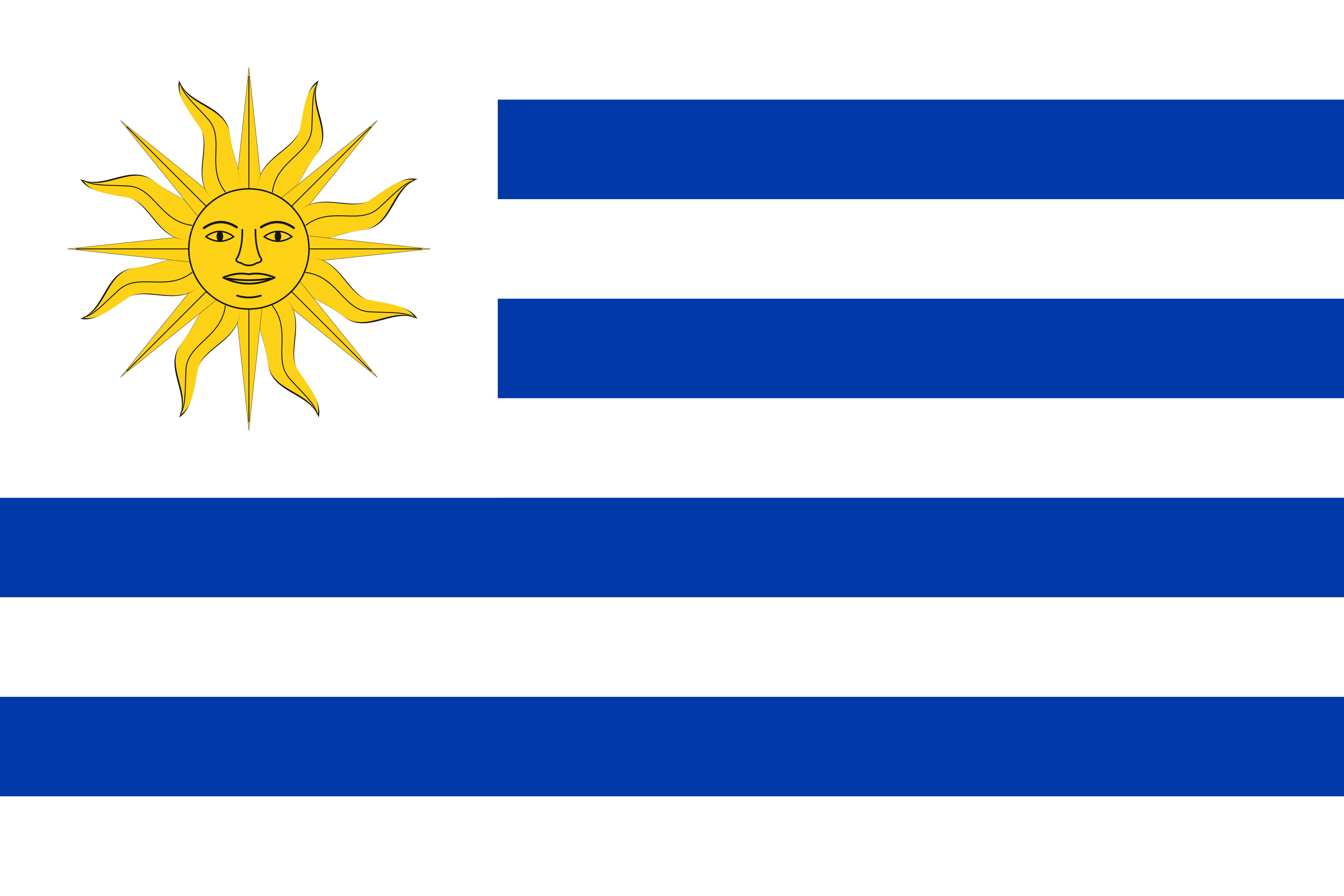
Uruguay’s flag has nine horizontal stripes, five white and four blue, with a gold Sun of May in a white upper-hoist square. The sun has a human face and sixteen alternating straight and wavy rays. The current stripe arrangement dates to July 1830, and the flag’s height-to-length ratio is 2:3.
This guide explains the founding departments, the sun’s construction, the changes from 1828 onward, and the roles of Uruguay’s three patriotic flags. It distinguishes the statutory National Flag Day on December 18 from the June 19 oath ceremonies, identifies the chosen digital colors, and links the historical and official sources behind each answer.
Sources: Uruguay Embassy in Argentina — Pabellón Nacional · Interior Ministry resolution, August 21, 1996 — National flag colors · Army ceremonial and protocol regulation — Decree 339/003
What is the national flag of Uruguay called?
Uruguay’s national flag is called the Pabellón Nacional or Bandera Nacional. It has nine blue and white stripes and a golden, human-faced sun in a white canton. It is the principal national flag; the flags of Artigas and the Thirty-Three Orientals are separate national symbols with their own designs.
Pabellón can be translated as flag or ensign in this context. The country’s official Spanish name is República Oriental del Uruguay. The word Oriental refers to its historic position east of the Uruguay River; it should not be read as a reference to East Asia or used to identify a different country.
The emoji 🇺🇾 uses the regional-indicator sequence U+1F1FA U+1F1FE, representing U and Y. Its appearance depends on the operating system, and some devices show letters instead. The supplied SVG preserves the intended geometry and sun details without depending on a platform’s particular emoji drawing.
Sources: Uruguay Embassy in Argentina — Pabellón Nacional · Uruguay Embassy — National symbols · Ministry of Economy and Finance — Uruguay, the country · Unicode — Uruguay flag emoji sequence
What are Uruguay’s flag colors and HEX codes?
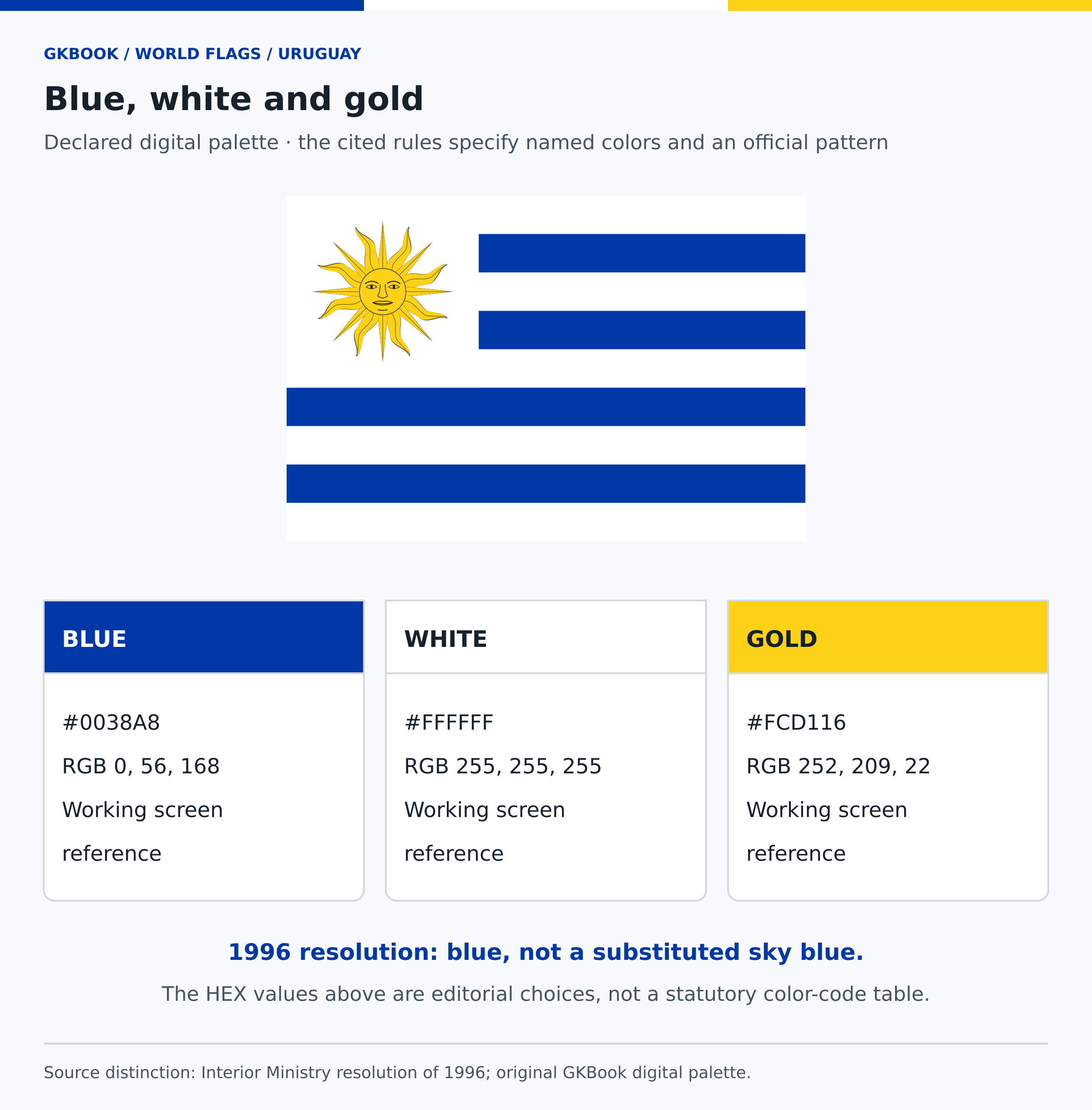
The specified colors are blue and white, with a gold sun. This edition uses #0038A8, #FFFFFF, and #FCD116, plus dark facial outlines. These are declared digital drawing choices, not HEX codes enacted by Uruguay. A 1996 Interior Ministry resolution explicitly rejected substituting sky blue for the national flag’s blue.

The working RGB values are 0, 56, 168 for blue; 255, 255, 255 for white; and 252, 209, 22 for gold. The fine dark lines describe the face and rays, rather than adding another broad field color. Every clean image and explanatory diagram in this package uses the same values.
The cited national descriptions specify named colors and an official pattern, not a complete modern screen-to-print conversion table. A government website’s interface palette is not automatically a flag specification. Match the approved pattern and obtain a physical proof when producing official cloth, rather than treating an arbitrary web swatch as a certified textile color.
| Element | HEX | RGB | Status |
|---|---|---|---|
| Blue stripes | #0038A8 | 0, 56, 168 | Editorial screen reference |
| White field and stripes | #FFFFFF | 255, 255, 255 | White |
| Gold sun | #FCD116 | 252, 209, 22 | Editorial screen reference |
| Fine sun details | #171717 | 23, 23, 23 | Illustration linework |
Sources: Interior Ministry resolution, August 21, 1996 — National flag colors · Uruguay Embassy in Argentina — Pabellón Nacional · Maldonado official digest — National-symbol provisions of 1952 · Drawing method and calculations
What does the Uruguay flag symbolize?
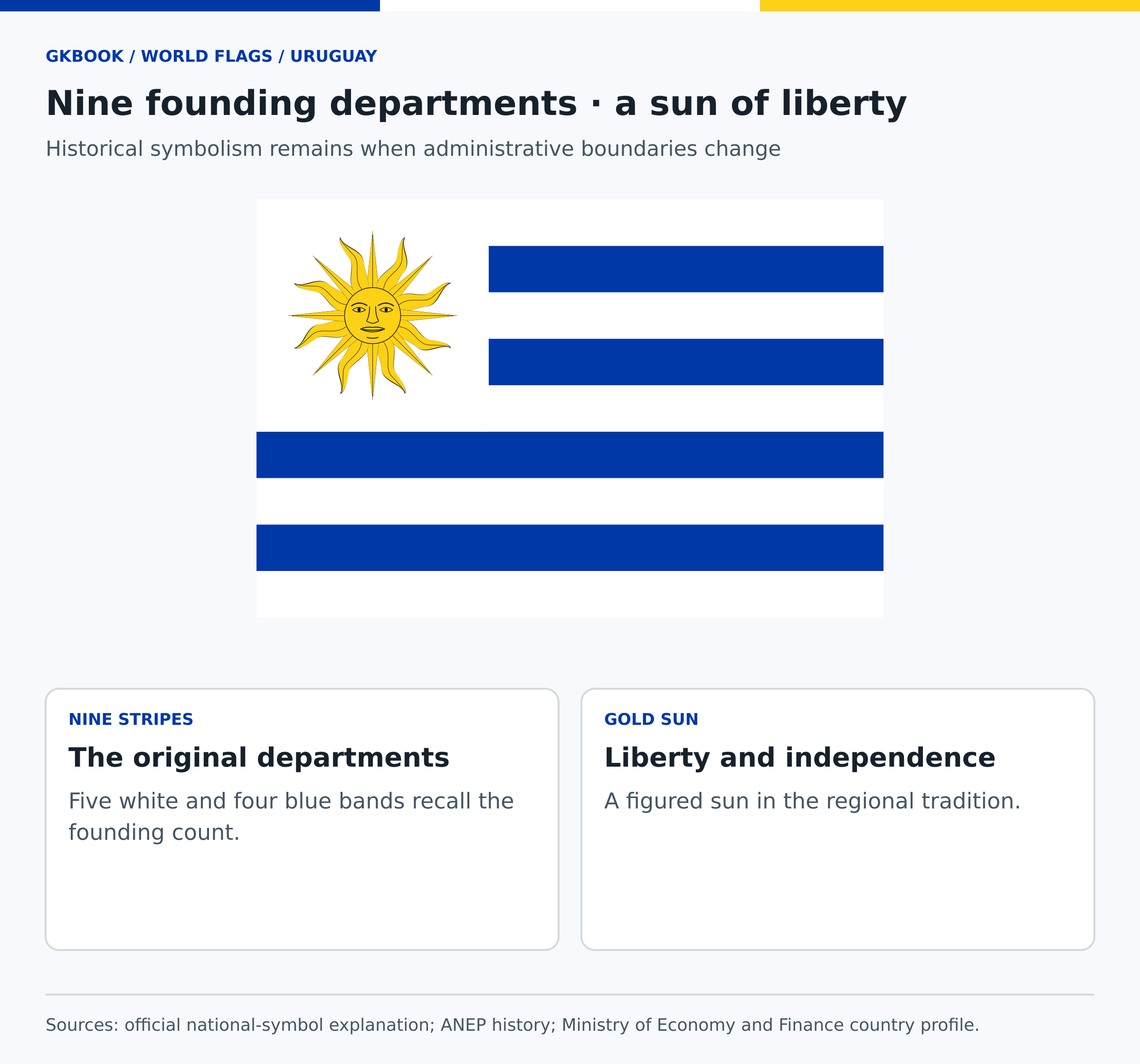
The nine stripes recall Uruguay’s nine original departments, and the Sun of May is associated with liberty and independence. The blue-and-white design belongs to the history of the Río de la Plata region. Popular explanations of individual color virtues should be distinguished from the legal description, which primarily specifies the flag’s visible form.

The numerical symbolism is historical, rather than a live count of today’s administrative divisions. Uruguay now has nineteen departments, yet its national flag retains nine stripes. The same distinction appears in many national flags: a founding number can remain meaningful even after the country’s internal organization has changed considerably.
White is often interpreted as peace and blue as sky or freedom in informal descriptions. Those associations are not presented here as clauses in the flag law. The documentary account connects the stripes with the early departments and explains the sun through its established regional symbolism, leaving room for personal and civic interpretations.
Sources: Uruguay Embassy — National symbols · ANEP Uruguay Educa — Evolution of the flag design · ANEP — Uruguay’s first Constitution and nine departments · Ministry of Economy and Finance — Uruguay, the country
How many stripes does Uruguay’s flag have?
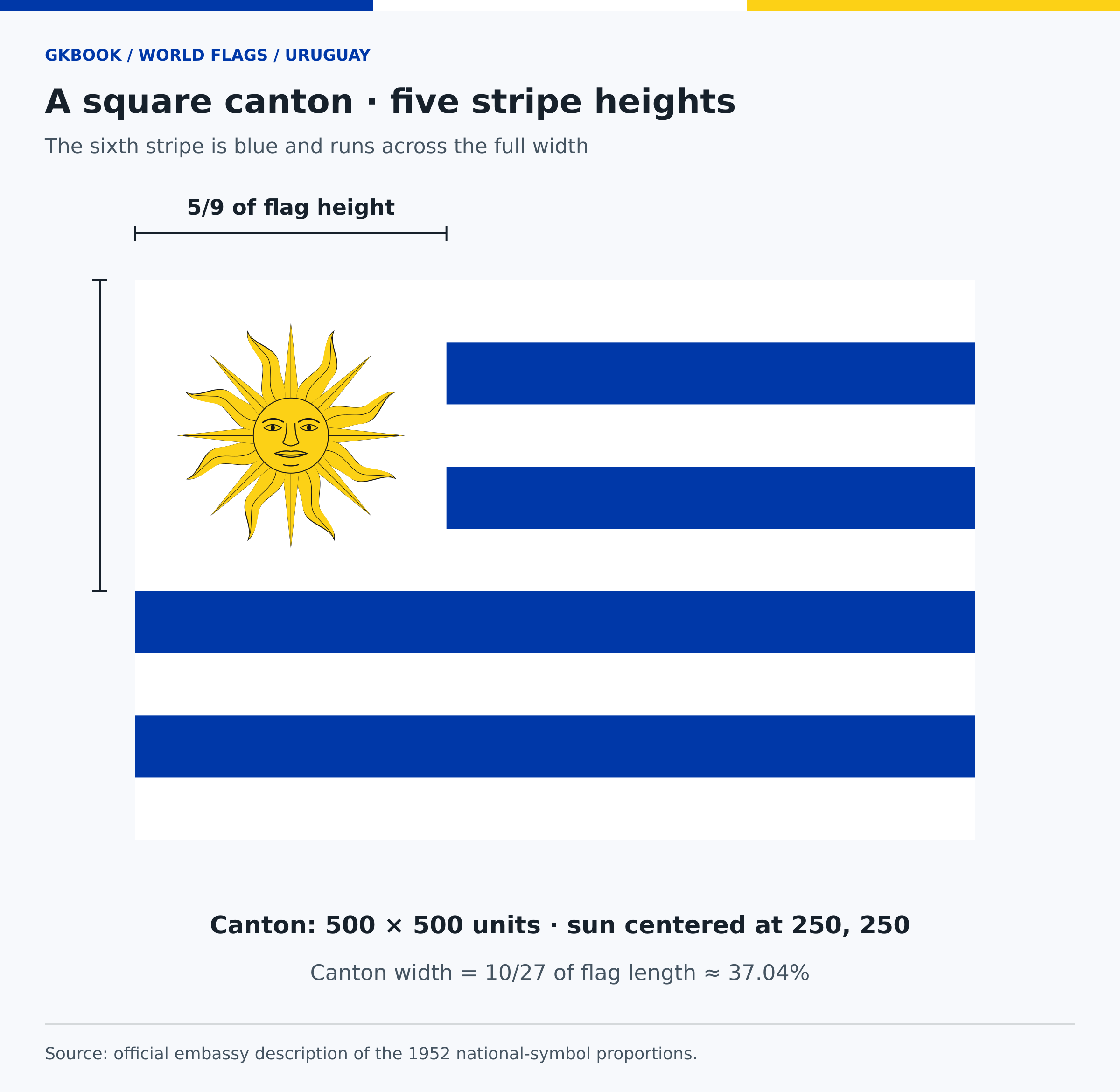
There are nine equal horizontal stripes: five white and four blue. White appears at both the top and bottom. The white canton covers the hoist-side portions of the upper five stripe levels. Count the bands at the fly, the free outer edge, where all nine levels remain visible.

The wording four blue bands on a white field and the description nine alternating stripes refer to the same current design. They count different things: one counts only colored bands, while the other includes the intervening white bands. Confusing those approaches can make an accurate historical description sound like a different flag.
Each stripe is one ninth of the flag’s total height. The two upper blue bands begin only beyond the canton; the lower two run across the full width. Our numbered figure keeps the labels outside the cloth so the stripes can be counted without changing the clean national design.
Sources: Interior Ministry resolution, August 21, 1996 — National flag colors · Uruguay Embassy in Argentina — Pabellón Nacional · Drawing method and calculations
Which nine departments are represented by the stripes?
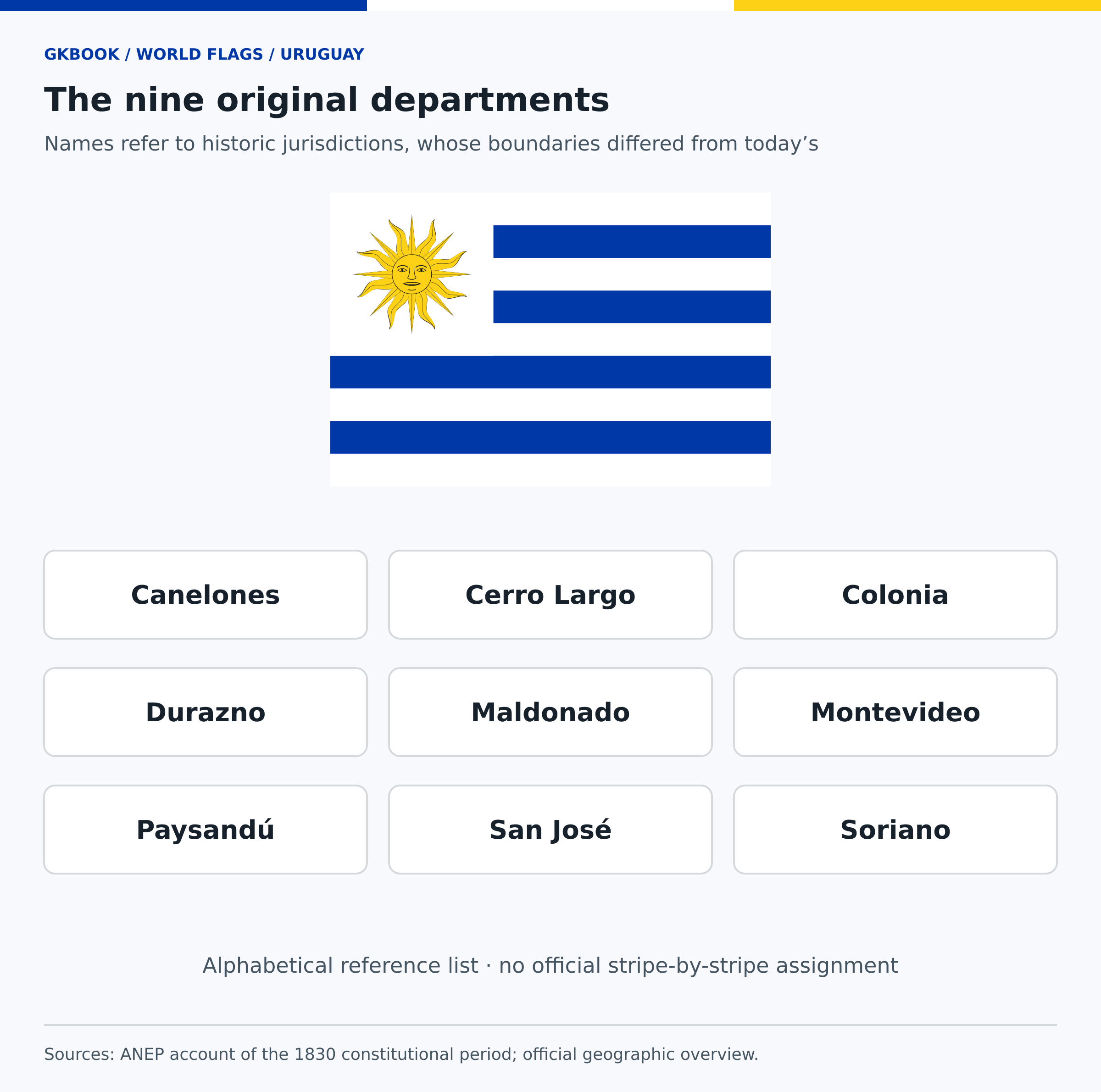
The original nine were Montevideo, Canelones, San José, Colonia, Soriano, Durazno, Maldonado, Cerro Largo, and Paysandú. Their historic boundaries differed from today’s departments. The stripes commemorate that early territorial organization collectively; the design does not label individual bands with department names or add a stripe whenever a new department is created.

ANEP’s account of the 1830 constitutional period lists these nine departments and explains how several covered much larger areas than their present namesakes. Paysandú extended across a vast northern territory, while areas now belonging to newer departments were contained within older jurisdictions. A modern map cannot simply be projected backward unchanged.
The name cards in the graphic are an alphabetical reference list, not an allocation of one named department to a particular stripe. Uruguay’s nineteen present departments belong to a later administrative arrangement. Retaining the old number records the flag’s origins without implying that newer departments have less national standing.
Sources: ANEP — Uruguay’s first Constitution and nine departments · Ministry of Economy and Finance — Uruguay, the country · ANEP Uruguay Educa — Evolution of the flag design
What is the Sun of May on Uruguay’s flag?
The Sun of May is the gold, human-faced solar emblem in the white upper-hoist canton. Uruguay’s version has sixteen rays. Official explanations associate it with liberty and independence, within the wider Río de la Plata tradition. Its position, face, and ray count distinguish it from a generic sun icon or Argentina’s thirty-two-ray emblem.

The sun is a complete radiant disc, not a rising half-sun at the horizon. The national description requires a face and sixteen rays, and the measured reference places it centrally within a square white field. Its entire ray envelope fits comfortably inside that square, with a clear margin on every side.
Related solar imagery appears in other national and historical symbols, but a shared name does not make the drawings interchangeable. Argentina places its sun in a central white band and specifies thirty-two rays. Uruguay keeps its sixteen-ray emblem in the canton, above and beside the alternating striped field.
Sources: Uruguay Embassy in Argentina — Pabellón Nacional · Uruguay Embassy — National symbols · Army ceremonial and protocol regulation — Decree 339/003 · Government of Argentina — National flag
How many rays does Uruguay’s sun have?
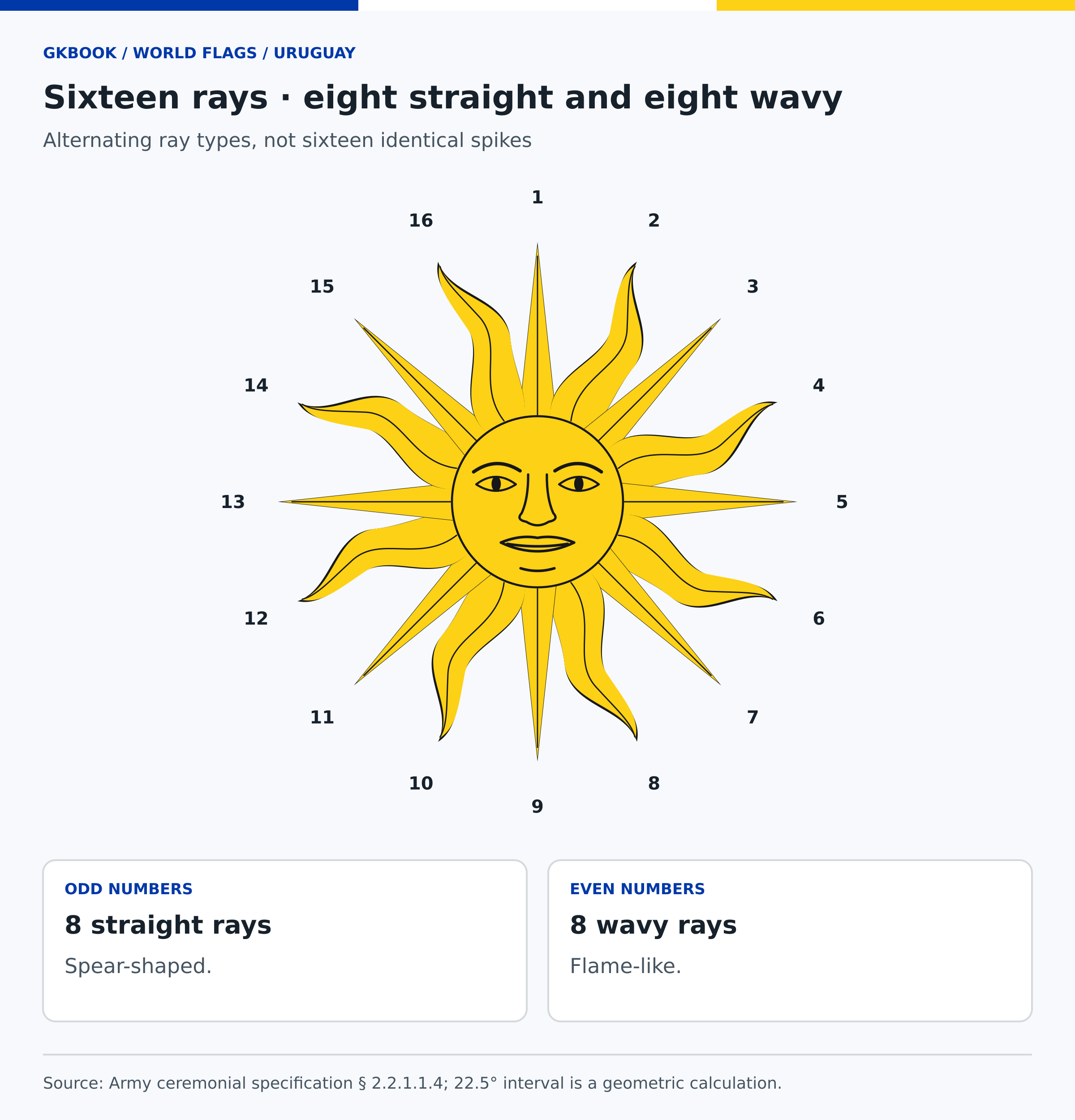
The sun has sixteen rays, alternating eight straight spear-shaped rays with eight wavy, flame-like rays. The two types alternate all the way around the disc. Count outward rays, not the dark lines within them. A thirty-two-ray sun belongs to Argentina’s specification and should not be substituted for Uruguay’s national emblem.
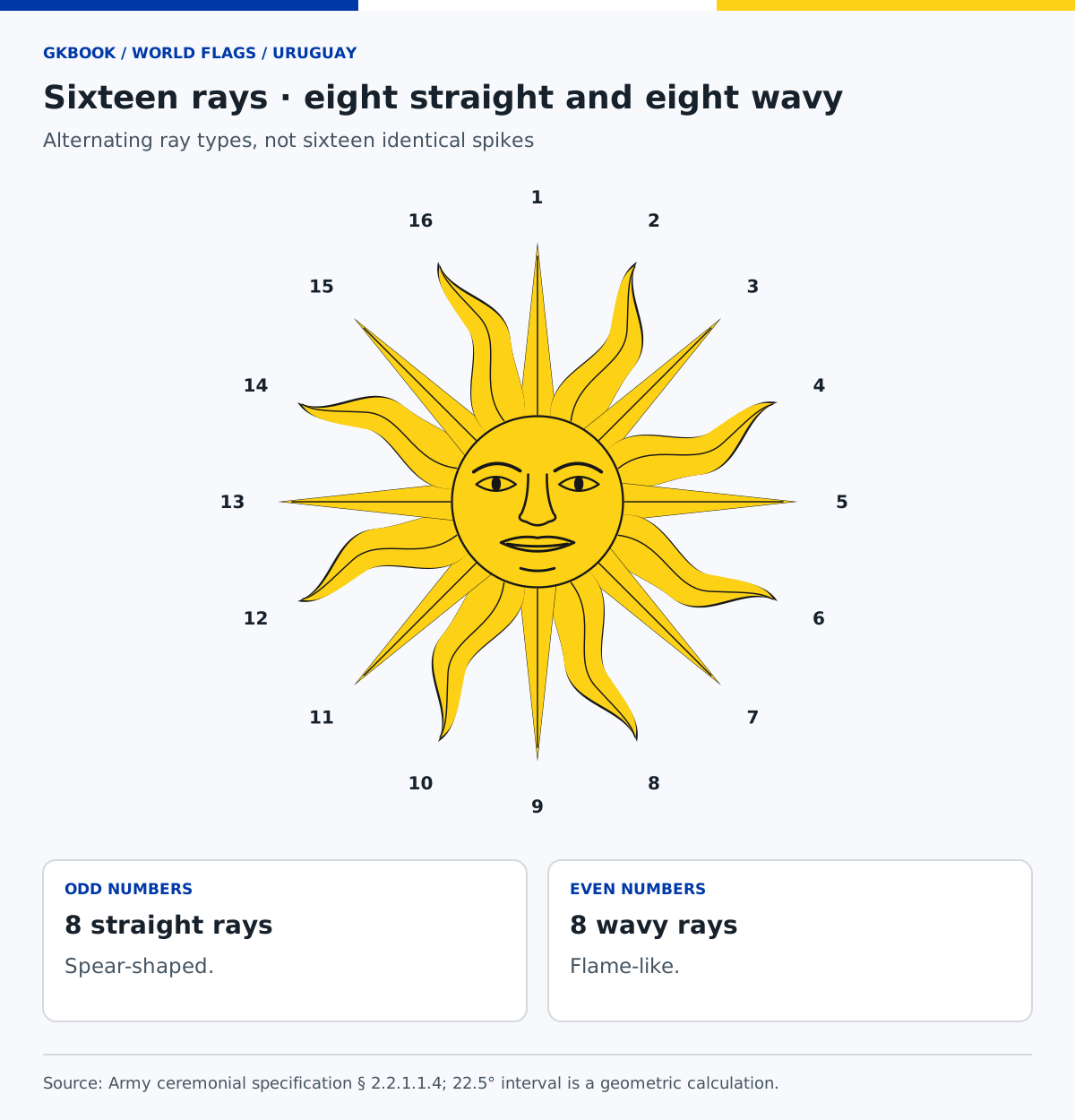
The straight rays in our reference drawing occupy the cardinal and diagonal directions. The wavy rays sit halfway between them, giving a repeating interval of 22.5 degrees. The complete design therefore has eight straight-and-wavy pairs; the pairing, rather than sixteen identical spikes, is the essential visual check.
The Army’s ceremonial description explicitly distinguishes the two ray types, and the embassy’s reference images show their alternating arrangement. Fine internal lines make the rays readable at larger sizes. At small sizes those details may soften, but removing half the rays or replacing the sun with a featureless circle changes the design.
Sources: Army ceremonial and protocol regulation — Decree 339/003 · Uruguay Embassy in Argentina — Pabellón Nacional · Drawing method and calculations
Why does the sun on Uruguay’s flag have a face?
The human face is part of the prescribed figured sun: the 1952 description calls for a radiant circle with a face and sixteen rays. It is an emblematic face, not an identified portrait of a president or national hero. Omitting the eyes, nose, and mouth produces an incomplete reference drawing.
The face makes the solar disc anthropomorphic, giving a natural object human features. That artistic description is different from assigning a personal identity to the figure. The national specifications describe what must appear, while the accompanying symbolism concerns liberty and independence rather than the likeness of a particular individual.
The linework supplied here is a new vector interpretation informed by the published official reference images. It retains a frontal face, central nose, two eyes, mouth, and the alternating rays. It is not an authenticated digital copy of the physical pattern held by the Museo Histórico Nacional, and is identified accordingly.
Sources: Uruguay Embassy in Argentina — Pabellón Nacional · Maldonado official digest — National-symbol provisions of 1952 · Uruguay Embassy — National symbols · Drawing method and calculations
How large is the white canton on Uruguay’s flag?
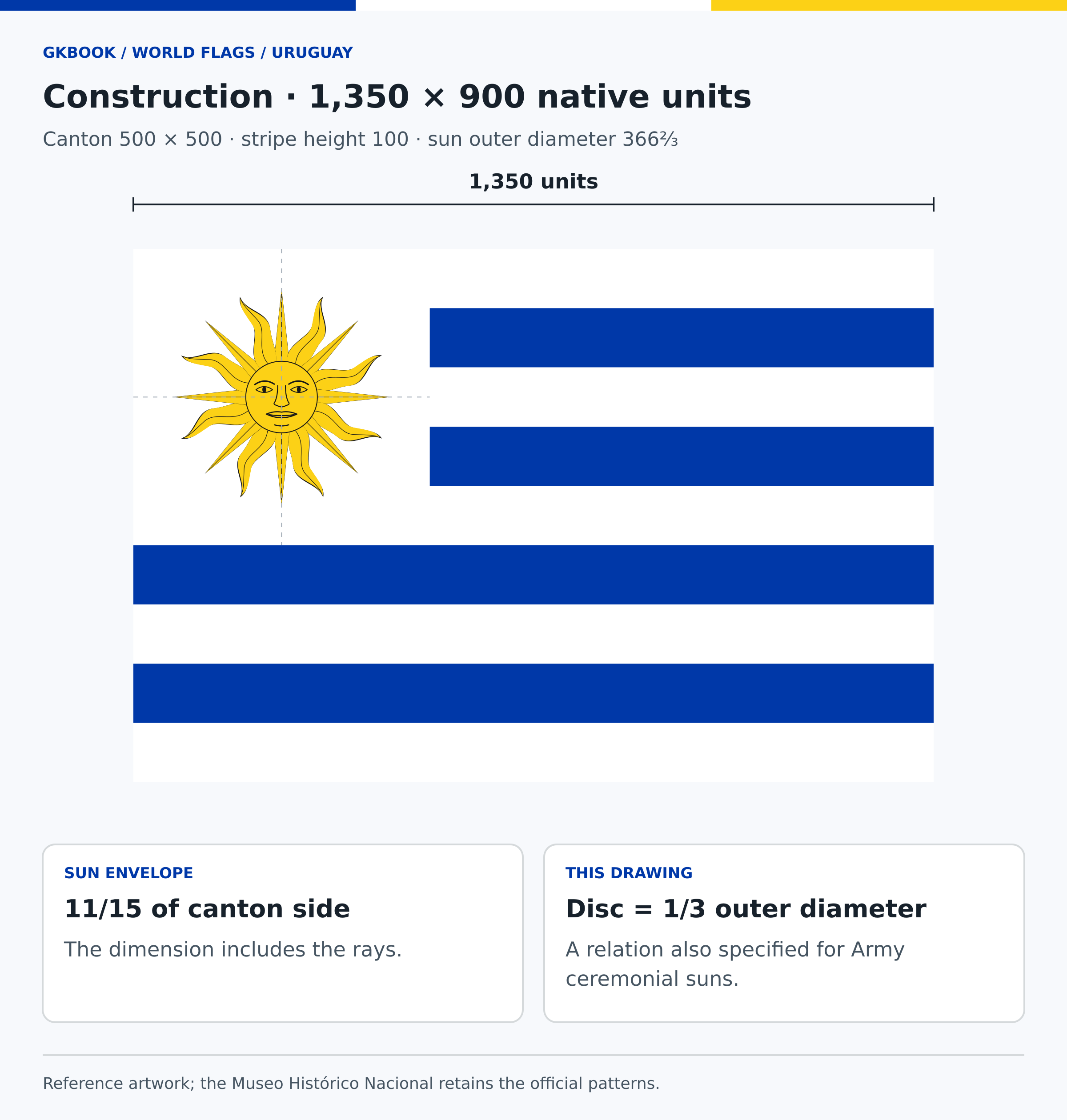
The canton is a square at the upper hoist, with each side equal to five ninths of the flag’s height. It ends just above the sixth stripe, which is blue. The sun is centered in that square, and its overall diameter, including the rays, is eleven fifteenths of the canton’s side.
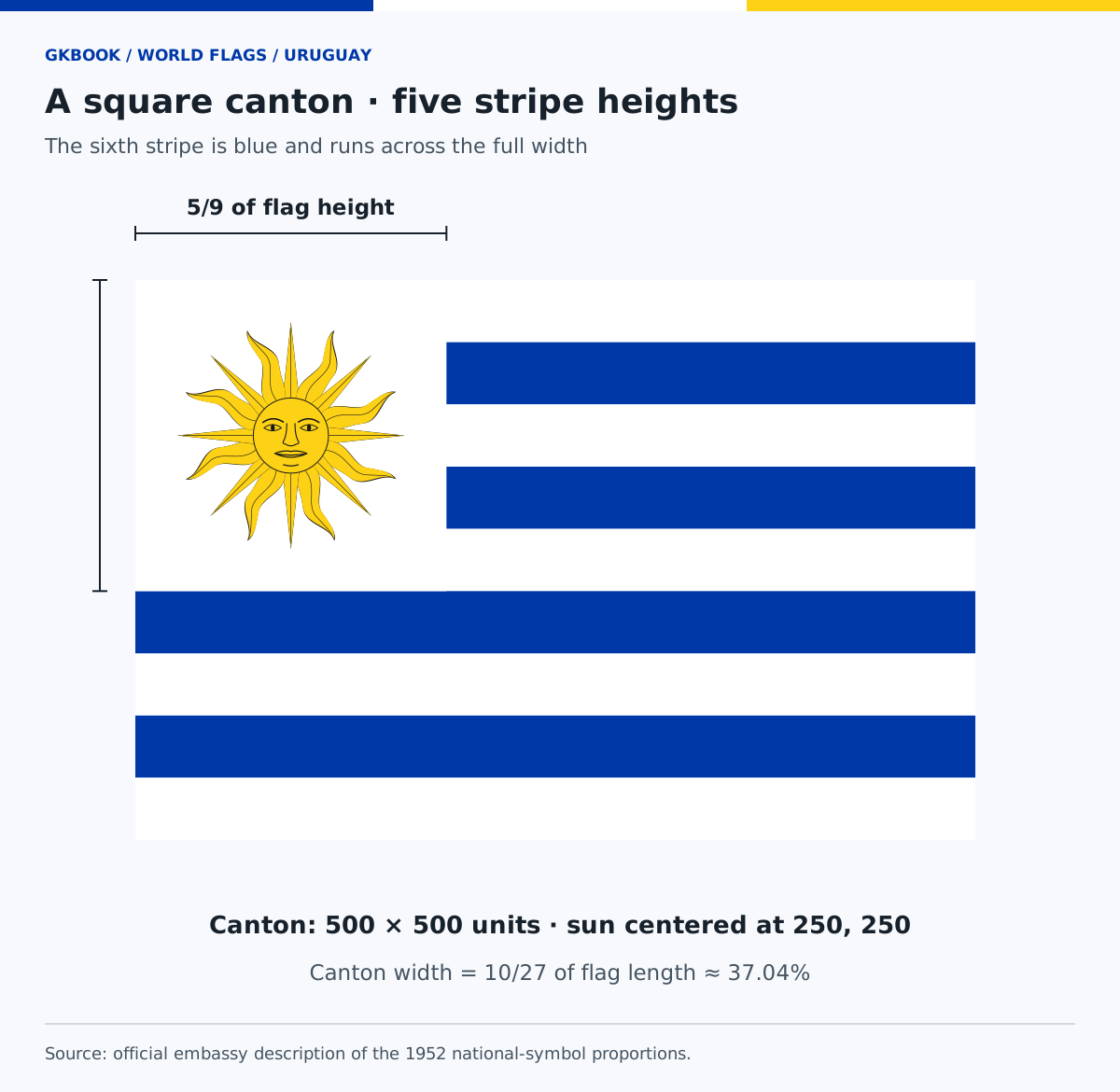
In the native drawing, the flag is 1,350 units long and 900 high. Each stripe is 100 units high, so the canton measures 500 by 500 and the sun center lies 250 units from each nearby edge. The canton occupies ten twenty-sevenths of the total flag length, about 37.04 percent.
A common error is to make the canton rectangular by borrowing the dimensions of another striped flag. Another is to extend it through the sixth stripe instead of stopping before it. The phrase sixth stripe exclusive is important: the blue band at that level must continue across the full flag width.
Sources: Uruguay Embassy in Argentina — Pabellón Nacional · Interior Ministry — Annotated national-symbol decree of February 18, 1952 · Drawing method and calculations
What is the official ratio of Uruguay’s flag?
The flag’s length-to-height ratio is three to two, conventionally written as a height-to-length ratio of 2:3. The clean PNG is 9,000 pixels wide and 6,000 high. Its canton remains square and its sun circular; stretching the artwork unevenly would distort both elements and change the specified proportions.
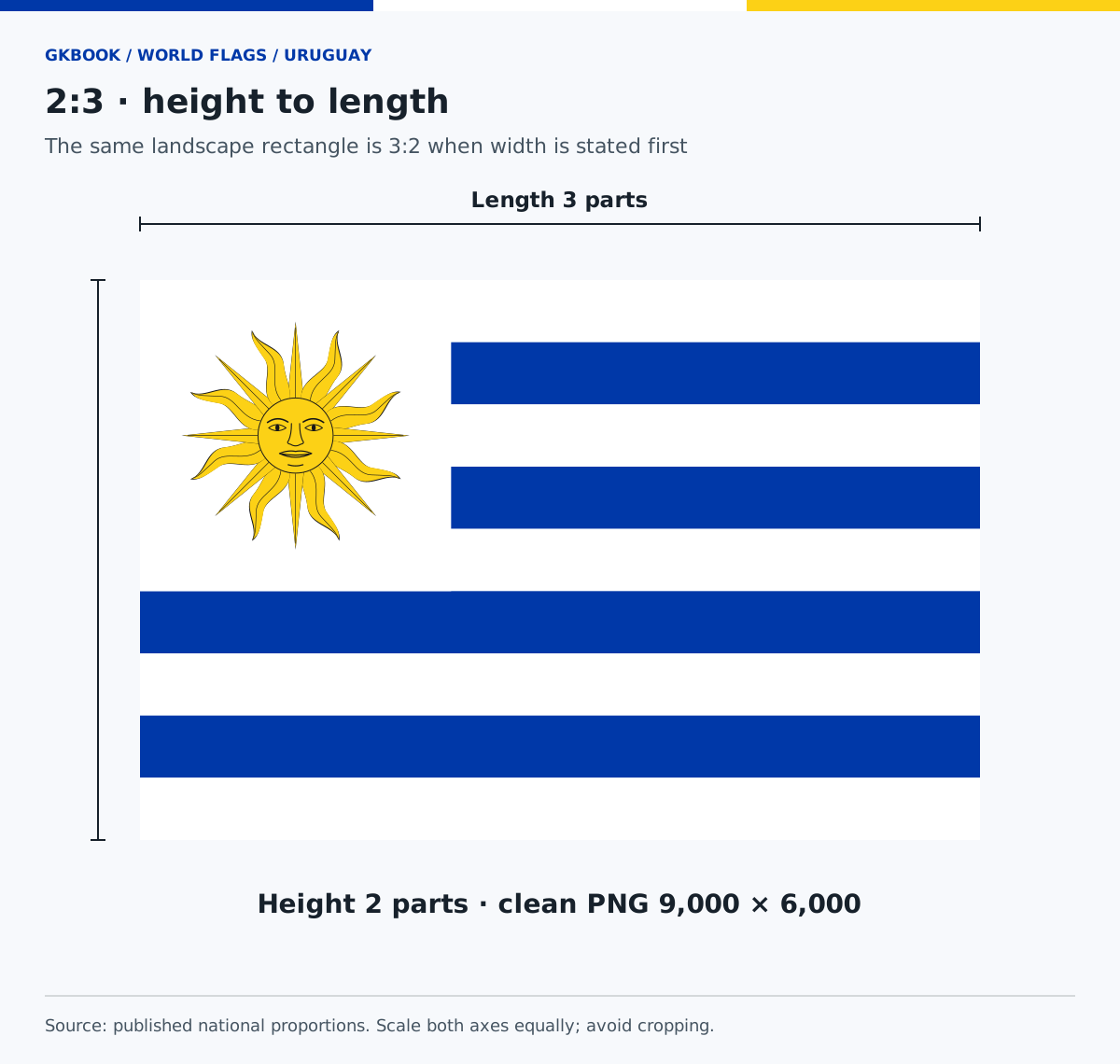
Image software normally reports width before height, while flag references often state height before length. Both 3:2 width-to-height and 2:3 height-to-length describe this same landscape rectangle. The article labels the convention explicitly so a portrait canvas or an incorrectly stretched export is not mistaken for the national reference.
Scale the entire drawing uniformly when placing it in a document, sign, or website. The surrounding page may have rounded cards or a narrow column, but the cloth itself should remain a complete rectangle. Use contain-style fitting or sufficient white space to preserve all four edges and the full canton.
Sources: Uruguay Embassy in Argentina — Pabellón Nacional · Army ceremonial and protocol regulation — Decree 339/003 · Drawing method and calculations
How do you draw Uruguay’s flag accurately?
Use a 1,350-by-900 rectangle with nine 100-unit stripes, beginning and ending in white. Add a 500-unit white square at the upper hoist. Center a sixteen-ray, human-faced gold sun in it, with an overall diameter of 366⅔ units. Alternate eight straight rays and eight wavy rays around the disc.
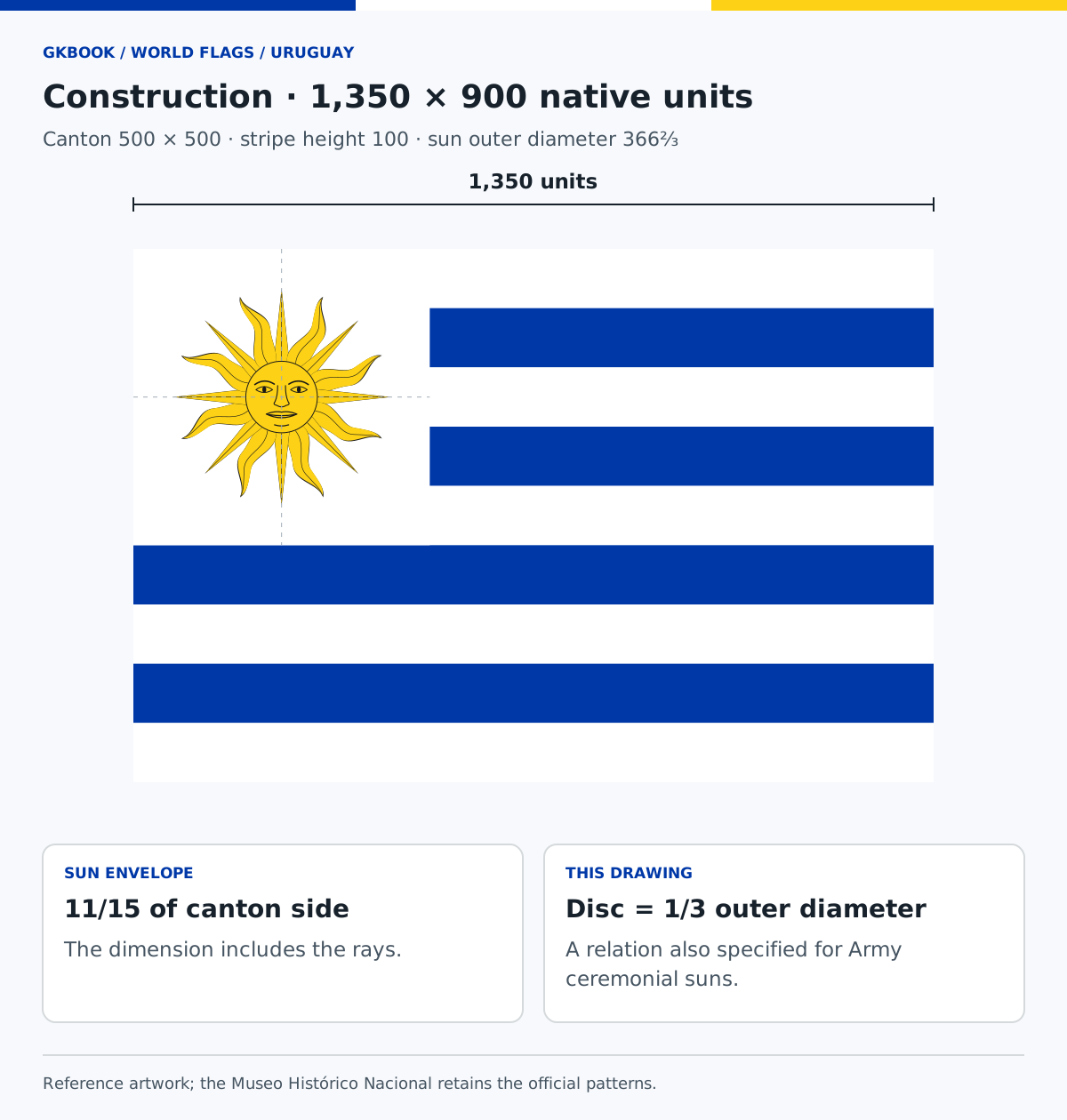
The outer sun diameter follows the published eleven-fifteenths rule. This illustration makes the central disc one third of that overall diameter, a relationship also found in the Army’s ceremonial sun description. The facial contours and ray curves are newly drawn details; the article does not mislabel those chosen paths as statutory coordinate data.
Keep measurement lines outside the clean master. The construction figure overlays guides only for instruction, while the downloadable flag SVG contains the complete cloth without labels, shadows, simulated texture, or external images. The included drawing record gives dimensions, colors, ray types, and the scope of the reference sources used.
| Element | Relation | Units |
|---|---|---|
| Flag | Length:height = 3:2 | 1,350 × 900 |
| One stripe | Height ÷ 9 | 100 |
| White canton | Five stripe heights, square | 500 × 500 |
| Sun center | Center of canton | 250, 250 |
| Sun outer diameter | 11/15 of canton side | 366⅔ |
| Central disc diameter | 1/3 of outer diameter in this drawing | 122 2/9 |
Sources: Uruguay Embassy in Argentina — Pabellón Nacional · Army ceremonial and protocol regulation — Decree 339/003 · Maldonado official digest — National-symbol provisions of 1952 · Drawing method and calculations
What did Uruguay’s first national flag look like?
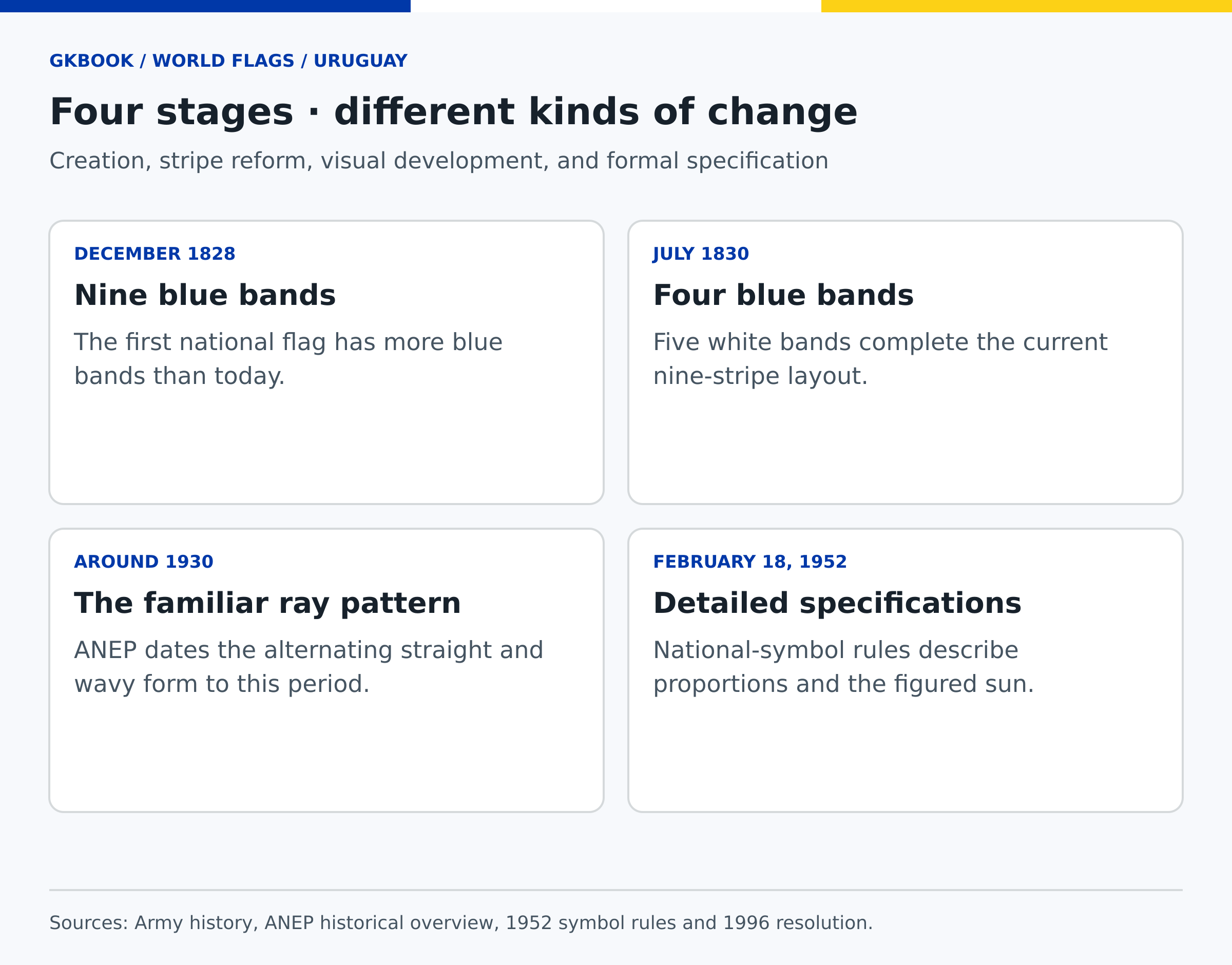
The first national flag created in December 1828 had nine blue bands on a white field, with a sun in a white square next to the hoist. That is different from today’s nine total stripes. In July 1830 the number of blue bands was reduced to four, leaving five white stripes between and around them.
The early wording counted the blue bands rather than every visible white interval. Historical summaries consequently become confusing when they shorten nine blue bands to nine stripes. Our article preserves that distinction and avoids presenting a modern sun drawing as a recovered, exact reproduction of an original 1828 textile.
Canelones, then Villa de Guadalupe, is central to the first flag’s history. Official commemorations connect the creation with December 18 and Joaquín Suárez’s initiative. The later symbol regulations cite an earlier December law date, so the history identifies the month and the commemorative date separately rather than concealing the documentary discrepancy.
Sources: Uruguayan Army — 197th anniversary of the first national flag · Canelones government — Plaza 18 de Julio · ANEP Uruguay Educa — Evolution of the flag design · Interior Ministry — Annotated national-symbol decree of February 18, 1952
How has the Uruguay flag changed over time?
The first flag of December 1828 used nine blue bands. The July 1830 reform reduced them to four, producing the familiar nine-stripe arrangement. Later standardization clarified the sun and proportions. ANEP’s historical account places the familiar alternating straight and wavy rays around 1930, while the 1952 decree set out the detailed national-symbol description.

A legal adoption date does not mean every surviving historical flag was manufactured identically afterward. Sun faces, rays, proportions, and shades varied in actual use. The education authority’s historical overview is useful precisely because it follows those visual changes instead of treating the present digital appearance as unchanged since independence.
The timeline labels each milestone by its function: creation, stripe reform, visual development, and formal specification. It does not illustrate all earlier flags with the modern sun and call them exact reconstructions. For a particular nineteenth-century event, consult dated objects or archival evidence before selecting a supposedly authentic historical flag.
Sources: Uruguayan Army — 197th anniversary of the first national flag · Interior Ministry resolution, August 21, 1996 — National flag colors · ANEP Uruguay Educa — Evolution of the flag design · Interior Ministry — Annotated national-symbol decree of February 18, 1952
When was Uruguay’s current flag adopted?
The current four-blue-band arrangement is associated with the law of July 12, 1830, as cited in official national-symbol guidance and the Interior Ministry’s 1996 resolution. The first flag dates to December 1828. The detailed 1952 specifications are a later standardization, so those dates answer different questions about the flag’s development.

Some online summaries give July 11, and official commemorative accounts also vary in how they describe the December 1828 sequence. This page uses the July 12 date stated in the cited legal references for the stripe reform. It does not silently substitute an anniversary, an assembly discussion, or a modern illustration date.
Uruguay’s first Constitution was sworn on July 18, 1830, another event in the same month that should not be confused with the flag law. The August 25 national anniversary concerns the 1825 declaration. Keeping those milestones separate makes the flag’s chronology clearer than assigning one date to the whole process of independence.
Sources: Interior Ministry resolution, August 21, 1996 — National flag colors · Uruguay Embassy in Argentina — Pabellón Nacional · ANEP — Anniversary of the oath of the first Constitution · Ministry of Education and Culture — August 25 history
Who designed Uruguay’s flag?
Joaquín Suárez is closely associated with the initiative for the first national flag in 1828. Official historical accounts connect its early making with María Josefa Álamo de Suárez, sometimes explicitly as a tradition. The current flag also reflects legislative changes and later standardization, so attributing every modern detail to one original designer oversimplifies the evidence.
The Presidency’s account of a first-flag replica distinguishes Suárez’s political role from the traditional attribution of the original textile to his wife. Canelones commemorations likewise connect the family with the flag and the town’s early national role. A political proposal, an act of sewing, and a later technical specification are different contributions.
This edition credits the historical initiative without pretending that an unchanged vector master survives from 1828. The modern illustration is original code-generated work based on the documented layout and published reference appearance. Its author does not claim to have invented the national design, and the artwork is not presented as a museum-certified facsimile.
Sources: Uruguayan Army — 197th anniversary of the first national flag · Presidency archive — Replica of the first national flag, 2008 · Canelones government — Plaza 18 de Julio · Maldonado official digest — National-symbol provisions of 1952
When is Uruguay’s National Flag Day?
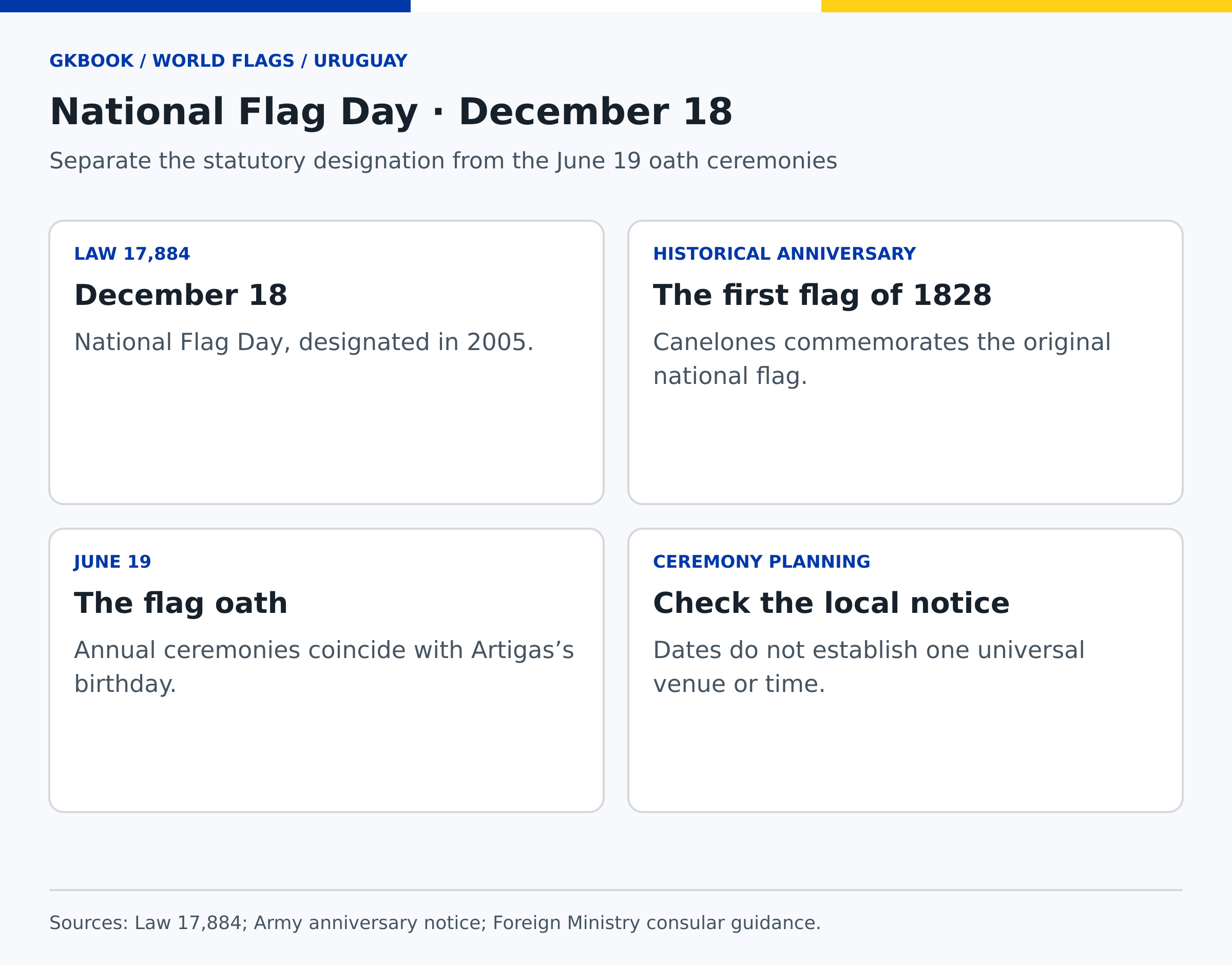
Uruguay’s legally designated National Flag Day is December 18. Law 17,884, promulgated in 2005, establishes that date. June 19 is associated with Artigas’s birthday and the annual oath of allegiance to the flag. The two observances are related to national identity but should not be merged into a single statutory Flag Day.
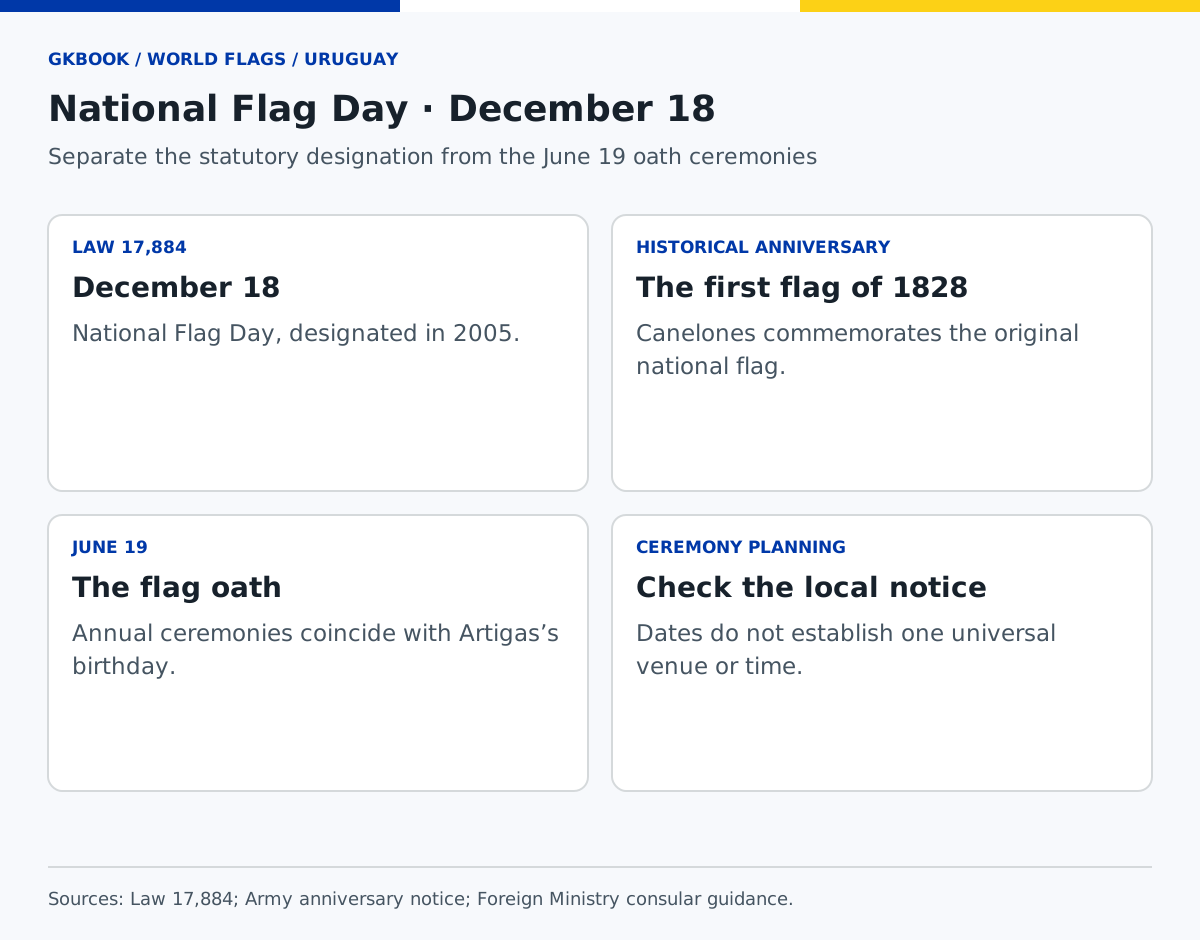
December 18 commemorates the creation of the first national flag in Canelones in 1828. The modern Army anniversary notices explicitly connect that historical event with the 2005 law. This is stronger evidence for the official designation than an unsourced calendar that labels every flag ceremony as a national flag holiday.
June 19 ceremonies remain important and widely observed, particularly in educational, military, and consular settings. Their significance does not change the wording of Law 17,884. The comparison graphic separates the two dates, while current local notices should be consulted for the actual venue and time of any planned ceremony.
| Date | Event |
|---|---|
| December 18 | National Flag Day under Law 17,884 |
| June 19 | Artigas’s birthday and annual flag-oath ceremonies |
| July 12, 1830 | Law cited for the four-blue-band arrangement |
| July 18, 1830 | Oath of the first Constitution |
| August 25 | Commemoration of the 1825 declaration |
Sources: Law 17,884 — December 18 National Flag Day · Uruguayan Army — 197th anniversary of the first national flag · Foreign Ministry, Uruguay Embassy in Peru — Flag oath
What is Uruguay’s oath of allegiance to the flag?
The Juramento de Fidelidad a la Bandera is a solemn public oath associated with June 19. Article 28 of Law 9,943 establishes the obligation for natural and legal citizens. Educational, military, and consular authorities administer it in their respective settings; registration details and documentation should be checked with the institution organizing the ceremony.
The national legal provision, a school ceremony, and a consular appointment are different levels of instruction. Current consular pages describe a once-in-a-lifetime act and explain what to do when someone lacks their certificate. They also vary in age and administrative wording, so this article does not invent a universal appointment rule from one office’s page.
A child’s promise and the formal oath should not automatically be treated as identical administrative events. Anyone who needs proof for a particular procedure should obtain the responsible authority’s current instructions. The page explains the tradition and legal basis without copying a past ceremony’s time or inviting readers to contact an unrelated consulate.
Sources: Law 9,943, article 28 — Oath obligation · Foreign Ministry, Uruguay Embassy in Peru — Flag oath · Foreign Ministry, Consulate in Toronto — National flag oath · Decree 169/982 — June 19 oath context
Does Uruguay have three national flags?
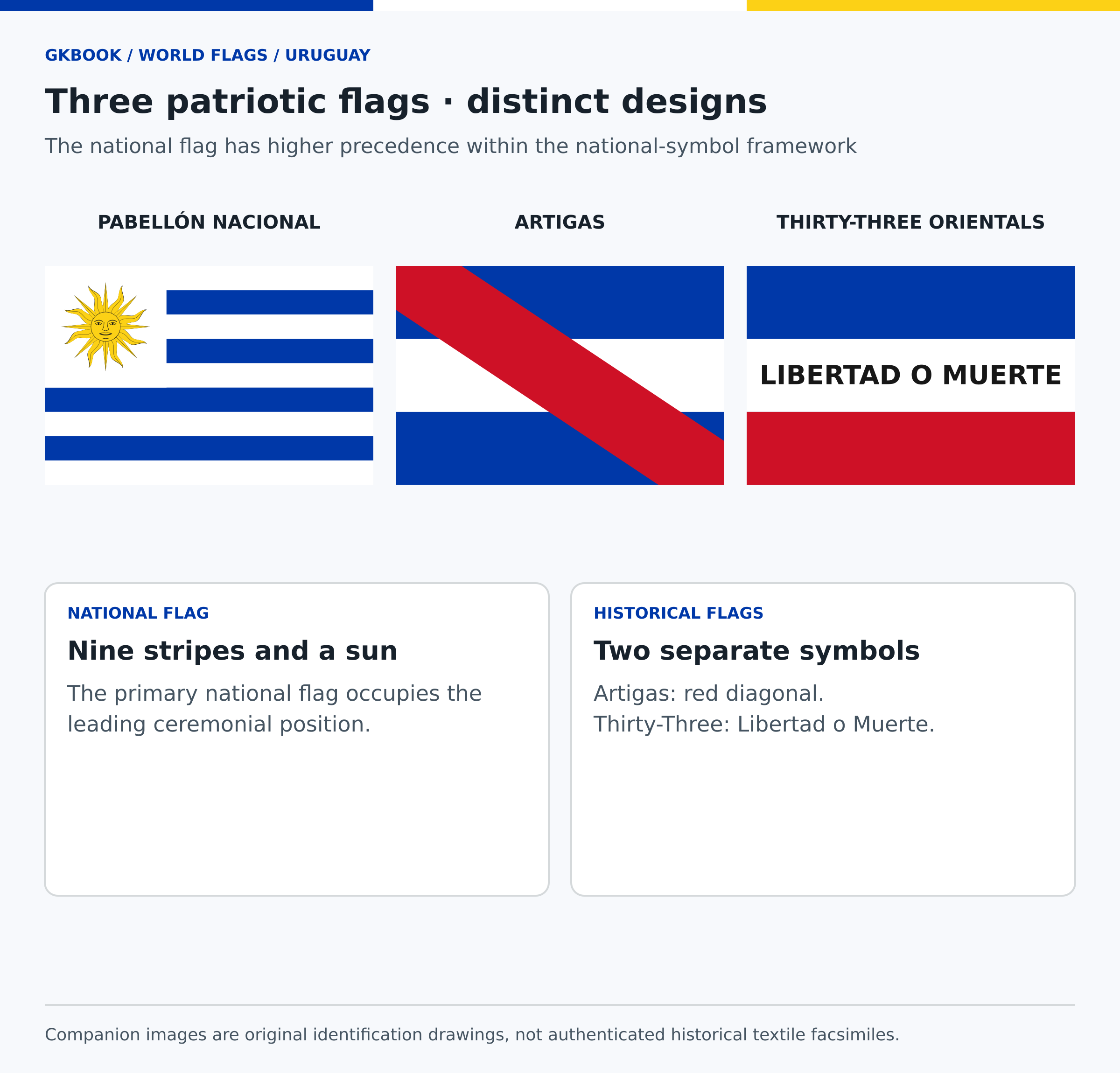
Uruguay recognizes the Pabellón Nacional, the flag of Artigas, and the flag of the Thirty-Three Orientals among its national symbols. They are three distinct flags with different designs and historical associations. The Pabellón Nacional has higher precedence; describing the country as having three flags should not imply three interchangeable designs of equal ceremonial rank.

The 1952 framework lists six national symbols in order: the national flag, state arms, anthem, Artigas flag, Thirty-Three flag, and national cockade. Only three items in that list are flags. The gallery places their complete layouts side by side so the stripes-and-sun flag can be distinguished from the two historical banners.
Each companion flag has its own defining feature. Artigas’s is blue, white, and blue crossed by a red diagonal band. The Thirty-Three flag has blue, white, and red horizontal bands and a central inscription. Neither carries the national flag’s sun canton, and neither is a different color edition of the same master.
Sources: Maldonado official digest — National-symbol provisions of 1952 · Uruguay Embassy — National symbols · State and Diplomatic Ceremonial Manual — Decree 435/007
What is the flag of Artigas?
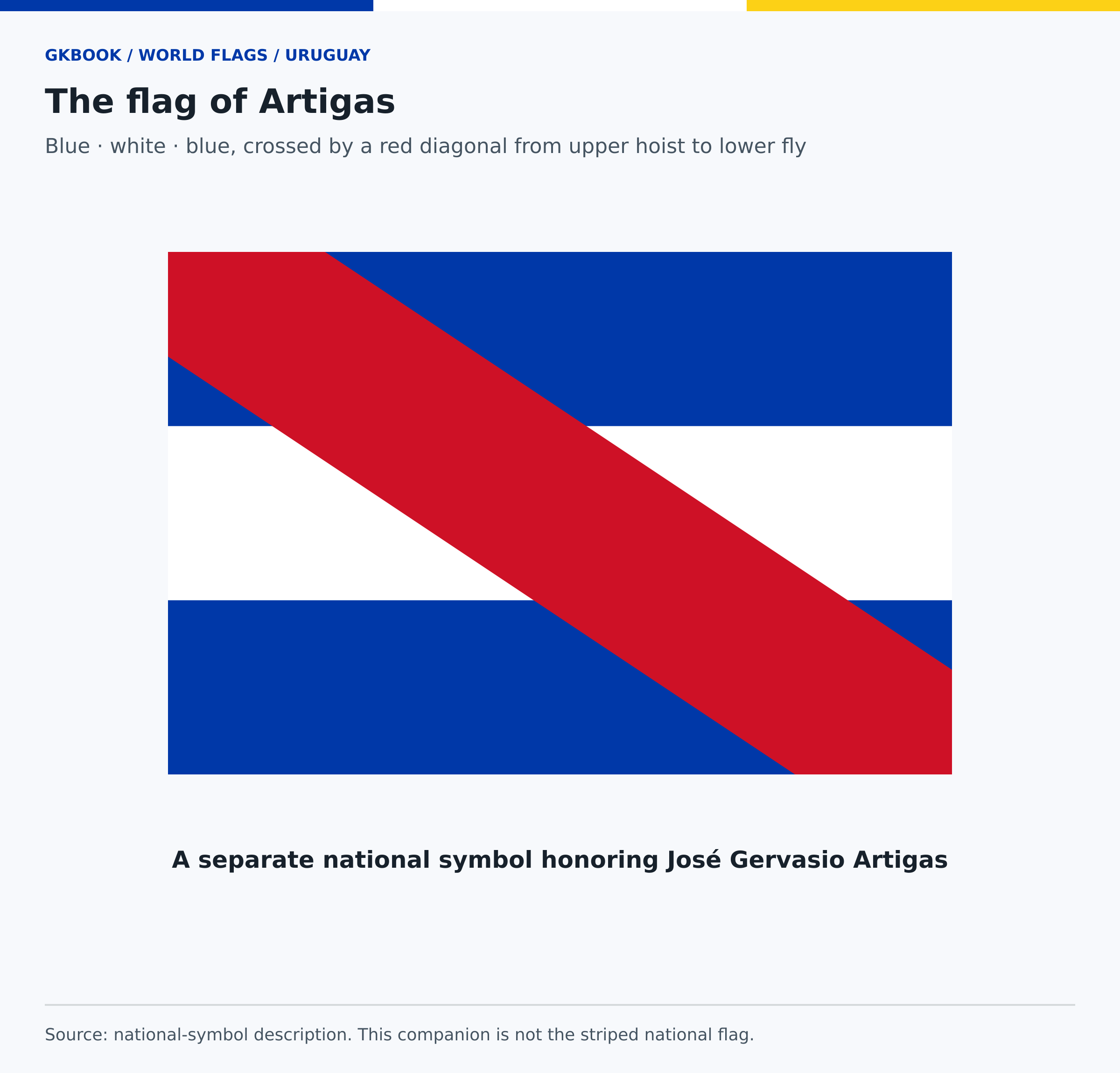
The flag of Artigas has three equal horizontal bands of blue, white, and blue, crossed by a red diagonal band running from the upper hoist to the lower fly. It honors José Gervasio Artigas and is a separate national symbol. Its proportions match the Pabellón Nacional, but its design and ceremonial position are distinct.
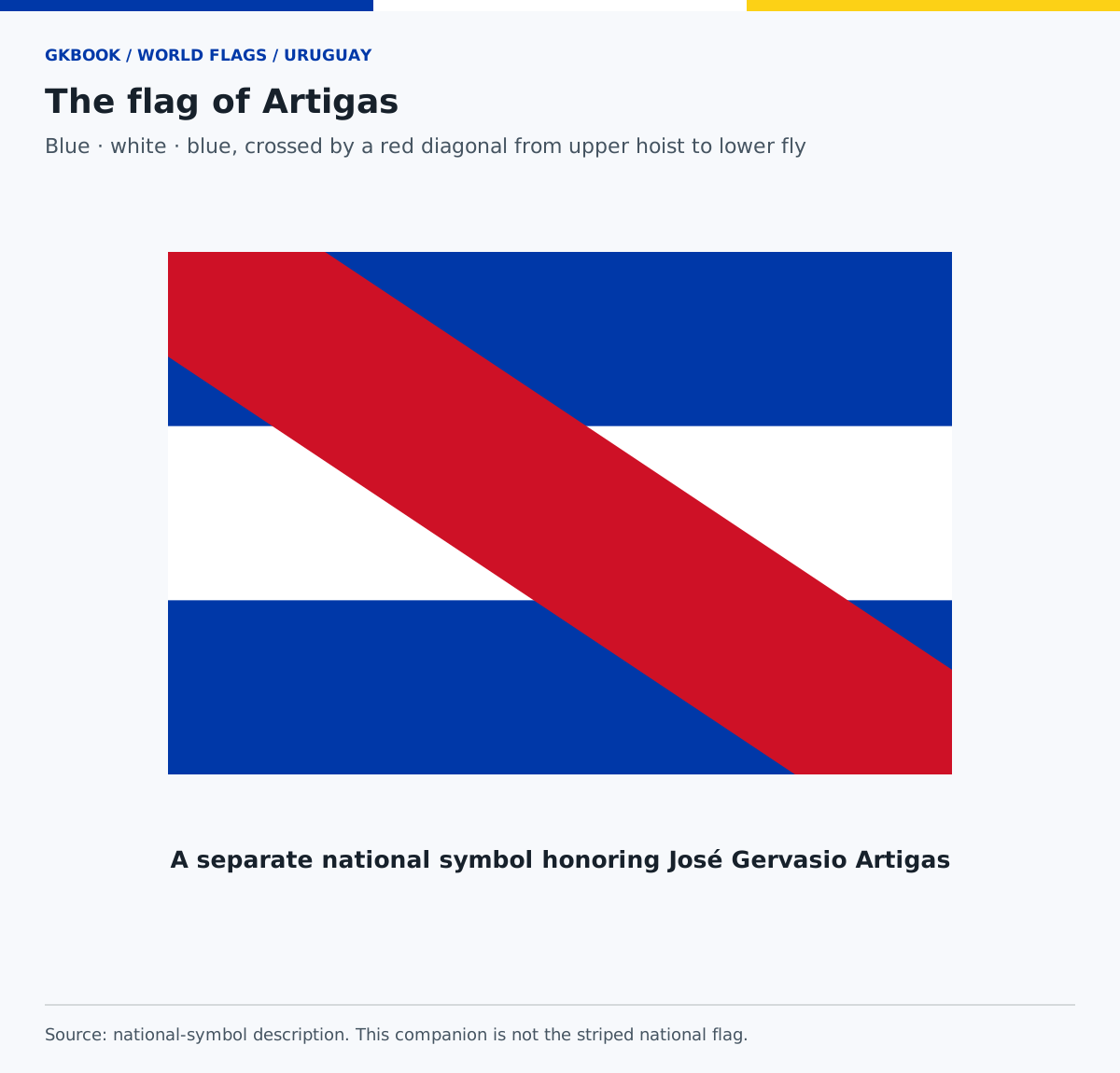
The diagonal must be described using the attachment edge: in the conventional front view it descends from upper left to lower right. A reverse view changes what the observer sees without changing the physical hoist. The national-symbol description gives the red band the same width as a horizontal band; our drawing measures that width perpendicular to its edges.
The supplied illustration is a complete identification reference, without a sun or added lettering. It helps explain ceremonies where all three patriotic flags appear together. Formal state and military arrangements assign the Artigas flag a place relative to the national flag, rather than using it to replace the national flag’s position of honor.
Sources: Uruguay Embassy in Argentina — Flag of Artigas · Interior Ministry — Annotated national-symbol decree of February 18, 1952 · State and Diplomatic Ceremonial Manual — Decree 435/007 · Drawing method and calculations
What is the flag of the Thirty-Three Orientals?
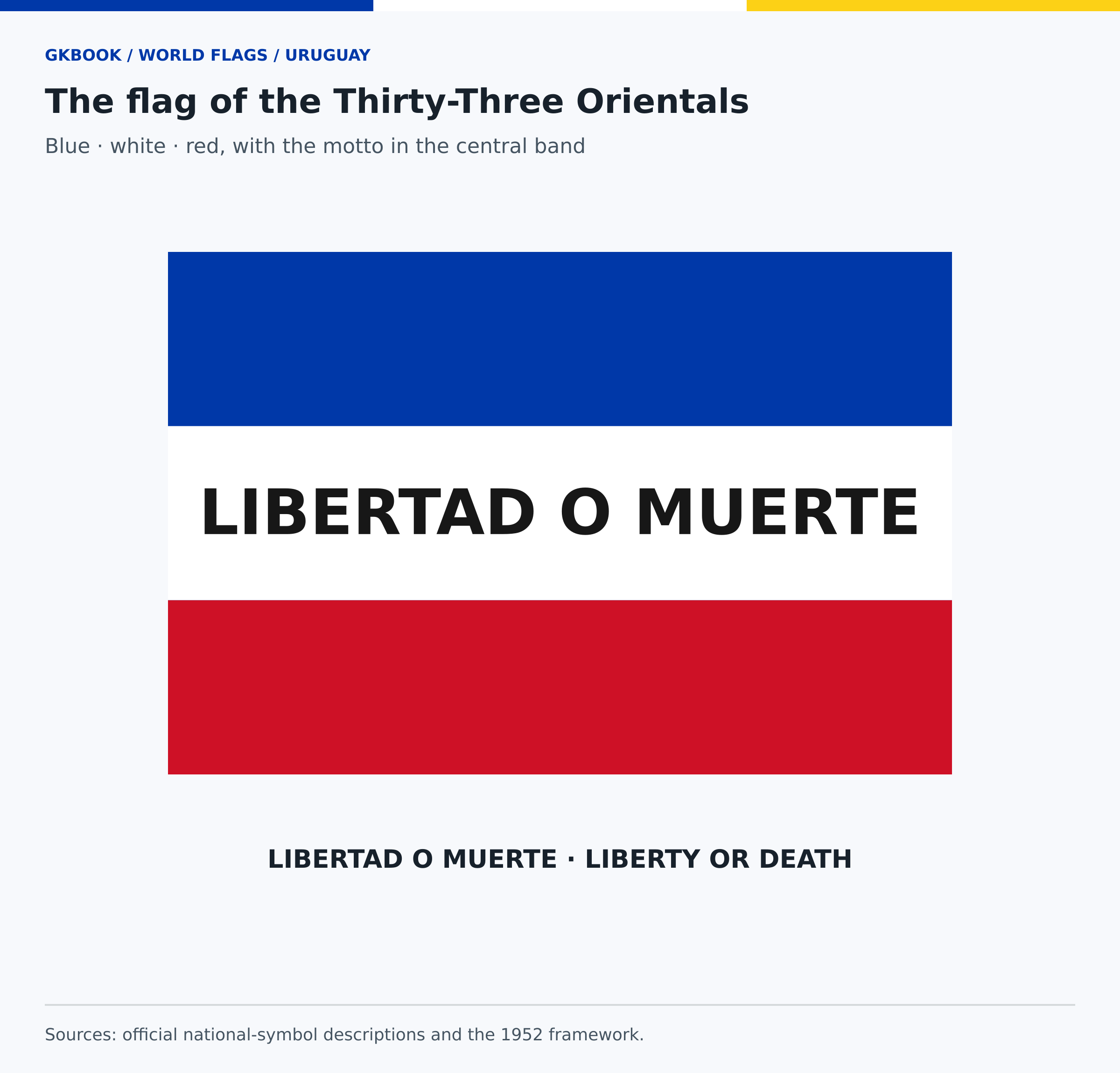
The flag of the Thirty-Three Orientals has three equal horizontal bands: blue above, white in the middle, and red below. The central band bears Libertad o Muerte, meaning Liberty or Death. It commemorates the Thirty-Three and their 1825 campaign, and is a recognized national symbol separate from the striped Pabellón Nacional.
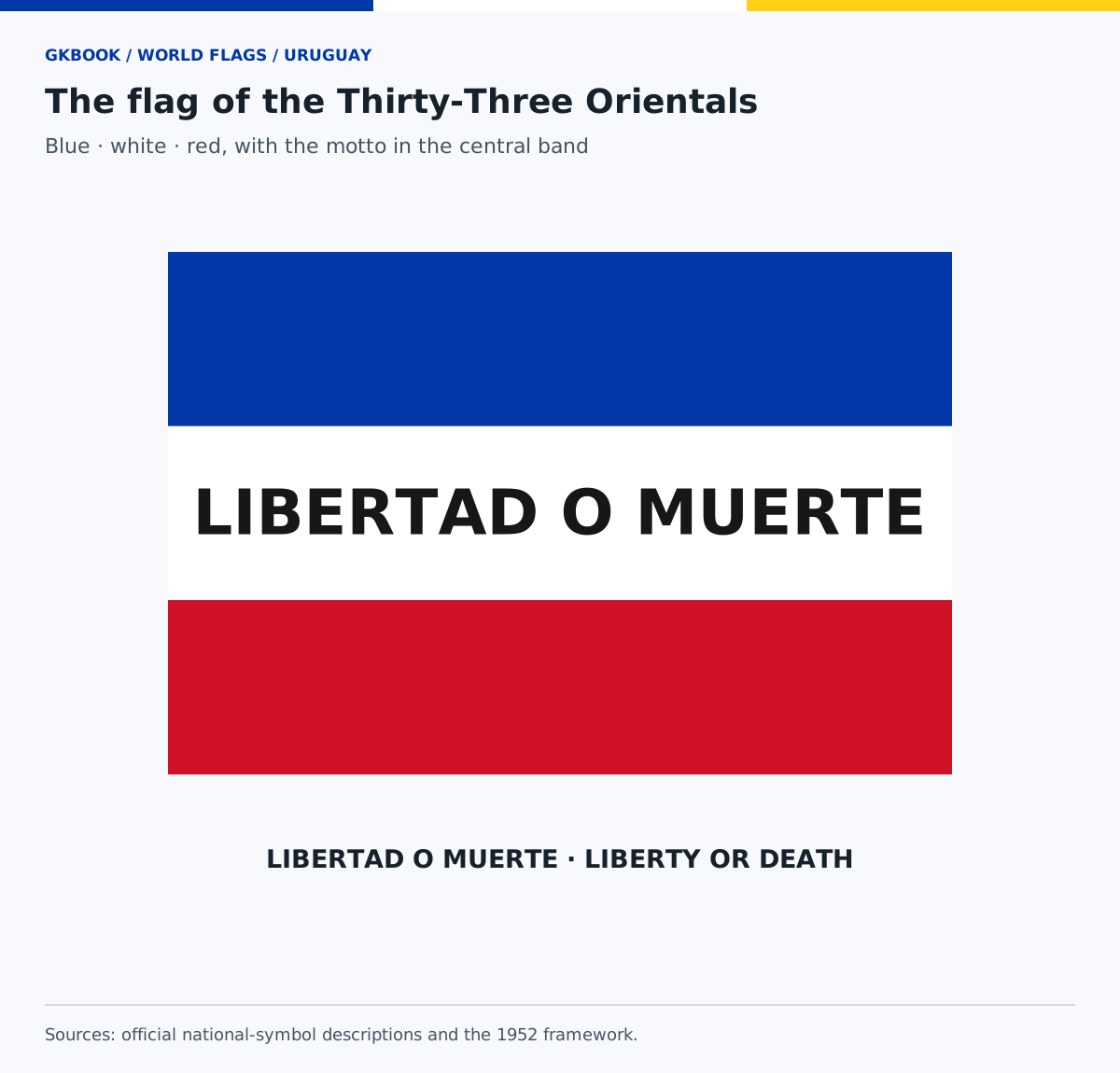
The motto is part of this flag’s identity; removing it leaves a generic tricolor rather than the complete modern reference. Its historical association includes the landing at La Agraciada on April 19, 1825. The banner and the later national flag answer different historical questions and should be labeled distinctly in teaching materials.
Our accompanying drawing uses readable dark lettering in the central white band and preserves the three equal bands. It is an original identification illustration, not a facsimile of a surviving campaign textile or a certified embroidery pattern. The current reference and the historical object should not be assumed identical in every material detail.
Sources: Uruguay Embassy in Argentina — Flag of the Thirty-Three · Uruguay Embassy — National symbols · Interior Ministry — Annotated national-symbol decree of February 18, 1952 · Drawing method and calculations
What laws and rules govern Uruguay’s flag?
Uruguay’s flag framework includes the nineteenth-century flag laws, the national-symbol decree of February 18, 1952, later resolutions, and separate state and military ceremonial rules. The Museo Histórico Nacional preserves official patterns. A 2023 decree created a commission to study technical specifications; establishing that commission did not itself replace the flag with a new design.
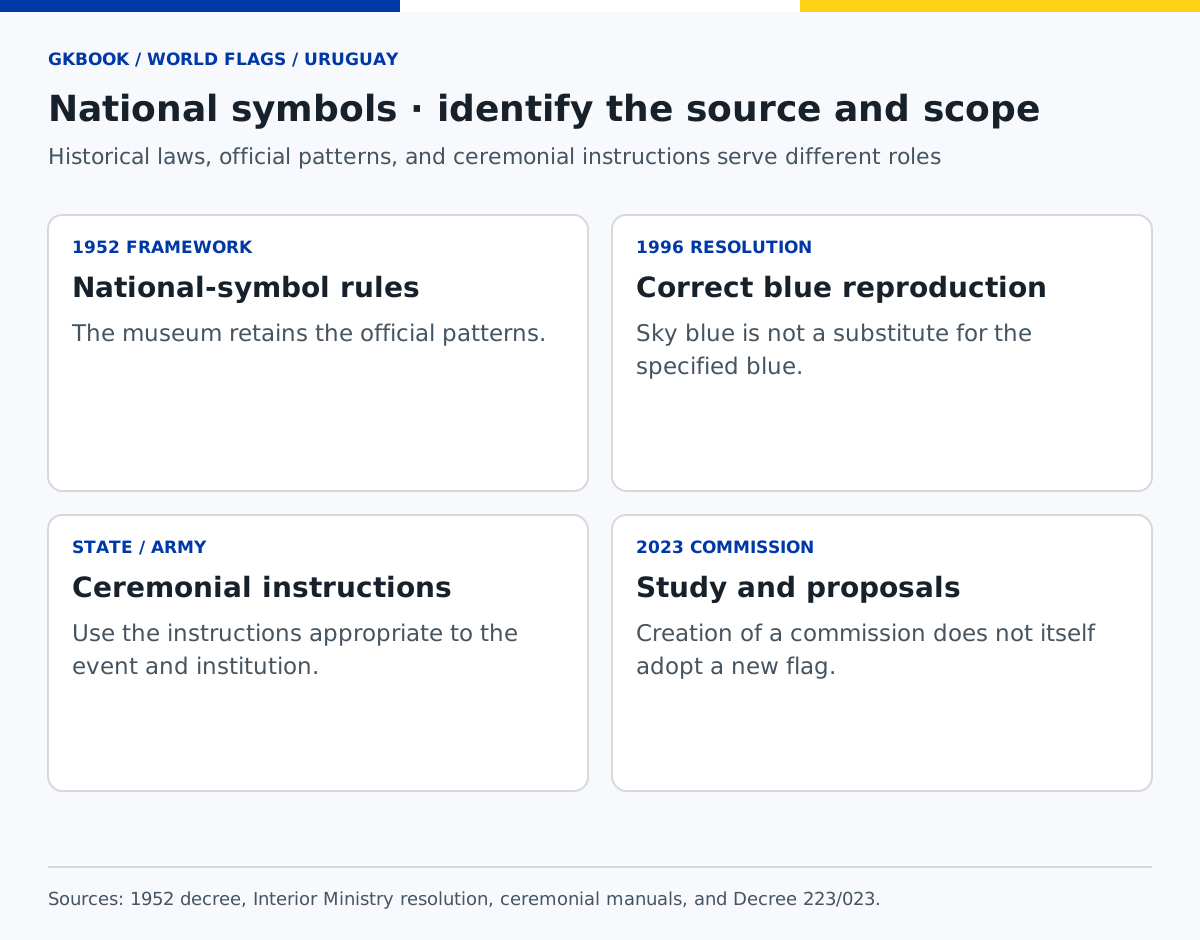
The 1996 Interior Ministry resolution is particularly relevant to reproduction because it addresses incorrect blue shades and reiterates fidelity to the national design. The legal framework should not be reduced to informal advice borrowed from another country. Conversely, a service-specific instruction should not automatically be presented as a rule governing every private household.
The article identifies the scope of each reference and does not quote old nominal fines as current payment amounts. The official-pattern requirement is distinct from the copyright license on our newly drawn illustrations. For a formal state commission or a disputed use, consult the competent authority and the applicable current text rather than treating an educational download as official approval.
Sources: Maldonado official digest — National-symbol provisions of 1952 · Interior Ministry resolution, August 21, 1996 — National flag colors · Decree 223/023 — Technical national-symbol review commission · State and Diplomatic Ceremonial Manual — Decree 435/007 · Army ceremonial and protocol regulation — Decree 339/003
Which way up should Uruguay’s flag be displayed?
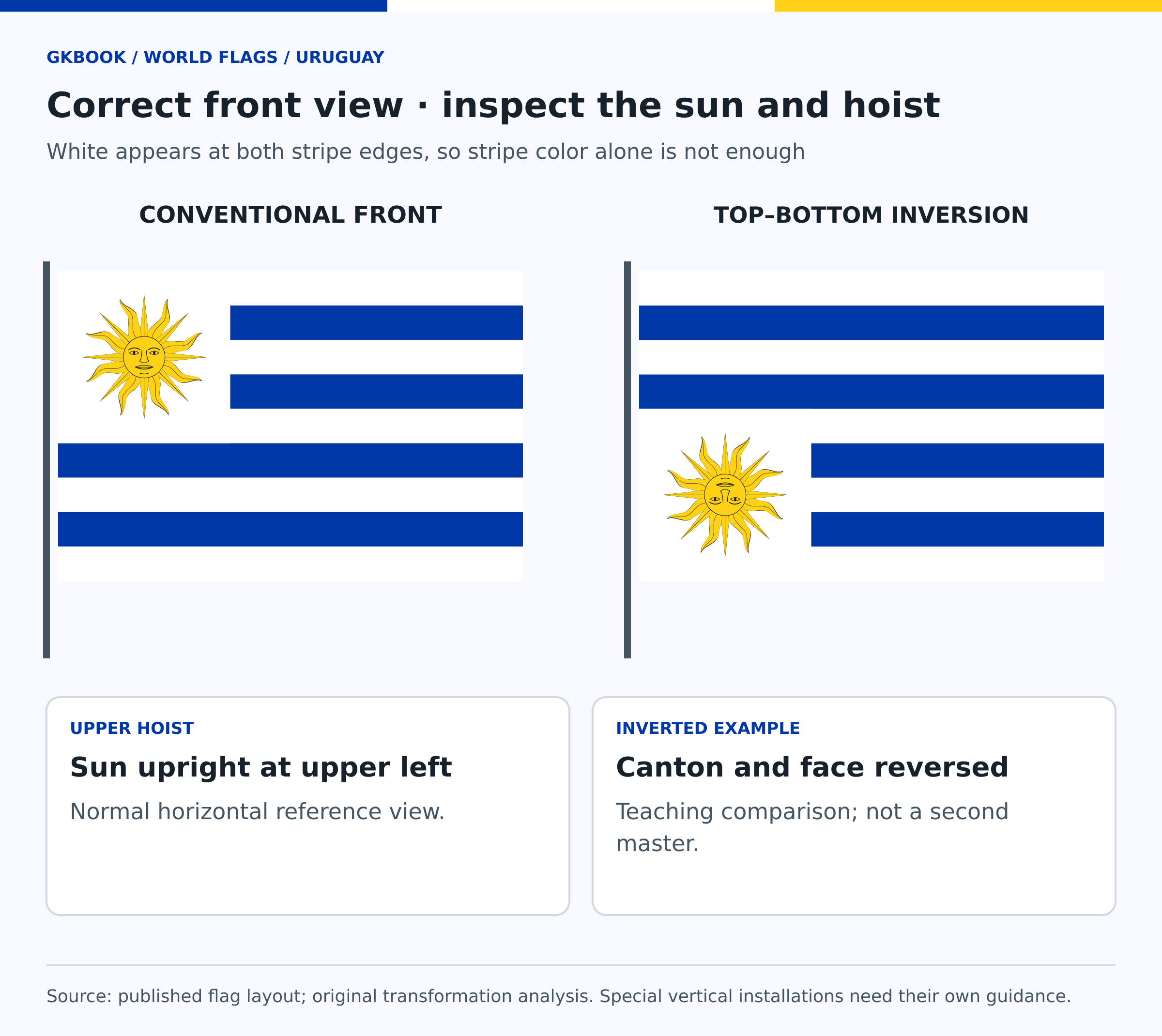
In a conventional horizontal front view, the sun canton is at the upper left, next to the hoist, and the sun’s face is upright. The top and bottom stripes are white. Stripe color alone cannot reveal an upside-down flag, because the stripe sequence has the same colors at both ends.

Locate the attachment edge and inspect the sun before judging a photograph. Turning the cloth from top to bottom moves the canton and inverts the face, while looking from the reverse puts the hoist on the other side. Our comparison identifies the front-view master and an explicitly inverted teaching example with the pole shown.
A portrait layout should not be made by compressing the flag or moving the sun independently. Rotating a physical cloth also turns its face and changes the canton’s position. The cited general description specifies the normal hoist-side layout; special vertical installations should follow the host authority’s instructions rather than an imported foreign wall-display rule.
Sources: Uruguay Embassy in Argentina — Pabellón Nacional · Drawing method and calculations
What does the reverse of Uruguay’s flag look like?
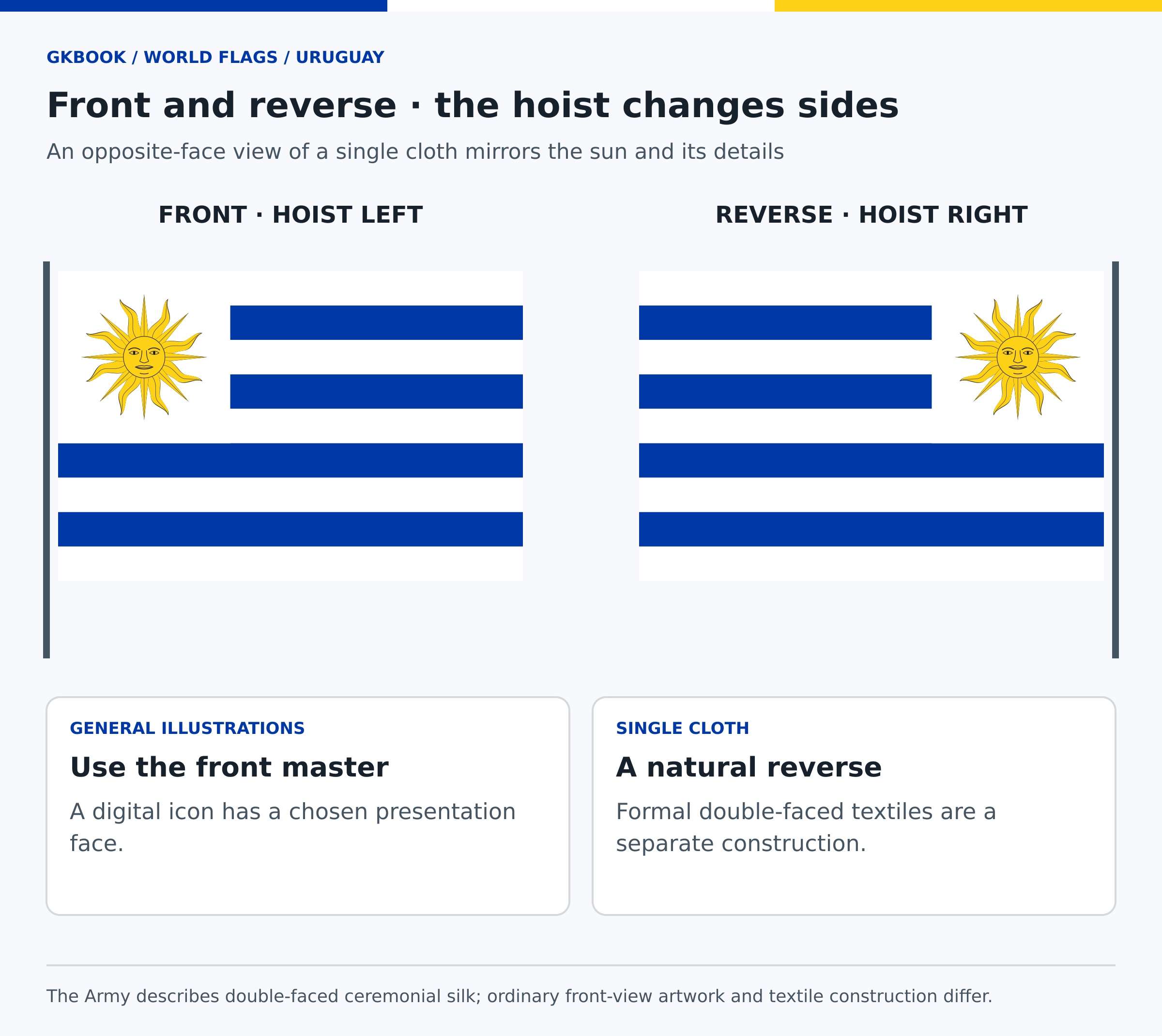
Viewed through a single cloth from behind, the flag appears horizontally mirrored: the sun canton is at the observer’s upper right and the hoist is on the right. This natural reverse is not automatically an upside-down flag. The face and curved ray details mirror with the cloth, while the nine-stripe count remains unchanged.
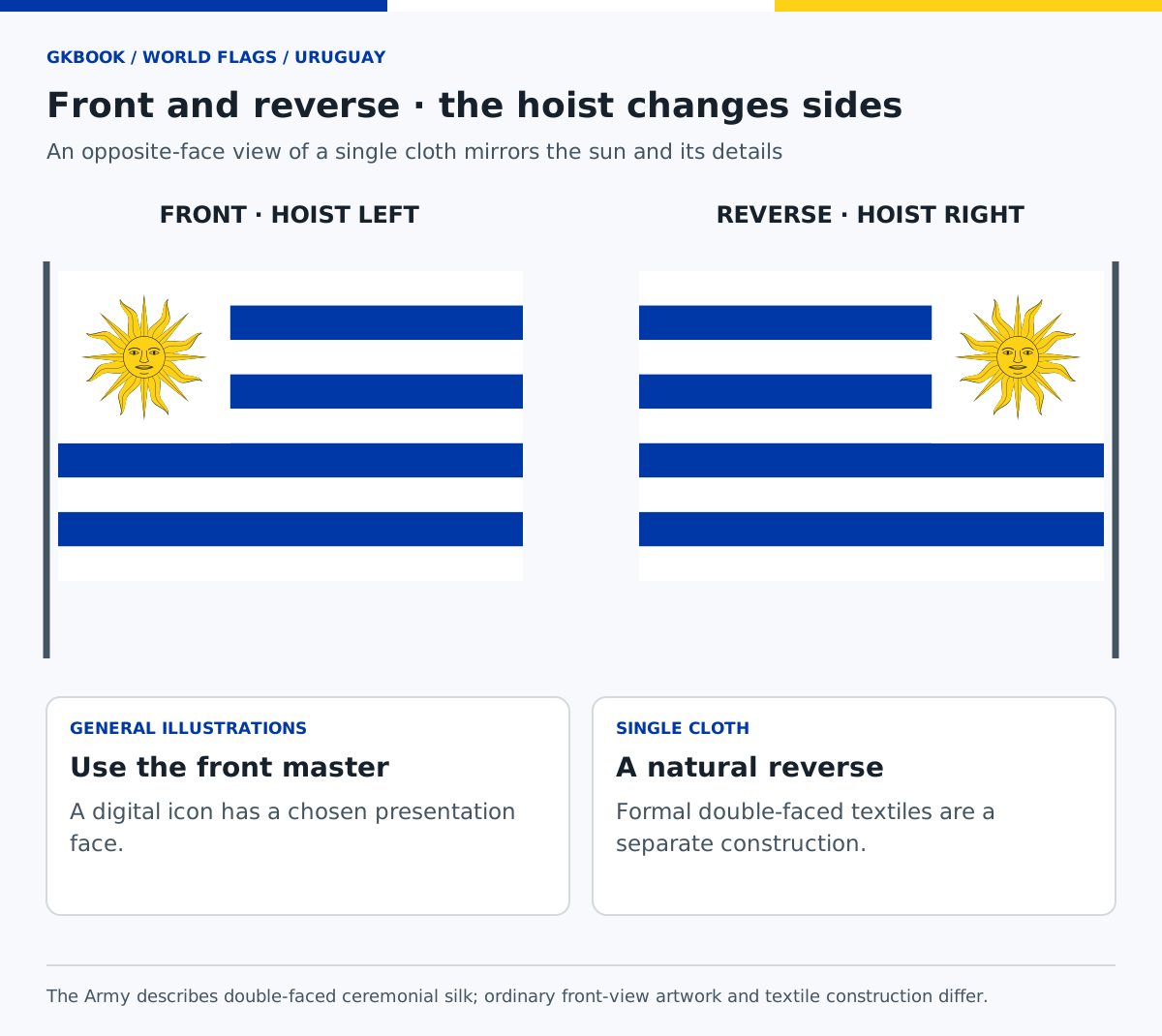
The graphic labels the two viewpoints and shows the staff on the appropriate side. For a normal digital flag icon, use the front-view master rather than a reverse photograph. The distinction matters because the upper-left rule describes a conventional front illustration, whereas an actual flag can be approached and photographed from either side.
Construction methods can also differ. The Army’s ceremonial specification describes double-faced silk colors, so not every formal textile should be analyzed as a single translucent print. Our reverse illustration explains the geometric view through one cloth; it does not prescribe how every official double-faced flag must be embroidered or assembled.
Sources: Uruguay Embassy in Argentina — Pabellón Nacional · Army ceremonial and protocol regulation — Decree 339/003 · Drawing method and calculations
Is Uruguay’s flag symmetrical?
The complete flag has neither left-right nor top-bottom mirror symmetry, and rotating it through 180 degrees does not reproduce the original. Its sun canton occupies only one corner. The alternating stripe background has simpler symmetries, but those do not determine the symmetry of the complete national design with its faced sun.
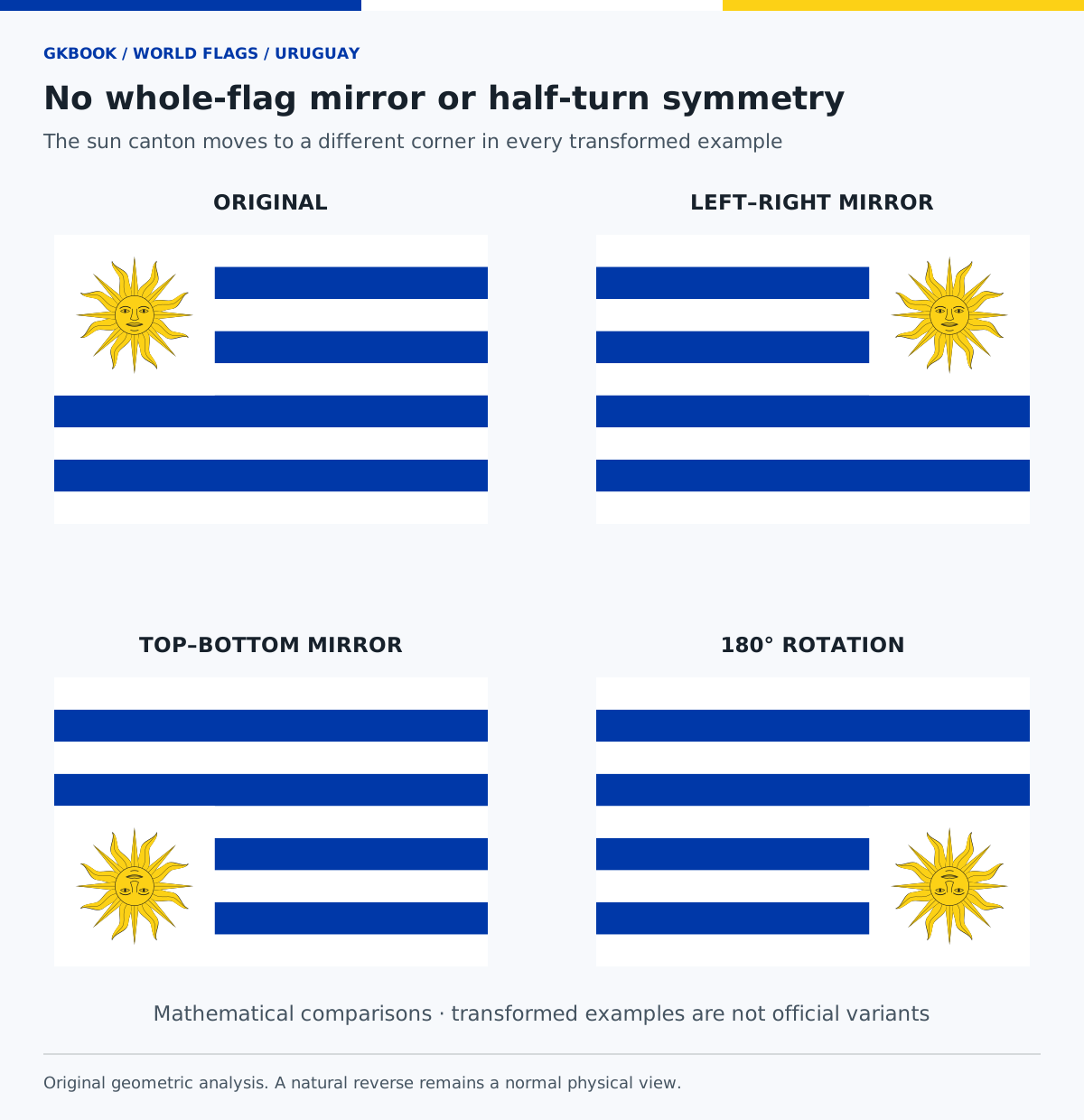
The comparison applies three operations to one complete master: horizontal reflection, vertical reflection, and a half-turn. The canton moves to a different corner each time. The face provides another orientation clue, while the curved rays have a directional appearance that should not be silently altered when illustrating the reverse.
This is a mathematical analysis of the drawing, separate from rules about respectful display. A natural reverse remains a normal physical view even though it differs from the front image. The gallery labels transformed examples as teaching comparisons, ensuring that they cannot reasonably be mistaken for additional official flag variants.
Sources: Drawing method and calculations · Uruguay Embassy in Argentina — Pabellón Nacional
How are Uruguay’s three patriotic flags arranged?
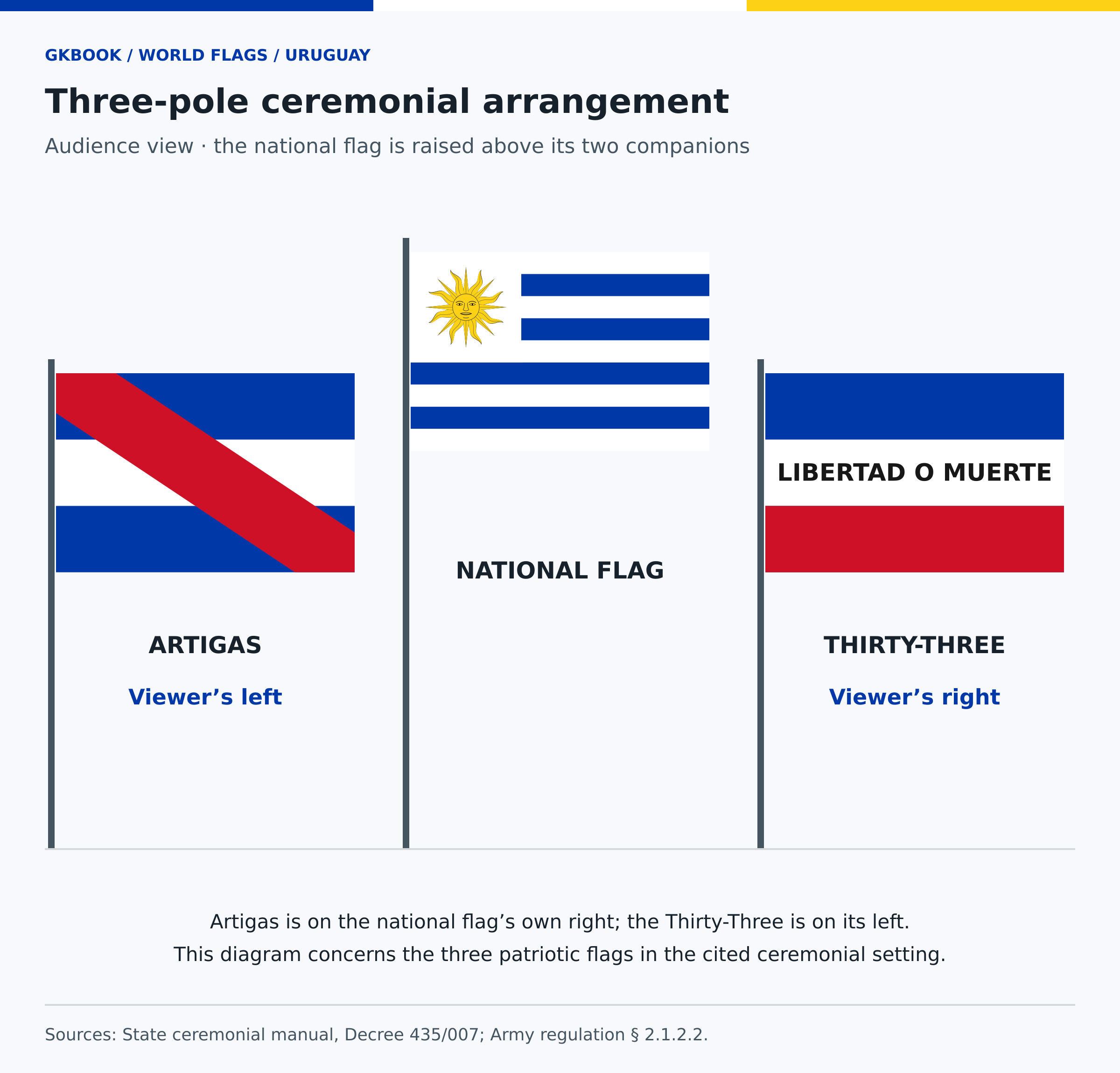
State ceremonial guidance places the Artigas flag to the national flag’s right and the Thirty-Three flag to its left, with the national flag distinguished by height or forward position. Viewed from the audience, that puts Artigas on the left and the Thirty-Three on the right. The viewpoint must be stated to avoid reversing the arrangement.
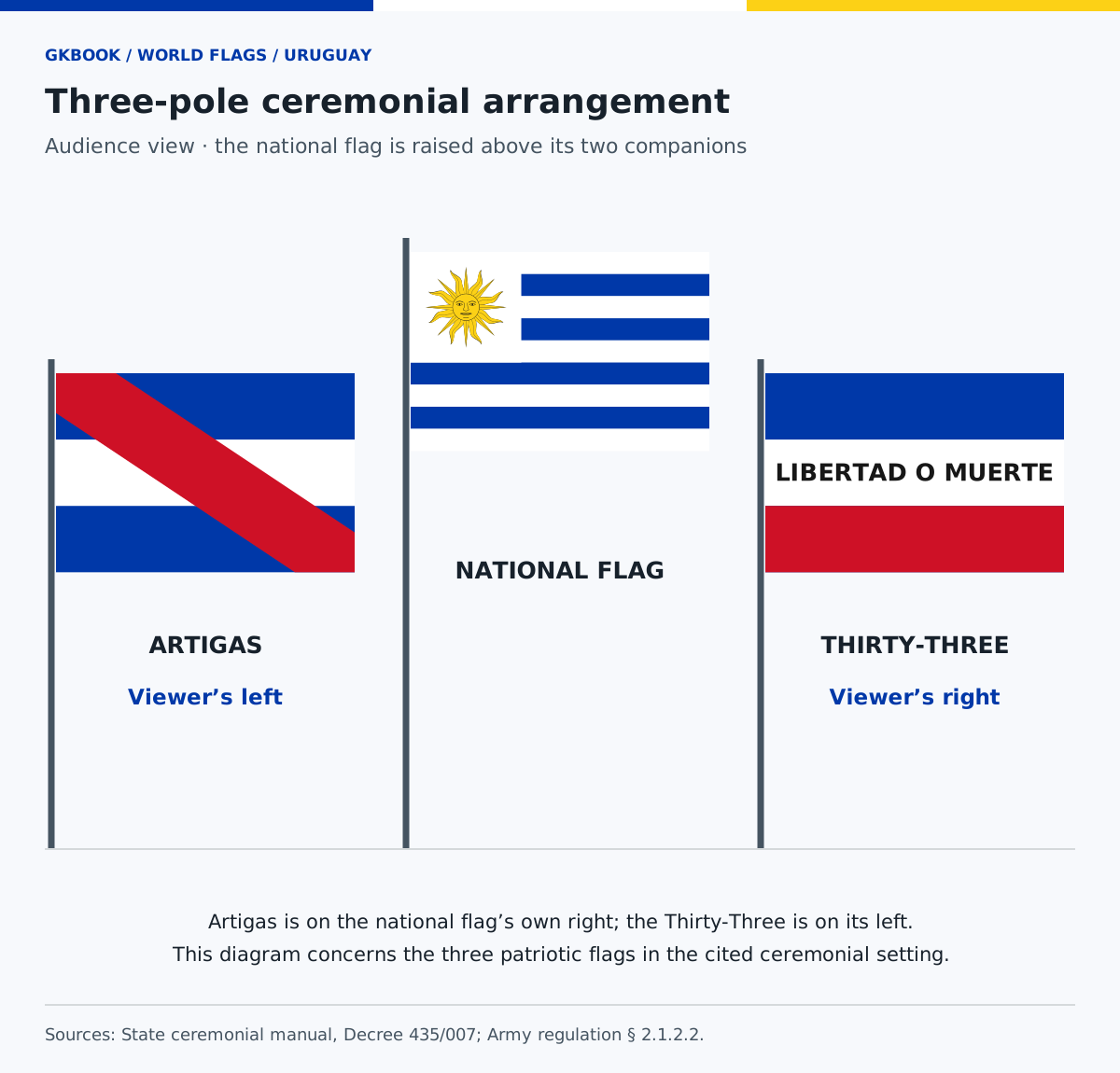
The three-pole diagram uses a higher central national flag and labels the audience’s view. The Army’s wording clarifies the perspective by describing the arrangement with one’s back to the line of flags. The state manual separately addresses official ceremonies and national precedence; these are named ceremonial contexts, not instructions invented from a photograph.
Do not generalize this three-national-symbol arrangement into a claim that any institutional banner can be placed beside the Pabellón Nacional in a state ceremony. The cited manual has specific restrictions and position rules. Foreign national flags, presidential events, military parades, and ordinary private display require attention to their own setting.
Sources: State and Diplomatic Ceremonial Manual — Decree 435/007 · Army ceremonial and protocol regulation — Decree 339/003
How is Uruguay’s flag flown at half-staff?
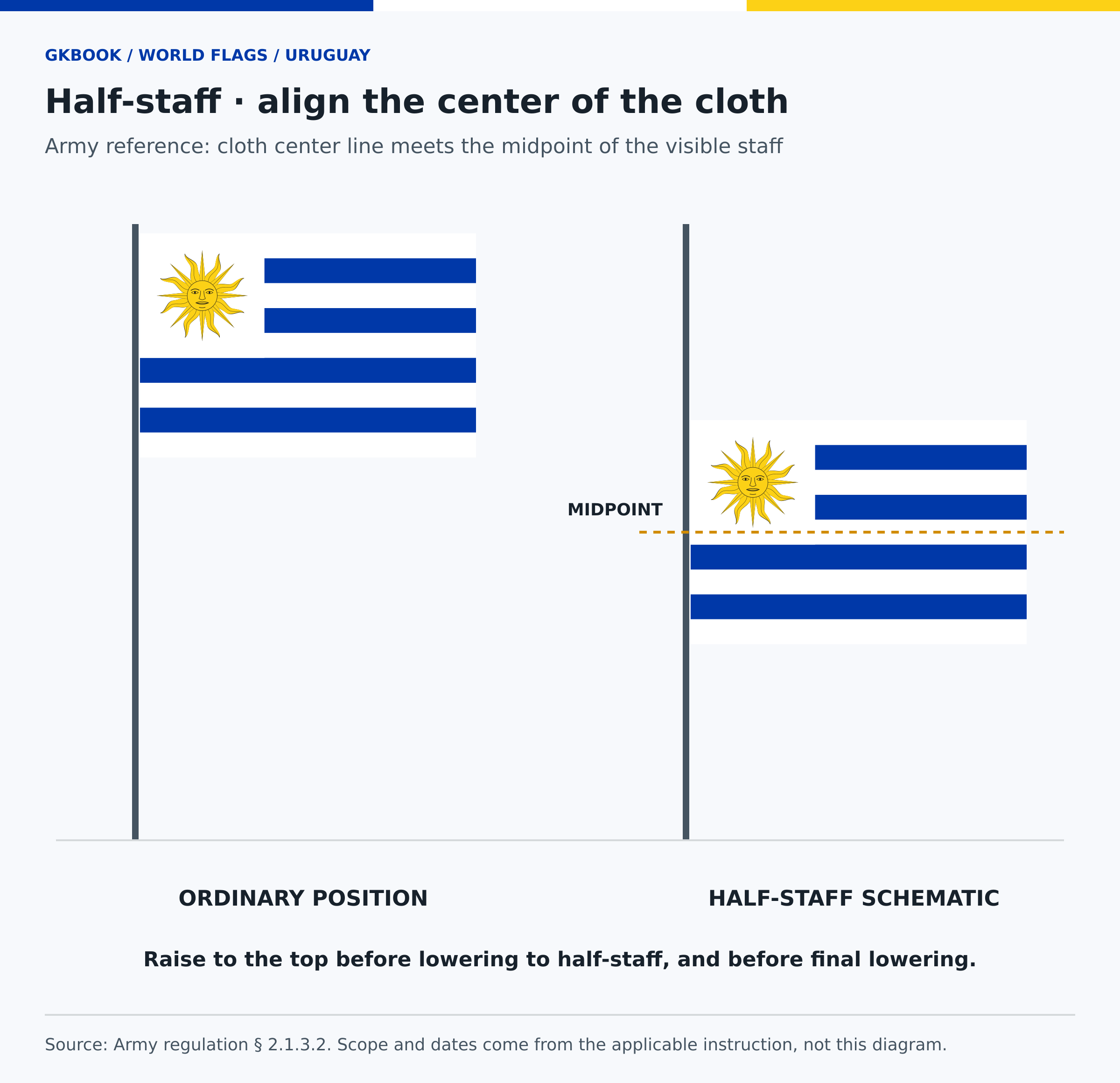
The Army ceremonial rule places the middle line of the cloth at the midpoint of the visible staff. The flag is first raised to the top before being lowered, and returned to the top before final lowering. Follow the responsible authority’s mourning instruction; this diagram explains a specified military convention, not an active national mourning order.
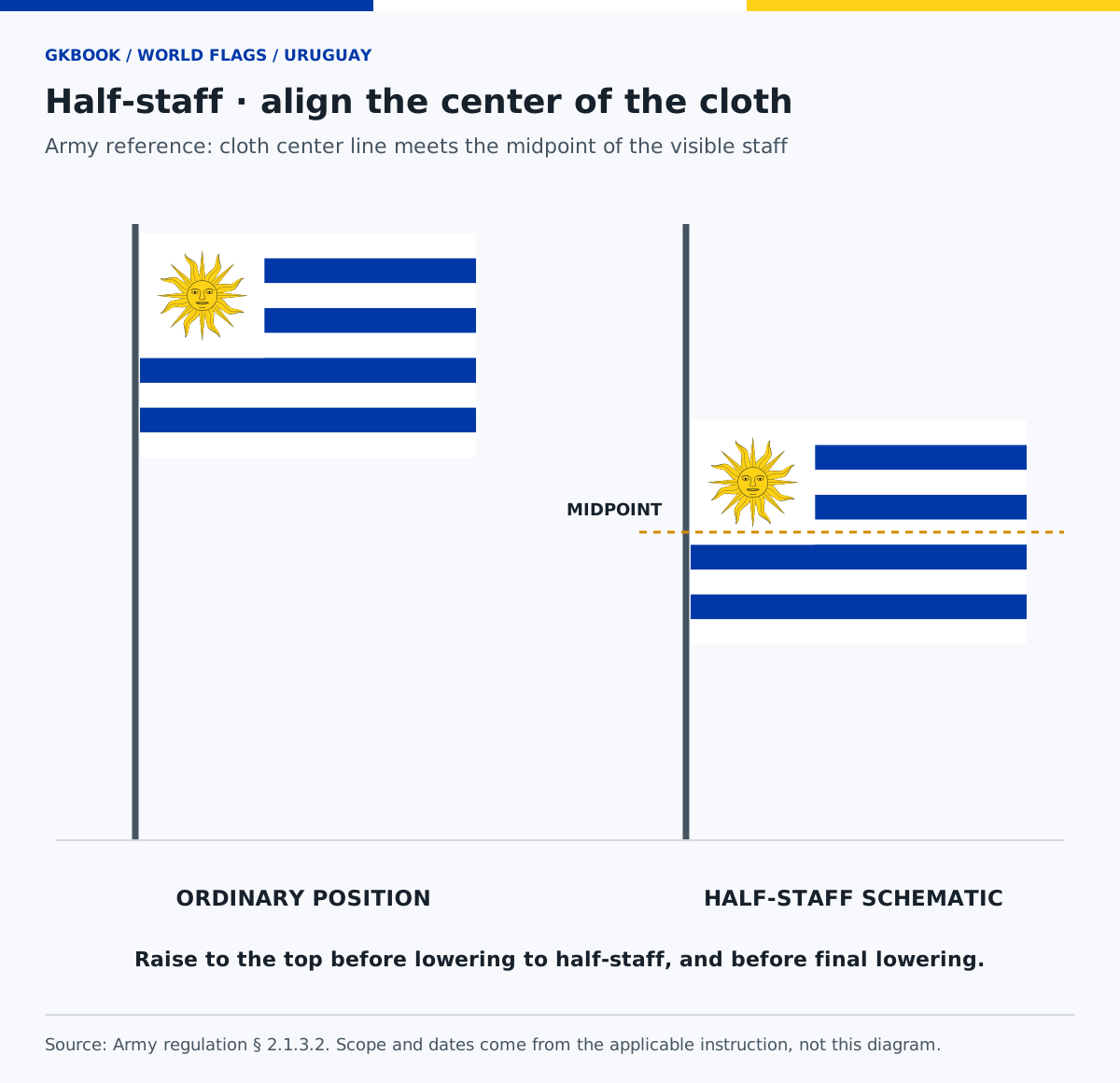
Measuring the center of the cloth differs from simply placing its top edge halfway down the pole. The graphic marks both the staff midpoint and the flag’s center line, keeping the complete national flag visible. This makes the chosen reference clear and avoids borrowing another country’s approximate half-mast convention without checking it.
The same Army text gives precedence to full-height display on patriotic dates and describes resuming an ordered mourning position afterward. The general page does not decide how a future decree applies to every building. Confirm the dates, institutions covered, and responsible instructions for an actual ceremony or period of mourning.
Sources: Army ceremonial and protocol regulation — Decree 339/003 · Presidency — National mourning notice, May 2025
How should Uruguay’s flag be handled and cared for?
Keep the flag clean, complete, and protected from dragging or damage, and use the applicable institutional procedure for raising, lowering, folding, and retirement. Uruguay’s Army regulations provide detailed handling instructions, while historically significant flags may require preservation. An ordinary worn flag and a museum object should not automatically receive the same treatment.
For Army establishments, the cited regulation describes daytime flying, exceptions when severe weather threatens the cloth, and folding lengthwise before successive triangular folds from the fly end. These details belong to that service’s procedure. They should not be transformed into a claim that Uruguay has adopted another country’s familiar flag-folding ritual unchanged.
The 1952 framework provides for preserving flags of historical significance, and the Army distinguishes retired ceremonial colors from ordinary replacement flags. Seek the responsible institution’s advice before discarding a historic or formally presented textile. For ordinary care, suitable cleaning, dry storage, sound attachments, and avoiding contact with the ground help preserve both appearance and usable life.
Sources: Army ceremonial and protocol regulation — Decree 339/003 · Maldonado official digest — National-symbol provisions of 1952
How does Uruguay’s flag differ from Argentina’s and Greece’s?
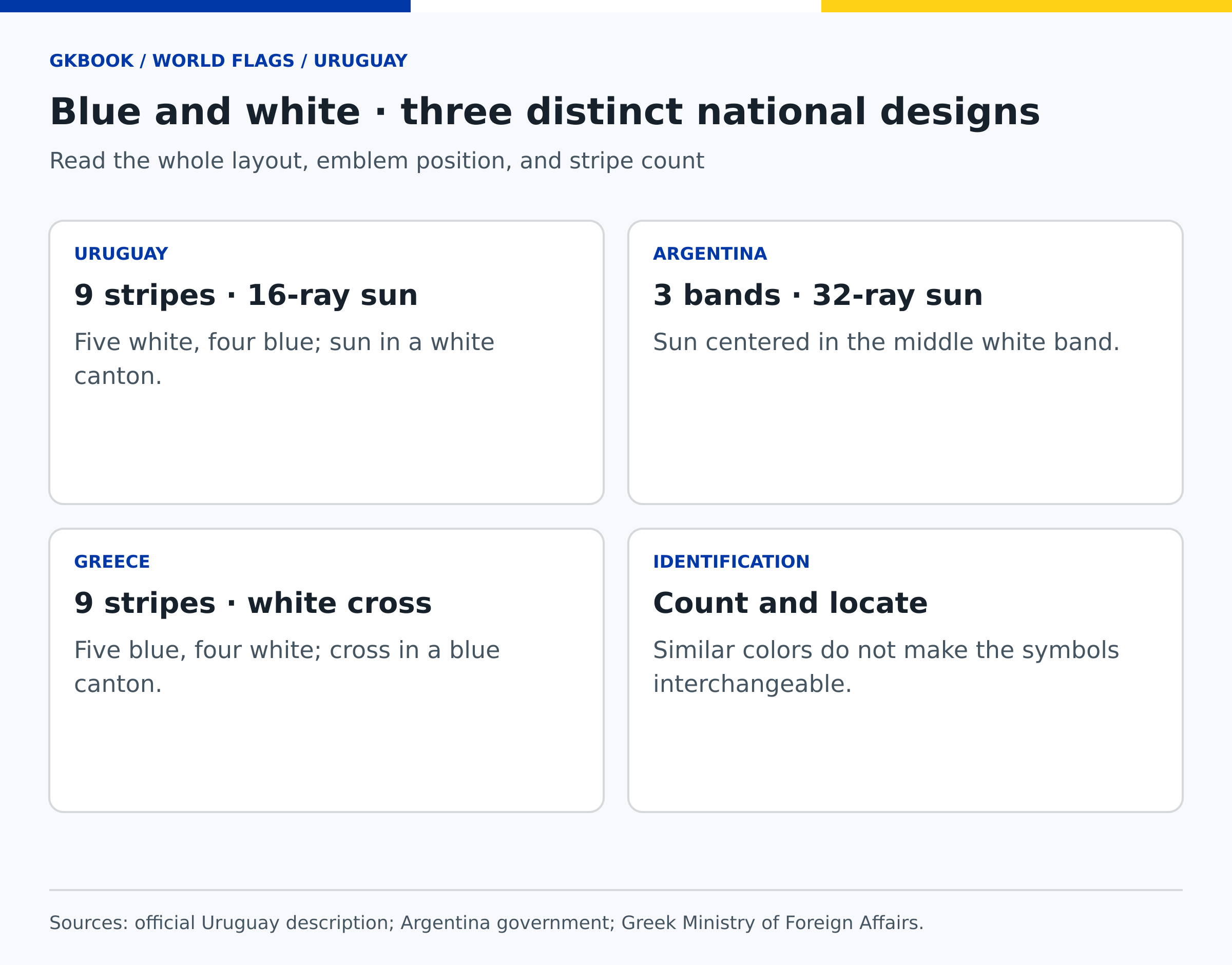
Uruguay has nine stripes beginning and ending in white, plus a sixteen-ray sun in a white canton. Argentina has three bands and a thirty-two-ray sun in the central white band. Greece has nine stripes beginning and ending in blue, with a white cross in a blue canton. The similar colors do not make these designs interchangeable.
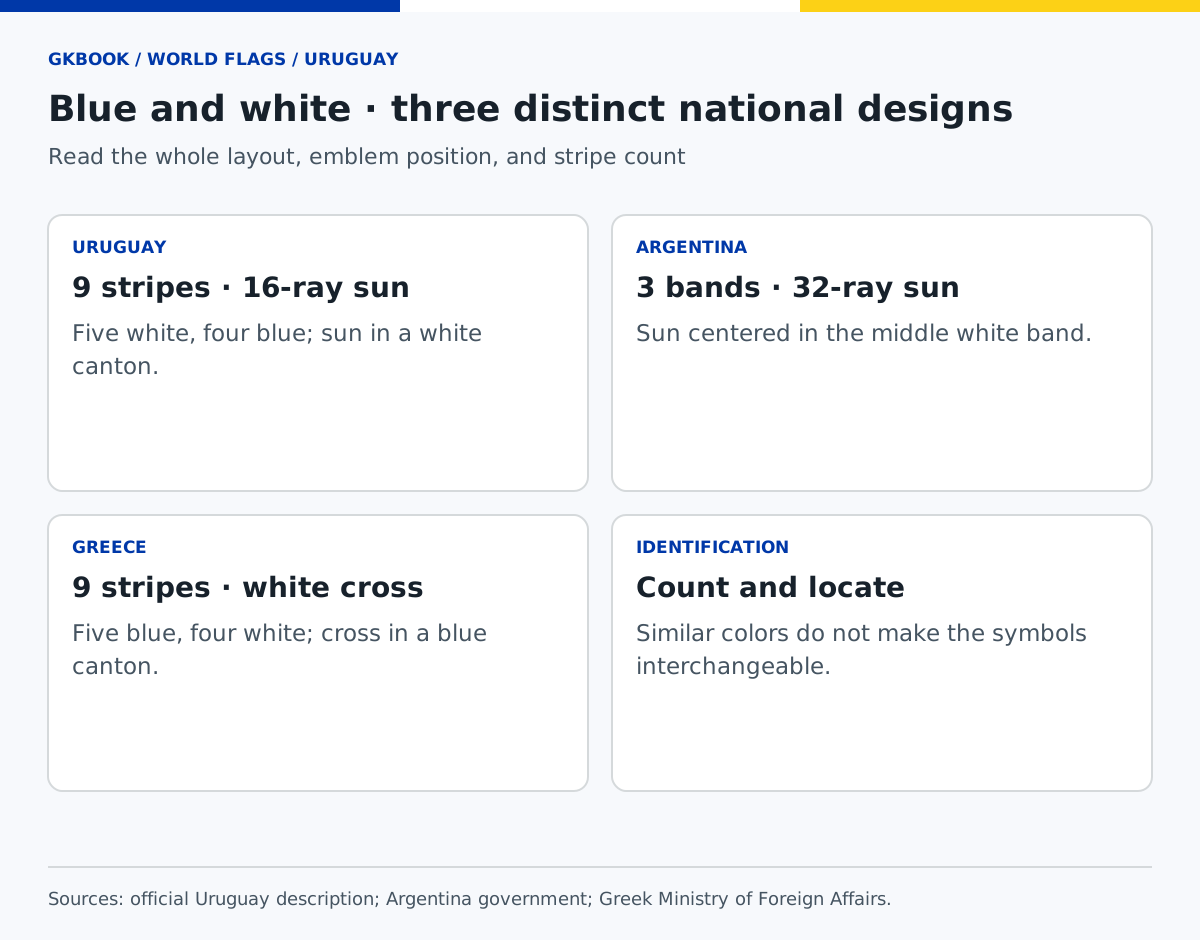
The sun’s position and ray count distinguish Uruguay from Argentina even when an image is too small to judge the precise shade of blue. Uruguay’s emblem belongs in the upper-hoist square, while Argentina’s is centered across the flag. Copying an Argentine sun into a Uruguayan layout doubles the required ray count.
Greece provides a different counting comparison: it also has nine stripes, but five are blue and four white, the reverse of Uruguay’s totals. Its canton carries a cross instead of a sun. The graphic gives identifying features rather than manufacturing patterns for either comparison country, whose governments publish their own national specifications.
| Country | Stripes | Canton or emblem |
|---|---|---|
| Uruguay | 5 white + 4 blue | Gold 16-ray sun in white upper-hoist square |
| Argentina | 3 broad bands | Gold 32-ray sun centered in white band |
| Greece | 5 blue + 4 white | White cross in blue upper-hoist canton |
Sources: Uruguay Embassy in Argentina — Pabellón Nacional · Government of Argentina — National flag · Greek Ministry of Foreign Affairs — State symbols
Which Uruguay flag image should I download or print?
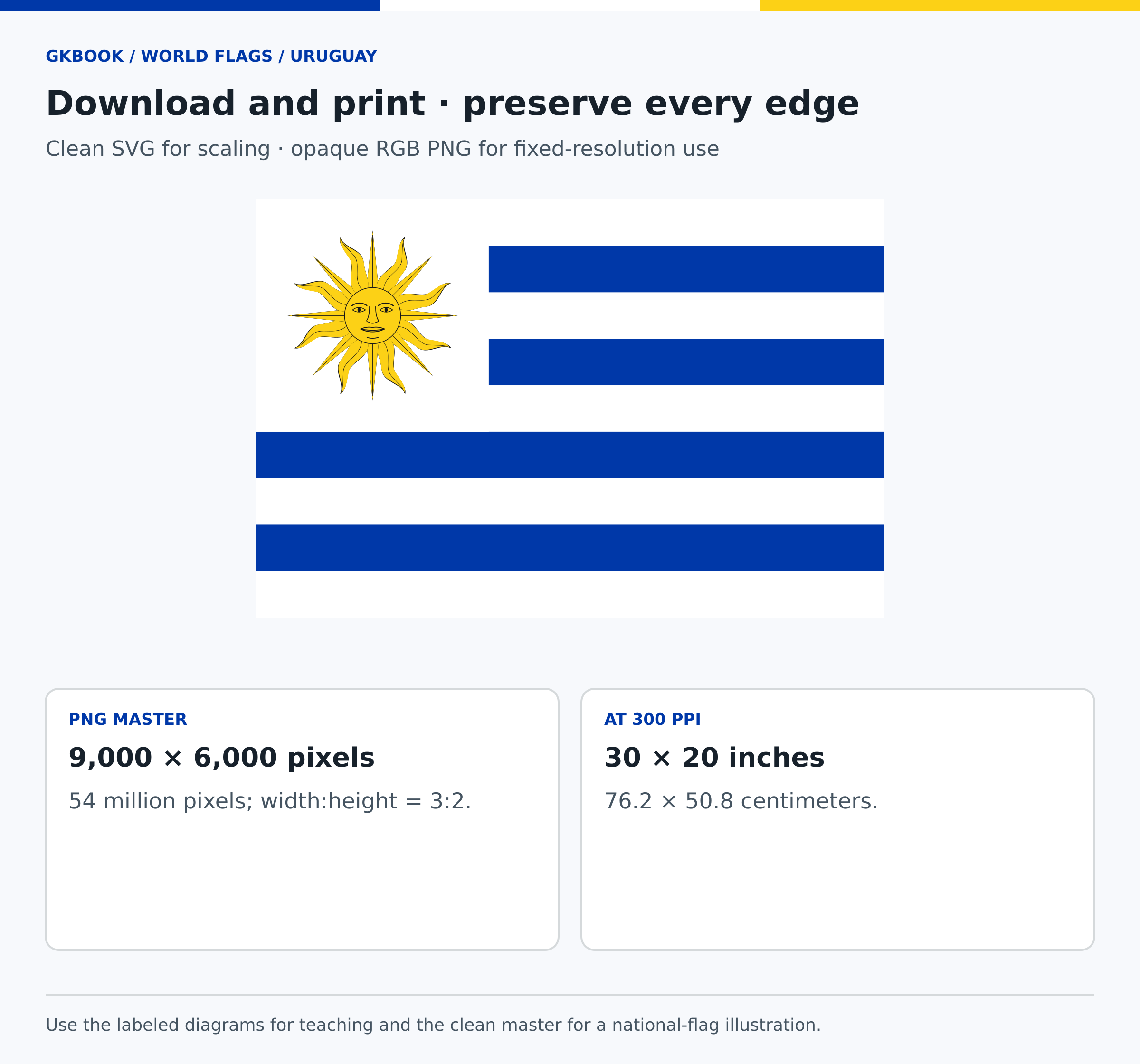
Use the clean SVG for scalable vector artwork or the opaque 9,000-by-6,000 PNG for a fixed-resolution image. Both preserve the 2:3 height-to-length ratio, nine stripes, and complete sixteen-ray sun. At 300 pixels per inch, the PNG measures 30 by 20 inches, or 76.2 by 50.8 centimeters.

The PNG contains 54 million pixels. That size supports detailed reproduction of the face and rays, but the appropriate print resolution still depends on the material, process, and viewing distance. The SVG can be scaled without a fixed pixel limit, provided its aspect ratio and complete rectangular boundary remain intact.
Choose the unannotated master for a national-flag illustration and the labeled graphics for lessons or reference material. Keep captions and logos outside the cloth. For an official physical flag, agree on the approved pattern, materials, dimensions, and color proof with the responsible supplier; this package supplies documented educational artwork rather than certification of a finished textile.
Sources: Drawing method and calculations · Uruguay Embassy in Argentina — Pabellón Nacional · Maldonado official digest — National-symbol provisions of 1952
Sources and research notes
This article draws on Uruguay’s legal records, official embassy descriptions, ANEP historical resources, government archives, and state and Army ceremonial guidance. Links accompany each answer. The source bibliography and image credits document retrieval limits, historical discrepancies, and the artwork’s reference choices.
December 18 National Flag Day is distinguished from June 19 oath ceremonies. The stripe-reform date follows the legal references, and the earlier nine blue bands are distinguished from today’s nine total stripes. The original illustrations preserve the measured layout while identifying their digital palette and detailed drawing choices.
Download Uruguay flag pictures
Download the complete national flag as scalable SVG or 9,000 × 6,000 PNG. Both preserve the 2:3 height-to-length ratio, nine equal stripes, and complete sixteen-ray sun with its face.
The gallery includes 24 subjects, each available as SVG and PNG, including reference drawings of the Artigas and Thirty-Three flags. A separate 1,200 × 630 social-sharing card places a complete flag beside its title. Use the clean master for national-flag illustrations and the annotated graphics for teaching. The construction guide explains the measured layout.
Continue exploring national designs in World Flags.
World Flags/Uruguay
Uruguay flag pictures
Complete national flag with nine stripes and a sixteen-ray figured sun. Original reference artwork based on the cited dimensions and published appearance.
Original GKBook vector artwork; proportions: Uruguay national-symbol specifications and official embassy description; digital palette is an identified editorial choice.Download SVGDownload PNGBlue #0038A8, white #FFFFFF and gold #FCD116 are used consistently. Dark linework articulates the face and rays.
Original GKBook vector artwork; proportions: Uruguay national-symbol specifications and official embassy description; digital palette is an identified editorial choice.Download SVGDownload PNGThe nine stripes do not count today’s nineteen departments. Informal color virtues are distinguished from the legal description.
Original GKBook vector artwork; proportions: Uruguay national-symbol specifications and official embassy description; digital palette is an identified editorial choice.Download SVGDownload PNGThe canton covers the hoist-side portions of the upper five levels; all nine stripes remain visible at the fly.
Original GKBook vector artwork; proportions: Uruguay national-symbol specifications and official embassy description; digital palette is an identified editorial choice.Download SVGDownload PNGThe flag preserves the founding count even though Uruguay now has nineteen departments.
Original GKBook vector artwork; proportions: Uruguay national-symbol specifications and official embassy description; digital palette is an identified editorial choice.Download SVGDownload PNGThe enlarged emblem is a separate detail. The complete flag above shows its correct position and relative size.
Original GKBook vector artwork; proportions: Uruguay national-symbol specifications and official embassy description; digital palette is an identified editorial choice.Download SVGDownload PNGNumbers are outside the emblem. Dark interior strokes do not count as extra rays.
Original GKBook vector artwork; proportions: Uruguay national-symbol specifications and official embassy description; digital palette is an identified editorial choice.Download SVGDownload PNGThe white square ends before stripe six. Extending it through that stripe would change the design.
Original GKBook vector artwork; proportions: Uruguay national-symbol specifications and official embassy description; digital palette is an identified editorial choice.Download SVGDownload PNGA square canton and circular sun depend on uniform scaling. The whole flag remains visible.
Original GKBook vector artwork; proportions: Uruguay national-symbol specifications and official embassy description; digital palette is an identified editorial choice.Download SVGDownload PNGThe principal layout follows the published national proportions. Face contours and curved ray paths are original drawing choices.
Original GKBook vector artwork; proportions: Uruguay national-symbol specifications and official embassy description; digital palette is an identified editorial choice.Download SVGDownload PNGThis timeline does not claim that the exact modern sun appeared unchanged on every early textile.
Original GKBook vector artwork; proportions: Uruguay national-symbol specifications and official embassy description; digital palette is an identified editorial choice.Download SVGDownload PNGJuly 12 is the cited reform-law date; July 18 is the oath of the first Constitution. Those are different events.
Original GKBook vector artwork; proportions: Uruguay national-symbol specifications and official embassy description; digital palette is an identified editorial choice.Download SVGDownload PNGJune 19 is important in the flag tradition, but Law 17,884 names December 18 as National Flag Day.
Original GKBook vector artwork; proportions: Uruguay national-symbol specifications and official embassy description; digital palette is an identified editorial choice.Download SVGDownload PNGAll three complete layouts are shown. They are not interchangeable color variants of a single national flag.
Original GKBook vector artwork; proportions: Uruguay national-symbol specifications and official embassy description; digital palette is an identified editorial choice.Download SVGDownload PNGThe reference uses three equal horizontal bands and a red diagonal of the same perpendicular width. It contains no sun.
Original GKBook vector artwork; proportions: Uruguay national-symbol specifications and official embassy description; digital palette is an identified editorial choice.Download SVGDownload PNGThe inscription is a defining part of the reference. The drawing is not a replica of a specific 1825 textile.
Original GKBook vector artwork; proportions: Uruguay national-symbol specifications and official embassy description; digital palette is an identified editorial choice.Download SVGDownload PNGThe article distinguishes a reference drawing from an authenticated official pattern and a study from an enacted redesign.
Original GKBook vector artwork; proportions: Uruguay national-symbol specifications and official embassy description; digital palette is an identified editorial choice.Download SVGDownload PNGThe inverted example keeps the hoist on the left and reflects the whole flag from top to bottom.
Original GKBook vector artwork; proportions: Uruguay national-symbol specifications and official embassy description; digital palette is an identified editorial choice.Download SVGDownload PNGThis is a geometric view through one cloth, not a manufacturing instruction for every official double-faced color.
Original GKBook vector artwork; proportions: Uruguay national-symbol specifications and official embassy description; digital palette is an identified editorial choice.Download SVGDownload PNGThe stripe background has simpler symmetries; the complete faced-sun flag does not share them.
Original GKBook vector artwork; proportions: Uruguay national-symbol specifications and official embassy description; digital palette is an identified editorial choice.Download SVGDownload PNGThe national flag is distinguished by height. A forward position is another option in the state manual; this figure chooses one clear arrangement.
Original GKBook vector artwork; proportions: Uruguay national-symbol specifications and official embassy description; digital palette is an identified editorial choice.Download SVGDownload PNGThe visible staff runs from y=240 to y=900; its midpoint is y=570. The lowered flag’s center line is also y=570.
Original GKBook vector artwork; proportions: Uruguay national-symbol specifications and official embassy description; digital palette is an identified editorial choice.Download SVGDownload PNGThese are identification notes, not new manufacturing specifications for Argentina or Greece.
Original GKBook vector artwork; proportions: Uruguay national-symbol specifications and official embassy description; digital palette is an identified editorial choice.Download SVGDownload PNGPrint dimensions follow from the pixel count and selected sampling density. The complete sun, canton, and stripes remain visible.
Original GKBook vector artwork; proportions: Uruguay national-symbol specifications and official embassy description; digital palette is an identified editorial choice.Download SVGDownload PNGFrequently asked questions
What does the Uruguay flag look like?
Uruguay’s flag has nine horizontal stripes, five white and four blue, with a gold Sun of May in a white upper-hoist square. The sun has a human face and sixteen alternating straight and wavy rays. The current stripe arrangement dates to July 1830, and the flag’s height-to-length ratio is 2:3.
What is the national flag of Uruguay called?
Uruguay’s national flag is called the Pabellón Nacional or Bandera Nacional. It has nine blue and white stripes and a golden, human-faced sun in a white canton. It is the principal national flag; the flags of Artigas and the Thirty-Three Orientals are separate national symbols with their own designs.
What are Uruguay’s flag colors and HEX codes?
The specified colors are blue and white, with a gold sun. This edition uses #0038A8, #FFFFFF, and #FCD116, plus dark facial outlines. These are declared digital drawing choices, not HEX codes enacted by Uruguay. A 1996 Interior Ministry resolution explicitly rejected substituting sky blue for the national flag’s blue.
What does the Uruguay flag symbolize?
The nine stripes recall Uruguay’s nine original departments, and the Sun of May is associated with liberty and independence. The blue-and-white design belongs to the history of the Río de la Plata region. Popular explanations of individual color virtues should be distinguished from the legal description, which primarily specifies the flag’s visible form.
How many stripes does Uruguay’s flag have?
There are nine equal horizontal stripes: five white and four blue. White appears at both the top and bottom. The white canton covers the hoist-side portions of the upper five stripe levels. Count the bands at the fly, the free outer edge, where all nine levels remain visible.
Which nine departments are represented by the stripes?
The original nine were Montevideo, Canelones, San José, Colonia, Soriano, Durazno, Maldonado, Cerro Largo, and Paysandú. Their historic boundaries differed from today’s departments. The stripes commemorate that early territorial organization collectively; the design does not label individual bands with department names or add a stripe whenever a new department is created.
What is the Sun of May on Uruguay’s flag?
The Sun of May is the gold, human-faced solar emblem in the white upper-hoist canton. Uruguay’s version has sixteen rays. Official explanations associate it with liberty and independence, within the wider Río de la Plata tradition. Its position, face, and ray count distinguish it from a generic sun icon or Argentina’s thirty-two-ray emblem.
How many rays does Uruguay’s sun have?
The sun has sixteen rays, alternating eight straight spear-shaped rays with eight wavy, flame-like rays. The two types alternate all the way around the disc. Count outward rays, not the dark lines within them. A thirty-two-ray sun belongs to Argentina’s specification and should not be substituted for Uruguay’s national emblem.
Why does the sun on Uruguay’s flag have a face?
The human face is part of the prescribed figured sun: the 1952 description calls for a radiant circle with a face and sixteen rays. It is an emblematic face, not an identified portrait of a president or national hero. Omitting the eyes, nose, and mouth produces an incomplete reference drawing.
How large is the white canton on Uruguay’s flag?
The canton is a square at the upper hoist, with each side equal to five ninths of the flag’s height. It ends just above the sixth stripe, which is blue. The sun is centered in that square, and its overall diameter, including the rays, is eleven fifteenths of the canton’s side.
What is the official ratio of Uruguay’s flag?
The flag’s length-to-height ratio is three to two, conventionally written as a height-to-length ratio of 2:3. The clean PNG is 9,000 pixels wide and 6,000 high. Its canton remains square and its sun circular; stretching the artwork unevenly would distort both elements and change the specified proportions.
How do you draw Uruguay’s flag accurately?
Use a 1,350-by-900 rectangle with nine 100-unit stripes, beginning and ending in white. Add a 500-unit white square at the upper hoist. Center a sixteen-ray, human-faced gold sun in it, with an overall diameter of 366⅔ units. Alternate eight straight rays and eight wavy rays around the disc.
What did Uruguay’s first national flag look like?
The first national flag created in December 1828 had nine blue bands on a white field, with a sun in a white square next to the hoist. That is different from today’s nine total stripes. In July 1830 the number of blue bands was reduced to four, leaving five white stripes between and around them.
How has the Uruguay flag changed over time?
The first flag of December 1828 used nine blue bands. The July 1830 reform reduced them to four, producing the familiar nine-stripe arrangement. Later standardization clarified the sun and proportions. ANEP’s historical account places the familiar alternating straight and wavy rays around 1930, while the 1952 decree set out the detailed national-symbol description.
When was Uruguay’s current flag adopted?
The current four-blue-band arrangement is associated with the law of July 12, 1830, as cited in official national-symbol guidance and the Interior Ministry’s 1996 resolution. The first flag dates to December 1828. The detailed 1952 specifications are a later standardization, so those dates answer different questions about the flag’s development.
Who designed Uruguay’s flag?
Joaquín Suárez is closely associated with the initiative for the first national flag in 1828. Official historical accounts connect its early making with María Josefa Álamo de Suárez, sometimes explicitly as a tradition. The current flag also reflects legislative changes and later standardization, so attributing every modern detail to one original designer oversimplifies the evidence.
When is Uruguay’s National Flag Day?
Uruguay’s legally designated National Flag Day is December 18. Law 17,884, promulgated in 2005, establishes that date. June 19 is associated with Artigas’s birthday and the annual oath of allegiance to the flag. The two observances are related to national identity but should not be merged into a single statutory Flag Day.
What is Uruguay’s oath of allegiance to the flag?
The Juramento de Fidelidad a la Bandera is a solemn public oath associated with June 19. Article 28 of Law 9,943 establishes the obligation for natural and legal citizens. Educational, military, and consular authorities administer it in their respective settings; registration details and documentation should be checked with the institution organizing the ceremony.
Does Uruguay have three national flags?
Uruguay recognizes the Pabellón Nacional, the flag of Artigas, and the flag of the Thirty-Three Orientals among its national symbols. They are three distinct flags with different designs and historical associations. The Pabellón Nacional has higher precedence; describing the country as having three flags should not imply three interchangeable designs of equal ceremonial rank.
What is the flag of Artigas?
The flag of Artigas has three equal horizontal bands of blue, white, and blue, crossed by a red diagonal band running from the upper hoist to the lower fly. It honors José Gervasio Artigas and is a separate national symbol. Its proportions match the Pabellón Nacional, but its design and ceremonial position are distinct.
What is the flag of the Thirty-Three Orientals?
The flag of the Thirty-Three Orientals has three equal horizontal bands: blue above, white in the middle, and red below. The central band bears Libertad o Muerte, meaning Liberty or Death. It commemorates the Thirty-Three and their 1825 campaign, and is a recognized national symbol separate from the striped Pabellón Nacional.
What laws and rules govern Uruguay’s flag?
Uruguay’s flag framework includes the nineteenth-century flag laws, the national-symbol decree of February 18, 1952, later resolutions, and separate state and military ceremonial rules. The Museo Histórico Nacional preserves official patterns. A 2023 decree created a commission to study technical specifications; establishing that commission did not itself replace the flag with a new design.
Which way up should Uruguay’s flag be displayed?
In a conventional horizontal front view, the sun canton is at the upper left, next to the hoist, and the sun’s face is upright. The top and bottom stripes are white. Stripe color alone cannot reveal an upside-down flag, because the stripe sequence has the same colors at both ends.
What does the reverse of Uruguay’s flag look like?
Viewed through a single cloth from behind, the flag appears horizontally mirrored: the sun canton is at the observer’s upper right and the hoist is on the right. This natural reverse is not automatically an upside-down flag. The face and curved ray details mirror with the cloth, while the nine-stripe count remains unchanged.
Is Uruguay’s flag symmetrical?
The complete flag has neither left-right nor top-bottom mirror symmetry, and rotating it through 180 degrees does not reproduce the original. Its sun canton occupies only one corner. The alternating stripe background has simpler symmetries, but those do not determine the symmetry of the complete national design with its faced sun.
How are Uruguay’s three patriotic flags arranged?
State ceremonial guidance places the Artigas flag to the national flag’s right and the Thirty-Three flag to its left, with the national flag distinguished by height or forward position. Viewed from the audience, that puts Artigas on the left and the Thirty-Three on the right. The viewpoint must be stated to avoid reversing the arrangement.
How is Uruguay’s flag flown at half-staff?
The Army ceremonial rule places the middle line of the cloth at the midpoint of the visible staff. The flag is first raised to the top before being lowered, and returned to the top before final lowering. Follow the responsible authority’s mourning instruction; this diagram explains a specified military convention, not an active national mourning order.
How should Uruguay’s flag be handled and cared for?
Keep the flag clean, complete, and protected from dragging or damage, and use the applicable institutional procedure for raising, lowering, folding, and retirement. Uruguay’s Army regulations provide detailed handling instructions, while historically significant flags may require preservation. An ordinary worn flag and a museum object should not automatically receive the same treatment.
How does Uruguay’s flag differ from Argentina’s and Greece’s?
Uruguay has nine stripes beginning and ending in white, plus a sixteen-ray sun in a white canton. Argentina has three bands and a thirty-two-ray sun in the central white band. Greece has nine stripes beginning and ending in blue, with a white cross in a blue canton. The similar colors do not make these designs interchangeable.
Which Uruguay flag image should I download or print?
Use the clean SVG for scalable vector artwork or the opaque 9,000-by-6,000 PNG for a fixed-resolution image. Both preserve the 2:3 height-to-length ratio, nine stripes, and complete sixteen-ray sun. At 300 pixels per inch, the PNG measures 30 by 20 inches, or 76.2 by 50.8 centimeters.
Every general-knowledge topic and the A-to-Z lists.
The world A to Z: flags, countries, the sciences, places, people, subjects.







We Value Your Opinion Comments